
By Charles Pekow — If prices of cycles and related gear are going up, blame the on-again, off-again tariffs. And you can expect prices to keep rising. It’s too early to say how much, as the results haven’t fully materialized yet and President Donald Trump is constantly changing his policy and tariff threats. “We have not felt the full effects yet,” says Chris Bell, director of federal policy for People for Bikes (PFB). “It’s too early to say if people are buying fewer bicycles… The supply chain can’t react immediately.”
And while the Trump Administration is constantly changing the terms of the tariffs and announcing new trade deals, the trade barriers are already disrupting the bicycle industry, says Patrick Cunnane, advisor to Hyper Bike Co, which manufactures everything from e-bikes to mountain bikes to children’s bicycles from its New Jersey base.
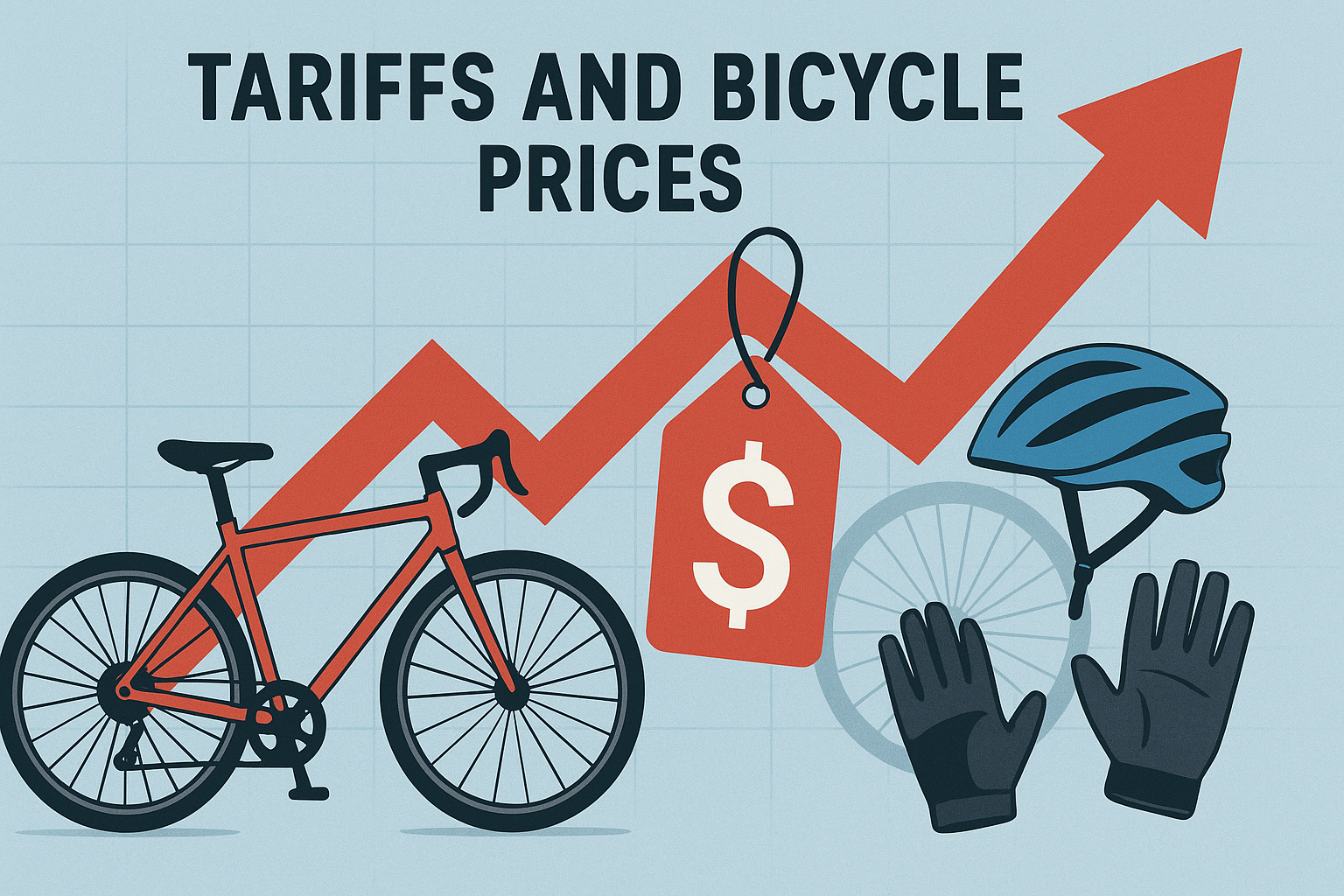 While the new tariffs are making matters worse, they weren’t the first to cause price increases, Cunnane notes. He said that prices have gone up since Section 301 tariffs were more quietly imposed during the first Trump Administration. But prices of bicycles and parts are now anywhere from 10 percent to 45 percent higher than a year ago, thanks to the more recent import taxes, he said in an interview. Most bicycles sold in chain stores like Walmart and Target are still made in China. Only about three percent of bicycles sold in the United States are built domestically. American manufacturers tend to specialize in niche and more expensive cycles, such as those made from carbon and titanium, or tandems.
Several other manufacturers, dealers and importers of bicycles and parts—including Shimano, Target, and Borealis Fat Bikes—did not respond to inquiries. “I am not the best person for this request at this time and must apologize but am unable to assist,” Heather Mason, executive director of the National Bike Dealers Association, stated in an email.
Those who want to keep bicycles and accessories available and affordable have turned to legislation and litigation. On June 11, the co-chairs of the Congressional Bike Caucus introduced the U.S. Bicycle Production and Assembly Act (H.R. 3904), an effort to encourage domestic bicycle production. The bill would suspend tariffs on parts if used to make bicycles or tricycles in the United States. It would also set goals of assembling 2 million bicycles annually in the U.S. within five years and 5 million bicycles annually within ten years. The U.S. International Trade Commission would have to report on progress. But it offers no enforcement mechanism.
Is the legislation more than show? The bill was referred to the Ways and Means Committee. But when the House adjourned for the summer in late July, no representatives had sponsored the bill other than caucus co-chairs Vern Buchanan (R-FL) and Mike Thompson (D-CA). Nor had the committee acted on it. While Buchanan announced the bill in a press release, Thompson didn’t, though he often issues statements on all sorts of matters.
No companion bill is pending in the Senate either. The offices of Buchanan and Thompson did not respond to queries.
PFB endorsed the legislation, but Bell acknowledges that if it passes, production “is not going to come back immediately.” Cunnane says that “the bill will have a positive impact on prices and will create American jobs.” But it could take years to build factories and shift production to America.
Meanwhile, a manufacturer of women’s cycling clothes and gear has joined one of the lawsuits against the Trump Administration. Terry Precision Cycling, LLC of Burlington, VT is one of five companies represented by the Liberty Justice Center in a case charging that the president lacks the authority to issue the tariffs he did without congressional approval. The case is currently pending before the U.S. Court of Appeals for the Federal Circuit in Washington, DC.
The complaint notes that Terry imports finished products from China, Taiwan, Italy, Vietnam and the Philippines and fabrics and trims from Guatemala, China, El Salvador and the European Union. The filing says “the imports Terry Cycling relies on are not reasonably available from a supplier in the United States.”
It goes on to say the “impacts of the tariffs on Terry Cycling have been severe and escalating. Terry Cycling has already paid $25,000 in unplanned tariffs this year for goods which Terry was the importer of record, and Terry projects that the tariffs will cost the company approximately $250,000 by the end of 2025. Looking ahead to 2026, if no changes are made to current trade policy or its supply chain structure, Terry Cycling will face an estimated $1.2 million in tariff costs—an amount that is simply not survivable for a business of its size. To manage these increases, Terry has been forced to pass along its costs to its customers and will also decrease product offerings and reduce availability to retail partners. In the short run, these tariffs are an existential threat to Terry Cycling.” Terry Acting President Nik Holm did not respond to a request for an interview.


Quite an admission from Terry cycling that they can’t compete and will be going out of business. I won’t be buying any of their product if they won’t be around to stand behind it.
Happy to make an offer for the whole business before you fold it.
Comments are closed.