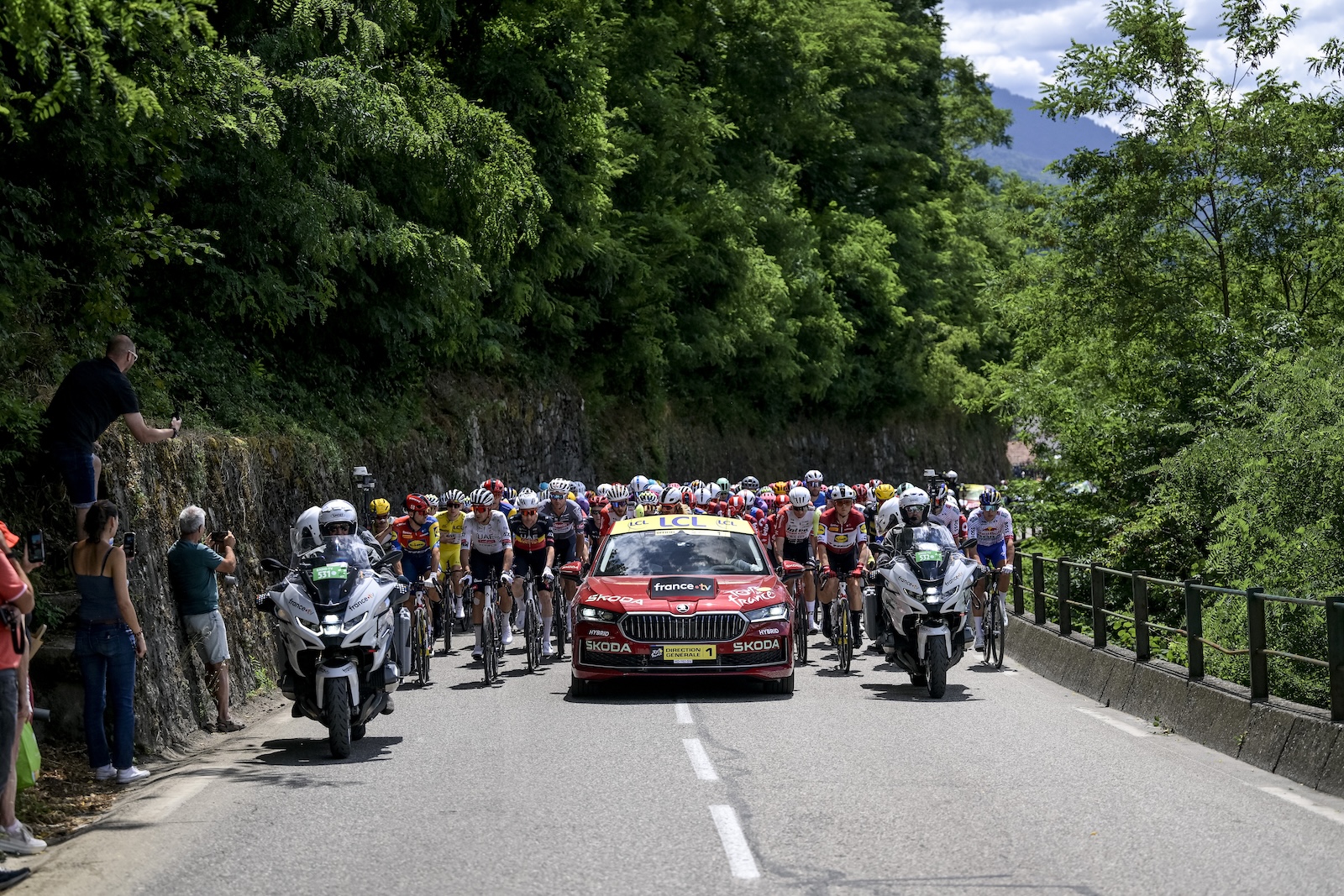
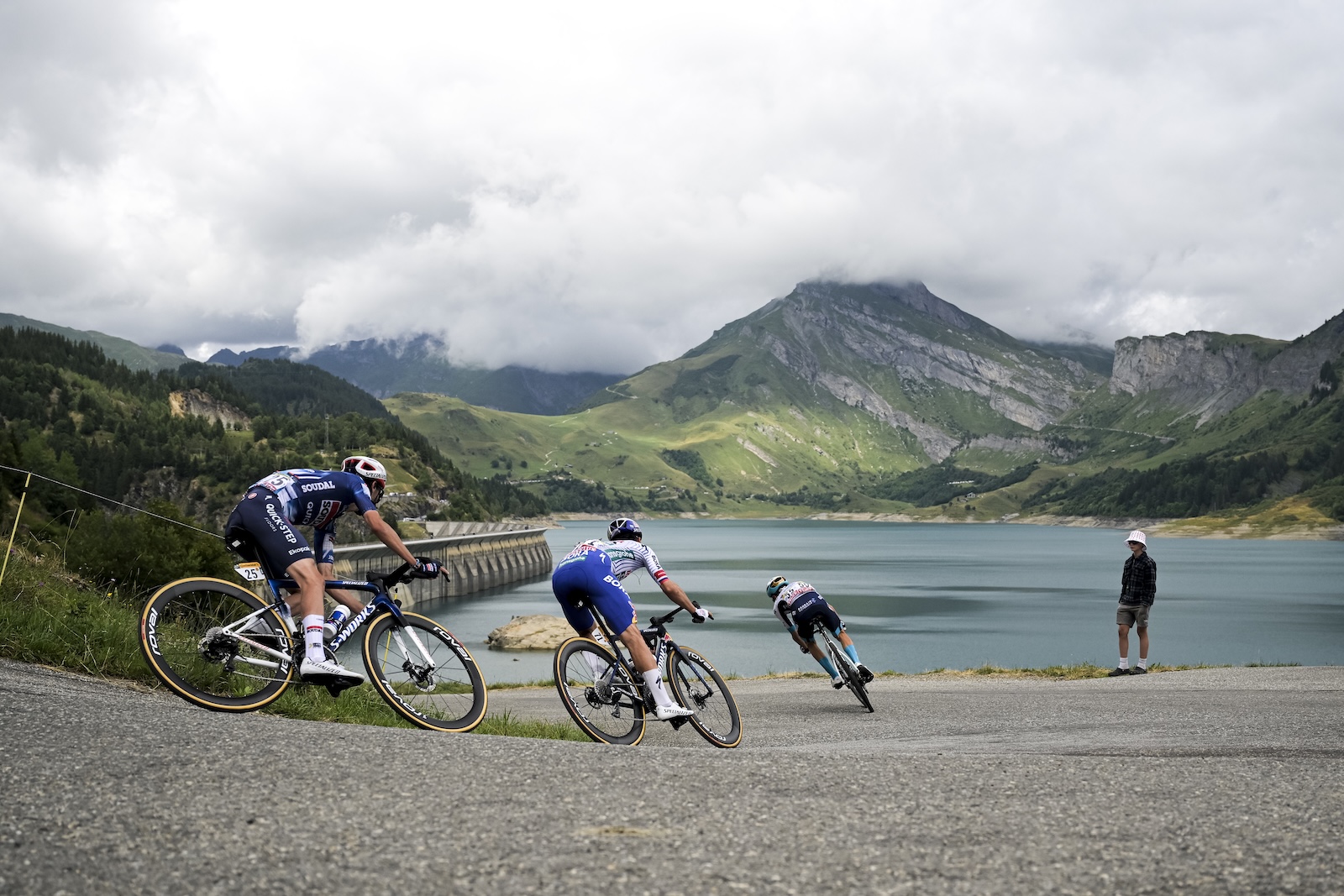
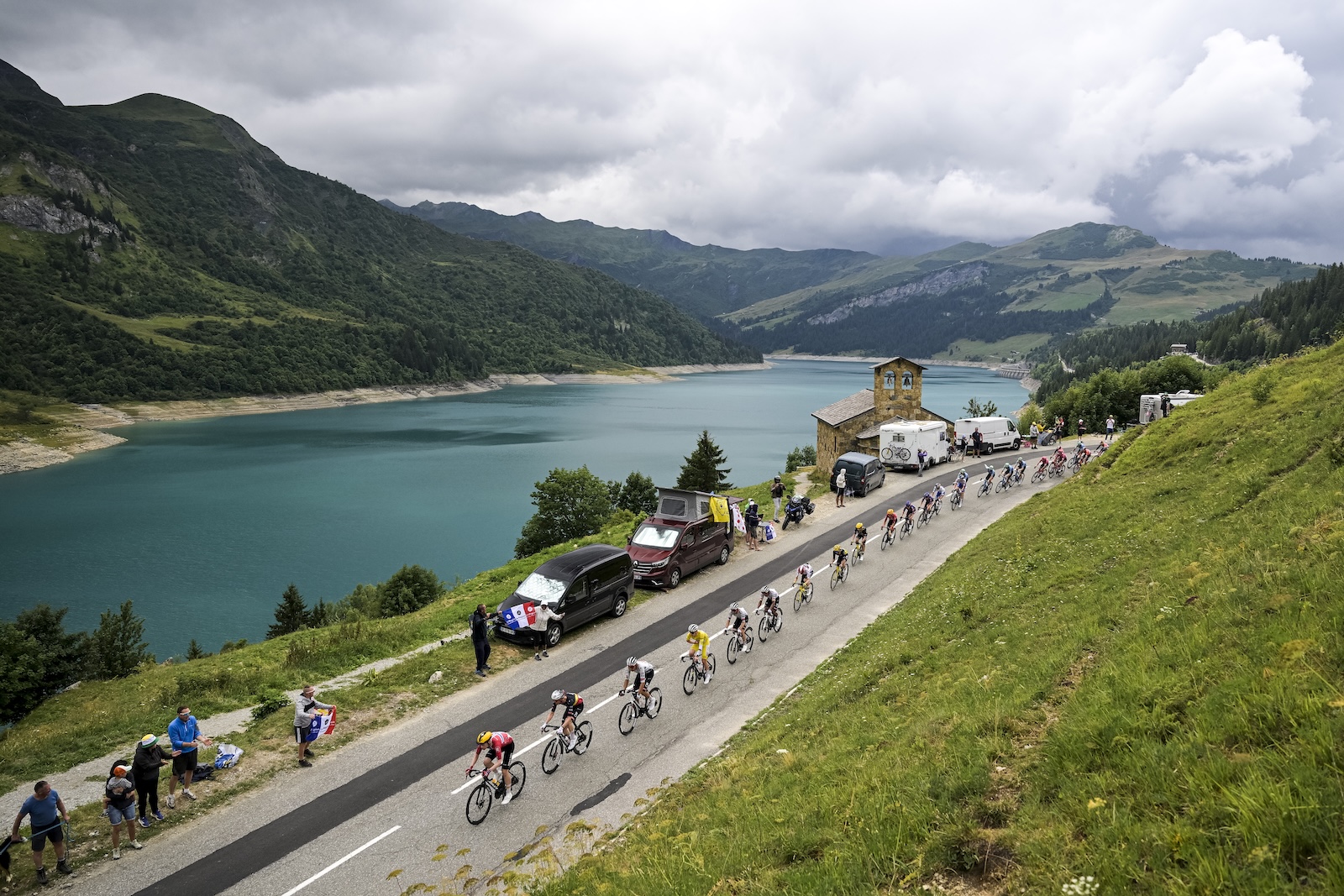
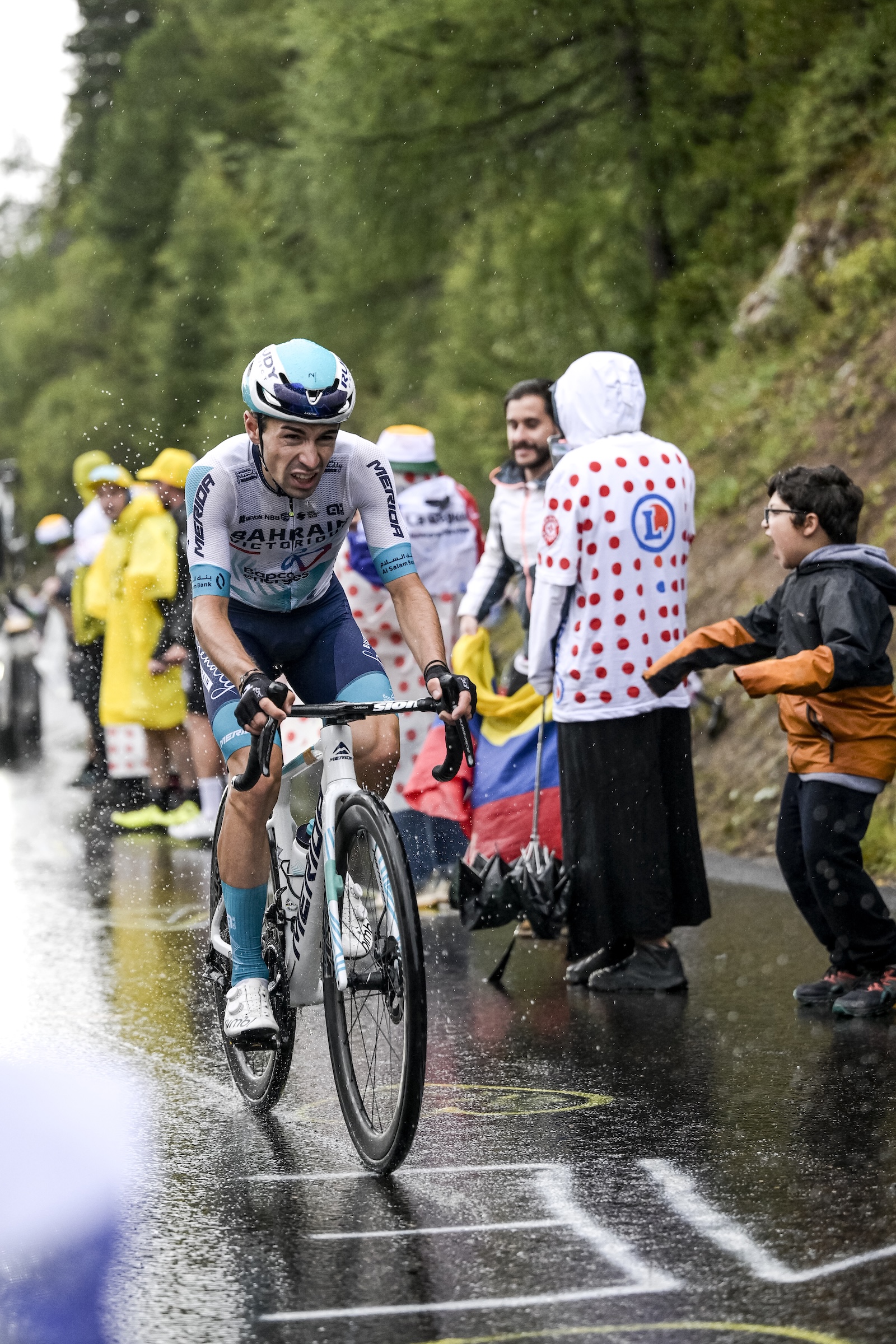
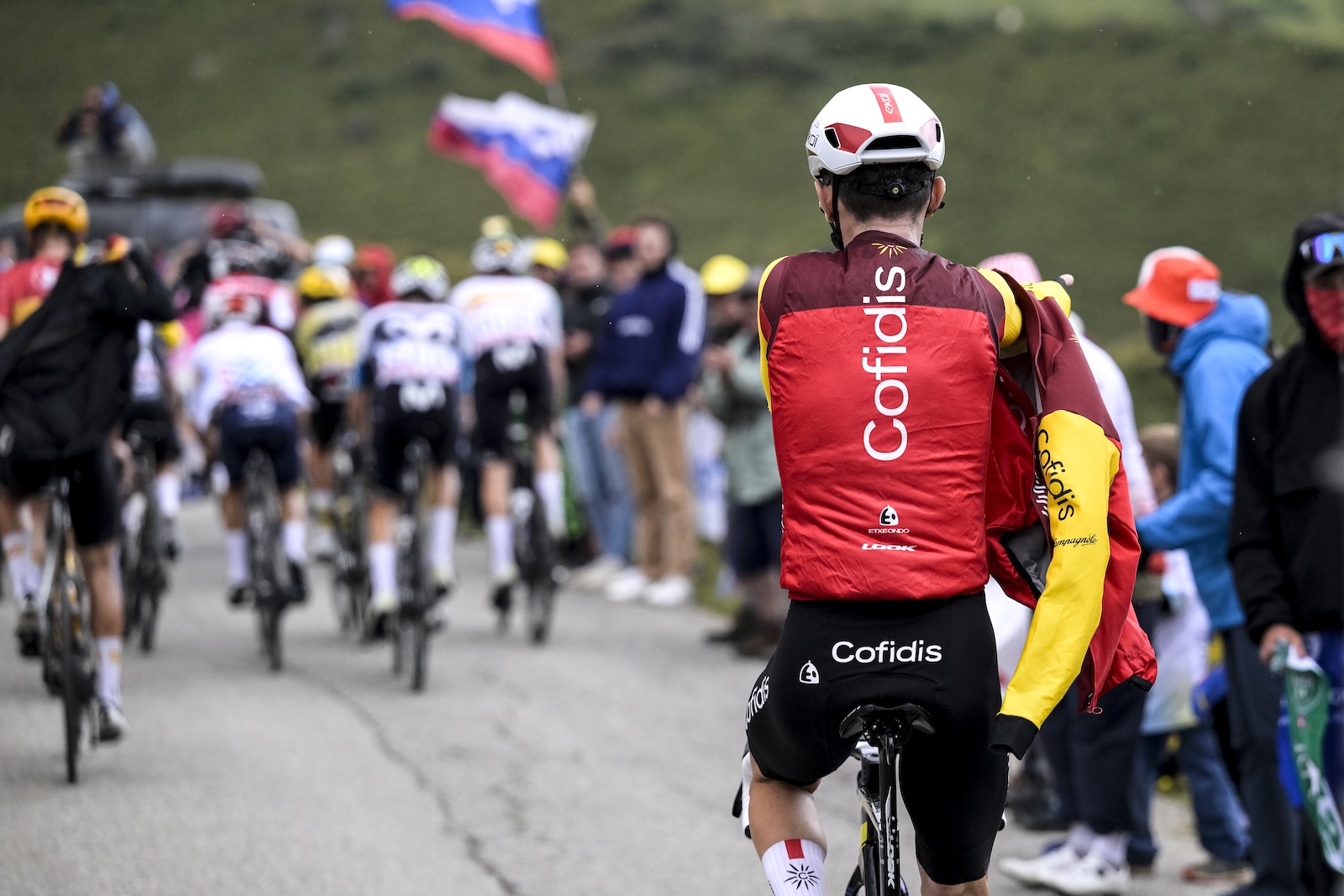
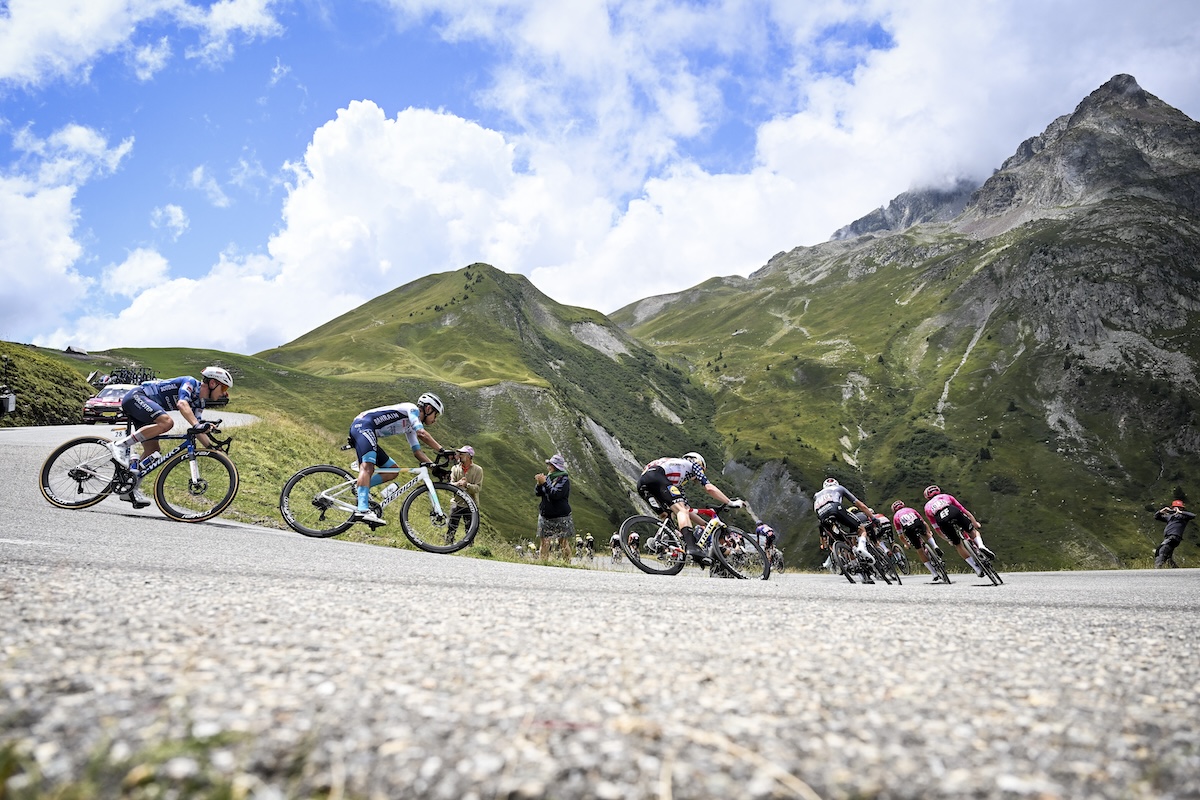
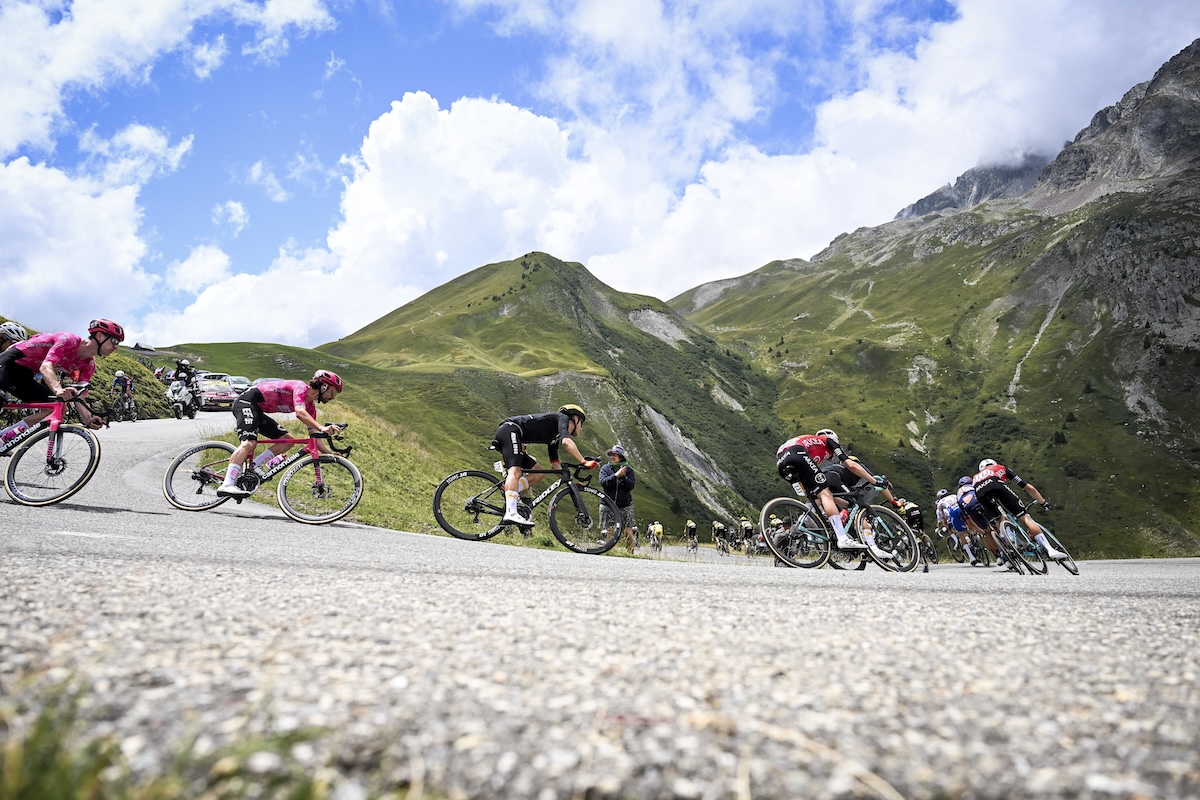
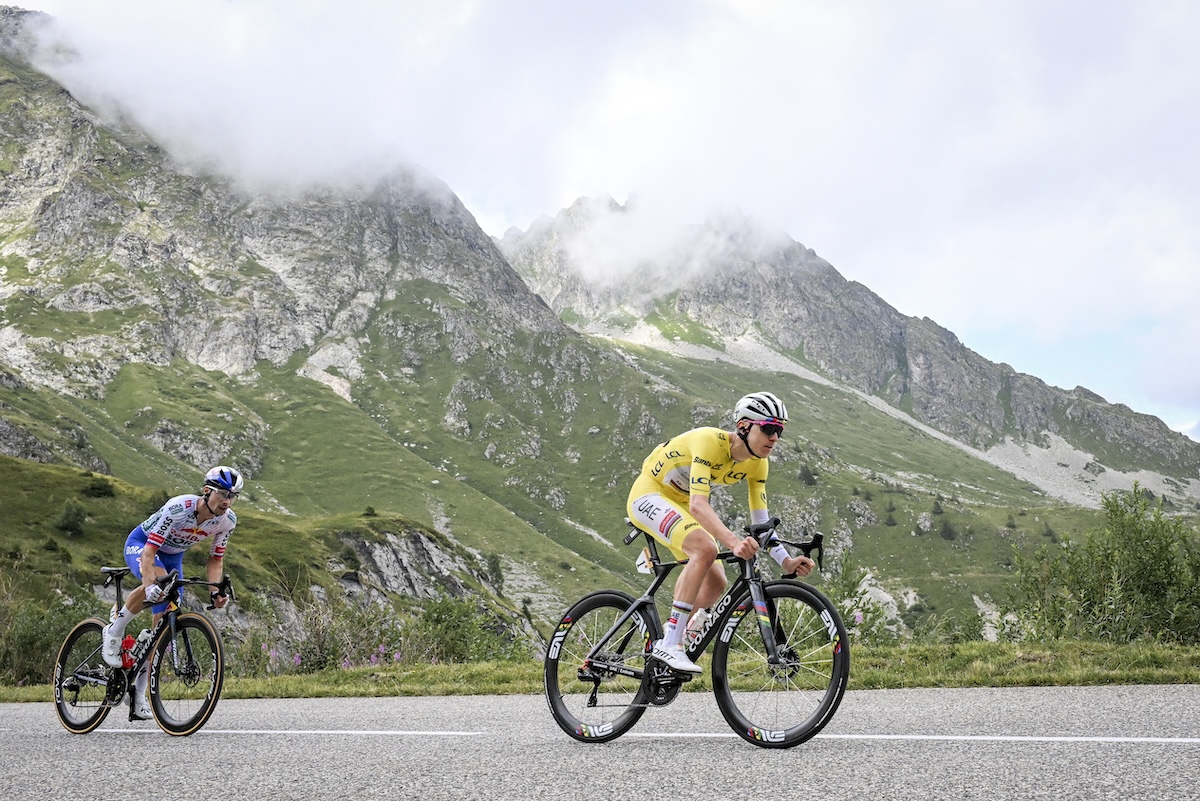
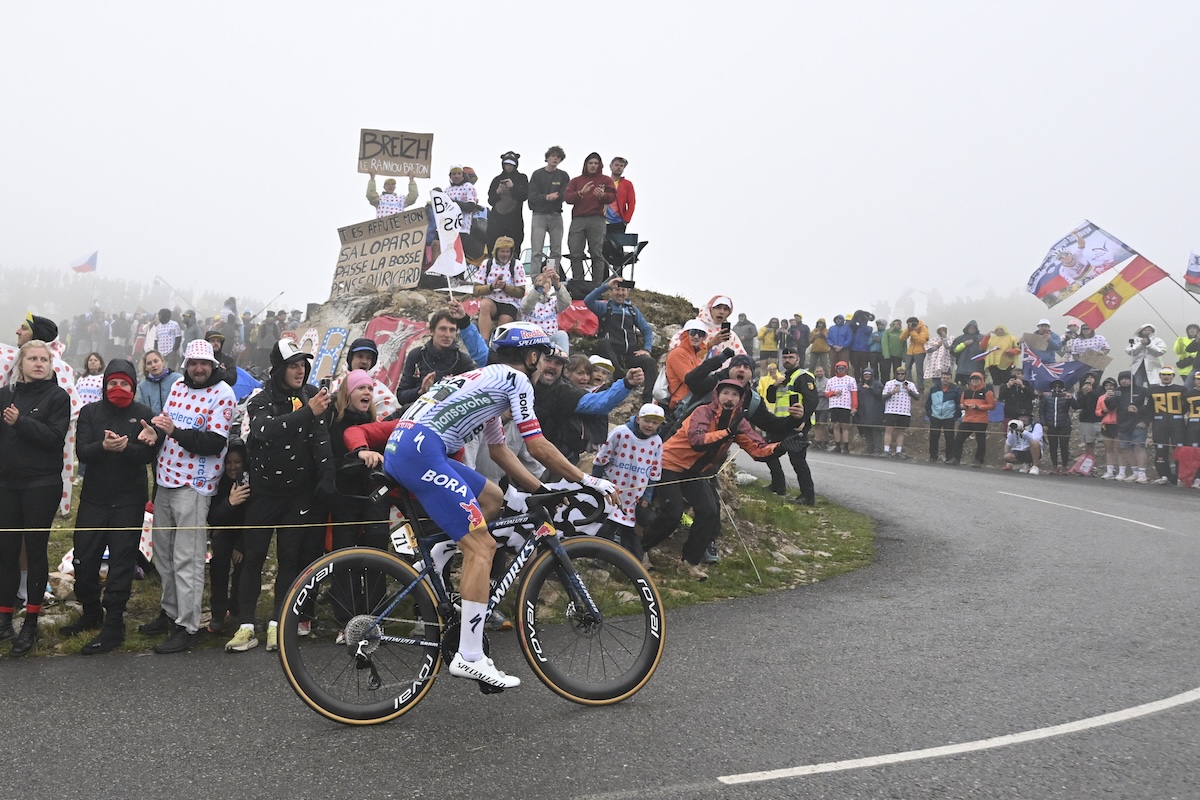
PONTARLIER, France (26 July 2025) — The morning air in Nantua crackled with anticipation as 160 riders prepared for Stage 20, a 175-kilometer journey through the Jura Mountains to Pontarlier. With the general classification largely settled and only two stages remaining, this was the day for opportunists, attackers, and those still hunting their moment of Tour de France glory.
A Huge Battle for the Breakaway
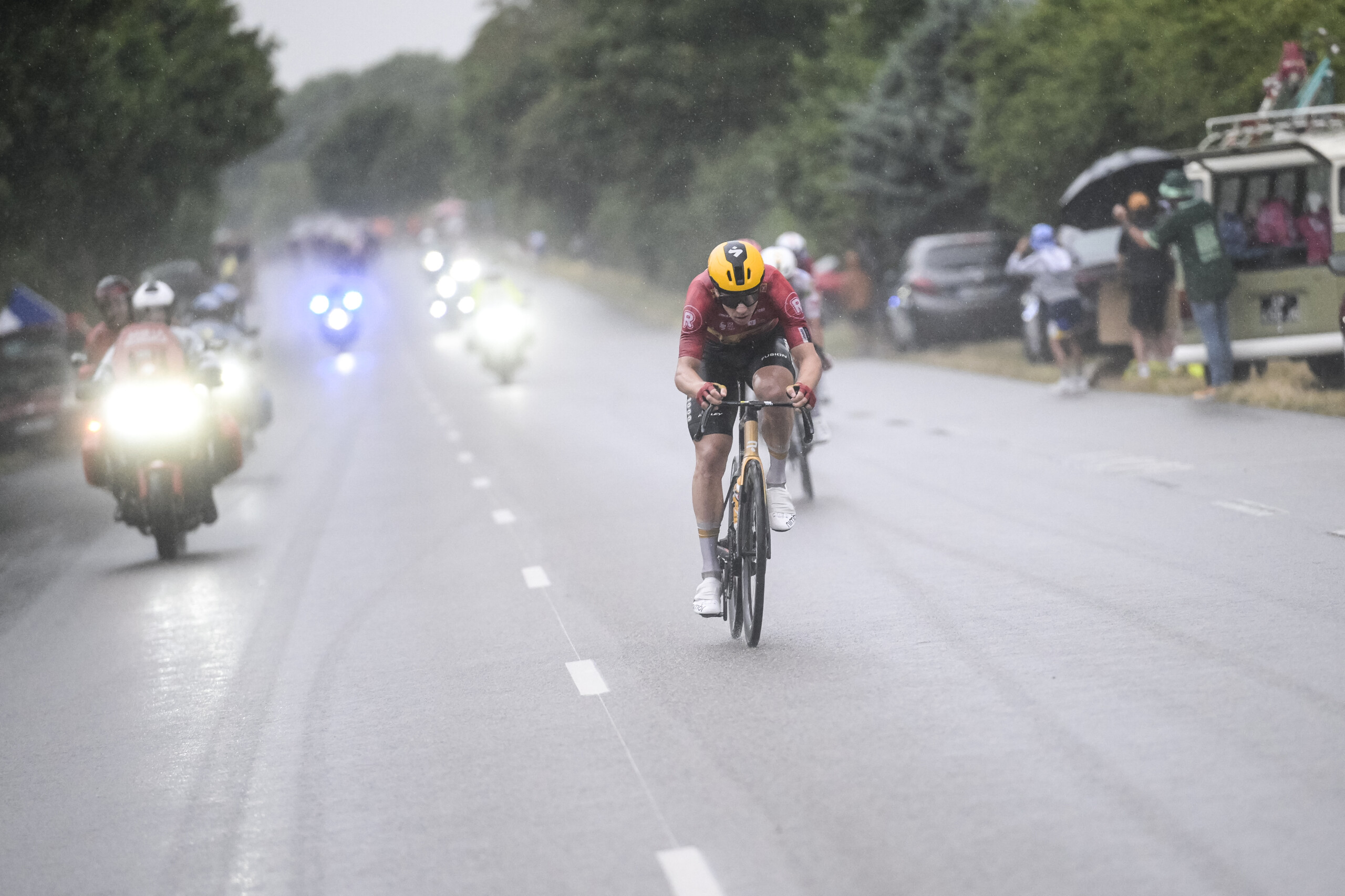
The race exploded into action the moment the flag dropped at 12:17, with a ferocious battle that raged for over 60 kilometers before any semblance of order emerged. “Today was full gas racing, especially during the first hour – up and down, left and right, under heavy rain,” Tadej Pogačar later described the chaotic opening. “It was pretty dangerous and even the Yellow Jersey could have been at risk at some point.”
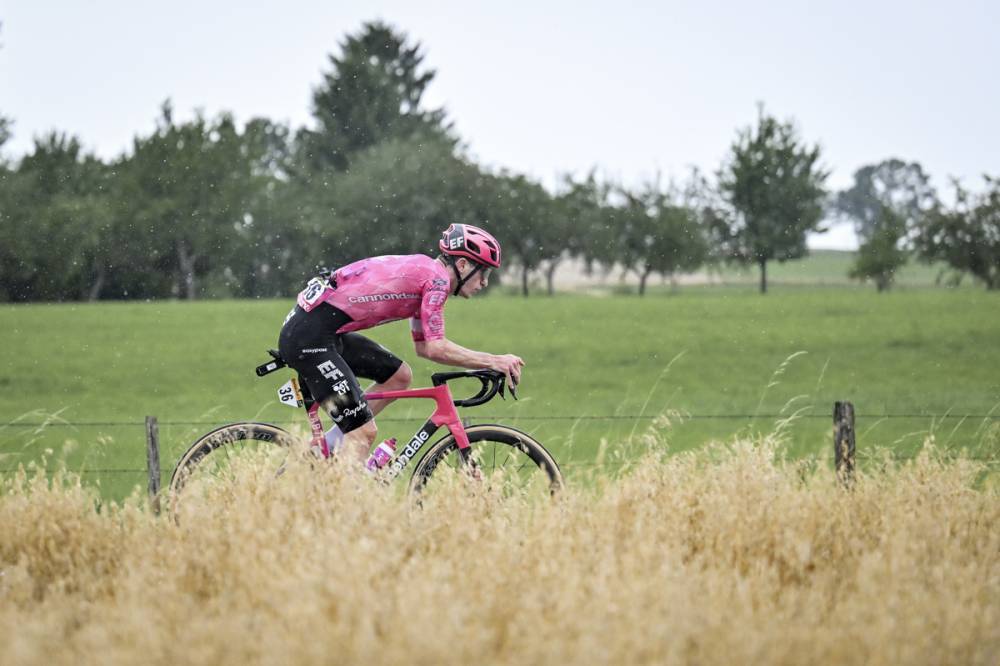
Kasper Asgreen of EF Education-EasyPost fired the opening salvo, immediately establishing himself at the front as rain began to fall across the peloton. The Danish rouleur knew these roads intimately, having pulled off a masterful breakaway victory in Bourg-en-Bresse during stage 18 of the 2023 Tour, just 30 kilometers west of today’s start in Nantua. His experience showed as he drove hard through the early kilometers, but the nervous energy in the bunch meant every attack met fierce counter-attacks.
EF Education-EasyPost had clearly identified this stage as a major opportunity. Ben Healy, the Irish climber who had already tasted stage victory earlier in this Tour, launched attack after attack in support of his team’s ambitions. “I spent a lot of this Tour helping Ben [Healy] and I knew last night that today would be one of my chances,” Harry Sweeny later explained about his team’s tactical approach.
Wave after wave of attacks crashed against the front of the peloton. Wout van Aert tried his luck, Julian Alaphilippe surged repeatedly, and riders from across the classification spectrum threw everything into gaining those precious early meters of freedom. Tim Wellens, the former mountains jersey wearer, featured prominently in the action, while young guns and veterans alike sensed opportunity in the chaotic opening hour.
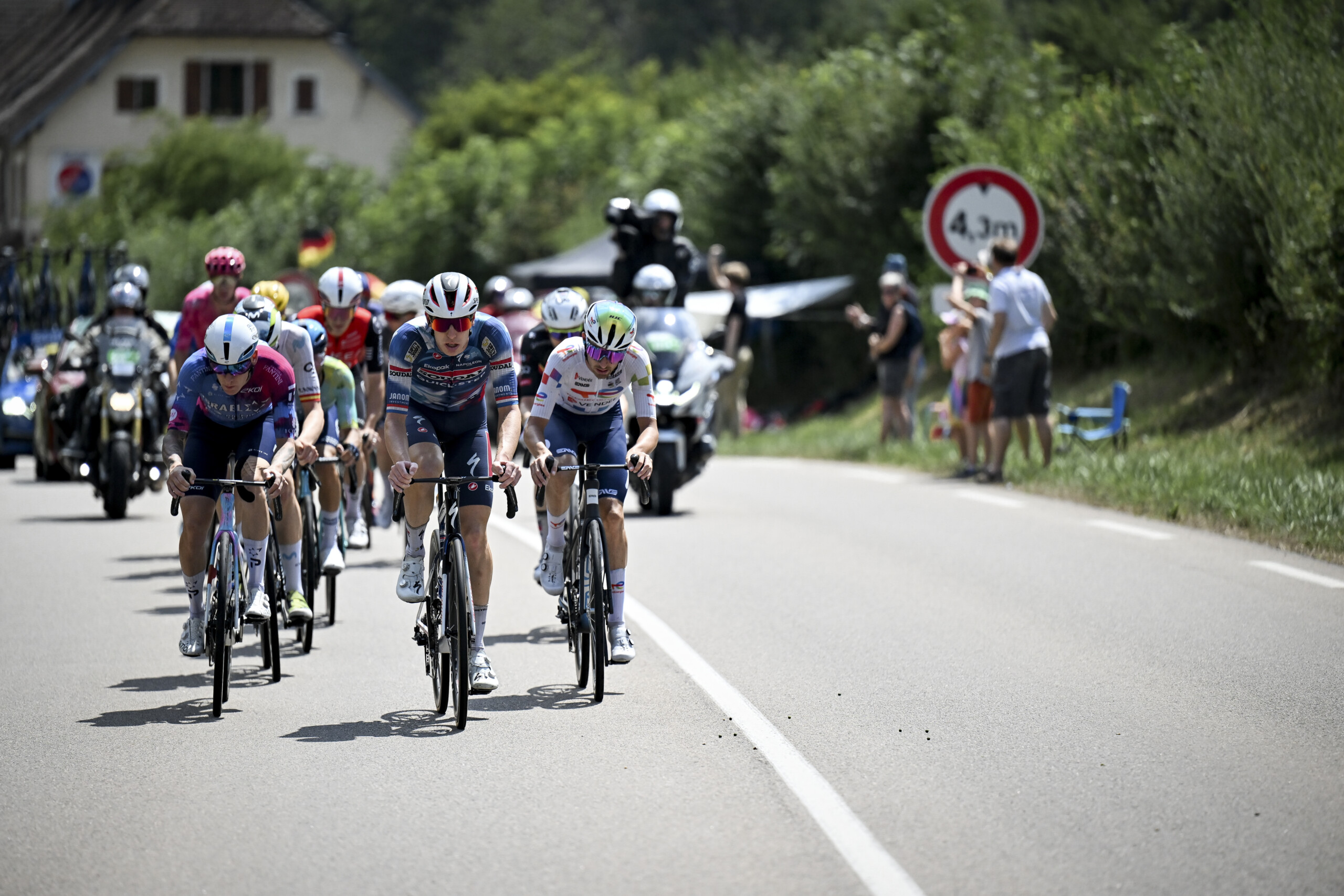
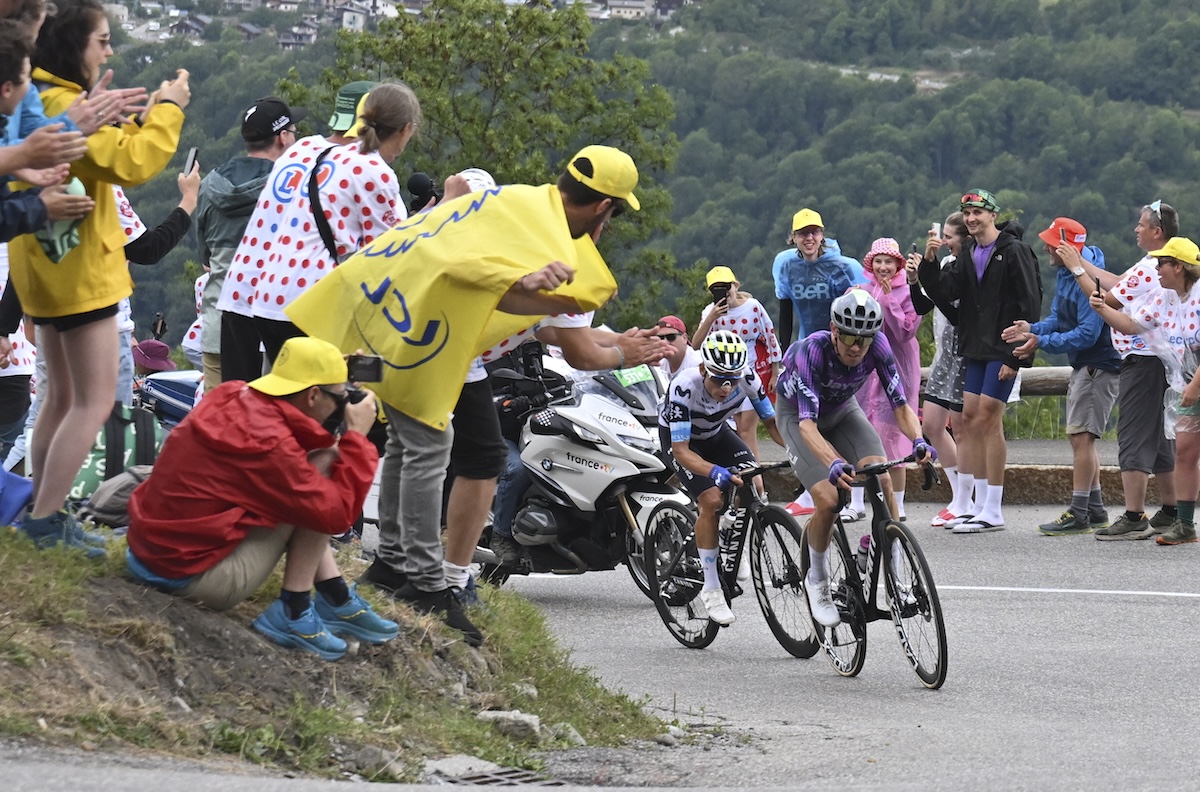
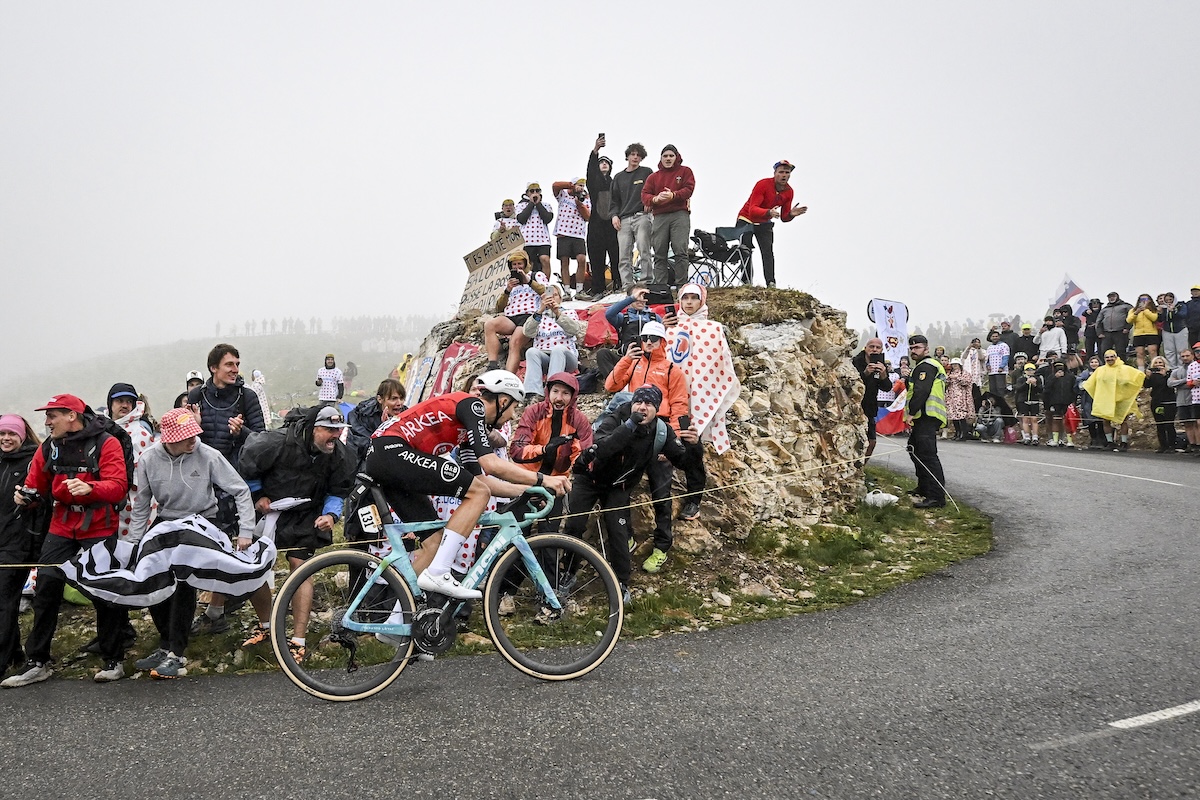
Finally, at kilometer 65, after 60 minutes of relentless combat, the decisive move crystallized. Harry Sweeny, Asgreen’s EF teammate, managed to bridge across to a promising trio of Tim Wellens (UAE Team Emirates-XRG), Matteo Jorgenson (Visma-Lease a Bike), and Ewen Costiou (Arkéa-B&B Hotels). Nine more chasers successfully made the junction in the chaos that followed, forming a formidable 13-man breakaway.
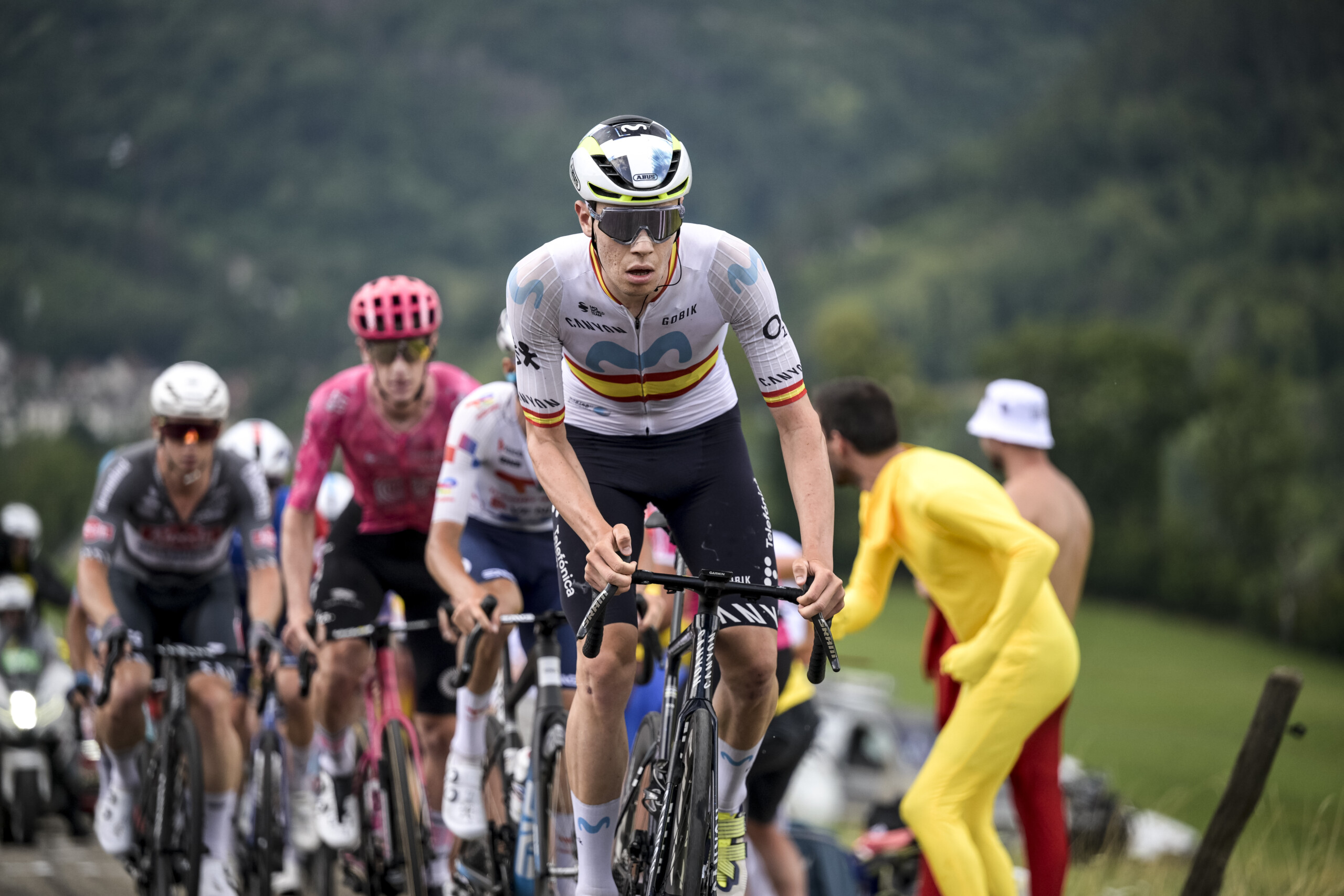
The final composition read like a perfect blend of climbing specialists, tactical nous, and raw ambition: Pascal Eenkhoorn (Soudal-Quick Step), local hero Romain Grégoire (Groupama-FDJ), the versatile Kaden Groves (Alpecin-Deceuninck), veteran Matteo Trentin (Tudor), Ivan Romeo (Movistar), Simone Velasco (XDS-Astana), French climber Jordan Jegat (Total Energies), Frank van den Broek (Picnic-PostNL), and Jake Stewart (Israel-Premier Tech).
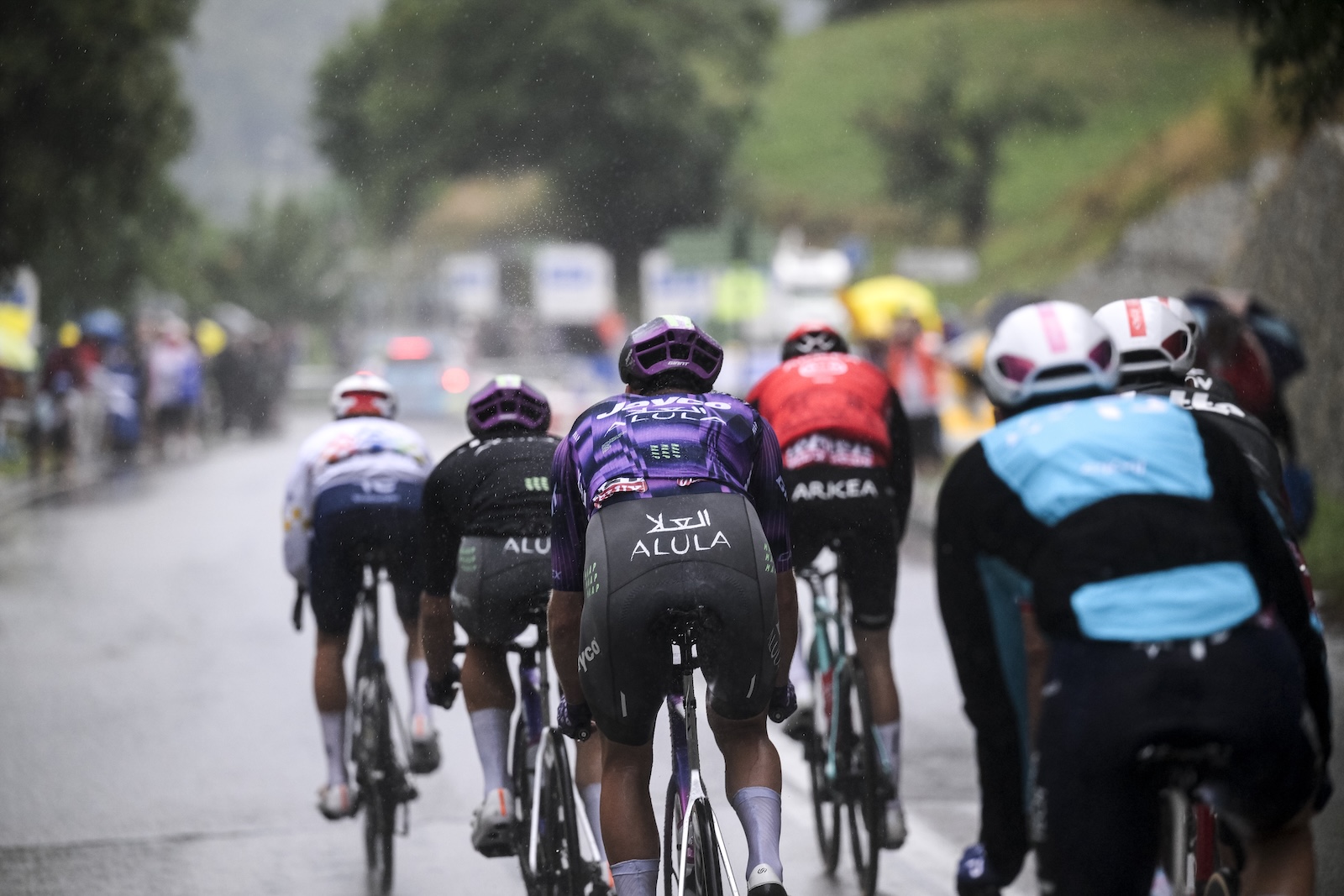
Behind the newly formed breakaway, Mauro Schmid of Jayco-AlUla found himself with a crucial responsibility. Jordan Jegat’s presence among the escapees posed a direct threat to Ben O’Connor’s 10th place in the overall standings, with just 4’08” separating the two riders. The Swiss national champion took to the front of the peloton, his distinctive jersey visible as he began the delicate task of controlling the gap.
The chase wasn’t without drama. Around kilometer 65, both Oscar Onley (Picnic PostNL) and Felix Gall (Decathlon AG2R La Mondiale) found themselves momentarily distanced from the main group, their Decathlon AG2R La Mondiale teammates immediately mobilizing to bring them back. The situation eventually stabilized, but it highlighted the nervous energy still crackling through the peloton.
Schmid’s task became more complicated at kilometer 71 when he crashed on a slippery section of road. The Swiss rider quickly remounted, but the incident briefly disrupted the chase effort. Despite this setback, he regained control and managed to stabilize the gap at 2’30” as the race approached the day’s main challenge: the fearsome Côte de Thésy.
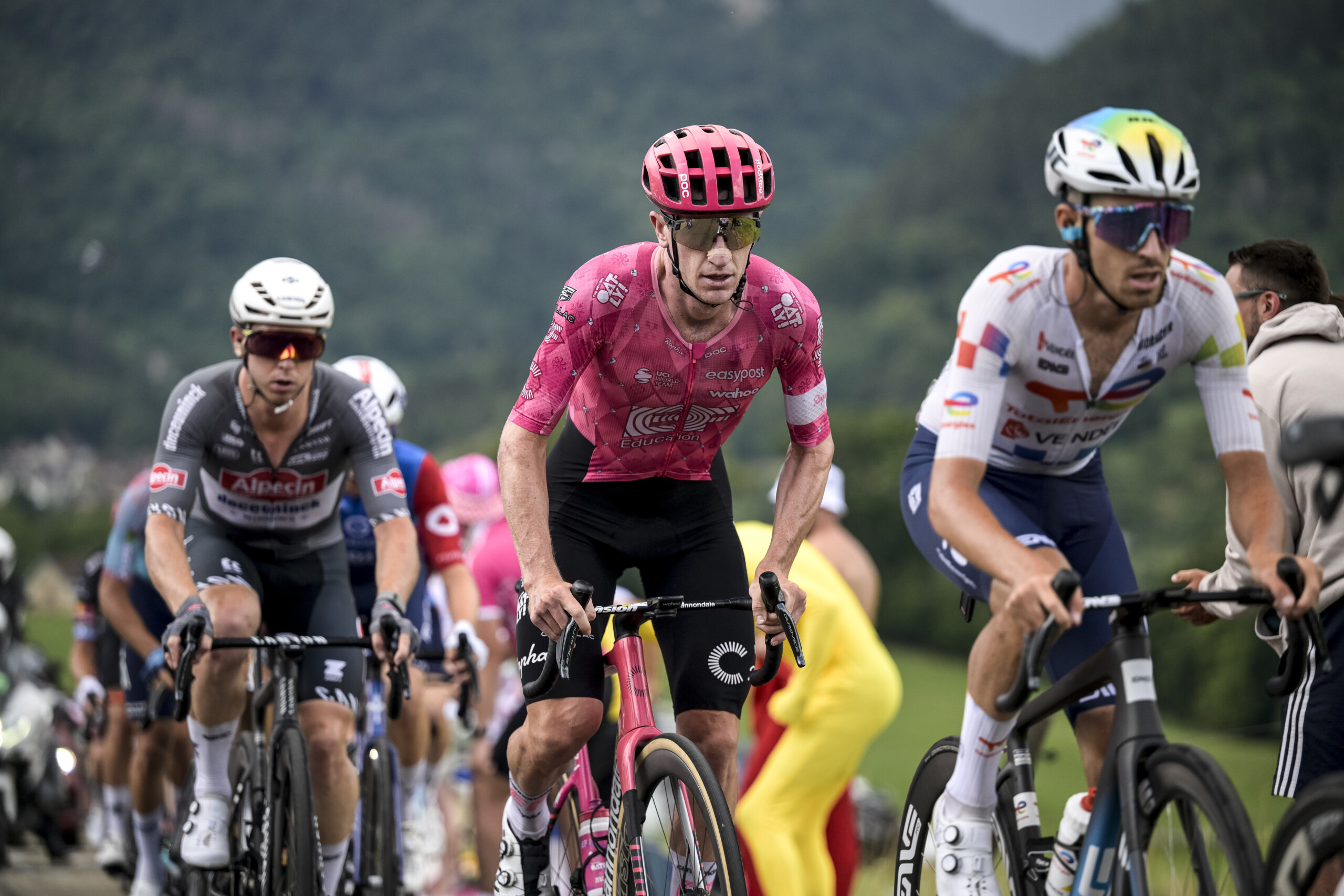
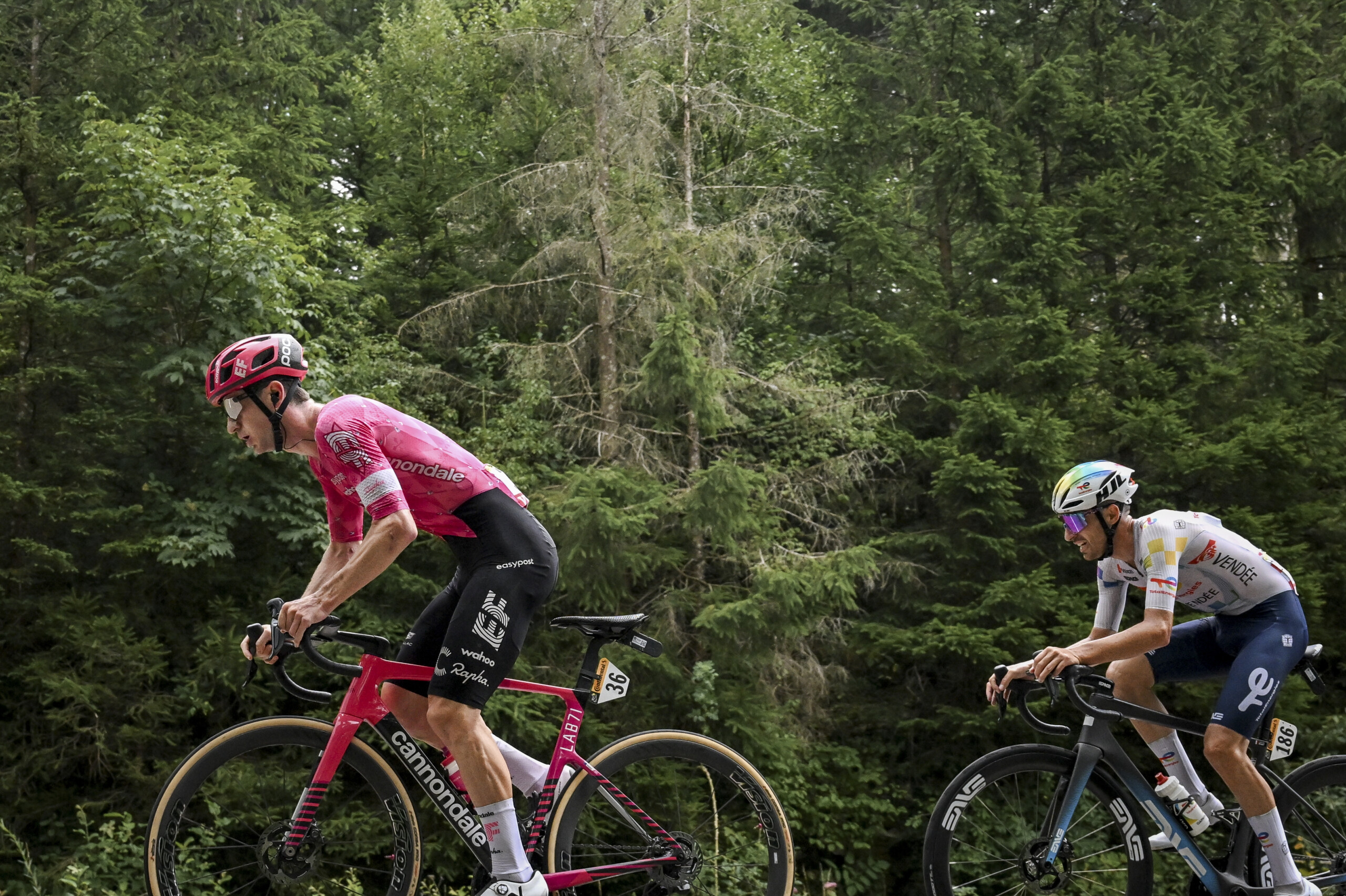
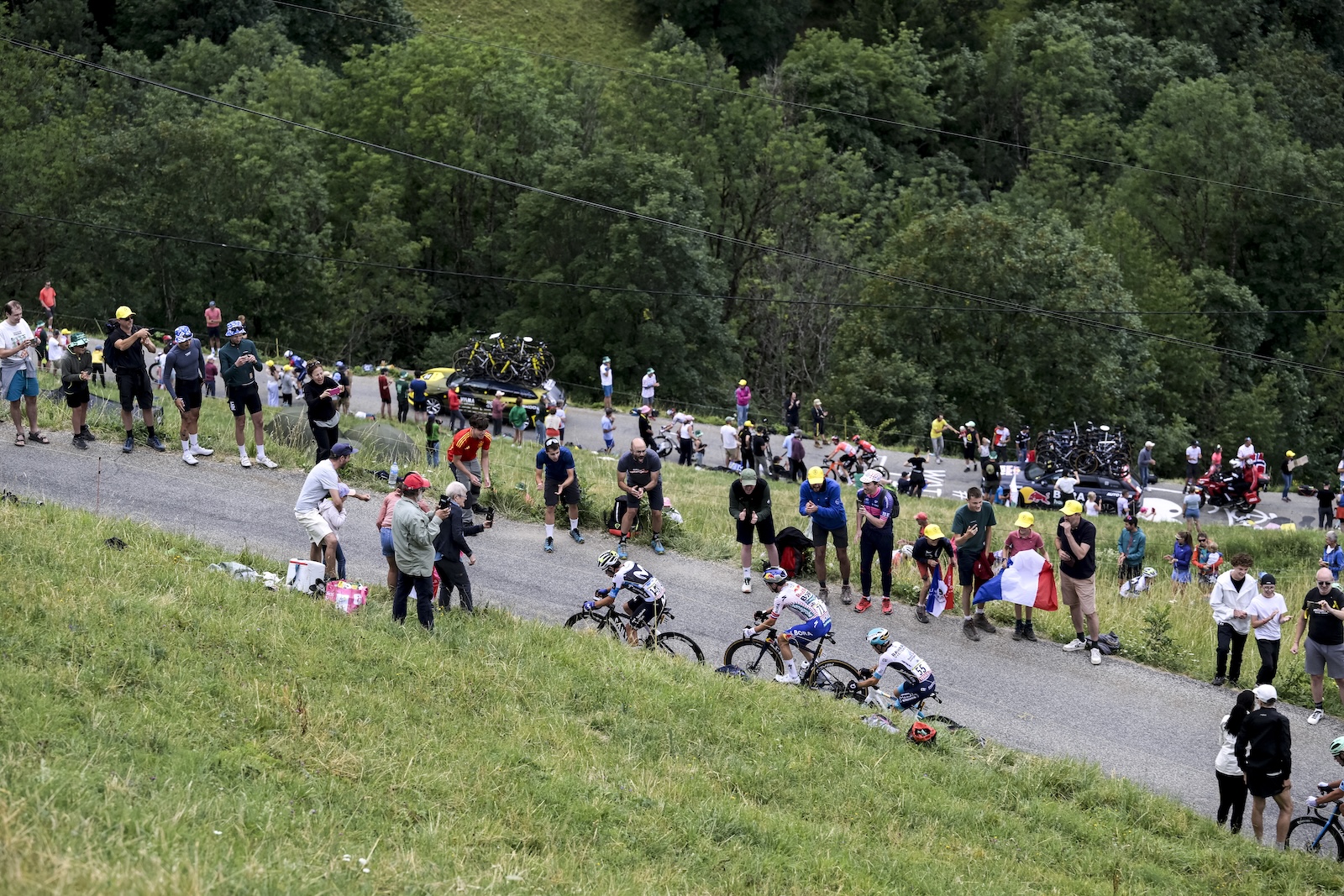
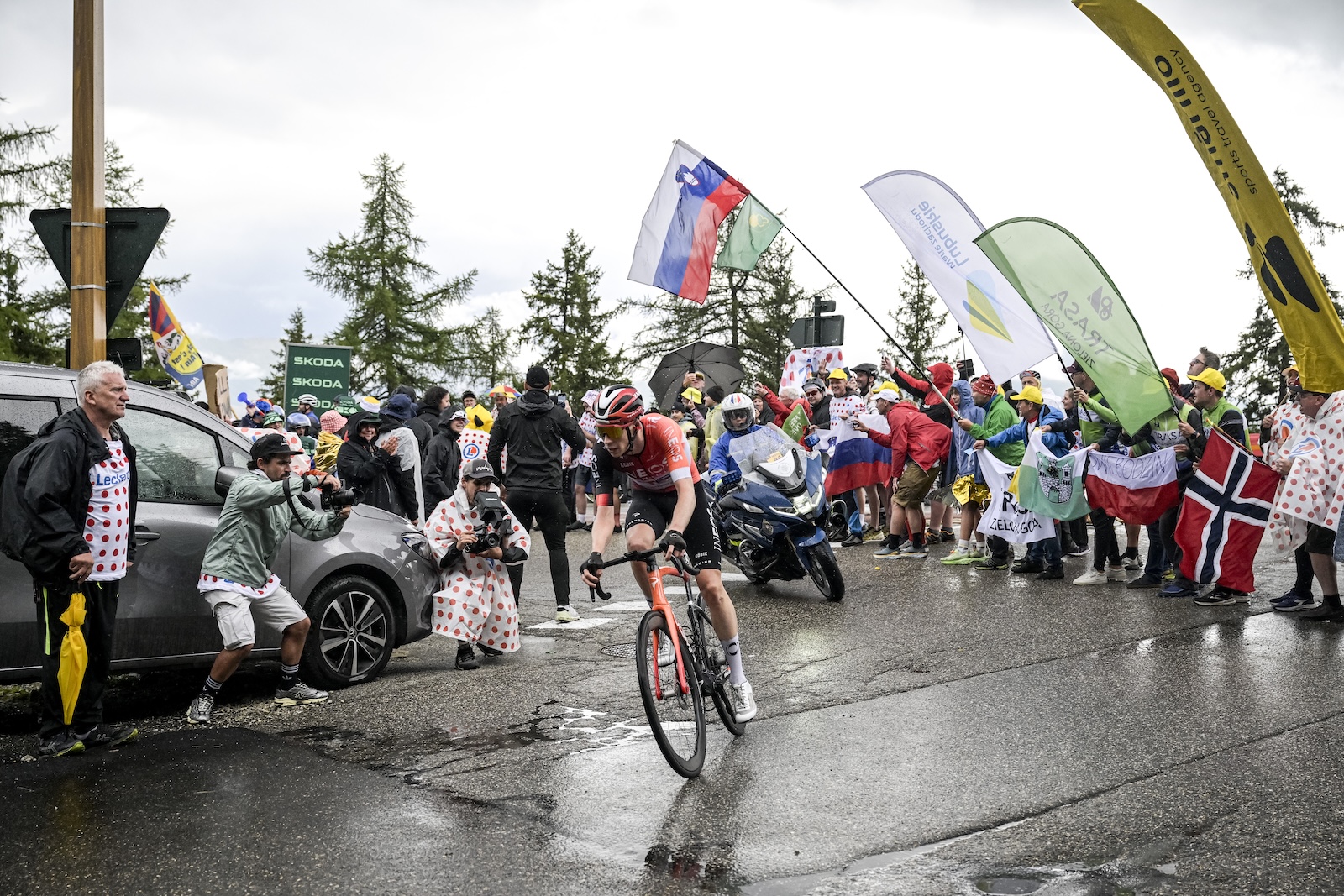
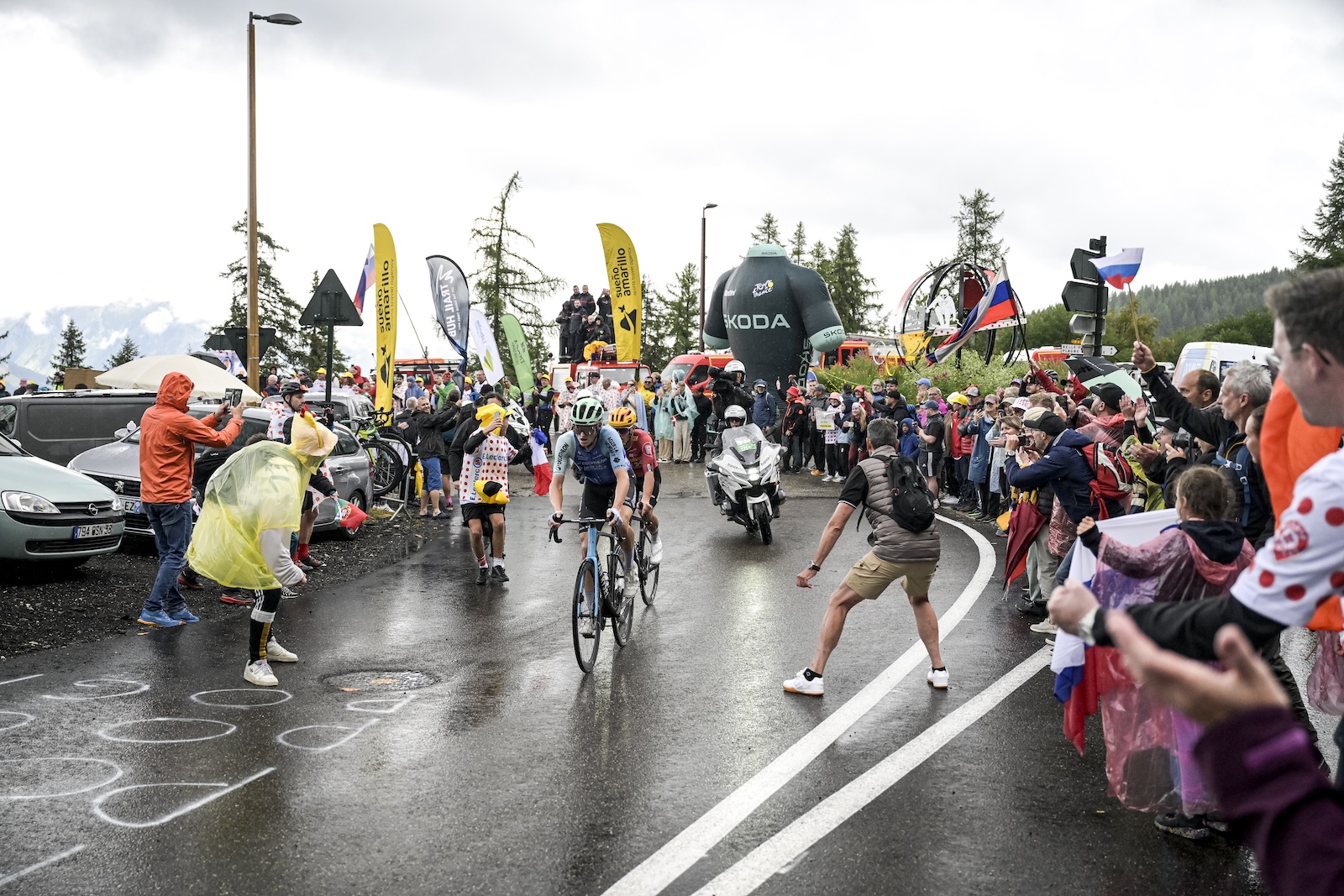
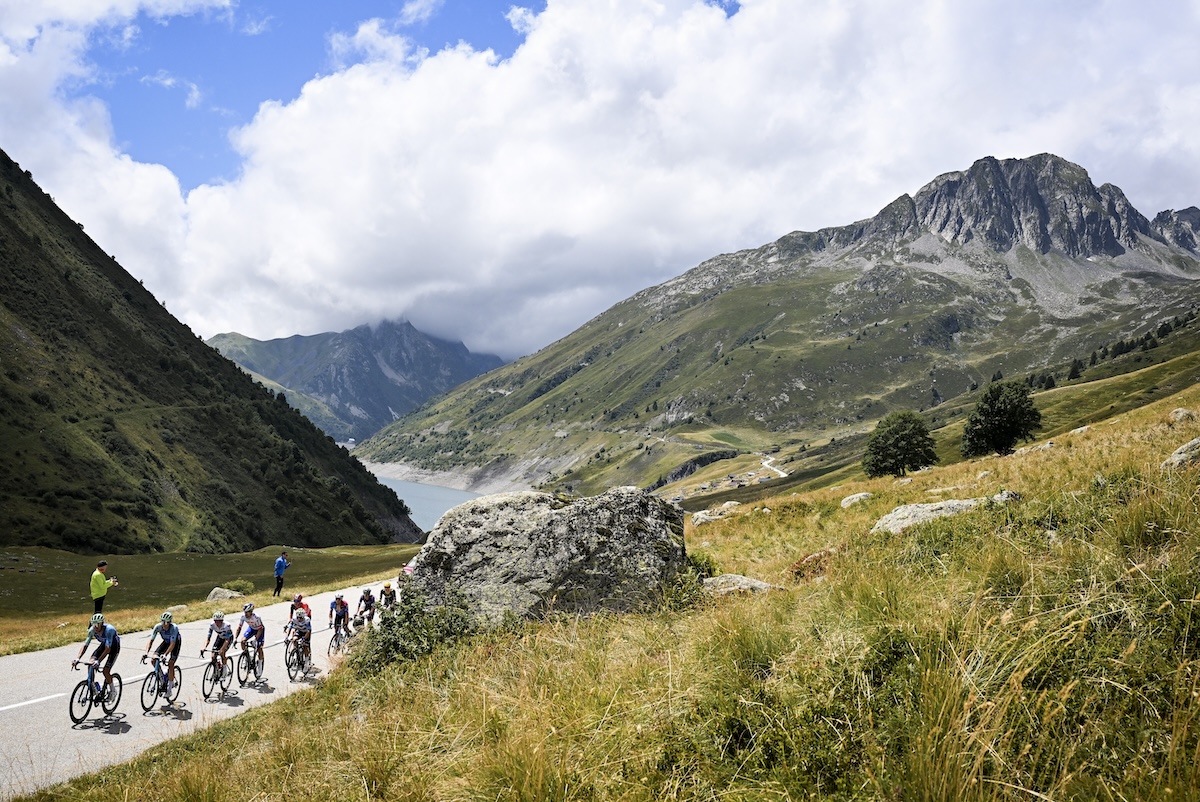
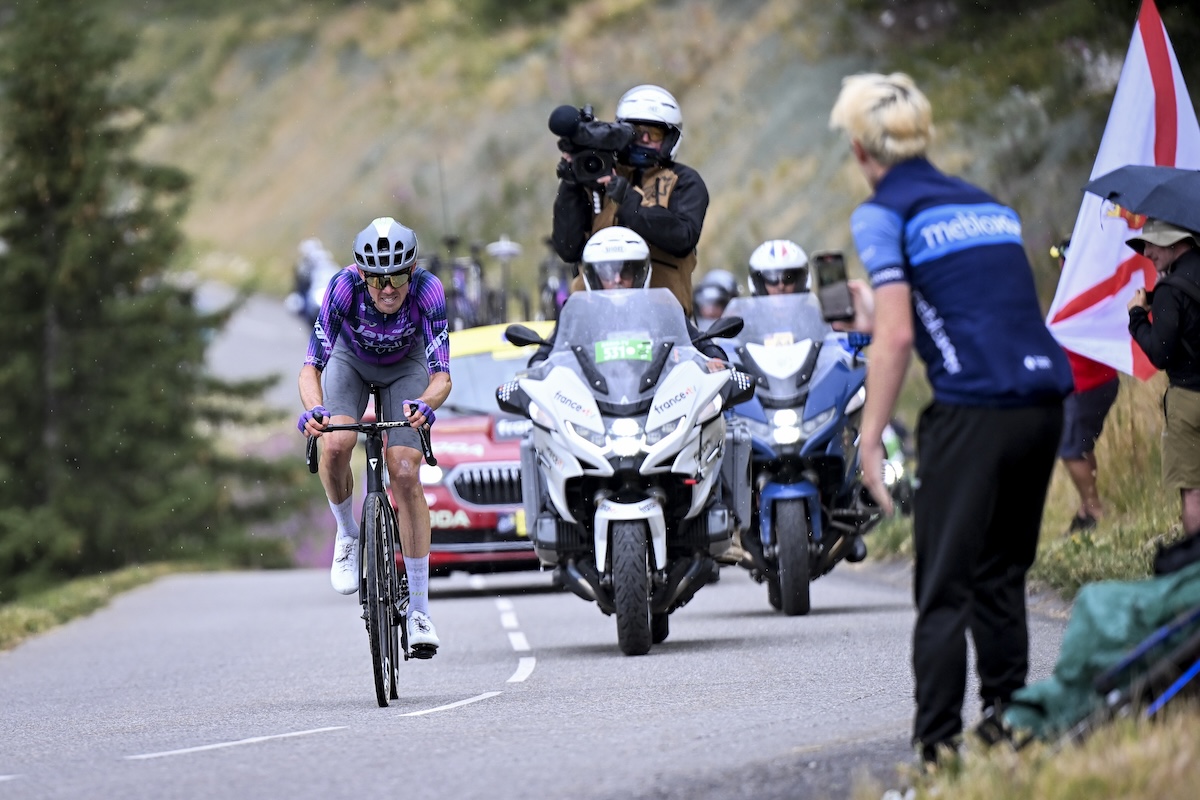
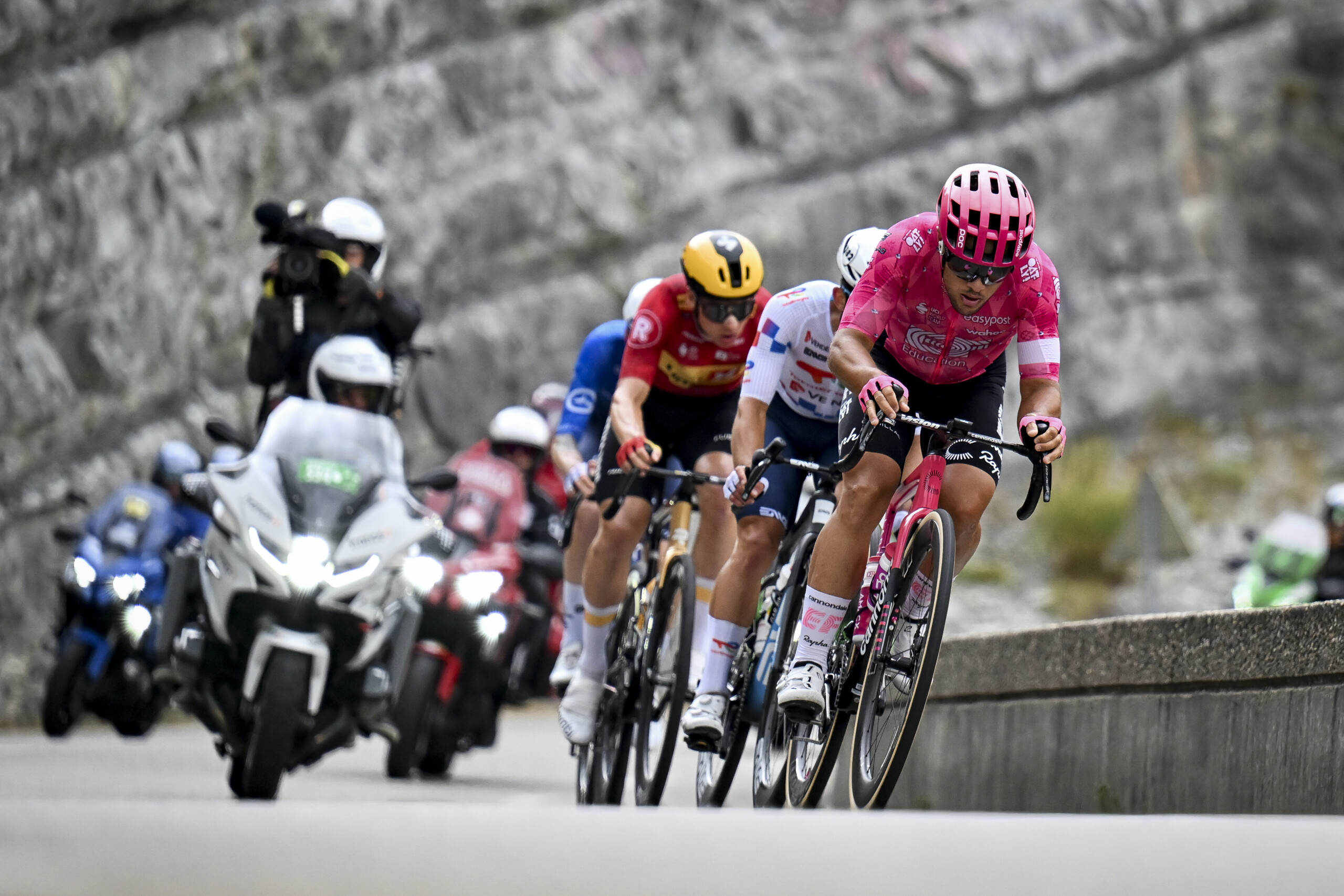
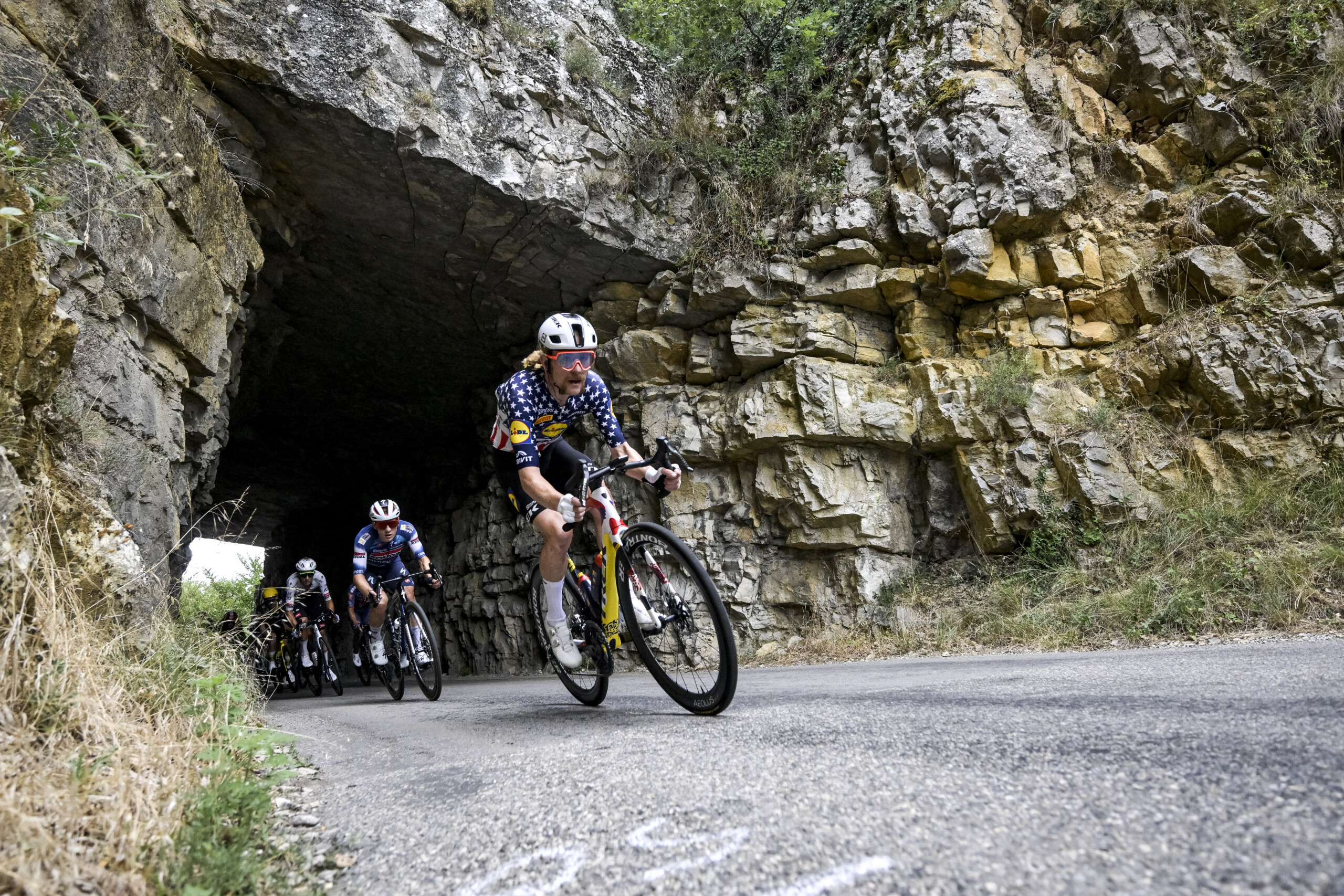
The climb immediately shattered the breakaway’s unity. Jordan Jegat launched a fierce acceleration as soon as the road pitched upward through the 3.6 kilometers averaging 8.9%. The French climber’s attack immediately put pressure on his companions, but Harry Sweeny proved equal to the challenge, grinding his way back to the TotalEnergies rider as they approached the summit.
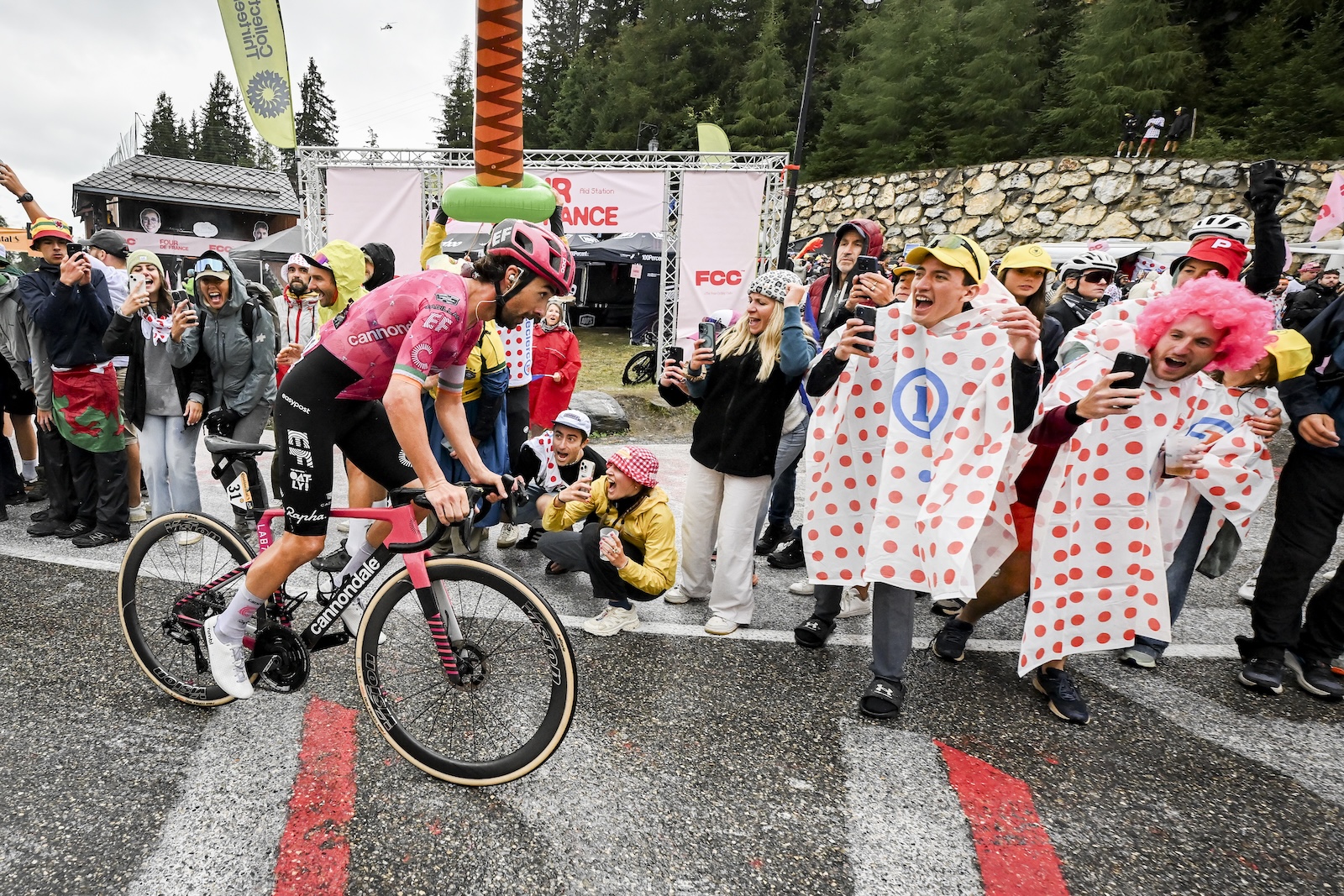
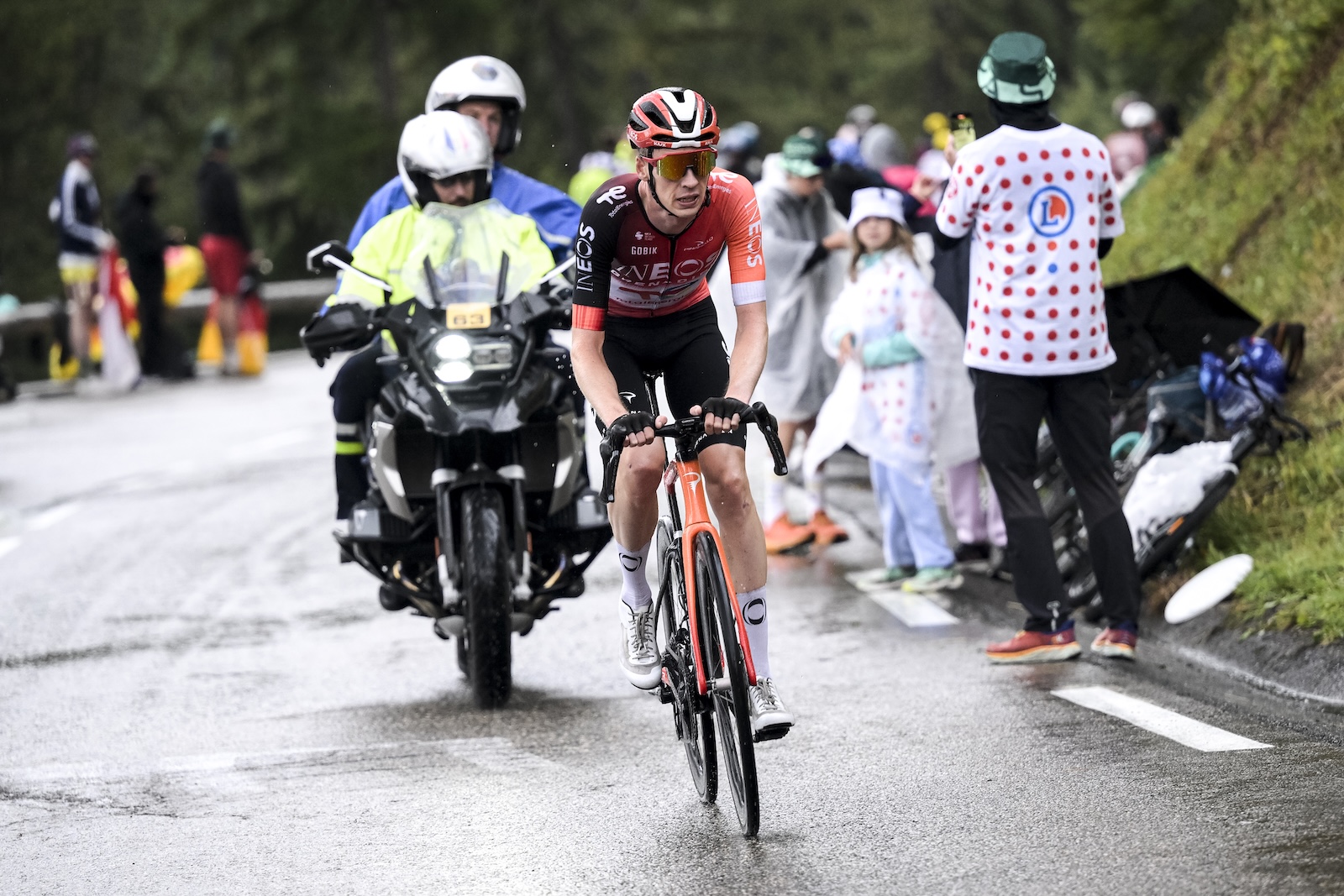
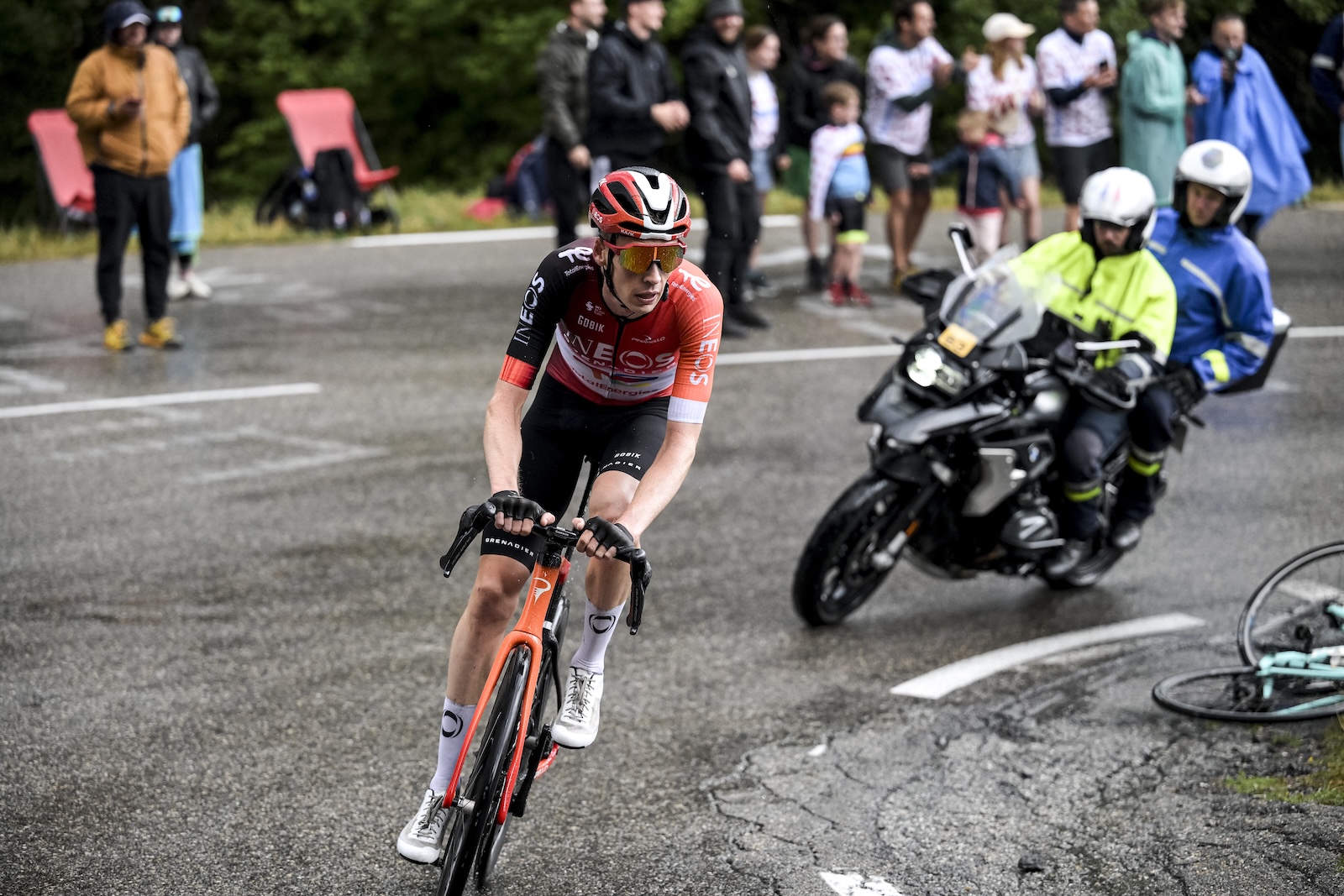
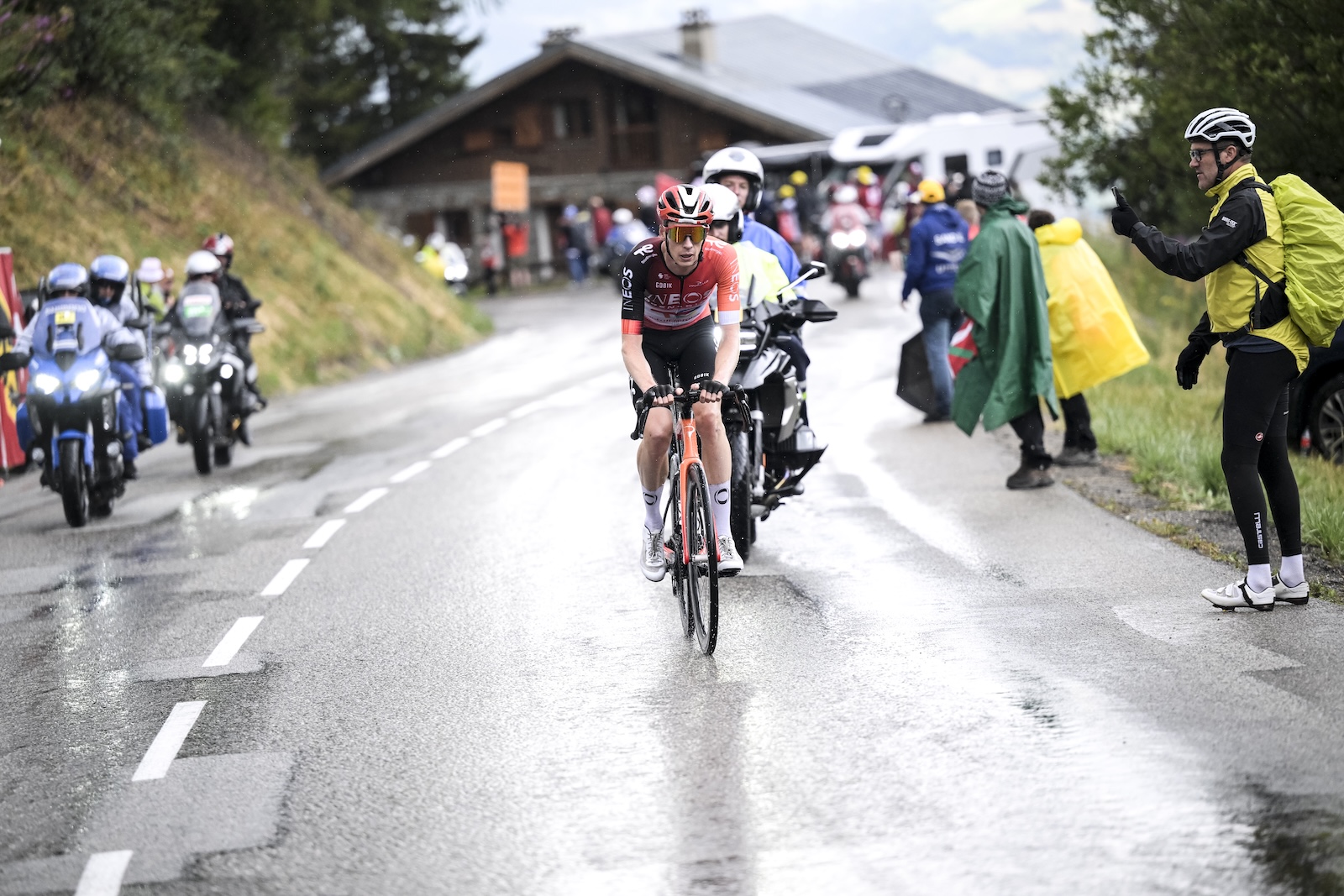
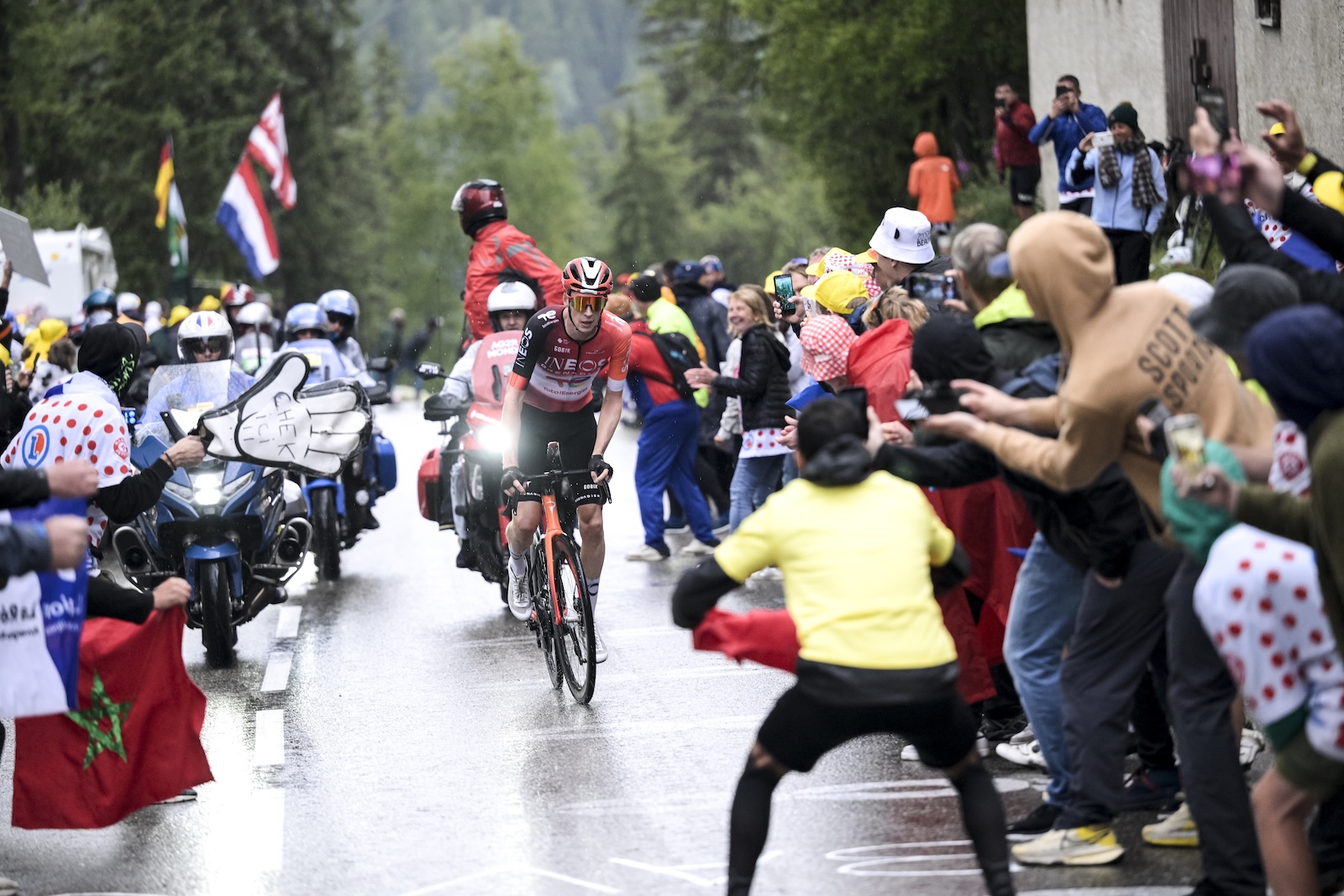
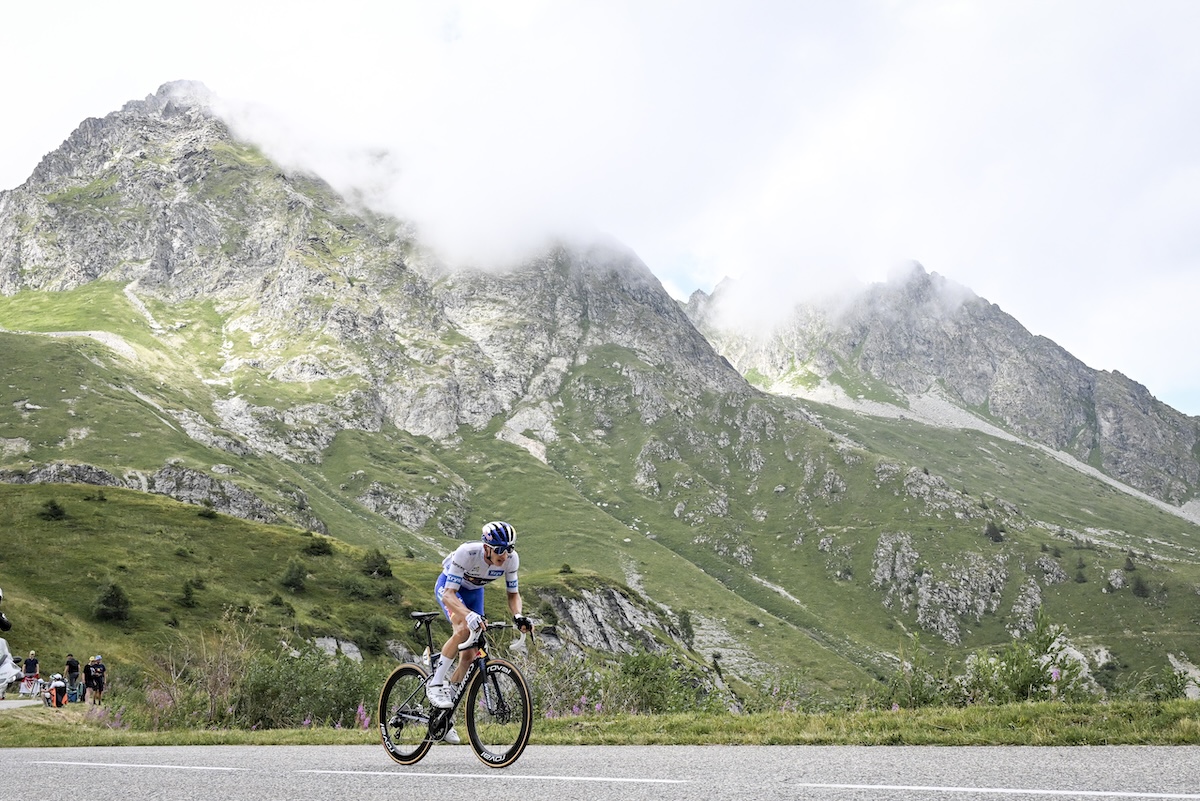
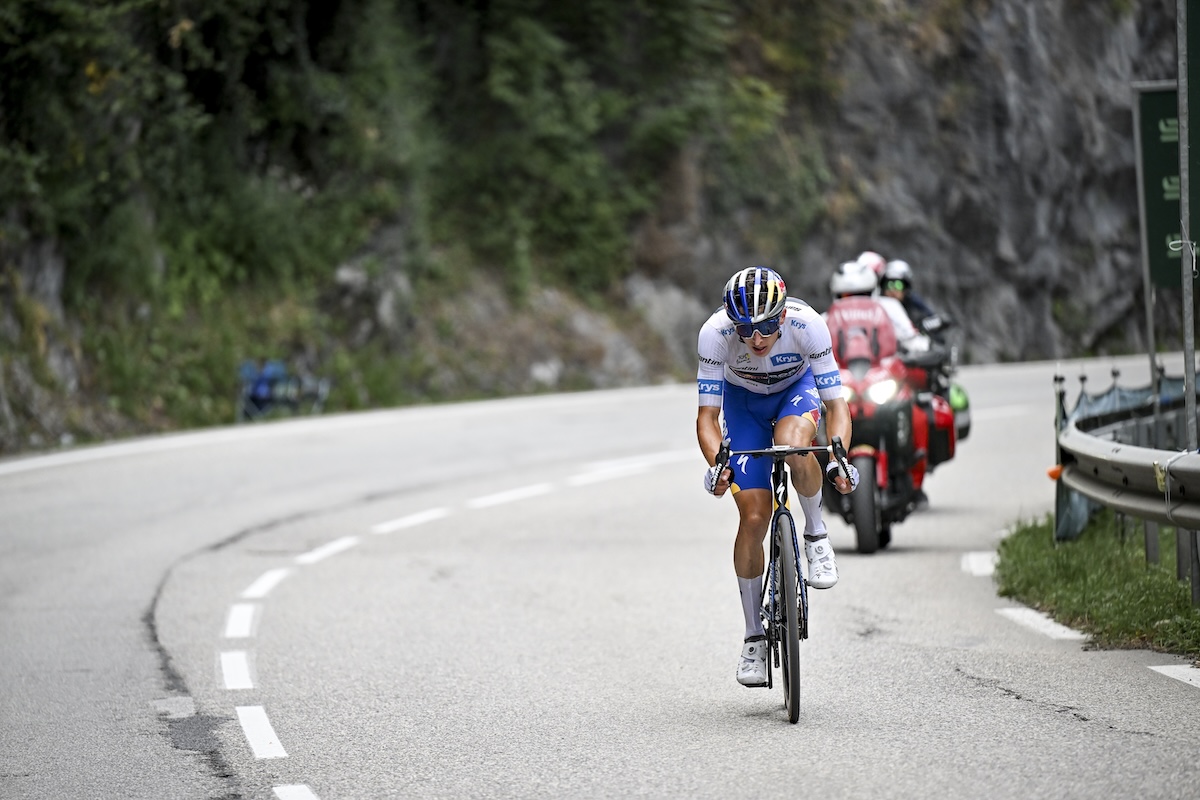
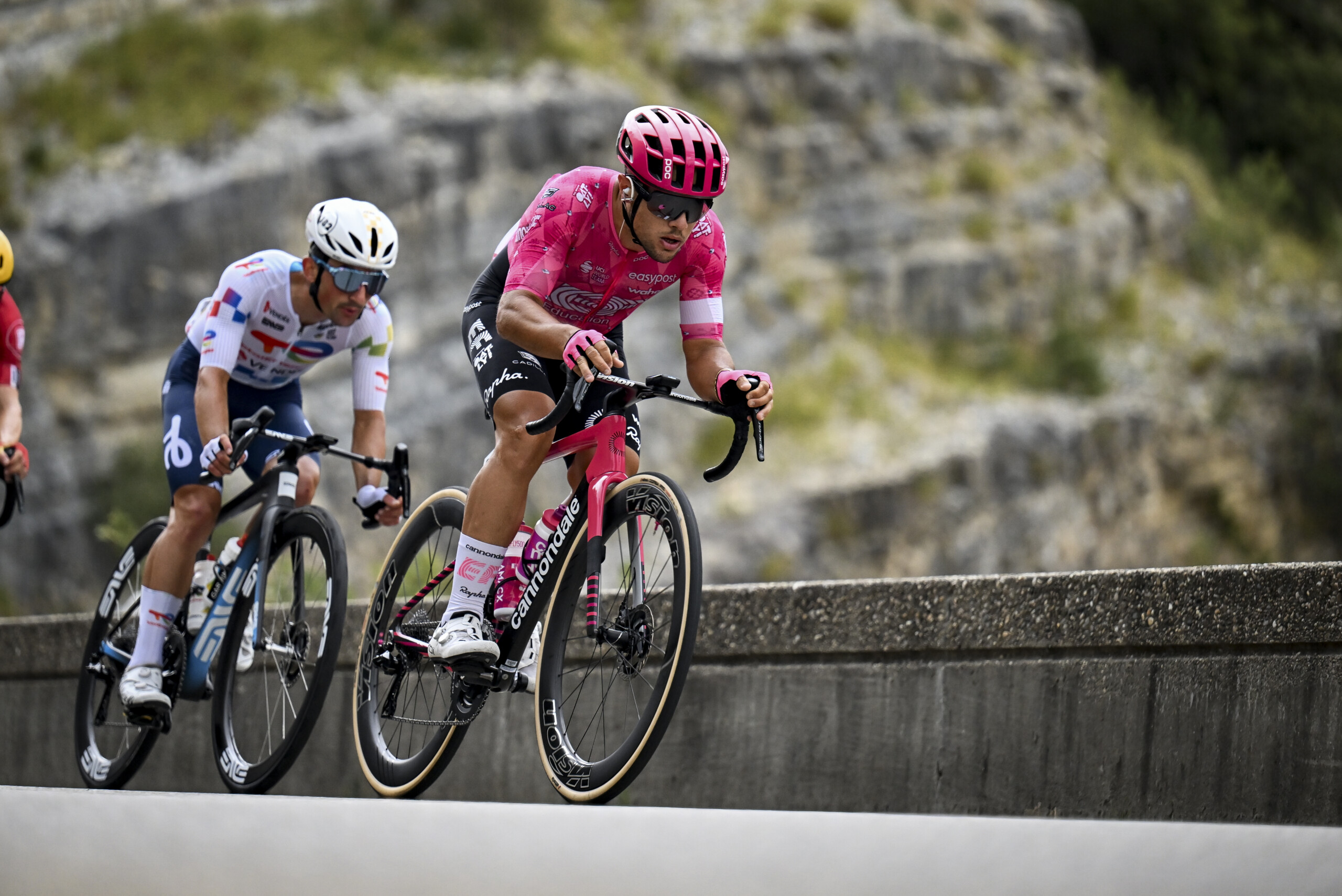
26/07/2025 – Tour de France 2025 – Étape 20 – Nantua / Pontarlier (184,2 km) – Harrison SWEENY (EF EDUCATION – EASYPOST)
“When Jegat went on the climb, I thought that he would be very strong but I got to him and he didn’t really have anything to go with,” Sweeny later reflected on this crucial moment. “I sort of knew at that moment it was probably the wrong move.”
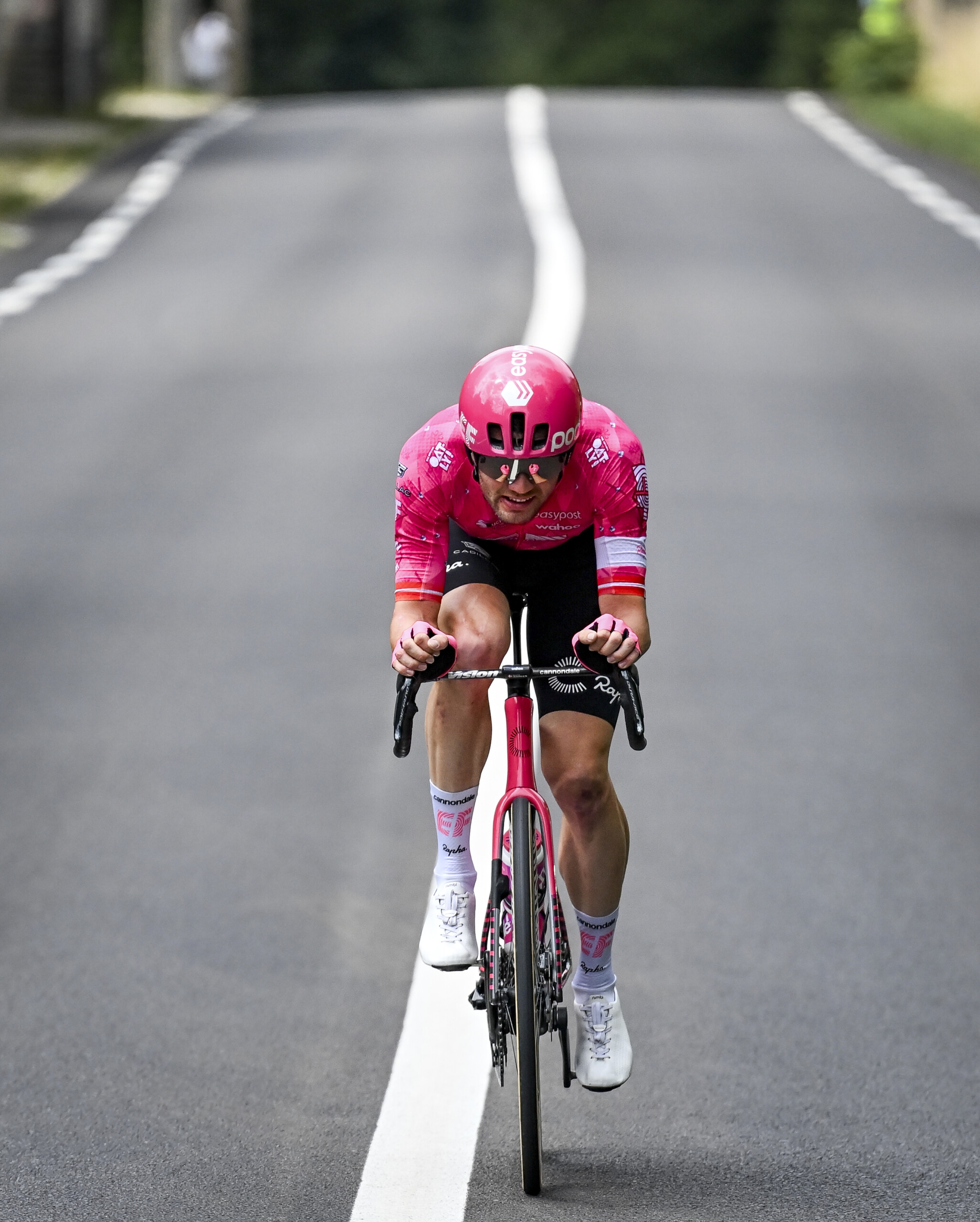
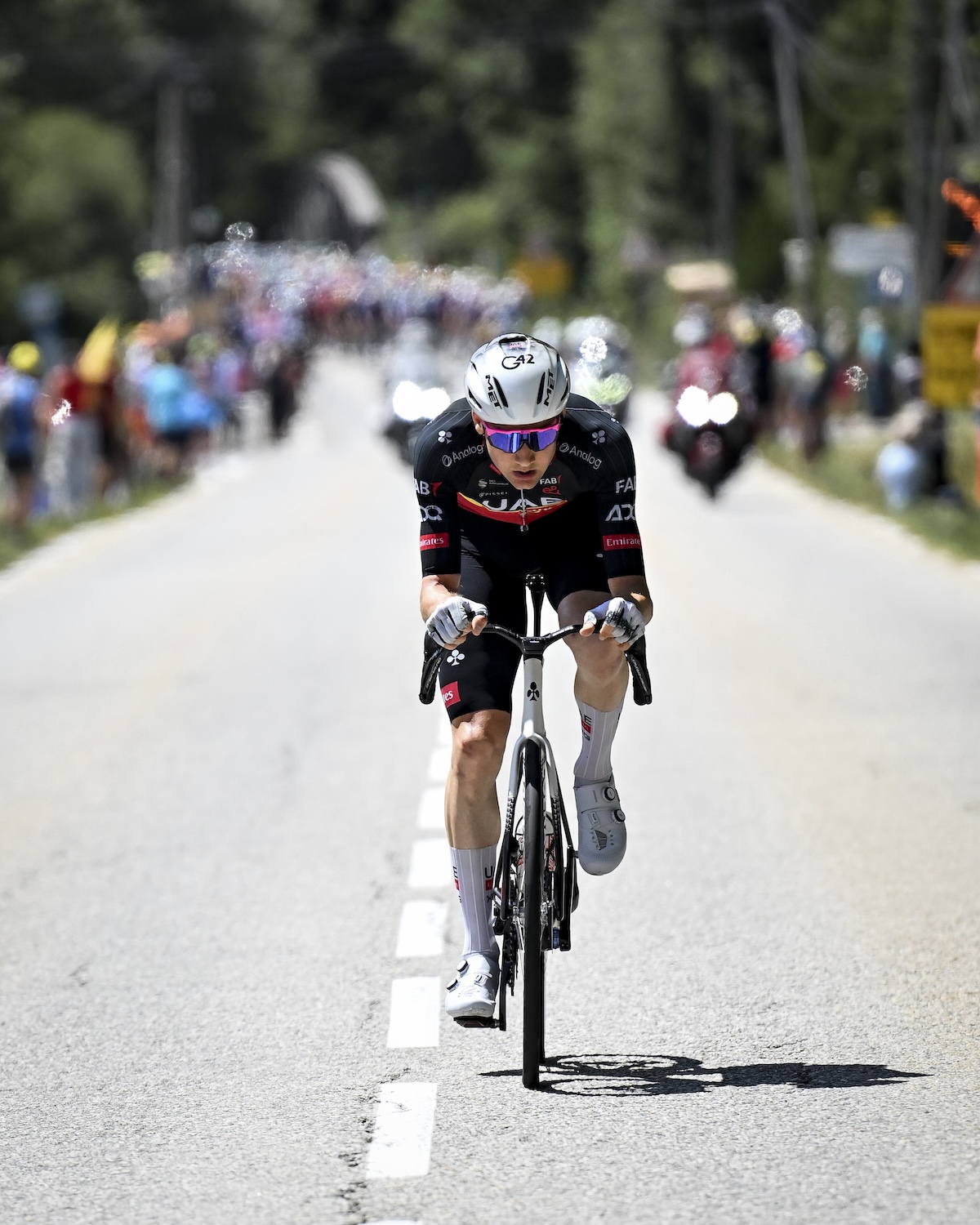
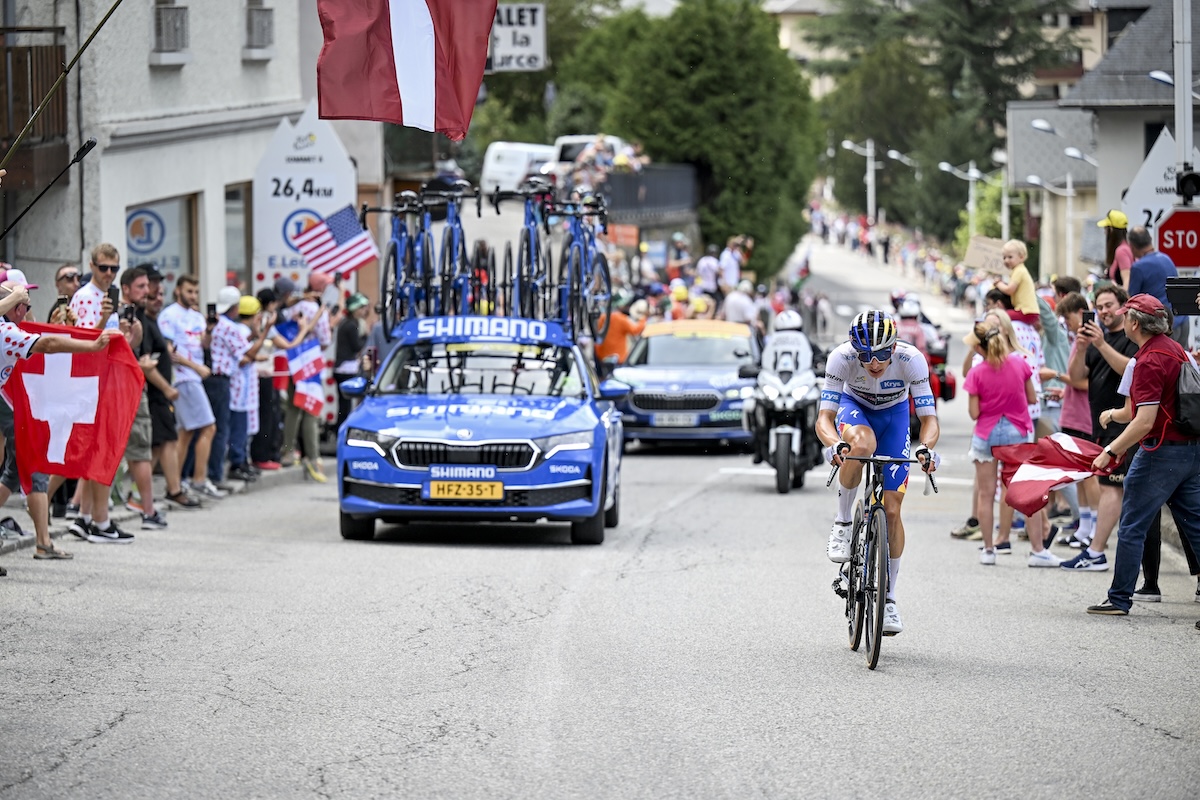
At the top of Côte de Thésy, with 54 kilometers remaining to the finish in Pontarlier, Sweeny made his decisive move. The EF Education-EasyPost rider, sensing his moment, dropped Jegat and went solo into the descent. Within minutes, he had opened a gap of 40 seconds to his former breakaway companions, his rainbow bands of Australian national champion clearly visible as he carved through the twisting descent.
For several kilometers, Sweeny’s solo effort looked like it might stick. The Australian maintained his advantage through the technical descent and onto the flatter roads leading toward the final climb. “I did everything that I could to try and make it work,” he later said about his bold move. But cycling’s eternal truth—that one rider rarely beats many for long—began to assert itself. Behind him, the remnants of the breakaway had regrouped and worked systematically to reel him in.
The catch came as the race hit the bottom of the Côte de Longeville, the day’s final categorized climb sitting just 24.1 kilometers from the finish. Ten riders came back together in a dramatic regrouping, though the earlier pace had cost them three casualties: Costiou, Wellens, and Jorgenson had fallen behind and now fought a losing battle to rejoin.
A Dramatic Finale
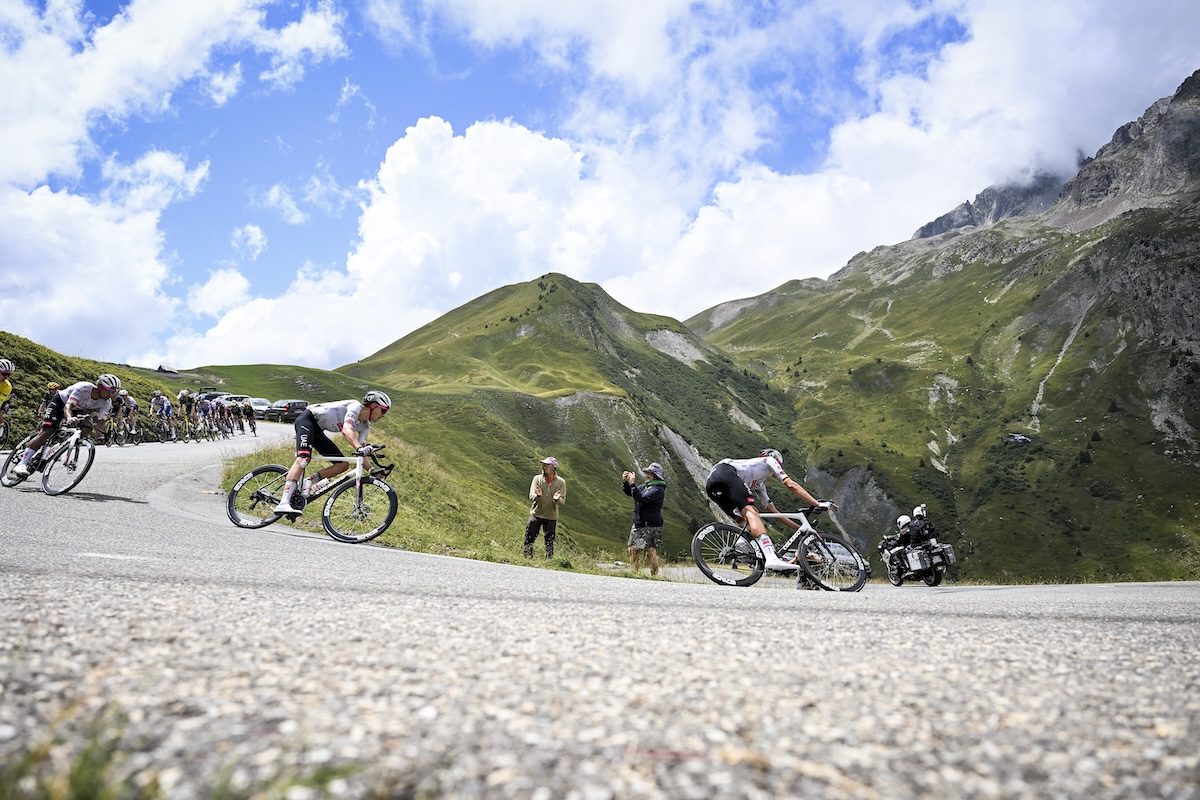
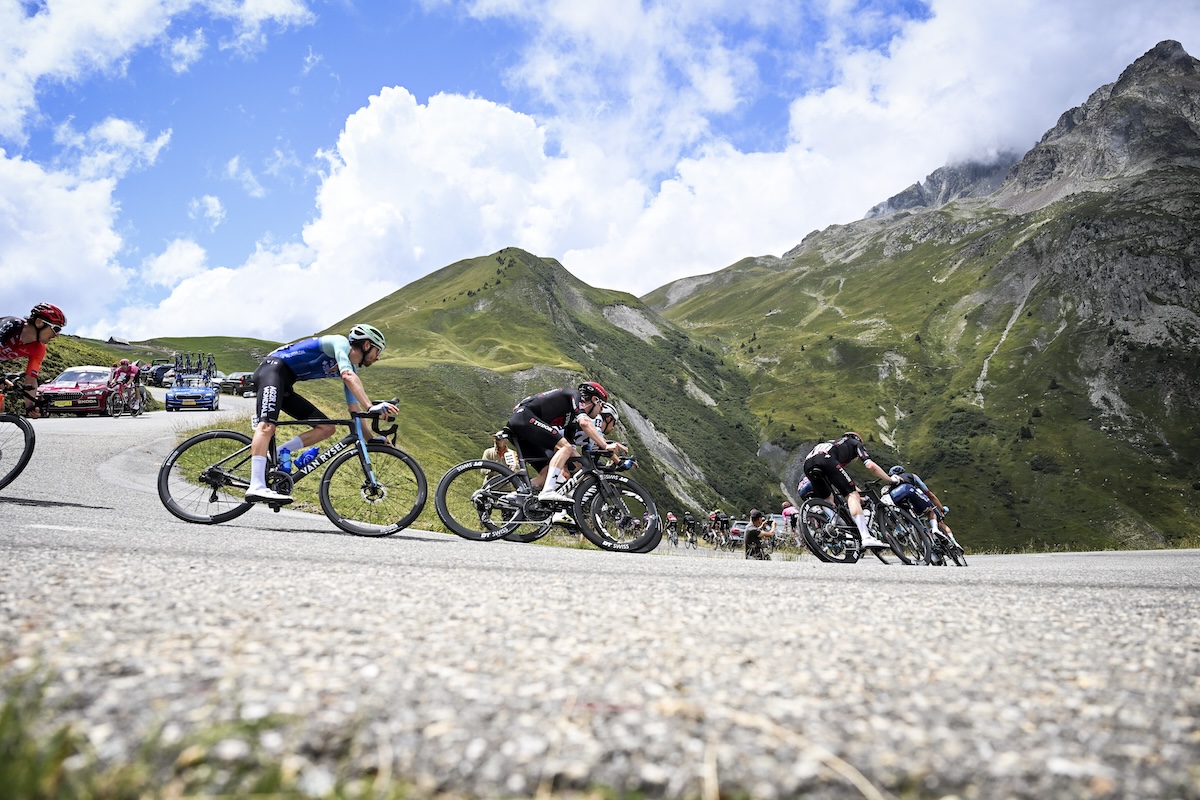
The Côte de Longeville, despite its modest category 4 classification, proved to be the stage’s decisive battlefield. The racing became increasingly aggressive as the regrouped leaders hit the 2.5-kilometer climb averaging 5.5%. Over the summit, just six riders emerged clear: local hero Romain Grégoire, Ivan Romeo, Simone Velasco, Kaden Groves, Jake Stewart, and Frank van den Broek.
The sense of opportunity felt palpable as this elite group crested the climb with just over 20 kilometers remaining. Grégoire, riding on home roads with thousands of supporters lining the route, immediately accelerated on the technical descent. The Groupama-FDJ rider had waited all day for this moment, and the roar from the crowd reached deafening levels as he opened a small gap.
But the others weren’t finished. Ivan Romeo, the Spanish climber, sensed his own opportunity and launched a counter-attack in pursuit of Grégoire. For a brief moment, it looked like the Movistar rider might bridge across and form a winning duo. Then disaster struck.
With 22 kilometers to go, Romeo hit a slippery corner at speed and went down hard. The crash looked spectacular and immediately ended his stage hopes. Worse still, the incident caught both Grégoire and Velasco in its aftermath, forcing all three riders to scramble back to their feet as precious seconds ticked away.
Through the chaos, three riders had kept their composure and their momentum: Kaden Groves, Jake Stewart, and Frank van den Broek. The trio quickly established themselves at the front as their rivals dealt with the crash aftermath, but the real racing had just begun.
“After the crash [with 22 km to go], there was gap, and Van den Broek went full. I closed that,” Groves later described the pivotal moment. “And then him and Stewart look at each other.”
With 16.5 kilometers to go, the psychological battle began. Stewart and van den Broek, both experienced professionals, began the familiar dance of marking each other. Each rider knew the other was dangerous, each waited for the other to make the first move. Neither wanted to lead out a sprint for the other’s benefit.
“In the finale, I knew Jorgenson and Wellens would look each other so I distanced myself from them,” Groves explained his tactical thinking. The Australian had watched and learned all day, and now he saw his moment. While his two companions continued their tactical standoff, Groves simply rode away.
“I went full for the last 16 km,” he said of his winning move.
The Solo Masterpiece
What followed ranked as one of the most impressive solo performances of the 2025 Tour de France. Groves, drawing on the accumulated experience of six Vuelta stage wins and two Giro victories, began building an advantage that would only grow. Behind him, van den Broek finally realized the danger and began a desperate chase, but the damage was already done.
Stewart, perhaps realizing his tactical error too late, also gave chase, but he was already out of contention for victory. Van den Broek’s pursuit proved valiant but ultimately futile—the gap continued to grow with each passing kilometer as Groves displayed a masterclass in time trialing.
“I didn’t enjoy the final kilometres as much as I would like to,” Groves admitted about the pressure of his solo effort. “I’ve never been in this situation before and with the noise of the crowds, it was quite difficult to hear in the radio. I knew I had about 30, 40 seconds and I just wanted to go to the finish line as quick as possible.”
The final 16 kilometers became a procession toward history. Groves maintained a pace that his pursuers simply couldn’t match, his advantage growing from seconds to nearly a minute. As he entered the final five kilometers, the emotion of the moment began to show on his face. This wasn’t just any stage win—this was his first Tour de France victory, the final piece in a Grand Tour puzzle that would make him only the 114th rider in cycling history to win stages at all three Grand Tours.
Meanwhile, behind the leaders, Pascal Eenkhoorn had ridden a quiet but effective race. The Soudal-Quick Step rider had managed to distance himself from the crash-affected group and steadily made up ground on the fading Stewart.
Emotional Victory
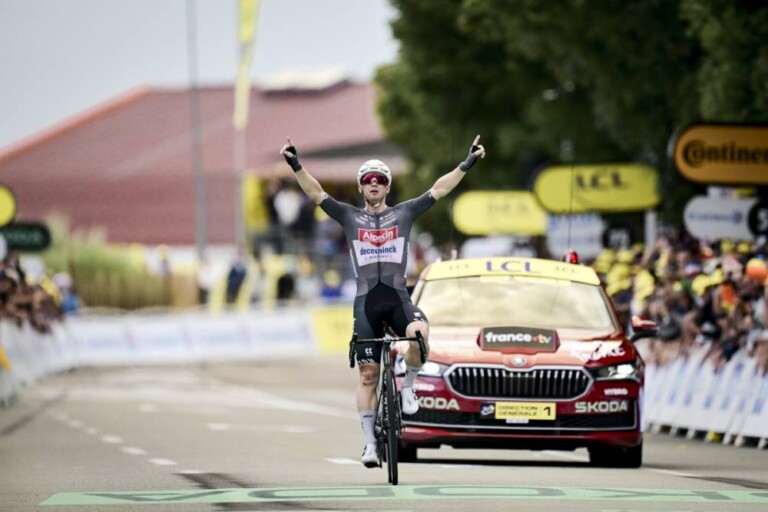
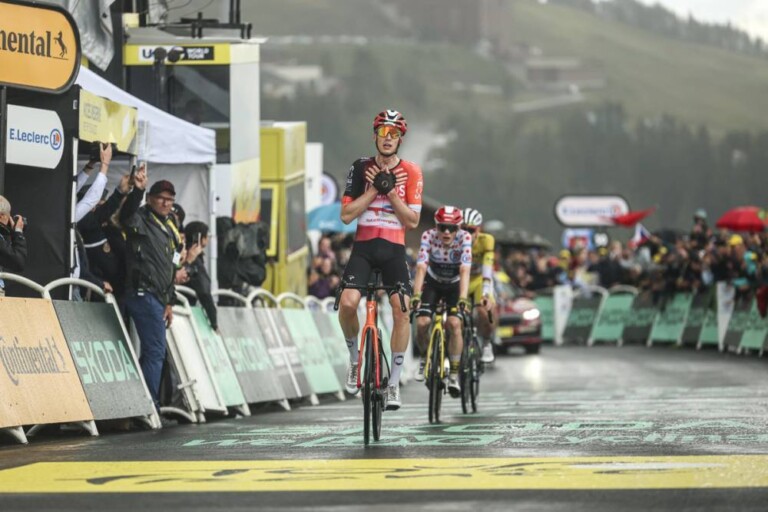
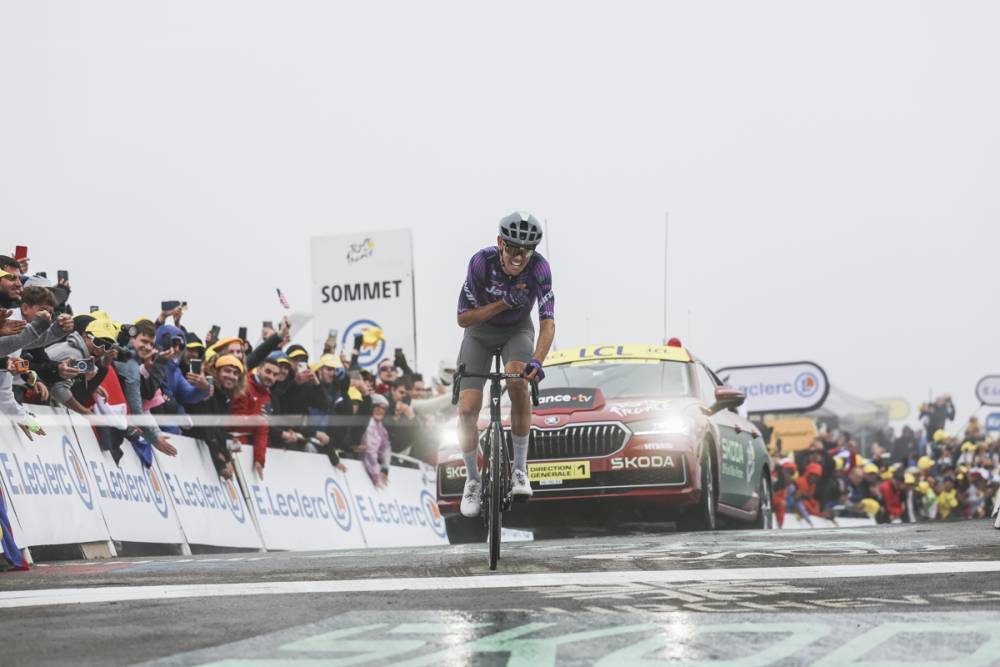
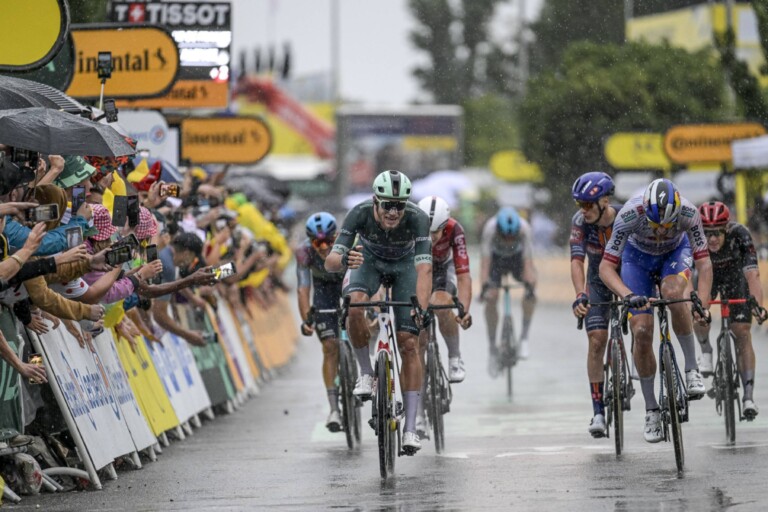
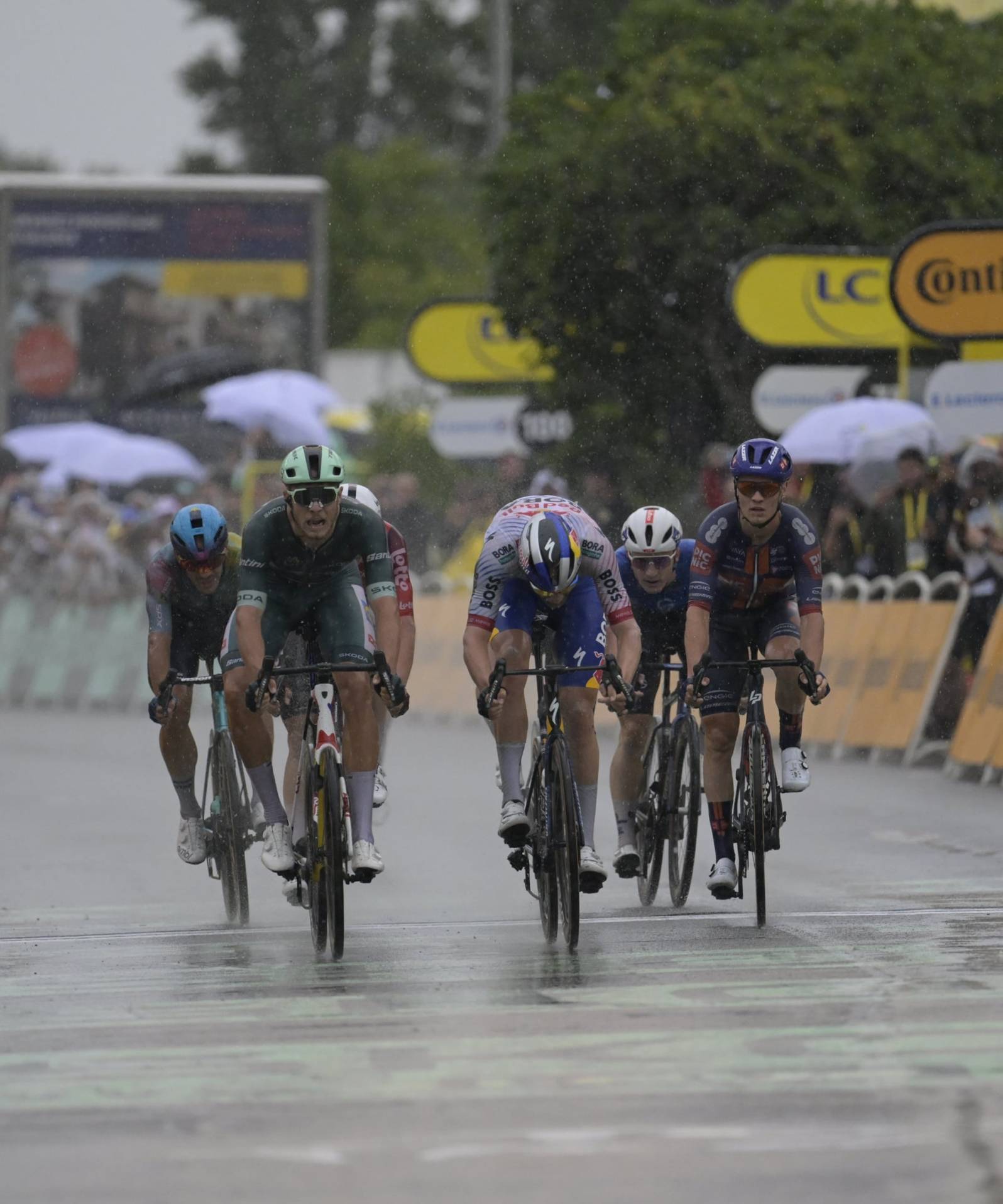
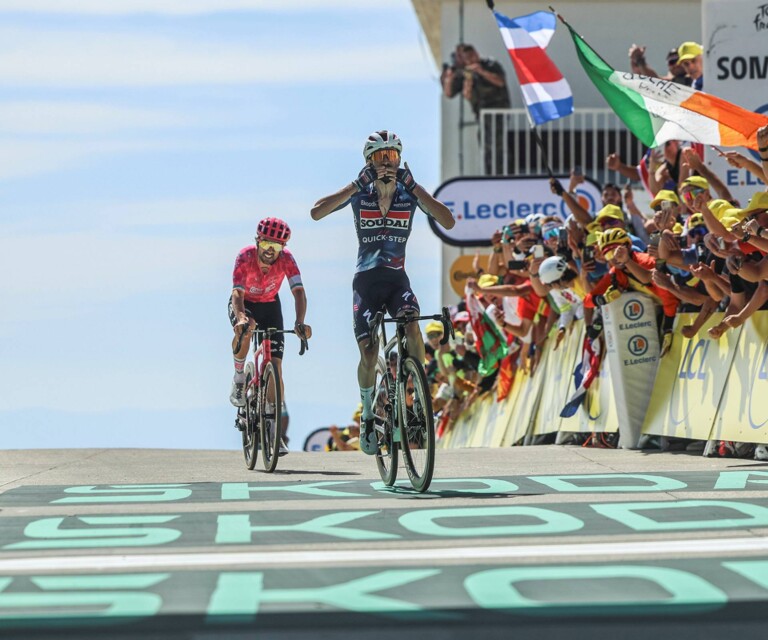
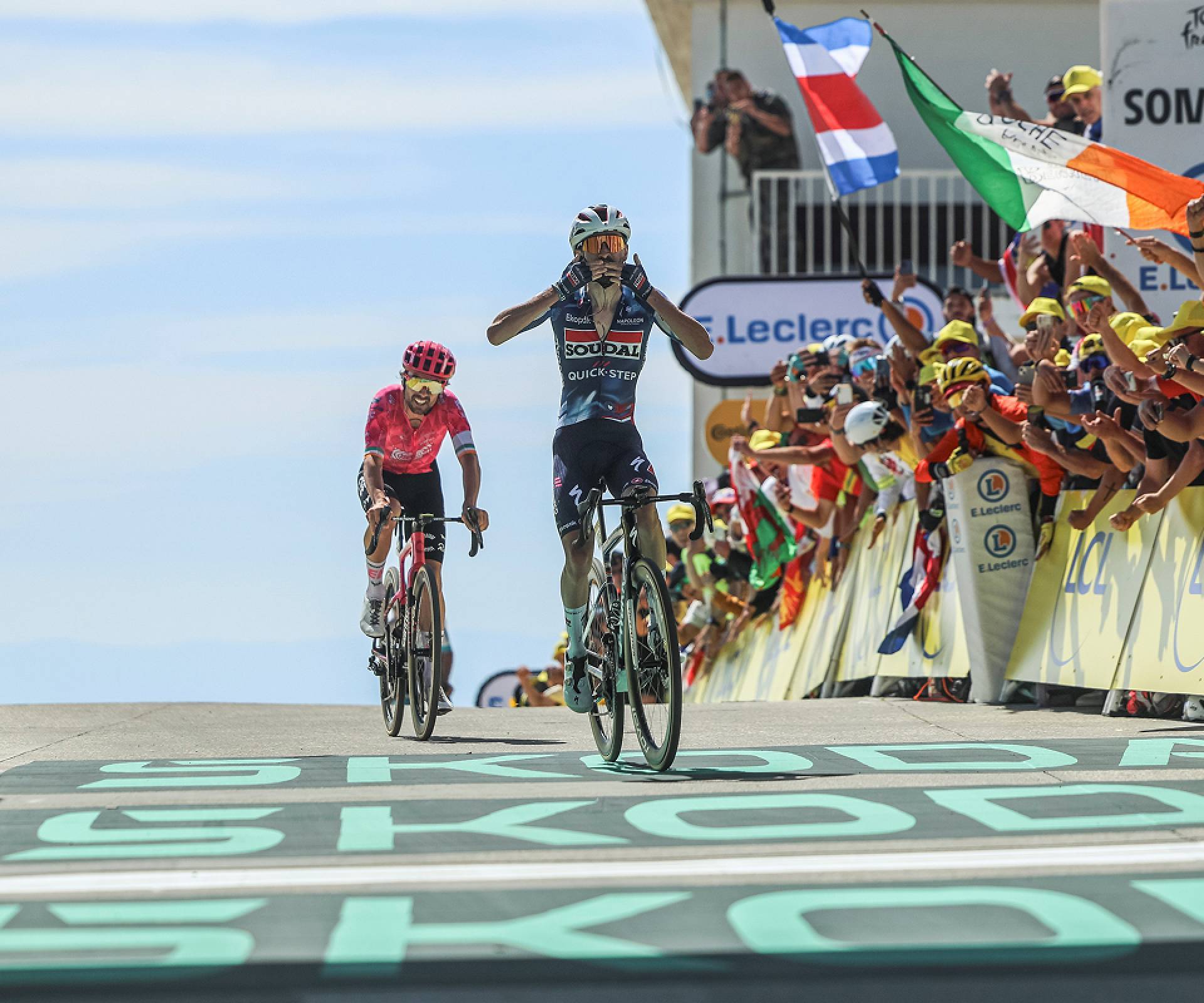
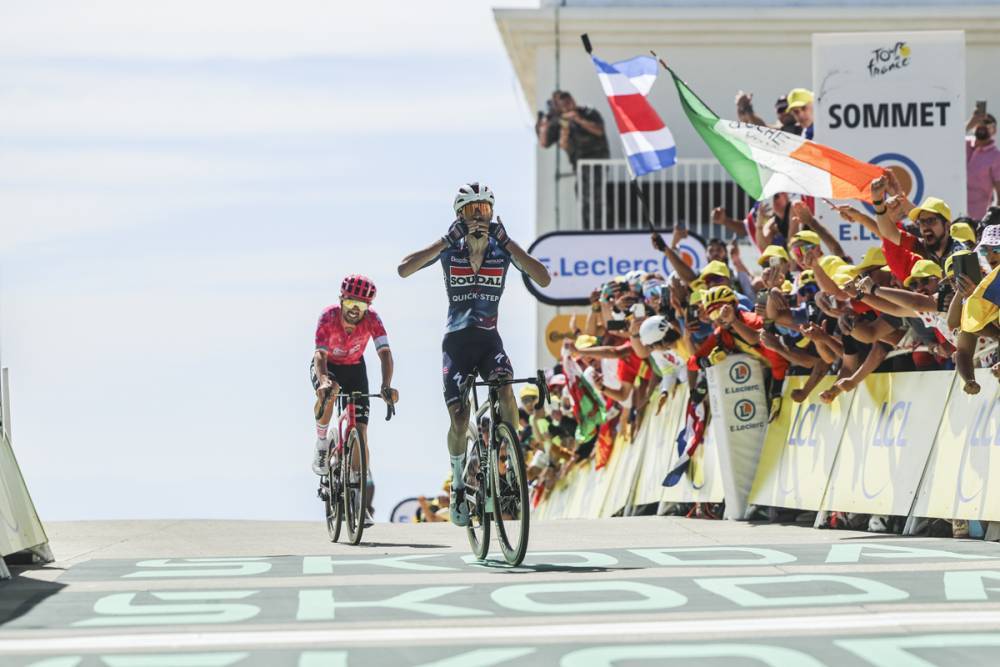
Kaden Groves crossed the line in Pontarlier with arms raised high, tears streaming down his face as the magnitude of his achievement hit home. “Winning in all three Grand Tours is a dream of every rider, and especially in the Tour,” he said through his emotions after the finish. “It’s also my first solo victory, and to do it in the Tour makes it even more special. It’s so many emotions.”
The victory capped a challenging season for the Australian. “It’s been an up and down year, missing the Classics, and that’s why bouncing back in the Giro was super important for me,” he reflected on his path to this moment.
Frank van den Broek rolled in 54 seconds later, his second place a just reward for the strongest chase of the day. Pascal Eenkhoorn claimed the final podium spot at 59 seconds, having timed his effort perfectly to overhaul the fading Jake Stewart in the final kilometers.
For Harry Sweeny, the day ended in disappointment despite his brave solo effort. “I have to say I am very disappointed,” he admitted. “In the end, it’s not what I wanted. If it had been the right moment, with the right rider, then that move would have worked. You never know until you try.”
But the EF rider showed his class in defeat, celebrating his friend’s success: “Kaden [Groves] is one of my best mates so I think tomorrow night in Paris is gonna be good fun. You could see the emotion, Kaden had tears in his eyes crossing the finish line and it’s the opposite for me…”
Despite the disappointment, Sweeny remained philosophical about his Tour performance: “This Tour, I’ve showed people a lot of what I’m capable, but it leaves me hungry for more, for sure.”
Romain Grégoire, the local hero who had animated the finale before his crash, had to settle for fifth place on his home roads—a bitter disappointment but still a result that showcased his fighting spirit. The peloton eventually crossed the line with a gap of over seven minutes, having conceded the stage early in the proceedings.
Team Success and Gratitude
For Alpecin-Deceuninck, Groves’ victory represented perfect tactical flexibility. “I came here to support Jasper [Philipsen] and then we lose him, so we shifted focus to Mathieu [van der Poel],” Groves explained the team’s evolving strategy throughout the Tour. “We had some incredible success at the start of the Tour and the team gave me the opportunity to win a third stage with a third rider, which is something unique also.”
The gratitude in his voice was unmistakable: “I’m incredibly grateful for the opportunity to start the Tour and now I repay them with a win.”
Championship Implications
In the overall standings, Jordan Jegat’s brave ride paid unexpected dividends. The TotalEnergies climber’s presence in the early break and strong finishing kick were enough to leapfrog Ben O’Connor into 10th place overall—a significant achievement for both rider and team.
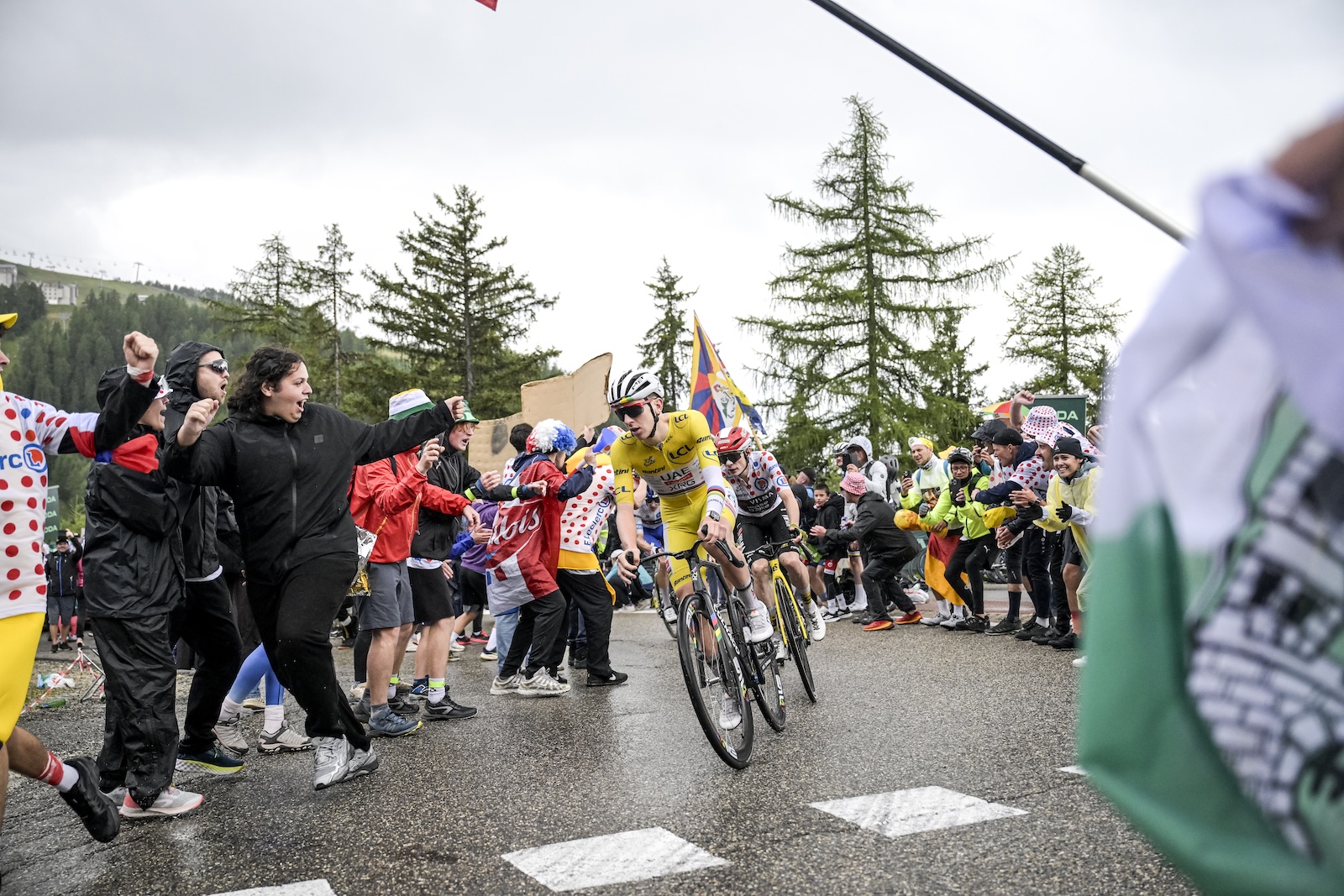
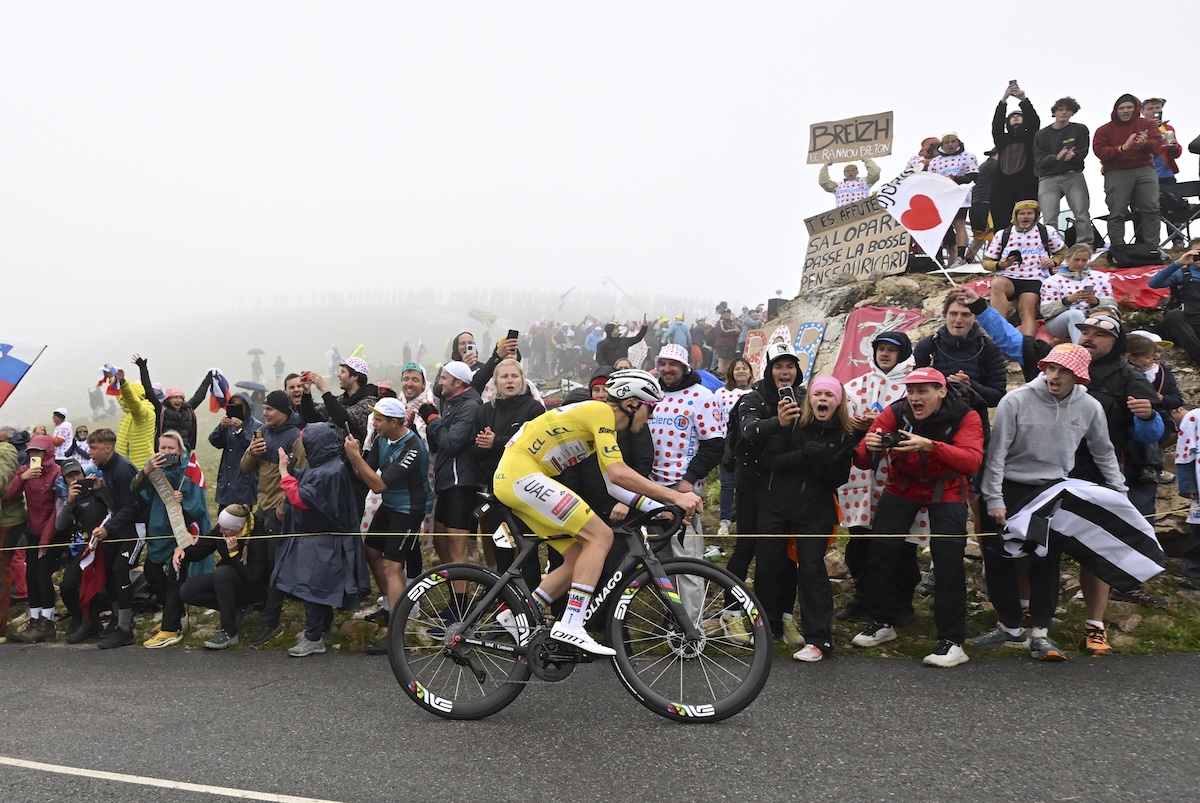
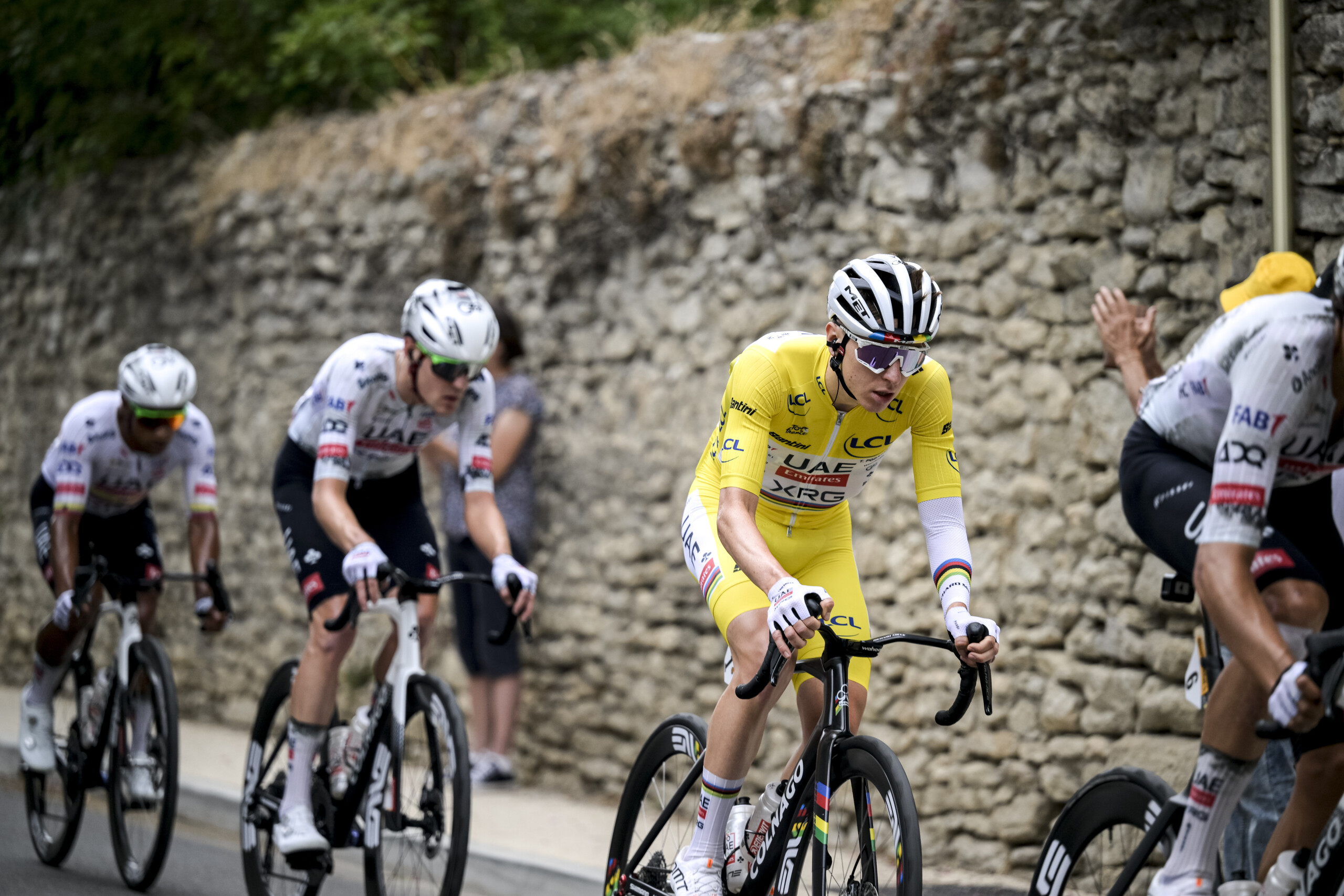
For the main classification contenders, the stage passed without major incident. Tadej Pogačar maintained his commanding lead, though he remained cautious about claiming victory prematurely. “I am more or less sure of my overall victory, but I still don’t want to say anything about it,” the Slovenian said. “I want to stay focused, along with my team, until I have crossed the last finish line in Paris.”
Florian Lipowitz successfully defended his third place overall and white jersey, describing the day as “a big relief” after expecting “a super hard day.” The German already looked ahead with some concern: “I don’t know how it will be tomorrow but it will be a hard day. I don’t expect it to be a sprint, there will be fireworks on the climb.”
Looking to Paris
As the Tour prepared for its traditional finale on the Champs-Élysées, the green jersey competition remained tantalizingly close to resolution. Jonathan Milan, despite holding a commanding lead, showed the superstition common among athletes: “Call me superstitious, but I prefer to wait until tomorrow before saying that I have won the green jersey.”
The Italian sprinter savored the moment: “This has been a big goal since the beginning of the year, both for me and for my team. I want the achievement to sink in slowly. These last few days have been beautiful for me. I have actually enjoyed them.”
Pogačar, meanwhile, already looked forward to the spectacle of racing through Paris: “It is always a pleasure to ride in such a big, beautiful city like Paris is. That’s one of the most beautiful parts of this sport. We are 180 guys who spend weeks riding in the mountains and in the end, all of a sudden, we come to the streets of one of the biggest cities in the world.”
However, he warned that the final stage might not follow the traditional script: “I am unsure of how the final stage will pan out. It won’t be a Classic, because we come after 20 stages and the course is relatively short, and that will make for a rather punchy effort. We will make plans depending on how we feel after entering the final circuit and assessing the risks we may take. We have guys like me or Jhonatan Narvaez who can go for the win.”
The Perfect Stage
Stage 20 provided the perfect reminder of why the Tour de France captivates millions worldwide. From the hour-long battle for the breakaway in the opening kilometers to Groves’ emotional victory in Pontarlier, it showcased everything that makes cycling’s greatest race so compelling: tactical warfare, individual brilliance, heartbreak, triumph, and the pure unpredictability that keeps fans on the edge of their seats.
For Groves, as he prepared to celebrate his achievement, the words said it all: “I’m gonna celebrate this one and enjoy the Champs Élysées tomorrow.” It was a perfect ending to a perfect day—cycling at its finest, with a worthy winner whose tears of joy embodied everything the Tour de France represents.
For the Tour de France, another chapter had been written in its rich history of unforgettable stage victories, one that would be remembered not just for the tactical brilliance of the racing, but for the raw emotion of a dream finally realized.
By the Numbers
114: WINNER IN ALL THREE GRAND TOURS!
Winning a Tour de France stage for the first time, Kaden Groves becomes the 114th rider to have raises his arms in all three Grand Tours. The Australian has won seven Vuelta stages, two Giro stages, and one Tour stage. The 113th to join this list was Tim Wellens thanks to his victory in Carcassone six days ago.
4: ANOTHER “NEO” WINNER
After Jonathan Milan (stages 8 and 17), Thymen Arensman (stages 14 and 19), and Valentin Paret-Peintre (stage 16), Kaden Groves is the 4th Tour newcomer to win this year. Four “neo” becoming Tour winners, like in 2023 (Jai Hindley, Carlos Rodriguez, Félix Gall, Jordi Meeus). He is the 863rd rider to win a Tour stage.
2002: TWO DUTCHMEN ON THE PODIUM
The Dutch riders Frank Van den Broek (2nd) and Pascal Eenkhoorn (3rd) both achieved their 2nd Tour stage podiums. Frank finished 2nd in Rimini last year, Pascal 2nd in Bourg-en-Bresse in 2023. This is the first time there have been two Dutch riders in the top-3 since Plouay 2002, 23 years ago, and the hat-trick of Karsten Kroon, Servais Knaven, and Erik Dekker!
40: AUSTRALIA WINS, AGAIN!
Kaden Groves gives Australia its 40th victory, two days after Ben O’Connor’s triumph at the Col de la Loze. Two wins in three days, a first since 2006, when Robbie McEwen won in Esch-sur-Alzette (July 3), Saint-Quentin (July 5), and Vitré (July 7). The last Tour with two Australian victories was the 2022 edition (Simon Clarke in Arenberg; Michael Matthews in Mende).
14: A NEW WINNER FOR ALPECIN-DECEUNINCK
Alpecin-Deceuninck claimed its 14th Tour victory, but Kaden Groves is only the 4th different rider to lead the team to victory. He joins a list that includes Jasper Philipsen (10 wins with the team), Mathieu van der Poel (2), and Tim Merlier (1). This is the 3rd Alpecin-Deceuninck victory in this Tour – and with 3 different riders – after stages 1 (Philipsen) and 2 (van der Poel).
3: BRAVE AUSTRALIANS
Present in the breakaway and leading the Côte de Thésy, the toughest climb of the stage (category 2), Harry Sweeny received his first combativity award. He’s the third Australian to do it after his compatriots Michael Storer (stage 15) and Ben O’Connor (stage 18). It makes Australia the second country with the most combativity awards, behind France (9).
3: POLKA-DOT JERSEY FOR POGAČAR
There are only 5 points left for the moutains classification. Leader Tadej Pogačar has a 13-point lead over second-place Jonas Vingegaard. By reaching the finish line tomorrow, the Slovenian will win his 3rd polka dot jersey after 2020 and 2021, as many as Eddy Merckx and Julio Jimenez. Richard Virenque (7), Federico Bahamontes (6), and Lucien Van Impe (6) are the only riders to have won this classification more than three times.
80: GREEN JERSEY SECURED FOR MILAN
With an 80-point lead over Tadej Pogacar and 70 points remaining tomorrow, Jonathan Milan is mathematically guaranteed to win the points classification. The Italian still needs to cross the finish line on Sunday to confirm his first green jersey triumph. He would be the 7th different winner in the last seven years (2019-2025), a streak not seen since 2006-2012. Milan can become the first “néo” to win the points classification since Peter Sagan in 2012.
Stage 20 Results
Kaden Groves (Alpecin-Deceuninck) – 4h06’09”
Frank van den Broek (Team Picnic PostNL) – +54″
Pascal Eenkhoorn (Soudal Quick-Step) – +59″
Santiago Velasco (XDS Astana Team) – +1’04”
Romain Gregoire (Groupama-FDJ) – +1’04”
Jake Stewart (Israel – Premier Tech) – +1’04”
Julien Jegat (TotalEnergies) – +1’04”
Tim Wellens (UAE Team Emirates XRG) – +1’04”
Matteo Jorgenson (Team Visma | Lease a Bike) – +1’04”
Harry Sweeny (EF Education-EasyPost) – +1’04”
General Classification After Stage 20
Tadej Pogačar (UAE Team Emirates XRG) – 73h54’59”
Jonas Vingegaard (Team Visma-Lease a Bike) – +4’24”
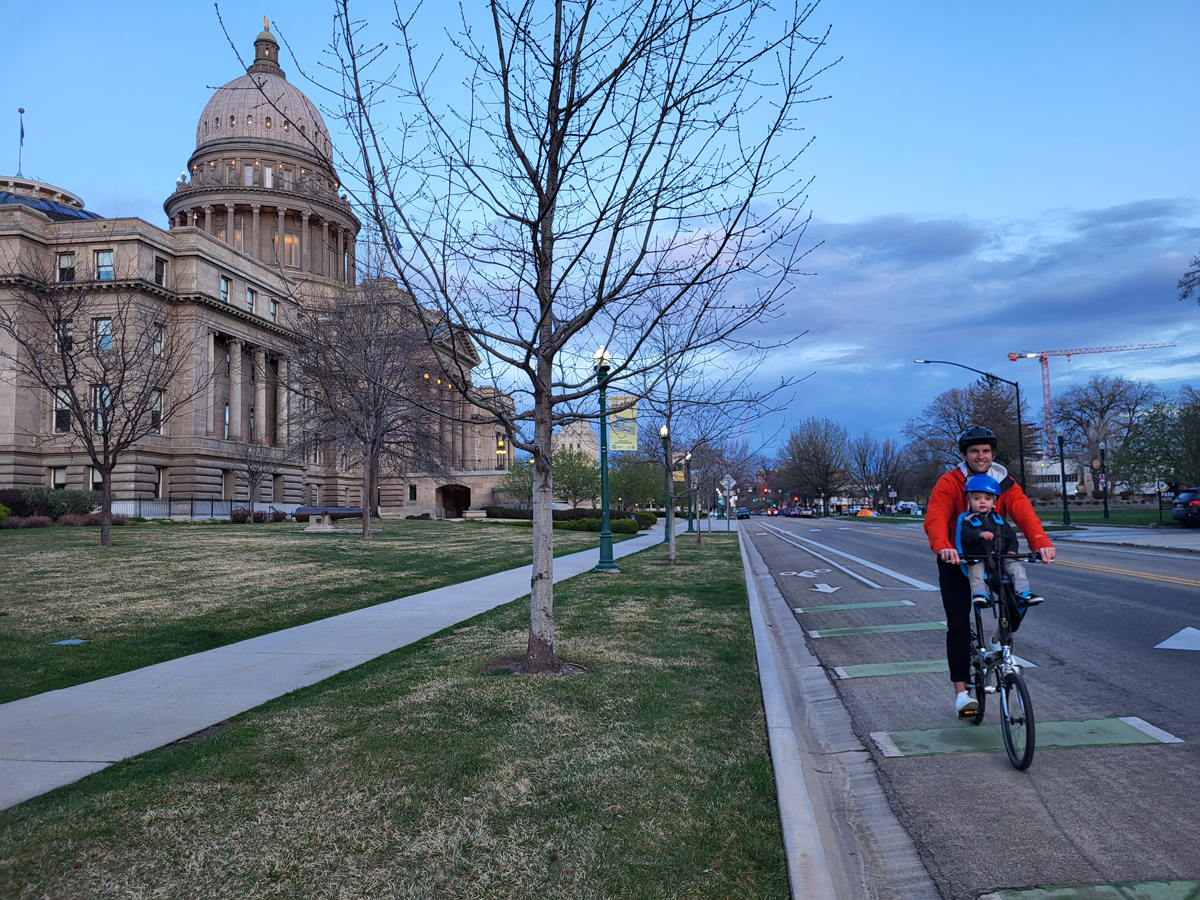
By James Knight — Senate Bill 1140 and Senate Bill 1144 have passed in the state of Idaho. These bills will regulate and dictate when bike lanes and sidewalks can be built in Ada County, including Boise. The bills were sponsored by now former Senator Mark Harris, who is from Soda Springs, Idaho. Senate Bill 1140 passed with 28-6-1 in the Senate and 59-9-2 in the House, while Senate Bill 1144 passed 26-7-2 in the Senate and 58-10-2 in the House and were signed into law by Governor Brad Little according to legislature.idaho.gov.
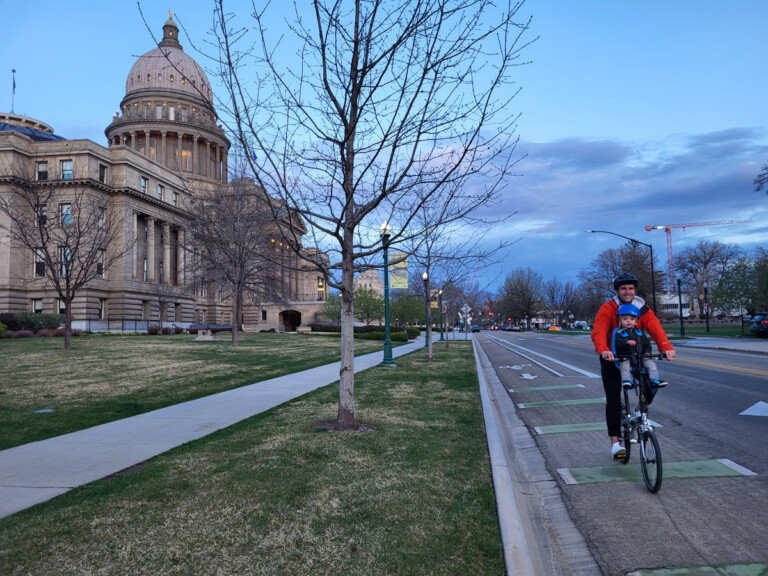
Boise bike lanes would be severely hampered by two new bills that have passed the Idaho State Legislature. Photo by Colton Grange
These bills passed despite the community electing two new pro-pedestrian and bicycling Ada County Highway District commissioners Alexis Pickering and Patricia Nilsson, as Colton Grange notes in the Cycling West editorial “Advocacy Alert: Idaho Bills Will Severely Impact Bike Projects.” While these bills primarily impact Boise and other areas within Ada County. The bills were brought forth by politicians from outside of Ada County. As Colton Grange noted in the same editorial “A bunch of politicians who don’t live in Ada County are voting to overrule the results of that election and threaten ACHD members with jail time should they commit the crime of building a bike lane. It’s excessive regulation. It’s government overreach.”
The new bills essentially say that bike lanes and pedestrian facilities can only be improved upon or added to a highway project if they provide a secondary benefit to the project, or are near schools or parks, or if there are federal regulations requiring such action. Any elected person who tries to infringe on these laws can be charged with a misdemeanor and punished by up to a year in prison and $1000 fine.
LA PLAGNE, France (25 July 2025) — The mountains speak their own language through gradients and oxygen debt, through the rhythm of labored breathing and the percussion of carbon wheels against tarmac. On this penultimate day in the Alps, with the Tour’s final act awaiting in Paris, the peloton faces one last reckoning with the high places that have defined this race since its inception.
Stage 19 of the Tour de France 2025 should have been a ceremonial procession, the final mountain test before the yellow jersey procession to the Champs-Élysées. Instead, it becomes a theater of dreams and records, where a Dutch climber named Thymen Arensman etches his name into Tour folklore with a performance that defies logic and rewrites the script of what seems inevitable. But perhaps more significantly, it becomes the stage where Jonas Vingegaard finally answers the question that haunts him since last year’s defeat: can he still match Tadej Pogačar in the mountains?
The answer comes in the final sprint to the line, where the Dane reaches 34.3 km/h to edge the Slovenian by mere inches—breaking a nine-stage mountain losing streak that stretches back to their last meaningful confrontation. For Vingegaard (Visma-Lease a Bike), wearing the polka-dot jersey in deference to Pogačar’s (UAE Team Emirates-XRG) yellow, it represents a psychological victory worth far more than the two seconds he gains.
The Quiet Before the Storm
The morning air in Albertville carries the weight of expectation and the promise of Alpine drama. This storied city, which has become a regular fixture in the Tour’s Alpine odyssey, prepares to witness its sixth peloton departure in less than a decade. The ghosts of cycling’s past linger in the mountain air—Pierre Rolland’s triumph in 2012, Romain Bardet’s coup in 2016, Geraint Thomas’s yellow jersey seizure in 2018, and most memorably, the 2022 stage to the Granon where Vingegaard first dethrones Pogačar.
Nature intervenes before the riders even clip in. A course change reduces the stage from its original 129.9 kilometers to a compact but venomous 93.1 kilometers, concentrating the day’s drama into a tighter window. The 161-man peloton will roll through Beaufort before rejoining the original route toward La Plagne, where the final HC climb of the 2025 Tour awaits like a sleeping giant.
At 14:30, the peloton begins their 5.4-kilometer neutral parade through the streets of Albertville, a city that will soon fade into memory as the mountains rise ahead. Local hero Alex Baudin (EF Education-EasyPost), born in this very town, carries the hopes of French cycling on his shoulders. His aggressive racing style, witnessed just yesterday and during the Critérium du Dauphiné’s passage through these same roads, promises fireworks from the opening kilometers.
The stage profile appears deceptively benign on paper—just 93.1 kilometers through the heart of the Tarentaise Valley after the course change. But those familiar with Alpine racing know better. Three classified climbs await: the Col du Pré (12.6km at 7.7%), the Cormet de Roselend (5.9km at 6.3%), and finally, the hors catégorie beast of La Plagne (19.1km at 7.2%). With 45 King of the Mountains points available—20 each at the first and final climbs, plus five at the Cormet—the day’s mathematics heavily favor the pure climbers.
The jersey situation adds layers of intrigue to the unfolding drama. Pogačar enters the day in commanding yellow, his 4:26 advantage over Vingegaard seeming insurmountable with just three stages remaining. Yet the Slovenian’s dominance in the mountains classification—105 points to Vingegaard’s 89—means he starts wearing yellow while his Danish rival dons the polka dots, a visual reminder of the power dynamics that define this Tour.
In the points classification, Jonathan Milan’s (Lidl-Trek) sprint victory yesterday moves him to 332 points, extending his lead to 75 over the yellow jersey. The Italian’s Lidl-Trek team controls the early pace, their seven remaining riders forming a perfect train as the race officially begins at 14:45.
The truncated distance only sharpens the stakes. With less road to work with, every move will carry amplified consequence, every hesitation potentially decisive.
The Early Choreography
As ritual dictates in this Tour, Lidl-Trek assumes their familiar position at the front of the bunch, shepherding the green jersey of Jonathan Milan toward the intermediate sprint at Villard-sur-Doron. The first 12 kilometers to Villard-sur-Doron unfold at a civilized pace, the peloton content to let Lidl-Trek orchestrate the approach to the intermediate sprint. Quinn Simmons, Toms Skujiņš, Thibau Nys, and Jasper Stuyven (all Lidl-Trek) take turns at the front, their mechanical precision testifying to modern sprint train tactics. Behind them, Milan sits perfectly positioned, flanked by teammates Simone Consonni and Edward Theuns.
The sprint itself displays a masterclass in controlled aggression. Milan, resplendent in his emerald tunic, dominates with characteristic ease, claiming his seventh intermediate sprint victory of the Tour—a small but symbolic assertion of control in a race where such moments of certainty have become increasingly rare. Biniam Girmay (Intermarché-Wanty) manages second, with Anthony Turgis (Total Energies) completing the podium. But Jonas Abrahamsen (Uno-X Mobility) catches the eye, following the sprinters through and then continuing his acceleration beyond the line—the first hint that the day’s racing is about to ignite.
Alpine Overtures
The Col du Pré provides the stage’s first selective moment, its 7.2% gradient serving as an appetizer for the feast of suffering to come. The approach to the Col du Pré marks the Tour’s transition from valley roads to mountain warfare. As the gradient begins its inexorable rise, the peloton’s demeanor shifts perceptibly. Conversations cease, positions crystallize, and the distinctive sound of gear changes echoes through the ranks.
Abrahamsen’s early move displays textbook opportunism—a sprinter’s teammate seizing the moment when the pure climbers are still sizing each other up. The Norwegian’s solo effort carries him clear as the climb’s initial ramps sort the field, but seasoned observers know this is merely the opening gambit in a much larger game.
Behind him, the climb’s steeper pitches—reaching 10% in places—begin to reveal the day’s true protagonists. From the inevitable early skirmishes, two groups crystallize at the race’s sharp end, before distilling further into a trio that will define the day’s opening act. Primož Roglič (Red Bull-BORA-hansgrohe), still smarting from yesterday’s losses on the Col de la Loze, becomes the first to show his hand. The Slovenian veteran’s acceleration with seven kilometers remaining to the summit proves surgical in its precision, immediately distancing all but the most committed climbers.
Only Lenny Martinez (Bahrain Victorious) and Valentin Paret-Peintre (Soudal Quick-Step) can match Roglič’s initial surge. Martinez, in particular, seems motivated by the 20 King of the Mountains points on offer—valuable currency in his ongoing battle with Pogačar for the polka-dot classification. The Frenchman’s aggressive riding has already netted him ten summit victories in this Tour, including three hors catégorie climbs.
The three crest the Col du Pré in that order, Martinez claiming the symbolic first passage and maximum points, Roglič taking the remaining five for second place, and Paret-Peintre rounding out the podium. Their advantage over the yellow jersey group stands at a modest 55 seconds—close enough to maintain hope, far enough to avoid immediate recapture.
Behind them, Tim Wellens (UAE Team Emirates-XRG) assumes domestique duties for Pogačar, the Belgian’s steady tempo ensuring no dangerous moves can develop. The yellow jersey himself looks supremely relaxed, chatting occasionally with teammates Jhonatan Narváez and Adam Yates while keeping a watchful eye on Vingegaard’s position.
The Visma-Lease a Bike leader, resplendent in polka dots that fall to him as the classification’s second-placed rider, rides with the contained aggression of a rider who knows his moment will come. Surrounded by teammates and sporting the mountain jersey with quiet dignity, Vingegaard presents a paradox—outwardly calm yet internally coiled for action.
The Accelerando
The Cormet de Roselend—that familiar giant of the Tour’s alpine arsenal—begins to impose its will on the race’s narrative. The Cormet de Roselend provides a brief interlude, its gentler gradients allowing Roglič to showcase the descending skills that once made him a ski jumping world champion. The Slovenian’s fearless approach to the rain-slicked switchbacks proves breathtaking—hitting 94.6 km/h on the steepest sections while maintaining perfect control. His average speed of 62 km/h on the descent speaks to decades of experience reading mountain roads in all conditions.
Martinez again tops the climb, extending his King of the Mountains points tally, but behind, the GC group rouses itself into action. Andreas Leknessund (Uno-X Mobility) takes up the tempo-setting duties, his steady rhythm designed to shed Kevin Vauquelin (Arkéa-B&B Hotels), the Arkéa-B&B Hotels rider who fell behind on the Col du Pré.
The time gaps tell the story of a race beginning to fracture along predictable lines: the three leaders hold a 50-second advantage over the yellow jersey group, while Vauquelin trails by 1’50”, his hopes of stage glory already fading into the alpine air.
Yet even Roglič’s legendary bike handling cannot create the decisive gap needed for stage victory. Martinez and Paret-Peintre show equal commitment on the treacherous descent, their pursuit relentless despite the challenging conditions. By the time the trio reaches the valley floor, their lead stabilizes around the one-minute mark—significant enough to stay clear, but hardly insurmountable given the firepower lurking in the chase group.
Roglič, that master of tactical opportunism, senses the moment on the descent. The Slovenian, who has redefined what’s possible in his mid-thirties, drops his two companions on the technical downhill sections, his bike handling as precise as his tactical instincts.
The intermediate classifications tell the story of a race still in its infancy. At the Cormet de Roselend’s summit, Martinez extends his King of the Mountains points tally while Roglič adds to his collection. But with 20 points still available at La Plagne’s summit, the day’s major prize remains very much in play.
Behind them, the weather becomes a factor. Rain clouds gather ominously over the final climb, their dark presence adding an element of uncertainty to the tactical calculations. In mountain racing, weather can be the great equalizer—or the decisive factor that separates the truly great from the merely good.
The Final Gathering
By the time the race reaches the valley floor, the day’s story compresses into its essential elements. Paret-Peintre and Martinez, their early efforts spent, get swept up by the peloton with 32 kilometers remaining. Tim Wellens of UAE Team Emirates-XRG bridges across to Roglič, the Belgian all-rounder’s effort reducing the gap to nothing just as the road begins its final, decisive turn upward.
Ahead lie 19.1 kilometers of La Plagne, ascending at an average of 7.2%—the Tour’s final major summit, where careers can be made and dreams can die.
The Crucible of La Plagne
The sight of La Plagne’s lower slopes rising ahead like a concrete wall marks the day’s transition from chess match to full combat. This climb, with its reputation for breaking dreams and creating legends, hosts a Tour de France finish for the fifth time in the race’s history. The echoes of Laurent Fignon’s victories in 1984 and 1987 seem to whisper from every switchback, reminders of the climb’s capacity to crown champions and destroy pretenders.
The gradient of La Plagne exposes truth, and Roglič—that warrior of so many alpine battles—finds himself among the first casualties as the climb bites deep. His early distancing triggers an immediate response from Decathlon AG2R La Mondiale, who sense opportunity for Felix Gall (Decathlon AG2R La Mondiale) to claim fifth place overall.
As the early breakaway hits the climb’s opening kilometers, the mathematics of mountain racing begin their inexorable work. The rain that threatens all afternoon finally begins to fall, transforming the already challenging climb into a treacherous test of nerve and skill. The roads become slick, the rocks more dangerous, and the margin for error vanishingly small. These conditions favor experience over youth, calculation over impulse.
Behind the leaders, the yellow jersey group assembles into its familiar formation. Wellens continues his metronomic pace-setting, his diesel engine perfectly calibrated to keep the race under control while preserving Pogačar’s energy for the decisive moments ahead. The Slovenian champion looks around frequently, his eyes constantly seeking Vingegaard’s position—a tell-tale sign that despite his commanding overall lead, he remains acutely aware of the threat posed by his greatest rival.
The early kilometers of La Plagne are deceptively gentle, their 5-6% gradients lulling riders into a false sense of security before the climb’s middle section ramps up toward double digits. Here, with 21 kilometers remaining to the finish, the day’s script begins to deviate from expectation.
With 14 kilometers of climbing remaining, the race’s ultimate protagonist finally makes his entrance. Tadej Pogačar, bearer of 51 maillots jaunes and architect of so many alpine masterpieces, launches an attack that shatters the group like glass hitting stone.
Only Jonas Vingegaard can match the Slovenian’s acceleration, the Dane’s wheel-sucking a testament to the tactical chess match that has defined their rivalry throughout this Tour. But they are not alone—Thymen Arensman has somehow bridged across, the Ineos Grenadiers climber positioning himself in the most rarified company imaginable.
The Master Stroke
Thymen Arensman spends the early part of the stage in complete anonymity, the Dutch climber content to ride in the wheels of the yellow jersey group while his more heralded teammates and rivals mark each other. This patience proves to be tactical genius of the highest order.
The Ineos Grenadiers rider possesses advantages that aren’t immediately apparent to casual observers. He understands the psychological burden that Pogačar and Vingegaard carry—the weight of their rivalry that makes them focus on each other rather than the wider tactical picture.
When Roglič’s breakaway finally gets reeled in with 21 kilometers to go, the stage appears to be setting up for the familiar two-man battle that has defined so many mountain stages in recent years. Felix Gall (Decathlon AG2R La Mondiale) assumes pace-making duties, the Austrian’s fierce tempo stringing out what remains of the yellow jersey group and creating the perfect launching pad for attacks.
The Moment of Truth
What happens next defies conventional wisdom and challenges every assumption about the hierarchy of professional cycling. With 13 kilometers remaining, Arensman—the stage winner from Hautacam who has already exceeded every expectation of his Tour—makes a decision that borders on the absurd.
Arensman makes his move—not with the explosive acceleration that marks most successful breakaways, but with a subtle shift in rhythm that speaks to deep tactical intelligence. His increase in pace is almost imperceptible at first, but he sustains it in a way that immediately puts his rivals on the defensive.
The Dutchman’s acceleration is not the desperate flailing of an overreaching domestique, but a calculated gamble by a rider who has already tasted the impossible once before. Pogačar and Vingegaard both react, but their response is conditioned by months of marking each other. As they glance across to gauge their rival’s reaction, Arensman simply rides away from them. His knowledge of La Plagne’s every nuance allows him to accelerate precisely where the gradient favors sustained power over explosive speed.
Within 500 meters, the Dutchman opens a gap that proves to be the winning move. His timing is perfect—late enough to avoid a prolonged chase, early enough to build an insurmountable advantage. Most importantly, he correctly calculates that Pogačar and Vingegaard will be too focused on each other to mount an effective pursuit.
As he opens a gap on the two strongest riders in the world, the alpine air seems to thin with possibility.
Three kilometers later, the inevitable regrouping occurs. Pogačar and Vingegaard join with Gall, Oscar Onley (Picnic PostNL), Florian Lipowitz (Red Bull-BORA-hansgrohe), Tobias Johannessen (Uno-X Mobility), and Ben Healy (EF Education-EasyPost). The mathematics of the chase seem simple: seven of the world’s finest climbers against one audacious Dutchman who holds a slender 30-second advantage.
A Duel for the Ages
What follows is perhaps the most psychologically charged mountain duel of the Tour. Behind Arensman, who steadily extends his advantage with each pedal stroke, Pogačar and Vingegaard find themselves locked in the kind of personal battle that transcends mere racing tactics.
For Pogačar, the situation represents a familiar scenario. The Slovenian has dominated mountain finishes so completely in recent years that he has grown accustomed to controlling the finale from positions of strength. His nine consecutive victories over Vingegaard in mountain stages have created an aura of invincibility that extends far beyond mere statistics.
Yet something is different today. Perhaps it is the polka-dot jersey adorning Vingegaard’s shoulders—a visual reminder that the Dane remains capable of challenging for mountain prizes. Perhaps it is the accumulated pressure of maintaining yellow jersey responsibilities while also defending his King of the Mountains lead. Whatever the cause, Pogačar’s usual air of supreme confidence seems fractionally diminished.
Vingegaard, conversely, rides with the desperate urgency of a rider who understands that opportunities for redemption are becoming increasingly rare. His relegation to second place in this Tour has been comprehensive, built on a foundation of superior climbing that had seemed unshakeable. Today represents perhaps his final chance to prove that the fire that carried him to two Tour victories still burns within.
As the kilometers tick by, their tactical dance becomes increasingly intricate. Pogačar surges slightly, testing Vingegaard’s response. The Dane matches him immediately, sometimes even taking the initiative with counter-attacks of his own. Neither can shake the other, but neither gains ground on Arensman, whose metronomic pace up ahead remains untroubled by their psychological warfare.
The supporting cast adds their own subplots to the unfolding drama. Florian Lipowitz (Red Bull-BORA-hansgrohe), the young German who has impressed throughout the Tour, desperately tries to limit his losses to preserve his white jersey aspirations. His 11:01 deficit to Pogačar in the overall classification means he can afford little slippage, yet the pace being set by the race leaders begins to tell on his less experienced legs.
Oscar Onley (Picnic PostNL), the revelation of this Tour, also starts to feel the effects of his recent breakthrough. The young Briton gained 1:39 on yesterday’s stage to La Loze, moving to within 11:23 of the yellow jersey, but La Plagne’s relentless gradients test the limits of his still-developing mountain legs.
The Pressure Cooker
With five kilometers remaining, the race situation crystallizes into its essential elements. Arensman leads by 30 seconds, his advantage seeming stable as he maintains his devastating rhythm of 23 km/h on gradients that reduce many riders to survival mode. He has already been awarded the day’s combativity prize—a fitting recognition for the tactical masterpiece he is executing.
The gap fluctuates like a heartbeat in the thin air—30 seconds, then 25, then 20 as the final three kilometers approach. Behind Arensman, Onley begins to show the first signs of distress, his young legs finally succumbing to the accumulated fatigue of three weeks’ racing.
Behind him, the psychological tension between Pogačar and Vingegaard ratchets up another notch. Every glance, every subtle shift in position, every change in breathing pattern gets analyzed and interpreted. They are close enough to hear each other’s labored breathing, to see the strain in each other’s faces, to sense the mounting fatigue that even the world’s best climbers cannot entirely mask.
The supporting group gets whittled down to its essential components. Gall continues his pace-making duties, though his earlier efforts begin to show. Lipowitz hangs on grimly, knowing that every second lost here will be almost impossible to regain, defending his white jersey and podium position. Onley, too, fights to stay connected, his youthful enthusiasm battling against the accumulated fatigue of three weeks of racing.
The weather continues to play its part, the rain making every corner treacherous and every pedal stroke a calculated risk. These conditions test more than just physical strength—they demand complete mental focus and unwavering commitment to the racing line.
The Final Gambit
The decisive moment arrives with two kilometers remaining. Here Pogačar finally abandons his patient approach and unleashes the kind of acceleration that has become his trademark. The attack is smooth, powerful, and seemingly effortless—the hallmark of a rider operating at the very peak of his abilities.
Lipowitz, sensing the moment, accelerates. The German’s move brings Arensman into view, the gap closing with each meter of altitude gained. The stage victory that seemed impossible suddenly becomes tangibly within reach of the chase group.
For once, however, Vingegaard is ready. The Dane’s response is immediate and comprehensive, matching Pogačar’s surge with an acceleration of his own that speaks to months of preparation for exactly this moment. For the first time in their recent encounters, it is Pogačar who looks around with concern rather than confidence.
The psychological shift is subtle but unmistakable. Vingegaard, carrying the weight of nine consecutive mountain defeats, finally finds the form that once made him cycling’s most feared climber. His positioning is perfect, his breathing controlled, his pedal stroke fluid despite the enormous power he generates.
Behind them, the casualties begin to mount. Lipowitz, despite his best efforts, can no longer sustain the pace. His acceleration with 2.5 kilometers to go is brave but ultimately futile, the young German’s inexperience showing as he overextends himself when patience would serve him better.
Onley, too, finally succumbs to the accumulated strain. The Briton’s brave effort throughout the Tour has been one of the race’s most compelling storylines, but La Plagne’s merciless gradients finally find his breaking point. With two kilometers to go, he drops from the leading group, his dreams of a stage victory dissolving into the Alpine mist. The young Briton finishes 47 seconds behind Arensman—his struggles giving Lipowitz valuable breathing room in the young rider classification.
The Moment of Truth
But Arensman has found something beyond physical capability—a zone where suffering becomes transcendent, where the body’s limitations dissolve into pure will. Ahead of the drama unfolding behind him, Arensman can sense victory approaching. His intimate knowledge of La Plagne’s final kilometers tells him exactly what remains: one final ramp of maximum gradient, followed by a slight easing before the finish line. He has calculated his effort perfectly, maintaining just enough in reserve for one final acceleration when it will matter most.
The gap to his pursuers stabilizes at 15 seconds—close enough to maintain pressure, far enough to offer genuine hope of victory. His average speed of 23 km/h for the entire climb represents a performance of exceptional quality, achieved in conditions that would break lesser riders.
As the red kite marking the final kilometer appears, he maintains his advantage, the gap hovering at 20 seconds as if suspended by invisible threads. As the gradient kicks up to its maximum in the final kilometer—reaching 12% in places—Arensman finds that elusive extra gear that separates stage winners from also-rans. His acceleration is subtle but decisive, stretching his advantage back toward the 20-second mark that will guarantee victory.
Behind him, Vingegaard and Pogačar lock themselves in their own private world. The Dane positions himself perfectly for the final sprint, his bike handling in the treacherous conditions flawless despite the intensity of his effort. Pogačar, for his part, seems to calculate his options—whether to risk everything on one final acceleration or to accept that today will not be his day.
In those final moments, with La Plagne’s crowds creating a corridor of sound and color, Thymen Arensman holds off the inevitable. The finish line at La Plagne approaches through swirling mist and the roar of thousands of spectators who have braved the Alpine weather to witness cycling history. Arensman, arms raised in triumph, crosses first with the kind of victory that defines careers. His time for the final climb—19 minutes and 1 second—will stand as one of the finest performances in the mountain’s storied history. He crosses the line with arms raised, his face a mask of exhaustion and disbelief.
Two seconds later, the moment that cycling has waited for finally arrives. Vingegaard, summoning every ounce of the form that once made him cycling’s greatest champion, outsprints Pogačar in the final meters. His speed of 34.3 km/h in the final sprint testifies to the reserves of power he has maintained despite the brutal pace—just two seconds ahead of Vingegaard and Pogačar, who cross together in a sprint that seems almost anticlimactic after the drama that preceded it, yet carries profound psychological weight.
The psychological implications are immediate and profound. After nine consecutive mountain defeats, Vingegaard has finally proven he can still match Pogačar when it matters most. The margin is tiny—just two seconds—but the symbolism is enormous. The balance of power in cycling’s greatest rivalry has shifted, if only slightly, back toward equilibrium.
Pogačar, gracious in defeat despite his evident disappointment, crosses the line two seconds behind his greatest rival. His overall lead remains commanding at 4:26, and his yellow jersey seems secure with just two stages remaining. Yet the flicker of vulnerability he shows in the final kilometers will not go unnoticed by his rivals or the cycling world at large.
Lipowitz salvages fourth place, his deficit of six seconds to the stage winner representing a creditable performance given the circumstances. His white jersey remains secure, though Onley’s struggles have given him valuable breathing room in the young rider classification.
The Aftermath
In the immediate aftermath of his triumph, Arensman’s words capture the magnitude of what he has achieved:
“I’m absolutely destroyed. I can’t believe it. To win one stage from the breakaway was already unbelievable. But now, to do it against the GC group, against the strongest riders in the world, it feels like I’m dreaming. I don’t know what I just did.”
The tactical genesis of his attack reveals itself in the post-race interview: “After the descent towards La Plagne, I was talking on the radio, Tobias [Foss] was there, and I spoke with our DS Zak [Dempster]. I thought today is the last mountain stage. I’m not riding for GC, but I’ll try to hang on, see how the legs feel in the first kilometres of the climb. I told Tobias to swing off: ‘Tomorrow is your day, and I’ll see what I can do here.'”
His tactical gamble was born of desperation and opportunity in equal measure: “Since I’m not in the GC, I figured maybe they’ll look at each other. I just try, I just don’t take no as an answer. Tadej [Pogačar] and Jonas [Vingegaard] are the strongest in the world, almost aliens, and I’m human. I can’t believe I beat them today.”
The mental fortitude required for such an audacious move becomes clear in his description of the final kilometers: “I tried to not look behind, to go as fast as I could. I did and it was enough. This is just crazy.”
His triumph becomes all the more remarkable by the adversity he has overcome in recent weeks: “I got sick in the last week of the Giro. Somebody crashed into me and my knee was hurting. I still got to Rome but I had better hopes. To then go to the Tour and take two stage wins is just crazy.”
Behind him, Lipowitz successfully defends his white jersey and podium position, his tactical acumen evident in his race analysis: “I knew after yesterday Oscar [Onley] is very strong and I had to keep his wheel. I think I managed things quite well today. Of course, on the last climb, I was thinking a lot. You never know how your legs are in the end but I felt quite okay and when I saw him dropping, I gave everything. I’m super happy with today.”
The German’s emotional response captures the magnitude of racing at cycling’s highest level: “It’s unbelievable [to wear the white jersey and be in the GC top 3] but I expect another hard day tomorrow, with a lot of ups and downs. Everyone will try to join the breakaway so we still need to be focused. Today was amazing. It was incredible to see so many fans cheering for me, to see my name painted on the road. I never saw that. I had goosebumps during the race.”
The Yellow Jersey Milestone
For Pogačar, the day brings both triumph and tactical reflection. His 52nd day in yellow ties Jacques Anquetil’s historic record and secures his place in the Tour’s top five for most days leading the overall standings. Yet his post-race analysis reveals the complexity of racing at the sport’s pinnacle:
“We did a very good job until the last climb. Then some riders thought they could sprint all 19 kilometres of the climb and set a super high pace from the bottom. I attacked as soon as Decathlon stopped pulling, but it was a bit too early. I thought Jonas [Vingegaard] may have wanted to win the stage as I did, but he was just following my wheel.”
His tactical decision not to follow Arensman’s attack proves costly but perhaps inevitable: “When Arensman attacked, I decided not to follow and set a defensive rhythm I felt comfortable with. Nobody else contributed to the chase, and Arensman was too strong for my comfort pace. We came close to overtaking him, but we didn’t and he deserved this win.”
The physical toll of the chase becomes evident in his description of the final kilometers: “I was pulling and counting down the kilometres left to Paris. I had to pull for nearly the whole climb, and came quite tired to the finish line.”
The fatigue of leading the Tour for nearly two months is evident in his words: “It was a tough last three days and I’m happy that today is over. The Tour de France has begun to feel very long. With this weather today, and the ceremony after… I just want to go to the bus and take a good, hot shower. This is the Tour de France, and you never know what might come your way. We have to keep our focus for two more days.”
The Broader Picture
As the riders recover in the finish area, the day’s broader implications begin to crystallize. Arensman’s victory builds on tactical intelligence of the highest order—patient positioning, perfect timing, and intimate course knowledge combine to create one of the Tour’s most impressive stage wins. His performance serves as a reminder that in mountain racing, cerebral approach can triumph over pure power.
For Vingegaard, the psychological victory is perhaps more valuable than the stage podium. His ability to match and ultimately beat Pogačar in a mountain sprint demonstrates that reports of his decline have been greatly exaggerated. The confidence gained from this performance could prove invaluable in future encounters.
Pogačar’s defeat, meanwhile, is hardly catastrophic. His yellow jersey remains secure, his overall advantage commanding, and his reputation intact. Yet the aura of invincibility that has surrounded his mountain performances fractures, creating doubt where none had existed before.
In the King of the Mountains classification, Pogačar’s dominance continues despite his stage defeat. His 105 points remain well clear of Vingegaard’s 89, with Martinez third on 97 points after his early break success. The polka-dot jersey will return to Pogačar tomorrow, though Vingegaard’s brief tenure has been symbolically important.
The points classification sees Milan extend his advantage, his early sprint points proving valuable as the Tour enters its final stages. With 332 points to Pogačar’s 257, the Italian’s green jersey appears all but secure barring catastrophe.
Historical Echoes
As the Tour prepares to leave La Plagne and continue its march toward Paris, the echoes of cycling history seem to whisper from every switchback. This climb, which has witnessed Fignon’s dominance in the 1980s and created legends across five previous Tour finishes, adds another chapter to its storied legacy.
Arensman’s victory will be remembered not just for its tactical brilliance, but for the way it has been achieved—through patience, intelligence, and perfect execution rather than brute force. In an era dominated by power meters and scientific training, his triumph reminds us that bike racing remains fundamentally about reading situations and seizing moments.
The duel between Vingegaard and Pogačar, meanwhile, adds another layer to cycling’s greatest modern rivalry. Their battle transcends mere competition, representing a clash of contrasting philosophies and approaches to the sport’s ultimate prize.
The Eternal Return
As the last riders cross the line at La Plagne and the mountains begin their descent into evening shadow, Stage 19 of the 2025 Tour de France takes its place in the race’s vast mythology. Arensman’s double triumph—Hautacam and now La Plagne—represents something pure in a sport often complicated by tactics and calculation: the victory of audacity over convention, of dreams over probability.
With just two stages remaining, the 2025 Tour enters its final act. But on this day, in these mountains that have witnessed a century of cycling’s greatest stories, Thymen Arensman adds his own chapter to the legend. The last dance at La Plagne belongs to a Dutchman who dares to dream beyond his station and finds, in that rarified air, that even aliens can be human when the mountains call the tune.
In the thin air of the French Alps, where legends forge and yellow jerseys change hands, multiple narratives converge into one transcendent moment. Arensman’s tactical masterpiece, Vingegaard’s psychological redemption, and Pogačar’s rare moment of vulnerability combine to create the kind of stage that defines Tours and lives in memory long after the final podium ceremony in Paris.
The mathematics of the race remain largely unchanged—Pogačar’s yellow jersey secure, Milan’s green jersey all but guaranteed, Lipowitz’s white jersey defended with German efficiency. Yet the psychological landscape shifts in ways that cannot be quantified by time gaps or points classifications. The aura of inevitability that surrounded this Tour’s final week shatters under a Dutchman’s audacious gamble and a Dane’s moment of redemption.
As the Tour caravan prepares to depart La Plagne for the final time, the mountain’s slopes bear witness to one eternal truth: that in cycling, as in life, it is not always the strongest who prevail, but those who dare to dream when the moment demands courage over calculation. The last dance at La Plagne reminds the cycling world why the mountains remain the Tour’s ultimate theater—unpredictable, unforgiving, and utterly unforgettable.
By the Numbers
2: DUTCH CLIMBERS’ NEW STAR
Winner in Superbagnères six days ago, Thymen Arensman raises his arms for the 2nd time and gives the Netherlands its 170th Tour victory. He is the first Dutchman to win two mountain stages since Peter Winnen, who triumphed at L’Alpe d’Huez in 1981 and 1983, over 40 years ago!
1981: NEOS GOING PAST ONE
Two riders, Jonathan Milan and Thymen Arensman, scored 2 stage wins in their first Tour. Not a common sight: the last time it happened was in 1981, with both Ad Wijnands and Daniel Willems scoring 2 stage wins at their first participation. Before Milan and Arensman, the last “neo” to win two Tour stages was Tadej Pogačar in 2020.
6/12: A HALF… MORE THAN A HALF
Thymen Arensman 1st (2 wins), Tadej Pogačar 3rd (4), Ben Healy 8th (1), Valentin Paret-Peintre 9th (1), Simon Yates 10th (1), Ben O’Connor 12th (1): half of the top-12 riders have won more than half of the stages contested (10 out of 19)!
52: POGAČAR LIKE ANQUETIL
Tadej Pogačar still leads the general classification and equals Jacques Anquetil as the 5th rider with the most Yellow Jerseys (52). His next target is Christopher Froome (59).
2000: GALL FOR AUSTRIA
Félix Gall reaches 5th place in the general classification, the best ever achieved by this rider, who is finishing his third Tour de France (8th and stage winner in 2023). He has never done as well in a Grand Tour, his references being a 6th place in the Vuelta (2022, stages 4-5) and a 18th place in the Giro (2024, stage 1). He is the first Austrian to be in the top 5 of the Tour de France since Peter Luttenberger, who was 5th after stages 10 and 11 in… 2000!
6: JOHANNESSEN IS MAKING HISTORY
Moving from 7th to 6th overall, Tobias Johannessen improves a result that would be historic for Norway. A Norwegian has never finished in the top 10 of the Tour, the highest ranking being Jostein Wilmann’s 14th place in 1980.
10: VINGEGAARD BEATS POGAČAR. FINALLY!
Tadej Pogačar had beaten Jonas Vingegaard in the last 10 mountain stages. Even if it wasn’t for today’s victory, the Dane (2nd) ended this streak by finally beating the Slovenian (3rd) in La Plagne. It hadn’t happened since the 11th stage of the Tour 2024, won by Vingegaard in Le Lioran.
63: ONE MINUTE FOR THE PODIUM
63 seconds (or 1’03”) separate Florian Lipowitz (3rd) and Oscar Onley (4th) in the general classification. The battle for the podium – which is also the battle for the white jersey – has not been this tight after 19 stages since the Tour 2019. Geraint Thomas was then 3rd, 12 seconds ahead of Steven Kruijswijk.
3: LOSER OF THE DAY
Attacking in the first part of the stage, Primož Roglič finished 27th, 12’39” behind the winner. The Slovenian had not finished so far since Mende 2022 (113th, +24’23”). He lost 3 places, slipping from 5th to 8th overall behind Kévin Vauquelin. 8th would be his worst result in a “finished” Grand Tour since 2017 (38th in the Tour de France, with a stage victory in Serre Chevalier). During this period, he won 5 Grand Tours, finished on the podium in three others… but also abandoned five times.
11: MARTINEZ’S EFFORTS WERE NOT ENOUGH
First at the summit of the Col du Pré, and then the Cormet de Roselend, Lenny Martinez has conquered 11 climbs in this Tour. It’s the highest number, far ahead of Tadej Pogačar (5), who dominates the mountains classification. The Frenchman is mathematically no longer in contention for the polka dot jersey: he is 20 points behind, with 14 remaining.
BOISE, Idaho (July 22, 2025) — On a course that tends to favor sprinters at the Bailey & Glasser Boise Twilight Criterium, it was all about the attackers, with Sofia Arreola and Luke Fetzer winning on late-breaking attacks.
For Arreola, her last-ditch move came with two laps to go after Virginia’s Blue Ridge Twenty28 team dominated the 70 minutes of action. With a team of three strong riders, Arreola used her position as lead-out to launch early. She took advantage of the eyes on her sprinter teammate Marlies Mejias and went all out before the bell, getting a gamblers’ prime for her troubles. All of the race before the last lap saw Mejias lead a charging peloton in for second, right behind Arreola for the team’s 1-2 finish.
Sofia Arreola wins the 2025 Boise Twilight. Photo courtesy Boise Twilight
On the men’s side, it was a more egalitarian race as riders from across the peloton sent different moves up the road. The most dangerous move came 50 minutes in when Andrew Frank of Empyr Cycling took a flyer and immediately forged a dangerous gap. With about five laps left, the gap was around 30 seconds. Fetzer, sensing the risk of the win slipping away, hit out with vengeance. Two laps later he had caught and passed Frank. Two laps after that, he was solo, winning his first ACC race and getting a massive return for all of his efforts in support of his teammate Lucas Bourgoyne.
In the fight for the overall ACC titles, Aline Seitz finished close enough to the podium to retain her lead in the standings, while Virginia’s Blue Ridge Twenty28 made a big leap to the top of the team standings. Maurice Ballerstedt did enough to snatch the red jersey from Brody McDonald, while Cadence Cyclery have built a massive lead in the team standings.
Sofia Arreola snatches the win after a dominant team performance
In the women’s race, it was all about Virginia’s Blue Ridge Twenty28 versus the two top individuals on the ACC circuit, Aline Seitz and Andrea Cyr. With numbers to play with, Virginia’s Blue Ridge were aggressive early and often, attacking numerous times in the first half of the race and mopping up the vast majority of the crowd sourced primes that kept the action flowing.
The first big move of consequence came when Rylee McMullen (Virginia’s Blue Ridge Twenty28) attacked hard with just under half of the race remaining. No one went with McMullen, but that was part of the effectiveness of the move as it forced the rest of the peloton to keep the pressure on with Arreola and Mejias were able to keep their powder dry for the final few laps. While McMullen was marooned off the front just 10 to 20 seconds ahead of the rest of the peloton, she was able to continue to snag primes as the laps count down including the ACC mid race point sprint that put her back in the green jersey.
Eventually, McMullen was brought back into the fold and a sprint looked inevitable as Mejias looked to be the fastest in the field. Nevertheless, Virginia’s Blue Ridge Twenty28 had one more surprise up their sleeve in the form of Sofia Arreola.
Arreola, who often combines with Mejias as her last leadout rider, had the freedom to attack the race and find the opportunities to try and win one for herself. With just over three laps to go, Arreola found that opportunity and took it with both hands.
“It’s really fun racing with Marlies,” Arreola said after the race. “We have been racing against each other and together since we were juniors. It’s just really fun to be teammates because she can win out of a sprint or a breakaway and I can too.
“We knew we were a strong team and we knew we could win from different scenarios so when I found myself off the front I knew I could just keep going.”
Behind Arreola, Mejias closed fast, nearly passing Arrelo on the line, but holding off just enough to manage to let Arreola take a huge win and for the team to go 1-2 at the line, while Makayla MacPherson (CCB p/b Levine Law Group). Aline Seitz finished sixth, which kept her in the lead of the ACC ahead of Andrea Cyr, and MacPherson.
Women’s results
Sofia Arreola — Virginia’s Blue Ridge Twenty28
Marlies Mejias — Virginia’s Blue Ridge Twenty28
Makayla MacPherson — CCB p/b Levin Law
Andrea Cyr — Fount Cycling Guild
Rylee McMullen — Virginia’s Blue Ridge Twenty28
Aline Seitz — UTC Butcherbox Cycling
Isla Carr — UTC Butcherbox Cycling
Tessa Beebe — Byrds
Sara Vladimirova — Ride or Die Racing
Zoe Saccio — PDX Dream Team
Luke Fetzer steals the show
The men’s race might have had a similar end result to the women’s race, however, the way the race got to that outcome was drastically different. Instead of having a dominant team attacking the race, the men’s field had a bunch of strong racers and sprinters working with very few teammates. There were a few strong groupings — namely Cadence Cyclery and L39ion of Los Angeles — but with strong solo riders like Brody McDonald and Maurice Ballerstedt two of the main favorites for the win it was always likely to be a scrappy, unpredictable race.
Luke Fetzer wins the 2025 Boise Twilight. Photo courtesy Boise Twilight
Despite that unpredictable pretense, most of the race proceeded without any sustained moves. Consistent attacking was met with consistent chasing and marking, with the primes adding to the ebb and flow of the action.
The biggest mid race pre contest came at the ACC mid race point sprint as Owen Gillott (Cheney Windows and Doors) and Danny Summerhill (L39ion of Los Angeles) have been locked in a season long battle for the jersey and it looked set to be a full sprint between the two. However, right before the bell was being rung for the sprint, Ben Elumbaugh (Team RF Foundation p/b George’s Cycles) took a massive flyer and nabbed the sprint from Gillott and Summerhill, who were charging hard from behind. In the end, Elumbaugh has yet to place in the ACC green jersey points, so the race for second was crucial. Gillott edged out Summerhill on the line, which put him back in the Green jersey for Chicago Grit next week.
With 20 minutes left of racing, the race finally had its first significant breakaway when Andrew Frank (Empyr) went solo. The move didn’t attract attention at first, but after a half dozen laps, Frank had a gap of over 30 seconds and the race was entering its final phase. Without any big teams to chase, Empyr put themselves on the front to try and block the field and give Frank more of an advantage before the sprint.
Their plan was almost successful, until nine laps to go when Luke Fetzer jumped from the peloton with a leadout from his sprinter Lucas Bourgonye, and quickly closed the gap to Frank by himself. When he got to Frank with just under 3 laps to go, Fetzer hit out again, dropping Frank and taking over the front of the race alone, never to be seen again.
“At nine to go Lucas was like, ‘there is a guy off the front, you got to go!’” Fetzer said of the move that won him the race. “He set me up coming into the first turn and I made it across in three laps, and it was wrapped from there.
“The last ditch effort is the exact same as a solo flyer so it transitioned well. It’s the first time I have won a race like that solo, so all the time leading out Lucas has paid off.”
Back in the field, two crashes stymied any strong chase as Empyr cycling’s blocking tactics backfired in a big way; first on the backstretch with one of their riders swinging off and clipping his teammate from the front of the peloton causing a big crash. Not to be out done, with two laps to go, Empyr was embroiled in another self-inflicted crash as they overlapped wheels again when they were pulling off the front of the field. Two laps, two teammates in teammate crashes.
Nevertheless, up ahead Fetzer cruised to his first big victory on the criterium scene, raising his arms well before the finish and soaking in the cheers from a massive crowd. Behind him Frank, unaware of the chaos his team caused behind him, was holding on to a small gap into the final straight. He was just meters away from taking the second spot on the podium before Maurice Ballerstedt and Ama Nsek burst by him with 25 meters left to race to snatch a podium finish from him.
In the end, it was fourth for Frank, third for Ballerstedt, and second for Nsek. Ballerstedt did enough to work his way into the ACC overall lead as well before the series heads to Chicago next weekend.
On cycling’s most feared ascent, Ben O’Connor exorcised demons while Pogačar faced his greatest nightmare—and both emerged transformed
COURCHEVEL, France (24 July 2025) — The morning mist clung to the valley floor like a shroud as 162 riders assembled in Vif, their breath forming small clouds in the Alpine air that would soon thin to nothing. Above them, invisible behind gray clouds, the Col de la Loze waited—a 2,304-meter colossus that had twice witnessed Tadej Pogačar’s rare moments of mortal frailty. The devil has many faces on the Col de la Loze, and the yellow jersey knew them all.
At this altitude, La Loze stands as the highest summit in this edition, making it the Souvenir Henri Desgrange—a special prize named after the iconic creator of the race, who took riders over 2,500 meters as early as 1911 at the Col du Galibier. La Loze might be slightly lower, but its irregular slopes have already carved themselves into cycling legend through just two previous appearances in the Tour de France—both times serving as the theater for the Slovenian’s most profound suffering. In 2023, on these very slopes, Pogačar uttered the words that haunt him still: “I’m gone, I’m dead,” as Jonas Vingegaard (Visma-Lease a Bike) inflicted a five-minute defeat that all but sealed the Tour. It remains the most striking defeat Pogačar suffers in his otherwise dominant Tour history.
As Carlos Rodriguez (Ineos Grenadiers) and Cyril Barthe (Groupama-FDJ) withdraw from the race due to injuries sustained in yesterday’s crash, 162 riders now remain to face Stage 18 of the 2025 Tour de France—the queen stage with three hors catégorie climbs packed into 174 kilometers with a staggering 5,450 meters of elevation gain, the highest single-day total of the race. The weather forecast reads like a climber’s nightmare: overcast skies bleeding into intermittent rain, with thunderstorms predicted for the final ascent. At the summit, temperatures will plummet from the valley’s deceptive 23°C to a bone-chilling 10°C. Epic weather for a stage that promises to rewrite the race’s narrative.
But this edition explores a slightly different side of the devil’s playground—26.4 kilometers at 6.5% average gradient, with gradients above 10% on several stretches, compared to the more brutal Méribel approach used in 2023. The yellow jersey’s demons await, but this time, it will be another man entirely who dances with the devil and emerges victorious.
The Mathematical Certainty of Green
The morning began with mathematical certainty disguised as competitive theater. At precisely 12:20, after a ceremonial 4.6-kilometer parade through streets lined with anticipation, the real race began. The opening 30 kilometers unfolded with deceptive tranquility, Lidl-Trek orchestrating a controlled 50 km/h tempo to protect Jonathan Milan’s commanding 72-point lead in the green jersey competition. Jasper Stuyven (Lidl-Trek), Edward Theuns (Lidl-Trek), and the indefatigable Milan himself took turns at the front, their blue, red, and yellow jerseys cutting through the peloton like sharks through still water.
The large contingent of Lidl-Trek riders at the front of the peloton had sent an unmistakable message to any potential attackers: the green jersey was very interested in the points at the intermediate sprint at kilometer 23, and no one was foolish enough to challenge him. At the intermediate sprint in Rioupéroux, Milan fulfilled his first mission of the day with ruthless efficiency, claiming another 20 points—his sixth such victory of the Tour. Behind him, Biniam Girmay (Intermarché-Wanty) and Anthony Turgis (Total Direct Énergie) completed the podium, but the mathematics were already cruel.
Milan’s advantage over Pogačar stretches to 92 points—a margin that renders the points classification all but decided with only 180 points remaining until Paris. The Italian powerhouse transforms what was once cycling’s most unpredictable competition into a procession of inevitability. The green jersey, it seems, finds its owner.
But as the riders pass through Vizille—hometown of the late Thierry Claveyrolat, “L’Aigle de Vizille,” whose own Tour dreams ended in tragedy—the race’s true character begins to emerge. The road tilts upward, imperceptibly at first, then with growing malevolence. The battle to form the day’s breakaway begins immediately after the sprint, and everyone understands that whoever makes the right move now will be riding for glory eight hours later on the Loze’s unforgiving slopes.
The Glandon’s Cruel Arithmetic
Tim Wellens (UAE Team Emirates-XRG) fired the opening salvo, his acceleration at kilometer 34 splitting the peloton like an axe through kindling. The Belgian’s attack drew immediate responses: Wout van Aert (Visma-Lease a Bike), that master of calculated aggression, launched the first serious acceleration, followed by Wellens. Kaden Groves (Alpecin-Deceuninck) bridged across to join the initial move, but it was the names that followed that transformed a typical early break into something more dangerous.
After numerous attacks and counter-attacks that shred the peloton’s composure, two distinct groups emerge on the 21.7-kilometer ascent to the Col du Glandon. At the front, a formidable 15-rider selection forms: Wellens, Matteo Jorgenson (Visma-Lease a Bike), Lenny Martinez (Bahrain Victorious), Thymen Arensman (Ineos Grenadiers), Primož Roglič (Red Bull-Bora-hansgrohe), Ben O’Connor (Jayco AlUla), Raúl García Pierna (Arkéa-B&B Hotels), Will Barta, Gregor Mühlberger, Einer Rubio (Movistar), Felix Gall, Bruno Armirail (Decathlon AG2R La Mondiale), Michael Woods, and Alexey Lutsenko (Israel Premier Tech). Michael Storer (Tudor) drops due to a mechanical issue, his Tour dreams derailed by the cruel randomness that defines cycling’s grandest stage.
The American Jorgenson, still smarting from a difficult second week, sees redemption in the breakaway. Martinez, the 21-year-old Frenchman tied with Pogačar on 60 King of the Mountains points, understands that today might be his last chance to claim the polka dots outright. Arensman, the quiet Dutchman whose steady consistency goes unnoticed, senses opportunity in the chaos.
In pursuit at 30 seconds halfway up the climb, a chase group featuring Andreas Leknessund (Uno-X Mobility), Luke Plapp (Jayco AlUla), Cristian Rodríguez (Arkéa-B&B Hotels), Enric Mas, Pablo Castrillo (Movistar), Jordan Jegat (Total Energies), and Frank van den Broek (Picnic PostNL) fights desperately to bridge the gap that could determine their entire Tour.
24/07/2025 – Tour de France 2025 – Étape 18 – Vif / Courchevel Col de la Loze (171,5 km) – Col du Glandon
By the base of the Col du Glandon—at a deceptively moderate 5.1% gradient—the fifteen leaders forge clear, their gap to the yellow jersey group hovering at a dangerous 1’50”. Nils Politt (UAE Team Emirates-XRG), that most reliable of domestiques, maintains tempo for his leader Pogačar, but the controlled expression on the Slovenian’s face betrays nothing of his intentions.
The Glandon’s opening kilometers pass in relative harmony, but climbing at over 25 km/h leaves no room for weakness. Will Barta (Bahrain Victorious) cracks first, his American dreams evaporating in the thin air. Michael Woods (Israel-Premier Tech), the Canadian who harbors stage ambitions, finds himself distanced as Bruno Armirail drives the pace with metronomic precision.
Lenny Martinez manages to take the 20 points at the summit, claiming the crucial King of the Mountains points—his 25.5 km/h ascent on the 21.7-kilometer climb (5.1% gradient) earning him crucial markers in his duel with Pogačar, a small but significant blow to the yellow jersey’s hopes of claiming the polka-dot jersey. Behind him, Arensman collects 15 points, Jorgenson 12, with Mühlberger earning 10 points and Armirail 8 to complete the top five. The peloton trails by 1’50″—close enough to maintain control, far enough to allow the drama to unfold naturally on the climbs ahead.
For O’Connor, the Glandon becomes a revelation and a torment in equal measure. “I tried a lot,” he reflects later, “but it came back and I was feeling in the box.” The Australian sees Felix Gall and Roglič make their moves and thinks simply: “Just do it, get yourself there.” But cycling’s cruelest lesson is that effort alone guarantees nothing—sometimes the harder you try, the deeper you sink into the quicksand of your own limitations.
Visma Changes the Script on the Madeleine
On the descent from the Glandon, Jorgenson and Arensman break clear, their technical skills and tactical awareness opening a dangerous gap over their former companions. The Jorgenson-Arensman duo descends at over 62 km/h to escape the breakaway, their move seeming audacious, perhaps foolhardy—but it proves prescient.
The Col de la Madeleine—19.2 kilometers at 7.9%—announces itself with typical Alpine brutality. Here, where the gradient bites deeper and the air grows thin, cycling’s harsh arithmetic plays out without sentiment. But the configuration changes again on the approach to the 29th ascent to Col de la Madeleine in Tour history (the last rider to go first at the summit was Richard Carapaz in 2020), where Martinez—the young Frenchman who starts the day tied with Pogačar for the mountains classification lead—finds himself no longer in contention.
Enric Mas (Movistar), the Spanish climber who enters the Tour with podium ambitions, tries to attack early in the stage but drops rapidly, lasting barely three kilometers before abandoning the race entirely. His Movistar teammate Pablo Castrillo follows soon after, their Spanish dreams dissolving in the mountain mist. At the front of the race, the breakaway begins to fracture under the Madeleine’s relentless pressure.
Some 11 kilometers from the Madeleine’s summit, the Jorgenson-Arensman duo gets reeled in by a regrouped chase featuring Roglič, O’Connor, Rubio, Gall, Armirail, and Alex Baudin (EF Education-EasyPost). Their advantage swells to 2’30” over the peloton, but behind them, Visma-Lease a Bike prepares to change the entire complexion of the race—preparing Vingegaard’s attack.
With 72 kilometers still remaining to the Col de la Loze—an eternity in Tour de France terms—Vingegaard launches an attack 5 kilometers from the Madeleine summit that splits the race like lightning through dark clouds. The shake-up becomes radical, with only Pogačar remaining on the Dane’s wheel. The move’s violence proves immediate and devastating—suddenly, the two protagonists of cycling’s greatest rivalry find themselves isolated together, chasing down a breakaway that no longer seems so dangerous at all.
24/07/2025 – Tour de France 2025 – Étape 18 – Vif / Courchevel Col de la Loze (171,5 km) – Florian LIPOWITZ (RED BULL – BORA – HANSGROHE) – Col de la Madeleine
The shake-up becomes radical in its simplicity: where once there exists tactical complexity, now there is only the pure arithmetic of power and will. The leading duo in the general classification catches up with the rest of the breakaway 4 kilometers from the Col de la Madeleine and finishes the climb with this group, their arrival transforming what has been a stage-hunting expedition into something far more significant.
Vingegaard’s pace up the 19.2-kilometer climb (7.9% gradient) at an average speed of 21 km/h becomes a statement of intent. When he goes first at the summit—collecting 20 precious points and the psychological advantage of leading Pogačar over a major climb, ahead of Pogačar (15 points), Jorgenson (12 points), Gall (10 points), and Roglič (8 points)—he merely joins the leaders rather than distances his greatest rival.
More ominously for Danish hopes, Pogačar matches every acceleration with apparent ease, his face betraying no sign of the suffering that etches itself into every other rider’s features. The Slovenian shows no signs of the distress that marked his 2023 capitulation. If anything, he appears to bide his time, waiting for the moment when the Col de la Loze will reveal its true character.
Back in the valley between the Madeleine and the final ascent, the pace drops as both leaders wait for their teammates to rejoin them. This tactical lull proves costly—not for the protagonists themselves, but for their chances of controlling what happens next. Between the Madeleine and the final ascent lie 15 kilometers of deceptive terrain on the flat—rolling roads that appear benign but serve as cycling’s most ruthless sorting ground.
Here, where tactical acumen matters as much as raw power, Ben O’Connor (Jayco AlUla) writes his name into Tour de France legend. The 29-year-old Australian, whose previous Grand Tour victories have each come via audacious long-range attacks, studies the group dynamics with the calculating gaze of a predator. O’Connor has won stages in all three Grand Tours: 17 kilometers solo to Tignes in the 2021 Tour, 28 kilometers alone to Yunquera in the 2024 Vuelta, 8 kilometers clear to Madonna di Campiglio in the 2020 Giro. His signature writes itself in kilometers of solitude, in the art of measuring suffering against the ticking clock.
With 41 kilometers remaining, O’Connor strikes. The Australian sets off as the pace drops in the valley, his acceleration not explosive but inexorable, the steady pressure of a man who understands his own limits and calculates the risk precisely. Jorgenson follows him, then Rubio joins them. The others look at each other, their hesitation fatal to their chances of maintaining control.
“On Glandon and then at the bottom of Madeleine, I was really close to pulling the pin,” O’Connor admits later. “But these are days that you have to be mentally resilient and trust yourself. I really needed self-belief today, from myself and from the team.”
24/07/2025 – Tour de France 2025 – Étape 18 – Vif / Courchevel Col de la Loze (171,5 km) – Florian LIPOWITZ (RED BULL – BORA – HANSGROHE) – Col de la Madeleine24/07/2025 – Tour de France 2025 – Étape 18 – Vif / Courchevel Col de la Loze (171,5 km) – Florian LIPOWITZ (RED BULL – BORA – HANSGROHE) – Col de la Madeleine
Behind the three leaders, Lipowitz seizes the opportunity to return and attack with 34 kilometers remaining, his white jersey a blur of ambition against the alpine backdrop. The young German’s move creates yet another tactical situation ahead of the final ascent of the day, but by now the race fragments beyond anyone’s ability to control. race was fragmenting beyond anyone’s ability to control.
At the bottom of the Col de la Loze, the mathematics become stark: the three attackers lead by 1 minute over Lipowitz, while a strong group of chasers—with the likes of Oscar Onley (Picnic PostNL), Kevin Vauquelin (Arkéa-B&B Hotels), and Tobias Johannessen (Uno-X Mobility)—get back to the Pogačar-Vingegaard group. They start the climb with a gap of 3’50” to the leaders—manageable for riders of their caliber, but only if O’Connor’s strength proves finite.
Into the Crucible of La Loze
The Col de la Loze via Courchevel presents a different challenge than its infamous Méribel incarnation. This marks the third time that the Tour de France visits the Col de la Loze, and the third different version of this colossal climb. In 2020, the Méribel slope was climbed (21.5 kilometers at 7.8%, with the final four kilometers a veritable wall, averaging around 10% and with gradients of 24%), while in 2025 it climbs via Courchevel. The 2023 climb (28.1 kilometers at 6%) mixed both slopes: riders climbed through Courchevel to Le Praz (1,258 meters above sea level) and then connected with the Méribel slope at Mussillon (1,378 meters above sea level) and finished with those final four kilometers of impossible ramps.
At 26.4 kilometers with an average gradient of 6.5%, but with sections above 10% that can shatter dreams in moments, this version proves less steep but longer—a sustained test of will that separates the merely talented from the truly great. As O’Connor begins the ascent, his gap to the chasers already at 45 seconds, the weather begins to deteriorate exactly as forecast. Gray clouds press down from above, and the first drops of rain begin to fall. The temperature plummets with each meter of elevation gained, transforming breath into vapor and making every gear change an act of faith.
O’Connor and Rubio dropped Jorgenson with 21 kilometers remaining, their collaboration suddenly transformed into a two-man pursuit of glory. But with 16 kilometers to the summit, O’Connor made the decision that would define his Tour de France. He went solo, his acceleration subtle but decisive, leaving Rubio to contemplate the cruel mathematics of professional cycling: sometimes, being very good simply isn’t good enough.
At that point, Lipowitz trails by 1’50”, while Simon Yates (Visma-Lease a Bike) drives the GC group with a gap of 3’05”. O’Connor, climbing at 22.5 km/h—a pace that breaks most professional cyclists—looks neither left nor right, his focus absolute. The Australian doesn’t look back while UAE Team Emirates-XRG takes control of the GC group with Jhonatan Narváez and then Adam Yates, whose pace prevents further attacks until the last kilometer.
Behind him, the chase disintegrates with brutal efficiency. Rubio, his earlier enthusiasm for the breakaway now a liability, cracks at 13 kilometers from the summit. Jorgenson, despite his evident class and the support of his Visma-Lease a Bike teammates below, cannot sustain O’Connor’s relentless rhythm.
By 10 kilometers from the finish, the Australian rides alone—a solitary figure ascending through the mist toward cycling immortality, his advantage growing with every pedal stroke. The mathematics become stark: O’Connor climbs at a pace that suggests he will finish the 65-kilometer solo effort—from his initial attack to the summit—in around 1 hour and 15 minutes. It represents a masterclass in pacing, a display of climbing prowess that belongs in cycling’s pantheon of great solo performances.
Behind them, the chase organizes with ominous efficiency, their deficit holding steady as UAE Team Emirates-XRG begins to mobilize their resources. First Narváez, then Adam Yates take up the pace-setting duties, their rhythm designed to prevent further attacks while gradually eroding O’Connor’s advantage.
For the Australian climbing alone through the Alpine air, the final kilometers become an exercise in controlled suffering. “Once Rubio was gone, I just didn’t want to be caught by the Yellow Jersey group in the final 5km,” he explains later. “When I heard it was still 3 minutes with 3 kilometres to go, it felt so good.”
The Champions’ Final Dance
Three minutes and 20 seconds behind O’Connor, in what remains of the general classification group, the real race for the Tour de France reaches its climax. Pogačar, showing the tactical maturity that defines his ascension to cycling’s summit, waits with the patience of a master. Vingegaard, desperate to claw back time before Paris, pushes the pace, but the Slovenian champion remains unmoved.
The group whittles down to its essential elements: Pogačar and his lieutenant Soler; Vingegaard with Kuss and Simon Yates working in support; Roglič, isolated but dangerous; Onley, the young Briton fighting for his first Tour podium; and a handful of others clinging to relevance by their fingernails. The gap to the group with Onley, as well as Michael Storer (Tudor) and the Yates brothers, stands at 1’50″—a reminder that even the most tactical of races can splinter into fragments when the mountains bite deep.
At 9 kilometers from the summit, Simon Yates cracks and gets distanced. Johannessen and Sepp Kuss follow, their Tour hopes evaporating in the thin air. Felix Gall, the 2023 stage winner on this very climb (who took off from the breakaway to take his maiden stage win in the Tour, ahead of Simon Yates and Pello Bilbao), finds himself fighting just to stay within a minute of the leaders and is about to suffer the same fate.
But it is with 5 kilometers remaining that Pogačar finally shows his hand. The acceleration becomes sudden, violent, and immediately decisive. Only Vingegaard can follow initially, the Dane’s face a mask of concentration and pain. Behind them, Onley responds gamely but clearly suffers, while Roglič—that master of late-race surges—finds himself with nothing left to give.
As the gradient steepens to 15% in the final three kilometers, cycling’s cruel hierarchy asserts itself with mathematical precision. O’Connor, still alone at the front, climbs through clouds now, his red and black Jayco AlUla jersey a beacon in the gathering gloom. His time splits show no signs of weakness—if anything, he climbs faster as the finish approaches, the psychological boost of certain victory propelling him toward his greatest triumph.
Behind him, cycling’s brutal hierarchy asserts itself with mathematical precision. Vingegaard tries again, but he cannot resist when Pogačar pounces in the final 500 meters—flying past Rubio to take second place. The Dane’s capitulation becomes total. Where once he could match Pogačar’s every acceleration, now he can only watch as the yellow jersey pulls away with what appears to be contemptuous ease. It represents the kind of moment that defines Tours de France—not the gap itself, but the manner of its creation, the visible breaking of a champion’s will.
The Slovenian faces his demons on the Col de la Loze and emerges not just unbroken, but strengthened.
The Summit’s Truth
At 17:24 local time, after 5 hours, 3 minutes, and 47 seconds of racing, Ben O’Connor crossed the line atop the Col de la Loze with his arms raised in triumph. At 2,304 meters above sea level, as storm clouds gathered around the highest point of the 2025 Tour de France, his margin of victory—1’45” over Pogačar, with Vingegaard another 9 seconds back—represented more than just a stage win. It was vindication for a career built on calculated risks and audacious solo efforts.
The Australian’s celebration was brief but heartfelt—a man who understood that such moments are rare and precious in cycling’s unforgiving arena. He had ridden the race of his life on the Tour’s hardest day, and the mountain had rewarded his audacity with immortality. His average speed of 22.5 km/h up the final climb on the 26.4-kilometer ascent (6.5% gradient), achieved while carrying the weight of a 65-kilometer solo effort, represented climbing of the highest order. It was his second Tour de France stage victory and arguably the finest performance of his career.
“It’s special to do it again here in the Tour de France,” O’Connor reflected, his voice thick with emotion and exhaustion. “The last time in Tignes was a complete shock but this time I got to enjoy much more. I had a super day today, I was finally back to being me after struggling for the past 17 days. My knee is absolutely screwed now, it’s really painful. It’s lingering there and it’s not going to stop until the end of the race. But to finally get it done… I chased that win on day 10, it was a lot of frustration when Simon [Yates] won. Having that moment today is absolutely massive. You always want another win at the Tour and you can’t get enough of these. I was afraid behind they would be dropping bombs and I would explode in the final kilometres. They closed the gap in the finale but I had enough. Once Rubio was gone, I just didn’t want to be caught by the Yellow Jersey group in the final 5km. When I heard it was still 3 minutes with 3 kilometres to go, it felt so good. On Glandon, I tried a lot, but it came back and I was feeling in the box. I saw Felix Gall and Primož Roglič go and I thought: ‘Just do it, get yourself there.’ On Glandon and then at the bottom of Madeleine, I was really close to pulling the pin but these are days that you have to be mentally resilient and trust yourself. I really needed self belief today, from myself and from the team.”
Pogačar followed 1 minute and 45 seconds later, close enough to Vingegaard—who trailed by another 9 seconds—to reclaim the lead in the mountains classification. The Slovenian’s performance had been masterful in its control: he had waited while others attacked, responded when necessary, and struck when it mattered most. His return to the polka-dot jersey was the cherry atop a comprehensive display of championship cycling. After climbing the Col de la Loze at 23.3 km/h, Pogačar took the opportunity to retake the lead in the mountains classification, dethroning Martinez.
For Pogačar, the stage represented a different kind of victory—the conquering of psychological demons that had haunted him since 2023. “To be honest, I wanted the stage win today but our clear priority was staying in the overall lead,” he explained with characteristic honesty. “This side of the Col de la Loze is easier than the one we did in 2023—that was much worse. Whenever we climb that side again, I’ll definitely go for the win. As for today, when Visma accelerated in the Madeleine I thought we may get a good shot to play for the stage. We were quite fast on the downhill, but then the group got super small and there was no cooperation whatsoever in the valley, so I waited for my teammates to come back and it took a long time. At the bottom of the climb, my guys started to pull and I was hoping we would bring the break back—yet Ben O’Connor was very strong and managed to defeat us. I’m happy I had good legs and kept the Yellow Jersey. It was difficult to make any difference today. I was a bit scared of this stage, but it turned out to be a beautiful day. I expect tomorrow to be another big day, similar to today. Visma will try everything, yet we are strong as a team and I hope we will survive so we can reach the Champs-Élysées in yellow on Sunday.”
But perhaps the day’s most significant development occurred in the battle for third place overall. Onley’s fourth-place finish, just 1’58” behind O’Connor, allowed him to gain 1’37” on Lipowitz, narrowing the gap for the final podium spot to a mere 22 seconds. Right behind them, Onley gained 1’37” on Lipowitz and narrowed the gap to the third place in the overall standings to just 22″. The young German, who had shown such promise earlier in the Tour, was left to confront the harsh reality of his limitations.
“The stage was super hard. I felt quite good and when I joined the group with Jonas [Vingegaard] and Tadej [Pogačar], they were looking at each other,” Lipowitz explained, his disappointment evident. “I tried to pace myself but I ran out of energy on the final climb. Onley and Johannessen were strong. Tomorrow will be another day. I hope I can recover well and then we go again. I gave my best today so I don’t think I can change anything. We have to see tomorrow. Primož [Roglič] also showed that he was strong. We’ll make a plan for tomorrow and then we’ll see what happens.”
Einer Rubio (Movistar) completed the top five at 2’00”, his early aggression earning a place in cycling history.
The Devil’s Due
In the thin air atop the Loze, as O’Connor savored his moment and Pogačar pulled on the polka-dot jersey once again, the race’s hierarchy had crystallized with brutal clarity. Lipowitz, the young German, had finished 3’37” behind O’Connor but retained his white jersey and third place in the overall standings, though his advantage over Onley had shrunk to a precarious 22 seconds—the battle for third place and the white jersey now extremely close.
The time cut, calculated at 31 minutes and 30 seconds after O’Connor’s victory, had been generous enough to keep 137 riders in the race—17 minutes and 7 seconds after O’Connor’s triumph marked the time since the finish for the last riders. But numbers told only part of the story—this had been the kind of stage that separates Tours de France from mere bike races, the kind of day that lives in cycling’s collective memory long after the statistics have been forgotten.
As the last riders crossed the line in the gathering dusk, the Col de la Loze had rendered its verdict with characteristic brutality. O’Connor had claimed his second Tour de France stage victory, matching his 2021 triumph at Tignes with another masterpiece of long-range attacking. His victory was a reminder that in cycling’s grandest theater, audacity and calculation can still triumph over pure power.
But it was also a footnote to a larger story—Pogačar’s psychological resurrection on the climb that had once broken him. The Slovenian’s lead over Vingegaard now stood at 4’26”, with only one mountain stage remaining before the ceremonial procession to Paris. Heading into the final mountain stage to La Plagne on Friday, the yellow jersey had emerged not just unbroken but strengthened. The demons of La Loze had been faced and conquered, not through domination, but through the quiet confidence of a champion who had learned to dance with the devil and lead the dance himself.
Better the devil you know than the devil you don’t—Pogačar had been marked for life by this ascent, but last week he had shown at Hautacam that he could turn the tables at venues that had seen him crumble. And while everyone considered he wanted to win at La Loze as well, he had insisted his main ambition was to keep the Maillot Jaune all the way to Paris for a historic fourth triumph. Unlike in 2023, when it had witnessed Pogačar’s greatest defeat, this time the mountain had confirmed his supremacy.
Tomorrow would bring La Plagne and one final chance for Vingegaard to overturn the inevitable. As for Vingegaard, he had said he was ready to do everything to regain supremacy in the Tour, but the sequence of HC climbs on stage 18—with the Col du Glandon and Col de la Madeleine ahead of La Loze—had given him the perfect terrain to dance with the devil, and still he had come up short.
But as the Alpine air grew thin and cold around the Col de la Loze’s summit, one truth had crystallized with brutal clarity: sometimes the greatest victories come not from winning, but from surviving the places where you once feared to tread.
The devil shows many faces on this July afternoon, but only one man faces them all and emerges with his dreams intact. For Tadej Pogačar, the road to Paris has never looked clearer—even as Ben O’Connor soars above the clouds, reminding the cycling world that greatness comes in many forms, and sometimes the most beautiful victories belong not to the inevitable champion, but to those brave enough to risk everything for a moment of transcendence.
The Australian eagle had soared magnificently, claiming the stage with a performance that belonged in cycling’s pantheon of great climbing displays. But the sun still belonged to Slovenia, and the road to Paris had never looked clearer for the man in yellow. The essential truth of this Tour de France—Pogačar’s inexorable march toward a third title—remained unshaken by even the most audacious of attacks.
By the Numbers
4: O’CONNOR LIKE VAN DER POEL AND MERLIER
Mathieu Van der Poel, Tim Merlier, and Ben O’Connor have one thing in common since today. All three won their first Tour stage in 2021, then had to wait 4 years before winning again. After the Dutchman and the Belgian a few days ago, the Australian raised his arms for the 2nd time in the race. He won in Tignes 4 years and 20 days ago.
4/5: FROM SPRINTERS TO CLIMBERS
Since Caleb Ewan won 5 Tour sprints in 2019/2020, Australians conquered 4 of their 5 wins in mountain stages: Ben O’Connor in Tignes 2021, Col de la Loze 2025; Michael Matthews in Mende, 2022; Jai Hindley in Laruns, 2023. The exception is Simon Clarke winning the cobbled stage in Arenberg, 2022.
9: POGAČAR ALWAYS AHEAD OF VINGEGAARD
Since his victory at Le Lioran last year, Jonas Vingegaard has not beaten Tadej Pogačar in the mountains. The Slovenian has finished ahead of the Dane in the last 9 mountain stages, often arriving one place ahead of his rival (8 out of 9 times).
22: SO TIGHT BETWEEN THE YOUNG RIDERS!
Florian Lipowitz saved his white jersey, but Oscar Onley stands only 22 seconds behind. This is the first time the young rider classification is so tight after 18 stages since the Tour 2006, 19 years ago! At the time, 5 seconds were separating Damiano Cunego and Markus Fothen.
750: THE END OF THE AUSTRALIAN DROUGHT
The Tour 2024 was the first without an Australian victory since 2018; it will not be the case in 2025. Ben O’Connor claimed Australia’s 39th victory, the first since Jai Hindley at Laruns in 2023, 750 days ago. The Australian drought hasn’t been this long since the 1,080 days separating the stages of Prato Nevoso 2008 (Simon Gerrans) and Mûr-de-Bretagne 2011 (Cadel Evans).
22: SPAIN LOSES TWO OUTSIDERS
Carlos Rodriguez and Enric Mas, respectively 10th and 18th in the general classification yesterday, have withdrawn. The former wasn’t at the start this morning, the latter abandoned during the stage. The leading Spaniard is now Cristian Rodriguez in 22nd place. A Tour without a Spaniard in the top 20? It would be a first in the 21st century.
23: POGAČAR LIKE HINAULT
Tadej Pogačar retains his polka-dot jersey thanks to his two 2nd-place finishes at the Col de la Madeleine and the Col de la Loze. This is his 23rd, equal to Bernard Hinault, whom he ties for 6th place among the riders with the most polka-dot jerseys. He will catch Lucho Herrera (5th, 26 times) if he keeps it until the end.
151: THE BIGGEST COLLECTION
Tadej Pogačar now has 151 Tour distinctive jerseys (51 Yellow Jerseys, 2 green jerseys, 23 polka-dot jerseys, 75 white jerseys). The Slovenian is the first to reach the 150-jersey mark. Among his contemporaries, he is ahead of Peter Sagan with 148 jerseys (4 Yellow Jerseys, 130 green jerseys, 14 white jerseys).
5,450: THE CLIMBERS’ KINGDOM
The 5,450 meters of elevation gain climbed today is the highest total for a Tour 2025 stage! This is due to the three HC climbs (Col du Glandon, Col de la Madeleine and Col de la Loze). This is the 14th time that a stage has included three HC climbs, the highest number ever achieved. The last time was on stage 12 of the Tour 2022 between Briançon and L’Alpe d’Huez.
2,304: HIGHER THAN HIS NATIONAL SUMMIT
The Col de la Loze stands at 2,304 meters, and never before has an Australian won this high in the Tour. By doing so, Ben O’Connor also triumphed at an altitude higher than his country’s highest point, Mount Kosciuszko (2,228 meters). This is only the second time an Australian has won at over 2,000 meters… and that was O’Connor’s first victory in Tignes in 2021 (2,089 meters)!
Stage 18 Results
Ben O’Connor (Team Jayco Alula) – 5h03’47”
Tadej Pogačar (UAE Team Emirates XRG) – +1’45”
Jonas Vingegaard (Team Visma | Lease A Bike) – +1’54”
Oscar Onley (Team Picnic PostNL) – +1’58”
Einer Rubio Reyes (Movistar Team) – +2’00”
Felix Gall (Decathlon AG2R La Mondiale Team) – +2’25”
Primož Roglič (Red Bull-Bora-Hansgrohe) – +2’46”
Adam Yates (UAE Team Emirates XRG) – +3’03”
Tobias Johannessen (Uno-X Mobility) – +3’09”
Sepp Kuss (Team Visma | Lease A Bike) – +3’26”
General Classification After Stage 18
Tadej Pogačar (UAE Team Emirates XRG) – 66h55’42”
Jonas Vingegaard (Team Visma-Lease a Bike) – +4’26”
Kasia Niewiadoma’s unlikely path from Polish village roads to Tour de France champion
“Maybe I can start by saying that bike was always a big part of my life,” Kasia Niewiadoma says, settling into her story with the quiet confidence of someone who has learned to trust unexpected journeys. For the Polish cyclist who would eventually wear yellow at the Tour de France Femmes, two wheels began as pure adventure—a passport to freedom in the mountains of southern Poland.
“It was our way of having fun or exploring the world,” she recalls. “It was like this one thing that would allow us to go far without our parents knowing where we were at.” The racing came naturally, as it does with kids testing limits. Bombing downhills without braking, crashes inevitable, all part of the game.
She grew up in a region called Górki, among people known as Górale—mountain folk with a reputation. “They’re very stubborn, loud, they know what they want. They’re really hardworking and driven people,” she explains. “I would say that my parents are a good representation of that. Especially my dad.”
That father would change everything with a simple gesture. One day he appeared with a road bike and asked, “Do you want to go try riding a bike with me?” What happened next revealed something fundamental about his youngest daughter’s character.
“I remember just like going so hard down the village where I grew up just to like show him that I’m something basically,” she says. The next day, he signed her up for a local race. She won—against both boys and girls. “Everything just like fell into the right places.”
The Youngest Child’s Fire
Being the youngest sibling had shaped her in ways she was only beginning to understand. “When with my brother, I would be like wrestling or fighting,” she remembers. “I don’t know why you have this feeling. You don’t even know what racing or riding a bike is, but you want to make sure that others are suffering when they ride on your wheel.”
That competitive instinct would crystallize around a Nike tracksuit—expensive, coveted, seemingly out of reach for a teenager in small-town Poland. The solution was pure Kasia: make it a competition.
“Maybe I can have a bet with my dad that if I drop him on a climb, he can buy it to me,” she proposed. Her father, confident in his fitness, “shaked my hand straight away.”
But something shifted on that climb. “I just remember going so hard from the start. Then I started to feel that he’s dropping and that gave me so much power.” She got the tracksuit. More importantly, she got something else.
“And from that moment, yeah, I would always drop him. I had that confidence.”
Finding Her Place
The path from Polish village roads to professional cycling wasn’t straightforward. In 2013, when she first put on the Rabobank jersey, “I was just so stoked. That was like the moment where I was like, ‘Okay, I made it now.'” But she was green in ways that mattered. “I had no idea about what echelons were.”
More challenging than tactical ignorance were the cultural assumptions she faced. “I think that as a Polish person coming to a Dutch team, there’s always this prejudice about Polish people, especially in Holland,” she reflects. “But I knew I had to show them that we Polish riders are better than they think.”
Everything changed when she signed with Canyon SRAM. “Once you feel very accepted and well known within the team, then it’s like so easy to just like always bring the vibe up. Naturally, we build each other up.”
But success brought its own complications. “I feel like I became very obsessive with like wanting to win,” she admits. The harder she chased victories, the more elusive they became. Then came a revelation that would reshape her approach: “I feel like once I stopped pursuing it, that’s when it came. So, I feel like it’s just a process that maybe I will never understand.”
The Paradox of Pressure
The lesson crystallized at the Gravel World Championships in Italy. She went in with minimal expectations: “It’s going to be a nice trip. We’re going to have good food, nice drinks.” Race day arrived, and suddenly, “I just had perfect legs and I was like, ‘Okay, let’s let’s go.'”
“Sometimes when you release the pressure, that’s when the results come,” she discovered.
This philosophy would prove crucial when the biggest opportunity of her career arrived. Her training partners in the U.S. could see the competitor lurking beneath the surface. As her husband Taylor Phinney puts it: “If I pass the threshold and put that wheel in front, then I will look over at Kasia. She won’t look at me and I know that it’s game on. She’s ready to kill.”
Yellow Jersey Dreams
The journey toward yellow began in an unexpected moment of vulnerability. “I feel like the start of the yellow jersey journey was the second last stage,” she recalls. During pre-race preparation, warming up on the rollers, her partner Taylor Phinney approached with a question that would prove prophetic.
“I was like, ‘Damn, can you imagine if actually I won this race?’ And he was like, ‘Yeah, that would change your whole life.'”
The final stage tested everything she had learned about pushing through pain and trusting her body. “I was in so much pain. I just was like, I want this freaking race to stop.” But something unprecedented happened: “Then my body followed and that was like the first time when actually the body overcame mindset.”
Crossing the finish line, exhaustion overwhelmed everything else. “To be honest I was like thank God like this is over I don’t want to be here.” Then came the radio chatter, the realization, the explosion of joy.
“The moment when I actually realized that I won the tour was euphoric feeling of like happiness and joy and everyone is hugging you. You, I don’t know, kiss strangers. You just like you’re friends with everyone. It’s such a funny feeling.”
The Mystery of Excellence
Even now, the victory carries an element of mystery that she’s comfortable leaving unexplored. “I still don’t know how I did it,” she admits with characteristic honesty. “But at that moment, I gave more than I thought I could.”
It’s a fitting conclusion to a story that began with a stubborn kid from the Polish mountains, determined to prove herself on village climbs. The girl who once made a bet over a tracksuit had discovered that sometimes the greatest victories come not from forcing your will upon the world, but from trusting your body to carry you beyond what your mind believes possible.
The mountains of Górki shaped her, teaching lessons about suffering and persistence that would translate perfectly to the world’s biggest cycling stages. But it was learning to let go—to stop chasing and start trusting—that ultimately brought her home to yellow.
VALENCE, France (23 July 2025) — In the sweltering heat of the Rhône Valley, where the mistral winds carry whispers of autumn and the vineyards stretch toward distant Alps, cycling’s fastest men gathered for what many believed would be their final communion with glory in the 2025 Tour de France. Stage 17, a seemingly innocent 160.4-kilometer jaunt from Bollène to Valence, represented more than mere geography—it was the last altar upon which the sprinters could offer their prayers before the high mountains would claim the race’s soul.
The mathematics were stark, the arithmetic unforgiving. With Montmartre’s cobbled ascent lurking in the final stage like a malevolent specter over the Champs-Élysées, this sun-baked stretch through the Drôme department offered the peloton’s fastest finishers their ultimate reprieve. The Boulevard Franklin Roosevelt in Valence had witnessed the coronations of Mark Cavendish, Peter Sagan, and André Greipel in years past—only the Colombian “Chepe” González’s audacious breakaway victory in 1996 stood as testament to the boulevard’s occasional appetite for surprise.
The Gathering Storm
As the sun climbed over Bollène’s ancient ramparts, 164 riders assembled for what promised to be a day of reckoning. Missing from their ranks was Danny van Poppel (Red Bull-BORA-hansgrohe), whose priorities had shifted overnight to life’s greater victory—the birth of his child mere hours before the stage began. In his absence, the sprint trains reshuffled their calculations, their chess pieces repositioned for the final gambit.
Biniam Girmay (Intermarché-Wanty) and his devoted domestiques understood the weight of expectation pressing upon their shoulders. After three stage victories in the previous year’s Tour, the prospect of returning to Eritrea empty-handed gnawed at their collective conscience. The team’s tactical blueprint for Valence carried the desperation of the condemned and the precision of the converted.
Meanwhile, Jonathan Milan (Lidl-Trek) faced his own crucible. The Italian powerhouse, making his Tour debut with the swagger of youth and the hunger of the uninitiated, needed every available point to fortify his green jersey against the omnipresent threat of Tadej Pogačar (UAE Team Emirates). For Milan, Valence represented not just opportunity but necessity—a chance to transform his maiden Tour from promising debut into legendary arrival.
Tim Merlier (Soudal Quick-Step) brought his own narrative to the boulevard. The Belgian speedster sought to extend the sunshine that had finally broken through the storm clouds surrounding his team, following Aurélien Paret-Peintre’s triumph on Mont Ventoux and the painful memory of Remco Evenepoel’s withdrawal. In cycling’s theater of dreams and nightmares, redemption often arrives wearing racing colors and spinning at 50 kilometers per hour.
The supporting cast read like a directory of speed: Australia’s Kaden Groves (Alpecin-Deceuninck), Belgium’s Arnaud De Lie (Lotto Dstny) and Jordi Meeus (Red Bull-BORA-hansgrohe), Germany’s Phil Bauhaus (Bahrain Victorious) and Pascal Ackermann (Israel-Premier Tech), France’s Paul Penhoët (Groupama-FDJ) and Arnaud Démare (Arkéa-B&B Hotels). Each carried dreams calibrated in watts per kilogram and measured in the milliseconds that separate glory from anonymity.
The Early Mathematics
The stage profile appeared deceptively benign—1,650 meters of elevation spread across 160.4 kilometers, with the final categorized climb, the Col de Tartaiguille, positioned more than 40 kilometers from the finish line. Yet in the Tour de France, topographical statistics merely provide the stage upon which tactical drama unfolds. The morning’s first act began predictably, with Jonas Abrahamsen (Uno-X Mobility) launching himself into the void, seeking another chapter in his breakaway anthology.
23/07/2025 – Tour de France 2025 – Étape 17 – Bollène / Valence (160,4 km) – Jonas ABRAHAMSEN (UNO-X MOBILITY)
Quinn Simmons (Lidl-Trek) responded with the mechanical precision of a Swiss timepiece, his role clearly defined by directeur sportif’s pre-stage briefing: contain but do not suffocate, control but do not kill. At kilometer five, Abrahamsen had gathered accomplices—Vincenzo Albanese (EF Education-EasyPost), Quentin Pacher (Groupama-FDJ), and Mathieu Burgaudeau (Total Energies)—forming a quartet of ambition that would define the day’s early narrative.
23/07/2025 – Tour de France 2025 – Étape 17 – Bollène / Valence (160,4 km) – Vincenzo ALBANESE (EF EDUCATION – EASYPOST)23/07/2025 – Tour de France 2025 – Étape 17 – Bollène / Valence (160,4 km) – Vincenzo ALBANESE (EF EDUCATION – EASYPOST)
The gap reached its zenith at 2’50” by kilometer 23, a margin that suggested the peloton’s sprint teams had calibrated their response with mathematical precision. Too close, and the break would wither; too distant, and panic would set in. The buffer represented cycling’s perpetual tension between risk and reward, between the known quantity of a bunch sprint and the chaotic variables of a long-range attack.
The Col du Pertuis Revelation
Racing’s truths often emerge on the climbs, and the Col du Pertuis (category 4, summit at kilometer 66.3) served as the stage’s first confessional. As Ineos Grenadiers applied pressure to the front of the peloton, reducing the breakaway’s advantage to a mere 35 seconds at the summit, the race’s dual narrative crystallized with stark clarity.
23/07/2025 – Tour de France 2025 – Étape 17 – Bollène / Valence (160,4 km) – Quentin PACHER (GROUPAMA-FDJ), Jonas ABRAHAMSEN (UNO-X MOBILITY)
In the vanguard, attackers launched themselves with the desperation of the condemned, only to find Simmons playing the role of tactical executioner, neutralizing each surge with the efficiency of experience. Behind, a more dramatic subplot unfolded as the climb’s modest gradients proved sufficient to fracture the sprint field. Milan and Merlier, the day’s two most fancied finishers, found themselves hemorrhaging time, their support riders scrambling to orchestrate damage limitation.
23/07/2025 – Tour de France 2025 – Étape 17 – Bollène / Valence (160,4 km) – Quinn SIMMONS (LIDL-TREK)
Dylan Groenewegen (Team Jayco-AlUla) and Démare joined the growing group of dropped sprinters, their earlier confidence evaporating in the heat of competition. The sight of cycling’s fastest men struggling on what amounted to little more than a geographical speed bump served as reminder of the Tour’s unforgiving nature—even on stages designed for sprinters, survival precedes success.
The Resurrection
Yet cycling’s capacity for redemption often matches its appetite for destruction. By kilometer 85, through a combination of teamwork, determination, and the peloton’s natural elasticity, the dropped sprinters had clawed their way back to contention. Teams like Tudor (Alberto Dainese), Alpecin-Deceuninck (Groves), and Intermarché-Wanty (Girmay) had invested heavily in the recovery operation, their domestiques burning matches with the profligacy of the desperate.
The gap to the breakaway had been trimmed to 30 seconds, then allowed to expand again to 1’10” as the race entered its final 50 kilometers. This tactical breathing space provided the perfect prelude to the day’s final examination: the Col de Tartaiguille at kilometer 117.
Van Aert’s Gambit
As the peloton approached the day’s final climb, Wout van Aert (Team Visma-Lease a Bike) launched an attack that carried the hallmark of desperation disguised as inspiration. The Belgian powerhouse, seeking to salvage something from a Tour that had promised much but delivered frustration, bridged to within 25 seconds of the leaders before reality intervened.
Van Aert’s 12-kilometer solo effort represented cycling’s eternal optimism—the belief that individual brilliance can overcome collective strength. His eventual reabsorption by the peloton served as tactical punctuation, confirming that this day belonged to the sprinters and their carefully orchestrated machinery.
The Final Reckoning
As the race entered its final 12 kilometers, nature added its own dramatic flourish. Rain began to fall across the Rhône Valley, transforming road surfaces from predictable to treacherous, adding an element of chaos to what had been a carefully choreographed finale.
The sprint teams responded with increased urgency, their lead-out trains forming with military precision. Abrahamsen, the day’s final breakaway survivor, maintained his doomed resistance for another eight kilometers before the inevitable mathematics of the bunch sprint claimed their victim.
23/07/2025 – Tour de France 2025 – Étape 17 – Bollène / Valence (160,4 km) – Jonas ABRAHAMSEN (UNO-X MOBILITY)
With four kilometers remaining, the Norwegian’s lonely adventure ended, and cycling’s fastest men began their final preparations for combat. The boulevard beckoned, its wide expanse promising both glory and heartbreak in equal measure.
Chaos and Triumph
The final kilometer delivered cycling’s cruelest irony—a crash that removed several key protagonists from contention just as victory appeared within reach. Eight riders emerged from the chaos to contest the stage victory, their numbers reduced by circumstance rather than selection.
In that moment, Milan proved why youth often trumps experience when combined with raw power and perfect positioning. The Italian’s sprint carried the authority of destiny, his second stage victory in his debut Tour confirming his transformation from promising newcomer to established star.
Meeus, the Belgian powerhouse, claimed second place ahead of Denmark’s Tobias Lund Andresen (Team Picnic PostNL), their podium positions representing both personal triumph and collective heartbreak for those caught behind the late crash.
The Aftermath
“I’m really happy, I’m without words I have to say,” Milan reflected after his victory celebration, his joy tempered by awareness of the chaos that had enabled his triumph. “I didn’t survive alone, I survived with the help of my teammates and I have to appreciate this. Without them, I would still be on one of the climbs, I wouldn’t be here!”
The Italian’s gratitude extended beyond mere politeness—it represented acknowledgment of cycling’s fundamental truth that individual victories emerge from collective effort. “They help me every single day and today was a really tough stage. We controlled from the beginning, of course with the help of other teams. Then my teammates helped me when I was dropped and they put a good pace on the second climb.”
For Milan, the victory carried additional significance in the context of the green jersey competition. “There’s a bit more of gap now in the points standings. I’m a bit more relaxed. I will keep fighting and trying to achieve as many points as I can.”
23/07/2025 – Tour de France 2025 – Étape 17 – Bollène / Valence (160,4 km) – Tadej POGACAR (UAE TEAM EMIRATES XRG)
Meanwhile, race leader Pogačar navigated the stage’s dangers with the calculating patience of one who understands that Tours are won in the mountains, not on the boulevards. “It has been a fairly quiet day, but not an easy one as it was fast and there was some bad weather in the end,” the Slovenian reflected. “I’m happy that the stage is over and we all managed to stay safe. The goal is to keep the Yellow Jersey, and nothing else.”
His thoughts had already turned to the approaching high mountains, where his rivals would make their final desperate attempts to dethrone him. “As for tomorrow, we can expect Visma to try and go in the breakaway, and ride every climb full gas. Later, at the Col de la Loze, they will try everything they can to drop me. I’ll be ready for everything that may come my way.”
The Greater Narrative
As the sun set over Valence, casting long shadows across the Boulevard Franklin Roosevelt, the 2025 Tour de France’s penultimate sprint stage entered the record books as both ending and beginning. For the sprinters, it represented their final moment in the spotlight before the mountains would claim the race’s narrative. For Milan, it confirmed his emergence as a force in cycling’s fastest discipline.
But perhaps most significantly, it served as prelude to the Tour’s final act—the high mountain stages that would determine the race’s ultimate victor. As Florian Lipowitz (Red Bull-BORA-hansgrohe) noted, “Mountains are awaiting us now. Both stages 18 and 19 will be super hard. I expect Jonas [Vingegaard] and Visma to try something, and I’ll try to be up there with the best.”
The Tour de France’s eternal rhythm had reached another crescendo—speed giving way to suffering, tactics yielding to raw endurance, the boulevard surrendering to the mountaintop. In Valence, the sprinters had claimed their final kingdom. Tomorrow, the mountains would crown their own king.
For Pacher, who had animated the day’s early breakaway, the philosophical truth remained unchanged: “It’s good to show yourself, but you have to do it intelligently, with the aim of getting a result.” In cycling, as in life, the margin between glory and disappointment often measures no more than the width of a wheel, the duration of a heartbeat, the difference between being in the right place when fortune smiles and being caught behind when chaos strikes.
The road to Paris would continue, but the sprint era of the 2025 Tour de France had reached its conclusion on the sun-soaked streets of Valence, where Milan’s power had proven superior and cycling’s eternal drama had written another chapter in its infinite story.
The road to Paris would continue, but the sprint era of the 2025 Tour de France had reached its conclusion on the sun-soaked streets of Valence, where Milan’s power had proven superior and cycling’s eternal drama had written another chapter in its infinite story.
By the Numbers
2: MILAN MAKES IT TWO
Having already won in Laval (stage 8), Jonathan Milan claimed his 2nd Tour. He is the first Italian to win two stages in the same Tour since Vincenzo Nibali in 2014, 11 years ago (four wins and the Yellow Jersey). He is also the first “neo” to win twice since Tadej Pogačar in 2020 (three wins)
1997: PODIUM FOR THE LANTERNE ROUGE!
Jordi Meeus is the general classification’s lanterne rouge (164th and last ranked), but today he finished 2nd. It’s the first stage podium for the lanterne rouge since 1997, 28 years ago, when Philippe Gaumont finished 3rd in the Disneyland Paris time trial (stage 20).
50: YELLOW HERO
General classification leader Tadej Pogačar collects his 50th Yellow Jersey. He is the 6th rider to reach this total after Eddy Merckx (111), Bernard Hinault (79), Miguel Indurain (60), Chris Froome (59), and Jacques Anquetil (52), whom he can overtake by the finish of the Tour 2025. At 26 years and 305 days, Pogačar is the 2nd youngest rider to have 50 Yellow Jerseys, behind Merckx (26 years and 20 days when he did so in 1971). Including the 20 pink jerseys from the Giro 2024, this is his 70th Grand Tour leader’s jersey.
22: YOUNGEST EVER FOR DENMARK
Tobias Lund Andresen (3rd) is the first Dane under 23 to finish on a stage podium. The Team Picnic PostNL rider, who will celebrate his 23rd birthday on August 20, beats the record of his compatriot Jesper Skibby, who finished 3rd at Futuroscope in 1987 (10th stage) at 23 years, 3 months, and 19 days.
3/6: ITALY, LOVELY ITALY
With Jonathan Milan (1st), Davide Ballerini (5th), and Alberto Dainese (6th), Italy has placed 3 riders in the top-6 for the first time since the 17th stage of the Tour 2014, which finished in Saint-Lary-Soulan (Giovanni Visconti 2nd, Vincenzo Nibali 3rd, Alessandro De Marchi 5th)
9: FRENCH FIGHTER
In the breakaway for 147 kilometers, Quentin Pacher was awarded his 3rd combativity prize after Carcassonne 2021 (stage 13) and Villeneuve-sur-Lot 2024 (stage 12). This is the 9th time a French rider has been awarded the prize this year (Mattéo Vercher x2, Bruno Armirail x2, Lenny Martinez x2, Ewen Costiou, Mathieu Burgaudeau, Quentin Pacher). France has not been so honored since the Tour 2008 (10 combativity prizes)
72: GREEN GIANT
Jonathan Milan’s 72-point lead over his runner-up in the points classification (Tadej Pogačar) represents the biggest gap between first and second place since the start of the Tour. The last two winners in Valence, Peter Sagan (2018) and Mark Cavendish (2021), then kept the green jersey until Paris. A good sign for the Italian?
8: THE PELOTON’S MOST ADVENTUROUS RIDER?
29 riders have won an intermediate sprint since Jonas Abrahamsen’s Tour debut in 2023. Frequently present in breakaways, the Norwegian has won the most of these sprints: 8, including today’s in Roche-Saint-Secret-Béconne! Following him are Bryan Coquard, Jonathan Milan, and Mads Pedersen, winners of 5 intermediate sprints since 2023.
24: FROM RECORD TO RECORD
Yesterday’s stage podium (Valentin Paret-Peintre, Ben Healy, Santiago Buitrago) was the youngest of the Tour 2025, with an average age of 25 years and 30 days. This record was beaten by today’s top-3 (Jonathan Milan, Jordi Meeus, Tobias Lund Andresen), who have an average age of 24 years and 346 days.
9: WHEN WILL DE LIE’S TIME COME?
Fourth today, Arnaud De Lie finished in the top-5 of a stage for the 9th time since joining the Tour in 2024, and the 4th time this year. The Belgian is still chasing his first victory, his best result being a 3rd-place finish on three previous occasions.
Stage 17 Results
Jonathan Milan (Lidl-Trek) – 3h25’30”
Jordi Meeus (Red Bull-Bora-Hansgrohe) – +0″
Tobias Lund Andresen (Team Picnic PostNL) – +0″
Arnaud De Lie (Lotto) – +0″
Davide Ballerini (XDS Astana Team) – +0″
Alberto Dainese (Tudor Pro Cycling Team) – +0″
Paul Penhoët (Groupama-FDJ) – +0″
Yevgeniy Fedorov (XDS Astana Team) – +0″
Clément Russo (Groupama-FDJ) – +0″
Jasper Stuyven (Lidl-Trek) – +0″
General Classification After Stage 17
Tadej Pogačar (UAE Team Emirates XRG) – 61h50’16”
Jonas Vingegaard (Team Visma-Lease a Bike) – +4’15”
The Tour de France has captivated the world for over a century, evolving from a newspaper publicity stunt in 1903 into cycling’s most prestigious and grueling competition. This legendary race has witnessed extraordinary athletic achievements, survived two world wars, and created iconic traditions that have become synonymous with cycling excellence. Behind the yellow jerseys, mountain climbs, and sprint finishes lies a treasure trove of fascinating stories, unexpected origins, and remarkable records that reveal the rich history and quirky details that make the Tour truly unique. Test your knowledge of cycling’s greatest race with these intriguing questions about the traditions, legends, and surprising facts that have shaped over 120 years of Tour de France history.
Tour de France cycliste : Col St Michel : [photographie de presse] / Agence Meurisse. Source: Gallica.bnf.fr / Bibliotheque Nationale de France, 1926. Public domain photo.Tour de France cycliste : Second place overall Nicolas Frantz leads the peloton. [photographie de presse] / Agence Meurisse. Source: Gallica.bnf.fr / Bibliotheque Nationale de France, 1926. Public domain photo.Q1. The maillot jaune (yellow jersey) is the most coveted prize in cycling, worn by the race leader. However, its iconic color wasn’t chosen for sporting reasons. Why is the Tour de France leader’s jersey yellow?
Q2. The Tour de France features several different competitions within the race, including the famous polka dot jersey for the best climber. What inspired the distinctive polka dot pattern of the King of the Mountains jersey?
Q3. The Tour de France has run annually since 1903, but experienced significant interruptions during the 20th century’s major conflicts. How many times has the Tour de France been canceled due to world wars?
Q4. The Tour de France has been won by riders ranging from young phenoms to seasoned veterans, but one record for youth has stood for nearly a century. Who is the youngest rider ever to win the Tour de France, and how old was he?
Q5. While many riders have won the Tour de France decisively, one victory stands out for its sheer dominance across multiple categories. Which rider achieved the rare feat of winning the Tour de France while also claiming the points (green jersey) and mountains (polka dot jersey) classifications in the same year?
By Nancy Clark MS RD CSSD — To listen to advertisements for pre-workout products, sports drinks, electrolyte replacers, and recovery beverages, you’d think every person who exercises needs to worry about maintaining optimal fluid and electrolyte balance for every workout. While there is no harm in vigilantly replacing sweat losses, please rest assured: most fitness exercisers and athletes who train for less than 60 to 90 minutes a day are unlikely to become dehydrated or depleted of electrolytes. That’s most of us!
Indeed, certain athletes should pay close attention to maintaining a proper fluid and electrolyte balance, including long distance cyclists, marathoners, triathletes, and other endurance athletes who train in the heat for extended periods of time. So should soccer players during a hot-weather tournament, competitive tennis players baking on sunny tennis courts, football players training in full uniform during hot weather, and athletes who simply sweat a lot. (Some athletes sweat more than others; sweat rates vary widely!)
Dehydration can happen during one bout of intensive exercise; other times, it sneaks in over the course of several days of hot weather. The longer your exposure to heat, the greater your risk of becoming dehydrated. That’s why soldiers, construction workers, and gardeners who are exposed day after day to hot weather should have a fluid plan that contributes to a need to urinate at least every four hours. The goal is to lose no more than 2% of your body weight during a workout. That’s three pounds of sweat for a 150-pound athlete (as calculated from pre- and post-exercise weigh-ins). Minimizing dehydration during exercise contributes to a far easier recovery. Post-workout, you’ll feel better and have more energy the rest of your day. No need to feel zapped!
The following hydration facts and fallacies can help you better survive training and competing in today’s hotter climate.
Being well hydrated makes exercise feel easier. Your body functions best physically and mentally when it is in fluid and electrolyte balance—not under-hydrated and certainly not seriously dehydrated.
When you exercise dehydrated, your muscles, heart, lungs, and brain function less efficiently. These negative effects get amplified by heat and your performance will decline. In a study with cyclists who biked for two hours in the heat, whose who drank too little and lost 2% of their body weight reported higher heart rate, perceived effort, and glycogen use compared to the 1% dehydrated cyclists.
Interestingly, many top marathoners lose 5% to 6% of their body weight (a gallon of sweat!) during a marathon. Would they perform even better if they could drink more? Seems likely.
As humans, we cannot adapt to dehydration, but we can adjust to the feelings of being dehydrated. That is, if from time to time you train underhydrated, you will become familiar with how it feels. The far wiser path is to learn to prevent dehydration by matching sweat losses with fluid intake. Practice doing this during training sessions!
Your desire to drink is controlled by feedback loops that make you feel thirsty (or not). The feedback is based on losses of water and sodium from the kidneys. Tanking up two hours before exercise allows time for the kidneys to process and eliminate the excess before you start to exercise. During exercise, kidneys conserve water and produce less urine; hence you’ll experience less of an urge to urinate.
The right balance of body fluids inside and around cells gets regulated by electrolytes such as sodium and potassium. The concentration of sodium in your blood actually increases during exercise because you lose proportionately more water than sodium—unless you overhydrate by drinking too much plain water during extended exercise. (Bad idea!) The more you train in the heat, the less sodium you lose because your body learns to conserve sodium (and other electrolytes).
An effective way to help maintain fluid and electrolyte balance is to consume about 500 milligrams of sodium 90 minutes before you start to exercise in the heat. That’s as simple as adding extra salt to pre-exercise oatmeal, eggs, or potato before you exercise in the heat. Doing so will help retain fluid, delay dehydration, and enhance endurance.
In general, commercial electrolyte replacers are more about convenience than necessity. Real foods like olives, pickles, and crackers with cheese after a sweaty workout can “work” as well as a commercial product. You just need to plan ahead and buy the salty foods so they are readily available (and that just might not happen…).
Athletes who sweat heavily might lose about 500 to 700 mg sodium in an hour of vigorous exercise. While a sports drink is handy during exercise, real foods offer more sodium afterwards. (Eight ounces of Gatorade can offer less sodium than a slice of bread.) Some options for replacing sodium losses include:
Commercial Food
Sodium
Salty food
Sodium
Propel Electrolyte water, 8 oz
120 mg
String cheese, 1 stick
220 mg
Gatorade, 8 oz
110
Beef Jerky, 1 oz
600
Gu Salted Caramel, 1 gel
125
Salt on food, ¼ tsp
600
Nuun, 8 oz
150
Broth, from one cube Herb-ox
1,020
In a study with subjects who drank either whole milk, skim milk, orange juice, or a commercial replacement solution, the beverages that best retained fluids were whole and skim milk. That’s because milk has a strong electrolyte content and rehydrates better than a low electrolyte beverage (i.e. plain water). Carbs, along with electrolytes, further stimulate rapid fluid absorption. For post-exercise recovery, chocolate milk is an excellent carb-electrolyte choice. Pus, it also offers protein to help repair and build muscle. And most importantly, it’s yummy. Let’s drink to that!
MONT VENTOUX, France (22 July 2025) – In the cathedral of cycling suffering that is Mont Ventoux, where legends are forged and dreams are shattered against the white limestone ramparts, it was the smallest man who stood tallest. Valentin Paret-Peintre (Soudal Quick-Step), all sinew and determination, carved his name into the immortal mythology of the Giant of Provence with a victory that crackled with the electricity of pure French passion.
The numbers tell only part of the story: 15.7 kilometers at 8.8% gradient, 165 riders departing Montpellier under the Mediterranean sun, one pneumonia-stricken Mathieu van der Poel (Alpecin-Deceuninck) absent from his team’s ranks. But statistics cannot capture the poetry of what unfolded on these sacred slopes, where five Frenchmen have now tasted glory and where the 2025 Tour de France’s first victory for the host nation bloomed like a desert flower.
The Storm Before the Calm
From the gun, the peloton writhed like a serpent sensing danger ahead. Wout van Aert (Visma-Lease a Bike), the last man to conquer Ventoux in Tour colors back in 2021, fired the opening salvo—a reminder that reputation carries weight in the currency of cycling warfare. Yet the Belgian’s early thrust was merely a feint, absorbed by a peloton that understood the day’s true reckoning lay miles ahead on the moonscape summit.
The real battle began at kilometer 11, when Marco Haller (Red Bull-Bora-Hansgrohe), Marc Hirschi (Tudor) and Xandro Meurisse (Alpecin-Deceuninck) slipped the leash. Behind them, Nils Politt (UAE Team Emirates-XRG) transformed into a human shield for his team, his massive frame cutting through the wind as he attempted to cork the bottle of attacking ambition. But pressure, like water, finds its way through the smallest cracks.
What followed was cycling chaos at its most beautiful—a two-hour ballet performed at nearly 50 kilometers per hour that eventually saw 35 riders clear the field. Among them, like actors gathering for the final scene of a Shakespearean tragedy, were the day’s protagonists: the elfin Paret-Peintre, the irrepressible Ben Healy (EF Education-EasyPost), and a supporting cast that read like a who’s who of stage hunting nobility.
The Filtering of Dreams
Pavel Sivakov (UAE Team Emirates-XRG), Marc Soler (UAE Team Emirates-XRG), Tiesj Benoot (Visma-Lease a Bike), Victor Campenaerts (Visma-Lease a Bike)—the names rolled off like an incantation as the breakaway swelled to include cycling’s eternal optimists. But it was Tudor who provided the first act of selection, Matteo Trentin’s acceleration at kilometer 105 splitting the group like a blade through silk.
Julian Alaphilippe (Tudor), that mercurial master of the unexpected, joined the move alongside Fred Wright (Bahrain Victorious), Thymen Arensman (Ineos Grenadiers), Enric Mas (Movistar Team), Simone Velasco (XDS-Astana), Jonas Abrahamsen (Uno-X Mobility), and Pascal Eenkhoorn (Soudal Quick-Step). Eight riders, temporarily united in their pursuit of glory, though Eenkhoorn’s tactical withdrawal to rejoin his teammates hinted at the deeper chess match being played.
At Châteauneuf-de-Pape—a name that carries its own weight in French culture—Abrahamsen claimed the intermediate sprint, the leading septet holding a gossamer-thin 25-second advantage over their pursuers and a more substantial 4’55” cushion on Politt’s peloton. When Wright punctured with 36 kilometers remaining, it was as if fate itself was refining the cast for the final drama.
The Yellow Jersey Under Siege
As the first ramps of Ventoux bit into tired legs, Alaphilippe did what Alaphilippe does—he attacked with the sudden violence of a thunderclap. Mas and Arensman responded, but it was the Spaniard who pressed on solo with 13 kilometers of suffering remaining, his Movistar jersey disappearing into the heat haze that dances perpetually above Ventoux’s lower slopes.
Behind, in the chasing group, Paret-Peintre began his relentless acceleration campaign, each surge a small hammer blow against the cohesion of his companions. Only Healy could match the Frenchman’s pace, the Irish climber’s lean frame cutting through the thinning air with metronomic precision.
But the real theatre was unfolding in the yellow jersey group, where Visma-Lease a Bike had transformed into an instrument of tactical precision. When Jonas Vingegaard (Visma-Lease a Bike) launched his first attack with 8.5 kilometers to the summit, it was with the methodical violence of a surgeon’s scalpel. Again and again the Dane surged, supported by the Herculean efforts of Benoot and Campenaerts, turning the screw on Tadej Pogačar’s (UAE Team Emirates-XRG) ambitions.
Yet the Slovenian champion, yellow jersey tight across his shoulders, responded to every thrust with the composure of a master swordsman. This was not the broken Pogačar of previous Ventoux encounters—this was a rider reborn, his legs carrying the confidence of overall victory within their sinews.
The Dance of Death
With four kilometers remaining, the convergence was complete. Healy and Paret-Peintre reeled in the fading Mas, their partnership a study in controlled aggression. Behind them, Santiago Buitrago (Bahrain Victorious) and Ilan Van Wilder (Soudal Quick-Step) clawed their way back into contention, the Belgian’s tactical acumen evident as he took control of the group in the final kilometer—a human dam preventing the yellow jersey group from making contact.
22/07/2025 – Tour de France 2025 – Étape 16 – Montpellier / Mont Ventoux (171,5 km) – Ben HEALY (EF EDUCATION – EASYPOST), Valentin PARET PEINTRE (SOUDAL QUICK-STEP)
What followed was pure cycling theater. Healy and Paret-Peintre traded accelerations like boxers feeling for an opening, each attack met with a counter, each surge answered with steely resolve. The headwind that plagued the final sections added another layer of tactical complexity—timing would be everything.
In those final hundred meters, as the gradient pitched skyward one last time, Ben Healy made his move. The EF Education-EasyPost climber had chosen his moment perfectly, his sprint opening with the precision of a Swiss timepiece. For a heartbeat, victory seemed within his grasp.
But Paret-Peintre, that slight figure who had climbed with such metronomic excellence, found something extra in his reserves. His final surge, timed to perfection in the closing meters, was a masterclass in race craft—waiting, watching, then striking with the venom of a coiled serpent.
As Paret-Peintre crossed the line, arms raised to the Provençal sky, it was impossible not to feel the weight of history settling on his shoulders. The fifth Frenchman to conquer Ventoux in Tour colors, he joins Richard Virenque, Marco Pantani, Jean-François Bernard, and Eddy Merckx in cycling’s most exclusive club—though only the French names truly matter on this most French of mountains.
“As a Frenchman, it’s crazy to win a stage in the Tour de France,” Paret-Peintre would later reflect, his voice still thick with emotion. “This morning I didn’t really believe I could win, but you have to take your chances anyway. On Ventoux it’s even more unique. It’s a legendary place in cycling, even internationally, everyone knows Mont Ventoux.”
His tactical brilliance in the finale was evident in every word: “I knew the last few hundred meters were very steep, so I chose to wait for Healy to launch the sprint first and then try to overtake him.” It was the calculated gamble of a rider who understood that on Ventoux, patience is often rewarded.
The Battle Continues
Behind the stage winner, Buitrago completed the podium ahead of Van Wilder, while Pogačar crossed the line 43 seconds back—crucially, still ahead of his Danish nemesis. The time gaps were minimal, but in a Tour de France where every second carries the weight of destiny, Pogačar’s defensive masterclass spoke to his growing maturity as a Grand Tour champion.
“Jonas really tried today,” Pogačar acknowledged with the magnanimity of a champion secure in his position. “They rode quite well as a team, but luckily I had better legs than in 2021 and could cope with Jonas’ acceleration. My big focus was Jonas, and nothing else. Jonas and I will race each other until Paris.”
Vingegaard’s relentless attacks had found no chink in the yellow jersey’s armor, but the Dane’s tactical aggression served notice that the final week would be no procession. With Benoot and Campenaerts providing the kind of mountain support that wins Tours, Visma-Lease a Bike had demonstrated they remain a force capable of changing the race’s trajectory.
For Healy, the runner-up spot carried both satisfaction and the sting of what might have been. “I tried to get the jump on Valentin before that right-hand turn into the line,” he explained. “I managed to do that, but those last hundred metres are so hard… He had a better kick and beat me to the line.”
The Road to Paris
As the peloton rolled away from Ventoux’s summit, the 2025 Tour de France had found its French hero in the most unlikely of packages. Paret-Peintre, initially omitted from Soudal Quick-Step’s Tour roster before being called up to support Remco Evenepoel, had transformed disappointment into triumph on cycling’s most demanding stage.
“At first, I wasn’t scheduled to do the Tour de France, so I was very disappointed,” he admitted. “But then they brought me in to help Remco, so I had absolutely no goal of winning a stage. Then we had to regroup within the team and during the rest day, we said to ourselves that it was already good to have won stages and that we could keep going.”
The Giant of Provence had made its choice, anointing the smallest rider in the bunch as its 2025 champion. In a sport where the mountains never lie, Valentin Paret-Peintre had spoken the truth that all climbers understand: on the steepest slopes, it is not the size of the rider that matters, but the size of his heart.
With Paris still days away and the yellow jersey battle intensifying, the 2025 Tour de France had found its rhythm—a symphony of suffering, strategy, and sublime human achievement played out against the most beautiful backdrops in sport. The road ahead promised more drama, but for one magical afternoon on Mont Ventoux, France had its hero, and cycling had its poetry.
By the Numbers
27: FRANCE IS BACK!
Valentin Paret-Peintre is the first Frenchman to win in this Tour. He ends a 27 stages and 380 days drought, since Anthony Turgis won the 9th stage of the Tour 2024 in Troyes. Paret-Peintre claims his 3rd professional victory, again on an uphill finish after his triumphs at Bocca della Selva (Giro 2024) and Jabal Al Akhdhar (Tour of Oman 2025).
60: FROM POULIDOR TO PARET-PEINTRE
Valentin Paret-Peintre claims the 5th French victory at the legendary Mont Ventoux, 60 years after Raymond Poulidor’s first in 1965 (stage 14, already starting from Montpellier). Then came Bernard Thévenet (1972, stage 14), Jean-François Bernard (1987, stage 18, time trial), and Richard Virenque (2002, stage 14).
3: SOUDAL QUICK-STEP CAN WIN EVERYWHERE!
It’s Soudal Quick-Step’s 4th win this year, something the team hasn’t achieved since 2021. Valentin Paret-Peintre is also the team 3rd different winner, a first since the Tour 2015. Perhaps most impressive is that the team has managed to win two sprints (Tim Merlier in Dunkerque and Châteauroux), a time trial (Remco Evenepoel in Caen) and a mountain stage (Paret-Peintre today). This had never happened before!
4: HEALY THE FIGHTER
At just 24 years old, Ben Healy has been awarded a 4th combativity prize (Saint-Lary-Soulan last year; Vire Normandie, Le Mont-Dore,and Mont Ventoux this year). Only one rider of the peloton, Wout Van Aert, has more (5). Second today, Healy secured his 3rd podium finish in this Tour after his victory in Vire Normandie and his 3rd place in Le Mont-Dore. He is the first Irishman to achieve such a feat since Sam Bennett in 2020.
2002: QUICK-STEP, WHAT A STORY!
Valentin Paret-Peintre triumphed on the slopes of Soudal Quick-Step’s first victory, having achieved it here in 2002 with Richard Virenque. It was the team’s only success on a HC summit to date! The Frenchman also achieved the team’s first mountain stage victory since Julian Alaphilippe’s triumphs in Bagnères-de-Luchon, Le Grand-Bornand (2018), and Nice (2020), but each of those times, the finish was on the flat.
25: YOUNGEST VENTOUX PODIUM
Valentin Paret-Peintre, Ben Healy, and Santiago Buitrago have an average age of 25 years and 30 days. This is the youngest stage podium of the Tour 2025, and also the youngest in the history of stage finishes at Mont Ventoux! The previous record dates back to 1970 (26 years and 20 days for Eddy Merckx, Martin Van den Bossche, and Lucien Van Impe).
3: HAT-TRICK OF NEW WINNERS
Valentin Paret-Peintre becomes the 862nd different Tour stage winner. After Thymen Arensman (stage 14) and Tim Wellens (stage 15), he is the 3rd new winner in a row! Such a run hasn’t occurred since stages 11 to 13 of the Tour 2022, won by Jonas Vingegaard, Tom Pidcock, and Mads Pedersen.
3-7: COLOMBIA AND SPAIN IMPROVING
Santiago Buitrago (3rd) secured Colombia’s first stage podium since the start, the last being Fernando Gaviria’s 3rd place in Dijon last year. A little further back, Enric Mas equaled Spain’s best result, finishing 7th like his compatriot Ivan Romeo in Caen. The Spanish have not won in 44 stages, since Carlos Rodriguez’s victory in Morzine in 2023.
21: POIS-GACAR
Tadej Pogačar takes the polka-dot jersey from Lenny Martinez, who will wear it tomorrow since the Slovenian also holds the Yellow Jersey. He once again becomes the rider in the peloton with the most polka-dot jerseys, 21 compared to 20 for his teammate Tim Wellens.
4: VAN WILDER HIGHER THAN EVER
Ilan Van Wilder played a decisive role in his teammate Valentin Paret-Peintre’s victory, accompanying him for part of the stage and the final climb. Finishing 4th, the Belgian recorded his first top-5 finish in a Grand Tour road stage. His only top-5 finish at this level came was in the Vuelta 2022, but in a time trial.
By Dave Campbell — After Greg LeMond won the World Road Championship in 1983, cycling interest in America reached a level not seen since the heyday of Major Taylor and the Six Days at Madison Square Garden. 1984 was to be the year of his Tour de France debut. CBS Sports covered the 1984 Paris-Roubaix for the first time, with special interest in the man in the rainbow jersey, but he failed to finish. His spring had started well at Italy’s Tirreno-Adriatico where he notched three top four finishes in the road stages, second in the final time trial, and fifth overall. The classics, however, had been a bust with 9th in Ghent-Wevelgem and 15th in Flanders. He finally showed a glimmer of form in late April, finishing third in Liège-Bastogne-Liège and then winning a stage at the Clasico RCN stage race in Colombia before disaster struck.
After returning from ten days of high-altitude mountainous racing in Colombia, he crashed hard in a small race in the Netherlands. Rushed to hospital, he was placed in intensive care for a day with one doctor even fearing brain damage. He told New York Times columnist Samuel Abt “The doctors wanted me to stay out of riding for ten days, but that would mean no Dauphiné Libéré, which meant no Tour de France”. Three days later he was indeed racing at the Dauphiné, which he won in 1983, in preparation for his first Tour. Placing third in the mountainous stage five, he won the final time trial to finish third overall but well behind Colombian sensation Martin Ramirez and former teammate and four-time winner Bernard Hinault. But he was clearly ready for his first Tour and the French newspaper editors at L’Équipe listed he and 1983 Tour champion Fignon as the favorites. Hinault, who was coming back from injury and on a new team (La Vie Claire) financed by French celebrity entrepreneur Bernard Tapie, was expected to be their closest challenger.
The longest race LeMond had ever finished was the 1982 Tour de l’Avenir, which was eleven days long but time-wise less than a third of the length of the Tour. L’Américain had started the 1983 Vuelta but lasted only sixteen stages, dropping out with bronchitis. Despite his status as reigning World Champion, he was charting new territory and turned just twenty-three a few days before the start. Riding for Renault-Elf-Gitane, he would share leadership responsibilities with recently crowned French Champion Fignon, a potentially difficult proposition. Again, he told Abt “You can always use two leaders, at least for the first week. Then we’ll see who’s in the best position. I know I would work for him, and I think he would work for me. I’m going to do as well as I can. I want to do the best that’s possible. If I don’t succeed this year, I’ve got five or six more tries. At my age, if I finish in the top three to five, I’ll be happy. Not many people win it the first time out like Merckx or Hinault.”
The previous best American finish in the race was twelfth by Jonathan Boyer the year before, and at that point he was the only American who had ridden the race. The 1984 Tour, the 71st edition, would begin on June 29 and run through July 22. Seventeen teams (seven French, two from Belgium, two Dutch, two from Spain, one from Switzerland, one from Italy, one from Portugal, and a team of amateurs from Colombia) of ten riders would contest 23 stages, 4020 kilometers, with just one rest day. There were five total time trials: a prologue, two individual tests, a mountain time trial, and a team test. There would be just one day in the Pyrénées mountains but a staggering four consecutive days in the Alps after the mountain time trial to La Ruchère.
LeMond was the only rider showing first-time jitters at the 5.4 km prologue from Montreuil to Noisy-le-Sec, forgetting to sign in and incurring a 75 franc fine. Held up by the American television crews that would hound him throughout the three weeks, he arrived late to the start ramp and was still tightening his toe straps as he received his countdown. Hinault won three seconds clear of Fignon, with LeMond in ninth twelve seconds further adrift. The enthusiastic LeMond mixed it up in the 148.5 km first stage field sprint into Saint Denis finishing ninth. The stage was won by Belgian Frank Hoste whose countryman Ludo Peeters took the yellow jersey. Greg’s teammate Marc Madiot won the 250 km, seven-hour stage two with a late attack as Dutchman Jacques Hanegraaf, a teammate of Peeters, took over the yellow jersey. Madiot today directs the French FDJ.com squad and his stage would be the first of a staggering ten wins by LeMond’s dominant team. Their next victory came on stage three’s team time trial where they defeated Panasonic-Raleigh by four seconds but Hanegraaf of third-placed Kwantum kept yellow.
Belgian Ferdi Van den Haute won the short Stage 4 into Bethune and Mathieu Van der Poel’s father, also on the Kwantum team took yellow with young LeMond now in sixth, just 19 seconds down. He had developed a cough, however, that would later turn to bronchitis and require him to be on antibiotics for nearly two weeks. On the 207 km stage five to Cergy-Pontoise, three “no hopers” were allowed to break clear and gain almost 18 minutes. Portuguese rider Paulo Ferreira won the sprint, but LeMond’s teammate and friend Vincent Barteau took the yellow jersey. He would not relinquish it until stage seventeen. Belgian Hoste won another sprint on stage six into Alençon with LeMond now eleventh overall. The 67 km stage seven time-trial to Le Mans was won decisively by Fignon on board his aerodynamic Gitane Delta low profile bicycle. Only sixteen seconds clear of second placed Sean Kelly, he put nearly a minute into Hinault. LeMond managed only tenth, over two minutes down and finished coughing, telling reporters “I didn’t expect to be beaten by that much”. He rose to eighth on GC but now trailed Fignon and Hinault significantly as well as his training partner and another race favorite Phil Anderson of Australia.
The following day’s flat stage into Nantes was won by another Renault man, Fignon’s close friend Pascal Jules with no change in the overall. Stage nine from Nantes to Bordeaux is the sort of thing that has been eliminated from modern tours…a 338-kilometer flat slog through the heat that took the riders nearly ten hours to complete. LeMond, known for his attention deficit difficulties told British Cycling Weekly that “Some of the older guys like those stages, but I would prefer a transfer. It’s so boring riding for ten hours on such a flat route. It’s not a physical thing, although you ache and get sore, but it’s longer than a flight across the Atlantic, and I get so bored doing them as well!” Dutchman Jan Raas won the day, but Renault had to chase hard when LeMond missed a split in the crosswinds, which was not ideal as the Pyrénées approached, nor were his sore feet. LeMond has flat feet and unique toes and developed a large corn that required a visit to the race doctor and nearly ended his race. Custom orthotics and shoes that spread out the pressure points didn’t exist in 1984, and all the riders used caged metal pedals with toe clips and straps which were especially problematic for Greg’s unique feet.
Eric Vanderaerden won another flat stage into Pau while Barteau maintained the lead as the Pyrénées loomed while LeMond visited the race doctor to have his feet treated. He suffered immensely in the seven-hour Pyrenean stage into Guzet-Neige that climbed 4500 meters. Dropped on the first climb, he showed wisdom beyond his years and didn’t panic, riding his own pace and limiting his losses with the help of teammates. He eventually finished 16th losing nearly four minutes to stage winner and King of the Mountains, Robert Millar. LeMond admitted he almost quit this day but wanted to honor coach Cyrille Guimard’s patience with him. He dropped to ninth, over four minutes behind Fignon, now clearly the team leader even though Barteau still wore yellow. Renault man Pascal Poisson won the next day’s flat stage while LeMond grabbed a bonus sprint to move up to seventh, but still trailed favorites Hinault, Fignon, and Anderson. The depth and strength of Renault were on display again when team helper Pierre-Henri Menthéour won the long hilly stage thirteen from Blagnac into Rodez. On another long and hilly transition stage the following day, LeMond was caught too far back when the field split and lost another dozen seconds to Hinault, Fignon, and Anderson. Greg rode strongly the following day, however, finishing eighth and moving up to sixth overall as the race arrived in Grenoble for the only rest day at the foot of the Alps prior to a brutal final week.
The stage sixteen time-trial saw Fignon trounce everyone, including the specialist climbers. He covered the 22 kilometers that climbed 1000 meters in just over forty-two minutes while LeMond, suffering from both his sore feet and breathing problems struggled to seventeenth nearly two minutes behind which dropped him back to eighth, now six minutes behind Fignon and three minutes back of Hinault. It was in the following days, however, that Greg began to recover and show his true class, growing stronger as the race progressed. Stage seventeen to l’Alpe d’Huez was only 151 km long but gained nearly 5500 meters. Colombian amateur Luis Herrera made history with his win at the famous ski resort while Barteau finally crumbled, losing ten minutes. Fignon dropped all the other contenders to finish second and take a yellow jersey he would never relinquish. Our American hero passed a fading Hinault on the final climb to finish sixth and leap up to fifth on the GC, 8:45 back of his dominant teammate.
Fignon had spoken publicly over the winter about his American teammate, predicting he would leave Renault for more money and during the evening at l’Alpe d’Huez, that scenario began to unfold. When LeMond stepped out to stretch his legs after dinner, he was approached by “a woman in a black leather suit, just like in a James Bond movie. She said Monsieur Tapie would like to see you, please come with me and so I hopped on the back of her motorcycle!” Arriving at Tapie’s chateau, LeMond was asked if he would “like to make more money than he ever dreamed of”. The dominance of his old team had made it abundantly clear to Hinault, who planned to retire at the end of 1986, that he needed a back-up leader and LeMond was offered a million dollars over three years. It was a significant raise from the $125,000 he was currently making at Renault, and he would eventually take the offer which subsequently improved the contracts for all riders.
On the following day’s queen stage to La Plagne, an Alpine monster climbing 6000 meters in 185 km, Fignon attacked on the final climb to win solo, over a minute clear. Behind, the rejuvenated LeMond attacked, claiming third on the stage just over a minute back and clawing back nearly two minutes from Hinault. He leapt up to third and took over the white neophyte jersey from Barteau, who lost over twenty minutes. The following day’s stage to Morzine was another brute, climbing 5500 meters in 185 km and the tired favorites all finished together behind solo winner Angel Arroyo of Spain. After winning the next day’s mid mountain stage, Fignon had over nine minutes on Hinault with LeMond a little over a minute further adrift. After another boring 320-kilometer flat stage, the 51 km final time trial was the only significant hurdle remaining. Fignon won it just a fraction ahead of Kelly with Hinault thirty-six seconds back and LeMond in fourth just forty-one seconds down. He would roll into Paris the following day in third overall, on the winning team and in the white jersey of best young rider. His final week was stunning, with experts wondering what the talented American would do at the Tour when healthy. After all, his coach Guimard noted he had effectively ridden his debut Tour “on one leg!”
Bibliography:
Abt, Samuel (1985) Breakaway: On the Road with the Tour de France. Random House.
De Vise, D. (2018) The Comeback: Greg LeMond, the True King of American Cycling, and a Legendary Tour de France. Atlantic Monthly Press.
Martin, Pierre (1984). Tour 84. Kennedy Brothers.
Moore, R. (2011). Slaying The Badger: LeMond, Hinault and the Greatest Ever Tour de France. Yellow Jersey Press.
Sidwells, C. (2015). “Cycling Legends: Greg LeMond” presented by Cycling Weekly. P. 30-36
Cycling West and Cycling Utah Magazine’s Summer 2025 Issue is now available as a free download (10 MB download). Pick up a copy at your favorite Utah, Idaho, Wyoming, Nevada, Montana, Colorado, Arizona, New Mexico, North Dakota, South Dakota, and Northern California bike shop or other location. Or join to get a copy of our next issue delivered to your actual mailbox!
Cycling West Summer 2025 Cover Photo: Action in the women’s field during stage 4, Anthony Lakes, in the 2025 Baker City Classic. Photo by Sean Benesh, seanbenesh.com
Contents
Reno Bike Project Refurbishes Bikes, Trains Mechanics, and Provides Workstations — page 3
The Athlete’s Kitchen: Hydration and Electrolytes – When do they matter? — page 5
New Federal Paved Trails Planned in CA, NV, and AZ — page 6
Study: Protected Bike Lanes Drive Biggest Gains in Commuter Cycling — page 6
Tour de France Trivia — page 7
More Tour de France Trivia — page 7
New Utah Bike Paths Planned as Part of I-15 Project — page 7
Pennsylvania Uses Trail Counters to Guide Funding and Maintenance — page 7
Study: Protected Bike Lanes Drive Biggest Gains in Commuter Cycling — page 7
LeMonster Tackles the Tour! Reliving Greg LeMond’s 1984 Tour de France Debut — page 8
Anatomy of a Disc Brake — page 10
The Breaks: the Newest Trail in Cedar City — page 11
Bikepacking Around El Malpais National Monument — page 12
Round the Beav – and Beyond… — page 14
How the World’s Largest Group Ride Got So Big — page 15
Tour de France Trivia Answers (From page 7) — page 22
More Tour de France Trivia Answers — page 22
Trump-Era Rules Slash Environmental Reviews—With Mixed Impacts for Bike Projects — page 22
Parting Kiss – The Bicycle Art of Dave Flitcroft (Right) — page 22
ACCESS Act Aims to Expand 529 Use to Commuting Costs — page 22
There’s a reason riders mark their calendars for mid-August in Wyoming — the Jurassic Classic Mountain Bike Festival is back, and it’s bigger, dirtier, and more joyful than ever. Held in the vibrant outdoors hub of Lander, the 2025 edition of the Jurassic Classic promises three days of trails, tunes, tacos, and trail tools, all set against the rugged beauty of the Wind River Mountains.
Whether you’re a first-timer just learning to balance on flats or a grizzled veteran of switchbacks and singletrack, Jurassic Classic delivers a long weekend packed with riding, clinics, parties, and good old-fashioned mountain town charm. And, as always, proceeds go straight back into the dirt — supporting the Lander Cycling Club’s trail stewardship and cycling advocacy work.
Friday, August 15 – Clinics, Competition & Kickoff Concert
The weekend kicks off at Central Wyoming College’s Alpine Science Institute — aka basecamp for Friday’s skills clinics and classic bike games. Packet pickup starts at 9 AM, with food trucks and drinks on-site by late morning. Clinics run all day, and there’s something for everyone: youth-focused sessions, gender-inclusive spaces, and PMBIA-certified instruction across skill levels. Beginners ride free with a festival pass.
Scenes from the Jurassic Classic. Photo by Carle Cote courtesy of Lander Cycling Club
Friday afternoon brings the ever-entertaining “Foot Down” and “Bunny Hop” showdowns, plus a brand-new Pump Track Jam to test timing and flow. When the sun sets, the scene shifts to Lander City Park for a free outdoor concert headlined by indie-Americana outfit SUSTO, with Bob LeFevre & the Already Gone opening. Camp for free in the park, drop your bike at the festival valet, and let the night roll on.
Scenes from the Jurassic Classic. Photo by Carle Cote courtesy of Lander Cycling Club
Saturday, August 16 – Sinks Canyon Shuttles & Shenanigans
Day two takes riders to the heart of Lander’s trail network with shuttles running from Bruce’s Parking Lot to key points like the Fossil Hill Trailhead and the freshly carved Sunnyside Trail. With local bike shops Gannett Peak Sports and The Bike Mill providing mechanical support, and Wind River Shuttle handling the lifts, riders can focus on what matters — flowy descents and panoramic views.
Scenes from the Jurassic Classic. Photo by Carle Cote courtesy of Lander Cycling Club
After a full day in the dirt, the festival returns to City Park for a community party that only Jurassic Classic can deliver. Expect food trucks, artist booths, vendor tents, and offbeat traditions like the Huffy Toss (you read that right) and the wildly competitive Strider Races. There’s an epic raffle, drinks from Sierra Nevada and Stiegl, and a chilled-out paint-and-sip session led by artist Stacy Wells (free with pre-registration).
Sunday, August 17 – Dirt Church at Johnny Behind the Rocks
Sunday is all about giving back. Riders are invited to roll up their sleeves and dig into trail work at Johnny Behind the Rocks, one of Lander’s premier riding areas. In partnership with the BLM, this “Dirt Church” is a chance to shape the future of local singletrack — literally. After a few hours of digging and a short group ride, volunteers are rewarded with a hearty lunch and some well-earned high fives.
Tickets and Details
Full festival tickets are available online starting May 1 and include access to clinics, rides, and events. Registration closes July 31, with limited swag available for late purchases made between August 1–16.
Masters Men 45-49: Joseph Dabbs (Homewood, AL; Dirt Camp Racing)
Masters Men 50-54: Justin Thomas (Reno, NV; TCI Wealth Advisors)
Masters Men 55-59: Christopher Peck (Los Gatos, CA; LGBRC p/b Ben Dodge Realtor)
Masters Men 60-64: Chris Ziomek (Albuquerque, NM; Old New Mexican)
Masters Men 65-69: Michael Funk (Camp Hill, PA; Team Momentous)
Masters Men 70-74: Wayne Gorry (Clemson, SC; Hammer Nutrition)
Masters Men 75-79: Stan Ford (Temecula, CA; The Bike Shop) – Defending Champion
Masters Men 80+: Jim Hoffmeister (Brevard, NC) – Age 81
Notable Achievements
Multiple Title Winners:
Anna Morozowich: 2 titles (XCC and XCO in Junior Women 11-14)
Ingrid McElroy: 2 titles (XCC and XCO in Junior Women 17-18)
Noah Scholnick: 2 titles (XCC and XCO in Junior Men 15-16)
Aida Linton: 2 titles (XCC and XCO in Junior Women 15-16)
Carla Williams: 2 titles (XCC Masters Women 30+ and XCO Masters Women 35-39)
Ashley Green: 2 titles (XCM and XCO in Masters Women 40-44)
Kristen Smith: 2 titles (XCM and XCO in Masters Women 45-49)
Gus Michaels: 2 titles (XCC and XCO in Masters Men 30-39)
Tamara Tabeek: 2 titles (XCM and XCO in Masters Women 65-69)
Defending Champions: Multiple riders successfully defended their 2024 titles
Team Dominance: Bear National Team had exceptional performance across multiple categories
Event partners: Roanoke County Parks and Recreation & Tourism, Virginia’s Blue Ridge Sports, Roanoke Parks and Recreation, Roanoke Outside Foundation, Hollins University, Cardinal Bicycle, and Western Virginia Water Authority
Event sponsors: HOVERAir, Cuore of Switzerland, US Performance Academy, and TrainingPeaks
Next Event: The championships will return to Virginia’s Blue Ridge in 2026.
By Charles Pekow — A missing link in the Wasatch Front bike system can be built. Congress approved the Mountain View Corridor Completion Act, which transfers about 200 acres from the Bureau of Land Management within Camp Williams to the State of Utah so it can complete the roadway linking communities in Salt Lake and Utah counties. The National Guard uses the land, 26 miles south of Salt Lake City, as a training ground but the land in question is wilderness.
Meanwhile, the Utah Department of Transportation (UDOT) is building “four miles of a 12-foot-wide asphalt shared-use path. This includes four pedestrian bridges near 2100 North, two grade-separated crossings, and a pedestrian bridge over Porter Rockwell Boulevard,” UDOT spokesperson Wyatt Woolley stated in an email.
“The goal of this addition to the active transportation network is to improve connectivity with existing and planned trails in the area. The new trail will link to the existing 2100 North path and provide a connection to the future Jordan Narrows Trail. Additionally, we are constructing a box culvert for a future crossing and bridge that will connect the multi-use path to the trail network north of the project, enhancing regional access for pedestrians and cyclists,” Woolley added.