
Three stages, three winners, three different stories in the shadow of the Alps
TURIN, Italy (25 August 2025) — The 80th edition of La Vuelta a España began not in the searing heat of Andalusia or on the windswept plains of Castilla y León, but in the cool shadow of the Italian Alps. For three days, the Spanish Grand Tour belonged to Piedmont, its rolling hills and mountain passages providing an unlikely but fitting stage for cycling’s most unpredictable race.
From the moment the peloton rolled out from the baroque splendor of Turin’s Reggia di Venaria, it was clear this would be no ordinary Vuelta opening. Gone were the customary time trials and cautious reconnaissance of form. Instead, racing began in earnest from kilometer zero, delivering three distinct stages of drama that established the early narratives for the three weeks ahead.
Stage 1: The Sprinters’ Rare Moment
Turin – Reggia di Venaria → Novara, 186.7km (23 August 2025)
The Vuelta has always been cycling’s most democratic Grand Tour, where sprinters, climbers, and opportunists alike find their moments of glory. Yet in recent years, the opening stages have become the domain of chronomen and team time trials. Stage one represents a rare gift to the fast men—a chance to claim La Roja through pure speed rather than aerodynamic efficiency.
The route through Piedmont was a love letter to the region’s cycling heritage. Starting from the spectacular Reggia di Venaria, the former royal residence of the Savoy family, the parcours wound through landscapes that had witnessed generations of cycling history. The neutralized section through Turin’s historic center was ceremonial in its grandeur, but once the flag dropped, the gloves came off immediately.
Two men had arrived in Piedmont with clear intentions. Mads Pedersen, the Danish powerhouse fresh from his dominant display at the PostNord Tour of Denmark, had already claimed the opening maglia rosa at the Giro d’Italia earlier in the season. His three stage victories and points classification triumph at the 2022 Vuelta marked him as the man to beat. But standing in his way was Jasper Philipsen, the Belgian bullet who had claimed the opening stage yellow jersey at the Tour de France before his campaign was cruelly ended by a collarbone-breaking crash.
“After my crash in the Tour, I was really disappointed to be out,” Philipsen would later reflect. “We had worked really hard for it, it was a major goal. After a setback, you have to find new goals. This was a nice one and I knew we had one chance.”
The mathematics of La Vuelta are unforgiving to sprinters. Among cycling’s three Grand Tours, it offers the fewest opportunities for the pure speed merchants. Every flat finish becomes precious, every potential bunch sprint a matter of life or death for those whose careers depend on the ability to generate explosive watts in the final 200 meters.
As race technical director Javier García explained, “Starting with a flat stage is unusual for us, but it’s a way of thanking the Piedmont region for its efforts, showing more of the region’s territory and landscapes, and in sporting terms it’s also a way of broadening the range of riders who can take the leader’s jersey.”
The stage unfolded with characteristic Vuelta unpredictability. A six-man breakaway formed early, featuring Pepijn Reinderink (Soudal Quick-Step), Nikita Vinokurov (XDS Astana), Joel Nicolau (Caja Rural-Seguros RGA), Koen Bouwman (Jayco AlUla), Hugo de la Calle (Burgos Burpellet BH), and Alessandro Verre (Arkéa-B&B Hotels). Three were Vuelta debutants, adding to the day’s sense of fresh possibilities.
Behind them, the sprint teams marshaled their forces. Lidl-Trek and Alpecin-Deceuninck took control, their respective leaders knowing that this opportunity might not come again. The categorized climb of La Serra at kilometer 70.5 provided the first real test, with Verre claiming the summit and the initial lead in the King of the Mountains competition.
As the kilometers ticked by, the breakaway’s advantage never exceeded two minutes. The sprint teams were not to be denied their moment. By the time the race reached Novara—birthplace of Giuseppe Saronni and a city that had previously smiled upon Eddy Merckx and Tim Merlier—the stage was set for a pure power contest.
In the final kilometer, Alpecin-Deceuninck executed their lead-out with clinical precision. Jonas Rickaert and Edward Planckaert delivered Philipsen to the crucial final corner with perfect timing. While Pedersen found himself caught behind, Philipsen unleashed his devastating finishing kick.

“The team was very strong with Jonas [Rickaert] and Edward [Planckaert],” Philipsen said afterward. “In the final kilometre, they executed the plan perfectly. I only had to start sprinting with 175 metres and I’m really happy that it works out for us.”
The victory was comprehensive. Great Britain’s Ethan Vernon (Israel Premier Tech) took second, with Venezuela’s Orluis Aular (Movistar) completing the podium. Pedersen, the pre-stage favorite, could manage only 14th.
For Philipsen, it was redemption after the disappointment of July. “This jersey motivated me the last few weeks and it’s always great when you work towards a goal and then when you succeed. It doesn’t always happen. I’m really gonna enjoy the day. It will only be one day, as tomorrow is too hard for me but I will enjoy every moment.”
Stage 1 Results
| Place | Rider | Team | Time |
|---|---|---|---|
| 1 | Jasper Philipsen | Alpecin-Deceuninck | 4:09:12 |
| 2 | Ethan Vernon | Israel Premier Tech | 4:09:12 |
| 3 | Orluis Alberto Aular Sanabria | Movistar Team | 4:09:12 |
| 4 | Elia Viviani | Lotto | 4:09:12 |
| 5 | Iván García Cortina | Movistar Team | 4:09:12 |
| 6 | David González López | Q36.5 Pro Cycling Team | 4:09:12 |
| 7 | Bryan Coquard | Cofidis | 4:09:12 |
| 8 | Gonçalo Silva Cossan | Caja Rural-Seguros RGA | 4:09:12 |
| 9 | Tom Pidcock | Q36.5 Pro Cycling Team | 4:09:12 |
| 10 | Madis Mihkels | EF Education – EasyPost | 4:09:12 |
General Classification after Stage 1
| Place | Rider | Team | Time | Time Behind |
|---|---|---|---|---|
| 1 | Jasper Philipsen | Alpecin-Deceuninck | 4:09:02 | – |
| 2 | Ethan Vernon | Israel Premier Tech | 4:09:06 | +0:04 |
| 3 | Pepijn Reinderink | Soudal Quick-Step | 4:09:06 | +0:04 |
| 4 | Orluis Alberto Aular Sanabria | Movistar Team | 4:09:08 | +0:06 |
| 5 | Nikita Vinokurov | XDS Astana Team | 4:09:08 | +0:06 |
| 6 | Koen Bouwman | Team Jayco AlUla | 4:09:10 | +0:08 |
| 7 | Elia Viviani | Lotto | 4:09:12 | +0:10 |
| 8 | Iván García Cortina | Movistar Team | 4:09:12 | +0:10 |
| 9 | David González López | Q36.5 Pro Cycling Team | 4:09:12 | +0:10 |
| 10 | Bryan Coquard | Cofidis | 4:09:12 | +0:10 |
Jersey Holders after Stage 1
- Red Jersey (La Roja) – Overall Leader: Jasper Philipsen (Alpecin-Deceuninck)
- Green Jersey – Points Classification: Jasper Philipsen (Alpecin-Deceuninck)
- Blue & White Polka-dot Jersey – King of the Mountains: Alessandro Verre (Arkéa-B&B Hotels)
- White Jersey – Best Young Rider: Ethan Vernon (Israel Premier Tech)
Stage 2: The Climber’s Counter-Attack
Alba → Limone Piemonte, 159.5km (24 August 2025)
If stage one belonged to the sprinters, stage two was always destined to crown a different breed of athlete. The 9.8-kilometer climb to Limone Piemonte, averaging 5.1%, represented the first real examination of clim5bing legs in this year’s Vuelta.
The day began with tribute to Iván Meléndez, a junior rider who had tragically passed away on Saturday while competing in the Vuelta Ciclista a la Ribera del Duero. The peloton’s somber mood soon gave way to competitive fire as the stage unfolded against the backdrop of enthusiastic crowds celebrating local hero Matteo Sobrero.
Jonas Vingegaard arrived in Alba carrying the weight of expectation and questions about his form. The two-time Tour de France winner had endured a difficult season, marked by his horrific crash at the Tour de France and subsequent recovery. But if there were any doubts about his condition, they would be emphatically answered on the slopes above Limone Piemonte.
The early breakaway drama featured Gal Glivar (Alpecin-Deceuninck), Jakub Otruba (Caja Rural-Seguros RGA), Liam Slock (Lotto), and eventually Sinhué Fernández (Burgos Burpellet BH), after Nico Denz (Red Bull-Bora-Hansgrohe) had briefly joined before dropping back. The Spanish climber bridged across after a determined chase, creating a four-man group that would animate the middle portion of the stage.
Behind, Q36.5 Pro Cycling Team controlled the gap around two minutes, giving Tom Pidcock’s squad early responsibility for the race tempo. But as the stage progressed and the final climb loomed, it became clear that the real battle would be fought among the general classification contenders.
The wet roads added an element of danger that would prove costly for some. Guillaume Martin-Guyonnet (Groupama-FDJ) became the first abandonment of the race after a crash, while Vingegaard himself hit the deck but remounted quickly, his left elbow bloodied but his determination intact.
“I went down pretty hard but it seems like I didn’t hurt myself too bad,” Vingegaard would later say. “I have a bit of bruises but I think because it was so slippery I was sliding, so I didn’t really get any bad road rash or anything.”
The final climb began with Philipsen immediately distanced, his brief tenure in La Roja coming to its expected end. Visma-Lease a Bike set a relentless pace, with Sepp Kuss providing the crucial support that would become a hallmark of their Vuelta campaign.
In the final kilometer, the script seemed written for others. Marc Soler (UAE Team Emirates-XRG) and Felix Gall (Decathlon AG2R La Mondiale) attempted to upset the apple cart, but Kuss’s vigilant presence shut down their moves. Then came Giulio Ciccone’s acceleration, the Italian launching what appeared to be a race-winning attack.
But Vingegaard had other plans. Following Ciccone’s wheel with the patience of a master tactician, the Dane waited until the final corner to make his move. What he hadn’t expected was the extra distance to the line, which provided just enough road to complete his overtaking maneuver.
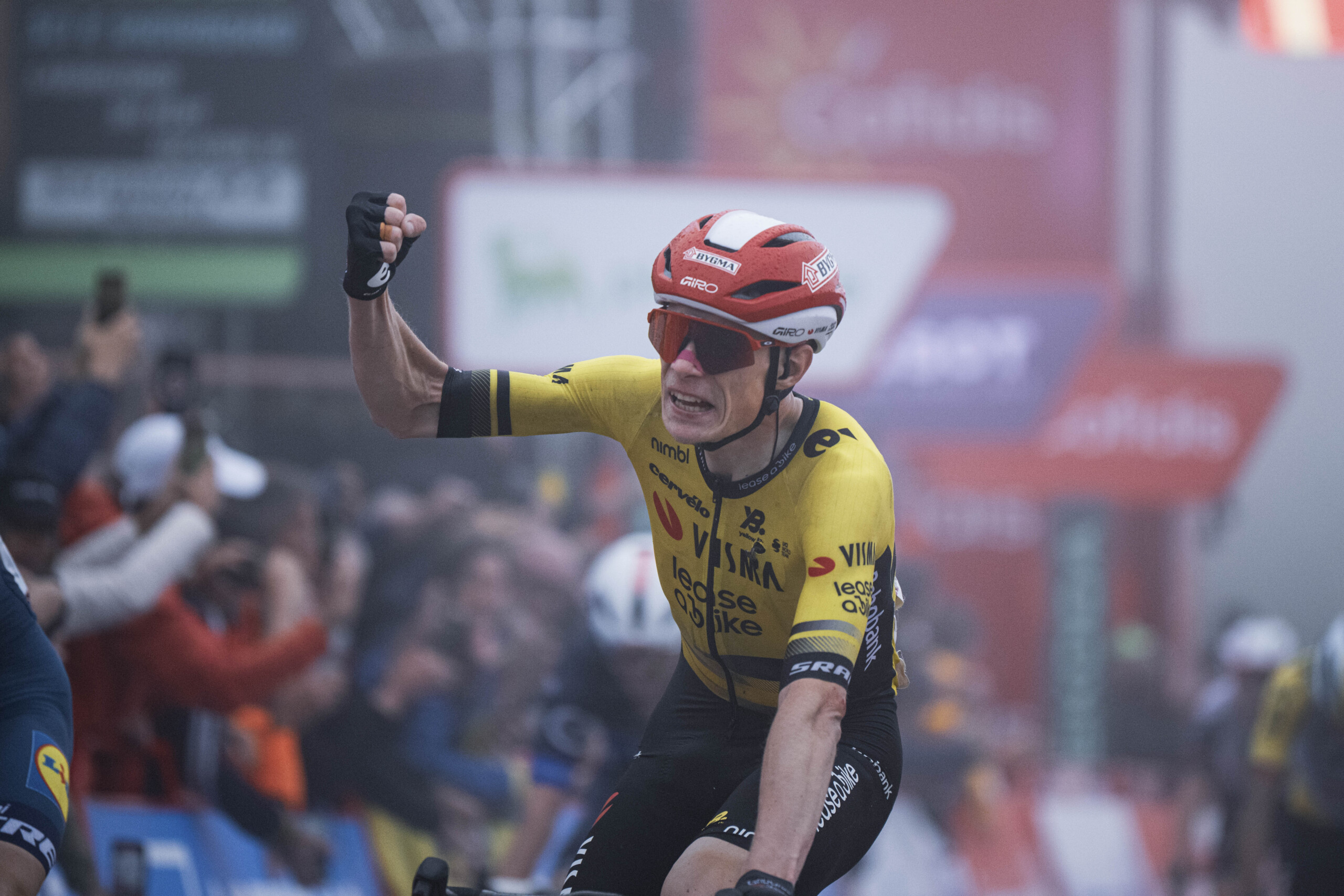
“To be honest, before the corner, I didn’t think that it would be possible to pass him, but from the corner on it was a bit longer to the finish than I thought so I actually could pass him,” Vingegaard explained.
The victory was Vingegaard’s third stage win at La Vuelta and his first La Roja in a Grand Tour since his Tour de France triumphs. He became only the third Danish rider to lead the Spanish race overall, following Lars Michaelsen (1997) and Jakob Fuglsang (2011).
“It’s been also a few years since I’ve had the leader jersey in a Grand Tour so that is also really nice,” he reflected. “Today, I showed that I am where I want to be. The legs are good, and hopefully I will be good for the upcoming 19 stages.”
The stage also saw Juan Ayuso inherit the white jersey as best young rider. The Spanish climber, winner of the competition in 2023, viewed Vingegaard’s presence in red as potentially beneficial for his UAE Team Emirates squad. “I think it’s even better for our team that [Jonas Vingegaard] has the red jersey,” he noted pragmatically.
Stage 2 Results
| Place | Rider | Team | Time |
|---|---|---|---|
| 1 | Jonas Vingegaard | Team Visma | Lease a Bike | 3:47:14 |
| 2 | Giulio Ciccone | Lidl-Trek | 3:47:14 |
| 3 | David Gaudu | Groupama-FDJ | 3:47:14 |
| 4 | Egan Bernal | INEOS Grenadiers | 3:47:14 |
| 5 | João Almeida | UAE Team Emirates XRG | 3:47:16 |
| 6 | Felix Gall | Decathlon AG2R La Mondiale Team | 3:47:16 |
| 7 | Jai Hindley | Red Bull – BORA – hansgrohe | 3:47:16 |
| 8 | Juan Ayuso | UAE Team Emirates XRG | 3:47:16 |
| 9 | Matteo Jorgenson | Team Visma | Lease a Bike | 3:47:16 |
| 10 | Tom Pidcock | Q36.5 Pro Cycling Team | 3:47:16 |
General Classification after Stage 2
| Place | Rider | Team | Time | Time Behind |
|---|---|---|---|---|
| 1 | Jonas Vingegaard | Team Visma | Lease a Bike | 7:56:16 | – |
| 2 | Giulio Ciccone | Lidl-Trek | 7:56:20 | +0:04 |
| 3 | David Gaudu | Groupama-FDJ | 7:56:22 | +0:06 |
| 4 | Egan Bernal | INEOS Grenadiers | 7:56:26 | +0:10 |
| 5 | Tom Pidcock | Q36.5 Pro Cycling Team | 7:56:28 | +0:12 |
| 6 | Jai Hindley | Red Bull – BORA – hansgrohe | 7:56:28 | +0:12 |
| 7 | Santiago Buitrago | Bahrain Victorious | 7:56:28 | +0:12 |
| 8 | Matteo Jorgenson | Team Visma | Lease a Bike | 7:56:28 | +0:12 |
| 9 | Juan Ayuso | UAE Team Emirates XRG | 7:56:28 | +0:12 |
| 10 | Marc Soler | UAE Team Emirates XRG | 7:56:28 | +0:12 |
Jersey Holders after Stage 2
- Red Jersey (La Roja) – Overall Leader: Jonas Vingegaard (Visma-Lease a Bike)
- Green Jersey – Points Classification: Jasper Philipsen (Alpecin-Deceuninck)
- Blue & White Polka-dot Jersey – King of the Mountains: Jonas Vingegaard (Visma-Lease a Bike)
- White Jersey – Best Young Rider: Juan Ayuso (UAE Team Emirates XRG)
Chapter Three: The Puncher’s Paradise
Stage 3: San Maurizio Canavese → Ceres, 134.6km (25 August 2025)
The final Italian stage promised yet another variation on the theme, with the uphill finish at Ceres providing a category 4 sting in the tail after 134.6 kilometers featuring nearly 2,000 meters of elevation gain. If the race organizers had sought to showcase the complete spectrum of La Vuelta’s challenges within three stages, they had succeeded brilliantly.
Mads Pedersen arrived at the start in San Maurizio Canavese knowing this represented perhaps his best opportunity to claim a stage victory. The 2.6-kilometer ascent to Ceres, averaging 3.6%, was precisely the kind of punchy finish that suited his explosive finishing kick. His Lidl-Trek team had learned from their stage one disappointment and were determined to control the narrative from the opening kilometers.
The early breakaway featured a familiar cast, with Alessandro Verre making his third consecutive appearance in the morning move. Wearing the polka-dot jersey on behalf of overall leader Vingegaard, the Italian joined Sean Quinn (EF Education-EasyPost), Luva Van Boven (Intermarché-Wanty), and Patrick Gamper (Jayco AlUla) in the day’s escape.
Lidl-Trek’s dominance of the pace-making was absolute. Daan Hoole and later Amanuel Ghebreigzabhier took turns at the front, maintaining the breakaway’s advantage at a manageable two and a half minutes. Their plan was clinical: keep the escape within reach while saving Pedersen’s legs for the finale that everyone expected him to win.
The route passed through Cuorgnè, where Egan Bernal holds honorary citizenship—a reminder of the Colombian’s early professional days with Androni Giocattoli when he lived and trained in these valleys. It was a poignant detail that highlighted cycling’s ability to connect riders with the landscapes that shape their careers.
As the race reached its business end, Lidl-Trek’s grip on proceedings seemed unshakeable. The rolling terrain and increasing pace began to fracture the peloton, with Jasper Philipsen among those struggling to maintain contact. The previous day’s stage winner was paying the price for his explosive effort in Novara, his brief reign as race leader now a memory.
Sean Quinn, the former US national champion making his return to the sport’s highest level after a knee injury-plagued season, provided the day’s most compelling subplot. His solo attack with 39 kilometers remaining offered a glimpse of the aggressive racing style that had once made him a feared competitor. He maintained a 55-second advantage for much of the finale before being reeled in with 19 kilometers to go.
The final ascent began with Pedersen perfectly positioned, his teammates having delivered him to the crucial final corner with mathematical precision. Everything appeared to be unfolding according to plan. But David Gaudu had other ideas.
The Frenchman had been building toward this moment throughout a difficult season. His last UCI WorldTour victory had come at the 2022 Critérium du Dauphiné, where he had defeated Wout van Aert in a similar finish. The drought of wins had been frustrating for a rider of his caliber, but on the slopes above Ceres, everything clicked.
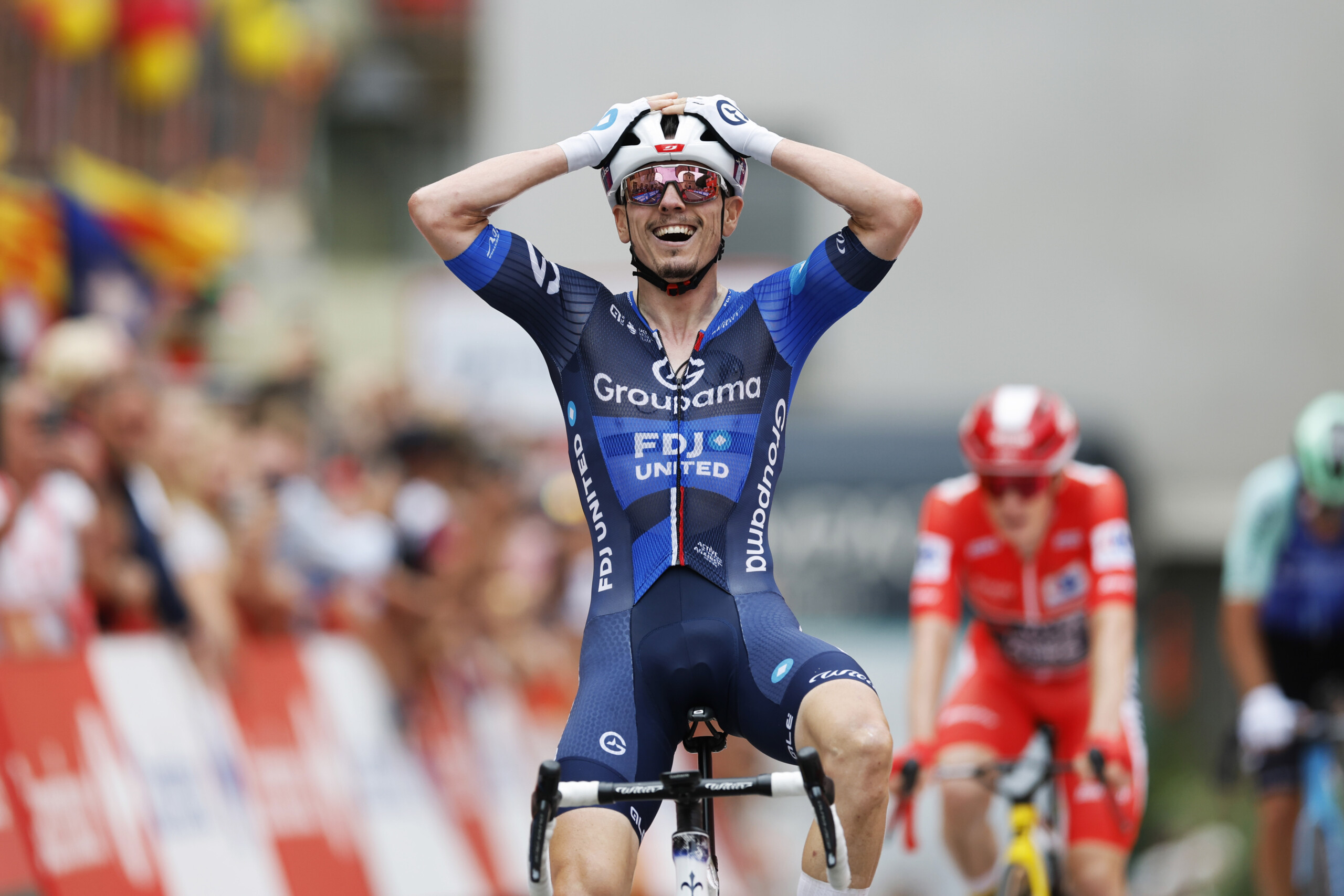
“I was thinking this stage was for [Mads] Pedersen but the team told me this morning I have punch and I can win today,” Gaudu revealed. “They did a very very good good job to put me in the first positions all day.”
As Pedersen launched his sprint with 250 meters remaining, it seemed the Danish powerhouse would finally claim his stage. But Gaudu had timed his effort to perfection, surging past the fading Pedersen in the final 50 meters to claim his third La Vuelta stage victory.
“Pedersen launched his sprint with 250 metres to go. I just got back in the last corner, and I pushed with everything I had until the line,” Gaudu described. “It’s been a really tough season. I haven’t won a World Tour race since the Critérium du Dauphiné where I beat Wout van Aert [2022]. Now we can add Mads in a sprint! It’s a bit anecdotical, but there’s a lot of positives to take from it.”
Vingegaard completed the stage podium, his third-place finish and four bonus seconds enough to retain La Roja despite Gaudu drawing level on time. The overall classification would be decided by the addition of stage placings, with Vingegaard’s superior tally (45 to Gaudu’s 53) keeping him in the leader’s jersey.
For Juan Ayuso, watching from the chasing group, the stage represented successful damage limitation. “It was a super hard [finish], super hectic, a mix between a mountain top finish where you have to be in the front, and a sprint finish with all the chaos,” the young Spaniard observed. “But there is no time gap, no crash, so overall it’s a good day.”
Stage 3 Results
| Place | Rider | Team | Time |
|---|---|---|---|
| 1 | David Gaudu | Groupama-FDJ | 2:59:24 |
| 2 | Mads Pedersen | Lidl-Trek | 2:59:24 |
| 3 | Jonas Vingegaard | Team Visma | Lease a Bike | 2:59:24 |
| 4 | Giulio Ciccone | Lidl-Trek | 2:59:24 |
| 5 | Jordan Labrosse | Decathlon AG2R La Mondiale Team | 2:59:24 |
| 6 | Orluis Aular | Movistar Team | 2:59:24 |
| 7 | Santiago Buitrago | Bahrain Victorious | 2:59:24 |
| 8 | Egan Bernal | INEOS Grenadiers | 2:59:24 |
| 9 | Bodi Koerdt | Team Picnic PostNL | 2:59:24 |
| 10 | Jai Hindley | Red Bull – BORA – hansgrohe | 2:59:24 |
General Classification after Stage 3
| Place | Rider | Team | Time | Time Behind |
|---|---|---|---|---|
| 1 | Jonas Vingegaard | Team Visma | Lease a Bike | 10:55:36 | – |
| 2 | David Gaudu | Groupama-FDJ | 10:55:36 | +0:00* |
| 3 | Giulio Ciccone | Lidl-Trek | 10:55:44 | +0:08 |
| 4 | Egan Bernal | INEOS Grenadiers | 10:55:50 | +0:14 |
| 5 | Tom Pidcock | Q36.5 Pro Cycling Team | 10:55:52 | +0:16 |
| 6 | Jai Hindley | Red Bull – BORA – hansgrohe | 10:55:52 | +0:16 |
| 7 | Santiago Buitrago | Bahrain Victorious | 10:55:52 | +0:16 |
| 8 | Matteo Jorgenson | Team Visma | Lease a Bike | 10:55:52 | +0:16 |
| 9 | Juan Ayuso | UAE Team Emirates XRG | 10:55:52 | +0:16 |
| 10 | Valentín Paret-Peintre | Soudal Quick-Step | 10:55:52 | +0:16 |
*Vingegaard leads on countback (sum of stage placings: 45 vs 53)
Jersey Holders after Stage 3
- Red Jersey (La Roja) – Overall Leader: Jonas Vingegaard (Team Visma | Lease a Bike)
- Green Jersey – Points Classification: Jonas Vingegaard (Team Visma | Lease a Bike)
- Blue & White Polka-dot Jersey – King of the Mountains: Alessandro Verre (Arkéa-B&B Hotels)
- White Jersey – Best Young Rider: Juan Ayuso (UAE Team Emirates XRG)
Looking Ahead: The Battle Lines Drawn
As La Vuelta prepares to leave Italian soil and cross into the Pyrenees, the three opening stages have provided a perfect microcosm of what makes the Spanish Grand Tour unique. Three different types of stage, three different winners, three different tactical battles—all played out against the stunning backdrop of Piedmont’s cycling heritage.
Philipsen’s sprint victory in Novara shows that when opportunities arise for the fast men, they must seize them without hesitation. Vingegaard’s climbing masterclass at Limone Piemonte demonstrates that reports of his decline have been greatly exaggerated. And Gaudu’s punchy triumph in Ceres proves that in cycling, as in life, timing can be everything.
The jersey competitions reflect this early diversity. Vingegaard holds both La Roja and the points classification, his consistent high placing across all three stages rewarding versatility over specialization. Alessandro Verre retains his polka-dot jersey, his early breakaway heroics establishing him as the mountains classification’s first protagonist. Juan Ayuso’s white jersey marks him as the best of the young generation already making their mark on the race.
As the race prepares to enter Spain proper, the Italian prologue has established the key narratives that will define the weeks ahead. The climbing hierarchy is beginning to clarify, with Vingegaard asserting his credentials while riders like Bernal, Ayuso, and Hindley serve notice of their own ambitions.
But perhaps most importantly, these three stages have demonstrated that this will be no processional affair. From Philipsen’s redemptive sprint to Gaudu’s perfectly timed surge, the racing has been aggressive, unpredictable, and utterly compelling. If this is merely the appetizer, the main course promises to be extraordinary.
The road to Madrid stretches ahead, but already the foundations have been laid for what could become one of the most memorable Vueltas in recent memory. In cycling, as Alessandro Verre notes after claiming his first Grand Tour jersey, “It’s only the first stage and we have lots of goals. We have to stay calm and be focused for the next days.”
The next 18 stages will determine whether calm and focus will be enough, or whether La Vuelta’s inherent chaos will once again prove that in this most unpredictable of races, anything remains possible until the final kilometer in Madrid.