
By Gail Newbold — When a friend mentioned she’d been enjoying the new West Davis Corridor bike path, I made a note to give it a try. Memorial Day seemed to be the perfect occasion and my husband agreed.
This multi-use trail is one of Utah’s newest long-distance paved trails. It parallels the new 16-mile West Davis Highway (SR-177) and stretches for about 10 miles from the I-15/Legacy Parkway interchange in Farmington through Centerville, Kaysville, Layton, and Syracuse.
I was excited.
At least I was until the day before our ride when my husband Dave said, “I was just driving on the new West Davis Corridor Highway and saw the bike path and I think it looks ugly. And it runs right alongside the highway.”
Silence. We began scrambling for other options. All were further from our home. Ultimately, we decided to stick with the West Davis Trail (the official name) because it was conveniently close to home. At least we’d be cycling someplace new, we reasoned, even if it was ugly.
Searching for Access Points
I did a lot of online research trying to find the southernmost starting point. I tried UDOT’s website, Facebook, and Davis County Trails with little success. Dave was confident he could find it. He’d seen a parking lot “somewhere.” But as per what I’d read on Facebook, it wasn’t easy to find. We drove for miles with the trail in sight but never saw an exit or parking lot. Eventually, we got off at the 950 North Exit in Farmington and pulled into a big parking lot. We found out later it’s the first exit on the new highway when you’re heading north.
While my husband unloaded the bikes, I accosted a couple of bikers hoping to get some trail intel: Like where were we and where did the trail start and end?
Dave and Laurie Jenson of Kaysville said the south end of the trail would be obvious because we’d see a foot bridge at a parking lot where the West Davis Trail joins the old Legacy Trail. They said the north end stops at Gentile Street in Syracuse.
A Vital Link to Other Trails
Arriving at the end of the trail wasn’t the point, however, for Dave Jenson and a lot of other cyclists. The beauty of the trail, Jenson said, is how it serves as a connector between other bike paths.
“I can bike from Rose Park in Salt Lake City to Syracuse and only have to cross two or three roads,” he said. “I like how the path gets me onto the west side of the valley. I love the trail and I think the scenery is great.” He cycles the West Davis Trail two to three times a week.
It serves as a vital link between paths and creates a broader regional trail system. It was designed for nonmotorized recreational activities, including walking, running, and cycling, as well as bicycle commuting. The trail meanders western Davis County communities and borders protected wetland areas near the Great Salt Lake. It, and the many other trails in Utah, are important because they allow cyclists to commute and recreate away from cars.
Surprisingly Scenic
Finally, Dave and I hopped on our bikes and cycled north, our expectations low for a scenic ride. Turns out, what you see flashing by at 60 miles per hour from your car window is entirely different from what you see sitting on the saddle of a bike.
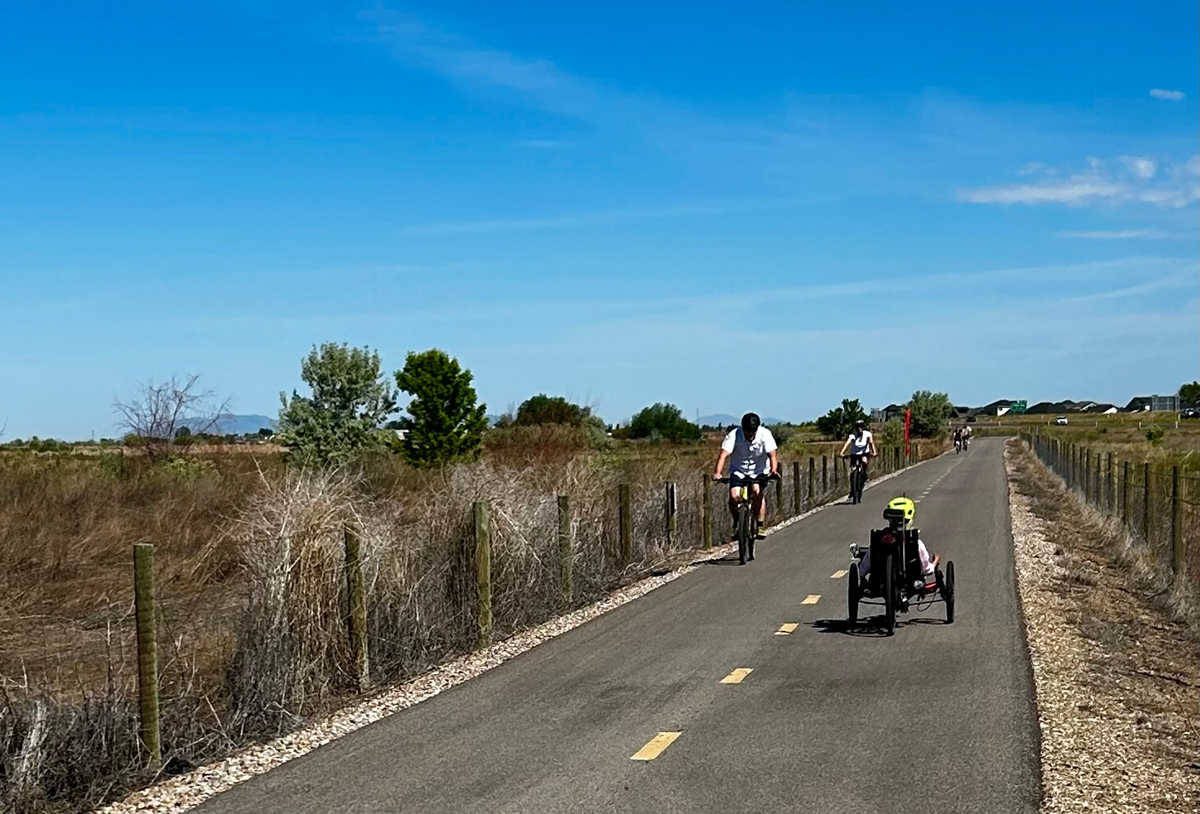
For the first mile or so, the highway was hidden from view, which was nice. But even when it appeared, somehow its proximity to the trail never detracted. We cycled past fields of cows, long stretches of wetland, range grass and farm houses. Birds chirped around us as the sweet scent of Russian olive trees mingled with the pungent odor of manure. The sky was blue and dotted with white puffy clouds.
On our way back south, the green mountains stood proud and tall. We stopped to photograph a beautiful stream. And stopped again to laugh at a herd of sheep shoving and pushing like a rugby scrum, vying for a spot in the shade. I was charmed by the sights and smells.
Dave seemed less enchanted by the scenery and more enthusiastic about simply being on his bike. “It’s nothing like the Trail of the Coeur d’Alene,” he said.
Of course it wasn’t. But cycling for me is not about which bike path is prettier, and it’s true, we’ve been on some spectacular ones: the Trail of the Coeur d’Alene, of course; but also the gorgeous trails in Sun Valley, Idaho; Jackson, Wyoming; Zion National Park; and British Columbia, Canada; to name a few. I think the joy of cycling is more about being immersed in my surroundings, whatever they might be, in a way that’s more pleasurable than walking, hiking or driving in a car.
Evidently, a lot of other cyclists feel the same, based on the number of people who were enjoying the trail. It was encouraging to see how popular it was, and a good reminder of how cycling is one of the most accessible outdoor activities around. There were riders of all ages, sizes and shapes: older couples, families carting kids and babies, and serious cyclists in spandex kits hunched over their handlebars.
We continued north beyond the West Davis Trail for a few minutes so I could use the bathroom at the Jensen Nature Park in Syracuse.
Whether you’re using the West Davis Trail to connect from one trail to another, or simply want a scenic rural ride on the west side, you won’t be disappointed.
Know if you go:
- More info (search for West Davis Trail) https://www.daviscountyutah.gov/county-info/trails
- There’s no shade.
- No bathrooms
- No food or water.
- Access points are a little confusing, but according to Dave Jenson, you can find them near the Legacy Parkway interchange, 950 North in Farmington, 200 North in Kaysville, and 2700 West in Layton. You could also try accessing the trail from city parks near the route or from neighborhoods near the trail.
- The most scenic stretch is said to be the southern half near Farmington and the wetlands by the Great Salt Lake with views of marshes, bird habitats and fewer houses.
- Sunrise and evening rides can be beautiful because of the light over Farmington Bay.
- The path is wide, smooth, flat and mostly uninterrupted.
- The trail opened in early 2024 the same time as the highway.