
By Brian Berlin — Jason Morin loves bikes. He raced them, dreamed of owning a shop, and opened Shift Bicycle in 2020. He closed it in 2025.
Small businesses come and go, but Shift Bicycle’s closure hit me hard because it was my local bike shop (LBS).
Cyclists form long-term relationships with their bike shops. When your LBS goes away, it feels like losing a friend. You mourn the loss.
“It’s sad to me, too,” Jason said. “Because I do feel like there aren’t a lot of similar types of shops like what I had.”
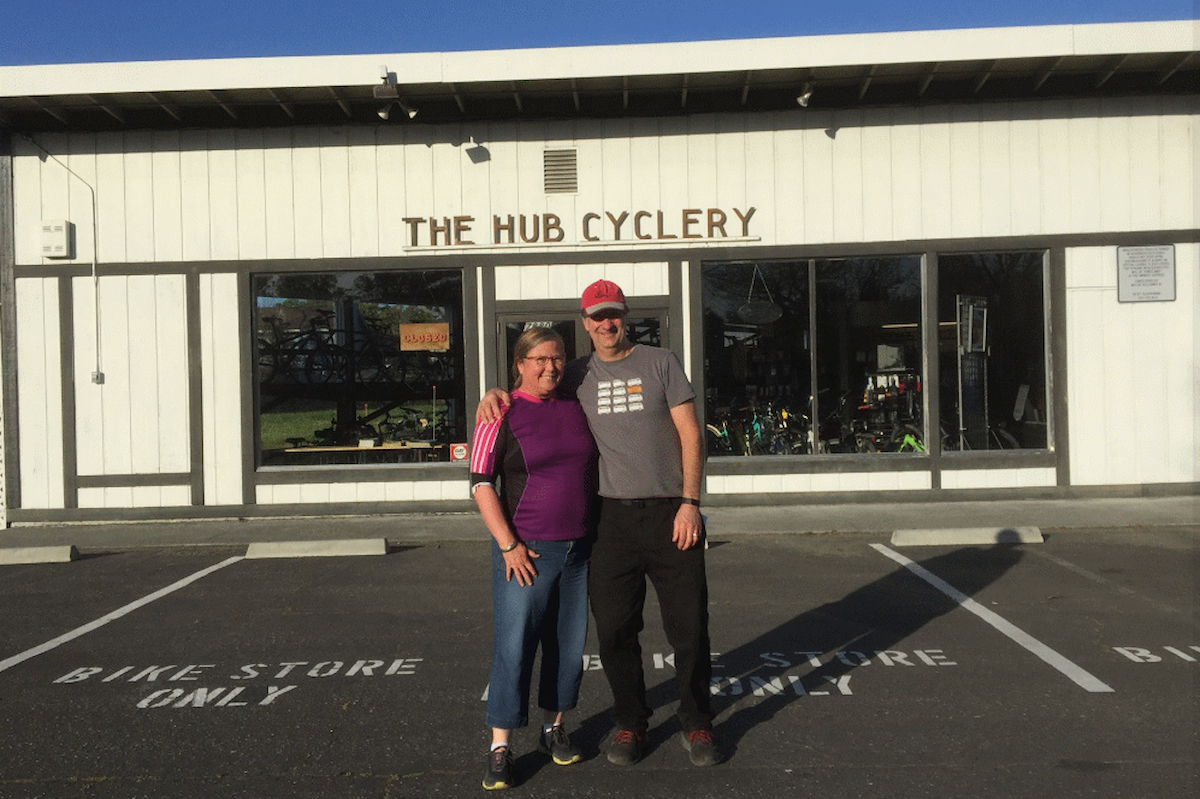
Chaz and Claire Fetrow operated the Hub Cyclery in Cotati, California, for 36 years. Hub was a fixture in the community; my sister-in-law bought her Giant bike there. Hub is now closed. Chaz and Claire felt it was time to retire, despite the deep connection they shared with their customers.
“I really feel like our shop was a special place,” Claire said. “We did care a lot about our customers. We definitely felt like it was this massive community that we’d known for thirty-six years.”
Hub’s closing left a void, Claire acknowledged, and dependency on the shop hasn’t faded. An email from a former customer made that clear.
“She wrote and they said they were really sorry to see we weren’t there,” Claire said. Claire had helped the woman’s husband get a bike, and now “she needed a bike, and what were they going to do? And could we still help them?”
Open Air Bicycles in Santa Barbara, California, another Giant dealer, will close unless a new owner steps forward. Owner Ed Brown wants to retire.
“I’ve just been doing this for a long time. I’m moving on to greener pastures — I mean, literally, five acres in Colorado,” he told the Santa Barbara Independent.
Independent bike shops, like many small businesses, close for a variety of reasons: competition, cash flow, retirement. Owners sell to a manufacturer, transfer ownership to employees, sell to an interested buyer, or liquidate and close the doors.
A love of cycling will only get you so far. Even if you do everything right, you can still fail at running a bike shop.
Competition is beyond fierce. Local bike shops compete with each other for new-bike sales, service business, and employees. Major bike brands compete directly with their own dealers by opening retail storefronts and selling directly to consumers, in person and online. Consumers can buy bikes cheaply from Amazon, Costco, and Walmart. E-bikes often sell directly to consumers or through dedicated shops, bypassing the LBS entirely. Demand remains soft, thanks to excess inventory, fewer buyers, and tariff-driven price increases.
Taken together, these challenges reveal a bike industry in flux. They merit a deeper look, both individually and for their combined impact on independent bike shop owners.
PPTSD: Post-Pandemic Traumatic Supply Disorder
During the pandemic lockdown, it seemed like everybody bought a bike. Shops sold out, then placed refill orders that manufacturers couldn’t fill. Then the supply chain opened up and inventory poured in — except by then, everyone already had a bike, leaving fewer buyers for new bikes and a glut of unsold inventory.
“Oh my goodness, there are some manufacturers that still have two years’ worth of old models that they’re still trying to get rid of,” said David Mull, owner of Pedal Pushing Bicycle Shop in San Diego, California.
“Well, I’ve been hearing that for about four years,” said Stephen Frothingham, editor-in-chief of Bicycle Retailer and Industry News. “Wholesale inventory came down a lot last year, 2025 — 41% down year-over-year in December, according to PeopleForBikes.”
That still leaves retail inventory, which is harder to track.
Matt VanEnkevort, CEO of Marin Bikes, said, “I know for a fact that a very high level of inventory exists. At least at the big three — Giant, Trek, Specialized — in the U.S. Specialized less, so they liquidated very aggressively. But Trek and Giant didn’t. And I know pretty certainly that they’re still sitting on an amazing amount of inventory.”
Frothingham pointed to a second inventory problem: the pandemic demand spike, followed by two years of bargain pricing, pulled forward people’s buying plans.
“So if you are the kind of guy who buys a new bike every five years, maybe you took advantage of a bargain in the last couple of years to buy sooner,” he said. “So now you won’t buy again for another six or seven years. Or something like that. My point is that even if inventory returns to a normal state, there might be some reduced demand for another season or so.”
If your LBS doesn’t stock the bike you want, that sale goes elsewhere.
Tariffs Remain
The bike industry recently dodged tariffs on steel and aluminum products, but Section 301 tariffs on Chinese-manufactured bicycles and parts remain.
Tariff threats alone create volatility and uncertainty across the industry.
David Mull recalled that “just the fact that they were announced definitely has affected the bicycle industry, big time.”
“The bike industry depends on a highly global supply chain,” wrote Jeff Brines, entrepreneur and blogger, “so it’s no surprise that tariffs from the Trump administration have had an outsized impact.” Tariffs, he argues, are driving up costs and injecting uncertainty into the system.
Tariffs have raised the cost of new bicycles, prompting some consumers to postpone purchases until the situation settles. One expert doesn’t expect that to happen soon.
At Eurobike in 2025, the Financial Times reported that Jenn Dice, U.S. chief executive of PeopleForBikes, said the American cycling industry faces “devastating consequences” from tariffs and the resulting uncertainty. She predicted a stagnant U.S. market through 2029.
Suppliers as Competitors
“You know, [suppliers] are now your competitors,” Claire Fetrow said. “They’re trying every day to find ways around having to go through the independent bike dealer and make the margins less so that they can keep more money.”
One example: manufacturers are buying up their own dealers while also opening new corporate locations. Trek leads that strategy.
“The Trek rep called me up,” David Mull said. “And he said, ‘Would you like to be a Trek dealer?’ And I’m like, well, there’s a Trek dealer a mile and a half away on Fletcher Parkway. And he said, ‘It doesn’t matter, it’s a corporate store.’”
The number of manufacturer-owned bike shops is rising. Industry analysts estimate Trek now operates more than 500 retail locations and is on pace to become the largest bike-retail chain in the industry.
Specialized has also acquired bike shops, notably BikeSource, a retail chain with locations in Colorado, Ohio, and North Carolina. Specialized kept BikeSource’s owner, Marc Eisenberg, its employees, and its name.
Pon.Bike, a subsidiary of Pon Holdings, acquired Mike’s Bikes locations in Colorado and California. Pon.Bike’s global holdings include Cannondale, Cervélo, Gazelle, GT, and Santa Cruz. The deal mirrored the Specialized-BikeSource arrangement: Pon.Bike kept the owner, staff, and name in place.
Giant approached Hub Cyclery differently, Claire Fetrow recalled.
“At one point, we were offered, I can’t remember what it’s called now, like a partnership or a Giant retail partner store,” she said. “If we do X amount of dollars, and then they basically come in and rebrand your store. So your store doesn’t look like Chaz and Claire’s store anymore. It looks like Giant’s store.”
BikeSource’s and Mike’s Bikes’s owners chose to join their suppliers rather than compete with them. Most independent bike shops don’t have that option. What stops a manufacturer from opening a store nearby, undercutting sales and service, and luring away staff?
Direct-to-Consumer
You can buy a bike online and have it shipped straight to you, bypassing the LBS entirely. Direct-to-consumer sales have grown so much that they may now pose a bigger threat than company-owned shops.
Buying direct gives consumers flexibility and dozens of vendors to choose from, but the model has drawbacks.
First, bikes bought online need assembly. Consumers who buy online should already have an assembly plan in place; if they don’t, they’ll need a mechanic to do the work.
Show up at a bike shop with a bike you bought online, and the mechanic may turn you down. At minimum, expect to pay for assembly and fitting.
You could assemble it yourself, if you have the tools, expertise, and confidence — but you’ll probably end up calling customer support or hauling the bike to a shop anyway.
Despite those drawbacks, some manufacturers built their businesses around DTC sales from day one and have worked hard to make that experience friendly and seamless. Here are two examples, at different points on the price spectrum.
Canyon Bicycles
Canyon Bicycles is a sought-after DTC manufacturer that has become one of the most influential and innovative names in the modern cycling landscape.
The Koblenz, Germany-based company builds elite bikes around aerodynamic carbon-fiber frames favored by professional racers. Canyon sells online and operates a showroom in Carlsbad, California, where customers can shop, test-ride, and choose a model. An Aeroad CFR Di2, for example, lists for $10,499.
Canyon owners can still get bike shop service through Canyon’s partner network, which includes 28 REI Co-op locations and 66 local bike shops in the U.S. But can an LBS thrive in that kind of relationship after missing out on the new-bike sale?
State Bicycle
Phoenix, Arizona-based State Bicycle sells direct to deliver style, simplicity, and affordability, where Canyon uses DTC to deliver high-performance engineering. State follows a lean model, selling each model in limited quantities and retiring it once it sells through.
State’s Core-Line models start at $449.99. Riders can go bikepacking on the State 4130 Trail for $1,499.99 or buy a carbon-fiber road bike for as little as $2,999.99.
Customers can have their State bikes assembled at any bike shop using State’s shop locator tool, or opt for a ProBuild warranty by having a shop assemble the bike and registering it with State within 30 days of delivery.
Pre-Owned Direct to Consumer
The Pro’s Closet (TPC) buys used bikes, takes trade-ins, certifies bikes, and resells them online. It has sold 46,000 pre-owned bikes and offers a 30-day risk-free return window that builds trust with online shoppers.
TPC serves as a secondary market for riders who want to sell or trade up, and as a primary market for riders chasing a high-end bike at a discount.
An LBS could lose a new or used bike sale to TPC, but shops can also join as TradeUp partners. The process works like this:
- The dealer submits photos to TPC.
- TPC issues a TradeUp offer within 48 hours, and the customer completes the acceptance process.
- The dealer inspects and packs the bike, then ships it with a prepaid label.
- TPC inspects the bike on arrival and pays the dealer.
Big-Box Bikes
Amazon, Costco, and Walmart are in the retail bike business, big time — putting further pressure on the LBS.
If you assume Amazon only sells low-end department-store bikes, think again.
Canyon built its business on cutting out the middleman in bike distribution. Now North American customers can buy Canyon’s entry-level urban, recreational, and mountain bikes on Amazon at competitive prices. Canyon calls the partnership a “complement” to the premium models it sells only on Canyon.com.
Cannondale also lists certain models on Amazon; local bike shops fulfill the orders when customers click “Buy for Me.” The customer then reaches a checkout page showing which shop will ship the bike.
Beyond Canyon and Cannondale, Amazon sells a 700C steel-framed, 14-speed commuter bike for $190, with professional assembly available for another $160.
Parts and accessories traditionally provide add-on, higher-margin sales for local bike shops. Online retailers like Amazon have cut deeply into that business. David Mull describes it this way:
“What’s happening is customers come in because they don’t know what they need,” he explained. “So then they come into a bike shop and get all their info, and then leave and go order it on Amazon. So you educate them, and they take that information and go buy it online.”
Costco Next
Select models from Priority Bikes, the New York City manufacturer of belt-drive, low-maintenance city and off-road bikes, are available online through Costco Next, including both pedal and pedal-assist models.
Walmart
Looking for an off-road bike under $700? Walmart sells a hardtail or full-suspension Ozark Trail bike for $600 or less, and a drop-bar gravel bike for $648.
Ozark Trail has been a Walmart outdoor brand for years, and Walmart introduced its Ozark Trail bike line in April 2023.
“We have developed a bike for the weekend warrior that is ready to hit the trails,” Maddy Johnson, associate merchant for adult bikes at Walmart U.S., said at the time.
How should independent bike shops respond to the DTC boom? The long-term play might be to welcome the assembly and service work — even promote it. These bikes still need assembly, tuning, and fitting, which creates an opening to develop new customers, especially since a corporate store might shun that work altogether.
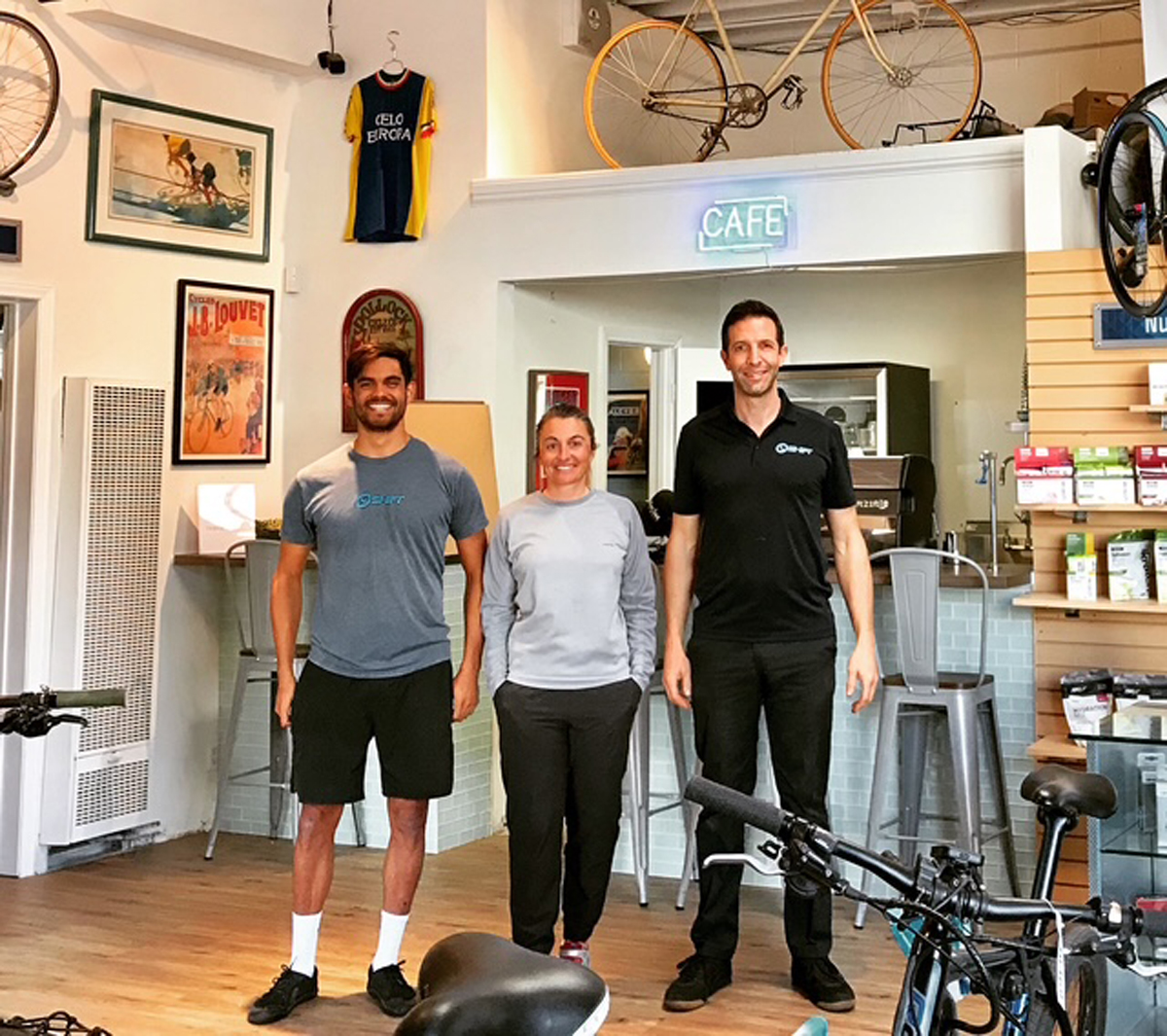
My relationship with Shift didn’t start with a new-bike purchase. Jason Morin fixed the bike I already had and sold me accessories. Later, I bought a used bike, and Jason fixed that one too.
Consumers won’t stop buying bikes online or from major retailers. But every bike still needs service, adjustments, tires, tubes, and accessories — and every rider still needs a relationship with a shop that cares about them and their bike, wherever they bought it.
The E-Bike Phenomenon
E-bikes affect LBS owners in two ways. First, many e-bike vendors sell direct. Second, LBS owners must decide whether to sell and service e-bikes at all. Would e-bikes compete on the shop floor with pedal-only models? What staffing, funding, and space would they require?
David Mull went all in.
“It’s not going away. The future is the e-bike. It really is,” he said.
Mull sells and services e-bikes without reservation. He points out that e-bikes wear through tires, tubes, chains, and brake pads just like any other bike, and riders need qualified mechanics to handle that work.
Staffing: Recruiting, Hiring, Training, and Retaining Employees
Finding and keeping experienced, dependable mechanics is another major LBS challenge.
“Number one,” Jason Morin said, “I think that in order to have a profitable bike business today, you have to have a pretty high-volume, competent service department.”
Technicians need ever-more expertise, and shops need to pay them a livable income — both are pressing issues for LBS owners.
Bicycle Retailer and Industry News (BRAIN) polled its State of Retail panel in 2024, and members shared their best hiring and retention strategies.
For recruiting, shops looked to industry trade schools, the United Bicycle Institute, the Barnett Bicycle Institute (rebranded as U of Q Institute), the Professional Bicycle Mechanics Association job board, and social media posts.
For retention, shops offered a 4% matching 401(k), three weeks of paid time off, one week of paid sick time, four weeks of paid parental leave, subsidized medical, dental, and vision coverage, and wholesale pricing. Smaller shops offered flexible hours and discounts.
Those are strong benefits, but most independent bike shops likely can’t afford to match them.
Customer Loyalty
Small, local brick-and-mortar businesses depend on regular, repeat customers who value the in-person experience. The success of online retailers suggests many buyers now accept a purely transactional relationship. Claire Fetrow believes that shift has already happened.
“I don’t think it is going to change,” Claire said. “But when people see their small local businesses, whether it be a bike shop or a bookshop in their community that has done a good job and it disappears, they have to sort of start asking themselves how many things do they have in their basement they bought from Amazon and how important is it for them to change that habit? Is it important enough to change that habit to keep a sense of community or not?”
Despite these pressures, romantics still want to own a bike shop, and many current owners still plan to keep running theirs.
But is owning and running a bike shop a good business today?
“No,” Jason Morin said.
He cited the pressures facing LBS owners: the current environment, competition, and the difficulty of finding and keeping quality mechanics.
“It’s a tough business,” David Mull said. “You definitely have to have passion. You’re not gonna make a killing at it.”
“I really love bicycles,” he added. “And so did my dad. You know, I always thought of it as something I wanted to do. I wanted to do a bike shop.”
Claire Fetrow urged caution, too.
“If someone that I knew that I really liked or anybody came along and said, this is what I’m thinking of doing [opening a bike shop], I’d be nervous for them,” she said. “Because I think that the industry, like when we first started in it 36 years ago, was all about bike shops. You know, you were their [manufacturers’] baby. Like, you’re the people that sell our stuff. We love you.”
Now, she said, those same manufacturers are your competitors.
“I would be very careful,” Stephen Frothingham cautioned about operating an independent bike shop. “The right store in the right market with the right approach can still be very profitable. Some shops are growing and are profitable. But just throwing up your shingle and opening your dream shop in the wrong market could be a disaster, either small or large.”
What does the LBS need to do to survive these pressures?
If survival really is a matter of “right store, right market, right approach,” as Frothingham put it, then forget about competing head-on with major brands, the DTC channel, or big-box retailers on price.
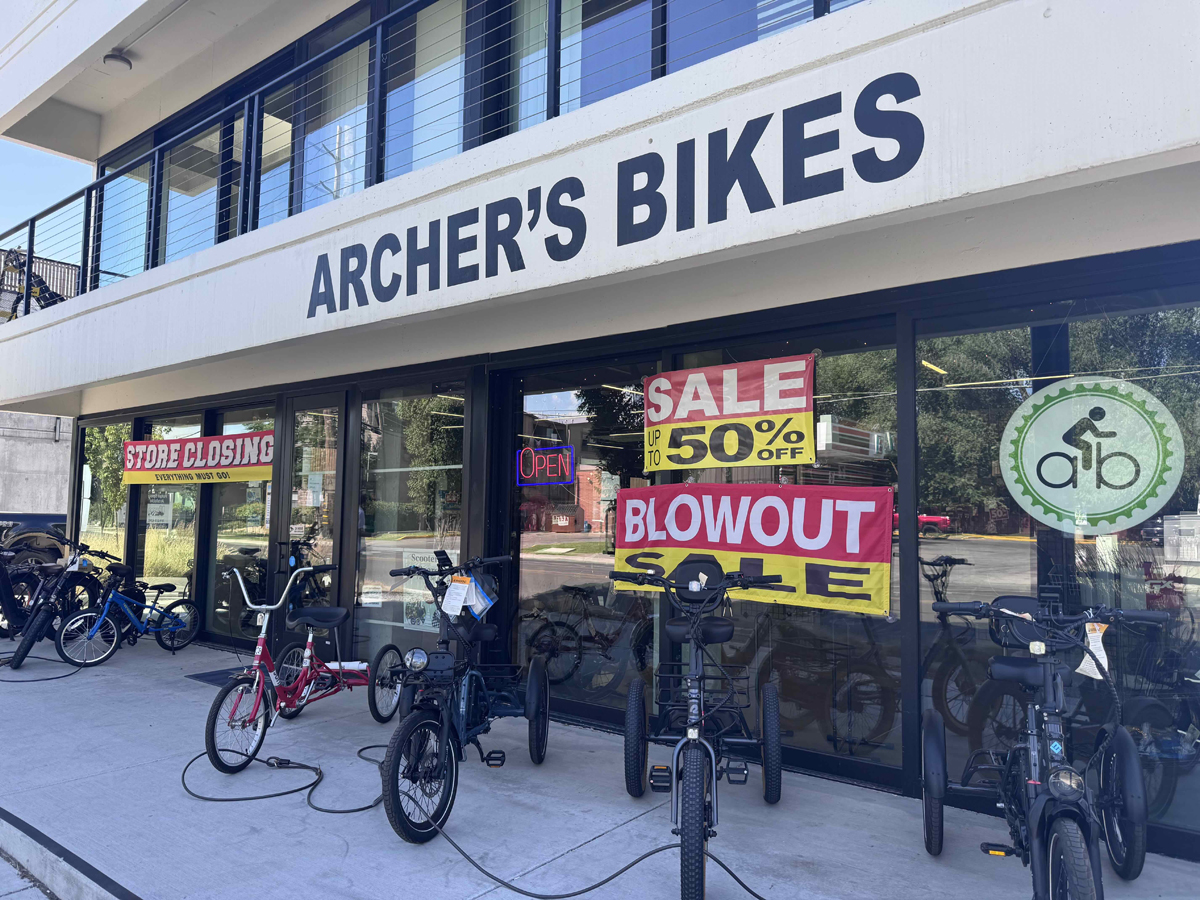
Dave Iltis, publisher of Cycling West magazine, believes that local bike shops need to not only provide service, expertise, repair and fitting skills that online retailers will never be able to match, but also that they need to be better engaged with their community.
“Helping a customer to choose a bike, welcoming them to cycling, and acting as a hub for the bike community — including hosting group rides and providing bike event information — will ensure the success of the local bike shop. Most consumers won’t know what they need to enjoy cycling, they won’t know how to bleed a hydraulic brake, and they won’t be able to recognize a creaking bottom bracket from a squeaky caliper. As bikes become technologically more sophisticated, the LBS provides the anchor that cyclists need to thrive.”
Dave continues, “We maintain a listing of bike shops that have closed across the western United States. We’d much prefer listing new shops that are opening.”
The LBS playbook should emphasize agility. A savvy operator understands the current bike shop environment and positions the business to pick up ground when other local shops fold under these pressures.
Like Vladyslav Savytskyi…
Shift Bicycle Rides Again
Vladyslav Savytskyi is a Ukrainian immigrant who ran a bike rental company with a partner for 20 years. The business thrived in summer but burned through profits every winter. When war broke out in Ukraine, Vlad sold his share to his partner and moved to the U.S.
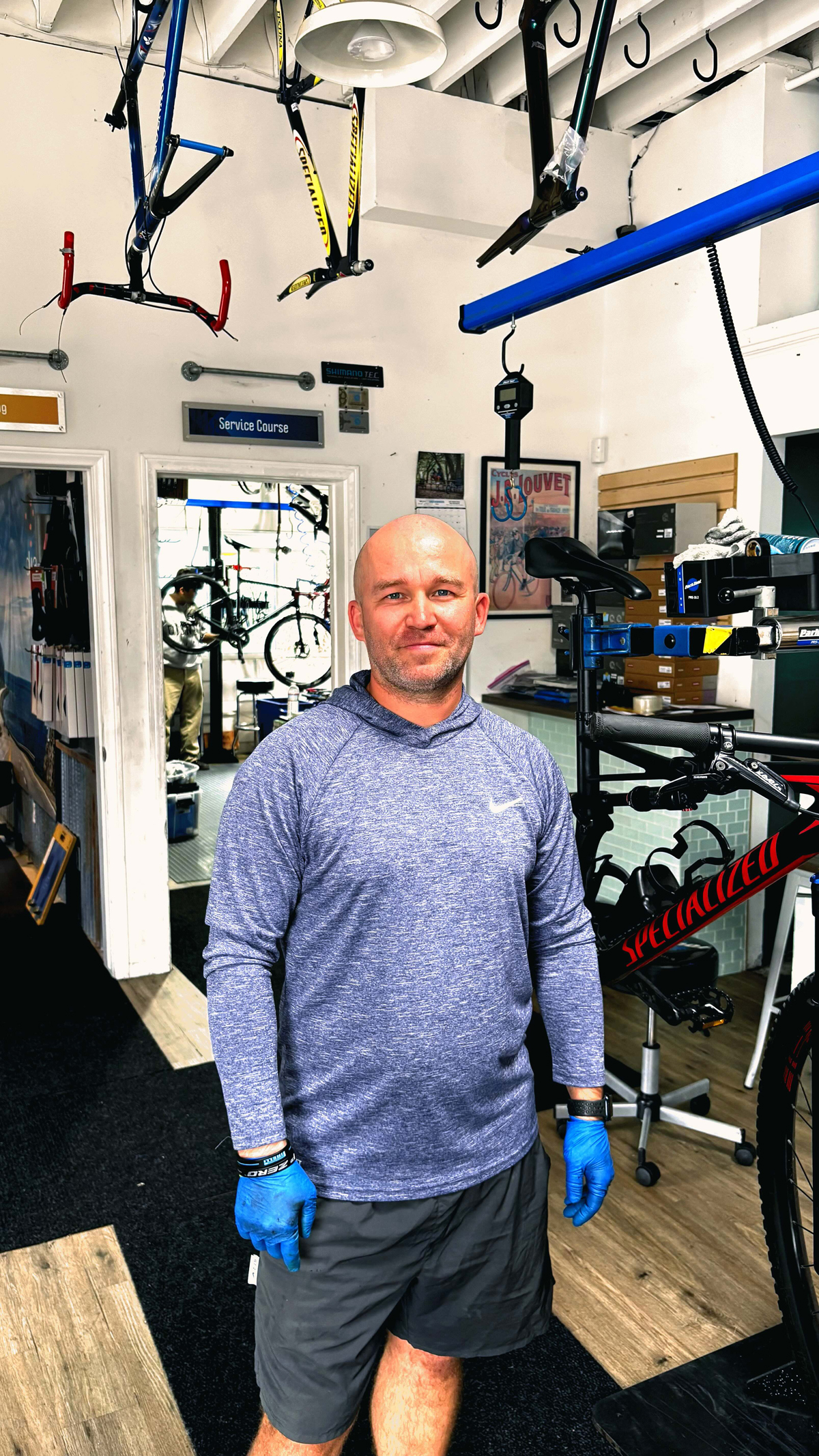
Vlad now owns Shift Bicycle and has renamed the shop Really Great Bicycle Service.
He was already running a mobile bike-repair van in the Los Angeles area when Shift became available. He plans to use the shop as a home base while he keeps growing the mobile business.
“I have super huge plans,” he told me.
He wants to expand the mobile side along the lines of the Velofix model.
“I’m good at building companies,” he continued. “I’m not a guy who is the owner of this small shop and works there for life by himself.”
I visited the shop to meet Vlad in person.
“Better than expected,” he said when I asked how business was going.
The shop was buzzing. A mechanic worked through a stack of repairs. A customer got fitted for a bike. Vlad had his own hands on a repair, too.
No new bikes sit on the shop floor. For now, Vlad’s plan is to focus on service.
To me, Vlad’s service-first approach may be exactly the right model for the LBS. He understands the pressures other shops face, and he looks poised to gain ground as others struggle — he’s already hired a mechanic from a shop that recently closed nearby.
Vlad’s shift from retail to repair-only could work as a broader model for the LBS. He’ll need to recruit and keep reliable mechanics and build enough service volume to keep them busy; his market should support that, and his location isn’t set up for retail foot traffic.
He recognizes that not everyone wants a new bike. He doesn’t care where you bought yours. He’s there to help you get the best out of the bike you already have.
That’s the LBS relationship I want, and I suspect many riders feel the same way. In the end, my local bike shop didn’t die. It improvised. It adapted. It lives on.
References
- The Future of Bike Prices: What COVID, Inflation, Tariffs and Fx Mean for 2026 — Jeff Brines — https://jeffbrines.com/2025/08/29/from-discounts-to-sticker-shock-the-changing-economics-of-the-bike-industry/
- Open Air Bicycles Set to Close Its Doors in March — The Santa Barbara Independent
- US cycling faces ‘devastating’ consequences from trade war — Financial Times — https://www.ft.com/content/75fce76f-48b6-4b2b-b9f6-eaf3f3371039
- Vosper: Who Are We Anyway? — Bicycle Retailer and Industry News, Nov. 11, 2024 — https://bicycleretailer.com/opinion-analysis/2024/11/08/vosper-who-are-we-anyway
- Specialized buys BikeSource locations in three states — Bicycle Retailer, Nov. 15, 2021 — https://www.bicycleretailer.com/retail-news/2021/11/15/specialized-buys-bikesource-locations-three-states
- Canyon Bicycles — Innovation and Direct-to-Consumer Revolution — Beyond the Bike Roads, Sept. 30, 2025 — https://buymeacoffee.com/beyondbikeroad/canyon-bicycles-revolutionizing-cycling-industry-through-innovation-direct-consumer-excellence
- REI now a Canyon authorized service partner — Bicycle Retailer and Industry News, Oct. 30, 2024 — https://www.bicycleretailer.com/retail-news/2024/10/30/rei-now-canyon-authorized-service-partner
- State Bicycle Co. — https://www.statebicycle.com/
- The Pro’s Closet — https://www.theproscloset.com/
- Canyon selling some bikes through Amazon — Bicycle Retailer — https://www.bicycleretailer.com/industry-news/2025/04/30/canyon-selling-some-bikes-through-amazon
- State of Retail: Best practices for recruiting, hiring, and retaining qualified salespeople and mechanics? — Bicycle Retailer and Industry News, April 11, 2024 — https://www.bicycleretailer.com/industry-news/2024/04/11/state-retail
- Velofix — https://www.velofix.com/
- Bike Shop Closures in the West — https://www.cyclingwest.com/industry/bike-shop-talk/bike-shop-closures-in-the-western-us/