Home Blog Page 202

Crossing the Chilcotin

By Jay Hudson

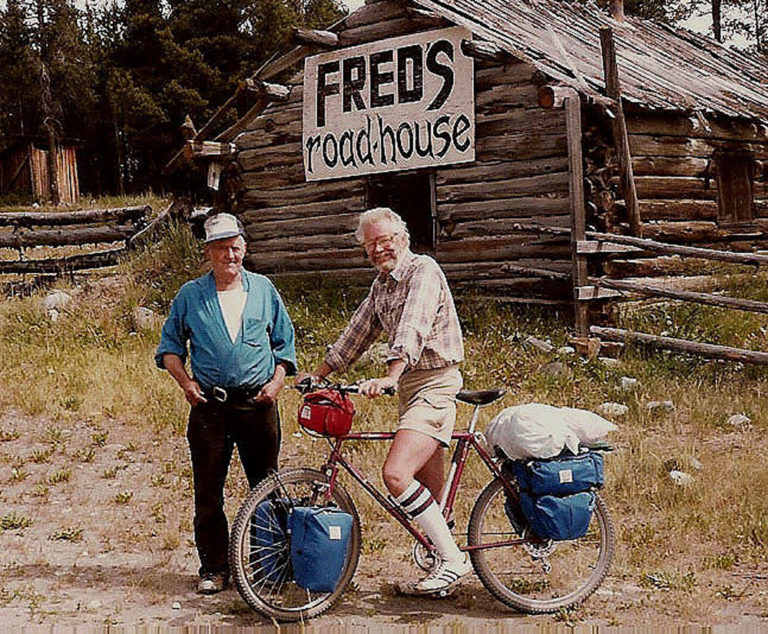
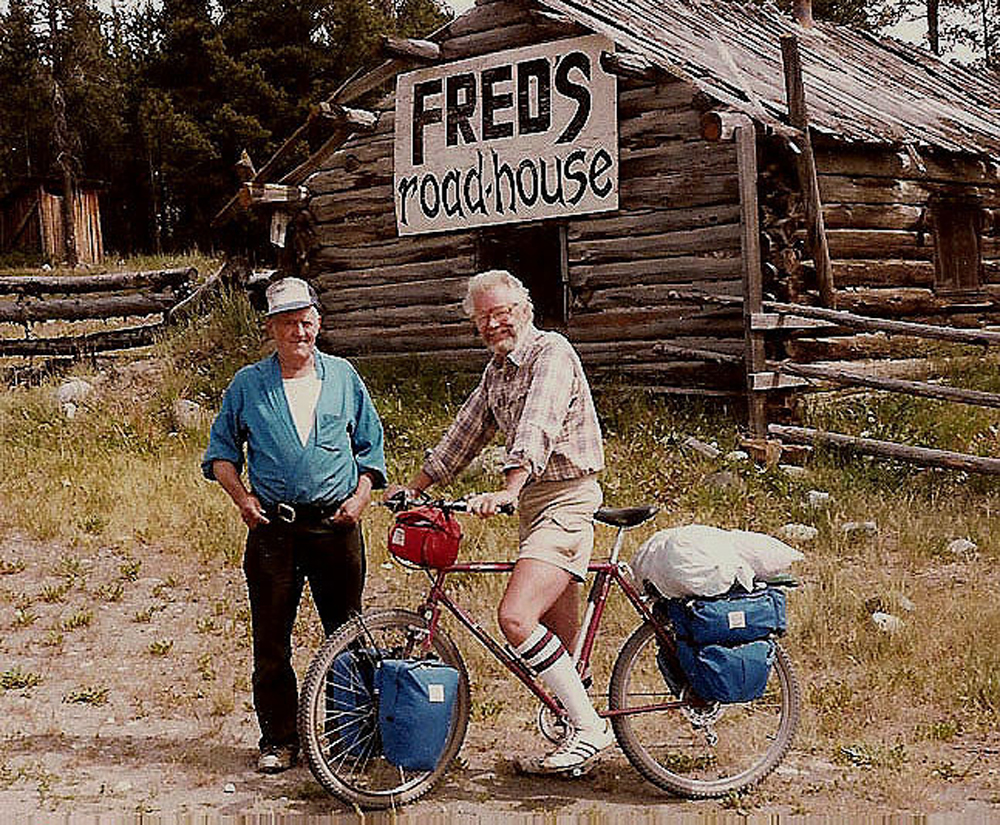
Jay Hudson in the Chilcotin, British Columbia, in 1984 in front of Fred’s Roadhouse. Photo courtesy Jay Hudson.

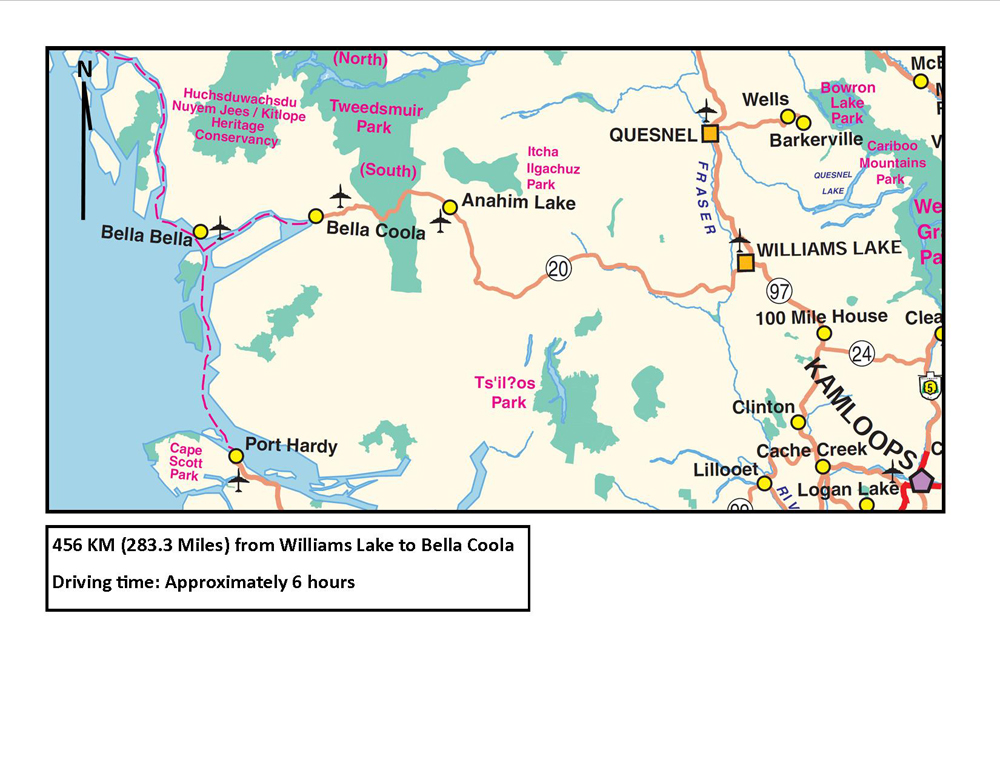
The British Columbia Canadian border guard waved me over to the side of the entry station with a slight scowl on his ruddy face that summer day in 1984. I can’t say as I blame him. I must have looked like a hippy in my old beat up Datsun station wagon. I had been wandering from Ogden, Utah for three days and the back of the wagon looked like a disaster area with supplies, a rumpled sleeping bag along with bicycle parts laying helter-skelter. I didn’t look much better with bedraggled clothes, a beard, wild hair, and probably cookie crumbs stuck to my mustache. Once I explained that I was on my way to Williams Lake to ride my mountain bicycle 456 km to Bella Coola over the Chilcotin territory, they let me into the Queen Mother land; reluctantly.

Williams Lake

I parked the car in Williams Lake, gave the keys and my wife’s phone number to a fellow from the road department. I saddled up, and headed west in 92 degree heat. The idea was to cross the Fraser River while staying on Highway 20 for five or six days. This leisurely ride would bring me to the point where Alexander MacKenzie reached the coast after crossing the continent some 10 years before Lewis, and Clark. There would be mountains, rivers, valleys, grizzly bears and unanticipated mini-adventures along the way. Once in Bella Coola, I would catch a twice a week bus back over the rutted, steep, rocky dirt road.

From the outskirts of William’s Lake the paved road turned uphill then dropped to Sheep Creek Bridge across the Frazer River. As I peddled up Sheep Creek Hill I used all 18 of my gears to make the 1,200 foot climb. Topping out, I entered Belcher’s prairie knowing a few hours of flat riding would renew my energy. There was a sign at Hanceville about 40 miles west of Williams Lake that warned travelers not to attempt the road without good brakes and emergency provisions. It was talking about autos as no one has ever made the trip on a bicycle. Trailers were not allowed. I left pavement at Hanceville peddling onto the best stretch of dirt I would see for days, and the last of pavement until the Bella Coola valley. I was taking a chance on the road because the history of this old horse trail since it was pushed west in the 1860’s was one of bad weather and bad surfaces with long periods between help. Cell phones were somewhere in the future so I knew I may be laid up beside the road in a tent waiting for dry weather or an occasional rancher for help. I gambled that July 1984 would be good to my 49 year old body.

The Chilcotin country was sparsely populated with a history as a tough land calling for tough men and a few very strong women. Men eked out a living from the land when it let them. Scattered ranchers sought the comfort of few, and far between stores while Merchants counted on these rough men to keep the store open. Sightseeing travelers were scarce as the road wasn’t bulldozed to Bella Coola until 1952, so unless you lived in the area, were visiting, hunting or fishing, there wasn’t much reason to risk the trip.

Alexis Creek

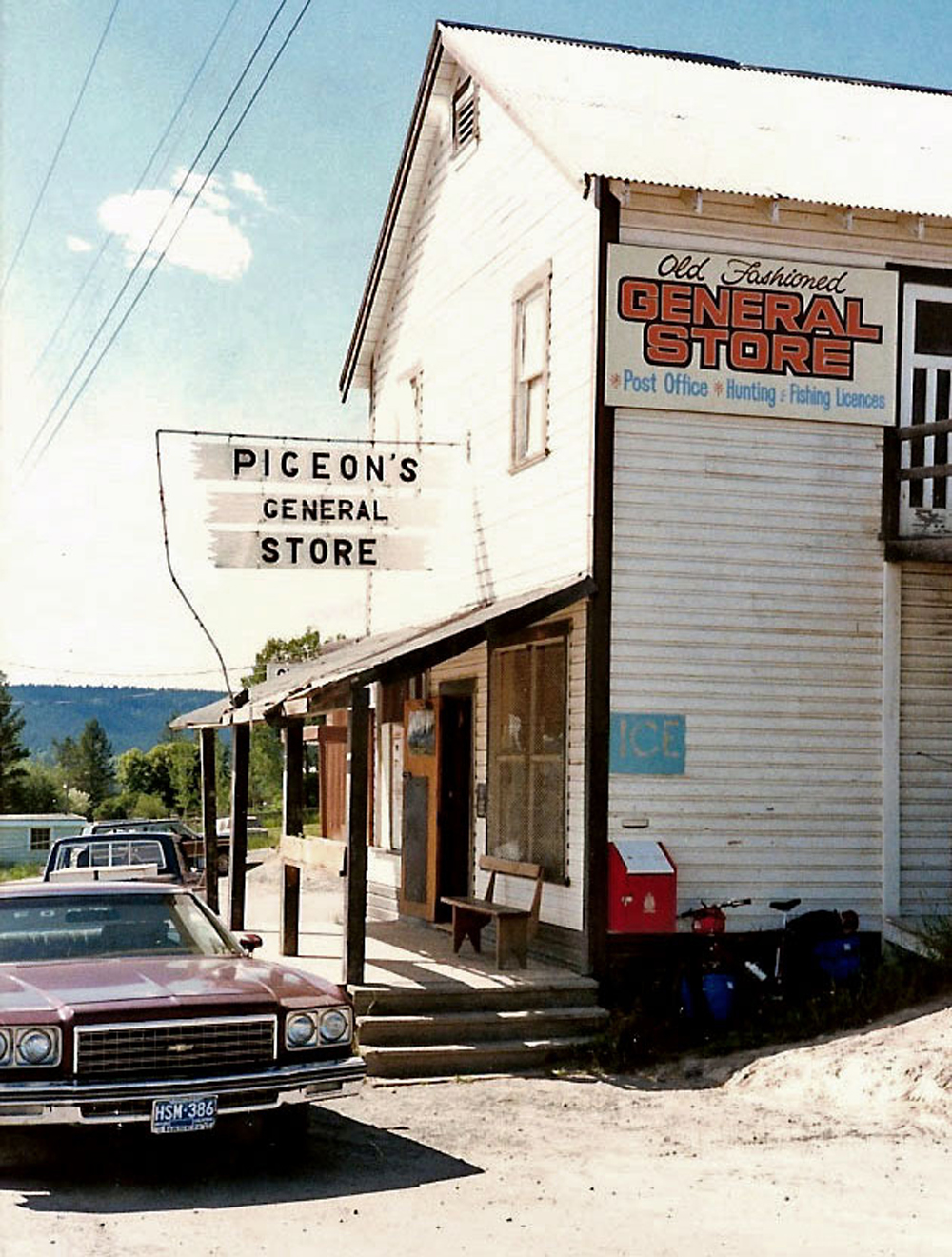
Alexis Creek was big enough to have buildings on both sides of the road with Pigeon’s Old Fashioned general store the center of activity. Upstairs from the store was a community hall demanding you enter, and have a look around as it was the only thing of interest in town. The folks in the store would send a letter for you, sell you fishing or hunting licenses or fill a box with food stuffs and staples. Several dirty old vehicles were parked outside some in such condition that I wondered if they were abandoned. A maroon Chevy sedan caught my eye because it looked like it had just gone through a car wash or a deep creek. A red mailbox hung from the side of the store near the ever-present store bench inviting anyone to sit a spell and spin a story.

The road tread changed every few miles, and although it could be rough with ruts, stones or water, it was rideable. If I was lucky, my spare parts could keep me going without having to send back to William’s Lake for replacements. The weather held. Although I thought I would be seeing wildlife, few animals or birds were in evidence. Running water was always a welcome sight giving me an excuse to dismount, and soak my hot feet. Traffic was not a problem as I could ride for hours without seeing another person. I must have been viewed as a crazy outsider with my saddlebags, shorts, and long socks. Outsiders had never been that welcomed in the Chilcotin but I never felt I wouldn’t be helped if I needed it; if only to keep me moving.

You could argue the title “Highway” 20, but you couldn’t argue the tenacity of the people depending on it to survive. The time I spent growing up in the north plains country of Montana taught me that those who didn’t survive the country were the ones who couldn’t use whatever was handy to fix whatever necessary. These were people that could sit out the night in a cold broken down car or who could make a big story out of the smallest of hardships. I admired the people of the Chilcotin. It hurt a bit, though, when I parked my bike up against a buck rail fence at an isolated old home, entered a café created out of the living room, ordered a slice of apple pie, and no one paid me the least bit of attention. Even Montanans would have said, “Howdy”, and probably inquire what I was doing on a bicycle so far from town.

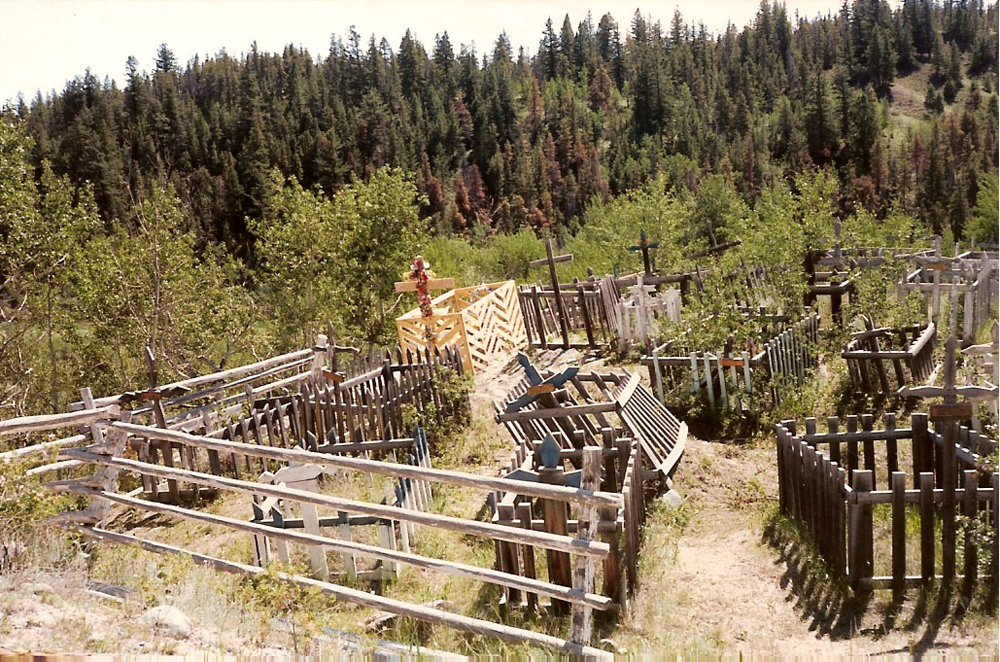
Between Alexis Creek and Redstone a small log red roofed store surrounded by another buck rail fence that looked like a good place to stop. The store sported a gas pump with a long handle to manually fill the glass reservoir for gravity feed. The pump sat between well-worn tire marks on the grass. It brought back memories of when I lived in a log house with the same kind of pump where my Dad and grandparents also sold a few supplies. It was my job to fill the reservoir and let it gravity feed into the car’s gas tank. That was in 1947 on Highway 2 at the bottom of Glacier National Park in Montana. I rode by the Redstone Cemetery, and wondered about the people buried there and how they had died in this harsh country. The graves had little picket fences around them. Some of the grave sites needed care but I guessed that after a few years no one remembered much about some of the owners.

Chilanko Forks

The road got rougher. Riding now demanded constant rock dodging while easing my way across minor washouts. The country was green, the sky clear and the wind calm as I peddled on toward Chilanko Forks store on a much abraded road. I had made letter arrangements with the store owner Ron Morrow to camp in the back of his place. I looked forward to some conversation, a beer, and a hot meal made up by a real cook.

The ride through Bull Canyon on the way to Ron’s was enough to make me want to camp early, but the idea of a cold beer at Ron’s store kept me going. Ron showed me where to put up my tent as we talked about my trip. I asked him what was happening with a group of locals sitting on a fence across the road while a fire shot flames, and smoke into the air on the plateau just up the hill. Ron said that it was a yearly event. The locals set the fire, called it in, then sat on the fence waiting for the government to hire them to go up the hill, and put it out. Nice work if you can get it! I filled up on supplies from the store, had a good nights sleep, and saddled up for the next stretch of road heading west. There were no early morning signs of weather trouble ahead. Because there were no weather forecasts, you had to use your eyes, and nose in place of the newspaper.

At Tatla Lake the scene was just what you would expect from the Chilcotin; an old two-story house with a porch where a sign stating AISCAMIVE (?) hung was complemented with a nearby rusting hay rake, a buckboard, and the lake in the background. Snow covered the mountains in the distant north making for a picture postcard scene. I heard later that the house was used as a dorm for a nearby long closed school.

Fred’s Road House

I pulled off the road at Towdystan to admire a great white sign calling out FRED’S ROAD HOUSE. It hung on a barn long out of use when up walked a fellow who wanted to know what in the world I was doing on a bicycle. He introduced himself as Fred Englbertson. He wore his weathered baseball cap at a rakish angle, a night shirt stuffed into his black everyday work pants with a huge belt buckle pushed halfway to his right hip. I was sure that he saw me coming, threw on a pair of pants over his nightshirt, and came out for a meet and greet. I got the definite feeling that here was a man that was self sufficient, could fix a tractor or my bike, and had a few stories to tell while he worked. I was also sure that everyone in the Chilcotin probably knew him and had a story about him. Fred invited into his home for a cuppa where his massive living room was filled with hunting trophies from his guiding days. It turned out that he had never left the Chilcotin until he was in his 50’s when a client invited him on an African Safari. It was strange to see a Cape buffalo, and a Thompson’s Gazelle hanging beside a grizzly. Fred said he didn’t like the custom of having the Africans carry his gun, load it and hand it to him for the kill so he hauled it around Africa just like at home in the Chilcotin. He said his best memory of the trip to Africa was not of the hunt but the parties in Paris.

Flying

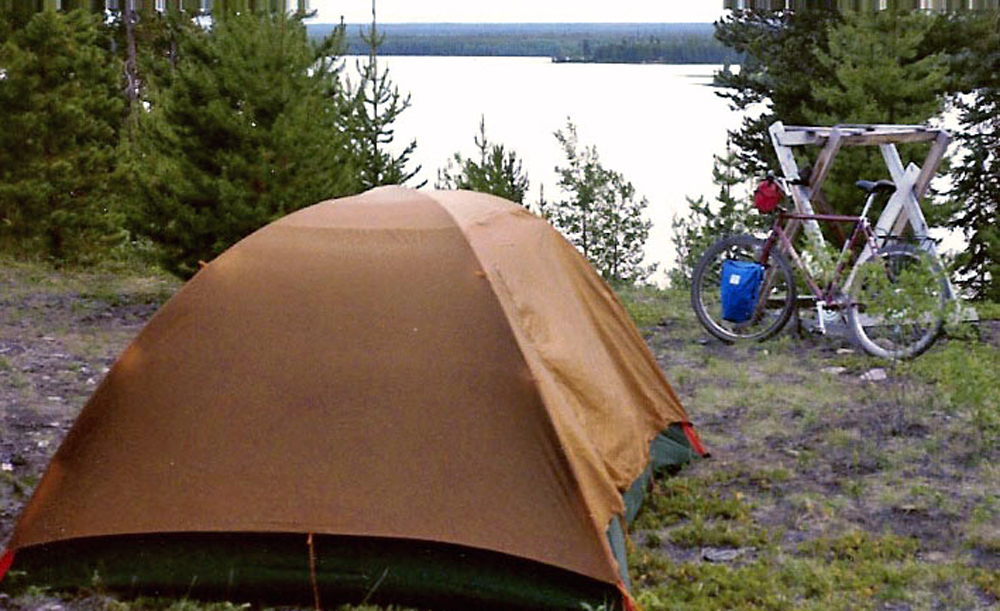
The weather held as I pushed west in a fresh pair of socks, a candy bar pulled out of my pannier, and a plastic bottle full of fresh cold water. I passed a roofless abandoned log cabin with a bus stop sign nailed to the lintel. There was no door, just two broken rusted hinges. I wondered if this was a joke or did the Chilcotin run horse drawn buses in the old days. Nimpo Lake was on my map as a possible campsite so I peddled on. I set up a camp at what I thought would be a wonderful sunrise view of the lake with the high mountains of Tweedsmuir National Park to the west. As I was relaxing after a freeze dried camp stove dinner, a float plane landed on the lake, and motored up to my camp. Two fellows climbed out on the float, and threw fly lines in the water hoping for a trout dinner. We were talking about my trip when the pilot asked,

“What was I doing tomorrow?” I responded:

“More of the same! Just heading for Bella Coola.”

“Would you like to spend the day flying with us tomorrow?

I’ll bring you back in the late afternoon?”

“Yes”, I enthusiastically replied.

They motored off to the upper end of the lake to spend the night in a hunter’s cabin.

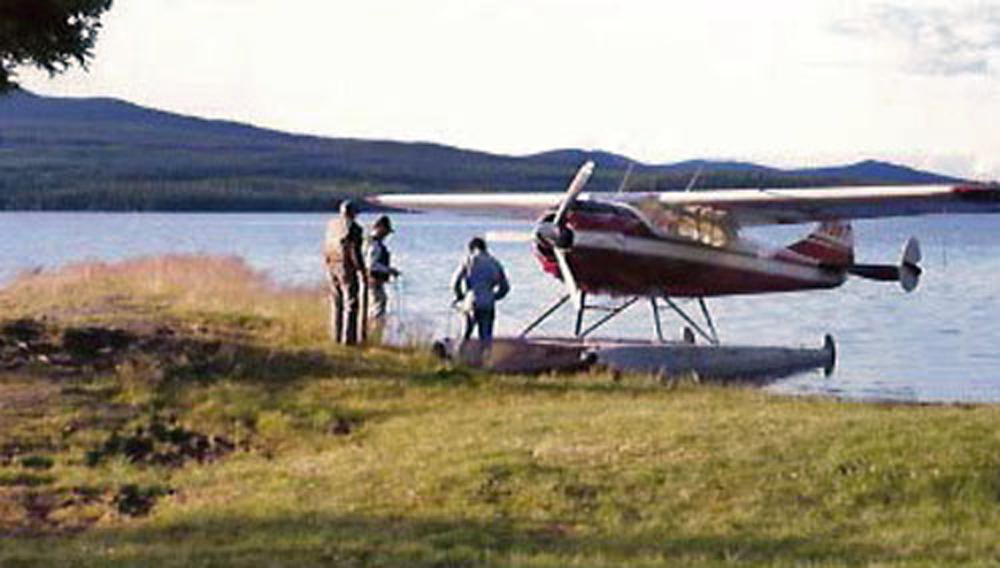
When they arrived at my camp the next morning, I had finished breakfast, packed everything, and had placed my bike inside the tent. We rose off the lake in the early morning light setting a heading of north by northeast. Flying over the land I had been so close to on the bike gave me another perspective. I wondered just where we would turn back as we buzzed small lakes, a moose, and beaver dams. We landed on Tsacha Lake. They ran the plane up on the lake bank at the MacKenzie Trail Lodge where we had trout for lunch. We talked to the owners about their future. They were convinced that the lodge would become a regular stopping point between Vancouver, British Columbia, the Yukon, and Alaska. We rolled a drum of petrol in a wheelbarrow down to the beach where we loaded up the 1942 Cessna 195 three bladed tri-tail. This was as far as my hosts from Los Angeles were going north that day, and we returned to Nimpo Lake where I prepared a solo dinner of freeze dried spaghetti.

The next morning I packed up for the long uphill climb to Tweedsmuir National Park where I had heard a Ranger could put me up, and save me a sleepless night in Grizzly country. About a half hour into the ride, I saw a plane on a northwest flight plan which was probably my Cessna friends headed for the Yukon. I returned to the task at hand with my head down while pushing in 13th of my 18 gears when I heard the sound of a plane ahead of me. When I looked up, the Cessna was coming down the road right at me at about 50 feet off the dirt. The pilot pulled up to my right while the copilot waved out the window. They then returned to their flight plan leaving me breathless from the excitement with one foot on the ground, and needing a drink. Evidently they had seen me from the northwest, and turned around to give me a thrill. I felt like Gary Grant in the movie “North by Northwest”.

An Eye Out for Grizzlies

When I arrived at Tweedsmuir Provincial Park in the late afternoon, the Ranger was not in residence. This made me nervous as I did not want to set up a tent in what was reputedly well-traveled grizzly route. I had had bear experiences growing up in Montana, and bears just plain scare me. Because I had a lot of mid- summer northern daylight remaining, I decided to ride on toward Bella Coola. I didn’t have a topo map but I knew the road ahead was up and down, steep, long and repetitious. They even had a name for it when they were bulldozing it with a cable driven blade: “The Precipice.” I had already climbed about 1000 feet to Heckman pass at 4573 and the road would drop at 18% for about 1500 feet, climb again for about 1000 feet then drop at 18% to the Bella Coola valley at sea level. I didn’t look forward to the difficult climbs ahead but the thought of grizzlies carried me along. By the time I reached a motel on the valley floor I had 75 miles in back of me, it was late in the day, and I needed a shower, a cold drink, and a meal cooked by someone else.

The motel owner asked me clean up a campground in return for a hot meal. I jumped at the offer and when we got there we found part of the campground had been destroyed by a grizzly the previous night. Four French school teachers were huddled together on top of the table next to their tents after a night with a grizzly. The following morning I continued on to Bella Coola riding past log rafts, abandoned boat houses, road repairs. I was on a paved road again after days of dirt, and rocks. I looked back towards the mountains and wondered how high they were, and how difficult it must have been to finally bring the roads from the east, and the west together using old equipment and sturdy men on 18% grades.

A Return Via Bus

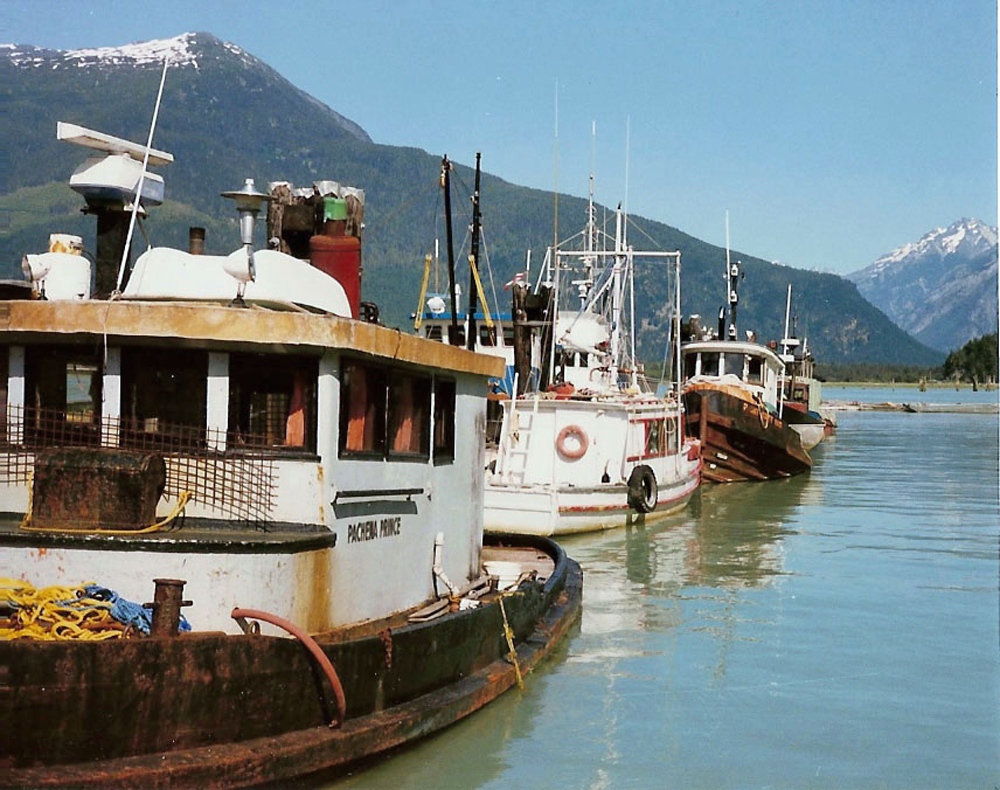
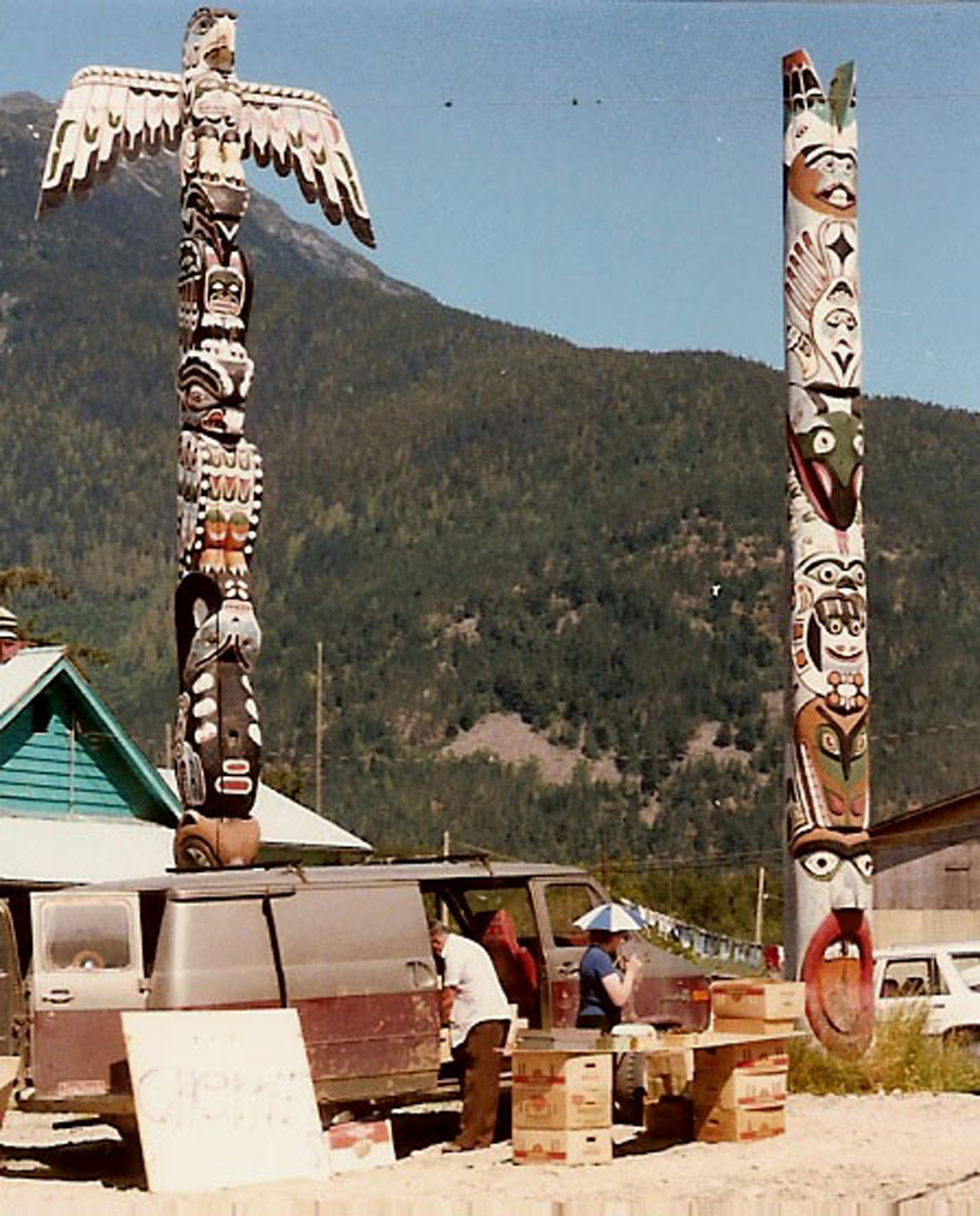
Bella Coola, with its totem poles, steep roofed church, fishing boats, adjacent hay fields, and small business center was a relief. I looked forward to a real bed, another beer, and the ride back to William’s Lake on the bus.

The following morning I stuffed my bike in the luggage compartment of the bus to the amazement of bus driver Dennis Murray. I sat back ready to retrace my week-long journey in just a few hours getting a new perspective on the road. It was hard to recognize anything on the way back while looking out the right side of a bus traveling miles an hour faster than my bike. I enjoyed the time Dennis geared down to make the grades. I don’t remember a single passenger boarding the bus for the 456 km ride back except two fellows who boarded with me in Bella Coola.

When we arrived in the afternoon at Williams Lake, I retrieved the keys to the car, and took a motel room in anticipation of the trip back to Ogden. It would take two or three days depending on what came up along the way.

The Chilcotin was a ride to remember. When I returned, I purchased the book “The Road Runs West” which describes Highway 20’s history. The book was yet another slant on a wonderful country. The characters in the books, and the stories about their lives left me wondering just what would have happened if things had gone wrong for me as I peddled what could have been extremely harsh country, nasty weather, and a complete lack of quick medical assistance.

Notes:

  • The route is not that far but in 1984 there were only two stretches of pavement totaling approximately 50 of the 283 miles. The road base was rocky with stretches of gravel or graded mountain soil.
  • On invitation, I spent two days traveling by float plane out of Nimpo Lake sightseeing. I stored my bike in the tent.
  • I was afraid to camp at Tweedsmuir National Park because of the threat of grizzly bears so I rode from Anahim Lake to Hagensborg. A very long exhausting day.
  • I spent one day cleaning up a campground at Hagensborg east of Bella Coola after a grizzly bear tore it up and frightened four people from France.
  • A book titled “THE ROAD RUNS WEST” details the years of road construction by men coming east to meet the men going west.
  • Bike shops in Williams Lake state that people are now riding the route one way to get to the ferries in Bella Coola.

The Bike:

According to Matt Howard owner of The Bike Shop in South Ogden, who sold me the TREK, is that the bike did not have very big tires and zero suspension to make the ride tolerable. It did not have disc brakes or front and rear suspension.  It did not have the huge gear range with a low end that makes it possible to climb the steepest grades. Finally that early mountain bike was a lot heavier than today’s version.
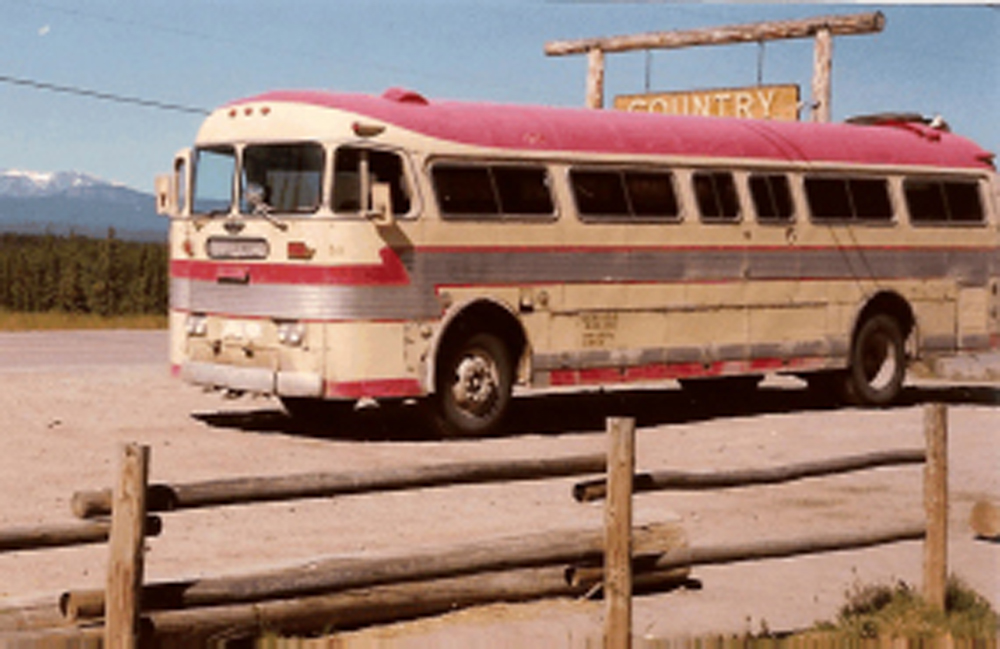
The Highway 20 bus that Jay took from Bella Coola to Williams Lake. Photo by Jay Hudson
The 1942 Cessna 195 on Nimpo Lake. Photo by Jay Hudson
Bella Coola. Photo by Jay Hudson
Bella Coola Totems. Photo by Jay Hudson
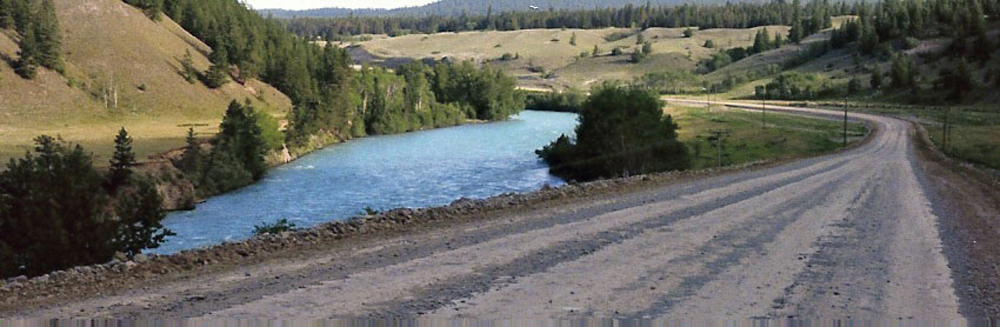
Bull Canyon. Photo by Jay Hudson
Nimpo Lake Campsite. Photo by Jay Hudson
Pigeon Store in the Chilcotin. Photo by Jay Hudson
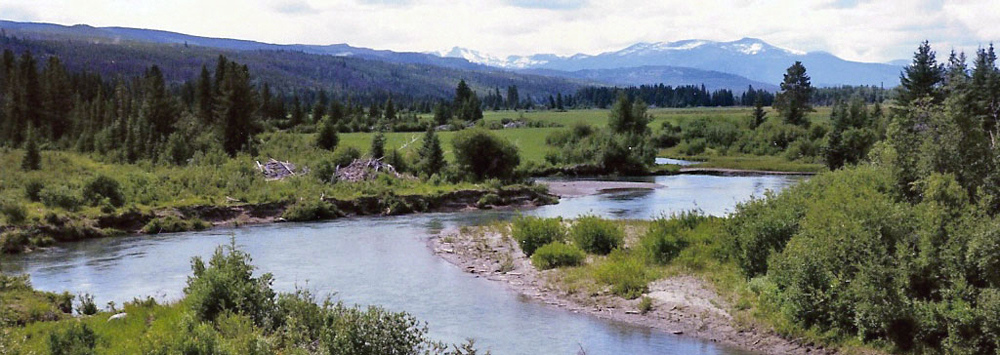
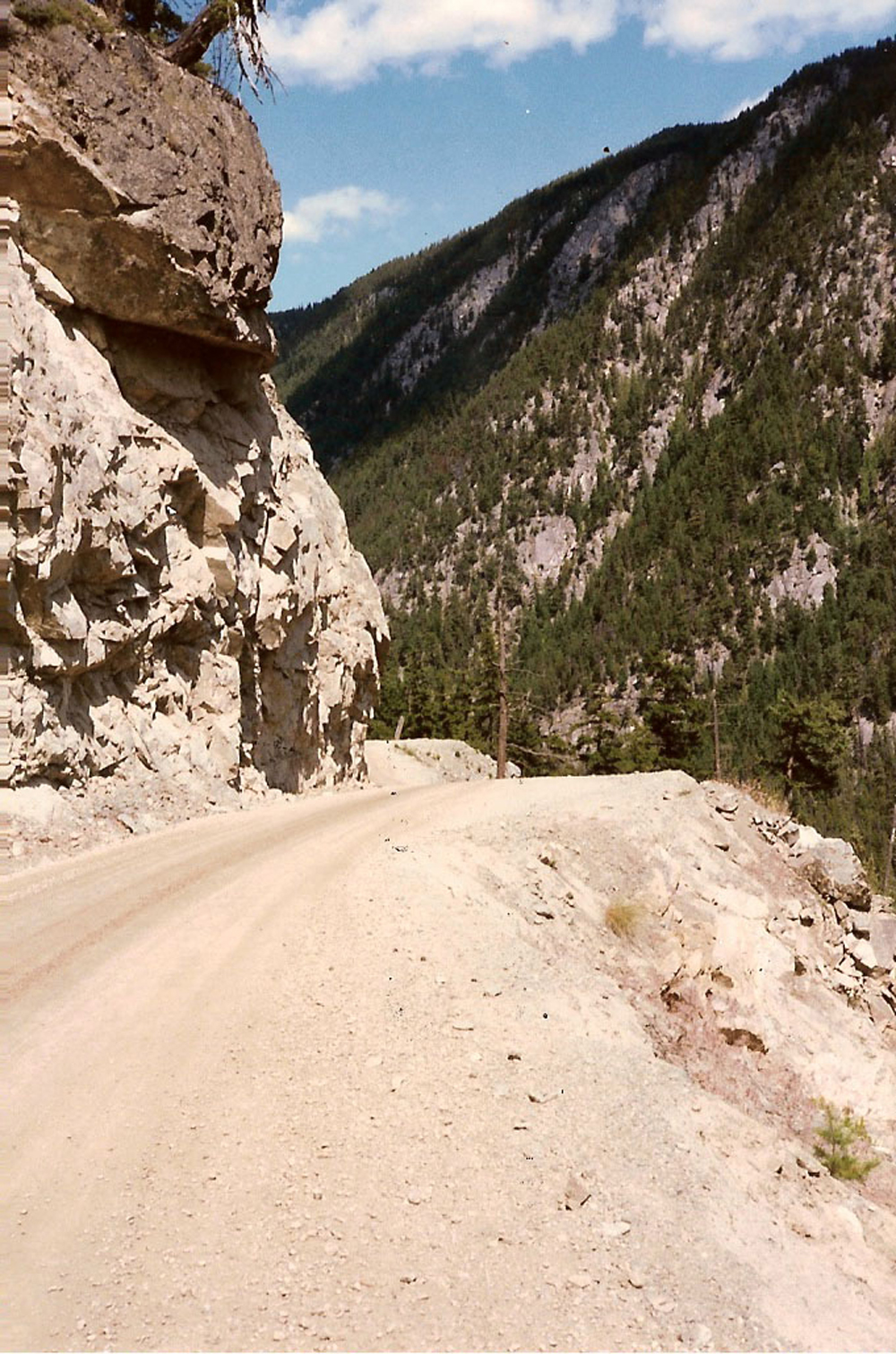
A view in the Chilcotin. Photo by Jay Hudson
Sheepcreek Hill near the Frazer River in the Chilcotin, British Columbia. Photo by Jay Hudson
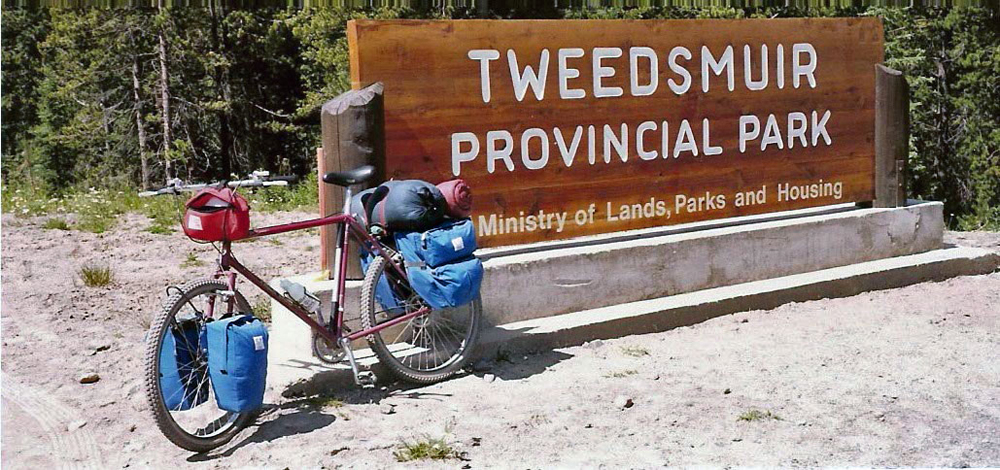
Tweedsmuir Provincial Park in the Chilcotin, British Columbia. Jay’s loaded Trek 830 touring bike is pictured. Photo by Jay Hudson
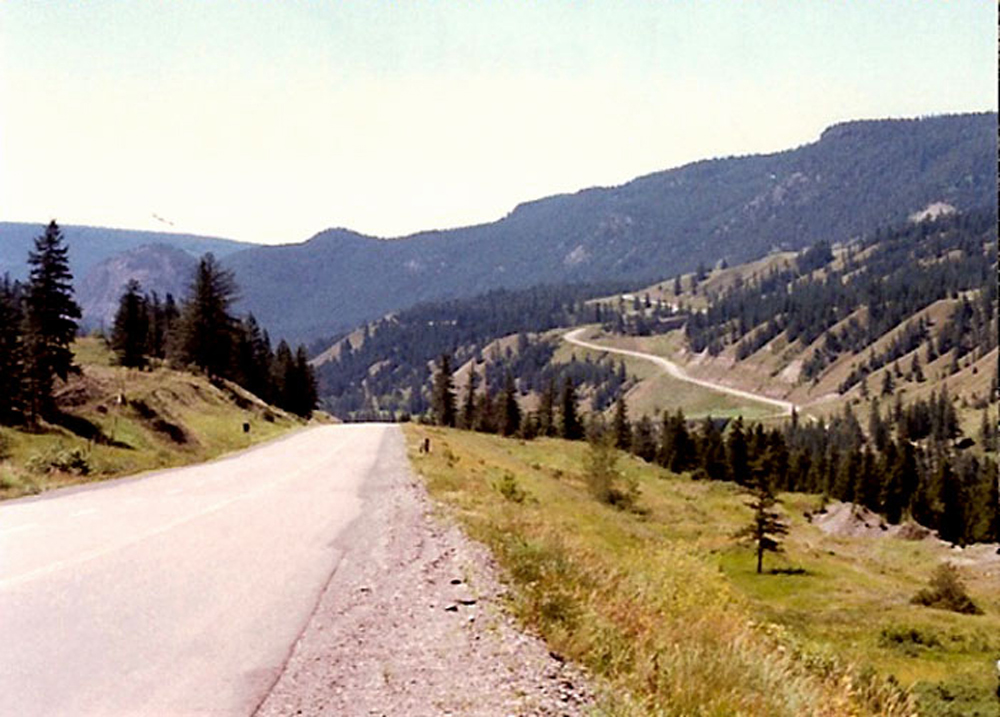
West from Tweedsmuir. Photo by Jay Hudson
A map of Williams Lake to Bella Coola on Highway 20 in British Columbia.
A cemetary in the Chilcotin. Photo by Jay Hudson

Editorial: Salt Lake City Parks Should be Car Free Two Days a Month

5

Salt Lake City has two incredible parks within the city – Sugarhouse Park and Liberty Park. We propose that for two weekend days each month, alternating every two weeks, each park would be car free. Both currently have approximately 1.25 mile loop roads going through the park that are open to automobile traffic almost every single day of the year. One exception is that the Sugarhouse Criterium takes place without cars on the road for one day a year. Historically, bike races have been held in Sugarhouse Park for decades. The same may be true for running events in each park. Aside from these few days, both parks always have cars on the road.

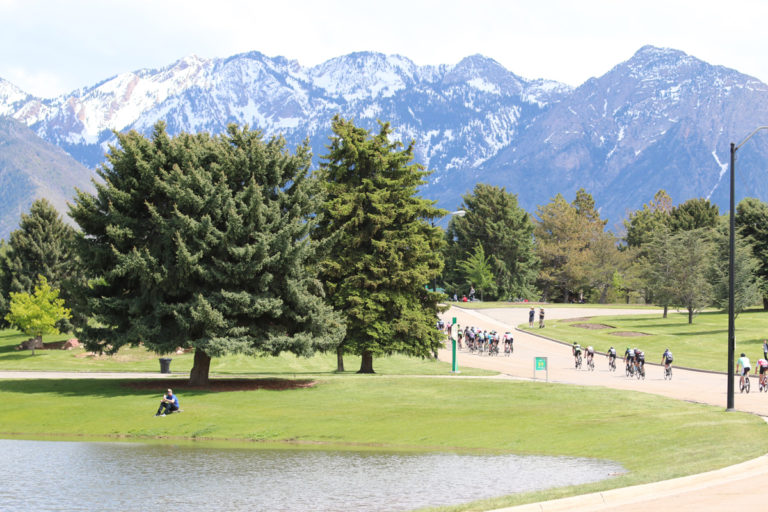
What would Liberty Park be like if for one day a month there were no cars? Photo by Dave Iltis

A car free park would give families, people on bikes, runners, pets, sledders, walkers, and other people who enjoy the park, a chance to experience the park without cars. While each currently has a bike and running path around the each park, the opportunity to enjoy the outdoors without incursion by automobiles would provide a chance for greater serenity within the city. If each park were car free two days a month, there would be an opportunity to enjoy a car free park one day each week within Salt Lake City.

Some key parks in other cities have done so. Golden Gate Park in San Francisco has car free sections of road every Sunday, Monday holidays, and summer Saturdays. People come out in droves to enjoy the roadway without cars.

Central Park in New York City is now car-free capping an effort that appears to have begun in 1991.

This could happen right away with little effort or planning by Salt Lake City. However, some improvements to infrastructure would help the process. Both parks need safe, non-auto ways to get to the park. Better bike lanes to and from each park would help greatly. Each has a couple of good routes currently. Liberty Park can be accessed by the 600 E. neighborhood byway. Sugarhouse Park by the PRATT Trail as well as 1500 E. needs better access. For Sugarhouse Park, adding bike lanes on 2100 South would help to make it safer to access the park from the north, south, and east.

This will take political will from the Mayor, especially to reverse the decision to not put bike lanes on 2100 S between 1700 E and 2300 E. For Liberty Park, hopefully the 9-Line Trail will result in bike lanes on 900 S that will make park access easier, and on 500 E too.

Additionally, there are few bike racks in either park – installing more would provide a safe place to lock up personal transporation while enjoying the parks.

From what we hear, there is a Greenbike station planned for Liberty Park at some point. We have not heard anything regarding a station at Sugarhouse Park. This would help to improve accessibility to the park, and recreation within the park.

Both parks suffer from some huge barriers to pedestrian access in certain places. By Liberty Park, there is no crosswalk between 900 S and 1300 S on 700 E for example. By Sugarhouse Park, the southwest corner is a pedestrian nightmare for those wanting to walk to the park from the neighborhoods south of I-80. Scary crossings of freeway exits and entrances, and a too narrow bridge lurk to make park access difficult.

Both parks are readily accessible by UTA bus.

All of these should be remedied soon, but are not necessary to implement car free parks.

Salt Lake City should start this summer by making Sugarhouse Park and Liberty Park car free for two days a month every other week.

Sugarhouse Park is car free only one day a year for the Sugarhouse Criterium. Photo by Dave Iltis

Sen. Lee Reintroduces Bill to Allow Bikes in Wilderness

May 29, 2019 – Sen. Mike Lee (R-UT) is trying again to weaken protection of the wilderness. He reintroduced legislation in May that would give local federal officials the ability to allow bicycles and other non-motorized vehicles in federally-designated wilderness areas. His S. 1695 would end the nationwide restriction. The bill was referred to the Committee on Energy and Natural Resources. It picked up no immediate cosponsors.
He introduced a bill with the same idea, called the Human-Powered Travel in  Wilderness  Areas Act last year but it got no cosponsors and the committee never acted on it. The bill would have applied to lands administered by the Bureau of Land Management, National Park Service, Forest Service and Fish and Wildlife Service
Lee also introduced legislation last year and this year that would restrict creation of expansion of national monuments in Utah. That bill is now pending before the same committee. Sen Mitt Romney (R-UT) has cosponsored it.

-Charles Pekow

Mountain biking could be allowed in federally designated wilderness areas if Sen. Mike Lee's 2019 bill is passed. Photo by Dave Iltis
Mountain biking could be allowed in federally designated wilderness areas if Sen. Mike Lee’s 2019 bill is passed. Photo by Dave Iltis


From Salt Lake City, Utah to Mesa, Arizona: A Bike Tour is Planned

By David Ward

David Bennion’s cross country bike tour on this bike inspired David Ward to plan a bike tour for this fall. Photo by David Ward

For years I have been reading articles in Cycling West by Lou Melini and others on bicycle touring. And though the idea has been enticing, I have never done much of that. In fact, I have done virtually none at all, being able to count on one hand the times I have actually toured on a bike.

The first time was way back when I was first getting into cycling. I had lost a lot of weight, as a result of which I was engaging in a lot more physical activity, both to keep the weight off, and simply because I could. I had always enjoyed riding a bike from the time I was a kid, so when I lost all that weight and became more active, I naturally made cycling a big part of my active lifestyle.

So it was that around 1980 I strapped a tent and a sleeping bag on the rear rack of my old Motobecane, struck out from my home in Salt Lake and headed to Pocatello where I was to meet up with my wife, Karma. The first day I rode to Mantua, Utah where I camped for the night, and the next day pedaled the remaining miles to Pocatello. I remember being gratified at the accomplishment, but also that it was not as challenging as I thought it would be.

My next foray into bike touring came, I believe, in 1984. At that time, Karma and I decided to do a tour that started and finished in Jackson, and did a loop through Teton National Park. I don’t recall well the details from that trip, except that we rode all the way through Teton National Park to the southern boundary of Yellowstone Park before we headed back toward Jackson. I also remember how scenic it was to be seeing Teton National Park from the seat of a bike. So much better than a car.
The next year, 1985, we had some friends who had taken up cycling, so together we planned a Colorado loop where we started in Montrose and rode to Telluride. The second day took us from there to Dolores. Day 3 saw us push on to Durango where, on day 4, we took the narrow gauge train to Silverton from where we rode to Ouray. I particularly remember that day as I had several flats before I figured out the rim tape had slipped and the tubes kept pinching into the spoke holes. The last day saw us complete the tour by riding from Ouray to Montrose.

Then in 1986, with those same friends, we retraced the tour Karma and I had done a couple of years earlier through Teton National Park.

To be honest, though, these three trips were not hardcore bike tours as we rode from hotel to hotel, glad to have a warm shower and soft bed each night. Still, they were very enjoyable, and a refreshing way to see the scenery.

But that’s it. No touring since then. Nada. As I think back on these tours, I am amazed we have not done more, because they were so enjoyable. Still, life has its way of creating obstacles, and we did not succeed in overcoming those to do more touring. I can look back and understand how that happened.
Still, the idea has continued to appeal to me. Then, a couple of years ago, a good friend took a month off from his law practice and being a Mormon bishop to cycle across the United States. He built up his touring bike, particularizing it to his desires, and stopped in to show it to me about a week before he left. He had really thought things through, and had a great trip across this beautiful country. He did some camping, but more often stayed in hotels.

Anyway, he has inspired me. So, I have decided, before my body gets too old, to do at least one good bike tour. Next fall, I am going to ride from my home in Salt Lake to my daughter’s home in Mesa, Arizona. Since I have just reached this resolve, the planning, other than the decision to do it, is still to come. One thing I do know, however, is that I am too old to sleep on the ground anymore, or at any rate do not want to. So I intend to ride from motel to motel. That will also lighten my load somewhat.

I am excited to do this, though my body of 68 years with its creeping arthritis is somewhat more apprehensive. But there comes a time when you realize that if you are going to do in this life some things you have considered doing, you better get on it while you still can. That time has come for me.

I know to many of the seasoned bike tourists, my planned ride probably doesn’t seem like much. But it seems like a major challenge to me. And that is what matters. And who knows, maybe it will lead to more touring adventures before age puts a stop to such shenanigans.

So next fall, some time late September or early October, I will pedal out of my driveway, point my front wheel south, and keep turning the pedals over till I get to Mesa.


Ride the Golden Spoke

By David Collins — This month marks the 150th anniversary of the first transcontinental railroad. On May 10, 1869, the final spikes were pounded into place near promontory Utah completing the first coast-to-coast railroad. Three of the four ceremonial spikes used that day are currently on display at the Utah Museum of Fine Arts on the campus of the University of Utah.

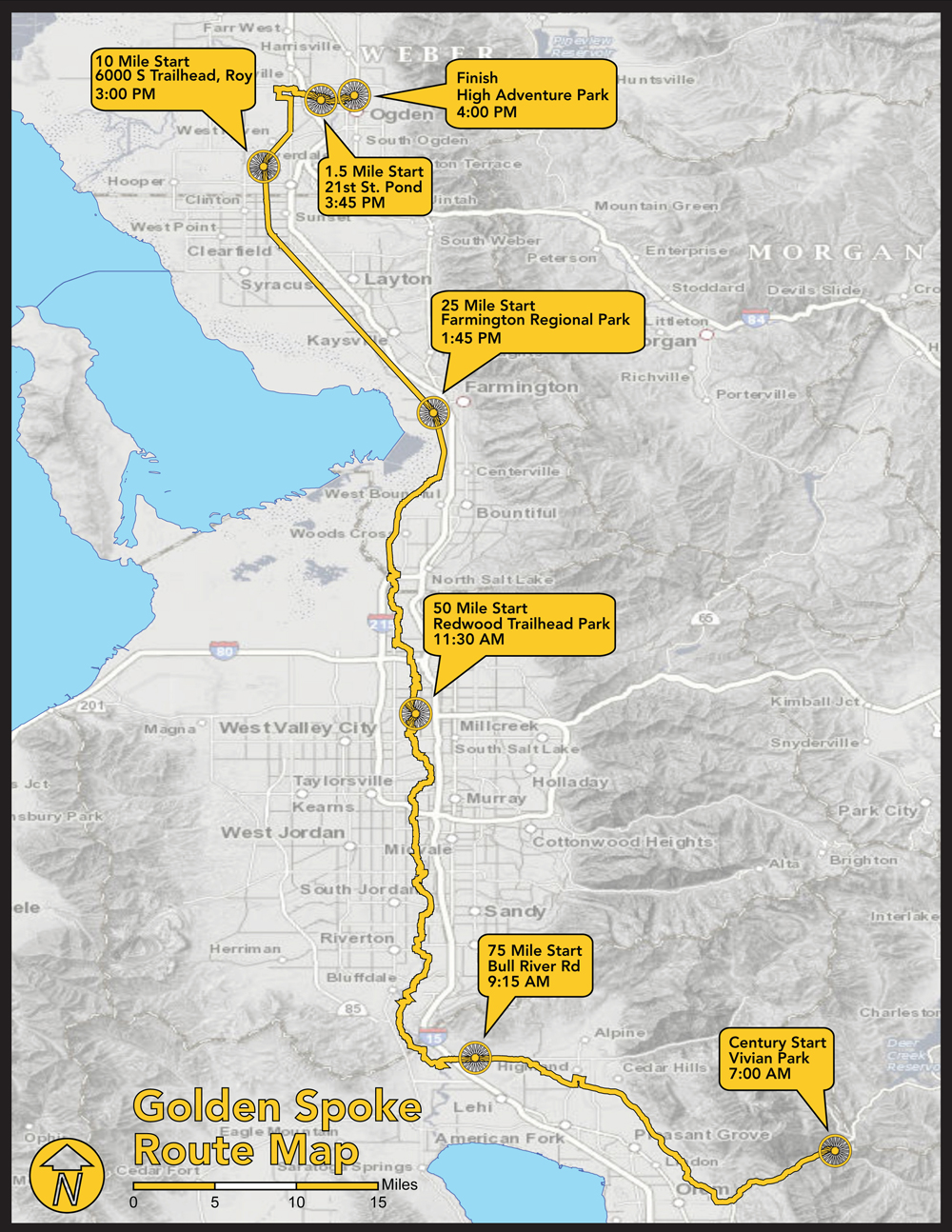
Golden Spoke Route Map
Golden Spoke Route Map – The longest continuous multi-use urban trail network west of the Mississippi River

Looking for a great century ride to commemorate the occasion? Try the 106 mile paved urban network of trails called The Golden Spoke. It’s a safe way to ride through the heart of the Wasatch Front.

Route: Begin at the Provo River Parkway at Bridal Veil Falls in Provo Canyon (Hwy 189) to the mouth of Ogden Canyon with a quick 15 mile detour into downtown Salt Lake City and up to the University of Utah. 121 miles.

Terrain: A taste of alpine canyons, waterfalls and famous fly-fishing river shorelines, wetlands, but primarily—paved trails through the heart of cities of the Wasatch Front including, Provo, Orem, Lindon, Pleasant Grove, American Fork, Lehi, Bluffdale, Draper, Riverton, South Jordan, West Jordan, West Valley, Salt Lake City, Bountiful, Centerville, Farmington, Kaysville, Layton, Clearfield, Sunset, Roy, West Haven and Ogden. If that seems like a lot of cities, you’re right. The ride links several paved trails (including the Provo River Parkway, Murdock Canal Trail, Jordan River Trail, Legacy Trail, Denver & Rio Grande Rail Trail and the Ogden River Parkway).

What to See: A slice of life along the Wasatch Front (home to about 2 million residents); International Peace Gardens; river shorelines-Provo, Jordan and Weber; towering Wasatch Mountains to the east and sparkling lakes to the west—Utah and Great Salt Lake; Great Salt Lake Legacy Nature Preserve; Farmington Bay; WWII US Navy mapping agency—now an industrial park called Freeport; the Salt Lake City headquarters campus of the Church of Jesus Christ of Latter-day Saints (including their iconic temple); The Cathedral of the Madeleine; the 2002 Winter Olympics Opening Ceremony stadium at the University of Utah.

Selfies and Photo Ops: Bridal Veil Falls; gullies around the point-of-the-mountain; 2002 Winter Olympics sidewalk art and Opening Ceremony stadium at University of Utah; Cathedral of the Madeleine; Salt Lake City Temple; Farmington Bay views of Antelope Island, Ogden Canyon waterfall (about a half a mile east at the end of the ride—in the mouth of Ogden Canyon).

Wildlife: Songbirds, birds of prey, migratory birds, waterfowl, muskrats, deer, coons and similar carpetbag size creatures, urban squirrels and chipmunks, game fish, field mice and other little critters.

Best Post Ride Eats: Timbermine Steakhouse in Ogden. The ride ends in the parking lot and convenient enough, some of the best meats in Utah are served inside with all the sides you’d expect from a good steakhouse. Be sure to get the Timber Pie for dessert, it’s some kind of ode to the chocolate chip and it comes with tasty cold ice cream on the side, a perfect way to end a long day in the saddle.

Still have Legs, Lungs and Sunlight? Head toward the mouth of Emigration Canyon just east of the University of Utah and check out the This is the Place Heritage Park (across the street from Hogle Zoo). It includes several historical displays that shed light on the early years of exploration and settlement including trappers, explorers, pioneers and the Pony Express.

Notes: Pay careful attention to the map and route information since some of the connections along the way may not be obvious or well-marked. Also, be sure to check local news about the insect/bug hatch on the Jordan River. If you ride during a live hatch, you should bring netting for your head, otherwise your bike ride might quickly turn into a buggy ride.

David Collins is a cycling enthusiast and amateur randonneur. Follow him on Instagram @rockypumpkin.

New Bill in Congress Would Provide Tax Break for Cycling to Work

By Charles Pekow

Cycling West - Cycling Utah Magazine logoRemember when it was possible to get a tax break for riding your bike to work? Probably not, but until last year, it was legal to get a tax-free reimbursement of up to $20/month for the costs of biking to work (parking, tune-ups, fixing flats, etc.). But your employer had to offer the benefit and few did. But the Tax Cuts and Jobs Act of 2017, which gave billions in benefits to large corporations, took away the bike benefit as of 2018 for the few who could take advantage of it.

But now Representative and long-time bicycle champion Earl Blumenauer (D-OR) has introduced legislation that would not only restart but would expand the benefit. The Bicycle Commuter Act of 2019 (H.R. 1507) would switch it from a reimbursement to a pre-tax benefit and clarify that it would apply to electric bicycle and bikeshare users.

Users would have to ride regularly either to their place of employment or to/from a public transit stop on their way to work. The bill picked up 11 cosponsors, including Gwen Moore (D-ID), Raul Grijalva (D-AZ) and the most famous new member of the House, Alexandria Ocasio-Cortez (D-NY). The bill was referred to the Ways & Means Committee on March 5, 2019, where it still sits.

View it at https://www.congress.gov/bill/116th-congress/house-bill/1507/


Mountain Biking is My Act of Resistance

By Raksha Vasudevan — In predominantly white Colorado, I bike to beat my fear.

As an immigrant seeking a place to belong, I couldn’t have felt more out-of-place than when I moved to America shortly before the 2016 presidential election. And as the vitriol escalated, I never expected to find solace on two wheels.

Here’s how it happened: Nearing 30, I found myself yearning for a previous life. As an international economist, I lived and worked in Africa for most of my 20s. But after a while, I longed for familiarity, to not be instantly labeled and treated as an outsider because of how I looked and spoke: a South Asian woman with a North American accent. I missed, too, my home in Canada. Jobs in international economics are rare in North America, so I was delighted when I found one in Denver in September of 2016. Colorado seemed to offer everything I wanted: a short flight to my mom in Calgary, the mountains, and a climate that made it easy to be outside year-round. Only after I arrived, in a daze of reverse culture shock, did I look up the statistics: 80 percent of Denver’s population was white. I was nearly as much an outsider here as I’d been in Africa.

Though confident while out riding on trails, Raksha Vasudevan constantly pushes up against a culture of mountain biking that is predominantly white and higher income. Photo courtesy of Raksha Vasudevan

That sense of alienation only mounted after Donald Trump’s unexpected victory. The day after the election, I wanted desperately to go to the mountains, far away from people who had chosen a leader who seemed to hate people like me — people of color, immigrants, women. But, like most women of color in Colorado, I’d realized after I got here that I earned a disproportionately low salary. Given Denver’s growing cost of living, I could only visit the mountains when my few car-owning friends did — and none of them wanted to leave their homes that day.

In the following weeks and months, as rhetoric and violence against people of color escalated, I hesitated to go beyond the city, into rural areas, where diversity was likely to be even lower, making me all the more visible. The lack of crowds — something I used to love about wide open spaces — now scared me, my sense of adventure troubled by visions of being attacked and left in the forest. In Fremont, California, a South Asian woman who went hiking just a few weeks after the election returned to find her car window shattered and a note calling her a “Hijab wearing b—–” who should “get the f— out.” I debated leaving, perhaps returning to Canada. But that seemed like a defeat, a confirmation that people like me didn’t belong in the outdoors — or anywhere in America.

Things began to change in the spring, when a mountain-biking friend convinced me to try it. “There’s nothing that makes you feel more alive,” he said. That’s what the outdoors had always done for me — before it started to appear both inaccessible and hostile, reserved for people with specific levels of material wealth and melanin. Partly to challenge my own perceptions, I rented a bike and started riding with him. Immediately, I was hooked: the searing uphill climbs, the adrenaline of hurtling downhill. There was no time for self-consciousness, no opportunity for other trail-users to ask, “Where are you from?” I started saving to buy a used mountain bike. But once again, in outdoor gear shops and biking groups, surrounded by pale-skinned people with visibly larger budgets, I felt not only poor but out of my depth.

Despite the challenges, I kept biking precisely because I didn’t fit in on the trails, the sports shops or groups. Yet I craved a future where I did. After all, people of color and immigrants also pay taxes that fund state and national parks. We, too, deserve the sight of forest green and sky interrupted only by mountain peaks — and to have a choice in how we experience the landscape, whether by foot, bike, horseback, kayak or some other way. But I wasn’t willing to wait for everything to become easily accessible for people like me — I had to start now. And perhaps by doing so, I’d help to create that future.

Still, that dream is continually threatened. Recently, a friend and I traveled to western Colorado to bike, Mesa County’s trails being among the best in the country. On the drive to the trailhead, we passed at least three trucks with MAGA stickers. I knew Mesa County had voted 64 percent Republican in the 2016 election. At the trailhead, I sat in the car for a long time before setting off, filled with trepidation.

On the trail, I stopped to take a picture of yucca clinging improbably to slanting canyon walls. A man in a camouflage shirt walked towards me. As he got closer, he blinked noticeably, as if surprised to see someone like me there. But he nodded as he passed by, and I released the breath I hadn’t known I’d been holding.

All my worries — money, my U.S. visa, the perceptions and reactions of others — were still with me on the trail, sometimes bubbling up, but gradually dissolving the longer I biked. The trail demanded my attention urgently — jagged switchbacks, tree roots swelling up suddenly from the soil—and at other times, gently. The wind brushed my scalp through my helmet vents. A jaybird call broke the slog of pedaling uphill. A flash of red appeared as my front tire passed blooms of Indian paintbrush. I couldn’t have anticipated any of it, yet it was exactly what I needed.

Raksha Vasudevan is an economist and writer living in Denver. Follow her on Twitter: @RakshaVasudevan This story was originally published in the March 4, 2019 issue of High Country News (hcn.org). See: https://www.hcn.org/issues/51.4/essays-mountain-biking-is-my-act-of-resistance

BLM to Collect Fees for Mountain Biking in Some Areas

By Charles Pekow

Cycling West - Cycling Utah Magazine logoPay what you will but you will be expected to pay something if you want to mountain bike in Bureau of Land Management (BLM) sites in Utah. BLM announced it will begin collecting fees for day use at the Three Peaks Trail System and McCoy Flats Day Use Site, starting Aug. 27.

But for day biking, BLM designated the areas “no minimum use fee” sites, meaning bikers can “pay what they feel their recreation experience is worth to them specifically for the use of these developed recreation areas.” People will have to pay set fees if they wish to rent a cabin or camp out, though.

The money is supposed to stay onsite. BLM Utah says rising use of its land for recreational purposes is increasing its maintenance costs, which it needs to recover through fees. The agency promises that whatever you pay will be used strictly to replace aging infrastructure, improve visitor services and expand access to its Utah lands for recreation.

Details at https://www.govinfo.gov/content/pkg/FR-2019-02-27/html/2019-03385.htm


A Bike Advocate Reflects on Veronica Davis’ Talk: Biking, Equity and Inclusion

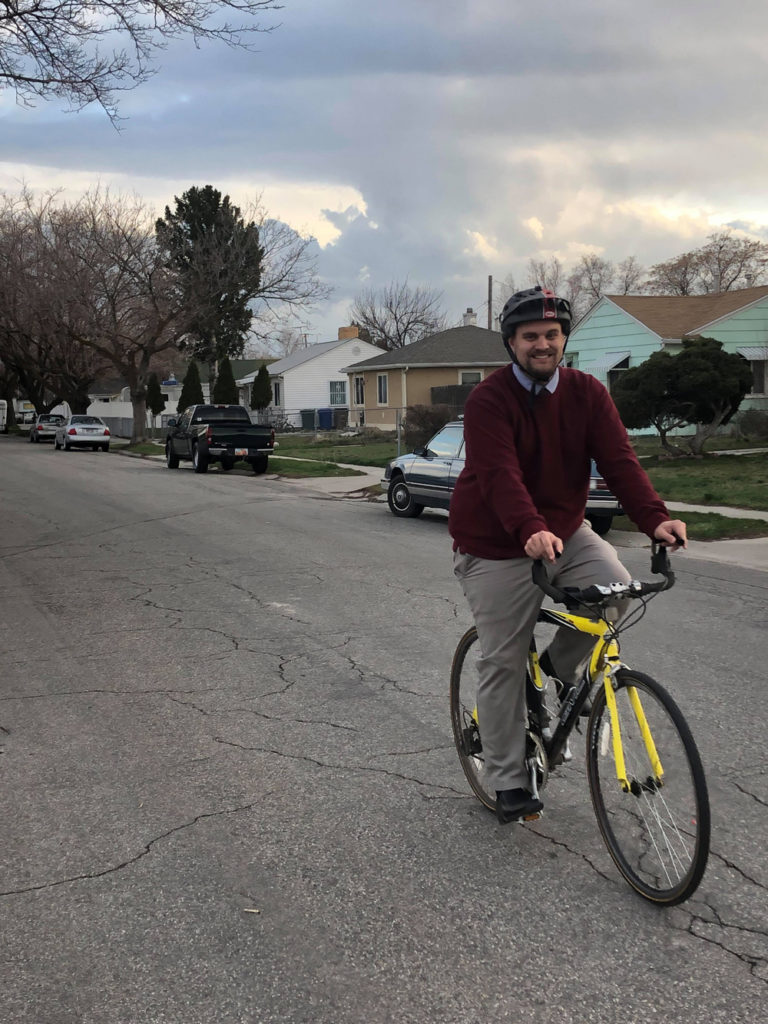
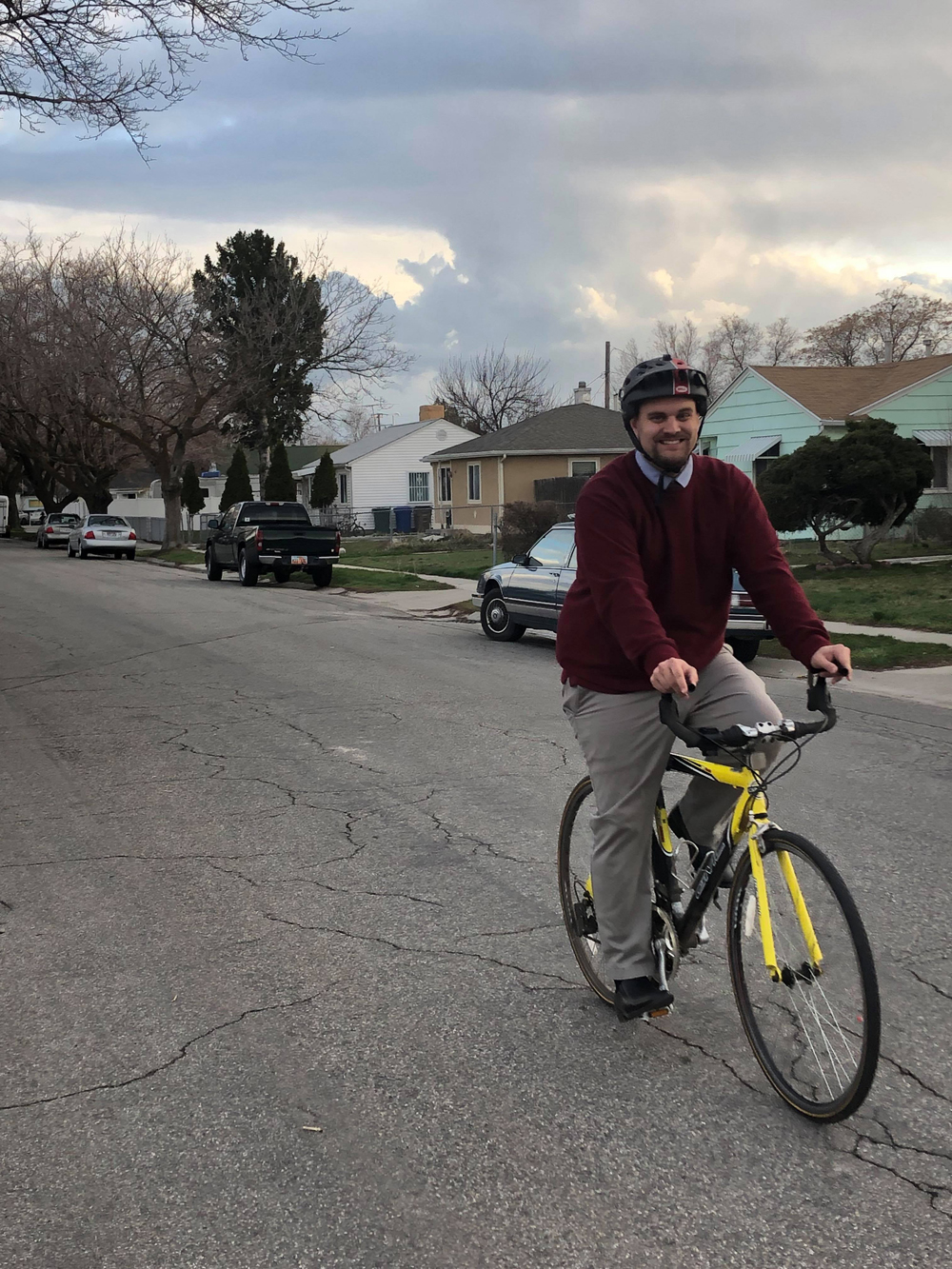
By Turner Bitton — Last week I got my bike out, cleaned it, and performed all of the maintenance needed to prepare for my commute to work. This was my first time commuting to work by bicycle since I moved to a new home, in a new neighborhood, with a vastly different commute than I would have had even last year.

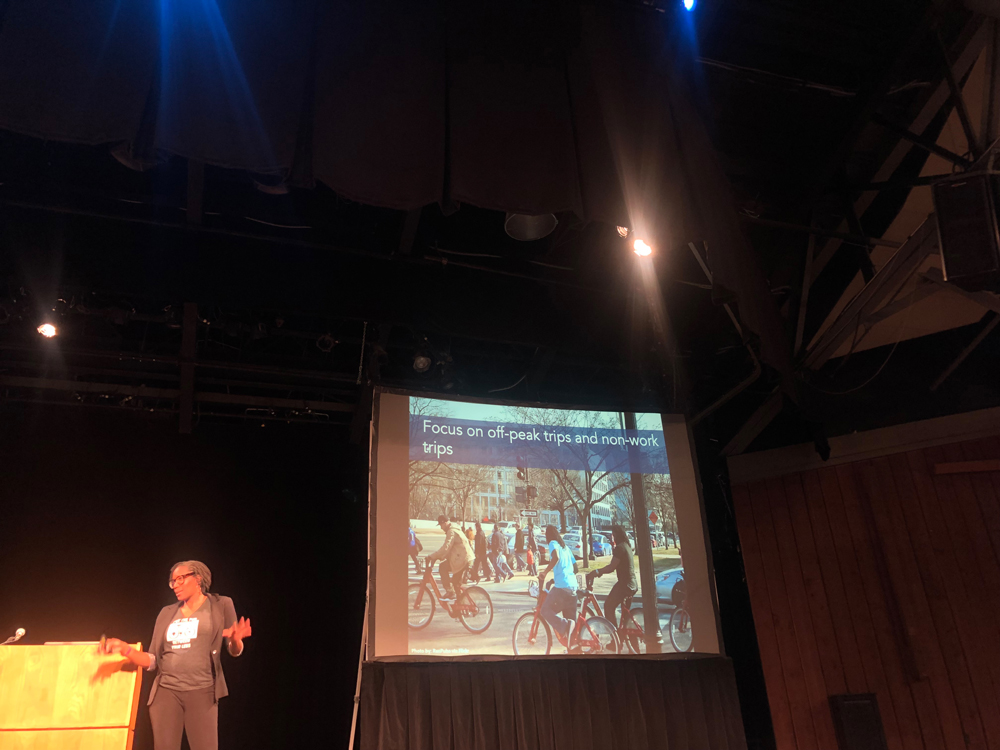
Veronica Davis talk was on Biking, Equity, & Inclusion at the 2019 Utah Bike Summit. Photo by Dave Iltis

As a new resident of the Glendale neighborhood of Salt Lake City, I’ve got a new opportunity to explore urban environments that I previously hadn’t been exposed to. Commuting to work by bicycle is an amazing opportunity to see, smell, and hear the sounds of a growing city and changing community.

As I begin a new chapter of commuting to work in a new community, I’m reminded of the inspiring discussion led by Veronica Davis at the Utah Bike Summit on March 5th. Ms. Davis’s speech “Biking, Equity and Inclusion” was as inspiring as it was sobering. I’ve had a lot of time to reflect on the key themes and as I biked to work, the lessons she provided were brought to life in front of me as I rode.

Bicycling for me is a past-time, an opportunity to commute to a job that respects my desire to be healthy is willing to provide accommodation for me in commute by bike (in the form of schedule flexibility), and that largely celebrates my choice. I’m privileged to be considered a part of “the bike community” and have the opportunity to participate in the broader cycling community. I left the summit feeling absolutely dumbfounded by the ignorant way I’ve talked about cycling.

Equity – in the abstract it is a difficult ideal to define and even more difficult to refine in practice. To reflect on the lessons of decades of hard work by cycling advocates and community leaders leave us with a sense of awe but also a call to action for the future. It is no secret that bicycle infrastructure has been hard fought. Even today, important changes to transportation planning like the so-called “Road Diet” on 900 West in my neighborhood are cause for controversy.

Veronica Davis inspired me to reframe the way that I think about cycling – especially commuting – and equity. She helped me understand that cycling can be a great equalizer – that cycling defines and builds community when we are willing to do the hard work of addressing the inequities of our systems and infrastructure. Each of the key points of her presentation has left a lasting impression in my mind. Each has important lessons for our communities.

As I reflect on Ms. Davis’s presentation, here is what sticks out in my mind:

  • Focus on understanding community needs. The needs of each community are fluid and responsive to change. The need to listen to viewpoints and include others is critical. I like to think of myself as a part of my community, but in many ways, I’m removed from the day-to-day reality of my community. Conversations with neighbors have only reinforced this and taught me some important humility.
  • Expand the message. Much of our messaging about cycling focuses on the “problems” that the cycling community has identified as important to us. We must try to reframe cycling as a solution to the problems that our community faces rather than a niche issue. When we invest in cycling, promote it and love it, we have the opportunity to build community and address issues beyond cycling.
  • Focus on supportive bike infrastructure. We tend to think of infrastructure in concrete (literally) terms instead of social terms. However, social infrastructure requires as much of an investment as physical infrastructure. Community councils, homeowners associations, parent-teacher associations, and other organized groups should invest time and energy in discussing the importance of cycling and how it solves problems.
  • Focus on off-peak trips and non-work trips. So much of our dialogue focuses on commuter cycling and often centers on getting people from one place to another. We have to embrace cycling as more than a form of transportation, it is truly a form of social interaction. Leisure cycling and cycling untethered from the demands of day to day life provides a unique way to experience our community and recover a bit of solace in our complex world. It is okay to bike without purpose and to enjoy cycling for the sake of it.

Ms. Davis’s presentation has inspired me to try to think about cycling beyond my own worldview. As I think about the opportunities that we have to build community through cycling, I am grateful for the opportunity to have been challenged and to grow personally by Ms. Davis. As you get on your bike, try to get out of your own head and see the unlimited potential for cycling to heal the divides and pain in our communities. Cycling is about much more than transportation, it is an opportunity to bridge divides and build community.

Turner C. Bitton is an avid cyclist and is well-known for his commitment to public service. He lives in the Glendale neighborhood of Salt Lake City with his husband Chase and their two dogs Charley and Moose.

“Cycling is about much more than transportation, it is an opportunity to bridge divides and build community,” says Turner Bitton, a cyclist that lives on the west side in Salt Lake City. Photo courtesy Turner Bitton

So, You Want To Get Your Kid On A Mountain Bike…

By Erica Tingey

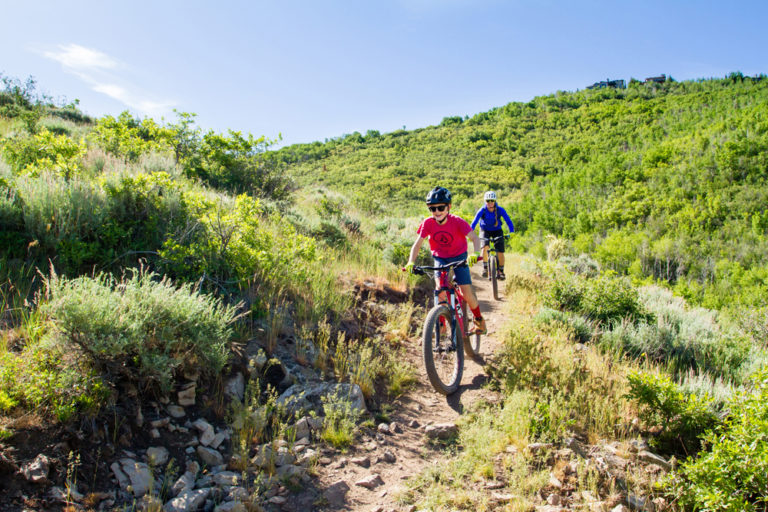
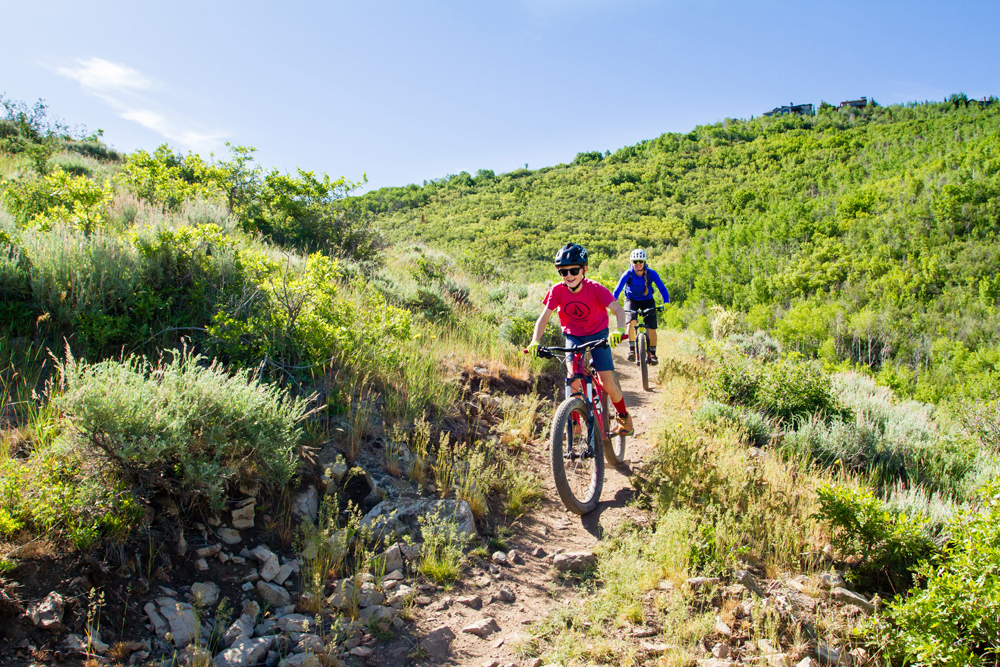
Erica trails her son on a downhill. Photo by Discover Utah/Monique Beeley

We are a cycling family. I raced my mountain bike around the world as a professional. My husband is an avid rider. And my 9-year-old son cruises singletrack almost better than I do! You’d think that we were born to pedal, but that would be very far from the truth. I’ll let you in on a little secret; my son resisted riding bikes with the same force that I resist black licorice – and I really can’t stand black licorice.

Cycling, and especially mountain biking, can be a wonderful family activity. Park City is home to trails for all ability levels, with vistas and smiles for miles. We moved here with the idea of pedaling all summer and skiing all winter. Getting our son on board with our plans took some extra work, however. And while we haven’t figured out everything, we think we may have masted the art of mountain biking with our kid. What follows in this brief article are some simple steps and strategies that we used to get our family out on the trails, with minimal tears and maximum fun.

Tell me if this sounds familiar. You’ve taken your child to your favorite trail in hopes of sharing your love of free-flow riding and it ended up in tears 10 minutes in, followed by a long, silent drive home. That happened to me more times than I care to admit! While there is no magic wand to make it all better, there are a few things you can do to increase the enjoyment level for all involved.

First, and as is true with most things in life, time is a gift that is paid with patience. Children’s muscles grow and their stamina improves each year. As my son is able to pedal stronger, his enjoyment on the bike increases. So, step one, be patient and know that your efforts to get your kids out there is worth it.

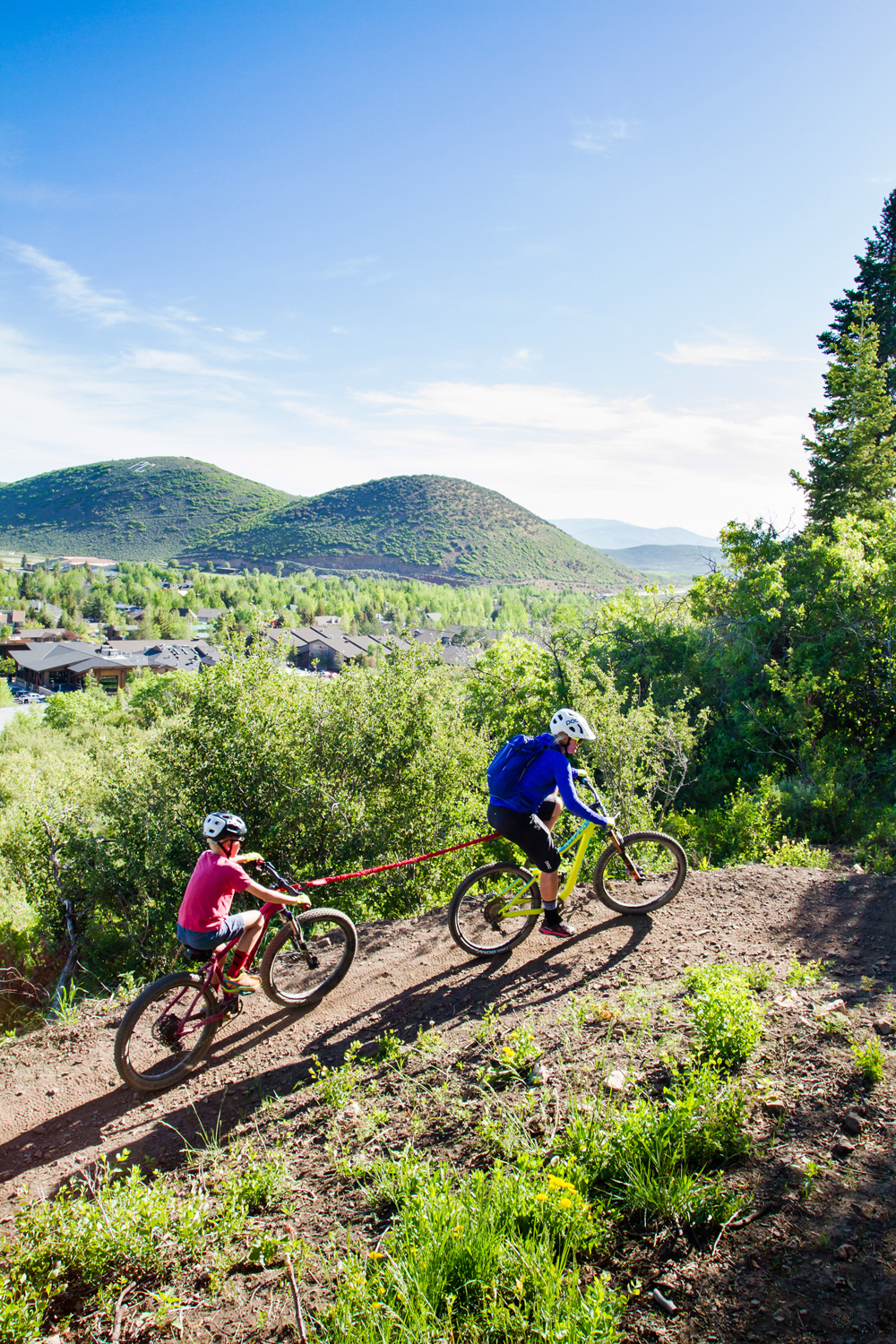
Second, and perhaps what has made the most difference, is making the ride enjoyable for everybody. For me, I like to pedal and feel my muscles do what I have trained them to do. To that end, there is a genius set-up designed by a friend of mine called the Tow-Whee. The Tow-Whee allows for the stronger rider to literally pull the weaker rider up and over just about any trail. On my first ride with my son and the Tow-Whee, I pulled him up Ghost Falls then across so we could descend Rush Flow! My son was 7 years old at the time and I expected it to be at least another 4-5 years before I could get him up there! A whole new world opened up when I towed him up the mountain so he could ride back down! The Tow-Whee is especially great with kids’ bikes, as they tend to weigh about 1/2 of the kids’ own body weight, with far too many gears for a child to keep track of.

Third, I put my son in a mountain bike class each summer. Park City has several great options for kids, with each class geared (no pun intended) toward the child’s ability level. With other kids of similar abilities each pushing each other and awesome teaching from the instructors, I noticed marked improvement in my son’s abilities.

Fourth, the right bike can make a big difference. This year, we turned another corner as a riding duo. For my business I have the Jamis Eden bikes for my clients to demo and I decided to let him try one. It is a 26″+ bike with a 1×11 drive train, dropper post and hydraulic brakes. All of a sudden he is riding off rocks, rolling over roots, and all fear has evaporated. There is a saying that “it’s not about the bike.” When it comes to kids and their heavy bikes, however, it actually is. This bike has massively improved his riding, undeniably. Let’s say you aren’t able to upgrade your child’s bike to an adults XS frame just yet (due to their height or your family budget). Then make sure your child’s bike has been checked by a certified bike mechanic to be sure the gears shift smooth and the brakes work. It’s also worth figuring out how low of pressure you can run in their tires. Tires with too much pressure in them make the child bounce around unnecessarily.

Finally, prepare for a lot of stops. Bring food your child likes and choose a trail that allows for off-the-bike exploring. We love to ride a little ways up Armstrong and then stop for a snack at the King Con lift. There is sometimes a stream there and other areas for my son to explore.

Here are a few extra hints that can make all the difference (these apply to the parents as well!)

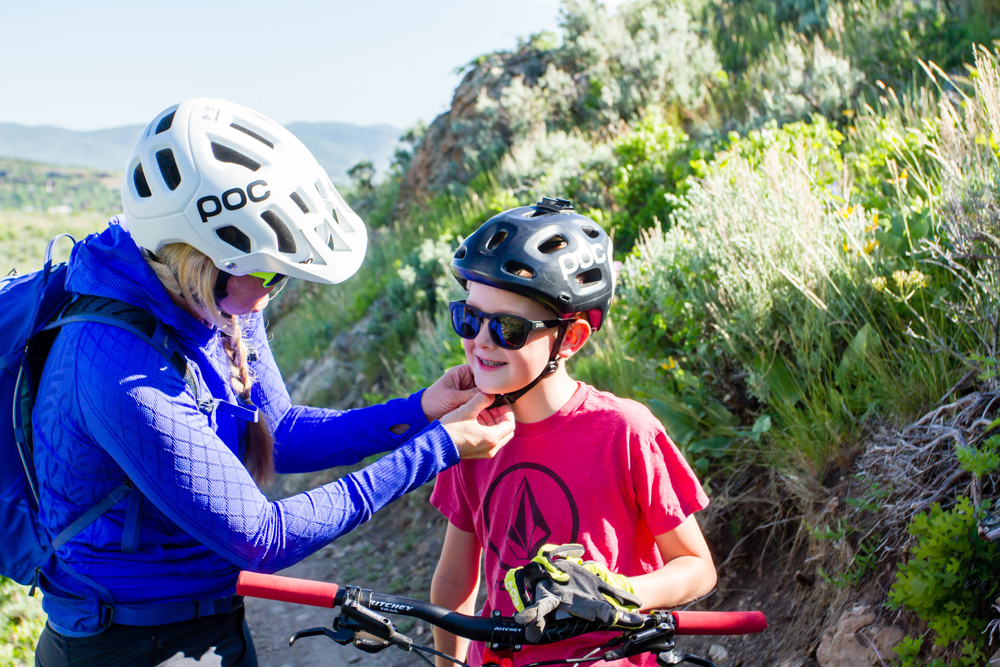
Make sure they have a snug yet comfortable helmet. If the helmet can be pushed back to see the forehead, the chin strap and circumference is too loose. Helmets have a relatively short life, I recommend using them for only 3-4 years since the foam deteriorates making the helmet less effective.

Full finger gloves will also save you lots of scrapes and potentially save fingernails! Gloves also have the power to get kids excited about riding. As with adults, new gear is motivating.

Get the Trailforks app, it is free and has live tracking. Find a green trail in your area, read the description for suitability, and go for it!

In terms of skills you can teach your child, check these out. Remind your kid to ride with “heavy feet, light hands” (weight over the pedals / bottom bracket, not the handlebars), ride like a ninja, not a flamingo (this refers to pedal position, while coasting downhill you want level pedals), encourage them to stand up off their saddle while descending, with knee flexion to allow for changes in the terrain. For more skill tips and lessons, you can check out my website: womeninthemountains.com

Initially, set your expectations low. Underestimate your child’s fitness. It is better to go for a short, positive ride than a long slog and end up in tears (both of you!). Perhaps you can avoid having a destination in mind. Perhaps you can get your own workout later, just be there in the moment with them to be sure they enjoy the experience!

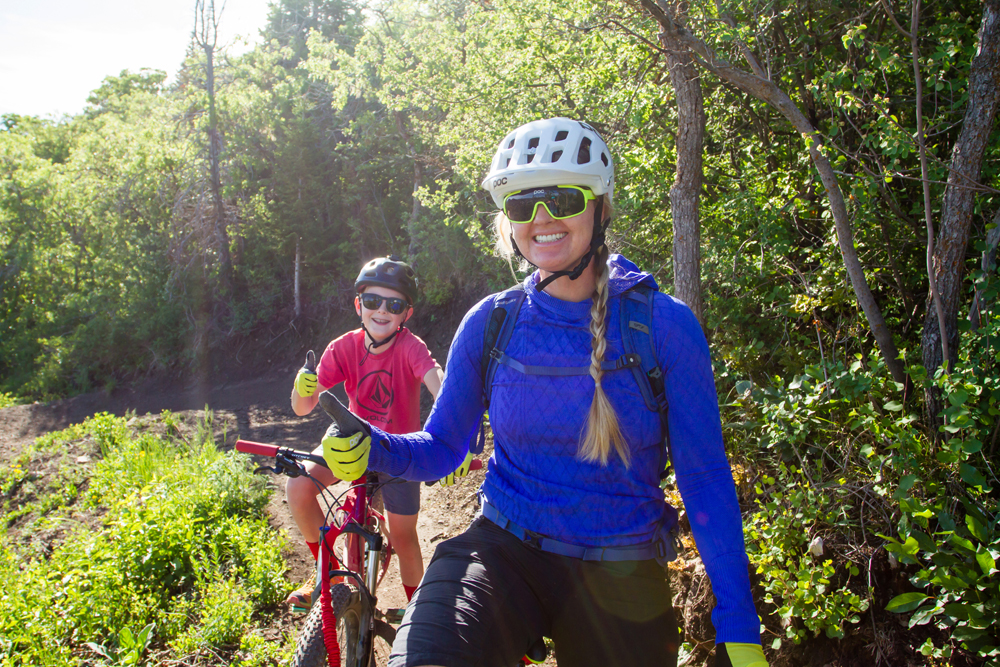
Lastly, do all that you can to keep the experience positive! We love bikes and want our kids to love bikes!

Erica Tingey is the founder of Women in the Mountains, a mountain bike skills coaching company. She raced mountain bikes professionally from 2010 to 2017. Erica raced World Cups as well as national level races where she secured multiple podiums. She and her husband have a 10- year old son and call Park City, Utah home. You can reach her at: Erica@womeninthemountains and www.womeninthemountains.com. Originally published in Discover Utah Kids Magazine.

Erica uses the Tow-Whee to help her son climb. Photo by Discover Utah/Monique Beeley
A well adjusted helmet is key for safety. Photo by Discover Utah/Monique Beeley
It’s important to have fun when riding. Photo by Discover Utah/Monique Beeley

Steel is Real at the 2019 North American Handmade Bicycle Show (NAHBS)

By Patrick Walsh

A Report from Sacramento, California

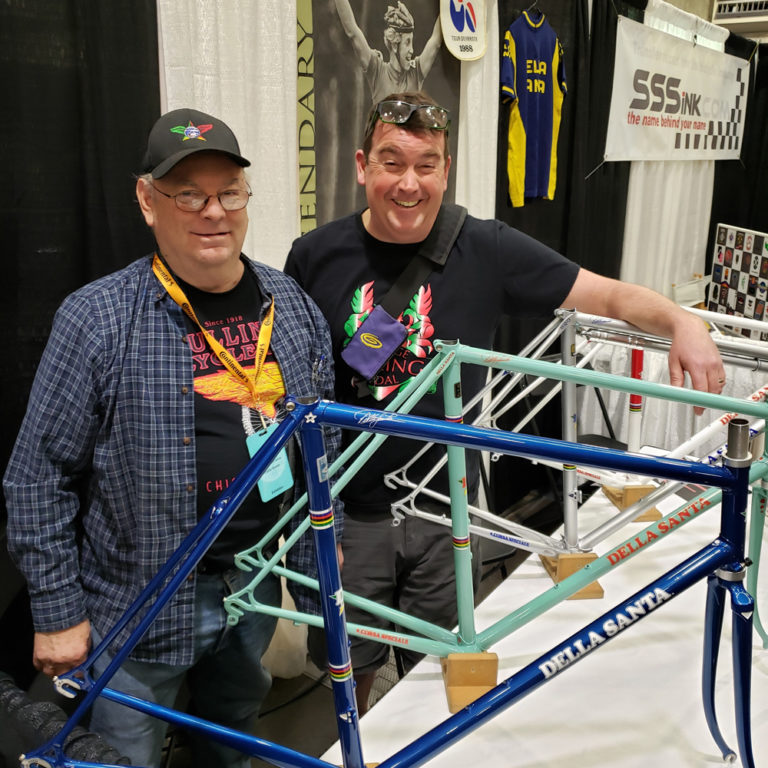
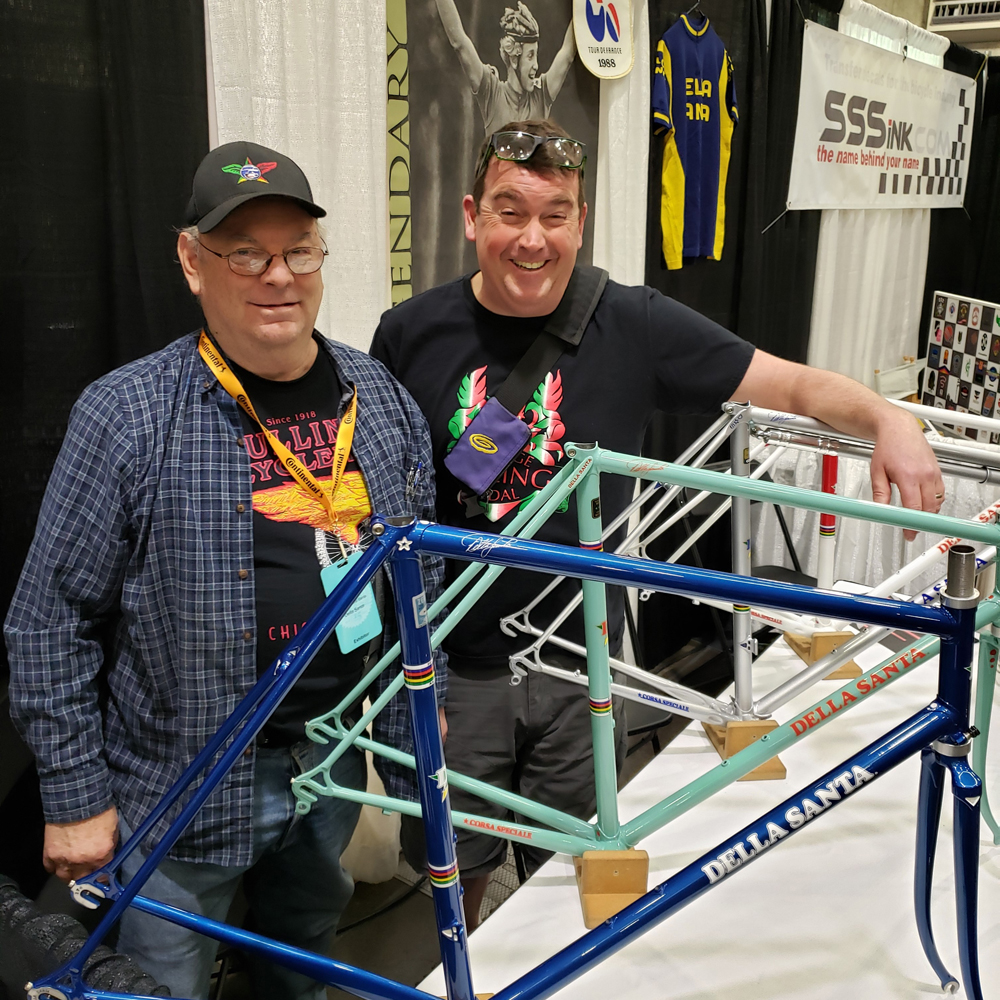
Della Santa shows off their beautiful steel bikes. 2019 NAHBS.
Photo by Patrick Walsh

Full disclosure, I do not own a carbon bike; my current ones are are steel, titanium, or aluminum. I have owned 3 carbon, the 26er I sold well after that size lost its popularity, one frame I cracked, and the last I promptly sold when the latter cracked. I enjoyed all three, but I have a steel touring bike that is now 10 years old. The other metal bikes will likely last even longer. I don’t think of myself as a luddite, but it may be a long time before I own a bike with more than a small part made of carbon.

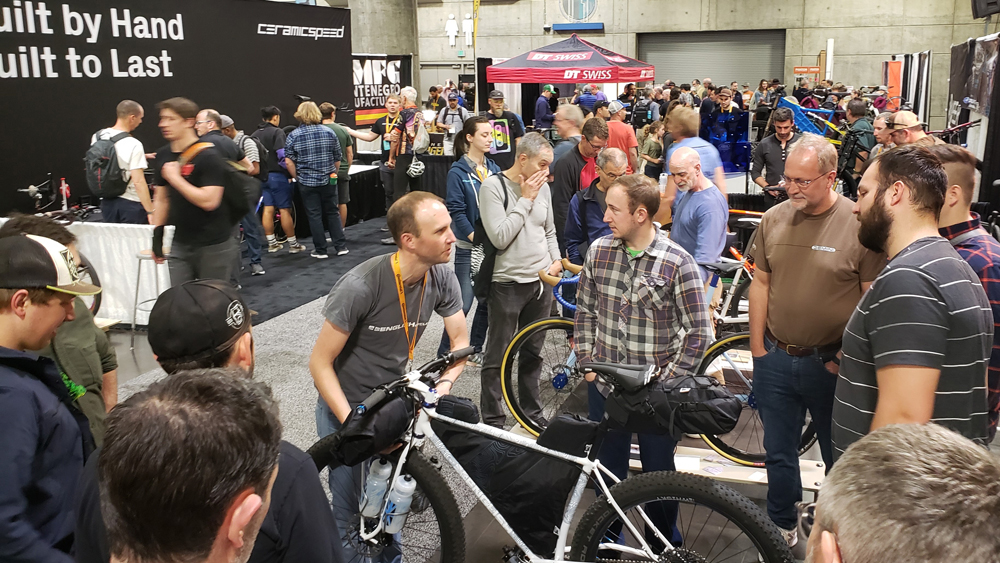
So, it was with great pleasure that I walked all 10 columns of mostly metal bikes made by makers both famous and new. Don’t get me wrong, there are some really great carbon bikes at the show and appropriate awards for their beauty. But I would guess greater than 90 percent of the bikes are metal, almost all titanium and steel. The vibe is really friendly, and I had informative conversations with legends who I have read about in magazines and some who I have bought components from. None of them was pushing a sales pitch. They are enthusiasts of the highest level and will tell you about design inspiration, welds on specific bikes, or pricing if you ask. We chatted about the towns we live in and where we like to ride. Some builders are riding and building enthusiasts, while others seemed to be more builders than riders and may not expound about the ride feel of different materials.

Hand-made bikes and makers are a highly diverse group. Roland Della Santa lamented the continued declining popularity of steel (his only medium), saying that someone would need to win the tour on a steel bike to bring it back. That was on Saturday, the same day that Tom Porter won the Best New Builder Award for an Art Deco lugged steel frame bike that could be displayed in the Guggenheim or the Chrysler Building lobby. Both builders are correct, both builders are active, and both builders are working in steel. Most cyclists are buying carbon, many might never know how steel rides, and most will not see the range and depth of artistry at this show. There are bikes that are feats of engineering, those that are tried and true geometries to be ridden, and those that are pushing boundaries. All of them are works of art, but I can only imagine owning/buying some of them.

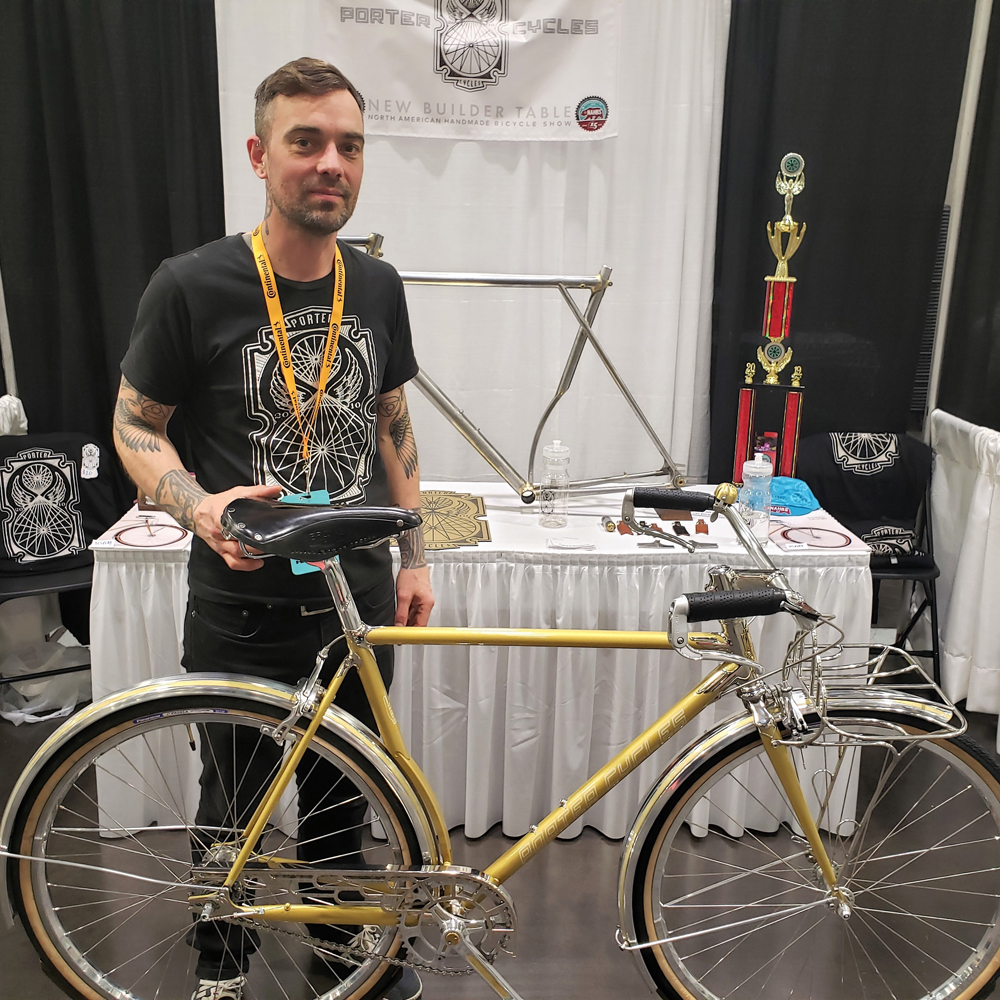
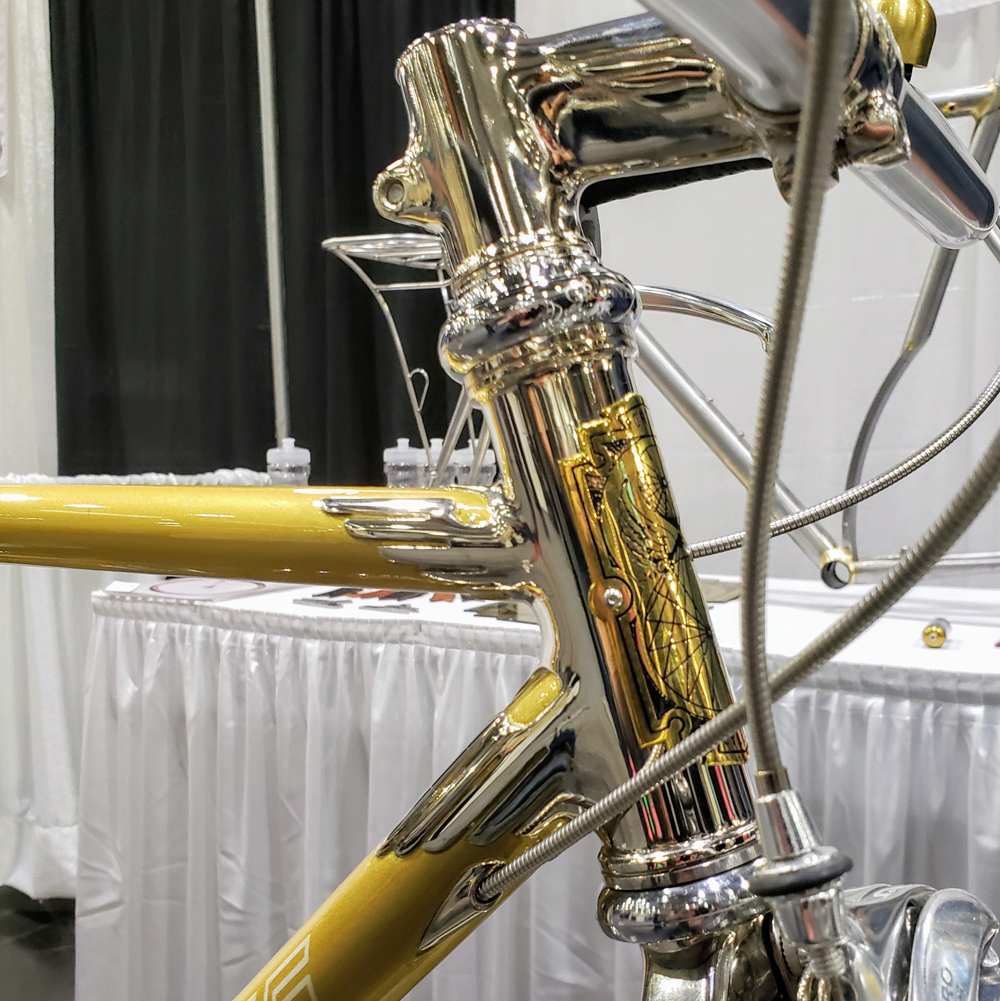
Tom Porter’s bike was painted radiant yellow gold with hand-cut silver wing lugs and had elegantly curving racks. Tom talked about the inspiration, a tense time between World Wars when politics and art converged to emphasize triumph. He recommended The Golden Age of Cycling, a book I have just ordered and look forward to reading. The Art Deco movement produced an unmistakable style, and his bike appears to have rolled out of the era. Incidentally, I voted for this bike for People’s Choice Award, a sentiment felt by many but not enough to win.

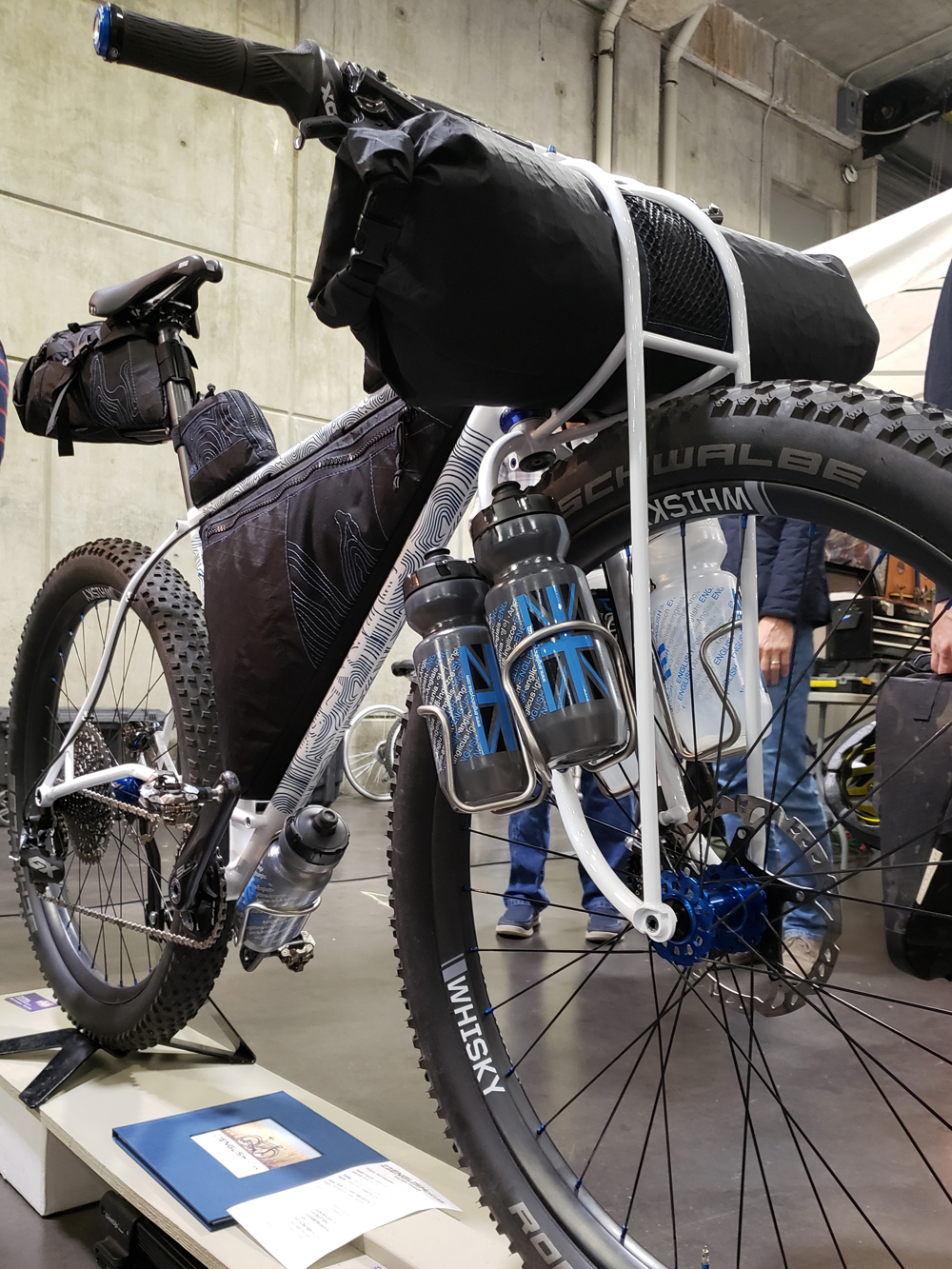
I learned about bikes I never imagined, especially English Cycles “Righty” with single-sided fork and single-sided rear triangle, custom hubs, and interchangeable front and rear wheels – truly a feat of engineering and execution. I listened to Rob English talk about the inspiration for this incredible, lightweight machine, a client who travels on trains with tight space and time. He somehow translated it into this incredible machine.

Jumping from topic to topic cannot be avoided at the show. It should be embraced, although the experience of the show is a little overwhelming. I will definitely stay for a second day next time to revisit things I missed and review things I loved. One minute I was talking about an old-style, classic geometry steel frame and then at the Santana display learning about their new, high tech Z coupler that could someday overtake the S&S for travel bike ubiquity (not to take away from proper folding bikes. The only folding bike I saw, Hunter Cycles mini-fat was on the podium for Experimental Bikes.

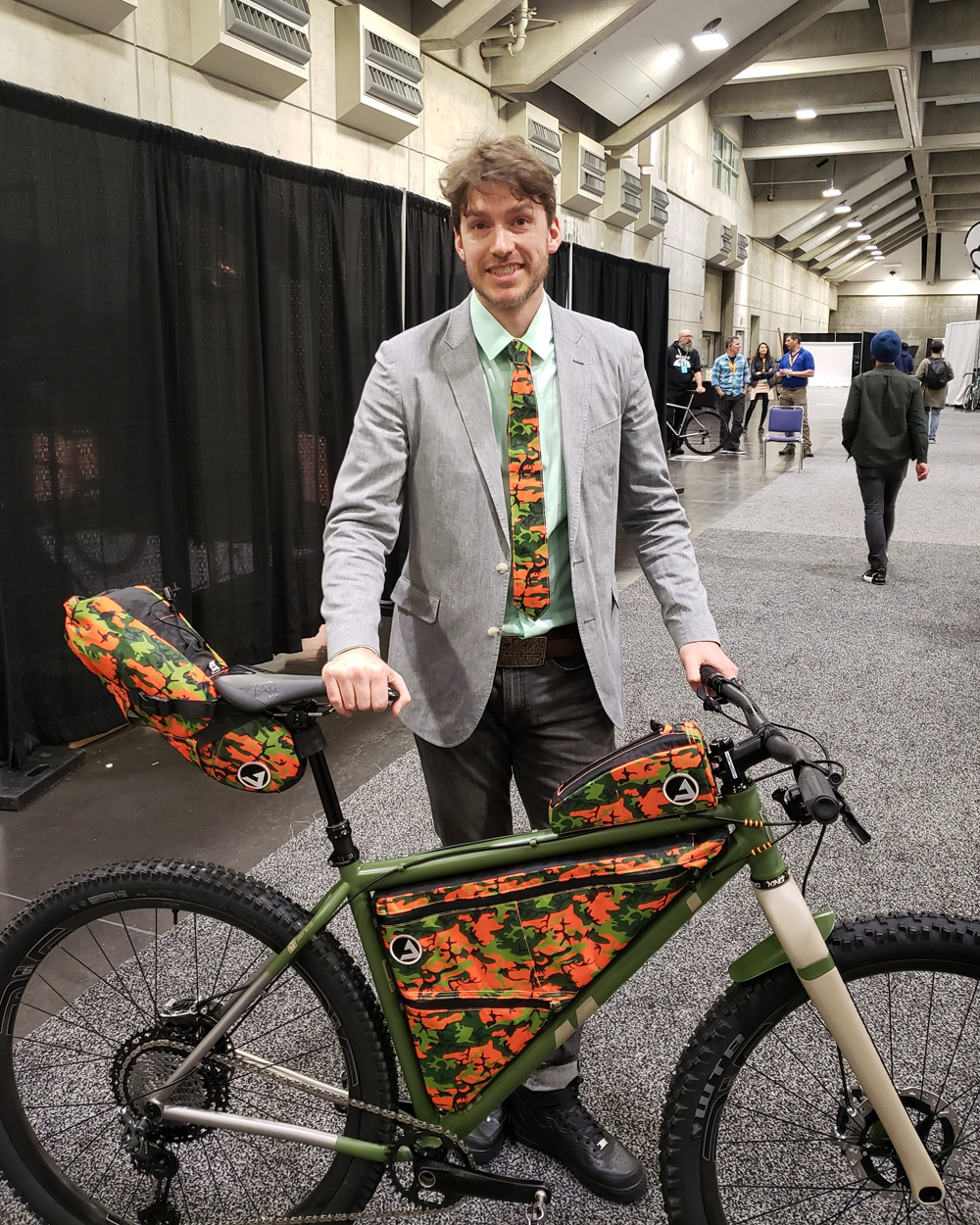
Gravel bikes were everywhere, while mountain bikes less common than I expected, showing the shift many of us feel. Bikepacking set ups were in many displays, including frame, seat, handlebar, top tube, and fork bags but no makers of these bags! Everyone could tell you the makers, but I was surprised that none were on site.

Talking with friends after, we each had a different favorite and maybe a second (and third) bike we would take home if we could. I left wanting more, and I hope to attend next year to see how it all changes again and maybe to pick up a custom request I have not quite started dreaming up yet. One of my big draws for this year’s show was to see my friend Roger pick up his new steel frame Della Santa. I don’t think I have seen him happier.

Editor’s Note: The 2020 North American Handmade Bicycle Show will be held in Dallas, Texas from March 20-22.

Editor’s Note 2: Sadly, Roland Della Santa passed away at his home in Reno, Nevada on May 4, 2019. His dedication to the sport and craftsmanship will be missed.

A view of the floor from the English Bicycles booth. 2019 NAHBS.
Photo by Patrick Walsh
English displays their bikepacking vehicle. 2019 NAHBS.
Photo by Patrick Walsh
Phillip Ball and Mosaic Cycles won the Best Mountain Bike Award. 2019 NAHBS.
Photo by Patrick Walsh
NAHBS isn’t just about displaying bikes, it’s about riding them too! 2019 NAHBS.
Photo by Patrick Walsh
William Thomas Porter and his bike, Winged Victory. 2019 NAHBS.
Photo by Patrick Walsh
Porter Cycles took home the Best New Builder Award. 2019 NAHBS.
Photo by Patrick Walsh
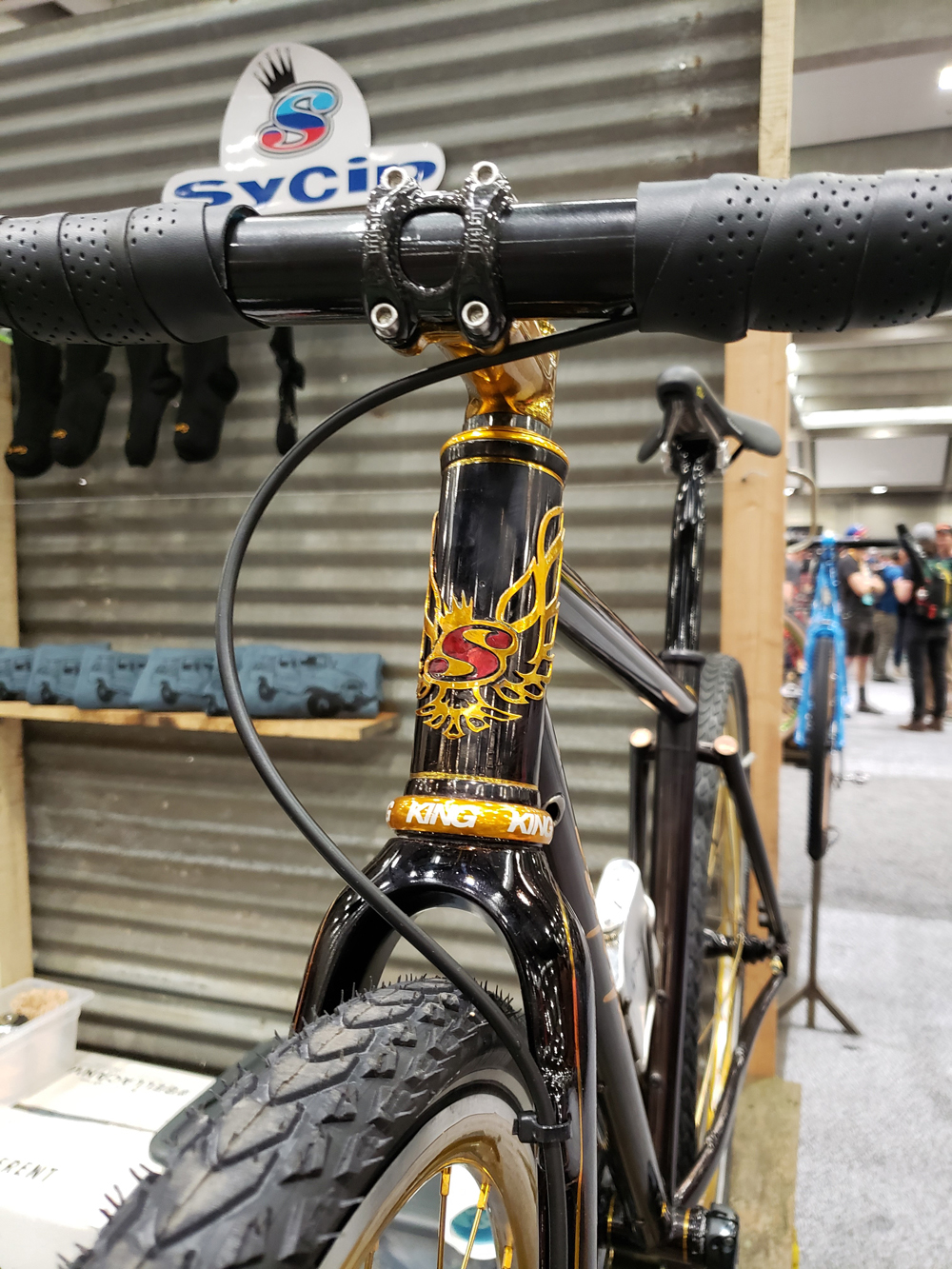
A gorgeous headbadge from SyCip Designs. 2019 NAHBS.
Photo by Patrick Walsh
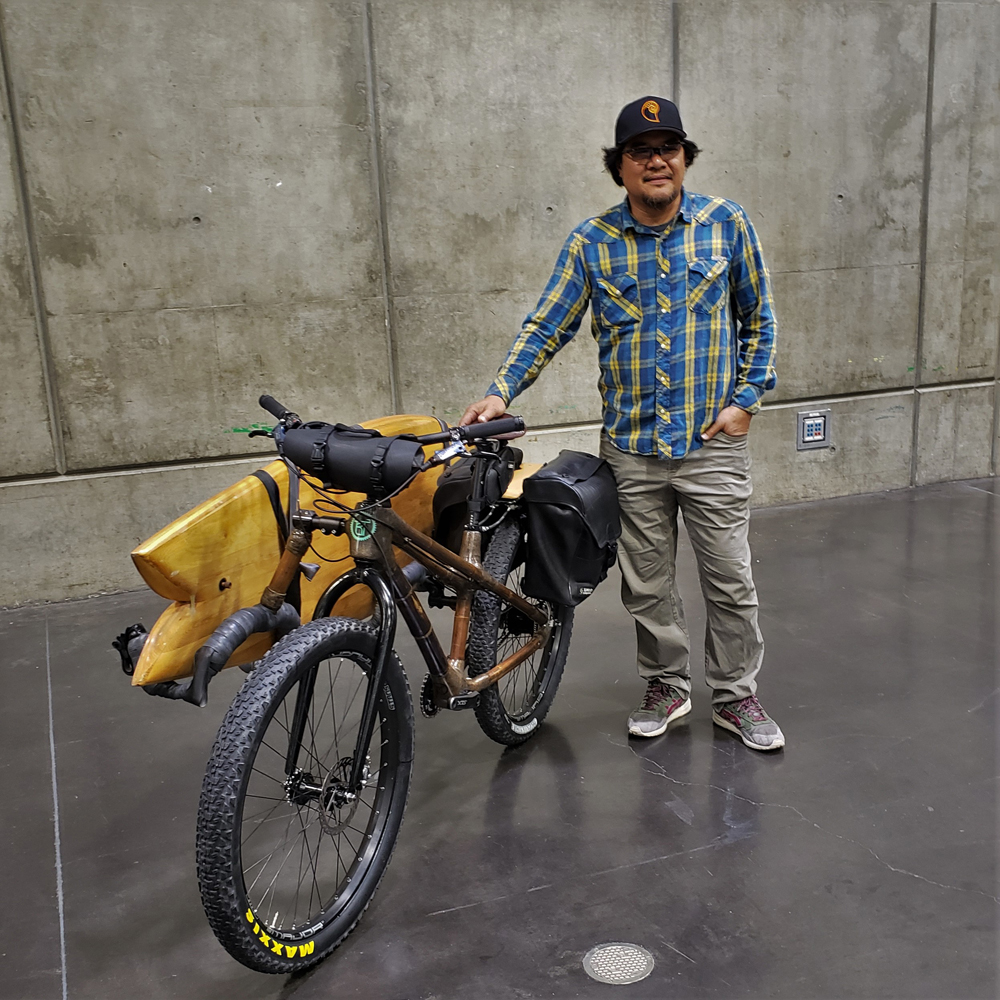
Upcycle showcases an innovative surfboard rack. 2019 NAHBS.
Photo by Patrick Walsh

Stefano Barberi Tackles the True Grit Epic 100

By Stefano Barberi

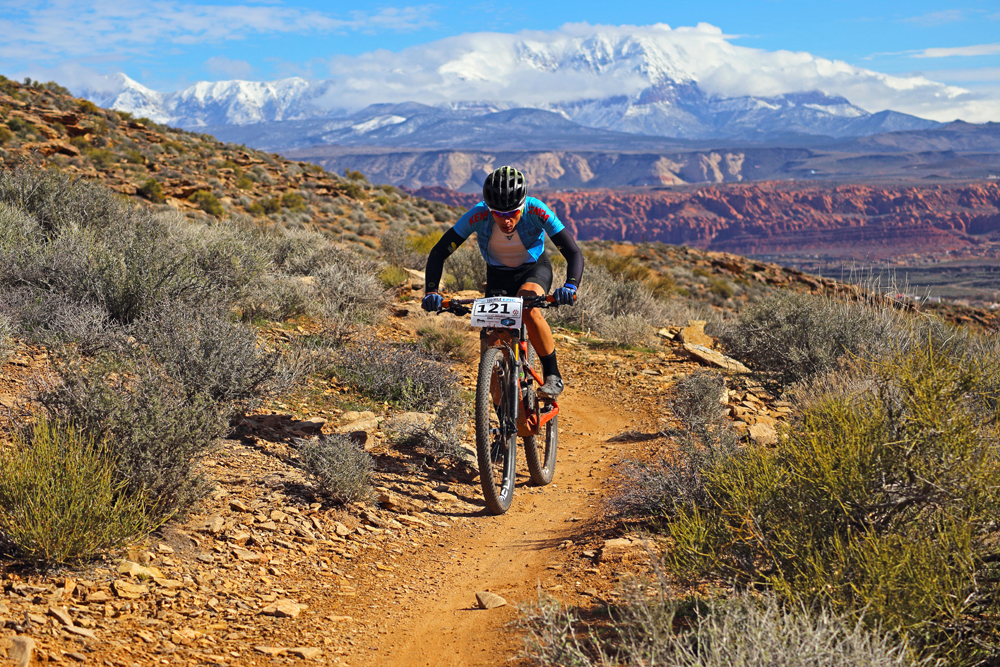
Stefano Barberi on his way to 4th overall in the True Grit Epic 100. Photo by CrawlingSpider.com

On a recent Saturday, March 9, I took the start on my 2nd True Grit Epic, which also happens to be the start of my 2019 endurance season. The True Grit Epic earned its reputation for well, requiring true grit, and for being epic. Yeah I see what they did there, and with reason. It’s your typical Utah landscape with lots of big rocks and boulders that make up the course, fairly open with minimal trees, and the race is made up of 2 laps of about 43 miles each for the “100 mile” category or 1 lap for the “50 mile”. This race is technical and be prepared to be sore all over or a couple days afterwards, my knuckles are still sore as I type. Apparently there were another 849 people who like pain, as the race was completely sold out once again. Last year I went on to finish 2nd overall in the open men 100 mile category.

The days leading into the race were rainy and there were even snow days in the weeks leading up to the event. I drove out Wednesday with my wife Katie and son Micheli who turned 2 the day after the race. GRO Racing sent out an email a couple days prior saying that there was potential for a small course change depending on the conditions the morning off but luckily that plan was not required. Either way i was ready with a couple sets of Dryve wheels and multiple tire options from Kenda Tires.

The race starts fairly early at 7am, just after sunrise. I woke up a couple hours before, breakfast, load the car, wake up the wife and transport the baby into the car for the drive over. Once there my plan was to just unload the bike, I made the decision to run the new Booster Pro Kenda tires, threw on the Fizik shoes and lined up. From the start it was apparent we were there to race and there wasn’t going to be any games played. After a few of us got in a little tangle up Sam Brehm decided to put in the first dig, with Taylor Lideen and Pete Karinen chasing behind and eventually moving around into the lead, with myself somewhere behind chasing back. With the sun still rising there was a horrible glare depending on which direction we were heading and I think all of us were just trying to do our best to follow each other trusting the person ahead knew the way.

Soon I see Taylor and Pete coming up from behind me, they made a little detour but were quick to get back to the rest of us and back into the lead. Coming into the 1st tough single track section there were 3 up ahead and 3 or 4 of us in a chase group which started to splinter a bit. As I lead the chase group down the waterfall I noticed that Sam disappeared (found out later due to a flat), then some gaps, apparently someone else had a couple broken chains around this time too and we were barely 1.5 hours into the race.

Personally, I was feeling horrible physically from the start, would be easy to blame the low 30’s temperature or this or that but at that point it didn’t really matter why, I was just going to keep my head down and hope to come around a bit. At this point I was sitting 5th with one rider somewhere around 1-2 minutes ahead after the Zen Trail, and that is how it would stay pretty much till Zen Trail on the second lap. The 4th place rider made a stop at the feed station, I moved into 4th, and the legs started to come around a little bit about hour 5 and I didn’t see anyone again until I crossed the finish line (well beside the hundreds of other riders in the other categories).

4th place is not really what I had hoped for but to be honest, that is an honest expectation for where I am this season. At the end of last year I had to have surgery to fix a UPJ obstruction (Google that) and I planned to have surgery at the end of the season but with the recovery everything was pushed back about 6 weeks from my usual off season routine. Instead of trying to rush things, I’m trying to take my time a bit and see if I can come good a little later in the year as I typically have a small peak late march, then a drop followed by another bigger peak in June, which worked for the road season calendar but maybe not work as well with the MTB calendar these days as everything is a bit later. Only time will tell how that goes, but regardless of that I have no doubt True Grit is a great way to start my season, I’ll for sure be back again 2020 and you should join me too.

With that I end by saying thank you to GRO Racing, and all of the volunteers for putting on a great event, and to St. George for being such an amazing host city, tons of great restaurants and things to do so bring the family along like I did.

Stefano Barberi is a Pro mountain biker going into his 16th season as a professional rider, 14 as a road cyclist and the last 2 as a mountain biker.

Sponsors: Serious Cycling, Kenda Tires, Starlight Apparel, TheBlackBibs, Dryve Wheels, Fizik, Tasco MTB, ESI Grips

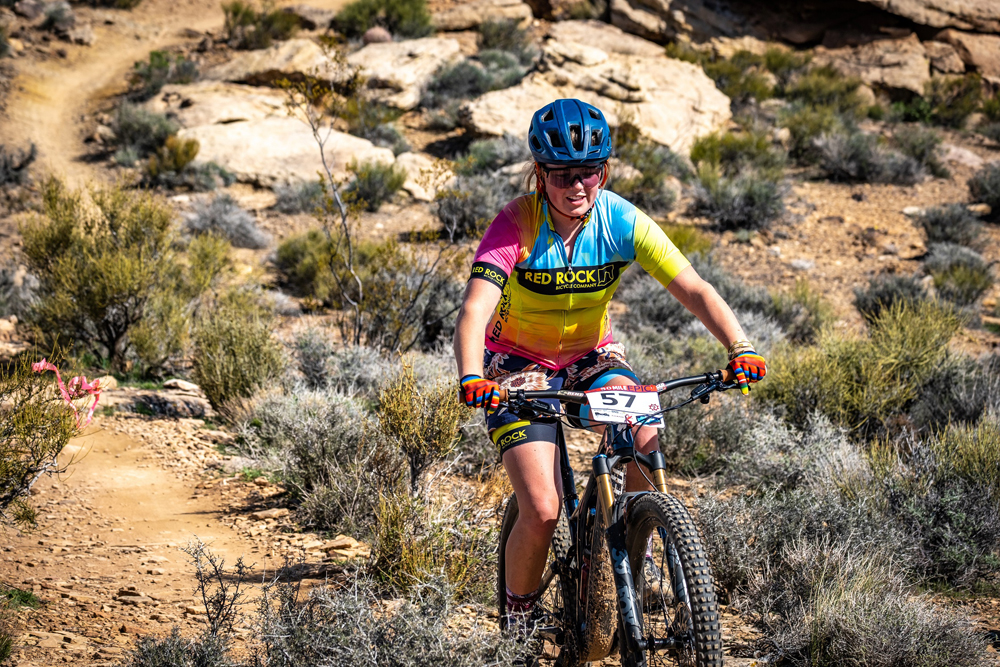
Ashlyn Puzey, Red Rock Bicycle, raced the new 50 Relay. Her partner was Brad Norman. Photo by CrawlingSpider.com
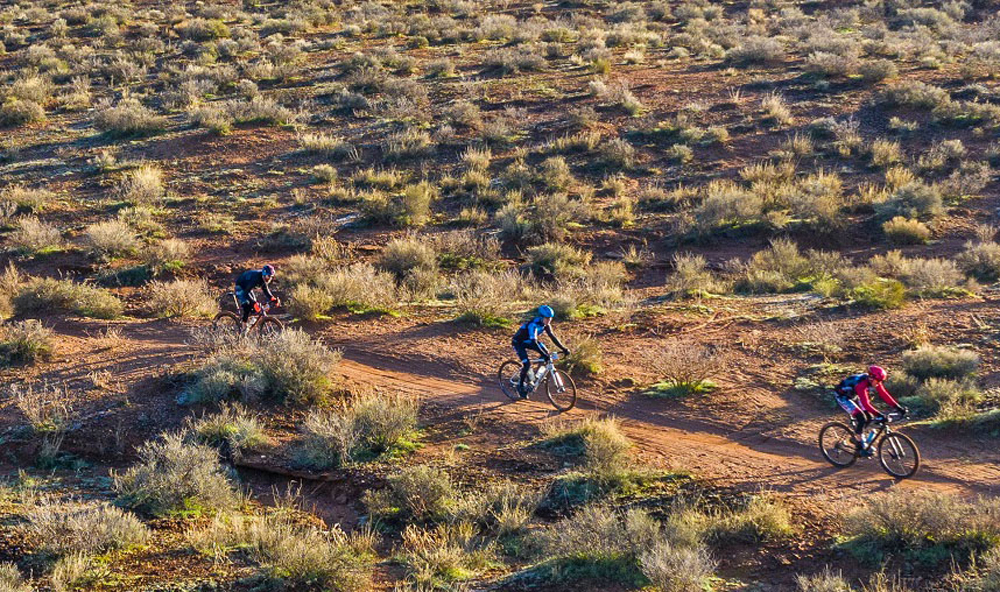
A wave of gravel racers in the new True Grit Gravel Epic descends into Bear Claw Poppy. Photo by CrawlingSpider.com
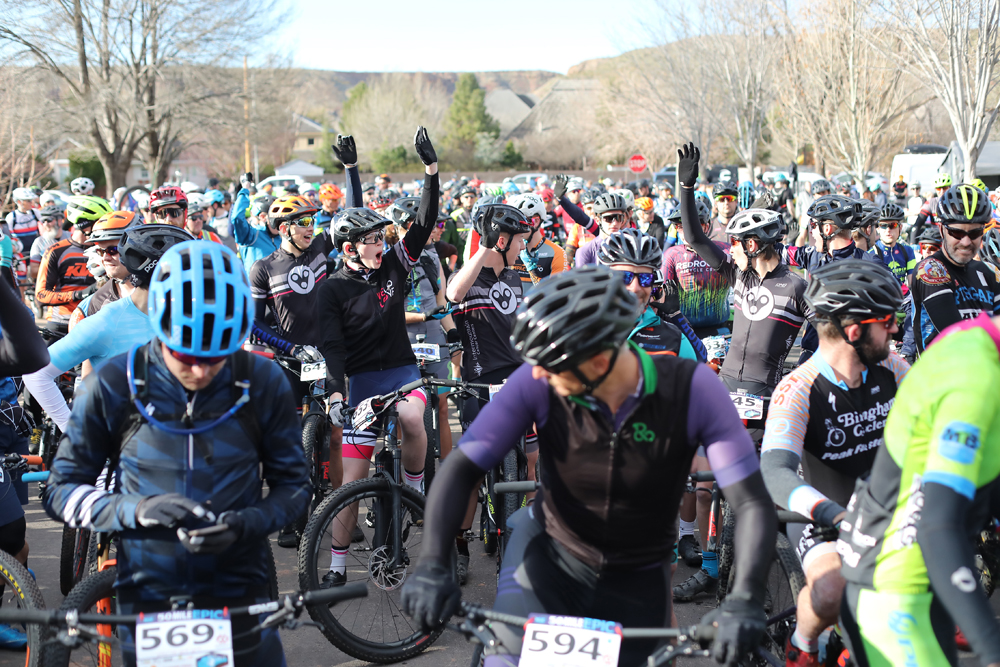
The 50 Mile race was 600 riders strong. Featuring team Velolove cheering. They were the largest team and junior team in 2019. Photo by Courtney Jacobs Photography
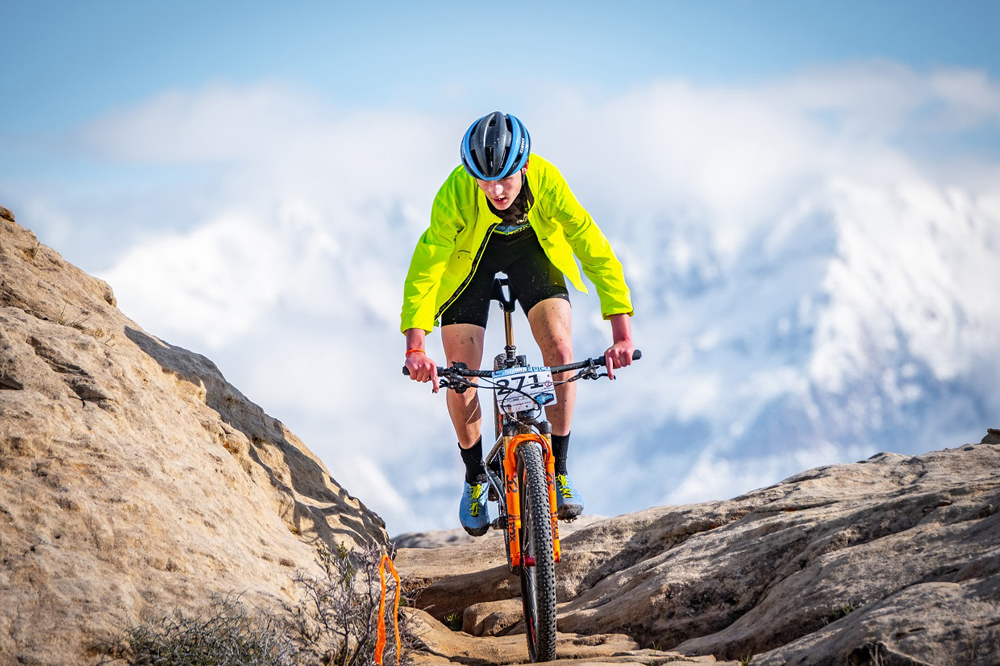
Jack Youngblood, 17 years old, raced the Pro Men’s 50. Photo by CrawlingSpider.com

States Develop Programs to Reduce Cyclist Deaths

By Charles Pekow

Idaho Develops Bike Safety PSAs

Cycling West - Cycling Utah Magazine logoThe good news: traffic deaths are down nationally. The bad news: pedestrian deaths are rising. So reports the Governors Highway Safety Association in its annual Spotlight on Highway Safety report, Pedestrian Traffic Fatalities by State: 2018 Preliminary Data. The report (https://www.ghsa.org/sites/default/files/2019-02/FINAL_Pedestrians19.pdf) says that the number of pedestrian deaths rose 40 percent over the previous decade nationwide. The report does not give figures on bicyclist casualties, though.

So what can be done? In 2015, Congress enacted a $70 million/year National Priority Safety Program, Section 405(h) Nonmotorized Safety, which provides grants for projects that reduce bicyclist and pedestrian fatalities. States can use funds for public education and for police training and enforcement.

The report suggests “Congress could provide states more flexibility in the kinds of programs these funds can be used for, such as public education on safe bicyclist and pedestrian practices generally, not just traffic laws, on the safe use of infrastructure, to aggregate more data on non-motorized safety, and to expand programs to more classes of non-motorized road users.” (The law was passed before the popularity of e-bikes and scooters.)

A few states, meanwhile, have taken the initiative to use federal funds to reduce cyclist casualties, the report documents.

The Idaho Office of Highway Safety sent money to the Idaho Walk Bike Alliance to develop PSAs about walking and bicycling safety in Idaho. The Alliance is working on two 60-second public service announcements it plans to offer on social media, one dealing with bicyclist behavior, the other motorist behavior, Alliance Executive Director Cynthia Gibson said in an interview.

The motorist spot explains how to share roads with other users, telling them to give bicyclists plenty of room and what to expect when turning right and a cyclist occupies the corner. The bicyclist video describes Idaho law that allows cyclists to treat stop signs as yield signs and red lights as stop signs they can go through after stopping if no cross traffic appears.

The Alliance says the cyclist spot may be available in May and the motorist one this summer to distribute on social media. If it gets funding, it would like to air them on TV. “That’s our goal but we don’t have that kind of money,” Gibson says. They’ll first appear in the Boise area, but “we are working with advocacy groups and bike shops around the state” to distribute the videos, she says. “We’re expecting that once we release them, a lot of people will post and share them. We think it will happen pretty quickly.”

While the cyclist video deals specifically with Idaho law, the more generic motorist one could be useful in other states, she says.

Elsewhere, Massachusetts funded 84 local police departments to conduct overtime bike safety patrols. The state allowed the recipients to buy equipment such as crosswalk markers, signs, traffic cones and even helmets.

The Florida Department of Transportation’s Pedestrian and Bicycle Safety Coalition developed a that addresses the safety issue on multiple fronts: legislation, education, locating dangerous locations and building infrastructure (https://www.fdot.gov/safety/2a-programs/bicycle-pedestrian.shtm).

Indiana uses State and Community Highway Safety Grant Program funds from the National Highway Traffic Safety Administration (https://www.nhtsa.gov/highway-safety-grants-program) for a pedestrian and bicycle safety program.

South Carolina’s Office of Highway Safety & Justice Programs works with the State Highway Patrol on a Target Zero campaign. Community relations offers give about 700 presentations a year at places such as fairs to warn people about vulnerable roadway users. It also places billboards around the state warning motorists to look out for them.

Virginia uses broadcast advertising in English and Spanish and places notices on bus shelters and on buses in the Washington DC suburbs to warn drivers to watch out for cyclists.

A number of localities around the country are addressing the issue through Vision Zero campaigns that set goals to reduce accidents and involve multiple offices (chief executive, police, public health, transportation). See visionzeronetwork.org.


Event Day Preparation! Get Ready to Ride or Race!

Event Morning: From waking up to the start line, how to tackle the morning of your goal event.

Preparing for race or ride morning reduces stress and lets you perform at your best! Photo by Matt McKinney

Good morning, racers! It’s your big day. You have done all the training, prep, planning, and you wake up ready to roll. How should you get from waking up to starting your event? Let’s lay it out. These guidelines are not meant to be exclusive to racing, any goal event or important ride should incorporate the same principles.

To begin, count back from the time your event starts for your planning. You will need to do some self-experimentation prior to your event to know how to time your breakfast (or, if your event is later in the day, when you should have your last substantial meal before your event). Most people need between 2.5-3.5 hours to digest a meal before starting a race or event. If your event is longer and will roll out at a lower intensity pace, you may be able to eat closer to start time. If your event starts early in the morning, you can also experiment with sleeping in and eating a smaller meal closer to start time and then continuing to eat on the bike as soon as you start.

I like to get everything ready that I can the night before an event; fill and mix water bottles, pick out clothes and pack additional cold or wet weather attire that may be needed. Use a checklist as you pack your gear bag. I also fill up my jersey pockets. Pack your jersey pockets the night before so when you arrive at the race, you just need to pull on your pre-packed jersey instead of digging through your gear bag. Nerves will be high on the morning of your event and you may feel scattered. The more you can get ready prior, when you are in a calm state of mind, the more you can attenuate those nerves on the day.

If you have packed everything the night before, once you eat your breakfast, you should have some downtime. Nerves may be high. Try sitting and being mindful, visualize a smooth, strong ride. Or keep the nerves at bay by socializing or listening to fun music. Nerves are good and they indicate a strong level of arousal and excitement about your event. But overwhelming nerves can be paralyzing and detrimental. Try to find a balance. Meditation and visualization are great tools to calm the nerves.

You will need to figure out how long it will take to arrive at the venue from your home or where you are staying but try to arrive about 1.5 hours prior to event start. If you need to register at the venue and/or you anticipate a line for registration or packet pickup, give yourself extra time. Likewise, if you need to pre-ride the course or a section of the course, make sure you factor time for that. If you will need feed assistance during the race, have this sorted out prior to arriving. And make sure your feeder has your bottles, clear instructions, and anything else they might need. (Make things easy for your feeder. For example if you want bottles in a certain order, clearly number them. Working the pits is frenetic, simplify as much as you can).

Just as you count back from event start to your last big meal, count back once you arrive at the venue. You probably need 25-45 minutes for a solid warm-up. Warm-ups are pretty individual but generally follow the same idea of gradually increasing effort to your expected start pace and overall race pace. I provide several warm-up protocols to athletes I coach to try so they can home in on what works for them. Have a plan for your warm-up, know what works for you. Give yourself 15-20 minutes from the time you finish your warm-up to event start so you have time to grab any last items, make any adjustments to your bike (hopefully nothing major!), use the restroom (expect a line!), etc. So you should probably be getting on your bike to start your warm-up about one hour prior to event start. (This will vary depending on the kind of event you are doing and what kind of warm-up you need. Additionally, some events will require you to stage significantly earlier than start time. Ask event officials how early you will need to stage and modify your warm-up planning for that). If you finish warming up and have the opportunity to keep spinning around the venue before staging, use that and keep your legs moving instead of standing around. Likewise, if the event start is delayed, keep spinning gently and roll with the proverbial punches.

Have a plan. Races are about more than just pedaling hard. Which parts of the course will suit you and which will challenge you? Before all goal races or events, I have a planning session with the athletes I coach. We go through various scenarios, plan pacing, fueling, and how to approach each section of the course. The morning of the event can make or break. Think it through and have a plan. Count back from start time and schedule everything so you arrive at the line, fueled, warm, and ready! Good luck!

Sarah Kaufmann is the owner of K Cycling Coaching. She is a professional XC and CX racer based in Salt Lake City, Utah. She can be reached at [email protected] or 413.522.3180.

Tinker and Felder Win 2019 Tinker Classic

By Cimarron Chacon

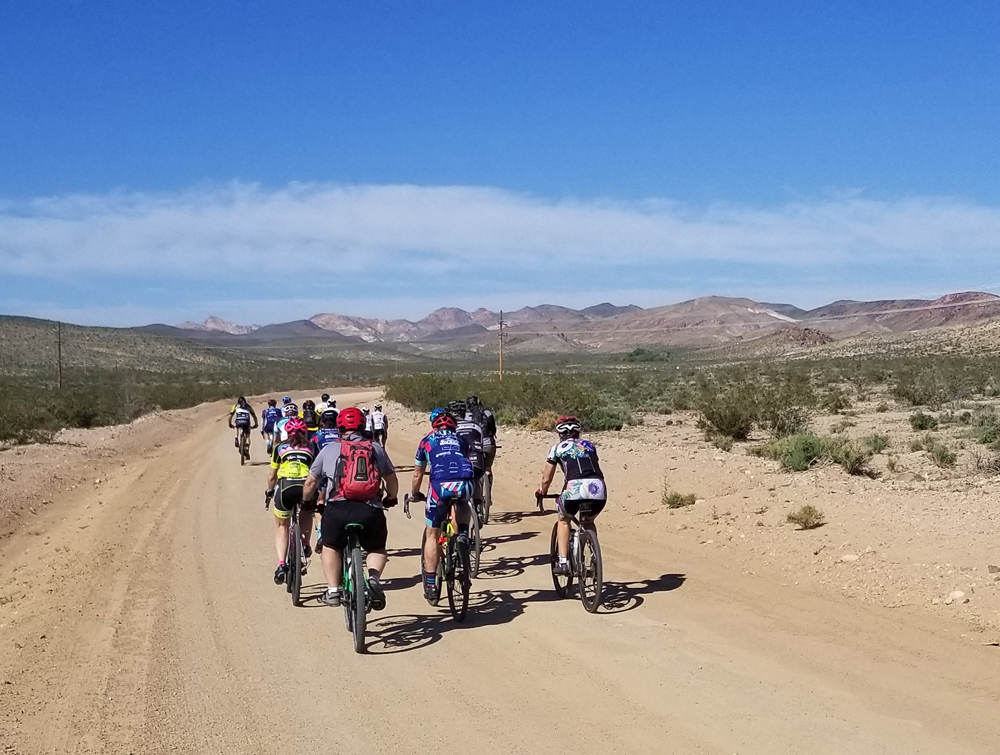
There was a loud bang and bright colors lit up the dark skies over the Spicer Ranch this past 4-20. The crowd of racers, riders, and family cheered as the opening ceremony – a 15-minute fireworks show – kicked off the 3rd Annual Tinker Classic Off-Road Cycling festival. The festival includes a tough 70-mile off-road race, a 40 mile gravel grinder, all in a 3-day festival atmosphere with vendors, demo bikes, and homemade ranch food and beer.

The riders set off from the start in the 2019 Tinker Classic. Photo by Dave Spicer

The Classic 100 K (70 mile) race consists of 2 loops that transition in the town of Beatty. The lead pack of 5 came in within seconds of each other after lap one, led by John Nobil (Bear Valley Bikes) and Josh Onarhiem (IBB Cyclery), with Tinker (Cannondale) and Samuel Brehm (BVB), and Stewart Gonzales (BVB) coming in a minute behind together to rounding out the lead pack. But Tinker is known for holding back in a long race and making his move at the end. This was exactly what he did, passing Samuel Brehm just before Feed 5, and giving himself a minute and a half lead by the finish. This was the second year that Samuel has chased Tinkers wheel only to miss the win. Stuart finished 3rd, with John and Josh taking the final 2 podium spots. The only female to race this year was Amanda Felder, also Team Bear Valley Bikes, had a respectable showing, taking 11th over-all.

It is expected that 2020 will be the year that Samuel will finally take the top spot at the Classic 100K as Tinker no longer plan to race in his namesake event. Instead he will share his time with all by shaking hands and dishing out high-5’s at the finish-line after leading the Gravel Grinder out. So make your plans to join the Tinker Classic 2020 in Beatty, Nevada on April 18th.

For more information, visit tinkerclassic.com

Tinker Classic, Beatty, NV, April 19-21, 2019

Place, Name, Team, Time

Open Men

  1. David Juarez, Cannondale 4:41:26
  2. Samuel Brehm, Bear Valley Bikes/Honey Stinger 4:42:58
  3. Stuart Gonzalez, Bear Valley Bikes/Honey Stinger 4:49:24
  4. John Nobil Bear Valley Bikes/Honey Stinger 5:02:34
  5. Josh Onarheim, IBB Cyclery 5:18:38
  6. GREG GIBSON, TruckerCo Rockstar Energy 5:20:55
  7. Steve Antill, CTS 5:44:18
  8. James Cope, The Countertop Shop 6:04:09

Open Women

  1. Amanda Felder, Bear Valley Bikes 6:08:04

Master Men

  1. Larry Pritchard, 5:32:37
  2. David Montague, 6:33:50
  3. Brandon Smith, 6:36:14
  4. Jordan Smith, 7:03:07

Men 30-49

  1. Mike Moore, 5:49:38