PRESS RELEASE – SALT LAKE CITY (April 18, 2019) – Fourteen of the world’s best international and domestic men’s professional cycling teams have accepted invitations to compete at the 2019 Larry H. Miller Tour of Utah on Aug. 12-18. Five countries are represented among the current lineup – Australia, Colombia, Israel, Italy, and the United States.
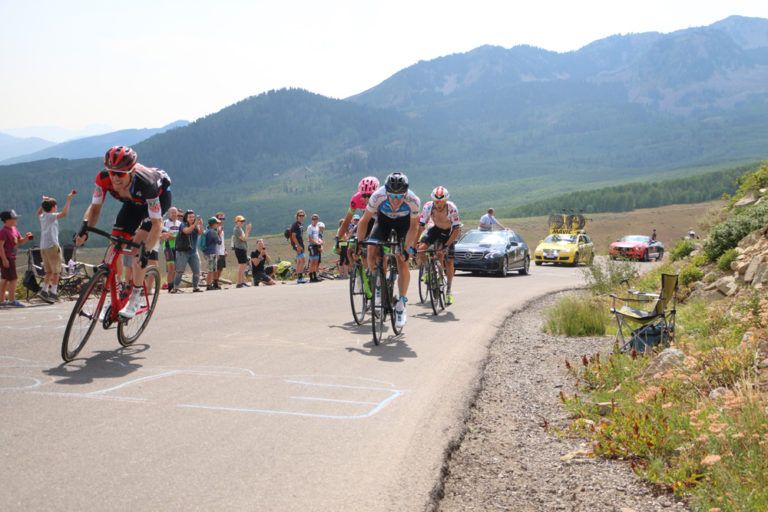
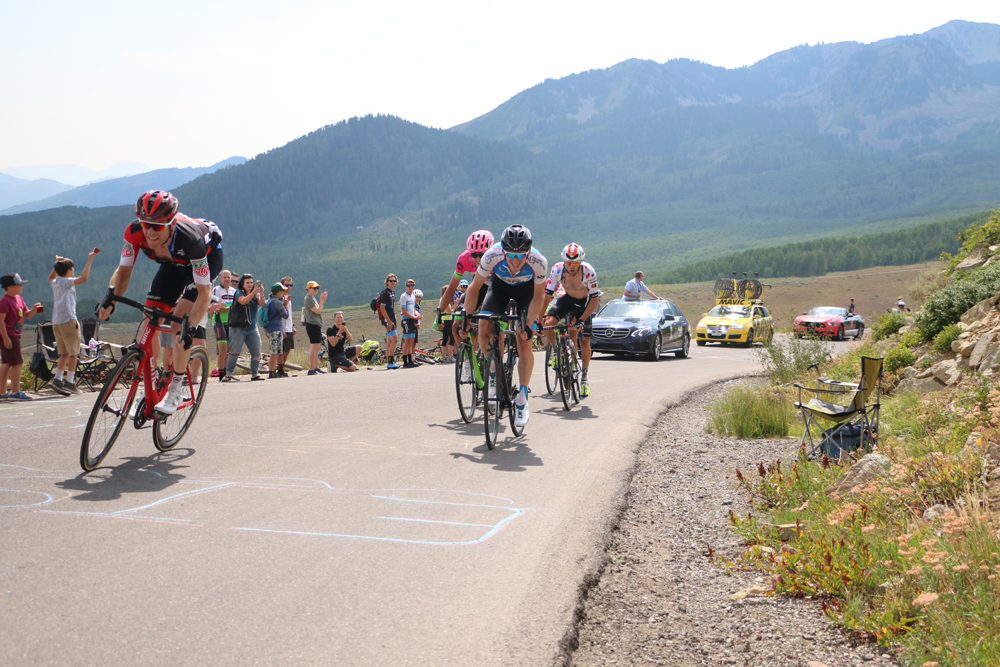
14 of the top teams in the world will race the 2019 Tour of Utah. Here, riders crest Empire Pass in Stage 6 of the 2018 Tour of Utah. Park City, Utah. Photo by Dave Iltis
Two teams racing the Tour of Utah for the first time are from the UCI Pro Continental ranks with Manzana Postobon (Colombia) and Neri Sottoli-Selle Italia-KTM (Italy). Among the returning U.S.-based teams, six have competed for five or more years in Utah — EF Education First, Trek-Segafredo, Hagens Berman Axeon, Rally UHC Cycling, Arapahoe l Hincapie powered by BMC and Wildlife Generation Pro Cycling presented by Maxxis.
The longest streak for competing at the Tour of Utah is 11 years and belongs to Rally UHC Cycling, a UCI Pro Continental team managed by Circuit Sport. Last year the team competed as Rally Pro Cycling. Another new name in the peloton is Wildlife Generation Pro Cycling presented by Maxxis. This squad competed for six years in Utah under the Jelly Belly Pro Cycling colors.
These teams have accounted for 37 stage victories and overall classification titles at the Tour of Utah since 2011, the year the Tour was elevated internationally by the Union Cycliste Internationale (UCI). Three additional teams will be added later this spring for “America’s Toughest Stage Race,” for a total of 17 teams in the final field of the UCI 2.HC stage race. Rosters for each team are expected to total 120 riders and will be announced in late July.
TEAMS ACCEPTING INVITATIONS (as of 4/18/19)
303 Project (USA)
Arapahoe l Hincapie presented by BMC (USA)
Aevolo Pro Cycling (USA)
EF Education Pro Cycling (USA)
Elevate – KHS Pro Cycling (USA)
Hagens Berman Axeon (USA)
Israel Cycling Academy (Israel)
Manzana Postobon Team (Colombia)
Neri Sottoli-Selle Italia-KTM (Italy)
NIPPO-Vini Fantini-Faizanè (Italy)
Rally UHC Cycling (USA)
Trek-Segafredo (USA)
Team BridgeLane (Australia)
Wildlife Generation Pro Cycling presented by Maxxis (USA)
“The Tour of Utah continues to attract a prestigious field of teams for seven days of fierce competition across our beautiful state,” said John Kimball,managing director of the Larry H. Miller Tour of Utah. “The world-class quality of teams matched with the challenging terrain of Utah always creates a worthy champion. We expect the 15thedition of the Tour of Utah will again deliver triumphant moments at the finish line each day for the riders and spectators.”
Four of these teams will be competing in May at the Giro d’Italia, one of the three Grand Tours of men’s stage racing. EF Education Pro Cycling and Trek-Segafredo will participate as UCI WorldTour teams. Israel Cycling Academy and NIPPO-Vini Fantini-Faizanè are both UCI Pro Continental teams and received wild card entries for the event. It is the third year Israel Cycling Academy will compete in Utah and the fourth year for NIPPO-Vini Fantini-Faizanè.
The Tour of Utah will begin on Aug. 12 at Snowbird Resort for a prologue (short time trial), one of four ski resorts that is part of the event. The Tour will conclude on Aug. 18 in Park City. Additional host venues are North Logan City, Brigham City, Powder Mountain Resort, Antelope Island State Park, North Salt Lake, Salt Lake City, and Canyons Village at Park City Mountain.
The Larry H. Miller Tour of Utah is free to all spectators, making professional cycling one of the most unique professional sports in the world today. It remains a 2.HC-rated stage race on the UCI America Tour, making it one of the premier events for professional cycling teams in North America. The Tour is also part of the USA Cycling Pro Road Tour. More information about the Larry H. Miller Tour of Utah can be found by visiting www.tourofutah.com, as well as social channels Facebook (tourofutah), Twitter (@tourofutah), Instagram (@thetourofutah) and YouTube (Tour of Utah).
You may not want to ride in Mexico City. Unless it is Sunday morning. Or unless you are a little crazy and think riding a bike almost anywhere is simply an opportunity for adventure. On a trip from which I just returned, both reasons sufficed for me.
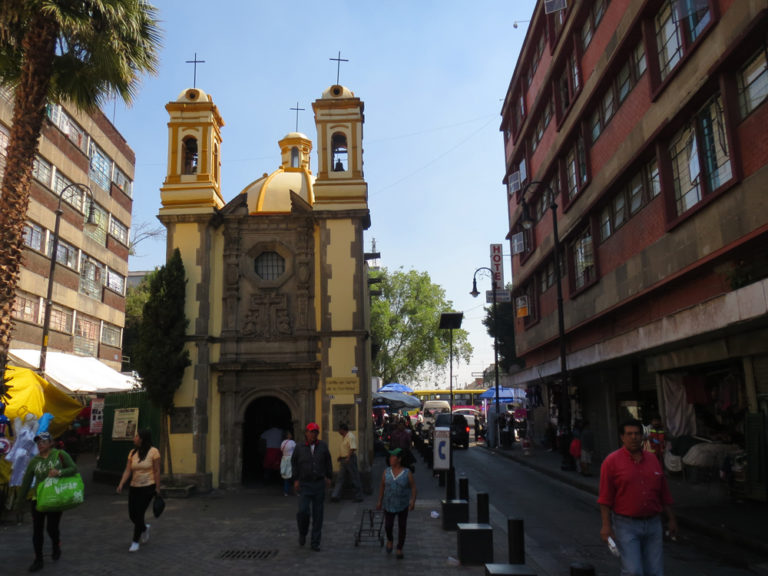
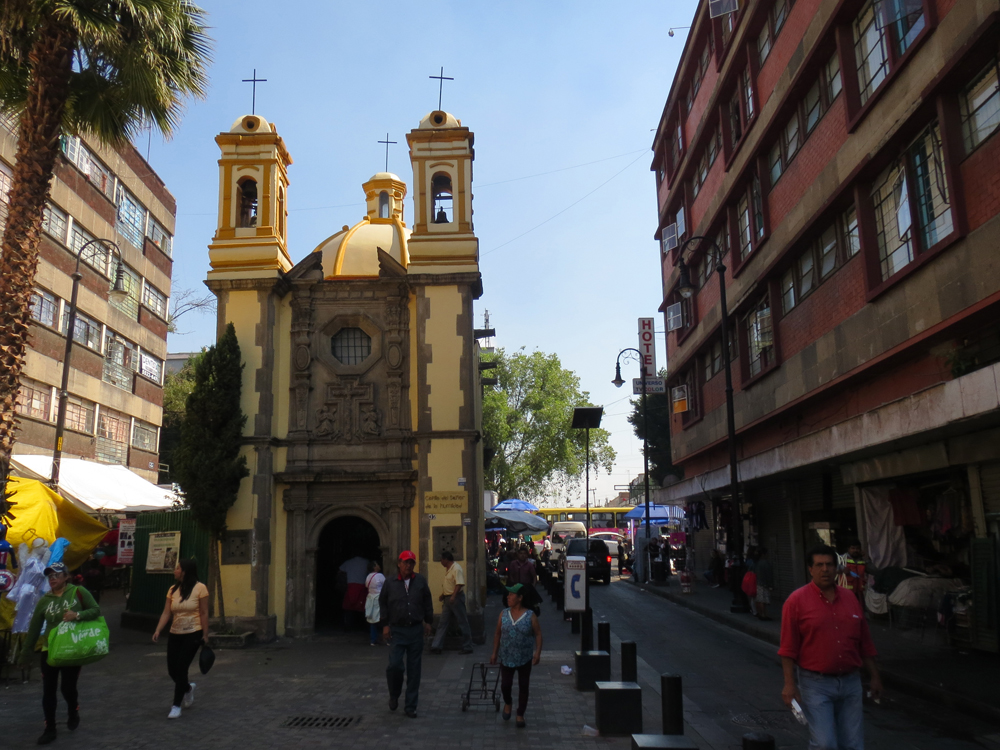
Capilla del Senor de la humildad – A treasure found exploring by bike. Photo by David Ward
As I have related in this column before, my daughter, Jessica, works for the Foreign Service and as such ends up working in embassies around the world. This has taken my wife, Karma, and me to Dhaka, Vienna, Beirut, Belgrade and, most recently, to Mexico City. On all of these sojourns, I have tried to work some cycling into my schedule and have succeeded except for the trip to Beirut.
Muévete en Bici
Jessica facilitates my passion by checking with others about cycling opportunities. This time, she learned that on Sunday mornings a main route through the heart of Mexico City, Paseo de la Reforma, is closed to traffic and opened up to cyclists and other non-motorized traffic as part of Muévete en Bici – Move by Bike.
So, Saturday evening, I rented a single speed bike (Mexico City is mostly flat) for a day and on Sunday rode the short distance to La Reforma. I was amazed by what greeted me: Bicycles, scooters, pedestrians and roller bladers, but mostly cyclists.
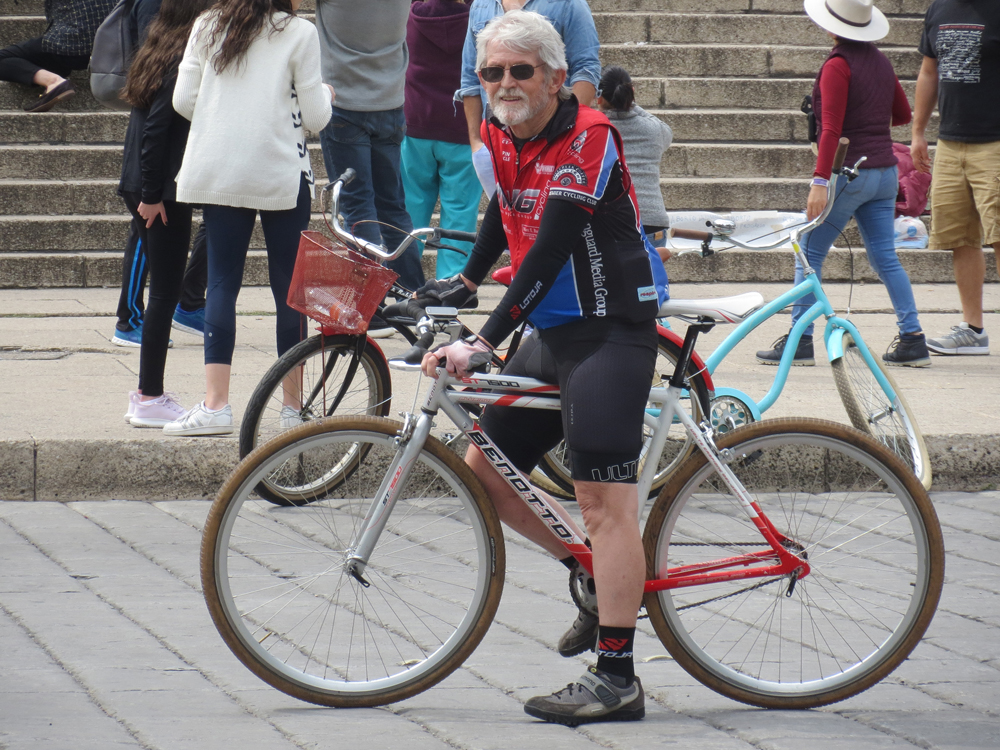
All kinds of cyclists. I was only one of a few people in lycra, and we stood out conspicuously. Most others were on older mountain bikes, city bikes and even trikes, dressed in everyday clothing. I also saw Uber Eats delivery riders, and cargo bikes delivering water jugs and various other goods. I saw a person with a Day of the Dead mask on, and a beautiful custom low-rider bike. Occasionally, someone had on a helmet, but that was pretty scarce. This was not a bike event so much as a civic happening. It happens every Sunday, and thousands turn out to take advantage of the closed road for a casual Sunday morning ride and the festive atmosphere.
La Reforma is closed off for about 7.5 miles, though most ride a stretch of about 4 miles. There is no start or finish. You just jump in where you want, turn around when you want, and exit when you are done. Volunteers are posted at main intersections to stop the flow so cross traffic can get through. Along the route are mechanical support stations and vendors of crafts, goods and food. La Reforma is a great thoroughfare for this entire circuit, allowing one to enjoy the sites, sounds and smells. After completing the 15-mile loop and smelling the cooking from the food stands, I met up with Jessica and Karma for tacos. We had tacos for which the meat was a pork and chorizo mix, and were simply some of the tastiest tacos I have eaten, made better I am sure by the ride and vibrant atmosphere.
I had previously read about a similar event in another Central or South American city. But to experience it brought home how enjoyable and relaxing it is. No one needs to, and clearly few do, identify as a cyclist. They just grab whatever wheels they may have and show up for a fun time.
Exploring Mexico City by Bike
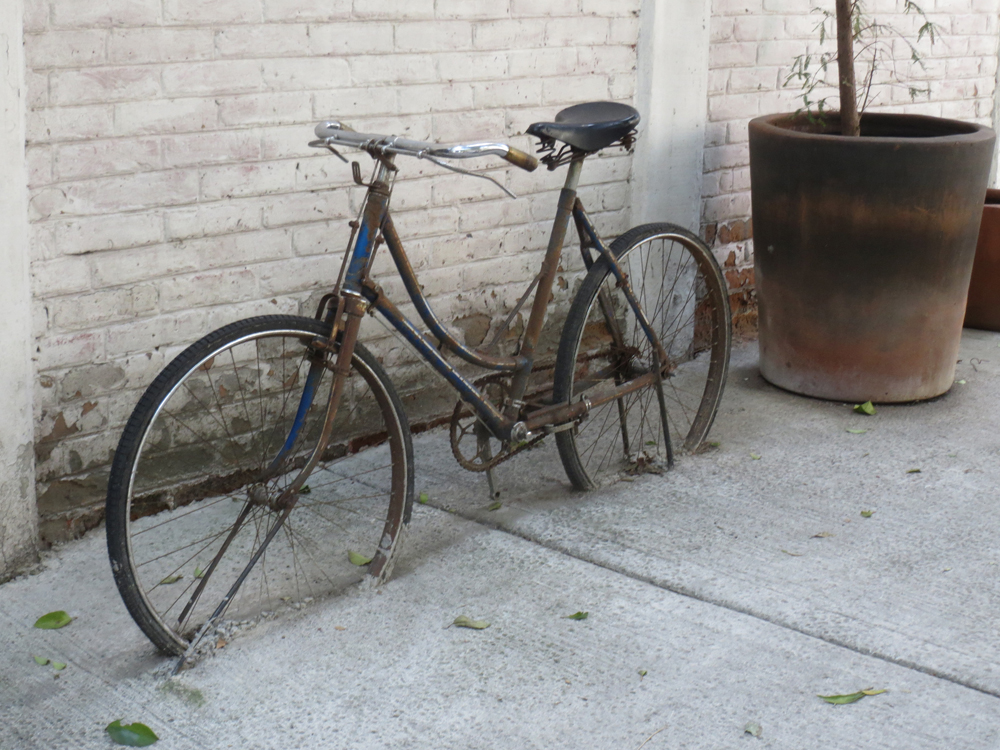
But this was not my only cycling adventure in Mexico City. On another day, I again rented this trusty single speed and set out to explore, something I really enjoy doing when visiting new places. It is a great way to discover an area and some of its uniqueness, eccentricities, and hidden treasures. This time, traffic was all around me, and I can say that cycling in Mexico City is not for the weak at heart. You have to be willing to ride somewhat aggressively. Drivers are generally courteous and will let you in, but only once you stick out your nose, or rather front wheel. Thankfully, traffic is generally fairly slow and not overly busy if you can stay off the main roads.
Exploring Mexico City on a bike is a challenge, though probably easier than a car if you don’t know your way around. I was constantly on Google Maps to figure out where to go, and then on again to figure out where I was and where I had gone astray. Straight streets are rare, many are one way, and the names keep changing. Plus, it is hard to get over the main expressway going through Mexico City without braving a very traffic congested road. I ended up bike-hiking over a pedestrian bridge. But then, that is all part of the adventure.
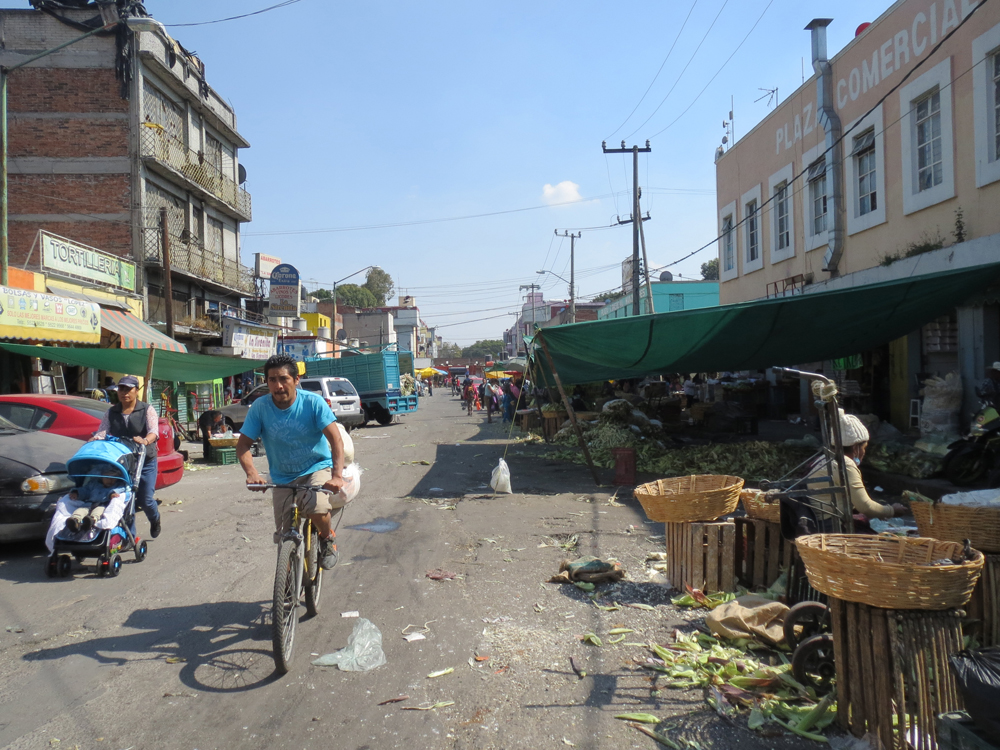
On this day, I very indirectly made my way to the main center of Mexico City (informally called the Zocalo), and wound through its underbelly a little, observing huge work stands where all that corn the Mexicans cook and eat is shucked. I then worked my way to the Plaza de la Constitucion. Here you can visit the Palacio National with its beautiful Diego Rivera murals, the grand Catedral Metropolitana de la Ciudad de México and the Templo Mayor, a relatively recently discovered Aztec temple previously buried beneath the city’s streets and buildings. A little further away is the Palacio des Belles Artes where, the night before, we had attended the Ballet Folklorico, one of the best cultural dance and musical events I have ever attended. From there, I made my way back to my friendly bike shop and dropped off my bike.
Mexico City is a city full of life and living. Before going, Karma and I had talked with several people who had been to Mexico City, and each one told how much they enjoyed it with many saying it was their favorite city. Having been there, I now understand and agree. It is hard to put into words, but Mexico City has a vibrancy and liveliness that is invigorating and intoxicating.
Cycling in San Miguel de Allende
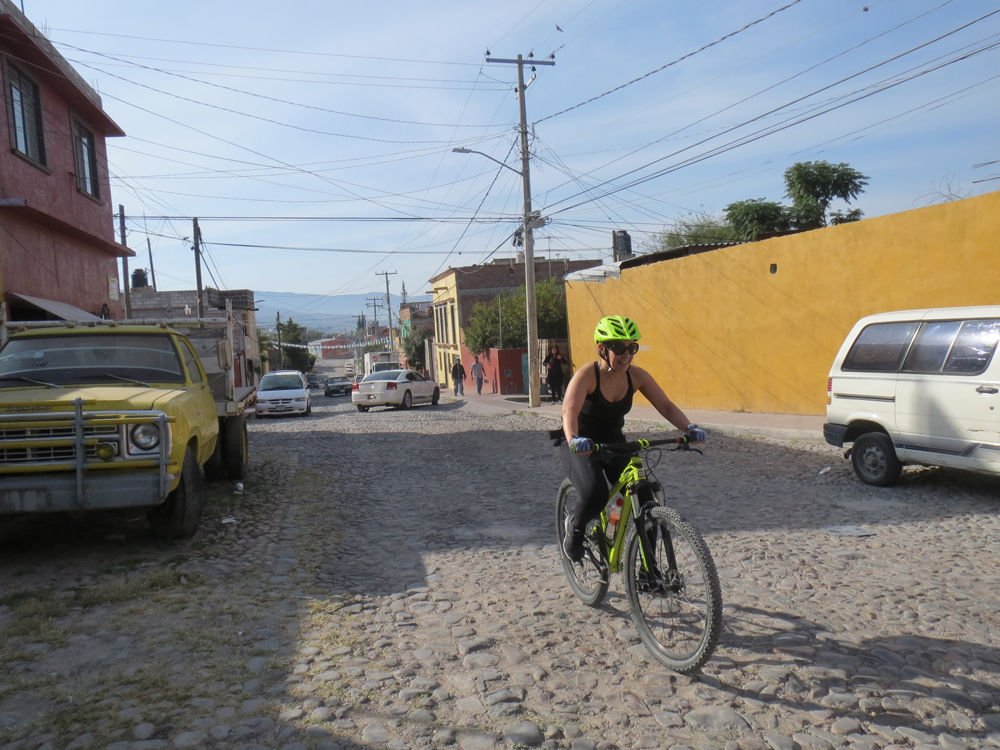
We also took a 4-day excursion to San Miguel de Allende, a tourist favorite with its well-preserved colonial Spanish baroque architecture and cobbled streets. It is an experience just to walk around this city. In the evening, its main plaza, El Jardín, is full of people milling around and being entertained by the ubiquitous mariachi bands. Towering over El Jardín is the beautiful neo-Gothic church Parroquia de San Miguel Arcángel with its dramatic pink towers rising above the plaza. Like Mexico City, San Miguel is full of life and you find yourself just wanting to be out in the middle of it.
Naturally, I checked on-line into the possibility of renting a bike. In one of the chats I stumbled upon, one person said to forget riding in San Miguel because it is all cobblestones and very hilly. But I also came across a website for Bici-Burro Bikes. It’s owner, Alberto (“Beto”) Martinez, conducts biking and hiking tours. So, I signed up.
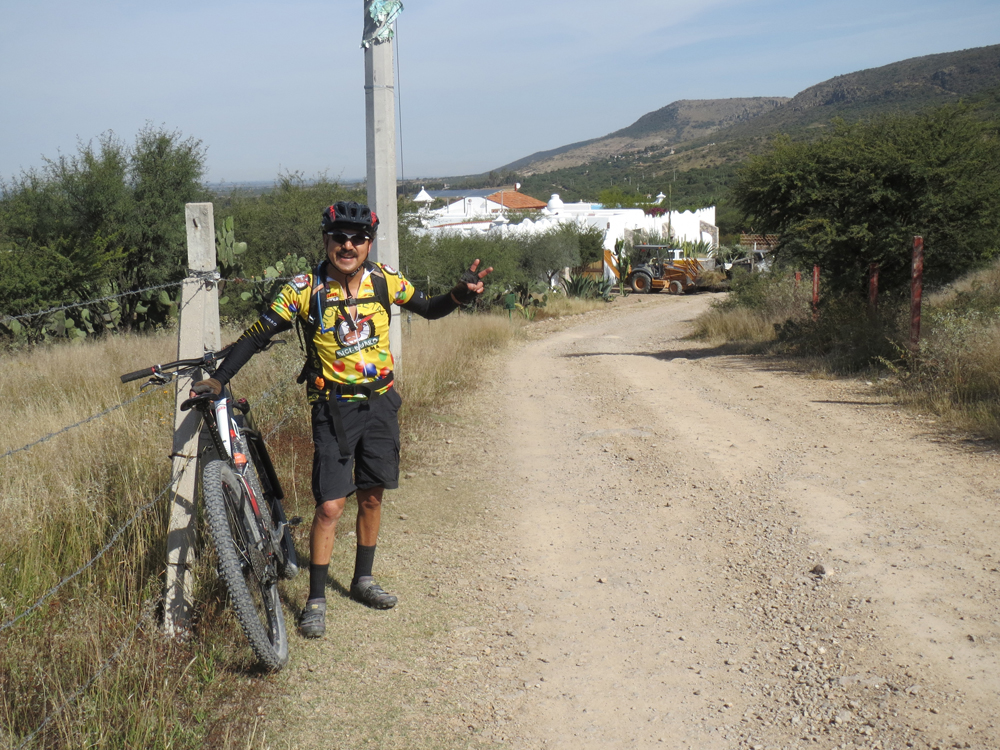
The next day, I joined two ladies, Gianna and Leila, and Beto took us on a 22-mile tour through the environs of San Miguel. All riding is done on mountain bikes with front suspension which is what is needed in San Miguel. I would have also enjoyed rear suspension, but these are excellent bikes and sufficed very well for the rough cobbles and dirt and gravel roads we traversed. The tour took us through countryside where, among many other things, we saw haciendas and passed through small Mexican villages, including one where I saw parents leading a donkey on which their son was seated. I really enjoyed this ride for the feel and sense it provided of life in rural Mexico.
Prior to this trip, I had never really had a desire to visit Mexico. But our time there filled me with an overwhelming sense of the rich vibrancy of Mexican life and culture. I was enthralled with it, and am looking forward to a return trip.
And to further exploration and adventures there on a bike.
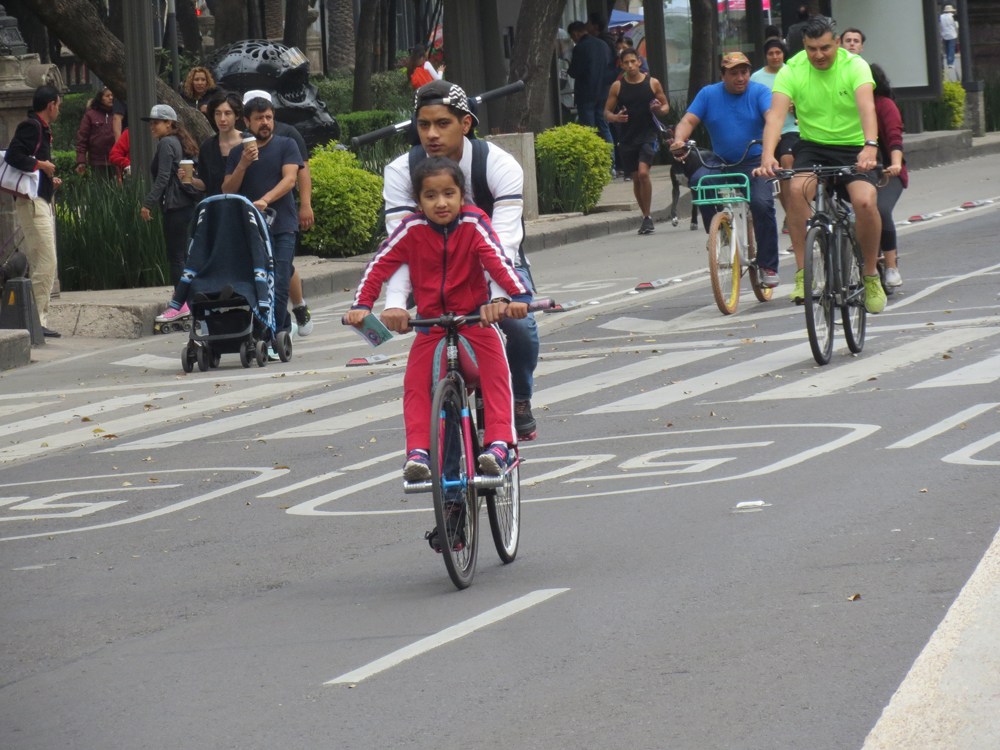
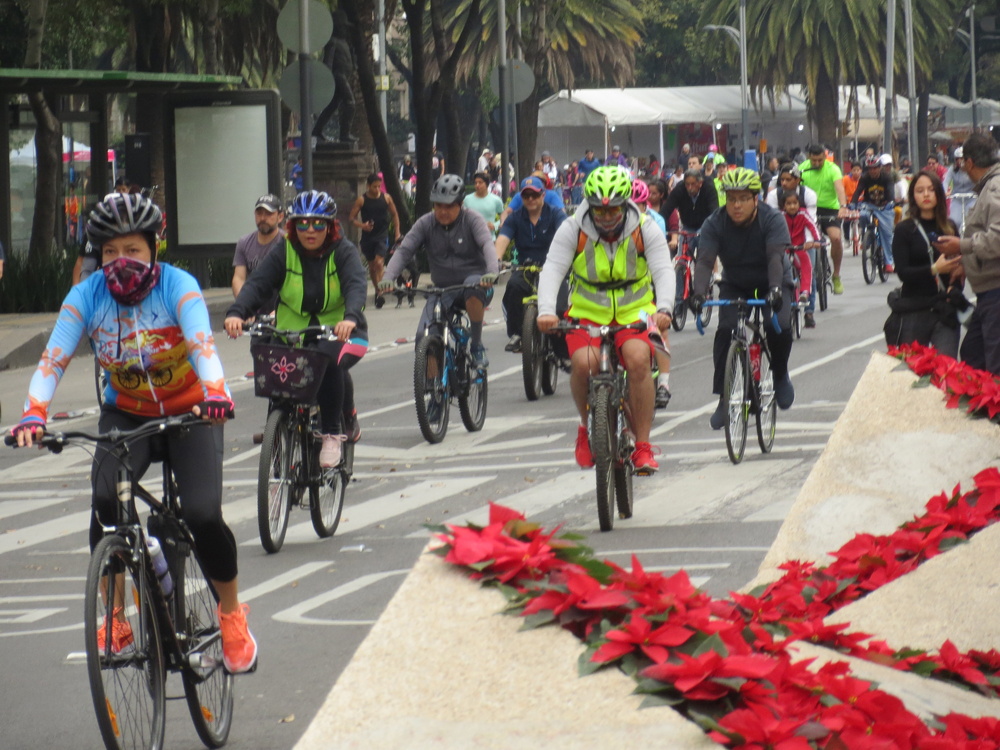
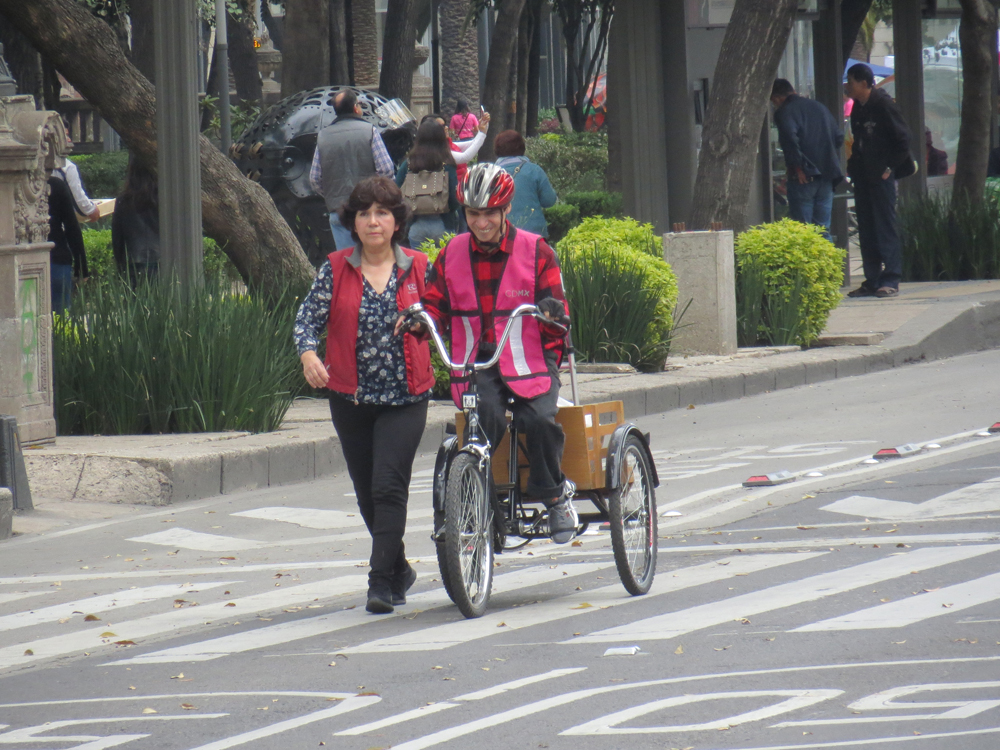
Beto, tour guide and owner of Bici-Burro. Photo by David WardLeila riding the cobbles of San Miguel de Allende. Photo by David WardA treasure found on a small back street while exploring Mexico City. Photo by David WardCorn Shucking in the Zocalo. Photo by David WardCapilla del Senor de la humildad – A treasure found exploring by bike. Photo by David WardÁngel de la Independencia. Photo courtesy David WardTaking little sister for a ride in the Muévete en Bici. Photo by David WardOn the Paseo de la Reforma. Note the mask on the guy in the yellow vest. Photo by David WardA tricyclist enjoying the Muévete en Bici. Photo by David Ward
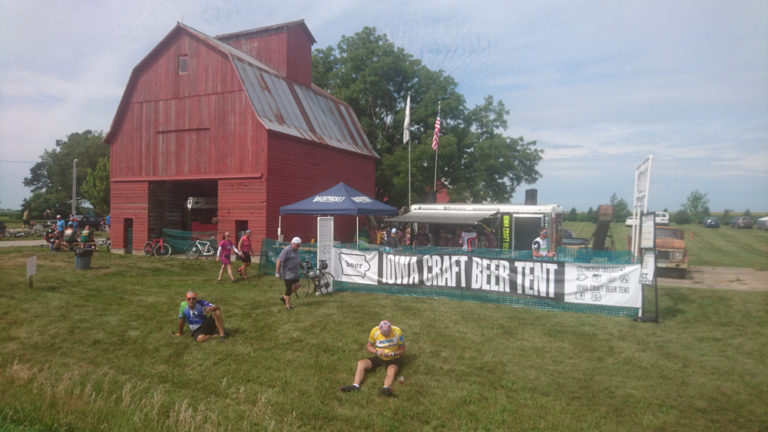
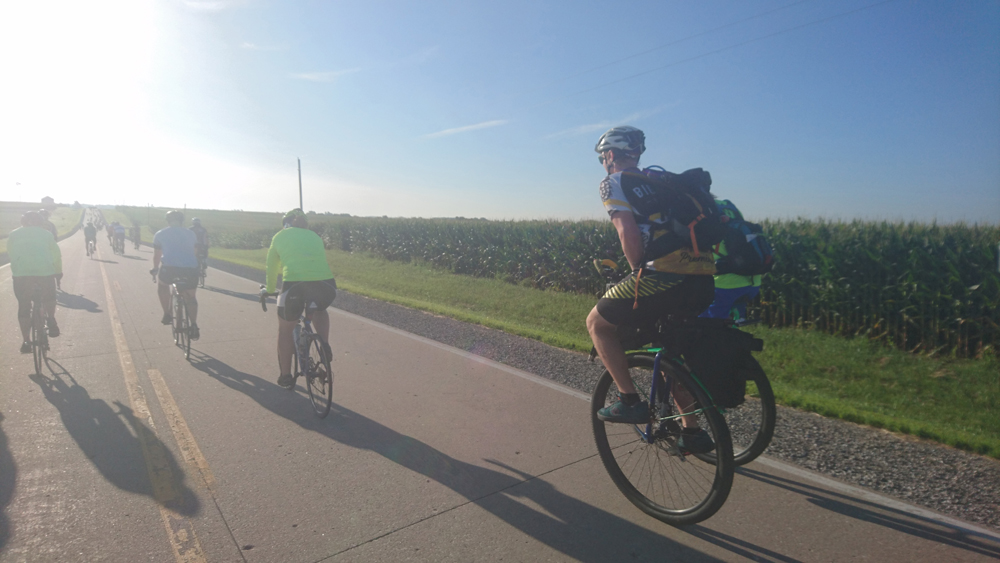
The Iowa Craft beer tent was one of many on the route. RAGBRAI 2018. Photo by John Monroe
Last year during our ride to Colorado, John and I talked about the idea of riding in/to a different part of the Country. For the past four years, John Monroe and I have toured the Intermountain West that included riding in Utah, Idaho, Wyoming, Colorado and Nevada. It’s no secret to those who ride long distances in the West that it is a mountainous desert. We wanted to try something a little more flat and less remote. It became increasingly clear that we wanted to try something different after nearly running out of water on Utah’s east desert [Editor’s Note: See their chronicle: “Southwest Furnace on Two Wheels: A Bicycle Tour From Provo, Utah to Grand Junction, Colorado” in our April 2018 issue online].
John mentioned RAGBRAI. I had never heard of it. It is the Register’s Annual Great Bike Ride Across Iowa. It began with the Des Moines Register’s writer/copy editor John Karras and avid cyclist Don Kaul who wrote the “Over The Coffee” column for the same paper. The idea was to ride across Iowa and write about the adventure. They began recruiting riders over a period of six weeks. 300 ambitious cyclists started that first year in 1973 while only 114 finished the entire distance but, they picked up cyclists along the way resulting in 500 riders between Ames and Des Moines. Those who rode begged for more and RAGBRAI was born. It has been held annually since then with a limit now of 8500 full distance riders and “Day Riders” that have combined to a peak of 33,000 riders in 2013. The route changes every year with cities around the state bidding to be on the route. What remains the same is to ride from the Missouri River to the Mississippi River. The daily mileages on this year’s ride ranged from 43 to over 100 miles.
We reached out to our W.O.B.L. Facebook group to test the interest level. We had nearly a dozen interested riders and held a planning meeting to talk details. Taffy had ridden it over a dozen times and was the Subject Matter Expert (SME) for questions we had about the process and ride. RAGBRAI is a ride; not a race. We had a hard deadline for registration. Interested riders send in their money and if they make the cut, are notified by email. If you don’t make the cut, a full refund is given. The hard date for registration came and then there were five of us. If we made it in lottery, we would make firm plans. Taffy would ride with us on the drive out but remain a part of her “Team Spirits” (TS) friends from Iowa. Jess Galaviz, Chuck Galaviz, John Monroe and I made up the W.O.B.L. contingency from Utah. We made it in. Woo Hoo. We were so excited. But now that we were in, we had some logistics to figure out. Transporting 5 riders and bikes can be tricky but we made it work.
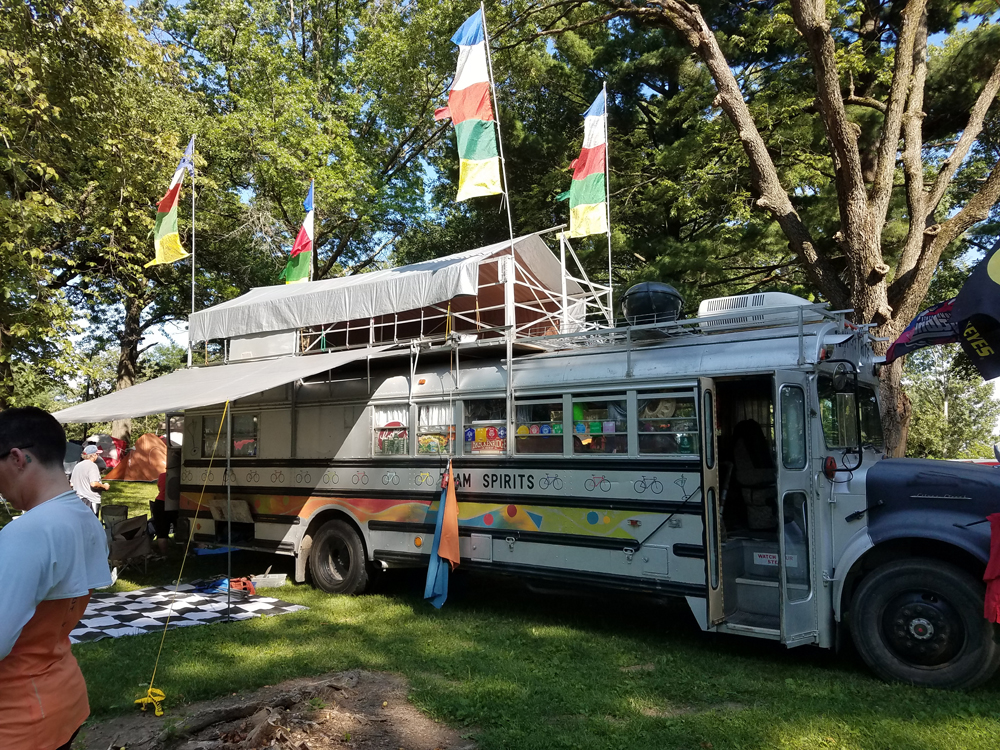
We arrived in the starting town of Onawa to set up camp. Approaching the town, we saw an airplane flying around pulling a large ‘Welcome to RAGBRAI’ banner. I hadn’t seen one of those since I was a kid. We were asked by TS to reserve a large footprint for our group. Randy, the bus driver and host for TS has converted an old school bus to an awesome SAG wagon complete with cooking, shower and balcony. It was called “Silver Beauty”. I assume that is because it was painted silver and was a beautiful site at the end of each day’s ride. Randy drove the bus and would meet at the lunch town each day and Janice, a non-riding member of TS would drive our van and meet us at the “End Town” each day.
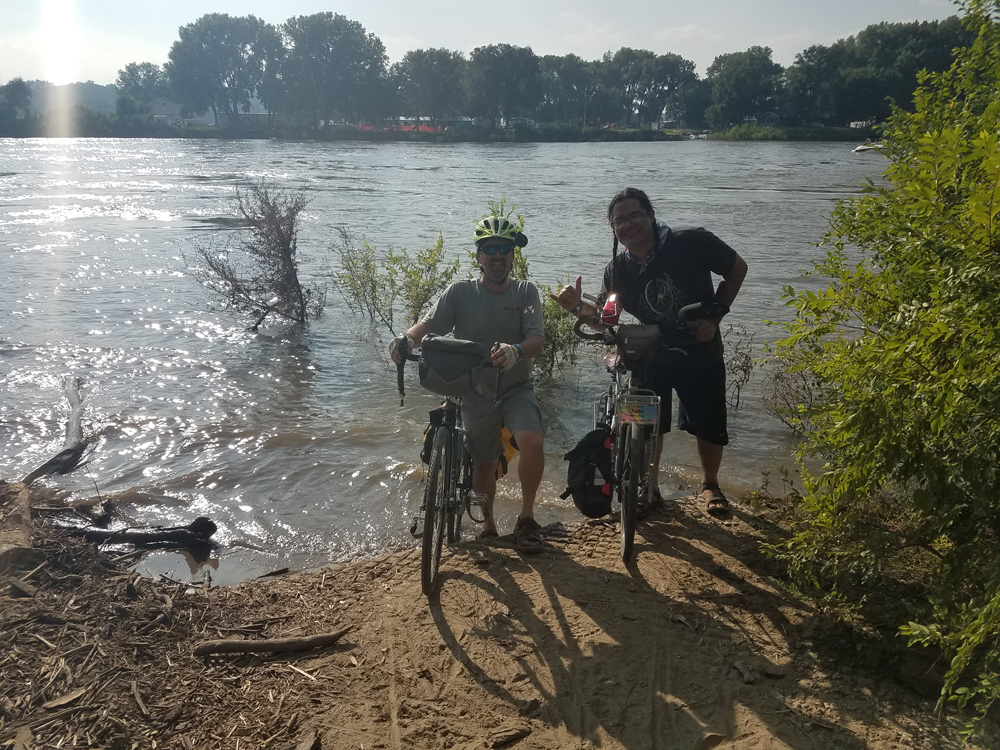
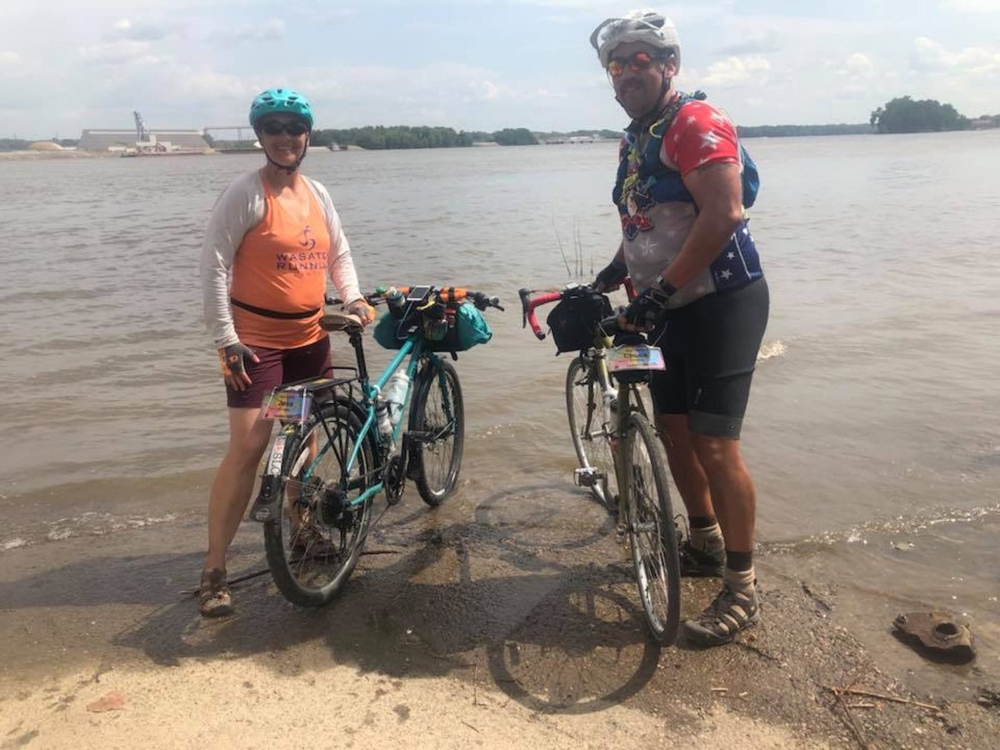
Onawa is not right on the river so we road back to the Missouri to dip our tires (it is the tradition). There were hundreds of riders and many were waiting to dip their tires as we approached. While awaiting our turn, we chatted with a few other cyclists. Each bike on our team had a custom license plate with our name and state. One young man saw Utah on my plate and threw his hand up for a high five stating he was from Bountiful. That was cool to meet someone else from Utah. Next thing I know, he and his companions (a young man and woman) stripped down for a quick skinny dip in the river. They were quite ambitious getting into the water. I believe they underestimated the strength of the river’s current. It was fast moving and I wondered if they would make it out without drowning. They struggled against the current but eventually made it back. After dipping, John and I rode over the bridge to Decatur, Nebraska for a picture. Jess and Chuck headed back for the nearly 10 mile ride back to town. Now we were ready for the days to come. I had been a little concerned about the heat and humidity. I am originally from Indiana and remember the torture of putting up hay in those conditions. Fortunately we experienced mild weather throughout our weeklong ride. This is the first “supported” ride that John and I had undertaken. It felt a bit strange to not have nine liters of water and all our gear. We all still carried some essential items like patch kit, water, sun screen, snacks and phone.
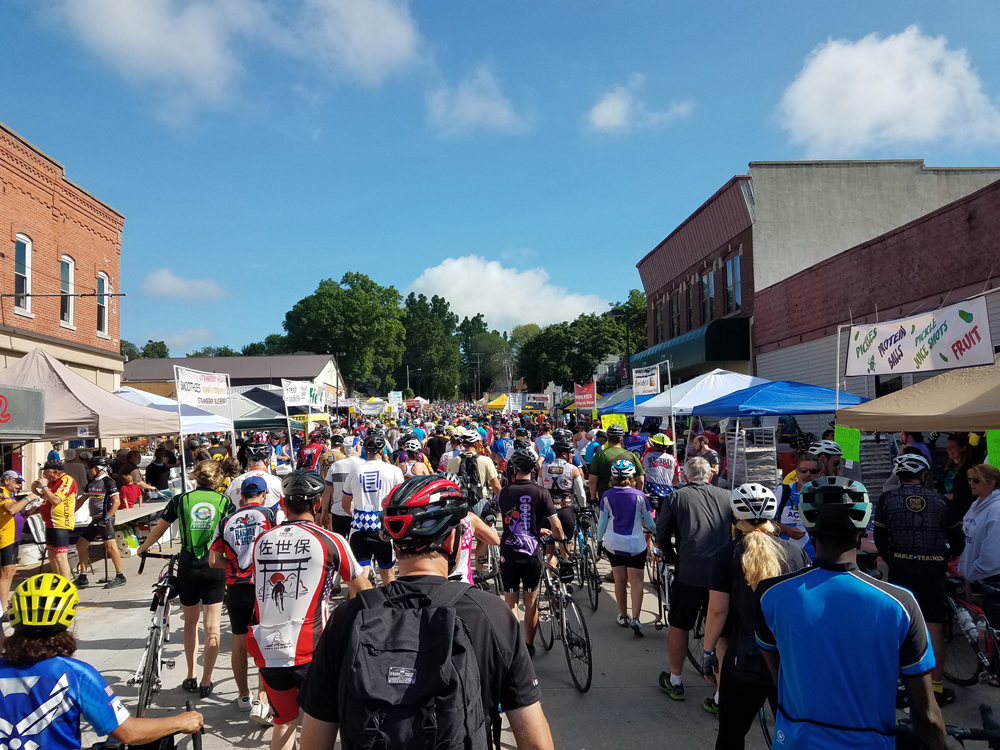
There is no shortage of food to eat throughout the ride. Beginning at 7:00 in the morning, you can get breakfast, lunch or dinner, ice cream, pie, craft beer or a shot. Some stopped in every town for a hit. RAGBRAI is a fundraiser for the participating towns. Apparently a qualification is that they must be able to provide for thousands of cyclists. We liked the church food the best. Good food for a good price and a good cause. School sports teams, Scout troops, and professional vendors were also widely available. Lemonade stands were popular as well. Riding into each town was a treat. Residents stood along both sides of the road clapping and welcoming us to their town. It was great to see folks out on the lawn chairs and wheelchairs showing their Iowa hospitality. Live bands were not uncommon, water stations were essential, so was the pie. It was impossible to ride through the main street of each town. We had to get off and walk our bikes because of the bottleneck of cyclists. Main Street was usually lined on both sides with food and vendor tents. Pork Chops were 1½” thick, ice cream was home made on little gas powered engines and fresh made pie in every town.
Right out of the gate, my bike began to creak. The sound was rhythmic and creaked at every pedal stroke. We started out with a Kevin from TS. He stuck with us for 15 miles and couldn’t take the racket any longer and moved on. I must admit, it was annoying. This noise plagued me throughout the ride. It was embarrassing at times. I stopped at 3 repair tents on the first day to fix the creak. They each advised that it was a different problem. Their efforts did not fix the creak. I considered replacing my entire drivetrain, wheels, and pedals. John and I rode together and would meet Taffy, Chuck and Jess at the end of the day. Iowa is not flat but what we like to call “Rollers”. I didn’t find the hills bad, considering John and I had been climbing mountains out West.
I was amazed at the different bikes and cyclists. I saw every shape and size of bike and rider. The footprint that thousands of bikers require for camping is significant. Camps are separated by who you travel with. We were riding with a Supplies and Gear (SAG) vehicle so we camped with all the SAG. Others loaded their gear on semitrailer each morning and search for it in the pile at days end. Some paid for professional SAG who transported their gear and did camp set-up and take-down each day. They were also in another area. That became a challenge to find where our SAG was parked. Randy had the prayer flags on the bus to easily identify it in a field of buses. It helped. The end of each day included relaxing in the shade, setting up tents, and finding dinner. Showers were not a daily activity for all of us.
On day 3 we set up camp at the local Fair Grounds. Town was only a few blocks away so after tents were up and wandered over. It rained hard while we were in the library “charging up.” We didn’t think much about it and wanted to wait out the storm. We met a young 20 year old kid named Carston who was talking himself in to the century ride later in the week. He was anxious about it but really wanted to do it. When we got back to camp, John and I realized that we failed to button up our tents and rain was able to get in. It took some doing but it eventually dried out. When we put our tents away each morning, they were soaking wet from dew. The first order of business when arriving each evening was to pull out the tent to dry out before setting up.
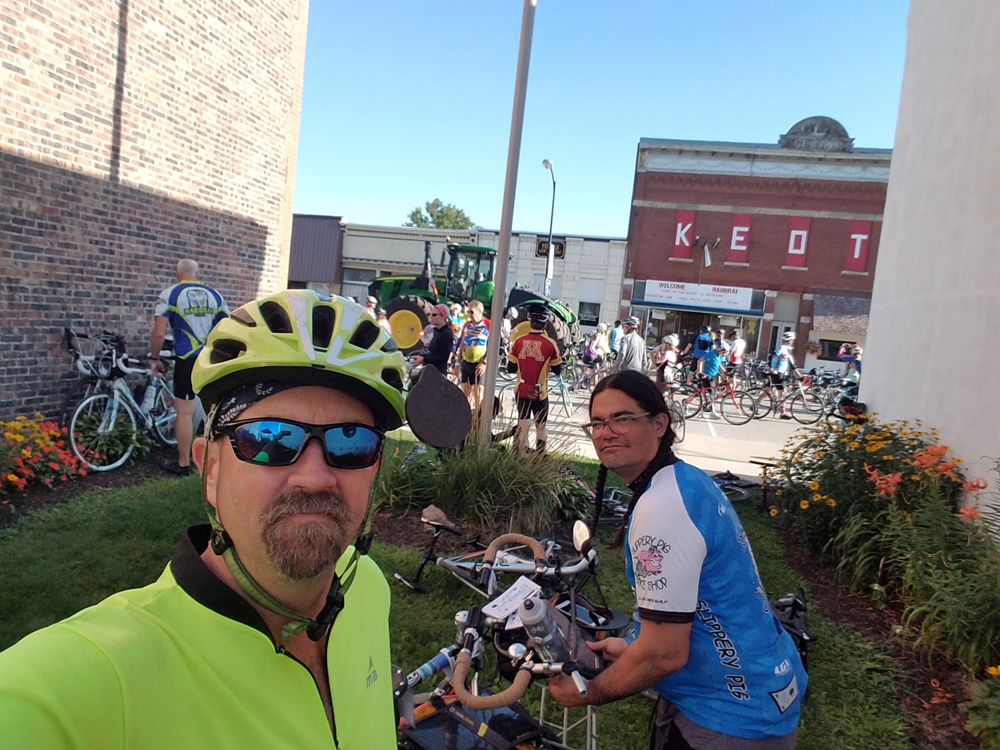
John’s birthday was on day 4 of the ride. He had me write on his left calf “It’s my Birthday”. That generated some “Happy Birthday and discussion points throughout the day. He met a Native American named Patrick from Iowa’s Meskwaki tribe. John has long dark hair that is braided on each side of his head. When Patrick rode up along he asked John which tribe he was from. John isn’t from a tribe but has Shoshone tribal ties; I guess he passed as a tribal member that day. He ran into Patrick a few days later at the Expo. Later in the day we were climbing a long hill; from the bottom, we could see a string of cyclists up on the left lined up for a turn on a homemade slip and slide. A farmer had laid out a large piece of plastic on a grassy hill that terminated in a freshly dug dirt pool at the end. The water for the slide was coming from a tractor parked with a large weed-type sprayer to lubricate the slide. We guess that any pesticides were nonexistent; at least we told ourselves that. John said that was the best day so far. Additionally there was a pond with a zip line strung across it. The other end of the cable was connected to a tractor that was pulling tension.
That night I found myself at a brick and mortar bike shop to attempt to find the origin of the creaking. I wasn’t alone. There were several of us commiserating with each other about our needed repairs. We were in the basement of the bike shop so bike had to be carried down a narrow stairway. While sitting there an Air Force rider sat down next to me. The Air Force had a large presence on the ride. Teams of Air Force soldiers were riding throughout the route each day. They stopped for anyone off their bike to render assistance. It was awesome to see their efforts to help anyone and everyone that needed it. Additionally, they were managing traffic during downed-rider incidents and rendering aid until emergency responder arrived. This soldier and I chatted. The previous night’s storm caught him unaware as well and his sleeping bag was sopping wet. He explained that he couldn’t sleep in it and walked to a neighborhood and began knocking on doors asking for a clothes dryer. He went on to describe the challenge of finding help for a 6’2” black guy knocking on doors in rural Iowa in the dark. An elderly woman answered and reluctantly let him in. He said that he could tell she was uncomfortable but wanted to help. They began a conversation and he learned that her husband was an Air Force Pilot and they sat on the porch and talked for 45 minutes. She hugged him when he left and thanked him for coming by. I reminded him that in this life, some are placed in our path for our benefit, while we are placed in the path of others for their benefit. I think both occurred in the story he described.
The next day’s ride ended at Iowa State University in Ames and we ran into Carston after we rode through the stadium. He was still talking about the century for the next day and was nervous. He wasn’t sure he would do it and neither were we for that matter, but we wished each other well and went our separate ways. I was amazed that we saw him again because of thousands of riders, it was hard to recognize people.
The century day required repeating about 18 miles of the route to incorporate the extra miles loop. It ended up being well over 100 miles. We had picked up laminated day maps at the Expo on the first day that showed the route and mileages. We eventually determined that the mileage on the map was from town to town and not necessarily from camp to camp. The result was that some days were 10 miles farther than the mileage indicated on the map. I saw Emily from TS during the repeated 18 mile stretch. John met up with Jess and Chuck after his loop and they rode in to camp together. We received a cool patch for doing the extra miles. At the halfway point, one of the original organizers was present for photo ops with cyclists. We wondered if Carston attempted it and if he made it. About 6 miles before then end of the days ride, I saw a cyclist go down on a downhill stretch. The Air Force was already there and calling out to cyclists to move over and slow down. There seemed to be more “cyclist down” incidents and ambulance rolling lights and sirens the last few days of the ride.
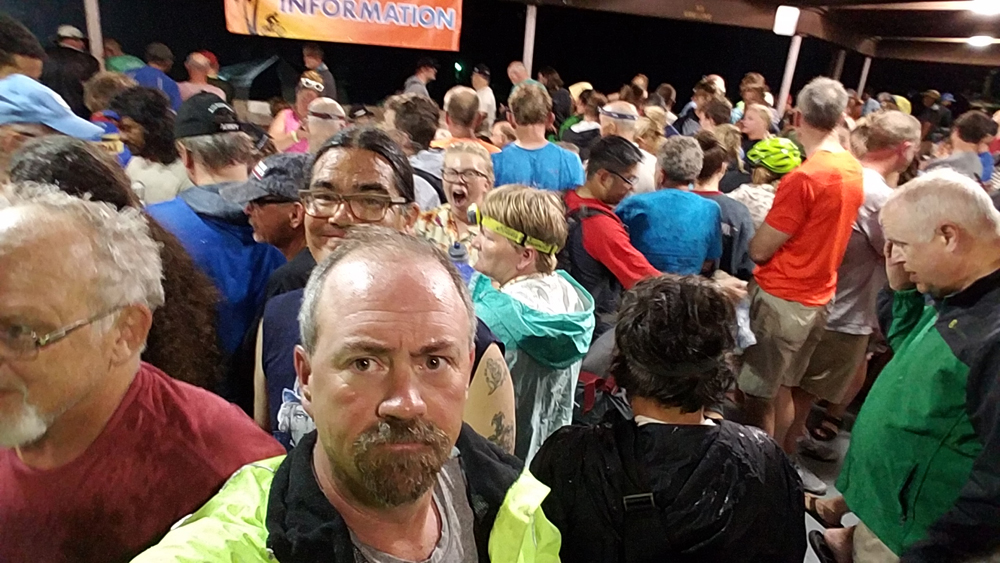
We stopped at a friend of Jess’ that night for dinner and laundry. It was nice to have clean clothes. That night was a crazy one though. John woke me up yelling at me to wake up. There was high wind and a tornado warning and we were being evacuated from the campground to a nearby shelter. The shelter was a community pool house. There were cyclists running through the winds and rain toward the shelter. I had been awake out of a dead sleep for about 90 seconds when running for the shelter. We were packed in there like sardines and were required to stand because there was no room to sit down. We spent about 45 minutes in the shelter when they let us go back to bed. Some people hadn’t staked their tents down and several of the hundreds of tents were blown over and away. Jess and Chuck didn’t go to the shelter but instead went and sat in the van.
I went to another brick and mortar bike shop. I was there for an hour and a half. The tech advised that my spokes needed to be oiled because they were dirty and when cleaning the rim he spotted micro cracks in the rim. I poo-pooed his opinion that my spokes needed to be oiled and that the creaking could be that. He cleaned it up and sent me on my way. I wasn’t very satisfied until the next day. Hardly any creaking. I paid more attention and realized that he was right. I rode virtually creak free for the remainder of the ride. John even took a picture of me walking past a repair tent without stopping. I would have to look for new wheels when I got home though. I also wrote a glowing review for that bike shop for their help and patience with me after I arrived back home.
The last day of riding was nice. John admitted that he wasn’t ready for it to end. We stopped at a Mennonite Church and received quite a history lesson from one of the parishioners. They had good watermelon. The watermelon stops were always a treat. A huge piece for a couple $$. This church had a lot going on. Plenty of food options and a history lesson. Just a bit farther down the road was the Pine creek Grist Mill in Wildcat Den State Park. It was a worthy stop and very interesting. A three-story mill alongside Pine Creek with a bit of a salacious history. The owner had tied himself to one of the support posts during impending river flooding. A bit of drama behind that story. You can read up on it online. As we made the final turn onto the freeway toward the end of our ride I saw a cyclist sitting at roadside with bike turned upside down (the sign for the RAGBRAI SAG that a ride was requested). It was Carston. John and I turned around to talk to him. The burning questions was; had he done the century? He was excited to see us and proud of himself that he had done it. He did experience a mechanical problem that prematurely ended his ride but it didn’t matter to him, he had completed the century and 7/8 of the RAGBRAI. I felt bad for him but he was on cloud 9 and did not care near as much about the finish as the century.
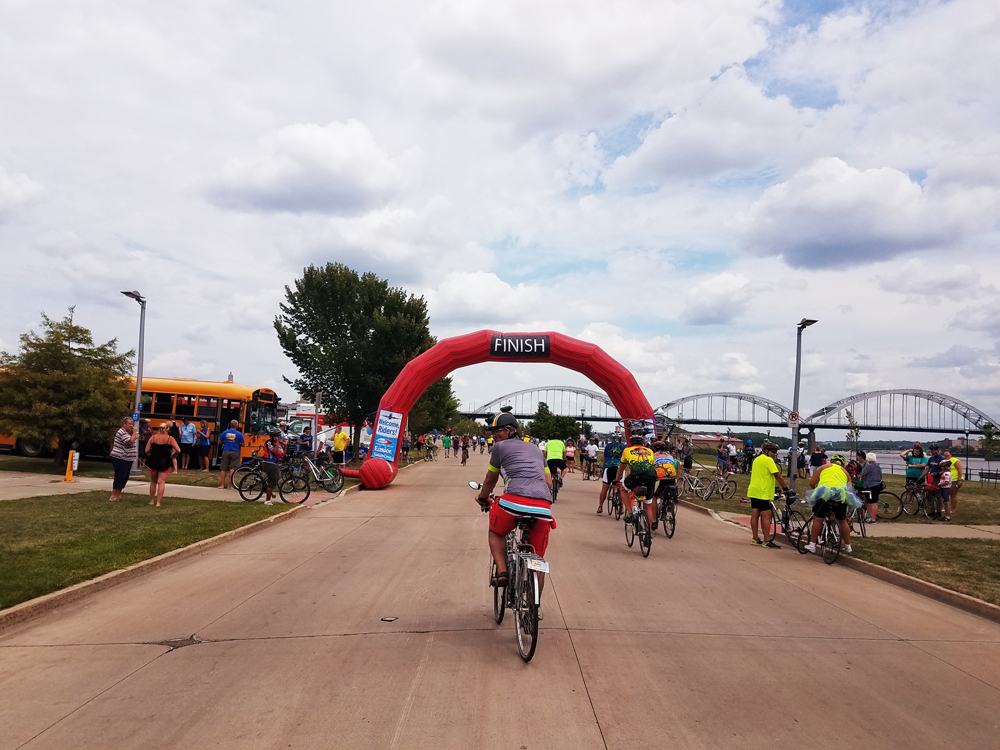
We were less than a mile from the finish when we noticed a small group of cyclists dipping in the Mississippi River a bit prematurely. These were seasoned RABGRI-ers who knew what the official dipping place was like. We all dipped there and rode to the end on a bike path parallel to the river. When we approached the end, we were happy to miss the thousands that were lined up to dip. They would allow several hundred in at a time for the photo op then several hundred more.
We met the Silver Beauty for the final time before heading home. There was a bit of melancholy though. We had made new friends and put another adventure in the book. A new kind of adventure for John and I.
Getting there and back: From Utah we drove most of the way on Friday, stayed in a motel and arrived at the “Start Town” on Saturday afternoon for Sunday’s start. Again on the return, we put in about 4 hours of driving after Saturday’s ride and drove all day to arrive back to Salt Lake late Sunday afternoon.
Ride details and options: There were a number of self-supported riders, so that is an option. One of the challenges if you don’t have a driver for your vehicle is the transport back across the state to your vehicle. Every registered participant can use the RAGBRAI trailer to transport their gear every day. Some cyclists find camping spots or Air BNB along the way but it is the exception, not the rule. There are charter companies that will do everything for you including getting you and your gear back and forth across the state, but it is expensive. The hills are nothing like Utah, if you are used to riding in the West, the rollers shouldn’t bother you much. There are sparsely positioned free water and snack stops along the route but not enough to sustain you. We all carried a pannier or bag for our daily needs. The food is not cheap but it is filling. You can figure $25-$30 daily for food, or you can cook for yourself if you have the means. We did some of both, even enjoying HuHot Mongolian Grill a couple times during the week. We were fortunate with cooler than normal temps. The ride is held in the middle of July and temps the week before our arrival were 15 degrees hotter with higher humidity.
The diversity in bikes was incredible. Hand bikes, tandems, Elliptigos, several Penny Farthing bikes, unicycles, tricycles, carbon, steel and aluminum bikes. Flat bars, aero bars and drop bars. I even saw a man in full matching kit dismounting a Roadmaster. The ride is for everyone. I saw people easily 50-60 pounds overweight pedaling along with everyone else with mutual admiration and respect for all. Even me with the creaky bike. We would do it again and talked about applying again in 5 years for the 50th anniversary. Looks like Teton’s and Yellowstone may be our next adventure. Check out https://ragbrai.com for pictures and info for past and future rides. Thanks to my team mates (Jess, John and Chuck), that helped put this story together.
Dipping tires in the Missouri River. A RAGBRAI tradition. Photo courtesy Chris Blinzinger
John at The Finish Line. RAGBRAI 2018 Photo by Chris Blinzinger
Bottleneck on Main Street. Thousands of riders participate each day. RAGBRAI 2018. Photo by Chris Blinzinger
Taking a break at RAGBRAI. Photo by Chris Blinzinger
Silver Beauty SAG Wagon. RAGBRAI 2018. Photo by Chris Blinzinger
The Storm Shelter after a tornado warning. RAGBRAI 2018. Photo by Chris Blinzinger
Guys on unicycles. RAGBRAI 2018. Photo by John Monroe
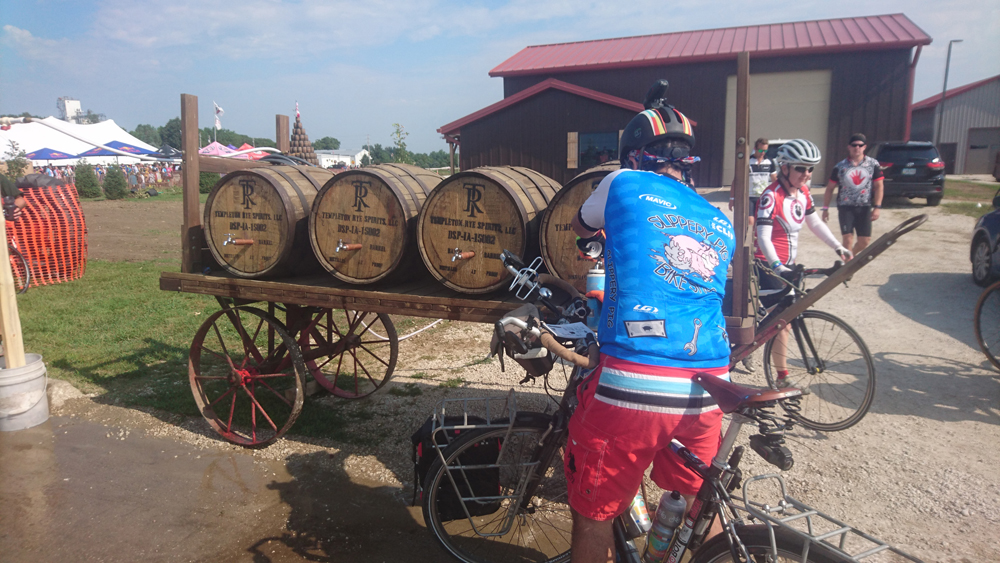
Water filing station at Templeton distillery. RAGBRAI 2018. Photo by Chris Blinzinger
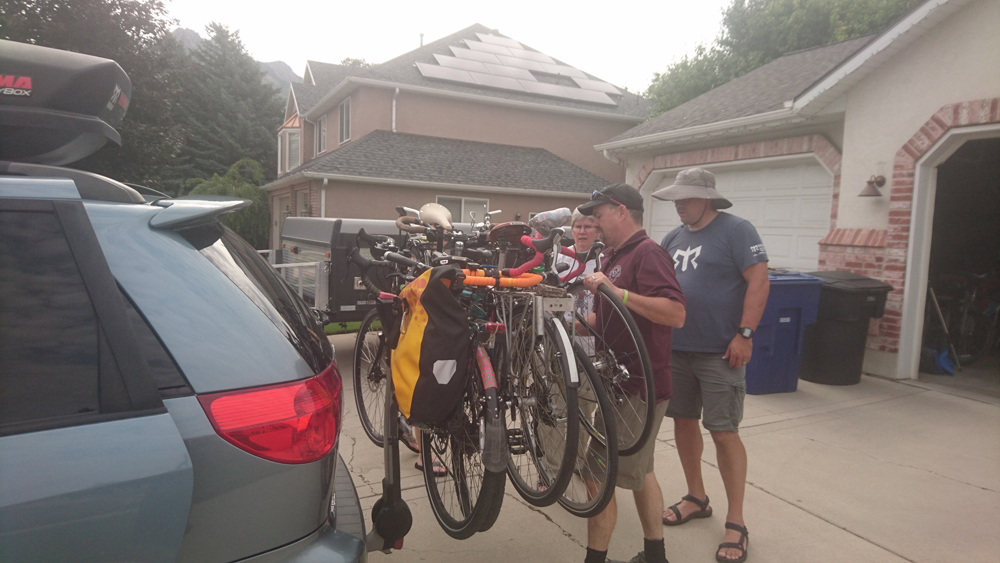
Loading up leaving Utah. RAGBRAI 2018. Photo by John Monroe
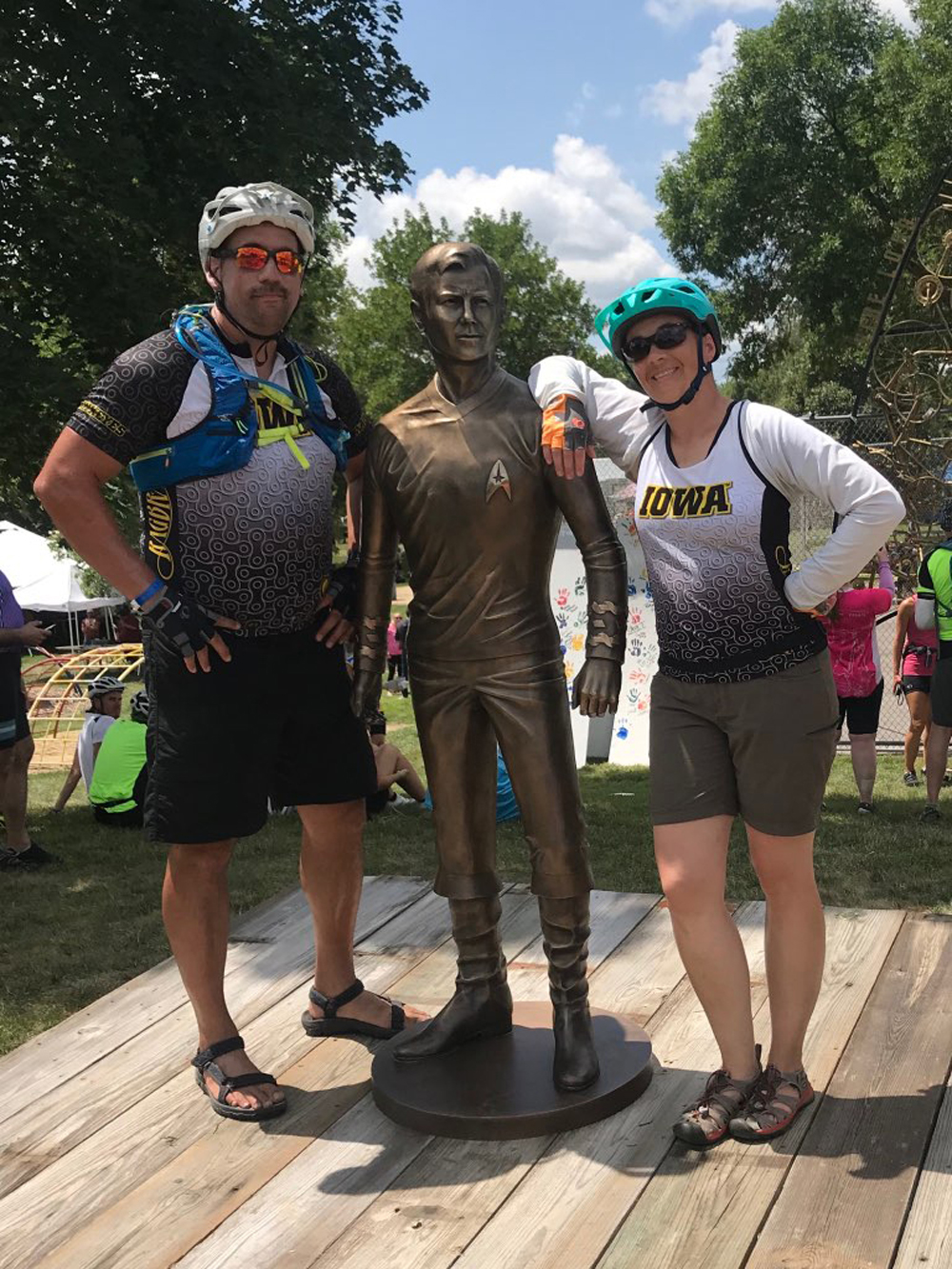
Jess and Chuck with Captain Kirk. RAGBRAI 2018. Photo courtesy Jess Galaviz
Dipping Tires in the Mighty Mississippi is a RAGBRAI tradition. RAGBRAI 2018. Photo courtesy Jess Galaviz
Chris Blinzinger is an avid cyclist, commuter and tourer. He is a member of the Provo Bike Committee and advocate for active transportation. He tours with friends and family and hopes to ride back to his home state of Indiana in the near future.
On March 20, 2019, Florencio Irizarry, from Puerto Rico, reknown Salt Lake City master bicycle mechanic, experienced a serious heart-attack. For nearly twenty years, Flo has been wrenching in the Salt Lake City area. For the longest time, one could find Flo behind a work-stand at the now closed Wild Rose Mountain Sports. These days, ‘The Bike Whisperer’ has been doing what he loves to do, fixing bicycles at Contender Bicycles in Salt Lake.
Always meticulous, Flo is the guy many ask for and will only allow to work on their bike. He’s the guy that gets the job done right, hard-working, straight forward, and humble.
Apparently, two days after he got out of the hospital and only a week after his episode, he went back to work! Sounds about right. But he figured out pretty quickly that it was going to take some time. One can imagine.
Flo and the medical community are optimistic, even so, there is always uncertainty.
Flo began working on bicycles in his Dad’s garage at age ten. By eleven, Flo was lacing wheels and continued to work on bikes until he enlisted in the US Army at age eighteen. After his Army stint, Flo honed his experience in New York City as a bicycle courier and mechanic. He has stories of how a courier might interact with traffic, especially the traffic that leans towards the aggressive. There is technique involved in retribution, but I’ll leave that for Flo to tell you himself when you visit him at Contender.
In between, Flo was a service manager at a bike shop in the Orlando, Florida area. Ever the outdoor adventurer, the mountains eventually called to Flo, snowboarding on his off days in the winter or hitting the Bonneville Shoreline trail with the Bs after after work. Rubber-side down, we’re fortunate that Flo remains a corner-stone of our bicycle community.
Flo needs time to recover and needs your help to make it through his recovery.
A GoFundMe account to help Flo – FLO BRO 2.0, has a goal of $10,000 and a tentative end date of the middle of May 2019, has been setup by Max Lohmeyer owner of The Hub, Salmon Idaho, and race director of 12 &24 hours Disco mountain bike race.
It states, “FLO will need at a minimum to take a couple months off of work to put his focus on the #1 most important thing in his life right now, his recovery. Maybe he will need more time and maybe not, either way right now he needs recovery time more than anything.”
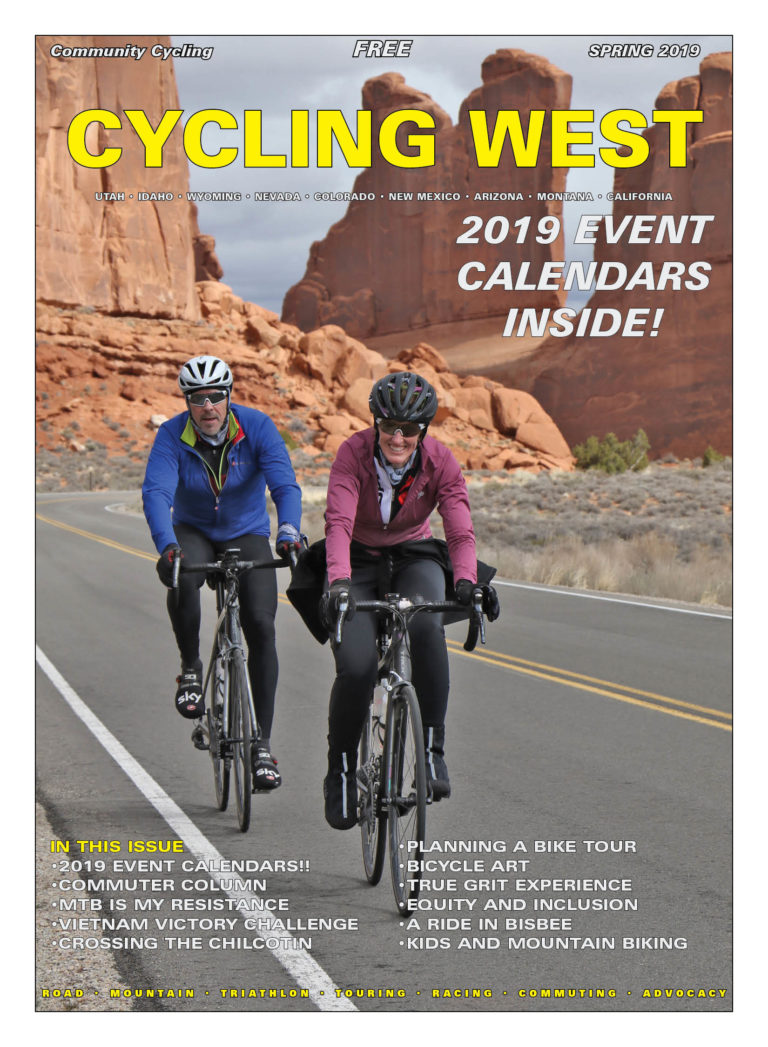
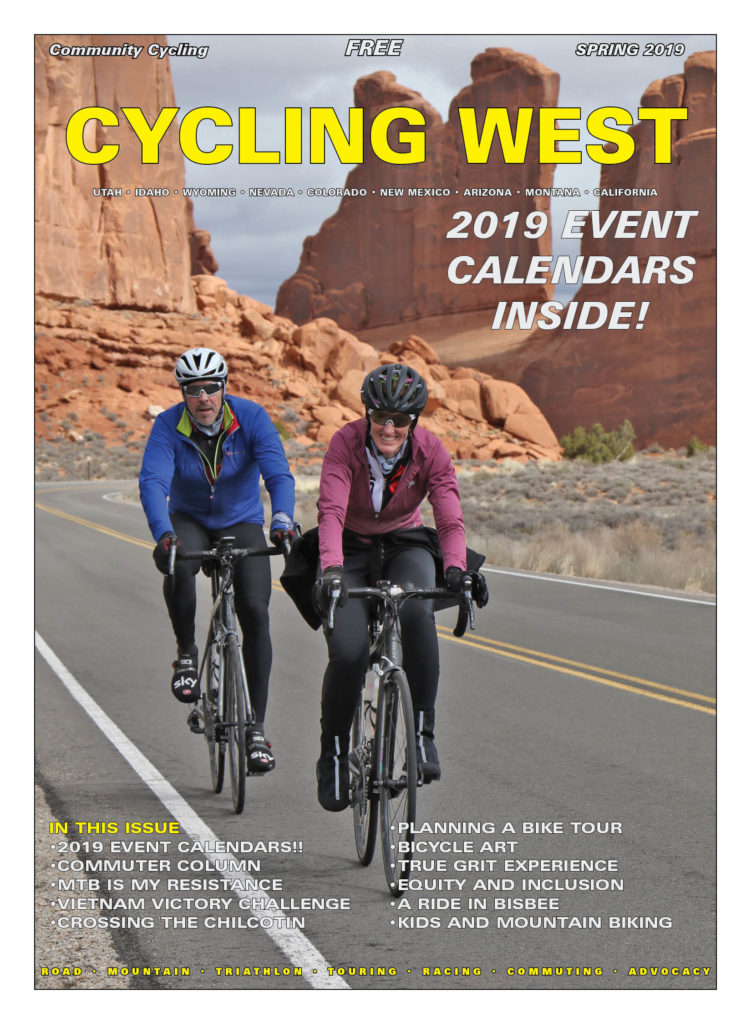
Cycling West and Cycling Utah Magazine’s Spring – April 2019 Issue is now available as a free download (7.5 mb download), Pick up a copy at your favorite Utah, Idaho, Wyoming, Nevada, Montana, W. Colorado, N. Arizona, and N. California bike shop or other location!
Cycling West Spring 2019 Cover Photo: Riders in Moab during the 2019 Skinny Tire Festival. Photo by Moab Action Shots, find your photo at moabactionshots.com
Contents
Steel is Real atthe 2019 North American Handmade Bicycle Show (NAHBS) –page – 3
A Bike Advocate Reflects on Veronica Davis’ Talk:Biking, Equity and Inclusion –page – 4
It could get harder to turn an abandoned railroad into a bike path. The Surface Transportation Board (STB) has proposed amending its rules to put a three-year cap on the negotiation period for a conversion, “absent extraordinary circumstances.” Current law allows an unlimited number of six-month delays to negotiate a deal.
STB is responding to a request from the National Association of Reversionary Property Owners, who complain of endless delays. But opponents say it can take longer to line up financing to build an interim or permanent trail, or to go through the required environmental or historic preservation reviews.
Under STB’s proposal, projects currently under review could get an additional six half-year extensions after their current one expires when the rule change becomes effective. Details: https://tinyurl.com/y8odk3z5.
You’ve heard it before but here’s one more example you can cite to argue that bike lanes help business. An academic study in San Francisco found bike lanes “rarely produce profoundly negative outcomes, and that they are often associated with positive business performance outcomes.” But they affect different types of enterprises differently. Planners, therefore, should consider the mix of establishments when adding bike lanes in commercial areas.
Bicycle Lanes and Business Success: A San Francisco Examination published in Transportation Research Record (https://tinyurl.com/ybolkv79) found that in two of three areas studied, sales went up “markedly” after bike lanes were installed. It seemed to have hurt in the third area but the study concludes “(b)icycle lanes do not seem to have the catastrophic negative effect on business that some merchants claim.” Businesses that serve local residents seemed to benefit more than others.
The study did not, however, compare areas with bike lanes with neighboring ones without them. Nor did it consider the possible effects of removing parking spaces to provide bike lanes.
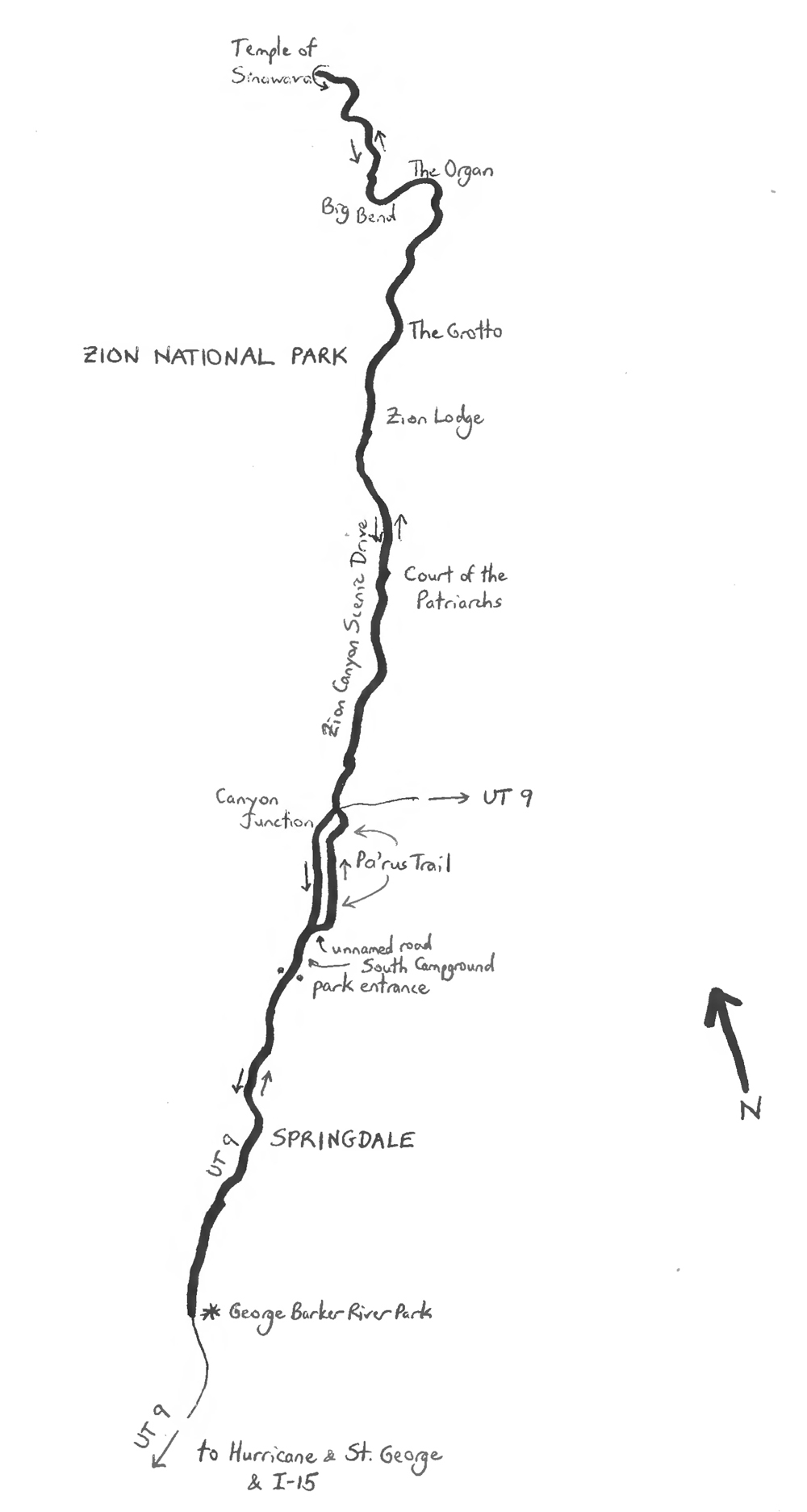
The Zion Canyon Ramble is a nifty but dense 19.8-mile, out-and-back ride from Springdale to Zion National Park and back, in southwestern Utah. The ride is “dense” in that the route is chock full of outstanding, monumental scenery. The net climbing is 664 feet. Although the ride is relatively short, taking your time to enjoy the scenic views, perhaps even stopping a few times, is highly recommended. Start the ride at George Barker River Park in Springdale, conveniently located along Zion Park Boulevard, also known as Zion – Mount Carmel Highway, and also known as Utah State Highway 9 (UT 9). The park is located on the right side of the road, just outside of Springdale’s main retail district (at 1751 Zion – Mount Carmel Highway). Exit the park and turn right onto UT 9. Prepare for some slowing as you ride through the town of Springdale. The traffic volumes cannot be attributed to local Springdale, which had a small but growing population of 570 in 2016. Rather, with 4.5 million visitors annually, as of 2017, traffic volumes heading in and out of Zion can be heavy, particularly during certain seasons. Zion was the third-most-visited National Park in the U.S. in 2017, trailing only the Great Smoky Mountains and Grand Canyon. Springdale itself is a picturesque town, nestled along a fork of the Virgin River, with scenic backdrops. But, the real scenery is up the road, in Zion.
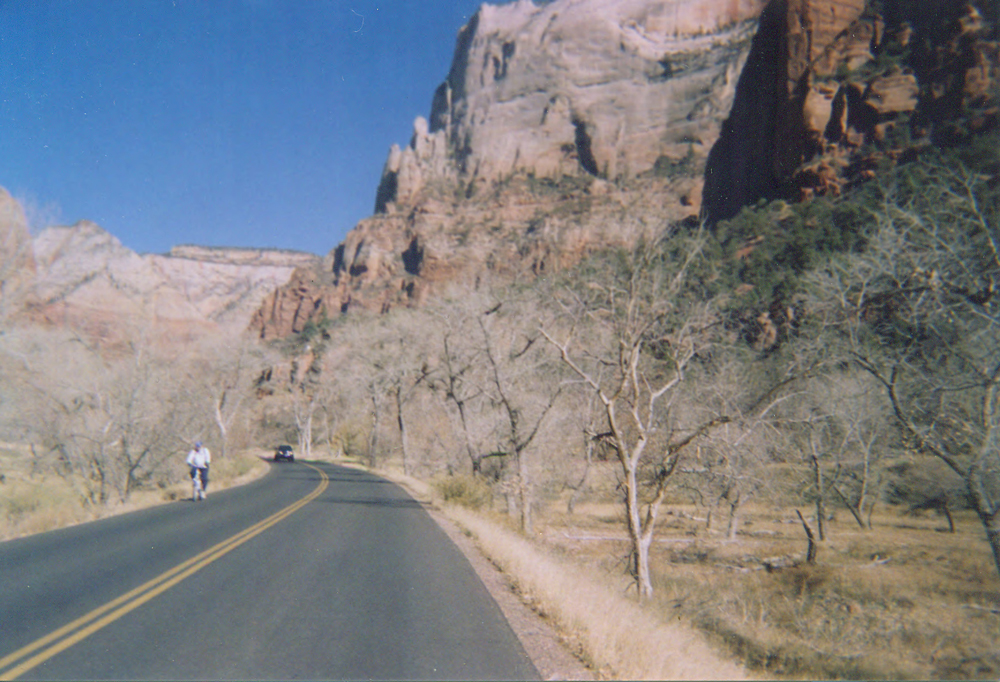
Court adjourned. A rider pedals out of the Court of the Patriarchs in Zion National Park. Photo by Wayne Cottrell
The ride starts at an elevation of 3,809 feet, at George Barker River Park. Head toward Zion on UT 9; it is a gradual climb, with a couple of rollers, as you head through town. Just beyond the two-mile mark, pass a small parking area on the right – this is a dropoff zone for Zion, for those who prefer to hike in. It was otherwise a $35 entrance fee for most motor vehicles as of this writing. Bicycles are not exempt (nor are pedestrians), with a $12 fee. The entrance pass is good for seven days, so you can come back! (That’s seven consecutive days, unfortunately). After entering the park, ride past the parking and camping areas on the right. At mile 2.75, turn right onto the unnamed road, followed by a left turn onto Pa’rus Trail. Trail? The trail is actually a wide, paved path that is a pleasant alternative to riding or walking along the road. The trail meanders adjacent the Virgin River’s North Fork, crossing it several times. The river may be seasonably dry. Pass under UT 9 at mile 3.75, and then emerge onto Zion Canyon Scenic Road. Cross over to the other side of the road, and continue heading north. Although the scenery thus far has been spectacular, the experience becomes majestic, as the road enters the Court of the Patriarchs. There is a trailhead here. To your right are the Twin Brothers, and to your left, maybe out of view, are The Sentinel and the Altar of Sacrifice. Admittedly, among the attributes of Zion are the majestic names of the park’s features, all of which add to the mystique of the experience. The road continues to climb gradually, as you pass Mount Moroni to the left, and Zion Lodge on the right. The lodge is an actual lodge, rather than a natural feature. You are now 6.3 miles into the ride. The canyon narrows north of the lodge, with Red Arch Mountain on the right, followed by the Great White Throne, and Mount Majestic on the left. There is a picnic area and trailhead along here.
The canyon continues to narrow, as the road enters The Organ (mile 8.3). The experience is that of riding into the bowels of a great pipe organ, with the road twisting to the left, and then to the right, all with limited sight distance, except for vertical (up), and the prospects of ascension. There are trailheads at Weeping Rock and Big Bend, just off the road. The slot canyon effect follows you as leave The Organ, and gradually enter the Temple of Sinawava, also known as The Pulpit. The road ends here (mile 10.0), in Zion’s all-natural version of surround sound, where sheer walls nearly encircle you. From here, Riverside Walk (hiking trail) continues up the narrow canyon to the north, toward more of Zion’s features. If you can, park and lock your bike, and take a short hike, before heading back.
The return ride reverses the outbound route. The only exception is to skip the Pa’rus Trail on the way back, and stay on the road. Given that the prevailing direction is downhill on the way back, your speed may be a smidgen too high for comfortable riding on the path. Thus, keep straight on Zion Canyon Scenic Road at the Pa’rus Trail, remaining on the road. At UT 9, turn right; the road curves to the left and heads south, toward the park exit, and on into Springdale.
Starting & ending point coordinates: 37.177272oN 113.008700oW
The Zion Canyon Ramble is a nifty but dense 19.8-mile, out-and-back ride from Springdale to Zion National Park and back, in southwestern Utah. Map by Wayne Cottrell
For more rides, see Road Biking Utah (Falcon Guides), written by avid cyclist Wayne Cottrell. Road Biking Utah features descriptions of 40 road bike rides in Utah. The ride lengths range from 14 to 106 miles, and the book’s coverage is statewide: from Wendover to Vernal, and from Bear Lake to St. George to Bluff. Each ride description features information about the suggested start-finish location, length, mileposts, terrain, traffic conditions and, most importantly, sights. The text is rich in detail about each route, including history, folklore, flora, fauna and, of course, scenery.
Wayne Cottrell is a former Utah resident who conducted extensive research while living here – and even after moving – to develop the content for the book.
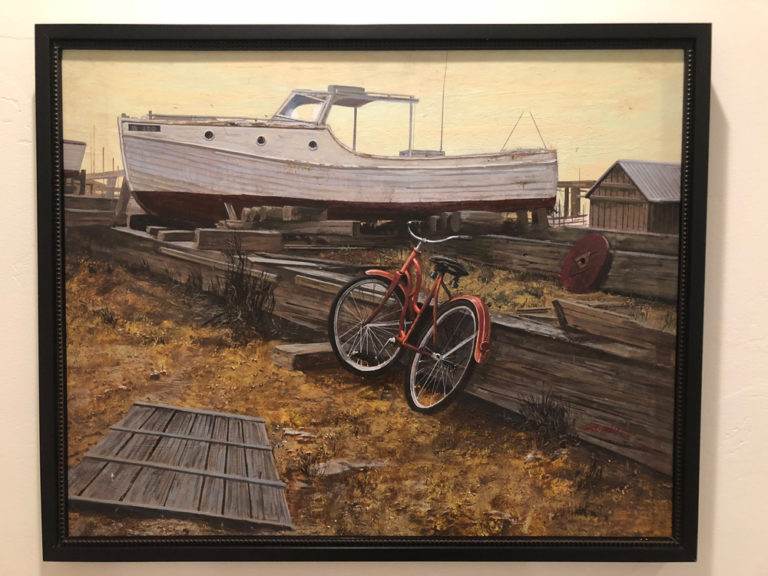
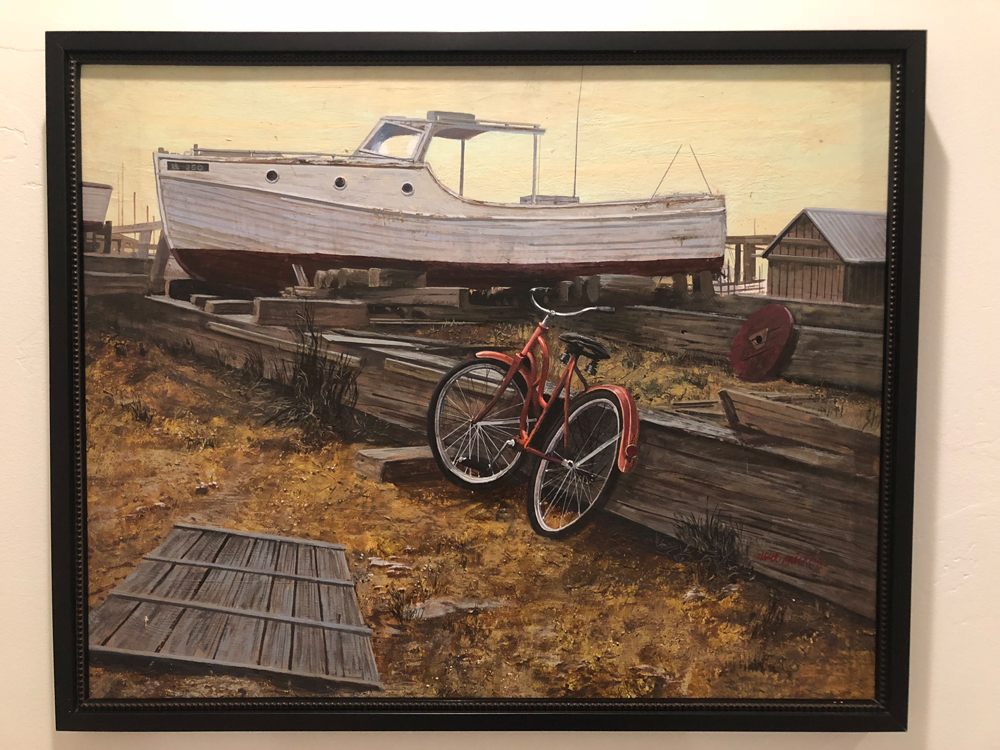
A picture of the marina in Rowayton, Connecticut. Painting by Albert Michini
Name of the artist: Albert Michini
Title: Untitled
Subject: A picture of the marina in Rowayton, Connecticut
Medium: Oil on Canvas
Brief biography: Albert Michini’s style of art was realism and his works always reflected proper proportion, detail, and light patterns. He was a painter, sculptor, photographer, sketcher, and etcher. One of Al’s passions was anything with wheels. He incorporated bicycles, motorcycles, airplanes and cars in many of his works. Riding his bicycle around town, down by the water, was a daily habit in the summer in Connecticut. He even commuted to work on his motorcycle with paint boards strapped to the back.
He was born in 1925 in Philadelphia, Pennsylvania and spent most of his life in the area. Al was the oldest of 5 children and the son of Italian immigrants. At the age of 18, Al enlisted in the army and became a platoon leader traveling through Europe as the allies reclaimed German occupied territories in World War II. After the war, he returned to Philadelphia and enrolled in the Hussian School of Art where he obtained a bachelors degree in fine arts. Upon graduation he became a teacher at the Hussian school and also worked as a freelance illustrator.
In the mid 1960s Al moved his family to Connecticut to teach at the Famous Artists School which was an art correspondence school founded by Norman Rockwell and Albert Dorne. During this time he continued his freelance work which included some notable things such as the 1972 Boy Scout manual, Golden Book Encyclopedias, and back covers for The Saturday Evening Post, Creepy and Vampirella magazines. He also wrote a book called “The Artist and The Camera”.
In 1976, Al moved his family back to Pennsylvania to work as a sculptor of commemorative coins for The Franklin Mint. At that time he also joined the Air Force Art Program. Through the program he was able to witness the rollout of many new planes and produce paintings of these planes. His artwork still hangs in the Pentagon.
Albert Michini passed away in 1994 but his legacy lives on in the still vibrant works of art that hang on the walls and rest on the bookshelves of his children, grandchildren and countless Americans.
So just where is the Recreational Trails Program (RTP) funding going? A few senators want a better idea and have introduced the RTP Full Funding Act of 2018 (S. 3604), which would require a study every five years of how much money from nonhighway recreational fuel taxes is going into the Highway Trust Fund for that purpose and to see if each state is getting its fair share. Up to $3 million from the fund could be diverted to this study.
The bill was referred to the Environment & Public Works Committee. Of the four cosponsors, the only one coming from a western state is James Risch (R-ID). See https://tinyurl.com/y8wnjmtm .
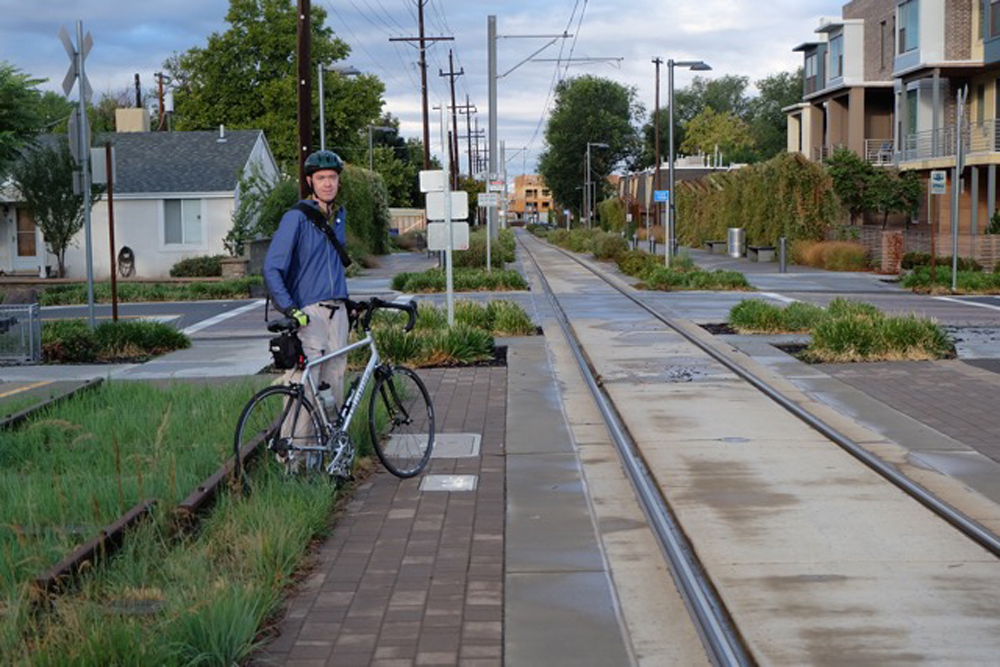
Kelly Gilman, landscape architect, on his showpiece, the S Line Trail, in Salt Lake City, Utah. Photo courtesy Kelly Gilman
The architectural firm CRSA designed the landscape along the S-line bike trail in Salt Lake City. Kelly Gillman, a senior principal with the firm, was the lead landscape architect and managing principal on the project. He now uses the S-line to bike to his office. Due to his firm’s diligence and design work, Kelly and his fellow architects were able to avoid UTA’s planned concrete and cyclone fencing for the much more aesthetically pleasing plant based wall separating the bike path and the streetcar.
Cycling Utah: Kelly, before we move onto your role in the S-line bike trail landscaping, let’s talk about you, your family, and then your bike and commute. So tell me about you and your family.
Kelly Gillman: I am married with two daughters. I am a landscape architect and certified planner, a principal with an architecture and planning firm in Salt Lake City. My wife (Tina) is also a landscape architect, but also a teacher at our daughters’ school.
My family is supportive of my bike commute. Although the commute means I may be home a little later than if I drove, they appreciate that I arrive home with a clearer mind. The ride allows me to push the demands of the work day behind me. They also appreciate that I am healthier.
C.U.: Do your wife and daughters follow in your cycling footsteps?
K.G.: The school Tina teaches at, where our daughters attend is near the Marmalade District downtown. It is too far from our Canyon Rim neighborhood (in the city of Millcreek) to realistically ride to. However, Tina does regularly ride around our neighborhood to get to exercise class, or with other neighbors. A few years ago she designed the bike path system on Wasatch Blvd (when she was with a previous firm). She rides it with a neighbor from time to time. Our daughters haven’t shown much interest in riding, other than to go to Bob’s Brain Freeze.
C.U.: Tell me about your commuting bike. I understand it once belonged to your father?
K.G.: I first started commuting a couple of years ago on my mountain bike. As I found myself enjoying the ride, I decided to try a road bike. I obtained my first road bike from my Father. He had scaled back his riding and I asked to try it out and now it is my full time bike. It is a Specialized Sequoia. My father used it for longer rides rather than commuting. I am also using it for weekend rides as well as my daily (3 times a week) commute. Because of its age I needed to make a few simple repairs (although not necessarily upgrades) to the bike. I’ve so far primarily added new Shimano wheels and a RoadMorph bike pump. I am considering putting a rack on the bike so I don’t have to carry my clothes in a pack on my back.
C.U.: Tire size is a frequent mention in cycling articles and in my experience commuters use a variety of widths. What do you use and has it worked for you?
K.G.: I am currently riding with 23MM size tires. I haven’t had any issues with them, but I admit I have very little experience with any other sizes other than what is typical for a mountain bike. I suspect if I extend my commuting into the winter I will appreciate trying some other tire widths to compensate for the greatly varying road conditions.
C.U.: What is your route to work? What are the best and worst features of the route?
K.G.: From my home on the east side of Canyon Rim, I jump on the Parley’s Trail at Tanner Park and ride through Sugar House to the S-Line Greenway, that we designed at CRSA. (Incidentally, the S-Line Greenway was featured in Landscape Architecture Magazine in November of 2017).
At 600 East I turn north riding through Liberty Park. I continue on 600 East to South Temple. My office is just off 600 East and South Temple. I have enjoyed the new Parley’s Trail more than I expected, and love the connection to the S-Line Greenway. Although I didn’t mind the previous route down 2700 South, I enjoy the trail much better. The surface on 2700 South is not great and the traffic can be heavy.
There are a couple of minor inconveniences with the route I take. On 600 East the crossing at 800 South can require a long wait for a break in traffic. The warning signals don’t activate unless a pedestrian on the corner pushes a button. As 600 East is a lightly travelled road, the signals between 400 South and South Temple can take longer than average to cycle to green. However, recent crossing upgrades at 900 South, 1300 South, and 2100 South are very nice.
C.U.: Why do you commute by bike?
K.G.: I commute by bike primarily because it helps me feel good about myself. Cycling to work has great health benefits both physically and mentally. I can achieve some of these benefits by taking transit (driving can be stressful). However my 9-mile ride is faster than taking transit though not faster than driving.
C.U.: How often do you commute by bike? What keeps you off the bike to get to work?
K.G.: I have only been commuting for about a year and a half. I typically ride about three days a week. It difficult to ride every day as I sometimes have the need for a car at the office for business related travel. I stopped riding in November last year and started back up again in February. It can be fairly windy and extra cold near the mouth of Parley’s Canyon where I depart in the morning. When it drops below about 40 to 45 degrees in the morning, I typically tap out unless it is a day where I can wait until later in the day to start my ride. I have not yet invested in the bike or personal gear needed to be comfortable on these cold winter mornings.
I don’t believe Parley’s trail receives any winter maintenance. I know there are facilities around the country that are maintained year-round. I would be interested to see how many cyclists here in Salt Lake City would take advantage of a year-round facility. I know there are many who commute on bike in the winter but I have not made that leap yet.
C.U.: Now that you have had about 1.5 years of seeing the completion of your work as you ride the S-line trail, what do you think?
K.G.: Overall the project has met our vision. As landscapes grow and change over time it has been fun to see the plant materials mature and grow into the long term vision and experience we had in mind.
C.U.: I’m impressed with how nice the landscape has been kept. Who maintains the S-line?
K.G.: Salt Lake City and South Salt Lake, as I understand it, are overseeing the ongoing maintenance of the project. City staff, and at times, volunteers work to maintain the trail and greenway. The Utah Transit Authority ensures the streetcar line is maintained to safety standards.
C.U.: What are your overall thoughts about separated bike trails like the S-Line trail or redesigning roads to accommodate bikes?
K.G.: I believe there should be a range of options provided in all modes of transportation. Everyone should have reasonable access to the modes that work best for them. I say this because our roads, especially local roads, are paid for by a variety of funding sources and shouldn’t be (in most cases) designed for single mode use. Separated multi-use paths and trails are part of the overall system, and I would like to see investment in these facilities as well. These facilities are used for commuting but also for recreational activities. This all adds to the richness of our community.
C.U.: Thanks Kelly. Perhaps we will see more pedestrian/bike facilities developed in the style developed by CRSA.
If you have a suggestion for a commuter profile, especially from Idaho, Montana, Nevada, Wyoming, W. CO, and N. AZ, have a commuter question, or other comments, please send it to [email protected]
McCoy Flats could get more mountain biking options under legislation introduced in Congress. Rep. Rob Bishop (R-UT) introduced the Northern Utah Lands Management Act (H.R. 6843), which calls on the Bureau of Land Management (BLM) to create a trail system and map of trails around the area in Uintah County, UT.
The legislation allows construction of new trails and calls for a long-term management plan to be implemented within two years.
The area already contains 10 short trails comprising 35 miles of track. BLM and several organizations have already mapped the area.
The bill (https://tinyurl.com/y8esz9ex) was referred to the House Natural Resources Subcommittee on Federal Lands. It picked up no cosponsors and the subcommittee hasn’t acted on it since its Sept. 26 introduction. Bishop chairs the full committee until the end of 2018.
A few new tools can help communities make the roads safer for cyclists and pedestrians, direct from Washington, DC.
The Guidebook on Identification of High Pedestrian Crash Locations (https://tinyurl.com/ydarfsak), a manual for traffic planners from the Federal Highway Administration includes tips for improving bicyclist safety, acknowledging that agencies need to take a different approach to improving bike/ped safety than they do for motorist safety and that since most crashes involve motorists, they may focus their attention on them and give leg-powered transit short shrift. Cyclist crashes also get underreported, lessening awareness of them.
The tome refers readers to a variety of tools that can help determine safety needs. But it says we still don’t know some basic necessities, such as the relationships between the number of cyclists crossing an intersection or on a road to the number of incidents.
Meanwhile, the Transportation Research Board in October 2018 released the 2017 FARS/CRSS Pedestrian Bicyclist Crash Typing Manual A Guide for Coders Using the FARS/CRSS Ped/Bike Typing Tool, with the initials standing for Fatality Analysis Reporting System and Crash Report Sampling System (https://tinyurl.com/ya3wdh88).
The manual revises factors to consider when coding incidents (presence of crosswalk, school zone,, traffic light…) and factors such as whether a motorist or cyclist lost control of the vehicle.
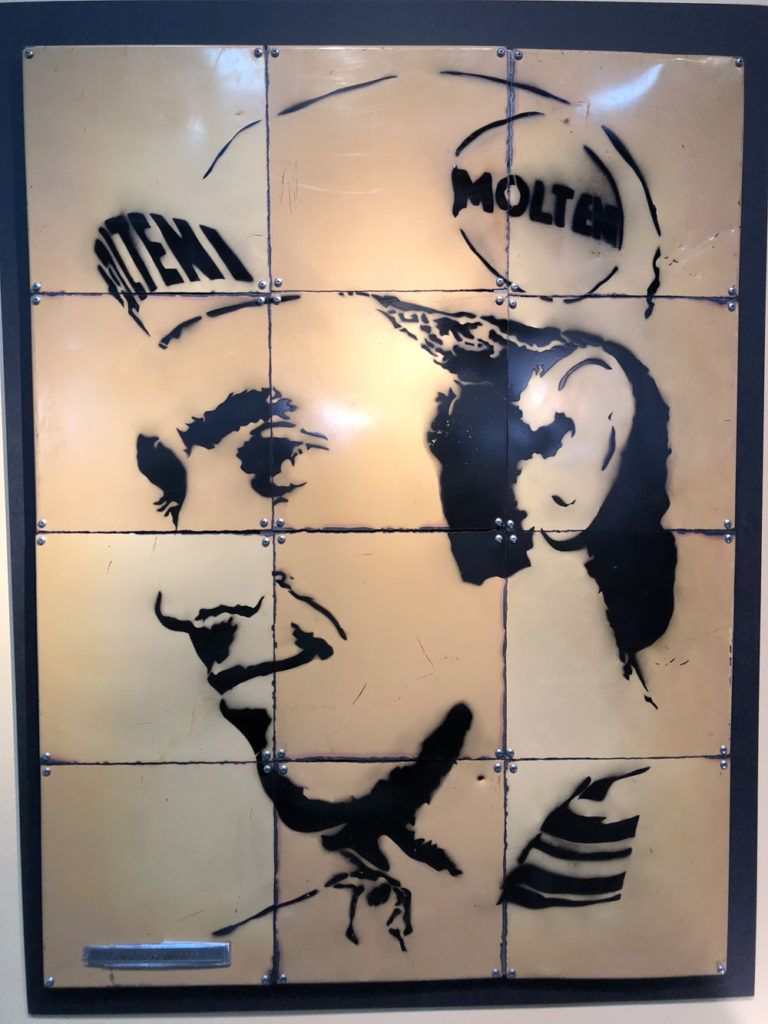
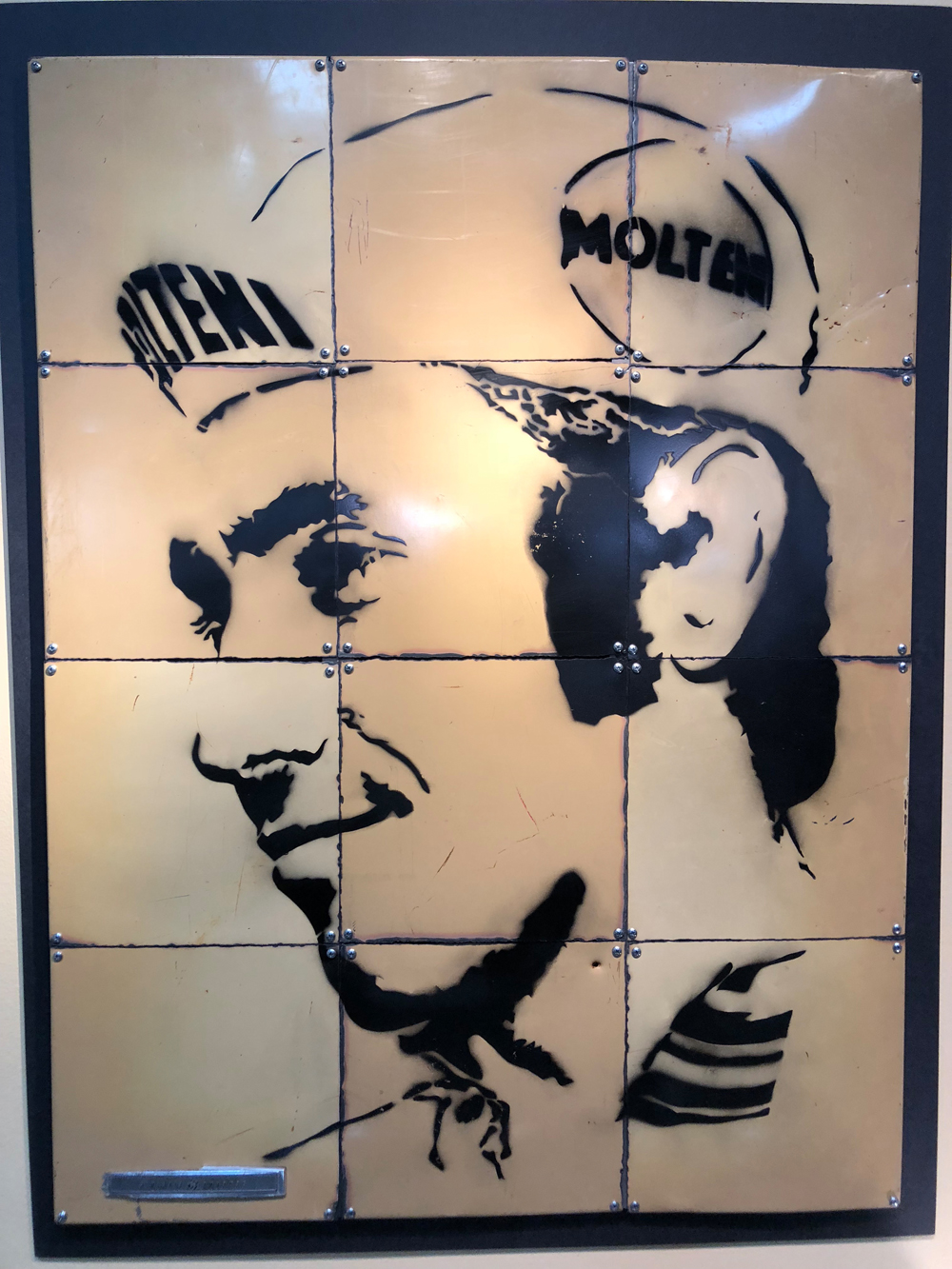
Title: De Kannibaal Medium: Spray paint, refrigerator, a bit of wood, and a bunch of screws.
Process by which you created this: After coming across an old refrigerator in the desert, I hauled it home in hopes of being able to salvage enough of the exterior to make a interesting canvas. I cut the exterior of the fridge into usable tiles and then rattle-canned them with a stencil that I had hand cut.
Background: I had originally made the piece for an annual bicycle art show that was hosted by a good friend, Brent Hulme, at the Salt Lake City Bicycle Company. He’d had asked if I wanted to display anything – and so I whipped up the portrait of Merckx. I had no intention of selling it, and when it sold, the mrs. was kind of sad that the it wasn’t coming back home. I ended up buying her a weed eater with the cash from the sale.
Where can people find your art? I tinker and dabble in my shop, but rarely do my creations make me any money. That’s what day jobs are for. Most of the items created in my shop are purpose built, one-off creations aimed at fulfilling a need, while maintaining some sort of flair. I tend to overdo things. Generally, the satisfaction that I get out of a project is had at about 2:00 am in my shop when whatever I am working on is finally completed, my shop is a complete wreck, and I catch myself giving whatever it is that I have built the thousand yard stare. You can find my “art” at every corner of my shop, my home, and in the hands of my friends and family. Furniture, doors, custom engine carriers, bicycles, you name it – they are strewn about. Many of them are used and loved, some are in a pile waiting for another chance at becoming something good.
Are you still building bikes? Tell us about them: I am still building bikes, but at a snails pace – and mostly for friends and family. Extra time is becoming a precious commodity around my shop, and I find myself leaning towards spending time with my lovely bride and my youngster rather than filing my life away. I imagine that I will always be building bikes, but right now – I have other priorities.
Where can people find more information on this? I post somewhat regularly on Instagram (jrusshanson). If you are interested in being inundated by photos of Volkswagens, feel free to have a looksee. I have tens of followers.
Editor’s Note: The art can be seen at Trek Bicycles of American Fork (trekAF.com)
In 32 years (2050), we will be dealing with major food issues. By then, the global population will have grown from today’s 7.6 billion people to 10 billion people (not due to lots of new babies, due mainly to longer lifespans related to better health care and nutrition). We will need 60% more food than is available today. To do so, farmers will need to increase crop yield, use water more effectively, and feed animals more efficiently. The agricultural industry is working hard on that—and climate change complicates it all.
As athletes, we like having plenty of food to eat and clean water to drink. Hence, we want to think about how we can invest in a sustainable future with our food and lifestyle practices. While we may suffer less from food shortages than will the people and athletes in less developed countries, we won’t be able to escape these environmental problems:
oppressive heat that not only damages crops but also drains the fun from playing outdoor sports, like soccer and tennis;
storms that disrupt plane travel for sports teams, as well as the flights of thousands of recreational athletes going to, let’s say, New York City for a marathon;
floods that ruin farms and crops, as well as playing fields;
droughts that kill crops, golf courses, and gardens.
The timely topic of sustainable diets and animal agriculture was prominent at the Academy of Nutrition and Dietetics Food & Nutrition Convention & Expo (#FNCE). The message was clear: We are facing the urgent need to curb greenhouse gas emissions (GHGE) to reduce our carbon footprint and invest in our future well-being. Here’s some of what I learned from speakers Frank Mitloehner PhD, professor and air quality specialist at the University of California-Davis, and Amy Myrdal Miller RD of Farmer’s Daughter Consulting. Perhaps this information will nudge you to think more about how your food and lifestyle choices impact the climate—and inspire you to make some changes.
Waste less food. Up to 40% of the food we produce gets wasted. About 16% of that happens at the farm (e.g., sick animals not treated with antibiotics, unharvested crops due to labor shortages or “ugly” produce); 40% happens in food service and restaurants, and 43% in our homes. Who among us hasn’t tossed out “ugly” apples, over-ripe bananas, and perfectly good leftovers? A huge contributor to food waste is the “best used by” date on food packages. Please note: the “best used by” date is not a “don’t eat this” expiration date, but rather a marker for quality and freshness.
Wasted food required energy to be produced and then transported to your supermarket (and landfill). Wasted food takes up 21% of precious (and limited) landfill space; this represents the largest percentage of all waste in US landfills. As it rots, creates the greenhouse gas methane.
To reduce food waste, you want to shop carefully, use leftovers, and compost food scraps. Restaurants, colleges, and other quantity food producers need to figure out how to find a meaningful home for leftovers, such as by donating to food pantries, if permitted.
Eat less animal protein. Farm animals produce methane, so reducing the demand for meat is another way to help the environment. Yet it is not the biggest way to help. That’s because meat/food production is not the leading cause of GHGE, despite what you might have read repeatedly in the recent past. Hence, you do not need to become vegan unless you truly want to do so. If everyone were to eat a vegan diet every day, GHGE might drop only 2.6%. But you do want to eat meat less often and in smaller portions. If all Americans honored Meatless Mondays, the drop in GHGE in the US would be 0.5%.
While not the cure-all for carbon emissions, every little bit helps!Instead of blaming farm animals for being methane producers, the far bigger sources of GHGE are from the burning of oil, coal, and natural gas (fossil fuels). The environmental benefits of eating less animal protein of any type pales in comparison to the benefits from reducing fossil fuel use. Using fossil fuels to create electricity accounts for 30% of all GHGE. Transportation accounts for 26%, and industry, 21%. Agriculture contributes to only 9%, and animal agriculture alone, about 4% of all GHGE in America. (This number includes the carbon footprint of animals from birth to being consumed.) To put this in perspective, a recent study showed that switching from a meat-based to a vegan diet for one year equates to the GHGE of one trans-Atlantic flight from the US to Europe.
Educate yourself about the pros and cons of grass-fed beef. With conventional agriculture, corn-finished cattle are generally raised on pastureland first for about 10 to 12 months, and then finished on a corn-based diet for the last 4 months to optimize marbling. Grass-finished cattle spend a total of 26 to 30 months on pastureland before they are slaughtered. All of that time, they are making manure, belching from the high fiber grass diet, and releasing methane. Corn-fed cattle produce far less methane and are content to eat the corn when well-balanced into their diet. (Yes, I know there are other reasons you might want to choose grass-fed cattle. I’m just talking sustainability here.)
Another way to reduce GHGE might be to start considering the possibility of eating protein-rich insects. I admit, I’m not there yet—but they are a sustainable source of protein. We just need more research to learn about the digestibility and bioavailability of insect protein—and how to make it yummy.
Solving the world’s impending food (and water) crisis is a huge global issue. We need governments around the world to look holistically at the complex interplay between the environment and food production systems. While we need to work together globally, each of us can act locally. How about biking more, driving less and wasting less food, as well as eating less meat? The next generation will thank us.
Nancy Clark, MS, RD counsels both casual and competitive athletes at her office in the Boston-area (Newton; 617-795-1875). Her best selling Sports Nutrition Guidebook and food guides for cyclists, marathoners, and soccer players offer additional information. They are available at www.NancyClarkRD.com. For her popular online workshop, see www.NutritionSportsExerciseCEUs.com.