Finally, Sen. John Barrasso (R-WY) got another measure through committee that Congress failed to pass last year. The Senate Committee on Indian Affairs approved S 207, a bill to improve roadway safety on Indian reservations. The bill aims to make it easier to get permits for tribal road safety projects such as signs and signals at bicycle crossings, crossing islands and hybrid beacons. Projects can only allow rumble strips if they do not impede bicyclists.
The bill would give the U.S. Dept. of the Interior a 45-day deadline to review projects, with a 30-day extension possible.
In 2017 Governor Herbert initiated the 1,000 Miles Campaign with a goal to build 1,000 new miles of family-friendly bike lanes, paths, and trails by 2027. This effort will set Utah on course to be the premier bicycling destination for all riding disciplines and skill levels.
Bike Utah is the nonprofit partner designated to carry out the implementation of the 1,000 Miles Campaign. We provide strategic planning, technical assistance, and connections to financial resources, so communities can begin or continue developing bicycling in their area. We are particularly interested in working with communities on paved projects, e.g. multi-use paths and physically protected lanes. We can also assist with mountain bike trails!
Bicycling provides a multitude of benefits for invested communities ranging from increased quality of life to roadway decongestion. We can help you understand how best to leverage these benefits through diverse types of infrastructure that meet the precise needs of your community.
Since the creation of the 1,000 Miles Campaign, Bike Utah has assisted seven counties and eighteen communities throughout the state to implement plans and encourage progress. Also, we have tracked 61 miles of relevant infrastructure and trails built since 2017.
Blake Olorenshaw, Daggett County Economic Develop Committee Chairman, said of a current 1,000 Miles effort in his county, “I remember hearing about plans and rumors to get a bike path/walking path since the early 2000’s. Once we were put in contact with the 1,000 Miles Program, the rumors are becoming a reality. We are in the process to get a bike path in our wonderful community. This is game changing! This will make the amazing place next to Flaming Gorge even more accessible.”
We need your help to track more miles! We know that many more family-friendly miles have been built in Utah since the 1,000 Miles Campaign was initiated.
We are looking for maps with descriptions including your name, project name, location, distance, a short description of the type of infrastructure, and any available photos. When the information is verified, it will be recorded here: BikeUtah.org/1000miles .
Here are basic standards for what constitutes a family friendly bike path, lane, or trail to be supported and tracked by the 1,000 Miles Campaign.
Paved Infrastructure
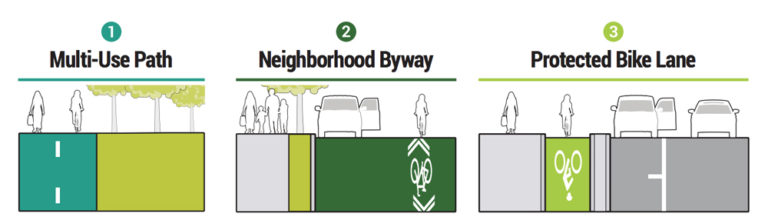
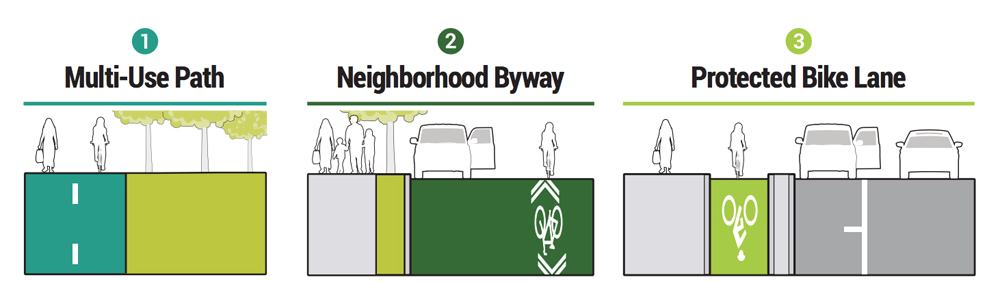
0 – 25 mph – Neighborhood Bikeway; no Separation but requires signage/markings designating space as bicycle friendly with appropriate road treatments to reinforce speed limit
26 – 44 mph – Physically Protected Lane; curbs, bollards, etc. may be used as physical protection for cyclists
45+ mph – Multi-Use Path separated by at least a median or grade separation
Bike Path Typology (From Salt Lake County’s Bikeway Design Guide, https://slco.org/uploadedFiles/depot/fRD/planning_transportation/SLCoBikewayDesign.pdf)
Images sourced from Salt Lake County Regional Planning & Transportation; Bikeway Design
Mountain Bike Trails
A range of difficulties are allowed so long as signage is posted indicating the level of difficulty. These may range from Easiest to Extremely Difficult (white circle to double black diamond).
Ready to get your community involved? Know of infrastructure that belongs on the map? Please send any questions, requests, and submissions to [email protected].
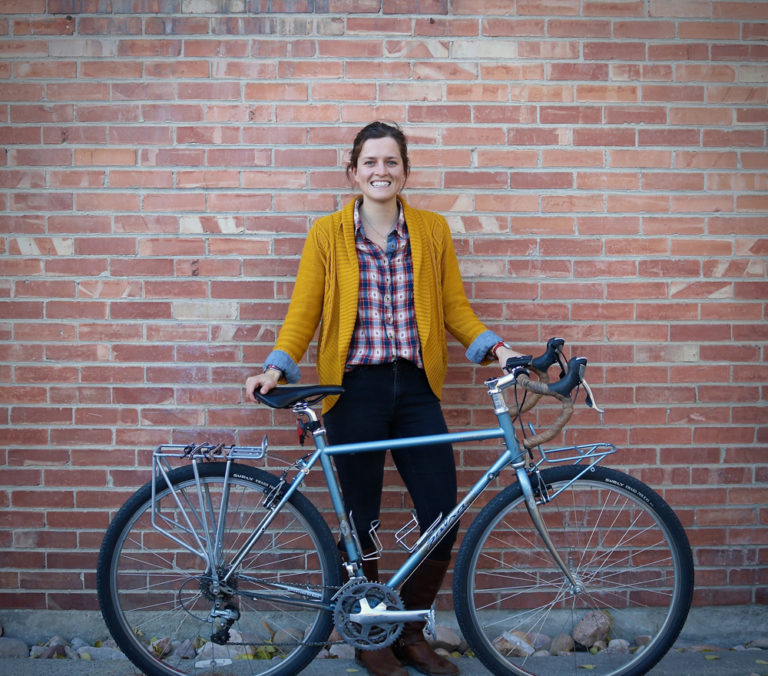
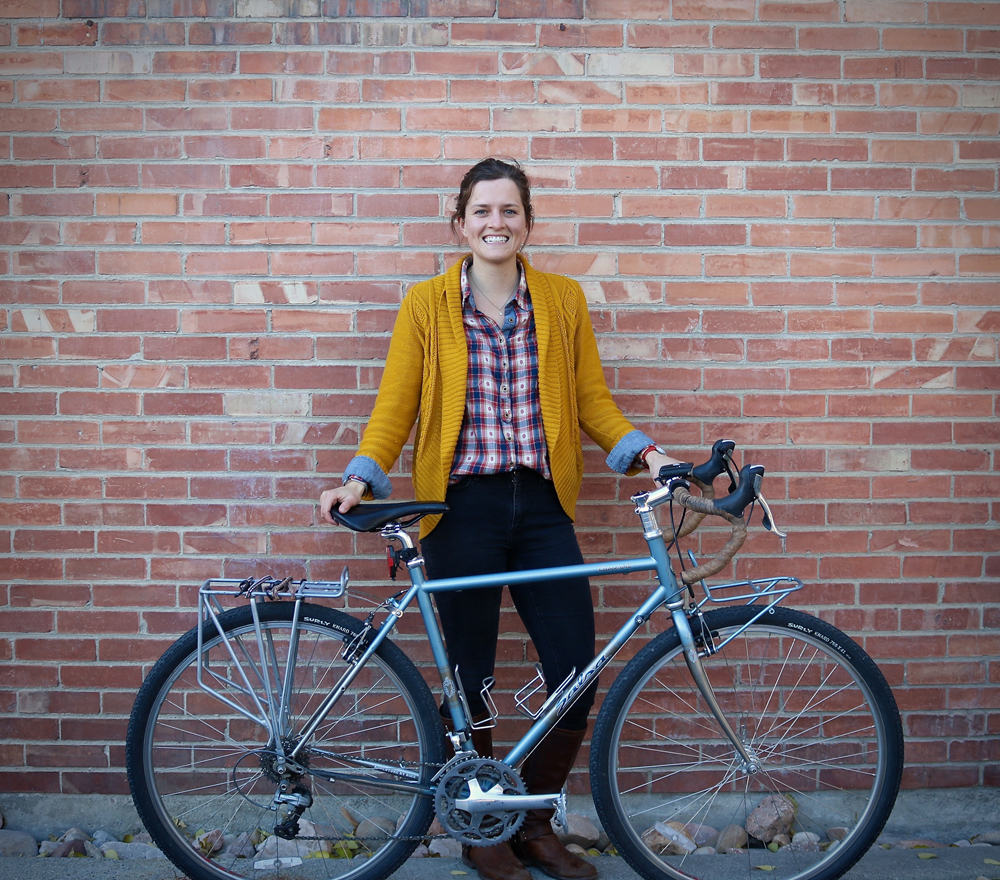
Stephanie Tomlin is a transportation planner with Fehr & Peers and also sits on the board of Bike Utah. Photo by Phil Sarnoff
Cycling West: Stephanie, It has been 3 years since you were last featured in Cycling Utah. At that time you were with Aggie Blue Bikes on the campus of Utah State. What have you been up to since that time?
Stephanie Tomlin: I wrapped up my time as program director of Aggie Blue Bikes and defended my master thesis on active transportation planning in Cache Valley in May, 2016 and took the opportunity to travel for three and a half months throughout eastern Europe with Sam (Warrick, center manager for the SLC Bike Collective). We returned in early September and I started working at Fehr & Peers Transportation Consultants as a transportation planner shortly after, where I am still working today. At work I specialize in active transportation planning and design, which means I get to help create bike lanes, multi-use paths other facilities to make biking and walking easier and safer throughout the state and the west. It’s an ideal gig for me – it’s what I wanted to do when I got into planning.
Other than work, I spend my free time on any bike I can, skiing, canoeing, camping, throwing pottery, and tending to the Warrlin Ranch – a one-acre urban homestead Sam and I bought out in West Valley. We have two dogs, turkeys, chickens, lambs, fruit trees and a 2,500 square foot garden. It keeps us plenty busy, but in the best way possible!
C.W.: You now live in West Valley City. In my mind, there is a disconnection when associating West Valley City and bicycle commuting. Tell me that I am wrong that West Valley is bad for bike commuting.
S.T.: Haha, it’s actually funny that you bring this up because it is something I am very involved in right now. The firm I work for, Fehr & Peers, was actually hired by West Valley City to create a bike and pedestrian implementation plan, of which I am the project manager for! So I am becoming intimately familiar with the biking and walking condition both from the standpoint of a resident and from the standpoint of a transportation professional. There are definitely some improvements West Valley can make towards becoming friendlier for those on foot and on bike. I would say one of the most difficult things to work around is the large state roads that crisscross West Valley. Crossing Bangerter and Redwood or 3500 South on foot or bike, for example, is very difficult and dangerous. And with those major barriers people are a lot less likely to get out biking and walking in the first place. There are also segments of roadway without sidewalks and generally there are not too many bike lanes to speak of. However, West Valley does have some wonderful low volume neighborhood streets that are great to ride and walk through, and the city is bordered on the east side by the Jordan River Trail. There are some great things going for the city, it’s just a matter of making some key connections and implementing some important facilities that prioritize those on foot and bike.
C.W.: From the perspective of someone in the transportation industry, in your experience what is the most difficult constraint to overcome when building cycling facilities?
S.T.: I find that space acquisition is often the most difficult barrier to overcome when trying to plan for and build cycling facilities. Often cities are in a situation where they are looking to retrofit cycling facilities on an existing roadway which means they need to carve out some space from somewhere to fit that proposed facility. This can be challenging because it may require cities or jurisdictions to considered repurposing vehicular travel lanes to cycling facilities – which I know sounds completely reasonable to most of the people reading this article. However, sometimes that is a tall order for decision makers, who sometimes don’t see the benefits of utilizing space in the roadway for cycling facilities. So then maybe the next logical thought it to put the cycling facility above the curb. It makes the facility more comfortable for the cyclists anyways, while not requiring a repurpose of vehicular travel lanes. Sounds like a win-win, right? Well, it’s complicated… Above curb facilities can require the city to purchase right-of-way from private land owners, making the facility very costly to construct. So, it’s not to say that space acquisition for cycling facilities is impossible – it’s not at all – it is just a barrier that requires design consideration, and in situations where it is tight, public support can really help usher a cycling facility project along.
C.W: How do you manage to get through WVC to your work?
S.T.: My bike commute to work in Sugarhouse consists of riding through the neighborhoods of West Valley to the Green Line TRAX station, taking TRAX to Central Point, then riding up the S-Line trail the rest of the way to Sugarhouse Park. I really can’t complain. The integration with light rail in recent years has really stepped up my bike commuting game 🙂
C.W.: What are some of the differences and similarities you have noted in your commute in the Salt Lake County valley vs. Cache County?
S.T.: Bike commuting in Salt Lake involves a lot of separated multi-use pathways and separated facilities, whereas Cache Valley commuting was often on low-volume neighborhood roadways that didn’t necessarily need separated cycling facilities. It’s interesting to compare the two locations because I never felt unsafe riding in Cache Valley because of the low volume roadways, even though there sometimes weren’t bike lanes there to ride on. Here in Salt Lake the ever-growing network of comfortable and often separated cycling facilities on busier roadways obviously has it’s pros as well. I like riding in both of them for different reasons. I LOVE the ability to integrate bikes and light rail here in Salt Lake. My bike and the train are a part of my every-day commute here and it is makes transit exponentially more appealing and functional for me.
C.W.: Since the time of the previous column, I have read reports of “no growth” and in some cases declines in commuting by bicycle. A recent article in USA Today stated that in 2014, 904,000 people described themselves as bicycle commuters. The article went on to say that that in 2017 only 836,500 people that count themselves as bike commuters with a 3.2% drop from 2016 to 2017. Some cities such as San Francisco and Seattle have reported decreases in bike commuting upwards of 20%. (I don’t know the sources of the numbers in the article or the methodology of the counts, both of which could be completely wrong).
Do you think the article is accurate? Are you aware of different numbers?
S.T.: I have heard of and seen similar reports to the ones you state here. It’s somewhat disheartening considering the investment many cities and states have made in active transportation infrastructure, but I’d imagine it’s a result of a relatively strong economy and low gas prices right now. Things may change and shift back the other direction. I also see this from the perspective of the strides Utah has made and I think at the state level there is still a big emphasis towards promoting and supporting active transportation infrastructure. For example, UDOT is coming to the table to accommodate bike infrastructure in their roadways much more than they have in the past. And the governor has recently established the 1,000 miles of new trails in Utah, campaign, which will help support growth and development of cycling infrastructure throughout the state. I am optimistic that bike commuting will still be a viable option for Utah residents into the future.
(Cycling West editorial note: I have since been informed that the USA Today article is incorrect. Though the numbers of bike commuters has flattened, the numbers are much better than what USA Today has printed. Lou Melini)
C.U.: What changes have you made over the last several years with regards to clothing, bike and tire choices? What tips do you have for a trouble-free bike commute?
S.T.: Let’s see. I got a front basket for my commuter bike recently, which is nice for small miscellaneous items, although I find it kind of cumbersome on the train. I also recently got Surly Knard tires for my commuting bike that I love. They are knobby and 700X41 which make them great for anything on gravel or adventurous alleyway commuting. In terms of clothing choices, it’s interesting because I feel like I have gotten less cycling-gear specific in my commute recently. I now work in an environment where I need to be a little more presentable than I needed to be at Aggie Blue Bikes, but I still find that I often bike commute in the clothes I am going to be working in. Maybe this isn’t the greatest thing in the world, but it’s working for me right now and takes packing an extra pair of clothes for work out of the equation, which is a bonus! I think it comes down to making it work in whatever way you can and being flexible. Do I show up to work a little sweaty? Yes. But it’s manageable and I always prefer that over driving my car in…
C.W.: Overall has the environment for bike commuting improved over the past several years? What could be improved?
S.T: As I mentioned in the above question yes, I do feel like the condition for bike commuters has been improving over the past several years. It just seems to be more recognized than it has been in the past. With that said, we still have a long ways to go. But we now have so much data to help make the case for safe cycling facilities that I think it is just going to get easier to justify the improvements.
C.W.: Thanks Steph. It has been great to catch up. Keep up the good work for cyclists and see you on the S-Line trail.
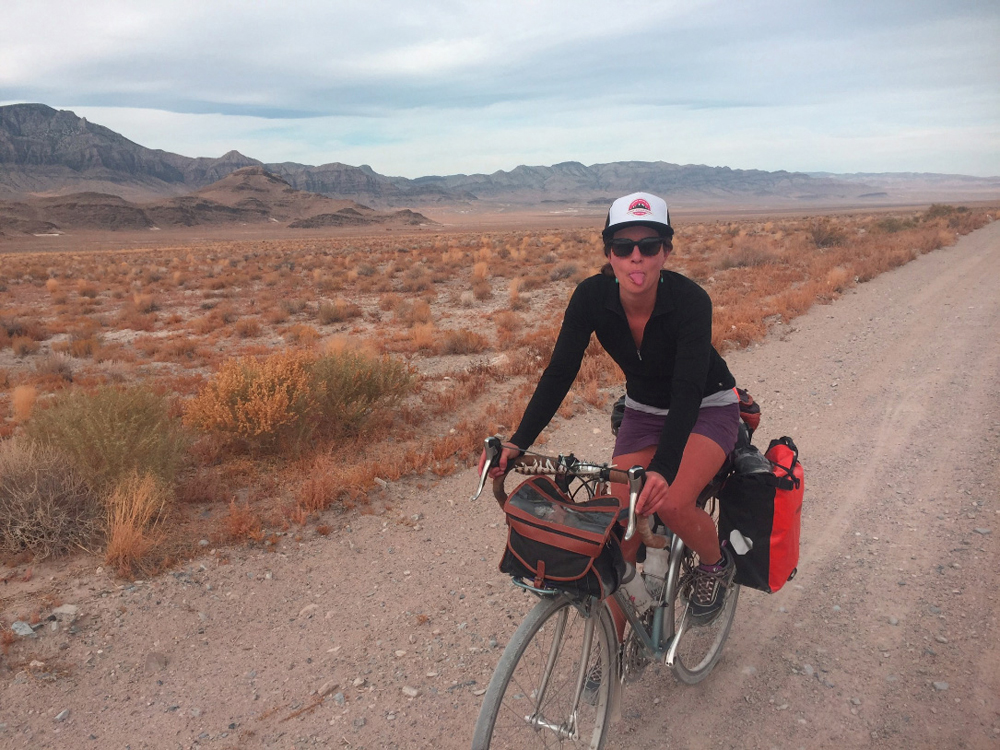
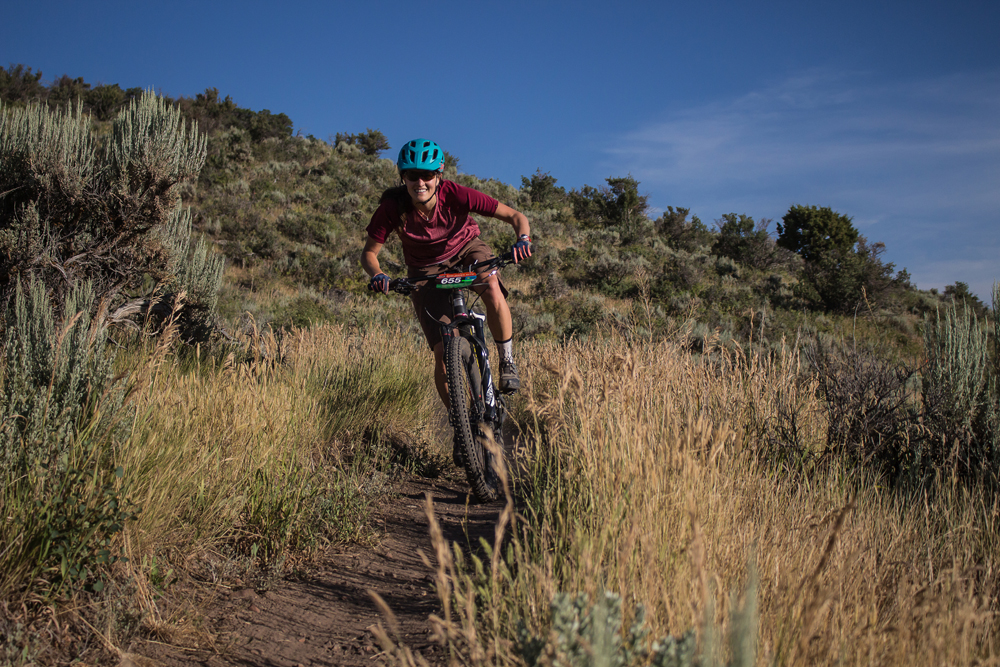
Stephanie Tomlin on a bike tour. Photo by Samuel WarrickStephanie Tomlin mountain bikes as well as commutes. Photo by Whitney Johnson
If you have a suggestion for a commuter profile, especially from Idaho, Montana, Nevada, Wyoming, W. CO, and N. AZ, have a commuter question, or other comments, please send it to [email protected]
As 2019 gets under way, a good percentage of the thousands of riders in Utah and throughout the Western states, take the time to set goals they would love to achieve this year. Age doesn’t matter. Whether you are 15, 25, 35, or 75, it’s always exciting and fundamentally sound for each of us to create reasonable goals that are reachable. Let’s take a look at some successful methods that will enhance the enjoyment of riding and will also help us achieve the goals we have set for ourselves.
Years ago I read in a cycling publication that while setting goals we should do so by establishing training parameters in one of two categories: time or miles. Do not keep switching back and forth, such as riding 100 miles one week and concentrating on riding six hours the next. Most riders have some sort of equipment on their bike that registers the distance of each ride. Whether it’s a sophisticated Garmin or a simplified CatEye, by the end of the ride we know exactly how far we have pedaled.
For example, let’s say someone wants to ride 2,000 miles for the season. This rider can get out one evening during the week and both days over the weekend. If weather permits this person to ride from April thru October, he or she has about 30 weeks. That works out to an average of approximately 66 miles a week. That could easily work out to two 25-mile rides on the weekend and one 16-mile ride in the evening. Once you set your goal of how many miles you would like to ride this year, it’s just a matter of utilizing a little math to figure out how many days a week you will ride and how many miles per session.
Some enthusiastic riders have bicycle trainers at home. This convenience allows them to ride throughout the winter season. Others attend gym sessions where they get miles adding up by participating in spinning classes. Even if you don’t have an odometer attached to a bike at a spinning class, you pretty much know that in an hour you poured about 16 miles of sweat on the gym floor. This doesn’t have to be an exact science configuration, but if you train by measuring distance, you will be very close to the distance you calculated.
On the other hand, some prefer to set their goals depending upon time on the bike. A rider can basically get the same training by using the clock instead of the odometer. For example, the distance rider discussed above plans to average 66 miles a week. If he/she averaged approximately 16 mph on their rides, that comes to a little over four hours a week on the bike.
If a rider is preparing for a century ride, most like to be training for a minimum of eight weeks. In reality, it makes more sense to initiate training at least 12 weeks before the event. While training for a hundred mile ride, most coaches advise the riders to gradually increase their miles per week or hours on the bike as the deadline approaches. A rider may start out doing 60 or 80 miles a week and by the eighth or tenth week, he or she may be up to 125 miles or more. Many advise riders to go fairly hard up until about two weeks before the event. Cut the training miles or time down just a bit so that your body is physically ready but you are not completely fatigued. And of course, most riders are paying close attention to their diets as the event approaches. How many times have you heard friends say, “Load up on your carbs and hydration three-four days before the big ride?”
Of course there are other variables to consider. The first that comes to mind is the number of vertical feet the rider has pedaled. For those that have access to the long and steep canyons in the Wasatch Mountain range, many of the instruments available at bike shops will calculate those figures for you. Personally, I have a friend I had not seen since last spring and inquired, “How was your summer?” His reply was, “Good, I rode 3,300 miles and did 285,000 vertical feet.” I didn’t need to ask if he was in shape for ski season. Last year, Bicycling Magazine’s senior writer Selene Yeager, wrote a book entitled “CLIMB!” which I found to be extremely helpful (See a review in the July 2018 issue on our website). Known for years as the “Fit Chick” she shares not only her own hard-earned expertise but also wisdom and advice from exercise physiologists, cycling coaches, nutrition experts and top amateur and professional climbers. Speaking of goals: setting a reachable target of how many vertical feet you would like to ride this season, will nearly guarantee that you will attain a degree of fitness that ranks way up there!
Which brings us to another subject that will enhance the potential of reaching our goals–cross-training. Whether it’s hiking in the mountains, running, playing tennis, racquetball, pickle ball, swimming, or spending time in the gym lifting weights, all of us can improve our speed and durability on the bike by staying active in other sports. A very popular wintertime sport that is great for keeping the lower body in good shape is skiing. Whether you travel down the slopes on skis or a snowboard, your legs will get a good workout and be ready for riding the bike when spring weather arrives.
Another factor to consider is whether you prefer to ride with others or alone. Many feel it is safer to be part of a peloton because the motorized traffic will see the multi-colored outfits the riders wear and drive more carefully. After an accident, some motorists claim they did not see the rider because it was dusk and the rider did not have his flashing light turned on or was not wearing a colorful riding outfit. The primary goal that all of us behold is to have a safe ride.
There are many bicycle riding clubs not only in the Salt Lake City area but throughout the western states. Nearly all of these clubs have a variety of groups according to riding levels based on speed and distance. Most group clubs start the season with less intensive rides while each participant is improving their own condition. By the end of the season, everyone is in much better shape and has established quite a few good memories. And that just might be the pinnacle of all the accomplishments we have reached over the course of a season. The friends we have made and the challenges we have encountered, will no doubt make all of those miles and hills worth it, in the long run.
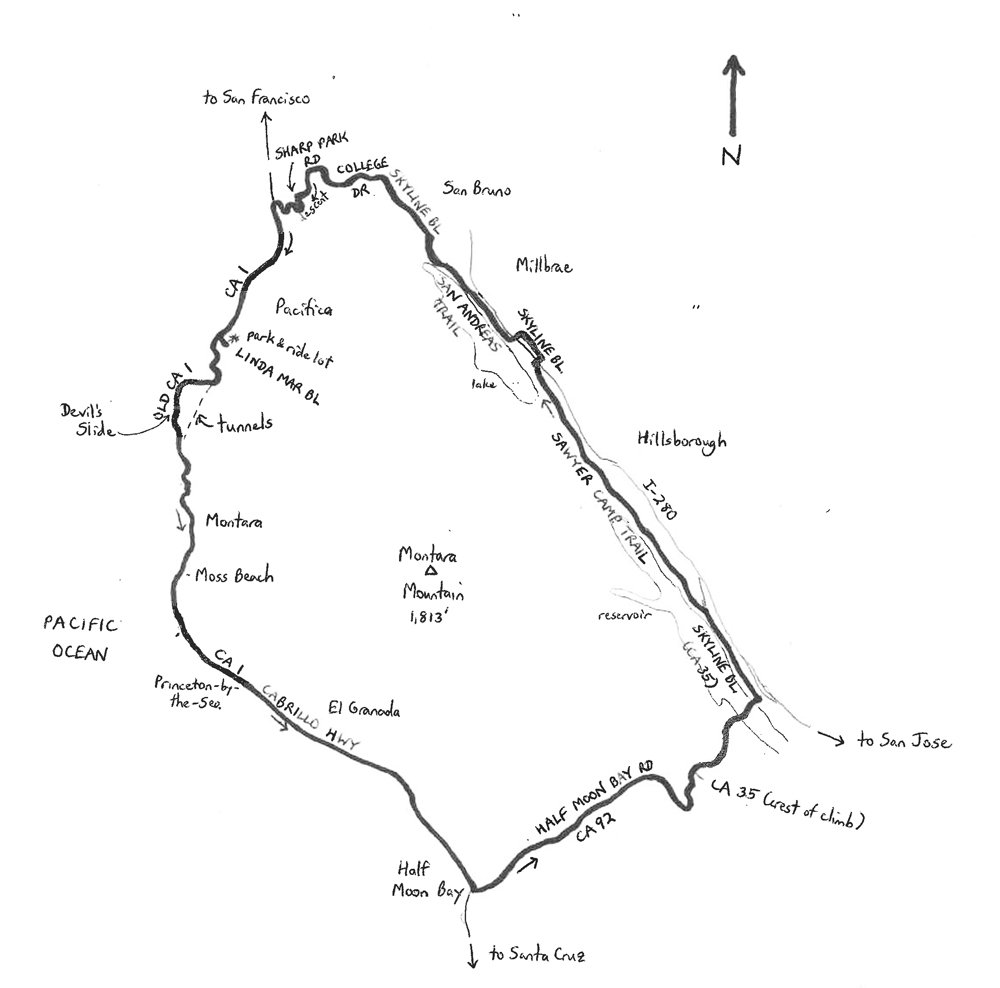
The Circuito de Montagna Montara is 36.6-mile, giant counterclockwise loop around Montara Mountain in northwestern San Mateo County, near San Francisco, California. The ride is one of several featured routes in my Best Bike Rides San Francisco (part of the Falcon Guides series). Montara Mountain is the most prominent peak in the northern part of the Santa Cruz Mountains, which stretch from north to south along the peninsula south of San Francisco. The high point (peak) is at 1,898 feet above sea level. There are no paved roads over the summit, so the Circuito hugs the mountain as closely as possible on good through roads and highways. The preferred direction is counterclockwise, to keep the Pacific Ocean on your right. Elevations along the ride range from just 3 feet, at the starting point, to 858 feet at the crest of the San Andreas Fault uplift (please see below).
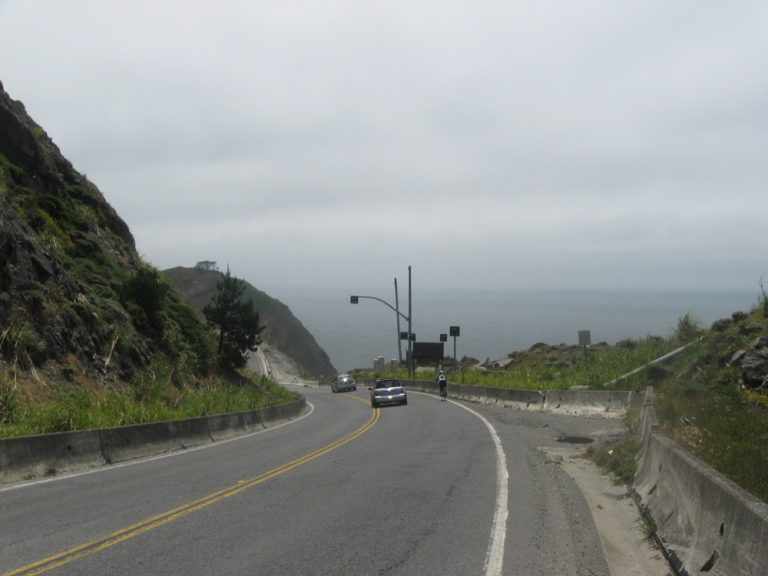
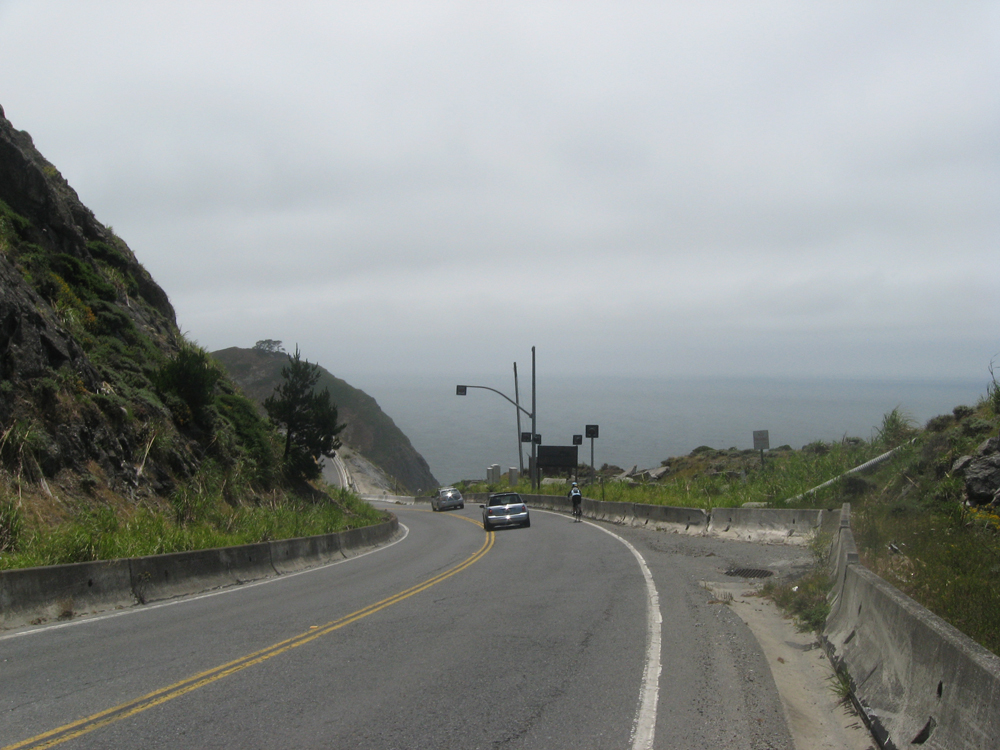
A rider descends Highway 1, toward Devil’s Slide, with the Pacific Ocean in the background. The cars are gone now, having been rerouted. Photo by Wayne Cottrell
The ride begins near the southern city limit of Pacifica, along California’s State Highway 1 (CA 1; also known as the Cabrillo Highway). Pacifica stretches along the coastline for six miles and inland for some distance up valleys that reach downslope from the Santa Cruz Mountains. The city is rich in takeoff points for surfing, hiking, mountain biking, fishing, and even skateboarding. Many summer days (June through August) find the city enshrouded in fog, with it occasionally lasting for days. Yet, the number of sunny days, during the rest of the year, is greater than the national average.
Begin the ride at the park-and-ride lot near the corner of CA 1 and Linda Mar Boulevard. Turn left and head south on CA 1. The highway immediately leaves the city and climbs into the forested hillside on the northwest slopes of Montara Mountain. The highway shoulder is narrow, but drivers are (or at least should be) used to seeing bicycles along this stretch. New to this stretch are the Tom Lantos Tunnels, through which the main CA 1 highway passes, leaving the old CA 1 to hikers, runners – and cyclists! After cresting, the old highway curves and begins a downhill along the rugged Pacific coastline. This is one of the more dramatic stretches of the highway, as it passes high above the crashing surf below, including Devil’s Slide. This stretch hovers above slopes that descend into the surf at gradients of 30% to 70%. Planning for the Lantos Tunnels, in fact, began way back in 1958. CA 1 was completed in 1937, but had been subject to cracking and landslides ever since – these actually closed the highway for up to months at a time, about every ten years. In truth, CA 1 has been gradually creeping toward the ocean since construction, with the movement accelerated after major rainstorms. The tunnels were finally opened to traffic in 2013, making the drive much safer for motorists. As for cyclists – well, consider it part of the adventure that the road may slide into the ocean, taking you with it.
Just south of the tunnel portal (i.e., the other end) is an unpaved parking area for Gray Whale Cove State Beach and McNee Ranch State Park. You may have noticed, on your right, some odd-looking militaristic construction. Six structures were built at Devil’s Slide during World War II to observe naval activity on the Pacific, as a means of protecting San Francisco. The observation structures were essentially steel-and-concrete pillboxes, a few of which still remain. As you leave this dramatic segment, CA 1 turns slightly inland and enters a series of unincorporated communities. These include, from north to south, Montara, Moss Beach, El Granada, and Princeton-by-the-Sea. Montara features Montara State Beach, which is a popular, mile-long beach. Potentially high surf during storm surges makes the beach unsafe for swimming, but very popular with expert surfers. To the south of Montara is Moss Beach, which features the Fitzgerald Marine Reserve, Moss Beach Distillery, and Seal Cove Inn (which is right along CA 1). The latter is a high-profile destination property.
El Granada’s concentric, circular street pattern was designed by famous city planner Daniel Burnham. The community was originally developed by Ocean Shore Railroad as a seaside resort for San Franciscans. Construction of the Ocean Shore Railroad between San Francisco and Santa Cruz started in 1905, with the northern portion extending as far south as Tunitas Creek, south of Half Moon Bay. The railroad used a coastal alignment, portions of which have long since been covered by landslides. Many of the railroad’s stations still exist, though, in some places they are private residences. In the meantime, El Granada has transformed into a sleepy coastal residential community.
The next community, Princeton-by-the-Sea, boasts the Half Moon Bay Airport, which is immediately adjacent to CA 1. This small community also hosts Mavericks, a surfing competition at Pillar Point Harbor that attracts experts who can handle the 50-foot waves. Just south of Princeton-by-the-Sea, CA 1 enters Half Moon Bay, the lone incorporated community along this stretch of highway. The coastal microclimate makes the entire stretch of CA 1 communities and the adjacent foothills subject to a greater amount of moisture than to the north or east. Annual rainfall of 50 inches is common, as is plenty of fog drip on overcast days.
Prepare to make a left turn at the city’s busiest intersection, CA 92, by checking for traffic and moving toward the left-turn lanes. Turn left with the signal onto CA 92 and head east. After a brief passage along the edge of the city’s central business district, which is to your right, continue to head out of town. CA 92 carries in excess of 20,000 motor vehicles per day, even as the highway narrows to just two lanes, so expect to share the road. The shoulder is narrow along the nearly imperceptible incline east of Half Moon Bay, so be attentive. After passing a number of nurseries, CA 92 finally widens as it approaches the second significant climb of this route. You are greeted by a wider shoulder and a stiff climb to the crest of an uplift that was caused by action along the San Andreas Fault.
CA 92 crests at Skyline Boulevard (CA 35) and then descends swiftly, adjacent to a dense grove of California oak woodland. The descent takes you down the drier side of the Santa Cruz Mountains, and once you are beyond the woodland the difference from the wetter, Half Moon Bay side is clear. The highway descends into the rift valley and crosses between the Lower (to the left) and Upper (to the right) Crystal Springs Reservoirs. Both reservoirs are artificial (the water is real) and are linked hydraulically. Water comes from local precipitation, the Hetch Hetchy Reservoir in the Yosemite Valley, and nearby watersheds. At the signal on the climb following the crossing of the reservoirs, turn left. You are now on the northern portion of Skyline Boulevard (CA 35). Ride north, with the I-280 freeway on your right and Lower Crystal Springs Reservoir on your left. The road climbs through here, cresting at Bunker Hill Drive, and then descends. Adjacent to the Crystal Springs Road intersection, turn left to enter the Sawyer Camp Trail.
Sawyer Camp is a paved trail that runs parallel to the northern arm of the reservoir for a distance. The trail began as an access road to Leander Sawyer’s camp in the mid-19th century, near the Jepson Laurel tree (600 years old, and the largest such tree in California). Later the trail was used by a stagecoach line from Millbrae to the north. Still later the trail became San Andreas Valley Road, along the main route between San Francisco and Half Moon Bay. Fast forward about 100 years, and with improved highways better serving motor vehicle traffic, the trail has become a destination path for nonmotorized vehicle users. The trail is six miles long, stretching from Crystal Springs Road in the south to Hillcrest Boulevard in the north, on the western edge of Millbrae.
Enjoy the Sawyer Camp Trail as it scoots along the rift valley adjacent to the Crystal Springs Golf Course. The Jepson Laurel is on the left, to the north of the northern end of Lower Crystal Springs Reservoir. The gradients are moderate, and there are bound to be plenty of path users. At the south end of San Andreas Lake, the path turns sharply to the right to cross San Andreas Dam. Similarly to the Crystal Springs Reservoirs, San Andreas Lake is a water source and is not open to the public. The lake rests directly on the San Andreas Fault. The path curves around the southern end of the lake and then climbs to a bench on the lake’s eastern side. Pay attention to the signs, as speed limits and the center-line rule are enforced along here. In fact, beyond the crest cyclists are cautioned to walk their bikes along the downhill to avoid conflicts with other path users. At the end of the path, to stay on pavement, turn right into the cul-de-sac (Hillcrest Boulevard), ride under I-280, and then turn left onto Skyline Boulevard.
At the next major intersection, which is Larkspur Drive, turn left, ride under I-280 again, and then turn right at the end of the street onto the San Andreas Trail. This is another paved path that is more or less a continuation of Sawyer Camp Trail. The path parallels San Andreas Lake on the left and Skyline Boulevard on the right until it ends at San Bruno Avenue. As you ride along, look upward to your left to view Sweeney Ridge. On November 4, 1769, the Gaspar de Portola Expedition sighted San Francisco Bay from high atop the ridge, thereby “discovering” it. At trail’s end at San Bruno Avenue, cross over to the other side of Skyline and continue heading north on Skyline. The road descends through here, and you will probably build up some good speed. The fun ends at Sneath Lane as Skyline levels and then starts to climb gradually as you enter the city of San Bruno.
Turn left onto College Drive (move into the left-turn lane) and begin the climb up to Skyline College. Follow the road as its curves to the left, entering the campus. The road, in fact, ends at a cul-de-sac through which bicyclists can pass. Follow the path through to the other side, continuing to climb. Turn right at the stop sign onto Ysabel Drive and descend away from the college. Turn left onto Sharp Park Road at the signal, immediately opposite Milagra Ridge County Park. Sharp Park Road descends sharply, twisting and plummeting toward the ocean. Watch your speed in the turns. After crossing over CA 1, turn left to ride along the frontage road, which is Bradford Way. Follow this bumpy road as it curves into a residential neighborhood (you are now in Pacifica). Continue to the T-intersection at Mori Point Road and turn left next to the Loyal Order of Moose facility (no actual moose).
Head up the short climb on Mori Point Road to CA 1 and turn right. Here you have two options: ride along the shoulder of the highway or take the parallel paved path. The paved path is actually more challenging than the highway, as it traverses hillier terrain. Both routes lead to the same place: southern Pacifica. Also, both routes involve two short climbs. The second one is especially dramatic, as a spectacular view of Pacifica State Beach is revealed over the crest. Also known as Linda Mar Beach, this is a popular spot for beginning surfers. Beginners can perhaps become experts very quickly here, as there have been a number of reports of white sharks in the waters over the years. Continue to Linda Mar Boulevard and turn left to conclude the ride, at the park-and-ride lot.
Starting & ending point coordinates: 37.595603oN 122.503103oW
The Circuito Montagna Montara is a 36.6 milen road bike circuit just south of San Francisco. Image by Wayne Cottrell
For more Utah rides, see Road Biking Utah (Falcon Guides), written by avid cyclist Wayne Cottrell. Road Biking Utah features descriptions of 40 road bike rides in Utah. The ride lengths range from 14 to 106 miles, and the book’s coverage is statewide: from Wendover to Vernal, and from Bear Lake to St. George to Bluff. Each ride description features information about the suggested start-finish location, length, mileposts, terrain, traffic conditions and, most importantly, sights. The text is rich in detail about each route, including history, folklore, flora, fauna and, of course, scenery.
Wayne Cottrell is a former Utah resident who conducted extensive research while living here – and even after moving – to develop the content for the book.
(DENVER, CO—DECEMBER 11, 2018)— The 2019 Colorado Classic will become the only women’s stand-alone stage race in the Western Hemisphere on the Union Cycliste Internationale (UCI) calendar and USA Cycling’s Pro Road Tour, organizers of the race announced today, while raising the bar for pro women’s cycling around the world.
RPM Events Group LLC, organizers of the Colorado Classic, will offer unprecedented financial support to female athletes at the 2019 event, including a prize purse nearly four times the 2018 women’s purse and more than the men’s 2018 purse, along with stipends to support team travel and expenses.
Jennifer Valente (Twenty20 p/b Sho-Air) raises her arm in victory after winning the bunch sprint to take Women’s Stage Four, a 4 lap circuit race around downtown Denver. 2018 Colorado Classic cycling race (Photo by Dave Richards, daverphoto.com
With free live video streaming coverage each day of the race, the Colorado Classic will put women’s cycling and Colorado on a global stage. The live stream and on-demand replays will be syndicated to fans around the world through cycling and partner websites as well as though Facebook Live and the race’s Tour Tracker mobile app.
“From the inaugural race of the Colorado Classic two years ago, the organization has stood behind women,” said Kristin Armstrong, the most decorated female cyclist in U.S. history, having won gold medals in each of the last three summer Olympics. “The announcement today of a women’s-only UCI stage race truly shows the dedication and commitment the Colorado Classic has to women in sport. I was fortunate enough to have my start in a women’s-only event back in 2002 at the HP Women’s Challenge; I know first-hand the tremendous amount of impact this will have on women’s cycling by creating and providing opportunity for spectators and riders across the world.”
The third annual Colorado Classic will be a four-stage road race August 22-25, 2019 that will bring some of the best female teams and cyclists in the world for four days of racing over challenging Colorado terrain.
“The Colorado Classic has been instrumental in bringing pro racing back to Colorado, and we are proud to support their bold move in becoming a women’s-only bike race,” said Colorado Governor-Elect Jared Polis. “The Colorado Classic reflects what our state is known for – innovation and inclusion – while showcasing Colorado’s diverse outdoor health and wellness lifestyle.”
To focus on and expand the women’s race, the Colorado Classic will forego the men’s UCI race in 2019. Organized now solely around female competition, the 2019 Colorado Classic will unveil more challenging routes, longer race distances, and better start times for women than ever before, positioning the event as an ideal run-up to the UCI Road World Championships following a month later and the 2020 Olympics.
“With women’s cycling, we saw the greatest opportunity to fulfill our mission to create a world-class race in Colorado that is socially impactful,” said Ken Gart, Chairman of RPM Events Group. “By creating one great race instead of two average ones, we can shine a bright light on Colorado and pro women’s racing while affecting meaningful social change.”
More than a race, the Colorado Classic will act as a movement to inspire women, challenge and redefine female professional cycling, and ultimately, empower women of all ages to break the mold, and fight for their goals.
USA Cycling is including the women’s race in its Pro Road Tour (PRT), which showcases the premier domestic road calendar events in the U.S., including criteriums, road races, stage races and omniums.
“The Colorado Classic showcases both the beauty of Colorado and the remarkable talent of these compelling athletes. Both USA Cycling and the International Cycling Union (UCI) are proud to support this outstanding event that focuses on women who are exceptional cyclists. I applaud RPM for their commitment to building a world class event for women,” said Bob Stapleton, Chairman of USA Cycling and UCI Management Committee Member.
“Because of the Colorado Classic’s commitment to pro women cycling, we expect a stellar international field of approximately 20 teams and world-class racers to compete,” said Sean Petty, Race Director for the Colorado Classic.
Since its 2017 inaugural year, the Colorado Classic has advanced women’s racing in several ways. The Colorado Classic was the first major USA cycling race to go without podium hostesses, opting instead to celebrate male and female cycling legends, including Connie Carpenter Phinney. Last year, the race expanded the race to four stages and designed the routes similar to the men’s race. The Colorado Classic also has assembled an all-female team of public address announcers for calling the race, and will feature several female influencers and heroes spanning across women’s athletics.
“I am really excited to hear that the Colorado Classic women’s race is growing into a 4-day, UCI event,” said Katie Hall, pro cyclist and overall winner of the 2018 Colorado Classic women’s race. “Colorado is such a beautiful state and such a hotbed for American cycling that it seems like the perfect place to host a challenging UCI stage race that will feature the women.”
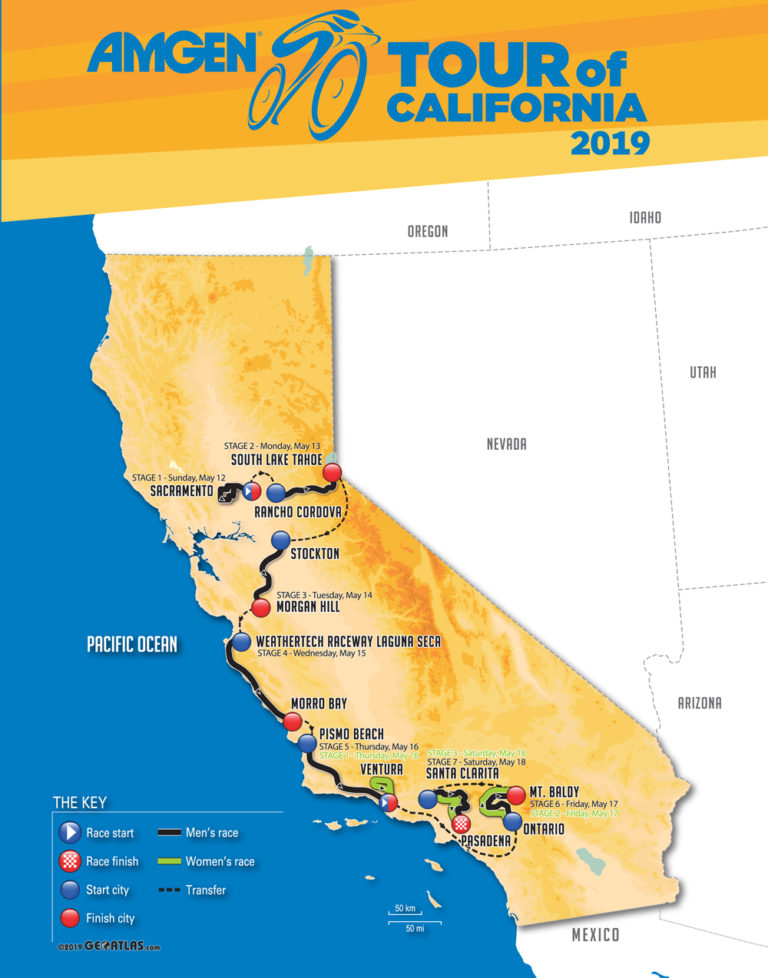
LOS ANGELES (Jan. 31, 2019) – The 2019 Amgen Tour of California will be the longest and most challenging in its 14-year history, with details announced today by AEG, owner and presenter of America’s only UCI WorldTour race.
Throughout seven stages over seven days (May 12-18, 2019), the world’s elite professional cyclists will contest mountain roads, highways and coastlines from Sacramento to Pasadena. The 773-mile course through 13 Host Cities will ante up 14 Sprints, more than 68,000 feet of elevation gain and 25 King of the Mountain (KOM) climbs, the most in race history, and a fan-favorite Mt. Baldy summit finish. More than half of the seven stages feature 120+-mile courses.
With seven new courses between them, the Amgen Tour of California Women’s Race empowered with SRAM will run concurrently May 16-18, using many of the same routes as the men’s course. Also the longest women’s race in event history, the 177.8-mile, three-stage road race course will see the athletes climb more than 20,800 feet, including eight QOMs.
The Amgen Tour of California is designed to cover varied terrain, with opportunities for sprinters, climbers and general classification riders to shine throughout the week.
“The Amgen Tour of California is the pinnacle of cycling in America. The 2019 race course is incredibly demanding – there’s more climbing and more long road days than ever before. With the best of the best in cycling coming to California to contest it, we are in for another memorable race,” said Kristin Klein, president of the Amgen Tour of California and executive vice president of AEG Sports. “We look forward to shining a spotlight on the beauty of California and the dedication of these athletes for fans, in person and via the worldwide broadcast, in what will be one of the most exciting sporting events in the country this year.”
Covering part of the 2019 Amgen Tour of California course on the steep hills of Mt. Baldy near Los Angeles, the annual L’Etape California by Le Tour de France public ride will return to Southern California this spring to take cycling enthusiasts on a mountain adventure. Riders of all levels can experience the essence of the Tour de France one month before the watching the professionals attack the Alps. Participants can expect spectacular views, peaceful twisting roads, and an abundance of climbing in this year’s edition.
Presented by Visit California, a visual overview of the men’s and women’s courses, along with information on L’Etape is viewable at www.amgentourofcalifornia.com.
By Charles Pekow — Pupils at six Navajo elementary schools in Arizona this spring will take part in an experimental program to teach them bicycling skills. And if it works, it can be continued and expanded to other Indian schools.
The Indian Health Service (IHS) is sponsoring the Outdoor Experimental Program – Cycling & Biking Program at the schools in the towns of Chinle, Pinion and Tsaile in northeast Arizona. It will use curricula produced by Project Venture, an Albuquerque NM-based organization dedicated to help “indigenous youth embracing their potential through outdoor adventure and service” (projectventure.org).
IHS sees the program as helping improve children’s health. The plan calls for serving more than 200 fourth- and fifth-grade students in after-school, in-school, day-long and overnight programs. IHS is seeking a contractor to teach riding, safety, bike maintenance and repair along with other skill and character developments and outdoor education.
If it goes well, the program may be extended for years and expanded to other schools, depending on funding, Contract Specialist Tovarai Tenorio says.
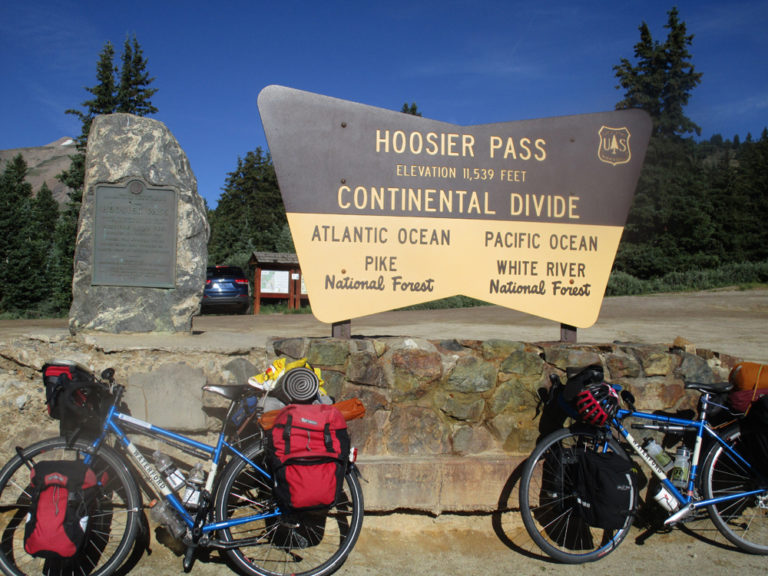
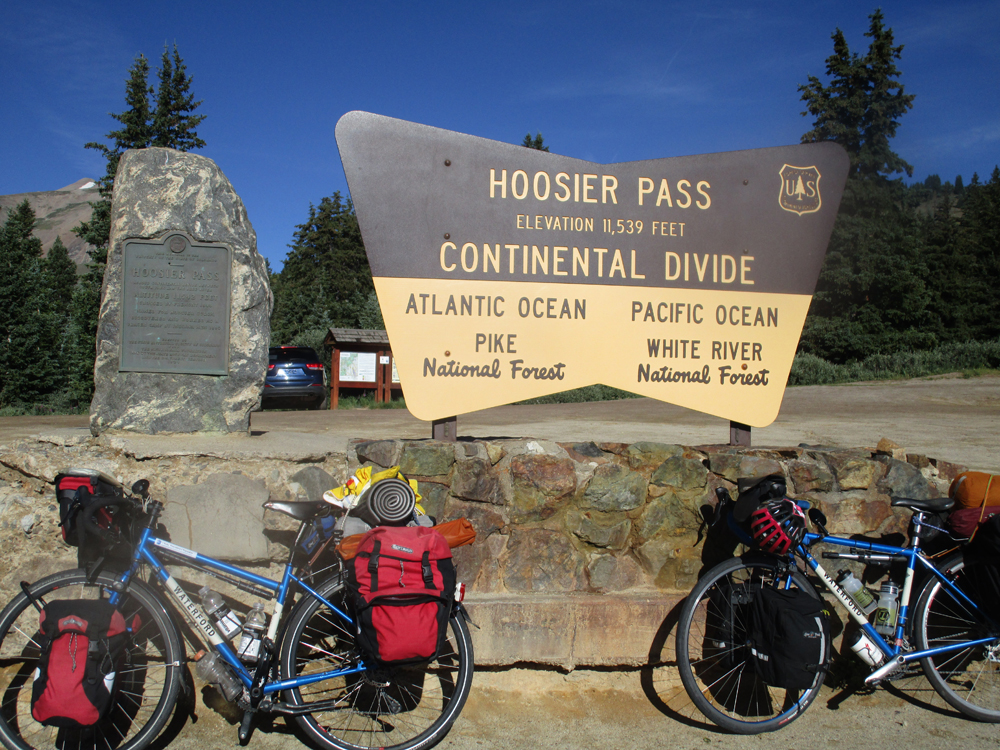
Hoosier Pass Colorado. It’s downhill from here to the Kansas border. Photo by Julie Melini
Riding across the U.S. has been on my to-do list ever since I completed my first transcontinental ride in 1975. On August 22nd of 2018, Julie and I completed our ride across the United States via Adventure Cycling Association’s, TransAmerica Bike Route. We rode 4,230 miles during our 70 days of riding plus we took one rest day. We had hoped to complete the ride on August 21st, our 36th anniversary, but as we say, it is what it is.
Our rest day was in Missoula and entailed visiting with a college friend that I met during freshman orientation in 1969. Bob was excited to have us stay at his house. “I’ll have breakfast for you bright and early, 9 AM OK?” I broke the news to Bob gently that we normally left at sunrise to beat heat and traffic, so we compromised at 8:30. Bob, like hundreds of others along our travels were friendly, helpful, and generous, cheering us along even though they did not have a clue to what is like to do an overnight bike ride let alone a transcontinental ride.
We had a great ride, though there were more than a few days of mountain climbs in the west, masochistic steep terrain in the Ozark Mountains of Missouri, heat that forced us to stop for the day, and the uncertainty of the quality of where we camped or slept for the night. Julie kept telling me how angels helped get her over the mountains, helped us through the heat, and made our nights comfortable despite some disappointments. I sometimes had to agree that maybe she was right more than a few times. Then there was the final day of our ride. Going back to 1975, it seems that on every big trip there is one day that will stay in my mind forever. Like our Appalachian Trail thru-hike, the day waited until the end.
Julie kept procrastinating about obtaining plane tickets until our final day, primarily because we didn’t really know what day was going to be the last day. We assumed it was the 22nd of August but we didn’t know for sure. One never knows what may happen. For example her rear derailleur cable broke on the 20th of August and I couldn’t thread a new cable in, presumably because the head of the old cable was jammed in her shifter. (There is a longer story to this) Fortunately the last 95 miles was relatively flat. By adjusting the setscrew on the rear derailleur, I turned her 27-gears into 3. Despite “only” 3 gears she was able to comfortably ride the rest of the way.
During the final week of our ride, the plan was to complete the TransAmerica bike route in Yorktown where there was a bike shop. We would box up the bikes, have Bike Flights pick the bikes up, maybe stay the night to visit historic Yorktown and fly out on the 23rd. I had contacted the bike shop early in our final week and boxing the bike was all set, all we had to do was contract with Bike Flights, but again we procrastinated.
We made good time on the 20th despite Julie’s broken cable so I called the called the shop to finalize our plans. The woman on the phone was somewhat distraught and said a “sudden incident” has occurred with the shop and they would not be open on the 22nd. She was very nice and said that she would leave 2 bike boxes outside and that there was a UPS store about a block or so away. At this time I was ready to end our ride in Williamsburg and make our arrangements at a different shop. Williamsburg is 13 miles shy of the official end in Yorktown but Julie wanted to do the entire ride with or without me, “trust the angels”. The day before our arrival I again called the shop in Yorktown asking to buy a pedal wrench to be put in the bike box. The guy I spoke also was a bit distraught. He said the registers were closed so I couldn’t buy anything but he would put his personal wrench in the bike box for me to use.
On the 22nd of August we rode the final 33 miles into Yorktown, stopping at the memorial monument, the official end of the TransAmerica bike route. I went to the nearby visitor center to buy a book for the upcoming flight home while Julie searched for directions to the bike shop on her phone. Now she looked distraught stating; “Siri is telling me the bike shop is 13 miles away”. I replied it must be another Siri mistake as we had many of them during our travels. Upon asking a local person, the shop indeed was 13 miles away. Apparently Yorktown is geographically a large town for the given population.
We ate some of the food we had on our bikes, filled our water bottles and rode off to the bike shop that was closed hoping that the boxes would be outside and behind the bushes as promised. We mostly followed a back road but for a less than a mile we were on a rather busy road. A small car pulls up along side of us and the driver yelled, “Hey pull over, I need to talk to you”. My first reaction was to ignore the jackass that wanted to chew us out for being on the road. The driver then pulled into a Starbucks lot waving to us to pull into the parking lot, which I did. He approaches us with his hands over his head saying, “I’m Ron, from Ron’s House with Adventure Cycling”. I knew who he was as his home is used to house traveling cyclists. After my amazement wore off that someone like Ron would coincidentally be driving past us on this one-mile stretch of road I was then able to state what our short term plans were. We told him about the closed bike shop and the bike boxes. He said he was also going to the shop.
I searched all over as did Julie, no boxes. No, this can’t be happening, I said to myself! In the shop were some people so I jumped up and down outside the store to attract attention. The people in the shop were Trek employees doing inventory, as I then found out, Trek bought the shop. I explained the situation and in short time I had 2 bike boxes marked “boxes for bikers”, plus they gave me some tools to use to pack my bike, and in one box I found the pedal wrench. By this time Ron showed up and went to UPS to buy strapping tape to seal the boxes. His car is small so he put one boxed bike in the trunk as best he could and took it to the UPS store. He then took the second box along with Julie and I and our panniers to UPS. Our bikes were turned over to UPS albeit at a considerably higher cost then Bike Flights.
Ron then asked, “What’s next”. Julie replied that either we get a flight or a place to stay to which Ron replied, “I’ll take you to the airport”. Julie quickly tried to get plane tickets but didn’t receive a confirmatory email. We went to the airport and explained our situation to the American Airlines agent. He said he had our information but no ticket, “no problem”. He helped Julie finalize the transaction saving us the $70 agent fee and we had a flight home. Still in our bike clothes we then went to the restroom to wash up a little, change into “normal” clothes and headed for a restaurant as we had a not eaten much that day. At midnight we arrived home. The next day I received a phone call from the bike shop, profusely apologizing for the mix up with the bike boxes. I had to think that Julie might be right again about the angels, so I made sure she texted Ron to thank him.
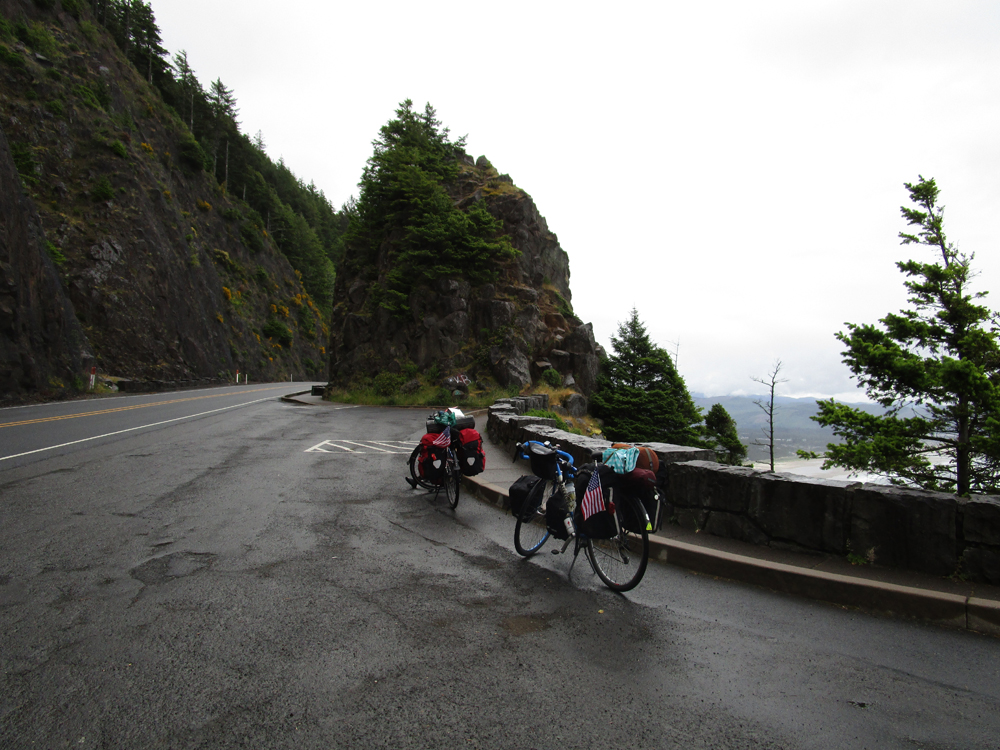
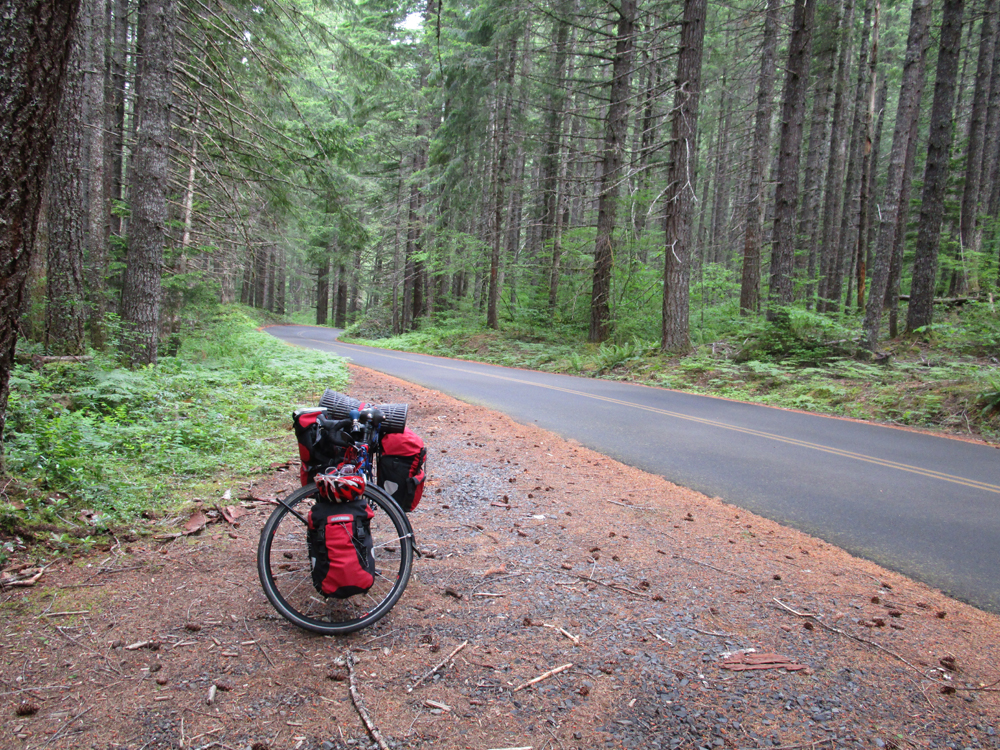
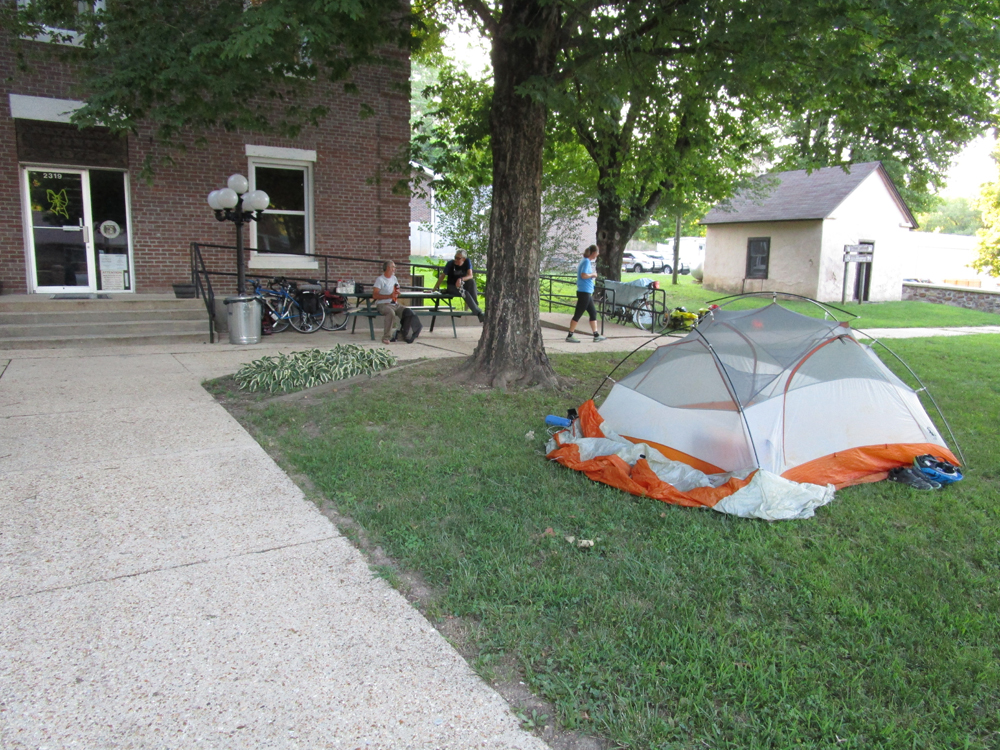
Time for a scenic break along the Oregon Coast. Photo by Julie MeliniOregon woodlands; Beautiful state to ride through. Photo by Julie MeliniSmall town hospitality. We couldn’t officially set up tents until the county staff left at 5:30. Bathroom in the police station around the corner of the county building. Very small convenience store served as a “grocery store” in this town that saw better days. Photo by Julie Melini
The gamification of cycling is creating a whole new genre of cyclist who do most of their riding indoors, and love it! The days of the pain cave and suffer-fest may be over, with Zwift providing the convenience of virtual reality scenery, courses, and competition all in the safety of your spare room, basement or garage.
It’s not dissimilar to the rise of indoor rock-climbing gyms 20+ years ago. What was viewed initially as a backup option for bad weather days, a long drive to the crag, or a place to practice a few bold moves in preparation for “real climbing” instead spawned a whole new generation of “rock” climbers with excellent physical prowess but a dearth of skill for assessing and protecting their progress up natural lines on an actual cliff – unless those skills were also practiced and honed in the great outdoors.
So too with indoor cycling. Smart trainers, power meters, and nuanced training programs are helping cyclists work on developing their metabolic energy systems and power output – tuning up their motor for excellent performances. But if those performances are going to take place outside, a whole other skill set needs attention, and it’s called bike handling! “Yeah, but I know how to ride a bike”, you say. There’s a difference between being able to pedal a bike, and being able to ride a bike. Bike handling skills are what keep you upright and alive when riding outside, be it on you own or in a group, in competition or not. And they need attention and practice. Outside there are 4 primary hazard categories that you won’t encounter while sweating through your indoor cycling training program: corners, motorists, road surface hazards and other cyclists.
Let’s start with cornering. I distinctly remember my first ride on Zwift primarily for the fact that when I tried to lean the bike into corners on the course, it wouldn’t lean because it was stuck upright in a stationery trainer. The brain adapts, and the more you ride indoors looking at VR courses, the less your brain informs your body about the actual physics of steering a bike around a corner. It will need reminding and it better happen before you blow off the outside of a bend and into the rocks or down an embankment. Maybe you can use the thought of an emergency room bill as an incentive to practice cornering.
The #1 reason many people prefer to train indoors is for concerns about the #1 hazard riding outside, which is distracted drivers and the potential for being hit by one. Route selection and time of day go a long way toward minimizing this, but so too does paying keen attention to the sounds of approaching vehicles; looking at drivers to see where they are looking; and noting other “motor language”. Awareness and anticipation are critical skills for riding defensively. Riding in traffic requires sharp senses for survival, and although practice doesn’t guarantee safety, it contributes.
Motorists aren’t the only hazard. The road surface offers many including loose gravel, pot holes, broken edges, badly patched pavement, drainage grates, sticky or slippery new pavement, wet pavement, ice, disappearing shoulders, shredded truck tires, broken glass, dead animals, live animals, rockfall off an embankment, and DOT traffic hazard signs – which for some inexplicable reason are invariably set up in a bike lane. All of these things are manageable with bike handling skills. Look ahead, expect hazards, and be able to brake, steer nimbly around then, or unweight the front wheel or bunny hop over something. Some you will see coming and can easily avoid, and some will catch you by surprise and need an intuitive and immediate response if you are to maintain control. Riding outside exposes you to these hazards and helps you develop coping strategies.
The last hazard to skill up for is your fellow cyclist (or masses of them). For a truly terrifying experience, enter a charity ride or gran fondo that attracts a whole bunch of novice riders, start at the back and then try and ride up through the group. Riding in a group (of even 2 people) requires another whole layer of skill that you might think you are getting on a Zwift social ride inside, but you are probably not. Group riding requires a mix of anticipation, being predictable with your own actions, gear selection and shifting, smooth accelerations, brake feathering, pace lining and communicating via voice and hand signals. It’s enough to make someone want to stay at home on their indoor trainer!
But there are great reasons to get outside and ride. Most events, competitive or not, are still held outside. You can go places, see things, and encounter the unexpected. You might experience the wonder of sunrise or sunset (remember your lights, people!) and in recent times while outside riding I’ve enjoyed seeing gaggles of migrating geese, a badger, a black rabbit, a flock of whopping cranes and a train loaded with wind farm turbine blades. Sightings like these make rides memorable, as do positive encounters with other cyclists.
Triathletes – don’t think you are exempt from any of this! Even if you only ever do one closed course non-drafting event a year, getting time outdoors on your bike builds confidence on the bike. Confidence on the bike will reduce both your stress level and your calorie consumption. Speaking of which – you need practice keeping hydrated and fueled, which requires grabbing bottles and snacks while you are on the move, without having the stationery trainer hold your bike upright for you. You will ride faster and have more fun outside if you make a habit of working it into your training routine, and not just saving it for race day.
The continued development of smart trainers and online training platforms may well see further divergence of cycling into those who keep their riding indoors, and those who don’t. But if you are riding indoors primarily as preparation for an outdoor riding season or even just one event, it’s time to start moving some of your training time to the great outdoors.
Spring emerges. Keep your head up and enjoy new green leaves and blossoms while honing your bike handling skills. But while you are indoors, get a few actual “how to” bike handling tips from any number of videos on YouTube. Might as well make extra good use of that time inside!
John Higgins is a professional bike fitter and purveyor of unique and boutique bicycles and fit-related components and accessories in Salt Lake City. More info on bikefitr.com
Update: April 25, 2019 – According to Kingsbury, police have located and spoken with the driver and they deny any involvement with the incident. Forensic tests are being conducted on the car.
April 22, 2019 – On April 20th, 2019, cyclist Trever Kingsbury was cycling down Emigration Canyon with a friend when a car allegedly ran him off the road twice near the intersection of Foothill Drive and Sunnyside and dragged him approximately 100 yards. Trever sustained injuries, and is in pain. In his own words from his Facebook post, Trever describes the incident,
On 4/20 @ 10:05am coming out of Emigration at the intersection of Sunnyside and Foothill a friend and I were run off the road twice by a Silver 2013 Mercedes Coup with plate # V581DU. On his 2nd attempt to hit us he locked up his brakes at 35mph and I was tossed onto his car and drug for almost a 100 yards while he accelerated away. There were tons of people riding at the time and we are looking for anyone driving or riding that might have seen the accident or this driver. The police aren’t doing anything to prevent this man from injuring or killing another cyclist and “it might be a few weeks till they have a chance to look into it”. Extremely frustrated after an expensive and painful night in the hospital and would greatly appreciate anyone’s help. A cycling lawyer has already been contacted. Any specific media, govt, or police contacts would also be appreciated!
Trever Kingsbury, shown here on a better day, recently sustained injuries from a hit and run driver who allegedly assaulted him with his motor vehicle. Photo courtesy Trever Kingsbury.
Trever sustained a number of injuries, fortunately it seems that he’s incurred no major injuries. He said, “Luckily everything in the first 24 hours remained superficial. After 24hours the swelling in my leg got bad enough to warrant ER trip due to loss of sensation, decreased motor strength and vasculature stuff in my foot. They ruled out fracture and DVT for sure which is good, but, found swelling to be compressing nerves and superficial blood supply to my leg leading to extreme neurogenic pain increases. Not mentioning the tweaked neck, back, hip, head and pretty solid loss of skin. Thankful nothing major like a femur fracture or head trauma but the potential for something like that or death was far higher than I ever want anyone to go through.”
Mark LeBlanc was riding with Trever at the time and posted this on Facebook about the encounter:
I was with Trevor and I witnessed the entire incident. This was not an accident. This was intentional. This was malicious. He tried to run us off the road and then he slammed on the brakes so we’d hit him from behind. We were going downhill at 30-35 mph. The only reason I wasn’t also taken down was because I went off the road to avoid it. When he did this, there weren’t even any cars in the left lane, but he was in the right lane trying to kill us anyway. The police aren’t taking this seriously at all. Please help share this story. Trevor and I are also MTB enthusiasts. We’re just like all of you. We love riding our bikes. Our road bikes, mountain bikes, cruisers….. We love bikes. And we love our families. We want to know that when we go for a ride, we won’t be killed. We always want to make it home for dinner. This should be a common ground for all cyclists.
His bike is mostly ok as well, but Trever, who is working on a Doctorate of Physical Therapy at Rocky Mountain University Of Health Professions in Provo, is not happy about the lack of followup from Salt Lake City Police Department:
Luckily my bike stayed in 1 piece except for some cracks and component damage. Bike faired better than body I think! The police have all the on scene photos. At this point it’s just trying to get some pressure on SLPD to not take motorists running people off the road with malicious intent lightly. This isn’t a bumper hit and run, it’s aggravated assault and for them to immediately disregard witnesses and say it was probably an accident is pretty ridiculous. And to not even follow up. I personally have a name and address that I can’t release but they won’t follow up. Meanwhile he could be having repairs be done to his car.
Anyone with additional information is encouraged to contact the Salt Lake City Police Department at 801-799-3000.
Salt Lake City Police Department Public Information Officer Detective Greg Wilking spoke to Cycling Utah (4-23-19) about the case. He said, “We do take these things seriously. That’s the bottom line.” He stated that officers did respond to the scene to investigate, but there was some initial confusion on the victim’s part regarding the plate number and make and model. That was sorted out later in the day. A detective was assigned to the case on Monday, and a followup investigation is taking place. It is normal procedure for the patrol officer to respond, and then for detectives to be assigned to the case to follow up, “There may not be an immediate response or we may not be able to solve the crime in one hour or that it will go unsolved. Sometime it’s a matter of letting those (hit and run) detectives do what they do best,” he said. “If there’s something to follow up on they do it. They put that case together. It’s a very lengthy process. They wrap it up nicely so that when they take it to the DA’s (district attorney) office there’s very little doubt that their going to be succesful in prosecuting it.”
Update: April 23, 2019. Salt Lake City Police Department posted the following tweet at 9:53 am, 4-23-19 indicating that they are taking it seriously and investigating:
“We at #SLCPD take #hitandruns w #injuries very seriously. Multiple #officers responded to the scene, canvassed the area for the vehicle, & did follow up w the plate info. A #detective is working diligently to follow-up on evidence in this case”
Plenty of unfinished business from the last Congress has come up again early in the new one and even being fast tracked. But western Republicans are trying to block at least some efforts to expand biking opportunities on federal land.
Most notably, the Natural Resources Management Act (S. 47), one of the first bills introduced in the Senate in January, contains a polyglot of goodies for specific public lands around the country. The bill was placed directly on the Senate Legislative Calendar, bypassing committee review. The Senate Energy and Natural Resources Committee (ENR) had approved most of the components late last year but the full Senate, obsessed with the government shutdown in December, never got around to voting on it. The Senate was considering it the first week of February.
The bill’s 10 sponsors include Steve Daines (R-MT), Cory Gardner (R-CO) and Mitt Romney (R-UT). The legislation includes a number of measures blocked last year.
The legislation, for instance, includes the Every Kid Outdoors Act, which passed the House and ENR last year. The bill would give all American fourth-graders (plus 10-year-olds being homeschooled) free access to federal lands where admission is charged – along with up to three adults accompanying them, specifically including those riding bicycles. So if a a fourth-grader bikes into a national park or recreation area that charges an entrance fee, both parents and an uncle can bike in free with him.
The fourth-grader would have to obtain a pass, however, which will start on Sept. 1 of the fourth-grade enrollment and be good through the next summer. The provision would apply in national parks, fish and wildlife preserves, national monuments, national forests, etc. The legislation encourages, but does not require, federal officials to pump state outdoor agencies to participate. The agencies would report to Congress annually on the number of students taking advantage.
The bill would also officially establish a San Rafael Swell Western Heritage & Historic Mining Recreation Area in Utah on land currently administered by the Bureau of Land Management. The legislation calls for a study of recreational opportunities, specifically including bicycle trails, in the area, noting that any new or expanded trails would have to be “consistent with the purposes of the recreation area.” ENR reported a bill specifically calling for this last December; but the Senate, obsessed with the government shutdown, never voted on it.
And the bill would establish the McCoy Flats Trail System on Bureau of Land Management (BLM) property in Uintah County, UT, an area where 35-40 miles of mountain bike trail already exists, stemming from the McCoy Flat Road Trailhead. BLM would officially develop a management plan for the trailhead, working with the county and nearby Indian tribes. The legislation would forbid motorized bikes on the trails. It even allows BLM to obtain other nearby land to extend the system.
The bill would also permanently reauthorize the Land and Water Conservation Fund, which expired last year despite widespread popularity. The fund can be used for recreational projects such as building mountain bike paths and trailheads. The federal government gets about half and states and territories about half. Funds come from fees paid by oil and gas drillers – it doesn’t cost taxpayers a dime but Congress let it expire anyway.
An attempt to reauthorize the fund failed last December because Sen. Mike Lee (R-UT) blocked it as he wanted Utah lands exempted because he thinks the federal government already controls too much Utah real estate.
[Editor’s Note: S.47 passed the Senate with a vote of 92-8 on February 12, 2019. Utah’s Mike Lee was among the no votes. The bill passed the House with a vote of 363-62 on February 26, 2019. All four of Utah’s Representives in the House voted in favor of the bill. S.47 was signed into law by President Trump on March 12, 2019.]
Senate Bill Would Reauthorize the Land and Water Conservation Fund
If Congress doesn’t pass the above bill, reauthorizing the fund on its own might. Sen. Richard Burr (R-NC) introduced S. 302, which would permanently reauthorize the fund (https://tinyurl.com/y8sy72jx). The bill currently sits before ENR. It picked up 13 bipartisan cosponsors. Among mountain west senators, they include Michael Bennet (D-CO), Steve Daines (R-MT), Gardner and Jon Tester (D-MT).
Utah’s Mike Lee’s Bill Would Hurt Expansion of Biking
Lee is taking other measures to block expansion of biking and other recreational opportunities in Utah. Stung by President’ Barack Obama’s extension of national monuments in the state, Lee introduced the Protect Utah’s Rural Economy Act (S. 90), which would prohibit expanding or starting national monuments in Utah without permission of both Congress and the Utah legislature. Utah’s junior senator, Romney sponsored it with him. The bill sits before ENR. (https://tinyurl.com/ycx8n5kt).
House Bill Would Restore Bears Ears National Monument
But over in the House, legislation that would do the opposite has been introduced. Rep. Ruben Gallego (D-AZ) introduced H.R. 871, which would expand Bears Ears National Monument in southeastern Utah to 1.9 million acres. President Barack Obama established the monument but President Donald Trump rescinded its size by 85 percent in 2017.
While the Antiquities Act gives the president the power to create national monuments, it’s not clear if a president can rescind a designation. Three lawsuits are currently challenging Trump’s move.
The U.S. Forest Service (USFS) and BLM jointly manage Bears Ears. Most mountain biking is done on roads. Expansion could lead to increased signage or creation of trails eventually.
The bill, referred to the Natural Resources Committee, picked up 71 cosponsors, none from Utah.
Most biking in the area is done on roads, says Dustin Randall, owner of Roam Industry, which provides bike trips in the area. And he’s not optimistic about getting much new trail. “If the monument is made, the chances of something new being created are probably like zero. It is really hard” to get through the process of working with USFS, he says. In the short run, “they can’t do anything because the monument status keeps going back and forth. Even with their cooperation, it will take years to get approval and National Environmental Policy Act studies done.”
House Bill Would Hamper National Monuments in Arizona
While he wants to expand Bears Ears in Utah, Gallego may have to play defense in his home state. Two Republican Arizona representatives, Andy Biggs and Paul Gosar introduced H.R. 79, which would require congressional approval for a new national monument in Arizona. Wyoming already gets such an exemption. The bill was referred to Natural Resources.
Colorado Recreation Bill (CORE) Introduced to Senate
Back in the Senate, Bennet introduced The Colorado Recreation & Economy (CORE) Act, (S. 241), which would designate recreational, conservation and wilderness management areas in Colorado, including nearly 80,000 acres for recreation such as mountain biking. Like the resources bill described above, CORE combines several bills that failed to pass in the last Congress. Rep. Joe Neguse (D-CO) introduced it in the House as H.R. 823, referred to Natural Resources. Neither version picked up any immediate cosponsors.
The bill would create a 16,996-acre recreational management area in the Tenmile Range for mountain biking and other recreation. The area, in White River National Forest, already contains well-used mountain bike trails. But giving it the special designation “may make it easier to get more money from the Forest Service” for recreational enhancements, explains John Whitney, Bennet’s Western Slope Regional Director. It would also protect the area from oil and gas drilling and commercial logging.
CORE would also set up a Williams Fork Wildlife Conservation Area in the same forest, where biking would be allowed only on designated trails and roads. Two bisecting roads on the north shore of Green Mountain Reservoir are used for biking. The bill says they could stay open but no new roads or trails could be build.
The bill would also set up a 21,663-acre Sheep Mountain Special Management Area within Grand Mesa, Uncompahgre, Gunnison and San Juan National forests. Biking would only be allowed in the Ophir Valley Area and Liberty Bell Corridor. Bennet worked out the deal to protect mountain biking in the area in conjunction with the San Miguel Bike Alliance while at the same time preserving as much wilderness as possible.
In a letter to Bennet on the predecessor legislation containing this provision last year, Max Cooper, president of the San Miguel Bike Alliance, wrote “some bikers have some concerns about additional wilderness designation. San Miguel Bike Alliance supports this bill as a balanced piece of legislation that will protect our ecosystem in the long term. A reason for our support is the amount of work and compromise that has gone into this legislation with the mountain biking community.” Most of the added wilderness lies in areas too steep for biking anyway, he continues.
Our friend Michael Wise, Salt Lake City bike advocate, cyclist, passed away in early March 2019. We share his obituary, a collection of photos of him, a remembrance of his life, and a story of his life in his own words.
“How often have I lain beneath rain on a strange roof, thinking of home.” – William Faulkner
Obituary:
Michael Wise. Photo by Ryan McCalmon
MICHAEL JAMES WISE, 54, passed away in Shanghai, China, where he had spent his last six years teaching English. The world is less Wise now. Michael’s love for China, the Chinese people, the Chinese lifestyle, and the respect that the Chinese bestowed upon him was astounding. Michael was happiest in China.
Michael was born in Denver, Colorado, on September 21, 1964 but grew up in Salt Lake City, Utah, graduating from East High School. He attended the University of Colorado and received a Bachelor of Arts, a major in International Relations, and a minor in Chinese Mandarin in which he became fluent. Michael later earned a Master of Arts in English from the University of Nevada, Las Vegas, where he also contributed western idioms for dictionaries.
Michael was a prolific traveler who lived in Taiwan as well as China, for several years. Forever a romantic, his heart never left China. Yet, the Trans-Siberian Railway took his journey to Paris, France, where he learned French.Later he taught English in Spain. After returning to the USA, he wrote software [using an impressive dvorak keyboard layout] in Las Vegas and then Reno for the Nevada Department of Employment, Training & Rehabilitation, before transferring to the Utah Department of Workforce Services in the Salt Lake City offices.
Michael’s friends knew him as a incredible chef and baker. Among other things, his homemade bread was coveted and never went cold. He helped local businesses, like Mamachari Kombucha, get off the ground, volunteering to brew into the twilight hours. As a renaissance man he was very kind and generous with his time and abilities.
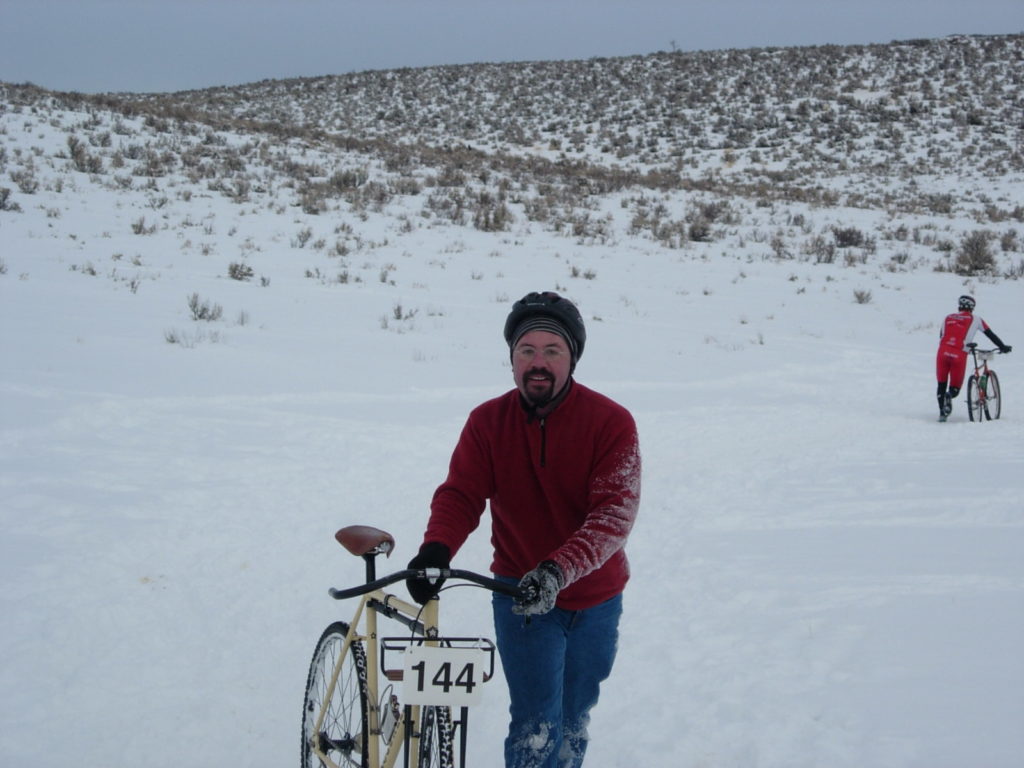
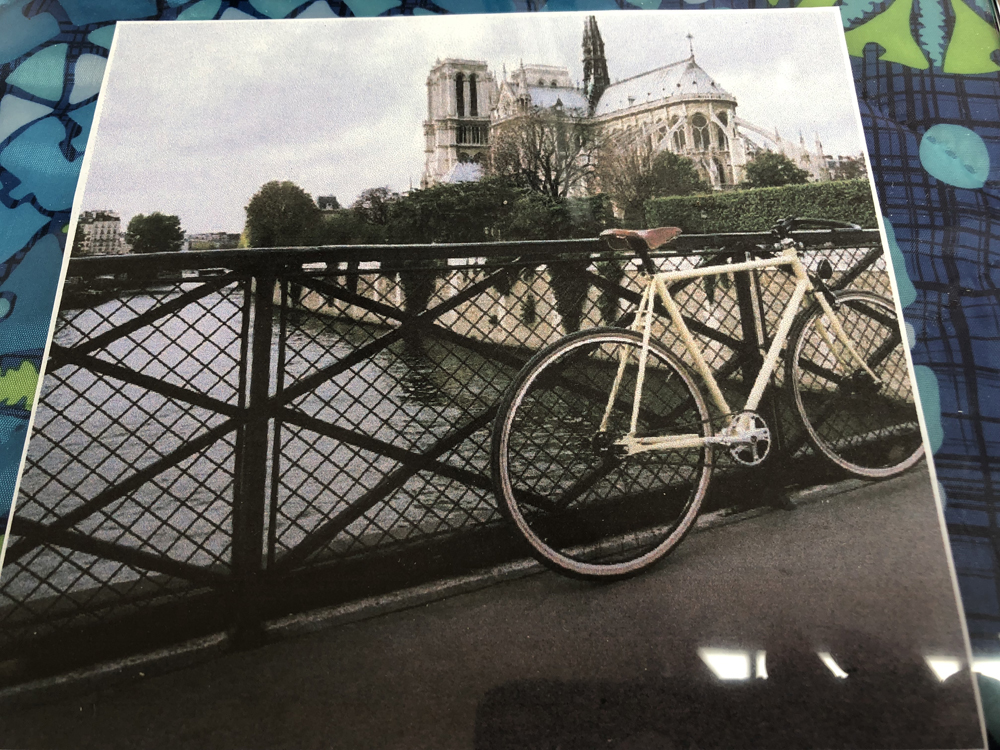
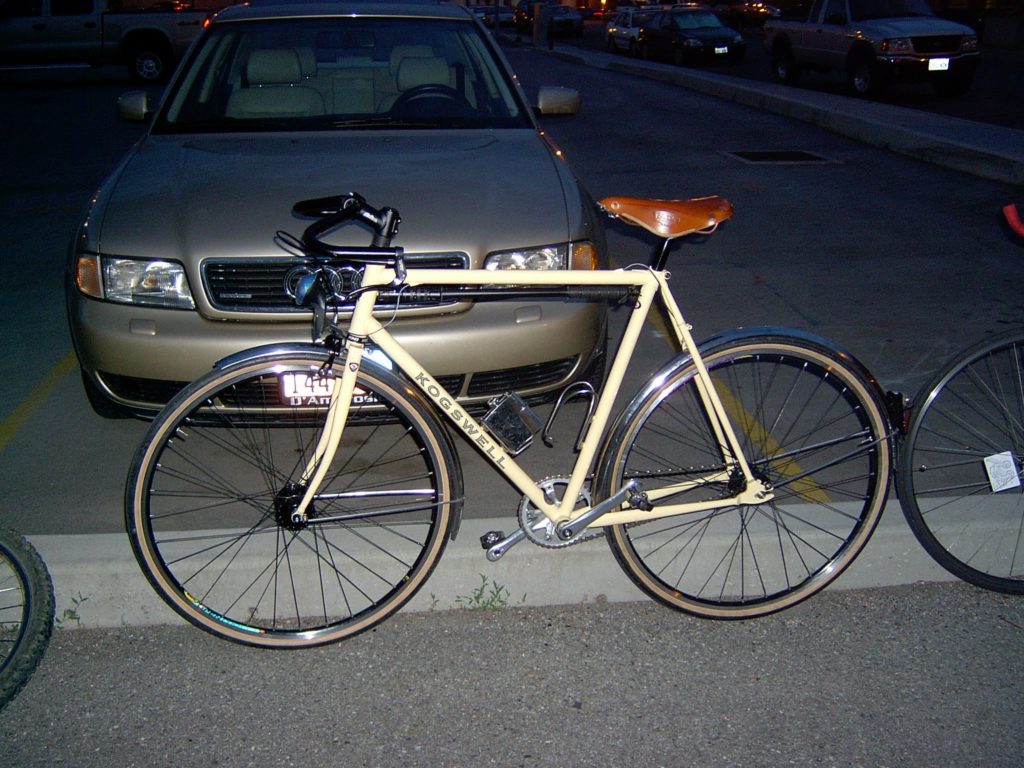
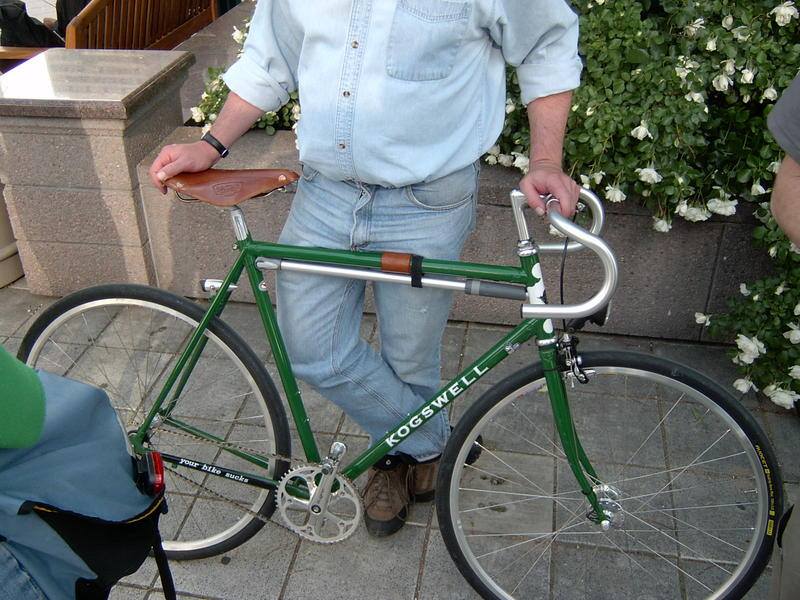
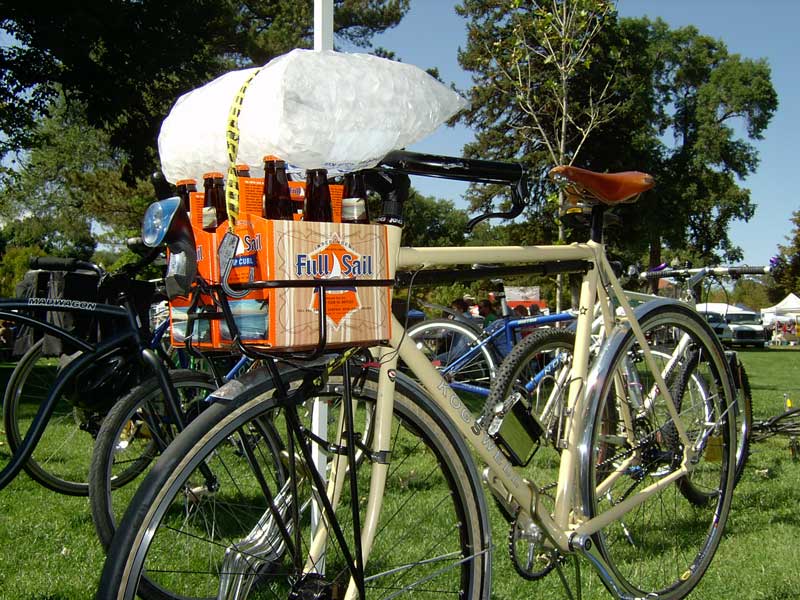
As a bicycle advocate Michael shared his passion in a number of ways: He co-founded a prominent 501(c)(3) non-profit in Salt Lake City, called the Bicycle Collective; became a nationally-certified safety instructor through the League of American Bicyclists;organized alley cat races; served as a Bicycle Count volunteer for the Salt Lake City Division of Transportation for many years, becoming the lead Bicycle Count Coordinator in 2012; and was a member of the Mayor’s Bicycle Advisory Committee, just to name a few. His contributions were an instrumental force in Salt Lake City’s successful effort to achieve Silver-level Bicycle Friendly status in 2010. Michael was nearly always found on one of his unique kustard-colored Kogswell bicycles, of which he had many, all in a classic style and outfitted with a front rack and Brooks saddle.
Michael is survived by his parents, James and Kay Wise, his brother Matthew James Wise and sister-in-law Aimee Wytko Wise, the cyclists of Salt Lake City, and the people of China.
“How often have I lain beneath rain on a strange roof, thinking of home.” – William Faulkner
Michael Wise at Ice Bike Time Trial, January 21, 2006, Park City, Utah. Photo by Rob Lingstuyl
Thoughts on My Life by Michael Wise
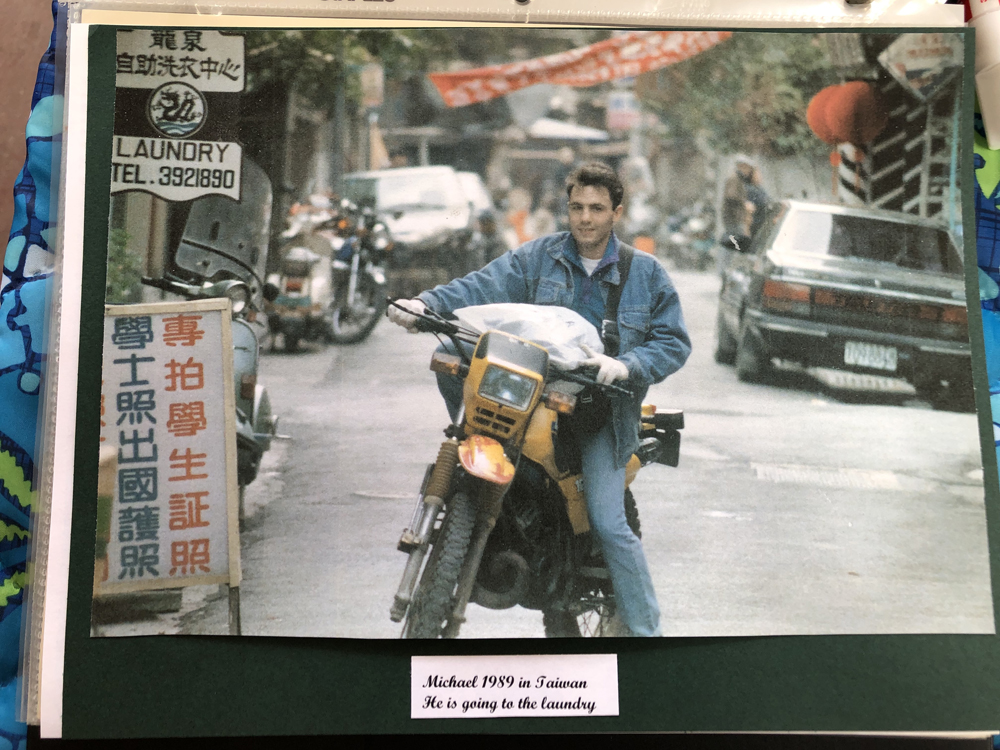
Michael Wise in Taiwan in 1989. He’s going to the laundry.
My father travelled around the world on business when I was a child. He was rarely at home, was not there for our birthdays, our graduations, our softball games. But there was a magic when he was home: I saw him as the romantic globe-trotter, and when he brought home visitors, they were mostly exotic foreigners, like the Japanese man who barely spoke English, who taught me how to make a boat out of paper; or the French businessman trying to decide if he should move his family to Salt Lake City; or the South African lawyer with whom I discussed civil rights.
So, I of course wanted to be like him; what child does not worship his father? However, my attitude was completely different; that was the part about rebelling against your father. I did not think making a short trip someplace was worth it: you do not learn the language, the culture, and all your interactions are superficial. You might see a few impressive sights, but you lose a deeper understanding. This is why I felt I had to live abroad, to get a true sense of the language, the culture, the personalities.
So, I graduated from college, and moved to Taiwan. I was twenty-two years old, and it was a culture shock for me. But I was able to make a living as an English teacher, and I had the rich environment of Taipei to practice my Chinese. Most foreigners did not like the job as an English teacher, but I was a language buff anyway, and methods of learning new languages fascinated me. But the pressure to leave the world of English teaching for a more“professional occupation” was intense, and in America teachers do not command that much respect. So, in my final years there, I took a job writing and voice-acting for an English-learning magazine, even though I had become quite good at recognizing the difficulties Chinese have with learning English, and the problem of language acquisition in general. I was practicing it, and my Chinese became fluent during this time.
But the travel bug bit, and I decided to leave Taiwan and go travelling. Or rather, I should say that Nancy, my girlfriend, decided. This was the sort of two-day stop travelling that my father did, and while it sounds romantic, from China to Mongolia to Russia to Poland to Germany, Italy, France, Spain… It was really a slog that had both of us exhausted and irritable. We did not eat well, we did not sleep well, and most of the people we met were just trying to cheat a couple of American tourists. It was easy to see why Americans, including my father, came back home with very little desire to go abroad again.
But I wanted to go abroad again. I figured I missed something in that frenetic tour, and there were places I had enjoyed: France and Spain were both big surprises. I went back to the United States to complete a Masters Degree in English, with a heavy emphasis on linguistics and language acquisition theory. Armed with that degree, I returned to Madrid, where I spent six months. But the Spaniards had not yet become eager to learn English, and finding jobs was too difficult, so I went back again to America.
It was the mid-1990s, and the Information Technology field was looking for anyone with a background in computers to help with the Y2K problem. So, I took a job in Information Technology, and settled down in Salt Lake City. It was not what I wanted to do, and I was not that good at it, but it paid well, with vacation time that took me to Paris several times, in hopes of getting a job and moving there. It never worked out, because teaching English was something the English and Irish could do as well as I. So, I went back to America again.
After years in Information Technology, I finally quit. Eventually, I got a job working for an international school in Shanghai. It did not look ideal; the owner of the school was a scam artist. But it got me out of the United States, to living in a place where I spoke the language and knew something of the culture. I could use the school to spring into something better.
I met people from Lingua Tutor at a job fair, and almost immediately started working part-time for them. To me, their pitch was ideal: private tutoring, with the backing of a school. I knew, from Taiwan, of the conundrum there: private tutoring was much more lucrative, and usually less work. You could tailor the plan individually, without different levels and different expectations. But it was quasi-legal (you could not get working permission without a school sponsorship), and the students could be unreliable, leaving your income in limbo. Lingua Tutor seemed to have the solutions to all those problems.
But something I have really enjoyed with Lingua Tutor is the variety. Rather than just one-on-one teaching, I have been able to train new teachers, teach corporate classes, teach high school students, teach children, and meet dozens of people from every profession, who are all contemplating the dynamic changes China has been going through the last few years.
So, while I wanted to emulate my father, I have actually surpassed him. I have spent more time abroad all together, speak four languages instead of one, and I have met people from all walks of life, not just engineers and businessmen. What is more, I have gotten so close to other cultures that I realize how much more there is to know, and how little you can understand a culture, yet think you know everything about it. I do not have to pretend to understand the Chinese anymore; mostly it is a matter of being open to what they have to say.
“How often have I lain beneath rain on a strange roof, thinking of home”—William Faulkner
Michael’s Kogswell with Notre Dame in the background.Michael Wise in China.Michael Wise (center).
A Remembrance of Michael Wise by Ron Ferrucci
Michael Wise was a curmudgeon—wait, that’s not the word I’m looking for, a conundrum – Michael was a historian that did graduate work in linguistics (think that’s it, he worked on dictionaries), that worked as a programmer with the State of Utah. He did not live to work, he worked to live. He loved his friends, was always there for you, never had an unkind word – except for the cagers. He was also an anachronism, he was a Renaissance man. He was well read and well spoken.
Michael was a founder of the Salt Lake City Bike Collective—contrary to popular opinion, I was not, I missed by a few months—and I met him first in August 2004 at the Farmer’s Market. We did bike valet. Did not know what to make of Michael, he was about 10 years older than the rest of us. But I soon got to know him as a retro grouch. And that evening we went to a birthday party for Tony. After four attempts at trying to ride Tony’s tall bike, Michael lost his glasses in the grass. Then had to crawl on hands and knees to find them. Tony was like “how blind are you.” When Michael discovered his Glasses, Tony found out.
I trained with Michael as a League of American Bicyclists certified instructor. He and I were not fans of helmets but were insistent on lights. I remember going to a training class with him and having to tell him his helmet was on backwards.
Michael was a bike enthusiast if there ever was one, but not the best mechanic. When he got his second Kogswell he did not tighten his handlebars down properly, and as we raced to the old Juniors and turned to the bike rack…his handlebars turned but his bike did not…and he went straight into Juniors and under the pinball machine (the scream of “whoa whoa whoa” audible from inside).
Michael won a set of disc brakes at a bicycle event. He had no bike to put them on. What would you do? He hired Tony (Pereira of Breadwinner Cycles) to build a bike for those brakes (in Kogswell (Kustard) cream of course).
But my favorite story about Michael was the time Ed had a couch surfer from China that was hanging with us at Squatters, with her speaking fluent English and Michael speaking fluent Mandarin – Michael taught English in Taiwan for three years – the other patrons must have thought they were in an episode of the Twilight Zone. Perfect example of Michael, an anomaly. Michael loved Chinese culture, was fluent in Mandarin, and taught English in Taiwan for three years—-did I mention that Michael was a Renaissance man.
We thought we lost Michael about six years ago. Jonathan called me to tell me the bad news. He was not doing well and was in the hospital for a few months. But Michael recovered. He got his second chance and he did not waste it. He moved to Shanghai and continued to teach English. Most importantly, he got to live the life that we wanted, in the country he loved. I almost moved there to teach English and hoped to enjoy some horrific Asian booze that had snakes or such in it with him. I cannot shed tears for Michael, but I will, because he got more life out of those six extra years than most people get in 50: he lived the life that he wanted!!! He truly got a second life, and he did not let it go to waste. He took the bull by the horns.
I see a connection between Michael and my dad. My dad had a heart attack scare in 2004. He stopped drinking, stopped smoking, and lived 12 more years. Neither of these men wanted to waste their second chance. For Michael, it was moving to China, a country he loved; for my dad, it was seeing his children accomplish something. Of course, that included my sister getting married and having kids. Not my optimum choice for a second life, but he got to see his grandchildren.
Michael Wise, Cancer Cat Alley Cat Scramble 2007. Photo by Michael WolfeA typical t-shirt showcasing Michael Wise’s sense of humor. Photo by Michael WolfeMIchael Wise’s Kogswell. Photo by Michael WolfeMichael Wise at the Spoke-N-Word Blue Bicycle Alley Cat 2005. Photo by Michael WolfeAnother of Michael Wise’s Kogswells. Photo by Michael WolfeMichael Wise’s Kogswell. Photo by Michael Wolfe
We may be past resolution setting time of year. What happened to those goals you set for yourself? Are they still on a sticky note next to your computer or do you remain on track? Your intentions were undoubtedly good, the problem with resolutions is they are generally outcome based. Most lists will look something like:
Lose weight
Get organized
Drink less
Train more
So where is the plan of action? In order to ensure you accomplish a goal, try making them with the intent of being measurable, attainable, and positive. Setting behavioral resolutions or goals puts you on track for success. For example, “on Saturday I will organize a grocery list to buy only nutritious food this week” or “I will train 15 hours this week.” Here are a few ideas to help you make specific plans to accomplishing your goals, whatever they may be.
If a food is in your possession or located in your residence, either you, someone you love, or someone you marginally tolerate will eventually eat it. -John Berardi
Do a kitchen makeover! Get rid of all the non-nutritious stuff and/or food triggers and replace them with healthy foods and snacks.If a food and/or drink isn’t conducive to your goals, why would you keep it?A kitchen makeover will help you stay in control and on track. You don’t want to be deciding between ice cream and spinach while standing in front of the fridge 15 minutes to dinner time.
What’s “Unhealthy Food”? If you think it’s junk, it is.
Obvious Junk Foods
Chips
Chocolates or candy
Soda/pop/sweetened drinks
Alcohol, especially flavored/sweetened mixed drinks
Instant foods like cake mixes and mashed potatoes
Margarine and other processed fats
Most frozen dinners
Most take-out or restaurant leftovers
Bowls of candy or other snacks sitting around
Flavored nuts (e.g. beer nuts)
Trick Foods
These are foods that seem healthy but aren’t. They’ve gone from something good (whole, unprocessed food) to something that a machine spit out, something that’s full of sugar and chemicals, and/or something that’s had all its original nutrients stripped out.
Sweetened yogurt, frozen yogurt, and even dairy alternative products
Breads and bagels, unless they’re made exclusively with whole grains
Other baked goods (coconut oil even adds up as a hydrogenated fat)
Breakfast cereals
Crackers, even the whole grain ones
Fruit, cereal, and/or granola bars
Regular peanut butter
Fruit juice
A good rule here is to check the labels. Look for forms of sugar such as high fructose corn syrup as well as hydrogenated oil, fractioned oil, and preservatives.
My kitchen’s empty! Now what?
It’s time to restock your kitchen with healthy replacements for the garbage you just unloaded. All you have to do is make the available food good stuff, and nature takes care of the rest. Thus, take the restocking process seriously. It’s just as important as the removal process.
How to Restock
Here’s how to quickly restock some nutritious foods. Start by picking your 3 favorite:
Write them down. The fewer ingredients the better!
Check out how simple this restocking process can be based on the following sample shopping lists:
Seems reasonable, right?!
Yes! The rest of the family (kids, spouse, etc.) can eat these foods too. Why would you feed your family something you wouldn’t eat yourself? Take pride in what you bring to the table, to the pantry, to your bodies. You’ll sleep better, train better, and over time your physique will change too! If you are looking to up your nutrition game and really add the “missing” piece to your training plan, contact me and I’ll help you makeover your nutrition life!
Breanne Nalder, MS, RDN has a Master’s degree in Nutrition with an emphasis in Sports Dietetics at the University of Utah. She is a Registered Dietitian, the nutrition coach at PLAN7 Endurance Coaching, and races on the road and gravel on the professional level. For personal nutrition coaching, you can reach Breanne at 801-550-0434 or [email protected].
Ben, my oldest son, gave me Old Man on a Bicycle for Christmas. “It fits you”, he said, reminding me that I rode across the U.S. in 2018 at the “young” age of 67. Don Petterson was 71 when he started his ride across the U.S. in 2002, finishing in 2003 after a broken clavicle (collarbone) in Price, Utah aborted his 2002 ride. He published the book 11 years later.
Old Man on a Bicycle
Don wanted to do something out of the ordinary in his retirement, so he decided on a whim to ride across the United States on a bicycle, a bicycle that he did not yet have. The bike tour was actually his second choice. Fortunately for the bike-touring community he realized that, despite being a licensed pilot, his thoughts of flying a fixed wing ultralight plane across the U.S. would not work out.
Mr. Petterson had “not ridden a bike in years” and “had never ridden for more than a few miles”. Within minutes of starting his trip he had to call his wife as he “slipped his chain” jamming it so that he could not make the repair. This occurred because he was trying to fix his bike computer while riding. If anything, this was an embarrassing start to a trip in front of family members, some of which questioned his judgment and sanity. After getting his bike and bike computer squared away he was off again realizing that he may be not up for the challenge. “I was shaky on steep turns”; “had not practiced emergency stops”; clumsy when releasing my feet from the clamps of the bicycle pedals as quickly and safety demanded”; “I could manage only the most basic repairs and knew nothing about making adjustments”; “I had never made an overnight bike ride and I hadn’t yet built up enough muscular endurance”. These quotes were some of his thoughts and anxieties on that first day. After reading that passage it reminded me of my 1975 trip across the U.S. but I was young and naïve. He ended up having a good first day, riding 58 miles.
As a bicycle touring books go, this one is pretty good. It has a good mix of travelogue writing (i.e. diary), autobiographical information about the author, entertaining anecdotes, and some of what I will call “preaching”. Mr. Petterson inserts into the book numerous short tangential information such as the benefits of helmets, the not so beneficial effects of smoking, and some science related to the physiology of aging among numerous tidbits of information. Most of the information is welcome and nicely adds to the book.
At the time of his ride across the U.S., Mr. Petterson was retired as a Foreign Service officer having served as an Ambassador for the U.S. After his retirement he also served in the New Hampshire House of Representatives. I think his age and occupation was a part of my interest in his book. The book was well written and I can relate to his age-related maladies.
On the other hand he was, to be polite, a bit absent minded. He twice left his wallet on the rear rack of his bike, fortunately not losing it. He lost a pair of riding tights, a few tools, a previously helpful map, and his camera, though he rode back to the motel and found the camera in the trash. He knew about Adventure Cycling Association but decided on a do-it-yourself route that caused him to lose countless hours during the course of his ride after getting lost, backtracking, and finding himself on really bad roads. Twice he was told by bike shop employees in Colorado and California that he had ridden on the most dangerous road in the area. To his credit, Mr. Petterson did well on the roads he chose except for the incident in Price.
In order to travel as lightly as possible, he was unprepared for cold weather and rain, so he stayed in his motel until the weather improved. He didn’t camp nor have a camp stove so he ate an interesting variety of meals some of which were good. Since he didn’t carry much in the way of food, he rode too long on more than a few occasions to obtain food. He even needed to go to bike shops to properly pump his tires, as his pump was small on only useful to inflate a flat tire to get to a shop.
Despite my concerns, he did do the trip and should be commended, as anyone should be for completing a ride across the U.S. He did the ride differently than I would, but that is okay. Given that he rode alone, much of his riding style choices were in part to socialize. Even the need to go to a bike shop to pump his tires was a social exercise to chat with the employees perhaps about the roads he should take to get to his next destination. When you retire you will understand the need to socialize.
I enjoyed the book. I primarily enjoyed getting to know Don and read about his travels that included stretches of road in Utah, eastern Colorado and Kansa that I also have toured through. Because of how he wrote the book, the time lapse of 12 years between his ride and publication was not a deterrent on the quality of the book.
Old Man on a Bicycle: A Ride Across America and How to Realize a More Enjoyable Old Age by Don Petterson; 2014: Outskirts Press Inc. Outskirtspress.com, https://outskirtspress.com/oldmanonabicycle, ISBN: 978-1478722915


 Finally, Sen. John Barrasso (R-WY) got another measure through committee that Congress failed to pass last year. The Senate Committee on Indian Affairs approved S 207, a bill to improve roadway safety on Indian reservations. The bill aims to make it easier to get permits for tribal road safety projects such as signs and signals at bicycle crossings, crossing islands and hybrid beacons. Projects can only allow rumble strips if they do not impede bicyclists.