Home Blog Page 26

Tour de France Stage 7: Pogačar’s Tactical Masterclass at Mûr-de-Bretagne

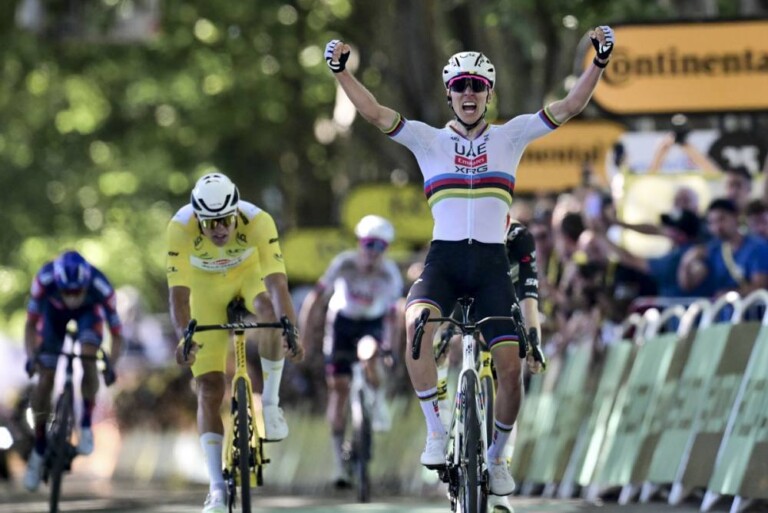
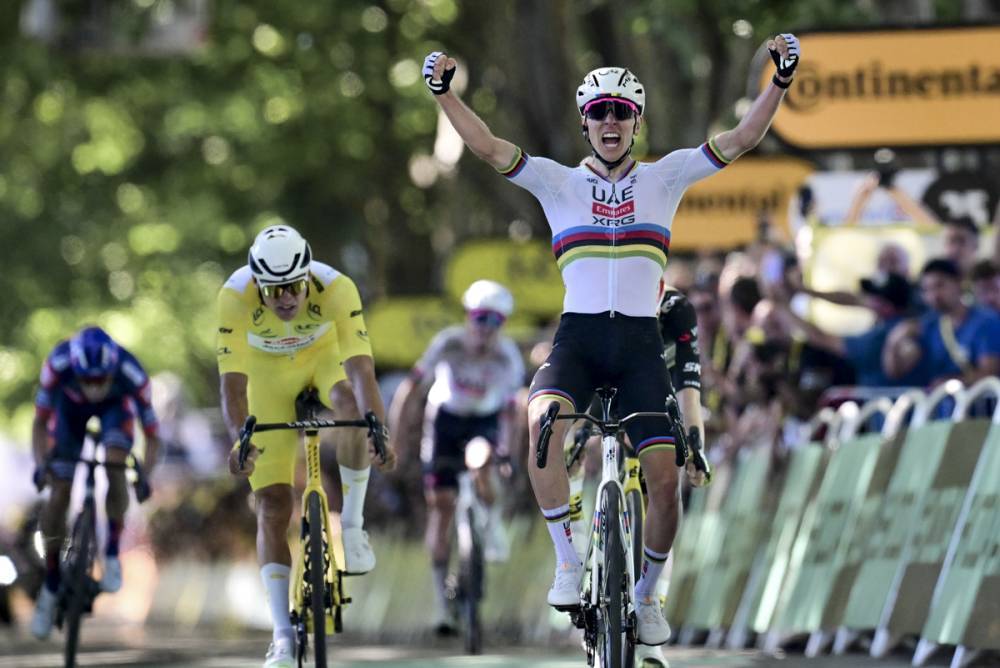
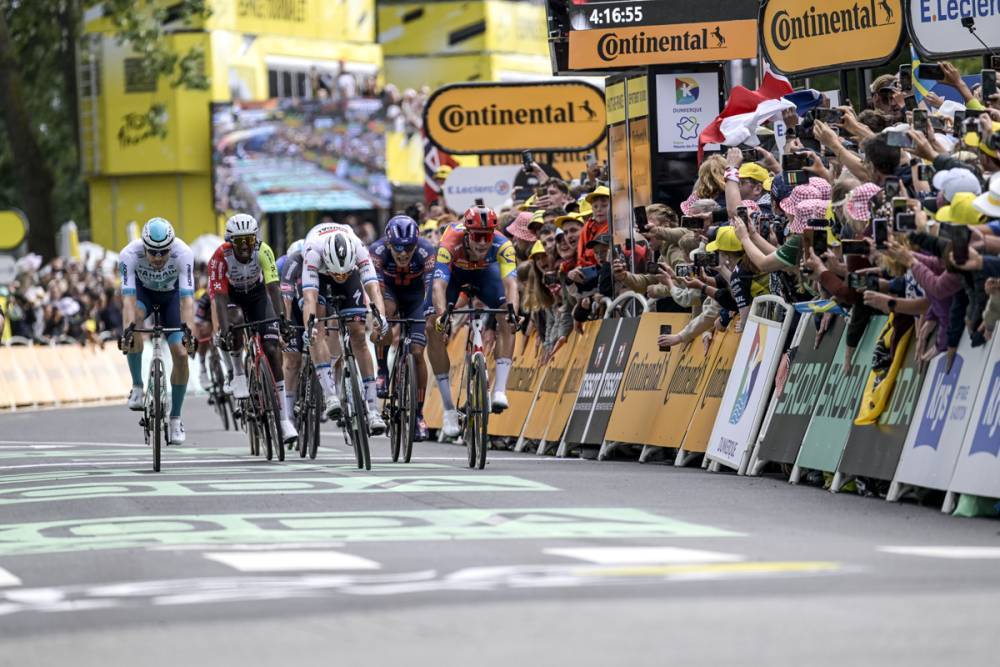
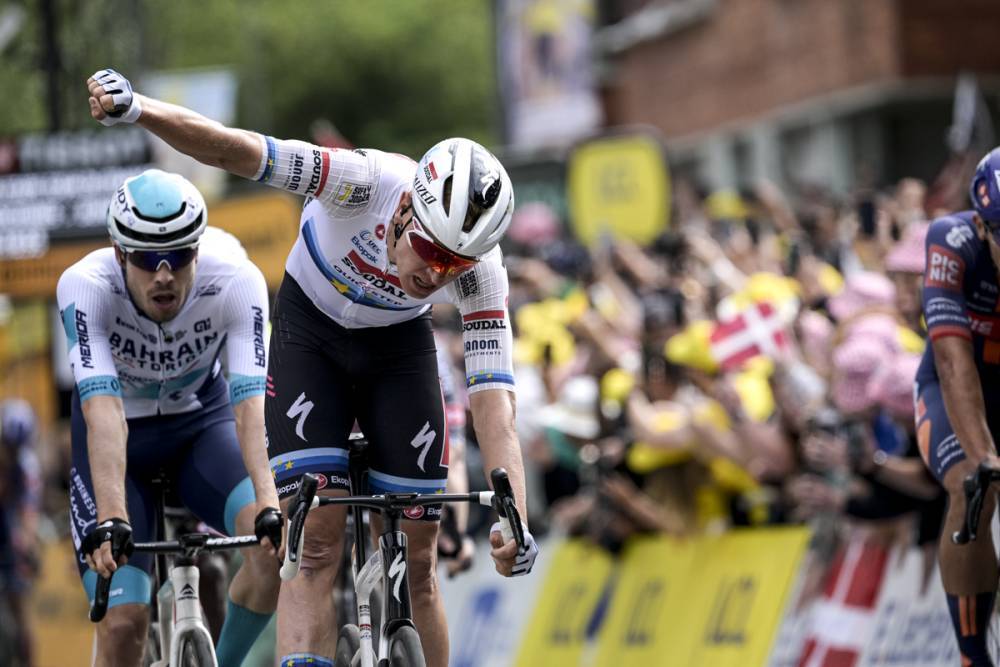
MÛR-DE-BRETAGNE GUERLÉDAN, France (11 July 2025) — On cycling’s most storied climbs, legends are forged through suffering and tactical brilliance. Stage 7 of the 2025 Tour de France delivered both in abundance as Tadej Pogačar orchestrated a masterful performance to claim his second stage victory of this year’s race, reasserting his dominance with a display that left rivals gasping in his wake on the brutal 15% gradients that have defined careers and destroyed dreams.

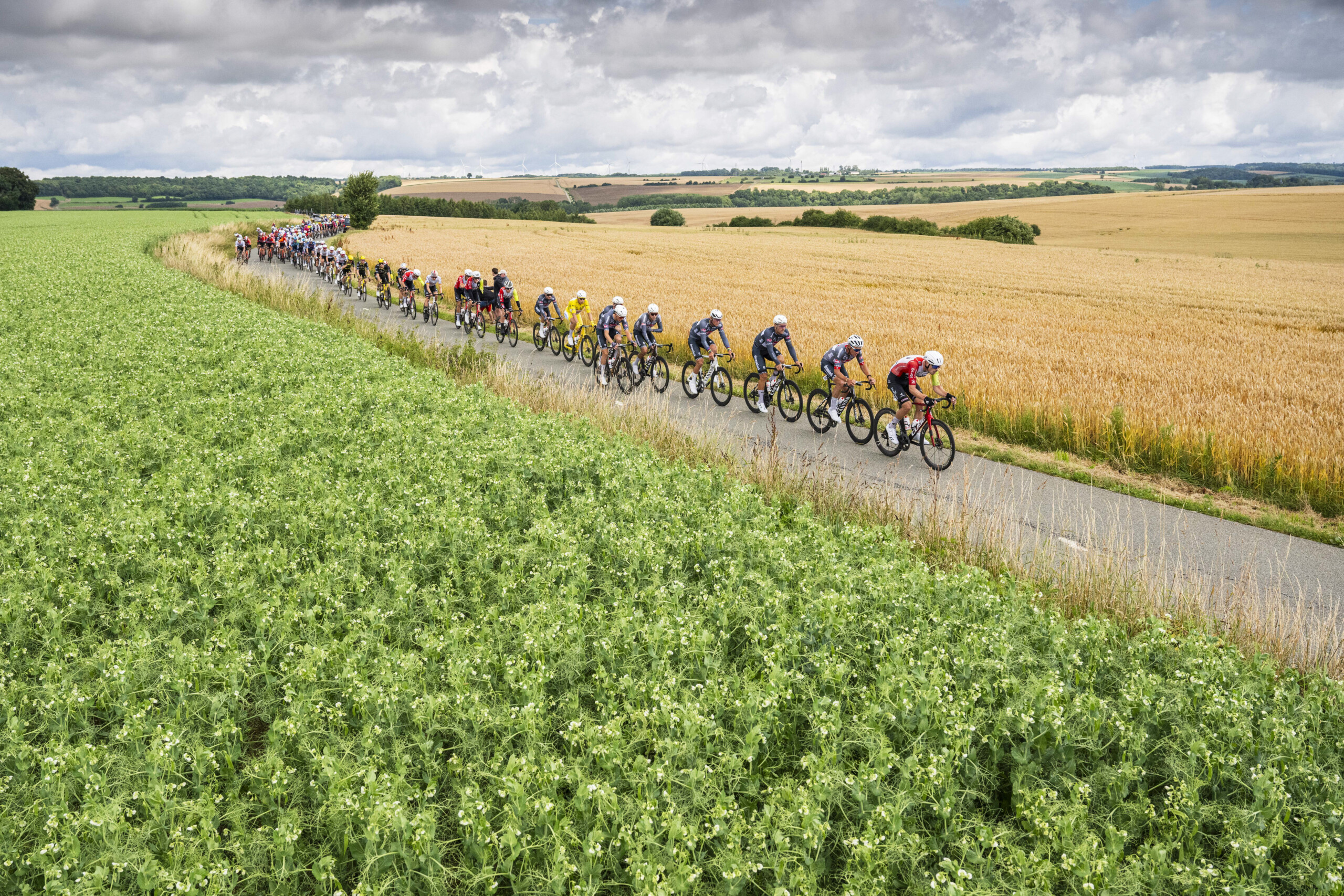
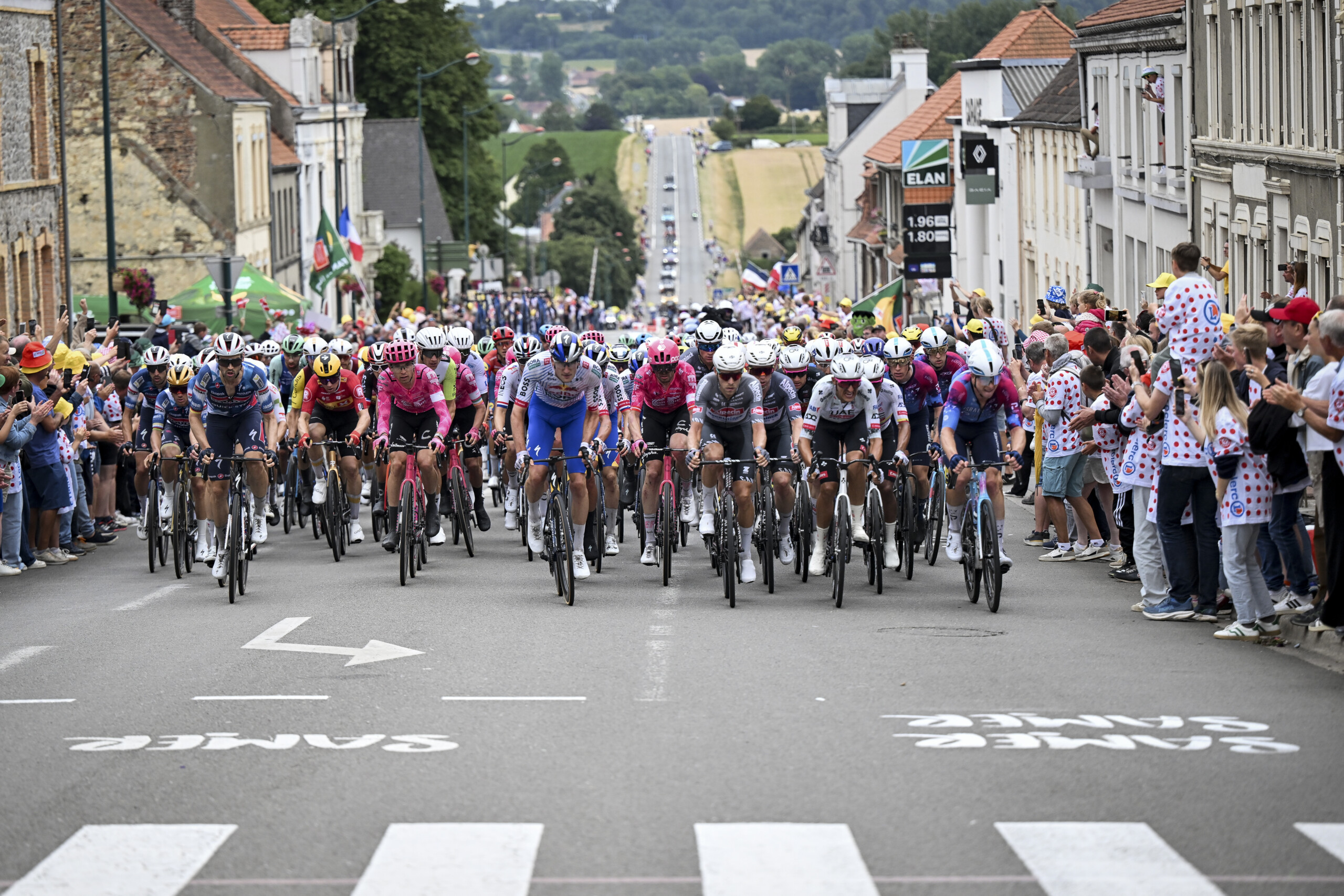
The 179-rider peloton departed Saint-Malo under scorching conditions, with temperatures and aggressive racing creating a cauldron of intensity befitting the iconic Breton finale. From the opening kilometers, the tempo was blistering—an early indicator of the tactical chess match that would unfold on the legendary slopes where Bernard Hinault once ruled supreme.

The Early Skirmishes

The day’s narrative began with characteristic aggression as Wout van Aert, sensing an opportunity to add to his palmarès, launched an immediate sortie alongside Mauro Schmid. The Belgian’s powerful diesel engine and Schmid’s climbing pedigree seemed a formidable combination, but the peloton’s collective intelligence quickly recognized the threat. After just 20 kilometers of freedom, the duo found themselves swallowed by a pack unwilling to grant easy passage to riders of their caliber.

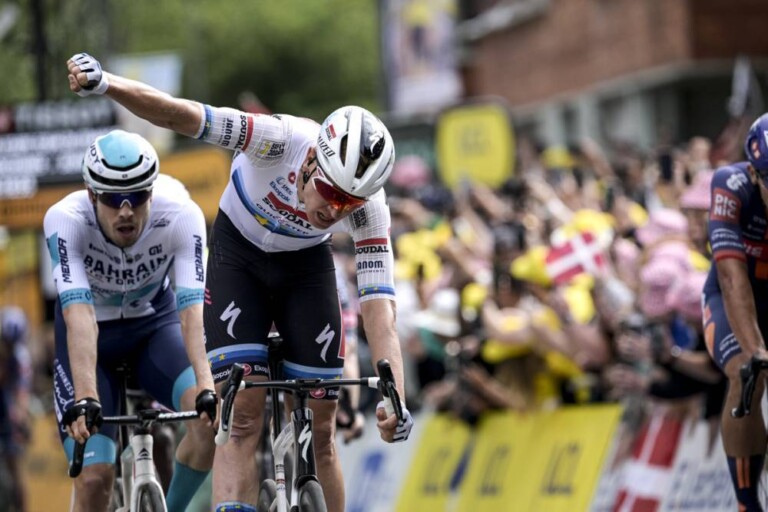
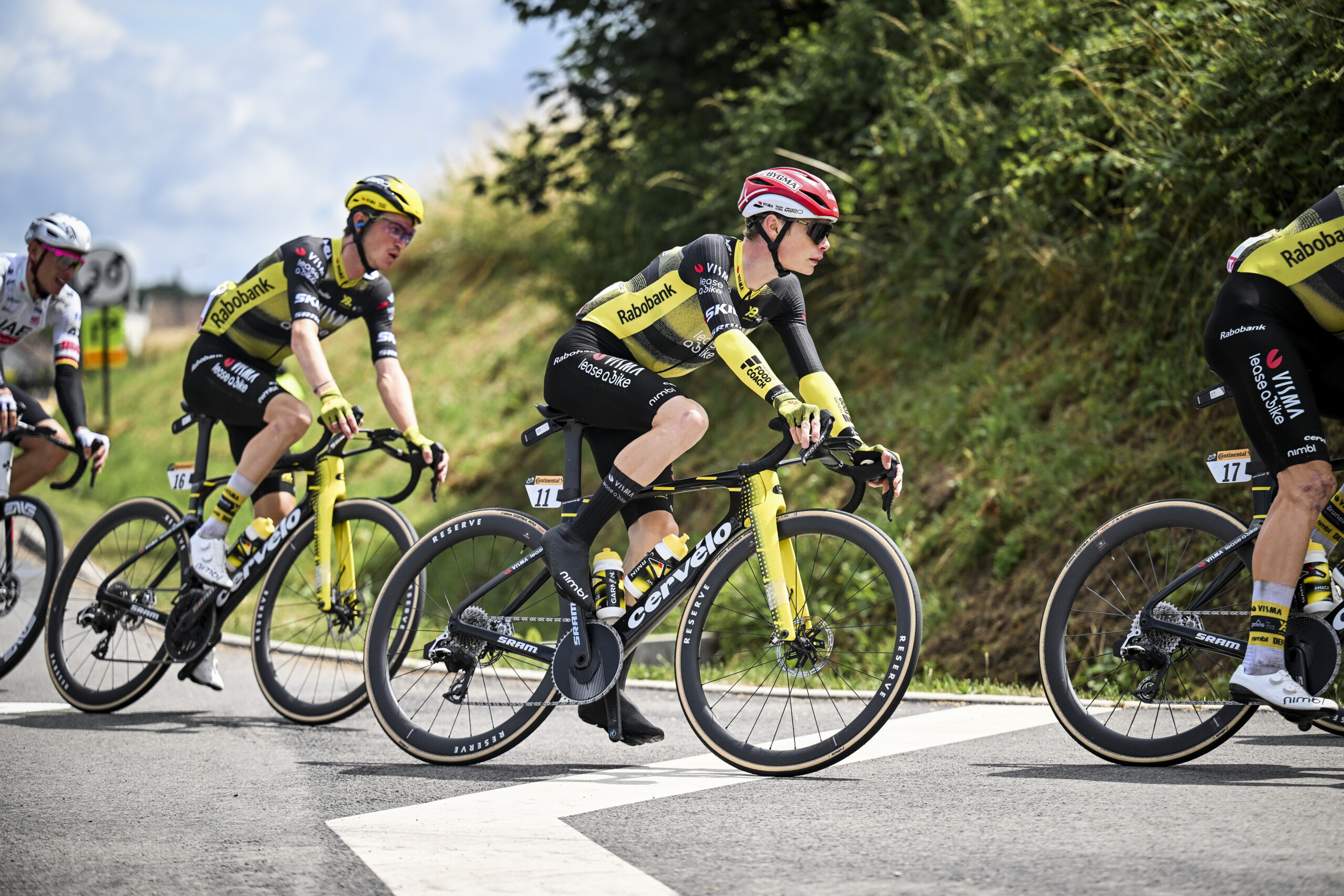
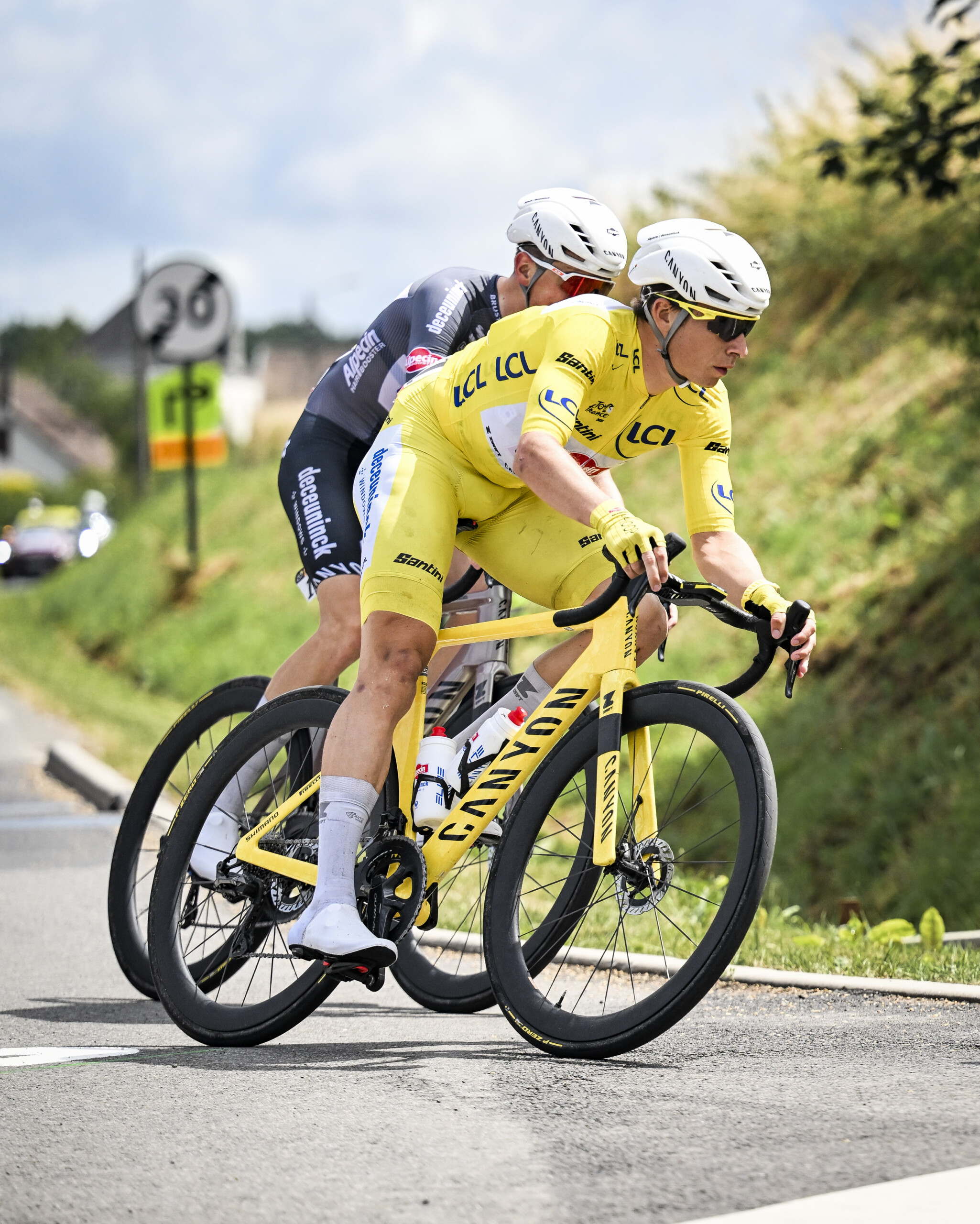
11/07/2025 – Tour de France 2025 – Étape 7 – Saint-Malo / Mûr-de-Bretagne Guerlédan (197 km) – Wout VAN AERT (TEAM VISMA | LEASE A BIKE), Mauro SCHMID (TEAM JAYCO ALULA) – Photo © A.S.O.

What followed was a masterclass in controlled aggression, with UAE Team Emirates-XRG dictating terms while allowing just enough rope for a select group to establish themselves. The early pace was nothing short of ferocious—commissaires noted that after one hour, the peloton had already covered 53.7 kilometers, a blistering average that would ultimately favor the strongest climbers when the road tilted skyward.

Neilson Powless, the American climbing specialist, and Valentin Madouas, riding with the weight of French expectations, repeatedly probed the peloton’s defenses. Their attacks, while ultimately unsuccessful, served to fracture the field and elevate the heart rates of riders who would need every ounce of energy for the finale.

The Breakaway Ballet

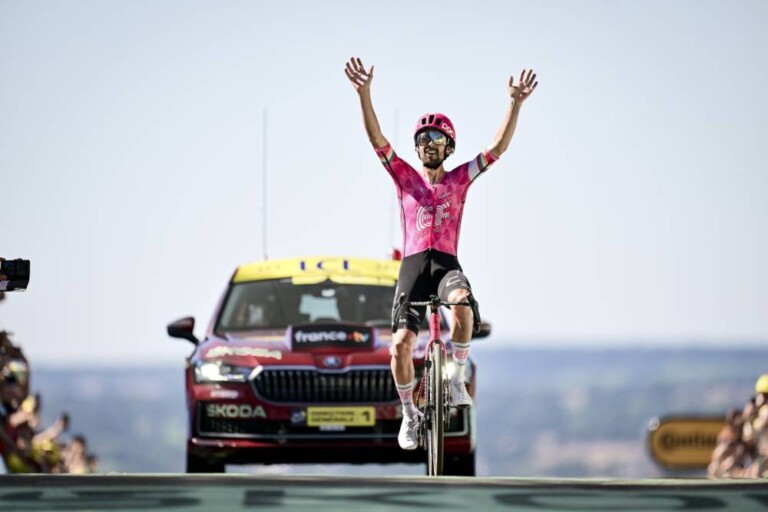
The eventual breakaway quintet—featuring the experienced Geraint Thomas alongside Alex Baudin, Marco Haller, Ewen Costiou, and Iván García Cortina—represented a carefully curated selection of climbing talent and tactical nous. Thomas, the former Tour winner, brought gravitas and experience; Baudin offered American grit; Haller provided Austrian precision; while García Cortina added Spanish flair to the mix.

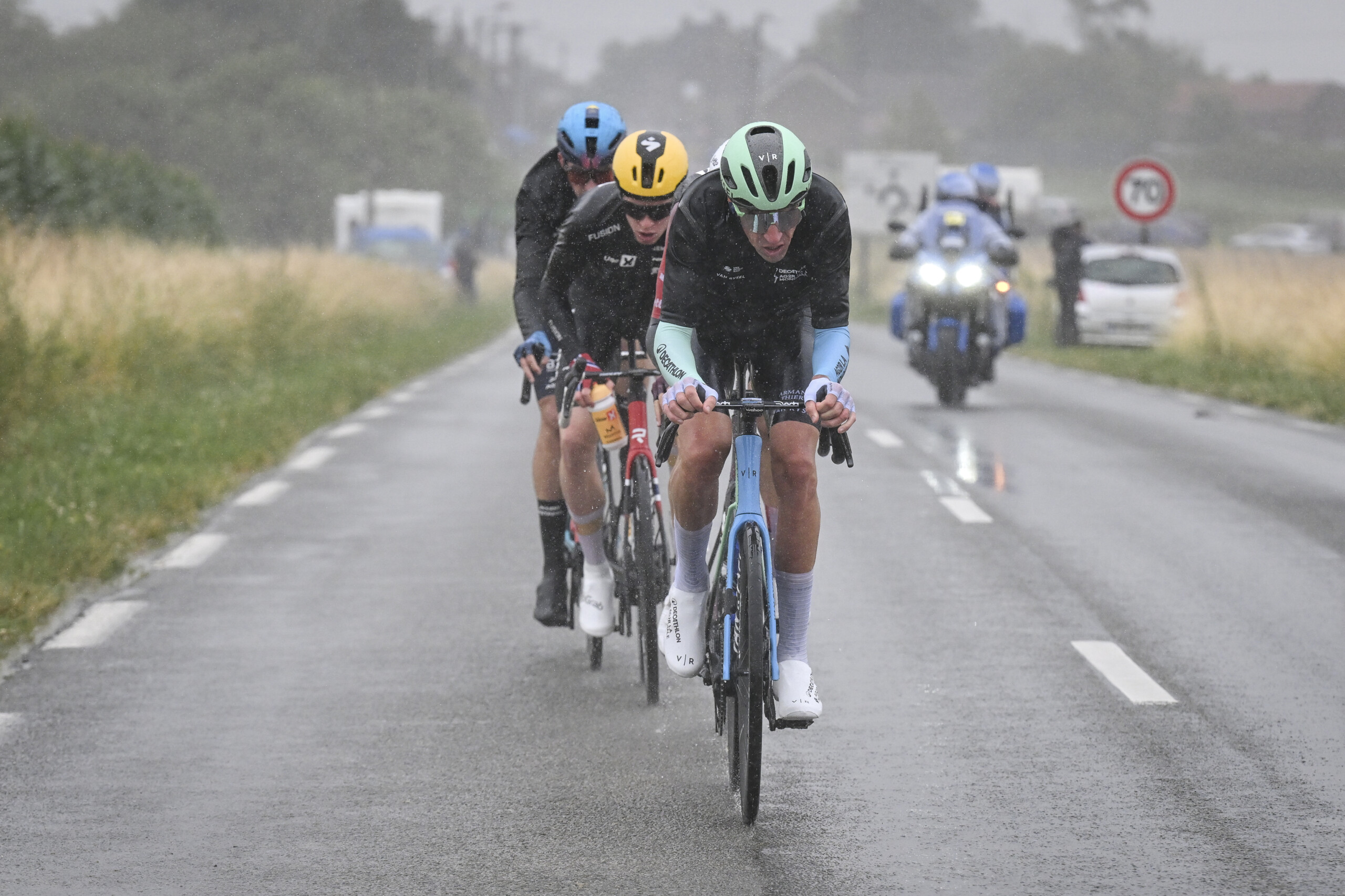
11/07/2025 – Tour de France 2025 – Étape 7 – Saint-Malo / Mûr-de-Bretagne Guerlédan (197 km) – Geraint THOMAS (INEOS GRENADIERS) – Photo © A.S.O.
11/07/2025 – Tour de France 2025 – Étape 7 – Saint-Malo / Mûr-de-Bretagne Guerlédan (197 km) – Ivan GARCIA CORTINA (MOVISTAR TEAM) – Photo © A.S.O.

Yet UAE’s tactical discipline kept the race firmly under control, never allowing the gap to exceed 1’40”. Marc Soler and his teammates rode with the methodical precision of a Swiss timepiece, their tempo calculated to maintain contact while allowing the breakaway riders their moment in the spotlight.

“The peloton didn’t give us much leeway, but we managed our effort well and accelerated when we had to,” reflected one of the escapees later, acknowledging the delicate balance between hope and reality that defines breakaway racing.

Breton Hero’s Moment

As the race approached its climactic finale, the landscape transformed from the rolling countryside of Brittany to the unforgiving slopes that would separate contenders from pretenders. Local hero Ewen Costiou, riding for Arkéa-B&B Hotels, provided the day’s emotional crescendo as he distanced his breakaway companions on the first ascent of Mûr-de-Bretagne.

11/07/2025 – Tour de France 2025 – Étape 7 – Saint-Malo / Mûr-de-Bretagne Guerlédan (197 km) – Alex BAUDIN (EF EDUCATION – EASYPOST), Ewen COSTIOU (ARKEA-B&B HOTELS) – Photo © A.S.O.

The sight of Costiou, one of seven Breton riders in the race, powering clear on home soil stirred the thousands of spectators lining the climb. His solo effort, stretching across the summit and into the descent, represented everything beautiful about cycling—a local rider seizing his moment on the sport’s biggest stage.

“Nothing better could have happened to me,” Costiou reflected afterward, his voice thick with emotion. “It was an incredible climb, especially in front of my family, my girlfriend and my friends. I’ll definitely remember it for the rest of my life. I climbed Mûr-de-Bretagne a few years ago with some other young riders at the start of the stage, and now I’ve ridden it at the front of the race!”

The Breton’s advantage proved short-lived—caught with 12 kilometers remaining—but his effort had served its purpose, softening the field and setting the stage for the climactic battle that would follow.

The Crash That Changed Everything

With tension building toward the inevitable explosion, disaster struck with brutal timing. A crash involving João Almeida and Santiago Buitrago with six kilometers remaining sent shockwaves through the peloton, disrupting UAE’s perfect setup and forcing an immediate tactical recalibration.

Almeida, riding in exceptional form and positioned as Pogačar’s key lieutenant for the finale, found himself sprawled on the tarmac, his race potentially over. The Portuguese climber’s absence left a gaping hole in UAE’s strategy, forcing Tim Wellens to assume road captain duties in the most critical phase of the stage.

“Of course, it’s beautiful to be in yellow and win the stage but like Tim just told me, it was a luxury to have João so close in GC,” Pogačar acknowledged later. “It was a good opportunity for him as well. He’s in great shape so I really hope it’s nothing broken and he can continue.”

The crash served as a stark reminder of racing’s cruel unpredictability—one moment of inattention capable of destroying months of preparation and dreams of glory.

The Final Ascent: Tactical Perfection

The decisive moment arrived with devastating simplicity. Despite the disruption caused by Almeida’s crash, UAE’s tactical depth proved decisive. Wellens, the Belgian veteran, seamlessly assumed leadership duties, delivering Pogačar to the base of the final climb with surgical precision.
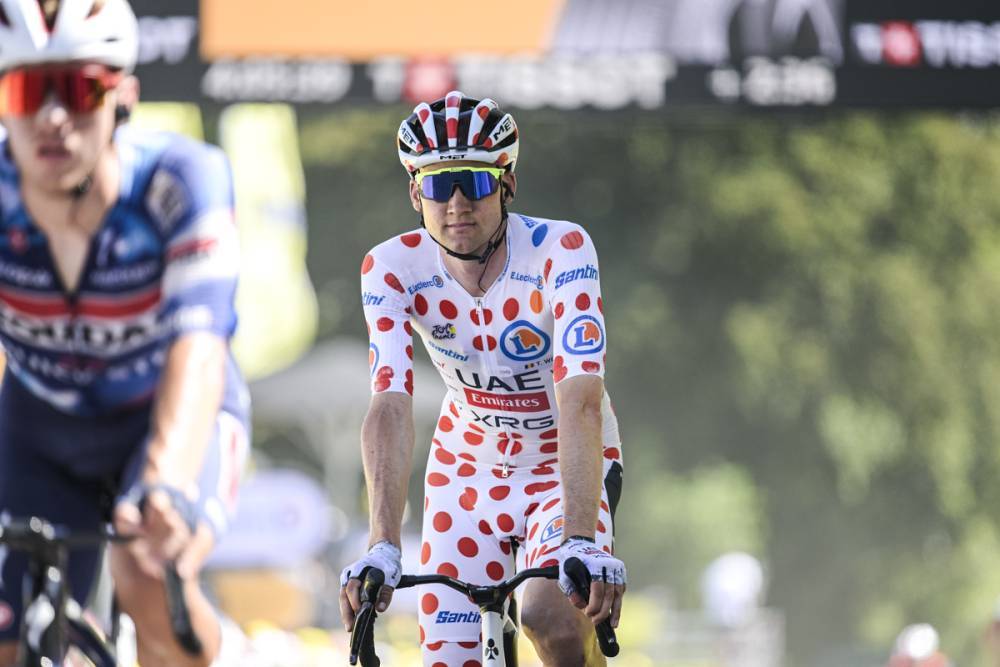
11/07/2025 – Tour de France 2025 – Étape 7 – Saint-Malo / Mûr-de-Bretagne Guerlédan (197 km) – Tim WELLENS (UAE TEAM EMIRATES XRG) – Photo © A.S.O.

The atmosphere was electric as the reduced peloton—now just 35 riders—approached the base of the legendary ascent. Visma-lease a Bike had taken control, their distinctive yellow and black jerseys setting a pace designed to splinter the field before their leader, Jonas Vingegaard, could launch his own assault.

“Tim led me out to the bottom of the final climb,” Pogačar explained with characteristic precision. “Normally, João should have been there but I could follow Remco’s slipstream. And then Narváez did a superb job to keep things under control until the sprint.”

The climb itself—2 kilometers at 6.9% average gradient with ramps reaching 15%—represented cycling’s purest form of suffering. As the gradient bit hardest, the pretenders fell away one by one, leaving only the sport’s elite to contest the stage victory.

Pogačar’s acceleration was both predictable and unstoppable. The Slovenian’s rainbow jersey, earned through his world championship triumph, seemed to glow in the afternoon sun as he unleashed his finishing kick. Nine riders remained in contention as the steepest sections approached, but when Pogačar shifted into his highest gear, the outcome was never in doubt.
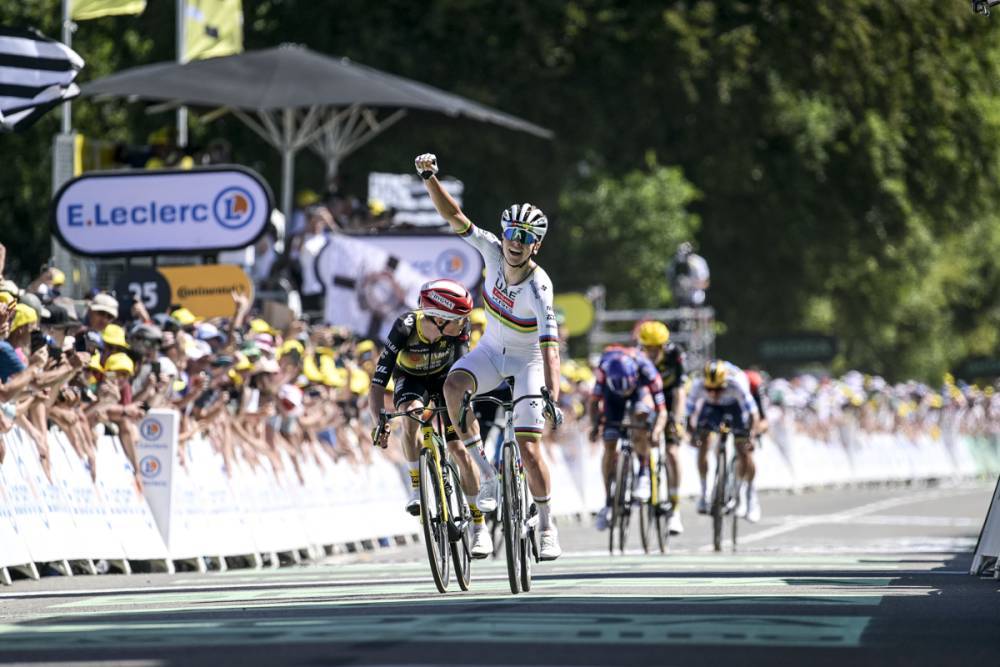
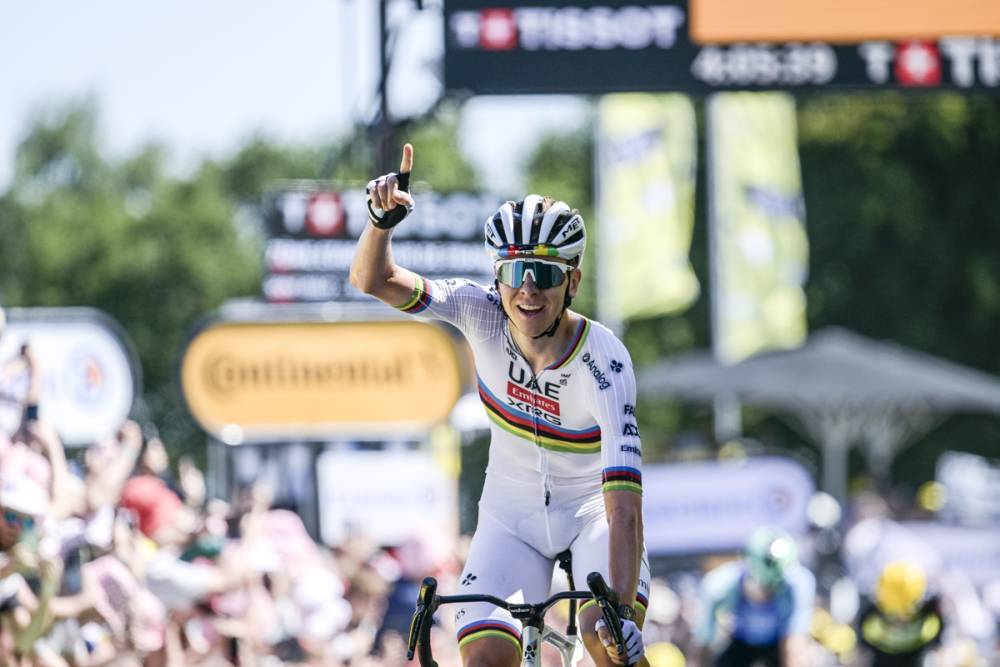
11/07/2025 – Tour de France 2025 – Étape 7 – Saint-Malo / Mûr-de-Bretagne Guerlédan (197 km) – Tadej POGAČAR (UAE TEAM EMIRATES XRG) – Photo © A.S.O.

Vingegaard, the defending champion, managed to match the initial acceleration but couldn’t sustain Pogačar’s relentless pace. Oscar Onley, the young Briton riding for Picnic PostNL, rounded out the podium with a performance that announced his arrival among cycling’s elite.

Evenepoel’s Honest Assessment

Remco Evenepoel’s performance, finishing sixth on the stage but maintaining second place overall, came with characteristic analytical precision. The Belgian’s tactical intelligence and physical gifts were evident, but the final kilometer exposed the cruel mathematics of elite climbing.

“I wouldn’t say my performance was disappointing, but I would have liked to have fresher legs in the final kilometer—I wish the race had finished under the flamme rouge!” Evenepoel admitted with typical honesty. “It was a great effort by UAE Team Emirates to set up the climb and Tadej’s attack. Just Jonas and I were able to cope with his pace, and that’s one of the many positives to take from today: that I was able to stay with the two best climbers in the world on a very steep hill.”

The Belgian’s pragmatic outlook reflected the tactical patience required in three-week racing. “Afterwards, once we entered the final kilometer, I could feel my legs were full of lactic acid. I lost 12 seconds, bonus included, to Tadej today—yet I don’t care, because next week gaps will be measured in minutes. I’m happy with how things are going.”

Evenepoel’s assessment of the broader tactical picture proved equally insightful. “It’s pretty bad to lose Mattia Cattaneo, because he is my number one bodyguard both in the flat and in the mountains. He made the right call by quitting the race, because he had crashed hard and was feeling some headache. Losing him is yet another reason for us to just follow the super teams, without taking matters in our own hands. Visma and UAE are the ones that decide how the race unfolds. If they want to create chaos, they do. If they want to bring the break back, they can do too. They are just super powerful.”

Van der Poel’s Struggles

Notably absent from the finale was Mathieu van der Poel, the Dutch superstar who had entered the stage in second place overall. The Alpecin-Deceuninck leader, typically explosive on short, punchy climbs, found himself distanced on the steepest sections, eventually finishing 22nd and dropping to fifth overall.

11/07/2025 – Tour de France 2025 – Étape 7 – Saint-Malo / Mûr-de-Bretagne Guerlédan (197 km) – Mathieu VAN DER POEL (ALPECIN-DECEUNINCK) – Photo © A.S.O.

Pogačar’s post-race analysis was telling: “Mathieu and I both know this finish very well, with some nice memories. We wanted the same thing, to win on that iconic climb but I think maybe he left too much energy on the road yesterday to be up there today.”

The observation highlighted cycling’s unforgiving nature—a moment’s tactical misjudgment or physical overreach can cost dearly in the sport’s biggest races.

The Bigger Picture

Pogačar’s victory marked his 19th Tour de France stage win and his 42nd day in the maillot jaune, equaling Jacques Anquetil’s historic tally and placing him fifth in the all-time rankings. More significantly, it demonstrated the Slovenian’s ability to deliver when the race reaches its critical junctures.

“The day went like we planned,” Pogačar noted with characteristic understatement. “We did an amazing job, all the teammates were perfect. It was a hot day, super fast… We spent a lot of energy but we had a plan, we stuck to it, and we won. I can be confident in my sprint, especially with a teammate to set me up.”

The stage also highlighted the ongoing tactical battle between the race’s superpowers. Pogačar’s pointed observation about his rivals proved particularly revealing: “The last two days, it was some strange racing from Visma. Let’s see their approach in the next days. The weekend will be easier and then stage 10 will be a proper hard day of suffering with hot temperatures and lots of climbs all day. There can be some movements but we’ll see then.”

Looking Forward

As the race prepares for the upcoming challenges, Pogačar’s commanding performance at Mûr-de-Bretagne sends an unmistakable message. The rainbow jersey bearer remains the man to beat, combining tactical acumen with an explosive finishing kick that continues to define Tour de France racing at its highest level.

The psychological impact of his victory cannot be understated. By regaining the yellow jersey on the eve of a stage to Laval—where he first claimed the overall lead in 2021—Pogačar has established a narrative of dominance that will weigh heavily on his rivals’ minds in the crucial stages ahead.

By the Numbers

13: POGAČAR 10-3 VINGEGAARD
For the 13th time, Pogačar and Vingegaard finished 1-2 in a Tour stage (in either order). They extend their all-time record. The Slovenian has won 10 of these 13 stages.

19: POGAČAR EQUALS FABER
Tadej Pogačar raises his arms for the 19th time on the Tour. He equals Luxembourg’s François Faber with the 7th most victories. One more and he will move up to 6th place alongside Nicolas Frantz, another Luxembourger and a 20-time winner.

2: KEEP AN EYE ON(LEY)
At just 22 years, 8 months and 28 days, Oscar Onley is the 2nd-youngest British rider to finish in the top-3 of a Tour stage. Only Tom Simpson did it earlier, being 3rd in Malo-les-Bains in 1960 at 22 years, 6 months and 28 days. Tom Pidcock is the youngest British winner at 22 years, 11 months and 14 days (stage 12 of the Tour 2020 in Alpe d’Huez). Onley will beat him if he wins by the end of this edition.

5: A NEW WINNER IN BRITTANY
The 5th finish and 5th different winner at Mûr-de-Bretagne Guerlédan, while the previous winner (Mathieu Van der Poel) was racing. Tadej Pogačar succeeds Cadel Evans (2011), Alexis Vuillermoz (2015), Dan Martin (2018), and Van der Poel (2021). Of these five, only the Australian has gone on to win the Tour after raising his arms here.

2: YOUNGSTERS SHOW THEIR GRIT
After Lenny Martinez in Rouen, Ewen Costiou is the 2nd U23 rider to win the Combative award in this first week of the Tour. The two French youngsters follow the likes of Romain Grégoire (stage 17 in 2024), Quinn Simmons (stage 19 in 2022) and Marc Hirschi (stages 9, 12 and 18, and Super Combative of the Tour 2020) to already make the 2020s the decade where U23 riders have been the most combative. In the 1980s, Philippe Chevallier, Paulo Ferreira, Miguel Indurain, Soren Lilholt and Christophe Lavainne won one combative award each before their 23rd birthday.

2/6: POGAČAR, HIGHER AND HIGHER
Tadej Pogačar is only the third rider to win at least two stages in each of his first six Tours. The other two are Nicolas Frantz (1924-1929) and Eddy Merckx (1969-1975, except in 1973 when he was absent). The Slovenian is also the first reigning road World Champion to win more than one stage since Peter Sagan in 2018 (stages 2, 5, and 13).

4: VINGEGAARD OUT OF THE PODIUM
Jonas Vingegaard sits 4th in the general classification, 1’17” behind Tadej Pogačar, an unusual position after 7 stages. This had only happened to him once before, 4 years ago, in 2021, during his first Tour. The Dane was 11th. His other rankings after 7 stages were 2nd in 2022, leader in 2023, and 3rd last year.

22: COSTIOU SHINES
At 22 years, 8 months and 1 day, Ewen Costiou is the youngest rider to be leading at the summit of the Mûr-de-Bretagne, which he achieved on the first of the day’s two passes, before being caught by the peloton. He beat Laurent Desbiens’ record, who did so at 23 years, 9 months and 20 days (stage 3 in 1993).

7: CHASING VICTORY
Since his last success at Le Lioran on July 10, 2024, Jonas Vingegaard has finished on a stage podium 7 times, without ever raising his arms as the winner! The riders who have won these 7 stages are Tadej Pogačar (6) and Mathieu Van der Poel (1). The Dane has now secured his 21st podium finish in the Tour (4 wins, 11 second-place finishes, and 6 third-place finishes).

62: A SLOVENE RECORD EQUALLED
Primož Roglič has worn the leader’s jersey 62 times in a Grand Tour (11 times in the Tour de France, 9 times in the Giro d’Italia, and 42 times in the Vuelta a España), making him the record holder for Slovenia. A statistic now equaled by his compatriot Tadej Pogačar: 42 times Tour Yellow Jersey, 20 times Giro pink jersey. The absolute record belongs to Eddy Merckx with 200.

53.7: FULL SPEED
The first hour of racing out of Saint-Malo was completed at 53.7 km/h. The highest average speed during the beginning of a stage since the start of this Tour!


Stage 7 Results – Saint-Malo > Mûr-de-Bretagne Guerlédan (178.5km)

    1. Tadej Pogačar (UAE Team Emirates-XRG) – 4h 05′ 39”
    2. Jonas Vingegaard (Team Visma-lease a Bike) – s.t.
    3. Oscar Onley (Picnic PostNL) – +2”
    4. Florian Gall (Decathlon AG2R La Mondiale) – +2”
    5. Matteo Jorgenson (Team Visma-lease a Bike) – +2”
    6. Remco Evenepoel (Soudal Quick-Step) – +2”
    7. Kévin Vauquelin (Arkéa-B&B Hotels) – +2”
    8. Jhonatan Narváez (UAE Team Emirates-XRG) – +7”
    9. Aurélien Laurance (Ineos Grenadiers) – +15”
    10. Tobias Johannessen (Uno-X Mobility) – +21”

General Classification After Stage 7

    1. Tadej Pogačar (UAE Team Emirates-XRG) – 25h 58′ 04”
    2. Remco Evenepoel (Soudal Quick-Step) – +54”
    3. Kévin Vauquelin (Arkéa-B&B Hotels) – +1’11”
    4. Jonas Vingegaard (Team Visma-lease a Bike) – +1’17”
    5. Mathieu van der Poel (Alpecin-Deceuninck) – +1’29”
    6. Matteo Jorgenson (Team Visma-lease a Bike) – +1’34”
    7. Oscar Onley (Picnic PostNL) – +2’49”
    8. Florian Lipowitz (Red Bull-Bora-hansgrohe) – +3’02”
    9. Primož Roglič (Red Bull-Bora-hansgrohe) – +3’06”
    10. Mattias Skjelmose (Lidl-Trek) – +3’43”

Jersey Holders After Stage 7

    • Maillot Jaune (Overall Leader): Tadej Pogačar (UAE Team Emirates-XRG) – 25h 58′ 04”
    • Maillot Vert (Points Classification): Tadej Pogačar (UAE Team Emirates-XRG) – 156 pts
    • Maillot à Pois (King of the Mountains): Tim Wellens (UAE Team Emirates-XRG) – 8 pts
    • Maillot Blanc (Best Young Rider): Remco Evenepoel (Soudal Quick-Step) – 25h 58′ 58”
Bicycle Collective Initiatives Serve Community While Promoting Learning And Self-Reliance

By James Knight — The Bicycle Collective aims to promote cycling as an effective and sustainable form of transportation, with transportation equity and self-reliance as a main focus. They partner with over 60 different organizations to provide refurbished bicycles and educational programs. These programs primarily serve refugees or lower-income families.

The Collective, which started in 2002, has locations in Salt Lake City, Ogden and St. George. The Collective opened up their new Salt Lake hub — The Kahlert Community Bicycle Resource Center — in November of 2023, with a grand opening celebration in May of 2024. The new building is located at 325 West, 900 South in Salt Lake City.

The exterior of the Bicycle Collective and Resource Center. Photo by James Knight

Thomas Cooke, digital strategist for the Bicycle Collective, detailed the organizations main stakeholders. One of which is their community partner IRC (International Rescue Committee), who are having trouble providing clients due to new immigration policies.

“There’s a spread that lists by location, all of the partners that we work with, and we’re always adding new ones. Sadly, right now, the way the political climate is, we probably won’t do a lot. We’ve been told by IRC that the demand for bikes for refugees is going to be down because there will be less refugees due to the new immigration policies.” Cooke said.

Despite IRC not being able to provide as many clients, Cooke believes it won’t be a problem finding people to give bikes to.

“We’ll find other people to give Bikes for Goodwill to. But it is kind of a sad thing. IRC is typically one of our largest partners, and they’ve already told us this year, don’t expect a lot of clients.”

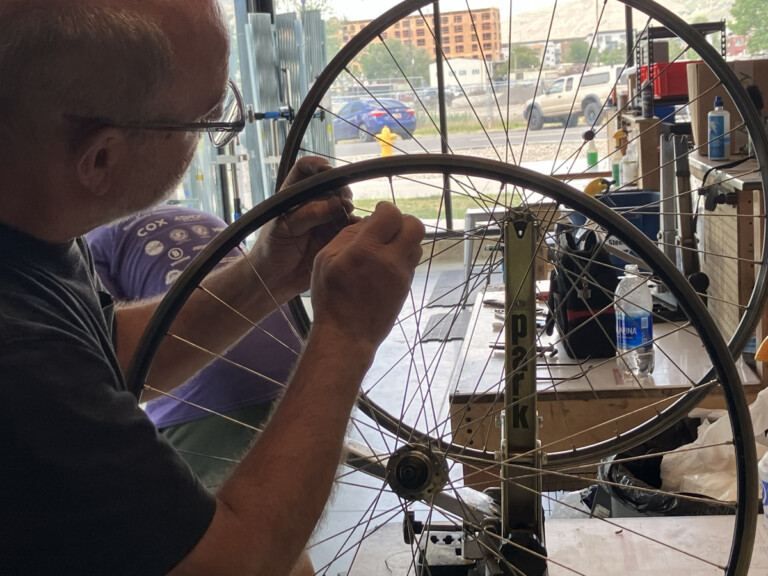
A man repairs part of a wheel on his bicycle. Photo by James Knight

Cooke shared information about the circumstances around Bikes for Goodwill’s recipients and how the organization promotes self-reliance. According to the Collective’s 2024 annual report, the Bicycle Collective gave away 1231 free bikes through their Bikes for Goodwill program during the year.

“A lot of times, the recipients for Bikes for Goodwill are among the most vulnerable of the population, it wouldn’t do any good if we just gave them a bike and didn’t also provide a low-cost way for them to maintain it or learn about maintaining them it themselves. A lot of it is from the bike itself to the maintenance to providing a low-cost way to take care of it. It’s about being self-reliant. If we gave somebody a bike and then they needed to get a new chain or something, and their only solution was to go to one of one of the higher priced bike shops, than we wouldn’t really be serving that mission. They could always come back and either fix it themselves or be taught how to fix it. So, our culture is about teaching self-reliance, but the bike just happens to be the tool that we focus on,” said Cooke.

Cooke also shared information about the shops two other current locations, one in St. George and one in Ogden. Unfortunately, the Provo shop closed its doors late last year.

“We had one in Provo, and we shut it down at the end of 2024. We just had some challenges, mainly with the building that we were in. The lease was up. We own the Ogden building. We don’t own our St. George location, but we rented from the city. With the Provo situation we had actually looked for over a year to find another like long term permanent home, and we just couldn’t find anything. There’s a group of people down in Provo that had been affiliated with us and are kind of doing their own thing now, but we wish them well. We just made the decision that the Provo location was not working for us”. Cooke said.

A woman works on her bicycle at the Bicycle Collective. Photo by James Knight

While the Provo Collective is closing, others are picking up the slack. One such place is the new Provo Bike Hub. The Hub is separate from the old Provo Bike Collective. Pando Refitters generously donated space for the Bike Hub to have limited services. The Hub is located at 249 N. University Avenue and will open May 1st. Kira Johnson, the board chair of Provo Bike Hub, said “We envision being a space dedicated to bike repair, education, bike rides—and above all, bringing people together.”

While Provo is in transition, St. George seems to be doing really well. According to Cooke the St. George location is in the same parking lot as Red Rock Bicycle Co., which is a great location, just servicing a very different customer base. “Ogden has a lot of potential. I’ll just say that it’s kind of gone up and down. It’s a couple miles from Weber State. There’s a lot of students up there. We think Ogden has a lot of potential. But it’s a smaller operation,” Cooke said

Refurbished bicyles are displayed at the Bike Collective and are ready to sell. Photo by James Knight

Due to not being reliant on federal funding, the shop relies a lot on the contributions of their partners and generous donors. Those who donate to the Collective, whether through an actual bicycle, a monetary donation or through volunteering, are vital to the Collective’s success. According to the Collectives most recent annual report, 334 volunteers helped contribute 6,757 hours doing mechanical work and bicycle repairs in the shop. In addition, any bicycles and parts that can’t be refurbished are recycled. This furthers the Collective’s mission of a cleaner and safer society.

Donna McAleer, the executive director of the Bicycle Collective, stated that over 72.5 tons of aluminum, steel and rubber were recycled last year. She noted that about 1/3 of the bikes donated get recycled right away. Bicycle parts that are still usable for repairs will be kept in house for people to come in and work with.

For those who can’t regularly volunteer or donate, there are still ways to get involved and contribute to the Collective. Each year the Collective hosts “Bike Prom” as their annual fundraiser. This year’s event will take place on August 23rd. It consists of a bike ride that starts at Liberty Park and ends at the Woodbine Food Hall. People can dress up in costumes or other formal attire and enjoy a bike ride and delicious food. The event not only raises money but is also designed to give back to the people that support the shop with a fun end of summer party.

For more information, visit the official website of Bicycle Collective at https://bicyclecollective.org.

For additional information about the Provo Bike Hub, visit https://provobikehub.org/


Tour de France Stage 6: Healy’s Breakaway Masterclass Reshuffles Yellow Jersey Fight

VIRE NORMANDIE, France (10 July 2025) — In a stage that director Christian Prudhomme had ominously dubbed “the most leg-breaking flat stage in the recent history of the Tour,” Ben Healy delivered the performance of his career, soloing to victory across the rolling hills of Normandy while behind him, the yellow jersey changed hands by the slimmest of margins.

The EF Education-EasyPost rider’s audacious 42-kilometer solo breakaway not only secured Ireland’s first Tour stage win since Sam Bennett’s Champs-Élysées triumph in 2020, but also inadvertently orchestrated a tactical masterpiece that saw Mathieu van der Poel reclaim the maillot jaune from Tadej Pogačar by a mere second.


The Perfect Storm

Stage 6’s 201.5-kilometer route from Bayeux to Vire Normandie, with its 3,550 meters of elevation gain spread across countless rises and dips, had been circled on many calendars as an opportunity for long-range attackers. Healy, ever the opportunist, had identified this stage from the race’s inception.

“Today’s stage really suited me, I had circled this day from the start,” Healy explained after his emotional victory. “And to do it on the first opportunity is really really amazing. I just switched on from the start. Maybe I spent a bit too much trying to get into the break but that’s just the way I do it.”

The day’s narrative began to unfold at the early intermediate sprint in Villers-Bocage, where Jonathan Milan of Lidl-Trek demonstrated his sprint credentials by edging van der Poel, while Healy and Quinn Simmons positioned themselves strategically for the coming battle.

10/07/2025 – Tour de France 2025 – Étape 6 – Bayeux / Vire Normandie (201,5 km) – Quinn SIMMONS (LIDL-TREK), Ben HEALY (EF EDUCATION – EASYPOST) – Photo © A.S.O.

The Breakaway Ballet

What followed was a masterclass in breakaway formation under the most extreme conditions. The pace was nothing short of brutal—49.5 kilometers covered in the opening hour—nullifying early attempts from Pablo Castrillo and Wout van Aert. The relentless tempo whittled the peloton down to just 20 or 30 riders at various points, illustrating the ferocity of the racing.

10/07/2025 – Tour de France 2025 – Étape 6 – Bayeux / Vire Normandie (201,5 km) – William BARTA (MOVISTAR TEAM), Michael STORER (TUDOR PRO CYCLING TEAM), Ben HEALY (EF EDUCATION – EASYPOST) – Photo © A.S.O.

Healy and Simmons’ persistence eventually paid dividends when they joined a five-man move at kilometer 57, accompanied by van der Poel, Harold Tejada, and Will Barta. The group’s composition was tactically perfect—strong enough to sustain the effort, yet without any serious GC threats beyond van der Poel’s time-based calculations.

10/07/2025 – Tour de France 2025 – Étape 6 – Bayeux / Vire Normandie (201,5 km) – Mathieu VAN DER POEL (ALPECIN-DECEUNINCK), Simon YATES (TEAM VISMA | LEASE A BIKE) – Photo © A.S.O.

The addition of Eddie Dunbar, Simon Yates, and Michael Storer created an eight-man breakaway with the perfect blend of climbing ability and tactical nous. Crucially, UAE Team Emirates-XRG appeared comfortable with the composition, calculating that van der Poel’s 1:26 deficit would be insufficient to threaten Pogačar’s overall lead.

The Moment of Truth

With 42.5 kilometers remaining, Healy made his race-defining move at the base of the category-3 Côte de Saint-Michel-de-Montjoie. It was textbook timing—late enough to be decisive, early enough to build an unassailable advantage.

“I knew I needed to get away from the group,” Healy reflected. “I picked my moment, I think I timed it well and I caught them by surprise a little bit. Then I knew what I had to do: just put my head down and do my best ride to the finish.”

10/07/2025 – Tour de France 2025 – Étape 6 – Bayeux / Vire Normandie (201,5 km) – Ben HEALY (EF EDUCATION – EASYPOST) – Photo © A.S.O.

The Irishman’s acceleration was devastating. Within 15 kilometers, he had opened a 47-second gap, extending it to 45 seconds over the climb’s summit with Simmons and Storer leading the chase. Van der Poel, perhaps feeling the effects of his aggressive racing style, couldn’t match the pace and found himself fighting a losing battle.

The Yellow Jersey Calculation

Behind the breakaway drama, a more subtle but equally significant battle was unfolding. UAE Team Emirates-XRG, despite controlling the pace, seemed to miscalculate the time gaps. Tim Wellens, Pogačar’s teammate, later admitted the handover was “on the limit, and not calculated!”

10/07/2025 – Tour de France 2025 – Étape 6 – Bayeux / Vire Normandie (201,5 km) – Ben HEALY (EF EDUCATION FIRST-EASYPOST) – Photo © A.S.O.

The margins were razor-thin: Healy’s winning time of 4:24:10 put him nearly four minutes ahead of van der Poel, who crossed the line 3:58 back. When Pogačar led the GC group home 5:27 behind Healy, it meant van der Poel had gained exactly enough time to reclaim yellow by one second.

10/07/2025 – Tour de France 2025 – Étape 6 – Bayeux / Vire Normandie (201,5 km) – Ben HEALY (EF EDUCATION FIRST-EASYPOST) – Photo © A.S.O.

“I don’t know why [UAE Team Emirates-XRG] pulled behind me,” van der Poel mused post-stage. “They’re not afraid of me but maybe they wanted to control somebody else. It’s their right to pull, they do their own tactics and it’s up to us to ride faster if we want the jersey. I would have loved to have a bit more than one second but I’m happy to have it again for one day tomorrow.”

10/07/2025 – Tour de France 2025 – Étape 6 – Bayeux / Vire Normandie (201,5 km) – Michael STORER (TUDOR PRO CYCLING TEAM) – Photo © A.S.O.

Tactical Implications

The stage’s outcome reveals several tactical undercurrents heading into the first weekend. UAE’s decision to relinquish yellow, while publicly unintentional, follows sound Grand Tour strategy. With the fearsome Mûr-de-Bretagne finish awaiting on Stage 7, having van der Poel in yellow removes the pressure of controlling the race while positioning Pogačar to attack from a position of strength.

“It is a good move to let the Yellow Jersey go,” Wellens confirmed. “The Tour de France can be very long, and there are so many tough stages to come. Tadej was feeling really good today, but it was not the day to create any time gaps on the GC.”

For van der Poel, the return to yellow carries both opportunity and burden. The Mûr-de-Bretagne holds special significance—it’s where he claimed his first Tour stage wins in 2021. However, with Pogačar lurking just one second behind and Jonas Vingegaard showing improved form, the Dutchman faces an immediate test of his stage racing credentials.

“It’s really nice to be in yellow to go to Mûr-de-Bretagne, a special place for me,” van der Poel said. “But when you see how Tadej [Pogačar] is riding, if he attacks tomorrow, or Jonas [Vingegaard] as well, it will be very difficult not only for me but for the whole bunch to follow on this climb.”

The Broader Picture

Remco Evenepoel’s steady progress continues to fly under the radar, with the Belgian positioned perfectly in third at 43 seconds. His measured approach suggests a rider finding his rhythm: “I felt good today, I recovered well from yesterday’s time trial and I was happy with my legs. I’m improving day by day.”

The sprint classification battle is also heating up, with Jonathan Milan making a strong statement by winning the intermediate sprint. His assessment of the competition is telling: “In my opinion, my main rival in the sprints will be Tim Merlier. As for the points classifications, there are many others like Tadej Pogačar or Mathieu Van der Poel who have a different skillset compared to mine.”

Looking Ahead

As the race heads into its first weekend, Stage 6 has perfectly set the stage for fireworks on the Mûr-de-Bretagne. Van der Poel’s one-second advantage is simultaneously everything and nothing—enough to wear yellow, insufficient to provide security.

The tactical chess match between UAE Team Emirates-XRG and their rivals has only just begun. By allowing van der Poel to reclaim yellow, they’ve created a situation where others must take responsibility for controlling the race, while Pogačar can time his attacks with precision.

For Healy, the victory represents vindication of his aggressive racing philosophy and marks him as a rider capable of seizing opportunities on the biggest stage. His breakthrough performance adds another dimension to an already complex race dynamic.

“A stage win in the Tour is just unbelievable, it’s what I’ve worked all for, not just this year but the whole time,” Healy said, his emotion evident. “Also for all the people who worked so hard to support me, it really is amazing to repay them like that.”

As the riders prepare for tomorrow’s return to the Mûr-de-Bretagne, one thing is certain: the first week of the 2025 Tour de France has already delivered tactical intrigue, emotional victories, and the kind of marginal gains that define Grand Tour racing. The weekend promises to be equally compelling.

By the Numbers

15: HEALY AFTER BENNETT
Ben Healy raises his arms for the first time on the Tour. He gives Ireland its 15th victory, almost five years after Sam Bennett’s last victory (Champs-Élysées 2020). This is his second Grand Tour success – he won stage 8 of the Giro d’Italia 2023 in Fossombrone.

10: RIGHT CALL BEFORE MÛR-DE-BRETAGNE GUERLÉDAN
Mathieu Van der Poel regains the Yellow Jersey, the 10th of his career and the 85th for the Netherlands. His very first was won in 2021 in Mûr-de-Bretagne Guerlédan. The venue that will host the finish of stage 7 tomorrow!

3: SHAKES IN THE CLASSIFICATIONS
Tadej Pogačar loses the lead in the general classification, the points classification, and the best climber classification. The last time these three classifications changed hands on the same day was on stage 3 of the Tour 2019. Julian Alaphilippe took the Yellow Jersey from Mike Teunissen, who was also dethroned in the points classification by Peter Sagan. Tim Wellens (already him!) took the polka dot jersey from Greg Van Avermaet.

144: VICTORIOUS RAID
Offensive from the very beginning, Ben Healy entered into the decisive breakaway at km 57, until the finish 144 km later! The Irishman broke away to take the lead alone with 42 km to go. A scenario similar to that of his victory at the Giro d’Italia 2023: he escaped alone with 50 km to go.

1: CLOSEST IN 14 YEARS
There is one second between the Yellow Jersey (Mathieu Van der Poel) and his runner-up (Tadej Pogačar) in the general classification. This is the smallest gap after six stages since the 2011 edition, 14 years ago! The same gap separated general classification leader Thor Hushovd from eventual winner Cadel Evans in Lisieux.

2: THE POWER OF YOUTH
At 24 years, 9 months and 29 days, Ben Healy is the second-youngest Irish winner on the Tour after his compatriot Sean Kelly. He was 22 years, 1 month and 11 days old when he won in Poitiers in 1978.

40: IRELAND IS SHINING
With Ben Healy (1st) and Edward Dunbar (4th), the two Irish riders of the peloton are in the top-4 today. This is unprecedented since the Stephen Roche-Sean Kelly double at the finish of the Col d’Aubisque on July 17, 1985, almost 40 years ago!

17: WELLENS WITH THE POLKA DOT JERSEY
Holder of the polka dot jersey during stage 3, before losing it to Tadej Pogačar, Tim Wellens regains the lead in the climbers’ classification. This is his 17th polka dot jersey, equaling Christopher Froome, Laurent Jalabert, and Peter de Clercq.

2: STRONG AMERICANS
With Quinn Simmons (2nd) and William Barta (6th), two Americans are in the top six today. It’s the first time since stage 9 of the Tour 2023 (Matteo Jorgenson 4th, Neilson Powless 6th). The United States’ last victory dates back to stage 15 of the Tour 2021, won by Sepp Kuss in Andorre-la-Vieille.

12: ONE MORE FOR EF EDUCATION – EASYPOST
The team EF Education – EasyPost wins for the 12th time. Its last success was on July 17, 2024, during stage 17 won by Richard Carapaz in SuperDévoluy. The team took its first victory in 2011 (when it had a different name), winning a team time trial. 10 different riders have won since, the only one to do so twice being Thor Hushovd (stages 13 and 16 in 2011).


Stage 6 Results (Bayeux > Vire Normandie, 201.5km):

    1. Ben Healy (EF Education-EasyPost) 4:24:10
    2. Quinn Simmons (Lidl-Trek) +2:44
    3. Michael Storer (Tudor Pro Cycling Team) +2:51
    4. Eddie Dunbar (Team Jayco AlUla) +3:21
    5. Simon Yates (Team Visma-Lease a Bike) +3:24
    6. Will Barta (Movistar Team) +3:29
    7. Harold Tejada (XDS Astana Team) +3:52
    8. Mathieu van der Poel (Alpecin-Deceuninck) +3:58
    9. Tadej Pogačar (UAE Team Emirates-XRG) +5:27
    10. Jonas Vingegaard (Team Visma-Lease a Bike) +5:27

General Classification after Stage 6:

    1. Mathieu van der Poel (Alpecin-Deceuninck) 21:52:34
    2. Tadej Pogačar (UAE Team Emirates-XRG) +0:01
    3. Remco Evenepoel (Soudal Quick-Step) +0:43
    4. Kévin Vauquelin (Arkéa-B&B Hotels) +1:00
    5. Jonas Vingegaard (Team Visma-Lease a Bike) +1:14
    6. Matteo Jorgenson (Team Visma-Lease a Bike) +1:23
    7. João Almeida (UAE Team Emirates-XRG) +1:59
    8. Ben Healy (EF Education-EasyPost) +2:01
    9. Florian Lipowitz (Red Bull-Bora-Hansgrohe) +2:32
    10. Primož Roglič (Red Bull-Bora-Hansgrohe) +2:36

Current Jersey Holders after Stage 6:

    • Yellow Jersey (Overall Leader): Mathieu van der Poel (Alpecin-Deceuninck)
    • Green Jersey (Points Classification): Jonathan Milan (Lidl-Trek)
    • Polka Dot Jersey (King of the Mountains): Tim Wellens (UAE Team Emirates-XRG)
    • White Jersey (Best Young Rider): Remco Evenepoel (Soudal Quick-Step)

A Bike Tour in Spain – Mountains, the Alhambra, and Panaderias

By Tom Diegel — If you’re into bike packing/touring – or even if you’re not! – eventually you’ll be drawn to ride in Europe. Whether you have visions of leisurely days in rolling hills smelling of lavender with castles on the horizons between stops at great little bakeries tucked into quaint little cobble-streeted villages or long grinds up the iconic climbs you see skinny guys flying up on their way to mountaintop finishes in The Tour, Western Europe has it all. To be sure, France and Italy are the most logical and probably most popular destinations for American cyclists, but certainly not be overlooked is the home of the Other Big Tour, Spain. Doing your own Vuelta a España ensures that you’ll be able to get it all: rolling hills, big mountain climbs with endless rippin’ descents, fabulous food, fascinating history, plenty of dedicated cycle tracks, plenty of castles, friendly people who treat cyclists with high regard while both in their cars and out, and of course plenty of panaderias for amazing baked goods!

We had done a lot of tours in Europe: Italy, Switzerland, France, Scotland, Austria, Germany, and others, but Spain – taking up most of the Iberian Peninsula along with Portugal – was kind of out of the way of the rest of those countries, so we hadn’t quite made it there. But we knew that Spain was deserving of its own trip, and with a nice long window of time in the Fall of 2023 we decided to try to “do” Spain on our bikes, which was actually laughable: it’s such a big and diverse country that even two months enabled us to only get a taste of the country.

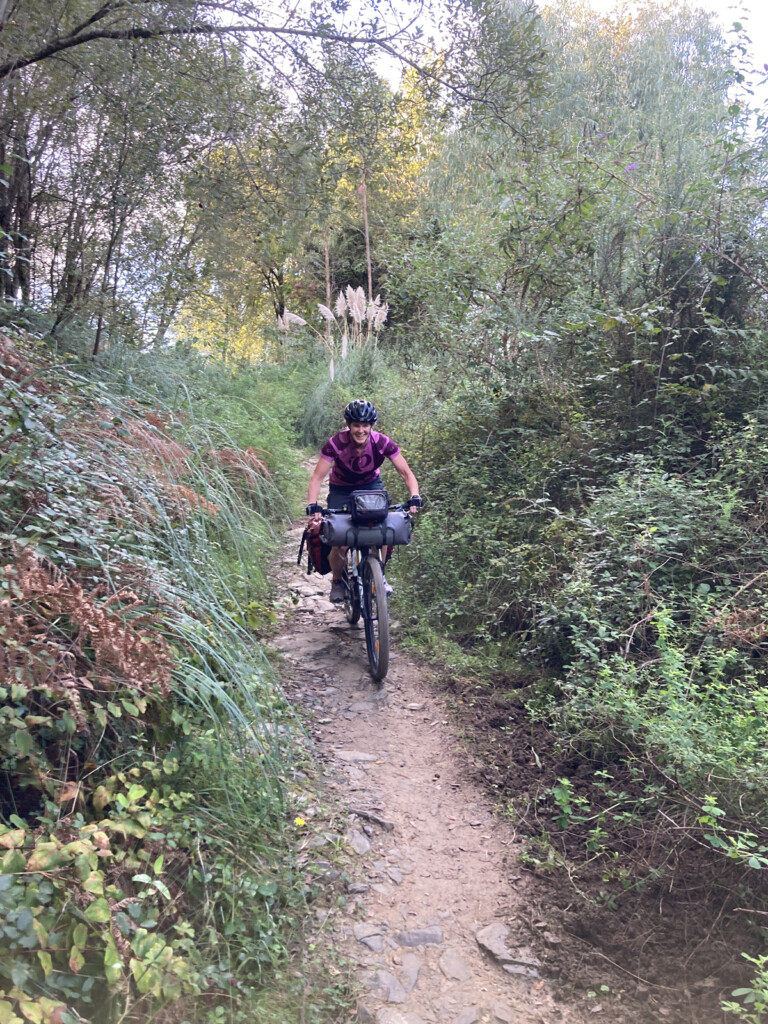
We assume St. James also rode this singletrack on the Camino Santiago. Bike Touring in Spain. Photo by Tom Diegel

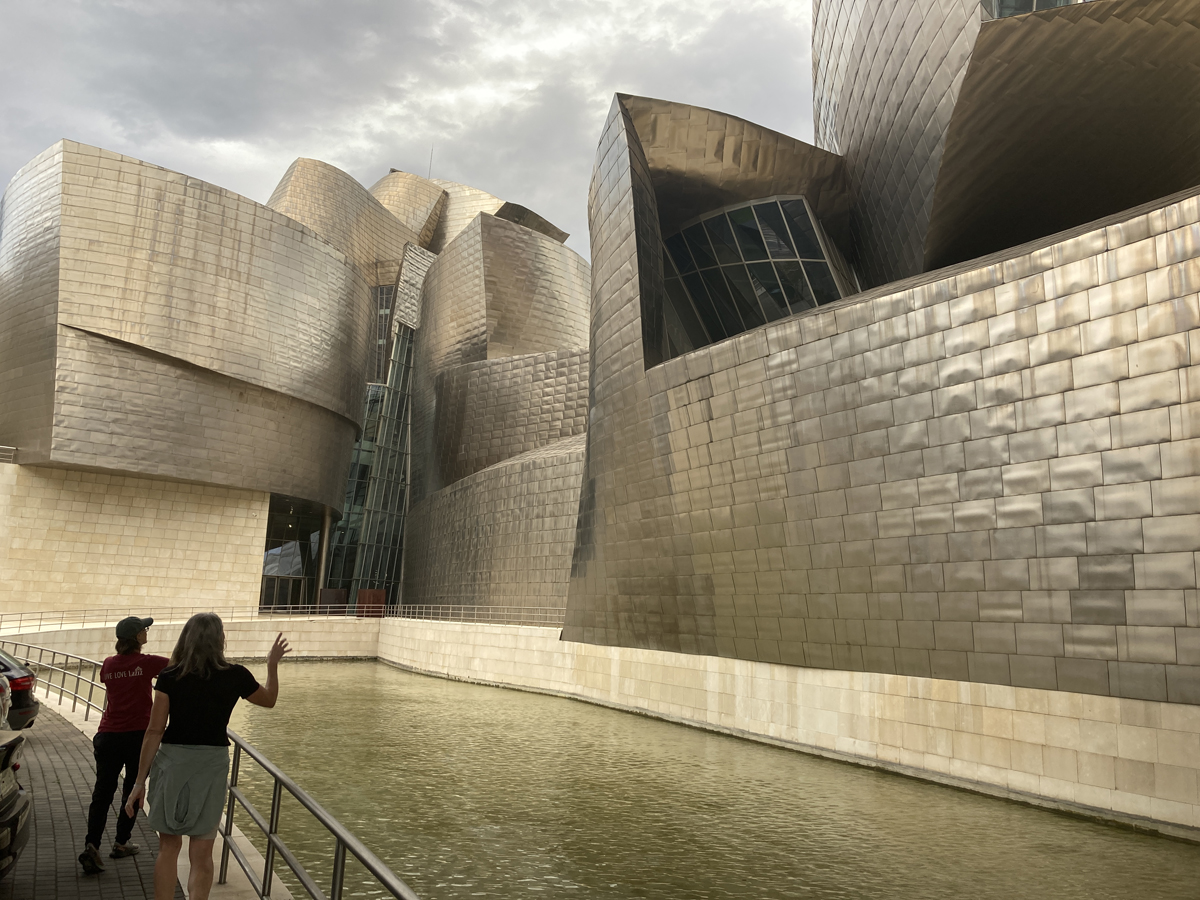
We started in early October; like many places, Fall is a great time in Spain, because the summer heat is off and as the fall wears on you can work your way south to maintain warmish weather. We began our tour in Bilbao, which is effectively on the north coast not far from the southwest coast of France and provided us with an opportunity to of course visit the famous – and worthy – Guggenheim Museum there before heading into the countryside. While we didn’t quite plan on it, we actually began riding on the famous Camino de Santiago. a pilgrimage inspired by the apostle Saint James that people from all over the world travel to Spain to do; it’s kind of like doing the Appalachian Trail but more urban, and while it’s “a form of spiritual path or retreat for the pilgrims’ spiritual growth” it also offers some fun and challenging singletrack riding!

The Guggenheim is as cool outside as it is inside. Bike Touring in Spain. Photo by Tom Diegel
The Guggenheim building is as impressive as its art. Even if you’re not very artsy the Guggenheim is incredible.. Bike Touring in Spain. Photo by Tom Diegel

With a quick detour into far SW France to the Euro surf capital of Biarritz to pick up my wife Ashley who’d been on a non-bike tour with her mom and other octogenarians, she and I and our friend Amy started a loop that we pretty much made up as we went to explore the hills south of Bilbao. While not tall mountains, these “hills” were steep, and most of our riding was on gravel to rugged double track, so we learned to adjust our daily kilometerage accordingly. But even our shorter days got us into cool little villages that all had cheap accommodations if we needed them and remote hills with decent water for easy camping (though wild camping is technically not legal in Spain – nor, really, in the rest of western Europe – no one really cares if you camp, and if you feel like you should ask permission due to the proximity to a house locals virtually always say “sure, camp here, camp there, no problem!). And some of the “hills” were real: we decided to do a late-day climb to stay at a converted monastery for a couple of nights, and the paved climb was probably 15 miles.

The Picos de Europa are big limestone crags that are similar to the Dolomites, but with only double tracks crossing through them. Bike Touring in Spain. Photo by Tom Diegel

After 10 days of riding, we dropped Amy off in Bilbao, and on the advice of a climber friend of ours we headed for the Picos De Europa, a little-known limestone range rising over 8000 feet out of the Atlantic about halfway across the northern edge of Spain that’s sort a mini-Dolomites. These mountains proximity to the Atlantic means that they tend to get some weather, and indeed traversing the coast to get there we got impressive amounts of rain and 60 mph winds that sort of shut us down for a day, but gave us that much more incentive to visit one of Spain’s famous caves: Cuevas El Castillo, which has paintings on it that are over 40,000 years old! With clearing weather, we were able to indeed head into the Picos, which provided big gravel climbs and descents that were steep enough to actually be bit scary, especially while craning our necks to ogle at the craggy limestone peaks that loomed on all sides of us.

Via Verdes are able to take advantage of beautiful 19th-century railroad bridges. Bike Touring in Spain. Photo by Tom Diegel

We had two other friends – the Megans – whom we were meeting in Valencia on the coast, so once we plunged out of the Picos we got into the mid-country flats north of Madrid, where we discovered Via Verdes. Via Verdes are the Spanish versions of our rails-to-trails, but particularly in the flatter interior they are far more extensive than our very spotty rail trails, and you can ride them for literally hundreds of kilometers of car-free, relatively flat cruising. Since we were running a bit behind to meet the Megans we were easily able to jump on the still-in-use rails (i.e. trains) to make up time, and soon enough we were flying down a long descent through – not surprisingly – endless orange groves as we approached Valencia. We rode singletrack pretty much right up to the airport’s runways, rendezvoused with the Megans, and started the next leg of our trip.

And the dirt roads were really fun. Bike Touring in Spain. Photo by Tom Diegel

Bikepacking.com is a great website with incredible routes on it from all corners of the world, and Spain is no exception. The one that piqued our interest and prompted us to meet the Megans in Valencia is a tour called the “Altravesur” that goes for over 800 miles generally following one of the Great Trails of Europe – the GR 7 – from the east coast of Spain trending southwest, ending near Gibraltar, with the Sierra Nevada mountains and many national parks enroute. Our standard mode is to find a cool bikepacking route and use it as sort of a general guide; we ride the routes when convenient and of course always find them to have great riding and Ride With GPS provides the nice turn by turn instructions, but we get easily distracted by both near and far side attractions and have no problem veering off the established routes to satisfy our own curiosities. Most of the time these “side adventures” work out, but one memorable day had us in a dusty agricultural area reminiscent of California’s Central Valley with something like 60 mph crosswinds blowing us into the highway that one ended with us stuffing all four of us and our bikes into a van-taxi to get us off the highway and into a hotel!

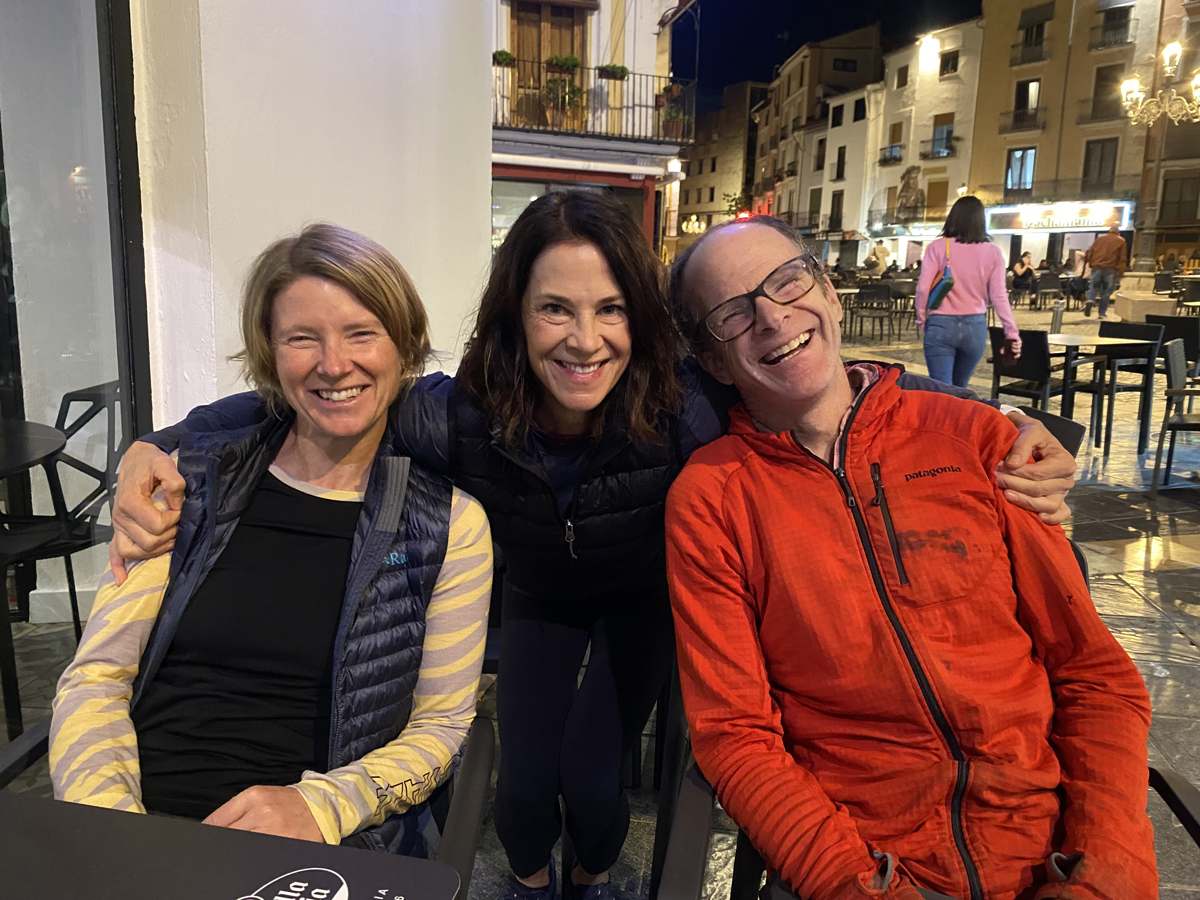
The author with the Megans. Bike Touring in Spain. Photo courtesy Tom Diegel

Another variation took us to Almeria (where one of the Megans flew home from) that had an incredible Moorish castle (the “Moors” were Muslims from Northern Africa who ruled Spain in the Middle Ages), while yet another took us into the Tabernas Desert, which is somewhat reminiscent of Southern Utah and – like our desert – was made famous by “Spaghetti Westerns” like Clint Eastwood’s “Fistful of Dollars” in the 70’s (we stumbled into a Universal Studios-type of Western movie set so Euros can get a sense of the American West … in southern Spain!).

The clay-tiled roofs common to southern Spain create a cool mosaic as you climb out of the towns. Bike Touring in Spain. Photo by Tom Diegel

Not far from the desert we climbed back up into the mountains and basically rode – in two days – a famous stage of the actual Vuelta a España (Almería to Alto de Velefique) that was last won by Ryder Hesjedal. Because we were on the periphery of the desert there’s not a lot of vegetation, so as we crested the pass, we could basically gaze down on all the twists of turns of our upcoming 4000-foot descent.

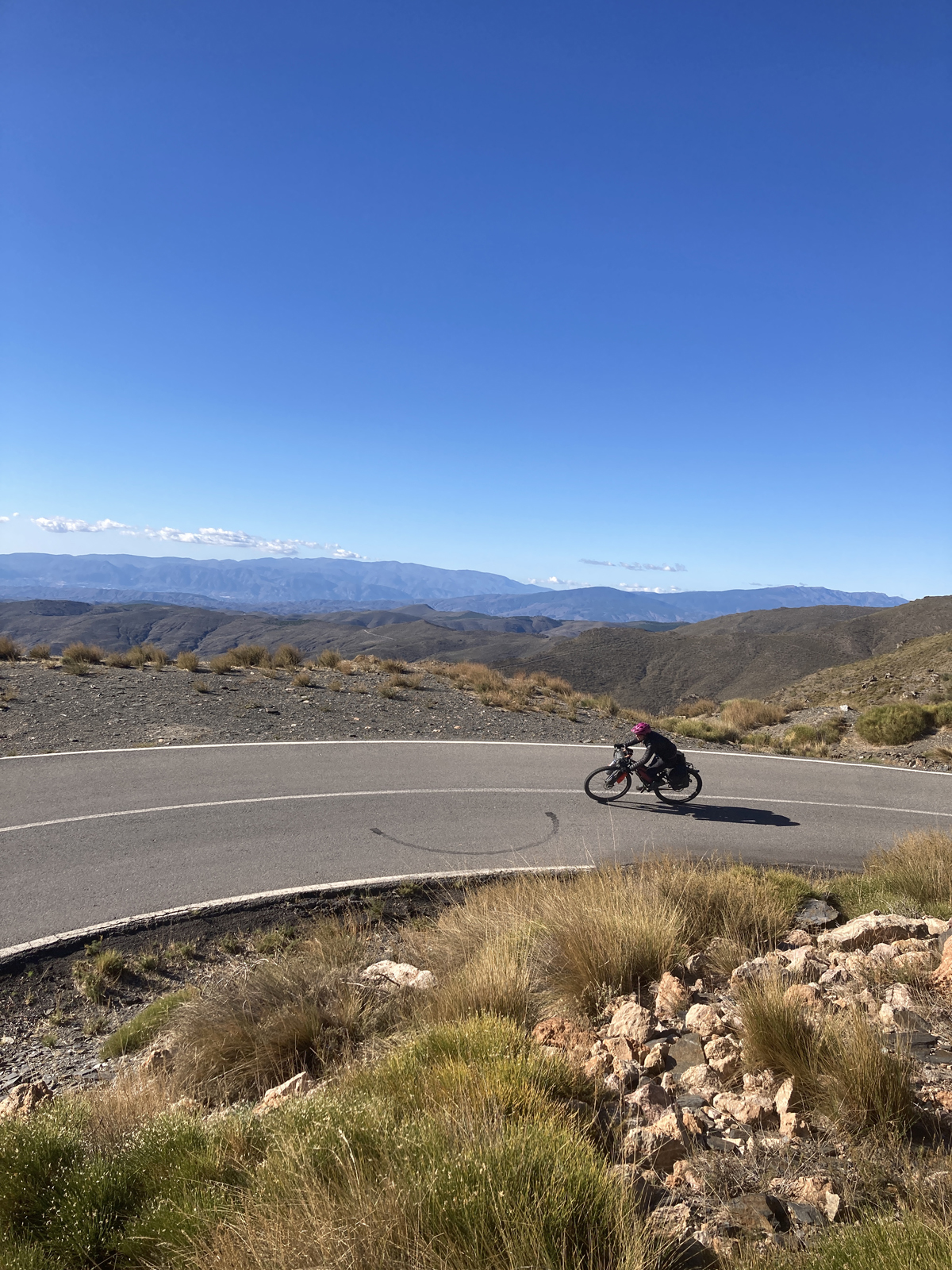
Leaning into a beautifully-banked corner on a 20km descent, Ashley is winning her own Vuelta. Bike Touring in Spain. Photo by Tom Diegel

The Sierra Nevada mountains are the biggest and highest in Spain, rising basically out of the Mediterranean Sea to over 11,000 feet. We were back on the Altravesur to get to the Sierras, but once there we started doing our own variations to milk the range, which included a stop in a town famous for its pork products (complete with a pork museum), a great bed and breakfast with both a hike and a ride up to the highest peak in the Sierras, and lots of undulating roads that traversed around the lower flanks of the peaks. At the western edge of the Sierras is Granada, home to what may be Spain’s most famous site, the Alhambra. The Alhambra is a huge Moorish castle on a hill towering above Granada, and its grounds and interior museums are impressive and vast (and they need to be to hold the crowds).

As if the Alhambra wasn’t impressive enough, our next site – with many kilometers of fabulous, mostly-gravel roads in between – was Ronda, a town famous not only for its vaunted bullfighting ring (and associated museum; a weird spectacle but certainly an integral part of Spanish culture) but also the fact that it’s a full-on city that evenly straddles a deep and difficult-to-access gorge, with only a couple of ancient bridges going across the chasm that are perpetually filled with walking and gaping tourists; cars don’t rule in Ronda.

The Spanish appreciate their cyclists as much as the French! Bike Touring in Spain. Photo by Tom Diegel

Getting back onto the Altravesur we wiggled our way down through remote hills laced with great double track to an overlook with a great view of Gibraltar and across the Strait to the 14,000-foot Atlas Mountains of Morocco.

We decided not to go to Gibraltar, which is a bit of an odd place since it’s a British Overseas Territory that is a tiny peninsula jutting off Spain between Europe and Africa. Instead, we rode to the city of Cadiz, one of the major ports of Spain since it’s at the intersection of the Pacific and the Mediterranean. We bade goodbye to our other Megan and carried on into Portugal, which can be left for a future tale.

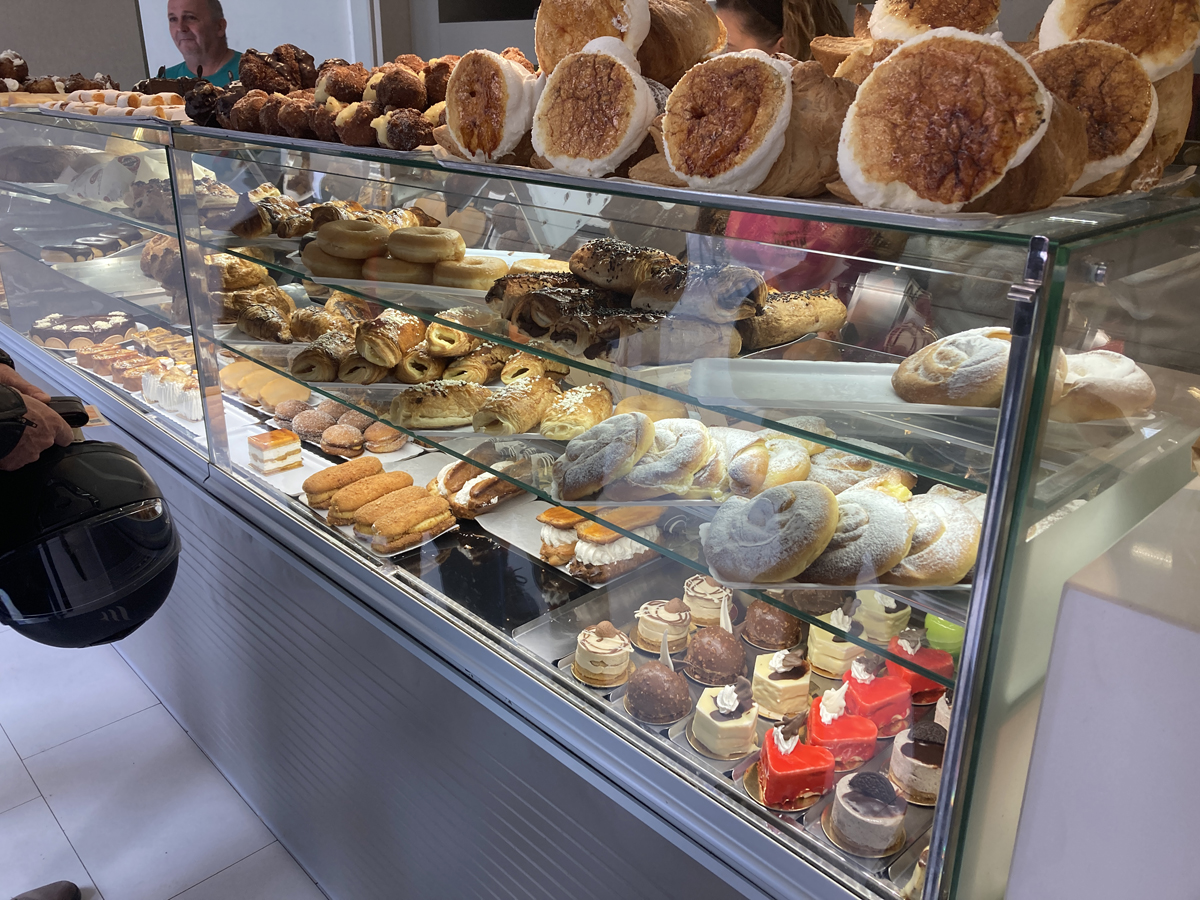
Ah, La panaderias! Spain does not get nearly enough credit for their amazing power pastries that adorn bakeries in every vilage. Leave your pseudo-food shots and blocks at home. Bike Touring in Spain. Photo by Tom Diegel

We went to Spain with very little knowledge of its history or culture and realized that it’s not just another European destination; between its Moorish occupation and long reign by the dictator Franco and somewhat isolated-yet-vast terrain Spain is a dramatically different place. But like its Euro neighbors to the north and east, it’s a fascinating country with incredible food, great people, a long and storied history of bicycling, drivers who treat cyclists with respect, and – importantly – great panaderias!

Spanish Churros come all curled up like this with a cup full of warm chocolate to dip them into; combined with cafe it’s standard morning fare. Author Tom and Ashley approve of this breakfast. Bike Touring in Spain. Photo courtesy Tom Diegel

We had the luxury of being able to do a two-month trip to explore a lot of corners of the country, but we left a lot to return to, and focusing on any one of the many zones for a more-normal, couple-of-week trip would undoubtedly be an incredible bicycle journey for everyone.


Tour de France Stage 5: Evenepoel and Pogačar Share the Spoils as Time Trial Reshuffles the Race

CAEN, France (9 July 2025) — The cobblestones of Normandy gave way to the smooth tarmac of Caen’s time trial circuit on Wednesday, where the 33-kilometer individual test against the clock delivered the first true reckoning of the 2025 Tour de France. In a masterclass of sustained power and tactical precision, Remco Evenepoel claimed his second career Tour stage victory while Tadej Pogačar seized the yellow jersey with a performance that signaled his championship ambitions.

The race of truth around the historic Norman capital unfolded exactly as many had predicted, yet with nuances that will reverberate through the remaining two weeks of racing. Evenepoel, the reigning world time trial champion, demonstrated why he remains the sport’s premier chronoman, posting a time of 36 minutes and 42 seconds at an average speed of 54.0 kilometers per hour. His victory margin of 16 seconds over Pogačar was significant enough to showcase his superiority against the clock, yet narrow enough to highlight the Slovenian’s remarkable improvement in the discipline.


The Morning Establishes the Benchmark

For Pogačar, the day represented a calculated gamble that paid dividends. While conceding the stage to Evenepoel, he gained crucial time on virtually every other general classification contender, vaulting from joint leadership to the race lead with a 42-second advantage over the Belgian. The UAE Team Emirates-XRG leader now holds three of the four Tour jerseys, adding yellow to his existing green and polka dot collections—a feat that underscores his versatility and current form.

The morning’s early starters set a competitive tone that would persist throughout the day. Kazakhstan’s Yegueniy Fedorov briefly held the hot seat before Pablo Castrillo improved the benchmark. The young Spaniard’s time stood until his Movistar teammate Ivan Romeo, the U23 world time trial champion, demonstrated why he’s considered one of cycling’s brightest prospects.

The technical demands of the Caen circuit suited pure time trialists, with its mix of flat sections and rolling terrain requiring both sustained power and tactical pacing. The relatively short distance meant that every second would be magnified, placing premium on riders’ ability to maintain threshold power while managing the metabolic demands of an all-out effort.

Luke Plapp appeared destined for the early lead, posting the fastest times at each intermediate checkpoint, but the Australian champion’s effort unraveled in the final kilometers. The tactical demands of time trial pacing became evident as several riders, including Plapp, pushed too hard in the opening sections only to fade when precision was most needed.

Into this void stepped Edoardo Affini, the European time trial champion, who delivered a stunning performance that would stand as the reference time for hours. The Italian’s effort, 30 seconds clear of Romeo and posted at an average speed of 53.2 kilometers per hour, demonstrated the level of excellence required to contend on such a demanding circuit.

The French Challenge and Rising Stakes

The French national time trial champion Bruno Armirail came tantalizingly close to unseating Affini, falling just two seconds short despite a powerful finish. The Decathlon AG2R La Mondiale rider’s effort exemplified the depth of talent in the modern peloton, where national champions routinely deliver performances that would have won stages in previous eras.

09/07/2025 – Tour de France 2025 – Étape 5 – Caen / Caen (33 km CLM) – Bruno ARMIRAIL (DECATHLON AG2R LA MONDIALE TEAM) – Photo © A.S.O.

As the afternoon heat intensified and the general classification contenders began their efforts, the tactical complexity of the stage became apparent. Team cars positioned themselves strategically around the circuit, providing split times that would prove crucial for pacing decisions. The pressure mounted as each successive rider faced the daunting task of not just beating Affini’s time, but doing so while managing the expectations of overall victory.

The Contenders’ Hour

Florian Lipowitz provided the first serious challenge to Affini’s time, the German’s effort highlighting the depth of talent within the Red Bull-Bora-Hansgrohe squad. His performance also overshadowed that of team leader Primož Roglič, whose struggles against the clock continued to hamper his overall ambitions. The Slovenian veteran’s time deficit of over two minutes to the eventual winner underscored the challenges faced by pure climbers in modern Grand Tour racing.

The psychological warfare of time trial racing became evident as intermediate times filtered through the race organization. Riders starting later had the advantage of knowing exactly what was required, but also faced the pressure of meeting specific targets. This dynamic would prove crucial as the day’s protagonists took to the course.

The Championship Clash

Then came Evenepoel, and with him, a reminder of why he stands alone among the sport’s time trialists. The Belgian’s ride was a study in sustained power and tactical precision, his 54.0 kilometers per hour average speed relegating Affini to second place by 33 seconds. The world champion’s effort showcased the technical mastery that separates elite time trialists from the merely excellent.

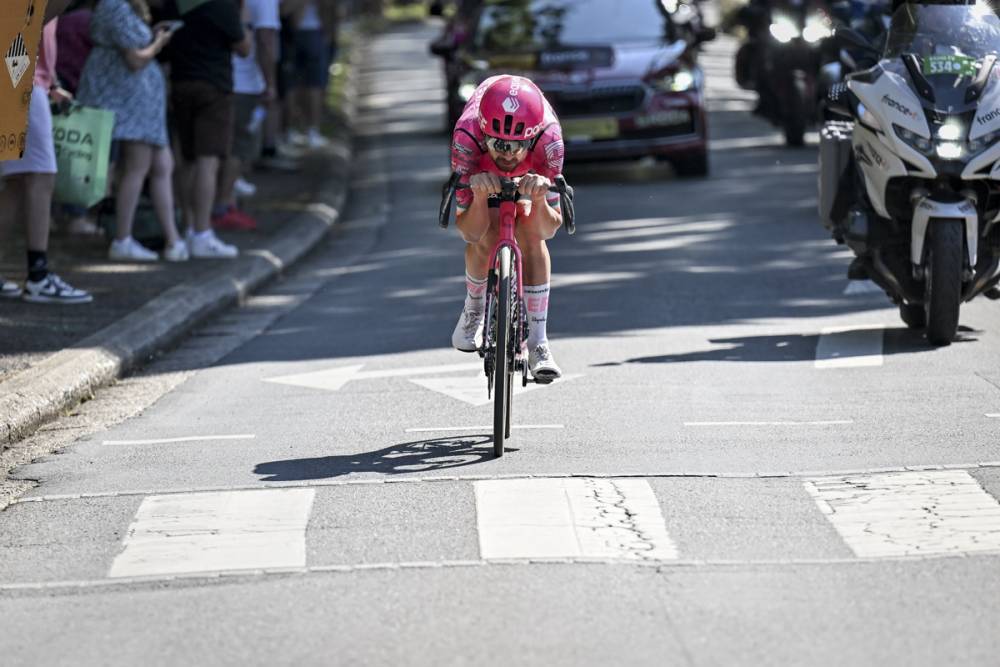
09/07/2025 – Tour de France 2025 – Étape 5 – Caen / Caen (33 km CLM) – Remco EVENEPOEL (SOUDAL QUICK-STEP) – Photo © A.S.O.

Evenepoel’s pacing strategy revealed the meticulous preparation that goes into championship-level time trial performance. His ability to maintain consistent power output while navigating the circuit’s technical challenges demonstrated why he has dominated the discipline at the highest level. The precision of his cornering and his aerodynamic position reflected years of refinement in pursuit of marginal gains.

More significantly, his performance established a benchmark that would test even Pogačar’s renowned finishing ability. The psychological pressure on the Slovenian was immense—not only did he need to deliver a career-best time trial performance, but he had to do so knowing that anything less than perfection would likely cost him the yellow jersey.

Pogačar’s Defining Moment

The Slovenian’s response was immediate and emphatic. While unable to match Evenepoel’s raw speed, Pogačar’s deficit of just 16 seconds represented a quantum leap forward in his time trialing capabilities. His average speed of 53.7 kilometers per hour, combined with the time gaps he opened on key rivals, transformed the race’s general classification landscape.

09/07/2025 – Tour de France 2025 – Étape 5 – Caen / Caen (33 km CLM) – Tadej POGACAR (UAE TEAM EMIRATES XRG) – Photo © A.S.O.

The technical analysis of Pogačar’s effort revealed significant improvements in his aerodynamic position and pacing strategy. His ability to maintain consistent power output throughout the circuit, rather than relying on explosive bursts, demonstrated the evolution of his time trial technique. The marginal gains accumulated through equipment optimization and position refinement were evident in his sector times.

Perhaps most importantly, Pogačar’s performance sent a clear message to his rivals about his current form and tactical approach. His willingness to prioritize overall time gains over stage victory showed the maturity that has defined his championship campaigns. The calculated risk of conceding 16 seconds to Evenepoel while gaining significantly more on other contenders exemplified championship-level tactical thinking.

The Casualties and Revelations

The day’s biggest casualty was Jonas Vingegaard, the Danish star whose time trial struggles have become increasingly pronounced. The Visma-Lease a Bike leader’s 13th-place finish, leaving him 1 minute and 13 seconds adrift of Pogačar, raised serious questions about his ability to challenge for overall victory. His performance suggested either a concerning lack of form or tactical miscalculation in his preparation.

The defending champion’s struggles were particularly surprising given his team’s resources and his previous time trial performances. His deficit to Pogačar now appears potentially insurmountable, especially considering the climbing stages that await. The psychological impact of such a significant time loss in a discipline where he was expected to remain competitive cannot be understated.

09/07/2025 – Tour de France 2025 – Étape 5 – Caen / Caen (33 km CLM) – Mathieu VAN DER POEL (ALPECIN-DECEUNINCK) – Photo © A.S.O.

Equally concerning for those harboring overall ambitions was the performance of Mathieu van der Poel, who surrendered the yellow jersey after three days of inspired leadership. The Dutch champion’s time trial limitations were exposed, dropping him to sixth overall and 1 minute and 28 seconds behind Pogačar. His post-stage demeanor suggested he had expected this outcome, focusing instead on future stage opportunities.

The Surprise Contender

The surprise package of the day was Kévin Vauquelin, the Arkéa-B&B Hotels rider who leveraged home support and superior time trial technique to claim third place overall. The Norman’s performance, just 59 seconds behind Pogačar, positions him as an unexpected podium contender and provides his team with a legitimate general classification threat.

Vauquelin’s rise represents one of the most compelling narratives of the early Tour. His ability to maintain position through the opening stages while others faltered, combined with his strong time trial performance, suggests a maturity beyond his years. The French rider’s technical proficiency against the clock was evident in his sector times, which remained consistent throughout the effort.

The tactical implications of Vauquelin’s performance extend beyond individual achievement. His positioning creates an interesting dynamic for the mountain stages, where his team’s aggressive racing style could prove decisive in shaping the overall battle. The presence of a genuine French contender also adds significant emotional weight to the race narrative.

Champions’ Perspectives

In the post-stage interviews, both protagonists displayed the measured confidence of champions who understand the magnitude of their performances. Pogačar, speaking from the yellow jersey presentation podium, acknowledged the challenge ahead while expressing satisfaction with his tactical execution.

“I’m super happy with how the race turned out today,” Pogačar said. “We had some strong competition out there. To finish just 16 seconds behind the best time triallist in the world, both Olympic and World Champion, is great. I put some time on most of my GC rivals – just lost some to Remco [Evenepoel]. I’m happy this day is over and we can start focusing on the remainder of the Tour de France… and keep the ball rolling.”

The three-time Tour champion also revealed his tactical philosophy for the remainder of the race, emphasizing long-term strategy over short-term jersey defense. “It’s going to be a hard Tour de France. We have raced five stages already, and they have been quite fast. This year’s course is super hectic. We have to watch out the whole time, because every stage is nervous. I’m super happy to have the Yellow Jersey, yet we are aware the race can feel very long from now until Paris. As of now, our priority is going to be keeping our advantage on our GC rivals, and not necessarily the jersey.”

His comments revealed the strategic thinking that has defined his championship campaigns—a willingness to sacrifice short-term gains for long-term positioning. This tactical maturity, combined with his demonstrated versatility, makes him the most complete rider in the current peloton.

Evenepoel, meanwhile, displayed the satisfaction of a rider who had executed his plan to perfection while maintaining realistic expectations about his overall ambitions. “I knew I had a good chance to win but the legs had to be there. I didn’t feel like I could go any faster so it was a good plan. I kind of pushed pretty steadily, a bit harder on the uphills than the downhills of course. And I gained positions at every checkpoint. The pacing was perfect and everything was on point, I’m super happy.”

The Belgian’s technical analysis of his performance revealed the meticulous preparation that goes into championship-level time trial racing. His ability to maintain consistent power output while adjusting for the circuit’s topographical demands demonstrated the tactical sophistication that separates elite performers from the merely talented.

“Now, the two guys from the team that came for stage wins have done it, with Tim [Merlier] and I. We can be relieved and focus on the podium in Paris. Of course, there are regrets after our rookie mistake on day 1. But we can’t change the past and it actually motivated me even more! It’s getting better every day so let’s hope it keeps going like that.”

His assessment of Pogačar’s performance was equally revealing, acknowledging both the improvement and the implications for the overall battle. “Tadej [Pogačar] did a very strong time trial as well, losing about half a second per kilometre. If you compare with the Critérium du Dauphiné, he made a big step forward and he shows he’s in big form.”

Looking Toward the Mountains

The stage also saw the withdrawal of Emilien Jeannière (TotalEnergies) and Jasper De Buyst (Lotto Dstny), reducing the peloton to 179 riders as the race approaches its first serious mountain test. These departures, while not unexpected given the demands of Grand Tour racing, serve as reminders of the physical toll that three weeks of competition extracts from even the most prepared athletes.

As the Tour de France 2025 prepares to leave Normandy behind, the time trial has provided the clarity that was missing from the opening stages. Pogačar’s emergence as the race leader, combined with Evenepoel’s continued excellence against the clock, sets up a fascinating battle for the remaining two weeks. The mathematical precision of time trial racing has eliminated much of the uncertainty that characterized the opening sprint stages.

The real test, however, begins next week when the mountains of the Massif Central loom. There, the time gained and lost on the flat roads of Caen will be put into proper perspective, and the 2025 Tour de France will reveal its true character. The tactical implications of today’s result extend far beyond the immediate time gaps, establishing psychological momentum and strategic positioning that will influence decision-making throughout the race’s decisive mountain stages.

With Vingegaard seemingly struggling and van der Poel’s limitations exposed, the path to Paris appears increasingly to run through the Pogačar-Evenepoel rivalry. Their mutual respect, evident in post-stage interviews, masks an intense competitive dynamic that promises to define the remainder of the 2025 Tour de France. The stage’s outcome has fundamentally altered the race’s tactical landscape, setting up what promises to be one of the most compelling battles for cycling’s greatest prize in recent memory.

By the Numbers

2: EVENEPOEL’S TOUR STAGE WINS
Remco Evenepoel claims his second Tour de France stage victory, following his maiden triumph in Gevrey-Chambertin in 2024. He becomes the third rider to win individual time trials in different editions of the Tour while holding the world championship rainbow jersey. This is his 64th professional victory, his 5th of the year.

54.0: KILOMETERS PER HOUR AVERAGE
Evenepoel’s winning speed of 54.0 km/h on the 33-kilometer circuit demonstrates the exceptional level of time trial performance in the modern peloton. His power output sustainability over the technical Caen circuit showcased championship-level preparation.

42: POGAČAR’S ADVANTAGE IN SECONDS
Tadej Pogačar’s 42-second lead over Evenepoel represents the largest time gap between the top two riders in the 2025 Tour de France. His deficit of just 16 seconds to the stage winner highlights his remarkable improvement in time trial disciplines.

1:13: VINGEGAARD’S DEFICIT
Jonas Vingegaard’s time loss of 1 minute and 13 seconds to the new race leader represents the biggest surprise of the stage, potentially ending his championship ambitions before the mountain stages have even begun.

179: REMAINING RIDERS
The withdrawals of Emilien Jeannière and Jasper De Buyst reduce the peloton size as the race approaches its first serious mountain challenges, with attrition expected to continue as the Tour intensifies.

1: THE CHAMPIONS IN ACTION
Reigning road World Champion Tadej Pogačar won yesterday; time trial World Champion Remco Evenepoel did the same today. Two different World Champions winning in two days, it never happened before!

1: FIRST GREEN JERSEY FOR POGAČAR
Tadej Pogačar succeeds Jasper Philipsen (stages 1-2) and Jonathan Milan (stages 3-4) to lead the points classification (green jersey). This is a first in the Slovenian’s career, as he has never led the points classification! He has now been the holder of all the Tour’s distinctive jerseys: the Yellow Jersey (41 times), the polka dot jersey (18 times), the white jersey (75 times), and the green jersey once.

3/5: THE BELGIANS SHINE
After Jasper Philipsen (stage 1) and Tim Merlier (stage 3), Remco Evenepoel gives Belgium a 3rd victory in the first five stages. It hasn’t happened since 1981: Freddy Maertens won twice in Nice and Narbonne, plus a victory for Lucian Van Impe at Pla d’Adet.

5: POGAČAR HAS (ALMOST) EVERYTHING
Tadej Pogačar becomes the 5th rider in history to lead the general classification, points classification, and mountains classification simultaneously! The previous four were Bernard Hinault (stage 2 in 1979; prologue in 1985), Acacio da Silva (stages 1-2 in 1989), Richard Virenque (stage 2 in 1992), and Philippe Gilbert (stage 1 in 2011). It’s the first time this has happened so late (stage 5). Eddy Merckx won all three classifications in 1969, but the polka dot jersey didn’t exist – it was created in 1975.

41: POGAČAR BACK IN YELLOW
Tadej Pogačar dethrones Mathieu Van der Poel and takes the 41st Yellow Jersey of his career. As many as Sylvère Maes, making him the 6th best-ever performer in this classification.

9: AN ITALIAN ON THE PODIUM
Third on the day, Edoardo Affini is the first Italian to finish on the podium in an individual time trial since Fabio Aru, 3rd in Megève in 2016, 9 years ago. However, the route included climbs. For a flat time trial, this is an unprecedented performance in the 21st century!

2001: TWO FRENCHMEN IN THE TOP 5
Two Frenchmen, Bruno Armirail (4th) and Kévin Vauquelin (5th), finished in the top 5 today. It hasn’t happened in an individual time trial since July 7, 2001, 24 years ago. Christophe Moreau won the 8.2 km prologue in Dunkerque, while Florent Brard finished 5th.

09/07/2025 – Tour de France 2025 – Étape 5 – Caen / Caen (33 km CLM) – Julian ALAPHILIPPE (TUDOR PRO CYCLING TEAM) – Photo © A.S.O.

3: VAUQUELIN IMPRESSES
Kévin Vauquelin is now 3rd in the general classification, becoming the first Frenchman on the podium since Romain Bardet after stage 1 in 2024. To find a Frenchman on the podium after stage 5, you have to go back to Julian Alaphilippe in Colmar in 2019. The rider from Normandie is now 24 years, 2 months and 13 days old. The last Frenchman this young to be in the top 5 of an individual time trial was Armand de las Cuevas in 1992! He finished 2nd of the time trial in Luxembourg, at 24 years and 17 days old.

09/07/2025 – Tour de France 2025 – Étape 5 – Caen / Caen (33 km CLM) – Ivan ROMEO (MOVISTAR TEAM) – Photo © A.S.O.

21: ROMEO, YOUNG AND (ALREADY) FAST
The youngest rider in the peloton, Ivan Romeo, finished 7th today. At 21 years, 10 months and 23 days, the Spaniard is the youngest rider to finish in the top 10 in an individual time trial since Dmitriy Ignatyev, 3rd in Annecy in 2009 at the age of 21 years and 26 days. Tadej Pogacar won the time trial at La Planche des Belles Filles in 2020, but he was slightly older than Romeo (21 years, 11 months and 29 days).

18: POGAČAR EQUALS CLAVEYROLAT
With no points awarded in Caen, Tadej Pogačar retains his polka dot jersey, the 18th of his career. He equals Thierry Claveyrolat as the 8th cyclist with the most polka dot jerseys. Next up is Bernard Vallet, who has worn the jersey 20 times.

21: EVENEPOEL BACK IN WHITE
Today’s winner, Remco Evenepoel, took the lead in the young rider classification and collected his 21st white jersey. Since his Tour debut last year, he has consistently led this ranking, excepting stage 1 in 2024 and stages 1 to 4 this year. That’s 21 of the 26 stages contested so far!


Stage 5 Results (Caen > Caen, 33km ITT):

    1. Remco Evenepoel (Soudal Quick-Step) 36:42
    2. Tadej Pogačar (UAE Team Emirates-XRG) +16″
    3. Edoardo Affini (Team Visma | Lease a Bike) +33″
    4. Bruno Armirail (Decathlon AG2R La Mondiale Team) +35″
    5. Kévin Vauquelin (Arkéa-B&B Hotels) +49″
    6. Florian Lipowitz (Red Bull – Bora – Hansgrohe) +58″
    7. Ivan Romeo Abad (Movistar Team) +1:02″
    8. João Almeida (UAE Team Emirates-XRG) +1:14″
    9. Luke Plapp (Team Jayco AlUla) +1:17″
    10. Pablo Castrillo Zapater (Movistar Team) +1:18″

General Classification after Stage 5:

    • Tadej Pogačar (UAE Team Emirates-XRG) 17:22:58
    • Remco Evenepoel (Soudal Quick-Step) +42″
    • Kévin Vauquelin (Arkéa-B&B Hotels) +59″
    • Jonas Vingegaard (Team Visma | Lease a Bike) +1:13″
    • Matteo Jorgenson (Team Visma | Lease a Bike) +1:22″
    • Mathieu van der Poel (Alpecin-Deceuninck) +1:28″
    • João Almeida (UAE Team Emirates-XRG) +1:53″
    • Primož Roglič (Red Bull – Bora – Hansgrohe) +2:30″
    • Florian Lipowitz (Red Bull – Bora – Hansgrohe) +2:31″
    • Mattias Skjelmose (Lidl-Trek) +2:32″

Current Jersey Holders after Stage 5:

    • Yellow Jersey (Overall Leader): Tadej Pogačar (UAE Team Emirates-XRG)
    • Green Jersey (Points Classification): Tadej Pogačar (UAE Team Emirates-XRG)
    • Polka Dot Jersey (King of the Mountains): Tadej Pogačar (UAE Team Emirates-XRG)
    • White Jersey (Best Young Rider): Remco Evenepoel (Soudal Quick-Step) 

Short Film: “14”

Tour de France Stage 4: Century Mark as Pogačar’s Calculated Strike Sets Up Time Trial Showdown

ROUEN, France (8 July 2025) — In the shadow of Rouen’s gothic cathedral, Tadej Pogačar delivered a masterclass in tactical racing that announced his arrival as the dominant force of the 2025 Tour de France. The Slovenian world champion’s perfectly timed attack on the Rampe Saint-Hilaire not only secured his 100th professional victory but also served notice that his rivalry with Mathieu van der Poel has reached a new level of intensity.

 
The 174.2-kilometer stage from Amiens Métropole to Rouen was always going to be a day of reckoning, with its punchy finale featuring five categorized climbs packed into the final 50 kilometers. What unfolded was a chess match between two of cycling’s most explosive talents, with Pogačar ultimately proving that his rainbow jersey carries the weight of championship form.

08/07/2025 – Tour de France 2025 – Étape 4 – Amiens Métropole / Rouen (174,2 km) – Lenny MARTINEZ (BAHRAIN VICTORIOUS) – Photo © A.S.O.

The Tactical Buildup

The stage began with familiar patterns as Lenny Martinez (Bahrain Victorious) launched an early attack immediately after kilometer zero, clearly motivated to salvage something from what had been a difficult opening to his Tour. Jonas Abrahamsen (Uno-X Mobility) was quick to respond, with Thomas Gachignard (Total Energies) joining at kilometer five and Kasper Asgreen (EF Education-EasyPost) completing the quartet at kilometer 19.

08/07/2025 – Tour de France 2025 – Étape 4 – Amiens Métropole / Rouen (174,2 km) – Jonas ABRAHAMSEN (UNO-X MOBILITY) – Photo © A.S.O.

Behind, the yellow jersey’s Alpecin-Deceuninck team, led by the tireless Silvan Dillier, maintained a controlled tempo that kept the break on a tight leash. The tailwind in the opening two hours pushed the escapees to an impressive 46.2 km/h average, but their maximum advantage never exceeded 2’10” – a clear indication that the peloton had no intention of allowing a breakaway victory.

08/07/2025 – Tour de France 2025 – Étape 4 – Amiens Métropole / Rouen (174,2 km) – Thomas GACHIGNARD (TOTALENERGIES) – Photo © A.S.O.

Martinez’s pursuit of King of the Mountains points added an intriguing subplot to the stage. The Spaniard, clearly sensing an opportunity to add to his polka-dot jersey aspirations, dropped his companions on the Côte de Belbeuf to claim maximum points. His solo effort represented the kind of calculated risk-taking that defines Grand Tour racing, though his fate was sealed when Tim Wellens (UAE Team Emirates-XRG) led the peloton’s relentless chase on the Côte de Bonsecours.

08/07/2025 – Tour de France 2025 – Étape 4 – Amiens Métropole / Rouen (174,2 km) – Thomas GACHIGNARD (TOTALENERGIES), Jonas ABRAHAMSEN (UNO-X MOBILITY), Kasper ASGREEN (EF EDUCATION – EASYPOST) – Photo © A.S.O.

The Decisive Moment

The real drama began as Visma-Lease a Bike took control heading into the final sequence of climbs. The Dutch team’s positioning of Jonas Vingegaard spoke volumes about their tactical awareness – they understood that the Rampe Saint-Hilaire, with its punishing gradients exceeding 10%, would be where the stage was won or lost.

UAE Team Emirates-XRG’s response was swift and brutal. João Almeida, serving as the perfect lead-out man, set a blistering pace that immediately shattered the peloton. Then, with 5.5 kilometers remaining and just 300 meters from the summit, Pogačar made his move – a calculated explosion of power that only Vingegaard could initially match.

08/07/2025 – Tour de France 2025 – Étape 4 – Amiens Métropole / Rouen (174,2 km) – Mathieu VAN DER POEL (ALPECIN-DECEUNINCK) – Photo © A.S.O.

The technical precision of the attack was striking. Pogačar had clearly studied the gradient profiles meticulously, timing his acceleration to coincide with the steepest section where pure power would be the determining factor. Van der Poel, despite his reputation for explosive finishes, found himself momentarily caught off guard by the sheer intensity of the acceleration.

“I didn’t know exactly how long it would be so maybe I could have put in a little bit more towards the top but I think Jonas [Vingegaard] would have been with me anyway, I expected him to follow,” Pogačar explained post-stage. “In a way, it was perfect, because everyone’s legs were tired and the next attacks were not as strong as they would have been.”

The Sprint to History

The regrouping on the descent to the uphill finish created a fascinating dynamic. Eight riders had managed to reconnect with the Pogačar-Vingegaard duo, setting up a reduced sprint that would test different skill sets. Van der Poel, true to his reputation, opened the sprint early, but this time his explosive power wasn’t enough to hold off the world champion’s finishing kick.

The moment captured the essence of what makes Pogačar so formidable – his ability to deliver maximum power when it matters most, regardless of the circumstances. His 18th Tour stage victory and 100th professional win represented more than just statistical milestones; they demonstrated his evolution into a complete rider capable of winning in multiple scenarios.

08/07/2025 – Tour de France 2025 – Étape 4 – Amiens Métropole / Rouen (174,2 km) – Tadej POGAČAR (UAE TEAM EMIRATES XRG) – Photo © A.S.O.

“I couldn’t dream for a better finish than today’s,” Pogačar reflected. “To beat one of the best of the world in road cycling, especially in this kind of finishes, and to reach 100 victories, in the Tour de France, with the rainbow jersey, it’s incredible.”

Van der Poel’s post-stage assessment was telling: “On the last climb, he attacked and put me in the red. I could feel my legs burning. We managed to come back, but I was a bit exhausted coming into the finale. I did try to sprint, but I was on my limit and Tadej was simply stronger than everyone.”

Time Trial Implications

The stage result creates a fascinating scenario heading into tomorrow’s individual time trial. While Pogačar and Van der Poel are level on time, the Dutchman retains the yellow jersey due to his superior placings in the opening stages (54 points versus Pogačar’s 92 under the Tour’s placement-based tiebreaker system).

This mathematical quirk adds psychological intrigue to tomorrow’s race against the clock. Van der Poel, realistic about his time trial capabilities against Pogačar, acknowledged the likelihood of losing the yellow jersey: “If I am realistic, I know that I will probably lose it in tomorrow’s ITT, yet it will be a pleasure to ride a time trial in yellow as I did in 2021.”

The tactical implications extend beyond the yellow jersey battle. Pogačar’s demonstration of current form sends a clear message to his rivals that he’s peaking at the right moment. His ability to follow attacks, control the finale, and deliver a decisive sprint suggests a level of completeness that will be difficult to counter in the mountains ahead.

Vingegaard’s third-place finish, eight seconds behind the leading duo, positions him perfectly for the time trial. The Danish champion’s time trial capabilities are well-documented, and his current deficit suggests he could emerge from tomorrow’s test as a genuine contender for the overall victory.

Supporting Cast Delivers

The stage also highlighted the importance of tactical support in modern Grand Tour racing. Almeida’s lead-out work for Pogačar was exemplary, demonstrating the Portuguese climber’s willingness to sacrifice personal ambitions for team success. Similarly, the work of Wellens in the chase phase showed how UAE Team Emirates-XRG has built a support structure capable of controlling races at the highest level.

Jonathan Milan’s intermediate sprint victory and retention of the green jersey provided another tactical subplot. The Italian’s pragmatic approach – “Our goal today was to score as many points as possible in the Intermediate Sprint in order to keep the green jersey, as we knew that the final was a bit too hard for me” – exemplified professional racing’s blend of ambition and realism.

The revelation that Kévin Vauquelin retained the white jersey added a home crowd element to the proceedings. The young Frenchman’s emotional response – “It’s just a dream” – reminded observers that the Tour de France remains cycling’s most emotionally charged competition.

Looking Forward

Tomorrow’s time trial will provide the first major GC shake-up of the 2025 Tour. Pogačar’s current form suggests he’s likely to assume the yellow jersey, but the margins remain tight enough that tactical miscalculations could prove costly. Van der Poel’s acknowledgment that he’ll “try to win again at Mûr-de-Bretagne on Friday” indicates that the battle for stage victories will continue regardless of GC positioning.

The stage served as a reminder that the modern Tour de France rewards versatility above all else. Pogačar’s ability to win in multiple scenarios – from bunch sprints to mountain stages to time trials – makes him the most complete rider in the current peloton. His 100th victory, achieved in the rainbow jersey on French soil, represents a symbolic passing of the torch to a new generation of cycling excellence.

As the peloton prepares for tomorrow’s individual test, the tactical landscape of the 2025 Tour has been fundamentally altered. Pogačar’s calculated strike in Rouen has set up what promises to be a compelling battle for cycling’s greatest prize.

By the Numbers

18: POGAČAR, THE AGE OF MAJORITY
Tadej Pogačar wins his 18th Tour de France stage. He overtakes Jean Alavoine (17) to become the 8th most successful rider. Just ahead of him are Luxembourg’s François Faber (7th, 19 wins) and Nicolas Frantz (6th, 20 wins).

6: ALWAYS A WINNER SINCE 2020
This is the 6th consecutive Tour de France with at least one victory for Tadej Pogačar: three in 2020, 2021, and 2022, two in 2023, six in 2024, and one in 2025. The Slovenian has won in each of his first six Tours. Something previously achieved by André Leducq, Bernard Hinault, Walter Godefroot, Nicolas Frantz, André Greipel, and Eddy Merckx.

100: THE CENTENARY OF POGAČAR
Tadej Pogačar claims his 100th professional victory in Rouen. He is the most victorious rider of the 2025 Tour peloton, ahead of Arnaud Démare (97), Primož Roglič (91), Dylan Groenewegen (77), and Remco Evenepoel (63).

1: FIRST PRIZE FOR MARTINEZ
Present in the breakaway, Lenny Martinez won the combativity award for the first time in his young career. This is his first individual award in the Tour. The Bahrain Victorious team hadn’t won this award since stage 19 of the 2021 edition, with Matej Mohorič.
Lenny Martinez finished first in the Côte de Belbeuf (1.3 km / 9.1%) with an average speed of 22.7 km/h.

9: VAN DER POEL STILL IN YELLOW
Mathieu Van der Poel wins his 9th Yellow Jersey and is 62nd in the standings, along with Jean Majerus, Fiorenzo Magni, and Herman Van Springel, among others. It is also the 84th Yellow Jersey for the Netherlands, the same number as Germany.

2/3: THE GOLDEN TRIO
This is the second time in three days that Tadej Pogačar, Mathieu Van der Poel, and Jonas Vingegaard have finished in the top-3 of a stage, something that had never happened before 2025. Today is the first time that Van der Poel has finished on the podium of a stage without winning it! The two previous times, he won in Mûr-de-Bretagne (2021) and Boulogne-sur-Mer (2025).

18: (ALMOST) ALWAYS TOGETHER
Jonas Vingegaard finishes on the podium of a stage for the 20th time. Guess who was also in that top-3 with him, 18 times? His rival Tadej Pogačar!

17: THE POLKA DOT JERSEY FOR POGAČAR
Tadej Pogačar reclaims the polka dot jersey, which he lost yesterday to his teammate Tim Wellens. This is the 17th time he has won the jersey, making him the 9th best historical performer, along with Peter de Clercq, Laurent Jalabert, and Chris Froome.

24: POGAČAR FOR SLOVENIA
Slovenia records its 24th Tour de France victory. The 12th most victorious country of the race owes this statistic to Tadej Pogačar (18), Matej Mohorič (3), and Primož Roglič (3), who took the first one in 2017.

4: FROM ALAPHILIPPE TO POGAČAR
Tadej Pogačar is the first reigning road race World Champion to win a stage of the Tour de France since Julian Alaphilippe in 2021, four years ago. The Frenchman won the first stage between Brest and Landerneau, his most recent success.


Stage 4 Results (Amiens Métropole > Rouen, 174.2km):

    1. Tadej Pogačar (UAE Team Emirates-XRG)
    2. Mathieu van der Poel (Alpecin-Deceuninck) 
    3. Jonas Vingegaard (Visma-Lease a Bike) 
    4. Oscar Onley (Team Picnic PostNL)
    5. Romain Grégoire (Groupama-FDJ)
    6. João Almeida (UAE Team Emirates-XRG)
    7. Remco Evenepoel (Soudal Quick-Step) +3″
    8. Matteo Jorgenson (Visma-Lease a bike) +3″
    9. Mattias Skjelmose (Lidl-Trek) +7″
    10. Kévan Vauquelin (Arkea – B&B Hotels) +10″

General Classification after Stage 4:

    1. Mathieu van der Poel (Alpecin-Deceuninck)
    2. Tadej Pogačar (UAE Team Emirates-XRG) +0″ (2nd on countback)
    3. Jonas Vingegaard (Visma-Lease a Bike) +8″
    4. Matteo Jorgenson (Visma-Lease a Bike) +19″
    5. Kévan Vauquelin (Arkéa -B&B Hotels) +26″
    6. Enric Mas (Movistar Team) +48″
    7. Oscar Onley (Team Picnic PostNL) +55″
    8. João Almeida (UEA Team Emirates-XRG) s.t.
    9. Remco Evenepoel (Soudal Quick-Step) +58″
    10. Mattias Skjelmose (Lidl-Trek) +1:02″

Current Jersey Holders after Stage 4:

    • Yellow Jersey (Overall Leader): Mathieu van der Poel (Alpecin-Deceuninck)
    • Green Jersey (Points Classification): Jonathan Milan (Lidl-Trek)
    • Polka Dot Jersey (King of the Mountains): Lenny Martinez (Bahrain Victorious)
    • White Jersey (Best Young Rider): Kévin Vauquelin (Arkéa-B&B Hotels)


The Last Supper: How a Farmer’s Son Fed the Cannibal His Final Meal

The 1975 Tour de France and the end of cycling’s most ruthless dynasty

By Steven L. Sheffield — In the summer of 1975, somewhere on a melting ribbon of Alpine asphalt four kilometers from the ski station of Pra-Loup, the most dominant athlete of his generation began to die a very public death. Behind Eddy Merckx, gaining with each pedal stroke, came a quiet Frenchman whose very existence seemed to violate the natural order of professional cycling.

Map of the 1975 Tour de France created in Inkscape, by Andrei I. Loas (CC BY-SA 3.0 Deed, Attribution-ShareAlike 3.0 Unported)

The moment Bernard Thévenet passed the faltering Belgian that July afternoon represented more than a changing of the guard in sport’s most grueling theater. It was the collapse of an empire built on the simple, terrifying premise that one man could be so superior to his peers that competition became mere formality. For five of the previous six years from 1969 to 1974, Merckx had treated the Tour de France not as a race but as a harvest, methodically consuming everything in his path: stages, jerseys, records, and most devastatingly, hope itself. The one year he didn’t (1973), he skipped the Tour de France in favor of racing the Vuelta a España and Giro d’Italia, winning both.

But empires, even sporting ones, carry within them the seeds of their own destruction. In 1975, that destruction would come in the most unlikely of forms: not through tactical miscalculation or mechanical failure, but through the accumulated weight of expectation, the fist of a spectator, and the patient ambition of a dreamer from a village called The Handlebar.


Le Guidon

Bernard Thévenet was born in Le Guidon—literally “The Handlebar”—a hamlet so small it seemed more prophecy than place. If destiny has a sense of humor, it revealed itself in that name, in the cosmic joke of a future Tour winner emerging from a village that shared its moniker with an essential component of a bicycle.

Thévenet’s cycling epiphany arrived in church. The year was 1961, and young Bernard was serving as a choirboy when the priest made an unusual announcement: Mass would begin early so the congregation could watch the Tour de France pass through their region. When the peloton finally swept by in a blur of chrome and color, something fundamental shifted in the boy’s understanding of what was possible.

“The sun was shining on their toe-clips and the chrome on their forks,” he remembered years later. “I had already been dreaming of becoming a racing cyclist and that magical sight convinced me definitively.”

It was a vision sustained through grinding years of amateur racing and the skepticism of farming parents who needed their son’s labor more than his dreams. Thévenet rode his sister’s bicycle to school from age six, graduated to his own bike a year later, and began the daily ten-kilometer pilgrimage that would prepare his legs for mountains he had never seen.

When his parents discovered his first race only through the local newspaper, there was “a row”—but Thévenet won that race, and victory, as it so often does, silenced all objections. By 1975, this son of the soil had transformed himself into something his childhood vision could never have imagined: not a knight in shining armor, but a patient assassin of cycling royalty.


The Hollow Crown

To understand Thévenet’s eventual triumph, one must first grasp the psychological prison that Merckx’s success had constructed around him. By 1975, the Belgian had become a victim of his own dominance, trapped by expectations that had calcified into inevitability. The man they called “The Cannibal” for his insatiable appetite for victory had begun to find that even cannibals could lose their hunger.

Eddy Merckx, seen here winning the 1975 Amstel Gold race, in the lead-up to that year’s Tour de France. Creative Commons CC0 1.0 Universal Public Domain Dedication. Dutch National Archives, The Hague, Fotocollectie Algemeen Nederlands Persbureau (Anefo), 1945-1989 Access number: 2.24.01.05 File number: 927-8337

Merckx’s spring campaign that year had been devastating in its completeness. Wearing the rainbow jersey, he won Milan-San Remo, the Amstel Gold Race, the Tour of Flanders, and Liège-Bastogne-Liège, among others. Each victory, however, felt less like triumph than obligation. The joy had leached out of racing, replaced by the grim duty of maintaining an empire that everyone, including Merckx himself, secretly understood could not last forever.

The first cracks appeared not on the bike but in bed. Merckx contracted a cold and, later, tonsillitis during his spring campaign, causing him to skip the Giro d’Italia for the first time in years. For a man whose legend rested on racing everything, everywhere, the decision represented seismic shift.

Meanwhile, Thévenet was gathering quiet confidence. On June 9th, he won the Critérium du Dauphiné Libéré while Merckx finished a distant tenth. It was the kind of result that, in any other era, would have been dismissed as anomaly. But in 1975, with Merckx showing signs of mortality, it felt like permission to dream.

“In the end, perhaps there was a possibility,” Thévenet reflected years later. “I knew I couldn’t let it slip away.” That single word—”perhaps”—contains multitudes. It acknowledges the audacity of challenging the unchallengeable while maintaining the humble realism that would prove essential to his success.


The Peloton Assembled

When the 1975 Tour de France began in Charleroi on June 26th, the early stages revealed both familiar patterns of Merckx’s control and subtle signs of disruption. On the second day, Thévenet lost nearly a minute—a gap that would have been fatal in previous Tours when Merckx’s form was unassailable.

“That morning, between Charleroi and Molenbeek, I lost almost a minute, it started badly,” he recalled. “But in the afternoon the race exploded, and I managed to hold on and follow the leading group. I was just happy to still be in the game!”

This Tour felt different from the start, charged with electricity that suggested the established order might be more fragile than it appeared. Merckx continued to demonstrate his superiority in time trials, winning two stages against the clock and maintaining his yellow jersey. But Thévenet was not being distanced as expected. In the crucial time trial into Auch, he lost only nine seconds—a result that left him tantalizingly close at 2’20” behind.

The psychological warfare had begun. “During the rest day, Merckx said I was his main rival,” Thévenet recalled. In that acknowledgment lay both threat and opportunity. For the first time in years, the Belgian would have to hunt specific prey.


The First Crack

Professional cycling reserves its most revealing moments for the mountains, those cathedrals of suffering where pretense dissolves and truth emerges in its rawest form. When the 1975 Tour reached the Pyrenees, the real battle began.

On July 8th, the Tour reached Pau for Stage 11, the first major test in the mountains. The stage would prove to be a seismic shift disguised as routine mountain theater, the moment when whispers of Merckx’s mortality crystallized into observable reality. What transpired in those ancient peaks would not topple the king immediately, but it would reveal the first hairline fractures in what had seemed an impenetrable fortress.

Bernard Thévenet and the returning Eddy Merckx during the climb to Pla D’Adet in the Pyrenees during Stage 11. It was on this stage of the 1975 Tour de France that Merckx first faltered, losing nearly a minute to his rivals at the finish. Photo © Cor Vos

The stage began with the familiar choreography of mountain racing—early attacks, calculated pursuits, the gradual winnowing of the peloton as the road tilted skyward. But as the kilometers accumulated and the gradient bit deeper, something unprecedented began to unfold. Bernard Thévenet and Joop Zoetemelk, the taciturn Dutchman who had spent years in Merckx’s shadow, found themselves riding away from the very man who had made such escapes impossible for half a decade.

For those who witnessed it, the moment carried the surreal quality of watching natural law reverse itself. Merckx, the eternal predator, suddenly appeared as prey. The Belgian, who had built his legend on the simple premise that no one could sustain a pace he could not match, found himself watching two riders disappear up the mountain while his own legs, for the first time in memory, refused to respond to his will.

Zoetemelk would claim the stage victory, his first taste of what it meant to beat the unbeatable. He crossed the line with the measured satisfaction of a man who had waited years for such a moment, knowing that behind him, Thévenet followed just six seconds later. But the real drama played out nearly a minute further back, where Merckx arrived with the hollow-eyed expression of someone who had glimpsed his own mortality.

The time gaps alone—fifty-five seconds to Zoetemelk, forty-nine to Thévenet—might have been dismissed as tactical miscalculation in any other era. But this was 1975, and such margins represented something more ominous: the first public acknowledgment that the Cannibal’s appetite was no longer infinite. The stage had reduced the contenders to their essential elements: Thévenet, Zoetemelk, Lucien Van Impe, and Merckx. Everyone else had been relegated to the role of spectator in what was shaping up to be cycling’s most consequential drama.

In the press room that evening, journalists who had spent years chronicling Merckx’s dominance found themselves grappling with an unfamiliar narrative. Here was the man who had devoured everything in his path, suddenly looking vulnerable on the very terrain where his supremacy had seemed most absolute. The questions came carefully, respectfully, but with an undercurrent of anticipation that would have been unthinkable just days earlier.

Merckx himself understood the significance of what had occurred. In the measured tones of a general acknowledging his first tactical defeat, he spoke of the difficulty of the stage, the strength of his rivals, the long road still ahead. But those who knew him best could detect something new in his voice: not quite doubt, but the absence of the absolute certainty that had characterized his previous campaigns.

For Thévenet, the stage represented vindication of his quiet confidence. He had not merely survived in the mountains; he had thrived, demonstrating that the legs forged in the hills around Le Guidon could indeed carry him to places where even Merckx could not follow. The farmer’s son had served notice that the empire’s borders were no longer secure, that the unthinkable was slowly becoming inevitable. “I could have gained more, I punctured near the finish,” Thévenet explained with the casual confidence of a man who had begun to believe in his own superiority.

The Pyrenean stage would be remembered not for its drama—there had been little of the fireworks that would later characterize Pra-Loup—but for its revelation. Like the first crack in a great dam, it appeared insignificant to casual observers but contained within it the promise of the flood to come. In the mountains above Pau, the natural order of professional cycling had shifted, almost imperceptibly, but definitively. The Cannibal had shown his first sign of satiation, and in a sport where vulnerability is measured in seconds, fifty-five seconds might as well have been eternity.


Puy-de-Dôme

The cracks that had first appeared in the Pyrenees were widening with each mountain stage. What had begun as whispers of vulnerability in Stage 11 had grown into audible murmurs of possibility. Merckx, sensing the shift in the peloton’s psychology, began to race with the desperate intensity of a man who understood that his empire was under siege. But desperation, in professional cycling, often breeds the very mistakes it seeks to avoid.

Three days later came the stage that would shatter Merckx’s aura of invincibility in the most brutal and unexpected way. The climb to Puy-de-Dôme had always been a crucible of the Tour, its volcanic slopes a fitting metaphor for the explosive tensions that mountain stages invariably unleash. But on July 11, 1975, it became something more: the site of cycling’s most infamous assault, a moment when the sport’s unwritten contract between athlete and audience was torn asunder by the very passions that make cycling France’s most visceral spectacle.

The stage had begun with the familiar rhythms of mountain warfare. Early attacks were absorbed, the peloton stretched and compressed like an accordion as the gradient fluctuated, and gradually the pretenders fell away until only the true contenders remained. Thévenet, riding with the measured confidence of a man who had discovered his own strength, positioned himself perfectly for the final assault. Behind him, Merckx rode with the grim determination of a champion who sensed that his reign was entering its final act.

As the riders approached the summit, the crowds thickened into a human corridor of noise and emotion. French spectators, intoxicated by the possibility of witnessing their countryman humble the Belgian colossus, pressed against the barriers with an intensity that bordered on hysteria. In such moments, the line between passionate support and dangerous obsession can become dangerously thin.

The attack, when it came, was swift and devastating. As Merckx prepared for the final sprint to the line, disaster struck from the crowd itself. First, a woman leaned over the barriers and slapped him—a shocking breach of the respect traditionally accorded to cycling’s greatest champions. Then, inside the final kilometer, came an assault that would be remembered as one of sport’s most cowardly acts: a French spectator named Nello Breton, driven by his devotion to Jacques Anquetil and his inability to bear watching his idol’s record fall to a Belgian, punched the champion in the kidneys with the force of accumulated resentment.

The assault was more than physical violence; it was a violation of the unwritten contract between athlete and audience, a reminder that even the greatest champions remain vulnerable to the basest human impulses. But it was also something more insidious: a manifestation of the pressures that had been building around Merckx for years, the weight of being simultaneously the most admired and most resented athlete in his sport.

Merckx, his face contorted with pain and shock, somehow managed to cross the line thirty-four seconds behind Thévenet. The margin might have been manageable under normal circumstances, but these were no longer normal circumstances. The Belgian immediately vomited, his body finally succumbing to the accumulation of stress, illness, and violence. The image of cycling’s greatest champion, doubled over in agony while his rival celebrated, would become one of the sport’s most haunting tableaux.

During the rest day that followed, team doctors discovered that Merckx was suffering from an inflamed liver—a condition that may have been exacerbated by the punch but was likely the result of months of accumulated stress and the lingering effects of his spring illnesses. He was prescribed pain medication and blood thinners, treatments that may have further contributed to his weakened state. The irony was cruel: the man who had built his legend on his ability to suffer more than any other rider was now suffering in ways that actually diminished his capacity to compete.

For the first time in his career, opponents sensed genuine weakness in their tormentor, and like sharks detecting blood in the water, they began to circle. The psychological shift was palpable. Where once riders had resigned themselves to racing for second place, they now began to believe that the ultimate prize might actually be within reach. The emperor’s clothes were not merely threadbare; they were falling away entirely, and everyone could see it.


Pra-Loup

July 13, 1975. Stage 15: Nice to Pra-Loup. Despite everything that had transpired—the early cracks in the Pyrenees, the humiliation at Puy-de-Dôme, the mounting evidence of his mortality—Merckx still led the Tour de France by 58 seconds. It was a lead that, in any other year of his dominance, would have been insurmountable. But 1975 was not any other year, and the man who had once made such margins feel like eternities now found himself defending a gap that seemed to shrink with each labored breath.

One mountain stage separated him from what would have been his sixth Tour de France victory and an unprecedented place in cycling history. The mathematics were simple: survive the Alpine crucible of Pra-Loup, and the Tour would be his. But mathematics, as Merckx was about to discover, mean nothing when the body begins its rebellion against the will.

The stage began in Nice under a merciless Provençal sun, the kind of heat that transforms tarmac into rivers of melting tar and reduces the strongest riders to mere mortals. For the thousands of spectators who had made the pilgrimage to witness what many expected to be Merckx’s triumphant defense of his crown, the day promised to be a celebration of cycling’s greatest champion. Instead, they would witness one of sport’s most dramatic collapses, a fall from grace so complete and public that it would redefine what it meant to be vulnerable in the face of greatness.

What unfolded on that scorching Alpine afternoon has been preserved in the collective memory of cycling as one of sport’s most epic battles. Pierre Chany, L’Équipe’s legendary correspondent, captured the drama with the lyrical precision that only comes from witnessing history: “Those who were there will be slow to forget Bernard Thévenet’s six successive attacks in the never-ending climb of the Col des Champs, Eddy Merckx’s immediate and superb response, the alarming chase by the Frenchman after a puncture delayed him on the descent…”

The battle began on the Col des Champs, where Thévenet launched attack after attack with the methodical precision of a master craftsman. Each assault was answered by Merckx’s superior tactical intelligence, the Belgian drawing upon decades of experience to neutralize threats that would have destroyed lesser champions. For those watching from roadside, it appeared to be another chapter in the familiar story of Merckx’s inexorable march to victory.

On the descent, the Belgian even gained ground, his technical skills allowing him to claw back precious seconds while Thévenet struggled with a puncture that threatened to derail his entire campaign. The moment perfectly encapsulated the cruel mathematics of professional cycling: all the fitness in the world means nothing when fortune turns against you. But Thévenet, displaying the tenacity that had carried him from the farms of Le Guidon to the pinnacle of professional cycling, refused to surrender to circumstance.

As the race approached the Col d’Allos, Merckx appeared to be in his element. His Molteni teammates set a blistering pace, distancing themselves from competitors before the final climb. The Belgian rode with the measured confidence of a man who had orchestrated such scenarios countless times before. For thousands of spectators lining the roadside, it looked like another chapter in the familiar story of his inexorable march to victory.

But then, four kilometers from the summit of Pra-Loup, the unthinkable happened: Eddy Merckx simply stopped being superior.

The collapse, when it came, was total and public, a disintegration so complete that it seemed to violate the fundamental laws of professional cycling. The man who had built his legend on never showing weakness suddenly became weakness incarnate, his body betraying him in the most visible way possible. The heat, the accumulated stress, the lingering effects of illness and assault—all of it converged in a moment of pure, undeniable human limitation.

British writer Graeme Fife would later paint an unforgettable portrait of that moment: “Thévenet caught Merckx, by now almost delirious, 3 km from the finish and rode by. The pictures show Merckx’s face torn with anguish, eyes hollow, body slumped, arms locked shut on the bars, shoulders a clenched ridge of exertion and distress. Thévenet, mouth gaping to gulp more oxygen, looks pretty well at the limit, too, but his effort is gaining; he’s out of the saddle, eyes fixed on the road. He said he could see that one side of the road had turned to liquid tar in the baking heat and Merckx was tire-deep in it.”

The metaphor was perfect: the great Merckx, trapped in melting asphalt, watching helplessly as his era dissolved beneath him while his conqueror rode past into history. The road itself seemed to be rebelling against the old order, creating a physical manifestation of the psychological quicksand that had been slowly consuming the Belgian champion.

For those who witnessed it, the moment carried a weight that transcended sport. Here was the man who had redefined what it meant to be dominant, reduced to a figure of almost Shakespearean tragedy. The crowds who had come to witness his triumph instead found themselves watching the public execution of a dynasty, the end of an era that had seemed as permanent as the mountains themselves.

As Thévenet disappeared up the mountain, his climbing style pure and economical while Merckx’s became increasingly labored and desperate. The stage finished with Thévenet claiming a victory that was both personal triumph and historical watershed. Behind him, Merckx arrived looking like a man who had aged years in the space of hours, his face bearing the hollow expression of someone who had glimpsed his own mortality and found it wanting.

When Bernard Thévenet crossed the finish line at Pra-Loup, he had achieved something that transcended sport: he had proven that even the most complete dominance contains within it the possibility of its own ending. Merckx finished fifth, one minute and twenty-six seconds down, and lost the yellow jersey that had seemed permanently affixed to his shoulders to the farmer’s son who had dared to dream of the impossible.

In the press conference that followed, the questions came with the careful reverence reserved for witnessing the end of an era. Thévenet, exhausted but gracious, spoke of his satisfaction at finally fulfilling his childhood dreams. Merckx, displaying the dignity that had always characterized his career, offered congratulations to his conqueror while privately grappling with the reality that his empire had crumbled in the space of a single Alpine afternoon.

The following day, Stage 16—just 107 kilometers from Barcelonnette to Serre Chevalier—was short in distance but operatic in scope. It played out not merely as a mountain stage, but as a passing of the torch, a subtle tragedy unfolding beneath the jagged spires of the Alps. The route coiled upward over the Col de Vars and then the stony, lunar flanks of the Col d’Izoard, a climb soaked in Tour legend and freighted with the ghosts of Coppi and Bobet. It was here that Bernard Thévenet, compact and composed, rose out of the saddle and into a different echelon of cycling history.

As Thévenet danced upward in the thinning air on the Col d’Izoard, Merckx faltered behind again, riding not just against his rival but against the erosion of inevitability. By the time Thévenet descended into Serre Chevalier, greeted by a delirious crowd and the high-altitude hush of a July afternoon, Thévenet had dealt the final blow to Merckx’s domination.

A bikini-clad spectator by the roadside held up a sign that would become as famous as the moment itself: “Merckx is beaten. The Bastille has fallen.” It was Bastille Day in France, and the symbolism could not have been more perfect. The cycling monarchy had been overthrown not by revolution but by the simple, inexorable process of human limitation asserting itself over human ambition.

For Merckx, there would be no miraculous recovery. Though he would later crash and break a cheekbone—gaining back some time through the sympathy and tactical confusion that injuries create—the damage was irreversible. Team doctors advised him to abandon the race, but Merckx, displaying the stubborn pride that had made him great, refused to quit.


Champs-Élysées

When the 1975 Tour de France reached its historic first finish on the Champs-Élysées, the transformation was complete. Thévenet concluded his efforts with a time of 114h35’31”, winning by 2’47” over Merckx, with Lucien Van Impe third. It was the first time Merckx had lost a Tour in his six starts, and it would be his final podium appearance in cycling’s greatest race.

Years later, reflecting on his defeat with the wisdom that comes only from having experienced both triumph’s heights and loss’s depths, Merckx displayed characteristic grace: “For years, people have been waiting for me to collapse. But the collapse never came. To be beaten, I had to come up against someone stronger than me.”

It was a generous assessment, though perhaps not entirely accurate. Thévenet had not been stronger than peak Merckx; he had been stronger than diminished Merckx—Merckx the victim of his own success, Merckx the prisoner of expectations that had grown beyond any human’s capacity to fulfill. In cycling, as in all sports, timing is everything, and Thévenet’s greatest gift may have been his exquisite sense of when the moment had arrived to strike.


After

Bernard Thévenet would win the Tour de France again in 1977, but he would always be remembered first as the man who proved that even cannibals could be fed their last meal. His victory represented something more profound than a changing of the guard; it restored to cycling the possibility of surprise, the understanding that no matter how complete a dominance might appear, sport retains its capacity to humble even the mightiest.

Within three years of his defeat, Merckx would retire from professional cycling, psychologically exhausted by the burden of being perpetually hunted. “I was psychologically exhausted,” he admitted. “I always wanted to win, I couldn’t anymore. I became aware that they were surrounding me like a wounded lion.” The hunter had indeed become the hunted, and like all great predators, he understood when it was time to leave the field to younger, hungrier competitors.

Looking back on his childhood vision of cyclists as heroes, Thévenet offered a reflection that captures both the romance and reality of athletic achievement: “They were modern-day knights,” he said of that moment when the peloton swept past his village church. “It was never that magical when I was actually in the peloton of the Tour!” The observation contains multitudes—the gap between dreams and reality, the way proximity diminishes mystery, the understanding that heroes are ultimately just human beings pushed to their absolute limits.

Yet for one glorious moment on the road to Pra-Loup, magic had indeed occurred. A dreamer from a hamlet called The Handlebar had proven that even the greatest champions are mortal, that every reign must eventually end, and that in cycling, as in all great narratives, there is always room for one more miracle.

The year 1975 would leave lasting marks on the Tour de France—the polka-dot jersey for the best climber, the white jersey for the best young rider, the historic finish on the Champs-Élysées—but perhaps its greatest gift to cycling history was simpler and more profound: it reminded the world that the most beautiful stories are not about dominance but about the courage to challenge the unchallengeable, the wisdom to recognize when the moment has arrived, and the grace to understand that every ending creates space for a new beginning.

In the end, Thévenet’s triumph was about the eternal human capacity to dream beyond the boundaries of the possible, to persist in the face of overwhelming odds, and to recognize that sometimes the smallest person in the room possesses the power to topple giants. On that sweltering afternoon high in the French Alps, a son of the soil proved that even the most ravenous appetites must eventually be satisfied, not by victory, but by the simple, inexorable fact of human limitation. In serving that final meal on melting tarmac, he reminded the world that in sport, as in life, every feast must eventually come to an end.


Sources

The information in this article is drawn from the following sources:


Tour de France Stage 3: Merlier Powers to Victory in Dunkirk as Philipsen Crashes Out

DUNKIRK, France (7 July 2025) — In a thrilling finish that epitomized the chaotic beauty of Tour de France sprinting, Tim Merlier delivered a masterclass in tactical patience and raw speed Monday, snatching victory from the jaws of defeat to claim his second Tour de France stage win while drama and heartbreak unfolded across the windswept roads of northern France.

The Belgian speedster from Soudal Quick-Step appeared beaten with 500 meters to go, boxed in behind the Lidl-Trek train as Jonathan Milan prepared to unleash his devastating kick. But in a moment of pure racing instinct, Merlier found daylight and exploded past the Italian powerhouse in the final 50 meters, throwing his bike at the line to secure victory by mere centimeters in Dunkirk.

 
“I’m very happy, it’s my second victory in the Tour and I’ve only sprinted twice in the Tour!” Merlier gasped after his triumph. “In the last five kilometres, it was really difficult to stay in the slipstream. I had to try several times to find my position. It was only in the last 500 metres that I was able to get back into the slipstream. It cost me a lot of energy, but once I was in position, I was confident in my sprint.”

07/07/2025 – Tour de France 2025 – Étape 3 – Valenciennes / Dunkerque (178,3 km) – Emilien JEANNIERE (TOTALENERGIES)

Disaster Strikes at the Intermediate Sprint

The stage’s defining moment came not at the finish line but 88 kilometers earlier, when disaster struck the peloton at the intermediate sprint in Isbergues. As the riders hit maximum velocity, contesting crucial green jersey points, Jasper Philipsen—Stage 1 winner and the Tour’s most dominant sprinter—made contact with Bryan Coquard (Cofidis) and crashed heavily onto the tarmac at terrifying speed.

The sickening thud of carbon fiber and flesh meeting asphalt silenced the roadside crowds as Philipsen lay motionless before eventually climbing into the race doctor’s car, his Tour de France dreams shattered in an instant. The Belgian star’s abandonment sent shockwaves through the peloton and left his Alpecin-Deceuninck squad reeling.

 
“All our thoughts are for sure with Jasper. It’s pretty sad to see him go like this. There is a good chance he has broken something,” said race leader Mathieu Van der Poel, Philipsen’s teammate, his voice heavy with emotion. “We had a pretty nice goal in winning the green jersey with him again. It’s not a happy day today.”

Early Breaks Fizzle in the Flanders Wind

The stage began with the familiar Tour de France ballet of breakaway attempts, but the flat, wind-exposed terrain of northern France offered little incentive for adventurous riders. Jonas Rickaert (Alpecin-Deceuninck) and Matej Mohoric (Bahrain-Victorious) made a perfunctory effort, but their hearts weren’t in it—they surrendered after less than 10 kilometers of token resistance.

Similarly, Nils Politt and Tim Wellens (UAE Emirates XRG) gave it a go before capitulating at kilometer 21, leaving the peloton to settle into the hypnotic rhythm of a controlled stage. Van der Poel’s teammates took command at the front, maintaining just enough pace to discourage further attacks while preserving energy for the inevitable sprint finale.

Wellens Chases the Polka Dots

The day’s only moment of genuine racing came when Tim Wellens launched a calculated attack before Mont Cassel, the stage’s lone categorized climb. The Belgian national champion knew exactly what he was doing—targeting the King of the Mountains points that would earn him the coveted polka-dot jersey.

07/07/2025 – Tour de France 2025 – Étape 3 – Valenciennes / Dunkerque (178,3 km) – TEAM VISMA | LEASE A BIKE

“Last night, Tadej Pogacar and I talked about the possibility of me taking the polka dot jersey. He told me he was happy to have it, but as he’s a generous person, he doesn’t mind sharing,” Wellens revealed after securing the climbing prize.

His solo effort stretched the gap to 1’45” over the summit, but the mathematical certainty of the sprint finish meant his freedom was always temporary. The peloton reeled him in with 27 kilometers remaining, setting up the high-speed chess match that would define the stage.

07/07/2025 – Tour de France 2025 – Étape 3 – Valenciennes / Dunkerque (178,3 km) – Biniam GIRMAY, Louis BARRE (INTERMARCHÉ – WANTY)

Chaos in the Coastal Headwinds

As the race entered Dunkirk’s windswept approaches, the atmosphere transformed from controlled procession to barely contained chaos. The coastal headwinds turned positioning into a life-or-death struggle, with teams fighting desperately for the coveted spots in the top 20 positions.

Lidl-Trek appeared to have executed the perfect strategy, delivering Milan to the front of the peloton with surgical precision. The Italian looked unbeatable as he prepared to unleash his sprint, but Merlier’s experience and tactical nous proved decisive.

07/07/2025 – Tour de France 2025 – Étape 3 – Valenciennes / Dunkerque (178,3 km) – Tim MERLIER (SOUDAL – QUICKSTEP) – Photo © A.S.O.

“I cannot be super happy with a 2nd place,” Milan admitted, his disappointment evident. “I had my eyes set on the stage win, and thus I can only feel partially happy. It has been a chaotic final. I tried my best in the sprint. Maybe I should have waited a bit more, given the headwind… But in the end, it went like it went and I can only congratulate Tim [Merlier] on his victory.”

Van der Poel Adapts to New Reality

With Philipsen’s departure forcing a complete strategic recalibration, Van der Poel confirmed that Kaden Groves would inherit the team’s sprint leadership. “I think Kaden Groves will become the sprinter of the team. He has shown in previous years that he is able to win big races. It was difficult to refocus today, but in the coming days we will fight for victories with him.”

Young French sensation Kévin Vauquelin, resplendent in the white jersey, hinted at bigger ambitions looming. “Tomorrow there’s a chance to make a move. It’s a course that suits me,” he said with quiet confidence. “Of course, the Maillot Jaune is on my mind. I don’t know if I’ll be marked, but they know I’m not aiming for the overall classification. However, it would be great to wear it for the stage in Caen.”

The victory marks Merlier’s second Tour de France stage win, following his 2021 triumph in Pontivy. In a remarkable coincidence, both victories came on Stage 3, the day after Van der Poel won a stage—though the riders were teammates in 2021 at Alpecin-Fenix, making this latest chapter in their intertwined careers all the more poignant.

By the Numbers

2 – 1470: MERLIER FOLLOWING VAN DER POEL
The day after Mathieu Van der Poel’s 2nd Tour victory, 1,470 days after his first one, Tim Merlier achieved exactly the same performance! The Belgian won the 3rd stage of the Tour 2021 in Pontivy. At the time, he was the teammate of Van der Poel and Philipsen. Merlier is now competing in his second Tour, but for Soudal Quick-Step.

13: SOUDAL QUICK-STEP UNSTOPPABLE
This is the 13th consecutive edition that the Soudal Quick-Step team (and its various names) won at least one stage, since 2013. The last time was Remco Evenepoel’s victory in the time trial between Gevrey and Chambertin, last year. This is the team’s 53rd Tour de France victory.

2/3: BELGIUM LIKE IN 2005
Belgium won two of the first three stages thanks to Jasper Philipsen (stage 1) and Tim Merlier (stage 3). This hadn’t happened since 2005, 20 years ago, when Tom Boonen won stages 2 and 3.

8: VAN DER POEL EQUALS KNETEMANN
Mathieu Van der Poel retains his Yellow Jersey. This is his 8th Yellow Jersey, the same number as his compatriot Gerrie Knetemann. It makes him the third-highest-ranked Dutchman in this ranking, behind Joop Zoetemelk (22 times) and Wout Wagtmans (12 times).

1: MILAN, HAPPINESS IN GREEN
Jonathan Milan took the green jersey for the first time in his career. It’s also the first time he finished in the top three of a Tour stage (2nd today). At 24 years, 9 months and 6 days, Milan is the youngest Italian rider to lead the points classification since Francesco Moser in 1975 (24 years and 8 days).

16: WELLENS BACK WITH THE POLKA DOT JERSEY
Tim Wellens took the polka dot jersey on stage 3 in 2019, before losing it on stage 18. First rider in the Côte de Cassel, he took the jersey for the 16th time. One more day, and he’ll enter the top 10 riders who have worn the jersey the most times, alongside Peter de Clercq, Laurent Jalabert, and Chris Froome (17 times).

8: PHILIPSEN OUT OF THE RACE
Having crashed during the intermediate sprint in Isbergues, Jasper Philipsen is the 8th green jersey to retire from the race while leading the points classification. The previous seven were Cyrille Guimard (1972), Jan Raas (1980), Mario Cipollini (1993), Jaan Kirsipuu (1999), Alessandro Petacchi (2003), Tom Boonen (2005), and Marcel Kittel (2017).

5: BAUHAUS STILL CLOSE
This is the 5th time Phil Bauhaus has finished on the podium in a Tour de France stage, but the German has yet to win! He has finished second two times (Bayonne 2023, Nimes 2024), and third three times (Nogaro 2023, Moulins 2023, Dunkerque 2025). The record for podium finishes without a Tour victory? 10, for Jan Mertens, Gilbert Desmet, and Andreas Kloden.

108: THE LONG ITALIAN WAIT
It has been 108 stages and 2,171 days since Italy last won at the Tour – its last victory was on stage 20 of the 2019 edition, won by Vincenzo Nibali. This is the longest current wait for a country that has already won here. Second in Dunkerque, Jonathan Milan aims to end this drought this year.


Stage 3 Results (Valenciennes > Dunkirk, 183.4km)

    1. Tim Merlier (Soudal Quick‑Step) – 4h 16’ 55″
    2. Jonathan Milan (Lidl‑Trek) – same time
    3. Phil Bauhaus (Bahrain Victorious) – same time
    4. Søren Wærenskjold (Uno‑X Mobility) – same time
    5. Pavel Bittner (Picnic PostNL) – same time
    6. Biniam Girmay (Intermarché‑Wanty) – same time
    7. Kaden Groves (Alpecin‑Deceuninck) – same time
    8. Pascal Ackermann (IPT) – same time
    9. Amaury Capiot (Arkéa‑B&B Hotels) – same time
    10. Alberto Dainese (Tudor Pro Cycling) – same time

General Classification Top 10 After Stage 3:

    1. Mathieu van der Poel (Alpecin–Deceuninck) – 12h 55’ 37″
    2. Tadej Pogačar (UAE Team Emirates–XRG) – +4″
    3. Jonas Vingegaard (Visma–Lease a Bike) – +6″
    4. Kévin Vauquelin (Arkéa–B&B Hotels) – +10″
    5. Matteo Jorgenson (Visma–Lease a Bike) – +10″
    6. Enric Mas (Movistar) – +10″
    7. Joseph Blackmore (Israel–Premier Tech) – +41″
    8. Tobias Halland Johannessen (Uno‑X Mobility) – +41″
    9. Ben O’Connor (Jayco AlUla) – +41″
    10. Emanuel Buchmann (Cofidis) – +49″

Current Jersey Holders

    • Yellow Jersey (General Classification Leader): Mathieu van der Poel
    • Green Jersey (Points Leader): Jonathan Milan – 81 pts
    • Polka-Dot Jersey (King of the Mountains): Tim Wellens –  3 pts
    • White Jersey (Best Young Rider): Kévin Vauquelin 

Dave Walker’s Cycling Cartoons: 20 Reasons

Dave Walker’s Cycling Cartoons, 20 Reasons to Love Cycling

Fueling Performance: An Athlete’s Guide to Choosing Fruits and Vegetables

By Breanne Nalder Harward, MS, RDN — When it comes to optimizing endurance performance, specifically for cyclists, nutrition is as important as time in the saddle. While carbohydrates and hydration often steal the spotlight, fruits and vegetables provide a wide range of micronutrients and phytonutrients that directly support energy production, recovery, and overall health. Choosing the right types of produce at the right times can improve energy metabolism, reduce oxidative stress, and support gut comfort during long rides. The key (and the challenge) is understanding how to make strategic choices when it comes to fruits and vegetables, with a special focus on fiber, micronutrient density, and timing.

Veggies are important for cyclists for micronutrients and fiber. Food: roasted brussel sprouts, carrots, cabbage, and onions with candied peppered pecans. Food and photo by Dave Iltis

Micronutrient Powerhouses

Athletes have long been advised to prioritize fruits and vegetables due to their high content of vitamins, minerals, antioxidants, and anti-inflammatory compounds. Adding these items to your grocery list can be incredibly beneficial for everyone:

  1. Bananas – A staple in many cyclists’ pockets, bananas are rich in potassium and vitamin B6. Potassium is crucial for muscle contraction and fluid balance, while B6 supports energy metabolism. So not only are bananas easily digestible carbohydrates, but they also bring natural electrolytes and help the body increase energy production.
  2. Beets – Beets are high in dietary nitrates, which naturally increase vasodilation. Consuming red beet juice or eating a roasted red beet before a ride may enhance stamina and reduce perceived exertion by improving blood flow and oxygen utilization. Essentially, beets help your muscles get more oxygen, faster.
  3. Sweet Potatoes – Rich in complex carbohydrates and beta-carotene (a precursor to vitamin A), sweet potatoes help replenish glycogen stores and support immune function—critical for athletes training at high volumes. They are a great “carb load” food the night before or morning of a big ride, just give enough time to digest them (see the fiber section of this article).
  4. Greens – Dark leafy greens like spinach, kale, and Swiss chard are loaded with iron, calcium, magnesium, and antioxidants. Iron supports red blood cell production and oxygen transport—key for endurance capacity. Calcium and magnesium are the electrolytes that we don’t talk about as much as sodium and potassium but play crucial roles in the musculoskeletal and nervous systems, keeping the body firing on all systems. Try to incorporate greens into as many meals, snacks, and smoothies as possible (again, being mindful of timing and fiber content).
  5. Berries – Blueberries, strawberries, raspberries, and blackberries are packed with polyphenols, particularly anthocyanins, which reduce inflammation and oxidative damage induced by prolonged aerobic activity. Essentially, it can never hurt to add berries to any meal or have as a snack that acts like a sweet treat at any time of day.
  6. Citrus Fruits – Oranges, grapefruits, and mandarins provide vitamin C, an antioxidant that supports immune health and helps reduce post-exercise muscle soreness. Their high-water content also supports hydration. So don’t be shy to add citrus to the recovery routine!

Understanding Fiber: Soluble vs. Insoluble

Fiber is an essential part of a balanced diet, but not all fiber is created equal—especially when it comes to athletic performance. There are two main types:

Soluble Fiber

Soluble fiber dissolves in water to form a gel-like substance in the digestive tract. It slows gastric emptying and helps regulate blood glucose levels. Sources include:

  • Oats
  • Apples
  • Bananas
  • Carrots
  • Beans

Benefit for cyclists: Soluble fiber supports gut health and satiety during training periods, particularly on rest days or post-ride meals.

Insoluble Fiber

Insoluble fiber adds bulk to stool and promotes intestinal motility. It does not dissolve in water and moves through the gut largely intact. Sources include:

  • Whole grains (e.g., bran)
  • Leafy greens
  • Celery
  • Skins of fruits and vegetables

Timing Matters

While fiber is crucial for overall health, consuming high-fiber foods too close to a ride can lead to gastrointestinal discomfort, including bloating, gas, cramping, or the dreaded “pit stop.” Insoluble fiber can lead to GI distress if consumed too close to exercise. For cyclists, this is particularly problematic during long or high-intensity rides. If GI distress is common, consider eliminating these foods 12-24 hours before and stick with the simple and easily digested carbohydrates.

Pre-Ride Nutrition (1–3 Hours Before Exercise):

Minimize high-fiber fruits and vegetables to avoid GI issues. Opt for low-fiber fruit like bananas and peeled apples or at least blend fruits into a smoothie or juice. Cook all vegetables, because they are easier to digest than raw, and have white rice or refined grains if part of a larger meal.

During Exercise:

Avoid fiber altogether. Stick to easily digestible carbohydrate sources like sports drinks, and energy gels, and real food should be things like bananas and rice-based bars.

Post-Ride Recovery:

This is a great time to reintroduce high-fiber fruits and vegetables to aid in glycogen replenishment, reduce inflammation, and support digestive health. Combine carbohydrates with a lean protein and healthy fats for optimal recovery. Did someone say burrito bowl with avocado, protein of choice, and a side salad with all the color one can put on a plate? Yum!

In Conclusion

Fruits and vegetables are a cornerstone of any endurance athlete’s diet, but their impact goes far beyond general health. For cyclists, strategic selection and timing of produce, particularly regarding fiber content, can play a critical role in performance, recovery, and gut comfort. By emphasizing nutrient-dense, low-fiber options before and during rides, and loading up on a variety of colorful, fiber-rich produce post-exercise and on rest days, cyclists can harness the full power of fruits and veggies in their training plans.


14th Annual Utah-Cache Gran Fondo Returns July 12, 2025

One of the largest and longest running Gran Fondos in the Western US, cyclists of all ages and abilities converge in North Logan, Utah for a fun day of riding and racing.

NORTH LOGAN, Utah — Nearly 1,400 cyclists will ride or race from North Logan, Utah, on 4 different courses throughout Cache Valley in Northern Utah and Southern Idaho on Saturday July 12th.

A USA Cycling Gran Fondo National Series Qualifier, the Utah-Cache Gran Fondo gives racers two options of either 76 or 104 miles to get their ticket’s punched to compete in the USA Cycling Gran Fondo National Championship on Sept 14th in Frederick, MD. (https://www.granfondonationalseries.com/gran-fondo-national-championship) Both distances will net 25% of the distance participants an invitation to the Gran Fondo National Series in either 2025 or 2026, giving the ability to compete either year.

The one-day race/ride begins in the cool early-morning hours at Green Canyon High School in North Logan, with a short closed-course controlled start behind pilot cars and local law enforcement to get all riders out of the city safely. After the race categories are released, recreational riders roll-out to ride distances of their choice of either 35, 50, 75 or 100-miles in concentric circles around the beautiful scenic back roads of northeastern Utah and southeastern Idaho. The fastest racers will reach the finish line back at Green Canyon around mid-afternoon.

Scenes from the Cache Gran Fondo. Photos courtesy Cache Gran Fondo

As in past years, the podium is full with riders from U19 to 70+ in both Men’s and Women’s Categories, presenting the top racers from over 26 different states, and as many as 8 different countries. Race categories are broken out in 5-year increments, giving more racers the opportunity to compete against those of similar age and ability, and resulting in more invitations to compete at Nationals. Non-racers are also eligible for fun prizes as well, with recognition going to riders who travelled the furthest, oldest and youngest riders, (7 years old to 78), most courteous, best jersey, and each state has a raffle awarding one rider from each state a fun prize from our prize board. 

“We’re looking forward to another fun and fantastic day of racing and riding through one of the United States’ most beautiful cycling communities,” said Troy Oldham, who has been Cache Gran Fondo’s founder and race director for the past 14 years. “We want thank all our cyclists, event staff, sponsors and volunteers for their continued support to make the event more than just an average bike race.”

Scenes from the Cache Gran Fondo. Photos courtesy Cache Gran Fondo

If the course scenery doesn’t excite cyclists to join us in Cache Valley this year, maybe the attention to detail will. “When we first set out to design the event, we wanted three things; 1) to create the perfect training ride for local racers registered for LOTOJA (Logan to Jackson in September), 2) an event that celebrates healthy and happy lifestyles, and 3) to give every cyclist the thrill of being in a Big Ride (the Italian translation of ‘gran fondo’).

All cyclists, regardless of ability or experience will be treated to healthy breakfast items provided by Intermountain Health’s Logan Regional Hospital, and all the support stations are full of nutrition and hydration options from local grocery store Lee’s Marketplace, as well as local stores along the way. Local safety and law enforcement is provided by Cache County Sheriff’s Office, the Bridgerland Amateur Radio Group, and our volunteers who place over 300 directional signs to keep the riders on the right courses.

Scenes from the Cache Gran Fondo. Photos courtesy Cache Gran Fondo

As the cyclist complete their chosen course, they are met by volunteers and given a blingy custom finisher’s medal, a cooling towel by Utah Bicycle Law, and a meal card to have lunch on us at their choice of four different local restaurant booths. Riders are also encouraged to check the prize board to see if they won a prize, grab a Pepsi or Gatorade from the Pepsi Trailer, check their bike into our Bike Valet hosted by the Cache Valley Mountain Bike Team, or stand under our cooling misting tent or ice bath presented by Intermountain Sports Medicine trainers. We even offer showers to all riders who want them in the Green Canyon High locker rooms so the athletes can clean up before eating or returning home.

The Cache Gran Fondo in beautiful Cache Valley offers something for every cyclist weather they are training for a big stage race like LOTOJA, riding in their 1st or 100th Century, looking for a fun ride with friends and family, or even that first organized bike event experience. We even allow e-bikes on our non-competitive courses, and every year have dozens of e-bike participants who ride in their first organized event. We created the Cache Gran Fondo to celebrate cycling in Utah and hope you join us on July 12th for one of the best rides in the West.  For more information or to register, visit www.cachegranfondo.com


Tour de France Stage 2: The Flying Dutchman Soars Again

How Mathieu van der Poel orchestrated a perfect stage finale to claim his second Tour de France stage victory and the maillot jaune

BOULOGNE-SUR-MER, France (6 July 2025) — The rain fell steadily on Lauwin-Planque as 182 riders rolled out for stage 2 of the 2025 Tour de France, but nothing could dampen the spirits of the Alpecin-Deceuninck squad. Fresh off Jasper Philipsen’s commanding victory the day before, the Belgian team was riding a wave of confidence that would carry them to even greater heights by the time the peloton reached the windswept coast of Boulogne-sur-Mer.

What unfolded over the subsequent 185 kilometers was a masterclass in tactical racing, explosive power, and the kind of opportunistic brilliance that defines cycling’s greatest champions. At the center of it all was Mathieu van der Poel, the Flying Dutchman whose versatility and raw speed continue to confound the sport’s conventional wisdom about specialization.

06/07/2025 – Tour de France 2025 – Étape 2 – Lauwin-Planque / Boulogne-sur-Mer (209,1 km) – Photo © A.S.O.

The Early Break: Calculated Risks in Treacherous Conditions

The day began with the familiar rhythm of breakaway formation, as Yevgeniy Fedorov of XDS-Astana surged clear in the opening kilometer. He was quickly joined by Andreas Leknessund (Uno-X), Brent Van Moer (Lotto), and Bruno Armirail (Decathlon-AG2R), forming a quartet that would define the narrative of the stage’s first half.

 
For Armirail, the opportunity to showcase his team’s colors at the front held special significance beyond mere publicity. “It’s nice to show the jersey at the front since the team is half from the north,” he explained afterward. “And above all, I preferred to get through this stage in the breakaway because it started raining and that’s always a way to avoid crashes. But we still need to turn this into a result, going all the way and winning a stage or taking the polka dot jersey.”

06/07/2025 – Tour de France 2025 – Étape 2 – Lauwin-Planque / Boulogne-sur-Mer (209,1 km) – Bruno ARMIRAIL (DECATHLON AG2R LA MONDIALE TEAM) – Photo © A.S.O.

The French rider’s tactical reasoning reveals the calculated nature of early breakaway participation. In wet conditions, positioning at the front offers a significant safety advantage, reducing the risk of being caught behind crashes that inevitably occur when nervous pelotons navigate slick roads. The quartet’s early aggression paid immediate dividends as they avoided the pile-up at kilometer 44 that brought down both the Norwegian and Kazakh national champions.

Despite this momentary disruption, the breakaway reformed efficiently, building their advantage to 3’05” by kilometer 45. This gap represented the sweet spot for breakaway success—large enough to discourage immediate pursuit, yet small enough to avoid triggering panic in the peloton. The watchful eyes of Intermarché-Wanty and Alpecin-Deceuninck directeurs sportifs, however, ensured this freedom would be temporary.

The Intermediate Sprint: A Preview of Explosive Power

As the race progressed toward the Category 4 Côte de Cavon-Saint-Martin, Leknessund’s victory in the KOM sprint demonstrated the Norwegian’s climbing pedigree. But it was the intermediate sprint that provided the first real glimpse of the explosive power that would define the stage’s conclusion.

Jonathan Milan’s remarkable display of speed—hitting 80 km/h to narrowly edge Tim Merlier, Biniam Girmay, and Jasper Philipsen in the bunch sprint—served as both a technical marvel and a tactical statement. While Fedorov collected the 20 points available at the front, Milan’s acceleration revealed the kind of raw power that the peloton’s top sprinters possessed, foreshadowing the intensity that would characterize the finale.

The tactical significance of this moment cannot be overstated. By kilometer 133, with 52 kilometers remaining, the breakaway was absorbed. The peloton’s acceleration in the final 90 kilometers had systematically eroded the gap, demonstrating the collective power of teams committed to a bunch finish. This timing was crucial—early enough to allow for tactical positioning, late enough to prevent further breakaway attempts.

The Finale: Tactical Chess at High Speed

The approach to the final climbs transformed the stage from a controlled pursuit into a tactical chess match played at 50 km/h. Wout van Aert’s pace-setting at the bottom of the Côte du Haut Pichot was textbook positioning—aggressive enough to string out the peloton, controlled enough to keep his team leader, Jonas Vingegaard, in contention.

06/07/2025 – Tour de France 2025 – Étape 2 – Lauwin-Planque / Boulogne-sur-Mer (209,1 km) – Jonas VINGEGAARD (TEAM VISMA | LEASE A BIKE) – Photo © A.S.O.

When Tim Wellens unleashed his acceleration, the peloton’s immediate explosion revealed the razor-thin margins that separate the Tour’s elite from the rest. This wasn’t gradual selection—it was surgical precision, instantly creating the small group that would contest the stage victory.

The Côte d’Outreau provided the stage’s most tactically complex sequence. Jhonatan Narváez’s pace-setting for UAE Team Emirates-XRG served multiple purposes: positioning Pogačar optimally, increasing the tempo to discourage attacks, and forcing other teams to commit their resources early. When Kevin Vauquelin attacked at the summit, he triggered a sequence of moves that would define the stage’s conclusion.

06/07/2025 – Tour de France 2025 – Étape 2 – Lauwin-Planque / Boulogne-sur-Mer (209,1 km) – Photo © A.S.O.

“On the first hill in the finale, I had to move up in the peloton, and that’s when I realised that my legs were feeling good and that I had a chance to make my move,” Vauquelin explained. “So then I thought that there might be some marking between the favourites and that I would take advantage of that. I attacked several times, I tried hard and maybe a little too hard. When I was with Matteo Jorgenson, I really thought there was a chance because he’s very strong, but he didn’t cooperate, he played his team tactics.”

Vauquelin’s tactical analysis reveals the complexity of modern Tour racing. His recognition that the favorites might mark each other rather than pursue immediately demonstrates sophisticated race reading. His frustration with Jorgenson’s non-cooperation illustrates the collision between individual ambition and team tactics that defines professional cycling.

“I have a few regrets because I would have liked to cross the line first, but it means that my legs are good. I’m feeling upbeat every day and I enjoy every moment. With these legs and the positioning I had today, I can be hopeful, for example on the Rouen stage. The white jersey isn’t exactly a goal, I mainly want to try and win a stage, but if I can ride on the roads of my region [Normandy] in this jersey, that would be exceptional. The important thing for me is to manage to stay in this form for the first ten days.”

06/07/2025 – Tour de France 2025 – Étape 2 – Lauwin-Planque / Boulogne-sur-Mer (209,1 km) – Jasper PHILIPSEN (ALPECIN-DECEUNINCK) – Photo © A.S.O.

Van der Poel’s Masterclass: Patience and Explosive Power

Throughout the chaos of the finale, one rider remained conspicuously calm: Mathieu van der Poel. The Dutch champion’s tactical approach represented evolution in his racing philosophy—the controlled aggression of a mature champion rather than the explosive unpredictability of his younger self.

Van der Poel’s positioning throughout the final climbs was textbook tactical racing. He covered the dangerous moves without expending unnecessary energy, remained patient when others panicked, and positioned himself perfectly for the sprint that his experience told him was inevitable. When the moment arrived, his acceleration was devastating in its simplicity—no elaborate lead-out, no tactical complexity, just pure explosive power that left even Tadej Pogačar struggling to respond.

06/07/2025 – Tour de France 2025 – Étape 2 – Lauwin-Planque / Boulogne-sur-Mer (209,1 km) – Mathieu VAN DER POEL (ALPECIN-DECEUNINCK) – Photo © A.S.O.

The victory marked a remarkable parallel to 2021, when van der Poel won stage 2 at Mûr-de-Bretagne to claim his first yellow jersey. This repetition wasn’t coincidence—it reflected the Dutchman’s ability to peak for specific objectives and execute under pressure.

Van der Poel’s Elation: “It Was About Time!”

The emotional weight of the victory was evident in van der Poel’s post-race reflections. “It was super difficult, the finale was harder than I thought. But I was really motivated. Finally, four years after my first win, it was about time I took a second one! It’s also the second time I’m rewarded with the yellow jersey as well so I guess it was worth the wait!”

His tactical preparation had been meticulous, revealing the professional approach that has elevated his Tour performances. “The team told me to study the last 500 metres. We had a video of the finish and I watched it a few times. I already had in mind what I wanted to do if it came down to a sprint but when you see who comes 2nd [Tadej Pogačar] and 3rd [Jonas Vingegaard], that says enough about how hard it was.”

The Dutchman’s respect for his competition was palpable in his assessment of the finale’s difficulty. “Of course, people put me as a favourite but when you see which riders were at the front on the climbs, I think I did a really good job… I didn’t dare to raise my hands before the finish line but it’s an incredible moment.”

Van der Poel’s tactical analysis revealed how the stage had evolved differently than expected. “They predicted headwind on the final climb so I thought Jasper would have a chance but the climbs were harder than we expected and the pace was super hard. At the top of the second last climb, we were only 8 riders at the front.”

The victory’s significance extended beyond personal achievement to team success. “It’s a dream for the team. Everything else that comes now is just a bonus. I hope I can keep the jersey until the time trial, then it will be very hard to keep it. Just winning a stage was the goal for me and I’m very very happy to have achieved it.”

Pogačar’s Honest Assessment: Learning from the Best

For Pogačar, the runner-up finish represented both satisfaction and a valuable learning experience. His post-race analysis revealed the respect van der Poel commands even among cycling’s elite.

“I’d say it was a good day out. It was a hard, long stage. It had a bit of everything – rain, stress, short kicks… I felt good towards the final, and my team did quite fine as well. I’m very happy I’ve taken a strong 2nd place. Mathieu was stronger in the final sprint, so chapeau to him. It’s hard to beat him in the sprint. To be honest I messed up a little bit, because I got a bit scared to sprint against him and I waited too long on his wheel.”

Pogačar’s admission of tactical error demonstrates remarkable self-awareness. His acknowledgment that he “got a bit scared to sprint against” van der Poel reveals the psychological impact of the Dutchman’s reputation. Even riders of Pogačar’s caliber must recalibrate their approach when facing van der Poel’s unique combination of power and unpredictability.

The Slovenian’s acquisition of the polka dot jersey added an unexpected dimension to his day. “I wasn’t expecting to claim the polka dot jersey, but here I am and I will enjoy the day in this jersey tomorrow. I’ve won the Tour de France KOM classification twice in my career, but I have only worn it once over the five Tours I’ve done. It’s going to be my second day ever in the polka dot jersey, and it will be a special feeling.”

His comments about Vingegaard’s performance added another layer of tactical insight: “We could expect Jonas [Vingegaard] to attack after what we saw in the Critérium du Dauphiné, and it’s nice to see him do it. He made us suffer.”

Philipsen’s Generous Perspective: Team Success Over Individual Glory

The stage’s result meant that Jasper Philipsen, despite finishing 31 seconds behind van der Poel, could hand over the yellow jersey to his teammate with genuine satisfaction. His post-race comments revealed the collaborative spirit that has become Alpecin-Deceuninck’s greatest asset.

“I wasn’t too far away from keeping the Yellow Jersey. I gave it a try, but the last few climbs turned out to be harder than I expected. Anyway, it isn’t bad at all to lose the jersey to Mathieu [Van der Poel]. I’m super happy for him. We at Alpecin-Deceuninck are having a super good start. My teammates are doing an amazing job to support Mathieu and myself. We have already had two amazing days, and we are looking forward to keeping it going. Tomorrow’s stage is a very good chance for another win indeed.”

Philipsen’s generous perspective reflects sophisticated team dynamics. Rather than viewing van der Poel’s success as a threat to his own ambitions, he recognized it as part of a broader narrative of collective success. This collaborative approach, rare in the intensely individual world of professional cycling, positioned the team perfectly for the challenges ahead.

Tactical Analysis: The Perfect Storm

Van der Poel’s victory resulted from the convergence of several tactical factors. First, the timing of the breakaway’s capture left insufficient distance for further attacks but enough for tactical positioning. Second, the sequence of climbs provided natural selection points without being severe enough to eliminate the pure sprinters entirely. Third, the weather conditions favored riders comfortable with technical descents and wet road surfaces.

Most crucially, van der Poel’s tactical patience allowed him to conserve energy while others exhausted themselves in ultimately futile attacks. His positioning throughout the finale—always present but never leading—demonstrated the kind of tactical maturity that distinguishes champions from contenders.

The stage’s conclusion also revealed the evolution of modern Tour tactics. Rather than the traditional pattern of early breakaway, gradual pursuit, and bunch sprint, stage 2 featured multiple micro-selections that created a finale contested by a small group of elite riders. This pattern reflects the increasing sophistication of modern racing, where tactical positioning and explosive power matter more than pure sustained speed.

Looking Forward: Momentum and Expectations

As the Tour de France continues its journey through northern France, van der Poel’s victory serves as a reminder of cycling’s enduring capacity for surprise. In an era increasingly dominated by scientific training methods and marginal gains, the Dutchman’s raw talent and tactical intelligence represent something more elemental—the pure joy of competition and the pursuit of perfection in motion.

For Vauquelin, despite the disappointment of coming so close to victory, the performance offered genuine promise for the stages ahead. His honest assessment of his form and tactical awareness suggests a rider ready to challenge for victories in the Tour’s opening week.

The white jersey currently adorning his shoulders may not be his primary objective, but it serves as a symbol of cycling’s eternal renewal—the emergence of new talents ready to challenge the established order. As the peloton prepares for the flatter roads toward Dunkirk, the stage is set for another chapter in what promises to be a memorable Tour de France.

Van der Poel’s victory in Boulogne-sur-Mer was more than just a stage win; it was a statement of intent, a demonstration of tactical brilliance, and a reminder that in cycling, as in life, the most beautiful victories often come to those who combine patience with the courage to seize the moment when it arrives.

By the Numbers

2: MVDP AND ALPECIN’S MAGIC NUMBER
Mathieu Van der Poel claimed his 2nd Tour victory in this 2nd stage. He had already won on a stage 2, in 2021. It’s also the 2nd consecutive victory for the Alpecin-Deceuninck team, the Dutchman succeeding Jasper Philipsen. The last team to win the first two stages was Quick Step – Alpha Vinyl in 2022 (Yves Lampaert then Fabio Jakobsen).

1,470: VAN DER POEL IS BACK
By winning in Boulogne-sur-Mer, Mathieu Van der Poel ended a 1,470-day victory drought. The Dutchman hadn’t won on the Tour since his first victory, achieved on June 27, 2021, between Perros-Guirec and Mûr-de-Bretagne.

16: POGACAR BOUNCES BACK
Tadej Pogacar was ranked 18th in the general classification yesterday, something that never happened before! The Slovenian had never been worst than 17th (stage 1 in 2020). He gained 16 positions today to move up to second.

2,534: FRANCE WITH THE WHITE JERSEY
Fourth overall, Kévin Vauquelin leads the young rider classification and takes his first white jersey. He is the first Frenchman to do so since Pierre Latour, who won this classification on July 29, 2018, 2,534 days ago!

1: GROUPAMA-FDJ IS LEADING!
Groupama-FDJ takes the lead in the team classification for the first time in its history, after 29 participations! It’s also the first time a French team is leading this classification since AG2R La Mondiale’s victory in 2014.

5: VAN DER POEL VS POGAČAR
This is the 5th 1-2 from Mathieu Van der Poel and Tadej Pogačar, following stage 5 of Tirreno-Adriatico 2021, stage 2 of the Tour de France 2021, the Tour of Flanders 2023 and Paris-Roubaix 2025. It’s also the second time that Van der Poel-Pogačar-Vingegaard secured a podium finish, a month after it happened on stage 1 of the Critérium du Dauphiné 2025.

20: PHILIPSEN STILL IN GREEN
Although he lost his Yellow Jersey, Jasper Philipsen retained the lead in the points classification and won his 20th green jersey as best sprinter. He equaled Wout van Aert, the active rider with the most green jerseys. The record belongs to Peter Sagan with 130.

7: VAN DER POEL KEEPS THE DREAM GOING
Mathieu Van der Poel took the lead in the general classification, earning his 7th yellow jersey. The previous six back to the 2021 edition, where he led from stage 2 to 7.

168: THE NETHERLANDS STILL WINNING
Mathieu Van der Poel claimed the Netherlands’ 168th Tour victory. It’s the fifth consecutive edition with at least one Dutchman winning a stage. MVDP also earned the country’s 82nd Yellow Jersey.

5: A NEW WINNER IN BOULOGNE-SUR-MER
While Lauwin-Planque was a new destination for the Tour de France, Boulogne-sur-Mer was hosting a finish for the 5th time. The first was 76 years ago, in 1949, with Belgian Norbert Callens at the top. A compatriot of Mathieu Van der Poel, Jean-Paul van Poppel, then won in 1994, before the German Erik Zabel (2001) and the Slovak Peter Sagan (2012).


Stage 2 Results (Top 10)

Stage 2: Lauwin-Planque > Boulogne-sur-Mer (209km)

    1. Mathieu van der Poel (Alpecin-Deceuninck) – 4:45:41 (B10)
    2. Tadej Pogačar (UAE Team Emirates XRG) – 4:45:41 (B6)
    3. Jonas Vingegaard (Team Visma | Lease a Bike) – 4:45:41 (B4)
    4. Romain Grégoire (Groupama-FDJ) – 4:45:41
    5. Julian Alaphilippe (Tudor Pro Cycling Team) – 4:45:41
    6. Oscar Onley (Team Picnic PostNL) – 4:45:41
    7. Aurélien Paret-Peintre (Decathlon AG2R La Mondiale Team) – 4:45:41
    8. Kévin Vauquelin (Arkea-B&B Hotels) – 4:45:41
    9. Simone Velasco (XDS Astana Team) – 4:45:41
    10. Jarne Berckmoes (Lotto) – 4:45:41

General Classification After Stage 2 (Top 10)

    1. Mathieu van der Poel (Alpecin-Deceuninck) – 8:38:42
    2. Tadej Pogačar (UAE Team Emirates XRG) – 8:38:46 (+4s)
    3. Jonas Vingegaard (Team Visma | Lease a Bike) – 8:38:48 (+6s)
    4. Kévin Vauquelin (Arkea-B&B Hotels) – 8:38:52 (+10s)
    5. Matteo Jorgenson (Team Visma | Lease a Bike) – 8:38:52 (+10s)
    6. Enric Mas (Movistar Team) – 8:38:52 (+10s)
    7. Jasper Philipsen (Alpecin-Deceuninck) – 8:39:13 (+31s)
    8. Jake Blackmore (Israel – Premier Tech) – 8:39:23 (+41s)
    9. Tobias Johannessen (Uno-X Mobility) – 8:39:23 (+41s)
    10. Ben O’Connor (Team Jayco AlUla) – 8:39:23 (+41s)

Jersey Holders After Stage 2

    • Yellow Jersey (GC Leader): Mathieu van der Poel (Alpecin-Deceuninck)
    • Green Jersey (Points): Jasper Philipsen (Alpecin-Deceuninck)
    • Polka Dot Jersey (Mountains): Tadej Pogačar (UAE Team Emirates XRG)
    • White Jersey (Best Young Rider): Kévin Vauquelin (Arkea-B&B Hotels)


Alzheimer’s Association Receives $8,200 from Over The Hill Gravel Grinder

Following the third annual Over the Hill Gravel Grinder held in Horseshoe Bend, ID on Saturday, June 14, 2025, the Lost River Cycle Club made a donation of $8,200 to the Alzheimer’s Association Greater Idaho chapter. The donation comes from registration fees and donations from participants in this year’s event.
 
(From left to right, Alix Neva, Executive Director Alzheimer’s Association, Dave Fotsch, event director, Emma Taylor, Manager of Development, Alzheimer’s Association. Photo credit: Dave Fotsch)

As with previous years, the cycle club donates proceeds after expenses to the Alzheimer’s Association annual Longest Day fundraiser, this year dedicating the ride to long-time local cyclist Gene Pori, who passed away in April with Alzheimer’s.


Tour de France Stage 1: The Belgian Blitz Claims Yellow in Lille

LILLE, France (5 July 2025) – A masterclass in sprint train execution sees Jasper Philipsen add yellow to his palmarès as the wind wreaks havoc on the Tour’s opening day

The cobblestones of northern France have always been treacherous territory for Grand Tour contenders, but few could have predicted just how dramatically the 2025 Tour de France would explode into life on its very first day. What began as a seemingly straightforward sprinter’s stage around Lille Métropole transformed into a tactical masterpiece that saw Jasper Philipsen claim not just his tenth Tour stage victory, but his first-ever yellow jersey, while several General Classification hopefuls found themselves nursing significant time losses before the race had barely begun.


As the peloton rolled out from Vauban’s Citadel for the 184.9-kilometer loop, the mild elevation profile of just 1,150 meters and three categorized climbs suggested a routine day for the sprinters. The reality proved far more complex, with crosswinds and aggressive racing creating a chess match of positioning that would ultimately separate the tactically astute from the caught-out.

05/07/2025 – Tour de France 2025 – Étape 1 – Lille Métropole / Lille Métropole (184,9 km) – Photo © A.S.O.

The Early Moves

The opening salvos came immediately, as tradition dictates. Mattéo Vercher of Total Energies, clearly relishing his role as the Tour’s first attacker, launched himself clear as soon as the flag dropped in earnest. His bold move attracted quality company in the form of Jonas Rutsch (Intermarché-Wanty), Matis Le Berre (Arkéa-B&B Hotels), Bruno Armirail (Decathlon AG2R La Mondiale), and Benjamin Thomas (Cofidis).

The quintet established a maximum advantage of 2 minutes and 25 seconds, enough to contest the day’s opening King of the Mountains points at the Côte de Notre-Dame-de-Lorette. Thomas, the experienced track specialist turned road racer, showed his tactical nous to claim the polka dots—a move that was clearly part of Cofidis’s strategic planning.

“I’m really happy, because that’s what we had decided in the team briefing. I was free to break away,” Thomas would later explain. “Once I took the first point, I needed a second to secure the polka dot jersey, and it all came down to Mont Cassel.”

The writing was already on the wall as Quinn Simmons (Lidl-Trek) and Silvan Dillier (Alpecin-Deceuninck) began the chase behind.

05/07/2025 – Tour de France 2025 – Étape 1 – Lille Métropole / Lille Métropole (184,9 km) – Photo © A.S.O.

The First Fractures

The peloton’s nervousness was palpable from the early kilometers, and rightfully so. Northern France’s crosswinds are legendary for their ability to split fields, and several teams had clearly marked this stage as potentially decisive. As the pace ramped up past the 50-kilometer mark, the first casualties began to emerge.

Filippo Ganna and Stefan Bissegger, two of the sport’s premier time trialists, found themselves on the wrong end of crashes that would ultimately force both to abandon.

The break was inevitably reeled in before the first intermediate sprint at kilometer 87.5, where Jonathan Milan (Lidl-Trek) demonstrated his growing confidence by taking maximum points ahead of Bryan Coquard (Cofidis), Biniam Girmay (Intermarché-Wanty), and Jasper Philipsen (Alpecin-Deceuninck). This sprint would prove prophetic, showcasing the key protagonists who would later contest the stage victory.

05/07/2025 – Tour de France 2025 – Étape 1 – Lille Métropole / Lille Métropole (184,9 km) – Bruno ARMIRAIL (DECATHLON AG2R LA MONDIALE TEAM) – Photo © A.S.O.

The Wind Awakens

Vercher’s second attack alongside Thomas briefly rekindled hopes of a successful breakaway, but their crash on the descent of Mont Cassel at kilometer 139.7 epitomized the day’s aggressive nature. The incident, which saw both riders hit the deck hard, demonstrated the fine margins that separate success from disaster in professional cycling.

For Thomas, the crash was particularly significant as it occurred during his bid to secure the polka dot jersey. “It’s a place I know well because we often ride there during the 4 Jours de Dunkerque,” he reflected. “And yet I attacked too early, Matteo came back and we had to sprint. On the cobbles, you always sprint sitting down, but when I threw the bike forward, I lost my balance, my front wheel came off and we fell. I didn’t even know if I had crossed the line first!”


The Cofidis rider was quick to take responsibility for the incident. “It was entirely my fault, so I went to apologise to him and luckily he’s fine. I’m a bit sore and I’ll be aching for two or three days, but nothing too serious.”

“Then there was an incident on Mont Cassel,” Vercher reflected. “I don’t blame him because that’s cycling, he made me fall but it could easily have been the other way round. The most important thing is that we can both start again tomorrow, because we could easily have broken something. In any case, I’m happy to start the Tour in this frame of mind, it will bring positive energy to the team.”

As the duo hit the deck, the peloton was already fracturing behind them under the relentless pressure of crosswinds.

Soudal Quick-Step, masters of Belgian classics racing, were the first to turn the screw with 77 kilometers remaining. Their acceleration immediately put riders on the back foot, with the Yates twins (Adam and Simon) among those initially distanced, though both managed to regain contact. Less fortunate was Lenny Martinez, who would struggle throughout the day, and the already-battered duo of Bissegger and Ganna, whose Tour dreams ended in the team cars.

The situation settled momentarily, but Visma-Lease a Bike had other plans. With Jonas Vingegaard’s tactical nous driving their strategy, the Dutch team delivered the killer blow with 20 kilometers remaining. Their precisely-timed acceleration created the definitive split of the day, one that would prove costly for several marquee names.

The Decisive Split

When Visma-Lease a Bike hit the front with such venom, the peloton exploded like a fragmentation grenade. Remco Evenepoel, the young Belgian sensation from Soudal Quick-Step, found himself on the wrong side of the split alongside Primož Roglič and Florian Lipowitz (Red Bull-Bora-Hansgrohe). Also caught out were Tim Merlier (Soudal Quick-Step), Jonathan Milan (Lidl-Trek), and surprisingly, Wout van Aert (Visma-Lease a Bike).

The 39-second gap that opened would prove insurmountable, despite frantic chasing from the second group. For Biniam Girmay, who found himself in the front group, the tactical awareness that kept him positioned correctly would prove crucial to his stage podium.

“A lot of guys were super nervous about the wind from the beginning of the stage,” Girmay observed. “I was sure the bunch was going to split at some point. I tried to find a good spot for myself in case something happened, and I managed to do it when the real split happened.”

Alpecin’s Masterclass

While chaos reigned behind, Alpecin-Deceuninck were executing their sprint preparation with clinical precision. The Belgian team’s strength in depth showed as they took control of the front group, with Mathieu van der Poel and Kaden Groves forming a formidable lead-out train for their designated finisher.

Van der Poel, the former world champion, demonstrated his tactical intelligence by launching Groves at the perfect moment. The Australian’s acceleration was timed to perfection, creating the platform for Philipsen to unleash his devastating finishing kick.

The Sprint Supreme

As the barriers of Lille approached, Philipsen found himself in the position every sprinter dreams of: clear road ahead, perfect timing, and the legs to deliver. His acceleration was simply devastating, opening a gap that his rivals couldn’t close despite their best efforts.

05/07/2025 – Tour de France 2025 – Étape 1 – Lille Métropole / Lille Métropole (184,9 km) – Jasper PHILLIPSEN (ALPECIN-DECEUNINCK)

“It’s really amazing, I will never forget this tenth victory in the Tour,” Philipsen beamed. “It was an incredible team performance. It was nervous all day, we had to be in the front and then it really opened up in the final 15 kilometres. We used our strength and we finished it off. I knew I had really good legs and the fans in the final kilometres gave me goosebumps.”

Biniam Girmay, who had matched Philipsen blow for blow throughout the 2024 Tour, found himself in the familiar position of runner-up. However, the Eritrean’s tactical positioning had been compromised by the earlier echelon splits, leaving him isolated in the crucial final kilometers.

“Unfortunately, I had to do everything by myself and spend a lot of energy because I didn’t have any teammates with me – and I missed them,” Girmay explained. “I’m sort of happy with my second place, but also a bit pissed. It is not nice to miss such a good opportunity to wear the Yellow jersey. The white jersey is a good consolation prize, especially in my last year competing for it – but I have to admit that, in my mind, the best jersey in the Tour de France is the green one.”

Despite the disappointment, Girmay’s second place was nonetheless a statement of intent. “In any case, I’m super happy with my shape as I was able to feel comfortable from start to finish on the stage. I feel tired now, but there is another good chance for me tomorrow. I came here to win stages, and I’ll try to land one as quickly as possible.”

Soren Waerenskjold completed the podium, a result that validated the Norwegian’s growing reputation as a genuine sprint contender at the highest level.

The Yellow Jersey Emotion

For Philipsen, the significance of claiming his first yellow jersey was overwhelming. The Belgian had established himself as one of the Tour’s most consistent stage winners, but the maillot jaune had always eluded him. As he crossed the line with arms raised, the emotion was unmistakable.

“We had a great opportunity today and I’m so glad we took it,” Philipsen reflected. “I’ve dreamed about the Maillot Jaune. I had the green jersey two years ago and now to have the yellow jersey hanging in my house, it’s gonna be amazing. I’m gonna enjoy it with the team because we all deserve it. Mathieu [Van der Poel] got the jersey in 2021 and it’s amazing for the team to repeat this success. Also, it was my first big chance to take the yellow jersey and I’m so happy to have made it.”

The victory marked his tenth Tour stage win, placing him in increasingly exclusive company. More importantly, it demonstrated his evolution from a pure sprinter to a complete cyclist capable of surviving the brutal tactical warfare that defines modern Grand Tour racing.

The team aspect of the victory was not lost on the Belgian champion. “There’s always pressure in the Tour. The competition is really high. We had to be 100% focused. The support from the guys around me, their experience, their composure, it gives me confidence and I’m happy to do the final kilometres with them. It’s a real team effort and I’m glad to finish it off. Everything needs to go well. Now the pressure is off and we’ll try to go for more.”

Thomas Claims the Polka Dots

Despite the crash that marred his day, Benjamin Thomas’s strategic aggression paid dividends as he secured the King of the Mountains jersey—a first in his career. The significance of the achievement wasn’t lost on the Cofidis rider.

“It’s my first climber’s jersey, in any race, so I’m really happy,” Thomas beamed. “And of course, the one in the Tour is legendary. We’ll see tomorrow if it’s worth trying to break away, but I’d like to keep it.”

The crash may have been painful, but Thomas’s tactical execution in the early break demonstrated the kind of opportunistic racing that makes the Tour de France so compelling. His willingness to take responsibility for the incident with Vercher also showcased the sporting values that define professional cycling at its best.

Tactical Ramifications

The day’s events have already reshaped the Tour’s strategic landscape. With Evenepoel, Roglič, and Lipowitz now 39 seconds adrift, their teams face the stark reality of having to claw back time on stages where opportunities may be limited.

For Vingegaard and Pogačar, both of whom navigated the day’s chaos successfully, the early advantage provides a crucial buffer. Their presence in the front group demonstrated the tactical awareness that separates true Grand Tour contenders from mere stage hunters.

The Road Ahead

As the Tour heads south toward more mountainous terrain, the lessons of Lille will reverberate through the entire peloton. The early assertion of dominance by teams like Visma-Lease a Bike and Alpecin-Deceuninck has established a clear hierarchy, while the caught-out riders face the daunting task of recovery.

For Philipsen, the immediate challenge is clear: how long can he hold the yellow jersey? History suggests that pure sprinters rarely retain the overall lead once the mountains arrive, but his tactical maturity and the strength of his team provide genuine hope for an extended stay in yellow.

The 2025 Tour de France has announced itself emphatically, serving notice that this will be a race where tactical awareness and positioning prove just as important as pure physical ability. In the wind-swept roads around Lille, Jasper Philipsen has claimed his crown, but the real battle for supremacy has only just begun.

By the Numbers

10: PHILIPSEN HIGHER IN HISTORY BOOKS
Jasper Philipsen becomes the 36th rider to raise his arms for the 10th time in the Tour de France. He equals the Dutch riders Gerrie Knetemann, Jan Raas and Joop Zoetemelk, the Belgian rider Walter Godefroot, the Luxembourger rider Charly Gaul and the French riders Henri Pelissier, Maurice Archambaud and Antonin Magne.

1771: FINALLY A SPRINTER IN YELLOW
Wearing the Yellow Jersey was “a dream” for Jasper Philipsen. He is the first sprinter to do so since Alexander Kristoff, 1,771 days ago. The Norwegian opened the 2020 Tour de France by winning in Nice. His compatriot Soren Waerenskjold almost succeeded him, finishing third today. Since Kristoff’s last victory on August 29, 2020, Norway has finished nine stages in the top three.

7: BELGIUM, A SAFE BET
Jasper Philipsen extends Belgium’s streak of winning at least one stage since 2019 (7th consecutive edition). This is Belgium’s 491st victory, earning its 457th Yellow Jersey. The last one was Wout Van Aert during the Tour 2022, stage 5. That was already in the Nord department, between Lille Métropole and Arenberg!

90: THOMAS AFTER COSNEFROY
Benjamin Thomas is the first French rider to take the polka dot jersey since Benoit Cosnefroy in 2020, 90 stages ago. France had dominated the mountains classification for most of this Tour, thanks to Fabien Grellier (stage 1) and then Cosnefroy (stages 2 to 16). The Cofidis team had not held the polka dot jersey since Simon Geschke’s performance in 2022 (stages 9 to 17).

2: GIRMAY STILL MAKING HISTORY
Robbie Hunter was the only African rider to wear the white jersey in the Tour, in 2001. The South African is joined in this regard by Biniam Girmay, who leads the young riders’ classification after finishing 2nd today.

75: WAERENSKJOLD THE FASTEST
At 75.69 km/h, Soren Waerenskjold reached the highest speed of the final sprint in Lille. The Norwegian was even faster than Jasper Philipsen (71.46 km/h), without beating him on the finish line!

27: FAST CLIMBERS
Today’s three climbs, each of category 4, were all completed at 27 km/h! Benjamin Thomas climbed the Côte de Notre-Dame-de-Lorette at 27.78 km/h, then the Côte de Cassel at 27.27 km/h. Jonas Vingegaard finished the job in the Mont Noir at 27.23 km/h. It’s the first time the Danish is the first rider in a category 4 climb!

115: BAD LUCK FOR GANNA AND ITALY
Filippo Ganna will not finish his second Tour de France. The six-time Italian time trial champion withdrew after 115 kilometers, suffering a crash at kilometer 52. This is the second time in a row that an Italian opens the list of retirements, after Michele Gazzoli during stage 1 last year.

1: FIRST TIME FOR ALPECIN-DECEUNINCK
This is the first time that the Alpecin-Deceuninck team achieved the combo stage 1 – Yellow Jersey. This has already happened one time in a Grand Tour, during the Giro d’Italia 2022 (Mathieu Van der Poel). The team also achieved its 12th Tour de France victory: 2 with Van der Poel and Merlier in 2021, 10 with Philipsen since 2022.

5449: ALWAYS MORE!
49 of the 184 riders in the peloton this morning were starting their first Tour de France. There are now 5,449 cyclists to have participated in the race since its first edition in July 1903.

3: PHILIPSEN VS GIRMAY
This is the third time that Jasper Philipsen and Biniam Girmay finished 1st and 2nd in a Tour stage. Last year, the Eritrean won ahead of the Belgian in Colombey-les-deux-Églises (stage 8). Philipsen took his revenge by beating Girmay in Saint-Amand-Montrond (stage 10). The two men are also the last two winners of the green jersey, in 2023 for Philipsen and 2024 for Girmay.


Stage 1 Results

Lille Métropole > Lille Métropole (184.9km)
    1. Jasper Philipsen (Alpecin-Deceuninck) 4:24:33
    2. Biniam Girmay (Intermarché-Wanty) s.t.
    3. Søren Wærenskjold (Uno-X Mobility) s.t.
Selected finishers:
    • Remco Evenepoel (Soudal Quick-Step) +39″
    • Primož Roglič (Red Bull-Bora-Hansgrohe) +39″
    • Florian Lipowitz (Red Bull-Bora-Hansgrohe) +39″

General Classification

After Stage 1
    1. Jasper Philipsen (Alpecin-Deceuninck) 4:24:23
    2. Biniam Girmay (Intermarché-Wanty) +6″
    3. Søren Wærenskjold (Uno-X Mobility) +10″
Jersey Holders
    • Yellow Jersey (Overall Leader): Jasper Philipsen (Alpecin-Deceuninck)
    • Green Jersey (Points Classification): Jasper Philipsen (Alpecin-Deceuninck)
    • Polka Dot Jersey (King of the Mountains): Benjamin Thomas (Cofidis)
    • White Jersey (Best Young Rider): Biniam Girmay (Intermarché-Wanty)