
2026 Paris–Roubaix Hauts-de-France • Compiègne to Roubaix • 258.3 km • 30 cobbled sectors
April 12, 2026 — The race was always going to make history. The only question, on the morning of April 12th in Compiègne, was whose history it would make. If Tadej Pogačar crossed the line first in the Vélodrome André Pétrieux, he completed the set of five Monuments in a single calendar year — a feat no rider has achieved in the long, rich history of professional cycling. He would also, in doing so, become the sole rider in history to hold the defending champion’s title in the Tour de France, the World Championship road race, and all three cobbled or spring Monument classics simultaneously. If Mathieu van der Poel prevailed, he became the first man to win Paris–Roubaix four consecutive times, a record without precedent in this race’s 123 editions. And if somebody else disrupted both of them, the sport would spend years telling the story of who and how.
Wout van Aert (Visma–Lease a Bike) answered all three questions at once. He survived two punctures, two long chases through the cobbled carnage of a race that had spent eight years refusing to give itself to him, and an afternoon of relentless attacks from the world champion, before launching his sprint at 200 metres inside the velodrome and winning by a margin of clear daylight. It was his first cobblestone trophy, earned in the manner the Hell of the North seems to reserve for the riders it has made wait the longest. It was also Visma–Lease a Bike’s first Paris–Roubaix victory after 42 consecutive, winning-less participations since the team’s founding in 1984 as Kwantum-Decasol.
Behind Van Aert, Pogačar crossed the line with the same time and the quiet composure of a man storing the defeat for later use. Jasper Stuyven (Soudal–Quick-Step) came in third at 13 seconds, having attacked from the chasing group with three kilometres to go on pure instinct, at the precise spot where winners have launched from before. Mathieu van der Poel — who had stopped three times in the Trouée d’Arenberg with mechanical failures and left that forest over two minutes down before fighting his way back to within two seconds of the podium — finished fourth. This race, as Wout van Aert said afterwards, gives every finisher their own story. The race of the century did not disappoint.
A Race Written Before the Start
The 123rd edition of Paris–Roubaix Hauts-de-France offered three former winners at the start: Van der Poel, who had conquered the last three editions; Dylan van Baarle (Soudal–Quick-Step), winner in 2022; and John Degenkolb, victor in 2015. Among the podium finishers also present were Pogačar (2nd in 2025), Pedersen (3rd in 2024 and 2025), Van Aert (2nd in 2022, 3rd in 2023) and Yves Lampaert (3rd in 2019). Van der Poel arrived with Jasper Philipsen, himself a runner-up in 2023 and 2024, and Silvan Dillier, 2nd in 2018. Pogačar had Nils Politt, 2nd in 2019, and Florian Vermeersch, 2nd in 2021. The assembly of pedigree was extraordinary even by Roubaix’s own standards.
The historical weight on Pogačar’s shoulders was particular. The last Tour de France winner to triumph at Roubaix was Bernard Hinault in 1981 — 45 years ago. Since then, just four Tour champions have finished inside the top ten here: Greg LeMond, Bradley Wiggins, Geraint Thomas, and Pogačar himself, runner-up in 2025. To win today would also have made him the first man ever to win both cobbled Monuments in the same year while also holding the rainbow jersey — Rik Van Looy achieved the Flanders–Roubaix double in 1962 wearing the jersey, as did Van der Poel in 2024, but neither had also won the Tour de France. At 27 years and six months, Pogačar’s Monument count stood at twelve — one fewer than Eddy Merckx at the same age.
The weather offered a tailwind and a dry road. South-westerly winds averaged 20 kilometres per hour across a course headed broadly north, which race director Thierry Gouvenou noted would benefit riders of the calibre of Van der Poel and Pogačar. Mild overnight rain had left the cobbles firm rather than treacherous. The average speed through the opening hour would exceed 53 kilometres per hour. Conditions, in short, were fast — fast enough to strip away the margin for error that the slower, muddier editions sometimes provide.
Ninety Kilometres of Nothing, Then Everything at Once
The peloton rolled out of the Place du Général de Gaulle in Compiègne at 10:50 for the neutralised prologue, with the flag dropping at 11:07 for 175 starters on the 258.3-kilometre route to Roubaix. The opening 90 kilometres played out as a fierce, frustrated back-and-forth between riders trying to establish a breakaway and squads determined to deny them one. Modern Adventure’s Ezra Caudell — 19 years and 216 days old, the youngest rider in the race — was among the many who tried and failed. Riders from Cofidis, Picnic, EF Education, Bahrain, NSN, and Decathlon launched attacks in waves. None stuck for more than a few minutes.
Mathieu van der Poel had offered a pre-race assessment of why. “If there’s one race where it’s possible to at least get in the finale, Roubaix is the one,” he said. “But everybody knows this and that’s also why the fight is always so big to be in the breakaway. Right now, the race opens up quite soon, and then it’s very difficult for a breakaway to survive.” Jasper Philipsen agreed: “With the race dynamics now, there have been Classics like Dwars door Vlaanderen on which there was no breakaway at all — and it can be the same in Roubaix with the way we just keep on riding and fighting.” They were right. By kilometre 78, the favourites’ squads had moved to the front and the fight for the break was effectively over.
A full peloton entered the first cobbled sectors. Josh Tarling of Ineos Grenadiers led the bunch into sector 30 from Troisvilles to Inchy at kilometre 95.8. UAE Team Emirates-XRG kept the pace high, Antonio Morgado and Juan Sebastián Molano setting a tempo through the opening string of sectors — Troisvilles to Inchy, Viesly to Quiévy, Quiévy to Fontaine au Tertre, Viesly to Briastre, and the uphill Briastre sector at kilometre 114.9, 800 metres of cobbles at four to five percent that Gouvenou had singled out as likely to cause pain. He was correct. By the exit of Briastre, the peloton had shed riders to 60-odd at the front. The main favourites survived intact despite early punctures for Mads Pedersen and, in sector 28 from Quiévy to Fontaine au Tertre, Wout van Aert.
The Rainbow Jersey Borrows a Bike
The mechanicals that define Paris–Roubaix arrived first for Tadej Pogačar. With 121 kilometres to go, midway through sector 22 from Quérénaing to Maing, the world champion suffered a mechanical so severe that he rode for some distance on a half-deflated tyre before his rear wheel failed completely. The Shimano neutral service provided a spare — not a UAE team machine, not a bike calibrated to his position or components. Pogačar mounted it and began to chase, already falling nearly a minute behind the head of the race.
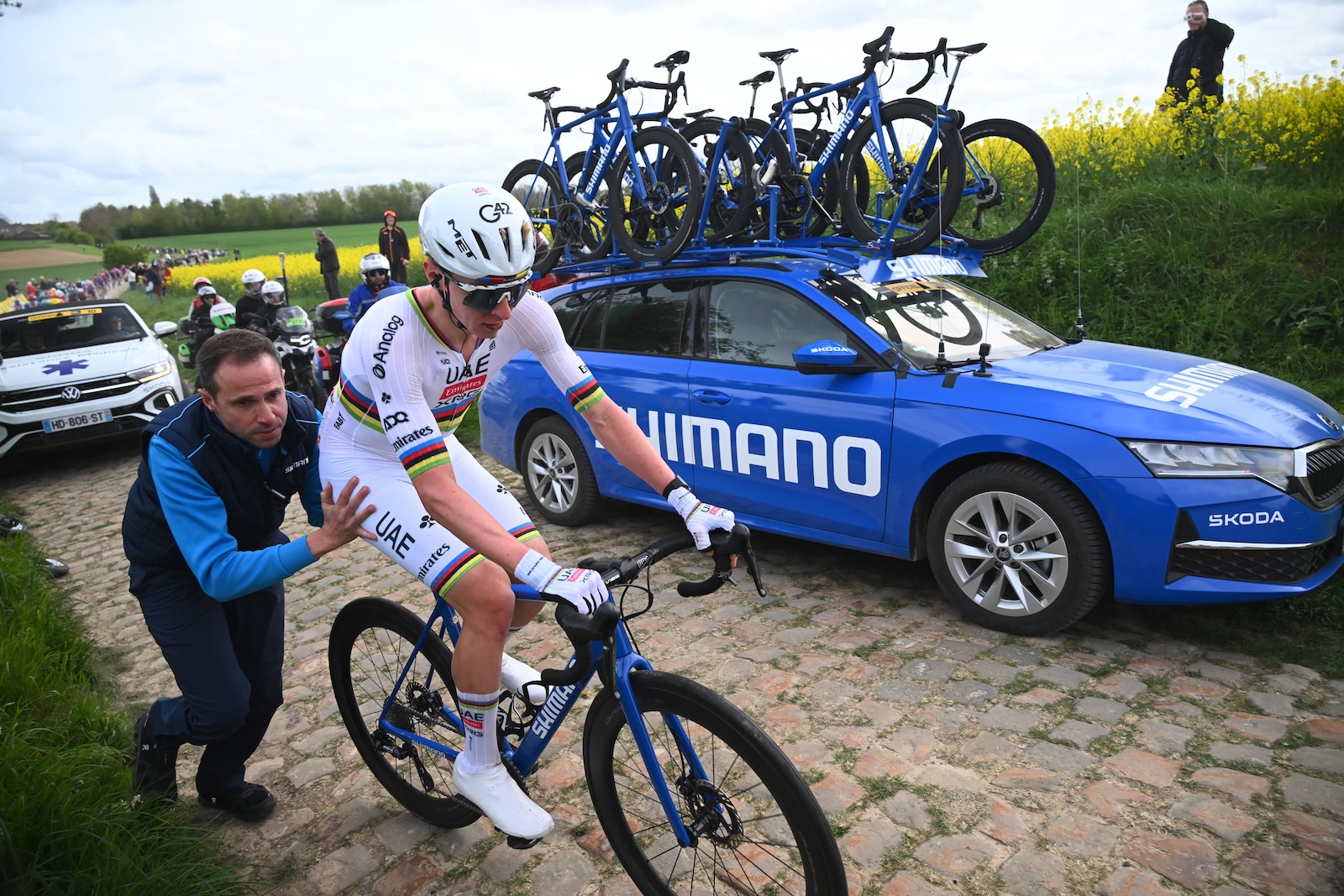
Three UAE teammates — Nils Politt, Mikkel Bjerg and Antonio Morgado — waited and organised the chase. Alpecin–Premier Tech, meanwhile, controlled the front group’s tempo at a deliberately gentle pace, the peloton spread across the road in the manner of a team in no hurry. The favour would not last. By kilometre 149.1, entering Denain with 111 kilometres to go, Pogačar had closed to 25 seconds. Alpecin and Visma moved to the front and lifted the pace. The rainbow jersey was on his own now, Politt and Bjerg having spent themselves. With 103 kilometres remaining, Van der Poel made the first acceleration of his day through sector 20 from Haveluy to Wallers, a four-star sector that turned the screw. Ineos then eased the pressure and allowed Pogačar to close — and with 98 kilometres to go, after 22 kilometres of chasing, the best part of it riding alone, he was back at the front. Politt and Morgado had emptied themselves in his service.
“There were a lot of flat tires today,” Pogačar said. “When I first punctured, I rode for a while on a half-empty tire, and broke my rear wheel as a result so I had to take a Shimano bike. I had to spend a lot of energy because I wanted to reach the head of the race before Arenberg — otherwise, it would have been much more difficult to make it to the front. Some kilometres later I had one more puncture. Every problem means a waste of energy, but this is how this race goes. I don’t regret anything.”
Arenberg Destroys Van der Poel
The new approach to the Trouée d’Arenberg — first introduced in 2025 at the riders association’s request, adding four corners before the sector entrance to slow the field from the 60–65 kilometres per hour it once reached on the straight descent into the three-metre-wide cobbled track — had its intended effect. The peloton entered the forest stretched and measured rather than in a terrified sprint. Wout van Aert led it in, Mathieu van der Poel directly on his wheel.
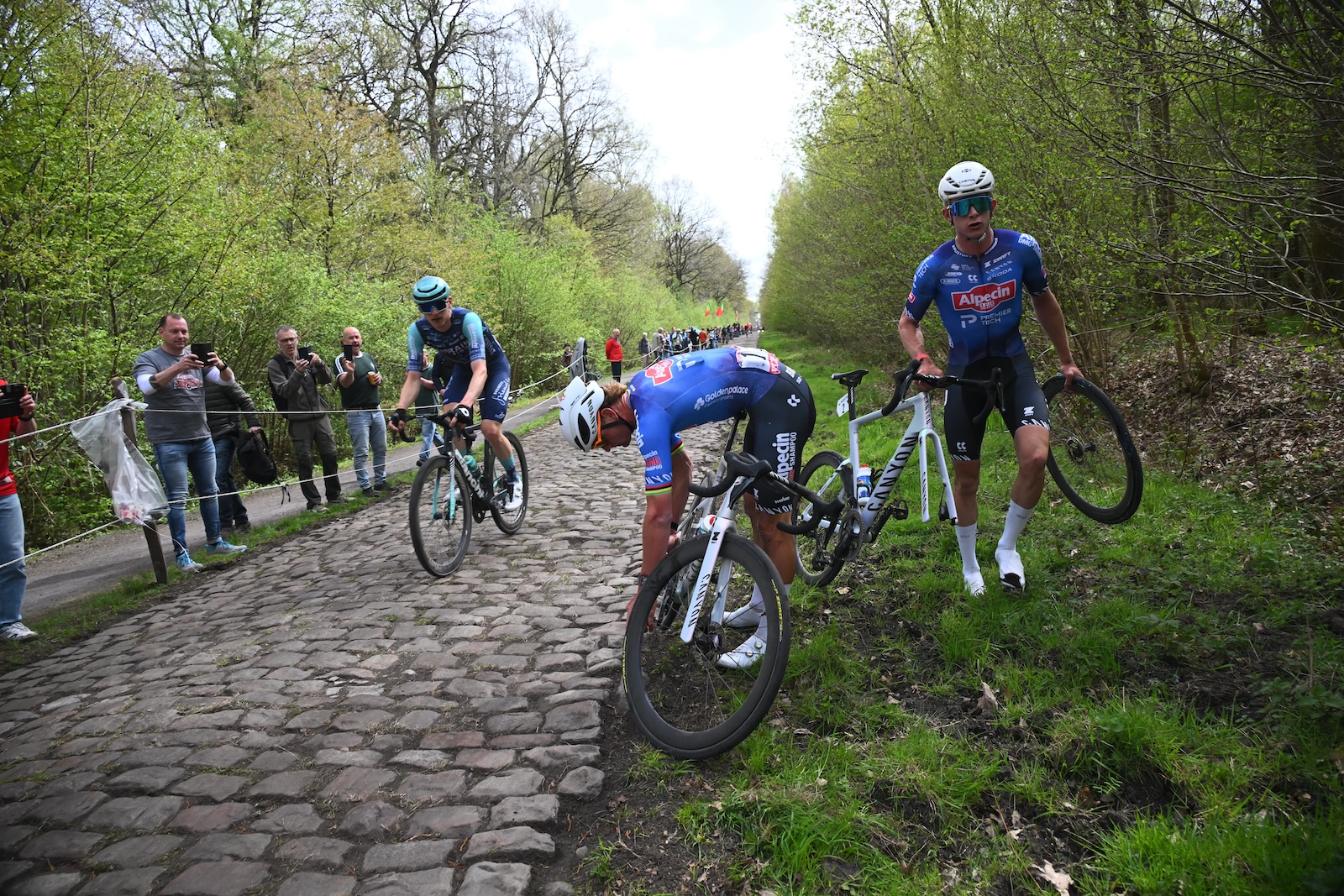
Seconds into the sector, Van der Poel stopped. He took Jasper Philipsen’s bike, his teammate dismounting in the middle of the Arenberg cobbles to hand it over. Van der Poel resumed, then stopped again. Tibor del Grosso dismounted to give the defending champion his own wheel. Van der Poel stopped a third time. The unreal scenes — three-time defending champion, favourite for a fourth consecutive victory, halted repeatedly in the most iconic sector in cycling — took some moments to absorb. He emerged from the forest over two minutes behind the lead group. Florian Vermeersch, UAE’s domestique brought to the race specifically to support Pogačar on the cobbles, crashed at the final stretch of Arenberg and was out of contention.
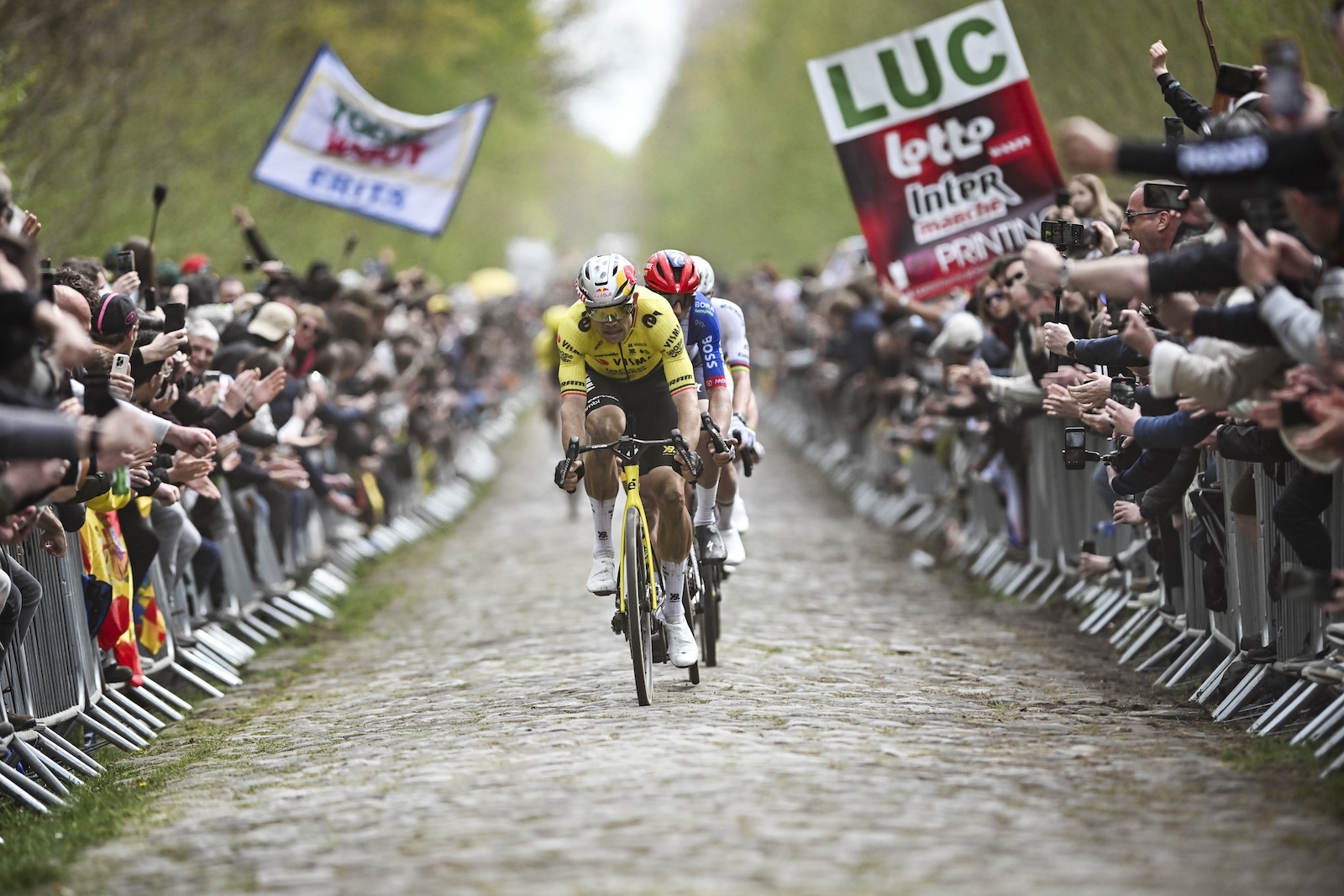
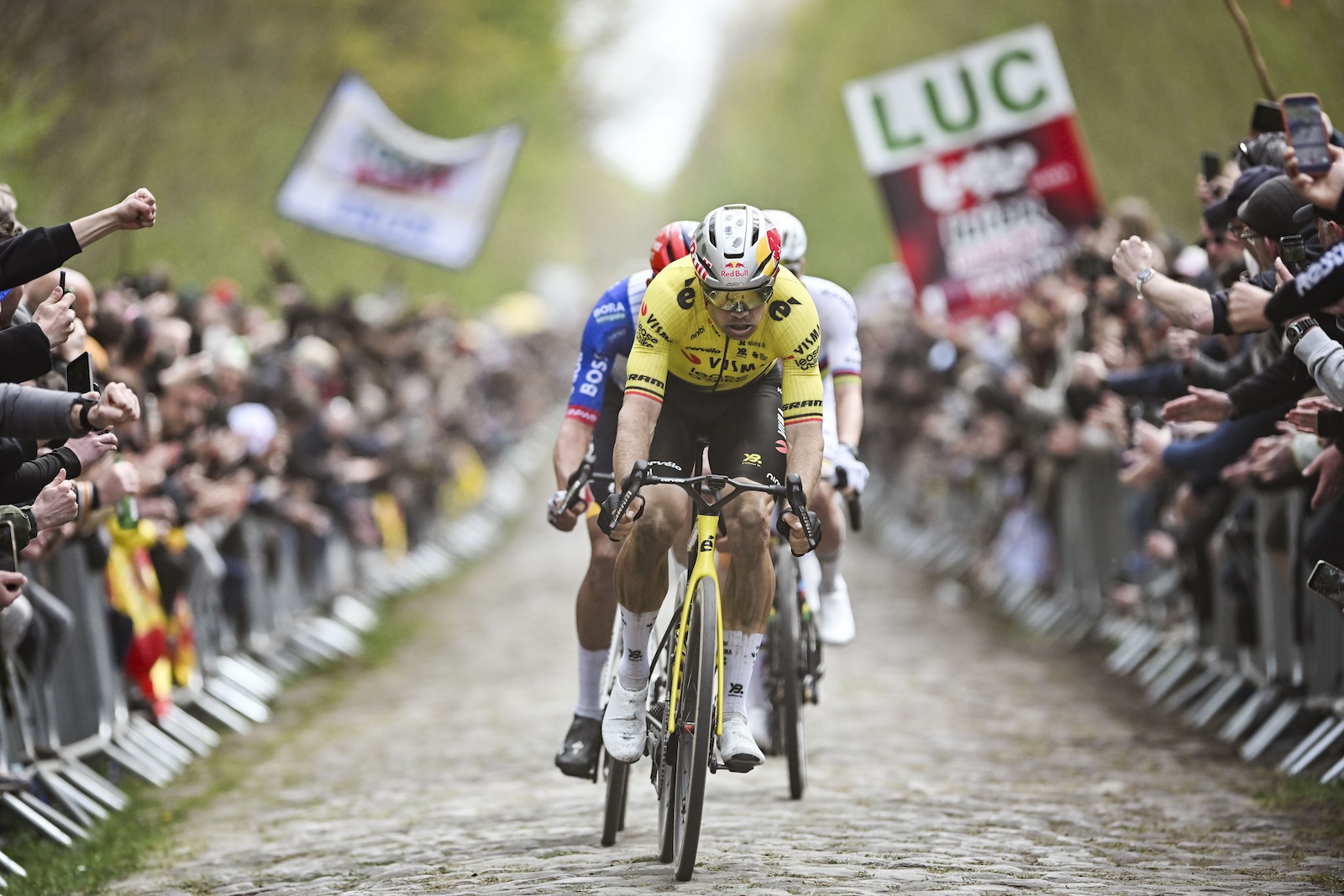
Seven riders came out of the Trouée d’Arenberg at the head of the race: Pogačar, Van Aert, Christophe Laporte (Visma–Lease a Bike), Mads Pedersen (Lidl–Trek), Stefan Bissegger (Decathlon CMA CGM), Jasper Stuyven (Soudal–Quick-Step) and Laurence Pithie (Red Bull–BORA–hansgrohe). Filippo Ganna (Ineos Grenadiers) and Jordi Meeus (Red Bull–BORA–hansgrohe) bridged back with 84 kilometres to go. Van der Poel, two minutes in arrears, began hauling himself back through the groups with Philipsen’s help. In almost any other edition of Paris–Roubaix, his race would have been over. This was not almost any other edition.
A Second Puncture Each, a Second Chase Each
The front group’s composition continued to shift. Ganna, having fought back to the lead, suffered a puncture in sector 17 from Hornaing to Wandignies and immediately lost contact. Laurence Pithie suffered a mechanical with 78 kilometres to go and fell out of the lead group, leaving six: Pogačar, Pedersen, Van Aert, Laporte, Bissegger and Stuyven. Then both Pogačar and Van Aert, the two men who had already navigated one mechanical apiece and were riding at the front, suffered second punctures in sector 16 from Warlaing to Brillon, with 71 and 72 kilometres to go respectively.
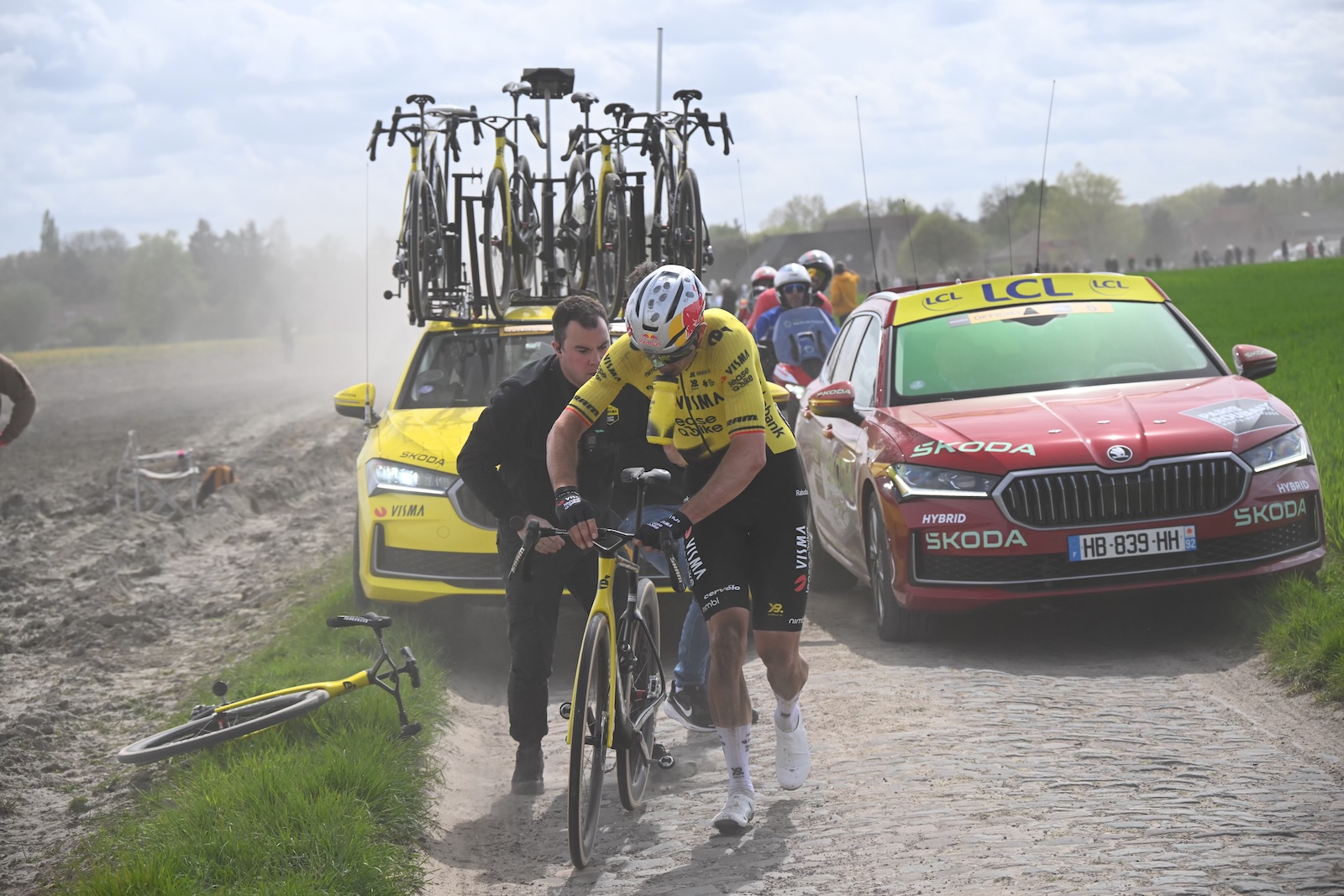
Pogačar changed bikes from the UAE team car and immediately set off chasing. Van Aert changed bikes as Pogačar swept past him on the road. The world champion regained the front group at the exit of sector 15, from Tilloy to Sars-et-Rosières. Van Aert, with Pithie and Meeus as company, rejoined the lead ahead of sector 13 in Orchies at kilometre 198.2 — a chase of roughly ten kilometres from his second puncture. Two mechanicals each, two chases each completed.
Behind them, Van der Poel’s chase had become something close to astonishing. Through sector 13 in Orchies, he and Ganna dragged a ten-strong group, closing to within 30 seconds of the lead with 67 kilometres to go. The race situation at the entrance of sector 12 from Auchy-lez-Orchies to Bersée: eight riders at the front, a gap of 25 seconds, and Mathieu van der Poel bearing down.
Sector 12: The Race Decides
The sector from Auchy-lez-Orchies to Bersée carries four stars across 2.7 kilometres. With 53 kilometres to go and Van der Poel just 25 seconds behind, the lead group of eight entered it and the race shattered into its definitive shape. Van Aert accelerated. Pogačar went with him immediately. Pedersen tried to hold their wheel and failed, the threshold between the two leaders and the rest measured in a few bike lengths that became a few hundred metres and then more than that. On a left-hand corner near the sector exit, Van Aert and Pogačar nearly collided — Van Aert’s line carrying him into the world champion’s space for an instant before both riders straightened and kept riding. The moment passed without incident. The gap did not.
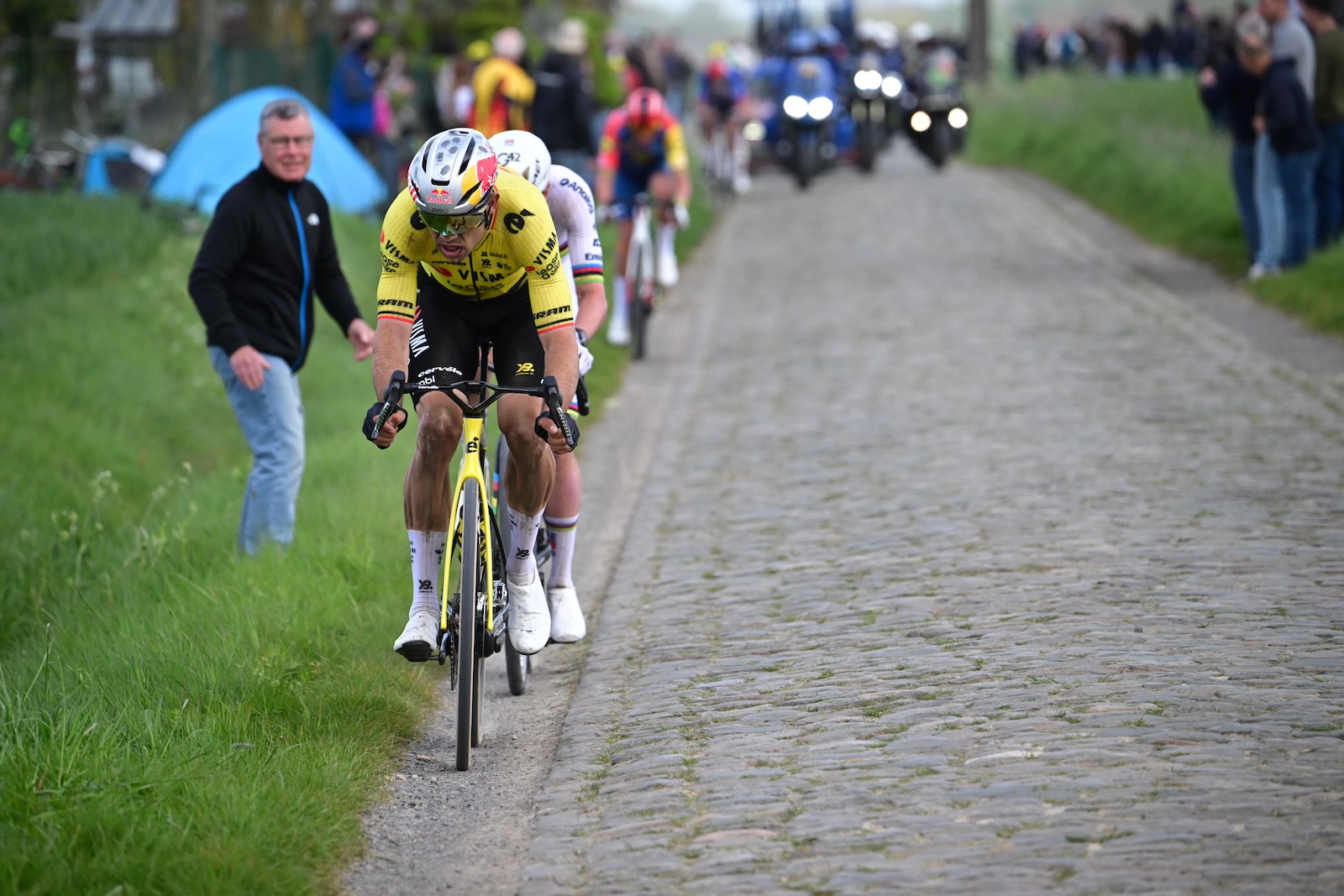
Van der Poel had closed to within 20 seconds of the lead group before the sector began. He bridged to the Stuyven group containing Pedersen, Laporte, Bissegger and Tim Van Dijke (Red Bull–BORA–hansgrohe) as they emerged from the sector. The chasing six were now behind a leading duo who had already begun building their lead in earnest. “Since we first went on the attack, I knew I had a small chance to win, even if we were a long way off the finish,” Van Aert said. “Until the Carrefour de l’Arbre, I thought we had a chance of staying at the front but I was also aware that anything could happen. After that sector, I really believed we would play for the win.”
Mons-en-Pévèle: Where Champions Make Their Move
The five-star Mons-en-Pévèle sector at kilometre 209.7 — three kilometres of cobbles with sidewinds making the already demanding sector harder still on this particular afternoon — has a particular place in this race’s recent mythology. Fabian Cancellara used the tarmac approach to Mons-en-Pévèle to launch the move that won him the race in 2010; Johan Vansummeren did the same in 2011. Pogačar entered it with the same intent.
The world champion accelerated sharply out of a corner, putting a small gap into Van Aert. Van Aert closed it. Pogačar attacked again. Van Aert closed again. Pithie crashed out of contention on a left-hand corner midway through the sector — her day over. Pogačar kept trying. Van Aert kept closing. The Belgian made a tactical decision that he would later describe with unusual precision: rather than riding alongside Pogačar or attempting his own accelerations, he would sit directly on the world champion’s wheel, denying him the option of attacking from behind and forcing him to keep the pace honest from the front.
“Mons-en-Pévèle was the moment when I decided to stick on Tadej’s wheel through the cobbled sectors, so he couldn’t attack from behind,” Van Aert said. “It was a moment of realization — he is the strongest rider of the peloton, after all. I managed to keep up with that acceleration in Mons-en-Pévèle, and from then on stayed on his wheel.” The leading duo came out of the sector with a 42-second lead. Van der Poel and Van Dijke had bridged to the Stuyven group, making six chasers: Pedersen, Van der Poel, Laporte, Bissegger, Stuyven and Van Dijke. Forty-five kilometres to go.
Laporte’s presence in that chasing group was neither accidental nor irrelevant. The Visma–Lease a Bike co-leader, who had been with the lead group from Arenberg onwards, now found himself separated from his teammate — but not without purpose. From within the pursuers, Laporte disrupted every organised chase, slowing cooperation at critical moments, checking accelerations, choosing the wrong wheel at the right time. Stuyven watched it unfold with helpless clarity. “Honestly, I thought we were going to catch the two leaders,” he said. “Christophe Laporte did an excellent job. He was annoying, in a correct way, disrupting our chasing efforts. We were only 25 seconds short from catching them, but we never managed to do it.”
That moment of maximum threat came after sector 5, Camphin-en-Pévèle, at kilometre 238.4, where the six chasers had closed to 25 seconds. Five sectors remained. The gap had to hold for 20 more kilometres. It had to hold through the Carrefour de l’Arbre.
The Carrefour Settles the Question
The Carrefour de l’Arbre has carried five stars in every edition of Paris–Roubaix for as long as the rating system has existed. Two kilometres and a hundred metres of the hardest cobbles in the race, at kilometre 241.2, with the finish 17 kilometres beyond. Everything tends to happen here, or to become irreversible here. Today was no different. Pogačar led his rival into the sector and unleashed a series of accelerations, going so hard that he nearly lost control on a left-hand corner — sliding briefly off the cobbled line before recovering. Van Aert held his wheel through every surge. The chasers, unable to match the pace being set at the front and still being managed by Laporte, lost further ground. They exited the Carrefour 40 seconds behind the leaders. The arithmetic was now unambiguous.
From the Carrefour, the two riders cooperated efficiently into Roubaix. They took turns at the front, sharing the wind in the economy of two men who understood that the sprint inside the velodrome was settled between them and that there was no advantage to be gained by attacking now. Van Dijke made a late acceleration with four kilometres to go in the chasing group; it came to nothing. Stuyven then went, with three kilometres remaining, at the precise location his racing instinct identified. “I kind of hesitated before attacking,” he said. “That’s the place where many winning attacks have taken place in the past, and that’s why I attacked there on pure instinct, trying to make the most of it. I felt it was not going to be easy to stick, but I kept trying because I knew it was going to be even harder to finish on the podium if I sprinted against Mathieu, Mads, and the others.” Pedersen gave chase; Van der Poel, Laporte and the rest could not close it. Stuyven held on.

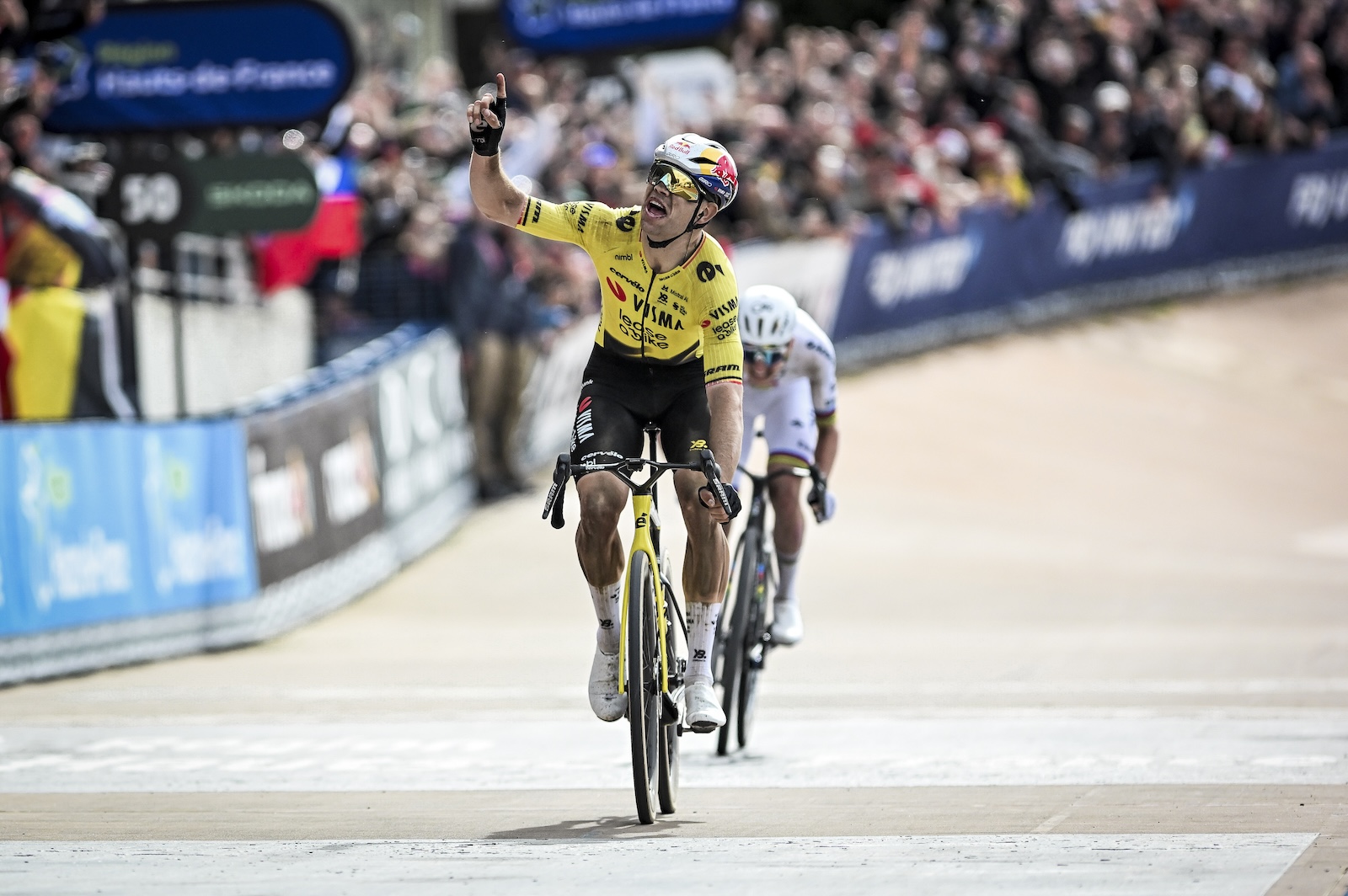
At the velodrome, Pogačar led onto the track with Van Aert on his wheel. One 400-metre lap. The world champion carried the speed to the final straight and waited. Van Aert launched at 200 metres. He had rehearsed the moment — the exact sequence, the exact timing — many times in preparation and many more times in his mind. He knew what to do. Pogačar had nothing to match it. The margin at the line was unmistakable.
“I Will Definitely Come Back to Win This Race”
Tadej Pogačar has, at 27 years old, won enough races that defeat no longer surprises or destabilises him. He crossed the line in second place and spoke about Van Aert with something beyond the diplomatic generosity that champions sometimes offer. “Wout van Aert deserves this victory for how he always comes back from every setback,” he said. “He never gives up and he should be a hero for many young kids because of how he rides.”
On the sprint itself, he was candid about what he experienced from the front. “Every time I tried to drop Wout, my legs were not the greatest anymore. He always could ride back to my wheel. I could feel it was not meant for me today to drop him before the sprint. And, as for the sprint, well — it was great to see from up close how fast he can be after so many efforts.”
He also offered an assessment of the racing dynamic that has come to define the era — himself, Van Aert and Van der Poel operating at the same altitude, each trying to break the others. “I find it very cool, how we race together,” he said. “I really like when everybody races with their heart on their sleeve, doing their best without trying to flick others. Sometimes it’s better to sit back and save some legs, but I love making the race hard and have a lot of respect for those who do the same.” He will come back to Roubaix, he said. Maybe not next year. He has the years.
“I Attacked on Pure Instinct”
Jasper Stuyven joined Soudal–Quick-Step for 2026 after years at Trek–Lidl, and his first Paris–Roubaix podium arrived in his new colours. He was not sore from the crash he had suffered at the Tour of Flanders the previous week — the biggest pain, he said, was in his legs. He had ridden intelligently throughout, staying out of trouble in the early chaos and surviving the sector-by-sector attrition that eliminated so many others.
“It’s a very nice podium after many years of consistency, having just missed the podium before,” Stuyven said. “With the current generation of phenomenal riders, the task doesn’t get easier. I changed teams, and the trust and support from the team have been pretty nice. This result is a big reward for myself and for my team.” He acknowledged that experience and positioning — knowing the racing lines, knowing where to be on each sector — had been as valuable as physical condition. “You know, even with all the experience, I still had to be reminded of many things from the team car,” he added. “I’m very happy for Wout. Everyone who has been his teammate, either on a trade team or on the Belgian national team, knows what an incredible athlete he is. It’s great to see him win a Monument like Roubaix in this fashion.”
Eight Years, One Finger to the Sky
Wout van Aert has pointed a finger to the sky each time he has finished Paris–Roubaix since 2018. That was the year he first rode the race and lost a teammate. Michael Goolaerts, 23 years old, suffered a cardiac arrest on a cobbled sector and never regained consciousness. Van Aert has not forgotten. He stood second in 2022, third in 2023. Circumstances dismantled him in every other edition he entered — mechanicals, crashes, bad luck at bad moments — the race repeatedly finding new ways to take what seemed within reach. Today it found two more punctures, and he dealt with them and kept going.
“This victory means everything to me,” he said at the finish. “It’s been a goal since 2018, when I first did this race and I lost a teammate, Michael Goolaerts. He is the reason why I pointed my finger to the sky. This victory is for Michael, and also for his family and the staff — Marianne, Christophe … and all my friends and teammates from my previous team. It was a really tough day and, ever since then, I have always been unlucky in this race in one way or another. This also brought me some experience and, when luck was not on my side today, I kept believing I could win. Finally, the reward is here.”
He spoke about what believing through repeated failure actually feels like. “I didn’t stop believing a lot of times, but the next day I always woke up after falling short again.” He did not dress up his form or claim exceptional legs as the explanation for this one finally going right. “It would be a nice story to say I was feeling better than any other year before, but the reality is I also felt quite good in previous years when circumstances have played against me. The experience gathered in those previous editions of the race gave me the knowledge I needed to pull off this victory.”
On the sprint: “When I entered the Velodrome, I just stuck to my plan. In my mind and during my preparation I did this sprint so many times. I knew exactly what to do. The hardest part was making it to the Velodrome. Tadej attacked so many times. I was on my limit to stay in his wheel. Now it’s all worth it.”
He spoke about the race itself with the affection of a rider who has been shaped by a place that has hurt him more than almost anywhere else. “This is such a chaotic race,” he said. “Everybody coming through the finish line has his own story, and that’s what makes it so beautiful. It can be hard, but on a day like this it is the best race that exists.” He also acknowledged the role Laporte played from within the chasing group — the disruption of the chase, the invisible labour of the domestique who ends up on the results sheet 15 seconds behind his leader’s winning time. “Having Christophe in the chasing group definitely played a role in my victory too.”
Visma–Lease a Bike has raced Paris–Roubaix under its various names since its founding as Kwantum Hallen in 1984: Superconfex, Buckler, Wordperfect, Novell, Rabobank, Belkin, LottoNL-Jumbo. Eight podium finishes across four decades without the top step. Van Aert had been identified as the man to change that across multiple editions. Today he finally did. “I’m incredibly proud to finish off the work of years and years,” he said. “It was a dream for our CEO Richard Plugge to finally win Roubaix.”
Van Aert was the last rider to beat Pogačar on European roads before today — stage 21 of the 2025 Tour de France, on the Champs-Élysées, having gone clear on the slopes of Montmartre. Since then, Pogačar had won six consecutive European races: the European Championships, Tre Valli Varesine, Il Lombardia in 2025, then Strade Bianche, Milano-Sanremo and the Tour of Flanders in 2026. The streak is over. It took Paris–Roubaix, with everything it took, to end it.
Paris–Roubaix does not give itself away. It extracts a price, and then a higher price, and when a rider has paid everything and there is nothing left to take, it occasionally relents. Today it relented for Wout van Aert. For Michael Goolaerts. For 42 years of Visma waiting. For the finger pointed at the sky.
Results
| Pos | Rider | Team | Time |
| 1 | Wout van Aert | Team Visma – Lease a Bike | 5h 16’ 52” |
| 2 | Tadej Pogačar | UAE Team Emirates-XRG | s.t. |
| 3 | Jasper Stuyven | Soudal–Quick-Step | @ 0’ 13” |
| 4 | Mathieu van der Poel | Alpecin–Premier Tech | @ 0’ 15” |
| 5 | Christophe Laporte | Team Visma – Lease a Bike | s.t. |
| 6 | Tim van Dijke | Red Bull–BORA–hansgrohe | s.t. |
| 7 | Mads Pedersen | Lidl–Trek | s.t. |
| 8 | Stefan Bissegger | Decathlon CMA CGM | @ 0’ 20” |
| 9 | Nils Politt | UAE Team Emirates-XRG | @ 2’ 36” |
| 10 | Mike Teunissen | XDS Astana Team | s.t. |