
MONTRÉAL, Canada (September 14, 2025) — Brandon McNulty (UAE Team Emirates) secured victory at the Grand Prix Cycliste de Montréal on Sunday in one of professional cycling’s most memorable finishes, as teammate Tadej Pogačar (UAE Team Emirates) orchestrated a stunning display of selflessness by gifting the American the win after a dominant performance that saw UAE Team Emirates tie the all-time record for victories in a single season.

The 209.1-kilometer Canadian classic became the stage for UAE’s 85th triumph of 2025, equaling HTC-Columbia’s 2009 record, but more significantly showcased tactical cycling at its absolute pinnacle as the Emirati squad dismantled a world-class field through relentless pace-making before delivering a fairy-tale finish that will resonate through cycling folklore.
The Foundation: Early Moves and UAE’s Iron Grip
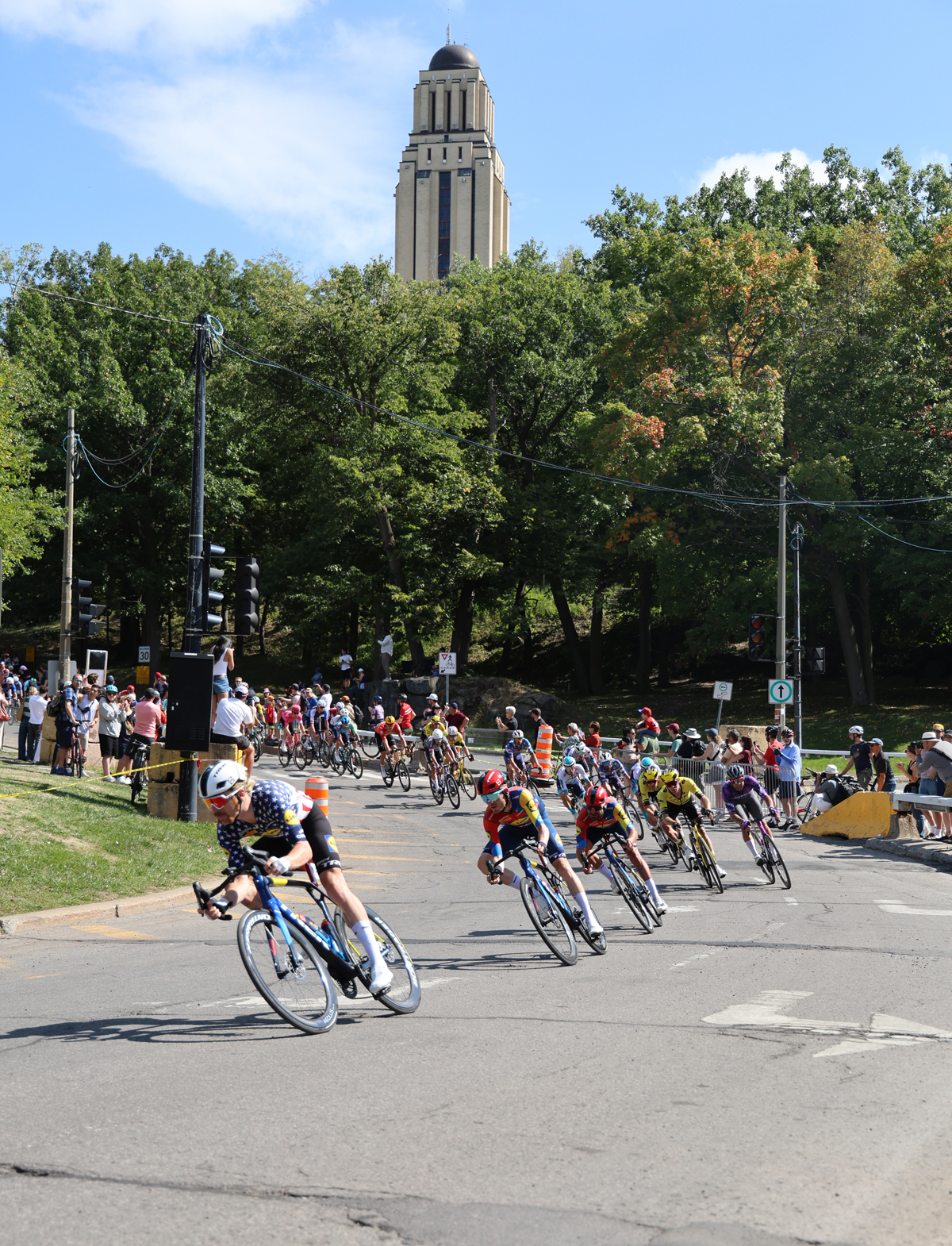
The race began with characteristic Canadian classic aggression as seven riders formed the day’s initial breakaway on the opening circuit of the 17-lap course. Victor Lafay (Decathlon AG2R La Mondiale) spearheaded the French contingent alongside Americans AJ August (Ineos Grenadiers) and Artem Shmidt (Ineos Grenadiers), Dutch duo Pascal Eenkhoorn (Soudal Quick-Step) and Frank van den Broek (Picnic-PostNL), and Scandinavian representatives Jørgen Nordhagen (Visma-Lease a Bike) and Embret Svestad-Bårdseng (Arkéa-B&B Hotels).

Their maximum advantage peaked at 1’50″—a deceptively comfortable margin that masked the brewing storm behind. From the moment UAE’s German powerhouse Nils Politt assumed control at the head of the peloton, the breakaway’s fate was sealed. For nearly 100 kilometers, Politt delivered a masterclass in controlled aggression, maintaining a steady, punishing tempo that not only kept the leaders within striking distance but began the systematic destruction of the peloton.
The early signs of carnage emerged quickly. Guillaume Boivin (Israel-Premier Tech), Luke Lamperti (Soudal Quick-Step), and Ruben Guerreiro (Movistar) were among the first casualties, abandoning before the race had even reached its halfway point. More ominously for the breakaway, a second chase group of nine riders had formed behind them, including dangerous operators like Jan Tratnik (Red Bull-Bora-Hansgrohe), Mauro Schmid (Jayco-AlUla), and Gianni Vermeersch (Alpecin-Deceuninck).
Drama and Destruction: The Eenkhoorn Saga
While Politt orchestrated the pursuit with mechanical precision, high drama unfolded in the breakaway as Pascal Eenkhoorn endured a race that epitomized cycling’s cruel unpredictability. First, mechanical issues dropped the experienced Dutchman from the lead group, forcing a herculean effort just to regain contact with his companions.
Then came the defining moment of misfortune. On one of the race’s signature climbs, Eenkhoorn’s front wheel clipped another rider, launching him into a spectacular somersault crash that left him sprawled on the unforgiving Montreal tarmac. Though the Soudal Quick-Step veteran gamely remounted and continued, his race was effectively finished—a stark reminder of how quickly dreams can shatter in professional cycling’s unforgiving arena.
The crash became symbolic of the breakaway’s broader struggle against UAE’s relentless pursuit. As Eenkhoorn fought his losing battle, the two groups ahead merged with 120 kilometers remaining, creating a formidable 16-rider alliance. But their unity would prove irrelevant against the machine-like efficiency of UAE’s chase.
The Acceleration: Wellens and the Peloton’s Explosion
Just as the enlarged breakaway seemed to be finding its rhythm, UAE unveiled their next weapon. Tim Wellens, the explosive Belgian climber, relieved the tiring Politt and immediately transformed the race’s character. His first pull up the fearsome Côte Camillien-Houde was nothing short of devastating.

The peloton didn’t just stretch—it exploded. Half the field was instantly distanced, unable to match Wellens’ ferocious acceleration. Riders who had harbored podium dreams found themselves fighting merely for survival as the Belgian’s tempo shredded the group with surgical precision.

The casualties mounted with each passing kilometer. Christophe Laporte (Visma-Lease a Bike) and Biniam Girmay (Intermarché-Wanty) joined the growing list of abandonments, while even seasoned campaigners struggled to maintain contact with the rapidly shrinking front group. The breakaway ahead began hemorrhaging riders—Laurence Pithie (Red Bull-Bora-Hansgrohe), Artem Shmidt, and Harry Sweeny (EF Education-EasyPost) among those who couldn’t sustain the increased pace.
McNulty’s Hammer: The Final Devastation
As if Wellens’ contribution wasn’t destructive enough, UAE possessed one final devastating weapon. Brandon McNulty, the American powerhouse with a reputation for punishing climbs, assumed pacing duties as the race entered its decisive phase. His impact was immediate and catastrophic.
McNulty’s first surge up Camillien-Houde was like a detonation in the peloton. The remaining breakaway survivors—who had fought valiantly for over 100 kilometers—were swept up as if they were stationary. Alex Baudin (EF Education-EasyPost), the last fugitive from the morning’s moves, was caught and dropped, his brave solo effort ending in the face of McNulty’s relentless pursuit.
Behind, the destruction reached unprecedented levels. Wout van Aert (Visma-Lease a Bike), the Belgian superstar and 2022 runner-up, cracked spectacularly and abandoned with 54 kilometers remaining. Julian Alaphilippe (Tudor Pro Cycling), fresh from his Quebec triumph just 48 hours earlier, began sliding backward through the group despite having positioned himself perfectly on Pogačar’s wheel.
The pace was so severe that even the race’s pre-selected favorites couldn’t survive. Paul Lapeira (Decathlon AG2R La Mondiale), Arnaud De Lie, and Simon Yates found themselves distanced and fighting losing battles against the merciless tempo. The front group, once numbering over 150 riders, was now reduced to fewer than 25 survivors.
The Tactical Masterstroke: Sivakov’s Setup
With the field decimated and only the strongest climbers remaining, Pavel Sivakov (UAE Team Emirates) assumed the destructive duties from McNulty. The Frenchman, riding with the same selfless dedication he had displayed in Quebec, drove an absolutely punishing pace that served final notice of UAE’s intentions.
This was no longer racing in the traditional sense—it was systematic demolition. Every surge up the climb eliminated more riders, every acceleration tested the absolute limits of human endurance. Pello Bilbao (Bahrain-Victorious), well-positioned until a cruel mechanical issue stuck his chain, was forced to change bikes and watch his chances evaporate.
The tactical brilliance of UAE’s approach was now crystal clear. By controlling every aspect of the race’s development, they had ensured that when Pogačar finally unleashed his signature attack, only the very strongest climbers would remain to challenge him. It was grand tour tactics applied to a one-day classic, executed with flawless precision.
The Decisive Strike: Pogačar’s Attack
With three laps remaining and the group whittled down to barely 20 survivors, the moment cycling fans worldwide had been anticipating finally arrived. McNulty, his yeoman’s work apparently complete, launched an acceleration that prompted immediate responses from Quinn Simmons (Lidl-Trek) and drew young Louis Barré (Intermarché-Wanty) into the action.
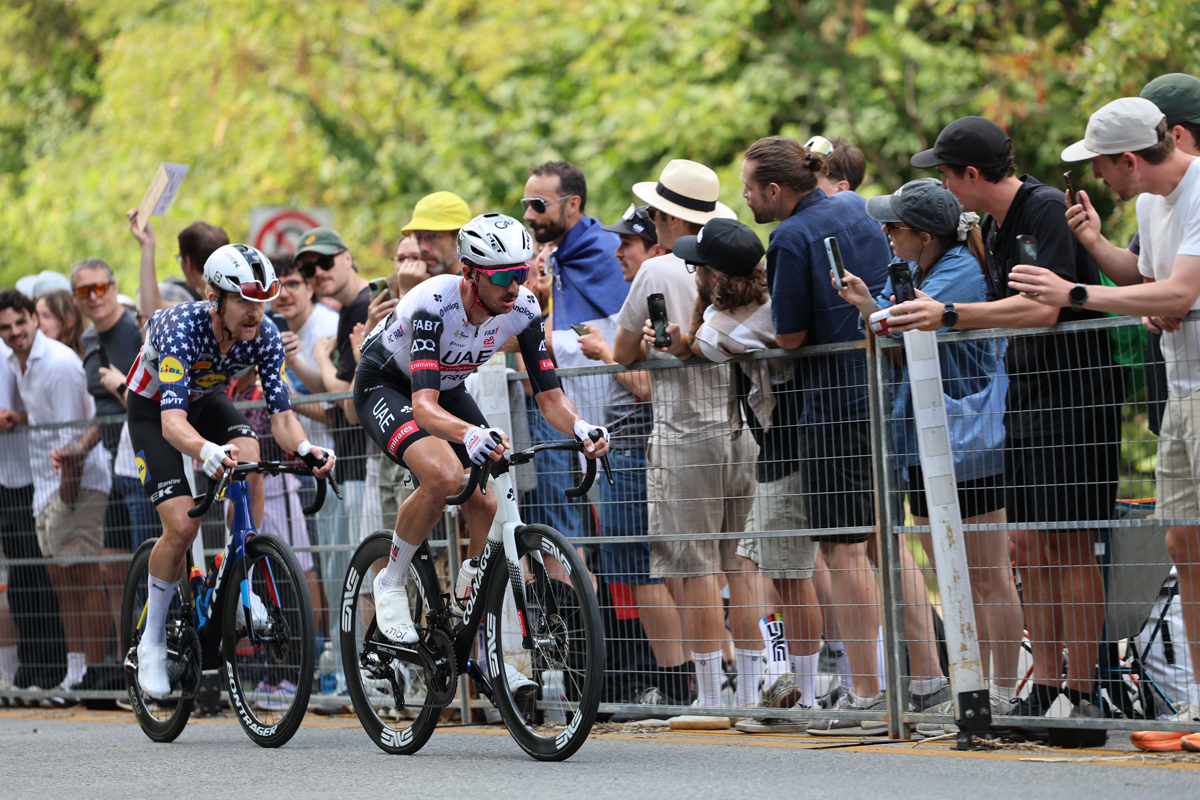
“With four laps to go, I was asked if I could try a solo attack. I tried and four of us broke away,” recounted McNulty after the race. McNulty first with Simmon in tow, joined soon after by Barre and Pogačar.
Then it happened. Tadej Pogačar, the four-time Tour de France winner and reigning world champion, unleashed the attack that would define the race. His acceleration was vintage Pogačar—explosive, sudden, and utterly irresistible. The response was immediate but insufficient as the Slovenian’s move split the select group definitively.
“I gave the signal for Brandon to try his luck with four laps to go, then I joined him,” Pogačar reflected on the tactical execution.

Louis Barré, displaying maturity beyond his years, managed to bridge across to join the leading trio of Pogačar, McNulty, and Simmons. For several kilometers, the young Frenchman matched the infernal pace, even requesting water bottles to pour over himself in the mounting heat. But the sustained tempo eventually proved too much, and Barré cracked with over 20 kilometers still to race.

The Shocking Twist: Pogačar’s Second Attack and Stunning Decision
With Barré’s departure reducing the leaders to three, Pogačar sensed an opportunity to test his remaining companions’ resolve. His second attack came with devastating effect—a vintage acceleration that seemed designed to drop everyone and set up a solo victory charge to the line.
As the world champion powered clear, it appeared the race was following a familiar script. Pogačar solo, driving toward another prestigious victory, with his rivals left to battle for the minor placings behind. But then came the moment that transformed a routine tactical victory into cycling legend.
Instead of pressing his advantage, Pogačar sat up and waited. He looked back, assessed the situation, and made a decision that stunned everyone watching. As McNulty bridged across with a superhuman effort, the Slovenian’s gesture became clear—he was bringing his teammate back into contention for victory.
“When I found myself alone after my attack in the penultimate lap, I decided to wait for him when I saw that he wasn’t that far behind,” Pogačar explained. “Once we were together, it was clear that the victory would be between us.”
“After Tadej’s attack, I managed to drop Quinn Simmons and catch up with him,” McNulty added. “It was very special to find ourselves both at the front of the race.

The Gift: A Masterpiece of Sporting Brotherhood
What followed in the final 15 kilometers was perhaps the most remarkable display of teamwork and friendship ever witnessed in professional cycling. Rather than engaging in the expected battle for victory, roles reversed completely as Pogačar dedicated himself entirely to McNulty’s success.
Kilometer after kilometer, the world champion pulled on the front while McNulty sat comfortably in his slipstream. The sight was almost surreal—cycling’s biggest star, fresh from Tour de France triumph, towing his teammate toward what would become the American’s biggest career victory.
As they chatted and smiled in the closing kilometers, with Simmons grimly hanging on for third place 1’03” behind, it became evident this wasn’t mere tactics—it was a genuine gesture of sporting brotherhood that transcended competitive cycling’s normally ruthless calculations.
The Historic Finish: Arm-in-Arm to Immortality
The approach to Montreal’s finish line became pure theater. As the two UAE riders swept around the final corner with victory assured, they looked at each other, shared a moment of understanding, and created one of cycling’s most memorable images.

Crossing the line arm-in-arm, with Pogačar pointing to McNulty and celebrating his teammate’s triumph, the gesture completed one of professional cycling’s most selfless acts. The world champion had transformed what could have been another routine victory into something far more meaningful—a testament to the bonds that unite teammates who share cycling’s greatest challenges.
“Winning the Grand Prix Cycliste de Montréal by crossing the finish line with Tadej Pogacar, the best rider in the world and my teammate, will remain a unique moment in my career,” McNulty said after the finish. “It was an incredible day! We managed to execute our plan to perfection.”

Behind them, Quinn Simmons secured a well-deserved podium spot, his solo effort proving that pure determination could overcome superior numbers. The American’s third place marked his best WorldTour one-day result and provided additional satisfaction for the North American cycling community.
“This Grand Prix Cycliste de Montréal was one of the most difficult one-day races of my career,” Simmons reflected. “Being beaten by Brandon and Tadej is quite honorable. It’s my best result in a UCI World Tour one-day race. It’s an important milestone in my career. And then to be on the podium with another American, wearing the United States champion’s jersey, makes this day even more special.”
The Record and the Reckoning
McNulty’s victory represented far more than individual triumph—it marked UAE Team Emirates’ 85th win of the season, tying HTC-Columbia’s 2009 record for team victories in a single year. The statistic perfectly encapsulated the squad’s unprecedented dominance across all cycling disciplines, from grand tours to classics, sprint stages to mountain summits.
“With this victory, we have equaled the record for wins in a season,” McNulty noted. “It’s very special and very rewarding after narrowly missing out last year (81 wins in 2024). Now we want to break that record before the end of the season.”
For McNulty, the win provided career validation after years of selfless service to team leaders. The Phoenix native’s third victory of 2025 was his 18th career success, but none had come with such symbolic weight or emotional resonance. That it arrived as a gift from cycling’s biggest star only amplified its significance.
For Pogačar, the performance served multiple purposes. After his disappointing 29th place in Quebec—a result born of tactical isolation rather than physical weakness—the Slovenian demonstrated his form was perfectly intact ahead of the upcoming World Championships in Kigali. More importantly, he showed that true champions understand when victories mean more to teammates than personal glory.
“I’m very happy to see Brandon win here,” Pogačar said. “He was very strong, as was the whole team today. We quickly reduced the peloton thanks to the sustained pace we set at the front.”
The world champion also reflected on the broader team success: “It’s been an incredible season for our team. Many riders have already raised their arms in victory this year (20 riders, editor’s note), each one seizing their chance. It’s the result of a tremendous collective effort.”
Lasting Impact: Beyond Results and Records
As the dust settled on one of cycling’s most memorable days, the broader implications became clear. UAE’s tactical approach—systematic control leading to decisive late-race moves—represented the evolution of modern cycling strategy. By eliminating variables and controlling every aspect of the race’s development, they had transformed what could have been chaotic into calculated precision.
Simmons acknowledged the tactical masterclass: “Pogačar and McNulty’s team had a score to settle after Friday’s Grand Prix Cycliste de Québec. They did it in style. Congratulations to them.”

The race highlighted cycling’s unique capacity for creating moments that transcend sport itself. In an era often dominated by commercial considerations and individual pursuits, Pogačar and McNulty’s embrace served as a powerful reminder of cycling’s essential humanity—the understanding that sometimes the greatest victories come not from defeating rivals, but from elevating friends.
The Grand Prix Cycliste de Montréal had once again proven its status among cycling’s most demanding one-day tests. The 17 passages of Côte Camillien-Houde served their purpose perfectly, creating the selective pressure that separated contenders from pretenders while providing the stage for an unforgettable finale.
Montreal’s race became more than a cycling competition—it became a masterpiece of tactical execution, sporting brotherhood, and human connection that will be remembered long after the statistics fade and the records are broken.

Race Statistics
| Distance | Elevation Gain | Laps | Circuit Length | Winning Time | Avg. Speed |
|---|---|---|---|---|---|
| 209.1 km | ~4573 m | 17 | 12.3 km | 5h 14′ 04″ | 39.9 km/h |
Top 10 Results
| Rank | Rider | Nation | Team | Time |
|---|---|---|---|---|
| 1 | Brandon McNulty | USA | UAE Team Emirates | 5h 14′ 04″ |
| 2 | Tadej Pogačar | SLO | UAE Team Emirates | s.t. |
| 3 | Quinn Simmons | USA | Lidl-Trek | + 1′ 03″ |
| 4 | Neilson Powless | USA | EF Education-EasyPost | + 1′ 45″ |
| 5 | Adam Yates | GBR | UAE Team Emirates | + 1′ 49″ |
| 6 | Louis Barré | FRA | Intermarché-Wanty | + 2′ 00″ |
| 7 | Tiesj Benoot | BEL | Visma-Lease a Bike | + 2′ 25″ |
| 8 | Alex Aranburu | ESP | Cofidis | + 2′ 57″ |
| 9 | Corbin Strong | NZL | Israel-Premier Tech | + 2′ 59″ |
| 10 | Alberto Bettiol | ITA | XDS Astana | s.t. |
Best Young Rider
| Rank | Rider | Nation | Team | Time |
|---|---|---|---|---|
| 34 | Jørgen Nordhagen | NOR | Visma-Lease a Bike | + 11′ 30″ |
Best Canadian
| Rank | Rider | Nation | Team | Time |
|---|---|---|---|---|
| 45 | Hugo Houle | CAN | Israel-Premier Tech | + 15′ 01″ |
Note: 105 riders abandoned the race, testament to the brutal pace set by UAE Team Emirates throughout the 209.1-kilometer contest.