
Hinz breaks women’s course record; Spangler fulfills goal that ‘shot for the stars’
By David Bern — The winner’s podium in the 43rd annual LoToJa Classic honored two new Pro 1/2/3 victors who tapped into self-belief and grit to win one of America’s most revered bicycle races.
Cat. 3 Justin Spangler, 34, (Team Mi Duole) of Salt Lake City, free-wheeled alone across the finish at Jackson Hole Mountain Resort in 8:29:28 with an average speed of 23.8 mph.
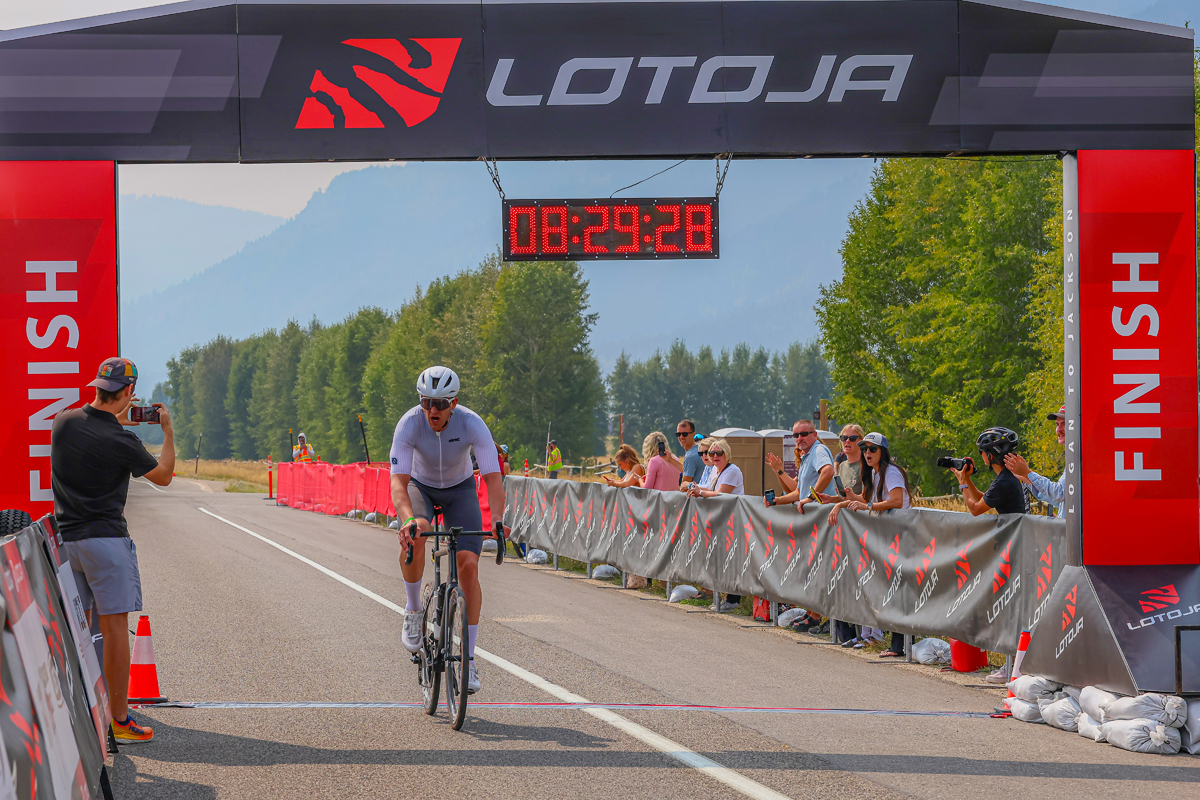
He beat more practiced Cat. 1/2’s in the 203 mile/327 kilometer race with only three years of training and racing experience. He also did it without the typical lightweight build of an endurance cyclist: He weighs a muscular 205 pounds and is 6 feet 6 inches tall.
But Spangler showed that when you mix passion and goals with lots of high, durable watts, great things can happen.
“LoToJa is the Tour de France of Utah,” he said while explaining his desire to win a race that only a few ever achieve. “I like goal-setting. The discipline, the structure… When I set the goal to win LoToJa, I shot for the stars.”
That shot nearly netted Spangler another prize too. He just missed breaking the men’s course record of 8:18:29 by less than 12 minutes.
But Cat. 3 Bailey Hinz, 39, (Team Go-Fast) of Las Vegas, Nevada, blew past the stars to win the Women Pro 1/2/3’s and shatter the women’s course record of 9:35:00 that was set by Melinda MacFarlane in 2013.

At an average speed of 21.6 mph, Hinz reached the ski resort in 9:20:45 and beat the record by more than 14 minutes.
She did it while riding solo for more than 90 miles after pulling away from a break on Salt River Pass and winning the Queen of the Mountain prize. She also beat higher category women to the finish.
“I had heard a lot about LoToJa from others and thought I never could do it,” Hinz said.
Inspired by a late friend’s unfulfilled wish to ride LoToJa, Hinz started having success riding 100 miles. Bigger miles were on the horizon when she rode last year’s 206-mile Seattle-to-Portland Bicycle Classic in a day.
She said she felt “great” at STP’s finish line. After that, Logan to Jackson no longer seemed “never.”
“I love long training days. To put in the work,” Hinz said. “LoToJa gave me a goal to set my sights upon.”
Solo escape artist
Race morning conditions in Logan on Sept. 6 were clear, windless and 50 degrees when 31 Men Pro 1/2/3 and Men Veteran 35+A riders rolled away at 5:30 a.m. from Sunrise Cyclery. The two categories are allowed to race together because of lower field numbers, similar ability and experience.
According to Spangler, the usual early-morning breakaway in the dark didn’t immediately occur after the peloton left the neutral rollout in West Logan. But a few miles later, Cat. 1 Dylan Fluckiger, 23, (Team Velovit Elite) of Kimberly, Idaho, jumped off the front. It wasn’t an all-out effort, “but it woke everyone up,” Spangler said.
Fluckiger was soon caught and the peloton stayed together through Cache Valley and Preston (29 mi/47 km). It appeared everyone was saving their guns before reaching the foot of LoToJa’s first major climb: 22-mile-long Strawberry/Emigration Canyon and its 7,424-foot-high summit (57 mi/92 km).
Except for one.
Cat. 1 Jesse Hogin, 36, (Unattached) of Las Vegas, Nevada, rolled off the front after the descent to Riverdale (35 mi/56 km). He made the identical move at the same spot last year and soloed for nearly 100 miles before being caught.

And he didn’t get dropped or just ride wheels afterward. He worked into the chase group’s rotation to the line and took sixth in the Men Pro 1/2/3’s. His strength and endurance awed fellow racers.
But despite Hogin’s strong showing last year, no one gave chase — for now.
“After we turned right [at Riverdale], I put a little pressure on the pedals and saw that I had a gap,” Hogin said about this year’s solo move. “Whenever I was out of sight over a roller or around a curve, I increased the pressure on the pedals to increase the gap.”
And like last year, he stayed out of sight for most of the day.
Big chases begin
Spangler said as the field began to climb Strawberry, Fluckiger went to the front and set a pace that “blew up everyone like crazy.”
On Strawberry’s false flat, which is approximately three miles from the summit, Fluckiger and Cat. 3 Mitt Niederhauser, 21, (Team Brainstoke) of Mountain Green, Utah, were off the front with a 20- to 30-second gap.
Spangler said several riders who got dropped before the false flat regained contact as the summit approached. A chase group of about 20 then formed.

“We did a historic descent down Strawberry,” he said in effort to catch Fluckiger and Niederhauser. They were caught before Ovid (70mi/113km) in Bear Lake Valley. Spangler said he did most of the work during the chase.
Which is why he stayed alert when several riders stopped for a pee break a few miles west of the first feed zone at Montpelier (76 mi/122 km). He noticed Cat. 1 Roger Arnell, 40, (Team Johnson Elite Orthodontics) of Farmington, Utah, and Cat. 1 Matthew Clark, 40, (Team Ascent) of North Salt Lake, Utah, go up the road.
Spangler had relieved himself before climbing Strawberry and didn’t need to stop. After the hard chase on the descent into Bear Lake Valley, Spangler didn’t want to needlessly burn more matches to catch Arnell, who won LoToJa in 2019, and Clark, who finished seventh last year.
So, he joined them. Spangler said that choice proved to be pivotal, because he, Arnell and Clark weren’t caught by the chase group until 10 miles later at the base of 6,923-foot-high Geneva Summit (84 mi/135 km). He had saved some matches for later in the day.
On the climb Fluckiger went to the front even though he had just helped catch Spangler, Arnell and Clark. After the summit and descent to Geneva (90 mi/145 km), Spangler said the chase group rode into a brutal headwind for 11 miles to the base of 7,630-foot-high Salt River Pass (106 mi/171 km).
Making that headwind even harder was knowing that Hogin was several minutes ahead and it would take a Herculean effort to catch him.
At this point the chase group consisted of Spangler, Fluckiger, Arnell, Niederhauser and Clark, along with Cat. 1 Grant Simonds, 28, (Team Landscape to Lifescape) of Salt Lake City; Cat. 4 Men Master 35+A Daniel Cherkis, 41, (Team Troll Training) of Park City, Utah; Cat. 3 Payson Norman, 20, (Team BrainStoke) of Mountain Green, Utah; Cat. 4 Men Master 35+A Creighton Green, 40, (Team BrainStoke) of Mountain Green, Utah; Cat 3 McKade Jaussi, 23, (Team Plan 7) of Lehi, Utah; and Cat. 3 Blair Perkes, 26, (Team BrainStoke) of Grand Junction, CO.
Words hit a nerve
Salt River Pass is four miles long with a steady pitch of six to eight percent and vertical gain of 1,012 feet. The climb is renowned for causing pelotons and chase groups to detonate, and to establish the day’s final selections for the finish 97 miles away.
Arnell went to the front soon after the climb’s start and set a hard pace. Aware of Arnell’s climbing prowess, Spangler jumped on his wheel. The two created a gap and held it to the top with Fluckiger and others chasing behind.
Arnell beat Spangler for the King of the Mountain prize with a time of 13:38 and an average speed of 15.4 mph. Spangler crossed the line just seconds later at 13:44.
It was the second KOM prize for Arnell, who won it in 2023. With the race’s last major climb done, the two riders let gravity and their pedals propel them down into Star Valley.
“Roger and I descended from Salt and Dylan (Fluckiger) caught us on the descent,” Spangler said. “Matt (Clark) brought a crew with him. He’s such a fast descender. He gets so aero.”
The 11-man chase group hurried into the feed zone at Afton (122 mi/196 km) to refuel. Spangler said because of traffic, his support crew barely made it to the feed zone in time. His sister had to run to hand him a bottle.
A construction zone control light stopped the chase group after Afton. Spangler said they were delayed there for six minutes. A race official told them that Hogin was delayed at the light for only 40 seconds, which meant he was even farther ahead than before.
After the light, the chasers resumed their effort to catch Hogin. But one of the riders knew it wasn’t enough.
“That’s when Dylan (Fluckiger) yelled that we have to get serious. That none of us are here just to take second place,” Spangler said.
Fluckiger’s words hit a nerve. And inspired focus and purpose.
“After that everyone started to pull through the paceline,” Spangler said. “Everyone gave it their all… I will always love that paceline. It was that cool.”
The chase makes contact
The 11-man chase group sped for 25 miles through the rest of Star Valley to the feed zone at Alpine (156 mi/251 km). Their effort continued for another 15 miles along the Snake River before they caught Hogin.
“I could tell that he [Hogin] was hurting bad,” Spangler said. “He had done a mind-boggling effort for 130 miles just to get caught.”
And just like last year, Hogin didn’t drop back but began to work. Spangler noted that Hogin likely would have soloed to the finish if the chase group hadn’t ridden so hard for 90 minutes to catch him.
Hogin said he heard that his gap in Star Valley was eight to nine minutes — and possibly more after the chase group lost six minutes at the control light — but he started to feel gassed at Thayne (137 mi/220 km).
“I tried to keep the power and gap as high as possible,” he said. “Once I was an hour into the effort, and it being my last race of the season, I wanted to make it as hard as possible as I could.”
But after Alpine and losing time, he realized he wouldn’t make it solo to the finish. He pulled back on the power and rested while he waited to get caught.
What the chase group had done to catch Hogin began to show. Spangler said everyone was cramping and some were visibly nauseous from the effort. Spangler then began a series of attacks before and after Hoback Junction (178 mi/286 km) to winnow the group and “set the podium.”
The big attack
Hogin said Cherkis and Spangler got away on South Loop Road with about 14 miles to go after Cherkis attacked and Spangler chased him down.
The two worked together and had a gap when they rode onto the bike path after South Loop Road. While they sped across the Wilson Bike Path Bridge (196 mi/315 km), Spangler suddenly felt emotional. He was fast approaching a spot immediately after the bridge that was a source of deep disappointment for him.
While racing as a Cat. 3/4 in his first LoToJa in 2023, he hit a pothole on the bike path after the bridge and before Village Road. He fixed the flat, but never caught the lead group before the finish.
And in last year’s LoToJa, Spangler said he suffered heatstroke at the same spot after the bridge and had to stop. He rested for 30 minutes before he could get back on his bike to finish.
But after passing the spot with Cherkis, and texts of encouragement from family and friends chirping on his bike computer, his motivation to win spiked.
The two turned onto Village Road and faced the last seven miles/11 kilometers to the finish. They worked together to prevent getting caught. Spangler was confident of his chances, but also knew that Cherkis was “so insanely strong.”
That strength again showed when Cherkis attacked hard just before the 3 km sign. Spangler responded, caught Cherkis, and then immediately counterattacked. He said he went as hard as he could for 15 to 20 seconds. It was the winning move.
Spangler said with 1K to go he saw that Cherkis wouldn’t catch him. He eased up as the finish line neared. He said in those final meters, he thought about all of the work he had done to reach this point. He also thought of the sacrifices his wife, family, friends and work colleagues had done for him to attain his goal.
Spangler crossed the line with gratitude and tears in his eyes.
Cherkis finished a few seconds later with a time of 8:29:37. He finished second overall and took first place in the Men Veteran 35+A category. Despite racing solo for 130 miles, Hogin took third overall and second in the Men Pro 1/2/3’s with a time of 8:30:48.28.
Fluckiger was with Hogin at the line and took fourth overall and third in the Men Pro 1/2/3’s with a time of 8:30:48.46. Taking second place in the Men Master 35+ and fifth overall was Green at 8:31:11. The rest of the chase group consisted of Men Pro 1/2/3’s and rolled in with Clark at 8:32:56, Niederhauser at 8:35:15, Simonds at 8:49:22.48, Norman at 8:49:22.89, Arnell at 8:49:25 and McKade at 8:49:57.
Sign of respect
Hogin said that Fluckiger gave him a push before the line to make sure he took second place. It was evidently a gesture of respect for the solo break Hogin had done, and for the work the two did in the final miles trying to catch Spangler and Cherkis.
Spangler, who is married, a father, and is a field sales representative for Google Cloud, celebrated with family, friends and his coach at the finish.
He said since 2023 he has ridden more than 45,000 miles, climbed 2.1 million vertical feet and cracked five frames to win LoToJa. That distance and vertical is almost equivalent to riding around Earth’s equator twice and climbing to the International Space Station twice.
“It’s kind of mind-numbing to be on the other side of a goal,” he said.
But he’s not done with LoToJa. Or goals. The former marathon runner who caught “the cycling bug in 2023,” plans to defend his title next year, with an eye on him, or helping someone else, to break the men’s course record.
“I would really like to be part of that,” he said.
The women race away
Hinz now knows what it feels like to win the Pro Women 1/2/3’s and also break the women’s course record. But doing both without teammates posed a hard challenge for her as she and 50 other women rolled away from Sunrise Cyclery at 6:34 a.m.
Due to lower field numbers, all USA Cycling licensed women start and race together in LoToJa. Respective category wins and placings are maintained despite mixed-category finishes.
While in the neutral rollout after the start, Hinz said Cat. 1 Women Master 45+ Jennifer Halladay, 54, (Team Hammer) of Kuna, Idaho, said to her “we have a chance at breaking the record today.”
As a seven-time category winner of LoToJa, Halladay’s words weren’t to be taken lightly.
Hinz said that she had no teammates in the race and hoped the peloton would stay intact to share the workload through Cache Valley and over Strawberry. But attrition took its toll on the 22-mile-long climb. By the summit, it was Hinz and seven other women that had formed a break.
That seven included Halladay, plus Cat. 3 Women Master 45+ Maggie Chan-Roper, 50, (Team Zone 5) of Saratoga Springs, Utah; Cat. 2 Katie Bonebrake, 34, (Unattached) of Salt Lake City; Cat. 3 Amy Hotchkiss, 44, (Team Night Owls) of Kyle, Texas; Sarah Esmeier, 28, (Team Pay N’ Take) of Flagstaff, Arizona; Cat. 2 Ashley Maginot, 32, (Unattached) of North Salt Lake, Utah; and Women Master 45+ Shauna Flach, 47, (Team Midway) of Park City, Utah.
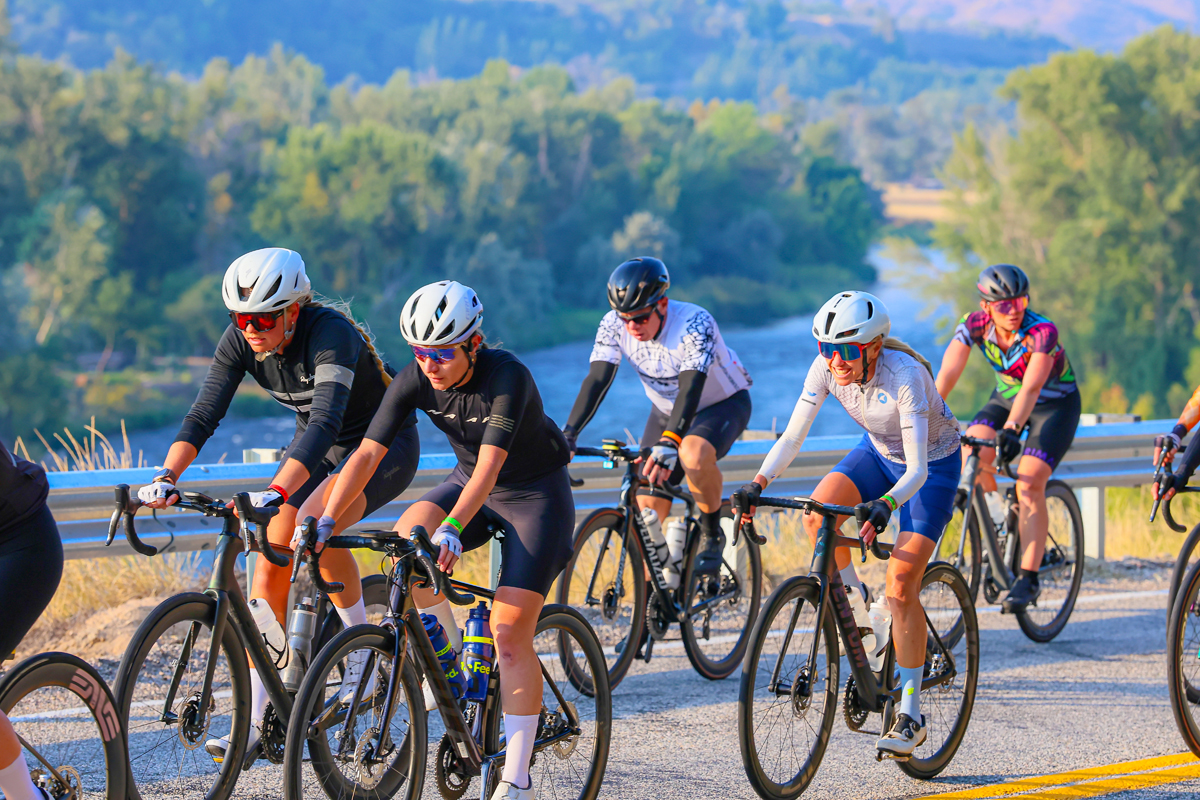
The break held and gained time on the descent into Bear Lake Valley. Hinz said everyone agreed to stop at the feed zone in Montpelier to refuel. Afterward, the eight women worked together toward Geneva summit. Halladay lost contact before the summit.
The seven women descended Geneva together and reached the base of Salt River Pass intact.
After that it was all Hinz.
“I put in a dig for the QOM (Queen of the Mountain),” she said simply about her attack. A while later Hinz turned around to see who was with her. She had dropped everyone.

Hinz kept her pace high and won the QOM with a time of 15:32 and speed of 13.5 mph. She missed breaking the QOM record of 14:19 — set by Marci Kimball in 2018 — by 1:13.
Nearly a minute back, Esmeier reached the summit in 16:26, followed by Bonebrake in 17:01. The other members of the break soon followed.
“[Chan-Roper] is a great descender and I thought she would bridge up with others,” Hinz said about the descent into Star Valley. “But she didn’t. I kept pressure on myself on the descent.”
And after the descent too. The former marathon runner and triathlete went full gas. At the feed zone in Afton, she learned from her boyfriend that the gap was around three minutes.
Chase group worries
Hinz said she got delayed about eight minutes at the construction zone control light after Afton. She worried that the chase group would catch her. But it never arrived.
“I had no clue what my gap was at that point,” she said. “I wish I had known.”
After the delay Hinz got back to work. She tried not to blow herself up and stayed in a “high Zone 2.” In her mind she thought if the chase group caught her, “we could work together” to the finish.
“But if not, this is good because I don’t have a sprint left in my legs,” she said.
Hinz also thought about the course record as she worked her way to Alpine. After the delay at the stop light, she speculated the opportunity was gone.
However, after the feed zone at Alpine, she did the math and realized that she could do it without any mishap.
“I tried to stay focused,” she said about riding the last 47 miles/76 kilometers to the finish. The air was smoky from wildfires and she could feel it in her lungs. She also had to avoid illegal drafting.
“I had to play leap frog around the men and make sure I didn’t break the rules,” she added.
After several hours on the road, Hinz said the bike path between South Loop and Village roads was “fun.” But she still didn’t know her gap time and was getting tired.
On Village Road, Hinz said it wasn’t until the last mile before the finish that she stopped worrying about getting caught. She smiled and pumped her right fist in joy while crossing the line.
“I was overwhelmed with disbelief and started to cry,” Hinz said. “It felt surreal and joyful. Days after, it still feels surreal.”
A gap of more than 12 minutes passed before the rest of the original break started to cross the finish. Maginot took second in the Women Pro 1/2/3’s with a time of 9:32:45.37 immediately followed by Bonebrake in third at 9:32:45.47 and Esmeier in fourth at 9:32:46.58.
Flach came in next at 9:35:53.46 and won first place in the Women Master 45+. She was followed by Chan-Roper who placed second in the Women Master 45+ with a time of 9:43:40.51. Hotchkiss was the eighth finisher of the original break, taking fifth in the Women Pro 1/2/3’s with a time of 10:13:06.
Other first place USAC licensed women finishers include: Cat. 5 winner Micah Fredrick, 27, (Unattached) of Salt Lake City with a time of 9:52:16; Cat. 4/5 winner Kate Hick, 46, (Team Unattached) of Ladera Ranch, CA, with a time of 10:34:23; Women Master 60+ winner Dixie Madsen, 61, (Team Zanconata) of Layton, Utah, with a time of 10:44:03; Women Master 35+ winner Julie Nelson, 44, (Team Markees Cycling) of Kennewick, WA, with a time of 10:51:02; and Women Master 55+ winner Heidi Nielson, 59, (Team Plan 7) of Salt Lake City with a time of 11:21:15.
Complete finish line results are available at lotoja.com. Click on the “Results/Records” tab in the navigation bar to access.
The next benchmark
Hinz, who is a psychotherapist that specializes in trauma therapy for adolescents and adults, said she plans to defend her title next year.
She also wants to try to set another new course record. And this time, she’s setting a goal that perhaps shoots for the stars.
“I would like to see a woman go under nine hours,” she said. “That’s the next benchmark.”
Larry Peterson Passes
Longtime LoToJa Classic participant Larry Peterson, 81, of Centerville, Utah, died on Sept. 7 after having a medical emergency and falling while racing in a three-man relay during LoToJa. No other cyclists or vehicles were involved.
Notes
This year’s LoToJa featured approximately 1,550 USAC licensed and non-licensed cyclists. There were 23 separate start groups that included USAC licensed race categories, plus non-licensed cyclosportive categories and relay teams.
The start groups left Sunrise Cyclery Logan in four-minute intervals to separate race and ride categories on the road. Each group contained an average of 40-50 cyclists.
Despite its 203-mile distance, LoToJa always sees a variety of ages at the start and finish lines.
The oldest female cyclist to start and finish was Betsy Cordes, 67, (Team Cinch Cycline), of Bozeman, MT, with a time of 11:49:26. The oldest male cyclist to start and finish was Richard Linton, 75, (Unattached), of Draper, Utah, with a time of 11:19:16.
The youngest female to start and finish was Avery Gadd, 17, (Team PLUNJ) from St. George, Utah, with a time of 13:13:10. The youngest male was Solomon Perkins, 15, (Team Maybird Reyes-Psych) from Salt Lake City, with a time of 9:05:10.
LoToJa is the longest one-day USAC-sanctioned bicycle road race in the U.S. Its 203-mile parcours passes through northern Utah, southeastern Idaho and western Wyoming. It crosses flat, hilly and mountainous terrain, and features nearly 10,000 feet of climbing.
The first edition was held in 1983 with seven riders who started at Sunrise Cyclery and finished in downtown Jackson. The winner was Bob VanSlyke with a time of 9:00:28.
The 44th annual LoToJa Classic will be held on Sept. 12. The race’s 2026 website will be launched next March with online registration beginning in mid-April.