
SANREMO, Italy (21 March 2026) — In only its second year, the Sanremo Women presented by Crédit Agricole already carried the weight of a race that knows what it wants to be. On a bright Ligurian morning, Lotte Kopecky made sure it also had the right winner.
The morning light over the Ligurian coast had turned the sea the colour of hammered pewter by the time 144 riders rolled out from Genova just after half past ten. Sunny at the start—sixteen degrees, a light southerly breeze off the water—but clouding over by the finish in Sanremo, as if the weather itself understood that what was about to unfold required a certain gravity. The 2nd edition of the Sanremo Women presented by Crédit Agricole was underway, and for the next three hours and forty-seven minutes the most beautiful road in cycling would belong to the women who dared to contest it.
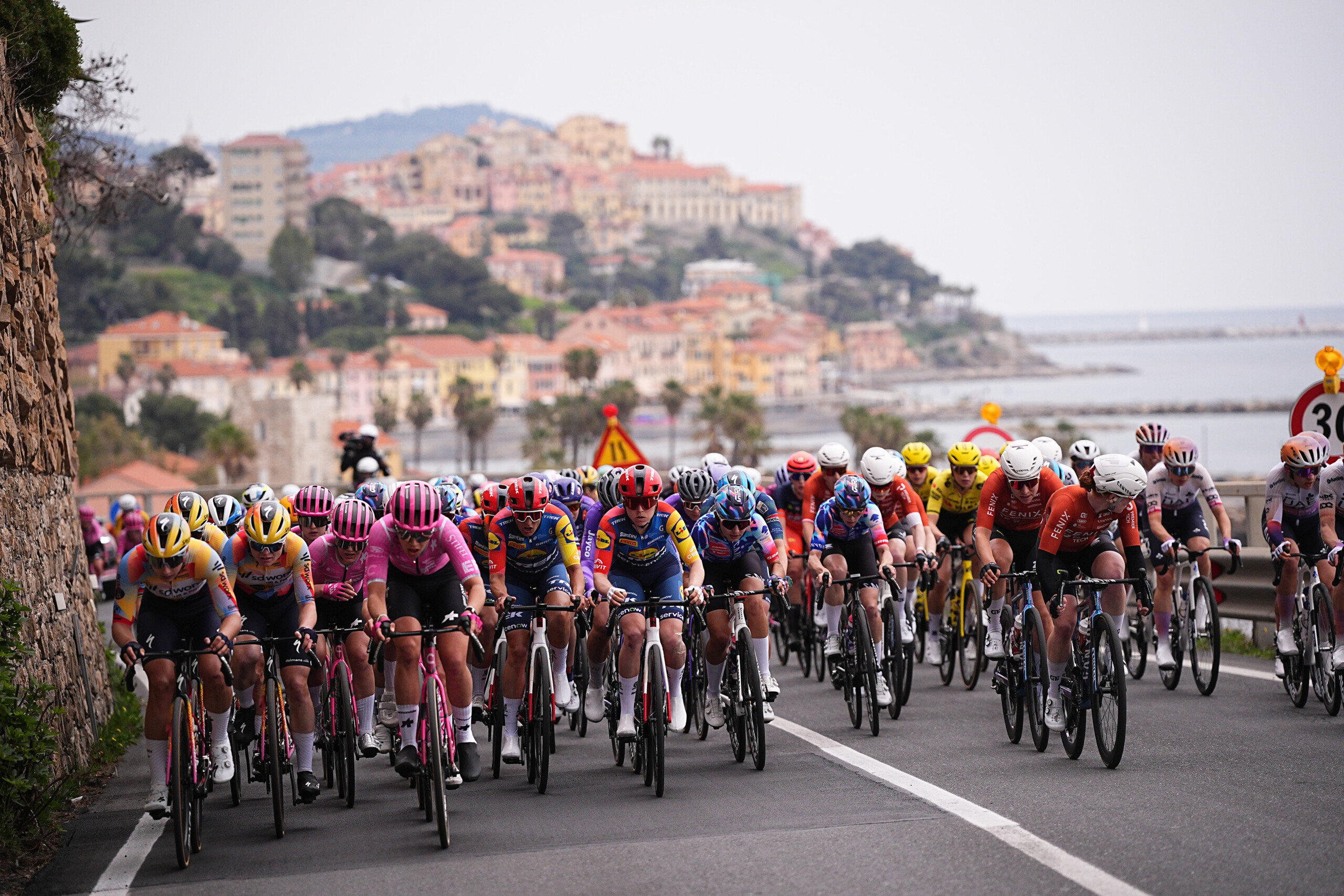
Genova watched them go—one of the great maritime republics of the medieval Mediterranean, its historic centre a maze of narrow caruggi and grand palaces squeezed between the sea and the Apennine hills. Out through the elevated road past the Porto Antico, down to Sestri Ponente, and west onto the Aurelia, that ancient coastal artery that has linked Milan and Sanremo for more than a century of racing. In the start village, the question on every tongue was the same: could Lorena Wiebes, the Dutch champion who had claimed the inaugural edition in 2025, defend her title against a field of extraordinary depth? Or would the climbs finally do their work?
The field that took the start reflected women’s cycling at its most competitive. Thirty countries, 144 riders. Italy led with 46, the Netherlands with 24, France with 14. At one extreme, Eleonora Deotto of Mendelspeck E-Work—the youngest entrant at eighteen years and 227 days. At the other, Mavi García of Liv AlUla Jayco, who had passed her 42nd birthday 78 days earlier, and who would play a brief but telling role in the afternoon’s drama. One entry in the race statistics carried its own quiet irony: the reigning world champion has never won this race. The bookmakers had their opinions. The road, as always, would have the final word.
The Early Roads: The Breakaway Game
For the first thirty kilometres the peloton refused to concede anything. Attacks fired off the front in waves—team after team trying to establish a presence in the break—but each effort was absorbed before it could breathe. The bunch moved with the collective alertness of a body that knew the real race was still hours away, and for a while it seemed as though the opening act might never end. Past the thirty-kilometre mark, something finally gave.
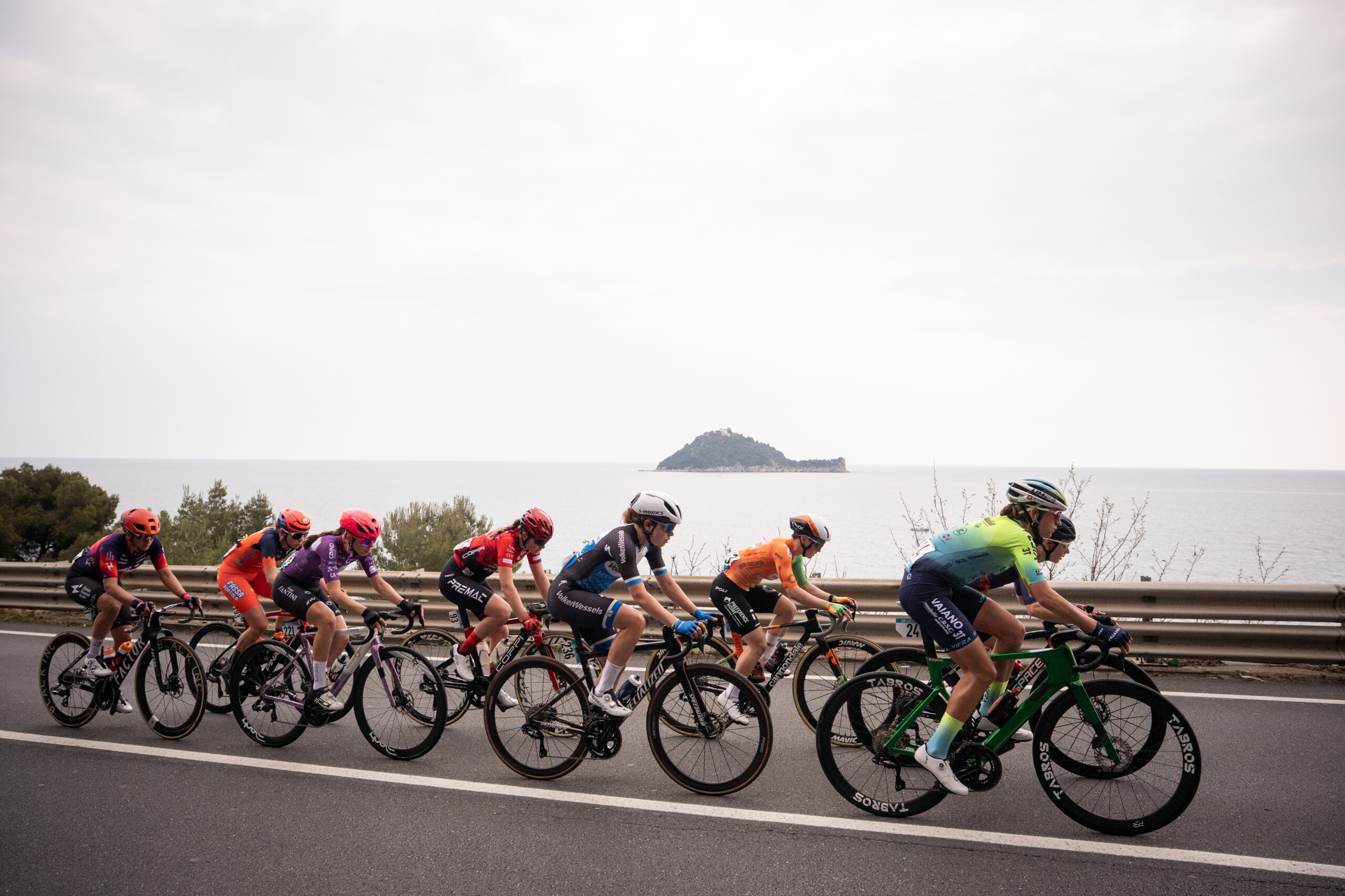
Eleonora La Bella of Aromitalia Vaiano, Constance Valentin of Mayenne Monbana My Pie, and Sofia Arici of Vini Fantini–BePink threaded the needle and opened a gap that the peloton, for the first time, chose to respect. The trio held, and over the next hour six more riders bridged across: Katia Ragusa (Human Powered Health), Lara Crestanello (Isolmant–Premac–Vittoria), Heidi Franz (St Michel–Preference Home–Auber93), Eleonora Deotto—the youngest starter in the race, already making her Sanremo debut at eighteen—Sara Lucconi (Top Girls Fassa Bortolo), and Bodine Vollering of VolkerWessels, the younger sister of Demi, here carving her own path.
Behind the nine, Victoire Berteau (Cofidis) and Fariba Hashimi (Vini Fantini–BePink) attempted to bridge the gap independently, but the peloton eventually reeled them back into the fold. With just under 100 kilometres remaining, the leaders held a maximum advantage of three minutes and forty seconds. The real work was still ahead. A small crash briefly disturbed the Cofidis train in the bunch—several riders went down before remounting quickly. The French team were riding in support of former world champion Amalie Dideriksen, one of the names quietly circulating as an alternative path to the finish should the race come apart in the right way.
The Capi: The Landscape Changes
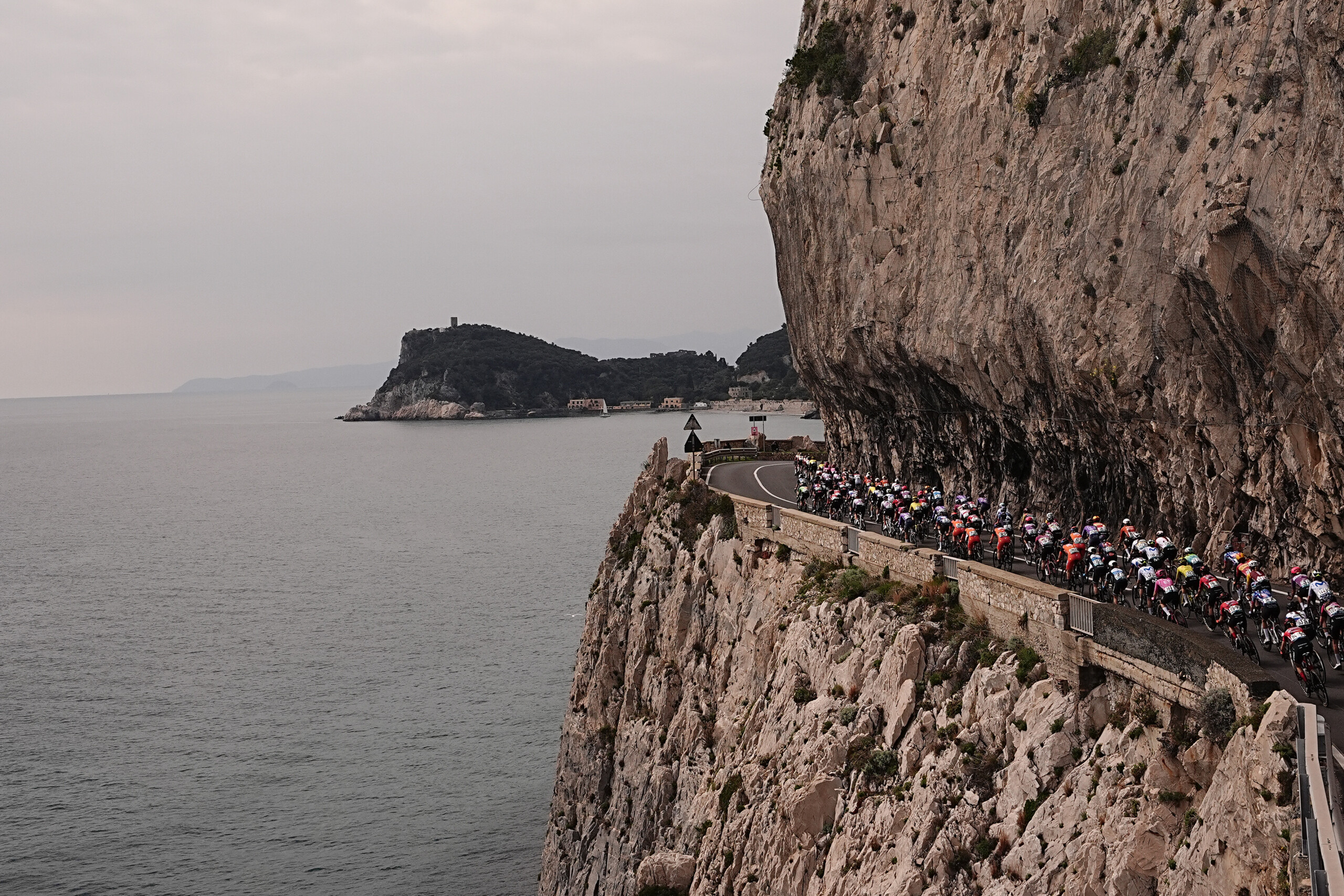
At fifty kilometres to go, with the gap standing at one minute thirty, the Capi appeared on the horizon. This is the sequence that makes the Ligurian finale unique and unrepeatable: three headlands jutting into the Mediterranean—Capo Mele, Capo Cervo, and Capo Berta, the most demanding of the three—each one a short ramp, a descent, and a reminder that this race rewards considerably more than pure speed. Over Capo Mele, the nine leaders still held a minute and twenty-five seconds. By the time the race swung past Capo Berta and descended toward Imperia, the gap had collapsed to around thirty seconds. Only three riders remained at the front: Franz, Arici, and Bodine Vollering, clinging to seconds, not minutes. The peloton had made its decision.
The Cipressa—five-point-six kilometres at 4.1 percent, added to the route in 1982—awaited.
The Cipressa: The Race Lights Up
Lidl–Trek led the charge onto the Cipressa, committed to the twin options of Elisa Balsamo—Italy’s former world champion, racing in front of her home crowd—and the formidably talented Niamh Fisher-Black. Visma | Lease a Bike sat behind as a kind of hedge, their ambitions not yet fully declared. Uno-X Mobility positioned themselves well in the nervous concertina behind.
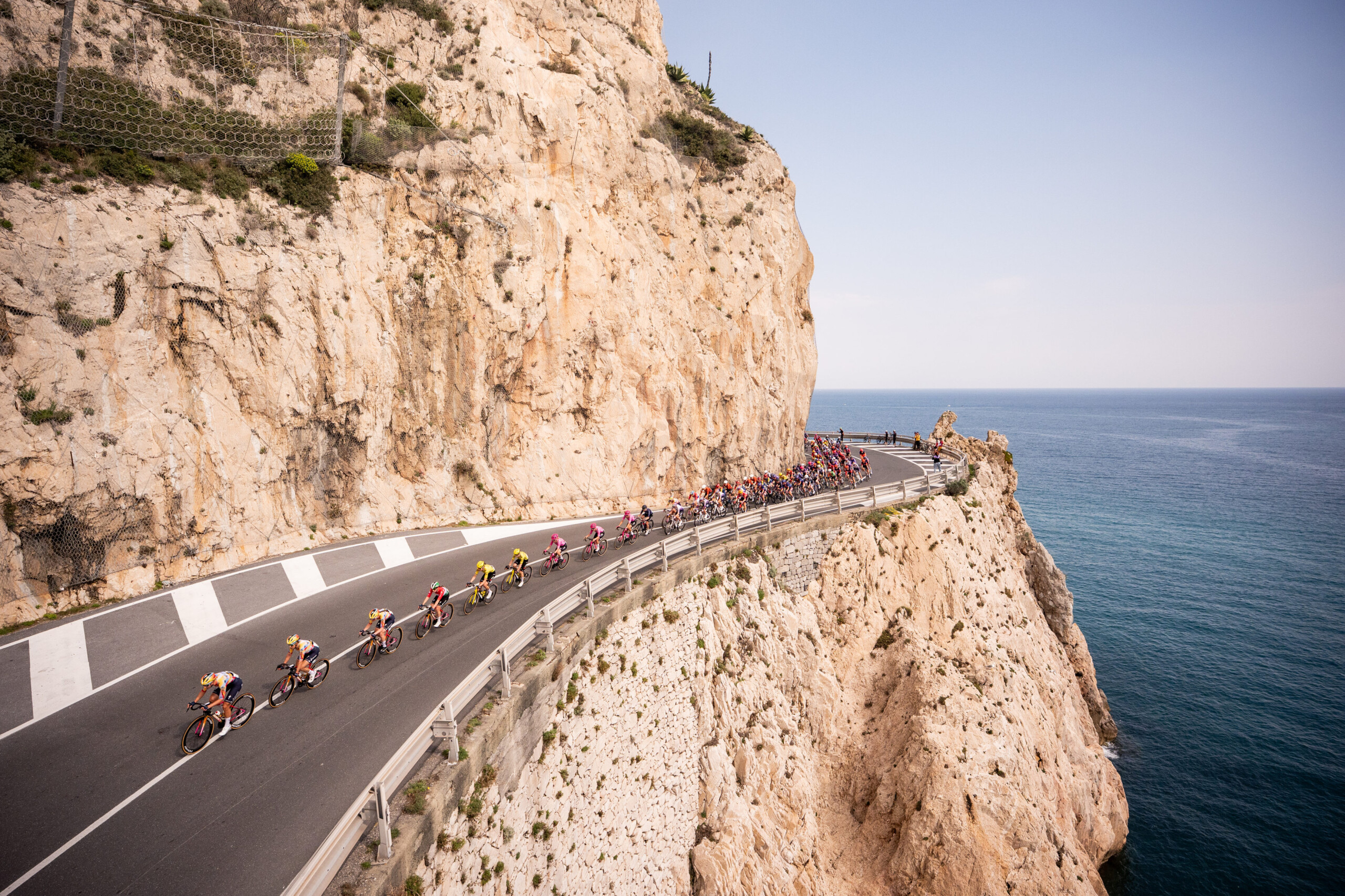
Those still in the group at the foot of the climb were already climbing at over thirty kilometres per hour. Riders began losing contact immediately. Then Femke de Vries (Visma | Lease a Bike) launched the first real move. Katarzyna Niewiadoma and Fisher-Black went straight after her, the kind of instant reflex that defines the truly prepared rider. The bunch split and re-split. Wiebes, marked and watched and protected throughout the day, absorbed the accelerations near the front while managing her effort carefully—visibly on the limit but, for now, still there.
Then Niewiadoma went again, harder, with the full weight of her climber’s ambition behind it. Wiebes lost positions. At the KOM it was Lieke Nooijen of Visma | Lease a Bike who crested first, alone, with roughly ten seconds on a dwindling chase of around 25 riders. Behind Nooijen, EF Education–Oatly were making their presence felt: Noemi Rügg and Cédrine Kerbaol moving purposefully through the group, the Swiss climber with unfinished business from a third place the year before.
Catastrophe on the Descent
What happened next on the Cipressa descent changed the race irrevocably. A crash, sudden and severe, swept through the group on a blind corner. Niewiadoma—who had been leading the group on the descent when she fell first—went down hard. Kim Le Court Pienaar of AG Insurance–Soudal also hit the tarmac. Riders behind had no time to react. Niewiadoma was visibly shaken and in pain. The race moved on without her, as it must.
With twenty kilometres remaining, Nooijen led onto the Aurelia, but solo efforts against a strengthened and motivated chase rarely survive the flat coastal run to the foot of the Poggio. At thirteen kilometres to go, she still held twenty-two seconds over a group of some forty riders. It was, in the language of the sport, probably not enough. But she kept pushing, the Dutch tenacity demanding that every possible second be extracted before the inevitable concession.
The Poggio: Five Go Clear
At nine kilometres from Sanremo, the Poggio di Sanremo begins. Three-point-seven kilometres, an average gradient of just under four percent, with ramps touching eight on the upper slopes. Four hairpin bends in the first two kilometres. The road narrows, the carriageway tightens, and the field—now down to forty or so—compresses before it shatters.
Lidl–Trek controlled the tempo as Nooijen was finally absorbed. Nikola Noskóvá of Cofidis attacked. The question was not whether someone would go on the hardest ramps, but who and when.
Puck Pieterse answered. The Fenix–Premier Tech climber hit the steepest section with the kind of sudden violence that demands an immediate response or allows a gap. Rügg and Kopecky both reacted. Then came Silvia Persico, and García herself—still here, at 42, on the decisive climb of the afternoon. The race was fracturing. Near the summit, five riders went clear together: Kopecky, Rügg, Pieterse, Eleonora Gasparrini of UAE Team ADQ, and Gasparrini’s teammate Dominika Włodarczyk. Behind them, the group containing Wiebes was six or seven seconds adrift. In those seconds, the entire calculus of the race changed.
After the race, Lotte Kopecky said, “On the Poggio I was waiting for someone to go—I did not intend to attack myself. In our team we have strong riders and Lorena, who is fast. I’m fast as well, but not as fast as she is. In a smaller group like today, I can sprint too.”
The Descent and the Sprint
On the technical, fully paved descent off the Poggio—narrow in places, a continuous series of hairpins and counter-bends through the urban outskirts of Sanremo—Włodarczyk took up the work for Gasparrini while Kopecky rode deliberately passive, watching everything with the patience of a rider who has already decided that the sprint, when it comes, is hers. The gap to Wiebes held at around ten seconds as the five hit the Aurelia for the last time.
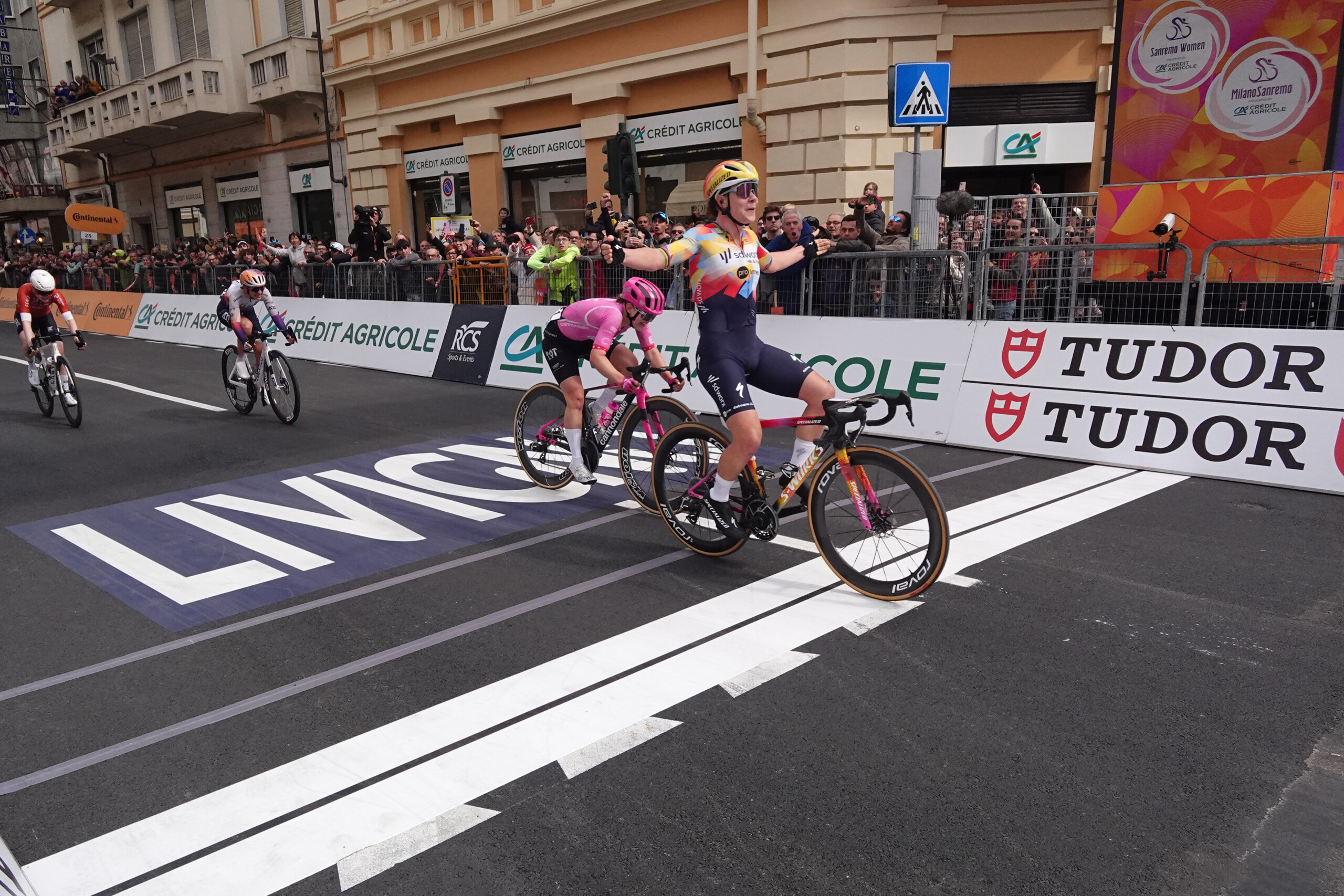
With one kilometre remaining, they were safe. The sprint was inevitable.
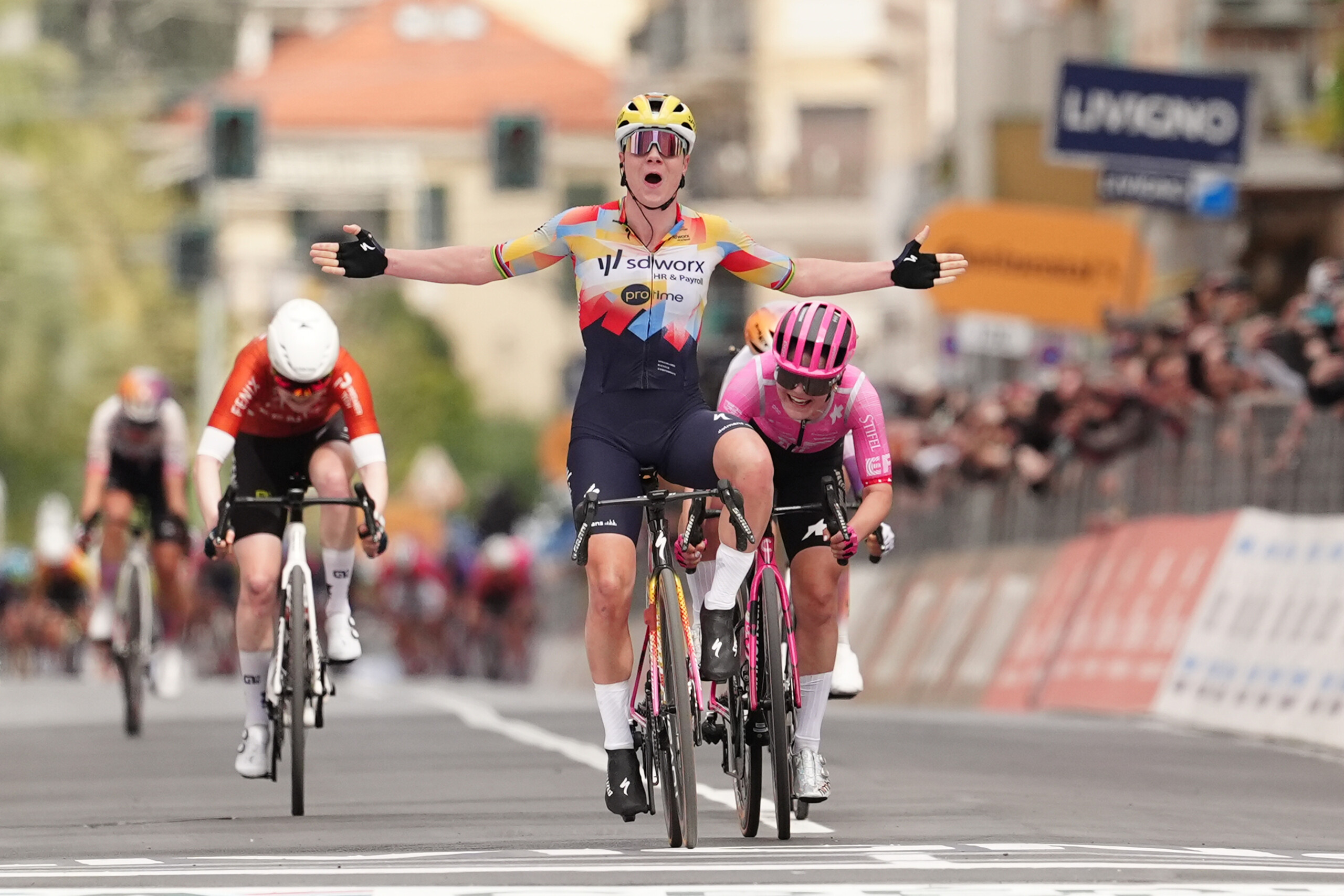
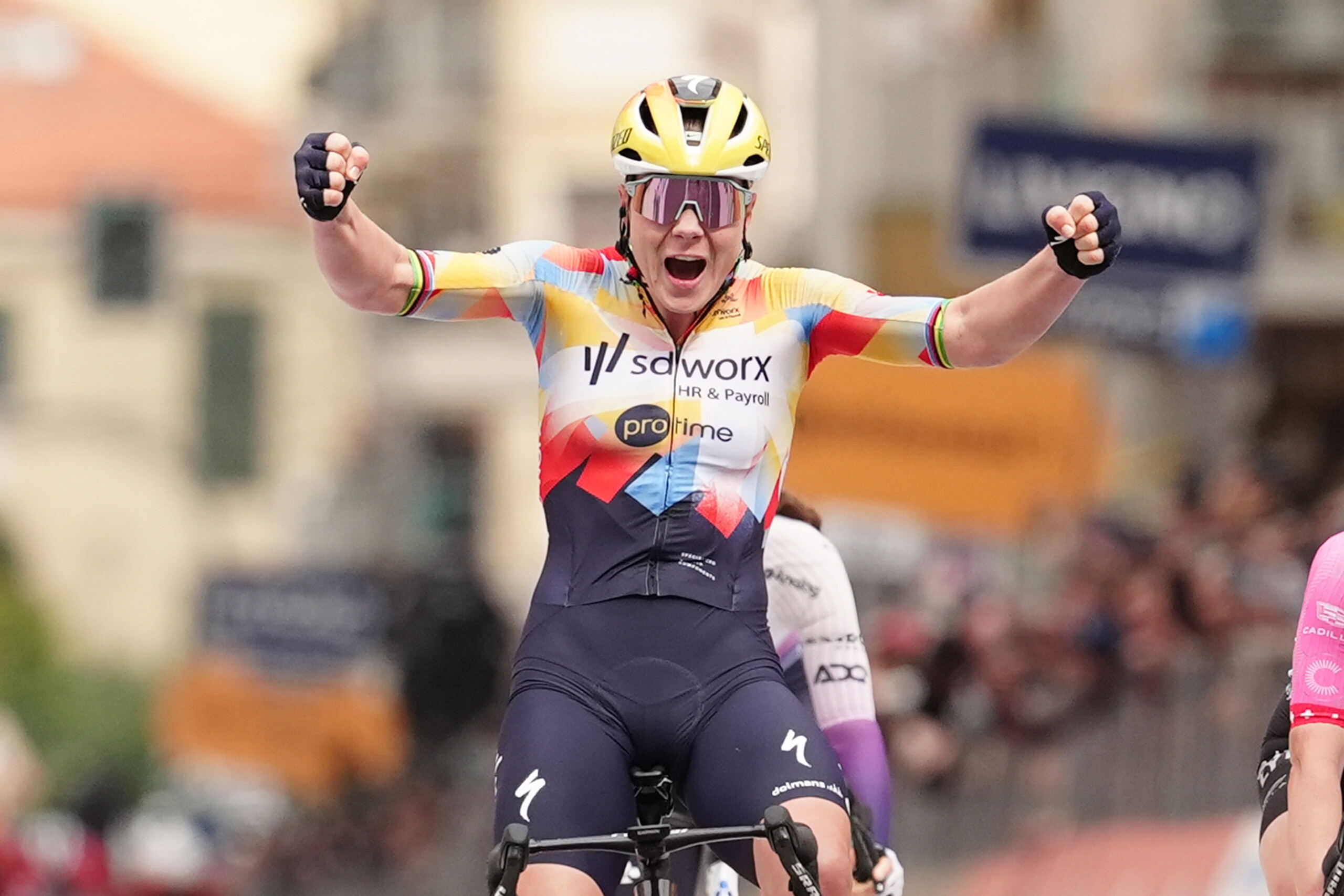
Włodarczyk launched Gasparrini early off a roundabout at 850 metres, a bold leadout from the UAE Team ADQ engine—a statement that they would not simply cede the positioning battle. Rügg found her wheel. Kopecky, who had monitored every move since the Poggio summit, timed her effort with the clinical precision of a rider who has done this before. She won with authority on the Via Roma. Rügg crossed second, Gasparrini third, Pieterse fourth. Behind, Włodarczyk took fifth, four seconds ahead of the Wiebes group. The defending champion finished sixth—her bid to become the first two-time winner of this young race having ended on a Ligurian hillside.
The Aftermath: Records Fall on Via Roma
The statistics assembled themselves in the minutes after the finish with the satisfying click of well-fitted things. At 55 professional wins, Kopecky became the first Belgian ever to win Milano-Sanremo Women—in either its current incarnation or the earlier Primavera Rosa era—and the first Belgian to stand on its podium. Her pedigree, already stacked with two world titles, three Tour of Flanders victories, two Strade Bianche, a Paris–Roubaix, and more, had acquired another monument. Three days earlier, she had won Nokere Koerse.
In the press conference, she allowed herself a moment of perspective. “It means a lot to win Sanremo Women,” she said, “especially after last year when not everything went as I wanted. Milano-Sanremo is a big thing. The event carries a lot of history—it’s a very big victory.” She was characteristically precise about what had and had not worked. “On the Cipressa, I was a bit too far behind—I had to fight in the group. On the Poggio I was waiting for someone to go. I did not intend to attack myself. If the group going for the win was big, it would have been for Lorena. But in a smaller group like today, I can sprint too, and I’m glad it went all good.”
Noemi Rügg, whose relationship with this race appears to deepen each year, had finished third in 2025 and now stood on the second step, the only Swiss rider ever to have a podium finish here. “I really love this race,” she said. “The parcours is tailor-made for me. It’s perfect.” She described the tactical texture of the afternoon with the candour of a rider who had processed what had happened even before stepping off the bike. “I knew there would be an attack on top of the Poggio to try and get rid of the sprinters. I was actually surprised it wasn’t harder earlier on. These one or two-minute efforts suited me very well. I went with the flow and followed my instinct.” Getting so close hurts a little, she admitted, “but I have to be very happy with this second place.”
At 23, Eleonora Gasparrini became the youngest Italian on any Sanremo podium in either incarnation of the race, beating Sara Felloni’s record from 1999, and the first Italian to stand on the Sanremo Women podium specifically. She was generous with credit. “This is my first time and I have to thank my team-mates. They’ve really done an amazing job today. We raced as the best team.” She traced the tactical arc of her own day: conserving on the Cipressa, responding on the Poggio, trusting her teammates on the descent. “I went all in for the sprint.” Then she offered a thought that felt true about this race and its possibilities. “It’s only the second year for the Sanremo Women. It’s a really open race—for sprinters, but the climbs are selective. It makes it a really interesting race. Probably not every year it will finish the same way.”
Only two editions old, Via Roma’s women’s race already holds its share of stories. Kopecky’s victory—controlled, intelligent, executed by a team that ran this race from the neutralised zone to the finishing straight—had the quality of something inevitable only in retrospect. On a day when Niewiadoma lay on a Ligurian hillside, when Nooijen rode into the wind alone for twenty kilometres, when a 42-year-old García reached the Poggio summit in the leading group, the most classical version of the story prevailed: the best team, with two outstanding cards, played the right one at the right moment.
The Classicissima, in its second spring, is beginning to understand itself.
RESULTS
| POS | RIDER | TEAM | TIME |
| 1 | Lotte Kopecky | Team SD Worx – Protime | 3h47’17″ |
| 2 | Noemi Rügg | EF Education–Oatly | s.t. |
| 3 | Eleonora Gasparrini | UAE Team ADQ | s.t. |
| 4 | Puck Pieterse | Fenix–Premier Tech | s.t. |
| 5 | Dominika Włodarczyk | UAE Team ADQ | +0:04 |
| 6 | Lorena Wiebes | Team SD Worx – Protime | +0:09 |
| 7 | Ally Wollaston | FDJ United–SUEZ | s.t. |
| 8 | Elisa Balsamo | Lidl–Trek | s.t. |
| 9 | Charlotte Kool | Fenix–Premier Tech | s.t. |
| 10 | Chiara Consonni | CANYON//SRAM zondacrypto | s.t. |
NOTES
— Kopecky’s 55th professional victory and second of the 2026 season, following Nokere Koerse three days prior.
— First Belgian winner of Milano-Sanremo Women, and the first Belgian podium finish in either the current race or the earlier Primavera Rosa.
— Noemi Rügg: the only Swiss rider to podium at Sanremo Women, finishing 3rd in 2025 and 2nd in 2026.
— Eleonora Gasparrini: first Italian podium finisher in Sanremo Women, and at 23 the youngest Italian on any Sanremo podium, eclipsing Sara Felloni’s record set in 1999.
— Average speed: 41.182 km/h over 156 km from Genova to Sanremo.
— 76 riders contested their first Sanremo Women in this edition.