
Tirreno–Adriatico 2026 | Full Stage-by-Stage Report
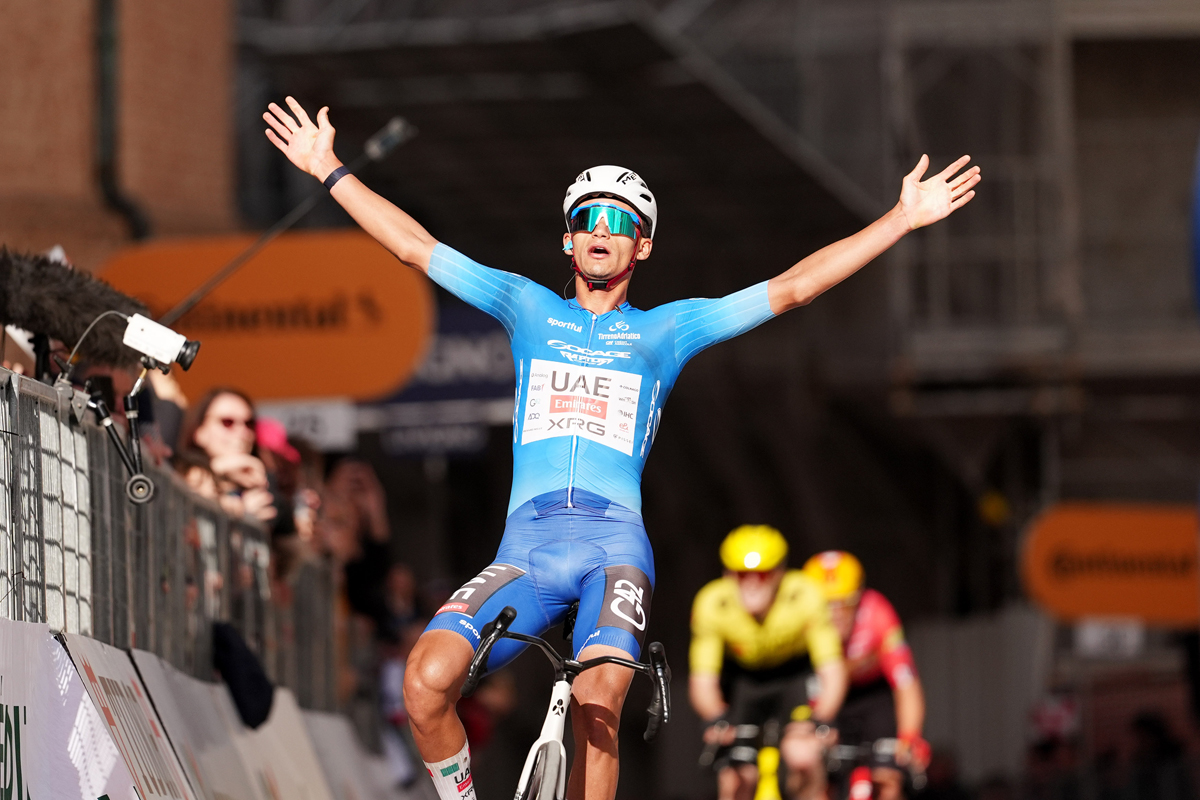
Ganna’s Law, Unbroken
March 9, 2026 · Stage 1 · Lido di Camaiore Individual Time Trial · 11.5 km
There is a particular kind of pleasure that a rider takes in a course he owns, and Filippo Ganna owns the seafront time trial at Lido di Camaiore in the way a sculptor owns a particular block of marble — with intimate knowledge of its grain, its resistance, its possibilities. He had won here in 2022, 2023, and 2024. He arrived at the 61st edition of the Race of Two Seas as a four-time world champion in the discipline, an Ineos Grenadiers team leader, and the kind of presence at a start ramp that turns competitors into spectators before a pedal has turned. He did not disappoint. He rarely does.
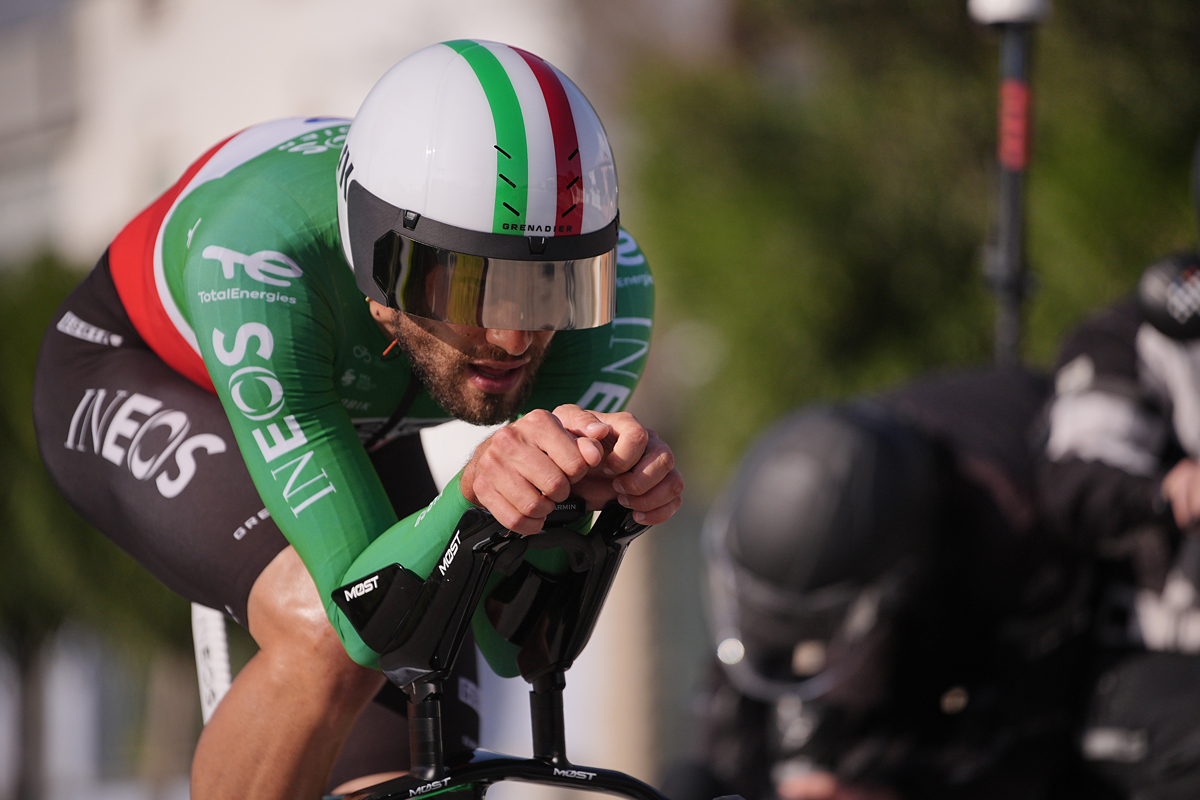
The course is unchanged from the formula established in 2022: 11.5 kilometres from the start in Lido di Camaiore, flat throughout, a single turn at Fumetto after five kilometres where the intermediate time check sits, and then the return leg into whatever the Tyrrhenian headwind chooses to offer. No technical surprises. No gradient to absorb the strongest men. Pure watts, applied by the purest time triallist in contemporary cycling.
Ganna’s average speed of 56.8 km/h didn’t just win the stage — it set a new all-time record for a Tirreno-Adriatico time trial, breaking the mark of 56.6 km/h he had established himself in San Benedetto del Tronto back in 2020. The record, like the victory, was his own to supersede. He crossed the line 22 seconds clear of Thymen Arensman, his Ineos teammate, who had evidently been briefed on exactly how far his leader was prepared to be pushed. Max Walscheid of Lidl-Trek took third by a margin measurable in thousandths of a second over Magnus Sheffield, who completed an afternoon of extraordinary Ineos dominance by finishing fourth.
The race’s maglia azzurra changed shoulders with a certain inevitability. It was the twelfth time in his career that Ganna had worn the blue jersey of the overall leader at Tirreno-Adriatico, leaving him within three of Roger De Vlaeminck’s record of fifteen. Whether the Piedmontese rider would extend his lead before the race reached San Benedetto del Tronto was a question he addressed with characteristic directness in the finish area. “It’s true that I want to arrive at Milano-Sanremo ready and fresh,” he said, “but that doesn’t mean I’ll give up the Maglia Azzurra. On the contrary, I’ll try to keep it for as long as possible.”
The general classification picture was already taking shape. Primož Roglič of Red Bull-Bora-Hansgrohe lost 31 seconds, Antonio Tiberi of Bahrain Victorious 33. Isaac Del Toro, the young Mexican riding for UAE Team Emirates-XRG and widely regarded as one of the most dangerous climbers in the current peloton, conceded 36 seconds. Giulio Pellizzari, Del Toro’s Red Bull-Bora teammate, gave 37. Matteo Jorgenson of Visma-Lease a Bike was 44 seconds down; Jai Hindley and Ben Healy both lost 49. Deeper in the field, Richard Carapaz trailed by 1’16”, and Lennert Van Eetvelt by 1’39”. The time trial had done what time trials do: arranged the field in a hierarchy that the coming days would interrogate, revise, and eventually overturn.
Van der Poel in the Dust
March 10, 2026 · Stage 2 · Camaiore → San Gimignano · 206 km
The white roads of Tuscany had barely recovered from Strade Bianche when Tirreno-Adriatico arrived at San Gimignano and asked for more. Stage two of the 61st edition was not Strade Bianche — nothing is, or could be — but its single 5.3-kilometre gravel sector, placed with surgical precision inside the final kilometres and featuring double-digit gradients, produced the race that the morning had promised and the weather had complicated. By the time the dust rose — wet and darkened by the rain that had begun falling as the peloton approached the white roads — the general classification had been remade entirely.
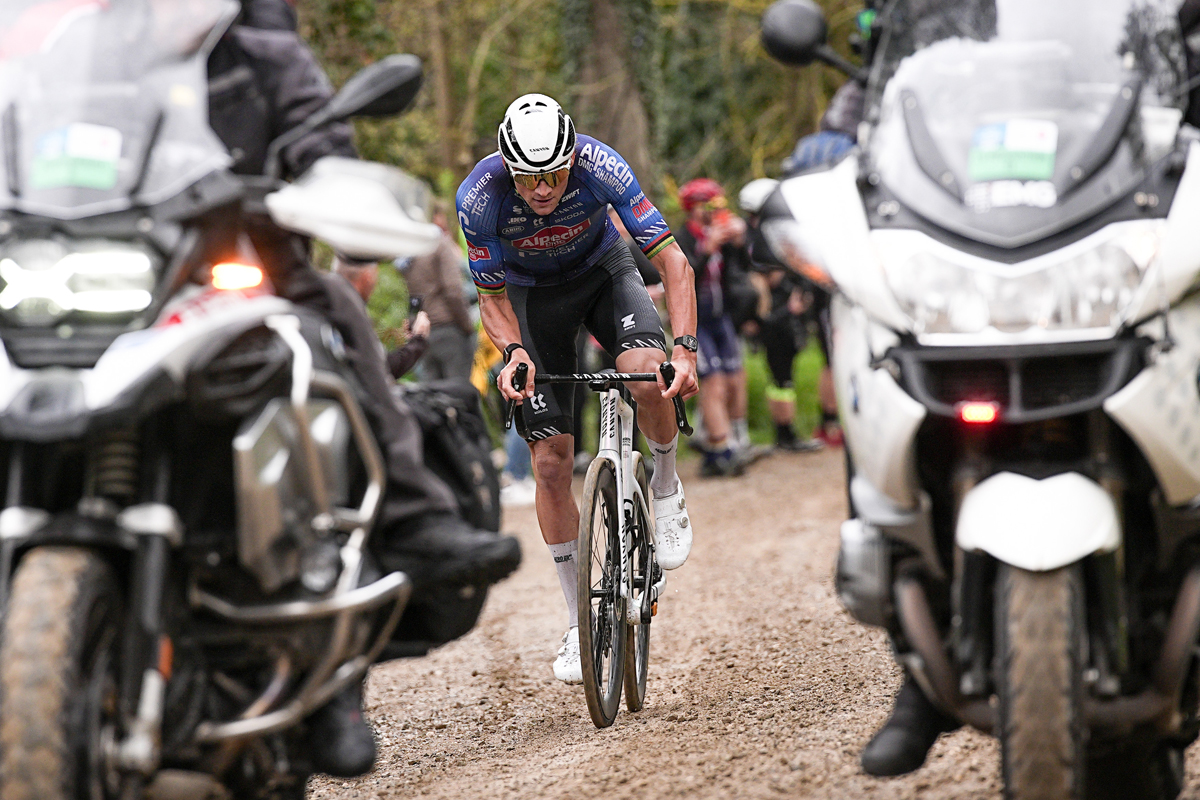
The day’s opening geometry was familiar: four riders from the lower orders of the classification got away early, Diego Pablo Sevilla of Polti VisitMalta taking the KOM at Castelnuovo Val di Cecina before the race moved on toward the finale. The peloton controlled everything with the unhurried competence of a group that knows its moment is coming. It came with 25 kilometres to go.
The rain had been building through the afternoon, turning the already technical gravel sector into something considerably more demanding. As the white roads appeared, Julian Alaphilippe of Tudor attacked — the former world champion still capable of the instinctive aggression that once made him uncatchable on days like this. But it was Mathieu van der Poel who broke the race open. The Alpecin-Premier Tech rider, who had won his last cyclocross world championship on ground not unlike this, raised the pace and the field fractured.
Glued to his wheel: Isaac Del Toro, Giulio Pellizzari, and Matteo Jorgenson of Visma-Lease a Bike. Then Jorgenson slipped on the damp surface and crashed, the American’s hopes of bridging the gap evaporating in the moment of impact. Del Toro and Pellizzari chased back across to Van der Poel. Behind them, Filippo Ganna was dropped. Thymen Arensman — who had ridden so strongly to second place on stage one — went down in a separate crash and would finish 1’38” back. The maglia azzurra, which had seemed so secure that morning, was suddenly vulnerable.
Three riders emerged from the gravel: Van der Poel, Pellizzari, and Del Toro. The Mexican, already calculating the general classification implications with the cool precision that defines his racing, refused to take turns on the final uphill drag into San Gimignano’s medieval centre. He pulled for the last two kilometres, stacking the sprint in Van der Poel’s favour and his own, ensuring that whatever happened on the finish line, the time gap to the Ganna-led field behind would be as large as possible. On the cobbled run-in, Pellizzari attempted to jump early. Van der Poel wasn’t caught. He threw his wheel across the line, Del Toro inches behind, Pellizzari third.
The entire field of GC contenders finished 17 seconds back. Arensman, who had been second overall, lost 1’38”. Del Toro — with the bonus seconds from the stage result applied — was the new maglia azzurra. Pellizzari sat three seconds behind him. Magnus Sheffield, unscathed, moved to third.
Van der Poel spoke with the measured satisfaction of a man who understood precisely where he was in his preparation. “It was very difficult to beat these young guys,” he said. “The level was very high, especially in the long climb, especially with the rain in the last half hour. It was quite tricky but the team did a really good job.” He traced the tactical logic of his winning move: “Julian Alaphilippe attacked first, then I went because I knew there were some technical corners. I just tried to make the race as hard as possible.” He placed the victory in the context of where he needed to be for the spring classics. “I came to Tirreno-Adriatico to prepare for Milano-Sanremo and the other classic races but also to try and win a stage. Last year I was close a few times. I’m happy to take a stage win again here five years after my last one.”
Andresen Announces Himself
March 11, 2026 · Stage 3 · Cortona → Magliano de’ Marsi · 221 km
The longest stage of the 2026 edition asked 221 kilometres of the riders on a day of persistent rain, rolling Umbrian roads, and the particular weariness that comes from having already crossed gravel and climbed walls in the preceding 48 hours. The sprinters had been waiting. Jonathan Milan, the Lidl-Trek fastman who enters every race as a favourite, had been waiting. The day belonged instead to Tobias Lund Andresen, whose name sat somewhere in the conversation about emerging sprinters without yet commanding its head.
By the time the race reached the finishing straight in Magliano de’ Marsi — gradually uphill for the final 15 kilometres, a ramp of two to three percent in the last hundred metres — Andresen had answered every question about where he stood. He was the fastest. He was also the most composed.
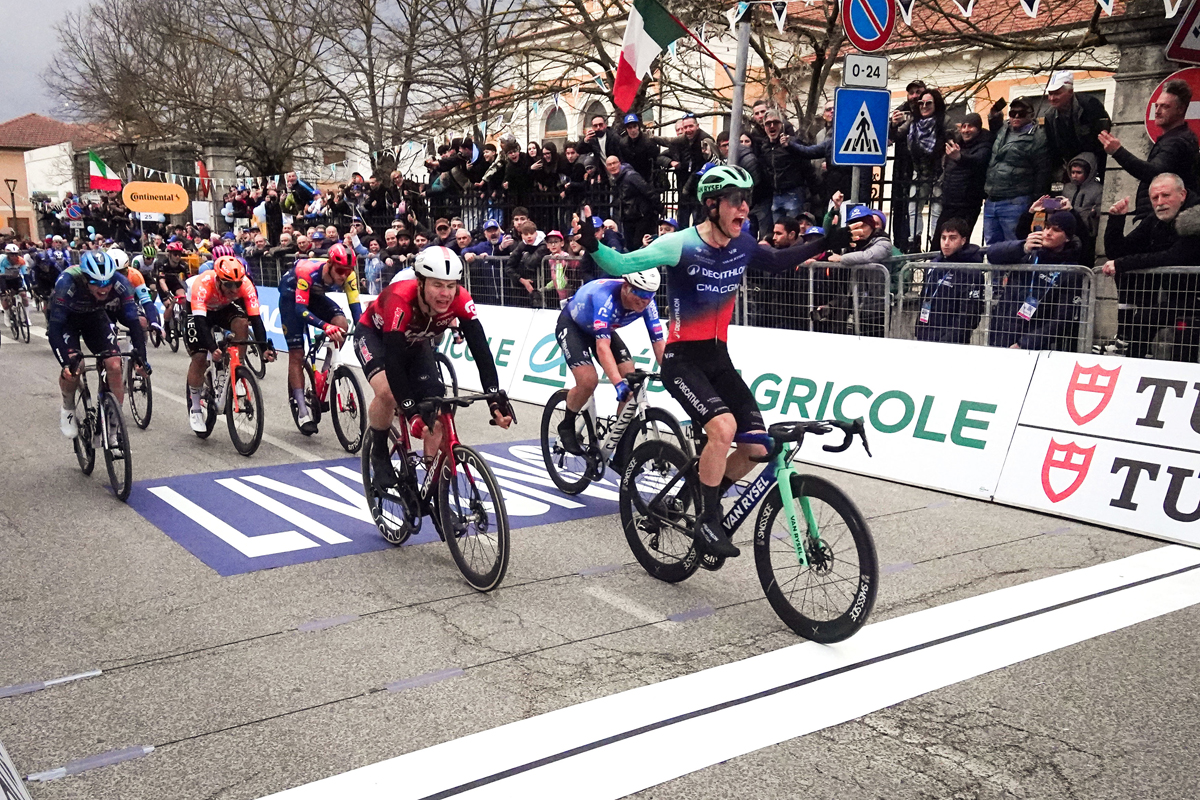
The stage had offered little in the way of genuine racing until the final 25 kilometres. Diego Pablo Sevilla took the solo break, collected the KOM points in Todi, and sat up with 130 kilometres still to race — the green jersey his aim, the stage never really the point. Jonas Abrahamsen, Ethan Hayter, and Liam Slock tested the wire inside the final 25 kilometres before being reeled in at the twenty-kilometre mark. Then Decathlon AG2R La Mondiale took control of the mechanics of the sprint, and their work was precise.
Jonathan Milan read the finale wrong. He launched from too far out, the Lidl-Trek team either mistiming their positioning or miscalculating the distance, and the effort that should have carried him to the line in command instead left him exposed to be caught. Andresen came through him, then Arnaud De Lie of Lotto Intermarché, then Jasper Philipsen of Alpecin-Premier Tech. Milan was seventh. The margins were clear.
For Andresen — ten professional victories, the third of the current season after wins at the Tour Down Under and the Cadel Evans Great Ocean Road Race — this was a different scale of result. “Everyone had cold legs, so I wanted to be first to launch the sprint,” he said. “It’s also because of Jonathan Milan that we went full speed so early.” He framed the victory in terms that suggested a man who had revised his own ambitions upward during the winter. “Tirreno-Adriatico is one of the biggest races of the year so to take a win here means a lot to me. My season has been unbelievable so far, winning in Australia and making two top-10 in Belgium — I wouldn’t have thought I could take such a big step this year but it’s due to this so amazing team.” Del Toro picked up a bonus second at the intermediate sprint and retained the maglia azzurra without drama. The race was shaping around him.
Van der Poel, Confirmed
March 12, 2026 · Stage 4 · Tagliacozzo → Martinsicuro · 213 km
If stage two in San Gimignano suggested that Mathieu van der Poel was in good form, stage four from Tagliacozzo to Martinsicuro provided something closer to confirmation. Two victories from two attempts in the same race week, the second taken in a headwind sprint from a reduced group of fourteen that had survived the wall of Tortoreto via Badetta — 1.6 kilometres at 8.4%, with ramps to twenty percent — with twelve kilometres remaining. The Dutch rider sat on wheels, read the sprint, and was simply the fastest man on the road to the Adriatic.
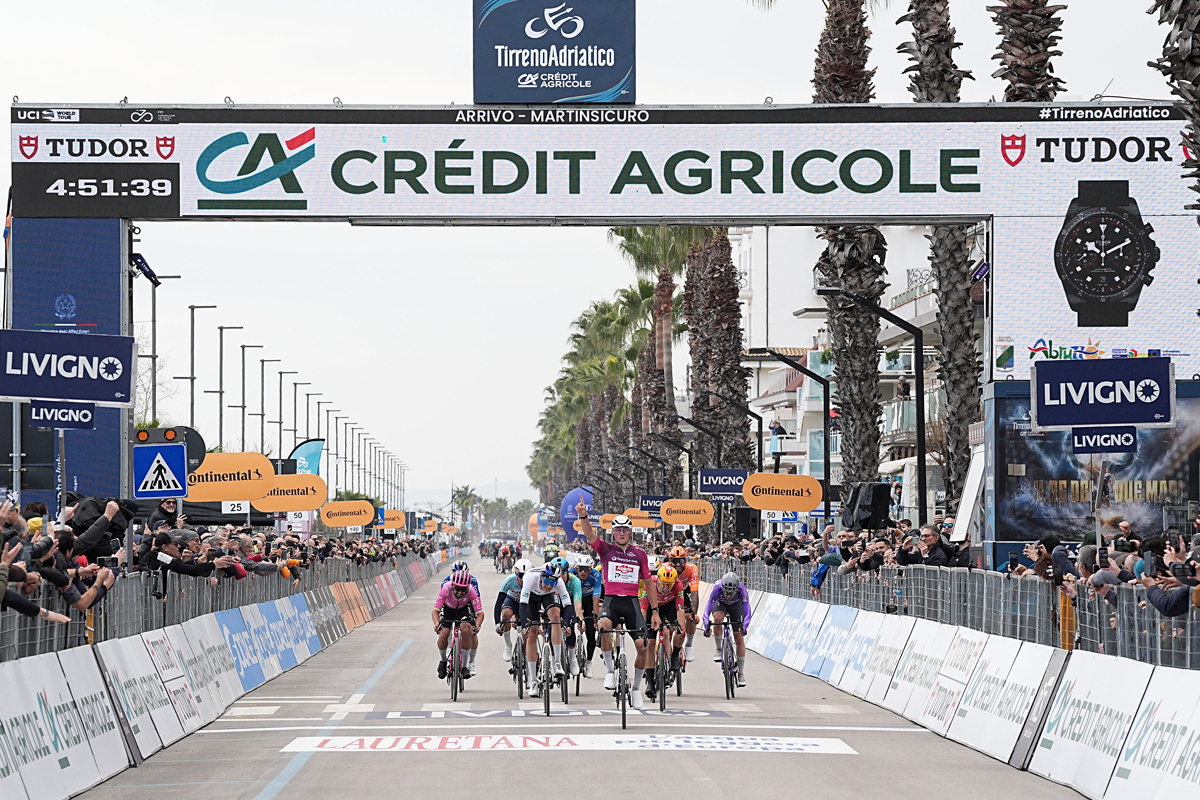
The day had opened with ambition from every direction. The profile — two major climbs in Ovindoli and the HC Valico delle Capannelle, followed by a series of punchy Abruzzese kickers, culminating in the Tortoreto ramp — was the kind of stage that invites long-range attacks and tends to reward them. Twelve riders made it into the break: a distinguished group that included Diego Pablo Sevilla, Rémy Rochas, Liam Slock, and Jonas Abrahamsen alongside nine others. Sevilla swept the KOM points on both major climbs. Jakub Otruba was the most aggressive through the middle hours, going solo before the intermediate sprint in Mosciano Sant’Angelo.
UAE Team Emirates-XRG controlled the race throughout with the methodical efficiency that defines the best teams in the peloton. They brought the break back at the foot of Tortoreto, and then Visma-Lease a Bike took command on the climb itself, Matteo Jorgenson forcing the pace in a way that shattered the peloton and left fourteen riders at the front: Van der Poel, Ben Healy, Filippo Ganna, Giulio Ciccone, Alessandro Pinarello, Primož Roglič, Giulio Pellizzari, Andrea Vendrame, Wout Van Aert, Jorgenson, Del Toro, Jan Christen, Tobias Halland Johannessen, and Clément Champoussin. Fourteen riders, eight kilometres of flat seafront, a headwind, and a sprint.
They watched each other. Short accelerations, probing moves, none decisive. Jan Christen tried to anticipate; Van Aert closed it. Ganna launched; Vendrame closed it. And then Van der Poel went. The headwind that had been neutralising attacks proved, in the end, to suit him better than anyone else in the group — the raw power required to drive through still air favours the largest engines, and his is among the largest. He came to the line first, with Giulio Pellizzari — who had sheltered with intelligence and emerged late — claiming second. Tobias Halland Johannessen of Uno-X Mobility was third.
The bonus seconds changed the race. Pellizzari, taking six seconds for second place, moved ahead of Del Toro in the general classification and into the maglia azzurra. The Italian was 23 years old, born in the Marche, and the next two stages would finish in his home territory. The circumstances were theatrical, and the stage was set.
Van der Poel assessed his week with the bluntness of a man who doesn’t complicate his own narrative. “It was quite a hard day with a strong breakaway. The pace was really high all day. In the end, Visma did a really good job. I could gamble a bit because I already won my stage.” He was precise about the tactical execution: “I was expecting a late attack from Filippo Ganna. I also knew Visma was going to take a sprint with Wout. I just tried to react immediately on everything.” He acknowledged the risk in his timing: “I launched my sprint a bit too early maybe. With the headwind it was quite far away from the finish line. Luckily I managed to get it to the line.” The declaration of form was unambiguous: “I’m in a good shape.”
Valgren’s Long Road Back
March 13, 2026 · Stage 5 · Marotta-Mondolfo → Mombaroccio · 184 km
Cycling has a talent for producing the kind of day that contains two completely separate stories, each compelling in its own register, running parallel through 184 kilometres before converging at a finish line on a hill above the Adriatic. On stage five of Tirreno-Adriatico, one story belonged to Michael Valgren — 34 years old, 1,639 days without a professional victory, a father of one month — and the other to Isaac Del Toro, twenty-three years old, reclaiming the maglia azzurra with the forceful authority of a rider who understands that the race is his to lose.
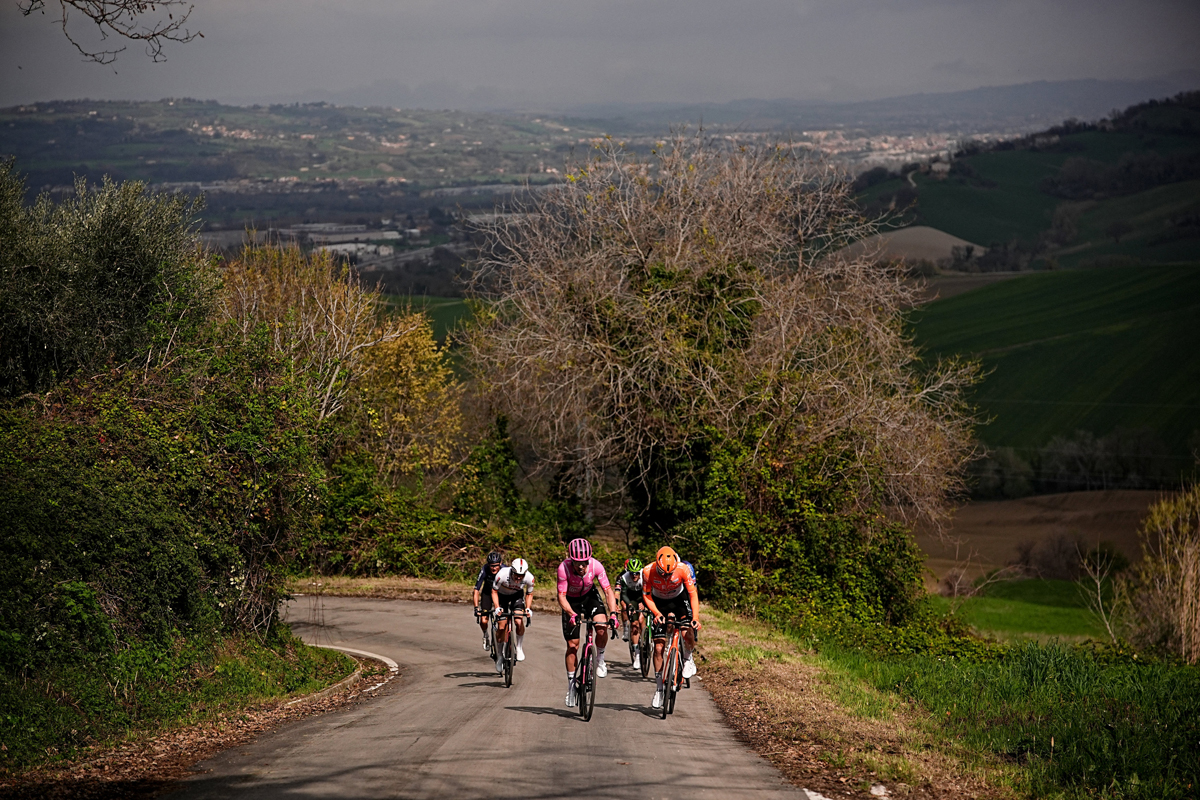
The stage from Marotta-Mondolfo to Mombaroccio offered no flat roads and no mercy: 3,900 metres of elevation gain distributed across a relentless sequence of short climbs and sharp Marche ramps, culminating in a 21.6-kilometre circuit to be covered twice, with the Santuario del Beato Sante — 4.2 kilometres averaging 6.2%, the final 1,200 metres at nine percent — crested for the second time with 1.5 kilometres to the line. The course was the kind that reduces pelotons to their essential components.
After 35 kilometres a breakaway formed with the kind of roster that suggested the day’s stage win would come from within it: Edward Planckaert and Emiel Verstrynge of Alpecin, Joan Bou, Jack Haig of Ineos, Georg Zimmermann, Michael Valgren of EF Education-EasyPost, Sjoerd Bax, and Julian Alaphilippe of Tudor. The Frenchman, starting the stage 1’20” behind Pellizzari, held the virtual maglia azzurra for long stretches as the race developed, which gave the move a particular theatrical texture.
UAE Team Emirates-XRG held the peloton’s tempo at around thirty riders through the winding circuit. Antonio Tiberi and Wout Van Aert lost contact. On the penultimate lap, the break came apart: Valgren and Alaphilippe made the split, and then on the final ascent of the Santuario, Valgren found a gear that the former world champion couldn’t match. He dropped Alaphilippe and flew to the summit alone.
Behind him, the peloton was fracturing around its most important rivalry. Del Toro attacked, once, twice, three times on the final climb, and on the third acceleration Jorgenson followed. The pair extended a gap of nineteen seconds over Pellizzari, who had Roglič alongside him trying to limit the damage. Valgren crossed the line in Mombaroccio with his arms in the air, the gap behind him growing as Del Toro and Jorgenson arrived eleven seconds later, eleven seconds ahead of the field.
In the finish area, Valgren was still finding the words for what had happened. “It’s unbelievable to be a winner again after so long,” he said. “We all work so hard for this. I had a really good winter with my family. They supported me. We had a baby one month ago. This win is for him and for the team.” He recalled the day’s demands without self-pity: “It was a hard race at the start with lots of attacks but I had good legs all day. I attacked and Julian came with me. In the end, it was such a hard day. I was pushing all day. I had amazing legs.” A former winner of both the Amstel Gold Race and Omloop Het Nieuwsblad, Valgren had arrived at Tirreno-Adriatico as a rider rebuilding, and left stage five as a winner again. The general classification now read Del Toro, Pellizzari at 23 seconds, Jorgenson at 34. One stage remained before the sprint finale.
Del Toro in Pellizzari’s Backyard
March 14, 2026 · Stage 6 · San Severino Marche → Camerino · 188 km
Giulio Pellizzari was born in San Severino Marche. He grew up in Camerino. Stage six of Tirreno-Adriatico 2026 started in the first of those places and finished in the second, on the Muro della Madonna delle Carceri — three kilometres at 8.8%, ramps to eighteen percent — in front of a crowd that had come for a particular outcome. Professional cycling is rarely that accommodating. But the crowd got a race worthy of the occasion, and their rider gave everything he had, and in the end Isaac Del Toro was simply better on the day that mattered most.
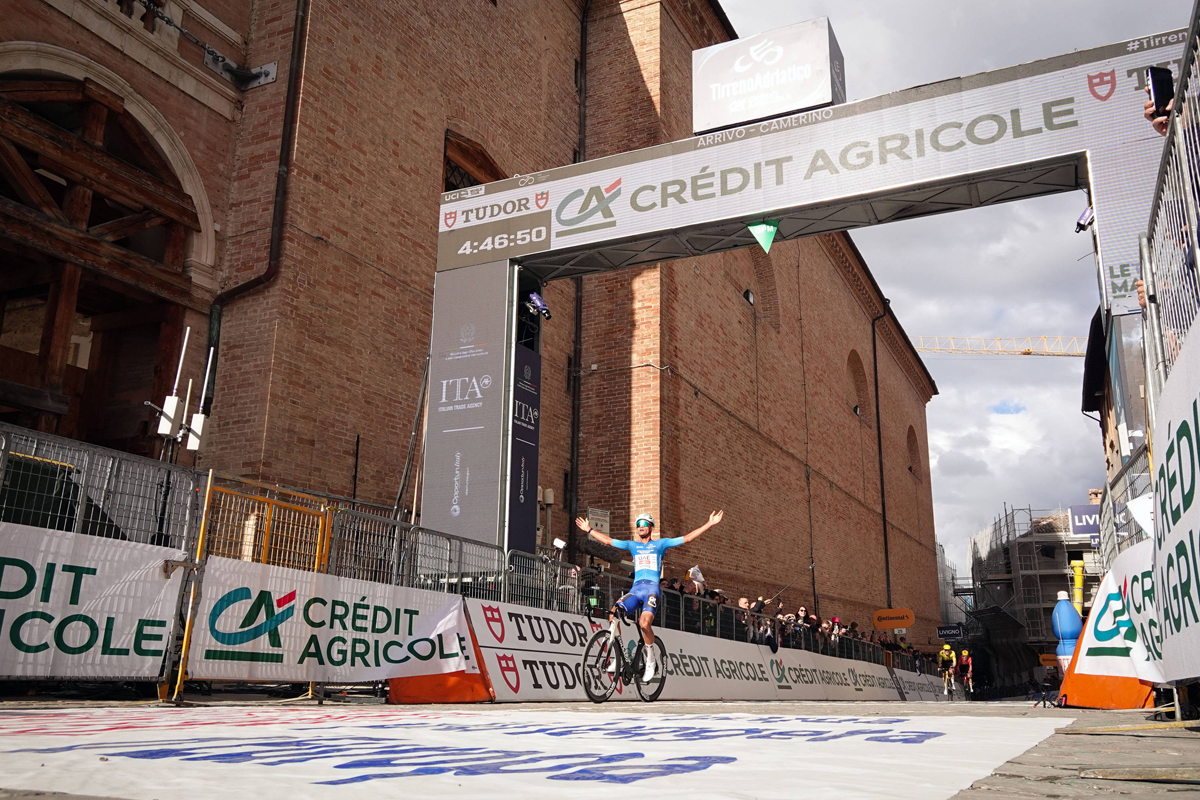
The course offered nowhere to hide: another 3,900 metres of elevation, the Valico di Santa Maria Maddalena after fifty kilometres, then the entry to Camerino and its eastern ascent at nearly eleven percent, before the final circuit of 28.6 kilometres, covered twice, with the decisive wall crested three times in total. Anyone who wanted the Trident trophy would have to produce it here.
A seven-rider break went clear at the foot of the Sassotetto climb: Gregor Mühlberger, Vincenzo Albanese, Clément Braz Afonso, Filippo Ganna — now free of GC obligations and clearly relishing the freedom — Walter Calzoni, Timo Kielich, and Guillermo Thomas Silva. Kielich crossed first at Sassotetto. Mühlberger and Braz Afonso then dropped the rest on the first ascent of the Muro della Madonna delle Carceri with sixty kilometres remaining and stayed clear until seven kilometres from the finish. Behind them, Richard Carapaz attempted something ambitious, opening a gap of 1’20” before the flattest connecting sections between the climbs exposed the limits of his diesel engine on this type of finish.
The peloton’s final circuit began with Alaphilippe making the first selection, thinning the field toward its essential core. The contenders waited, measuring, each hesitant to be the one who drove the others to the finish. Wout Van Aert attacked. Ben Healy responded. Then Pellizzari, with the crowd at maximum volume around him, went all-in — caught and dropped Healy, flew past him, and for a few seconds the Camerino hillside believed. Del Toro played a different game. He let Pellizzari go, watched the gap reach something manageable, and launched near the final kilometre with the decisive acceleration of a rider who had been saving his best move.
He closed it within pedal strokes. Jorgenson tried one last surge; Pellizzari cracked under the combined pressure; Del Toro surged past near the line. Tobias Halland Johannessen of Uno-X Mobility took second, three seconds back. Jorgenson arrived alongside him. Pellizzari, who had ridden the stage of his life in front of his people, held second overall from Jorgenson by a single second.
It was the first victory by a Mexican rider in the history of Tirreno-Adriatico. It was the twenty-fifth professional win for Del Toro in two and a half years of racing — a pace of accumulation that invited comparisons with Tadej Pogačar at the same age, who had managed seventeen. Del Toro addressed the win and the day’s peculiar emotional complexity together. “It’s quite close today but I’m super happy to win this stage,” he said. “I said yesterday that I wanted that.” He acknowledged the specific difficulty of the decisive moment: “When Giulio Pellizzari attacked, I wasn’t sure to bring him back because it was a very hard climb and he’s super strong. We couldn’t give him too much space.” And he named the strangeness of winning where his rival is at home: “It gives me mixed feelings to win in his hometown. Now one stage to go — let’s hope for the best outcome tomorrow.”
The sprint finale into San Benedetto del Tronto remained, but the Trident trophy was already decided in everything but formal ceremony. Del Toro had won the Race of Two Seas at twenty-three, on roads that belong to someone else, by the margin of something that couldn’t be stopped.
Milan’s House, Milan’s Rules
March 15, 2026 · Stage 7 · Civitanova Marche → San Benedetto del Tronto · 142 km
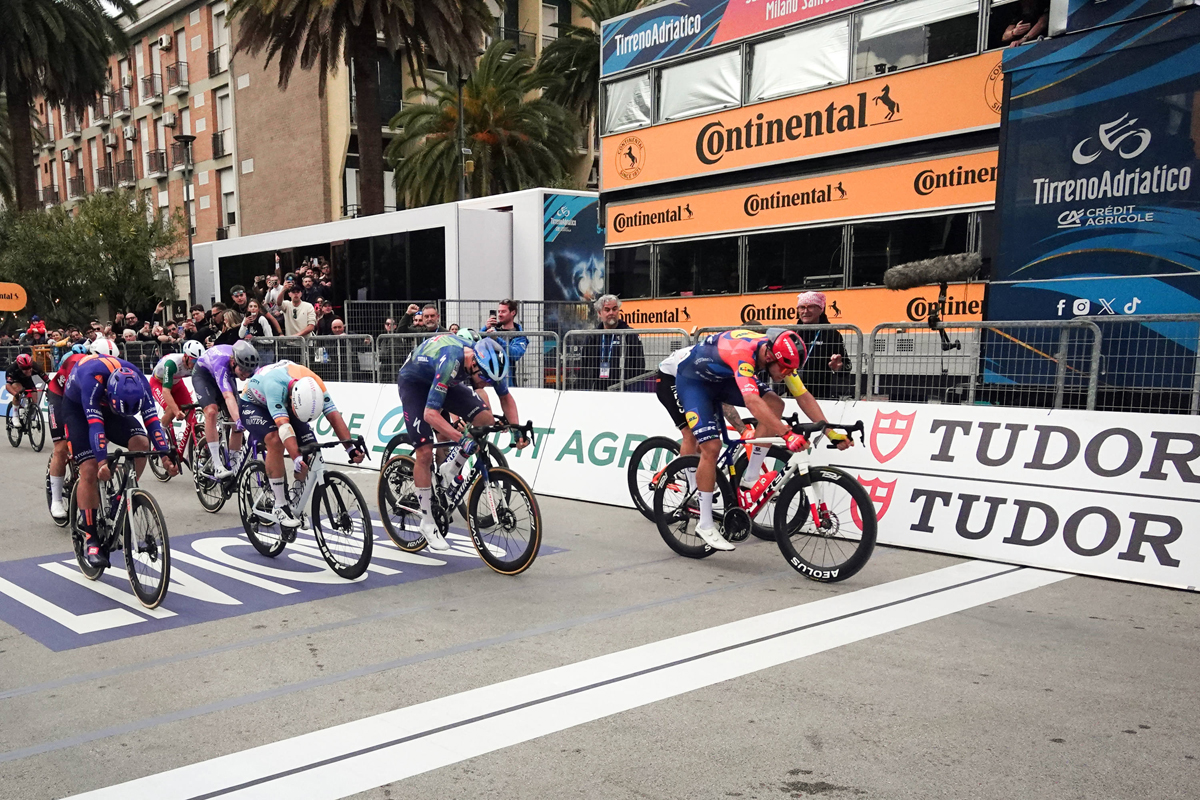
Jonathan Milan has won this stage before. He won it in 2024, and again in 2025. He arrived at the start of the final stage of the 61st edition of Tirreno-Adriatico having described the week as one of suffering — too many mountain stages for a sprinter of his architecture, too few opportunities to do what he does best. He had finished seventh at Magliano de’ Marsi when he should have won. He had watched the race’s GC story unfold through stages designed to exclude him. Now the Adriatic seafront was in front of him, the road was flat, and San Benedetto del Tronto was waiting. He won again. Third consecutive year, fifth career stage victory on this race. The sprint as homecoming.
Before it came to that, Mathieu van der Poel had one more thing to say. The Alpecin-Premier Tech rider — already holding two stage wins, already confirmed in the form he required for the spring classics, already making his preparation for Milano-Sanremo look dangerously complete — attacked with a hundred kilometres still to race. He made the stage hard in the way that only he can make things hard: not with the accumulated pressure of a peloton-sized tempo, but with the sudden, violent disruption of one man deciding to go now. It wasn’t enough to stay away on 142 flat kilometres to the Adriatic, and the peloton eventually reassembled, but it cost effort from every sprint team that had been conserving their lead-out men.
The finale tightened around a crash inside the final 2.5 kilometres — the week’s last moment of chaos, Paul Magnier of Soudal-Quick Step going down and forcing his teammate Laurenz Rex, who had been slated for a domestique role, into a sprint he hadn’t expected to be riding. Milan, watching from his wheel of Edward Theuns, found the Belgian in the sprint and drove past him with the authority of a man who has done this exact thing on this exact road before. Sam Welsford of Ineos Grenadiers took second, Rex third — his first stage podium at the race. Milan crossed the line with the weight of a hard week leaving his body all at once.
“I feel pain and happiness at the same time,” he said. “It’s been a tough week and a tough stage again today. My teammates supported me all the way. I had very little to do after them today. They gave me a perfect lead-out.” He looked ahead to the bigger objective with clear-eyed focus. “I want to enjoy this victory and take a rest ahead of Milano-Sanremo where we have two big names, Mathieu and Tadej. I still have one week to be ready to fight with them.” Later, at the press conference, he elaborated on what the week had taught him. “It’s been a Tirreno-Adriatico in which I’ve suffered a lot. Looking at the route, I understood there would be very few stages suiting me for winning but it was a great opportunity to train for further goals.” He placed the stage win in the context of collective obligation: “My teammates supported me so much in the past few stages that I wanted to repay them by winning today.” On the sprint’s decisive moment: “The only moment I’ve feared something was when the crash happened. Luckily, we remained in one lane. It’s been difficult to find the wheel of Edward Theuns but it came down to the sprint I wanted for winning for the third straight time.”
Isaac Del Toro had other business to conclude. At the intermediate sprint in the stage’s middle section, he attacked and collected a bonus second — enough to push Matteo Jorgenson below Giulio Pellizzari in the battle for the final podium’s second step. It was a small, deliberate act of racing on a day that had otherwise released him from obligation. He arrived in San Benedetto del Tronto as the owner of the maglia azzurra, the maglia ciclamino, and the maglia bianca — three jerseys on one rider, twenty-three years old, in his first Tirreno-Adriatico victory.
“I’m super happy to get this victory with the team,” he said. “I’ve been coming here for the last three years and I’m very proud of the achievements with the team. It’s the way I want to race more as a leader.” He placed the week in the specific context of what comes next. “I’ve been in Mathieu van der Poel’s wheel more than often this week, maybe that will help in Milano-Sanremo.” He was immediate about his role there: “I’ll be racing it for Tadej and not looking for a result for myself. There won’t be Jhonathan Narvaez or Tim Wellens due to injuries, so I want to do a great job as a teammate. I enjoy to be this kind of guy who can switch roles and I want to learn as fast as I can.” He allowed himself a moment of national pride: “It’s super nice to be the first Mexican winner of Tirreno Adriatico. People back home support me like crazy — they start to understand the sport.”
Matteo Jorgenson had made a mistake on stage two when he crashed on the gravel, surrendering the time that might have put the race within reach. He had clawed back what he could through the Marche walls, and on the final day he’d found the bonus second that lifted him above Pellizzari in the standings. “To win this intermediate sprint that makes me second instead of third is a nice way to finish this week after the mistakes I’ve made,” he said. He weighed the result with the honesty it deserved: “To finish second of Tirreno Adriatico is a good result although I came for winning. I would have liked to win but Isaac was a little stronger than me at every turning point of the race, congrats to him.”
Giulio Pellizzari had been carrying a secret. Two days of pain behind one knee, bad enough that abandonment had crossed his mind, bad enough that the crowd scenes in Camerino the previous afternoon had been conducted partly in a fog of discomfort. “I don’t know what happened but I’ve had two days with a pain behind a knee. It has made my racing really difficult. I’ve thought of pulling out but I’ve preferred to fight until my home stage, which was yesterday.” He framed the podium in terms that suggested a rider who understood he had spent everything the week had to offer. “This was my first time racing Tirreno Adriatico so I can be proud with my first podium in a WorldTour stage race, thanks to my team and champions like Primož and Jai who supported me.” He set his target for the future with the directness of a twenty-two-year-old who has just established a baseline: “Tirreno Adriatico is the race I want to win in the future.”
Diego Pablo Sevilla of Polti VisitMalta collected the maglia verde and reflected on what it meant for a team that has chased classification jerseys without claiming one under its previous identity. “Six days ago when I started breaking away, for sure I didn’t imagine myself being the King of the Mountains at the end of the race,” he said. “My team, even when it was previously called Eolo, always took distinctive jerseys during the race but never won any. I’m really happy to do it. Maybe not everybody fought for this jersey but for us it’s very important.” Red Bull-Bora-Hansgrohe took the teams classification. Del Toro received the Trofeo Mealli as the race’s most combative rider. The Trident was his.
FINAL GENERAL CLASSIFICATION — TIRRENO–ADRIATICO 2026
61st Edition · March 8–15, 2026 · Overall winner: Isaac Del Toro (UAE Team Emirates–XRG)
| # | Rider | Team | Time / Gap |
| 1 | Isaac Del Toro | UAE Team Emirates–XRG | 28:02:14 |
| 2 | Matteo Jorgenson | Visma–Lease a Bike | + 0:40 |
| 3 | Giulio Pellizzari | Red Bull–Bora–Hansgrohe | + 0:42 |
| 4 | Tobias Halland Johannessen | Uno-X Mobility | + 1:14 |
| 5 | Primož Roglič | Red Bull–Bora–Hansgrohe | + 1:21 |
| 6 | Giulio Ciccone | Lidl–Trek | + 1:26 |
| 7 | Santiago Buitrago | Bahrain Victorious | + 1:49 |
| 8 | Ben Healy | EF Education–EasyPost | + 1:55 |
| 9 | Magnus Sheffield | Ineos Grenadiers | + 2:02 |
| 10 | Alessandro Pinarello | NSN Cycling Team | + 2:06 |
Stage Wins: Ganna (Stage 1 ITT), Van der Poel (Stages 2 & 4), Andresen (Stage 3), Valgren (Stage 5), Del Toro (Stage 6), Milan (Stage 7) · Points & Young Rider: Del Toro · Mountains: Sevilla · Teams: Red Bull–Bora–Hansgrohe