
By Tom Jow — I can still remember when one of my co-workers at Wild Rose installed his first set of hydraulic disc brakes on his mountain bike. Honestly, they seemed so complex at the time. It was difficult to see the benefits beyond the challenges. There were few frames and forks designed for the brakes. Questions like “how do we bleed these” and “why can’t the rotors be true” came up with every subsequent new brand and model. Now, with the familiarity that comes with years of experience, I find bicycle hydraulic disc brakes to be a pretty simple system to use and maintain. Before we start talking about performing maintenance, let’s introduce the individual parts and how they all fit together.

Working from the top down, the part we interact with is the brake lever. Nearly all brake levers have an adjustment for the static or resting position of the lever blade. This allows one lever size to fit multiple hand sizes. Fully featured brake levers will also have an adjustment for contact point; the distance the lever moves before the pads contact the rotor. The important part of the lever is the master cylinder. The master cylinder consists of a reservoir for fluid and an internal piston. When we squeeze the brake lever, the piston moves forward, pushing fluid into the line. This fluid movement eventually reaches the brake caliper, pressing the caliper pistons out and thus the brake pads into contact with the rotor.

The brake fluid itself could be considered a component. It is designed to meet stringent standards for performance. For reasons of proven performance, many bicycle brake manufacturers have chosen to use automotive DOT4 and DOT5 fluids. Other manufacturers chose to design their own fluids, using a mineral oil base. Due to the nature of braking, both types of fluid must be stable regarding ambient temperature, line pressure and boiling point (fluid temperature).

At the end of the line, so to speak, is where the majority of the braking magic happens. The brake caliper is a block of aluminum containing the brake pads, pistons and some flexible seals. To me, these flexible seals are the magic part. As fluid moves into the caliper, the fluid pushes pistons out of their bores, moving the brake pads against the rotor to slow the bike and rider. These seals, which keep brake fluid in the piston bore under pressure, flex outward with the moving piston. When braking is complete and pressure is released from behind the piston, the seal flexes back, pulling the piston and ultimately, the brake pad, back into their resting position. As the brake pads wear, the seals allow the system to self-adjust by allowing the piston to creep out of its bore. The number of pistons in the caliper vary for purpose of the brake. For example, for road and cross-country mountain bikes where light weight is a major factor, the brakes are small with only two pistons per caliper. Heavier duty brakes, such as for downhill will be larger and heavier with four pistons per caliper. Four piston calipers will use larger brake pads, the increased braking surface area greatly contributing to increased braking power. In addition, the heavier caliper body absorbs more heat from the braking friction, allowing the system to work more effectively longer.
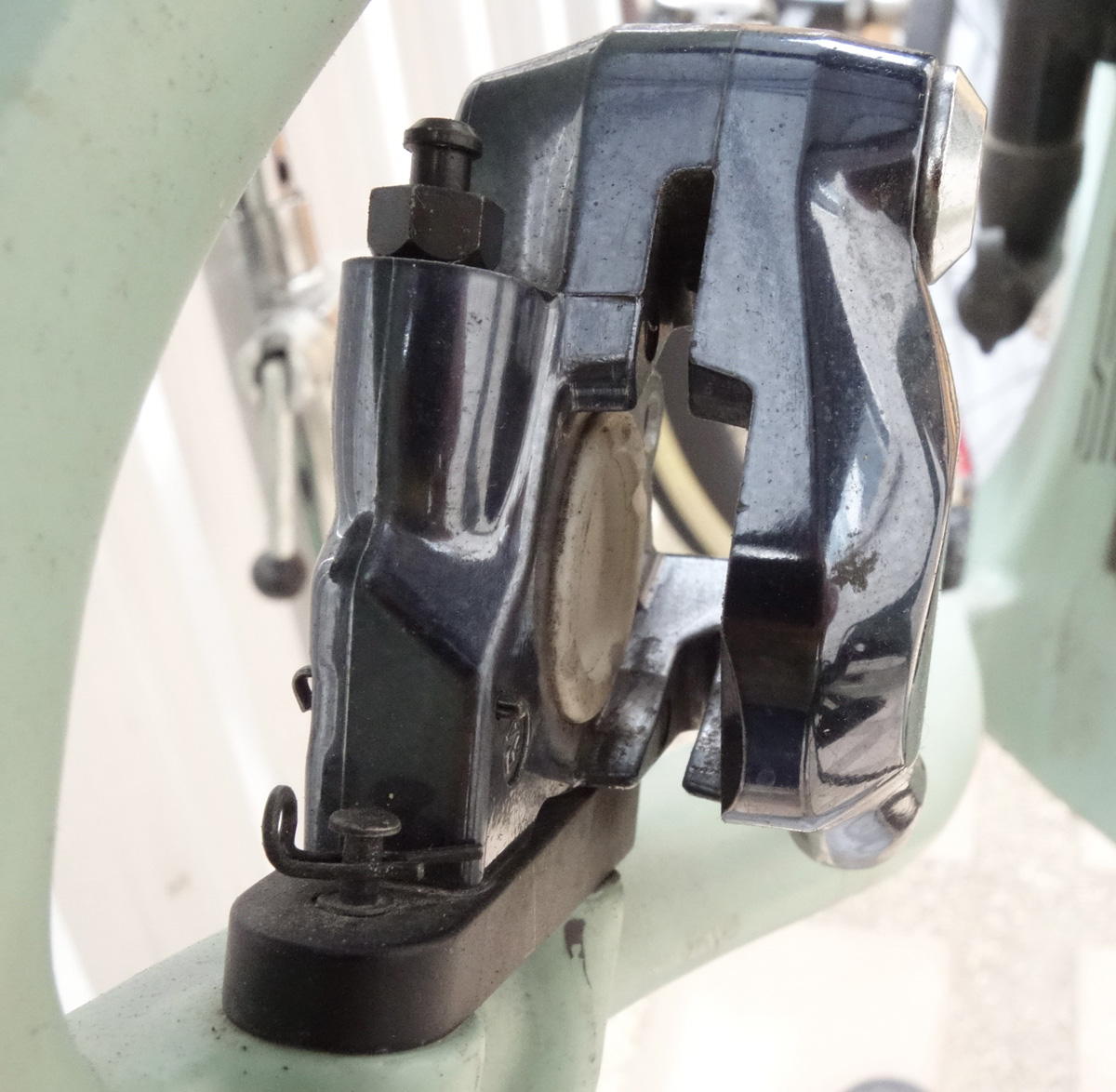
The true source of all this heat is the friction of brake pads squeezing a rotor between them. To suit different performance needs, brake pads are available with different materials. For all around performance, organic/resin pads offer good bite, smooth, even modulation and quiet operation. Metallic pads, while louder and rougher feeling, offer better performance under the higher heat stresses of downhill riding. Rotors, with few exceptions, have a steel brake surface compatible with all brake pads.
As a simple, but high-tech component, hydraulic disc brakes have only a few hard rules to follow. The most important rule to follow is using only manufacturer recommended fluids. Using incorrect fluids can lead to equipment damage and a high risk of brake failure. Also, protect the brake pads because the material is very absorbent. Grease and oil can easily contaminate the pads. The two main sources of brake pad contamination are leaky piston seals (rare) and careless application of chain lubricant (common). A lesser-known rule for disc brakes is compatibility of rotors after use. The reason for this is brake pad material, by design, embeds itself into the rotor surface. Therefore, when replacing brake pads only, we must be sure to use the same pad compound or suffer diminished brake performance.
In terms of performance for the least amount of time spent on maintenance, for me, hydraulic disc brakes may be the winner. Sure, they may be complicated on the inside, but in operation they are simple. With no cables to adjust, I just keep them clean, and they perform.
Next time: My brake pads and rotors need to be replaced.