
How Mathieu van der Poel orchestrated a perfect stage finale to claim his second Tour de France stage victory and the maillot jaune
BOULOGNE-SUR-MER, France (6 July 2025) — The rain fell steadily on Lauwin-Planque as 182 riders rolled out for stage 2 of the 2025 Tour de France, but nothing could dampen the spirits of the Alpecin-Deceuninck squad. Fresh off Jasper Philipsen’s commanding victory the day before, the Belgian team was riding a wave of confidence that would carry them to even greater heights by the time the peloton reached the windswept coast of Boulogne-sur-Mer.
What unfolded over the subsequent 185 kilometers was a masterclass in tactical racing, explosive power, and the kind of opportunistic brilliance that defines cycling’s greatest champions. At the center of it all was Mathieu van der Poel, the Flying Dutchman whose versatility and raw speed continue to confound the sport’s conventional wisdom about specialization.
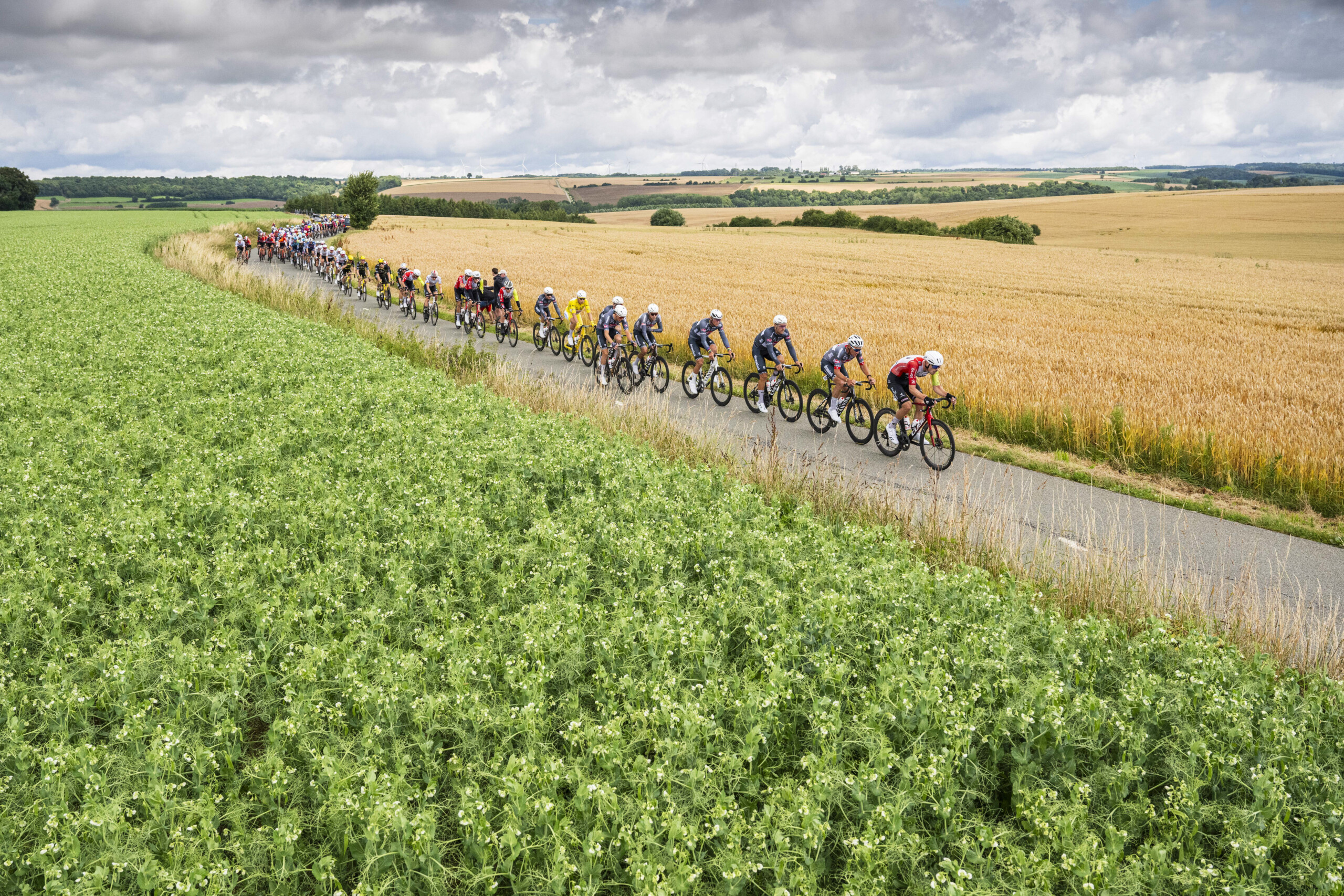
The Early Break: Calculated Risks in Treacherous Conditions
The day began with the familiar rhythm of breakaway formation, as Yevgeniy Fedorov of XDS-Astana surged clear in the opening kilometer. He was quickly joined by Andreas Leknessund (Uno-X), Brent Van Moer (Lotto), and Bruno Armirail (Decathlon-AG2R), forming a quartet that would define the narrative of the stage’s first half.
For Armirail, the opportunity to showcase his team’s colors at the front held special significance beyond mere publicity. “It’s nice to show the jersey at the front since the team is half from the north,” he explained afterward. “And above all, I preferred to get through this stage in the breakaway because it started raining and that’s always a way to avoid crashes. But we still need to turn this into a result, going all the way and winning a stage or taking the polka dot jersey.”
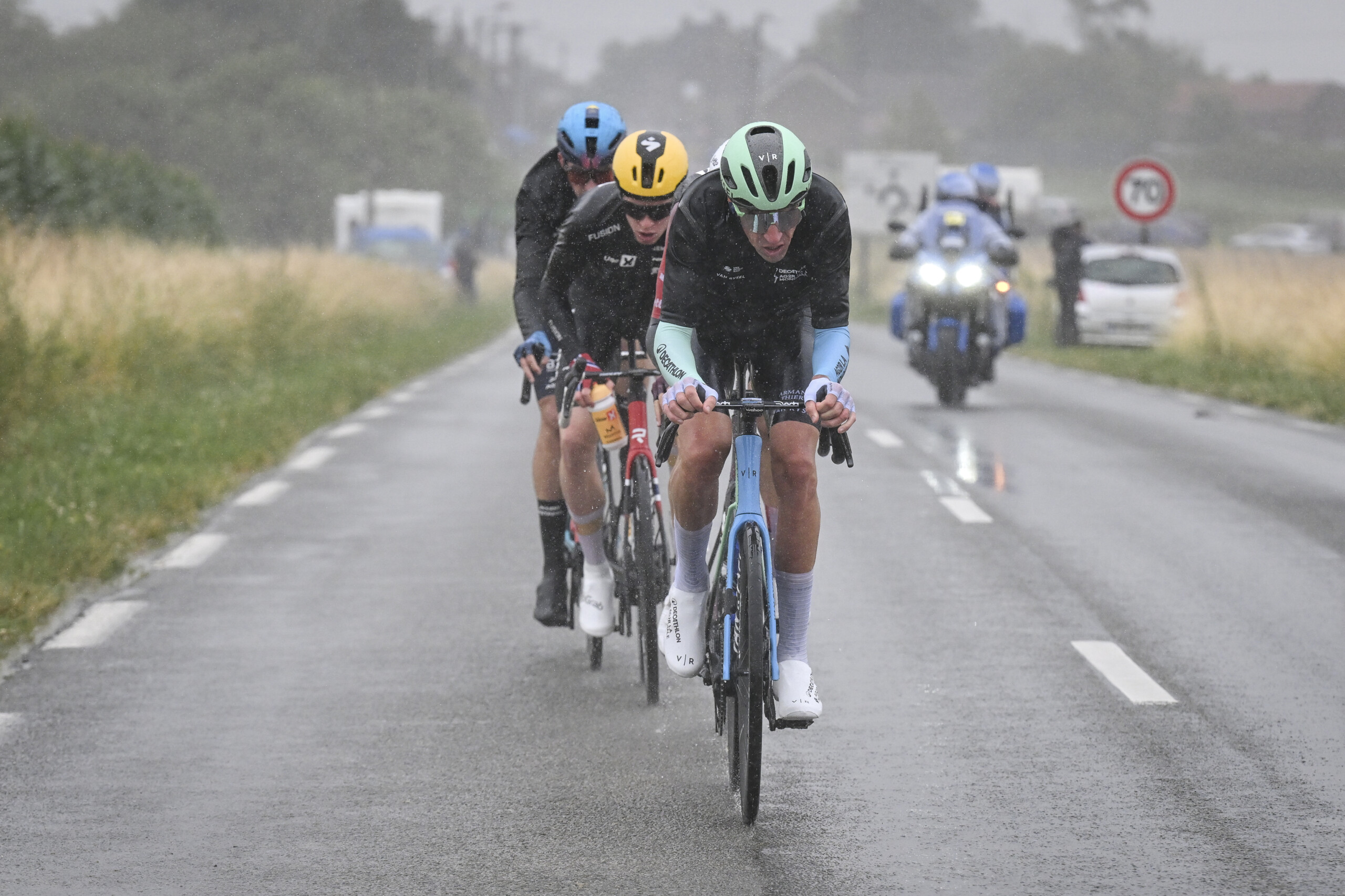
The French rider’s tactical reasoning reveals the calculated nature of early breakaway participation. In wet conditions, positioning at the front offers a significant safety advantage, reducing the risk of being caught behind crashes that inevitably occur when nervous pelotons navigate slick roads. The quartet’s early aggression paid immediate dividends as they avoided the pile-up at kilometer 44 that brought down both the Norwegian and Kazakh national champions.
Despite this momentary disruption, the breakaway reformed efficiently, building their advantage to 3’05” by kilometer 45. This gap represented the sweet spot for breakaway success—large enough to discourage immediate pursuit, yet small enough to avoid triggering panic in the peloton. The watchful eyes of Intermarché-Wanty and Alpecin-Deceuninck directeurs sportifs, however, ensured this freedom would be temporary.
The Intermediate Sprint: A Preview of Explosive Power
As the race progressed toward the Category 4 Côte de Cavon-Saint-Martin, Leknessund’s victory in the KOM sprint demonstrated the Norwegian’s climbing pedigree. But it was the intermediate sprint that provided the first real glimpse of the explosive power that would define the stage’s conclusion.
Jonathan Milan’s remarkable display of speed—hitting 80 km/h to narrowly edge Tim Merlier, Biniam Girmay, and Jasper Philipsen in the bunch sprint—served as both a technical marvel and a tactical statement. While Fedorov collected the 20 points available at the front, Milan’s acceleration revealed the kind of raw power that the peloton’s top sprinters possessed, foreshadowing the intensity that would characterize the finale.
The tactical significance of this moment cannot be overstated. By kilometer 133, with 52 kilometers remaining, the breakaway was absorbed. The peloton’s acceleration in the final 90 kilometers had systematically eroded the gap, demonstrating the collective power of teams committed to a bunch finish. This timing was crucial—early enough to allow for tactical positioning, late enough to prevent further breakaway attempts.
The Finale: Tactical Chess at High Speed
The approach to the final climbs transformed the stage from a controlled pursuit into a tactical chess match played at 50 km/h. Wout van Aert’s pace-setting at the bottom of the Côte du Haut Pichot was textbook positioning—aggressive enough to string out the peloton, controlled enough to keep his team leader, Jonas Vingegaard, in contention.
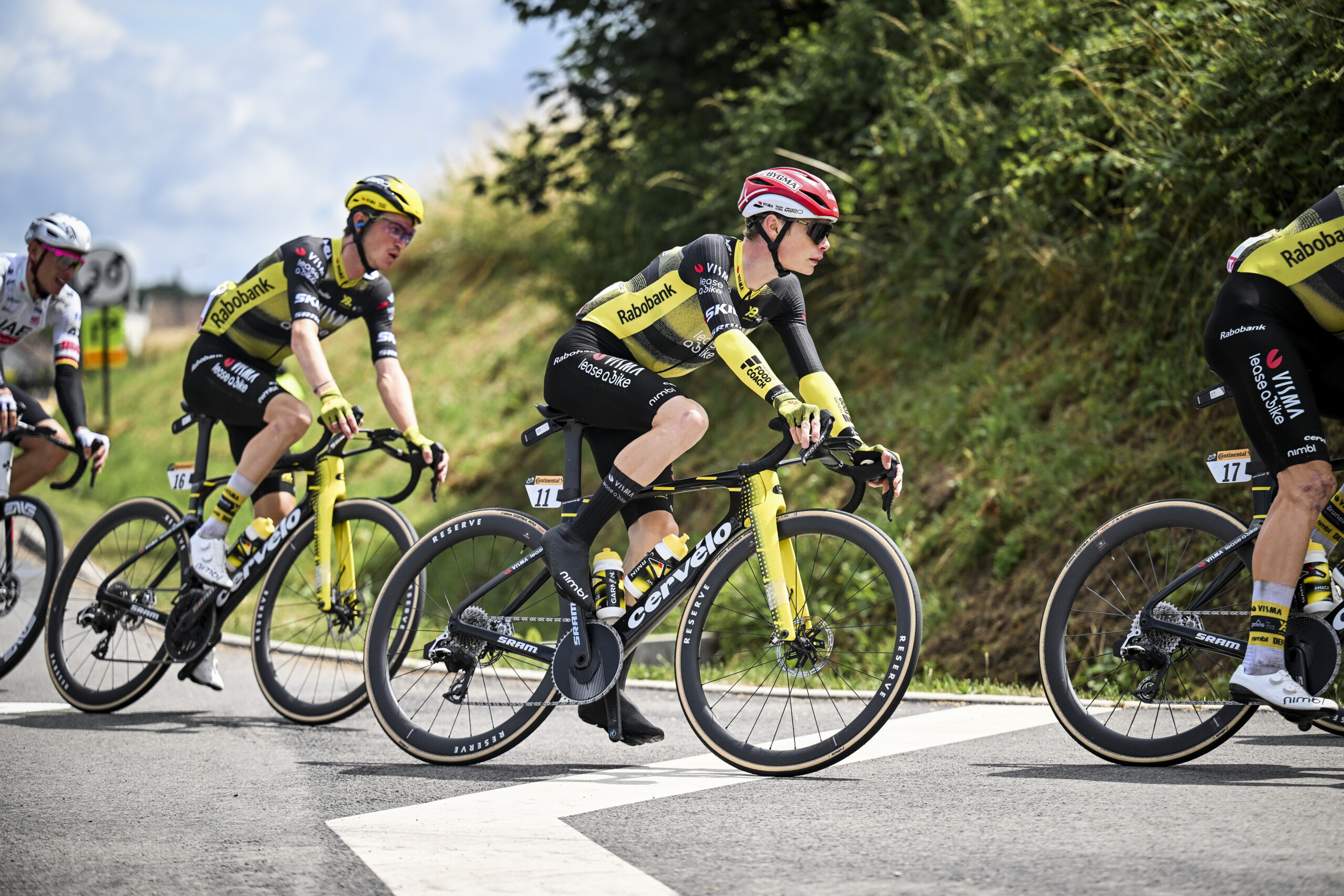
When Tim Wellens unleashed his acceleration, the peloton’s immediate explosion revealed the razor-thin margins that separate the Tour’s elite from the rest. This wasn’t gradual selection—it was surgical precision, instantly creating the small group that would contest the stage victory.
The Côte d’Outreau provided the stage’s most tactically complex sequence. Jhonatan Narváez’s pace-setting for UAE Team Emirates-XRG served multiple purposes: positioning Pogačar optimally, increasing the tempo to discourage attacks, and forcing other teams to commit their resources early. When Kevin Vauquelin attacked at the summit, he triggered a sequence of moves that would define the stage’s conclusion.
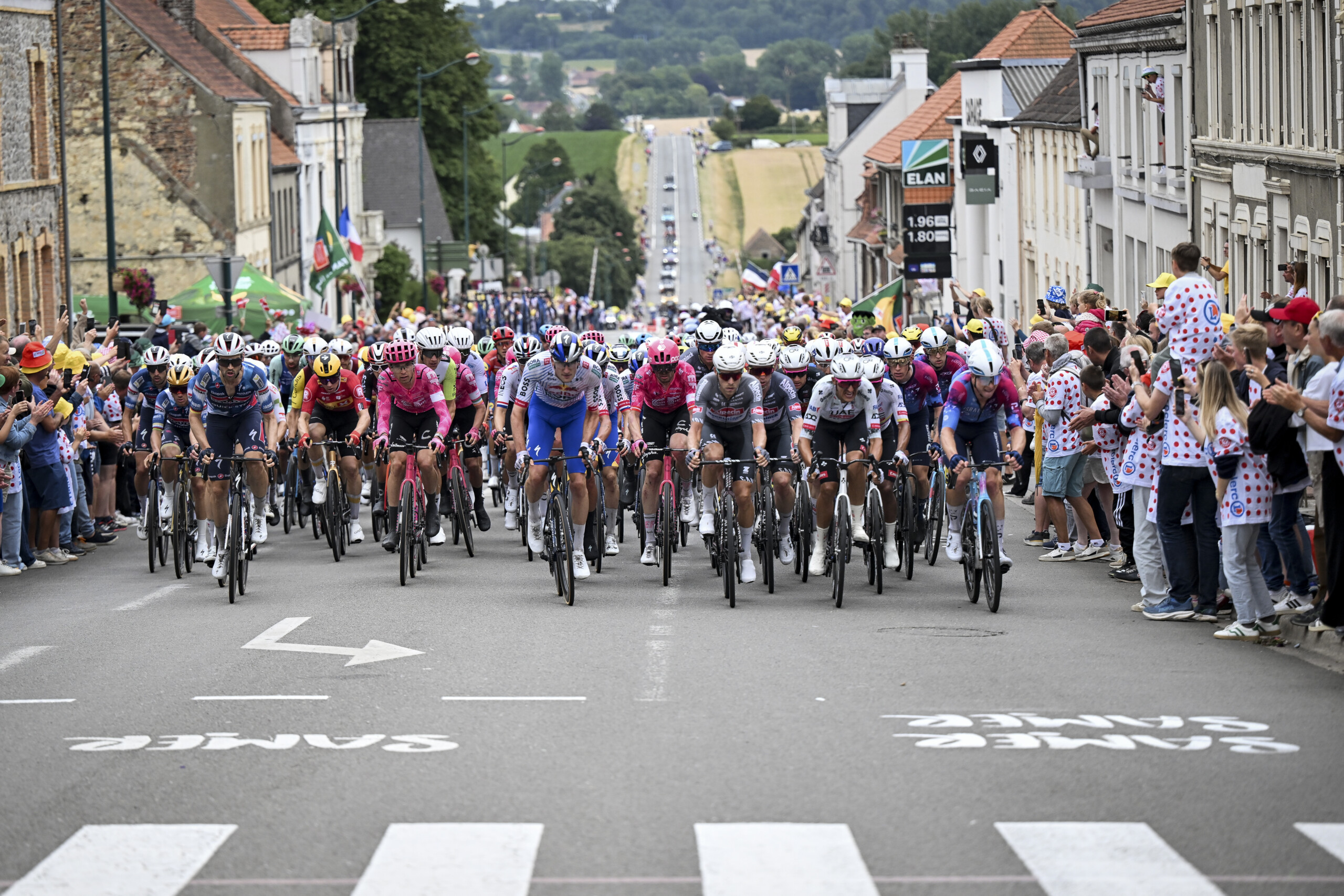
“On the first hill in the finale, I had to move up in the peloton, and that’s when I realised that my legs were feeling good and that I had a chance to make my move,” Vauquelin explained. “So then I thought that there might be some marking between the favourites and that I would take advantage of that. I attacked several times, I tried hard and maybe a little too hard. When I was with Matteo Jorgenson, I really thought there was a chance because he’s very strong, but he didn’t cooperate, he played his team tactics.”
Vauquelin’s tactical analysis reveals the complexity of modern Tour racing. His recognition that the favorites might mark each other rather than pursue immediately demonstrates sophisticated race reading. His frustration with Jorgenson’s non-cooperation illustrates the collision between individual ambition and team tactics that defines professional cycling.
“I have a few regrets because I would have liked to cross the line first, but it means that my legs are good. I’m feeling upbeat every day and I enjoy every moment. With these legs and the positioning I had today, I can be hopeful, for example on the Rouen stage. The white jersey isn’t exactly a goal, I mainly want to try and win a stage, but if I can ride on the roads of my region [Normandy] in this jersey, that would be exceptional. The important thing for me is to manage to stay in this form for the first ten days.”
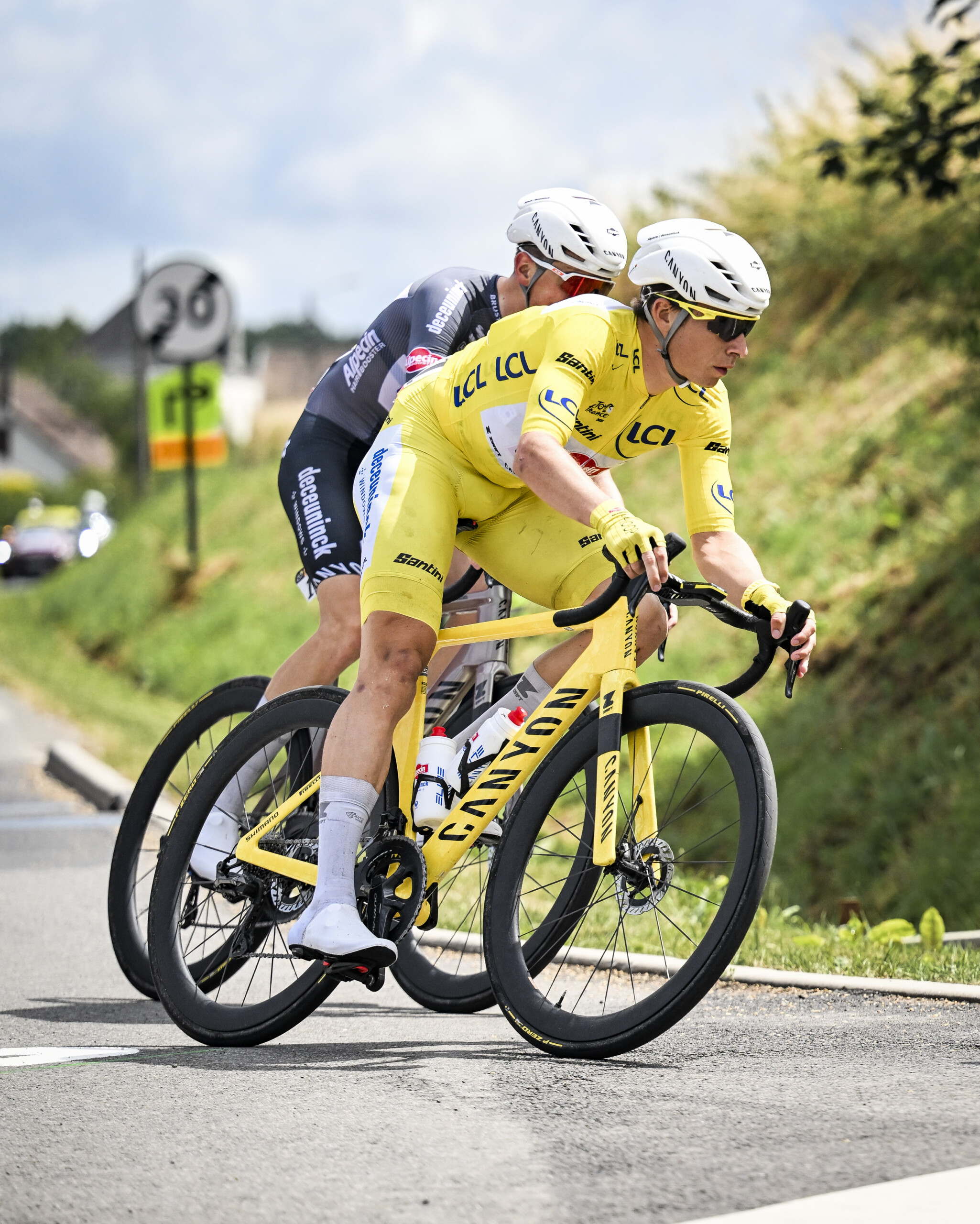
Van der Poel’s Masterclass: Patience and Explosive Power
Throughout the chaos of the finale, one rider remained conspicuously calm: Mathieu van der Poel. The Dutch champion’s tactical approach represented evolution in his racing philosophy—the controlled aggression of a mature champion rather than the explosive unpredictability of his younger self.
Van der Poel’s positioning throughout the final climbs was textbook tactical racing. He covered the dangerous moves without expending unnecessary energy, remained patient when others panicked, and positioned himself perfectly for the sprint that his experience told him was inevitable. When the moment arrived, his acceleration was devastating in its simplicity—no elaborate lead-out, no tactical complexity, just pure explosive power that left even Tadej Pogačar struggling to respond.
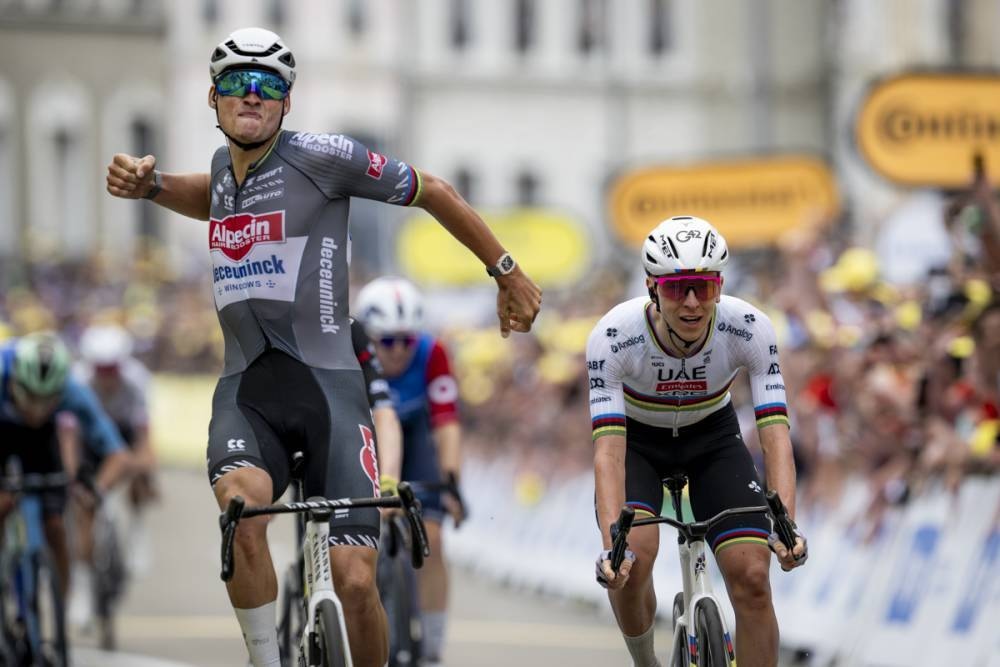
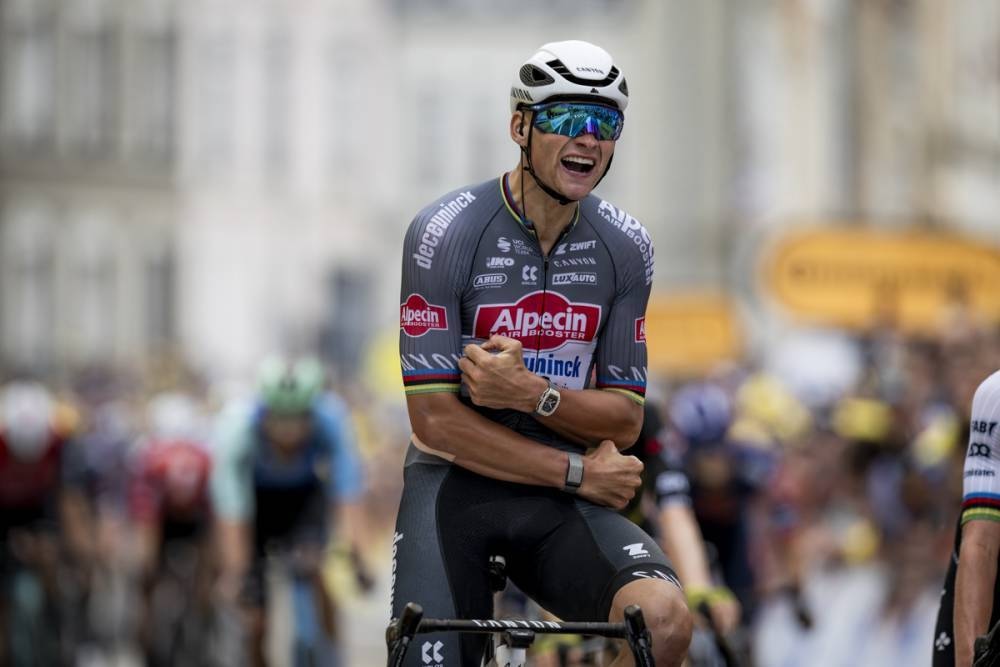
The victory marked a remarkable parallel to 2021, when van der Poel won stage 2 at Mûr-de-Bretagne to claim his first yellow jersey. This repetition wasn’t coincidence—it reflected the Dutchman’s ability to peak for specific objectives and execute under pressure.
Van der Poel’s Elation: “It Was About Time!”
The emotional weight of the victory was evident in van der Poel’s post-race reflections. “It was super difficult, the finale was harder than I thought. But I was really motivated. Finally, four years after my first win, it was about time I took a second one! It’s also the second time I’m rewarded with the yellow jersey as well so I guess it was worth the wait!”
His tactical preparation had been meticulous, revealing the professional approach that has elevated his Tour performances. “The team told me to study the last 500 metres. We had a video of the finish and I watched it a few times. I already had in mind what I wanted to do if it came down to a sprint but when you see who comes 2nd [Tadej Pogačar] and 3rd [Jonas Vingegaard], that says enough about how hard it was.”
The Dutchman’s respect for his competition was palpable in his assessment of the finale’s difficulty. “Of course, people put me as a favourite but when you see which riders were at the front on the climbs, I think I did a really good job… I didn’t dare to raise my hands before the finish line but it’s an incredible moment.”
Van der Poel’s tactical analysis revealed how the stage had evolved differently than expected. “They predicted headwind on the final climb so I thought Jasper would have a chance but the climbs were harder than we expected and the pace was super hard. At the top of the second last climb, we were only 8 riders at the front.”
The victory’s significance extended beyond personal achievement to team success. “It’s a dream for the team. Everything else that comes now is just a bonus. I hope I can keep the jersey until the time trial, then it will be very hard to keep it. Just winning a stage was the goal for me and I’m very very happy to have achieved it.”
Pogačar’s Honest Assessment: Learning from the Best
For Pogačar, the runner-up finish represented both satisfaction and a valuable learning experience. His post-race analysis revealed the respect van der Poel commands even among cycling’s elite.
“I’d say it was a good day out. It was a hard, long stage. It had a bit of everything – rain, stress, short kicks… I felt good towards the final, and my team did quite fine as well. I’m very happy I’ve taken a strong 2nd place. Mathieu was stronger in the final sprint, so chapeau to him. It’s hard to beat him in the sprint. To be honest I messed up a little bit, because I got a bit scared to sprint against him and I waited too long on his wheel.”
Pogačar’s admission of tactical error demonstrates remarkable self-awareness. His acknowledgment that he “got a bit scared to sprint against” van der Poel reveals the psychological impact of the Dutchman’s reputation. Even riders of Pogačar’s caliber must recalibrate their approach when facing van der Poel’s unique combination of power and unpredictability.
The Slovenian’s acquisition of the polka dot jersey added an unexpected dimension to his day. “I wasn’t expecting to claim the polka dot jersey, but here I am and I will enjoy the day in this jersey tomorrow. I’ve won the Tour de France KOM classification twice in my career, but I have only worn it once over the five Tours I’ve done. It’s going to be my second day ever in the polka dot jersey, and it will be a special feeling.”
His comments about Vingegaard’s performance added another layer of tactical insight: “We could expect Jonas [Vingegaard] to attack after what we saw in the Critérium du Dauphiné, and it’s nice to see him do it. He made us suffer.”
Philipsen’s Generous Perspective: Team Success Over Individual Glory
The stage’s result meant that Jasper Philipsen, despite finishing 31 seconds behind van der Poel, could hand over the yellow jersey to his teammate with genuine satisfaction. His post-race comments revealed the collaborative spirit that has become Alpecin-Deceuninck’s greatest asset.
“I wasn’t too far away from keeping the Yellow Jersey. I gave it a try, but the last few climbs turned out to be harder than I expected. Anyway, it isn’t bad at all to lose the jersey to Mathieu [Van der Poel]. I’m super happy for him. We at Alpecin-Deceuninck are having a super good start. My teammates are doing an amazing job to support Mathieu and myself. We have already had two amazing days, and we are looking forward to keeping it going. Tomorrow’s stage is a very good chance for another win indeed.”
Philipsen’s generous perspective reflects sophisticated team dynamics. Rather than viewing van der Poel’s success as a threat to his own ambitions, he recognized it as part of a broader narrative of collective success. This collaborative approach, rare in the intensely individual world of professional cycling, positioned the team perfectly for the challenges ahead.
Tactical Analysis: The Perfect Storm
Van der Poel’s victory resulted from the convergence of several tactical factors. First, the timing of the breakaway’s capture left insufficient distance for further attacks but enough for tactical positioning. Second, the sequence of climbs provided natural selection points without being severe enough to eliminate the pure sprinters entirely. Third, the weather conditions favored riders comfortable with technical descents and wet road surfaces.
Most crucially, van der Poel’s tactical patience allowed him to conserve energy while others exhausted themselves in ultimately futile attacks. His positioning throughout the finale—always present but never leading—demonstrated the kind of tactical maturity that distinguishes champions from contenders.
The stage’s conclusion also revealed the evolution of modern Tour tactics. Rather than the traditional pattern of early breakaway, gradual pursuit, and bunch sprint, stage 2 featured multiple micro-selections that created a finale contested by a small group of elite riders. This pattern reflects the increasing sophistication of modern racing, where tactical positioning and explosive power matter more than pure sustained speed.
Looking Forward: Momentum and Expectations
As the Tour de France continues its journey through northern France, van der Poel’s victory serves as a reminder of cycling’s enduring capacity for surprise. In an era increasingly dominated by scientific training methods and marginal gains, the Dutchman’s raw talent and tactical intelligence represent something more elemental—the pure joy of competition and the pursuit of perfection in motion.
For Vauquelin, despite the disappointment of coming so close to victory, the performance offered genuine promise for the stages ahead. His honest assessment of his form and tactical awareness suggests a rider ready to challenge for victories in the Tour’s opening week.
The white jersey currently adorning his shoulders may not be his primary objective, but it serves as a symbol of cycling’s eternal renewal—the emergence of new talents ready to challenge the established order. As the peloton prepares for the flatter roads toward Dunkirk, the stage is set for another chapter in what promises to be a memorable Tour de France.
Van der Poel’s victory in Boulogne-sur-Mer was more than just a stage win; it was a statement of intent, a demonstration of tactical brilliance, and a reminder that in cycling, as in life, the most beautiful victories often come to those who combine patience with the courage to seize the moment when it arrives.
By the Numbers
2: MVDP AND ALPECIN’S MAGIC NUMBER
Mathieu Van der Poel claimed his 2nd Tour victory in this 2nd stage. He had already won on a stage 2, in 2021. It’s also the 2nd consecutive victory for the Alpecin-Deceuninck team, the Dutchman succeeding Jasper Philipsen. The last team to win the first two stages was Quick Step – Alpha Vinyl in 2022 (Yves Lampaert then Fabio Jakobsen).
1,470: VAN DER POEL IS BACK
By winning in Boulogne-sur-Mer, Mathieu Van der Poel ended a 1,470-day victory drought. The Dutchman hadn’t won on the Tour since his first victory, achieved on June 27, 2021, between Perros-Guirec and Mûr-de-Bretagne.
16: POGACAR BOUNCES BACK
Tadej Pogacar was ranked 18th in the general classification yesterday, something that never happened before! The Slovenian had never been worst than 17th (stage 1 in 2020). He gained 16 positions today to move up to second.
2,534: FRANCE WITH THE WHITE JERSEY
Fourth overall, Kévin Vauquelin leads the young rider classification and takes his first white jersey. He is the first Frenchman to do so since Pierre Latour, who won this classification on July 29, 2018, 2,534 days ago!
1: GROUPAMA-FDJ IS LEADING!
Groupama-FDJ takes the lead in the team classification for the first time in its history, after 29 participations! It’s also the first time a French team is leading this classification since AG2R La Mondiale’s victory in 2014.
5: VAN DER POEL VS POGAČAR
This is the 5th 1-2 from Mathieu Van der Poel and Tadej Pogačar, following stage 5 of Tirreno-Adriatico 2021, stage 2 of the Tour de France 2021, the Tour of Flanders 2023 and Paris-Roubaix 2025. It’s also the second time that Van der Poel-Pogačar-Vingegaard secured a podium finish, a month after it happened on stage 1 of the Critérium du Dauphiné 2025.
20: PHILIPSEN STILL IN GREEN
Although he lost his Yellow Jersey, Jasper Philipsen retained the lead in the points classification and won his 20th green jersey as best sprinter. He equaled Wout van Aert, the active rider with the most green jerseys. The record belongs to Peter Sagan with 130.
7: VAN DER POEL KEEPS THE DREAM GOING
Mathieu Van der Poel took the lead in the general classification, earning his 7th yellow jersey. The previous six back to the 2021 edition, where he led from stage 2 to 7.
168: THE NETHERLANDS STILL WINNING
Mathieu Van der Poel claimed the Netherlands’ 168th Tour victory. It’s the fifth consecutive edition with at least one Dutchman winning a stage. MVDP also earned the country’s 82nd Yellow Jersey.
5: A NEW WINNER IN BOULOGNE-SUR-MER
While Lauwin-Planque was a new destination for the Tour de France, Boulogne-sur-Mer was hosting a finish for the 5th time. The first was 76 years ago, in 1949, with Belgian Norbert Callens at the top. A compatriot of Mathieu Van der Poel, Jean-Paul van Poppel, then won in 1994, before the German Erik Zabel (2001) and the Slovak Peter Sagan (2012).
Stage 2 Results (Top 10)
Stage 2: Lauwin-Planque > Boulogne-sur-Mer (209km)
-
- Mathieu van der Poel (Alpecin-Deceuninck) – 4:45:41 (B10)
- Tadej Pogačar (UAE Team Emirates XRG) – 4:45:41 (B6)
- Jonas Vingegaard (Team Visma | Lease a Bike) – 4:45:41 (B4)
- Romain Grégoire (Groupama-FDJ) – 4:45:41
- Julian Alaphilippe (Tudor Pro Cycling Team) – 4:45:41
- Oscar Onley (Team Picnic PostNL) – 4:45:41
- Aurélien Paret-Peintre (Decathlon AG2R La Mondiale Team) – 4:45:41
- Kévin Vauquelin (Arkea-B&B Hotels) – 4:45:41
- Simone Velasco (XDS Astana Team) – 4:45:41
- Jarne Berckmoes (Lotto) – 4:45:41
General Classification After Stage 2 (Top 10)
-
- Mathieu van der Poel (Alpecin-Deceuninck) – 8:38:42
- Tadej Pogačar (UAE Team Emirates XRG) – 8:38:46 (+4s)
- Jonas Vingegaard (Team Visma | Lease a Bike) – 8:38:48 (+6s)
- Kévin Vauquelin (Arkea-B&B Hotels) – 8:38:52 (+10s)
- Matteo Jorgenson (Team Visma | Lease a Bike) – 8:38:52 (+10s)
- Enric Mas (Movistar Team) – 8:38:52 (+10s)
- Jasper Philipsen (Alpecin-Deceuninck) – 8:39:13 (+31s)
- Jake Blackmore (Israel – Premier Tech) – 8:39:23 (+41s)
- Tobias Johannessen (Uno-X Mobility) – 8:39:23 (+41s)
- Ben O’Connor (Team Jayco AlUla) – 8:39:23 (+41s)
Jersey Holders After Stage 2
-
- Yellow Jersey (GC Leader): Mathieu van der Poel (Alpecin-Deceuninck)
- Green Jersey (Points): Jasper Philipsen (Alpecin-Deceuninck)
- Polka Dot Jersey (Mountains): Tadej Pogačar (UAE Team Emirates XRG)
- White Jersey (Best Young Rider): Kévin Vauquelin (Arkea-B&B Hotels)