
Saddling Up to Ride in Cowboy Country by Cycling West columnist Dave Campbell is now available and is a celebration of both one rider’s cycling experiences and the explosion in American cycling that happened in the 1980s. Perhaps the most dramatic development for Dave happened in the summer of 1983. In mid-June, he was the only rider his age (14) at the Wyoming State Road Championships and wasn’t even allowed to ride, instead being given a gold medal and sent home. However, in the spirit of camaraderie, community, and “do it yourself” that typified 1980s American bike racing, he met some older riders at the event who took him to a bigger race in Utah and later he and a friend tackled the cycling mecca of Colorado. By mid-August, he was racing against 65 other riders his age in a twelve-stage, ten-day long stage race (The Red Zinger Mini Classic) that was patterned after The Coors Classic, then America’s biggest event. The following chapter is an excerpt from Dave’s first book, a 22-chapter, 226-page volume that traces both his story and the development of modern American cycling.
Sweet Dreams (Are Made of This) (Chapter 8)
By Dave Campbell — My mom purchased a Swedish Thule roof rack from Bob for our 1968 Ford Mustang to carry my bike all over Colorado. Dan Lander, a nurse, and member of the local club generously loaned me a pair of wheels for spares. I only had the one set on my bike and would need to put wheels in the follow car or the pit zone in criteriums in case I had a flat tire. My sew-ups had to stay behind in the garage, as they were “illegal” for Intermediate racing in 1983. We planned the race “on the cheap” with Grandma and Grandpa Boxell’s home in Golden as a frequent place to crash and minimal hotel stays. We coordinated with Topher and his mom, Barb whenever we could, as well as John and his stepdad OJ.
Junior gears were “restricted” in those days and unlike in Wyoming where officials never checked our gears, every day after our RZMC stages we would have to do a “roll out”. The bike was placed in its highest gear and the pedal aligned with a piece of tape and then rolled backwards to another tape mark marking the allowed distance. For Intermediates it was a few inches beyond 22 feet. Gears were spoken of by the number of teeth on the chainrings (front sprockets) and on the cogs (rear sprockets). In an era when most every bike came stock with 42/52 chainrings and freewheels with a 13 or 14 (or rarely a 12) highest cog, meeting this requirement wasn’t easy and often required special modifications. Since my basic freewheel was a 14-24 six speed (up from five cogs on the Bertin), the cheapest and easiest way to make my gears junior legal was to remove my 52 tooth chainring and replace it with a smaller 45. I had to get this odd-sized chainring from a mail order catalog since Bob only stocked standard sizes. My front chainring combination was a somewhat ridiculously close spaced 45/42, meaning I was usually riding in the big ring. Some riders my age just used a single chainring. The logic was to encourage young riders to spin and not ruin their knees stomping on big gears. In practicality it meant on a descent of any steepness we were spun out and coasting while in flat, fast races we were in top gear the whole time and spinning like crazy!
We picked up our race packets with hundreds of other kids on August 11th at the University of Colorado in the American cycling mecca of Boulder. The Intermediate category would feature 65 riders, far and away the largest peloton Topher and I had ever raced in. In fact, it doubled our previous biggest field experience in Steamboat! John was racing too, and the Junior field had nearly 100 competitors, including several riders like Craig Schommer, Tim Hinz, Roy Knickman, James Urbonas and David Farmer who were permanent residents at the Olympic Training Center. Knickman, on the same Raleigh team as Hampsten, Tilford, and Rogers, especially had a buzz about him, being dubbed “the next Lemond” by the cycling press. Many thought he was in with a chance of making the Olympic Team the following year. He would go on to place top five in five different events, including two medals, the following month at the Junior Worlds in New Zealand.
The race was extremely well organized, and everyone received a musette bag with a race logo t-shirt, cap, poster, water bottle, and the all-important race bible upon check-in. In Wyoming, the races rarely even gave out a t-shirt! In addition to stage details and directions, the Race Bible listed each of our hometowns and our best race results, mine of course being “Wyoming State Champion”. Given the circumstances, it felt like a dubious distinction. I hadn’t really earned it after all. There were lots of REAL state champions at this race! I immediately met Colorado, California, Arizona, and east coast riders, and there were many unknown quantities from across the country including the National champion in my age group, Andrew Gellatly from Virginia.
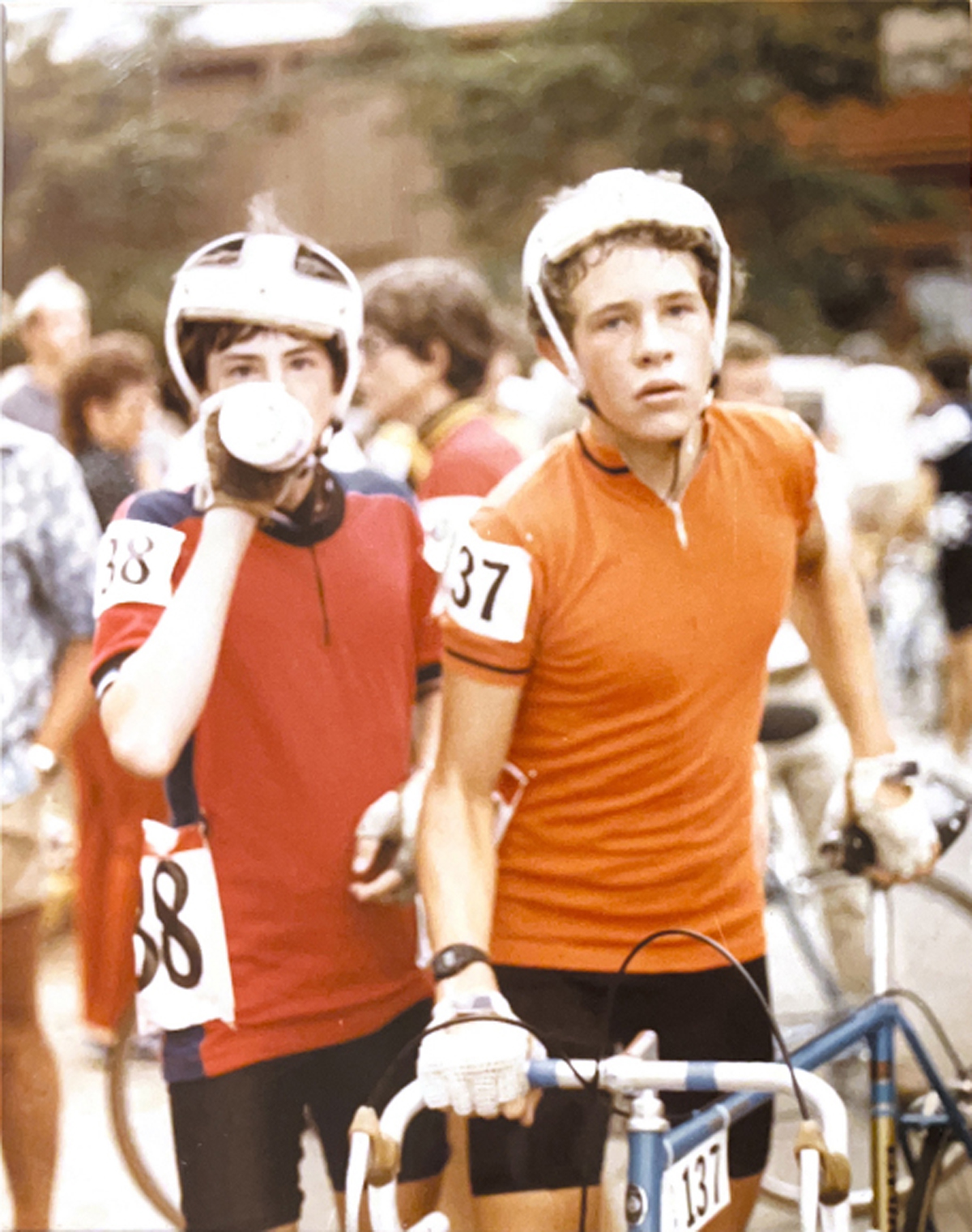
The ten days featured twelve stages: A street sprint prologue, four criteriums that had famously featured in the Coors Classic (North Boulder Park, The Boulder Mall, Vail Village, and Washington Park in Denver), four road races, two hill-climb time trials, and a concluding circuit race. I got stung in the eye by a bee warming up for the sprints and could hardly see and ended up getting smoked and eliminated immediately. Everything at this race was bigger, harder, and faster than in Wyoming. There were team vans with high-end matching machines on top, and riders getting their legs oiled up and massaged by soigneurs! (A soigneur is a team helper who cares for riders during a race by giving massage, preparing food, and handing up bottles and musettes.) Topher and I were some of the few lacking any team logos or sponsors on our jerseys. It was all a little intimidating but
Exciting and I loved it…this was where I wanted to be!
The afternoon’s criterium was even worse than the Street Sprints as I was dropped quickly and got lapped, nearly twice! The following day’s road race, which featured a long climb, was better, but I was dropped again. My Aunt Mary and Uncle Lyle came to the next race, a criterium at the Boulder Mall, to take photos and I vowed I would do better. I scored a personal victory when, although once again off the back, I was determined to NOT get lapped. When the bell rang signaling one lap to go, the pack was bearing down on me, and I had a Rocky moment, deciding I would not go down without a fight! I basically sprinted the whole last lap as if I was in a solo breakaway and not some wanker out the back and I just managed to make it to the line without being caught…progress!
Coming from a tiny rural area, the Red Zinger Mini Classic was as much a social and cultural experience for me as an athletic one. I was very interested in the music played over the PA before and after the stages. Two songs that I really loved were The Eurythmics “Sweet Dreams (Are Made of This)” and Duran Duran’s “Rio”. I had seen the videos for both at our hotel the night before the first stage. The imagery, the fashion, and the color were all mesmerizing! We all had dinner that night at the Hotel Boulderado alongside the Mall after the fourth stage, eating outside right across the street from a record store. Kids would roller skate through the mall and right into the record shop. And it was a “real record store” stocked full of so much music I had never even heard of. Music in my hometown of Lander, Wyoming was quite limited: we had KOVE, a country western station and KDLY, which played the top 40 on the pop charts…and we didn’t even have a record store! We could only purchase records and cassettes at a couple of department stores, and the choices were very limited. It seemed we heard and could buy only the very worst and cheesiest of the Top 40. We were still well over a year away from having the current revolution in modern music, MTV in Wyoming. Many of my other friends were into heavy metal and although I did like the way that got me pumped up for training and racing, I longed for something deeper and more meaningful. Music that lifted me, much like cycling did, above what I saw as the mundane, boring, and predictable ways of life in “small town, Wyoming”. I began to find it during my time racing in Colorado in the form of Punk/New Wave and the music that was played on college radio stations.
One of the best riders competing in the RZMC was Erik Bennett from Fort Collins. We quickly became friends and hung out after the races, even though during the races he was regularly leaving me behind. He wore the Green King of the Mountains jersey throughout the race, ultimately winning that category. In bigger stage races, officials awarded points to the first few riders to the top of the major climbs and the more difficult the climb, the more points were earned. Patterned after the Tour de France, there was a separate prize list for this category as well as a points jersey competition for the most consistent daily finisher to reward the sprinters. In this race, the biggest in the country, the winner of each competition got a new bike! Erik had spikey hair with a “tail” in the back. On the chrome forks of his Italian Benotto racing bike he had affixed big blue stickers that said SEX on one leg and PISTOLS on the other. I had no idea what this was all about, so he explained that it was a punk rock band and played some of their songs for me on his Walkman. Now, THIS was a new world…wild, raw, exciting, and rebellious, and like nothing I had been hearing back in Cowboy Country! In the time after the races, I continued to pay attention to what the other riders were listening to and browsed in the numerous record stores throughout the college town of Boulder after our daily races.
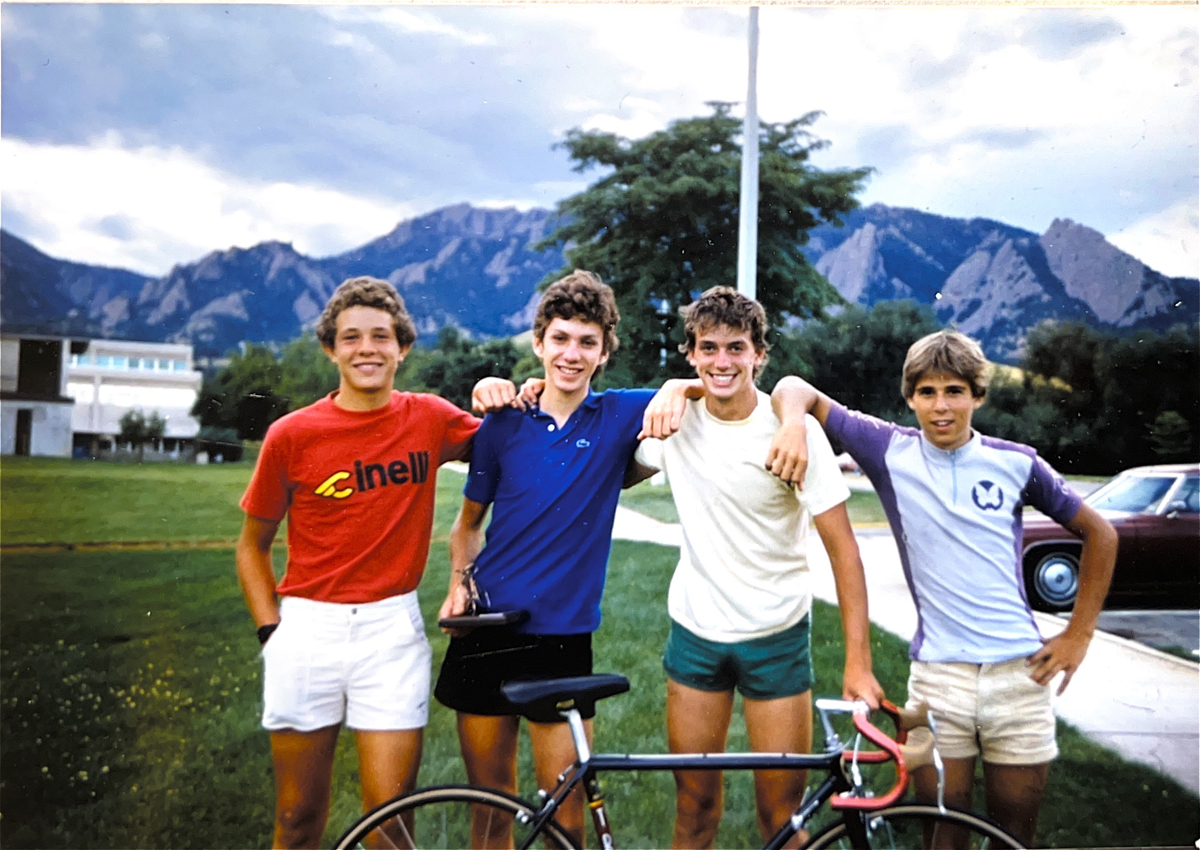
My last stop, not coincidentally, prior to driving back home to Lander was the Record Store near my grandmother’s house where I went to find some punk rock to bring home. I will always remember what the clerk told me when I asked for a Sex Pistols cassette…” This is the coolest punk from when punk was cool!” I bought “Never Mind the Bollocks”, playing it on my Walkman on the drive home. It was angry, it was rebellious, and nobody else I knew in Lander had it or had ever heard anything like it. In what I perceived as the sometimes shallow and occasionally repressive world of Wyoming, rock and roll and cycling both meant freedom. They were both places where you could spread your wings and express your individuality. The Sex Pistols cassette was the perfect soundtrack for my continued journey into the world of bicycle racing.
For Stage five we left the Boulder/Denver area and drove up through a dramatic thunderstorm to the mountains. Topher’s mom’s friend had a condo in Copper Mountain, and we crashed on his floor. In the morning, we faced a four-mile hill climb time trial on the bike path from Copper Mountain to Vail pass. I was hoping to improve my overall standings with a good ride here and was going well when I approached a pedestrian. I yelled out “on your left” and that is exactly where she moved… to her left! We clipped shoulders, which sent me over the handlebars…and pretzeled my front wheel. I couldn’t continue and there was still nearly a week’s worth of racing ahead! I was totally screwed.
I limped back down to the start-line, distraught and angry. My mom convinced me to plead my case to the race officials, and they agreed to let me continue in the race, but I would be given the last placed riders time on the day. The Intermediate class included riders from age 12 through 14 and hence there was a wide range of physical development among us. Some kids were muscular and shaving, most like Topher and I were just skinny kids who were either amid, or had just gone through, their growth spurt. And some like the guy in last place were still just little boys! Shortly after negotiating our deal to continue, this rider was just setting off, so mom and I cheered him off the line. The time of this little guy who placed last every day would keep me in the race.
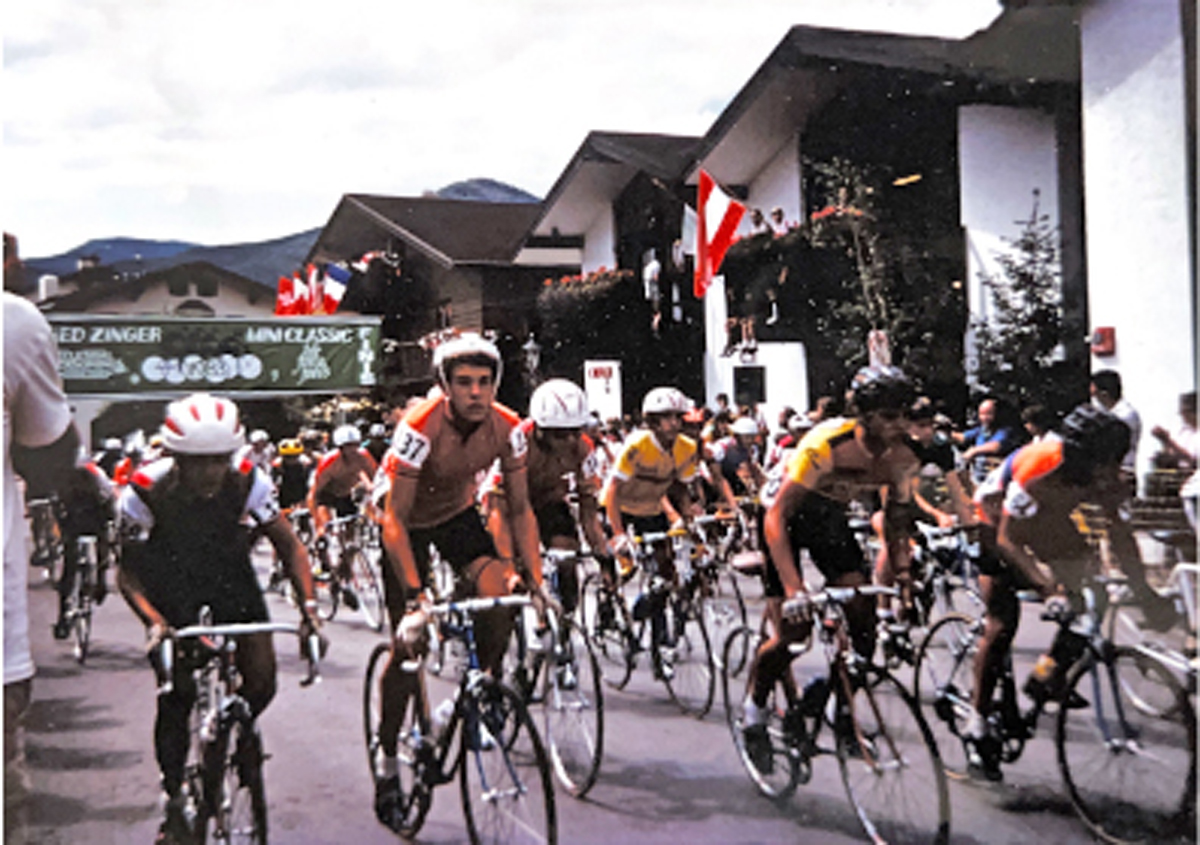
Fortunately, I had those spare wheels from my Lander clubmate for the afternoons race. We found a shop in the village at the foot of the ski lift that could rebuild my wheel with a new rim before we left the next morning. The afternoon criterium consisted of 25 laps through Vail Village for twenty miles total. It was right at the foot of the ski mountain and was a route regularly used in the Coors Classic. I saw that race on TV and in magazines with Davis Phinney having won the last few editions. The village was styled to look European with little chalets and shops, and the start/finish banner was adorned with national flags from all over the world. The course was packed with spectators and there was a little climb shortly after the finish. I felt like I was racing in Europe! Thoroughly inspired, I didn’t get dropped and recorded my first pack finish, an important lesson in letting the race inspire rather than intimidate and rising to the occasion. After days of floundering behind, in Vail I was finally IN the race!
I had been doing all the races in my Wind River Wheelers wool club jersey but most of the cool kids had spandex jerseys or even skinsuits. I had only recently upgraded to “skin shorts” (Lycra spandex) which were a massive improvement over wool in every way. Cycling gear was very hard to come by in Lander, usually requiring a special order. I had found a cool Italian spandex jersey, made by Sergal, in a supplier catalog at Bob’s shop in the weeks prior to my big race and cashed in all my tire credits to order it. It hadn’t arrived in time, but Dad mailed it to Grandmas when it did. As such, I got my bright shiny teal, yellow, and purple Italian jersey just in time for the Stage seven Washington Park Criterium in downtown Denver. I thought it looked “new wave”, but my father thought it was girly and hated it! The tight fitting, brightly colored clothing that became the norm among racing cyclists during the 1980s would elicit many comments and insults out on the roads of Cowboy Country over the coming years.
The Denver stage was another I had seen in the Coors Classic and only had one 90-degree corner with the rest being just sweeping bends. The whole thing circled around a big pond amidst large flower gardens. My Grandmother and Grandfather Campbell lived nearby and came to watch, joining Mary and Lyle, while Aunt Bev was there too, having driven out from Illinois. Between my new jersey, more family to cheer me on and the morale from my improved results from Vail I was fired up! The race was 25 laps for eighteen miles and with around ten laps to go, I was not only still in the pack, but I was also feeling great…so, I moved up! Before I knew it, I was near the front and when I saw all my relatives approaching, I charged! Right onto the very front of the peloton! A classic rookie ego-move. My family, who by now had grown accustomed to seeing me either dropped or hanging on for dear life, went crazy! “He’s leading the pack!” I could hear my Aunt Bev exclaim!
It seems every bike racer goes through this phase of development. After a period of struggle and adjustment, once they are finally “in” the race, the excitement inspires them to drive hard on the front of the group and just tow everyone else along. And that is exactly what I did, lap after lap and right when I passed my family…I got on the front and threw down! I knew about the benefits of drafting and how much harder it was to just ride on the front with everyone in my slipstream, but I couldn’t resist. I was drunk on my newfound power and confidence! Bike racing, however, as I would learn in the coming years, is all about conserving your energy and making a move when it can really count, like breaking away from the field, or winning a final sprint. Riding hard on the front just gives your competitors a free ride and wastes valuable energy. And, of course, with a few laps to go, I started running out of steam and fell back. I still managed to get into the top twenty in the final sprint, which was my best result yet. I had to endure some humiliation when my Aunt Mary, very proud of my improvement, had me sit on the #1 step of the podium after the race for a photo. No rider wants a picture on the top step unless it is earned! I moved quickly, didn’t smile, and hoped none of my competitors would see me.
For Stage eight we had to drive back up into the mountains, this time to Estes Park. My mom was fired up as she had worked summers here in college and on the beautiful drive home told me story after story of her days there. It was only our second night in a hotel, and I was stoked to find MTV once again. In the morning, we had a tough road race called “Devil’s Gulch” which started by hurtling down Big Thompson Canyon. This was both exciting and terrifying, as 65 gung-ho kids blazed along at 40-50 miles an hour bunched tightly together and completely spun out on our tiny top gear.
After the fast descent, we turned left and climbed back to Estes Park through Devil’s Gulch Canyon, a long and steady climb. Brimming with newly found confidence in my abilities and no longer in awe of my competition, I was hanging tough as we approached the last steep switchbacks before the descent back down into Estes Park. Just as I was imagining going with a break over the top or contesting the final sprint, the pack compacted and the rider behind rammed into me. I didn’t go down, but his front wheel had hit my rear quick release skewer, and it was now flipped straight out! It was on the verge of opening all the way which would cause my wheel to fall out enroute to an almost certain crash. YIKES!
Back in Bob’s bike maintenance class, we were taught to put the skewers parallel to a frame tube to prevent being forced open. I had seen pictures in magazines of top riders with both skewers pointing straight back and this looked cool to me…aerodynamic and sleek. Being very in tune with the visual aspects of the sport, I mounted my skewers like this. Now in the heat of battle, I was paying the price for choosing cool over practical. I had to stop and close that skewer or risk the wheel pulling loose on the descent and causing certain doom. I tried to pass as many riders as I could, but I finished off the back and was angry at myself for missing an opportunity for a much better result.
As I waited to watch John finish, the Junior women came in. Well, one Junior woman…Ruthie Matthes, a ski racer from Sun Valley, Idaho and a virtual unknown. She wore a grey jersey with no team logos or sponsors…stealthy! She had attacked on the long climb and left behind a field of strong women, several of whom lived at the Olympic Training Center. She arrived over four minutes clear and took the overall lead. She made quite an impression on me and over time she would make quite an impression on the sport. In her ensuing nineteen-year cycling career she would win three National Road championships, five National Mountain bike championships, the Mountain Bike World Cup, a silver medal in the World Road Championships, represent the USA in the 2000 Olympics, and win the 1991 World Mountain Bike Championship!
Just like at the Coors Classic, the penultimate stage was on the barren roads of the Morgul-Bismark outside of Boulder. A tough, hilly circuit that finished with a couple of very steep climbs, the last of which was known as “The Wall”. And just like at the Coors, there were officials on hand to help catch exhausted riders on the line and even medics with oxygen masks! My Uncle Jim, one of my first cycling tutors, came for this one and I hoped for a solid performance to move me up the GC. I secretly wanted to move ahead of Topher, and I was getting close. Alas, I was dropped near the end but still managed to distance Topher. Our long odyssey was nearing its end. That evening we blasted up the 1.2-mile NCAR climb outside of Boulder and then raced a twenty-mile circuit race around the National Bureau of Standards on the final day.
I was 33rd and Topher was 34th on the final General Classification. In just over two months, I had come a long way with my cycling, from merely hoping I would have someone to race against to racing for ten days straight against sixty-five of the best riders in the country my age! All the riders gathered at the awards ceremony in a Colorado University auditorium, cheering our newfound friends and basking in the glow of our collective accomplishment to finish a ten-day long race. The organizers gave out some incredible prizes. Erik won a new Trek racing bicycle for being King of the Mountains. Back in Golden, my grandfather told me how proud he was of me for “racing against all those more experienced kids’ day after day and hanging in there.” I had learned a lot and was proud of my improvement over the course of the race. I overcame some setbacks, but I desperately wanted to really compete and be up front in a big race and score a solid result. I wanted to be up on that podium for real!