
By Charles Pekow — America’s Bike Lane survived a last-minute threat because cyclists pushed back hard against a Trump administration plan to remove the two-way cycle track across the National Mall in Washington, D.C.
In March, the White House, the Department of the Interior, and the U.S. Department of Transportation decided, with virtually no public warning, to remove the well-used bikeway and replace it with a motor-vehicle lane. Interior Secretary Doug Burgum said he wanted more cars to bring people to popular events, including the upcoming celebrations for the nation’s 250th birthday. He gave the public only three days’ notice and said the move was part of the administration’s Making the District of Columbia Safe and Beautiful plan.
The five-year-old track, known as America’s Bike Lane, runs north-south along 15th Street NW through residential districts, downtown Washington, and the National Mall. The northern section, which leads to the Mall, became the nation’s capital’s first protected bike lane in 2010 and remains safe (https://nacto.org/latest/two-way-cycle-track-15th-street-washington-d-c/). Five years ago, the National Park Service extended the route .75 miles through the Mall and along the Tidal Basin to the Jefferson Memorial, where it connects with other trails that riders can take across the Potomac River or through federal parks. The administration almost removed that section without due process.
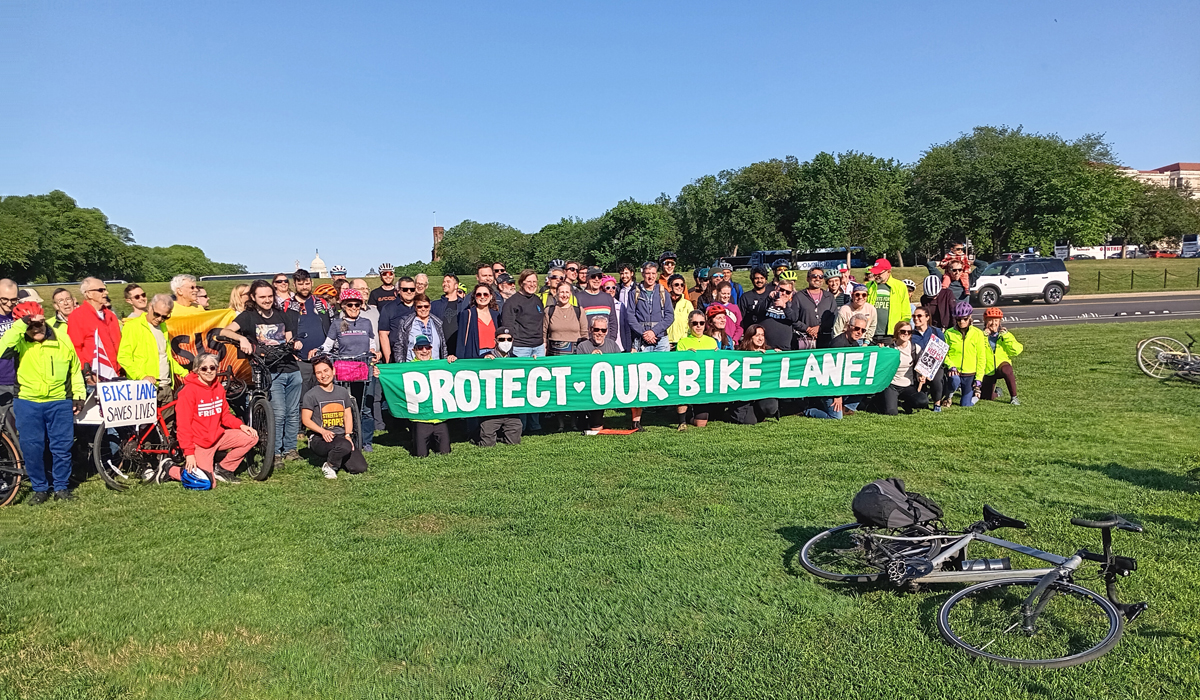
The trail has become popular with commuters, recreational cyclists, scooter users, visitors, and tour groups. When word spread that Interior planned to close the lane, local bicycle groups mobilized immediately and held protest rallies that drew considerable local media coverage. Hill Family Biking, a neighborhood bike group, organized a protest ride with only 48 hours’ notice and attracted more than 300 participants. The District Department of Transportation and Washington Mayor Muriel Bowser strongly support the lanes, but they lack jurisdiction over federal property. Eleven members of Congress wrote letters supporting the track.
The Washington Area Bicyclist Association, of which I am a member, sued, and the government delayed the work for a month. Two days before the planned demolition date, U.S. District Judge Amy Berman Jackson blocked the removal. She ruled that “the decision to remove the dedicated bike lanes is arbitrary and capricious,” and noted that the government had not adequately explained its decision (https://storage.courtlistener.com/recap/gov.uscourts.dcd.290657/gov.uscourts.dcd.290657.33.0.pdf).
In fact, DDOT’s study (https://before-after-evaluations.ddot.dc.gov/pages/73de6aa8f42f41fd904a1340a186c5b4) provided the only documented evidence about the trail’s value. Since the track opened, crashes have decreased 46 percent and bicycle injuries have dropped 91 percent along the corridor. Traffic speeds have not slowed. The federal government, however, failed to provide evidence that removing the bike path would improve traffic flow or safety.
The judge did not stop the government from trying again. As of late May, the federal government had not appealed, but the deadline had not passed. NPS also promised to give at least five days’ written notice before it tries again to rip up the lane.
“It’s good to see the courts standing up for policy. Yes, the federal government CAN remove the bike lanes, but it MUST prove there is a safety or other REASON — rather than just tearing them out with no basis whatsoever,” WABA Executive Director Elizabeth Kiker stated in an email.
During the National Bike Summit in March, the League of American Bicyclists took advocates from across the country on a ride along the trail. The administration’s move also sparked protests by bicycle groups as far away as Honolulu.
“We gave them a toolkit on how to get a rally together,” said Caron Whitaker, LAB deputy executive director. “Showing up matters. Having the data matters.”
Bicycle Colorado also took up the cause and sponsored rides supporting the 15th Street lane.
“It was a very short and small ride (in Denver) as obviously we didn’t have a lot of time to plan,” said Ashley Vander Meeden, marketing and communications manager for Bicycle Colorado. “For us, it’s a conversation starter. If you can rip out a bike lane in DC, you can rip one out in Denver or Grand Junction.”
Whitaker said WABA “talked to a legal team quickly to understand the options, spread the news quickly and got media involved right away. We also worked with them to connect the 15th Street bike lane with other actions by the administration and raised awareness nationwide that, while this was one bike lane, it was connected to a philosophy that roads should be for cars only, and would reverberate around the country. This helped us leverage the crowd at the National Bike Summit and build national support.”
The proposed Mall tear-up turned out to be only one lane in a broader anti-bike roadmap. On April 20, Transportation Secretary Sean Duffy sent a letter to all governors and state transportation departments asking them to describe actions to reduce traffic jams. The letter ominously suggested that “you may also need to recover roadway capacity from other purposes to support driving.”
The 15th Street proposal also was not the only threat to bicycling in tourist Washington. President Donald Trump decided he wanted to turn East Potomac Park into an expensive golf club. The 330-acre park, which opened in 1912, includes a public golf course, but it also includes the Jefferson Memorial, bike lanes, ball fields, a miniature golf course, and other public amenities. Bike riders, bird watchers, picnickers, boaters, and other recreational users would get squeezed out under Trump’s plan.
The D.C. Preservation League and two local residents sued “to stop the Trump-Vance administration from irreparably destroying a priceless piece of American history as it seeks to convert a public recreation space into an exclusive, high-end golf course.”
Check out #bikelanessavelives and #americasbikelane for related advocacy ideas.