
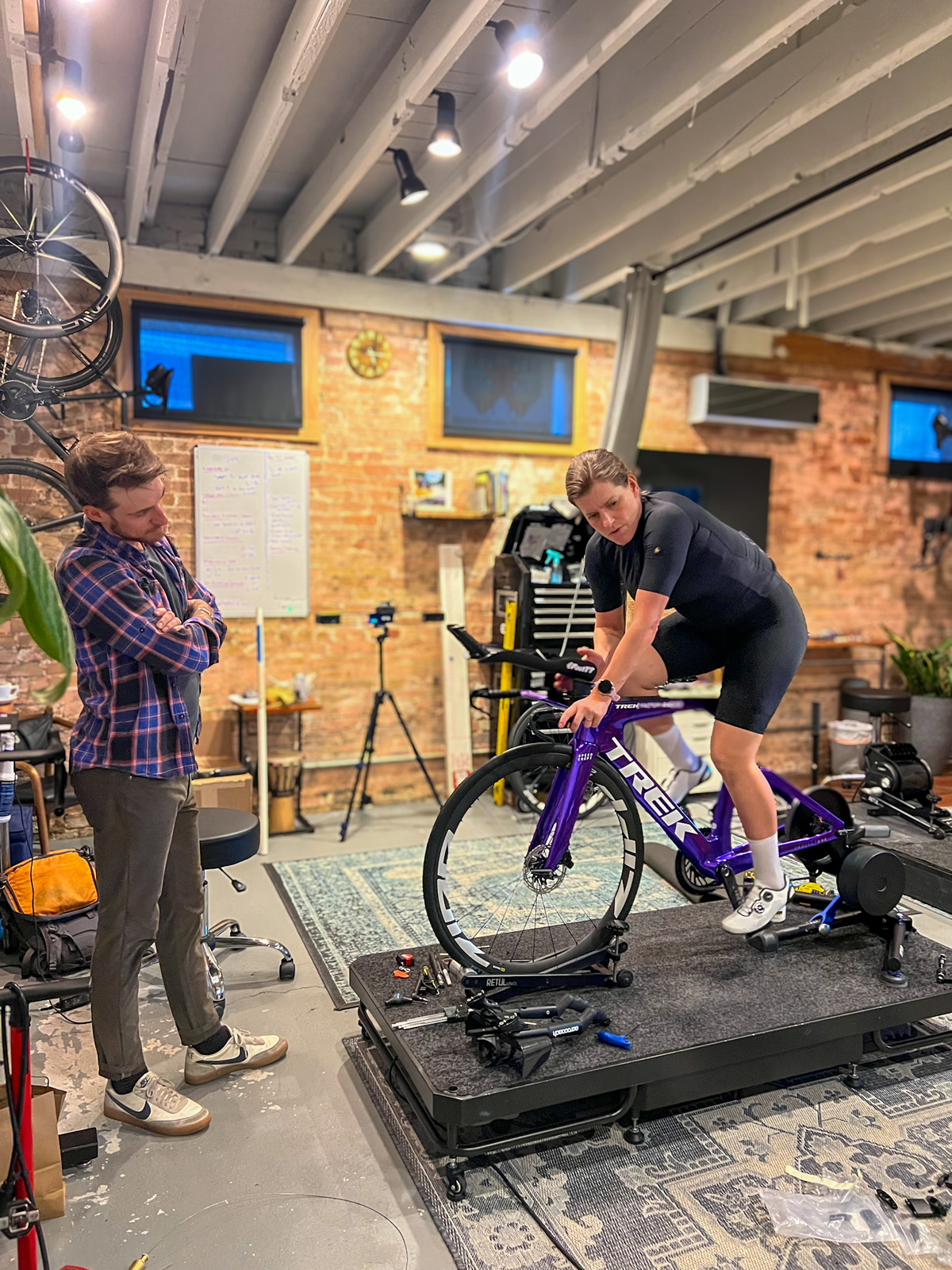
By Pat Casey with Skye Moench — As a bike fitter and student of biomechanics and physiology, I’m fascinated by the human body’s ability to adapt, evolve, and overcome physical and physiological challenges of all kinds. The act of childbirth is one of the most awe-inspiring events that the human body is equipped to perform. I’m fortunate to have several cycling friends who are now having children, which brings me to writing this piece, which is both educational for myself and hopefully for others, as I discuss my dear friend Skye Moench’s recent experience with childbirth and her return to sport. Skye is an esteemed professional triathlete and a rockstar new mom, navigating her return to training after giving birth to her daughter, Lois, in November 2024. We performed a ‘postpartum’ bike fit just 3 months after Lois made her arrival to the world, and we put our heads together to provide some insight into some of the common, and lesser known postpartum symptoms affecting cyclists and triathletes returning to riding after pregnancy.
Section 1: The Unseen Recovery
The demands new moms face are far-reaching, exhausting, and frankly overwhelming. The impacts on activity can vary greatly, especially if the athlete faced complications during delivery. However, there are many elements mentioned by Skye, as well as other female cyclists I interviewed, who reported experiencing similar symptoms once they were 6-8 weeks postpartum, which coincided with their first attempts to return to riding. These include but are not limited to:
- Pelvic Floor Instability: The residual effects of pregnancy can alter how pressure is managed in the saddle. Considerations for saddle width, shape, and pelvic support are key. This may also lead to changes that reduce reach, allowing the rider to depend less on core muscles that are still being rehabilitated and strengthened.
- Postural Shifts & Shoulder Internal Rotation: From nursing and carrying, there’s often a tendency for protracted shoulders and upper trap dominance. How this affects reach, bar drop, and handling tension could be explored to manage discomfort and even improve handling and confidence as a new starting point early in the return-to-riding process.
- “Mom Thumb” (De Quervain’s Tenosynovitis): Common due to repetitive lifting/carrying of the baby. This lesser discussed ailment can affect grip, wrist extension, and comfort on the hoods or aero bars. Riders might explore making adjustments to their cockpit setup, handlebar width, and padding options like a more forgiving bar tape, or even a slightly higher bar stack to alleviate pressure on the wrists.

Section 2: Rebuilding the Breath & Core
- Thoracic Spine Mobility: Pregnancy can restrict this area, and postpartum breathing may feel shallow. Reintegrating full diaphragm expansion not only helps with general wellbeing but restores power and posture on the bike.
- Flared Ribs/Core Reconnection: This affects stability in the saddle and out-of-the-saddle efforts. Skye described how, despite her focused training in the gym during her pregnancy, she has maintained a focus on core and pelvic floor rehabilitation. Each rider will have a different level of involvement with core strength, depending on how much abdominal separation occurred during pregnancy, which will largely determine how these changes might affect the road forward. However, from a cycling perspective, encouraging core and pelvic stability should be paramount.
“A lot of the postpartum “things” like core, pelvic floor, ribs, etc. take a lot longer than the coined “6 week window” that doctors give the green light to get back to exercise or normal activity, so there is no shame in taking months to feel like things are strong and back to normal. And even this version of your new body should be considered a “new normal”. Not to mention, taking care of a baby doesn’t go away. Encouraging postural improvements in your shoulders, hip stability and mobility, all of it.. mom thumb (especially) is still a consideration for a long time. At least until you’re done picking your kid up all the time!”
Section 3: The Changing Footprint
- Foot Size & Shoe Fit: A topic not often discussed. Foot elongation or arch collapse during pregnancy can lead to the need for new cycling shoes or insoles. This change also affects cleat positioning, foot/arch stability, and subsequently, knee tracking. If you’ve noticed a change in how your shoes fit, there might be a need for new shoes. Alternatively, if your first rides are not particularly challenging or climbing-oriented, switching to platform pedals and comfortable running or mountain bike shoes could be a safe alternative to achieve both safety and allow the foot to return to its pre-pregnancy shape/size, possibly. If this does not change after 3 months, new shoes may be in order.
Section 4: The Mental Rebuild
Skye and I spoke a bit on the psychological piece of postpartum return to cycling and training. For an elite athlete, balancing expectations, fatigue, identity, and anticipation to get back to a World-class “pre-baby Skye” is stressful on its own. “This mindset has definitely evolved as the months have gone on for me. In the beginning, I didn’t feel too much stress about getting back to “old Skye” because I felt like I had so much time to get fit, and that my baby would sleep through the night soon. I’d get a nanny, and everything would go great.
I’ve learned as the months have gone on that I won’t be “old Skye” ever again, but that’s not a bad thing. This is a totally new phase of life for me. My body has changed, my priorities have changed, my sleep has changed, almost everything (except my love for purple bikes) has changed. I’ve accepted that I am now on a new journey to find the “new Skye”, and while there are parts of my old life and the way I used to do things that help me try to be the best athlete I can be now, I also understand that I have to be more flexible with my daily schedule, my capacity to train, and with my overall timeline to “getting back” to where I was.
So, I guess the advice would be – I think having goals is good, especially on days where it’s really hard and it doesn’t feel like it’s worth trying, because the goals help you stay disciplined the best you can. Keep the goal, but let go of expectations of how you will get there, or even how quickly you will get there. I have learned that I can’t force things. I can’t just muscle through sleep deprivation, I can’t force my baby to sleep, I can’t force my body to immediately train the way it used to. But I can just do the best I can every single day, and as I do that, I am slowly seeing progress. I started training at the beginning of April under my coach’s guidance, and it has only been in the last few weeks where I am starting to feel like I might be getting somewhere.” ― Skye remarks on the shift in mindset postpartum and her acceptance of her new normal.
She continues, “I have also had to let go of any expectations that I may perceive others have of me. Like thinking sponsors want me back racing at my peak already, or even feeling bad if I have to bail on a morning training session with friends cause my baby didn’t sleep. The most important people I don’t want to let down right now are myself and my baby (Matt, too, but we’re talking babies haha), and that helps me not stress about the rest. I can live with myself if sponsors drop me, but I would regret not being the mother I want to be to Lois during this time.”
Section 5: Bike Fit Considerations for Postpartum Athletes
Every postpartum athlete’s experience will be unique to the rider, their body, and the various needs of the new life they have just brought into the world; sometimes, some challenges are more complex than others. And the solutions can be multifactorial. The key piece of advice is to listen to the signals your body is sending you, seek guidance from your physical therapist and/or doctor, and keep notes about what you’re experiencing so that you and your bike fitter can make informed decisions about these changes with purpose and direction. Adjustments to bike position can change over time, and they should change as your body and brain adapt to the many new and exciting elements in your life.
Any new bike fit will take range of motion, pelvic mobility, spinal alignment, and core stability into account. Your postpartum body is unlike the one you may have had at the beginning of your pregnancy. Addressing these changes through an updated movement screen is an honest and objective way to assess where you might want to focus your conditioning outside of the specific rehab you are performing with your physical therapist or coach.
The changes in body composition and abdominal shape could also be an area to accommodate, as the hip angle may feel more closed off. Adjusting reach and/or stack by raising the handlebars may be a worthwhile, and even temporary, change that can improve comfort and confidence as you return to riding, either indoors or outside.
Re-assessing sit bone width, pelvic stability, and spinal alignment might also warrant a change in saddle width, shape, or position, especially if the position gets less ‘aggressive’ with a shorter, taller front end. Consider these options on an “as needed” basis, particularly if you are not feeling the same kind of sit bone engagement as you did before delivery.
Closing:
Skye’s story is relatable and universal to women everywhere who love to ride but might be unsure about how to approach the changes to their bodies, especially as they pertain to riding position. Some riders may not feel entirely at home in their bodies postpartum and may lose some desire to get out on the bike. Returning to riding or training postpartum isn’t just about bouncing back—it’s about building forward with awareness, patience, and support.
Skye adds, “I’ve had days where I feel like I don’t belong as an elite athlete because I don’t feel like I look like it. I’ve lost weight since I’ve seen you for this fit, but I’m still up 10-12 lbs from where I would normally be (also still breastfeeding!). But even there, the focus is on the process and what’s important to me right now.. which is feeding Lois and doing the best I can.”
Whether you seek the help of an experienced bike fitter or want to make changes on your own, adjusting your bike position can be a positive and pivotal way to regain the familiar feeling of riding and exploring your local roads or trails with comfort and confidence.
Do you have any stories you’d like to share about your own experience with returning to riding postpartum, or any particular adjustments you made to your fit that helped? I’d love to learn more about this topic, so please feel free to email [email protected] with any anecdotes or stories that might help us improve our job. Thanks for reading!