By Koby Brown — Most of us would balk at the idea of riding a bicycle across a state—even if the state were little old Rhode Island. Tell your friends you plan to do it and they’ll probably call you crazy. Some might even say you can’t do it or that you’re not strong enough.
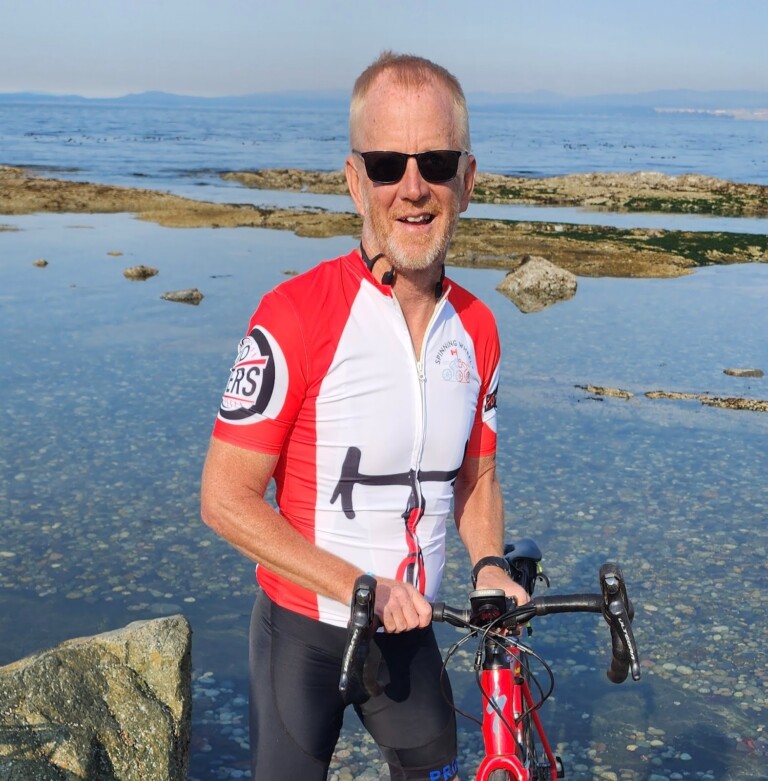
None of that stops Rob Warner. And Rob faces a challenge most of us never will.
Doctors diagnosed Rob with early-onset Parkinson’s disease when he was 33, just three months after his youngest child was born. Parkinson’s—the world’s fastest-growing neurodegenerative disorder—primarily affects a patient’s ability to control movement. Millions of people live with Parkinson’s, and tens of thousands receive the diagnosis every year. Its hallmark symptoms include tremors, stiffness, and slowed movement, along with a host of other difficult complications. Researchers continue searching for a cure and for ways to ease patients’ symptoms.
As the disease has progressed, Rob’s life has become more complicated. Tasks that once felt routine now require greater effort as Parkinson’s affects his motor skills.
But Rob keeps moving.
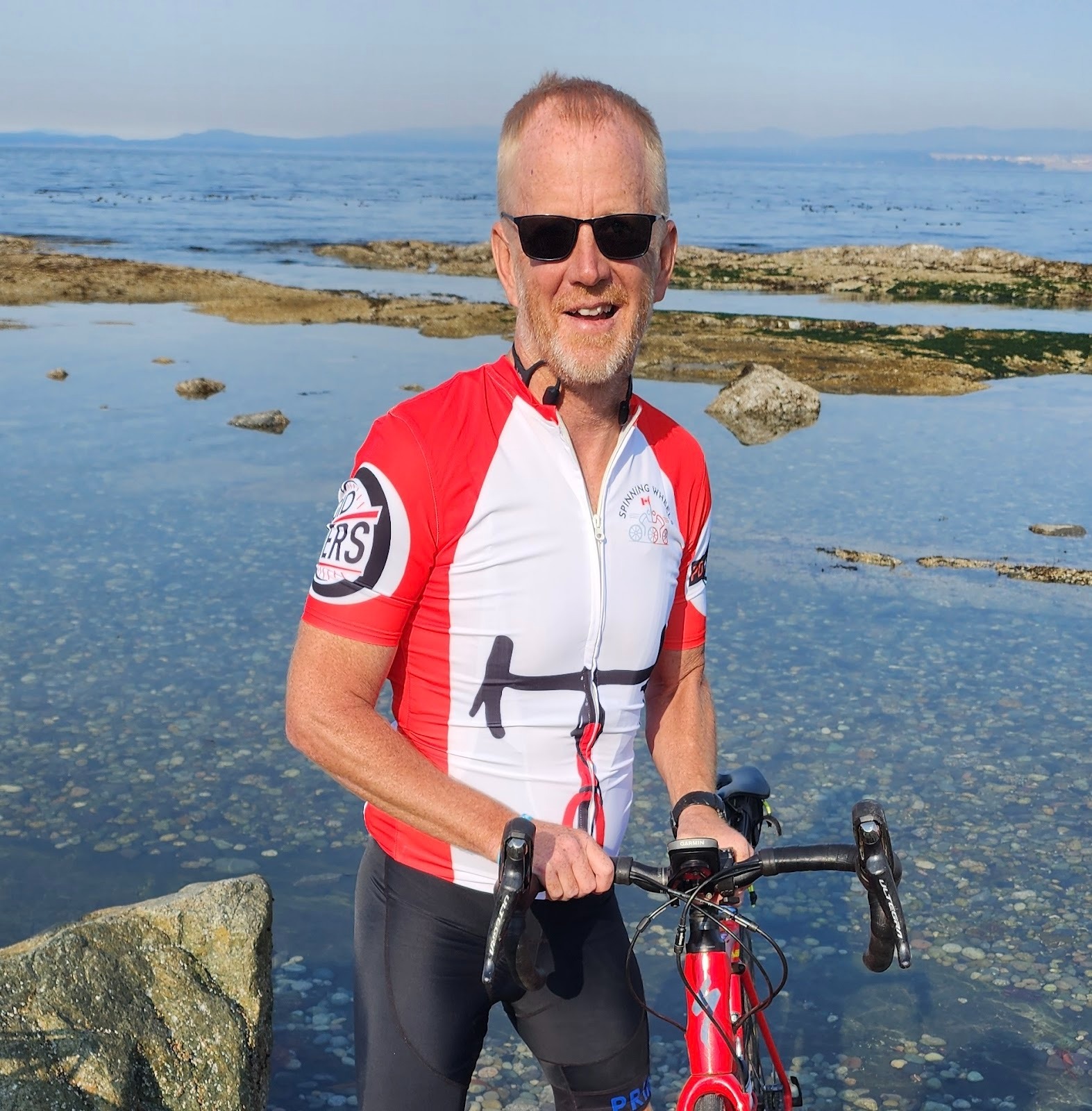
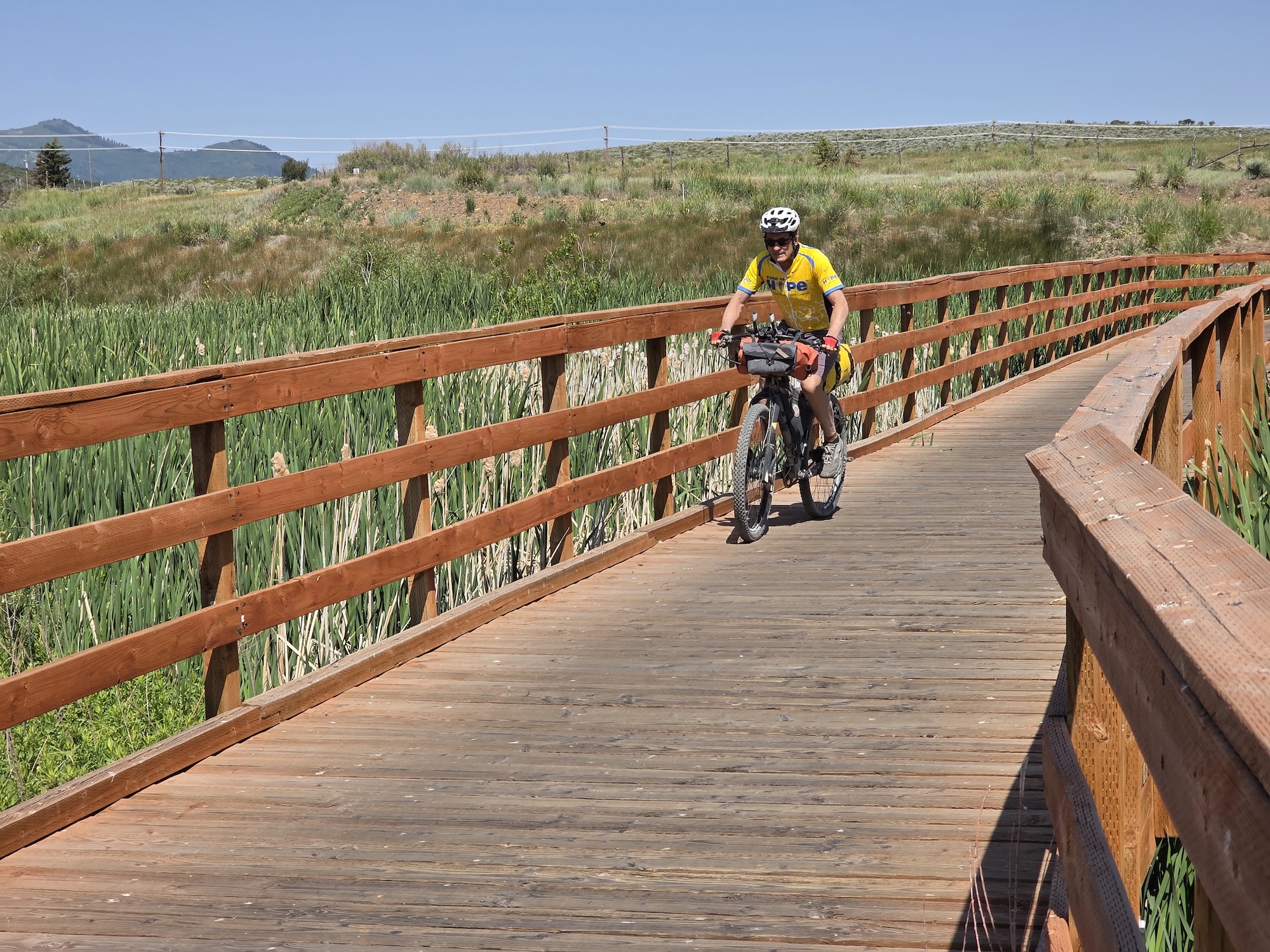
Rob Warner. Photo courtesy of Koby Brown.
Two summers ago, he joined the Spinning Wheels Tour, a group of Parkinson’s patients and supporters who crossed Canada by bicycle to raise awareness. Riders of all kinds took part—young and old, fit and out of shape, healthy and ill, Parkinson’s patients and non-patients alike.
Rob rode the British Columbia leg, a weeklong effort that demanded grit, sweat, and determination—and more than 300 miles of pedaling. Together, the group covered more than 5,000 miles. Their goal: raise awareness, fight stigma, build a support community, and beat the odds.
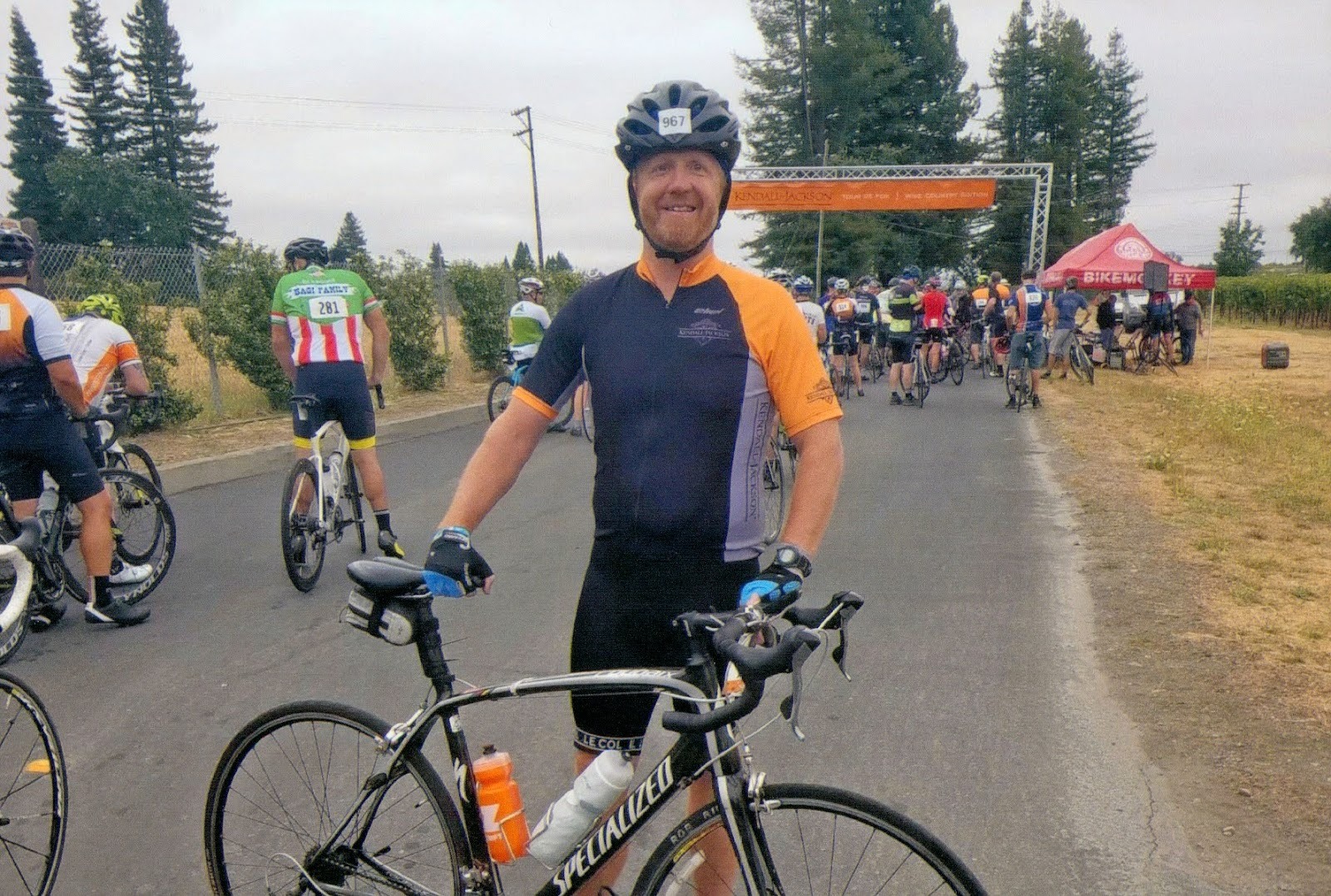
Rob Warner. Photo courtesy of Koby Brown.
There’s another reason, too. Intense exercise ranks among the best therapies for managing Parkinson’s disease.
Research shows that vigorous exercise—especially cycling—can slow the disease’s progression and provide meaningful relief from symptoms. Hard exercise improves both gross and fine motor function, enhances balance, and stimulates brain mechanisms that preserve dopamine. As patients exercise, the brain repairs neural connections and protects dopamine-producing neurons.
Cycling offers particular benefits. The rapid, repetitive motion of pedaling forces the brain to adapt, improving motor control. The smooth, continuous movement also reduces freezing of gait while delivering a strong cardiovascular workout without the joint stress common in other forms of exercise. Cardio training further helps Parkinson’s patients by reducing stiffness, a symptom that strongly affects quality of life.
Unfortunately, many patients feel powerless to improve their situation.
That’s exactly why Rob and his teammates are preparing an even more ambitious ride this spring.
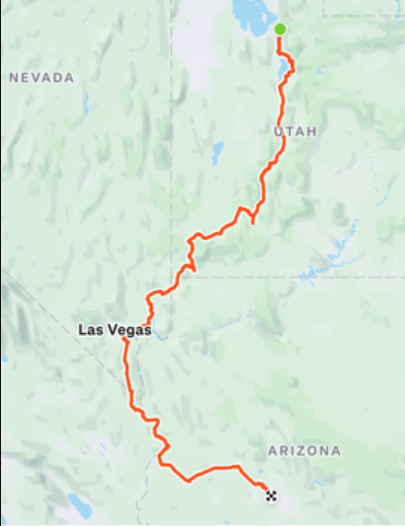
Course map.
From May 2 to May 22, 2026, Rob—serving as captain of Team Utah—will climb back into the saddle. He will lead a group of supporters on a 20-day journey from Salt Lake City, Utah, to Phoenix, Arizona, where the 7th World Parkinson Congress will take place from May 24–27.
Their route will cross Utah, Nevada, California, and Arizona, including stretches along the Wasatch Front and through Cedar Breaks, Snow Canyon, Valley of Fire, and Lake Havasu. Two other teams—Team Route 66 and Team West Coast—will also ride to Phoenix in support of the World Parkinson Congress.
Rob and Team Utah invite anyone to join the journey. Ride a mile or ride all 900. Show up on an old Walmart Huffy BMX or a ten-thousand-dollar Bianchi. However you ride, you’ll find a section of road where you can join in, get some exercise, make friends, and support an important cause.
We hope you’ll find a way to support this effort, stand with millions of people living with Parkinson’s, and connect with the PD community.
To learn more—or to find other ways to support Team Utah and the broader Parkinson’s community—find them on Facebook at Team Utah – Pedal for Parkinson’s.
A race of attrition on the shores of Lake Maggiore delivers a first WorldTour victory for the Dutch powerhouse as her team controls every kilometre of a tactical, demanding classic
TROFEO ALFREDO BINDA — COMUNE DI CITTIGLIO Luino to Cittiglio, Italy — 152.7 km — March 15, 2026
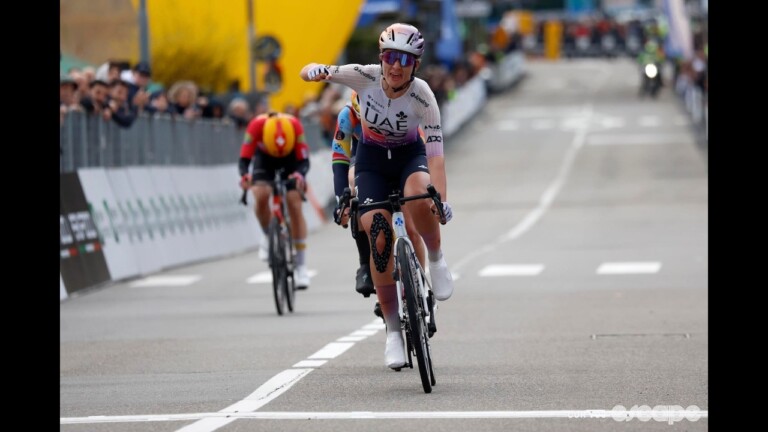
There are days in professional cycling when a team is so thoroughly in command that the only question remaining is which of their riders will take the prize. Sunday’s 27th Trofeo Alfredo Binda — Comune di Cittiglio was one of those days, and UAE Team ADQ the team doing the commanding. In the end it was Karlijn Swinkels, a rider not even pencilled in as the plan A, who crossed the finish line first in Cittiglio to claim her debut WorldTour victory in a race that has graced the Women’s WorldTour calendar since its inception in 2016.
The 152.7-kilometer race between Luino and Cittiglio — already shortened by nearly ten kilometres after overnight snow made the first classified climb at Masciago Primo impassable — played out as a slow-building demolition derby across five punishing finishing circuits on the hills above Lake Maggiore. By the time the dust settled on the final ascent of Orino, Swinkels had outsprinted Anna van der Breggen and a gutted Mie Bjørndal Ottestad in a charged three-woman finish, while the chasing group arrived 47 seconds in arrears, having never found the legs to close what had looked, at various points, like a bridgeable gap.
A MODIFIED COURSE, AN UNMODIFIED AMBITION
Race morning brought cold air and wet roads to the north Italian lakeside. Organisers confirmed the route change early: the Masciago Primo climb, which would have come after 29 kilometres, was cut from the parcours following snow accumulation overnight. The peloton would still face more than 2,300 metres of vertical gain across the five closing circuits, each 17.6 kilometres long and containing two climbs — the short, sharp ramp at Casale and the 4-kilometre ascent to Orino at 433 metres, featuring ramps of 10 percent and tight hairpin bends. Anyone expecting an easier day because of the shortened route was quickly disabused of that notion.
The field rolled out of Luino at 1:00 p.m. local time, 137 women signed on for what would prove to be one of the oldest races on the Women’s WorldTour calendar. The Trofeo Binda, first held in 1974, holds a particular distinction: it is the longest-running race in women’s top-tier cycling, having joined the World Cup in 2008 and the Women’s WorldTour at its founding in 2016. To win here is to add your name to a list that includes Marianne Vos, Kasia Niewiadoma, Elisa Longo Borghini, and the recently retired Lizzie Deignan. Today, one more name would be added.
THE BREAK, THE BUILD, THE BLOWUP
For the first hundred kilometres, the race followed a familiar script. Early attempts at establishing a breakaway came to nothing on the nervous roads, the peloton unwilling to cede control. It was Hannah Ludwig of Cofidis who eventually succeeded, slipping clear with around 106 kilometres remaining and building a lead of just under two minutes as the peloton settled into a rhythm behind her. The German rider, a strong climber and a versatile racer, made herself at home out front as UAE Team ADQ sat on the front of the bunch, content to manage the gap rather than chase in earnest.
Ludwig’s advantage remained relatively stable — around one minute 30 to one minute 45 — as the race ticked through its early closing circuits. The pace, though, was already high, the average sitting north of 41 kilometres per hour despite the damp conditions. By the time the race entered its final two laps, the bunch had been reduced to a compact, nervous group of fewer than 20 riders, and Ludwig’s adventure was nearing its end.
With 35 kilometres remaining, the mood shifted. UAE were now setting a punishing tempo, Mavi García putting her head down and her legs to work at the front of a reduced peloton. Riejanne Markus of Lidl-Trek lit the touch paper, and suddenly it was attack after attack. Elisa Longo Borghini — a two-time winner of this race, a local in every meaningful sense, and the team’s headline act — went on the offensive, drawing Kasia Niewiadoma, Noemi Rüegg of EF Education-Oatly, and Puck Pieterse of Fenix-Premier Tech with her. The move nearly stuck but the group came back together over the top.
SD Worx-Protime, Visma-Lease a Bike, Human Powered Health, and Picnic-PostNL all tried their luck in the frantic kilometres that followed. World champion Magdaleine Vallieres of EF Education-Oatly took her turn on the descent. Nothing stuck. The race was coiling itself tighter and tighter.
UAE SPRING THE TRAP
With 22 kilometres remaining, Eleonora Gasparrini made her move. The UAE rider accelerated clear on the approach to the Casale climb, drawing six riders with her: teammates Karlijn Swinkels and Silvia Persico, Anna van der Breggen of SD Worx-Protime, Pfeiffer Georgi of Picnic-PostNL — who had won the junior race on this course earlier in her career — and Norway’s Mie Bjørndal Ottestad of UNO-X Mobility. The gap opened to 17 seconds at 15 kilometres to go.
It was, on the face of it, a problematic situation for UAE. They had three cards to play, there was little incentive to do the bidding of their rivals. Van der Breggen, meanwhile, was doing exactly what Anna van der Breggen does: working hard, keeping the pace high, serving her team’s interests — in this case, protecting Lotte Kopecky and Blanka Vas behind.
What followed on the penultimate ascent of Casale was a swift and brutal reorganisation. Persico and Gasparrini, despite being the architects of the move, were shed from the group. Georgi, too, began to struggle. By the time the road tilted toward Orino for the final ascent, the lead group had been whittled to four: Swinkels, Van der Breggen, Georgi, and Ottestad. With 11 kilometres remaining, Swinkels had gone to sit in, either marking Van der Breggen or protecting Longo Borghini’s interests behind. The tactical chess match was reaching its most complex phase.
THE CLIMB THAT DECIDED EVERYTHING
Georgi was dropped from the front group as the road bit in earnest on Orino. Three riders remained: Swinkels, Van der Breggen, and Ottestad, with a gap of around 35 seconds over the Kopecky-Vas group behind. Van der Breggen, a rider of unmatched tactical intelligence and race-reading ability, was unrelenting on the climb. She attacked one kilometre from the summit. Ottestad began to crack. Swinkels, hanging on, was forced to the front by Van der Breggen as the gradient eased — a move that forced the Dutch rider to do exactly the work she preferred not to do.
Over the top with 7.5 kilometres remaining, Van der Breggen went deep into her poker face. The gap was 48 seconds. The logic of the situation dictated cooperation — sprint from three and let the fastest legs decide. Van der Breggen, however, showed no interest in expediting that outcome, refusing to come through as Swinkels sat up. It was a mind game as much as a road race.
Behind, on the descent, Marianne Vos attacked the chase group but was covered by Longo Borghini. Ottestad, showing extraordinary courage for a rider who had already emptied herself on the climb, attacked the leading trio at four kilometres to go — a defiant, gutsy lurch for glory that briefly reshuffled the cards. It was never going to be enough.
THE SPRINT, THE VICTORY, THE REWARD
Van der Breggen never came through. Swinkels wound it up, and when the sprint opened, the UAE rider had too much. Ottestad, who had given everything and then some, had nothing left for the finish and crossed third. The chasing group arrived 47 seconds later, Blanka Vas leading them home, Lotte Kopecky rolling in seventh.
For Swinkels, it was an emotional and significant arrival. This was her first WorldTour victory — a result that validated not just her own considerable abilities but the depth of an UAE Team ADQ squad that is quietly becoming one of the most formidable in the women’s peloton. It was also her second win of a young 2026 season, having already taken victory at the Trofeo Binissalem-Andratx in Mallorca.
“I was supposed to be waiting for the final sprint. But then we had this occasion where we attack with the three of us — with Silvia and Gaspa — and they kept pulling for me. I felt quite confident on the climb but then I got a bit nervous because in the final, Anna didn’t pull. In the sprint I felt quite confident but also a little nervous because I really wanted to finish the good teamwork off, because the girls worked really hard for me and believed in me today.” Karlijn Swinkels, race winner
UAE’S STATEMENT PERFORMANCE
If the win was Swinkels’, the performance belonged to UAE Team ADQ as a whole. They placed three riders in the penultimate selection, four of their six in the top 20, and controlled the race from start to finish. Eleonora Gasparrini and Silvia Persico celebrated with their teammate at the finish line — women who had driven themselves into the ground in service of a victory they handed to a teammate with grace and confidence.
The transformation of UAE Team ADQ in recent seasons has been one of the stories of the women’s peloton. Since Elisa Longo Borghini joined the squad, the team has gained both a marquee name and, it appears, a culture of depth and tactical sophistication. The Italian veteran, a double winner of this very race in 2013 and 2021, did not take the prize today — but she was central to making it possible.
For SD Worx-Protime, it was another race that slipped through their fingers. Van der Breggen rode brilliantly and intelligently, but the tactical read that the race would come down to a sprint from the break — and that she might not be the fastest wheel to back — proved costly. Kopecky, finishing seventh, and Vas, leading the chasers home, underlined the team’s firepower. It is a squad built to win in multiple ways. Today was not their day.
Mie Bjørndal Ottestad deserves special mention. The Norwegian, riding for UNO-X Mobility, exemplified her team’s growing confidence and aggression with a performance of rare courage. She drove the move, stayed in the front group longer than anyone had a right to expect, attacked four kilometres from the line when the move made little sense by the numbers, and crossed the line third having ridden herself almost to a standstill. It was the kind of performance that announces a rider to a wider audience.
HISTORY AND HERITAGE IN CITTIGLIO
Trofeo Alfredo Binda, named after the Cittiglio-born champion who won the Giro d’Italia five times between 1925 and 1933 — a record he shares with Fausto Coppi and Eddy Merckx — has earned its place as the most historic race on the Women’s WorldTour calendar. First held in 1974, it staged its 53rd edition today, the only gap in the record coming in 2020 during the pandemic.
Previous winners in the field today included Shirin van Anrooij, who won the 2023 edition, Marianne Vos — who holds four victories here alongside Maria Canins — Kasia Niewiadoma, and Longo Borghini. None of them added to their tallies. Instead, a new name joins the honour roll: Karlijn Swinkels, winner of the 2026 Trofeo Alfredo Binda, and a rider who may well be back for more.
RESULTS — 2026 TROFEO ALFREDO BINDA — COMUNE DI CITTIGLIO
MARCH 8, 2026 · STAGE 1 · ACHÈRES → CARRIÈRES-SOUS-POISSY · 170.9 KM
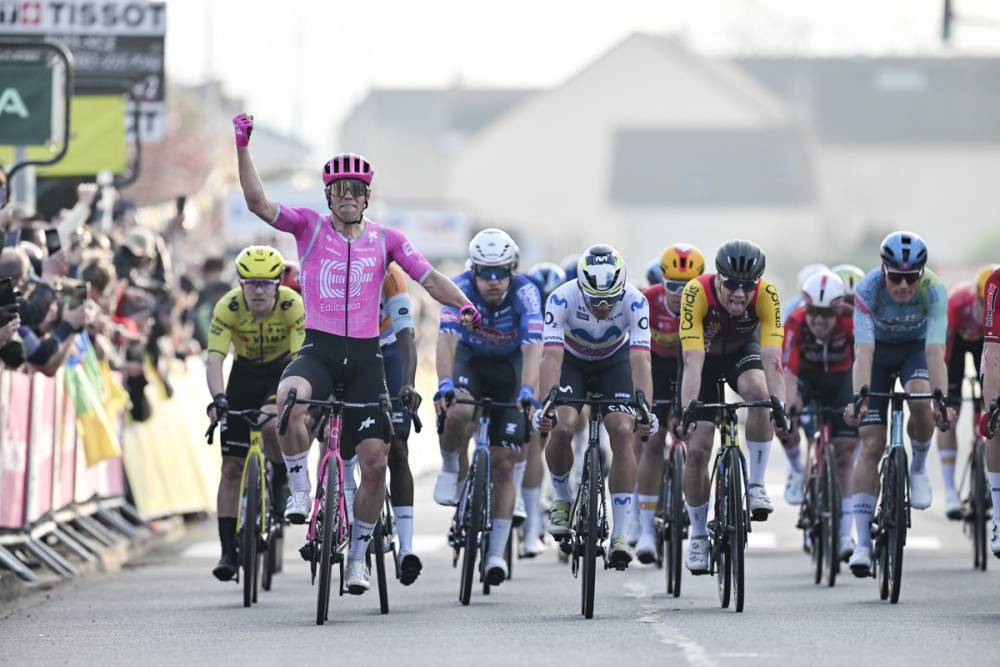
America has made the opening act of Paris–Nice its own. In 2025 it was Matteo Jorgenson and Magnus Sheffield who ruled the Promenade des Anglais. In 2026, barely a week into March and a long way yet from the sea, Luke Lamperti announced his country’s continued dominion over the Race to the Sun with a forceful, impeccably timed sprint in Carrières-sous-Poissy. The EF Education-EasyPost rider, twenty-two years old and still building a palmares to match his ambition, crossed the line first in a finale so laden with climbs and crossroads that the pure sprinters were stranded somewhere behind him. This was not a gift. He had to earn it.
The 84th edition convened under a grey ceiling in Achères — 154 riders, one early abandonment. Kelland O’Brien of Jayco AlUla didn’t even reach the neutral zone before calling it a day, the cruel arithmetic of professional cycling reducing a week of preparation to a morning of nothing. The clouds broke with surprising speed, and by the time the peloton had shed its neutral veil, the sun was out — provisional, March-thin, but present — as if the race itself had willed the weather into something approximating its own name.
The initial aggression was considerable. Teams jabbed and probed through the opening kilometres, none willing to let a move go unchecked, all acutely aware of the four categorized ascents embedded in the final circuit. At kilometre seven, the racing settled into its early geometry: six riders off the front — Casper Pedersen of Soudal-Quick Step, Luke Durbridge and Patrick Gamper from Jayco AlUla, Max Walker of EF Education-EasyPost, Mathis Le Berre of TotalEnergies, and Sébastien Grignard of Lotto Intermarché. A functional, experienced group, not one given to extravagance.
Biniam Girmay’s NSN Cycling Team and Casper van Uden’s Picnic PostNL governed the tempo behind them, keeping the gap within the gravitational range of sprint ambitions. The break’s maximum advantage never crested 1’45” at the halfway mark, and then the peloton turned up the flame. The finale — a 16.6-kilometre circuit to be completed twice, punctuated by the Côte de Chanteloup-les-Vignes, a 1.1-kilometre wall averaging 8.3%, the old battleground of the Polymultipliée — required the kind of collective vigilance that turns team directors pale.
On the first passage of the circuit, Casper Pedersen made the mountains his private territory. He crested the Côte de Gargenville first, then reeled in Le Berre’s surge over the Côte de Vaux-sur-Seine to collect more KOM points. He was not merely accumulating points; he was constructing a case for the polka-dot jersey. At the top of Chanteloup-les-Vignes, he went first again. The jersey was effectively his.
Into the final lap, the gap stood at 1’15”. It was Bruno Armirail of Visma-Lease a Bike who drove the chase with the kind of relentless, metronomic power that makes other riders’ lungs ache in sympathy. The gap fell through 45 seconds at the base of the final ascent, and Le Berre threw one more card across the summit — an acceleration that put him ahead of the bunch by 30 seconds. Not enough. Not today.
With five kilometres remaining, the lead shrank to ten seconds. Inside two kilometres, the break was absorbed, swallowed whole by a peloton that had been hunting it all afternoon. EF Education-EasyPost moved to the front with the precision of a team that knows exactly which rider it’s delivering. In the final kilometre, Marijn van den Berg laid down a lead-out of complete conviction, and Lamperti came off his wheel and drove through the line — ahead of Vito Braet of Lotto Intermarché and Orluis Aular of Movistar, with Girmay fifth and a yellow-and-white jersey changing shoulders for the first time in this edition.
Lamperti was still catching his breath when the words started coming. “It means a lot to me,” he said. “It’s a super special win, for sure the biggest in my career so far. It’s hard to describe how nice it is to be here, on the podium, wearing that jersey.” He reached back for context. “It’s my first Paris-Nice. Matteo has won the last few years and Sheffield has won a stage, so maybe it’s good luck for the Americans here.” He was careful about his self-assessment — not a pure sprinter, he insisted, more of a Classics rider — but he understood precisely what had happened. “The climbs today before the finish made it super hard and there were less sprinters. It was a bit hectic before the final corner and we had to go really long. Marijn was great. It was an incredible lead-out. We are quite similar. To have his belief and full commitment was super nice. It takes a lot of things to win in cycling, everything has to go right, and I think it was the case today.”
Casper Pedersen sat in the polka-dot jersey and found philosophy where others might have found frustration. “We had the ambition to go for the stage as well,” he said, “but it’s very hard and in the end I think we did the best we could. We had a plan. We wanted to accelerate in the last 50 kilometres to try and challenge the bunch as much as possible. We had a really good collaboration in the breakaway. It was a strong group. In the end we get caught with 2 kilometres to go — we took a really good shot but it’s really hard to finish it off in a race like Paris-Nice.” He set his sights clearly on the days ahead: the jersey would be worth defending at least through the time trial. Beyond that, the climbs would be the judge.
Mathis Le Berre hadn’t even been scheduled to start. He’d been called in at the last minute to replace Emilien Jeannière, and arrived at the line with something to prove and nothing to lose. “It’s my very first day in this race and I’m delighted that the team has placed its trust in me right away,” he said. “I wanted to break away and my ambition was to take the polka dot jersey, but I found myself with Casper Pedersen, who was stronger than me on the climbs. I sensed he was struggling a bit on the last one, so I attacked and got ahead of him, but it wasn’t enough. However, I haven’t had my final say yet — I’m going to keep fighting.” He would be true to his word.
Kanter’s Finest Hour
MARCH 9, 2026 · STAGE 2 · ÉPÔNE → MONTARGIS · 187 KM
Montargis has a reputation for separating ambition from capacity. The town has hosted Paris–Nice sprint finales before and it tends to produce them with a kind of theatrical generosity — a long, relatively uncomplicated run-in that seems to invite the fast men, and then a finale chaotic enough to deny half of them. Max Kanter arrived there on March 9th as a man who, by his own admission, had barely felt capable of turning pedals in recent days. He left it as a winner of one of the most prestigious bike races in the world.
The stage from Épône ran 187 kilometres south into the Loire valley, carrying 1,270 metres of elevation over three categorized climbs before the flat finale. Crosswinds had been forecast as mild, perhaps ten kilometres per hour, and the weather held. The sprint teams were present and calculating. So was Casper Pedersen, who woke up in polka dots and had every intention of wearing them into Tuesday.
The breakaway took shape through the familiar grammar of early racing: Jasha Sütterlin of Jayco AlUla attacked from the gun, and after seven kilometres of hard selection, he was joined by Pedersen, Le Berre, and Matteo Vercher of TotalEnergies. Sütterlin lasted twelve kilometres before the road had its verdict and he drifted back. Three remained. Pedersen and Le Berre, their KOM rivalry already established on stage one, resumed hostilities at the Côte des Mesnuls at kilometre 30.3 — Pedersen over first, three points, Le Berre second, two, Vercher third and gone.
EF Education-EasyPost and NSN held the peloton in check throughout the morning. The duo’s advantage peaked at 2’25” near kilometre 45, and then the road began doing the work the teams required. Through the valley they rode, the two principals of this minor competition within a competition, and at the Côte de Villeconin and again at the Côte du Pressoir, Pedersen’s climbing superiority told. “On the kind of climbs we had yesterday and today, I knew I was more explosive and had an advantage,” he would say later, with the careful honesty of a man who understood the limits of that advantage. “I don’t know if that would be the case on longer climbs — it might have been different.” By the final ascent his KOM tally stood at eighteen, Le Berre’s at fourteen.
The mathematics of the afternoon took a new shape at the intermediate sprint in Fromont, with 46.1 kilometres remaining. Lotto Intermarché had driven Pedersen and Le Berre back to the bunch in the final kilometres of their escape, and now Vito Braet turned the field at the sprint line and collected six bonus seconds — enough to draw level with Luke Lamperti in the overall classification. Behind them, Juan Ayuso of Lidl-Trek took four seconds and eight seconds back in time. The winner of the stage would take ten more bonus seconds. The afternoon’s personal stakes, already high, had just climbed.
Then came the crash, with 34 kilometres to go, and the race’s arithmetic was temporarily replaced by its physics. Phil Bauhaus, Cees Bol, and Sandy Dujardin all went down on the approach roads, and while all three regained contact with the bunch, the damage to Bol’s readiness for the sprint was already done. Daan Hoole, his lead-out man from Decathlon CMA CGM, surveyed the situation with cool pragmatism. “Normally we would have sprinted with Cees Bol,” he said afterward, “but he crashed. He was suffering a bit, so the team said he was not gonna sprint and he would recover for tomorrow. They asked me what I wanted to do.” The answer he gave was direct: he went.
With 21 kilometres remaining, Hoole launched himself out of the peloton and opened a gap of thirty seconds within minutes. Movistar reacted, then Tudor, then Red Bull-Bora-Hansgrohe and EF Education-EasyPost joined the chase. The gap came down as the kilometres fell away, and inside the final kilometre, Hoole — brave, committed, ultimately alone against the combined horsepower of teams protecting their sprinters — was finally caught. “In a race like this, you need a bigger gap,” he said. “But it was nice to give it a go.”
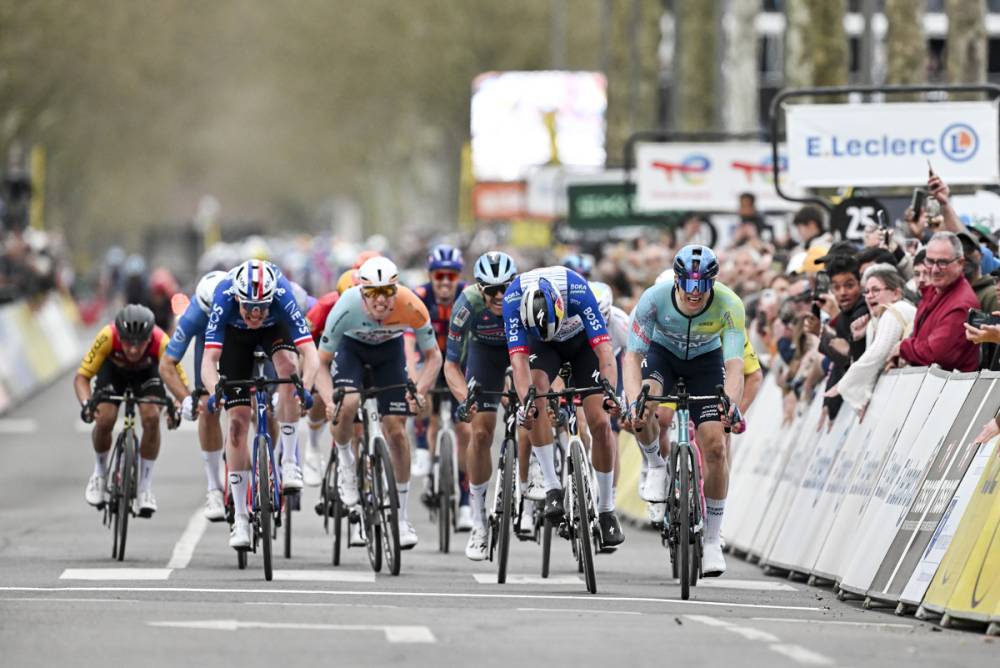
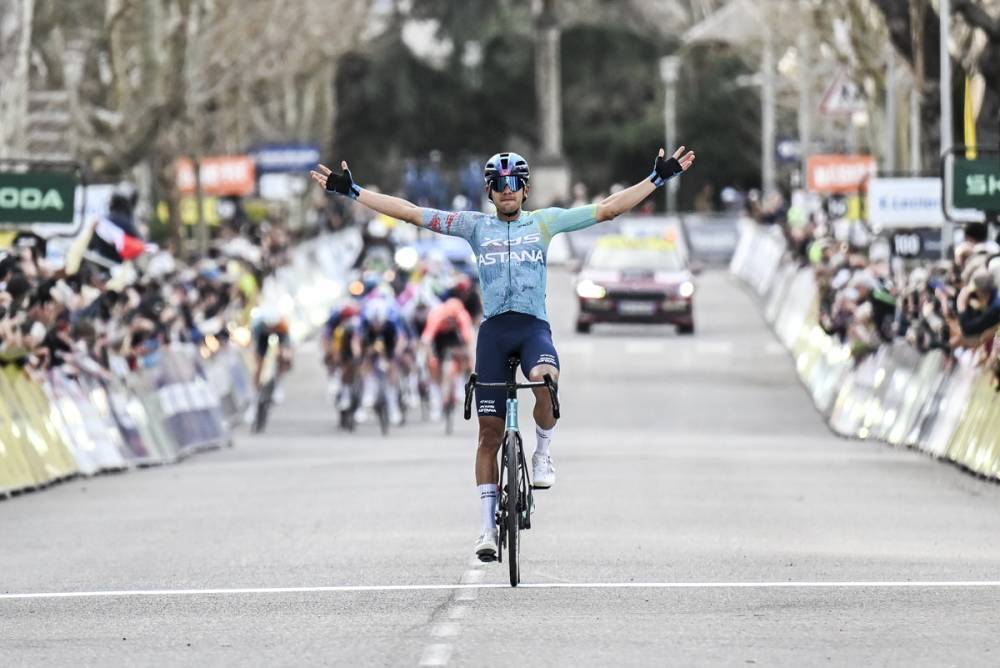
Mike Teunissen of XDS Astana had found position, and in the closing metres he delivered Max Kanter to the line with the economy of a man who had done this many times and intended to keep doing it. Kanter came off his wheel, opened his sprint, and the day was done: Kanter first, Laurence Pithie of Red Bull-Bora-Hansgrohe second — Pithie had finished second at Montargis two years earlier and managed to do it again with what seemed like ironic precision — Jasper Stuyven of Soudal Quick-Step third.
Kanter’s reaction in the finish area had the texture of genuine disbelief. “It’s a dream to win in a race with such a high prestige,” he said. “Paris-Nice is one of the biggest races in the world. I’ve been fighting for this for a long time. It’s my first World Tour victory, it’s kind of unbelievable.” He had boarded the team bus that morning uncertain whether he could finish. “The last couple of weeks haven’t been the best. I didn’t have the biggest confidence. But I gave it all in the last 200 metres.” He gave full credit to Teunissen. “With 2 kilometres to go, we were not in the best position but he did an unbelievable pull towards the last roundabout and then he did an incredible lead-out. He gives me a lot of confidence.”
Lamperti finished fifth and kept the jersey by the narrowest of margins — Braet level on time, the outcome to be determined Wednesday on the short drag of the team time trial. He had enjoyed the day in yellow more than he let on. “Today was super special. I enjoyed it from kilometre zero. It’s not often you get to wear a jersey like this. For me, it’s the first time.” On the tactical situation with Braet: “I knew that before the finale, but we also just wanted to ride for the stage. I told the guys: ‘We just ride normal, we don’t ride to try to beat him, we see what we can do.'” Both sprint finales had been chaotic, he noted, and today he’d been boxed. “We wanted a bit more from the sprint, but it’s also nice to keep the jersey for tomorrow.” His team would ride last in the TTT, an advantage he intended to use.
Ayuso Claims Yellow, Ineos Take the Stage
MARCH 10, 2026 · STAGE 3 · COSNE-COURS-SUR-LOIRE → POUILLY-SUR-LOIRE (TTT) · 23.5 KM
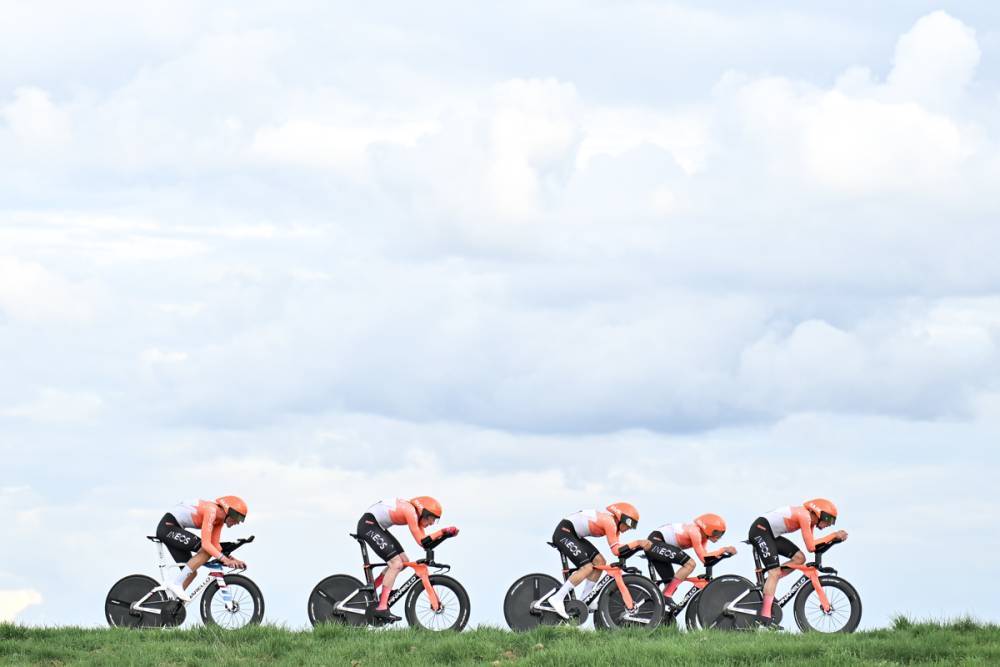
The team time trial has become one of Paris–Nice’s most reliable generators of drama, and the 23.5-kilometre test between Cosne-Cours-sur-Loire and Pouilly-sur-Loire delivered it in full. By the end of the afternoon, Ineos Grenadiers had taken the stage, Juan Ayuso had taken the yellow-and-white jersey, and the general classification had its first proper shape.
The format was the same one that had been used on this race before, and would later serve as a template for the Tour de France opener in Barcelona: stage time set by each team’s fastest rider, with GC time credited to any rider who finishes alongside their team leader, and individual times thereafter. The incentive was clear — put your man at the line as fast as possible, and make sure as many others as possible are with him when he crosses.
Picnic PostNL and Jayco AlUla went early and set reference points before Groupama-FDJ United came through at 51.5 km/h to erase them. Brandon McNulty and Marc Soler finished as a pair four seconds ahead of the French team — a fine time for UAE Team Emirates XRG, but not the race-winning performance that had handed McNulty the leader’s jersey two years before in Auxerre.
Visma-Lease a Bike came through strongly, Jonas Vingegaard pacing Armirail, Davide Piganzoli, and Victor Campenaerts over the line together, 21 seconds ahead of UAE. Then Decathlon CMA CGM moved to the front — they led at the intermediate checkpoint but seemed to falter in the final stretch, until Daan Hoole, still apparently full of sprint and stubbornness from his Montargis adventure the previous afternoon, rode the last five kilometres alone and arrived four seconds ahead of Visma. One day after being caught inside the final kilometre of a stage, Hoole had somehow improved.
Lidl-Trek erased those marks. Mathias Vacek, Soren Kragh Andersen, and Jakob Söderqvist propelled Ayuso to the line in 26’42” — nine seconds ahead of Decathlon. It was a formidable collective performance, built through shared training and meticulous pacing. Ayuso had four bonus seconds banked from his intermediate sprint victory the previous day. The stage win, however, would depend on Ineos Grenadiers.
The British squad were thirteen seconds faster than Lidl-Trek at the halfway point. The gap diminished through the second sector as Ineos’s protective layers were progressively spent, until Kevin Vauquelin crossed the line in 26’40” with Oscar Onley a wheel-length behind. Two seconds over Lidl-Trek’s time. Two seconds, and four bonus seconds, and the yellow jersey went to Ayuso rather than Vauquelin.
“We were really motivated this morning,” Ayuso said, working through the logic of a day that had delivered something both gratifying and slightly wrong-shaped. “Me and the team really thought it was possible to win, and to lose for just 2 seconds, it hurts. The guys deserved the win.” He found a way to hold both feelings at once: “I wouldn’t say there’s disappointment, but a bit of sadness. I would have preferred not to have the jersey but to win the stage.” He was realistic about the road ahead. “In Paris-Nice, things can change very quickly. Tomorrow will be bad weather and a really hard stage.”
Vauquelin absorbed the two-second sting with the discipline it required. “I was really looking forward to testing myself with Ineos Grenadiers,” he said. “I knew it could work to our advantage. And I’m really happy to show off our work.” On the jersey: “I would have liked to take the Maillot Jaune. There was the bonus yesterday… You can find those two seconds anywhere on a course like this. But we can be happy and there’s still a very tough second part of the race ahead with the weather and the course. I like difficult conditions, so we’ll see what happens tomorrow.”
Wind, Rain, and the Road to Uchon
MARCH 11, 2026 · STAGE 4 · BOURGES → UCHON · 195 KM
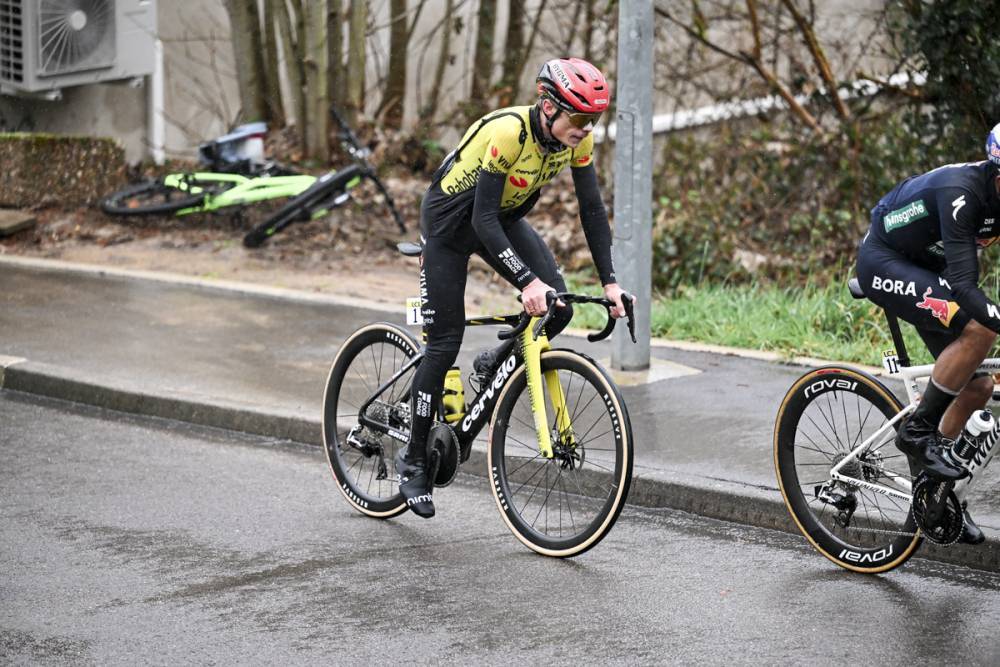
Stage four of Paris–Nice began as a race and became a survival exercise almost immediately. Before the peloton had crossed the Cher and found its southward rhythm, the weather had intervened with the decisive authority of a commissaire tearing up a rulebook. Crosswinds from the south, gusting to 45 kilometres per hour, tore the field to pieces before the first categorized climb appeared on the horizon. By the time the riders reached Uchon and its savage final kilometre — gradients to sixteen percent, wet roads, the cold that had been building since morning — Jonas Vingegaard was alone at the front of it, and Juan Ayuso was somewhere far behind, injured and out of the race.
The riders were warming up before the start with an intensity that had little to do with April muscles and everything to do with anxiety. Twenty to thirty kilometres per hour from the south, sustained crosswinds on open Burgundian roads — the mathematics of echelons was visible to everyone before a pedal had been turned in anger. Sure enough, within five kilometres the road split. Ayuso was in the right place, alongside Vingegaard, Oscar Onley, Brandon McNulty, and a Red Bull-Bora-Hansgrohe train four riders deep built around Dani Martinez. Kevin Vauquelin, second overall at the start of the day, was caught in a third group that scrambled back to the second before the damage became permanent.
Red Bull-Bora-Hansgrohe drove the front, the pace oscillating but never merciful, the gap to the chasers swelling between 55 seconds and 1’40” as the race threaded through the Morvan. Lenny Martinez of Bahrain Victorious and Vauquelin drove the chase on the Côte de la Croix des Cerisiers at kilometre 127, bringing the gap to 45 seconds. Then the lead group accelerated on wet roads, and Ayuso hit the ground on the descent.
He tried to continue. The injuries made that impossible. Brandon McNulty was also caught in the incident, and the front group — already reduced — exploded. Five riders remained at the front: Martinez with teammates Nico Denz and the Van Dijke brothers, Mick and Tim, and Vingegaard. They pressed the Côte de la Croix de la Libération with the collective energy of men who understood the opportunity in front of them. Behind, Joshua Tarling paced Onley — who had already changed bikes on an earlier crash descent — but the gap only widened.
Vauquelin and Lenny Martinez eventually bridged to the chasers sixteen kilometres from the finish, trailing the lead group by 2’40”. Mick van Dijke cracked with 6.5 kilometres to go. Tim set tempo all the way to the flamme rouge. And then, as the road kicked into its final, brutal kilometre, Vingegaard released everything.
The gap to Dani Martinez at the line was 41 seconds. The gap in the general classification — Vingegaard wearing yellow-and-white for the first time in this race — was 52 seconds over Martinez. Georg Steinhauser of EF Education-EasyPost, who hadn’t originally been on the Paris–Nice roster, was third overall, 3’20” back, followed by Vauquelin at 3’39”.
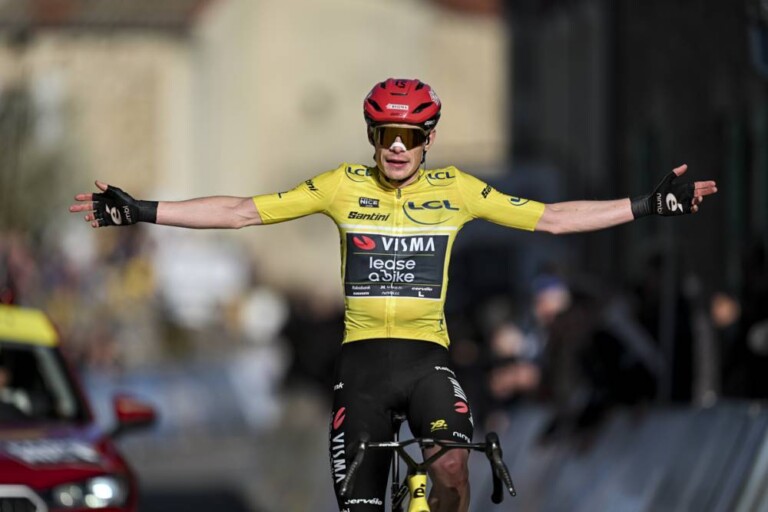
Vingegaard stood in the finish area and worked through the day’s arithmetic with a kind of grateful incredulity. “I wouldn’t say we expected such a crazy day — we expected it to be crazy, but definitely not like it ended up,” he said. He noted the previous year’s abandonment — the crash on this same race, the weeks lost. “Last year, I had to abandon the race. Then, I had the leaders jersey and I crashed. Coming back and winning a stage, my first in Paris-Nice outside of the TTTs, it’s really nice to start the season this way.” On the conditions: “First of all, it was crosswinds straight from the gun. Already there, a few guys were caught behind. And later on, a lot of guys were freezing today. I didn’t, because lot of clothes on, which is also the reason I couldn’t take them off.” He looked ahead with characteristic directness. “Now our goal will be to try to take the yellow jersey to Nice. I can defend — but if I feel good, it’s always nice to win more stages.”
Georg Steinhauser was still processing what the week had become. Two weeks earlier, he hadn’t expected to be at Paris–Nice. Now he was on the podium of one of the most prestigious stage races in the world. “Days like this are not easy. Crashes, crosswinds — it had everything. I managed to survive all of this and I still had the legs for a good effort.” The white jersey felt significant. “Last year was not my best year. So to be back and to wear a leader’s jersey in a World Tour race like Paris-Nice is special.”
Revenge on Familiar Roads
MARCH 12, 2026 · STAGE 5 · CORMORANCHE-SUR-SAÔNE → COLOMBIER-LE-VIEUX · 206.3 KM
Twelve months earlier, Jonas Vingegaard had been lying somewhere on the Côte de Trèves, the yellow jersey no longer relevant, the season’s ambitions revised in the seconds it takes a bicycle to stop being a bicycle. On stage five of Paris–Nice 2026 he rode back over that same climb with the quiet authority of a man who has settled a debt with a particular piece of road, and then continued up the Côte de Saint-Jean-de-Muzols to take his second consecutive stage victory by more than two minutes. The margins were growing. The message was unambiguous.
The stage from Cormoranche-sur-Saône to Colombier-le-Vieux was the longest of the race at 206.3 kilometres, and the most demanding in terms of raw elevation — 2,950 metres, with gradients reaching sixteen percent in the finale. Teams stripped of general classification ambitions threw their most durable climbers into the early attacks, the first 63 kilometres producing skirmishes without resolution before Aleksandr Vlasov of Red Bull-Bora-Hansgrohe made his move on the Côte de Lentilly. He was first over the summit, pressed on, and at kilometre 70 collected four companions: Joshua Tarling of Ineos Grenadiers, Rémi Cavagna of Groupama-FDJ United, Jefferson Cepeda of Movistar, and Nicolas Prodhomme of Decathlon CMA CGM. A qualified group.
Visma-Lease a Bike kept the gap at approximately 1’40” without obvious strain. David Gaudu of Groupama-FDJ had been fifth overall at the day’s start; by the time the Côte de Trèves appeared on the horizon at kilometre 106.7, he was gone, the parcours having made its judgment. Ivan Romeo and Lorenzo Milesi of Movistar counter-attacked toward the second group of five, Victor Campenaerts of Visma joining them. The eight combined with 90 kilometres remaining, and the gap never exceeded 2’05” thereafter. Visma held the tempo with the patience of a team whose leader had not yet needed to show his hand.
On the Côte de Sécheras, the first of three sharp kickers in the finale, the break splintered. Cepeda went alone; Vlasov and Prodhomme gave chase while the rest were absorbed by a rapidly accelerating peloton. Tarling and Campenaerts were back with their respective teams as Cepeda pushed over the crest of the Côte de Saint-Jean-de-Muzols — 2.2 kilometres averaging eleven percent, sixteen percent at its worst — with the combined weight of Ineos Grenadiers and Visma-Lease a Bike close behind.
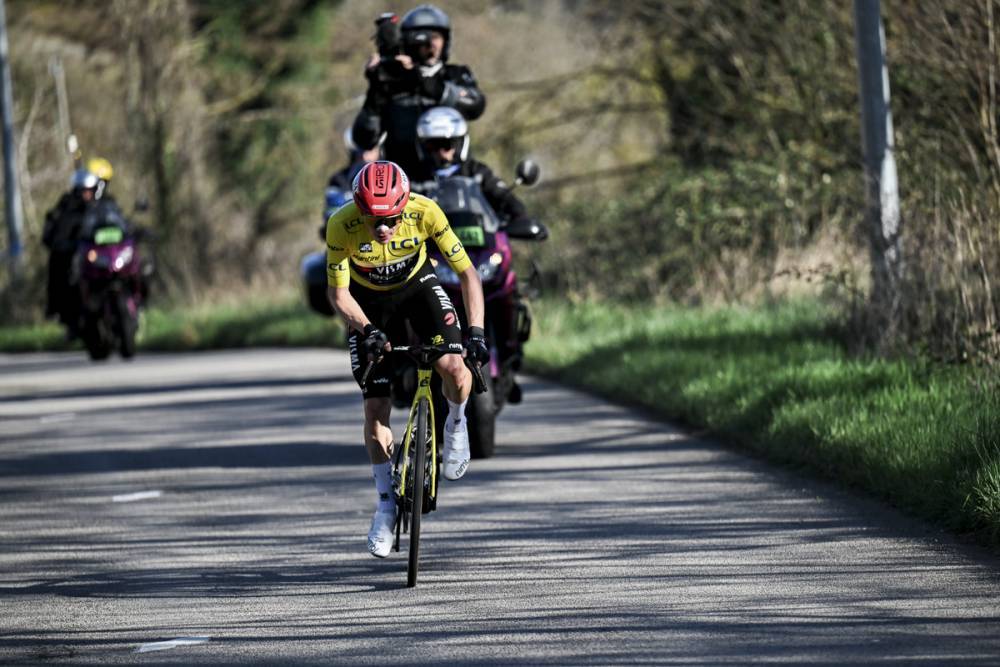
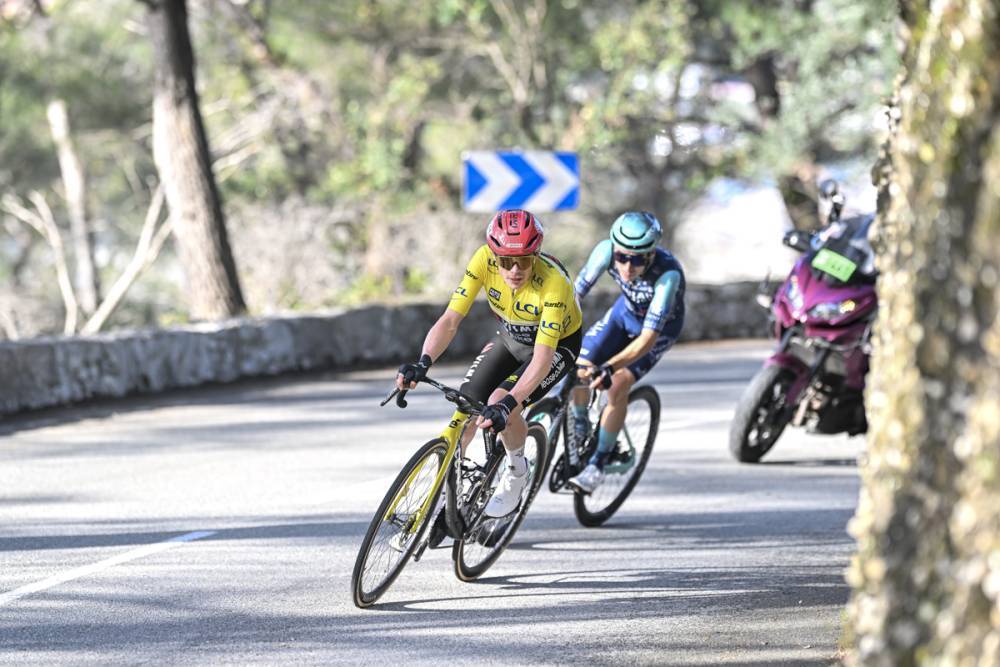
With a kilometre remaining on the climb, Vingegaard attacked. Seven riders scrambled after him — Martinez, Steinhauser, Vauquelin, Lenny Martinez, Mathys Rondel of Tudor, Harold Tejada of XDS Astana, Valentin Paret-Peintre of Soudal Quick-Step — and not one of them could hold his wheel. He crossed the summit alone and descended toward Colombier-le-Vieux at his own pace, the race behind him a different race entirely.
Paret-Peintre attacked over the final climb, the Côte de Saint-Barthélémy-le-Plain, and reached the finish line 2’02” behind Vingegaard. Tejada took third at 2’20”. Dani Martinez’s deficit in the general classification was now 3’22”. Steinhauser sat at third, 5’50” down. Vauquelin, who had been second only days before, was 6’09” adrift.
Vingegaard allowed himself the pleasure of naming the road. “I realised at one moment: ‘This looks like the road where I crashed last year,'” he said. “I didn’t know we were coming back but it’s nice to take revenge on such a beautiful day.” He acknowledged what his teammates had contributed. “They did an amazing job, making sure it was a good group in the front and keeping the gap tight. Everyone sacrificed themselves for me and I’m happy I could repay their efforts. My teammates deserve champagne tonight.” On the tactical evolution: “We had to adapt the plan a few times. Victor did an amazing lead-out and I already had a gap without needing to go all out. Then you can stay within your limits.”
Georg Steinhauser was quietly startled by his own resilience. “I had good legs. I was a bit afraid when I looked at the profile yesterday but I’m super happy with how I could defend the third place in GC today. I have to say I’m surprising myself a bit. Two weeks ago, I wasn’t even supposed to do Paris-Nice.” He set a modest, competitive tone for the days ahead. “It’s still three days to go. It’s not gonna be easy but I’m in a good situation. Today, the tactic was to do my own pace in the climbs. To be honest, I didn’t think I would be able to keep up with a rider like Vauquelin. This gives me confidence.”
Tejada Flies in Provence
MARCH 13, 2026 · STAGE 6 · BARBENTANE → APT · 179.3 KM
Harold Tejada had been having a complicated week. He’d lost time in the crosswinds on stage four, a result that reframed his ambitions even as it left him free to race aggressively. He’d finished third at Colombier-le-Vieux on stage five, which was the kind of performance that reminded a rider — and a team — of what was possible. In Apt on Saturday, the roads winding through the Luberon toward the Côte de Saignon’s punchy finale, he put the week in context with a counter-attack so well-timed and so committed that the peloton — exhausted, shattered by Victor Campenaerts’s tempo at the front — couldn’t respond.
The stage from Barbentane ran 179.3 kilometres through Provence, 2,100 metres of climbing, four categorized ascents, and a cat-2 finale over the Côte de Saignon — 4.5 kilometres to go. Of the 129 riders who had started the race on Sunday in Achères, only 125 signed on. Oscar Onley had withdrawn overnight, joined by Ivan Romeo, Julien Bernard, and Rick Pluimers.
The battle for the breakaway consumed forty-two kilometres and a considerable quantity of goodwill. When it finally resolved, Joshua Tarling of Ineos Grenadiers, Igor Arrieta of UAE Team Emirates XRG, Staff Cras of Soudal Quick-Step, and Arthur Kluckers of Tudor were clear. Counter-attackers tested the wire; NSN and Cofidis closed the gap. Benjamin Thomas of Cofidis drove tempo in the bunch, and the pace was high enough to keep the break’s advantage below 2’10” for most of the afternoon.
The race’s real mechanics became apparent on the Col de l’Aire Deï Masco with 33 kilometres remaining. Soren Kragh Andersen of Lidl-Trek had gone solo in pursuit at kilometre 37, and at the summit he trailed by 30 seconds with the bunch a further 20 behind him. Arrieta accelerated on the descent; Cras was dropped and swept up by Kragh Andersen. The two chasers couldn’t close the gap and sat up. The race approached Saignon with Tarling and Arrieta out front, the bunch behind them measuring its resources.
Lidl-Trek began driving hard through the valley — Kragh Andersen, Söderqvist, Lennard Kämna taking turns — and the gap fell to 25 seconds at the base of the Côte de Saignon. Arrieta and Tarling pushed again: 35 seconds. Then Campenaerts took the front of the bunch and turned the dial, and the break evaporated. Lenny Martinez attacked immediately below the summit, and Tejada watched.
Martinez’s move was nullified — caught, absorbed, the peloton condensed in the closing kilometers of the ascent. And there was Tejada’s moment. He went over the top with ten seconds and everything he had, descending toward Apt with the focused velocity of a man who has rehearsed this scenario many times. The peloton reacted, but not quickly enough. He took the line six seconds ahead of Dorian Godon of Ineos Grenadiers — the French national champion, fastest from the reduced bunch — and Lewis Askey of NSN. Vingegaard, protected and composed throughout, retained his jersey with enough margin to contemplate the final weekend without alarm.
“It’s a very emotional moment for me, my first World Tour win with the team,” Tejada said, the words coming quickly. “It’s huge for me to win in Paris-Nice, a race of high calibre with riders such as Jonas, Dani… I’m delighted to raise my arms.” He noted the afternoon’s complications — a mechanical on the penultimate climb, a bike change — with a shrug. “My teammates did an amazing job and I was at the front for the final climb. I knew it was up and down all the way to the line so I gave it everything I had when I made my move.” On the week’s balance sheet: “We were aiming for the podium but I lost a lot of time on the crosswind day. That’s cycling. And on the other hand, we have two stages under our belt, with Max’s and mine. Champagne!”
Vingegaard gave a measured account of a day that had required more management than the previous two. “Today ended up being not an easy day, quite hard all day, but we made it to the finish.” He named Axel Zingle as part of the tactical calculus. “We wanted to catch the breakaway but we were on thin line, because we wanted Axel to be up there.” He was clear about where his form sat in the broader season. “I think my shape is pretty good. It’s not my best yet, but hopefully I can get there for the Giro and the Tour.”
Steinhauser spoke in the careful language of a man who has learned to protect what he has rather than claim what he hasn’t. “I’m happy with how today went. I’m happy with my legs. The last climbs were a bit steeper and nastier than I expected. When I saw Victor Campenaerts pull, I knew what would happen, but I’m happy I managed to keep up.” He acknowledged the difficulty honestly: “I’m a realistic guy and I know it’s gonna be really hard for me to stay on the podium, but I’m not gonna give up without giving it a big fight.”
Lamperti, holding his yellow jersey with diminishing certainty as the climbs accumulated, was direct about his situation. “I’m a bit at Vingegaard’s mercy with this jersey. But Georg is in the white, and we also heard on the radio Michael Valgren won in Tirreno Adriatico, so for the team it’s a super nice week. We’ll race full gas, we have nothing to lose.” Josh Tarling, having spent the day in the break only to be caught with five kilometres to go, was honest about the frustration. “For sure I’m a bit disappointed. We knew they were coming, but I didn’t know they were that fast.” He redirected quickly: “Now we just go all in for Kevin. He’s in a good place, he feels super good, so whatever he needs we do.”
Godon’s Gift, Vingegaard’s Crown
MARCH 14, 2026 · STAGE 7 · LE BROC → ISOLA-VILLAGE · 47 KM (MODIFIED ROUTE)
The final mountain stage of Paris–Nice 2026 had been planned as a summit finish at the Auron ski resort, 1,614 metres above sea level. The weather had other intentions. Over the preceding days the forecasts had darkened, and on the evening of March 13th the organisers confirmed what most had suspected: the rain-snow line at approximately 1,100 metres made the ascent to Auron inadvisable, and the stage finish would be moved to Isola-Village. By the following morning the situation had deteriorated further. Rain in the valley, ice on the roads in the upper sections, made even the original start location in Carros unsafe. The riders were loaded onto team buses and transported to Le Broc, to a new start on the Louis Nucéra bridge, 73 kilometres into the original route. What remained was 47 kilometres.
It was still Paris–Nice. It was still racing. One hundred and ten riders signed on during the team presentation on the Promenade des Anglais and filed onto buses with the philosophical acceptance that racing in the mountains in March sometimes requires. Visma-Lease a Bike took control from the moment the flag dropped — Campenaerts, Armirail, Affini, and Kelderman rotating at the front while Axel Zingle stayed on Vingegaard’s wheel with the focused attention of a man guarding something genuinely valuable.
The attacks arrived with the arithmetic of a shortened stage: less time, greater urgency, the same ambition. After a dozen kilometres, Tim Marsman of Alpecin-Premier Tech slipped away on his own. The tall Dutchman was in his first World Tour race, riding on adrenaline and something harder to name, and he pushed his advantage to fifteen seconds at the halfway point before the peloton, orderly and purposeful, began reducing him. Inside the final ten kilometres, Marsman was caught. Nicolás Vinokurov of XDS Astana counter-attacked with seven kilometres remaining — he was closed down within moments. The sprint was coming.
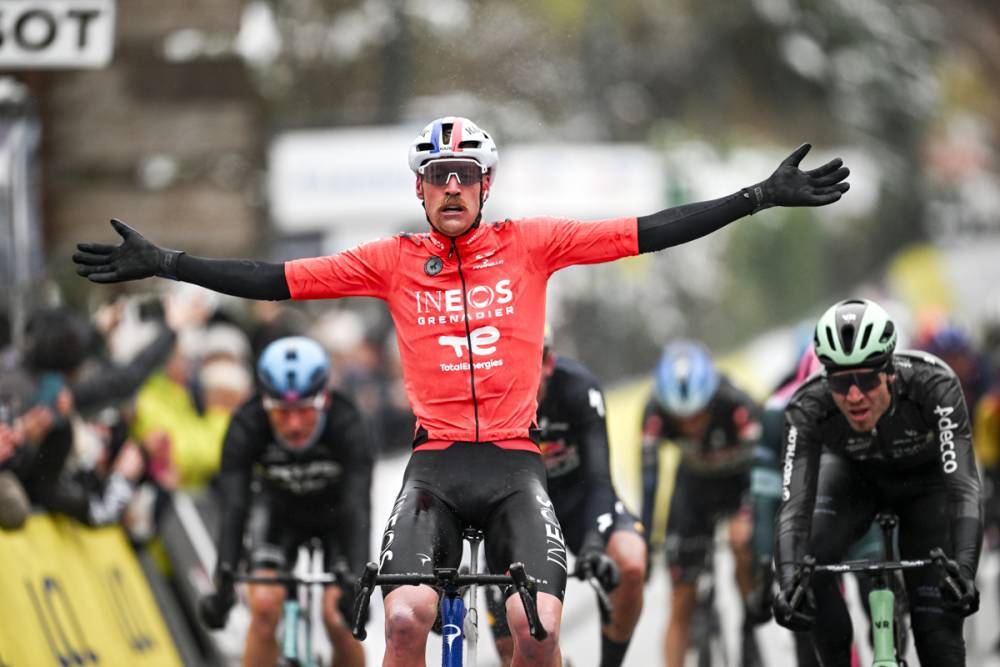
There were crashes. There are always crashes. The Ineos Grenadiers train absorbed the disruption and kept its formation, and in the final straight, with Carlos Rodríguez having driven forty kilometres of the stage and the rest of the team having contributed everything they had, Dorian Godon launched inside the final two hundred metres. The French national champion — unable, in the rain, to show the tricolor jersey that the title entitles him to wear — drove through the line ahead of Biniam Girmay of NSN and Cees Bol of Decathlon CMA CGM. His first victory with Ineos Grenadiers. His first win in Paris–Nice.
“I never thought I’d win a mountain stage on Paris-Nice,” Godon said, allowing himself the irony. “More seriously, I’ve been close all week long. We were really motivated today, with full focus, and it made the difference.” He described the collective performance with precise gratitude: “Carlos pulled for 40 kilometres, everyone led me out in crazy fashion. I was sitting on the sofa, and I just had to sprint for 30 seconds in the end. It was an amazing job from the guys.” He looked ahead to the final stage. “Tomorrow, I’ll give myself at 300% to help Kevin get on the podium.”
Marsman, standing on the podium of his first World Tour race after 35 kilometres alone against the collective patience of a peloton, found the register that the moment called for. “It’s my first World Tour race, so to be on the podium, with the names that are here — it’s really special. It’s a childhood dream.” He was clear about the arithmetic of his solo effort: “Just me against the peloton, it was really hard on these roads. But it was fun.”
Vingegaard had backed off at the right moment when the crashes came, and arrived at the finish unscathed and unmoved from the summit of the general classification. He kept his statement brief. “I think it’s very important to race. This is one of the biggest races in the world, but it was quite slippery in the end. I backed off at the right moment and made sure I wasn’t caught in a crash.” He permitted himself one forward-looking sentence: “I just hope that I can keep the jersey all the way to the end.”
Steinhauser, nineteen seconds clear of Vauquelin in the fight for the final podium, faced one more day. “Today was another special Paris-Nice day,” he said. “Tomorrow is gonna be super hard. I know it’s only 19 seconds to Vauquelin. My goal is to keep this advantage. Let’s see how it goes.”
Somewhere below them, in the Alpes-Maritimes valley, the rain was still falling. The Promenade des Anglais waited. Paris–Nice was heading home.
Sun King
MARCH 15, 2026 · STAGE 8 · ALLIANZ RIVIERA → ALLIANZ RIVIERA (NICE) · 129.2 KM
There is a particular cruelty in arriving at the finish of a great stage race as the rider who was almost good enough. Kévin Vauquelin had been chasing Georg Steinhauser’s nineteen seconds for a week, through the mountains of Burgundy, through Provence, through the shortened Alpine stage where the weather had rearranged everything. On the final day of the 84th edition of the Race to the Sun — a 129.2-kilometre loop from the Allianz Riviera stadium packed with 2,300 metres of climbing and three cat-1 ascents — Visma-Lease a Bike and Ineos Grenadiers rode the last stage of Paris-Nice 2026 as though it owed them both something. In the end, only Vingegaard collected.
The course was not designed for conservation. Three categorized climbs, the last of them the unprecedented Côte du Linguador — 3.3 kilometres at 8.8%, gradients to fourteen percent — placed inside the final twenty kilometres, with a further descent and drag to the line. The peloton, reduced by a week of attrition to its most resilient constituency, attacked from the opening kilometres. Fabio Van den Bossche, Benjamin Thomas, Matteo Trentin, Alexandre Delettre, and the increasingly irrepressible Tim Marsman got clear at kilometre nine. The peloton gave chase with intention: the gap never reached 1’15” at kilometre 21, and as the road tilted toward the Col de la Porte — the first cat-1 summit, at kilometre 50.7 — both the break and the peloton began to fracture under the pressure.
From the wreckage of the col, Valentin Paret-Peintre of Soudal Quick-Step emerged as the day’s most enterprising actor. Having bridged to the early attackers, he went again six kilometres from the summit and crested it 25 seconds ahead of Marc Soler, with the reduced peloton 45 seconds behind. He pressed on down the descent and into the valley, where Soler was caught by the bunch, and began the Côte de Châteauneuf-Villevieille — the second climb — with his advantage intact at 45 seconds. There are riders who exist to make races harder, and Paret-Peintre, who had already reached the finish at Colombier-le-Vieux in second place on stage five, was deploying that talent fully.
Ineos Grenadiers had their own agenda. With Vauquelin sitting nineteen seconds behind Steinhauser in the white jersey fight, they pushed the pace on the second ascent with the focused urgency of a team that has run the numbers and understands that the opportunity is narrowing. And then, on that same climb, the race’s cruelest moment arrived: Dani Martinez, second overall and riding with the controlled energy of a man who has kept his deficit to four minutes over seven stages, was taken down by a teammate. His crash wasn’t his fault. His injuries were real. He climbed back on his bike and began chasing 1’30” behind the men he needed to beat.
The peloton did not wait. Ineos drove through, and then Visma-Lease a Bike took over with 21 kilometres to go, Victor Campenaerts setting the brutal tempo that has been his contribution to Vingegaard’s victories all week, winding up the elastic until only one man could follow it to its natural conclusion. On the Côte du Linguador’s slopes, Campenaerts put everything into the lead-out and Vingegaard came off his wheel. One rider went with him: Lenny Martinez of Bahrain Victorious, the twenty-two-year-old Frenchman whose season had been building toward exactly this kind of moment.
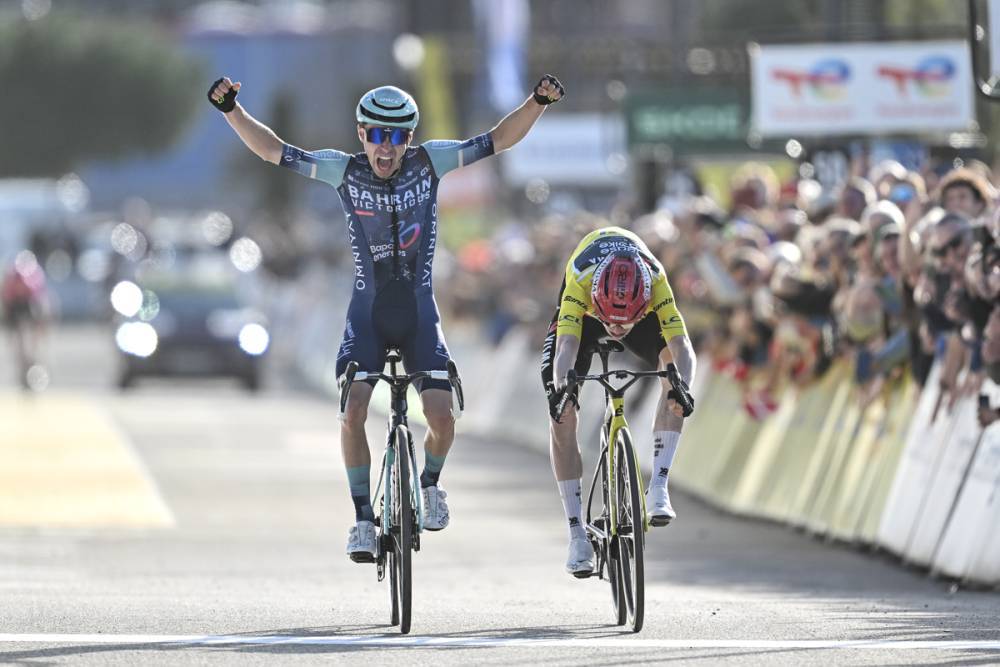
The two of them — the Dane who owns the Tour de France, the young Frenchman who may one day challenge for it — descended together and rode the final kilometres in the pragmatic alliance of men who each want second place to stay where it is. Into the final kilometre, neither moved. It was Martinez who blinked first, launching the sprint that Vingegaard answered but could not quite match. The Frenchman took the stage — the first French winner of a Paris-Nice final stage since Arthur Vichot in 2014. Behind them, Paret-Peintre had long since been caught, and the peloton was sorting its own hierarchy.
Steinhauser survived. The white jersey stayed on his shoulders. Vauquelin, who had felt superb through the first two climbs and then hit a wall on the Linguador’s steepest ramps, finished seventeen seconds adrift of the young German in the final standings, the gap between them widening to 17 seconds by Nice’s finish line. His Ineos Grenadiers team had won the TTT stage, had won stage seven through Godon, and had propelled Vauquelin to fourth overall — an excellent week by any measure that didn’t account for how close he’d been.
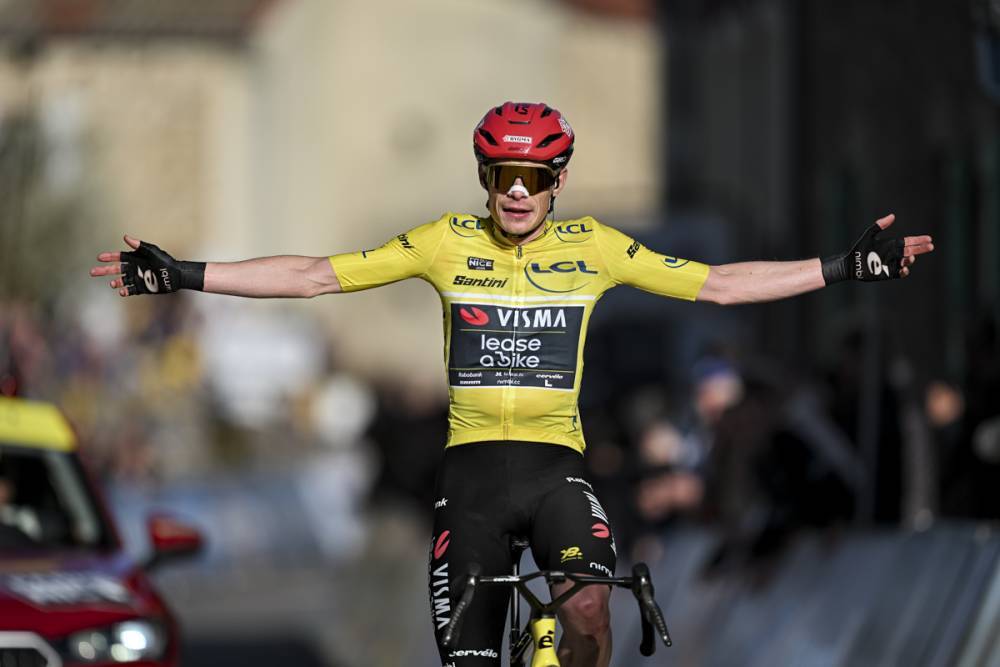
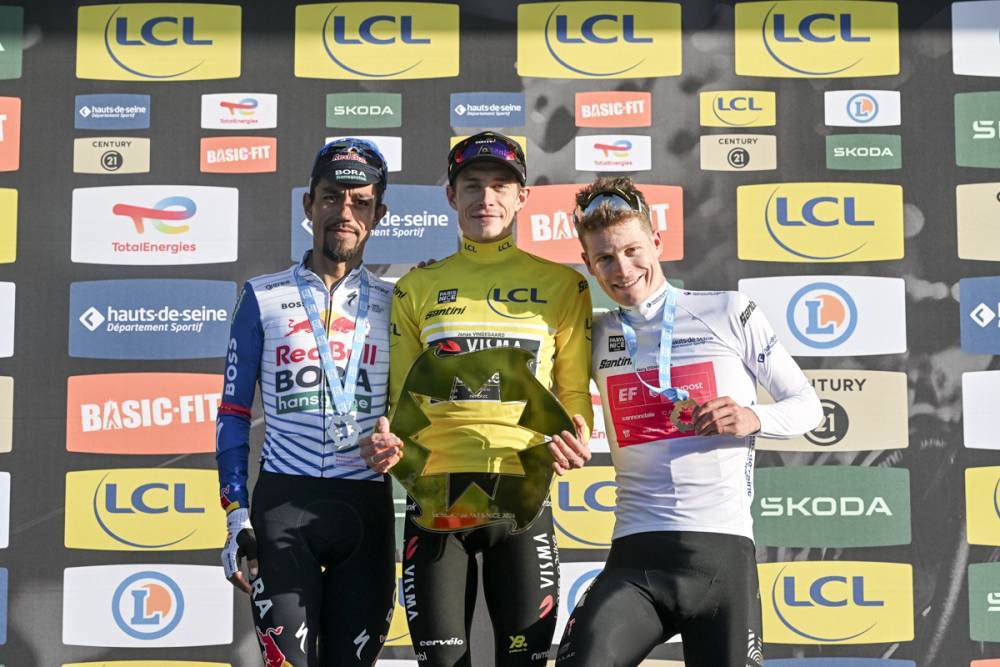
Vingegaard stood on the podium in Nice wearing three jerseys: yellow-and-white for the overall classification, green for the points standing, and polka-dot for the mountains classification. The margin over Dani Martinez — 4’23” — was the largest recorded between winner and runner-up at Paris-Nice since 1939, the fourth biggest gap in the race’s entire history. It was also his first Paris-Nice title, a race that had repeatedly refused to cooperate. Last year the crash. Previous editions, a stage win in a TTT but never the overall. “Actually, to win Paris-Nice means a lot to me,” he said, and the simplicity of it was striking from a rider who has two Tour de France victories to his name. “It was the one that I just couldn’t get right. Finally, I get it right. I’m extremely happy.”
He had spent the week in something close to a different register from the men around him. “It’s my first race of the year and I’m really happy with how we’ve raced all week. I’m definitely in a very very good shape. I still think I can improve for the upcoming races. Hopefully I can do that, especially for the Tour.” This was Paris-Nice as accelerant, not destination. The season’s real chapters were still to be written.
Lenny Martinez arrived at the interview area still processing what the week had been and what the final stage had meant. “I’ve been chasing a win since the start of the season,” he said. “Beating Jonas makes it even sweeter. My family are here too; I saw them on the screen. I couldn’t be happier.” He reconstructed the sprint’s interior drama with the vividness of recent experience. “When Jonas didn’t want to go ahead in the final kilometre, I thought to myself that it was a pity, but that’s the way it goes. I was a bit worried. When I saw the line, I thought: I’ve got to go for it, then I thought it was a bit far away… I saw a shadow closing in, I was really scared, but I didn’t give up and I’m very happy.” He found the week’s significance: “It’s different from last year; I’m much more consistent. And winning a stage at the end shows that I’m improving as the week goes on.”
Dani Martinez, who had finished on the podium of Paris-Nice despite abandoning his bike in pain somewhere on the penultimate climb’s slopes, found a particular kind of grace in the assessment. “This is cycling. Nothing is for sure until you cross the finish line. I had really good legs and everything was under control until the penultimate climb. My teammates were doing a spectacular job. I made a mistake, I went down, and it was quite a hard crash. But I got back up and kept pushing. The team did a fantastic job. They’ve been amazing all week long, including today, and this is a podium we achieved together.”
Steinhauser, who two weeks ago hadn’t been on the Paris-Nice roster and now stood on its final podium, allowed himself something approaching calm. “It’s an amazing feeling. To be honest, I always had on the back of my mind that Vauquelin was gonna overtake me. He’s super strong, but I grew confidence over the days.” He traced the final day’s tension: “I was still nervous ahead of today’s stage, with a gap of just 19 seconds. I just gave it my all, I had a good day, and I made it.” On the Linguador’s crucial passage: “I suffered, but I saw Vauquelin was struggling a little bit too. It was a relief for me.”
Vauquelin, fourth overall, found the balance between honest assessment and forward-looking resolve. “I felt great right up to the final climb, and I don’t know why, but when I really had to push myself to the limit, I hit a wall,” he said. “My body needs to accept that I’m not yet at 100% after spending so much time off the bike due to my injury this winter. I need to keep going down this path.” He counted what the team had achieved through the week — the TTT stage victory, Godon’s win in Isola, the consistent support of a squad that had dealt with Onley’s withdrawal and Rodríguez’s crash and kept racing: “We can be pleased with our week.” He looked ahead with the steady ambition of a rider who has understood something important about himself. “I really enjoy this leadership role; I like competing for the general classification and I feel I’m improving. I need to stay on this path and one day it will pay off.”
FINAL GENERAL CLASSIFICATION — PARIS–NICE 2026
84th Edition · March 8–15, 2026 · Overall winner: Jonas Vingegaard (Visma–Lease a Bike)
#
Rider
Team
Time / Gap
1
Jonas Vingegaard
Visma–Lease a Bike
25:25:11
2
Dani Martínez
Red Bull–Bora–Hansgrohe
+ 4:23
3
Georg Steinhauser
EF Education–EasyPost
+ 6:07
4
Kévin Vauquelin
Ineos Grenadiers
+ 6:24
5
Lenny Martinez
Bahrain Victorious
+ 7:31
6
Marc Soler
UAE Team Emirates–XRG
+ 9:09
7
Ion Izagirre
Cofidis
+ 9:19
8
Mathys Rondel
Tudor Pro Cycling Team
+ 10:23
9
Alex Baudin
EF Education–EasyPost
+ 10:33
10
Harold Tejada
XDS Astana Team
+ 11:40
Stage Wins: Lamperti (Stage 1), Kanter (Stage 2), Vauquelin/Ineos TTT (Stage 3), Vingegaard (Stages 4 & 5), Tejada (Stage 6), Godon (Stage 7), L. Martinez (Stage 8) · KOM & Points: Vingegaard · Best Young Rider: Steinhauser
By Shalina Chatlani — Cities and states are filing lawsuits and scrambling for alternative sources of money as the Trump administration seeks to shut off the federal funding spigot for biking and walking trails.
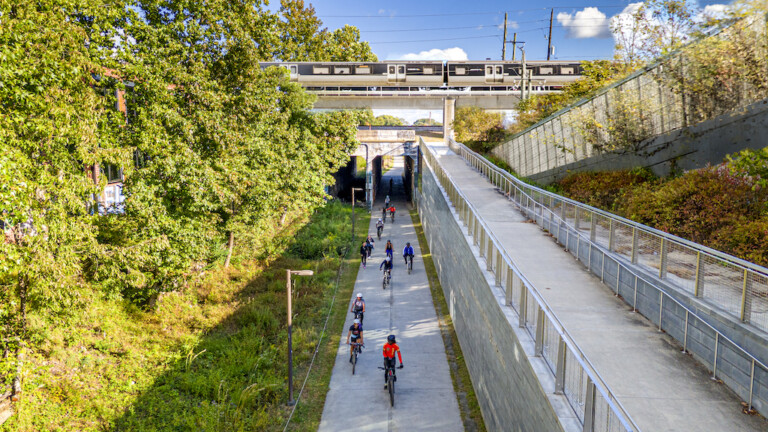
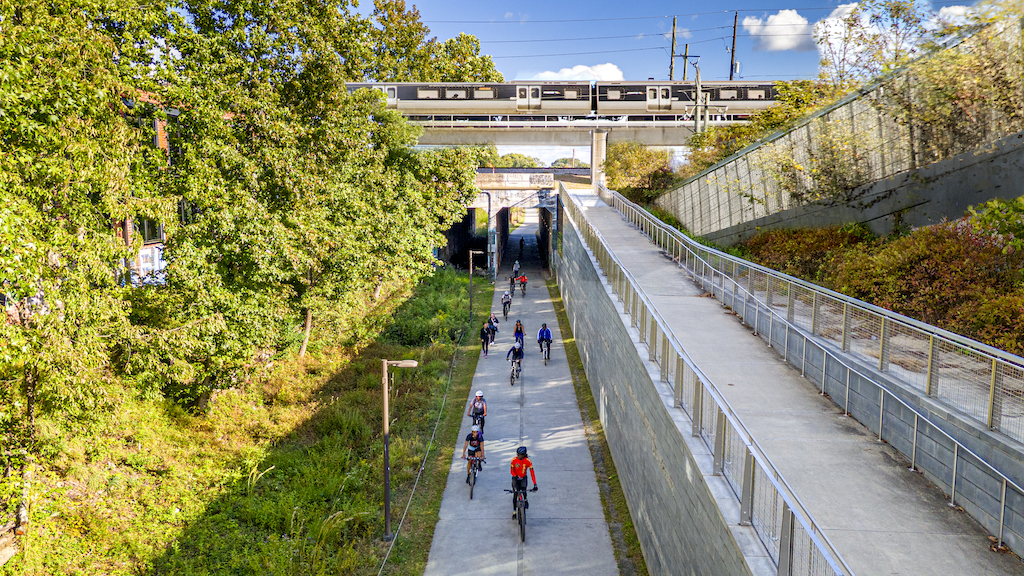
Atlanta Beltline’s Southwest Trail runs under MARTA heavy rail tracks. The Atlanta Regional Commission is continuing to work with local governments and other community partners to plan and develop the Flint River Gateway Trails network. Plans call for the Beltline to connect to the Flint River Gateway Trails. (Photo courtesy of Atlanta Regional Commission)
Since the early 1990s, there has been fairly consistent — and largely bipartisan — federal support for bicycle and pedestrian projects. Federal funding for such projects reached new heights during the Biden administration, as major spending measures in 2021 and 2022 included billions in new money for them.
But in his efforts to eliminate what he perceives as diversity, equity and inclusion initiatives — and to roll back anything associated with his predecessor — President Donald Trump has targeted hundreds of millions in federal grants for biking and pedestrian projects. And further cuts could be coming.
The broad tax and spending measure Trump signed last summer rescinded $2.4 billion from the Biden administration’s Neighborhood Access and Equity Program, money included in the 2022 Inflation Reduction Act to address long-standing safety issues stemming from past infrastructure projects, including interstate highways that split minority communities.
Of that total, at least $750 million was specifically earmarked for trails, walking paths and bike lane projects, according to data on grant recipients collected by Rails to Trails Conservancy, a nonprofit that advocates for trails and the construction of multiuse paths in abandoned railroad corridors.
Mark Treskon, a principal research associate at the nonprofit Urban Institute, said the administration seems to view bike and pedestrian trails as “a policy thing that people on the left like,” and is cutting funding as a “knee-jerk reaction” to former President Joe Biden’s policy priorities.
But Nate Sizemore, a spokesperson for the U.S. Department of Transportation, said the Trump administration is simply “getting back to basics” by “building the essential infrastructure needed to safely move people and commerce.”
“As grant programs become available for applicants, we will ensure that every taxpayer dollar is reinvested into rebuilding the roads and bridges our economy demands. … This decision reflects a significant shift away from the previous administration’s costly social and climate initiatives that deprioritized the needs of American drivers and increased congestion risks,” Sizemore wrote in an email.
Already reeling from the $750 million in cuts included in Trump’s One Big Beautiful Bill Act, cities and states that are counting on federal money for biking and pedestrian projects are worried about further cuts when Congress reauthorizes a broad transportation funding law that expires on Sept. 30. Biden’s 2021 infrastructure measure boosted the amount of money available for bike and pedestrian projects under that law.
“Everything is on the table, and there’s lots of risks to not only some of these grants that have been given under the last transportation bill … but it also implicates programs that are like the bread and butter of building trails, walking and biking infrastructure that have been around for many decades,” said Kevin Mills, vice president of policy at Rails to Trails Conservancy.
“We’ve heard warning signs from the administration, from leaders in Congress and from the heads of state transportation departments that they are looking to focus more on cars and less on active transportation, and sometimes less on transit as well.”
Seeking alternatives
In the aftermath of last year’s cuts and uncertainty over the future of federal funding, some states and cities have seen their projects completely stall, while others have found ways to move forward while decreasing their reliance on federal support.
In Connecticut, Rick Dunne, the executive director of the Naugatuck Valley Council of Governments, the federal metropolitan planning organization in that area of Connecticut, said the Trump administration pulled $5.7 million in funding to build around 9 miles on a 42-mile trail project known as the Naugatuck River Greenway Trail last September.
“It would have leveraged a whole bunch of state money and local dollars to build these sections,” Dunne said, noting that the council was hoping to use the federal funds to get matching dollars locally. “It would have advanced all of the activities on the trail and built major sections using other state, federal and local funding for construction.”
Dunne said Connecticut is limited in how it raises transportation funds because it doesn’t have counties.
“It’s either paid for by those small local towns, 10,000 to 20,000 people, or it’s paid for by the state,” Dunne said. “But once we lose the federal funding, then we start losing some of the state funding and local funding that would have matched it.”
Dunne said the council has not received any further communication from the U.S. Department of Transportation.
In Albuquerque, New Mexico, Terry Brunner, director of the city’s Metropolitan Redevelopment Agency, said the Trump administration last September pulled an $11.5 million grant to build part of a 7.5-mile pedestrian and bike lane around the city’s downtown.
The city decided to sue the administration in November to get those funds back, and the case is still wrapped up in court.
“We’re hoping we get a positive outcome on the lawsuit,” Brunner said. “We’ve also got a backup plan to ask for another federal funding source, or try to get funding from the state of New Mexico to the city of Albuquerque to complete the section, because we were about 90% done with the design of this trail.”
Brunner said Albuquerque has one of the highest pedestrian and cyclist death rates in the country, so getting people off the streets onto a safe trail is a priority for the city.
“I don’t think they’re going to stop us, but they’ll delay us,” he said, noting that the city is lucky because the state is offering funding and that the city budget may have some flexibility.
“Historically, we’ve always had a good partnership in Albuquerque with the federal government, and this is taking away a little bit of that shine and making us feel as if the federal government just really doesn’t care about Albuquerque.”
Projects in Republican-led states
The Trump administration also rescinded a $147 million grant for Jacksonville, Florida, to complete the 30-mile urban Emerald Trail.
Kay Ehas, CEO of Groundwork Jacksonville, the city’s nonprofit partner in building the Emerald Trail and restoring Hogans and McCoys creeks, says the group is continuing to work with the city “to identify funding to replace the federal grant that was rescinded last year.”
“We are enlisting the support of corporate and private donors to fund design, which keeps the project moving while we seek government dollars for construction,” Ehas told Stateline.
Meanwhile, in Georgia, the Atlanta Regional Commission is continuing to plan and develop Flint River Gateway Trails, said Josh Phillipson, principal program specialist at ARC. The 31-mile network of bike and pedestrian paths would connect communities along the Flint River in the southern portion of the metro Atlanta area. The commission tapped into the area’s annual allocation of federal transportation funding to cover the cost of the $1.5 million master planning effort, which includes a 20% local match from ARC, despite losing a $65 million federal grant.
“We are not doing anything on the construction because we don’t have those dollars at this point,” Phillipson said. “We’re stepping back a little bit more into our traditional role of doing the long-range planning, but we’re going to be sticking with this project, committed for the next few years.”
Mills, of Rails to Trails Conservancy, lamented the loss of the Neighborhood Access and Equity grants, which would have helped areas “where historic transportation investments had split communities in two,” cutting off residents from economic opportunities and their neighbors.
In Atlanta, for example, Phillipson said the trails project was meant to “bridge over core infrastructure decisions of the last century that were overwhelmingly impacting more diverse communities,” making it “difficult now to walk or ride a bike between two adjacent communities.”
Treskon, of the Urban Institute, said cities and states will be hard-pressed to replace all the federal money they lost.
“It’s a pretty big hit across the board for the places that had built that into their financial plans,” he said.
Stateline reporter Shalina Chatlani can be reached at [email protected].
Editor’s note: This article has been updated to correct the amount the Atlanta Regional Commission needed for its master planning effort and the source of the funding.
This story was originally produced by Stateline, which is part of States Newsroom, a nonprofit news network which includes Idaho Capital Sun, and is supported by grants and a coalition of donors as a 501c(3) public charity.
BAKER CITY, Oregon (March 14, 2026) — The Baker City Cycling Classic returns to eastern Oregon June 26–28, 2026, bringing three days and four stages of road racing back to one of the Pacific Northwest’s most scenic—and demanding—stage race venues.
The race combines two challenging road races, an individual time trial, and a fast downtown criterium in Baker City, creating a balanced test of endurance, strategy, and speed.
Baker City Cycling Classic 2025. Photo by Sean Benesh
Race director Brian Cimmiyotti says the event has built its reputation by keeping the focus squarely on the racing.
“For teams looking to build real stage race depth, Baker City offers something different,” Cimmiyotti said. “We don’t rely on spectacle. We rely on stages that expose weaknesses and reward durability. Over three days, the strongest riders rise.”
Baker City Cycling Classic 2025. Photo by Sean Benesh
A proving ground for developing talent
Over the years, the Baker City Cycling Classic has served as a developmental stepping stone for elite riders. Past overall winners include Sepp Kuss, Tayler Wiles, Brianna Walle, and Cameron Jones.
Unlike one-day races, stage racing requires riders to manage effort across multiple disciplines while navigating team tactics, recovery, and varied terrain.
“Our simple formula has always been the same,” Cimmiyotti said. “Three days. Four stages. No soft stages. The courses speak for themselves.”
Baker City Cycling Classic 2025. Photo by Sean Benesh
The 2026 stages
The 2026 edition will maintain its established format:
Stage 1 & Stage 4 — Road Races Two challenging road stages featuring sections of the Elkhorn Drive Scenic Byway and the Grand Tour Route, with big views and serious climbing.
Stage 2 — Individual Time Trial A flat, power-focused test where aerodynamics and pacing often begin shaping the general classification.
Stage 3 — Downtown Criterium A fast, technical circuit through historic downtown Baker City that brings spectators close to the action.
Together, the stages create a well-rounded general classification contest while giving domestic teams a true stage-race experience without the travel demands of larger national series events.
A race rooted in the community
The event has long been woven into the fabric of Baker City, drawing riders and spectators to the historic downtown and providing a boost for local businesses and hospitality.
“This race belongs to the town,” Cimmiyotti said. “Baker City shows up for it. That partnership is part of what makes the event sustainable year after year.”
Event details
Baker City Cycling Classic June 26–28, 2026 Baker City, Oregon
Three days and four stages of racing in eastern Oregon featuring more than 8,000 feet of climbing across the weekend. Professional and amateur riders compete on the same courses, and men’s and women’s prize purses are matched by sponsor BELLA Main St. Market.
HUNTINGTON, Utah (March 13, 2026) — The 40th Annual MECCA Mountain Bike Festival will take place May 1–3, 2026, in Huntington, Utah, bringing riders together for a weekend of mountain biking, community, and outdoor adventure in the scenic San Rafael Swell. The event is organized by the MECCA Mountain Bike Club.
Scenes from the Bike the Swell Mountain Bike Festival. Photo courtesy MECCA Bike Club
Hosted annually by the club, the festival is designed to welcome riders of all experience levels—from beginners and recreational cyclists to seasoned mountain bikers. Participants will explore a variety of routes across the Swell, including the new single-track course near Joe’s Valley Reservoir and the recently developed Swell Retreat Loop. Each ride highlights the dramatic desert landscapes and unique geology that make the region a premier destination for outdoor recreation.
According to the club’s website, the festival has long been built around inclusivity and camaraderie, offering guided rides that range from novice-friendly outings to challenging advanced routes. Volunteers and club members guide participants through unfamiliar terrain, while support vehicles and on-site mechanical assistance help ensure a safe and enjoyable riding experience.
Scenes from the Bike the Swell Mountain Bike Festival. Photo courtesy MECCA Bike Club
This year’s festival headquarters and camping will be located at the Buckhorn RV Park and Resort, where riders will gather after each day on the trails for food, entertainment, and social activities.
Festival registration includes:
A commemorative long-sleeve event T-shirt
A swag-filled backpack
Catered meals throughout the weekend
Entertainment and evening activities
Entry into the grand prize drawings
Prizes for the 2026 festival include two brand-new adult mountain bikes donated by Altitude Cycle, a premium hydration pack, and a variety of other gear and outdoor prizes.
Evening festivities will feature catered dinners, a cornhole tournament, bingo, line dancing, and live music, creating opportunities for participants to connect with fellow riders from across Utah, Colorado, California, and beyond.
The MECCA Mountain Bike Festival has become a signature event for the region, bringing together outdoor enthusiasts who share a passion for mountain biking and the remarkable landscapes of Castle Country. The MECCA Mountain Bike Club is a nonprofit organization dedicated to promoting bicycling—particularly mountain biking—and fostering a welcoming community for riders of all ages and abilities.
Early registration for the 2026 festival ends April 18, 2026. Riders are encouraged to register early to secure their spot for this landmark anniversary celebration.
For more information about the festival, registration details, or the MECCA Mountain Bike Club, visit: biketheswell.org
MISSOULA, Montana (March 10, 2026) — A new cross-country bikepacking route stretching more than 3,800 miles will debut in 2026 as part of the 50th anniversary celebration of the Adventure Cycling Association.
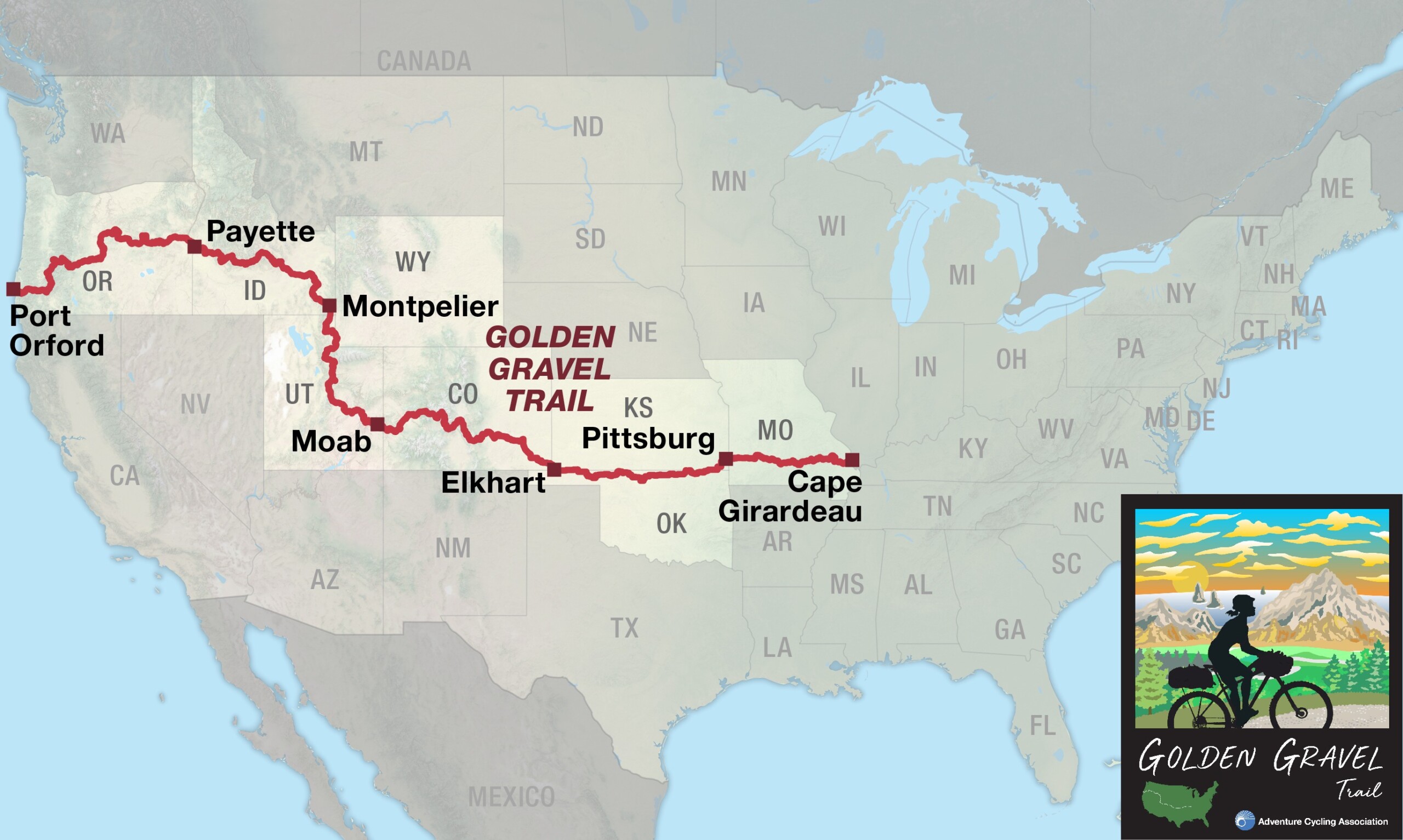
Golden Gravel Trail. Map courtesy of Adventure Cycling Association
Called the Golden Gravel Trail, the 3,804-mile mixed-surface route runs from the Mississippi River to the Pacific Ocean and crosses eight states: Missouri, Kansas, Oklahoma, Colorado, Utah, Wyoming, Idaho, and Oregon. About 65 percent of the route follows unpaved roads, reflecting the growing interest in gravel riding and backcountry bikepacking.
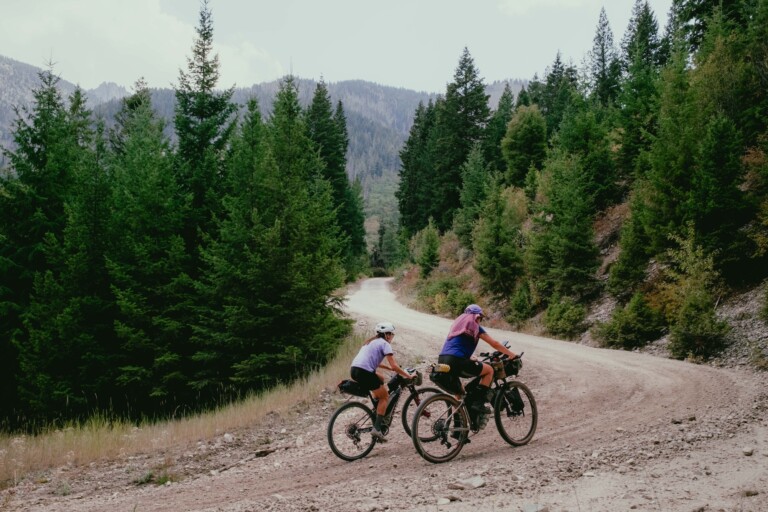
Oregon. Photo by Jeremy Nolan, courtesy of Adventure Cycling Association
Adventure Cycling officials say the route showcases a wide cross-section of American landscapes while emphasizing quieter roads and remote travel. Riders will pass through rolling Ozark hills, the open Great Plains, deserts of the interior West, and challenging alpine passes before reaching the Pacific coast.
“For five decades, Adventure Cycling has been inspiring people to travel by bicycle, and the Golden Gravel Trail represents our vision for the next 50 years,” said routes director Jeffrey Mizell. “This route honors our legacy while embracing the evolution of bicycle touring and the growing bikepacking community.”
Idaho_Golden Gravel Route Research_2025
Built on a legacy of bicycle travel
Adventure Cycling was founded in 1976 when approximately 4,000 cyclists rode across the United States during the Bikecentennial, a coast-to-coast event celebrating the country’s bicentennial. That ride helped establish the original TransAmerica Trail, which later became the backbone of what is now a 57,298-mile national network of bicycle touring routes.
Idaho_Golden Gravel Route Research_2025
Today the organization maps and maintains the Adventure Cycling Route Network, publishes Adventure Cyclist magazine, leads guided tours, and advocates for safer cycling infrastructure across the United States.
The Golden Gravel Trail represents the next step in that evolution, combining the organization’s route-development experience with the growing popularity of off-pavement touring.
Early excitement for the anniversary route
The new route is one of several initiatives marking Adventure Cycling’s 50th anniversary in 2026. Through the organization’s Drop-in Rides program, cyclists can ride portions—or the entirety—of major Adventure Cycling routes at their own pace during the anniversary year.
Utah. Photo by Carl Gable, courtesy of Adventure Cycling Association
Those routes include the classic TransAmerica Trail, the Great Divide Mountain Bike Route, and the new Golden Gravel Trail.
The program has already drawn strong participation. Nearly 800 rides have been registered for 2026, with roughly one-third of those riders planning to tackle sections of the Golden Gravel Trail.
Utah. Photo by Carl Gable, courtesy of Adventure Cycling Association
“The response to our 50th anniversary initiatives has been extraordinary,” said Routes and Advocacy Coordinator Ellie Zachary. “Nearly 800 rides have already been registered with us in 2026, and the strong early interest in the Golden Gravel Trail proves that our community is excited not only to celebrate our history, but to help build what comes next.”
Among those planning to ride the route are Canadian adventure cyclists Ali Becker and Mat Leblanc, who together have logged more than 60,000 miles of bike travel and often seek out newly launched long-distance routes. The pair plan to ride both the Great Divide Mountain Bike Route and sections of the Golden Gravel Trail this summer as Drop-in Rides.
Colorado. Photo by Nat Cobb, courtesy of Adventure Cycling Association
Route development and testing
Development of the Golden Gravel Trail involved extensive research and partnerships. The concept was partly inspired by an off-road route known as the Trans America Trail, a rugged 5,000-mile dirt route originally designed for motorcycles and other off-road vehicles.
Adventure cyclist Sarah Swallow helped validate portions of the new bicycle route. Swallow rode approximately 1,800 miles of the Golden Gravel Trail in 38 days during the fall of 2025, documenting her experience along the way.
“The Golden Gravel Trail represents a new chapter in American bike touring,” Swallow said. “It blends the spirit of classic cross-country routes with the growing desire for dirt, quiet roads, and immersive travel. I believe it will inspire more people to explore by bike and to see the country from a different perspective.”
Missouri_50th Anniversary Route Research_2025
Free access for riders
In recognition of its 50th anniversary, Adventure Cycling will make the Golden Gravel Trail available free to riders. The digital route will include detailed route lines, service listings, and up-to-date information about riding conditions and weather.
Cyclists can also register free Drop-in Rides along any segment of the route throughout 2026, receiving route information, planning support, and help connecting with other riders along the way.
“Just $18 builds one mile of route,” said Maxton Caplanides, Adventure Cycling’s vice president of community engagement. “And thanks to our donors, we can get this route in the hands of riders everywhere.”
More information about the Golden Gravel Trail and Adventure Cycling’s 50th-anniversary rides is available at adventurecycling.org.
SALT LAKE CITY, Utah (March 12, 2026) — The Utah Cycling Association (UCA) announced the launch of its 2026 Grand Championship Points Series (GCPS), a season-long, age-group based championship spanning USA Cycling sanctioned events throughout the UCA’s region.
Winner! Action in the Sugar House Criterium. Photo by Dave Iltis
The GCPS rewards consistency and multi-discipline participation across both asphalt and dirt racing, including road, criterium, time trial, hill climb, mountain bike, gravel, cyclocross, BMX, and IMCC collegiate competition.
Points are awarded by age group only, based on finishing position and field size. UCA Championship events carry double points, and athletes must complete a minimum of four eligible events to qualify.
To encourage cross-discipline engagement, the series includes:
A 50-point bonus for competing in both asphalt and dirt disciplines
Discipline bonuses of 20 points per additional discipline (up to 100 points)
NICA integration, allowing up to two Utah High School MTB League races to count toward participation requirements
The 2026 GCPS is designed to strengthen long-term athlete development while creating a clear, season-long competitive objective across Utah, Southeastern Idaho, and Western Wyoming.
Two of California’s Top Cycling Events Join Forces with a Third
Riders can participate in three renowned events across California over three months.
Big Bear Lake, California (March 12, 2026) – Tour de Big Bear and Mammoth Gran Fondo today announced the 2026 expansion of their California Pass Challenge (CalPass Challenge). Alongside the two alpine cycling events, Phil’s Cookie Fondo in Malibu will add a coastal twist to this California cycling trifecta.
The leading group at the Mammoth Gran Fondo. Photo by Captivating Photos
“We’re excited to include Phil’s Cookie Fondo in the CalPass lineup,” said Phil Gaimon, former professional cyclist and event organizer. “Joining forces with Tour de Big Bear and Mammoth Gran Fondo allows us to offer riders an exceptional challenge across California’s diverse settings. Our Malibu Fondo will deliver the coastal riding that people love. And with us being the final event in the series—10,000 gourmet cookies are a sweet reward.”
Beyond personal achievement, each event supports charitable causes, promoting a broad community impact. Participants will enjoy numerous perks, including commemorative medals, limited-edition jerseys, and VIP experiences. The journey includes the following:
Tour de Big Bear (July 31 – August 2, 2026) – A high-altitude adventure at Big Bear Lake. Participants can select from mountain bike races, gravel rides, or Gran Fondo events suitable for all skill levels. The event is known for its renowned aid stations and vibrant festival activities at Bear Mountain Resort.
2025 Top 10 Gran Fondo in the US, Gran Fondo Guide
2025 Best Gravel Ride, Gravel Rides California
Location: Big Bear Lake, CA, 6,752’ elevation
Events: 9 | Gran Fondo / Gravel / XC Mountain Bike
Distances: 25 – 100 miles
Scenes from the Tour de Big Bear. Photo courtesy Tour de Big Bear
Mammoth Gran Fondo (September 12, 2026) – Gran, Medio, and Piccolo riders will experience the dramatic beauty of the High Sierra with 75 miles of closed-course riding and ample rider support, all while supporting local community programs.
2024 Top 10 Gran Fondo in the US, Gran Fondo Guide
Location: Mammoth Lakes, CA 8,075’ elevation
Events: 3 | Gran Fondo
Distances: 42 – 102 miles
Phil’s Cookie Fondo (October 24-25, 2026) – Tackle the challenging yet rewarding terrain of Malibu, complete with delectable cookie-themed aid stations (10,000 cookies on course) and a gourmet post-ride feast.
2025 Top 10 Gran Fondo in US, Gran Fondo Guide
Location: Malibu, CA 105’ elevation
Events: 7 | Gran Fondo
Distances: 20 – 100 miles
Cookies at Phil’s Cookie Fondo. Photo courtesy Phil’s Cookie FondoScenes from Phil’s Cookie Fondo. Photo courtesy Phil’s Cookie Fondo
Discounted registration for the combined three event series is open and must be finalized by July 27th, 2026. Event organizers currently have an excellent incentive program underway, those who register before the end of March are entered into a giveaway for a complimentary pass for a friend, with three winners to be selected.
MADRAS, Oregon (March 5, 2026) — Cross-country mountain bike racing returns to the high desert this spring as the Madras MTB Race rolls back into Central Oregon on April 4. Organized by Zone 5 Promotions, the event highlights the rapidly growing Madras East Hills Trail System while continuing the legacy of one of the region’s longtime off-road races.
The race takes place on the expanding network of trails in the hills east of Madras, where riders will encounter fast singletrack, punchy climbs, and wide-open views of the Cascade Range. Known for its dry conditions early in the season, the high-desert terrain has become an increasingly popular destination for mountain bikers looking to start their race calendar before many mountain trails elsewhere have melted out.
Scenes from the 2025 Bonecrusher. Photo by Sean Benesh
The Madras MTB Race follows a classic cross-country format designed to reward strong climbing, efficient pacing, and careful line choice. Competitors will ride a course that mixes rolling terrain with purpose-built singletrack, showcasing the character of Central Oregon riding—flowing trails punctuated by short, sharp efforts and open stretches of rugged landscape.
Scenes from the 2025 Bonecrusher. Photo by Sean Benesh
The event traces its roots to the former Bonecrusher race, which built a reputation for tough racing and demanding terrain. While the event now carries a new name, organizers say the spirit of the original race remains intact. At the same time, the updated Madras MTB Race highlights the significant trail development that has taken place in the area over the past several years.
Scenes from the 2025 Bonecrusher. Photo by Sean Benesh
Local riders, volunteers, and trail advocates have steadily expanded the Madras East Hills Trail System, transforming the hills above town into one of Central Oregon’s emerging mountain bike destinations. The growing network now offers a variety of riding options, from fast flow trails to more technical sections, making it well-suited for cross-country competition.
Scenes from the 2025 Bonecrusher. Photo by Sean Benesh
Race organizers expect a range of participants, from experienced mountain bike racers chasing early-season fitness to newer riders eager to test themselves on a well-designed XC course. Junior categories are also part of the event, reflecting the continued growth of youth mountain biking programs throughout Oregon and the Pacific Northwest.
Beyond the race itself, the event offers riders an opportunity to explore Madras and the surrounding high-desert landscape. With expansive views, a dry climate, and steadily expanding trail infrastructure, the region continues to attract cyclists from across the state and beyond.
Registration for the Madras MTB Race is currently open, with early pricing available ahead of race day.
[Editor’s Note: With Tadej Pogačar winning his first race of the season at this past weekend’s Strade Bianche, it seems appropriate to have a look back at his 2025.]
By Dave Campbell — Most cycling historians have long held Eddy Merckx’s amazing 1972 season as the greatest single year of performance in Professional cycling. Slovenian Tadej Pogačar clearly achieved similar heights this year. In my mind, 1972 and 2025 represent the two greatest seasons in the history of Professional cycling.
To be clear, ranking cycling accomplishments from different eras remains a fool’s errand. So many aspects of our sport have changed. Riders in Merckx’s era raced more often but faced a much smaller and less international peloton. Equipment, nutrition, and training methodology have vastly improved, and premier events now enjoy much higher levels of support and organization. While both riders competed in the Monuments and Grand Tours, other important events like the Montjuich hill climb and Baracchi Trophy have disappeared, and newer races such as Strade Bianche now command high esteem. Nonetheless, analyzing what both men achieved in their respective eras proves not just interesting but informative. The parallels and similarities strike me as quite remarkable. I make no claims about which rider achieved more, simply laying out the statistics for readers to judge (or not) as they will.
Eddy Merckx in possibly the 1972 Tour de France. The bike graphics are similar to those of his 1972 hour record ride. Photo by Cor Vos
Both riders began racing in February wearing the rainbow stripes of defending World Champion and would turn twenty-seven during their respective monster seasons. Tadej began winning almost immediately, taking stages three and seven enroute to the overall win at the UAE Tour to launch his season of immortality. Eddy, on the other hand, opened with the Trofeo Laigueglia one-day race in Italy, finishing third, then rode the Tour of Sardegna, notching three top-ten stage results but finishing just 33rd overall. Het Volk saw him finish third again, with his first win coming on his eighth day of racing at the prologue of Paris-Nice, where he would win two more stages enroute to second overall. In very non-Merckx-like fashion, he lost the leader’s jersey on the final time trial. Pogačar, in contrast, won his next race, the “new classic” Strade Bianche over the white gravel roads of Tuscany.
Thus, Pogi began Classics season with four victories under his belt while the Cannibal had three. However, Merckx won Milan-San Remo for the fifth time in dominating fashion while Pogačar’s constant attacks could not dislodge Mathieu Van der Poel, undoubtedly the finest Classics rider of his generation, leaving him second. Merckx, for his part, distanced Roger DeVlaeminck, one of only three cyclists in history who claimed all five monuments.
Pogačar tackled Flanders next, indicative of the modern approach of racing less and targeting the biggest events. He triumphed decisively while Merckx managed only seventh. The Belgian, in contrast, had first tackled three prior semi-classics, earning two second places and winning Brabantse Pijl. The Cannibal then notched third in the (then) mid-week Ghent-Wevelgem before finishing seventh in Paris-Roubaix. Pogi skipped Ghent but achieved a fine second in his debut at the “Hell of the North”. All-time greats DeVlaeminck and Van der Poel defeated both riders, respectively. Both riders dominated in the Ardennes, winning Flèche Wallonne and Liège-Bastogne-Liège. Tadej finished a close second at Amstel Gold whereas Eddy missed the Dutch Classic but notched a second place at the now-extinct German Classic Henninger-Turm. Both riders won two monuments in their spring campaigns and stood equal on victories with seven at the conclusion of the spring classics.
At this point the differing approaches of each era become most clear as Pogačar took a six-week hiatus from competition while Merckx never went a week without racing and notched another win (GP Momignies) before tackling the Giro d’Italia. The Cannibal tore through the Italian Grand Tour, claiming four stages and wearing the leader’s jersey from stage seven to the finish in Milan in mid-June. Pogačar resumed racing in mid-June, and he picked up where he left off, winning the first stage of the Dauphine in France. After claiming two more stages, he won the race overall as well as the Points Classification.
Merckx took a rare two weeks away from racing after the Giro but then finished second in his National Championship prior to starting the Tour de France the following week. Pogačar, in contrast, had no more racing prior to his attempt at a fourth Tour win. Eddy faced a field of 132 riders in 1972 from nine different nations as he also chased his fourth Tour victory. Pogačar, in contrast, competed against 184 riders from twenty-seven different countries, highlighting the growth and globalization of the sport.
Merckx won the Tour’s opening prologue, and his Molteni squad claimed the Team Time Trial. Five more stages went his way enroute to overall victory, the points jersey, and a staggering seventeen days in the yellow jersey. Pogačar proved not quite as dominant, claiming four stages, notching thirteen days in yellow, and claiming the mountains jersey in addition to the overall title. 88 riders—66.7% of the starters—finished the 1972 Tour de France, which covered 3,846 kilometers. In 2025, in contrast, 87.0% of the starters made it to Paris after 3,302 kilometers of racing.
Whereas Pogačar, very vocal about his fatigue, took six weeks away from racing, Merckx won the Scheldeprijs a week after finishing the Tour and finished fourth in his World title defense the following week. In the final eight weeks of the season, he claimed a staggering twelve victories including every stage and the overall of the now-defunct Montjuich hill climb in Spain and the À travers Lausanne stage races. He won two Italian semi-classics (Giro del Piemonte and Giro dell’Emilia) before winning his third monument of the season with Il Lombardia and taking the Trofeo Baracchi two-man time trial with Roger Swerts. Capitalizing on his great form, he then set the Hour Record at the end of the season!
Tadej Pogacar in the Grand Prix Cycliste de Montréal 2025. Photo by Dave Iltis
Pogačar returned to racing after the Tour at the two Canadian Grand Prix events which didn’t exist in Merckx’s day. He finished 29th in Quebec but then second in Montreal, after gifting the win to his teammate Brandon McNulty in a dominating performance. He appeared off his game with fourth at the World Championship time trial but rebounded with a performance for the ages, defending his title in the road race with an epic escape. Three more races to finish the year yielded three more wins at the European Road Championships, Tre Valle Varesine, and his third monument at Il Lombardia.
Despite some marked differences, many similarities emerge. Both riders claimed three monuments and won both Ardennes Classics. Both men won the Tour de France while taking an additional category (Points for Merckx and Mountains for Pogačar) as well as multiple stages (six for Eddy and four for Tadej). The second major stage race of the year differs notably—Merckx won the Giro while Pogačar took the Dauphine. Eddy wore the leader’s jersey on a staggering 32 of 43 days (74.4%) raced in the four stage races he won, while Tadej led 23 of the 36 (63.9%) days he raced in the three stage races he won. Pogačar went three for three on the stage races he contested while Merckx took four out of six.
The most striking result of this analysis remains the remarkable similarity between each rider’s win rate. Pogačar raced less, only fifty times, but won twenty races, achieving a stunning success rate of 40%. Merckx raced much more, notching eighty days of competition, but by winning thirty-four times, he won an astounding 42.5% of the time he raced. Adequate superlatives simply don’t exist for the staggering accomplishments of these two great champions. Just winning the events they claimed in ONE season would make for an outstanding career for a more mortal rider. Since I was too young to follow Eddy Merckx’s career, I feel grateful to have gotten to follow probably the only other rider at that caliber throughout an entire season of excellence. Chapeau to both campionissimos!
HURRICANE, Utah (March 10, 2026) — Riders from across the region are invited to dust off their bikes and mark their calendars for the 15th Annual Hurricane Mountain Bike Festival, taking place March 27–28, 2026, at the scenic campground at Quail Creek State Park. Set against the dramatic red-rock mesas and sweeping vistas near Zion National Park, the festival brings together mountain bikers for a weekend of riding, learning, and celebrating the sport in one of the Southwest’s premier trail destinations.
Scenes from the Hurricane Mountain Bike Festival. Photo by MiguelSantanaPhotography
A longtime spring tradition for riders, the festival blends world-class singletrack access with a lively community atmosphere. Attendees can expect group rides, music, games, giveaways, free swag, and an exhibitor expo—all designed to bring riders together around their shared love of mountain biking.
For 2026, festival organizers are placing a renewed emphasis on community, connection, and progression, encouraging riders of all backgrounds—from first-time trail riders to seasoned veterans—to take part in the weekend’s activities.
Rides:
The festival features group rides each day. Rides will take place on Friday and Saturday and feature choices like Gooseberry Mesa, JEM Trail, and Guacamole (weather and trail condition dependent). Shuttles are there to take you to the Mesa.
Skills Clinics Designed to Build Confidence on the Trail
One of the highlights of the festival is its lineup of small-group skills clinics, designed to help riders build confidence on Hurricane’s unique terrain. Clinics focus on foundational technique and skill progression so participants can make the most of the region’s renowned technical trails.
Sessions include:
· Fundamentals of Technical Riding – Covering body positioning, line choice, shifting, energy management, and strategies for navigating rocky terrain, switchbacks, and technical descents.
· Drops & Jumps Clinic – Teaching the fundamentals of safely approaching drops and jumps through structured progressions, including body positioning, suspension setup, and landing techniques.
· Turns & Corners Clinic – Helping riders confidently tackle tight turns, switchbacks, and high-speed corners with proper technique and control.
Clinics are typically recommended for intermediate riders and are conducted in controlled environments that allow participants to practice skills and drills they can take back to the trail. Small group sizes ensure individualized instruction and one-on-one coaching time.
Importantly, the clinics are inclusive of both traditional mountain bikes and e-bikes, reflecting the festival’s welcoming approach to riders across disciplines.
The festival has become a vibrant meeting point where the riding community come together.
Scenes from the Hurricane Mountain Bike Festival. Photo by John Shafer
Riding for a Cause
Beyond the trails and festivities, the Hurricane Mountain Bike Festival also supports meaningful causes. Festival registration helps sustain and improve local trail systems through the Trails Alliance of Southern Utah (TASU), which works to build, maintain, and advocate for responsible trail access throughout the region.
In addition, festival proceeds help support the humanitarian work of Free Burma Rangers, a relief organization that provides medical care, aid, and assistance to vulnerable communities in conflict zones around the world.
By participating in the festival, riders are not only enjoying some of the best trails in Southern Utah—they are also contributing to efforts that strengthen both local outdoor recreation and global humanitarian relief.
Packages, Camping, and Festival Experience
Festival registration offers several participation options, including a VIP package that includes reserved on-site camping, access to demo bikes, a private shuttle day to the mesas, and festival meals. Additional packages allow riders to tailor their experience with options such as camping at the venue and local rides.
For those looking to fully immerse themselves in the weekend, camping at the festival site allows riders to stay close to the action and enjoy evening gatherings, food, and festivities after a full day on the trails.
A Celebration of Riding in Southern Utah
With iconic landscapes, world-class trails, and a welcoming festival atmosphere, the Hurricane Mountain Bike Festival continues to grow as a signature spring event for riders across the Southwest. Whether participants come to improve their skills, try new gear, or simply enjoy the camaraderie of the riding community, the festival promises an unforgettable weekend on and off the trail.
For registration, schedules, and additional details, visit:
Event location and camping info: Quail Creek State Park RV Campground (472 5300 W, Hurricane, UT 84737)
Event info: March 27-28, 2026 — Hurricane Mountain Bike Festival, Hurricane, UT, Ride with us on world-class singletrack at the foothills of Zion National Park. Join us for 2 days of bike festival shenanigans, festival with great food and shopping, bike shuttles, skills clinics, dinner, prizes and more!, DJ Morisette, 435-635-5455, [email protected], hurricanemtbfestival.com, otesports.com
Russell Finsterwald chased for 95 miles, caught Andrew L’Esperance on the final climb, and edged him in the closest finish in BWR history. Haley Batten rode away to win by 13 minutes in scorching desert heat.
SCOTTSDALE, Arizona (February 28, 2026) — The 2026 Belgian Waffle Ride Arizona delivered one of the most dramatic finishes in the event’s history on Saturday, as Russell Finsterwald overhauled long-time leader Andrew L’Esperance in the final 200 meters to win by half a wheel in a lung-searing sprint. In the women’s race, Olympic silver medalist Haley Batten turned the 100-mile gravel test into a solo exhibition, crossing the line 13 minutes clear of the field.
The race unfolded under the hottest conditions in BWR Arizona history, with temperatures reaching 88°F, a fact that shaped everything about the day’s tactical dynamics and turned the McDowell Mountain Park course into a crucible of attrition. More than 600 riders started; many did not finish.
Men’s Race: L’Esperance Lights the Fuse Early
Andrew L’Esperance dispensed with the usual opening pleasantries. Just five miles into the race, he and Chase Wark launched off the front, and the Canadian quickly established himself as the stronger of the two. L’Esperance dropped Wark on a long singletrack section and pressed on alone, building an advantage that stretched beyond four minutes at its peak. It was the kind of move that either looks like genius or folly, and for most of the day, it looked like genius.
Behind, the peloton fractured under the desert heat. Finsterwald found himself in a committed chase group of four riders, and they set about the long, grinding work of bringing the gap down. The math was simple; the execution was not. L’Esperance rode with purpose at the front, pressing the advantage through the technical singletrack sections and fast gravel straightaways that define the BWR Arizona course.
With 60 miles remaining and the chase group making no inroads, Finsterwald made his decision. He attacked solo and committed to running down L’Esperance by himself. It was a gamble built on patience and a belief that the Canadian, after 90 kilometers off the front in searing heat, would eventually crack.
Russell Finsterwald, 2026 BWR Arizona winner. Photo courtesy of Belgian Waffle Ride
He nearly ran out of road. Finsterwald did not make contact until roughly 10 miles to go. When he did, he immediately tried to dislodge L’Esperance with a series of accelerations. L’Esperance absorbed every one.
“I tried to shake him, but he still had some left in him,” Finsterwald said afterward. “We both knew it was going to come down to a sprint.”
It did. The two riders entered the finishing straight together after 100 miles of racing, and Finsterwald timed his jump perfectly, entering the final stretch first and edging past L’Esperance to take the win by a single second—the smallest margin in BWR history. For Finsterwald, the reigning BWR Quad-Tripel Crown series champion who finished second to Keegan Swenson at this same event last year, the win added another significant chapter to his gravel palmares.
Russell Finsterwald outsprints Andrew L’Esperance to become 2026 BWR Arizona winner. Photo courtesy of Belgian Waffle Ride
Torbjørn Røed (Trek Driftless) finished third for the third time in four editions of BWR Arizona, crossing the line 4:03 behind the winner. Lunchbox Racing teammates Julien Gagne and Andrew Dillman rounded out the top five.
Women’s Race: Batten Puts on a Clinic
If the men’s race was a chess match resolved by a sprint, the women’s race was a demolition. Haley Batten, the Olympic silver medalist in cross-country mountain biking, used the first singletrack sector to establish her superiority and never looked back.
Haley Batten, 2026 BWR Arizona winner. Photo courtesy of Belgian Waffle Ride
Racing from a dedicated women’s start wave, Batten capitalized on her technical mountain bike handling skills to gap the field on the loose, rough singletrack. Once clear, she kept the pressure on the pedals through every sector, extending her advantage with each passing mile. Her lead grew to more than 10 minutes at times, with the field rarely able to make a dent.
The margin at the finish told the story: Batten crossed the line in 5:58:13, more than 13 minutes clear of second place. It was a dominant, unassailable performance, and the kind of ride that reminded the gravel world that Batten’s cross-country pedigree translates with terrifying efficiency to mixed-surface racing.
Haley Batten, 2026 BWR Arizona winner. Photo courtesy of Belgian Waffle Ride
“It was absolutely smokin’ hot out there and the 100-mile course was relentless,” Batten said at the finish. “I’m satisfied with my effort and to ride away with the win. That was hard. It’s hot; I’m pretty fried.”
Behind her, Haley Smith (Factor Racing) and Cécile Lejeune (Trek Driftless) fought a race-long battle for second, with Smith crossing the line at 6:11:22 and Lejeune finishing just 26 seconds later. Alexis Skarda (Scott Bicycles–Q36.5) took fourth and Holly Henry (Broad Street/Bici) rounded out the top five in a strong ride from the Victoria, B.C., rider.
Equipment choices played a role in Batten’s dominance. She ran a RockShox Reverb XPLR AXS dropper seatpost and opted for a split tire setup—a Specialized Tracer 50c in the rear and an Air-Track 2.2 in the front—to handle the loose, punishing terrain. It was a setup built for confidence on a course that punished hesitation.
The Heat Factor
The extreme temperatures reshaped the race in ways both obvious and subtle. The BWR Arizona course through McDowell Mountain Park already demands a particular kind of rider—one comfortable on technical singletrack, fast on gravel, and resilient across 100 miles—but the heat added another variable entirely. Fueling strategies broke down. Pacing calculations went sideways. Riders who started too aggressively paid double for it in the final third.
Photo courtesy of Belgian Waffle Ride.
It was a day that rewarded the patient and the prepared, and both race winners exemplified those qualities in different ways: Finsterwald through his long, disciplined chase and perfectly timed sprint; Batten through her decisive early move and unrelenting tempo across the remaining miles.
The 2026 Belgian Waffle Ride Arizona—now in its fourth edition—confirmed the event’s reputation as one of the most demanding and unpredictable races on the American gravel calendar. It served as the opening round of the BWR Quad-Tripel Crown of Gravel Series, which continues at BWR California in Del Mar on May 3.
SIENA, Italy (March 7, 2026) — Tadej Pogačar attacked with 78.5 kilometers still to race and rode alone through the Tuscan dust for nearly two hours to claim a record-breaking fourth Strade Bianche title. It was the 109th victory of his professional career. The Slovenian world champion, making his 2026 season debut, surpassed Fabian Cancellara’s all-time mark of three victories and confirmed, once again, that the white roads of Siena remain his personal playground.
No rider had ever won the race three years running. Pogačar has now won every edition he has entered since 2022—four in a row, the 2023 race the only one he skipped—and is the only reigning world champion to win Strade Bianche, having done so in consecutive years. Since 2020, he has won the first race or overall classification of every season he has contested. The pattern holds the force of natural law.
The pack rides during the Strade Bianche (White Roads) a 203 km one day cycling race from and to Siena (Tuscany), Italy – Saturday March 7, 2025 – Sport – cycling (Photo by Fabio Ferrari/LaPresse)
Behind him, a teenager announced himself on the biggest stage. Nineteen-year-old Paul Seixas of Decathlon CMA CGM finished second, one minute down, the best result of his young career, while Pogačar’s UAE Team Emirates-XRG teammate Isaac del Toro completed the podium in third at 1’09”. At 19 years, 5 months, and 11 days, Seixas shattered the record for the youngest rider on the Strade Bianche podium—a mark previously held by Moreno Moser, who won in 2013 at 22 years and 2 months. He is the fourth Frenchman to stand on the podium, following Romain Bardet (2nd, 2018), Julian Alaphilippe (1st, 2019; 2nd, 2021), and Valentin Madouas (2nd, 2023). Del Toro, meanwhile, became the first Mexican on the Strade Bianche podium and the first non-European since Egan Bernal finished third in 2021.
The pack rides during the Strade Bianche (White Roads) a 203 km one day cycling race from and to Siena (Tuscany), Italy – Saturday March 7, 2025 – Sport – cycling (Photo by Fabio Ferrari/LaPresse)
In a race that has increasingly favored pure climbers over the cobbled classics men, the youth of the podium—Seixas at 19, del Toro at 22, fourth-place finisher Romain Grégoire at 23—hinted at the shape of a rivalry still taking form. Their combined average age of 23 years and 28 days set a new record, beating the 2018 podium of Tiesj Benoot, Bardet, and Wout van Aert by nearly a year and a half. The future arrived in Siena. It just wasn’t fast enough to beat the present.
A Familiar Script, Written Early
The 20th edition of Strade Bianche unfolded under dry skies and mild temperatures, the spring sunshine baking the gravel sectors into their fast, firm, dusty form rather than the thick Tuscan clay that clings to wheels and breaks chains in wetter years. The light was golden and flat across the Val d’Arbia, the kind of afternoon that makes Tuscany look like a painting even when the peloton is tearing it apart. Organizers had shortened the course and trimmed the number of gravel sectors to fourteen, hoping to tighten the race and deny Pogačar the attritional distance that had served his previous demolitions. It did not matter.
POGACAR Tadej during the Strade Bianche (White Roads) a 203 km one day cycling race from and to Siena (Tuscany), Italy – Saturday March 7, 2025 – Sport – cycling (Photo by Fabio Ferrari/LaPresse)
Pogačar would later admit to the nerves that accompany any season opener. “Every year, it’s the same,” he said. “I feel a bit nervous before the first race but it’s a super nice feeling to restart, especially with Strade Bianche.” Whatever anxiety he carried was invisible on the road. His UAE Team Emirates-XRG squad rode the first three hours with the quiet authority of men executing a plan they had rehearsed until it bored them.
A nine-rider breakaway featuring Tibor Del Grosso, Jack Haig, Patrick Konrad, and Tim Rex established itself around 160 kilometers to go and built a lead of nearly two minutes with UAE content to patrol the peloton behind. The real racing, everyone understood, waited on the Monte Sante Marie. For Pogačar, the break was scenery.
When the break’s advantage collapsed to twenty seconds under the pressure of the UAE-led peloton, the catch came just as the field swung onto the famed gravel climb. Florian Vermeersch led first, Pogačar glued to his wheel. Then the world champion moved to the front on a downhill section of gravel and accelerated. The field shattered.
About ten riders initially held contact—del Toro, Seixas, Tom Pidcock, Matteo Jorgenson, Grégoire, and Jan Christen among them—but Pidcock suffered a mechanical, a slipped chain at the worst possible moment on the sterrato. The disruption forced him to expend energy just as the race was splitting, and the rhythm he lost never fully returned. He would later downplay it with the careful honesty of a man who knows the result wouldn’t have changed. “Some mechanical issue on Santa Maria and that really killed my momentum there,” he said, “but I wouldn’t have been easy with Tadej anyway. I don’t think it changed the race much apart from taking a bit more out of me.”
– during the Strade Bianche (White Roads) a 203 km one day race from and to Siena – Tuscany,- Saturday March 7, 2025, Italy. Sport – cycling (Photo by Fabio Ferrari/LaPresse)
And when Pogačar stamped again, harder, only Seixas could respond. The French teenager rode his way back onto the Slovenian’s wheel in a moment of audacious defiance—a move that took nerve, power, and the kind of ignorance about consequences that only a 19-year-old possesses. It earned him nothing but delayed punishment.
– during the Strade Bianche (White Roads) a 203 km one day race from and to Siena – Tuscany,- Saturday March 7, 2025, Italy. Sport – cycling (Photo by Fabio Ferrari/LaPresse)
Seixas would later describe the sequence with a teenager’s bluntness: “It was a bit strange when Pogačar attacked. I tried to follow Pidcock and del Toro tried to block me, not once or twice but three times. I was stuck and that’s the game they chose to play so I had to try and bridge the gap. But just a twenty-meter gap to Pogačar is too much. I’ve been very close but there were five hundred meters of climbing too much for me. I could see he was managing his effort. He looked back and just didn’t want to have me on his wheel.”
The Strade Bianche (White Roads) a 203 km one day cycling race from and to Siena (Tuscany), Italy – Saturday March 7, 2025 – Sport – cycling (Photo by A Garofalo/LaPresse)
Pogačar surged a third time, and Seixas cracked, falling twenty seconds behind, then forty-five, then a minute. The winner explained his calculus afterward. “I knew before the start that Paul Seixas was a serious opponent,” he said. “After I attacked, I looked back at one point after the steepest section—he wasn’t that far, so I thought, ‘OK, I need to really give it all.’ I’m glad I succeeded to drop him rather than having to ride together with him.”
With 78 kilometers still to ride, Pogačar set off alone at the front of the race. It is a distance that would break most riders just to contemplate. Pogačar treats it as a commute.
The Long Road Home
Del Toro caught Seixas on the road and sat on his wheel, refusing to take a pull—textbook team tactics with his leader up the road. It left Seixas to choose between chasing alone and waiting for the group behind. The Frenchman, wisely, chose to wait. A quintet formed: Seixas, del Toro, Jorgenson, Pidcock, and Christen, along with Grégoire and others who bridged across. They organized a chase.
For a time, it worked. Pogačar’s lead, which peaked at 1:50, began to shrink. It dropped to 1:35, then 1:20. The chasers, driven by Seixas and Pidcock with Jorgenson contributing, dared to believe. Gianni Vermeersch and Grégoire bridged up to add fresh legs. But del Toro and Christen—both UAE riders—sat in like passengers on a train, consuming no energy, contributing nothing. It was infuriating and correct.
Pidcock, still feeling the cost of his mechanical, kept working, but the earlier disruption had drawn down his reserves. The gap hovered around the one-and-a-half-minute mark, close enough to hurt, far enough to mock. “It’s so difficult when you’re in the group behind and you know the race is gone,” he said. “You can always think, this is just the race now, but yeah, it’s not really how it is when one guy’s in front.”
POGACAR Tadej (UAD UAE TEAM EMIRATES XRG ) during the Strade Bianche (White Roads) a 203 km one day cycling race from and to Siena (Tuscany), Italy – Saturday March 7, 2025 – Sport – cycling (Photo by Fabio Ferrari/LaPresse)
Then the road tilted upward again, and Pogačar found his rhythm. On the Montechiaro gravel sector, and then Colle Pinzuto—the stretch renamed in his honor after previous exploits—the gap stabilized and began to grow. He rode with the metronomic consistency of a man who had done the arithmetic in his head and found the answer satisfactory. By fifteen kilometers to race, the lead held at 1:20. The chase died. It had never really lived.
POGACAR Tadej during the Strade Bianche (White Roads) a 203 km one day cycling race from and to Siena (Tuscany), Italy – Saturday March 7, 2025 – Sport – cycling (Photo by Fabio Ferrari/LaPresse)
Seixas, who had spent himself driving the pursuit, found one final burst of acceleration on the approach to Siena. He attacked del Toro, dropped him, and rode into the Piazza del Campo alone for second place. “For the podium, I managed to get him out of my wheel,” he said afterward. “It was really unbelievable.” It was a remarkable ride from a rider still too young to vote in most countries. Del Toro held on for third, his highest World Tour classic finish, a reward for disciplined teamwork. Grégoire attacked the remnants of the chase group to take fourth, followed by Vermeersch and Christen.
The Dust Settles
Pogačar entered Siena alone, sweeping past the Duomo and down the narrow streets, the roar of the crowd funneled between the medieval walls. He did not sprint up Via Santa Caterina. He did not need to. He slowed, smiled, and soaked in the noise, crossing the line with the leisure of a man collecting something he already owned. The average speed of 42.699 kph was a new race record, up from 40.705 kph the previous year—a measure of how fast the dry roads ran, and how relentlessly UAE had set the tempo from the gun.
POGACAR Tadej (UAD UAE TEAM EMIRATES XRG ) winner of the race after the Strade Bianche (White Roads) a 203 km one day cycling race from and to Siena (Tuscany), Italy – Saturday March 7, 2025 – Sport – cycling (Photo by Spada/LaPresse)POGACAR Tadej (UAD UAE TEAM EMIRATES XRG ) winner of the race after the Strade Bianche (White Roads) a 203 km one day cycling race from and to Siena (Tuscany), Italy – Saturday March 7, 2025 – Sport – cycling (Photo by Fabio Ferrari/LaPresse)POGACAR Tadej (UAD UAE TEAM EMIRATES XRG ) winner of the race after the Strade Bianche (White Roads) a 203 km one day cycling race from and to Siena (Tuscany), Italy – Saturday March 7, 2025 – Sport – cycling (Photo by Fabio Ferrari/LaPresse)
Speaking seconds after the finish, Pogačar paid tribute to his teammates. “Chapeau to the team today,” he said. “They’ve done an incredible job from the start, controlling the breakaway and setting up a great pace. It was beautiful to see all the guys from the team performing so well. I’ve seen Paul Seixas chasing really hard on the steepest part of the climb when I attacked on Monte Sante Marie. I said to myself, ‘Go all out to the top then I’ll see either he’ll come to my wheel or he’ll explode.’ Then I saw the gap was enough and Isaac and Jan were there. It helped a lot to go alone. It’s a great start of the season. I’ll take the rest of the year race by race and we’ll see if it goes as well as last year.”
Later, in the press conference, he was asked whether any of his four Strade Bianche victories stood apart. “There isn’t one that stands out,” he said. “They’re all unique.” He addressed the obvious question about the solo distance with a shrug. “Reality is that I don’t like long breakaways. It’s just because the best place to make a difference is now with eighty kilometers to go. It used to be with fifty, but we have no reason to complain, especially after winning.” He paused. “Sometimes I had personal thoughts too.” He did not elaborate.
Four Strade Bianche titles now, added to a palmarès that includes four Il Lombardia wins, three Liège-Bastogne-Liège victories, and two Tours of Flanders. His dominance of the Monument and one-day calendar continues to grow in ways that resist comparison to any single predecessor. There is no historical template for what he is doing. He is writing the template.
Pidcock, the only other man to win Strade Bianche in the past four years, finished seventh after his mechanical cost him a realistic shot at following Pogačar’s wheel in the crucial moment. The effort of the earlier phases eventually told in the final kilometers. “I think that was a pretty big gap when people are thinking about the final,” he said, “and yeah, I ran out of legs in the final as well.” Despite the setbacks, his performance on the gravel sectors confirmed Pinarello Q36.5’s competitive condition heading into the spring. Jorgenson took eighth. Wout van Aert, a former winner who admitted before the race that he carried more question marks than confidence, finished tenth after spending much of the second half in a chase group that never found the legs to rejoin the front.
Ben Healy, who animated the middle portion of the race with a string of aggressive attacks, eventually paid the price for his efforts and faded. It was a more unfortunate day for Pidcock’s teammate Quinten Hermans, who abandoned after a crash earlier in the event. Initial reports indicated no serious injuries, but the incident ended any chance of contributing to the finale.
In the press conference, Seixas could barely contain himself. “This is the best result I could get today,” he said. “Tadej Pogačar racing the same way he did in 2024 and 2025—he’s one step ahead of the others. I’m really happy to be second. It’s just insane to be here.” He is 19 years old. The insanity, one suspects, has barely begun.
Del Toro, who played the team role to perfection, kept his focus on the collective result but allowed himself one dream. “It’s so nice to get the victory with the team,” he said. “I was supposed to be a little bit in front of Tadej but he decided to go early. Paul Seixas was very impressive. He showed before that he’s at a super high level. I’m super happy to race against guys like him. Hopefully one day in my career, I’ll win Strade Bianche. I really like this place where I took the Maglia Rosa at the Giro d’Italia last year.”
The conversation afterward centered not on whether Pogačar could be beaten, but on when. The youth of the riders filling the places behind him—Seixas, del Toro, Grégoire—suggested the answer might eventually come, but not yet. As long as Pogačar starts a race on these roads, the white dust of Tuscany settles in the same pattern: first across the line, alone, the gap yawning behind him like a geological fact.
His next appointment: Milan-Sanremo, in two weeks. A race, he has acknowledged, that he finds much harder to win.