Home Blog Page 3

Cycling Trivia: La Corsa Rosa

By Steven Sheffield — The Giro d’Italia is the most Italian thing in sport — and that is saying something. Founded in 1909 by La Gazzetta dello Sport, a sports newspaper that was struggling to survive and gambled its future on staging a race around the entire country, the Corsa Rosa has grown across more than a century into one of the most celebrated and dramatic events in cycling. Inspired by the success of the Tour de France, which had launched six years earlier in 1903, the Giro quickly developed an identity entirely its own — one shaped by the landscapes of Italy, the passions of its tifosi, and a gift for producing racing that defies rational explanation. Today it stands as the second of cycling’s three Grand Tours in terms of age, and for many devotees of the sport, first in terms of drama and beauty.
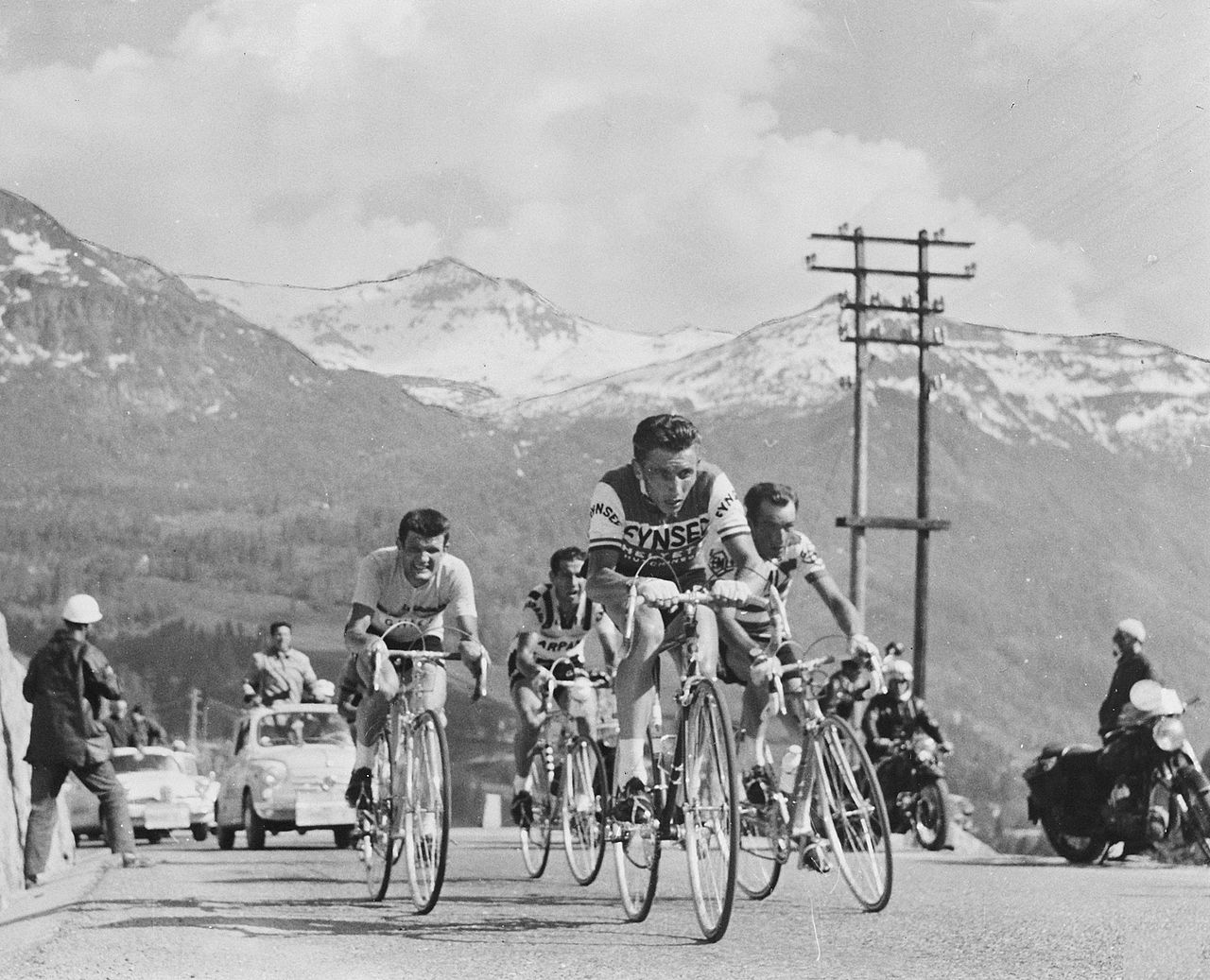
43rd Giro d’Italia (1960), Jacques Anquetil, Charly Gaul, Jos Hovenaers, and Gaston Nencini. Image in the public domain.

The race takes its character from Italy itself — chaotic, emotional, unpredictable, and capable of sudden and extreme shifts in fortune. Its mountain stages in the Dolomites and the Alps have provided the backdrop for some of cycling’s most legendary performances, and its long history is populated by figures whose names still carry the full weight of the sport’s mythology. The Giro has a particular genius for producing races that cannot be explained by form guides or pre-race logic — moments of courage, betrayal, and improbable triumph that linger in the memory long after the peloton has left Italy.
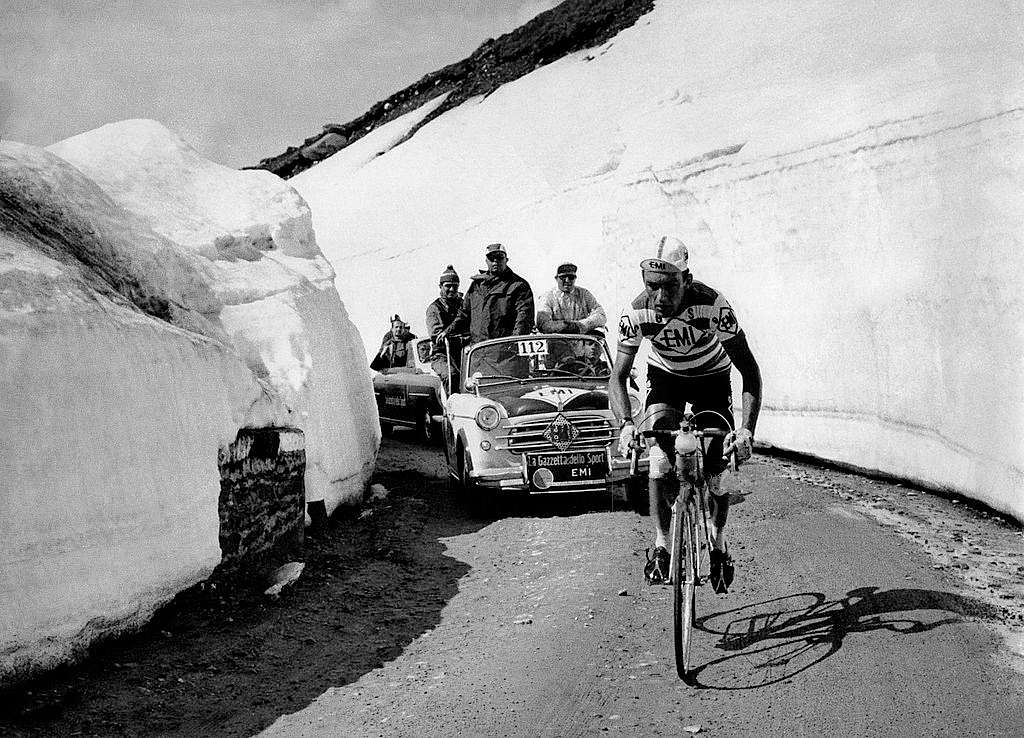
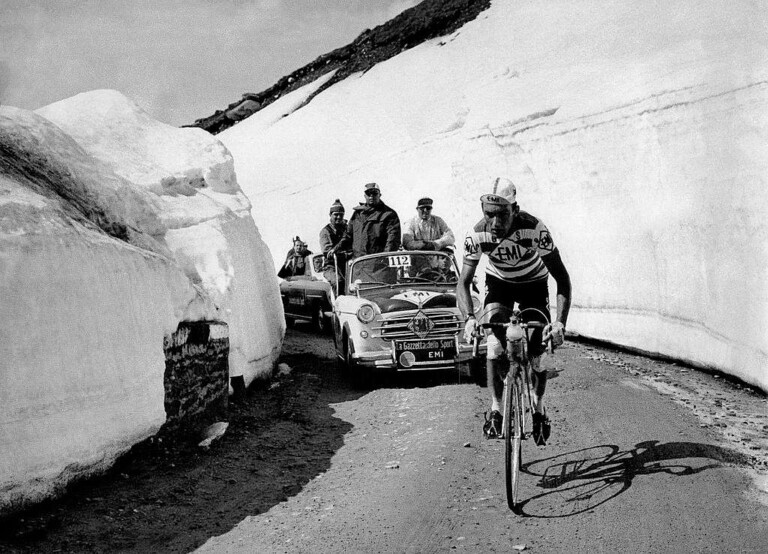
The professional cyclist Charly Gaul, native from Luxembourg, engages a climb in a hairpin turn during the Giro d’Italia, followed by the flagship vehicle; the sportsman recovered the Pink jersey and won the 42nd edition of the Giro with a breakaway on the Mount Piccolo San Bernardo. Italy, 1959. Image in the public domain.

The 109th edition of the Giro d’Italia begins on 8 May 2026 with a Grande Partenza in Bulgaria — the first time in the race’s history that it has started there — before transferring to Italy for three weeks of racing through the peninsula’s most spectacular terrain, finishing in Rome. The questions that follow draw on the full sweep of the Giro’s history, from its earliest editions to the 2026 race itself.

Q1. Three riders stand alone atop the all-time Giro d’Italia winners list, each having won the race five times — a total no one has since matched or surpassed. Who are the three riders tied for the most Giro d’Italia victories, and what do all three have in common beyond the number of wins?

Q2. Today the pink leader’s jersey is inseparable from the identity of the Giro. Yet the race’s first two decades were run without any distinctive jersey for the overall leader. Who was the first rider to wear the maglia rosa, and why was pink chosen as the jersey’s color?

Q3. Each edition of the Giro d’Italia designates a stage as the Tappa Bartali in honor of Gino Bartali. His legacy extends well beyond his racing palmarès, however. During World War II, he undertook a series of long solo rides through German-occupied Tuscany under the cover of training, the true nature of which was not widely known until after his death in 2000. What was Bartali actually doing on those wartime rides, and what recognition did he receive posthumously?

Q4. During the 1949 Tour de France, Fausto Coppi crashed early in the race, lost more than eighteen minutes on a single stage, and came within a conversation of abandoning. His teammate was Gino Bartali — the defending Tour champion and his great rival. What historic achievement did Coppi accomplish at the 1949 Tour, and what does the episode reveal about the relationship between the two men?

Q5. For more than forty years after the race began, every Giro winner was Italian. The race had been contested since 1909 before a foreign champion finally claimed the maglia rosa. Who was the first non-Italian rider to win the Giro d’Italia, and in what year did he do so?

Q6. The 1956 Giro d’Italia produced one of the most remarkable displays of physical courage in the history of the race. Fiorenzo Magni, the Tuscan champion known as “The Lion of Flanders” for his three Tour of Flanders victories, suffered a severe injury during the race yet refused to abandon. With a broken collarbone and unable to grip the handlebar with his damaged arm, Magni improvised a solution — he bit down on an inner tube looped around his bars and used it as a brace to hold his position on the bike. Despite this extraordinary effort, Magni did not win the 1956 Giro. Who did, and where did Magni finish?

Q7. Franco Balmamion won the Giro d’Italia in back-to-back years, 1962 and 1963, making him the last Italian rider to win consecutive editions of the race. He was not a flashy champion — no barnstorming mountain attacks, no dominant time trial performances. Contemporary journalists noted that he had a habit of winning the Giro without many people noticing. He started the race eleven times across his career. What is it about Balmamion’s Giro record that makes it genuinely unique in the race’s history — and which other rider shares a version of it, albeit with an asterisk attached?

Q8. Eddy Merckx’s record at the Giro d’Italia stands apart from every other rider in the race’s history. His five victories span an extraordinary period of dominance, but his achievement in combining the Giro with Tour de France victories in the same season is equally remarkable. How many times did Eddy Merckx win both the Giro d’Italia and the Tour de France in the same calendar year, and in which years did he accomplish this?

Q9. Felice Gimondi remains one of the most complete champions in Giro d’Italia history, a figure whose legacy is sometimes underappreciated because his career overlapped almost entirely with that of Eddy Merckx. How many times did Gimondi win the Giro d’Italia, in which years, and what single accomplishment in the broader palmarès of professional cycling placed him in the rarest company of all-time Grand Tour champions?

Q10. The 1987 Giro d’Italia remains one of the most controversial editions in the race’s history. A rider who had previously worn the maglia rosa found himself ordered to ride in support of a teammate who had overtaken him in the general classification. He chose not to. Which rider defied his Carrera team orders on a mountain stage of the 1987 Giro to attack the rider who had taken the pink jersey from him?

Q11. One of the most legendary days in Giro history occurred during the 1988 crossing of the Passo di Gavia, when riders faced a full alpine blizzard with temperatures well below freezing and snow so deep that the road itself disappeared. Which rider emerged from that stage with the race lead, what team did he ride for, and what was the historical significance of his eventual overall victory?

Q12. The 1989 Giro d’Italia concluded in Florence with an individual time trial of 53.8 kilometers. Laurent Fignon entered that final stage already wearing the maglia rosa, holding a lead of 1 minute and 31 seconds over second-placed Flavio Giupponi. He would defend it successfully and win the Giro overall. But the most revealing subplot of that Florence time trial involved a rider who placed second in the stage — more than a minute faster than Giupponi — while appearing to have little bearing on the race’s outcome. Who was this rider, and why does his performance in Florence matter enormously when you consider what happened eight weeks later?

Q13. Unlike most trophies in professional sport, the Giro’s prize takes the form of a striking spiral design — a shape that has no conventional base, no cup, no plaque. What is the trophy awarded to the winner of the Giro d’Italia called, and what does its name mean in English?

Click to next page to see answers.
Study: Steel Bicycle Frames Hold Up Better than Aluminium or Titanium

By Charles Pekow — Steel bicycle frames may weigh more and feel less refined than aluminum or titanium alloys, but new research suggests they resist deformation far better under load.

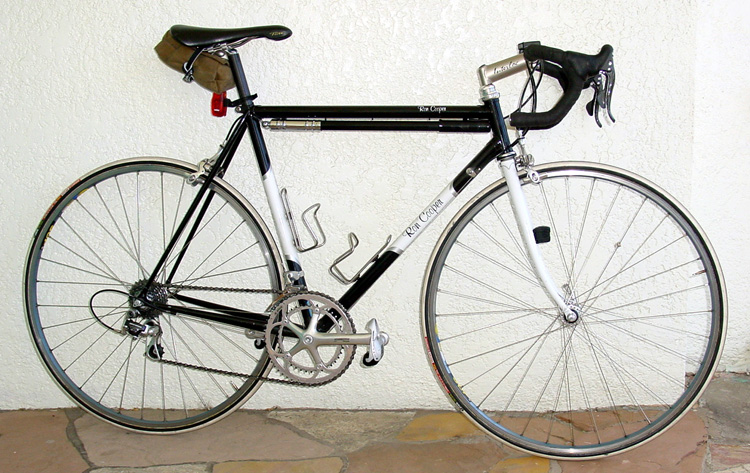
Steven Sheffield’s 1997 Ron Cooper road bike, equipped with Campagnolo Record 10 components. Photo by Steven Sheffield.

Researchers at Khulna University of Engineering and Technology analyzed frame performance and found that “steel tubes exhibit approximately 65% less deformation compared to aluminum tubes and 51% less deformation compared to titanium tubes.”

The study, Numerical Analysis of Bicycle Frame Using FEM, used finite element modeling to compare how different materials respond to stress. Across all three frame types, the seat stay, seat tube and top tube experienced the highest levels of deformation. By contrast, the lower-positioned chain stay performed better in each material configuration.

The findings suggest that while aluminum and titanium frames often win on weight savings, steel may offer greater structural stiffness and resistance to flex under comparable loads.

Read the full study here: https://www.researchgate.net/publication/397516757_Numerical_Analysis_of_Bicycle_Frame_Using_FEM


What’s Up with Glendale’s Bike Lanes?

By Brian Berlin — Advocates for protected bike lanes may think the anti-woke mob is coming for them. In California, citizen uprisings have forced municipalities to undo existing bike lane projects.

A petition in Glendale, California forced a City Council vote on whether to terminate the North Brand Boulevard bike lanes project. In December 2024, the Council obliged and voted four-to-one to remove the lanes and restore the half-mile section to its previous configuration.


View this post on Instagram


A post shared by Walk Bike Glendale (@walkbikeglendale)

However, the hysteria about a culture war on bike lanes may be overblown.

Councilman Dan Brotman, who cast the dissenting vote, denies the project reversal has been the “death knell” of future mobility projects in Glendale.

“It certainly has taught us some lessons about how we how we roll things out”, he told me. “…but it hasn’t stopped any project we’re working on”.

Brotman cited the La Crescenta Avenue Rehabilitation Project, 1.7 miles of bike facilities including protected and buffered bike lanes. The project is under construction and expected to be completed by March 2026.

“While it (La Crescenta) did get us to do more work to explain the night and day differences with North Brand”, Brotman explained, “it has not been dialed back in any way.”


Me? A Mountain Bike Coach?

By Jamie Morningstar — As my eldest daughter entered high school, she expressed vague interest in a flyer for a mountain bike team she saw at school. Always one to capitalize on any interest my kids have that gets them outside, we dialed into the info meeting and learned about the big, giant world of NICA.

National Interscholastic Cycling Association (NICA) is an international organization to connect middle and high school students with a love of mountain biking. NICA isn’t a traditional sports team by most definitions. NICA doesn’t exist to build the world’s fastest mountain bikers. Instead, their mission is to “build strong minds, bodies, character, and communities through cycling.” Riding bikes is the how, not the what.
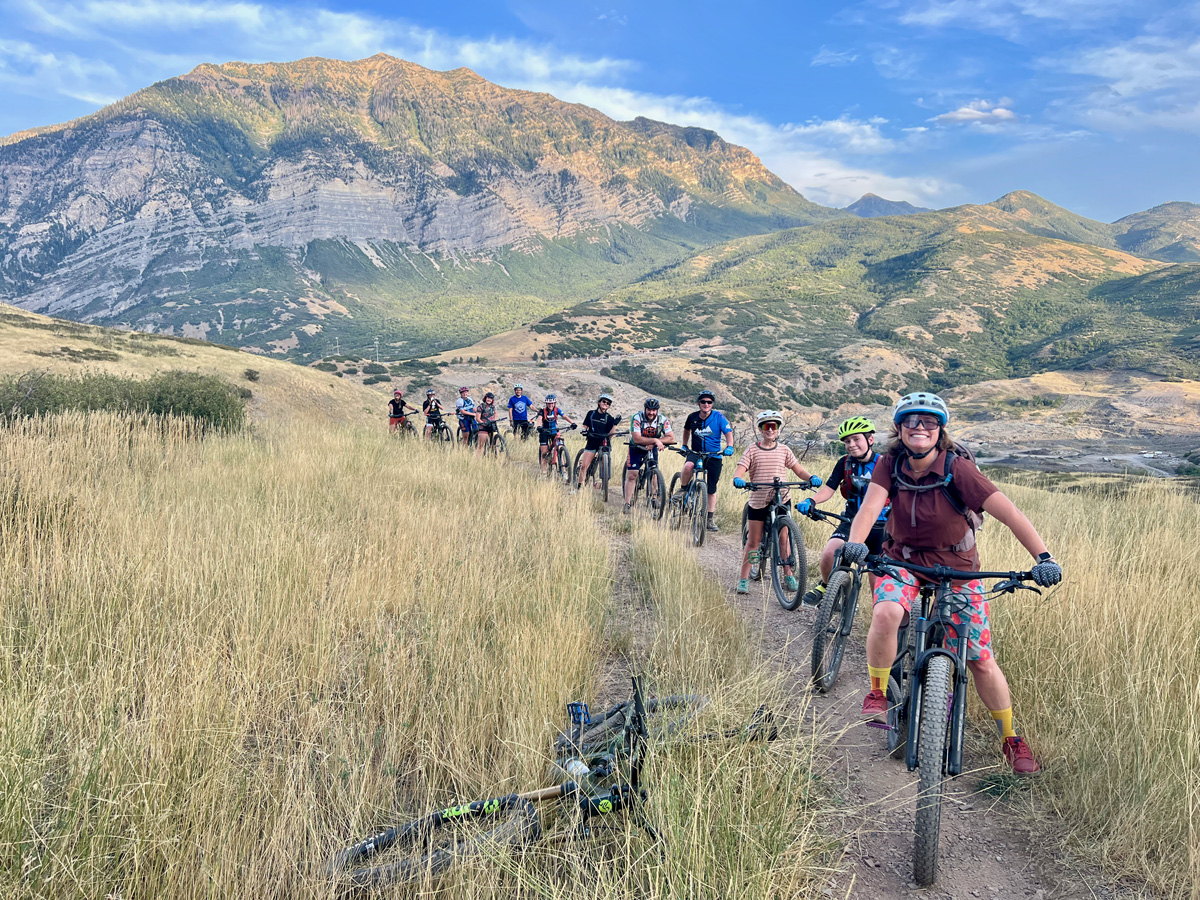
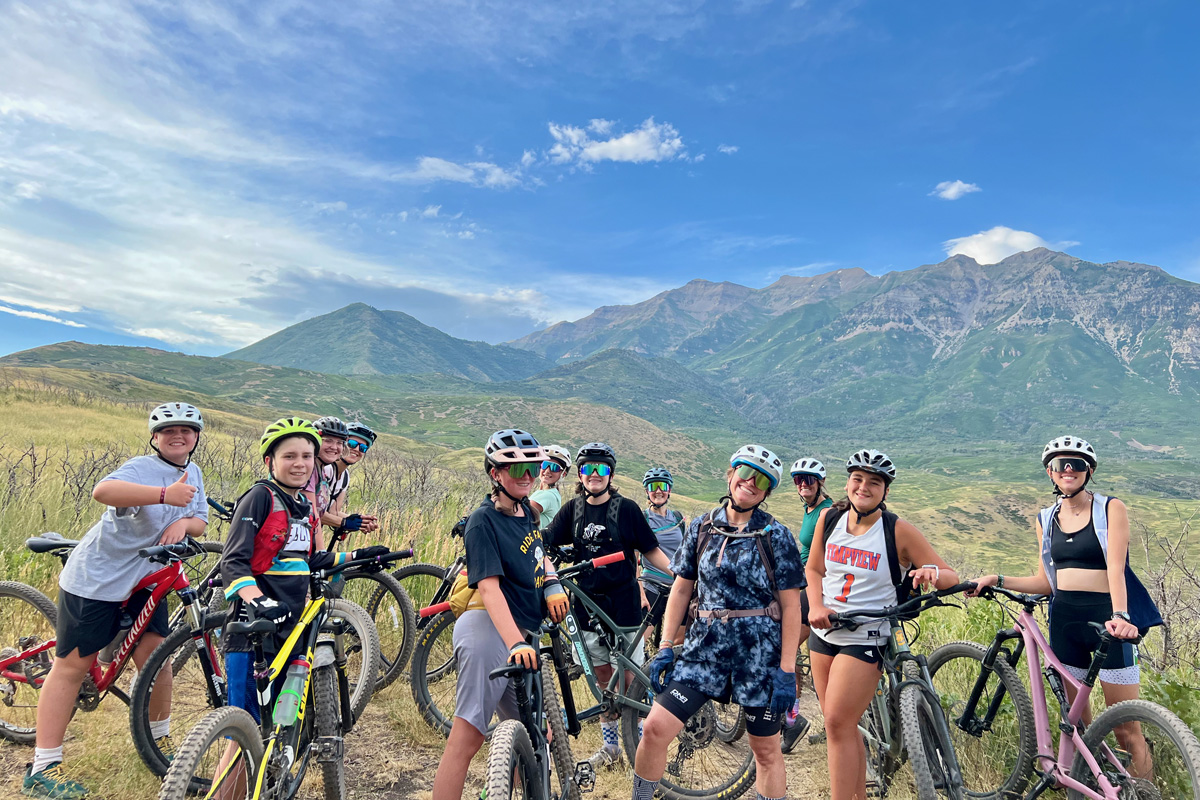
Jamie, her ride group, and fellow coaches take a break mid-practice and enjoy the view. Photo courtesy Jamie Morningstar

At the end of my first team info meeting, there was an invitation for parents to coach. The nature of mountain biking means that each team needs a ton of adults to help (each practice requires at least a 1:6 ratio of coaches to students). I turned to my daughter and said, “I’ll ride if you will.” And I immediately regretted the whole thing.

Although I was an avid road rider and commuter, in the previous decade, I had been mountain biking exactly once. It ended with me in a walking brace for many weeks. I decided then and there that mountain biking was not my sport.

However, enough time had apparently passed since the not-being-able-to-walk-because-of-mountain-biking experience that I was ready to try again, especially if it meant riding with my kid. I’ve now been coaching for five years, and here’s what I’ve learned:

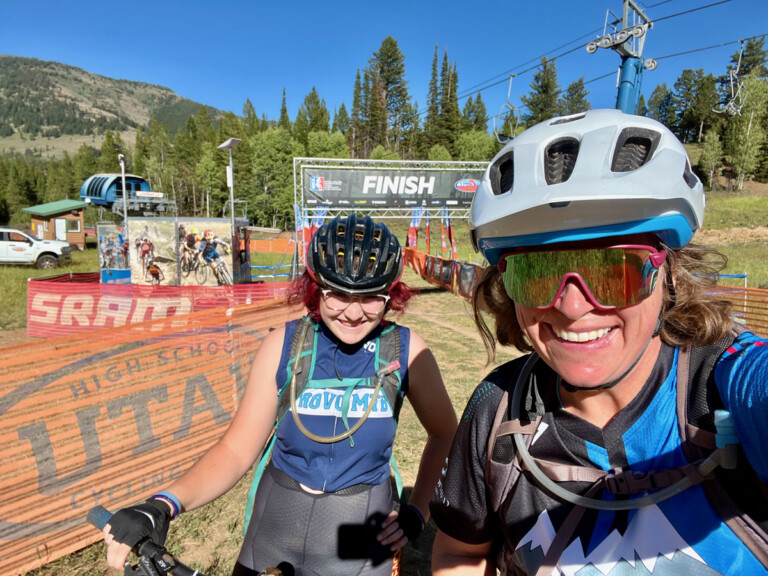
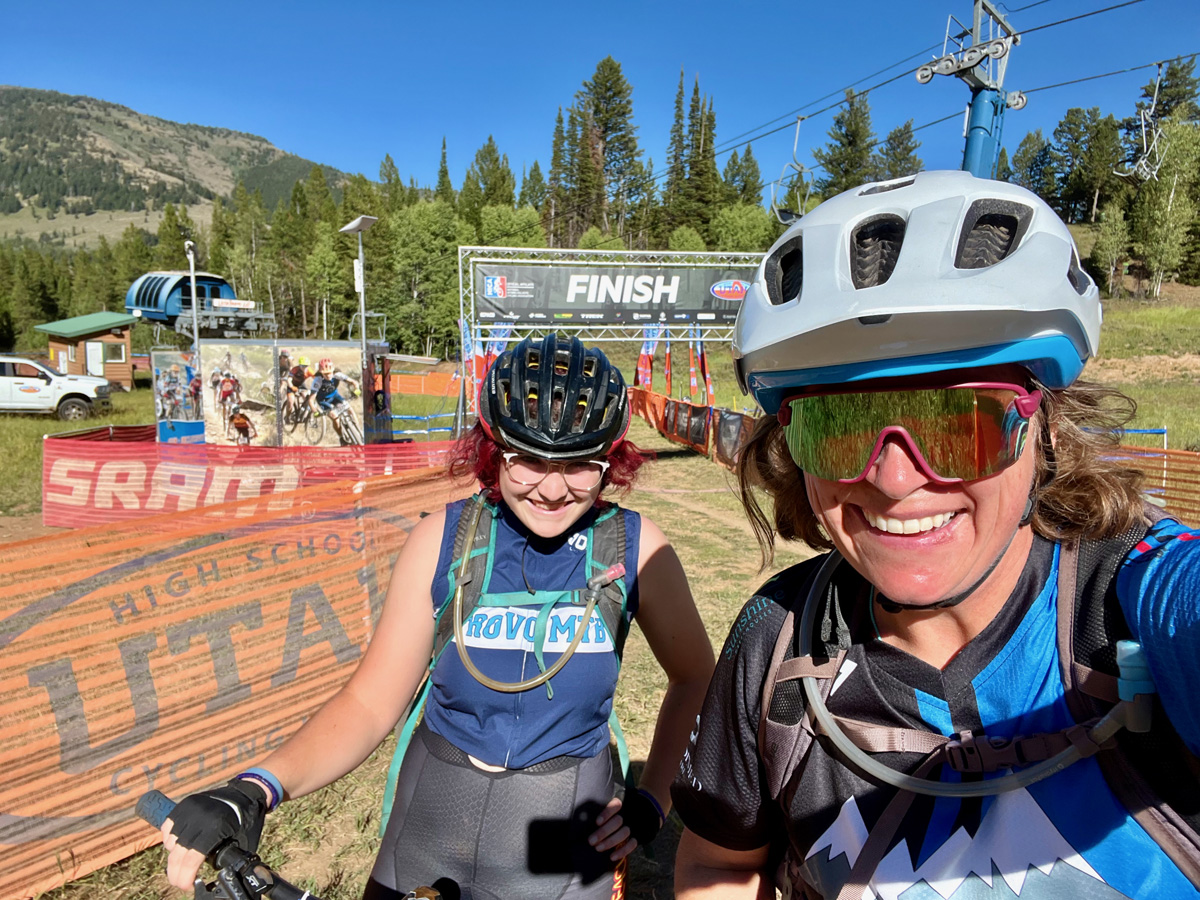
Jamie and and her daughter Sasha pre-ride a racecourse at Beaver Mountain, Utah the day before a race. Photo by Jamie Morningstar

Can they actually use me?

Yes! Most teams need coaches at every level, and usually, teams will work with you and your schedule to identify the practices you can make.

But seriously, I don’t know if I can do it.

That’s awesome. Do it anyway. Here’s the deal – yes, NICA needs more hard-charging super-fit folks who can pace the fastest groups. But there are a lot more kids on the team who don’t need the fastest rider; they just need adults willing to invest in them and cheer them on. We’re all learning together. If mountain biking scares you a little (or a lot), that doesn’t mean you can’t coach, it just means you’re sane. Representation matters – bring your true self and show those kids that everybody can enjoy the outdoors.

Jamie, her ride group, and fellow coaches take a break mid-practice and enjoy the view. Photo courtesy Jamie Morningstar

Is it hard?

Well, that depends on your definition of hard. NICA makes the path to coaching very achievable. All that’s required is a background check, a bike, and a few online safety courses to begin coaching (higher levels of coaching are also available and require additional training). To be a “Level 1” coach and ride along with the team requires two or three hours of self-paced online training provided by NICA that you complete before the season begins.
If the question is, “Is coaching demanding?” then the answer is definitely yes. Mountain biking is an endurance sport. It will kick your butt in all the best ways. You’ll probably have moments when you would be sitting on the ground crying because you’re really not sure you can make it up that hill, and the only thing stopping you is that there’s a kid sitting on the ground crying, and you want to be an encouraging example. It’s a tough sport, no matter your level of skill or fitness.

Can I ride an e-bike?

NICA welcomes coaches on e-bikes, although you would need to check with your team and local trail rules just to be sure. E-bikes are a wonderful way to get more coaches out there feeling confident in leading the pack. I often ride my e-bike if I know I’m going to be leading my ride group or I’m feeling a little tired that day.

How much will you have to learn?

If you’re relatively new to mountain biking, the learning curve is steep. But remember, the kids are experiencing the same challenges you are! My first season coaching was also my first season on a mountain bike. I fell a lot. I wouldn’t wear skirts to work that first summer because my legs were so banged up. My brain and body were constantly getting challenged and stretched right alongside the students I rode with. I didn’t know the trails, I didn’t know how to ride properly, and I didn’t know the lingo. And it was great.

Do you have to be a parent to coach?

Nope! NICA welcomes any adult as a coach. You just need to want to get on a bike and help kids grow. Most coaches are parents of students on the team, but sometimes grandparents, older siblings, neighbors, etc., join to help. Everybody is welcome.

But what does a coach do?

All of the clichés apply here- it takes a village to raise a mountain bike team, and many hands make for light work. Some coaches agree to be ride leaders, which can require the coach to plan the practice’s route and the skills the students will focus on (it’s good to coach for a year to two or be very familiar with your local routes before offering to ride lead, and a higher coaching certification is required). Most coaches ride along with the group or “sweep” (ride at the end of the line). This requires basic coaching certification, and a knowledge of bike repairs is helpful for helping kids with mechanicals. Other than that, you’re just riding along and helping the students feel encouraged and on the right trail.

There are many other volunteer roles that can be filled by coaches or other volunteers, such as providing food, carpooling to practices and races, posting to social media, doing back-end bookkeeping, hauling trailers, and putting up pop up shelters. As a coach, you don’t have to run the show or be in charge, you just are one more set of hands making the team function.

What kind of commitment are we talking about here?

Every team is a little different, but most practice two or three times per week. Some practice in the early morning, especially in the summer heat, and some in the evenings. Teams are usually broken up by ability into ride groups, and each ride group needs several ride leaders and coaches. Most teams understand that coaches cannot commit to making every practice, and there’s sufficient coach overlap to fill in for each other for vacations and other missed practices. The commitment could be as little as two hours per week if you commit to one practice, or as much as six to eight hours per week during peak practice season plus races if you choose to volunteer for races.

The western states run on a fall season, while in the southeast mountain biking is generally a spring sport. The beginning of the season is usually pretty light, with just one practice per week as the students learn the base skills. The latter part of the season leading up to races tends to heat up, with more practices and more intensity to prep for the races. Typically, there are 4–5 races over the course of the two- to three-month-long season.

On my team, practices start ramping up in June, peak during race season in August and September and then pull back as kids complete their final races, ending with state championships in October for the students who qualify and then the end-of-season parties.

What would my race responsibilities be as a coach?

Races are mostly staffed by volunteers, and it’s totally up to you if and how you want to participate. Race volunteering is never required, although it’s always helpful. There are lots of volunteer roles on race day that can be staffed by anybody – helping students line up at the start, giving kids water bottles as they race, and helping with traffic and pedestrian control. There are also on-the-bike volunteer roles helping students with mechanical and medical (and sometimes emotional) needs on-course. These are reserved for higher-level coaches with basic mechanical and first aid skills. Some races can be several hours away from a team’s home base, so it’s always fun to camp out with the team (or get a hotel if that’s more your speed) and make an adventure of it.

Is it worth it?

As a result of coaching, my leadership skills have grown, my cycling skills have exploded, I’ve encouraged and invested in kids who are developing lifelong healthy habits and outlooks, and I’ve formed friendships with fellow coaches that last well beyond bike season. Coaching with NICA is a great investment. Plus, you’ll probably get a team hoodie out of the deal.

Ok, I’m interested – what are my next steps?

Awesome! You can find your local team in one of a few ways. You’ll probably have good luck just searching for “-name of my local high school- mountain bike team.” Or check out https://nationalmtb.org to learn more about NICA and find a league in your area. Reach out and give it a try!


Iron Horse Bicycle Classic Returns to Durango for 53rd Edition, Memorial Day Weekend Showdown with the Train

DURANGO, Colorado — The Iron Horse Bicycle Classic returns to Durango over Memorial Day weekend, May 22–24, 2026, for its 53rd edition, bringing thousands of riders and spectators back to one of the most iconic and enduring events in American cycling.

First established in 1972 following a friendly but fateful challenge between two brothers—one on a bicycle, the other aboard a steam train—the event has grown into a nationally recognized festival rooted in the rugged terrain and railroad heritage of Southwest Colorado. That origin story still defines the weekend, most notably in the famed “Race Against the Train,” where cyclists roll out of Durango alongside the historic Durango & Silverton Narrow Gauge Railroad on a 50-mile route to Silverton. Along the way, riders crest two 10,000-foot passes, making it one of the most demanding—and visually striking—road races in North America.

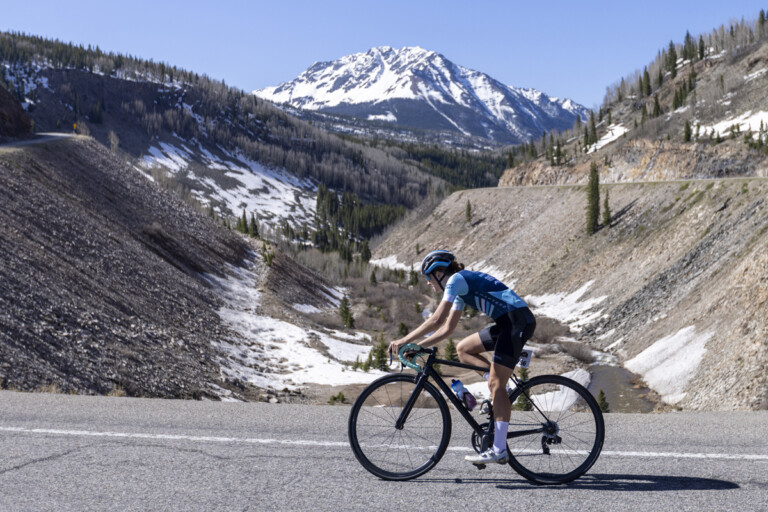
Scenes from the Iron Horse Bicycle Classic. Photo by Scott DW Smith

Saturday’s headline events include the Coca-Cola Road Race, which begins with a 7:15 a.m. wave start, and the McDonald’s Citizen Tour at 8:00 a.m., giving riders of varying ambitions the chance to tackle the same high-altitude course. The Purgatory Quarter Horse event follows at 8:15 a.m., adding another competitive layer to the day’s racing.

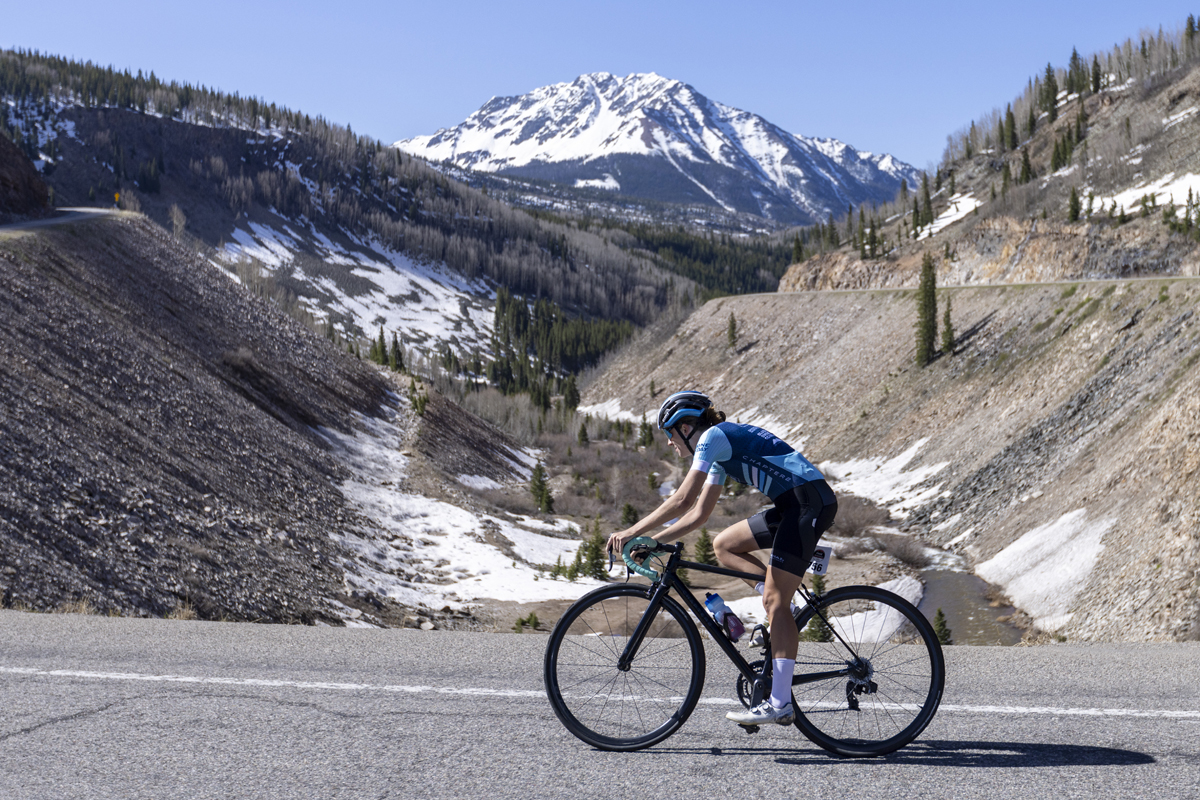
Scenes from the Iron Horse Bicycle Classic. Photo by Scott DW Smith

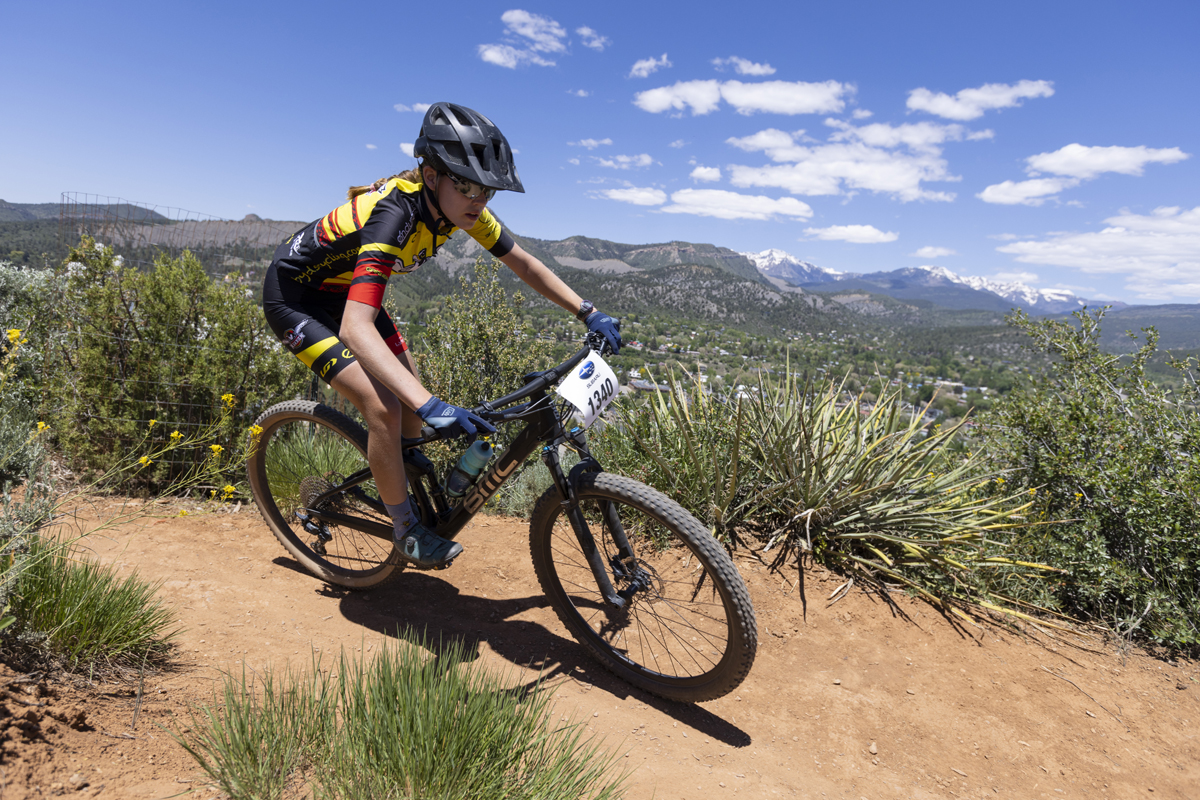
Now in its fifth decade, the Iron Horse has evolved well beyond a single race into a full weekend of cycling. Sunday’s schedule features the LaStrada LaPlata Gravel Race (8:00 a.m.), followed by three waves of mountain bike racing at 8:30 a.m., 11:00 a.m., and 1:30 p.m. A cycling festival runs from 9:00 a.m. to 4:00 p.m., complemented by a kids race and Kids Village, vendor expos, and community programming that underscores the event’s broad appeal.

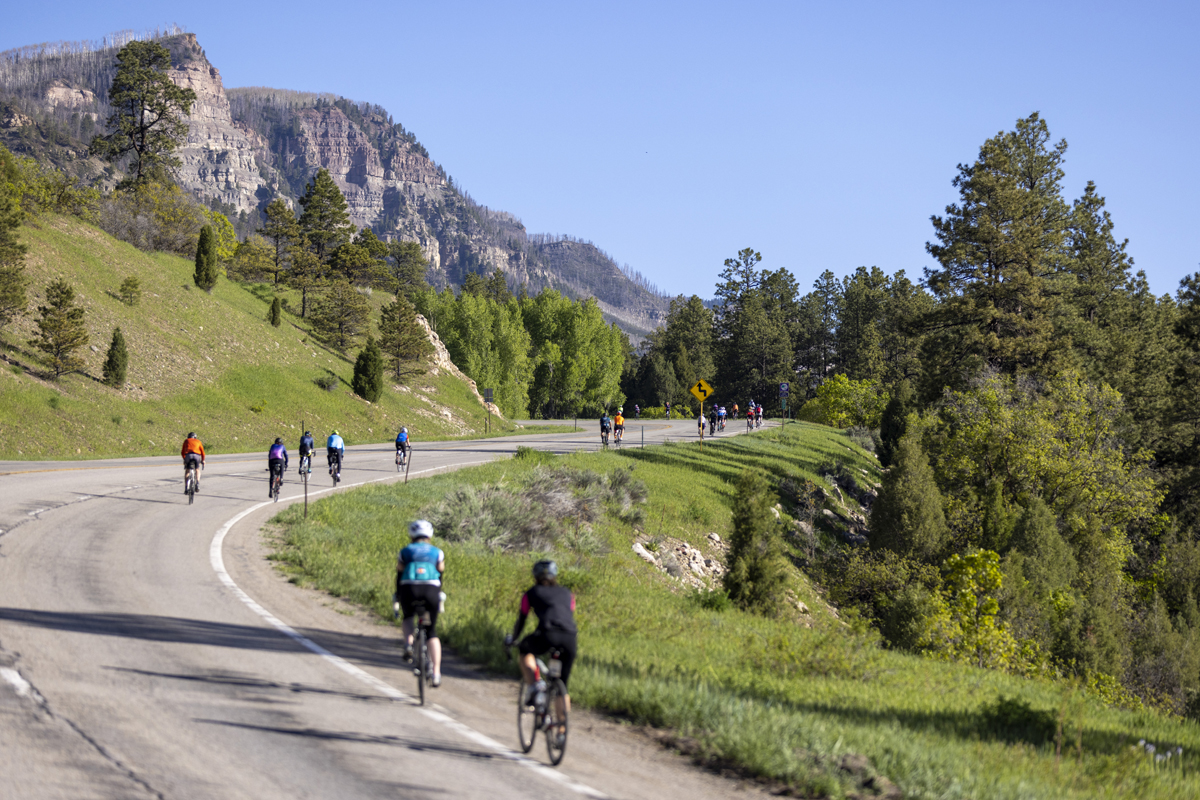
Scenes from the Iron Horse Bicycle Classic. Photo by Scott DW Smith

Festivities begin Friday, May 22, with last-minute registration and packet pickup from 2:00–7:00 p.m. in Buckley Park, alongside a beer garden, vendors, and live music. The day culminates in the Faceplant Ale Kick-Off Parade at 4:20 p.m., where costumes are encouraged and the tone for the weekend is set.

What continues to distinguish Iron Horse is its combination of competition and community. Spectators line the course out of Durango, local businesses host celebrations throughout the weekend, and visitors experience the distinctive culture and scenery of the San Juan Mountains. From elite racers to first-time participants, the event offers something for nearly every kind of rider, across road, gravel, mountain bike, and family-friendly formats.

Organizers anticipate strong attendance in 2026, building on decades of sold-out races and growing participation across disciplines, as Durango continues to cement its reputation as a premier cycling destination.

More information, including registration details, is available at ironhorsebicycleclassic.com.

Dave Walker’s Cycling Cartoons: The Cobbled Classics

0
Cobbled Classics, by Dave Walker
The Cobbled Classics, by Dave Walker

Dysfunctional Cycling Club, and why you should quit…

By Maynard Hershon — I believe that the good group training ride, perhaps especially the good club training ride, is where the heart of road cycling beats. It’s where riders are formed, where technique is learned, where friendships are made, where riders learn to look after one another. 

It’s a world phenomenon, the group ride. Learn to ride on your good club ride and you can take your skills anywhere and fit…right…in. First, you’ve got to find that good ride.

The Dysfunctional Cycling Club by Maynard Hershon

Think about the group rides you’re doing. If you’re not learning anything on your rides, if your rides are ragtag and everyone for himself, if you are not making friends or learning how to take care of your fellow cyclists, you’re wasting your time in a sadly defective training routine. 

It’s worse than merely wasting your time. You’re learning bad habits. You’re practicing sorta-cycling. Your presence on his rides encourages the leader so he’ll continue to lead similarly crummy, counterproductive rides. 

Quit that ride. Find one that isn’t someone’s ego on parade. 

Most group rides today are dysfunctional. If you see that no one looks back to see what’s happening behind him, checking out the tail-enders to ensure they’re doing okay, quit that ride. 

If you have never seen a ride leader drop back to tow someone back up to the group in his draft, quit that ride. 

If you see that the no-drop policy stated in the club newsletter and mentioned during pre-ride briefings is simply a fiction, quit that ride. 

If you see that everyone arrives in a car five minutes before the ride start, and disappears within minutes at ride’s end, quit that ride. If you see that no one ever rides to the ride, quit it.

No amount of effort spent finding a real training ride is wasted. Find one that’s more than a simultaneous workout reflecting the strengths of the ride leader. Commit to the good ride. Learn and develop as a rider. Staying with the crummy ride is disheartening and pointless.

Because the abilities and commitment levels of cyclists vary so widely, a training ride must accommodate strong riders and struggling riders alike. How can it do that, you ask – if your experience of training rides was formed at one of the thousands of bad ones. 

If the ride leader, for reasons of his or her own, invariably chooses the hilliest route for the rides, that route will ruin the ride for weaker riders. If every route features long hills, hills steep enough so that drafting is ineffective, weaker riders will be dropped. That’s a given. 

Dropped riders will watch the pack ride away into the distance. Still gasping for breath, they will feel whipped, unworthy, unable for what seems like the millionth time to stay with the pack. I just can’t climb; they repeat to themselves like a defeatist mantra. 

A few of those riders will be emotionally tough; they’ll keep coming back. Most will decide to ride alone or join a bowling league or spin club. 

If your club ride leaders, strong riders all, invariably choose hilly routes when there are flatter alternatives, and if you have asked the ride leaders why they do that and have been rebuffed and made to feel foolish and not nearly gnarly enough, quit that ride. Quit the club. 

Find a club and a ride that understand the dynamics of group cycling. Find one that seems aware that catering to an “elite” group of like-minded clueless spin class heroes is not bike riding. If you can find a group of old racers, men and women who enjoy the group dynamic but are no longer trying to make the Olympic team, fall into place with them. You’ve found the holy grail.  

Club rides are not for learning to pedal and ride a straight line, acquiring basic fitness or getting used to climbing. Do those things on your own or with one or two riding friends. Then take your basic fitness to a good club or ride group and learn group skills. 

Otherwise, you will repeat your first year of cycling again…and again…and again. That’s what the members of Dysfunctional Cycling Club do. 

On a flattish ride, a less-fit rider can draft a stronger rider, a rider he feels safe following. Sitting in the draft, benefiting from the vacuum behind a solo rider or a group, is the key to road cycling. 

Learning how to draft and finding rides where you feel safe following close will lift your cycling far beyond the meager level of so many club riders.

The rider behind learns to sit in the draft in still air and in shifting winds. He learns to trust other riders. He learns smoothness and how to maintain a steady pace. He learns that staying on the wheel is of vital importance, that losing that wheel will slow him dramatically. 

If he loses the wheel, he will no longer be part of the ride. Better to stay on the wheel and finish triumphantly. Finish with your friends. Feel like part of something, something worthwhile. 

On flattish rides in a large group, the draft will keep the weaker riders in the pack. They will learn where to position themselves in the draft as the wind changes direction. They will see that, even if they are not so strong, they can hang and complete the ride with the pack.

They will experience success and feel like bike riders. 

In the pack, they will learn vital skills. They will learn how to be predictable and safe in close company. They will learn how rotating lines of cyclists work, how they spread the workload. They will soon be riding further and faster than they ever imagined.

They will ride next to many other riders, some of them road riders for many years. They will find that they feel great comradeship with those other riders. There’s always something to chat about. The riders will most often stop post-ride for coffee. There will be more yet to talk about.

And next week’s ride to look forward to. 

Look at 20-, 30- and 40-year cyclists. They didn’t stay at it because they rode with DCC. They’re veterans of decades of good training rides, supportive training rides, disciplined rides where everyone knows there’s no trophy or prize money at the end of a training ride. No glory. Solidarity. 

All this is in contrast to Dysfunctional Cycling Club’s training rides, or group workouts as they’re beginning to call them here. On DCC rides, no one learns anything – except the dropped riders, who learn how worthless they are as athletes. 

If you read this and realize that you’re in a club or ride group like DCC, quit. Look around. Find a civilized club or ride. Find out why so many old roadies are still on their bikes. 

Note: This story is from Maynard’s new book: The Dysfunctional Cycling Club and Other Stories

Maynard Hershon is a Colorado based cyclist who has written for Winning Magazine, VeloNews, California Bicyclist, and the Bicycle Paper. His newest book is The Dysfunctional Cycling Club and Other Stories.

May 2026 is Bike Month Across the West! Calendar of Events!

0

May is Bike Month, as it has been since 1956 when the League of American Bicyclists (LAB) created the month-long celebration. Our 2026 Bike Month calendar of events is below.


In the west, there are a bunch of events to get you excited and involved in cycling. This year, with the pandemic slowly, all to slowly, subsiding, many in person events are returning, while others are still being held virtually. 

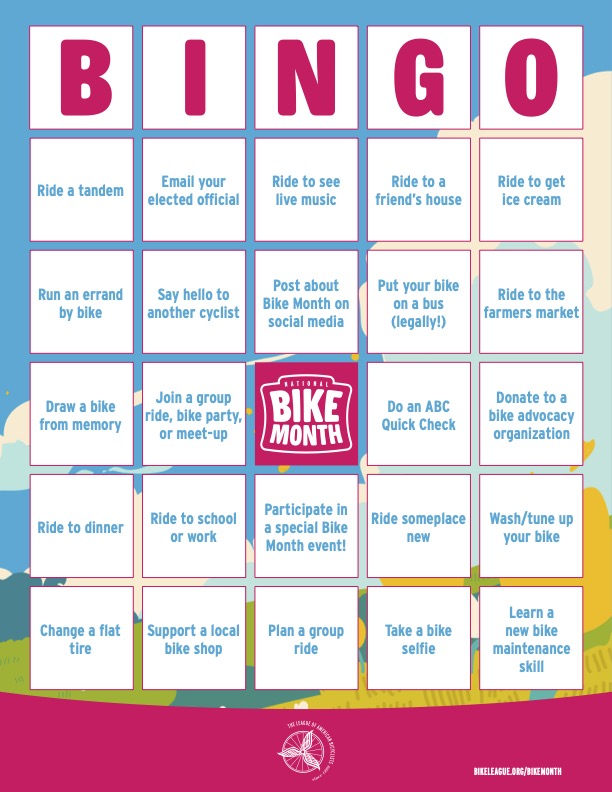
The best thing you can do during Bike Month, is to ride your bike! Take part in the National Bike Month Challenge. Their website states, “Bike Month 2026 is a fun, free, and friendly challenge that’s open to riders of all levels. Whether you’re just getting back on a bike or you’re an avid commuter, everyone is invited!”

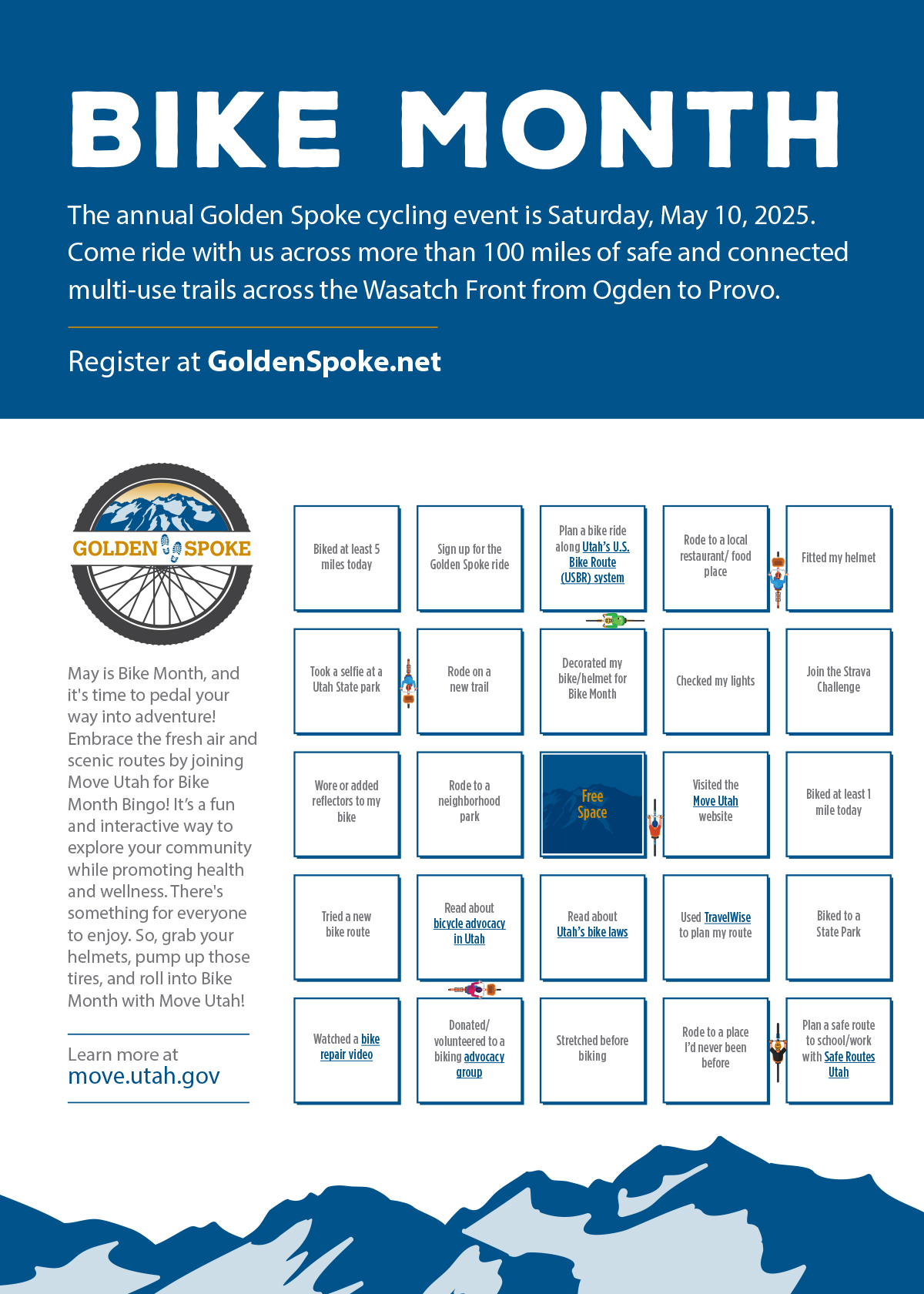
In Utah, Move Utah has a great bike bingo poster.


A great way to honor those who have been hit or killed while cycling is by participating or organizing a Ride of Silence in your community, “On Wed. May 20th, 2026 at 7:00 PM, the Ride of Silence will traverse and unite the globe as nothing before it. Cyclists will take to the roads in a silent procession to honor cyclists who have been killed or injured while cycling on public roadways. Although cyclists have a legal right to share the road with motorists, the motoring public often isn’t aware of these rights, and sometimes not aware of the cyclists themselves.” For more, see rideofsilence.org.

  • Tag your photos on social media with #bikemonth, #bikethere, and #bikejoy – LAB is promoting this social campaign.
  • Join your local or state bike advocacy organization – see the Advocacy section in the calendar in this issue for a few of those groups.
  • Join Cycling West and help us to make the world a better place through bicycling.
  • Comment on a local or national bike project.
  • Check with your local transportation or streets department to see what projects are coming up and provide input.

Ride your bike! To the store, to work, for fun, with your family, on a date, up a hill, down a hill, to the mountains or to the sea, ride around your city clockwise and then counterclockwise, play bike bingo, or bike polo, race or don’t race, pop a wheelie, ride in the dirt, on the pavement, in the gravel, but most of all, just ride.
For more ideas, visit bikeleague.org

2026 Western States Bike Month Calendar

May 1-31, 2026Reno, Sparks, Truckee Bike Month, Bike Month, Reno Bike Week, Reno, NV, Commute by bike in Washoe County. Log your miles. Tons of other events too., Truckee Meadows Bicycle Alliance , 775-323-4488, [email protected], bikewashoe.org/bike-month/

May 1, 2026Art Stroll and Roll, Utah Bike Month, Provo, UT, Ride your bike to Downtown Provo’s monthly Art Stroll to check out fantastic local artwork and shop at our fun and unique downtown businesses. 6-9 pm., Aaron Skabelund, 385-207-6879, [email protected], bikeprovo.org

May 1-31, 2026Provo Bike Month, Utah Bike Month, Provo, UT, Tons of events throughout the month! April 26: National Trails Day Ride; May 1: Art Stroll and Roll; May 9: Start a Bike Bus at Your School; May 14: Bike Anywhere Day; May 16: Golden Spoke Ride; May 20: Ride of Silence, Aaron Skabelund, 385-207-6879, [email protected], bikewalkprovo.org/bike-month-2025

May 1-31, 2026Grand Valley Bike Month, Bike Month, Grand Junction, CO, Bike to Work, Bike Swap, Bike to Business, Bike to Bourbon, Yoga for Bikes, and a whole lot more!, Sarah Brooks, 970-244-1830, [email protected], mesacounty.us/gvbikemonth

May 1-31, 2026National Bike Month, Utah Bike Month, Everywhere, UT, Celebrate the bicycle with events and programs from the League of American Bicyclists!, Bike League , [email protected], bikeleague.org

May 2, 2026Tour de Brewtah, Utah Bike Month, Salt Lake City, UT, A tour of the city highlighting Salt Lake’s great bicycle infrastructure, engaged community, and craft beers., Ryan Miller, [email protected], tourdebrewtah.com

May 2, 2026Village Bicycle Project Bicycle Drive, Utah Bike Month, Park City, UT, 6th annual Spring Bike Drive—an event that transforms unused bicycles sitting in local garages into life-changing tools for communities across West Africa. The event will be held Saturday May 2 from 9am to 1pm in the Staples/Walmart parking lot in Kimball Junction. (6543-6545 N Landmark Dr, Park City, UT 84098)., Joshua Poppel, 518-312-8047, [email protected], cyclingwest.com/advocacy/pedaling-change-village-bicycle-project-park-city-bike-drive-may-2-2026/, villagebicycleproject.org

May 3, 2026National Ride A Bike Day, Utah Bike Month, Everywhere, UT, Celebrating National Ride A Bike Day is simple: go for a ride — any ride. Whether it’s a short trip on a bikeshare bike or a double century, any way you choose to ride a bike is the right way to ride a bike, Cycling West , [email protected], bikeleague.org

May 6, 2026National Bike to School Day, Utah Bike Month, Everywhere, UT, A day to climb out of the motor vehicle and onto your bike on your way to school., Cycling West , [email protected], walkbiketoschool.org

May 8, 2026Salt Lake City Mayor’s Community Bike Bash, Utah Bike Month, Salt Lake City, UT, A mellow ride with Salt Lake City Mayor Erin Mendenhall around downtown Salt Lake. Meet at 5:30 pm, ride at 6, party after the ride. Start: Washington Square Park. Meet on the SE corner of the park, located at 451 S State St, Salt Lake City, UT 84111, Salt Lake City Transportation , 801-535-6630, [email protected], slc.gov/transportation/bike/mayors-bike-ride

May 9, 2026SLUG Cat Alleycat Bike Race!, Utah Bike Month, Salt Lake City, UT, Starts at Artspace, Saturday Cycles, 230 S 500 W. This exciting alleycat event features a scavenger hunt bike race that takes you all over Salt Lake City. Bike with the coolest cats you know in town, make new friends  and win awesome prizes from our local sponsors! 14th Annual! Registration is open between 4-5 pm and at 5 the race will begin. Cyclists will ride around the city to collect points for their manifest. At 7pm we will begin the award ceremony and cyclists can relax for a well-earned celebration., Angela Brown, 801-487-9221, [email protected], Nick Zunkowski, 801-487-9221, [email protected], slugmag.com/slug-cat/

May 9, 2026South Salt Lake Mural Fest Bike Tour, Utah Bike Month, Salt Lake City, UT, Join Sweet Streets for a leisurely bike tour of South Salt Lake’s newest murals for 2026. The event will start from the event headquarters on Commonwealth Avenue at 230 PM then ride a 4.5 mile loop stopping at several murals, returning around 4 PM. Artists will be available during the tour to chat and answer questions about their work, Troy Saltiel, [email protected], sweetstreetsslc.org

May 10-16, 2026Flagstaff Bike to Work Week, Bike Month, Flagstaff, AZ, Bike to work, record your commute, win prizes!, Anthony Quintile, 928-526-7704, [email protected], Kyle Hornbeck, [email protected], flagstaffbiking.org

May 11-17, 2026National Bike to Work Week, Utah Bike Month, Everywhere, UT, Week-long festival with events, Bike to Work Day, and more., Cycling West , [email protected], cyclingwest.com/event-calendars/bicycling-events-swaps-and-festivals, bikeleague.org/events/bike-month

May 11-15, 2026Bike to Work and School Week, Utah Bike Month, Logan, UT, 7:30-9:30 AM M-F fuel stations and bike tune ups at Transit Center; 3:30-5:30 PM; Fuel Stations: Mon: Cache County Library, Tues: Mendon Library, Wed: Logan Library, Thurs: Smithfield Library, Fri: Hyrum Library, Emily Fletcher, 435-755-1646, [email protected], trails.cachecounty.org

May 14, 2026Bike to Work and Wherever Day in Provo City, Utah Bike Month, Provo, UT, Provo businesses will host stations located throughout the city and hand out free breakfast, drinks, and other treats to people who arrive by bike from 7:30 – 9:00 am. (Provo City’s breakfast station will be open at 6:30 am for early bird riders.) Pick up some breakfast and coffee, get to know your fellow commuters., Aaron Skabelund, 385-207-6879, [email protected], bikeprovo.org

May 14, 2026Bike to Wherever Day, Bike Month, San Francisco, CA, Join people across San Francisco and the Bay Area in riding your bike to get to wherever you need to go – or just for fun!, SF Bike Coalition , 415-431-2453, [email protected], sfbike.org/bike-to-wherever-day/, bayareabiketowork.com

May 14, 2026Bike to Wherever Day, Bike Month, East Bay, CA, It’s the Bay Area’s biggest day for bicycling, and this year Bike East Bay is bringing you safe, socially distanced fun. Pledge to ride to get all the details, find your nearest energizer station, and get ready for the big day!, Bike East Bay , 5108457433, [email protected], Caitlin Gleason, 707.480.6897, [email protected], bikeeastbay.org/btwd

May 14, 2026Bike to Work Day, Bike Month, Marin County, CA, Tom Boss, 415-456 3469, [email protected], marinbike.org, bayareabiketowork.com

May 15, 2026National Bike to Work Day, Utah Bike Month, Everywhere, UT, A day to climb out of the motor vehicle and onto your bike on your way to work., Cycling West , [email protected], bikeleague.org

May 15, 2026Bozeman Bike to Work Day, Bike Month, Bozeman, MT, Ride Your Bike To Work Day and treat yourself to a free coffee at several locations, Alex Lussier, [email protected], Megan Lawson, 406-570-7475, [email protected], Gallatin Valley Bicycle Club , [email protected], gallatinvalleybicycleclub.org/events

May 16, 2026Golden Spoke, Utah Bike Month, Wasatch Front, UT, Join the annual Golden Spoke Ride, a cycling event that spans Utah’s safe, connected, multi-use trail network across the Wasatch Front from Ogden to Provo. Routes range from 1 to 50 miles or more—for beginners to experts. Explore, learn, enjoy, and develop skills, in a safe, family-friendly environment. This free event includes two simultaneous group bike rides, one begins in Roy and travels south, while a second begins in Provo and travels north. This year’s northern ride will highlight the recently completed West Davis Corridor Trail.  Both rides will converge in the center of the trail network at Tracy Aviary’s Nature Center at Pia Okwai, located along the Jordan River Trail in South Salt Lake. There will be an end of ride celebration, including food, music, and post ride activities at the Nature Center. Participants can receive complimentary transit passes from UTA to help them get to and from the event along with lots of other goodies from our partners and sponsors.  This is a great way to experience our growing network of trails along the Wasatch Front.  Registration is required for perks, and availability may be limited on a first come, first served registration basis, Caroline Johnston, [email protected], goldenspoke.net

May 16, 2026Draper Mayor’s Bike to Work Day, Utah Bike Month, Draper, UT, Join Draper City Mayor Troy Walker on this free group ride along the beautiful Jordan River Parkway Trail to celebrate the Golden Spoke Trail network, Leave from Rotary Park at 10:00 AM, ride to Tracy Aviary Center on the JRT, Draper City , [email protected], draperutah.gov/bikeride

May 20, 2026Ride of Silence, Bike Month, Prescott, AZ, Ride to honor dead and injured cyclists and to honor Amber Harrington who was killed by a drunk driver in 2015. Organized by Bike Prescott, Ride will begin at 5:30pm at the SE corner of the Prescott courthouse square., Patricia David, [email protected], rideofsilence.org, bikeprescott.org

May 20, 2026Ride of Silence, Utah Bike Month, Provo, UT, Join the Provo chapter of the Worldwide Ride of Silence to ride to honor people who were killed or injured while biking this last year and last several years. We will begin at Dixon Middle School and go for a short, slow, silent ride with brief stops at the ghost bike memorials for Doug Crow and Mark Robinson, and return to Dixon Middle School where we will have light refreshments. Meet at 6:30. Dixon Middle School, 750 W 200 N. Ride begins at 7 pm sharp., Lucy Ordaz Sanchez, 801-477-7048, [email protected], rideofsilence.org, bikewalkprovo.org/bike-month-2025

May 20, 2026Ride of Silence, Bike Month, Various, Everywhere, Ride to honor dead and injured cyclists. Locations worldwide, Cycling West , [email protected], rideofsilence.org

May 23, 2026Explore the 9 Line Trail, Utah Bike Month, Salt Lake City, UT, Stations will be set up along the 9 Line Trail on Saturday, May 23 from 10 AM – 2 PM from 900 E to the Jordan River Trail. These stations will have sustainable transportation and community groups and have information on their work and the amenities that you can reach nearby via the trail. If you’re planning to stay in town for Memorial Day weekend this will be a great way to enjoy the outdoors and your local community, traffic free, Troy Saltiel, [email protected], sweetstreetsslc.org

May 27, 2026New Salt Lake City Bikeways Celebration, Utah Bike Month, Salt Lake City, UT, A community ride celebrating two new protected bikeways on 400 South and 300 West! Connecting the East and West sides of the city, the 400 South viaduct trail is one of only two train-free crossings in the city, and it features Strut, the longest public artwork in Utah. Afterward, planners and artists behind the project will be on hand to answer questions, Salt Lake City Transportation , 801-535-6630, [email protected], slc.gov/transportation/bike/bike-month

May 30, 2026Bike Prom, Utah Bike Month, Salt Lake City, UT, Bike Prom is more than a ride—it’s a celebration of cycling culture, sustainable transportation, and the community spirit that powers Bicycle Collective’s mission. Don your fanciest prom duds or costume, grab a date (or group, or come solo) and join a thousand friendly riders on a slow ride around SLC streets. The bike ride starts at 6:30 PM at Liberty Park (corner of 500 East and 900 South) and will end at Woodbine Food Hall ( 545 West 700 S, Salt Lake City, UT 84101) where we’ll dance and eat the night away! Final details are TBD, but definitely save the date and put this one on your calendar! For more details, or to get involved as a sponsor, reach out to Bicycle Collective, Donna McAleer, 801-328-2453, [email protected], bicyclecollective.org, bikeprom.com

Maynard Hershon Releases New Book: The Dysfunctional Cycling Club

Cycling West contributor and longtime cycling world commentator Maynard Hershon presents a new selection of stories, inspired by his years of riding both bicycles and motorcycles. The Dysfunctional Cycling Club and Other Stories is out with 50 of Maynard’s stories over 147 pages.

The Dysfunctional Cycling Club by Maynard Hershon

Here are lessons from his passions, plus suggestions about your bike club.

Mix with the racers on Devil’s Kitchen in the Tour de Trump while carrying a photographer aboard a support motor. Learn why he toted VIPs around a night criterium course in Bend, Oregon.

Meet brave bike racers and a few colorful locals in small-town America.

Here’s a taste of “Tested and Found Sufficient:”

“Cause credit IS due. It’s easy to quit, to become an ex-bike rider. You meet them all the time. It’s not easy getting to be an old bike rider, man or woman. Takes years. Years in the saddle.”

Learn about l’Eroica, the famous ride for vintage bicycles on Tuscany’s “white roads,” and his eventful stay in Italy.

Suffer with him on Flying Hoosiers Hill and up near-vertical Alba Road.

Enjoy breakfasts in memorable spots like St Francis and Longford, Kansas.

Maynard is a Colorado based cyclist who has written for Winning Magazine, VeloNews, California Bicyclist, and the Bicycle Paper. Since 1983, both cycling and motorcycle magazines have featured Maynard’s adventures.

Note: Order from Earle Young, $26 media mail, no tracking, $32 Priority mail, with tracking. PayPal to [email protected] or Venmo @Earle-Young-3, last 4 digits of phone number 0348.


Shimano Settles Crankset Case for $11.5 Million Over Defect Claims

By Charles Pekow — Shimano has agreed to pay $11.5 million to settle a civil case over defective cranksets. The Consumer Product Safety Commission (CPSC) charged that the products “contain a defect which could create a substantial product hazard or create an unreasonable risk of serious injury or death because the recalled bonded crank parts can separate and break.”

Shimano manufactured and sold the cranksets between 2012 and 2023, even after receiving at least 4,519 reports of separation and six injury reports, including bone fractures, joint displacements, and lacerations, according to the CPSC. The agency also said the company failed to report the issue in a timely manner, as required by law.

Shimano settled the case without admitting liability. The company recalled the products in 2023. The CPSC has opened a public comment period before finalizing the settlement. Shimano also agreed to submit reports and undergo audits to ensure future compliance with the Consumer Product Safety Act.

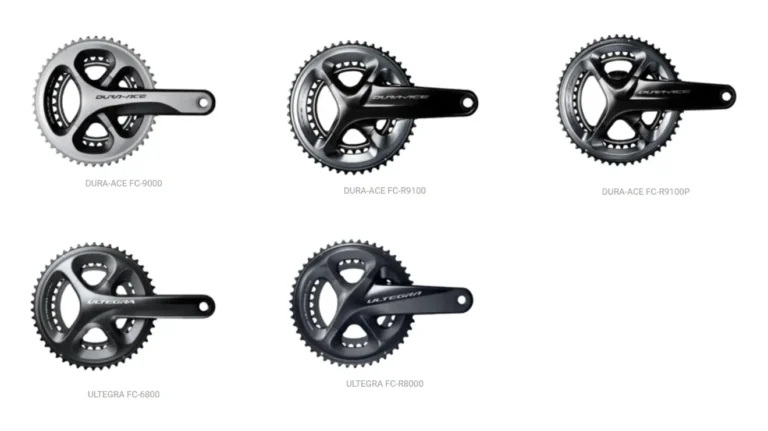
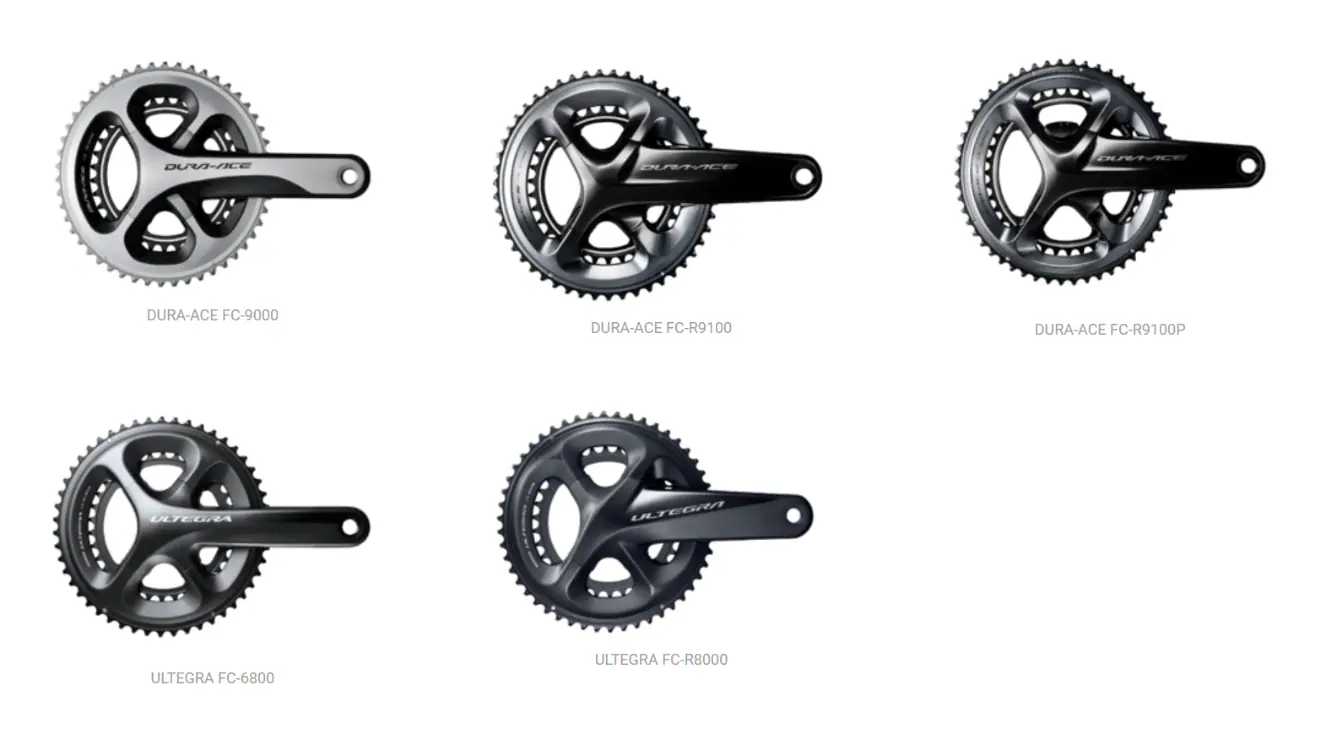
The recall covers about 680,000 11-speed bonded Hollowtech II cranksets, including Ultegra models FC-6800 and FC-R8000, and Dura-Ace models FC-9000, FC-R9100, and FC-R9100P.

The full agreement is available at https://www.govinfo.gov/content/pkg/FR-2026-03-17/html/2026-05135.htm.


Vollering Flies Away in 2026 Liège-Bastogne-Liège Femmes

0

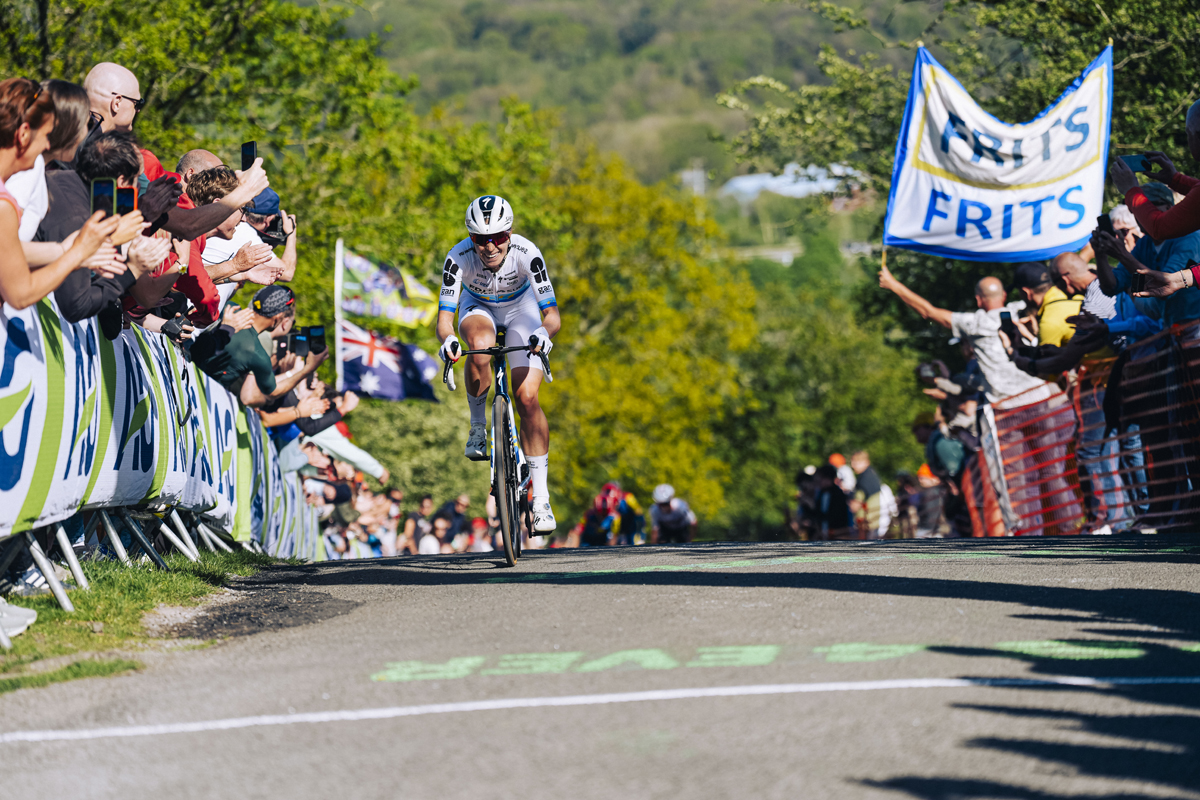
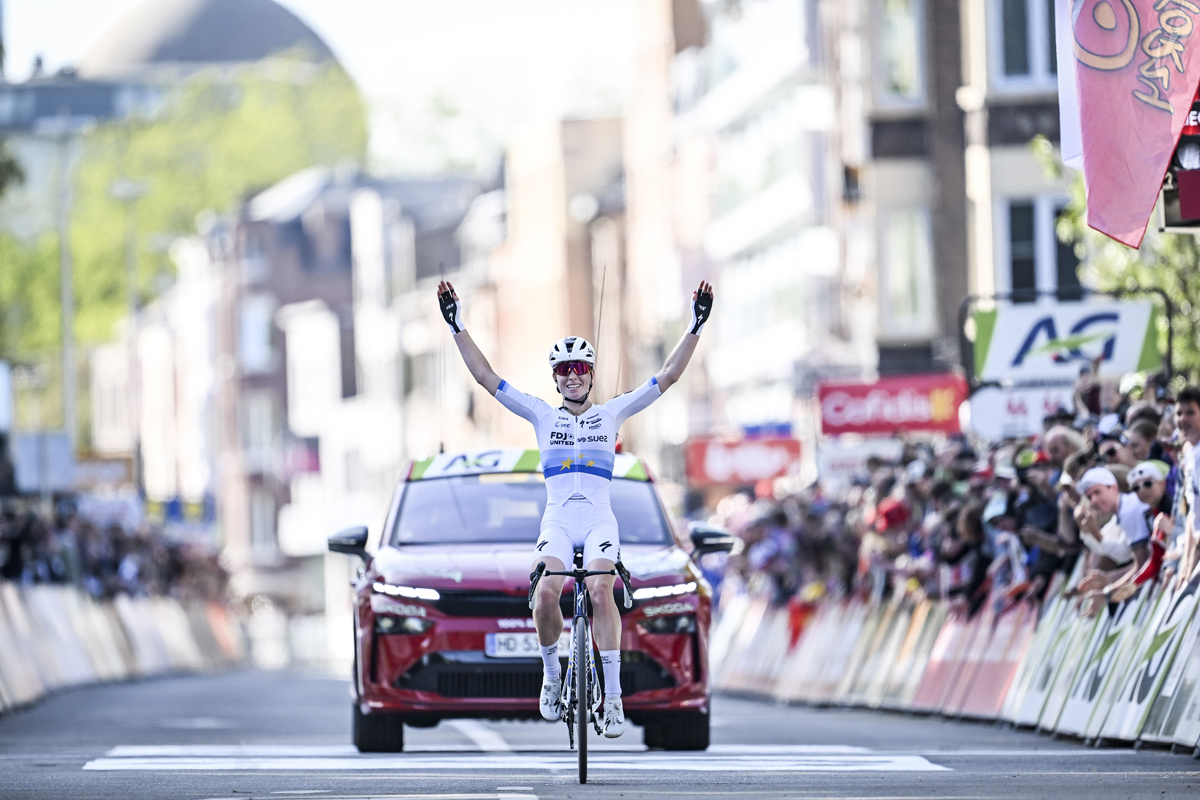
LIÉGE, Belgium (April 26, 2026) – The 10th edition of Liège-Bastogne-Liège Femmes saw Demi Vollering (FDJ United-Suez) become the first three-time winner of the race as she attacked on the Côte de La Redoute and rode solo for 34km to the finish line. After also winning La Flèche Wallonne Femmes midweek, Vollering was again far too strong for her rivals, reaching the finish on Quai des Ardennes a significant 1’29” margin ahead of Puck Pieterse (Fenix-Premier Tech) and Kasia Niewiadoma Phinney (Canyon//Sram zondacrypto), who completed the podium. The 2017 and 2018 winner Anna van der Breggen (Team SD Worx – Protime) finished fourth, crossing the line just behind Niewiadoma, while the top five was rounded out by Paula Blasi (UAE Team ADQ), after a great week for the Spanish rider.


26/04/2026 – Liège Bastogne Liège Femmes 2026 – Bastogne > Liège (156 km) - Demi VOLLERING (FDJ UNITED-SUEZ) - Côte de la Redoute Photo Gaëtan Flamme, ASO
26/04/2026 – Liège Bastogne Liège Femmes 2026 – Bastogne > Liège (156 km) – Demi VOLLERING (FDJ UNITED-SUEZ) – Côte de la Redoute Photo Gaëtan Flamme, ASO

Race Summary:

Starting from Bastogne 
The official start to the race was given at 1.32 pm after a 4.8 km parade out of Bastogne, with 118 starting riders on the road. There were several early breakaway attempts, but they were all quickly neutralised. The bunch was therefore all together as the climb of the Col de Haussire (Km 28.9, 3.9 km at 6.8%) was tackled for the first time ever in the Liège-Bastogne-Liège Femmes race.

The attacks continue 
A strong group of five riders pulled clear on the Col de Haussire ascent, comprising Elise Chabbey (FDJ United – Suez), Sara Casasola (Fenix – Premier Tech), Nienke Vinke (SD Worx-Protime), Femke De Vries (Visma-Lease a Bike) and Riejanne Markus (Lidl Trek), with Swiss rider Chabbey leading them over the summit. Within four kilometres of the Col de Haussire, however, the bunch had caught them. Shortly afterwards, Femke Gerritse (Team SD Worx – Protime) attacked just after km 40 and soon created a 20″ gap, increasing her lead to 2’10” by km 50. 

Into the climbs
At the foot of the Côte de Wanne climb (Km 67.7, 3.6 km at 5.1%) Gerritse was still two minutes ahead, but Julie Bego (Cofidis Women Team) joined Lauren Dickson (FDJ United – Suez) on the counter-attack and they got within 55″ of the leader of the race on the ascent, before they were caught again by the bunch on the descent. At the top of the third climb of the day (Km 74.2: Côte de Stockeu – 1 km at 12.5%) the peloton had all but caught Gerritse, whose lead had diminished to just 5”, then as the bunch climbed the Côte de la Haute-Levée (2.2 km at 7.5%) the breakaway rider was finally reeled in.

26/04/2026 – Liège Bastogne Liège Femmes 2026 – Bastogne > Liège (156 km). Photo Gaëtan Flamme, ASO

Relentless intensity 
On the Col du Rosier climb (Km 92.7, 4.4 km at 5.9%) several big-name riders, including Mischa Bredewold (Team SD Worx – Protime) and Evita Muzic (FDJ United – SUEZ) were distanced, but they rejoined the main group for the ascent of Col du Maquisard (Km 105.2, 2.4 km at 5.7%). On both the Col du Maquisard (Km 105.2, 2.4 km at 5.7%) and the Côte de Desnié (Km 109.3, 1.5 km at 8.1%) Pauline Ferrand-Prevot (Team Visma – Lease a Bike) was seen setting the pace at the front of the peloton.

Seven riders go clear
At the summit of the Côte de Desnié Maeva Squiban (UAE Team ADQ) attacked and Juliette Berthet, Elise Chabbey (FDJ United – Suez), Femke De Vries (Visma-Lease a Bike), Noemi Rüegg (EF Education-Oatly), Antonia Niedermaier (Canyon//Sram zondacrypto) and Isabella Holmgren (Lidl-Trek) followed her, the seven-strong group soon building a 40” lead. But with 36.5 km to go as the race went through Sougne Remouchamps, before the Côte de La Redoute (Km 122, 1.6 km at 9.4%), the pack had caught them. 

Vollering attacks on La Redoute
On La Redoute Vollering launched an attack 570 m from the summit, topping the climb alone, with the peloton exploding behind her. Vollering continued her effort on the descent with the likes of Puck Pieterse (Fenix-Premier Tech), Kasia Niewiadoma (Canyon//Sram zondacrypto) and Isabella Holmgren (Lidl – Trek) the three riders closest to her in the chase at 23″ with 29 km remaining, as Niamh Fisher-Black (Lidl – Trek) was unable to stay with them. Youngster Holmgren would later also drop from the group, to be replaced by the more experienced Anna van der Breggen (Team SD Worx – Protime) in the final chase, although none of them could match the race leader.

Dutch star so strong
Vollering impressively powered on solo over Côte des Forges (Km 132.7, 1.3 km at 7.8%) and Côte de la Roche-aux-Faucons (Km 142.6, 1.3 km at 11%) to cruise into Liège with a big advantage at the front, enjoying the acclaim from the huge crowds along the Quai des Ardennes. She sealed the win in style to round off a great spring, on the back of her recent victories at La Flèche Wallonne Femmes and Tour of Flanders.

26/04/2026 – Liège Bastogne Liège Femmes 2026 – Bastogne > Liège (156 km) – Demi VOLLERING (FDJ UNITED-SUEZ). Photo Gaëtan Flamme, ASO

2026 Liège-Bastogne-Liège Femmes Top 10 Results:

1 DEMI VOLLERING 1 FDJ UNITED-SUEZ 04H 10′ 22”
2 PUCK PIETERSE 11 FENIX-PREMIER TECH 04H 11′ 51” + 00H 01′ 29”
3 KATARZYNA NIEWIADOMA 71 CANYON//SRAM ZONDACRYPTO 04H 11′ 51” + 00H 01′ 29”
4 ANNA VAN DER BREGGEN 21 TEAM SD WORX – PROTIME 04H 11′ 51” + 00H 01′ 29”
5 PAULA BLASI CAIROL 101 UAE TEAM ADQ 04H 12′ 10” + 00H 01′ 48”
6 ISABELLA HOLMGREN 83 LIDL – TREK 04H 12′ 10” + 00H 01′ 48”
7 ELISE CHABBEY 3 FDJ UNITED-SUEZ 04H 12′ 18” + 00H 01′ 56”
8 MAGDELEINE VALLIERES MILL 51 EF EDUCATION – OATLY 04H 12′ 18” + 00H 01′ 56”
9 JULIETTE BERTHET 2 FDJ UNITED-SUEZ 04H 12′ 18” + 00H 01′ 56”
10 AXELLE DUBAU-PREVOT 52 EF EDUCATION – OATLY 04H 12′ 18” + 00H 01′ 56”

Reflections on the 50th Anniversary of the Bikecentennial

Jubilee in the Desert – Pedaling Forward Since 1976

By Roger Crandall — Now that our Nation has reached 250 years, we as cyclists might reflect back a bit to just 50 years ago, when modern popular cycling took off in the 1970’s. What cycling was done in America of the 1800’s and at the turn of the century had very little bearing on us today. When I went to college ’68-72, even when a car was not allowed, I never rode a bike, that was for kids. Two years later, that would all change. As for myself, I remember when I sat down in a dentist office and picked up the National Geographic Magazine of May 1976, and at that moment my world would be forever changed 180 degrees. Since that moment, my cycling experience has been a factor in all the major decisions of my life to today.

Reading about my heroes and inspiration, Dan and Lys Burden, Greg and June Siple cycling from Anchorage, Alaska to Missoula, Montana thrilled me to the bone. My wife and I saw ourselves through them, and we became them! Their goal to ride to South America, became our goal! They accomplished their goal and probably thought that most people wouldn’t follow them on that kind of crazy trip, so they invented the Bikecentennial to inspire other young Americans to take up cycle touring. Little did they know then that the spark they lit fired us up to buy two of those “new-fangled 10 speed bikes” and begin our journey from Chicago to Mexico, Central America, and around South America for 2 ½ years. Now we all can pedal forward from 1976 and celebrate another 50 years of cycling.

If you are not familiar with Adventure Cycling Association, it was founded in 1976 when a group of 4,000 riders embarked on a cross country Bikecentennial journey to celebrate America’s 200th birthday. That original Trans American trail became the backbone of what is now 57,298-mile ACA network spanning the country with signage, maps, both published and digital.

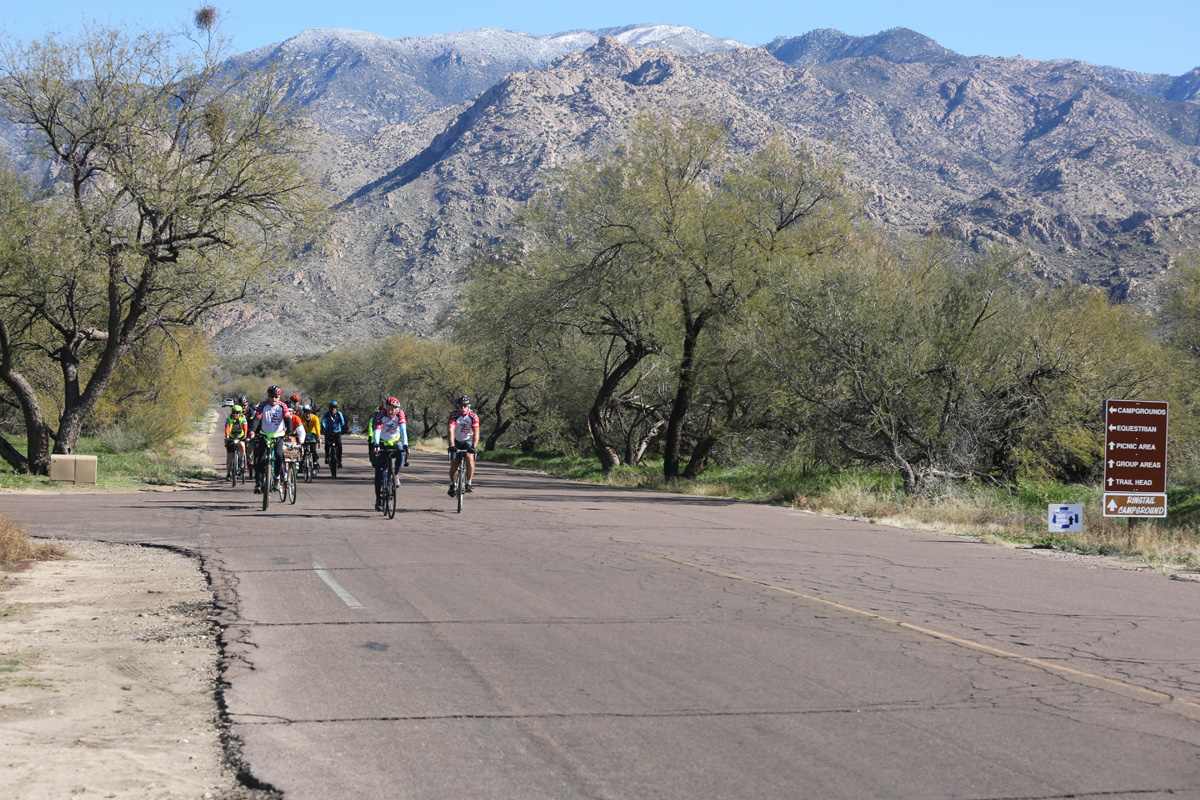
Scenes from the Adventure Cycling Anniversary Ride Jubilee 2026. PHoto by Dreux MeMack

It was an absolute “must do” to be there for the Adventure Cycling Association’s Jubilee, January 9-12 at Catalina State Park, just north of Tucson, Arizona where around 400 cycle enthusiasts were celebrating their life changing ride across America in 1976. I have never encountered so many people that I have had so much in common with; neither high school reunions nor other bicycle rides. It was scary to see yourself coming and going! The weekend was filled with group rides, hikes, speakers, slide shows of the ’76 ride, music, dinners together, a real blast, back to the past!

A true highlight for me was to meet our guest speaker, the world’s most famous woman cyclist, star of countless videos, holder of the around the world Fastest Know Time (FKT) for women, and my personal hero, Lael Wilcox; and did she have a lot to inspire us with. She is going after the Men’s Around the World Record this year! Her warmup rides will include “drop-in rides”, that we can do with her, like the Southern Tier, 3,074 mi, route from San Diego to St. Agustine, FL. We asked how we, (those in our 60’s and 70’s) could keep up? She said on whatever bike we want including E-bikes. She will just be doing her 230 to 240 miles a day average pace! You should have heard the laughs. I shouted, “Yea, I can do that! In my dreams!” Maybe I can hang with her for a mile or so with my E-bike on Turbo mode? Let’s, see???

Author Roger Crandall is in the back row in yellow. Scenes from the Adventure Cycling Anniversary Ride Jubilee 2026. PHoto by Dreux MeMack

This year in 2026, Adventure Cycling Association is launching the Golden Gravel Trail, a transformative 3,804 mile mixed-surface route that represents the future of long-distance bikepacking in the USA. The G.G.T. traverses eight states: Missouri, Kansas, Oklahoma, Colorado, UTAH, Wyoming, Idaho, and Oregon. Seventy percent of the route is on unpaved surfaces, and it will offer an unparalleled journey from the Mississippi River to the Pacific Ocean. This year the Golden Gravel Trail will be completely free to ride as a celebration of the 50th Anniversary of the ACA. The digital route, including detailed route lines, service info, riding and weather conditions, and up-to-date details cyclists expect from the ACA will be available at no cost. In September 2026, ultra-endurance racer Lael Wilcox, one of ACA’s board members, will attempt to set the first Fastest Known Times, on the new route. Drop-in rides with other famous riders like Ryan Van Duzer on the Great Divide Mountain Bike Route, will be going on all year with sign-ups starting on March 10th.

Though you may think our Country after 250 years is not getting any wiser, and mistakes are being made every day. At least we are moving upwards and onwards for cycling with a growing cross-country Great American Rail Trail and new routes that even pass close to home for us in Utah. Thank goodness we have something to celebrate; and it is for us, in the cycling community, to guide the new generations back into the fold of bicycle touring. Let’s get onboard for MABTA, no, not NAFTA… Make America Bike Tour Again!


Pogačar triumphs again in Liège and finds a new challenger in Seixas

0

LIÉGE, Belgium (April 26, 2026) – Tadej Pogačar (UAE Team Emirates-XRG) proved again his current domination of professional road cycling by winning the 112th Liège-Bastogne-Liège, becoming the first rider in this century to get three straight victories in La Doyenne, and completing an outstanding spring in which he has won all Monuments at stake but Paris-Roubaix (2nd, behind Wout van Aert) while wearing the rainbow jersey and being the Tour de France reigning champion – a feat only achieved before by Eddy Merckx in 1975. This Liège, though, had a different factor at play compared to the two previous ones. His name is Paul Seixas (Decathlon-CMA CGM). At 19 years and 7 months old, the young Frenchman managed to resist Pogačar’s devastating accelerations up La Redoute and only kneeled down before the world champion at La Roche aux Faucons, crossing the finish line in 2nd position to further build on his promise of one day challenging the Slovenian rider for his throne as best rider of the moment. Remco Evenepoel (Red Bull-Bora-Hansgrohe) rounded out the podium after a gutsy, courageous performance that saw him go on the offensive from the start and be chased for 165 kilometres by the peloton.


173 riders took the start in the 112th edition of Liège-Bastogne-Liège, held over a 259,5-kilometre course from Liège to Bastogne and back, at 10:00. There were two DNSs: James Shaw (EF Education-EasyPost) and Alexandre Delettre (TotalEnergies). The race was shaken from the very beginning by 54 riders who went clear as the flag dropped, establishing a breakaway that included the likes of Remco Evenepoel (Red Bull-Bora-Hansgrohe), Egan Bernal (Ineos Grenadiers) or Quinten Hermans (Pinarello-Q36.5). Despite the efforts by Tadej Pogačar’s UAE Team Emirates-XRG, the front group managed to stay clear and went on to build a sizable advantage, as large as the 4’00” timed atop the Côte de Saint-Roch (km 83,7).

26/04/2026 – Liège Bastogne Liège 2026 – Liège > Liège (259,5 km) - Pau MIQUEL DELGADO (BAHRAIN VICTORIOUS), Egan BERNAL (INEOS GRENADIERS), Michael Shea LEONARD (EF EDUCATION - EASYPOST), Remco EVENEPOEL (RED BULL - BORA - HANSGROHE) © A.S.O./Billy Ceusters
26/04/2026 – Liège Bastogne Liège 2026 – Liège > Liège (259,5 km) – Pau MIQUEL DELGADO (BAHRAIN VICTORIOUS), Egan BERNAL (INEOS GRENADIERS), Michael Shea LEONARD (EF EDUCATION – EASYPOST), Remco EVENEPOEL (RED BULL – BORA – HANSGROHE) © A.S.O./Billy Ceusters

A frantic chase between two pelotons

From the axis of the course in Bastogne (km 96,6), Paul Seixas’ Decathlon-CMA CGM (which was the only team not represented at the head of the race) started contributing to the chase. The gap went quickly down to the 2’05” clocked at the summit of the Col de Haussire (km 132,4). It was on its ramps that Belgian national champion Tim Wellens started setting a fierce pace on behalf of UAE. He was later joined in this duty by Decathlon’s Antoine L’Hôte as Pinarello-Q36.5’s Tom Pidcock fell out of contention due to a mechanical issue. Together, Wellens and L’Hôte further reduced the advantage of the front group until finally catching up with the best part of it at kilometre 165. By that point, five men had jumped from the breakaway: Baptiste Veistroffer (Lotto-Intermarché), Alexander Kamp (Uno-X), Pascal Eenkhoorn (Soudal-Quick Step), Gijs Leemreize (Picnic-PostNL) and Hugo Houle (Alpecin-Premier Tech). They would be brought back, one by one, until no escapee was any longer in the lead before the summit of the Côte de Stockeu (km 177,7).

Seixas resists Pogačar’s attacks up La Redoute

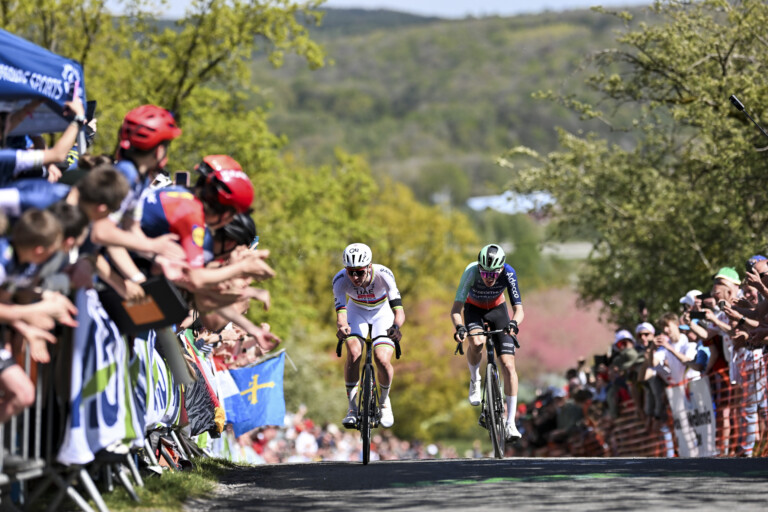
The race entered a steady phase, with UAE Team Emirates-XRG at the helm and a remarkable fight for positioning in the peloton, which was decimated down to 60 riders. It was in the first slopes of the Côte de la Redoute (km 225,5), with 35 kilometres to go, that Tadej Pogačar launched a first trademark, violent attack – and then a second before the summit. Firm on his wheel, Paul Seixas managed to stay put as Lidl-Trek’s Mattias Skjelmose unsuccessfully tried to bridge back and found himself reeled back in by a chasing group. The young Frenchman was not shy of cooperating with the world champion, and this defined the race in their favor. Atop the Côte des Forges (km 236,2), the duo had already built a one-minute gap on their nearest chasers.

26/04/2026 – Liège Bastogne Liège 2026 – Liège > Liège (259,5 km) - Tadej POGACAR (UAE TEAM EMIRATES XRG), Paul SEIXAS (DECATHLON CMA CGM TEAM) - Côte de la Redoute © A.S.O./Billy Ceusters
26/04/2026 – Liège Bastogne Liège 2026 – Liège > Liège (259,5 km) – Tadej POGACAR (UAE TEAM EMIRATES XRG), Paul SEIXAS (DECATHLON CMA CGM TEAM) – Côte de la Redoute

The rainbow jersey flies away in the Roche aux Faucons

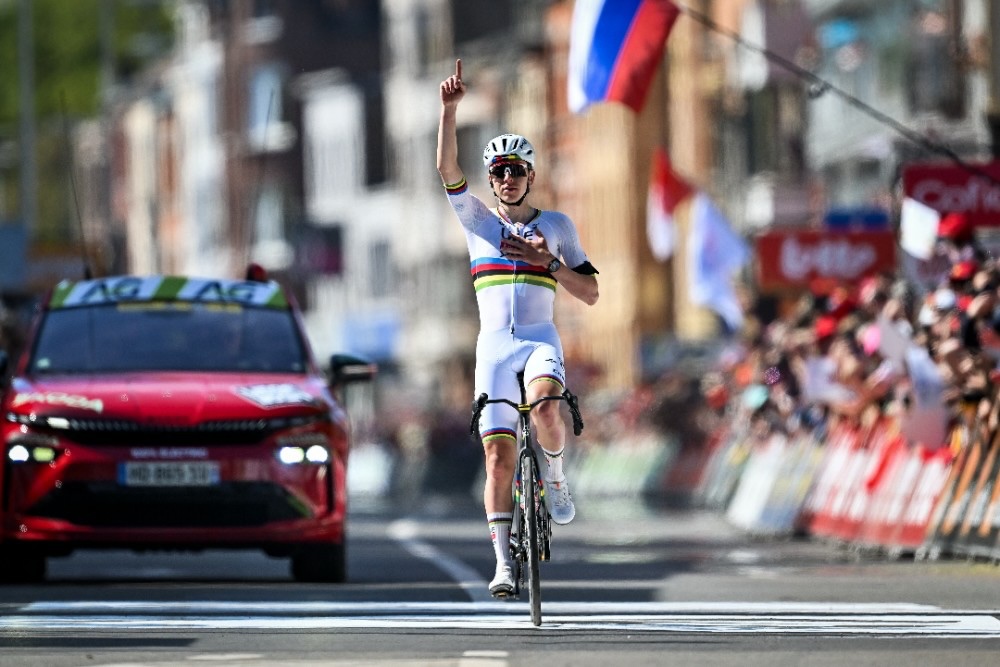
As in every edition between 2018 and 2021, the Côte de la Roche-aux-Faucons (km 246,1) was set to be the deciding climb in Liège-Bastogne-Liège. Pogačar hit the afterburners from its foot, and finally managed to drop Seixas 600 meters from the summit – that is, with 14 kilometres to go. The Slovenian quickly built a gap that enabled him to reach the finish with 45” on his challenger, pointing a finger to the sky in loving memory of his former teammate Cristian Camilo Muñoz, who passed away two days before this race. Behind the front duo, the fight for podium was hectic and, after many attacks, came down to a sprint in which Evenepoel managed to get a meagre reward for his gutsy performance by defeating Alpecin’s Emiel Vestrynge and Ineos’ Egan Bernal to the line.

26/04/2026 – Liège Bastogne Liège 2026 – Liège > Liège (259,5 km) - Tadej POGACAR (UAE TEAM EMIRATES XRG). Photo © ASO
26/04/2026 – Liège Bastogne Liège 2026 – Liège > Liège (259,5 km) – Tadej POGACAR (UAE TEAM EMIRATES XRG). Photo © ASO

Tadej Pogačar: “I am impressed and amazed by how good Paul Seixas is”

“A lot of things happened today. In the beginning, I was at the back, just following wheels, and from one moment to the next there was a split with Remco in it. I was a bit nervous at first, and we tried hard to close the gap down immediately. After 20 minutes, we realized it was not bad to let them go as in this kind of large breakaways the cooperation is never great, even if I was a bit scared that Remco Evenepoel could jump and go solo from that group. We kept the situation under control thanks to Vegard [Stake Laengen] and Rune [Herregodts], who did an amazing job. Decathlon came to help later, and the rest of the team then came in. You never let Remco go away, but today’s situation was different.”

“I wouldn’t know how to explain why La Redoute suits me so well. I find it is a good spot to attack because it is a hard climb and it comes after 5 hours of racing. Then, I decide where to launch my attack just on the feeling. It really depends on the year. As for today, Benoît [Cosnefroy] did a great lead-out into the climb and I could feel he was nearly empty. We had some momentum and this is why I felt it was the right moment to go.”

“I went really deep up La Redoute, and I could see Paul Seixas was struggling, but then he came near me across the summit. He pulled quite strong all the way and because of this we were able to open a big gap. In the back of my mind, I was getting ready to go head-to-head on a sprint with him. I gave it a try at the Roche aux Faucons anyway, and luckily managed to drop him.”

“I am impressed and amazed by how good Paul is. Chapeau to him. I have nothing but praise for the kid – for his incredible results at the start of this season, and for how mature he is. I don’t think there are many riders stronger than him right now. Having him at such a good level being just 19yo is a source of motivation for everybody to keep trying to improve. He is just 19yo and the best age for us riders usually is 26 or 28. We have to keep working hard if we want to keep fighting for victories, before he destroys everybody. I definitely know that every year it will become harder and harder for me to win. I’ve been doing this for a while now and I’m not getting any younger. It’s a matter of time before I decline.”

“It means a lot to win one of the biggest races in cycling again. I don’t do many races anymore, and thus don’t have many opportunities to win. That means I’m under a lot of pressure on days like today. I’m really happy that we succeeded. I couldn’t be more proud of my team, today and all season long. I hope we can keep going like this into the summer, after Romandie. We are in a good place right now. I feel good on the bike and during training, and I appreciate the time I spend with my teammates more and more every year.”

 Paul Seixas: “I have to take one step at a time”

“I always race to win, but we know that [Tadej] Pogacar has been utterly dominant these last few years, so just being able to follow him is already something. You have to take things one step at a time, without rushing. At Strade Bianche, I couldn’t follow his first attack; today I managed to do it, so I’m quite happy with my performance. There’s also the team’s work to consider, because at Strade Bianche I found myself isolated and couldn’t get on his wheel when he attacked. Here, I was perfectly positioned on his wheel all day. I think that’s what allowed me to hang on at La Redoute, because I had to give it all there. The extra edge of being well-placed on his wheel throughout the race is definitely something.”

“I was completely exhausted at La Redoute. The speed we were climbing at, I was blown away! It was an insane pace. It didn’t take much more for me to crack; I was at my limit. I hung on as best as I could, and afterwards it felt good to catch my breath and take turns at the front with him. We built up the necessary lead to go all the way to the finish, and then it came down to the final climb up the Roche aux Faucons. It was a battle of brute force there. Experience always helps, but it didn’t really matter here because the race wasn’t particularly complicated: I just had to stay in his slipstream, be there at the right moment, and find myself alone with him. There’s not much I could have done better. I simply lacked the power to stay with him a bit longer.”

“Just keeping up with Pogacar is extremely difficult. He’s one of the greatest riders of all time, so being able to hang on to him, to fight with him all the way to Roche-aux-Faucons… He was so close to the finish. There’s still work to be done, and that’s normal; we mustn’t rush things, but be satisfied with what we got today.”

“I was in uncharted territory racing such a long race as a Monument is. I did well in Il Lombardia last year, but there were some question marks anyway. I think I’ve made a step forward in terms of endurance. How hard the race was almost works to my advantage because I can repeat efforts and recover quite well from them, as we saw at the Tour of the Basque Country. It’s very satisfying for the future. Since I finished second, my next ambition will be to win a Monument. There are no certainties in life regarding the future: until you’ve done it, you haven’t done it. I’m just going to work towards it.”

Remco Evenepoel: “My breakaway was a very, very strange situation”

“It’s difficult to explain what happened in the early stages of the race. I always try to be up there at the start of Liège-Bastogne-Liège, because I know it can be pretty hard, and this is why I was in the front group when the split happened. We were gone, but it was not our goal – just an accident. We quickly built a gap, and then it was too late to drop back so I just tried not to spend too much energy. The collaboration was not great, so I think the move didn’t make a great difference in my favor. The situation could have been more beneficial if the group had worked alright together, or if I had had one more teammate to ride at the front. All in all, it was a very, very strange situation. I don’t think it took a toll on me towards the finish, but we still have to check my numbers with the coaches.”

“I was in a good position coming into La Redoute, between sixth and tenth wheel at the front. I nearly crashed on a roundabout, though, after touching wheels with the guy in front of me. We started the climb at a very strong pace, and I knew I was going to be on my limit pretty soon if I followed the other riders’ pace, so I chose to focus on myself. I realized pretty quickly that my legs were not great into the final, so I focused on not letting any big group go, and then on doing a great sprint so I could make it to the podium. With the legs I had today, this was the best possible outcome.”

“It seems Paul [Seixas] was more than ready for a 6-hour race. It was not surprising that he was able to follow Tadej [Pogacar] up La Redoute, because we know his results and his performances from the previous months. He showed again today that he already is one of the best climbers in the world, and on top of this has a great punch in him. The whole world can only say ‘chapeau’ to him. It’s great that he can already fight for the win in big races like Liège-Bastogne-Liège.”

RANK RIDER RIDER NO. TEAM TIME GAP
1 TADEJ POGACAR 1 UAE TEAM EMIRATES XRG 05H 50′ 28”
2 PAUL SEIXAS 21 DECATHLON CMA CGM TEAM 05H 51′ 13” + 00H 00′ 45”
3 REMCO EVENEPOEL 11 RED BULL – BORA – HANSGROHE 05H 52′ 10” + 00H 01′ 42”
4 EMIEL VERSTRYNGE 211 ALPECIN-PREMIER TECH 05H 52′ 10” + 00H 01′ 42”
5 EGAN BERNAL 112 INEOS GRENADIERS 05H 52′ 10” + 00H 01′ 42”
6 PELLO BILBAO 92 BAHRAIN VICTORIOUS 05H 52′ 10” + 00H 01′ 42”
7 ROMAIN GREGOIRE 101 GROUPAMA-FDJ UNITED 05H 52′ 10” + 00H 01′ 42”
8 CHRISTIAN SCARONI 124 XDS ASTANA TEAM 05H 52′ 10” + 00H 01′ 42”
9 TOBIAS JOHANNESSEN 131 UNO-X MOBILITY 05H 52′ 10” + 00H 01′ 42”
10 FILIPPO ZANA 167 SOUDAL QUICK-STEP 05H 52′ 10” + 00H 01′ 42”


Porch Bike

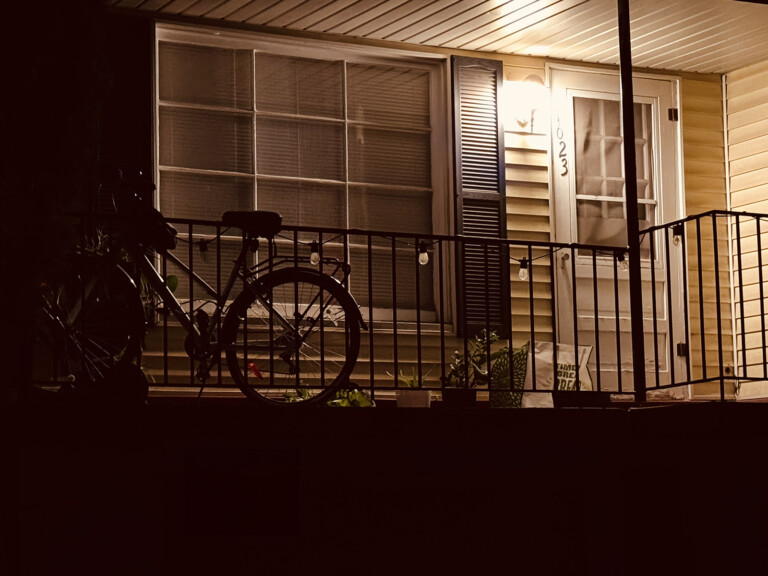
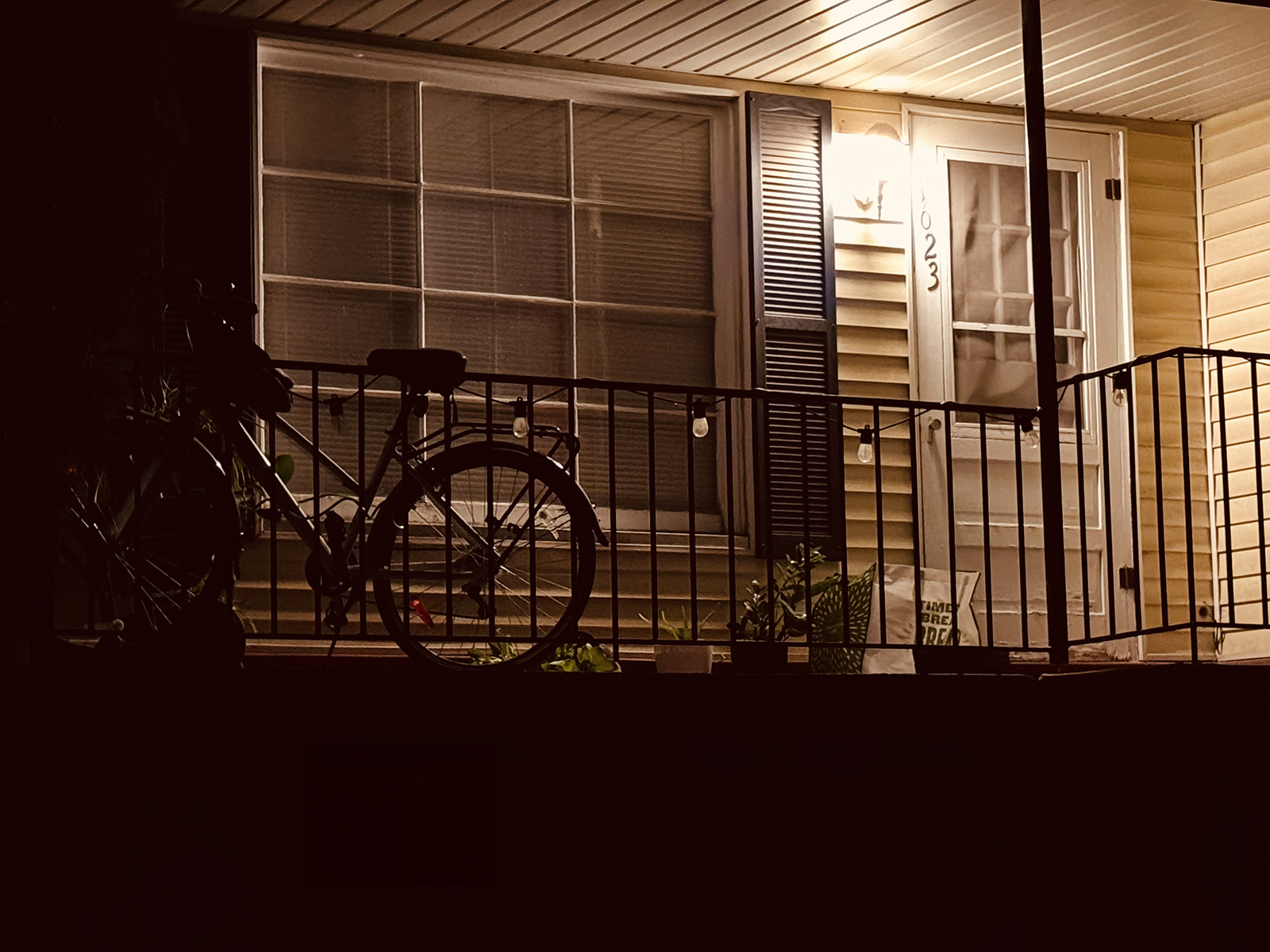
Porch Bike. Photo by Dave Iltis

Crowdsourcing the Bike Lane: How an App Is Tracking—and Deterring—Blockages

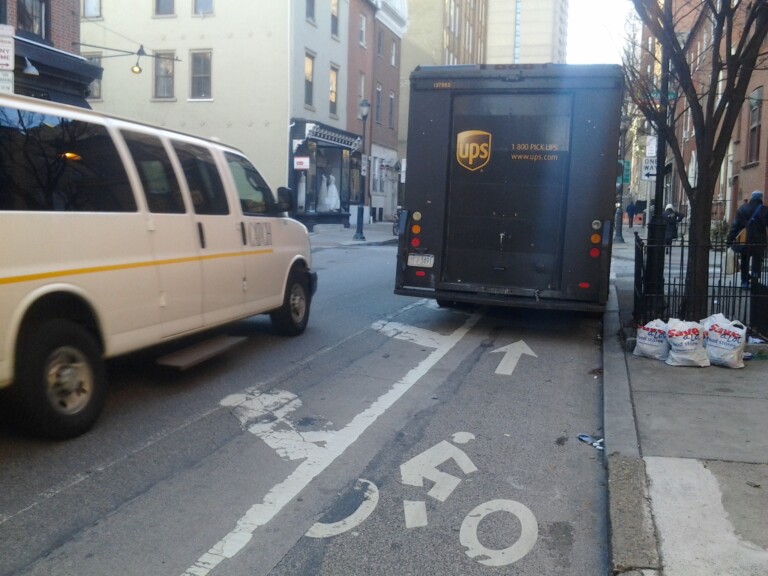
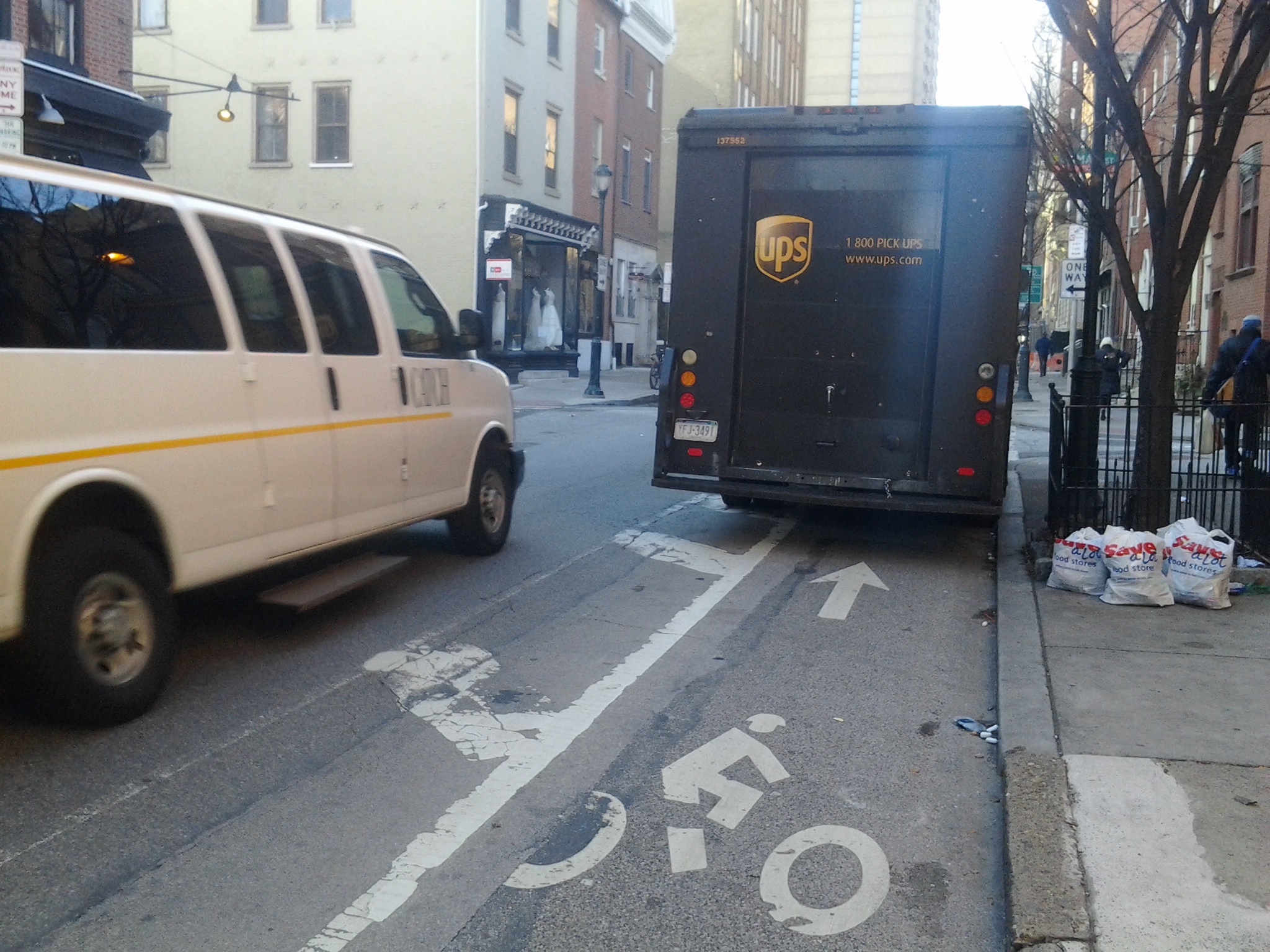
By Charles Pekow — Every urban cyclist knows the drill: a delivery van idles in the bike lane, forcing a swerve into traffic or a sudden stop. In Chicago, one rider turned that daily frustration into a nationwide tool. Christina Whitehouse founded Bike Lane Uprising (BLU), an app that lets users report blocked bike lanes—and builds a growing database of where violations happen and who causes them.

Screenshot fromj the App Store.

Whitehouse argues that drivers will continue to ignore unprotected bike lanes as long as it remains the easiest and cheapest option. BLU channels each report into a central database spanning the United States and Canada. By early March, users had logged more than 114,000 incidents—data that cities now use to guide enforcement and infrastructure improvements.

Few bike lanes in Philadelphia are protected, leading to situations where trucks and other vehicles park in and thus block the lane. Photo by “Phila. Bikes”, CC BY-SA 2.0, Attribution-ShareAlike 2.0 Generic

BLU does more than collect complaints. The organization runs education programs to explain bike lane laws, identifies repeat offenders, and flags companies whose drivers repeatedly block lanes—one firm accumulated 60 violations. The app also notifies companies directly. Some employers, Whitehouse says, are unaware of the problem; others may implicitly encourage it.

In Chicago, BLU has worked with the city to reroute 911 complaints about bike lane obstructions away from police dispatch and toward parking enforcement. Officials have also used BLU’s mapped data to pinpoint where stronger enforcement—or better infrastructure—is needed.

Cyclists in western cities have adopted the app as well. In Cedar City, reports show most violations come from private drivers, with about 20 percent from company vehicles and even a handful from municipal employees—while for-hire drivers account for relatively few.

The app is available at https://www.bikelaneuprising.com/.