By Tom Jow — The prospect of owning an E-MTB has been slowly creeping up on me. First one friend, then another. Let’s face it though, none of us are getting any younger. When they first came out, I was as disgusted as anyone that’s been around since the beginning of the sport. Gradually my disgust turned into acceptance, observing that “hey, you still have to pedal the thing”. However, at no time did I ever say they couldn’t be fun. I mean, who can argue against riding the same speed or faster using less power? I just wasn’t ready to get one. Until a friend made me an offer I couldn’t refuse.
Because I wasn’t shopping, I knew very little about them. This is what I knew: 1) they have a motor, 2) a battery, 3) a controller to adjust a number of assist levels, and 4) when you pedal, it assists you. After some rides and some research, I have learned a lot more.
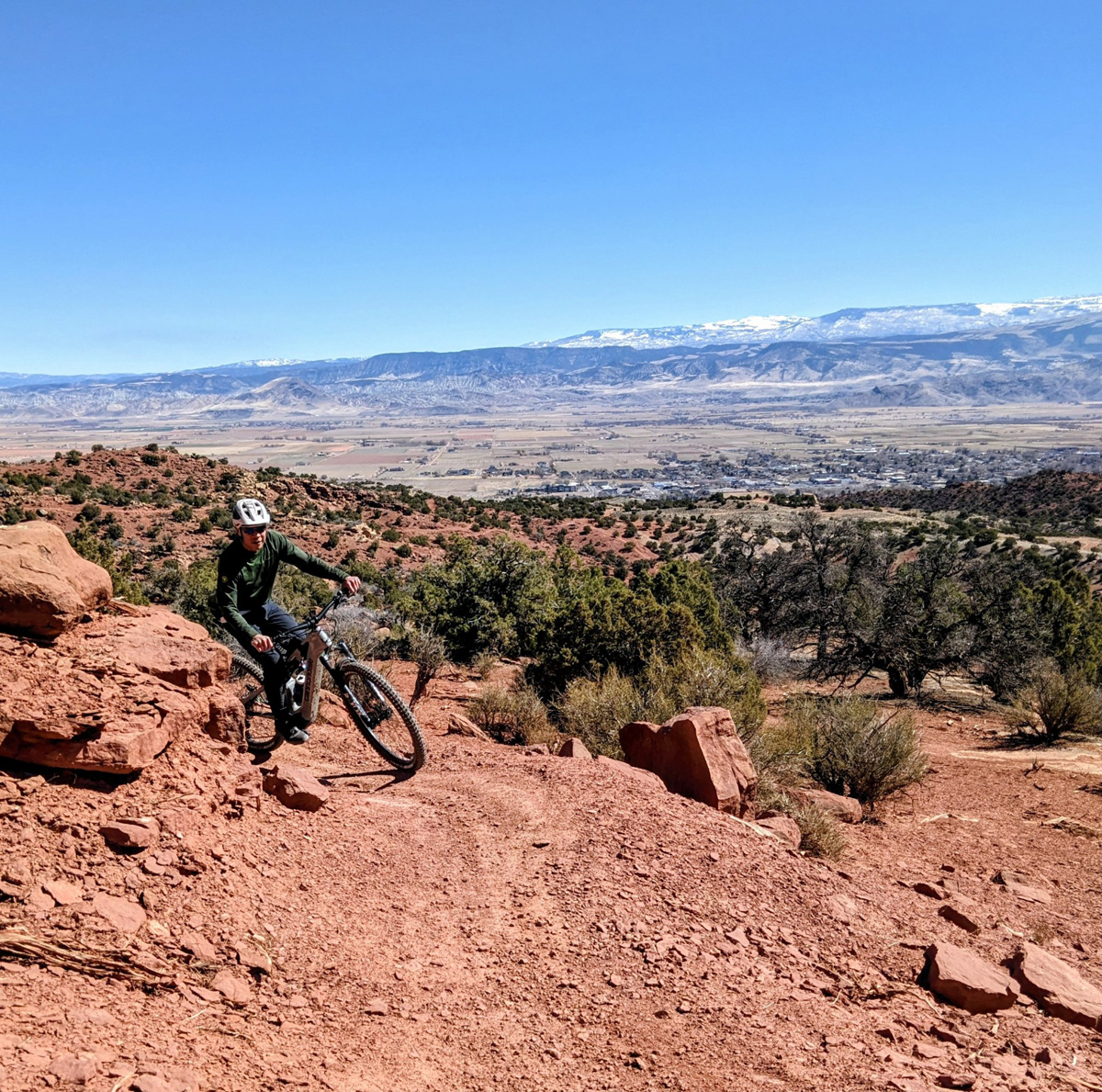
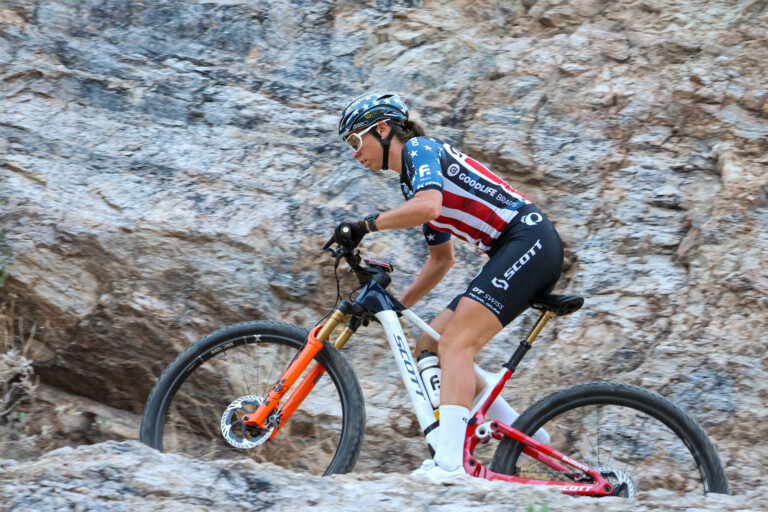
Tom Jow cruising up the trail on his e-MTB in Richfield, Utah. Photo by A. Meyer
For example, motors come in different power levels. Measured by output of torque, the motors could be broken down into three categories: full power (>85Nm), mid power (50-60Nm), lightweight (35-40Nm). In my brief research, there appears to be many more full power e-MTBs than mid power or lightweight.
The full power bikes are the most capable of going both uphill and down. Usually paired with the largest battery (>700wH) these bikes are quite heavy, 50 pounds or more. Combined with long travel suspension of more than 150mm front and rear, think of the full power e-MTB as a “self shuttle” downhill machine.
For the rider that prefers a lighter weight bike but still wants a strong assist, look to the mid power category. With 55-65Nm of torque and a smaller battery (500-600wH) these bikes weigh approximately 45-50 pounds. Even at this weight, it is heavier than most of us are accustomed to. However, with long travel suspension, the mid power bikes can still handle a wide range of terrain, both uphill and down.
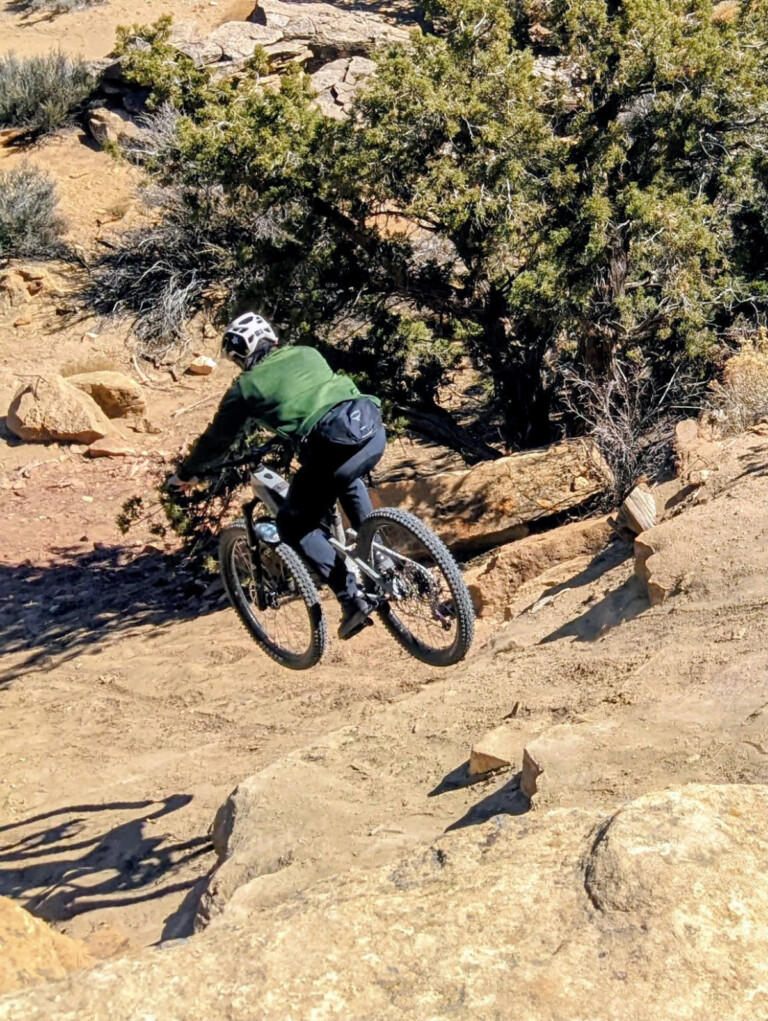
Tom Jow on his e-MTB flying down the Spinal Tap trail. Photo by A. Meyer
The lightest weight e-MTBs tip the scale in the range of 35-45 pounds. Equipped with a motor that ranges 35-45Nm and a lightweight battery (350-450wH), these bikes offer an assist that is closer to a strong tailwind than having a motor. The rider of these lightweight e-MTBs (my guess) is someone that wants to use the assist as little as possible. Examples of this might be keeping up with strong friends on non-assisted bikes or tackling slightly longer or steeper rides than normal.
Truth be told, I didn’t even know these things before I started riding one. My first couple rides entailed just figuring out the power modes, and how strong they were (or weren’t). One thing I found out quickly was that Eco mode was barely strong enough to get the bike out of its own way. The mode Trail 1 was the sweet spot. It seemed perfectly matched for the uphill grade and my power output. Trail 2 was too strong for any tight or blind turns. But it sure was fun going up wall steep pitches. And Boost mode? Much too strong for anything that wasn’t straight and smooth.
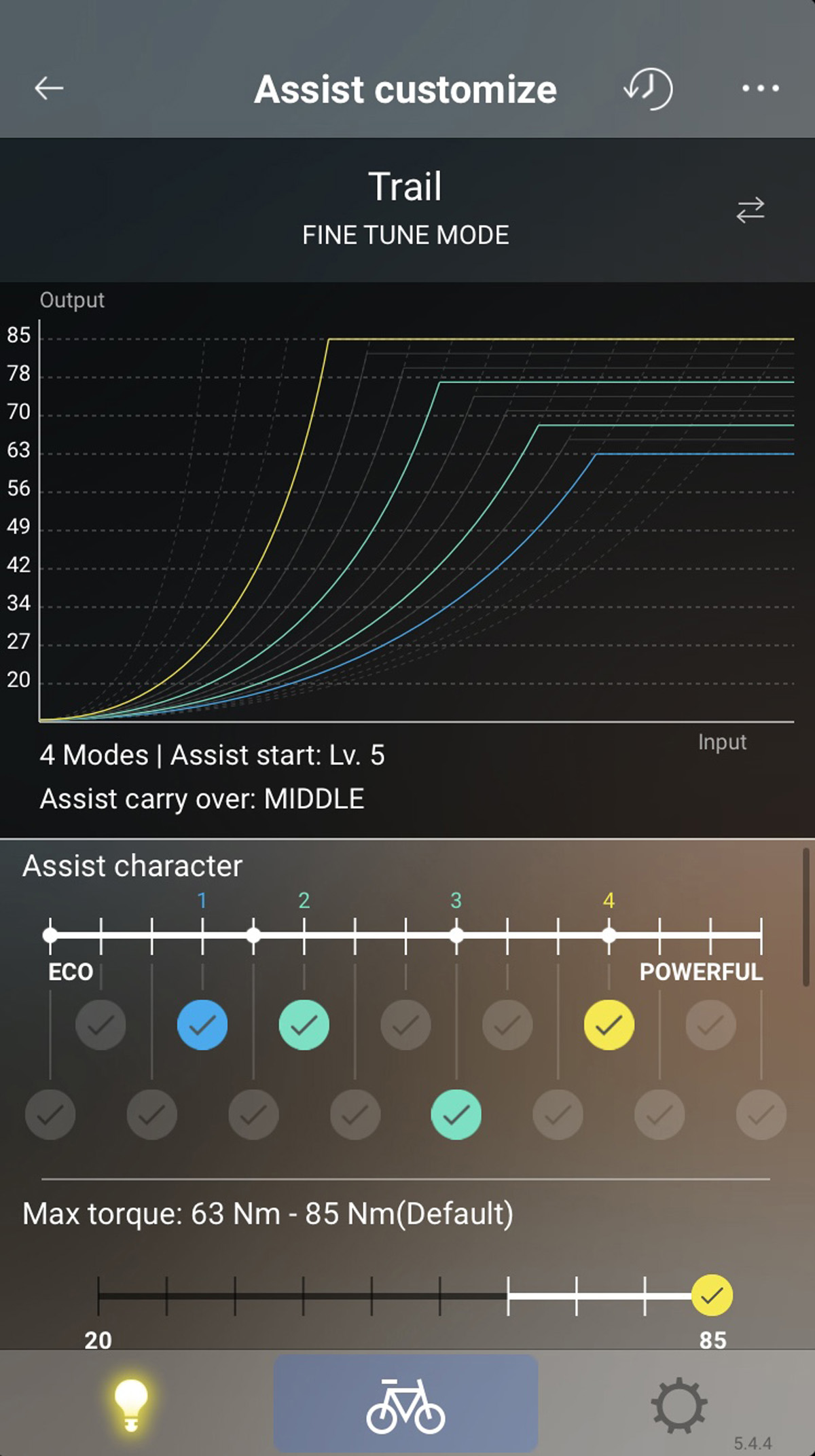
I needed to figure out how to fix Eco mode. It just wasn’t helping enough. After a little research, I discovered I could connect to the Shimano E-tube app and make some changes to the programming. Within the app, I found many drive characteristics to adjust. Shown in the graphs in photo 1 are the power curves of the different modes. The vertical axis is the output (in torque), and the horizontal axis is input (human power). This means that the taller the curve, the higher the output. The maximum is 85. Each individual mode also has a maximum output. For example, Eco tops out at about 60. As for the horizontal axis, the flatter the curve, the more human input is required for power to match. Notice that in the Trail 2 (green) and Boost (yellow) mode, the lines are much steeper than Eco mode. When using the stronger modes, the assist begins much earlier.
Programmable options of the Shimano EP8 motor including power curves for each mode, start timing and assist carryover.
Options for programming the power levels of each mode.
As for my needs, first I wanted to address the weak Eco mode. By moving the blue dot towards powerful (photo 2), I made the power come on a little sooner. If you look closely, you can see that the blue line in the second screenshot is a little steeper. Another adjustment I wanted to try changing was the “assist carryover”. This affects how long the motor continues to produce power after pedaling stops. It seemed to me that having a little more carryover could help get up and over obstacles. This I changed to medium. The behavior for “assist start”, which affects how the power comes on from a dead start, I chose to leave at the default of “quick”.
What a difference changing the Eco power curve made. Now I could ride in Eco mode without feeling like I was doing all the work. It is actually usable now. Assist carryover, on the other hand, is going to take a little getting used to. The anticipated benefit of having a little kick to get up rocks and steps is very helpful. However, I did not expect to be overshooting corners because the power was still on. I will have to learn to coast a little earlier to adjust for this.
Not only do I have to adapt to the carryover, but I am also learning how to pedal symbiotically with the motor. This is the key to getting the most out of the power assist. Referring back to the graphs, notice how far across the input axis the blue line for Eco mode extends, moving up the output axis gradually? This indicates that the rider must put in quite a bit of effort in order to get some return. Witness also that as we move to the more powerful modes the input requirement is reduced. The question then is: how does the motor sense input?
The motor takes into account two factors, torque and cadence. Torque, for example, is the twisting force applied to the drive spindle. When we apply high pressure to the pedals at a low cadence we are creating “high” torque. The second factor, cadence or pedal rpm, is as important; maybe even more. The reason is that the drive is programmed to be most helpful near a cadence of 80-90. If cadence is so important, what does torque have to do with it? Well, we can ride at optimum cadence in two different torque scenarios. First, we can ride in an easy gear, spinning along at 80rpm with low torque. In this instance, the motor will assist in a manner that feels like floating up the hill. On the other hand, we could pedal at the same cadence in a higher gear, pushing hard on every pedal stroke. The motor will mirror this higher torque, powering up the hill and encouraging us to keep up by adding more assist as we apply more pressure.
This feeling of being superhuman, pedaling like crazy and flying up the hill is the attraction, isn’t it? Or is it the feeling of floating along like we are using very little power? Maybe riding long distances in Eco mode using minimal assistance is more desirable? With multiple power modes we can do it all. Now I have learned that not only is the e-MTB versatile, but it is also a lot of fun. So much fun in fact, that my other bikes are at risk of collecting a lot of dust.
About the artist: I am Belgian artist living in Brussels. I am self-taught and I love minimalist art in which I work; I like to seek the minimum of strokes to convey an idea or an situation or an emotion.
The second week of the 2026 Giro d’Italia arrived with chaos, attrition, and the first true mountain battles of the race. Jhonatan Narváez continued his remarkable comeback with two stage victories for UAE Team Emirates XRG, while Jonas Vingegaard finally unleashed his climbing legs on the slopes of Blockhaus and Corno alle Scale. Yet despite the Danish star’s dominance in the high mountains, Portuguese outsider Afonso Eulálio refused to surrender the Maglia Rosa, surviving day after day against the race favorites as the Giro tilted toward its decisive phase.
Stage 4 — Catanzaro–Cosenza, 138 km
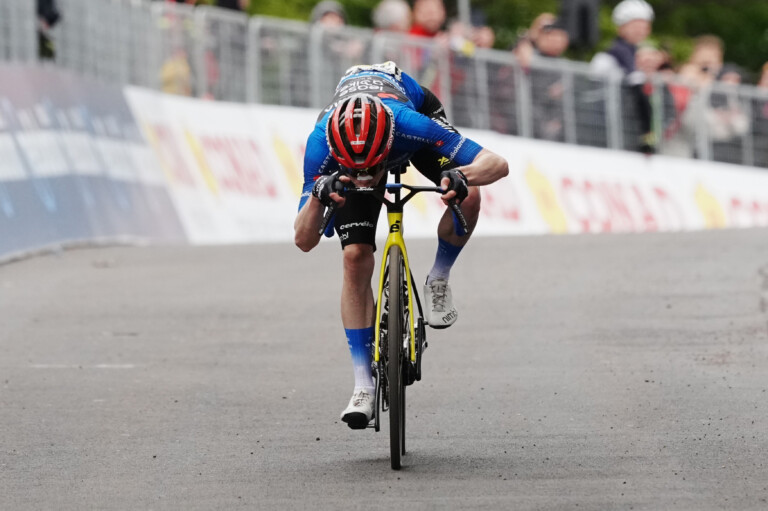
The Giro’s first visit to Calabria delivered a nervous, explosive finale into Cosenza, where twisting roads, late climbs, and technical corners shattered the peloton before Jhonatan Narváez surged to victory.
The Ecuadorian rider stayed patient through a chaotic final kilometer, following teammate Jan Christen through the decisive moves before launching his sprint out of the final corner. Narváez accelerated past Orluis Aular and Giulio Ciccone to claim the stage after 138 kilometers in 3:08:46, an average speed of 43.863 kph.
Ecuador’s Manuel Jhonatan Narvaez of UAE Team Emirates XRG winner of the stage on the finish line during Stage 4 of the Giro d’Italia, from Catanzaro to Cosenza, Italy, Tuesday, May 12, 2026. (Photo by Gian Mattia D’Alberto / LaPresse)
Behind the stage battle, Ciccone collected enough time to move into the Maglia Rosa for Lidl-Trek, giving the Italian tifosi their first homegrown race leader of the Giro.
Narváez’s victory carried additional emotion after injuries derailed the start of his season.
“This victory is really big for me,” Narváez said after the finish. “After my crash in Australia in January, I have spent three months training in Ecuador. I want to thank my wife, my family and my team who supported me in this difficult period.”
The UAE rider also dedicated the win to teammates who crashed during the opening stages and praised Christen, whose aggressive finale nearly carried him into pink.
“Jan is a great guy, he was trying to take the Maglia Rosa today,” Narváez said. “He’s a young guy who needs to learn how to race. He did a great final and for me with him at the front it was just a question of waiting for the sprint. I took the corner really well. Then it was just about the legs in the last straight.”
Stage Results
Place
Rider
Team
Time
1
Jhonatan Narváez
UAE Team Emirates XRG
3:08:46
2
Orluis Aular
Movistar Team
s.t.
3
Giulio Ciccone
Lidl-Trek
s.t.
General Classification
Place
Rider
Team
Time
1
Giulio Ciccone
Lidl-Trek
16:18:51
2
Jan Christen
UAE Team Emirates XRG
+0:04
3
Florian Stork
Tudor Pro Cycling Team
+0:04
Jersey Leaders
Jersey
Classification
Rider
Team
Maglia Rosa
General Classification
Giulio Ciccone
Lidl-Trek
Maglia Ciclamino
Points Classification
Paul Magnier
Soudal Quick-Step
Maglia Azzurra
Mountains Classification
Diego Pablo Sevilla
Team Polti VisitMalta
Maglia Bianca
Best Young Rider
Jan Christen
UAE Team Emirates XRG
Stage 5 — Praia a Mare–Potenza, 203 km
The Giro’s longest stage to that point turned into a war of survival across the rugged roads into Potenza, where crashes, fatigue, and relentless climbing reshaped the general classification.
A late move by Igor Arrieta and Afonso Eulálio decided both the stage and the Maglia Rosa. The pair escaped clear in the closing kilometers and drove through the twisting uphill finale while the favorites hesitated behind.
Spain’s Igor Arrieta Lizarraga of UAE Team Emirates XRG winner on the finish line during Stage 5 of the Giro d’Italia, from Praia a Mare to Potenza, Italy, Wednesday, May 13, 2026. (Photo by Gian Mattia D’Alberto / LaPresse)
Despite crashing earlier in the stage, Arrieta recovered to outsprint Eulálio for the victory, giving UAE Team Emirates XRG its second stage win in two days. Eulálio finished two seconds behind but emerged as the day’s biggest revelation, climbing into the Maglia Rosa after an aggressive, fearless ride that suddenly transformed him from breakaway opportunist into Giro leader.
Guillermo Thomas Silva finished third for XDS Astana Team, 51 seconds behind Arrieta, as the race splintered across the final climbs.
“I’m really happy to achieve this victory after my three teammates crashed at the beginning of the Giro and after I crashed as well today,” Arrieta said. “I didn’t think it was lost when I crashed, I wanted to try till the end. I was completely empty in the last kilometres but I knew Eulálio was also the same. We both deserved the victory but in the end, I took it.”
Arrieta thanked his girlfriend, family, and trainer after the finish, while Eulálio pulled on both the Maglia Rosa and Maglia Bianca.
Stage Results
Place
Rider
Team
Time
1
Igor Arrieta
UAE Team Emirates XRG
5:07:51
2
Afonso Eulálio
Bahrain Victorious
+0:02
3
Guillermo Thomas Silva
XDS Astana Team
+0:51
General Classification
Place
Rider
Team
Time
1
Afonso Eulálio
Bahrain Victorious
21:27:43
2
Igor Arrieta
UAE Team Emirates XRG
+2:51
3
Christian Scaroni
XDS Astana Team
+3:34
Jersey Leaders
Jersey
Classification
Rider
Team
Maglia Rosa
General Classification
Afonso Eulálio
Bahrain Victorious
Maglia Ciclamino
Points Classification
Paul Magnier
Soudal Quick-Step
Maglia Azzurra
Mountains Classification
Diego Pablo Sevilla
Team Polti VisitMalta
Maglia Bianca
Best Young Rider
Afonso Eulálio
Bahrain Victorious
Stage 6 — Paestum–Naples, 141 km
Everybody hit the deck in Naples — or at least it felt that way — and Davide Ballerini suddenly found himself with a clear road to the biggest win of his Giro d’Italia career.
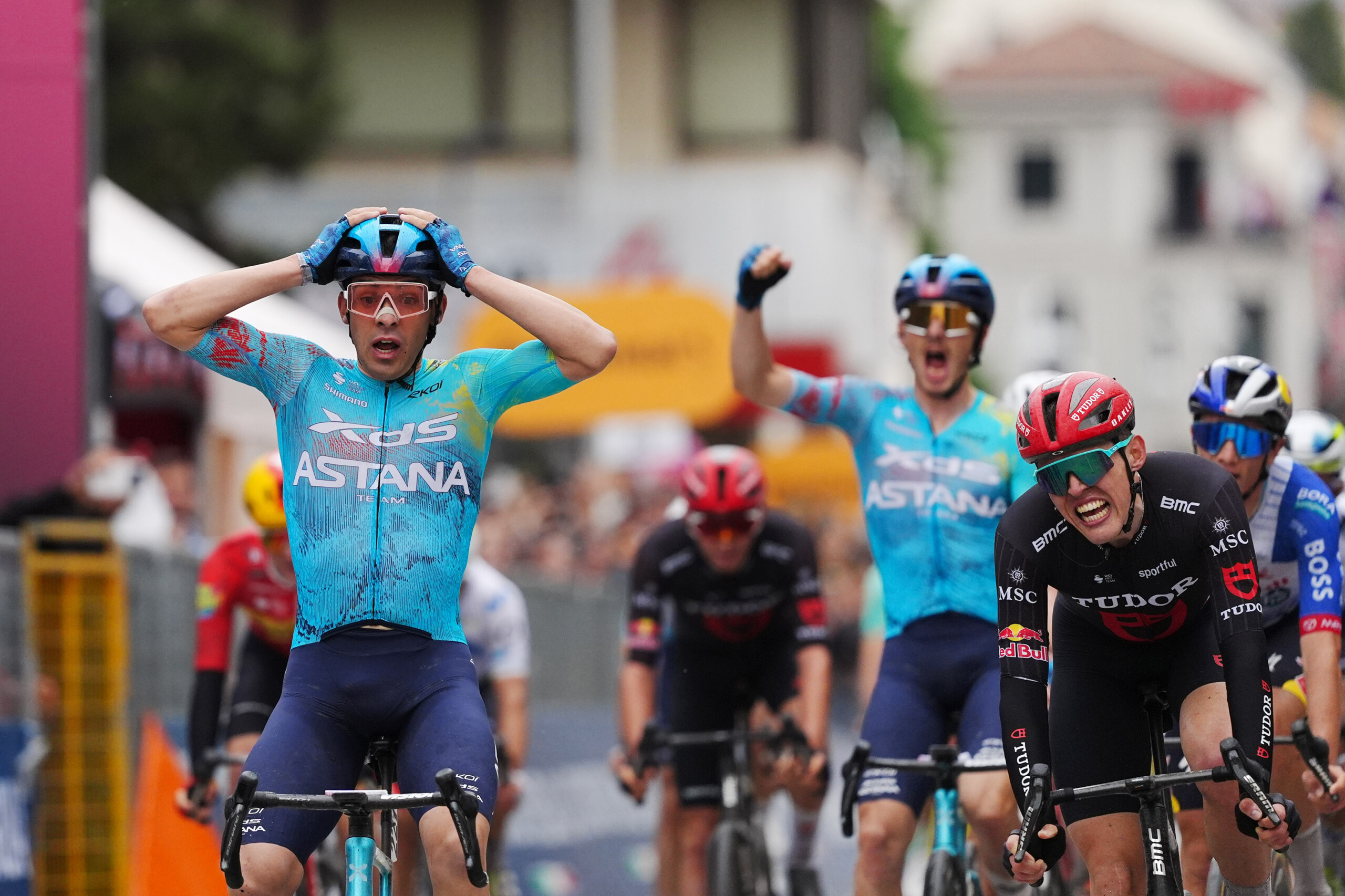
The XDS Astana Team rider survived a treacherous, rain-slicked finale through the streets of Naples and avoided the carnage in the final corner on the slippery cobblestones near Piazza del Plebiscito. Ballerini had entered the finale as part of the lead-out for Matteo Malucelli, but when the sprinters and lead-out riders began sliding across the road, the race opened in front of him.
Italy’s Davide Ballerini of XDS Astana Team winner of the stage on the finish line during Stage 6 of the Giro d’Italia, from Paestum to Naples, Italy, Thursday, May 14, 2026. (Photo by Gian Mattia D’Alberto / LaPresse)
Jasper Stuyven followed Ballerini through the chaos, but the Soudal Quick-Step rider could not come around him in the final 200 meters. Paul Magnier, already in the Maglia Ciclamino, had to put a foot down in the crash, remounted quickly, and still fought his way back to third place.
After the scenic start in Paestum, the stage took time to ignite. Around 10 kilometers into the day, Edward Planckaert and Luca Vergallito of Alpecin–Deceuninck sparked the breakaway. Martin Marcellusi and Manuele Tarozzi of VF Group Bardiani–CSF Faizanè and Mattia Bais of Team Polti VisitMalta soon joined them.
The escape never gained much freedom. The peloton kept the gap under one minute as the route passed through town after town, with thousands of fans lining the roads. The general classification riders stayed tucked safely near the rear of the bunch, trying to avoid trouble before the next day’s Blockhaus test.
The bunch reeled in the breakaway 36 kilometers from the finish. Filippo Magli claimed the Red Bull KM, while Lennert Van Eetvelt opportunistically picked up two bonus seconds.
That set up the expected sprint finish in central Naples, the fourth consecutive sprint stage and the Giro’s first-ever finish in Piazza del Plebiscito. Unibet Tietema Rockets appeared to have the finale under control until the last corner with 400 meters remaining. Elmar Reinders touched the brakes on the slick cobbles and crashed, taking Dylan Groenewegen, Jonathan Milan, and several others down with him.
Ballerini and Stuyven slipped through on the inside line. Both had started the finale in service of faster teammates, but the crash turned them into stage contenders in an instant. Ballerini held his line, drove through the final straight, and delivered Italy its first stage win of the 2026 Giro.
“I thought I could win a stage at the Giro, but certainly not this one and not in this way,” Ballerini said after the finish. “Today, our sprinter was Matteo Malucelli, but when we entered the final corner, I saw two riders go down. They told me to go for it. I was hoping the finish line would come quickly, but it was still quite far away and I was on the limit. Fortunately, I made it. I’ve finally won a stage of the Giro d’Italia!”
Behind the chaos, Eulálio enjoyed a day of minimum risk and maximum reward. The Bahrain Victorious rider avoided trouble, safely retained the Maglia Rosa, and turned his attention toward the looming Blockhaus summit finish.
Stage Results
Place
Rider
Team
Time
1
Davide Ballerini
XDS Astana Team
3:19:30
2
Jasper Stuyven
Soudal Quick-Step
s.t.
3
Paul Magnier
Soudal Quick-Step
s.t.
General Classification
Place
Rider
Team
Time
1
Afonso Eulálio
Bahrain Victorious
24:47:13
2
Igor Arrieta
UAE Team Emirates XRG
+2:51
3
Christian Scaroni
XDS Astana Team
+3:34
Jersey Leaders
Jersey
Classification
Rider
Team
Maglia Rosa
General Classification
Afonso Eulálio
Bahrain Victorious
Maglia Ciclamino
Points Classification
Paul Magnier
Soudal Quick-Step
Maglia Azzurra
Mountains Classification
Diego Pablo Sevilla
Team Polti VisitMalta
Maglia Bianca
Best Young Rider
Afonso Eulálio
Bahrain Victorious
Stage 7 — Sulmona–Blockhaus, 245 km
The Giro reached the mountains, and Jonas Vingegaard immediately imposed himself on the race.
After a long, wind-battered stage through the Abruzzo region, the first summit finish at Blockhaus exploded under the pressure of the favorites. With 5.5 kilometers remaining, Vingegaard attacked out of the select group and quickly reduced the race to survival.
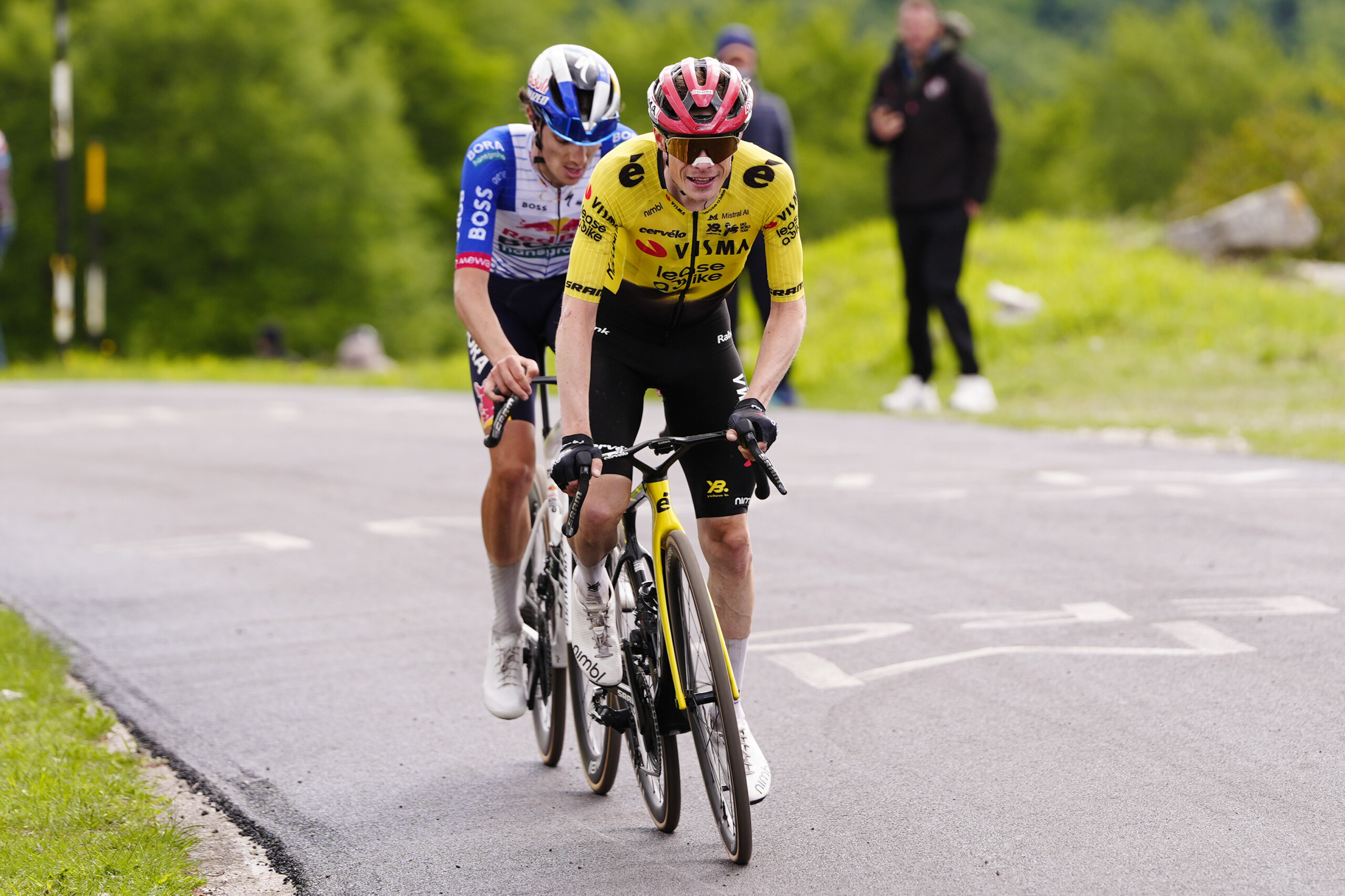
Denmark’s Jonas Vingegaard Hansen of Team Visma | Lease A Bike leads ahead Italy’s Giulio Pellizzari of Red Bull – Bora – Hansgrohe during Stage 7 of the Giro d’Italia from Formia to Blockhaus, Italy. Friday May 15, 2026. (Photo by Fabio Ferrari / LaPressee)
Giulio Pellizzari initially tried to follow, but the young Italian could not hold the Dane’s pace. Felix Gall chose a steadier rhythm and limited his losses to 13 seconds, while Jai Hindley, the last Giro rider to win at Blockhaus in 2022, finished third at 1:02.
Vingegaard’s victory gave him his first Giro d’Italia stage win and completed his set of stage victories across all three Grand Tours. The win also evoked Eddy Merckx’s famous Blockhaus triumph in 1967, linking the Dane’s first Giro breakthrough to one of the race’s iconic mountain venues.
Denmark’s Jonas Vingegaard Hansen of Team Visma | Lease A Bike wins Stage 7 of the Giro d’Italia from Formia to Blockhaus, Italy. Friday May 15, 2026. (Photo courtesy of LaPresse)
“I’ve been waiting for this stage since I saw the route,” Vingegaard said. “It made it a nice day to take the stage win. To have now at least one win in each of the Grand Tours is special.”
The Team Visma | Lease a Bike leader said he expected Pellizzari and others to try to follow when he attacked, but he timed his move carefully in shifting winds near the top of the climb.
“In the last climb, there was a lot of wind, sometimes a side wind, sometimes a head or a tail wind,” Vingegaard said. “I was trying to find the right moment to attack according to the wind. I’m just happy to win a stage and especially this one. The Blockhaus is an iconic finish in Italy.”
The stage also belonged, in part, to Eulálio. The Maglia Rosa cracked with six kilometers remaining, but instead of collapsing completely, he fought his way to the summit in damage-limitation mode with help from Damiano Caruso. He lost 2:55 but kept pink by 3:17 over Vingegaard.
“I’m happy because to keep the Maglia Rosa was one of the objectives for today,” Eulálio said. “I tried to avoid suffering as much as I could. In the finale, I exploded. Had I not had Damiano Caruso along, I probably would have lost one or two more minutes.”
Eulálio said the favorites were “flying” while he focused only on survival, but he accepted the time loss after a 245-kilometer stage with a punishing summit finish.
Vingegaard became the 115th rider to win stages in all three Grand Tours, and the 13th Dane to win a Giro stage. He also became only the third Danish rider to win an uphill finish at the Giro, after John Carlsen at Gran Sasso in 1989 and Chris Anker Sørensen at Terminillo in 2010. Gall recorded his fourth Grand Tour stage podium, while Hindley became the only rider in Giro history to finish in the top three twice at Blockhaus.
Stage Results
Place
Rider
Team
Time
1
Jonas Vingegaard
Team Visma | Lease a Bike
6:09:15
2
Felix Gall
Decathlon CMA CGM Team
+0:13
3
Jai Hindley
Red Bull-Bora-Hansgrohe
+1:02
General Classification
Place
Rider
Team
Time
1
Afonso Eulálio
Bahrain Victorious
30:59:23
2
Jonas Vingegaard
Team Visma | Lease a Bike
+3:17
3
Felix Gall
Decathlon CMA CGM Team
+3:34
4
Jai Hindley
Red Bull-Bora-Hansgrohe
+4:25
5
Giulio Pellizzari
Red Bull-Bora-Hansgrohe
+4:28
Jersey Leaders
Jersey
Classification
Rider
Team
Maglia Rosa
General Classification
Afonso Eulálio
Bahrain Victorious
Maglia Ciclamino
Points Classification
Paul Magnier
Soudal Quick-Step
Maglia Azzurra
Mountains Classification
Jonas Vingegaard
Team Visma | Lease a Bike
Maglia Bianca
Best Young Rider
Afonso Eulálio
Bahrain Victorious
Maglia Bianca
Worn by
Giulio Pellizzari
Red Bull-Bora-Hansgrohe
Stage 8 — Chieti–Fermo, 156 km
One day after the high mountains, the Giro returned to puncheur territory on the steep, rolling roads into Fermo. The constantly changing terrain shredded the peloton and created another opportunity for aggressive racing.
Once again, Narváez seized it.
The Ecuadorian rider attacked late and powered through the headwind alone after a day of relentless pressure from UAE Team Emirates XRG. Behind him, the Uno-X Mobility duo of Andreas Leknessund and Martin Tjøtta chased desperately but never closed the gap. Narváez finished the 156-kilometer stage in 3:27:26, averaging 45.122 kph, with Leknessund 32 seconds back and Tjøtta at 42 seconds.
Ecuador’s Manuel Jhonatan Narvaez of UAE Team Emirates XRG winner of the stage on the finish line during Stage 8 of the Giro d’Italia, Thursday, May 14, 2026. (Photo by Gian Mattia D’Alberto / LaPresse)
“We knew it was a good stage for me,” Narváez said. “We played it well with my teammates. I think the man of the day is Mikkel Bjerg. He’s a guy who works a lot for the team all year long.”
Narváez said the headwind made the final effort extremely difficult, but UAE never stopped believing in the move.
“We never gave up, even with 60km to go,” he said. “We rode smart. It’s a big victory, after my crash in January, after we were down to five riders here at the Giro. We have a good atmosphere in the team. I think we will win stages again next week.”
The victory marked Narváez’s second of the Giro and UAE’s third overall despite crashes that had already reduced the squad to five riders.
Behind the stage fight, Eulálio safely retained the Maglia Rosa, still leading Vingegaard by 3:15, while Gall remained third overall.
Stage Results
Place
Rider
Team
Time
1
Jhonatan Narváez
UAE Team Emirates XRG
3:27:26
2
Andreas Leknessund
Uno-X Mobility
+0:32
3
Martin Tjøtta
Uno-X Mobility
+0:42
General Classification
Place
Rider
Team
Time
1
Afonso Eulálio
Bahrain Victorious
34:28:42
2
Jonas Vingegaard
Team Visma | Lease a Bike
+3:15
3
Felix Gall
Decathlon CMA CGM Team
+3:34
Jersey Leaders
Jersey
Classification
Rider
Team
Maglia Rosa
General Classification
Afonso Eulálio
Bahrain Victorious
Maglia Ciclamino
Points Classification
Paul Magnier
Soudal Quick-Step
Maglia Azzurra
Mountains Classification
Jonas Vingegaard
Team Visma | Lease a Bike
Maglia Bianca
Best Young Rider
Afonso Eulálio
Bahrain Victorious
Stage 9 — Modena–Corno alle Scale, 184 km
If Blockhaus announced Vingegaard’s arrival, Corno alle Scale confirmed that the Dane had become the Giro’s central force.
The stage unfolded cautiously at first, with Decathlon CMA CGM Team controlling much of the chase behind the breakaway in support of Felix Gall. Their pressure steadily reduced the gap, and by the final climb the stage victory suddenly came back into play.
Vingegaard initially planned to ride defensively after Visma spent heavily at Blockhaus and raced one man down, but Gall’s aggression changed the script.
“We wanted to be more defensive because we’re already one man down and we spent a lot of energy at the Blockhaus,” Vingegaard said. “But Decathlon was pulling all day, then a hard pace up the climb was better for me and once the breakaway was within reach, I was happy to go and take the victory.”
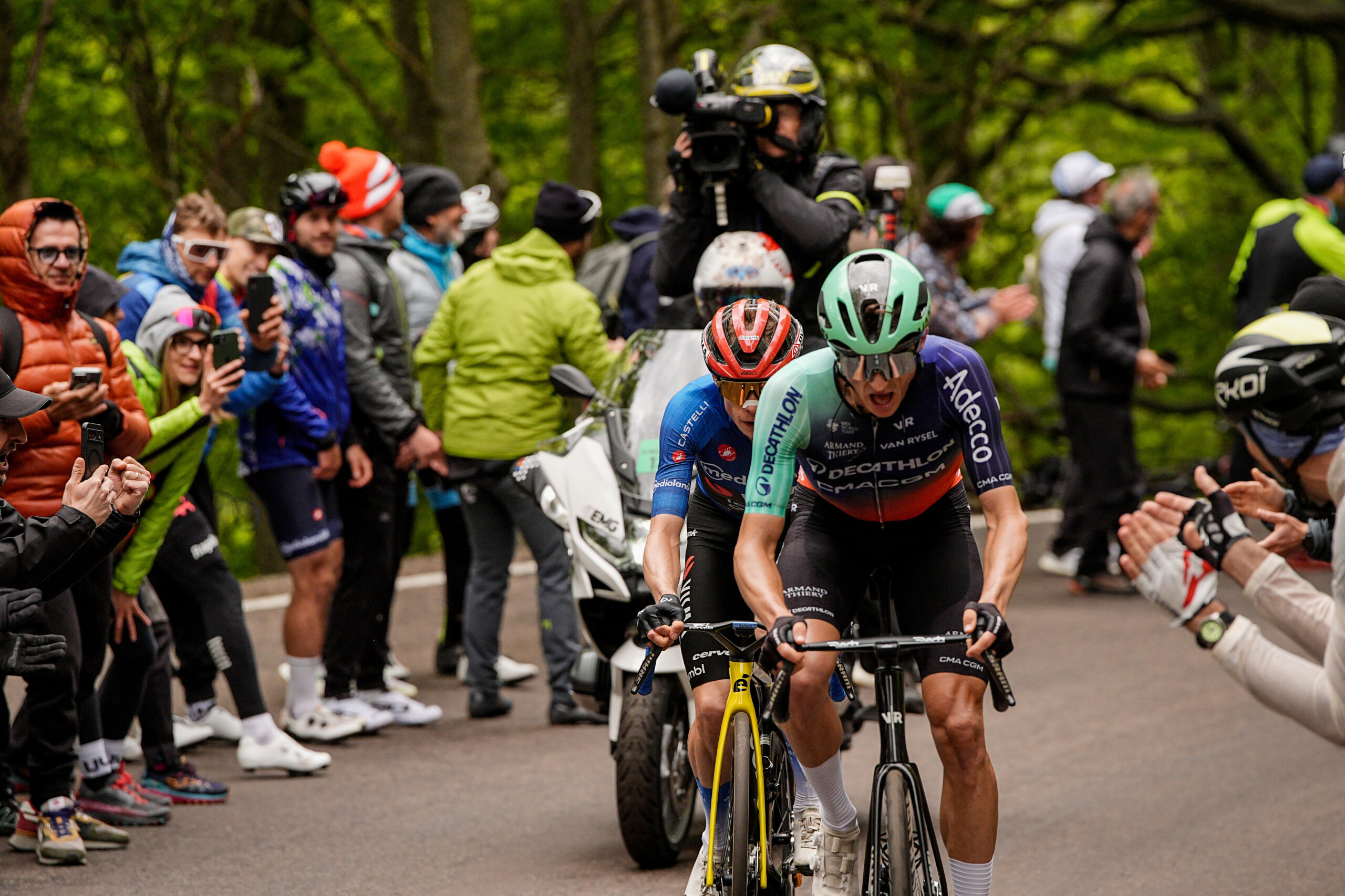
Austria’s Felix Gall of Decathlon CMA CGM Team and Denmark’s Jonas Vingegaard Hansen of Team Visma | Lease A Bike climb Corno alle Scale during Stage 9 of the Giro d’Italia, from Cervia to Corno alle Scale, Italy, Sunday, May 17, 2026. (Photo by Marco Alpozzi/LaPresse)
As the breakaway faltered inside the final kilometer, Vingegaard launched another devastating acceleration 900 meters from the finish. Gall fought to limit the damage but again could not match the Dane’s explosive finishing kick. Davide Piganzoli completed the podium for Visma after surviving the favorites group.
The victory marked Vingegaard’s 50th professional win and his second Giro stage victory in three days.
“Fifty pro wins is a milestone for sure,” Vingegaard said. “It’s quite a lot for me and something I’m super happy with. Also to take my second stage win at the Giro is special, so it’s a good day for us.”
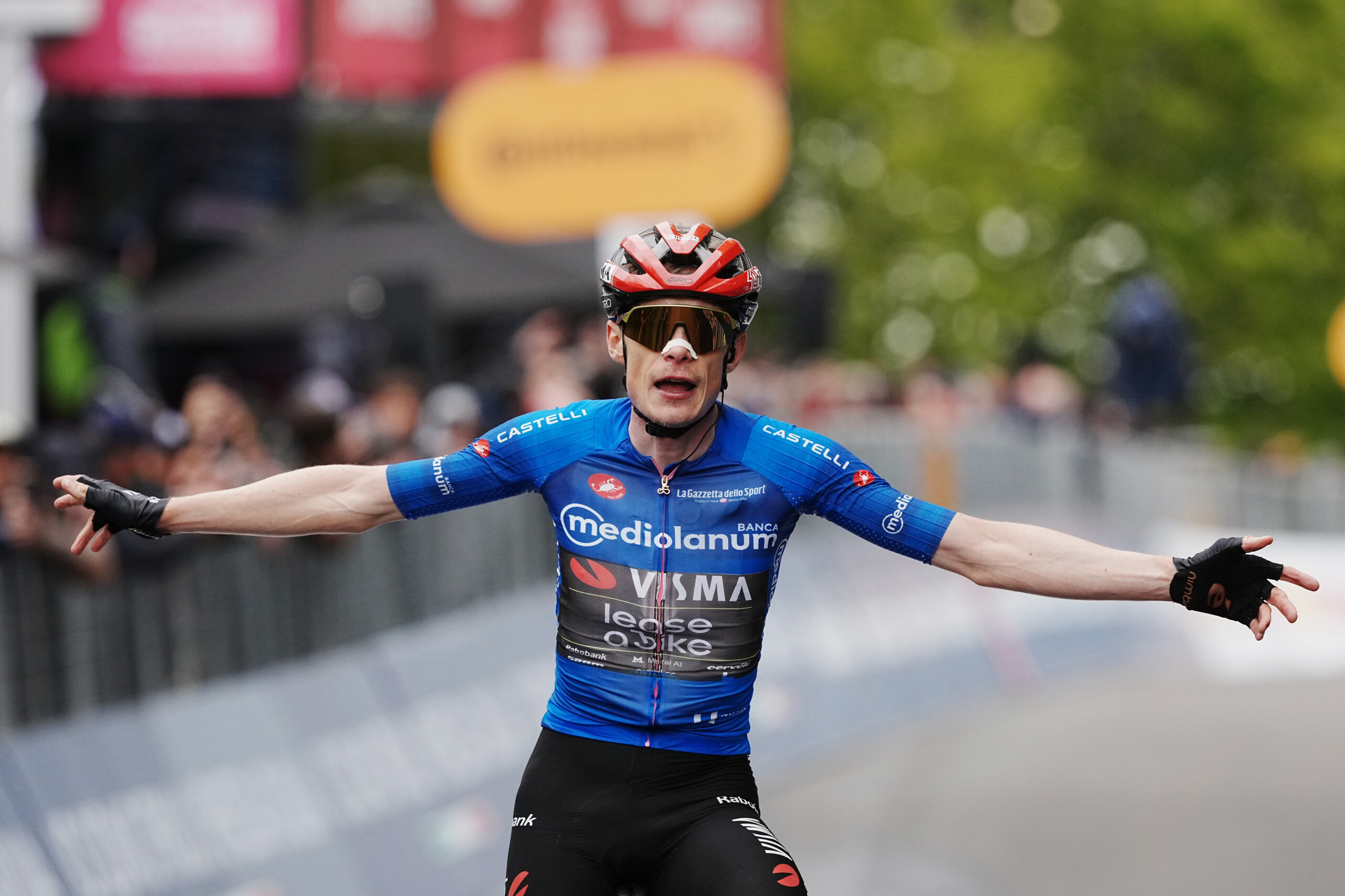
Denmark’s Jonas Vingegaard Hansen of Team Visma | Lease A Bike (azure jersey) winner of the stage on the finish line during Stage 9 of the Giro d’Italia from Cervia to Corrno alle Scale, Italy, Sunday May 17, 2026. (Photo by Gian Mattia D’Alberto / LaPresse)Denmark’s Jonas Vingegaard Hansen of Team Visma | Lease A Bike (azure jersey) winner of the stage on the finish line during Stage 9 of the Giro d’Italia from Cervia to Corrno alle Scale, Italy, Sunday May 17, 2026. (Photo by Gian Mattia D’Alberto / LaPresse)
But once again, Eulálio refused to disappear.
After nearly cracking at Blockhaus two days earlier, the Maglia Rosa delivered perhaps the ride of his career by finishing fifth among the favorites and limiting his losses enough to keep pink by 2:24 over Vingegaard before the 42-kilometer individual time trial after the second rest day.
“It’s perfect, my Giro is already a successful one!” Eulálio said. “I’m glad to still have the Maglia Rosa on the rest day and we’ll see what I can do in the time trial.”
Eulálio said he never imagined making the top five on a stage like Corno alle Scale in the group of favorites, but he felt stronger after recovering from Blockhaus, his crash, and his earlier breakaway effort.
“I don’t know my limits,” he said.
Vingegaard’s win gave Denmark its 21st Giro stage victory and made him the first Dane with two mountain-stage wins at the Giro. Team Visma | Lease a Bike reached 15 wins on the season, while only four teams had won stages through the first nine stages: UAE Team Emirates XRG with three, and Soudal Quick-Step, XDS Astana Team, and Visma | Lease a Bike with two each.
For the third time in a professional race, Vingegaard and Gall finished first and second, following a similar result at the Volta a Catalunya earlier in the year. Gall became the only Austrian with two top-two finishes at the Giro, while Vingegaard became the first rider to win at least two stages in his first Giro since Tadej Pogačar won six in 2024.
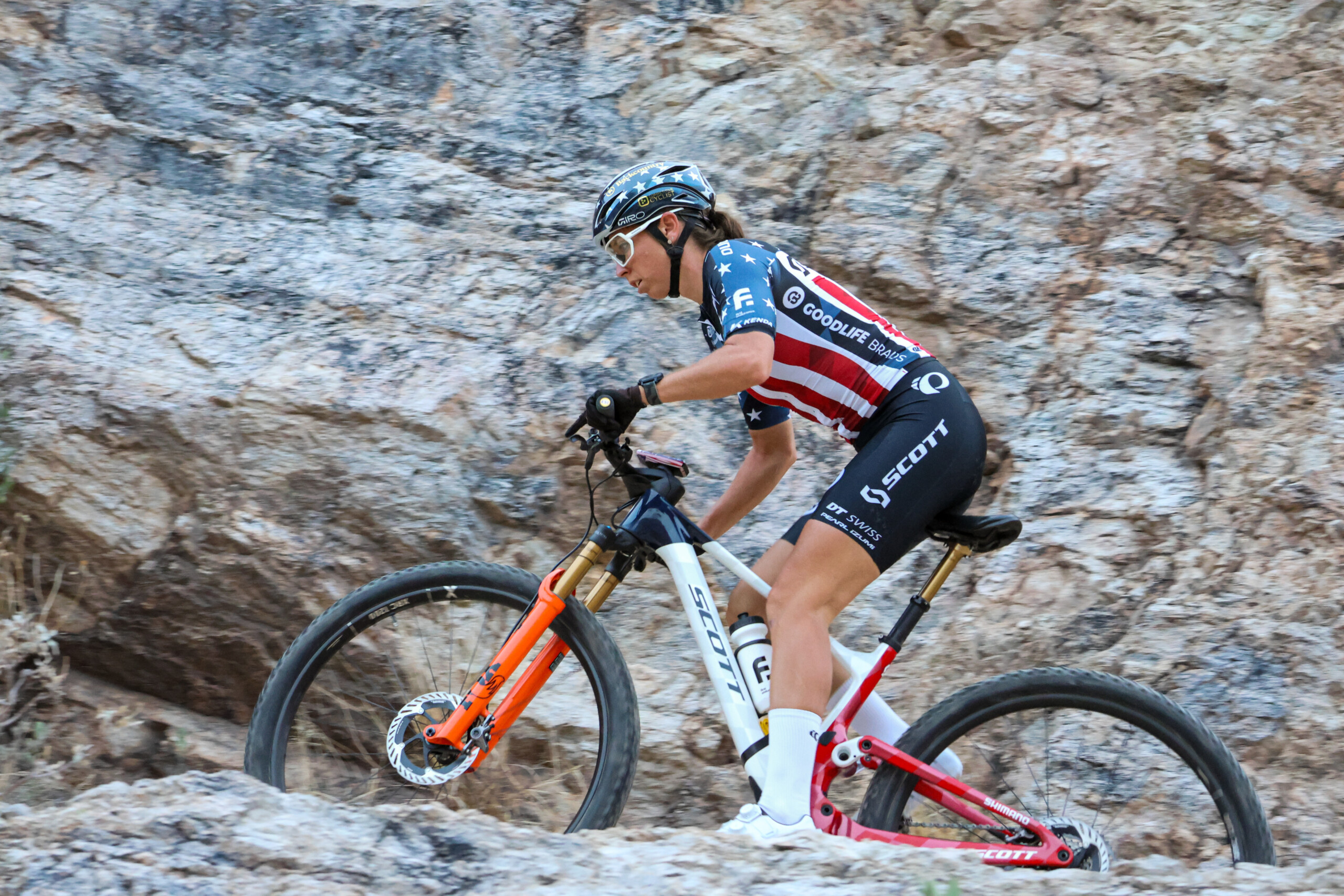
SALT LAKE CITY, Utah — Professional endurance cyclist Hannah Otto has built a career on pushing beyond the edge of what most riders consider possible. This October, the Salt Lake City-based cyclist plans to take on her biggest challenge yet: a single-day bicycle ascent of Mount Kilimanjaro. If successful, Otto will become the first known woman to ride from the mountain’s base toward its 19,341-foot summit in one continuous push, battling nearly 15,000 feet of elevation gain, brutal high-altitude terrain, and oxygen-starved air — all to help provide bicycles for communities around the world.
The project, called “Beyond the Summit,” combines elite endurance sport with a humanitarian mission. Otto hopes to raise $165,000 for World Bicycle Relief, enough funding to provide 1,000 bicycles to people in rural communities worldwide through a campaign powered by The Intrepid Foundation.
“This attempt scares me,” Otto said. “But that’s how I know it’s worth pursuing. The deeper purpose is what makes it worth it because for someone else, a bicycle isn’t a way to push limits, it’s access to everything.”
Unlike traditional Kilimanjaro expeditions that unfold over six to eight days, Otto plans to compress the climb into a single sustained effort at extreme altitude, where oxygen levels drop to roughly half those at sea level. The lower slopes offer stretches of rideable dirt road, but higher on the mountain the route deteriorates into steep volcanic scree and technical terrain that will force Otto to shoulder her bike and hike toward the summit.
Photo courtesy of Hannah Otto/Beyond the Summit
Few cyclists have ever completed the climb in a single day, and many reported attempts survive mostly through rumor and word of mouth. Cory Wallace documented a successful men’s ascent several years ago, but Otto has found no documented examples of a woman completing the feat in one push by bicycle.
And reaching the summit marks only half the challenge.
After hours of climbing through freezing temperatures and thinning air, Otto will still face the long descent back down the mountain while fighting exhaustion, altitude sickness, and rapidly changing conditions that can humble even well-acclimated athletes.
Otto plans to spend a week acclimatizing on the mountain before launching the October 2026 attempt. A film crew will document the project, capturing both the physical intensity of the climb and the deeper story behind the mission.
“At its core, the project is about mobility,” Otto said. “The bike has given me so much in my life. I want the bike to continue to transform the lives of others as well.”
Otto has become one of endurance cycling’s most recognizable ultra-distance athletes. She currently holds the USA Marathon Mountain Bike National Championship title and won the Leadville Trail 100 MTB in 2022. Her previous endurance projects include a record-setting ascent of Mauna Kea — one of the hardest climbs in the world — along with the films “Kokopelli Strong,” “Infinite Pursuit,” “Chasing The Triple Crown,” and “The Whole Enchilada.”
Supporters can learn more about the project and contribute through Beyond the Summit. Organizers say 100 percent of donations will go directly to World Bicycle Relief.
Bikepacking Roots has announced the recipients of its 2026 BIPOC Bike Adventure Grant program, continuing an effort to reduce barriers to bikepacking and outdoor adventure for Black, Indigenous, and People of Color communities across the United States and Canada.
Now in its fourth funding cycle, the grant program supports community leaders and grassroots organizations that use cycling and bikepacking to create welcoming outdoor spaces, expand access to equipment and education, and build stronger community connections through riding and outdoor experiences. Since launching in 2020, the program has distributed 40 grants and more than $140,000 in cash and gear support, making it one of the largest and longest-running initiatives of its kind in bikepacking.
Image courtesy of Bikepacking Roots
“It was inspiring to read all of the applications and discover the breadth of amazing work being done by BIPOC leaders across the US and Canada to support their communities,” said Noelle Battle, executive director of Bikepacking Roots. “We are excited to uplift their work and build long-term partnerships to support diversity in the bikepacking community.”
The organization says the latest grants build on momentum from previous recipients, whose projects included overnight youth bikepacking trips in New Mexico, a 110-mile Katy Trail adventure in Missouri featuring first-time bikepackers from six states, and the launch of a tribal gear-lending library in California that supported elders and youth riders alike.
Photo courtesy of BIKEPOCING
This year’s recipients span a wide range of communities and regions, from Alaska to the U.S.–Mexico borderlands:
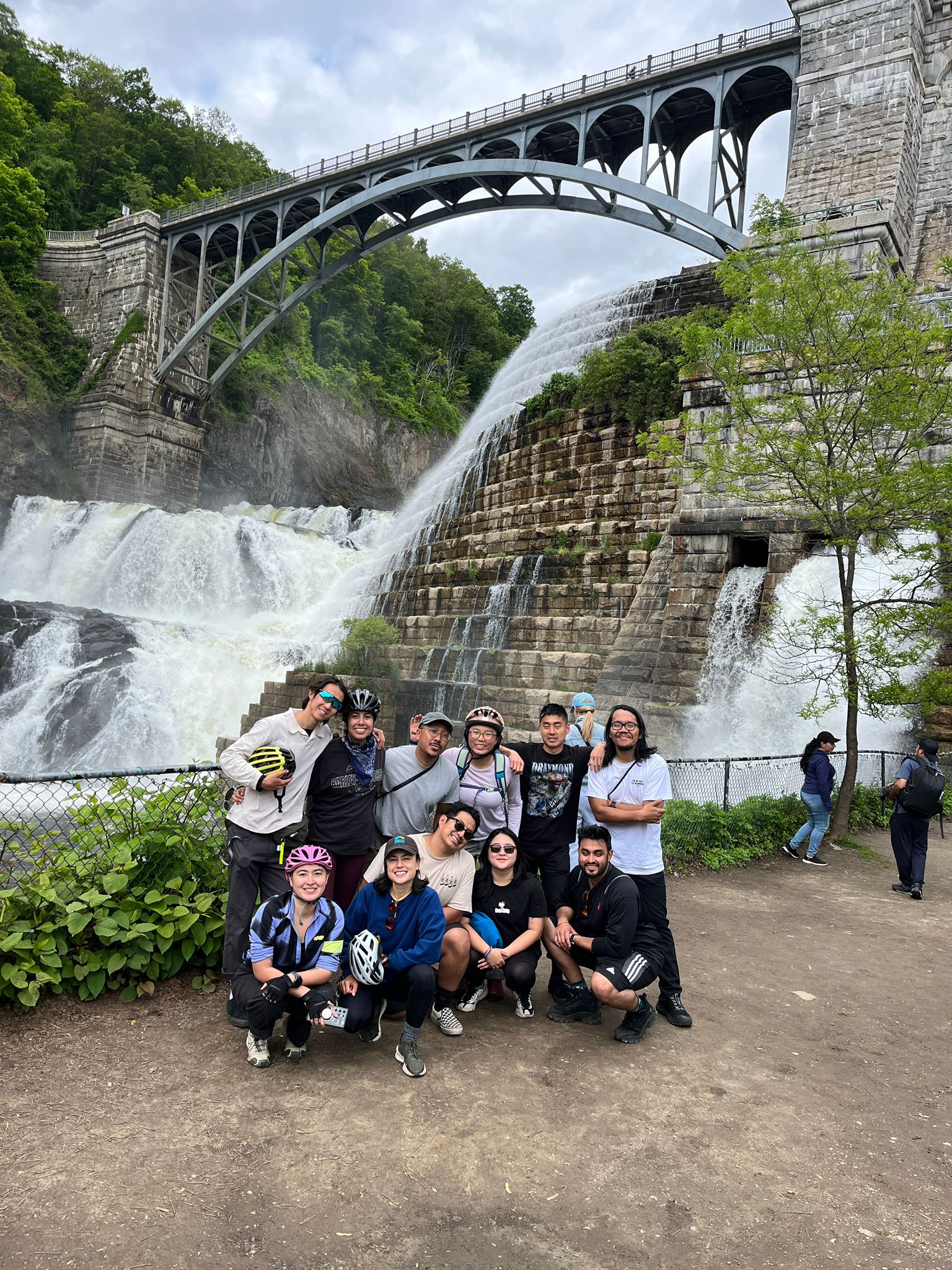
BIKEPOCING is an NYC-based group focused on making bikepacking and cycling culture more accessible to Black, Indigenous, and People of Color riders through group outings, free workshops, transportation support, and a self-funded community gear library. (Bikepacking Roots)
Black Spoke Society is a Black and queer-led cycling community in Durham, North Carolina, that creates welcoming spaces for Black and brown riders through learn-to-ride classes, group rides, and bikepacking trips supported by a growing gear library. (Bikepacking Roots)
Brownout Recreation Collective grew out of the Excelsior Bike Club in San Francisco and works alongside Latino immigrant communities through bilingual bikepacking programs and a community lending library designed to make equipment accessible for beginner riders. (Bikepacking Roots)
BSpoke supports BIPOC cyclists in Alaska through community rides, maintenance clinics, beginner skills workshops, and social events aimed at reducing barriers to cycling and outdoor access.
Kimberly Sambou partners with organizations in the Chicago area to organize beginner-friendly bike camping trips, workshops, and group rides that help Black cyclists and outdoor enthusiasts gain confidence and experience in outdoor recreation.
Rodadas de Perreo is an Indigenous and immigrant-led bike club in Seattle that centers women of color, nonbinary riders, and Spanish-speaking communities through bilingual programming and introductory bikepacking trips.
WTFNB El Paso creates community-led bikepacking opportunities in the El Paso–Juárez borderlands for women, trans, femme, nonbinary, and BIPOC riders through workshops, mentorship, practice rides, and binational gear-sharing initiatives.
Photo courtesy of Rodadas de Perreo
Bikepacking Roots also recognized a long list of industry partners that contributed gear donations, discounts, and fundraising support for the grant recipients, including Big Agnes, Ortlieb, Osprey, Revelate Designs, Shimano, and Wolf Tooth, among others.
Founded to support route development, public lands advocacy, and a more inclusive bikepacking community, Bikepacking Roots says the grant program remains a key part of its effort to expand access to outdoor adventure and create more welcoming entry points into bikepacking for riders from historically underrepresented communities.
By Charles Pekow — How can planners figure out the best ways to close gaps in bicycle networks? A new guide from the National Highway Cooperative Research Program urges transportation agencies to replace traditional methods with approaches that reflect the rapid growth of e-bikes and scooters.
For years, planners have evaluated topography, mapped network gaps, and calculated the potential health, economic, and social benefits of closing them. In Estimating Benefits of Closing Gaps in Active Transportation Networks: A Guide, the program outlines how agencies have used those tools to justify bike lanes, trails, signage, and lower speed limits.
Mind The Gap
But the report makes clear that agencies must do more. It calls for additional research to better account for the differences among e-bikes, scooters, traditional bicycles, and other personal mobility devices. For example, e-bike riders may feel less deterred by hills than traditional cyclists, which changes how planners should assess barriers in a network.
The guide lays out practical ways to estimate how infrastructure changes will influence behavior. If a city builds a more attractive bike facility, will more people ride and reduce vehicle emissions? If officials lower speed limits, will they make streets safer for everyone?
Planners must start by pinpointing not only missing links but also weak spots in existing infrastructure. A painted bike lane on a busy arterial may offer little protection from traffic. Potholes or sewer grates may discourage riders. In some cases, a confusing route that zigzags through side streets to avoid steep grades may simply need clearer wayfinding to serve people walking, biking, or rolling.
The guide also pushes agencies to analyze how specific fixes will shift travel patterns. Will riders use a new route? Will it persuade drivers to switch to biking? Will it prompt people to make trips they previously avoided?
Finally, once planners settle on solutions, they must communicate them effectively. The public does not need every technical detail behind the analysis. Instead, planners should present clear, concise explanations tailored to each audience. That includes news media, community members, traffic engineers, grant administrators, and elected officials at every level. Federal and state lawmakers may sit one step removed from local transportation decisions, but their backing can prove critical when agencies seek funding. Officials have limited time, so planners must explain directly how proposed improvements will benefit constituents and advance policy goals.
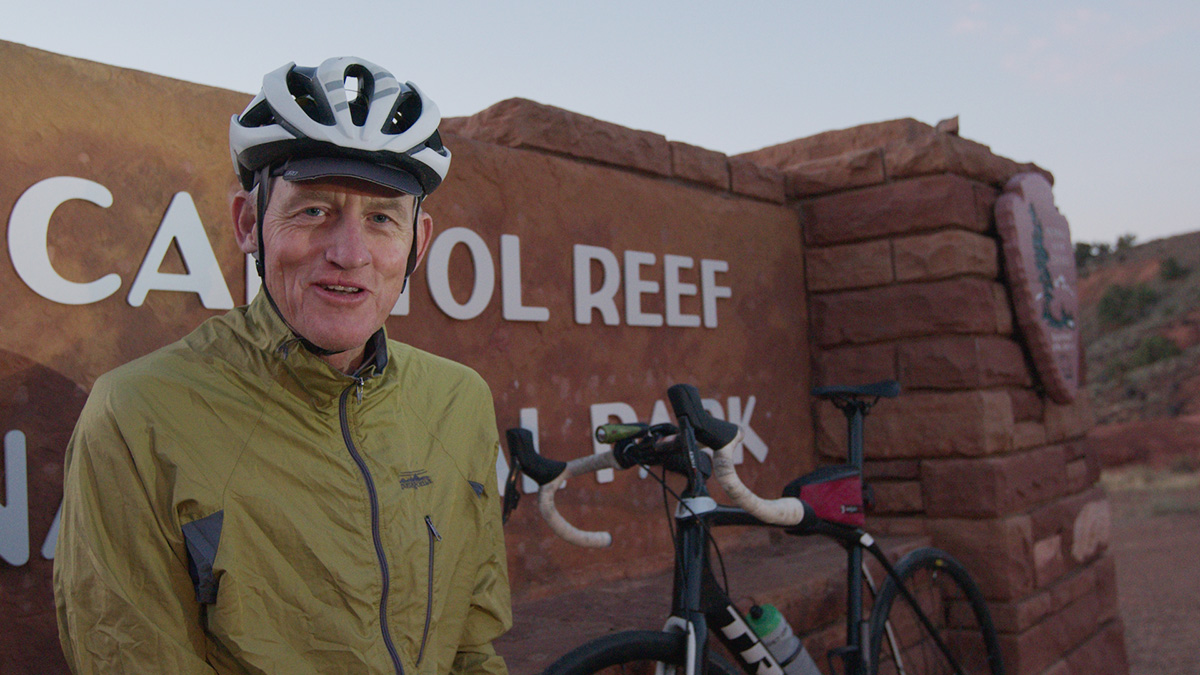
Longtime Utah climate advocate Bill Barron is cycling 700+ miles through Utah’s Mighty Five National Parks to bring people together around a shared goal: protecting the places we love while building the political will for effective climate solutions. Along the route, he’ll host conversations on Citizens’ Climate Lobby’s policy commitments to reduce emissions, remove climate pollution, and protect people—highlighting carbon pricing as a proven, scalable solution and comprehensive permitting reform as a timely opportunity to accelerate progress. Grounded in the power of relationships and citizen engagement, this tour connects everyday voices to real pathways for bipartisan action in Congress.
This ride is also a fundraiser to support the work of Citizens’ Climate Lobby. Donate
The ride is underway! Here is the schedule of events. You can also follow along on youtube and Instagram @billbarronutah and find Bill at billbarronutah.org
Schedule of rides:
Thursday May 7th:
6:00-7:00 Evening Talk at the St George Library; 88 W 100 S, Forsyth Community Room B about the economics of clean energy: Bill Barron, Rod Perry, Bryan Dial, Dave DeMille
Friday May 8th:
8:00-9:30 AM—Talking Climate over Coffee, West Village Cafe; 695 S 100 W, St George
3:00 PM—Zion Cycles; 868 Zion Park Blvd, Springdale, meet for Gran Fondo (group ride) up Zion Canyon
7:30-8:30 PM—Zion Canyon Brew Pub; 95 Zion Park Blvd, Springdale
Saturday May 9th:
8:00-10:00 AM—Deep Creek Coffee Co.; 932 Zion Park Blvd., Springdale
4:00 PM—Speak at the Amazing Earthfest during Potluck and Social Dinner Party, Jacob Hamblin Park Small Pavilion, Kanab
Sunday May 10th:
8:00-9:00 AM—Meet Bill Barron at Willow Canyon Outdoor Gear & Books; 263 S 100 E, Kanab
7:00 PM—Gem Theater; 105 N Main St, Panguitch
Monday May 11th:
8:00-9:00 AM—Gem Theater Lobby-Chatting Climate over coffee; 105 N Main St, Panguitch
11:30 AM—Bryce Canyon Gran Fondo; meet at the Bryce Canyon Visitor Center parking lot
Tuesday May 12th:
8:00-9:00 AM—Chatting Climate over Coffee; Escalante Interagency Visitor Center Picnic Area, 755 W Main St, Escalante
12:00-1:00 PM—Little Bone Food Truck; 20 N Hwy 12, Boulder
5:30 PM—Torrey Town Pavillion, Potluck Hosted by Rural Voices of Utah; 75 E 100 N, Torrey
Wednesday May 13th:
8:30-9:30 AM—Shooke Coffee Roasters; 135 E Main St., Torrey
11:00 AM—Capitol Reef Gran Fondo; meet at the Capitol Reef Visitor Center parking lot
6:00 PM—Talk at Goblin Valley State Park Amphitheater; 18630 Goblin Valley Rd
Thursday, May 14th:
6:30 PM—John Wesley Powell Museum; 1765 E Main St., Green River
Friday, May 15th:
3:00 PM Island in the Sky, Grandview Point; from the desk of Bill BarronPress Conference
Saturday, May 16th:
9:30 AM—Arches Gran Fondo; meet at the Arches Visitor Center parking lot
6:00 PM—Grand Center/Senior Center; 182 N 500 W, Moab
Sunday, May 17th:
5:30 AM—meet at the Horsethief Campground, 82 E Dogwood Ave for the White Rim Gran Fondo, Canyonlands
By Peter Abraham — This week I attended my fifth Bicycle Leadership Conference, an annual gathering of the bike industry organized by People for Bikes. I’m currently in my third career, and I’ve attended events like this in every phase of my professional life. When I produced tv commercials, I attended the AICP Award Show in New York every year. After that I worked in the running event business, and I would go to Running USA and The Running Event.
BLC took place at the Marriott Resort in Dana Point, California. It’s an hour and a half from my house, so it’s easy for me to throw my bike in the car and drive down. BLC has alternated between Dana Point and Tucson, another nice location with great cycling. The event is essentially 2 and a half days of dinners, presentations, talking to new & old friends and early morning bike rides.
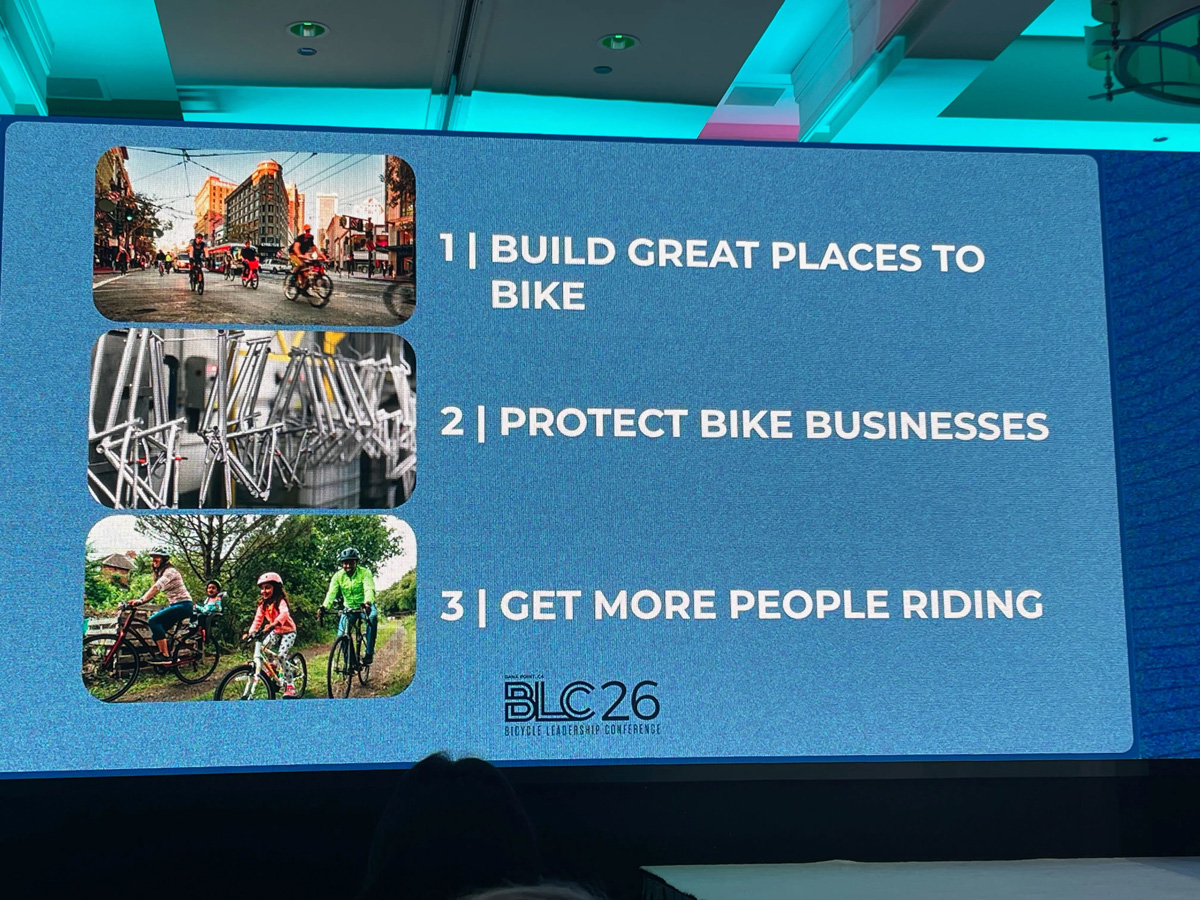
People for Bikes priorities for 2026. Photo by Peter Abraham
I find these kinds of events to be fun, informative and exhausting. But always worthwhile. Here’s what happened at BLC this year.
At dinner the first night awards were presented to both The White Line and Ride for your Life, inspiring organizations devoted to bicycle safety that started after people (Magnus White and Sarah Debbink Langenkamp) were tragically killed on their bikes by drivers of motor vehicles. The need for safe places to ride was a theme that came up over and over during the week.
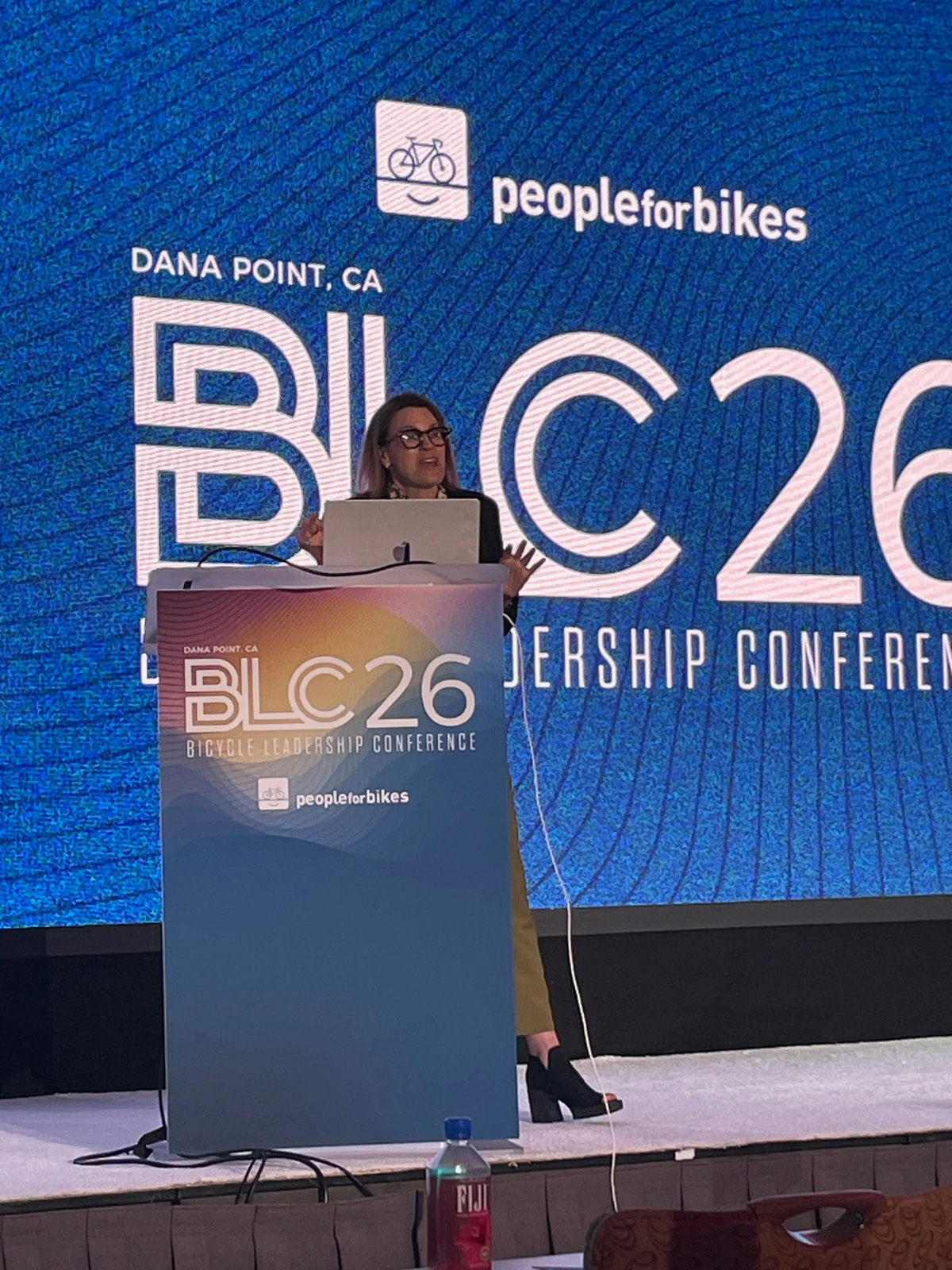
People for Bikes CEO Jenn Dice laid out the organization’s priorities for 2026. Tangible and actionable. Photo by Peter Abraham
People for Bikes CEO Jenn Dice and her team do a great job putting on this event, and I thought this was the best one ever: great speakers, tight production and lots of opportunities to meet and talk to people. The bike industry is gradually coming out of (but still in) arguably its most challenging period ever: the COVID boom/bust in demand followed by massive trade tariffs and now the spike in energy costs. It’s an incredibly complicated time to be in any business, not only bikes. But in both presentations and informal conversations this week, I felt more focus and intention than I’d seen over the last few years from attendees. It would be easy, almost expected, to be pessimistic about the industry at this point in time. But I didn’t feel much of that.
One of the features of BLC is a few speakers who are not necessarily from the bike industry but have great ideas or insight that is relevant for all of us in the room. This year featured Chip Conley and Jon McNeill in those roles, and everyone I spoke with agreed that their presentations were exceptional. Chip talked about the way that successful companies are built and how businesses can identify “what business they’re in.” Which is a bigger and broader than, for example, “we make bicycles.” As an example, he referred to his time at Airbnb, where the leadership team identified that they’re actually in the business of BELONG ANYWHERE rather than “renting rooms.” And that has guided their business ever since. In the open Q&A at the end of his talk, I asked how he took that mission into implementation as it related to staff, product and marketing. He then gave details about Airbnb events for hosts they created that reflected this purpose, and how the mission can mean different things to different employees of the business. Chip’s presentation was a super informative and useful.
Jon McNeill is a longtime cycling enthusiast and business leader. He was the Tesla President, running sales and marketing, from 2015–2018, and he currently serves on the Board of Directors of both General Motors and lululemon. He shared so much wisdom from his time at Tesla about how they massively speeded up process, simplified manufacturing and sidestepped traditional practices. As an example, he talked about cutting down the available versions of the Model S from 380,000 choices to two choices. All of the ideas and strategies he presented felt directly relevant for the bicycle industry. I approached him after he walked off stage to ask a question. Jon immediately said, “Peter, I met you but you don’t remember. It was in Bentonville after you got your concussion. Tim Johnson and I went over to check on you the next day.” Wow! He was right, I had zero memory of his visit, but I really appreciate that he had done that.
The two most important themes that were talked about among attendees and on panels were 1) eBikes and 2) infrastructure. These two subjects dominated the conference.
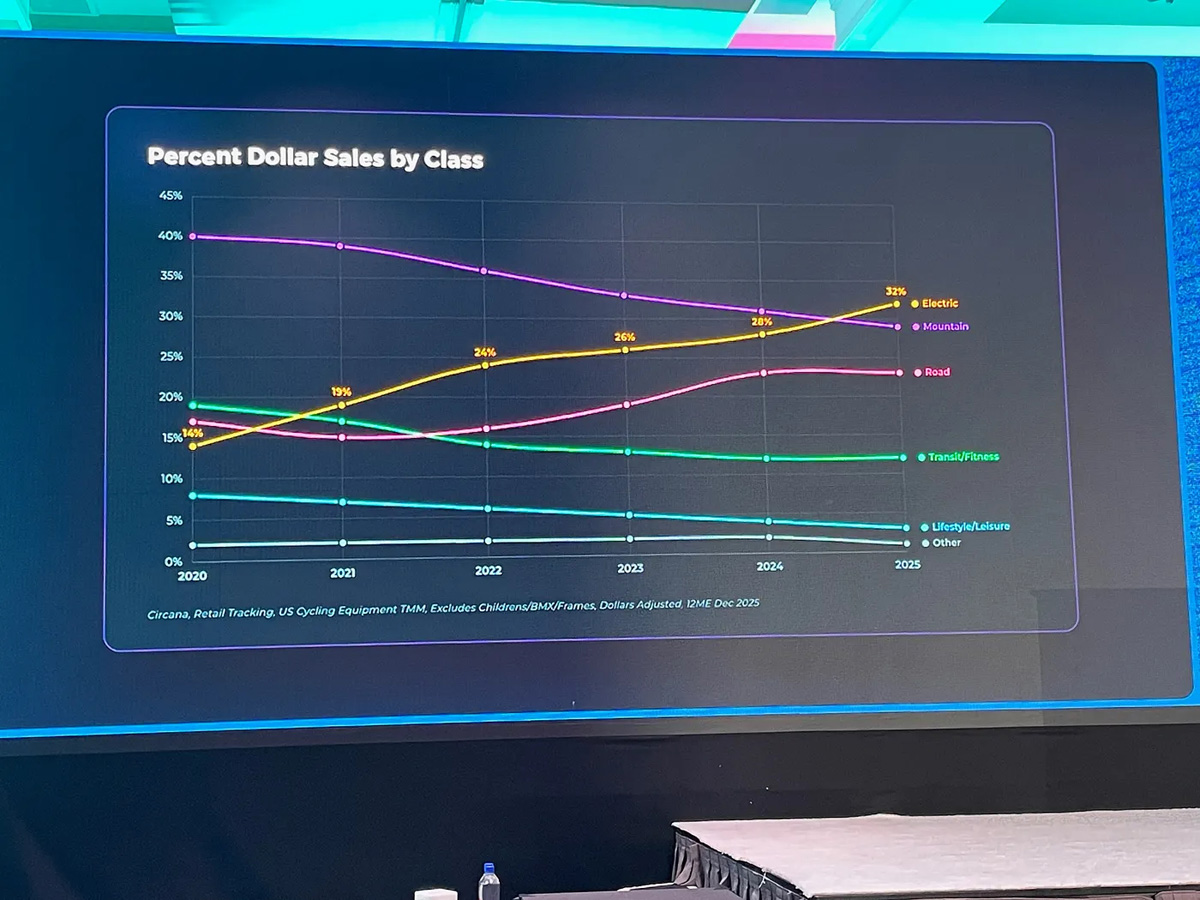
This chart detailing 5 years of bike sales says a lot about the rise of e-bikes. Photo by Peter Abraham
eBikes have exploded in popularity over the last few years. They are the biggest growth area of the bike industry. I asked one of the biggest bike retailers in the country if he could share any insights with me. What were the top three things he’s seeing right now that I might not be aware of? And basically his response was, “Numbers 1, 2 and 3 are related to eBikes.” Many of us spent a lot of time this week discussing the many angles to eBikes. How separate are those eBike riders from the traditional cycling customer? What about the emerging category of eMotos, which are actually motorcycles with an electric engine…should those be regulated differently? And how about the big bicycle brands — Specialized, Trek, Canyon, etc. — who are making electric commuter bikes…does that customer care about the bike racing tradition of these brands? Will that customer pay double for a bike from these brands that is almost exactly the same as a comparable eBike from Lectric or Aventon?
My friend Juliet Scott-Croxford of Brompton interviewed the Lectric eBike founders on stage, and it felt so refreshing. They approached bikes as young newcomers to the space thinking about transportation as a vehicle for having fun. One thing that is clear is that eBikes — the biggest growth area in the industry — are being dominated by outsiders like Lectric, Aventon and (until their recent demise) RadPower. Setting eMountain Bikes aside, the traditional bike brands have struggled in the mass eBike market. While these newer direct to consumer brands have quickly built big businesses with low cost product that solves customer problems (getting around on an eBike without spending too much).
As I mentioned, safe streets and infrastructure were another frequently discussed theme throughout the week. This is a foundational component of the bike industry: without safe places to ride, we can’t expect people to buy bicycles. I am part of a People for Bikes task force trying to get more bike infrastructure built in the period before and after the LA28 Olympics. And I was asked to share some of the early work we’re doing. So I spent five minutes taking everyone through our point of view on infrastructure in LA.
Here’s the text of my talk:
I’m part of a People for Bikes task force, Ride LA Together, getting more people on bikes around the LA28 Olympics. Bike infrastructure is one of the tangible benefits from an Olympic Games that lasts. That is durable.
I want to tell you about a number.
25. That’s the current People for Bikes city rating for LA. Out of 100. It’s a terrible rating, below bike hot spots like Orlando, Atlanta and Phoenix. No disrespect to those places, but we can do better.
Like me, you may have been inspired by the bike infrastructure Great Britain got built around the 2012 Games. Or what Paris did before and after 2024. Those positive changes–dozens of projects and hundreds of miles of bike lanes–are DURABLE. Almost permanent.
And in both places, biking continues to increase after the games. We’ve been in touch with people in the UK and France who worked on both of those initiatives, and one of the French team told me: “Peter, don’t underestimate the potential for the Olympics to change behavior at scale.”
The leverage we have right now to increase biking in a metropolitan area of 13 million people is 10x what it would have been 5–10 years ago. That’s because of the Olympics.
In fact, just an hour ago someone here at the conference told me about a potential BMX track near here that is getting closer to completion because the Olympics (and the BMX event) are coming to LA.
On top of that, the LA28 team feels that bikes are the great unlock for transportation at the Games. Many of the venues are going to be fenced off for security reasons. You’re not going to be able to drive your car down to, say, the Coliseum and park there. You’ll have to park 4 miles away and take an uber. But bikes and pedestrians can get through the fence.
We want to help deliver a lasting bike legacy in Los Angeles.
Of course, there are challenges here, like recovering from last year’s fires and a fragmented governance landscape. But we can make a difference if we all get involved.
Ride LA Together will align advocacy, industry partnerships and storytelling to create safer places to ride.
We’ll help unlock $600 million in infrastructure projects that are already at the 1 yard line. Great organizations like Festival Trail, Move LA, Ride LA, CicLAvia and Streets are for All are already doing amazing work on lots of infrastructure. And that goes along with billions in light rail and subways that are going in.
But we can help accelerate all of this.
We’ll help align all of the stakeholders, and there are many.
We’ll help arrange measurement of biking in LA. If we don’t do that, we can’t claim success later.
We’ll help put pilot programs in place.
And we’ll help bring in brands from both inside and outside of the bike industry.
But we need your help to do all of this. There is so much expertise and leadership in this room.
So we’re asking you to scan this QR code and sign up on our list. That sounds like an anti-climax, but the asks are going to come quickly.
For example, the Metro Board is about to take its final vote on the $430 million LA River Bikeway–that’s a 9-mile bike lane right through downtown LA–and as soon as it goes on the agenda, we’ll ask everyone on the list to write letters to the Board.
We need your help with four things:
Advocacy (like this)
Fundraising
Marketing these projects & initiatives
Building community
You’ll get to be part of the process that is creating the same change that happened in London and Paris. I guarantee you won’t regret that.
Overall it was a great week. I’m already looking forward to next year.
By Charles Pekow — Not all federal support for bicycling has disappeared under the Trump administration. The U.S. Department of Transportation recently announced nearly $1 billion in Safe Streets and Roads for All (SS4A) grants, funding 521 projects nationwide — including several in Mountain West states that aim to improve bicycle safety in high-crash corridors.
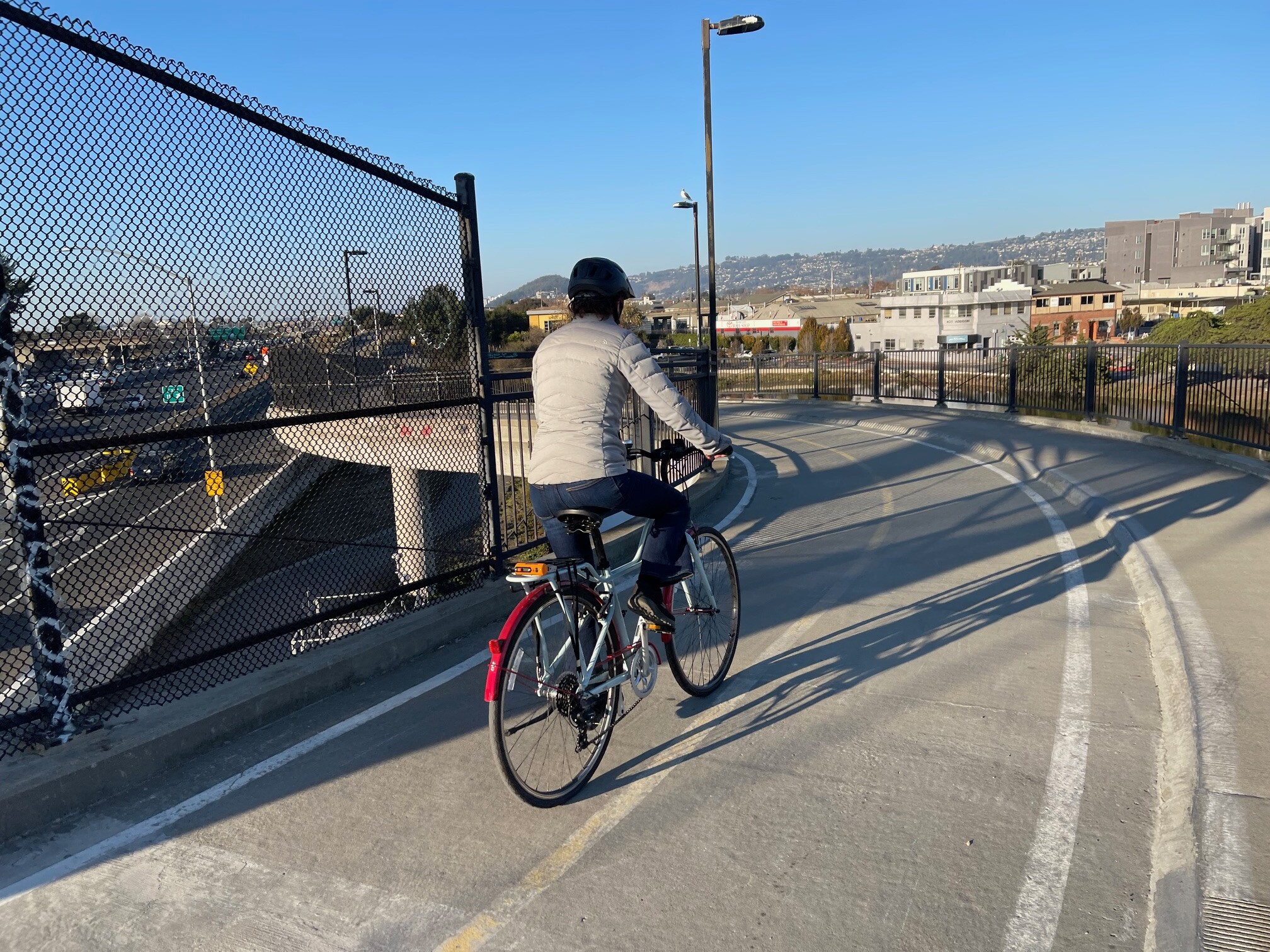
A cyclist rides on the I-80 bicycle bridge in Berkeley, California. California’s 2025 budget prioritized freeways over safe streets. Photo by Dave Iltis
Among the recipients:
Gallatin County, Montana received a Connecting Communities: Gallatin County Rural-Urban Multimodal Safety Initiative grant to build a 1.75-mile shared-use path along Huffine Lane. A bicyclist died on the corridor in 2022, where the speed limit reaches 55 mph and traffic averages 27,000 vehicles per day. Planners estimate a separated path will cut bicyclist and pedestrian injury risk by 65–89 percent. The grant will cover about $13.9 million of the project’s roughly $17.3 million cost.
The Tahoe Transportation District secured funding for its South Demonstration Phase 1A Multimodal Path and Sidewalk Project. The district will construct a one-mile trail and sidewalk from Stateline Avenue/Lake Parkway to Laura Drive along U.S. 50, closing a gap between existing bike paths. Crews will also install curb ramps, lighting, and other safety features. Officials project the improvements will reduce crashes by 25–40 percent. Federal dollars will supply about $2.9 million of the $5.5 million budget.
The Ramah Navajo Chapter in New Mexico won $200,000 to develop a $250,000 Safe Routes to School (SRS) plan. The effort will assess and recommend bicycle, pedestrian, and bus routes to schools across 250 miles.
Moorcroft, Wyoming received $336,000 for an SS4A Planning and Demonstration Grant to create a $420,000 Action Plan. The plan will evaluate school crossings and recommend countermeasures to improve bicyclist safety as part of a Safe Routes to School strategy.
Arizona State University earned funding for its Cooling the Commute: Heat SRS plan. The $100,000 grant will cover four-fifths of the cost of incorporating heat-risk analysis into Safe Routes to School planning in Casa Grande. The project will identify heat hot spots and deploy sensors to gather real-time data.
Montana State University received $5 million for its $6.25 million Advancing Safer Roads and Streets in Rural Areas initiative. The multi-state project will include Safe Routes to School planning in Gallatin and Madison counties in Montana and in LaBelle, Florida, which faces similar rural safety challenges.
The North Central New Mexico Economic Development District secured $471,813 for a $589,767 Comprehensive Safety Action Plan that includes Safe Routes to School components.
Nibley City, Utah will use a $278,976 grant for its Nibley Pedestrian Crossing and Intersection Tactical Safety Improvements and Evaluation project. The $348,720 effort will deploy low-cost treatments at 14 locations, including bicycle counts, surveys, pedestrian beacons, and raised crosswalks.
Ryan Muncy was awarded the Fan Favorite at the Mark Gunter Photo Awards this year. The shot is from the last edition of the Littleton Twilight Criterium held on August 2, 2025. The event is canceled until a new promoter steps up.
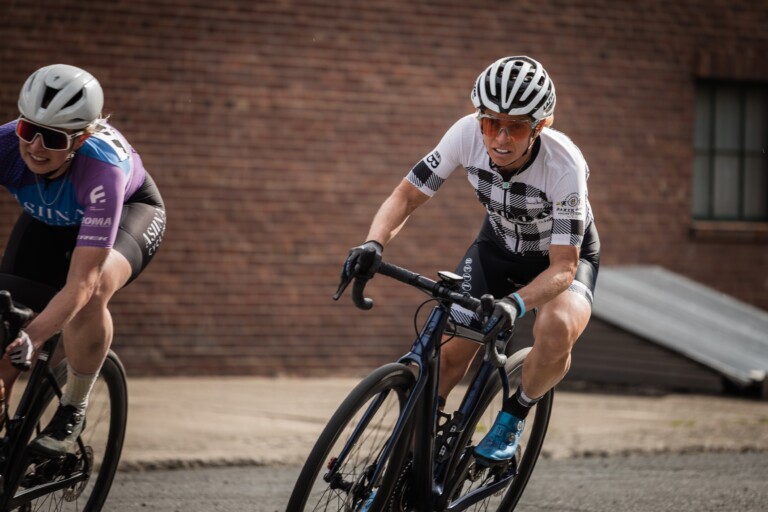
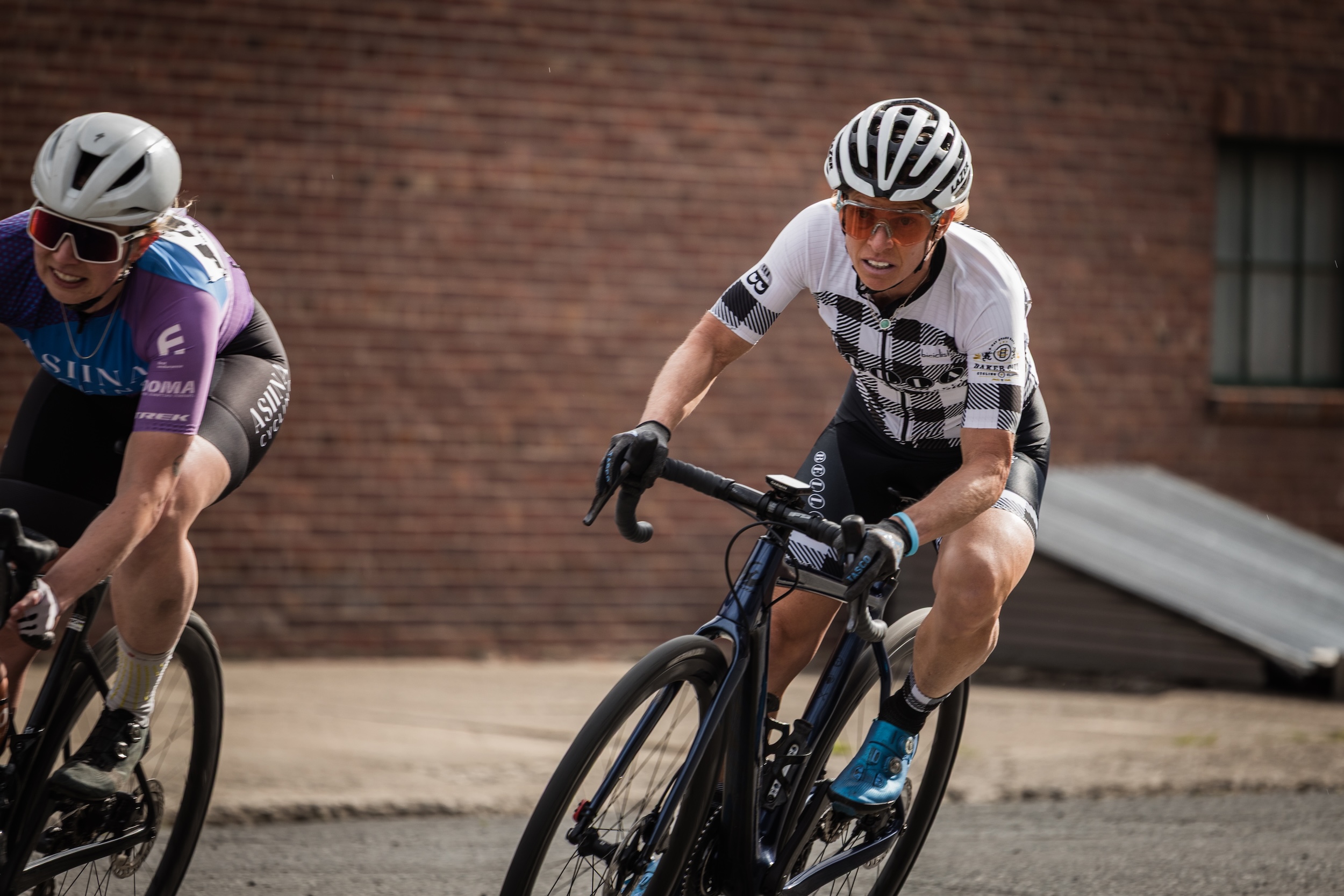
A grassroots initiative backed by local support gives emerging women racers a team, a kit, and a seat at the starting line of the Baker City Cycling Classic.
BAKER CITY, Oregon (May 11, 2026) — For a woman stepping into road stage racing for the first time — or showing up to a race weekend without a team around her — the logistics alone can be daunting enough to keep her home. No kit, no carpool, no one to talk through the course with the night before, and no familiar faces at the start line.
Team BELLA exists to change that.
Returning for 2026, the Baker City Cycling Classic’s women’s team program is one of the more quietly powerful things happening in Pacific Northwest cycling — a community-built initiative that removes the practical barriers standing between a rider and her first (or second, or fifth) stage race experience. Presented by BELLA Mainstreet Market and longtime Classic supporter Beverly Calder, the program offers eight spots on a first-come, first-served basis to women who are new to road or stage racing, attending the event without a team, or simply looking for a welcoming environment in which to race.
A Team BELLA rider during Stage 3 of the 2025 Baker City Cycling Classic. Photo by Sean Benesh.
What they get in return is substantial: free race entry, a custom kit designed by Italy’s Biciclista and produced with support from Stefano Spedini, coordinated lodging through Betty’s Books in downtown Baker City, and perhaps most importantly, a group of like-minded women to race alongside during one of the region’s most celebrated stage races.
“Our goal is simple,” said race director Brian Cimmiyotti. “We want to help remove barriers and create an environment where more women feel welcomed into road racing and stage racing. Team BELLA is about community, mentorship, and making the experience approachable for riders who may be stepping into this world for the first time.”
That philosophy fits Baker City’s character. The Classic — held annually over three days of road races, time trials, and downtown criterium racing in Eastern Oregon — has built its reputation not just on challenging courses and stunning high-desert scenery, but on the kind of genuine hospitality that keeps riders coming back year after year. Team BELLA is an extension of that culture, applied directly to the structural problem of women’s participation: that even riders who want to race often don’t have the infrastructure around them to make it happen.
The 2026 kits are already in production in Italy. The race runs June 26–28.
Women interested in joining Team BELLA for the 2026 Baker Cycling Cycling Classic can reach out to Brian Cimmiyotti at [email protected], or find more information at bakercitycyclingclassic.com/bellateam. Eight spots. First come, first served.
By Lou Melini — In September of 2025, Julie and I did a “hiker/biker” bike tour of Yellowstone National Park, a trip I had been planning for about a decade. Our tour was a shortened version of what I had originally envisioned, but it worked well with our time limitations.
Yellowstone NP was created in 1872, the first national park in the United States and in the world. It is 3,472 square miles, with 96% in Wyoming and the rest in Idaho and Montana. Only Death Valley NP is larger in the continental U.S., and three national parks in Alaska are larger. Because I have traveled through Yellowstone on at least eight occasions, backpacked into the backcountry on four occasions, and done numerous car camping trips, I can say that Yellowstone is my favorite national park.
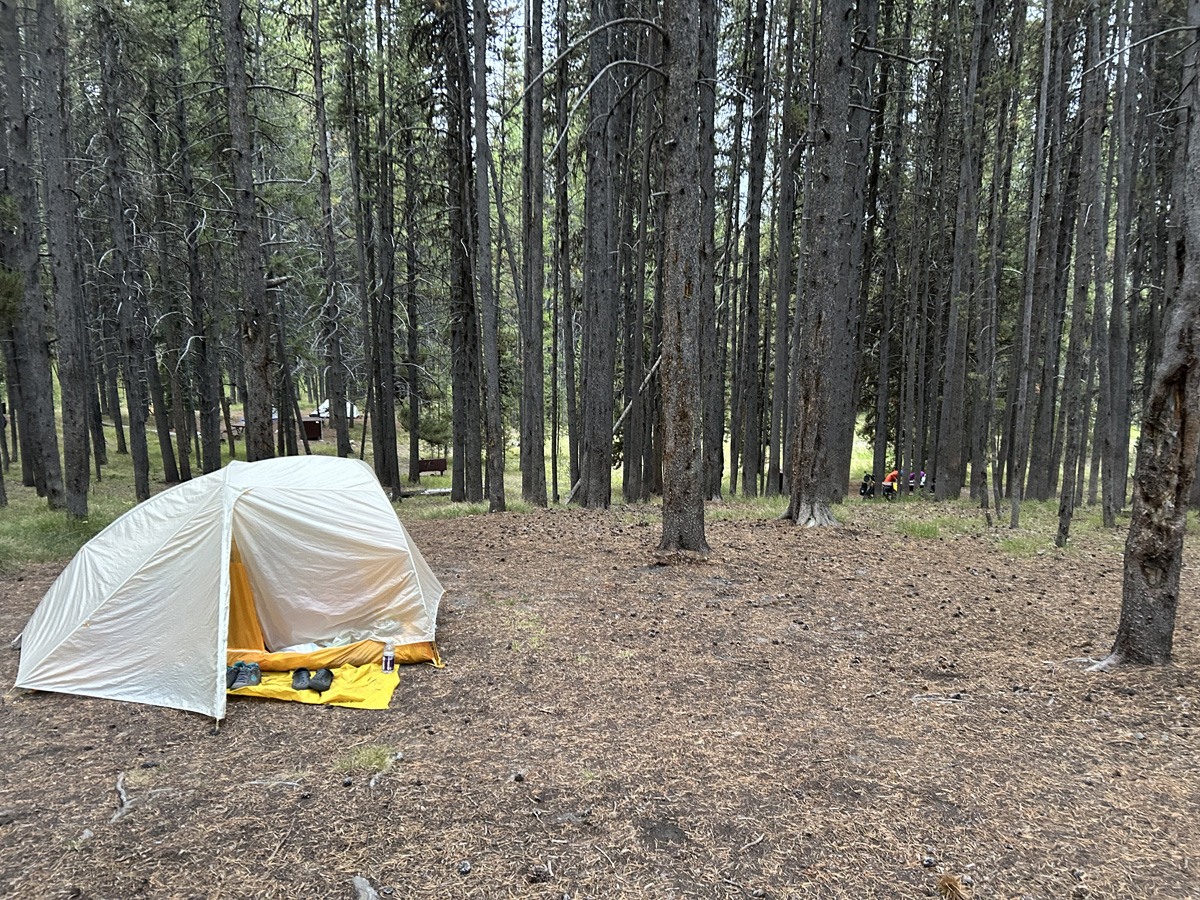
Traveling by bicycle in Yellowstone has become immensely easier with the creation of hiker/biker campsites, which are found in every campground except Fishing Bridge and Slough Creek. If you roll in with your bike loaded with camping gear, you will have a place to stay. Hiker/biker campsites give traveling cyclists a true sense of “welcome to Yellowstone,” compared to my experience in 1975. My friend Jeff and I visited Yellowstone as the first national park either of us had ever visited. Our excitement was palpable until reality set in. Each day, we spent upwards of an hour trying to convince someone to allow us to share their campsite, a result of arriving late in the morning or early afternoon despite pedaling as fast as we could.
HIker/Biker Campsite in Yellowstone. Photo by Lou Melini
Hiker/biker campsites are usually small plots of land set aside for people entering the park on foot or by bike. In Grant Village, the sites are within group campsites that have not been reserved. Water and restrooms are a short distance from the tenting area. Some campgrounds also offer showers and laundry facilities within a reasonable distance. Picnic tables and bear storage bins are generously available in hiker/biker sites. The hiker/biker campsite in Madison is located behind the campground check-in building. As an added bonus, I have been able to get morning coffee at the employee office door there for the past 20 years when I need it.
The cost of a hiker/biker site is $10, or $5 with my senior pass. This compares to about $20–$50 for a regular campsite, depending on amenities. Regular campsite fees include showers, but hiker/biker sites do not, although employees have occasionally treated me to a shower. In 2025, showers cost $5.50. Do the math if you are traveling with three or more cyclists. For example, in Grant Village, three cyclists would be $1.50 ahead using a regular campsite instead of a hiker/biker site, with even more savings if you have a senior pass. However, campgrounds are generally booked up, and hiker/biker sites are worth the peace of mind of knowing you have a place to stay.
Julie and I had five days to complete our Yellowstone tour before going to our timeshare in Island Park. We left our car with friends in West Yellowstone, which borders the park. You can also leave a car at the West Yellowstone visitor center (check with the visitor center for details). In addition, you can take a Salt Lake Express bus to West Yellowstone and return via the bus at the end of your trip. I have used Salt Lake Express for a couple of my bike trips. Be sure to call ahead to let them know you are transporting a bike.
We arrived at our friends’ house early in the afternoon from our home in Millcreek, Utah (outside of Salt Lake City). We then rode 15 miles on a flat road with a shoulder bordering the Madison River to our first night’s destination, Madison Campground. This short ride is a favorite for Julie and me, as there is a chance of elk and bison sightings, but mostly because of the scenic ambiance of fly fishers in the Madison River. Be prepared with food, as Madison Campground does not have food amenities aside from a small snack shop. There are also no showers at Madison.
We awoke to temperatures in the mid-30s—a cold mid-30s—for this early September trip. Welcome to Yellowstone in September. It took us some time to get out of camp. Our destination was Canyon Campground, only 26 miles away, so we had plenty of time. Madison sits at 6,800 feet of elevation, while Canyon is at 7,900 feet, so we knew we had some climbing ahead over those 26 miles.
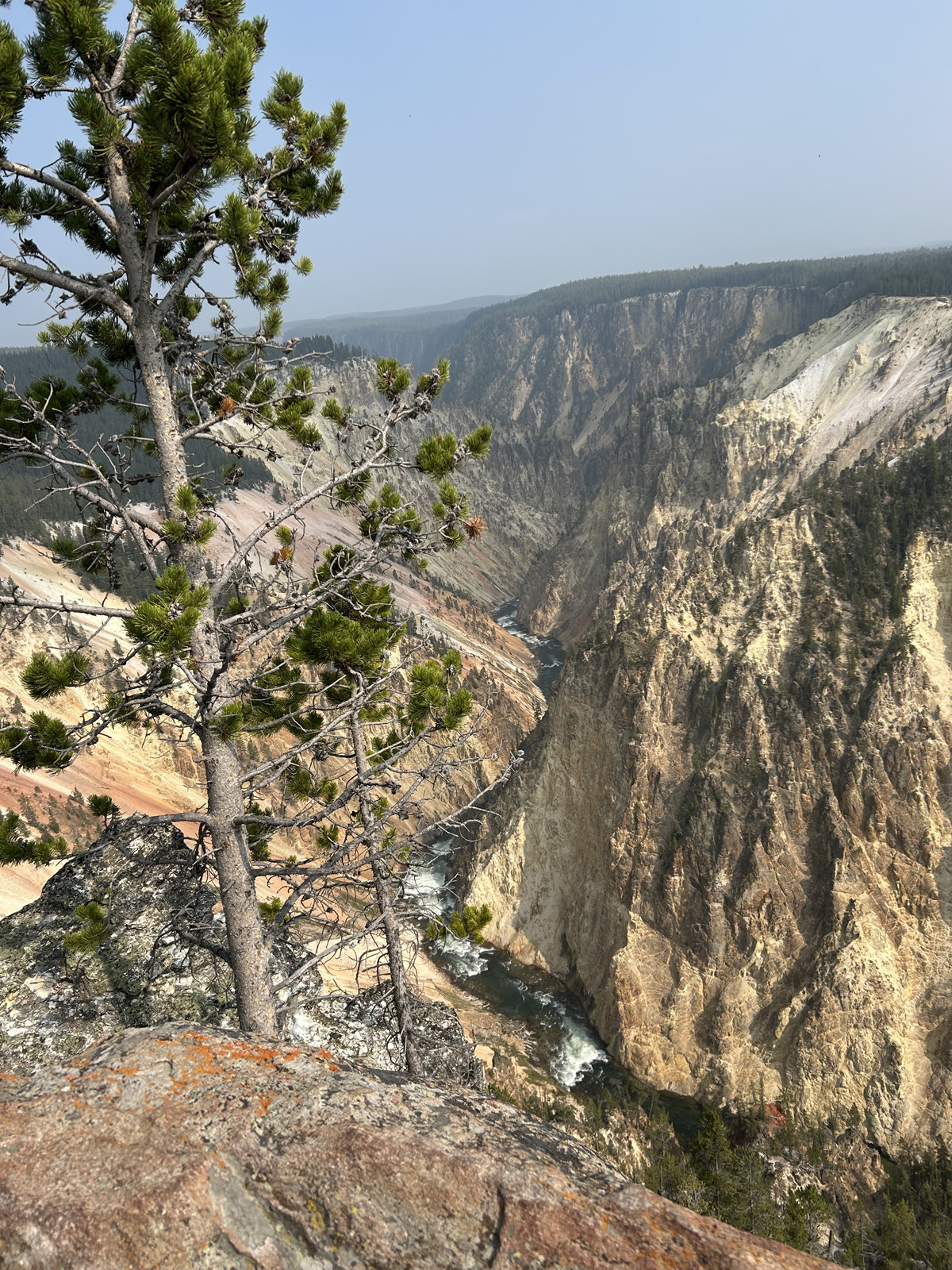
The Grand Canyon of the Yellowstone. Photo by Lou Melini
The ride to Canyon Campground was pleasant. The road is forested on both sides and has a shoulder. We detoured onto Virginia Cascade Road, a one-way road that parallels the main road. This route takes you along the Gibbon River and a small cascade (waterfall). Julie and I arrived at Canyon with plenty of time to hike along the Grand Canyon of the Yellowstone, perhaps the most beautiful feature of Yellowstone NP. Canyon has a small village that includes a grocery store, restaurants, gift shops, a post office, and a visitor center. Showers and a laundromat are also available.
We shared the hiker/biker site with five other cyclists, including a couple from Switzerland who were 3.5 years into their planned five-year global journey. I have rarely camped with more than two other cyclists in Yellowstone during my stays in the park. I happened to have a fistful of shower passes (a longer story), so I treated the group to showers.
Julie and I were traveling the “Grand Loop” of Yellowstone: Madison, Canyon, Grant Village, and back to Madison. Two of the cyclists at Canyon were from Billings, Montana. They were riding the upper loop of Yellowstone, which includes Mammoth, Tower Fall, and Canyon Campgrounds. Mammoth is the headquarters of Yellowstone and features several geological attractions, as well as a perennial herd of elk that reside near the campground. Once, at Mammoth Campground, an elk parked itself in front of my bear box shortly after I had emptied it of my food. I have had elk wander into campgrounds where I was staying on three or four occasions, including this trip.
The morning we left Canyon was again cold, but our new Swiss friends were in shorts. Julie and I bundled up for the 37-mile ride to Grant Village. The ride to Fishing Bridge does not have a shoulder, and the road is in disrepair in places. We started early and had little traffic as we rode along the Yellowstone River. At Fishing Bridge, a shoulder appears for the final 21 miles of the ride. We also rode through light rain for about an hour on this stretch to Grant Village.
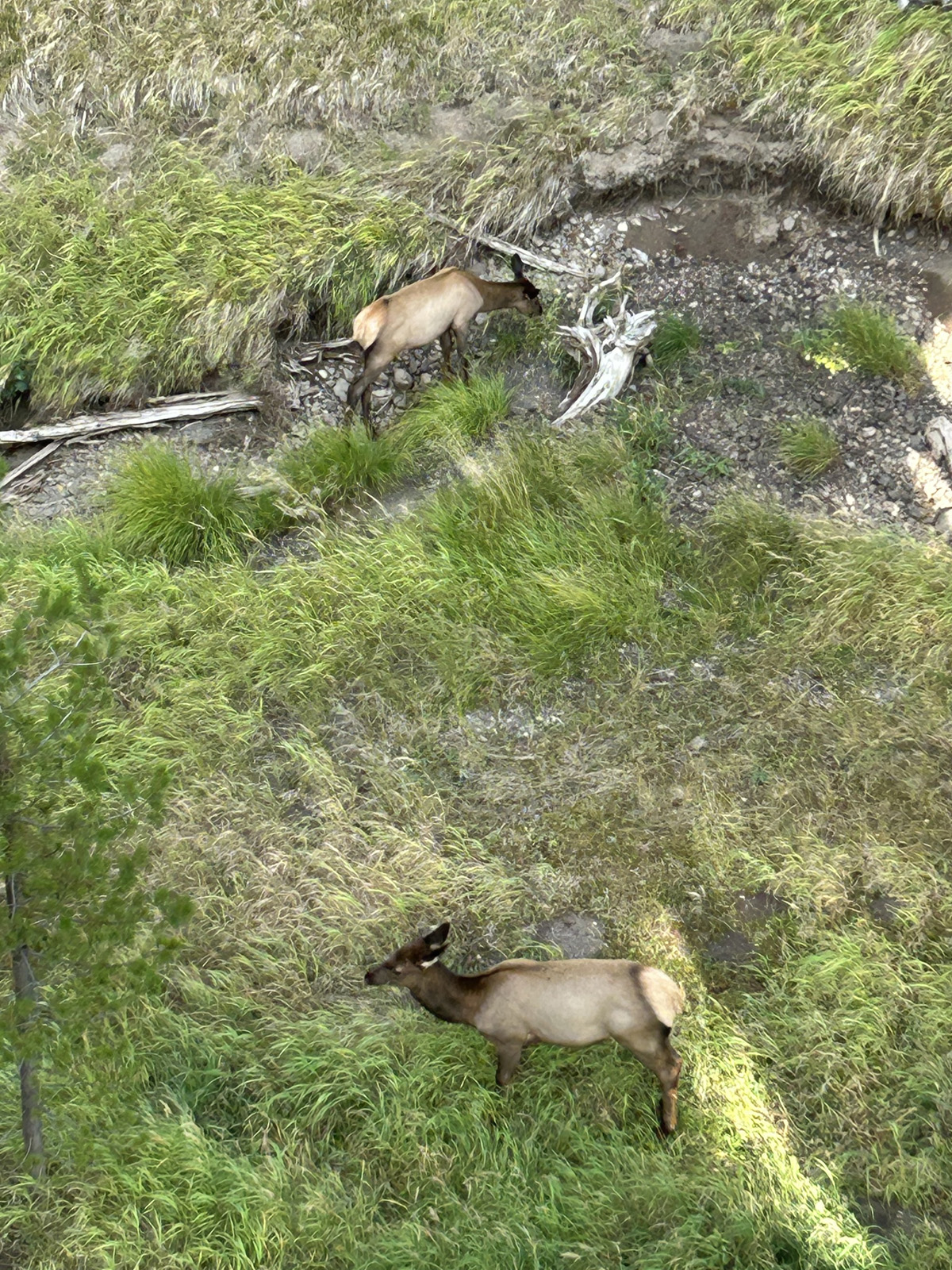
Elk at Grant Village. Yellowstone Bike Tour. Photo by Julie Melini
Grant Village is a small village, so we were able to acquire food to cook for dinner. From Fishing Bridge to a couple of miles before Grant, we rode along Yellowstone Lake. While setting up our tent, an elk walked along the boundary of the campground. Julie and I also saw several elk from a bridge over a ravine while walking to the grocery store.
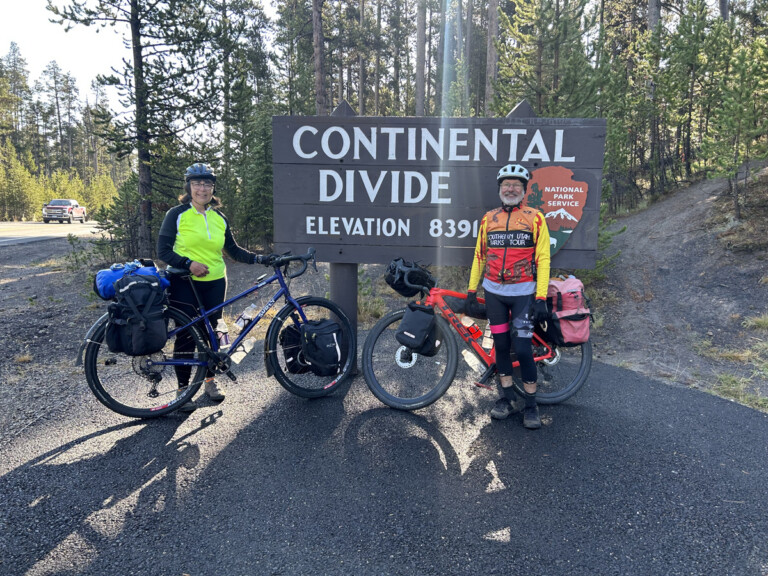
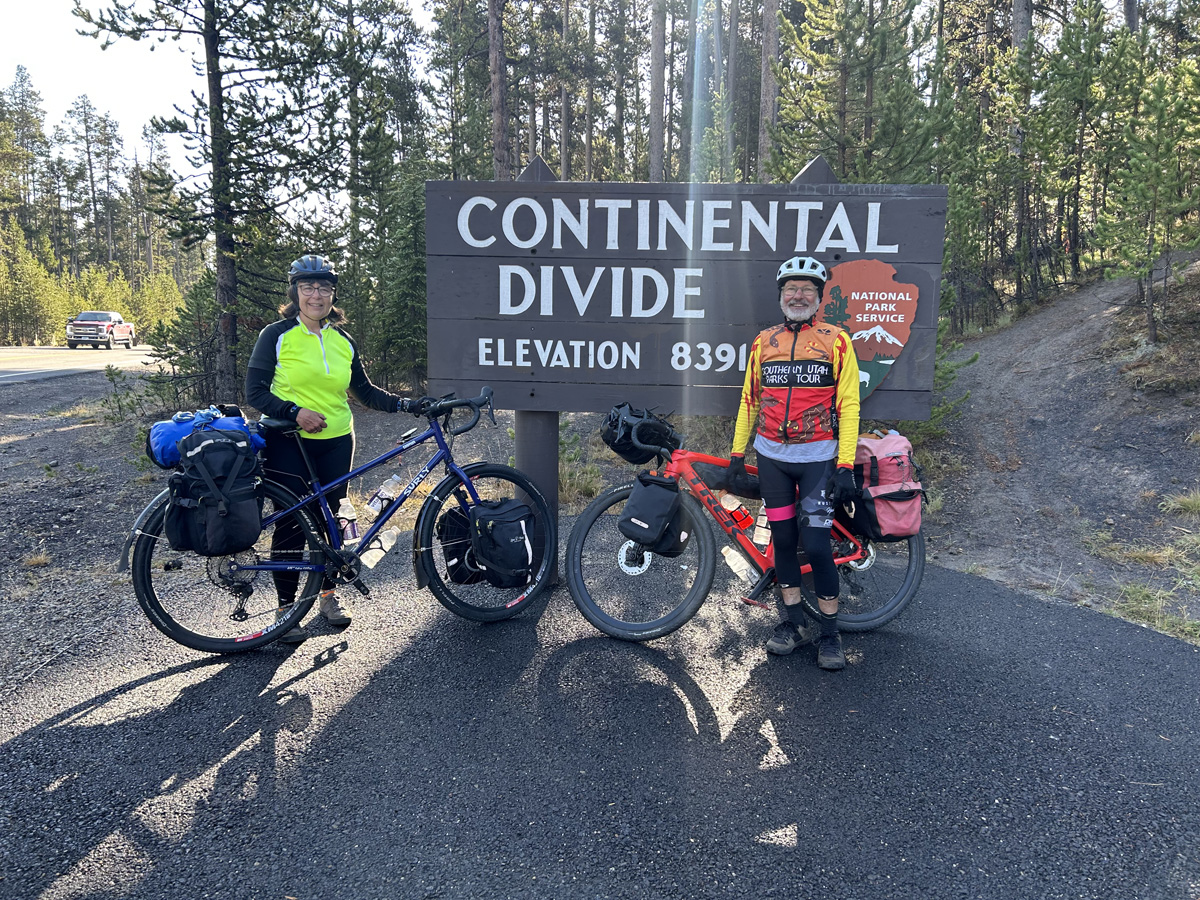
We left Grant Village on day four of our trip, a morning that was warmer than the previous ones. Despite the cold mornings, we were able to ride later in the day in shorts and a thin long-sleeve top. By afternoon, we were in short sleeves. Madison Campground was 40 miles away, and we had three climbs, two of which crossed the Continental Divide above 8,300 feet and nearly to 8,400 feet.
Julie and Lou at the Continental Divide. Yellowstone Bike Tour. Photo by Julie Melini
We began climbing about two miles out of camp as we headed to Old Faithful for lunch, to pick up dinner supplies, and, of course, to watch Old Faithful erupt. There is a good shoulder on the road from Grant Village except for about a quarter mile before and after Old Faithful. From Old Faithful to Madison Campground, traffic increased significantly. Despite “no parking” signs, we were forced onto the road numerous times. Julie and I tried to take bike paths to get off the road, but the first was inexplicably closed and the second was closed due to a “carcass on the trail.” In both cases, we had to backtrack a couple of miles. This section can be busy starting in late morning due to the Lower, Midway, and Upper Geyser Basins, including the Grand Prismatic Spring at Midway.
On our return to Madison, the same person checked us in at the hiker/biker site as on our first night. He is officially a resident of South Dakota, as the state allows people who live and travel in an RV to claim residency. He remembered Julie and me, so check-in was quick. We knew our neighbors from Millcreek had arrived at Madison Campground in their trailer, so we had dinner with them and played cribbage afterward. It was a nice evening. The next morning, day five, we rode the final 15 miles back to our car.
Nuts and Bolts:
Entrance fees: The entrance fee to Yellowstone by bicycle is $20, or free with a senior or annual pass (check current pricing; disabilities are free). Passes are good for seven days. If you are riding with a group, be aware that entrance station employees may not always know the regulations. For example, my senior pass allows the holder and three others to enter. I have had no issues getting Julie in on my pass, but she now has her own lifetime senior pass ($80). On one occasion, however, I brought a friend, and the attendant initially assumed he needed to pay until I clarified the rule. There is also a “car rule”: a $35 vehicle fee covers up to four occupants. In theory, a group of four cyclists should pay $35 under this rule—but good luck explaining that.
Traveling by bike in Yellowstone: Riding in Yellowstone presents unique challenges, but I consider it safe with appropriate precautions, as in any city. Speed limits range from 25 mph in tourist areas to 45 mph elsewhere, and rangers enforce them. Wildlife—especially bison—poses the greatest risk. Plan how you will handle encounters, as traffic can become erratic with sudden stops. On one occasion, I rode down the center line between stopped cars to avoid bison on both sides. Often, I ask a driver to use their car as a shield. Once, before the park officially opened, my family and I climbed onto a boulder while a herd of bison walked down the road.
Some cyclists worry about being hit by RV mirrors. That may have been true in 1975, but I no longer consider it a major concern. At one point, Adventure Cycling Association even rerouted the TransAmerica route to avoid Yellowstone, sending riders south on Route 20 and over Teton Pass to Jackson. That route includes high-speed traffic, though it now has shoulders along much of its length.
You can extend the route Julie and I rode by including the upper loop of Yellowstone. Be aware that the road from Norris to Mammoth lacks a shoulder. You can also extend south into Grand Teton National Park, where hiker/biker sites are available at Colter Bay and Jenny Lake. The road from Grant Village to the south entrance of Yellowstone also lacks a shoulder, but traffic is lighter early in the morning. Beyond the entrance, the road includes shoulders and eventually a bike path in Grand Teton NP.
Leave early from camp, stay aware of your surroundings, anticipate sudden movements from cars, and enjoy the ride.
Food and lodging: You do not need to carry large amounts of food unless you have specific dietary needs. Larger campgrounds and tourist areas—such as Canyon, Grant Village, and Old Faithful—offer food. Grocery options are limited, and restaurants are priced accordingly.
Bike shops: Bike shops are available in Jackson, Wyoming, as well as Freeheel and Wheel in West Yellowstone.
Lou Melini is a lifelong bicycle commuter, tourer, and the former Commuter Column editor for Cycling West.
Three days, three sprints, and an unexpected Maglia Rosa
The 109th Giro d’Italia opened not on Italian roads but on the wide Bulgarian coast, and the first three stages played out like a sprinters’ tutorial — two wins for Paul Magnier, one for a young Kazakh who had no business winning a Grand Tour stage this soon, and a maglia rosa situation that nobody quite predicted.
Stage 1 — Nessebar–Burgas, 147 km
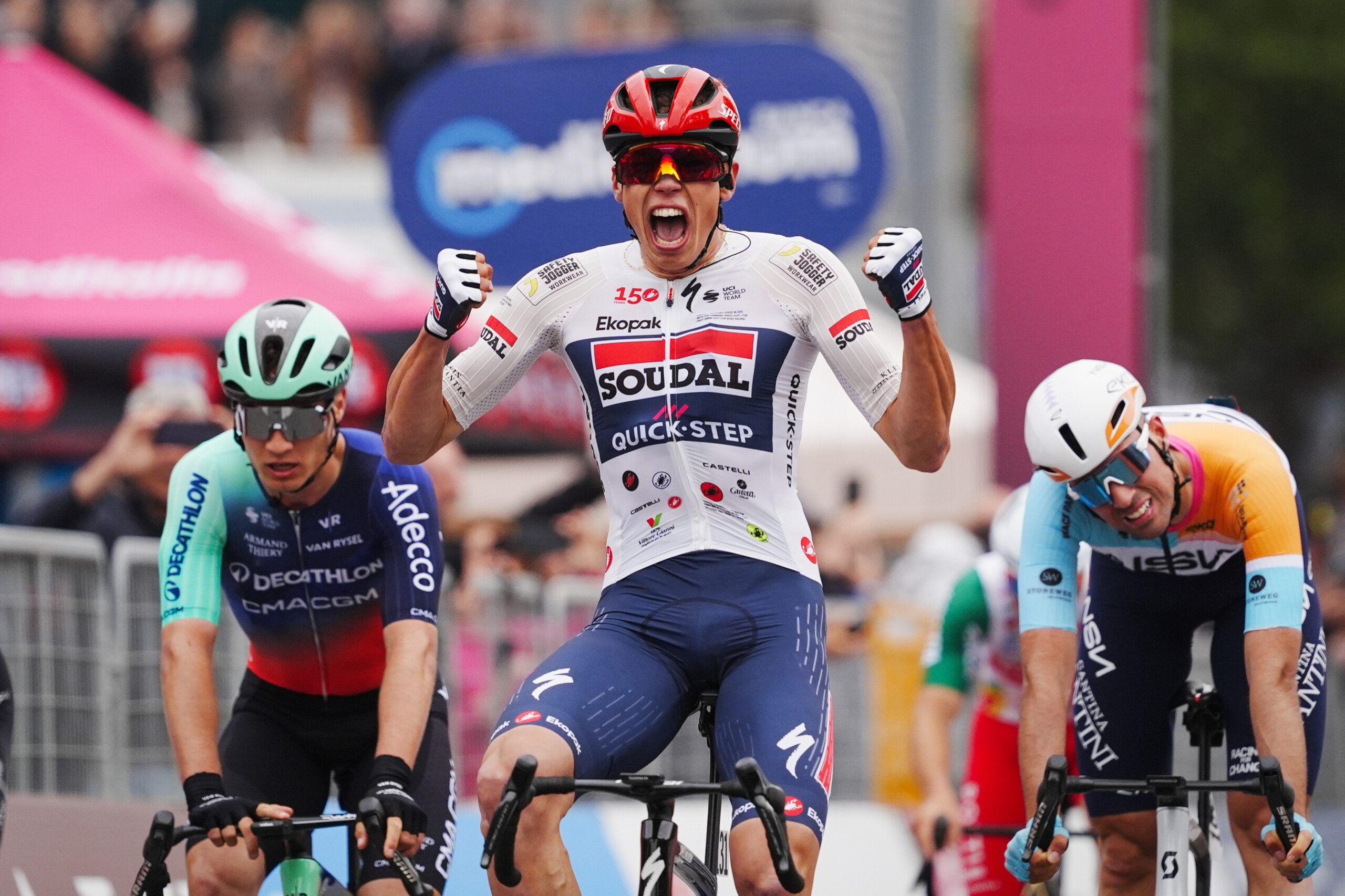
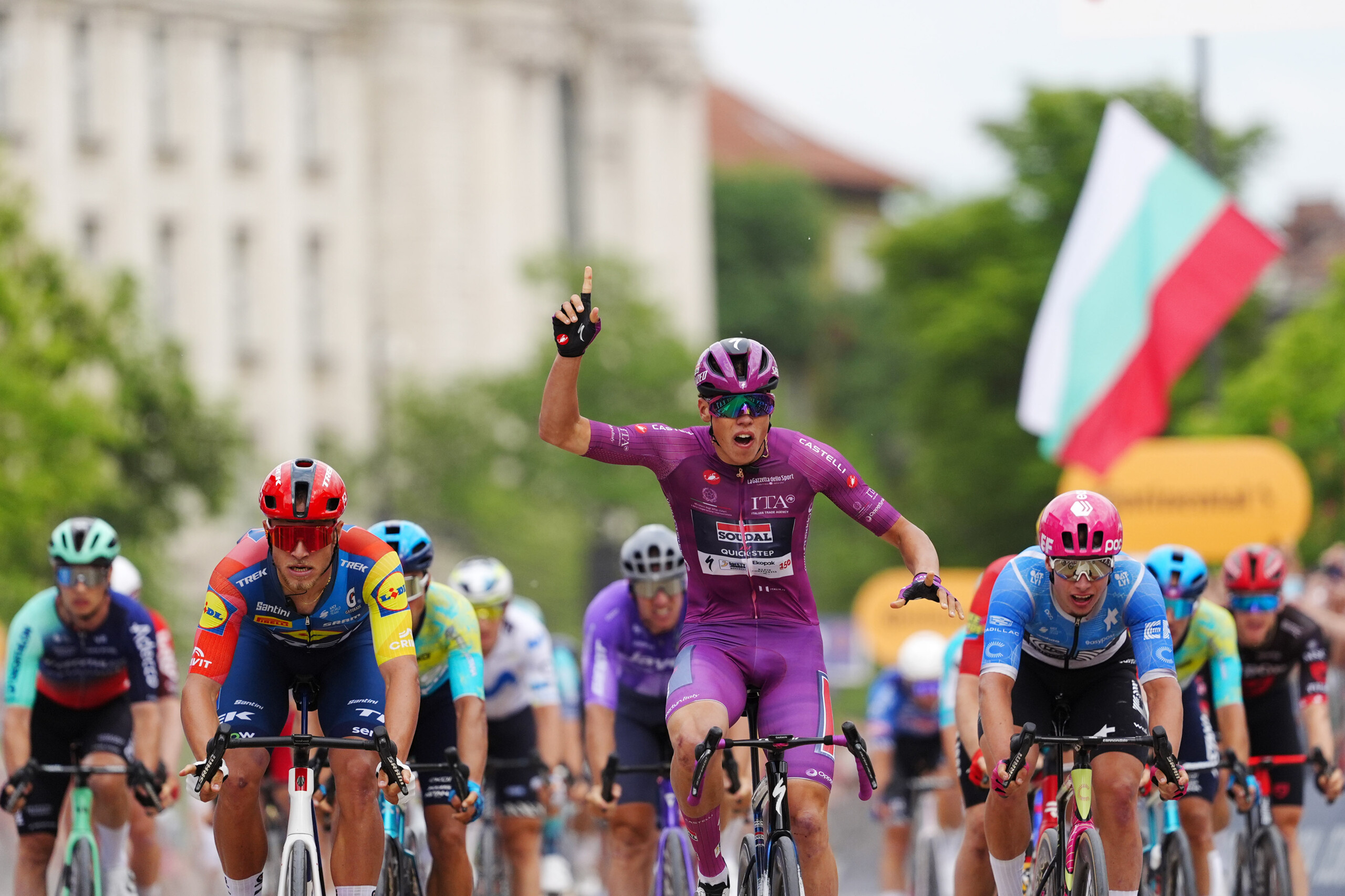
Soudal Quick-Step controlled the finale on the Black Sea coast, and when the roads narrowed before the sprint, the crash that swept through the bunch left Magnier clear. Jasper Stuyven delivered him to the final straight, and the young Frenchman came around a field that included Jonathan Milan to take the win — and with it the pink jersey, the ciclamino, and the white in a single afternoon’s work.
France’s Paul Magnier of Soudal Quick-Step winner on the finish line during Stage 1 of the Giro d’Italia, from Nessebar to Burgas, Bulgaria, Friday, May 8, 2026. (Photo by Massimo Paolone/LaPresse)
“It’s a big emotion. I was already happy to start the Giro with a nice shape and a special jersey from Castelli. Now I can change it for the Maglia Rosa. Six years ago during Covid I was watching Arnaud Démare winning with the Ciclamino jersey. He sent me a message to do the same. I’m glad I did. — Paul Magnier”
Stage Result
Pos
Rider
Time / Gap
1
Paul Magnier (Soudal Quick-Step)
3h21’08” — 43.851 km/h
2
Tobias Lund Andresen (Decathlon CMA CGM Team)
s.t.
3
Ethan Vernon (NSN Cycling Team)
s.t.
General Classification
Pos
Rider
Time / Gap
1
Paul Magnier (Soudal Quick-Step)
3:20:58
2
Tobias Lund Andresen (Decathlon CMA CGM Team)
s.t.
3
Manuele Tarozzi (Bardiani CSF 7 Saber)
+0’04”
Jersey Classifications
Jersey
Classification
Leader
Maglia Rosa
General Classification
Paul Magnier (Soudal Quick-Step)
Maglia Ciclamino
Points Classification
Paul Magnier (Soudal Quick-Step)
Maglia Azzurra
Mountains Classification
Diego Pablo Sevilla (Polti VisitMalta)
Maglia Bianca
Best Young Rider
Paul Magnier (Soudal Quick-Step)
Stage 2 — Burgas–Veliko Tarnovo, 221 km
The longest stage of the Bulgarian opening block looked like another sprint on paper. Guillermo Thomas Silva tore that paper up. XDS Astana’s Christian Scaroni stayed active all day at the front, setting the tempo over the hard final kilometres, and when it came time to sprint Silva read the finish perfectly — launching at precisely the right moment to beat Florian Stork (Tudor Pro Cycling) and Giulio Ciccone (Lidl-Trek). The pink jersey passed from Magnier to the Kazakh’s shoulders.
“I’m delighted. This is only the second stage of my first Giro d’Italia and I’m the winner. I’m speechless. I knew I came with good shape but I also knew it’s very hard to win a stage of a Grand Tour. Having won in the first few days will give us a lot of serenity. — Guillermo Thomas Silva”
Stage Result
Pos
Rider
Time / Gap
1
Guillermo Thomas Silva (XDS Astana Team)
5h39’25” — 39.067 km/h
2
Florian Stork (Tudor Pro Cycling Team)
s.t.
3
Giulio Ciccone (Lidl-Trek)
s.t.
General Classification
Pos
Rider
Time / Gap
1
Guillermo Thomas Silva (XDS Astana Team)
9:00:23
2
Florian Stork (Tudor Pro Cycling Team)
+0’04”
3
Egan Bernal (Netcompany Ineos)
+0’04”
Jersey Classifications
Jersey
Classification
Leader
Maglia Rosa
General Classification
Guillermo Thomas Silva (XDS Astana Team)
Maglia Ciclamino
Points Classification
Paul Magnier (Soudal Quick-Step)
Maglia Azzurra
Mountains Classification
Diego Pablo Sevilla (Polti VisitMalta)
Maglia Bianca
Best Young Rider
Guillermo Thomas Silva (XDS Astana Team)
Stage 3 — Plovdiv–Sofia, 175 km
Soudal Quick-Step controlled the stage from the gun, put Magnier in position with a kilometre to go, and watched him do the rest. He beat Jonathan Milan and Dylan Groenewegen (Unibet Rose Rockets) in a sprint that confirmed what Stage 1 had only suggested: Magnier belongs among the world’s best finishers. Silva stayed safe, held his four-second cushion over Stork and Bernal, and carried pink to Italy.
“I dreamt of winning two stages out of three in Bulgaria. It became a goal. The team did an amazing job — we had a plan to be in the best position with 1 km to go and that’s exactly what we did. Beating Jonathan Milan and Dylan Groenewegen means I can feel I’m among the world’s best sprinters. — Paul Magnier”
Stage Result
Pos
Rider
Time / Gap
1
Paul Magnier (Soudal Quick-Step)
4h09’42” — 42.050 km/h
2
Jonathan Milan (Lidl-Trek)
s.t.
3
Dylan Groenewegen (Unibet Rose Rockets)
s.t.
General Classification
Pos
Rider
Time / Gap
1
Guillermo Thomas Silva (XDS Astana Team)
13:10:05
2
Florian Stork (Tudor Pro Cycling Team)
+0’04”
3
Egan Bernal (Netcompany Ineos)
+0’04”
Jersey Classifications
Jersey
Classification
Leader
Maglia Rosa
General Classification
Guillermo Thomas Silva (XDS Astana Team)
Maglia Ciclamino
Points Classification
Paul Magnier (Soudal Quick-Step)
Maglia Azzurra
Mountains Classification
Diego Pablo Sevilla (Polti VisitMalta)
Maglia Bianca
Best Young Rider
Guillermo Thomas Silva (XDS Astana Team)
Diego Pablo Sevilla leads the mountains classification unchallenged and looks unlikely to be troubled by sprinters for it. The Giro proper — climbs, time trials, the whole Italian argument — begins now.
By Charles Pekow — Men die in cycling crashes at far higher rates than women—a pattern that holds across most of the United States. A five-year study by the Bicycle Accident Lawyers Group, an Arizona-based firm that represents injured cyclists, found the national male fatality rate is 74 percent higher. But in 13 states, the trend flips—sometimes dramatically.
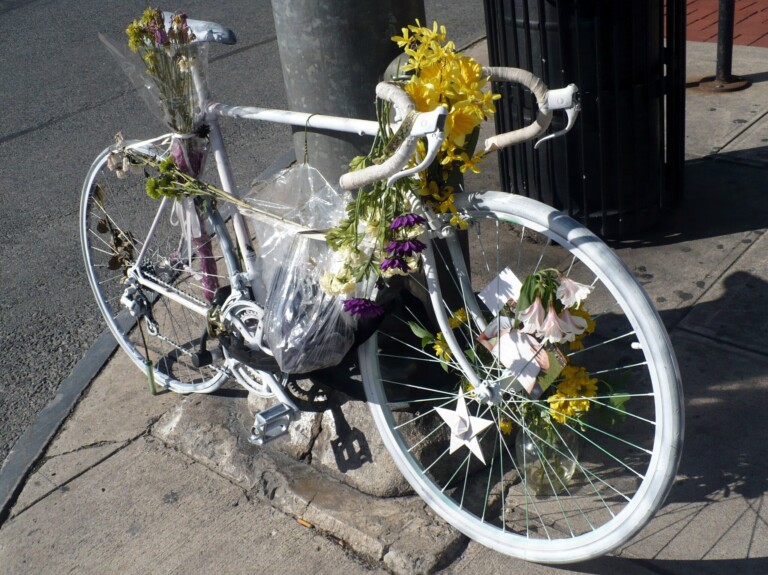
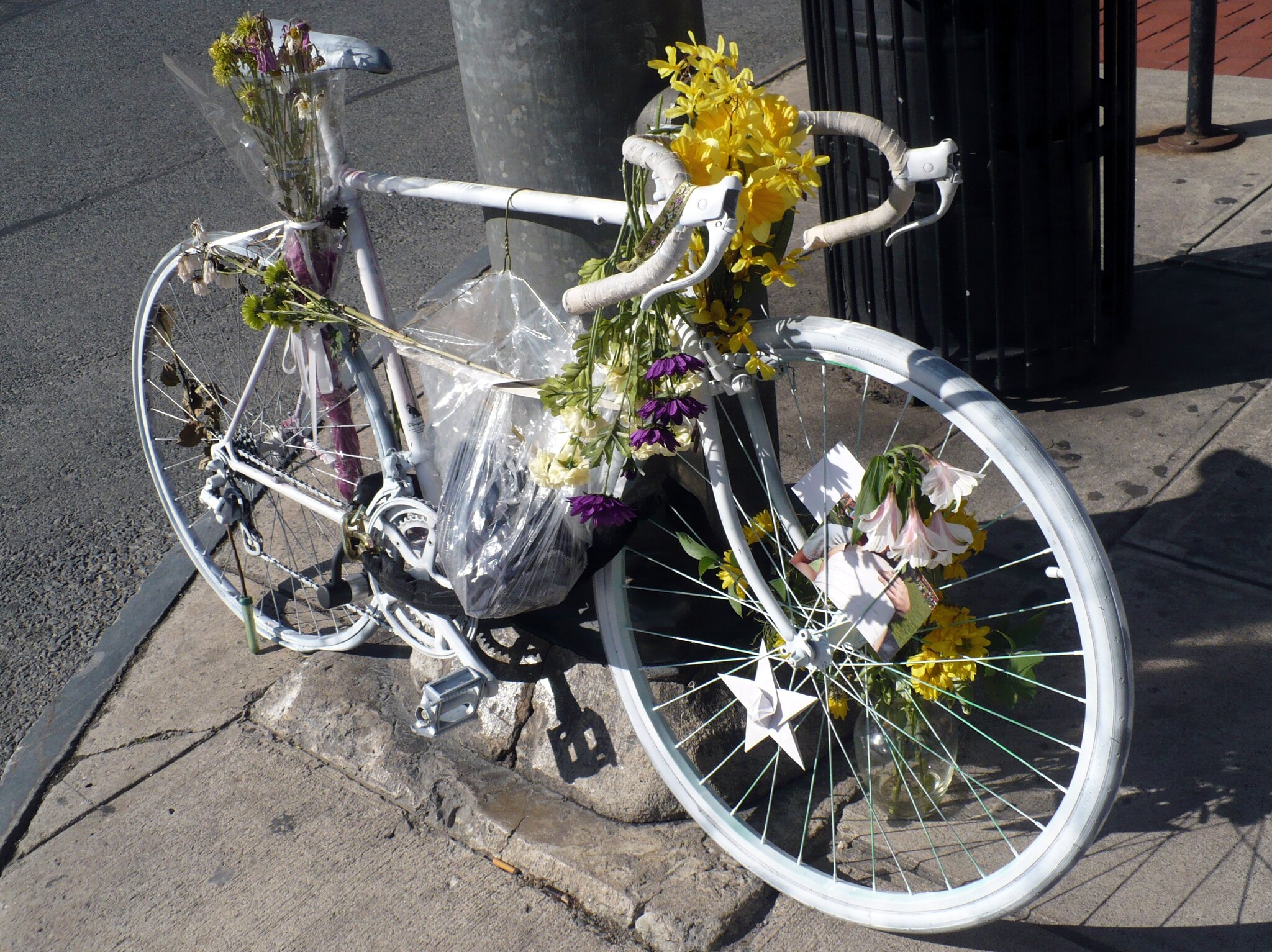
Even a slight reduction in cyclist deaths is welcome. One less death means one less ghost bike. Photo by Philip Chapman-Bell, CC BY-NC-SA 2.0 ATTRIBUTION-NONCOMMERCIAL-SHAREALIKE 2.0 GENERIC
In Idaho, women were 60 percent more likely to die in cycling crashes. Montana showed a gap of about 47 percent, and Utah 18 percent. The contrast with neighboring states is striking: in Colorado and Nevada, men were 170 percent and 160 percent more likely to be killed, respectively. In smaller states, however, limited data may make firm conclusions difficult.
States with higher female fatality rates span both rural and urban areas. Only Florida and California reported more female cycling deaths than Arizona, which ranked second nationally in per-capita deaths among women. Arizona also ranked third for male cyclist fatalities.
The firm urges planners to account for gender differences when designing safety programs and education efforts. The data come from the National Highway Traffic Safety Administration’s Fatality Analysis Reporting System.