By Charles Pekow — Are American campaigns for better bicycling considering the needs of all potential riders? It looks like they’re not. A recent survey of state and local bicycle advocacy groups suggests that advocacy groups dominated by commuter, recreational, and even professional cyclists may not be considering the needs of large groups of people who can and would ride if given the right circumstances.
Academics from Pennsylvania State University published results of a survey in the June issue of the Journal of Transport & Health. In “Bicycle Advocacy Organizations and Coalitions’ Capacity for Equitable Programming: Findings from a National Survey,” authors fault bicycle advocates for not considering the needs of non-mainstream people of all sorts, or people who don’t look like or share the capabilities of the lobbyists themselves (https://www.sciencedirect.com/science/article/abs/pii/S2214140522000391#!)
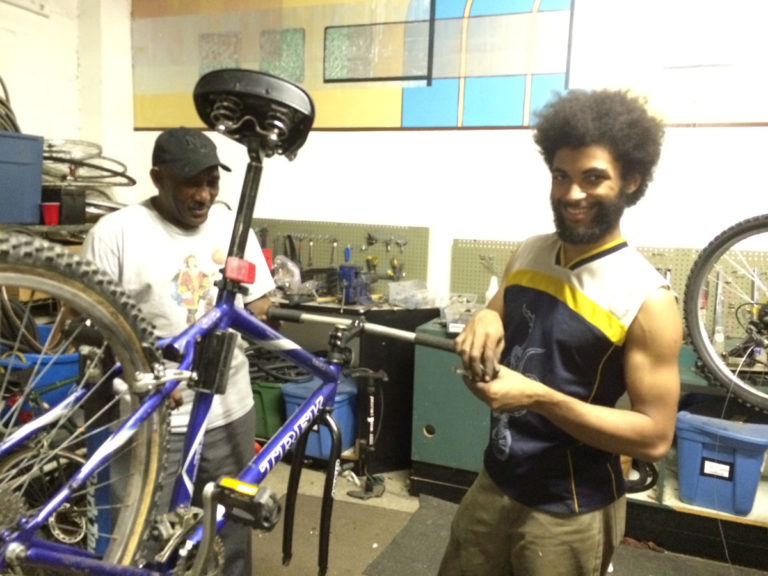
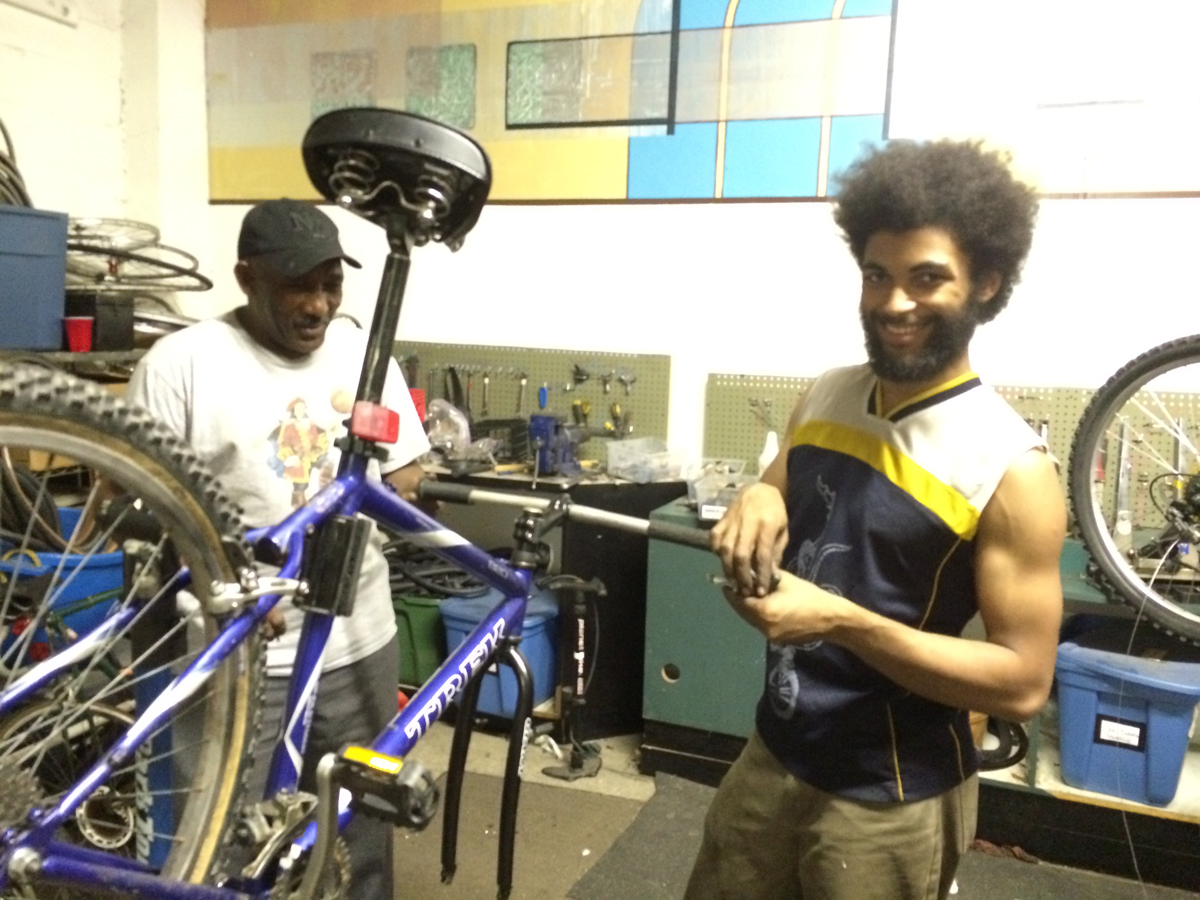
“African Americans were more than twice as likely as whites (38% vs 14%) to agree that their perception of bicyclists would improve if people on bikes represented a “broader cross section of Americans, such as women, youth and people of color” in their community.” (from the League of American Bicyclists The New Majority, Pedaling Towards Equity Report). Here, two bicycle mechanics work at the Freewheel Community Bike Shop in Madison, Wisconsin. Photo by Dave Iltis
The researchers surveyed state and local bicycle affiliate groups of the League of American Bicyclists (LAB). It got 71 usable responses in 35 states about how they try to work with or help out different racial/ethnic minorities, women, low-income communities, youth, LGBTQ+ people, etc.
“On average, participants stated a lack of programming in underserved populations compared to the general population, and also stated many barriers/desired tools for reaching underserved populations. On average, coalitions also ranked the importance of equity low, and ranked ‘providing equitable opportunities’ as a low priority,” the researchers found, suggesting “bicycle coalitions should attempt to implement strategies to provide equitable programming.’
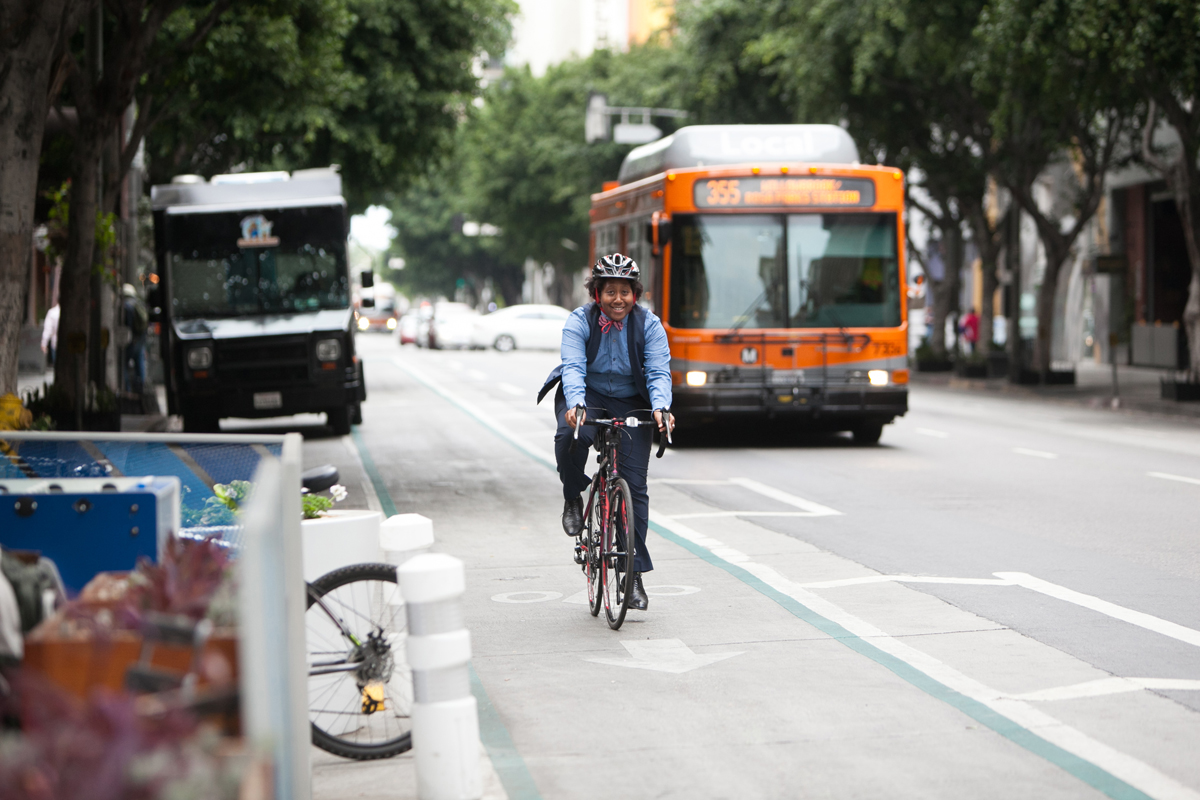
Tamika Butler in downtown Los Angeles outside of the Los Angeles County Bicycle Coalition offices. Photo by Serena Grace
Big barriers include seeing cycling as male-driven, along with a lack of access to facilities in low-income areas. One can only speculate as to whether the self-selective groups who completed the survey are more concerned than the ones who didn’t respond. Respondents also self-reported with no checks in place to ensure accuracy.
The report continues “coalitions ranked bicycle safety/education as their top priority, followed by encouragement for biking. Addressing concerns for underserved populations, and socially connecting bikers were the last priorities … [advocates] indicated that the biggest barrier to reaching underserved populations was a lack of financial resources, followed by a lack of personnel.”
The study suggests a need to focus on equity as a goal in itself, rather than simply incorporating it into other priorities. Its ideas ranged from classes in other languages, staffing diversity, and bike maintenance programs for LGBTQ+.
The study’s authors note that the small sample size did not consider the demographics of the advocates, which may not be representative of the USA as a whole. They also note that they didn’t consider the needs of people with physical challenges who may lack adequate equipment or support to ride.
One statewide group that has been pedaling far ahead on the trail of these issues, however, is Bicycle Colorado, which started a RIDE (short for Respect, Inclusion, Diversity and Equity) initiative in 2018 (https://www.bicyclecolorado.org/ride-building-equity-in-bicycling/)
Its website says, “members of our RIDE Advisory Board have gathered bimonthly with Bicycle Colorado to share their experience, expertise and ideas – as well as perspectives we don’t currently have on our staff.” Advisory Board members have also alerted Bicycle Colorado to issues such as discriminatory enforcement of laws, explains Aishwarya Krishnamoorthy, director of marketing and communications. The death of George Floyd in May 2020 “was a real catalyst in terms of our work,” Krishnamoorthy says. “We did a ride for racial justice.”
Bicycle Colorado also provides info on adaptive equipment such as three- and four-wheelers, recumbents, electric bikes, etc. (http://bicyclecolorado.org/adaptive/) “It’s hard to keep up with people riding regular bikes (but) having group activities dedicated for people who use adaptive equipment or older adults” can work, Krishnamoorthy adds.
“We used to have a full-time teammate who spoke Spanish” and Bicycle Colorado shows up at Cinco de Mayo festivals, she notes.
Sometimes the minority party just needs to reach out. “The Wind River Indian Reservation asked us to help write and put together an active transportation plan for communities on their reservation both for transportation and recreation. We’re well on our way to helping with that plan,” says Michael Kusiek, executive director of Wyoming Pathways, that state’s bicycle advocacy organization. Shoshone and Northern Arapaho lands encompass more than 2.2 million acres in the center of the state.
The Rail-to-Trail Conservancy’s (RTC) current major project, the Great American Rail Trail cross-continent bike route, “will go through quite a bit of Native American territory. We are trying to figure out the most sensitive and thoughtful process to deal with those communities. The Wind River Indian Reservation has the highest pedestrian fatality rate of any place in the country. One of the most amazing things we ever could do would be to design this trail to help be a solution to that problem,” says Kevin Mills, RTC vice president for policy. “You need to keep learning and you need to approach (inclusion and equity) with humility,” Mills continues.
RTC (of which I am a member) started out with the goal of turning abandoned railroad lines into multi-use trails. Then it learned “it wasn’t enough just meeting demand. We had to make sure the trails served everybody.”
Mills also blamed grant competitions and some transportation officials for not considering the needs of low-income communities when they structure grant applications and seek public input. Even the poorest communities will have to find a non-federal match for grants under the Infrastructure Investment and Jobs Act, for instance. RTC failed to convince Congress to allow waivers.
The Adventure Cycling Association also realizes it is coming late to the game. “We acknowledge that systemic racism and sexism impact the ability of BIPOC and LGBTQ+ people to travel by bicycle safely,” it says on its website (https://www.adventurecycling.org/about/diversity-and-justice/). “As an organization, we have a lot of work to do to support, empower, and create safe spaces for underrepresented communities.”
As such, the non-profit bike-travel promoter started some programs trying to meet the needs of various gender groups. It reached out to cycling groups that serve their needs, Project Manager Carmen Aiken relates. “We have worked with some (local chapters) to fund beginners’ adventures (short trips). We offer scholarships and stipends to help with marginalized communities to go on trips, she says. “What we think of as accessible or inclusive often is not … It is still a work in progress.”
Local bike groups can reach out to “groups in your area doing the work of trying to make the cycling communities more inclusive” and collaborate with them on rides and other events, suggests Molly Sugar, a founder of Radical Adventure Riders, a five-year-old organization with chapters around the country devoted to “gender inclusivity and racial equity in cycling and the outdoors” (http://radicaladventureriders.com). “Just having the conversation to meet the needs of specific groups is important. There’s no one-size-fits-all solution.” It could mean offering pre-registration or discounts if you want to meet a certain quota, she suggests. “You can ask the people you are trying to reach to lead the rides.”
She also suggests including pictures of members of different demographic groups and using different languages on your website.
Bike Utah started a Level Pedals program this year to try to diversify the biking community. It first had to examine what was – and wasn’t – out there.
“On the west side of Salt Lake City, there aren’t many bicycle shops,” notes Program Director Vince Lok. Lok arranged a community bicycle repair day with mechanics volunteering to fix bikes. He also found a lack of bicycle safety education amongst members of disadvantaged communities. “How do we teach folks? Is it a convenient time, the right language? Just because we build a bike lane doesn’t mean people are going to ride on it.”
Giving bikes to people won’t help much if they lack access to repairs or know how to care for the vehicles. “A lot of the time, we get folks who received bikes, but they didn’t come with helmets, locks or lights.”
Lok said he also had to learn about the cultures of different communities. The Utah Governor’s Office of Economic Opportunity gave Bike Utah $75,000 to conduct a needs assessment, so Lok spends time talking and riding with people, including those associated with two organizations that support refugees and their families, as well as from Wasatch Adaptive Sports, a non-profit organizing and supporting recreational activities, including mountain biking events, for those with adaptive needs.
It’s not just in America that the cycling community realizes it has to reach out to others. Riders in Great Britain recently saw the need and founded Diversity in Cycling, describing itself as “a collaborative grass roots project” that asked one question: “Why, even in a multiracial and cosmopolitan city such as London, are the cycling clubs and broader cycling community so white?” The answer: many Black and Asian people were riding but weren’t targeted in marketing efforts. Diversity in Cycling put out a report with recommendations for bike groups, which include scheduling different types of events than usual, and promoting diversity and inclusivity in membership through photos. (https://www.diversityincycling.com/wp-content/uploads/2020/12/Diversity-In-Cycling.pdf)
A few other recent studies shed light on actions needed to further inclusion:
The National Association of City Transportation Officials released a paper saying that many bicycle safety laws do little to advance safety, while disproportionately penalizing Black, Latino, poor and homeless people. “Breaking the Cycle: Reevaluating the Laws that Prevent Safe and Inclusive Biking” argues that rules such as banning sidewalk biking “are too often enforced unevenly.” People typically ride on sidewalks because of a lack of safe cycling infrastructure, and a lack of knowledge of safe cycling best practices. The paper indicates the “overabundance of unsafe infrastructure in disinvested communities has resulted in Black and Indigenous pedestrians and bicyclists constituting a disproportionate number of fatalities each year …” (https://nacto.org/wp-content/uploads/2022/08/Bikeway-Design-Enforcement-Paper.pdf)
A study at the University of Oregon and Greenlining Institute called on bike share operators to increase their efforts to make bikes available in underserved areas, to people with physical challenges, and to those with limited incomes. Most bikeshare programs are making some efforts, such as “reduced fares, multilingual services, cash payment compatibility, non-smartphone access, adaptive vehicles for users with disabilities, mandated geographic service areas, and targeted marketing and outreach.” However, by and large programs don’t know how well their efforts are working, or in some cases even how to establish goals. (https://pdxscholar.library.pdx.edu/cgi/viewcontent.cgi?article=1242&context=trec_reports)
Note: We wanted to discuss the issue with LAB and how it is trying to diversify the bicycling community. We left repeated messages for multiple staff members, but no one acknowledged our emails or phone queries made over several months.
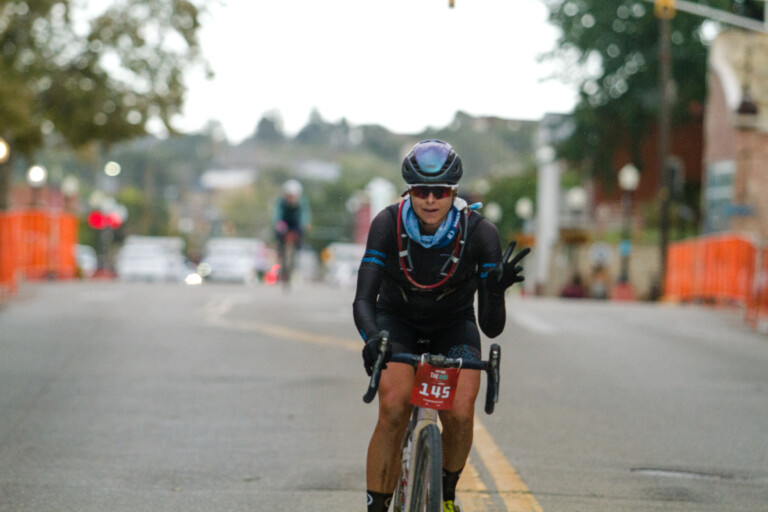
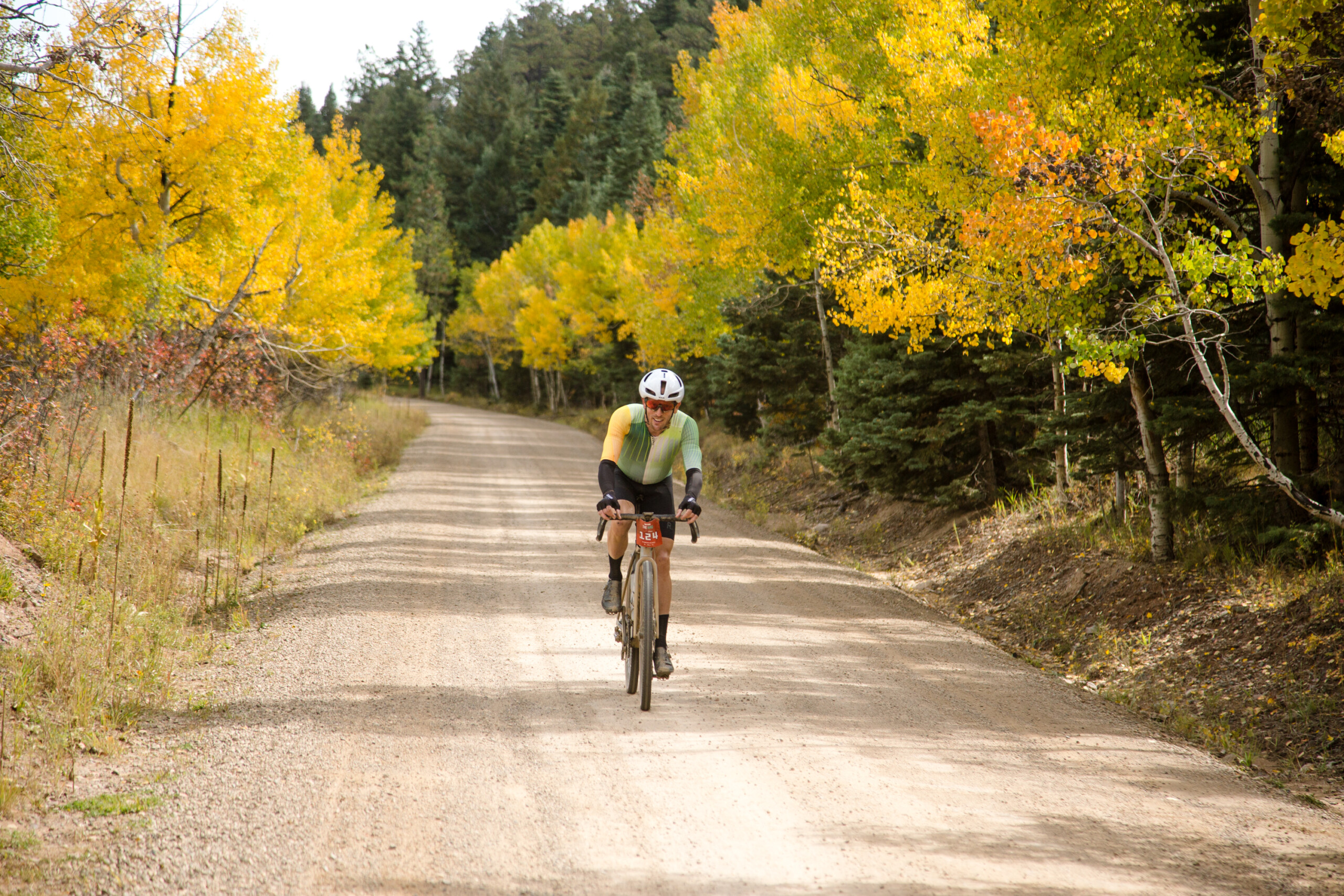
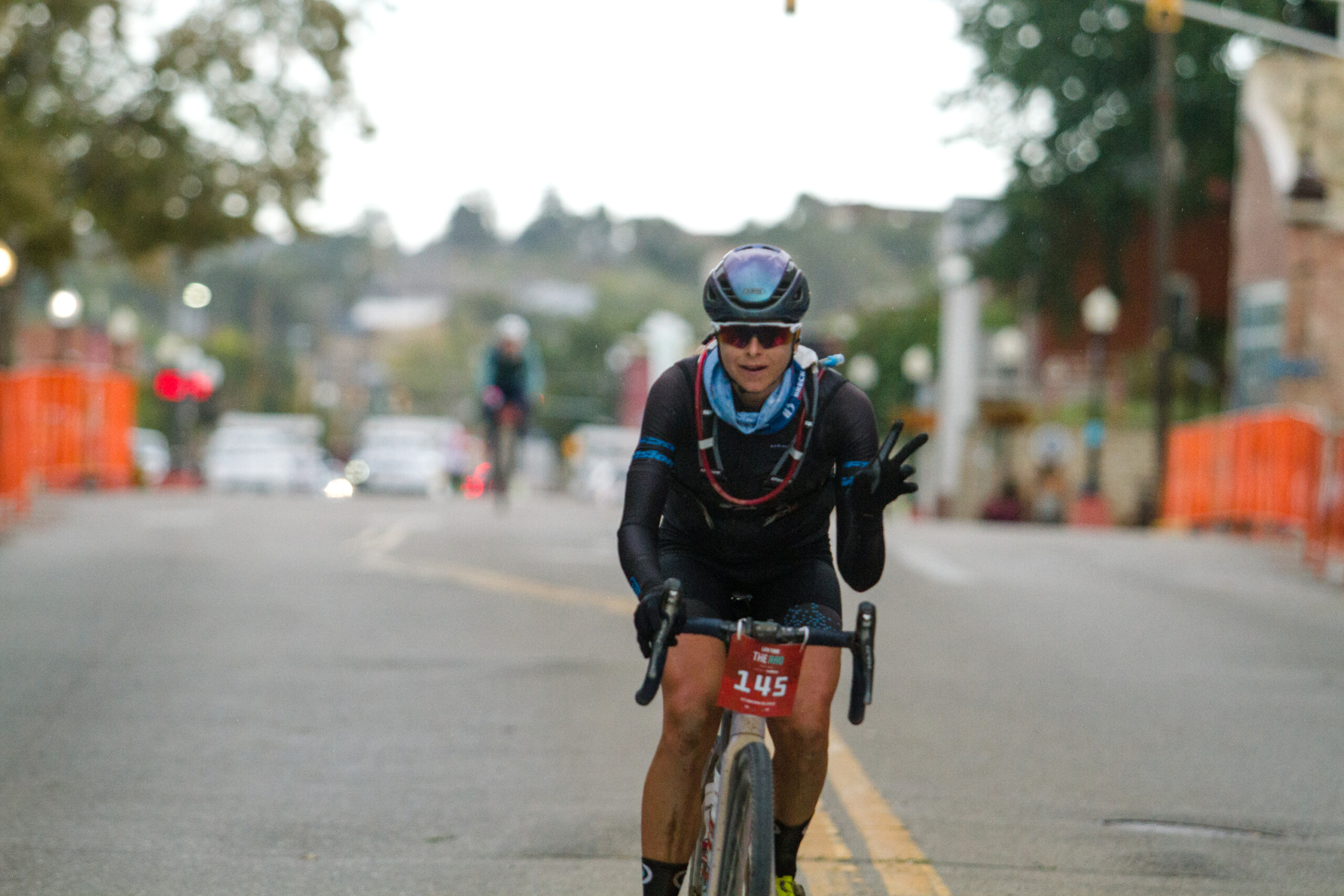
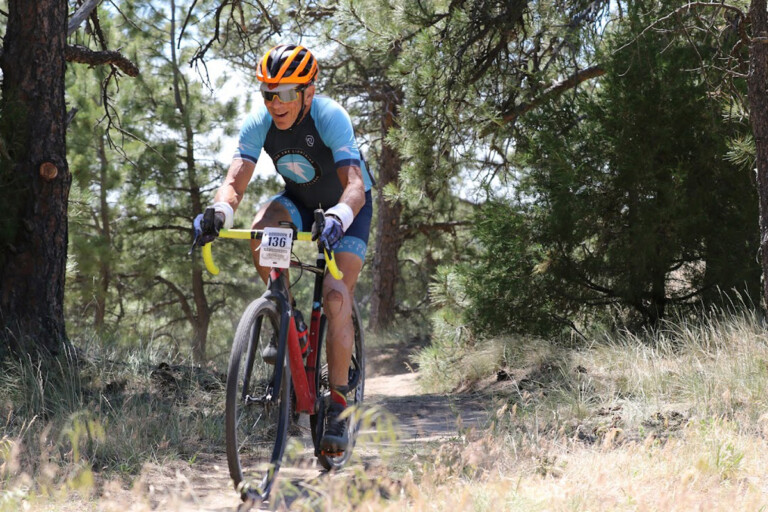
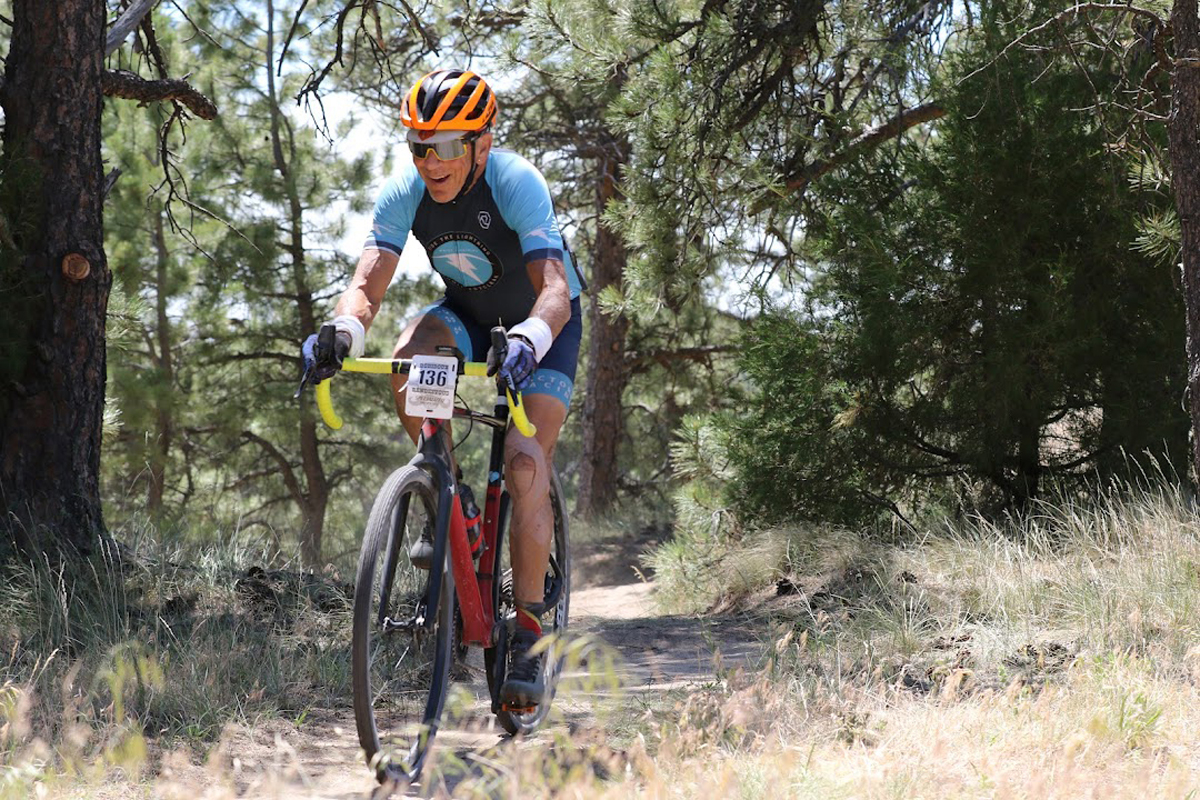
TRINIDAD, Colorado (October 9, 2022) — Life Time’s The Rad Dirt Fest presented by Wahoo took place this weekend in Trinidad, Colo. for its second year, where cyclists ventured off-road to tackle the 165-mile ‘Stubborn Delores’, 99-mile ‘Anteloop’, or 38.5-mile ‘Frijole’ course distances. The courses were in pristine condition with riders noting how they enjoyed the beauty of a perfect Colorado fall day.
Photo by Linda Guerrette, courtesy Life Time
“Alongside the community of Trinidad, we were incredibly excited to showcase this magnificent landscape for athletes to explore for a second year,” said Amanda Boyer, Marketing Manager at Life Time. “As a more grassroots-style gravel race within our portfolio, and one which offers a wide range of mileage options, The Rad truly is an event for riders of every level.”
Photo by Linda Guerrette, courtesy Life Time
The town of Trinidad is an emerging outdoor recreation destination with a friendly, fun, and eclectic vibe that is rich in history and vibrant architecture and features a thriving art scene. Life Time and athletes have been graciously welcomed by business owners and members of the community throughout the planning of, and weekend of, the event.
Women’s Stubborn Delores (165 miles) Results –
Emma Grant, 31, of Appling, Ga. with a time of 9:10:16
Autumn Vegh, 28, of Denver, Colo. with a time of 10:46:50
Shaneis Kehoe, 31, of Denver, Colo. with a time of 10:59:30
Men’s Stubborn Delores (165 miles) Results –
John Keller, 25, of Boulder, Colo., with a time of 8:05:15
Chris Mehlman, 22, of Manchester, Mass., with a time of 8:27:24
Tim Rea, 33, of Miami, Fla, with a time of 8:53:11
Women’s Anteloop (99 miles) Results –
Ashley Frye, 22, of Colorado Springs, Colo., with a time of 5:03:16
Anne Donley, 45, of Denver, Colo., with a time of 5:06:50
Jess Cygan, 29, of Colorado Springs, Colo., with a time of 5:10:46
Men’s Anteloop (99 miles) Results –
Jiri Senkyrik, 34, of Boulder, Colo., with a time of 4:42:26
Nick Goould, 44, of Colorado Springs, Colo., with a time of 4:42:32
Tony Baca, 31, of Golden, Colo., with a time of 4:44:15
Women’s Frijole (38.5 miles) Results –
Amy Magnuson, 54, of Colorado Springs, Colo., with a time of 2:16:56
Sara Bates, 36, of Boulder, Colo., with a time of 2:22:42
Melissa Hylton, 34, of Denver, Colo., with a time of 2:23:2
Men’s Frijole (38.5 miles) Results –
Bryce Woollard, 31, of Longmont, Colo., with a time of 1:54:02
Niko Skievaski, 25, of Boulder, Colo., with a time of 1:54:08
Travis McCabe, 33, of Orlando, Fla, with a time of 1:54:14
Non-Binary Frijole (38.5 miles) Results –
Lee Buell, 60, of Des Moines, IA, with a time of 3:29:16
By Molly Absolon — The first time I saw an electric bike — better known as an ebike — I was struggling up a hill. Suddenly, a silver-haired man came whizzing by in regular city clothes. I felt a wave of envy as he left me in the dust.
That was probably five years ago, and since then ebike use has exploded. In 2020, ebike sales in the United States for just the month of June totaled roughly $90 million, up 190 percent from the previous June.
Molly Absolon. Photo courtesy Molly Absolon
It’s hard to remember, but regular mountain bikes didn’t become commercially available until the 1980s, and when the early adopters hit trails previously used only by hikers and horseback riders, conflicts happened fast.
People claimed the bikes increased erosion. They worried about collisions and scaring horses. They theorized that mountain bikes would frighten wildlife. Today, those same arguments are being used against electric mountain bikes.
Once again, the controversy seems to stem from the fear of change, perhaps some arrogance and maybe a little jealousy. After all, since I suffered to get to the top of the climb on my own power, shouldn’t you?
U.S. Agency positions: For now, the US Forest Service treats electric mountain bikes as motorized and limits their use to motorized trails. The Bureau of Land Management has opted to allow local land managers to make the call, but only after undergoing an environmental review of the trails in question.
In 2017, the International Mountain Bike Association, which had said that ebikes should be considered motorized vehicles, softened its stance. Instead, it proposed that local land managers and user groups should determine — on a case-by-case basis — whether to allow ebikes on naturally surfaced trails. Many members canceled their memberships. Some comments were harsh.
One wrote, “If you’re too old to still ride the trails you love, do as many beforehand, reminisce about the good old days and encourage the young. Don’t throw them and our public land under the bus.” That kind of attitude does not bode well for land managers to find an easy compromise.
So, what are the impacts of electric mountain bikes. Do they harm trails, or cause more accidents?
In 2015, the International Mountain Bike Association studied the environmental impacts of mountain bikes, both electric and self-propelled, and found no appreciable differences between the two in terms of soil displacement on trails. Overall, bike impacts were similar to the impacts of hikers.
Horses, motorcycles and off-road vehicles do much more damage to trails.
As for problems caused by speed, traffic studies show that accidents and their severity escalate as differences in speed increase. But do electrified bikes go that much faster than traditional bikes?
To find out, Tahoe National Forest measured the top speeds reached by intermediate and advanced riders using both kinds of bikes. Differences on the downhills were small. On uphills, traditional bikers averaged 5-8 mph, while electric mountain bikes traveled 8-13 mph. This was a difference, but not enough of a difference to cause more accidents, especially if bikers alert others to their presence and ride in control.
Rachel Fussell, program manager of the nonprofit PeopleForBikes, says that more than a battery boost, speed on trails reflects rider skill as well as trail design. She believes that all users observing proper trail etiquette would avert most potential conflicts.
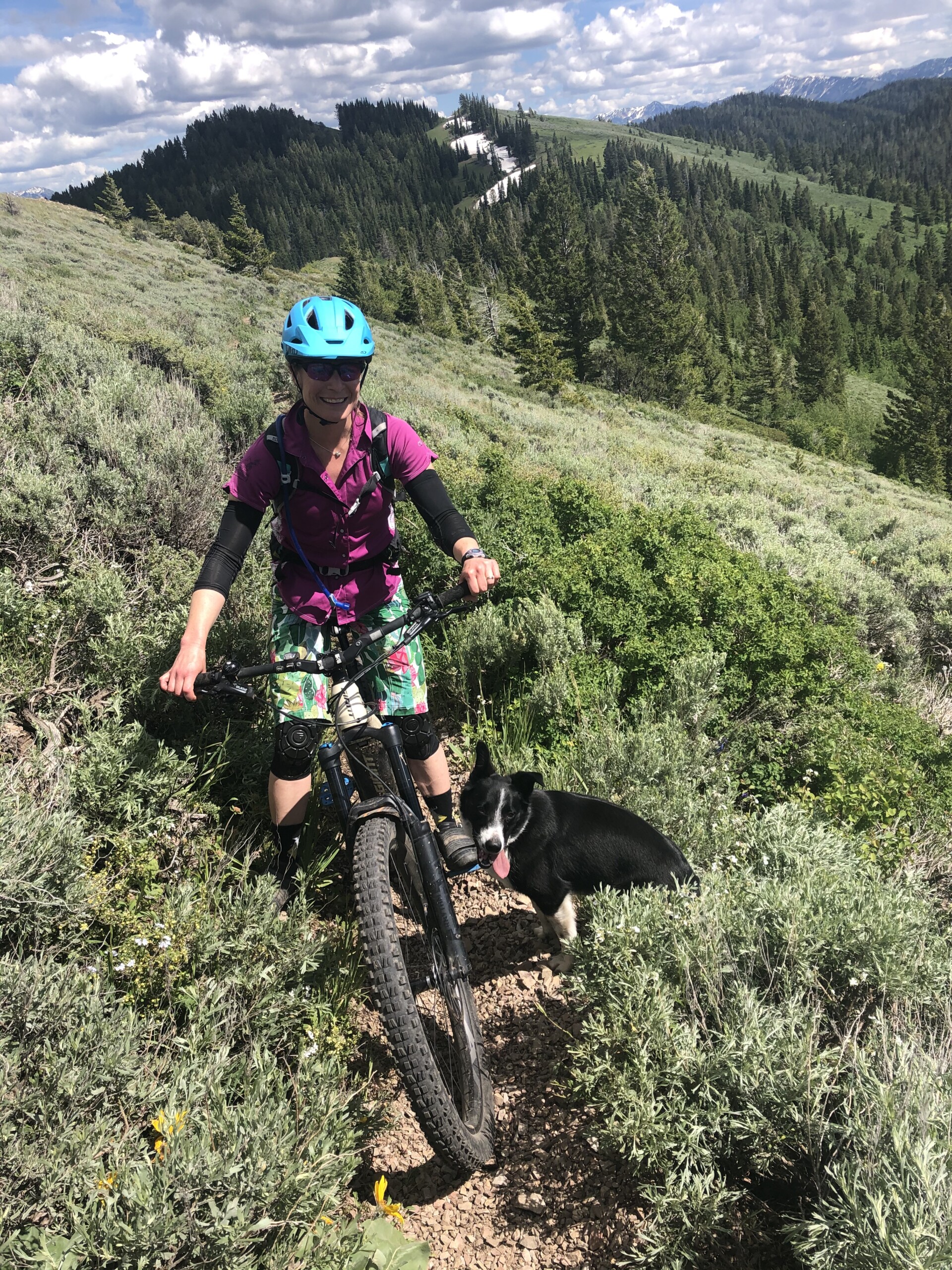
Mountain biker Celeste Young takes a break along the Big Hole Crest Trail in Idaho, Summer 2022. Photo by Molly Absolon
Celeste Young has been a biker all her life and now coaches mountain biking. Her fleet of bicycles has recently grown to include an electric mountain bike.
“The most negative thing I’ve heard is, ‘Oh, you’re cheating,’” she says. “But it’s just another way to be out there. You get an extra boost going up these really hard trails, so it makes a challenging trail fun, rather than demoralizing.”
It’s a puzzling notion that someone accused her of cheating. It would be one thing if you secretly put a motor in your bike during a race, but when it’s an amateur rider going out for fun and exercise, how is having an electronic boost cheating?
The whole thing reminds me — a skier — of the controversy that erupted after snowboards appeared at ski resorts. They were new and fast, and their rhythm on the slope was different than the rhythm of people on skis.
We didn’t like them, and I doubt they liked us. But we’ve worked it out. Now, public land managers face the knotty problem of how much access to allow ebikes, and where, or whether to segregate them to their own trails. Welcome to the crowded West.
Molly Absolon is a contributor to Writers on the Range, writersontherange.org, an independent nonprofit dedicated to spurring discussion about Western issues. She lives in Victor, Idaho, and has worked as a wilderness educator, waiter, farmer and freelance journalist to support her outdoor recreation habit.
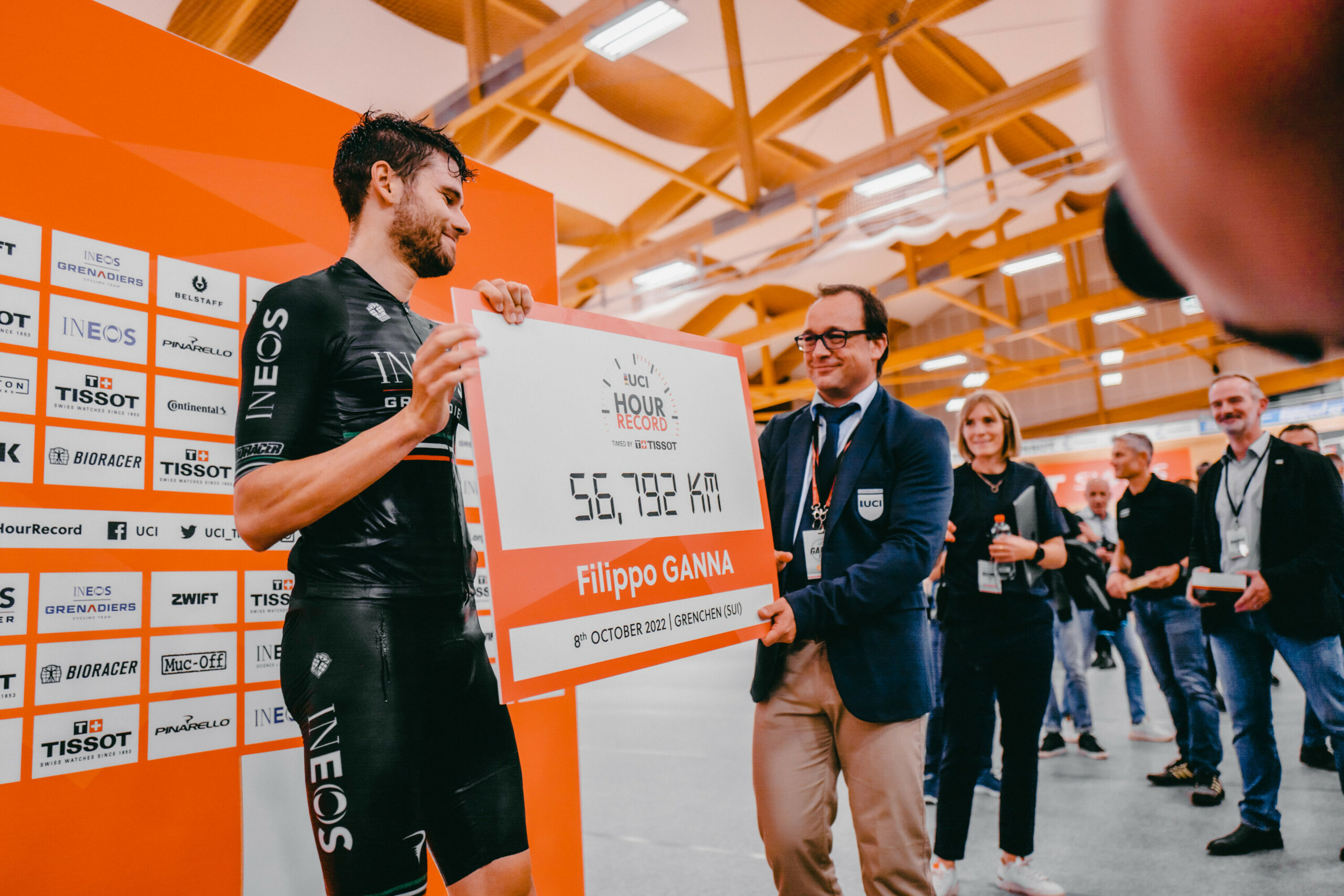
The Union Cycliste Internationale (UCI) is pleased to announce that Filippo Ganna today broke the UCI Hour Record timed by Tissot, by covering a distance of 56.792 km in 60 minutes at the Tissot Velodrome in Grenchen, Switzerland.
Photo courtesy UCI
With this historic performance, the Italian member of UCI WorldTeam Ineos Grenadiers takes the record from Great Britain’s Daniel (Dan) Bigham – performance engineer for Filippo Ganna’s team -, who covered 55.548 km on 19 August at the same velodrome.
Reacting to his successful attempt, Filippo Ganna said: “To arrive at this amazing goal is fantastic for me and for all the staff who have worked for a long time to get to this result.”
Describing the pain of the last five minutes, he said: “I lost energy to try to go for 57, but nothing [in the legs]. It’s OK!”
The new holder of the UCI Hour Record timed by Tissot does not appear to have ruled out another attempt: “Next time maybe I will try at another part of the season when I have fresher legs and we can go even higher… but now we will think about recovery.”
A specialist on the road and track, Filippo Ganna (26) is considered one of the best time trial athletes of the current professional peloton. He has an impressive list of achievements: double UCI World Champion in the individual time trial (in Imola – Emilia-Romagna in 2020 and Flanders in 2021), he is reigning Olympic Champion in the team pursuit and four-time UCI World Champion in the individual pursuit (2016, 2018, 2019 and 2020).
Men’s UCI Hour Record timed by Tissot:
08.10.2022: Filippo Ganna (ITA), Tissot Velodrome, Grenchen (SUI), 56.792 km
19.08.2022: Dan Bigham (GBR), Tissot Velodrome, Grenchen (SUI), 55.548 km
16.04.2019: Victor Campenaerts (BEL), Velodromo Bicentenario, Aguascalientes (MEX), 55.089 km
07.06.2015: Bradley Wiggins (GBR), Lee Valley VeloPark, London (GBR), 54.526 km
02.05.2015: Alex Dowsett (GBR), National Cycling Centre, Manchester (GBR), 52.937 km
08.02.2015: Rohan Dennis (AUS), Velodrome Suisse, Grenchen (SUI), 52.491 km
30.10.2014: Matthias Brändle (AUT), UCI World Cycling Centre, Aigle (SUI), 51.852 km
18.09.2014: Jens Voigt (GER), Velodrome Suisse, Grenchen (SUI), 51.110 km.
The women’s UCI Hour Record timed by Tissot is held by the Netherlands’ Ellen van Dijk, who covered the distance of 49.254 km at the Tissot Velodrome in Grenchen on 23 May 2022.
By Charles Pekow — Native tribes and organizations can apply for grants to promote bicycle tourism until Oct. 24. The Bureau of Indian Affairs is offering funding under the Tribal Tourism Grant Program. If a tribe wants to start a mountain bike tourism program, it can use funds for market analysis to site preparation, marketing, etc.
By Tom Jow — Earlier this year I finally gave up my old road bike. There was nothing wrong with it; top of the line Shimano Dura Ace and a custom steel frame built 25 years ago. I just wasn’t using it. Of course, shortly after it was gone, I started wanting a bike to ride on the road (or let’s just say “not steep trails”). Being one to suffer from peer pressure and industry trends I found myself replacing my road bike with a “gravel bike”. A really nice one with hydraulic disc brakes and tubeless tires. For me it is an easy choice. Who doesn’t want stronger brakes and less flats? However, for those considering disc brakes and tubeless for the first time, the idea can be a little intimidating. Well, I’m here to tell you there is nothing to be afraid of.
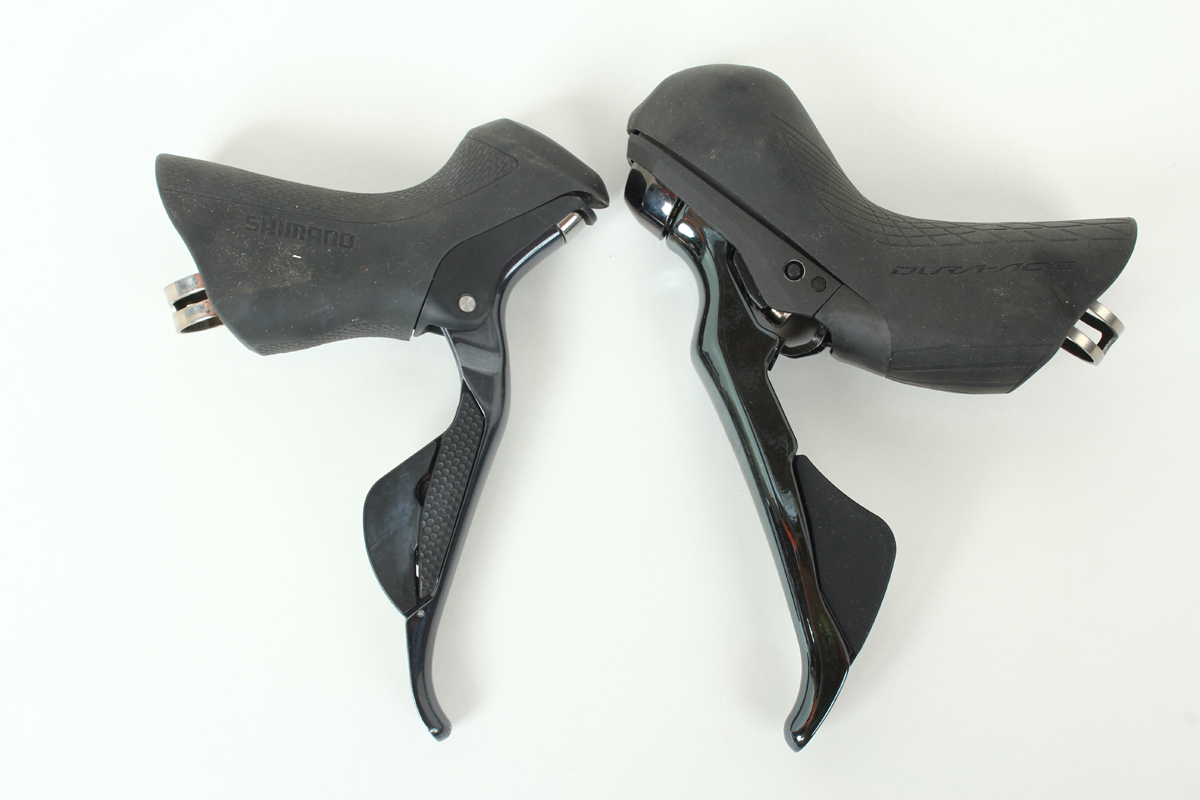
The hydraulic brake lever (right) is just a little larger than a cable type brake lever. Photo by Tom Jow
About ten years ago SRAM introduced hydraulic brakes for road bikes to the public. Mountain bikes have been using the technology for longer than that. The design is pretty simple; each brake consists of a lever, reservoir, line, caliper and rotor. The reservoir, which contains hydraulic fluid, is built into the lever. When actuating the lever, the fluid is forced through a line to the caliper. Contained inside the caliper are small pistons which under pressure press the brake pads against the steel brake rotors.
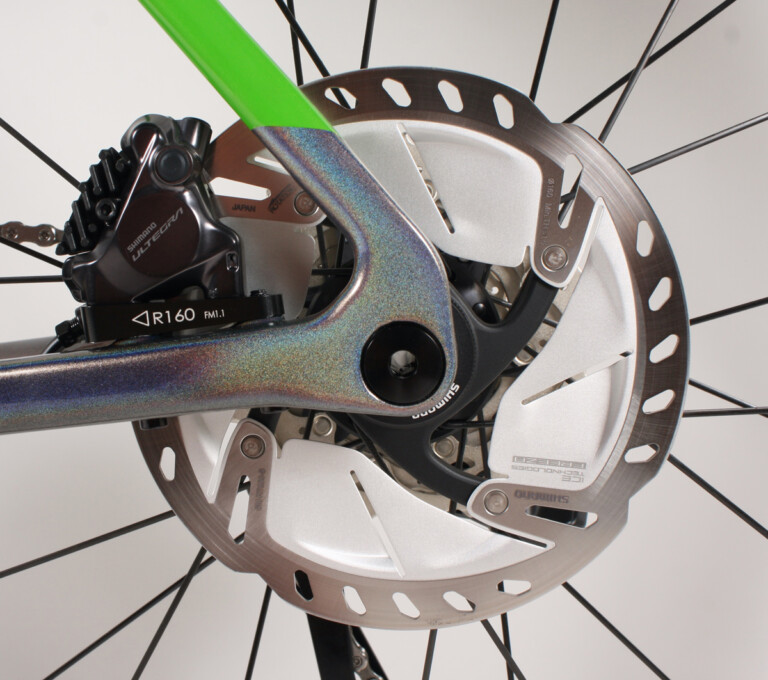
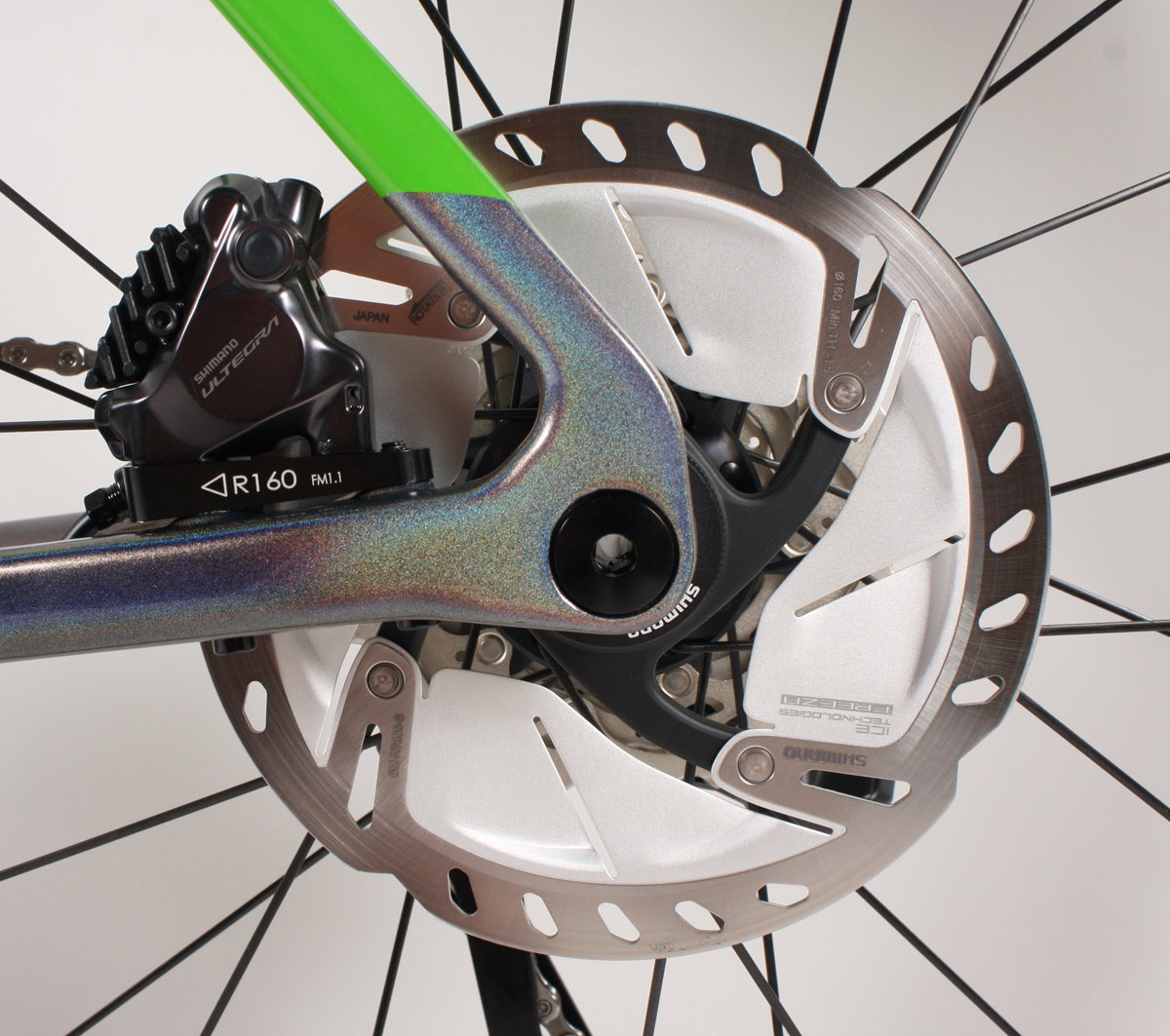
A road brake caliper is smaller than mountain and fits nicely on the seatstay. This brake rotor has a cooling shroud built in. Photo by Tom Jow
Hydraulic brakes are much more powerful than cable brakes. One reason they are so powerful is because the fluid does not compress. Therefore, unlike cable brakes, all the force exerted on the lever is also exerted upon the braking surface. Also, with a selection of brake pad compounds and rotor sizes braking response can be tuned to individual rider needs.
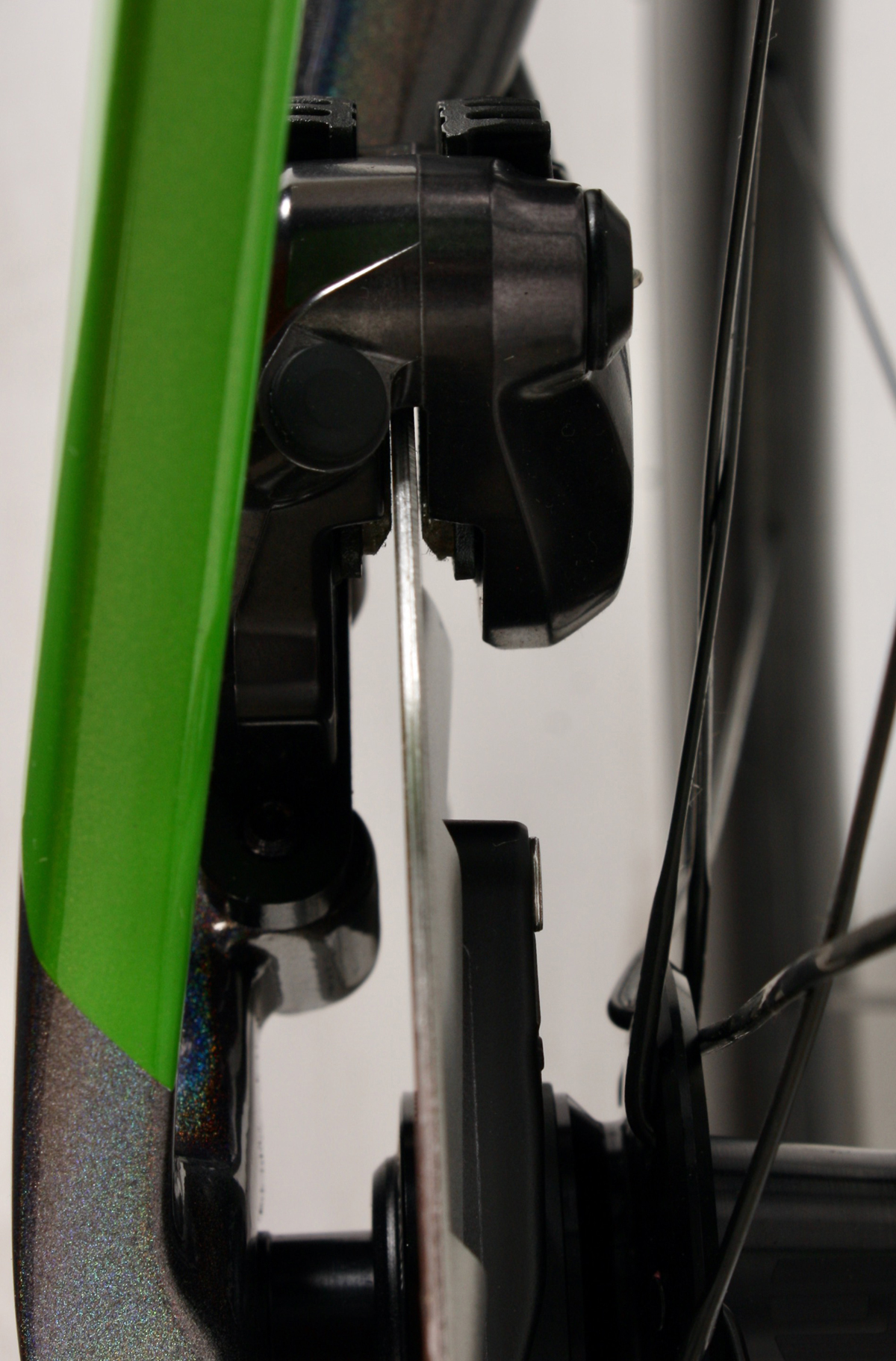
It is no wonder brake rotors rub occasionally. The clearance is very small. Photo by Tom Jow
There are, however, a couple minor drawbacks to the system. Because there is a very small amount of clearance between the rotor and brake pads there can be an occasional annoying “ting ting ting” sound of the rotor touching the brake pads while riding. In my experience some brakes are very easy to align while others are not. One factor in brake alignment is rotor variability. Few rotors are perfectly true. Some rotors will change shape under the heat of braking, therefore making a little noise until they cool down and return to their original shape. I have found few brakes that could not be aligned well.
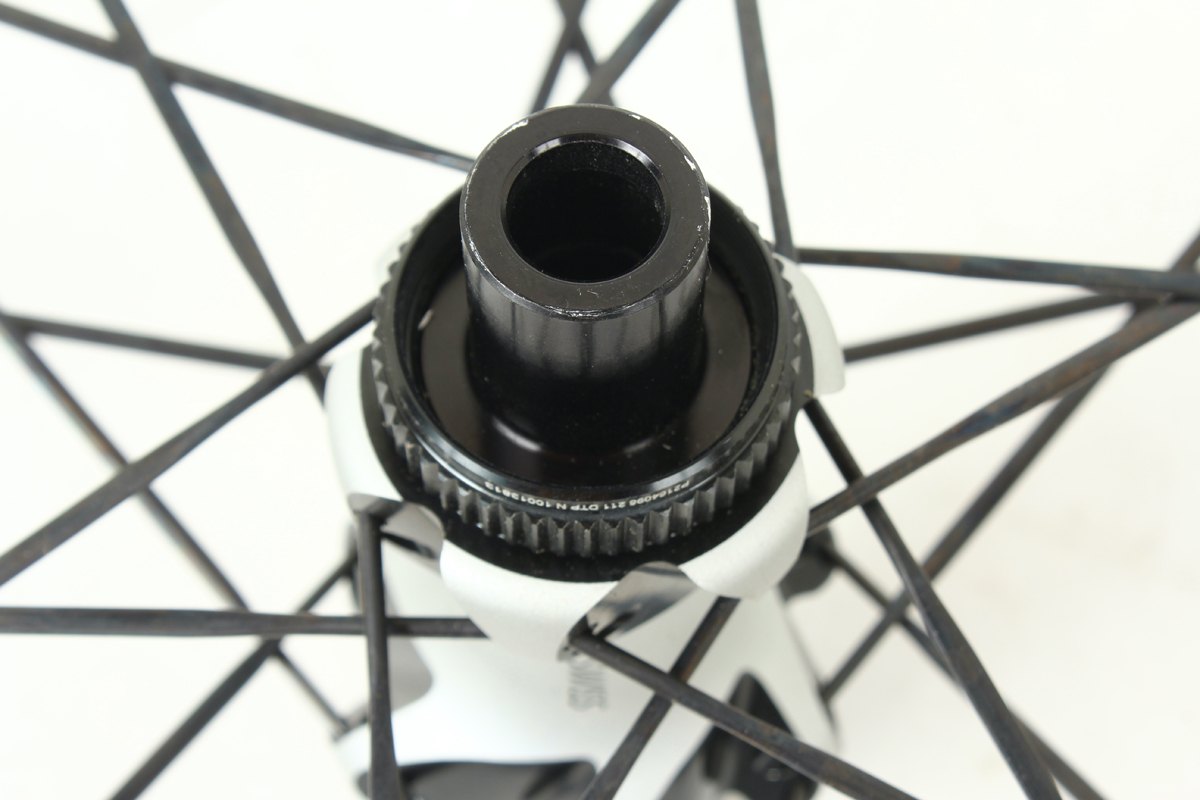
Shimano’s patented centerlock rotor mount. Nearly all road hubs use this over the older six-bolt mount. Photo by Tom Jow
The other drawback to hydraulic brakes is the fluid. Not a drawback really, but it may force some riders away from doing their own brake maintenance. Requiring replacement every 1-2 years depending on the brand, the task requires special tools, practice (some individual brakes still befuddle me), and can be messy. “Messy” is not what we want around brake pads and rotors. Even a small drop of spilled brake fluid can render a set of brake pads useless if the surface is contaminated.
Tubeless tires are not exactly the easiest for home mechanics either. Based on the use of liquid sealant, installation of the tire and sealant can be very messy. It’s amazing how big a mess a mere two ounces of liquid in a road tire can make. Also, matching tire and rim combinations can be finicky. Some combinations mount up easily, some are nearly impossible. In general, wider tires are easier to install. Once mounted, a high volume, high pressure burst of air is needed to lock the tire beads on the rim. This requires an air compressor or a pump with a built-in burst tank.
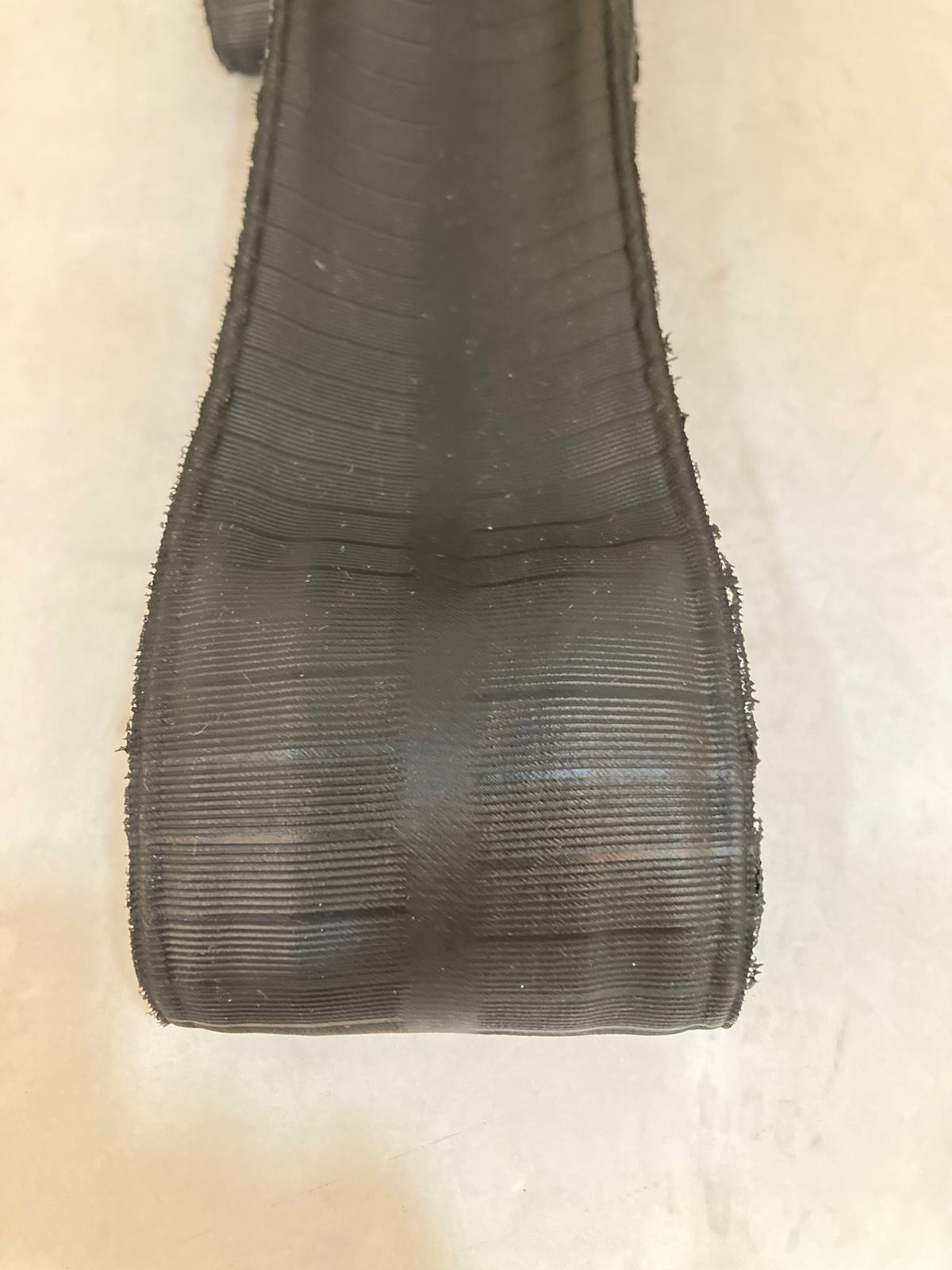
Tubeless tires have an inner layer of rubber to provide for better sealing. Photo by Tom Jow
While the initial setup can be a challenge, the benefits are worth the work. These benefits include puncture resistance, lower rolling resistance and a more comfortable ride. Manufacturers of the tire sealant claim to be able to close punctures up to three mm in diameter. In my experience goathead thorn punctures are a thing of the past. Larger punctures may require a short pit stop but will often seal with no tools. For larger cuts, a plug can be inserted (see “Tubeless tire puncture” in the Early Summer 2022 issue of Cycling West). As a last resort, riders may need to install a tube, but this is becoming less frequent.
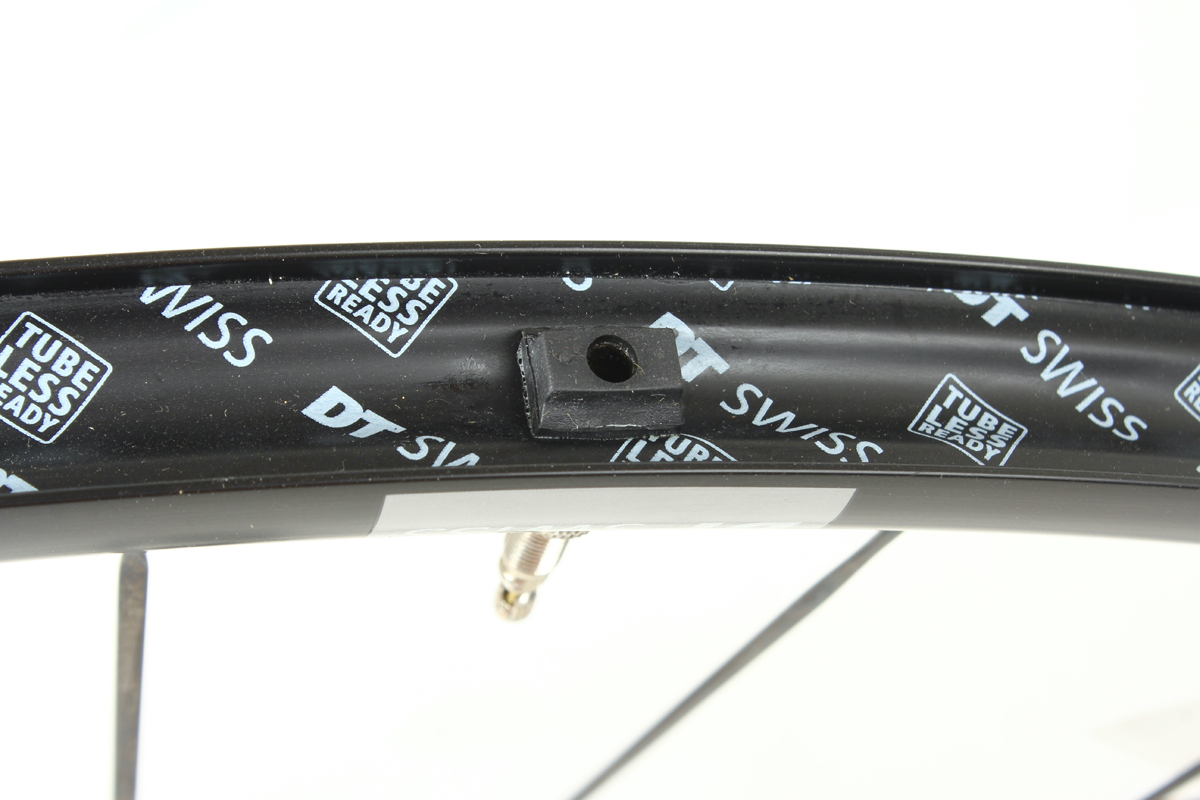
A non-porous tape seals the spoke holes and inner rim edge to edge. The valve stem has a large flexible rubber shoulder to seal the valve hole. Photo by Tom Jow
Without an inner tube, the risk of a pinch flat is reduced. For this reason, lower tire pressure can be used. Manufacturer studies have shown that lower tire pressure reduces rolling resistance by allowing the tire to conform and roll over debris and deformations in the road. How much lower you may ask? My normal default tire inflation with a 700 x 25c tire would be about 95-100 psi. With the Goodyear F1 road tire, the Goodyear tire pressure calculator recommends a starting point of 75 psi front and 79 psi rear, quite a bit lower than “normal”. In a real-world example, I use 40 psi in my 700 x 33c gravel tires, and they do not feel slow at all. In addition, they are very comfortable on some of the rough industrial roads I ride on. Instead of getting bounced around on road cracks and shallow potholes the tires absorb a large portion of the force.
Keep in mind that no system is perfect for every rider. And despite their obvious advantages, years ago I would not have confidently recommended disc brakes or tubeless to all cyclists. At the time, I felt the finicky nature and perceived complexity of both systems outweighed the increased brake performance and puncture resistance. I no longer feel that way. With a road-specific mount, smaller & lighter caliper, and years of incremental changes, road disc brakes have greatly improved. Road and gravel tubeless systems have also benefitted from improved rim design and a greater selection of both rims and tires. Now, as evidenced by their use on a greater range of bikes, hydraulic brakes and tubeless tires have reached a high level of performance and reliability for all cyclists. There is no longer anything to be afraid of.
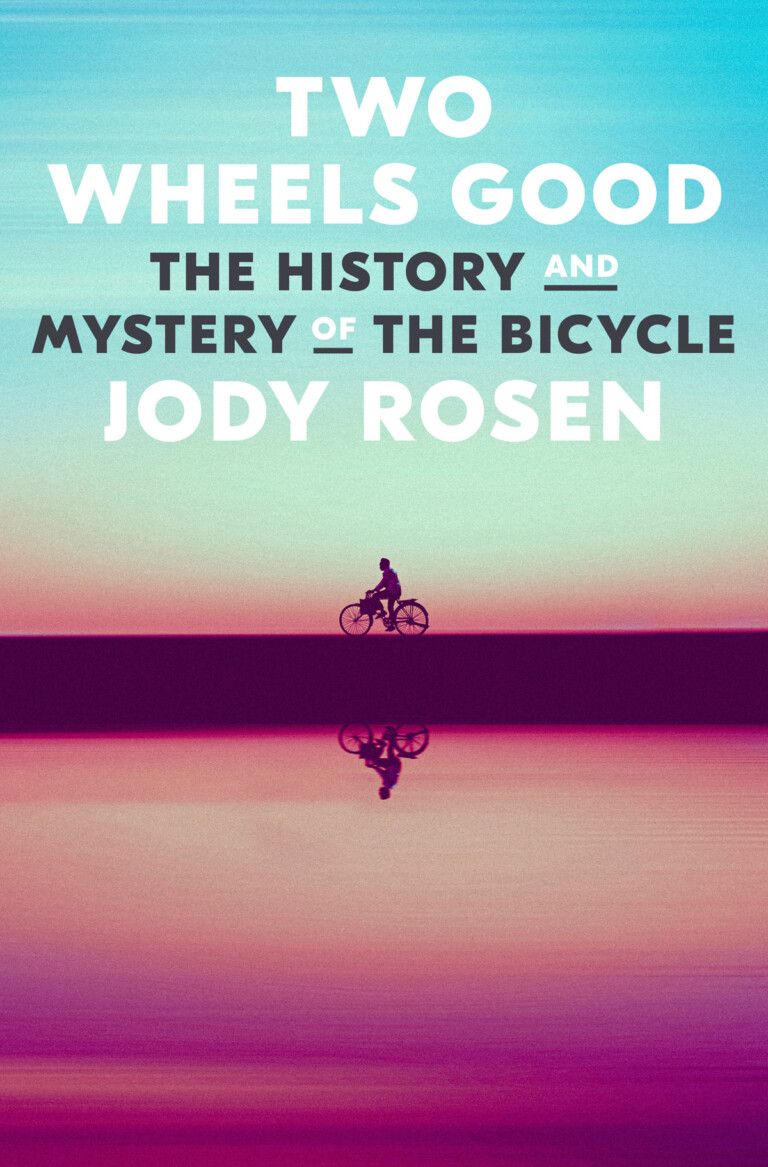
By Don Scheese — The more passionate an author is about their subject, the more readable the book. Make no mistake: Jody Rosen is passionate about the bicycle. In this wide-ranging, far-reaching social history, he traces the invention and evolution of the muscle-powered wheeled machine, from its first iteration in 1817 with the appearance of the Laufmaschine, or draisine, created by Karl von Drais, in Germany, to exercise or stationary bicycles aboard the International Space Station. A former bike messenger and currently free-lance writer, Rosen gifts us bicycle freaks a fascinating take on what the French called the “velocipede.””
How many bicycles exist in the world today? How much more efficient is it to travel by bike as opposed to walking? Which country in the world has the greatest number of bicycles? What effect did the 1989 Tiananmen Square protests in China have on bicycle use in that country? How did the Covid-19 pandemic affect the production, purchasing, and usage of bicycles worldwide? Why did certain bicycle manufacturers stop the sale of bicycles to police departments after the Black Lives Matter protests following the killing of George Floyd? Answers to all these questions, and many more, are provided in Two Wheels Good.
Granted, some of the history of the bicycle Rosen chronicles is familiar territory to aficionados (see David Herlihy’s exhaustive, and exhausting, tome Bicycle: The History, 2004). For example, it is common knowledge of American history how much the bicycle contributed to the rise of the women’s movement and the so-called “New Woman” In the late 1800s. The author quotes the now-famous proclamation by Susan B. Anthony: “Bicycling…has done more to emancipate women than anything else in the world.” But Rosen explores this historical trend much deeper. In a chapter entitled “Bicycle Mania,” he provides an entire catalogue of snippets from turn-of-the-century periodicals, many of which deal with rising divorce rates allegedly caused by women neglecting their matronly duties because of their obsession with riding a bicycle. Don’t believe me? Here is one sample from an 1899 Akron Daily Democrat article:
“Chris Heller has filed a petition in Common Pleas Court asking for a divorce from Lena Heller. He alleges gross neglect. To substantiate this, he says that she refused and neglected to keep house or prepare meals. He says his wife is a victim of the bicycle craze and that she spends nearly all her time riding her wheel in company with people who were strangers to propriety.”
Where there is a bicycle, there has always been a backlash. When bicycle riding reached its first zenith in the late 1800s after the invention of the “safety bicycle” (two wheels the same size, driven by pedals and a chain drivetrain, ridden on rubber tires), this newfangled artifact was decried by the horse industry, which feared—rightly so—that it would soon eliminate the need for equestrian-powered vehicles. (Ironically, some of the nicknames for the bicycle upon its appearance were “the Silent Steed” and “the hobby horse.”) Even before that, many commentators expressed outrage over the high speed and reckless antics of the “Dandy Chargers,” riders on earlier versions of the velocipede piloted by members of the upper class, the few who could afford such an expensive machine. And today, of course, animosity towards cyclists and cycling infrastructure such as dedicated bike lanes may be at an all-time high, as exemplified by the “bicycle hater” P.J. O’Rourke, with whose vitriolic words the author actually opens his book: “Mankind has invested more than four million years of evolution in the attempt to avoid physical exertion. Now a group of backward-thinking atavists mounted on foot-powered pairs of Hula-Hoops would have us pumping our legs, gritting our teeth, and searing our lungs as though we were being chased across the Pleistocene savanna by saber-toothed tigers.”
Like any good bicycle ride, this book takes us to new and unexpected places. Personally, I really liked the edginess of some of the topics addressed. Maybe I’m naïve and lead a sheltered existence, but I had no idea there was such a thing as “cycle-sexuality.” In a titillating chapter entitled “Put Some Fun Between Your Legs,” Rosen takes up the topic of the erotica of bicycle obsession: Internet porn featuring (you guessed it) people having sex on, and with, bicycles. And did you know about the World Naked Bike Ride, held in cities across the globe, a countercultural event whose purpose, according to the founders, is to “declare our confidence in the beauty and individuality of our bodies”? Then there is (in)famous author Henry Miller’s love affair with a French racing bike, as recounted in his memoir My Bike and Other Friends. So enamored is he of his two-wheeler that he lovingly cleans and caresses it each day, causing his mother to fret over whether he might take it to bed with him.
Or consider the chapter “Beast of Burden” in which Rosen, worldly traveler that he is, spends time in Dhaka, the capital of Bangladesh, where he befriends a rickashaw driver whose name is Badshah. Dhaka is one of the most densely populated, polluted, and impoverished cities in the world. It is also considered to be the rickashaw capital of the world, a teeming metropolis where there are relatively few roads and sidewalks are taken up by vendor stalls and curbside shanties. Now in his fifties, Badshah has been a rickashaw driver for over a decade. He was born in a rural part of the country, then forced to move to the city for economic opportunity. As a rickshawallah he makes a relatively decent living (for Bangladesh), earning about five dollars a day, working from ten in the morning till eight at night, hauling passengers around the teeming megalopolis, which only grows larger as rural residents, displaced by famine and natural disasters, are (like Badshah) forced to migrate to urban areas.
Then there is the chapter “Bicycle Graveyards.” In cities across the world—Paris, Amsterdam, London—where there are bodies of water, there are discarded bicycles, inundated and thus invisible until rivers and lakes and canals are periodically drained. This seemingly inexplicable phenomenon has only increased with the proliferation of bike-share companies providing rental bikes to residents and visitors in urban areas—Citi-Bike, Nice Ride, Bikeshare, etc., etc.—resulting in new forms of vandalism springing up. Why not toss a bike you just rented in a body of water, just for the hell of it? Resignedly, Rosen writes: “A bicycle is a durable good, but it’s also a disposable one: it’s easy to get rid of, if you don’t mind being a little antisocial about it.”
“Everything is political,” the truism goes. The bicycle is no exception. Its manufacture is tied to colonialism: where do we think, if we think at all, that the rubber, steel, and plastic parts of the bike come from? From former and present colonies of First World countries like Belgium, England, France, and the United States. Political protests in recent years, like at Tiananmen Square and at Black Lives Matter gatherings across America, are intimately associated with bikes and bike riders; government military tanks crushed hundreds if not thousands of bicycles in quashing the rebellion in China, and BLM supporters often rode their bicycles to scenes of protest while police used their bikes as blockades and offensive weapons. It should come as no surprise that Black and Latino bicyclists in low-income neighborhoods are the racial groups most often stopped and cited by authorities for minor infractions like riding on the sidewalk. And during the height of the Covid-19 epidemic, when social distancing became the norm and restaurants were forced to close down, hazard a guess as to who made possible the take-out craze: Deliveristas, bike delivery workers paid low wages risking their own lives while supplying food for the masses.
Some might accuse Rosen of political correctness here, of taking an invention seemingly as innocuous as the bicycle and injecting the topic with a healthy dose of “woke” politics, but like any good writer he sheds light on his subject in ways the reader perhaps never before considered.
Finally, there is the chapter “Personal History.” Throughout the book Rosen provides a New Journalistic first-person take on various topics. Here he goes full-on autobiographical–refreshingly so. Who as a cyclist has not thought about their ur-moment, their very first ride on a bicycle? Who has not recounted their own history of bicycles and bicycling through the years? Reading this chapter, I recalled my very first bike—a recycled and repaired klunker my father rescued for me from the local dump. Then, instead of the Stingray I longed for, my parents bought me a 10-speed, an English Huffy, quite popular in the 1960s and ‘70s. My first real bike, purchased during my college years, was a Peugeot PX-10, with a classic white Reynolds 531 frame, triple chainring, and Simplex derailleurs. I rode this beauty down the mean streets of Philadelphia, sans helmet, dodging malicious taxi and SEPTA bus drivers, avoiding treacherous trolley car tracks, constantly vigilant over the terrifying prospect of getting doored by some blithely unaware motorist or car passenger. A few years later, after a cycling hiatus, came several mountain bikes, provided by the U.S. Forest Service, while on fire patrol in the Idaho mountains. Then followed my cycling renaissance, during the height of the Lance Armstrong years, when every middle-aged male in Lycra (MAMIL) bought and rode obsessively an expensive carbon framed machine. Rosen’s own cyclo-history is equally interesting, especially his account of bike messenger years in Boston, and he concludes this chapter with touching tales of teaching his own kids to ride their bikes.
Just to be clear on what this book is not about. It is not a history of cycling as a sport—no Tour de France accounts here. Nor is it a history of mountain biking (though there is an engaging chapter featuring the daredevil stunt-cyclist Danny MacAskill). There are plenty of good reads about those subjects elsewhere. What this is, is a thoroughly engaging, idiosyncratic and personal, history of the world’s greatest invention.
Enjoy the ride.
Two Wheels Good: The History and Mystery of the Bicycle. By Jody Rosen. New York: Crown, 2022. 396 pp. $28.99
By Breanne Nalder Harward, MS, RN — It’s that time of year when the season is winding down, school is back on, and winter is approaching. These are all examples of times when we might let our nutrition discipline slip and revert to unhealthy eating patterns, specifically in the snack category. Eating in between meals can help us obtain and meet calorie goals for the day, fuel before or after workouts, and sustain energy levels throughout the day. Read on to learn healthy snack ideas, timing for snacks around exercise, and suggestions for healthy snacks on the go.
Every athlete knows that no two days are the same. Some days require higher calorie intake that others, depending on training volume and/or intensity. There are many factors to consider when selecting our snacks: hunger level, time of day, pre- or post-workout and weight goals. But when is the best time to eat certain foods? Eating too heavy of a meal before a workout can leave you feeling sluggish as digestion takes priority and blood goes to your guts rather than working muscles. Eating too little before a workout can result in decreased energy, limited performance and can lead to overeating afterwards, which can also cause discomfort.
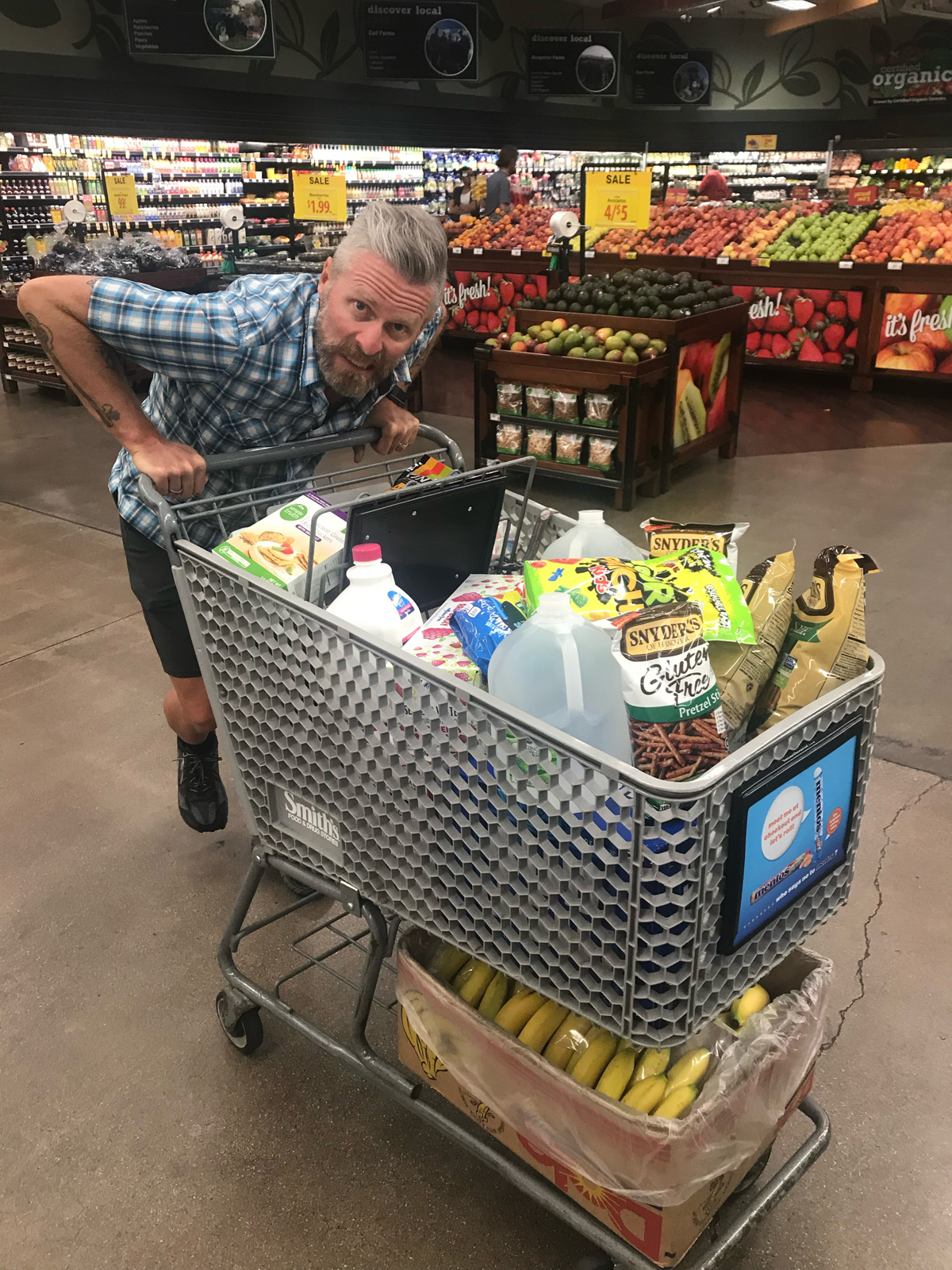
At the supermarket, shop for healthful ingredients based on foods from the 5 food groups: fruits, vegetables, whole grains, lean proteins, and low-fat or fat-free dairy foods. Photo by Breanne Nalder-Harward
Adapt the mindset of fueling your body for performance! It is easier for the human body to consume nutrients throughout the day as opposed to trying to consume everything in three meals. This is where snacks come in to play. Let’s break down the macros. You’ll hear me like a broken record that carbs are our main source of energy. Below is a more detailed description of when to consume simple carbohydrates vs complex carbohydrates. Fat, our second source of (sustained) energy, helps keep you feeling full longer and decreases inflammation.
Eating foods that are high in healthy fat (like nuts, avocados, or fish) are good when you won’t be training within 1-2 hours, such as dinners or snacks after breakfast, so they have time to digest and do their job.
Protein is not a source of energy, though it contains amino acids which are the building blocks that repair and rebuild worn down tissues post workout. So, it’s important to incorporate proteins into each snack and meal, but in smaller doses at a time, specifically 10-20g is what our bodies can utilize in any bolus of food. Try a PB and honey sandwich as a pre-workout snack, veggies, and hummus midday, and some Greek or cashew yogurt with fresh berries as an evening healthy treat.
Complex vs Simple Carbs
Slower-digesting carbohydrates (known as complex carbohydrates) provide sustained energy, even blood sugar levels, and help fuel the body so muscle repair can continue using protein. Examples include sweet potatoes, brown rice, and whole grains. Eating oatmeal at breakfast or quinoa at dinner will help keep blood sugar levels stable, allowing for better mental alertness and decreased cravings of sugary or salty foods at night. Not only does eating whole grains after training help the body to prioritize protein for muscle building, it also supplies sustained brain fuel while sleeping.
Simple sugars are what we need for the quick/instant energy that we need an hour before and throughout a workout, ride, or race. They cause less GI distress because there is less of the grain to breakdown. Be sure to take in 30-60g of carbohydrate through simple sugary foods or sport drinks, gels, chew to keep the engine burning.
Essentially, consuming simple sugars before and during exercise and complex carbohydrates afterward helps avoid the highs and lows in blood sugar. Eating simple or “empty” sugar when you are just sitting around cause the body to feel hungrier sooner, and whatever you don’t burn via exercise gets converted and stored as … fat! Snacking on something quick and easy (like candy or chips) then causes energy to spike and drop, continuing the cycle and not optimally preparing the body for training.
So again, simple sugars are good for right before and during training as the body needs quick fuel to help prepare and repair, helping allow for protein to repair muscles and the carbohydrates to fuel the rest of the body.
Before, During and After Training Snacks
Pre-workout snacks help fuel your muscles by providing them with quick energy for any exercise (endurance or strength training) by topping off muscle glycogen stores, which help provide instant energy and allow for increased performance throughout the duration of the workout. Snacks before a workout should be light (easily digestible so as not to cause any cramping, gas, or other discomfort during exercise), higher in quick burning carbohydrates and protein and less fat. Fat can cause an upset stomach due to its slow releasing time from the stomach into the GI tract.
This is a great time to talk about utilizing electrolyte mix in your bottles as part of your strategy to get simple sugars during exercise. Another thing you’ll hear me talk about endlessly is consumption of calories and electrolytes through hydration the whole time you’re riding. This is because your body is constantly using and releasing water and salts (it’s called sweat!) when turning the pedals. So, if you drink those things back continually, you are replenishing as you go. It’s also easier to keep hydration balance when you get your sodium, potassium, magnesium, etc. as your body uses it, along with ~30g of carbohydrate per bottle. These products are designed to improve your performance and avoid GI distress, so make it a staple in your routine to drink a bottle of mix per hour.
Post workout snacks should be higher in protein and carbohydrates than fat. You want carbohydrates as they help your body prioritize the protein to rebuild and repair muscle and tissue damage from the workout. This is why protein shakes have become so popular—they have the carbs from the milk and protein to help muscles repair. Drinks are also easier and faster to consume after a workout, and nutrients are more easily absorbed in liquid form than solid form. Consuming a post-workout snack with carbohydrates also helps replenish the glycogen stores depleted during exercise, which allows the body to have more fuel in the tank for the next workout.
Light, Moderate and Heavy Snacking
– Light snacking is good for days when you are not training and still need to keep energy levels high. On days you ride 60 mins or less or have cross training activities, enjoy fresh or frozen fruit, yogurt, veggies, hummus, rice crackers, edamame, etc.
– Moderate snacking is good for days when you are training, but the volume or intensity is not too high (1-3 hours). Snack ideas that help your body top off fuel resources and can aid in recovery after training include apple and string cheese, toast with peanut or almond butter, trail mix, oatmeal, popcorn, jerky, and of course smoothies.
– Heavy snacking is also like eating a mini meal. It is usually larger in size and contains larger amounts of carbs, fats, and/or proteins depending on the time of day consumed. These snacks are good for when training volume and intensity are high, thus meaning your body’s need for fuel is greater. On days you ride 3+ hours, snack on sandwiches (PB and honey, deli meat with veggies, tuna, grilled chicken), cheese and crackers, omelets with veggies and avocado, quinoa or oat cereal mixed with fruit and banana.
In summary, snacking throughout the day, especially for athletes, is important as it helps maintain blood sugar levels, keeps energy levels high, and prevents overeating at meals or late in the evening. Healthy snacking helps athletes feel fuller longer to make healthier choices at mealtimes instead of eating “naughty” foods when hunger strikes. When we’re talking about weight control and metabolism, healthy snacking is crucial in managing hunger throughout the day instead of eating heavily at night when more food can be stored as fat since fewer calories are burned while sleeping. What we put in our bodies directly impacts performance, so let’s take snacking as seriously as we do our training!
Nevada State Parks announced that the Park to Park Pedal Extreme will return to Kershaw-Ryan State Park on Oct. 8.
Photo courtesy Park to Park Pedal
Cyclists will enjoy miles of scenic beauty as they ride along Nevada’s first Scenic Byway, Highway 93, and peddle past the 1920s mission-style depot in the railroad town of Caliente and through the historic mining town of Pioche. The tour winds through four of Nevada’s beautiful State Parks: Kershaw-Ryan, Cathedral Gorge, Spring Valley, and Echo Canyon, and includes breathtaking views of Meadow Valley. The tour is capped off with a hearty Dutch oven feast at Kershaw-Ryan State Park.
The Park to Park Pedal event features three rides to choose from:
100 Mile Extreme
This ride is the most challenging with approximately 5600 ft of climbing. Pedal through four state parks, two old west towns, and up Pioche Hill.
60 Mile Double Jack
A more moderate challenge, this ride does include Pioche Hill, which is approximately 1400 ft of climb in about 10 miles. Features two state parks and two old west towns along the way.
40 Mile Helix
A shorter ride without extreme hill climbs. This ride goes from Kershaw-Ryan to Cathedral Gorge State Park in Panaca. Two state parks and the old railroad town of Caliente.
By Alex Stewart – A lot has changed in our society since my first long-distance bicycle tour in 2018, from Park City, Utah to Jasper, Alberta. More than I would expect in a four-year time window. When we choose the bicycle as our mode of travel, we open ourselves up to vulnerabilities we could’ve otherwise insulated ourselves from. As a result, we often get to have a degree of granularity in our experience unparalleled to the typical road trip. We get to see the supportiveness of the people in our society. The flip side of this coin is that we also open ourselves up to risks and can easily become the target of people’s anger and frustrations.
I dragged my feet for two weeks before deciding to go on this trip because I wasn’t sure what environment I would find myself cycling through in 2022. In a country experiencing significant tension and uncertainty, I worried about increased hostilities and if the vulnerability of (especially solo) bicycle touring would be worth it.
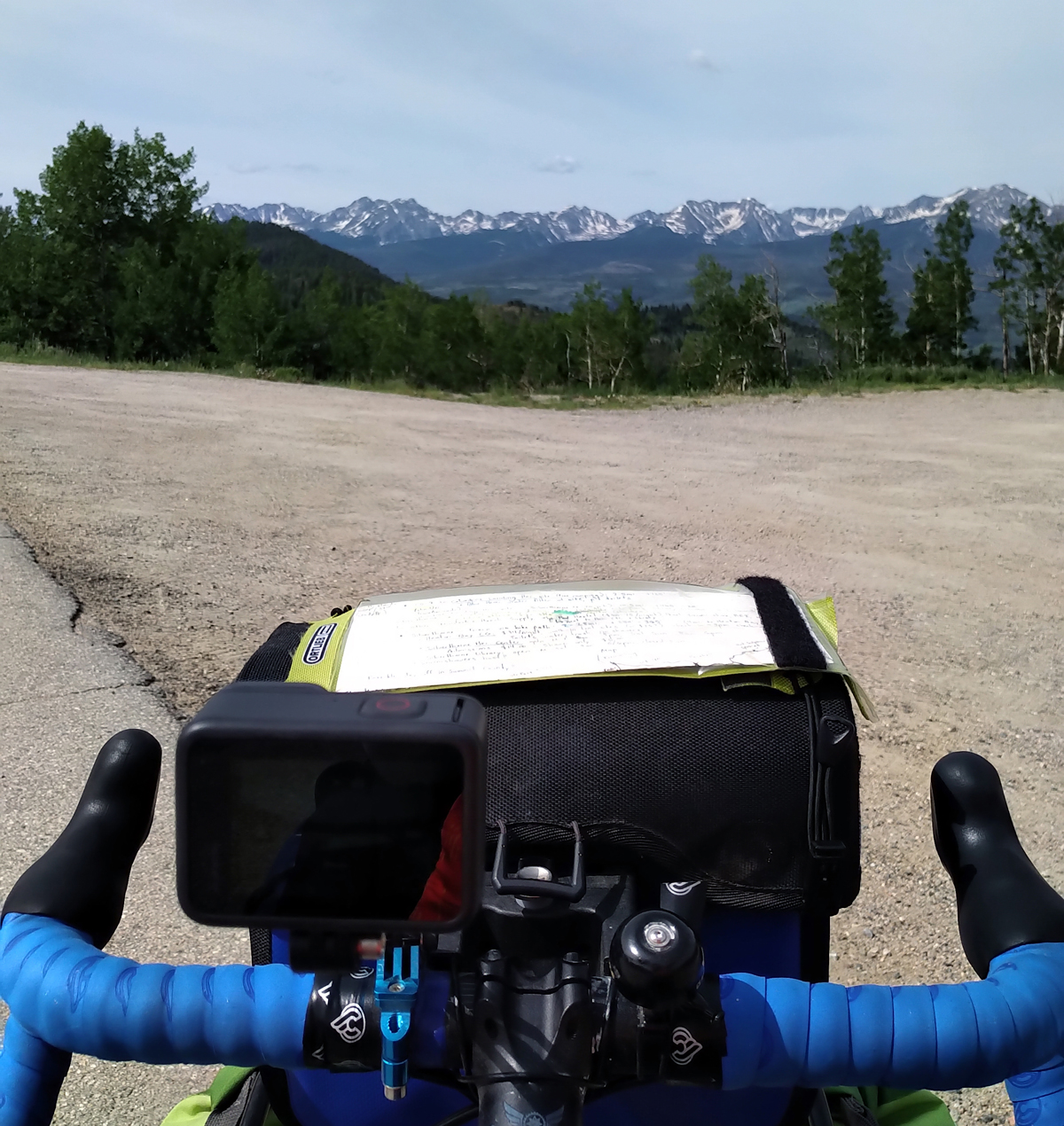
Partially because of this, I decided to travel close to home in a state where bicycling was more common. Despite living only a few hours from Colorado, I had never been south of Leadville — so not much further south than I-70. Like on my 2018 tour to the Canadian Rockies, I picked a destination I had long desired to visit for its beauty and challenge. This destination was the San Juan mountain range of southwestern Colorado. Along the way, I would cycle through many western Colorado towns, with dynamics both familiar and yet slightly different than the Utah resort town of Park City where I have both lived and worked.
As someone interested in affordable housing initiatives, I was curious to see what the housing and economic situations looked like in these Colorado towns where tourism has such a prominent presence in everyday life, housing, and business. I see bicycle touring as a prime opportunity to listen and observe at the immediate scale. The slow-moving nature of the machine lends itself well to that.
Not having a fixed end date to conform to, I decided to bike from my house to the state line of Colorado. The environment I traveled through to get there, southwestern Wyoming and the Flaming Gorge area of Utah, was quite different from what I would encounter later. I left Park City on a Saturday morning, passing at least a dozen cyclists on the Rail Trail heading to Wanship. I did not realize at the time that these were the last cyclists I would encounter until I reached Colorado, several hundred miles away. I exited Utah through Chalk Creek Road and hung south of Evanston, following rural Wyoming backroads and highways to traverse the northern foothills of the Uinta Mountains.
Climbing a Wyoming mounthill. Photo by Alex Stewart
While on my way to the Bridger Valley, I encountered one of Wyoming’s notorious mounthills just east of the ghost town of Piedmont. I didn’t consider them big enough to be mountains — at least not compared to the Uinta Mountains off in the distance — but they sure weren’t small enough to be hills. This steep mounthill resulted in a slippery push-a-bike affair to make it to the summit. Thankfully, this was the only time I encountered this scenario on the trip. The main street of Mountain View, WY, had slim dining offerings, but I managed to find a meal.
A cold front was moving in the next day, so I quickly made my way down WY-414 into Manila, UT. The heat had been getting to me the past few days, so I was relieved when the ride into Flaming Gorge was cool and pleasant. UT-44 on a Tuesday morning had minimal traffic and several opportunities to stop and take in the views as I climbed my way up along the western rim of the gorge and skirted the eastern flank of the Uintas. I suggest detouring to the Red Canyon Visitor Center for a premium vantage point.
One of the most remote stretches of my trip was between Dutch John, UT, and Maybell, CO, with no services for one hundred miles. Browns Park Road enters the northwest corner of Colorado and is mostly used by rafters to access the Green River. About 3/4ths of the road is paved, with the Utah side being more scenic. Forty miles from Maybell, a driver in a Chevy Volt pulled up beside me to ask if I knew where the nearest electric vehicle charging station was. Maybell has a campground with wi-fi and showers located within its central town park. I rode US-40 from Maybell to Craig and then Hayden, with good shoulders the entire way. In Hayden, I was warmly welcomed by the staff of the Wild Goose Coffee shop, located in a quirky converted granary building on the edge of town. They made me feel right at home, even offering me some route suggestions for my trip, and I would encourage anyone passing through to pay them a visit.
I took a scenic alternate route into Steamboat Springs that guided me through rural Routt County. I followed CR-27 south from Hayden, then pivoted north on CR-33 into Steamboat. It had been raining the past few days, and the fields surrounding me glowed a vibrant emerald green, and the color flowed up and over the rolling hills beyond. Unfortunately, some of the dirt county roads had turned into a sticky, peanut butter-like consistency that forced me to stop and remove my front wheel in order to scrape out stubborn clumps of mud that had become trapped in my fender.
Ute Pass Summit. Photo by Alex Stewart
In Steamboat, Richard and Sarah hosted me for the weekend. I had contacted them through Warmshowers. Sarah happened to bump into me riding along the Yampa River bike path and gave me a personal escort back to their home. On Monday morning I intercepted Tim Tait, an acquaintance of mine who was racing the Tour Divide. We rode together briefly on the pathway out of town, and he told me about some of the Tour Divide happenings. We joked about the “dot stalkers,” people who follow the racers in person by watching the online map that updated racers’ locations. On this day and the following, I was going to officially ride a short stretch of the Great Divide route between Steamboat Springs and Silverthorne. Ute Pass south of Kremmling was one of the highlights of my trip. When I crested the summit, I got my first view of some of Colorado’s famous snow-capped fourteeners.
I took a day off in Silverthorne, staying at a swanky new hostel called The Pad. Silverthorne is a convergence point for both the Great Divide and TransAmerica long-distance cycling routes, so I encountered multiple self-supported riders during this time. Continuing on, I took a busy bike path into Frisco and then to the junction of CO-91 at Copper Mountain. There was a cold drizzling rain up at Fremont Pass. People probably wondered why I had put on a rain jacket and waterproof gloves but was still riding in bib shorts. Thankfully, warm sunshine awaited me when I arrived in Leadville. This was the furthest south I had traveled in Colorado, and I was now about to enter unknown territory.
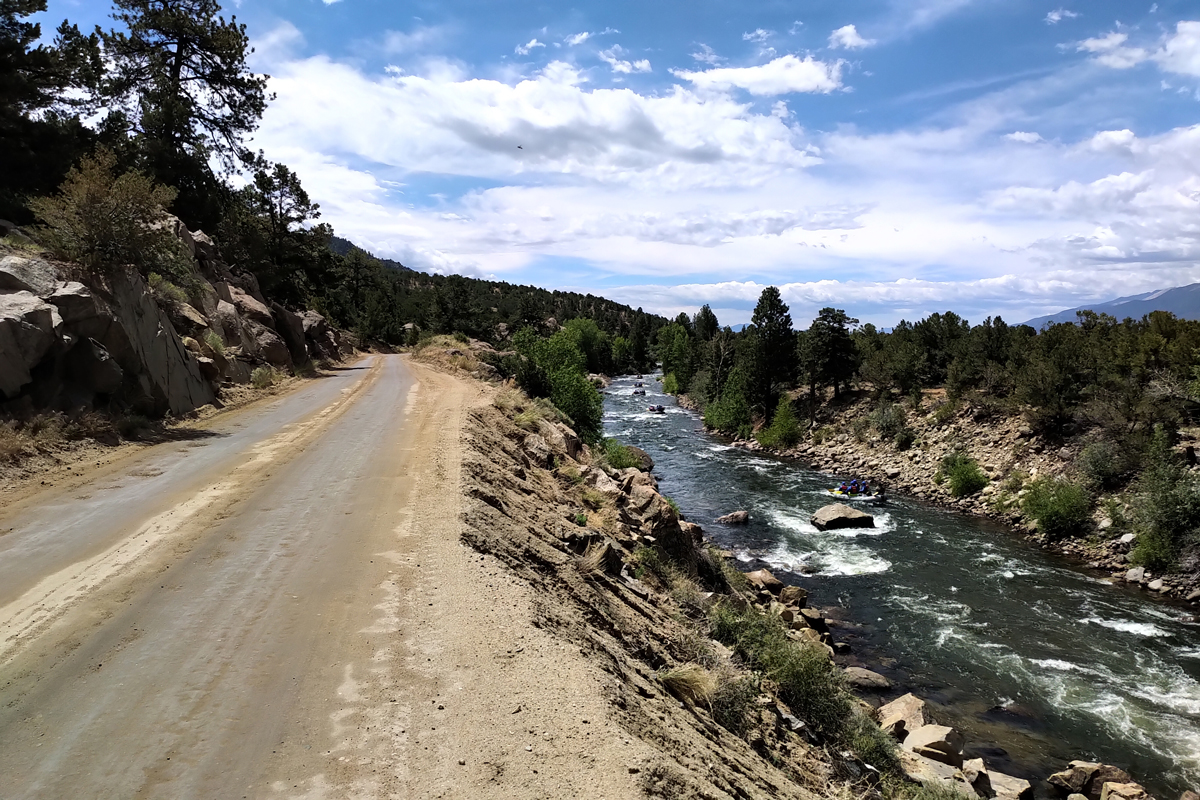
Backroad options between Leadville and Salida were ample, so US-24 could mostly be avoided. I stayed with another Warmshowers host, Ben, in Salida. He had a friend who was also passing through and staying there that evening. The next day they were off to ride some singletrack, beginning with the dirt road climb up Ute Trail west of town. They invited me to come along for that part, and I opted to join them.
A backroad in Buena Vista. Photo by Alex Stewart
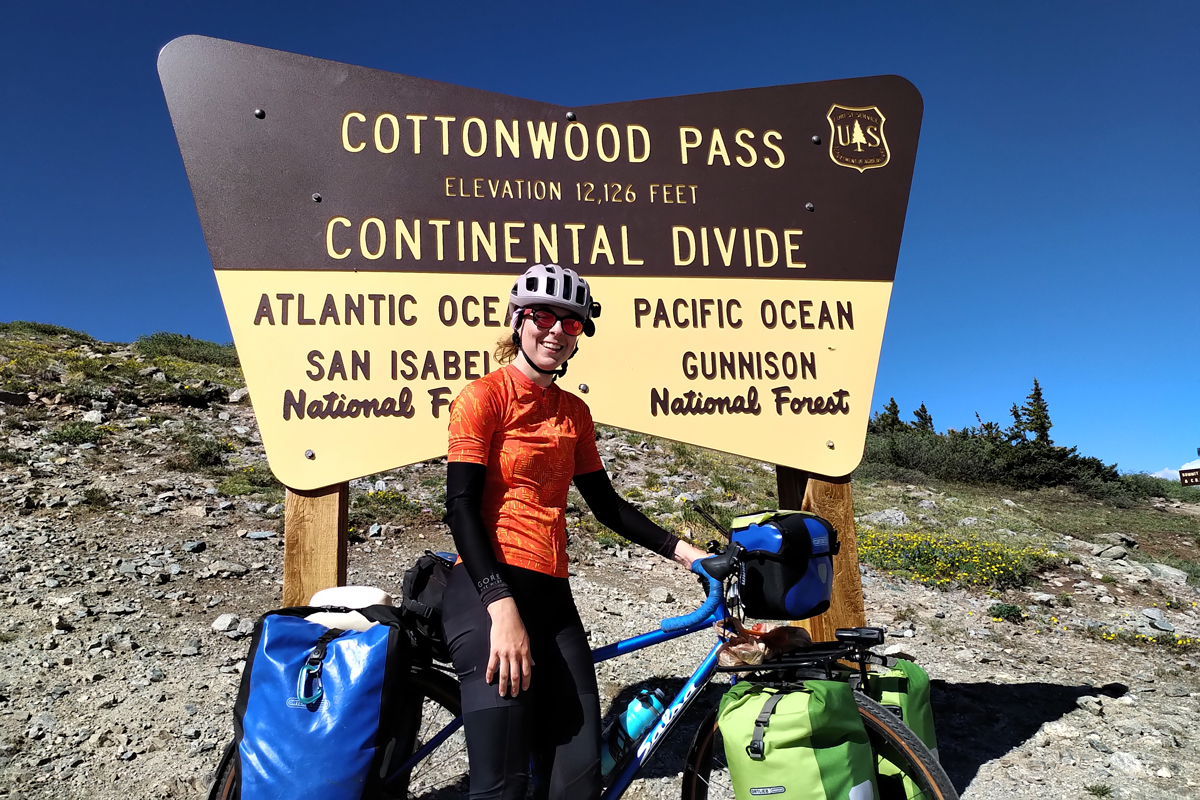
When I saw both of them come out of the house wearing jorts I became concerned. Only the fastest riders I know wear jorts. His friend was riding a singlespeed hardtail — another ominous sign that I was not in for a reasonably paced uphill ride. Once the Ute Trail started to pitch up, they peddled off together around the bend and gradually disappeared into the distance. I decided I would stick to my off-day riding pace. The next morning, I u-turned back to Buena Vista and bit off the first chunk of the Cottonwood Pass climb, camping about halfway up. Cottonwood Pass is one of the highest paved roads in North America, topping out at 12,126′. Taken as a two-part climb, I didn’t find it as challenging. In Crested Butte, I discovered the most interesting campsite of my trip. If you are willing to make the 700′ or so climb up to Crested Butte Mountain, there is a free tent camping area in a meadow with views of the surrounding mountains. Somewhat humorously, I pitched my tent in front of multi-million-dollar vacation homes, my views taking a forefront to theirs!
At the summit of Cottonwood Pass. Photo by Alex Stewart
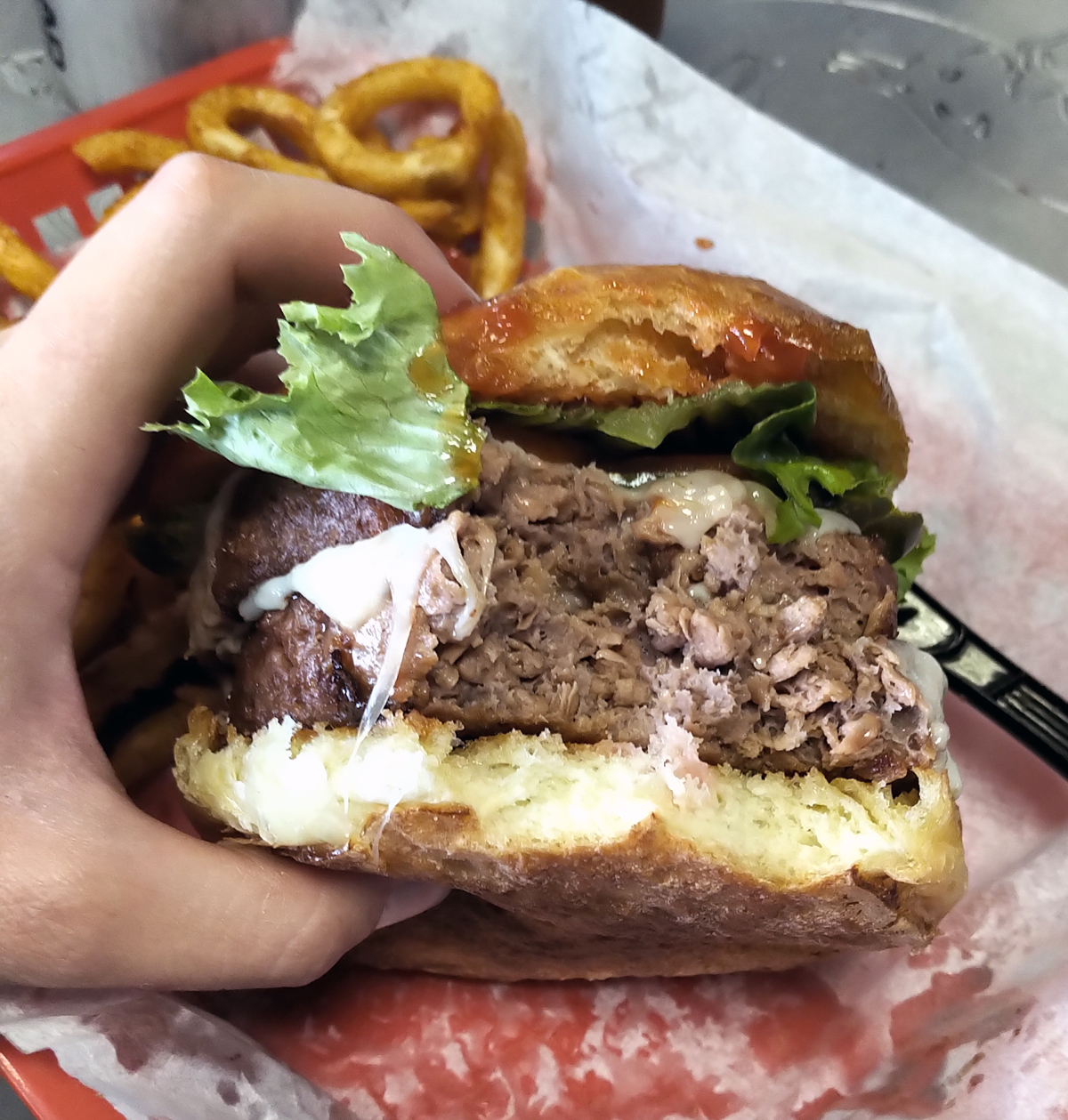
The route to Gunnison can be made into a loop if you are willing to climb Kebler Pass Road, then up and over Ohio Pass on a Forest Service gravel road. FS-730 tested my bike handling skills with some loose sections, but eventually I was on a quiet paved route leading into the Gunnison Valley. I custom ordered a sizeable double patty Beyond Burger at a place called Powerstop, and the cooks were surprised to see me manage to eat the whole thing. Gunnison is home to a unique bike shop/cafe known as Double Shot Cyclery — the folks lent me a quick helping hand when a poor bike parking job led to a bent rear derailleur hanger.
A custom double Beyond burger at Powerstop in Gunnison. Photo by Alex Stewart
US-50 between Gunnison and Montrose was the most logistically tricky section of my ride. The highway is undergoing extensive construction and consulting CDOT’s website was needed to figure out when it was open. Fortunately, I had a very nice pilot car driver transport me through the stretch. I detoured to visit Black Canyon of the Gunnison National Park, riding the seven-mile-long south rim road before heading into Montrose.
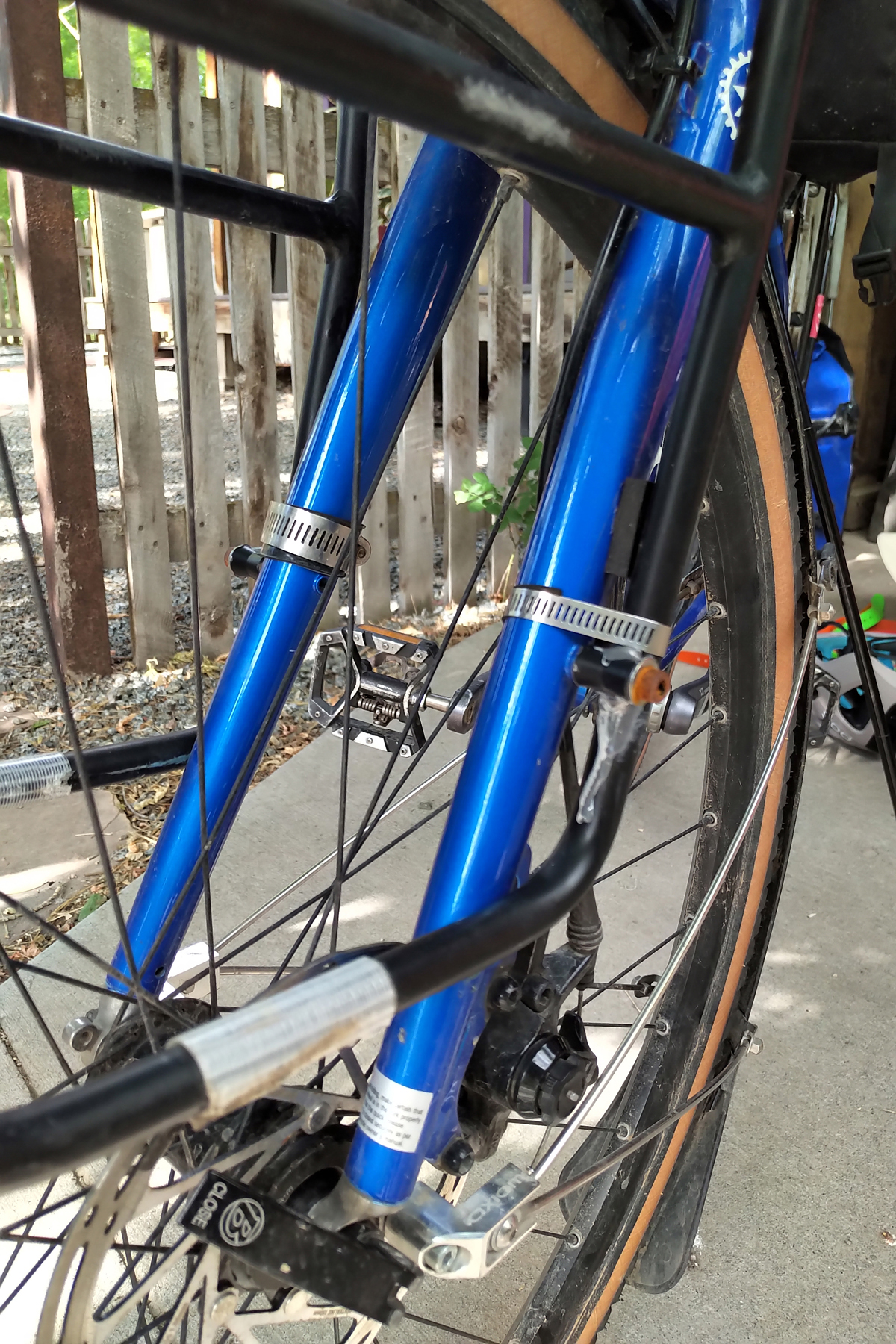
My Warmshowers hosts for the Fourth of July weekend, John and Mallory, were located in Ridgway. I opted to bypass a very heavily trafficked US-550 highway in favor of the mixed-surface CR-1. It was quite the climb, and I was roasting, eventually running out of water halfway through. To my relief, some monsoonal clouds had formed and bought me some time until dehydration would become a concern. The situation worsened a few miles down the road when I went over a large bump and suddenly heard a cracking noise and a significant front tire rub. I looked down to discover my front rack had sheared on both sides at the fork mount weld points. I moved off to the side of the road, waterless and now surrounded by rumbling thunder clouds, to figure out how to fix my rack well enough to make it the few more miles into Ridgway. I ended up strapping both front bags to the top of my rear rack with some extra-long tie-down straps. I then Voile strapped the top of the rack onto my handlebars to keep it from bonking my front tire. This clunky setup managed to work.
Our temporary front rack fix using hose clamps. Photo by Alex Stewart
The bike shop employee in Ridgway suggested I try hose clamps as a temporary solution. Since the rack was aluminum, a simple weld job was not an option. When I got to John and Mallory’s house, John immediately started to work on trying to figure out a way to repair it. We settled on the hose clamp idea, and I placed a pre-order for a new (steel) rack with a bike shop in Durango. I figured that despite the long weekend, the rack would arrive in Durango by the time I arrived. On the night of July 4th, I camped high above Ouray at the Amphitheater Campground, watching the fireworks light up and reverberate through the steep walls of the box canyon below. I think I accidentally parked my tent right next to the charred remains of a lightning strike on the ground.
The Million Dollar Highway. Photo by Alex Stewart
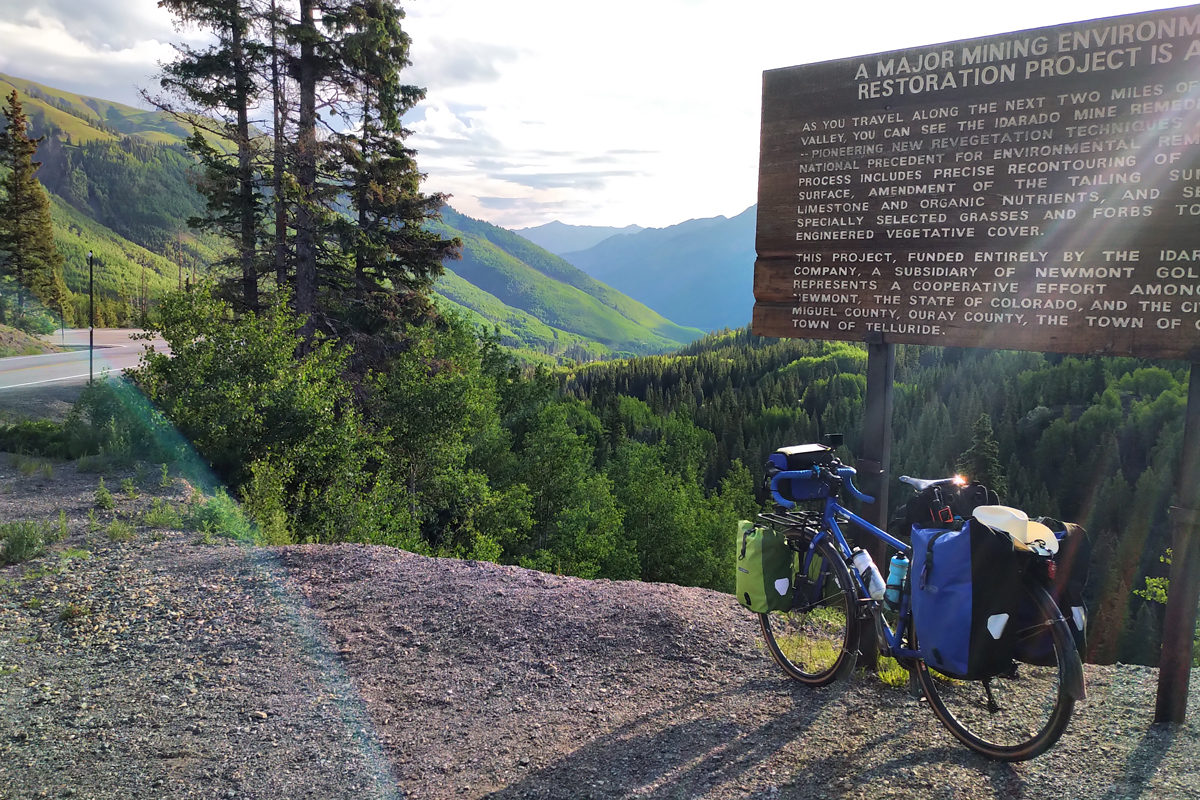
I hit the Million Dollar Highway early. In this direction, you ride the first few miles out of Ouray on the side of a sheer drop-off into the Uncompaghre Gorge. With minimal traffic and reasonably good rear sightlines, I could keep an eye on incoming and oncoming vehicles. When I saw big commercial trucks coming, I opted to find a safe pull-out in advance and wait it out until they passed, which helped make the ride less stressful. I concluded that I didn’t particularly care to ride the Million Dollar Highway after about 9am and only rode to Silverton the first day. As beautiful as the highway is, I frequently found myself hyperfocused on traffic to the point where I couldn’t enjoy it as much. A revisit to the San Juans may be in order for some bikepacking adventures. CR-250 into Durango was like a little bicycle highway. I hadn’t seen many cyclists on the last leg of my trip, but they were out in full force around Durango.
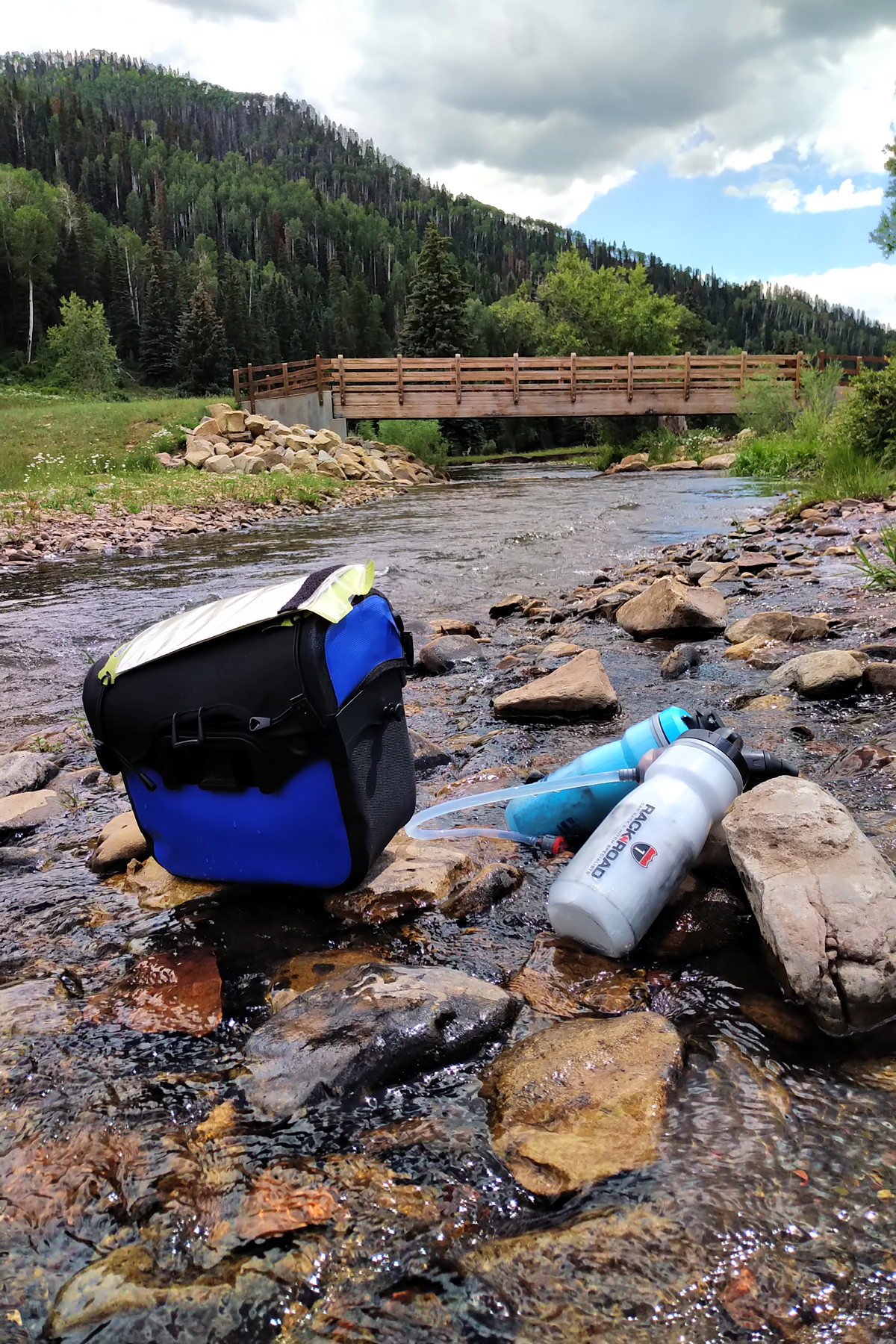
Taking a creekside rest break in the San Juan mountains. Photo by Alex Stewart
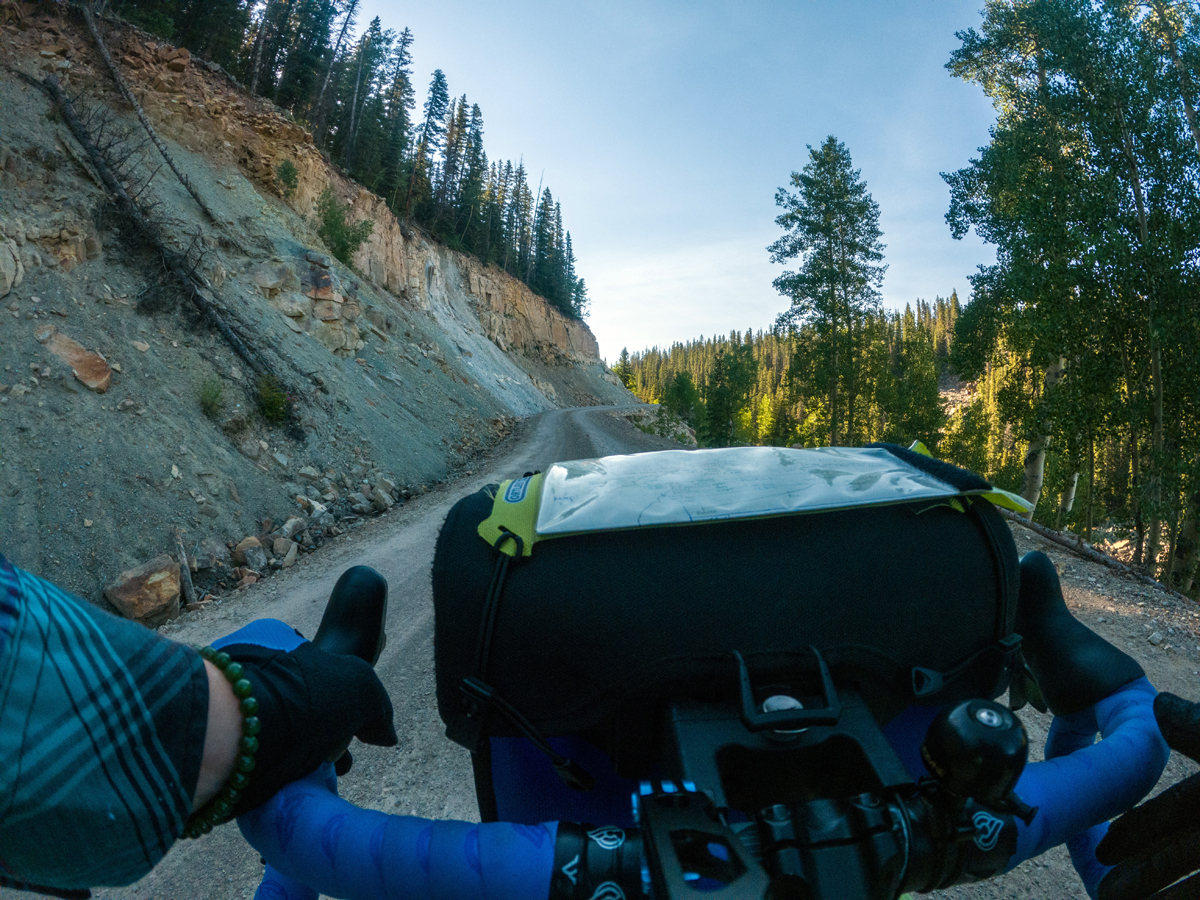
The heat returned as I exited the mountains and rode into Mancos and Mesa Verde National Park. Mesa Verde had several buildings spread throughout the ride where I could stop to cool off. After taking county roads between Cortez and Dolores, I took CO-145 towards Telluride but bypassed Rico and a good chunk of that highway in favor of taking Dunton Road. This was another road that challenged my bike handling skills as it transitioned into dirt and steep climbs, but I appreciated the more “bikepackey” feel of this route, which was quieter and closer to nature than the highway. I rode the free gondola in Telluride but didn’t stay past the evening.
The Dunton Road backway. Photo by Alex Stewart
I left early to ride CO-145 out of Telluride towards Placerville. Thankfully I was heading in the opposite direction of commuter traffic. I was unaware of the public bus that ran between Telluride and Norwood but would consider a public transit ride through this stretch of highway next time. I don’t think this stretch of highway is worth riding during the tourism season, despite its scenic aspects.
The summit of Dunton Road. Photo by Alex Stewart
I decided to end my ride in Grand Junction so I could take Amtrak back to Salt Lake City. Tim had long since outpaced me on his Tour Divide ride and was back at his home in Nucla. I got pretty toasted — arguably roasted — as I rode into Nucla from Norwood. He had suggested I ride CO-141 to Grand Junction. We had dinner together and discussed.
On my last official riding day of the tour, I opted for a bold move. Rather than ride the 50 miles between Naturita and stop in Gateway, where I would spend the afternoon and evening roasting in my tent on BLM land, I decided to ride straight through to Grand Junction where I could savor some indoor air-conditioned lodging. It was 105 miles between Naturita and Grand Junction. There was some climbing, but not like in the mountains. I would have to carry 2-3 liters of water through this stretch as water access was limited beyond Gateway and the high that day was in the upper 90s. I would need to leave early to minimize my risk of heat exhaustion. I had never ridden a century on a fully loaded touring bike, so this would be out of my comfort zone.
I started my ride out of Naturita at 4am on the night of the full moon, tackling the 50 miles to Gateway before 7:30am. CO-141 is one of the most beautiful road rides I have ridden, and its scenery keeps you engaged over many miles. The ride towards Gateway reminds me of riding along the Colorado River out of Moab, but with a fraction of the traffic volume. As you climb towards the Unaweep Divide summit, the red rock canyon walls transition to a grey hue. As you approach Whitewater, the landscape starts to change yet again. I found the temperature remained tolerable through this stretch, but the final descent into Whitewater felt like I was dropping down into an oven. I hit my low point maybe five miles out of Grand Junction. The heat finally got to me, and I had to stop. Eventually, I composed myself enough to dizzyingly limp into Grand Junction, where a Sinclair gas station (not a mirage) lay on the horizon with shakes and ice-cold beverages awaiting me. My recovery was surprisingly quick after that.
The next day I did a quick cooldown ride to Fruita and back. I waited for my Amtrak train back to Salt Lake City the day after. Unsurprisingly, it was delayed six hours and didn’t depart Grand Junction until after 10pm. I ended up taking a red-eye train to Salt Lake Central, arriving with the dawn around 6am. When the bike was rolled off the baggage car, I noticed my front tire was soft. Upon later investigation I found my rim strip had shifted slightly, which may have caused a very minor pinch and slow leak. This would be my only flat on the entire trip. Thankfully, my friend offered to pick me and my bike up from the train station so I wouldn’t have to ride back to Park City. That concluded my 37 bicycle-filled days of exploration.
Reflections
At some point early on in my trip, I decided to adopt a mindset that would help me accept some of the inevitable negative or stressful encounters. First, I decided to be positive towards others as a default unless they gave me some reason not to be. I found the mood-boosting effects of exercise and the relaxed wandering pace of my travels helped me maintain this. Second, I decided at the start of each day that I was going to preliminarily accept having one negative encounter per day. I usually met my quota, unfortunately, but almost never exceeded it. And the overtly positive and supportive encounters always exceeded the number of negative incidents.
When it comes to the increased cost of housing, some people like to rationalize it as “it’s happening everywhere.” I feel that this perspective doesn’t acknowledge local and regional variations, and western Colorado towns with tourism-heavy economies are experiencing the crunch in particular ways. As I cycled, I witnessed the extensive commuter traffic coming from towns like Craig, Gunnison, and Montrose. At one point, I believe I even stumbled on an area of primitive Forest Service land that employees of a nearby, very affluent resort town were camping on. This town (I’m keeping it anonymous because of the subjective nature of my observation) is possibly experiencing the worst workforce housing crisis of the nation’s ski resort towns, and the clogged two-lane highway leading into it might convince some workers to camp closer to their jobs, especially with high gas prices. This makeshift camping area was heavily occupied but was kept clean and tidy. I can’t confirm what I saw, but I think it would be fascinating to explore if there is any validity to this suspicion.
Two of my Warmshowers hosts, Richard and John, are both involved in local government. The issue of affordable housing sits at the forefront of their communities of Steamboat Springs and Ridgway, respectively. Workforce housing, in particular, has been one of the most pressing subcategories of affordable housing needed in these towns. My other Warmshowers host, Ben of Salida, lived in an ADU (Accessory Dwelling Unit) and worked in construction; as someone who helped produce housing units, he was also closely connected to the issue. Perhaps it was just a coincidence that these folks were my Warmshowers hosts, but I find the people who are friendly enough to welcome strangers into their homes at no cost as guests are often engaged in this issue. At this time, the housing situation varies from a crunch to a crisis, and ways to alleviate it are still ongoing; affordable housing projects and programs often have to fight to even come into existence.
Bicycling can be a lot more than a way to get around or a form of exercise. It can be a practice in self-empowerment, mindfulness, and observation. The very activity of cycling cultivates a perceptive and receptive mindset, and from it we may discover and connect with aspects of our world and its residents otherwise muffled by our day-to-day societal routines.
Planning Resources Used
CDOT’s Colorado Bicycling Map (online): shows traffic volume for state highways and which have wider shoulders
Colorado state road map (physical): found at a rest stop, free
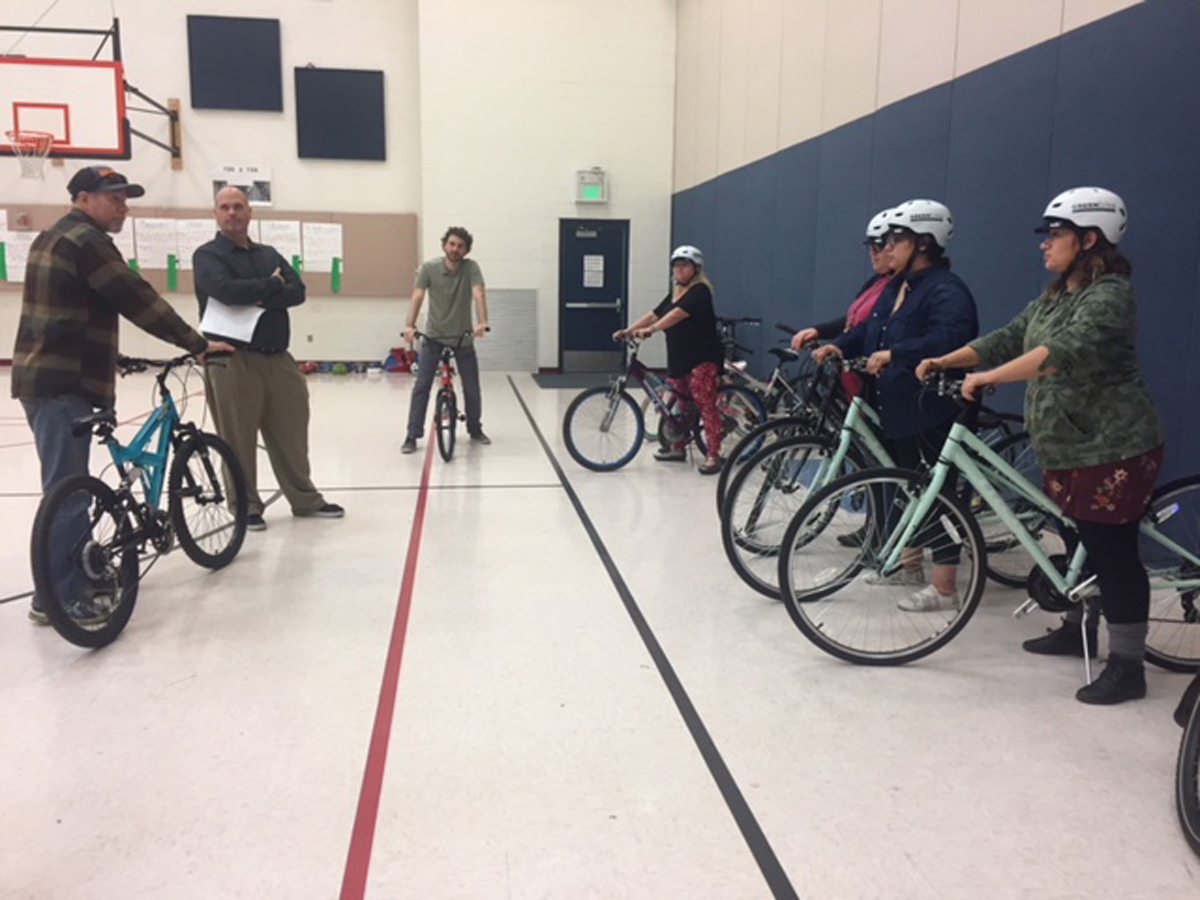
By Charles Pekow — Don’t think it’s too early or too late to teach people to ride a bike. Recent research says it can help the very young and the very old to learn to ride. More than that, it can help people on either side of the life spectrum overcome adjustment difficulties.
Bicycle Ambassadors instructing the Adult Learn to Ride Class. Photo by Beth Pacheco.
A study done by the Sensory Processing Disorder Foundation on children over six with developmental difficulties showed that teaching them how to ride a bike helped them not only with coordination, but to improve their social skills, self-esteem, behavior, motor skills and overall happiness.
Meanwhile, teaching senior citizens to ride can also help them maintain their sense of balance, another study shows. It notes that many people lose their equilibrium as they age, which results in falls that cause serious injury or death.
“Preliminary evidence suggests older adults who ride a bicycle have better balance than those who do not,” says Physical Activity, Balance and Bicycling in Older Adults, a study from the University of Missouri – Kansas City. Research found that those 65 and older who cycled were better coordinated than those who didn’t, as well as having stronger legs and better circulation.
Evelyn Dong and Russell Finsterwald crowned champions of the 4-day mountain bike challenge
COLORADO SPRINGS, Colorado (September 30, 2022) — After 4 days of racing, Russell Finsterwald (Specialized Off Road) and Evelyn Dong (Juliana/SRAM) beat strong fields to win the overall general classification at the Pikes Peak APEX. Two brand new courses challenged the field of riders along with two courses used in previous APEX events.
Racing started in earnest on the short, 11-mile technical time trial prologue on Thursday. Riley Amos, hot off his top-10 finish at the World Championships came out swinging to take the overall win and Evelyn Dong used her knowledge of the past two years to take the win in the women’s pro category.
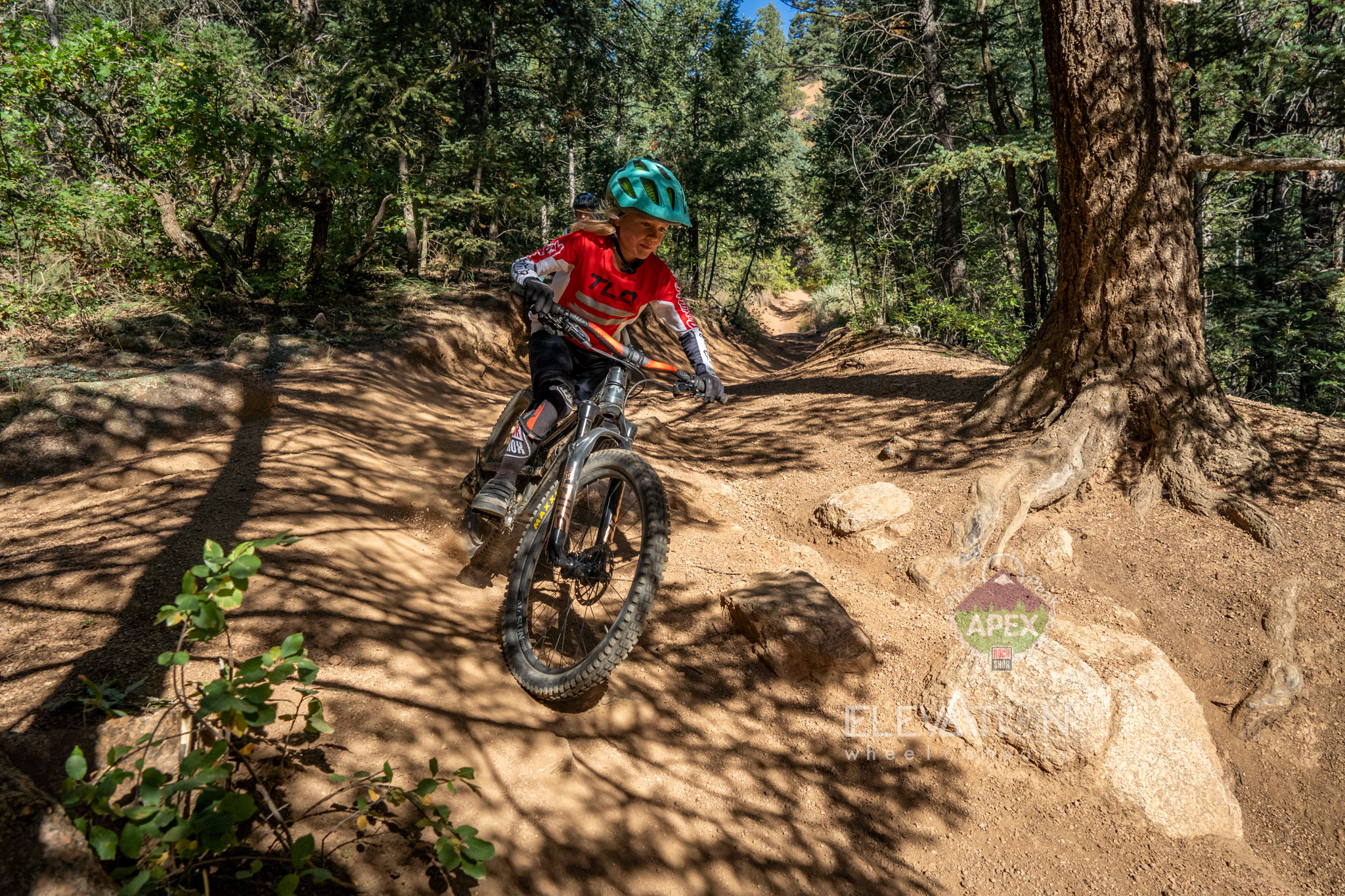
Stage 2 of the Pikes Peak APEX. Photo courtesy Pikes Peak Apex
Day 2 of the APEX was the new stage in Cañon City that crossed the Royal Gorge Bridge mid-race. A stiff 3-mile climb that gained 1800 feet right out of town pushed riders to their limits and created an immediate separation. Dong left the rest of the women’s field and ended up winning the stage by over 17 minutes before local star Deanna Mayles and Olympian Erin Huck finished. A group of men formed after the big climb and after they crossed the Royal Gorge Bridge mid-race, race leader Amos suffered a flat that put him back a few minutes. Finsterwald was able to get away from that group, soloing in just in front of Bear Development rider Lasse Konecny.
Day 3 saw the riders return to a lap of Rampart Range Reservoir but starting from the other side in Woodland Park. Dong continued her winning ways, dropping the rest of the women early in the stage while Amos was keen to push the pace and gain some time back on Finsterwald who was wearing the ASSOS leader’s jersey. Lachlan Morton and Alex Howes from EF Education and Olympian Todd Wells used their savviness to stay in the front group for a while, but in the end the high speeds of Amos were too much for the veterans. In the end Amos soled in but had only a few seconds on second place Brayden Johnson and Finsterwald finished in third, holding onto the GC lead. Kyle Trudeau continued his solid performances, holding onto 2nd place in the overall.
Stage 4 of the Pikes Peak APEX. Photo courtesy Pikes Peak APEX
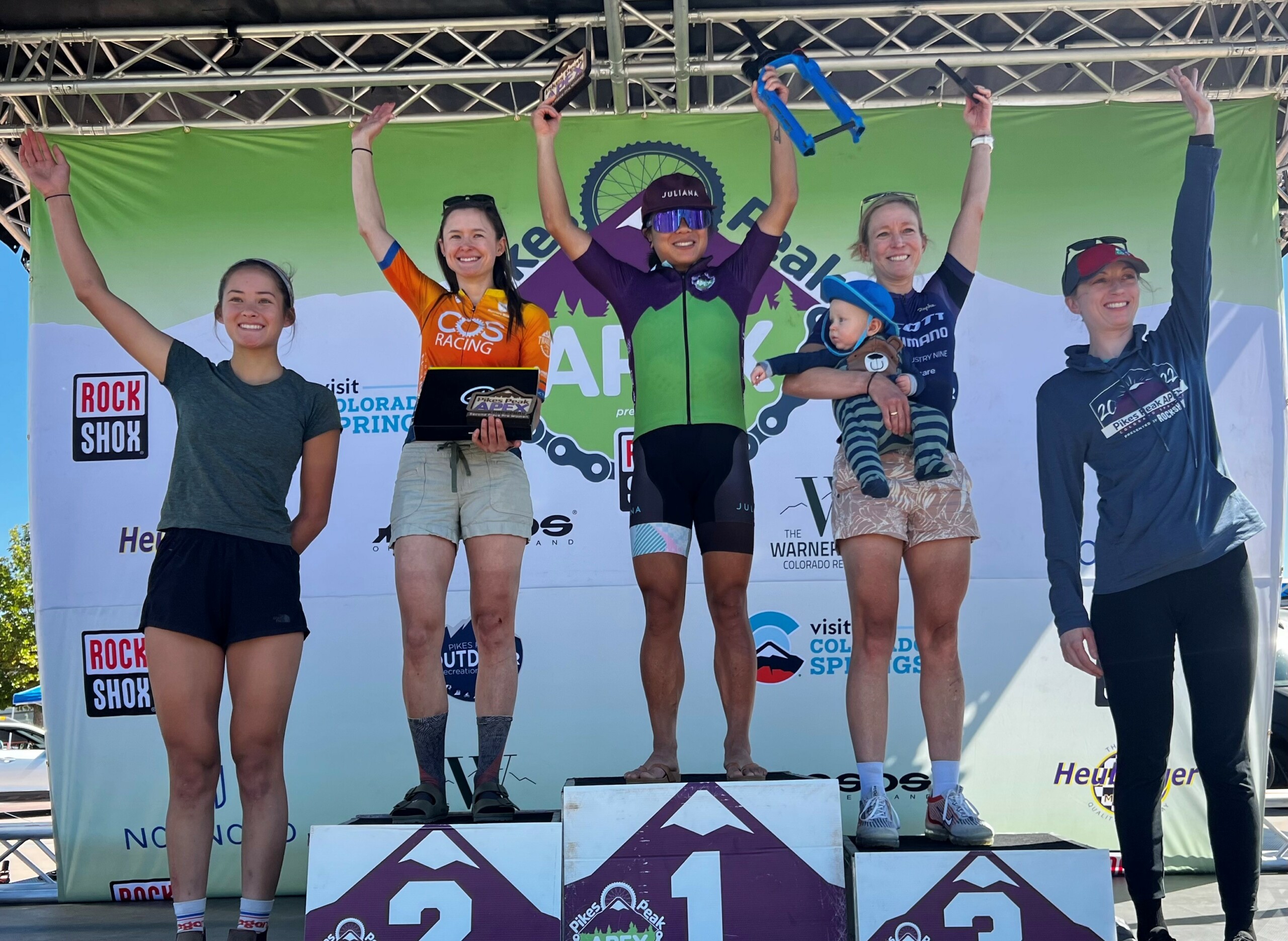
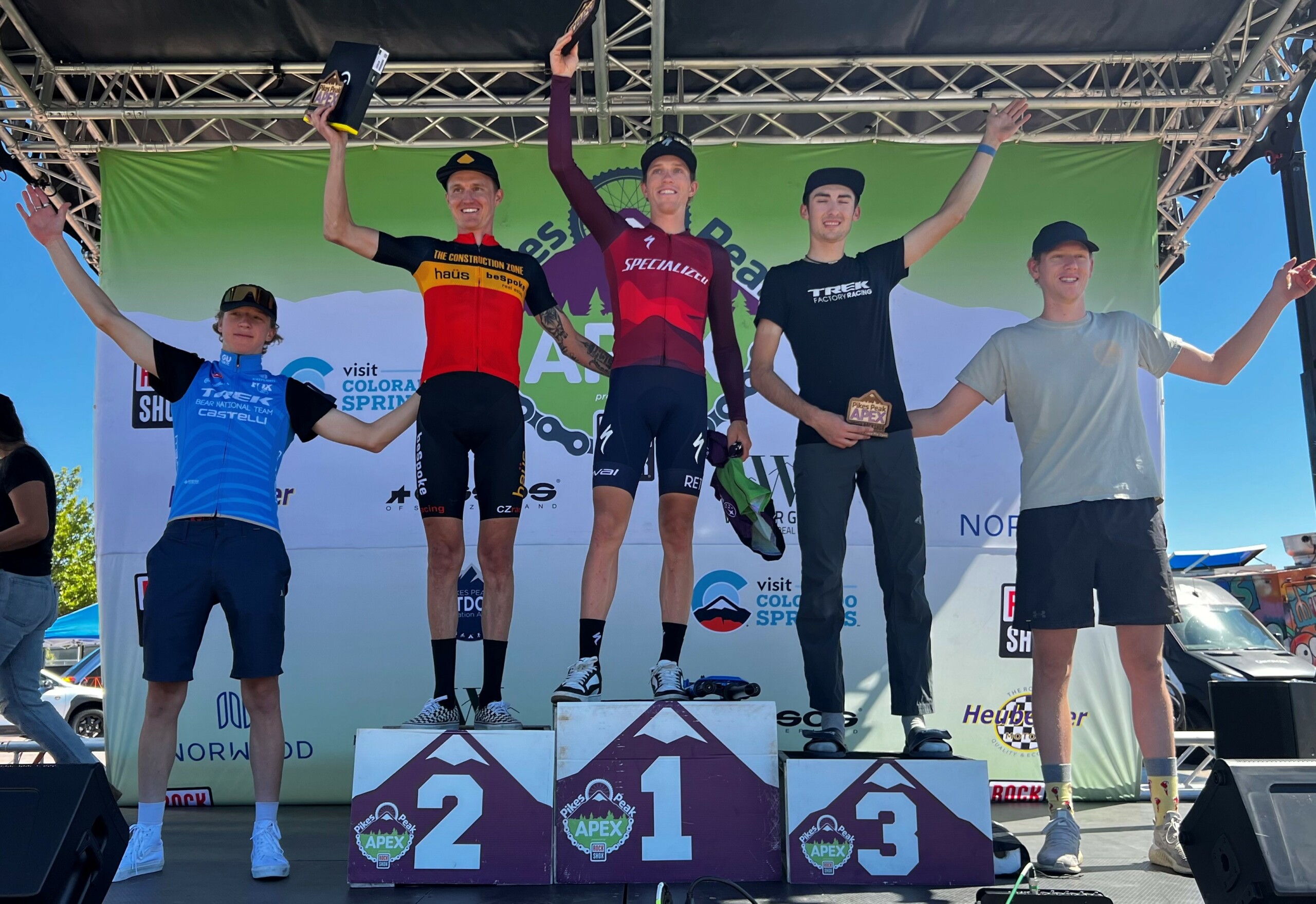
The final and 4th Day saw a shorter 20-mile stage with attacks from the gun with riders trying to mix it up. Dong seemed satisfied to take it a bit easier with a 20-minute lead in the GC, watching Mayles and Huck up the steeper climbs on the last day. In the end Huck was able to edge out Dong for the final stage win, but the GC didn’t change with Dong taking the overall win, Mayles in second, and Huck in third. On the men’s side, Amos pushed hard again trying to make up time lost on day two of the race. Amos did get a third stage win on the final day, but it wasn’t enough to move up to better than third overall with Finsterwald taking the overall win and Trudeau in second overall.
Women’s Final Podium at the 2022 Pikes Peak APEX. Photo courtesy Pikes Peak APEXMen’s Overall Podium at the 2022 Pikes Peak APEX. Photo courtesy Pikes Peak APEX
By Antoine Robichet, Université Gustave Eiffel and Patrick Nierat, Université Gustave Eiffel — As the world moves toward decarbonization, every option for slashing humanity’s carbon footprint must be on the table. As it stands, transport represents almost a quarter of Europe’s greenhouse gas (GHG) emissions, with the rise of e-commerce and on-demand, express deliveries worsening matters further.
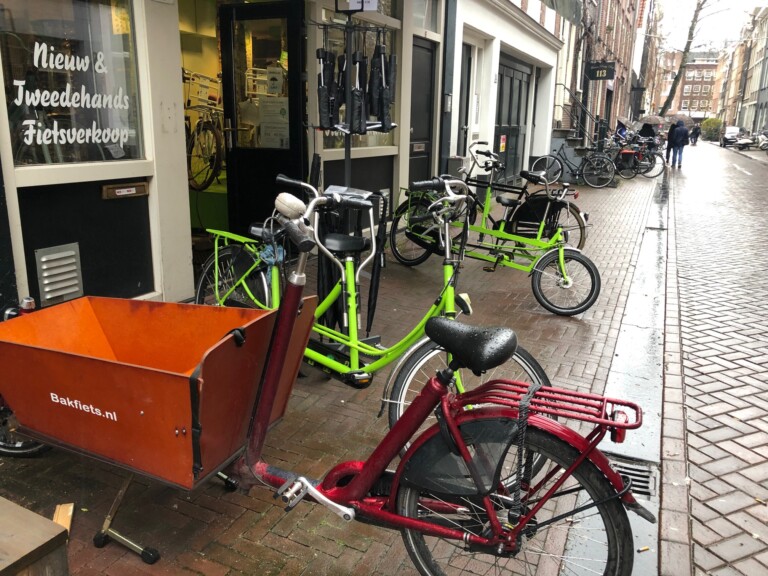
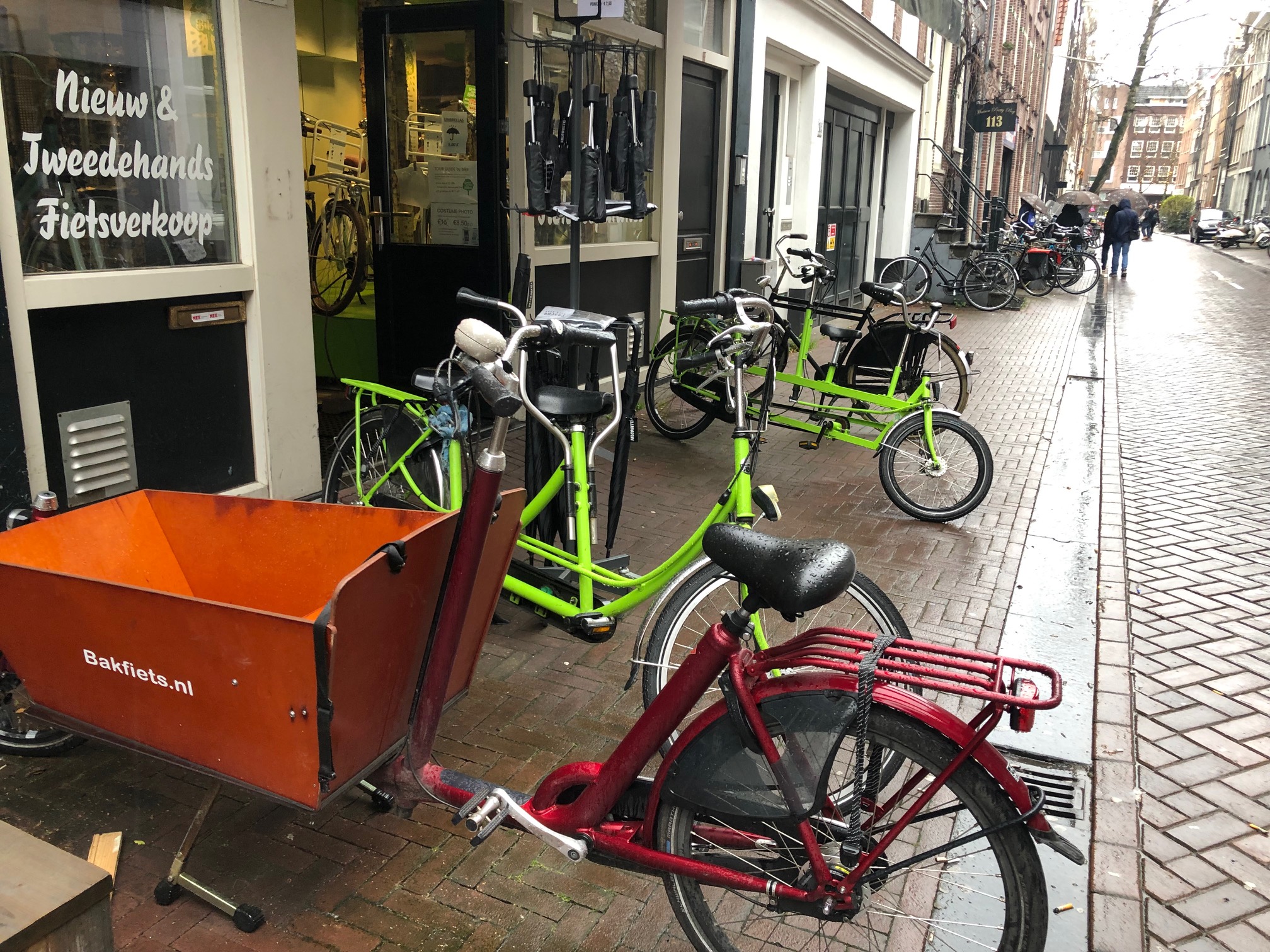
Cargo bikes (or bakfiets) in Amsterdam. Photo by Dave Iltis
Could ferrying parcels by bike rather than lorry help green our seemingly bottomless appetite for e-commerce? Basing ourselves on data from one of France’s largest freight transport companies, our research shows two-thirds of its business to and from the city of Paris could be carried out by cargo bikes.
The results, which take into account the weight of the transported parcels, offer an interesting perspective for the freight transport sector, regularly denounced as a major emitter of greenhouse gases at 14% of French GHG emissions. Indeed this mode of transport is responsible for a host of other ills, including congestion and noise pollution.
Despite this, road transport is still the leading means by which we delivery purchases in cities. In France, 88% of goods are carried by trucks. Although other long-distance transport options remain, such as by rail or river, cargo bikes currently represent the only sustainable solution to decarbonize the last mile – the most polluting one.
The rise of e-commerce
The challenge of decarbonization is twofold in terms of freight transport: it involves adapting the current model in favour of more virtuous practices (e.g. cargo bikes) while integrating constantly increasing flows. E-commerce, in particular, has a growing share in our consumption patterns (+4% of retail share between 2018 and 2020). This requires an increase in the fleet needed for urban logistics, with forecasts predicting a 36% increase in the distances travelled by trucks in major cities around the world by 2030 if no action is taken. This would have many negative effects such as a significant increase in congestion and greenhouse gas emissions.
Micro-hubs in the heart of cities
We therefore need to ramp up the development of bicycle logistics. Nevertheless, the use of cargo bikes requires a specific organisation. The general location of sorting terminals on the outskirts of cities does not favour this mode of transport. Bike’s low transport capacity and reduced speed compared to a truck limit their range of action. The use of micro-hubs in the heart of cities, with cargo bikes operating in a hub-and-spoke pattern from these points, therefore seems essential. However, there are two constraints.
On the one hand, bicycle logistics requires the transformation of commercial real estate, traditionally occupied by stores, into logistics platforms. These new places also called dark stores (not open to the public) compete with the commercial fabric currently established in the heart of cities. On the other hand, the addition of a supplementary step in the logistics chain leads to additional costs (mainly the cost of land) that need to be compensated – for example, through a high density of activities in the catchment area of micro-hubs.
Thus, some geographical areas appear to be more suitable than others for the implementation of bicycle logistics. To overcome this additional cost, the use of containers or trucks acting as micro-hubs is currently being studied. Even though these solutions do not compete with the current commercial fabric, they still imply a property right-of-way in the public space.
Is this the end of trucks in the city?
Finally, bicycle logistics does not necessarily mean the end of trucks in the city. The latter are indeed necessary to supply the micro-hubs on a daily basis, which must themselves be connected to the sorting terminals located on city outskirts.
Moreover, it is currently impossible to operate heavy (maximum 250kg) or voluminous parcels by cargo bike – this means transporting them by truck. The operators are therefore moving toward a mixed fleet.
In conclusion, if bicycle logistic represents a way to green logistics, it also raises some challenges that call for vigilance. Among others, the development of dark stores in the heart of cities which could harm the commercial fabric in the long run.
Finally, let’s not forget that the consumer is behind demand for e-commerce and its associated flows. Modifying consumer behaviour in favour of a less instantaneous demand remains the most relevant course of action to reduce the impact of logistics on the environment.
Belgian native digs deep into family history down “sketchy” tunnels.
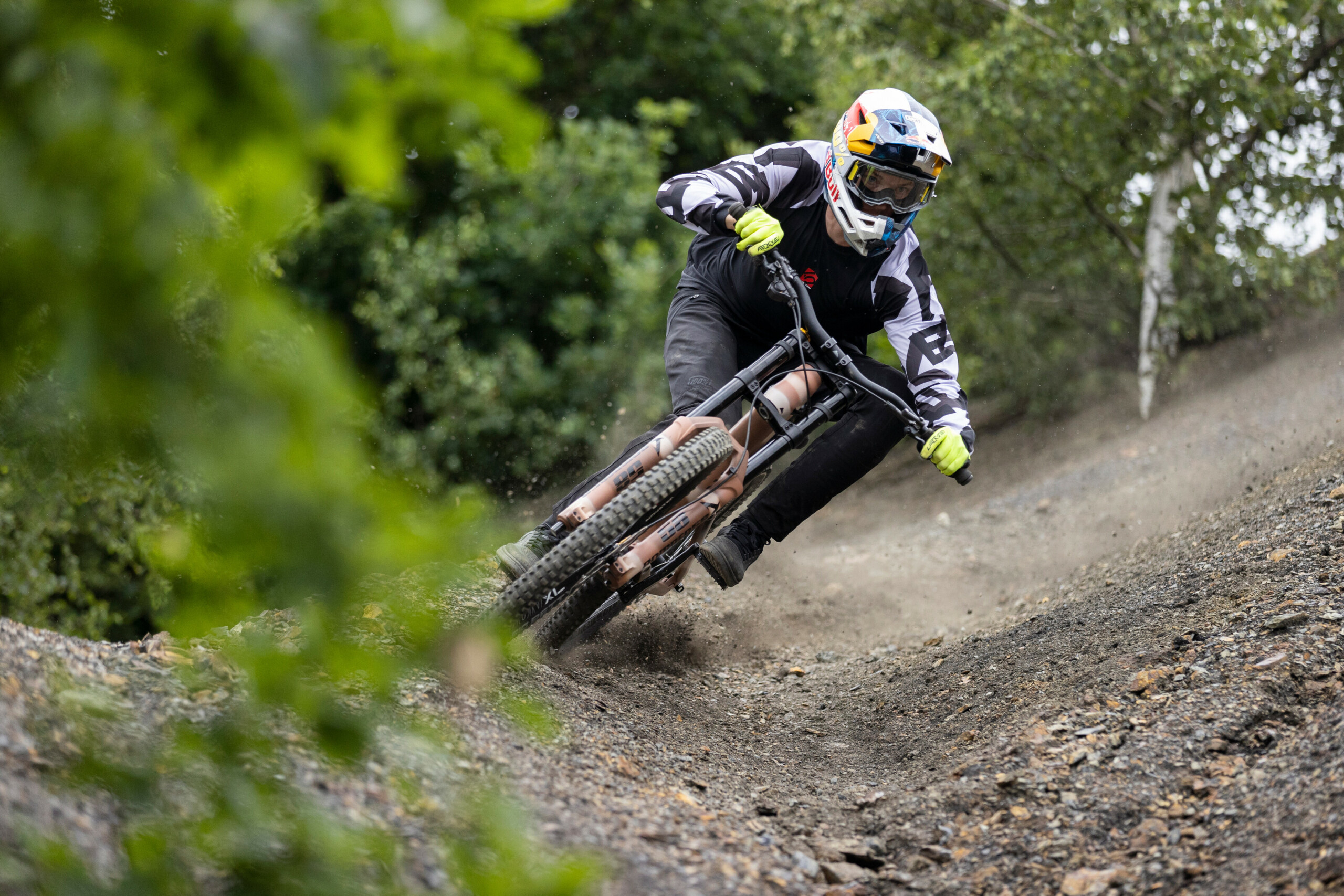
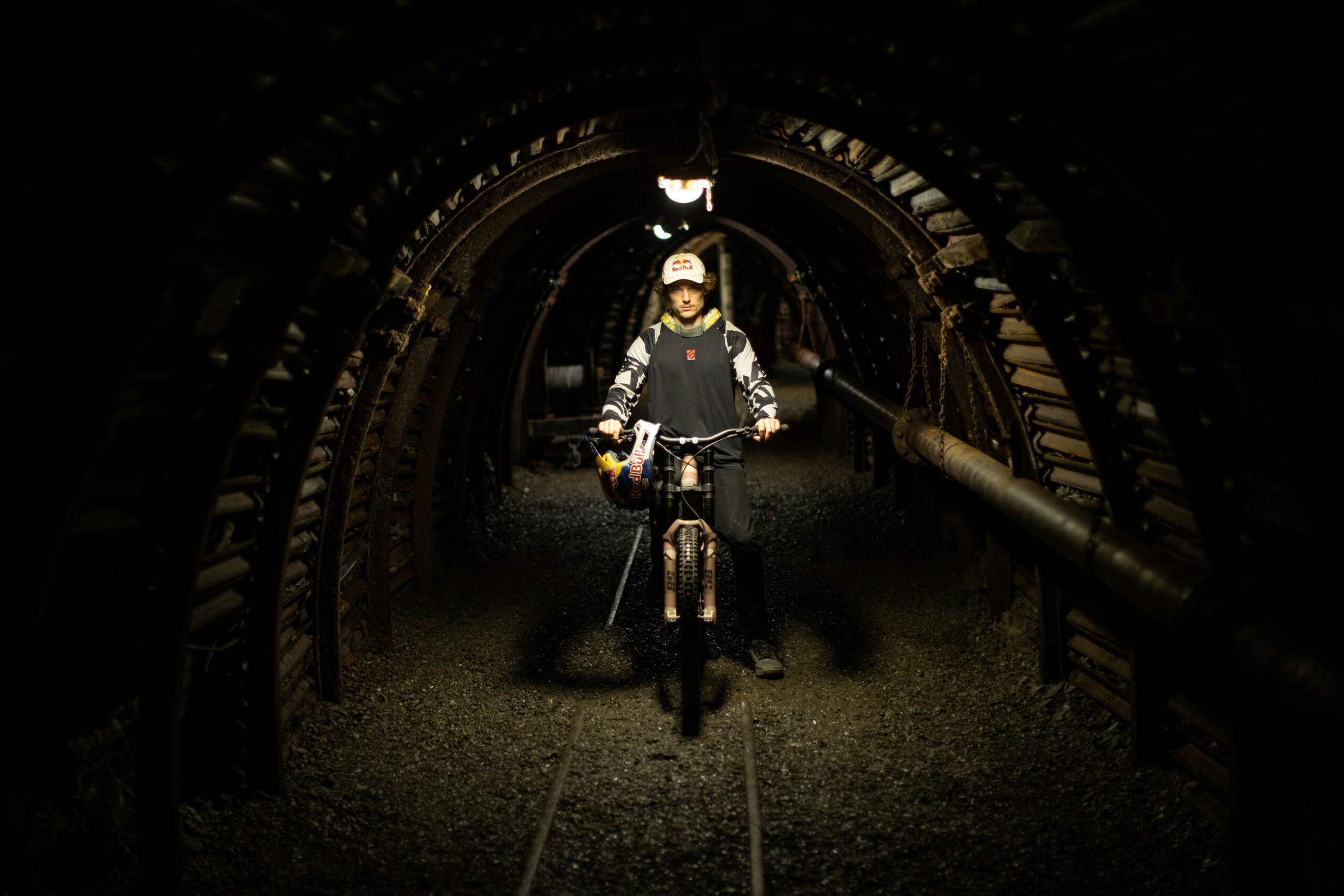
Mountain bike freerider Thomas Genon took a unique approach to prepare for the daunting MTB freeride event Red Bull Rampage. He travelled back to his native Belgium where he dug deep into his family history to push his freeriding skills to new levels down mining tunnels where his great-grandfather once worked. Here is all you need to know:
Red Bull Rampage is an iconic event on the mountain bike calendar with Belgian Genon aiming to improve on his seventh place from last year down the spectacular and daunting freeride course on October 21.
Genon, whose best Rampage results were fifth in 2015 and 2018, will line up with four-time winner Brandon Semenuk back to defend his 2021 title for 2022 alongside five other former winners.
To prepare for Red Bull Rampage, Genon and some close friends built a breathtaking line on one of the huge slag heaps near Liège and dropped in from the pitch-black top down into the mining tunnels.
Thomas Genon seen at “Tommy G’s Mine Line” in Liege, Belgium on June 27, 2022. // Jean-Baptiste Liautard / Red Bull Content Pool // SI202209240277 // Usage for editorial use only //
After finding the right locations, they got to work for 10 days straight and – even though one night of rain ruined three days of work – they just carried on. The 2012 Red Bull Joyride winner explained: “We wanted to put as many features as possible into that line. We were on a mission!”
He never met his ancestor but when he was a child he and his grandparents did visit the mines where he worked, which added a layer of family connection to the site as he pushed his freeriding skills to the limit.
Photo courtesy Red Bull
The 29-year-old said: “The working conditions then must have been really brutal. When I told my grandparents where and what I was doing, they could hardly believe I was in the same place, but with my bike. Only when we were digging our lines out of the slag heap and quarry from early morning to late at night did I begin to grasp what my great-grandfather must have gone through underground. I was given the chance to do whatever I wanted on a freeride bike, to do something more in line with my vision of riding. Even though I’m still more known for my slopestyle runs, I was stoked to try something new, something exciting. I wanted to try my best in something I’m maybe not known for.”
He added: “That is more of my kind of riding. It’s a weird transfer that you have to find out how to spin on and I’ve never really spun something this big. It was a good feeling to land that perfectly. The first try on the straight air, I just barely squeezed the front wheel in. The gap was way bigger than I expected. In the end it all worked out.”
Looking ahead to Rampage, he revealed: “Right next to the old mine lies a huge pile of stone debris. It immediately reminded me of Utah. All those loose little stones, very sketchy to ride.”
By Lee Waldman — Some of you may be familiar with my work. If you’ve raced in Colorado, and are over 50, you might have seen me on my cyclocross bike since the ‘cross bike is where I find my joy. Or, if you’re a reader of CX Magazine then you might have read my columns there. If neither of those are places that you frequent, then here’s what you need to know about me. I’m opinionated and I’m not shy about sharing my opinions. I’m old and border on being curmudgeonly at times. It shows up in my writing. I’m a passionate cyclist, focusing mainly on cyclocross, gravel and a bit of mountain bike racing — I gave up racing on the road years ago. It just stopped being fun. My list of accomplishments is short, but my list of injuries is long. I may make you angry with what I write and that’s ok. Feel free to let me know. I have thick skin. What I will try to do is share my love of the bike and my sincere belief in the beauty of cycling in all of its myriad of forms.
Lee Waldman in the Roubidoux Rendevous. Photo by Jess Deines
Some of you may be familiar with a researcher and writer named Brene Brown. She’s written 5 books about, to put it simply, how we show up with our best self. And let’s be honest, isn’t that part of what we’re all striving for every time we swing our let over the bike and push off for a ride or race.
Last night I watched a documentary featuring her speaking about the connection between vulnerability and courage. I came away thinking about the courage to take risks and what the connection is between that and cycling. To me, it seems a logical connection and so, I’d like to share my thinking with you.
Think for a minute about the concept of vulnerability. What exactly does it mean? Here’s how Dictionary.com (via Google) defines vulnerability: “the quality or state of being exposed to the possibility of being attacked or harmed, either physically or emotionally.”
Whether you race or ride for fitness and fun (yes, racing can be fun, but you know what I mean), I’m going to suggest that there is an element of vulnerability. I’m particularly vulnerable when I join a fast group ride, look down a “scary” technical section on my mountain bike, or simply line up for a gravel or cyclocross race. There’s always the risk of physical harm, but it’s the emotional risk of failing that I struggle with. Even at my age, having experienced a modicum of success on the bike, I still notice that element of worry and vulnerability every time. Be honest, how many of you reading this now have gone through the same thing?
So why do I / we practice vulnerability and open ourselves up to the risk of failure (whatever failure means to you)? We do it for one simple reason and that’s the elation that we feel when we’ve put it all on the line and come out the other side. I call that success. It might mean cleaning a section that you ride with your heart in your throat. I might mean setting your fastest time on Strava or your local time trial series. Possibly it means that you set a PR (personal record) in the last gravel race you rode, or, for the first time, you didn’t get dropped on the Wednesday night group ride. Hey, it could mean that you didn’t finish last in the cross race last weekend. What’s important is that you allowed yourself to be courageous and take a risk. You were vulnerable.
What did you learn? That you can do amazing things if you’re vulnerable enough to take a risk. One might even say that you had been courageous because, there is a definite connection there.
And that, my friends, is the beauty of cycling. It allows, even encourages us to open up to the vulnerability that goes with pushing our individual envelopes. It allows us to expand our world because we’ve jumped in with both feet, recognizing and then ignoring the possibility of failing because there is a very real chance that we will succeed. If we do that, then not only will we have proven Brene Brown correct, we will have grown not only as athletes, but as people because, we can then take that same courage into the challenges in our daily lives. Because cycling is a metaphor for “real life”.
Now, take that vulnerability, take a risk, meet a challenge and do it this way: Go ride your bike!