
By Brian B. Berlin — Tom Nostrant didn’t start out designing a way to prop up a bike. He was going to build a bike to go touring with his friend.
Tom is an avid bicycler, and during a ride with his regular cycling buddy, they got the notion that building bikes might be fun. His friend wanted to build a touring bike and ride it to California from Washington. Tom wanted to ride with him. So, they collaborated on frame building and gathering the tools they would need.
“We made the fixtures and tools together”, Tom recalled, “and so he owns some of the equipment and I own some.”
Tom’s friend built his touring bike from scratch. Tom decided he would modify a road bike he had built by changing the geometry and extending the chainstay to allow enough clearance for rear panniers.
When he finished the bike, Tom applied a beautiful coat of Candy Apple Red paint and thought he needed a way to prop it up without marring the finish.
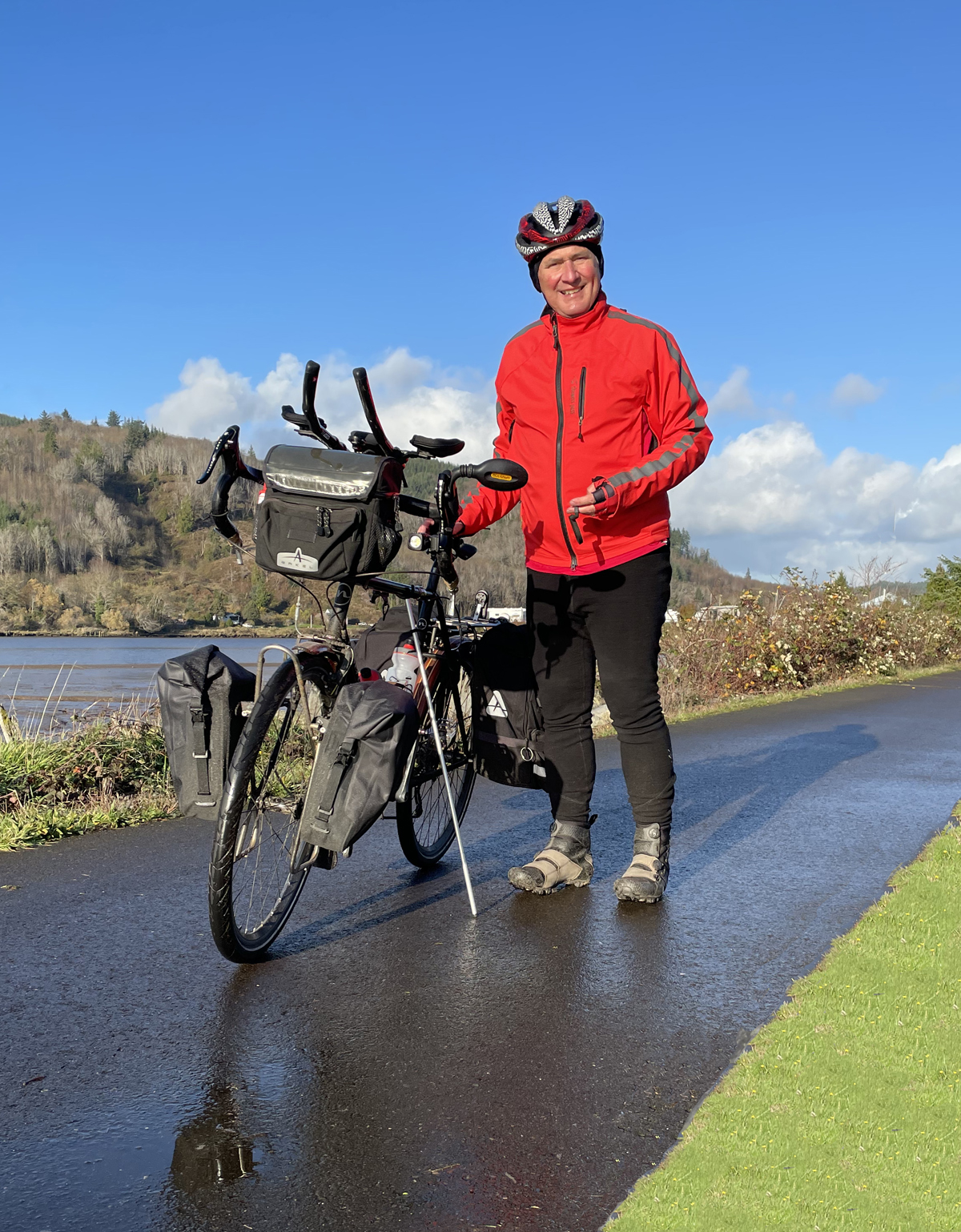
“I wouldn’t put a kickstand on my bicycle”, he explained, fearing the potential damage attaching a kickstand to the chainstay would do to the frame and his paint job. Laying the bike on its side wasn’t an option either. He still wanted a way to make it stand up. It wasn’t until he spotted an internet post showing a bike traveler using a stick with a fork on one end to prop up a bike that an idea began to percolate.
“I thought, well, that’s a very interesting solution, but who’s going to carry along a two-and-a-half-foot long stick, other than this guy?”
Tom was pitching his tent when the idea for the Click-Stand was born.
“And I looked at the tent poles, and that’s exactly when the aha moment hit.”
Tom created an early version that featured the folding tent-pole configuration and figured out a way to wedge the top end into a spot on his frame that supported the bike. He showed it to his touring buddy, but the pointed end wouldn’t catch any spot on his bike.
He then experimented attaching half of a large nylon washer to the end of the Click-Stand that touched the bike frame, which was satisfactory, and a forerunner of today’s model. He then joined his bike touring buddy on the ride to the Bay Area, and they both utilized their Click-Stands successfully. During the trip, Tom kept thinking about his new invention.
“I’ve thought of, and created, so many inventions, and ways to make things better during my life, but I’ve never tried to market one. Why not now?”
What Tom didn’t know then was that the percentage of inventions created by individual inventors that succeed commercially was pegged in one study at just 6.5%. Long odds indeed.
Like many inventors, Tom persisted and experimented, focusing primarily on a cradle that would fit under the top bar of most bicycles. The first iteration of the cradle was made from a plain white nylon washer with a nylon screw. While this worked, it wasn’t an elegant solution.
“So, I had to find a way to rubberize it”, he said about the nylon washer assembly, “and I went through all kinds of iterations on how you would do that.”
Mounting the nylon washer also involved multiple steps – cutting, resizing, sanding, drilling, tapping, mounting the washer and then dipping it in liquid plastic.
“I guess the only good thing was at that point,” Tom said looking back. “I wasn’t selling a ton of them, so I could kind of keep up with demand.”
Eventually Tom found a company in Vancouver, Washington that could make his cradles and the feet using injection molding. The company now has his molds and can fulfill orders as Tom needs them. He gets his tubing for the Click-Stand sections from a South Korean manufacturer and cuts them to size based on the customer’s measurements.
When you order your Click-Stand, you measure the distance from the “Contact Point” where the Click-Stand will touch your bike, straight down to the ground. Then measure the diameter of the tube where the Click-Stand cradle will support the bike.
You can choose how many sections you want, and which color, and Tom takes your measurements, inputs them into a special spreadsheet he developed that calculates the size of each section.
There are Click-Stands for almost any kind of bike: tandems, Bromptons, recumbents, heavy bikes, and lightweight bikes.
To prevent your bike from rolling forward, the Click-Stand comes with Brake Bands. These are custom corded mini bungee cord joined with a tab that allows you to slip them over your brake levers when squeezed to prevent your bike from rolling (User note: I apply the brake bands first, then prop up my bike with the Click-Stand). When you’re not using them, the bands sit firmly on your bars out of the way.
Tom sold the first Click-Stand in 2007, and many variations and 20,000 units later, the Click-Stand’s popularity continues to grow, primarily by word of mouth, which is how I discovered it.
My encounter with the Click-Stand came on a weekend bike camping trip with friends. A fellow traveler was struggling with the kickstand on his bike. He had one of those double-legged versions and it kept working loose and wasn’t keeping the bike stationary.
Observing this was one of our group who offered advice. “Get rid of that kickstand and get this,” he said, and pointed to his Click-Stand that was neatly propping up his gear-laden touring bike. He then did a quick demonstration of folding up the Click-Stand into a small bundle, then reversed the process by flipping it out and having it click neatly into place.
I was sold on the spot. I had a kickstand on my Surly Long Haul Trucker which worked fine until I loaded the bike with gear. The first time I went bike camping, I kicked out the kickstand, leaned my bike, the front wheel jerked left, and my Surly promptly fell over. After that I tried to rely on leaning my bike against walls, picnic tables, trees; any solid object I could use for this purpose, until I discovered the Click-Stand. I ditched my kickstand and have been relying primarily on my Click-Stand ever since.
Online reviews of the Click-Stand are positive. Reviewers do point out the minimal but extra effort required to fold and unfold the stand. You need to carry the Click-Stand somewhere on your bike, whereas a kickstand is already attached and ready to use. And a Click-Stand may not work well in soft or wet dirt, or sand, but neither does a kickstand.
While it is true that using a kickstand is a simple maneuver, it is unfair to compare it to the Click-Stand. Click-Stand is a complete paradigm shift from the traditional kickstand. It won’t damage your bike like a kickstand mounted on steel chainstay tubes – forget about carbon fiber frames. Comparing Click-Stand to kickstands is like comparing a road bike to a recumbent. They share the same function but in completely different structural and mechanical ways.
Since 2007, Tom has made every one of the Click-Stands by hand in his workshop in the basement of his home, in case you were thinking there was some third-party manufacturing partnership involved. Tom’s is a micro business – there are no employees, just him, making him one of 28.4 million non-employer businesses in the U.S.
Explained Tom, “It’s a micro business by design. I was retired and had other things I wanted to do.” Including spending time with his wife, working around the house, and riding bikes.
Plus, he wasn’t looking to run a full time business and he didn’t want employees. He doesn’t advertise. His social media content is a Facebook page. His website provides detailed information and a way to order Click-Stands, accessories, and replacement parts.
Tom is the sole developer, designer, manufacturer, and marketer of Click-Stand. Can he sustain this business for the long term?
“People ask me about that,” he admitted. “But it’s fun and I enjoy doing it”.
He also enjoys the interactions he has with people online that share stories about bicycling and pictures of their rigs supported by a Click-Stand.
“And that’s what makes it fun for me”.
So, when you order and receive your Click-Stand, take a moment and admire the detail, the craftsmanship, and the simplicity of the design. Built with loving care by Tom Nostrant, in a basement in Aberdeen, Washington.


When I upgraded to a Cannondale gravel bike (Topstone) and was fitting it out, I discovered there is no place to mount a kickstand. Contacting Cannondale, I was (rather rudely) told you can’t put a kickstand on the bike – either lean it or lay it on the ground.
I looked for a replacement, and thought I had one with a kickstand that clamps to the chainstay – but the Cannondale chain stays are basically round – so no luck there.
The Click stand was my salvation! Great device, lightweight and fits in a small top tube bag. After 1-½ years, only problem are the brake bands are starting to stretch and will need to be replaced.
I use pony tail holders to increase the tension on the brake bands. They can also be used as replacements for worn bands.