By Laura Howat — As a cyclist, it was my greatest honor to participate in the women’s Tour De France in 1988. The women’s Tour was inaugurated in 1984. The women’s 15-day Tour joined the men’s race one week into their 3 week race. The men and women races would be run concurrently with both events culminating in the Champs-Elysees stage. Unfortunately, the logistics of running the races concurrently became too much for the French promoters when their riders stopped dominating the podium and in 1992 the women’s Tour was moved to its own schedule in August and renamed La Grande Boucle Feminine. Sadly, the Grande Boucle’s run seems to have ended as well as the race has not been held since 2003.
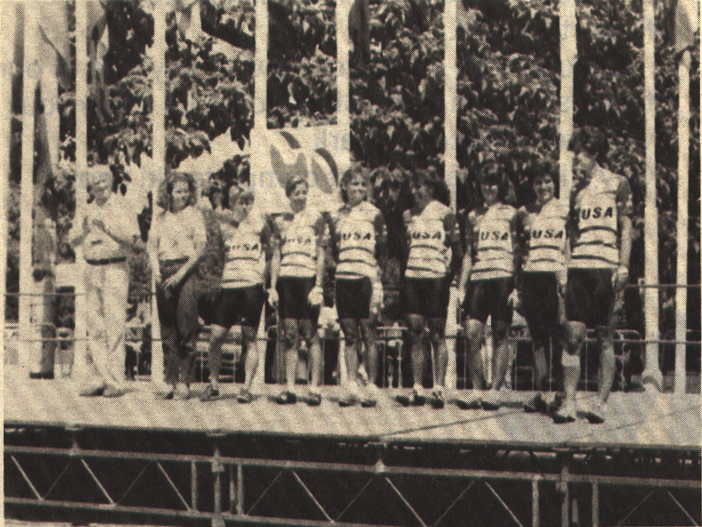
A picture of our team (USA) at the team presentation, 1988. From left, Tdf personnel, team manager Paula Andros, Betsy King, Laura Howat, Linda Brennaman, Laura Charameda, Annie Sirotniak, Susan Yeaton and Becky Evans. Photo courtesy Laura Howat
My invitation to the Tour de France in 1988 began a euphoric experience. It was an (almost) perfect several weeks. We circumnavigated a spectacular country, we were treated like royalty by the cycling fans, experienced dynamic racing, watched the men’s races and explored French villages and cities.
Michelin Tires, Peugeot automobiles and Tissot Swiss watches sent our American team of seven riders. Members were selected based on results and our ability to be a team rider. Our goal was to win stages. We came close. Our best sprinter, Linda Brenneman was second by a tire width once and she also had a fourth-place finish. I had more modest personal goals, to finish in the top half of general classification, and place in the top twenty in at least one stage.
The race started in the historic city of Strasbourg, along the German border, amid sunflower covered hills and rolling mountains. The international field contained riders from all over the globe. The racing was incredibly difficult during both the flat and mountainous stages. The flat stages wound through villages, over cobblestones and narrow roads. The “flat” stages always had several steep hills. The pace would be aggressive and hard since many more teams had an opportunity to win a flat stage rather than a mountainous stage. We would cruise along at 30 mph and fight for position in the pack the whole way. The mountainous stages were very steep and long and Jeannie Longo (France) and Maria Canins (Italy) would set the pace on these stages and burn riders off their wheel.
At first the aggressive European style of riding intimidated me. The pack would be twice as compact as in the U.S. The women often rode so close together they seemed to be leaning on each other. The Dutch were a good example of an aggressive team. Since they were last in the team standings, they were called to line up at the start line last each day. However, within the first mile of the race they would muscle their way to the front of the pack. The Dutch girls were very large; the smallest weighed about 160 lbs. I think they assumed if you didn’t get out of their way you would just bounce off them anyway. This style of riding assisted the Dutch with two stage wins.
The Dutch team was aggressive but it was Frenchwoman Jeannie Longo who dominated the race overall with five stage wins and the Tour de France title. If you follow women’s cycling, you know her career has been unparalleled but there were many controversies in the eighties. She had tested positive for banned substances several times. In 1987, she broke the women’s hour record but international authorities disallowed it after her drug testing came up positive. But the French seemed to care more about winning than playing by the rules. In fact, after the final 1988 Tour stage, the mayor of Paris gave Longo a decorative clock in celebration of her “hour record.”
I have many outstanding memories of my Tour de France trip. Here are a few of my experiences.
One of our hardest mountain stages was the Puy de Dome. The Puy is an extinct volcano with an even grade of 12% spiraling around the mountain for seven kilometers. The first 50k of the race wound through six villages and contained two 3rd category climbs. (1st category is the hardest but even a 4th category is difficult.) I had a gear of 42 x 25 for the 1st category Puy and could barely turn it over. As I was struggling up the climb, a man came running up on my right, pushing my teammate Betsy. Betsy King was a favorite with the spectators since she had raced in the Tour five years, was a former stage winner and spoke fluent French. When the man tired, another willing spectator took up the push. Soon she was out of sight. I looked back and saw one of the huge Dutch women gaining on me by the pushes of the numerous Dutch fans. I hadn’t been pushed yet but it seemed like a good time to get in on the action. I tried to make eye contact with Betsy’s willing pals since I was not brave enough to fake tears and cry “Poussez-moi!” like some others. Sure enough several spectators took the cue and gave me a push. It was still difficult to reach the finish, but the dedication of the 500,000 fans really helped. These spectators had climbed the mountain on foot before the road closure several hours earlier. They cheered enthusiastically for each cyclist and competed with each other to hand up drinking water and wet sponges.
One of the more touching moments of my Tour occurred while we were stopped for lunch. The police motorcycles had escorted the team cars and vans to a rest area so we could eat our prepared meal. I was sitting on the ground with a sandwich in hand when one of the team managers approached me. He knew I was American since I still had on my team jersey. He said, “Hello.” Communicating through the language barrier was difficult but he wanted to know how I liked the race. I asked him what team he managed. It turned out he was from the Russian team. (This was still the time of the Cold War!) He seemed so excited to talk with us. He said, “We are friends. Enemies for politicians only. We are friends.”
Another experience gave truth to the Andy Warhol prediction that everyone shall be famous for at least 15 minutes during their lifetime. I didn’t become famous for the honor of winning a stage but for a dramatic incident much less glorious. The 85k stage from La Clayette to Chalon sur Saone, in central France, had a steep 4th category climb within the first 20k. Maria Canins set a brutal pace up the climb which created a break. The fast pace continued during the flat kilometers after the summit. I couldn’t believe I had finally made the break! This was going to be a great day! However, I soon noticed that my front tire was going soft. I raised my hand to signal to the race commissaire who would radio my team car to come to the front of the caravan to change my wheel. Several minutes passed with no sign of my team car. I was riding on the rim when we began a twisty descent and was forced to drop off the race due to the danger of cornering on the rim. By now I was waving and yelling furiously. Obviously, my team car was still stuck behind the main field. A French team car offered to change my wheel. They pulled over and changed my wheel within seconds. As they were pushing me off, I heard a horn and screeching brakes behind me. Next thing I knew I was flying and tumbling through the air. Paula, our team manager finally made it through the traffic and was speeding trying to catch up to me. She was unable to stop the team car in time when she caught up to me and plowed into me and my bike from behind. I was dazed when they picked me up off the pavement but felt ok. My steel framed bike weathered the mishap fine except for the twisted handlebars. A camera crew who had stopped to film the wheel change got this bonus footage. The accident was shown on French national television ten times that day. The French people, who identify with suffering, gave me a special award for courage and extra attention during the remaining stages.
It was interesting to note that the French television narrator, who wanted a date with Paula, televised that it was the Italian team car that hit me to keep Paula out of trouble. He picked the Italians because they were ahead of the French in GC standings.
The Tour concluded on the historic Parisian boulevard, the Champs-Elysees. It was in this final stage that I finally cracked the top twenty during a stage and finished 14th. I was grateful to have finished the race (38th place GC) and fortunate to have participated in this storied Tour de France.
TOUR DE FRANCE FEMMES 2022 | STAGE 1 | PARIS TOUR EIFFEL > CHAMPS-ÉLYSÉES
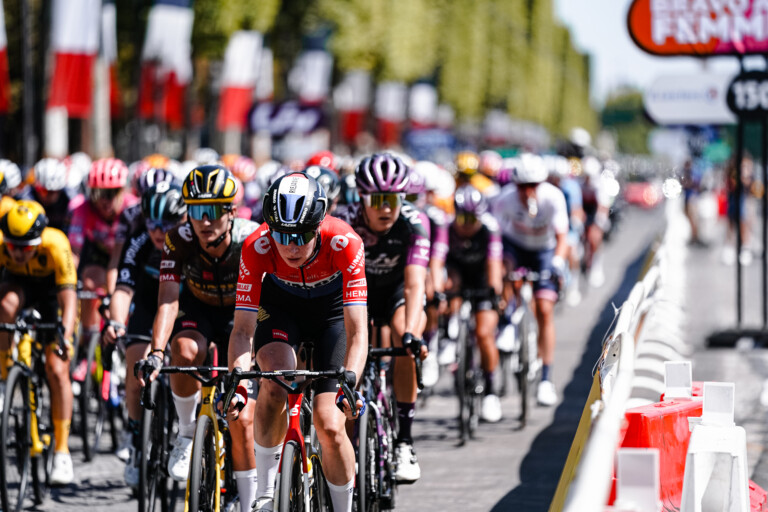
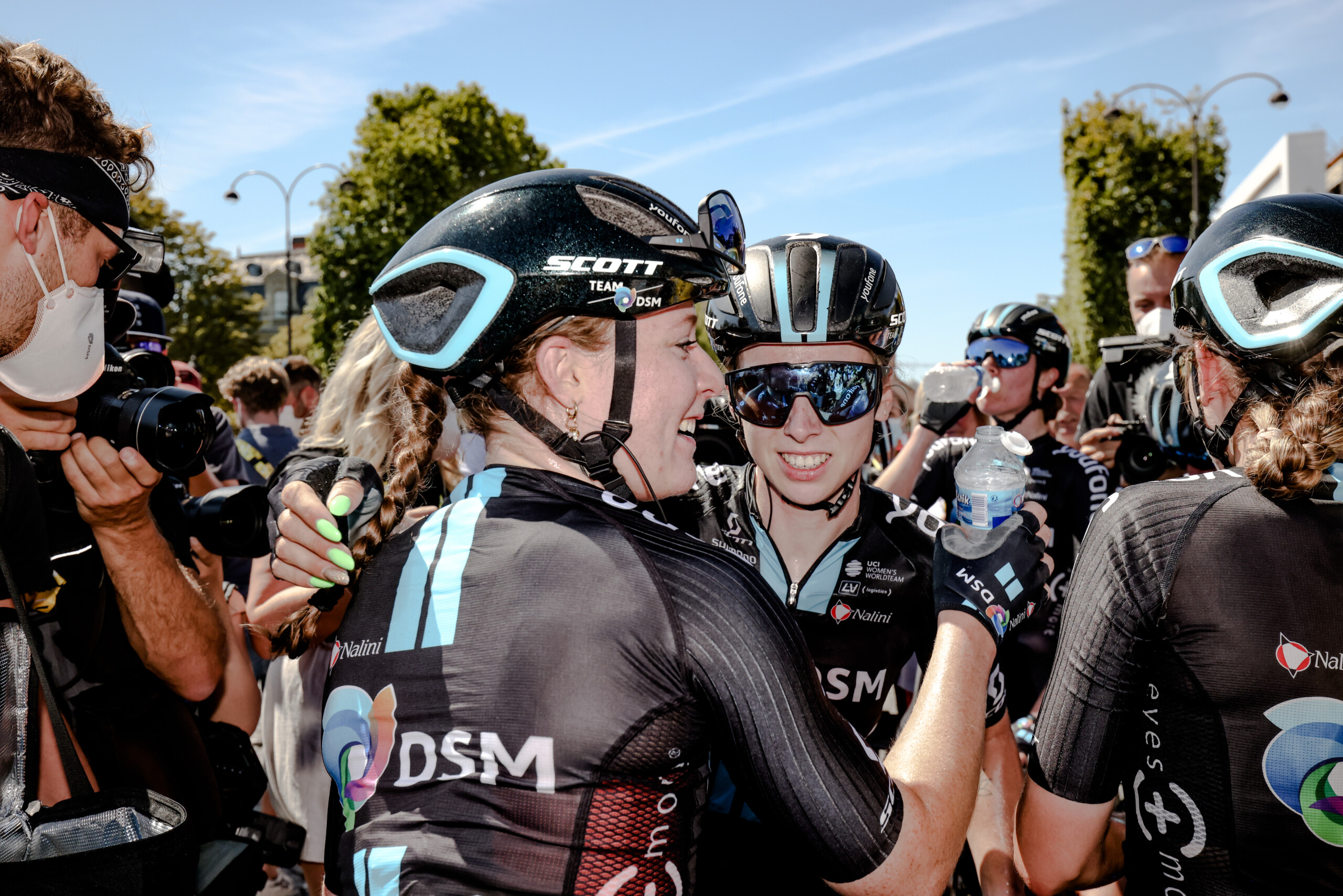
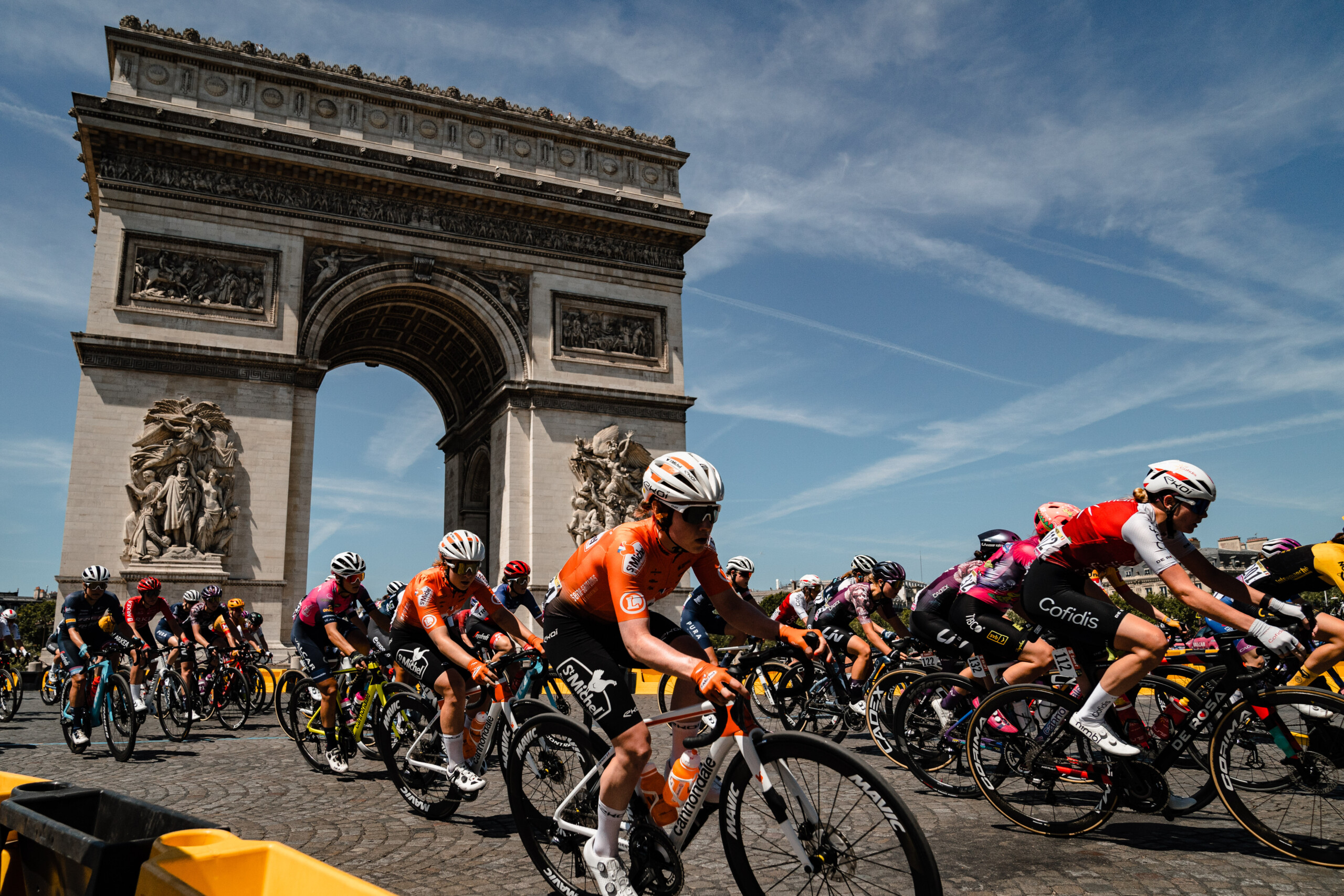
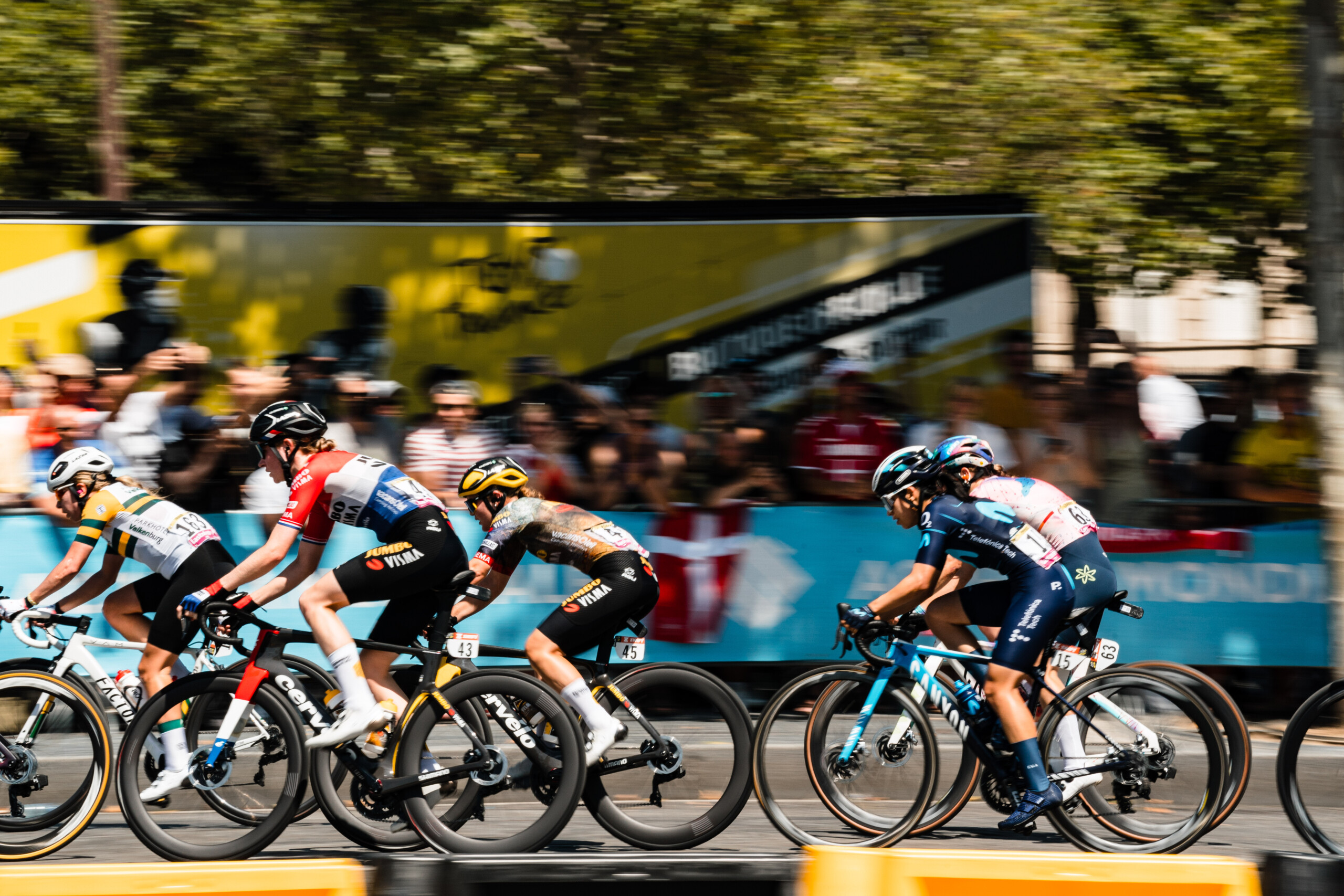
Champs-Élysées, PARIS (July 24th 2022) — History has been written on the Champs-Élysées as the superfast Lorena Wiebes (Team DSM) and the peloton of the Tour de France Femmes avec Zwift covered the first stage of the race this Sunday, in Paris. After 81.6km of fast racing, the Dutch sprinter took her 16th victory of the year… the most historic, claiming the Maillot Jaune of leader of the Tour ahead of her compatriot Marianne Vos (Team Jumbo-Visma). Lotte Kopecky (Team SD Worx) rounded out the podium of the day. The race will now set off towards the East, heading to the finish atop La Super Planche des Belles Filles next Sunday.
24/07/2022 – Tour de France femmes avec Zwift 2022 – Etape 1 – Paris Tour Eiffel / Champs-Elysees (81,7 km) – WIEBES Lorena (TEAM DSM) – Vainqueure de l’etape
The peloton started from the Eiffel Tower in the early afternoon with 144 trailblazers to pave the way for the first Tour de France Femmes avec Zwift. Attackers immediately set off, with riders from EF-Education-Tibco-SVB and Human Powered Health showing their intent to make the break. But the succession of attacks and counter-attacks make it hard to open a gap.
24/07/2022 – Tour de France femmes avec Zwift 2022 – Etape 1 – Paris Tour Eiffel / Champs-Elysees (81,7 km) –
First break and first sprint
After 18 km of racing around the Champs-Élysées, Mischa Bredewold (Parkhotel Valkenburg) attacks. She is quickly joined by Emily Newsom (EF Education-Tibco-SVB) and they open the first significant gaps.
With 8 laps (54.4km) to go, the leading duo are 25’’ ahead of Morgane Coston (Arkea), trying to chase them down, and 40’’ ahead of the bunch. But the peloton accelerate towards the first intermediate sprint (km 34.8). The attackers are reeled in and Marianne Vos (Jumbo-Visma) takes the first points of the day against Lorena Wiebes (Team DSM).
24/07/2022 – Tour de France femmes avec Zwift 2022 – Etape 1 – Paris Tour Eiffel / Champs-Elysees (81,7 km) –
First KOM
Pauline Allin (Arkea) launches a new move inside the last 45km. With many counter-attackers trying to join her, the gap is minimal. Henrietta Christie (Human Powered Health) eventually makes it a 2-woman breakaway, 15’’ ahead of the bunch. But the peloton accelerate again towards the second intermediate sprint, dominated by Lotte Kopecky (SD Worx).
Into the last 25km, Femke Markus (Parkhotel Valkenburg) and Anne Dorthe Ysland (Uno-X) attack and Marta Lach (Ceratizit-WNT) joins them at the front of the race. They battle it out on the only categorised ascent of the day with the peloton chasing hard behind them. Markus takes the 2 KOM points at the summit and the first polka-dot jersey is hers.
Femke Markus: “It’s special and it’s unbelievable. We worked on this plan yesterday and it’s unbelievable. I just won this jersey [polka-dot jersey]! I really like the pressure sometimes and I was looking forward to the stage and the Tour Femmes. It’s like a dream come true and now to wear the jersey is overwhelming. I hope I can defend it tomorrow and wear it again after the stage.”
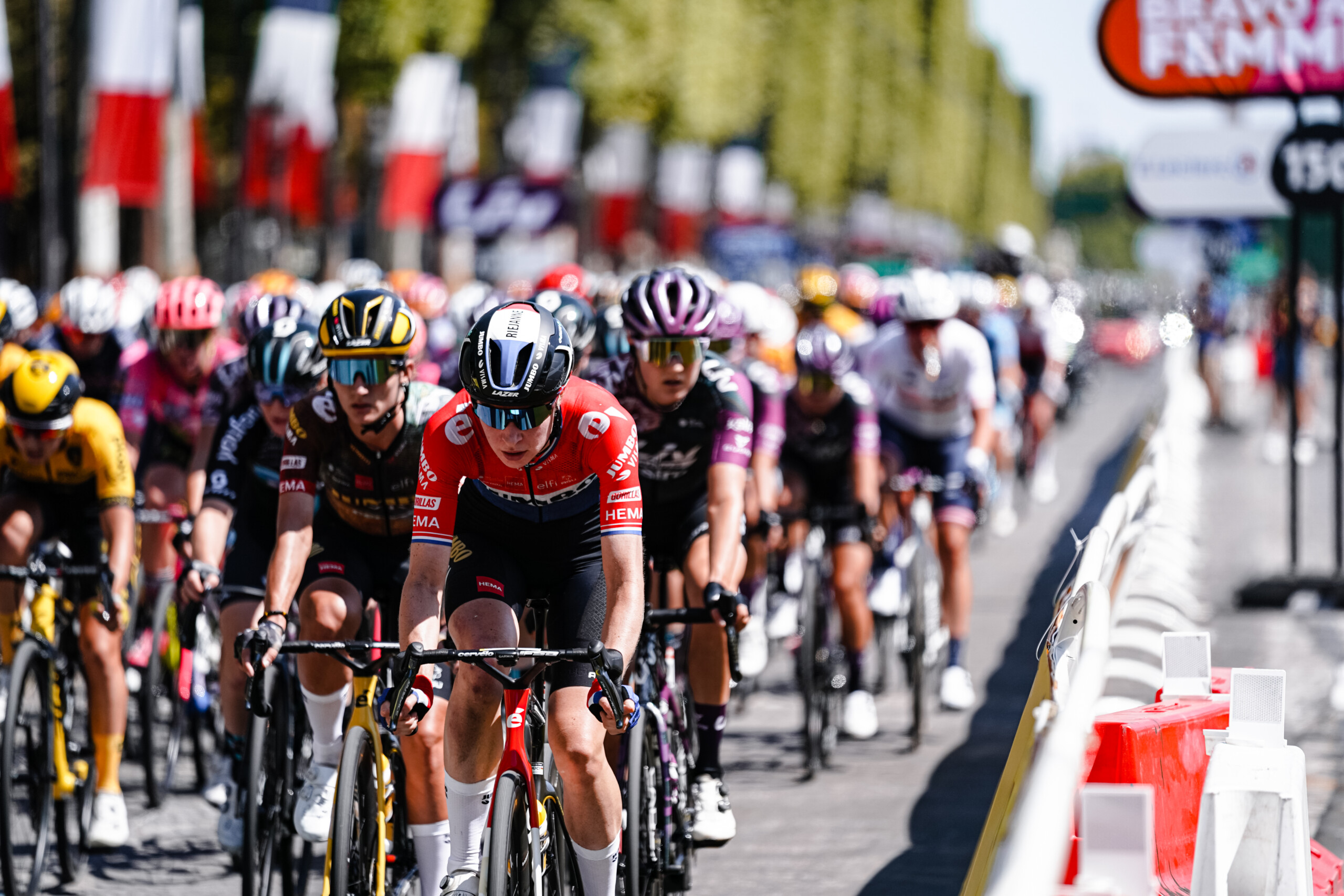
24/07/2022 – Tour de France femmes avec Zwift 2022 – Etape 1 – Paris Tour Eiffel / Champs-Elysees (81,7 km) – MARKUS Riejanne (TEAM JUMBO VISMA)
First abandon and first Maillot Jaune
The peloton immediately get back to the attackers… And Gladys Verhulst (Le Col-Wahoo) goes on the move, alone. She opens a gap of 50’’ ahead of the final 10km while Alana Castrique (Cofidis) suffers a crash and abandons the race.
Verhulst is stil 30’’ ahead of her rivals when she enters the final lap. She is eventually caught 2.3km away from the line. Ellen van Dijk (Trek-Segafredo) powers to the front but Team DSM and Jumbo-Visma move past her to set a magnificent sprint between the icon Vos and the rising star Wiebes, who narrowly takes the first Maillot Jaune.
Gladys Verhulst: “I believed I could win, a little bit, because 50 seconds is a lot on the Champs-Élysées. But I knew deep down that the peloton was going to set off on the last lap. There was little chance of going to the end, but hey, on a misunderstanding, it can work! I had chills, I was alone in the lead. It was all about me, it was “go Gladys, go Gladys!”. It was super cool, it’s the most beautiful avenue in the world, I think every French woman dreams of being at the front on this avenue. My attack was more or less planned. I was supposed to do the KOM, then I was told to counter-attack. It’s mission accomplished. But this is only the beginning, I still have a lot to prove.”
Lorena Wiebes: “I was quite relaxed before the start, I did everything as normal, and then I became nervous towards the end but I’m very happy I could finish tis off! This is amazing and I think the whole team deserves this after the amazing season we’ve already had. It was really close but luckily I could accelerate one more time and hold it to the finish line. I’m really happy that I was finally able to race on the Champs Élysées. It was a hard race, a fast one. It feels really special to ride here around Paris and even more special to wear the Maillot Jaune.”
Other Key Points:
While Lorena Wiebes is currently leading the Maillot Vert (Points) competition with 70 points, the jersey will be worn by Lotte Kopecky (Team SD Worx) on Stage 2. Kopecky is currently sitting in 2nd place with 60 points, while perennial favorite Marianne Vos (Team Jumbo-Visma) is in 3rd place another 5 points back.
By placing 6th in the stage, in the same time as Wiebes, Maike Van Der Duin (Le Col-Wahoo) is currently the leader of the Maillot Blanc (Best Young Rider) competition.
Canyon-SRAM Racing leads the Best Team competition after Stage 1, and will be wearing yellow dossards on Stage 2, while Gladys Verhulst’s (Le Col-Wahoo) attack earned her the Combativity prize for the Stage 1 and the red dossard.
Story, photos, and video all courtesy of Amaury Sport Organisation (A.S.O.)
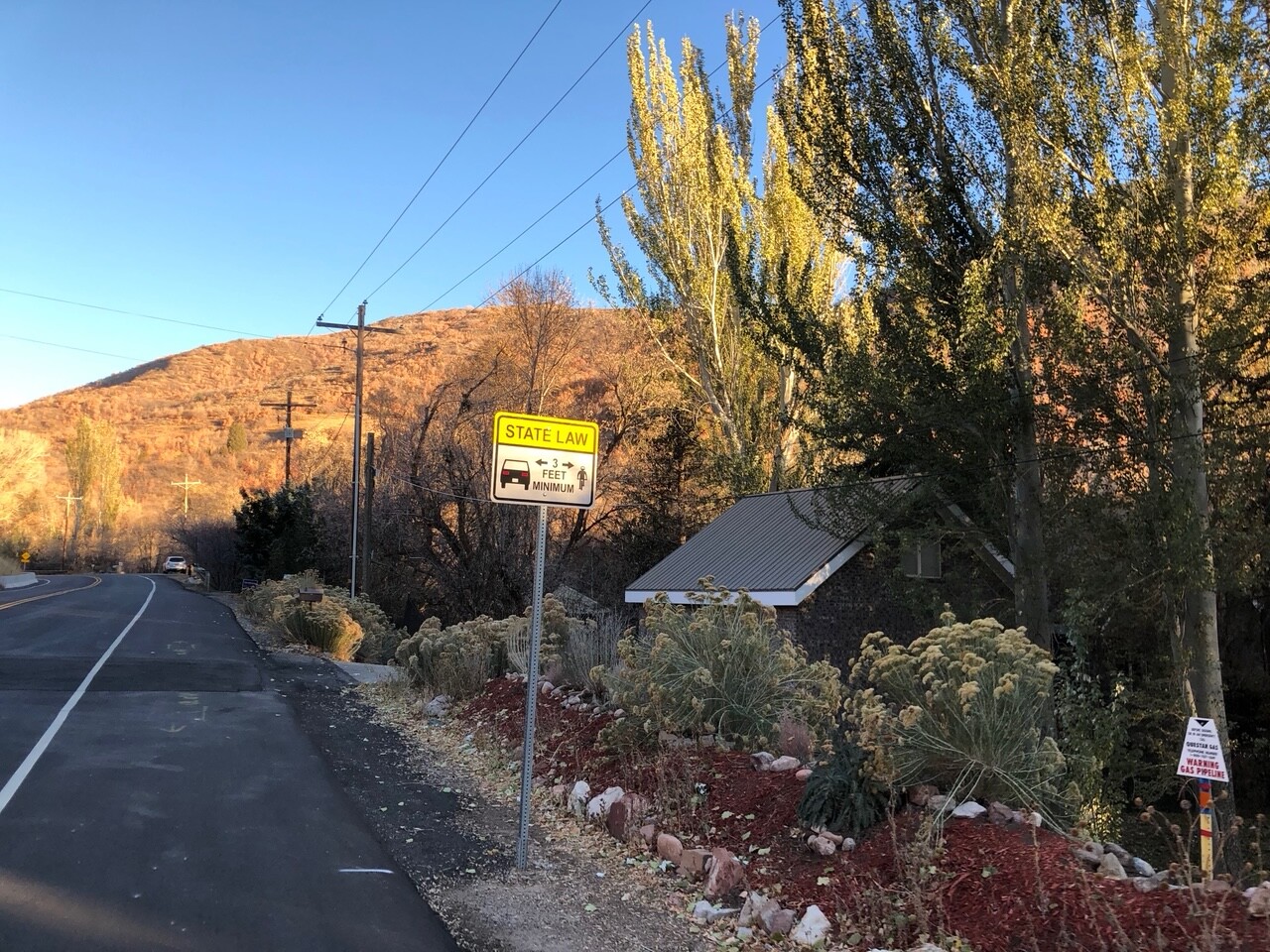
By Charles Pekow — If the police vigorously enforce passing laws, it will increase compliance, a federal review found. Grand Rapids, MI instituted a law requiring motorists to give bicyclists a five-foot clearance when passing. Knoxville, TN implemented a three-foot law. Both cities actively publicized the law. Police in both towns rode bikes with ultrasound monitors to judge how far away the autos actually passed. While 26 percent of motorists violated the five-foot rule, only five percent violated the three-foot rule.
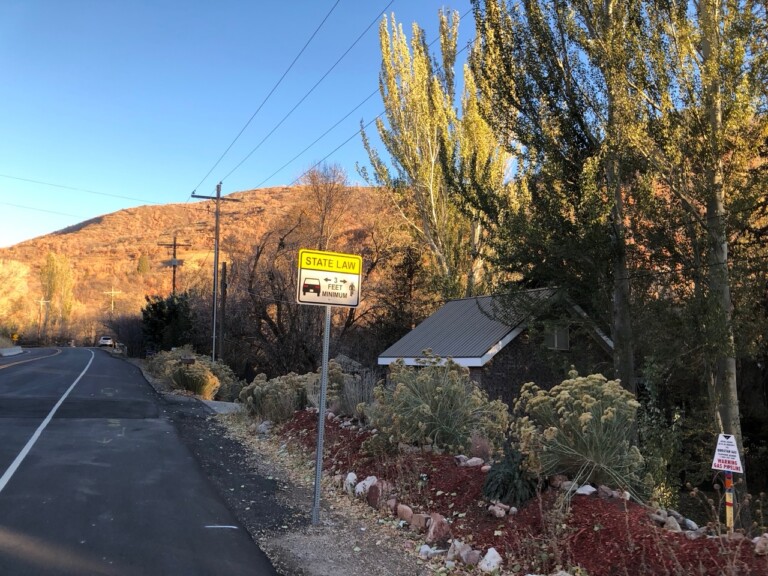
State Law: 3 feet Minimum for bikes. Photo by Dave Iltis
When a motorist passed too closely, the police officer on the bike would radio a squad car to stop the motorist. Police in both cities often just gave warnings instead of tickets. But they found at the end of the study that motorists were more likely to comply with the laws. The National Highway Traffic Safety Administration reported the results in Evaluating High-Visibility Enforcement of Bicycle Passing Laws (https://rosap.ntl.bts.gov/view/dot/60877).
The 1st edition of the Tour de France Femmes avec Zwift will hold its Grand Départ on Sunday July 24 in Paris at 1:40pm, at the foot of the Eiffel Tower, with a first stage that follows the circuit on the Champs-Elysées a few hours before the Tour de France.
Sprinter Lorena Wiebes is dreaming of wearing the first Maillot Jaune, as are world champion Elisa Balsamo and women’s cycling legend Marianne Vos.
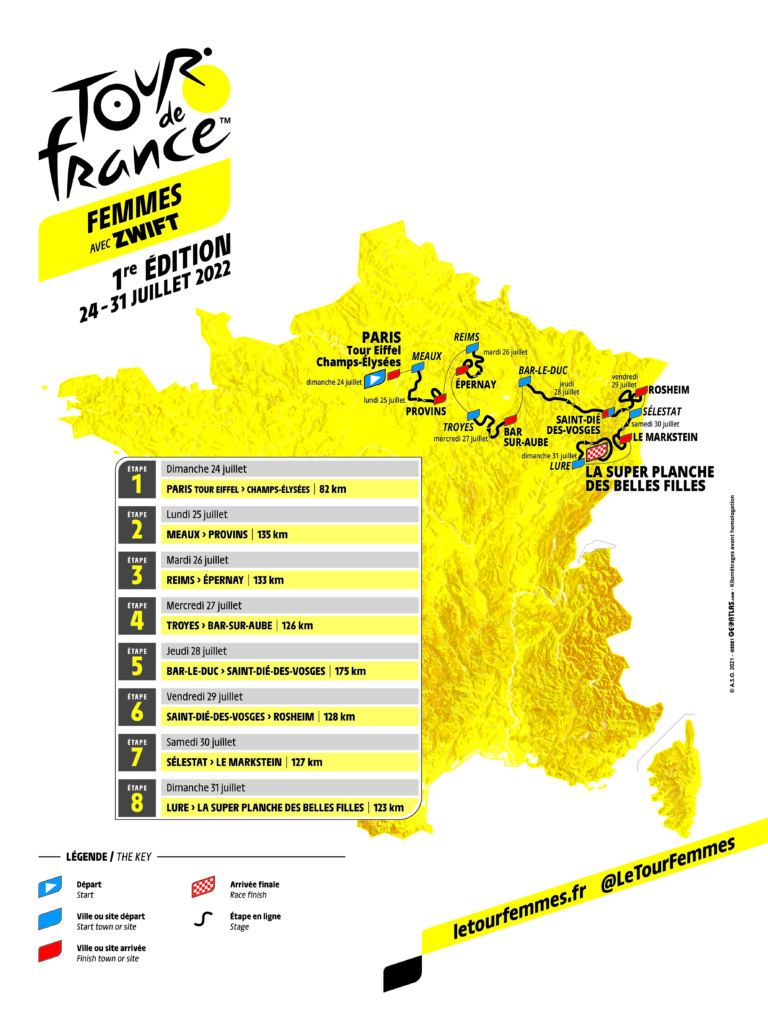
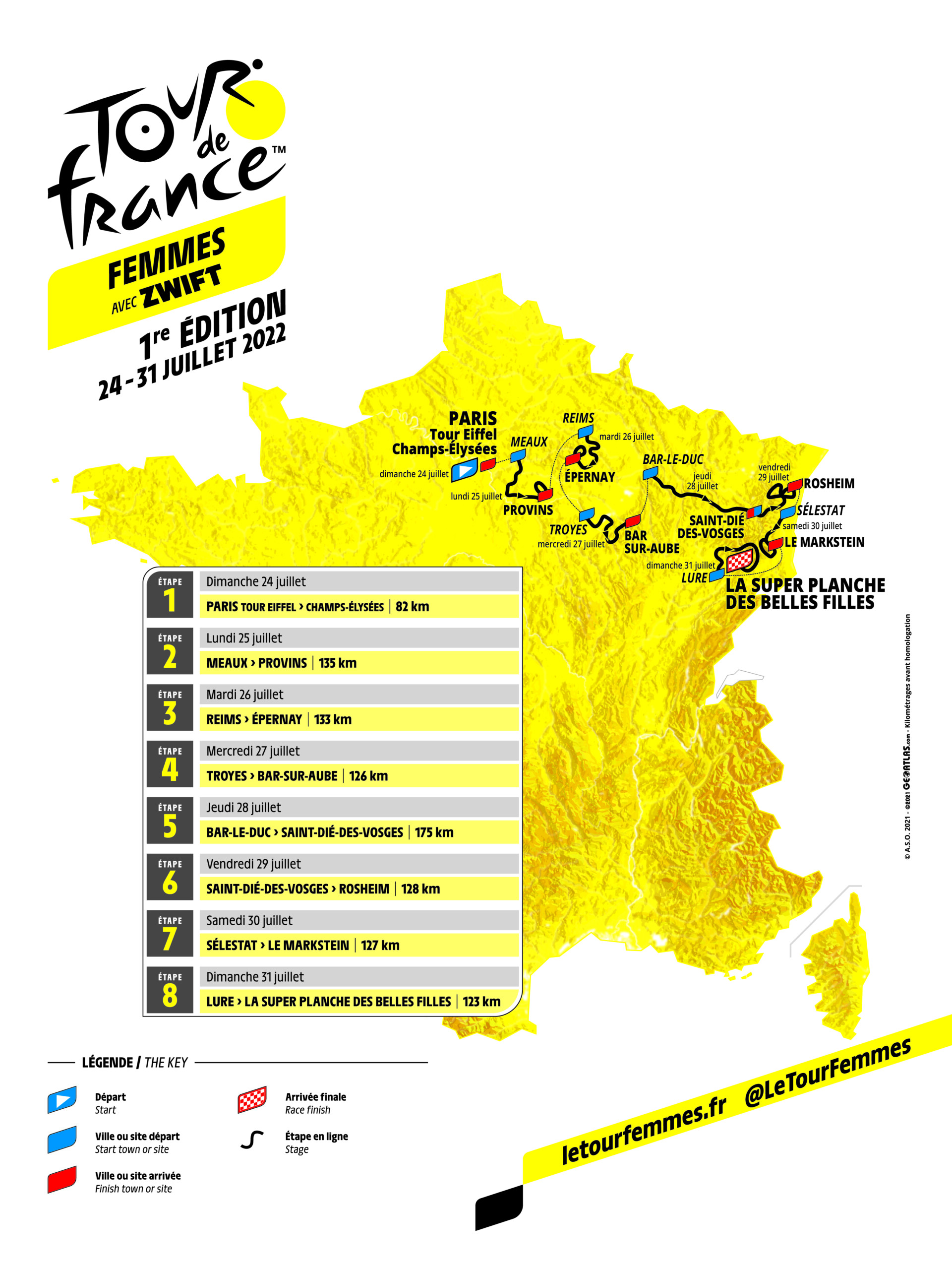
The race, made up of eight stages, will head east on Monday and will finish on the Super Planche des Belles Filles on Sunday, July 31.
Dutchwoman Annemiek van Vleuten is the major favorite, although the competition is set to be particularly fierce, especially from the SD Worx team. The leading 18 riders in the UCI world classification will all be taking starter’s orders.
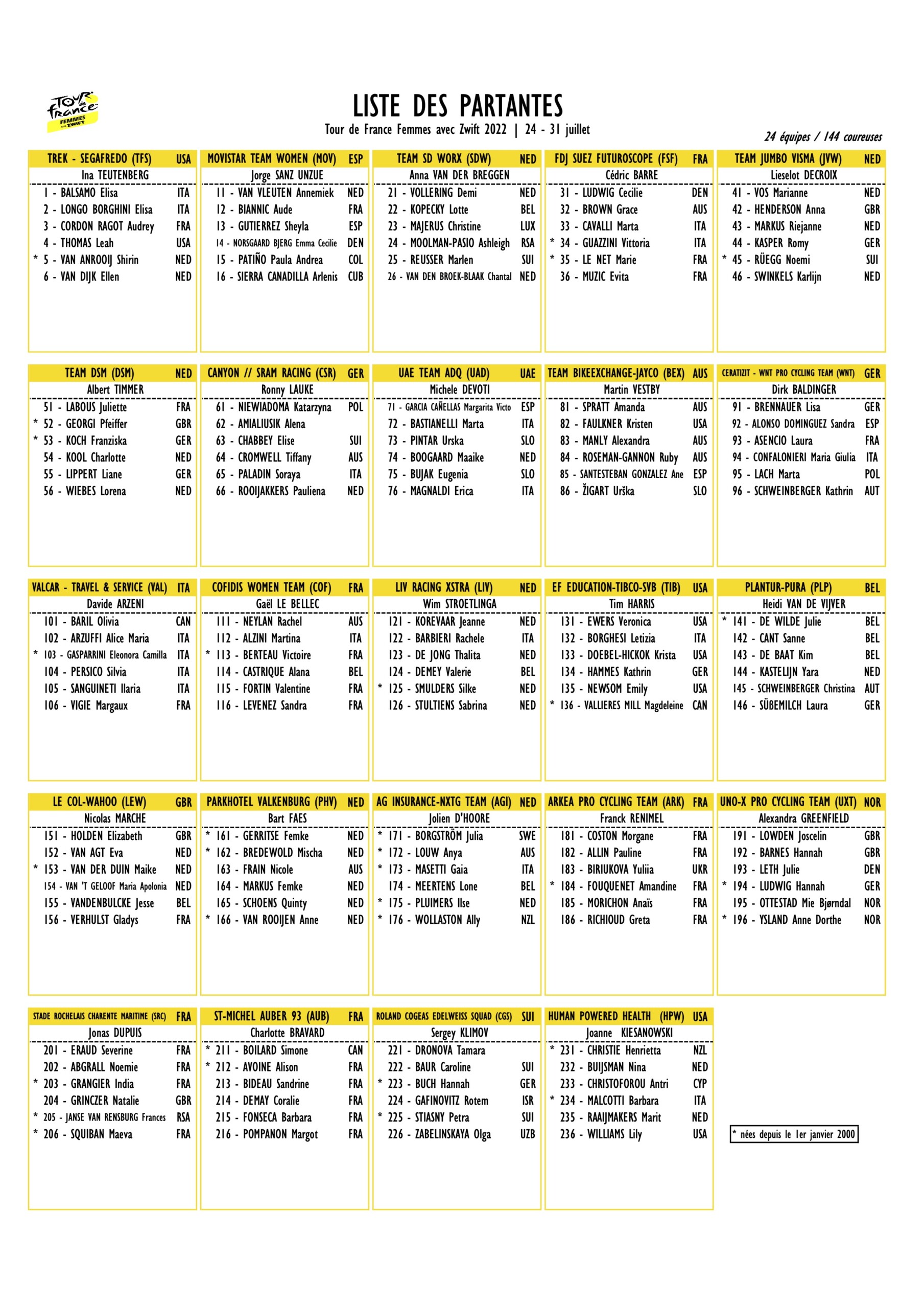
MEAUX, France (July 23, 2022) — On the day before the Grand Départ, the 144 riders on the 1st edition of the Tour de France Femmes avec Zwift met up in Meaux, at the Théâtre du Luxembourg, to attend the pre-race briefing. This town, the most largely populated in the Seine-et-Marne department, will host the start of the second stage on Monday, perhaps in the presence of Tadej Pogacar, as revealed by his partner Urska Zigart, selected at the last minute by Team Bike-Exchange Jayco following cases of COVID in her team. By Sunday, the women’s pack will have returned to Paris to tackle the roads on which the 81.6-km long first stage will take place.
Map of the 2022 Tour de France Femmes courtesy ASO
“We’ll be setting off in front of the Eiffel Tower followed by 12 laps of the circuit on the Champs-Elysées,” explained race director Franck Perque. “On this stage, we should see the sprinters’ teams leading the way. The winner of the stage will have the privilege of wearing the first yellow jersey”. As from Monday, the pack will head east, with the high points of gravel track sections on Wednesday and a weekend in the Vosges Mountains, where the climbers will do battle to see who wins the general classification. On Sunday July 31, the Super Planche des Belles Filles is where the event will conclude its 1033.6 kilometers of racing.
Lorena Wiebes: “We will give everything to get the yellow jersey”
The first Maillot Jaune is likely to be worn by a sprinter on Sunday evening and as such, speedster Lorena Wiebes is the major favorite. The Dutch rider boasts the most victories this season (15), four of which were achieved only last week on the Baloise Ladies Tour. In a show of ambition, she has painted her nails yellow on one hand and green on the other, because the DSM rider also has her sights set on winning the points classification. Firstly, however, her focus is on the first stage, which is seemingly tailor-made for her.
“I’ve been aiming for victory on the Champs-Elysées since I discovered the route,” she admitted. “Starting in front of the Eiffel Tower and riding along the Champs-Elysées will be a special feeling. We will give everything to get the Maillot Jaune. I think I’ll be fighting for it with Elisa Balsamo [Trek-Segafredo], Marianne Vos [Jumbo-Visma], Lotte Kopecky [SD Worx] or Emma Norsgaard [Movistar]. It’s going to be chaos. I’m expecting there will be plenty of attacks, especially since there are two intermediate sprints and climbing points to be won. Everyone will be keen to make their mark”.
Annemiek Van Vleuten: “It’s a little sad to see me as the only favorite”
Following the third triumph in her career on the Giro at the beginning of July, Annemiek van Vleuten (Movistar Team Women) is the main favorite for the general classification in the eyes of the world.
“That’s what people say, but all the teams are at the top level,” were the more modest words of the world number one, head and shoulders above the rest on Liège-Bastogne-Liège in spring. “It’s going to be tough and the competition is fierce. Marta Cavalli [from FDJ-Suez-Futuroscope, her runner-up on the Giro] has shown she is in very good form, Mavi Garcia [UAE Team ADQ] is as well, not forgetting, of course, Demi Vollering and Ashleigh Moolman-Pasio [SD Worx]. It’s a little sad to see me as the only favorite. I think that we saw on the Giro that there are more pretenders to the crown than that”.
The 39-year-old Dutchwoman is “very excited to be starting this new race”. However, from what she says, the Maillot Jaune is not an obsession for her, with her retirement approaching at the end of 2023. “I’m not the type of rider who dreams about jerseys, trophies or victories. My goal is to always be in the best form at the start of the race. I think that is the case for this Tour. I’m in very good form, perhaps even better than on the Giro,” admitted the Olympic and three times World Champion with a smile.
SD Worx pays homage to Pieters
SD Worx, the leading team in the UCI classification, will be wearing a special jersey for the first stage as they pay homage to Amy Pieters, World Champion in 2019, who came out of a coma at the end of April, four months after a terrible fall during training.
“She designed the jersey before her accident because she wanted to create one for her cycling store,” explained her team-mate Ashleigh Moolman-Pasio. “She’s making good progress in her recovery. She’s still an integral part of our team and we want to do our very best for her on Sunday whilst wearing this jersey”.
Another tribute would be to win a hatful of stages and triumph in the general classification, which is an ambition that SD Worx seems capable of accomplishing. With two pretenders for the Maillot Jaune (Ashleigh Moolman-Pasio and Demi Vollering), a formidable sprinter (Lotte Kopecky), a former world champion (Chantal van den Broek-Blaak) and the current European time-trial champion (Marlen Reusser), the Dutch team could light up the Tour at the slightest opportunity, quite like the Jumbo-Visma team has done on the Tour de France.
“We have a chance of winning on all the stages,” claims Ashleigh Moolman-Pasio, who will retire at the end of the year. “The idea is to put on the best show for the fans”.
Trek-Segafredo: a team of champions
The American team will have a strong case to make on the first stage with world champion Elisa Balsamo wearing race number 1. However, the Italian will willingly trade in her rainbow jersey for a yellow one.
“Of course, it’s my dream,” said the rider who has recently won two sprint stages on the Giro. “But it will be very tough because all the other girls will want it too. A podium finish would already be an excellent result on the Champs-Elysées and I want to help Elisa Longo-Borghini for the general classification”.
Half of the team will start wearing a distinctive jersey because Dutchwoman Ellen van Dijk is the current European Champion and Audrey Cordon-Ragot is the French champion. Speeding up and down the Champs-Elysées with the tricolor jersey is “the icing on the cake” for the rider from Brittany.
“It was my genuine goal to start this race wearing this jersey,” she said, savoring the moment in advance. “It’s difficult to have personal objectives in a team like this. My goal has almost been accomplished; now, I just have to enjoy it to the full and be in communion with the spectators who are going to be encouraging me a lot. And if the team manages to grab some victories, then that will be great”.
Broadcast in 190 countries
The race will be broadcasted in 190 countries. In France, France Télévisions will be the official broadcaster and Eurosport in Europe. Two and a half hours of each stage will be televised live every day, apart from the first stage which will be broadcast in its entirety.
The race will be streamed in the United States on Peacock TV. The race will also be streamed on GCN+ using a VPN to bypass geo-restrictions.
The race can also be followed live in its entirety on the official web site, with commentary in French and English.
By Charles Pekow — The most bike crashes don’t necessarily occur in the most well-traveled routes. That’s what Pittsburgh found out when the city overlayed data on where collisions take place with data on where cyclists most often ride. It’s not the heavily trafficked corridors but the less-ridden roads that lack a stop sign or bike lane or involve a blind curve or some other danger where riders are more likely to get smashed.
Pittsburgh used information collected by Streetlight Data, an analytics firm that measures where people ride by tracking devices such as cellphones. The City Department of Mobility and Infrastructure is using the data to prioritize safety projects.
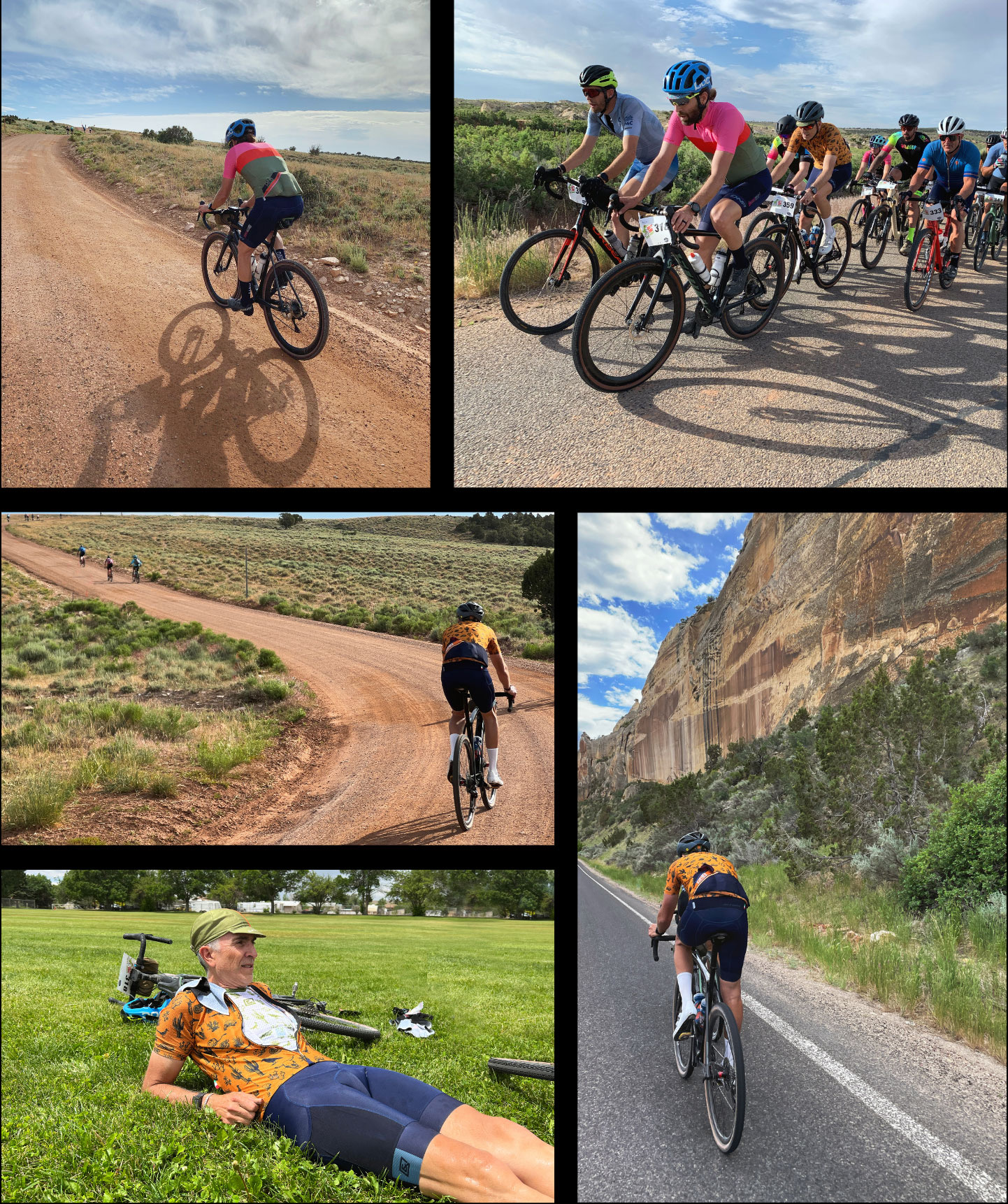
Compiled by Breanne Nalder Harward, Race Director — Rather than write a summary of how the Dirty Dino Gravel Grinder went, I asked various riders to share their experiences. Here are some personal accounts from an LA-SLC couple that each did different courses, a CO gal that had a rough day but made the most of it, the DNA Cycling staff that came down to sponsor the event and rode the mid-distance course together, and 2 other UT riders that tackled the long course.
Cassie Cobb: Dino-Lite 1st Female Finisher
The Dirty Dino Gravel Grinder was an awesome experience all around. We arrived on Friday for packet pickup, and we ended up picking up a new jersey from DNA Cycling while we were at it. Race day the weather held as the first groups rolled out. I did the Dino-Lite, the 32-mile option. We were the last group to leave, and you could tell we were all out there to have fun and ride some beautiful new terrain. The ride was amazing, and all 8 miles of gravel on our short course were pristine – I was joking with my climbing buddy that we could be on our road bikes (that’s how nice the gravel is!). The aid station at the top of the climb marked our turn around and after grabbing some First Endurance EFS and Swedish Fish snacks, we turned down for the descent into the wind. The headwinds made the last few miles a slow grind, but it was all smiles at the finish! I was the first female to cross the line, and my small but mighty finish was met with cold towels and beverages. I spent the rest of the afternoon hanging in the sun with my fellow Dino-Lite racers. We had a blast!
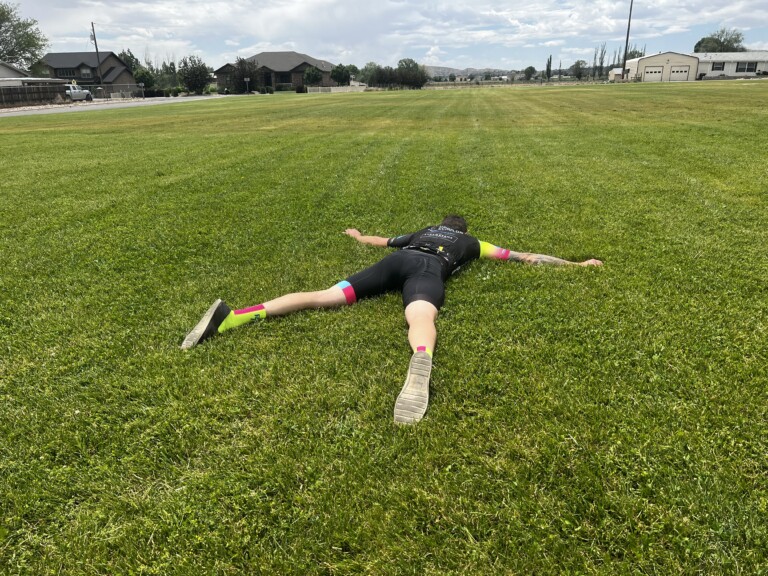
John Cobb’s impression of a starfish. Photo courtesy John Cobb
John Cobb: Dino-Bite 3rd 30-39 (on an MTB no less!)
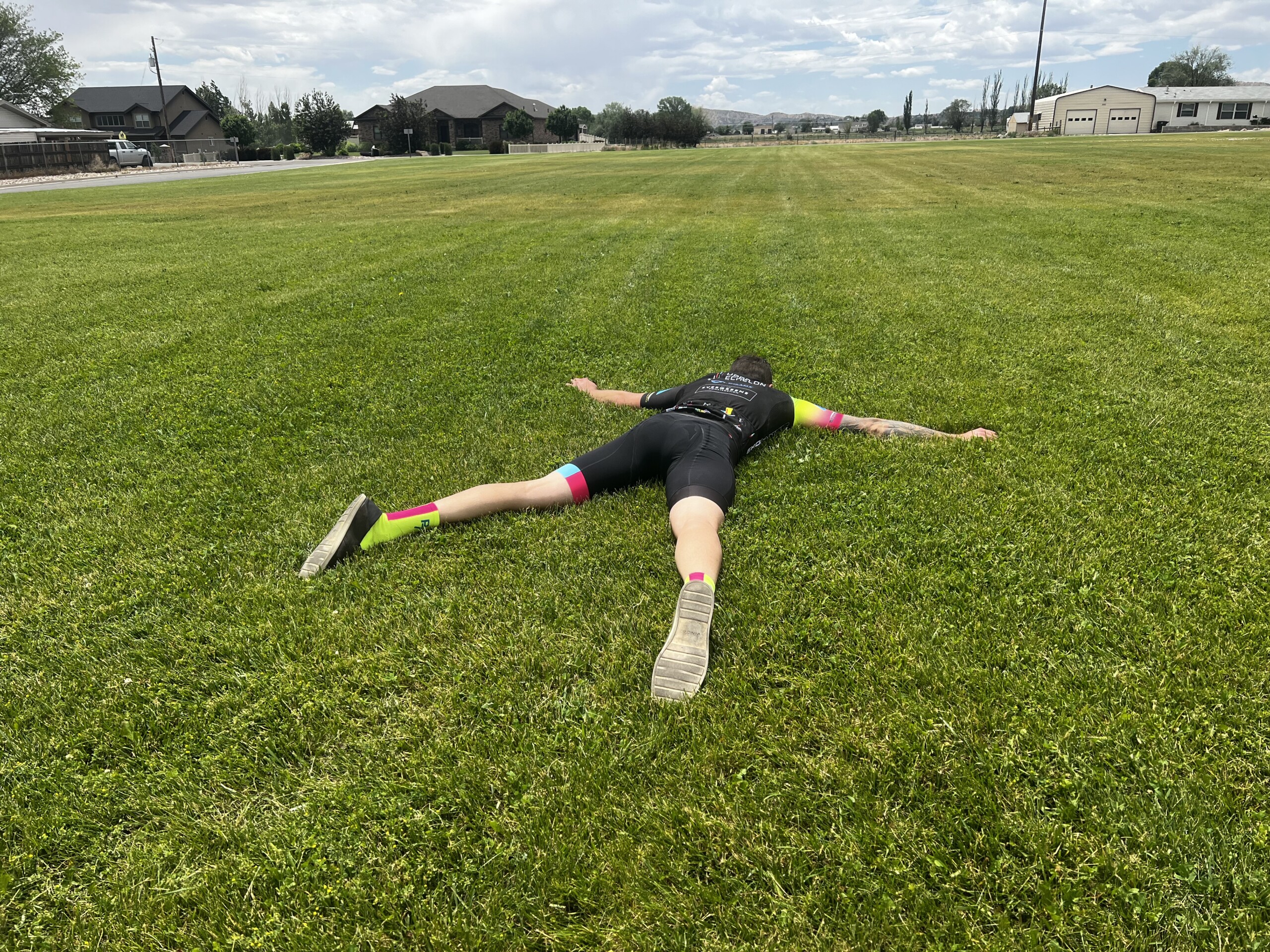
Dirty Dino was a messy and fun adventure. We started with a soul crushing climb into the woods, stringing out the field. By mile 30, civilization had faded into the rear-view mirror and hope was a mirage of an aid station up ahead. Dirt and sand crusted the edges of my helmet and gritted down the starting jitters. A costume of a T-Rex, no doubt a child, was the reminder I was still yet in a race. Soon after, the descent pushed us into a valley with running water and cliffs on both sides. The final miles became a group effort, as stragglers were plucked into a pace line for the asphalt finish. Not to be out done by Moe or Curly, we blew past the last turn and scrambled back for our photo finish. Exhausted and dehydrated, I fell to the elementary school lawn, creating my rendition of a starfish. It had been a test of wills, but I’m already excited for next year.
Dawn Manfredonia: Dino Bite Finisher
I signed up for the very challenging Dino-Mite course which was a grueling 106 miles with 9,400 ft of vertical gain, but I made more than a few mistakes with my nutrition and hydration and wound up switching to the Dino-Bite 60-mile course which was still a whopping 6,155 ft of climbing. I was reminded that mental fitness is as important as physical fitness. I had a lot of anxiety before this race and kept questioning myself on whether or not I could do a race like this, so I didn’t sleep well the night before. If you had asked me how this race went the day it took place, I would have said I’m never racing my bike ever again and I would have for sure broken up with my bike. My mind reached some pretty dark places that day and I felt disappointed in myself for not finishing the 106-mile course, but mistakes are opportunities for growth and rather than dig myself in a hole, this was the best option for me given how crummy I felt. I still don’t enjoy climbing, but that won’t stop me from challenging myself to events like this again!
Photo courtesy DNA Cycling
DNA Cycling Crew: All Crushed the Dino-Bite Course!
The DNA staff packed up and headed down to Vernal for the inaugural Dirty Dino Gravel Grinder. This event exceeded all expectations. The team opted for the Dino Bite with 59 miles and 5600 ft of vert. Within the first 15 miles, we gained 3,100 ft of vert climbing Taylor Mountain Road. After the main climb, riders found rolling terrain with punchy climbs and fast descents. Temperatures were perfect. The higher riders climbed, the cooler it became. The final summit push for the Dino Bite loop passes by Simm’s Peak at mile 30. With 29 miles left, riders start the descent back to the finish. “For those wondering about support, it couldn’t have been better. Aid stations were stocked, and the volunteers were fantastic. This event is on our to-do list for years to come. Highly recommend.”
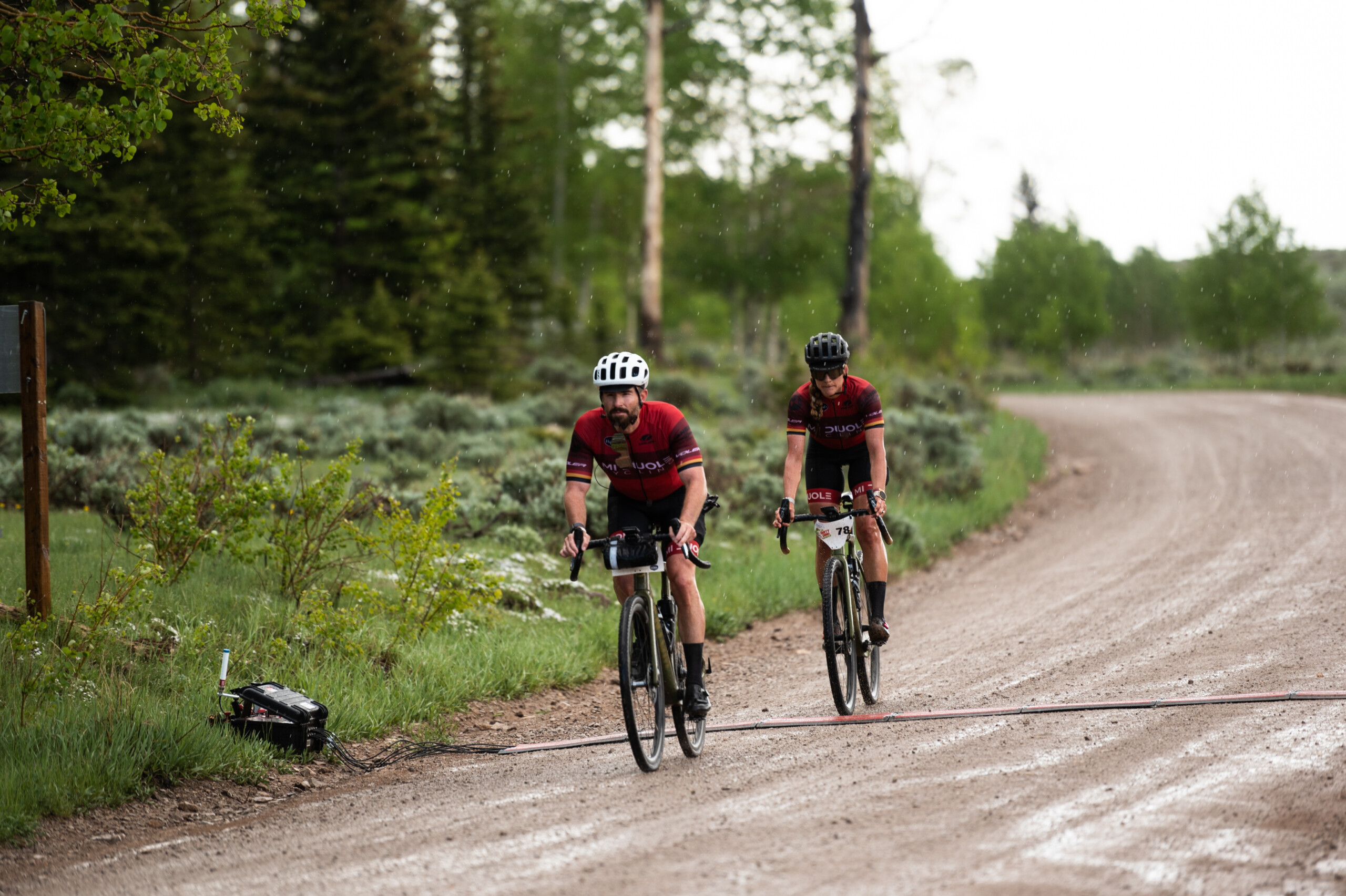
A pair of Mi Duole riders. Photo courtesy Ali Dudley
Matt Tennison: Dino-Mite Finisher
Interesting day. Definitely not my best, but I gave all that I had. The elevation literally drained me. I could barely push low endurance on the out and back climb, and I was completely destroyed. Then when I got back down to the pavement, back into the oxygen, I was able to push upper endurance and tempo again, even though I was completely blown. Apparently, I really struggle with long stints at high elevation. Nate (my teammate) beat me by like 25 minutes. I thought I was a lot closer to his level than that. I think riding in Spain and CA at sea-level gave me a false sense of fitness and power. Don’t get me wrong, I am not unhappy. I gave all that I had and finished 4th behind three really strong guys, although I was 20 min behind 3rd. I also made some tactical mistakes that likely cost me 7-10 minutes. Oh well, I’ll learn from those. I LOVED the course (except the out and back, which I hated with all my soul). It was the most beautiful course I have ever ridden and there were spots that I would’ve only thought possible in a painting. Also, Nate and I agreed it was a stellar event. So good!!
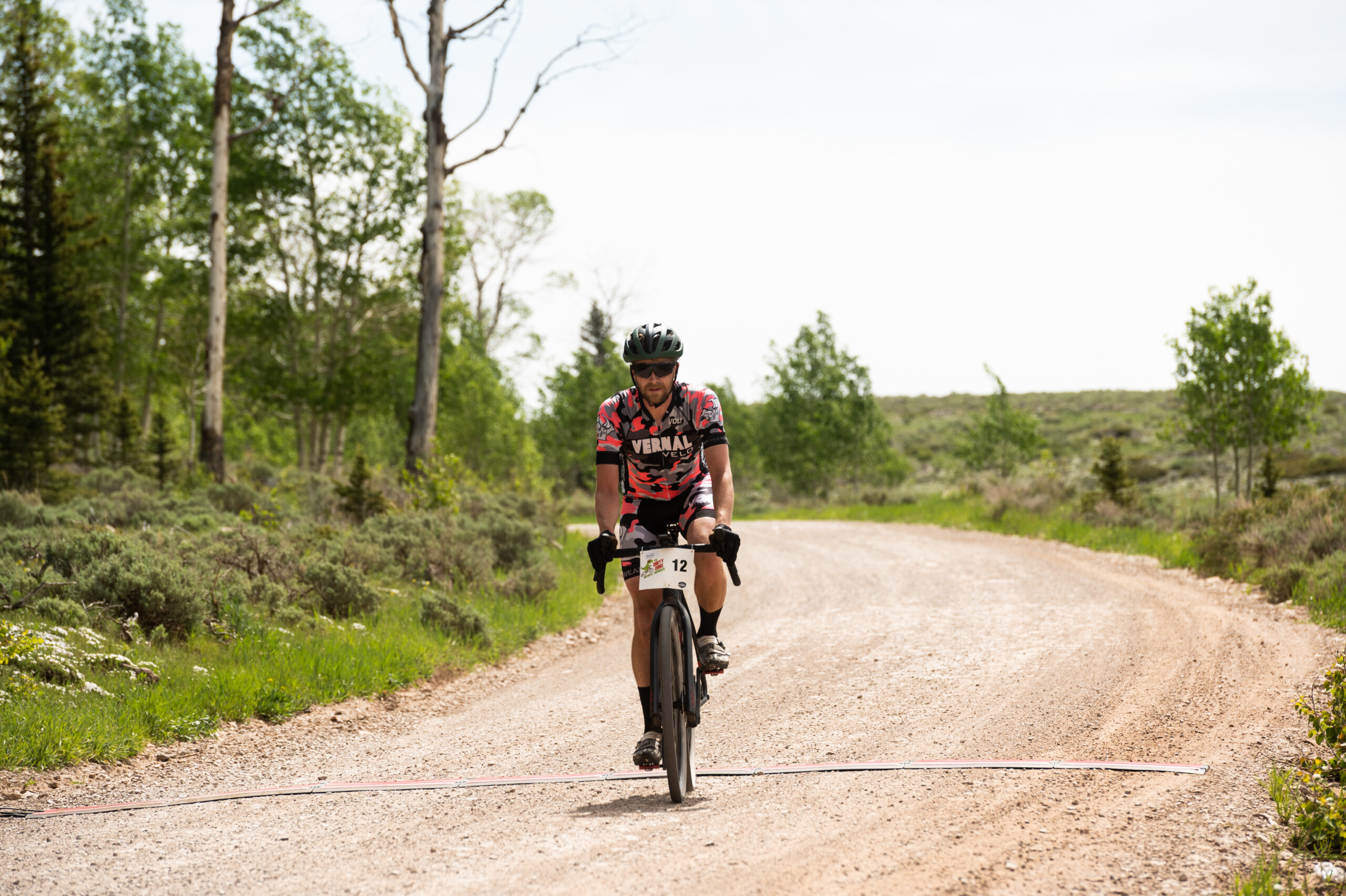
One of Vernal’s local riders tackling home roads. Photo courtesy Ali Dudley
Jessica Taverna: Dino-Mite 3rd Open Women
First things first, put this race on your calendar for next year! If you didn’t make it to the inaugural Dirty Dino Gravel Grinder, you definitely do not want to miss out in the future. My own race weekend got off to a bit of an inauspicious start as I treated everyone on the shakeout ride to a delightful serenade of squealing brakes – and not just when they were in use! But thanks to a well-planned race expo, and to the benefit of everyone who’d be around me the next morning, I handed my bike over to the Ventum mechanic and he got me all set and ready with useful but silent brakes. They’d come in handy the next day with ~10,000 feet of descending to match the ~10,000 feet of climbing we had before us.
Race director Breanne Nalder Harward pitched DDGG as a great Crusher training race, and somewhere around mile 60 as I made my way up to the race highpoint at Hacking Lake, I realized just how accurate that statement was – by mile 69, we would easily hit roughly the same vert as Crusher … but with another 35 miles of racing left to do! While I love Crusher, I have to say this race isn’t just good prep – it is every bit as good and maybe even better as a goal race. You spend the better part of the course above 9,000 feet, only descending back to the Vernal valley floor as you finish. That means you spend the vast majority racing high in the Uintas, surrounded by forests, cruising alongside streams, turning corners to get views of the even higher peaks. While it was an open course, there was minimal vehicle traffic, and I was happily impressed by how many cars slowed down around me to help reduce the dust factor. The course is gorgeous, and my only regret was, being as I was trying to actually race the thing, I didn’t get any pictures!
These roads were perfection – fun, fast, perfect dirt. For those who like a little spice (aka chunk and rowdiness) with their gravel, as I do, the Hacking Lake out and back had just what I needed, with a rollicking descent testing handling skills and line choice that had me laughing to myself with glee. And while I could have done without the burly headwind on the final 15 mile “the map says I’m going downhill so why am I working so hard” stretch, the variable weather of these summer races is all part of the game, and part of why the former alpine climber in me loves these kind of events.
One of the highlights of DDGG was seeing the way the community of Vernal embraced the race. At dinner the night before at Antica Forma, our server asked what exactly this “big bike thing” was all about and whether it was going on Sunday too – they were busier than normal, and she felt bad the service wasn’t as fast as usual and wanted to be prepared if we’d be around all weekend. She said it was great “seeing all these folks come to Vernal” – we thanked her for what was definitely not slow service and let her know there would probably be some very hungry folks after the race on Sat evening. And if word gets out like it should about how great this event is, they’ll definitely need to plan for even more visitors next year! I will certainly be among them.
Truman Glasgow: Dino-Mite 1st Open Men:
The Dirty Dino Gravel Grinder was an awesome race! Never have I ridden high mountain gravel roads in such perfect condition. The course was fast and the scenery was incredible. I definitely plan on coming back and racing it again!
Director Summary
Not only was this the inaugural event, but this was also my first endeavor as a race director. While I found this job to be harder (and more tiring!) than any race I’ve ever participated in during my career as a professional, I feel that I’ve found a new adventure and I’m hungry to make the Dirty Dino an event that everyone wants to attend. In the attempt to grow this event into a staple on all your calendars, I hope these experiences shared above inspire you to join the fun next year and bring your family and friends for an adventure in Dinosaur Land! For more information on the Dirty Dino Gravel Grinder, check out gravel-dino.com
Cyclists Can Join the Fight to Find a Cure for Cystic Fibrosis
The Cystic Fibrosis Community and the Utah – Idaho Chapter of the Cystic Fibrosis Foundation will host the 11th annual CF Cycle for Life as part of a national effort to raise funds and awareness for cystic fibrosis. This year’s ride will take place in scenic Summit County, Utah and is supported by CF Families along the entire route.
Photo courtesy CF Cycle For Life
“I ride to support my daughter and all those battling CF,” said long-time participant and mother to a daughter with CF, Suzie Featherstone. “Being part of a team who is doing whatever they can to better the lives of those battling Cystic Fibrosis is a team I want to be part of. There is power in numbers and I truly believe if we continue to work together we will one day find a cure for all those with CF.”
Photo courtesy CF Cycle For Life
Rider Jonathan Woodland said; “For the personal challenge and accomplishment, there is nothing quite like a long distance bike ride to to experience the primal forces nature like gravity, friction, and wind in the great outdoors. I ride to be part of the optimistic and brave CF community and to raise money for the great cause to find a cure. Most of all I ride in solidarity with my wife as she continually and courageously fights this disease.”
CF Cycle for Life event details:
Saturday, August 27th at John’s Park in Henefer, UT – CF Cycle for Life is a fully-supported ride with route options of 10, 25, 35, 55, 75, 100 miles. From breakfast to our cycle post party, you can enjoy fully stocked rest stops every 10-12 miles, bike mechanics, and support vehicles to help you complete your ride. Afterwards, enjoy a fully catered lunch and drink in our beer garden hosted by Shades brewing. Take your ride to the next level by signing up today and help make CF stand for Cure Found
How to Register
To get involved in CF Cycle for Life and help fight CF, please call the Cystic Fibrosis Foundation Utah and Idaho Chapter at 801-410-7266 or visit https://fightcf.cff.org/UTcycle.
Use code #UTcycle2022 to receive 100% off your event registration fee!
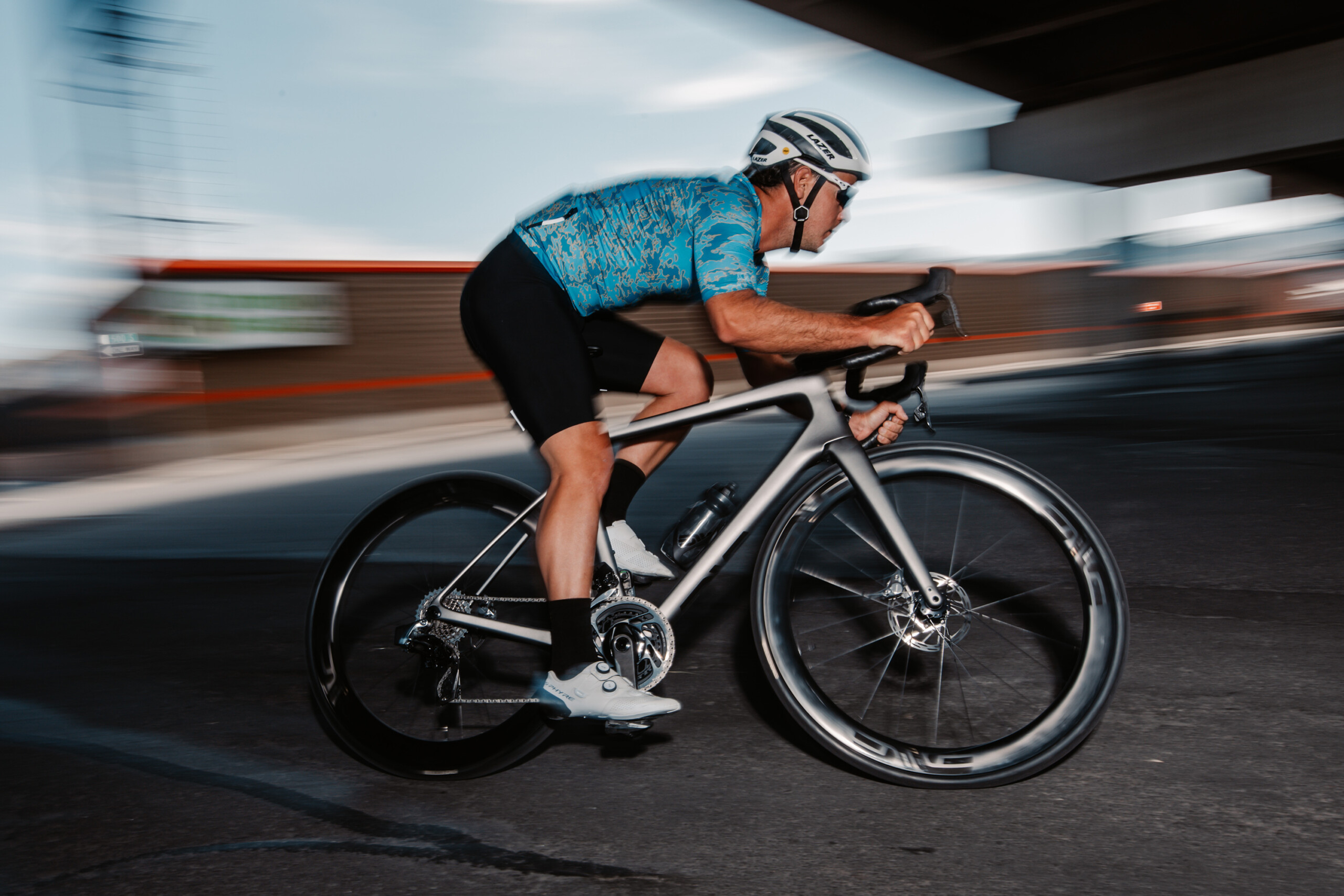
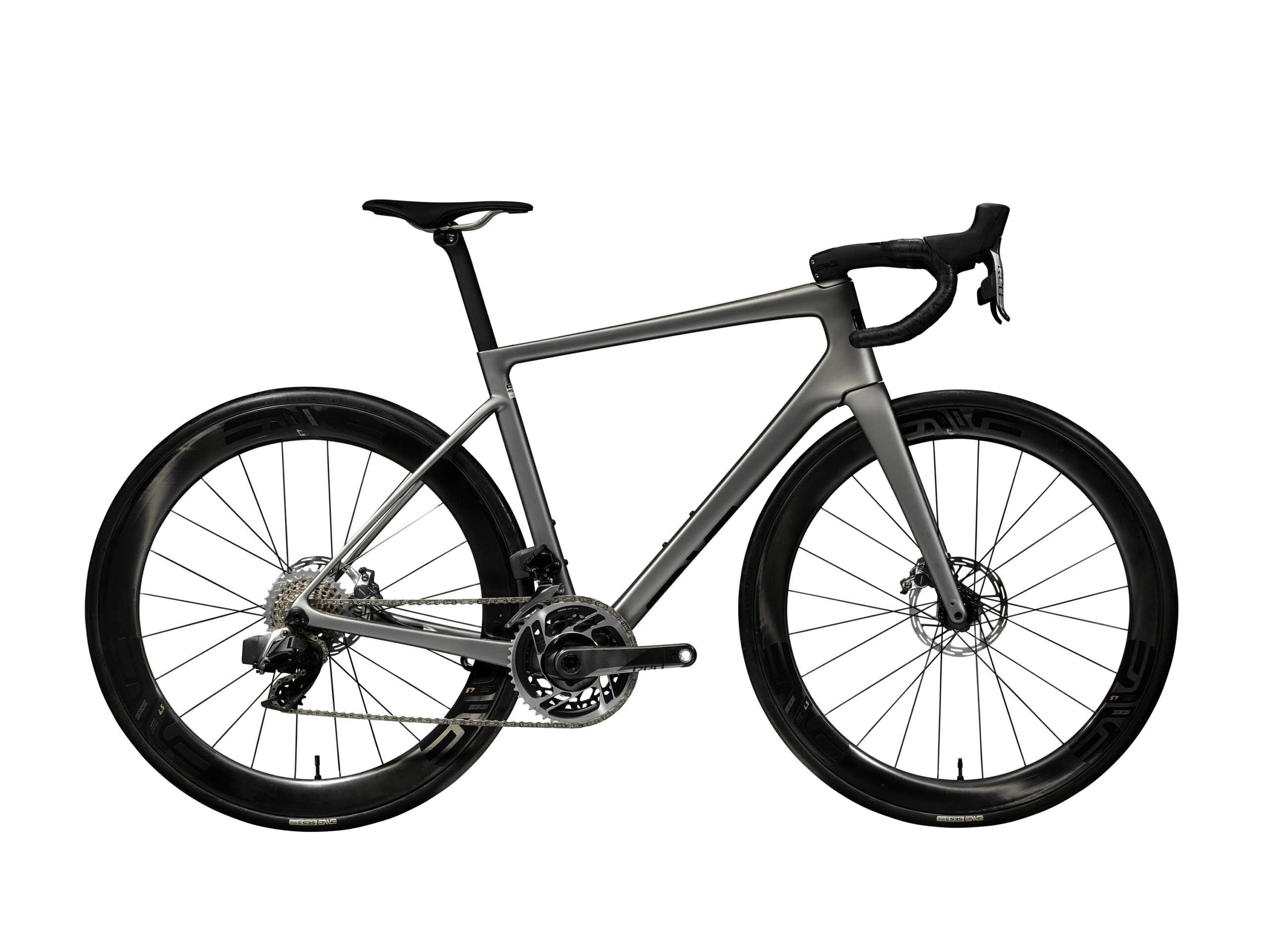
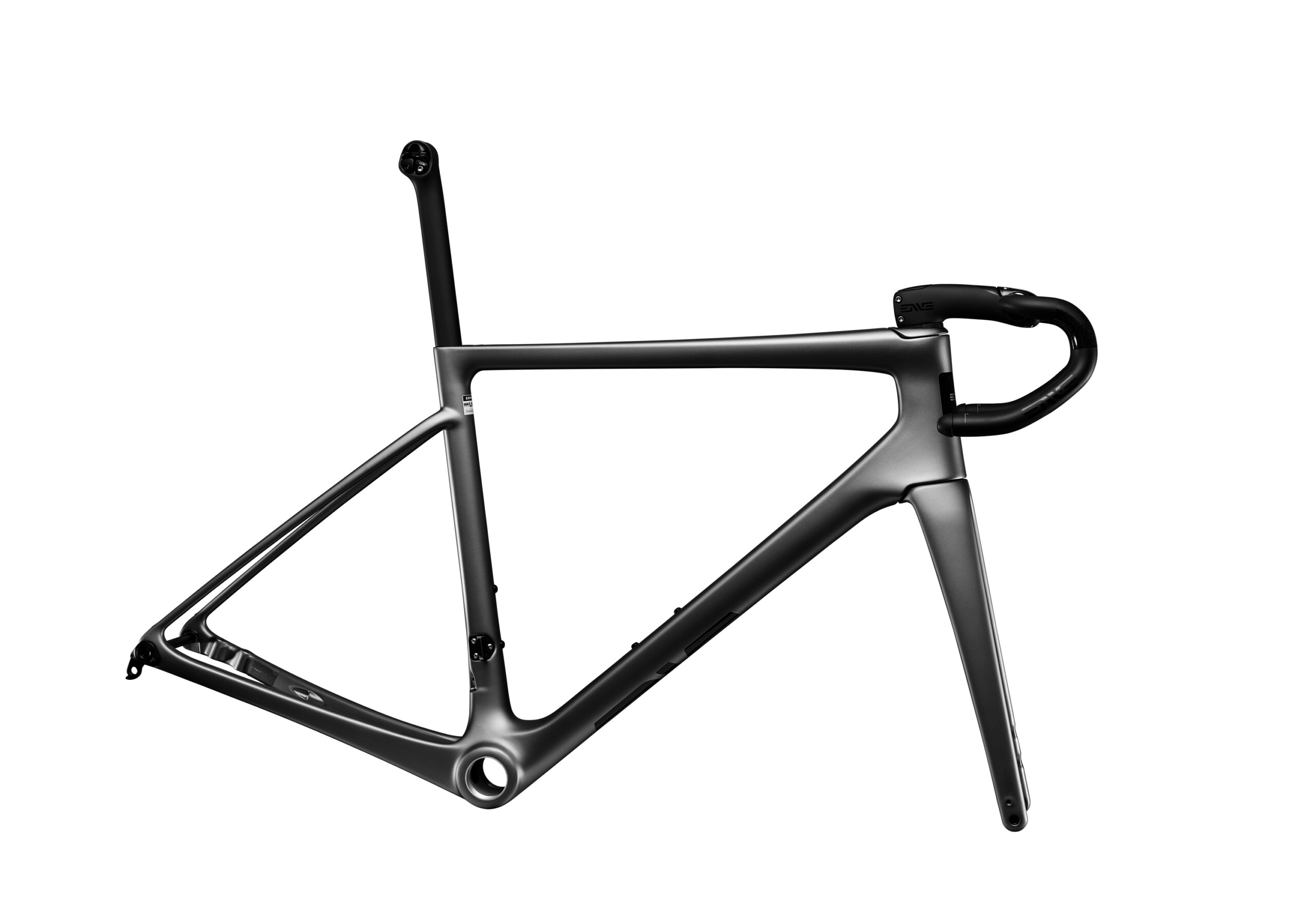
OGDEN, Utah (JULY 21, 2022) — ENVE is pleased to introduce the Melee, a purpose-built road racing bicycle designed and engineered to meet the high-performance, and versatility demands of today’s road racers. In 2021, ENVE launched their first complete bicycle, the Ogden, Utah-made Custom Road, and manifest their intention to evolve the brand from aftermarket wheel and component specialists to a full- service bicycle brand. Unlike the US-made Custom Road, which is fully customizable, the Melee is offered in seven stock frame sizes from 47 to 60 cm and manufactured overseas at ENVE’s factory.
Photo by Jussi Oksanen, courtesy ENVE Composites
“When we decided that the time had come for ENVE to expand into bicycle frames, we knew that we needed to make our first bike here in Ogden, and that we wanted it to be custom. At the same time, we understood that due to the nature of custom, availability of the Custom Road would be limited. Our US manufacturing facility provides us the unique opportunity to design, prototype, and iterate at a much higher rate than we can overseas – especially over the past several years. The Custom Road is the result of this process, and it established a sound foundation upon which we have been able to iterate and create the Melee,” stated VP of Product and Brand, Jake Pantone.
“The Melee is a no holds barred modern race bike built specifically to meet the performance demands of the discipline. The Custom Road, while capable of racing at the highest level, prioritizes customization and personalization over specific race performance metrics such as weight, stiffness, and aerodynamics. The Melee features a monocoque construction which allowed us to refine the tube shapes, reduce weight, and increase the overall efficiency of the Melee,” continued Pantone.
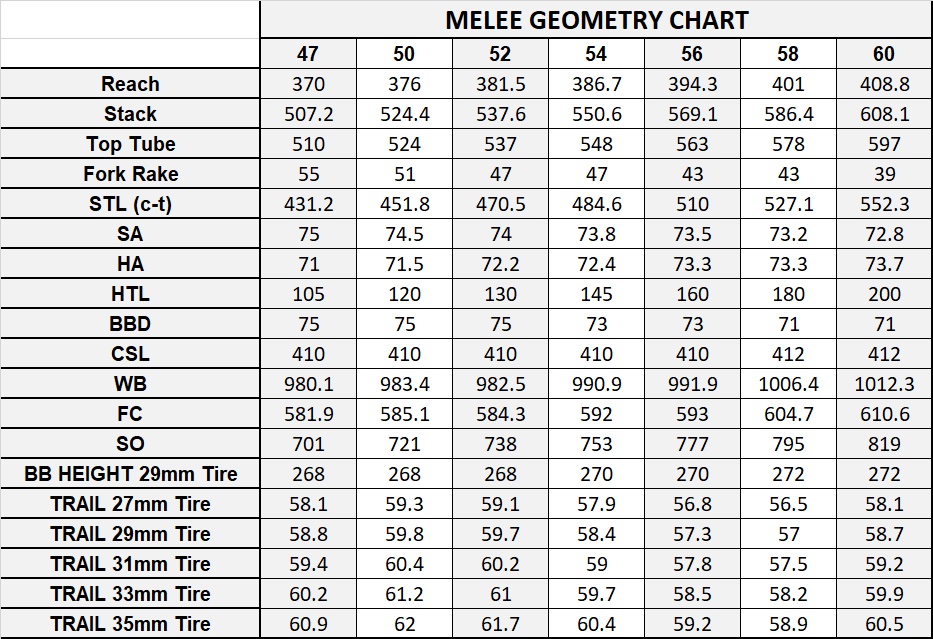
While mixed surfaces have nearly always had a presence in road racing, it hasn’t been until recently that all surfaces could be tackled on one bike. Versatility has come to define the modern race bike. ENVE’s Melee features a generous max tire clearance of 35 mm with the geometry and handling characteristics optimized for tires between 27 and 32 mm.
Photo courtesy ENVE Composites
Along with ample tire clearance, aerodynamic performance and integration are the expectation. ENVE’s Real-World Fast aero philosophy and technologies guided the development of the Melee. Real-World Fast as defined by ENVE means that the Melee has been designed with a holistic approach to performance. The tradeoffs of any one performance variable, be it aerodynamics and weight savings, or stiffness and compliance are balanced to ensure a fast, efficient, and confidence inspiring ride.
In practice, the Melee features all the aerodynamic trappings expected to achieve top-of-class efficiency – minimal frontal area, Kamm-tailed tube shapes, and full front-end integration. Additionally, ENVE has designed the Melee’s tube shapes to complement their own SES™ rim profiles. As a result, airflow transitions from wheel to frame surfaces in harmony to ensure a composed and stable ride experience in variable wind conditions.
Photo courtesy ENVE Composites
In terms of construction, the Melee is made using various forms of uni-directional carbon fiber following ENVE’s Material Optimized Design (M.O.D.) process. “In simple terms, Material Optimized Design means designing and manufacturing products that play to the strengths of carbon fiber. The materials, fiber weights, and fiber angles used in the laminate are selected and manipulated to achieve zone specific performance within the part. Carbon is the key ingredient, and we use the best we can get our hands on, but ultimately the process it is subjected to makes it an ENVE product,” stated Pantone.
Fit and geometry are another area that ENVE has paid special attention to with their new bicycle. The Melee is available in seven frame sizes, with five unique fork rakes to ensure that riders of all sizes will have the same responsive handling the Melee is intended to deliver.
When ENVE introduced the Custom Road in 2021, they introduced the ENVE Chassis. Simply, an ENVE Chassis is the canvas upon which you can assemble your dream bike. An ENVE Melee is available as a “Chassis Only” which includes the frame, fork, headset, handlebar, stem, and seatpost. The bar, stem, fork and seatpost are proprietary to the Melee and selected à la carte to ensure that customers get the exact fit spec they need from the start.
To aid in the fitment process, ENVE has created the ENVE Best-Fit Calculator. “Your road bike needs to be an extension of your body and we want people to achieve that seamless feel from the first pedal stroke. Our calculator aims to simplify the fitment process for the fitter and customer alike. The calculator functions simply by pairing a rider’s fit stack, fit reach, and saddle position numbers with a frame geometry, stem length, stem rise, spacer stack, and saddle offset. The output provides the rider with several frame and component configuration options that the rider along with their fitter can analyze to determine the rider’s ‘best-fit’ option,” stated Pantone.
For additional personalization and tuning, the Melee customer can then select their ENVE SES™ or Foundation wheelset of choice. For maximum weight savings, a customer may choose ENVE’s SES 2.3. For versatility, a pair of SES 3.4, and a rider seeking top aero performance may select the SES 4.5 or SES 6.7. Finally, by working with the local ENVE Ride Center or retail partner, drivetrain components and accessories are selected, and the build completed.
The Melee is available in one color, Damascus. Like their custom wheel decal program, ENVE gives customers the option to design a personalized decal kit for their Melee using ENVE’s Custom Decal Configurator. Once the custom decal order is complete, the kit is delivered direct to the customer with tools and instructions for installation.
The Melee is available now in select sizes and markets around the world. The ENVE Melee Chassis retails for USD $ 5500, € 5500, £ 5300, and includes the frame, fork, headset, stem, handlebar, and seatpost.
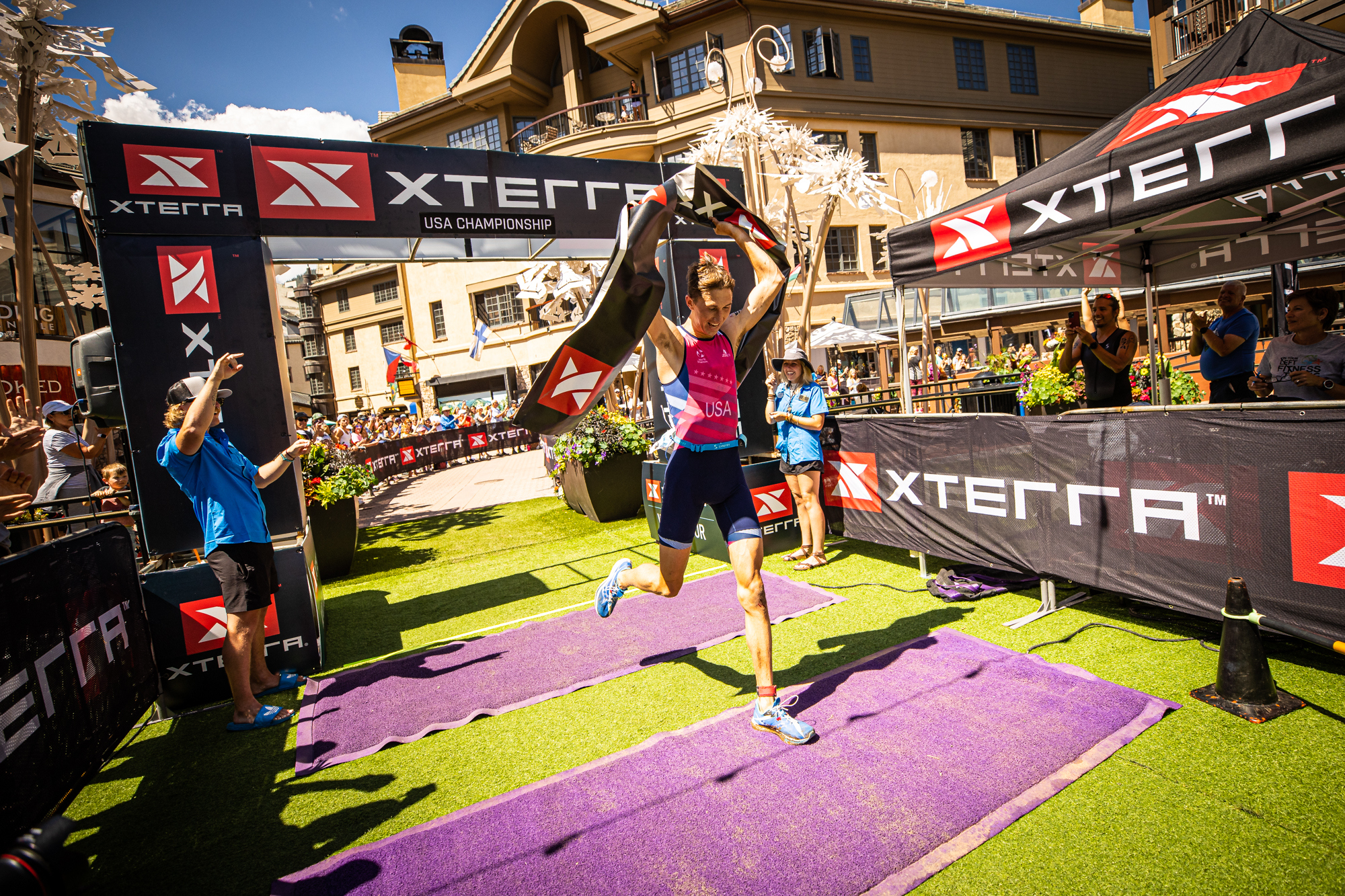
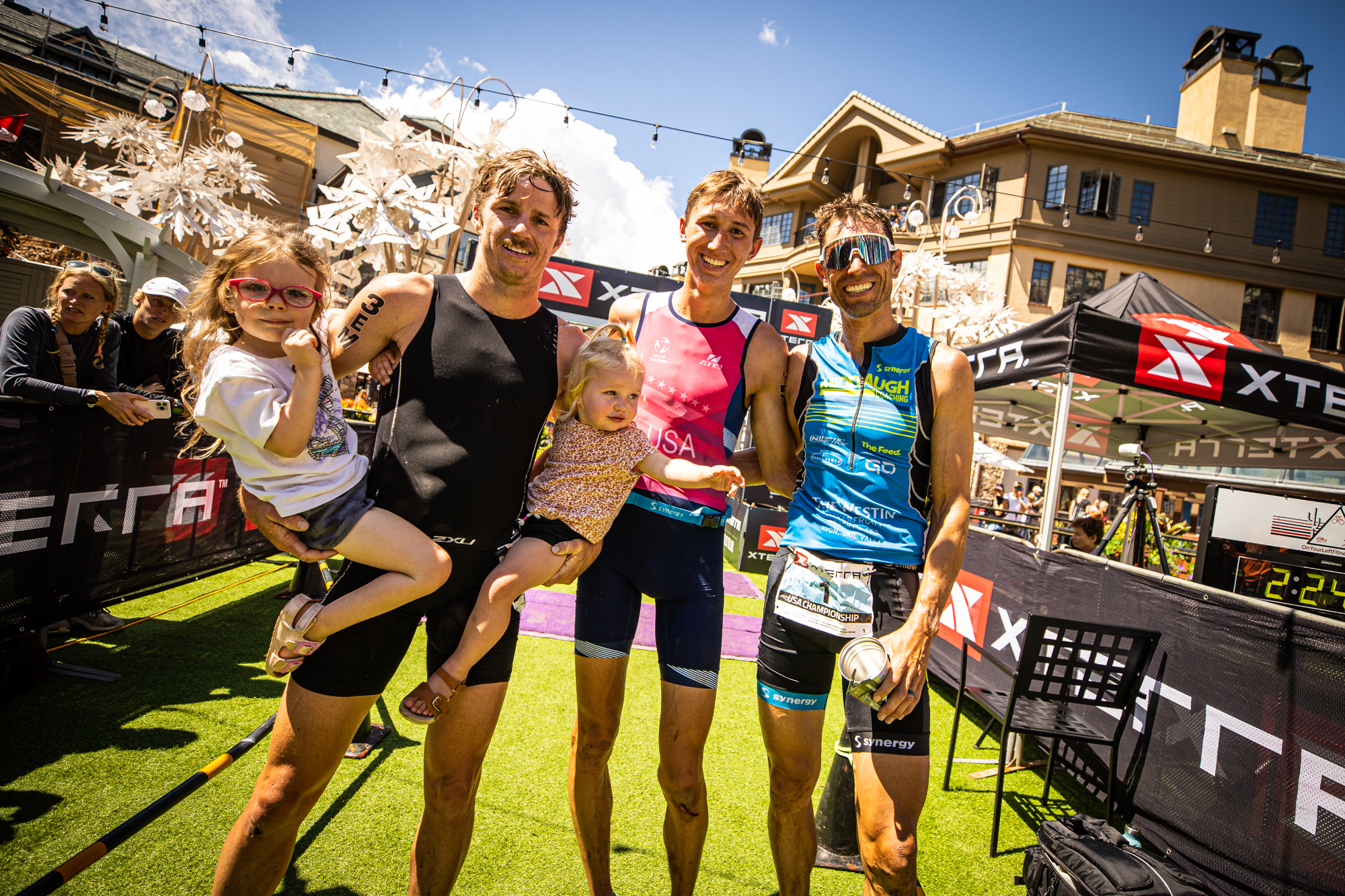
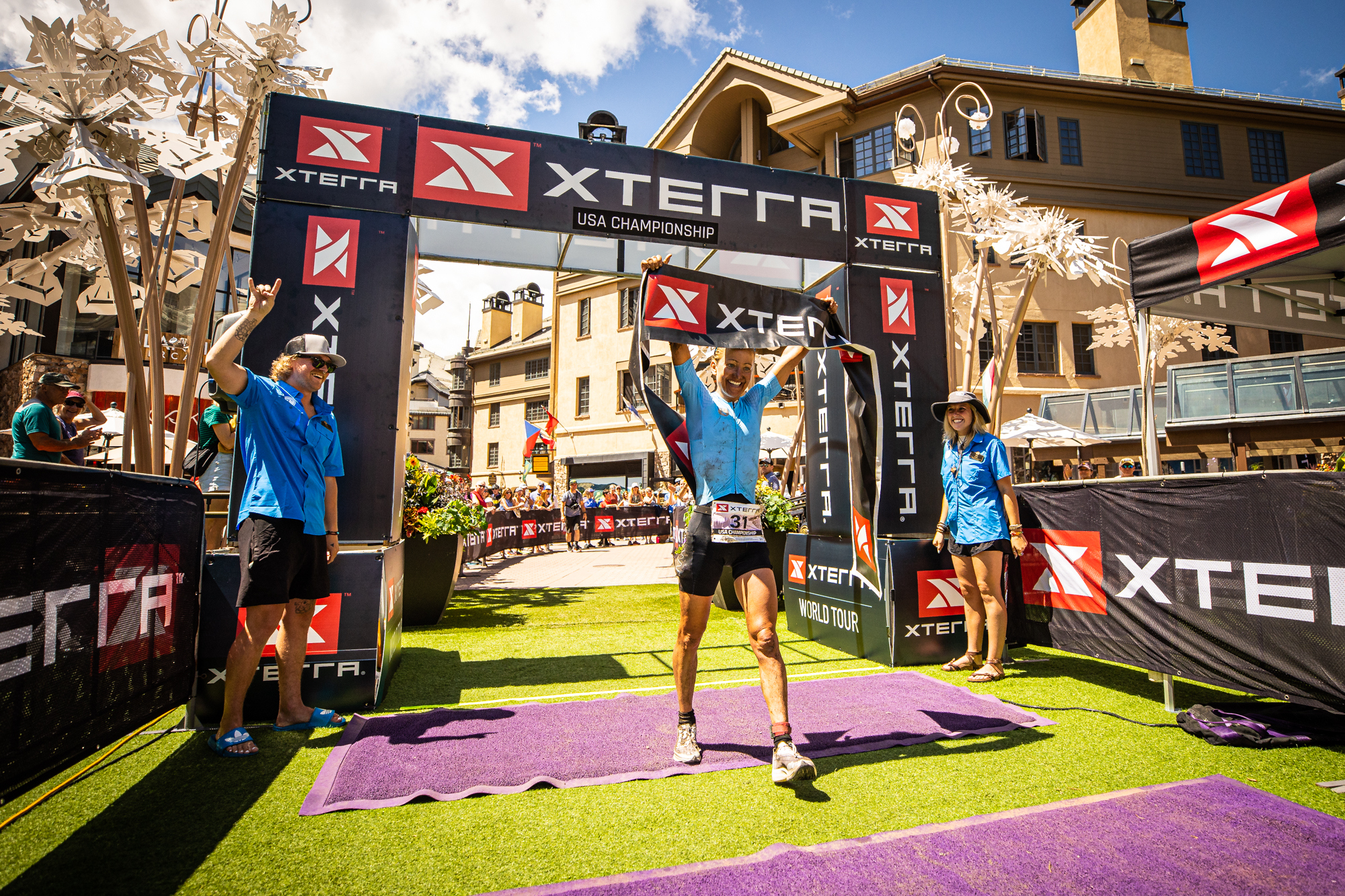
Teenage phenom Sullivan Middaugh and five-time World Champion Lesley Paterson captured the 21st annual XTERRA USA Championship off-road triathlon elite titles on a picture-perfect blue sky day at Beaver Creek Resort near Avon, Colorado on Saturday, July 16, 2022.
It’s the first elite win for the 18-year-old Middaugh, who was competing in his first elite race against his father, 43-year-old Josiah Middaugh – an XTERRA Hall of Famer and 15-time XTERRA US Champion.
“I feel awesome, everything went perfect for me today, and racing with my Dad in the pro field was amazing,” said Sullivan Middaugh, after winning the XTERRA US Elite Championship crown.
Photo by Jesse Peters/XTERRA
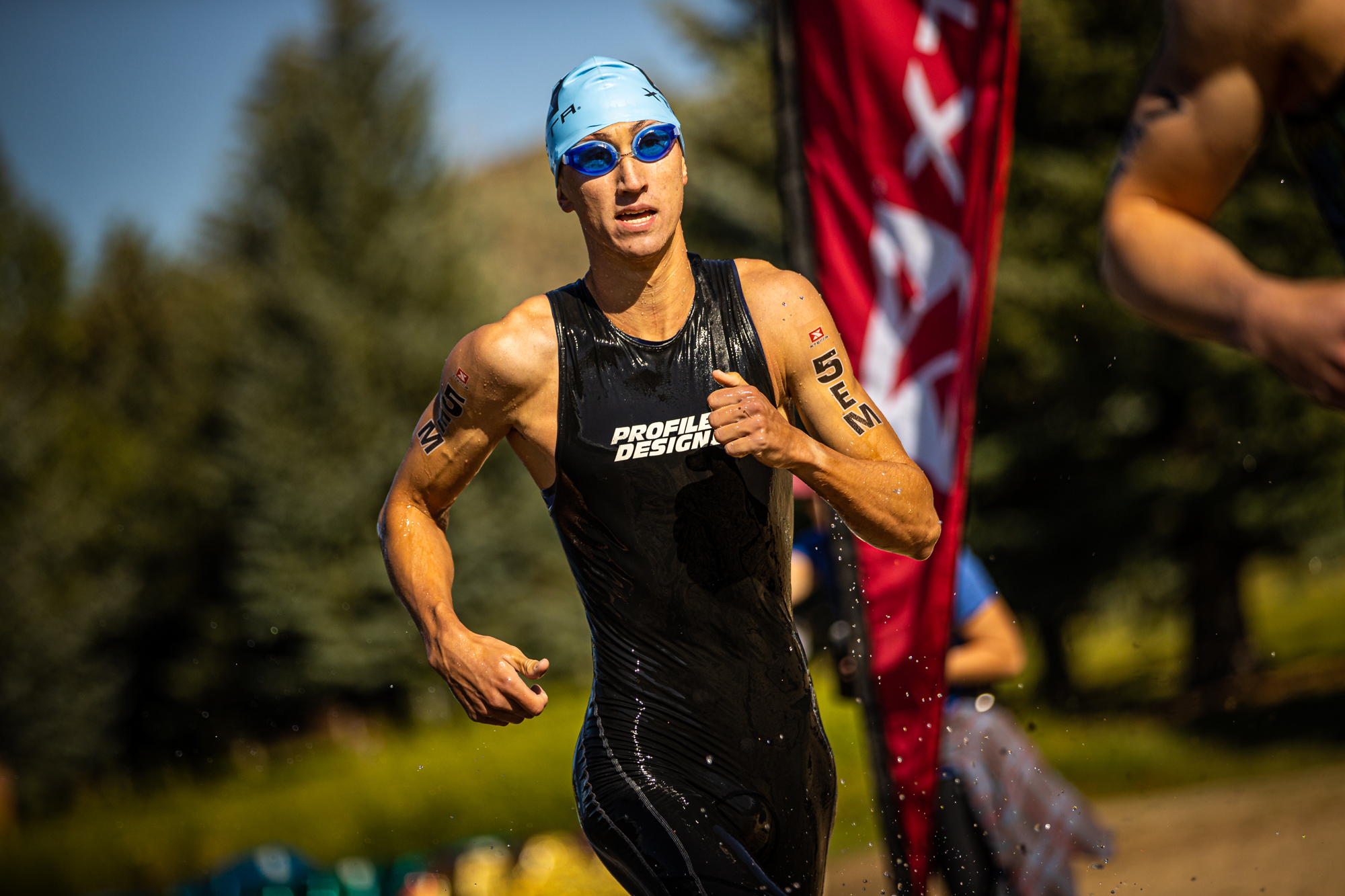
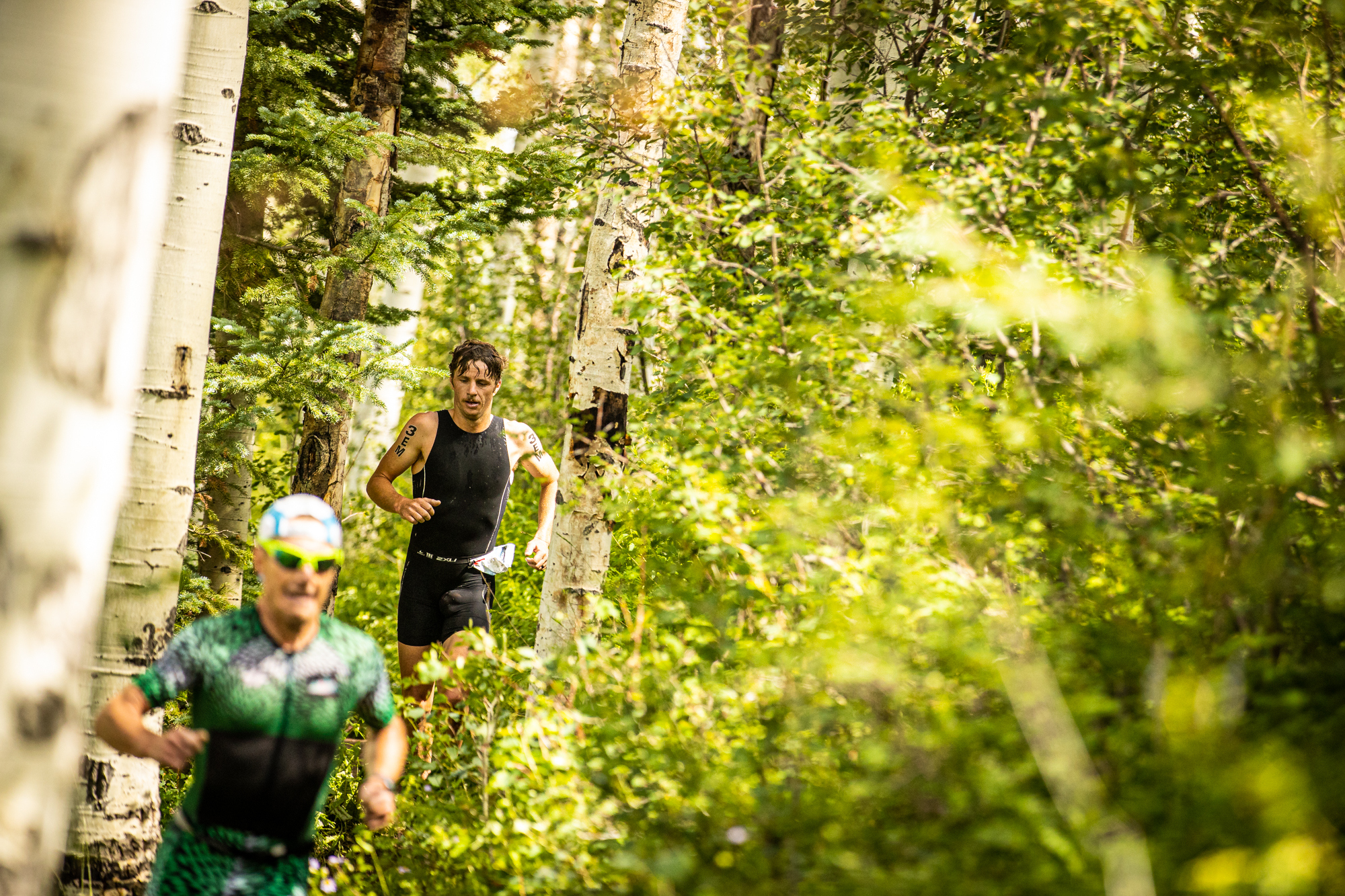
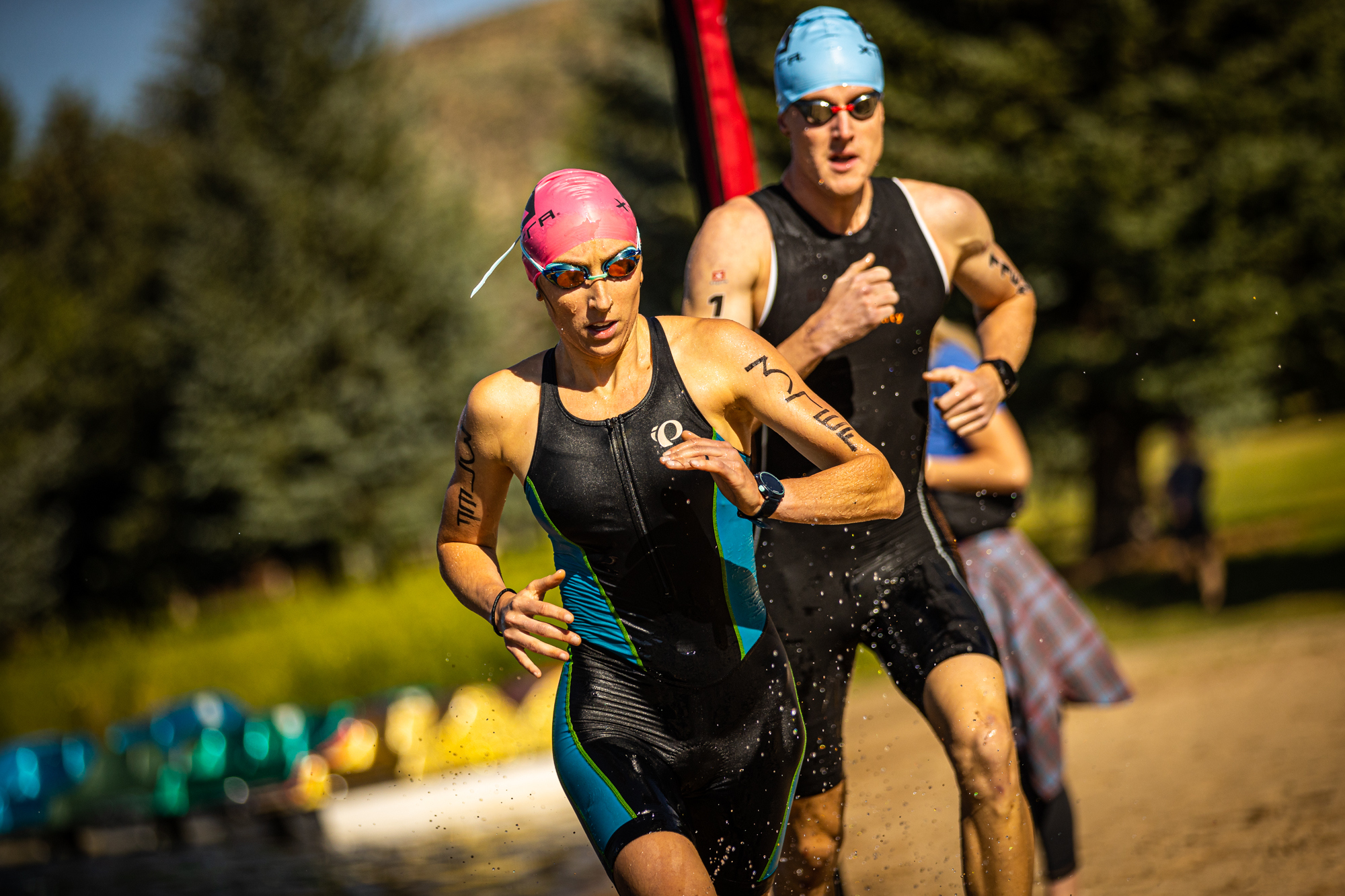
In the men’s elite race, Branden Rakita led the charge early with a 20-minute swim split for the non-wetsuit, 1.5K swim in Nottingham Lake. Timothy Winslow and Kieran McPherson were close behind, Nelson Hegg and Sullivan Middaugh (pictured) were 30-seconds back, and Josiah Middaugh was more than two minutes behind Rakita.
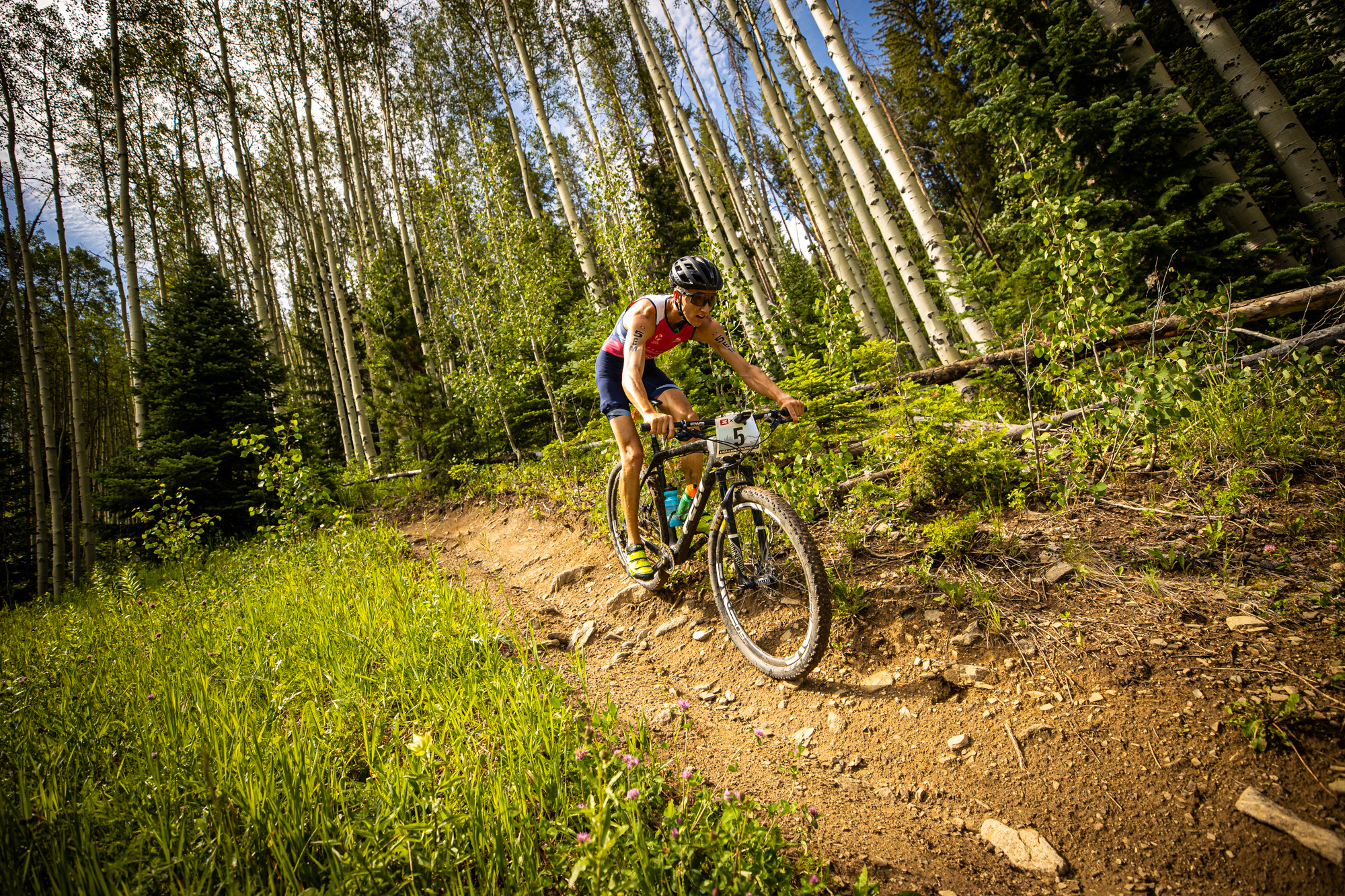
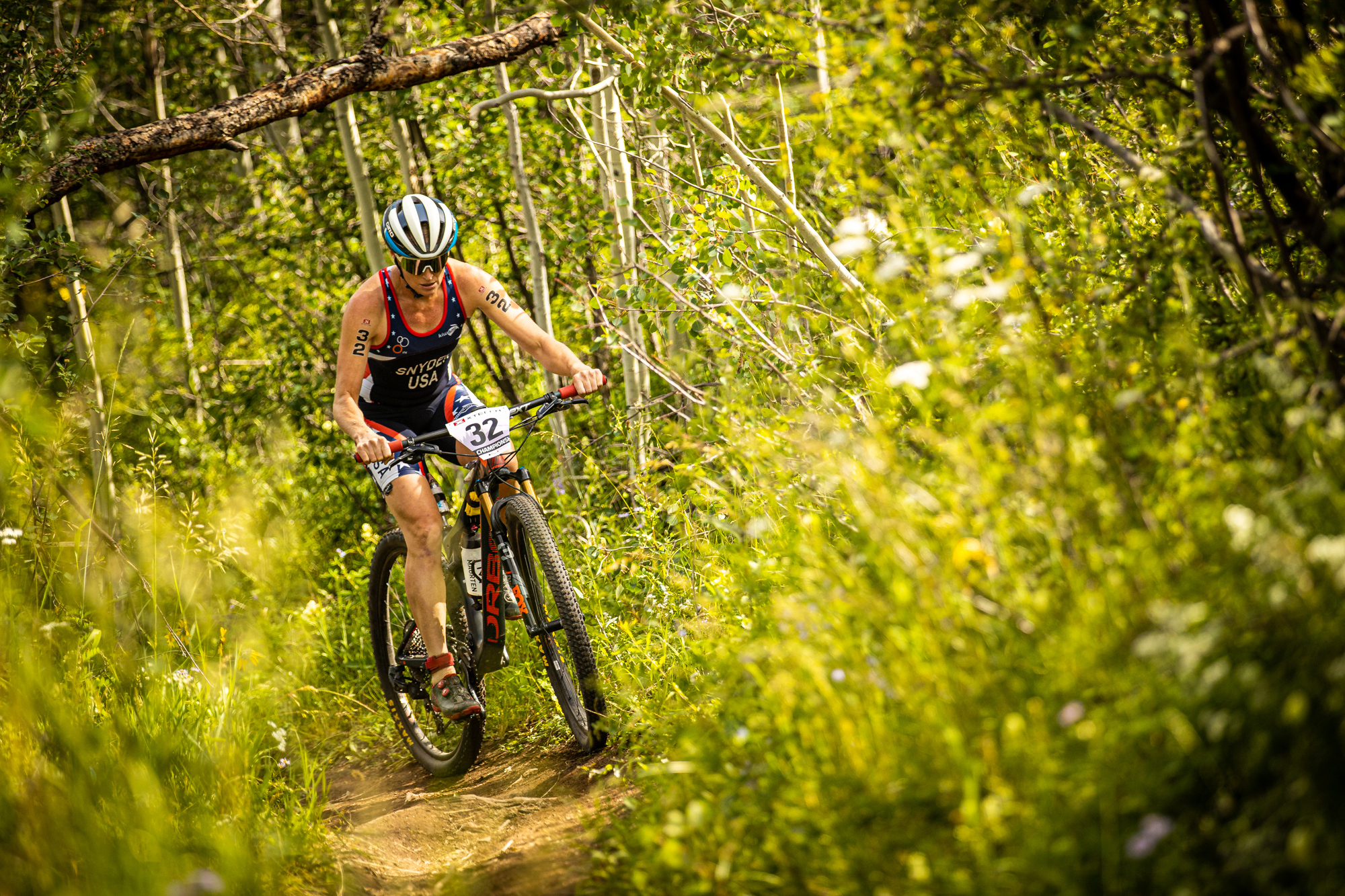
Sullivan got past Winslow, Hegg, and Szuch early on in the bike, charged past Rakita and McPherson to take the lead “two switchbacks up the Ute Trail” about three miles into the course, and then started pulling away.
By mile seven Sullivan was one-minute, 30-seconds ahead of McPherson, followed by Szuch, Rakita, Benny Smith, and his dad was almost three-minutes behind.
“Knew I had a gap but still had to push because my Dad is a super strong rider, and so are the other guys, so I had to push the whole way,” said Sullivan, who was 100% in charge until he got a flat tire.
Photo by Jesse Peters/XTERRA
“I hit the bridge at village-to-village really hard and heard my tire wheezing so I stopped right away and tried to fill it. Plugged one hole but there was another one. Filled it up as much as I could, but it was leaking the whole way so I probably had five PSI going up the last climb and then I just rode the rim the whole way down corkscrew.”
Corkscrew is the super fast, twisting, two-mile long downhill just before the finish.
“I cannot believe how fast Sullivan rode down corkscrew on a flat,” said Josiah Middaugh, who at that point had worked his way into second position about 30-seconds behind his son. “I mean, I put 1:30 on Colin who started the downhill with me, but nothing on Sully.”
Photo by Jesse Peters/XTERRA
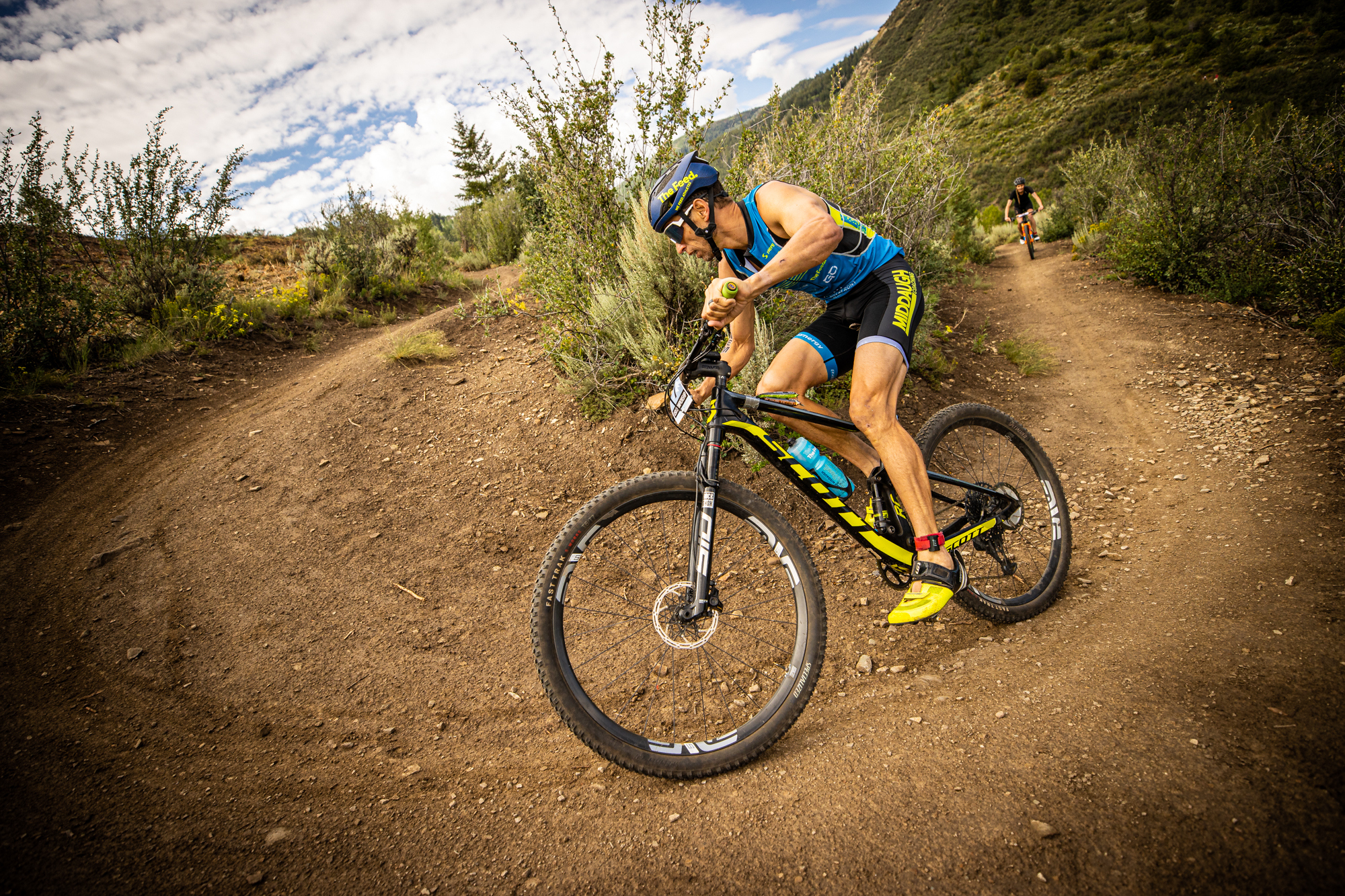
Once on the run the younger Middaugh took off and posted the fastest 10K split of the day (39:36) to cross the line in 2:20:28, a little less than two-minutes ahead of his dad (pictured) in second.
“I thought maybe Sullivan would like some company on the run, but apparently not,” laughed Josiah, who posted the fastest bike split of the day (1:16:28) to enter T2 about 30 seconds back. “I’m super proud of him, and happy to have been a part of this. It’s pretty amazing, the kid is next level.”
McPherson ran down Brian Smith and Colin Szuch to finish third, with Szuch in fourth and Smith in fifth.
Photo by Jesse Peters/XTERRA
“Everybody was worried about Josiah today, but it turned out we were worried about the wrong Middaugh,” said McPherson, who made a remarkable comeback after breaking his back in December last year.
“Just an insane day for the young fella, great to see that in the sport,” he added. “And that new course is a great improvement, great change for the better, and finishing in the middle of the village here was really special.”
Photo by Jesse Peters/XTERRA
Elite Men’s Results
Place – Name, NAT (Final Time)
Sullivan Middaugh, USA (2:20:28)
Josiah Midduagh, USA (2:22:11)
Kieran McPherson, NZL (2:23:31)
Colin Szuch, USA (2:24:05)
Brian Smith, USA (2:24:20)
Benny Smith, USA (2:33:11)
Branden Rakita, USA (2:33:42)
Samuel Jud, SUI (2:34:02)
Sam Teller, USA (2:34:08)
John Wiygul, USA (2:43:07)
Photo by Jesse Peters/XTERRA
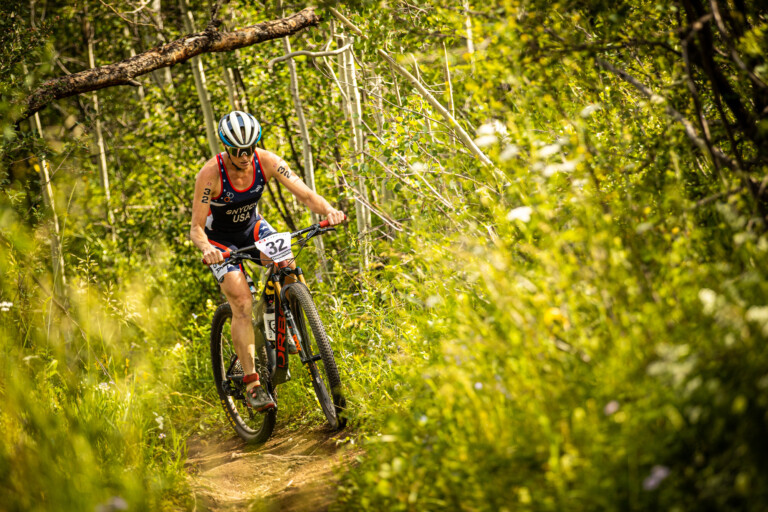
In the women’s elite race Maeve Kennedy (AUS) was first out of the water in 20:44, followed by Amanda Presgraves five seconds later, then Suzie Snyder another 15-seconds back. Lesley Paterson (GBR) was more than three minutes behind after the swim.
“The swim was horrible,” exclaimed Paterson. “I tripped on the first beach run, the altitude was killing me, and so was my obvious lack of swim training, it was terrible. I was thinking to myself that I’d never do this again.”
Photo by Jesse Peters/XTERRA
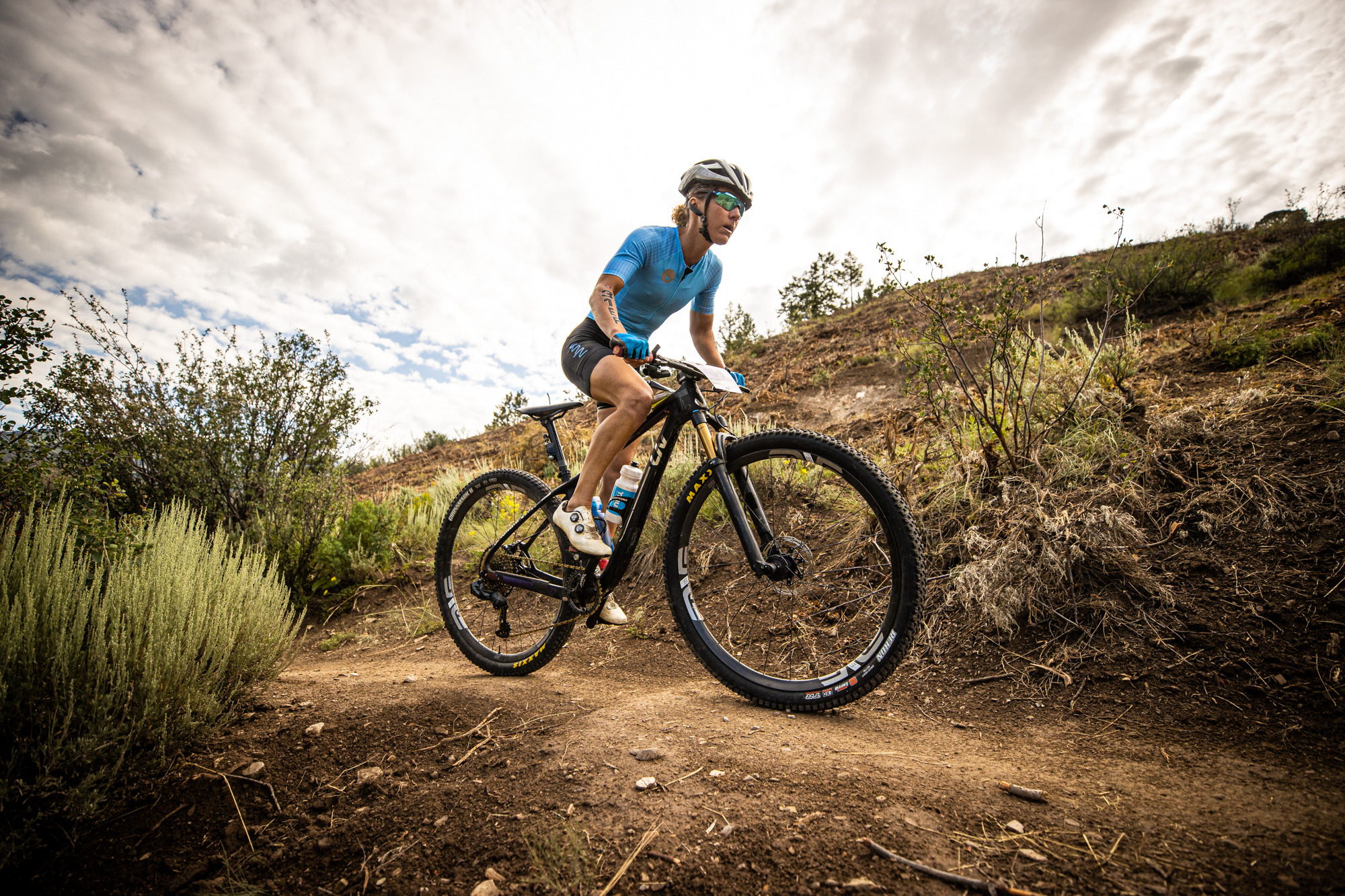
Once on the bike, however, things changed. Paterson passed Nicole Valentine and Presgraves early on, cut the deficit to Kennedy and Snyder in half by the seven-mile mark, and got to the front before the midway point on the bike.
“I was in the zone on the bike, and really enjoying it. It was such a beautiful day, a great course, tacky trails, I mean the conditions were absolutely perfect,” she said.
Paterson posted the fastest bike split (1:30:07) by more than five minutes then clocked the quickest run split (46:00) to take the tape in 2:43:43.
What makes her accomplishment ever the more remarkable is that she is also working more than full-time as a movie producer.
“If I can continue to jump into races, have fun, do well, and then make films at the same time, that’s my dream,” said Paterson, as she looks forward to the defining moment in her movie making career. “Our film All Quiet on the Western Front is going to come out in theaters in mid-October, and then on Netflix at the end of the year, and hopefully we’ll be campaigning for an Oscar.”
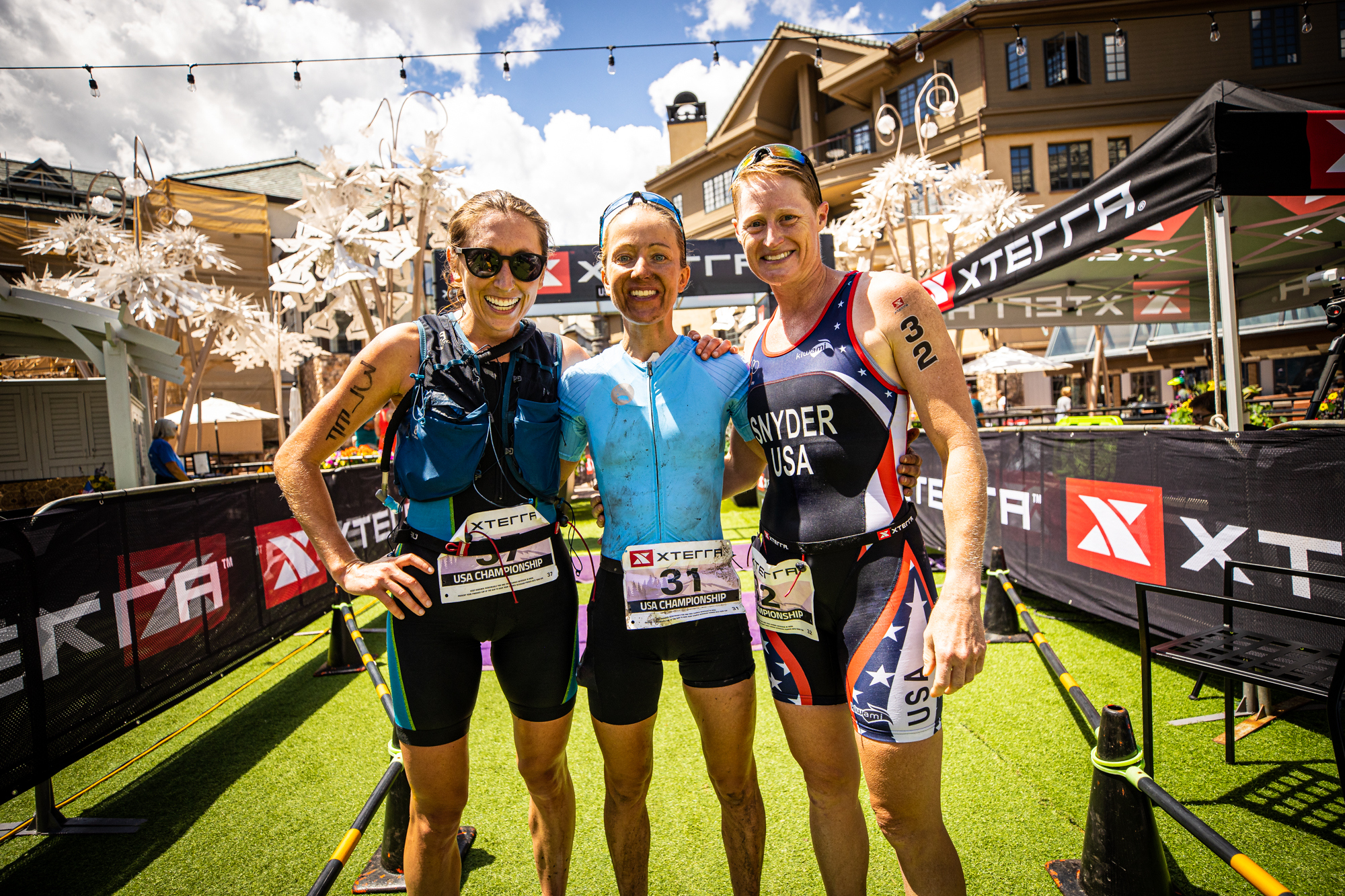
Snyder finished strong in second, and as the top American won the XTERRA US Elite crown for the fifth time in her career.
“It’s cool to get that title, I’m really happy considering all the stuff I’ve dealt with this year and the lack of training,” said Snyder.
The surprise of the day in the women’s race came from Amanda Presgraves, who was racing as an elite for the first time and on a rented bike, when she ran down Maeve Kennedy in the last 100-feet to take third place.
“I saw a ponytail, and kicked it into another gear. She was in front of me the whole time. I was pushed to a whole new level today,” said Presgraves (pictured). “I followed Suzie up the switchbacks at the start of the bike and was redlining the whole time, and I kept having this impulse to take my phone out and take pictures everywhere because it was so beautiful. The wildflowers, the views, the mountains, I was high on life riding in all that. So grateful to be here.”
Kennedy came in fourth and Nicole Valentine finished fifth.
Elite Women’s Results
Place – Name, NAT (Final Time)
Lesley Paterson, GBR (2:43:43)
Suzie Snyder, USA (2:52:02)
Amanda Presgraves, USA (2:58:24)
Maeve Kennedy, NZL (2:58:34)
Nicole Valentine, USA (3:05:17)
Irena Ossola, USA (3:15:10)
Nickie Luse, USA (3:18:08)
Jennifer Johnson, USA (3:23:46)
Chelsea Raymond, CAN (3:35:38)
All-time XTERRA U.S. Elite National Champions
Year – Elite Champs
2022 – Sullivan Middaugh/Suzie Snyder
2021 – Josiah Middaugh/Suzie Snyder
2020 – cancelled due to COVID-19
2019 – Branden Rakita/Julie Baker
2018 – Josiah Middaugh/Suzie Snyder
2017 – Josiah Middaugh/Julie Baker
2016 – Josiah Middaugh/Suzie Snyder
2015 – Josiah Middaugh/Emma Garrard
2014 – Josiah Middaugh/Emma Garrard
2013 – Josiah Middaugh/Shonny Vanlandingham
2012 – Josiah Middaugh/Suzie Snyder
2011 – Josiah Middaugh/Shonny Vanlandingham
2010 – Josiah Middaugh/Shonny Vanlandingham
2009 – Josiah Middaugh/Shonny Vanlandingham
2008 – Josiah Middaugh/Shonny Vanlandingham
2007 – Josiah Middaugh/Jamie Whitmore
2006 – Seth Wealing/Jamie Whitmore
2005 – Josiah Middaugh/Jamie Whitmore
2004 – Josiah Middaugh/Jamie Whitmore
2003 – Steve Larsen/Jamie Whitmore
2002 – Kerry Classen/Jamie Whitmore
2001 – Ned Overend/Monique Merrill
2000 – Michael Tobin/Kerstin Weule
1999 – Michael Tobin/Kerstin Weule
Note: U.S. Elite Champ was awarded to the top U.S. finisher in the America Tour Pro Standings from 1999-2015. From 2016-2019, when America Tour turned into Pan Am Tour, U.S. Elite Champ was awarded to the top U.S. finisher in the Pan Am/USA Championship race in Utah. Since 2021, the title goes to the top American elite in the USA Championship race.
The York 38 Special Mountain Bike Race will be held on August 20, 2022 in Helena, Montana. The race is in its 20th year, and is full of spectacular scenery. Helena is considered to be one of the best kept secrets in the country when it comes to the world of mountain biking, and for good reason. Dozens of miles of trails weave through the town and around it, ensuring a diverse variety of options for riders at any skill level. Rated as a silver level destination by the International Mountain Biking Association, Helena is the perfect spot for your next biking excursion.
The York 38 Special is a mountain bike race in Helena, MT. Photo courtesy York 38 Special
We asked organizer Joelle Selk about the event.
Cycling West: Tell us about the course. What are some highlights that riders will see? Is it single track, fire road, a mix? What are the distance options?
York 38: The course is a mix of gravel, rough USFS two track roads, and single track. The course climbs 3,000 feet up to Hogback Mountain, then drops rapidly into Trout Creek Canyon for the single-track section.
There are three course options, the traditional Trout Creek route which includes three miles of challenging single track in the stunning Trout Creek Canyon; the Bear Trap route, which adds an additional 2,000 foot climb and descent within the 38-mile course; or the double-loop “Spirit of 76” race.
The York 38 Special is a mountain bike race in Helena, MT. Photo courtesy York 38 Special
Cycling West: What type of bike will riders need? Is a mountain bike or a gravel bike best?
York 38: A mountain bike with suspension is best. This course will beat the crap out of you on a gravel bike.
Cycling West: Where can people stay if they travel to the event? Is there camping nearby?
York 38: Dispersed camping is available on USFS lands or Bureau of Reclamation campgrounds around Canyon Ferry Lake. Established campgrounds remain consistently full throughout the summer, and one cannot be guaranteed availability. Participants are otherwise encouraged to get a hotel room well in advance, as the Helena area has a very busy tourist and hunting season which extends into the fall months.
The York 38 Special is a mountain bike race in Helena, MT. Photo courtesy York 38 Special
Cycling West: When the event is over, what are some of the other activities nearby? Are there attractions for families too?
York 38: Helena is certainly a vacation destination, with Canyon Ferry Lake and the Missouri River nearby for water sports and fishing. Gates of the Mountain boat tours on the Missouri River offer a historical perspective of the Lewis and Clark Expedition. Helena offers many weekend activities, including the Farmer’s Market and music on the Downtown Walking Mall.
The York 38 Special is a mountain bike race in Helena, MT. Photo courtesy York 38 Special
Cycling West: Tell us about the history of the area? What are some of the highlights?
York 38: Helena was originally a mining boomtown beginning with a gold strike in 1864. After the gold played out, entrepreneurs established it as a financial center, and in 1874, it was named the Montana territorial capital. By 1888, there were around 50 millionaires living in Helena, which was more per capita compared to any other cities in the world. Over time, Helena became an agricultural center, later expanding to a governmental center, and finally to a more diverse community focused on outdoor recreation. With the surrounding mountains, Helena is located in a great area for fishing, hunting, mountain biking, and skiing.
The York 38 Special is a mountain bike race in Helena, MT. Photo courtesy York 38 Special
Cycling West: The ride is a fundraiser for York Fire and Rescue. Tell us about the organization, and what you do.
York 38: York Fire and Rescue is a small community-based volunteer fire department in the Big Belt Mountains, surrounded by Helena National Forest Service land. Currently we have 18 firefighters on our roster, 5 of which are also EMTs. Our service area is approximately 200 sq. miles with approximately 800 year-round residents. Because of the mountainous terrain, lakes, river and streams, this is a heavily utilized recreation area. Our fire crew provides structure and wildland fire protection and rescue services for the residents and recreationists within our service area.
Event Info:
August 20 — York 38 Special, York, MT, Ride 38 or 76 miles on single track, gravel, and Forest Service roads through breathtaking scenery in the Helena National Forest gaining 3,000 vertical feet!, York Fire Rescue , [email protected], york38special.org
By Breanne Nalder Harward, MS, RN — It’s the time of year when many of us have events away from home. Whether it’s a road trip to Southern Utah for a road fondo or a MTB race, a flight to one of the epic gravel events that are popping up all over the country, or anything in between it is crucial to prepare your nutrition too! We train hard to get ready for these rides, so let’s make sure to have a plan for all the food. As I always say, we want premium fuel for our engines to fire on all cylinders, and when we’re away from home that can become challenging. Here are a few tips to consider and a couple of staple recipes to use on your next adventure.
Know before you go
We all have particulars when it comes to sport nutrition products, and that’s ok! In fact, part of our preparation includes practicing the intake and timing of electrolyte mix, gels, bars, etc. Therefore, it’s a good idea to investigate what the event sponsors are and what might be provided at aid stations. Maybe it’s a product you’ve never tried, or worse one that you know doesn’t work for you. That way you can either try what will be provided in advance to be sure you like/tolerate it or know that you need to pack your ‘tried and true’ favorites. The last thing you want is to have a bad day on course because you didn’t have what you know your bodies needs to perform. It’s also worth looking up the local restaurants and grocery stores to know what your food options will be when you get into town. If there’s only a diner and a gas station, you’ll know you need to bring all your food. If there’s healthy places to dine, you can make reservations in advance to ensure you get the pre-race meal you want. And let’s not forget about breakfast the morning of an event. Make sure you either bring your go-to oatmeal and banana or check that your hotel’s breakfast has options that you like and of course that they offer food (and coffee!) early enough that you can eat and digest in time to get to the start.
What to pack
Having all your nutrition needs met when traveling is all about bringing your essentials! A quick list would include your vitamins, electrolyte, and recovery mix, and what I call “security snacks.” I am always over-packing to ensure I don’t have to settle for foods that may compromise performance. It may be a little extra weight and planning, but bring some of your favorite bars, some trail mix, protein powder, and a tub of your favorite electrolyte mix. That way you can ensure you don’t get stuck grabbing a donut or fast food or soda just to get by. Everything you put into your body in the days leading into an event has an influence; so, plan ahead, bring a cooler loaded with yummy healthy food, and know you will have what you need to ride your best!
Hydrating while traveling
I hope this isn’t redundant, but I want to remind you to drink, drink, drink! Travel is dehydrating by nature, even though we aren’t provoked to drink like we are when exercising and sweating. Always have water available, and it’s even a good idea to drink a bottle of electrolyte mix, especially when you’re gearing up for a long day in the saddle or the weather is forecast to be especially hot or windy!
Recipes
These energy bites are easy to prepare and travel with and provide nutrients to keep the engine burning strong. Enjoy!
Beets contain natural Nitrous Oxide to help increase your body’s ability to transport oxygen to your muscles.
Flour, oats, and dates give you the carbs you need for immediate energy.
Coconut and almonds provide healthy fat for sustained energy.
Cinnamon promotes fat utilization (just be careful not to use too much and give yourself dry mouth!)
Salt is a main electrolyte and helps balance the sweetness of the dates
Beet Root Energy Bites
Prep time: 25 minutes
Servings: 14 bites
Ingredients
9 Medjool dates, pitted and soaked
1 large red beet, roasted and chopped
1/2 cup all-purpose baking flour (or any GF flour you prefer)
1/2 cup unsweetened shredded coconut
1/4 cup raw almonds chopped
•1/2 tsp vanilla extract
Instructions
Add all ingredients to food processor and mix until a thick paste forms, scraping down the sides of food processor with rubber spatula as needed until evenly combined.
Transfer mixture to the fridge for 15 minutes to chill and set.
Form 14 energy bites from mixture and roll each in shredded coconut for added flavor.
Store in fridge for up to 2 weeks. Bring along in a small bag for fuel when you need an energy boost.
Cinnamon Date Energy Bites
Prep time: 20 minutes
Servings: 20 bites
Ingredients:
1 cup oats
Cinnamon to taste
1.5 packed cups Medjool dates, pitted and soaked
2 TBSP warm water
Instructions
Add all ingredients to food processor and blend until thick dough created.
Add in more water to make texture sticker as needed.
By Anne Findlay — Riding out of Salt Lake, the mountain canyons draw me in with their beautiful pine and aspen forests, spectacular vistas, and challenging yet satisfying climbs. So, naturally, when my friends in Denver asked me to join them again at this year’s Ride the Rockies – a 6-day road cycling tour through the Colorado Rockies – I could not resist. Even better, my friend Lisa Hamann from Cottonwood Heights wanted to join us. A week with good friends, beautiful mountains, and bikes? What more could I ask for?
This year’s route, connecting the towns of Copper Mountain, Glenwood Springs, Basalt, Salida, Breckenridge, and Golden, went right through mountains and towns I had long wanted to explore. (Each day, aside from day 5 in Breckenridge, where we stayed 2 nights, we would ride from one town to the next.) Initially, I didn’t give too much thought to the details, but saw lots of over-10,000’ passes on the profile, and some pretty long days. I kept looking for the easy rides and, well, there weren’t too many. Built into the schedule was a “rest day” ride on day 2 and another on day 5, with an option to add on a significant climb and, oh, 40 miles. I was pretty sure I would not be adding on the extra 40. The rest of the rides were significant in climbing, miles, and often both, and the first and third days kicked things off with centuries.
However, I like a good challenge, love riding my bike in the mountains, and figured I had time to train. Maybe, I could just view the whole thing as a super fun training camp week with friends? At elevation?
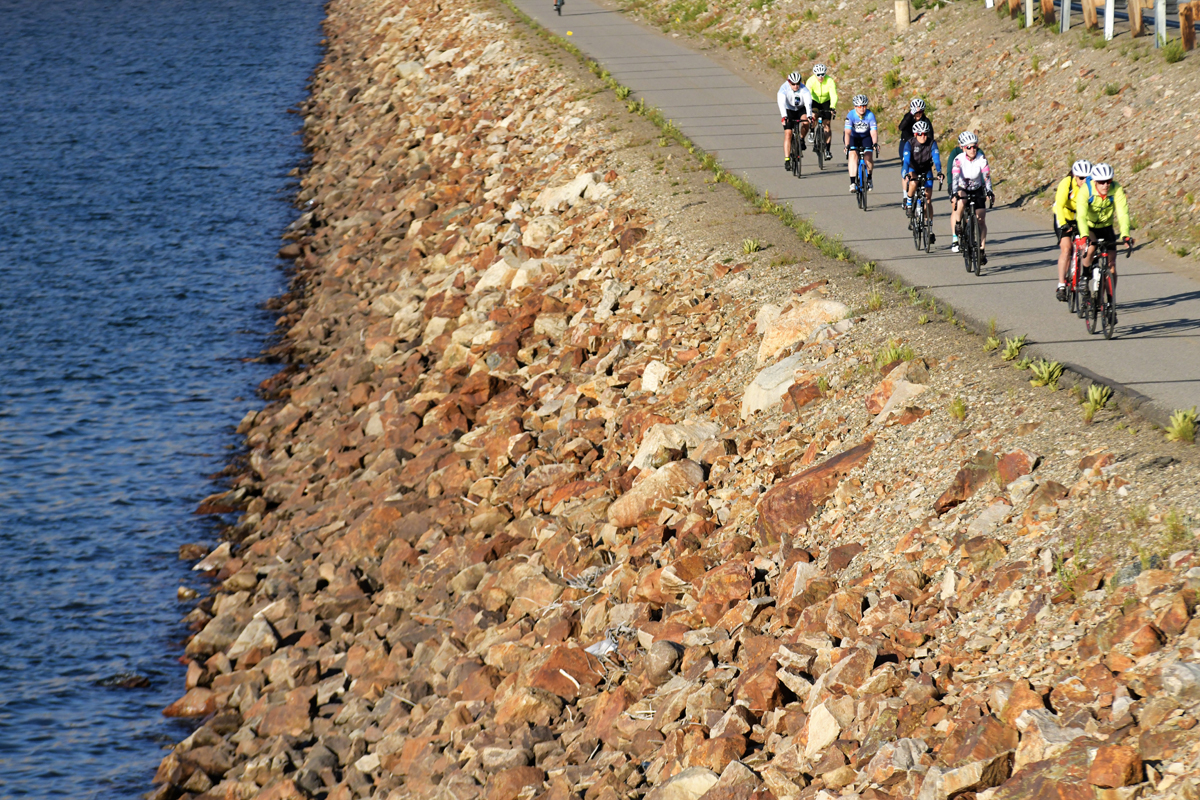
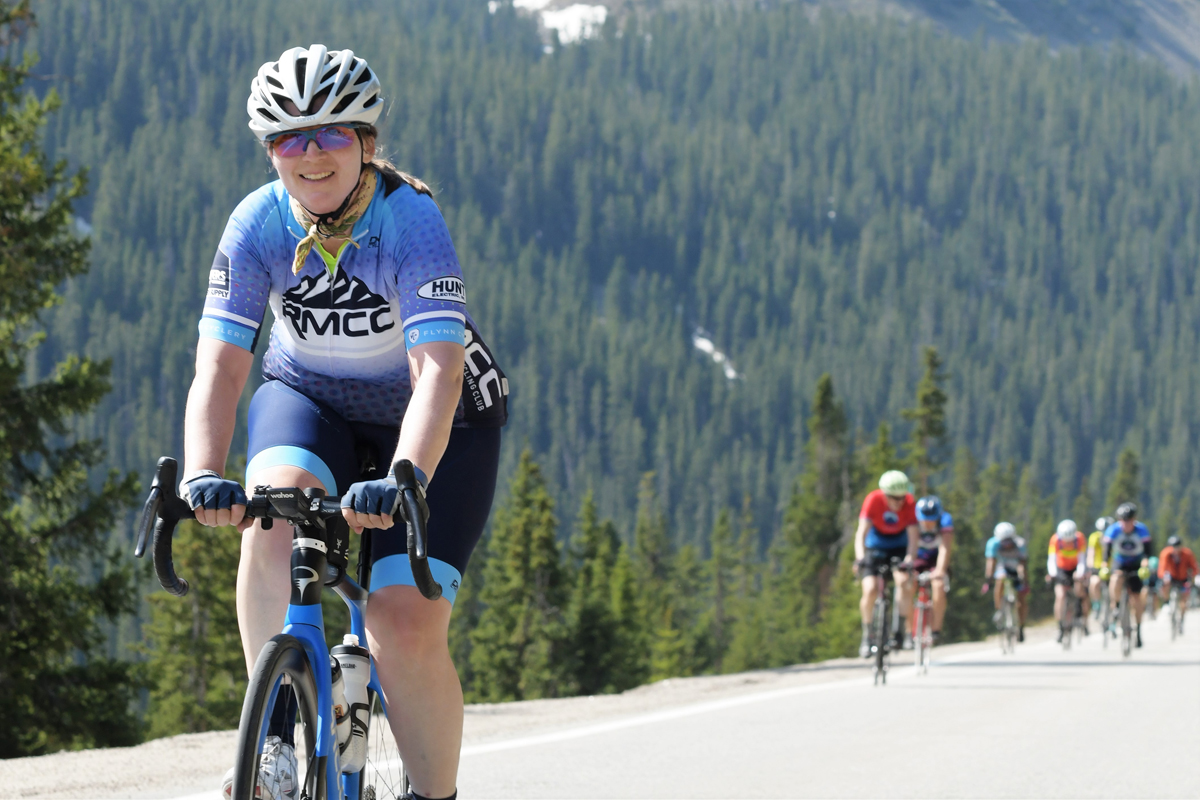
Our group of women (Stephanie, Lesley, myself, Lisa, Catherine) riding out of Breckenridge along the Dillon Reservoir. Photo by Ryan Muncy Photography
Initially, I had a little trepidation about signing up again after 2021, which faced some major challenges due in part to extreme heat, as well as the primary caterer falling through completely on the second day due to Covid (which affected people camping the most, but also some of the aid stations).
I was also a little stressed by some of the 2021 descents (especially gravel descents) on my beloved but aging Colnago, with its underperforming rim brakes + carbon rims combo. I had to actually stop and let my rims cool off a few times on the loose gravel descent from Lizard Head Pass. I was not amused.
However, the vastness and jaw-dropping beauty of the Colorado Rockies that we rode through in 2021 just blew me away – I mean, these mountains are truly next level– and I wanted more! (And I finally upgraded my bike to one with disc brakes, which gave me a lot more confidence on the descents. Also, this year’s course didn’t have any challenging gravel sections.)
I was hopeful that improvements would be made to on-course rider support, after the event was sold to new management in November 2021. In fact, that new management fell through, so the Bill Plock from 303cycling.com took over in April 2022 to become the current director, a mere two months before the event took place. At the time he took over, only one of 40 necessary permits was in place, and planning had been essentially stalled since January, so Bill had a daunting task ahead of him!
The tulips had already finished blooming when I looked again more closely at the route, again searching for something reassuring. Yikes, I was not ready! Life stressors (hello new puppy!) had taken a toll on my health and riding in 2021, and somehow, I had lost that little engine that I had come to rely on over these years. I was doubtful that I would be able to finish the event, let alone stay within reasonable distance of any of my friends.
Although I had made some progress with regular indoor training throughout the winter with TrainerRoad, I needed a more personal approach; fortunately, I connected with Dave Harward and Breanne Nalder Harward from PLAN7 cycling and nutrition coaching. The training took me out of the canyons for a bit as I worked to significantly increase my cadence and build back my endurance. I had gotten in the habit of riding up the canyons almost every ride, which I loved for the scenery; however, my fitness at higher cadences had dropped, and it took some work on flatter routes to build that back. I also focused on proper nutrition on the bike (i.e., using an electrolyte drink and getting enough carbs), recovery from workouts, and throughout the rest of the day.
As a person with type 1 diabetes, I had gotten into the habit of sometimes just eating to prevent low blood sugar, rather than eating to support my workouts, which would leave me under-fueled during my rides and really hungry the rest of the day. It took more effort to dial in the proper amount of insulin. High blood sugar can also be a big challenge because it messes with hydration and electrolytes; because I was eating more, I had to actually increase some of my insulin rates on my pump.
In addition, as a single parent with two young kids, the quality of my nutrition sometimes took a backseat to other obligations. Addressing all these changes would be critical to my success at Ride the Rockies, and I was really grateful to have expert help from Dave and Breanne.
The logistical planning for Ride the Rockies to get away without kids for a week was no joke. Fortunately, our fearless group leader, Lesley Anderson, is an expert planner and secured our lodging for the week through the company Summit Cycles Solutions (SCS). SCS supports riders who opt to stay in hotels by transporting their luggage from hotel to hotel, or in their “Camping Elevated” tent section by setting up tents and air mattresses for riders at each location and dropping off luggage at the tents. (Free camping is also always available for those who don’t mind doing it all themselves.)
In addition to lodging, though, I would need to arrange childcare for the week, find someone to take care of our dog, and make sure I could get the time off work and take care of all the last-minute things that seemed like an ever-growing list. After making arrangements with two babysitters, my mom, and enrolling my girls in a day camp for the week, I hoped things would be smooth sailing.
Finally, the week before Ride the Rockies arrived! All this preparation was worth it to me because – let’s get back to it – a week of riding every day with my friends in the mountains? I mean, come on! However, I wasn’t sure I would actually make it out of the house. And the news of extra drama with the kids hitting my phone as we crossed over the Colorado state line made me question if I would get to ride at all. After several hours of worry, things were resolved, and I took a huge sigh of relief — it was time to get on my bike.
Ride the Rockies 2022
Day 1: Copper Mountain to Glenwood Springs: 110 miles, 4390’ elevation gain
We had finally made it to the start of the ride, some last-minute bike mechanical drama notwithstanding. I was so happy to be riding at last with Lesley, Lisa and our other posse members, Stephanie Fowler and Catherine Collier. The early morning weather was chilly at nearly 10,000’, but we started with a climb to Fremont Pass (11,391’), which was a good way to warm up and shake off my initial sluggishness. Surprisingly, I felt normal during the first 3-4 hours which we spent riding above 10,000’, including cresting Tennessee Pass (10,423’) and Battle Mountain (9,269’).
The rest was “downhill” except for the 1000 more feet of climbing and massively strong and demoralizing headwinds – you know, the kind that make you work to ride downhill. It had become quite hot, and with the headwind and accumulated exhaustion, I bonked hard. We were all delighted to find a convenience store with icy drinks and a refrigerated beer cave to cool off in.
I tried to muster my strength for the remaining ~30 miles we had at that point and was very grateful for Lisa who patiently pulled me along. The last 10 miles riding next to the absolutely raging Colorado River on the Glenwood Canyon bike path were spectacular, and in the shade. Happily, I started to feel better and truly enjoyed this part of the ride. (I also reflected on how Colorado had managed to put this trail next to a massive river and right alongside, and often below, I-70; Utah needs to do better.)
I learned later from Bill Plock that the US Forest Service closes the bike path if there is a 30% or more chance of thunderstorms in the area, due to flash flood risk; we had lucked out with a good forecast. We learned later that there had been a small fire in the canyon after the riders went through, and there were two raft rescues on the Colorado River which had affected some riders getting through.
Day 2: Glenwood Springs to Basalt: 31 miles, 2926’ elevation gain
We started the morning out of Glenwood Springs on the Rio Grande bike path, taking a detour up a climb through some beautiful back roads that kind of reminded me of the Heber Valley–some rolling green hills and open areas, with mountains as a backdrop. We enjoyed a short stretch of packed dirt/gravel, the only gravel at this year’s event. Along the ridge top, the winds picked up and were incredibly forceful, too strong to even grab a bottle for a drink. The wind was absolutely whipping up waves on the nearby lake. The descent back down to the Rio Grande trail was super sketchy and I think we were all relieved to get down safely to Basalt.
Initially, we had planned to ride another 27 miles (with significantly more climbing) to our hotels in Snowmass; instead, we opted to stop in Basalt, the official stop for the day, and take advantage of the shuttle service that had been arranged for riders staying in Snowmass. Before heading out, though, we stopped by to get much-appreciated massages from massage therapists who help support Ride the Rockies each year. Massages can be scheduled each day and are set up right next to the camping areas.
Day 3: Basalt (Snowmass for us) to Salida via Independence Pass: 107 miles, 7140’ elevation gain
After the winds of the first two days, I felt a little anxious about what the ride to Independence Pass, at 12,095’ in elevation, would be like. I had heard that maybe the road was a little scary, maybe there was a cliff on the side, and what about those crosswinds. I was honestly a little shaken by the winds coming down to Basalt from the day before and kept studying the weather maps trying to reassure myself.
It didn’t help much.
The weather also looked a little unstable and perhaps there would be rain? Needless to say, we spent a lot of time engaging in the cyclist’s favorite quest of making the perfect clothing choices.
Riders make their way up Independence Pass from Aspen. Photo by Ryan Muncy Photography
After all the worry, the pass turned out to be one of my favorite rides ever, reminding me of some of the riding here in the Wasatch. It is a long climb at about 20 miles, but humane in steepness and spectacular in beauty. We had a little light rain early, and a few flurries near the top. The wind was often at our backs, although, at one hairpin turn, the crosswind was so sudden and strong that it very nearly blew me over.
The view of an expansive mountain valley surrounded by the mountain peaks was the reward as we made the last stretch to the top. Grateful to have my disc brakes for the descent, I enjoyed the views of the lush green grasses, trees, and rivers, as well as the tailwind down to Twin Lakes.
We grabbed lunch at the welcoming Twin Lakes General Store, warmed up, and were on our way. The tailwind moved us along quickly through the subsequent flat and rolling sections; however, as we neared Buena Vista and alongside the highway to Salida, we were repeatedly buffeted by incredibly strong crosswinds.
We all laughed later to see we had taken Strava trophies when we made the turn into Salida, with the winds at our backs. If we had only bothered to pedal! I would love to spend more time in Salida – we had a delicious dinner at a local restaurant and enjoyed watching the kayakers practicing in the rapids in the Arkansas River.
Day 4: Salida to Breckenridge: 79 miles, 6013’ elevation gain
The ride north out of Salida was beautiful, with more favorable winds and cooler temperatures. We backtracked to Buena Vista and this time I was able to enjoy the scenery a bit more, as we passed by some of the Collegiate Peaks 14ers in the area and an interesting mountain called Chalk Mountain that had big patches of, well, white chalk.
Although I enjoyed the terrain (mostly gradual climbing), I did not enjoy riding alongside the highway, which we did for almost the entire ride that day. I don’t know if there would have been an alternate way to get up to Breckenridge, but I was just counting down the miles until we got off the highway, only to turn onto … another highway.
We picked up lunch at the rest stop in Fairplay – wow, two huge buttermilk pancakes never tasted so delicious. Every day along the ride, they set up a tent at one of the rest stops to sell eggs, burritos, tacos, and pancakes. Another longtime RTR caterer set up at the rest stops to save riders from the heat with their fruit smoothies. YUM. The pancakes and syrup were a lot higher in carbs than I usually take in all at once, so I took a small amount of insulin to cover it, which can be a risky move due to the dramatically increased potency of insulin during exercise. It turns out, I guessed wrong and had to eat a lot more than I wanted to get through the climb up to Hoosier Pass, due to repeatedly falling blood sugar.
When I got to the summit at 11,542’, I was feeling a little spaced out – maybe the elevation or maybe just from too much insulin – and I just needed to get down. I was ready to be done for the day, and ready to be away from cars.
Day 5: Breckenridge Loop: 31 miles, 1512’ elevation gain – or 71 miles, 3984’ elevation gain with Ute Pass option
Ahhhhh, this was the day we all needed. We had a day to just relax and do our own thing. We could go short, go long, go early or later, and would be able to stay in the same place for two nights.
I had been pretty determined that I would not be doing the bonus 40 miles this day, but was persuaded by Stephanie, who made the compelling point that, “Before you know it, you will be back at your desk wishing you could be riding.” So true! I had the luxury of riding all day if I wanted to, so maybe I could give it a try.
Our group and others riding on the bike path along the Dillon Reservoir the last day. Photo by Ryan Muncy Photography
With a tailwind and downhill out of Breckenridge on their fabulous bike path, and our ladies’ posse leader that morning, Catherine, pulling us all along, we figured that we essentially had our recovery ride right there! The views of the Dillon Reservoir with the Breckenridge mountains backdrop were breathtaking as we wound our way around. I made a gametime decision to join Stephanie and Catherine on the Ute Pass out-and-back and was stunned by the beauty from the top of the Gore Range. Wow, Colorado was really showing off.
I felt surprisingly good that day and was glad I had decided to opt for the longer ride. Although my longest ride leading up to Ride the Rockies was 70 miles, I had just done 4 rides between about 70 and 110 miles in the past 5 days. I could see how the training, both cycling and nutrition, was really paying off, and was gaining confidence that I would not only finish the event, but finish feeling better than I started. I had not anticipated this.
Day 6: Breckenridge to Golden: 87 miles, 5500’ elevation gain
Our last day! As our “ladies posse,” 5 women strong, rode in a paceline around the Dillon Reservoir, I was both excited and sad to see our week of riding drawing to a close. It had been such a gift to be able to spend this much time riding and traveling with some of my favorite people, riding bikes in such awe-inspiring locales. Each woman in our group had shown such strength, power, talent, and grit along the way, and I don’t think I had laughed so much in a long time. Ahhh, just wonderful.
Anne Findlay enjoying the car-free ride up Loveland Pass on the last day. Photo by Ryan Muncy Photography
As we approached the Loveland Pass climb, I could hear the cheers of the cyclists as we saw the CDOT sign indicating that the pass was closed to motor vehicle traffic!! OMG! We were all so grateful to have a stress-free ride over the pass. Wow! With a stop for a delicious and perfectly timed scone from the Steep Coffee Shop in Keystone (I was over eating gels and blocks when I could help it), I was powered up for the climb to the 11,991’ pass. It was truly glorious, and the perfect way to end the week. We enjoyed the rest of the ride to Golden, including a bike path down through lush pine forests, the locally infamous Floyd Hill, and a locals-only side trip to Lookout Mountain.
I think we hardly even noticed the shuttle ride that we took to cross over some construction in Idaho Springs. I’m not sure if it was a week of riding, or the drop back down from higher elevations, but I felt the best I had all week. There had been a lot of preparation, and I had absolutely depended on support from my coaches and cycling friends both before and during the event; but somehow, I (as well as the rest of our group) had made it successfully through this incredibly challenging week of cycling!
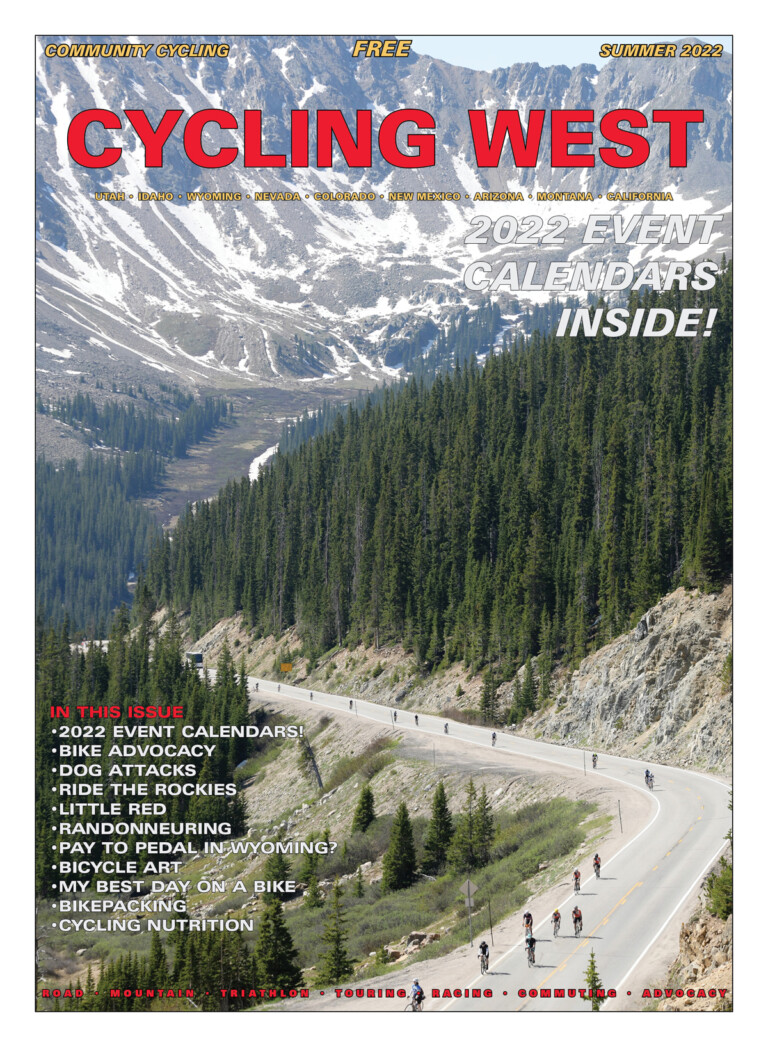
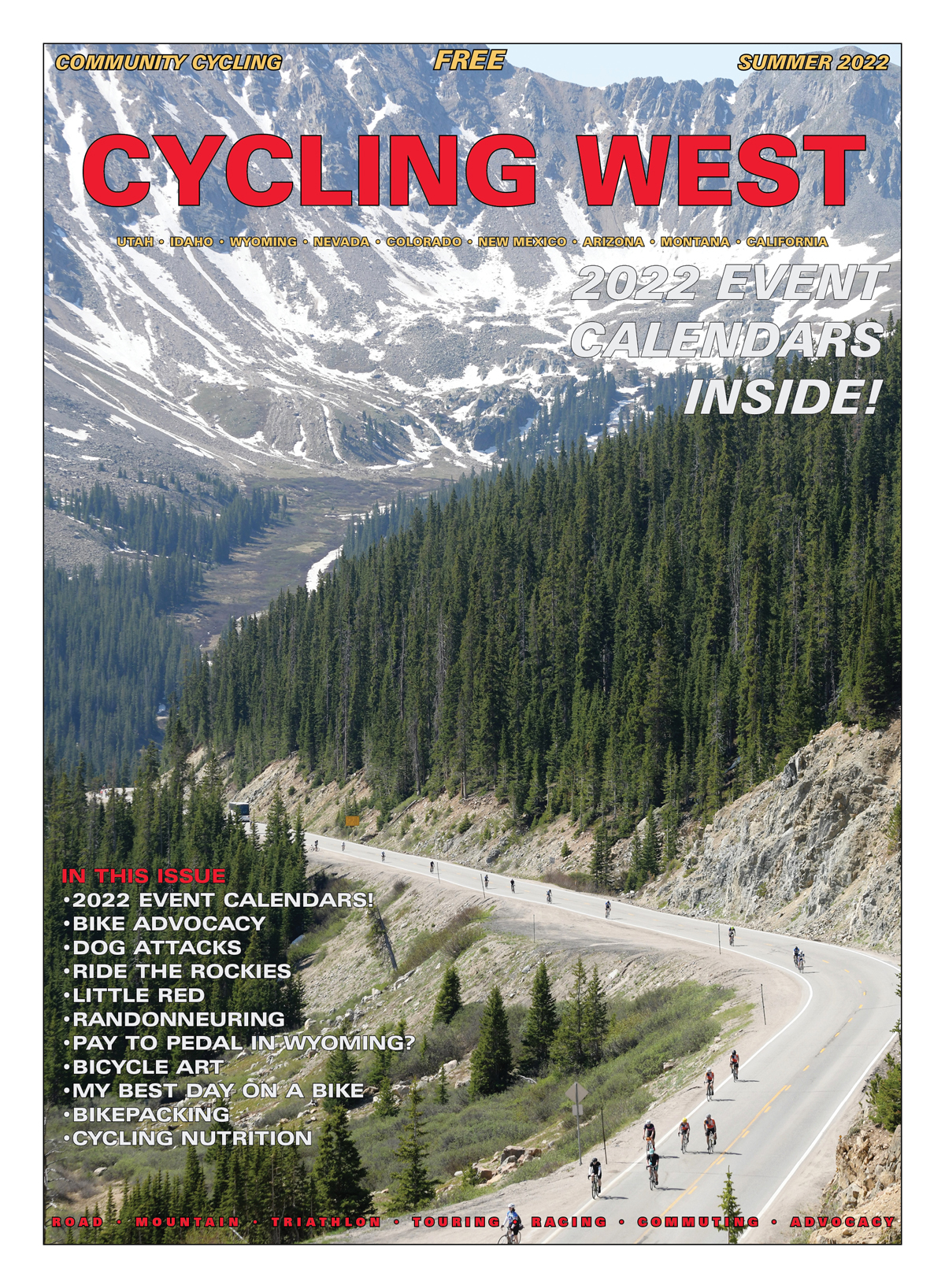
Cycling West and Cycling Utah Magazine’s Summer 2022 Issue is now available as a free download (10 MB download). Pick up a copy at your favorite Utah, Idaho, Wyoming, Nevada, Montana, Colorado, Arizona, New Mexico, and Northern California bike shop or other location.
Cycling West Summer 2022 Cover Photo: Riders on Loveland Pass in the 2022 Ride the Rockies. Photo by Ryan Muncy Photography, https://ryanmuncyphotography.smugmug.com. Follow him on Instagram @ryanmuncy
Contents
The Athlete’s Kitchen: Commercial Sports Foods: A Matter of Preference — page 2
Ride the Rockies: A Week of Challenging and Rewarding Cycling — page 3
Little Red Riding Hood: A Mother and Daughter’s Perspective — page 6
What is a Randonneur? Apparently, I Am! — page 7
Pay to pedal? Wyoming to explore mountain bike user fees — page 8
The Ultraknuckle: The Best Worst Idea Ever? — page 9
A Dog Attacks You While Cycling, What Do You Do? — page 10
A Roadie Tries Mountain Biking — page 11
My Best Day On A Bike, Ever — page 12
An Interview with Triathlete Melissa Coles — page 15
Bicycle Collisions More Likely on Less-Traveled Roads — page 15
COVID-19 Accelerates Shift Towards Bikes — page 23
Cargo Bikes Cleaner than Trucks — page 23
Bike Lanes Increase Ridership — page 23
Tandem Bicycle: The Bicycle Art of Jason Beck — page 24