Spring is in the air, the sun is warming your back, and you’ve got the hots for a new bike. It won’t have the smell of a new car, but it will have the feel of speed, joy and freedom. That’s assuming it is adjusted to fit you, and fitting starts with sizing. Which is why size matters.
A bike of the correct size offers a “fit window” to allow for adjustments to the saddle and handlebar position to suit your body and riding needs. If the bike is too big or too small for you, then it’s going to be a stretch (or a shrink) to get it close, and close will not be good enough for all day riding comfort.
Frame Size is a one dimensional measure of the height of the bike, as an actual or theoretical seat tube length. It may be expressed in inches or centimeters, or as a small, medium, large, etc. There is not a consistent agreed way to express a bike size, and so the same frame label size between different brands can vary significantly.
While size matters, you should also know that Shape does too. Two bikes labeled with the same frame size may be a very different shape, and therefore feel quite different. Frame Size does not take into account the length of the bike or the height of the front end, both influencing where the handlebars can be. These are important because they affect your reach and drop from the seat to the handlebars which determines your upper body position, which influences your back, neck and hand comfort. Seat tube angle is also an aspect of shape that influences where your center of mass and balance can be located.
Shape is two dimensional, and is defined in the frame geometry charts for each model, which show lengths and angles. Shape can be expressed descriptively. For example as race, competition, sports, or endurance for road bikes and as XC race, trail, all mountain or freeride for mountain bikes.
Shape can also be described as frame “stack and reach” co-ordinates, which defines where the head tube is in relation to the bottom bracket. These are useful numbers for comparative purposes.
Shopping for Size
When going into a store to buy a bike, you now know it is important to get the right size and shape. How is this determined? You can measure the geometry of an existing bike you ride that feels good for you, and use those specs. But if you don’t have an existing bike, or if it is not a good template, then it’s in the interest of the bike shop to help you out. There are 4 main sizing methods:
The eyeball. This is when the sales person runs their eye up and down you, and pronounces a number with confidence. It’s good for their ego, but not necessarily a quantifiable, evidence based approach. Move on…
Stand over clearance. This is useful, as no one wants to knack themselves straddling a bike, but it only takes into account one aspect of sizing, and ignores the rest. Move on…
Body measurements. Hard data like inseam length, height, torso length or sternal notch height, arm length. Now we are getting some evidence of skeletal proportions which are very useful for accurately recommending a bike size and shape, in conjunction with information about riding style and intentions, and physical factors like strength, flexibility and injury history. Be mindful that inseam length on its own is only a predictor of bike size and not bike shape. Two people with the same inseam length but different upper body portions may well be better off on different bikes. There are a number of body measurement systems available to bike stores, including the Fit Kit System which has been in use for over 30 years. This sizing is usually free if you are buying a bike at the store.
Pre-purchase fitting. This top shelf option has you riding on a size cycle (bike simulator) to determine a final fit position, and from this a recommendation of suitable bikes and components can be determined. This will typically have a cost because of the time and technology involved. The Guru Fit System is one such option, with integrated frame finder software, but there are a range of low tech to high tech size cycles around.
Buying Online or Used
If you are buying online, some websites offer a sizing guideline. These vary widely from totally useless to quite thorough. You can also go into a local bike shop that uses a sizing system, but convey your honest intentions of shopping online, and expect to pay for the sizing service. This also applies if you are buying a used bicycle, which is by far the easiest way to get a bike that will not fit. A great deal off KSL doesn’t make for a great ride if the bike is the wrong size. Measure twice, buy once. Size matters. So does shape.
John Higgins is an imported local cycling enthusiast who used to sell bikes, but now offers bike fitting services through BikeFitr and is a partner in Fit Kit Systems. He keeps a low profile, but you can find him if you want to.
GREENbike implements safety protocols during COVID-19 Crisis
SALT LAKE CITY, Utah (April 2, 2020) — In coordination with Governor Gary Herbert’s “Stay Safe, Stay Home” directive and Salt Lake City Mayor Erin Mendenhall’s proclamation implementing the directive, GREENbike, Salt Lake City’s nonprofit bike-share program, is offering $0.01 annual memberships to all essential workers.
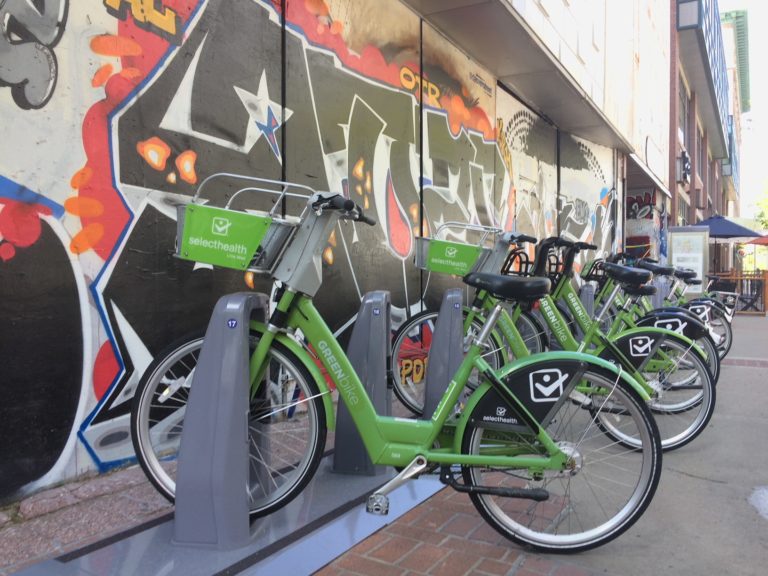
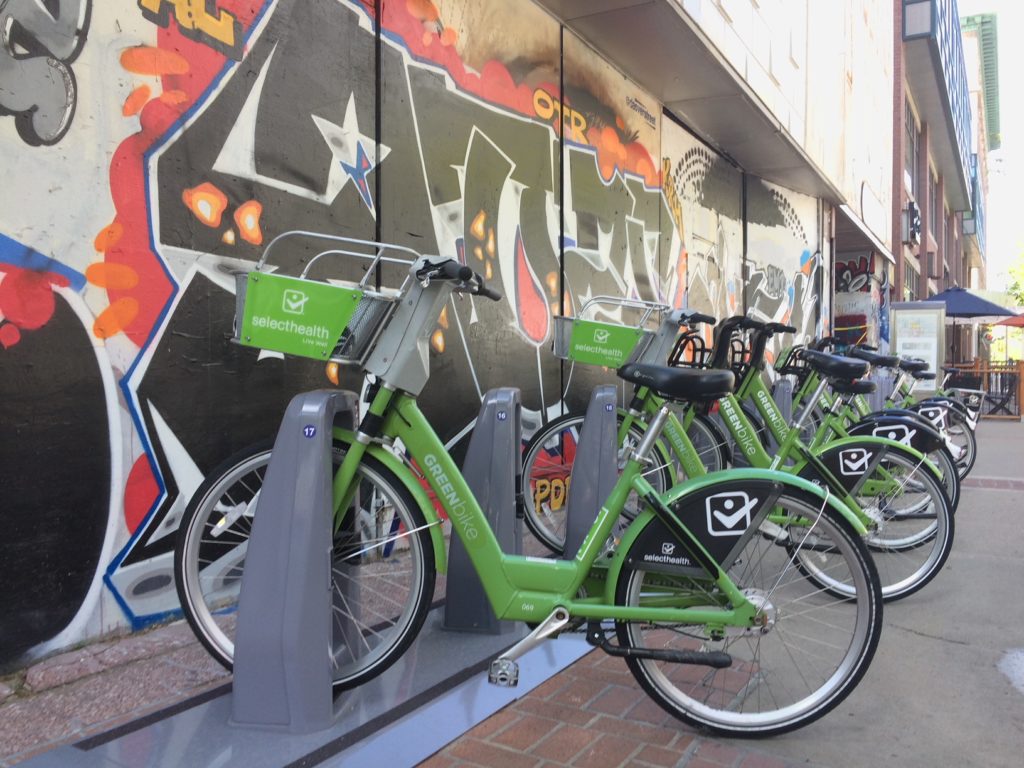
GreenBike has changed downtown Salt Lake City with 33 stations and hundreds of bikes. Photo by Dave Iltis
These workers include:
Health care professionals.
Law enforcement officers and first responders.
Faith leaders and workers, including an official, worker, or leader in a house of worship or other places of religious expression or fellowship.
Employees of charitable and social services organizations.
Grocery clerks and all grocery store employees.
Restaurant employees and drivers offering take-out and delivery options.
Bank employees.
Gas station employees.
All Utah residents unable to telework.
Eligible workers can go to greenbikeslc.org/join to purchase an annual pass and use the promo code Essential2020 to get the discount. The promo code is live and will be able to be used at any time from now until May 1st, or as long as the “Stay Safe, Stay Home” directive is in place. An annual GREENbike membership includes unlimited 1-hour bike rides for 365 days following account activation.
“We are grateful for the brave men and women working in these essential services,” said Ben Bolte, Founder, and Director of GREENbike. “We want to make sure those who are working during this time have access to as many affordable and safe transportation options as possible.”
The health and safety of our riders is a top priority at GREENbike. In line with the governor and mayor’s guidance, GREENbike is taking the following steps to protect our staff and the community:
Bikes & Stations
GREENbike technicians are regularly disinfecting all high-touch surfaces including the daily cleaning of kiosks, handlebars, grips, saddles, baskets, dock wake buttons, touch screens, credit card readers, gear controls, seat adjuster handles, bike bells, and bike locks.
The process used to disinfect bikes and tools includes wiping down stations with hot soap and water to clean. Technicians then use Simple Green Clean Finish and Isopropyl alcohol to disinfect the bikes and stations. Technicians are currently using Lysol wipes to disinfect the tools.
Staff
GREENbike technicians are working on bikes and stations alone in staggered shifts.
Technicians are required to follow strict hygiene standards including frequently washing hands with soap and water for at least 20 seconds; using hand sanitizer frequently; avoiding touching their faces; covering coughs or sneezes (e.g., into the sleeve or elbow, not hands).
GREENbike has provided disposable gloves and hand sanitizer to be used when working on bikes and stations as an additional precaution.
Technicians are disinfecting the tools they use as well as the surfaces of our maintenance vehicle after each shift.
Riders
Riders should remain at least six feet apart from individuals from other households while riding a GREENbike.
Riders should follow strict hygiene standards, including washing hands with soap and water for at least 20 seconds before and after using a bike, using hand sanitizer frequently; avoiding touching their faces; covering coughs or sneezes (e.g., into the sleeve or elbow, not hands).
Riders are encouraged to consider wearing gloves when operating a GREENbike.
Riders are encouraged to check out bikes using the BCycle App on their smartphones.
For more about our program and precautions in response to Coronavirus (COVID-19) visit greenbikeslc.org/covid19.
By Marty Jemison — The Murcia time trial was a chance to test my time trial bike … I thought I took it quite easy … but finished 22nd, I was truly practicing and thinking about the Redlands time trial … sometimes when there is no pressure, I can amaze myself … I think I was just having fun … make the bike go fast … get aero, pick a good line etc. … just geeking out. I was expecting a place in the 60s or 80s. the form is coming?
Now in Redlands … trying to deny jetlag, the fact that we just raced 5 days on another continent, and it was cold and rainy we started the first stage. We were attentive at the front … but there was confusion when we were lapping groups, some even for the second time … Clark and Dave Zabriskie somehow slipped away during this … who could blame them, but the rest of us had seemed to miss it … With two laps to go we knew, but there was only a halfhearted chase.
I felt good in the time trial but not great, the legs are still a bit heavy from the travels … I was a bit disappointed with 5th. we are here to win the race. WE had a minor celebration of Dylan’s win … mixed with tactics conversation for the next stages.
Today’s stage is leaving us very frustrated … it puts us in 4,5,6 (Levi Marty David) in GC, but still, that is not the leader’s jersey. Sunday’s stage will be the showdown. We can win.
Behind the scenes … tonight the team went to see ” Cider House Rules” after some local Mexican food., Last week I had intentions to write about Murcia … but spent a lot of time working with Dave teaching him how to get online with his Psion5. I use a Psion exclusively when I travel, Stephan K. also has one. A very practical handheld computer. more later ….
My writing is boring me at the moment so off I go …. maybe in these moments it would be better to just answer yes, no questions …
By Lou Melini — I wrote my first book review for Cycling Utah in 2002. Since that time I have read a half dozen books per year with bicycling as a significant or complete subject of the book. The subjects of the books had a variety of themes that included racing, touring, urban cycling, and some that were simply good literature. Since bicycle touring is what I enjoy most, I have summarized my top 5 touring books. Each of these books listed had been reviewed in Cycling Utah. My first book review, Catfish and Mandala, is included in the list. To narrow the quantity of bike touring books to a “top 5” took some time. My criteria for selection was that the book had to be well written, entertaining, read like a novel (and not a travelogue) and with one exception, tell about a bike tour from the beginning to the end of the book. I did not include books that were a collection of short touring stories such as Willie Weir’s; Travels With Willie, though I would recommend that book. So if you enjoy reading, choose any from the below selections.
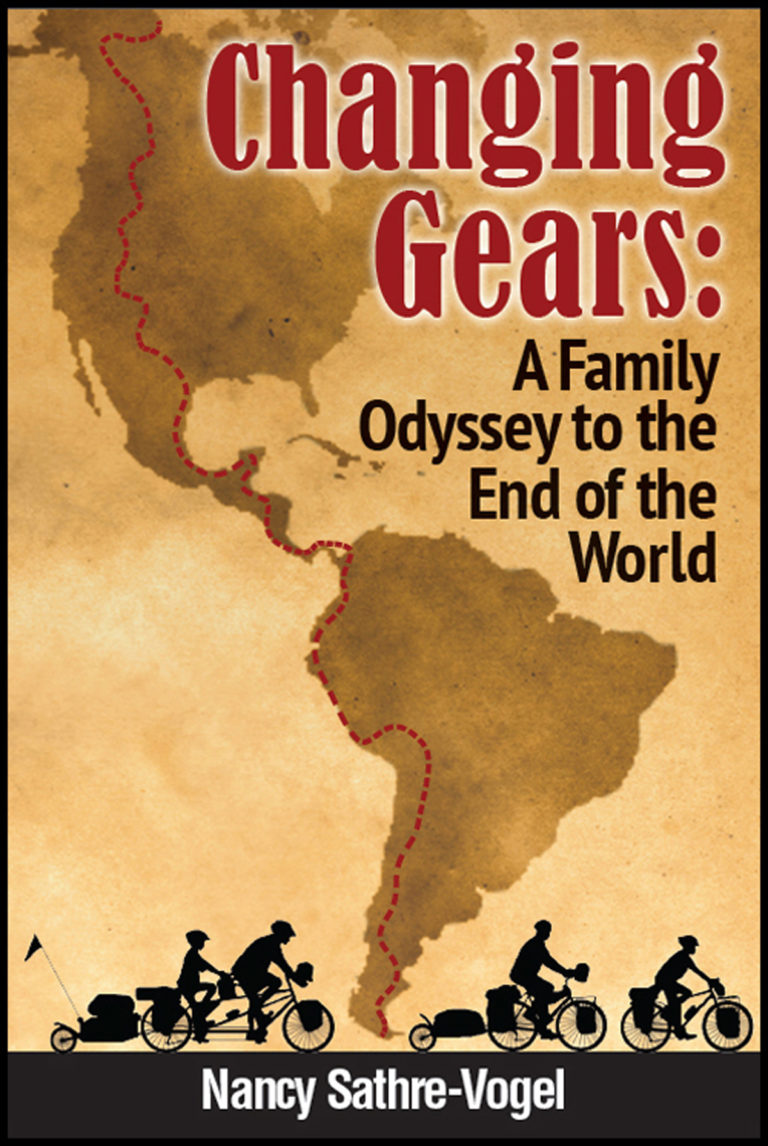
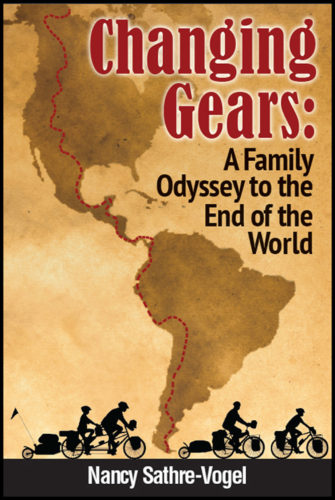
Changing Gears: A Family Odyssey to the End of the World (2013), Nancy Sathre-Vogel. ISBN: 9780983718734
The book Changing Gears: A Family Odyssey to the End of the World by Nancy Sathre-Vogel is one of Lou Melini’s top 5 bicycle touring books.
This book chronicles the 2-year, 9-month and 18 days that the Vogel family traveled from Prudhoe Bay in the northern part of Alaska to the southern most city in Argentina. The family included Nancy, husband John and their twin 10 year-old boys. Changing Gears details the geography, culture and logistics of traveling for that length of time and distance. Add the boys and one really ramps up the logistics. Just the plane trip to Alaska was an ordeal, transporting one tandem for John and son, Daryl and 2 single bikes for Nancy and the other son, Davy. In addition there was one BOB trailer and an Extra Wheel trailer. These were shipped along with 3 very large containers for all of the equipment that was to be stuffed into panniers and trailer bags.
Their start in Prudhoe Bay was less than auspicious. An oil worker helped them with their baggage after arrival who stated: “For the record, I drive this road on a regular basis, and I think you’re nuts”. On the day of departure, with 17,000 miles to go, Davy was brought to “the verge of tears” when he crashed moments after leaving the hotel parking lot onto the gravelly Dalton highway. After that mishap, they had 240 miles to the first town on the Dalton highway. The Vogel’s thought they were prepared by packing 50 pounds of food. With two hungry boys they ran out of food, or would have had a “road angel” not helped out. Obviously, no matter how much experience and planning one does, things happen.
The road angels are mentioned frequently in the book. When in Mexico, they met a motorcyclist. He had his motorcycle club escort the Vogels into the town they were entering. The club then escorted them out of town. The Vogels were then escorted into and out of a lot of towns by a number of motorcycle clubs from a “telephone tree” that was started on their behalf.
Nancy Sarthe-Vogel does a fantastic job of chronicling the journey. The encounters with the local people along the way were inspiring. Interestingly, or perhaps strangely, they were “stalked” by a small group of women (from the U.S.) that would contact any media or non-profit that publicized the Vogel’s trip and say that the Vogel’s were “abusing their children”.
And so went the travels of the Vogel family. I had a hard time putting the book down. It is very well written. It’s a ‘novel’, an adventure book, a travelogue and a “how-to” cycling book. It is additionally a book chronicling what families are supposed to be doing, though in this case the family is outside the bell curve by choosing to travel on bicycles.
So, after 2 years, 9 months and 18 days, Daryl and Davy became the youngest to cycle the Western Hemisphere. They have all of the documentation. Unfortunately Guinness World Records dropped the “youngest category” during their travels after the rescue of a young teen trying to be the youngest to sail around the world. You as the reader will watch the boys grow-up during their journey, an achievement worthy of an award despite the Guinness organization’s rejection.
Miles From Nowhere (1983), by Barbara Savage. ISBN: 9781680510362
I will be succinct in saying that this is the one bicycle-touring book that everyone should read. It is iconic. Put it alongside your Steinbeck or Hemingway collection. It is well written. You will also obtain a very good sense of what bike travel is about.
Barbara and her husband Larry set out for an around-the-world-adventure. Two years later they returned. In between are adventures in North America, Europe, Egypt, India, Nepal, Southeast Asia and New Zealand. The strain of travel at times negatively affected their relationship but mostly cemented it. There were joyous moments of hospitality by complete strangers, as well as hardships such as the never-seen-before poverty of Egypt. The adventure took place in the 1970’s, before computers, bicycle specific maps, books or even decent touring bikes and accessories.
There were other books about world travel from the 70’s that I tried to read. They tended to read like a diary. Miles From Nowhere is more like an adventure travel novel in which the reader looks forward to the next chapter. The cultural insights that Barbara includes in the book are especially welcome and entertaining. These insights are what make this a classic book. Her interactions with the various populations are described well, and would be told no differently than if she did the trip today. And finally her relationship with Larry and the emotional toil of another couple that they met and rode with are written well.
I’ve always dreamed of a long around-the-world tour. After reading the book I still dream but then had to reflect on whether I could do the ride. The stark reality of one passage in the book stuck with me when Barbara wrote upon entering New Zealand; “We’d return to “civilized” bike touring. Everyone spoke our language, and we were no longer forced to communicate with people in some awkward mixture of grunts, hand motions, and a few foreign words. There was no need to hassle with purifying water or to worry bout getting sick on it or the food we ate. We camped out anywhere we pleased without a thought about cobras, bandits, crowds of staring faces, or government regulations.”
Though published in 1983, the book is as relevant and entertaining now as it was then due to the manner in which it is written. You won’t be disappointed.
Catfish and Mandela (1999), Andrew Pham. ISBN: 9780312267179
Andrew Pham came to America at age 10 after he and his family made a harrowing escape from VietNam after the war. His father, a survival of the “re-education” camps for South Vietnamese soldiers, took his family to America to improve their lives. Leaving Vietnam was not easy, nor legal. Andrew’s family paid a fishing boat to take them initially to Malaysia. With time, the boat ran out of food, nearly out of water, and then started leaking, badly. Despite their desperate plight, a French vessel ignored the occupants of the boat. They were rescued the next day, eventually making their way to America.
Twenty years later, Mr. Pham returned to his home country, traveling by bicycle. His return to Vietnam is a fascinating journey and gives him time to self reflect on the reception that he receives from the citizens of his former country. “Only 20 years” but much has changed as Andrew struggles to find his past. Soon he realizes that “it isn’t the same place I left”. He is treated and preyed upon as a “rich American” rather than a returning citizen.
Throughout the book we learn about Mr. Pham’s family and the changes that occurred being in America. These passages, though not a part of the bike journey, make the book a true novel. Despite the book not being a “cover-to-cover” bike tour, it made my “Top 5” due to the quality of the writing. You will have a hard time putting this book down.
Catfish and Mandela was recognized for excellence with 10 different literary awards.
Once Upon a Chariot (2008), Iris Paris. ISBN: 9781606047880
In 1947 there was a famous Norma Jean that went by the stage name of Marilyn Monroe. There was another Norma Jean in that year, less famous, with the last name of Belloff. As a near 20-year-old, she decided to ride across the United States on a single speed bike with her possessions stored in a handlebar basket with additional gear strapped to the top of the rear rack. She carried little in the way of money, hoping to find work along the way. She ends the first phase of her journey during a snowstorm at her aunt’s house in Connecticut. In between her start and arrival in Connecticut are countless small adventures.
Norma Jean leaves Connecticut and returns to her California home also by bicycle. She happened to meet a leader in the bicycle-racing scene in New York during her first crossing of the U.S. She is given a “proper” bicycle to return to her home by the racing organization. With her new bike, also a single speed, she sets the women’s record for riding across the U.S. This book is truly an amazing journey that will rivet you to your seat.
Norma Jean’s daughter, Iris Paris, authors Once Upon a Chariot. Ms. Paris never knew the history of the bicycle that sat unused in the garage as she grew up. She apparently was unaware of her mother’s accomplishment, “locked in the hearts of certain family members until 1989”. As part of the inheritance from her deceased grandmother, Ms. Paris received, “5 trunks full of documents including my mother’s trophy”. The trophy was for finishing 3rd in the 1948 Women’s National Bicycle Championships. From the trunks, Iris Paris wrote her mother’s story.
While reading the book I kept thinking about how this was a story about a 19 year-old girl in post WWII America that rides alone for nearly 18 months. She is using a single-speed, balloon-tired bike, with all of her possessions strapped to a rack. She leaves with the intent of finding work along the way to pay for her trip. She is helped immensely by the kindness of strangers, sleeps along the road, eats very little at times due to lack of money, and shows a sense of perseverance that would stop the average person. Would any of us do this? Once upon a Chariot is a wonderfully inspiring story of a girl seeking adventure and self-understanding. For anyone contemplating a bike tour or just wants to read an inspirational book, this is it.
The 2 Norma Jeans’ did have one thing in common. In 1962, Norma Jean Baker (AKA Marilyn Monroe) was found dead at the age of 36. Officially listed as a suicide, there are multiple theories, including homicide, for her death. In 1971, at the age of 44, Norma Jean Belloff also committed suicide. She was diagnosed with an undisclosed mental illness at age 28. Coincidentally, her daughter and author Iris Paris, was 19 at the time of her death, the same age when Norma Jean Belloff rode off on the adventure of her life.
Mud, Sweat, and Gears: A rowdy family bike adventure across Canada on 7 wheels.(2009), Joe “Metal Cowboy” Kurmaskie. ISBN: 9781891369940
Joe Kurmaskie has written a number of very good books, including 2 books about his cross-country travels with his children. I have read 4 of Joe’s books. In Mr. Kurmaskie’s earlier book, Momentum is my Friend, Joe rides across the U.S. with his 2 sons. In Mud, Sweat and Gears, Joe rides across Canada with his wife Beth, the 2 sons and the new addition to the family, Matteo. Put yourself in Joe or Beth’s shoes. Two parents, 2 boys aged 9 and 7 and a 1-year-old in a trailer riding across Canada, an adventure sure to bring a lifetime of memories. You will share these adventures and memories throughout the book. You will read about the kindness of strangers, mixed with the reality of a family riding on 2 wheels, or should I say 7 wheels. (The tandem pulling a trail-a-bike and a trailer, plus Beth’s single bike)
You will put the book down every few pages to let out a good laugh. Here is an example of their welcome to a Canadian park. “Not 50 yards through the entrance, Ranger Selwin blocked our path. My greatest fear was that this grandfatherly-looking type would tell us his campground was full, overrun by bears, closed for repairs, or most crucial, suffering a tainted water supply. In an act of good will he extended a baseball cap full of thimbleberries. I started to ask him something but he waved me off. Eat first, then we’ll get to the questions.”
Of the books by Joe Kurmaskie, I chose Mud, Sweat and Gears for my top 5-book selection mostly due to the inclusion of his wife’s little footnotes that are in response to Joe’s writing that are simply hilarious. Initially Joe and Beth considered a triplet for the journey. When Joe decided that the triplet wasn’t working out and thought Beth should ride his single touring bike, Joe wrote; “She was stunned”. Beth’s footnote reply was “I was relieved. No matter how hard it was to wrap my head around soloing across Canada, I would have taken a bullet before getting back on that beast”.
Mud, Sweat and Gears is a very good read. It’s about bike touring, it’s about family, and mostly it’s about what can happen when a family of 5 ride across Canada. All of Joe Kurmaskie’s books are deserving of space on your bookshelf. If you can’t make up your mind about which book by Joe Kurmaskie you want to read, this is the book.
For my own bike tours I have the 4 “R’s” for each day’s ride; Ride, Relax, Read and Repeat. (It would be 5 “R’s” if eating started with the letter R). I hope the above reviews inspire to pick up one of the books and stuff it into your pannier for your next tour.
By Jack Stauss — Early on a Wednesday morning, I watched lightning flash outside my tent, stirring me from an already fitful night of sleep. Blurry-eyed and sore-backed, I pulled myself to sitting and unzipped the fly. While I sat for a second, letting the dim world come into focus, I thought of how in a couple hours I would be riding an indeterminable number of miles in a landscape I had never been in. It was dawn and I was ready for a cup of coffee. I packed up my Green River roadside camp and headed into town.
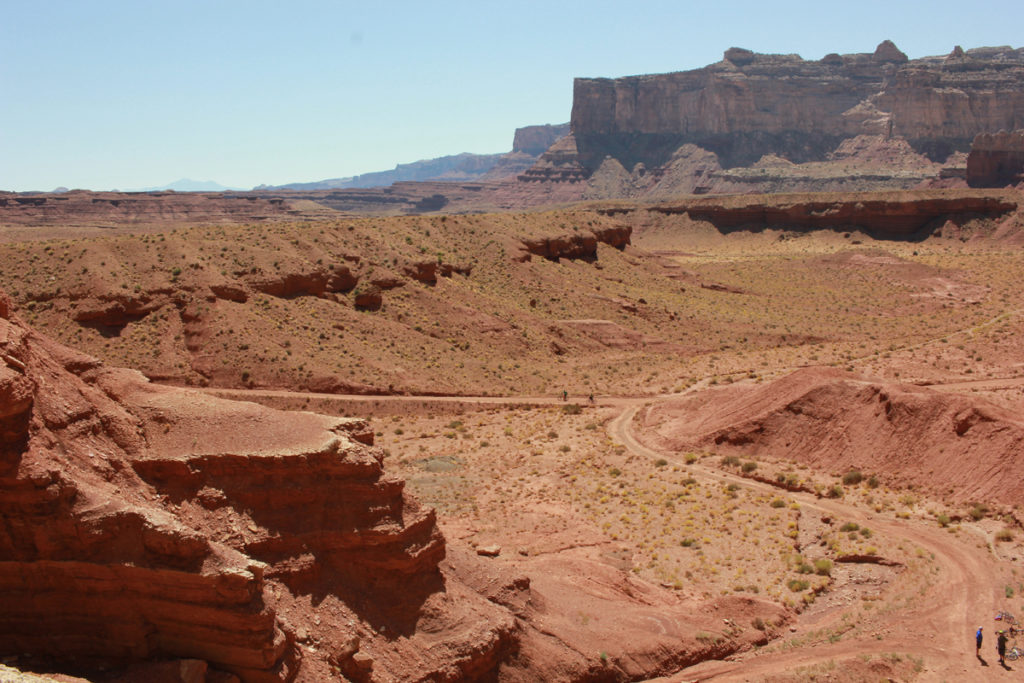
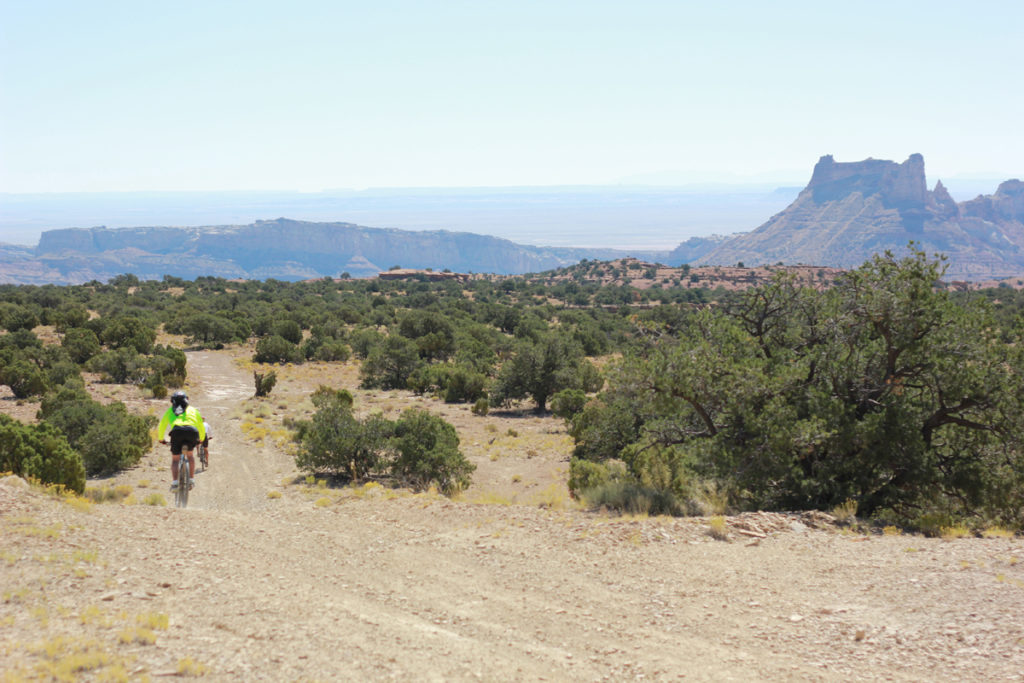
The Swell provides lots of excellent gravel roads, few cars, and sweeping vistas. Riding the San Rafael Swell on a Holiday River Expeditions trip. Photo by Jack Stauss
After stopping for some gas station brew, I arrived at the Holiday River Expeditions headquarters. I had done the river part of the outfit’s business, and I was eager to try their San Rafael bike trip. Their trips were always top-notch and the guides took a pro attitude across the board: providing adventure, interpreting history of the region, explaining plants and ecosystems, and pointing out the constellations while sitting around a campfire. Most importantly, they were going to support with their five-star mobile kitchen, cooking us gourmet meals after hard days of riding.
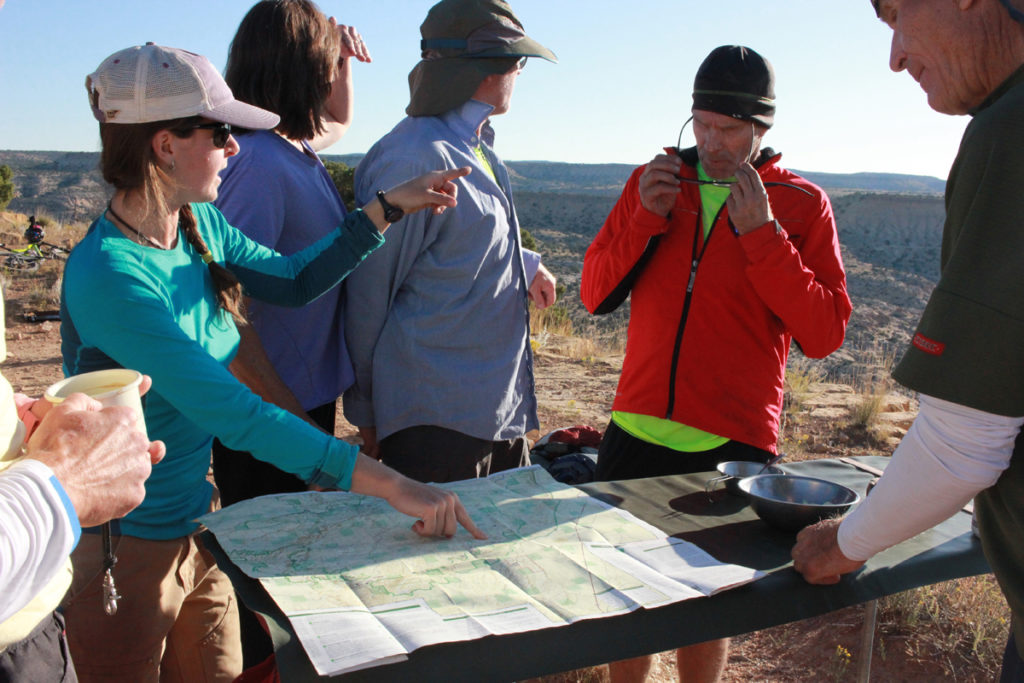
Sitting at a green picnic table outside the building, I slurped down the rest of my coffee. A sleepy young guide pushed through the swinging door and said “Hello.” Jack, one of our two guides, took a test ride on my hardtail and loaded it on the van. Soon the rest of the guests had arrived, and we all gathered around as our trip leader Susan unfolded a map on the table.
“We’re going south!” she said. She pointed to an exit off of I-70 about 40 miles west of Green River. From there, she traced her finger along backroads to the bottom of the Swell, all the way to the Temple Mountain Wash Panel. Over three days, this was going to be a huge survey of the region. I was psyched. This trip was not only going to open up a huge blank spot on the map for me, because we were riding, the bike would let me really experience the land.
After a quick drive on the highway and out into the desert, we topped off water, pumped up bike tires, and lubed chains. Our driver bid us farewell and we let the rubber hit the gravel. I started pedaling with a guy named Nick from the Boulder area who was there with a couple friends. He had never really done a trip like this, but spent a lot of time road riding and traveling the world. It seemed he was in his element. Along with us were his two buddies Eugene and Eric, and a couple from Albuquerque: Leslie and Matt.
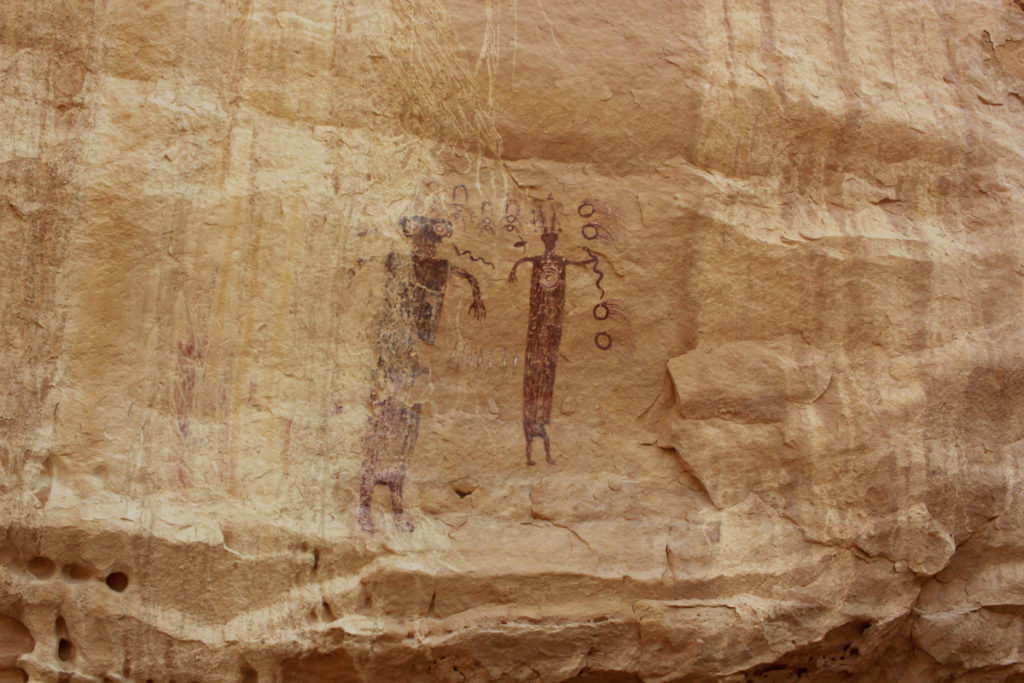
Biking north from I-70 to see a Barrier Canyon culture rock art panel. Riding the San Rafael Swell on a Holiday River Expeditions trip. Photo by Jack Stauss
We took a detour back to the north of I-70, to see a pictograph panel, so the groan of civilization droned on as we rode through a giant metal culvert under the freeway. The path was worn from easy access by Jeeps and four-wheelers, so the track was like a sandbox. My skinny tires slid around, sometimes stopping altogether in the soup. Our guide Jack’s fatter rubber ripped through the dust. We all weathered the sandstorm as best we could, and soon we were stopping at a massive rock art panel.
Barrier Canyon Culture rock art on a panel near I-70 west of Green River Utah. Riding the San Rafael Swell on a Holiday River Expeditions trip. Photo by Jack Stauss
Susan explained to us that it was left by the Barrier Canyon Culture, some of it painted 4,000 years ago. This civilization was different from that around sites commonly seen in Moab and along the rivers of the Colorado Plateau. While little is known about the ancient people, the Barrier Culture and their unique style is just another reminder that this is a place much older than our civilization, and worthy of our utmost respect.
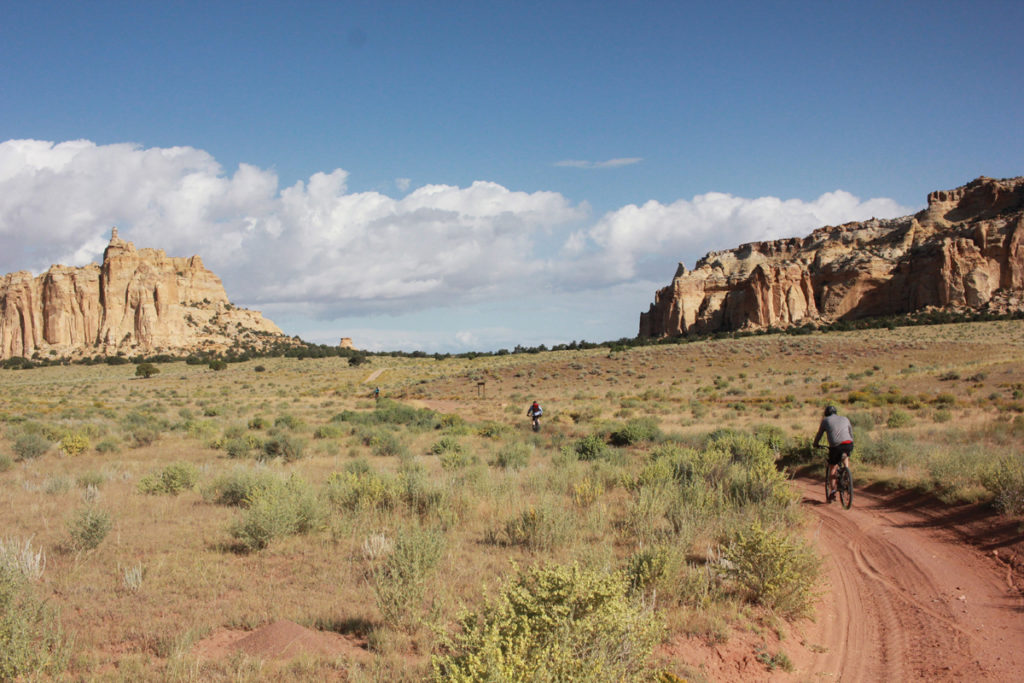
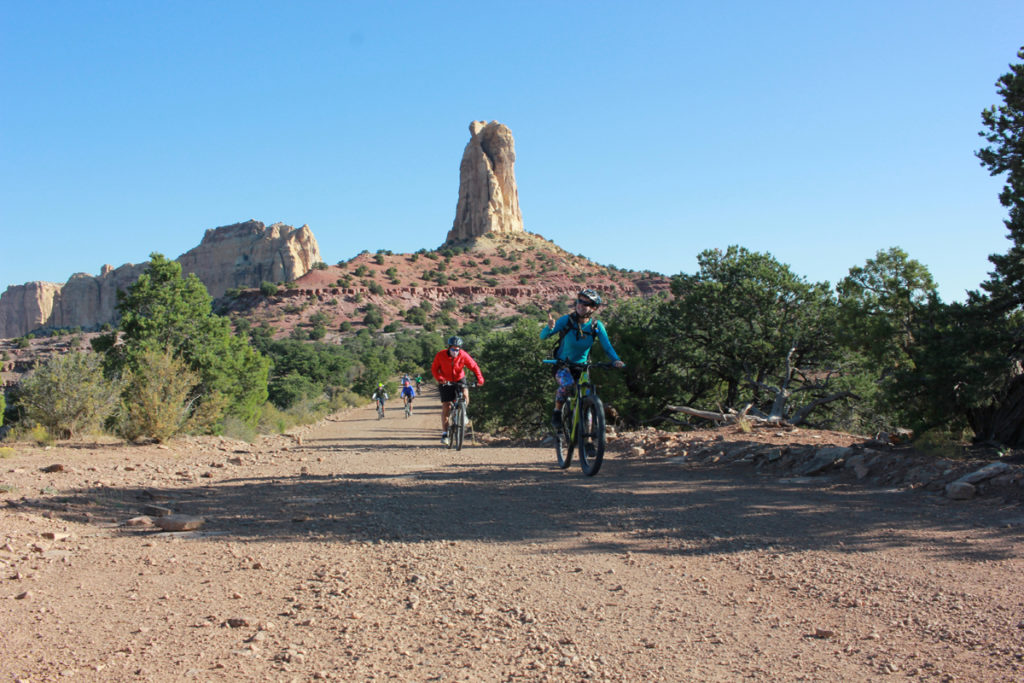
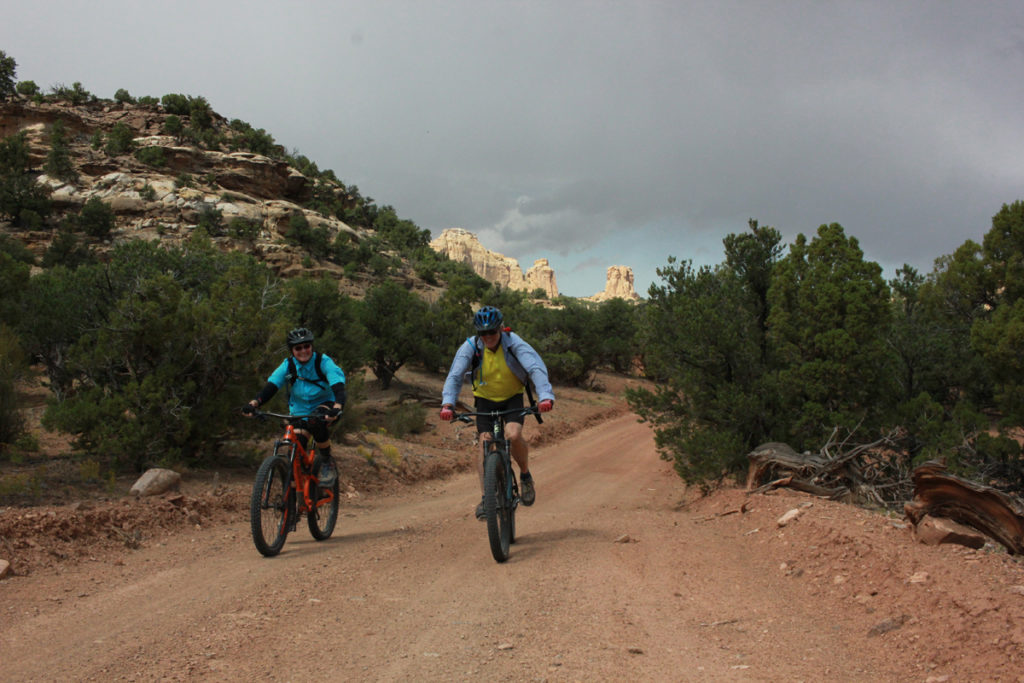
We ripped along gravel roads, thankful to have left the sand and highway behind. The country opened up in front of us, with rolling sage grasslands, shrubby blackbrush, and the occasional pinon juniper. We cranked along, passing each other, chatting, and feeling the wind rush around our bikes and bodies. Dark clouds swirled above and threatened rain. At lunch, we all wondered if it would produce, but the desert stayed dry.
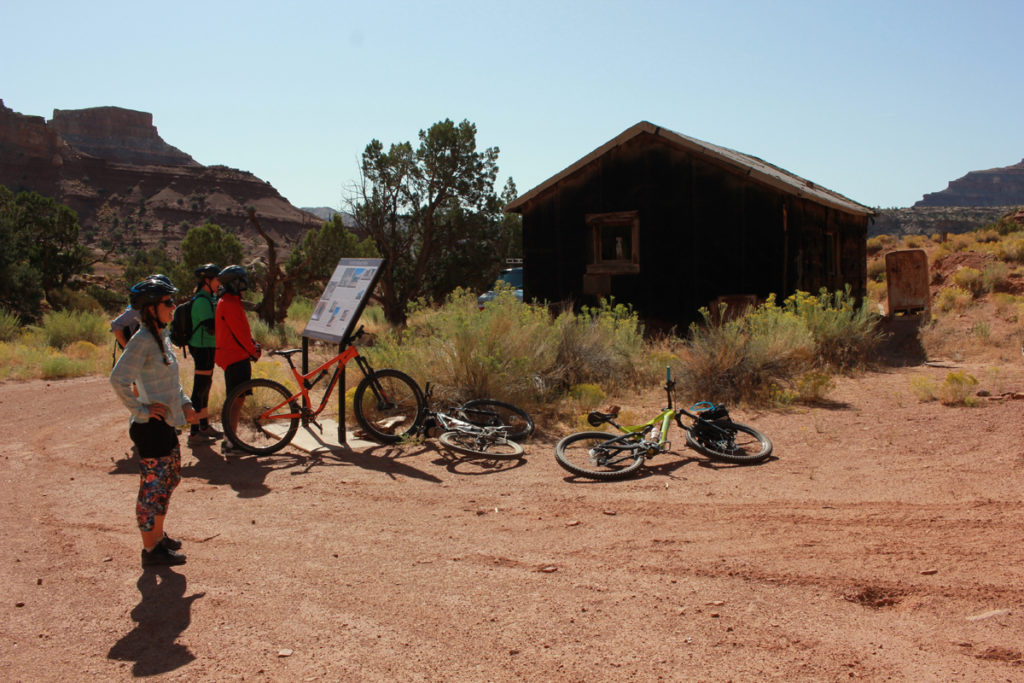
Our long lunch break gave us time to explore Swasey Cabin, some old ranching infrastructure, and some interesting geological formations. Swasey Cabin is built from lodgepole pine timber linked together as a dusty reminder of how the original Euro-American settlers spent their time. It was built from the want to live among the unforgiving landscape. The settlers used the resources as best they could. They collected water and ice from a seep, and stored food in a cave that doubled as a freezer.
Behind Swasey Cabin was Eagle Canyon. Susan took the pulse of a sleepy post-lunch crew.
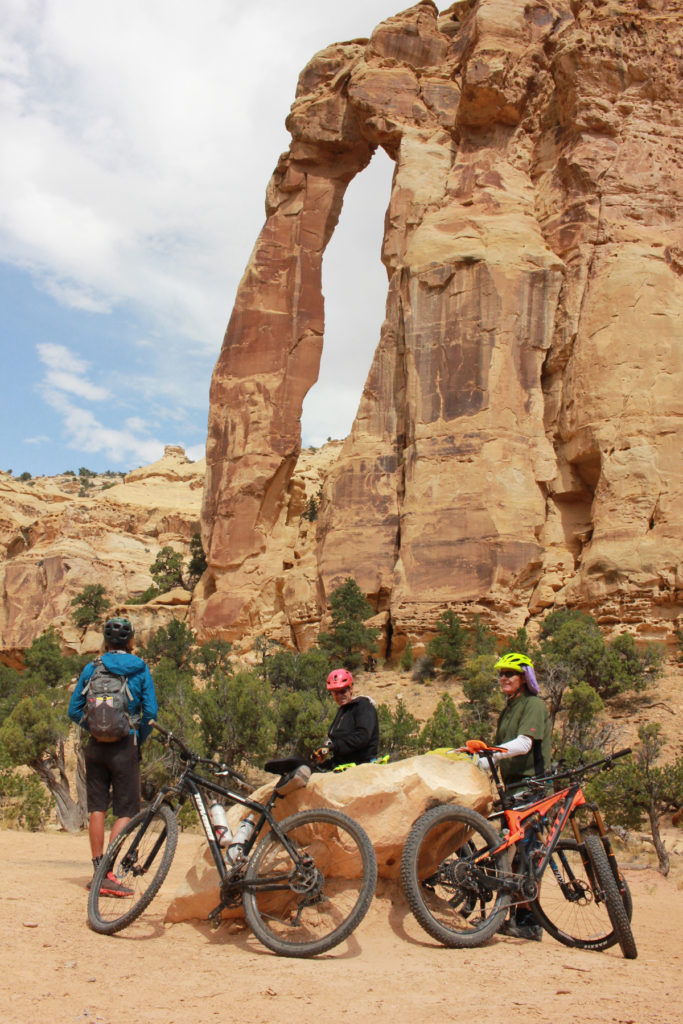
“Who wants to bike down to Eagle Arch?” she asked. We all rallied and mounted up. The ride down to the Arch was the first technical riding of the trip. We romped through loose sand, slickrock terraces, drops, and fun balance-y broken ground. It was exhilarating rolling over the obstacles, challenging myself to commit to scary drops or a fast, loose corner, blasting dirt off the double track.
The Arch rose out of the drainage and swept up high until it connected with the cliff it had been pulling away from. Ravens drifted above with the grey clouds. We snapped a few photos, stretched out, and climbed back on our bikes to repeat the steep ascent. Only a couple raindrops pattered on our shoulders.
After Swaseys, we cruised more gravel that criss-crossed the plateau. The route to our campsite was more or less the main gravel road through the Swell, so the sandy slog from the morning was a distant memory.
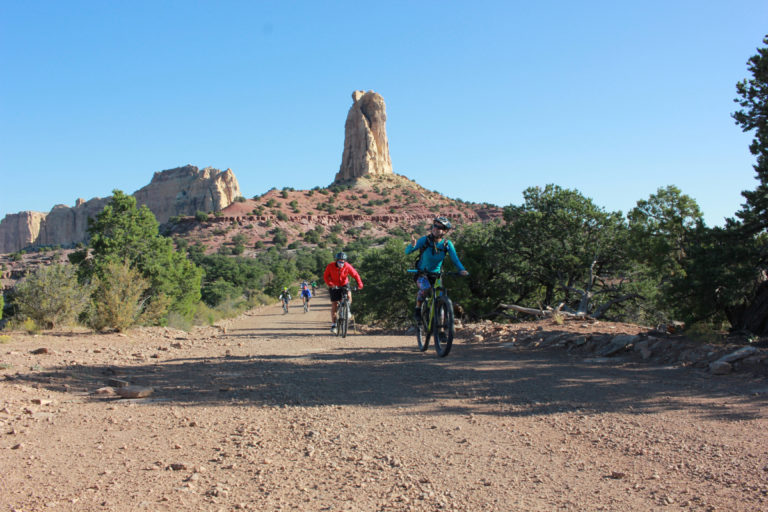
The crew leaving an amazing camp near Family Butte with a tower looming behind. Riding the San Rafael Swell on a Holiday River Expeditions trip. Photo by Jack Stauss
We climbed a hill which dropped into a long and enjoyable descent, flowing through winding corners, past tall sandstone walls and whizzed by juniper forests. To get to camp, we whooped through a rollercoaster of hills onto the Family Butte mesa, which features a series of desert towers. The climb was mellow, and I chatted with Eugene, the oldest member of our group. He told hilarious stories from his time traveling the world and the West.
Soon we were atop the mesa and Susan started looking for the turnoff to a camp she had hoped we’d get. She peered to her right and veered off, the rest of us waiting at the junction. A minute later she came back with a wide grin, “Oh yeah! This is the place!”
It was an astonishing view off a massive cliff, down onto another giant valley, across which stood a huge sandstone wall. Beyond that were blue-grey mountains stretching into the distance. The clouds that had not produced any rain swirled on the horizon, the setting sun shining through them, illuminating the canyon colors.
As we stood there, someone pointed out that we had not seen a single person since we left Swasey Cabin. It seemed that we had the whole desert to ourselves. We had dinner and drinks and watched the colors change with the light. As the sun dipped behind the horizon, the wind picked up, but we stayed out for a while and watched the stars rise before heading off to bed.
Susan pointed at the constellations: Vega and the Summer Triangle, the Big Dipper pointing to the North Star and Cassiopeia, and Sagittarius and Scorpius. With stories of the stars swirling through my mind and my legs tired from the day, I climbed into my sleeping bag and fell asleep within minutes.
Trip leader Susan Monroe gives us a lay of the land from camp. Riding the San Rafael Swell on a Holiday River Expeditions trip. Photo by Jack Stauss
The next morning, coffee and pancakes got us up for our scenic start of the day. I loaded up on calories and packed up all my gear. We were excited, as the wind had died down and the temperature was perfect for desert riding. To start the day, we had another epic descent down gravel roads for several winding miles from Family Butte to Red Canyon, the canyon we had camped above.
The team explores the Lucky Strike uranium mine from the 1950s deep in the Southern Swell. Riding the San Rafael Swell on a Holiday River Expeditions trip. Photo by Jack Stauss
Our first stop of the day was at the Lucky Strike Mine from the 1950s. At the mouth of a wide wingate canyon, dilapidated old buildings stood defiant to many seasons. Looking around the hillsides, entrances to shafts and tailings lurked in the terraced landscape.
After wandering around the camp, we gathered to talk about the history. We were here to recreate and experience the place, but the miners came down to dig out uranium. They spent a decade weathering the elements and hoping to make it rich from a place they must have been at odds with.
The discussion of mining took us into a broader discussion of the Colorado Plateau. Susan drew a picture in the sand of the region and helped us get oriented to where we were in relation to the Grand Canyon, Moab, and the mountain ranges that hem in the plateau.
She told us of the geological story of how the region came to be, pushed up from forces of the earth, layers upon layers of sand and sea for millions of years, uplifting again, then eroding away. And in the center of all of it was the Colorado and Green Rivers and their tributaries all of which played a major role in the shaping of the canyons.
Bikers explore a side canyon hike near Muddy Creek at the bottom of Red Canyon. Riding the San Rafael Swell on a Holiday River Expeditions trip. Photo by Jack Stauss
We pedaled through some more sand and loose cobbles away from the mine. Finally, one more descent on the day to the Muddy Creek. This was a fast fun ride downhill, ripping past steep walls and drop-offs. We pedaled off the main road and found another massive mining relic.
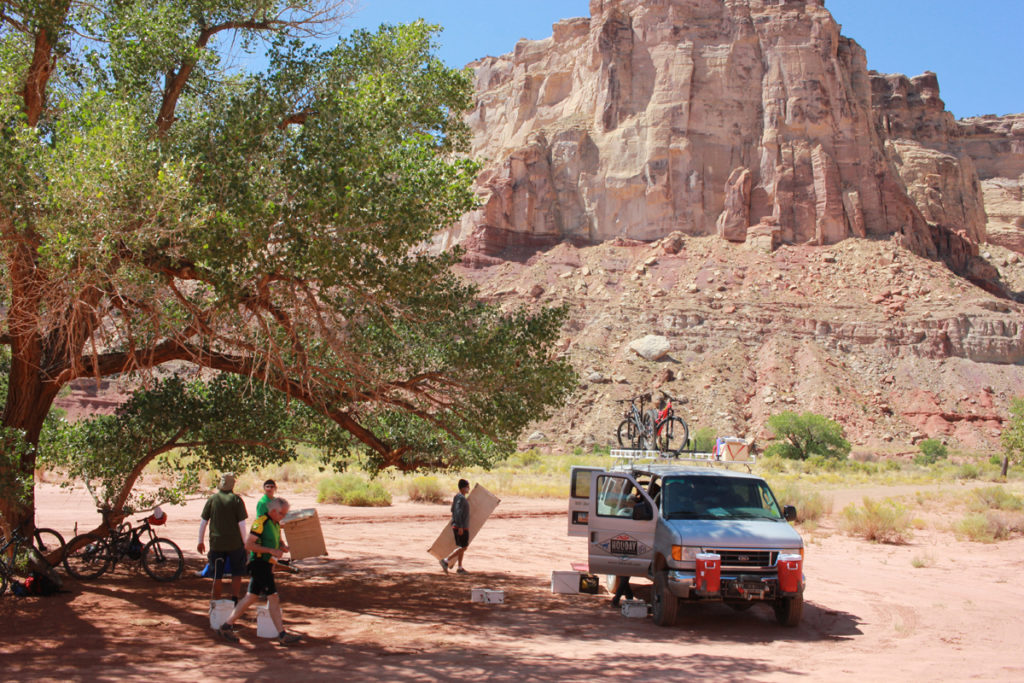
The Holiday Team gets lunch ready on the banks of Muddy Creek. Our support van held all our food for the trip. Riding the San Rafael Swell on a Holiday River Expeditions trip. Photo by Jack Stauss
Lunch was on the banks of the Muddy Creek, where I splashed cool water on my face and neck. We ate zesty wraps and lounged in the shade of cottonwoods with the massive Hondu Arch on the horizon.
After lunch, life quickly went from casual to a steady grind. We had to climb out of Red Canyon, and it took all afternoon. Fortunately, the road was firm and all of us were going about the same pace. The pitch of the road never got steep enough to warrant pushing, but I definitely had to put my head down and tell myself to keep turning the pedals.
Our biggest descent day two. We ripped a long winding, rolling road for many miles down into Red Canyon. Riding the San Rafael Swell on a Holiday River Expeditions trip. Photo by Jack Stauss
A couple hours later, we popped back out high on the mesa in the middle of the Swell. Sage meadows led us along rolling hills, and eventually through five miles of four-wheel drive double-track to our last campsite.
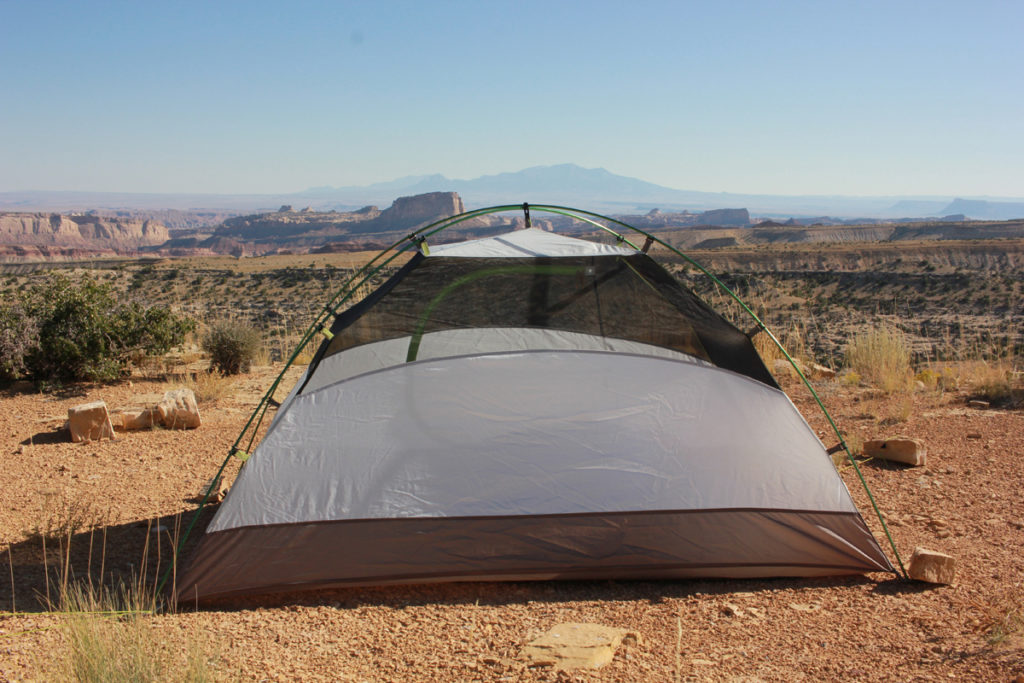
Nice spot for a tent on our last night; overlooking the Henry Mountains. Riding the San Rafael Swell on a Holiday River Expeditions trip. Photo by Jack Stauss
Much like the first night, this site had an astonishing vista. Instead of being on top of a wide valley, we were perched above a twisting slot canyon to the east. Beyond that, the jagged edged silhouette of the La Sal Mountains stood in contrast to the wide expanse. To the south, we had a direct view of the Henry Mountains, and further along still I could see Bears Ears and Cedar Mesa. Eric mentioned how amazing it was where a couple pieces of rubber could take you.
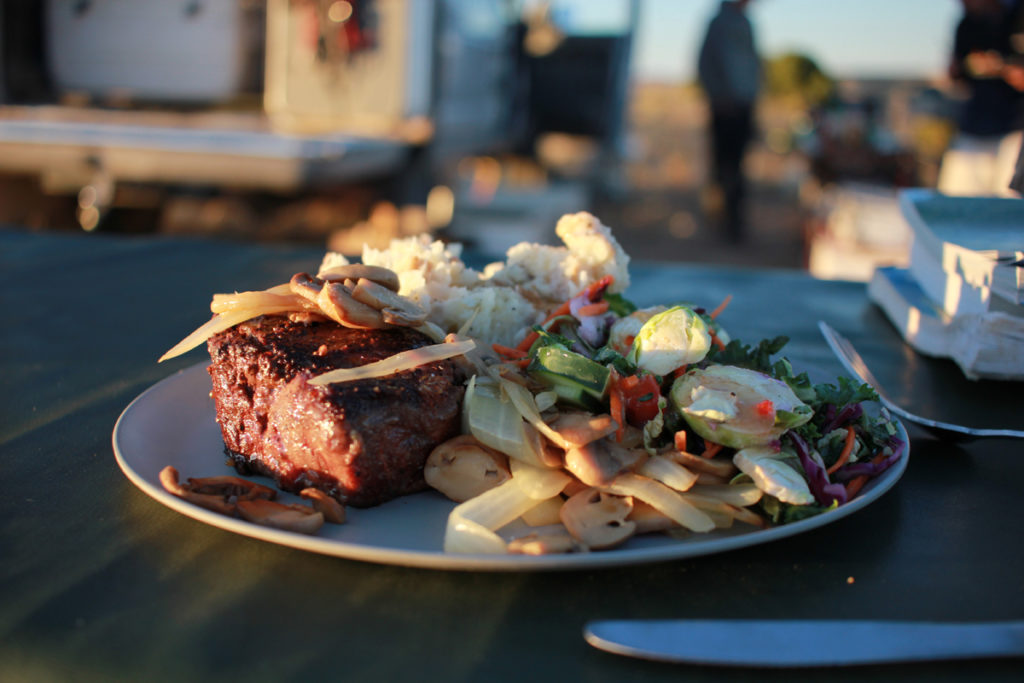
Holiday River Expedition does not skimp when it comes to the food. We stayed fueled up every day! Riding the San Rafael Swell on a Holiday River Expeditions trip. Photo by Jack Stauss
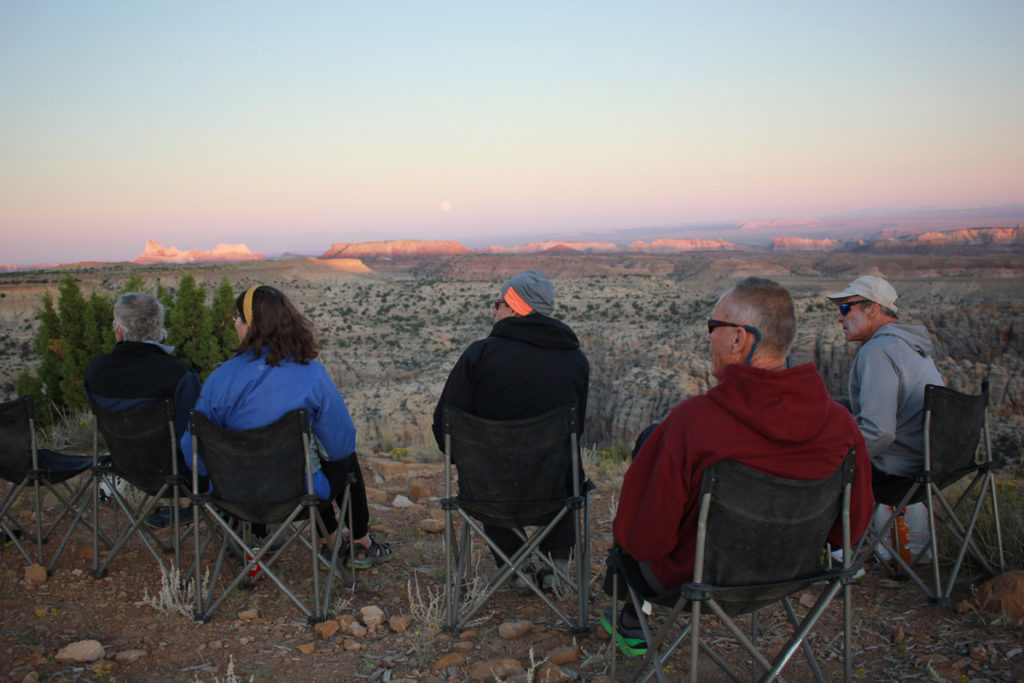
The last meal Holiday whips up for their guests is always perfectly grilled steak and mashed potatoes. After the day of hard riding it certainly felt like we earned it. With no wind and an amazing sunset, we feasted next to a fire. We told stories and laughed, watching another color-show over the canyon country and enjoying the company of friends. Again, we all remarked on how fortunate we were to have had the roads and trails completely to ourselves.
Enjoying the sunset on our last night in the Swell, above Chute Canyon. Riding the San Rafael Swell on a Holiday River Expeditions trip. Photo by Jack Stauss
When it was finally dark, we did a deeper dive into the stars looking at more constellations and telling myths about what it all meant. Susan had a deep passion for the place, and she shared it with all of us.
In the morning we all regretted the fact that we would have to return to civilization and “real” life. Over the previous few days of riding through the region, we had become old friends, and the landscape was as much a part of that as the connection to one another.
Our last descent above Temple Mountain. Riding the San Rafael Swell on a Holiday River Expeditions trip. Photo by Jack Stauss
We lamented packing up, but soon we were back on our bikes and in the grove of the gravel. I took my time getting through the last hills, snacking and looking at wildflowers. On the saddle of the last rise we looked out down to Temple Mountain and at the Henry’s in the distance. Soon we’d be back at pavement and onward to our lives and work, but before that we had one last long fun descent to rip together. We clicked into high gear and let it ride off the plateau all the way down into the twisting canyons beyond.
Nuts and Bolts
Trip Location
– Southern San Rafael Swell. From I-70 to Temple Mountain Road (pick up near highway 24).
Trip Route (more or less)
– This trip primarily followed Emery County Roads 1024 and 1012, with some detours to sites of interest. We exited out Temple Mountain Road. The whole trip was done from north to south.
Days (and mileage)
– We bike three full days, each day we rode between 20 and 25 miles
Water Availability
– There is no available water until you reach Muddy Creek. For us, this was at lunch on the second day. Muddy Creek has seasonal fluctuations.
If you go with Holiday tips (contact Holiday)
– To do this with Holiday River Expeditions contact them via their website: www.BikeRaft.com
If you go on your own tips
– It would be possible to run this on your own. National Geographic has a good topo with roads marked. It is highly suggested to do this with a support vehicle as you are many miles from help, service, and water is unpredictable at best.
Jack Stauss is an East Coast transplant who moved to the West in 2008 for college and skiing. Over the years he has fallen in love with the desert and mountains and spends every season either biking, hiking, ski touring, or rock climbing. He now works as a freelance writer and as an outreach director for a local environmental non-profit. He lives in Salt Lake City with his dog and girlfriend, who can out-bike him any day of the week.
UPDATE: An update posted on the USA Cycling website on April 9 announced that the suspension of racing through May 31, 2020.
March 25, 2020 – USA Cycling, the national governing body for bicycle racing in the United States emailed its membership recently to announce restrictions on racing at least through May 3, 2020. USAC has suspended all races, rides, clinics, and other permitted events through at least this date due to concerns regarding the COVID-19 coronavirus.
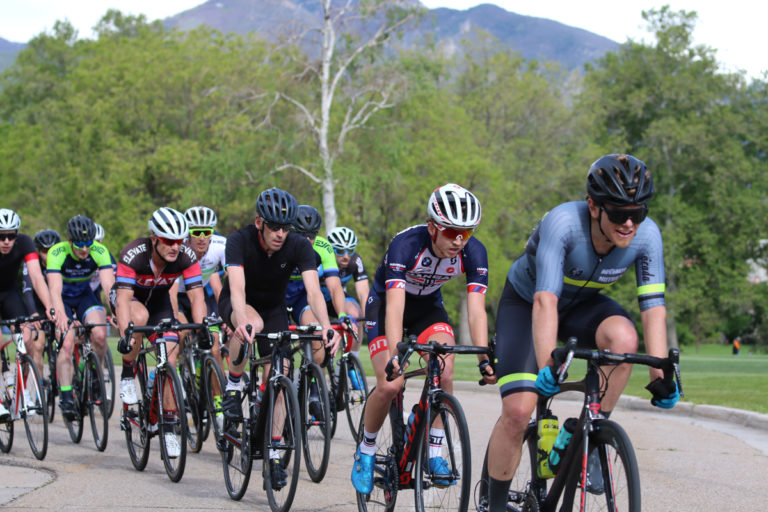
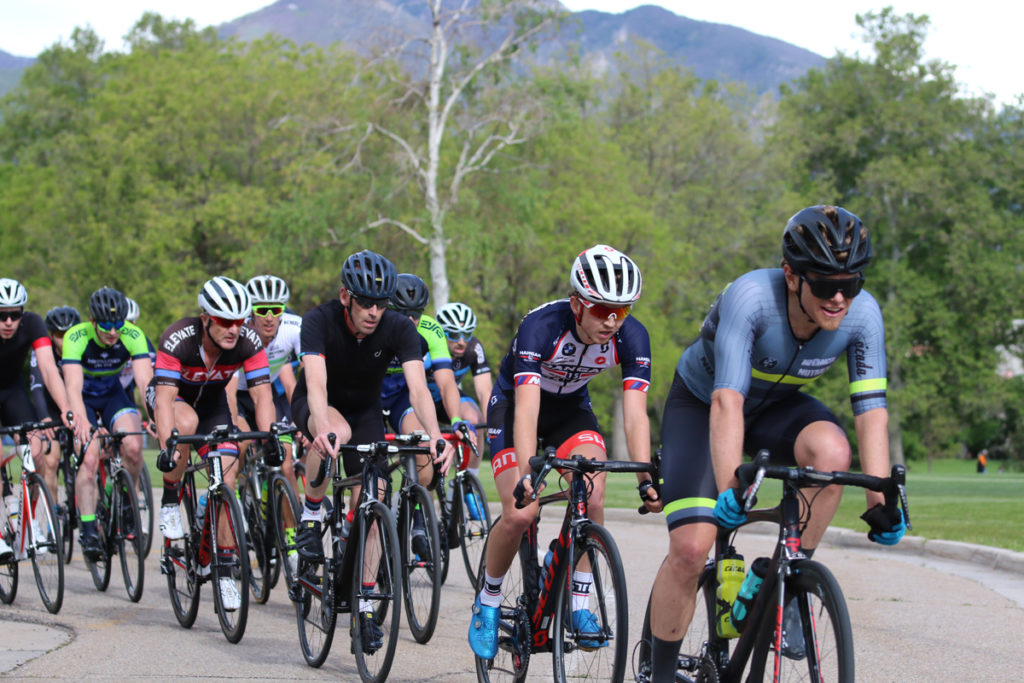
USA Cycling has cancelled all races through May 3, 2020 due to coronavirus concerns. Here, cyclists in the 2019 Sugarhouse Criterium line up on the back stretch. The 2020 Sugarhouse Crit is still scheduled for May 23, 2020. Photo by Dave Iltis
The message from USA Cycling CEO Rob de Martini, sent on March 18, 2020, is as follows:
Based on the current status of the national emergency, USA Cycling will extend its suspension of all issued permits for sanctioned events – including USA Cycling races, rides, camps, and clinics – through May 3, 2020. We will continue to work with our event directors on contingency plans and alternative dates for impacted events.
We are calling on all event directors, clubs, coaches, athletes, and members to follow the guidelines and regulations issued by national, state and local authorities. This includes foregoing gatherings such as group rides, in-person team meetings, and any other group or team activities where people assemble.
USA Cycling will continue to monitor the situation and meet with our partners and stakeholders to assess the state of this national emergency and its impact on the cycling community. We are taking measures within our control to protect our community so we can get back to riding and racing with everyone in good health as soon as possible.
We have brought on medical expert Dr. Michael Roshon to provide an informational video and follow-up webinar for our community around the base causes of COVID-19, how it’s transmitted, and all the precautions the cycling community should take to avoid transmission. You can view the video here, the webinar here, and find additional updates from Dr. Roshon on USA Cycling’s website and social media.
Sincerely,
Rob DeMartini President and CEO USA Cycling
UPDATE: An update posted on the USA Cycling website on April 9 announced that the suspension of racing through May 31, 2020.
SALT LAKE CITY, Utah (April 10, 2020) — The Little Red women-only ride to raise money for the Huntsman Cancer Foundation has been a mainstay on Utah’s calendar for several years. Unfortunately, it has joined the ranks of many other events being cancelled or postponed due to concerns regarding the COVID-19 coronavirus pandemic.
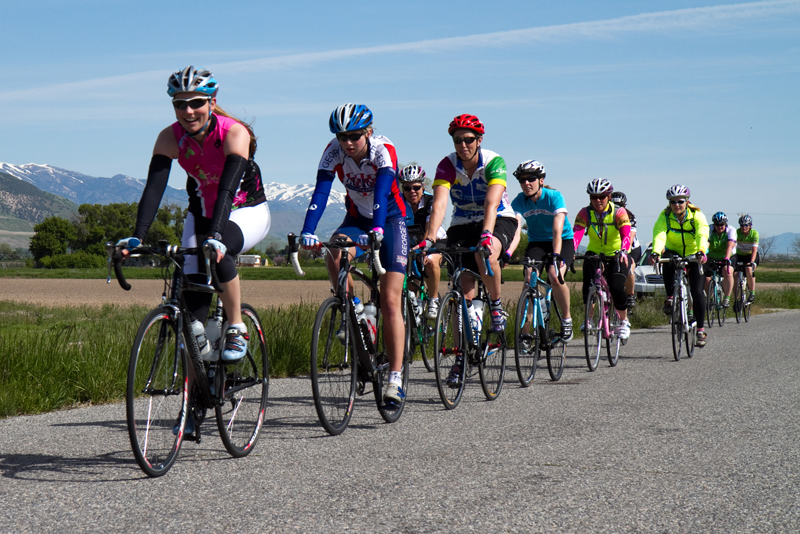
Riders enjoying the roads of Cache Valley in the 2011 Little Red.
In an email sent to registered participants and volunteers, Jackie McGill, President of the Bonneville Cycling Club, which organizes the annual event, had this to say:
Participants, Volunteers, Friends and Supporters of Little Red —
Global Pandemic. The words alone are terrifying; the reality is life-altering. With that in mind, we have reached the difficult decision to cancel Little Red 2020.
We know you will be disappointed to hear this, even though many of you were probably expecting it. We are truly heartbroken to take this action. Little Red, a summer highpoint for our riders, sponsors, vendors, volunteers and Cache Valley communities, has become another casualty of COVID-19.
Cancelling Little Red was an agonizing decision for the Executive Committee, driven by concern for the health and wellbeing of our wonderful constituents. Although the State of Utah has not (yet) issued any stay-at-home orders, a gathering of 4,000 people would be a reckless act given the current global outlook and dire forecasts by all health organizations.
We hope you stay safe and weather the situation as best you can. Get out there and ride your bicycle to stay in shape and let those well-earned endorphins take the edge off.
Little Red will return in 2021 – she is one tough gal and plans to come back stronger and sassier than ever! The Ride Into the Wild theme planned for this year will carry over to next year.
With gratitude for your support, The Little Red Organizing Committee Bonneville Cycling Club
The 40th Anniversary Tour of the California Alps – Death Ride originally scheduled for July 11, 2020, will be postponed to July 17, 2021 due to ongoing uncertainty of the COVID-19 crisis.
“Based on current health forecasts, we do not feel it is in the best interest of the cycling community nor the health of our families, friends and neighbors, to hold the event on July 11,” commented Becky DeForest, Executive Director of the Alpine County Chamber of Commerce, organizers of the annual ride.
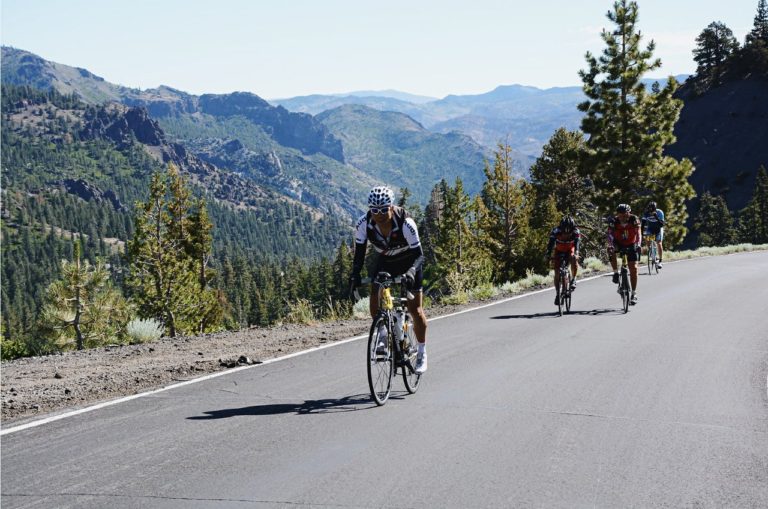
The 40th Tour of the California Alps – Death Ride has been postponed until 2021. Photo courtesy Bike The West/Tour of the California Alps – Death Ride
Pre-registered riders for the 2020 event have been invited to roll over their registrations to ride in 2021, or request refunds. Details are posted on the event’s website: www.deathride.com
The Tour of the California Alps – Death Ride has traditionally been recognized as one of the most challenging endurance events steeped in cycling history. Participants can choose to climb and descend up to five mountain passes, for a total of 15,000 vertical feet of climbing over the 129-mile course; all under the backdrop of the California Alps. Under a management agreement with Bike the West, the 40th anniversary ride was set to be fully supported, with strategically placed rest stops and services for participants throughout the course.
Curtis Fong, owner of Bike the West and original ride director of the Death Ride from 1984 – 1995, has a 28-year reputation of producing high-quality, fully-supported bicycling events at Lake Tahoe. Bike the West has committed to continue working with the Alpine County Chamber to direct the 40th Death Ride Resurgence Tour in 2021. “The Death Ride has always had a special place in my heart,” says Fong, “having helped start it and build it in its early years, and now with the opportunity to once again direct this awesome ride, I feel I have come full circle.”
Considered the “Woodstock” of cycling events, the annual Death Ride has drawn as many as 3,500 participants worldwide to Alpine County. One of the draws is that most of the course is on closed highways, working with Caltrans and the California Highway Patrol to allow participants to negotiate the scenic mountain passes with limited traffic. For the community, it is a major event that brings positive economic impact to many businesses, non-profit organizations, and agencies that provide services for the event.
The Alpine County Chamber of Commerce and Bike the West look forward to continuing to refine and produce the 40th Death Ride Resurgence Tour, inviting bicyclists from all over the world to participate in 2021. For updates, please visit the website: www.deathride.com or join their Facebook page: Death Ride – Tour of the California Alps.
It looks like it will be easier for cyclists to get to Arizona’s Prescott National Forest from Verde Valley and Yavapai Community College thanks to long-term community cooperation.
The Yavapai Resource Advisory Committee approved a $75,000 award to employ youth corps for the proposed Blowout Wash Trail Project. The Verde Valley Cyclists Coalition and Yavapai Community College are collaborating with the Verde Ranger District of the forest.
The coalition promised to pitch in $12,000 for the trail and the College agreed to allow the biking trail on its land and to build a trailhead. The 6.5-mile trail will connect with other trails in the Prescott National Forest. It will run along West Mingus Avenue and connect the communities of Prescott, Jerome, Clarkdale, and Cottonwood.
BOISE, Idaho (April 10, 2020) — For the first time in 13 years, the LP 200 will have to reschedule from its spring date to the fall. Normally held the weekend after Memorial Day, the 200 mile cycling relay from Boise to Sun Valley, ID has been moved to September 19, 2020.
Riders at the Lyle Pearson 200. Photo by Matt Green, courtesy OmniGo!
The LP 200 is among hundreds of events that have either been canceled or postponed due to the COVID-19 epidemic. The decision was made with the safety and health of all participants and staff in mind, and is backed by USA Cycling who has currently postponed all permitted events through May 31. All participants will have their entry moved to the new September 19th date or have the option of transferring to next year’s event.
Fortunately, there is a bright side to the change! The LP 200 has partnered with the Sawtooth Brewery in Ketchum, ID and will be finishing the event at their annual Oktoberfest. Participants will receive a custom finishers pint glass, a free beer and a delicious Bavarian meal. The festivities will include live entertainment and more than one beer to sample! And as usual, OmniGo! will provide real time results in the expo on a large screen and online.
On March 17th, 2020 the Spicer Ranch suspended all Spring events because “distancing restrictions” had put an undue strain on the town of Beatty, NV and the local shops. It took a little while to work with State and Local authorities to find a suitable a new date. We are excited to announce the event will go forward in 2020 on November 20-21. This should be a great weekend in the middle of cross season when the temperatures in the high desert are usually pleasant and stable.
Photo courtesy Matt Ohran/Tinker Classic.
Now that there is extra time for planning, we are also able to re-imagine the event and bring back the longer competitive race due to popular demand. Last year GRO Races produced the SSCWCX. We had so much fun putting this event on that we all thought why not repeat it every year.
The reimagined Tinker Classic will now include some fun elements from that event, including a fun obstacle style crit race on Friday, complete with the Team Hammersaw Flyer over, a “Breaking Bad” trailer and Jello pit. On Saturday we will return with a longer competitive Classic (Gravel roads on mountain or gravel bikes) Race in addition to the short Gravel Gran Fondo option. Saturday evening, we will have our traditional Ranch Games of Strength, raffle, and party sponsored by Sierra Nevada Brewing. Many of the vendors have already confirmed the date so we are excited to move forward with the fall plan.
You can find more information at Tinkerclassic.com. Registration for the event is scheduled to open on May 3rd.
OGDEN, Utah (April 9, 2020) — ENVE is pleased to introduce the Foundation Collection, a new line of U.S. made carbon wheels built on ENVE’s core values and technologies. As such, each model in the Foundation Collection was designed for best-in-class performance, is handcrafted in Ogden, Utah, and like all ENVE products, exists to improve the ride experience. Wheels in the Foundation Collection will retail for $1600 USD, $2899 AUD, $2250 CAD, £1800 and €1800.
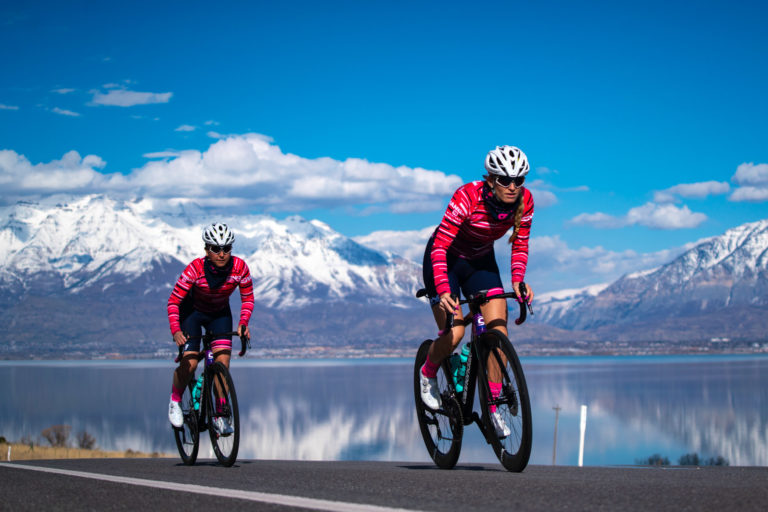
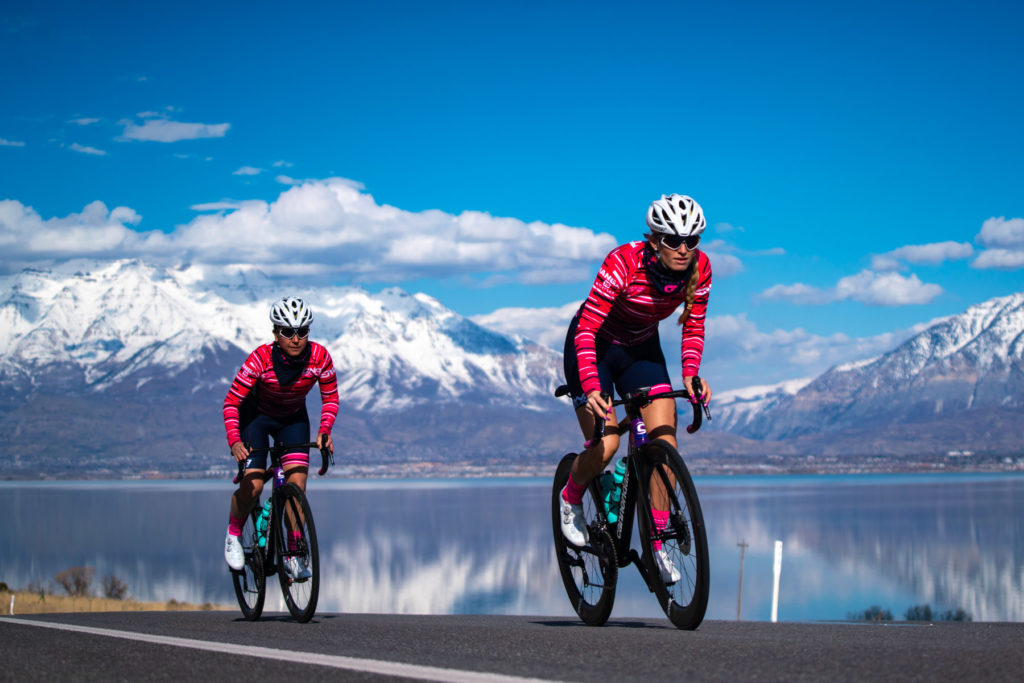
The DNA Pro Cycling women’s team riding the new ENVE Foundation Collection wheels. Photo courtesy ENVE Composites.
“A more accessibly priced wheel collection has been on our project list for many years now. At ENVE, we pride ourselves on delivering a top-shelf product to core riders. However, for us to hit our price and performance targets, we had to follow a plan and respect the process. Part of this was to achieve greater manufacturing efficiencies. We’ve been in our new state-of-the-art carbon manufacturing facility for just over three years now and roughly a year ago, we achieved levels of efficiency in manufacturing that allow us to both produce and deliver the volumes the Foundation Collection is creating while maintaining current production of our premium lines,” stated ENVE’s Managing Director, Jeremy Venz.
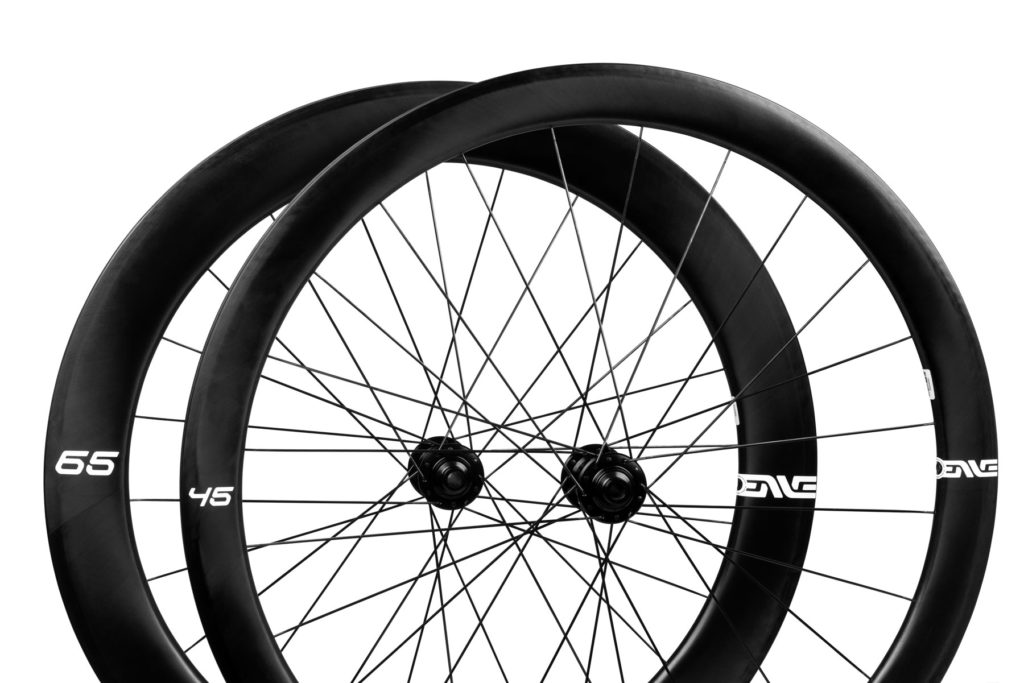
The first installments of the Foundation Collection come in the form of two purpose built aero road wheels developed to meet the demands of the modern road cyclist and triathlete – the ENVE 45 and 65. The ENVE 45 and 65 are named after their respective rim depths and pay tribute to the original ENVE road wheels that were introduced to the aftermarket in 2007.
ENVE’s new Foundation 45 and 65 Road Wheels. Photo courtesy ENVE Composites.
ENVE Foundation Road Technologies
Each wheel in the Foundation Collection features a host of proprietary technologies essential to achieving the best-in-class designation.
Foundation Aero Technology – The ENVE 45 and 65 benefit from a knowledge base established over more than a decade’s worth of aero wheel development of the premium Smart ENVE System (SES) lineup. Given the advantages of efficiency and stability that good aerodynamic design brings, ENVE states that good aero performance is a fundamental right for all of ENVE’s customers.
To achieve the low drag, high stability performance that the ENVE 45 and 65 rim shapes provide, ENVE has taken cues from its SES rim shape development with the major difference between Foundation and SES being that the Foundation rim geometries are matched front to back whereas SES wheelsets, feature rim shapes specifically optimized for the front and rear positions on the bike. As a result of this development, the ENVE 45 and 65 deliver drag reductions similar to, or better than, the competition’s wheels that are well upmarket in price.
The ENVE 45 and 65 are most efficient when paired with a 25mm (labeled) tubeless road tire. For riders wishing to run larger 28mm tires, aerodynamic losses are minimized by the efficiency of the rim’s shape, and losses are readily recovered by the rolling efficiencies gained from the higher volume tire.
Tubeless Compatibility – Like aerodynamics, the performance that tubeless can provide makes it a foundational technology for all ENVE wheels. The ENVE 45 and 65 feature a 21mm internal rim width and a hookless bead profile. Hookless has been a hot topic in recent months. According to ENVE this is why they choose a hookless design for their wheels.
“Road tubeless is still a fairly misunderstood technology. Riders understand that there are performance advantages to the system, but don’t always understand how a good tubeless system is designed to work. Essentially, for a trouble-free tubeless setup, the rim and tire interface need to be precise. We choose hookless because it allows us to consistently produce the critical dimensional tolerances tubeless requires,” stated ENVE’s VP of R&D, Scott Nielson.
Given the disparate rate at which rim and tire technology have progressed in recent times, ENVE developed an in-house tire qualification test to determine tire compatibility with the brand’s SES AR line which also features a hookless design. To aid the consumer through their tire purchasing decision and setup, ENVE has provided a list of available tires that have been tested and approved for use with the new wheels. For a tire to be approved and recommended for use, it must pass a maximum inflation test where the tire is inflated to 1.5x the max pressure of the rim or tire, whichever is lowest.
Additionally, ENVE has a tire pressure chart to aid customers in achieving their optimal tire pressures at https://www.enve.com/tirepressure/.
Wide Hookless Bead – The ENVE 45 and 65 also feature ENVE’s patent pending Wide Hookless Bead technology. This technology is defined as a wide surface at each of the rim’s leading edges. By creating a larger surface area at the rim’s leading edge, impacts from curbs, potholes, and debris are distributed over a larger area, reducing the likelihood of pinch-flatting tubed and tubeless tires alike. Additionally, this feature increases the rim’s impact toughness.
Patented Molded Spoke and Valve Stem Hole Technology (Patent #US 8,313,155) – ENVE’s patented process of molding spoke and valve stem holes results in rims that are stronger and lighter. Because carbon fiber gets its strength from continuous fibers, ENVE routes the fibers around the hole without cutting them which increases the strength of each spoke hole. This technique pays large dividends in the final product by creating a lighter and stronger rim.
Foundation Road Hub – The ENVE 45 and 65 are built on a new road hub that utilizes the same internals as ENVE’s premium hub offering, but with a simplified hub-shell. Like their premium hub offering, the Foundation Road Hub utilizes the tried and proven ID360 40t ratchet drive mechanism and ENVE’s maintenance free automatic preload system aptly referred to as Perfect Preload. This system eliminates the possibility that the hub will develop bearing play and slop over time. It also eliminates the need for the consumer to adjust preload on their own as ride time is accumulated. Where bearings are concerned, the Foundation Road Hub features premium grade, fully sealed NTN steel bearings where ENVE’s premium hub line features a custom NTN stainless-steel bearing for even greater longevity.
Lifetime Incident Protection and 5 Year Warranty – Services like ENVE’s incident protection program and warranty can influence a customer’s purchase decision as much as the product’s features, benefits, and price. The 5 Year Warranty protects buyers from defects in materials and workmanship. The Lifetime Incident Protection program protects owners from damage caused to their wheels while riding, crashing, or transporting their bikes. Proof of purchase is required.
The Foundation Collection’s ENVE 45 & 65 model road wheel models are available now from ENVE retail partners worldwide.
By Turner C. Bitton — As demand for safer streets for pedestrians and cyclists continues to grow, pressure is building on local transportation officials to provide bicycle infrastructure. Constricted transportation budgets remain beholden to automobiles, and residents are often left without the critical infrastructure they need to commute safely by bike.
Given these constraints, creative communities are looking for affordable opportunities to create safer experiences for resident cyclists. Communities across the country, from Arlington, Virginia to Los Angeles, California, have opted for a more affordable alternative to let the proverbial rubber hit the road before permanent infrastructure can be built.
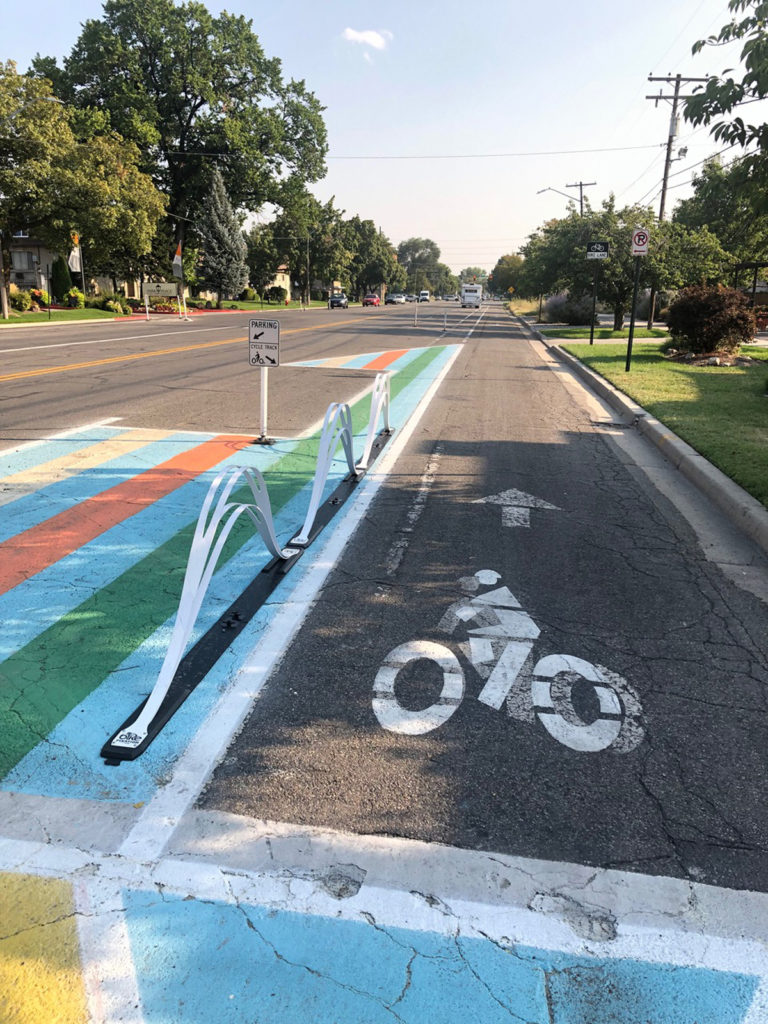
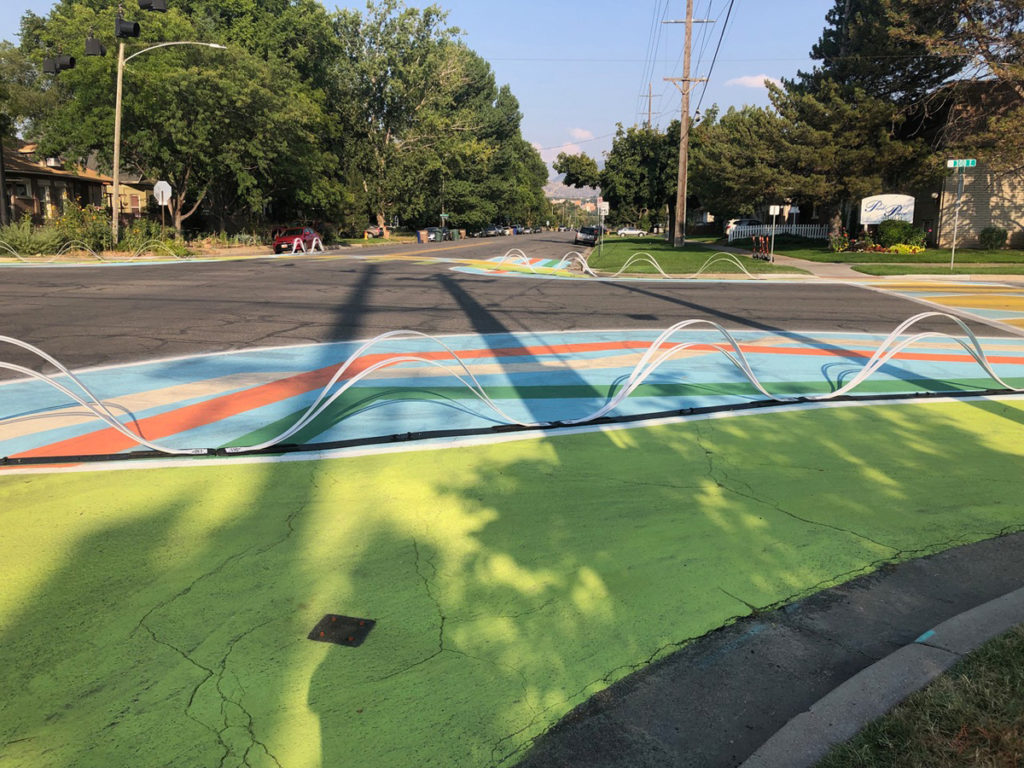
Wave delineated bike lanes at the intersection of 700 South and 300 East in Salt Lake City. Photo by Turner Bitton
So-called Wave Delineators are popping up in communities across the country. Observant cyclists in Salt Lake City, Utah will note that the city is now implementing this inexpensive form of bicycle infrastructure. I snapped a photo of these curious things at the end of the summer while I was commuting between meetings, and wanted to explore the practical uses of such infrastructure.
Wave Delineators are essentially a bike lane that uses physical dividers to separate cyclists from vehicles, without the need for expensive concrete infrastructure or less appealing flexible cones. These physical barriers come in a variety of shapes, sizes, and materials, as well as differing levels of permanence and protection. The aesthetics of the wave format make it a great way to incorporate a more artistic approach to cyclist safety while supporting community character.
Wave delineated bike lanes at the intersection of 700 South and 300 East in Salt Lake City. Photo by Turner Bitton
With research showing that protected bike lanes can increase bicycle traffic by upwards of 75%, it is imperative that bicycle infrastructure be incorporated into all transportation planning. This can create a tendency to trade Peter for Paul in many planners’ minds and as a result, more expensive forms of infrastructure are often delayed until major renovations or repairs are underway on streets. Wave delineated – and other forms – of flexible, semi-permanent infrastructure can open the door to a cheaper, less resource-intensive process of establishing bicycle-centric infrastructure along roadways without protected lanes.
Los Angeles is the in midst of a multi-year demonstration project testing whether such flexible infrastructure improves cyclist safety, and anecdotal evidence suggests that safety is improving. Cyclists are reporting higher rates of satisfaction with commuting, and are urging the local government to place more of the waves in other parts of the city.
Recent research from Monash University in Australia demonstrates what cyclists have long been able to confirm – painted lanes do not go far enough to protect cyclist safety. In fact, the study indicates that drivers tend to pass closer to bicyclists when there’s a white stripe and no barriers than when there’s no bike lane at all. Adding a vertical element, even a flexible one can enhance the safety of cyclists.
Given Salt Lake City’s geography and recognizing the financial considerations of building permanent infrastructure, it appears that wave delineated bike lanes could thread the needle of building out comprehensive infrastructure on a budget. As the city explores the use of wave delineated bike lanes, a certain degree of driver education will happen organically and this, above all else, will make the area a bit safer.
Turner C. Bitton is an avid cyclist and is well-known for his commitment to public service. He lives in the Glendale neighborhood of Salt Lake City with his husband Chase and their two dogs Charley and Moose.
If you have a suggestion for a commuter profile, have a commuter question, or other comments, please send it to [email protected].
EMPORIA, Kansas (April 6, 2020) — Life Time, the nation’s premier healthy lifestyle brand which owns and produces the Garmin Dirty Kanza, today announced that the event, notably known as the “World Series of Gravel”, will be rescheduled from May 29-31 to September 10-13 in light of the current COVID-19 pandemic and in an effort to provide a safe event experience for all. The Dirty Kanza team announced the news during a live Zoom video conference on Facebook Live.
In the video, Jim Cummins, Dirty Kanza co-founder and Chief Gravel Officer at Life Time, said, “We’ve been working very hard to look at what the current world situation is going to mean for Dirty Kanza 2020 with the health and safety of our participants, local community, emergency responders and everybody who is touched by Dirty Kanza in mind. At the end of the day, we didn’t feel it was appropriate to hold Dirty Kanza on our original date. We’re very excited to announce the rescheduled date and feel that the September 10-13 weekend is going to bring an amazing experience. ”
As the impact of COVID-19 continues to evolve, Life Time remains steadfast in its commitment to positively support the Emporia community and participating athletes. Cyclists will be able to choose from three options: they may keep their current entry and participate in the rescheduled event in September, defer their current entry to the 2021 event with a waived deferral fee, or receive a refund for their 2020 entry.
“We know that our athletes have trained hard for Dirty Kanza, so we wanted to maintain the event on our 2020 calendar,” says Kimo Seymour, president of Life Time Events and Media. “In choosing the rescheduled date, we applied careful consideration to avoid interfering with other scheduled races. While delayed from our typical timing, we believe this new date will allow athletes, promoters, sponsors and partners to come together for a fantastic event. Working together will be vital to ensure the health of our cycling community both on and off the bike.”
Infrastructure and facilities are a necessary component of bicycle-friendly communities, but are not sufficient on their own to encourage people to bicycle. According to a recent study done by the University of California at Davis, it also takes the right attitude. Researchers surveyed students, faculty and staff about cycling attitudes at a campus and town well known for excellent infrastructure.
UC Davis is one of only eight educational institutions to reach Platinum, the highest rank possible in the League of American Bicyclists’ Bicycle Friendly University program. The City of Davis has also reached Platinum.
While bicycle infrastructure and low speed limits make cyclists more comfortable, the researchers found “that even the best designed on-road bike facilities are unlikely to provide a comfortable bicycling environment for those without a predisposition to bicycle.”
In the study, Making Bicycling Comfortable: Identifying Minimum Infrastructure Needs by Population Segments Using a Video Survey: A Research Report from the National Center for Sustainable Transportation (https://ncst.ucdavis.edu/research-product/making-bicycling-comfortable-identifying-minimum-infrastructure-needs-population), researchers asked participants to look at videos and state which scenarios made them feel most comfortable. No matter what the infrastructure in the videos was, many of the participants indicated they were reluctant to bike, because they needed to dress well, cycling to campus caused stress, and/or they need a car anyway.
The study acknowledges that participants were largely undergraduate students and disproportionately female, so results don’t reflect attitudes of the general population. The videos also did not show all possible roads and paths, which could also have an effect on attitudes.