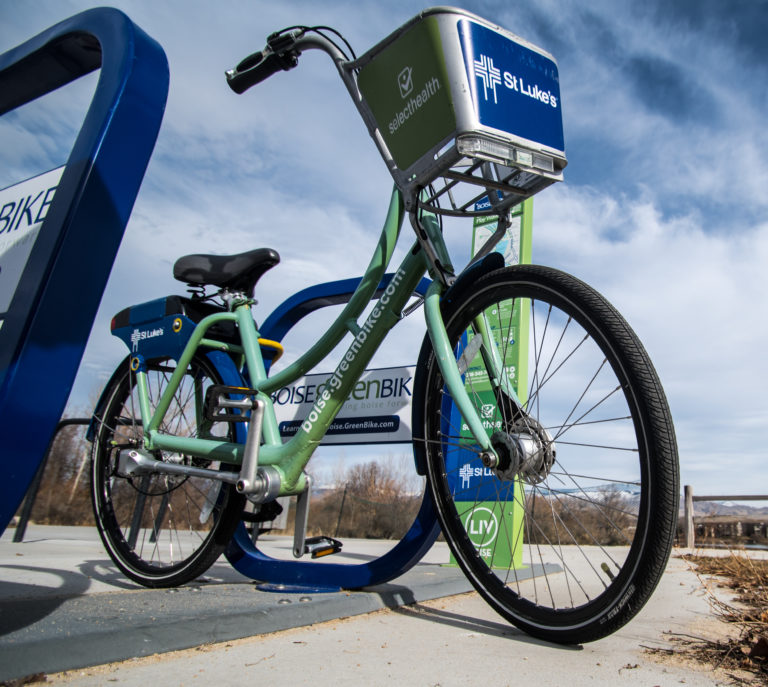
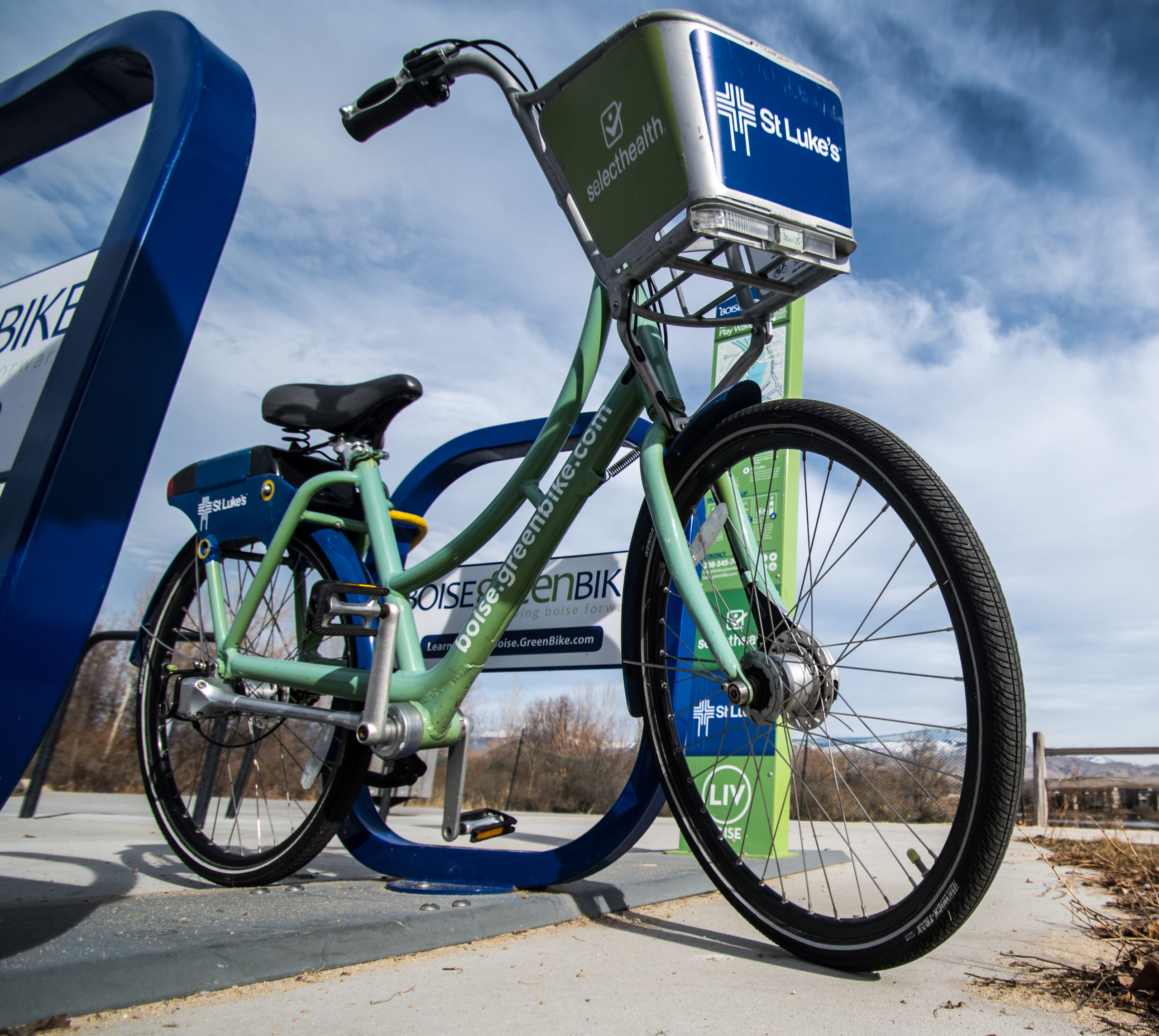
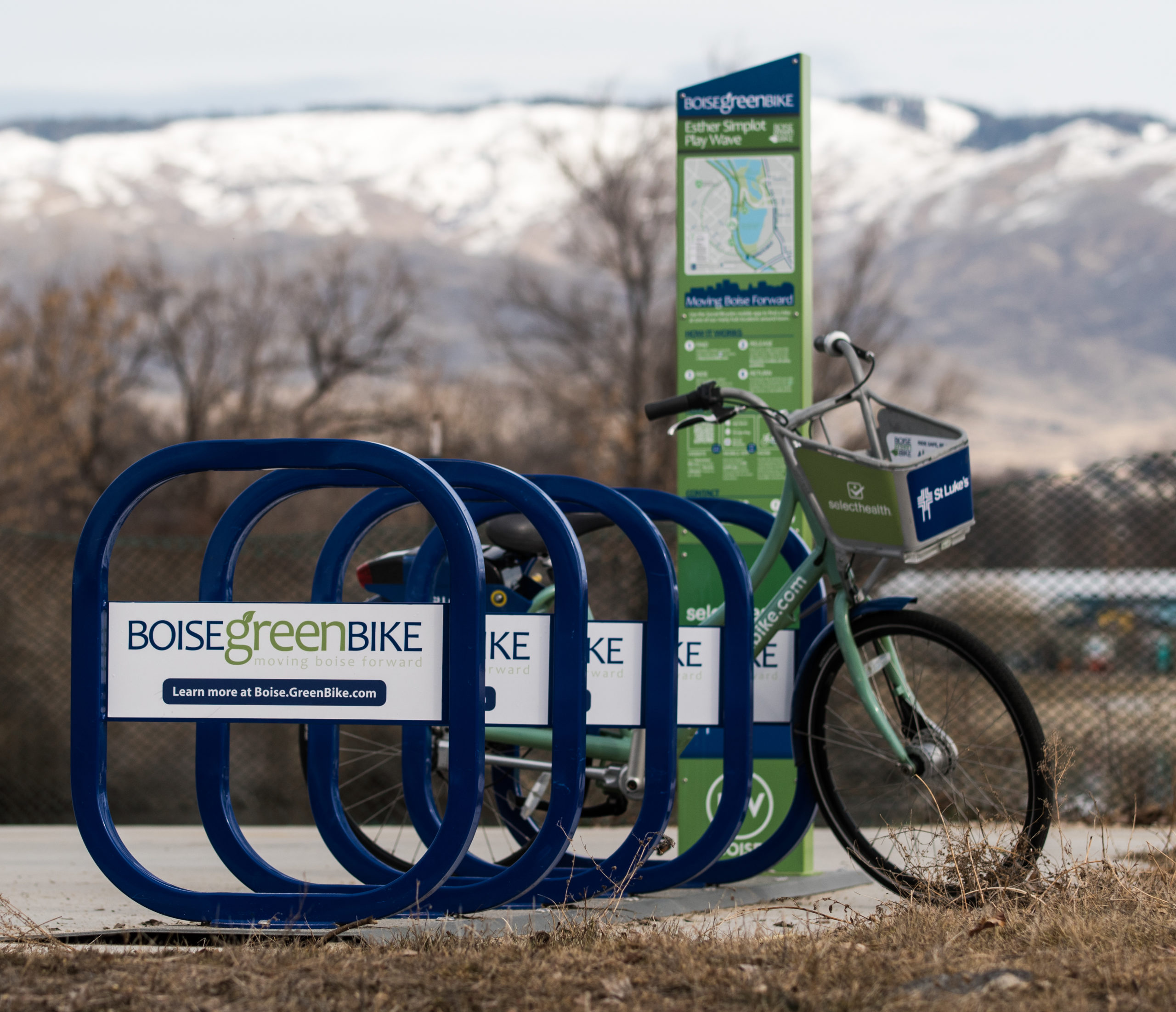
BOISE, Idaho (May 1, 2020) — Boise GreenBike will relaunch the bike share program on Monday, May 4, 2020, after a brief suspension because of the COVID-19 coronavirus pandemic. Service shut down after Governor Brad Little issued a statewide stay-at-home order March 25, 2020. The bikes were removed from the streets and taken to the shop. Every bike was cleaned, given a tune-up, and made ready for service. The system will relaunch with two weeks of free rides for everyone and certain restrictions on use.
Photo courtesy Boise GreenBike.
“As our city and state start to reopen for business we want to be able to provide a healthy and safe transportation alternative,” said Boise GreenBike Director Dave Fotsch. “We work hard to keep the bikes clean and disinfected, but we’re asking our riders to do their part as well.”
Biking is a healthy activity that can be practiced safely, even in the era of COVID-19. Boise GreenBike will continue to clean and disinfect the bikes on a regular schedule, but Fotsch explained that riders must use the bikes responsibly:
Don’t ride Boise GreenBike if you’re sick. Stay home instead.
Bring your own hand sanitizer and use it before and after riding the bikes.
Avoid touching your face.
Wear a cloth face covering if you’re going to be around other people.
Ride alone or in small groups.
Spread out. Maintain proper social distancing of six feet or more.
Boise GreenBike will offer unlimited one-hour free rides for two weeks, running through midnight, Monday, May 18, 2020. Free rides are limited to the following restrictions:
Riders will have to lock the bikes within one hour or the Pay as You Go rate of $5 per hour applies for overtime charges.
There will be no multiple free rentals. Free rides will be limited to one bike per account.
All other additional charges, including locking away from a station hub or outside the service area, or causing damage to the bikes, will apply.
Existing members do not need to do anything additional to take advantage of the free ride offer.
Photo courtesy Boise GreenBike.
You must be a member of Boise GreenBike to take advantage of the free ride offer. Join the Boise GreenBike network by going to Boise.GreenBike.com or by downloading the Social Bicycles app and selecting Boise GreenBike. For more information, visit the Boise GreenBike Facebook page or call the Help Desk at 208-345-7433.
SALT LAKE CITY, Utah (May 1, 2020) — While masses of walkers, runners, and bicyclists enjoy warm weather and a break from COVID-19 isolation in City Creek Canyon, City officials are urging caution and “to play well with others” on the steep and winding canyon road.
Salt Lake City Department of Public Utilities (SLCDPU) manages and maintains City Creek Canyon as a source of its drinking water and as a natural area. The City Creek Water Treatment Plant is three miles from the canyon entrance. The lush, urban oasis attracts thousands year-round as a convenient, recreational getaway, just minutes from downtown Salt Lake City. The watershed and recreation have co-existed for decades, largely because of rules that protect both water quality and people who play in the canyon.
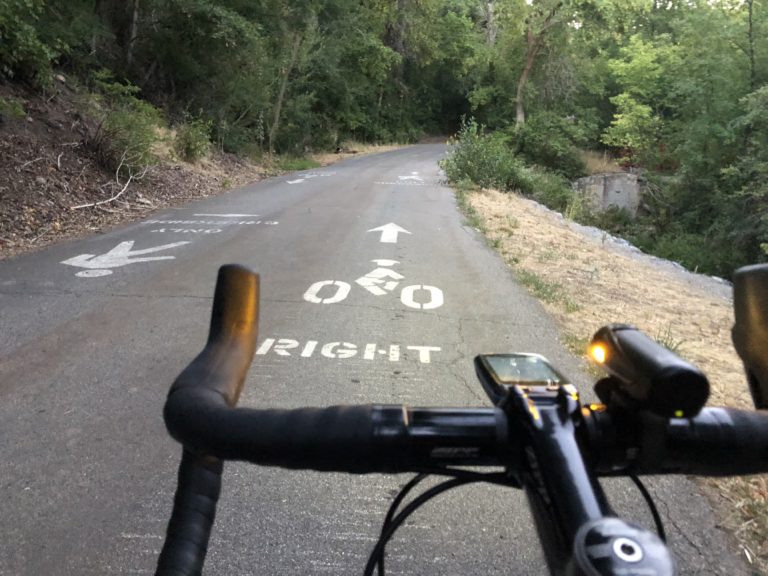
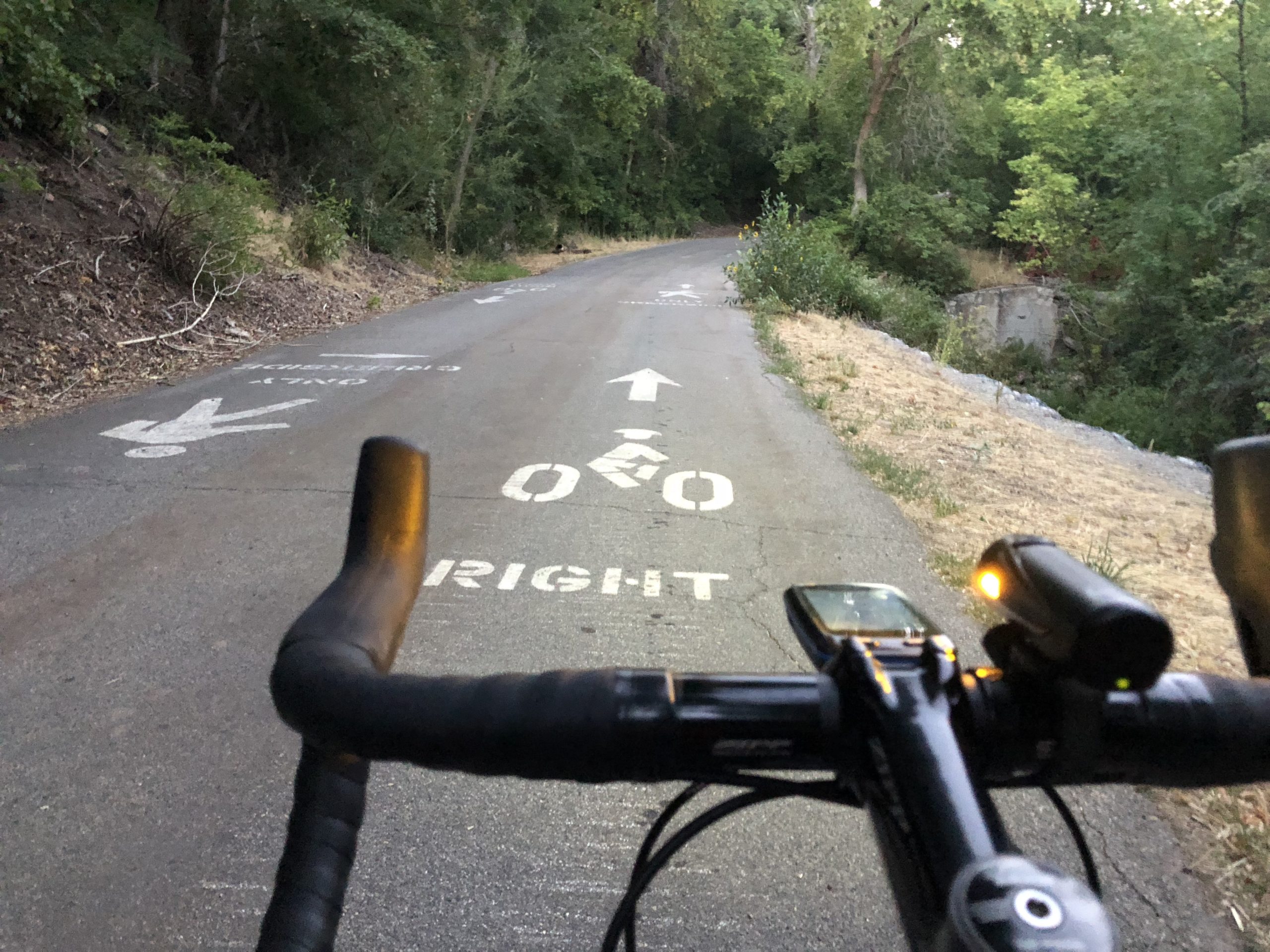
Cyclists should ride on the right side of the road in City Creek. Creek side going up, slope side going down. Pedestrians should always stay to the creek side. Photo by Dave Iltis
“In the past few weeks, with the stay-home directives in place for COVID-19, we have seen very large numbers of people recreating in City Creek Canyon. It’s completely understandable, given everyone’s need for fresh air and a break from being homebound,” said SLCDPU Director Laura Briefer. “But with the increase in visitation of the canyon, it is more important than ever to adhere to established safety protocols when walking, running, and cycling the canyon road.
“We want people to enjoy the canyon, especially in this difficult time with so many routine activities off limit,” Briefer said. “But we want them to do so safely and with respect for others.”
Pedestrians are required to stay on the canyon’s stream side. Bicyclists must always stay on the right, traveling on the canyon’s stream side heading uphill, and on the slope side traveling downhill. The speed limit for motorized vehicles accessing picnic areas and bicycles is 15 mph. City-owned vehicles, which include heavy construction and maintenance equipment, can be present at any time on the road, further emphasizing the need for slower speeds and just paying attention.
The canyon also beckons to dog owners who want to escape home with their furry friends. Leashed dogs are allowed in the lower canyon. Dogs are prohibited beyond picnic site 16, where a sign just below the water treatment plant directs owners and their dogs to turn around.
In the end, everything comes down to being safe and courteous. Following a few simple safety rules will allow for everyone’s enjoyment and rejuvenation.
“The City Creek experience is beautiful, peaceful and restorative,” Briefer said. “We want residents and visitors to enjoy it, but always with safety in mind for themselves, for others and for our drinking water supply.”
Basic rules of the road in City Creek Canyon:
Pedestrians keep to the stream side of the canyon
Bicyclists always on the right–stream side on the uphill, slope side downhill.
Dogs always on leash, maximum 6-foot length (retractable leashes are highly discouraged)
Observe all posted speed limits
Bicyclists should dismount and walk through the canyon entrance-exit area
“Go before you go.” Do not relieve yourself in the canyon
No camping in the canyon
Keep It Pure: Pack out what you pack in and leave no trace
Cyclists should note that there is no water available in the canyon currently, and all restrooms are closed until further notice.
By Jamie Morningstar — For most of the world, these past few weeks have been times of massive disruption, change, fear, and uncertainty. No aspect of our lives is untouched, from shopping norms to job certainties, and that includes our cycling patterns and self-care!
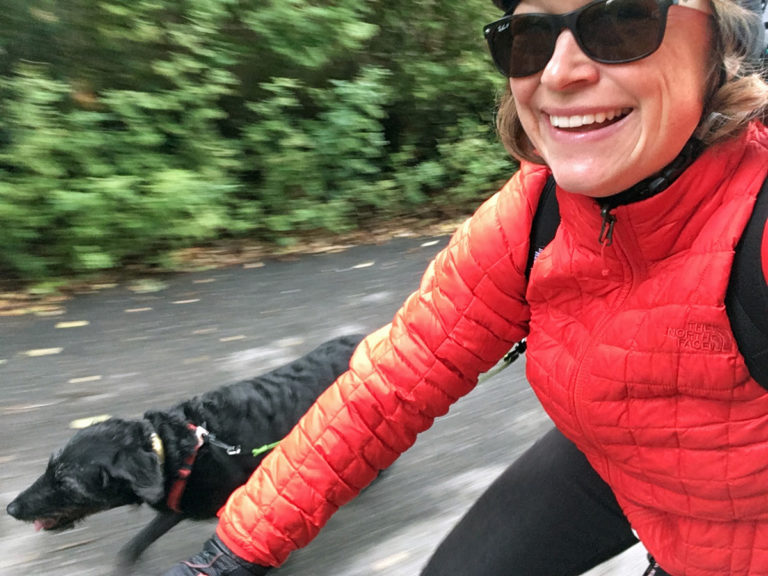
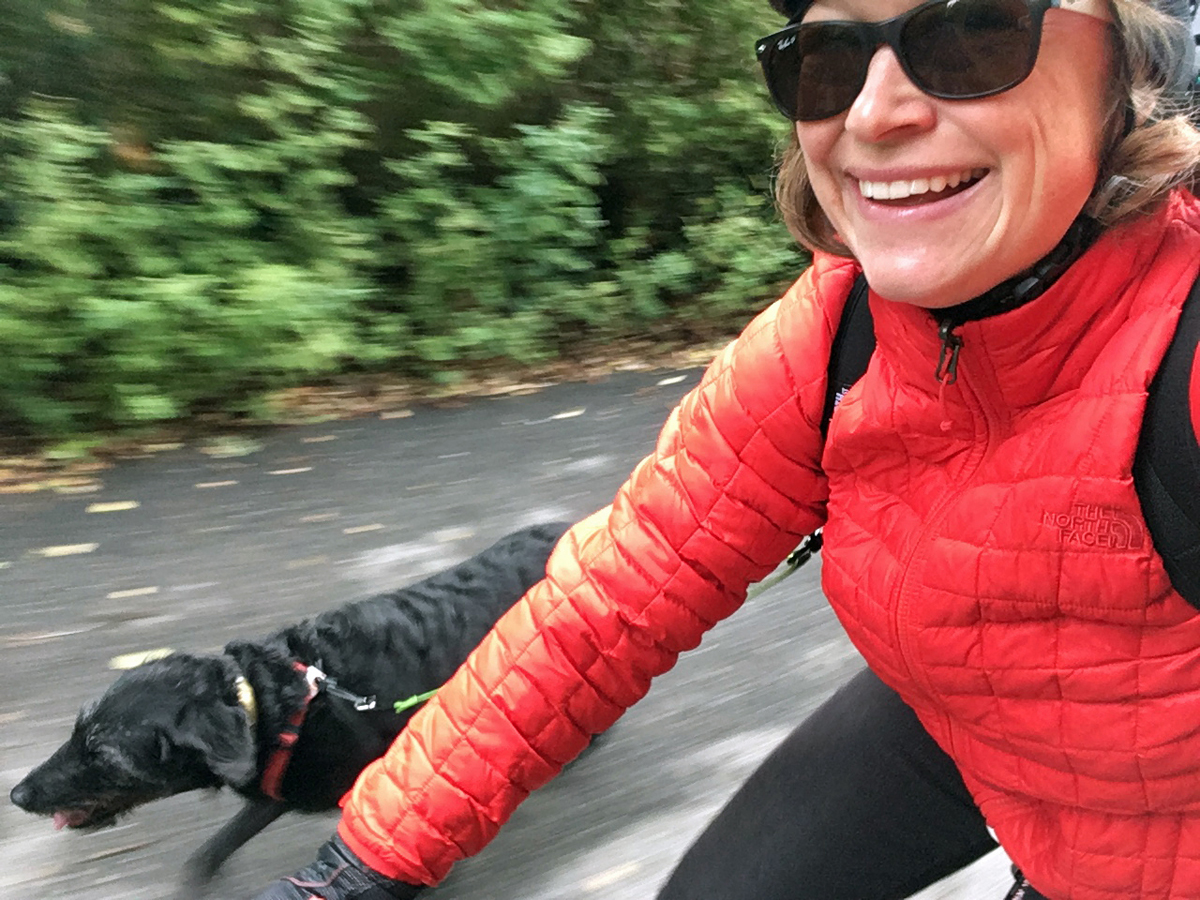
Jamie commuting with Chorney. Photo by Jamie Morningstar
Cycle commuting is one of my most cherished habits. I commute daily to work by bike year-round. According to my bike computer, since I began cycle commuting nine years ago I’ve logged 9,000 commuting miles and spent almost 30 days of cumulative time commuting on my bike. I really love riding to work.
Biking to work ticks several important boxes for me: it’s a natural way for me to get in a daily workout, cycling is ecologically sound, and I don’t have to compete for a parking space at work. But the biggest benefit to me of cycle commuting is that I get time at the beginning and end of my work day that is completely set-apart – it’s this delicious transition time between home and work when I get to be totally alone with my own thoughts. As a busy manager and mom of four, there’s not a lot of quiet, contemplative space in my daily routine. My commuting time is one of the few regular times when I create that space.
Enter: the chaos of the past few weeks. In my 1700 square foot house there are now four people elementary through college-aged doing school-from-home, two people working from home, plus two dogs and a cat. I need quiet space in my days now more than ever, but a cycle commute is no longer built into my daily routine. I know that there’s nothing stopping me from hopping on my bike before, during, or after my work day, but without the touchpoint of my normal cycle commute, it’s been much harder for me to find time in the saddle.
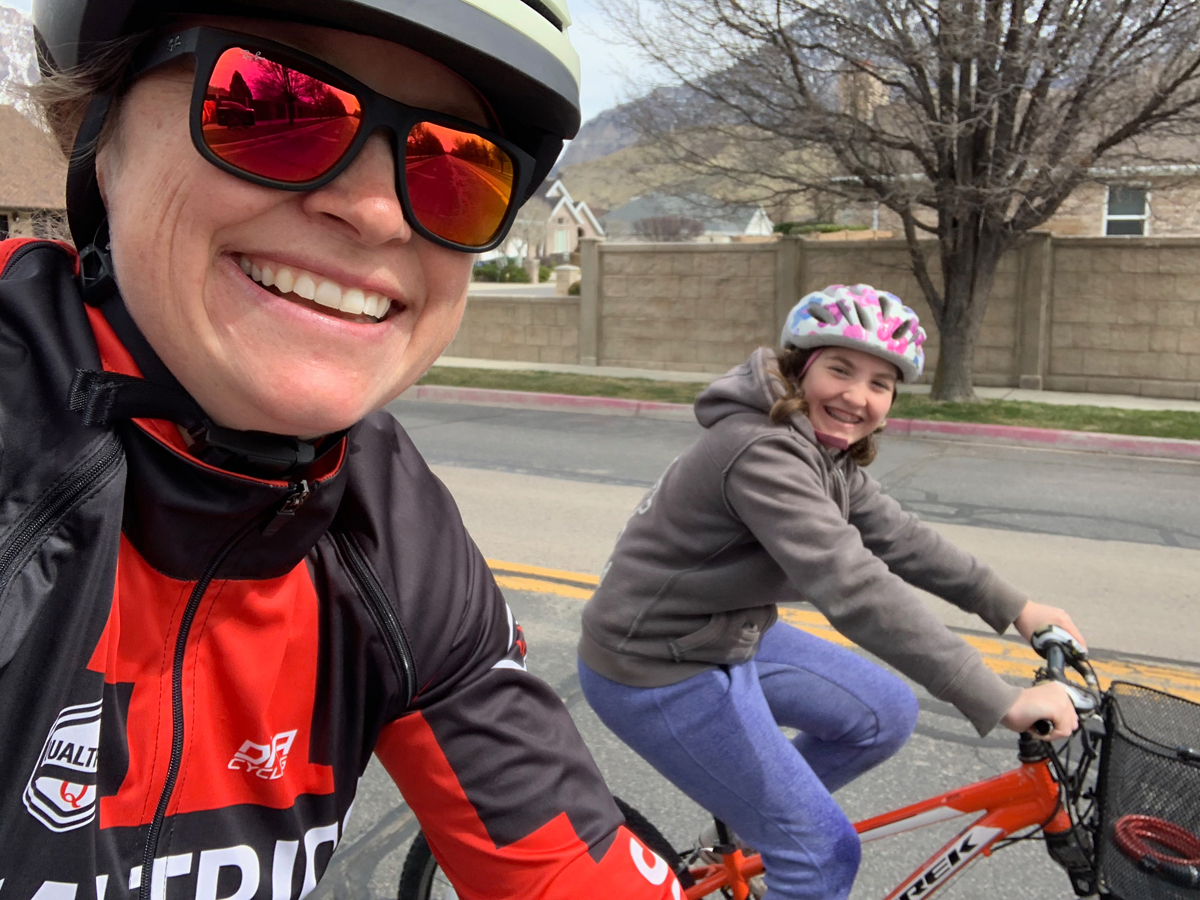
Jamie and her daughter Sasha take to the streets to run errands by bike. Photo by Jamie Morningstar
I’m keenly aware that I’m not alone in this struggle! Many of my fellow cycle commuters are in similar work-from-home situations. Some have been furloughed from jobs and businesses that are currently unsustainable. Mixed-modality commuters don’t have the public transportation options they once relied on. Kids and loved ones need us at home now more than ever. Normal routines are disrupted for almost all of us.
Yet these times of social distancing seem tailor-made for cycling. The roads are far less busy than usual. With all of our normal gym and indoor workouts cancelled, it’s one of the few ways to get one’s blood pumping. And we are naturally distanced by six or more feet when cycling.
So, how do we get into the cycling habit when all of our normal habits are disrupted?
Here are a few ideas:
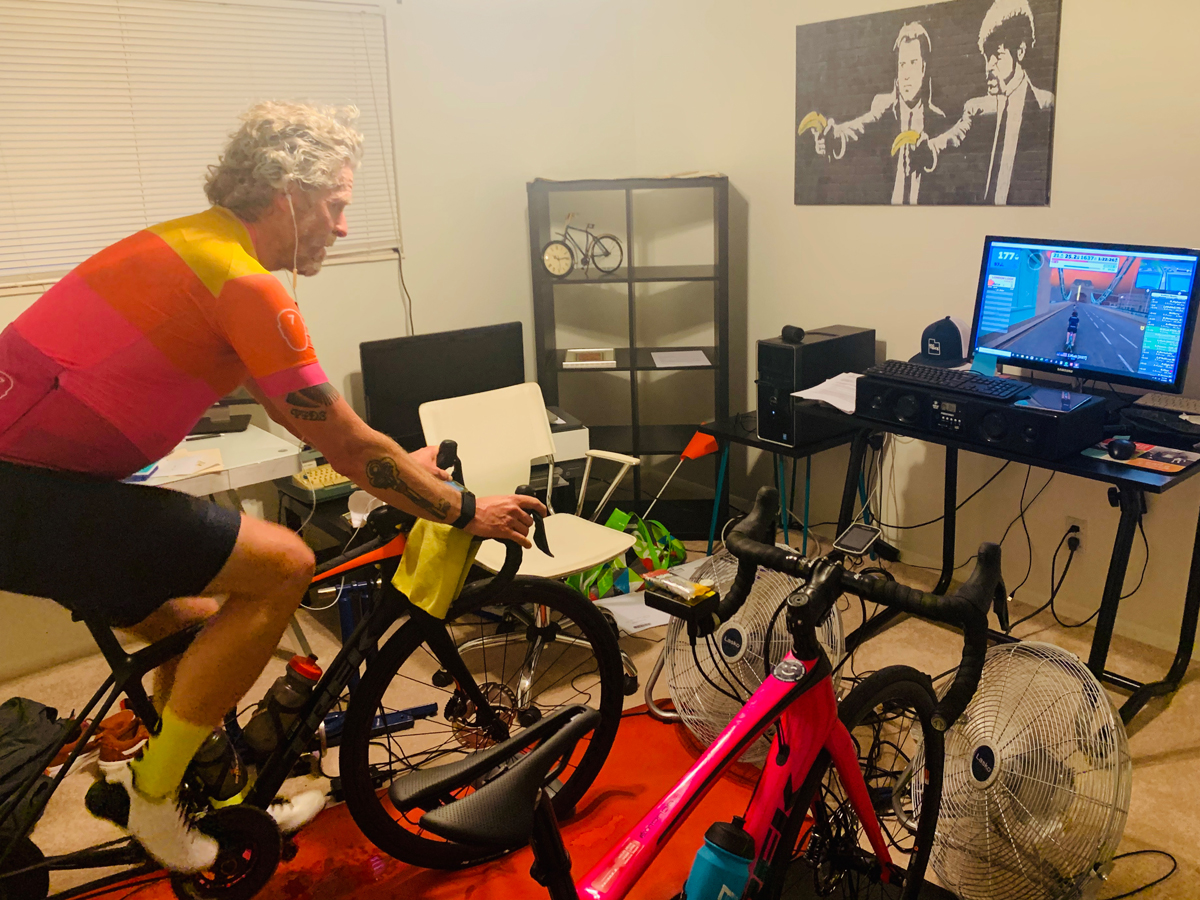
Get an indoor trainer. With gym closures, several of my friends have ponied up for Peletons or indoor trainers to keep fit when they’re unable to go outside. Personally, I’m not a huge indoor trainer fan – I’ve tried them over the years but the habit never stuck with me. However, there are tons of folks that are passionate about their Zwift and there’s never been a better time to try it!
Make excuses to ride. I now run all errands on my bike – need to drop by my kids’ school to pick up a packet? Bike. Cleaned out a closet and need to drop the donations off at a local bin? Bike. Touring grocery stores to figure out who has potatoes or pasta? Bike. I thought I was a pretty avid around-town cyclist before, but I’ve taken it to a whole new level over the past few weeks!
Start or end your day with a commute. One of the hardest things for me as a new work-from-homer is maintaining a daily rhythm – one hour just oozes into the next in the perpetual twilight of my basement “office”. One thing that has helped is setting an alarm to indicate the end of my work day and then taking a half hour ride. It gives me the solitude and transition that I love in my normal daily commute and helps me bookend my day.
This is a time when we each need to be a little more mindful about our health and safety and also how we’re going to stay balanced in mind, body, and spirit in this tough time. For most Cycling West readers, regular bike rides are an essential part of our self-care routines.
Right now, many of our routines are disrupted, including our self-care routines. But if we don’t take care of ourselves, we won’t be in a good place to take care of our families, coworkers, and communities. So take a minute, right now, and think about how you’re going to get on your bike tomorrow and make your day a little brighter.
If you have a suggestion for a commuter profile, have a commuter question, or other comments, please send it to [email protected].
Most of us have spent a good deal of time on an indoor trainer or some type of training program over the past months. Those long, sweaty, and often boring hours do make the difference between winning and losing when race season comes around again, and can be the stepping stone to taking your riding to the next level even if you don’t race. With all of that in mind, your nutrition is definitely important! So, rather than use the first part of the season to “race into shape” let’s keep in mind that optimal fueling promotes training adaptations that go beyond the hours on the bike. Practicing good eating habits in training can only further your success into the summer moths. Here are some ideas on how to properly fuel your body as we transition into the summer months.
Pre-ride Fuel
Consume this meal 2-3 hours before you head out to allow digestion time and full glycogen (the storage form of energy in our muscles) capacity. If you have to eat closer to training, choose a lighter meal and make sure your on-the-bike fueling includes electrolyte mix with calories and that you have plenty of ride food. Riding on an empty stomach is not wise, as you limit yourself by not having any energy to burn. So have that pre-ride meal, you’ll feel so much better with some cereal, fruit and granola, banana with toast, or fresh fruit smoothie before you hit the road or dirt. Now, what to take in your pockets…
Continue Fueling During the Ride
Aim to consume 30-60g of carbohydrate per hour, depending on body size, intensity, and duration of ride, to sustain your energy. On rides that are 90 minutes or shorter, it isn’t necessary to consume carbohydrates as you ride as long as you have fueled well beforehand and consume a recovery snack/meal straight after. Aim to drink a minimum of 500ml of fluid – many water bottles are 500ml – per hour as well. Ideally drink two bottles per hour, at least one of those having electrolyte mix, especially as it starts to get hotter in the summer months! A great way to get proper energy and hydration is to drink your carbs and electrolytes. A quality mix is designed to fuel you well, as long as you drink it, and drink it often.
Recovery: Re-Fuel and Fuel for Tomorrow
Getting your post-training nutrition right is going to make a huge difference towards helping your body replenish what you lost on the ride, and prepare you to be able to ride again the next day. You want a 3:1 combination of carbohydrates and protein – carbs to replace the energy you expended and protein to aid the recovery of muscle damage. Opt for something that’s easy to prepare and our bodies can absorb, as we have a 30-minute ‘window of opportunity’ for recovery post-ride. Typically, a smoothie is the most convenient choice, and most sport recovery products are designed with the proper amounts of carbs and proteins, as well as being rehydrating. The sooner you eat and hydrate the better your recovery and adaptation will be.
Breanne Nalder, MS, RDN has a Master’s degree in nutrition with an emphasis in sports dietetics at the University of Utah. She is a Registered Dietitian, the nutrition coach at PLAN7 Endurance Coaching, and raced for the DNA Pro Cycling team for 5 years. For individual custom nutrition coaching, contact her via email: [email protected]
The Concept: Start in Silverton Colorado and ride to Moab Utah off road via the San Juan and La Sal Mountains. Why not?
The Problem: It’s over 215 miles, and over 30,000 accumulated vertical feet.
The Solution: Huts! That is, you ride from hut-to-hut, with each hut spaced 30-40 miles from the other.
The Illusion: They carry all your stuff and it magically appears at each hut, with each hut being a quaint cabin in the woods, with soft pillows and meals prepared for you.
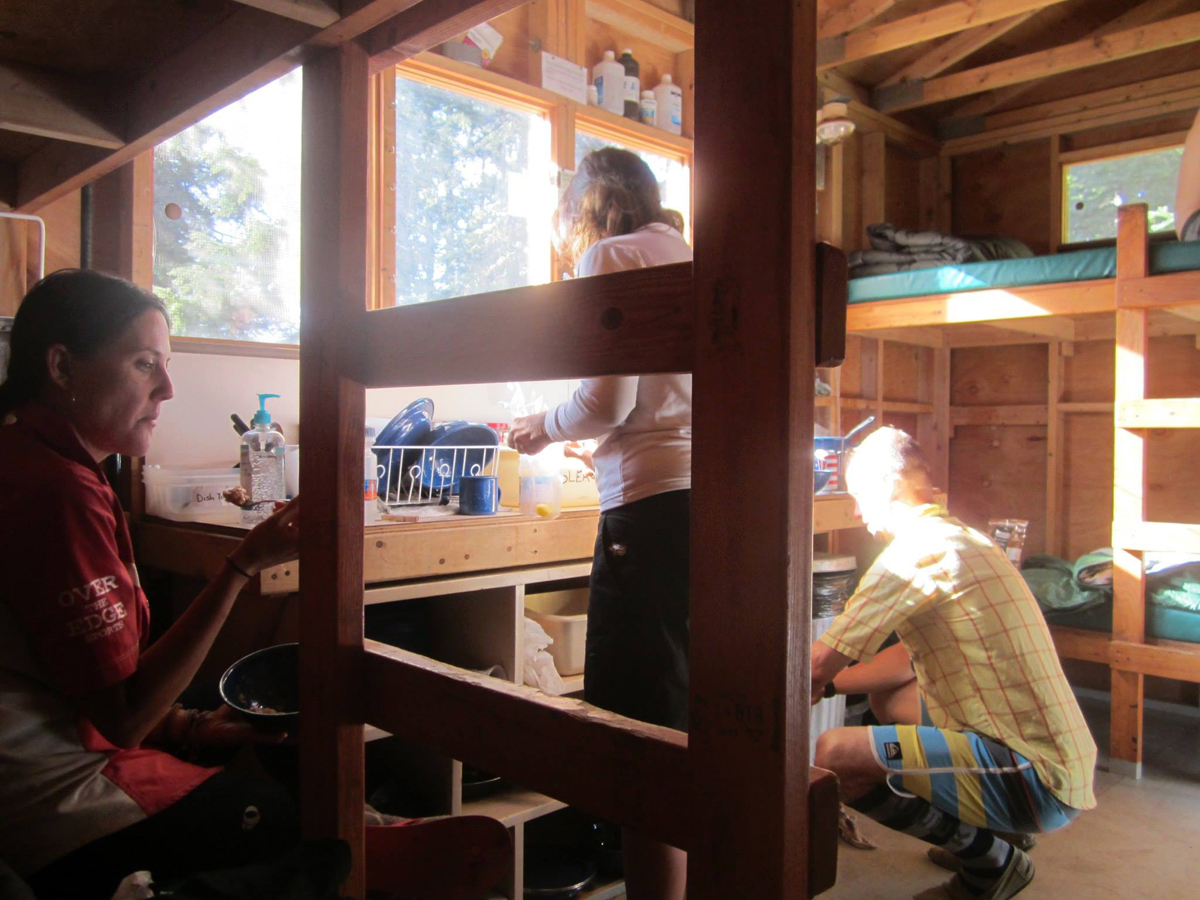
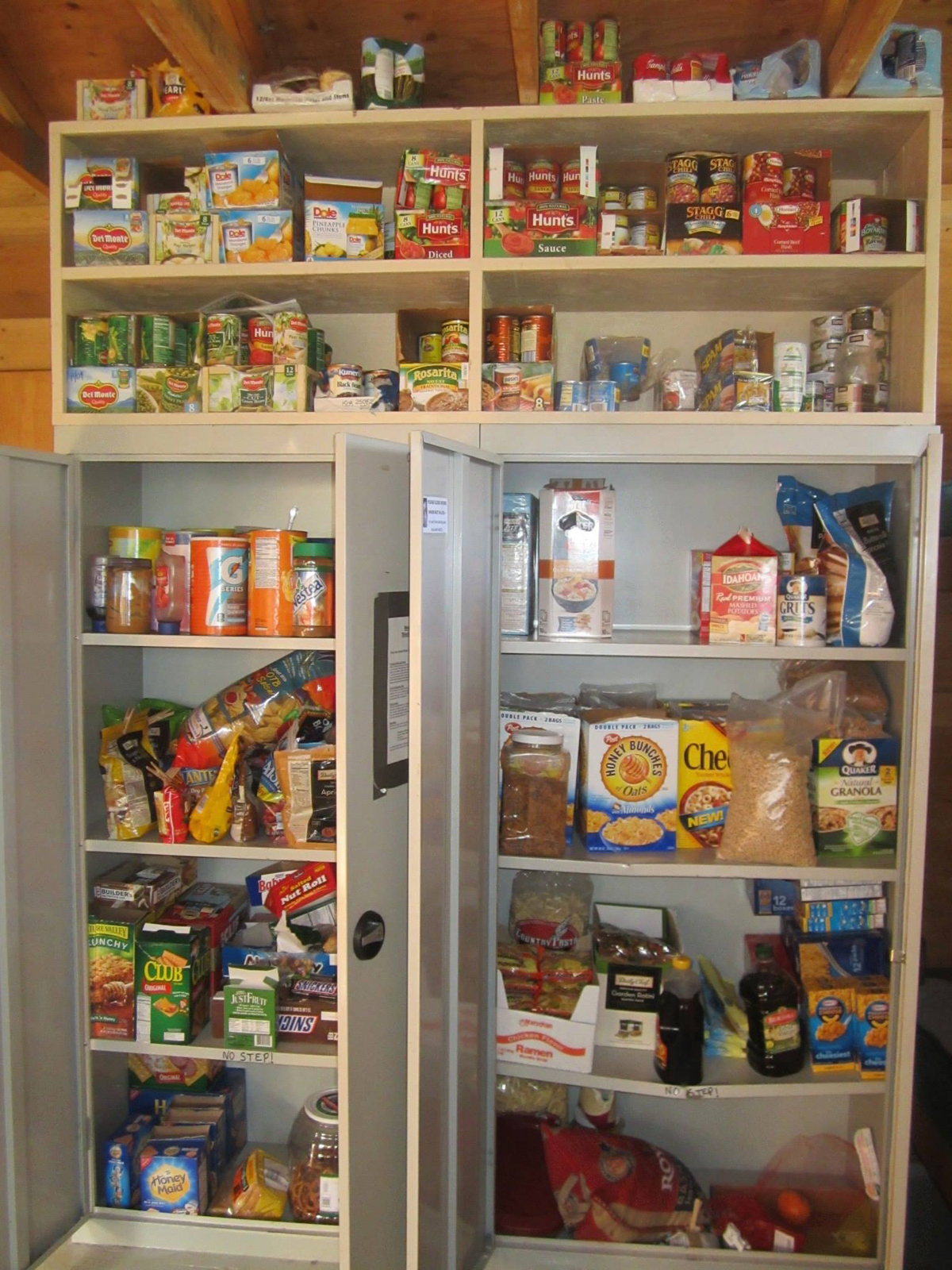
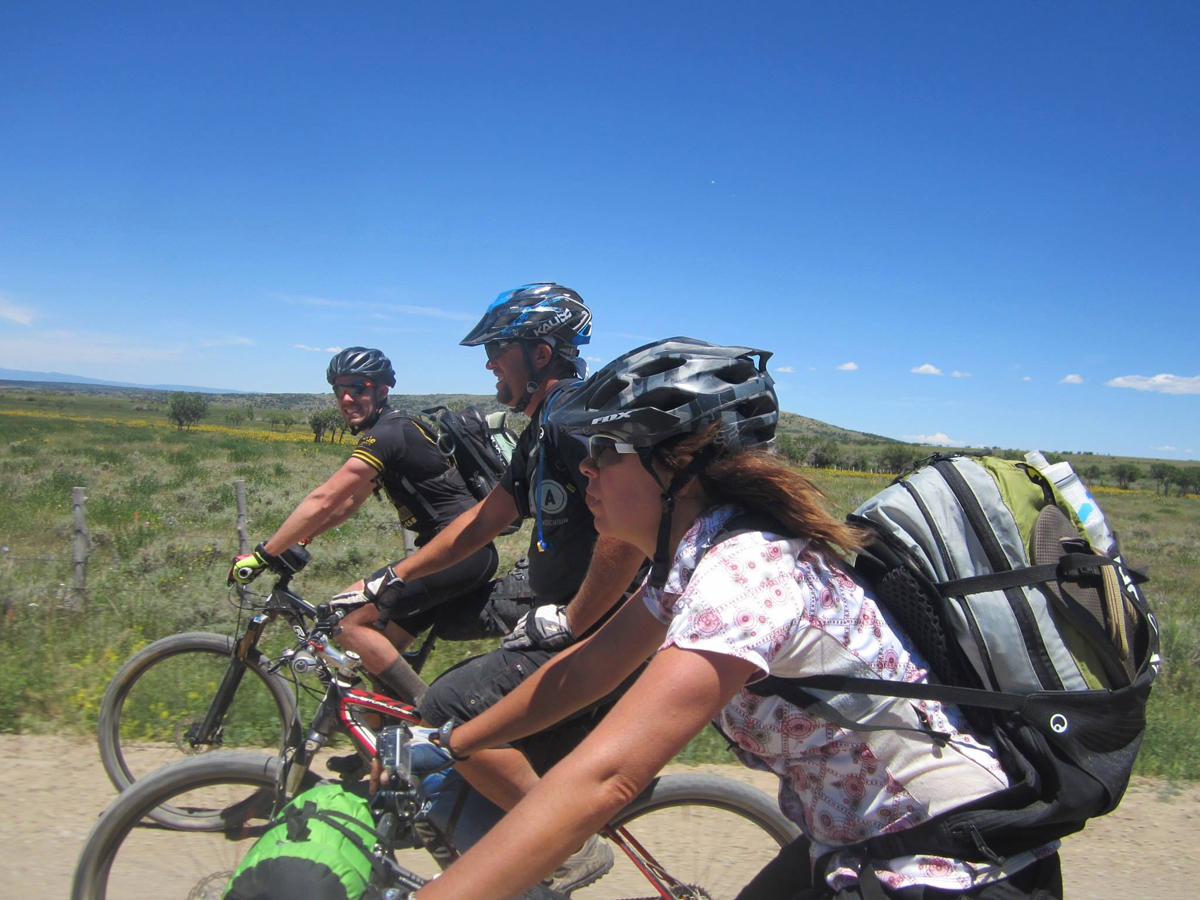
The Harsh Reality: They supply warm beer (sometimes coldish), a cabinet stocked with food, a bunk, and a nasty sleeping bag. You have to carry all your clothes and personal stuff, which even in the minimal, turns out to be either a big pack, or an array of novel frame bags on the bike. Either way, you are carrying about 20 pounds of stuff. You feel it, especially on climbs that end at over 12,000 feet. The hut is, well, a 20X20 foot shed. No running water. No electricity. No cell phone contact. You shit in a 20 foot tall composting toilet. Each day you drag your sorry ass out of bed, eat about three breakfasts, climb up to the composting toilet, pack your stuff, and then make it to the next hut.
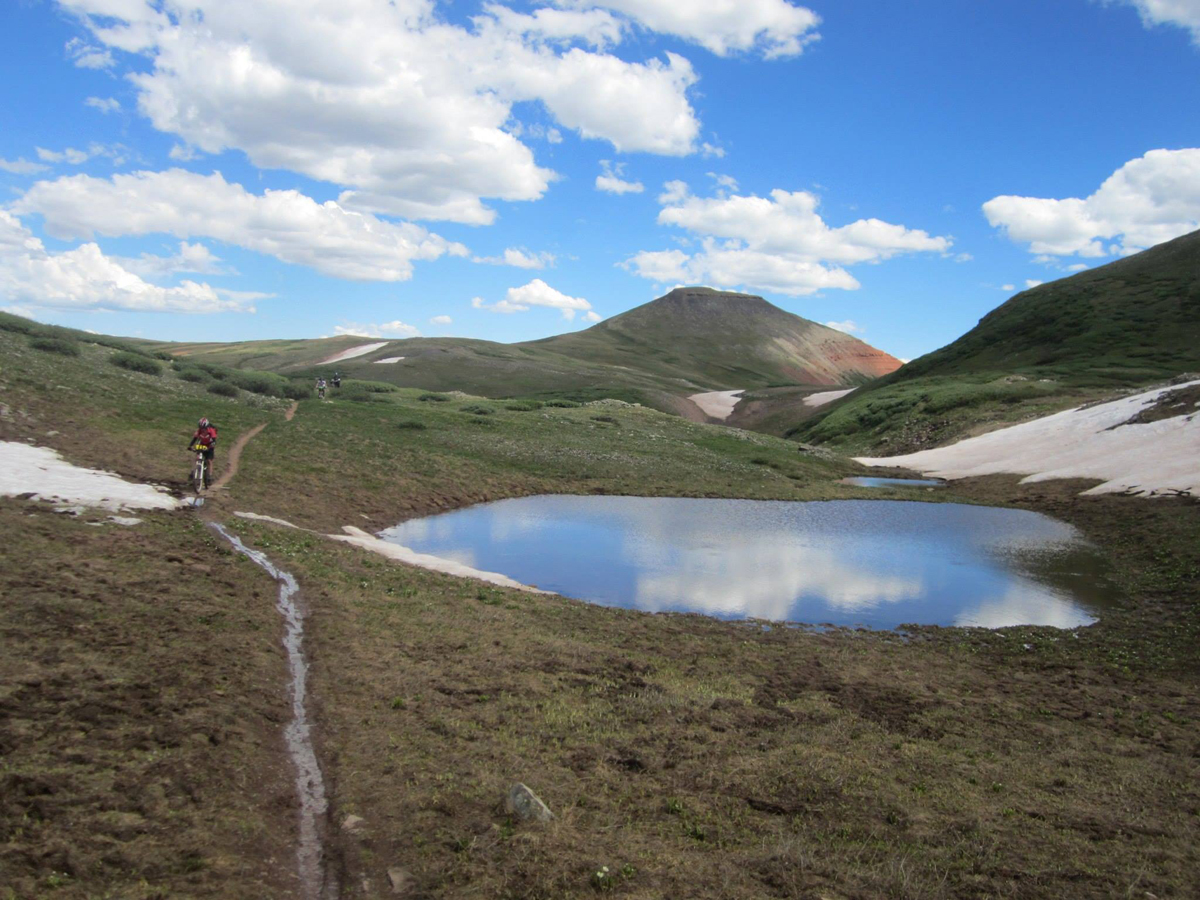
On top of the world on the San Juan Huts Tour. At 12,300 ft the air is thin at Rollin Pass.
The Harsher Reality: It’s hard. It’s really hard. We had the idea this would be like connecting Park City singletrack sections. It’s not. There are no signs. It never lets up. You MUST learn how to read maps or get really lost. Getting lost in the dark at 11,000 feet after 10 hours really sucks. Being on the bike 5-13 hours a day was hard. Finding the hut was hard. Making food was hard. Sleeping, or trying to sleep, was hard. Wearing the same damn socks shorts and shirt for 7 days was hard. Getting up at 5:30 am to beat the desert heat was hard. Bathing, that was almost impossible.
The Reasoning: It was awesome. It was transcending. It was life changing. It pushed limits and created bonds for life. You are on your bike for 7 days, with no outside contact, in the wilderness, on your own. It was pure bliss!
How it all went down:
The idea to take on a 7 day hut trip emerged in early January of 2014. The Huts hold 8 people. But that sounded crowded, so we settled on a group of 6. Cimarron and Bryce are husband and wife. Kim, Gazz, and Jamon had all been good friends with Cim and Bryce for years. Jamon and Sean are brothers, but had never met Kim or Gazz before the trip. None of the group had met Sean before the trip. Everyone in the group had being looking for the opportunity to take on this adventure.
After crunching schedules we found a date to take the trip in late June. We hoped that the snow would be melted at the high altitudes at this time, but that we would avoid the heavy summer rain season. Once you put down a deposit, San Juan Huts sends a Biker Bible, along with detailed route descriptions and a GPX file – but no map. Instead they give you a list of BLM and FS maps you can purchase that have the roads and trails shown. The San Juan Hut route offers several options to get to the each of the huts. Some alternatives are for wet weather passage, others are to add more single track into the adventure. The traditional Day 1 route begins at the Durango Mountain Resort and is 18 miles on a forest road with a 3725 foot total ascent. The alternative singletrack trail begins at Little Molas Pass and you ride the famous Colorado Trail above the timberline to a high point of 12, 600 feet at Rolling Pass and is 20 miles. The group was feeling strong and had been training hard for this trip since January. Option 2 was chosen. This one decision set the stage for the adventure to come.
Sunday, June 29:
With half the group traveling from Salt Lake City and half coming from St George our group of 6 met in Grand Junction where a shuttle to Silverton was arranged with friends. Silverton is known as a bit of a wintertime backcountry ski Mecca, and mostly attracts the red neck/ ATV crowd in the summer time. Our ragtag group was a bit out of place, but this was the closer and cheaper option to start our trip than Durango Mountain.
As we unloaded at the hotel in Silverton we slowly came to the realization that when those two cars pulled away there was only one way back to Moab – by bike. Before we were fully checked in Jamon scurried across the street to the liquor store festooned with a 50 point elk rack mounted to the front wall and acquired 12 beers. This aided the unpacking and settling in process. This was the first time we had all sat down and actually talked about the week ahead and who had brought what. Among the things that were missing, we somehow decided Cards Against Humanity was part of the “must have” list. The six of us set to work using 3 x5 cards to make our own game cards to pack in with us.
About the time we were good and comfortable (which at 9000″ is not very) it was time for dinner. Cheese, beans, tortillas and tequila sounded pretty damn good and a Mexican joint at 9000 feet that also boasted world famous margaritas sounded extra good. We made our way through town and saw the highest Harley shop in the world…that was Silverton.
Monday, June 30:
Let’s preface the day with the idea that long travel days, beers and high altitude do not always make for the best morning decisions. It was HIGHLY recommended to us that we get a shuttle from Silverton to our start at Little Molas Pass, but that would have meant getting up at 5:30 am. Knowing we were unprepared and unable to awake that early, we opted to sleep in and begin the adventure by bike in Silverton. After a quick Breakfast we started a 7 mile road climb at 9:30 am.
We climbed, straight up a mountain road. It was steep. Once we found the Colorado Trail and single track we enjoyed about 30 minutes of fun riding, then we were climbing again. Up steep, pitted rocky trail we went. We took turns pushing bikes and taking breaks. A single mile took an hour… 1 to 2 miles per hour was our speed. Altitude, thirst and exhaustion we setting in by mid-day and we still had a long way to go. We refilled our bottles with the snow pack run-off hoping there was not much to contaminate it at the top of the world. Cimarron began to have signs of altitude sickness and slowed the group. Jamon and Sean rode ahead and then thought they were lost and panicked as the landscape turned from high alpine to tundra.
Finally the group came together at the top of Rollin pass around 4:00 in the afternoon. A quick assessment of pace and time revealed we would not finish by dark. It was decided that Jamon and Sean would forge ahead to set up the Hut and make dinner and Bryce and Gazz would stay with Kim and Cimarron. Sean passed around altitude pills and we post-holed a zig zag trail across the melting snowpack to the ridge. It was beautiful.
The San Juan Huts had 8 bunks, with pads and sleeping bags. But don’t forget your bag liner.
Getting off the snow pack was an adventure; big drifts meant skiing off the top then running out with bike in hand. Bryce did this 3 times to get the girls bikes down. The trail was heading downhill. Giddy with excitement we naively thought the hardest part was over only to discover we had to head straight back up again. This time it was up a trail of huge boulders. Riding was not even an option here. We took turns handing bikes up. It was hard. Eventually the daylight turned to dusk and Gazz decided he would ride on ahead to catch Jamon and Sean. They got to the junction of the road just before dark and realized there was no way the group coming up in the dark would know where to turn. They build a huge arrow out of rocks and twigs hoping this would lead the way. Jamon glimpsed the hut at 8:45 PM. He and Sean got a fire started and began cooking and drinking beer.
Meanwhile back on the trail Kim, Bryce and Cimarron found dusk turning to dark and the temperatures dipping. A quick assessment of gear meant they had enough warm clothes to keep going forward or even spend the night on the mountain. The only problem is they only had 2 lights between the three of them. Staying in a tight group they attempted to ride down the twisty single track in the pitch dark. After a couple of near crashes Bryce rode on ahead and Kim and Cim got off their bikes yet again and walked.
The arrow saved the day for the stragglers, as they surely would have turned the opposite way. A quick ride down a fire road and they hear a familiar voice. Gazz had gone back out looking for them, and they all rolled up to the hut at 11, 500 feet together at 10:45 pm. It was a very long 13-hour day, and the longest 27 mile mountain bike ride-ever.
Tuesday, July 1:
The group woke late with lots to do – fill bladders, prep bikes, eat, eat and eat more. Pancakes come to mind, with pineapple and syrup. Hut departure wasn’t until 11:45. We had 29 miles ahead of us and 3722 feet of climbing. (We unanimously decided against the optional single track for Day 2.) The route was fantastic, a gravel road descent. Down and down we went until the junction with Highway 145. There was a brief discussion about bailing — at least Cimarron and Bryce. What if she could not handle the altitude again? The idea was abandoned and all 6 began the first climb of the day toward Black Mesa.
The day was beautiful, sunny and warm. The group sighted a river. A bath it was not, but it would take some of the stink away. Gazz got naked and laid right in. The rest of the group were not so brave, but everyone enjoyed the break to splash around in the water.
This night was much better, with the main group arriving at the hut around 6:45. Cimarron arrived slightly behind as she took it easy on the last big climb over 10,000 ft.
The Huts were stocked with exactly what you need to ride from Hut to Hut each day.
The hut was stocked with Oskar Blues beer and there was an amazing view and sunset…and then stars.
Wednesday, July 2:
Today the group was feeling great and up for an early departure at 7:15 am. The route was gravel all day and would include a big descent of 3500 feet to bring us to the Valley below at a comfortable 8000 foot elevation – we just had to get off the mountain first. It seemed pretty straightforward, head north 7 miles then turn. But the actuality of multiple T’s and Y’s was not that simple. We took a wrong turn and went in the wrong way for almost 3 miles until we hit a dead end. Jamon and Bryce took turns carrying Cim’s pack so she could breathe and climb back up to the top. This is not easy when you already have your own pack to carry. But the guys got inventive.
Day 3 of the San Juan Huts Tour. Down from the mountains, we could ride fast through the meadow.
We finally got back on track and headed down some of the most technical double track of the trip. Down meant more air to breathe and Cim’s pace picked up and she could carry her own pack once again. Our bikes carried us fast through the aspen groves for the next 7 miles. The next highlight of the day was another 10 miles or so down the road. It was a giant warm water reservoir – time for another bath. Chamois were changed for shorts and towels and snacks dug out of the bags and we headed for the shore. Most of the group jumped in and swam only to discover the lake was a bit nasty. We are all afraid we would get swimmers itch. Yuck.
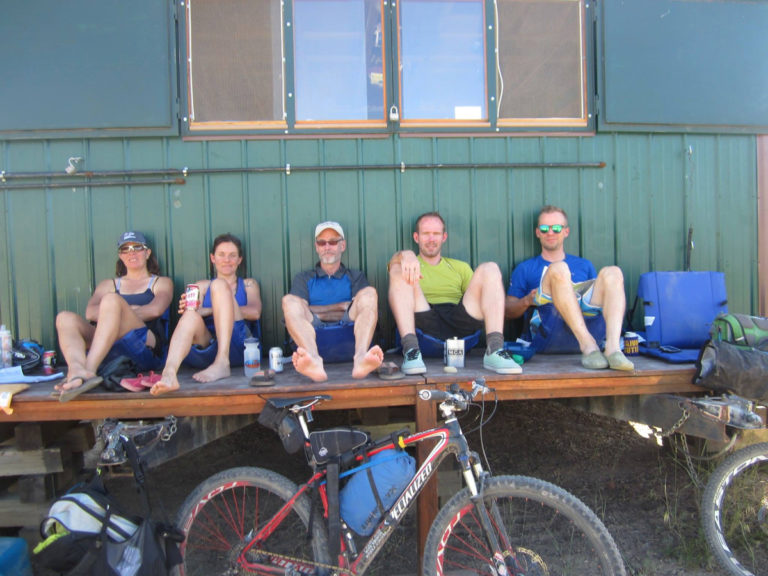
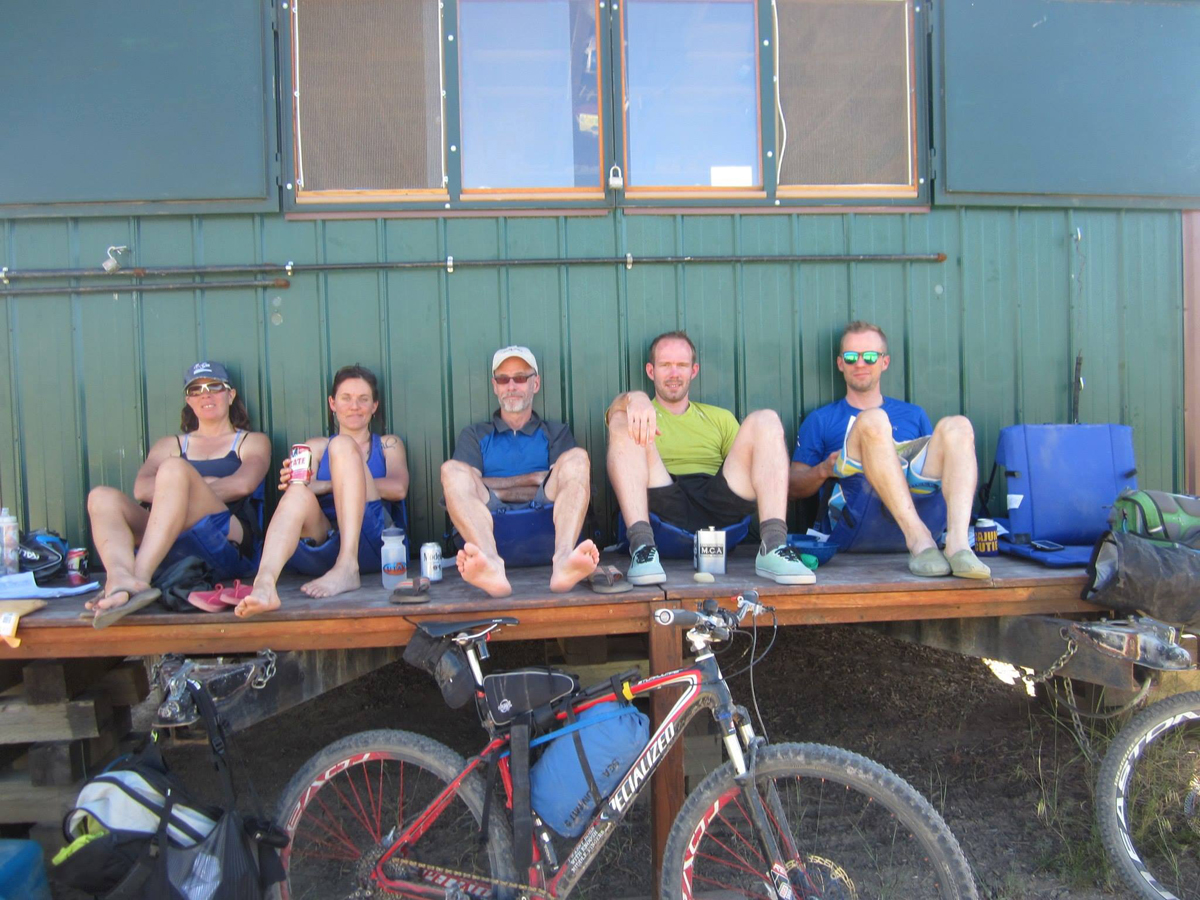
It was now very hot and we were all low on water, but none was available at the Lake facilities. The group would press on and figure out how to share what we all had left. Arrival time at the Hut was close to 3:00 PM. With hot sun and lots of time and energy left we began doing what any respectful mountain bike group does – drinking beer to excess. We played beer can bowling, did a lot of Porch’in while listening to retro punk on Jamon’s iPod and hung outside until the Gnats began to attack.
Hut number 3 of the San Juan Huts Tour. The porch became our gathering place and refuge from the sun.
With the missed turn we pedaled a good 43 miles on Day 3. Bryce slept on the porch in the wind.
Thursday, July 3:
By the 4th day memories are now of food, quirky habits, and imagination. Pedaling 34 miles in the day was just secondary. We had become orienteering pros. Dual map readers and my trusty 20 dollar cycle computer checked our mileage. No worries.
Hung over as bejesus, Sean’s French toast tasted like heaven. By now we were getting up at first light and out the door for a 6:45 am departure. It was gonna be a hot, flat day, with very little climbing. The “Apocalypse” store we were promised had supplies was out of business, but at least there was cell service.
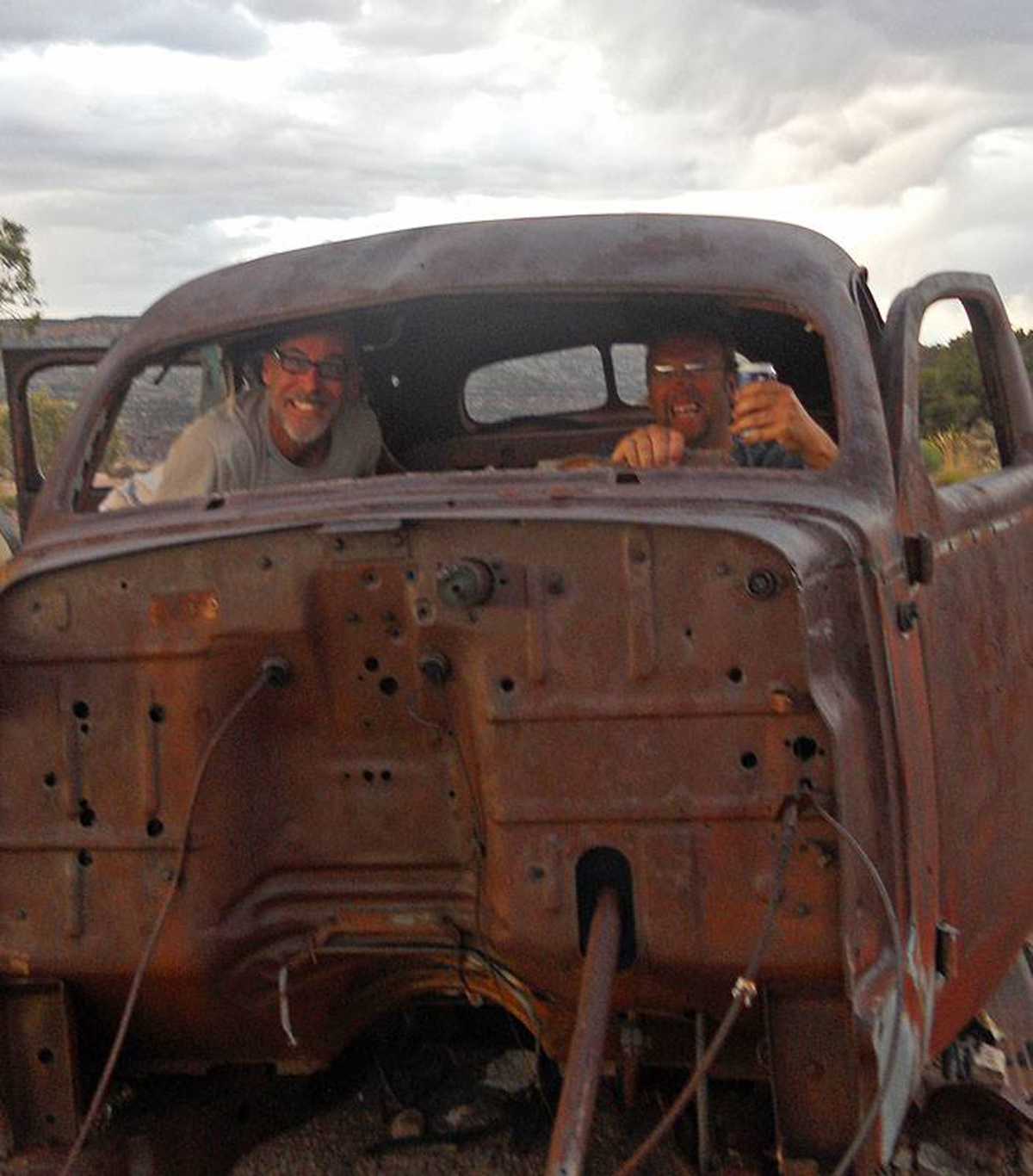
This abandoned old car became the inspiration for our favorite Hut story – “The Mole People.”
Next stop, Uranium country, which offered our first views of the LaSalle Mountains near Moab and diminishing views of Lizard Head Peak in the San Juans. The Hut was perched on the edge of amazing canyons of red rock. Arrival on this day was pre-noon. The beer was warm, and thus began the story of the Mole people. Mole people dungeon and Mole People car were all just a few of the things you make up after pedaling for 4 days straight. Bryce’s favorite meal was Chicken Noodle Soup with Green Chiles. He slept on the porch again that night.
Friday, July 4th:
Packing for heat meant fruit, and there was plenty in the Hut panties. Departure was at 6:30. A few words about the days 33-mile pedal include: rolling terrain, slot canyon views, red sand, goat heads, chucky rocks and impossible decent. Ya, we should have taken the other option. If you ever take this trip take the option on the road. Billed as “Single Track” and called Catch-Em-up –Trail” we were lured to this choice by misleading website images and unwarranted warnings about taking the highway road option. We found ourselves at the edge of Paradox valley looking at the steepest, unrideable decent imaginable. It may have been a trail once, but heavy rains and erosion had created a steep boulder field. Teaming up two, by two we slowly picked our way down this impossible descent. Our only solace in the mid-morning heat was seeing the River below. This was also a disappointment, with toxic water warning signs the River was not swimmable. We pressed on. It was crazy hot.
The hut was in an odd place, and the most miserable we had been in, with no working windows or ventilation. It was almost like they were trying to encourage us to give up and rent a room at the B & B. But there was a store in town so we called for ice and ice cream. This meant cold Budweiser and PBR for the 4th of July. We made the best party we could out of the situation. When in doubt, have a toga party.
After looking at the map we made plans for Cimarron’s evac. It was decided it was too risky for her to climb back over 10000 feet and possibly have a worse case of altitude sickness.
Saturday, July 5th:
A 6:45 departure was scheduled for those pedaling to get in front of the sun. Cimarron hung back at the Hut waiting for her 9 am ride into Moab. In the first 90 minutes of the day we climbed, 2K of Vert. It was hella steep. The rest of the climb was gradual, but were in Red Neck land – red neck camping and another reservoir you could not swim in. There was no more sage as we climbed back to the pinyons, then up to the evergreens. The evening was crazy with clouds, rain, and lightning – we were in Middle Earth. This was the coolest hut yet and it was stocked with good beer. We enjoyed lots of New Belgium brews around the fire. The night got a little crazy with Sean burning Jamon’s favorite yellow button up shirt with the sleeves cut off. There may have also been some peeing out the window. What the hell, we were almost done.
Sunday, July 6th:
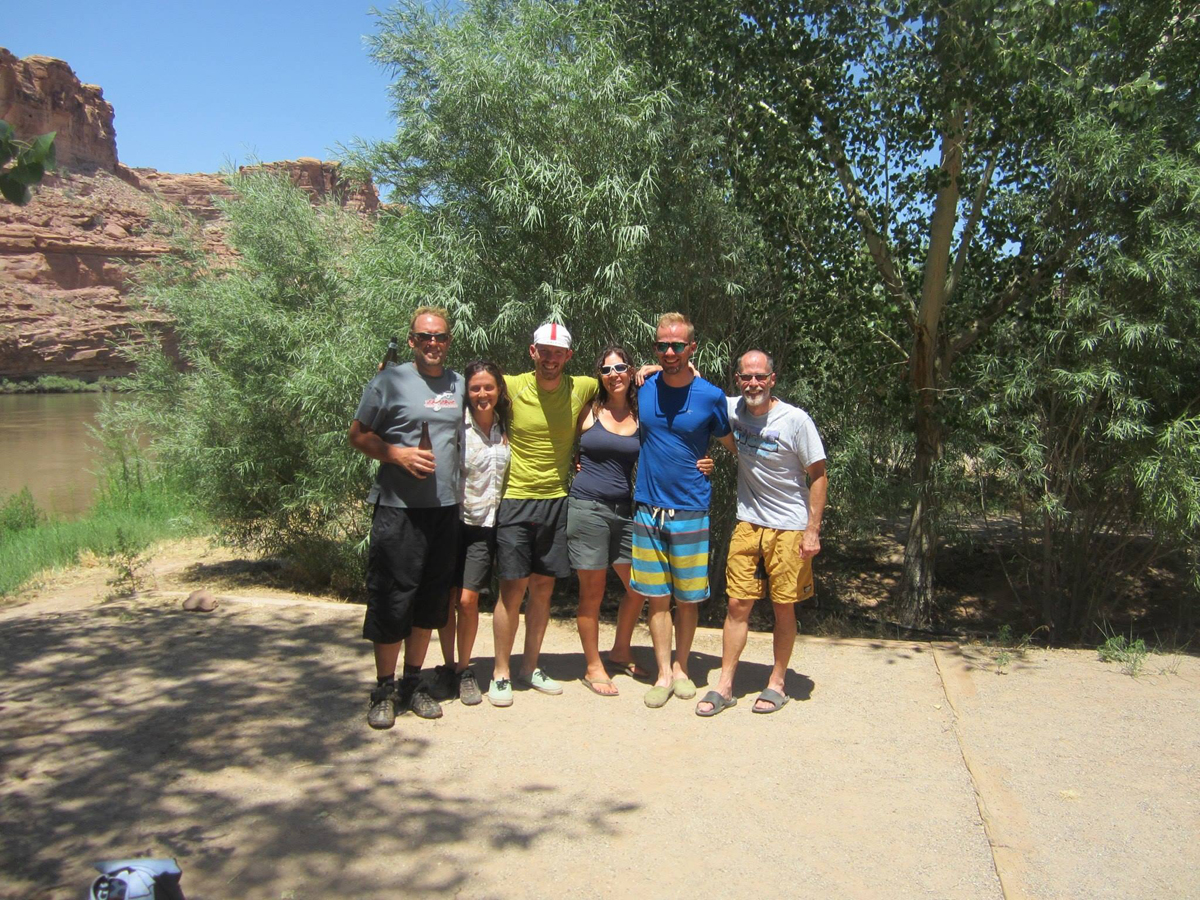
Today was a 7 am depart with a steep high climb to Burro pass. Today was the Whole Enchilada. It was a long descent to Moab in the heat. We need sunscreen. We ran out of water at LPS, and Bryce almost bailed down road. We finished at the Porcupine Trail head on the banks of the Colorado River at 2 pm. It was hot. But it was the best parking spot ever, with water, beer and chips and loved ones all waiting. We celebrate the accomplishment by playing the river. Kim’s stayed in Moab with her family and we said goodbye. The rest of us got a shuttle from Desert Rat Tours to Grand Junction. Then we all went home.
“We finished!”
Final Thoughts:
During this trip we created our own little micro-community of six stragglers and bonded. The difficulty of the trip either brought you together, or could rip you apart. In our case, we became a sandy, smelly, sometimes loud, traveling family/circus.
Total Distance About 230 miles (traditional route is 215)
Cost: $895.00 Per Person
What’s provided: Huts, Sleeping Bags, Crazy Creek Chairs, Great Variety of Food, Custom Maps, Custom GPS Tracks, Turn by Turn Directions, Backup Support.
What is not provided: Lodging before and after the trip, shuttles back to a vehicle, bikes, packing equipment.
Start: Silverton, Colorado (The traditional start is at Durango Mountain Resort)
End: Moab, Utah
Temperature range (ballpark) 50’s to 70’s in San Juans and 90’s in Paradox. It can be much warmer in July and August. Be prepared.
Water availability – The Huts are well stocked with water and food. Make sure to carry enough on the trail and bring a filter.
Cautions: Be prepared for extremes. Be prepared for goat heads (in certain areas and later in the season). Be prepared for mud in certain seasons. Be prepared with water and filter (although you may not need the filter on the trail) for the hotter temperatures. Be prepared with food and water on Day 1. Once we got to the first hut, we had everything we needed.
If you are going to take an alternative route (there are alternatives each day), you need to bring a little extra with you for the day.
Information: Once you sign up for the route, the San Juan Huts will provide information on how to best navigate your trip.
By Breanne Nalder-Harward and Dave Harward — Strange times are upon us. Our daily lives are impacted in ways that we may have never imagined. COVID-19 has us essentially on the run. People are hunkering down and preparing for extended time in physical distancing mode. “Physical distancing” sounds much more like what we’re trying to accomplish than “social distancing”. We have plenty of social outlets, we just need to protect our physical space.
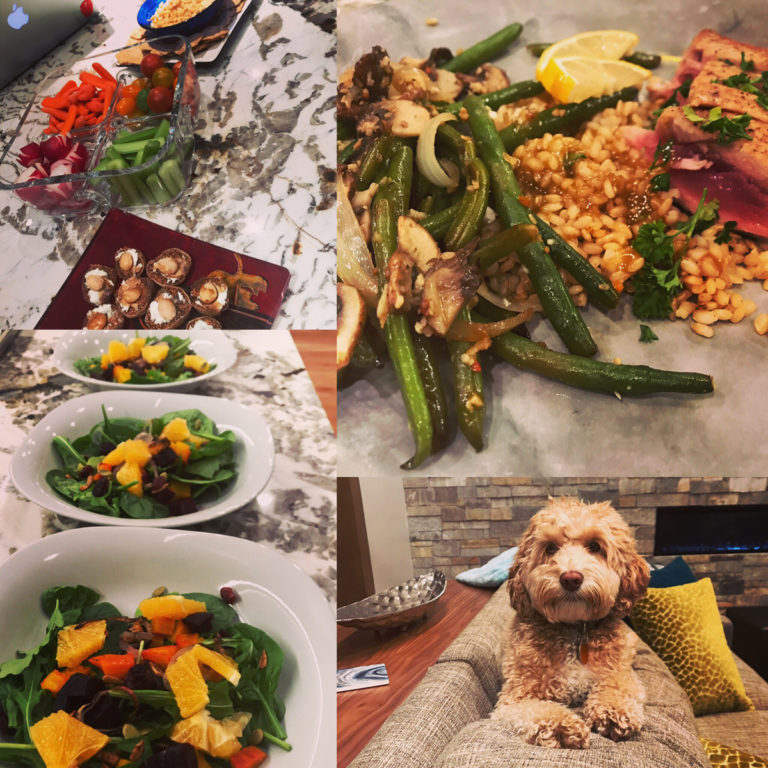
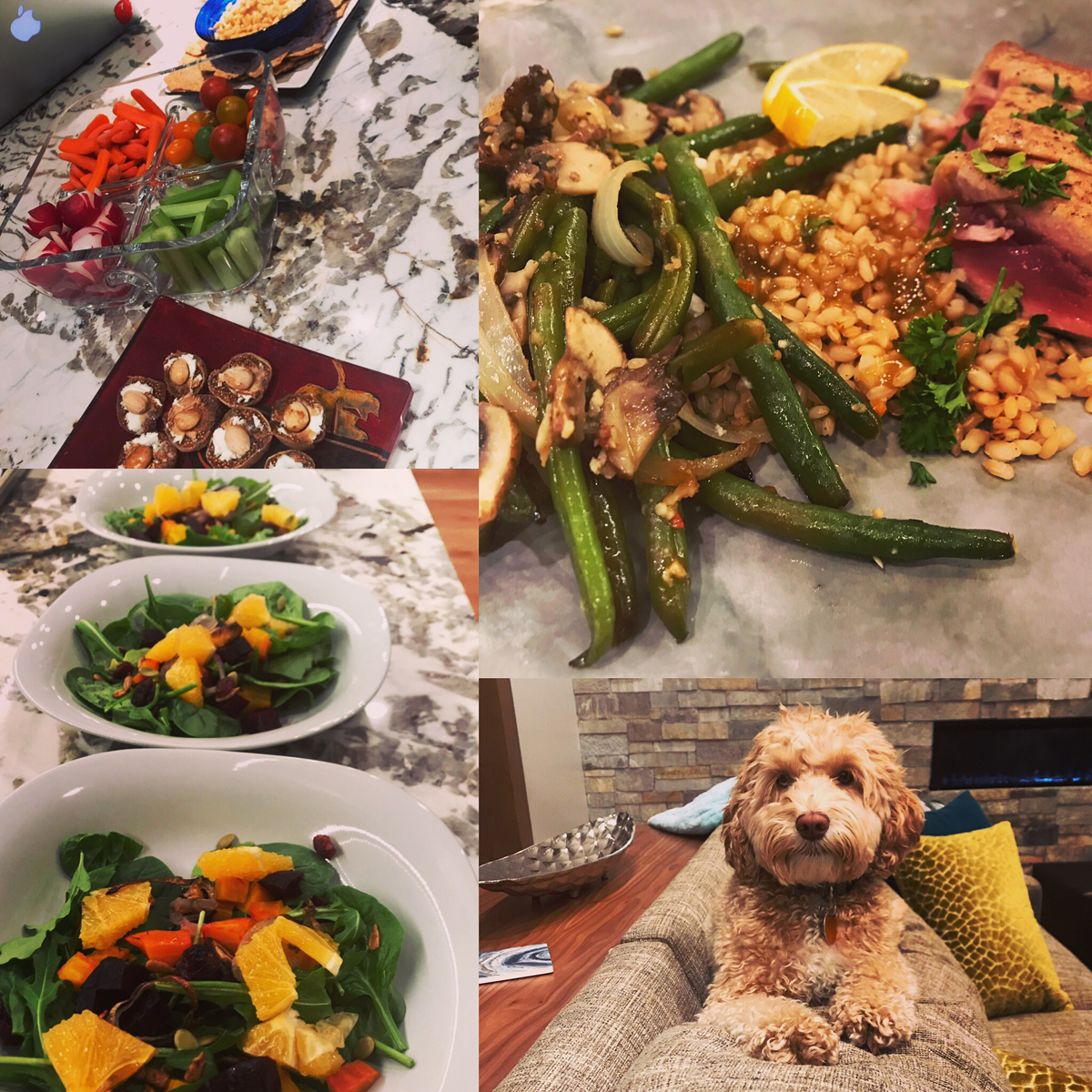
To stay fit during the pandemic, keep your meals clean, full of fruits and veggies, and control portion sizes. And spend time with your pet. Photo collage by Plan 7 Coaching.
Only You Can Prevent Virus Flare-ups
The only way to get back to regular living is to physically distance yourself from others at this time. It’s rough as we come into the spring season when group rides and races are the norm. As a collective cycling community, we must face the gravity of COVID-19 like responsible cyclists. Please only ride with your immediate family or the people with whom you reside. Please don’t take unnecessary risks while you’re out on the road or on the trail. We all value our health, so it’s our responsibility to take action to keep ourselves healthy and protect our peers, family, riding friends, and healthcare providers alike.
Train Don’t Strain
Frustration and extra time may tempt some athletes to go a little overboard on spring training. Consider, however, that training hard in marginal weather has been shown to increase human susceptibility to viruses. Over-trained athletes are more likely to contract a respiratory illness than the general population. We are not advising you not to work hard, rather to work smart! The goal is to find the proper balance between working out and wearing down.
Exercise can be a huge stress relief. Regular exercise can activate and boost immunity. Photo by Breanne Nalder-Harward
Studies show that exercise maintains or even boosts immunity. If you shift from couch potato to regular exercise, you will definitely activate and boost your immune system. However, if you are already exercising regularly, consider toning things back a notch while we are in an extra perilous situation as we are now. Maintaining a solid level of fitness will protect. Pushing the limits will put you at risk.
A structured training plan isn’t a magic black box. It’s challenging to be objective with your own training plan. Consider consulting with a professional coach who can put an objective eye on what you’re trying to accomplish. We all hope that before long, we’ll be back to normal and preparing to race all of those events we looked forward to in the off-season.
The worst case scenario is that we might be out of luck, and the entire 2020 season is a write-off. There is always next year and if you’ve maintained fitness by structuring your training, you’ll likely deepen your efficiency with a more moderate effort overall.
Make Lemonade
Now that we’re mostly eating at home, there are positives and challenges to our nutrition. On one side we are now cooking at home which takes fast food out of the equation. This gives us the opportunity to keep our meals clean, full of fruits and veggies, and control portion sizes. It also can allow us to be lazy and eat pre-packaged foods, snack too much, and choose convenient foods (which tend to be “junk” foods like chips, candy, and baked goods). Also, when working from home, it is important to manage triggers that can lead to stress eating.
A few tips to keep your food choices under control:
Keep a food journal to help identify stress-eating patterns.
Pre-portion snacks so you don’t mindlessly overeat.
Put healthy foods at eye-level in the refrigerator so you choose them first.
Fuel your body for what you do. For example, have carbs around exercise, not when you’re at your computer or in front of the TV, and enjoy a salad with lean protein in the evenings. Remember you don’t need energy to go to sleep. Our bodies digest and utilize nutrients while we sleep, so give it all the color and fiber to process overnight.
Hydrate! It may seem redundant to say, but it’s easy to forget to drink enough water when we’re out of our normal routine. Avoid sugar drinks, keep alcohol consumption moderate, make smoothies, whatever you can to keep that immune system strong.
Brain Fuel
We’ve heard from many clients and friends regarding highs and lows in their overall motivation considering the situation. Mental health is a huge consideration, as we may face financial strains due to an uncertain economy. Exercise can be a huge stress relief, but it can also be the cause of stress. Generally, we’re lucky to even have the opportunity to exercise, so view it as a benefit from the beginning, even when you struggle.
Find ways to have fun with exercise. Change things up a little. If you haven’t been over to the local park, pull on the running shoes and do a few laps on an uneven surface. Seek out a strength workout using body weight. Throw your newborn in a front pack and do some air squats!
When events are postponed indefinitely, maintaining motivation to train can be difficult, but can also be a benefit. Remember, with a postponed event, you will have more time to prepare and build depth to your fitness! Online group rides are actually a lot of fun, especially if you connect up over an audio channel to chit-chat about the day to day like you might normally do on a group ride. There are many opportunities to join online training rides in every cycling community that are posted on social media outlets.
Flatten The Curve
Let’s reiterate, the sooner we physically distance and reduce the chance of the virus spreading, then the sooner we can get back to normal. Skip the group ride that might be happening. If you’re riding outside, only go solo or with the people you live with. Reduce your risks, and please don’t crash! Stay positive and don’t give up on your training. Instead get creative and mix up your schedule with some new activities like grass or trail running, get on Zwift with a group ride, lift some weights or do a push up challenge, and be extra smart about your nutrition. Take a few deep breaths, away from others of course. Then get right back after it!
We’re here to support you at PLAN7 Endurance Coaching. Feel free to contact us for any coaching or nutrition needs. More details at plan7coaching.com
By Don Scheese — As the spread of the COVID-19 novel coronavirus grew from an epidemic to a pandemic, as the number of cases of the virus and deaths grew exponentially and the phrase “flattening the curve” came into vogue, and as the stock market crashed, I knew I had to retreat from the tidal wave of bad news to my time-honored sanctuary: the great out-of-doors.
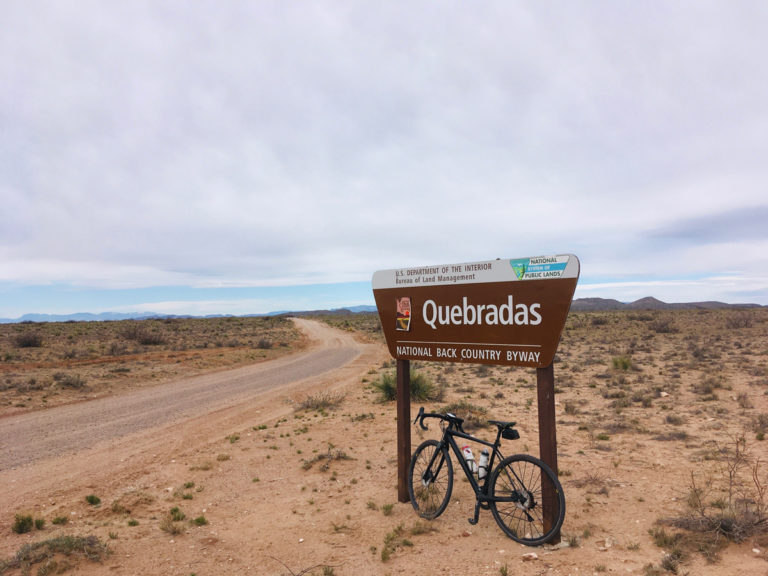
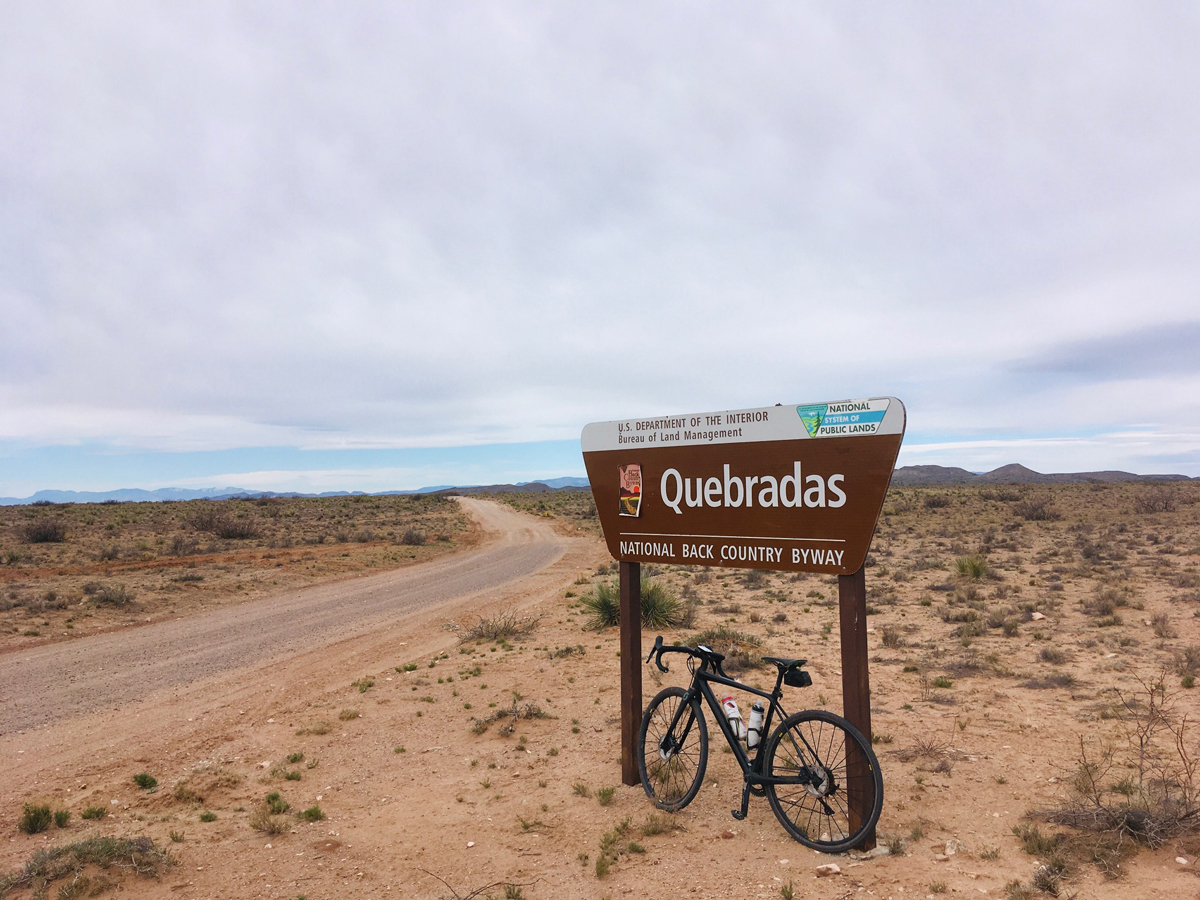
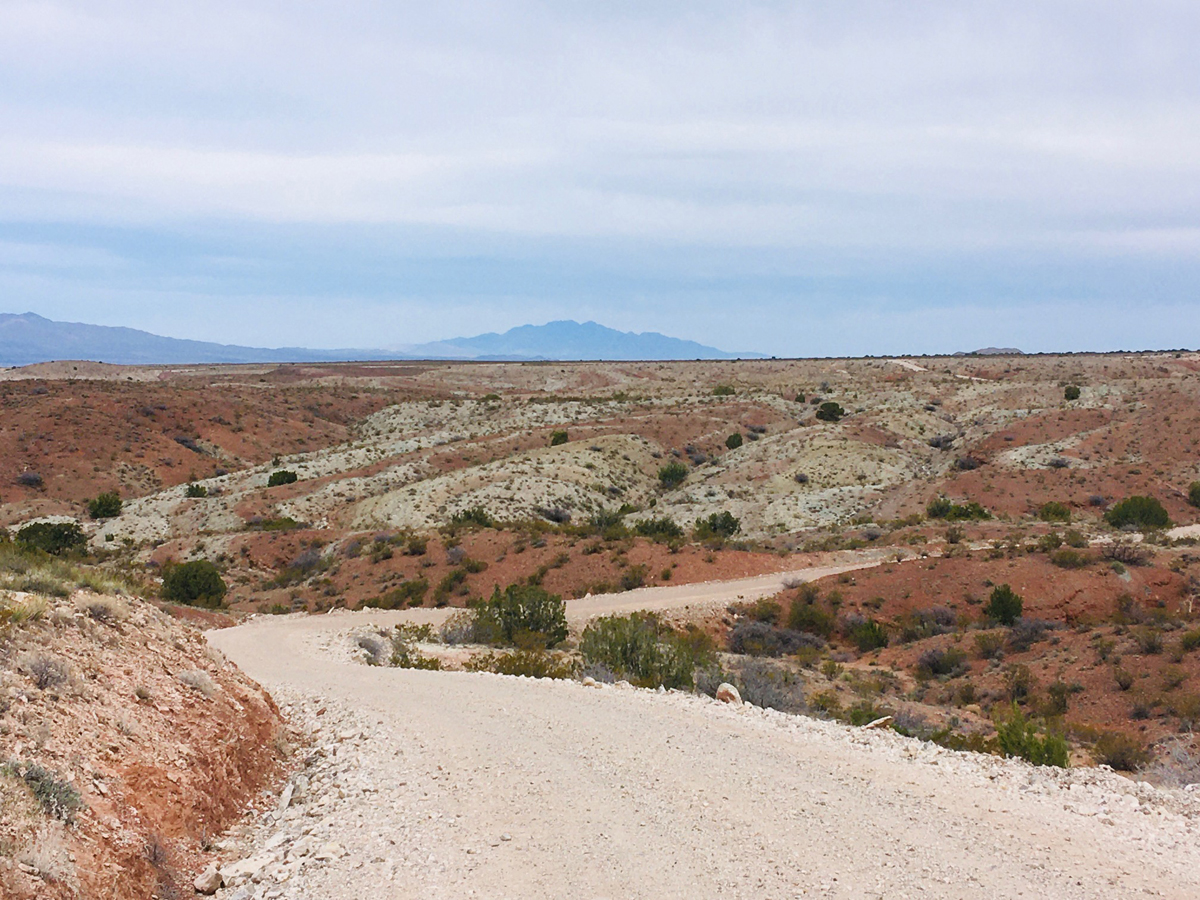
But where to go? I’d read an article in the local newspaper about the Quebradas Backcountry Byway, a BLM road east of Socorro in central New Mexico, that sounded intriguing. Quebradas is Spanish for “breaks” or badlands, and the byway promised some fascinating geology. More importantly at a time when “social distancing” was all the rage, it offered at least the hope for plenty of solitude. As a self-proclaimed misanthrope who normally cycles, hikes, and camps alone anyway, I looked forward to the 24-mile stretch of gravel sans motor vehicles, with expansive views, and the three most important elements of any outdoor excursion: Quiet, Solitude, and Wildness.
The Southern end of the Quebradas Backcountry Byway. Photo by Don Scheese
My plan was to do this as a 2-day trip, hopefully car-camping somewhere around halfway, cycling back to the start point then returning to the car; then cycling the second half of the road the next day and again returning to the car. So essentially, I’d ride the byway twice, getting a real feel for the terrain and seeing it from both directions. I wasn’t sure about how much elevation I’d be gaining and losing, but, as it turned out, I’m glad I approached the trip conservatively.
Day 1
The northern end of the Quebradas Backcountry Byway lies just north and east of Socorro. Once off the interstate, the approach is through some typical rural New Mexico communities consisting of dilapidated double-wides, crumbling adobe pueblo style homes, flowing acequias, grazing animals, and barking dogs. Just past the village of Pueblito the Byway officially begins and immediately starts climbing from the Rio Grande valley to the mesas and bajadas of the interior mountain ranges, in this case the low mountain range poetically labeled (like so many New Mexico landmarks) Lomas de las Canas—“the hills of the white hair”—named (I came to speculate) for the ocotillo forests on top of the white limestone ridges.
Every cyclist knows that it’s one thing to drive a road, quite another to ride it on your bike. Ernest Hemingway once wrote, “It is by riding a bicycle that you learn the contours of a country best, since you have to sweat up the hills and coast down them.”
As I drove my Subaru Crosstrek at a safe and sane 25-30 mph on the relatively smooth gravel road, pausing along the way to check out possible campsites, I took note of the many arroyo crossings but failed to truly appreciate how steep some of the climbs out of them would be on a bike, especially with rocky and loose gravel to contend with on the ascent. I noticed numbered signposts along the way (the New Mexico Bureau of Geology and Mineral Resources has published a Geology Guide to the Byway, downloadable from the agency website here: https://geoinfo.nmt.edu/publications/guides/quebradas/home.html).
Happily, I passed but one human inhabitation: the Four Hills Ranch around which were the usual NO TRESPASSING signs and the ubiquitous barbed wire fence strung out along the property. Mostly I just gawked at the endless expanses of creosote and mesquite flats, the deep red sandstone outcroppings, and the soft white limestone hills rising on the eastern horizon
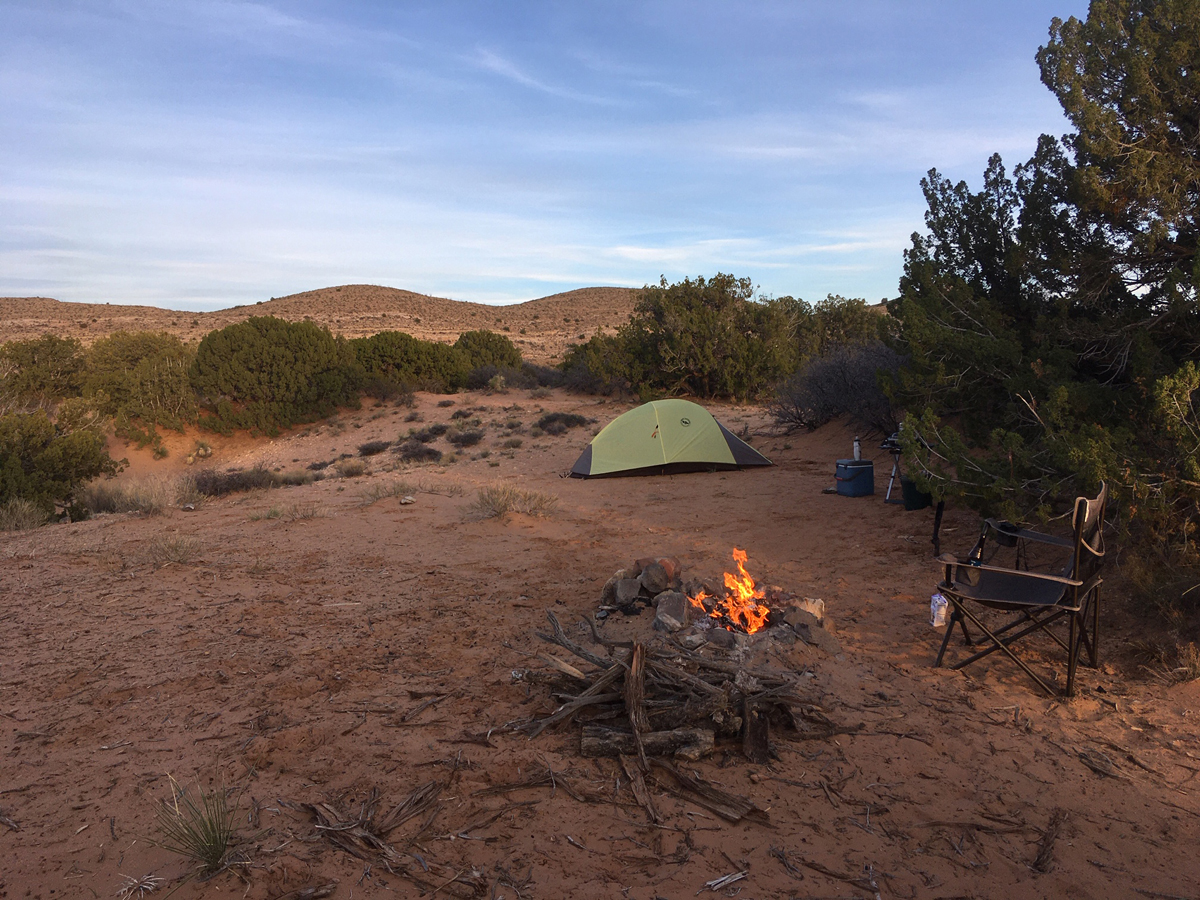
I drove by a few passable campsites but, recluse that I am, preferred a more secretive, sheltered site. At mile 12, I stopped at the deepest, widest arroyo crossing yet, the Arroyo de las Canas, a veritable barranca, and seriously wondered if I could ride my bike out of it. On the opposite side lay a flat juniper-dotted bench that looked promising and, at mile 13, sure enough, a well-traveled spur road took off to the west where, a couple hundred yards later, lay the perfect site: flat, sandy, sheltered, with an impressive and apparently well-used fire ring already set up. Not to mention good views of the Lomas de las Canas to boot. Giddyap!
Don’s camp at mile 13 on the Quebradas Backcountry Byway. Photo by Don Scheese
Quickly changing into my cycling gear, stuffing my jersey pockets with fruit chews and bars, topping off my 2 water bottles with water and energy drink, and being sure to take an extra spare tube, I hopped onto my trusty Scott Addict gravel bike.
The first challenge would be the climb out of the Arroyo, but at least I’d be taking it on with fresh legs. I coasted down then dropped into the bottom of the arroyo, noticing ponds of water amidst the willows, remnants of recent spring rains. I quickly shifted into my lowest gear—thank gawd for the 1:1 ratio of 34-34—and trundled my way up the incline, which at its steepest measured up to a 15% grade, confirming the real meaning of the term “gravel grinding.” I made it without stopping and was rewarded with fine views from the mesa top of the distant snow-capped ranges to the west: the San Mateos and Magdalenas, topping out at over 10,000 feet.
Arroyo de las Canas on the Quebradas Backcountry Byway. Photo by Don Scheese
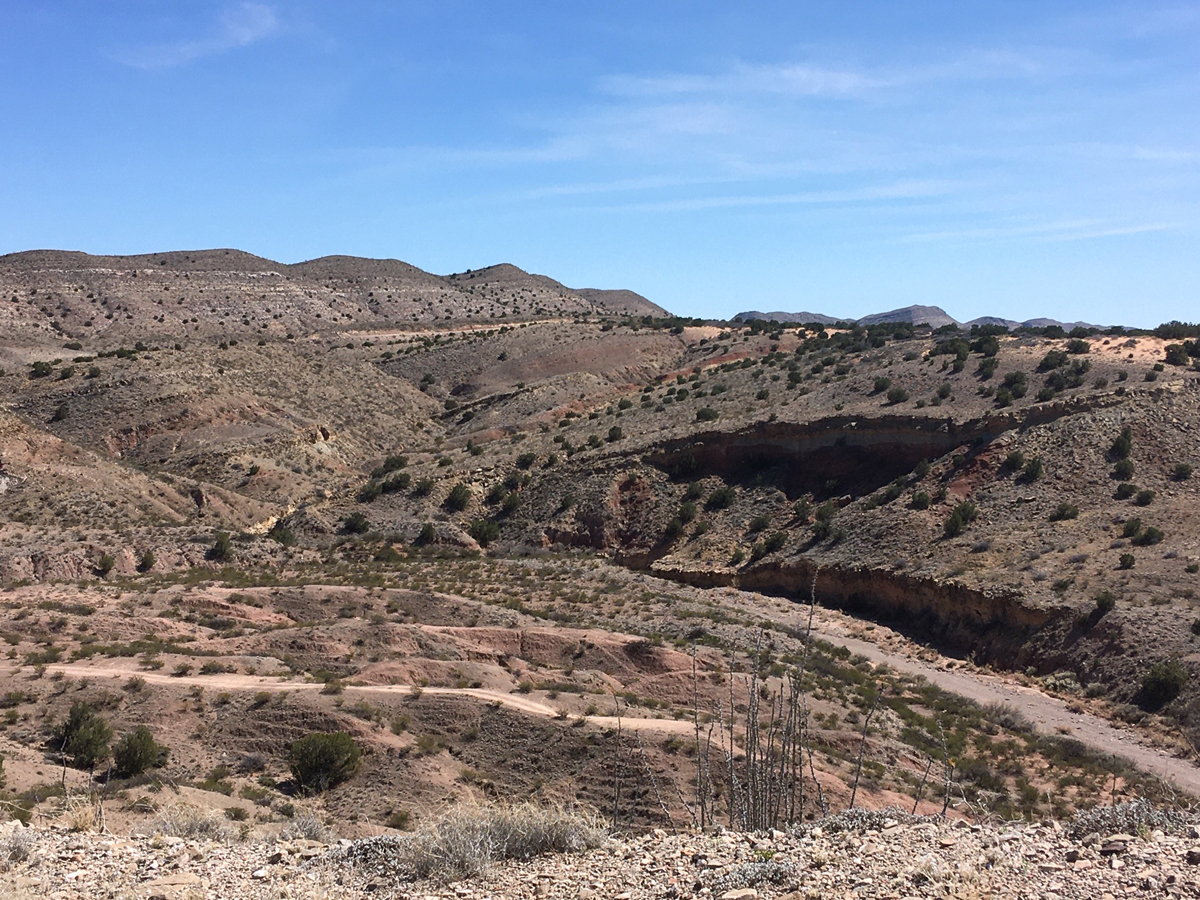
The next 12 miles consisted of endless rollers through a kaleidoscope of colors: deep reds of the Abo sandstone, pale yellows of the Yeso limestone, and the dark volcanic outcroppings of the more recent Baca era. I crossed three more substantial arroyos (fortunately none as deep as the Arroyo de las Canas) and enjoyed a nice tailwind across a relatively flat stretch of road passing through the landholdings of the 4 Hills Ranch. Most of the way it was nothing but creosote and mesquite, the sole surviving vegetation in some of the most cow-burnt landscapes I’d ever seen. The shadow of a lone turkey vulture soaring above drifted silently over me, and I started to hear the theme song from The Good, the Bad, and the Ugly in my head. “What beautiful desolation!” I thought to myself.
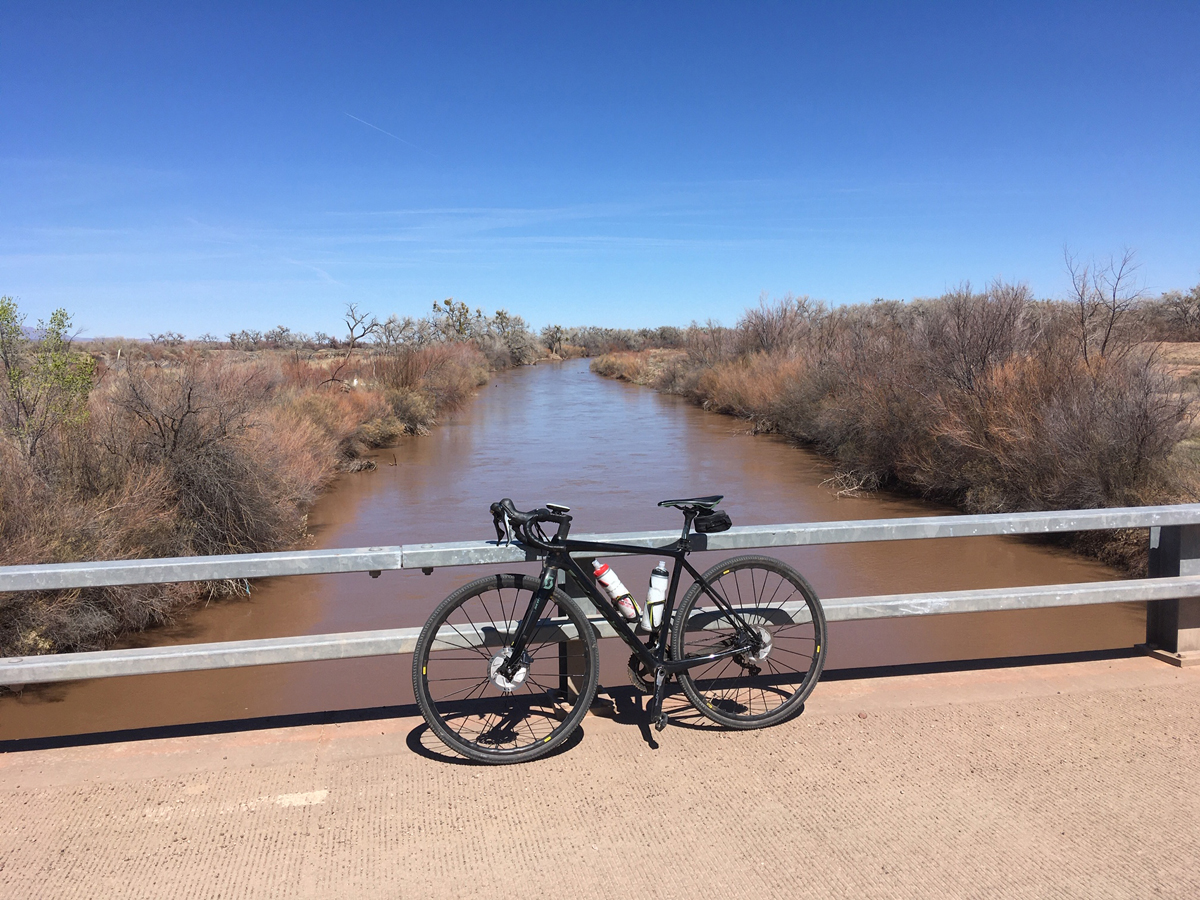
Around 3 miles from the northern terminus of the byway I had the best view yet of the soft pastels of the Rio Grande valley, the silvery cottonwoods with just a tinge of spring green in the bosque. After bottoming out and reaching the end of the gravel road, I decided to ride through the village of Pueblito to the river crossing, making better time than I wished, after being chased by some unleashed dogs—unsurprising, because who leashes their dogs out in the countryside? At the crossing I ate, drank, and watched the big brown god of a river—Rio Grande indeed!—purl under the bridge. The first half of today’s journey was complete, and utterly gratifying.
Crossing the Rio Grande. Photo by Don Scheese
The return trip proved to be much more challenging. Not only did I ride into a stiff 10-15 mile an hour headwind, there was much more climbing involved (1800’ compared to 600’). Once again, confirming the true meaning of ‘gravel grinding.’ But I managed just fine, taking the occasional break at the top of a pass to rehydrate, eat, and snap the occasional photo. Mercifully, the reverse climb out of the last big arroyo before the turnoff to my campsite was nowhere near as steep as the south-to-north approach, and by the time I made it back to camp and the vehicle it was late afternoon.
I’d encountered only four vehicles, two the same rancher apparently hunting down some stray cattle, the other two some fellow ‘social distancers.’ Other than a friendly wave to the rancher in his pickup there’d been no interaction with a member of my own tribe, which I found both physically and mentally beneficial. I celebrated with hot dogs grilled over a fire, some ranch beans, and a nice cold Fat Tire ale. I’d brought some firewood from home but there was plenty more scattered about and enjoyed hours of sitting around the campfire ruminating on my solitary state.
A poem by Robinson Jeffers came to mind, in which he reflects on a special spot of his on the California coast: “This place is the noblest thing I have ever seen. / No imaginable / Human presence here could do anything / But dilute the lonely self-watchful passion.”
I raised a flask of whiskey to all my heroes of solitary celebration, long before the term ‘social distancing’ came into being: Thoreau, Muir, Abbey, Jeffers.
Quiet. Solitude. Wildness.
Day 2
Awaken to milky skies and mild temps. A small warming fire and hot coffee to start the morning…followed by a sumptuous breakfast of scrambled eggs and home fries, bacon, and sausage, all slathered in salsa. Breakfast of champions.
On the bike hours earlier than yesterday, anxious to explore terra incognita—the un-reconned road ahead. I figured I’d have around 11 miles today, with less climbing to reach the end of the byway, and with calm winds to start, and maybe even a tailwind on the return, an easier ride—and I was right.
Heading south, I discovered later I had been straddling the border between the boundaries of a small Wilderness Study Area (WSA) proposed by the BLM—appropriately named the “Sierra de las Canas.”
According to one writer it contained the remains of an ancient Piro Indian pueblo, a rare prehistoric rock art panel, and several petroglyph sites, somewhere out there amidst all the blank desolation. Like any intriguing landscape, this is worth coming back to for further exploration.
The next couple miles called to mind some Georgia O’Keeffe paintings, soft reds and yellows horizontally streaking yet more badlands—layers of the Meseta Blanca formation. On the Quebradas Backcountry Byway. Photo by Don Scheese
The next couple miles called to mind some Georgia O’Keeffe paintings, soft reds and yellows horizontally streaking yet more badlands—layers of the Meseta Blanca formation. Through these strata the road dove and rose across five deep arroyos, one of which required me to hike-a-bike after my front wheel washed out in some loose chunky gravel. Oh well, no hurry on a still quiet solitary morning. In fact, this was a day of ultimate social distancing: I encountered absolutely no other human beings in 23 miles of riding, and heard hardly even a bird chittering from the creosote flats. A day of Quiet, Solitude, and Wildness.
The byway took a sharp turn to the northeast down into another arroyo, then a long gradual ascent up the same major drainage, to its head and the high point of the entire ride at 5400’. At this gap I met with my first and only sign of livestock, a small group of cattle feasting at a water tank, salt lick, and piles of hay. A backward glance over the road just travelled revealed fine views of the snow-capped Magdalenas through a gap in the cliffs.
The last three miles entailed a shallow descent to the official end of the byway. A couple miles of flat ranchland road stretched to the junction with Highway 380. The views to the south of the prominent cone of Cerro de la Campana, the Oscura and San Andres ranges, and the northern end of the Jornada del Muerto were enticing, but I had miles to go to return to the car as well as promises to keep, and reluctantly but happily turned around to ride the reverse route.
Back to the car, blessed with a welcome and increasing tailwind from the south. 23 miles roundtrip and 1800’ of total elevation gain for the morning—a good day’s ride for me.
Followed by a smooth drive home and a return to an ever-worsening pandemic, the whole trip served, as Robert Frost said of poetry, as a “momentary stay against the confusion.”
If You Go…
Check with the BLM office in Socorro about road conditions; the all-gravel road is graded occasionally. Do not ride immediately after substantial rains as the road becomes impassable. Riding from south to north is easier, as you start at around 5000’ and finish at 4600’ in the Rio Grande valley. I rode on 36 mm tires with good tread and would recommend at least a 35 mm tire for the loose gravel sections climbing out of the arroyos. Come prepared for a long ride and unexpected emergencies and do not expect to be bailed out as there is usually little traffic.
The best seasons to ride are spring and fall when daytime temperatures are more moderate and precipitation chances decline significantly. Dispersed camping is allowed along the byway but there is no water or bathroom facilities. Celebrate with a beer and a world-famous green chile cheeseburger at the Owl Café afterwards in the village of San Antonio near the southern terminus of the Byway.
Don “Seldom Seen” Scheese lives and rides in New Mexico, always in search of new adventurous routes, especially on gravel roads.
Most people in rural areas don’t ride a bike often, if at all. As such, they don’t see the benefits of safe and adequate trail networks. Too many local governments don’t see it either, and therefore rural communities don’t get adequate funding, support or planning for trail networks. The nation also lacks sufficient design guidance specifically for rural biking and many small communities don’t include experts in such design.
So concluded the Mountain Plans Consortium, which released a report to getting bike trails built in rural areas, specifically Wyoming. The consortium did find some improvement in commitment and trail development in the state, however.
The consortium relies largely on a 2015 Wyoming Bicycle Facility Design survey of rural areas. The survey found that attitudes toward bicycling had improved in the state in the previous five years.
The authors of 2019’s Rural Bicycle Design Guide for Wyoming say their survey found that “it is difficult to gain public support to allocate funds for bicycle projects. Bicycle facilities are often viewed as too expensive, or they are ranked low on the priority list. Neighborhood resistance to new trails existed, likely because of the subsequent traffic attracted to the neighborhood.”
Wyoming will give communities bike grants, however. Pinedale, for instance, got money from the Wyoming Department of Transportation to connect paths and create one leading to an elementary school. The department will also provide helmets and presentations on bike safety, the Guide says.
Despite resistance, the Guide provides instruction on choosing the types of bike facilities communities might want (bike path, paved shoulder, etc.) and how to design them for rural areas. It discusses the many factors planners might need to consider, from traffic calming methods to railroad crossings, beacons, bike boxes, turn lanes at intersections, or other similar infrastructure considerations. It largely relies on standards of the American Association of State Highway and Transportation Officials (AASHTO).
By Nicole Tittensor — Comeback 2020. That is the motto right now for my husband and I known as Team Tittensor. What we love is riding and racing our mountain bikes. Life has definitely thrown us a curve ball with my husband being seriously injured a few year ago, and with everything we’ve endured, there was one thing I did know. That was as long as the race wasn’t cancelled, I was lining up!
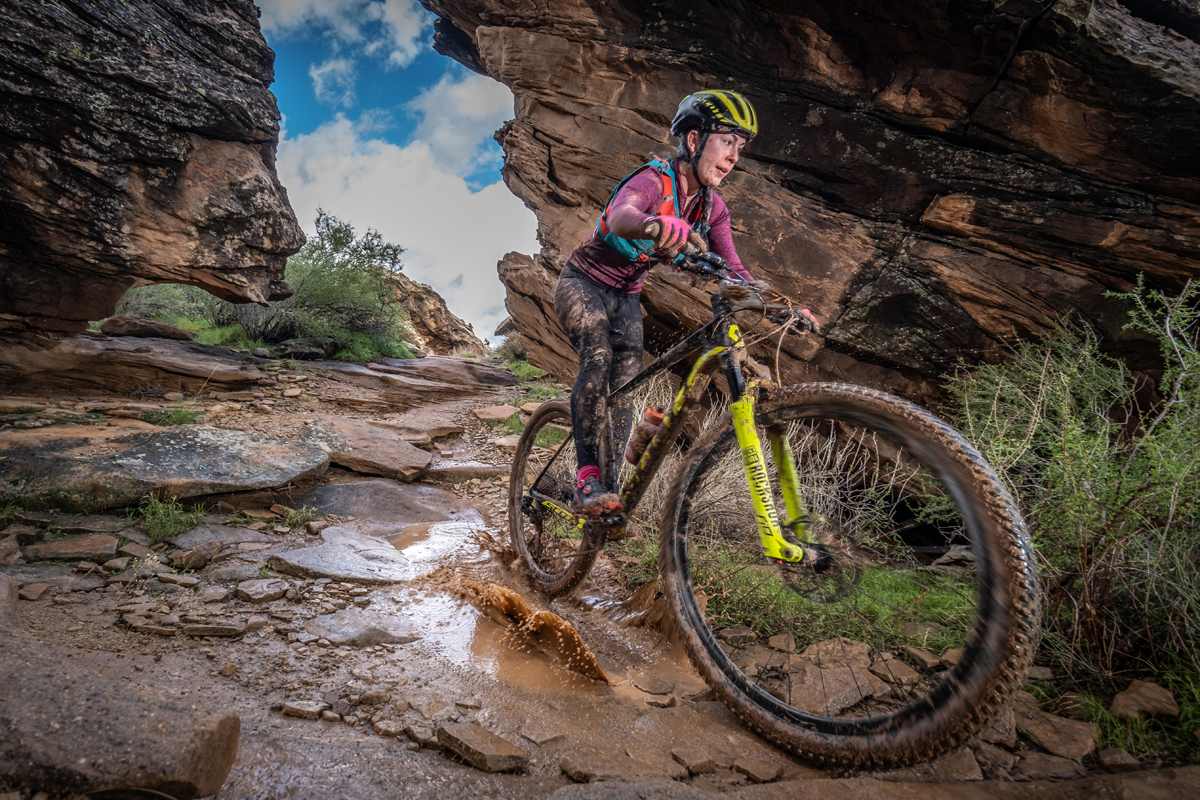
Nicole Tittensor on the Zen trail during the True Grit 2020 50 miler. Photo by CrawlingSpider.com, find your photo on their website.
I have been a professional XC racer for 4 years now and the True Grit is, and has been since I became a sanctioned pro, my opening season race. This year we got a whole lotta rain for a solid 9 hours a day prior. The morning of race, we didn’t know how muddy it would actually be, but knew it wouldn’t be pretty at the start through Keyhole wash. We had a plan. Fresh gloves, shoes, and bike wash at the start of Zen, and then take a hot water bottle and be prepared for Stucki to be muddy too.
When I woke up, Coach Zepp said “Today, your biggest rival will be Mother Nature.” Why is he always right!?!? We went to the start without having details on trail conditions. There is a wash at the beginning that I knew would be muddy, but had no idea the disaster waiting ahead.
We hit the slimy deep mud and it caked our bikes from top to bottom filling every space possible. Eventually my chain seized 3 times; the last time it sucked my chain on the inside of my chain guide. Something I was told was impossible to get back out. I was furious and frustrated as a watched everyone ride away. I couldn’t even pluck the mud away and planned on quitting. I didn’t want to hike my bike out so I sat and tried to massage the chain back through little by little. I sprayed it with my rocket red water because it’s the only thing that I had.
Eventually, I got it back on and couldn’t believe it. I planned on quitting still, but then KC Holley came by and encouraged me to keep going. So I just started pedaling. The mud started to fall away and I realized I felt amazing! I started hammering and caught everyone except the leader by Zen. Zepp had hot soapy water and cleaned my whole drive train and pedals. It made the biggest difference!
I crushed Zen and Stucki stronger than ever. I hit Barrel Roll knowing I wasn’t going to catch first but still was sitting strong in second. With about 5 miles left and only about 10 minutes of rocky single track I said, “just don’t flat!” I came around a slippery corner and tried to dodge a rock, but didn’t have proper speed and then boom! Rim hit, and the the dreaded sound of air slowly seeping out your tire. I was again devastated. I realized I blew my bead and that there was no way of sealing. So I sat down, to fix a flat. It took me forever, and after all that fight, I realized I had punctured the tube. So I started walking. I knew it would be about an hour walk to the finish, and I accepted my fate.
Then, A guy came by (I think his name was Andy Walsh) and told me he wanted to help me. He changed my flat, gave me his tube and CO2’s because mine were gone and told me he wanted to see me finish. So, I did.
Just a side note: There were a lot of unknowns on trail conditions, and many were worried about ruining the trails, and angry the organizers went on with the race. The trails were good, and won’t be ruined. It was really just the fire roads and washes that held all the mud.
Nicole Tittensor is a professional mountain bike racer from Axtell, Utah. She and her husband are a privateer team know as Team Tittensor. They represent Jans Park City and Scott USA.
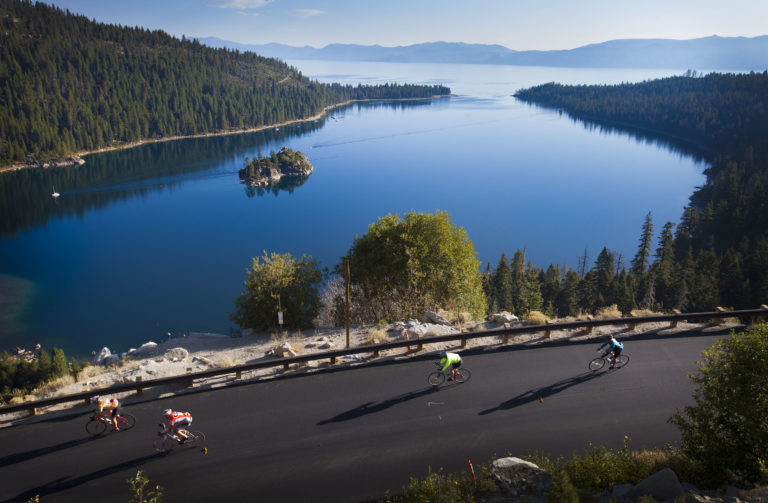
The 29th Annual America’s Most Beautiful Bike Ride, originally set for Sunday, June 7, is rescheduled to be combine with the 18th Annual Tour de Tahoe, set for Sunday, September 13, 2020. This due to the uncertainty of current and changing CDC coronavirus COVID-19 restrictions and mandates by national, state and county health agencies.
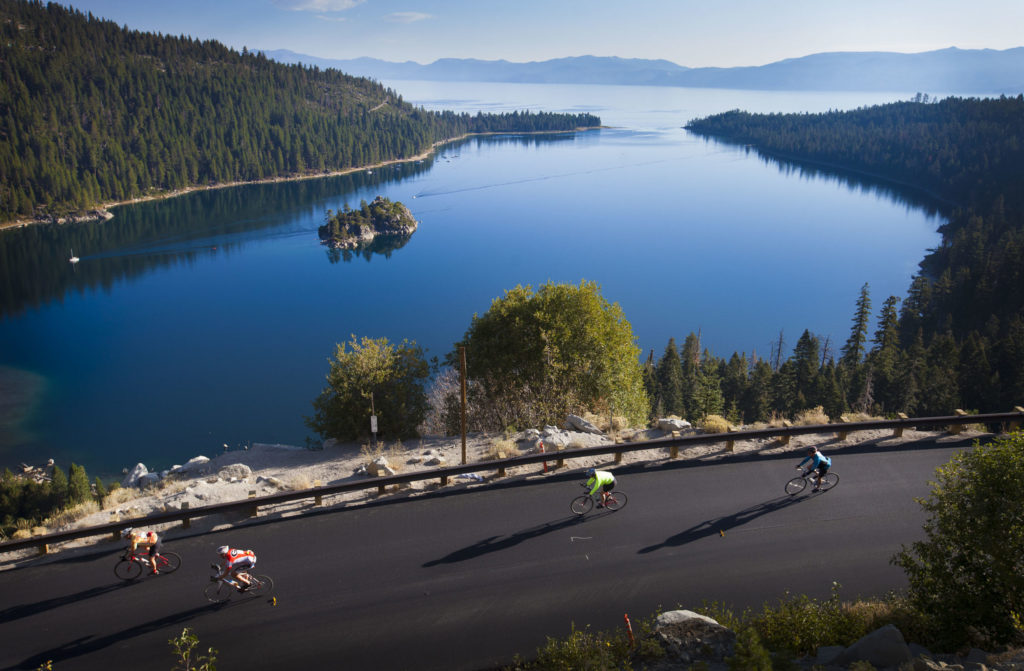
Photo by Rick Gunn, courtesy Bike The West
“This is an extremely difficult decision especially in that we have 800+ Team in Training members with the Leukemia & Lymphoma Society scheduled to participate and raise over $3 million”, commented event director, Curtis Fong. “We are fortunate to have Tour de Tahoe as a back-up event and hopefully life will return to a new normal by this date. By combining both rides, this year’s ride will be branded as America’s Most Beautiful Tour de Tahoe”. He added.
America’s Most Beautiful Bike has traditionally been held the first Sunday in June, since 1991 and is recognized as one of the best fully supported bike ride events in the country. Over the past 24 years, The Leukemia & Lymphoma Society has brought over 27,000 trained athletes to Lake Tahoe and have surpassed a total fund raising amount of $108 Million.
The Leukemia & Lymphoma Society have also rescheduled their Team in Training fund raising program to attend this year’s event and plans to be at the Start Line at the Hard Rock Hotel & Casino Lake Tahoe at Stateline, NV on September 13. The National Psoriasis Foundation, our Tour de Tahoe charity sponsor, will continue to bring their national team to participate as scheduled. Tour de Tahoe is traditionally held the Sunday following Labor Day, that has traditionally been the lowest traffic count Sunday in the month.
All online pre-registered participants have been notified that their registrations will be auto transferred to ride on September 13. Pre-registered participants will also have the options to transfer their registration to ride next year’s America’s Most Beautiful Bike Ride, scheduled for June 6, 2021 or cancel and request a refund. For more information and to register for the America’s Most Beautiful Tour de Tahoe, visit: https://www.bikethewest.com
The ride (not race) starts & finishes at The Hard Rock Hotel & Casino Lake Tahoe and reservations can be made by contacting their reservations system at 1-844-588-ROCK (7625), with discounts offered for early reservations. For those that have already booked rooms for AMBBR’s original date, and cannot make the ride on September 13, visit: https://hardrockcasinolaketahoe.com/faqs-contact/
The Hard Rock Hotel & Casino will update reservations or cancel and refund deposits.
The ride is open to any and all recreational bicyclists as well as endurance bicyclists (one does not have to raise funds to participate) offering options to ride around Lake Tahoe’s 72 mile shoreline route and a full 100 mile century and includes an out and back from Tahoe City to Truckee before continuing clockwise around the Lake… Bike the West prides itself with providing a fully supported ride with well stocked rest stops with food and beverage, including first aid and medical services, technical support with bike mechanics on duty, SAG Transport services and more taking care of all the participants needs to cross the finish line and receive their finishers medal… And, attend the after ride meal in the Hard Rock Hotel’s pool area with live entertainment.
America’s Most Beautiful Tour de Tahoe will feature a traffic delay on northbound Hwy 89 – Emerald Bay Road, at Baldwin Beach Road from 6:30 a.m. to 8:30 a.m. and is administered by the California Highway Patrol and El Dorado County Sheriff’s Department… Northbound traffic will be stopped and delayed until 8:30 a.m., to allow emergency, law enforcement, course support vehicles, only… and, allow registered event bicyclists to negotiate the climb up and around Emerald Bay. Southbound Highway 89 will remain open for the traveling public at all times.
Both the California Highway Patrol and Nevada Highway Patrol will provide traffic control along the entire route in both California and Nevada highways. And, over 150 bicycle event signs, including Special Event Ahead, Bikes Ahead, Share the Road, Ride Single File, Bikes Crossing, etc., are posted along the entire course route.
The ride is also supported by a number of non-profit organizations that include the Kiwanis Club of Tahoe Sierra, Sierra Ski Education Foundation, Tahoe Regional Planning Agency, Leukemia & Lymphoma Society, Lake Tahoe Wildlife Care, Rite of Passage, Lake Tahoe Bicycle Coalition, Blue Riders Motorcycle Club, Tahoe Amateur Radio Association, Douglas County Search & Rescue, Carson City Sheriff’s Search & Rescue, Barton Health – Tahoe Center for Orthopedics, Douglas County Sheriff’s Explorers, and many other organizations and sponsors.
Rest stops are positioned at Vikingsholm Parking, Gate Keepers Museum Parking and Kings Beach Plaza with Special Event permits with California State Parks. A rest stop is positioned in Truckee in the Cross Roads / Save Mart Center for those choosing the 100 mile ride option. There is also a rest stops on Lake Tahoe’s east shore on Hwy 28, 4-Miles from Spooner Junction (Hwy 28 & 50) with final rest stop at Spooner Junction in the snow park / boat inspection area.
Bike the West will also continue to produce the 29th Annual OATBRAN, One Awesome Tour Bike Ride Across Nevada, set for September 27 through October 3, 2020… OATBRAN is a multi-day, motel style bicycling tour across the Silver State on U.S. Highway 50 – America’s Loneliest Road from Lake Tahoe to the Great Basin National Park. Overnight Accommodations, bag transport, rest stops every 20 miles, 21 meals, bike mechanic support, SAG Transport support and after ride activities in all host communities, and more… For more information visit:
By Salt Lake Valley Trails Society — Mountain biking has been shut down in Spain and 12 counties in California. We don’t want that to happen here in the Western US. We have worked with the Salt Lake County Department of Heath to come up with the following guidelines. They are the minimums, you should exceed them. Please share these, so that we can continue to enjoy the mental and physical health benefits of mountain biking while protecting the community. Many thanks and happy trails!
Two riders practicing good social distancing on the Bonneville Shoreline Trail long before the COVID-19 pandemic. Photo by Dave Iltis
[Editor’s Note: Most of the following items apply to road cycling as well. Please stay safe.]
Give each other space. We recommend a MINIMUM 2 bike lengths to trail users. We know that you will do better than that, you will do your best and still have fun. Air fives, posts and comments are great ways to appreciate the radness.
Keep it to yourself. Don’t share bicycles, helmets, gloves, water bottles, snacks, whisky flasks, post-ride beers, vaping devices or smokes with your friends. If you need to loan a pump, tube or tool to someone, have them keep it until they can properly sanitize it.
Take it down a notch. Hospitals, ambulances and first responders are under tremendous stress. Work on something fun and simple, like manuals, instead of that eyeing up that big gap you’ve wanted to hit.
Ride to ride. Putting your bike in/on your car to ride your bike has always been less than ideal. Riding to trails keeps you fit, outdoors, away from gas/charging stations and auto accidents. Many counties are only allowing county residents at their trailheads and state parks. Ride close to home.
Go before you go. Lots of trailheads and trail areas don’t have restrooms and nobody wants to clean those that do. Before you ride, take a minute to relieve yourself.
It’s snot cool. It’s never nice, but now blowing your mouth, lungs or nose out in the vicinity of others is dangerous to them and will diminish your opportunities to ride with others. Carry wipes or get a long, long, long way away from people and trail with your face aimed at and close to the ground.
Ride the couch. If you are sick, in any way consistent with Covid-19 symptoms, please stay home and get well so that we see on the trail again, soon.
Make believe. Pretend that you are already sick and those other trail users are your best friends. It might be true.
Have a stash. Keep some sanitizing wipes, a spray bottle of isopropyl and/or disinfecting spray handy, even in your pack. Your trail using friends will appreciate that you are wise and caring.
Look out for others. Parents! You need to talk to your children and encourage over-adherence to these and other protocols. We are all in this together, so education, encouragement and calling out others are good tactics. Practice your heckling skills for use during cyclocross season or against those younger and more talented than you.
The Salt Lake Valley Trails Society is a bunch of trail loving mountain bikers in Salt Lake County trying to ensure the safety of our communities. Though we have tried to present the best and most current info possible, you need to stay abreast of current practices and can do so through the Centers for Disease Control. Happy trails.
The COVID-19 pandemic has been difficult for everyone, directly affected or not. Cycling West wants to know how you are coping. Are you getting out in the sun and riding your bike on occasion? Are you staying fit on the trainer inside? Are you able to just get out and walk around the neighborhood?
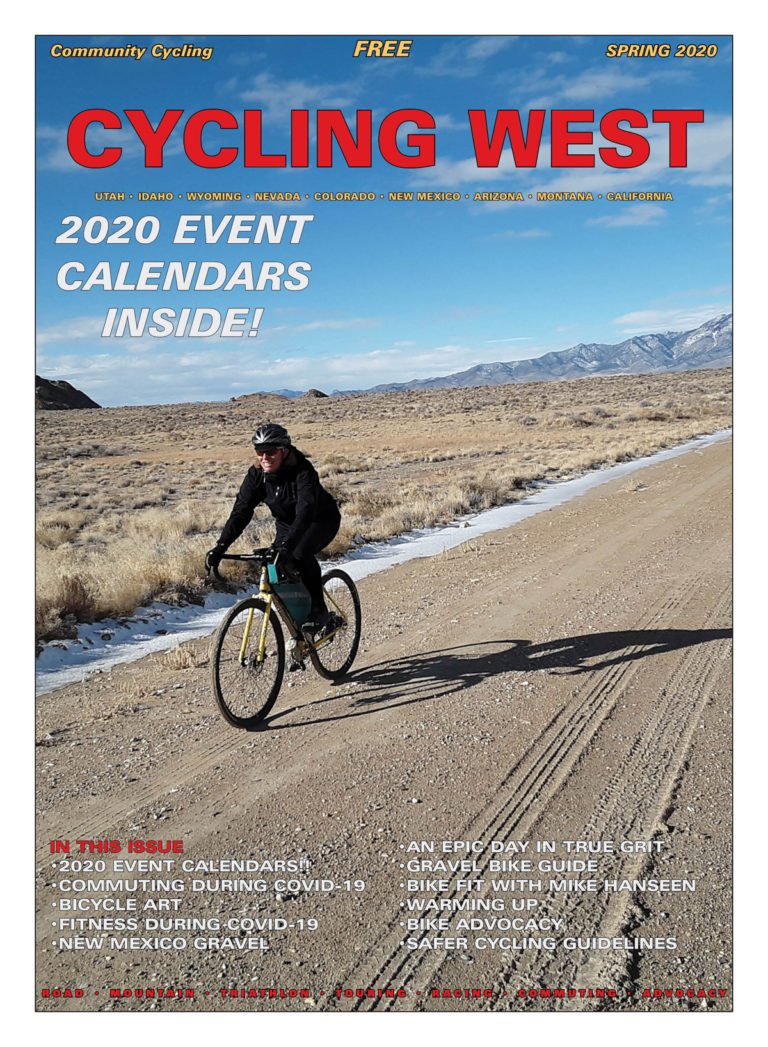
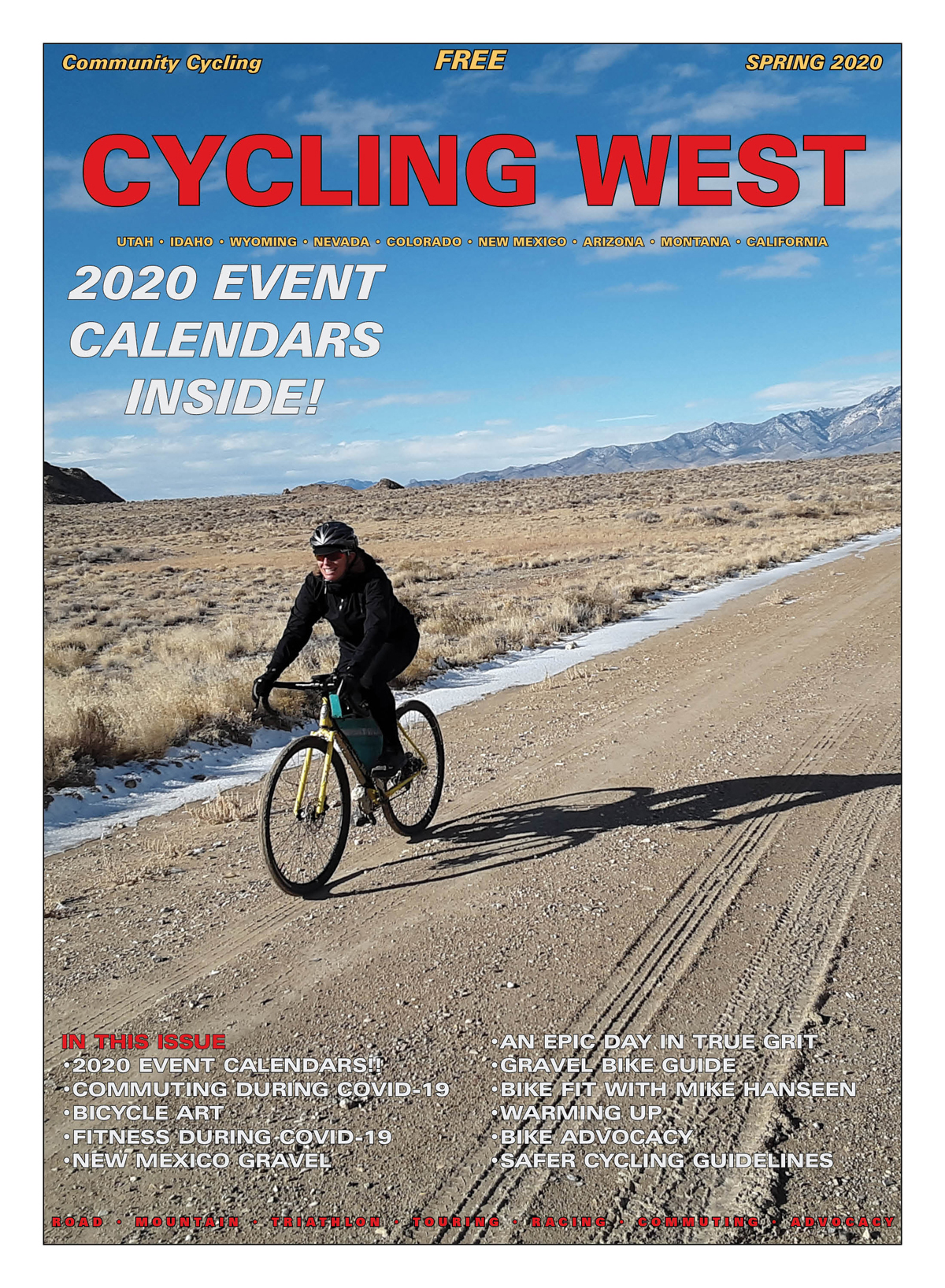
Cycling West Spring 2020 Cover Photo: Jackie Baker summiting Silver Island Pass on the Salty Lizard 100 course on her famous Breadwinner Cycles G-Road. Steel is heavy but real comfortable, plus, it’s the preferred material of custom builders. Photo by Bobby Kennedy
We at Cycling West are thinking of you and hope that this issue contains some useful information on the effects that the pandemic is having on cycling, as well as some things to look forward to when life regains some normalcy.
Over the past few weeks, and in the current Spring issue of Cycling West (see cover), we have provided several articles on riding during the COVID-19 novel coronavirus pandemic. Jamie Morningstar talks about keeping a commuting routine. Breanne and Dave Nalder-Harward write about the importance of staying healthy and fit through physical distancing, good nutrition, and maintaining fitness. Don Scheese took a two-day gravel adventure in the New Mexico outback.
We also have stories on coaching, gravel bikes, art and advocacy. Sarah Kaufmann provides information on warming up for an event. Bobby Kennedy lets us know what to look for when choosing a gravel bike. Claire Taylor sent us her mind map of wildlife seen during her bike rides. Charles Pekow updates us on rural bike advocacy, and Nicole Tittensor tells the tale of her epic day during the True Grit mountain bike race.
Cycling West Needs Your Help
Cycling West has been bringing you the best in cycling news and information for the western United States since 1993. We compile an extensive calendar of events, publish the magazine and website, work on advocacy issues locally and nationally, and live our mission: To make the world a better place through bicycling.
This is our 217th issue, and the second of our 28th year.
We’d like to be here for another 28 years, or even longer. As you will likely notice, the Spring issue is a little thinner than usual. We are reliant on our advertisers and our members for support, and with the pandemic’s resultant economic crisis, our revenue is down substantially. We ask for your help at this time to help us keep going.
What you can do as an individual:
Please join Cycling West by purchasing a membership, which includes a subscription to the print magazine.
Join at any level from $25 to $1000 a year on our website via PayPal:
Join by sending a check for what you can contribute to:
Cycling West
1124 4th Ave
Salt Lake City, UT 84103
If you are already a member of Cycling West, please tell your friends about us, or even consider giving them a gift membership.
Follow us on the web at: cyclingwest.com, @cyclingwest on Twitter and Instagram, and at facebook.com/cyclingwest and help us expand our reach.
What you can do as a bike shop:
If you are a bike shop owner or employee, please hand out a copy of Cycling West to as many of your customers as possible. Our distribution through events has shut down for now, and we ask that you help us grow bicycling by circulating the magazine. Your customers will hopefully enjoy the news and the respite from the anxiety of the day.
Please contact us about joining us as a member by participating in our bike shop directory. Email [email protected] for details, or call 801-574-3413.
What you can do as a company:
If you are a company, please consider running an ad with us during this time. We work year-round for better bicycling conditions, better information on events, to increase participation in the sport, and to grow the cycling community. If you can support us and other bike media during this time, we will be here for you when we move past this crisis. Email [email protected] for details, or call 801-574-3413.
Yours in cycling,
Dave Iltis • Editor and Publisher
Lisa Hazel • Assistant Editor
Steven L. Sheffield • Assistant Editor
Cycling West and Cycling Utah Magazine’s Spring 2020 Issue is now available as a free download (8 MB download). Pick up a copy at your favorite Utah, Idaho, Wyoming, Nevada, Montana, Colorado, Arizona, New Mexico and Northern California bike shop or other location.
High schools would become eligible for Safe Routes to School grants under pending legislation. Currently, only elementary and middle schools can participate. Senator Catherine Cortez Masto (D-Nev.) and Senator Kevin Cramer (R-ND) introduced the Safe Routes to All Schools Act (S. 3183), which was referred to the Committee on Environment and Public Works.
While the committee hasn’t acted on the bill itself, the language was included in the American’s Transportation Infrastructure Act of 2019 (S. 2302), which the committee passed. It is awaiting action by the full Senate.
By Steve Stauffer — As a painter, I get the incredible opportunity to travel and paint wherever the wind may blow! Painting “ En Plein Air “ means, painting onsite and painting from nature and what life puts right in front of me. Like road biking there is no better way to experience a landscape than to put yourself right in the middle of it.
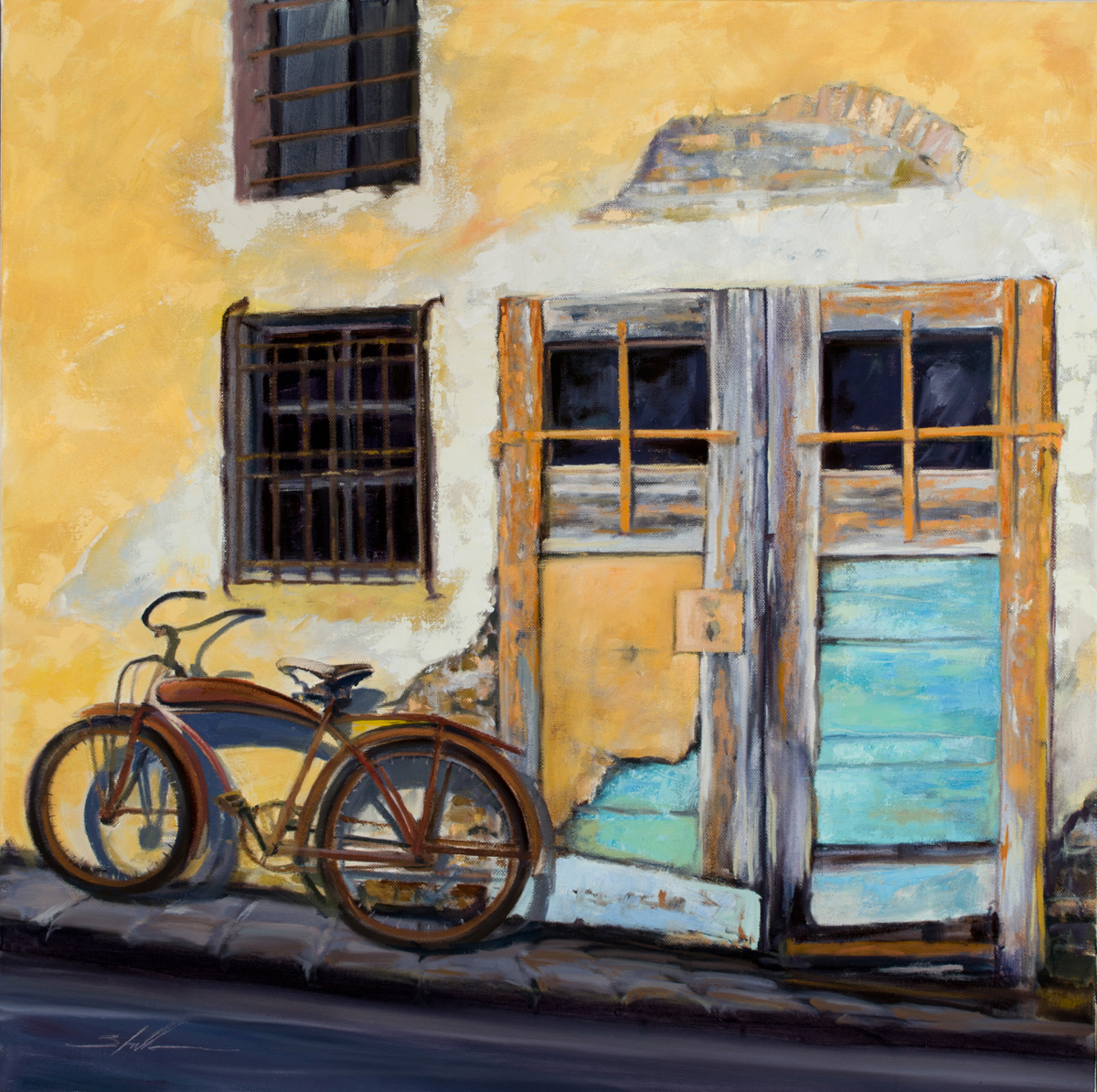
Florence Bike by Steve Stauffer
My wife and I were on a trip to Italy. We walked out of our motel in Florence to find this incredible scene just outside our doorstep! The moment I saw it, I knew it would be a wonderful painting.
Angel’s Hands Foundation has a ride each year and we thought it would be a great way to thank our ride sponsors and staff for assisting us each year. The painting was completed and prints were made. If you are interested in one of these prints you can contact us at www.angelshands.org . Prints are $45.00 + $10 shipping and handling. 100 % of the proceeds goes to Angel’s Hands Foundation and the families they support.
Angel’s Hands Foundation continues to be one of the most incredible blessings in my life. As a current board member, I am inspired and driven by these very special Angels. Each year I do a special painting and create prints for our fundraising. The original painting was auctioned off at our annual “Angel’s Hands Friendraiser”. Please take a moment and visit our website to learn more about Angel’s Hands Foundation, their mission and how you can join their wonderful ride this year.
To view this or my other work please go to www.stevestauffer.com
May 16 — Ride for the Angels, CANCELLED for 2020, Copperton, UT, 11th Annual. Start: 8:30am; 8655 West 10390 SouthCopperton Park; Routes: 25, 50 miles and Metric Century62.5 miles; $50.00 includes swag bag and ride shirt. With each registration you will be entered to win a new bike. Drawing to be held Saturday at 8:00 am, right before the start of the event. Rest stops and road support, Great cause! Post Ride Picnic too!, Dennis Carrigan, 801-201-5164, [email protected], angelshands.org