Home Blog Page 179

Bicycling Tourism Contributes $88 Million to Arizona’s Economy

Bicycle tourists bring big economic benefits to a state. At least that’s what neighboring Arizona found when the state studied the issue. The Arizona Dept. of Transportation (ADOT) released a 2013 study saying that people who come to the state to ride bicycles contribute more than $88 million a year to the state economy.
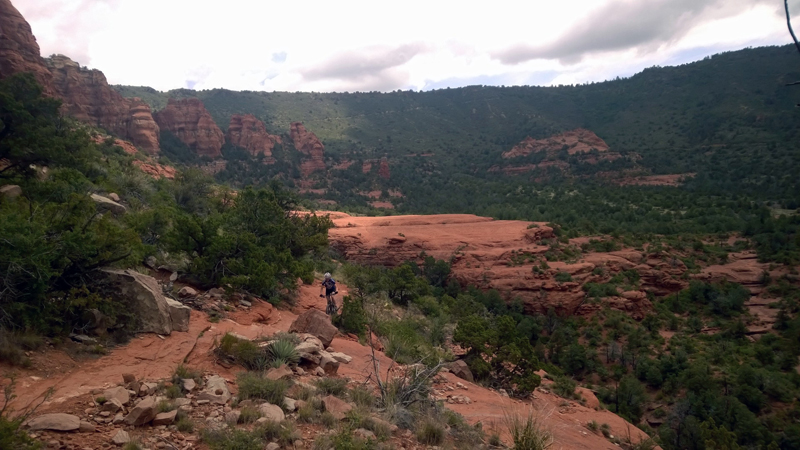
Sedona AZ Mountain Biking
A rider pedaling on the Hangover Trail in Sedona, Arizona. Photo by Lukas Brinkerhoff

The study found that about 14,000 people cross state or international boundaries to enter Arizona and participate in about 250 organized cycling events such as El Tour de Tucson – not to mention those who ride for other reasons. The study says these tourists are responsible for creating or maintaining 721 jobs.

In addition to spending traditional tourist dollars, these people spend money in bike shops. Surveyed shopkeepers said they repair a lot of cycle and sell them and merchandise to out-of-staters (sometimes in person; sometimes by shipping). But the sample of sales examined was too small to generate conclusions from and researchers found bike shop operators were reluctant to share information. Exports were also included in the study, and were estimated based on number of employees.

The report states that its “ultimate purpose …is to provide information to serve as one basis by which ADOT and potentially other state agencies could expand support for bicycling activity, and thereby the bicycle industry, in Arizona.”

And how to get more riders to come? “With its mild winter in the desert areas and numerous scenic attractions, Arizona is well positioned to increase this kind of activity, regardless of national trends in bicycle usage and could market itself as a destination for bicycle tourism. A velodrome could be an important complementary asset for bicycle tourism in Arizona,” the report suggests.

Would bicycle tourism bring great economic benefits to other states? Researchers looked at previous studies and concluded that those done are too area-specific and too few to generalize from. Arizona’s climate, for instance, is more likely to attract cyclists year-round than many other states.

But other recent studies have documented that cycling tourism boosts the local economy. The Oregon Bike Travel Study released in February for Travel Oregon, for instance, reported that bicycle tourists spent more than $325 million in the state last year, though the figure includes both Oregonians and visitors. And a study done three years ago at the University of Wisconsin estimated that non-residents who come to Wisconsin to cycle will spend an average of $76-$81 a day in the state.

Will Utah study how bicycling is helping the state? “There has been talk of it. We have not come up with specific plans,” says Evelyn Tuddenham, bike/ped coordinator for the Utah Dept. of Transportation. “If we do such a thing, it is likely to be a multi-agency study so we are sharing the cost and it is useful for a number of agencies…. We understand that it is important. I am sure that something will be done in the next few years.”

The Arizona study found that for the events it documented for 2012 and 2013, about one-third took place in spring – more than in any other season. Fall finished second with slightly more than a quarter. The fewest events took place in summer, about 15 percent.

But it seems to pay to both sponsor events (tours, mountain bike rides, cyclo-cross, BMX, bicycle races, triathlons and so forth) and build trails that people will ride on their own. Many events last more than one day, a boon to the lodging industry.

The study looked only at what tourists bring to Arizona – not how spending by Arizona residents on bicycling affects the state economy. The authors concluded they couldn’t judge that accurately because of the plague of all microeconomic studies: you can’t accurately factor in the substitution effect. They counted 39,000 Arizonans per year who ride in about 250 organized Arizona bicycle events (and it didn’t count every local event). But is a dollar spent on a bicycle a dollar not spent on a golf club?

The study focused mainly on bringing tourists into the state. It acknowledges that bicycle and related equipment manufacturing in the state is “limited to a few small firms” and that other states and countries focus much more on export. It notes that it is “likely that other states that have a much larger established base of bicycle manufacturing, such as California, have an advantage over Arizona.”

Researchers say they plan to update the study periodically but they haven’t determined how or when. But they suggest that ADOT and other state, tribal and local governments; together with bike groups; keep tabs on bicycle tourists’ spending. Someone should compile annual lists of in-state bicycle events. And the Arizona Dept. of Tourism should gather more data on cyclists, the study recommends.

An Economic Impact Study of Bicycling in Arizona: Out-of-State Bicycle Tourists & Exports: Final Report can be found here. McClure Consulting LLC of Phoenix and two other consulting firms conducted the study for ADOT.
 

Boise GreenBike Sponsors Fourth Annual Cranksgiving Bike Ride on 11/23/19

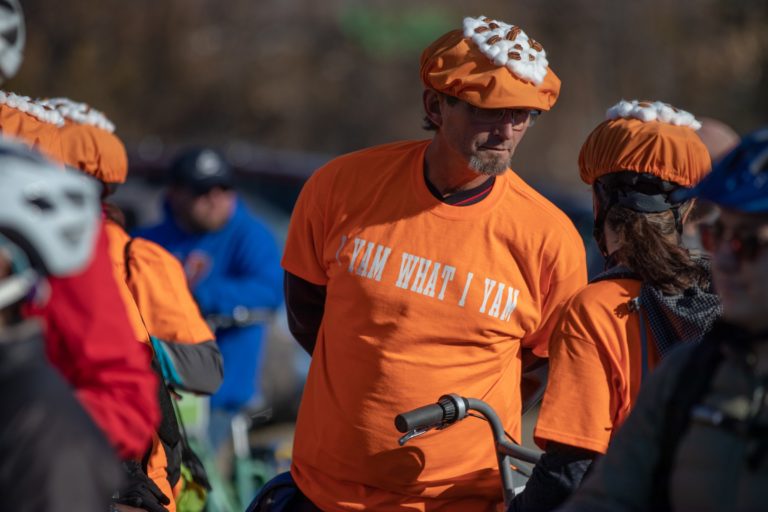
Boise GreenBike is once again proud to sponsor Cranksgiving, a Thanksgiving-themed scavenger hunt on bicycles that helps feed families in need. On Saturday, November 23, 2019, teams of participants will use bicycles to gather a list of items to fill Thanksgiving food boxes. Boise GreenBike gives the food boxes to St. Vincent de Paul for distribution to families in need throughout the Treasure Valley. Last year, 43 food boxes were distributed.

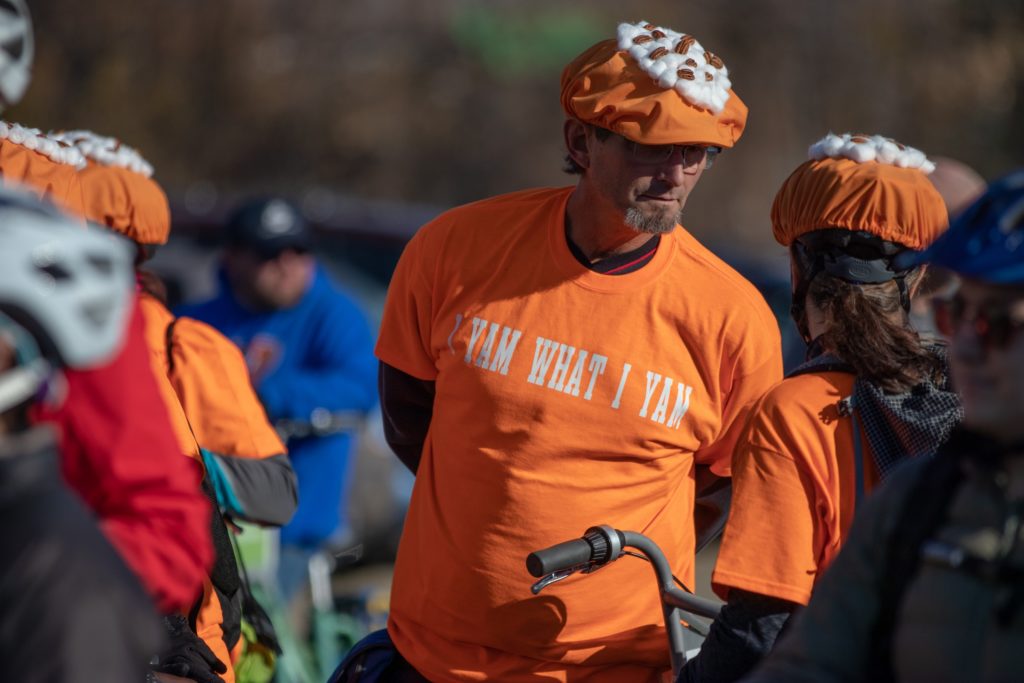
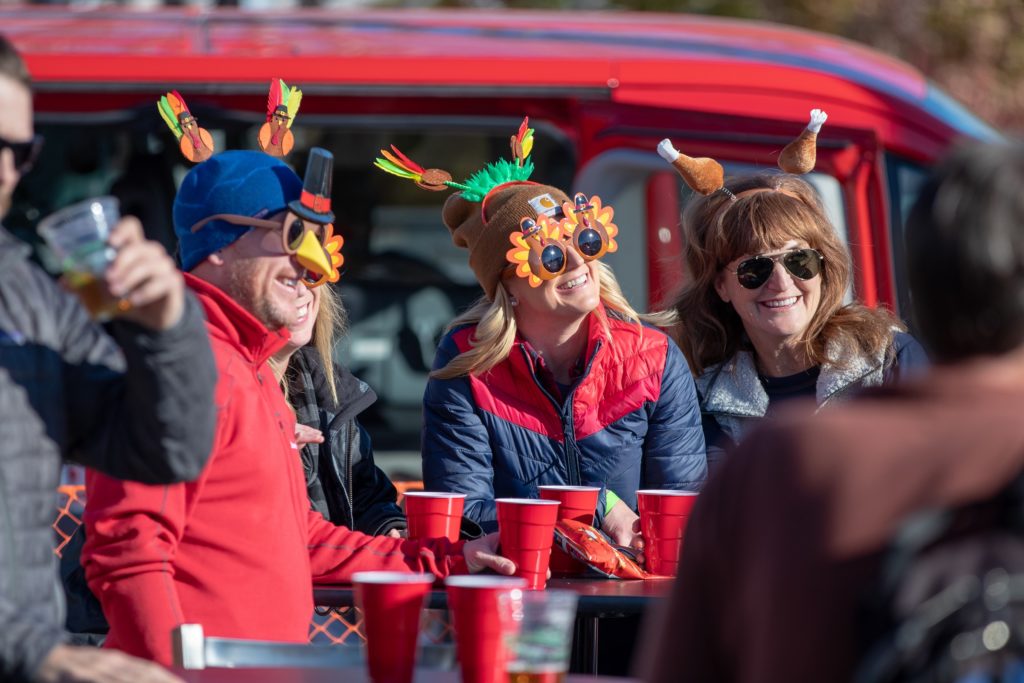
Costumes are encouraged at Cranksgiving. Photo courtesy Boise GreenBike

In an effort to grow the good, Boise GreenBike is also teaming up with Cauze, a charitable giving app, to help 17 local charities that provide food, shelter, clothing and medical assistance to families and individuals in need. Each team will choose a charity from the list to support along the way. Cauze will match all donations.

To make Cranksgiving accessible to more people personal bikes will be allowed in the event, with the stipulation that EACH TEAM MUST INCLUDE AT LEAST ONE BOISE GREENBIKE. For every GreenBike in use, the participant will get a $20 credit in the GreenBike network.

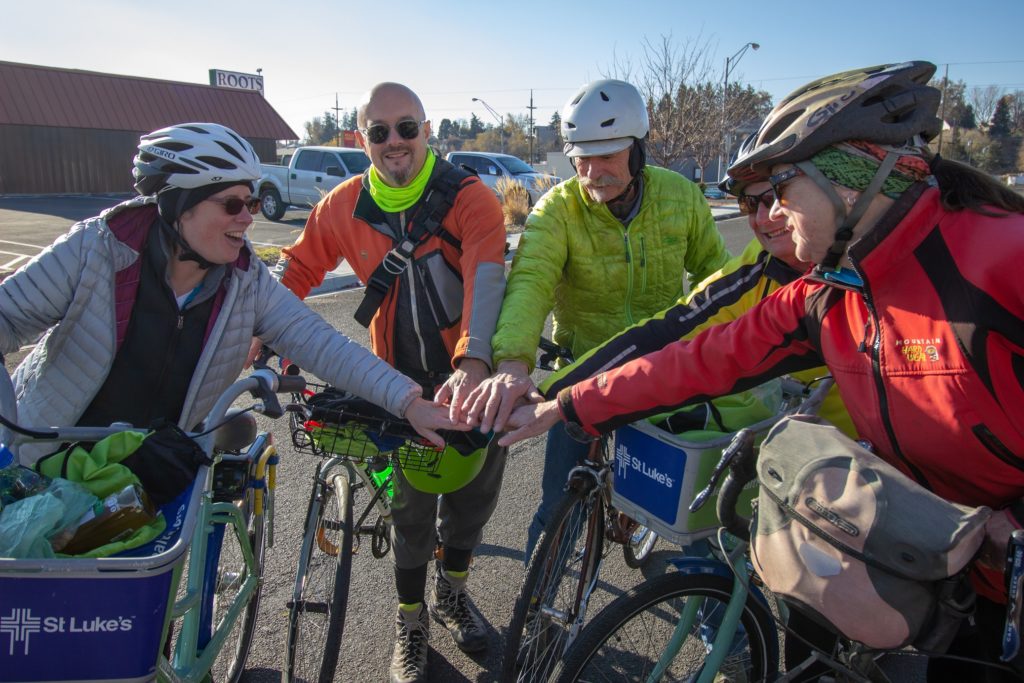
A team of riders getting ready to head out at the 2018 Cranksgiving event. Photo courtesy Boise GreenBike

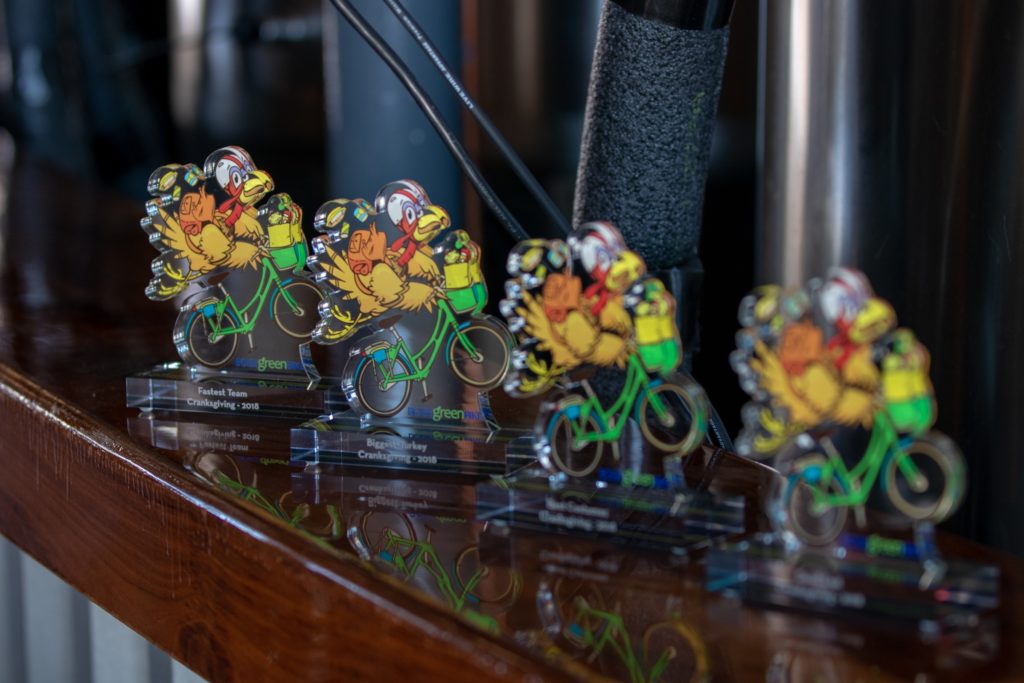
Instead of an entry fee, each rider should bring money to purchase the Thanksgiving food items. Teams of riders will get a manifest listing the food items to be collected as well as completing fun tasks along the way. Team members should bring a backpack to help carry food items. Prizes are awarded to teams that are the fastest, have the best costumes, and the biggest turkey.

Trophies for various categories at Cranksgiving. Photo courtesy Boise GreenBike

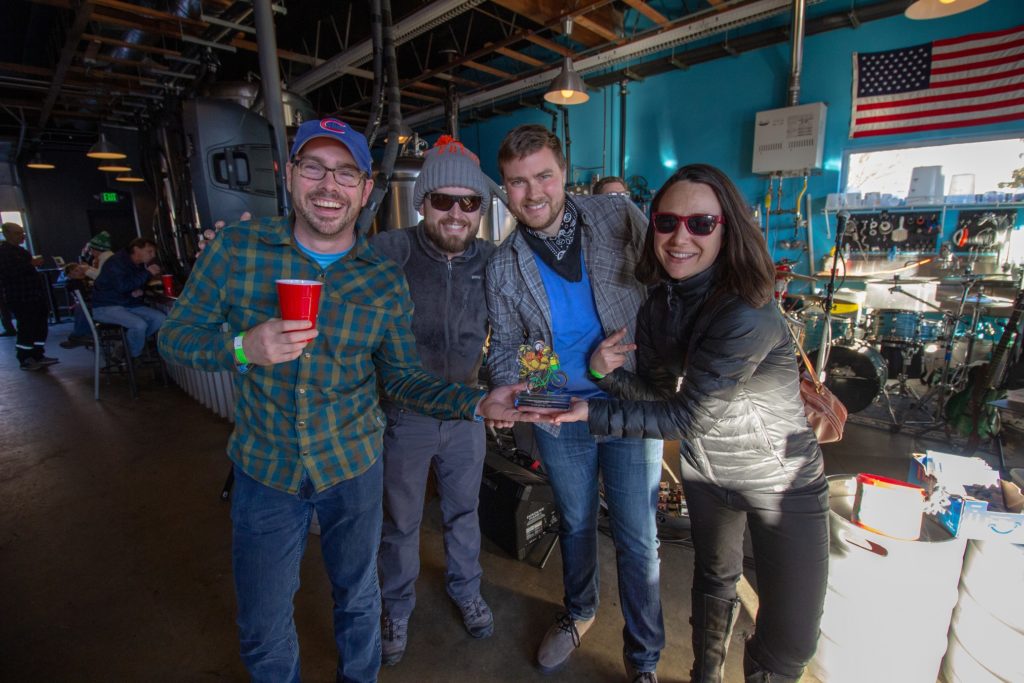
The Cranksgiving scavenger hunt will be followed by an after-party at Clairvoyant Brewing, 2800 W. Idaho Street in Boise. Food and beverages will be available for purchase. Event schedule:

  • 10:00 a.m. – Packet and bike pick up, Boise GreenBike World Headquarters, 106 E 34th St, Garden City, Idaho.
  • 11:00 a.m. – Race begins
  • 1:00-5:00 p.m. – After-event party at Clairvoyant Brewing, 2800 W Idaho St, Boise, Idaho.

To register a team go to https://tinyurl.com/cranksgivingboise2019

To volunteer for Cranksgiving go to https://www.signupgenius.com/go/5080C4DA9A72CA7FE3-cranksgiving2

For more information, go to the Cranksgiving Boise Facebook page: https://www.facebook.com/CranksgivingBoise/

After the race, stick around for beers, food, and friends. Photo courtesy Boise GreenBike

SBT GRVL to Open Registration December 3 for 2020 Event

SBT GRVL will offer a fourth 64-mile course option for year two, plus added double and single track sections to the Black and Blue courses

STEAMBOAT SPRINGS, Colo. (Nov. 5, 2019) – SBT GRVL, a world-class gravel bike experience set in the picturesque ranching town of Steamboat Springs, Colo., will open registration Dec. 3 for its second-year event.

SBT GRVL welcomed 1,500 cyclists for its successful inaugural year, all joining together to experience Routt County’s vast network of scenic gravel roads winding through the foothills of the Rocky Mountains. For 2020, SBT GRVL will further its commitment to all level riders by offering a new 64-mile fourth course option, dubbed Red. Riders of the Red course—a sweet spot between the 144-mile Black course and the 37-mile Green course—can expect approximately 4,100 feet of climbing and over 50 miles of gravel. Additionally, the Black and Blue courses will feature new double and single track sections, adding an interesting new dynamic to the race.

The SBT GRVL founders committed to parity, inclusivity and equality for all riders from year one. This commitment led to the re-opening of registration last year to offer 200 more spots for female riders. As a result, 400 women showed up to ride for the inaugural event, just under 30-percent of the field. Parity remains a priority for year two, and the founders are laser-focused on achieving a 50-50 ratio of male/female riders in the coming years. SBT GRVL will offer a $22,000 prize purse for 2020, which will be equally divided among male and female racers across the pro field. In addition, new for 2020, SBT GRVL will recognize age group winners across all four races equally.

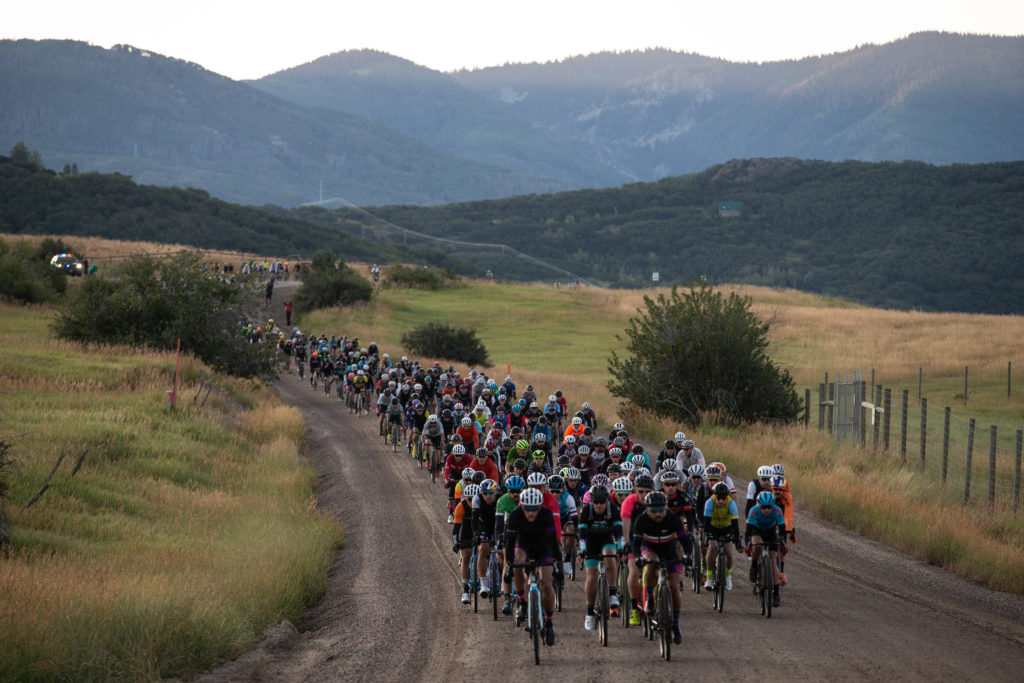
The field hits the dirt at the 2018 SBT GRVL. Photo courtesy SBT GRVL/Wil Matthews

“We were overwhelmed by the positive feedback we received from riders of all ability levels who experienced our inaugural SBT GRVL event,” says Mark Satkiewicz, co-founder of SBT GRVL. “As a commitment to the SBT gravel community, we took action on all feedback we learned from connecting with our first-year riders and we’ve implemented the updates they wanted for 2020. We think the new Red course addition will be a popular choice and the double and single track sections of the Black and Blue courses will not disappoint!”

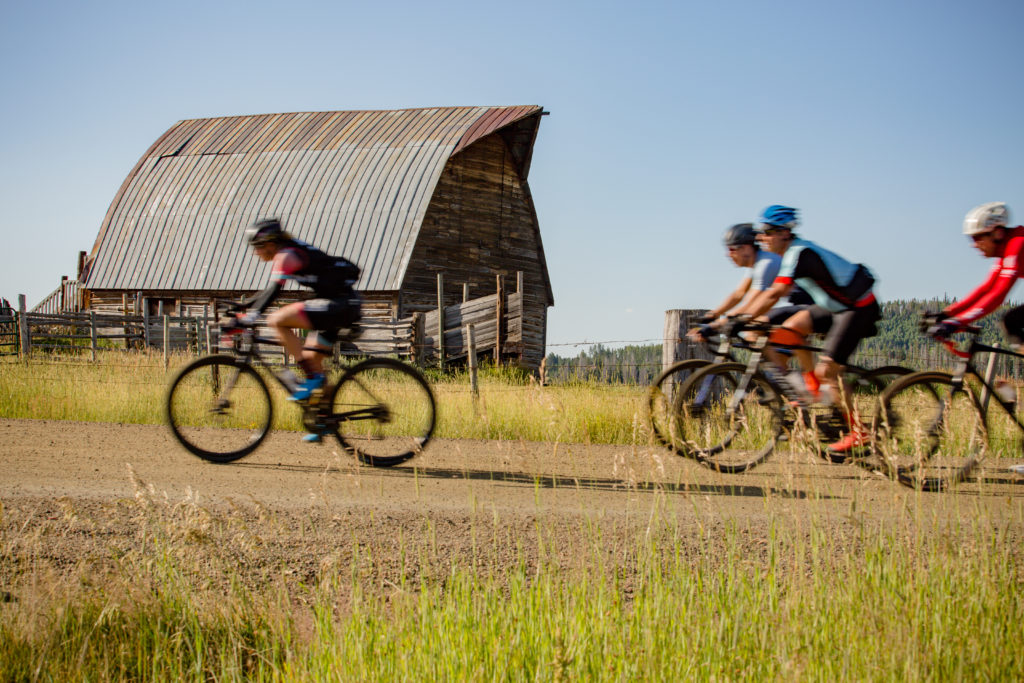
A rider participates in the 2019 Steamboat Gravel cycling race held near Steamboat Springs, Colorado. Photo courtesy SBT GRVL/Linda Guerrette

There will be a weekend full of activities for riders to enjoy leading into the main event on Sunday, Aug. 16, 2020. As a world-class cycling and snowsports destination, Steamboat Springs offers countless outdoor recreation options for the whole family, mountain-town hospitality and a noteworthy local dining scene. Whether visitors want to soak in the Strawberry Park Hot Springs or hike up to Fish Creek Falls, there are plenty of memories to be made for a weekend getaway with family and friends.

SBT GRVL, presented by Canyon Bicycles, announces additional sponsors for 2020: ABUS, ZIPP Speed Weaponry, SRAM, The Feed, and People for Bikes.

Register here on Dec. 3 and follow SBT GRVL on Instagram, Twitter and Facebook to stay up-to-date on the event. Don’t miss the highlights from year one on SBT GRVL’s YouTube channel.

Tucson Bicycle Classic Cancelled for 2020 after 34 Years

1

By Steve Bohn, TBC Founder and Promoter

34th Annual 2020 Tucson Bicycle Classic Canceled

TUCSON, Arizona (November 7, 2019) – With great regret, sadness and after much soul searching, I am announcing the 2020 Tucson Bicycle Classic (March 13-15) is canceled due to lack of commitment from the local cycling community, USAC cycling teams and dismal staff volunteer response. Les Scomparse (33 years) and Rhino Racing Team (12 years) have been dedicated, integral parts of the organization, staff and infrastructure of the race. After 12+ years of hard work, 4 main staff members and Rhino are stepping back from the race.

Reaching out to various teams and organizations via email, meetings and social media the last 6 months, the response was almost nonexistent. Ironically, for the first time in 5 years, the TBC has a title sponsor lined up but without a committed staff and team, this complex and beautiful race cannot move forward.

I am very proud of the TBC, hatching the idea in the spring of 1986 with other teammates in ’69 VW bus returning from very fun (and disorganized) Candlelight Classic Stage Race in New Mexico. Nearly 200 riders entered the inaugural TBC in August from across the West with the draw of racing in a timed stage race on open roads, just a month after Greg Lemond won his first Tour de France. Since then it had grown into one of the most popular stage races in the west, attracting over 700 racers at it’s peak.

Special thanks to all of the volunteers, racers, staff and sponsors over the last 33 years that made the TBC a reality. In return, the TBC supported El Grupo Youth Cycling and fights domestic violence supporting Emerge! as well as donating $100,000 back to the community over 33 years. The event generated nearly $1,000,000 in the regional economy yearly and helped put Tucson on the Cycling Mecca Map.

The option of the a 2021 (and beyond) TBC is open provided a committed team/organization and staff can come forward.

Sincerely,

Steve Bohn

TBC Founder and Promoter

Advocacy Alert: Forum to Encourage Better Cycling in Salt Lake Valley Canyons – November 7, 2019

0

By Greg Hoole — In the wake of growing complaints by cyclists about the conduct of Canyon Patrol officers, UtahBikingLaw.com is hosting an open forum between cyclists and supervising officers of the Unified Police Department.  The purpose of the forum is to increase understanding between cyclists and law enforcement with the aim of making the canyons a safer place for everyone.  The discussion will take place on November 7, 2019 at 6:00 PM at the law office of Hoole & King (UtahBikingLaw.com), 4276 S. Highland Drive in Salt Lake City.

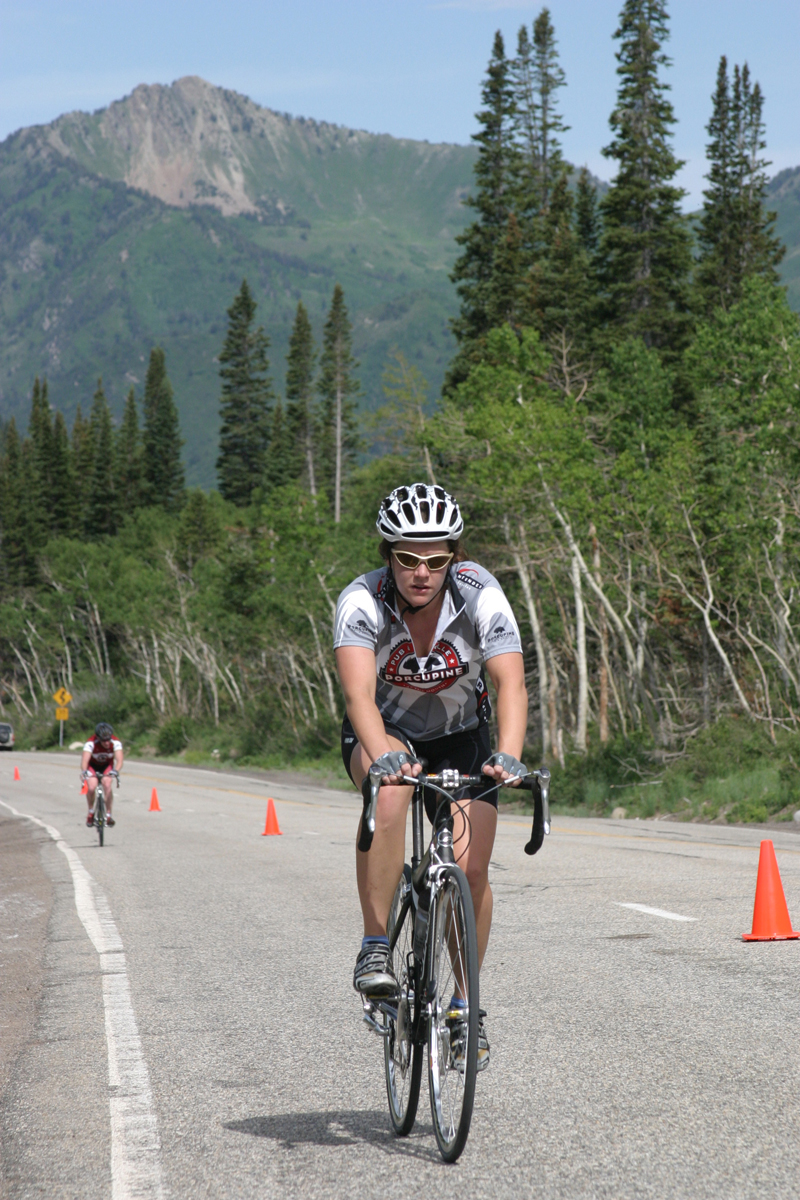
The Big Cottonwood Canyon Porcupine Hillclimb takes place in July each year. A rider is shown here with Mt. Raymond in the background. Photo: Dave Iltis
A forum will be held on Nov. 6 to encouarge better riding in the Salt Lake Valley Canyons. Photo: Dave Iltis

Off Season Nutrition: What Does Eating Clean Mean to You?

Isn’t Fall wonderful? We have the residual summer fitness and gorgeous weather to ride in and enjoy. But let’s face it, winter is coming… the time of year when the food becomes comforting, riding time likely diminishes due to weather and schedules and of course all the holidays. Many of us may use the off season as an excuse to put on a few extra pounds although that does NOT have to be the case! Why not maintain the physique you worked so hard for all summer and keep your food choices clean and healthy throughout the year? The focus of this article is to help you determine what clean eating is to you and in future articles how you can eat right through the “off season” and beyond.

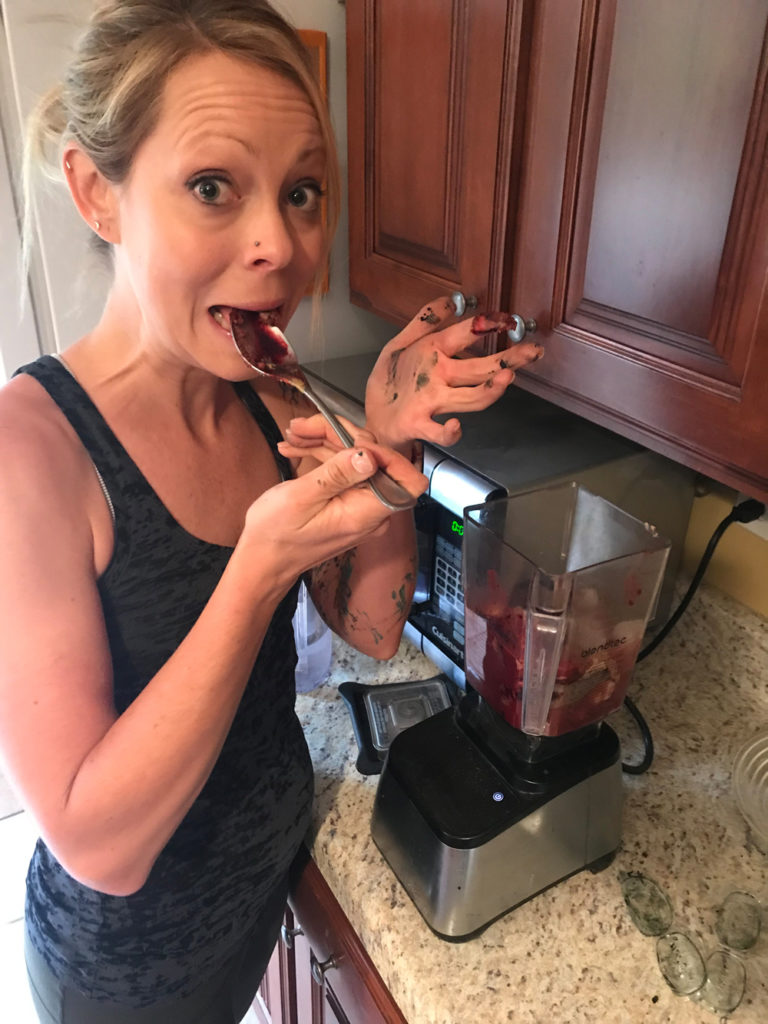
Breanne in the process of creating a smoothie. Photo by David Harward

By definition, the word clean means “free from dirt, stains, contaminants” and eat means “put food into mouth, chew and swallow it.” Put that together and clean eating literally means consuming food free from contaminants. This however, can be interpreted in many ways. Does eating clean mean avoiding processed foods, GMOs, refined sugar, etc. or is it choosing fresh fruits and vegetables, lean protein and plant-based fats? To answer those questions depends on whether you look at food choices as limiting the bad or enhancing the good. I prefer to have the mindset of enhancing the good, but they go hand in hand if your focus is on consuming what your body needs to reach your goals.

Now let’s talk about what our bodies need. With all the fad diets out there, it’s hard to decipher what’s right. Is it gluten free? Dairy free? Plant-based? Keto? Paleo? Mediterranean? Well the reason these all exist is because different bodies and lifestyles thrive on different eating patterns. The key is determining the right fuel for your body, and that is dependent on many factors. I wish I could give you one equation that tells you exactly what to eat every day, but it’s just not realistic! Instead let’s focus on balance of food choices and fueling your body for what you do each day.

For example, on a day that we ride for 5 hours we eat and drink more than we do on a day that we do a quick 1 hour spin. Sounds simple right? In concept yes, but this is where balance comes in to play. On the long ride day, we should be consuming more carbohydrates than on an easy day or rest day. So to choose a diet, say, that eliminates sugar entirely you may be shooting yourself in the foot if you intend on staying active through the winter months. You should however, keep sugars intake low on light exercise days and instead have nutrient dense foods to fill the belly and power the mind. So, if any of the specific “diets” listed above are important to you, keep in mind whether the macronutrient balance is appropriate for that day. Your engine runs the strongest when you put the proper gas in the tank!

In my next articles I will get into specific foods and break down our macronutrient and micronutrient needs as well as give ideas on how to incorporate them into your daily routines. In the meantime, I want you to think about what clean eating means to you. Is it eliminating certain products, incorporating more healthy foods, or focusing on the environment and animals? Ask yourself what you want to accomplish this “off-season” rather than wait until it’s Spring to get back into summer shape and shed the winter pounds (we’ve all been there right?!). Remember that clean eating comes from mindfulness, so set your intentions first, then we figure out the exact food plan. In fact, it would be great to hear from you! Send me your questions, requests for article content, even your personal goals. My contact info is below.

Breanne Nalder, MS, RDN earned a Master’s degree in nutrition with an emphasis in sports dietetics at the University of Utah. She is a Registered Dietitian, the nutrition coach at PLAN7 Endurance Coaching. Contact for custom nutrition planning: [email protected]

Nordic Skiing is the Perfect Winter Sport for Cyclists

By Tom Noaker – We’ve all heard about the physiological attributes of Nordic skiing as an ‘off-season’ training regimen for cyclists but here are a few non-statistical reasons for making Nordic skiing a part of your winter.

You don’t need a helmet, not even to race. Hang up the hard hat, pull that lycra race cap down to your eyebrows, and you’re good to go. You can pack away the elbow and knee pads as well. Even if you crash at speed (downhill speeds on skinny skis can be similar to cycling) you won’t be scraping across pavement or rocks and it’s likely you won’t be pin-balling off the aspens at any of our trail systems here in Utah.

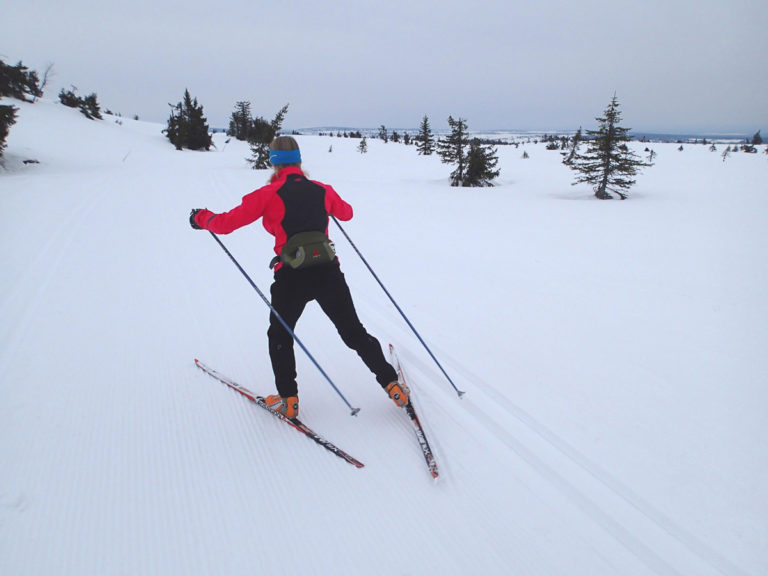
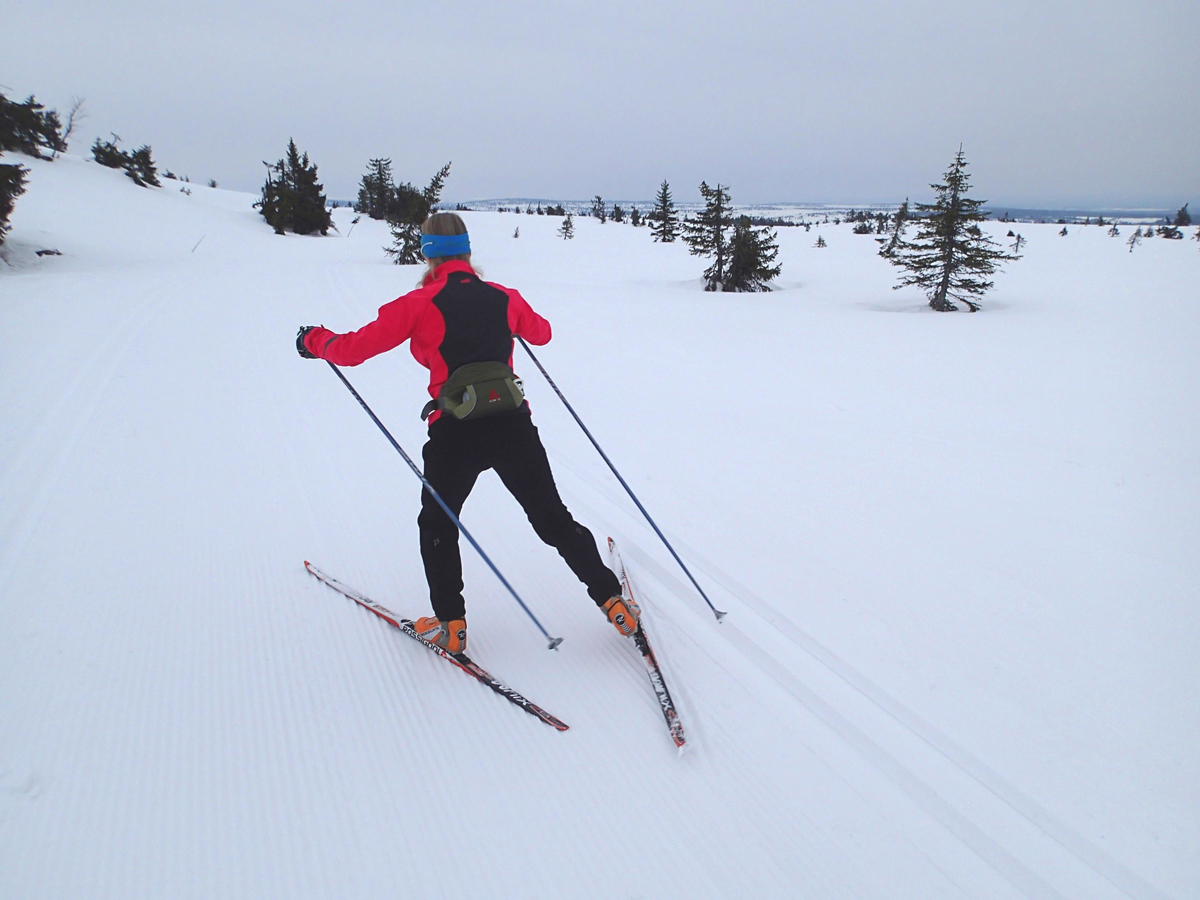
Skate skiing is a great way to have fun and stay fit in winter. Photo by Chris Magerl

Say goodbye to frozen toes and fingers. Trade that January frostbite ride for an hour skate and you’ll be toasty after the first ten minutes. Also the 2-to-1 rule applies; roughly 60 minutes of skiing equates to 120 minutes of riding. Nordic also introduces the cyclist to a new form of ‘full-body-fatigue’ similar to swimming and rowing but with the added components of weight bearing and balance. You know that visual of Nordic ski racers sprawling in the snow moments after crossing the finish line; that’s not soccer drama.

Nordic skiers are a ‘thrifty’ bunch. They know a full set of top end gear costs about half the price of a pair of carbon race wheels. Nordic season and day passes are a fraction of their alpine equivalents. You can reinvest some of those savings in wax, tools, base grinds and ski quiver expansion. As a cyclist you likely own more bikes than cars. As a Nordic skier you may soon own more skis than bikes and it won’t require an austerity budget.

Nordic sport is relatively attitude free and The Utah Nordic Alliance scene is refreshingly cordial. There are a number of discounted group clinics available to help cyclists advance quickly from entry to advanced skill levels. If you’re interested in racing, the Wasatch Citizen Series provides low cost entry fees, accurate, quick results and often post race lunch and prize drawings. Go to www.utahnordic.com for the full story

Cross Country Skiing is therapeutic for cyclists who spend plenty of hours hunched over the bars grinding out watts. A professional bike fit and some regular stretching can be helpful but a few months of reciprocating rather than rotary movement allows the body to fully unfold and reset. Neglected muscle groups get a wake-up call and those kinks that begin to feel like permanent-press get a full wash-and-dry cycle. Come springtime you will notice not only an increased cardio capacity but also improved core strength and enhanced power transfer.

Finally, winter is just too long not to make peace with and discovering a snow sport that requires considerable patience, practice and perseverance opens up a whole new attitude for the months of short daylight. When the days grow longer and warmer you may even consider adding some roller skis to your collection but that is a topic for another season; right now we need snow!

Tom Noaker is a well respected and accomplished sales rep and business owner in both the bicycle and ski industries. He has won sixteen State Championships in cycling across four age divisions, as well as three Mountain Bike National Championships, and competes as a cross-country skier at the elite and elite Masters levels. Tom coaches some of the best young riders in the country, and is board president of the South Summit Trails Foundation. Please send your training, equipment and event preparation questions to [email protected] with Ask Noak in the subject line.

A Winter Training Program Helps a Cyclist’s Mental Health

By Amanda Choudhary – “I Ride Louder to feel strong!” 

I signed up for Ride Louder at the JCC right after my third pregnancy loss. I was a mess. There were days I couldn’t remember what it felt like to feel strong, which was a huge change for me after years of triathlons. I just wanted to feel strong again—both physically and mentally. 

So I started to Ride Louder. And it worked! Feeling strong again was just like riding a bike—literally! My husband signed up for Ride Louder with me too. It gave us a way to connect over something other than grief.

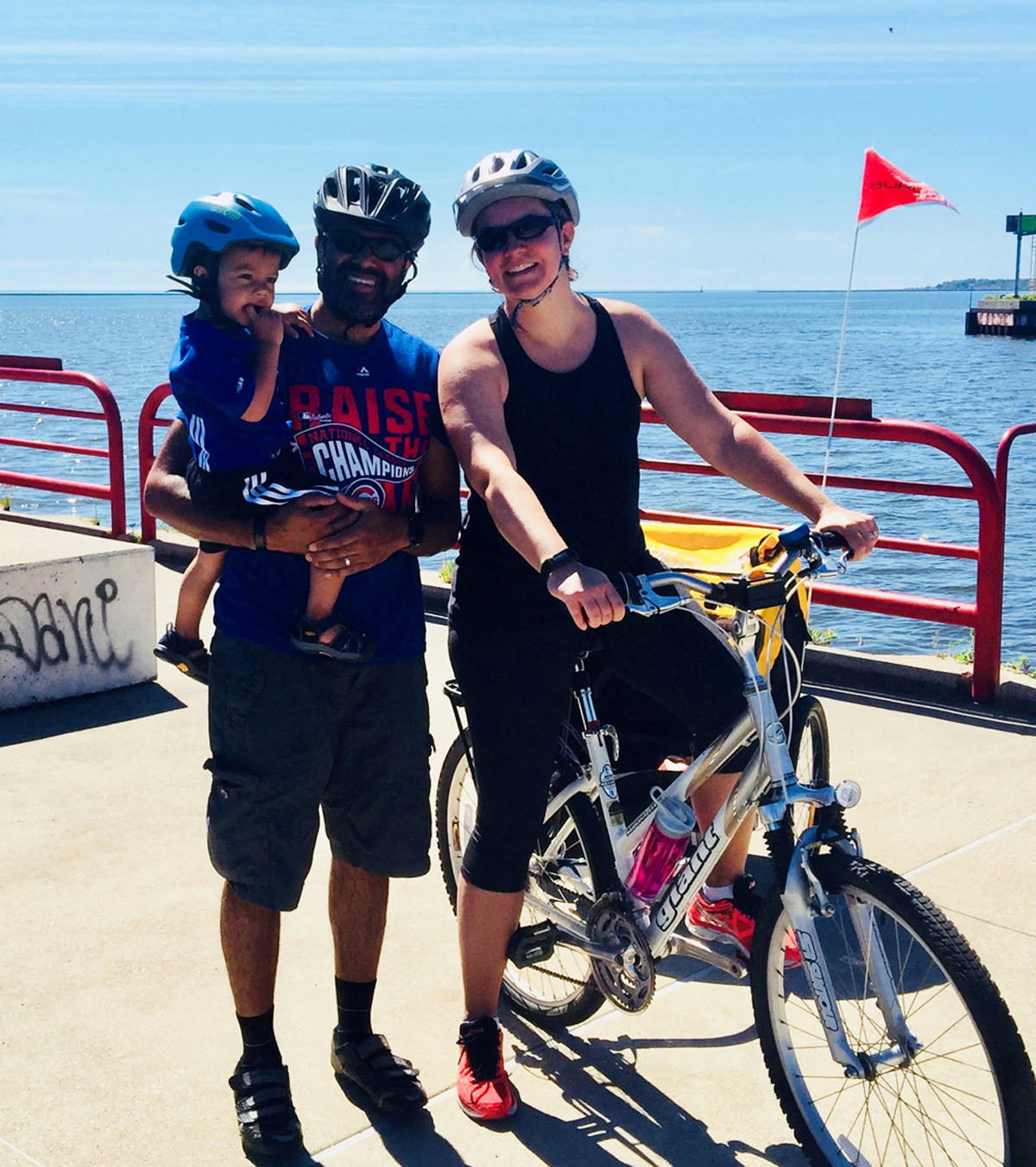
Left to right: Madan, Kavish, and Amanda Choudhary. Photo courtesy Amanda Choudhary

Then, in the middle of the winter, I got pregnant again. My doctor said to stay active and healthy, but I was terrified. I kept going to Ride Louder to keep some sort of routine and sanity. The coaches were always encouraging, but never pushed me out of my comfort zone. I felt comfortable and safe meeting my fitness goal- which at that point was just to do something active. 

At the start of Ride Louder, before I was pregnant, I loved pushing myself. I learned so much about my heart rate zones and what it felt like to manage my heart rate between the different zones. I also learned how to be best positioned on my bike, to be efficient and prevent injury. I could see the results of working hard and getting back into shape. On an off day, I always appreciated the coaches walking around and checking to hold me accountable. Once I got pregnant though, I was terrified of the coaches walking around. I worried to myself — Would they try to push me harder? Would I break down crying in class if they pointed out or asked why I wasn’t working as hard as I used to?” But that never happened once. The coaches pushed us as a class but trusted us as individuals to do what we needed to do.

By the end of Ride Louder I was 17 weeks pregnant, and now I have a happy healthy little guy. I can’t imagine getting through all that without my amazing husband and our Ride Louder experience.

My husband was not into cycling when we started the class.  He had been a runner for years, and had done some casual mountain biking. Ride Louder was a new challenge for him, and something we could do together. But he caught the cycling bug! He purchased a road bike, and has kept in touch with some of the Ride Louder folks. He goes out for a ride 2-3 times a week. As he has adapted to being a new dad, I know he would say cycling has become his source of sanity these days! 

I am forever grateful for Ride Louder. I hope sharing my story helps others to know how it important it is to ride, both for physical and mental health.

The 2019-2020 Ride Louder Winter Cycling Program will take place from November 4, 2019 to March 28, 2020 in Salt Lake City, Utah. For details, visit slcjcc.org/louder

Seth Parsons – Tips For Year-Round Riding on a Bike Friday

By Lou Melini – I first met Seth when he attempted to accompany me on an overnight bike tour in 2018. We rode together for quite a bit but due to a number of factors he had to turn around and go home, missing out on the camping. However we chatted about bike commuting, bikes, and everything associated with enabling one to ride to work with a smile. So more than a year later I get to chat with Seth once again.

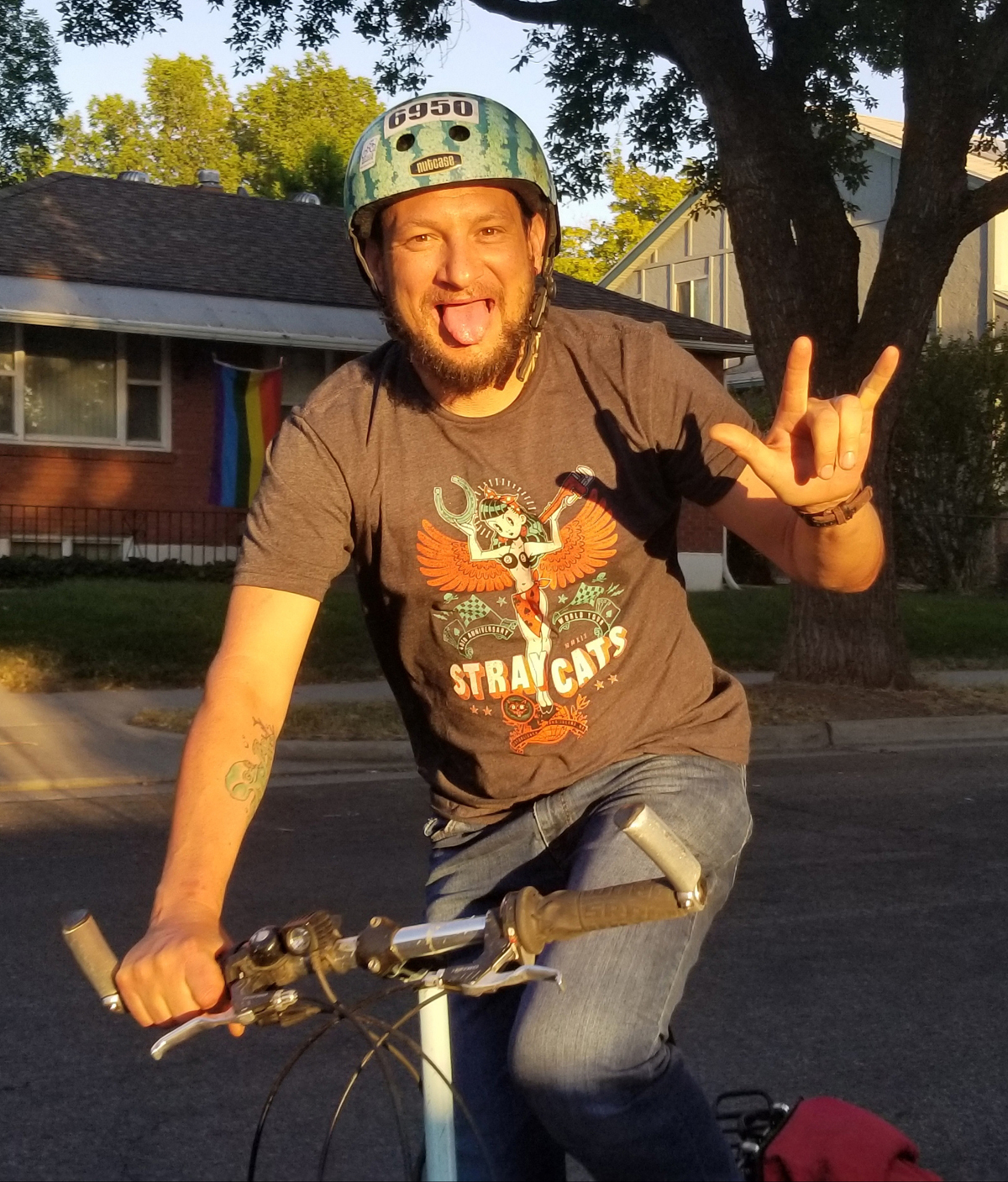
Seth Parsons commutes to work on his Bike Friday. Photo courtesy Seth Parsons

Cycling West: Seth, tell the readers a little about you and why you commute to work by bike.

Seth Parsons: I’m a dad, a husband, a teacher, and a bike commuter.

I bike commute now because it keeps me sane. And to be honest with you, I kinda like the look I get from my co-workers when I show up on my bike with icicles in my beard.

There was a time not too long ago when I really struggled with anxiety and depression. I started medication and therapy but nothing really got better until I really committed to commuting by bicycle in February 2018. Now my wife tells me that I need a bike ride when I get a little squirrely around the house. That’s her code that I’m going crazy and annoying her.

C.W.: What was it that made you decide to commute by bike?

S.P.: My “how I became a bike commuter” story is not brief. I think I first tried to get to work by bike in 2009. I was stationed at the Naval Air Station on Whidbey Island, north of Seattle. My wife was trying to get into green building and we were in a town that was very conscientious about its environmental impact. So, I guess I wanted to be “greener”. That didn’t last long and I put the bike away.

I played around with commuting to work at every job I’ve had since, but I really committed to it in 2018. That’s when the Subaru in our driveway became a “rolling storage shed” and we became, for all intents and purposes, a one-car family.

C.W.: Tell me about your current commute to work.

S.P.: I recently changed jobs. The new commute is a bit longer, but I think way more fun.

For the last two years for my previous job, I commuted from Sugarhouse to American International School of Utah in Murray. It was about a 7-mile commute, each way. I got a lot of use out of the S-Line trail, but it was a super short part of my commute. From 800 E, I’d take the S-Line to 300 E, then head south in the mornings.

Probably the worst part of my commute would be the four blocks I spend on 3900 S in South Salt Lake. It’s loud. There’s lot of traffic. I also got “doored” on this route going home one afternoon. But I guess that’ll happen to you if you ride your bike enough.

My new commute will takes me up near the international airport, about eight miles each way. It’s a great ride, flat and fast with a little time spent on the Jordan River Parkway. That’s probably my favorite part of this route. I’m not a big fan of riding along North Temple to the fairgrounds. There are a lot of stoplights that I’d like to avoid so I’m thinking about heading north a block or two, then west.

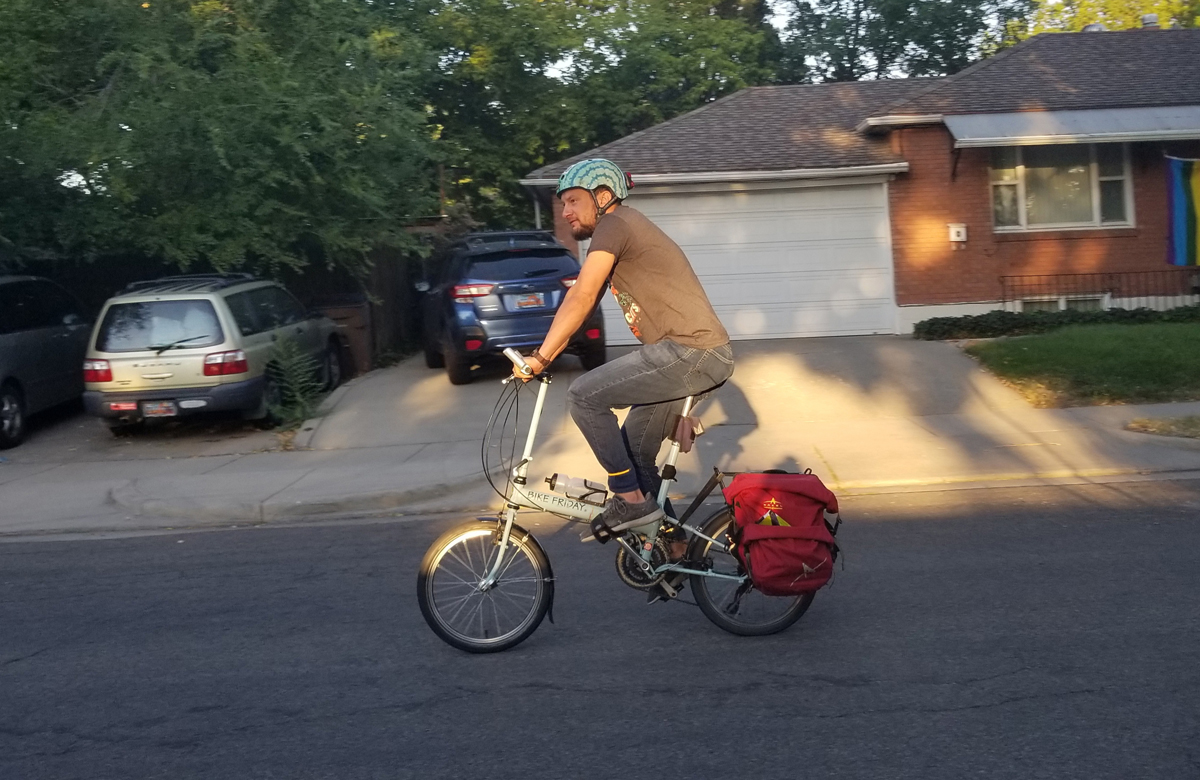
Seth Parsons’ folding Bike Friday is set up for commuting with a rack and panniers. Photo courtesy Seth Parsons

C.W.: I enjoyed watching you ride your folding bike. Tell me more about it.

S.P.: Ever since I unofficially committed to commuting by bicycle a year and a half ago, I’ve had every intention of riding every day…regardless of the weather. My commuter bike is a Bike Friday Pocket Llama. It’s a folding bike built by Green Gear Cycling in Eugene, Oregon. I had it custom built for me so it has a sweet placard with my name on it. I had been messing around with commuting before on an old Trek 4900, but I wanted a steel bike and I wanted a custom built bike and I didn’t want to spend a fortune. I met a lady in St. George once who was planning to ride across the US. She came to a World Peace Gardens gathering with this tiny blue bike with itty-bitty wheels to tell her story. That was my first exposure to Bike Friday. And when I started my new bike search, the small wheels kinda hung out in the back of my mind for a while. The hard part was finding one to try out. I eventually found a bike shop in Kentucky that had one in my size for a test ride. I rode it and ordered one of my own later that week.

The bike itself is standard Bike Friday. I added some fenders, lights, a rear rack and a bell. The thing is a workhorse and an absolute joy to ride. I’ve played around with various pannier and messenger bag combinations, but my current set-up is to ride with one waterproof Arkel bag clipped on the rear rack.

I carry everything I might need on a ride in that one bag. I always have a mini-pump and a spare tube with me. Additionally, I have a tube patch kit and a Leatherman for any minor repairs or adjustments I may need to make on a ride. Honestly, I’ve found the patch kit and Leatherman to be more helpful to people I meet on the ride than to me, but I’m glad I have it with me.

C.W.: Do you also ride through the winter? If so what tips do you have?

S.P.: I do ride throughout the winter. And I have every intention of doing it on my new commute as well. The trick to year-round riding is layers. You have to have a few nice pieces of clothing to act as a base layer. Then you can add to it. I’m a big fan of wool everything. I have a nice winter weight wool jersey I bought from Wabi Woolens that I really like. Under that I’ll wear a long sleeve merino shirt and maybe a pair of wool leggings if it’s cold enough. For shoes, I love my Timberland boots. They’re waterproof and look good enough to wear with dress pants to be business casual at my work. I typically wear my work pants during my ride just because I don’t like changing at school. If it’s super sloppy outside I’ll stuff my work clothes in the Arkel bag and roll to work wearing a pair of snow pants and my wool jersey.

If the weather is absolutely garbage or I just don’t feel like riding one day I’ll take Lyft. The advantage of having a folding bike is that it fits in any trunk. Most Lyft drivers are pretty amused to watch me fold this bike down into a pile of interconnected parts that could fit in a suitcase. Last year, there was about a week in early December that was bitter cold and I wasn’t feeling it, so I Lyfted it a few times to work. Then in January, I had an injury unrelated to cycling that kept me off the bike for about three weeks. I Lyfted it at that time as well.

I have recently added a Cleverhood rain cape to my collection and I love it. It covers my legs when I ride and it’s a super nice alternative to plastic rain jackets that I find just don’t breathe very well.

C.W.: You are close enough to remembering your start as a bike commuter. What words of wisdom can you pass onto others that may want to start commuting by bike?

S.P.: If you want to start riding to work, I’d say do it. Grab your bike and go. You’ll run into so many great people also on bikes that are willing to help you out if you have any problems. You don’t need a fancy bike. Google maps have bike direction settings so you can find a nice route to wherever you’re going. Also, remember that bike commuting uses energy, sometimes a lot of energy. You’re going to be hungry. You’re going to be tired. Just listen to your body or Lyft it on days you need a break.

Finally, the last thing I’d say is to have some fun. You get a different view of the city on a bike and a different sense of your place in it. Soon you’ll be passing cars full of unhappy looking people frustrated by traffic and sedentary in their seats. Give them a wave…remind them that life is worth smiling about.

C.W.: Seth, it has been a pleasure to catch up with you. Good luck with the new job. The use of Lyft with your Bike Friday sounds like a great “Plan B” for commuters.

If you have a suggestion for a commuter profile, especially from Idaho, Montana, Nevada, Wyoming, W. CO, and N. AZ, have a commuter question, or other comments, please send it to [email protected]

Why Ride a Recumbent Bicycle?

By Martin Neunzert – 

  1. You are out riding for the day with a good friend. You are on your recumbent trike and she is on her diamond frame bike. You notice her pedals match yours, so you ask, “Do you want to try the trike for a while?” What happens next?
    1. You get to ask: “Is that grin permanent now, or what?”
    2. You get to say, “You know, more people have been to the moon than have ridden a recumbent trike.”
    3. The last time you see her she’s a half mile ahead. You are left trying to figure out how to explain to her children she’s not coming back. Ever.
  2. Diamond frame cyclists will invite you, as a recumbent tricyclist, to go riding with them because:
    1. They know they can lean their bikes against your trike at breaks.
    2. They like the idea that people are looking at the trike rather than their spandex-stretching corporate-logo-festooned bellies.
    3. You can take awesome hub-level photographs of them, blurred with speed, without worrying about overlapping wheels.
  3. While out on your recumbent, you stop at a traffic light. A car pulls up next to you, the passenger rolls down the window and asks, “Is that CIA issue?” Your response should be:
    1. Stunned silence…
    2. Wait, what?
    3. Huh?
    4. Smile and wave and say, “Have a smart day!”
  4. You’re out riding on your titanium frame high-racer, on the local bike path, passing some cyclists, being passed by some cyclists. At the top of a rise, you see, in the far distance, a trike. You start hammering because trikes are slow, right? Pretty soon you’re passing everyone who passed you. After a half hour, you get pretty close. You notice:
    1. All your techy high moisture-wicking spandex clothing is drenched in sweat.
    2. You’re just about exhausted.
    3. He’s like, 70 years old.
    4. His battery pack.
  5. Diamond frame cyclists will never invite you, as a recumbent rider, to go riding with them because:
    1. You’ll be laughing as you get on your bike the second morning of a two-day fund-raising ride and they won’t be.
    2. They’ve seen horses that provide better drafting (wait for it…).
    3. You enjoy counting the number of times you hear “Trade ya!” toward the end of a century ride.
    4. Because their Lycra-clad asses, tight or not, are pretty much at your eye level.
  6. Your local mustachioed, coffee-drinking, tattooed and pierced bike mechanic does some work for you on your trike’s disc brakes. When you pick it up you ask if he took it for a test ride. He says,”I’ve never ridden a trike before.” Your response is:
    1. Seriously, dude?
    2. Dude, you should get out of the house more.
    3. You mean, since you were a kid?
    4. Man, do you do know it’s the 21st century?
  7. You might be a future recumbent cyclist if you’ve ever said to yourself:
    1. My hands hurt.
    2. My wrists hurt.
    3. My shoulders hurt.
    4. My neck hurts.
    5. My ischial tuberosities hurt so much I’m never getting back on that damn thing.
  8. You might be a future recumbent cyclist if you’ve ever said to a recumbent rider:
    1. I want one!
    2. I need one!
    3. Awesome!
    4. Nice bike!
    5. That’s a cooooool bike!
    6. Tight bike!
  9. The racer-chasers at your local bike shop won’t work on your recumbent or, if they do, they whinge incessantly about it. What must your conclusion be?
    1. They don’t yet understand a bike is just a bike is just a bike. Unless it’s a trike. Then it’s just a bike.
  10. You ride your trike to a get a pulmonary function test during which they determine your lung capacity and your lung’s ability to transfer oxygen to your blood (not for performance but because you almost died, twice, from pneumonia). Naturally, the test facility is at the top of a hill. You ask the technician if it makes any difference to the results if you exercise hard immediately before the test. She says:
    1. I don’t know, we’ve never had that happen before.
  11. You might be a wedgie if you’ve ever asked a recumbent rider:
    1. How do you steer?
    2. Are you relaxed?
    3. Is that easy?
    4. Is that hard?
    5. Ever fallen asleep on that thang?
    6. Where’s your TV remote?
    7. You’re missing something on that, aren’t you?
    8. (Pointing vaguely to the ground between the wheels): So, you don’t have pedals down there, then?
    9. Is that one of them self-driving bikes?
    10. (Pointing at the boom): Is that a rocket launcher in front there?
  12. You might be a wedgie if you’ve ever said to a recumbent rider:
    1. Oh, sure, anyone can do it laying down!
    2. You’re too relaxed!
    3. Tight bike!
    4. That is sooooo spooky!
    5. I like your car!
    6. Come ride in the skate park with that bike!
    7. There’s one of those professional bikes!
    8. Slow down, you’re going too fast!
    9. That’s a wicked bike!
    10. That’s literally a chair and a bicycle mixed!
  13. Which of the following items can recumbent trike riders pick up—without stopping—to make the world a better place for cyclists and motorists alike?
    1. Wrenches.
    2. Beer bottles.
    3. Screws.
    4. A ten-inch butcher knife.
    5. Nails.
    6. Wallets.
    7. Rocks, up to the size of a cantaloupe.
    8. Cell phones.
    9. A handgun.
  14. Recumbent cyclists encounter two types of people when out riding:
    1. People who smile and wave and say “Lovin’ it!
    2. Men.
  15. You might be a wedgie if you’ve ever asked a recumbent trike rider: Why do you ride that thing?
    1. It’s a total blast!
    2. It’s great exercise!
    3. Tricycling provides 50% better mental therapy than bicycling and 200% better mental therapy than unicycling
    4. Started with a blood cancer, tons of chemotherapy, then a bone marrow transplant, then pneumonia which would have killed me except for the high-dose steroids, then a stroke resulting in partial vision loss, among other things, then months of rehab punctuated by a fecal microbial transfer to combat diarrhea caused by C. diff from too many antibiotics, then another round of pneumonia with more high-dose steroids, all the steroids led to some death of bone tissue in one hip, then a total hip replacement, then a seizure resulting in continuous low-level dizziness. Why do I ride a trike? Because I can.
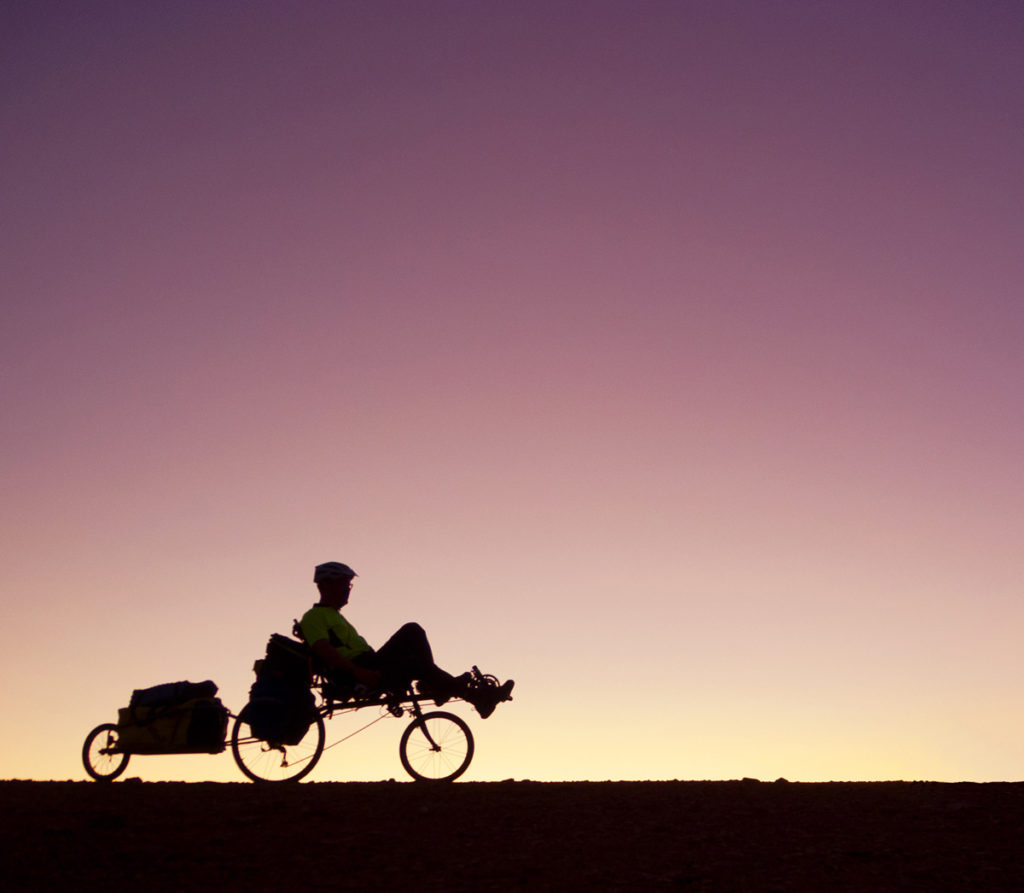
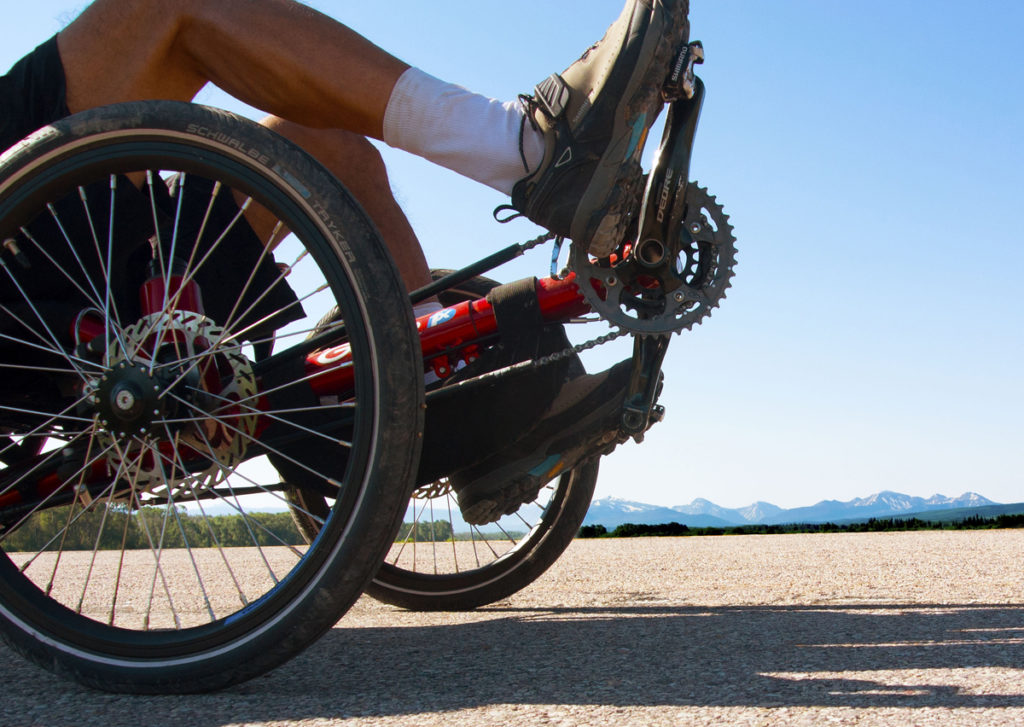
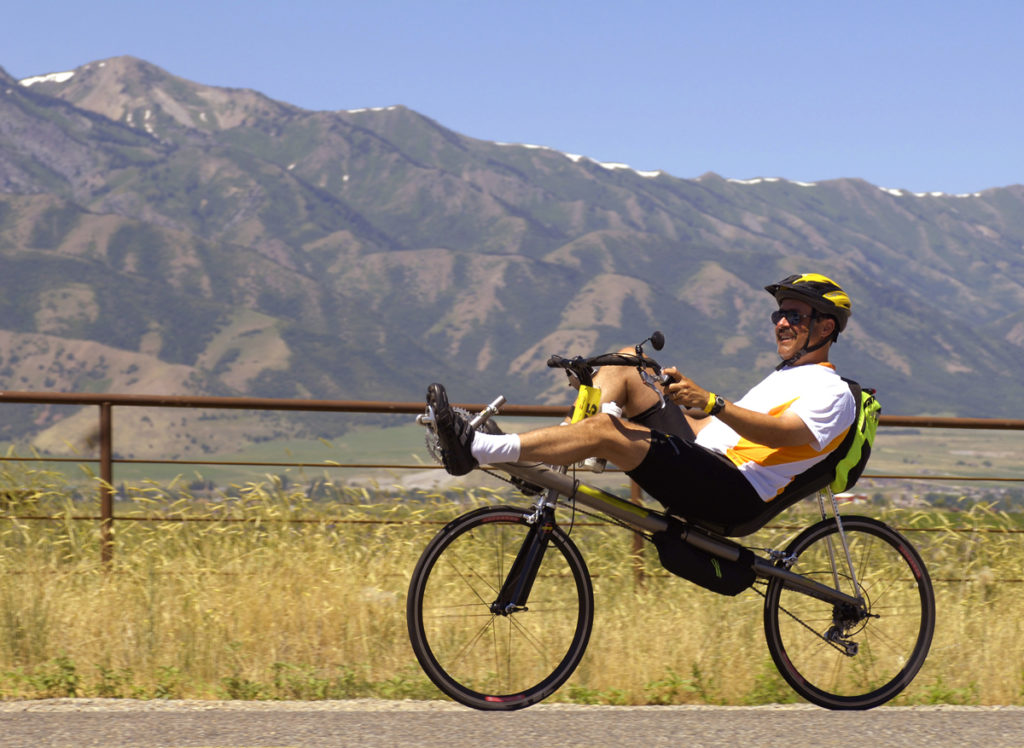
Martin Neunzert somewhere near Lake Powell, Utah (October 2011). Photo by Martin Neunzert
Part of the Uinta Mountains south of Evanston, Wyoming, beyond Martin Neunzert’s trike (July 2017). Photo by Martin Neunzert
Martin Neunzert on the Legacy Parkway Trail, Centerville, Utah. Photo by Arleigh Neunzert.


Martin Neunzert has been riding recumbents of all kinds for so long he says he’s forgotten what cycling pain is. When a bout with cancer nearly ended his life, he found a tricycle was a huge factor in allowing him to get back on wheels. His doctors and therapists credit his adaptability and determination to helping him make an almost full recovery. He hastens to note he is not nearly creative enough to make this stuff up; everything here has happened to him. Except the handgun. He found that on a mountain bike trail.

The Relationship Between Cyclists and Police Officers

By Russ Hymas and Ken Christensen – If you’ve ever been hit by a car while on your bike, you already know that one of the first things you do – after checking out the damage to your beloved bike, of course – is call the police. At the scene of the accident, a police officer’s duty is to make sure everyone is safe, take statements, and collect evidence that can be used in determining fault.

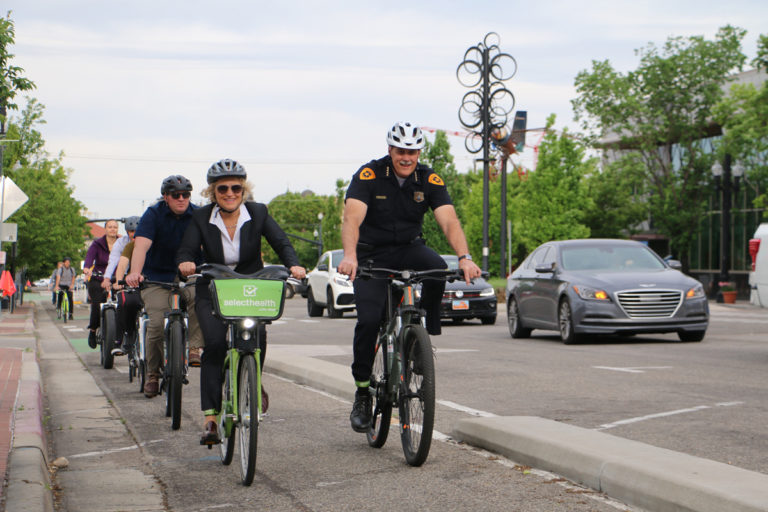
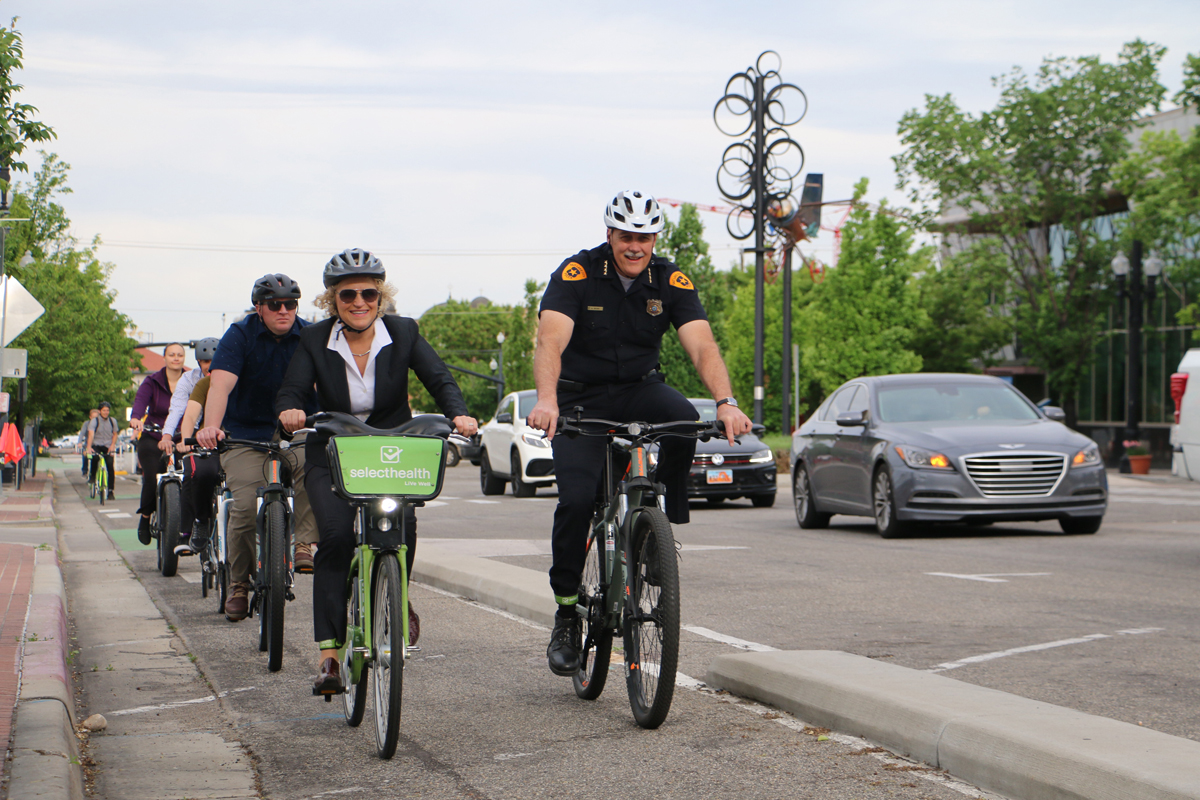
It’s important to establish a good relationship between cyclists and police officers. Here, Salt Lake City Police Chief Mike Brown (right) rides with Mayor Jackie Biskupski (left) in the 2019 Salt Lake City Mayor’s Bike to Work Day. Photo by Dave Iltis

Police officers put their lives on the line every day to keep us, our families and our communities safe. They see things and handle situations that would send most of us running in the opposite direction. But since officers are required to handle so many different situations, they can sometimes be less familiar with certain types of situations, such as cycling accidents. When it comes to car accidents, the scene is a familiar one for police officers. But a cycling accident can be different. Often times, police officers aren’t nearly as well-versed in cycling laws and the privileges afforded us.

In addition to the frustration this can cause for an injured cyclist, it can also have a significant impact on your ability to receive compensation for your damaged bike and injuries. If an officer is lacking in knowledge of cycling laws or the propriety of the cyclist’s actions, the traffic accident report he or she generates may lack accuracy or clarity on what happened in the accident and who is at fault.

This does NOT mean that you shouldn’t call the police after an accident. An incomplete accident report is better than none at all – especially in circumstances where some damage to your bike is overlooked, or your injuries aren’t fully recognized until the adrenaline wears off. What it DOES mean is that, as cyclists, we need to be extra diligent in documenting the events surrounding an accident. Riding with a GoPro or taillight camera is an excellent way to ensure your riding behavior is documented. Bike computers, Strava or other training apps, and photographs of the damage to your bike, the car involved, and the scene of the accident, are also extremely helpful.

The police officer may determine liability and issue a citation to one or both of the parties involved. The officer can also decide not to give any citations at all. Such a decision can add the proverbial insult to injury for a battered cyclist that watches a careless driver get away without so much as a slap on the wrist. But the issuance of a citation isn’t necessary for a personal injury claim. In fact, the citation isn’t even admissible in court! The jury or judge will be asked to determine fault based on the all the evidence and isn’t allowed to be influenced by whether a party received a citation or not.

This should go without saying, but always treat the police officer with courtesy and respect. You may be more familiar with Utah bike laws than the responding officer, but you don’t have to prove this at the scene of the accident. So becoming confrontational at the scene will likely do more harm than good. In certain circumstances, the police officer may be asked to come to court later on and testify as a witness in your injury case. The officer’s perspective can be very helpful and you do not want the officer to harbor animosity toward you because of the way you acted at the accident scene.

Cyclists are passionate about protecting our right to be on the road, but that right is nothing more than a privilege that can be taken away from us. Our right to use the road is not protected in our state or federal constitutions. By refusing to act maturely and responsibly, we are damaging our privilege to ride and can undermine the hard-earned gains from organizations such as Cycling West, BikeUtah, and many others. Just remember your grandmother’s sage advice … You can catch more flies with honey than vinegar.

Ken Christensen and Russ Hymas are avid cyclists and Utah attorneys at UtahBicycleLawyers.com. Their legal practice is devoted to helping cyclists injured in collisions with motor vehicles. They are authors of the Utah Bicycle Accident Handbook and are nationally recognized legal experts on cycling laws and safety.

Balance of Power (and Flexibility): Yoga for Endurance Athletes

By Melinda Macfarlane with Mark Deterline – 

Assistant Editor’s intro: In 2013, her first year of more structured training and active competing, Melinda built cycling and endurance fitness upon a foundation comprised largely of years of dedicated yoga. She flew up through the ranks to become one of Utah’s top female racers, while balancing racing with a supportive hubby, two young daughters and work.

Following several road race victories, including a state championship title, and on much less massive-mileage training than most, she pulled off her most impressive feat of the year: in 9:35, she not only accomplished her main competitive objective of 2013 by winning Logan to Jackson (LOTOJA) in the elite women’s division, she set the women’s course record in that grueling race covering more than 200 miles.

Monuments of achievement like that are built upon a firm foundation, and that is what yoga and cross-training mean to many successful endurance athletes.

* * *

Let’s be honest, cyclists are not generally known for their willingness to cross-train. One can tell by the – how do I put this delicately – oft lack of muscle definition in their arms that upper body conditioning is not high on their list of priorities. A personal example is the multitude of questions I get after posting photos from a run or hike: “Is your bike broken?”

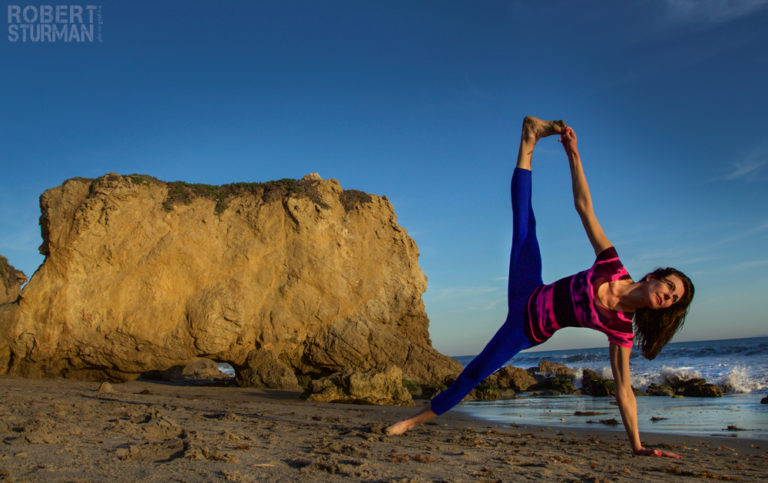
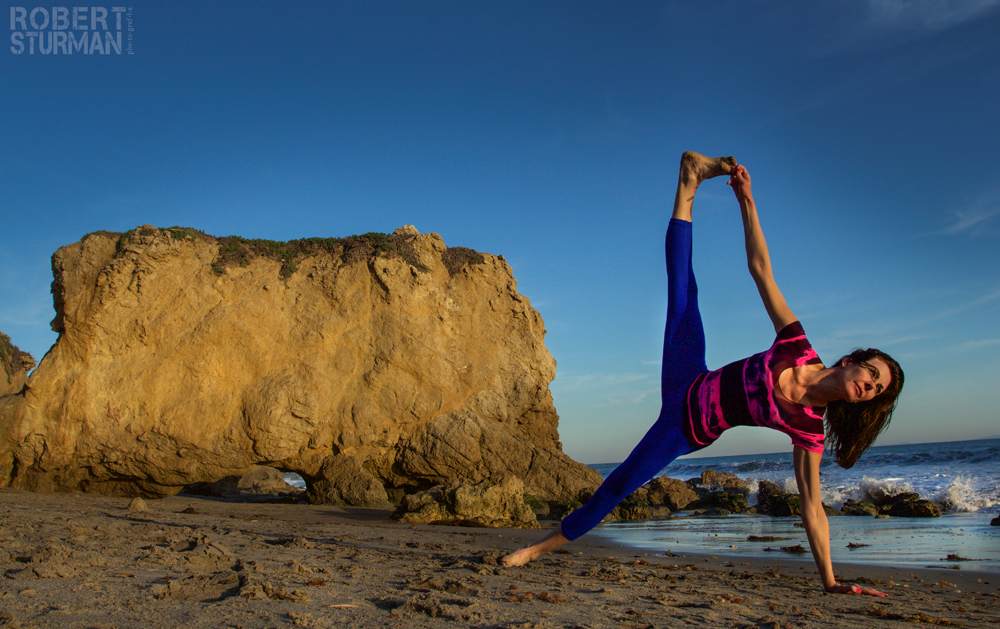
Yoga instructor, bike racer and XC/DH ski enthusiast Melissa Snow demonstrates “Vasistasana” side planking in Malibu. Melissa teaches beginner to advanced classes, and will write next issue’s yoga column. Photo by Robert Sturman, robertsturmanstudio.com.

In my opinion, cycling is one of the most fun activities in which a person can participate recreationally, as a form of exercise and as a competitive sport. It makes total sense that when I have any precious free time, my first instinct is to spend more time on my bike than to cross-train because one, I want to become a stronger and faster cyclist, but two, I just really enjoy it!

I had been both practicing and teaching yoga for years before I found cycling, so I am embarrassed to admit this, but my personal yoga completely fell by the wayside when I started cycling competitively. My excuse? “I don’t have time to do both; every spare second I have needs to be spent on the bike.” My coach even tried to teach me the importance of cross-training very early on in my cycling obsession, but I wouldn’t listen until I started having nagging pains, as well as overuse injuries.

I knew better! I am a yoga instructor, for heaven’s sake. But I still allowed my obsession with the bike get the best of me. Don’t let that happen to you…

I love yoga because it strengthens in ways nothing else does, the breath work does wonders for your cardio, and the meditative and emotional benefits are profound. Most of all, I love yoga because it keeps me injury and pain free. While all of these benefits are sublime, they often prove insufficient in motivating hardcore cyclists to make time for yoga. But perhaps this reality check will: in my experience, the only thing other than a bike fit by a trained, experienced and truly gifted bike fitter will keep you as pain and injury free as yoga.

So, I ask you to consider the following questions carefully. Do you love to ride your bike? Do you want to be able to ride your bike well into your later years? Then do yoga.

Of course I want to encourage everyone to attend classes, although realistically, many of us just won’t make the time. So, I’ll share some poses I know to be important and effective; there are plenty of videos and photos online to help you learn how to master these. Also, more and more instructors are streaming live classes that anyone with an internet connection can follow in real-time.

Downward Dog. Start with your knees sufficiently bent so that it’s NOT about the hamstrings, at first. Allowing the right bend in the knees will release your lower back. Reach your sit bones skyward by slightly arching your lower back. Then as you warm up, gently work your heels toward the floor, slowly straightening your legs so that you start to feel your hamstrings. Your legs may never get completely strait and your heels may never touch the floor. If you feel your hamstrings releasing, that is all that matters.

High or Crescent Lunge. Great for your hip flexors. Play around with reaching back through the heel to also release your calves.

High Lunge Twist. From the pose above, put your hands in prayer position at your chest, then take one elbow to the opposite knee. If that proves too intense, just take one hand to the floor and the other skyward in a twist. Riding bikes, our backs get so tight! This is a great release for your entire back, not to mention what it’s doing for your legs.

Modified Bridge. This strengthens the back and opens the front of the body, which is important after being on a bike.

Pigeon. Stretches hips and glutes. Remember, pinpoint pain is never OK! Lots of people overstretch the knees in this pose, and that is NOT GOOD. Sensation – even intense sensation – is ok, but sharp, pinpoint pain never is. If this proves too intense, lie on your back, take one foot to the top of the opposite thigh, essentially accomplishing the same thing. Even better, turn it into a balance pose by standing on one leg, taking the opposite foot on top of the standing leg’s thigh, and bend that leg into a squat. So, if you’re standing on your left leg, the right foot is on top of the left thigh, with the right knee over to the right. Deep bend with the left leg, butt back, weight in left heel.

Dancer Pose. This one is intense and probably too much for most who are less experienced, although it’s great for balance, and we MUST find a way to release our quads. If Dancer is too much, just balance on one leg, pulling the foot toward the glute of the leg you are not standing on. Not many poses in yoga release quads sufficiently for cyclists, in my opinion, so make sure to master the poses that do, and plan on looking into other ways for you to get that essential release.

IT Band Forward Fold. Way too many of us suffer from pain on the outside of the knee. While the following isn’t really an official yoga pose, as far as I’m aware, I include it in almost every one of my yoga classes because our IT Bands can get so tight. Cross one leg in front of the other and fold forward. Simple as that.

Forearm plank. Core strength is so important, and this is a good way to not only feel the core, but really to strengthen the entire body.

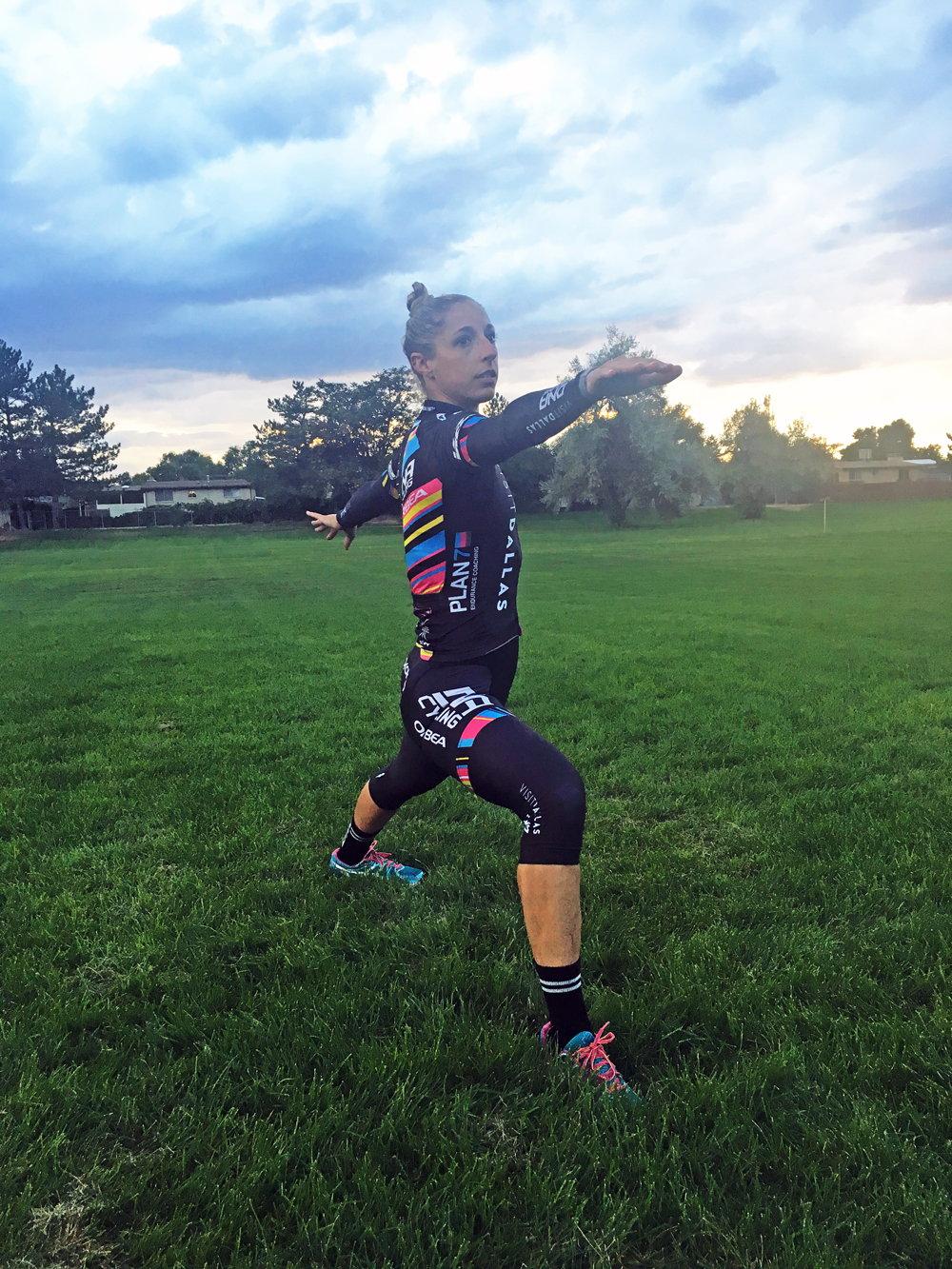
Mindy McCutcheon uses yoga as a key part of her training. She is shown here in Warrior pose. Photo courtesy Mindy McCutcheon

If you can get to a yoga class, please do. All of this will make much more sense if you work with an instructor. Start with a beginner’s class as soon as you can find one that fits into your schedule. We all know that the surest way to dislike something, even something potentially rewarding and gratifying, is to try to do too much, too soon, especially if it’s beyond our current level of competence. If initial classes are too demanding, you could get discouraged — and much worse, you could get injured.

If you don’t feel capable of committing to a class or even to a video, just do something safe and effective to help release all of the tension that cycling can cause, and work to heal the overuse damage we sometimes do. From there, we begin to build ourselves back up, as opposed to potentially breaking ourselves down. As we invest in our bodies and ourselves in this positive way, and as the tension dissipates and our strength increases, we get what we healthfully and ultimately want:

More functional power, more endurance, more comfort and more speed.

Melinda Macfarlane’s athletic bio from her coach’s perspective: Melinda is a longtime yoga instructor and cross-training devotee, which served her extremely well as a burgeoning bike racer. Her foundation of yoga, (trail) running, hiking, etc. catapulted her up through the ranks to complete a whirlwind 2yr racing career as a two-time State Road Race Champion, fastest ever women’s finisher at LOTOJA, along with numerous podiums and medals. What impressed me most about Melinda was her willingness to face her fears regarding the dangers of bike racing and insecurities around whether she could really do it. And she did it.

Silca Nears Perfection With Pumps

Since 1917, Silca has been the pump of choice of the professional peloton because of their reliability and serviceability. They are the only pump manufacturer that has been offering fully rebuildable products for their entire existence, now over 100 years.

I’ve had a love affair with Silca pumps since I first started riding bikes some 30-ish years ago … in fact, my original Silca Pista from the late-1980s is still going strong with just a couple of overhauls to replace gaskets and the leather plunger in that time.

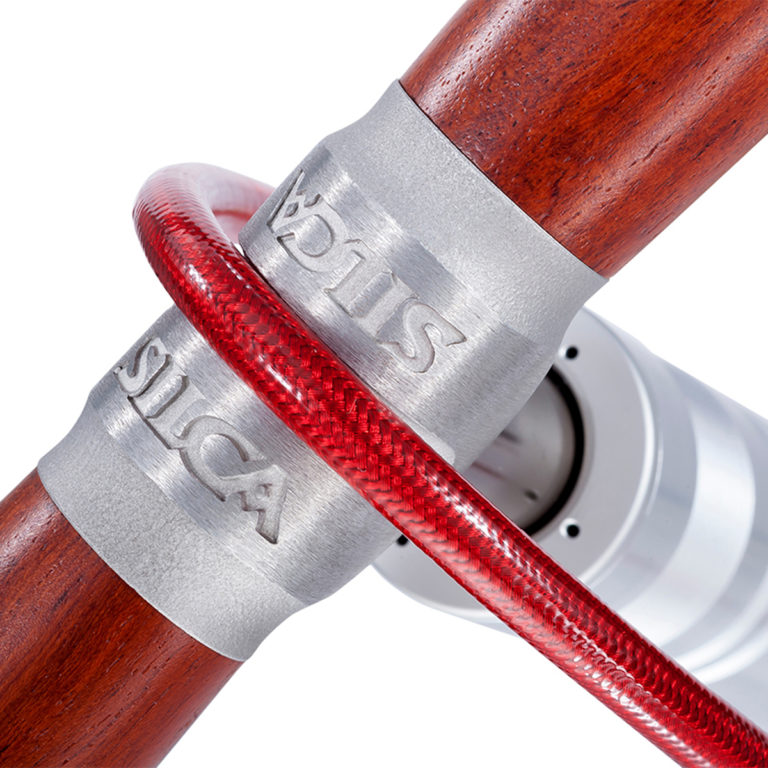
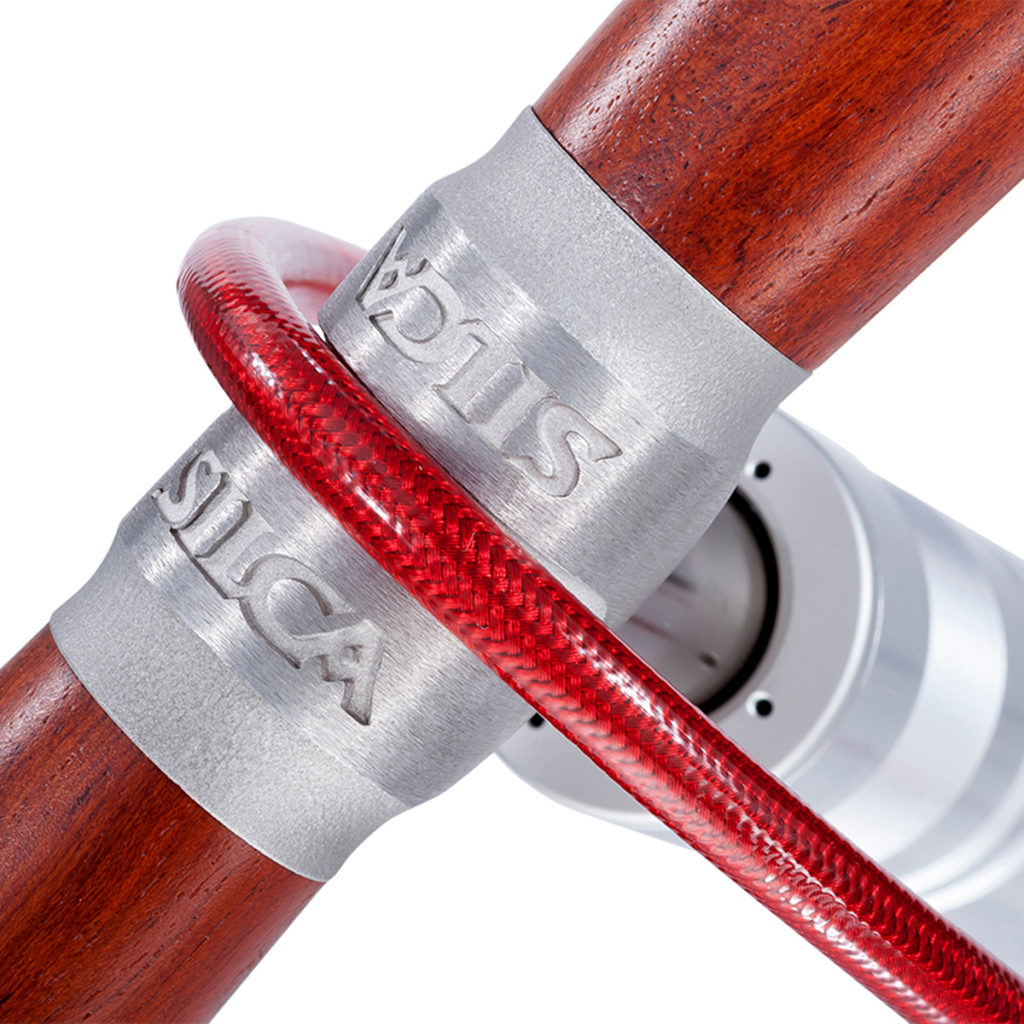
The Silca Superpista Ultimate floor pump is perhaps the last pump you will ever need to buy. It’s rebuildable, and finely crafted. Photo by Joe Vondersaar, courtesy Silca

The only downside with my original pump is that the stroke is so short compared to many modern pumps; but modern pumps use a lot of plastic and wear out with heavy use, and when they do, it’s difficult to find replacement parts to get them back up and running again. One gets tired of having to replace chucks (or buying a new pump, because it’s only $5-10 more than buying the replacement chuck) every few years.

When the new owners of Silca moved production from Italy to the United States and came out with the new Silca SuperPista and the SuperPista Ultimate, I knew I had to have one. If it’s possible to have an airgasm inflating your tires before a ride, then these pumps are the way to do it.

The SuperPista Ultimate (MSRP $450.00) has a steel barrel and comes with a replaceable 0-160psi gauge; which can be swapped out with a separate 0-60psi gauge for low pressure uses, such as dialing in the pressure on cyclocross tubulars or fat mountain bike tires. With its steel barrel and heavy zinc base, the Ultimate feels really solid, stable, and steady when in use, more so than any other pump I have ever used. For an additional $50.00, you can get the pump with the award-winning HIRO Locking Chuck ($110 aftermarket) instead of an updated version of the traditional Presta Chuck that Silca has been known for nearly 100 years.

The Ultimate’s less-expensive alternative (the SuperPista) is 99% as awesome for high pressure at 55% of the price.

The SuperPista (MSPR $235.00) is made of aluminium and does not have a replaceable gauge for low pressure uses, so it’s not the best tool for getting those Dugasts dialed in at 19.5psi in the front and 20.5psi in the rear at your next cyclocross race. While the machined aluminium base is exactly the same size as on its big brother, it feels just ever so slightly less stable when pumping up your tires because of its lighter weight. But seriously, we’re talking about a percentage point here, and it’s still better than the vast majority of pumps out there.

Neither pump has any plastic in any critical areas, most notably on the shaft and plunger; in fact, the only plastic I can find on either pump is the lens on the gauges.

Like the original Italian-made pumps, all the critical parts including the heavy leather washers which comprise the plunger, are serviceable and/or replaceable, and both pumps come with a 25-year warranty. In the bicycle industry, where technology (and companies) comes and goes, it’s refreshing to know that there are some constants.

Did I need a new pump? No, because like I said, my original Pista is still going strong … but the new Silca pumps work even better than the original, and it’s nice knowing that I will never need to buy another pump again.

Silca products are available direct from Silca (www.silca.cc) and from finer bicycle retailers nationwide.

Colorado’s Team Evergreen Awards $300,000 in 2019 Charitable Donations

EVERGREEN, Colorado (October 28th, 2019) — Team Evergreen Cycling (the largest cycling club in Colorado, established in 1988) recently announced their grant winners for 2019-2020 on October 27th. $135,000 in donations will be split among 21 recipients for the upcoming season. Combined with earlier contributions for the year, this puts the total gifts given (year to date) at almost $300,000.

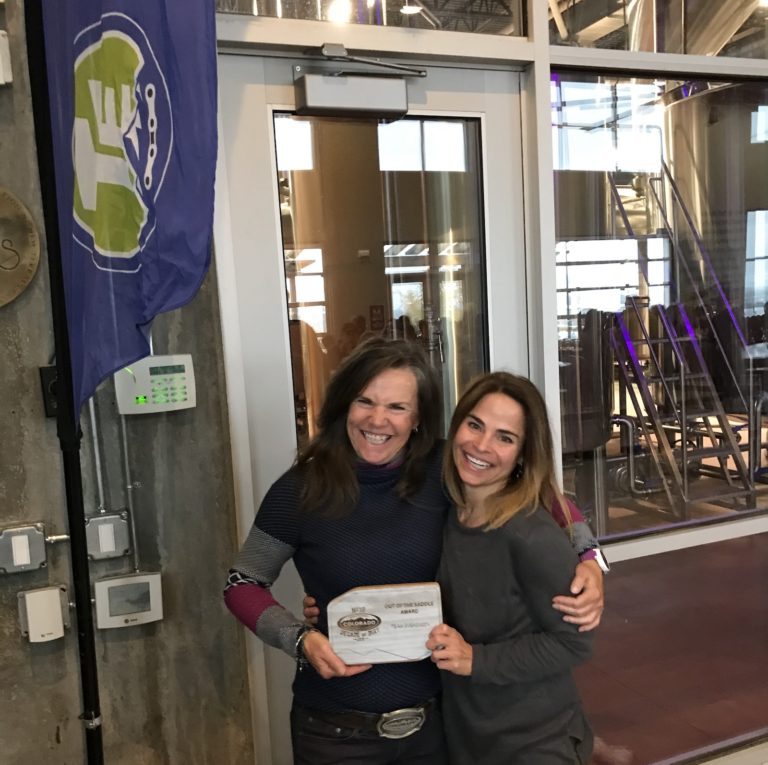
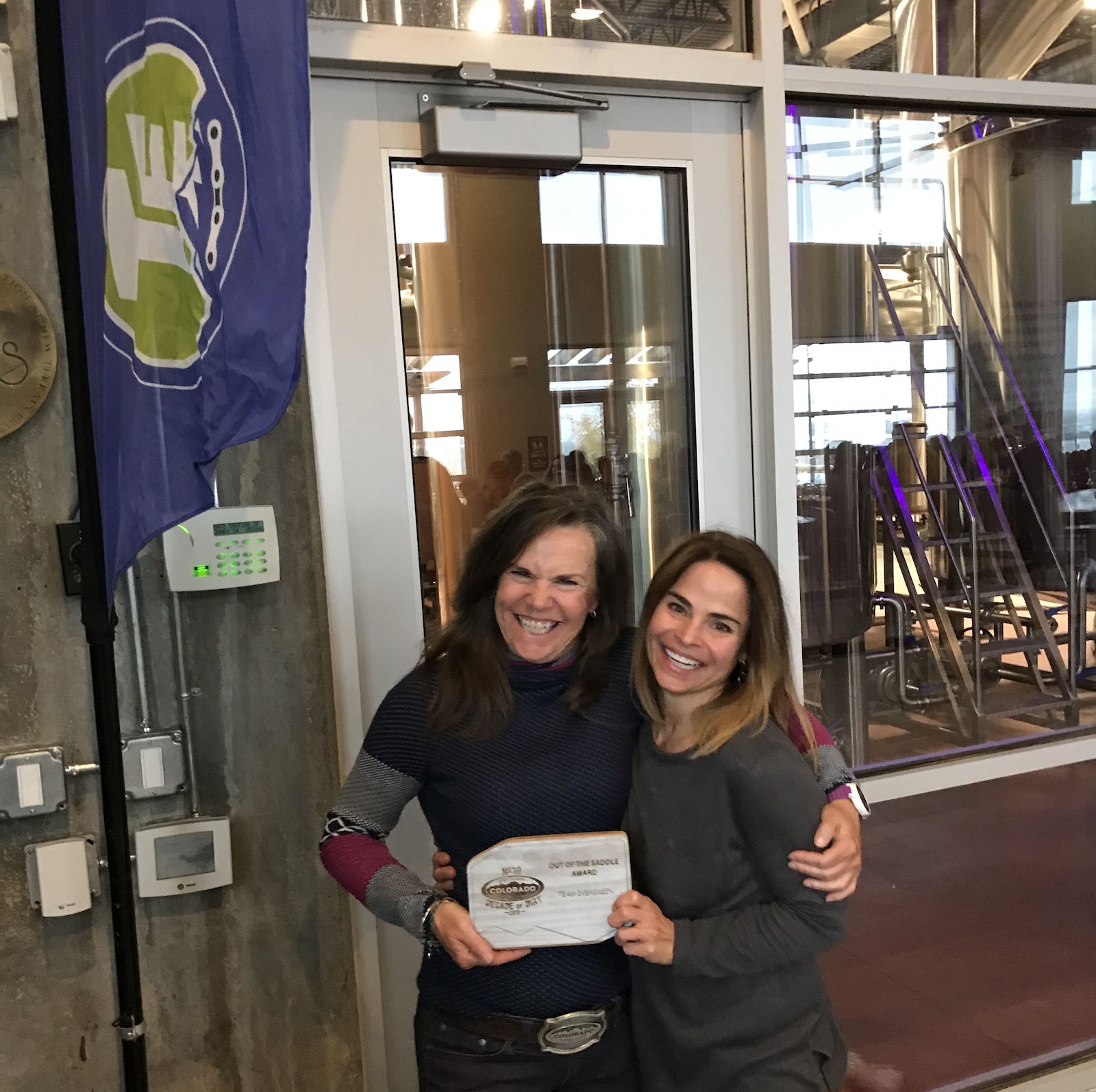
Colorado HS MTB League Exec Director Kate Rau (L) and Team Evergreen Executive Director Jen Barbour (R). Photo courtesy Team Evergreen

This year’s application process allowed Team Evergreen to consider a variety of charitable organizations (not necessarily related to cycling) in Jefferson, Clear Creek, Summit and Eagle Counties. Grants were to be considered based on the following categories:

  • Advocacy Grants – Nonprofit advocacy organizations relating to cycling in the Colorado and Rocky Mountain Region.
  • Community Grants – Nonprofit community based organizations in areas that host our events.
  • Trail Projects – Funds for trail projects (hard or soft surface) including required cash matches for grant applications, signage and related equipment purchases.

Jen Barbour, Executive Director of Team Evergreen/Triple Bypass states:

“Team Evergreen has been invested in our local communities and the state of Colorado since its beginning. As we’ve grown, so has our ability to make a positive impact. We expanded our grant considerations to further our reach.

“We believe in supporting the advocacy organizations that continue to make a big impact in our state. Providing grant assistance and volunteers for organizations such as Bicycle Colorado and COMBA (Colorado Mountain Biking Association), were obvious choices. But we also wanted to give back to the communities that graciously host our events. As we found with this year’s grant applications, this can be done through a myriad of ways.

“Whether it’s providing the Clear Creek EMS with new stretchers, or assisting with neighborhood rehabilitation projects, each Team Evergreen grant recipient is a worthy one.”

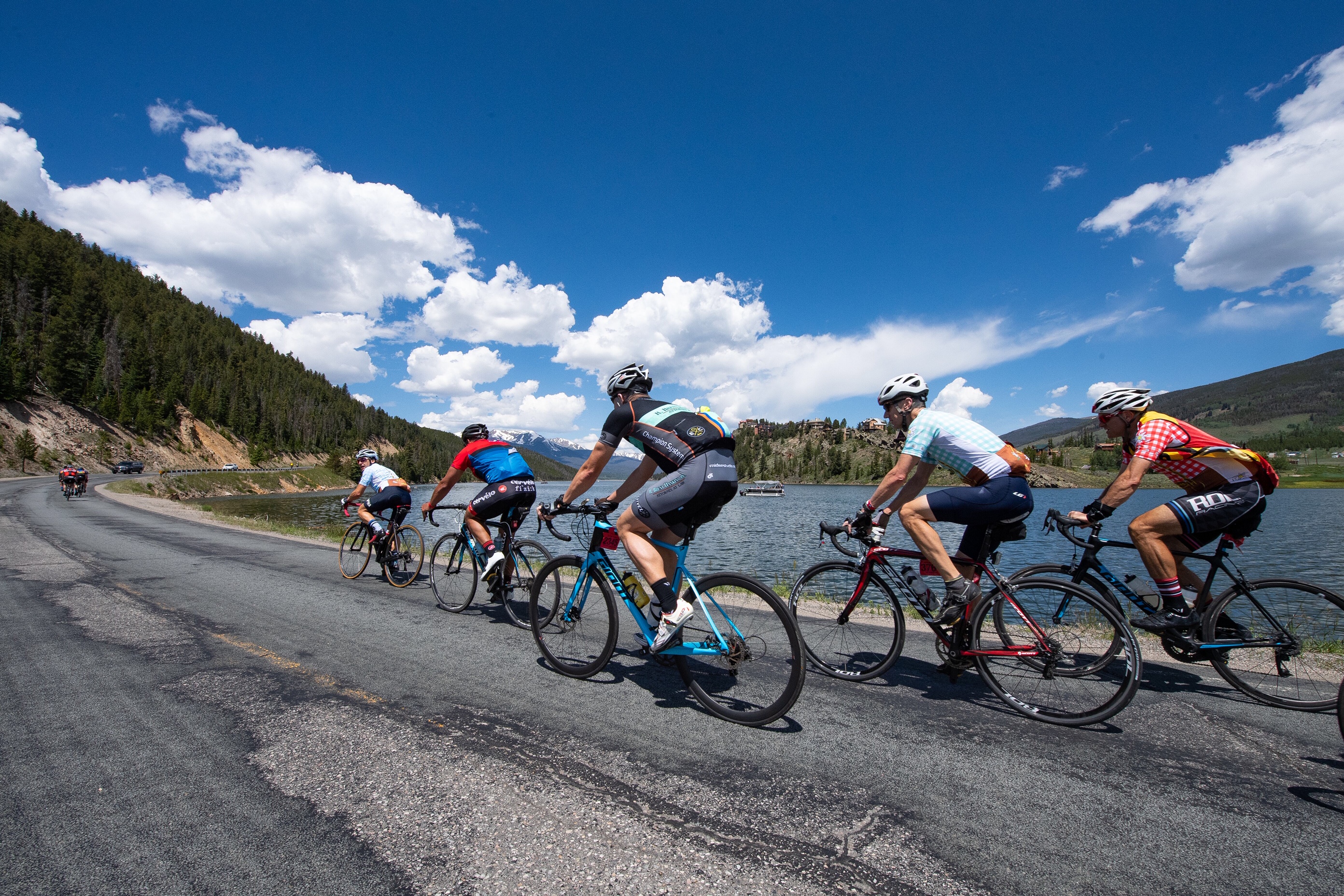
Riders on the annual Triple Bypass Ride, one of Team Evergreen’s major fundraising events. Photo courtesy Team Evergreen

With continued success, Team Evergreen plans to continue the grant process again for 2020-2021. To find out more visit www.teamevergreen.org

Organizations receiving grants include:

2019 TE Grant Recipients
GROUP PROJECT /PROGRAM SUMMARY
Advocacy
Colorado Mountain Bike Association (COMBA) Advocacy support for Mountain Biking
COMBA/Clear Creek Open Space Floyd Hill Segment 4 Trail Constuction
Colorado High School Cycling League HS MTB athletics and race scholarships
Special Olympics Colorado Special Olympian Cycling Program
Bicycle Colorado Bike School program
Bikes Together – Denver Provide lock, light and helmet to 360 people
Eyecycle Colorado Provide cycling activity for visually impaired persons
Bike Jeffco, Inc. Bike advocacy in Jefferson County
Front Rangers Cycling – Denver Role models and cycling programs for Denver at-risk youth
Davis Phinney Foundation Tour de Victory
Bicycle Racing Association of Colorado (BRAC) Outreach, women’s programs, website
Evergreen Parks and Rec Junior MTB Program
Community
Project Bike Tech – Summit County Equipment for bike mechanic programs in high schools
The Cycle Effect – Eagle Low Income Hispanic/Latina Girls MTB program
Scraps to Soil – Clear Creek Teaching Clear Creek County the benefit of composting
Clear Creek County Library District Bicycle Racks and updated outdoor seating
Clear Creek EMS Five new scoop stretchers
Clear Creek Advocates Provides services to victims of crime and trauma in Clear Creek
Clear Creek Rock House – Idaho Springs Mentoring and tutoring program for at-risk youth
Trail Pojects
Colorado Mountain Bike Association (COMBA) Cash match for North Elk Trail Project
Other
Neighborhood Rehab Project / Be A Tool Repairs to a home of a paraprofessional in Idaho Springs

Why I Ride

By Joe Kurmaskie – The genesis of my entire life was experiencing the complete control, abandon and ecstasy of that first afternoon on a bicycle. 

Even the streetlight’s flicker couldn’t bring me in.

It opened me wide for everything after; love and reaching for things real and beautiful, trying even after the passage of hope, the strength to lose, and the pull and lure of the long dark ride called America. 

Commuting and sightseeing by bike on a recent trip to Florida. No rental cars were used in the making of that trip. Photo by Julie Palermo

I’ve been chasing, occasionally catching my first ride dragon ever since. 

And since that fateful day at 5 years of age, I’ve been bullish on bicycles, some might even say evangelical at times, but mostly I try to show by example and through storytelling. Here’s the hard science story side of bikes that keeps me preaching its gospel;

I’ve always been bullish on bicycles…

  1. Bicycling keeps avg of $10,000 of savings in your pocket vs a car. 
  2. A bicycle has a tiny manufacturing footprint when compared to a car. 
  3. Bicycles produce no meaningful pollution when in operation. 
  4. Bikes save taxpayers money by reducing road wear. 
  5. A community of cyclists has 10 times the disposable income to spend in local businesses.
  6. Using a bike for transportation can help you lose weight and improve your overall health. 
  7. You can store a dozen bicycles in a single automobile-sized parking place. 
  8. Bicycles don’t burn gasoline. 
  9. Bicycling is often faster and more efficient than taking a car. 
  10. Bikes cost thousands per year less to maintain and operate than automobiles.
  11. Bicycling would reduce transportation fatalities by 99 percent.
  12. Bicycle commuters are more productive, and require less time off at work.
  13. It’s the most fun you’ll have with your clothes on.

And if we truly want a revolution against the suicidal energy policies being proposed by climate deniers then get out of your car and onto a bicycle, mass trans, foot. Even a few days a week. If we cut  national car use by just TEN percent it would up end the fossil fuel industry and change EVERYTHING.

Now, thinking beyond all the world changing benefits of the bicycle, allow me to end on a Zen note about the absurd and funny moments the bicycle has given me. A man, maybe this man, once took a bicycle ride to a holy place on a high pass. Worn to the bone, cold and wet and hungry, this man took his place across from the teacher. Waiting for last light to leave the sky he asked his questions. Time slowed, then seemed to stop. 

The teacher leaned in, conspiratorially. “Perhaps, Jessie’s girl grew up to be Stacy’s mom.”  (Credit goes to Rick Springfield’s classic pop hit, Jessie’s Girl and  another one hit wonder, Fountain’s Of Wayne’s, Stacy’s Mom)  

Joe Kurmaskie is a journalist, syndicated columnist, and contributor to numerous magazines including Outside, Bicycling Magazine, Men’s Journal and Parenting. He’s a bike advocate, activist, founder of Cadence Press, and a Random House author of seven books including Metal Cowboy, Mud, Sweat and Gears and A Guide To Falling Down In Public.