By Gail Newbold — The beauty of cycling in Sun Valley is you don’t need to bring your game face. Or your fancy kit. Unless you want to, of course. This sprawling landscape made famous for its celebrity skiing, now draws cyclists of all ilks to its crown jewel of paved paths: the Wood River Trail.
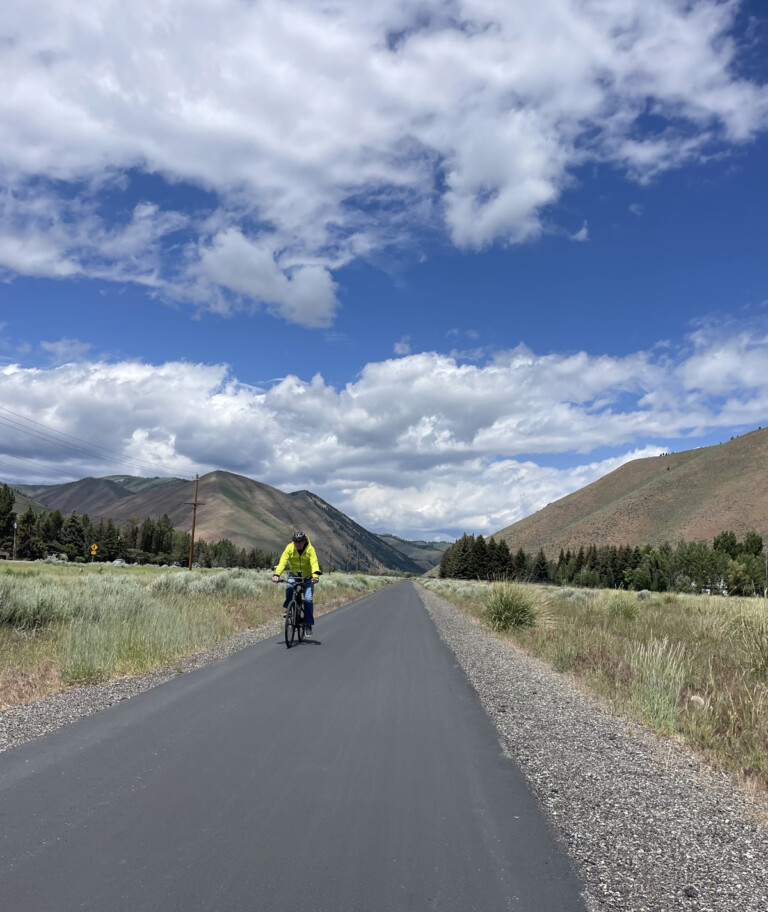
The beautiful Wood River Trail between Sun Valley and its northernmost end. Continue your ride north on the remote paved road at the trail’s end to get more bang for your buck. Photo by Gail Newbold
On a weekend in June, you’ll see riders in full professional gear on premium high-performance bikes sailing past families on rental bikes with grandma in the lead and kids trailing behind. There will be no shortage of golden-age couples living their best lives, randos in cotton tees and basketball shorts, and locals commuting from point A to B. You might even spot a few recumbent trikes.
Chill vibes and smiles abound. It’s not hard to understand why.
The tiny Hailey Farmers Market is a short ride off the Wood River Trail. It takes place every Saturday from 9 am – 1 pm at Roberta McKercher Park, June 14 through October 18. Photo by Gail Newbold
Spectacular Scenery and Paved Trails
Nestled among the surrounding Rocky Mountains in central Idaho, the Wood River Trail offers up spectacular scenery (and wildflowers) along its central spine that spans 20-plus miles and a loop with additional spurs at its northern end, making for a total of 36 miles of trail. And since it also serves as a connector for the communities in the Wood River Valley and Sun Valley areas, this means that lodging, restaurants, and other services are available along the trail. On summer Saturdays there is a cute farmers market with live music in Hailey at the Roberta McKercher Park a few blocks off the trail.
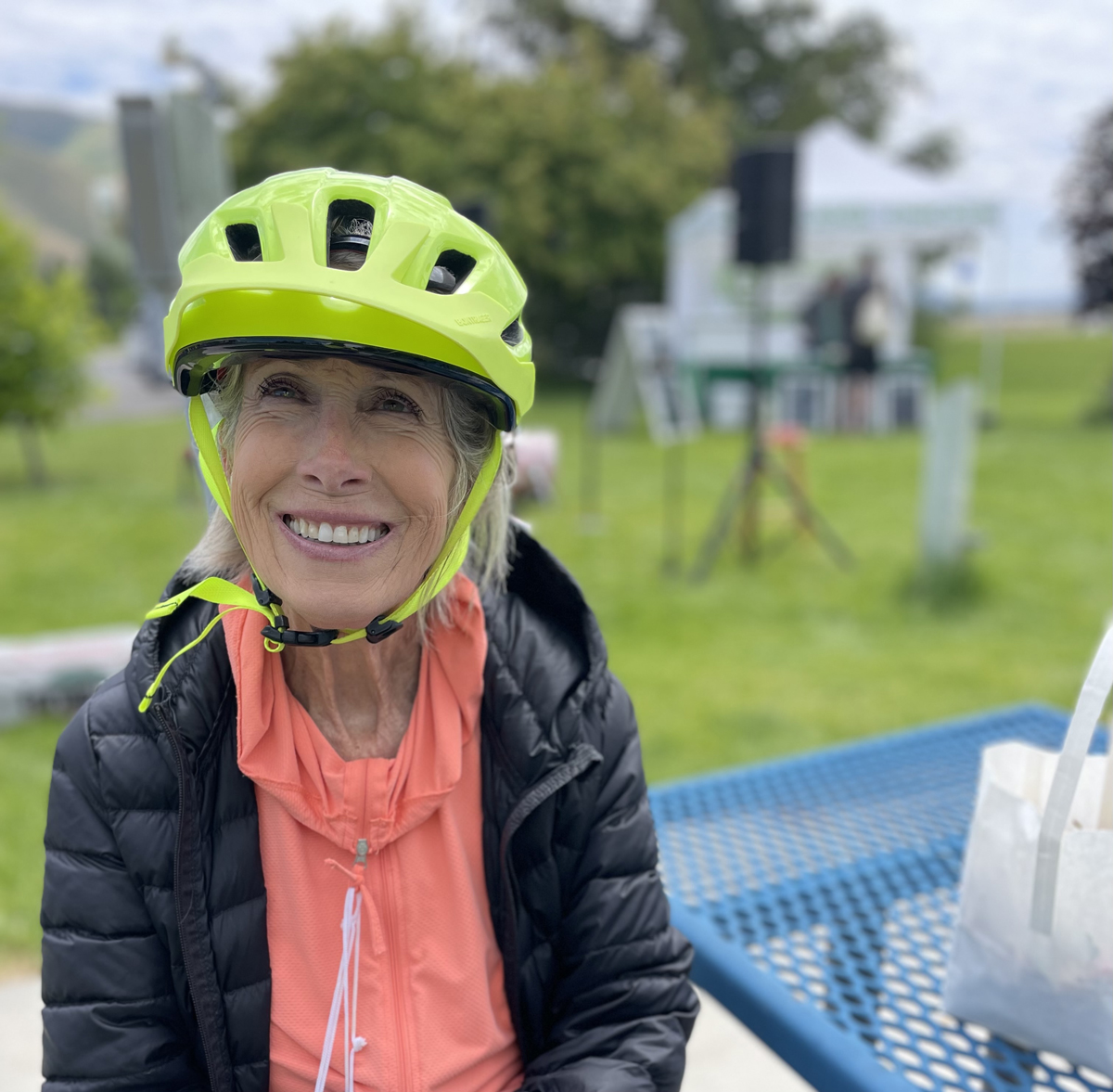
Gail Newbold basking in the live music at the Hailey Farmers Market. Photo by Dave Newbold
An added perk are the paved trails that connect the Wood River Trail to some of the condo developments, such as Elkhorn Village and the famous Sun Valley Resort. This means no biking on busy roads and no need to transport your bike to an access point.
At various Wood River Trail end points, you can even continue your ride on lightly trafficked remote roads into the mountains for as long as your legs can handle. The area is also rife with mountain biking trails and even gravel riding.
Not for the Faint of Heart
Fearless cyclists can tackle the challenging but rewarding 20–25-mile climb from Sun Valley to the beautiful Galena Pass, for an elevation gain of 3,000 to 3,500 feet on Highway 75. The route offers spectacular views of the Sawtooth Mountains and the high mountain valley north of Sun Valley. The road is smooth, and a shoulder makes it safer for cyclists, but it’s also very winding with a lot of recreational travelers, RVs and boats, so weekdays are best.
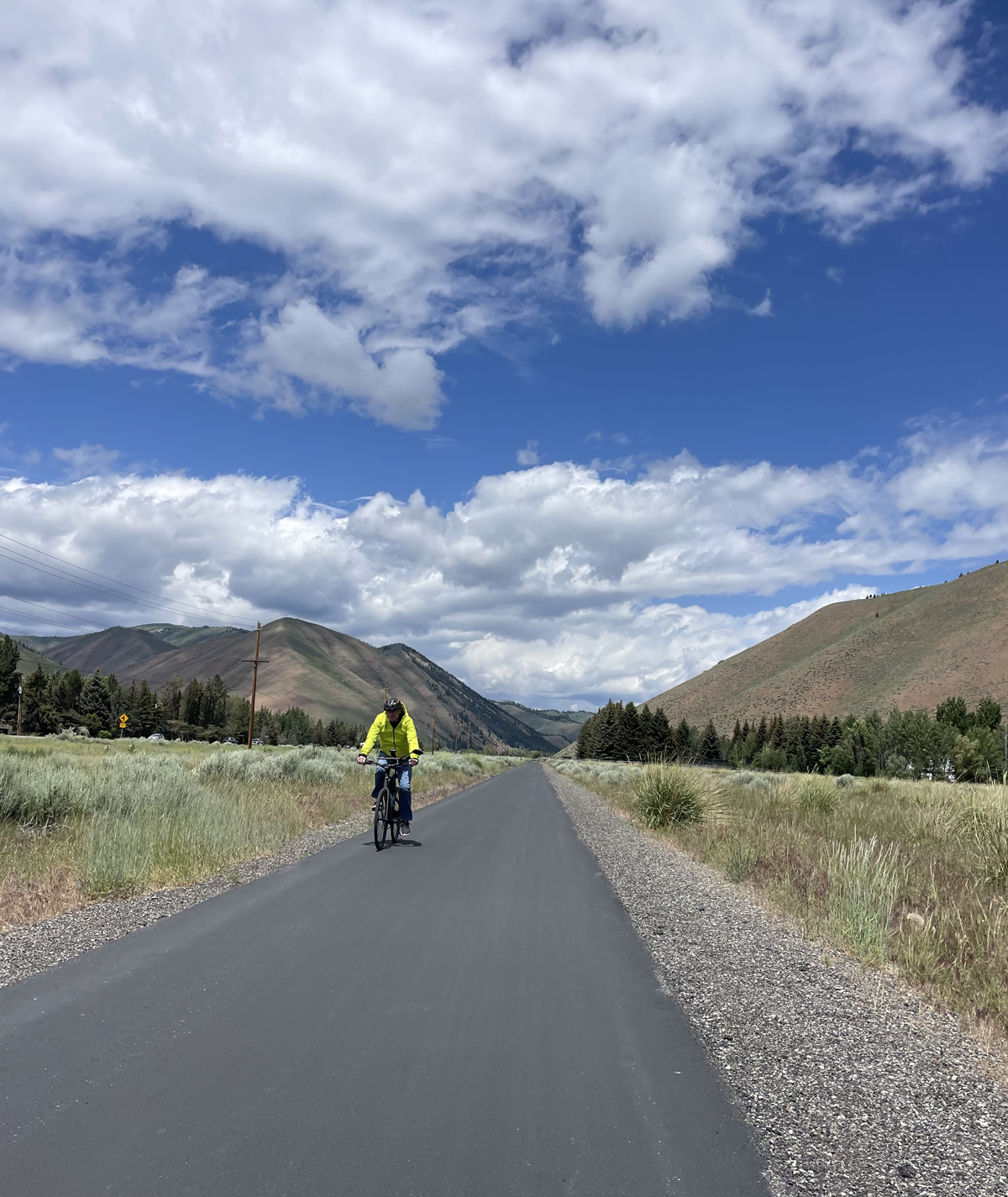
Dave Newbold cycling on the section of the Wood River Trail between Sun Valley and Hailey. Photo by Gail Newbold
While Sun Valley generally experiences warm, sunny summers, plan for surprises especially in the spring and fall. Even June can throw some curveballs as it did this year with winter weather advisories and morning temperatures below 40 one Saturday, and a blizzard the following day. Experienced cyclists donned in their all-weather gear were probably not phased. But novice recreational bikers either froze or wore puffer coats, rain shells, heavy jeans, or whatever they could lay hands on.
If bathrooms are important to you, know they’re hard to find. There is one at the Wood River Forest Service Campground or try searching public parks near your route.
Strangers Feel Like Friends
Turns out, the real sunshine in Sun Valley is the people. On a recent visit, I was blown away by how warm folks were.
At the Hailey Farmers Market where we bought a churro cookie and a super crunch cookie bar, the vendor chatted us up for 10 minutes about her English heritage and the ingredients in her amazing shortbread.
We found that bikers along the Wood River Trail were happy to stop and chat or answer questions. An older rider on a Catrike recumbent trike said he had Parkinsons and terrible balance and his three-wheeled bike allowed him to enjoy the great outdoors without fear.
One evening while searching for a table at crowded Lefty’s Bar & Grill in Ketchum, a man sitting alone at the bar jumped off his stool and insisted on saving a booth for us while we ordered. When we returned to wait for the waiter to bring our food, he hopped back to the bar as we thanked him profusely.
Another day at dusk, we went exploring by car and ended up on Warm Springs Road, which eventually becomes gravel. Drawn by the beautiful scenery and curious about how far the road went, we kept driving until we saw a lone cyclist and stopped to ask where it ended. He was as warm and friendly as others we’d encountered in the Wood River Valley and told us it seemed to go on forever and the summit was beautiful. We learned he enjoys gravel riding, but mostly mountain biking; and that he’s become more sensible with age and won’t cycle in bad weather or when he’s sick.
One last anecdote: While wandering downtown Ketchum in search of ice cream, a tipsy older man joined us. He said he’d been at a brew fest all day but doesn’t drink beer. “I drank hard cider for hours,” he said cheerfully.
More to Explore
If you’re up for a little extra driving, here are a few side trips well worth visiting within 100 miles of Sun Valley.
Craters of the Moon National Monument and Preserve: “Craters of the Moon is a vast ocean of lava flows with scattered islands of cinder cones and sagebrush,” says the NPS website. “We invite you to explore this ‘weird and scenic landscape’ where yesterday’s volcanic events are likely to continue tomorrow. There are variety of fascinating trails, cinder cones to climb, lava tubes to explore and tons of tiny wildflowers. We loved it and found it to be beautiful and peaceful. Note that the roads inside the preserve are narrow and winding with no shoulder. It’s about 65 miles from Sun Valley.
Land of the Yankee Fork State Park: If you’re into mining history, ghost towns and remote dirt roads all to yourself, The Land of the Yankee Fork State Park delivers. The Custer Motorway is 45 miles of pure, wild quiet—just you and the echoes of history. The landscape is ever-changing with wildflowers, historic cemeteries, three ghost towns to wander and a historic gold dredge you can tour. If you exit the motorway at Sunbeam, it’s about 75 miles to Sun Valley.
Red Fish Lake: It’s no secret Red Fish Lake is over-loved and overcrowded, but one look at the clear turquoise water framed by the jagged Sawtooth Mountains and you’ll understand why. You can escape the crowds by taking a seven-minute shuttle ride across the lake where you’ll encounter almost no one on the nearby hiking trails and lakeshore inlets. Splurge at Limbert’s restaurant at the Red Fish Lake Lodge.
‘Worlds’ Return to Durango 40 Years After the City Hosted the Inaugural Event in 1990
DURANGO, Colorado (September 25, 2025) — The Union Cycliste Internationale (UCI) announced today that Durango, Colorado, will be the host city of the 2030 UCI Mountain Bike World Championships. The event marks the 40-year anniversary from when the town of Durango and Purgatory Resort hosted the very first UCI mountain bike world championships races in 1990.
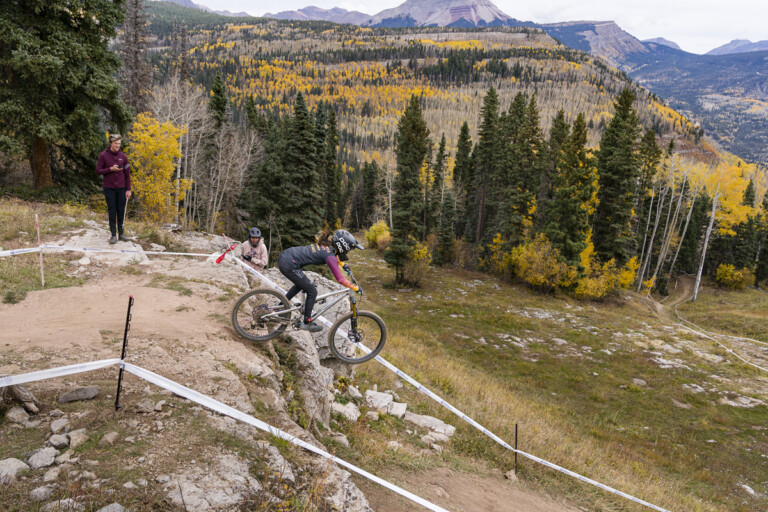
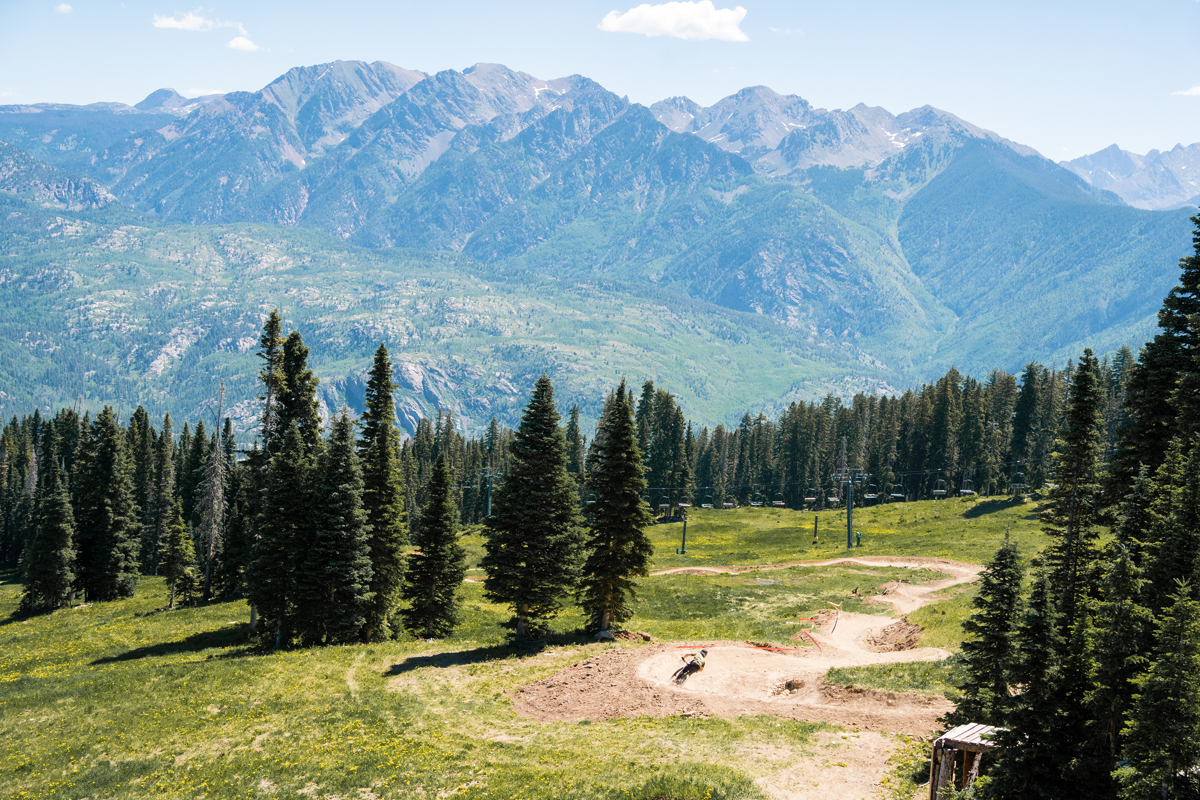
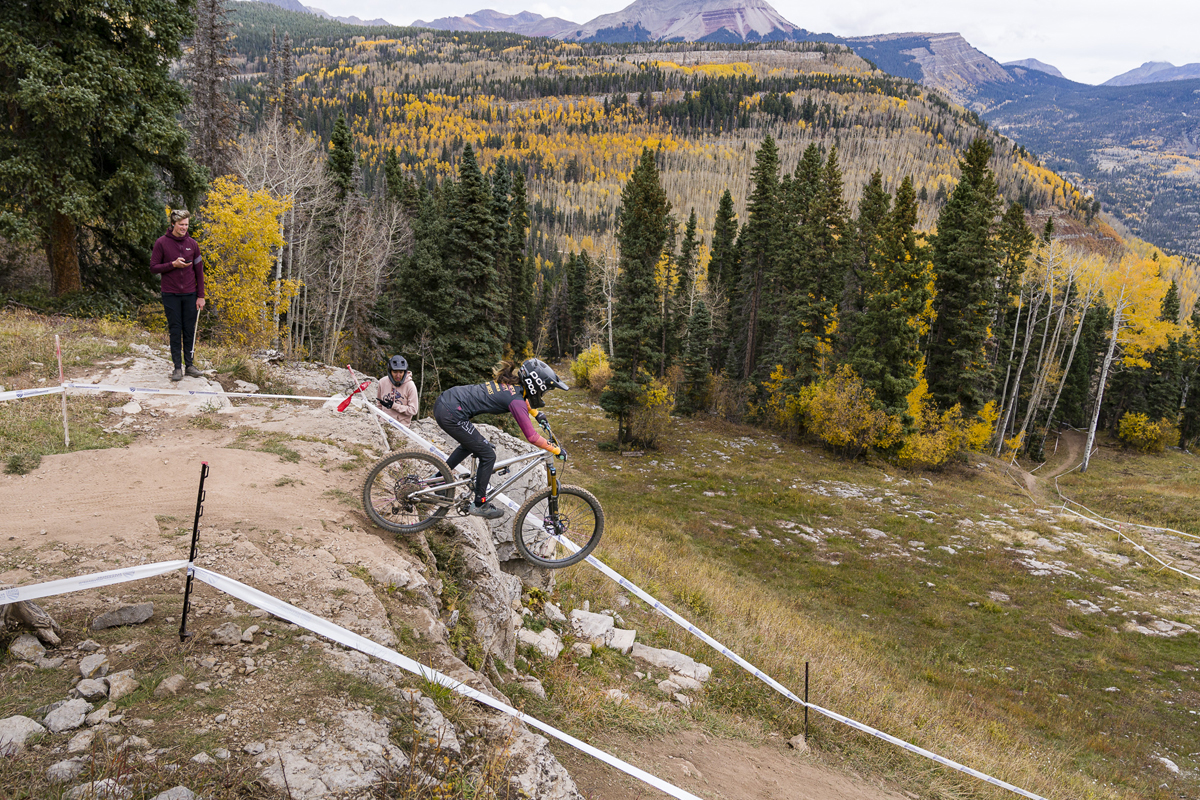
Action at the Big Mountain Enduro at Purgatory Bike Park, site of the 2030 World Championships. Photo Christian Ridings, courtesy Durango Worlds 2030.
Leading into the World Championships in 2030, the “Worlds,” Durango will also host a major international mountainbike race in 2028 and a UCI World Cup race in 2029. All events will be held at Purgatory Resort and will include Downhill, Cross Country Olympic, Short Track and Ebike.
“We’re thrilled to once again host the World Championships at Purgatory Resort,” said Dave Rathbun, Purgatory’s general manager. “Biking and Durango are synonymous with each other. This is a great opportunity to showcase our community’s commitment to the sport with the entire world.”
The series of global events elevates Durango, Colorado as a global cycling homeland and solidifies the City as North America’s mountain biking capital. The area features over 300 miles of world-class singletrack traversing environments from high-desert to high-alpine. The elevation training advantage of 6,500 feet fuels the success of numerous on- and off-road Olympic and professional cyclists who call Durango home, and powers Fort Lewis College’s collegiate cycling team to multiple national titles. Most importantly, mountain biking continues to shape the very fabric of the mountain-town community.
“We are beyond proud to announce the Worlds’ return to Durango 40 years after we pioneered the event in 1990,” said Durango Native Todd Wells, co-leader of the events and three-time Olympian mountain biker. “Mountain biking and cycling are woven into Durango’s DNA; from our pioneering spirit to the incredible trail infrastructure and our renowned junior-development programming, Durango is a true heartland of cycling. The 2030 World Championships will enable us to showcase our community on a global stage once again.”
USA Cycling Collegiate MTB National Championships: Day 4 at Purgatory Resort in Durango, Colorado, USA on October 16, 2022. (Photo: Craig Huffman)
Gaige Sippy, long-time Iron Horse Bicycle Classic director and co-leader behind Durango’s World Championship bid, added: “Hosting the 2030 UCI Mountain Bike World Championships is both a tribute to our past and an investment in our future. The world’s best will once again race on trails that continue to build legends right here in our backyard. We can’t wait to welcome riders and fans from around the world back to Durango.”
The City of Durango rose to international off-road cycling prominence when it hosted the inaugural UCI Mountain Bike World Championships in 1990. The first-ever men’s mountain biking world championships was won by Ned Overend, who still calls Durango, Colorado home. Juli Furtado, a long- time Durango resident and the visionary behind Juliana bikes, won the women’s event. Greg Herbold, also a Durango resident, won the men’s downhill race event. The 1990 Worlds attracted the world’s best mountain bikers of the time and generated global interest in the sport among fans and media.
“This is a momentous occasion for our community,” said Mayor Gilda Yazzie. “The city is honored to be chosen by the UCI to host this historic anniversary year, and we are thrilled to partner with Durango Cycling Championships and Purgatory Resort.”
Durango is host to the renowned Iron Horse Bicycle Classic for close to 55 years, established one of the country’s first junior development cycling organizations, Durango Devo, and is the birthplace of world-class trail advocacy (with more than 300 miles of maintained trails) in non-profit Durango Trails.
Durango has a remarkable record of producing top athletes in the sport—including numerous Olympians, professional cyclists, multiple world champions, and the most recent American Grand Tour winner in Sepp Kuss, who came up through the ranks in Durango’s cycling infrastructure, including formative years racing with Durango Devo’s Sweet Elite.
Additional details on event routes, community programs, and ticketing will be announced in the coming months. Please follow @Durangoworlds2030 on Instagram and visit www.durangoworlds.com.
By Dave Campbell – As a boy growing up in Wyoming, the trails, lakes, mountains, and streams all along the Wind River Range’s Louis Lake Road, known locally as “Loop Road” were my family’s playground. My most memorable boyhood adventures happened at its many scenic mountains Lakes. Ruggedly beautiful in a way only the Wyoming Rockies can be, the Loop Road begins and ends in Lander and connects South Pass to Sinks Canyon State Park. From a long climb past a dramatic red sandstone canyon, a gravel road then climbs past numerous mountain lakes and creeks to cross the continental divide before plunging down a gorgeous limestone canyon. Lander sits at 5358 feet of elevation and the high point of “The Loop” occurs at Blue Ridge at 9576 feet. At just over 66 miles long, with around 6000 feet of elevation gain, it is a formidable outing. But the biggest challenge is the gravel between the two highways. From the time I first started seriously riding in the early 1980s, I have wanted to ride it and in 2013 I finally did.
Forest Service Map. The Louis Lake Road Ride. Photo by Dave Campbell
Thankfully, several years prior, the worst of the gravel switchbacks, from Frye Lake to Bruce’s Camp, many deeply wash boarded from braking 4x4s and trucks towing trailers, were paved. This left a stretch of about nineteen undulating miles with 2000 feet of climbing. It was this development that made me believe the ride was possible…but how to set up my road bike? At that time, gravel bikes were still uncommon, and I certainly didn’t have one. All my local cycling friends and the outdoor adventurers I grew up with knew of no one that had ever done the ride and wondered what type of bike would be up to the diverse task. Thirty-five miles on the highway begins the ride with most of it climbing and gaining over 3800 feet. Then comes the gravel which varies dramatically: there are loose and sandy sections, hard packed bone rattlers, and sections with large exposed underlying granite chunks covered with scattered loose stones. Fit and determined, I ultimately tackled the big ride first on a Cannondale Carbon Road bike with the largest tires I could fit (measly 700×25 belted Michelins) and a low gear of just 39/27. Remarkably, I emerged unscathed with nary a flat tire in just under four hours. Strong and naïve, I remember thinking a little lower gear would be nice. Ha! I have since undertaken the ride nearly every summer but now enjoy it much more comfortably on a Moots Titanium gravel bike with 34/50 gearing up front and 11-30 in the back while rolling on 34 mm wide Challenge Strade Bianche tires.
After about eight successful rides now over the years, I can confidently say the best time to tackle this is in mid-to-late June and on a weekday. I have only ridden it clockwise as that puts the hardest climbing on the front end while saving the best descending for the finale. You want to miss the camper traffic as it is a popular recreation destination and steer clear of the days around the Fourth of July! Start early to not only beat the heat but also the wind. The wind tends to blow down from the mountains and typically picks up later in the day. Afternoon showers are possible so pack a light shell. There are gates on either end that close the road during the winter and it usually opens to vehicle traffic by June 15, although bikes can go around the gates and I have even dodged the occasional snow drift over the years. Take two tubes, a pump, and tire booting material, as well as plenty of food and water. Water on this ride can be a challenge, and I have regularly begged off campers and drivers over the years and thankfully they have always obliged.
The gravel section begins. The Louis Lake Road Ride. Photo by Dave Campbell
The first ten miles out of town on US Route 287 are a series of short rollers until the Rawlins Junction. Continuing after the interchange the Highway becomes Wyoming 28 (The Red Canyon Highway) and following a short descent, the long drag up to the spectacularly beautiful Red Canyon begins. Formally designated a National Natural Landmark by the Federal Government, its color and magnitude, even just from the roadside, is breath taking. The summit at Red Canyon is false, though, and a long gradual descent to a plateau forces another long climb back up, this time past Aspen meadows and Beaver dams to Limestone Mountain. If you stop to enjoy the views, consider asking fellow travelers for water as you’ll need it! The wind often picks up here and then the Sirens sing again because despite the many miles of climbing it is not “THE” summit. Another long descent follows down to the old US Steel Iron Ore mine, and the wind can really pick up as the last true climb looms ahead. Roadside signs tell the tale of the Boom and bust that gripped this area during the 1970s. This opening stretch is a great place to see Pronghorn. The last difficult climb on pavement is long, straight, and morale testing and takes you nearly to historic Atlantic City on the left, but you want the Louis Lake Road turnoff on the right…and the gravel.
Here Lander is now 31 miles behind or 35 miles ahead if the loop is completed. The longest climbs are finished and about 2/3 of the elevation has been gained but you are far from home free. A great Forest Service Sign lays out all the obstacles, sights, and mileage ahead. I usually stop and pull on thin over socks to keep the dust out of my well-ventilated shoes and to feel more “euro” on my epic Wyoming Roubaix. The opening two miles of gravel climb over washboard ruts that will rattle your bones and make you question this endeavor as progress is painfully slow. Choose your line carefully, keep the elbows bent, use those low gears, and be patient. Thankfully, the road soon levels out, gets smoother, and the mountain beauty makes it all worthwhile.
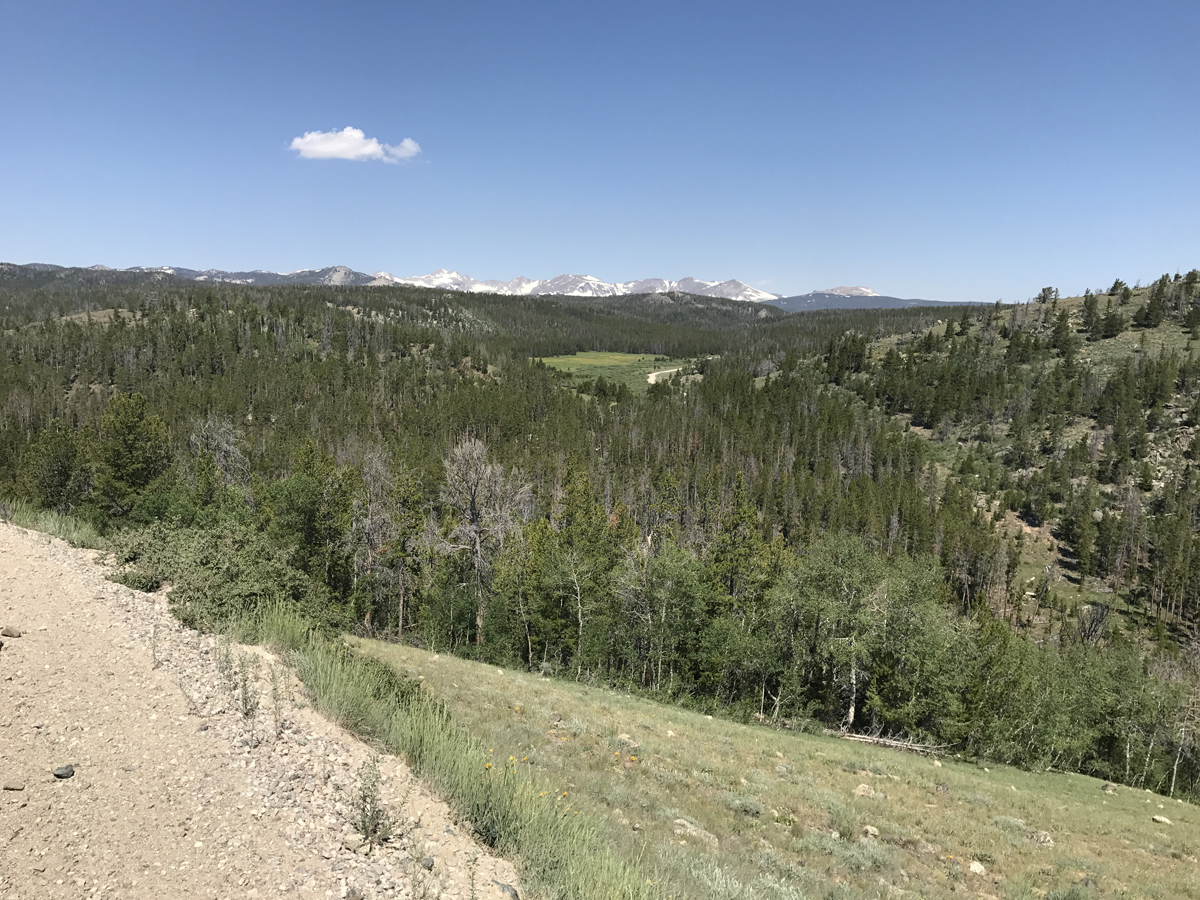
A view of the Wind River Range from the Louis Lake Road. The Louis Lake Road Ride. Photo by Dave Campbell
The first big open area is Granier Meadows at just under 8900 feet of elevation. It is beautiful, expansive, and covered in wildflowers. The wildflowers are another reason to get out here as soon as the road is passable. The first views of the peaks of the snow-covered Wind River Range are breathtaking and only get more spectacular as you continue. Surrealistic piles of Shale and Granite appear along Forest Service Road 300. A disturbing number of brown beetle-killed trees stand out amongst the sea of green Lodgepole Pine and Douglas Fir as my childhood frog hunting grounds come into view at Louis Lake. There is a lodge that is typically not yet open in June, but people are usually there prepping the cabins for the season. The owners are friendly and have allowed me to fill my bottles every year.
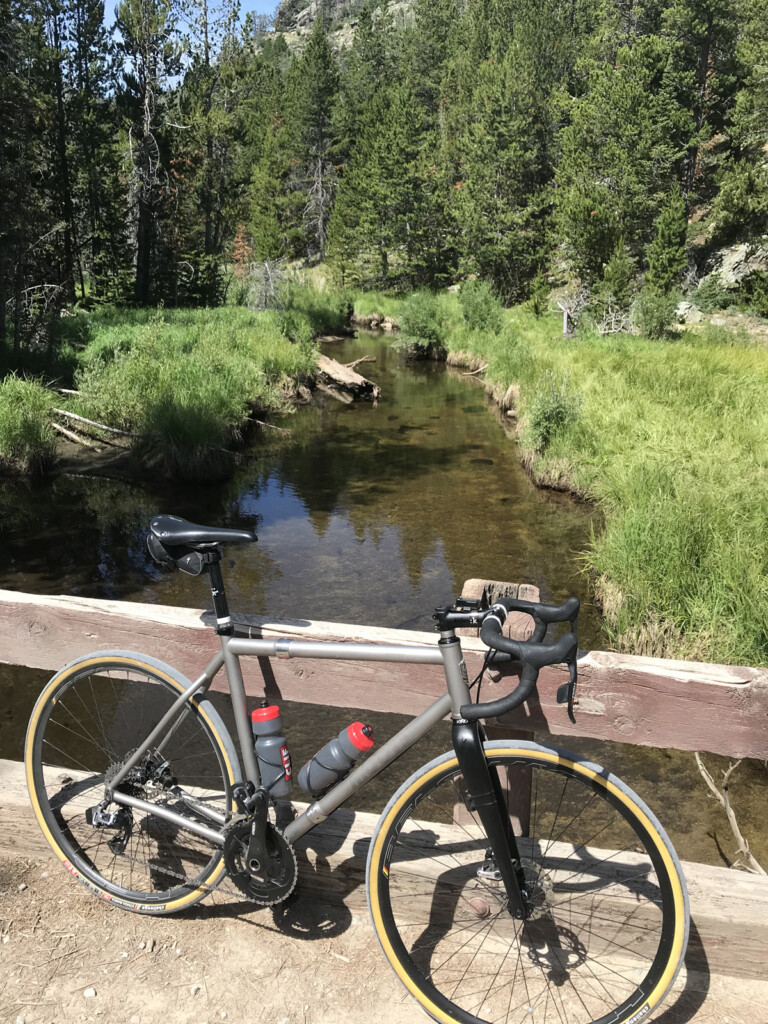
Dave’s bike leaning on a railing by the South Fork of Little Popo Agie River on the Louis Lake Road Ride. Photo by Dave Campbell
After crossing the stunning Little Popo Agie River on a quaint wooden bridge, there are more meadows and ponds and the chance to see wildlife. There is another steep and winding climb that dramatically brings the much larger Fiddler’s Lake into view. I used to find this gravel nearly as smooth as pavement but in recent years it has been rugged as the Loop Road no longer seems to be graded by the highway department. Just beyond this popular canoeing and camping site is the old Blue Ridge Fire Lookout. Constructed by the Civilian Conservation Corps, the stone steps yield an amazing view of the high mountain lakes and meadows. The serene and reflective moments at Fiddlers are brief as the steep, bumpy climb up to Blue Ridge itself begins.
The summit is not only the highest point on the ride at 9,576 feet, but also the Continental Divide. From here the road twists and winds down quite steeply and is very bumpy at times. There is significant washboard in spots that require very astute line choice as do the sharp and abundant rocks. Over the years, this is the only place I’ve had issues-bouncing a bottle, dropping a chain, and just once a flat tire. I regularly throw caution to the wind and let it rip when the road straightens out and drops into Worthen Meadows. The vibration is intense, but brief and there is but one more gentle climb on the dirt remaining.
After passing the turnoff to Roaring Fork Lake, the gravel ends dramatically at Frye Lake, where the Forest Service signs announce just 16 miles to Lander on Highway 131, the Sinks Canyon Highway. I regularly let out a whoop of joy here and would encourage you to do the same! Lander is home to NOLS (National Outdoor Leadership School) and is chock-full of rugged outdoor enthusiasts and these are their playgrounds. There is a short climb up to the “top of the switchbacks” as everyone in town refers to them. After that, however, you will drop about 3500 feet in fourteen miles. Just over the top are several fabulous mountain bike and hiking trails, bathrooms, and a parking lot.
A view of Louis Lake on the Louis Lake Road Ride. Photo by Dave Campbell
The view of the limestone Sinks Canyon below is awe-inspiring as is the five-mile-long descent at 6%. The turns can be taken at 20-25 mph, and you can accelerate up to nearly 40 on the straightaways. The minimal traffic, frequent constant radius turns, and near perfect road surface mean that this is nothing short of a cyclist’s playground. Pure descending gold. At the bottom of the first descent is a trailhead where you need to slow down as hikers cross the road. After this slight plateau, the road drops again at a ranger station and there is a cattle guard where caution is needed, but I have occasionally crossed at fifty mph when the wind is blowing down the canyon. The ensuing eight-mile descent is fast (I’ve hit over sixty mph) with peak speeds by the Visitor’s Center but be attentive as people cross the road here. Tourists feed the trout that gather at “The Rise” of the Sinks-where the Popo Agie River re-emerges after disappearing into limestone caverns further above. The curves of Sinks Canyon are gentle, and the walls of the Canyon flank the plunge until the road levels out. Cattle ranches and cabins now dot the countryside just outside of the lovely little town of Lander and you roll right past the City Park where you can camp for free. I didn’t think much of this place growing up, but I sure appreciate it now! No longer racing, this incredible ride is my fitness focus as soon as the snow melts. I train hard every year just to be able to ride the Louis Lake Road when I “come home” to big, beautiful Wyoming. Check it out, you won’t be disappointed!
By Charles Pekow — Two trails are about to be connected near Jackson, WY. Guardian Construction, Inc. of Utah was awarded a $2,722,569 contract by the National Park Service to build a 10-foot-wide asphalt trail. The Trail Pathway Connector Project will bridge a 0.8-mile gap between the trails. Guardian intends to complete the project by October, before the snow falls, says Project Executive Wayne Van Valkenburg.
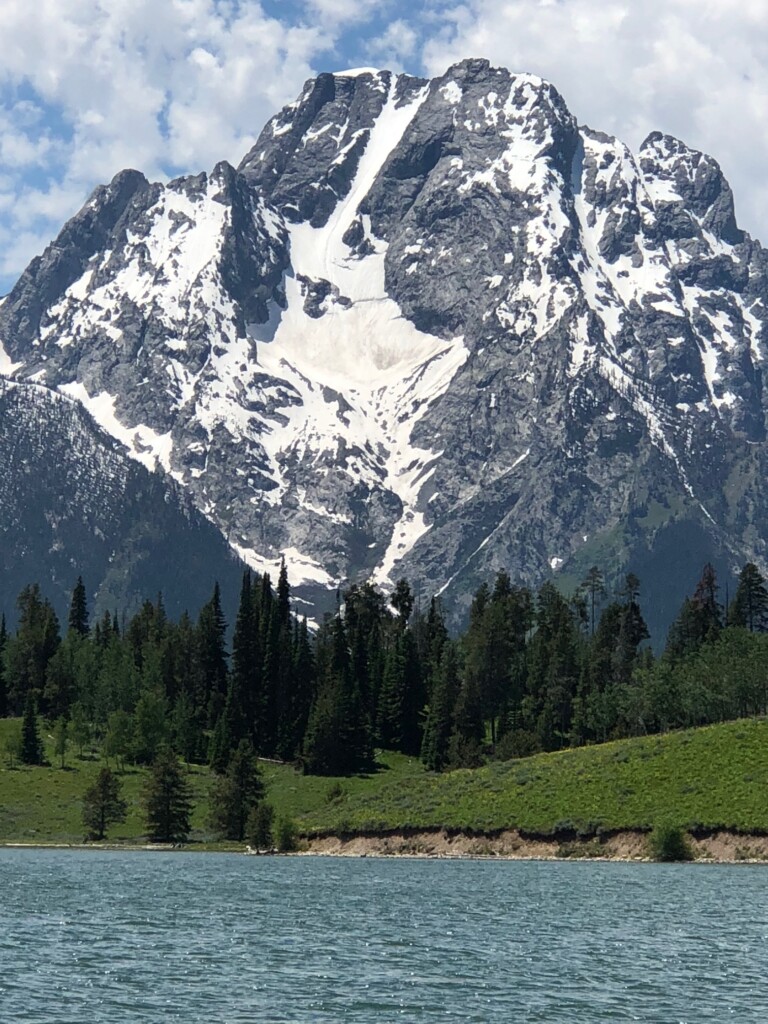
Mount Moran, next to Jackson Lake. Photo by Dave Iltis
The trail will begin at the intersection of Sagebrush Drive and Spring Gulch Road in Teton County, connecting the roundabout at Gros Ventre Junction on U.S. Highway 26/89/191 with the Jackson Hole Community Pathways system at Jackson Hole Golf & Tennis. This will improve bicycle access to Grand Teton National Park.
The commission does not have the power to set rules or diminish the authority of cabinet secretaries, but it can recommend policies. Part of its mandate involves “developing policies to expand access to public lands, national parks, national forests, and wildlife refuges while promoting a wide range of outdoor recreation opportunities,” including bike riding.
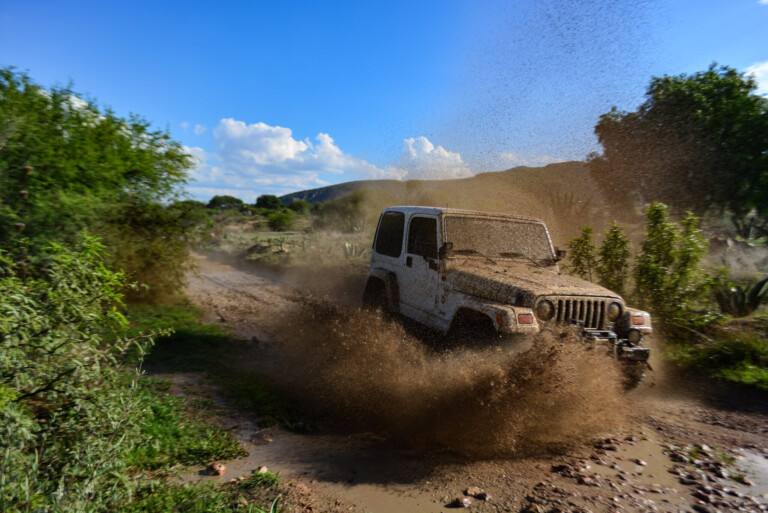
Easing the regulatory environment could lead to increased motorized traffic in the backcountry. Title: “Jeep Off-roading in backcountry”, Photo courtesy of Outlaw Off-Road & Performance, CC BY-NC 4.0 Deed, Attribution-NonCommercial 4.0 International (per Google Images)
However, expanded access could come at the cost of weakened environmental protections.
The Pacific Legal Foundation, a libertarian law firm, stated that the announcement “recognizes that people—not federal regulators—are best equipped to care for our natural resources.” At the same time, the foundation expressed concern that any new government commission could end up creating more bureaucracy and red tape.
The Sierra Club, meanwhile, issued a sharply critical statement, saying: “‘Make America Beautiful Again’ is the tiniest fig leaf on the most anti-environment administration in our country’s history.”
Brilliant attacks deliver commanding wins at Life Time Chequamegon as overall series battles intensify
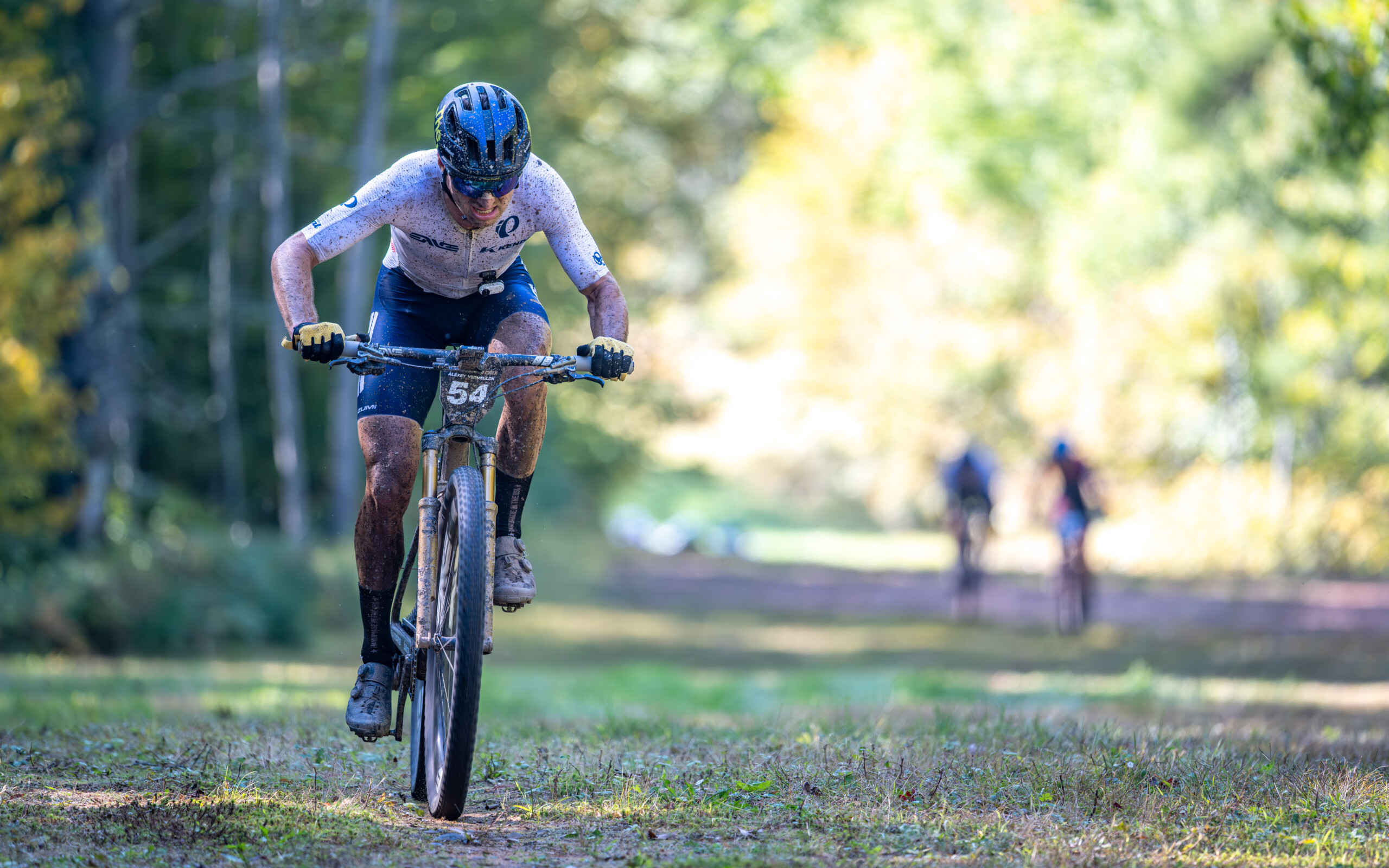
CABLE, Wisconsin (September 13, 2025) – The 2025 Life Time Chequamegon Mountain Bike Festival delivered drama as solo victors Melisa Rollins and Alexey Vermeulen produced incredible attacks to claim victory in Cable.
Melisa Rollins racing at the 2025 Chequamegon MTB Festival. Photo by Dan Hughes, courtesy of Life Time
Rollins made the earliest break of the day shortly after mile 23. She pulled away from an elite group of four riders after the tough Firetower climb and continued to press home her advantage all the way into Cable, where she crossed the line with a 4:32 winning cushion, repeating her 2021 success.
“We were a pretty big group coming through the first feed zone and I tried to stay patient,” Rollins explained. “The race blew up at mile 25 on the Firetower climb and I was feeling really good. I got a little gap over the top of it but wasn’t able to hold it. I got caught by three riders and then went again shortly after and knew that I was holding my momentum really well, and managed to hold them off until the finish.”
Behind her, series leader Cecily Decker battled with Alexis Skarda and defending champion Sofía Gómez Villafañe for second place. Villafañe produced an explosive late sprint to take second as Skarda took third, narrowly beating out Decker for the final podium spot.
Vermeulen’s Decisive Move
In the men’s race, Vermeulen left it until the closing stages to make his decisive move with about three miles to go. He left a pack of 14 riders behind to take his third victory at Chequamegon, this time by eight seconds.
Alexey Vermeulen racing at the 2025 Chequamegon MTB Festival. Photo by Dan Hughes, courtesy of Life Time
“I started trying to make my moves with around seven miles to go,” Vermeulen said. “I could see the group was splintering, and guys were chasing to regain contact, and I knew the rubber band would eventually snap and gaps would start to open up. So I just bided my time.”
The fight for the runners-up spot was hotly contested, with Kyan Olshove proving the fastest finisher. Brendan Johnston outsprinted Torbjørn Andre Røed for third place.
“I could tell that anybody who got on my wheel wasn’t willing to work, and it was still quite a long way to the finish,” Vermeulen explained. “I didn’t think anybody could go solo initially, but in the end I just trusted myself, saw the gap happen, and just committed. Once you commit you just have to believe in yourself because if it comes back, they’re going to beat you in the sprint.”
Series Standings Shake-Up
The results dramatically reshaped the overall standings. Rollins has closed the gap on both Villafañe and Decker at the top of the women’s competition, now trailing Villafañe by just 10 points in third position. Villafañe leapfrogged Decker back into first place, opening up a two-point lead.
Vermeulen’s triumph saw him rise from seventh to fourth place overall. The men’s standings are now incredibly tight, with Keegan Swenson’s advantage cut to just one point following his 12th-placed finish. Simon Pellaud holds second place overall after finishing seventh, while Røed is now just one point behind Pellaud in third. Only two points separate Swenson, Pellaud and Røed at the top of the men’s series.
“Chequamegon has been my big focus since Leadville so I haven’t really thought about Little and Big Sugar yet,” Rollins said. “I like to take things race by race but I know I want to show up at those two races the best I can and I’m excited to be part of the fight for the overall win. It’s going to be a really close and tough battle for the top spot.”
With such narrow margins, the final two races in northwest Arkansas promise a fierce battle for the Series crown.
By Andrew Phillips – I see many crashes that seem to repeat themselves. Perhaps one of the most common cycling incidents is the Left Hook. By knowing what the left hook is and that it’s a frequent cycling vs car collision, you can be better equipped to avoid being “knocked out” by one while on a ride.
Here Is a Left Hook Scenario:
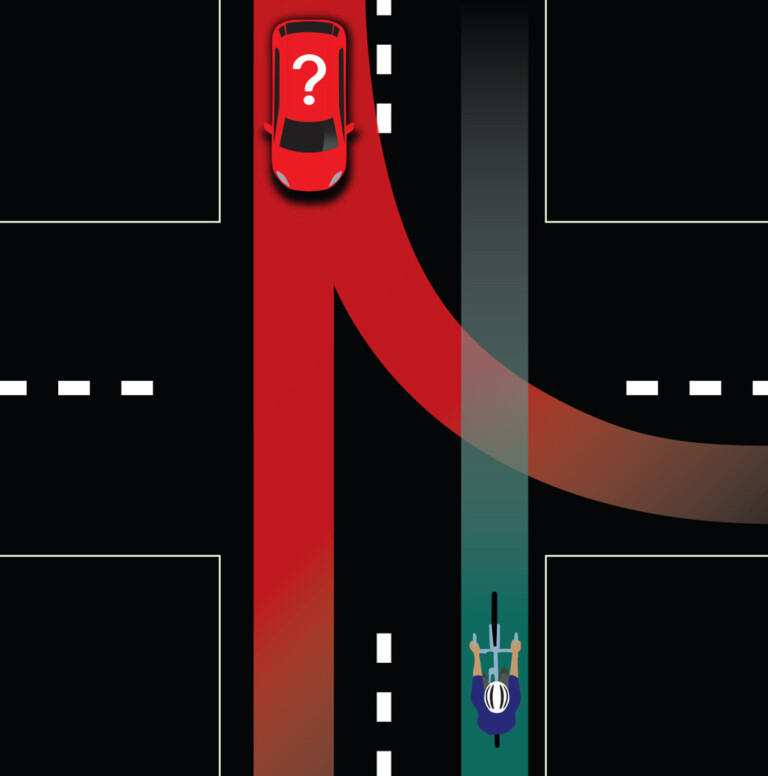
A cyclist is riding straight ahead on the right side of the road or in a designated bike lane. A motorist, coming in the opposite direction, prepares to turn left at an intersection or into a driveway. The motorist either: Fails to see the cyclist and turns left directly across their path. Or misjudges the cyclist’s speed, thinking they have time to turn. This results in the car cutting in front of the cyclist, leading to a potential crash.
The left hook happens when a car cuts across the path of an oncoming cyclist. Graphic courtesy Andrew Phillips
How Avoid or Reduce the Risk of a Left Hook Collision:
Be Extra Cautious at Intersections and Driveways. Slow down and be on the hoods/brakes when approaching any intersection. Look at the behavior of vehicles—are they slowing, signaling, or edging left? If so, that’s a potential red flag. If a motorist turns in front of you, make sure you know what your exit path is should you need to take it.
Watch for Turn Signals and Body Language. Don’t rely solely on turn signals—many drivers forget to use them. Watch for wheel movement, slowing down, or drifting into the turn lane, which often signals an upcoming turn even without a blinker.
Make Eye Contact. If a driver is waiting to turn left while you are going straight through, try to make eye contact so you know they’ve seen you. One of the most common things I hear from a motorist who hits a cyclist is, “I just didn’t see them. They came out of nowhere.”
Take the Lane When Necessary. In certain situations—especially where there’s no bike lane, or you’re approaching a complex intersection—it may be safer to take the full lane to prevent a car from passing and cutting across you. This is legal in many places when necessary for safety.
Use Lights and Bright Clothing. Especially in low-light conditions, use a bright front light, reflective gear, and contrasting colors to increase your visibility. A flashing white front light can help catch a turning driver’s attention.
MONTRÉAL, Canada (September 14, 2025) — Brandon McNulty (UAE Team Emirates) secured victory at the Grand Prix Cycliste de Montréal on Sunday in one of professional cycling’s most memorable finishes, as teammate Tadej Pogačar (UAE Team Emirates) orchestrated a stunning display of selflessness by gifting the American the win after a dominant performance that saw UAE Team Emirates tie the all-time record for victories in a single season.
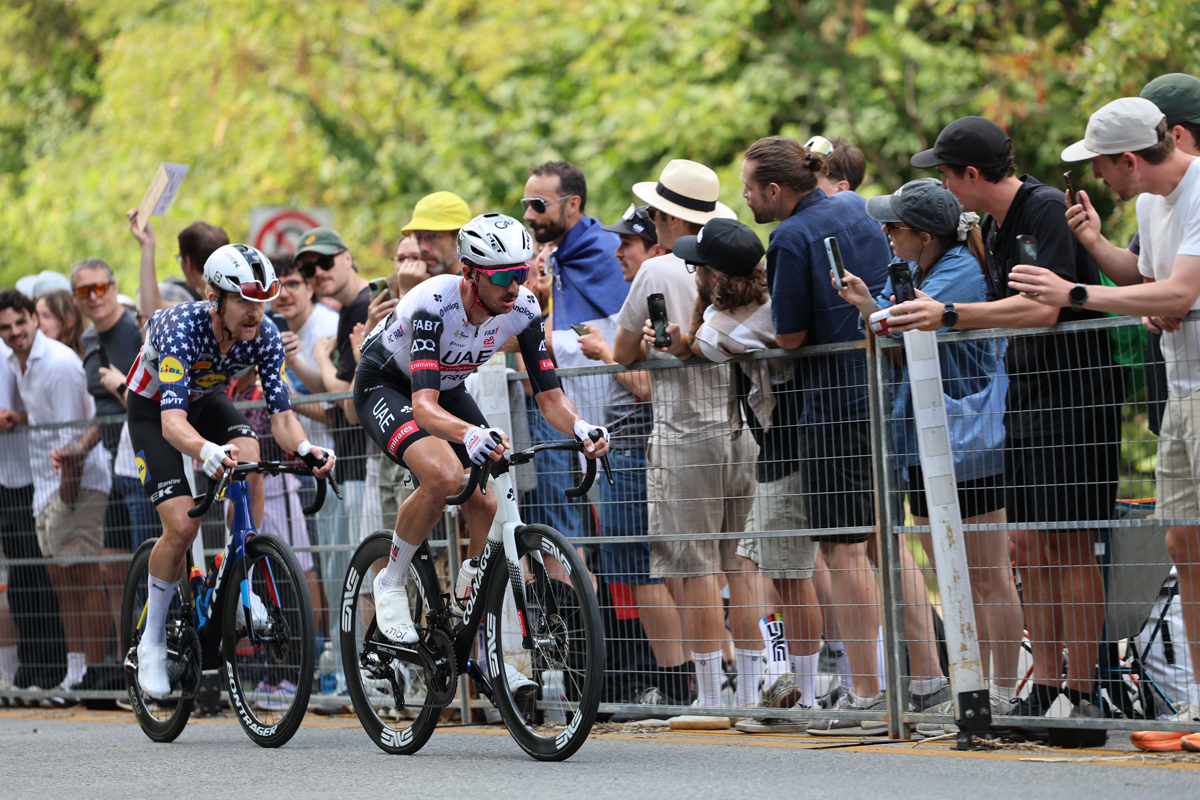
Biniam Girmay (left) and Antonio Pedrero (center) round the hairpin at the end of lap one. Grand Prix Cycliste de Montréal 2025. Photo by Dave Iltis
The 209.1-kilometer Canadian classic became the stage for UAE’s 85th triumph of 2025, equaling HTC-Columbia’s 2009 record, but more significantly showcased tactical cycling at its absolute pinnacle as the Emirati squad dismantled a world-class field through relentless pace-making before delivering a fairy-tale finish that will resonate through cycling folklore.
The Foundation: Early Moves and UAE’s Iron Grip
The race began with characteristic Canadian classic aggression as seven riders formed the day’s initial breakaway on the opening circuit of the 17-lap course. Victor Lafay (Decathlon AG2R La Mondiale) spearheaded the French contingent alongside Americans AJ August (Ineos Grenadiers) and Artem Shmidt (Ineos Grenadiers), Dutch duo Pascal Eenkhoorn (Soudal Quick-Step) and Frank van den Broek (Picnic-PostNL), and Scandinavian representatives Jørgen Nordhagen (Visma-Lease a Bike) and Embret Svestad-Bårdseng (Arkéa-B&B Hotels).
Best young rider Jørgen Nordhagen (Visma-Lease a Bike) leads the break. Grand Prix Cycliste de Montréal 2025. Photo by Dave Iltis
Their maximum advantage peaked at 1’50″—a deceptively comfortable margin that masked the brewing storm behind. From the moment UAE’s German powerhouse Nils Politt assumed control at the head of the peloton, the breakaway’s fate was sealed. For nearly 100 kilometers, Politt delivered a masterclass in controlled aggression, maintaining a steady, punishing tempo that not only kept the leaders within striking distance but began the systematic destruction of the peloton.
The early signs of carnage emerged quickly. Guillaume Boivin (Israel-Premier Tech), Luke Lamperti (Soudal Quick-Step), and Ruben Guerreiro (Movistar) were among the first casualties, abandoning before the race had even reached its halfway point. More ominously for the breakaway, a second chase group of nine riders had formed behind them, including dangerous operators like Jan Tratnik (Red Bull-Bora-Hansgrohe), Mauro Schmid (Jayco-AlUla), and Gianni Vermeersch (Alpecin-Deceuninck).
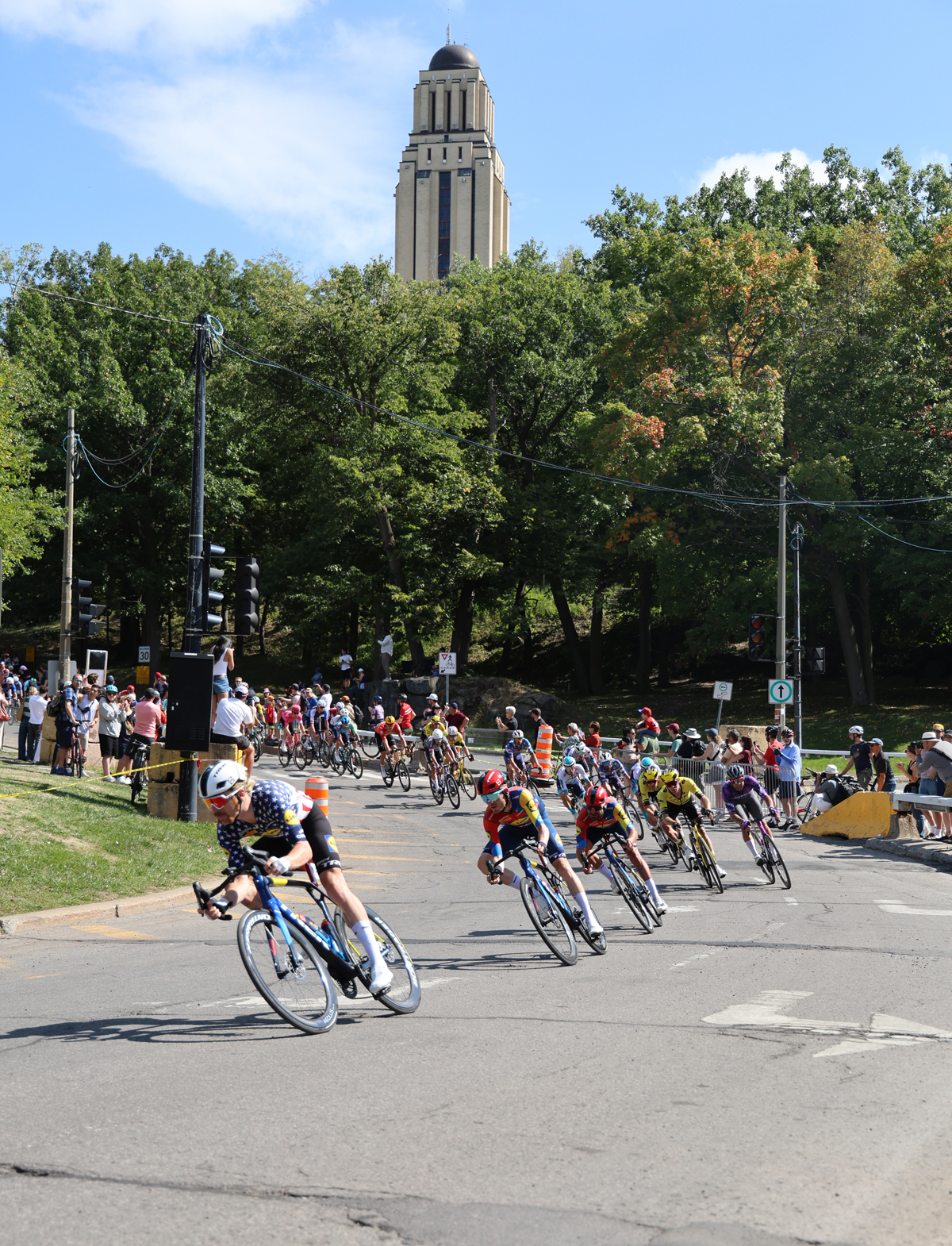
Quinn Simmons on the descent below the University of Montreal. Simmons would finish third on the day. Grand Prix Cycliste de Montréal 2025. Photo by Dave Iltis
Drama and Destruction: The Eenkhoorn Saga
While Politt orchestrated the pursuit with mechanical precision, high drama unfolded in the breakaway as Pascal Eenkhoorn endured a race that epitomized cycling’s cruel unpredictability. First, mechanical issues dropped the experienced Dutchman from the lead group, forcing a herculean effort just to regain contact with his companions.
Then came the defining moment of misfortune. On one of the race’s signature climbs, Eenkhoorn’s front wheel clipped another rider, launching him into a spectacular somersault crash that left him sprawled on the unforgiving Montreal tarmac. Though the Soudal Quick-Step veteran gamely remounted and continued, his race was effectively finished—a stark reminder of how quickly dreams can shatter in professional cycling’s unforgiving arena.
The crash became symbolic of the breakaway’s broader struggle against UAE’s relentless pursuit. As Eenkhoorn fought his losing battle, the two groups ahead merged with 120 kilometers remaining, creating a formidable 16-rider alliance. But their unity would prove irrelevant against the machine-like efficiency of UAE’s chase.
The Acceleration: Wellens and the Peloton’s Explosion
Just as the enlarged breakaway seemed to be finding its rhythm, UAE unveiled their next weapon. Tim Wellens, the explosive Belgian climber, relieved the tiring Politt and immediately transformed the race’s character. His first pull up the fearsome Côte Camillien-Houde was nothing short of devastating.
Tim Wellens of UAE driving the pace to split the pack. Grand Prix Cycliste de Montréal 2025. Photo by Dave Iltis
The peloton didn’t just stretch—it exploded. Half the field was instantly distanced, unable to match Wellens’ ferocious acceleration. Riders who had harbored podium dreams found themselves fighting merely for survival as the Belgian’s tempo shredded the group with surgical precision.
Grand Prix Cycliste de Québec 2025 winner Julian Alaphilippe (black Tudor jersey) struggles to stay with the lead group on the climb to Mt. Royal.. Grand Prix Cycliste de Montréal 2025. Photo by Dave Iltis
The casualties mounted with each passing kilometer. Christophe Laporte (Visma-Lease a Bike) and Biniam Girmay (Intermarché-Wanty) joined the growing list of abandonments, while even seasoned campaigners struggled to maintain contact with the rapidly shrinking front group. The breakaway ahead began hemorrhaging riders—Laurence Pithie (Red Bull-Bora-Hansgrohe), Artem Shmidt, and Harry Sweeny (EF Education-EasyPost) among those who couldn’t sustain the increased pace.
McNulty’s Hammer: The Final Devastation
As if Wellens’ contribution wasn’t destructive enough, UAE possessed one final devastating weapon. Brandon McNulty, the American powerhouse with a reputation for punishing climbs, assumed pacing duties as the race entered its decisive phase. His impact was immediate and catastrophic.
McNulty’s first surge up Camillien-Houde was like a detonation in the peloton. The remaining breakaway survivors—who had fought valiantly for over 100 kilometers—were swept up as if they were stationary. Alex Baudin (EF Education-EasyPost), the last fugitive from the morning’s moves, was caught and dropped, his brave solo effort ending in the face of McNulty’s relentless pursuit.
Behind, the destruction reached unprecedented levels. Wout van Aert (Visma-Lease a Bike), the Belgian superstar and 2022 runner-up, cracked spectacularly and abandoned with 54 kilometers remaining. Julian Alaphilippe (Tudor Pro Cycling), fresh from his Quebec triumph just 48 hours earlier, began sliding backward through the group despite having positioned himself perfectly on Pogačar’s wheel.
The pace was so severe that even the race’s pre-selected favorites couldn’t survive. Paul Lapeira (Decathlon AG2R La Mondiale), Arnaud De Lie, and Simon Yates found themselves distanced and fighting losing battles against the merciless tempo. The front group, once numbering over 150 riders, was now reduced to fewer than 25 survivors.
The Tactical Masterstroke: Sivakov’s Setup
With the field decimated and only the strongest climbers remaining, Pavel Sivakov (UAE Team Emirates) assumed the destructive duties from McNulty. The Frenchman, riding with the same selfless dedication he had displayed in Quebec, drove an absolutely punishing pace that served final notice of UAE’s intentions.
This was no longer racing in the traditional sense—it was systematic demolition. Every surge up the climb eliminated more riders, every acceleration tested the absolute limits of human endurance. Pello Bilbao (Bahrain-Victorious), well-positioned until a cruel mechanical issue stuck his chain, was forced to change bikes and watch his chances evaporate.
The tactical brilliance of UAE’s approach was now crystal clear. By controlling every aspect of the race’s development, they had ensured that when Pogačar finally unleashed his signature attack, only the very strongest climbers would remain to challenge him. It was grand tour tactics applied to a one-day classic, executed with flawless precision.
The Decisive Strike: Pogačar’s Attack
With three laps remaining and the group whittled down to barely 20 survivors, the moment cycling fans worldwide had been anticipating finally arrived. McNulty, his yeoman’s work apparently complete, launched an acceleration that prompted immediate responses from Quinn Simmons (Lidl-Trek) and drew young Louis Barré (Intermarché-Wanty) into the action.
Brandon McNulty leads Quinn Simmons with a couple of laps to go on the main climb. Grand Prix Cycliste de Montréal 2025. Photo by Dave Iltis
“With four laps to go, I was asked if I could try a solo attack. I tried and four of us broke away,” recounted McNulty after the race. McNulty first with Simmon in tow, joined soon after by Barre and Pogačar.
Then it happened. Tadej Pogačar, the four-time Tour de France winner and reigning world champion, unleashed the attack that would define the race. His acceleration was vintage Pogačar—explosive, sudden, and utterly irresistible. The response was immediate but insufficient as the Slovenian’s move split the select group definitively.
“I gave the signal for Brandon to try his luck with four laps to go, then I joined him,” Pogačar reflected on the tactical execution.
The Belgian fans were out in force. Grand Prix Cycliste de Montréal 2025. Photo by Dave Iltis
Louis Barré, displaying maturity beyond his years, managed to bridge across to join the leading trio of Pogačar, McNulty, and Simmons. For several kilometers, the young Frenchman matched the infernal pace, even requesting water bottles to pour over himself in the mounting heat. But the sustained tempo eventually proved too much, and Barré cracked with over 20 kilometers still to race.
And then there were four. Grand Prix Cycliste de Montréal 2025. Photo by Dave Iltis
The Shocking Twist: Pogačar’s Second Attack and Stunning Decision
With Barré’s departure reducing the leaders to three, Pogačar sensed an opportunity to test his remaining companions’ resolve. His second attack came with devastating effect—a vintage acceleration that seemed designed to drop everyone and set up a solo victory charge to the line.
As the world champion powered clear, it appeared the race was following a familiar script. Pogačar solo, driving toward another prestigious victory, with his rivals left to battle for the minor placings behind. But then came the moment that transformed a routine tactical victory into cycling legend.
Instead of pressing his advantage, Pogačar sat up and waited. He looked back, assessed the situation, and made a decision that stunned everyone watching. As McNulty bridged across with a superhuman effort, the Slovenian’s gesture became clear—he was bringing his teammate back into contention for victory.
“When I found myself alone after my attack in the penultimate lap, I decided to wait for him when I saw that he wasn’t that far behind,” Pogačar explained. “Once we were together, it was clear that the victory would be between us.”
“After Tadej’s attack, I managed to drop Quinn Simmons and catch up with him,” McNulty added. “It was very special to find ourselves both at the front of the race.
And then there were two. Pogacar leads McNulty on the penultimate descent. Grand Prix Cycliste de Montréal 2025. Photo by Dave Iltis
The Gift: A Masterpiece of Sporting Brotherhood
What followed in the final 15 kilometers was perhaps the most remarkable display of teamwork and friendship ever witnessed in professional cycling. Rather than engaging in the expected battle for victory, roles reversed completely as Pogačar dedicated himself entirely to McNulty’s success.
Kilometer after kilometer, the world champion pulled on the front while McNulty sat comfortably in his slipstream. The sight was almost surreal—cycling’s biggest star, fresh from Tour de France triumph, towing his teammate toward what would become the American’s biggest career victory.
As they chatted and smiled in the closing kilometers, with Simmons grimly hanging on for third place 1’03” behind, it became evident this wasn’t mere tactics—it was a genuine gesture of sporting brotherhood that transcended competitive cycling’s normally ruthless calculations.
The Historic Finish: Arm-in-Arm to Immortality
The approach to Montreal’s finish line became pure theater. As the two UAE riders swept around the final corner with victory assured, they looked at each other, shared a moment of understanding, and created one of cycling’s most memorable images.
Brandon McNulty (left) and super teammate Tadej Pogacar are full of smiles. Photo by Lisa Hazel
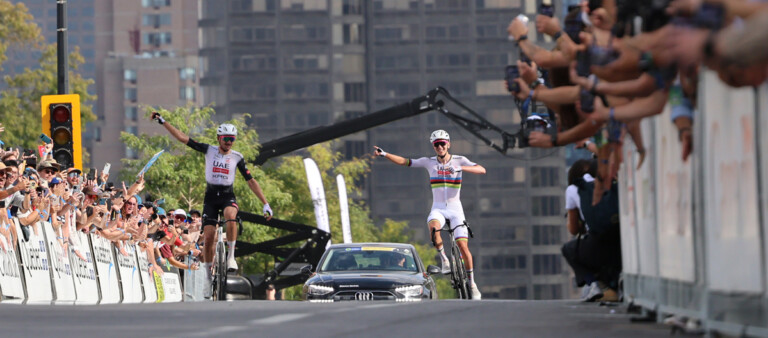
Crossing the line arm-in-arm, with Pogačar pointing to McNulty and celebrating his teammate’s triumph, the gesture completed one of professional cycling’s most selfless acts. The world champion had transformed what could have been another routine victory into something far more meaningful—a testament to the bonds that unite teammates who share cycling’s greatest challenges.
“Winning the Grand Prix Cycliste de Montréal by crossing the finish line with Tadej Pogacar, the best rider in the world and my teammate, will remain a unique moment in my career,” McNulty said after the finish. “It was an incredible day! We managed to execute our plan to perfection.”
Brandon McNulty (left) wins the Grand Prix Cycliste de Montréal 2025 crossing together with super teammate Tadej Pogacar. Photo by Dave Iltis
Behind them, Quinn Simmons secured a well-deserved podium spot, his solo effort proving that pure determination could overcome superior numbers. The American’s third place marked his best WorldTour one-day result and provided additional satisfaction for the North American cycling community.
“This Grand Prix Cycliste de Montréal was one of the most difficult one-day races of my career,” Simmons reflected. “Being beaten by Brandon and Tadej is quite honorable. It’s my best result in a UCI World Tour one-day race. It’s an important milestone in my career. And then to be on the podium with another American, wearing the United States champion’s jersey, makes this day even more special.”
The Record and the Reckoning
McNulty’s victory represented far more than individual triumph—it marked UAE Team Emirates’ 85th win of the season, tying HTC-Columbia’s 2009 record for team victories in a single year. The statistic perfectly encapsulated the squad’s unprecedented dominance across all cycling disciplines, from grand tours to classics, sprint stages to mountain summits.
“With this victory, we have equaled the record for wins in a season,” McNulty noted. “It’s very special and very rewarding after narrowly missing out last year (81 wins in 2024). Now we want to break that record before the end of the season.”
For McNulty, the win provided career validation after years of selfless service to team leaders. The Phoenix native’s third victory of 2025 was his 18th career success, but none had come with such symbolic weight or emotional resonance. That it arrived as a gift from cycling’s biggest star only amplified its significance.
For Pogačar, the performance served multiple purposes. After his disappointing 29th place in Quebec—a result born of tactical isolation rather than physical weakness—the Slovenian demonstrated his form was perfectly intact ahead of the upcoming World Championships in Kigali. More importantly, he showed that true champions understand when victories mean more to teammates than personal glory.
“I’m very happy to see Brandon win here,” Pogačar said. “He was very strong, as was the whole team today. We quickly reduced the peloton thanks to the sustained pace we set at the front.”
The world champion also reflected on the broader team success: “It’s been an incredible season for our team. Many riders have already raised their arms in victory this year (20 riders, editor’s note), each one seizing their chance. It’s the result of a tremendous collective effort.”
Lasting Impact: Beyond Results and Records
As the dust settled on one of cycling’s most memorable days, the broader implications became clear. UAE’s tactical approach—systematic control leading to decisive late-race moves—represented the evolution of modern cycling strategy. By eliminating variables and controlling every aspect of the race’s development, they had transformed what could have been chaotic into calculated precision.
Simmons acknowledged the tactical masterclass: “Pogačar and McNulty’s team had a score to settle after Friday’s Grand Prix Cycliste de Québec. They did it in style. Congratulations to them.”
Quinn Simmons (third place) on the penultimate descent of Mount Royal. Grand Prix Cycliste de Montréal 2025. Photo by Dave Iltis
The race highlighted cycling’s unique capacity for creating moments that transcend sport itself. In an era often dominated by commercial considerations and individual pursuits, Pogačar and McNulty’s embrace served as a powerful reminder of cycling’s essential humanity—the understanding that sometimes the greatest victories come not from defeating rivals, but from elevating friends.
The Grand Prix Cycliste de Montréal had once again proven its status among cycling’s most demanding one-day tests. The 17 passages of Côte Camillien-Houde served their purpose perfectly, creating the selective pressure that separated contenders from pretenders while providing the stage for an unforgettable finale.
Montreal’s race became more than a cycling competition—it became a masterpiece of tactical execution, sporting brotherhood, and human connection that will be remembered long after the statistics fade and the records are broken.
A Wout Van Aert fan! Grand Prix Cycliste de Montréal 2025. Photo by Dave Iltis
Race Statistics
Distance
Elevation Gain
Laps
Circuit Length
Winning Time
Avg. Speed
209.1 km
~4573 m
17
12.3 km
5h 14′ 04″
39.9 km/h
Top 10 Results
Rank
Rider
Nation
Team
Time
1
Brandon McNulty
USA
UAE Team Emirates
5h 14′ 04″
2
Tadej Pogačar
SLO
UAE Team Emirates
s.t.
3
Quinn Simmons
USA
Lidl-Trek
+ 1′ 03″
4
Neilson Powless
USA
EF Education-EasyPost
+ 1′ 45″
5
Adam Yates
GBR
UAE Team Emirates
+ 1′ 49″
6
Louis Barré
FRA
Intermarché-Wanty
+ 2′ 00″
7
Tiesj Benoot
BEL
Visma-Lease a Bike
+ 2′ 25″
8
Alex Aranburu
ESP
Cofidis
+ 2′ 57″
9
Corbin Strong
NZL
Israel-Premier Tech
+ 2′ 59″
10
Alberto Bettiol
ITA
XDS Astana
s.t.
Best Young Rider
Rank
Rider
Nation
Team
Time
34
Jørgen Nordhagen
NOR
Visma-Lease a Bike
+ 11′ 30″
Best Canadian
Rank
Rider
Nation
Team
Time
45
Hugo Houle
CAN
Israel-Premier Tech
+ 15′ 01″
Note: 105 riders abandoned the race, testament to the brutal pace set by UAE Team Emirates throughout the 209.1-kilometer contest.
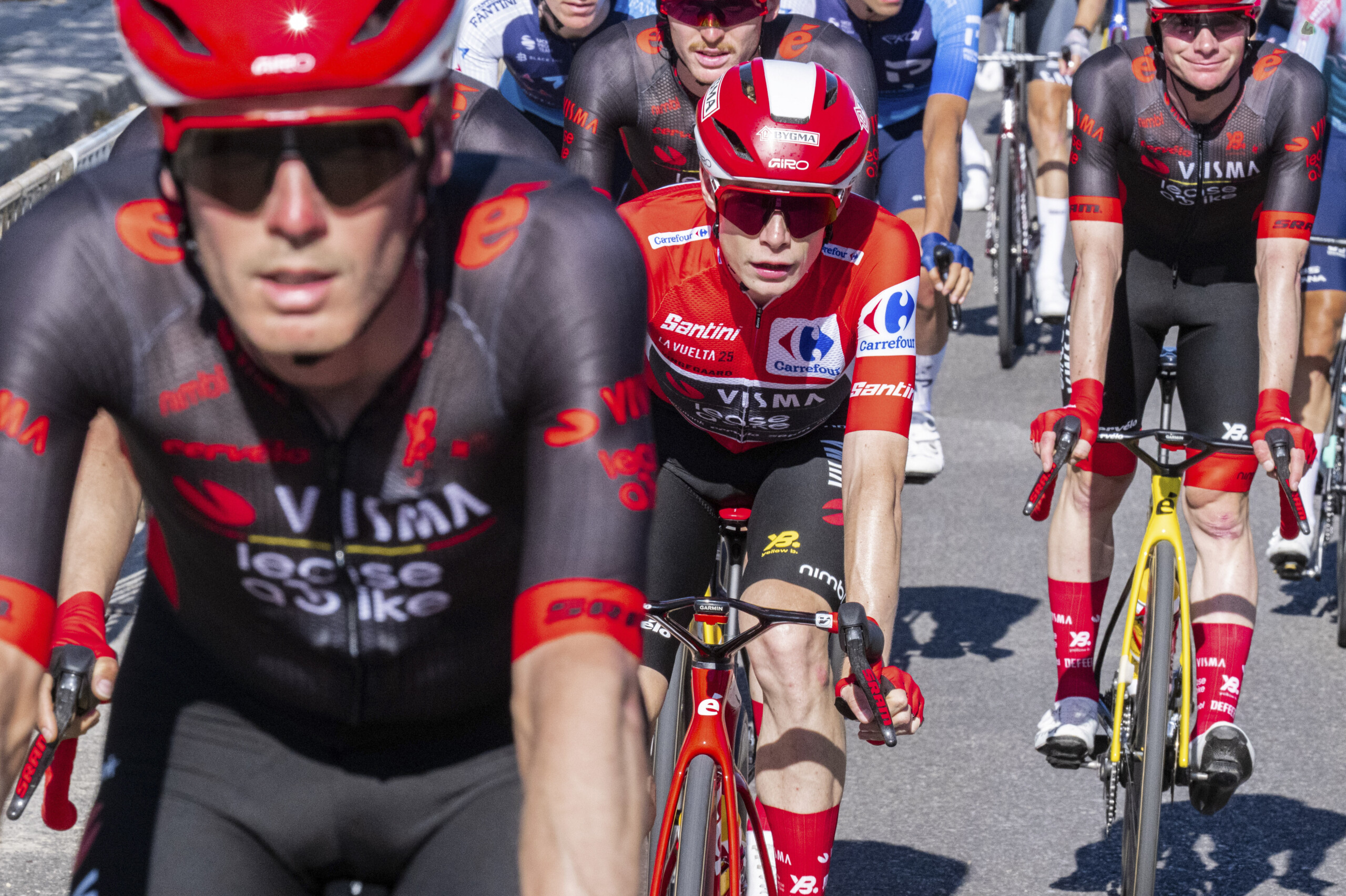
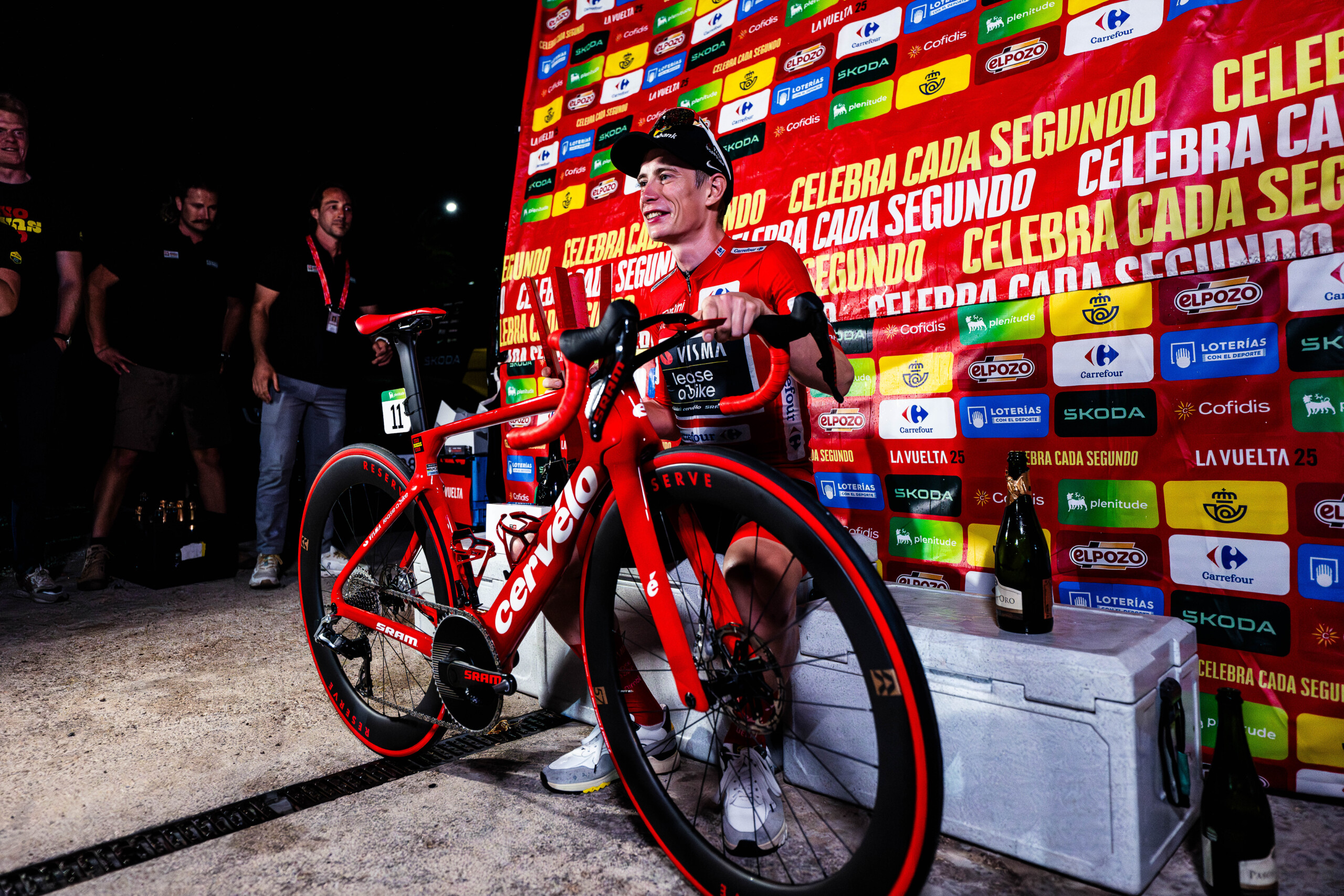
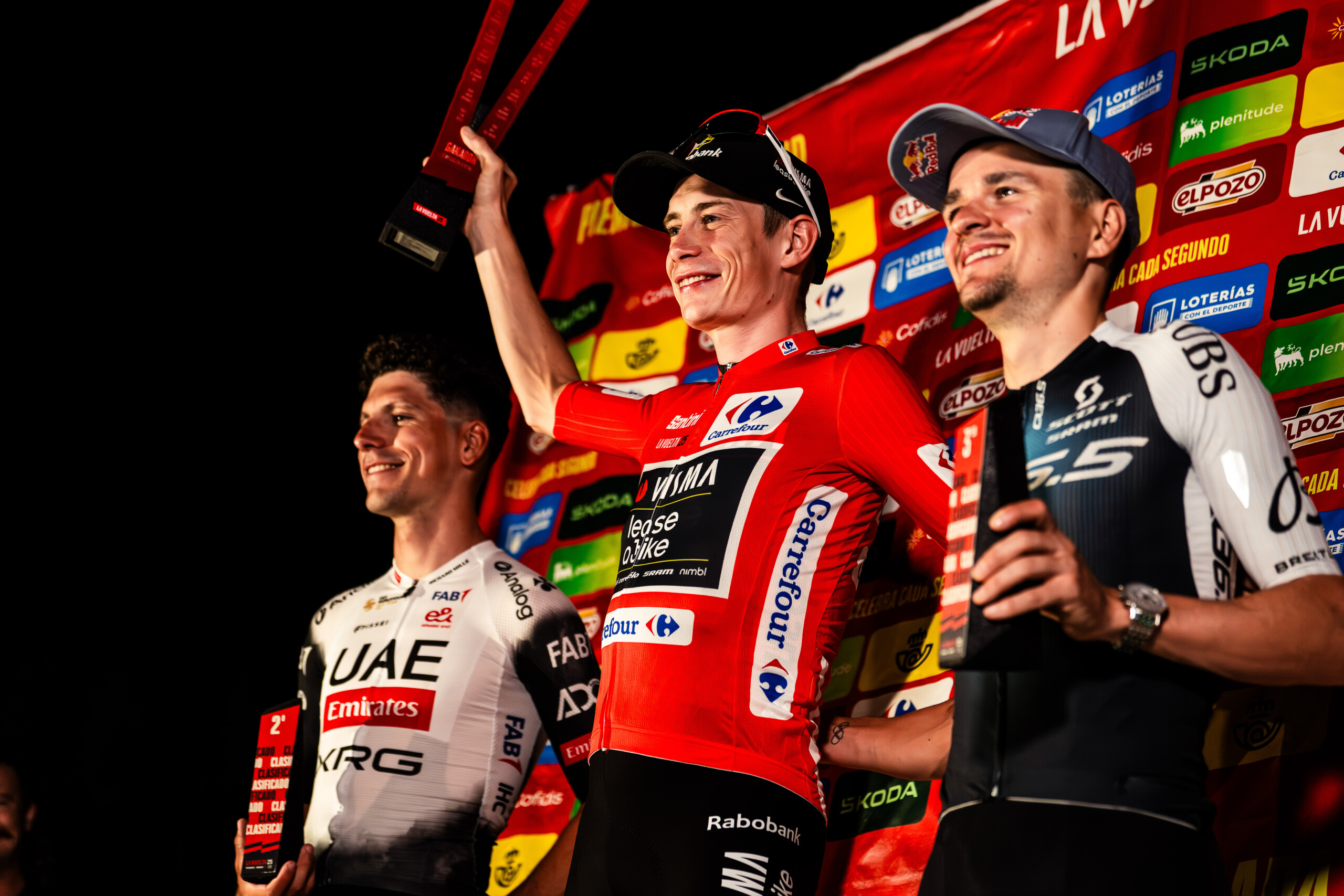
MADRID, Spain (14 September 2025) – The final week of La Vuelta a España 2025 delivered the dramatic crescendo this race deserved, culminating in Jonas Vingegaard’s historic triumph as the first Danish winner of the Spanish Grand Tour. What began as a battle between two evenly matched titans in Galicia evolved into something far more decisive on the slopes of Bola del Mundo, where the two-time Tour de France champion finally broke the resistance of João Almeida to claim La Roja in commanding fashion.
From Egan Bernal’s emotional return to victory after his life-changing crash to young Giulio Pellizzari’s breakthrough triumph and the unprecedented scenes in Madrid where protests forced an early finish, these six days encapsulated everything that makes La Vuelta cycling’s most unpredictable Grand Tour. Through tactical brilliance, raw courage, and moments of pure drama, Vingegaard emerged as a worthy champion of cycling’s most demanding three-week test.
Stage 16: Bernal’s Redemption in Galicia
Poio > Mos.Castro de Herville, 167.9km (September 9, 2025)
The race into Galicia delivered both triumph and chaos, as Egan Bernal claimed his first victory since returning from his career-threatening crash in January 2022, while stage protests forced an 8-kilometer reduction in the route. The Colombian legend’s 58th professional victory proved he remains one of cycling’s most formidable forces, even on shortened stages.
The opening of Vuelta’s final week saw attacks fly immediately as riders sensed their last opportunities for glory on Spanish soil. After 50 kilometers of fierce racing, four riders – Andrea Bagioli (Lidl-Trek), Bob Jungels (Ineos Grenadiers), Finlay Pickering (Bahrain Victorious), and Victor Guernalec (Arkéa-B&B Hotels) – established the day’s foundation.
Their advantage proved short-lived as thirteen chasers bridged across, creating a formidable 17-man group featuring Bernal alongside Mikel Landa (Soudal Quick-Step), Marc Soler (UAE Team Emirates-XRG), and an international cast including Jefferson Cepeda, Sean Quinn, and Mauri Vansevenant.
Visma-Lease a Bike’s controlled pace behind allowed the gap to grow to four minutes en route to Alto de San Antoñino, but the real selection came on the second climb at Alto do Graba. Landa’s acceleration three kilometers from the summit dropped all but Bernal and Clément Braz Afonso, with Nico Denz joining on the downhill.
The drama intensified when race organizers announced via Radio Vuelta that protests would force the finish line to move 8 kilometers earlier to Mos. This development added urgency to the finale, though it couldn’t diminish Bernal’s tactical mastery.
On the penultimate ascent of Alto de Prado, the Colombian icon showed his class, distancing Denz and Rolland before entering the finale with only Landa for company. Their two-man sprint showcased contrasting styles – Landa’s explosive acceleration versus Bernal’s sustained power – with the former Giro and Tour de France winner timing his kick perfectly.
“This marks my first success in an international race since my crash,” Bernal reflected afterward. “I was already a winner in the Giro, and I was leading stage 19 of the Tour de France 2019 when it was shortened due to weather conditions. Today brings back many emotions.”
Behind the breakaway celebration, the GC battle continued its inexorable development. Felix Gall (Decathlon AG2R La Mondiale) lost crucial time, conceding 54 seconds to his rivals as Bahrain Victorious set a fierce pace to protect Torstein Træen’s top-ten position. Jonas Vingegaard maintained La Roja with characteristic composure, but the margins remained razor-thin heading toward the decisive stages ahead.
Stage 16 Results
Place
Rider
Team
Time
1
Egan Bernal
INEOS Grenadiers
3:35:10
2
Mikel Landa
Soudal Quick-Step
3:35:10
3
Brieuc Rolland
Groupama-FDJ
3:35:17
4
Nico Denz
Red Bull-BORA-hansgrohe
3:36:12
5
Carlos Braz Afonso
Groupama-FDJ
3:36:12
6
Bob Jungels
INEOS Grenadiers
3:36:20
7
Kevin Vermaerke
Team Picnic PostNL
3:36:22
8
Xander Pickering
Bahrain Victorious
3:36:22
9
Sean Quinn
EF Education-EasyPost
3:37:58
10
Rudy Molard
Groupama-FDJ
3:37:58
General Classification after Stage 16
Place
Rider
Team
Time
1
Jonas Vingegaard
Team Visma | Lease a Bike
61:16:35
2
João Almeida
UAE Team Emirates XRG
61:17:23
3
Tom Pidcock
Q36.5 Pro Cycling Team
61:19:13
4
Jai Hindley
Red Bull-BORA-hansgrohe
61:19:45
5
Giulio Pellizzari
Red Bull-BORA-hansgrohe
61:20:56
6
Felix Gall
Decathlon AG2R La Mondiale Team
61:20:59
7
Matthew Riccitello
Israel-Premier Tech
61:21:28
8
Sepp Kuss
Team Visma | Lease a Bike
61:22:21
9
Torstein Træen
Bahrain Victorious
61:23:08
10
Julien Lecerf
Soudal Quick-Step
61:24:39
Jersey Holders after Stage 16:
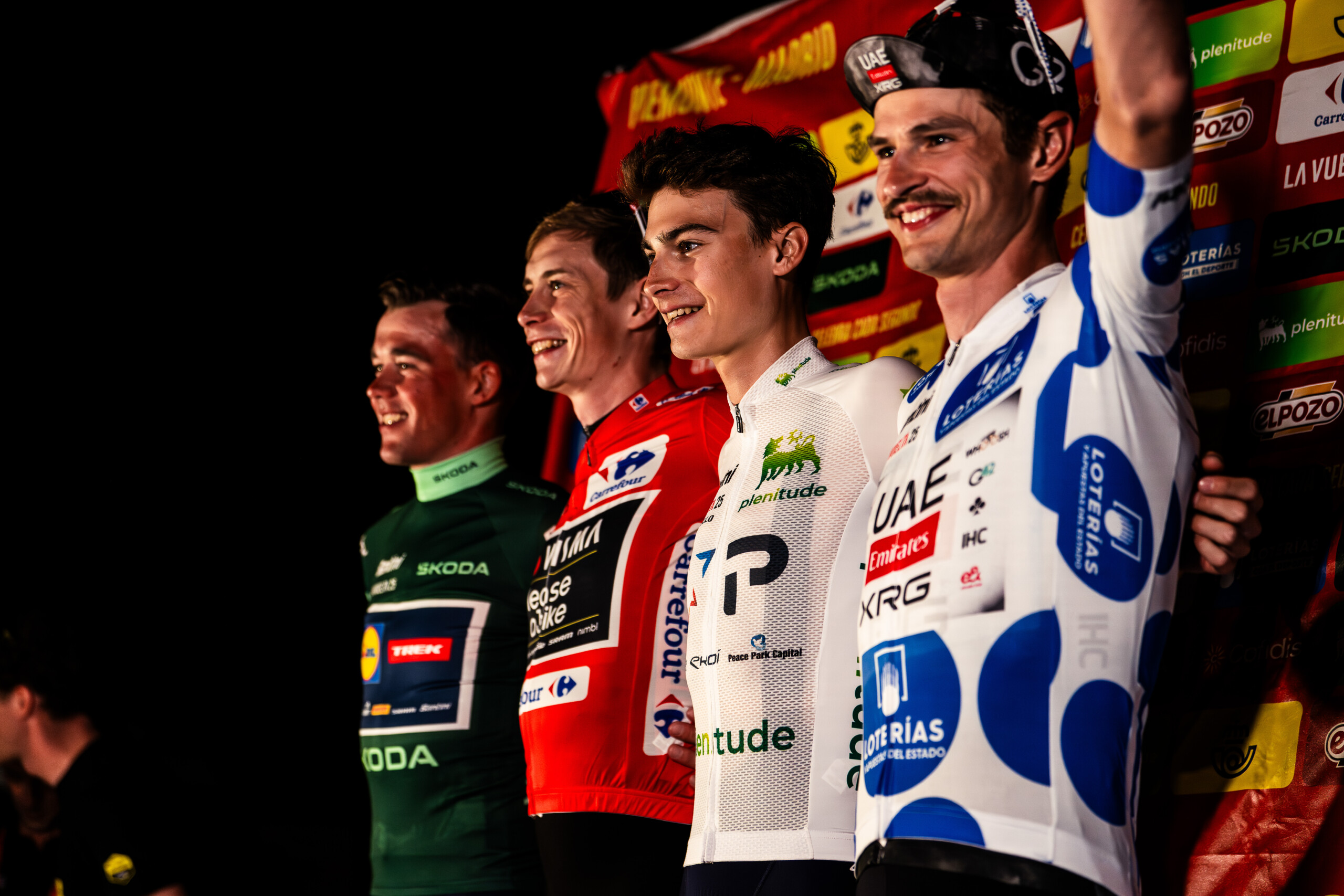
Red Jersey (La Roja) – Overall Leader: Jonas Vingegaard (Team Visma | Lease a Bike)
Green Jersey – Points: Mads Pedersen (Lidl-Trek)
Blue and White Polka-dot Jersey – King of the Mountains: Jay Vine (UAE Team Emirates XRG)
White Jersey – Best Young Rider: Giulio Pellizzari (Red Bull-BORA-hansgrohe)
Stage 17: Pellizzari’s Spectacular Breakthrough
O Barco de Valdeorras > Alto de El Morredero, 143.2km (September 10, 2025)
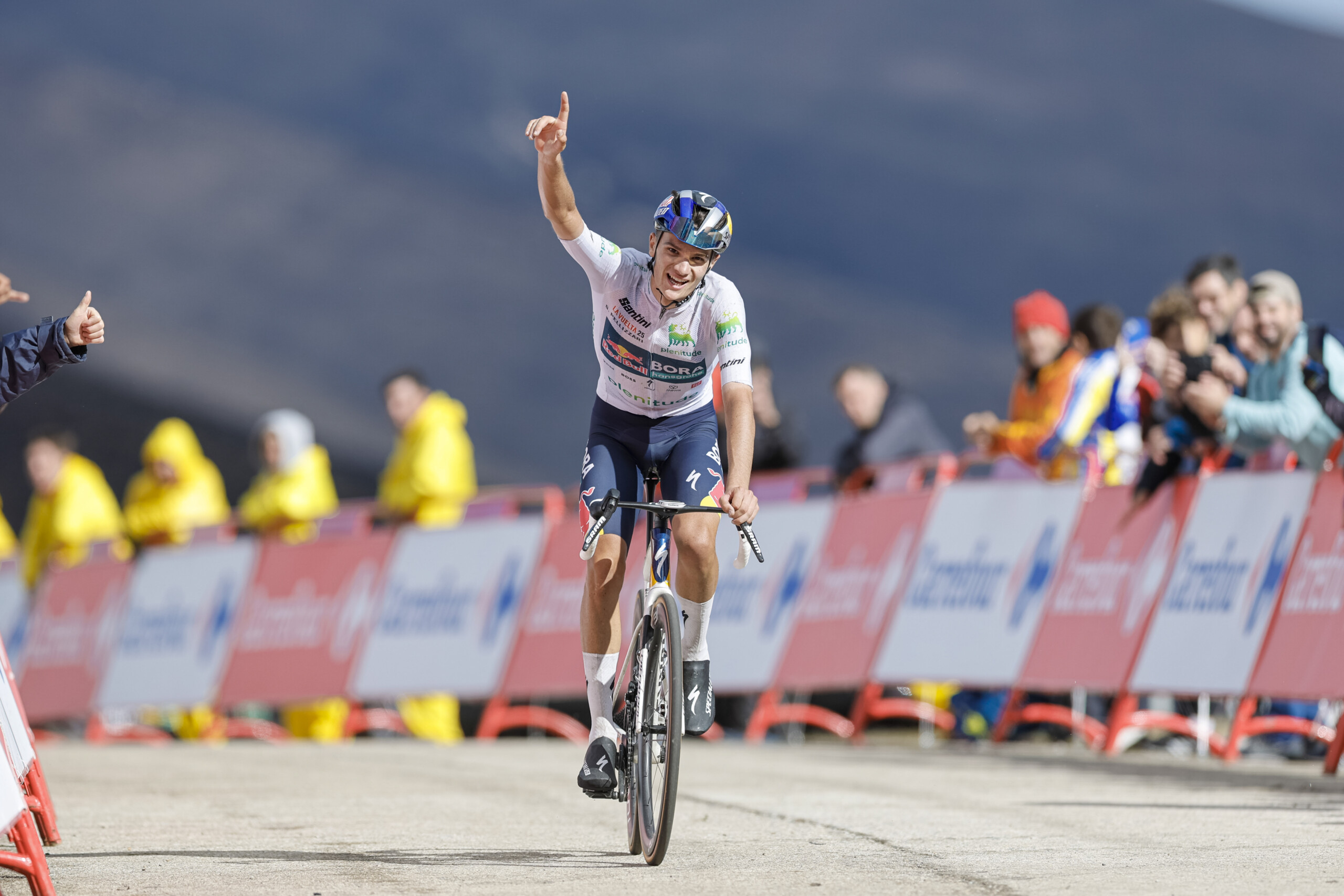
Two and a half months before his 22nd birthday, Giulio Pellizzari announced himself to the cycling world with a stunning solo victory atop Alto de El Morredero. The young Italian’s triumph marked the culmination of a perfect storm – exceptional individual talent, shrewd team tactics, and the kind of racing intelligence that transforms promising juniors into Grand Tour stage winners.
The unprecedented ascent of El Morredero provided the perfect stage for breakthrough performances, with its 8.8-kilometer climb at 9.7% offering no hiding place for pretenders. Starting from O Barco de Valdeorras, the peloton faced 3,500 meters of elevation that would test both legs and tactical acumen.
Early attacks hinted at both GC and breakaway possibilities, creating the chaotic opening that has become La Vuelta’s signature. Eight riders established the initial break at kilometer 25: Brandon Rivera (Ineos Grenadiers), Madis Mihkels (EF Education-EasyPost), Antonio Tiberi (Bahrain Victorious), Harold Tejada (XDS Astana), Patrick Gamper (Jayco AlUla), Luca Van Boven (Intermarché-Wanty), Timo Roosen (Picnic PostNL), and Jonas Gregaard (Lotto).
Fifteen kilometers later, four more riders bridged across: Joel Nicolau (Caja Rural-Seguros RGA), Léandre Lozouet (Arkéa-B&B Hotels), Sergio Samitier (Cofidis), and Gijs Leemreize (Picnic PostNL). Their 12-man group would provide the foundation for the day’s dramatic finale.
Visma-Lease a Bike’s control proved masterful, maintaining the gap at 1’50” at the base of Paso de las Travesias while Dylan van Baarle and Wilco Kelderman enforced discipline behind. The controlled tempo suggested Vingegaard’s confidence in his climbing form, though few could have predicted the dramatic conclusion awaiting on El Morredero’s exposed slopes.
Nicolau’s victory at the intermediate sprint in Almazcara demonstrated the breakaway’s commitment, though accelerations from Van Boven and Roosen briefly threatened their cohesion. Antonio Tiberi’s late attacks provided additional drama, drawing out Harold Tejada and eventually Samitier and Leemreize before the inevitable regrouping.
The final 12 kilometers witnessed pure climbing theater. Red Bull-BORA-hansgrohe drove the peloton to the base of El Morredero, but Visma-Lease a Bike assumed control on the opening gradients – the hardest section of the climb. Jai Hindley’s attack with 6 kilometers remaining drew immediate responses from Vingegaard, Tom Pidcock, and Matthew Riccitello, with Almeida and Pellizzari making contact shortly after.
Pellizzari’s moment came with 4 kilometers remaining. The young Italian’s acceleration was devastating, immediately opening a 30-second gap that would prove insurmountable. His tactical intelligence matched his physical gifts – recognizing that with two Red Bull-BORA-hansgrohe riders in the six-man group, nobody else would commit to a pursuit that might compromise their own podium chances.
“This is the best moment of my career, a short career until now,” Pellizzari reflected afterward. “Today I had a strange feeling. I felt a bit it could be my day. And I have to thank my team, especially Jai [Hindley]. In the last kilometres, there were two riders from our team out of six riders in the front. I was thinking: ‘If I go, nobody will follow.’ And that’s how it went.”
His victory margin – 16 seconds over Pidcock and 18 over Hindley – reflected the quality of opposition rather than any weakness in his performance. The Italian had timed his acceleration perfectly, choosing the steepest section where pure power would be decisive before maintaining his advantage through the flatter finale.
Stage 17 Results
Place
Rider
Team
Time
1
Giulio Pellizzari
Red Bull-BORA-hansgrohe
3:37:00
2
Tom Pidcock
Q36.5 Pro Cycling Team
3:37:16
3
Jai Hindley
Red Bull-BORA-hansgrohe
3:37:18
4
Jonas Vingegaard
Team Visma | Lease a Bike
3:37:20
5
João Almeida
UAE Team Emirates XRG
3:37:22
6
Matthew Riccitello
Israel-Premier Tech
3:37:26
7
Felix Gall
Decathlon AG2R La Mondiale Team
3:37:53
8
Torstein Træen
Bahrain Victorious
3:37:53
9
Sepp Kuss
Team Visma | Lease a Bike
3:37:58
10
Matteo Jorgenson
Team Visma | Lease a Bike
3:38:44
General Classification after Stage 17
Place
Rider
Team
Time
1
Jonas Vingegaard Hansen
Team Visma | Lease a Bike
64:53:55
2
João Almeida
UAE Team Emirates XRG
64:54:45
3
Tom Pidcock
Q36.5 Pro Cycling Team
64:56:23
4
Jai Hindley
Red Bull-BORA-hansgrohe
64:56:59
5
Giulio Pellizzari
Red Bull-BORA-hansgrohe
64:57:46
6
Felix Gall
Decathlon AG2R La Mondiale Team
64:58:52
7
Matthew Riccitello
Israel-Premier Tech
64:58:54
8
Sepp Kuss
Team Visma | Lease a Bike
65:00:19
9
Torstein Træen
Bahrain Victorious
65:01:01
10
Matteo Jorgenson
Team Visma | Lease a Bike
65:04:11
Jersey Holders after Stage 17:
Red Jersey (La Roja) – Overall Leader: Jonas Vingegaard (Team Visma | Lease a Bike)
Green Jersey – Points: Mads Pedersen (Lidl-Trek)
Blue and White Polka-dot Jersey – King of the Mountains: Jay Vine (UAE Team Emirates XRG)
White Jersey – Best Young Rider: Giulio Pellizzari (Red Bull-BORA-hansgrohe)
Stage 18: Ganna’s Time Trial Masterclass Shifts GC Dynamics
Valladolid > Valladolid, 12.2km Individual Time Trial (September 11, 2025)
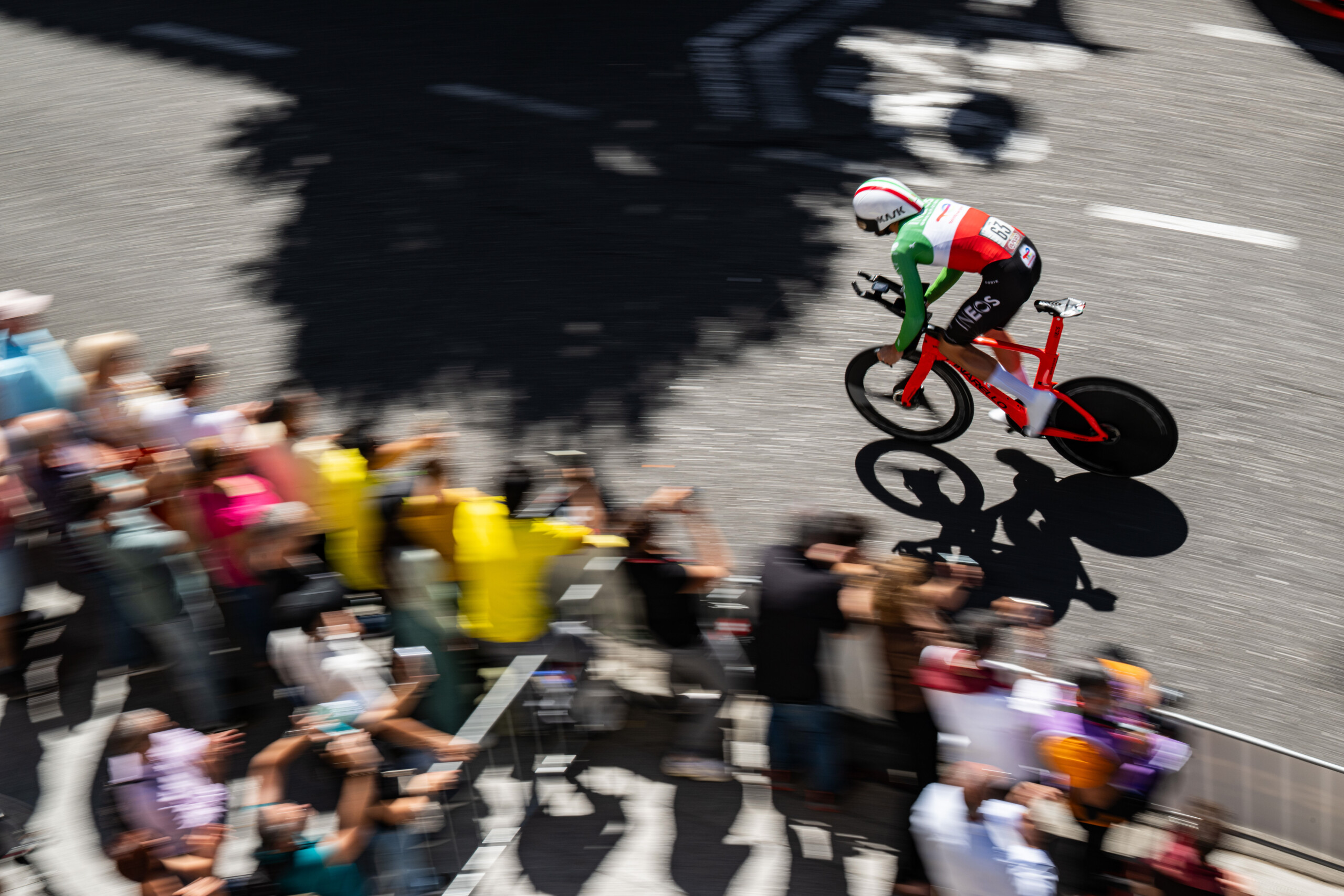
Filippo Ganna’s thunderous return to form delivered the time trial exhibition this Vuelta demanded, while the GC battle took its most significant turn yet as João Almeida clawed back precious seconds on Jonas Vingegaard. On the shortened but technically demanding 12.2-kilometer course through Valladolid’s historic streets, the Italian powered to his eighth Grand Tour individual time trial victory at an average speed of 56.2 km/h – a performance that rewarded two weeks of suffering in service of his team.
The two-time world time trial champion’s dominance was immediately apparent as he scorched through the multiple corners and technical sections that broke the rhythm of lesser specialists. Starting 17th overall, Ganna demolished Dan Hoole’s early benchmark of 13:19, setting a devastating time of 13:00 that would prove untouchable despite the quality of the field behind him.
Fourteen national time trial champions lined up in Valladolid’s late afternoon sunshine, each harboring hopes of challenging the Italian’s supremacy. Ivo Oliveira (UAE Emirates XRG) came closest among the early starters, finishing 11 seconds back, while Mads Pedersen’s 21-second deficit demonstrated the gulf between sprinter-specialists and pure time trialists on technical courses.
Stefan Küng’s challenge fell 12 seconds short despite the Swiss powerhouse’s renowned technical skills, while Bruno Armirail (Décathlon-AG2R La Mondiale) managed an impressive fourth place, 10 seconds behind Ganna. But it was Jay Vine’s extraordinary performance that provided the day’s most dramatic moment – the Australian climber missing victory by just 0.90 seconds in what would have been one of the most unlikely time trial victories in Grand Tour history.
“I think I suffered more during the last three hours in the hotseat than on the bike,” Ganna laughed afterward. “I did not find the correct rhythm in the first part, and then in the final part I pushed without thinking about numbers or anything. After my big crash in the Tour de France, it has not been easy to be back on the bike.”
The real drama unfolded in the battle for La Roja. Vingegaard approached the stage hoping to extend his advantage, but Almeida’s third-place finish behind his teammate Vine proved decisive. The Portuguese rider gained 10 crucial seconds on the race leader, reducing the deficit to just 40 seconds with three stages remaining.
“I think I can be pretty happy with how it went today,” Vingegaard reflected, though his ninth-place finish represented a rare tactical miscalculation. “I think, on a flat time trial like this, it suited a bit more the bigger guys, so to do this well in such a time trial I think that’s good for me. I’ve never done 55kph average on a time trial before.”
Vine’s near-miss provided consolation for UAE Team Emirates-XRG’s time trial ambitions while reinforcing his climbing credentials. “Time-wise, probably it was one of my best time trials,” the Australian admitted. “To come 2nd to Ganna it’s incredible, just beaten by one of the best time trialists in the world. Nothing more that I could do.”
The stage reshaped the white jersey competition as well, with Pellizzari losing 10 seconds to his closest rival after gaining 30 the previous day. The Italian remained sanguine: “I think that it was too short for me today. I was a bit tired after yesterday and I was expecting better, but it was important to save the result.”
Stage 18 Results
Place
Rider
Team
Time
1
Filippo Ganna
INEOS Grenadiers
0:13:00
2
Jay Vine
UAE Team Emirates XRG
0:13:01
3
Joao Almeida
UAE Team Emirates XRG
0:13:08
4
Bruno Armirail
Decathlon AG2R La Mondiale Team
0:13:10
5
Ivo Oliveira
UAE Team Emirates XRG
0:13:11
6
Stefan Küng
Groupama-FDJ
0:13:12
7
Kelland O’Brien
Team Jayco AlUla
0:13:15
8
Alec Segaert
Lotto
0:13:16
9
Jonas Vingegaard
Team Visma | Lease a Bike
0:13:18
10
Daan Hoole
Lidl-Trek
0:13:19
General Classification after Stage 18
Place
Rider
Team
Time
1
Jonas Vingegaard
Team Visma | Lease a Bike
65:07:13
2
Joao Almeida
UAE Team Emirates XRG
65:07:53
3
Tom Pidcock
Q36.5 Pro Cycling Team
65:09:52
4
Jai Hindley
Red Bull-BORA-hansgrohe
65:10:31
5
Giulio Pellizzari
Red Bull-BORA-hansgrohe
65:11:32
6
Matthew Riccitello
Israel-Premier Tech
65:12:30
7
Felix Gall
Decathlon AG2R La Mondiale Team
65:12:33
8
Sepp Kuss
Team Visma | Lease a Bike
65:14:39
9
Torstein Træen
Bahrain Victorious
65:14:55
10
Matteo Jorgenson
Team Visma | Lease a Bike
65:17:32
Jersey Holders after Stage 18:
Red Jersey (La Roja) – Overall Leader: Jonas Vingegaard (Team Visma | Lease a Bike)
Green Jersey – Points: Mads Pedersen (Lidl-Trek)
Blue and White Polka-dot Jersey – King of the Mountains: Jay Vine (UAE Team Emirates XRG)
White Jersey – Best Young Rider: Giulio Pellizzari (Red Bull-BORA-hansgrohe)
Stage 19: Philipsen’s Sprint Mastery and Vingegaard’s Tactical Gambit
Rueda > Guijuelo, 161.9km (September 12, 2025)
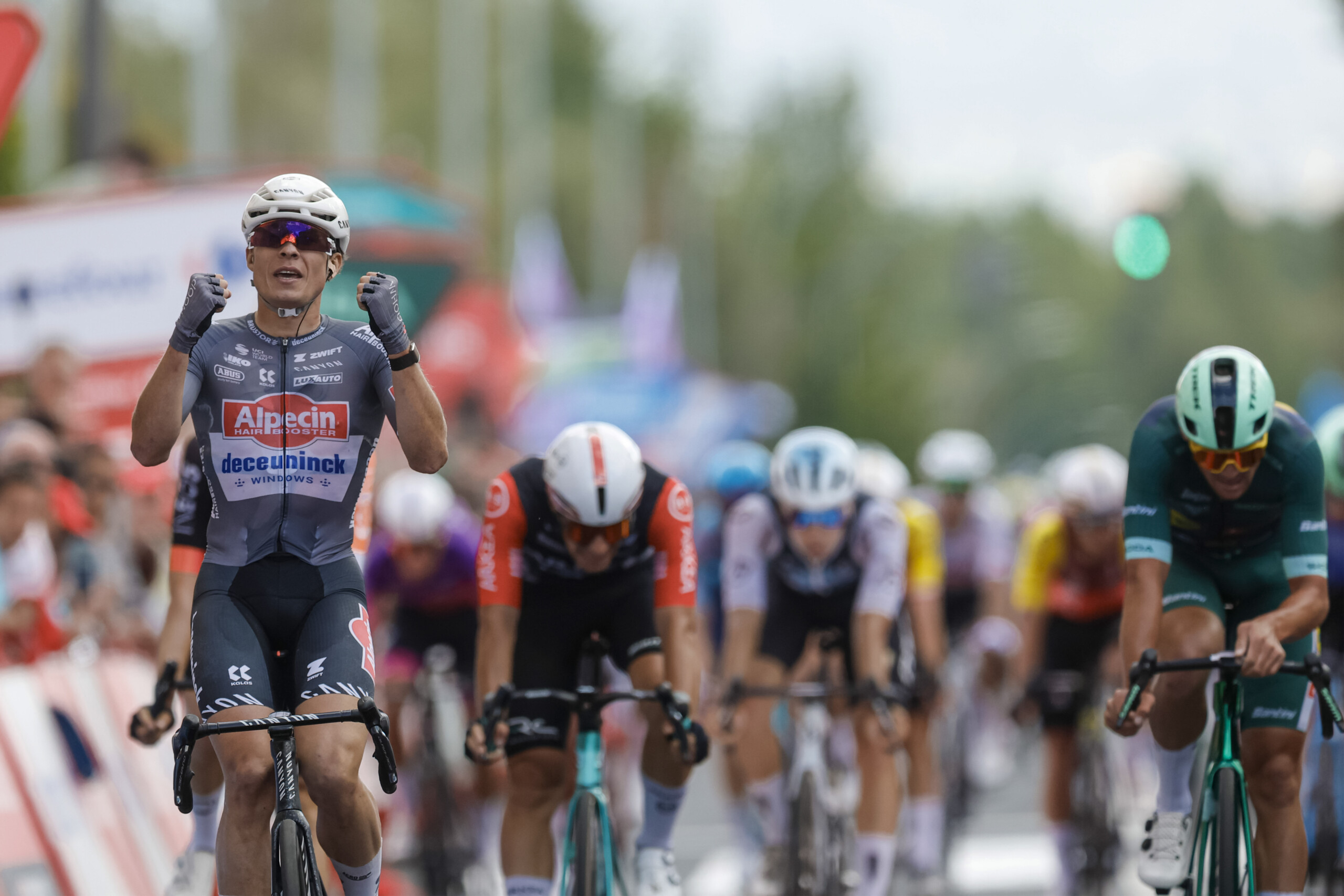
Jasper Philipsen’s third stage victory of this Vuelta demonstrated pure sprint mastery, while Jonas Vingegaard’s strategic thinking at the intermediate sprint added four precious seconds to his overall lead. On the penultimate stage offering flat racing and respite from the mountains, the Belgian speedster’s triumph consolidated his dominance of the bunch sprints while race tactics continued to evolve ahead of Saturday’s decisive showdown.
The 161.9-kilometer journey from Rueda to Guijuelo provided cycling’s speed merchants their final opportunity since Philipsen’s Zaragoza victory on stage 8. With just 1,117 meters of elevation and no categorized climbs, the route promised pure sprint racing – though crosswinds around Salamanca threatened to rewrite any simple script.
Jakub Otruba (Caja Rural-Seguros-RGA) reprised his role as serial attacker, launching himself from the flag drop for the second time in recent stages. Victor Guernalec (Arkéa-B&B Hotels) briefly joined the Czech rider’s audacious move before dropping back, leaving Otruba to face 145 kilometers of solo racing against the combined might of Alpecin-Deceuninck and Lotto.
The gap reached a maximum of four minutes after 40 kilometers as Philipsen’s lead-out train and Elia Viviani’s sprint squad shared pacing duties. Their measured approach suggested confidence in reeling in the lone attacker, though the persistent crosswinds demanded constant vigilance from nervous GC contenders.
Vingegaard’s tactical masterstroke came at the intermediate sprint in Salamanca, 103 kilometers into the stage. With Otruba still maintaining a one-minute advantage, the race leader seized his opportunity for bonus seconds, taking second place behind the breakaway rider to extend his GC lead over Almeida to 44 seconds.
“I wouldn’t call it winning a bunch sprint… I took a few seconds there,” Vingegaard said afterward. “We were in a good position so we went for the intermediate sprint. It was improvised. We just saw that we were in the front and we said: ‘Why not try?’ If we could get four seconds, then it was worth it.”
Otruba’s brave effort ended with 52 kilometers remaining as the peloton’s pace intensified through the valley’s crosswinds. Mario Aparicio and Sergio Chumil (Burgos Burpellet BH) attempted a late countermove 11 kilometers later, but Alpecin-Deceuninck and Visma-Lease a Bike’s acceleration nullified their hopes 35 kilometers from the finish.
The finale unfolded with textbook precision. Filippo Ganna’s lead-out work for Ben Turner brought INEOS Grenadiers to the front entering the final kilometer, but Alpecin-Deceuninck’s superior organization proved decisive. Ed Planckaert’s perfect timing delivered Philipsen into the ideal position for his devastating kick.
“It was a really tough finish line, after eleven days not going this deep, it definitely hurts,” Philipsen reflected. “We knew how the finale was, rising and then a bit more flat in the final 250 metres. The team set me with an amazing timing and it was all out in the final kilometre.”
The uphill drag to the line suited Philipsen’s explosive power perfectly, though Mads Pedersen’s second place confirmed his stranglehold on the green jersey. With a 100-point margin over Vingegaard and just 110 points available in the remaining stages, the Danish champion had effectively secured his second points classification victory.
“No, not really surprised that Jonas Vingegaard did the intermediate sprint,” Pedersen acknowledged. “I knew it would happen and we talked together. There were bonifications in that sprint, and he needs the seconds more than I need the points right now.”
Stage 19 Results
Place
Rider
Team
Time
1
Jasper Philipsen
Alpecin-Deceuninck
3:50:35
2
Mads Pedersen
Lidl-Trek
3:50:35
3
Orluis Alberto Aular Sanabria
Movistar Team
3:50:35
4
Jenthe Biermans
Arkea-B&B Hotels
3:50:35
5
Ben Turner
INEOS Grenadiers
3:50:35
6
Arne Marit
Intermarché-Wanty
3:50:35
7
Fabio Christen
Q36.5 Pro Cycling Team
3:50:35
8
Ethan Vernon
Israel-Premier Tech
3:50:35
9
Thomas Gruel
Groupama-FDJ
3:50:35
10
Jordan Labrosse
Decathlon AG2R La Mondiale Team
3:50:35
General Classification after Stage 19
Place
Rider
Team
Time
1
Jonas Vingegaard Hansen
Team Visma | Lease a Bike
68:57:44
2
João Almeida
UAE Team Emirates XRG
68:58:28
3
Tom Pidcock
Q36.5 Pro Cycling Team
69:00:27
4
Jai Hindley
Red Bull-BORA-hansgrohe
69:01:06
5
Giulio Pellizzari
Red Bull-BORA-hansgrohe
69:02:07
6
Matthew Riccitello
Israel-Premier Tech
69:03:05
7
Felix Gall
Decathlon AG2R La Mondiale Team
69:03:08
8
Sepp Kuss
Team Visma | Lease a Bike
69:05:14
9
Torstein Træen
Bahrain Victorious
69:05:30
10
Matteo Jorgenson
Team Visma | Lease a Bike
69:08:05
Jersey Holders after Stage 19:
Red Jersey (La Roja) – Overall Leader: Jonas Vingegaard (Team Visma | Lease a Bike)
Green Jersey – Points: Mads Pedersen (Lidl-Trek)
Blue and White Polka-dot Jersey – King of the Mountains: Jay Vine (UAE Team Emirates XRG)
White Jersey – Best Young Rider: Giulio Pellizzari (Red Bull-BORA-hansgrohe)
Stage 20: Vingegaard’s Crowning Glory atop Bola del Mundo
Robledo de Chavela > Bola del Mundo. Puerto de Navacerrada, 159km (September 13, 2025)
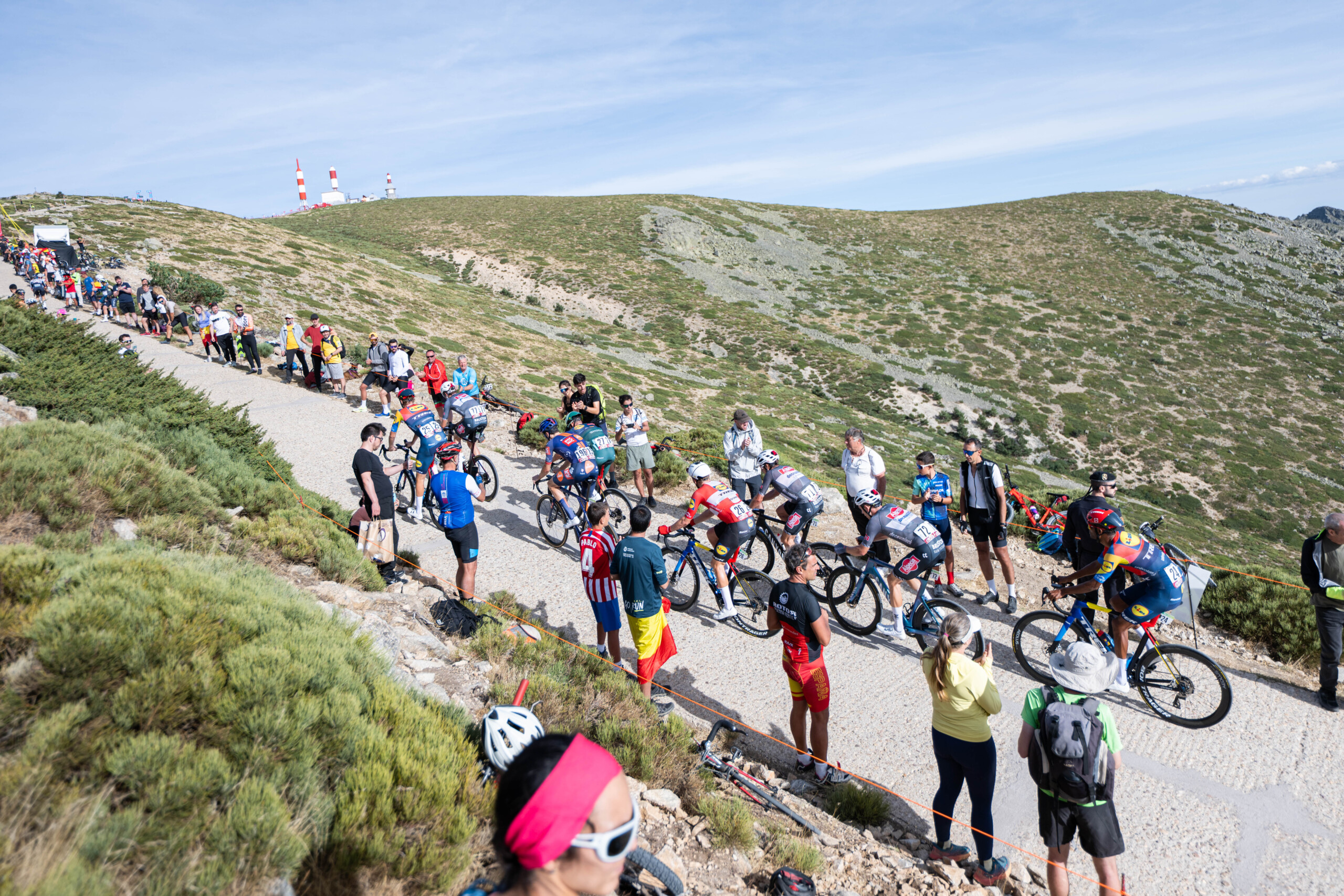
Jonas Vingegaard delivered the performance of a champion when it mattered most, powering to a decisive solo victory atop Bola del Mundo that effectively sealed his first La Vuelta triumph. With 1.2 kilometers remaining on the steepest gradients of the Spanish Grand Tour’s final climb, the Danish climbing specialist unleashed an acceleration that none could follow, crowning himself on the highest summit of this edition at 2,251 meters above sea level.
The stage with the most elevation – 4,226 meters packed into 159 kilometers – provided the perfect theater for La Vuelta’s final mountain showdown. Starting uphill on the Alto de la Escondida, the route promised a day-long battle of attrition before the decisive encounter on the brutal three final kilometers of Bola del Mundo.
INEOS Grenadiers forced the early racing with characteristic aggression. Filippo Ganna’s opening attack drew immediate responses from Egan Bernal, Michal Kwiatkowski, Bob Jungels, and Brandon Rivera, establishing the foundation for what would become a massive 37-man breakaway on the Alto de Parpadilla.
The composition was extraordinary: Bernal and his INEOS teammates controlled the break while Lidl-Trek deployed four riders including local hero Carlos Verona, Mads Pedersen, Giulio Ciccone, and Julien Bernard. Serial attackers like Eddie Dunbar (Jayco AlUla) and Mikel Landa (Soudal Quick-Step) provided additional firepower, though the peloton maintained firm control.
UAE Team Emirates-XRG and Red Bull-BORA-hansgrohe’s collaboration behind kept the gap under two minutes, their tactical alliance reflecting the stakes involved. The breakaway conquered the Alto del Leon before exploding on the Alto de Navacerrada, where Jardi van der Lee (EF Education-EasyPost) emerged first from the remnants.
At the base of the final climb, van der Lee held company with Bernal, Landa, and Ciccone, maintaining a minute’s advantage over the drastically reduced bunch. The 12.3-kilometer ascent at 8.6% would test every fiber of strength and will, with gradients reaching 20% on the decisive final sections.
Ciccone and Landa rapidly isolated themselves at the front while UAE Team Emirates-XRG ramped up the pressure behind. Jay Vine’s pace-setting drew out the final selection before stepping aside for Almeida’s signature acceleration. The Portuguese rider’s effort caught the break leaders three kilometers from the summit, setting up the climactic GC battle.
Jai Hindley’s attack with 2.5 kilometers remaining demonstrated Red Bull-BORA-hansgrohe’s commitment to the podium fight. The Australian’s move drew immediate responses from Vingegaard, Sepp Kuss, Almeida, and Tom Pidcock, establishing the sextet that would decide La Vuelta’s destiny.
Vingegaard’s moment came with 1.2 kilometers remaining. His acceleration was instantaneous and devastating, immediately gapping the group on gradients that reached their maximum severity. The sight of the race leader in La Roja powering away from cycling’s elite on the sport’s highest stage provided a fitting climax to three weeks of exceptional racing.
“Of course, I wanted to win in Bilbao and at L’Angliru, but Bola del Mundo is also something special,” Vingegaard reflected. “To be honest, I started to feel a bit better today, better than the previous mountain top finishes, so I’m happy with how things have turned for me today and with how the team has done over the last three weeks.”
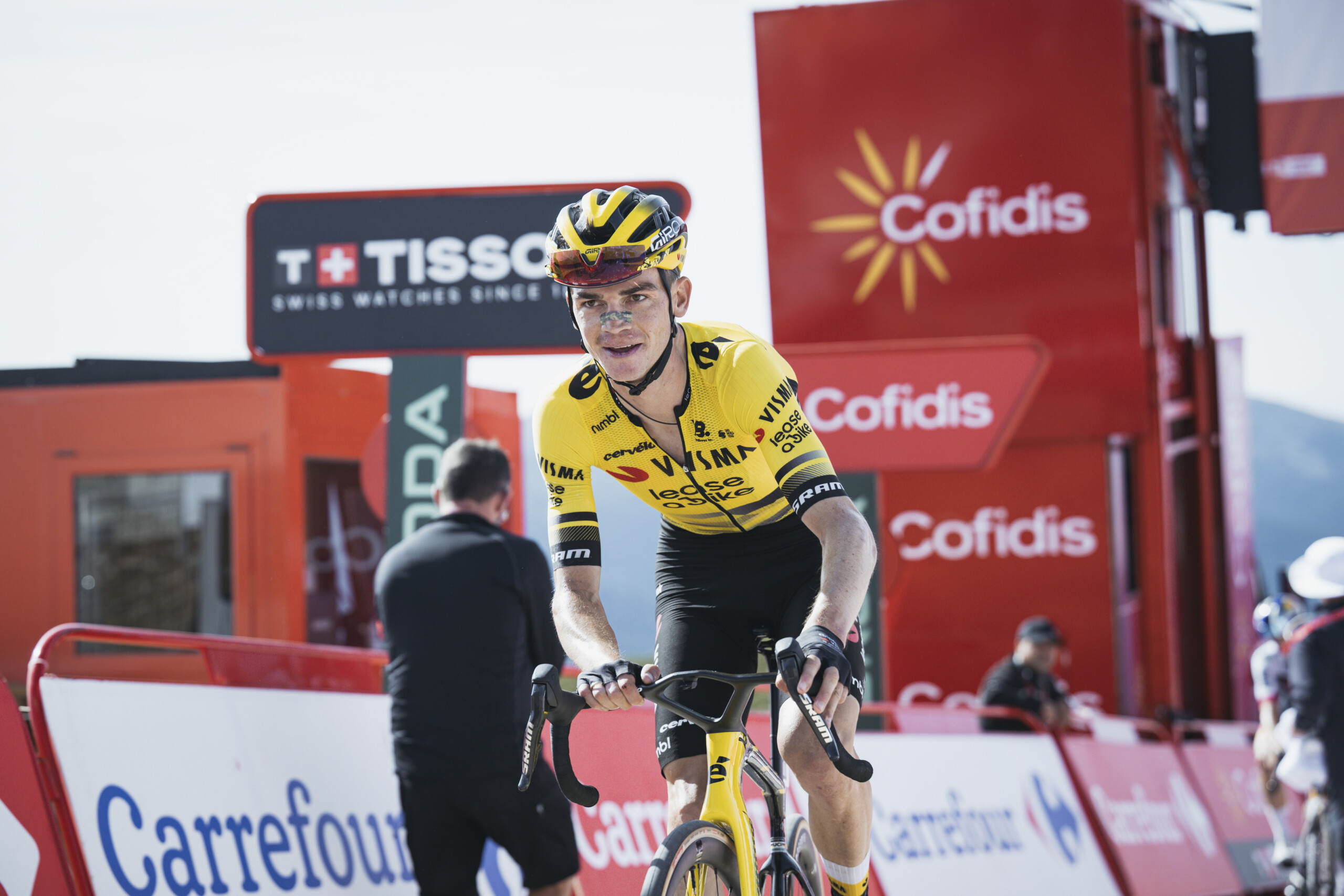
Kuss’s second place on his 31st birthday highlighted Visma-Lease a Bike’s dominance, with Hindley completing the podium at 13 seconds. Pidcock’s fourth place at 18 seconds secured his overall podium position, while Almeida’s fifth at 22 seconds reflected the Portuguese rider’s valiant but ultimately futile chase.
The stage witnessed a dramatic late change in the white jersey classification as Matthew Riccitello’s exceptional ride to sixth place at 47 seconds earned him the best young rider classification, overtaking Pellizzari who paid for his efforts the previous day.
“It couldn’t have gone any better,” Riccitello reflected afterward. “The white jersey was a goal going into the stage. If it didn’t happen, it had been a good Vuelta up until this point anyway. I went into the stage like I had nothing to lose.”
Jay Vine’s seventh place secured the polka-dot jersey outright, completing a dominant campaign in the mountains classification. “Winning the polka dot jersey is a bittersweet victory, I guess,” the Australian admitted. “The goal was to try to win La Vuelta. Unfortunately, we came up short.”
Stage 20 Results
Place
Rider
Team
Time
1
Jonas Vingegaard
Team Visma | Lease a Bike
3:56:23
2
Sepp Kuss
Team Visma | Lease a Bike
3:56:34
3
Jai Hindley
Red Bull-BORA-hansgrohe
3:56:36
4
Tom Pidcock
Q36.5 Pro Cycling Team
3:56:41
5
João Almeida
UAE Team Emirates XRG
3:56:45
6
Matthew Riccitello
Israel-Premier Tech
3:56:47
7
Jay Vine
UAE Team Emirates XRG
3:57:10
8
Giulio Ciccone
Lidl-Trek
3:57:34
9
Jan Hirt Lecerf
Soudal Quick-Step
3:57:45
10
Xander Pickering
Bahrain Victorious
3:57:53
General Classification after Stage 20
Place
Rider
Team
Time
1
Jonas Vingegaard
Team Visma | Lease a Bike
72:53:57
2
João Almeida
UAE Team Emirates XRG
72:55:13
3
Tom Pidcock
Q36.5 Pro Cycling Team
72:57:08
4
Jai Hindley
Red Bull-BORA-hansgrohe
72:57:38
5
Matthew Riccitello
Israel-Premier Tech
72:59:52
6
Giulio Pellizzari
Red Bull-BORA-hansgrohe
73:01:20
7
Sepp Kuss
Team Visma | Lease a Bike
73:01:42
8
Felix Gall
Decathlon AG2R La Mondiale Team
73:01:47
9
Torstein Træen
Bahrain Victorious
73:03:45
10
Matteo Jorgenson
Team Visma | Lease a Bike
73:06:13
Jersey Holders after Stage 20:
Red Jersey (La Roja) – Overall Leader: Jonas Vingegaard (Team Visma | Lease a Bike)
Green Jersey – Points: Mads Pedersen (Lidl-Trek)
Blue and White Polka-dot Jersey – King of the Mountains: Jay Vine (UAE Team Emirates XRG)
White Jersey – Best Young Rider: Matthew Riccitello (Israel-Premier Tech)
Alalpardo > Madrid, Stage Shortened Due to Protests (September 14, 2025)
La Vuelta a España 2025 concluded with scenes never before witnessed in Grand Tour history, as protests in Madrid forced the cancellation of the final stage’s finish and podium ceremony. Yet Jonas Vingegaard’s historic triumph as Denmark’s first winner of the Spanish Grand Tour could not be diminished by the chaos that engulfed cycling’s most unpredictable three-week race.
The traditional ceremonial final stage from Alalpardo began with the customary celebration of achievement. Vingegaard, resplendent in La Roja, posed for photographs with his Danish compatriots Mads Pedersen (green jersey winner), Mikkel Bjerg, Chris Juul-Jensen, Anders Foldager, and Jonas Gregaard before joining his Visma-Lease a Bike teammates for the champagne toast that marks Grand Tour victory.
The scenes were joyous as the 153 remaining riders made their leisurely way toward the Spanish capital, plastic cups and smiles everywhere as the La Vuelta caravan celebrated the completion of three weeks that had illuminated roads across Italy, France, Andorra, and Spain.
The celebration ended abruptly when protestors invaded the route, forcing race organizers to stop the peloton for safety reasons. Stage 21 ended without a winner, without a proper finish, and without the traditional podium ceremony that should have crowned Vingegaard’s achievement.
Instead, the final podium ceremony took place in a Madrid hotel parking lot, hastily organized by the teams themselves with a makeshift backdrop. The four distinctive jersey wearers posed for photographs in surreal circumstances that somehow seemed fitting for La Vuelta’s unpredictable nature.
“It’s a funny podium, and in some ways, probably the most special,” Vingegaard commented to Danish outlet TV2. “The day has been surreal. I must admit I’m somewhat disappointed not to be able to celebrate in central Madrid. It’s a shame that it’s under these circumstances, but it’s great that we could still make a little effort.”
Despite the unconventional conclusion, nothing could diminish the magnitude of Vingegaard’s achievement. The two-time Tour de France winner had claimed his first La Vuelta, making Denmark the 15th nation to conquer Spain’s Grand Tour. His final margin of 1’16” over Almeida reflected the sustained excellence required across three weeks of racing at the sport’s highest level.
Tom Pidcock’s third place marked a breakthrough performance for the MTB Olympic champion, becoming the first mountain bike Olympic gold medalist to reach a Grand Tour podium. Jai Hindley’s fourth place continued Red Bull-BORA-hansgrohe’s exceptional season, while Matthew Riccitello’s white jersey triumph capped a remarkable breakthrough for the young American.
Mads Pedersen’s green jersey victory made him only the second rider in history to win the points classifications of both the Giro and La Vuelta in the same year, after Eddy Merckx in 1973. Jay Vine’s successful defense of the mountains classification marked the first successful polka-dot jersey defense since Omar Fraile in 2015-2016.
UAE Team Emirates-XRG claimed the team classification, capping an extraordinary campaign that saw them win more stages than any team in a single Vuelta edition this century. Joel Nicolau earned the most aggressive rider award, while cycling’s unpredictable nature provided one final twist with the unprecedented finish.
Final General Classification
Place
Rider
Team
Time
1
Jonas Vingegaard
Team Visma | Lease a Bike
74:20:28
2
João Almeida
UAE Team Emirates XRG
+1:16
3
Tom Pidcock
Q36.5 Pro Cycling Team
+3:11
4
Jai Hindley
Red Bull-BORA-hansgrohe
+3:41
5
Matthew Riccitello
Israel-Premier Tech
+5:55
6
Giulio Pellizzari
Red Bull-BORA-hansgrohe
+7:23
7
Sepp Kuss
Team Visma | Lease a Bike
+7:45
8
Felix Gall
Decathlon AG2R La Mondiale Team
+7:50
9
Torstein Træen
Bahrain Victorious
+9:48
10
Matteo Jorgenson
Team Visma | Lease a Bike
+12:16
Final Jersey Holders:
Red Jersey (La Roja) – Overall Leader: Jonas Vingegaard (Team Visma | Lease a Bike)
Green Jersey – Points: Mads Pedersen (Lidl-Trek)
Blue and White Polka-dot Jersey – King of the Mountains: Jay Vine (UAE Team Emirates XRG)
White Jersey – Best Young Rider: Matthew Riccitello (Israel-Premier Tech)
The Final Reckoning
As the dust settled on cycling’s most extraordinary Grand Tour conclusion in decades, the sporting narrative emerged clearly from the chaos. Jonas Vingegaard had delivered when it mattered most, transforming his narrow advantage into decisive victory through tactical intelligence, climbing brilliance, and the mental fortitude that separates champions from contenders.
His triumph represented more than individual achievement – it marked the culmination of Visma-Lease a Bike’s evolution into cycling’s premier Grand Tour operation. Five stage victories across the three weeks, including Vingegaard’s three summit triumphs and Sepp Kuss’s birthday present, demonstrated their tactical sophistication and depth of talent.
Yet perhaps the most enduring image of La Vuelta 2025 will be that improvised podium ceremony in a Madrid hotel parking lot. In a sport where tradition and ceremony matter deeply, the sight of cycling’s newest champion celebrating among friends and family, making the best of unprecedented circumstances, somehow captured the essential spirit of what makes La Vuelta cycling’s most human Grand Tour.
The numbers tell their own story: 3,151 kilometers across four countries, 53,000 meters of climbing, and 21 stages that produced 15 different winners from eight nations. But the real story lies in moments like Bernal’s emotional return to victory, Pellizzari’s breakthrough triumph, and Vingegaard’s crowning glory atop Bola del Mundo – proof that cycling’s greatest race continues to write the most compelling chapters in sport’s ongoing narrative.
In the end, no protest could diminish what Vingegaard achieved across three weeks of exceptional racing. Denmark’s first La Vuelta champion stands among cycling’s elite, his name forever etched in the record books of the sport’s most demanding and unpredictable Grand Tour.
By Peter Abraham — I recently attended a public virtual meeting put on by CalTrans. That’s the state government organization that manages transportation in California, including highways, rail and airports. The purpose of the meeting was for CalTrans to present to the public their plan to improve bike safety on Pacific Coast Highway in Malibu. This is an important issue for me, because I’ve ridden my bike on that stretch of road since I was a UCLA student in the mid-1980s. I have several friends who’ve been hit by cars while riding on PCH, and I myself have had many close calls. As someone who takes his bike all over LA, I believe there is no higher bike infrastructure priority than making our roads, including PCH, safe places to ride.
CalTrans renderings for proposed PCH bike lanes in Malibu.
So I was excited for this meeting. They started by presenting to attendees the plan, what they intended to build on PCH. There were many thoughtful components in what they presented: Different versions of bike lanes that had yet to be finalized, intersections turned into traffic circles that would slow cars down, improved pedestrian crosswalks, landscaping, new sidewalks and more. And this plan covers about 20 miles of roadway. There was a lot to like about what they showed us.
While PCH is technically a “bike route” it would be much safer with actual bike lanes. Photo by Peter AbrahamOverlooking Pacific Coast Highway near Zuma Beach and Point Dume in Malibu. Photo by Peter Abraham
Once they’d gotten through all of that exciting stuff, they got to the budget and the timeline. I’m thinking to myself, “Hey this is an overworked government agency, so their time estimate could be as long as 3–5 years to get the work done. Prepare to be disappointed.” So they put up a couple slides. The first was the estimated budget for the work. There was a low and high estimate on the page. The range went from $62 million up to $268 million. OK, wow, that’s a lot of money and also a HUGE range. Is it that hard to estimate construction costs for an infrastructure project like this?
Then comes the schedule. Their estimate is 11–20 years to get the work done, IF THEY FIND THE NECESSARY FUNDING. Wut? 20 years? We’re talking about some bike lanes, and not, for example, a new international airport. I was prepared to be disappointed, but this was over the line. I immediately started thinking about how many places in the United States cannot even build basic safety infrastructure anymore. Why is that? This is country that put a man on the moon, invented the airplane and created the internet. But we can’t build some basic bike lanes in less than 10 years?
I closed my laptop in anger and set off in search of some answers. The first thing I did was buy the book Abundance by Ezra Klein and Derek Thompson. It dives into the issue that America struggles to get public infrastructure built anymore, from widely available healthcare to low income housing to high speed rail. It takes many years and billions of dollars to move the needle on these things, if they get done at all. And this PCH bike lane project feels like a microcosm of the same issue. The reasons, they explain in the book, boil down to all of the public policies, laws, permits and regulations that have been created on top of each other. While these things are well meaning (yes, there should be environmental reviews for some projects) there are now a huge number of hurdles to clear in order to get even a single thing built. The process of building public-facing projects is now so complicated that it actually prevents infrastructure from being created at all.
The next thing I did was call some friends with lots of experience in bike infrastructure. I wanted to learn from the experts around the United States and even in different countries. I had my own set of perceptions, but I’m just a marketing guy in LA. So I set up a series of calls and meetings with people who live and breathe bike infrastructure every day.
Dave Snyder, San Francisco. Photo courtesy Peter Abraham
Dave Snyder, San Francisco
Dave, a veteran infrastructure advisor and advocate based in the San Francisco bay area, largely echoed the issues raised in the Abundance book I read:
“In our democracy, we’ve built a lot of process into government to ensure decisions are inclusive. That’s a good intention, but it’s created a system where both politicians and staff avoid responsibility. Politicians can say, ‘We’re waiting on staff,’ and staff can say, ‘We’re waiting for political support.’ Each side punts responsibility to the other. If I had to point somewhere, I’d say the incentives for politicians are the issue. They benefit from slowing things down. That said, it’s also about our litigious culture and the environmental review process.”
Robin Stallings, BikeTexas. Photo courtesy Peter Abraham
Robin Stallings, BikeTexas
Robin is very smart about navigating a complex political landscape for bike infrastructure. He’s learned how to bring different viewpoints and political orientations together to get things built. And he’s getting a lot done in a state that might not be at the top of your list for bike lanes. I just visited Austin to ride bikes, and the community, infrastructure and law enforcement support for cycling was really impressive.
“Austin has made progress by learning from the Dutch. In 2012, Austin city leaders — including the fire chief — visited the Netherlands. They learned the value of community engagement up front.”
“Texas is a unique place — almost the size of Canada, and just as diverse. We have great things happening in cycling and some real challenges, all at the same time. Sometimes we find common ground with people we might disagree with on everything else, just by focusing on cycling.”
“So we’re statewide, headquartered in Austin. We’ve always worked at the local, state, and federal levels. While we’ve worked on education programs, we’re active at the legislature, which meets every other year. We’ve also been involved in bond elections, including the one for $460 million that you referenced earlier. Our efforts are definitely more focused on infrastructure than education now — getting plans done, funded, and implemented.”
Yuval Bar-Zemer, Linear City Development, Los Angeles. Photo courtesy Peter Abraham
Yuval Bar-Zemer, Linear City Development, Los Angeles
Yuval is an experienced real estate developer leading the creation of The Festival Trail in Los Angeles, a grassroots effort to connect 14 LA2028 Olympic venues by bicycle. He calls this “a spine for active transportation.”
Talking to Yuval I identified a few important things about getting bicycle things built in LA:
Firstly, he said, And on top of this, the greater Los Angeles area contains a patchwork of islands that are their own independent cities: Beverly Hills, West Hollywood, Santa Monica and Culver City all have their own mayors, city councils and development guidelines. So getting any infrastructure done in Los Angeles County that connects all of these different cities and council districts is uniquely complex.
Secondly, I note that real estate developers like Yuval are especially good at solving bike infrastructure issues, as they’ve been navigating city and regional bureaucracies to get things built for many years. This is what they do.
He added, “As I mentioned, bike infrastructure is just one of a long list of public assets — low-income housing, airports, trains — that require movement and initiative to get done. And we’re falling way behind other countries when it comes to actually making these things a reality. Can we catch up? I have no idea, but my fingers are crossed, as a cyclist and a citizen.”
Yuval was a major contributor to Measure HLA, passed by voters in 2024, in Los Angeles. That law requires the City of LA to complete, among other things, 238 miles of protected bike lanes.
Michael Schneider, Streets for All, Los Angeles. Michael showing us how it’s done with his children. Photo courtesy Peter Abraham
Michael Schneider, Streets for All, Los Angeles
“The city of LA is unbelievably broke right now and trying to manage a $1 billion deficit.” Michael explained to me how complex it is to get things built in LA. And in addition, we just had the massive and catastrophic fires destroy entire parts (Pacific Palisades and Alta Dena) of the city. Los Angeles is a place with a lot of challenges right now. So bike infrastructure may not be the top priority for city government.
I appreciate that Michael has a deep understanding of the California political landscape and how to get initiatives over the finish line. He also played a key role in getting Measure HLA passed in 2024. And Streets For All is actively involved in both state transportation bills and neighborhood council elections, both of which are central to getting infrastructure built here in LA.
Gary giving his TED Talk at TEDx Fargo. Photo courtesy Peter Abraham
Gary Vernon, Runway Group, Bentonville, Arkansas
Gary has led MTB trail building in Northwest Arkansas on behalf of the Runway Group (led by Tom and Steuart Walton) for many years. In addition to building over 600 miles of beautiful trails in his own backyard, he’s consulted with many other regions who want to emulate what’s going on near Bentonville. Gary is a Rich source of wisdom on what it takes to get bike infrastructure built.
Some of the magnificent bike “trails” that Gary has helped to develop in Bentonville. Photo by Peter Abraham
I have been traveling to Bentonville, Arkansas to ride bikes (often with Gary) for over five years. I’m fascinated by the transformation that bicycles have brought to the region, and Gary is an integral part of this. He’s mostly been focused on the creation of mountain bike trails. And if you’ve never seen this part of Arkansas, it would be easy to write off these improvements as very basic, lowest common denominator kind of bike infrastructure. In fact, everything Gary has built is incredibly strategic, thoughtful and built to maximize fun and inclusion. He creates ways for everyone to enjoy the trails, from first-time beginners to world-class experts. And often, he’s incorporated that wide skills range within the same trail or park. It’s remarkable.
Gary explained to me that once a community builds about 12-miles of new trails, then the infrastructure crosses a tipping point. After that the town or region gets behind the initiative and starts advocating for more trails. Moreover, not only are MTB trails 90% less expensive to build than paved bike paths, but they often attract trail runners and walkers as well. So different communities see the benefit of the infrastructure. All of these things have a compounding effect that accelerates the creation of more trails.
Ian Drake, former CEO of British Cycling. Ian practicing what he preaches at The Gralloch gravel race in Scotland. Photo courtesy Peter Abraham
Ian Drake, former CEO of British Cycling
Ian is someone I’ve learned a lot from. He led the effort to create all sorts of bike infrastructure before and after the London 2012 Olympics. It was a remarkable and successful effort to increase the use of bicycles at every level across the country.
One thing Ian helped me understand is the difference between “software” — bicycle rides and events — and “hardware” — infrastructure — in creating ways for people to ride bikes. Both things are important, but sometimes a city needs to create software — a big cycling event, for example — to prove to government that people actually want to get out on their bikes, before then getting into building the infrastructure. One of the iniatives that Ian oversaw was the Mayor of London’s Skyride in 2009, where about 85,000 people showed up to ride a 15 km route in London. This was during the lead in to the London 2012 Olympic Games, and that massive turnout helped pave the way for the dozens of bike projects, hundreds of grants and work that continues today with the Places to Ride initiative.
Martina Haggerty, People for Bikes. Photo courtesy Peter Abraham
Martina Haggerty, People for Bikes
Martina is the VP of Infrastructure at bike industry non-profit People for Bikes. I’ve long been a supporter of this organization, because they do so much important work around the country. Their mission is “to make the US the best place in the world to ride bikes.” That’s something I can get behind. While Martina is based on the East Coast, she works on projects all over. So I wanted to get her perspective on the challenges and opportunities facing bike infrastructure. Here’s what she told me:
“The number one reason bike infrastructure doesn’t get built in more communities is simple: elected officials don’t prioritize it. Even when funding exists and community plans call for safer streets, too many leaders back down in the face of opposition or fail to champion the work needed to move bike projects forward. All this despite the fact that bike infrastructure remains incredibly popular with the vast majority of voters across the political spectrum. Without bold political commitment, progress stalls.
“Even when there’s strong local support for bike infrastructure, securing funding remains a persistent challenge for many communities. When bike projects are eligible for funding, navigating the bureaucracy to access it can be complex and time-consuming, particularly for under-resourced communities.
“To solve these issues, communities and local advocates must build and demand political will at every level. We must invest in and support leaders who are willing to prioritize building safe, connected places to ride — even when it’s politically challenging.”
After all of these informative discussions, I came to a similar conclusion than Ezra Klein and Derek Thompson did in their book: there are just too many hoops — political, regulatory, public alignment — to jump through to get things built. What is the solution? I don’t know exactly, but I can say that without leadership from our government officials, this complicated process will not improve. In fact, it may even get worse than it is today. Here in California, have I seen our Governor, our Senators, our representatives, the Mayor of LA or state representatives speak out on the need for safe places to ride bikes? The answer is no, I have not seen any of them speak on this topic. That does not mean none of those people have ever mentioned it, but it will take real commitment and near constant advocacy to improve the situation. The bottom line? LEADERSHIP is needed. I’m here to help.
By Charles Pekow — If prices of cycles and related gear are going up, blame the on-again, off-again tariffs. And you can expect prices to keep rising. It’s too early to say how much, as the results haven’t fully materialized yet and President Donald Trump is constantly changing his policy and tariff threats. “We have not felt the full effects yet,” says Chris Bell, director of federal policy for People for Bikes (PFB). “It’s too early to say if people are buying fewer bicycles… The supply chain can’t react immediately.”
And while the Trump Administration is constantly changing the terms of the tariffs and announcing new trade deals, the trade barriers are already disrupting the bicycle industry, says Patrick Cunnane, advisor to Hyper Bike Co, which manufactures everything from e-bikes to mountain bikes to children’s bicycles from its New Jersey base.
While the new tariffs are making matters worse, they weren’t the first to cause price increases, Cunnane notes. He said that prices have gone up since Section 301 tariffs were more quietly imposed during the first Trump Administration. But prices of bicycles and parts are now anywhere from 10 percent to 45 percent higher than a year ago, thanks to the more recent import taxes, he said in an interview. Most bicycles sold in chain stores like Walmart and Target are still made in China. Only about three percent of bicycles sold in the United States are built domestically. American manufacturers tend to specialize in niche and more expensive cycles, such as those made from carbon and titanium, or tandems.
Several other manufacturers, dealers and importers of bicycles and parts—including Shimano, Target, and Borealis Fat Bikes—did not respond to inquiries. “I am not the best person for this request at this time and must apologize but am unable to assist,” Heather Mason, executive director of the National Bike Dealers Association, stated in an email.
Those who want to keep bicycles and accessories available and affordable have turned to legislation and litigation. On June 11, the co-chairs of the Congressional Bike Caucus introduced the U.S. Bicycle Production and Assembly Act (H.R. 3904), an effort to encourage domestic bicycle production. The bill would suspend tariffs on parts if used to make bicycles or tricycles in the United States. It would also set goals of assembling 2 million bicycles annually in the U.S. within five years and 5 million bicycles annually within ten years. The U.S. International Trade Commission would have to report on progress. But it offers no enforcement mechanism.
Is the legislation more than show? The bill was referred to the Ways and Means Committee. But when the House adjourned for the summer in late July, no representatives had sponsored the bill other than caucus co-chairs Vern Buchanan (R-FL) and Mike Thompson (D-CA). Nor had the committee acted on it. While Buchanan announced the bill in a press release, Thompson didn’t, though he often issues statements on all sorts of matters.
No companion bill is pending in the Senate either. The offices of Buchanan and Thompson did not respond to queries.
PFB endorsed the legislation, but Bell acknowledges that if it passes, production “is not going to come back immediately.” Cunnane says that “the bill will have a positive impact on prices and will create American jobs.” But it could take years to build factories and shift production to America.
Meanwhile, a manufacturer of women’s cycling clothes and gear has joined one of the lawsuits against the Trump Administration. Terry Precision Cycling, LLC of Burlington, VT is one of five companies represented by the Liberty Justice Center in a case charging that the president lacks the authority to issue the tariffs he did without congressional approval. The case is currently pending before the U.S. Court of Appeals for the Federal Circuit in Washington, DC.
The complaint notes that Terry imports finished products from China, Taiwan, Italy, Vietnam and the Philippines and fabrics and trims from Guatemala, China, El Salvador and the European Union. The filing says “the imports Terry Cycling relies on are not reasonably available from a supplier in the United States.”
It goes on to say the “impacts of the tariffs on Terry Cycling have been severe and escalating. Terry Cycling has already paid $25,000 in unplanned tariffs this year for goods which Terry was the importer of record, and Terry projects that the tariffs will cost the company approximately $250,000 by the end of 2025. Looking ahead to 2026, if no changes are made to current trade policy or its supply chain structure, Terry Cycling will face an estimated $1.2 million in tariff costs—an amount that is simply not survivable for a business of its size. To manage these increases, Terry has been forced to pass along its costs to its customers and will also decrease product offerings and reduce availability to retail partners. In the short run, these tariffs are an existential threat to Terry Cycling.” Terry Acting President Nik Holm did not respond to a request for an interview.
QUÉBEC CITY, Canada (September 12, 2025) — The cobblestones of Old Québec have witnessed centuries of history, but yesterday they bore witness to something rarer still: a master craftsman producing one last perfect stroke.
Julian Alaphilippe sits in the aftermath, still processing what has just transpired. At 33, the Frenchman has just delivered something altogether more elemental—a victory built on cunning, timing, and pure instinct. His first victory of the season, his first ever win on Canadian soil, and crucially, his first triumph in over a year since the 2024 Giro d’Italia.
“Honestly, it’s really a special victory for me,” he admits. “I’m closer to the end of my career, and this is a race I’ve always wanted to win.”
The Art of Patience
The Grand Prix Cycliste de Québec has always been a race that rewards patience over power. The Côte de la Montagne—375 meters of 10% gradient that the peloton faced 18 times over the 216.3-kilometer course—served as the race’s tactical fulcrum, a question asked again and again: how many times can you answer it?
GPC de Québec Start. Photo by Eric Gagnon, Grands Prix Cyclistes de Québec et de Montréal
All 18 UCI WorldTeams lined up alongside four ProTeams and the Canadian national squad before 200,000 spectators under clear skies. The favorites read like a who’s who of modern cycling: defending champion Michael Matthews, Canadian 2023 winner Arnaud De Lie, Tour de France champion Tadej Pogačar, classics specialists Wout van Aert and Biniam Girmay.
The early break formed immediately—Félix Bouchard and Philippe Jacob from Canada, Luca Vergallito from Alpecin–Deceuninck, and Filip Maciejuk from Red Bull–Bora–Hansgrohe pushing out more than six minutes. The peloton, controlled by Tudor and EF Education–EasyPost, kept them within range.
Philippe Jacob slipped away with 85 km remaining as the Côte de la Montagne began exacting its toll. Accelerations from Tim Wellens, Christophe Laporte, Quinn Simmons, and others sparked the sequence of moves that would define the race.
Peloton racing the Grand Prix Cycliste de Québec. Photo by James Startt, courtesy of Grands Prix Cyclistes de Québec et de Montréal
The Crucial Move
With just over 80 km remaining, Alaphilippe made his move. Sharp and attentive, he bridged across to a select group that included Wellens, Laporte, Simmons, Pavel Sivakov, Alberto Bettiol, and Quinten Hermans. It was a dangerous combination—strong enough to stay clear, but fragile in its cooperation.
Crucially, Alaphilippe refused to do significant turns at the front, conserving energy and frustrating his companions. It was a bold, unpopular tactic, but one that would prove decisive.
Peloton racing near the Château Frontenac during the Grand Prix Cycliste de Québec. Photo by James Startt, courtesy of Grands Prix Cyclistes de Québec et de Montréal
The Pogačar Factor
Behind them, Pogačar bided his time. In his first race back since midsummer, the Slovenian looked eager to test his form. With 13 km to go, he launched a sharp acceleration on the Côte de la Montagne, dragging Girmay, Paul Lapeira, and Jonas Abrahamsen with him.
For a moment it seemed the race would come back together, but the gap never fully closed. With Sivakov already up the road, UAE’s tactics became complicated, leaving Pogačar stranded while his teammate pressed on.
Peloton racing the Grand Prix Cycliste de Québec. Photo by Julien Payette, courtesy of Grands Prix Cyclistes de Québec et de Montréal
The Decisive Moment
As the leaders hit the final ascent of the Côte de la Montagne, Alaphilippe’s moment arrived. With 1.5 km remaining, he surged clear, his trademark punch leaving Sivakov and Bettiol unable to respond.
The Frenchman crested the climb alone and powered down Avenue George VI toward the finish, glancing back only once before lifting himself from the saddle for a victorious salute. Sivakov chased to finish two seconds behind, with Bettiol a further two seconds adrift.
Mattias Skjelmose and Matej Mohorič completed the top five, while De Lie won the peloton sprint for eighth, just ahead of Matthews.
Julian Alaphilippe (Tudor Pro Cycling Team) wins the 2025 Grand Prix Cycliste de Québec, 12 September 2025. Photo by Eric Gagnon, courtesy of Grands Prix Cyclistes de Québec et de Montréal
The Meaning
For Alaphilippe, the victory carried deep significance. Questions about his longevity had grown louder since his last win at the 2024 Giro d’Italia. “I’m very proud of my team,” he said afterward. “We didn’t imagine this scenario.”
The win represented a milestone for Tudor Pro Cycling too—the Swiss outfit that had signed him to elevate its profile. Delivering a WorldTour victory against the sport’s biggest stars was proof of concept.
As the peloton heads to Montréal for Sunday’s sister race, attention shifts to the World Championships in Rwanda. Alaphilippe’s resurgence suddenly makes him a wildcard for the French team, while UAE will need to reconsider how to balance Pogačar and Sivakov.
For one day in Québec, however, the story was simple: Julian Alaphilippe, racing as cunningly as ever, had reminded the cycling world that he still possessed the legs—and the timing—to win big. The 45th victory of a glittering career, delivered when many thought his best days were behind him.
By Charles Pekow — The future of BUILD grants remains uncertain, as President Donald Trump and his allies in Congress attempt to eliminate the program. Despite that, the U.S. Department of Transportation in July announced a new round of BUILD funding—short for Better Utilizing Investments to Leverage Development. Two of the awards could improve cycling infrastructure in Mountain West states.
Access to Opportunity: BUILD the Boise Bench Project Area. Image from US Department of Transportation.
The Ada County Highway District in Idaho received $18.436 million to improve conditions along the Boise Bench, including the addition of bicycle lanes. “The project totals approximately 5 miles along Allumbaugh Street from Northview Street to Fairview Avenue, Franklin Road from Milwaukee Street to Liberty Street, Irving Street from Curtis Road to Roosevelt Street, and Phillippi Street/Malad Street from Irving Street to Orchard Street,” according to the project description. Construction is expected to begin in March 2029.
Beartooth Highway Segments. Image from US Department of Transportation
Meanwhile, the Wyoming Department of Transportation received $10 million for engineering and design work on a 12.5-mile stretch of the Beartooth Highway (U.S. 212) in Park County, extending to the Montana border within Shoshone National Forest. The improvements are intended to better accommodate bicycles. No construction date has been set.
Riders from across the Southwest and beyond will converge on Douglas, Arizona on November 15, 2025, for BorderLands Gravel, a cycling experience that fuses epic riding, cross-border culture, and the rugged beauty of the high desert borderlands.
Photo courtesy of Borderlands Gravel
This year’s edition offers three challenging routes:
39 miles – An ideal introduction to gravel racing.
62 miles – A demanding test across varied desert terrain.
100+ miles – The ultimate BorderLands challenge for riders chasing serious mileage.
The day begins with the International Parade Lap—a free pre-race ride that crosses the U.S.–Mexico border into Agua Prieta before looping back into Douglas for the official start. Limited to just 70 riders, it’s a rare chance to pedal in two countries on the same morning.
Photo courtesy of Borderlands Gravel
Set against the dramatic backdrop of the Geronimo Trail, the San Bernardino National Wildlife Refuge, and sweeping desert horizons, BorderLands Gravel is more than a race—it’s a journey through landscapes steeped in history and culture. From the crisp morning sendoff at Art Car World to the finish-line celebrations in downtown Douglas, every mile reflects the spirit of the borderlands and the community that makes it possible.
Photo courtesy of Borderlands Gravel
Registration is now open at www.borderlandsgravel.com. Spots are limited, and with participants traveling from across the U.S. and Mexico, early registration is encouraged.
Photo courtesy of Borderlands GravelPhoto courtesy of Borderlands Gravel
We Will Never Be Here Again: Adventures in Cycling from the Wilderness to the Tour de France by Svein Tuft and Richard Abraham
By Dave Campbell — I “met” Svein Tuft in 2001 on the start line of the time trial stage of the Tour Willamette at Dorena Reservoir outside of Cottage Grove, Oregon. I was working as MC for the event and giving each of the 150 elite men a send off on their TT. It was a cold overcast April day with rain threatening but Tuft rolled up to the start line in nothing but a skin suit. His determination and focus were palpable. His body was solid muscle, much more robust than the typical skinny cyclists and he seemed impervious to the elements and utterly focused on the task at hand. He impressed me as a hard, hard man and I followed his career (which would last through 2019) closely from then on.
It was only fitting that as I read his book, he noted this time trial stage, which he won, was his first significant result at the elite level. He would go on to earn a silver medal in the World Championships time trial, place seventh in the Olympic Games, and lead his team time trial squad to stage victories at both the Giro d’Italia and the Tour de France while taking the pink leader’s jersey at the former. But his path to such lofty world beating achievements was like the man himself-completely unique. Tuft’s life is about doing things his way on the road less travelled while celebrating the learning that comes through the often-extreme challenges and setbacks.
Born in British Columbia to a rugged and unconventional father who had immigrated from Norway on a government deal to work in forestry, Svein and his older brother Klint grew up with little and helped on job sites when their dad worked construction, water skiing, chopping wood, and being independent from an early age. They were always outside and never sat still. Both brothers competed in water ski jumping and missed months of school to travel to Florida to compete in the winter. The Tufts placed more emphasis on real life experience rather than school and Svein took this to heart, dropping out after the tenth grade to focus on exploration, adventure, and “figuring things out on his own”.
The challenges of the world’s biggest cycling events are well documented, but they honestly pale in comparison to the adventures that Tuft undertook in his youth. Voluntarily and joyously, he took on increasingly rigorous and often solo adventures, often in remote areas and in the dead of winter. He absolutely loves the wilds of British Columbia and all the beauty, adventure, and recreation it had to offer. It began with mountaineering, snowboarding, and train hopping but later progressed to extended winter camping and bike touring, including a 4000-mile trip from BC to the northernmost tip of Alaska hauling his large dog in a trailer. He worked odd jobs as necessary to earn just enough to finance the next trip on the most minimal level, but he loved it. His reflections on these “crazy trips” intricately detail his thought processes at the time and his love of learning and personal growth through exertion and solitude. He had almost nothing except freedom and determination.
His extended bicycle touring trips gave him a sense of self-belief and a love of pushing his physical and mental limits. Upon seeing some results from a World Championship Time Trial in a magazine at his father’s house he not only wanted to race but was certain he could be competitive at the highest levels. At this point, his father who had never shared much with him told him stories of his grandfather Arne who had been an Olympic cross country ski racer for Norway and also raced bikes. The two would begin travelling throughout the Pacific Northwest to races where the hard-headed Tuft either won solo by ten minutes or his thrift store equipment failed.
The ensuing tales of his unconventional rise through the ranks of competitive cycling feature many trials and tribulations of travel, tenuous sponsorships and paychecks, and unique and challenging teammates. He also details his own search for his tribe and quest for inner fulfillment through challenge and effort. He is self-effacing and reflective while never being apologetic. By the time he is racing at the Pro Tour level, his incredible experiences have shaped him into an invaluable teammate and one of the best riders in the world. His ability to adapt and his love of learning by doing things his own way is unique in the sport and proves extremely effective. It is nothing short of a riveting book about an absolutely one-of-a-kind individual but ultimately extremely interesting man. Readers can learn a lot from how he approached his life and how he shares what he has learned.
We Will Never Be Here Again: Adventures in cycling from the wilderness to the Tour de France, by Svein Tuft (Author), Richard Abraham (Author), Paperback
Publisher: Svein Tuft & Richard Abraham
Publication date: March 15, 2025
Language: English
Print length: 304 pages
ISBN-10: 1068309202
ISBN-13: 978-1068309205