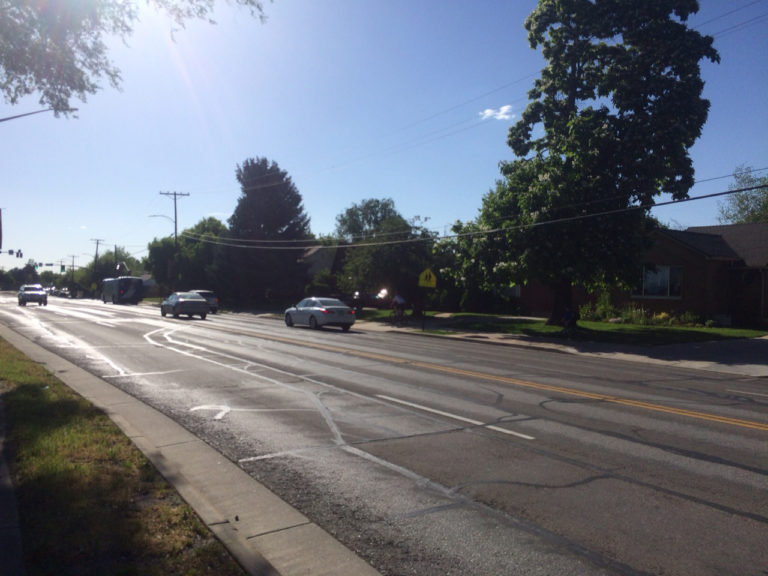
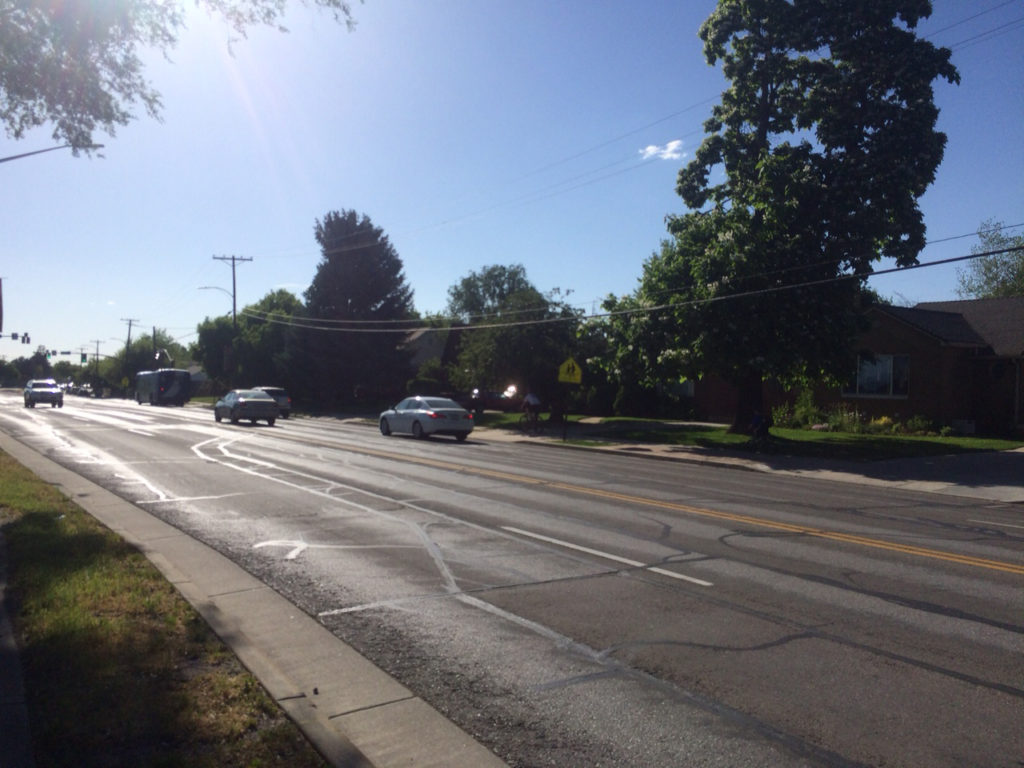
A father and child are forced to ride on the sidewalk on 2100 S since there are no bike lanes on 2100 S. Mayor Biskupski decided today to keep the status quo of a less safe 2100 S. Photo by Dave Iltis
July 13, 2017 – In an email to Councilpersons Luke and Adams, Salt Lake City Mayor Jackie Biskupski today decided that there will be no bike lanes on 2100 S from 1700 E to 2300 E.
The email states that despite the support for safety, reduced speed, and bike lanes , that the Mayor would keep the same configuration of 2 lanes in each direction with no center turn lane and no bike lanes. This configuration, according to Salt Lake City Transportation, is more dangerous for all road users – motorists, cyclists, and pedestrians. Yet, the Mayor seemed to give in to worries from local residents about potential congestion and held this as the deciding factor over safety and the Pedestrian and Bicycle Master Plan.
The Mayor did state that 2100 S should be looked at in its entirety, something that Cycling Utah included in our comments on the project.
The decision follows an extensive public outreach that gathered more than 1500 responses.
The responses of those who registered on the Open City Hall website (519 total) (http://www.slcgov.com/opencityhall) overwhelmingly favored making the route safer for bicycling and walking:
53.2% to 36%.
The ranked goals favored reducing congestion over improved conditions for bikes and pedestrians, but no totals were available.
53.7% favored a safer design of 2 lanes and a center turn lane, of which 46.2% favored bike lanes.
58.7% of respondents were willing to spend an extra minute or two during rush hour to have a safer 2100 S.
64.3% favored a reduction in speeding, which would have occurred with the Road Diet of 2 lanes, center turn lane, and bike lanes.
73.6% favored reducing congestion. Keeping the existing design will result in the same level of congestion, and is hence contrary to the desires of the survey respondents.
The email is below:
Dear Council Members Luke and Adams,
I wanted to let you know that after careful consideration and based on the community input we received over the last month, the Administration has decided not to pursue a change in lane configuration on 2100 South at this time.
The Transportation Division had recommended the changes be made to improve safety on the roadway as well as reflect the intent of existing master plans, primarily the Pedestrian and Bicycle Master Plan. Understanding that these changes could cause concern with local residents, and knowing your opinions on the issue, I personally asked Transportation to begin a public outreach effort to get feedback specifically on this project.
Even with an abbreviated window of time, this outreach effort was one of the most successful public engagements in City history—and Transportation should be applauded for their efforts. With more than 1,500 responses—a combination of Open City Hall, phone calls, emails, in person comments, and letters—the overall community was almost evenly split on the plan to reduce traffic lanes and add a center turn lane. More specifically however, respondents in 84108 and 84109 (the largest group of participants) were overwhelmingly opposed to any changes. Businesses along 2100 South, reached through door-to-door efforts, were largely in favor of reducing lanes and adding the center turn lane because it would provide easier access to their businesses.
As was to be expected, some of the conversation surrounded the addition of bike lanes on the roadway. The responses were split among those who ride bikes and those who don’t. The responses were also impacted by age, with older residents favoring the current configuration.
Respondents did identify safety as their second greatest concern, but were more concerned about congestion on neighborhood roads and bottlenecking—especially as the proposed reconfiguration would reduce traffic lanes at 1700 East.
Based on these responses, the adopted master plans, and information provided by our experts in Transportation, I believe the City needs to do further outreach to explain the benefits of a complete streets concept on this and other roadways. We also need to develop comprehensive plans for the length of 2100 South, rather than taking a piecemeal approach with changes. While the adopted Pedestrian and Bicycle Master Plan calls for bike lanes from 1300 East to Parley’s Way, it envisions a more complete stretch of 2100 South being reconfigured.
Please note, the planned resurfacing/slurry project on 2100 South will continue, beginning on Sunday. Over the next few days we will begin doing additional outreach to residents to notify them of the direction we are heading. We would appreciate any support you can provide, including sharing this with your constituents.
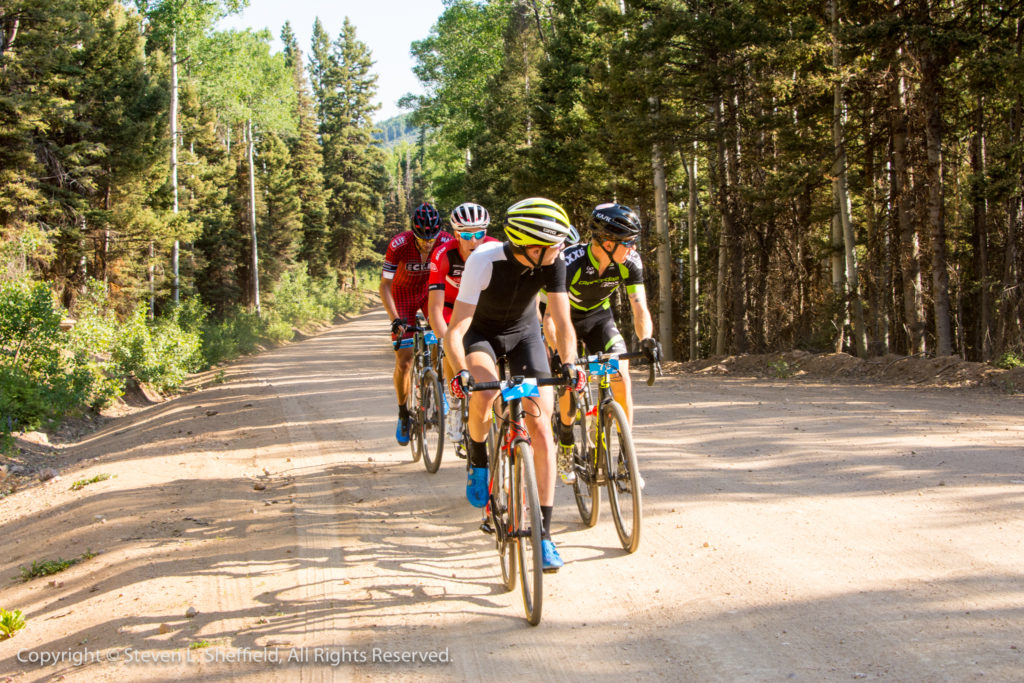
Robert Squire and Keegan Swenson looking at something in the forest as they ascend the first climb. Photo by Steven Sheffield
Beaver, Utah – July 8, 2017 – In the small town of Beaver, Utah, the second Saturday of July can only mean one thing; it’s time for another invasion of those crazy bike racers for the Beaver County Travel Council Crusher in the Tushar, presented by DNA Cycling. The epic road and dirt race has been organized by former pro cyclist Burke Swindlehurst, who grew up in the town, and discovered his talent and love of climbing in the Tushar mountain range and Fishlake National Forest towering above the town to the east.
Crusher organizer Burke Swindlehurst taking a minute to relax while waiting for the Pro/Open men’s field to come through. Photo by Steven Sheffield
Unlike many towns, which see bike races as nothing but an inconvenience, the towns of Beaver, in Beaver County, and the towns of Junction and Circleville in neighboring Piute County turn out in full-force, not only in town but all along the course to cheer riders on, and making sure that they are well supported for what may not be the longest, but is certainly one of the most difficult mixed-surface (or “gravel”) races in the United States.
Each year after the first in 2011, the event has sold out, and every year, the amount of time it takes to sellout has gotten shorter and shorter, happening in about 4 hours in 2017. Once again, the race attracted a varied crowd of road, cyclocross, and mountain bike racers, including current and former UCI WorldTour professional riders David Zabriskie and Ben King.
Men’s Pro Race Report
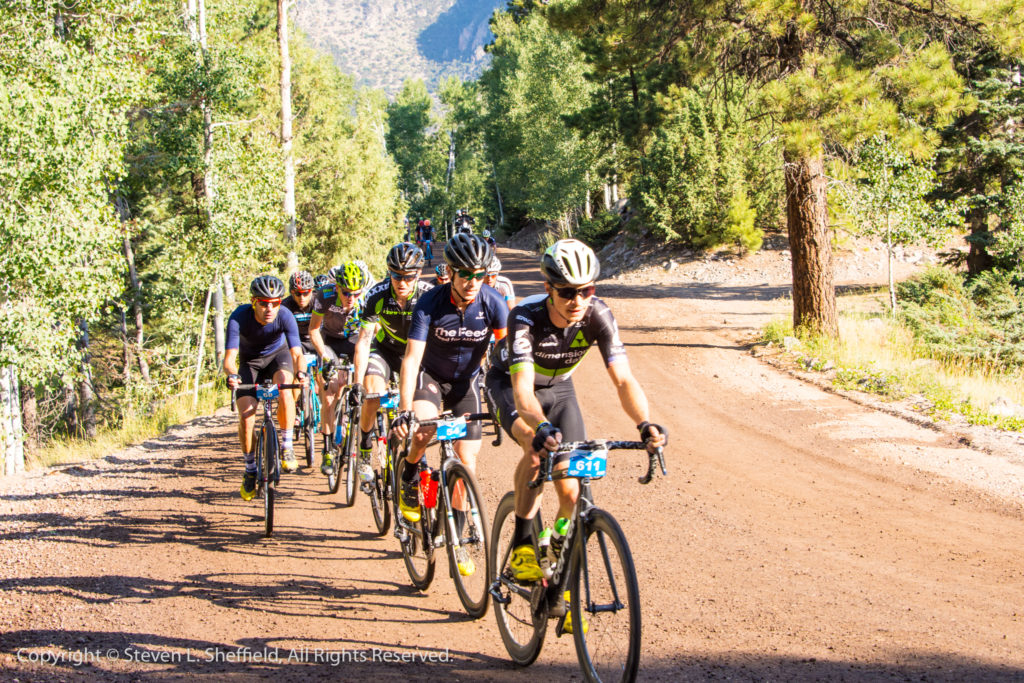
Ben King leading the main field up the first dirt section in the 2017 Crusher in the Tushar. Photo by Steven Sheffield
Shortly after the roll-out from Beaver, before racing really started in earnest, Benjamin Blaugrund (Juwi Solar) went on one of his signature breaks, in the company of Menso De Jong (Clif), while Robert Squire (Assos/Felt) got a front tire flat, leading to speculation that the Crusher still would not see a three-time winner, after Tyler Wren’s double in 2011 and 2012, Levi Leipheimer’s double in 2013 and 2014, and Squire’s own double in 2015 and 2016.
Benjamin Blaugrund on one of his typical early breaks. Photo by Steven Sheffield
After the race, Squire joked about his first of many mishaps: “Yeah, that’s kind of my thing now, is I just don’t keep air in my tires, it’s too heavy, so I get rid of all of the air. Bad call, so I put in a tube to try and give it a go again.”
However, the Crusher is a long race, and there were still another 67 miles to go, and has history has shown, anything can happen (and usually does).
After a hard 6-mile chase, Squire managed to reconnect to the main Pro/Open field shortly before the field turned off of UT-153 onto Kents Lake Road/FR-137 and hit dirt, causing the entire group to start to splinter as the race began in earnest.
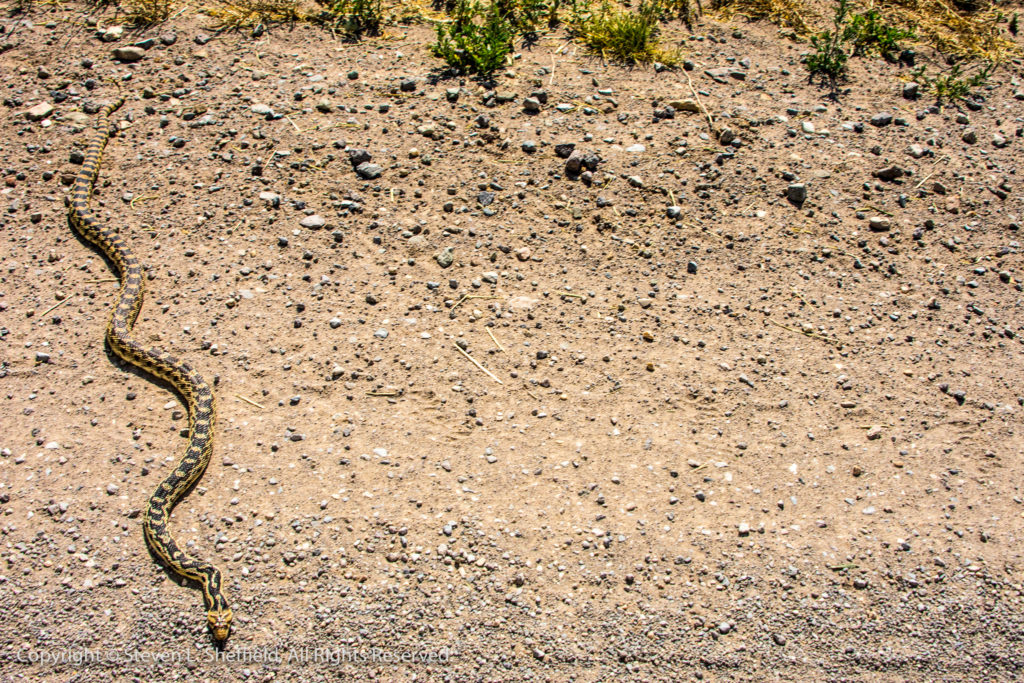
A little local wildlife waiting for riders to come through the Sarlacc Pit. Thankfully, he was there to cheer. Photo by Steven Sheffield
Blaugrund and De Jong widened their gap on the rest of the field to about four minutes, with Blaugrund’s teammate Leroy Popowski riding in no man’s land about a minute ahead of the main chase group containing Squire, Todd Wells (Troy Lee Designs), Keegan Swenson (Cannondale-3Rox), Ben King (Dimension Data), Jamey Driscoll (DNA Cycling), and Josh Whitney (EVOL)
Shortly before the various groups reached Anderson Meadows, Ben King flatted at about mile 16, for what was apparently not the only time on the day, while Popowski and De Jong were caught and dropped by the chase group about a mile-and-a-half later.
As the lead group topped the first major climb and were about to hit the rollers leading towards the second feed zone at Betenson Flat, Squire dropped his chain and had to stop again to untangle it, before starting to chase again with Popowski through the feed zone and onto the rough, washboard descent down the dirt section of UT-153.
“Once I got my tires situated, I was trying to rider gingerly and not puncture again, but then I just kept losing my chain. At the top of the Col de Crush descent, it bucked off and wrapped itself in a little loop-de-loop. Normally, I can just reach down and put it back on, but I had to get off and do some math and calculate how to get it back on. It dropped a few more times, but I was able to get it back on without stopping those times,” said Squire.
Popowski’s less-confident descending prowess caused him to lose time on the descent, while Squire continued his chase down the Col de Crush before rejoining one of the chase groups as the road became paved once again nearing the bottom of the descent and heading south on US Highway 89 and heading into the small towns of Junction and Circleville, where it looked like the entire populace of both towns turned out to cheer the riders on and hand-up bottles to the riders.
Squire, Driscoll, Krughoff, plus one on the chase from Junction to Circleville. Photo by Steven Sheffield
As the race pulled out of Circleville and started heading back north towards Doc Springs Road (and the section dubbed the “Sarlacc Pit” by participants of the race’s first edition in 2011), the situation on the road was Todd Wells & Keegan Swenson, with Squire, Driscoll, Allen Krughoff, and one or two others about a minute-and-a-half back, with a second chase containing Blaugrund, De Jong, and one other rider a further two minutes behind.
Squire attempting to bridge back up to Wells and Swenson in the 2017 Crusher in the Tushar. Photo by Steven Sheffield
If there is one truth about Doc Springs Road, it’s that you never really know what conditions are going to be like from year to year, from fairly sandy and deep the first year, muddy the second year, to relatively mild after recent rains keep the dust levels to a minimum, and that no matter what the conditions are, it’s going to be a tough section to work your way through before turning back up UT-153 to climb the Col de Crush. The “Pit” proved to be just as tough this year; while not as deep as the first year, the dirt was probably the loosest it had been since that first year, and with temperatures soaring and little vegetation to provide any respite from the sun and heat, it was bound to make an impact, with both Wells and Swenson switching from side-to-side of the road looking for a smooth line and something firm enough for their tires to grab some traction. It was in this section where the speculation started whether Wells’ “old man legs” or Swenson’s youth and climbing prowess would prove to be the other rider’s outdoing.
Squire still on the move on the Col de Crush in the 2017 Crusher in the Tushar. Photo by Steven Sheffield
As the race passed the three-hour mark on the Col, Swenson’s relative inexperience with longer endurance events, and lack of firsthand knowledge of the course became apparent, as he started to get gapped by Wells around the 54-mile mark, while further behind, it looked like Squire was beginning to claw back more time on the two leaders.
Sometimes, when racing, you don’t notice the scenery … but the Tushars do not disappoint when you do take the time. Squire still on the move on the Col de Crush. Photo by Steven Sheffield
With about 800 meters before the Pro-Form KOM, Squire caught and passed Swenson, before rejoining Wells in the lead about 300 meters later. With two bends in the road left before the KOM, Squire put in a little dig and opened up about a 10-meter gap back to Wells, which he held through the KOM, picking up the $250 prize for first rider across the line. Unlike most KOMs, which are usually awarded at the very top of the climb, the Pro-Form KOM is about 400 vertical feet below where the climb truly tops out before hitting the relatively flat rollers heading back towards Betenson Flat, and even more climbing to come after the turn-off to Gunsight Flat and Big Flat.
Wells was glad to have other riders for company on the climbs, first with Swenson, and then Squire, “It’s a lot nicer having someone to ride into the finish with. There were some pretty good headwinds on some of those sections up the climb, and while in the follow car you may not notice that there is a wind, when you’re on the bike you feel every little bit. It’s also nice to have some motivation of company out there. You know when you’re out there by yourself your mind kind of wanders, it’s hard to maintain focus, but when somebody else is there it’s easier to push.”
Once past the end of Big Flat, the riders reached the short, steep, and twisty descent from Timid Springs to Puffer Lake, and back to the pavement on UT-153. It was at this point that Wells launched his attack, hoping to dislodge Squire on the downhill to hold him off on the final climb to the finish by the Eagle Point Ski Resort Skyline Lodge, but all he could manage was about a 7-second gap, which Squire easily closed back down once the dirt was behind him.
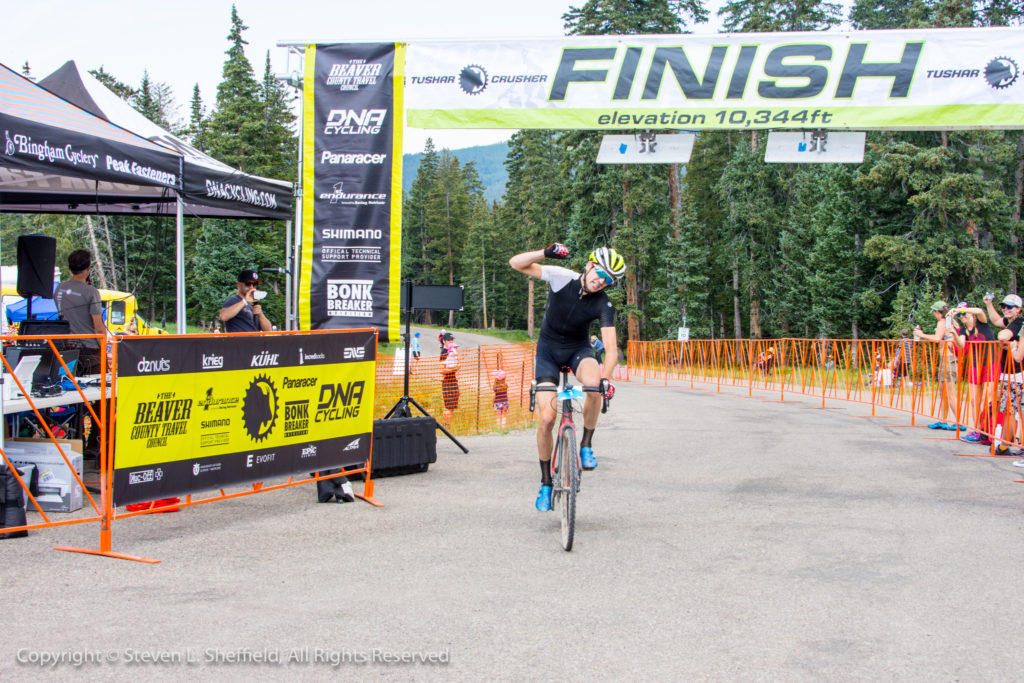
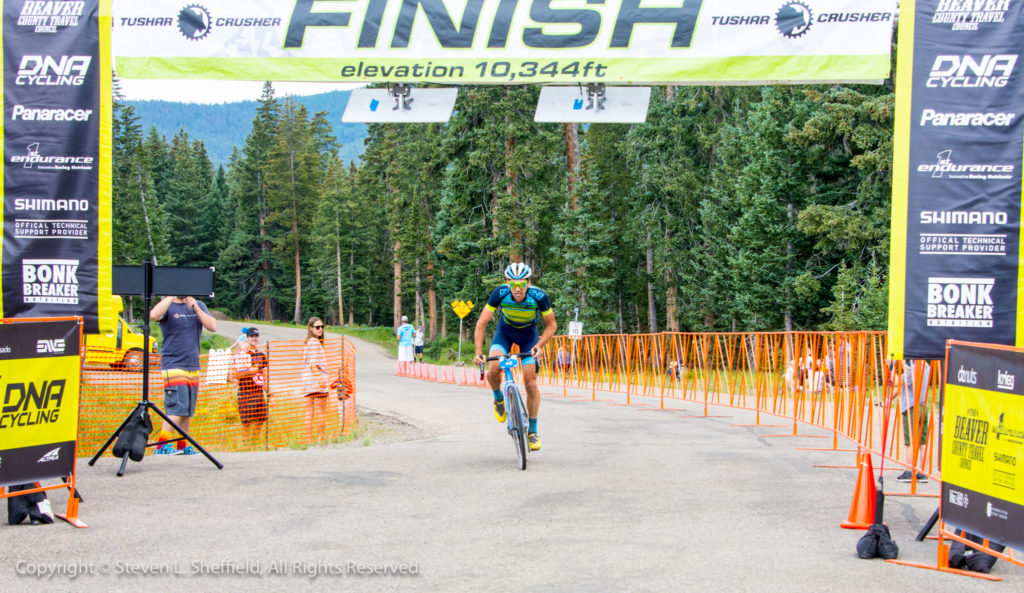
It looked like it was going to come down to a two-man sprint to the finish up the final climb, which gains about 600 vertical feet in one mile. Coming around the final turn into the last 400 meters, Squire gave one last dig quickly opening a 15-second gap, which he held to the finish, and in so doing becoming the first 3-time winner of what has become one of the must-do mixed-surface events in the western United States.
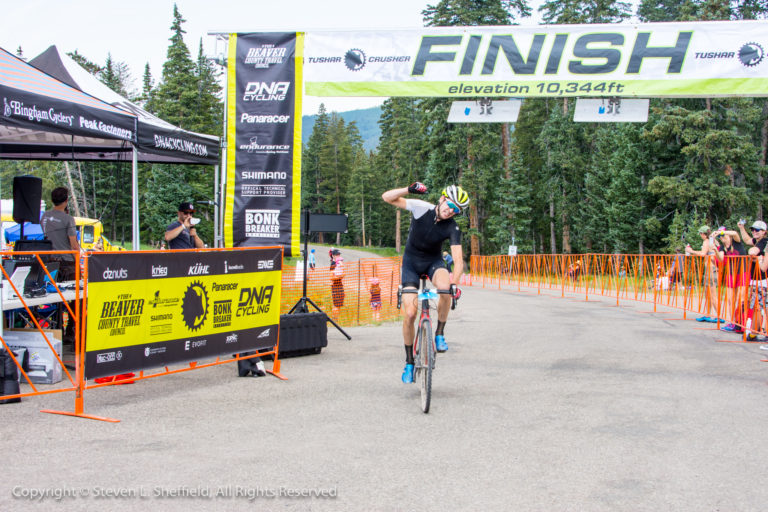
Robert Squire crossing the line, to become the Crusher’s first three-time winner. Photo by Steven SheffieldTodd Wells follows Squire across the line about 15 seconds later. Photo by Steven Sheffield
Wells commented about the race, “It was good, it seemed like it was a little more mellow this year than last. By the time we got up to the top, even though it seemed like a more reasonable tempo we were a smaller group, Keegan (Swenson), Squire and I, and then Squire’s chain came off. So then it was just Keegan and I rode together until about halfway up the Col de Crush, and it all kind of happened there.
“Keegan came off a little bit, and Squire caught on right there, so we went from Keegan & I riding together not knowing where Squire was because we couldn’t see him, to the three of us together for just a few seconds, and then Squire goes off the front. I was able to keep him close and we hooked back up again and rode together to the finish. I put in a death-defying descent on the last dirt road thing (from Timid Springs) because I knew that was my only chance, but he came back to me. It was going to take a really good day for me to beat him in the sprint.”
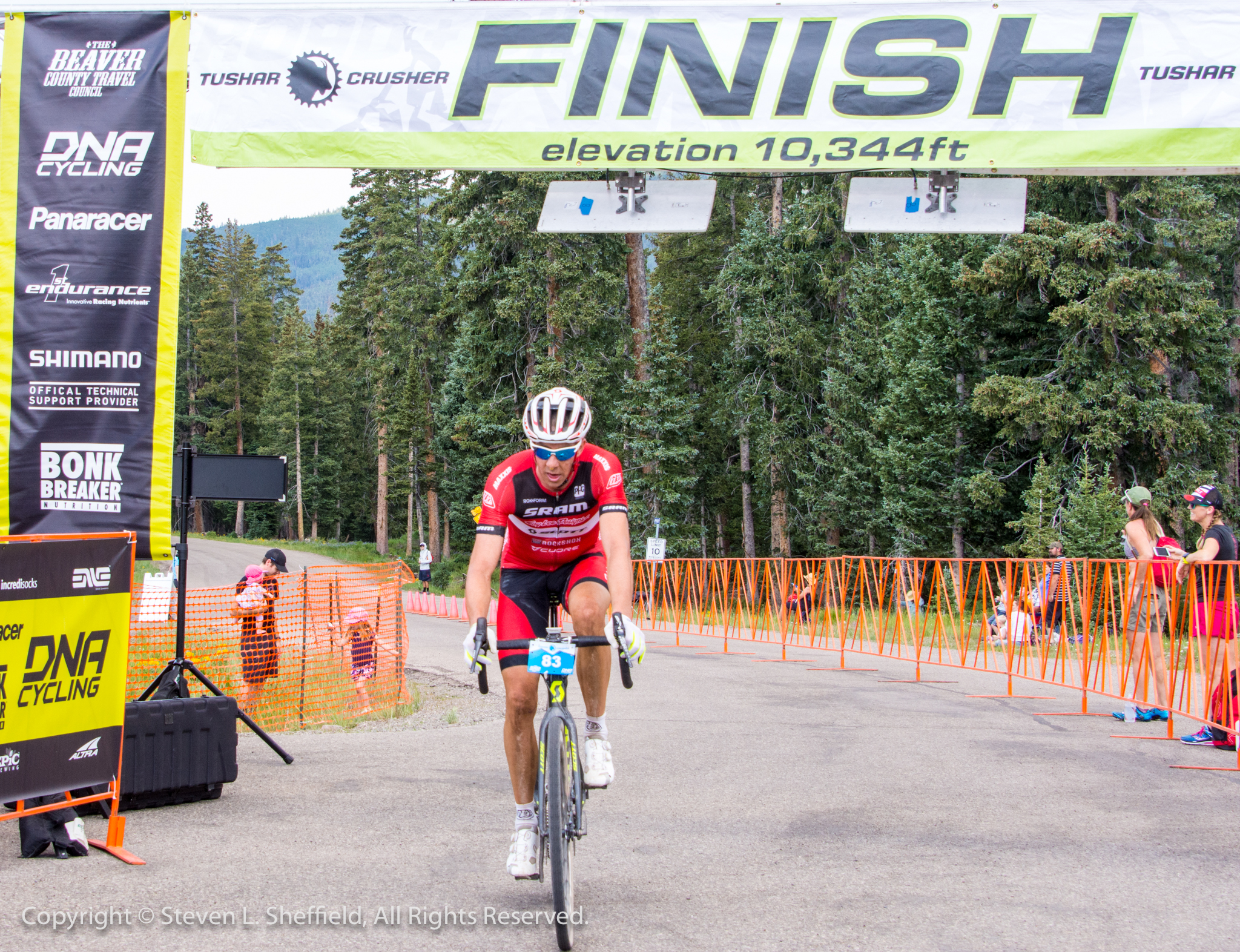
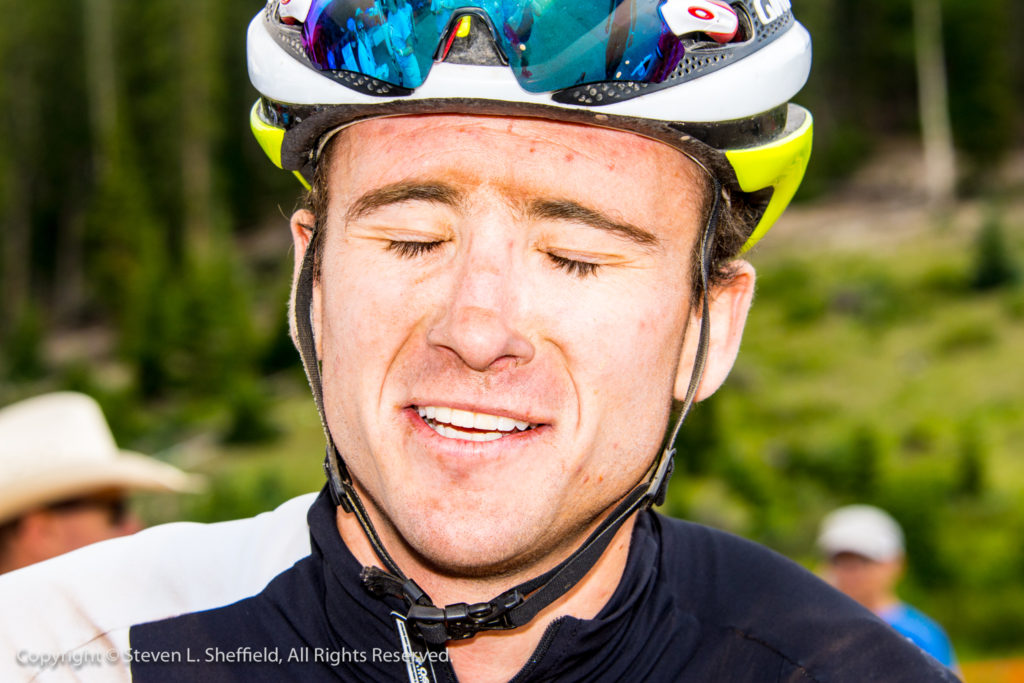
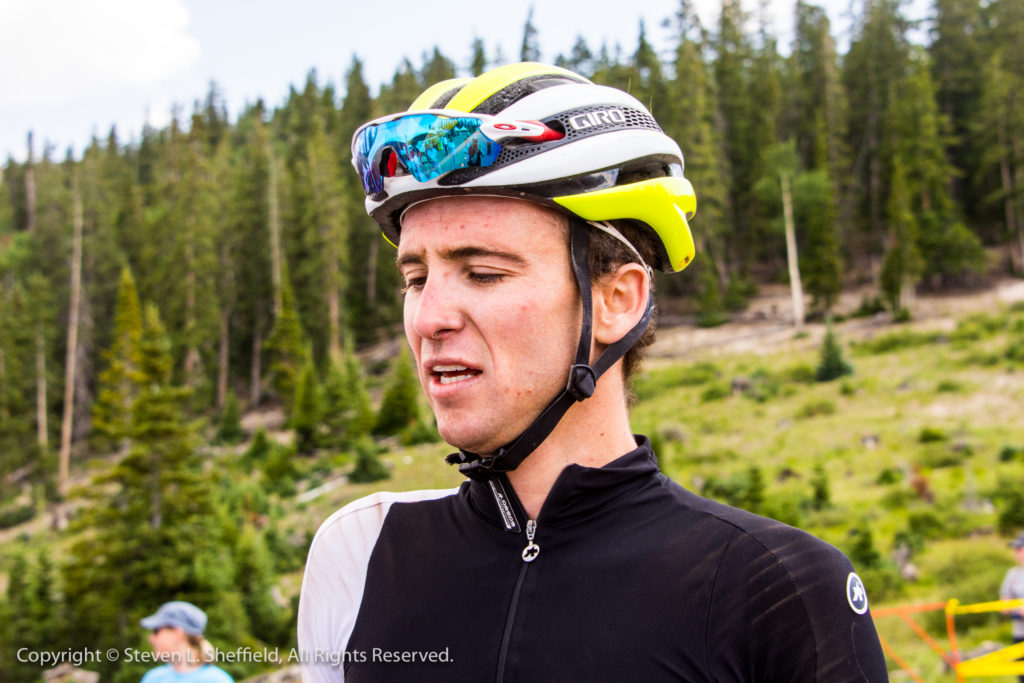
The effort and relief show in Squire’s face after the finish. Photo by Steven SheffieldThe effort and relief show in Squire’s face after the finish. Photo by Steven SheffieldKeegan Swenson takes third on the day. Photo by Steven Sheffield
Keegan Swenson was happy with his third-place finish, stating “A lot of my training is shorter; I haven’t been doing too many epic rides which are longer, because it still isn’t quite my wheelhouse right now. I do like the longer climbs, but it’s a long race. I think part of it was the heat as well, following Todd across the sandy false flat bits before the climb (on Doc Springs Road), I think that’s what put me in the box. I was hurting a bit before the climb; and he’s a big strong dude, he can go fast, so I was suffering even before the climb. Then when Robbie caught back on I knew it was going to go even faster and if I tried to go with them, I might explode, so I’m going to ride my own pace and maybe I can get them back if they start to play games later on. I just tried to finish in one piece.”
“I didn’t pre-ride the course, so that may have played a little into it as well, but I’m looking forward to coming back next year and seeing what I can do, now that I know what to expect.”
Jamey Driscoll crossing the line to take 4th in the 2017 Crusher in the Tushar. Photo by Steven Sheffield
BRIEF RESULTS
Place
Name
Team Name
Time
1
ROBERT SQUIRE
FELT- ASSOS
4:13:39
2
TODD WELLS
TODD WELLS/TLD
4:13:54
3
KEEGAN SWENSON
CANNONDALE 3ROX RACING
4:19:53
4
JAMES DRISCOLL
DNA CYCLING
4:25:18
5
LEROY POPOWSKI
JUWI SOLAR
4:29:06
6
DREW MILLER
4:32:15
7
ROTEM ISHAY
4:33:40
8
BENJAMIN BLAUGRUND
JUWI SOLAR
4:34:15
9
RYAN STEERS
PEDALERS FORK/10 SPEED COFFEE
4:35:25
10
ANDY DORAIS
CONTENDER BICYCLES
4:37:16
Janel Holcomb Takes the Women’s Race in the 2017 Crusher in the Tushar
Just a few minutes after the Elite men started, the women rolled out fairly easily, and were caught by one of the masters men fields starting behind them, so a group of the women jumped in with the men as the pace started to lift heading onto the dirt on FR-137.
As the group neared the top of the first climb, near Anderson Meadow, the group had separated with Janel Holcomb (Mavic) and Larissa Connors (Team Twenty20/Felt) in the lead, followed by Mindy McCutcheon (DNA Cycling), and then another group containing Breanne Nalder (PLAN7 DS) & Jennifer Luebke (DNA Cycling) and one other girl.
After the race, McCutcheon said “I’ve been sick, injured and a bit burned out for the past 6 months [after the conclusion of cyclocross season], so I haven’t been racing or training as much. I knew what to expect and not to panic and not to bury myself too early; if I just took it easy up the first climb, I knew I’d get separated from Janel and Larissa, but I also knew there was a so much road ahead, so much racing left.”
As the lead women’s group rolled through Anderson Meadow, from all the bouncing around on the washboard roads, Holcomb’s saddlebag came open and nearly fell off her saddle.
“We were just climbing and climbing and climbing, all of a sudden, my saddle bag exploded, everything everywhere, and it was dangling into my wheel, so I had to stop and get off and try to grab things and stick stuff in to my pocket,” said Holcomb. “I thought ‘Uh oh, this is not good! This is not good,’ so I just had get back on and got back into my rhythm with tubes hanging out of my jersey and all this stuff.”
Over the top of the climb coming into Betenson Flat, Holcomb managed to rejoin a small group with Larissa Connors, and attacked the descent.
Says Holcomb, “As we started the descent, I dropped Larissa again, and so I did the descent and loved it. Loved it! I know it was wash-boarded out, but I was just amazed at how beautiful the surroundings were. It was just gorgeous!”
When they hit the pavement on the bottom of the Col de Crush, heading in to Junction and Circleville, Holcomb was rejoined by Connors and 4 of the men they had been riding with; the group worked well together, grabbing more bottles at the aid stations.
As the group turned on to Doc Springs Road, another large group containing Mindy McCutcheon tagged on to the back of Holcomb’s group, and the riders once again settled into a rhythm.
According to Holcomb: ““It was hot, it was definitely very hot, but the conditions were pretty good; it was loose but you just had to relax and go with it and be patient. I really liked it and there were all sorts of people out there cheering which was really nice.”
Said McCutcheon, “Janel & Larissa both got away from me again through the Sarlacc Pit and the first part of the Col de Crush, and I knew I didn’t really have it in me to chase down Janel, which was fine.
As they turned back on to the pavement before starting the climb back up the infamous UT-153 Col de Crush, Holcomb had the realization, “’oh we’re going up that?’ I hadn’t really put it all together, you know. I was like ‘Are you kidding me?’ I knew it was going to be tough, it was so hot.”
McCutcheon followed, “I met Larissa again about halfway up the Col de Crush, and I could see her heart break when she saw mile after mile of climbing ahead of us, and I knew I just had to be slow and steady and I could probably hold her off.”
Coming through the QOM, Holcomb was also suffering. “I went through some rough patches there. Once in a while you get over a bit over the top of a little bit of a rise and you get a little more speed, and it was ‘okay, that feels good, that’s okay.’ It was a constant exercise of finding whatever power I could, taking in whatever food and drink I could, and then occasionally sitting up and looking around and taking it all in. No matter what happens it’s been a good day and an amazing event.”
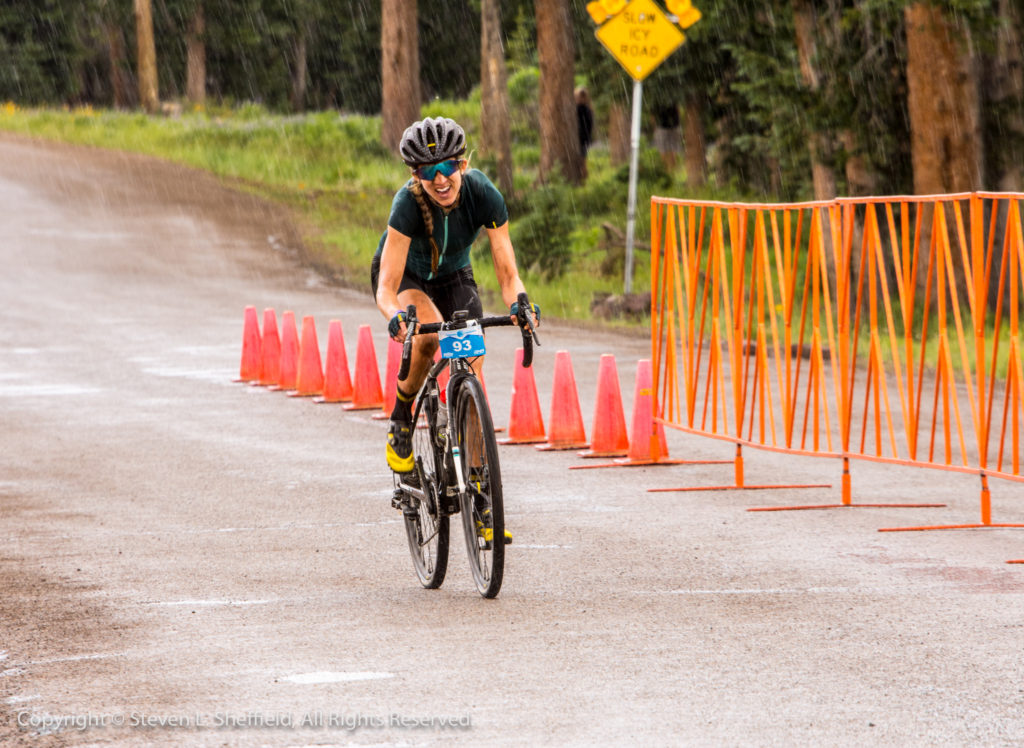
Janel Holcomb about to cross the line to win her first Crusher. Photo by Steven Sheffield
Holcomb continued, “There was descent there [from Timid Springs down to Puffer Lake] that was just awesome, and all of a sudden, I felt like I got my mojo back. I was just killing it! When you hit the pavement, there are a few rollers, but then when you make the last turn with a mile to go, I got a few drops of rain, and I was still so hot that I was like ‘yes, bring it on!’ and then it started hailing! Going through that last mile I just kept looking up at the horizon and eventually saw the banner, and it was like ‘Yes! It was awesome.” Crossing the line was such a release, there was so much joy.”
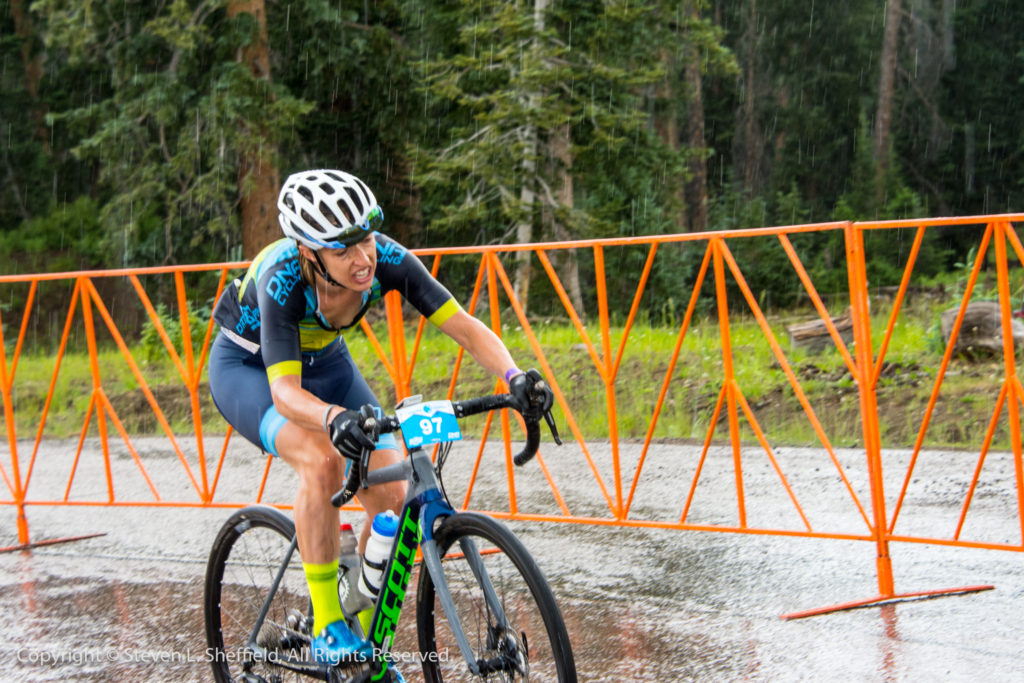
Mindy McCutcheon crosses the line to take a hard fought second place. Photo by Steven Sheffield
About 8 minutes later, in the pouring rain, McCutcheon also rolled across the line, saying after the finish, ““I came in not expecting much out of myself; I knew I wasn’t coming in as strong as last year and am thrilled and shocked that I pulled off second. Last year I felt like Superwoman, and this year I questioned myself a thousand times if I should even come down, and then to be out there and it’s blazing hot. I thought about quitting with just about every other pedal stroke I made. It was a much a mental challenge as a physical challenge to even finish this year, let alone take second, so I’m pretty happy about that.”
Breanne Nalder finishing third on the day in the 2017 Crusher in the Tushar. Photo by Steven Sheffield
Breanne Nalder (PLAN7 DS) caught and passed Connors on the climb up the Col de Crush, and was able to increase the gap and came in third, another 3 minutes back.
“Coming up the Col de Crush, I kept using men as carrots and acted like a rabbit. I knew I was in fourth because I hadn’t seen Jen (Luebke) or any of the other girls again. I came up on Larissa, and she said to me, “Why are you going this hard now?” and I said, “I’ve been going this hard the whole time!” and she kind of laughed. It motivated me to just go for it, and I was able to roll away from her.
If you have frequented your favorite local bike shop, coffee shop, recreation center or even a city or county office, you may have noticed a great new resource. After several years of hard work surveying, GIS mapping, vetting input from city and county sources, and of course public input, Salt Lake County finally has an updated bikeways map! This resource was designed in collaboration with Salt Lake City, Salt Lake County, UTA and UDOT and is the first comprehensive map for the residents of Salt Lake County in almost 10 years. The map not only provides routes along with route ratings for “comfort” levels, but a wealth of helpful and practical information for riders of all ages and experience levels. Public transit connections are listed as well as rules and regulations for cyclists and methods of using public transit in connection with Active Transportation. The Jordan Parkway has simultaneously released its own map to assist those who wish to navigate sections of this splendid resource as it connects neighborhoods and communities. Like the County map, this map includes details concerning transportation connections as well as information on several native plant and animal species and ongoing community development projects. Online copies of these maps exist in PDF format with app development for smartphones expected in the future. See http://bikeslc.com/WheretoRide/SLCBikeMap.html for pdf downloads.
Kids Bike Safety
A key element to being comfortable commuting by bike in an urban environment is safety. Ask any parent who wants to encourage their kids to ride early and ride often and they will tell you that helmets, lights and bells are vital resources they want their kids to use. However we all know that the most important resource is what that helmet protects and a responsible rider should know the rules and regulations for safe and legal conduct while sharing the road with motor vehicles. This goes for drivers as well, who should acknowledge that the roads must be shared with others in order for a safer commute for all of those involved. Salt Lake County has created a brief guide that contains tips, regulations and information that encourages road respect and how to safely commute while riding a bicycle and interacting with bicycles on the road. These brochures can be picked up at most county offices or you can visit www.bicycle.slco.org for more information.
Participate in the Salt Lake County Bicycle Advisory Committee
As the summer gets into full swing and concerts, festivals and the nightlife calls, SLCBAC urges safety and responsibility not matter how you decide to commute. Many downtown festivals offer bike parking and lights are an easy thing to buy or even score free as swag to help your commute home. We realize that not everyone always has the resources to attain training or hardware to keep safe while commuting. If you would like the committee or the Salt Lake County Bicycle Ambassadors to attend your local event or even sponsor a training session, please don’t hesitate to contact us via the County website http://slco.org/bicycle/ . We’re committed to improving both the physical and mental quality of cycling for our entire community. And please don’t forget that our meetings are open to the public and held on the second Wednesday of each month at the Salt Lake County Government Center at 2001 S. State Street, Salt Lake City in room N4-850 at 5:30pm.
By Charles Pekow — Ever tried taking your kids to school on the back of an electric bicycle? It works in China – but generally isn’t used as much in a dual-working parent family where the mother works longer hours than the father. In those families, the parents would rather drop off and pick up the kids by car. Or so says a report based on a study in the city of Kunming, the capital of the southern province of Yunnan, a city of 4.3 million people.
Much previous research has focused on walking and biking as means to escort children to school, but not on e-bikes, a more common mode of transport in China than in the United States. So five Chinese researchers attempted to fill the gap with Investigating Electric Bicycles as a Travel Mode Choice for Escorting Children to School: A Case Study in Kunming, China, published in the latest issue of Transportation Research Record, the journal of the Transportation Research Board (goo.gl/sCOzZD). The authors state that parents are increasingly driving their kids to school, which not only contributes to congestion and dirty air but to the number of overweight children.
As you would expect, parents are less likely to use bicycle or e-bike to take kids to school if they lived further from campus. And mothers assumed most of the child care responsibilities, so they were more likely than fathers to drop the kids off by e-bike. And if older people, such as grandparents, lived in the household too, they were more likely to accompany the kid by foot or e-bike than to have the kid taken by auto. Flexible hours for the mother didn’t seem to affect mode choice significantly.
The researchers relied on records kept by families in 2011. The results suggest, that since it is usually mothers who take the kids to school, “policies should guide female employees to balance work and family, for instance, by decreasing the working hours of females,” the study concludes. It also suggests governments establish good schools closer to where people live.
I caught my wife, Karma, tracing out on a map the first few stages of this year’s Tour de France. Not that she was trying to hide what she was doing. Truth is, she is a huge fan of the Tour, with a love of France, and she likes to know when the Tour is visiting places she has been.
I, too, love France, having worked there as a missionary for my church way back when Eddie Merckx was dominating professional cycling. I even have an old Merckx cycling cap I purchased as a young missionary. But I became enamored with the Tour when I took up bike racing myself and Greg LeMond was just starting to bust the legs of the European peloton.
Since then, Karma and I have dutifully followed the Tour every year. We have even made two trips over together, and I have made one on my own, to personally watch a few stages of the Tour. With the available TV coverage these days, Karma and I spend nearly every evening, often late into the night, watching that day’s action. People who know me know they are not to discuss that day’s action or results with me or in my presence. Indeed, Karma sometimes can’t handle the anxiety, so she goes on-line to check the results. But for my sake, she keeps mum till I have finished watching that day’s action.
Well, that is a long way of saying that I am excited that this year’s Tour de France will be starting up in a few days. To be honest, the Tour may be the main reason we don’t cancel our expensive cable TV service. And this year’s Tour promises to be a good one.
For the first time in several years, the yellow jersey looks to be hotly contested. Chris Froome remains the favorite, of course, but only because he is Chris Froome. He appears more vulnerable than ever before, and he sees this year’s Tour as his greatest challenge yet. Richie Porte would be the favorite (for some he is), except for the presence of Froome. Nairo Quintana’s team, Movistar, claims that Quintana comes to the race in great form. And this is a course, with little time-trialing and a lot of climbing, that favors him.
There are others who could also contest the yellow jersey. Alberto Contador and Alejandro Valverde come to the Tour in good form and are considered serious outside threats. Then there is the next generation of champions pushing to move to the top such as Romain Bardet, Thibaut Pinot and Fabio Aru. Still, Froome, Porte and Quintana are the top three contenders and this promises to be a tight race.
As always, the yellow jersey is the main show. But part of the beauty of the Tour are all the other competitions. The polka dot jersey for the best climber (King of the Mountains), green jersey for the best sprinter (Points Competition) and white jersey for the best young rider classification (25 and younger) are always exciting to watch.
Rafal Majka has to be the favorite for the polka dot jersey, having won it in 2014 and 2016. But this competition tends to be a bit hard to predict, as many of these climbers are working in support of their GC (General Classification) leaders or for their own GC chances. This often results in having to sacrifice focus and opportunities for mountain points. Thibaut Pinot has made this jersey his priority, despite his outside shot at a top GC finish or even victory. Also in the mix will be Thomas de Gendt and Ion Izagirre. In truth, there are several others who, if circumstances and form fall into place, could win this competition.
As for the green jersey, well, Peter Sagan owns it, and has owned it for the last years. And for motivation, if he wins this year, he will equal the record of Erik Zabel who won the jersey six times. Indeed, he likely will not be happy till he has broken Zabel’s record. Being a great sprinter who wins races for big points as well as a guy who can often stick with the climbers for awhile as the other sprinters are dropped and scoop up intermediate sprint points, Sagan has each year methodically compiled enough points to end this competition well before the end of the Tour. His top challengers this year would seem to be Marcel Kittel, Nacer Bouhanni and André Greipel. But frankly, none of them seem to have the ability to battle for stage wins and intermediate sprints throughout the Tour as does Sagan, and so Sagan is the hands down favorite here.
The white jersey doesn’t get the publicity that the others do, but it is a place to watch for future contenders. This jersey has been won in the past by Greg LeMond, Laurent Fignon, Alberto Contador, Andy Schleck (all future Tour winners), Andy Hampsten, Nairo Quintana (twice, in 2013 and 2015), and Thibaut Pinot, to name a few. That is a distinguished list. And the teams do take this competition seriously. So, watch for Simon Yates, whose brother, Adam, won this competition last year. Also keep an eye out for Louis Meintjes who took 8th overall in last year’s Tour, and Emanuel Buchmann who just finished the Criterium du Dauphiné in 7th place overall.
All this is just the overall stuff. The Tour consists of 21 stages, and each stage is hotly contested. A stage win in the Tour can be the key to a good contract for the next few years, so riders and keen to win one. There will certainly be many different stage winners, and a host of different riders contesting the finishes on those stages. Some will be won in a mass sprint, while others will be won by a solo breakaway. And several will see a contested sprint between 2-5 riders. The dynamics will be different for most stages. That is why Karma and I plop ourselves down in front of our TV each evening of the Tour to watch the action play out. We get caught up in the competition and intrigue of each stage.
Then there are the sideshows. I just saw a headline that Jan Ullrich, a German and one of cycling’s black sheep from the EPO era, will not be invited to the Tour’s start in Dusseldorf, Germany, a circumstance that has many current German riders somewhat upset. Oh, and Lance Armstrong’s name keeps popping up every time the Tour rolls around. He is, of course, persona non grata at the Tour, and for several years, Tour announcers Phil Liggett and Paul Sherwen were apparently not allowed to even mention his name. Nevertheless, each year Armstrong’s name gets brought up.
And speaking of Phil and Paul, when will Phil finally retire? He makes enough gaffes to get most announcers fired, but he has been the heart and soul of Tour broadcasts as long as most of us can remember, and we do love him. Thankfully, Paul is a perfect color man to work with Phil. They complement each other, and listening to them call each race is a pleasure by itself.
Well, those are my thoughts along with a few ramblings about the Tour. So, let me wrap up with thoughts on who will win this year’s yellow jersey. First, I am torn as to who to pull for. I like grand champions, and Chris Froome is one. It would be great if he could equal the five Tour victories of Eddie Merckx, Jacques Anquetil, Bernard Hinault and Miguel Indurain. On the other hand, how great would it be to see Nairo Quintana be the first Columbian to win the Tour? The country would go crazy for an entire year. Finally, Richie Porte epitomizes for me the true heart and soul of professional bike racing. He would be a great and deserving winner.
In the end, I am rooting for Froome, and I think he will win. He has the drive, the tactical sense and the team to put him at the top of the podium. But mostly, it will be an exciting race to watch, in all its aspects, and the excitement will last for nearly a month. What sporting event can do that for you?
[Editor’s Note: The Tour de France runs from July 1 – July 23, 2017]
I caught my wife, Karma, tracing out on a map the first few stages of this year’s Tour de France. Not that she was trying to hide what she was doing. Truth is, she is a huge fan of the Tour, with a love of France, and she likes to know when the Tour is visiting places she has been.
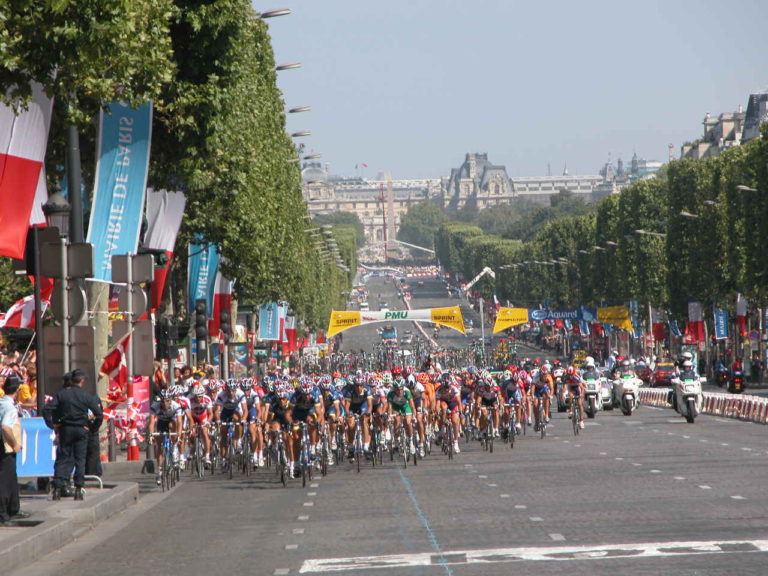
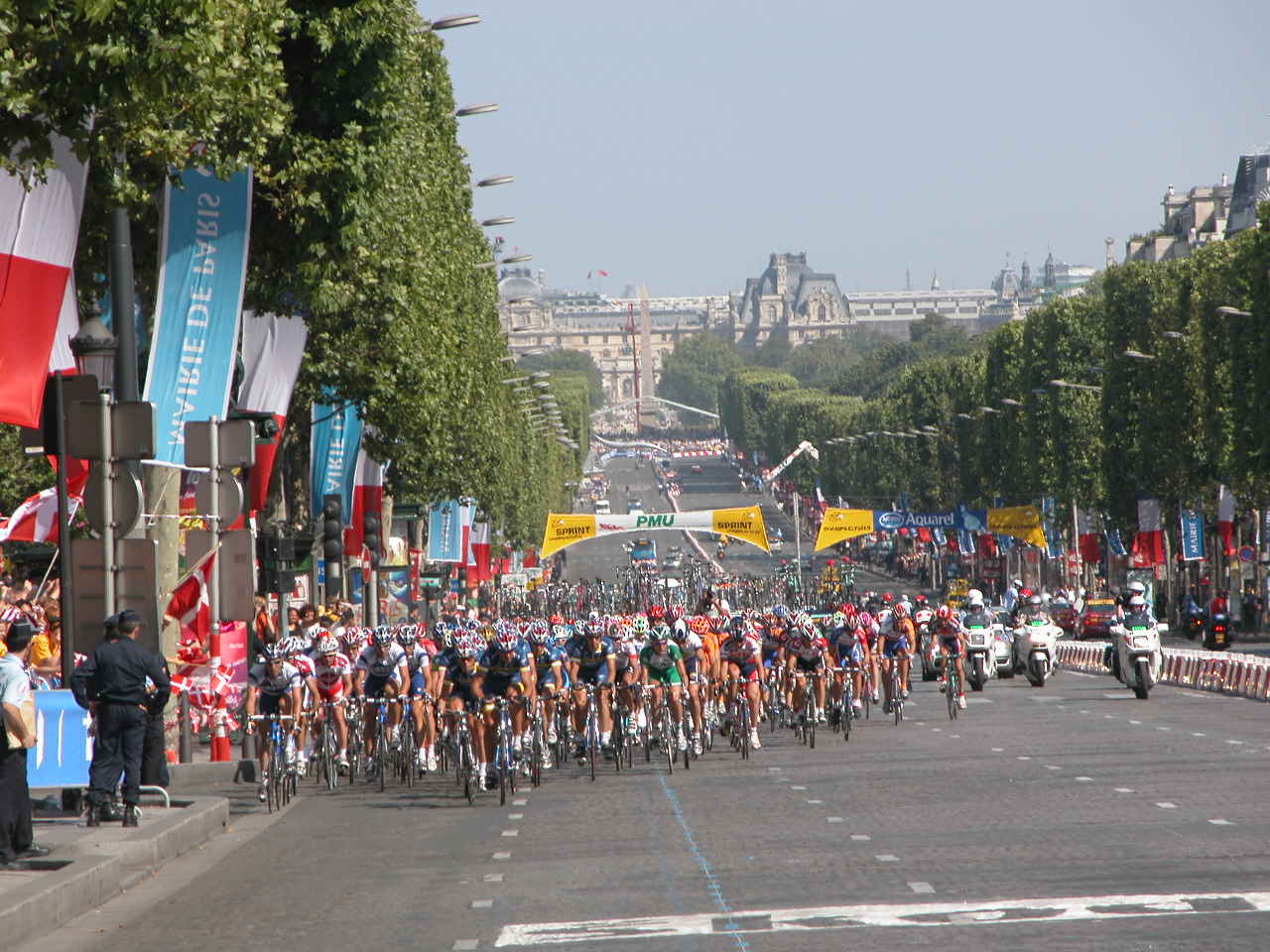
The peloton at the top of the Champs-Élysées in the final stage of the 2004 Tour de France. Photo by David Ward
I, too, love France, having worked there as a missionary for my church way back when Eddie Merckx was dominating professional cycling. I even have an old Merckx cycling cap I purchased as a young missionary. But I became enamored with the Tour when I took up bike racing myself and Greg LeMond was just starting to bust the legs of the European peloton.
Since then, Karma and I have dutifully followed the Tour every year. We have even made two trips over together, and I have made one on my own, to personally watch a few stages of the Tour. With the available TV coverage these days, Karma and I spend nearly every evening, often late into the night, watching that day’s action. People who know me know they are not to discuss that day’s action or results with me or in my presence. Indeed, Karma sometimes can’t handle the anxiety, so she goes on-line to check the results. But for my sake, she keeps mum till I have finished watching that day’s action.
Well, that is a long way of saying that I am excited that this year’s Tour de France will be starting up in a few days. To be honest, the Tour may be the main reason we don’t cancel our expensive cable TV service. And this year’s Tour promises to be a good one.
For the first time in several years, the yellow jersey looks to be hotly contested. Chris Froome remains the favorite, of course, but only because he is Chris Froome. He appears more vulnerable than ever before, and he sees this year’s Tour as his greatest challenge yet. Richie Porte would be the favorite (for some he is), except for the presence of Froome. Nairo Quintana’s team, Movistar, claims that Quintana comes to the race in great form. And this is a course, with little time-trialing and a lot of climbing, that favors him.
There are others who could also contest the yellow jersey. Alberto Contador and Alejandro Valverde come to the Tour in good form and are considered serious outside threats. Then there is the next generation of champions pushing to move to the top such as Romain Bardet, Thibaut Pinot and Fabio Aru. Still, Froome, Porte and Quintana are the top three contenders and this promises to be a tight race.
As always, the yellow jersey is the main show. But part of the beauty of the Tour are all the other competitions. The polka dot jersey for the best climber (King of the Mountains), green jersey for the best sprinter (Points Competition) and white jersey for the best young rider classification (25 and younger) are always exciting to watch.
Rafal Majka has to be the favorite for the polka dot jersey, having won it in 2014 and 2016. But this competition tends to be a bit hard to predict, as many of these climbers are working in support of their GC (General Classification) leaders or for their own GC chances. This often results in having to sacrifice focus and opportunities for mountain points. Thibaut Pinot has made this jersey his priority, despite his outside shot at a top GC finish or even victory. Also in the mix will be Thomas de Gendt and Ion Izagirre. In truth, there are several others who, if circumstances and form fall into place, could win this competition.
As for the green jersey, well, Peter Sagan owns it, and has owned it for the last years. And for motivation, if he wins this year, he will equal the record of Erik Zabel who won the jersey six times. Indeed, he likely will not be happy till he has broken Zabel’s record. Being a great sprinter who wins races for big points as well as a guy who can often stick with the climbers for awhile as the other sprinters are dropped and scoop up intermediate sprint points, Sagan has each year methodically compiled enough points to end this competition well before the end of the Tour. His top challengers this year would seem to be Marcel Kittel, Nacer Bouhanni and André Greipel. But frankly, none of them seem to have the ability to battle for stage wins and intermediate sprints throughout the Tour as does Sagan, and so Sagan is the hands down favorite here.
The white jersey doesn’t get the publicity that the others do, but it is a place to watch for future contenders. This jersey has been won in the past by Greg LeMond, Laurent Fignon, Alberto Contador, Andy Schleck (all future Tour winners), Andy Hampsten, Nairo Quintana (twice, in 2013 and 2015), and Thibaut Pinot, to name a few. That is a distinguished list. And the teams do take this competition seriously. So, watch for Simon Yates, whose brother, Adam, won this competition last year. Also keep an eye out for Louis Meintjes who took 8th overall in last year’s Tour, and Emanuel Buchmann who just finished the Criterium du Dauphiné in 7th place overall.
All this is just the overall stuff. The Tour consists of 21 stages, and each stage is hotly contested. A stage win in the Tour can be the key to a good contract for the next few years, so riders and keen to win one. There will certainly be many different stage winners, and a host of different riders contesting the finishes on those stages. Some will be won in a mass sprint, while others will be won by a solo breakaway. And several will see a contested sprint between 2-5 riders. The dynamics will be different for most stages. That is why Karma and I plop ourselves down in front of our TV each evening of the Tour to watch the action play out. We get caught up in the competition and intrigue of each stage.
Then there are the sideshows. I just saw a headline that Jan Ullrich, a German and one of cycling’s black sheep from the EPO era, will not be invited to the Tour’s start in Dusseldorf, Germany, a circumstance that has many current German riders somewhat upset. Oh, and Lance Armstrong’s name keeps popping up every time the Tour rolls around. He is, of course, persona non grata at the Tour, and for several years, Tour announcers Phil Liggett and Paul Sherwen were apparently not allowed to even mention his name. Nevertheless, each year Armstrong’s name gets brought up.
And speaking of Phil and Paul, when will Phil finally retire? He makes enough gaffes to get most announcers fired, but he has been the heart and soul of Tour broadcasts as long as most of us can remember, and we do love him. Thankfully, Paul is a perfect color man to work with Phil. They complement each other, and listening to them call each race is a pleasure by itself.
Well, those are my thoughts along with a few ramblings about the Tour. So, let me wrap up with thoughts on who will win this year’s yellow jersey. First, I am torn as to who to pull for. I like grand champions, and Chris Froome is one. It would be great if he could equal the five Tour victories of Eddie Merckx, Jacques Anquetil, Bernard Hinault and Miguel Indurain. On the other hand, how great would it be to see Nairo Quintana be the first Columbian to win the Tour? The country would go crazy for an entire year. Finally, Richie Porte epitomizes for me the true heart and soul of professional bike racing. He would be a great and deserving winner.
In the end, I am rooting for Froome, and I think he will win. He has the drive, the tactical sense and the team to put him at the top of the podium. But mostly, it will be an exciting race to watch, in all its aspects, and the excitement will last for nearly a month. What sporting event can do that for you?
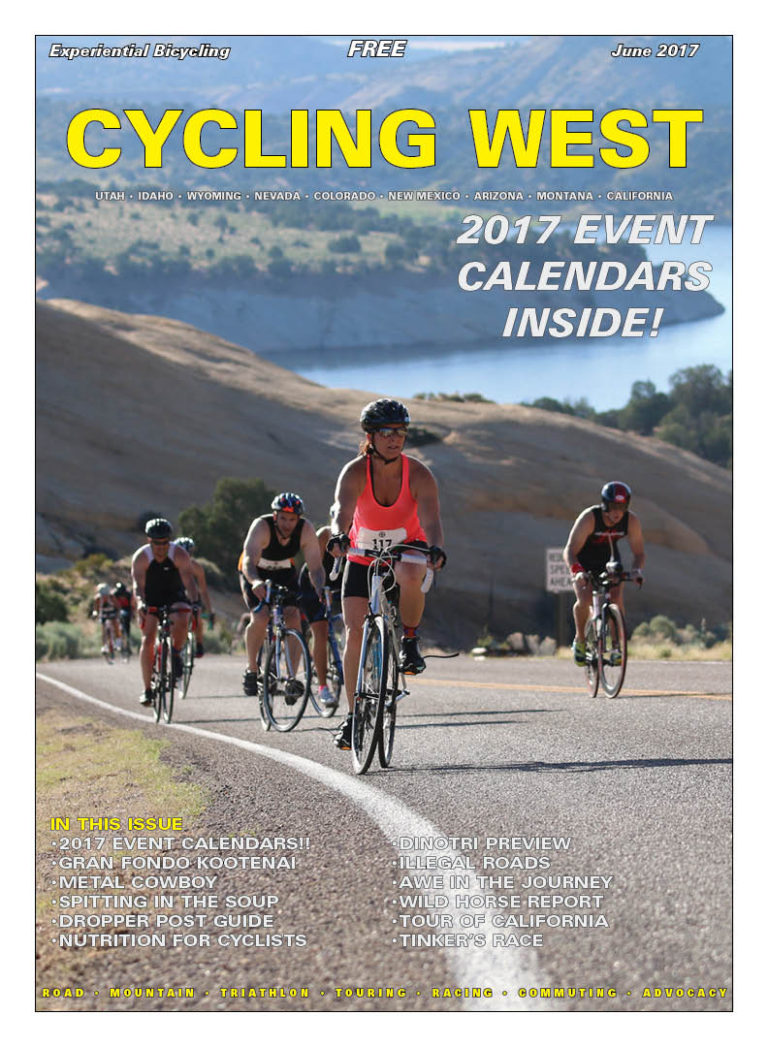
Cycling Utah and Cycling West Magazine’s June 2017 Issue is now available as a free download (10 mb download), Pick up a copy at your favorite Utah, Idaho, Wyoming, Nevada, Montana, W. Colorado, N. Arizona bike shop or other location!
Cycling West June 2017 Cover Photo: Riders climb out of Red Fleet Reservoir during the 2016 DinoTri in Vernal, Utah. Photo by Dave Iltis
Contents
Awe is Found in the Journey –page – 3
Dr. Eileen Hwang: Itinerant Bike commuter and Unhappy Car Renter –page – 4
Tour de Fat Sees Changes for 2017 –page – 4
The DinoTri is One of the Most Beautiful Triathlons in the Region –page – 5
Event Preview: Gran Fondo Kootenai Features a Fully-Supported, Multi-Day Fondo in Northwestern Montana –page – 6
Nutrition for Cyclists: Achieving Your Ideal Body Weight–page – 8
Spitting in the Soup Chronicles the History of Doping in Sport –page – 10
Bike Advocate: SLCBAC’s Marcus Kaller –page – 10
Report: Bikeshare and Bad Air? How do they Interact? page – 10
Why You Should Have a Share the Road License Plate –page – 11
Just Meandering . . . On A Bike –page – 15
Bike Friendly Status Awarded to St. George, Utah, Pueblo and Silverthorne, Colorado –page – 15
Chasing Lightning –page – 16
On Which Utah Roads Is It Illegal to Ride my Bicycle? –page – 17
Racing at the Tour of California – Pro Road Cycling At The Highest Level –page – 18
Tinker and Perry Win Nevada’s Tinker Classic –page – 20
Canyon’s Mancebo Wins Final Stage at Redlands, Eisenhart Takes Overall Win –page – 21
Report: Transporting Kids on E-Bikes page – 21
Saturday August 26, 2017 page – 27
A Guide to Dropper Posts –page – 30
Windy day, Record Field, and Record-Breaking Time at The Wild Horse –page – 31
The White Rim – Around Again –page – 32
Reno Area’s Geiger Grade to Gold Challenge is Full of History and Climbing! –page – 34
By Marcus Kaller — As a cyclist, I ride for two reasons. First, for the pure enjoyment, and second, it’s a healthy alternative way to get around places without using public transit or carpools. It took on more meaning when, years ago, I rode on my bike as part of my job. Usually, I’m working in an office, but a project opened an opportunity to where I can bike as part of it. I rode throughout Salt Lake City, doing a survey of city-owned assets to collect GIS data for my company’s database, by using the established bike routes there and I was impressed. In comparison, living in Midvale, which has no bike lanes to speak of, I wanted to see active transportation set up where I live. I grew up in both West Valley City and Taylorsville, riding in neighborhoods, to school, to work, for much of my life. It was something I wanted to share with my community.
From there, I learned about the Salt Lake County Bicycle Advisory Committee (SLCBAC) and the Bicycle Ambassadors program that the county operated. I applied for both, and a month later joined the ranks of SLCBAC. Since joining, I have talked to leaders in my community about implementing active transportation, talked to people across the county about biking, and even provide safety features for children to put on their bikes. It’s been difficult at times, especially with everything else going on in life. Strides have been made, but still much work remains at hand. Working with the people at SLCBAC gave me both insight and support in improving the bicycle environment in Sat Lake County.
So if you are an active cyclist, like myself, who want to make a difference and improve the quality of life in your community, I encourage you to visit your city council meetings and address your leaders about bicycling issues. Another thing is to find people who share your concerns and passion about cycling. One great place is the SLCBAC meetings we hold every month at the County Government Center, the second Wednesday of every month. And we are looking for people to join our committee who are concerned about the state of cycling in the county, especially those the live in the south and west areas of Salt Lake County, such as Draper, Riverton, Sandy, and Herriman. You can get more information at slco.org/bicycle.
If you live in Salt Lake City, there is the Salt Lake City Bicycle Advisory Committee. You can find more at www.slcgov.com/bc/boards-and-commissions-bicycle-advisory-committee. In addition, our friends from Bike Utah recently organized the Salt Lake Action Group. They are working on campaigns in advancing infrastructure, programs, and events throughout Salt Lake County. You can check them out at bikeutah.org/saltlakeactiongroup/. And finally, if you are want to encourage people to ride bikes and and teach safety practices, you can become a Bicycle Ambassador. More information can be found at slco.org/active-transportation/bicycle-ambassador-program/.
By working together, we can foster an environment that encourages people to get on their bicycles and ride for great opportunities.
By Charles Pekow — St. George City, Utah prides itself so much on its bike facilities that the first thing you might see on the city’s official website is a video of mountain bikers enjoying themselves (https://www.sgcity.org/). The rotating video features a variety of recreational events and when I hit the link, the bikers came up first. But the southwestern Utah had to improve its road biking around town to match its recreational cycling before it could be awarded Bicycle Friendly Community (BFC) status from the League of American Bicyclists (LAB).
This spring, it did just that, earning bronze status, the first step on the BFC ladder (below silver, gold, platinum and the seemingly unreachable diamond) in the spring round of awardee announcements. Two years ago, the city applied and received an honorable mention. Back then “they were really disappointed because they thought they were really close. They had great mountain biking but just didn’t have a lot of road biking going on,” explains LAB Policy Director Ken McLeod.
“The big thing that happened in between applications is that (last year) they adopted the St. George Active Transportation Plan (goo.gl/ildQwf) that provides a blueprint for more on-road facilities (so) people can bike all year long, not just mountain bike,” McLeod says.
“We put more emphasis on bike month with more activities than in previous years, including a ride with Mayor Jon Pike” and the city council to increase awareness around the city,” says St. George Engineering Associate Monty Thurber. The city also stepped up events for Bicycle Awareness Month (May) this year, featuring events at Bike to Work Day and Bike to School Day as well as an official proclamation from Pike and other activities.
The city is working on a variety of infrastructure projects, such as adding connectivity between neighborhoods and to parks and shopping, Thurber adds. The plan calls for trebling the city’s 50 miles of trails and building a connection with the nearby city of Washington, Utah. The Parks Department is also hoping to start construction of a bike skills park next summer.
To win higher status, of course, St. George must enact the plan and make the streets safer, McLeod says. The city of 80,000 also needs to dedicate more staff to biking and add bike facilities on more high-speed roads. “Some high speed roads are barriers to biking,” McLeod says.
“We’ll restripe and resurface more bike lanes and add wider shoulders when possible,” Thurber promises. “We aim to go for silver or gold. I don’t think we’ll ever be the Portland of Utah but its a goal we’d like to take on.”
Bike Friendly Colorado Cities
While St. George stands alone in Utah in getting an award this spring, the march in Colorado continues. Pueblo won bronze, up from the honorable mention it got in 2012. Pueblo impressed LAB with its high level of staff dedicated to biking but “on the other side, they don’t have a very good ratio of bicycle network to road network,” McLeod explains. Pueblo installed “pretty good coverage on high speed roads but is missing off-street and low-speed road facilities.”
Silverthorne, Colorado also moved up from honorable mention to bronze. It impressed LAB with its staffing and mileage network for a town with a population of 4,271. But it needs to provide better cycling facilities on high-speed roads. “It sounds like they’re trying to make the community a mountain biking destination and are going through the process of figuring out how they can do more trail development and opening the community to people to explore by bike,” in addition to its recreational facilities, McLeod explains.
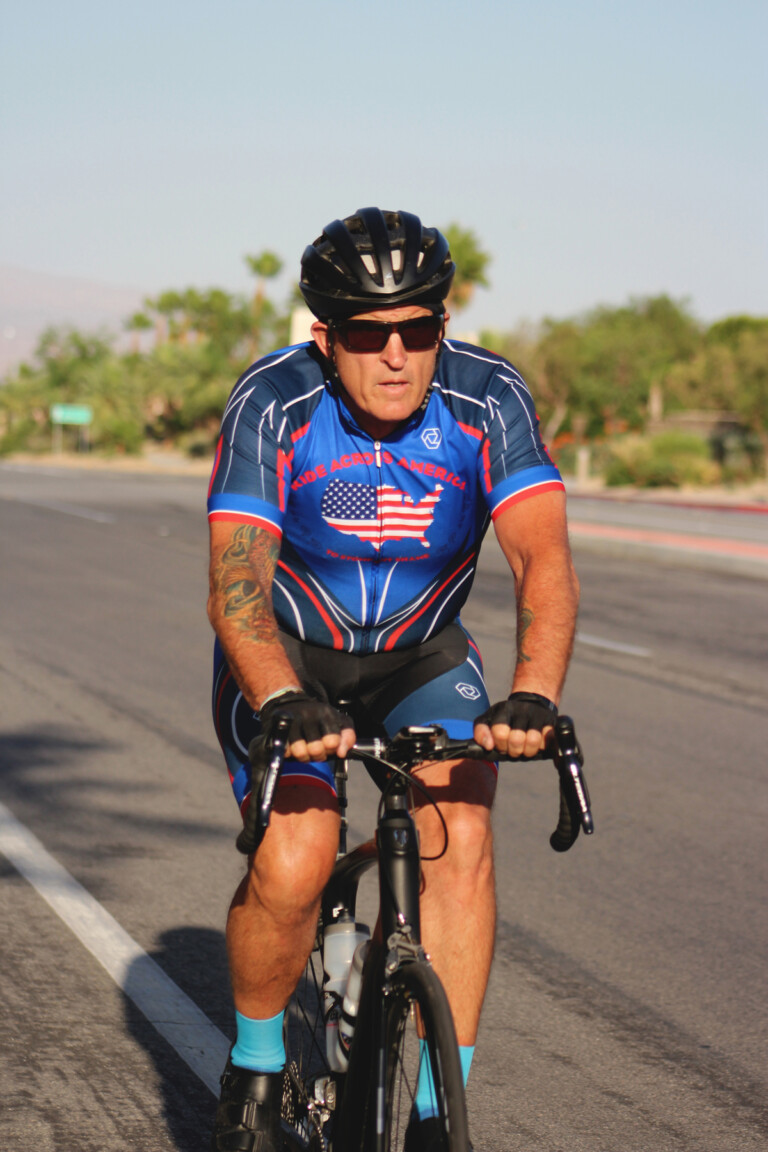
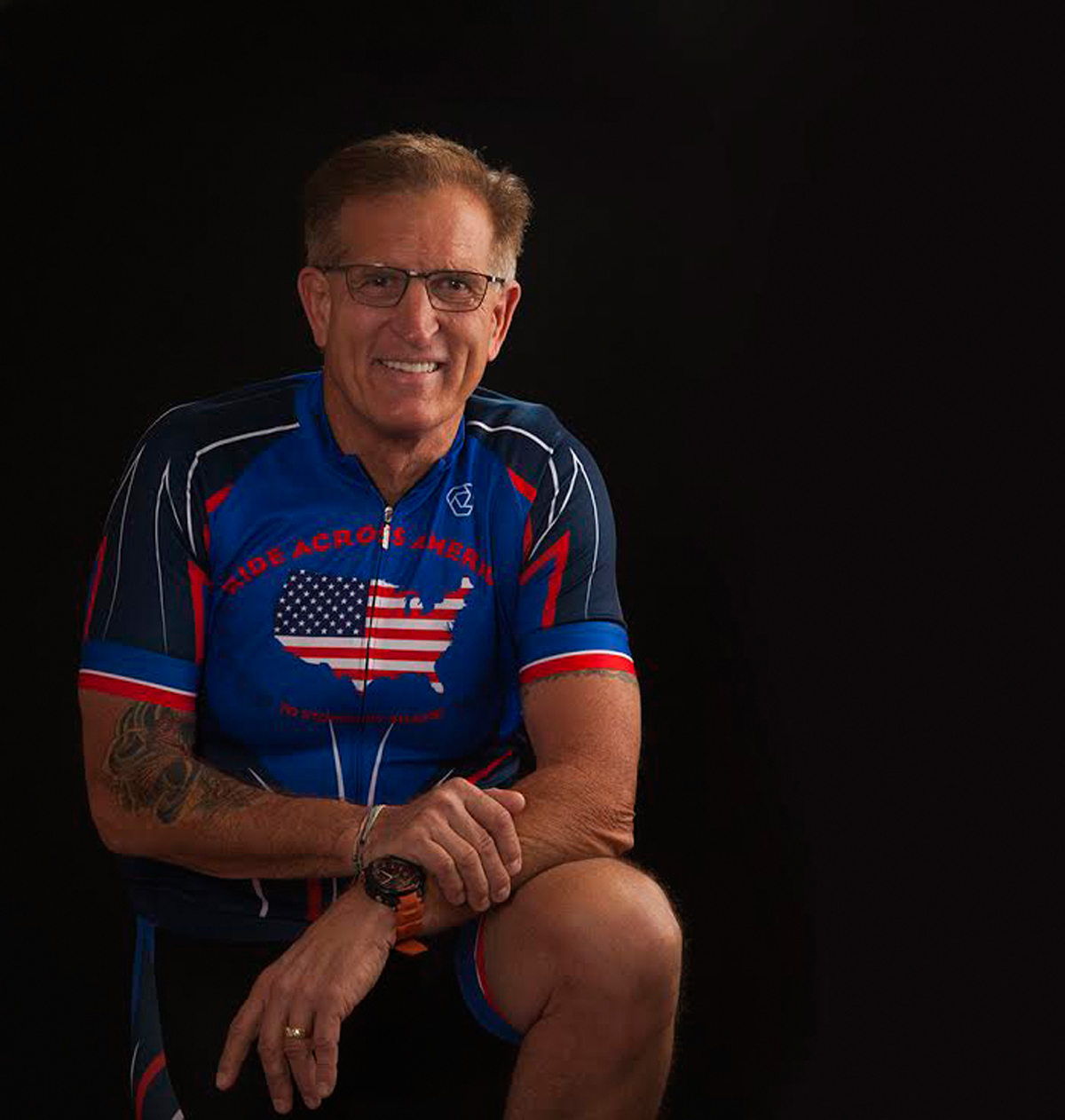
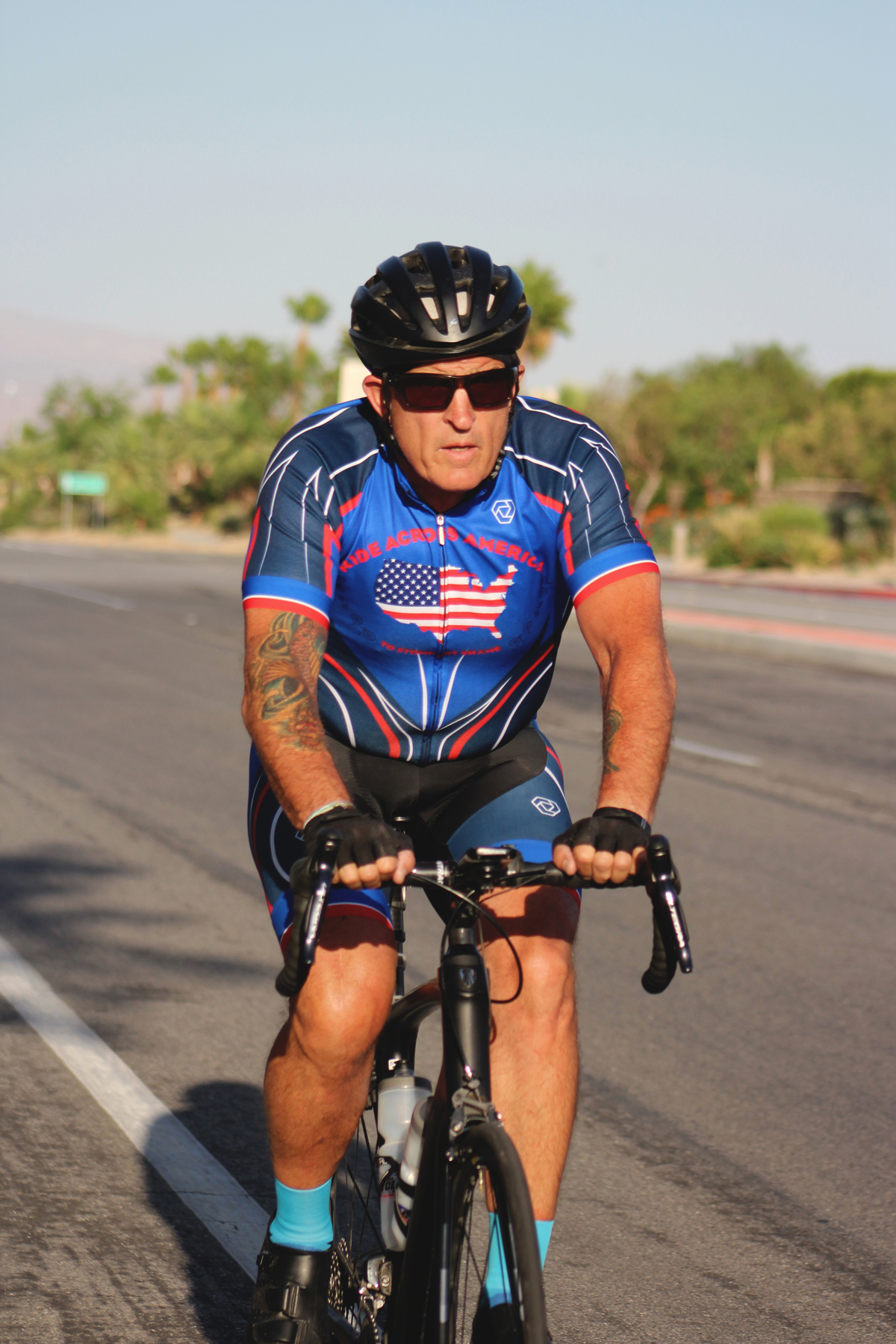
By Randy Boyd — On June 18, 2017, I am embarking on a Ride Across America to Stomp Out Shame, a 2,825-mile bicycle ride from Indio, CA to Beach Lake, PA. However this ride was set in motion fifty years ago when I was just ten years old by forces unforeseen by myself or any other human being.
It was the summer of 1967 and my mother, brother and myself went on a family vacation to visit my mother’s relatives in Indiana. We were told that my father was staying at home because he had to work. Events happened while in Indiana and all I wanted was my father, so when I arrived home, I ran from the car to the house to see dad, only he was not there. In fact I was told he had moved out and that he and my mother were getting a divorce.
Randy Boyd will be riding 2825 miles across the country in 2017 on the Ride Across America to Stomp Out Shame. Photo courtesy Randy Boyd
My father remained a big part of my life for the next couple of years. As a way of making up for not always being there for me, he bought me a metallic blue Schwinn 10 speed. As a kid I loved riding my bike and would race it around my block without a helmet, shoes or a care in the world. I remember one time coming around the corner and running square into the back of a parked car. I was fearless as a child.
About a year after my parents divorced my father became ill and I went from seeing him every other weekend to seeing him once a month. We had to postpone a backpacking trip we had planned and were reassured that as soon as dad was well we would go on the trip.
At the same time my mother met a man named Jack and in a short time he had become a surrogate father to my brother and I. He was there when my father was not. He would take us to the beach, picnics, out to dinner and to the Colorado River. He had earned my trust, my brother’s trust, my mothers trust and to some degree my fathers trust.
On Sunday January 12, 1969 after spending the weekend at Jack’s Laguna Beach house, we returned home around ten o’clock at night after driving two-hours through a severe rainstorm. As soon as we walked through the door our phone rang. Within minutes my mother met our neighbor at the front door and as they both walked back into the house I could tell something was wrong. My mother sat my brother and me on the couch and preceded to tell us our father had passed away from cancer. Needless to say I was confused, devastated and broken hearted, and no one could give me an answer to why my father had died.
Right about now you might be wondering what any of this has to do with cycling. Remember I said my Ride Across America started when I was 10 years old? So breathe in the good and breathe out the bad and see if you can relate to any part of this story.
It was a warm sunny spring day about a month after my father passed away. Like any other school day I walked myself home from school and let myself in the front door. As I walked into my house much to my surprise Jack was sitting on the living room couch. I thought to myself – cool, we are going to go out back and play catch. – Instead Jack stood up, put his hand on my shoulder and walked me into my bedroom. He sat me down on the edge of my bed and told me that he knew how hard it was going to be not having a father. He reassured me that he would be there for me. As he was talking with me his hand made it’s way to my crotch and what would be a five-year period of sexual abuse began. Oh, and as he walked me out of my room he told me this was our little secret. Understand I was a twelve–year old boy craving a father figure and a father’s love. And to top it off I was a member of a secret club. I thought he was giving me everything a loving father was supposed to give a son. Instead, for the next five years he would emotionally, physically, spiritually and sexually abuse me.
I still had that Schwinn 10 speed I got when I was ten years old, and after moving to Dana Point, CA I would often ride my trusty ten-speed to and from my baseball practices. However, eventually the bike riding was replaced with surfing. Surfing was my safe place, just Mother Nature and myself; no one could hurt me when I was surfing. However, eventually I turned to drugs and alcohol to quiet the pain and shame and I walked away from the very thing that gave me true peace – surfing.
I graduated from Dana Hills High School in 1975 and for the next thirty-one years, as a result of my abuse, I struggled with alcohol and drugs because they were the only things that would numb the pain of my abuse. I had let myself go physically gaining sixty pounds and I was absolutely no fun to be around. As a result of my drinking and the fact I carried the secret of my sexual abuse into my first marriage, after six years that marriage fell apart.
After the divorce I started taking care of myself physically. I went to the gym and became an avid runner. As a result I lost the sixty pounds I had gained and started feeling better about myself. I had my drinking and drugging under “control” and had fallen in love with a beautiful blond haired angel. Eventually I would marry this angel and my life would change in ways I had no idea were possible.
Cycling had never left my blood and eventually I began cycling again. First it was just riding my bike to the park with my son and slowly it became a way of life for me. I joined a club and would ride one hundred and fifty to two hundreds miles a week. I rode every chance I could. In many ways it became my new drug as I could escape from life’s realities while I was on the bike. I would often talk with my wife about one day doing the RAAM. However, life happens and with kids coming into our lives, I had to walk away from cycling yet again.
Raising a family and being there for my children was my number one priority in my life, so making the decision to walk away from cycling was not a hard decision. Without my cycling however, I had lost my means of escape and from 1990 – 2006; I fell deeper into my addictions. The unresolved issues of my childhood abuse constantly haunted me. In fact, it seemed to get worse. I am proud to say that I was a very successful businessman, father and husband. In fact my abuse drove me to success, but I could never fill that hole that was in my soul.
February 5, 2006 I had had enough. I was sick and tired of being sick and tired so I sought help for my addictions and entered into a treatment facility. One of the key elements in recovery is self-care and since I was going to the gym already and hiking a lot, I utilized those forms of exercise for my physical care. However, cycling was still in my blood and in 2007 a friend talked me into buying a bike. I have been riding now for the past ten years and while riding I have my greatest spiritual breakthroughs. Today I have twelve years of recovery from my abuse and eleven years of sobriety.
This brings us back to the Ride Across America to Stomp Out Shame. Sexual abuse of boys is of epidemic proportions not only here, but also in the entire world. Statistically 1:4 boys who become men are sexually abused. Yet America and the world want to act like it does not happen. After all boys “just get over it.” Wrong! For many survivors it destroys their self–esteem and self–confidence. The lasting effects are carried into all of their relationships, yet people believe it’s just the way they were born, if you don’t like it, too bad.
Randy Boyd is riding across the country to bring awareness to the prevalence of sexual abuse of boys. Photo by Allyssa Maupin
So on June 18, 2017 I will be embarking on a 2,825 mile bicycle ride from Indio, CA to Beach Lake, PA bringing awareness and educating as much of America about the prevalence of sexual abuse of boys, who the perpetrators are (93% are family members or friends,) and the correlation between chemical dependency and sexual abuse (80% of sexual abuse victims struggle with chemical dependency.) I will also deliver a message of hope, healing and a life of freedom and happiness beyond anyone’s imagination.
To learn more about the Courageous Healers Foundation and the Ride Across America to Stomp Out Shame go to www.courageoushealers.org If you are interested in joining Randy on a leg of the ride you can register at https://rideacrossamerica.eventbrite.com
By Charles Pekow — In December 2016, the National Highway Traffic Safety Administration (NHTSA) issued a new rule to require hybrid vehicles to make a minimum level of noise. Normally, one wouldn’t want more noise on the highways. But new vehicles are so quiet that bicyclists and others can’t always hear them coming. The new rules were designed to be phased in in 2018 and 2019. But the Trump Administration put a series of holds on the rule while it reexamines it (goo.gl/UZUdqk).
NHTSA was following an order from the White House to reconsider all new regulations that haven’t yet taken effect. As of early May, it hadn’t decided whether to kill the rule.
2100 S from 1700 E to 2300 E may get bike lanes in 2017.
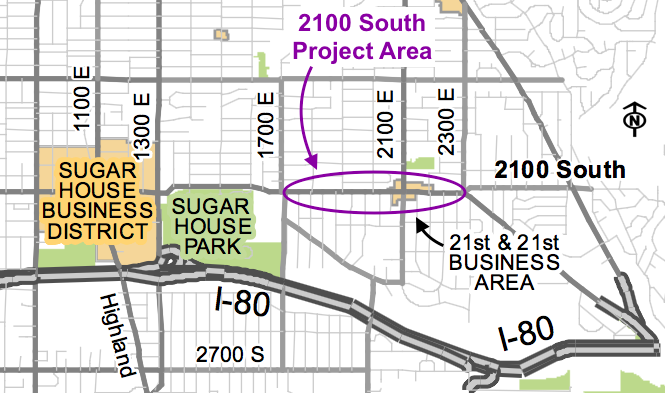
June 7, 2017 – Salt Lake City today announced a proposed redesign of 2100 S from 1700 E to 2300 E. The roadway will be resurfaced with a slurry seal later this summer. Three proposals are being considered.
Restripe and go from 4 travel lanes to 2 and a center turn lane, with bike lanes. (This is Salt Lake City’s recommended option)
Restripe and go from 4 travel lanes to 2 and a center turn lane, with no bike lanes.
Restripe and keep the same pattern of 2 traffic lanes in each direction with no bike lanes.
The preferred proposal seems to be number 1. This should result in a 30% reduction in motor vehicle crashes if the redesign results are like those of 1300 S and California Avenue are any indication. If bike lanes are added, there would likely be a further reduction in bike/vehicle crashes.
Project Open House – Thursday, June 22, 2017, 6-7:30 pm
Arch Nexus, 2505 Parleys Way.
Or, use our email form: [emailpetition id=”2″]
Bike lanes on this stretch of 2100 S are part of the 2015 Pedestrian and Bicycle Master Plan. Additionally, they are indicated in the 21st and 21st area master plan.
The lane reduction from 4 to 3 is called a Road Diet. Road Diets have many benefits. According to the Federal Highway Administration, they enhances safety, mobility, and access (safety.fhwa.dot.gov/road_diets/):
“A roadway reconfiguration known as a Road Diet offers several high-value improvements at a low cost when applied to traditional four-lane undivided highways. In addition to low cost, the primary benefits of a Road Diet include enhanced safety, mobility and access for all road users and a “complete streets” environment to accommodate a variety of transportation modes.
A classic Road Diet typically involves converting an existing four-lane, undivided roadway segment to a three-lane segment consisting of two through lanes and a center, two-way left-turn lane.
The resulting benefits include a crash reduction of 19 to 47 percent, reduced vehicle speed differential, improved mobility and access by all road users, and integration of the roadway into surrounding uses that results in an enhanced quality of life. A key feature of a Road Diet is that it allows reclaimed space to be allocated for other uses, such as turn lanes, bus lanes, pedestrian refuge islands, bike lanes, sidewalks, bus shelters, parking or landscaping.
Why consider a Road Diet? Four-lane undivided highways experience relatively high crash frequencies — especially as traffic volumes and turning movements increase over time — resulting in conflicts between high-speed through traffic, left-turning vehicles and other road users. FHWA has deemed Road Diets a proven safety countermeasure and promotes them as a safety-focused design alternative to a traditional four-lane, undivided roadway. Road Diet-related crash modification factors are also available for use in safety countermeasure benefit-cost analysis.
As more communities desire “complete streets” and more livable spaces, they look to agencies to find opportunities to better integrate pedestrian and bicycle facilities and transit options along their corridors. When a Road Diet is planned in conjunction with reconstruction or simple overlay projects, the safety and operational benefits are achieved essentially for the cost of restriping. A Road Diet is a low-cost solution that addresses safety concerns and benefits all road users — a win-win for quality of life.
Road Diets stand the test of time, having been implemented by transportation agencies for more than three decades. One of the first installations of a Road Diet was in 1979 in Billings, Montana. Road Diets increased in popularity in the 1990s. Cities, including Charlotte, Chicago, New York, Palo Alto, San Francisco and Seattle, have also opted for the positive impact Road Diets bring to their communities.”
Already, there is some opposition to the plan from Councilman Charlie Luke. Luke posted on Facebook yesterday, “I can tell you on this page that I am very opposed to any administrative plan that includes reducing traffic lanes on 2100 South.” Luke goes on to say that cyclists can ride elsewhere, “Bike lanes are good, but the six block section on 2100 S is already narrow. The city has identified 1700 S as a bike-friendly street. Parleys Canyon Blvd is another safer option. There is also the issue of commuter traffic spreading onto neighborhood streets. Residents near 1300 E complain regularly about increases traffic on streets not designed for heavy travel.”
Former Councilman Soren Simonsen is in favor of the redesign. He posted the following:
“Sugarhouse friends and neighbors, and bicycle and pedestrian advocates — good news! 2100 South may be finally getting its long awaited bike lanes.
These improvements have been planned for decades, and reiterated as official city policy in the 2005 Sugar House Master Plan, the more recently in the 2015 City Wide Bike & Pedestrian Plan. Bike lanes are also a recommendation in the 21st & 21st Small Area Plan, now in front of the City Council for adoption.
“Complete streets” are good for mobility, improve air quality, create safer neighborhoods, and increase business.
Please join the Sugar House Community Council meeting Wednesday evening to encourage this much needed “complete street” makeover, or submit comments online by email using the link provided.
If you have questions about “complete streets” please read this article that gives a good overview, and specifically addresses the configuration proposed for 2100 South — changing four car lanes to two lanes, center turn lane, and bike lanes — that will actually improve traffic flow while also making the street safer for bikes, pedestrians and cars as well:
Cycling Utah is fully in favor of the redesign of 2100 S from 1700 E to 2300 E to include bike lanes and a road diet.
Road Diets are safer and keep traffic moving better than streets without a center turn lane. Automobile crashes will likely decrease because speed differentials are decreased. It will be safer for people on bikes and foot too. And, bike use should increase. According to Salt Lake City (sugarhousecouncil.org/2017/06/07/2100-s-redesign-proposal-1700-e-2300-e/) traffic throughput is not likely to change either.
Sugarhouse has too much traffic as it is. Keeping an outdated road design is not going to solve this issue. In fact, the old design will result in more traffic in the future. What will help solve this is a shift from auto to human powered transportation, and increased transit options.
The quality of life in Sugarhouse depends on a calmer neighborhood. Keeping 4 lanes will just result in induced demand of more traffic rather than less.
Salt Lake City needs to continue moving forward, not backward, and should consider buffered bike lanes on this stretch as part of the redesign if there is space.
2100 S should eventually be redesigned from Foothill to 300 West (and beyond) and this should include bike lanes. Bike lanes in this region between 1700 E and 2300 E are a key beginning of a more friendly Sugarhouse.
Lastly, all streets should be safe for all modes of transportation. Why would we ask people on bikes or people walking to go several blocks out of their way when we don’t ask the same of drivers on those same streets?
Arterials are key corridors for people in bikes, people in cars, people in transit, and people on foot because they go to the destinations where all people want to go and, they tend to be the most direct route from A to B.
Salt Lake City Mayor Jackie Biskupski leads the Mayor’s Bike to Work Day on May 23, 2017. Photo by Dave Iltis
Cycling Utah calls on Mayor Jackie Biskupski and the Salt Lake City Council to complete the Bicycle and Pedestrian Master Plan in 5 years, and to triple funding for biking and walking in the fiscal year 2017-2018
By Dave Iltis • Cycling Utah • June 6, 2017
Last year, we submitted the following comments in regards to the Salt Lake City Budget for fiscal year 2016-2017. Unfortunately, funding levels were not increased. While many new bicycling projects in have been completed and are in the works such as the 900 S bike park, 900 W, the 300 N overpass, the University of Utah bike route, the McClelland and Folsom Trails, there are many, many more steps that are needed to make Salt Lake City better for people on bikes and people on foot. (Editorial continues below)
Submit comments to the Salt Lake City Council (they need to be submitted by 6-13-2017 by noon to be considered and read.
Comments may by submitted by emailing [email protected] or by signing the petition here (make sure to ‘edit’ the petition): [emailpetition id=”1″]
Salt Lake City has committed to use 100% renewable energy by 2032, and to reduce carbon emissions by 80% by 2040 according the goals of the Climate Resolution passed in July of 2016. One of the goals is for more Bike and Walking (active transportation). The Climate Positive document does talk about reducing emissions from transportation, but it doesn’t go far enough. According to the Union of Concerned Scientists, transportation accounts for 30% of US carbon emissions. If Salt Lake City is going to meet goals of reducing this contribution by 80% by 2040, we need to see a tripling of effort in getting more people biking and walking. Salt Lake City is not doing enough to make this happen currently.
Recently, Mayor Biskupski stated that she did not want to see anymore protected bike lanes such as those on 300 S. Protected bike lanes, while controversial for some, are a way to get more people on bikes. Bike use on 300 S increased by 30% overall when the lane opened in 2015. Sales increased too. While the Mayor has been supportive of cycling in general, her thinking on this is not in concert with the city’s goals on reducing carbon emissions. This needs to change. Salt Lake City needs to invest in more progressive bicycling and walking infrastructure and programs.
And Salt Lake City’s overall approach to transportation needs to change. This is a subject for a larger conversation that would include items such as reducing parking, increased transit, decreasing speed limits, decreased costs of transit, but, the city can spend much more on biking and walking infrastructure. It is inexpensive compared to overall transportation spending, and the return on investment is high and multiplicative.
The following are the still relevant comments from our 2016 comments.
Salt Lake City is the leader in bicycle programs and infrastructure for the State of Utah. But, in order to continue to lead, it needs a drastic increase in funding for cycling as well as a new Bicycle Program Office. Salt Lake City should aim to complete the current version of the recently passed Pedestrian and Bicycle Master Plan in 5 years, not 20 as stated in the plan. And, an Economic Development Plan For Cycling and the Outdoor Industry is needed (see the attached document).
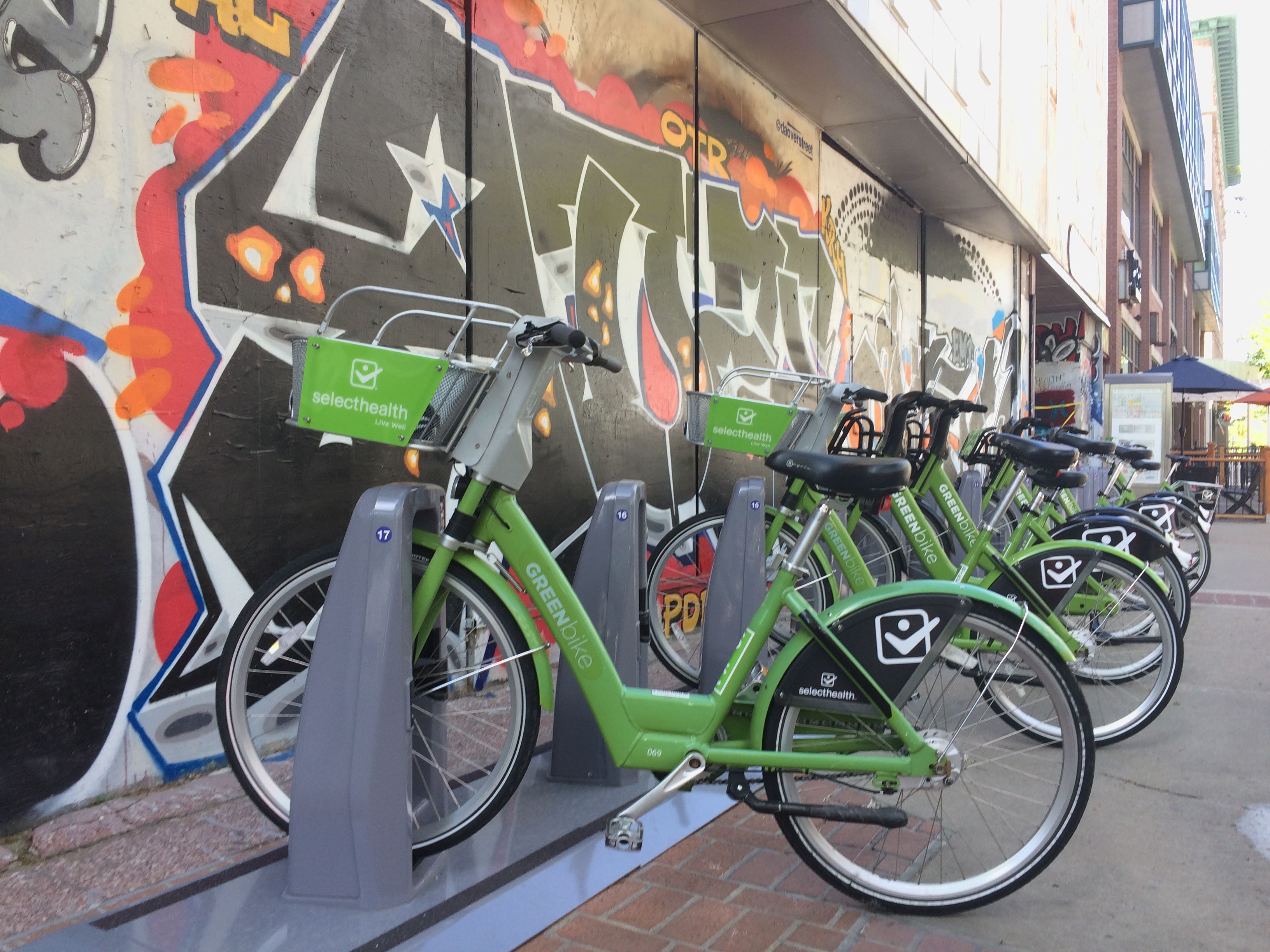
As the first Silver level Bicycle Friendly Community in Utah, SLC has built a substantial bicycle lane network, has installed one of the first protected intersections in the country, has a successful GreenBike Bike Share program, and has seen ridership increase dramatically over the years. And, with the recently passed Pedestrian and Bicycle Master Plan great things lie ahead if the plan is completed.
Bicycling and walking are great for the health, economy, and air quality of Salt Lake City. Each ride taken by its citizens increases their happiness and healthiness. It puts more money in their pocketbook since less money must be expended on automobile costs. This, in turn, results in more money being spent in the local economy since less money is spent on fuel. Additionally, cycling reduces air pollution which is a huge problem in Salt Lake City. And, each mile on a bike results in approximately 1 pound of CO2 emissions saved and does not contribute to PM2.5 or NOx.
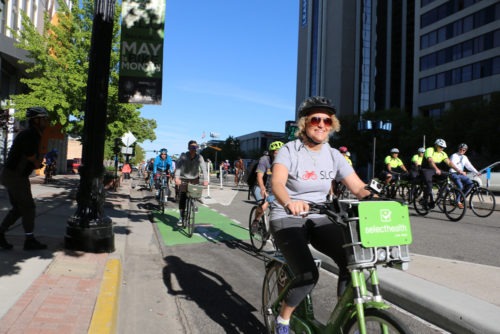
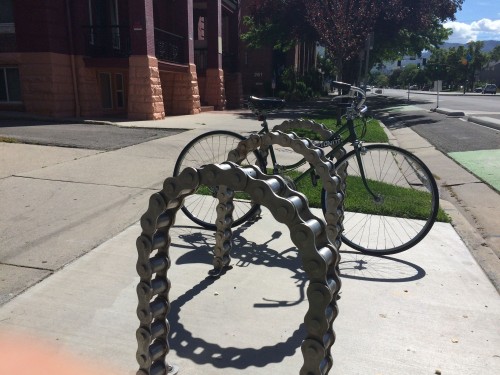
Cool new bike racks in Salt Lake City. Photo by Dave Iltis
Bicycle and pedestrian infrastructure is safer for people. It creates a more friendly, accessible city. It leads to better health outcomes. A better economy. And better air.
Salt Lake City is poised to rise to the next level of bicycling. To get there, several steps are needed.
The Pedestrian and Bicycle Master Plan needs to be completed in 5 years. 20 years is too long to wait for safe cycling.
Funding for bicycle and pedestrian programs, and the completion of the plan needs to be doubled or tripled immediately.
A Bicycle Program Office within the Transportation Division needs to be created. This office would serve to coordinate Bicycle and Pedestrian Programs and Policy throughout the city, not just within the Transportation Division. This would include many of the programs within the Pedestrian and Bicycle Master Plan, as well working with, for example, Parks and Rec for Bike Parks and mountain bike trails, the Police Department for enforcement, safety, and stolen bikes, and Economic Development for enriching our bicycle economy. Within this new Bicycle and Pedestrian Program Office, a program director would be needed. The current Bicycle and Pedestrian Coordinator position needs to be elevated to this new position.
Additional staff positions would be needed to implement the many programs and infrastructure planning in the Bicycle and Pedestrian Master Plan.
Salt Lake City needs a Recreational Cycling Plan that would include both:
A road cycling recreational plan, and
A Trails and Mountain Biking Plan. Salt Lake has no such plan, despite this being one of the top requests from its citizens (From the Rec Bond process of 2015)
An Economic Development Plan for Bicycling and the Outdoor Industry needs to be created. (Available on request) Focusing on these industries would result in economic development, growth, and an increase in healthy lifestyles in the city.
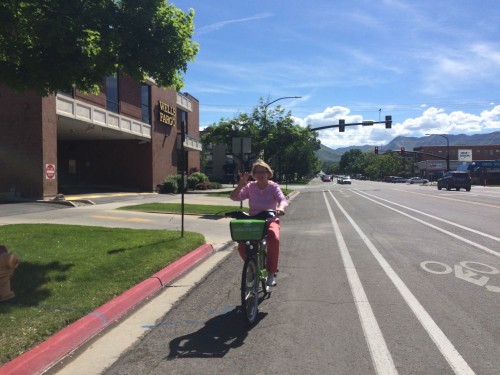
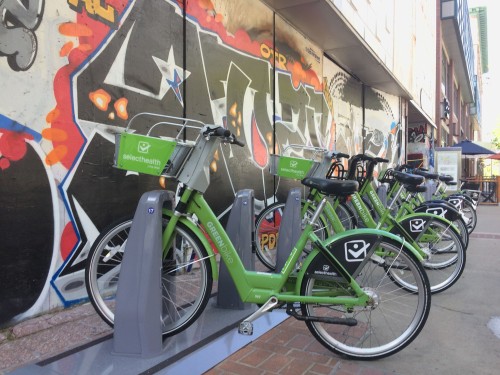
Greenbike is accessible to all riders. Salt Lake City needs infrastructure to match. Photo by Dave Iltis
Salt Lake City needs programs to improve air quality, economic development and health. As such, Salt Lake City needs better cycling and walking infrastructure and programs – investing in them is an investment in our community.
Investing in bicycling and walking infrastructure and programs leads to more people riding their bikes, more walking and thus better health, better air, and a better economy.
Editor’s Note: The preceding was sent to Salt Lake City Mayor Jackie Biskupski and the Salt Lake City Council as a comment on the upcoming budget.
To Comment:
If you would like to send comments in support of more cycling in Salt Lake City, please email them to:
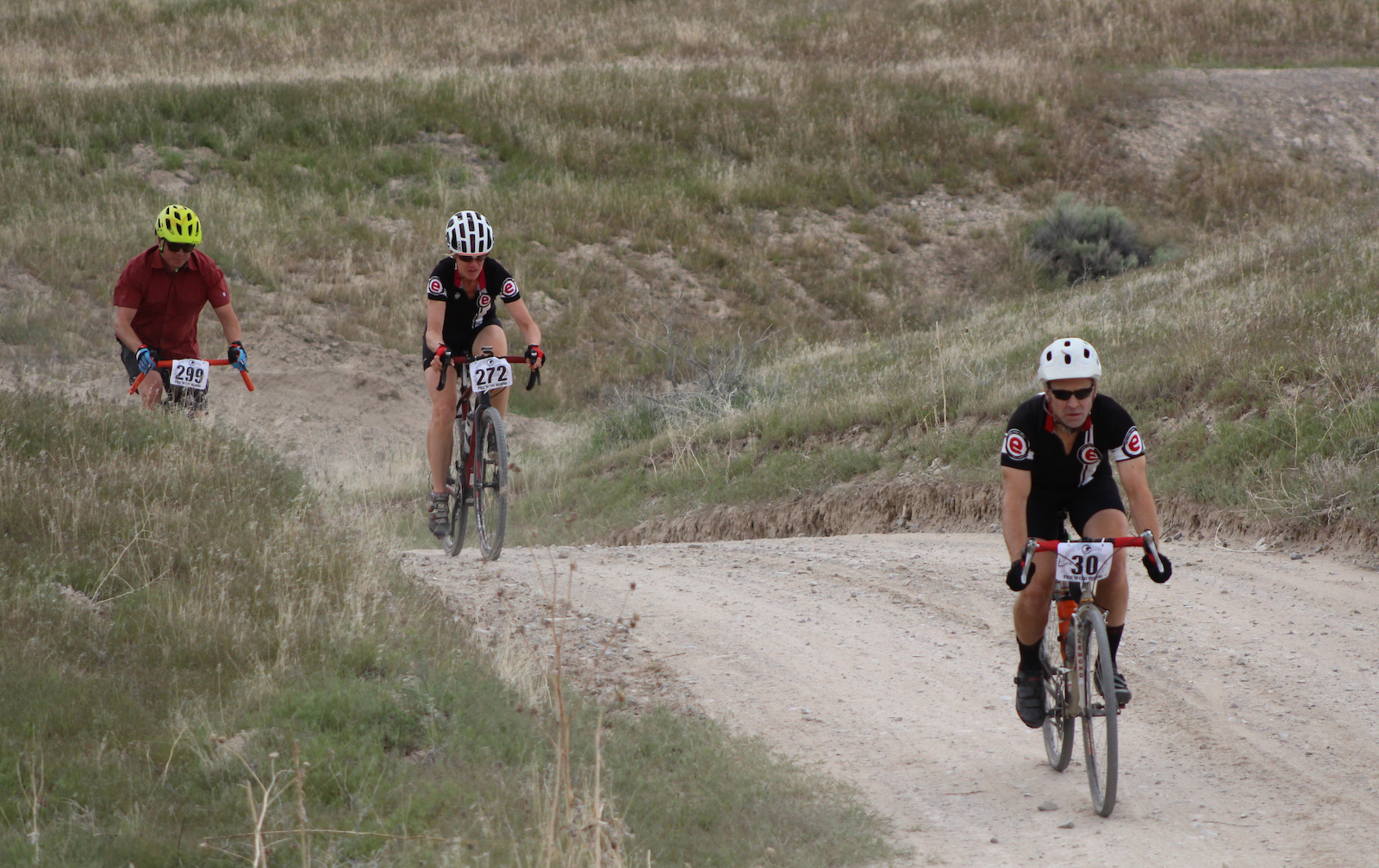
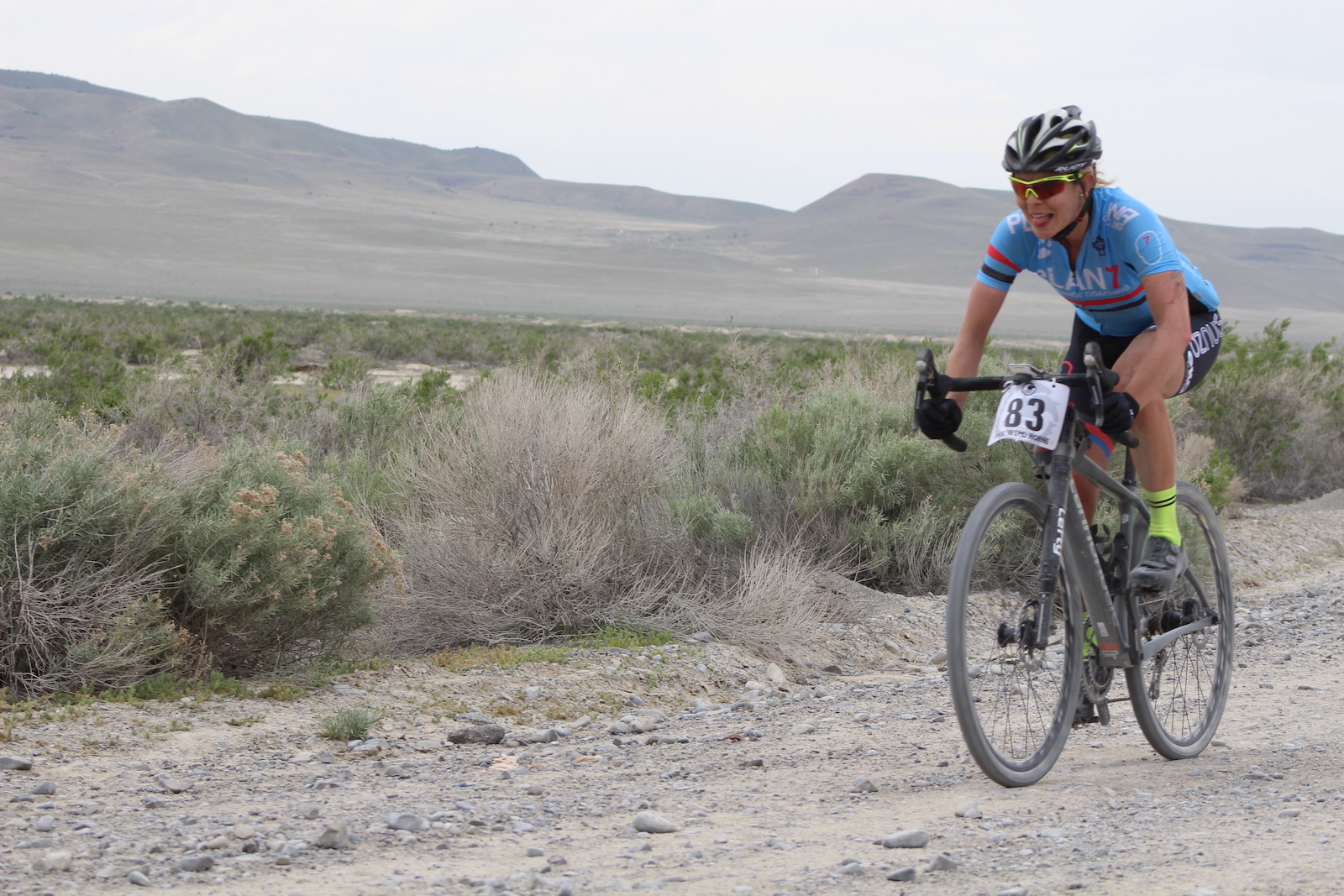
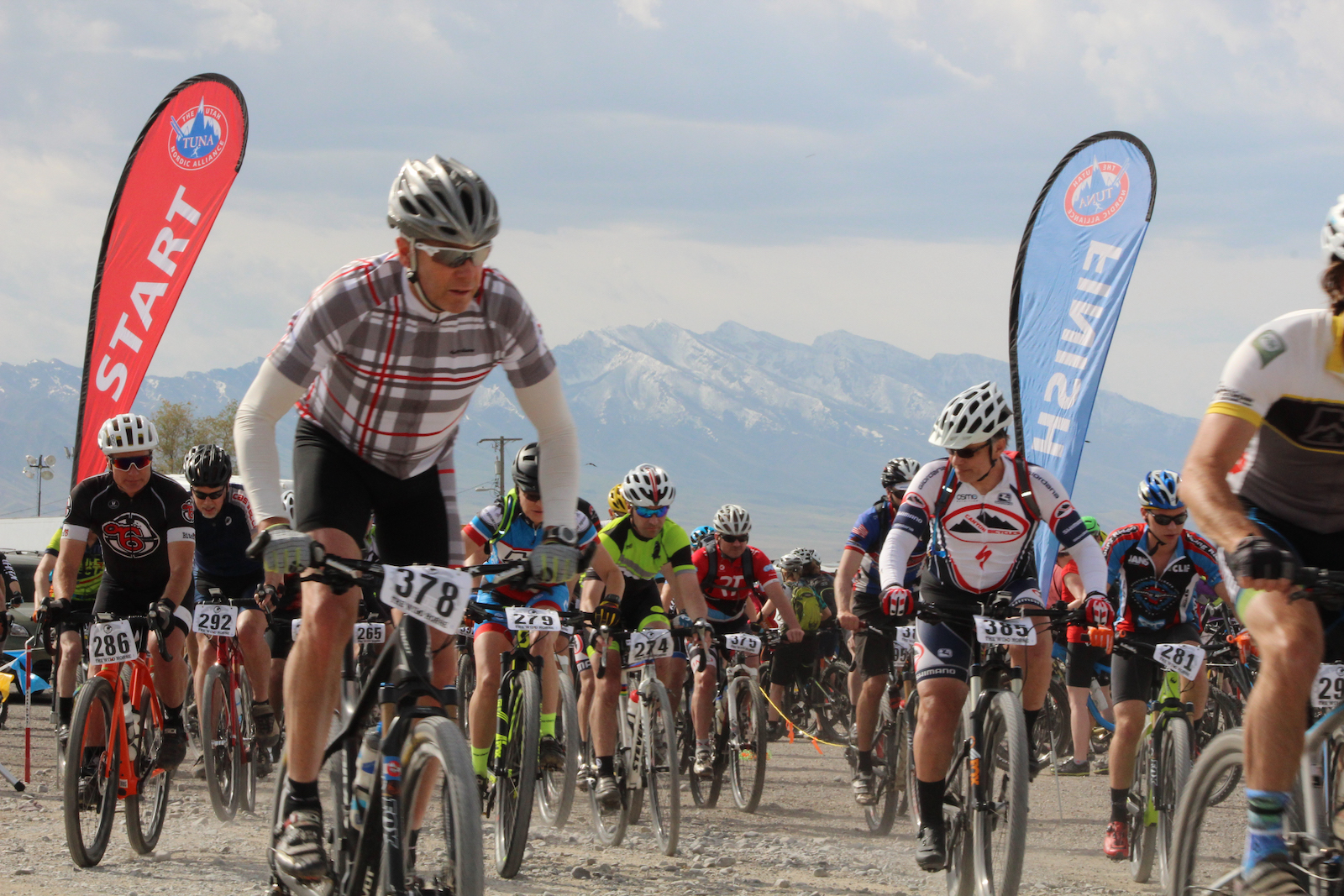
By Chris Magerl — Breanne Nalder is a road racer. She was part of the Team Time Trial at the 2015 UCI Road Worlds. A few weeks before The Wild Horse she was completing the Tour of the Gila road stage race, and a few weeks after The Wild Horse she completed the Tour of California road stage race. But she was on the start line of The Wild Horse on May 6, ready to churn out 76 miles of dirt and gravel around the Cedar Mountain Wilderness in Tooele County.
“I had blast getting off road!” said Nalder. “It’s such a fun change to get out of a high-speed peloton and roll around in the dirt with other amazing cyclists.”
The day was going pretty well for Nalder, who turned the fastest women’s time up Hastings Pass and Rydalch Pass, the two climbs that determine the KOM/QOM at The Wild Horse. By the time she rolled into the third aid station, at mile 56, she had been told by other riders that she had a significant gap to the second place woman.
Breanne Nalder nears the finish line in The Wild Horse. Photo by Barbara Engers
“This was my fatal mistake,” said Nalder “I’ll admit I got a bit confident and decided to stop at the last feed station and have a soda. I never get to stop in races so thought if others do it must be normal, right? I had plenty of time, right?”
Nalder drank a Coke. She filled her bottles. She snacked and chatted with the aid station volunteers. Then she saw Jeanette Petersen pedaling up the road, past the aid station and past Nalder.
“So I jumped on my bike and started motoring. Five minutes later I looked down and I had left both of my bottles at the feed station. Let’s just say the next 20 miles we’re not pleasant!” said Nalder. “I never caught Jeanette, and give her all the credit for riding a great steady race.”
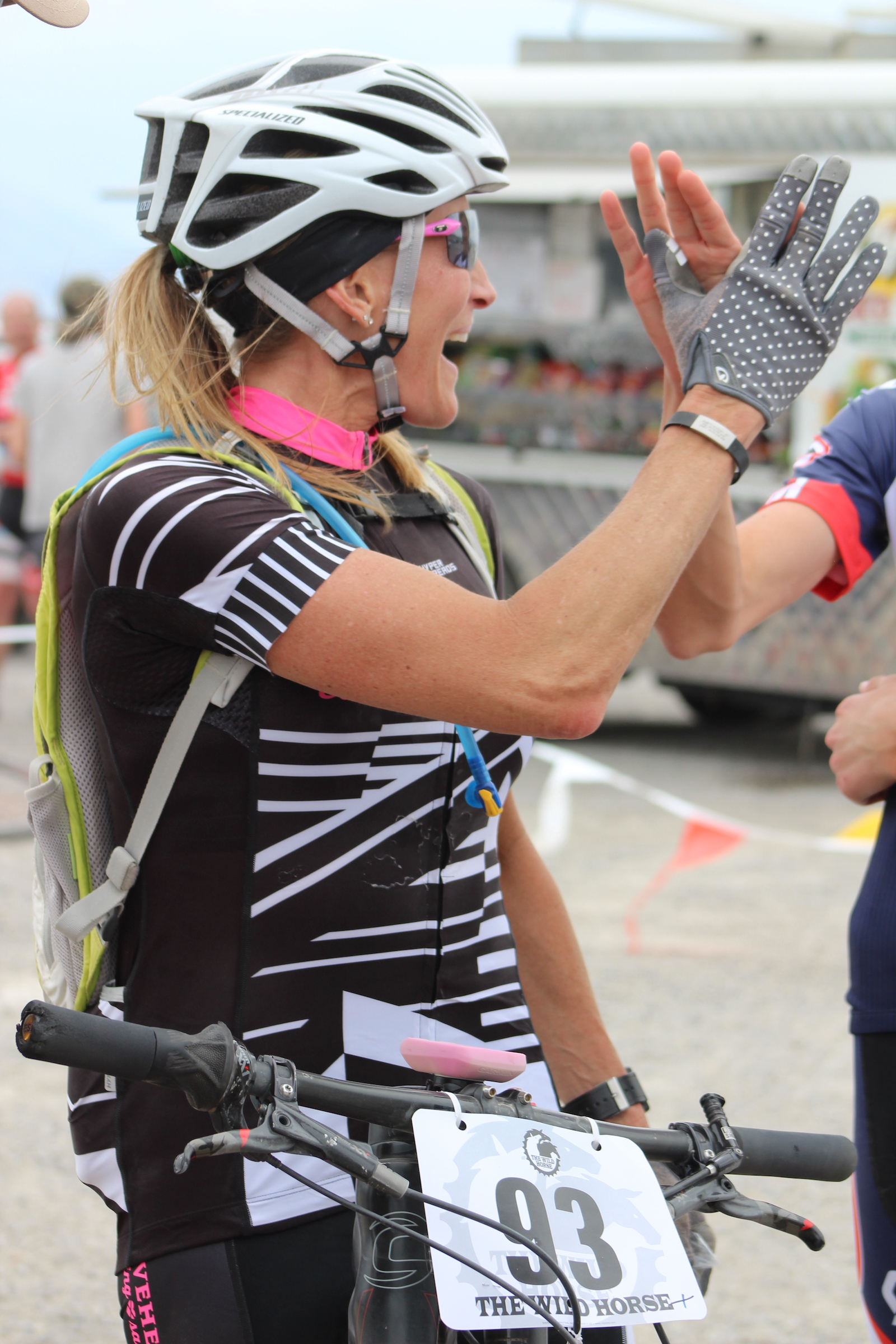
Jeanette Petersen was the fastest woman in The Wild Horse, crossing the line in 5:07. Photo by Barbara Engers
Petersen went on to win The Wild Horse in a time of 5:07, which placed her 10th amongst the 102 finishers of The Wild Horse. Nalder rolled in about five minutes later.
“This was only my second endurance race I’ve ever entered,” said winner Petersen. “I just ride and race for fun while trying to set personal goals.”
Petersen was on her full suspension Cannondale Scalpel MTB. ” Not the lightest set up but I was definitely having more fun on the descents and could go a lot faster than my competition.”
Meghan Sheridan, last year’s winner and the only woman to go under five hours in three years of The Wild Horse, said her early season fitness couldn’t match 2016. “Due to the high winds, the Wild Horse was extremely tough this year and a big early season accomplishment!” said Sheridan.
Riders in the Little Wild Horse make their way along the dirt roads that circle the Cedar Mountain Wilderness in Tooele County, about one hour west of SLC. Photo by Barbara Engers
The men’s race saw a fast guy miss the start, a strong group go off the front, several brave solo chases and more than a few flat tires at crucial moments.
Jamey Driscoll, an elite level CX racer living in Park City, arrived in Delle 12 minutes before the start. “I could have scrambled, but knew that I wanted to be prepared for that kind of adventure,” said Driscoll. The ride started, and Driscoll was not there, heading out about ten minutes behind. This led to multiple riders commenting on being passed by Driscoll looking like he was riding a rocket. Driscoll turned the screws on Hastings Pass, the first long climb, and thought that he might be able to work his way up to the leaders as he let it rip down the back side of Hastings.
Then he flatted. Chase over. He did go on to win the KOM, completing each of the two timed climbs more than one minute faster than the second-place man.
“After the flat, I rode it differently, since I was alone. I was saving something for the KOM. The other riders didn’t have my effort to gauge off of,” said Driscoll.
On the front, Roger Arnell, the winner of the first two editions of The Wild Horse, was in a small group motoring away on Hastings, along with Christoph Heinrich, Chris Stuart and Erik Harrington. As they neared the top, Heinrich eased off, a small gap opened, and Heinrich was left to chase hard on the descent, at one point hitting 45 mph. On gravel. On a CX bike. He passed Harrington early in the descent and caught the two leaders at the bottom, just after they turned south, into the teeth of a hard headwind.
“Now there were the three of us, working well together into the headwind,” said Heinrich. “Surprisingly, Erik made it back into the group as well, after he soloed into the headwind for probably 30 minutes, a very impressive effort.”
Then Harrington flatted. He would not see the lead trio the rest of the day, and would go on to finish fourth.
On Rydalch, the second long climb at the southern end of the course, Stuart took off and was off the front alone, a strong tailwind pushing him toward the finish, about 30 miles north. Heinrich chased solo, frequently seeing Stuart in the distance, and eventually catching and passing Stuart with about 20 miles to go. Then Stuart flatted, but Heinrich didn’t know it, and spent that final 20 miles expecting to see Stuart come back up to him at any moment. Heinrich pushed hard, finishing in 4:27, shattering Arnell’s course record by about nine minutes. Stuart pedaled in seven minutes later, and Arnell finished third. “Overall another great day and race!” said Arnell.
Riders head out for the 31 mile Little Wild Horse. There were 71 finishers in the Little Wild Horse and 102 finishers in the 76 mile Wild Horse. Photo by Barbara Engers
In the 31-mile Little Wild Horse, Brennon Petersen dropped Aaron Phillips a few miles from the finish and cruised in at 1:48:49, a course record. “After the sand pits me and Aaron actually saw a bunch of wild horses,” said Petersen. “It was super cool but sadly I couldn’t stop and take a picture.” Brennon Petersen, a rider on the Canyon Bicycles Elite Jr. Devo Team, is the son of Jeanette Petersen, the women’s winner of The Wild Horse.
In the women’s Little Wild Horse, Jennifer Cherland crossed the line first, ahead of 17 other women in the shorter distance.
The Wild Horse benefits the Utah League High School MTB Scholarship Fund. In addition to a contribution to the Scholarship Fund, all of the aid station volunteers and most of the finish line crew were Utah League folks, who received a contribution directly to their respective programs.
Second place finisher Stuart referred to his day as “a lot of type-2 fun.”
“It will be an event I’ll want to do in 2018,” said Stuart.
And for CX stand-out Driscoll, making the start with time to spare will be on the to-do list for the future. “The course is definitely for real. I will be trying to get a different bike for future editions,” said Driscoll. “I wanted to balance the position that I would be semi-comfortable in, but real MTB tires would be helpful. And maybe some suspension.”
By Dave Iltis — Gran Fondo Kootenai is a fully-supported, multi-day cycling event held in the remote northwest corner of Montana. This year’s edition occurs on July 1 and 2. The ride starts in Libby on Day 1 and travels to Eureka. The ride then returns to Libby – via a different route – on Day 2. The back-to-back, “stage” fondo is augmented with a short, unofficial, fun ride along the Kootenai River on check-in day (June 30).
We asked organizer John Weyhrich to tell us more about the ride.
Cycling West: Tell us about the three courses. What is the scenery like? How are the climbs?
Gran Fondo Kootenai: In general, we designed our routes to take in the region’s abundance of spectacular scenery along National Forest Scenic Byways, and to take advantage of its exceptionally lightly trafficked roads. Each day, riders will see snowcapped peaks, deep green valleys, grand lake vistas, and majestic mountain views. And, due to the remoteness of these routes, cyclists will also encounter very few motorized vehicles along the way
Our Day 0 “Fun” ride, is 17 miles long, with a minimal amount of elevation change. It helps orient new riders to the area, and follows the Kootenai River for a stretch along roads which we don’t otherwise ride during the actual event.
The Day 1 route is 76 miles long, with 4700’ gain, and three aid stations. It features continuously rolling terrain with a few short, steep climbs and a fabulous downhill run into the town of Eureka, just a few miles from the Canadian border.
The Day 2 route is 98 miles long, with 6000’ gain, and four aid stations. It boasts several stellar climbs through lush forests and long, fun descents along rushing streams. This route also includes a mile-long unpaved section, a legitimate Euro-style climb (10-miles, ave. grade 7%; max. grade 12%), and is considered by many to be one of the top routes in the nation – it’s truly an epic ride!
Nearing the top of the fearsome Yaak Divide climb in the Gran Fondo Kootenai. Photo by John Weyhrich
CW: What support is available to riders each day? What are the highlights of the rest stops? Where do riders stay in Eureka?
GFK: We offer full support during the entire weekend. That includes mechanical and nutritional support along the ride routes, as well as chip timing. Our aid stations are manned by members of regional service organizations, and their additions of home-baked goods, fresh fruit, and cool treats provide a little local flavor – figuratively and literally – to a full complement of Hammer Nutrition products and other standard ride fare. We also transport luggage and gear (clothes, tents, sleeping bags/pads, etc.) to/from Eureka, where we take over the school complex on Saturday evening and Sunday morning, provide warm showers, and a fantastic catered dinner and breakfast. Most participants overnight in their tents on school grounds, though some choose to sleep inside on the gym floor. A few choose to stay at one of the limited indoor lodging options in Eureka (at their own expense); if so, we’ll transport luggage to/from those locations, as well. Essentially, riders show up, hand us their gear, and simply focus on riding to their day’s destination.
Crossing Lake Koocanusa on Montana’s highest bridge in the Gran Fondo Kootenai. Photo by John Weyhrich
CW: Tell us about the natural features and geography of the area. What are some of the highlights?
GFK: The area is renowned for its abundance of natural resources, spectacular scenery, wild lands and its small, but hearty population. One of the most prominent features of the region is Lake Koocanusa, which we spend a considerable amount of time riding along (and across!). Technically, this body of water is a reservoir, but it’s in a scenically spectacular setting and it provides a fantastic backdrop for the event. We’ll ride for nearly 50 miles along the U.S. portion of the “lake,” but there is a whole other half of the lake in Canada! In fact, the name is a conglomeration taken from the Kootenai River which flows into/out of the lake in Canada and the U.S.A., respectively. And, speaking of the Kootenai River, Kootenai Falls – made famous in the film The River Wild with Meryl Streep and Kevin Bacon – lies just downstream from our start point in Libby. With the heavy snows received in the Kootenai region this past winter, the falls should be raging during this year’s event! The river bisects the rugged Cabinet Mountain range, still home to a modest population of grizzly bears. We’ll also pedal through the legendary and wondrous Yaak Valley, made famous in writings by Rick Bass and other authors for its quiet remoteness. Glacier National Park, and all its majestic grandeur, lies only an hour and a half to the east.
A tranquil stretch in the Yaak Valley in the Gran Fondo Kootenai. Photo by John Weyhrich
CW: Tell us about the history and the local people.
GFK: The name pertains to the ancient homeland of the Kootenai Indians, which reaches from northwest Montana to northern Idaho and southwestern Canada. In more modern times, the region has been susceptible to the rises and falls of the timber industry. Additionally, the town of Libby, in particular, was beset by the revelation that a local mine produced an asbestos-laden byproduct which caused severe medical and economic hardships for hundreds of the town’s residents. Libby is still recovering from that blow, and proceeds from the gran fondo go toward aiding that process.
CW: Is there anything else that you would like to add?
GFK: Gran Fondo Kootenai welcomes all interested cyclists. This event provides opportunities to be as challenging or as leisurely as desired. Our relatively small size – typically less than 100 riders – allows us to provide personalized service and a special, intimate experience. And, our close proximity to Canada draws many of our cycling neighbors from the north; come be part of a fun, friendly international rivalry.
Event Details:
July 1-2 — Gran Fondo Kootenai, Libby, MT. A two-day, point-to-point, chip-timed fondo featuring fully supported riding through the spectacular landscapes of Montana’s remote northwest corner. Located on National Forest Scenic Byways, our routes take in the stately Cabinet Mountains, serene Lake Koocanusa, and the legendary Yaak Valley. Proceeds benefit local charities, John Weyhrich, 406-241-2829, [email protected], gfkootenai.com