Bike Festival to Promote Bicycling for Shopping and Dining
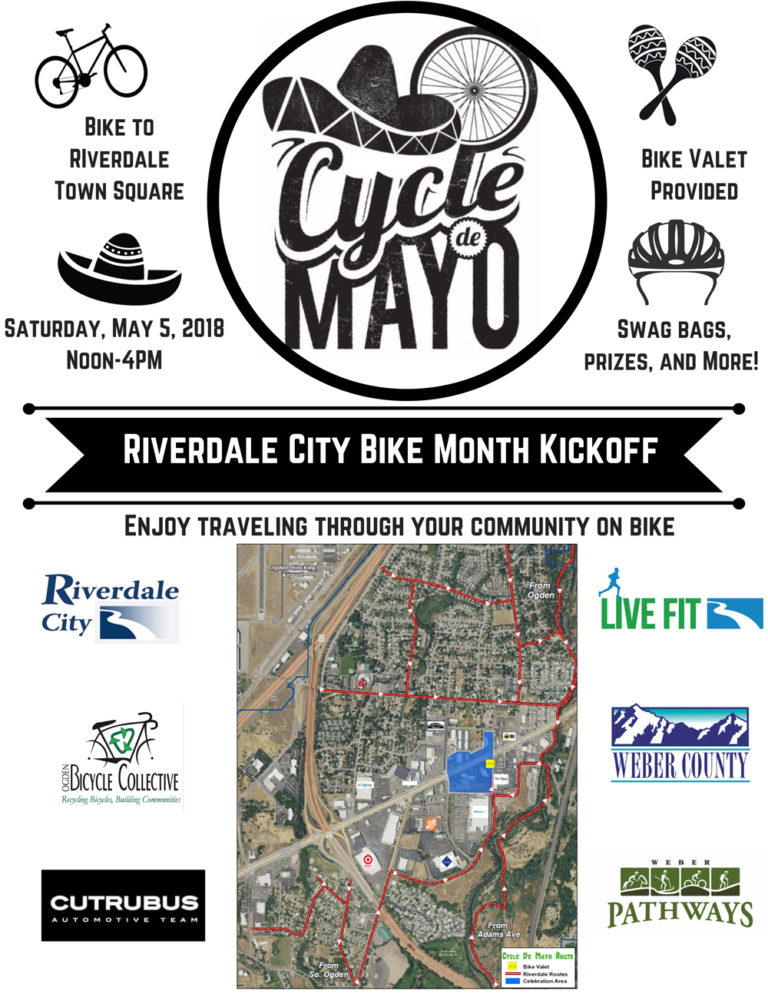
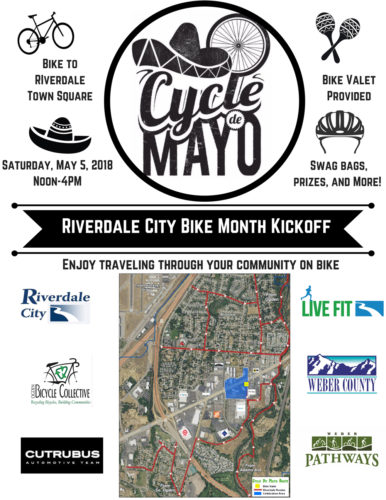
Cycle de Mayo Riverdale • May 5, 2018 • Noon to 4 pm • Utah Bike Month
People ride their bikes for many reasons. Some ride for exercise. Some ride to commute to school or work. Some ride to enjoy the outdoors alone or with friends. Or, all of the above.
The Cycle de Mayo Festival will be held on May 5, 2018 in Riverdale, Utah.
On Saturday, May 5th, Weber Pathways, Weber County, Riverdale City’s Live Fit team, The Ogden Bicycle Collective, and Weber-Morgan Health Department have put together an event called Cycle de Mayo to promote bicycling versus driving for light shopping and dining. The purpose is to make more people aware of how pathways available to citizens throughout the Weber County area can sometimes provide more convenient access to those businesses.
Riverdale is a central location on the path therefore Riverdale City is also promoting the use of the trail system. Riverdale Town Square and The Crossing is centrally located to all riders from the north, south and west, making it a great biking destination. And, because of its diverse business environment, it’s perfect for this event.
The promotion is designed to bring people from as far as Ogden, Layton, Hooper and Clearfield through the bike paths to the Riverdale Town Square and The Crossing. Once the riders get there they will be greeted by bike valets who will rack the riders’ bikes for safe keeping while the participants visit local businesses. Event participants will be given a swag bag where they will be directed to all the businesses at the center who participate in the event. Riders will visit those businesses for their swag reward.
Visit the “Riverdale City Utah” Facebook event page for a map with recommended bike routes and bring the family out to enjoy the Cycle de Mayo Riverdale on May 5th from 12 to 4 pm.
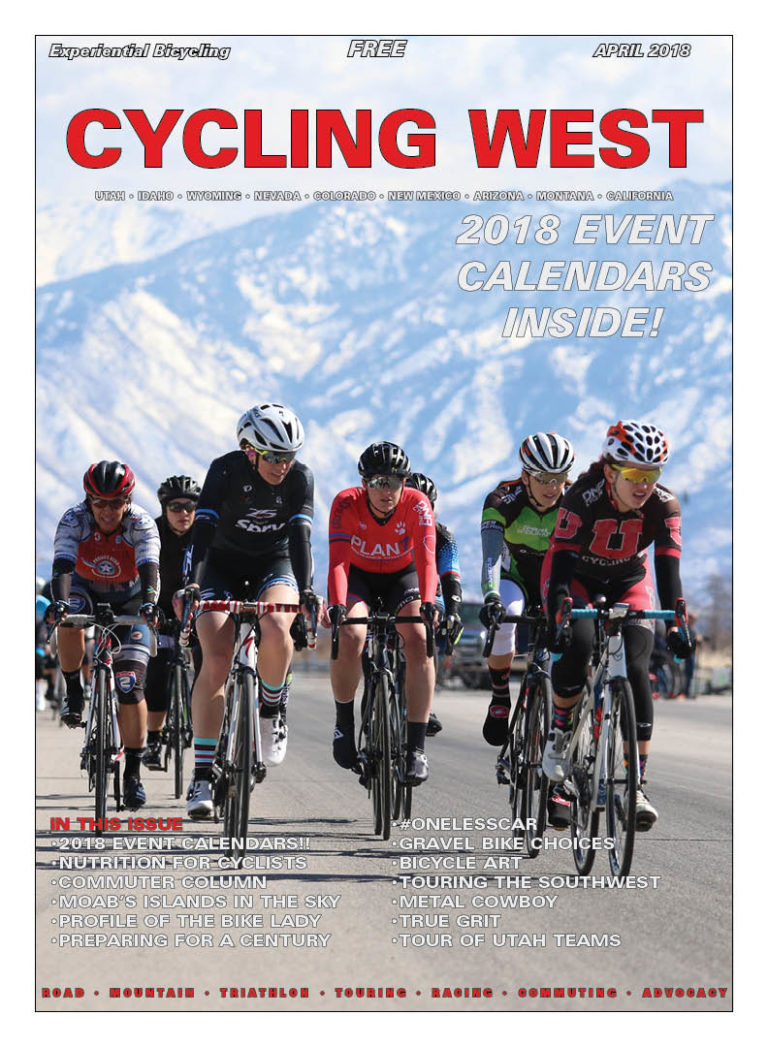
Cycling Utah and Cycling West Magazine’s April 2018 Issue is now available as a free download (9 mb download), Pick up a copy at your favorite Utah, Idaho, Wyoming, Nevada, Montana, W. Colorado, N. Arizona bike shop or other location!
Cycling West April 2018 Cover Photo: The women’s field at the Rocky Mountain Raceways Criterium on March 10, 2018 in West Valley City, Utah. The Wasatch Mountains loom in the distance. Photo by Dave Iltis
Contents
#onelesscar – page – 3
Tips for Bicycle Commuting – page – 4
Need More Reasons to Ride? Two Studies Show Cycling Reduces Effects of Aging – page – 6
Rocky Mountain National Park Opens Trail for Mountain Biking – page – 6
Riding the Canals of Phoenix – page – 8
Tour of Utah Announces First 9 Pro Teams for 2018 Race – page – 9
SLCBAC News for April 2018 page – 10
New Bike Facilties Coming to US 20/26 in Boise, Idaho page – 10
Trail Improvements Coming to Montana’s Helena-Lewis & Clark National Forest page – 10
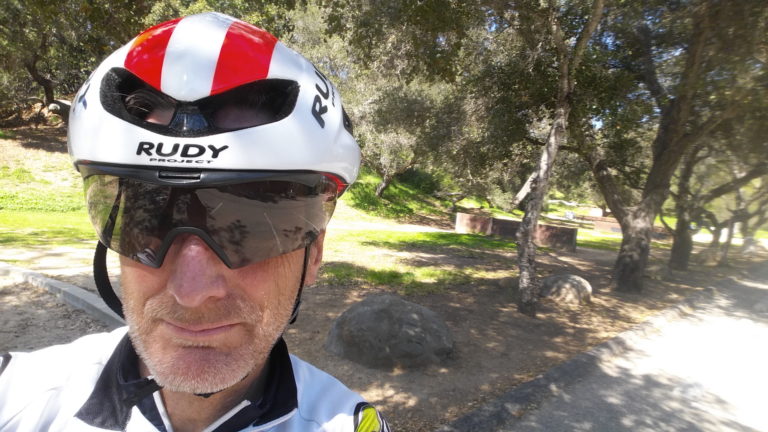
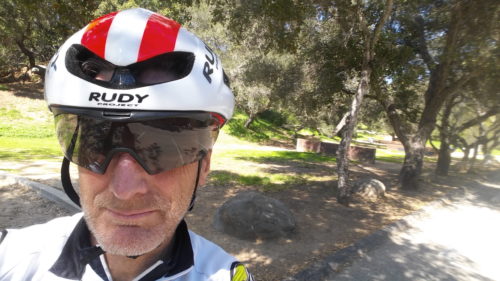
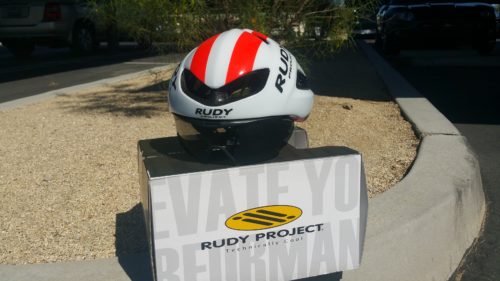
The Rudy Project Boost 01 Aero helmet is the first modern aero-style helmet that I’ve ever worn for regular riding around.
Almost thirty years ago, I had a Giro aero helmet. In its day, it was cutting edge, had a big fin, and of course, faster – laughing out loud. But it would be silly to ride around town with the big fin, though occasionally, someone would and the word ridiculous would come to mind.
Fast forward to present day, yes, I’ve been riding around town and country wearing the Rudy Project Boost 01, with the detachable shield installed. Surprisingly, the shield is not too dark for wearing glasses as well. As important, there is no feeling of claustrophobia. The Boost 01 definitely has a modern look.
Fit
In the Boost 01, I have not experienced any discomfort wearing the Boost 01. The straps adjust easily. The adjustable fitting knob secures the Boost 01 functionally to one’s head. The helmet’s shape is slightly oval, but for my head shape, I would prefer it slightly more oval. The sizing is comparable to other helmets that use “small/medium” sizing as opposed to “universal” sizing. The one I’m testing is a small/med.
Accessory Features
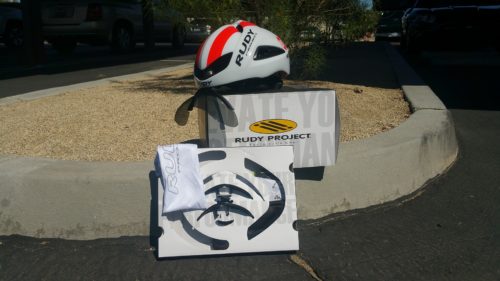
The Boost 01 comes with a snap in opaque neutral swing poly-shield that pivots from a hinge on the poly-plastic visor mount bracket. The shield installs intuitively by placing the lateral hooks into slots on the helmet and then snapping the center clasp. The Boost 01 comes with two main-port fittings, one solid, and one perforated for cooling and also acts as a bug screen. The Boost 01 comes with a fine helmet bag.
Ventilation
I have yet to wear the helmet in very hot conditions, but I’m going to guess that the air-flow has been optimized as it was pretty easy for the bee I encountered to enter the main front port without the perforated main port fittings in place. Rudy Project does offer insect shields for other helmets in their line-up for everyday riding.
Strap-clasp
I found the Boost 01 straps easy to adjust that hold the adjusted position well. Of the clasp, if you encounter a bee, you had better be able to remove said helmet quickly and intuitively. You will find a standard clasp mechanism on Boost 01. It’s true, I’ve been putting on and taking off helmets for almost thirty years. The Boost 01 did not fail me. Surprisingly, I found no bee. Maybe the bee made its exit out a rear vent.
Weight
I was recently on an eighty mile ride wearing the Boost 01 with a cycling cap and an ear-warmer. I wore the cycling cap backwards so that it would fit comfortably. I experienced no fatigue. That experience is contrary to wearing my non-aero everyday helmet which is maybe 80 grams heavier. While wearing my non-aero helmet, I experienced neck fatigue after about twenty miles while wearing the same cold weather set-up. I was surprised at the difference.
Noise
You know, I had expectations that an aero helmet would be quiet, but my experience has not confirmed my expectation. I can not say definitively one way or the other. I have yet to perform a noise test.
But are you noticeably more aerodynamic and thus faster?
As I do not have a wind-tunnel at my disposal, I do not have the means to quantify the parasite drag of the Boost 01. Does the Boost 01 improve laminar flow over a non-aero helmet, effectively reducing the size-of the barn door? My experience, subjective mind you, is yes. The Boost 01 in my experience seems to reduce parasite drag. Parasite drag becomes more prevalent at the square of the increase in one’s velocity per a blocking surface area – i.e. the proverbial barn door. Want the math? See: http://bit.ly/2I2IGVG
Why might this matter? Well, as a bike racer or time-trialer, every incremental improvement in efficiency saves you energy. It might matter, provided you’re not bleeding energy throughout an event like riding on the front for no good reason. That little bit of energy conservation might prolong a bonk. Or the tiny aero advantage might allow you to cover a gap, or over forty kilometers, maybe save a handful of seconds that helps you crush your PR.
Hocus-pocus? No, the math is real, it’s just that all of your other incremental inefficiencies add up. One might also consider an aero-helmet as cheap speed relative to buying expensive carbon and aero wheels or an aero-frameset, or in the other technologies like ceramic bearings, super lubricants, ovalized spokes, laminar-flow clothing, etc.
Conclusion
The Rudy Project Boost 01 Aero-helmet has proven its utility that speed specialists will appreciate. And finally, the Boost 01 supports the fragile ego of this old bike racer that still wants to hold on to performance idealism that I never had in the first place. That said, even though I’ve never had an engine, I’m faster for it while wearing the Boost 01.
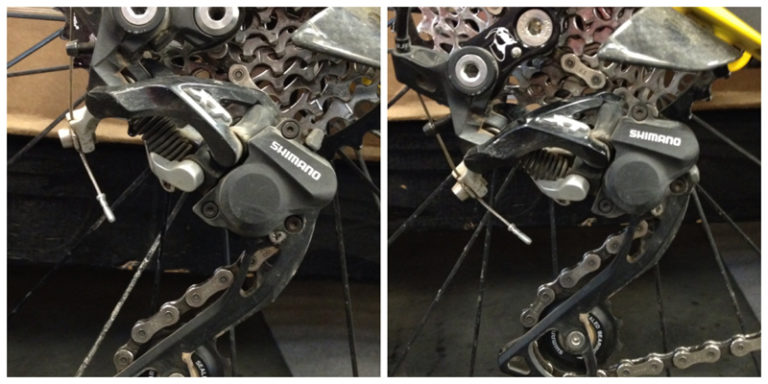
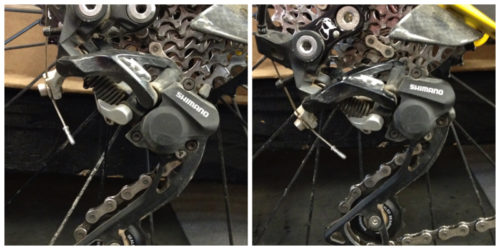
Rear derailleur without the Goat Link (left). Rear derailleur with the Goat Link (right).
By Tom Jow
One of the hottest trends in mountain biking right now is SRAM’s 1 x 11 single ring drivetrain. It is so hot that since it’s release it has spawned 3 mountain bike group sets, a cyclocross group and rumours of a road group. Also grown from the popularity of the 1x drivetrain is a number of conversion parts to upgrade a multi-ring 10 speed drivetrain to a 1 x 10 setup. In this article I review the eThirteen 42t rear cog and a RaceFace 30t narrow-wide chainring I installed on my bike last month.
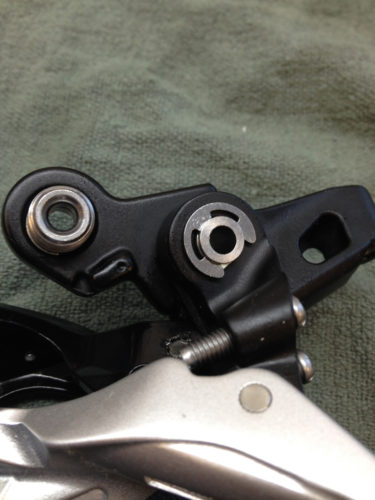
The Goat Link works to convert a rear derailleur into one that will work with a larger cog, and a single front chainring. The c-clip must be removed in order to install the Goat Link.The c-clip must be removed in order to install the Goat Link.
The Installation:
The installation process is simple and straightforward. Remove the cassette. Install the new cog behind the old cassette and remove either the 17 or 15 tooth cog. Remove the chainrings and install the new one. Then remove the front shifter, cable and derailleur. *For more detailed instruction on the installation process see Cycling Utah, May 2015.
The First Test:
Due to time and weather constraints, my testing was limited to about 10 rides; the Shoreline Trail, the hills at Liberty Park, and around the neighborhood. Despite having only a small amount of test rides, I was able to judge immediately how the drivetrain was working.
In my experience with two other 1x conversions at work, the system seemed to work pretty well. Both in the stand and test rides on flat ground the shifting could be rated (on a scale of 1-5) as 3.5-4. The performance of my bicycle, on the other hand, was more like 1.5. Let me say that I can adapt to about anything on a bicycle and the shifting performance of my new 1x drivetrain was totally inadequate. There would no adapting to this. Shifting from the 13 to the 17 was nearly impossible. Once in the 17, moving up the cassette to the 42 was very slow and of below average performance. Holding the shift lever or double clicking up and then shifting one back was required. Getting into the 42 from the 36 was about the only shift that worked well. Even moving down the cassette into the high gears was slow.
Back to the Drawing Board:
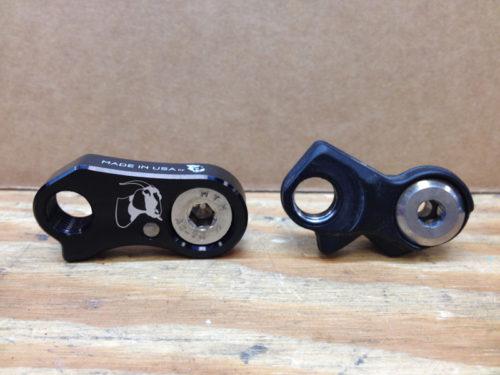
“What is my next step?” I asked myself. During my research I found there is a large array of components available in order to perform the perfect 1x conversion. I an attempt to improve the shifting, I decided to purchase the Wolftooth Components “Goat Link”. This component replaces the standard derailleur tab on a Shimano rear derailleur. The Goat link is a little longer and flatter (see photo 1), which brings the upper rear derailleur pulley closer to the cogs. Notice how much more the rear derailleur is under the cogs on the right of photo 2.
Replacing the link is an easy task. First, remove the rear derailleur. Remove the “c” clip
(photo 3) behind the bolt holding the link to the deraillleur body, and then remove the bolt. Install the Goat Link, replace the bolt and clip. Reinstall the derailleur and make any necessary adjustments to the cable tension. The “b” tension screw will also need to be adjusted, adjust it so the chain shifts smoothly onto the 42 cog without banging into it (you’ll see what I mean).
The Second Test:
It is amazing what a difference one component can make. From the first shift it was apparent that the shifting performance was greatly improved. Moving to the larger cogs was now much smoother, with only a hint of hesitation. I found that it did require a slightly more forceful shifting action, in other words, shift like you mean it. Coming back down to the high gears was nearly perfect.
Unfortunately, shifting from the 13 to the 17 was still next to impossible. During my research I found that Wolftooth Components manufactures a 16 tooth cog and highly recommends removing both the 17 and 15 and installing the 16. After digging around in my parts boxes, I found an old 16 tooth cog. So I replaced the 17 cog with the 16. An enormous improvement. Finally, a setup I could live with.
The Gearing:
Obviously there is a big change in the gearing. The biggest difference is the lack of overlap. A 2 x 10 drivetrain has only 14 gears that do not overlap. The gears I used most and their gear inch size (bold) are shown in table 1.
What this table shows is that in a perfect world, shifting would start, from low to high, in the 22-36, move through the 32, 28, 24, then shift to the 36-36, and move on down one by one to the 36-11. With a single chainring, however, there is no overlap. Shifting would begin in the 30-42 and complete at the 30-11(see table 2).
One of the other differences with my new gearing is a taller low gear and a shorter high gear. Referring back to table 2, the combination 30-42 is a 19 inch gear. This is equivalent to the 22-32, or one gear higher than the lowest of my old gearing. On the high end, at 74 inches, the 30-11 is 14 inches shorter than the 36-11. What does this mean? I need to work harder to get up the steep hills and spin faster to keep up on the downhills.
The Parts:
The first stage of the conversion consisted of the following three parts:
eThirteen EX cog – $69.95
Wolftooth Components Goat Link – $19.95
RaceFace 30t Narrow-Wide chainring – $59.95
The second stage of the conversion required the following:
Wolftooth Components 16t cog – $14.95
Be sure to cross check the compatibility of the new components to the old ones. For example, for use with Shimano cassettes, the add-on cogs are only compatible with XT and XTR. And the Goat link, is not compatible with SRAM derailleurs. So, check compatibility and read the instructions.
Conclusion:
It took a little experimentation, but I have a good working system now. The shifting seems simpler, but I miss the 36-36. That was my go to gear upon cresting a steep up that transitions to downhill. I’m not so concerned about the loss of my high gear, but I do miss the low gear of my old 22-36. Three inches in a gear size does not sound like a lot, but it was enough to have me walking on the steepest hill in my test rides. If necessary, it is possible to obtain a lower gear by purchasing a 26 or 28 tooth chainring for the smaller, 64mm bolt circle of my double crankset.
The total cost of the parts for this conversion is approximately $165. The total time I spent on labor was approximately 3-4 hours. In addition, removing the front shifter parts reduced my bike weight by almost 1 pound. So, for less than half the cost of a SRAM 1 x 11 cassette, anyone can purchase a very adequate 1 x 10 conversion kit.
You & A Bike & A Road by Eleanor Davis, Koyama Press, 2017
By Lou Melini
Eleanor Davis is an illustrator and cartoonist. She illustrated and wrote most of the book during a 2016 bike tour from her birth and childhood home in Tucson, Arizona to her current residence in Athens, Georgia. At least that was the plan. She rode as far as Jackson, Mississippi where she called her husband thus ending her tour. Though she ended the planned tour sooner than planned, she had a grand tour through 2 partial states and 3 full states including Texas, a state so large that it should count as traveling through 2 states.
The book is good in a very different sort of way due to the illustrated format. Think of reading a full length Charlie Brown/Peanuts book. The illustrations are well done, the dialogue is mostly good as it well reflects what she did, ride a bike for a long distance. The content of the book has many references that realistically describe a bike tour. For example, on day 39 she is going to Austin, Texas. She illustrates 2 touring cyclists with question marks over their heads. “ Eleanor?” “Jack?” describing her re-uniting with another touring cyclist that she met previously. One meets a number of people on a bike tour and Eleanor meets quite a few that she illustrates in her book. These are quite entertaining. “Day 42, Yegua S.P: The group at the RV spotted her. “Hey where’d you bike from. You touring” while his wife asked; “Come help us eat this catfish we just caught this morning” Eleanor’s reply; “Oh my God!” I can relate to this encounter Eleanor had.
Though I enjoyed the book, there were a few parts that were really unnecessary distractions to put it mildly. I personally do not like touring books that interject political statements or commentary. I sometimes enjoy tangential statements thrown into the flow of a touring book to perhaps bring some historical perspective of a town for example. Numerous pages with non-flattering remarks about border patrol and an odd interjection of “Boy do we hate Republicans” by a couple she meets on day 21 were just not needed. Nor did I appreciate the page of illustrations stating; “Today I only eat stuff that looks like d***s”. Perhaps I am getting old and overly critical.
Despite the above flaws, I would consider giving the book as a gift. However, I would certainly screen to whom I gave the book to as I think of my circle of bike travelers all would have that same criticism as I of the book. If the book stuck with the core subject, the bike tour, it would be a very good book to highly recommend due to the quality of the illustrations. It is a very unique book about a bicycle tour.
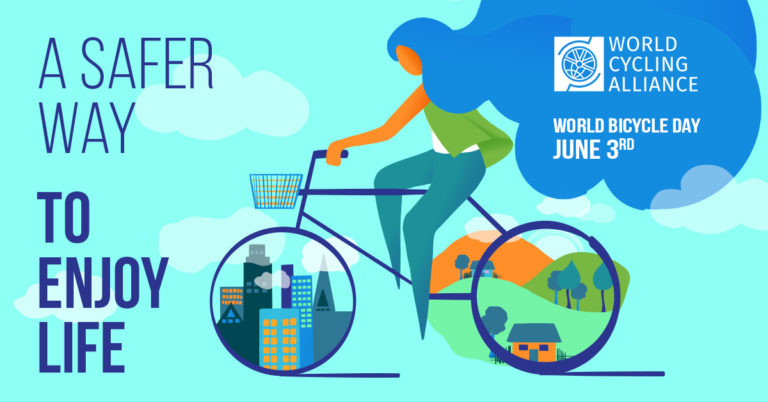
The United Nations has declared June 3rd as International World Bicycle Day, by adopting a resolution on April 12th 2018, during the 72nd Regular Session of the UN General Assembly, in New York City.
The resolution was adopted by a consensus of 193 member states. The declaration invites all Member States and relevant stakeholders to celebrate and promote awareness of the World Bicycle Day. The declaration encourages Member States to devote particular attention to the bicycle in cross-cutting development strategies and to include the bicycle in international, regional, national and subnational development policies and programmes. H.E. Ambassador, Aksoltan Ataeva, Permanent Representative of Turkmenistan to the United Nations, introduced the draft resolution, co-sponsored by 56 countries, to the General Assembly for the vote. The Assembly adopted the resolution, declaring June 3rd as World Bicycle Day.
The World Cycling Alliance (WCA) and the European Cyclists’ Federation (ECF) welcome this resolution adopted by the UNGA, after having campaigned for a UN designated World Bicycle Day since 2016. WCA and ECF Secretary General Dr. Bernhard Ensink states “Cycling is a source for social, economic and environmental benefits – and it is bringing people together. WCA and ECF are extremely happy with this declaration. This UN declaration is an acknowledgment of the contribution of cycling to the sustainable development goals (SDGs)”. WCA and ECF delivered a document to the UN in 2015 in which it is shown that cycling delivers directly on at least 12 of the 17 SGDs, titled “Cycling Delivers on the Global Goals!”.
WCA and ECF acknowledge the extraordinary work of Leszek Sibilski, Professor of Sociology at Montgomery College, Maryland, US and his students campaigning for #WorldBicycleDay.
WCA will hold its next Annual General Meeting on the 11th June 2018 in Rio de Janeiro, Brazil, the day before ECF’s flagship conference Velo-city 2018 Rio kicks off. The WCA will celebrate in Rio the UN resolution on the World Bicycle Day! #June3WorldBicycleDay
By Marcus Kaller — Spring is back, and with it time to get back on the bike for many cyclists locally. It is also time to really think about getting more involved to improving our community by implementing active transportation plans and bike infrastructure. Our recent meeting provided some opportunities.
Last month, Phil Sarnoff from Bike Utah unveiled a new online survey for bicyclists who live in the state of Utah. The survey, called “Utah State of Bicycling Survey,” is an invitation to share opinions from cyclists in identifying barriers in riding bikes and what improvements could be made. This survey covers commuting, road biking, and mountain biking. This information will be very useful in developing strategies for active transportation plans in cities, rural areas, and trails. You can participate by going to www.bikeutah.org.
Heidi Goedhart, active transportation manager for UDOT, introduced a new program at the meeting as well. Move Utah is a new program to “help communities identify the benefits of active transportation,” guide them to developing active transportation plans, and “plan for and/or join events and community outreach opportunities,” among other goals. And among the initiatives include, emphasizing integrated transportation planning, identifying benefits of health and activity, and improving quality of life for communities. This program will also focus on pedestrians and cyclist safety too. This program can be a great resource for helping communities create active transportation plans. For more information, visit www.moveut.org.
If you are interested in becoming involved in improving the quality of life in your community, you are encouraged to attend the SLCBAC meetings. They held every second Wednesday of every month, in Room N2-800, at the Salt Lake County Government Center (2001 South State Street). We also encourage you to join the committee. We seek new members who live in the south and west communities of Salt Lake County who enjoy cycling and want to make a difference. For more information, visit www.slco.org/bicycle.
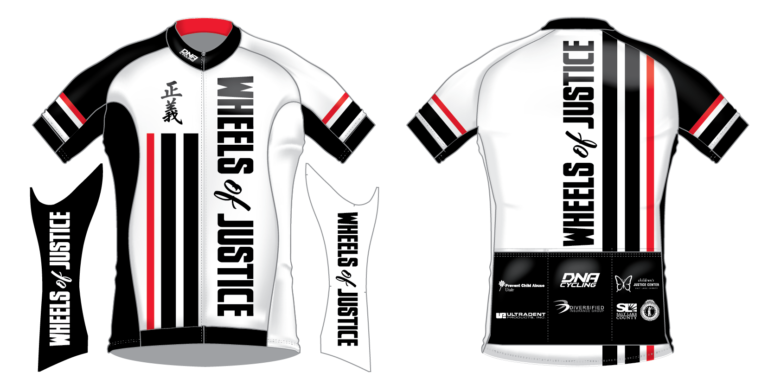
Even the most serious of problems can be addressed in a fun way. Wheels of Justice is a cycling club dedicated to preventing, and assisting the victims of, child abuse. Shockingly, one in four girls and one in six boys in Utah will be sexually abused before they turn eighteen. Child sex abuse alone costs Utah tax payers approximately $1 billion annually. Wheels of Justice raises money through the sale of cycling kits (jersey, bib shorts, and socks) and corporate sponsorships to support two outstanding organizations making a difference in our community: Prevent Child Abuse Utah (“PCAU”) and the Salt Lake County Children’s Justice Center (the “CJC”).
The new Wheels of Justice bike club, based in Salt Lake City, will ride to prevent child abuse.
The mission of PCAU is to forge and guide a community commitment to prevent child abuse in all forms through education, services, and public awareness. PCAU provides prevention education to both students and adults. Its student presentations include child abuse prevention, bullying prevention, internet safety, and healthy relationships. Its adult presentations are geared towards adults working with children and the overall community. It also administers a sexual abuse prevention training program for parents and caregivers. All of PCAU’s education is evidence informed, age-based, and free of charge.
The CJC is an award-winning program that provides a comfortable, child-friendly atmosphere where children receive coordinated services during the child abuse investigative process. The legal process can be traumatic for children. How children are treated after their abuse comes to light is a key factor in their recovery. The program’s home-like facilities are designed to decrease any secondary trauma that could be caused by the criminal justice and child protection systems. The expert staff help break the cycle of abuse and empower victims to become survivors. The CJC’s yellow butterfly logo represents the delicate and beautiful nature of childhood, as well as the empowerment that comes with exercising your wings to fly. The program’s operations are administered by the Salt Lake County District Attorney, and, as a mandated private-public partnership, donations from the community are vital to support the program’s mission and purpose.
Wheels of Justice has partnered with Utah-based DNA Cycling, which has made its coveted BIO Fit jersey and Elite bib shorts (custom made in Italy) available to our members at a steeply discounted price to assist in our fund-raising efforts. The more kits we sell, the lower our production costs become, and the more money we can pass on to PCAU and the CJC. You can join Wheels of Justice simply by visiting our club page on Strava (https://www.strava.com/clubs/WheelsOfJustice). You can also find the club on the Strava app by tapping the Explore icon, selecting the “Clubs” tab and then searching “Wheels of Justice” in the “Find a club” field. You can order a kit until Saturday, April 21, 2018 by visiting https://store.dnacycling.com/collections/wheels-of-justice.
Come, rep our colors, and help us make a difference!
April 9, 2018 – Cyclists are encouraged to participate in the planning process for an update to the Little Cottonwood Canyon Road that extends from Sandy, Utah to Alta, Utah. The project will like affect both road and mountain biking in the canyon. Details below. Cyclists are encouraged to attend the open house, or comment via the website or email.
UDOT’s road project could affect road and mountain biking in Little Cottonwood Canyon. Rob Squire (in front), Cycling Utah’s co-Rider of the Year, on his way to winning the 2015 Snowbird Hill Climb. Photo Dave Iltis.
PRESS RELEASE: April 9, 2018 – UDOT Announces Public Open House for Little Cottonwood Canyon Environmental Impact Statement
New study to address traffic congestion in Little Cottonwood Canyon
SALT LAKE CITY (April 9, 2018) – The Utah Department of Transportation (UDOT), Utah Transit Authority (UTA) and the USDA Forest Service (USDA FS) will host a public open house to address traffic congestion and safety in Little Cottonwood Canyon.
Scheduled April 10 from 4 to 8 p.m., the public open house will allow the public to provide comments on the Little Cottonwood Canyon Environmental Impact Statement (EIS). The open house will be held at Cottonwood Heights City Hall, 2277 E Bengal Blvd.
UDOT, UTA and USDA FS are conducting the Little Cottonwood Canyon EIS to address traffic congestion, safety, and public transportation options for residents, visitors, and commuters on SR 210 from Fort Union Boulevard to the Town of Alta, which includes Little Cottonwood Canyon Road.
In consideration of numerous previous studies and public involvement efforts carried out by a range of agencies and stakeholders regarding potential transportation improvements in the project study area, the EIS team will develop and evaluate a range of alternatives that reduce congestion and improve recreation and tourism experiences in Little Cottonwood Canyon.
The official public scoping period for the Little Cottonwood Canyon EIS runs through May 4, 2018. Official public comments on transportation challenges and issues in the canyon will be collected via email at [email protected] and the study website at www.udot.utah.gov/littlecottonwoodeis.
The public can also get updates and notifications on the following channels:
Twitter: @UDOTlcceis
Facebook group: @UtahDOT under the page’s Groups: UDOT Little Cottonwood Canyon Environmental Impact Statement (LCC EIS)
Instagram: @utahtransportation
The environmental review, consultation, and other actions required by applicable Federal environmental laws for this project are being, or have been, carried-out by UDOT pursuant to 23 U.S.C. 327 and a Memorandum of Understanding dated January 17, 2017, and executed by FHWA and UDOT.
By Charles Pekow — Part of the East Shore Trail in Rocky Mountain National Park will be adjusted to accommodate mountain bikers. The National Park Service (NPS) will rebuild a two-mile stretch of the trail in north central Colorado. Traditionally, hikers and equestrians have used the trail, which runs between Lake Granby on the south and Grand Lake on the north and is part of the Continental Divide National Scenic Trail. Currently, bicycles are only allowed to use the northernmost 0.7 miles in the Arapaho National Recreation Area but not the 5.5 miles in the park.
NPS plans to open to cyclists the segment from the northern park boundary to the Shadow Mountain Dam trailhead, since an environmental assessment showed cycling would not significantly impact the environment or conflict with other users. Campers and fishermen frequent the trail in summer. To accommodate cyclists while protecting the environment, NPS will reroute a quarter-mile segment of the trail.
Cyclists won’t be allowed on the single-track trail until NPS completes the rerouting, which it expects to accomplish by the fall or next year. NPS says that trail proponents, including the Headwaters Trails Alliance will do the work.
During the public comment period, several people complained about allowing cycling. NPS says that if too many conflicts arise between cyclists and other users, it reserves the right to ban cycling or limit it to every other day. NPS warns cyclists in its announcement of the new rule that “(m)ountain bike use on the East Shore Trail is a privilege and not a right.” But it noted that the trail gets a lot less use than other trails in the park and “(n)oise generated by bicycles and bicyclists would not be substantially greater than that produced by hikers, and would be less than existing noise from motorized vessels on the nearby lake.”
Bike lanes are good for public health. Photo by Dave Iltis
By Charles Pekow
An idea for reducing health care costs that largely gets left out of the Affordable Care Act debate: build bike lanes. They pay off handsomely, according to a recent economic study. Bike lanes increase the likelihood that people will ride, according to the report by Jing Gu, Babak Mohit, Peter Alexander Muennig published in Injury Prevention, a British medical journal.
“We conclude that investments in bicycle lanes come with an exceptionally good value because they simultaneously address multiple public health problems. Investments in bike lanes are more cost-effective than the majority of preventive approaches used today,” the authors say in their study, The Cost-Effectiveness of Bike Lanes in New York City.
The authors fault most academic research on bike lanes for not distinguishing adequately between different types (protected lanes, marked lanes, on-street bike routes, etc.). Yet they don’t distinguish in their own analysis. They apply theoretical economic assumptions that may not apply in the physical street world. But they conclude that adding 45 miles of bike lanes in New York City “may increase” the likelihood people will ride by 9.32 percent.
The analysis says that every mile of new bike lane increases ridership by .4 percent. They also say that bike lanes reduce injuries by 25 percent.
The Center for Injury Prevention & Control at the Centers for Disease Control funded the study. See goo.gl/6SoCjK.
Reference: Gu J, Mohit B, Muennig PA The cost-effectiveness of bike lanes in New York City Injury Prevention 2017;23:239-243.
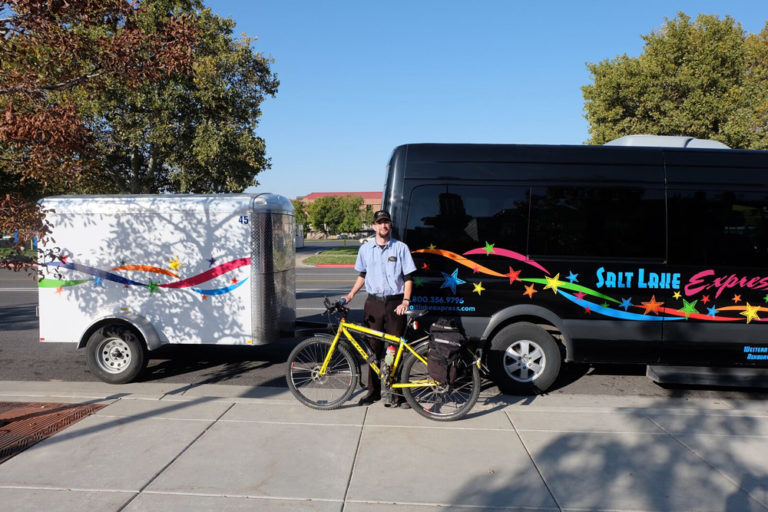
The Salt Lake Express is a great way to get to your bike touring destination throughout the Intermountain West. Photo by Lou Melini
By Lou Melini
Yellowstone National Park is fabulous to ride through. I had not ridden through Yellowstone since 2014, and I was itching to go back. Procrastination and a home remodel found me cancelling 2 trips and the end of August was approaching. As I was thinking about Yellowstone up popped a “Ride home from West Yellowstone starting September 16 announcement on a bicycle meet-up group. I signed up before I looked at my schedule. Due to my home remodel and family needs riding to and from West Yellowstone was not going to happen. It appeared that I was stuck until I remembered that the Salt Lake Express bus travels to West Yellowstone.
I checked the website and then called to ask questions about the bike. No problem; for 10 extra dollars Salt Lake Express will provide a trailer that you can roll your bike onto. According to the reservation person, if I changed my date of departure, they would simply transfer that reservation to another day. You must call vs. using the website to make a reservation with a bike. The $10 fee is the same fee charged for “more than 2 suitcases or boxes” according to the website, a reasonable fee, especially when compared to airlines.
In addition to West Yellowstone, you can use Salt Lake Express to get you to the start of your next bike tour (or backpack trip) in Boise, Idaho, Great Falls, Montana, Jackson, Wyoming, Logan or St. George Utah, Las Vegas, Nevada, Page, Arizona and if you wish, to Zion, National Park along with many points in between. I thought the overall fee was a very reasonable $76 ($86 with bike) to West Yellowstone. Gas and long-term parking, the latter being $5-10/day in my recent experiences, can eat up that $76 quickly. Also you can leave the driving to Salt Lake Express, though the driving time will be a bit longer due to their stops along the way. I should mention that I received a $3 senior discount as well and the driver had cold bottled water for the passengers.
I made my reservation for September 12, with the plan to ride a few days in Yellowstone before meeting up with Todd Crum of St. George for the ride home. Todd also had a reservation with Salt Lake Express for the bus to West Yellowstone. I chose the downtown Salt Lake City location to catch the bus on the corner of West and North Temple. I had a choice of 7:30 AM or 9:30 AM, but both departing times arrived in West Yellowstone at 4:55 PM due to the earlier departure having a 2-hour layover in Rexburg, Idaho. I took the latter time.
The bus driver helped me lift my bike onto the trailer (no rolling it on), padding the bike with cardboard and some foam after he snuggly secured it between the wall of the trailer and an object under a blanket that was shaped eerily like a coffin. I tipped the driver for his care of my bike. In Rexburg, I helped move this object to another trailer and indeed was an empty coffin, a cheaper way for the coffin manufacturer to transport his inventory. At this point I had to lie my bike on its side as there is no means to secure your bike to the trailer wall in an empty trailer.
The ride was a bit long, but I managed to read 5 chapters in James Michener’s book Mexico and view the scenery. I hoped that we would arrive promptly as scheduled in West Yellowstone as I planned to ride the 14 miles into Yellowstone to the hiker/biker camp at Madison Campground vs. staying in a West Yellowstone campground with a very pricey (potentially to $46) fee. The bus stopped at various locations to pick-up or drop off passengers, allowing us to use the restrooms or purchase food. Overall it was a pleasant ride. The bus driver was quite chatty in a pleasant way that helped pass the time. The only other passengers going all the way to West Yellowstone was an older couple from Kentucky that was seeing the country by train and bus. They were dropped off at a hotel in West Yellowstone and I was dropped off at the visitor center at precisely the scheduled time, 4:55 allowing me time to get into my riding clothes and arrive at Madison Campground by 6:05.
During my second night in Yellowstone at Grants Village, the weather report for the area was getting worse with snow up to 8 inches being predicted above 7000’. I called Todd to tell him I was riding home to Salt Lake and not meeting him on the 16th. Todd then was able to call Salt Lake Express to change his reservation to a couple of days past the brunt of the storm without a charge, a nice policy of Salt Lake Express if plans change. Check out the FAQ’s on the Salt Lake Express for details of the policy.
Todd and I rode to our homes separately but we both endured headwinds for most of the ride, with Todd suffering more than I. I also had night and morning rain showers for 3 days.
Despite the weather I had another great ride in Yellowstone NP where the employees treat you as “royalty”. At Madison campground, I had a personal escort to the hiker/biker site even though I told the attendant that I knew the campsite was behind the registration building. I also met several other bike travelers at Madison including a young couple from Hong Kong on a planned 3-year tour. At Grant Village the attendants at the laundry/shower building were giving traveling cyclists free showers despite the campground registration attendants telling us that showers were $4. Yellowstone is beautiful. If you haven’t ridden the park you should make it a part of your travel list. To hasten your ride to and/or from Yellowstone NP, use Salt Lake Express and leave the driving to them.
The Salt Lake Express operates throughout the Intermountain West. For details and destinations, see saltlakeexpress.com.
By Charles Pekow — A major highway project in Idaho got the federal green light. And it will include bike lanes and should make it much more comfortable to ride between Boise and I-84. The Federal Highway Administration gave the go-ahead to upgrades for about 15 miles of the US 20/26 Corridor in Ada and Canyon counties from Junction I-84 to Eagle Road. The road goes through the cities of Boise, Eagle, Meridian and Nampa.
The road will be widened from two to six lanes. FHWA’s Environmental Assessment (EA) determined the project will not cause significant environmental damage. It could take till 2040 before the project is competed, however.
Currently, cyclists must ride on the shoulders, even though the the speed limit is 55 mph along most of the corridor. (During construction, the situation could become worse for cyclists, the EA notes.) It also refers to “poor system-wide connectivity so non-motorized travel over an extended distance is limited.”
The plan calls for adding signals at intersections which would help cyclists cross the highway in Caldwell, Meridian and Eagle, which many consider too dangerous now. The plan foresees increased motorized traffic and calls for a multi-use pathway west of Meridian Road. Anyone who doesn’t like the decision can file suit until May 11. Details: https://www.govinfo.gov/content/pkg/FR-2017-12-15/html/2017-26946.htm
Troy Adair combines transit and bikes to get to work. Photo by Kelly Adair
By Troy Adair
I’m a guy in my 50s who had led a pretty sedentary life style for over 25 years. After graduating from college, I got a nice office job, and commuted by car. I didn’t have an exercise routine, so the pounds slowly added on through the years. I’m a short 5’5″ guy, and a few years ago it was kind-of a health wake up call to me when I was starting to get within a few pounds of hitting 200 pounds, and my blood pressure was getting into dangerous territory. So I decided I needed to find a way to incorporate some physical activity into my daily life.
I’ve found that when I exercise indoors it is boring and tedious for me; each 10 minutes of indoor exercise feels like at least 30 minutes of boredom to me. I’ve never been able to stick with an indoor exercise routine. But when I’m doing an outdoor activity, the opposite is true for me. I enjoy myself so much that it doesn’t feel like exercise, and each 30 minutes of outdoor activity only seems like 10 minutes of fun enjoyment to me.
I really enjoyed recreational hikes and bicycle rides. But I would often only do them on weekends when I didn’t have other responsibilities and time commitments.
To incorporate more physical activity into my daily life and routine, I decided I wanted to incorporate some bicycle commuting into my daily life. But I live in Bountiful and work in the Canyon Rim area near the mouth of Parley’s Canyon. My commute is 17 miles each way, or 34 miles round trip per day. Since I’m not a sports cyclist, that was further than I wanted to cycle each day. But then I discovered “multi-modal” bus/bicycle commuting, and it has worked out very well for me.
For me, there are buses that run between my home in Bountiful and either the University of Utah or to downtown Salt Lake City. From the University of Utah, it’s about a 5 mile bicycle ride to my work, or from downtown Salt Lake City it’s about a 7 mile ride. That is just about the mileage that I am interested in biking each way, and then I get to enjoy some reading and listening to music while I ride the bus the remaining 10 to 12 miles of my commute. I’m now into my third year of multi-modal bus/bicycle commuting, and I’ve really been pleased with the health benefits I’ve enjoyed from doing that, including losing some weight, lowering my blood pressure, and lowering my risk of heart disease and metabolic diseases.
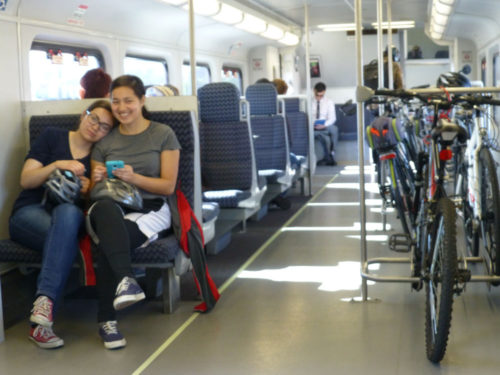
Chelsea & Natalie Adair and bikes on the FrontRunner train, when we (a) rode our bikes down to our local Woods Cross FrontRunner train station, (b) took the FrontRunner train down to the American Fork train station, then (c) rode home to Bountiful on the beautiful Jordan River Parkway trail. Photo by Troy Adair
Transit and Trails
I’ve also enjoyed taking advantage of public transit with my Saturday recreational bicycle rides. On Saturdays, I will often cycle down to my local Front Runner station, and then ride it to a section of a multi-use trail to ride. Of course, the Front Runner train has cars that accommodate and welcome bicycles, and it parallels the Jordan River Parkway Trail, the Legacy Trail, and the Denver Rio Grande Western Trail; and it also has stops near the Ogden/Weber River Parkway Trail in Ogden, and the Murdock Canal Trail and Provo River Parkway Trail in Utah County. So I’ve enjoyed easily accessing and riding all those trails from FrontRunner stations, without the need to drive to them with my car, and without the need to circle back on my rides to the same parking spot I left my car at. With FrontRunner stations, you can easily start your ride at one FrontRunner station, and finish it near another FrontRunner station, and then ride the FrontRunner to your local/home station.
So I really enjoy combining public transit and bicycling. Of course, by itself, public transit isn’t often convenient since the stops are often not convenient to homes and work places. And although bicycle commuting offers great ease in getting from point A to point B, and is a fantastic option by itself for those with short commutes, for those of us with longer commutes, it is often not practical by itself. But when you put them together, they go together like chocolate and caramel. The public transit allows you to cover long distances with ease, while the bicycle adds the convenience of quickly and conveniently getting from a transit stop to your work or home. So a “multi-modal” bus/bike commute has been a wonderful option for me and my 17 mile commute.
Note: I get to take advantage of some wonderful bicycle infrastructure when I cycle between downtown and my work, including the Sugarhouse Park and S-Line Greenway sections of Parley’s Trail, the 600 East Neighborhood Byway, the Liberty Park Trail, and the protected bike lanes on 300 East, 300 South, and 200 West. I even get to do a quick turn through the protected intersection at 300 South & 200 West. If you are interested, a created a YouTube video of some of that ride and wonderful infrastructure: “Bicycle Commute from Sugarhouse to Downtown Salt Lake City.” https://www.youtube.com/watch?v=BrFT-BMYzl4
Troy Adair is a “multi-modal” bus+bike commuter that lives in Bountiful and commutes to and works in the Canyon Rim area.
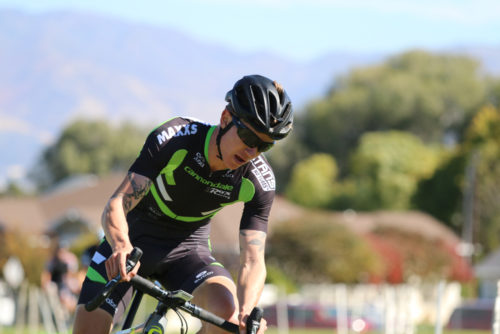
Keegan Swenson had a great year in 2017, winning several 6 races in the Pro XCT series. He is Cycling Utah’s 2017 Overall Rider of the Year. (Shown here in the UTCX cyclocross). Photo by Dave Iltis
By Dave Iltis
Each year, Cycling Utah recognizes the best riders, events, and clubs in Utah with our year end awards. Cycling in Utah is booming, with more people participating, more bike trails and pathways, and more excitement than ever before. We present our awards below.
Keegan Swenson had a season that most riders couldn’t even dream of having. The mountain biker from Park City was on a roll in 2017, winning three USA Cycling Pro XCT cross country races and three short track cross country races in the biggest mountain bike series in the country on his way to finishing second overall. He won the True Grit 50, along with the Park City Point to Point. He won several cyclocross races including some in the Utah Cyclocross Series. He added a second place in Short Track National Championships and a remarkable 5th place in the Pan Am Continental Mountain Bike Championships. Keegan Swenson is our 2017 Overall Rider of the Year.
Tiffany Pezzulo had a solid season on the road. She won the overall in the USA Crits series, the premier national criterium series, along with three races in Utah on her way to finishing 4th overall in the UCA points series. Tiffany Pezzulo is our Female Road Racer of the Year.
TJ Eisenhart is nicknamed Sunshine. His sunny personality and skills on the road bike led him to a stage win and the overall victory at the Redlands Classic Stage Race. He added a second place in stage 2 of the Colorado Classic and 4th overall, 3rd Overall at the Tour of the Gila, and 11th overall at the Tour of Utah. TJ Eisenhart is our Male Road Racer of the Year.
Sofia Gomez Villafane had a stellar season on the mountain bike. The Park City rider had three 2nds, a 3rd, and a 4th place in the Pro XCT series cross country and short track races on her way to finishing 5th overall. She added a 3rd place in the True Grit 50 and 11th in the Pan Am Continental Championships. Sofia Gomez Villafane is our Female Mountain Bike Racer of the Year.
Zach Calton was on a roll in 2017. The collegiate racer from the University of Utah won the overall USA Cycling Collegiate National Championship Omnium. He added two wins in the Intermountain Collegiate Cycling Conference series in cross country and downhill on his way to winning the overall season title. He added an 8th place in the Park City Point to Point. Zach Calton is our Male Mountain Bike Racer of the Year.
Lauren Bingham races all types of gravity – downhill, enduro, super-D. She won the USA Cycling Junior Enduro National Championship, finished 4th overall in the Pro Women category in the Scott Enduro Cup, and took two wins in the Utah Downhill Series Cat 1 women’s category. Lauren Bingham is our Female Gravity Racer of the Year.
Mitch Ropelato goes downhill faster than most riders in Utah. In 2017, he won the USA Cycling National Championship Dual Slalom, the Sea Otter Dual Slalom, the NW Cup ProGRT Downhill, and two races in the Utah Downhill Series. Mitch Ropelato is our Male Gravity Racer of the Year.
Sarah Kauffman won the Utah Cyclocross Series for 2016. She finished 3rd in the USA Cycling Masters 35-39 National Championship, and won 4 races in the UTCX series. Sarah Kaufmann is our Female Cyclocross Racer of the Year (2016 Season).
Kevin Day stepped up in cyclocross in a big way in 2016. The racer from Farmington, Utah won 6 races locally and nationally. He topped the podium twice in the Utah Cyclocross Series on his way to 5th overall and then added 4 wins in the masters fields at Cross Vegas, Charm City, DCCX, and CXLA. Kevin Day is our Male Cyclocross Racer of the Year (2016 Season).
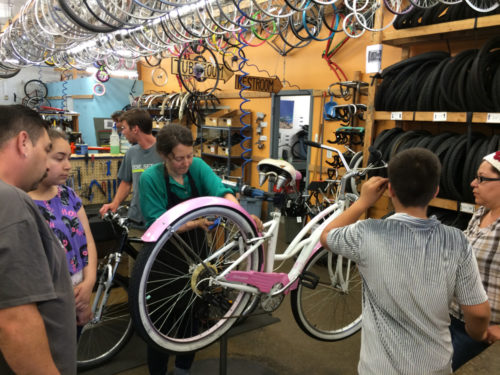
The Bicycle Collective is our 2017 Bike Advocate of the Year. It is an invaluable asset to Utah and to bicycling. Each year, they put thousands of people on bikes. Photo by Dave Iltis
The Bicycle Collective was started 15 years ago with a mission to put more people on bikes. This year, they opened the St. George Bicycle Collective, bringing the total number of community bike shops in Utah to 4. In recent years, they have acquired a building in Ogden, and upped the ante in Provo, while maintaining a stellar shop in Salt Lake City. The Collective each year puts thousands of people on used bikes, some which the giveaway to needy people and organizations. Their Park Tool School Classes teach many how to work on bikes, and their apprenticeship program trains people to be mechanics. For others, they provide a safe space to learn about bikes. They are an invaluable asset to Utah. The Bicycle Collective is our Bike Advocate of the Year.
The Intermountain Cup Mountain Bike Racing Series has been running for close to 30 years in one form or another. This year, organizer Joel Rackham and crew have reinvigorated the series and really improved the racing. With great courses, categories for all riders, and food for the riders after the race, the ICup is back on form. The Intermountain Cup Racing Series is our Event of the Year.
Zone 5 Racing showed up in force to the Utah Cycling Association races, as well as to the Utah Criterium Series Races. With team and individual wins in several categories in the crit series and a great showing across the categories, Zone 5 is our Road Racing Team of the Year.
Bingham Cyclery – Peak Fasteners Mountain Bike Club is a fun loving bunch of mountain bikers who like to race and ride. They show up at all of the mountain bike races, and enthusiastically support each other both at the races and after. One of the best features of their team is that they bring donuts to the races for team members and friends. In 2017, they won the Intermountain Cup Series Team Points competition. Bingham Cyclery – Peak Fasteners is our Mountain Bike Team of the Year.
Bonneville Cycling Club has been around for over 30 years to provide ride opportunities for Utah cyclists. With their nationally renowned Little Red Riding Hood ride, and dozens of club rides including multiple rides on many days, BCC has it down when it comes to organizing a club. Last year, the Little Red ride raised over $120,000 for breast cancer research at the Huntsman Cancer Institute. In 2017, cyclists traveled 199,107 miles on club rides, climbed 4,997,408 vertical feet, and commuted 18869 miles in 3382 trips, saving 17359 lbs of carbon. Bonneville has earned more awards from Cycling Utah than any other group because they deserve it. Bonneville Cycling Club is our Touring Club of the Year.
Lou Melini is a force of nature on the bike. He commutes everywhere, tours long distances, writes for Cycling West, and advocates for more people to ride. In 2017, in the Bonneville Cycling Club Commuter Standings, Lou finished first with 398 trips and 2718 commuting miles. Lou Melini is our Bike Commuter of the Year.
There were many other great accomplishments on the bike by Utah riders in 2017. We know of some of these. If we haven’t included one, it’s only because we hadn’t learned about it. We recognize the following with Honorable Mentions:
Naish Ulmer crushed it in the downhill in 2017. He won both the Utah Downhill Series Overall in downhill and in Super-D, winning 3 races along the way. He competed in the Scott Enduro Cup, taking five overall in the Pro Men’s.
Amanda Batty for 2nd in the USA Cycling National Downhill Championships, as well as many other solid results in downhill.
Cortlan Brown and Mary Emerson for winning the UCA road series.
Haley Batten for winning the U-23 USA Cycling Cross Country National Championship.
Lia Westerman for great results all year in both cross country and gravity mountain bike events.
Nicole Tittensor for winning the Intermountain Cup Pro Women’s and a top 10 in mountain bike nationals.
Alex Grant for winning the Intermountain Cup Pro Men’s series.
Ethan Nell for finishing 3rd at the Red Bull Rampage.
Logan Binggeli for finishing 3rd in the ProGRT standings and for finishing the Red Bull Rampage.
Cody Kelley for winning all three Scott Enduro Cup events and the overall.
16 year old Bryn Bingham for winning the Nevada State Super D championships and for finishing 8th overall in the Scott Enduro Cup Pro Men’s series.
Mike Pratt for running a successful season of the Hangar 15 Pro Cycling Team.
Landon Boogard and the Mountain Bike Enthusiasts of Utah, an awesome group of mountain bikers who give back to the community through trail days, bike drives, group rides, and more.
Jared Eborn is the person behind Extra Mile Racing as well as a bike enthusiast. In 2017, Jared organized multiple road races and century rides, often stepping in to put on a race when no other existed on the calendar. He promoted close to 10 races, and a couple of Gran Fondos, including a women’s only ride. He also served as the Utah Cycling Association Executive Director, helping to coordinate races and racers throughout 2017.
Thanks for reading Cycling Utah for the past 25 years.


 Ventilation
 But are you noticeably more aerodynamic and thus faster?