Home Blog Page 218

Trail Improvements Coming to Montana’s Helena-Lewis & Clark National Forest

By Charles Pekow — Several improvements for biking are in the works at Helena-Lewis & Clark National Forest in Montana. First, the Lincoln Ranger District intends to improve the Rogers Pass trailhead in the James Peak Protection Area. It lists the project as currently “under analysis” and plans to issue an assessment around September 1. The idea is to improve and expand the parking lot.

Bicycles are allowed on designated routes in the James Peak Protection Area. But right now, only three or four autos can park at the trailhead.

The U.S. Forest Service (USFS) also is reconfiguring segments of the Continental Divide National Scenic Trail in the forest. USFS’ main goal consists of keeping unauthorized motor vehicles off the trail. So it wants to narrow the trail.

The idea involves reconfiguring about 2.5 miles of existing road into a single-track non-motorized trail between Faith Gulch/Meyers Hill at trail maker 48, northbound until to the existing single track at marker 51.

It would also change from double to single track about 2 miles between Priest Pass south to the communication towers site off Macdonald Pass.

Third, the plan calls for rerouting the Haul Route from existing single track for 1.5 miles to the northeast around private property adjacent to the Josephine Mine, and then the meeting the existing route off Minnehaha. Routing the trail in the area gets tricky because of the need to keep hikers off roads and to circumvent a lot of private property in the area, explains Wilderness Trails Coordinator Marcus McDowell.

Also, this summer USFS will work with the Montana Conservation Corps to resign the trail so users know where they’re at, McDowell says.


Participate in the Utah State of Bicycling Survey!

By Abeer AlJanahi — It’s been a long time since the last statewide bicycling survey and a lot has changed in Utah. The last bicycle related survey in the State of Utah was the Household Travel survey in 2012. In order to get more current data, Bike Utah has created a Utah State of Bicycling Survey.

We want to look at bicycling in all its forms, so we’re asking about bicycle commuting, road biking, and mountain biking. Through this survey, we hope to obtain feedback from a wide spectrum of bike riders and non-riders in the state. The goal is to get at least 1,000 responses on the survey. The more responses we get, the more accurate our data and the better we can use this data to inform Bike Utah’s initiatives and programs. We are looking to understand the reasons people choose to bike or not to bike. This includes environmental factors, such as better bike lanes or cleaning up road shoulders and personal factors, such as access to equipment or bicycle education.

This survey will help us advance Utah as a better state for bicycling and let us know what communities in Utah need to get more people riding. If you want to learn more about Bike Utah, please visit us at our website bikeutah.org. If you would like to be a part of the effort to make Utah a better state for bicycling, please take our survey at http://bikeutah.org/survey


Calton and Dong Overcome Immense Competition to Take the Red Rock Rampage

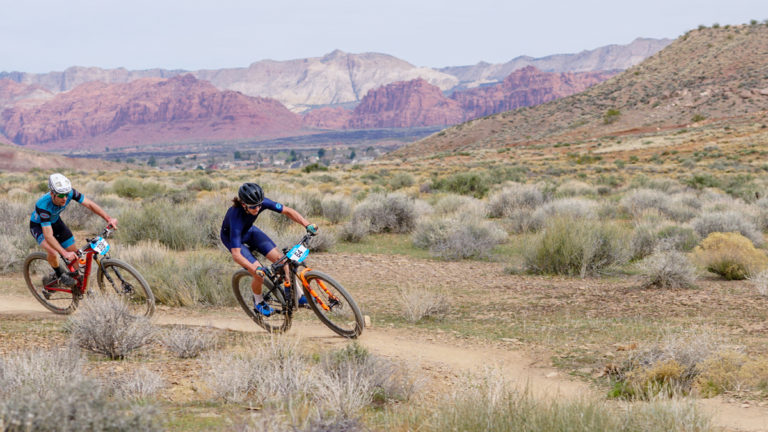
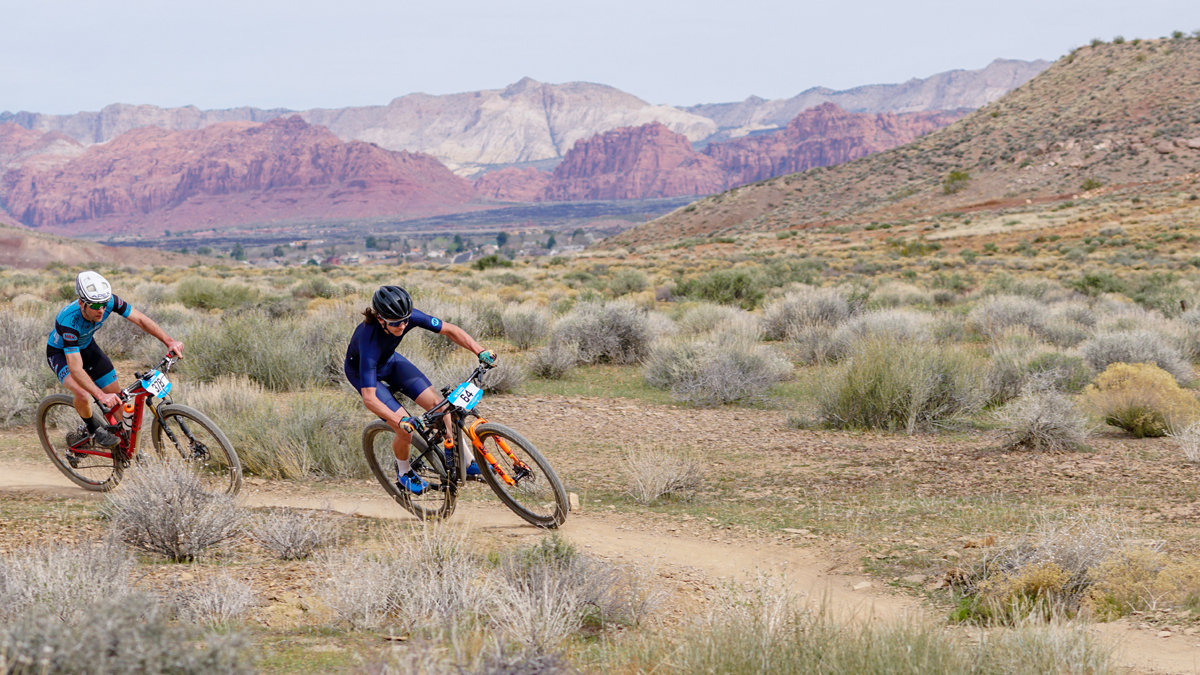
By Nate Gibby — ST. GEORGE, UTAH — After 28 miles and nearly 2,000’ of elevation gain, Zach Calton (Spry – Legacy Properties West Racing) edged out Alex Grant (Cannondale/Gear Rush) by less than one second to win the Elite Men’s division at the Red Rock Rampage X-country MTB race, the inaugural race of the 2018 Intermountain Cup series, held on March 26, 2018 in St. George, Utah.

Zach Calton leads the pro men's division of the Red Rock Desert Rampage Intermountain Cup on March 24, 2018. He went on to win the race over Alex Grant (in green). Photo by Matt Ohran
Zach Calton leads the pro men’s division of the Red Rock Desert Rampage Intermountain Cup on March 24, 2018. He went on to win the race over Alex Grant (in green). Photo by Matt Ohran

“On the second climb Alex attacked me hard and I went with him, as soon he let up I attacked him as an effort to get away, [or] at least to get to the front for the descent,” said Calton. “I didn’t get away, but I was in front and I liked my chances in a sprint.”

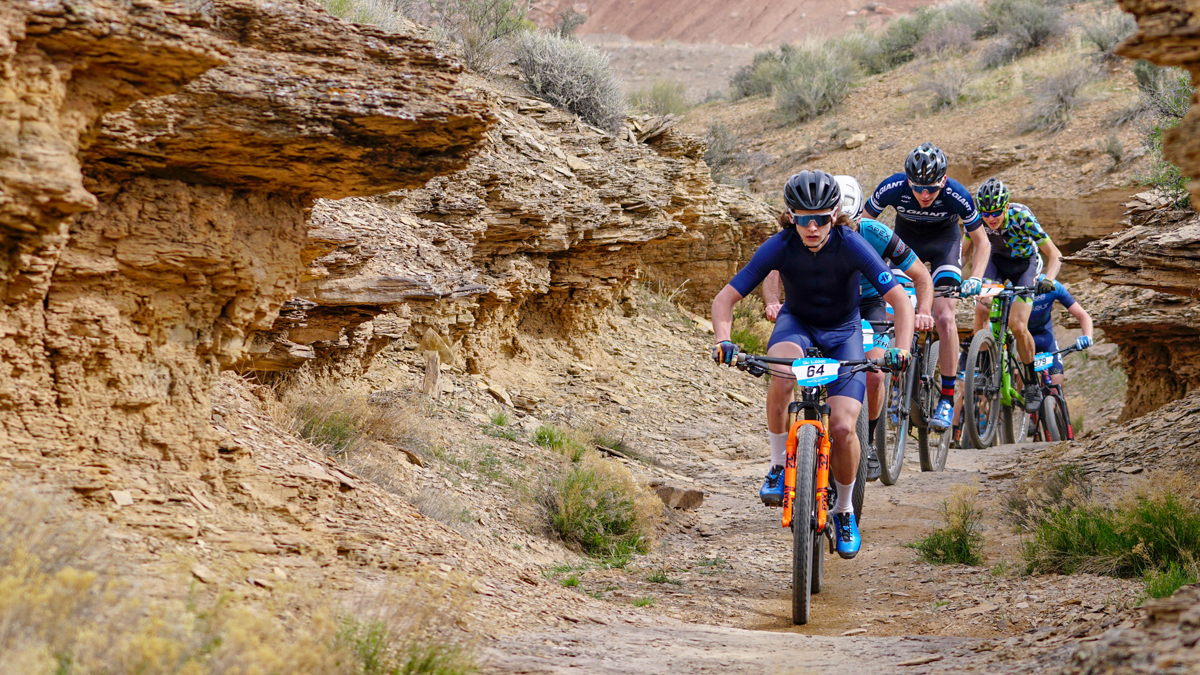
Zach Calton leads Justin Lindine through the Red Rocks of Southern Utah. Photo by Matt Ohran

Justin Lindine (Apex/NBX/Hyperthreads) rounded out the podium in an incredibly competitive Elite Men’s race in which the top five racers finished within three minutes of each other.

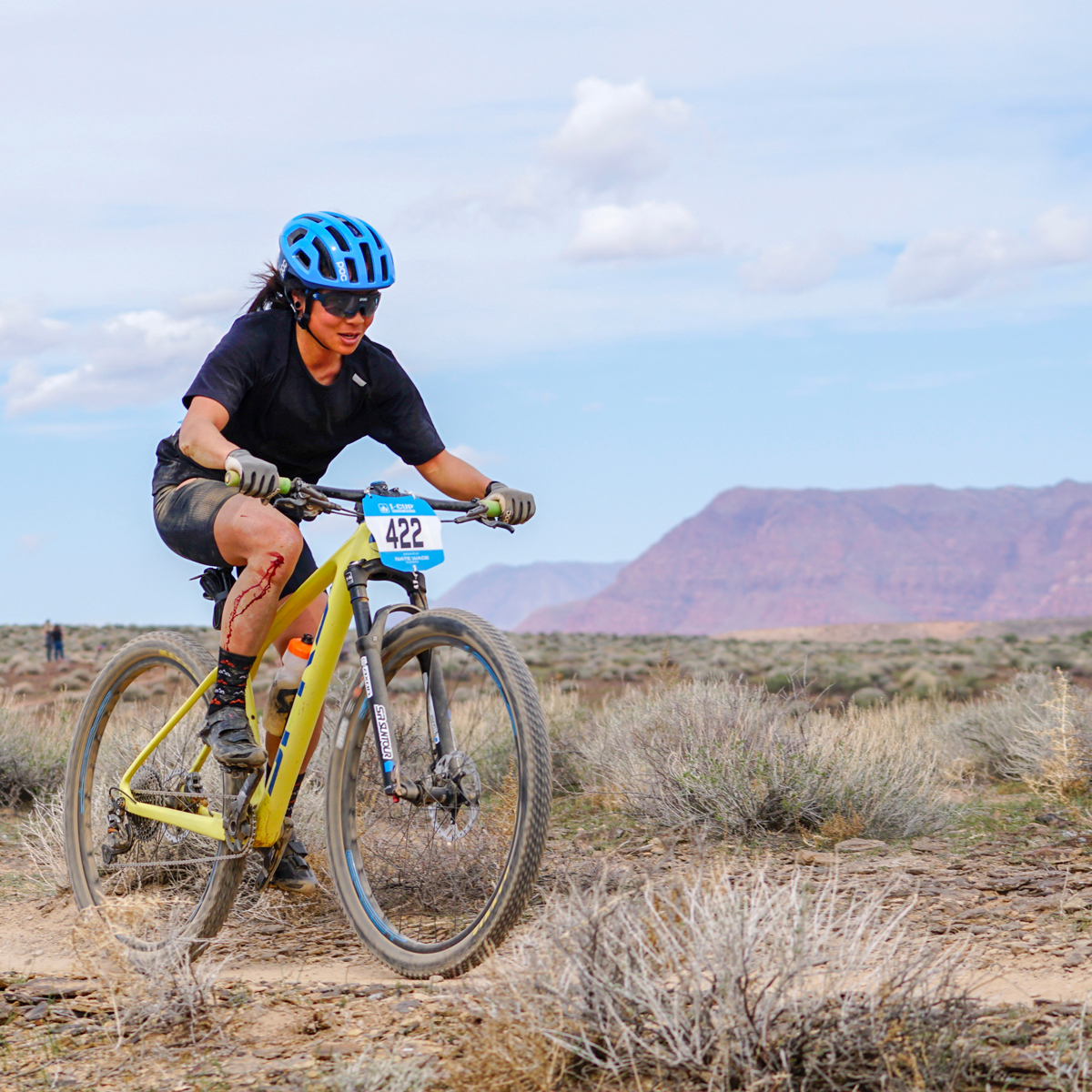
The equally competitive women’s elite division featured two top-10 racers from last year’s American National Championship at Snowshoe, W.Va., sixth-place finisher Evelyn Dong (Full Cycle) and Nicole Tittensor (Jan’s Park City/Scott Bikes/Reynolds Cycling). Facing a strong challenge from third-place finisher Meghan Sheridan (Bingham Cyclery/W | Law), Dong created separation on the first lap and held on for a 1:05 win over Tittensor.

Evelyn Dong overcame a crash to take the win in the women's pro division of the Red Rock Desert Rampage Intermountain Cup on March 24, 2018. Photo by Matt Ohran
Evelyn Dong overcame a crash to take the win in the women’s pro division of the Red Rock Desert Rampage Intermountain Cup on March 24, 2018. Photo by Matt Ohran

“[Dong] is pretty strong and a really good climber,” said Tittensor. “I decided to hop on her wheel on the first set of rolling hills and stay with her. We went into the first wash and she started to pull away from me.”

With a strong showing of over 450 racers, the Red Rock Rampage demonstrated once again how both mountain bike racing and the Intermountain Cup continue to grow in the Intermountain West.

“Over the last two years, the Intermountain Cup has continued to focus on rider experience,” said Joel Rackham, managing partner of Intermountain Cup. “As people continue to focus on their health, we continue to see large increases in our female riders and masters division (35 years old and older).”

One of our areas of focus has been in drawing more girls and women and we continue to see year over year growth. Our masters division (35 and older) continues to see tremendous growth as people focus more on their health.”

Founded in 1991, the Intermountain Cup consists of X-country and endurance MTB races throughout Utah. With seven X-country races of approximately 25 miles and one endurance races of approximately 50 miles, the series covers some of the most pristine and difficult rides in the state.

Next up in the Intermountain Cup X-Country series is Catcus Hugger on April 28, 2018 in Hurricane, Utah. With the majestic peaks of Zions National Park as a backdrop, the Cactus Hugger features 8.5-laps and 550’ of gain per lap on one of the most scenic desert courses in the world.

More information, and a complete schedule of upcoming races, is available at intermountaincup.com.

Tour of Utah Announces First 9 Pro Teams for 2018 Race

Five WorldTour Teams to Compete at America’s Toughest Stage Race

SALT LAKE CITY (March 27, 2018) – A prominent collection of nine men’s professional cycling teams representing seven countries have accepted invitations to compete at the Larry H. Miller Tour of Utah. A total of 16 teams will compete on Aug. 6-12 in the invitation-only road cycling stage race, with additional teams confirmed later this spring for “America’s Toughest Stage Race.”

Five WorldTour teams will travel from the Tour de France to compete in Utah. Joining the four teams named in January — BMC Racing Team (USA), Mitchelton-Scott (Australia), Team EF Education First-Drapac presented by Cannondale (USA), and Trek-Segafredo (USA) — will be Team LottoNL-Jumbo, which is based in The Netherlands.

In May, these same WorldTour teams will be joined by Israel Cycling Academy (Israel) and Bardiani CSF (Italy) to compete in the 100th edition of the Giro d’Italia. With the addition of Nippo-Vini Fantini-Europa Ovini of Italy and Silber Pro Cycling of Canada, the early field of teams for the Tour of Utah will have a significant international flair. Rosters for each team are expected to total 120 riders, and will be announced in late July.

TEAMS ACCEPTING INVITATIONS (as of 3/27/18)

  • Bardiani CSF (Italy)
  • BMC Racing Team (USA)
  • EF Education First-Drapac presented by Cannondale (USA)
  • Israel Cycling Academy (Israel)
  • Mitchelton-Scott (Australia)
  • Nippo-Vini Fantini-Europa Ovini (Italy)
  • Silber Pro Cycling (Canada)
  • Trek-Segafredo (USA)
  • Team LottoNL-Jumbo (Netherlands)

“We have an impressive lineup of international teams for the 2018 Tour of Utah at this early date. It is a tribute to the great support provided by host communities, Tour partners and staff that professional cycling teams around the world now ask to be invited to compete. The Tour of Utah has a solid reputation worldwide as one of the premier sporting events on the professional cycling calendar,” said John Kimball, managing director of the Larry H. Miller Tour of Utah.

All nine teams have made at least one appearance at the Tour of Utah in the previous 13 years of the event. From the WorldTour ranks, Team LottoNL-Jumbo first raced in the Tour of Utah in 2012 as Rabobank, and made its last appearance in 2014 as Belkin Pro Cycling. This Dutch-based squad has been on the racing circuit since 1984. The 26-rider roster includes two young American riders, Neilson Powless and Sepp Kuss. Both raced in Utah last year for other teams, the 21-year-old Powless was recognized as the Best Young Rider and Kuss finished second last year on the mountaintop finish of Stage 2.

As Australia’s only UCI WorldTour squad, Mitchelton-Scott returns to Utah for a second time. It has been five years since the Australian squad has competed in Utah. At that 2013 appearance as Orica-GreenEDGE, the team captured two stage victories by rider Michael Matthews (Australia).

Three of the World Tour teams are based in the U.S. with the BMC Racing Team, EF Education First-Drapac presented by Cannondale and Trek-Segafredo. BMC Racing Team has competed 10 times at the Tour of Utah and has won the overall team classification in Utah three times (2008, 2016, 2017). EF Education First-Drapac p/b Cannondale returns for an eighth year, and Trek Factory Racing returns for a fourth year. Both of these squads last competed in 2016, when Trek Factory Racing secured the overall Sprint classification title with American Kiel Reijnen. EF Education First-Drapac p/b Cannondale finished 2016 with a stage win and third-place overall by American rider Andrew Talansky.

Among the international field are three UCI Pro Continental teams. Israel Cycling Academy makes its second consecutive appearance at the Tour of Utah. The first professional cycling team from Israel, this team has accepted one of four wildcard invitations to compete in the upcoming Giro d’Italia, its first World Tour event.

Also competing in Italy with a special invitation will be Bardiani-CSF. The all-Italian team makes its third appearance at the Tour of Utah, finishing third in the overall team standings last year. The second all-Italian team returning to Utah is Nippo-Vini Fantini-Europa Ovini, returning for a third consecutive year. This Pro Continental team had two podiums from sprinter Marco Canola, including a victory on Stage 7 in Salt Lake City.

The lone UCI Continental team at this time is Silber Pro Cycling from Canada, making its third consecutive trip to Utah. The Canadian-based team finished the 2017 season with 29 victories and 58 total podiums. The team won a stage at the 2016 Tour of Utah with Canadian Kris Dahl, the last time the Tour finished in Cedar City.

The Tour of Utah remains a 2.HC-rated stage race on the UCI America Tour, making it one of the premier events for professional cycling teams in North America. It is also one of the prominent road cycling events that is part of USA Cycling’s Professional Road Tour. The Tour of Utah will start on Aug. 6 in St. George for the first time with a prologue, and conclude seven days later in Park City. Additional host venues are Cedar City, Payson City, Antelope Island State Park, Layton City, Salt Lake City, Canyons Village, and Snowbird Resort.

The Larry H. Miller Tour of Utah is free to all spectators, making professional cycling one of the most unique professional sports in the world today. The Tour of Utah is sanctioned by the UCI and part of the USA Cycling Professional Road Tour. More information about the Larry H. Miller Tour of Utah can be found by visiting www.tourofutah.com


Salt Lake County to Host Working Group on Road and MTB in the Wasatch on March 28, 2018

0

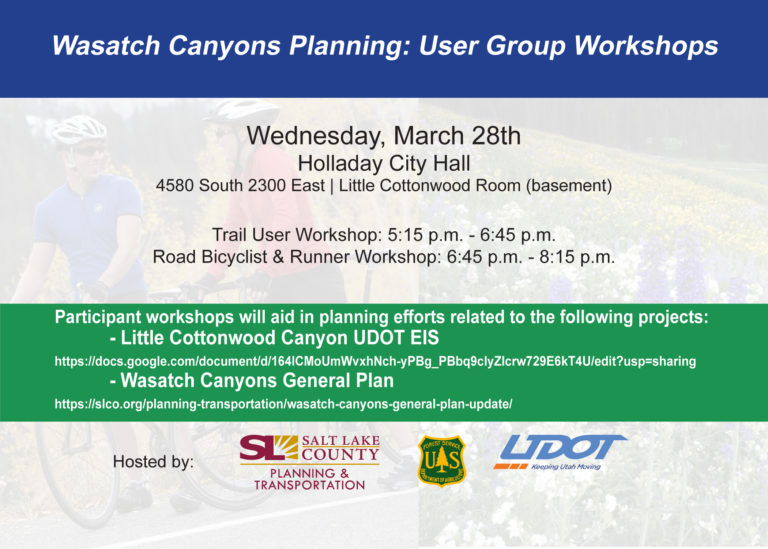
March 28, 2018 – There will be a working group for Wasatch Mountains and Little Cottonwood trail users and road users, both mountain biking and road biking on March 28, 2018 at Holladay City Hall. According to Salt Lake County, “The purpose of this plan is to guide future development and preservation in the canyons.” Road and Mountain Bikers are encouraged to participate.

Details are below:

Wasatch Canyons Planning: User Group Workshops

Trail User Workshop: 5:15 p.m. – 6:45 p.m.

Road Bicyclist & Runner Workshop: 6:45 p.m. – 8:15 p.m.

Hosted by:

Participant workshops will aid in planning efforts related to the following projects:

– Little Cottonwood Canyon UDOT EIS

https://docs.google.com/document/d/164lCMoUmWvxhNch-yPBg_PBbq9cIyZIcrw729E6kT4U/edit?usp=sharing

– Wasatch Canyons General Plan – Comments can be submitted here under Resources and the Interactive Story Map (maybe):

https://slco.org/planning-transportation/wasatch-canyons-general-plan-update/

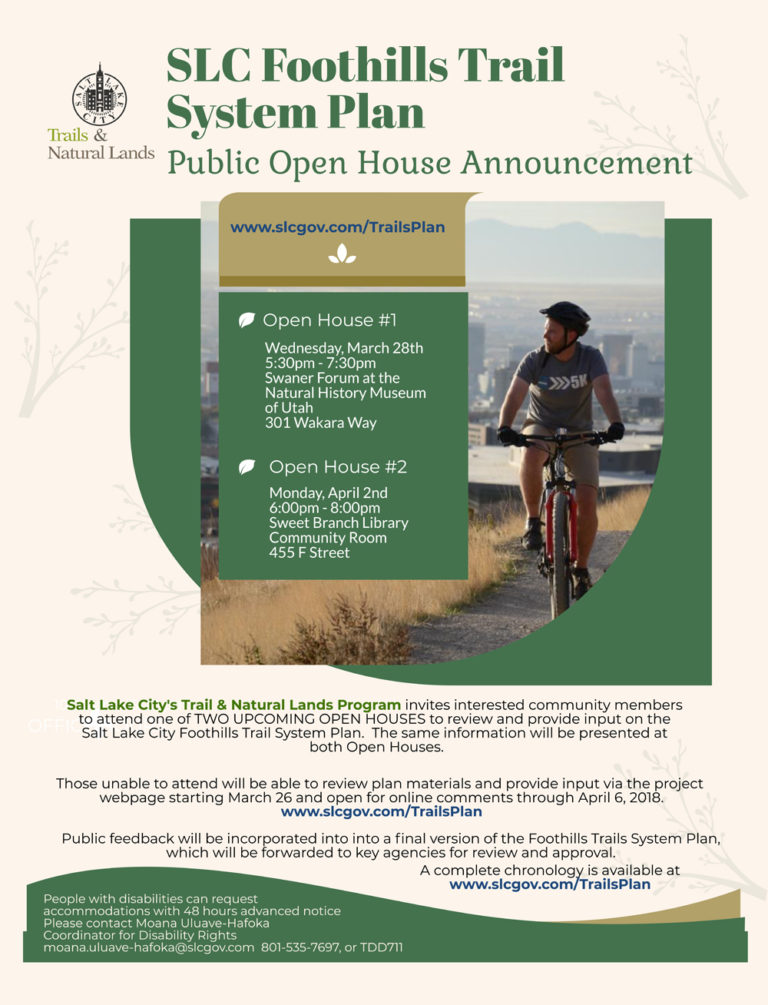
Salt Lake City to Hold Open Houses on Foothills Trails on March 28, 2018 and April 2, 2018

Salt Lake City, Utah – March 28, 2018 – Salt Lake City is in the midst of planning a new trails network for the foothills, more or less from City Creek Canyon to the Hogle Zoo area. The trails will be mostly mountain bike accessible, some downhill only, and some hiking only. Up to 55 miles of new trails may be built in the coming years.

Information on the Open Houses is below:

Outdoor Enthusiasts,


Attached is an announcement and open house invitation concerning our Foothills Trail System Plan.


The primary objectives of the SLC Foothills Trail System Plan are: (1) to provide detailed layout, design and management recommendations for a high-quality non-motorized recreational trail system that is safe, enjoyable, accessible, connected, and sustainable; and (2) to provide information to guide strategic implementation of the trail system over a 10-year horizon. The plan includes foothill open space lands on the east side of the city, extending roughly from Emigration Canyon to North Salt Lake.


Plan components available for review and comment include:

  • A summary of public and stakeholder feedback to-date
  • Alignment, design and management recommendations for existing and proposed trails
  • Trailhead improvement recommendations
  • Wayfinding signage recommendations
  • Implementation priorities


Following the Open Houses, public feedback will be incorporated into a final version of the Foothills Trail System Plan, which will be forwarded to key agencies for review and approval.  A complete chronology is available at www.slcgov.com/TrailsPlan


We hope to see you on one of the two scheduled Open Houses!

SHERILYN HIRSCHI

Volunteer/Outreach Coordinator

DIVISION of PARKS and PUBLIC LANDS

SALT LAKE CITY CORPORATION

Details on the Trails Plan are here: http://www.slcgov.com/TrailsPlan

Cycling Utah’s previous story is on the Salt Lake City Foothill Trails Plan


Tour of Utah Announces First 9 Pro Teams for 2018 Race

Seven Countries Represented by Nine Teams Accepting Early Invitations to Race at Tour of Utah

Five WorldTour Teams to Compete at “America’s Toughest Stage Race”

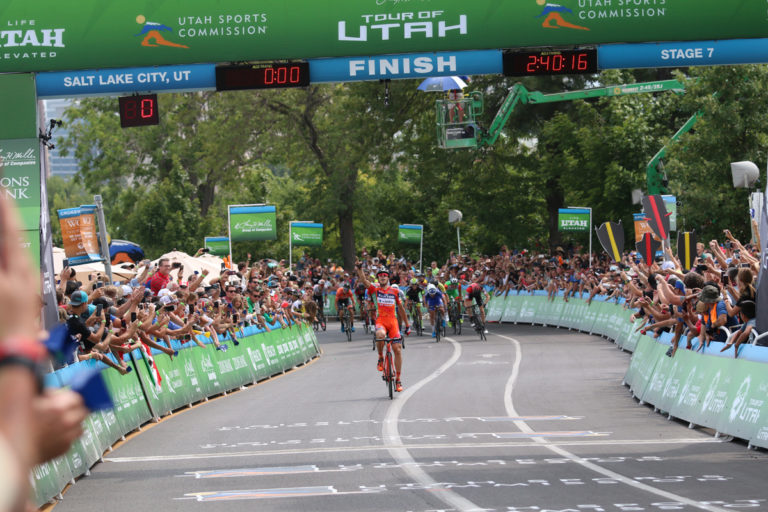
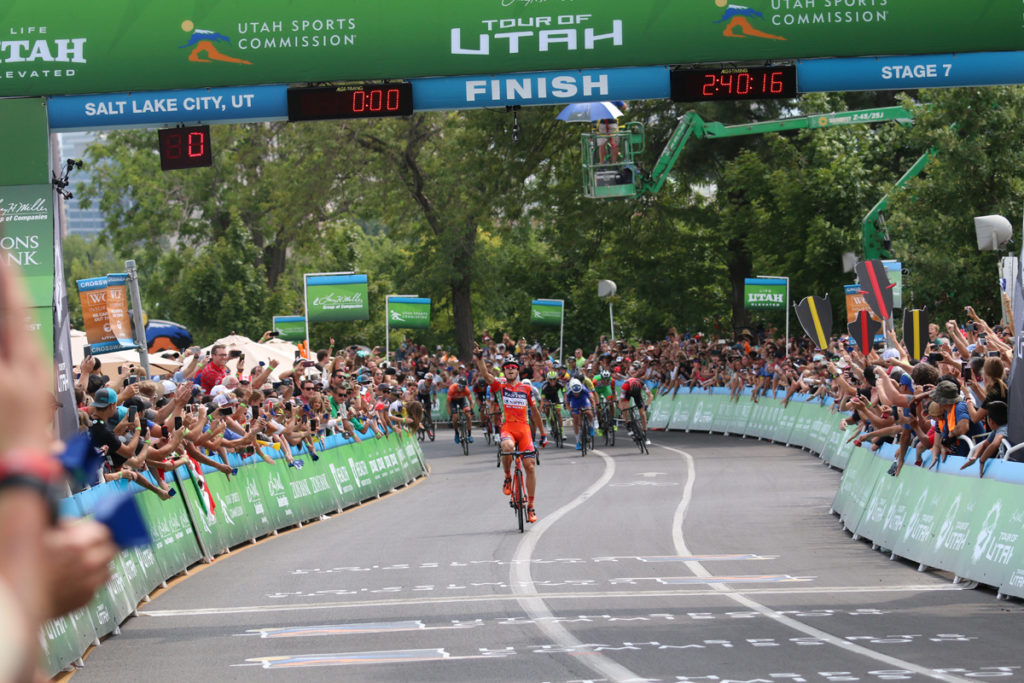
Marco Canola of Nippo-Vini Fantini winning stage 7 of the 2017 Tour of Utah. Photo by Dave Iltis

SALT LAKE CITY (March 27, 2018) – A prominent collection of nine men’s professional cycling teams representing seven countries have accepted invitations to compete at the Larry H. Miller Tour of Utah. A total of 16 teams will compete on Aug. 6-12 in the invitation-only road cycling stage race, with additional teams confirmed later this spring for “America’s Toughest Stage Race.”

Five WorldTour teams will travel from the Tour de France to compete in Utah. Joining the four teams named in January — BMC Racing Team (USA), Mitchelton-Scott (Australia), Team EF Education First-Drapac presented by Cannondale (USA), and Trek-Segafredo (USA) — will be Team LottoNL-Jumbo, which is based in The Netherlands.

In May, these same WorldTour teams will be joined by Israel Cycling Academy (Israel) and Bardiani CSF (Italy) to compete in the 100th edition of the Giro d’Italia. With the addition of Nippo-Vini Fantini-Europa Ovini of Italy and Silber Pro Cycling of Canada, the early field of teams for the Tour of Utah will have a significant international flair. Rosters for each team are expected to total 120 riders, and will be announced in late July.

TEAMS ACCEPTING INVITATIONS (as of 3/27/18)

  • Bardiani CSF (Italy)

  • BMC Racing Team (USA)

  • EF Education First-Drapac presented by Cannondale (USA)

  • Israel Cycling Academy (Israel)

  • Mitchelton-Scott (Australia)

  • Nippo-Vini Fantini-Europa Ovini (Italy)

  • Silber Pro Cycling (Canada)

  • Trek-Segafredo (USA)

  • Team LottoNL-Jumbo (Netherlands)

We have an impressive lineup of international teams for the 2018 Tour of Utah at this early date. It is a tribute to the great support provided by host communities, Tour partners and staff that professional cycling teams around the world now ask to be invited to compete. The Tour of Utah has a solid reputation worldwide as one of the premier sporting events on the professional cycling calendar,” said John Kimball, managing director of the Larry H. Miller Tour of Utah.

All nine teams have made at least one appearance at the Tour of Utah in the previous 13 years of the event. From the WorldTour ranks, Team LottoNL-Jumbo first raced in the Tour of Utah in 2012 as Rabobank, and made its last appearance in 2014 as Belkin Pro Cycling. This Dutch-based squad has been on the racing circuit since 1984. The 26-rider roster includes two young American riders, Neilson Powless and Sepp Kuss. Both raced in Utah last year for other teams, the 21-year-old Powless was recognized as the Best Young Rider and Kuss finished second last year on the mountaintop finish of Stage 2.

As Australia’s only UCI WorldTour squad, Mitchelton-Scott returns to Utah for a second time. It has been five years since the Australian squad has competed in Utah. At that 2013 appearance as Orica-GreenEDGE, the team captured two stage victories by rider Michael Matthews (Australia).

Three of the World Tour teams are based in the U.S. with the BMC Racing Team, EF Education First-Drapac presented by Cannondale and Trek-Segafredo. BMC Racing Team has competed 10 times at the Tour of Utah and has won the overall team classification in Utah three times (2008, 2016, 2017). EF Education First-Drapac p/b Cannondale returns for an eighth year, and Trek Factory Racing returns for a fourth year. Both of these squads last competed in 2016, when Trek Factory Racing secured the overall Sprint classification title with American Kiel Reijnen. EF Education First-Drapac p/b Cannondale finished 2016 with a stage win and third-place overall by American rider Andrew Talansky.

Among the international field are three UCI Pro Continental teams. Israel Cycling Academy makes its second consecutive appearance at the Tour of Utah. The first professional cycling team from Israel, this team has accepted one of four wildcard invitations to compete in the upcoming Giro d’Italia, its first World Tour event.

Also competing in Italy with a special invitation will be Bardiani-CSF. The all-Italian team makes its third appearance at the Tour of Utah, finishing third in the overall team standings last year. The second all-Italian team returning to Utah is Nippo-Vini Fantini-Europa Ovini, returning for a third consecutive year. This Pro Continental team had two podiums from sprinter Marco Canola, including a victory on Stage 7 in Salt Lake City.

The lone UCI Continental team at this time is Silber Pro Cycling from Canada, making its third consecutive trip to Utah. The Canadian-based team finished the 2017 season with 29 victories and 58 total podiums. The team won a stage at the 2016 Tour of Utah with Canadian Kris Dahl, the last time the Tour finished in Cedar City.

The Tour of Utah remains a 2.HC-rated stage race on the UCI America Tour, making it one of the premier events for professional cycling teams in North America. It is also one of the prominent road cycling events that is part of USA Cycling’s Professional Road Tour. The Tour of Utah will start on Aug. 6 in St. George for the first time with a prologue, and conclude seven days later in Park City. Additional host venues are Cedar City, Payson City, Antelope Island State Park, Layton City, Salt Lake City, Canyons Village, and Snowbird Resort.

The Larry H. Miller Tour of Utah is free to all spectators, making professional cycling one of the most unique professional sports in the world today. The Tour of Utah is sanctioned by the UCI and part of the USA Cycling Professional Road Tour. More information about the Larry H. Miller Tour of Utah can be found by visiting www.tourofutah.com


Tifosi Podium XC is a Fine Sunglass Shield for Endurance Sports

0

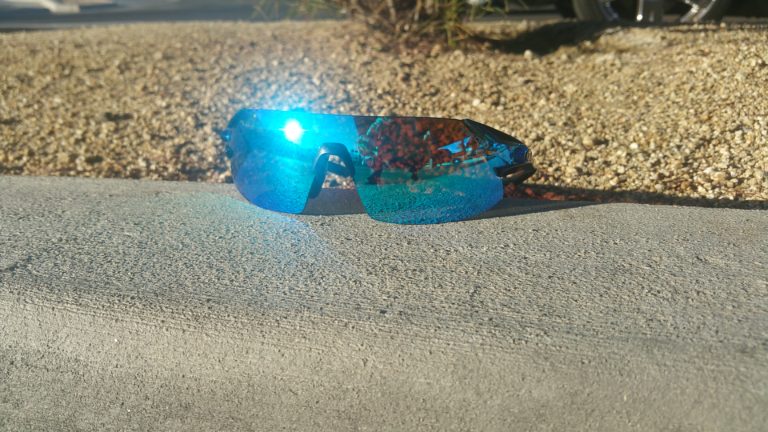
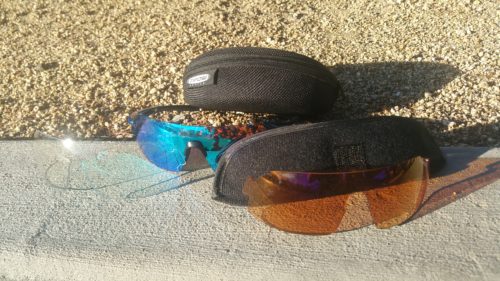
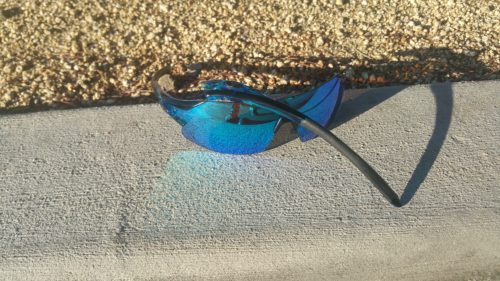
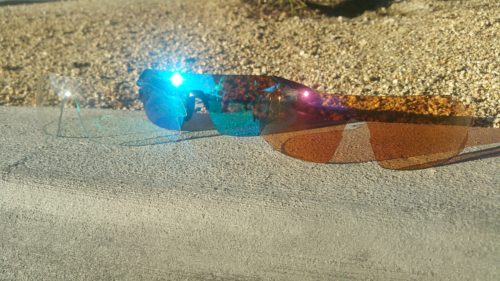
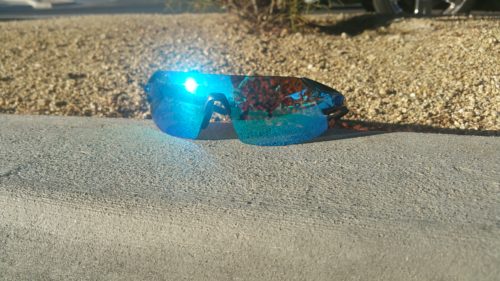
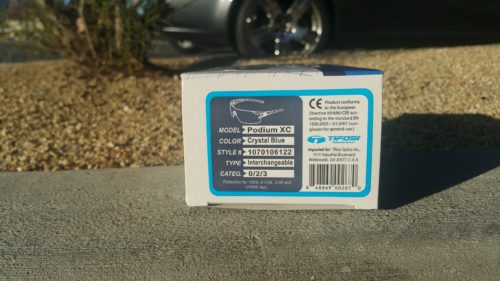
Tifosi Podium XC SunglassThe Tifosi Podium XC is a fine sun glass shield for endurance sports. The Podium is a medium sized shield that comes with three lenses: an iridescent reflective blue, a pink amber, and clear. The shield comes with a hard case, soft pouch, and a protective insert for the alternative lenses.

Lens Quality

I have found the quality of the reflective blue lens pretty good, though admittedly, I do have other lenses available in order to make an informed comparison. I think the blue reflective lens does a really good job of handling UV A and UV B light. They do a very good  job a reducing glare yet the blue lens is not too dark in medium light condition which speaks to the lens’ versatility.  The blue lens is my go-to day-to-day lens.

A couple of times I’ve used the amber in low light conditions and the clear lens on a windy night out side.

Lens Shape

In my experience, just because a sun glass calls itself a shield doesn’t necessarily mean the glass acts like a shield. In the case of the Podium XC, the shield geometry keeps the wind and thus particulates out of your eyes, thus contact lens uses should find the design favorable.

Interchangeability

I’ve always been a bit suspect of interchangeable lenses as I wonder about how much testing of such a feature was performed by real people. In the case of the Podium, I’m surprisingly pleased with the interchangeability of the lenses. I admit to following the instructions when switching the arms and nose piece, just so as to not inadvertently damage any component. I’ve got to say there is minimal if no risk in causing any damage, but there is a bit of nuance to performing the switcher-roo confidently.

Comfort

One thing that annoys me about sunglasses is irritation from undo pressure from the arms a the sun glass may cause above the ear. This can be especially annoying while wearing a bicycle helmet. I have experienced no such irritation from the Podium XC. I have about well over 100 hours wearing the Podium as a performance glass and just casually. I have fifteen to twenty hours running in the glass. I have not noticed the mass of the glass while wearing them, and that is a good thing.

Durability

So far the lens have been resistant to scratches. The replacement design has retained its functionality.

Conclusion

The Tifosi Podium XC is a fine sun glass shield worth consideration that seems on par with the quality products in the market. 

The Tifosi Podium XC retails for $79.95. For more information, see https://www.tifosioptics.com

Idaho Walk Bike Summit to be Held in May 2018 in Boise

By Bob Anthony — Boise, Idaho March 21, 2018 – Cycling advocates from across Idaho will meet in May for the 2nd Idaho Walk Bike Summit to be held at the Idaho State Capitol building in Boise. The summit sponsored by the Idaho Walk Bike Alliance will be held Wednesday May 16th through Friday May18th bringing together advocates, city staff, transportation professionals, planners, health community leaders, elected officials and other interested citizens from all over the state and the region. The goal of the summit is to provide education and training to a diverse audience through a selection of relevant topics on bicycle and pedestrian design, advocacy, land use, funding options, health and wellness, and more. The summit is designed to increase participants’ effectiveness at creating safe and accessible environments for walking or biking, whether it’s at the city, county, region, or state level.

The Keynote Speaker on Thursday morning May 17th will be Russ Roca who is the co-owner of “The Path Less Pedaled” which is a bike travel blog-turned business. Since 2009, “The Path Less Pedaled” has focused on the ways in which cycling can positively impact small and rural communities. Roca has partnered with community leaders and tourism agencies across the country to work through the challenges of marketing a destination to a bicycling audience.

Idaho Walk Bike Summit 2018 attendees will represent a spectrum of people from a variety of communities who are engaged in bicycling and walking. “The summit will be held in Boise, but the Idaho Walk Bike Alliance would like small rural communities well represented to share successes and challenges they face locally,” said Cynthia Gibson, Executive Director of the Idaho Walk Bike Alliance.

“The summit is designed to educate and inspire advocates from all over Idaho to increase success in their communities, whether they are urban or rural, by presenting information attendees can implement quickly and affordably in their towns,” added Gibson.

One of the summit presentations will be titled “Pedestrian and Bicycle Safety: Lessons learned from Utah Communities,” presented by Dr. Shaunna Burbidge of Active Planning based in Kaysville, Utah which will summarize 6 years of pedestrian and bicycle safety research undertaken by the Utah Department of Transportation.

Another summit highlight will be the Friday morning May 18th plenary session with speakers Chris Danley and Don Kostelec who are principals at Vitruvian Planning in Boise. They will make a presentation entitled “Real Stories. Real Challenges. Real Opportunities.” Danley and Kostelec will discuss the human toll of walking and bicycling in Idaho and what advocates and local elected officials can do with the knowledge they gain at the summit to effect real change when they go home.

For more information and to register for Idaho Walk Bike Summit 2018 go to https://idahowalkbike.org/summit-2018/

About the Idaho Walk Bike Alliance

The mission of the Idaho Walk Bike Alliance is to promote active transportation as healthy, safe, and reliable for all Idahoans. For more information or to support Idaho Walk Bike Alliance, visit www.idahowalkbike.org.

Push, But Not Too Hard

Cycling West - Cycling Utah Magazine logoBy Lora Erickson

Cycling and traveling for me usually also involves swimming and running since I am a triathlete. Earlier this year I traveled to Boulder, Colorado to attend a coaching summit as well as compete in the Ironman Boulder 70.3 event. What’s interesting about triathlon racing is trying to go hard but not too hard on the bike. It’s often a trade-off, if you go too hard on the bike you will most likely suffer on the run but if you push the bike and still can run okay in the end your overall time and placement is better even with a little slower pace on the run. That is what I choose to do in Boulder. I came into the race tired from racing an Olympic Distance event one- week before, traveled and had 4 days of mind numbing classes. I rode efficient with a higher cadence and clean pedal strokes patiently keeping an eye on my heart rate and power numbers and taking my nutrition as planned. I decided to push it to my higher numbers and see if I could hold it. I was the last wave of swimmers in the water and knew if I could finish the ride sooner I would have less time in the heat on the run so that is what I did. My legs struggled a bit on the run but overall not bad all things considered. This was a training race for me as I have the Ironman 70.3 World Championships in September. It worked. My run time was a bit slower but my ride time made up for it and more. I knew the effort on the bike yielded more benefit than that same increased effort on the run.

I find this same principle of knowing when to push and when not to can be a struggle for many athletes. Some athletes simple push every workout every day and get frustrated when they get injured or don’t see progress. Just like in my race, some portions of workouts or races are things we can push, other times we need to lay off the throttle and allow some easy coasting. Evaluate what is best for your effort for the most wanted outcome. As we are coming into winter it’s important to keep this in mind. Simply, flowers do not bloom all year. It’s good to scale back training and allow rest so when the race season comes you are fresh for it.

About the Author: Coach Lora Erickson is an Ironman All-World athlete and USAT certified triathlon coach. She is also a certified Slow Twitch Triathlon Cycling Coach with many years of experience coaching beginner to intermediate athletes. She offers on-line as well as in-person custom coaching. To learn more visit http://BlondeRunner.com or contact her directly at [email protected]

What’s in Your Bicycle Tool Kit?

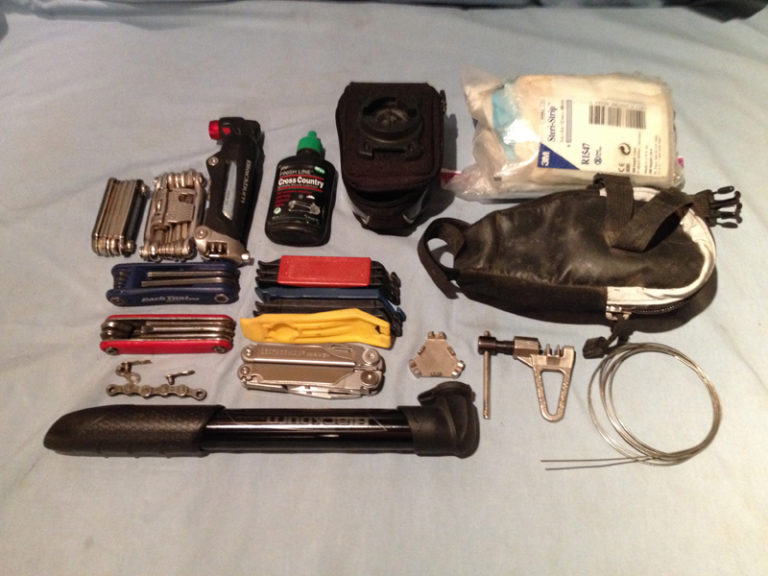
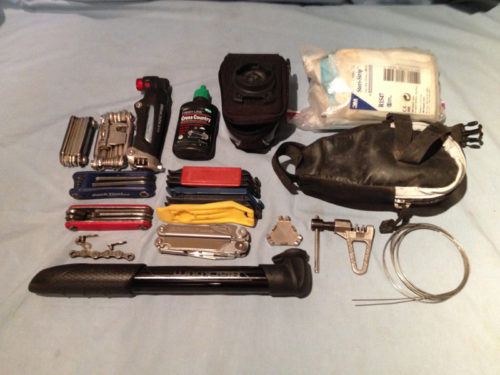
Bicycle tool kit
An assortment of some of the tools that one might carry, including
a number of multi-tool options.

By Tom Jow

Like a Boy Scout, Are You Prepared?

Last week while we were out riding out new mountain bike tandem. I heard a jingling sound coming from the rear of the bike. I asked my wife if she could tell what it was and she thought it must be something in our tool bag. Well our tool bag is not in the rear so after I heard it again I decided that we needed to stop and find out what it was. As it turns out, the five bolts of the granny chainring were all about to fall out. No problem I thought, with my trusty multi-tool, I’ll just tighten those suckers up right quick!

Fortunately this time I was prepared. I had a tool and all my chainring bolts. This has not always been the case. There’s been broken derailleurs, broken spokes, snapped cables and busted chains. I once gave a stranger one of my two tubes only to have three flats later on. It’s easier to be prepared if we know what we need. What do we need to be prepared?

I like to think of packing my repair kit in terms of levels of inconvenience. The more inconvenient it is to break down the more stuff I should bring. For example, during a quick road ride up Emigration Canyon or a single speed loop of the Shoreline Trail, something more than a flat tire won’t be that big of a deal. However, a problem on the Whole Enchilada in Moab or a weekday Morgan Loop could leave a rider walking for a long ways. If, like me, you don’t want to carry more than is necessary, bicycle repair kits can be broken down into categories.

The Minimum:

Pump or CO2 inflator

Spare tube

Tire levers

Valve extender

The Basics:

The Minimum plus:

Spare tube (2 total)

Patch kit

Tire boot

Multi-Tool

Chain tool and spare links

Epic:

The Basics plus:

First Aid Kit

Sunscreen

Chain lube

Spoke wrench

Spare cable(s)

Chainring bolts

While spare tubes, pumps and tools are obvious, some of the above items may be unknown to the new cyclist. Valve extenders, for example, are an attachment that allows a normal tube to be used with an aerodynamic wheel. You’ll need one if you get stuck without a special long valve tube. Another important item is a tire boot. This piece of an old tire is worth it’s weight in gold (it weighs nothing, takes up no space) when you have a large cut in the tire. In the event there is no tire boot, a dollar bill or an energy bar wrapper can work in a pinch.

Once all these items are collected, how are we going to carry it with us? For riders that wear jerseys with pockets on the back, well, in the pockets of course. That’s what they were made for. Many riders opt to use a small bag, or pouch that stores under the saddle. When purchasing this, be sure that it is large to carry everything necessary. Personally, I like a pouch that just barely fits what I want to carry. That way, there is no room for things to rattle around. Mountain bikers have it easy. Most are already wearing a hydration pack with space for everything and more.

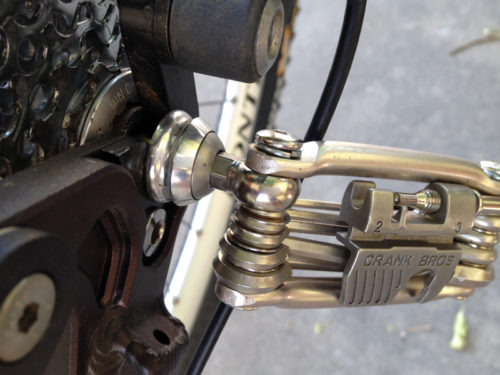
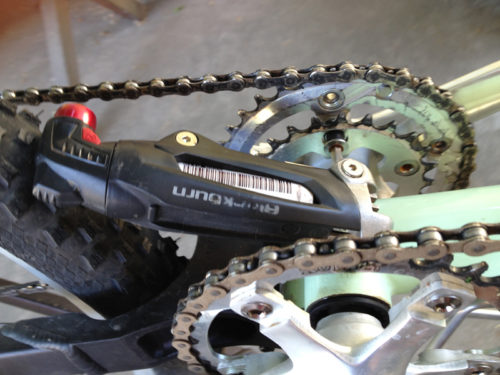
Keep in mind that just having the equipment to make repairs is not enough. It is equally important that the tools are compatible with all the parts of the bike and their locations. Any multi-tool will reach handlebar and stem bolts. Likewise seatpost or crank arm bolts. But the tool in my tandem repair kit that day was barely able to reach the inner chainring bolts. Tightening those five bolts took forever. I also discovered it has difficulty reaching the rear axle bolts. And the four millimeter hex wrench has been lost.

The above list is by no means the be all to end all. For a while one of my friends used to carry a crank puller and bottom bracket tools. In addition, remember to pack extra food and clothing in case the ride goes longer than planned or the weather goes bad. It has been said that during adventures you should expect the best but be prepared for the worst. I guess I may have to change my travel mantra.


Cycling West and Cycling Utah’s March 2018 Issue is Now Available!

Cycling West and Cycling Utah Magazine’s March 2018 Issue is now available as a free download (6 mb download), Pick up a copy at your favorite Utah, Idaho, Wyoming, Nevada, Montana, W. Colorado, N. Arizona, and Northern California bike shop or other location! downloadbutton

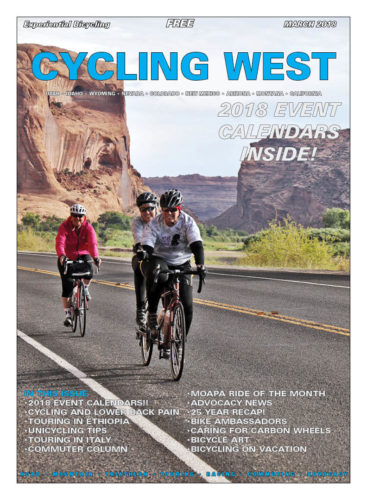
Cycling West March 2018 Cover Photo: Three riders pass by the Portal during the Moab Century on September 23, 2017. Photo courtesy Moab Action Shots. Find your photo at moabactionshots.com

Contents

An Open Letter to Drivers from Cyclists –  page – 3

Robert Simonton: Helping to Make the University of Utah a Bike Friendlier Ride –  page – 4

Cycling Utah and Cycling West: A Brief History of 25 Years –  page – 6

Cycling and Lower Back Pain –  page – 7

To Bicycle Tour Or Not To Bicycle Tour: Questions Shouldn’t Stop Your Momentum –  page – 8

Caring for Carbon Wheels –  page – 9

Tips for A Happy Bicycle Vacation –  page – 10

Salt Lake County Bicycle Advisory Commmittee News for Early Spring 2018 –  page – 11

The Bicycle Art of Richard Vroom –  page – 12

2018 Larry H. Miller Tour of Utah Announces Host Cities –  page – 13

In Praise of Riding with Ladies –  page – 16

From Winter to Early Season Mountain Bike Racing –  page – 18

Stan Swallow: Fast at 77 –  page – 19

Tifosi Podium XC is a Fine Sunglass Shield for Endurance Sports –  page – 19

The Magic of a Bike Tour Through Italy –  page – 20

Salt Lake County Bicycle Ambassadors are expanding in 2018! –  page – 30

How To Gain Weight Healthfully –  page – 30

Life on One Wheel: Tips for Unicycling –  page – 31

A Bike Tour through Ethiopia –  page – 32

Nevada’s Moapa Valley Ride on Fire is a Perfect Early Season Ride –  page – 35

Salt Lake County Bicycle Ambassadors are expanding in 2018!

By Beth Pacheco — This program was born out of the realization of the need for bicycle education, training and guidance in Salt Lake County. Our community is growing rapidly which increases the benefits of bicycling, both to the individual and the community. Bicycling provides pollution free and inexpensive transportation alternatives, health benefits, community and family building opportunities and increases the awareness of cyclists on the road, making it safer for everyone. It’s also just plain fun!

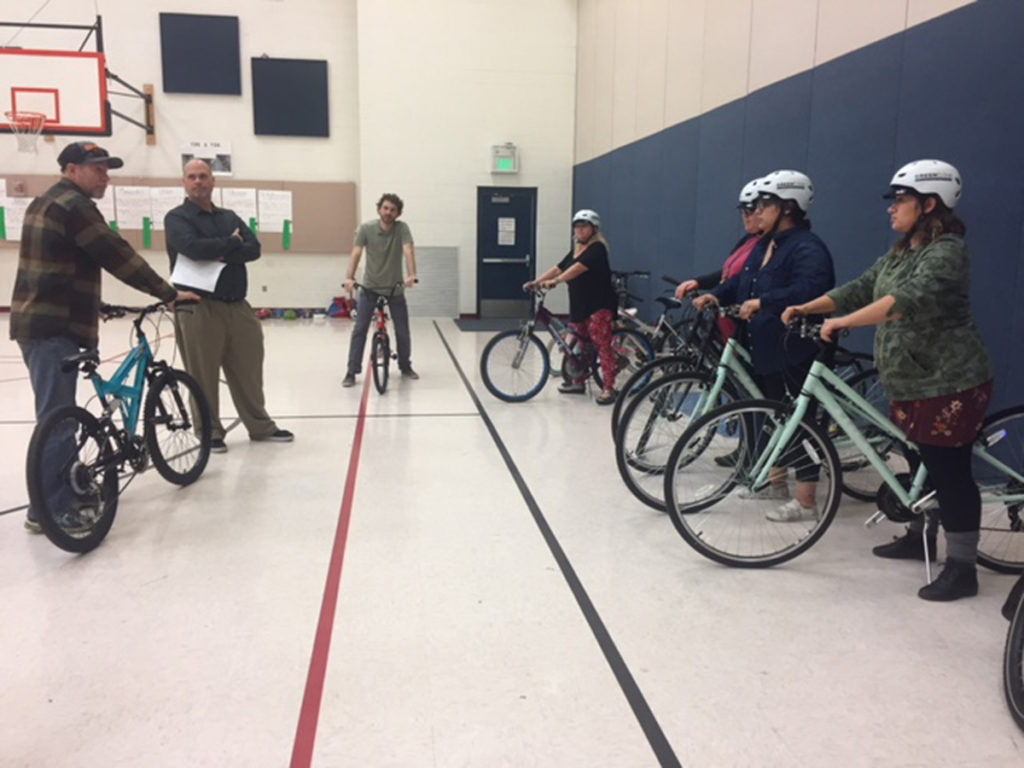
Bicycle Ambassadors instructing the Adult Learn to Ride Class. Photo by Beth Pacheco.

This is where the Bicycle Ambassadors step in. We are not about fast paced rides or wearing lycra. Some of us may choose those things on our own time, but as Ambassadors we are a community resource focused on getting more people on bikes. The Ambassadors are a diverse group made up of men and women of all ages (18+), many interests and occupations and varying levels of cycling experience and wrenching skills. Yes, a couple are competitive cyclists, but mainly we all love bicycling and want to share our passion with others. We work to increase safe, informed and confident ridership through education, working with new cyclists and promoting bicycle travel for both recreation and utility purposes. We would like nothing more than to find the streets packed with people of all ages, nationalities and income levels riding to work, to the store or out with friends and family.

One of our newest Ambassadors is University of Utah student, Austin Richards, who received his first bike just a few months ago and says “It’s changed his life!” and that being an Ambassador is a “blast!”. Long time Ambassador Josalyn Bates is a full time commuter, along with her husband and 10 year old son. She became an Ambassador after experiencing advanced cycling cultures in other countries and wanted to help develop that culture in Utah. She says that “the roads are much more safe when there are more cyclists”.

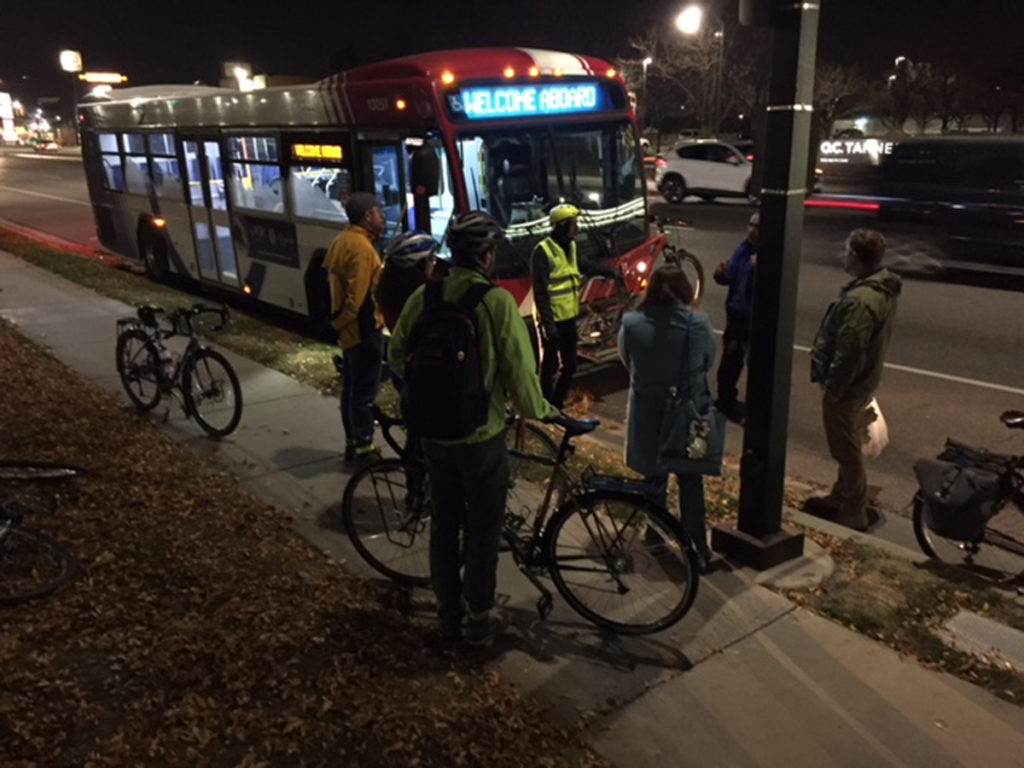
How do we accomplish these goals? We are focusing on a few specific areas and expect to increase our capacity as we grow our Ambassador team. In fall 2017, we rolled out the Bicycling Basics series. This bi-weekly series offers 15-45 minutes of instruction/discussion followed by a casual group ride where together we explore trails, bike lanes and roads in Salt Lake County. It’s a great way to gain confidence riding with other “vehicles”. We’ve partnered with Bike Shops all over Salt Lake County to offer a variety of topics, covering what we consider barriers that keep folks from getting out on their bicycle, with a few fun options thrown in. These include “Fixing a Flat”, “Basic Bike Maintenance”, “Taking Your Bike on the Bus” and “Yoga and Cycling”. Our 2018 Bicycling Basics Series debuts on March 29th. See our great lineup at www.slco.org/bikes and on Facebook.

Bicycle Basics participants learn how to load their bikes on the bus. Photo by Beth Pacheco.

Our newest initiative is the Adult Learn to Ride Class. With the generosity of Salt Lake County, Salt Lake County Bicycle Advisory Committee, Trek SLC, and Guthrie Bicycles, we have our own fleet of 5 bicycles, helmets and everything we need to teach people to ride.

We are really stoked about this class! Our goal is to enable adults to ride safely and confidently with their kids, to work and everywhere else. How cool is that? We begin with an indoor class in February at a local Elementary School and plan to offer this 2 session class each month at different locations in Salt Lake County, continuing with the Sorenson Unity Center in April.

Last, we serve as a community resource, providing support and education opportunities for local events such as the Bike Rodeo at the Safe Kids Fair on February 24th and Open Streets SLC on May 5th as well as tabling at local Farmer’s Markets and other events.

Does this sound like a fun and rewarding way to spend a few hours per month? If so, please consider joining our team and share your expertise and love of cycling with others. We welcome all, but are particularly looking for bilingual speakers to help us reach the often underserved areas in our diverse community. Learn more about our program, responsibilities and rewards at www.slco.org/bikes then reach out to Beth at [email protected] or call 309-241-0966.


Tarantula Ride…And More

tarantula on bike ride
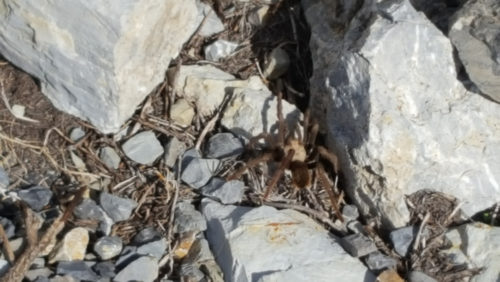
Tarantulas are one of the many wonders seen over the years on David Ward’s rides. Photo by David Ward

Riding along the Bonneville Shoreline Trail in Salt Lake where it approaches Parley’s Canyon from the north, I saw about thirty yards ahead of me a large brown spot that stood out against the black asphalt. As I drew close and rode by, this brown spot clearly resolved into a huge tarantula, 4-5 inches in diameter, crossing the trail.

Well, I had never seen a live tarantula, expect perhaps in a zoo somewhere. The largest spider I had ever seen was maybe an inch in diameter. I never knew tarantulas lived in Utah till someone happened to mention that in conversation one day. Now, here was one right in front of me. I made a quick u-turn once I realized what I had seen, and doubled back to get another look and a picture. By the time I was able to fumble my phone out of my jersey pocket, get it turned on and the camera app open, Mr. Tarantula was across the path and into the rocks. I still got a couple of pics, but he no longer stood out like he did on the path, and had soon escaped into the underside of a large rock.

Yellowstone Wolf
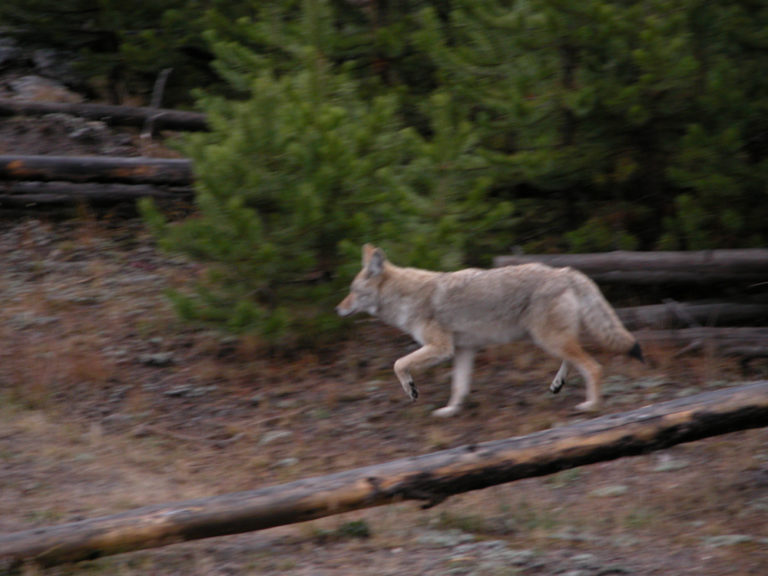
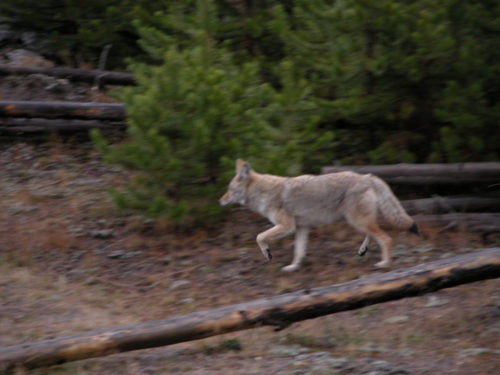
There was also the time my wife and I spotted a wolf on the side of the road while cycling in Yellowstone National Park. On that same ride, we took a side excursion to see the location of a geyser that erupts infrequently and erratically, only to arrive just in time to watch it erupt. Photo by David Ward

That is just one of the many wonders I have experienced being on a bike. Many years ago, a friend and I, while spending a few autumn days in Island Park, a beautiful forested area just outside of Yellowstone Park, went mountain biking on a trail where we would often cross-county ski in the winter. We had ridden across a large meadow a few miles back from the Island Park Dam and had stopped to eat some snacks on the edge of the meadow.

But as we were snacking, we heard a high pitched bugling, and then more bugling in response. Suddenly, scores of elk started entering the meadow from the surrounding forest. We realized it was the bugling of the elk we were hearing. I had known that elk bugled, but had never heard it before. Then suddenly again, elk were entering the meadow from the trees right behind us, crossing within yards of where we sat, with some of them also bugling.

The sun had already set, and we knew we would be riding in the dark on our way back. But with the orange and crimson sky, the fresh autumn air, this forested setting and the fall colors, a meadow of a hundred or more elk around and in front of us, and the bugling elk engulfing us, it was a surreal, wondrous scene, hard to leave behind. To this day, I count this as one of the great moments of my life, a reaffirmation of this beautiful world and the wonder of living in it. For me, it was and remains a reaffirmation of the artistry of God’s creative work and love.

Then there was the time my wife and I were visiting my daughter, Jessica, in Dhaka, Bangladesh where she was posted with the State Department. She was able to hook me up with some people in the British Embassy who would go on weekly rides in and around Dhaka. They furnished me with a bike and I joined them on one of their rides. We were there during a rainy period, so all the rivers and streams, of which there are a lot in this watery region, were running high.

We came to a spot where people normally crossed a large stream by way of a swinging bridge. However, the water was too high, so there was an enterprising man with a small boat who would ferry people across. Two at a time, our bikes were precariously balanced on this small boat, we were seated and, fingers crossed, ferried to the opposite shore.

On that same trip to Bangladesh, we took a short flight to Kathmandu, Nepal. After we arrived, I happened to notice an advertisement for mountain biking tours. I didn’t have time for a long tour, but called anyway and asked if they had half day tours. They said yes, and told me when to show up. I arrived at the appointed time and discovered that I was the tour group, and so had my own personal tour guide.

Well, you can’t really head out of town for a half day tour, so my guide said we would simply work our way partially around Kathmandu. Lest you think this was an urban ride through the paved streets of Kathmandu, let me assure you otherwise. For the next four hours he led me up and down the hills and vales and across the roads heading like spokes into the hub of Kathmandu. We road on some pavement, but mostly dirt roads and paths. We had to hike our bikes across streams. And we wound our way through rice paddies on the narrow, elevated dirt paths separating the paddies. It was one of the most arduous days of riding I have experienced. I wrote an article for Cycling Utah about this experience, exclaiming that my toughest day of mountain biking ever had been around and through the streets of Kathmandu.

And all that is to say nothing about the experience of simply riding a bike in these two countries. It was an amazing experience. The colors, culture and organized chaos on the streets of these cities make these excursions forever resident in my mind and heart.

There was also the time my wife and I spotted a wolf on the side of the road while cycling in Yellowstone National Park. On that same ride, we took a side excursion to see the location of a geyser that erupts infrequently and erratically, only to arrive just in time to watch it erupt.

On another trip to visit our daughter, this time while she was posted in Belgrade, Serbia, there was a Serbian working in the embassy who was into cycling, and Jessica arranged for me to borrow one of his bikes. I was able to take that with me on a road trip we took through Serbia, Croatia, Bosnia and Herzegovina. While in Croatia and staying on the island of Korçula just off the Croatian coast, I took a ride to the end of the paved road which found its terminus in the small town of Račišće. It was a classic picturesque, sleepy little fishing village surrounding a small harbor with its colorful skiffs and boats. As I rounded the final corner before reaching this jewel and began descending a small hill leading downward and out of the trees, it was the sight of this beautiful little village that greeted my eyes and imprinted itself upon my mind.

Well, I could go on for a long time about the wonders I have experienced while cycling. The list is extensive. But the point is that it was being out on a bike that made these experiences possible, or at a minimum greatly enhanced the experience. Somehow the freshness and clarity that comes from being outside, and the synergy of my bike and me, make these transcendent experiences special and even more memorable.

So, when possible, take your bike with you when you travel, and take time to get out and ride. You will experience your locations in a much more personal way, and you will find wonders and have experiences that you otherwise would have missed.

For more on tarantulas in Utah, see http://wildaboututah.org/tarantula-tales/

A Guide to Tire Pressure for Mountain Bikes

By Chris Magerl

Too much pressure!

Pump it up! And you will go slower.

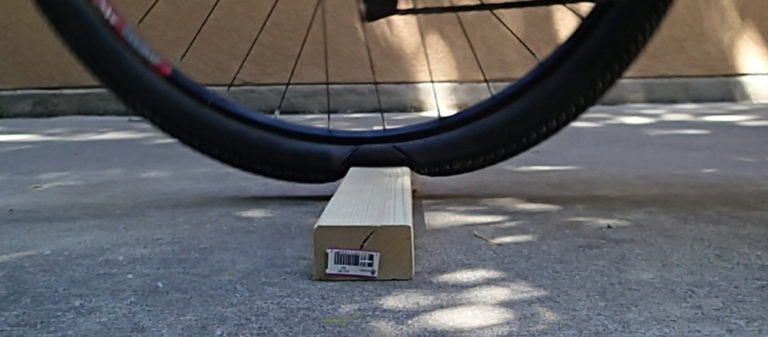
Riding off road, your tires are constantly striking obstacles. Rocks, roots, dirt clumps. Tires will either deflect (bounce) or deform (bend).

Deform is faster. Yet many offroad riders, especially beginners, think they will be faster if they make their tires very hard. It is not uncommon to find 120 lb high school mountain bike racers showing up with 45 psi in their tires. And then they wonder why their bikes react like a bucking bronco.

“Tire pressure is the main thing you can control concerning your connection between the bike and the ground,” said RideBiker Alliance/Cannondale pro cyclist Alex Grant. “Higher pressure feels faster because you are bouncing off everything. Low pressure feels slower because it is smoother. But low pressure is faster.”
 

Mountain bike tire pressure

Mountain bike tire pressure

Mountain bike tire pressure

 
Correct tire pressure has many variables, Grant points out. For starters, he is assuming you are running tubeless, which improves performance and versatility of any offroad bike. Take into account rider weight, how your rims and tires react at different pressures, the trail you are riding, and the speed you will travel. The only way to learn is to experiment.
 

Mountain bike tire pressure

Mountain bike tire pressure


Chris Currie from NoTubes reminds riders that the ground is their friend. “It’s the ground that is propelling you forward. Tires with higher pressure are actually ricocheting constantly off the ground, propelling you upward and backward, two directions that definitely don’t help with going forward.”

“The argument that suspension systems handle all those impacts so tire pressure doesn’t matter is also inaccurate,” said Currie. “I just interviewed World Cup Downhill points leader Rachel Atherton and she let us know they check her tire pressure to 0.1 psi tolerance. And that’s with 210 mm of travel!”

Grant has years of experience doing this, but when he gets to a new race course, he will test tire pressure for that venue.

“I will go out with a bit more pressure than I think I need, run a lap, take some out, see how it feels, and do it again.” For top racers such as Grant, that includes doing a hot lap, a lap at full race speed. “What might feel good in a corner at slow speed will fold at high speed.”

Kenny Wehn has been mechanic for the NoTubes Elite team as well as a top-level amateur MTB and cyclocross racer. In July he was wrenching for NoTubes athlete Chloe Woodruff as she won the US National Mountain Bike Championship. Chloe’s tire pressure on the championship ride? 20 psi front, 21 psi rear.

“In order to get the bike to work the way it was designed, you have to get the pressure right,” said Wehn. “It is so much more efficient if you are keeping that tire in contact with the ground. Too high pressure and you are not going to have climbing traction or cornering traction.”

Wehn thinks too many novice riders are being advised by an older rider who rode when mountain biking was in its infancy, tubes were the only way to go, and high pressure was the default. “When elite riders show younger riders what they are running, younger riders are more likely to get it.”

“You can take it too far,” Wehn cautions. “If you go too low, the tire will collapse in the corners.”

Robert Marion of the American Classic pro team offers a slightly different take. “For amateurs, I will tell them to take the bike out on pavement, sprint hard, and see if the tire feels like it is too squirmy. If so, they might want to add a bit of air. Once they get on the trail, going hard through a corner, if they feel like they can’t keep the bike on their chosen line, perhaps they should add a bit. If a tire is too squirmy in the warmup, think what is going to happen late in the race when you are tired and can’t hold your line. Don’t go too low.”

Cyclocross Tire Pressure

For cyclocross, the wrong tire pressure can take a strong rider out of the picture. For a dry course, Wehn suggests that riders start around 24 psi, go ride it, and adjust pressure. If you go too low on some clinchers, it will cause the tread pattern to bow in the middle, negatively affecting braking and climbing.

Grant’s goal for CX tires “As low as I can go without rimming out on a hot lap. If I rim out, I need to add some more. If not, I take some out. It is a fine line. You have to play with it on the course.”

There is less volume in CX tires, so learning to find the correct pressure become a much finer skill. But the message from the experts is the same. Says Wehn, “A lot of air makes it feel like you are going fast, but when you compare lap times, you will be faster with lower pressure.”

Getting started

Stan’s NoTubes offers a simple formula as a starting point for tubeless tire pressure for most XC riders. Divide your weight (in pounds) by 7, add 2 psi for the rear, subtract 1 psi for the front. For a 140 lb rider, that would yield 22 psi rear, 19 psi front.

Don’t have a gauge? Alex Grant suggests the following thumb test as a starting point. Put your thumb on the tire, place your other hand over your thumb, and press down as hard as you can. Touch the rim? Add more air. If you are not getting the tire to indent, take air out.

Kenny Wehn wants you to be comfortable with the rim hitting the ground. If you are not rimming out at least once a lap, you have too much air in your tires. Twice a lap is perfect.

These all assume tubeless. If you are running tubes, you have to go with more air or you will pinch flat, which happens when the tube is pinched between the rim and tire, creating two parallel cuts. Grant suggests the average high school racer with tubes start around 30 psi and test from there.

The gauge

Forget your fingers. If you want to learn how to get the most out of your tires, and have the most fun on your bike, you need to measure tire pressure. Your shop can order a good tire gauge for you, but you need to know what you are looking for.

The gauge on most pumps covers a range from zero to 140 or higher. For a 29 inch tire, the critical range is likely between 18 and 28 psi, depending upon your weight, your skills and the terrain. For Plus tires, that range is around 11 to 15 psi, and for fat tires (4-inch and wider), the sweet spot might be between 6 and 10. A dial gauge that goes beyond 100 is not going to be detailed enough for your needs.

There are analog (dial) gauges and digital gauges. Digital can be accurate and easy to read across the full range. Digital will require a battery, and some units, as crazy as it sounds, do not allow you to replace the battery. Do a bit of research first, looking for snazzy features such as auto shut-off and a replaceable battery.

There are analog gauges that have a range of zero to 30. If you are running tubeless, that is likely all you need.

A bleed-off valve is a very useful feature, and can be found on both digital and analog units, although reviews seem to question the effectiveness on some digital gauges. With a bleed-off, you can pump up higher than you need, then precisely let out air while the gauge is in place. Very handy, and far faster than removing the gauge, letting out some air, checking again, and repeating.

25 psi on your buddy’s pump is not the same as 25 psi on your pump, and not the same as 25 psi on your handheld gauge. Don’t sweat it. Buy a gauge, use it regularly, and develop your tire pressure knowledge based on the consistency that comes from using the same gauge every time. Bonus: if you are traveling, you can rely on anyone’s floor pump, and never worry about what their gauge says. Pump up high, check with your gauge, bleed off as needed.