Question: What are two things dogs and athletes have in common?
Answer: One, both dogs and athletes love to exercise. Two, they both come in different sizes and shapes.
Question: What is one thing dogs and athletes do NOT have in common?
Answer: Dogs are content with their natural physiques, while too many athletes try very hard to change the way they look. These athletes might be better off being like dogs. That is, does that bulky St. Bernard yearn to look like a lanky Greyhound? Heavens, no! Does the barrel-chested Labrador want to look like a sleek Setter? Doubtful. Each dog is very proud to represent his breed. Wouldn’t life be easier if each active person could be just as proud of his or her “breed”?
As a sports dietitian, I spend too many hours helping my clients find peace with their bodies. Most of these active people take the outside-in approach. They think if they change their body from the outside by losing undesired body fat or by adding some muscular bulk, they will be happier on the inside. Unfortunately, not true!
No weight will ever be good enough to do the enormous job of creating happiness. This story, told to me by a cyclist, proves that point: “I once weighed 124 pounds and was unhappy with that weight. I started exercising and dieting rigidly. I lost to 99 pounds but I still wasn’t happy. I ended up binge-eating; I gained to 160 pounds, where I was miserable. I sought help from a counselor, stopped eating emotionally, and with time, got my weight back to 124—and I felt happy there! Why couldn’t I have been happy at 124 pounds in the first place? Because happiness has nothing to do with weight…”
Granted, some people do have excess body fat they can appropriately lose to be healthier as a person and lighter as an athlete. They can rightfully feel pleased when they accomplish the goal of attaining an appropriate weight. But other athletes just think they have excess fat to lose; they have distorted body images. A survey of 425 collegiate female athletes reports the women wanted to lose 5 pounds, on average. (1) Another survey of the top women runners in the country found the same results. (2) Even elite athletes wistfully believe they will perform better if they are leaner. Unfortunately, the struggle to attain that “perfect weight” can cost them their health and happiness. Restrictive diets with inadequate protein, iron, zinc, calcium and a myriad of other health-protective nutrients—to say nothing of carbs for fuel—often contribute to injuries and poorer performance.
So what can you do if you are discontent with your body? First of all, you should get your body fat measured to determine if you actually have excess fat to lose. Data can be helpful. (Find a local sports dietitian to measure your body fat via the referral network at SCANdpg.org.) You may discover you have less body fat than expected!
Feeling fat
It’s easy to understand why so many athletes have distorted body images. When you put on skimpy running shorts that expose your “flabby things”, or a bathing suit that shows every bump and bulge, you can very easily “feel fat.” Sound familiar?
One solution to the “I feel fat syndrome” is to remember “fat” is not a feeling. That is, you don’t feel “blond hair” or “freckled.” You also do not feel “fat.” Yes, you may be feeling uncomfortable with your body. But you are really feeling imperfect, inadequate, insecure, anxious—and any number of other feelings that get described as “feeling fat.”
I encourage your to explore those real feelings, and figure out where you got the message that something is wrong with your body. The media is a good start, but it could also be a parent who lovingly said at a tender age “That outfit looks nice, honey, but if only you’d lose a few pounds…” What you hear is “I’m not good enough” and this can create a downward spiral of self-esteem. Weight issues are rarely about weight. They tend to be about feeling inadequate and imperfect.
What to do
So how can a discontent athlete feel better about his or her body? One tactic is to stop comparing yourself to your peers. To compare is to despair. Rather, pretend you live on an island where your body is “good enough” the way it is. (You are unlikely to ever have a “perfect” body, so the second best option is to enjoy a body that is “good enough.”) If you step off your island and start comparing yourself to your peers, please notice: Do you end up being too fat, too slow, too ugly, too dumb? Do you ever let yourself rise to the top and be better than others? Doubtful. You are better off staying on your island, and calling yourself a Gorgeous Goddess or Handsome Hulk. With time and practice, you can change the way you see yourself and come to believe perhaps you are, indeed, good enough the way you are!
Granted, changing the way you feel about your body is a complex process. The following resources can help you in this journey to find peace with your body:
For a plethora of books, visit the online bookshelf at www.gurze.com. Some of my favorites include The Body Image Workbook and The Don’t Diet, Live-It Workbook.
Life is more enjoyable when you can love your body and appreciate it for all it does and stop hating it for what it is not. When the drive for thinness comes with a high price, that price may not be worth the cost.
Nancy Clark, MS, RD, CSSD (Board Certified Specialist in Sports
Dietetics) counsels both casual and competitive athletes in her practice at Healthworks, the premier fitness center in Chestnut Hill MA (617-383-6100). Her NEW 2008 Sports Nutrition Guidebook, Food Guide for Marathoners, and Cyclist’s Food Guide are available via www.nancyclarkrd.com. See also sportsnutritionworkshop.com.
References:
1. Beals K and M Manore. Disorders of the female athlete triad among collegiate athletes. Int’l J Sport Nutrition and Exercise Metabolism. 2002. 12:281-293
2. Clark N, M Nelson, W Evans. Nutrition educational for elite female runners. Physician and Sports Medicine. 1988. 16:124-135
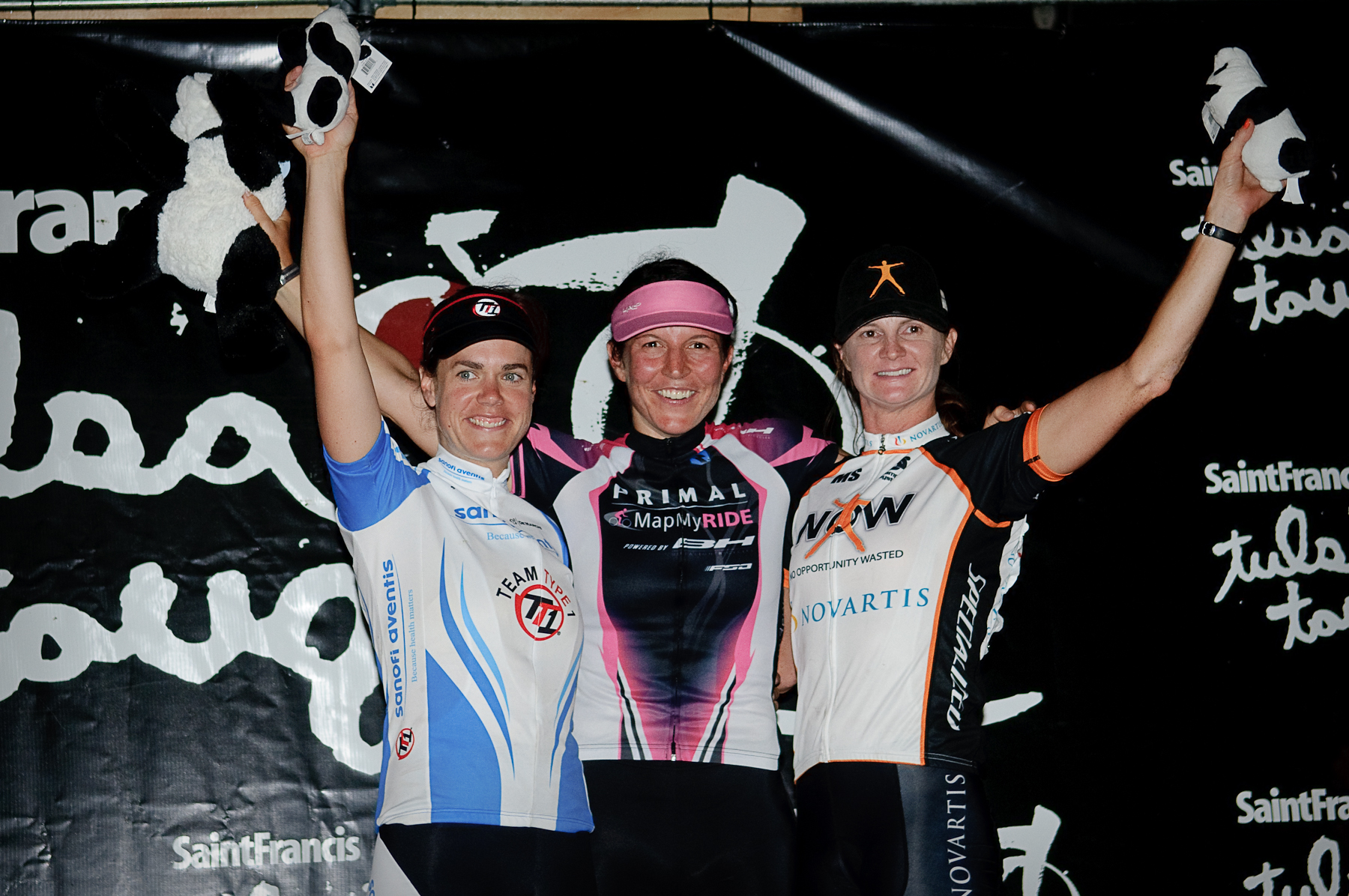
Pezzulo also rode for a podium finish in third place in Saturday’s Brady Village Criterium.
“Tiff put together an incredible performance this weekend in tough conditions and in a tough field of riders,” said Primal/MapMyRIDE Team Director Susannah Gordon. “The team rode great and was able to help Tiffany get in a position to be competitive at the end on Friday and Saturday and she finished the job.”
The three-day omnium is the team’s final event prior to the USA Cycling Elite Road Nationals in Augusta, GA later this month.
“The Tulsa Tough is such a fun event and suits my strengths well,” Pezzulo said. “We raced great as a group and are feeling strong and prepared as we head into our first Nationals race as a team.”
Primal/MapMyRIDE member Liza Rachetto also took home a top-10 finish during the three days of racing in Oklahoma.
SALT LAKE CITY— The Salt Lake City Police Department is offering up to a $5,000 reward for information that leads to the arrest and conviction in a fatal hit-and-run case.
At approximately 10:03 p.m. Tuesday, June 7, 2011, Brynn Barton was killed while riding her bicycle at 800 South and 700 East. Police are seeking information on a dark colored 1998-2001 four-door VW Passat sedan that is believed to have been involved in the incident.
The Police Department asks anyone with information about this case to call (801) 799-3000. Callers may remain anonymous.
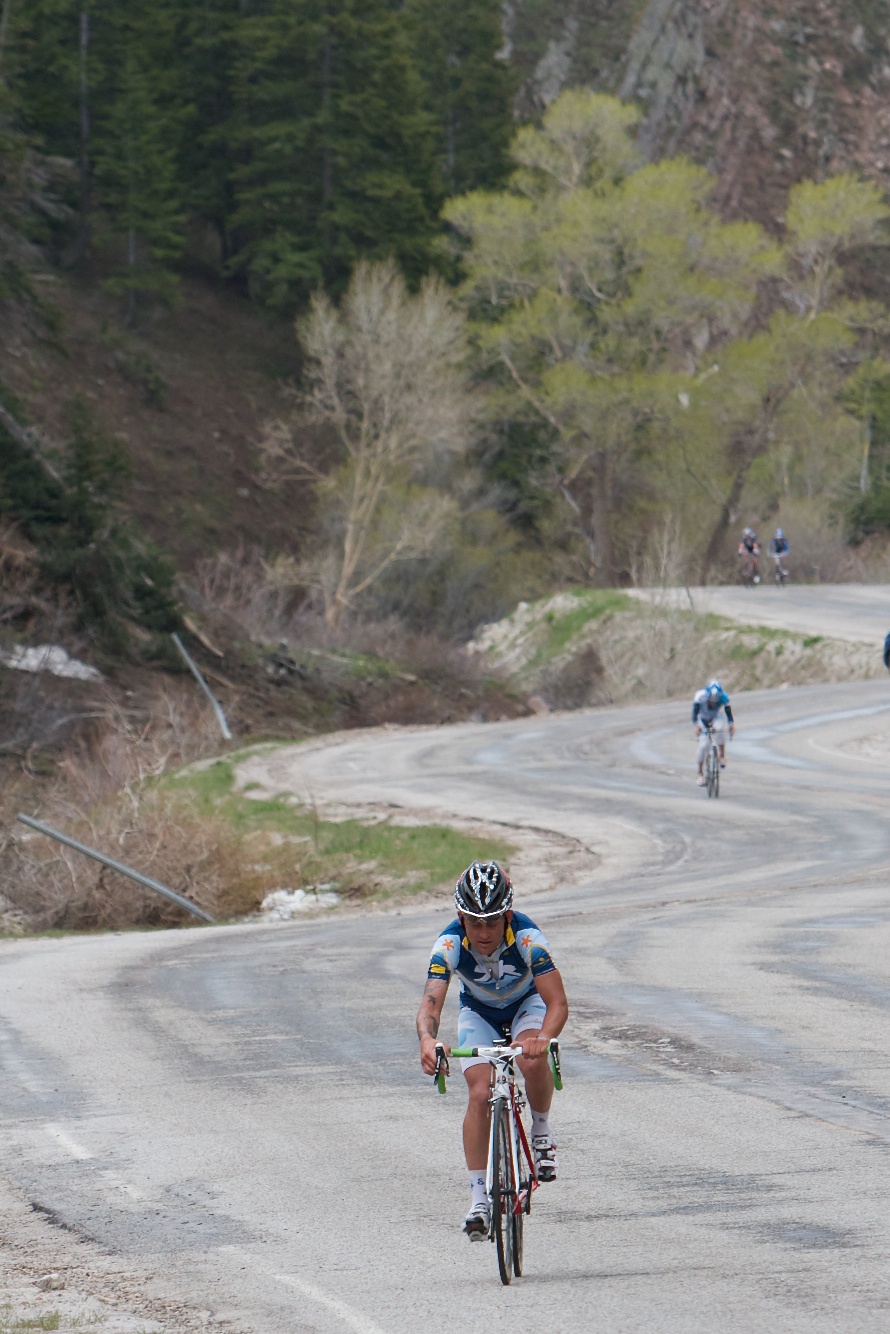
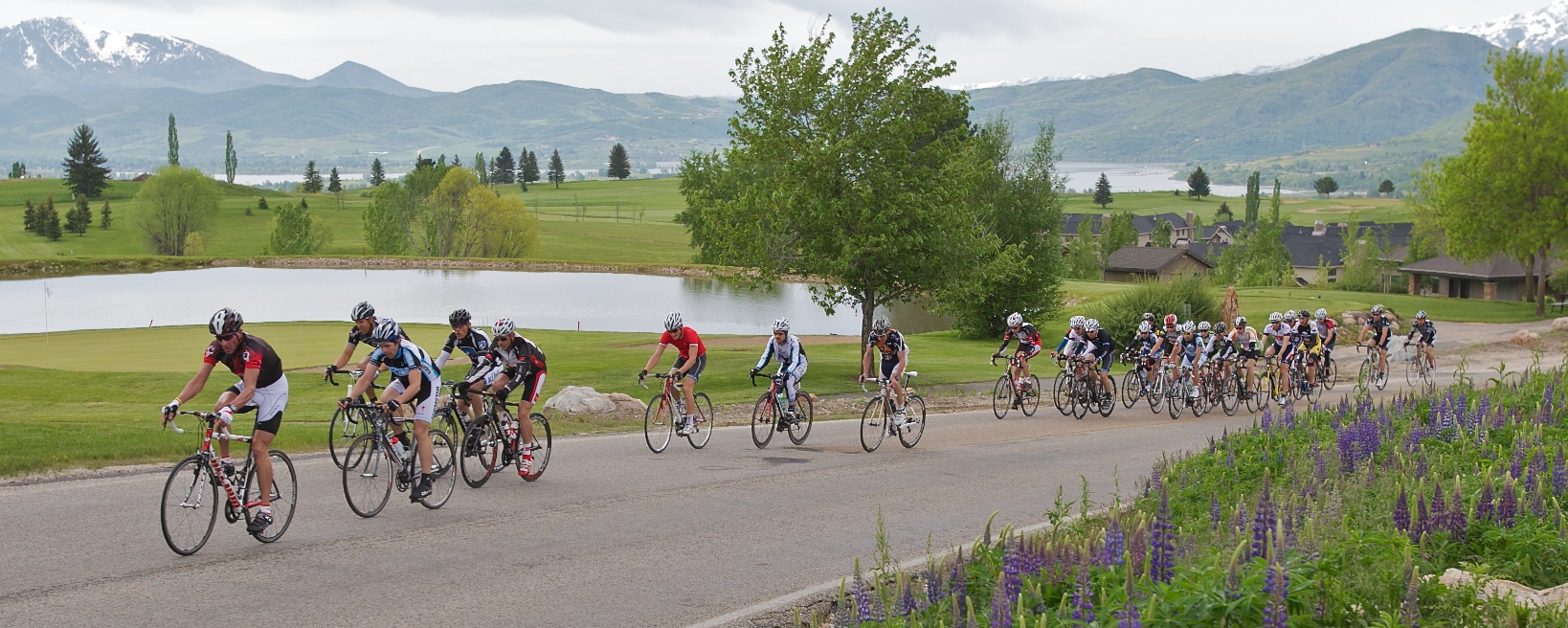
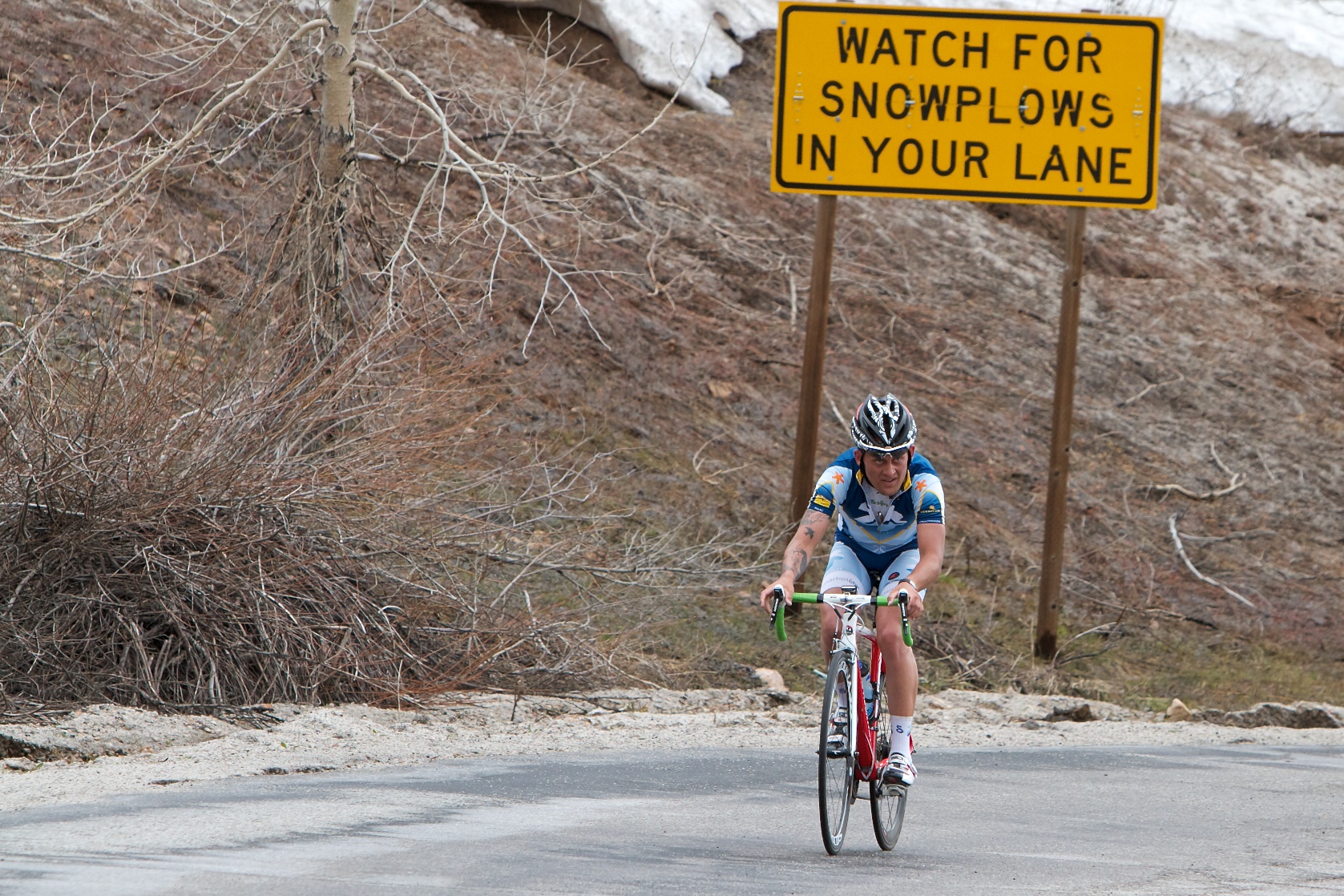
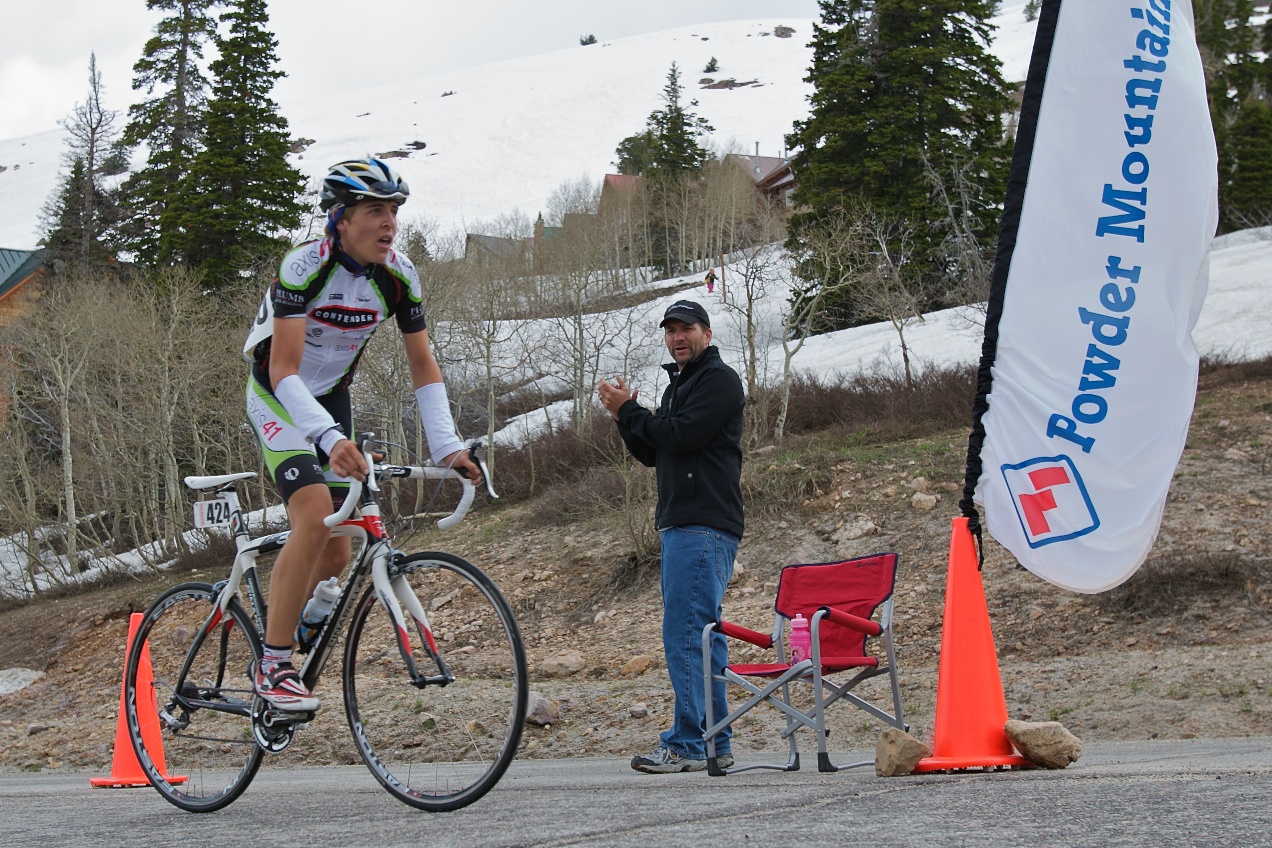
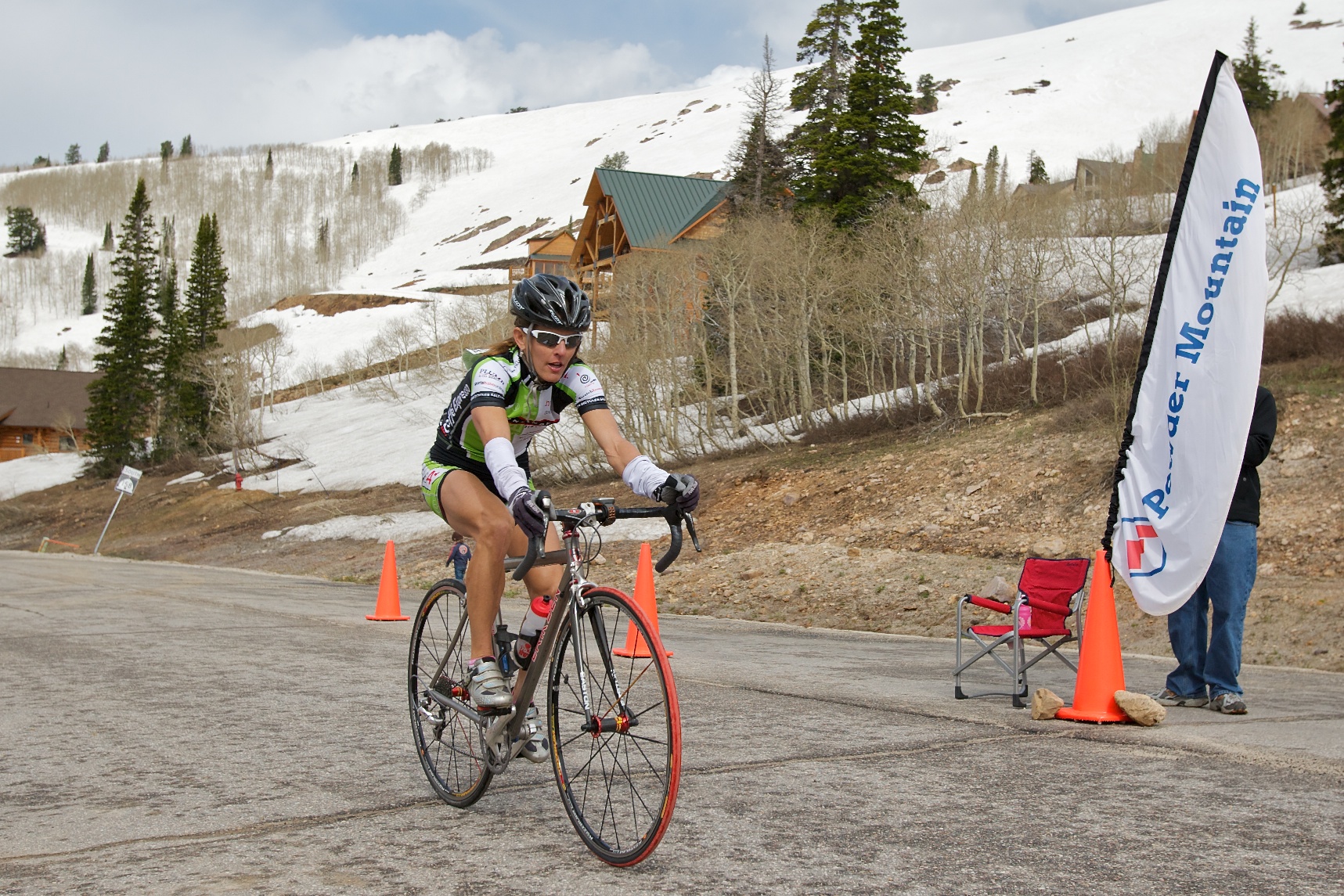
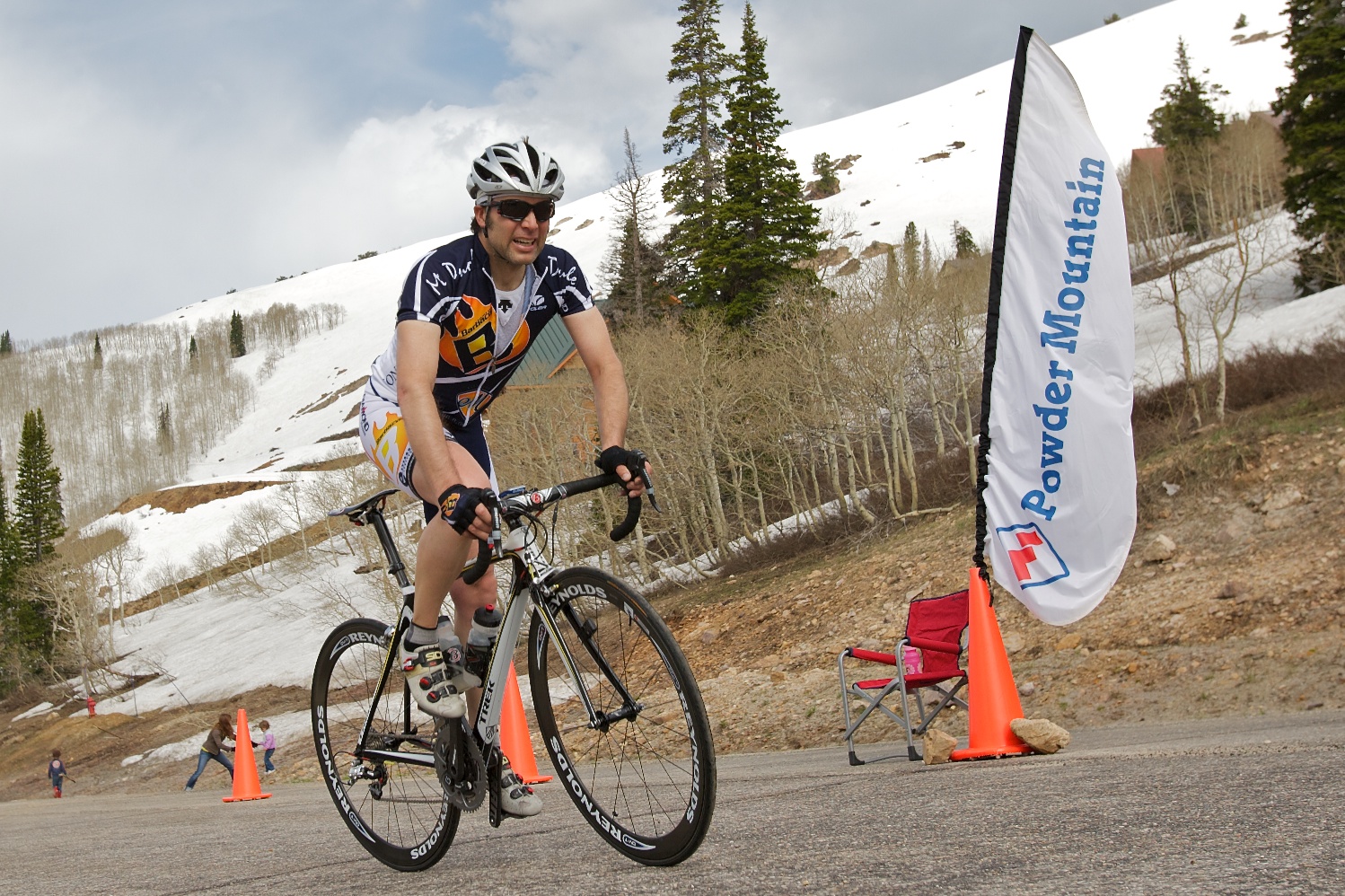
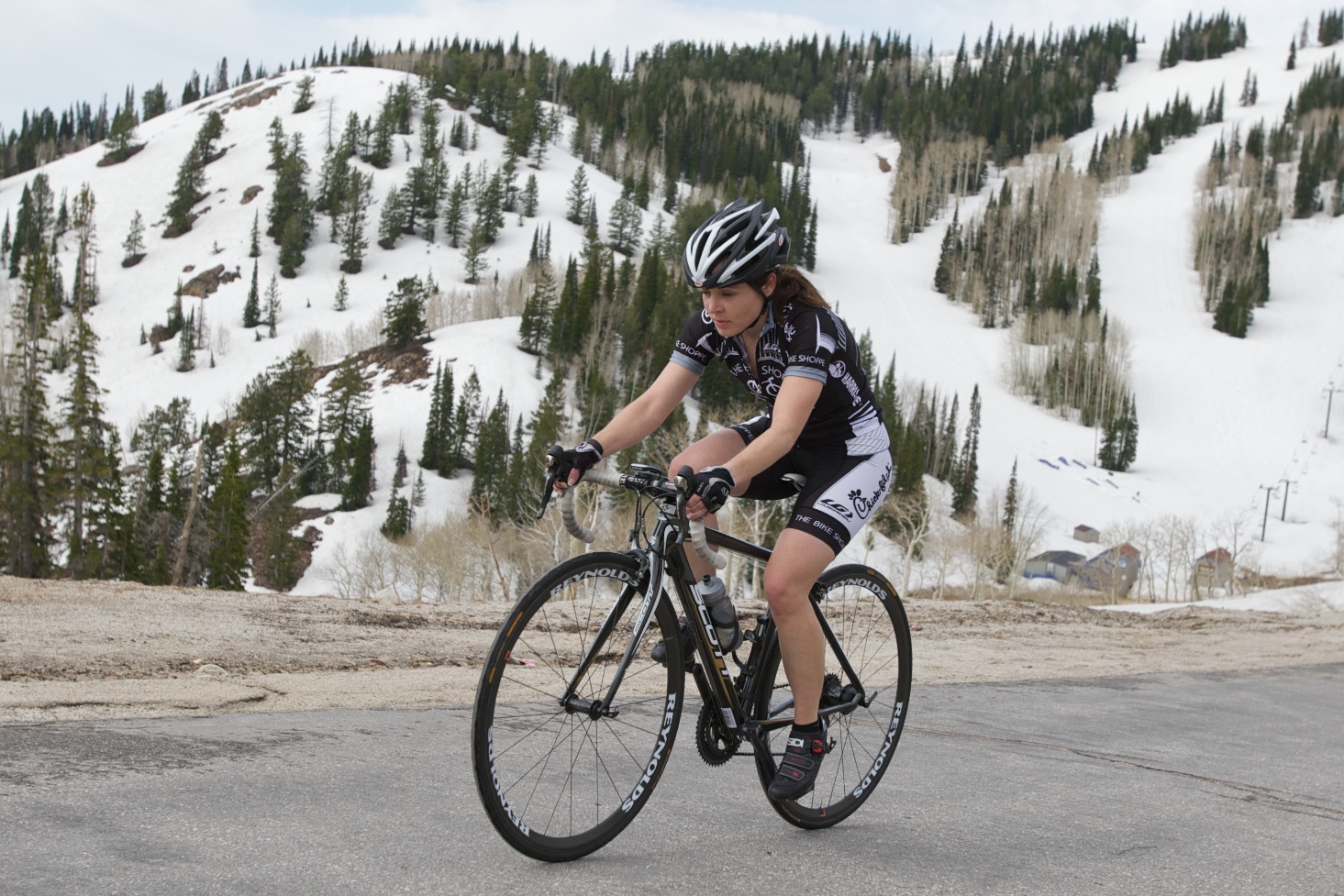
The third annual Powder Mt hill climb was held on 11 June 2011. Approximately 60 riders took the 6 mile, 3300 foot vertical challenge with the winner completing the race in a bit a little over 41 minutes. Photo: Dennis Montgomery.
6-11-11 – The 3rd Annual Powder Mountain Hillclimb proved once again just how rewarding the steepest climb in Utah can be. With UCA points, cash and numerous prizes on the line, 76 motivated climbers showed up to challenge the mountain, their rivals and themselves.
The deep snow still lingering up the road would prove to be a dramatic backdrop for this late spring classic and the snow from last year’s event fresh on everyone’s mind, the day started on the cool side with a brief spring shower. The rain subsided just before the start and the weather ended up being near perfect for such a grueling climb. The sun managed to show itself just in time for the awards ceremony.
The race to watch was the Men’s Cat 1-2. Norm Bryner and teammate Sam Kreig came with their game faces on. Newly upgraded Cat 2 rider and Ogden resident, Darren Goff, was also motivated to prove himself in his own back yard. The overall fastest time is awarded the Tecia Stout Trophy, a perpetual trophy established in honor of Tecia Stout who succumbed to ovarian cancer a few years ago. Nate Cisney held the trophy for the past year but a back injury kept him from defending. Cisney was the fastest rider in the previous two editions of the race. He set the standard in 2009 at 41 minutes 20 seconds for the 3300 foot, 6 mile climb.
The Powder Mountain Hillclimb doesn’t give anyone much time to warm up. Its steep from the get go. There’s a neighborhood to pass through and then the unrelenting climb really starts to take shape. Its at the road service gate where Bryner made his move. His attack was followed by Krieg, Goff and Erik Herrington but Bryner’s pace was too much. Bryner took the checkered flag in a record setting 41 minutes and 9 seconds earing his spot on the hefty Tecia Stout Trophy. Harrington followed at 42:45 and Sam Kreig took the final podium spot at 43:19. Darren Goff overcame his cold and took 4th at 43:19.
Norm Bryner won the overall. Photo: Dennis Montgomery.
There were many prizes and trophies up for grabs. Women’s Cat 4 winner Jessica Arbogast won the beautiful “Fastest Female” trophy with a time of 51:40. The unique “Clydesdale Trophy”, an actual Clydesdale horseshoe mounted on a plaque went to the fattest, I mean fastest, rider over 180 lbs. Nate Pack was this year’s Clydesdale winner. We all know that Nate Pack can climb!
Just finishing this “ridiculous climb”, as Junior National MTB Champ Keegan Swenson once described it, is a feat in itself. For that a “Lantern Rouge” is also awarded to the last rider up the mountain. Heather Smith took the prize in an admirable time of 1 hour 5 minutes. It’s a testament to the underlying theme of never quitting and never giving up. It embodies why so many of us race our bikes. Its to challenge and overcome and have a ball in the process.
A special thanks goes out to all who participated in this tough event and to the sponsors who made it happen: The Bike Shoppe, Peregrine Health, Enve Composites, Blue Iguana, Pro Bar, Roosters, Pearl Izumi Factory Store, Powder Mountain, Wolf Creek Resort, Diamond Peak Mountain Sports and The Bike Shoppe/Chick-fil-a Racing Team.
The third annual Powder Mt hill climb was held on 11 June 2011. Approximately 60 riders took the 6 mile, 3300 foot vertical challenge with the winner completing the race in a bit a little over 41 minutes. Photo: Dennis Montgomery.
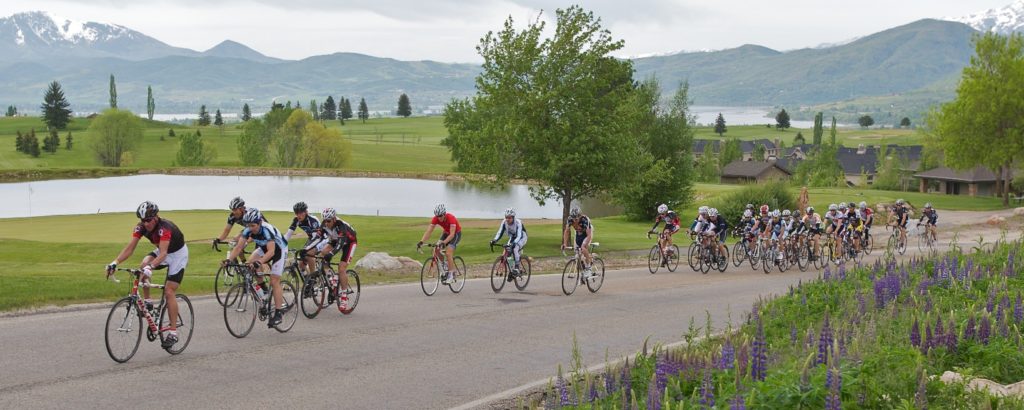
Photo: Dennis Montgomery.
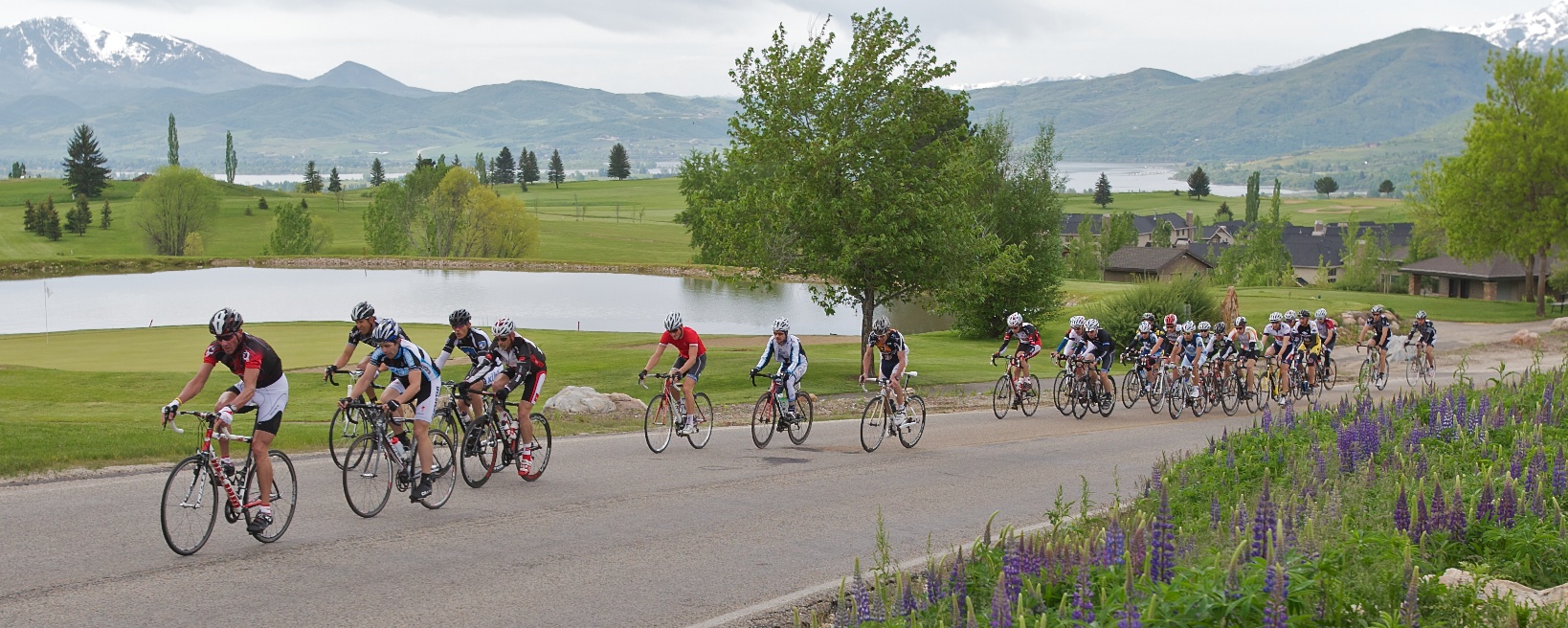
Photo: Dennis Montgomery.
Photo: Dennis Montgomery.
Photo: Dennis Montgomery.
Photo: Dennis Montgomery.
Norm Bryner won the overall. Photo: Dennis Montgomery.
Powder Mountain Hill Climb Results
June 11,2011
Place
Time
Bib Number
Last Name
First Name
Category
Cycling Road Team
1
0:44:50
210
BROWN
Cortlan
Cat 3 M
BIKEFIX
2
0:49:53
212
PACK
Nate
Cat 3 M
Team Big Ring / Gym Jones
3
0:47:36
211
LONG
Jeremy
Cat 3 M
Bicycle Center
4
0:48:23
213
PEREIRA
Cristiano
Cat 3 M
Animal Liberation Racing
1
0:51:40
309
ARBOGAST
jessica
Cat 4 F
2
1:02:06
311
DAHLBERG
Danielle
Cat 4 F
The Bike Shoppe / Chick-Fil-A
3
1:03:16
310
COOKLER
sarah
Cat 4 F
4
1:05:01
312
SMITH
Heather
Cat 4 F
The Bike Shoppe/Chick-fil-A
1
0:47:48
916
CLIFT
David
Cat 4 M
NA
2
0:48:08
918
GIBBONS
Eric
Cat 4 M
Bikers Edge
3
0:48:35
917
DEARDEN
samuel
Cat 4 M
4
0:48:41
922
KINGSOLVER
Ryan
Cat 4 M
YEA/ConsultNet
5
0:49:34
929
FESSLER
Blake
Cat 4 M
6
0:49:34
928
TASELL
Michael
Cat 4 M
Midoule
7
0:49:59
921
HURST
gary
Cat 4 M
Animal Liberation Racing
8
0:50:52
926
KNAPP
Jake
Cat 4 M
9
0:51:12
925
WILES
Travis
Cat 4 M
KUHL / Bingham Cyclery
10
0:54:23
923
RONNOW
Christian
Cat 4 M
FFKR/SportsBaseOnline
11
0:55:10
927
STACK
Scott
Cat 4 M
Real Cyclist
12
0:55:41
920
GIBSON
Justin
Cat 4 M
The Bike Shoppe / Chick-fil-A
13
0:59:27
919
GIBSON
Jaren
Cat 4 M
The Bike Shoppe/Chick-fil-A
DNS
924
SHELLEY
Collin
Cat 4 M
1
0:47:14
955
JOHNSON
Collin
Cat 5 – Citizen M
University of Michigan
2
0:47:32
954
JOHNSON
Connor
Cat 5 – Citizen M
3
0:55:58
958
XAIZ
Earl
Cat 5 – Citizen M
4
0:57:20
950
BLANGO
Matthew
Cat 5 – Citizen M
Ski Utah Cycling
5
0:58:10
951
FITZSIMMONS
Gavin
Cat 5 – Citizen M
Revolution Cafe Rio
6
0:58:26
959
BEDOYA
Daniel
Cat 5 – Citizen M
7
0:58:54
957
PETERSON
Ronald
Cat 5 – Citizen M
MiDoule
8
0:59:33
956
WHITE
kelly
Cat 5 – Citizen M
9
1:03:21
952
HOLMES
Breen
Cat 5 – Citizen M
10
1:11:10
953
HUNTER
James
Cat 5 – Citizen M
DNS
DNS
780
KENNARD
Gianni
Jr Boys 13-14 M
RMCC/Cyclesmith
DNS
DNS
781
SHELLEY
Tyler
Jr Boys 13-14 M
1
1:01:19
90
HATCH
marlene
Master 35+ F
1
0:44:26
762
ZIMBELMAN
Mark
Master 35+ M
Giant Cycling World – Skullcandy – Jumex
2
0:49:43
760
KADRMAS
Dan
Master 35+ M
Bountiful Mazda
3
0:56:21
761
OLSEN
Trent
Master 35+ M
TBS/Chick-fil-a Racing
1
0:43:55
439
WILLIAMS
Cris
Master 45+ M
Giant Cycling World – Jumex – Skullcandy
2
0:47:08
435
FLITTON
todd
Master 45+ M
3
0:47:53
436
FRYE
Norman
Master 45+ M
Ski Utah
4
0:53:05
438
SEABORN
rick
Master 45+ M
5
0:53:53
442
REESE
Spencer
Master 45+ M
6
0:57:52
440
WINNER
Todd
Master 45+ M
7
0:59:06
441
KOSN
Scott
Master 45+ M
Bountiful Mazda
8
1:01:17
437
SCHWAB
Bruce
Master 45+ M
1
0:48:51
870
COWLEY
Dirk
Master 55+ M
FFKR/SportsBaseOnline.com p/b Tour of Utah
2
0:48:57
871
KILGORE
tek
Master 55+ M
Mi Duole
3
0:53:38
876
HUNSKER
Jerald
Master 55+ M
Bountiful Mazda
4
0:55:23
872
LOUDER
Ken
Master 55+ M
FFKR/Sportsbaseonline p/b Tour of Utah
5
0:56:10
874
STORRUD
Shannon
Master 55+ M
Porcupine Racing
6
0:58:08
873
RONNOW
Lorin
Master 55+ M
FFKR Architects/SportsBaseOnline.com
7
1:02:37
877
McWhorter
Bruce
Master 55+ M
DNF
875
SIMMONS
Gary
Master 55+ M
Bountiful Mazda
1
0:51:29
128
BAGLEY
David
Master B 35+ M
Max International
2
0:52:21
135
KROMMENHOEK
Adam
Master B 35+ M
3
0:52:28
134
BLANCO
Walter
Master B 35+ M
Ski Utah
4
0:53:57
130
MURRAY
Bill
Master B 35+ M
Team Big Ring-RealCyclist
5
0:54:07
129
FLICK
Jeff
Master B 35+ M
RMCC/Cyclesmith
6
0:54:11
133
WHITE
Jamie
Master B 35+ M
Barbacoa – Mi Duole
7
0:54:45
131
OLMSTEAD
Doug
Master B 35+ M
The Bike Shoppe/Chick-fil-a
8
0:57:52
132
STEED
kevan
Master B 35+ M
The Bike Shoppe/Chick-Fil-A
1
0:41:09
30
BRYNER
Norman
Pro Cat 1-2 M
Barbacoa-Mi Duole
2
0:42:45
33
HARRINGTON
Erik
Pro Cat 1-2 M
RMCC/Cyclesmith
3
0:43:19
35
KRIEG
Sam
Pro Cat 1-2 M
Ski Utah-MarketStar
4
0:43:40
32
GOFF
Darren
Pro Cat 1-2 M
The Bike Shoppe/Chick Fil A
5
0:43:49
31
ELLIS
Eric
Pro Cat 1-2 M
Ski Utah-MarketStar
6
0:44:22
39
APOSTOL
Tyson
Pro Cat 1-2 M
Euclid
7
0:44:28
36
OLSEN
Aaron
Pro Cat 1-2 M
FFKR/SBO P/B Tour of Utah
8
0:49:50
34
HOWARD
Josh
Pro Cat 1-2 M
Team Bob’s-Bicycles.com
9
0:51:55
38
McConville
Robert
Pro Cat 1-2 M
Chemstar
DNS
37
PINKHAM
Chase
Pro Cat 1-2 M
BISSELL Pro Cycling
1
0:52:37
285
FRYE
Alison
Pro Cat 1-2-3 F
Ski Utah Cycling Team
2
0:53:09
283
ALTABELLA LAZZI
Dulce
Pro Cat 1-2-3 F
The Contender Club
3
0:59:28
284
APPLEBY-KRIEG
Karen
Pro Cat 1-2-3 F
ICE / Idaho Kidney Institute / SE Idaho Gastroenterology
WASHINGTON, D.C. – The U.S. Consumer Product Safety Commission, in cooperation with the firm named below, today announced a voluntary recall of the following consumer product. Consumers should stop using recalled products immediately unless otherwise instructed. It is illegal to resell or attempt to resell a recalled consumer product.
Name of Product: Carrier rack for mounting over front bicycle wheel
Units: About 100
Importer: Quality Bicycle Products of Bloomington, Minn.
Hazard: The bicycle rack’s mounting bracket can crack or break. When this happens, the rack can fall onto the bicycle’s front wheel, posing a fall hazard to the rider.
Incidents/Injuries: The firm has received one report of a rack mounting bracket breaking while the rider was on the bicycle, resulting in minor cuts.
Description: This recall involves Civia Loring bicycle racks. They have black aluminum tubing with bamboo panels and mount to the bicycle’s front fork. The word “Civia” is printed on the rack’s side panels.
Sold at: Independent bicycle stores nationwide from December 2009 through February 2011 for about $175.
Manufactured in: Taiwan
Remedy: Consumers should remove this rack from their bicycles immediately and contact the store where purchased for a full refund or replacement.
Consumer Contact: For additional information, contact Quality Bicycle Products toll-free at (877) 311-7686 between 8 a.m. and 6 p.m. CT Monday through Friday or visit the firm’s website at http://civiacycles.com/aftermarketloringfrontrackrecall/
The Salt Lake City Police Department is seeking the public’s help in locating and identifying a suspect vehicle and driver involved in the fatality of a bicyclist. On June 7th, 2011, witnesses called dispatch to report that a bicyclist had been struck by a vehicle at 756 South 700 East. Arriving officers found the bicyclist down in the roadway with severe injuries that resulted in her death.
Further investigation has narrowed the suspect vehicle to the following:
a Volkswagen Passat
manufactured during 1998-2001
dark in color
with front end damage and possibly windshield damage
Anyone with information is encouraged to contact the Salt Lake City Police Department at 801-799-4636, reference case 11-91175. Callers may remain anonymous.
This vehicle may be similar in appearance to the following:
Swenson, along with five junior men, made his European racing debut last week in Offenburg, Germany. In Switzerland, First-year junior rider Keegan Swenson (Park City, Utah/Whole Athlete-Specialized) immediately found his way to the front of the 60-rider field. Swenson dropped as far back as sixth before increasing his speed to move into second place at the finish line. Among the riders Swenson passed were Andri Frischknecht, who had a first and second in the first two World Cup races, and Dominic Zumstein, who placed third in Offenburg.
Swenson’s success as a first-year junior rider represents a significant high point for USA Cycling’s European junior rider mountain bike program. Swenson came through two USA Cycling Regional Development Camp and then was invited to two USA Cycling National Talent Identification Camps.
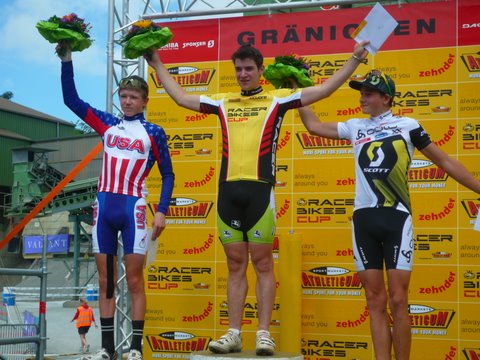
Swenson on the podium. Photo: Marc Gullickson/USA Cycling
Known as a guy who liked to dish out a little punishment as a cyclist, Burke Swindlehurst wasn’t about to let a little thing like retirement stop him from doing it again.
This time, though, Swindlehurst will be serving up the hurt from the somewhat comfortable role of race director as more than 300 brave – or is it foolhardy – cyclists line up to race the Crusher in the Tushar on July 16.
Described by Swindlehurst as “America’s most unique and challenging bike race,” The Crusher in the Tushar is a 79-mile test of endurance that will rival anything American cyclists have seen. With more than 12,000 feet of climbing and a mixture of asphalt and dirt road, the Crusher will almost certainly live up to its name.
“Of all my travel to far-flung places, I always enjoyed most getting back to ride my bike on the many roads, both paved and dirt in and around Beaver, my ancestral hometown,” Swindlehurst said of the race he’s drawn up in his backyard stomping grounds. “The concept of the “Crusher” has lived in my head now for more than 10 years and I have long dreamed of the day when an event would incorporate the incredible terrain and breathtaking scenery afforded in the surrounding Tushar mountains.”
The Tushar Mountains are one of Utah’s highest, though not best known, ranges. For those who join the 325-member field, however, the Tushars will certainly make a memory.
The Crusher is one of a growing number of ultra-endurance events in the state. The Rockwell Relay, Salt to Saint and Saints to Sinners relays are following the popular Ragnar Relay running format in some ways with teams riding non-stop over a couple of days and covering a few hundred miles. The Hoodoo 500, if you want it to be, might be Utah’s most-demanding individual cycling test with more than 500 miles and 30,000 feet of climbing across Southern Utah awaiting those who enter the solo class.
Swindlehurst’s Crusher in the Tushar, though, will blend the disciplines of road and mountain bike racing and make the choice of a bike second only to fitness in importance for the race. Tire choice will also give participants plenty to think about as they debate which set of rubber to put on their hoops.
Cyclists are free to choose any bike they want to ride in the Crusher – but once they start riding, they are not allowed to change bikes.
So while a racer might have an advantage on the dirt roads by using a mountain bike, a road cyclist might be able to build a huge lead over the first 17 miles of action because the road is paved and steep. Not having to haul the extra pounds of a mountain bike up the hill could prove to be the difference.
Then again, after hitting the dirt, a road bike will likely be sidelined numerous times with flat tires – allowing the mountain bikers to catch up and wave merrily at the poor unfortunate roadies searching desperately for a spare tube or CO2 canister.
Swindlehurst had just this conundrum in mind when dreaming up the event and has even included an entire section on the race’s website devoted to bike choice. Many participants have indicated they’ll likely chose a cyclocross bike – sacrificing a little speed on the asphalt for a little durability on the dirt.
“I recently had a friend liken the decision of which bike to choose for this course to that of a ski racer choosing his wax,” Swindlehurst said. “You’re probably not going to know for certain until the event is done. It’s all just part of the appeal, right?”
With a top elevation of more than 11,500 feet, Swindlehurst said it’s quite possible racers will – in true cyclocross fashion – have to cross some barriers to follow the course. But instead of jumping a hay bale or hurdle, there could easily be a snow bank or two in the way.
The Crusher in the Tushar, thanks to Swindlehurst’s reputation, has received its share of star appeal. Cyclists no-less-famous than Levi Leipheimer, David Zabriskie and even Lance Armstrong have mentioned the event on Twitter. Armstrong’s recent participation in Leadville 100 races gives some hope that he’ll break out one of his lesser-used bikes from the stable and join the 325-person field in the mountains above Beaver in July.
Less than 24 hours after registration opened, the Crusher’s field was nearly half full as racers rushed, perhaps against better judgment and hoping to avoid the rapid sellouts the frequent other events, to sign up for the race.
Swindlehurst said the race will have an 8-hour cutoff time to get on ‘official’ result. So racing hard is the only option.
“This event is certainly not to be taken lightly,” Swindlehurst said. “Simply finishing will be an epic achievement and it’ll be mandatory that one is prepared physically and mentally for the challenge.”
Otherwise, one’s Tushar will probably meets its Crusher.
Long known for their rather unique taste in fashion when if comes to gear for races, triathletes of all skill levels are increasingly migrating away from the two-piece kits that look more at home on a traditional cyclist.
Now, in an effort to shave seconds, or possibly minutes, off their time, triathletes are quickly transitioning to one-piece skin suits previously an almost exclusive domain of elite triathletes or cycling time trialists.
Gear manufacturers are embracing the change and rolling out an array of trisuits that are fast becoming a fixture at everything from small indoor-swim sprint races to full Ironman distance races. As one might expect, the technology and price range are nothing short of impressive.
Ranging from simple $100 suits with barely a whisper of a chamois to fabrics incorporating carbon fiber wicking technology, the newest suits have athletes of all levels looking – if not performing – like seasoned vets of the sport.
We’ll take a look at three trisuits ranging from entry level to professional worthy in a quick review.
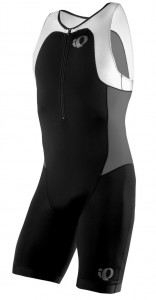
Pearl Izumi has jumped deep into the triathlon market and has a range of options. We were sent a pair of entry-level suits to give a test drive.
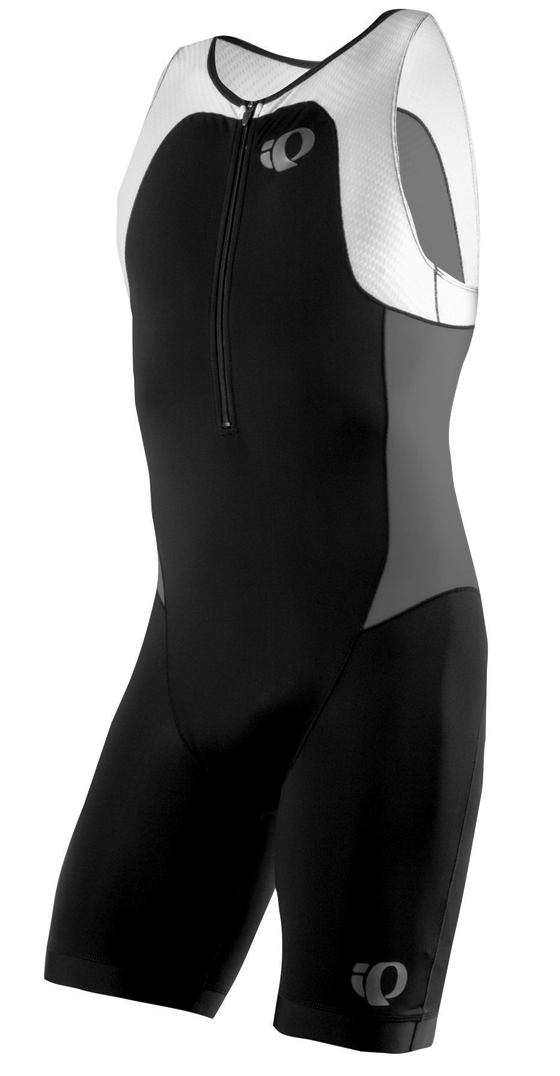
The Pearl Izumi Select Tri Suit is a sharp-looking model for those on a budget. With a price of $99, the Select comes without some of the frills associated with higher-end suits but provides a comfortable and functional experience. During my test session, I put the Select through a 1500-yard swim at the pool, an hour-long Spin class and a 5k run.
The swim was comfortable without much tugging or rubbing in the upper body or neck. With the full body suit, I could feel my body glide through the water. The only problem I found was when leaving the water.
The Select fabric and chamois absorbed the water and felt soggy compared to other tri suits I’ve worn in the past.
After a quick run upstairs and transition to the Spin class, I had dried out fairly well though the chamois gave me a bit of a squish when I mounted the bike.
For the next 60 minutes, I pedaled along with the rest of the class trying to pay attention to the fit, feel and function of the suit. The leg gripped stayed in place nicely and there was none of the expecting tightness around the neck and armpits.
The entry-level chamois, however, left something to be desired as I began to feel a bit uncomfortable after 30 minutes. I finished up the class, downed a gel and some water and quickly changed shoes for my run.
Again, the suit felt fine as it was completely dry and was performing admirably at transferring my sweat away. The five kilometers on the treadmill might have drawn a few puzzled looks from the walkers passing me on the indoor track, but as I motored along I had no comfort issues with the suit as the leg gripped held strong and the upper body section moved well with my strides.
Grade: B-. The Pearl Izumi Select is not for long-distance athletes. With an entry-level price and entry-level chamois, the Select does function perfectly well for the entry-level triathlete seeking a quality suit for a sprint distance race and will hold up just fine for an Olympic distance event.
Next in the test was the Pearl Izumi Elite tri suit with a suggested price of $130.
A step up in quality and price, the Elite has a slightly sturdier chamois and comes with an upgrade in fabric.
Putting the Elite to the test via another indoor tri, my experience was similar but different in all the right areas. The fabric repelled the water from the swim a little bit better and I was definitely less soggy as I left the pool. Still, water dripped from my body for a minute or two after the swim and my nether regions were definitely soaked.
Again, I felt no significant discomfort in the legs, waist or neck lines as I swam for 1500 yards. Flip turns posed no problem as I twisted my body every 25 yards, but that would not be an issue in an open water swim.
After the less-then-thrilling experience in the Spin class with the Select, I was a bit leery about how my bottom would like 60 minutes in the saddle with another entry-level chamois. But the Elite surprised me and I felt no discomfort despite forcing myself to stay in a seated position as long as possible while the Spin class instructor begged us to do a standing climb.
I moved to the run and, like with the Select, had a pleasant 5k on the treadmill.
Grade: B+ The Pearl Izumi Elite was a noticeable upgrade from the Select, but the squishy chamois and slow-drying fabric prevent a higher grade.
Finally, I stepped things up significantly and slipped into the TYR Carbon Zipper Back John.
With carbon fiber woven into the fabric, I felt fast just standing in front of the mirror. With a $270 price tag, I better be fast.
After a few wonderful experiences in the pool and Spin class with the Carbon, I gave the suit a real test at the Icebreaker Triathlon in American Fork.
The suit practically crinkles in your hand before being worn. But stretches wonderfully to fit your body like a glove. The TYR Carbon feels like a wetsuit in many ways and comes with a back zipper and an extra long pull cord.
As expected, the swim feels almost effortless as the material almost acts as a buffer to the water and your body glides from stroke to stroke. Because the amazing stretch in the fabric, flip turns posed no problems and leaving the water was a joy. Within seconds of exiting the pool, my suit had shed all water and I felt perfectly dry.
As I ran from the pool to Transition 1, I reflected back to the squish I had felt from other suits when hopping on the saddle. That was not the case with the TYR Carbon. Despite having a much more significant chamois, there was no squish and my bike ride was a dream as far as comfort goes.
Tucked into the aero position, the TYR Carbon moved well with my body and never gave me some of the telltale abrasions associated with many tri suits in the armpits or around the neck.
The leg grippers were beyond comfortable and my transition from bike to run was hindered only by my inability to put my shoes on quickly. A quick 5k run later I crossed the finish line just six seconds away from first place in my division – yes, six seconds away from first! Stupid running shoes! – and a huge fan of the TYR Carbon.
Grade: A The only thing preventing the TYR Carbon from getting an A+ is the price tag. Though $270 is nothing to some athletes, it is too much for most average-Joe trigeeks to part with. Still, if price is no object, the TYR Carbon is perhaps the best suit out there with pros, elites and average guys like me singing its praises.
The Bonneville Club commutes regulary and has accumulated over 15000 miles in it's commuter challenge. They also like to have fun! Photo: Robin Perkins
By Lou Melini
The Bonneville Cycling Club (BCC) has been a Utah fixture since 1976. The club is primarily known as a recreational and social riding club. The BCC puts on hundreds of rides annually for all abilities. The BCC has been very notable for large rides such as the ULCER and Little Red Riding Hood events. The club has donated tens of thousands of dollars to worthy charities as a result of ULCER and Little Red.
On May 1, 2010 the club added a “Bike Commuter Challenge” to show the community that the initials “BCC” puts back into the community more than just dollars.
Representing the BCC are some of the leading commuters in the Bike Commuter Challenge; Bob Renwick, Lawrence Bray (from Loa, Utah), Norma Blubaugh (from Cache Valley), Don (in charge of the ride schedule) and Mary Margaret Williams (current president).
Cycling Utah: I first want to say that as a member of the BCC since 1979 (and president in 1981), I am really delighted to see the BCC (bike commuter challenge) incorporated in the BCC (Bonneville Cycling Club). So why do you commute by bike? Tell me about your use of the bike as a means of transportation.
Lawrence Bray: I commute to save money, pollute less, and to fit more riding time into a busy day. Most of my commuting is to work and back but I can sometimes use the bike to replace the car for other trips. I ride to work when other logistical considerations allow and when the weather and road conditions are not too crazy. I live in the high country (7200 ft) in south-central Utah where it is usually a bit colder than the Wasatch Front. I have a little over a mile of dirt road each way on my commute as well as five miles of open (65 mph) highway with a fairly narrow shoulder. Happily, it is a very rural area (the nearest traffic light is 55 miles away) so traffic is light. I don’t commute when there is snow on the road but cold and dark are fine.
I live about 12.8 miles from where I work. It takes about 45 – 50 minutes to commute each way. If it were much shorter, it would have less appeal for me. About an hour ride each way is ideal for me. If it were much more than an hour there would be days where I would have to drive in order to meet other obligations. I lived in Heber City and taught at Park City High school for five years in the 90’s. That was a great bicycle commute in the spring and fall when the roads were clear.
Norma Blubaugh: When the guys at work asked why I started riding a bike instead of driving, my short, clever answer was, “The three ‘E’s: Economy, Ecology, and Energy”. I save a full tank of gas each month when I ride most days instead of driving. I use that savings to upgrade my gear for comfort and safety. My commute is 5 miles one way, and I usually take the bus about half way home (the uphill part of the trip). I commute to/from work, and also for light errands as time and energy allows, combining trips when possible, just as I do when driving. The Ecology aspect is obvious. It is a bit ironic that we are encouraged to drive less, which means walking or biking more, on days when the air quality is so bad we are told it is unhealthy to do so… The Energy aspect refers both to the desirable calorie burn and fitness benefits of cycling and to the enhanced alertness and energy level I enjoy when I bike to work. I enjoy it. Sometimes it’s the best part of my day, just me and the road. For me, bicycle commuting is one way to live my values and quietly serve as an example to encourage others inclined to try to make it work in their own lives.
I ride all year round, as often as family/work/social schedule permits. I can enjoy the ride down to about zero degrees with my current gear. I learned the hard, cold way to check the weather forecast every morning (minus 9 was not fun, even if I did get bragging rights at work). I will not ride on “Red Air” days, because I feel the difference in air quality when it gets that bad. I will ride in sun, rain, light, dark, hot, or cold as defined above when roads are clear enough so I won’t be forced into the uneven icy lane edges after a snowstorm. I do occasionally ride at night, and my early morning commute is dark several months of the year. I will ride more at night when I can add better reflective gear.
Bob Renwick: I bike commute for a number of reasons. Health: I do not gain and sometimes lose weight if I commute. I sleep better if I exorcise regularly.
Cycling is a lot less stressful for me than driving a car, as it is mentally and physically therapeutic. I also like saving miles on my car. I commute mostly for going to work, but occasionally, and more often, for errands around town like going to REI, the grocery store, post office, or shopping. I ride all year in almost all weather conditions, but I try to avoid rain downpours and snow packed or icy roads. I leave for work at 4:45 in the morning so I have quite a lot of experience with adverse conditions.
Don Williams: I commute primarily to work – and to club rides that are in between work and home. My commuting year normally starts in the mid-winter thaw like we saw this January and when work schedules permit. Because of project schedules, there is night commuting involved, there would be less if I got an earlier start – but I prefer to get to work in daylight, so I start later, but it makes the day a lot better. An average of once per week for the year is doable.
To start an active cycling season there is no better way than the mini-interval training that commuting provides. My first few days of commuting are a little restless until my body settles in to the routine of a brisk 1-hour workout inbound, sweaty clothes into a locker, followed by a hot shower, a full workday followed by a nice climb home. I’m fortunate that my firm, MHTN Architects remodeled our offices to LEED Gold standards two years ago, adding alternative transportation facilities consisting of secure bike storage lockers and a shower. Beats the old days of rinsing in rubbing alcohol when no shower was available.
Mary Margaret Williams: Commuting for me is a way to accomplish some of my life values: exercise, health, emotional well being, improve skills for riding in traffic, doing my small part in going green, in addition to decreasing air pollution. Furthermore, it saves dollars and gas. I have a 17 mile one way commute so the dollars add up. Riding to work creates a good mood to start the day. The ride home provides a workout so I don’t need to go out again. I enjoy passing other commuters along the way, sometimes counting how many people are out riding to work. I believe the best mileage for commuting is around 10 miles one way because the time it takes to ride is only a bit longer than if in a car. My commute requires a little over an hour one way if no mechanical problem occurs and depending on traffic lights which by the way can be annoying when you get stuck at those lights that bikes can’t trigger. Therefore, you have to either wait for a vehicle or walk over and push the walk button.
In addition to riding to work, when possible I make it a goal to commute to a club ride or out to dinner. Sometimes, I will stop by the store on the way home and pick up a few small items.
Participating in programs such as Clear the Air Challenge and BCC commuter challenge help motivate me to commute more often providing me with another goal.
Due to the early morning hours along with added travel responsibilities I have at work during the school year, it makes it difficult for me to commute while school is in session. Therefore, the majority of my commutes to work occur during the summer months. I will ride in poor weather conditions such as rain or snow but as a rule I don’t start a ride unless it is clear; Personally, I believe added risks of accidents are present with inclement weather conditions, however if cycling was my main mode of transportation, I would probably ride regardless. Riding at night is not a problem in fact I find it an exciting adventure and quite enjoyable. I do light myself up like a Christmas tree for optimum visibility.
Cycling Utah: Tell me about your involvement in the BCC. Also let’s discuss the Bike Commuter Challenge.
Lawrence Bray: I joined BCC in May 0f 2010. I am a native Utahn but began riding in 1983 in Alaska. Being a cyclist is a major part of my identity. I raced a lot in the 80’s and early 90’s but no more. I like the Commuter Challenge and I am surprised at the relatively small number of participants. I am glad BCC is putting some energy and support into it and hope the Commuter Challenge continues and thrives.
Mary Margaret Williams: I have been an active member of BCC from the first week we moved to Salt Lake City 12 years ago. During that time I have served on the Board in several positions including newsletter editor, member at large, vice president, and president. Belonging to a club provides many benefits including a great ride schedule; riding with others both for social aspect and safety issues: statistics indicate those who ride with a club have fewer accidents and are more skilled riders. Riding with others makes me push harder and improve my pace and skill.
Commuting has been a part of BCC for a few years, with the commuter challenge officially starting in 2010 for the purpose of encouraging members to commute more often be it to a club ride, work, store, or even to a friend’s home. The results are not for competition, but rather a challenge to accumulate miles as a club. One mission of the club is to provide opportunities for every aspect of riding for all types of riders and all reasons to ride; BCC advocates for safer roads and sharing the road therefore commuting fits right in with the mission. Due to rising pollution issues and gas prices, making commuting a priority is one of my goals as President.
Bob Renwick: I originally joined the BCC in 1984; George Orwell made me do it. I joined to learn new bike routes and get group motivation, but mainly to see new country and do longer rides where somebody new where they were going.
Norma Blubaugh: I joined the BCC last spring to support this cultural alternative in Utah. I was surfing the general topic of cycling, commuting, bicycle touring, etc., and found a link to the BCC. It was gratifying to see club photos on the site of other people who probably remember the first Earth Day
Cycling Utah: There has been a lot of debate regarding global warming. Also we have had another winter along the Wasatch Front with “red” days due to air pollution. How can the bike help with both?
Lawrence Bray: I believe the world would be a much better place and the human condition much improved if more people rode more bikes more often. Too bad our culture is so focused on convenience and expediency. I know Cycling Utah is not a forum for political activism, but there is no question in my mind that if the US Government is determined to intrude on our private lives, the state of our economy and physical health as a nation would be much better served by requiring every citizen to run or ride their bike for an hour a day than by imposing Universal Healthcare.
Norma Blubaugh: Until the air conditions are brought down to constant acceptable levels by other means (less diesel, more carpooling, better public transportation, etc.), I’ll continue to guard my own health by refraining from heavy outdoor aerobic activity on ‘bad air’ days. There would be fewer of these days if more people regularly biked and built air friendly practices into their daily routines.
Bob Renwick: There is a bit of catch 22 when the air is bad. One rides and helps reduce air pollution, but then you pollute your lungs more. That said however, I will ride on bad air days. I slow down a little to save my lungs and believe the overall benefit of not missing your exercise is greater.
Mary Margaret Williams: It is my opinion that everyone should do their part to reduce CO2 and assist in improving air quality. However, many people have jobs that make it difficult to commute, such as I do during school months. Promoting carpooling and commuting when possible is a goal.
Don Williams: Last spring I commuted 16 miles on a red air day with relatively high humidity – upon arriving at my office, a black film was coating all the leading edges of my bike frame. We’re breathing that stuff when the inversion sets in and that’s good enough proof to keep me commuting another day or two.
Cycling Utah: Don, you have been very involved as an officer in the BCC for most of your time with the BCC. Tell me about your membership, the BCC and the Bike Commuter Challenge.
Don Williams: I’ve been a member of BCC since moving to Salt Lake city about 12 years ago, and held office in the Club for 6 or 7 of those years. The Commuter challenge came about as a direct result of the Clear the Air challenge in July for the past 2 years. The Clear the Air Challenge is one month a year, great for keeping the energy level high, and posting some very impressive numbers in trips saved and lbs of emissions eliminated. However, the long haul is establishing a pattern of life-long habits that can make a year round difference, and what better way to start than with a cycling group.
Several of our most active commuters have not signed up for the challenge. Perhaps their personal level of advocacy is in those daily rides to work or shopping, but the BCC board is working to improve participation in all club programs through this year’s initiative of MORE 2011; More Members, More opportunities through heightened involvement of our membership, More riding, and exercise.
Current club membership stands at 300 and is steady. The Club’s articles express the need to promote all types of cycling, and commuting falls naturally into recognizing the needs and wants of our membership, while advocating improved road usage for cyclists.
Cycling Utah: Mary Margaret, you are the current president of the BCC. The Bonneville Club has done an exemplary job of raising funds for various causes. Tell me about some of the charitable work.
Mary Margaret Williams: Within the past several years, the Club’s primary focus has evolved toward giving to the Salt Lake and surrounding communities. By raising substantial monies for charitable causes such as “Women health issues” and the “Olympic Sports Youth Program”, BCC has been able to make a difference in the lives of our own community members.
BCC has contributed thousands of dollars to charities. These dollars come from our two major events Little Red and Ulcer. The recipients of our donations also take an active role in the event. For example, The University of Utah Genetics center provides additional fundraising as well as volunteers. As a result we assisted in raising $60,000 for University of Utah Genetics. The Olympic Park youth sports program provide over 50% of the volunteers as well as organizes volunteers. For this program we were able to give $9000 from our rides. In addition the BCC raised $500 for the Tour De Cure, and $1500 for the MS 150 in 2010.
Furthermore, we are able to increase safety skills of riders as a direct result of our bicycle skills classes and ride marshal program. BCC is proud to be able to contribute such great efforts to Salt Lake and surrounding cities in Utah.
(Editorial note: Both Don and Mary Margaret are “League Cycling Instructors” from the League of American Bicyclists, providing annual riding skills seminars.)
Cycling Utah: What are your commuter bike choices?
Lawrence Bray: I commute on a cyclocross bike with heavy commuter tires. The mix of dirt road and pavement has shaped my choice in bikes. A pure road bike was inappropriate for the dirt, sand, and sometimes mud of my loooong hilly driveway. I only have one bike now for the first time in 25 years. It works great for high-speed long distance road rides when I switch wheels.
Bob Renwick: Last spring Millcreek Bicycles shop in Olympus Cove built up a Gunnar Fastlane commuter and light touring bike for me.
Mary Margaret: I have a separate bike for commuting. My commuter bike has a bike rack and lights. It is a road bike but if my schedule changed
o allow me to commute more often, I would probably look into a true commuter bike with fenders and features made for the purpose of commuting. I wear a backpack that contains wallet, phone, clothes and shoes. In my bag on the bike rack, I usually pack my lunch along with a bungee cord, necessary tools and tubes for on the road maintenance. A must have for a commuting bike would be lights and a bike rack with a bag attached. I always wear Road ID tag and carry health insurance card.
Don Williams: I follow the tried and true philosophy of John Forrester, the founder of the Effective Cycling program for the League of American Bicyclists, John preached steel frame bikes for commuting, so 5 years ago when my 20 year old commuting bike frame cracked on my ride into work, I made it down the hill to a local bike shop and bought a steel framed cyclocross bike. The geometry was right, the handling responsive. The extra brake levers (found on some cyclocross bikes) come in handy when riding in traffic. The new hi-intensity strobe taillights can be seen from outer space, and makes one definitely more comfortable when riding home in the dark. A front strobe and a steady light mounted down low are my favorites for extended riding in darkness. Clip on fenders cut down on weight and the cleaning bill if you get caught in the rain on the way home.
Norma Blubaugh: My bike is a “tank” that I bought at a garage sale, so long rides are a workout rather than recreation. I added fenders and a rear rack with folding baskets to the sport hybrid bike. It already had a kickstand, which is very useful for quick errands in town. I carry a light duty cable lock to keep the bike from falling over when looped around a pole. Someone would have to be desperate to steal this bike! It is my only bike right now. The best comfort item besides a good frame fit is a gender specific seat 😉 Lights are not a comfort item, they are essential safety equipment.
Cycling Utah: What is the best part of being a member of the Bonneville Cycling Club?
Don Williams: Best part of being a part of any club particularly BCC – like minded individuals can share in the joy of cycling, share in the experience and pain of training, share in the enjoyment of supporting major charities with hundreds of service hours and a few dollars.
Bob Renwick: I like the group and the group experience. Riding with nice people and friends makes it easy to put in a lot of miles. I also like to ride in new areas and in BCC there are lots of really varied rides. You also get to learn a lot about bikes and how to ride safely and in a group.
Mary Margaret: The best part of being a member of BCC is having a ride schedule that provides something for everyone in addition to utilizing our rides to increase skills, reduce accidents, and promote cycling.
Norma Blubaugh: I’ve only participated in the BCC’s Commuter Challenge, so that’s the best part so far.
Addendum from column editor Lou Melini: Perhaps as a result of the commuter challenge, the Bonneville Cycling Club was awarded as Bicycle Club of the Year from the League of American Bicyclists, one of eight such clubs around the country. Congratulations on the hard work of the BCC officers and volunteers within the club.
Also I wish to apologize to REI employee John Higgins in the March commuter column. I misidentified him as “John O’Brien,” a different Aussie I once knew.
[Editor’s Note: The club has totaled 15000 miles and 14,277 lbs of emissions saved in its commuter challenge. Last year, the club mileage (non-commuter) competition surpassed 1 million miles cumulative over the last 10 years.]
If you have a suggestion for a commuter profile, have a commuter question you wish me to address, or other comments, please send them to [email protected].
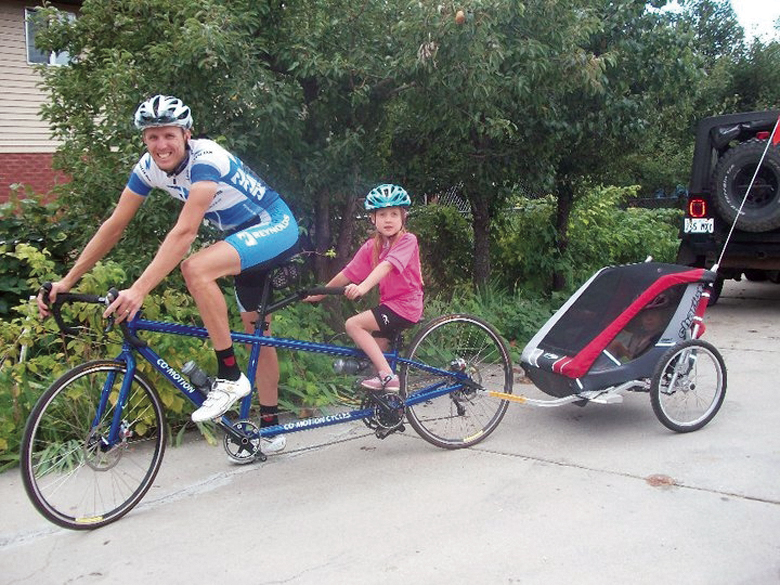
By Ryan Barrett — One of the things I am attempting to instill in my kids (3 girls and counting!) is my love of cycling. I did not come from a “cycling family”, but my wife did, with a father and three brothers who all raced. I would be lying if I said this was a purely philanthropic attempt to allow them to learn the freedom that comes with cycling. Yes! When the kids are young, their bike time is our bike time and my initial purchase of a trailer was largely to allow myself to continue to train around a lifestyle where training is less and less a priority.
Anyone who has had children will tell you, your life changes fast! Unless you are making your living pedaling, bike time becomes increasingly difficult to justify. But, don’t despair- you can continue to train with kids by purchasing a trailer.
Use you own judgment on what is safe, but I find that once an infant can holds its head up, it is safe to ride in trailer. We started our kids off in the trailer at about six months. I have seen people with younger children in their car seats in the trailer, but that is not really how trailer are designed.
Many people do not put helmets on their kids in the trailer. It is true that trailers are very safe. The rider can crash and the trailer will stay upright. That said, why delay learning safe riding habits? Put a lid on that kid! I have visited kids in the ER with injuries that could have been prevented by wearing a helmet, and it’s not something I wish on anyone, much less a child, so (and I’m trying not to get too preachy here) just do it! As we all know, kids mimic what their parents do so wear one yourself.
There’s a huge array of trailers on the market. Think of this as a long term investment, especially if you plan to have more kids. Yes, you pay a little more up front for quality, but it will last. You can buy one at a toy store, but would you buy YOUR bike there?
On a similar note, if you are planning to have more than one kid within a few years of each other, I recommend getting a double (i.e. – two seater). Yes, it is wider, but you should be riding primarily on open roads and paths, so a little extra width isn’t such an issue. And when there is only one kid in the trailer, it allows them more room. And yes, they will want room.
Also, many people fear there bike will be damaged using a trailer and so will only ride it with an older bike. With modern trailers, it is simply attached via your rear quick release. I have pulled a trailer on each of my race bikes over the past seven years and have never suffered any damage. I actually did my first ride on my custom Seven pulling the trailer… desperate times call for desperate measures!
One thing that became apparent when we started pulling our kids around is that the trailer is an excellent place for a nap! This can become an issue as they get older- as late day rides to lead to late nights. But, when the kids are awake, it is important to have books, water, even snacks as they get older. We’ve also found that planning the ride with a stop at a park gives the kids something to look forward to. Ultimately, increased enjoyment for them will lead to increased bike time for you! I’ve also found that having a trailer can provide a great workout in a short time frame, allows a stay-at-home spouse some much needed alone time, or can be a great day out for the entire family.
Ryan Barrett is the owner of Turbo! Sports Management- an independent sales rep in the cycling industry and coaching business. He has over 20 years of racing and coaching experience. A self-proclaimed “lifer”, Ryan has raced with the Schroeder Iron and NetZero professional teams, as well as the US National Team, and competed in many of America’s most prestigious races including the T-Mobile International/San Francisco Grand Prix, First Union USPRO Championships, USPro Criterium Championships, Redlands Cycling Classic, Cascade Cycling Classic, and many more. Ryan was featured in the full-length documentary “The Hard Road” about the NetZero team, is still an active Category 1 racer, was the 2005 and 2006 Utah State Road Race Champion and the 2007 and 2008 Utah State Criterium Champion. He lives in Provo, UT with his wife and three daughters.
The “Loneliest Road in America” just got a little less lonely.
Each June since his Stage IV head and neck cancer diagnosis in 2001, Jeff Warren sets off on a journey via his Litespeed Siena from his hometown of Reno, Nevada, to the steps of Huntsman Cancer Institute, where he endured the rigors of what he calls “slash, burn, and poison” (clinically known as surgery, radiation, and chemotherapy).
This June 18th, after riding for four days from Nevada, Warren will be joined by hundreds in the community for the last 140 or 40 miles in the “Huntsman 140.” The ride, which is now opened to the public for the first time, is a ride for survivors and supporters, a great LOTOJA training ride, and a fundraiser in honor of all cancer survivors.
“Cancer is not a solo act,” Warren said. “This ride is a metaphor for the cancer journey. Some parts of it are grueling, when you’re pushed to your limits, and there are sections that, like cancer, are extremely lonely, but you still have family and friends cheering for your success.”
Cyclists and teams can register at www.huntsman140.com. For a $70 registration fee, cyclists will receive a fundraising web page, a cycling jersey, on-course support, aid stations, and a finish line celebration. Each cyclist is required to raise an additional $70. 100% of those donations fund cancer research at Huntsman Cancer Institute.
Brigham City (Salt Lake City), Utah The American Diabetes Association’s Tour de Cure® presented by Larry H. Miller Dealerships is challenging local cyclists to join the movement to Stop Diabetes and raise funds to help change the future of diabetes, and is welcoming one of the nation’s professional cycling teams, Team Type 1 and its recent addition Team Type 2. The teams will join more than 50,000 other cyclists at sites throughout the country including over 1600 cyclists at the Utah Tour de Cure happening on 6/11 at Rees Pioneer Park in Brigham City for riders of all ages and ability levels.
Nathan Bartels of Team Type 1 Triathlon Team (sponsored by OmniPod) will be the keynote speaker at the Tour de Cure VIP Dinner on June 10, 2011 in Brigham City. On Saturday, June 11, Nathan Bartels will speak with our media, have photos taken with our Red Riders (riders with type 1 and type 2 diabetes), and commence the ride. The ride itself has start times at 7:30am (100 mile), 9:00am (80 & 60 mile), 10:30am (25 mile) and Noon (Family Fun Ride).
Team Type 1 was founded in 2004 by cyclists with type 1 diabetes to compete at the highest levels of the sport. These passionate professional cyclists are supporting the American Diabetes Association by participating in several Tour de Cure cycling events in addition to their race schedule. Team Type 1 took on the challenge of raising funds for diabetes in 2006. Seeking to represent both major groups of people with diabetes, the team added a new group of cyclists with type 2 diabetes, appropriately named Team Type 2.
Team Type 1 makes a fourth trip to the Tour of Utah in August, but this year with a higher designation. The team gained notoriety for winning the Race Across America multiple times before registering for professional status in 2008. Six of the current 21 members have Type 1 Diabetes, so the mission for Team Type 1 – sanofi-aventis continues to be raising awareness for diabetes.
“When Joe Eldridge and I formed Team Type 1, we wanted to challenge one another to take control of managing our diabetes, while trying to become the best cyclists we possibly could,” said Phil Southerland, founder of Team Type 1. “Since that time, our team has surpassed all of our expectations and has truly joined the fight against diabetes by raising funds in the Tour de Cure events. At the same time, we have taken control of managing our disease and truly hope that we will live one day without diabetes.”
In Utah, Tour de Cure’s Presenting Sponsor is Larry H. Miller Dealerships. Sponsored locally by SelectHealth, Jason’s Deli, Questar, Intermountain Healthcare, Nate Wade Subaru, IM Flash Technologies, Pacific Steel, OmniPod and sponsored nationally by Gold’s Gym and CLIF Bar, the Tour de Cure features a variety of routes. This fully supported, cycling, fundraiser takes you past the Bear River Bird Refuge, Golden Spike Monument and the famous ATK Rocket Garden in scenic Box Elder County.
To find out more or to form a team for next year’s Tour de Cure, call 1 888-DIABETES x7075 or visit main.diabetes.org/utahtourdecure.

 WASHINGTON, D.C. – The U.S. Consumer Product Safety Commission, in cooperation with the firm named below, today announced a voluntary recall of the following consumer product. Consumers should stop using recalled products immediately unless otherwise instructed. It is illegal to resell or attempt to resell a recalled consumer product.