By Charles Pekow — If you plan to drive to certain mountain biking areas on federal lands in Montana and Colorado, you may soon need to pay for parking. The fees are intended to support trail and land maintenance in these areas.
Starting May 15, 2025, parking in the Big Hole River Corridor in Montana will cost $5 per day or $20 for a seasonal pass. For more details, visit this link.
Similarly, beginning May 21, 2025, the Bureau of Land Management (BLM) will charge $4 per day or $20 annually to park at sites managed by the Uncompahgre Field Office in Colorado. Holders of certain federal passes, including the America the Beautiful Pass, National Parks and Federal Recreational Lands Senior Pass, or Access Pass, as well as Golden Age or Golden Access Passport holders, will receive a 50% discount.
In a state where nearly half the land is public, supporters worry a thriving industry will feel the pain of budget freezes, job losses.
By Katie Klingsporn, Wyofile.com — Trail projects around the state have kept Wyoming Pathways busy in recent years. Fueled both by the growing popularity of outdoor recreation and by statewide interest in nurturing the industry, the nonprofit group has worked with local and federal partners to develop trails from Togwotee Pass near Dubois to Pole Mountain near Laramie and Commissary Ridge near Kemmerer.
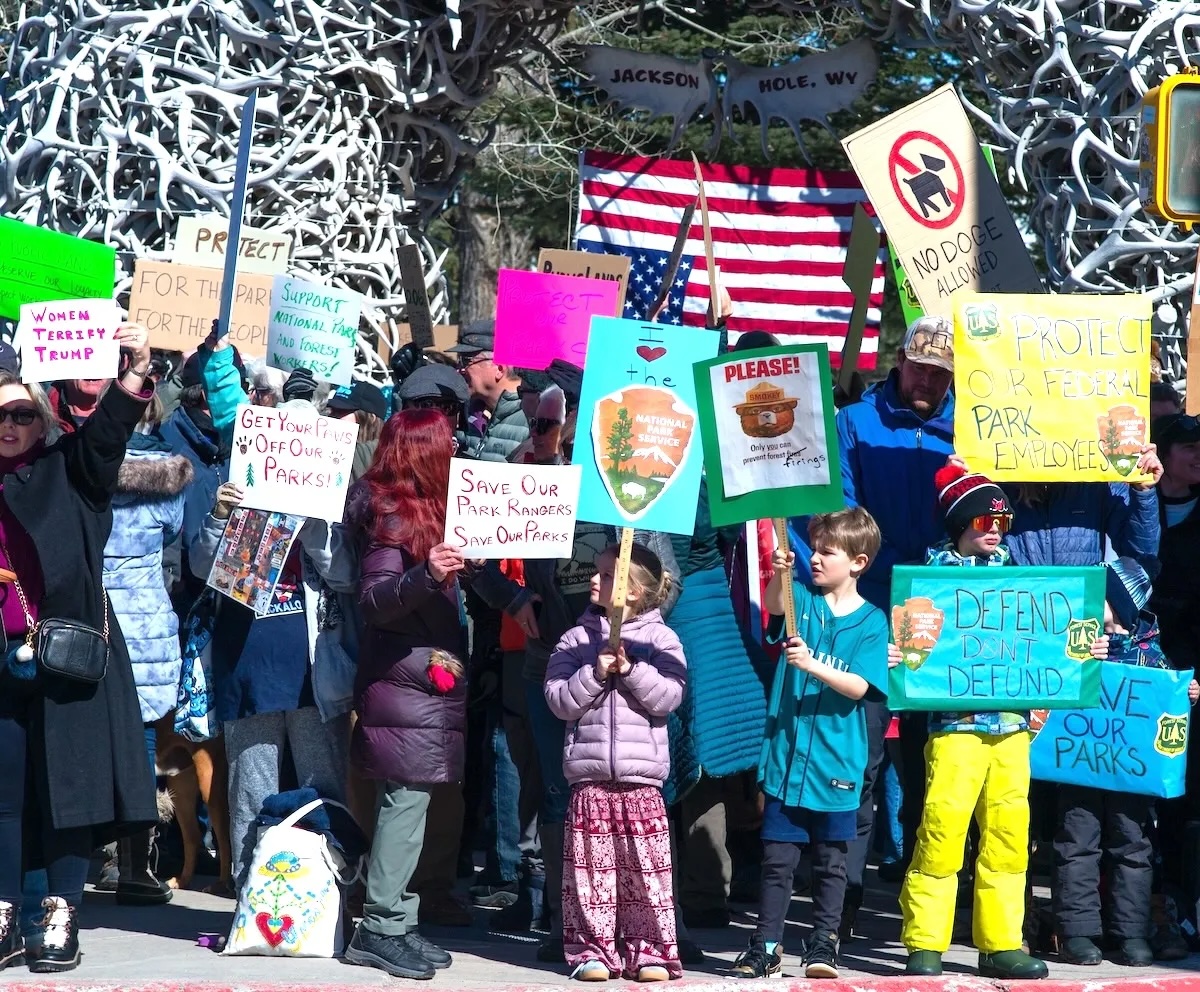
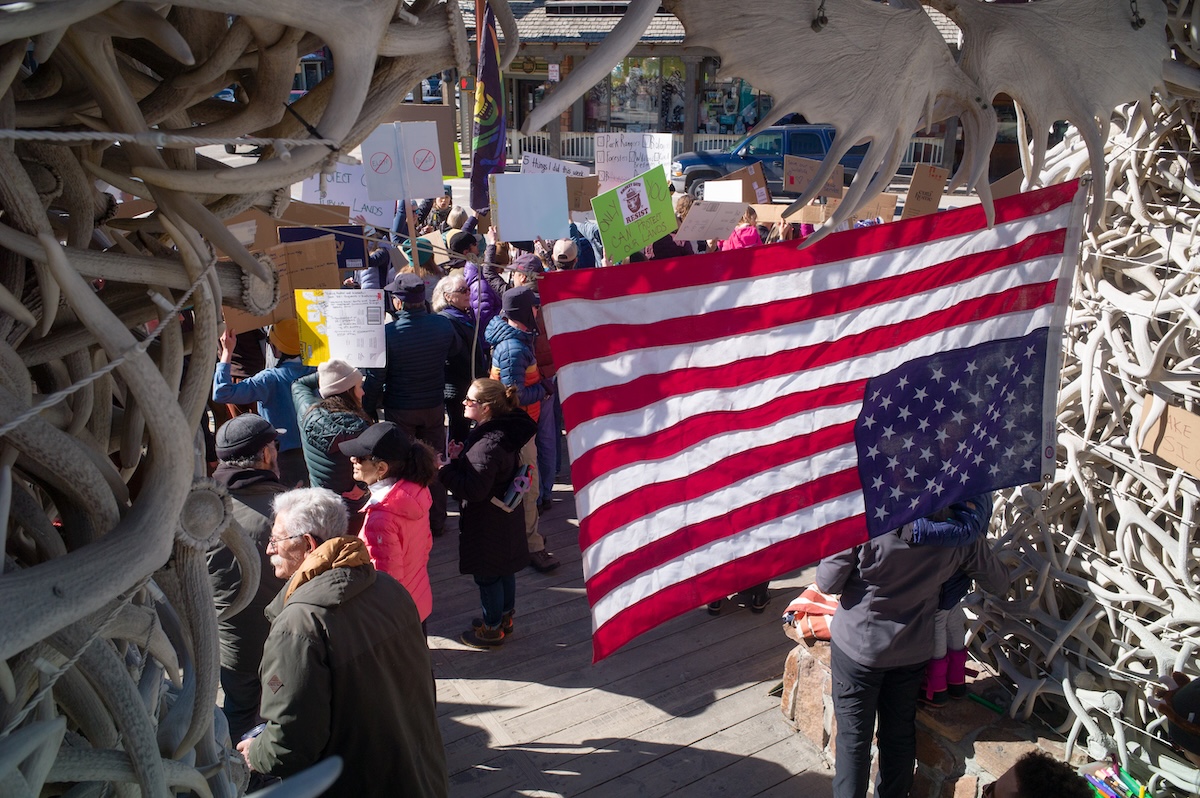
A crowd protesting cuts to the ranks of workers in Grand Teton National Park, the Bridge-Teton National Forest and other federal agencies gathers on the Jackson Town Square on March 1, 2025. (Angus M. Thuermer Jr./WyoFile)
Wyoming Pathways Executive Director Mike Kusiek expects that pace to slow if not halt due to the Trump administration’s recent cuts that resulted in untold job losses in federal offices managing Wyoming’s national forests, parks and other public lands. Federal spending freezes will also surely damper the work, he said.
“Ninety percent of our budget is federal funds to get work done” on national forest and Bureau of Land Management land, Kusiek said. “Funding streams are frozen.”
Even more discouraging, he said, is this: If those funds become unfrozen, “do we still have enough people working on the landscape to help deploy them?”
Questions like Kusiek’s are hovering over Wyoming’s outdoor recreation industry, which has been bulking up in recent years as increasing crowds flock to the state’s national parks, mountain biking networks, snowmobile trail destinations, ski hills and fishing waters.
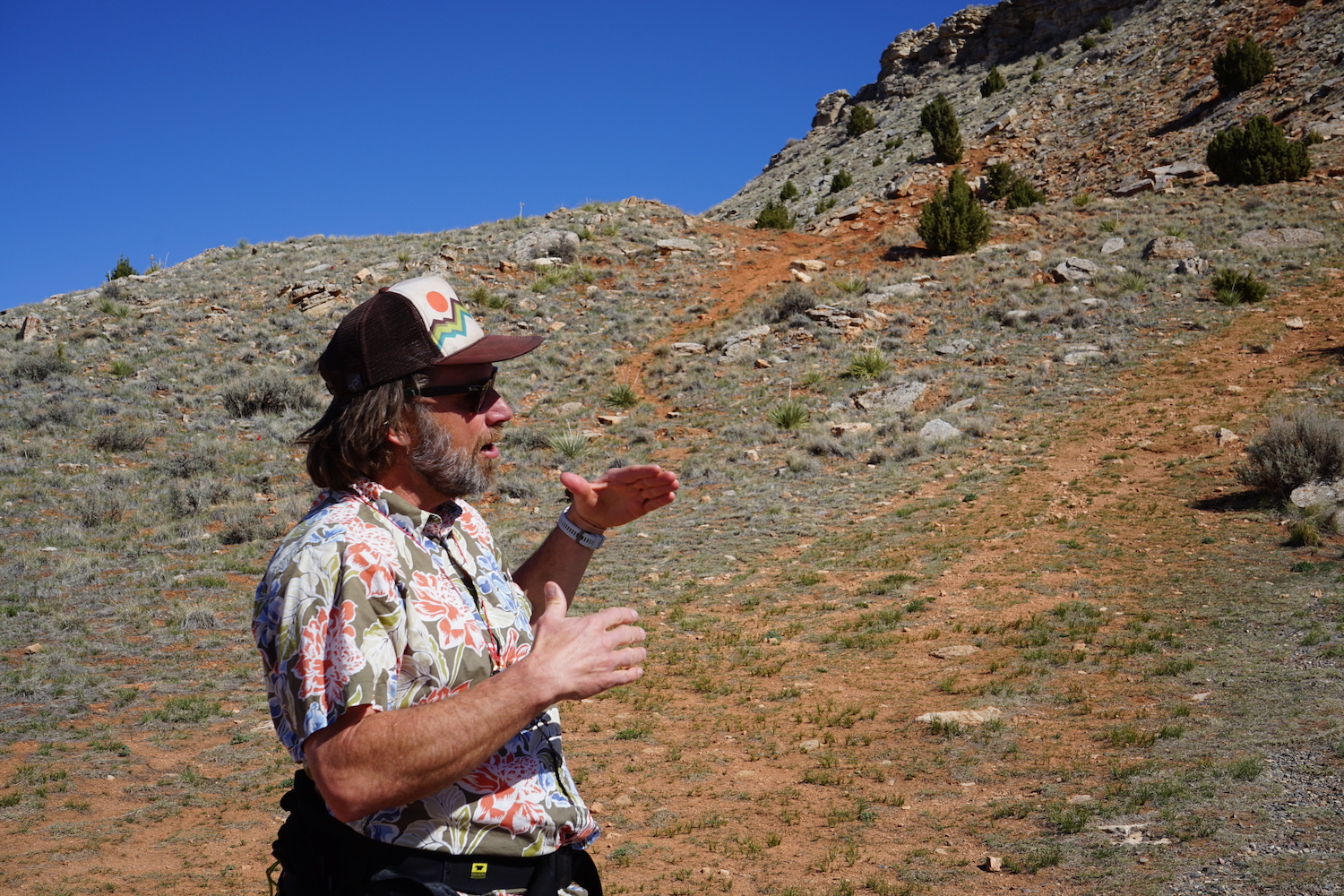
Wyoming Pathways Executive Director Michael Kusiek stands at the base of Roundtop Mountain in April 2022. Crews were building a new trail on the well-known Thermopolis promontory. (Katie Klingsporn/WyoFile)
Now, however, a community that many argue is already understaffed to meet increasing demand has taken a large hit. And advocates are worried.
“Public land management is the cornerstone of Wyoming’s outdoor recreation sector,” said Addi Jenkins, executive director of Wyoming Outdoor Recreation Business Alliance. In a state where nearly 50% of the land is public, she said, these layoffs threaten critical services to communities and businesses. “Without a well-staffed workforce, we risk losing the very resources that allow Wyoming’s outdoor economy to flourish and our way of life to persist.”
Of the 15,798 jobs that are identified in the Wyoming outdoor recreation sector, an estimated 884 are government related, said Dan McCoy, director of the Wyoming Outdoor Recreation, Tourism and Hospitality Initiative.
“Outdoor recreation is a big part of our economy in Wyoming,” he said, noting that the industry generated $2.2 billion last year.
The success of the industry rests in large part on capable management of public lands, the Wyoming Outdoor Council noted in a call to action this week.
“The agencies that manage the public lands … will now face significant constraints — not only in their ability to fight fires, maintain campgrounds and trails, and respond to emergencies but also in overseeing activities that allow for responsible multiple use of our public lands and support local economies,” the group’s email read.
After all, Jenkins said, a slowdown in crowds is unlikely.
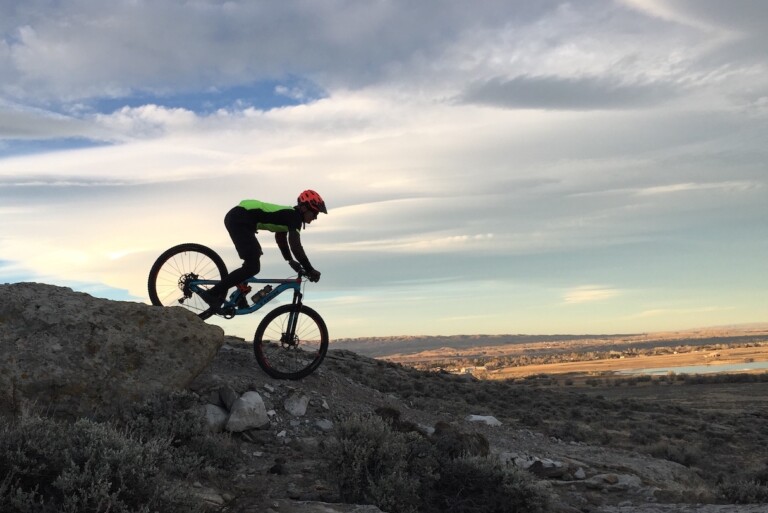
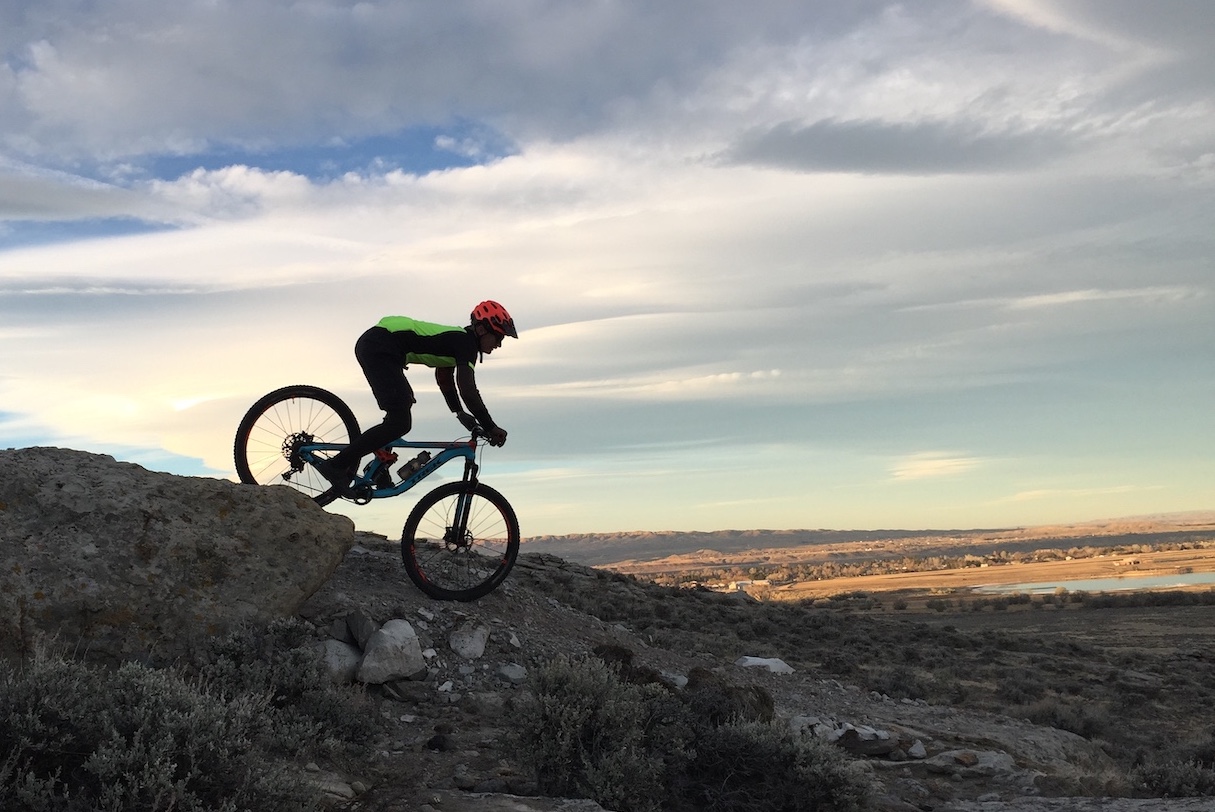
A mountain biker rides the Beck Lake Mountain Biking Area near Cody. (Nancy Patterson/BLM Wyoming/FlickrCC)
“There is still going to be a good amount of tourism, but the experience might be degraded and those experiences may fall short of the satisfaction that we normally receive,” she said, which could do lasting harm to Wyoming’s reputation.
In a recent Wyoming State Parks and Cultural Resources Commission meeting, agency Director David Glenn told the board that he has been unable to glean hard data from Wyoming’s federal agencies.
“We really don’t know how it’s going to affect outdoor recreation and other services in Wyoming, but we know it’s going to affect them to some degree,” Glenn said. In response, his agency is putting together a team to offer any needed support. “We’re thinking strategically, we’re thinking toward the future.”
“It may be that State Parks ends up helping out, keeping certain things open across the state while this stuff gets figured out with the federal government,” Glenn said.
Crown jewels
On Feb. 14, the federal government reportedly cut 1,000 positions from the National Park Service. It has been difficult to identify exactly how this impacted Wyoming’s parks. Public information officers from Yellowstone and Grand Teton routed inquiries to the D.C. office, which provided generic statements confirming only that the service will hire seasonal workers this summer.
However, Bill Ward with the Association of National Park Rangers said their best information indicates that Grand Teton lost five employees, while Yellowstone lost seven. As a comparison, Shenandoah lost 15 employees and Rocky Mountain lost 12.
It’s a tumultuous time for NPS employees, Ward said.
“I can tell you that right now there is a huge amount of uncertainty and confusion throughout the Park Service,” said Ward, a retired ranger himself. “The term I keep hearing is ‘devastated.’”
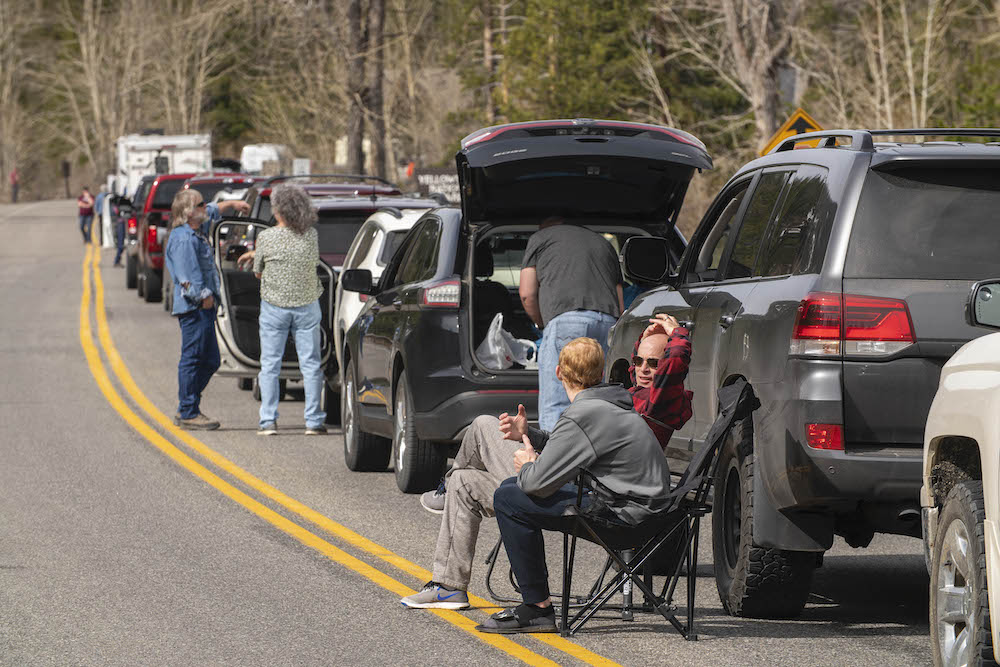
Vehicles began arriving at the East Gate of Yellowstone National Park well ahead of its scheduled noon opening on May 18, 2020. (Mike Vanata/WyoFile)
It’s positive news that the service is bringing on seasonal workers, he said, but onboarding them is a big task that will likely be slowed by the chaos.
“So while it will help in the long run, there may still be some shortages and some impacts in the early part” of the coming season, he said. The whiplash of news, hearsay and rumor, from lawsuits to new email demands and threats of further layoffs, is nearly impossible to keep up with.
To add insult to injury, he said, the Trump administration placed a $1 spending limit on government credit cards. “Parks usually use those cards to pay utility bills and buy toilet paper, travel and those types of things.”
NPS cuts sparked outcry from conservation groups and others worried about stewardship and safety at the popular destinations.
Managing crowds
In Yellowstone National Park, which has seen annual visitation grow from 3.2 million in 2013 to 4.7 million in 2024, Superintendent Cam Sholly has long advocated for increased staff. Worker levels need to grow to handle the crowds, he told WyoFile in September.
“You need people to manage people, and you need people to protect this park,” Sholly said.
Within the ranks of employees, confusion and worry dominate. One employee of Grand Teton National Park, who asked to speak anonymously for fear of reprisal, told WyoFile that park workers are “concerned for our parks, our communities and our colleagues.” The employee has seen preliminary indications that their job will be secure this summer, though it’s more than a month past the time of year when their position is typically confirmed.
National Park Service system staffing has eroded by 20% since 2010 while parks have experienced a 16% increase in visitation, according to the National Parks Conservation Association.
“We were already operating at somewhat of a constrained budget, constrained capacity for staffers,” said NPCA Northern Rockies Connectivity Program Manager Allison Michalski. “So this is really compounding, and I would say amplifying, some of those challenges.”
Cuts could have ripple effects on the robust visitor economy in park gateway communities like Jackson Hole, she said. They could also hamper emergency response efforts, including wildfire prevention and response. However, she said, so much is still uncertain.
“It’s another big ‘we don’t know yet,’ due to the lack of transparency and due to the challenges of getting good information,” she said. For the upcoming season in Wyoming, she said, it could look like any of the following: “Shorter visitor center hours, delayed openings, closed campgrounds, maintenance backlogs, trash and sanitation issues, restroom issues … and potentially public safety concerns.”
Reflecting that uncertainty, the NPS press team comments offer little specifics.
“The NPS is assessing our most critical staffing needs for park operations for the coming season and is working to hire key positions,” a February statement read. “The NPS is committed to protecting public lands, infrastructure, and communities while ensuring public access.”
Local economies
The federal government owns 97% of the land in Teton County, including Yellowstone and Grand Teton, “so we just have a lot of federal staffers here who are really ingrained in our community and do the very difficult and specialized job of protecting resources,” Michalski said.
A crowd gathered at the Jackson Town Square last weekend to protest cuts to the federal workforce. Participants held signs in support of the federal workforce and hung an upside-down American flag, a symbol of distress, near the town’s iconic antler arch.
Protesters in Jackson hung an upside-down flag, a symbol of distress, as they rallied against cuts to the federal workforce on March 1, 2025. (Angus M. Thuermer Jr./WyoFile)
The local impacts to northwestern Wyoming also prompted the Teton County Board of Commissioners to pen a letter to Wyoming’s congressional delegation expressing “deep concern and frustration” over the layoffs.
“Public lands in Teton County are the basis of our economic prosperity,” the Feb. 21 letter stated. “They must be properly managed and staffed … Staff that have been recently fired protect public safety, improving the experience of millions of annual visitors.”
Understaffing the public land management agencies, it continued, “will harm local businesses and the employees who drive our economy and sustain our community.” Commissioners asked the congresspeople to share any information.
The county board has not received a response, two commissioners confirmed this week.
Yellowstone and Grand Teton are huge attractions, but they are only a small part of the state’s public lands, which also include BLM badlands and deserts, mountainous national forests and state parks.
‘Who’s going to do the work?’
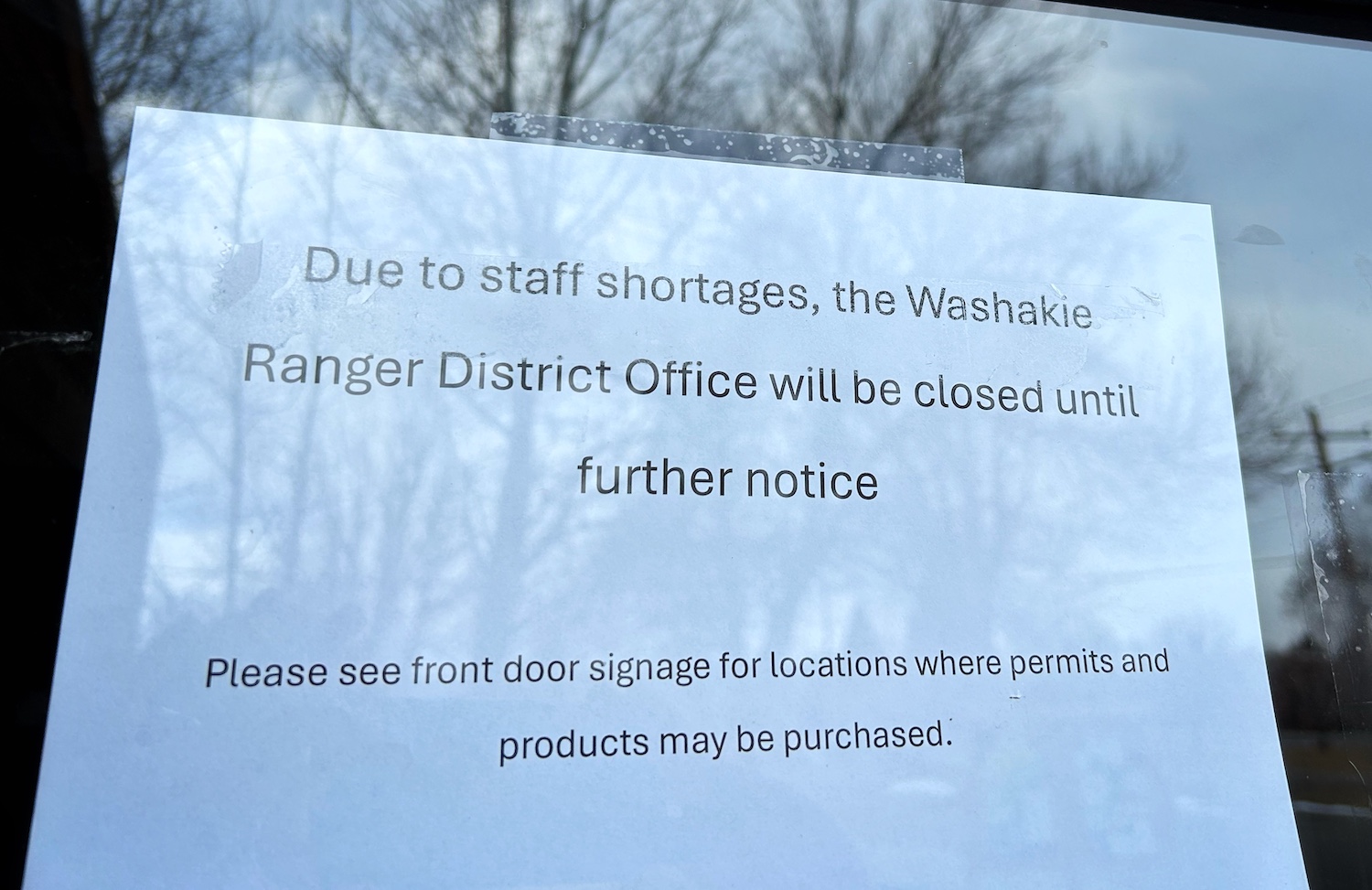
In Lander, job cuts gutted the Shoshone National Forest’s Washakie District office, which lost eight positions by late February, said retired Forest Service employee Bill Lee. A sign posted on the office door notified the public that the building didn’t have enough staff to remain open.
Fired employees included an archaeologist, NEPA coordinator and hydrology tech, Lee said, all “exceptional” workers. (A civil service board ruled Wednesday that thousands of fired USDA workers must get their jobs back at least temporarily, Politico reported,which could mean they get reinstated.)
“I think my big concern is it’s arbitrary, and now who’s going to do the work?” Lee said. The recent cuts aren’t the first bit of downsizing. Several positions, including his former position as a recreation specialist, were eliminated last fall in response to budget constraints.
A sign posted on the U.S. Forest Service’s Washakie District office in Lander in February 2025 notified the public that the office was closed. (Katie Klingsporn/WyoFile)
“The stuff on the ground that affects the general public on a day-to-day basis, that’s been wiped out,” he said. The result will be a skeleton crew to man a 700,000-acre landscape, he said. “Repairing things, cleaning things, painting things, reconstructing things — that will not get done. So then it becomes, how can we take care of our bathrooms, campgrounds and our trails?”
Like Teton County, Wyoming Pathways wrote a letter to Wyoming’s congressional delegation asking for assistance. Kusiek hopes it spurs some relief.
In the meantime, many things in his world are stalled. For example, Kusiek said, Wyoming Pathways is involved in a project to repair 13-year-old flood damage near Saratoga. The project received federal Great American Outdoors Act funding to pay for it, but that’s now in question, he said. Trump signed the law during his first presidential term.
“We’ve already put in probably 200 hours of work,” Kusiek said. “We contracted with a bridge maker, because we have to replace three bridges.”
The bridge maker is understanding about delays, Kusiek said, “but those bridges are sitting in Texas waiting to be shipped to us.”
WyoFile is an independent nonprofit news organization focused on Wyoming people, places and policy.
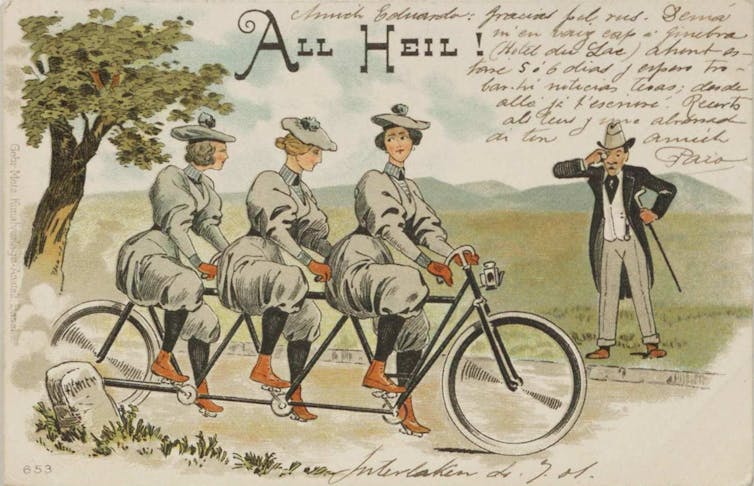
By Tamsin Johnson, Nottingham Trent University —Cycling, in its most familiar form, dates back to at least the 19th century. One example of an early bicycle was known as the “hobby horse”, and it later became the “Dandy horse” and then the “accelerator”. Early cycling was reserved for the upper-classes and was seen as highly fashionable and decorous – particularly for men.
A Victorian postcard from Germany. Modern Records Centre/University of Warwick
Women’s cycling, on the other hand, was viewed as trivial and unbecoming. When women were portrayed cycling, they were often eroticised and undressed.
The early development of women’s bicycles and cycle-wear was impeded by debates on women’s morality and sexual innocence. The bicycle was said to cause “bicycle face” (a face of muscular tension), harm reproductive organs and diminish what supposedly little energy women had.
Cycling women were viewed as sexually promiscuous both for the “unnatural” straddling of the bicycle and for the freedom cycling offered them. Where were they all cycling to, men wondered.
New women
The development in 1885 of the Rover “safety bicycle” revolutionised women’s cycling. It featured a lower mounting position and inspired somewhat of a cycling craze. By the 1890s, several million women around the world were cycling.
The influx of female cyclists on the streets created a moral panic for the Victorians. The image of the cycling woman came to represent a new type of woman with feminist ambition. This led to a discourse known simply as the “woman question”.
The ‘new woman’ as depicted in an illustration from 1908. Author provided
The fear caused by this cycling “new woman” is made clear in postcards from the time. The new woman in the example above is abandoning her husband and children for a day out and charging her husband with domestic tasks – a highly provocative notion to a Victorian audience. God forbid, perhaps she is also on her way to a suffragist rally. Cycling women were seen as radicals who threatened the “natural order of things”.
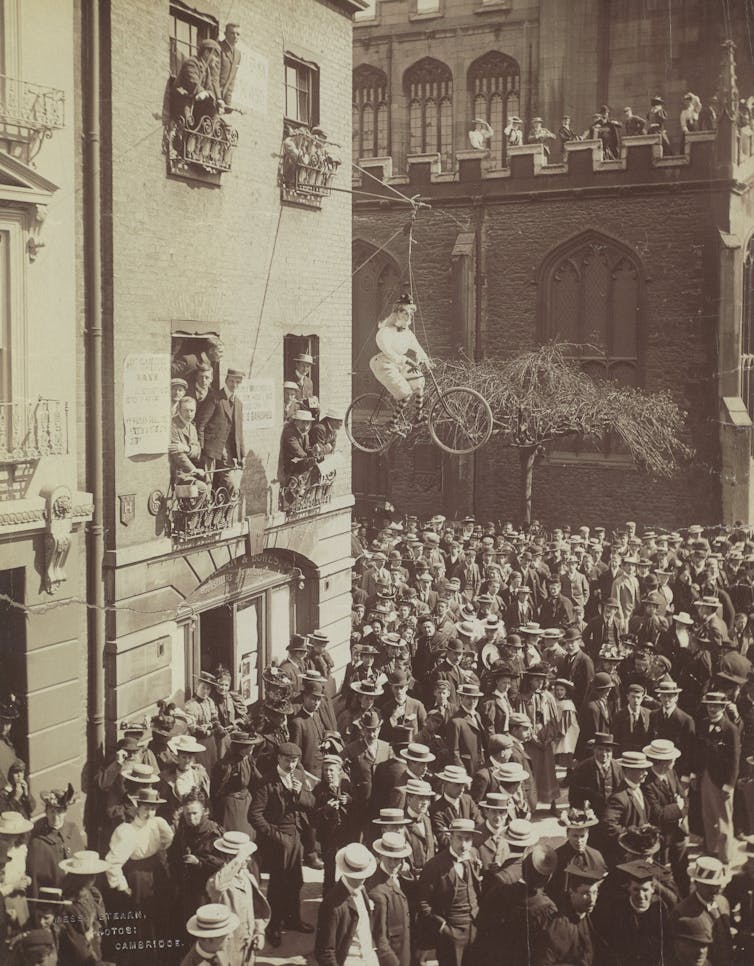
Such was the symbiotic relationship between feminism and women’s cycling, that the bicycle became emblematic of the suffrage movement. This photograph, taken in 1897, was taken at the height of the “woman problem” debate.
An effigy of a cycling woman hangs above a crowd at Cambridge University, as they await the result of a vote on whether female students ought to receive a degree upon completion of study. The vote was defeated and the effigy triumphantly torn down. Women could not receive a degree from Cambridge University until 1948.
The crowd await the result of the Cambridge vote. University of Cambridge
This photograph captures the cultural rejection of cycling, educated women.
The effigy, dressed in collegiate striped stockings, cap and rational dress is a stereotypical new woman. Akin to a Guy Fawkes dummy in November, during this time the cycling woman momentarily joined Britain’s long history of reviled figures of rebellion.
Mobile women
In her book Women and the Machine (2001), art historian Julie Wosk documents the history of a “cultural longing to represent women as safely stationary” in visual culture.At the turn of the century, cycling women were often depicted as incompetant, either falling off their bicycle, cycling into something or being attacked while cycling.
A Victorian postcard showing a woman falling from her bicycle. University of Warwick
The intention behind these images was to showcase women’s supposed technical and physical inability. The Victorian equivalent of the sexist modern-day stereotype that “women can’t drive”. At the base of such claims is a fear of mobile women. Images like these served as visual warnings for women who wished to exercise their physical freedom on two wheels.
After 1900, women’s cycling went through another transition. While in its early years cycling was considered an upper-class pursuit, by the 20th century bicycles were becoming democratised as the motorcar became the in thing for the wealthy.
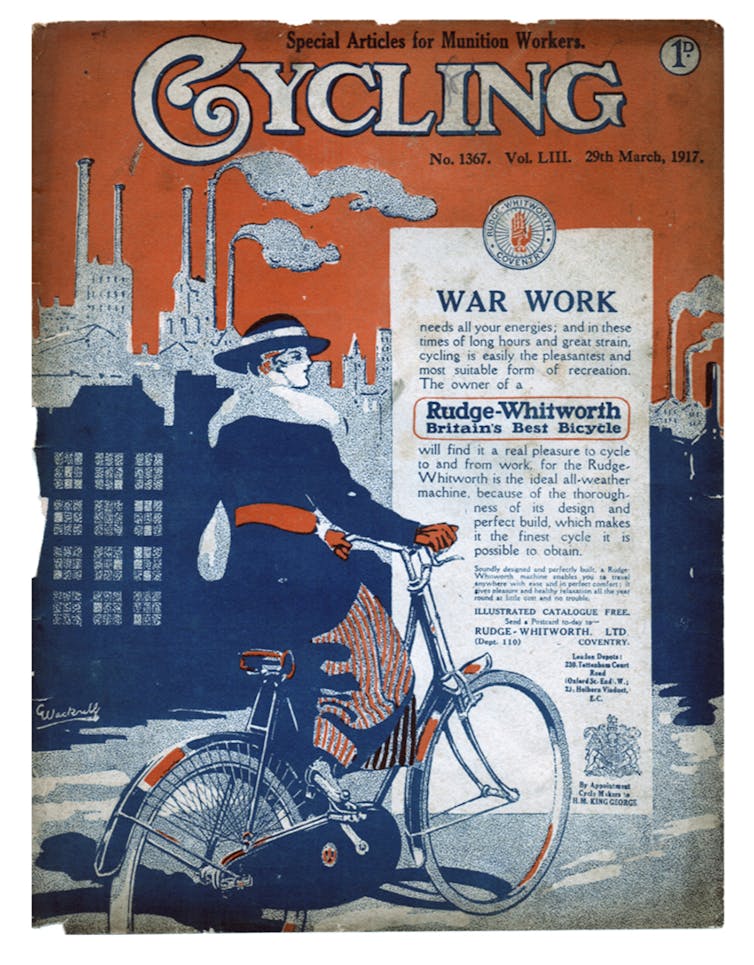
During the war, the bicycle was seen as the ideal mode of transport for female workers. Author provided, CC BY-SA
Bicycles became a form of functional transport for the working classes. The need for an expanded female workforce during the first world war had also helped to normalise women’s cycling.
As shown in the above special munitions edition of Cycling magazine, the bicycle was seen as the ideal “energy saving” mode of transport for female workers. While the advertisement copy shows that the 19th-century concerns over women’s “energies” endured during the war, the visual of a woman successfully cycling to her workplace confirms some progress.
By the 1930s, cycling manufacturers were offering women’s ranges more in line with men’s and leading brands offered speed and sports models to women. Marketing copy focused less on issues of morality and decorum and worries of “bicycle face” had long ceased to exist.
This was surely progress? Unfortunately, it isn’t so straightforward. The discourse around women cycling was still concerned with health and beauty more than sporting achievement. But now instead of being thought to damage femininity, cycling now supposedly ensured it.
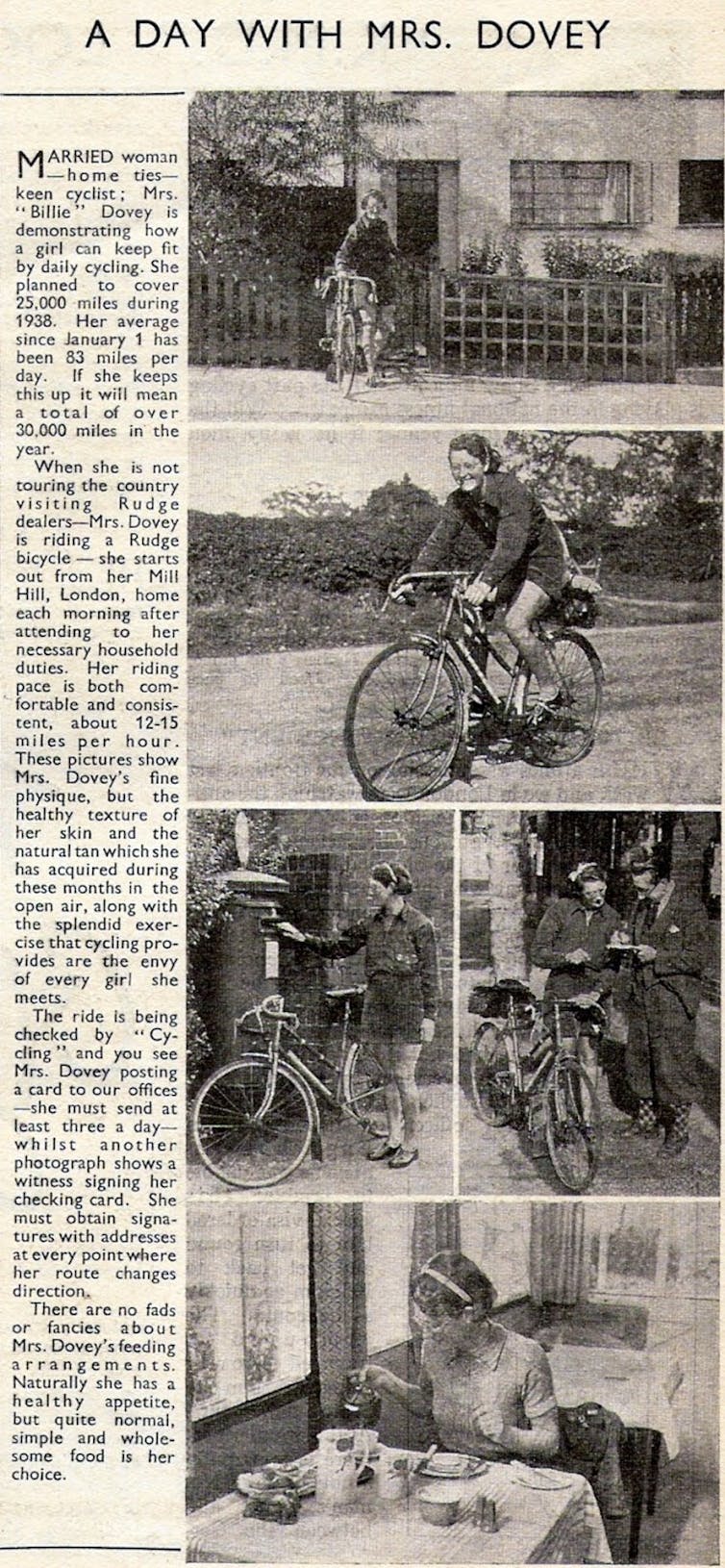
The news story about Billie Dovey. Author provided, CC BY-SA
In 1938 Billie Dovey was named British bicycle manufacturer Rudge-Whitworth’s “Keep Fit Girl” after she peddled almost 30,000 miles around Britain. But rather than focus on her remarkable achievement, the press described Dovey’s “fine physique”, “healthy” skin and “tan”.
Images of the past can tell us a lot about the culture which produced it. These images show a cultural discomfort with physically mobile women. And it’s a discomfort that hasn’t entirely disappeared.
A gender gap in British cycling persists. Nine in ten British women are reportedly “scared of cycling in towns and cities”. The UK’s poor cycling infrastructure matched with an increase in violence against women on the streets together make for an unappealing prospect for would-be female cyclists.
As well as safety fears, women have less leisure time – despite more flexible post-pandemic working structures – and societal pressures regarding their physical appearance when cycling still linger. That’s all despite the number of female cyclists adding to medal tallies for British teams in recent years which made household names of some athletes.
Whatever the future for women’s cycling, it is critical to understand and redress these long-held assumptions about women’s “paltry” abilities regarding technology, sports and cycling. It is important to recognise the bicycle as an agent for progress whilst acknowledging the historic and contemporary challenges facing female cyclists.
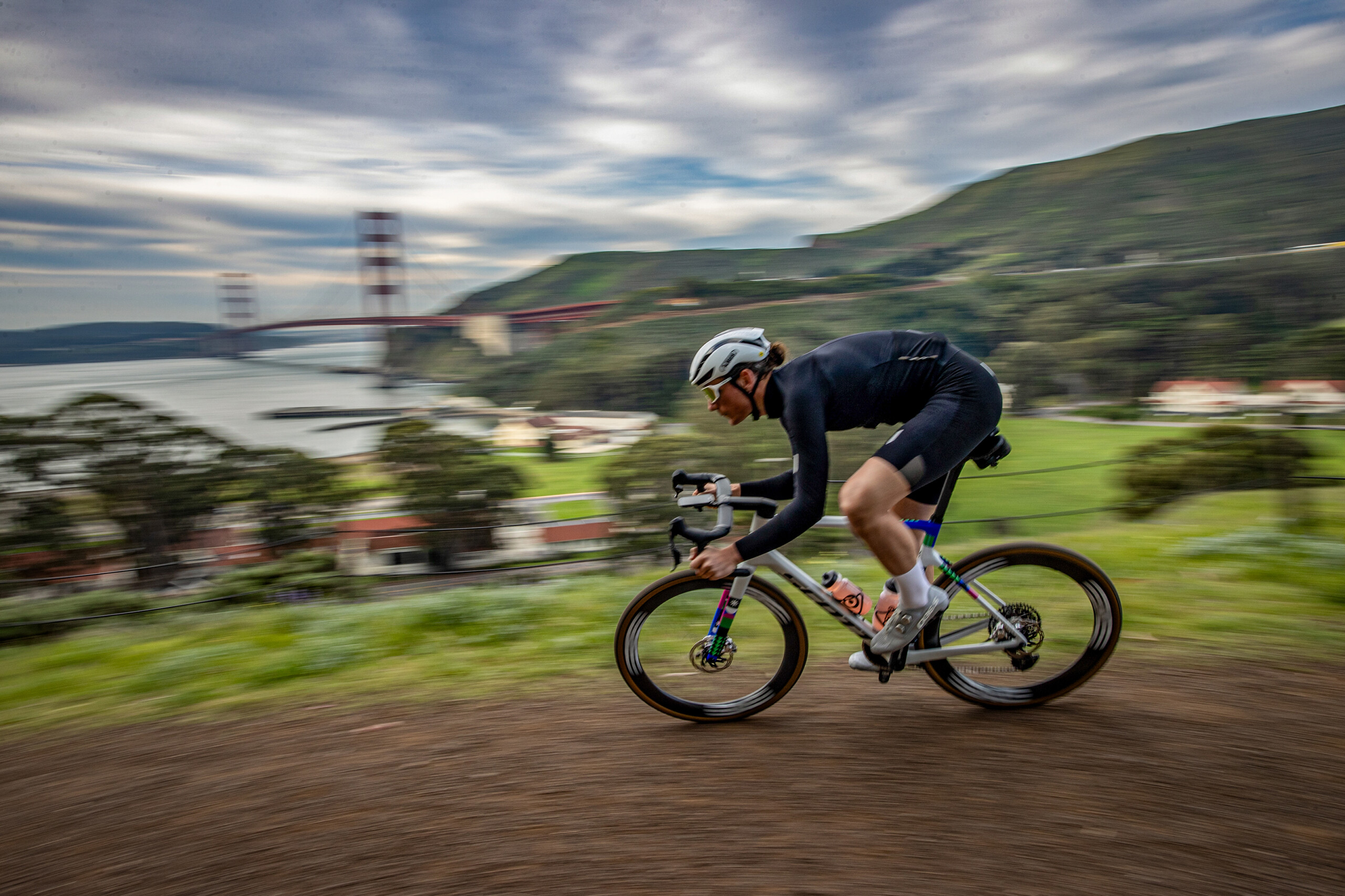
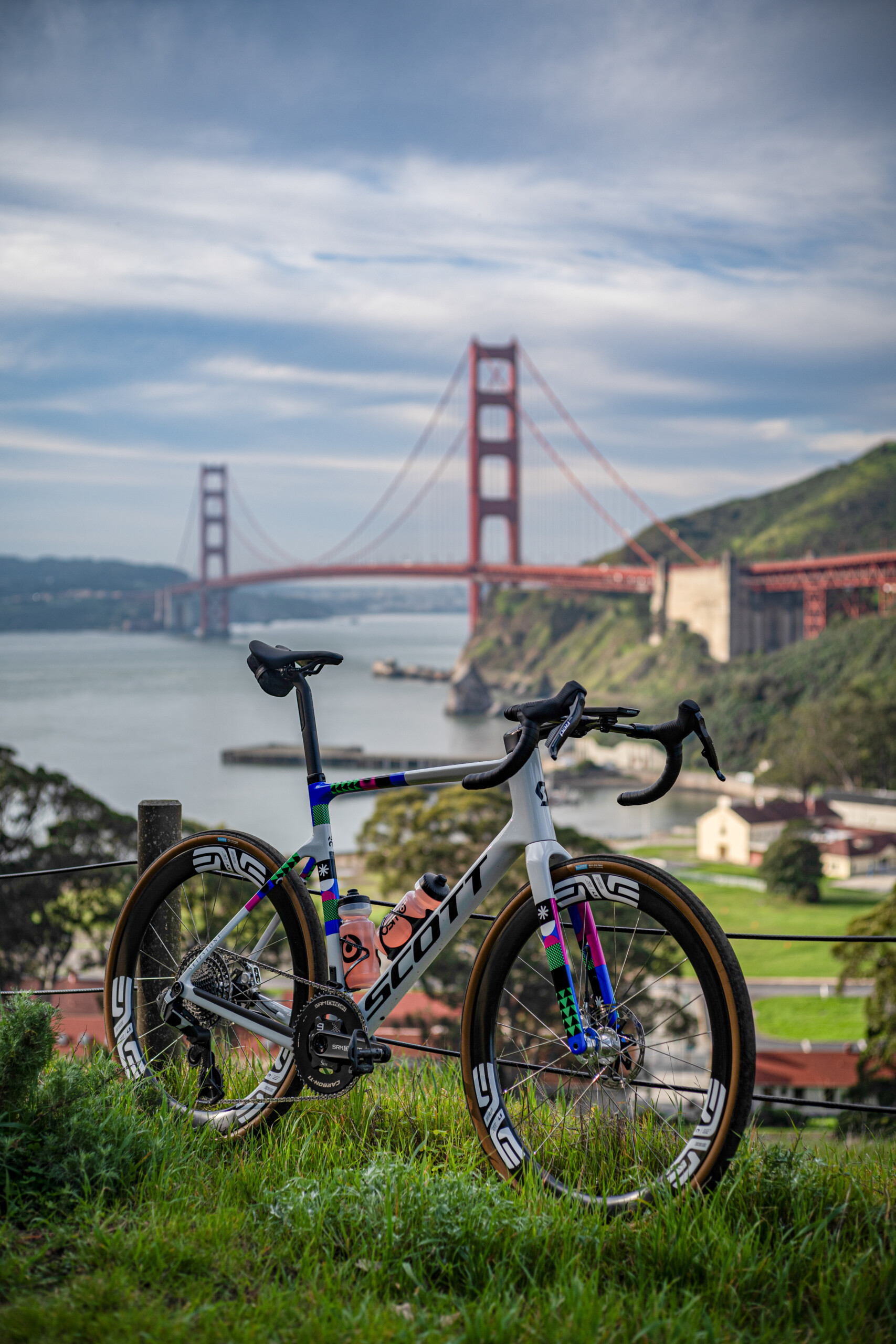
HOLLADAY, Utah (March 6, 2025) — SCOTT USA welcomes elite gravel racer Brennan Wertz to its roster of athletes for the 2025 season and beyond. The reigning U.S. National Gravel Champion brings his power, skill, and passion for adventure to SCOTT, proving his compatibility with the SCOTT Addict Gravel by taking an early-season victory at the Huffmaster Hopper.
Brennan Wertz. Photo courtesy of SCOTT USA
“From the first ride, the Addict Gravel felt like an extension of myself—like it was meant to be,” said Brennan. “At Huffmaster, I attacked through a mud pit with 7km to go and soloed to the win. There’s a selective final descent where I’ve struggled in the past, but this year, on my new bike, I led the way and forced separation. That confidence is huge.”
A dedicated gravel racer, Brennan thrives on the sport’s unique demands. “Gravel racing is multi-dimensional—you need fitness, technical skills, and the ability to manage your logistics as a privateer. It’s complicated, fascinating, and I love it,” he explained.
Brenna’s new Scott Addict Gravel. Photo courtesy of SCOTT USA
For 2025, Brennan keeps his race calendar focused on the U.S., looking to fly the Stars & Stripes at the most prominent domestic events, including Unbound Gravel and the national championships. “Winning Unbound in the national champ jersey and defending my title are my two biggest goals,” he said.
Beyond racing, Wertz is planning another bikepacking adventure across the Swiss Alps, building on last year’s high-altitude challenge. “I spent a week riding massive alpine passes last summer, and now I want to up the ante with an even more epic route,” he said.
In addition to the SCOTT Addict Gravel, Wertz is eager to ride the entire drop-bar collection of SCOTT drop bar bikes. The first one will be the SCOTT Foil, an aero road bike built for every ride. “I love fast endurance rides, and the Foil is going to be perfect for that—plus, the model I’m getting is purple, and I can’t wait to rip it on my home roads in NorCal.”
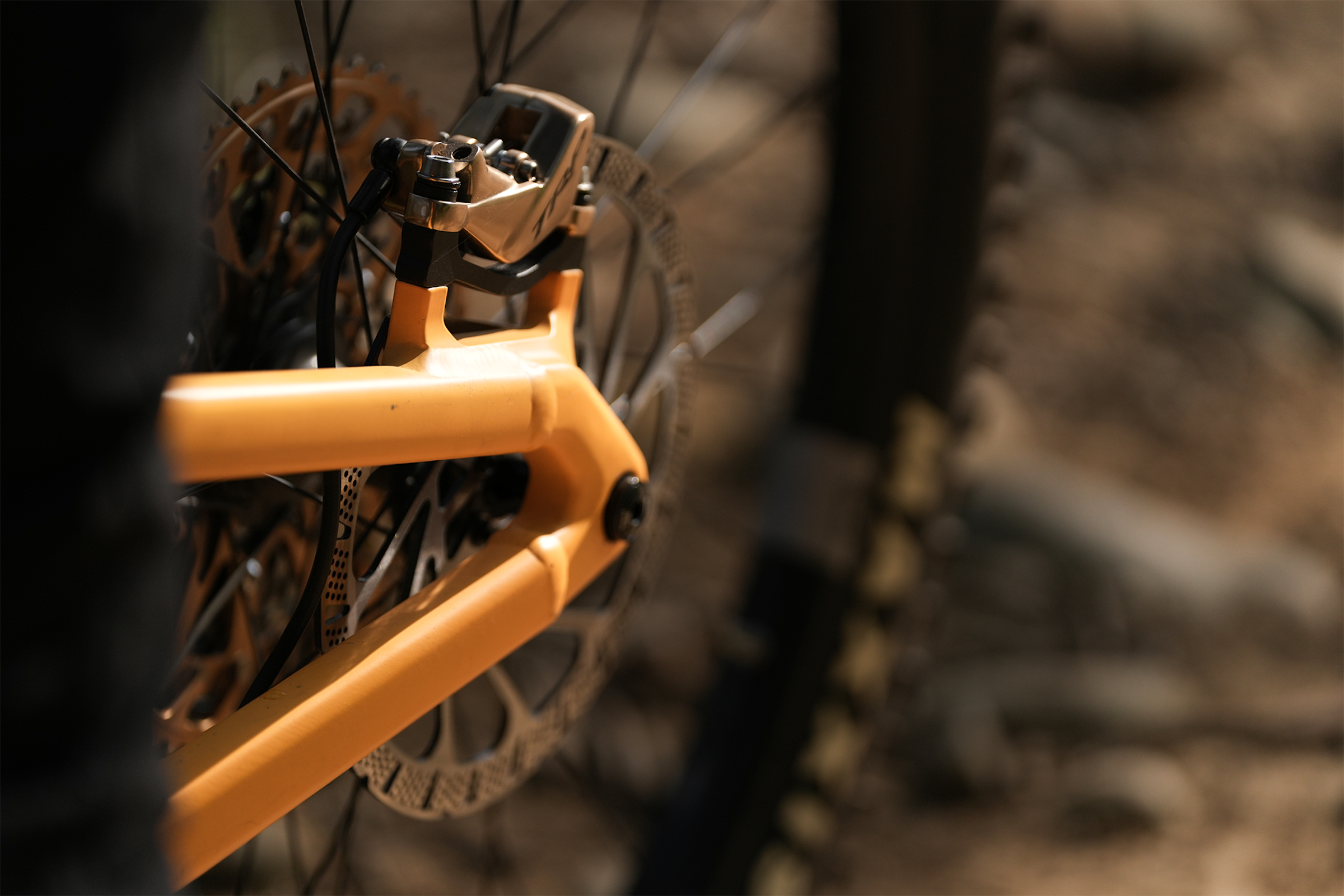
OGDEN, Utah (March 3, 2025) — TRP (Tektro Racing Products) has announced the launch of its new hydraulic disc brakes: EVO PROand EVO X. Engineered for every rider, these models offer customizable performance that allows for a closer reach and increased power while maintaining the consistency TRP is known for. Developed through years of prototyping, testing, and fine-tuning with world-class athletes, the EVO Series embodies TRP’s commitment to pushing the boundaries of performance.
Photo courtesy of TRP Cycling
Built on TRP’s legacy of world-class expertise, both the EVO PRO and EVO X are race-proven, having undergone rigorous development with elite teams at World Cup events. These new models deliver exceptional consistency, stability, and cutting-edge features that redefine what riders can expect from their braking systems.
EVO-PRO caliper. Photo courtesy of TRP Cycling
EVO PRO: Performance for the Bold
The EVO PRO was designed for serious downhill, enduro, trail, and E-MTB riders who demand top-tier performance under the most extreme conditions.
Pad Activation Dial (PAD) provides modulation adjustment, allowing riders to customize when the pads hit the rotor during the lever stroke.
Lever reach adjuster for personalized ergonomics, allowing riders to fine-tune the lever blade position to match their hand size and riding preference.
Ergonomic, supportive lever blade for increased comfort and control.
Clean cockpit design with streamlined cable path for internal or external routing
Developed in collaboration with World Cup Downhill and Enduro teams
Race-proven performance delivering exceptional braking power and consistency.
High-flow 4-piston caliper for strong, reliable braking performance.
Easy setup and maintenance for a seamless service experience
Compatible with Bosch ABS PRO- an innovative system that regulates brake pressure, allowing riders to maintain control and consistency under intense braking conditions.
Available in gold, grey, and black
Weight: 309g (Front), 323g (Rear).
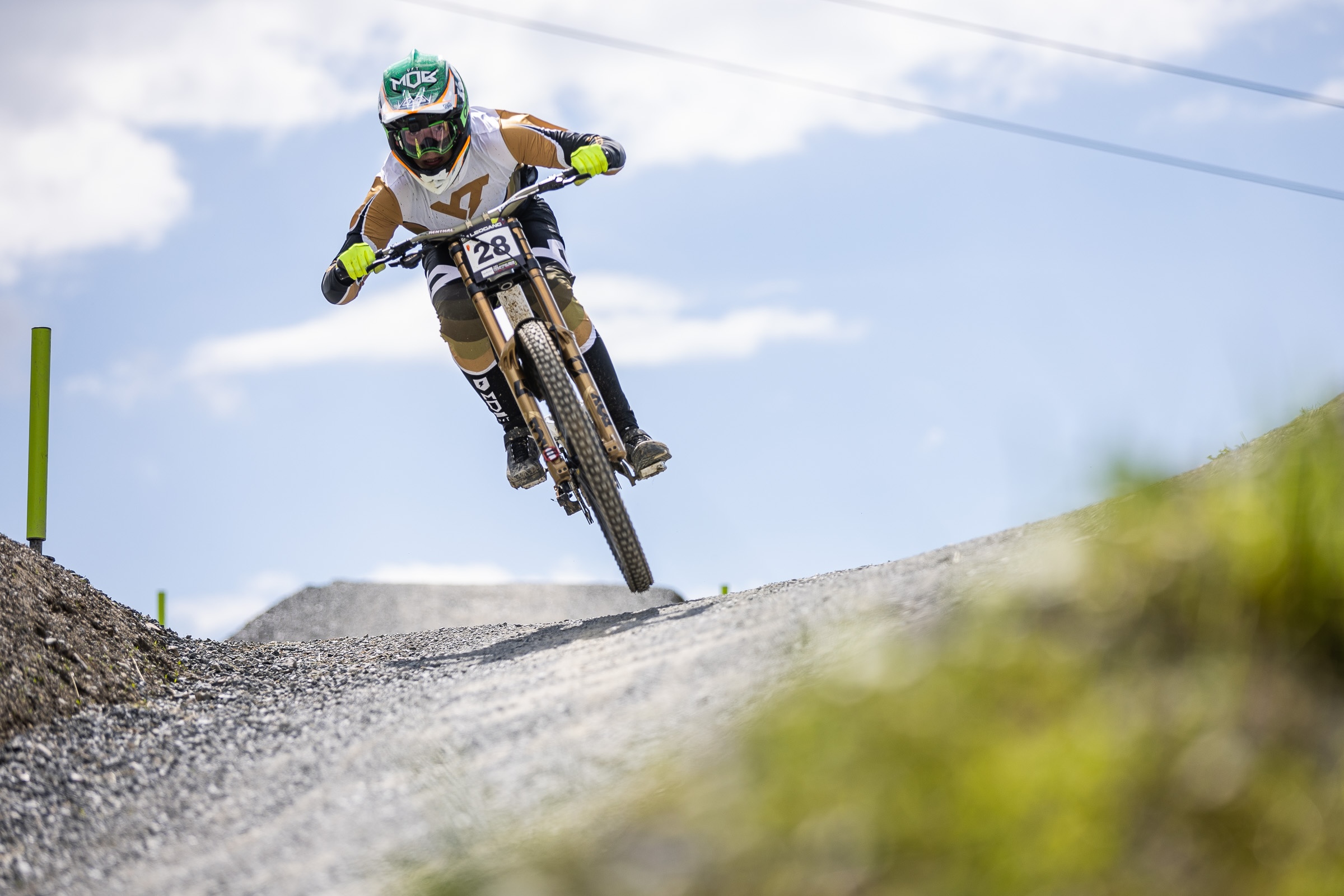
“I honestly love everything about the EVO Pros. They offer more power, better modulation, and improved lever feel. The addition of the Pad Actuation Dial is a huge upgrade. Brake feel is the most important part of my bike setup, and with both reach and modulation adjustments, I can fine-tune it to perfection.” – Oisin O’Callaghan / YT MOB
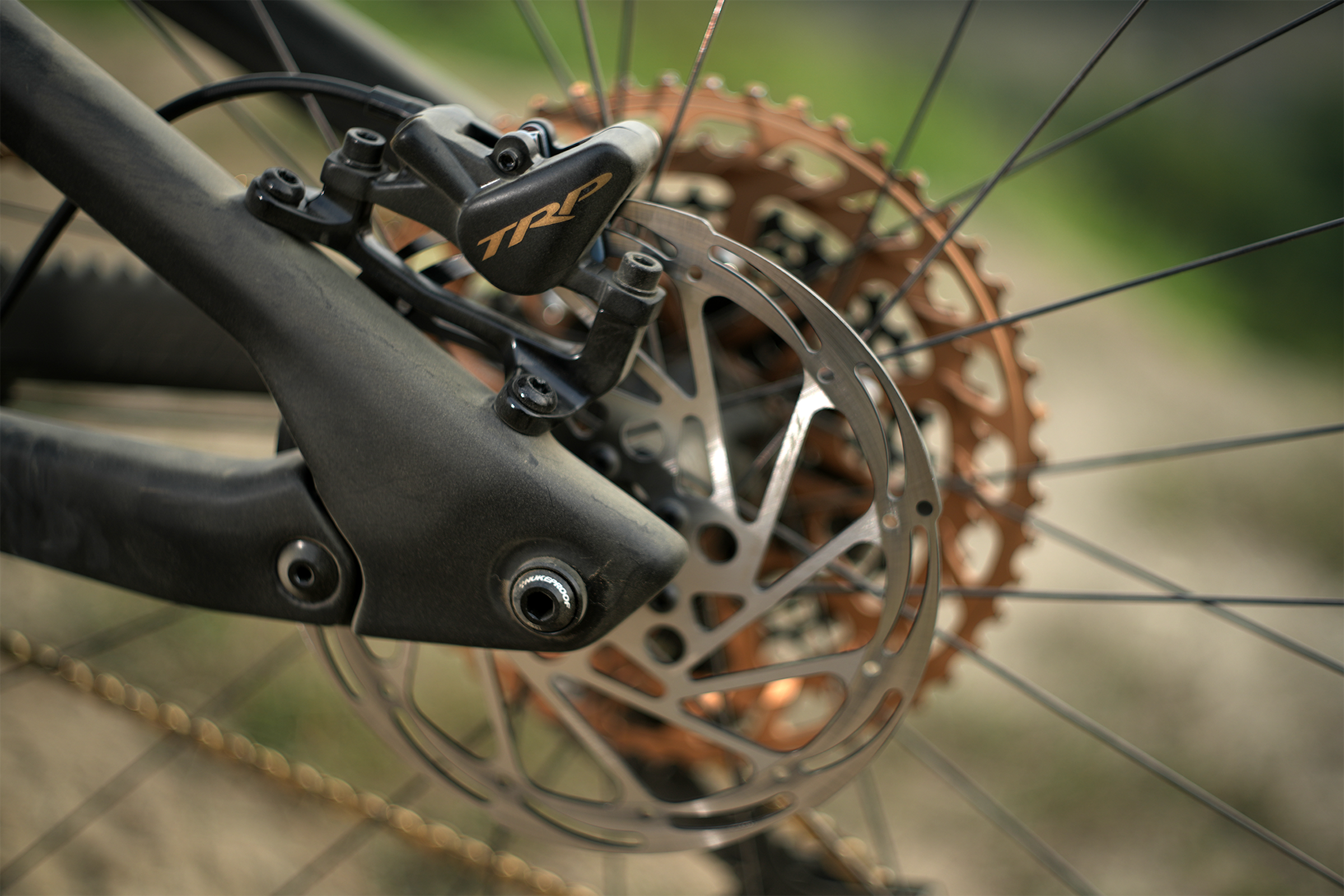
2-piston EVO-X caliper and rotor. Photo courtesy of TRP Cycling
EVO X: Light, Fast, and Precise
The EVO X offers race-ready performance for XC, light trail, and down-country riders, delivering smooth modulation and effortless control in all conditions.
Race-tested performance with optimized modulation and light finger action at the lever.
Supportive and ergonomic lever blade for improved comfort during long rides
Sleek master cylinder design for a clutter-free cockpit.
Performance-driven 2-piston caliper for stable and reliable braking.
Developed in collaboration with World Cup XC teams.
Titanium hardware for reduced weight and enhanced durability.
Easy setup and maintenance for quick adjustments on the go.
Available in gold and black
Weight: 289g (Front), 303g (Rear).
The Next Step in TRP’s EVOlution
“We’ve spent years perfecting every detail of the EVO PRO and EVO X,” said Leo Chen CEO of Tektro | TRP.
“These new products are the culmination of extensive testing and feedback from professional athletes at the highest levels of competition. We’re excited to offer riders a brake system that’s not only designed for race-day performance but is also easy to maintain and install for everyday use.”
The EVO PRO and EVO X are available now through TRP’s official channels and authorized dealers worldwide.
By Nancy Clark MS RD CSSD — The gut, also called the intestinal tract, includes the stomach, intestines, and colon. An amazing number of life-sustaining and performance enhancing events happen in the gut—including but not limited to digestion of the food we eat and absorption of nutrients that provide energy. While those of us with well-functioning “cast iron stomachs” are unlikely to think twice before eating any food that crosses our path, athletes with gastrointestinal issues (irritable bowel, diarrhea, reflux) are more cautious about what they eat.
Good gut health matters
Gut health can change; you don’t want to take it for granted. Rather, you want to properly feed those 100-trillion beneficial microbes that live in your gut; they have a big impact on your overall well-being. (Hint: Microbes like fiber-rich carbs!) Improper feeding, including long-term food restriction (anorexia, dieting) and a low fiber diet can reduce microbial diversity and have a detrimental health impact. A strong array of microbes in your gut enhances your immune system, reduces the risk of allergies, produces vitamins (K, B-12), optimizes absorption of nutrients, sends signals to the brain that make you more resilient to stress, and fosters anti-inflammatory and anti-carcinogenic benefits. A healthy gut enables athletes to access and utilize the fuels they need to perform longer, recover faster, and heal cells that get damaged during intense exercise. In comparison, athletes with unhealthy guts may spend more time siting on the bench feeling un-well (including travelers’ diarrhea).
Bacterial strains in the guts of humans and chimpanzees diverged and began to evolve separately 5 million years ago and 15 million years ago in humans and gorillas. Humans and apes evolved into a new specie at about the same time. A mutually beneficial relationship between gut bacteria and animal hosts may contribute to the formation of a new species. Credit: Darryl Leja, National Human Genome Research Institute, National Institutes of Health, CC BY-NC 2.0, Attribution-NonCommercial 2.0 Generic
Exercise itself is beneficial for gut health. Exercise with a fiber-rich diet (abundant fruits, veggies, beans, grains) is even better. Among elite athletes, those with a fiber-rich diet have a more robust microbiome compared to elite athletes with a lower fiber intake.
Eating for gut health
For sports-active people who want to feel good, perform optimally, and recover quickly from hard exercise, here are some suggestions about how to eat to optimize your gut health.
Figure out how to easily include more fruits and veggies in your daily diet. Suggestions:
Combine fruit with protein, such as banana & peanut butter or apple & cheese. For many athletes, this carb-protein combo is more appealing and likely to be consumed than just a piece of fruit.
Snack on dried fruit for a sweet treat (instead of candy).
Buy frozen veggies (broccoli, cauliflower, peas, carrots, etc.) and eat a pile, not just a serving, at dinner. Freezing retains nutrients, so frozen veggies can be more nutrient-rich than fresh veggies that lose nutrients during shipment from, let’s say, California to New England. Frozen veggies are also easier to incorporate into a busy athlete’s sports diet. No prep— and they cost less. Cook extra veggies, for leftovers to add to the next day’s breakfast omelet or lunchtime soup.
Redefine your afternoon “snack” as a “second lunch” with quality fiber-rich food (peanut butter & banana sandwich on whole wheat bread) instead of snacky foods (chips, sweets). Fiber-rich foods leave you feeling nicely satiated with sustained energy and less evening hunger.
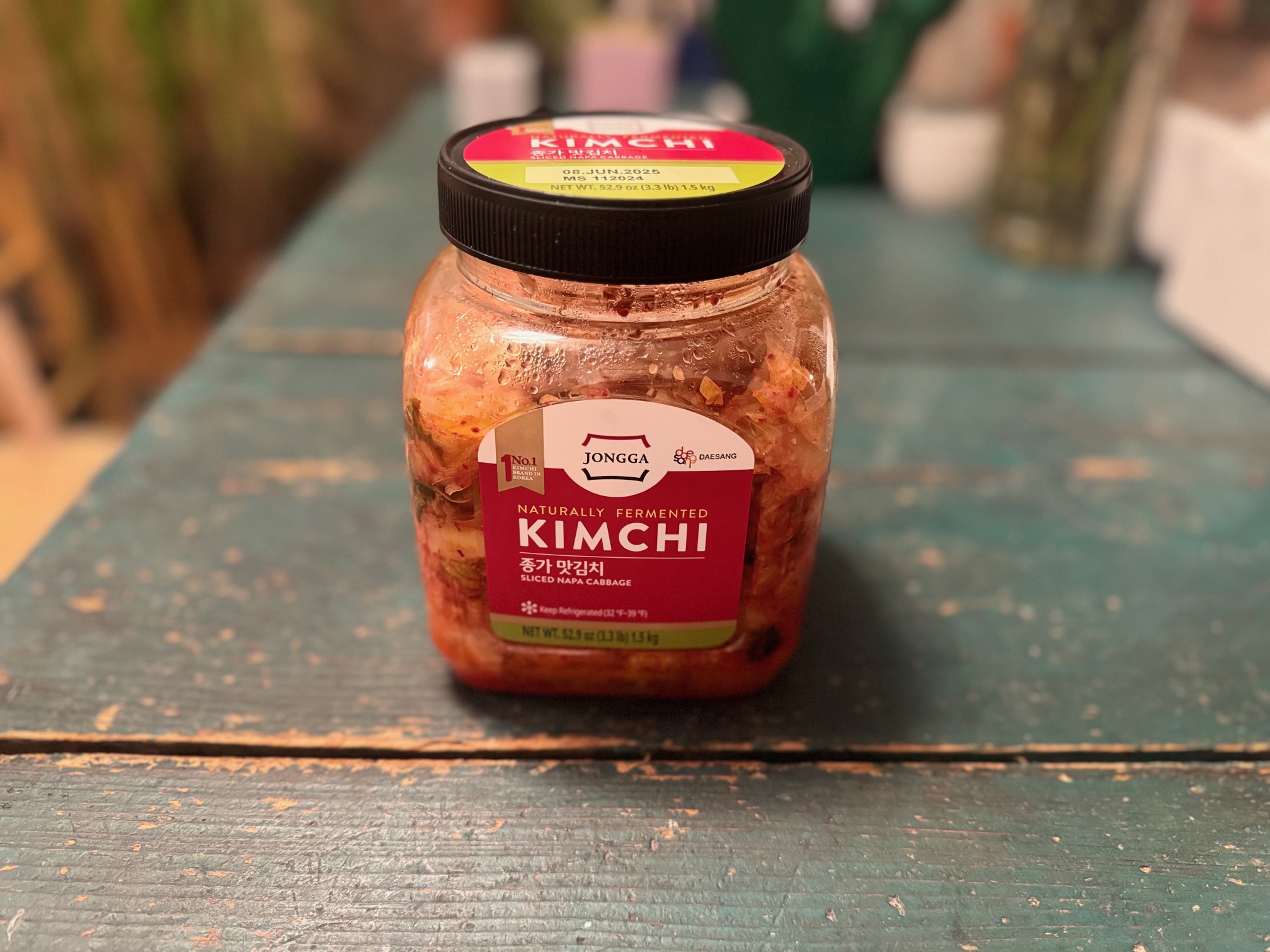
Enjoy more fermented foods. Snack on yogurt; make a smoothie with kefir. Learn to like kombucha. Try some kimchee or sauerkraut.
Boost your intake of fiber-rich grains (bran cereal, oatmeal, Dave’s Killer Bread, popcorn, brown rice), beans (hummus, burritos with refried beans, bean-dip), and nuts & seeds (nut butters, almonds, sunflower seeds).
Note: Not all fruits and veggies and fiber-rich. The best options have seeds (raspberries, black berries, cucumbers, cherry tomatoes) and edible skins (apples, pears, potatoes).
Fermented foods, like kimchi can restore microbe balance in your gastrointestinal tract. Photo by Dave Iltis.
Abating exercise-related GI distress
GI complaints are common among athletes and can vary according to sport. Cyclists in a bent-over position might suffer from heartburn or reflux. Marathoners with lots of intestinal jostling might experience “runners trots.” Gymnasts and ballet dancers fear being bloated with a bulging stomach. You are not alone if you exercise with GI distress! The following tips might help resolve current gut issues and reduce future digestive problems that could impact your sports performance.
Train your gut (not just your heart, lungs, and muscles). Being afraid to eat before you work out because you fear experiencing nausea, stomach cramps, or diarrhea is a questionable excuse for avoiding pre-exercise food (particularly for endurance athletes and those who train more than 60 to 90 minutes a day). The gut is trainable and can learn to tolerate fuel consumed before and during exercise. You at least want to try to fuel your body appropriately for the work that you will be doing. Training on empty will do nothing to help you compete against a better fueled athlete…
Instead of simply insisting you can’t eat before you exercise, be curious. What bad happens if you nibble on 25 to 50 calories of a simple, low-fiber grain, such as a pretzel, Vanilla wafer, or half-slice of white toast? Likely nothing! Next, build up to 50 to 75 calories, then 75 to 100. The goal is to consume ±200 calories in the hour or so before you train. The benefits will be more energy and a better workout.
During extended exercise, you want to build up to consuming 200 to 300 calories per hour after the first hour. Learn from each experiment and tweak your choices, if needed.
Some commercial sports foods quickly lead to GI distress, so test different products during training, not on the day of the event. A product might have too much caffeine or a type of carbohydrate that your body is not used to consuming. You might need to replace gels and chomps with honey and maple syrup. Both are available is single-serv packets for athletes.
Conclusion
Emerging evidence strongly suggests fiber-rich plant-based foods offer beneficial gut-health benefits that translate into overall health benefits not seen with highly processed low-fiber foods. Good gut health invites less inflammation, better recovery, and overall better well-being.
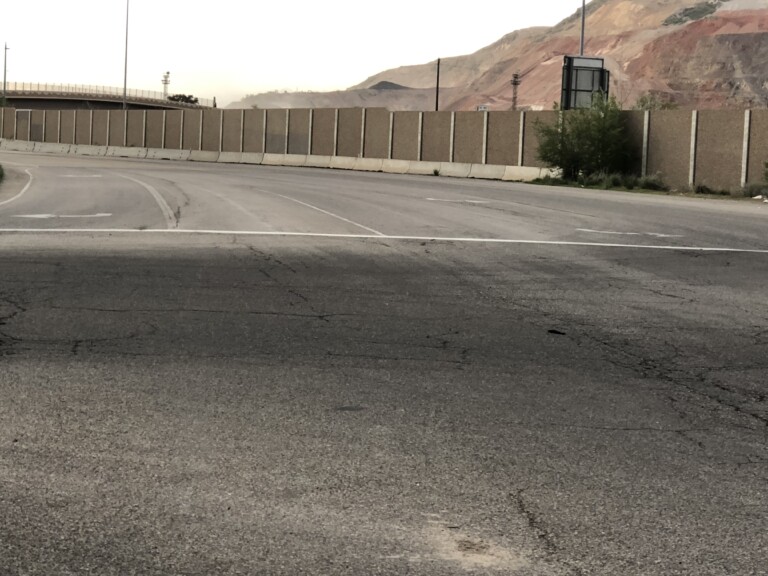
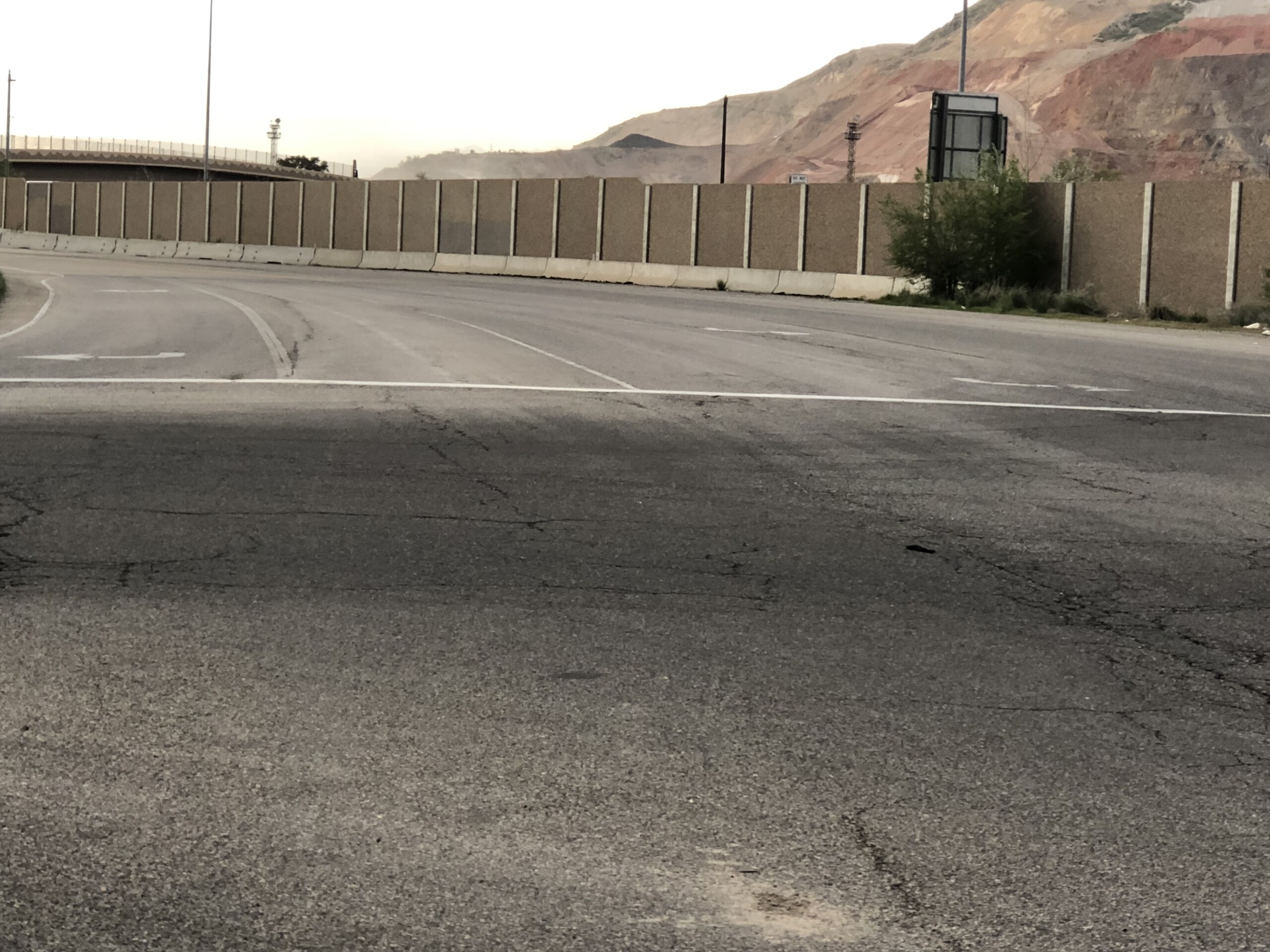
By Charles Pekow — States are encouraged, but not required, to consider the needs of bicyclists when modifying access to interstate highways under new rules adopted by the Federal Highway Administration (FHWA). While federal law mandates FHWA approval for adding or altering access to interstate highways, the updated rules stop short of making accommodations for bicyclists mandatory. Although bicycles are prohibited on most interstate highways, cyclists may need to cross access ramps.
1000 North off-ramp from I-15 in Salt Lake City, Utah. Note the lake of a bike lane across the ramp. Photo by Dave Iltis
The new rule, which became effective December 9, requires states to evaluate the impact of access modifications on all users. It notes, “The existing and projected land use along the crossroad should be examined, and opportunities to improve connectivity for pedestrian and bicycle travel should be considered as part of the access modification.”
By Lou Melini — An Alaskan bicycle tour has been on the bucket list for Julie and I for 15 years or more. Initially the plan was to ride the “North Star route” from Missoula, Montana to Denali National Park. That plan never rose to the top of our bucket list due to a bucketful of reasons. Julie and I are not yet ready to have a vehicle carry our gear, and we like to camp, so tours with vans and exclusively hotels were out. We have never been to Alaska, thus the thought of me pulling off the logistics in the manner that we are accustomed for an Alaskan trip seemed overwhelming to me.
In September of 2023 I got on the Adventure Cycling Association (ACA) website to browse the annual self-supported bike trips being offered for 2024. The ACA is perhaps the only organization that has group trips in which the riders carry their gear with no van support (note that most of their trips are van supported). The Denali National Park trip popped up in front of my eyes. A quick consult with Julie sealed the plan with each of us paying a $200 down payment. The late June 2024 trip started in Anchorage and ended, 430 miles and 14 days later (11 riding days) in Denali National Park. In addition, Julie’s sister lives on the Kenai peninsula in Alaska. The bike trip would combine a trip to see her sister and brother-in-law.
I’ve been a member of Adventure Cycling Association (ACA) since 1976/77 time period. I have used the maps produced by the ACA for many of my trips with Julie. The ACA produces great bike travel maps, and I expected the same professionalism for this tour.
Adventure Cycling Association Tours:
Julie and I were excited about doing our first commercial tour and doing it with the ACA. The website listed it as a road tour with some gravel. The technical difficulty was rated as “easy,” the terrain “mountainous,” and the difficulty rating of “5”, the most difficult. We assumed that the difficulty rating reflected the “mountainous” and “gravel” as there was no explanation for the rating. The tour was limited to 15 people including the leaders.
I should note that there are 2 aspects of ACA tours. There is a “Tours Team” a behind the scenes group and then there are the tour leader(s) that lead the trip.
We received a tour packet 2 months prior to our trip. A chat group was created enabling us to receive introductions from the rest of the group. I was happy to learn that many in our group had bike travel experience. Additionally, 5 of the 13 including me, were in their 70’s. One concern we had was a change in leadership for the tour 10 days prior to our departure.
For this trip we had 2 leaders, one an experienced tour leader and his assistant. Both leaders of the trip were excellent. They were very responsive to the concerns of the group. Because of their efforts the questions from the group were answered.
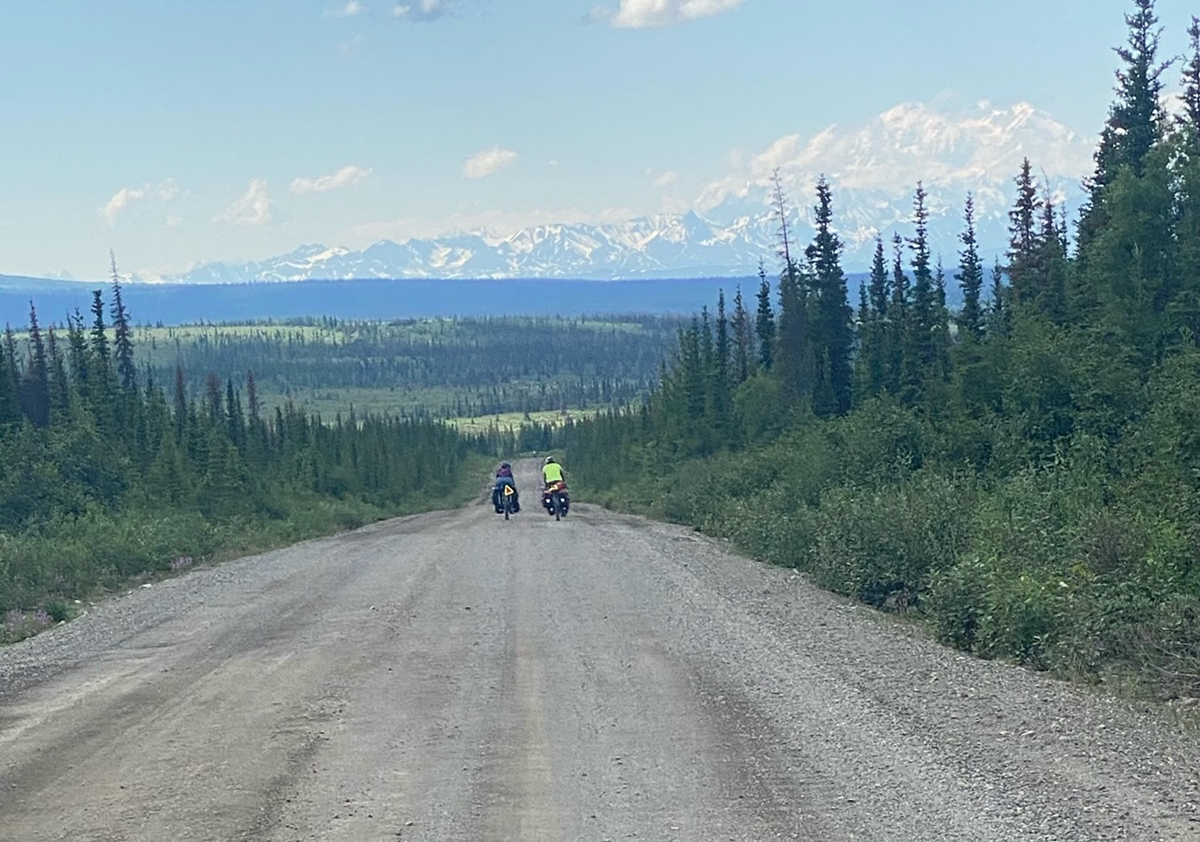
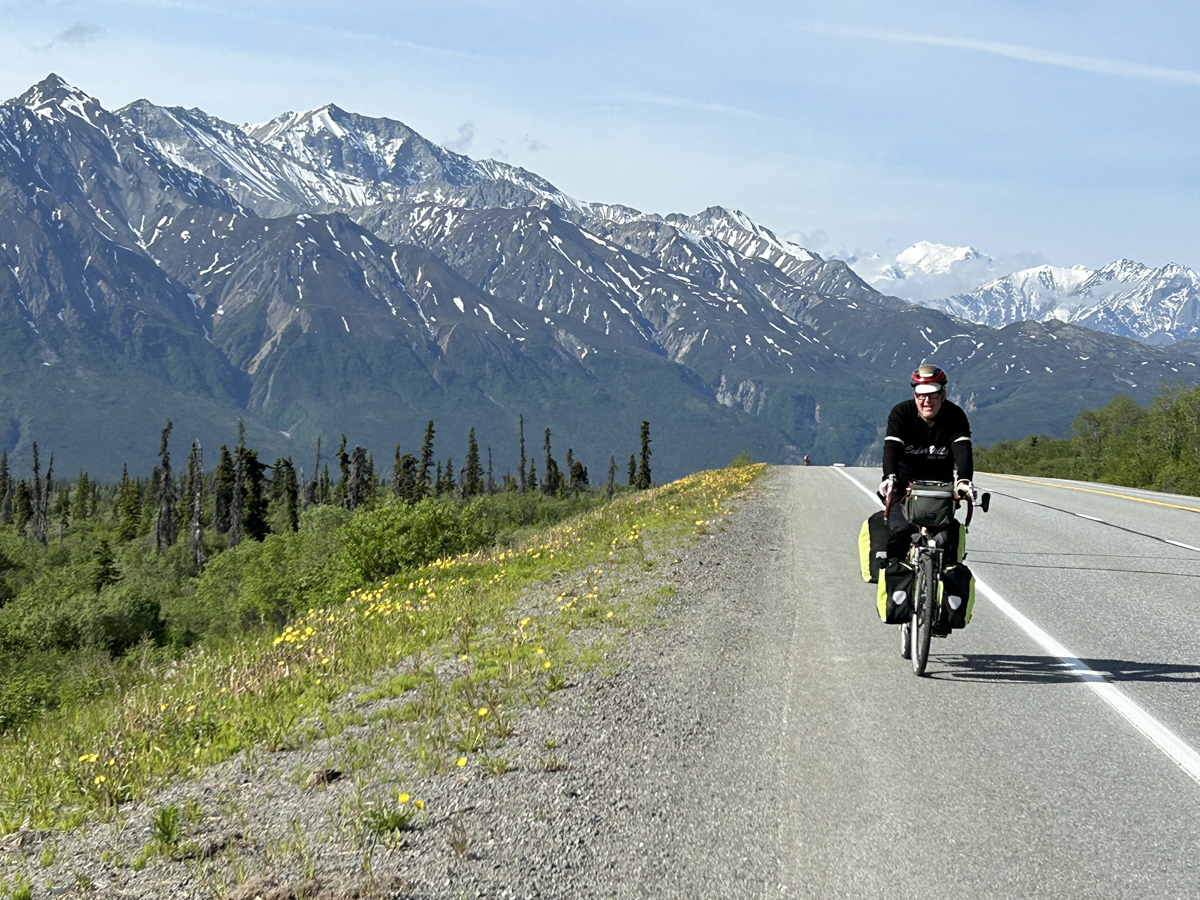
Riding on the Denali Highway. Photo by Julie Melini
Anchorage:
Julie and I arrived in Anchorage at 4 AM Salt Lake time. The night flight was the only direct flight. We had visions of arriving in Anchorage with our bikes still in Seattle. Schlepping our bikes through the airport at that time of night was not pleasant. Plus, we needed two taxis to get to the hotel. The alternative was using Bike Flights. Julie informed me that both bikes would cost $600 to Anchorage and another $600 home. Perhaps I will take fellow bike traveler Matt Davidson’s advice and rent a bike in the future.
We started our trip at the Ingra House Hotel the home base for the trip. Ingra House Hotel is more a hostel than hotel, small rooms (Julie and I plus 2 bikes filled the room), shared bathrooms but incredible service by the manager, Max, and staff. The hotel had kitchens and a storage room to store our bike boxes while on our tour. In addition, Julie and I stored our packed bikes when we went to visit her sister. Max provided bear spray and isobutane fuel left by guests unable to carry those products on planes. Max provided us with information about Anchorage and Alaska before we arrived. For example, he informed us that Alaska has 12,000 rivers and 3 million lakes larger than 5 acres. Ingra House reached out to us and gave us a discount as part of the bike group for additional nights we stayed before and after the ACA tour. I will suggest the Ingra House Hotel if you are going to Anchorage.
Anchorage is quite the cosmopolitan city with a multitude of ethnicities. Restaurant service is just OK. Expect waits over 1 hour to be seated at restaurants. The Anchorage Museum was quite interesting about Alaskan history. The bike shops provided superb service. Two members of the group needed emergency repairs. Both were accommodated with repairs completed within an hour that included a new wheel build and replacement of a front hydraulic brake caliper. The Anchorage area has 350 miles of bike trails. Julie and I toured the city for 3 hours or so on bike paths prior to our ACA tour. The people in Anchorage in general were helpful and friendly. On the downside, we were warned to lock our bikes if they were out of our sight.
We met the new leaders the first day at the hotel. Within two weeks the new leaders had packed their personal gear, group gear, got up to speed for the Denali tour, and were simply on top of things. Adrian was the official leader. He has had extensive experience leading bike tours with the ACA. He provided us with confidence in his leadership. Spencer was his assistant. Spencer has never led a tour, but he jumped in and was a great part of the leadership team. Everyone in the tour group were happy with the new leadership.
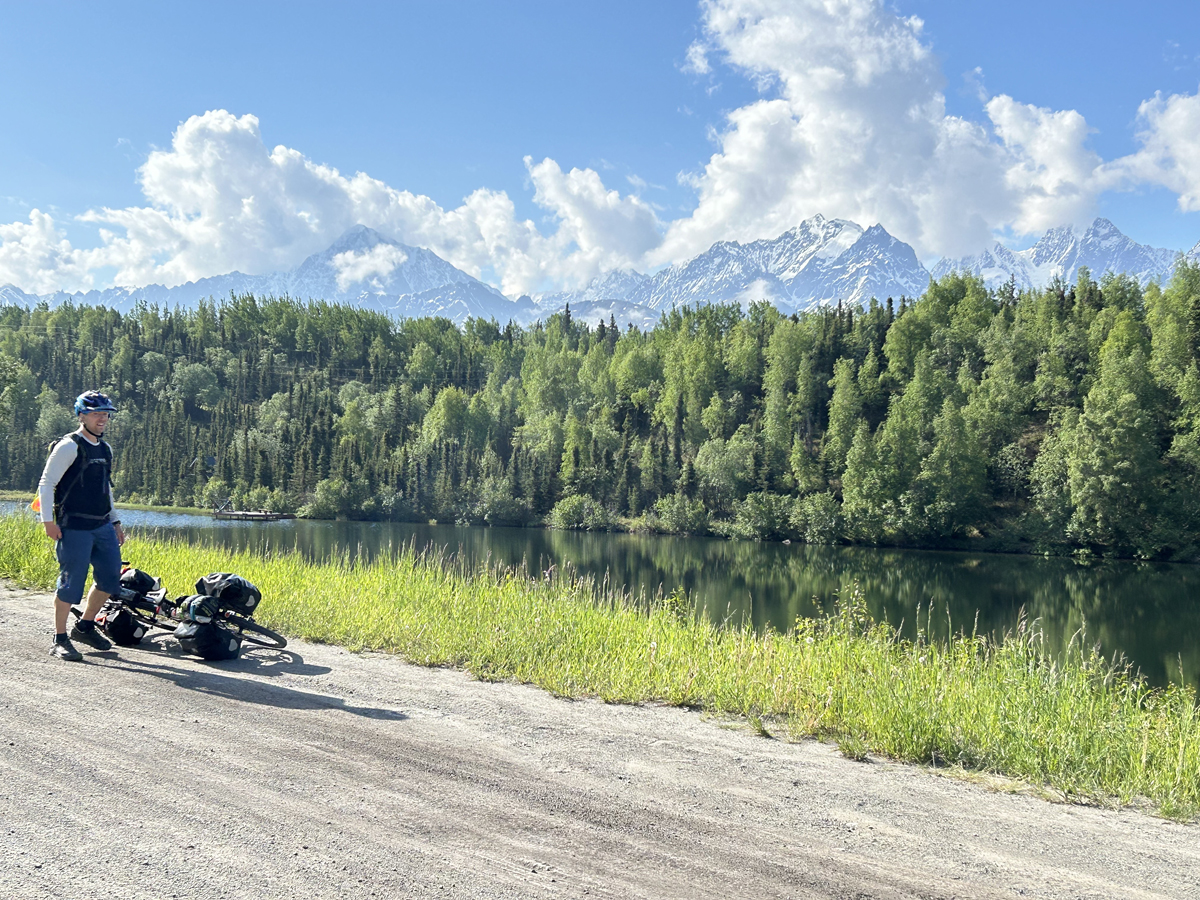
Break time along the Denali Highway. Photo by Julie Melini
The Tour: Roads and Scenery
We left Anchorage on the morning of June 16th. The group slowly split up as we followed RidewithGPS, and the map provided by the ACA. We took a bike path out of Anchorage and rode side roads to our first day’s destination, Palmer.
After Palmer, navigation was easy: east on the Glenn Highway (Hwy 1) to Glennallen, then north on the Richardson Highway (Hwy 4) to Paxson. We then turned west onto the Denali Highway (Hwy 8) to Cantwell where we turned north on the Parks Highway (Hwy 3) to Denali National Park. The tour included a train ride back to Anchorage. There are relatively few roads in the area of Alaska we rode. Though the construction season for roads is short, the roads were in decent shape.
The Glenn Highway had the most traffic, though light traffic would be a better word, with a wide shoulder on most of the road. The Richardson Highway had little traffic as did the Denali Highway. The 135-mile Denali Highway has 25 miles of pavement, 61 miles of gravel and 49 miles of chip seal, all of which is easily rideable. Contrary to the rumors, the gravel section of the Denali Highway was in excellent condition and easily traversed. I used 35 mm Pirelli Cinturato M tires with no problem. Julie was happy on her 45 mm Pirelli Cinturato H tires. My lowest gear has a 24-tooth chain ring with a 32-cassette ring that I never used, and Julie never used her lowest gear. Tires within the group ranged from 32C to 60mm. Gearing on some bikes was standard touring gears. We had few long climbs with roads grades being reasonable, perhaps similar to Emigration Canyon outside of Salt Lake City.
The scenery along the roads was outstanding. After leaving Palmer on day 2, the tour started to become remote as services became more spread out. The road out of Palmer had a nice shoulder and what I will describe as light traffic, allowing one to view the many splendid snow-capped mountain peaks, valley glaciers, lakes, and rivers. I can only assume that the rolling grassy hills we encountered would be defined as “tundra.”
Julie and I have toured on “the most scenic Highway” in several states over the years. In Alaska, the Denali Highway was perhaps the most spectacular road Julie and I have ridden on in our travels (the road through the North Cascades National Park being the lone exception). What helped make the Denali Highway notable was the lack of traffic probably due to the 60 miles of gravel. Even the spectacular beauty of Denali National Park, did not surpass the beauty of the Denali Highway.
Seeing Mt. Denali is a large part of the Denali experience. We took the free shuttle from our campground to mile 15. The bus/tour guide did his best to point out Mt. Denali, but our best view of Mt. Denali was on the train as we traveled back to Anchorage.
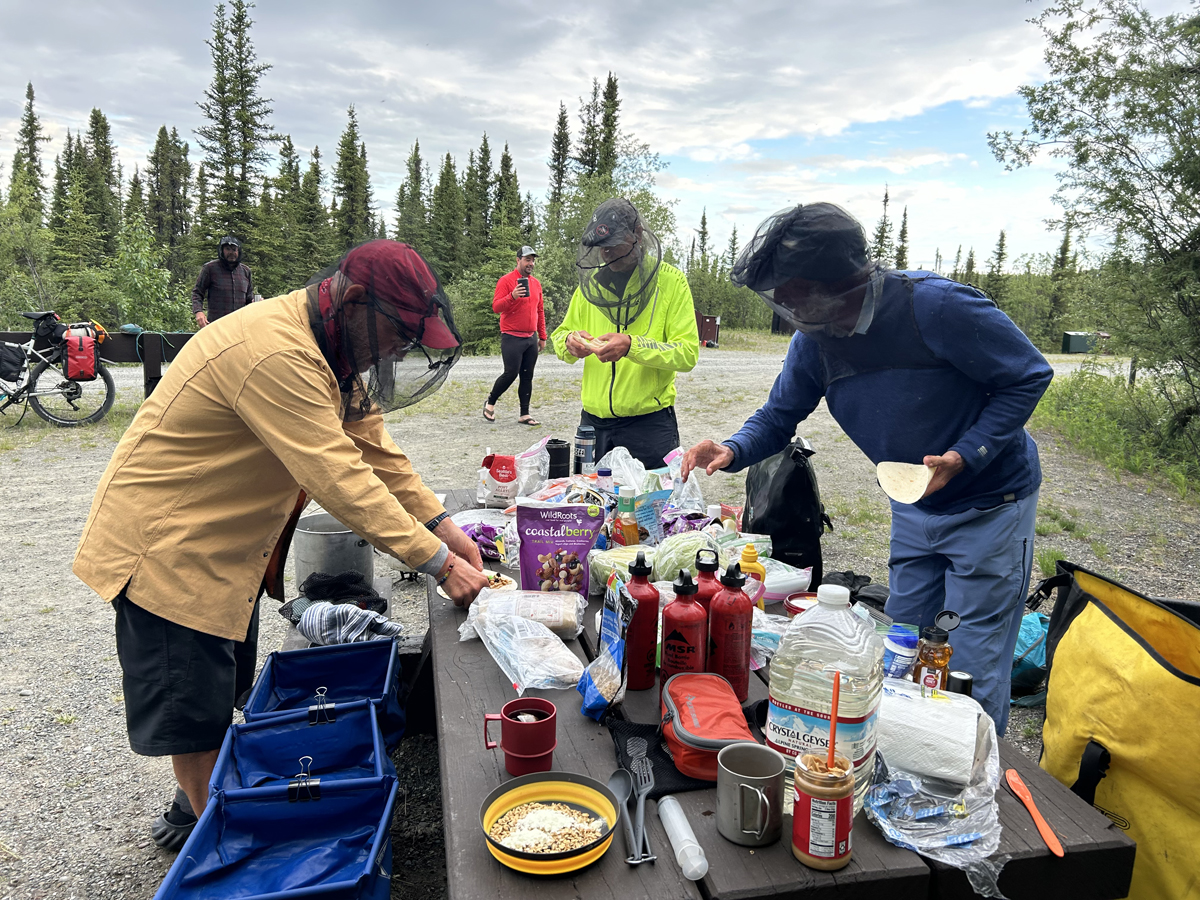
Sharing group kitchen with mosquitoes. Photo by Julie Melini
The Tour: Food
Julie and I had concerns about food and cooking during the tour. ACA tours do “group cooking.” Each night, 2 people are responsible for buying and cooking the food for the group with the exceptions being the 4 nights that we ate in restaurants. Julie and I prefer cooking our own meals although we enjoyed socializing with the group.
Groceries for the tour were obtained in Anchorage, Palmer, and Glenallen. There was a very small selection at a convenience store/gas station in Cantwell. About 10 miles north of Denali National Park there is a grocery store. The group carried 2 freeze-dried dinners purchased in Anchorage (REI) for nights when we did not have access to food stores or restaurants. The “market” in Cantwell was severely limited for supplies. On a few days, the leaders had arranged for breakfast at the restaurants and bagged lunches for us. Given the limited food options along our route, we ended up carrying less than expected due to the leadership and coordination by the group.
The restaurants we ate at had limited menu items, hamburgers (with variations including, cheese, bacon, or double patties of meat), pizza and sandwiches (Reubens for example). At the Maclaren River Lodge, we had a bit more variety including a 16-ounce steak dinner (steak and mashed potatoes) or Salmon. Vegetables were limited to the lettuce and tomato on a hamburger.
As I mentioned earlier, the leaders of the trip were great. At Denali National Park, one of the leaders rode 10 miles to the grocery north of the park for dinner and breakfast items. On the second night in Denali National Park we ate at a Serbian restaurant, one of many eating establishments within a couple of miles from our Denali camp. Eating at a Serbian restaurant was a novelty for our ride. The maître d’ took pride in explaining everything on the menu.
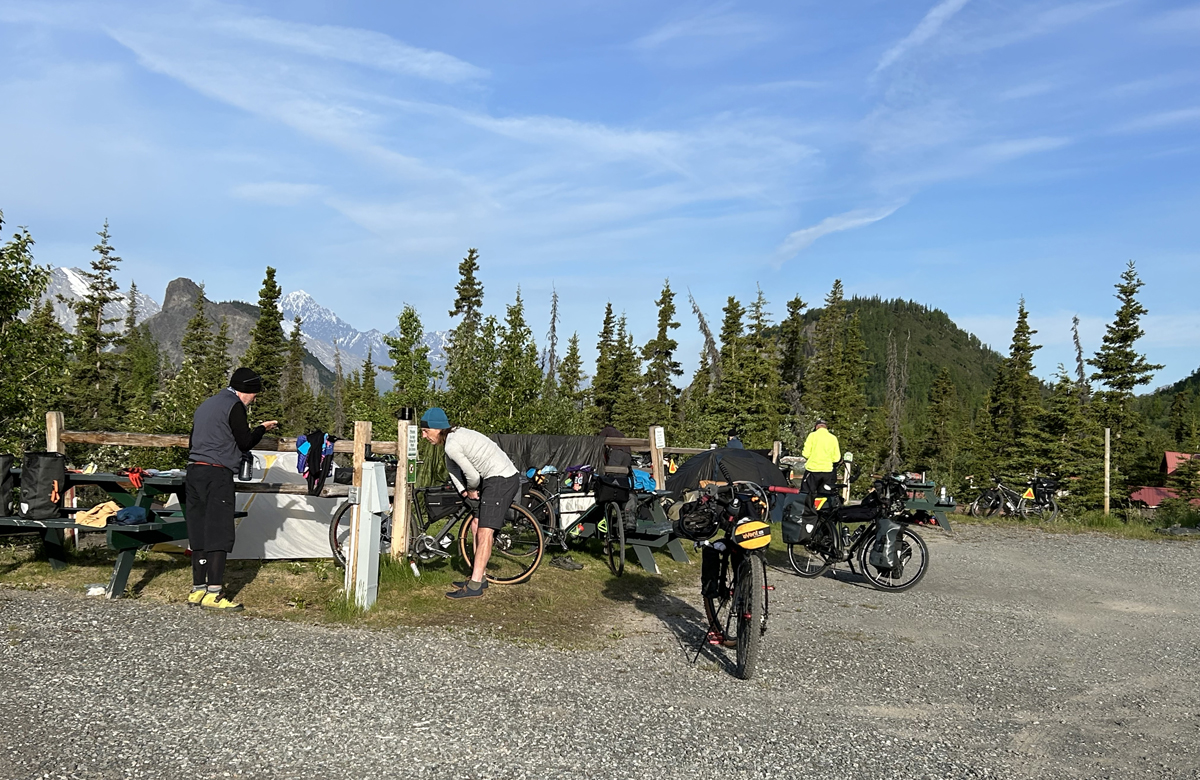
Cozy quarters at a BLM Campground. Photo by Julie Melini
22
The Tour: Lodging
We camped in 9 locations including Denali National Park and spent 3 nights in lodging along our route. Julie and I had no complaints about our lodging. In general, fitting 13 tents into our designated campsites was a challenge due to tree roots and hard packed gravel. Julie and I enjoyed the camping, our favorite choice in lodging.
Inexplicably, the first BLM campground we stayed at did not have water. One member of the group acquired 3 gallons of water from a construction crew. We had a water filter but were warned by the construction guys not to filter from the stream due to the mineral contamination. One of our leaders called the BLM office to explain the situation. The BLM employees brought us 8 gallons of water and a 12 pack of beer, per our request. They were paid well for the water, beer, and their time by the group.
BLM campgrounds were a purely first come, first serve basis. At the second BLM campground, the group hustled to get in early. The camp was crowded but we managed to get 3 adjacent sites for most of the group plus one other site.
The indoor lodges were very nice. One facility, a dog-sled resort, had large, immaculate private rooms, kitchens, porches, and included an educational session about dog sledding. At Maclaren River Resort, Julie and I were granted our own room, but the rest of the group had shared lodging with multiple people per room. Maclaren was a 2-day stay and provided the group with options to be jet boated up the river for a canoe return or a hike to a glacier. I should add that the jet-boat options were additional fees for the individuals partaking in the activity.
The Tour: Weather
Before our trip, the weather in Anchorage was damp and cool. Normal temperatures are low to mid 60’s for a high and upper 30’s for the low. Max, from the hotel said it had rained in Anchorage every day in June for the past 2 years. I packed a light puffy jacket and full rain suit. We had temperatures 10 degrees above normal and no more than 20 minutes of rain one night. I increasingly believe in Julie’s angels.
Wildflowers lining the road. Photo by Julie Melini
The Tour: Mosquitoes and other creatures
Prior to the tour, the email chat line was full of mosquito questions from the group. I knew how to deal with mosquitoes using clothing, head nets, permethrin and DEET, but the little critters can still be annoying. In Alaska, the number of mosquitoes is legendary. In addition to my normal armaments for mosquitoes, I purchased a Thermacell (backpacker model), a 4-ounce device powered by a small can of butane/propane fuel that will give a 15-foot diameter of mosquito free space. The Thermacell unit worked well. Fortunately, we only had two nights that we had bothersome mosquitoes much to the delight of the tour group.
The mosquitoes were ferocious when present. Once I had a sudden gastrointestinal attack. I hopped off of my bike, ran behind some trees and did my duty, and so did a swarm of mosquitoes. At this moment, I had an epiphany to develop toilet tissue impregnated with DEET.
Moose were a near-daily sighting on our travels. One person in the group saw a bear. There were a multitude of birds including eagles and ptarmigans. Julie and I were stopped during a short hike by a grouse that did not want us to continue on the trail. Interesting interaction with the attack bird. Julie and I saw one caribou in Denali National Park during a bus ride.
The Tour: Bikes
The bikes in our group ranged from road touring bikes with 32 mm Schwalbe tires to very popular (in the group) Surly bikes with up to 55 mm tires. Julie and I felt that her current travel bikes were compromises for the Denali tour based on the information the “tours team” provided. We purchased a Surly Grappler frame. All of the reviews of the Grappler stated that the stability of the Grappler was remarkable, just what Julie needed. I did not like the set-up of the stock bike. My son built 29’er tubeless wheels based on the cycling motto, light, durable and cheap, pick any two. The wheels were light and durable, perfect for the tour. I also upgraded the components to a Shimano gravel group. The bike was completed with an 11-51 cassette and a 32-tooth chain ring, that will be enlarged for future tours. Julie did great. The bike turned out to be needed not only for this trip but for future use, so I am happy with the decision to purchase the bike.
On the flight home, Julie lifted a bag and suffered a sudden loss of function of her left thumb with swelling at the base of the thumb. She has arthritis in her thumbs however we thought she had a ligament tear. The hand specialist confirmed that the disability was an acute arthritic flare. The Surly Grappler will be a template for future bikes for her, single chainring to limit left thumb use for braking only, hydraulic brakes (which she loves) for their feel and function over rim and mechanical disc brakes and drop bars, as she doesn’t want flat bars.
The Tour: Pedals
For the Denali tour, we decided on flat pedals, also used by most of the tour group. Julie will not ride clipped in on gravel. We did an overnight bike trip to Affleck Park, about a 2-hour ride from our home and 1.5 hours return trip back to our home due to the elevation changes. The time difference with the flat pedals was perhaps a 5-minute difference from our rides to Affleck clipped in.
In Alaska there is a lot of elevation change, but not steep nor long. The flat pedals worked great. On 3 occasions we hopped off the bikes and did a 1–2-hour hike. We carried lightweight Crocs for camp use vs. a second pair of shoes as in the past. Julie used flat pedals by Fyxation. She feels that the RaceFace Chester pedals bother her feet on long rides. The Fyxation pedals have 10 durable plastic pegs vs. the 8 metal pegs on the RaceFace. The Fyxation pegs may be a hair shorter. Julie did not perceive any difference in efficiency between the RaceFace or Fyxation. I used the RaceFace Chester, which I like. As a general statement, I find that flat pedals have a small exponential loss of efficiency compared to being clipped in as the road grade increases after about 4 percent. Those that have high cadence pedaling style (>85) may also note some loss in efficiency compared to being clipped in. Julie and I will be using flat pedals for future tours.
We were told that the Five Ten (by Adidas) shoes we wore would not make good hiking shoes. However, the shoes worked great for our walks that were all less than 2 hours.
The Tour: Would I do it again and was it worth the money?
Both Julie and I would do the tour again. I think I could plan a similar trip now that I have experienced Alaska and know about Alaska Milepost magazine/journal. Alaska Milepost is a free publication that will tell you what services (lodging, restaurant, etc.) at mileposts along the route. A few of the tour members used it to consult with the leaders regarding food options for our tour. I may consider other ACA trips such as the Selkirk loop (Northern Idaho/British Columbia) especially if Adrian or Spencer are the tour leaders. The ACA tour was a fantastic ride with beautiful scenery.
Julie and I have planned and toured alone in the past. Costs have been on average 20% of our Alaska tour. In our minds, the cost for 2 weeks (for both of us) seems like a lot as the ride was basically a self-supported (no van support) camping tour. The ACA tour price included lodging, food, and the train ride back to Anchorage from Denali National Park. We had great leaders, an excellent route, and the tour got us to Alaska. We met a bunch of strangers in Anchorage that became lifetime friends by the time we reached Denali National Park. One can’t put a price on friendship.
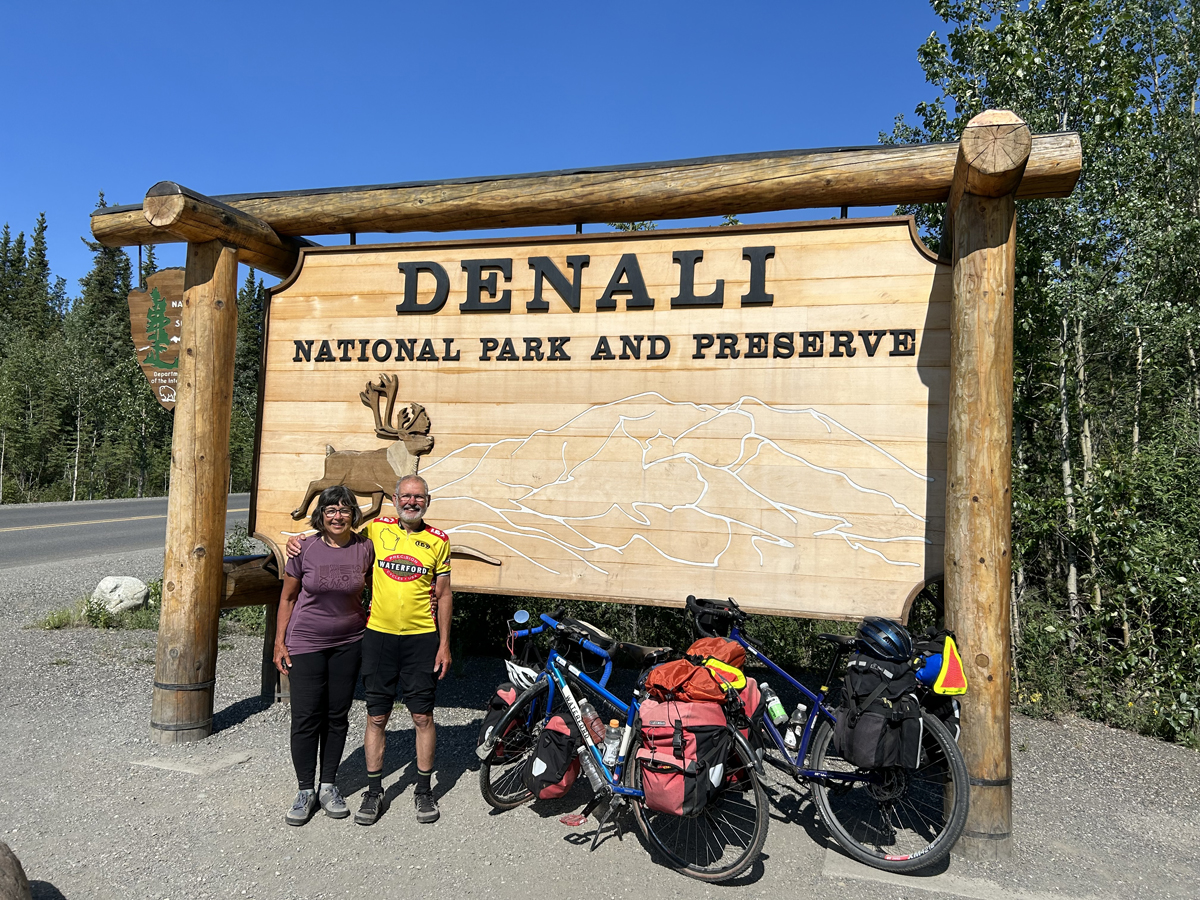
Julie and Lou at the entrance to Denali National Park. Photo courtesy Julie Melini
Trip Details:
Trip Name: Denali National Park Tour
Number of Days and Miles: 14 days (11 riding days) 430 miles (20-60 miles)
Dates traveled: Final two weeks of June
Where to go for more information: adventurecycling.org; Note that this trip is not being offered in 2025. Instead, the Alaska Golden Circle tour is offered.
By Lou Melini — An Alaskan bicycle tour has been on the bucket list for Julie and I for 15 years or more. Initially the plan was to ride the “North Star route” from Missoula, Montana to Denali National Park. That plan never rose to the top of our bucket list due to a bucketful of reasons. Julie and I are not yet ready to have a vehicle carry our gear, and we like to camp, so tours with vans and exclusively hotels were out. We have never been to Alaska, thus the thought of me pulling off the logistics in the manner that we are accustomed for an Alaskan trip seemed overwhelming to me.
In September of 2023 I got on the Adventure Cycling Association (ACA) website to browse the annual self-supported bike trips being offered for 2024. The ACA is perhaps the only organization that has group trips in which the riders carry their gear with no van support (note that most of their trips are van supported). The Denali National Park trip popped up in front of my eyes. A quick consult with Julie sealed the plan with each of us paying a $200 down payment. The late June 2024 trip started in Anchorage and ended, 430 miles and 14 days later (11 riding days) in Denali National Park. In addition, Julie’s sister lives on the Kenai peninsula in Alaska. The bike trip would combine a trip to see her sister and brother-in-law.
I’ve been a member of Adventure Cycling Association (ACA) since 1976/77 time period. I have used the maps produced by the ACA for many of my trips with Julie. The ACA produces great bike travel maps, and I expected the same professionalism for this tour.
Adventure Cycling Association Tours:
Julie and I were excited about doing our first commercial tour and doing it with the ACA. The website listed it as a road tour with some gravel. The technical difficulty was rated as “easy,” the terrain “mountainous,” and the difficulty rating of “5”, the most difficult. We assumed that the difficulty rating reflected the “mountainous” and “gravel” as there was no explanation for the rating. The tour was limited to 15 people including the leaders.
I should note that there are 2 aspects of ACA tours. There is a “Tours Team” a behind the scenes group and then there are the tour leader(s) that lead the trip.
We received a tour packet 2 months prior to our trip. A chat group was created enabling us to receive introductions from the rest of the group. I was happy to learn that many in our group had bike travel experience. Additionally, 5 of the 13 including me, were in their 70’s. One concern we had was a change in leadership for the tour 10 days prior to our departure.
For this trip we had 2 leaders, one an experienced tour leader and his assistant. Both leaders of the trip were excellent. They were very responsive to the concerns of the group. Because of their efforts the questions from the group were answered.
Anchorage:
Julie and I arrived in Anchorage at 4 AM Salt Lake time. The night flight was the only direct flight. We had visions of arriving in Anchorage with our bikes still in Seattle. Schlepping our bikes through the airport at that time of night was not pleasant. Plus, we needed two taxis to get to the hotel. The alternative was using Bike Flights. Julie informed me that both bikes would cost $600 to Anchorage and another $600 home. Perhaps I will take fellow bike traveler Matt Davidson’s advice and rent a bike in the future.
We started our trip at the Ingra House Hotel the home base for the trip. Ingra House Hotel is more a hostel than hotel, small rooms (Julie and I plus 2 bikes filled the room), shared bathrooms but incredible service by the manager, Max, and staff. The hotel had kitchens and a storage room to store our bike boxes while on our tour. In addition, Julie and I stored our packed bikes when we went to visit her sister. Max provided bear spray and isobutane fuel left by guests unable to carry those products on planes. Max provided us with information about Anchorage and Alaska before we arrived. For example, he informed us that Alaska has 12,000 rivers and 3 million lakes larger than 5 acres. Ingra House reached out to us and gave us a discount as part of the bike group for additional nights we stayed before and after the ACA tour. I will suggest the Ingra House Hotel if you are going to Anchorage.
Anchorage is quite the cosmopolitan city with a multitude of ethnicities. Restaurant service is just OK. Expect waits over 1 hour to be seated at restaurants. The Anchorage Museum was quite interesting about Alaskan history. The bike shops provided superb service. Two members of the group needed emergency repairs. Both were accommodated with repairs completed within an hour that included a new wheel build and replacement of a front hydraulic brake caliper. The Anchorage area has 350 miles of bike trails. Julie and I toured the city for 3 hours or so on bike paths prior to our ACA tour. The people in Anchorage in general were helpful and friendly. On the downside, we were warned to lock our bikes if they were out of our sight.
We met the new leaders the first day at the hotel. Within two weeks the new leaders had packed their personal gear, group gear, got up to speed for the Denali tour, and were simply on top of things. Adrian was the official leader. He has had extensive experience leading bike tours with the ACA. He provided us with confidence in his leadership. Spencer was his assistant. Spencer has never led a tour, but he jumped in and was a great part of the leadership team. Everyone in the tour group were happy with the new leadership.
Julie and Lou at the entrance to Denali National Park. Photo courtesy Julie Melini
The Tour: Roads and Scenery
We left Anchorage on the morning of June 16th. The group slowly split up as we followed RidewithGPS, and the map provided by the ACA. We took a bike path out of Anchorage and rode side roads to our first day’s destination, Palmer.
After Palmer, navigation was easy: east on the Glenn Highway (Hwy 1) to Glennallen, then north on the Richardson Highway (Hwy 4) to Paxson. We then turned west onto the Denali Highway (Hwy 8) to Cantwell where we turned north on the Parks Highway (Hwy 3) to Denali National Park. The tour included a train ride back to Anchorage. There are relatively few roads in the area of Alaska we rode. Though the construction season for roads is short, the roads were in decent shape.
The Glenn Highway had the most traffic, though light traffic would be a better word, with a wide shoulder on most of the road. The Richardson Highway had little traffic as did the Denali Highway. The 135-mile Denali Highway has 25 miles of pavement, 61 miles of gravel and 49 miles of chip seal, all of which is easily rideable. Contrary to the rumors, the gravel section of the Denali Highway was in excellent condition and easily traversed. I used 35 mm Pirelli Cinturato M tires with no problem. Julie was happy on her 45 mm Pirelli Cinturato H tires. My lowest gear has a 24-tooth chain ring with a 32-cassette ring that I never used, and Julie never used her lowest gear. Tires within the group ranged from 32C to 60mm. Gearing on some bikes was standard touring gears. We had few long climbs with roads grades being reasonable, perhaps similar to Emigration Canyon outside of Salt Lake City.
The scenery along the roads was outstanding. After leaving Palmer on day 2, the tour started to become remote as services became more spread out. The road out of Palmer had a nice shoulder and what I will describe as light traffic, allowing one to view the many splendid snow-capped mountain peaks, valley glaciers, lakes, and rivers. I can only assume that the rolling grassy hills we encountered would be defined as “tundra.”
Break time along the Denali Highway. Photo by Julie Melini
Julie and I have toured on “the most scenic Highway” in several states over the years. In Alaska, the Denali Highway was perhaps the most spectacular road Julie and I have ridden on in our travels (the road through the North Cascades National Park being the lone exception). What helped make the Denali Highway notable was the lack of traffic probably due to the 60 miles of gravel. Even the spectacular beauty of Denali National Park, did not surpass the beauty of the Denali Highway.
Seeing Mt. Denali is a large part of the Denali experience. We took the free shuttle from our campground to mile 15. The bus/tour guide did his best to point out Mt. Denali, but our best view of Mt. Denali was on the train as we traveled back to Anchorage.
The Tour: Food
Julie and I had concerns about food and cooking during the tour. ACA tours do “group cooking.” Each night, 2 people are responsible for buying and cooking the food for the group with the exceptions being the 4 nights that we ate in restaurants. Julie and I prefer cooking our own meals although we enjoyed socializing with the group.
Sharing group kitchen with mosquitoes. Photo by Julie Melini
Groceries for the tour were obtained in Anchorage, Palmer, and Glenallen. There was a very small selection at a convenience store/gas station in Cantwell. About 10 miles north of Denali National Park there is a grocery store. The group carried 2 freeze-dried dinners purchased in Anchorage (REI) for nights when we did not have access to food stores or restaurants. The “market” in Cantwell was severely limited for supplies. On a few days, the leaders had arranged for breakfast at the restaurants and bagged lunches for us. Given the limited food options along our route, we ended up carrying less than expected due to the leadership and coordination by the group.
The restaurants we ate at had limited menu items, hamburgers (with variations including, cheese, bacon, or double patties of meat), pizza and sandwiches (Reubens for example). At the Maclaren River Lodge, we had a bit more variety including a 16-ounce steak dinner (steak and mashed potatoes) or Salmon. Vegetables were limited to the lettuce and tomato on a hamburger.
As I mentioned earlier, the leaders of the trip were great. At Denali National Park, one of the leaders rode 10 miles to the grocery north of the park for dinner and breakfast items. On the second night in Denali National Park we ate at a Serbian restaurant, one of many eating establishments within a couple of miles from our Denali camp. Eating at a Serbian restaurant was a novelty for our ride. The maître d’ took pride in explaining everything on the menu.
The Tour: Lodging
We camped in 9 locations including Denali National Park and spent 3 nights in lodging along our route. Julie and I had no complaints about our lodging. In general, fitting 13 tents into our designated campsites was a challenge due to tree roots and hard packed gravel. Julie and I enjoyed the camping, our favorite choice in lodging.
Cozy quarters at a BLM Campground. Photo by Julie Melini
Inexplicably, the first BLM campground we stayed at did not have water. One member of the group acquired 3 gallons of water from a construction crew. We had a water filter but were warned by the construction guys not to filter from the stream due to the mineral contamination. One of our leaders called the BLM office to explain the situation. The BLM employees brought us 8 gallons of water and a 12 pack of beer, per our request. They were paid well for the water, beer, and their time by the group.
BLM campgrounds were a purely first come, first serve basis. At the second BLM campground, the group hustled to get in early. The camp was crowded but we managed to get 3 adjacent sites for most of the group plus one other site.
The indoor lodges were very nice. One facility, a dog-sled resort, had large, immaculate private rooms, kitchens, porches, and included an educational session about dog sledding. At Maclaren River Resort, Julie and I were granted our own room, but the rest of the group had shared lodging with multiple people per room. Maclaren was a 2-day stay and provided the group with options to be jet boated up the river for a canoe return or a hike to a glacier. I should add that the jet-boat options were additional fees for the individuals partaking in the activity.
The Tour: Weather
Before our trip, the weather in Anchorage was damp and cool. Normal temperatures are low to mid 60’s for a high and upper 30’s for the low. Max, from the hotel said it had rained in Anchorage every day in June for the past 2 years. I packed a light puffy jacket and full rain suit. We had temperatures 10 degrees above normal and no more than 20 minutes of rain one night. I increasingly believe in Julie’s angels.
Wildflowers lining the road. Photo by Julie Melini
The Tour: Mosquitoes and other creatures
Prior to the tour, the email chat line was full of mosquito questions from the group. I knew how to deal with mosquitoes using clothing, head nets, permethrin and DEET, but the little critters can still be annoying. In Alaska, the number of mosquitoes is legendary. In addition to my normal armaments for mosquitoes, I purchased a Thermacell (backpacker model), a 4-ounce device powered by a small can of butane/propane fuel that will give a 15-foot diameter of mosquito free space. The Thermacell unit worked well. Fortunately, we only had two nights that we had bothersome mosquitoes much to the delight of the tour group.
The mosquitoes were ferocious when present. Once I had a sudden gastrointestinal attack. I hopped off of my bike, ran behind some trees and did my duty, and so did a swarm of mosquitoes. At this moment, I had an epiphany to develop toilet tissue impregnated with DEET.
Moose were a near-daily sighting on our travels. One person in the group saw a bear. There were a multitude of birds including eagles and ptarmigans. Julie and I were stopped during a short hike by a grouse that did not want us to continue on the trail. Interesting interaction with the attack bird. Julie and I saw one caribou in Denali National Park during a bus ride.
The Tour: Bikes
The bikes in our group ranged from road touring bikes with 32 mm Schwalbe tires to very popular (in the group) Surly bikes with up to 55 mm tires. Julie and I felt that her current travel bikes were compromises for the Denali tour based on the information the “tours team” provided. We purchased a Surly Grappler frame. All of the reviews of the Grappler stated that the stability of the Grappler was remarkable, just what Julie needed. I did not like the set-up of the stock bike. My son built 29’er tubeless wheels based on the cycling motto, light, durable and cheap, pick any two. The wheels were light and durable, perfect for the tour. I also upgraded the components to a Shimano gravel group. The bike was completed with an 11-51 cassette and a 32-tooth chain ring, that will be enlarged for future tours. Julie did great. The bike turned out to be needed not only for this trip but for future use, so I am happy with the decision to purchase the bike.
On the flight home, Julie lifted a bag and suffered a sudden loss of function of her left thumb with swelling at the base of the thumb. She has arthritis in her thumbs however we thought she had a ligament tear. The hand specialist confirmed that the disability was an acute arthritic flare. The Surly Grappler will be a template for future bikes for her, single chainring to limit left thumb use for braking only, hydraulic brakes (which she loves) for their feel and function over rim and mechanical disc brakes and drop bars, as she doesn’t want flat bars.
The Tour: Pedals
For the Denali tour, we decided on flat pedals, also used by most of the tour group. Julie will not ride clipped in on gravel. We did an overnight bike trip to Affleck Park, about a 2-hour ride from our home and 1.5 hours return trip back to our home due to the elevation changes. The time difference with the flat pedals was perhaps a 5-minute difference from our rides to Affleck clipped in.
In Alaska there is a lot of elevation change, but not steep nor long. The flat pedals worked great. On 3 occasions we hopped off the bikes and did a 1–2-hour hike. We carried lightweight Crocs for camp use vs. a second pair of shoes as in the past. Julie used flat pedals by Fyxation. She feels that the RaceFace Chester pedals bother her feet on long rides. The Fyxation pedals have 10 durable plastic pegs vs. the 8 metal pegs on the RaceFace. The Fyxation pegs may be a hair shorter. Julie did not perceive any difference in efficiency between the RaceFace or Fyxation. I used the RaceFace Chester, which I like. As a general statement, I find that flat pedals have a small exponential loss of efficiency compared to being clipped in as the road grade increases after about 4 percent. Those that have high cadence pedaling style (>85) may also note some loss in efficiency compared to being clipped in. Julie and I will be using flat pedals for future tours.
We were told that the Five Ten (by Adidas) shoes we wore would not make good hiking shoes. However, the shoes worked great for our walks that were all less than 2 hours.
The Tour: Would I do it again and was it worth the money?
Both Julie and I would do the tour again. I think I could plan a similar trip now that I have experienced Alaska and know about Alaska Milepost magazine/journal. Alaska Milepost is a free publication that will tell you what services (lodging, restaurant, etc.) at mileposts along the route. A few of the tour members used it to consult with the leaders regarding food options for our tour. I may consider other ACA trips such as the Selkirk loop (Northern Idaho/British Columbia) especially if Adrian or Spencer are the tour leaders. The ACA tour was a fantastic ride with beautiful scenery.
Julie and I have planned and toured alone in the past. Costs have been on average 20% of our Alaska tour. In our minds, the cost for 2 weeks (for both of us) seems like a lot as the ride was basically a self-supported (no van support) camping tour. The ACA tour price included lodging, food, and the train ride back to Anchorage from Denali National Park. We had great leaders, an excellent route, and the tour got us to Alaska. We met a bunch of strangers in Anchorage that became lifetime friends by the time we reached Denali National Park. One can’t put a price on friendship.
Trip Details:
Trip Name: Denali National Park Tour
Number of Days and Miles: 14 days (11 riding days) 430 miles (20-60 miles)
Dates traveled: Final two weeks of June
Where to go for more information: adventurecycling.org; Note that this trip is not being offered in 2025. Instead, the Alaska Golden Circle tour is offered.
By Charles Pekow — Roadway stress likely affects how much Americans cycle, but its impact remains unclear due to a lack of effective measurement methods. Researchers at the University of Texas have developed a solution using smartphones. Traditional approaches, such as surveys, often suffer from biases in self-reported data, while physiological measurements, like heart rate tracking, are impractical for large-scale or real-time studies.
The researchers created CyclistAI, an app that assesses stress using a simulator with an accuracy rate of 89% for real-world conditions. The app monitors road conditions, rider maneuvers, and prompts cyclists in real time to rate their stress levels as low, medium, or high. This data can help urban planners identify streets where cyclists feel safer and more comfortable riding.
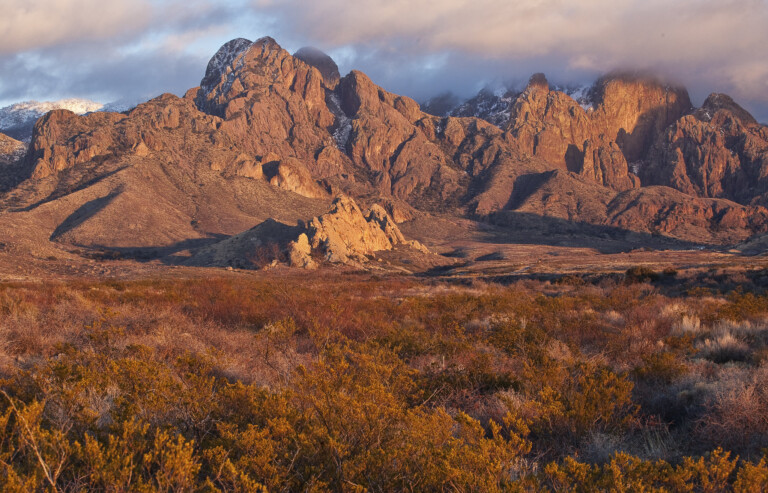
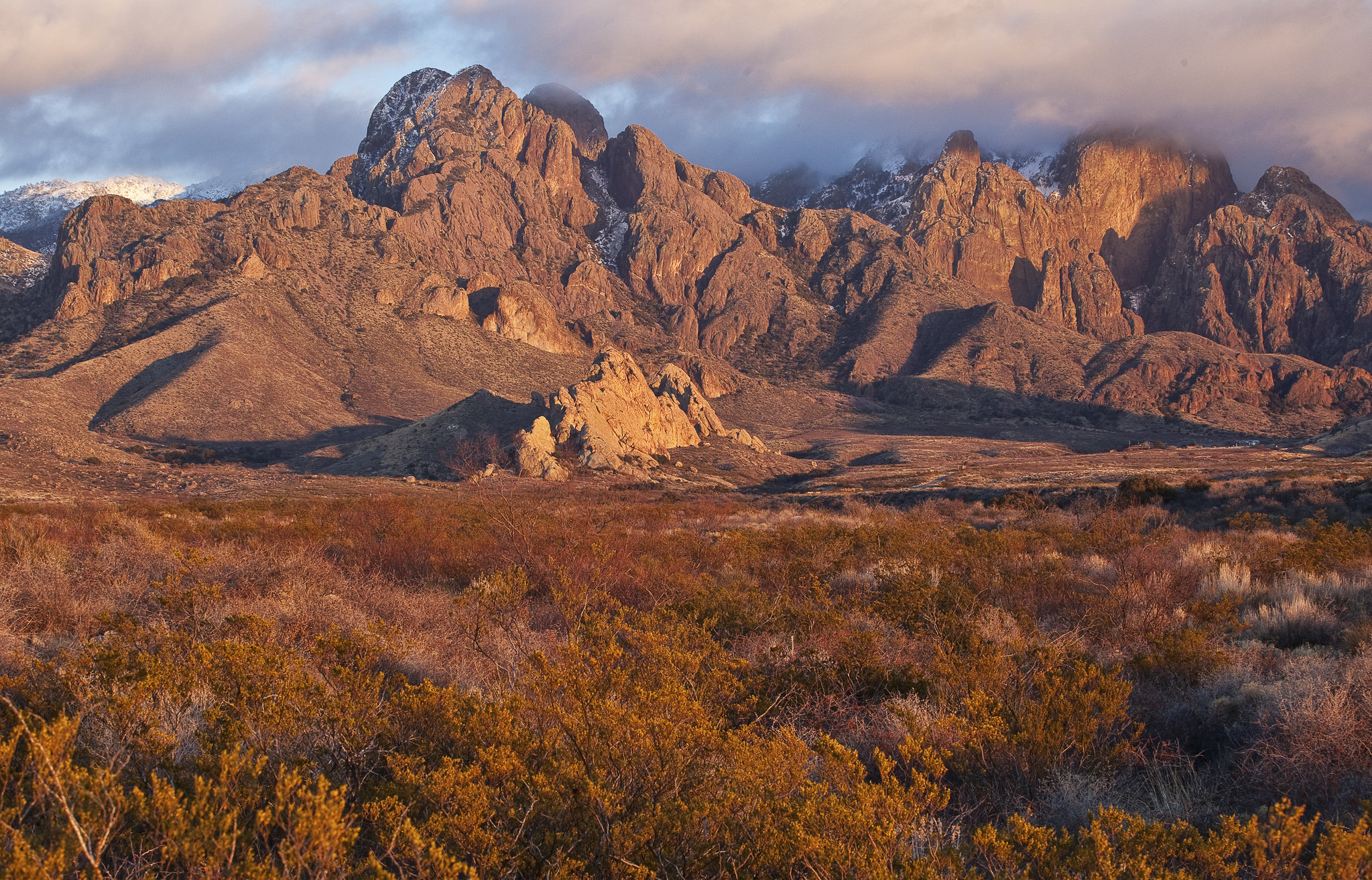
By Charles Pekow — Approximately half of the Organ Mountains-Desert Peaks National Monument in southern New Mexico will offer extensive mountain biking opportunities. However, the other half will be designated as wilderness and closed to mountain biking under a plan issued by the Bureau of Land Management (BLM). The Proposed Resource Management Plan and Final Environmental Impact Statement present several alternatives, each with different levels of access for mountain biking.
Organ Mountains-Desert Peaks National Monument. Photo by Bob Wick/BLM, CC BY 2.0
The BLM plans to keep the popular 250-mile Monumental Loop bikepacking route open to riders under all proposed scenarios. Some alternatives include banning off-highway vehicles (OHVs) from certain mountain bike trails to minimize user conflicts. However, mountain biking and motorized recreation will be prohibited on 239,596 acres—48 percent of the monument—within designated wilderness areas under any proposed BLM option.
Across the U.S., more pedestrians and bicyclists are killed or seriously injured today than any time over the past 40 years. Over 7,500 pedestrians and over 1,100 bicyclists died in traffic collisions in 2022, the most recent year with available data, according to the National Highway Traffic Safety Administration.
As an injury epidemiologist in Philadelphia who studies pedestrian and bicyclist injuries in the U.S. and Latin America, I want to share several evidence-based ways that Philadelphia can make walking, biking and getting around the city safer for everyone.
Protect bike lanes
Protected bike lanes have physical barriers that prevent drivers from entering the bike lane to park or pass other drivers.
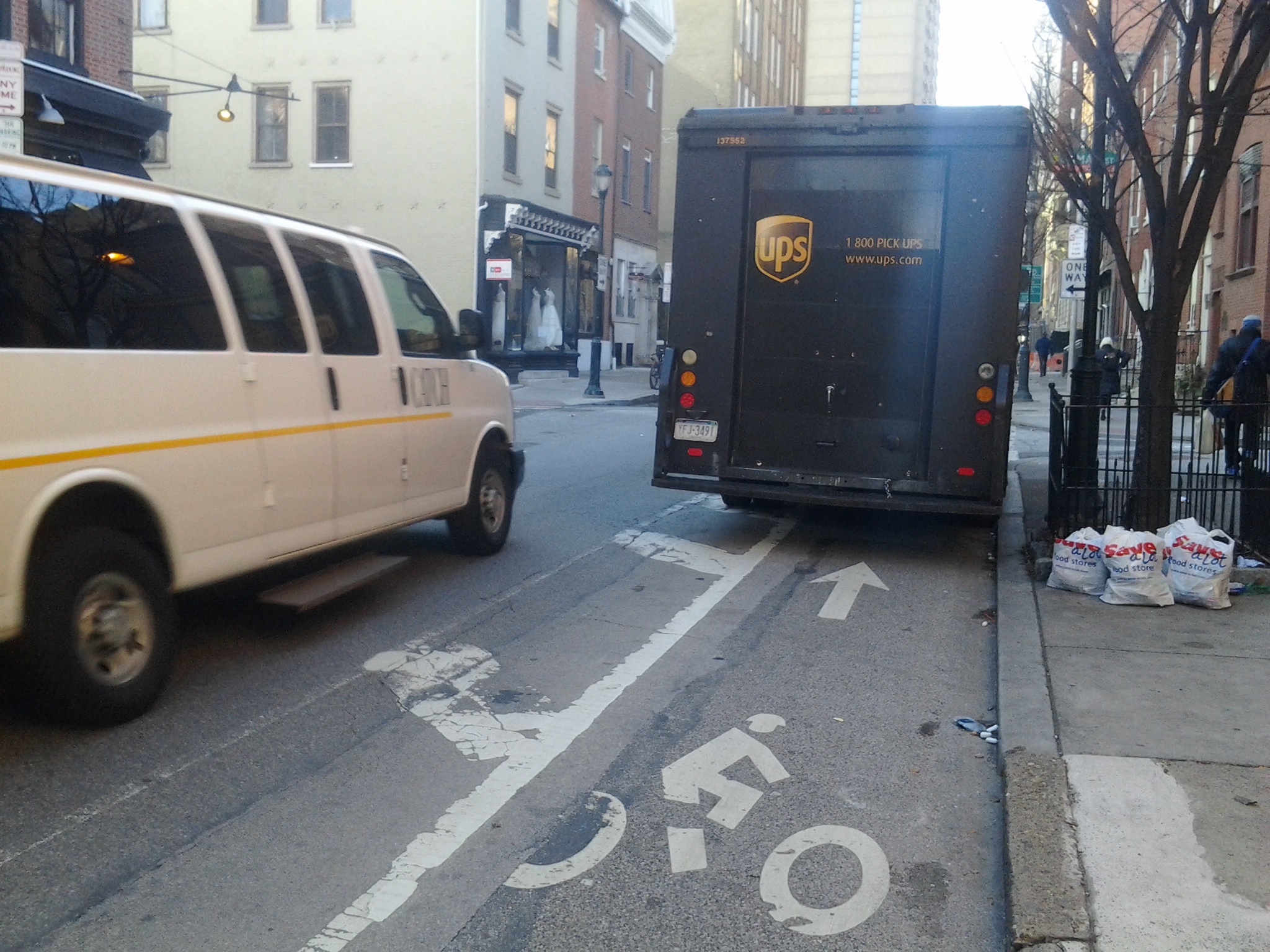
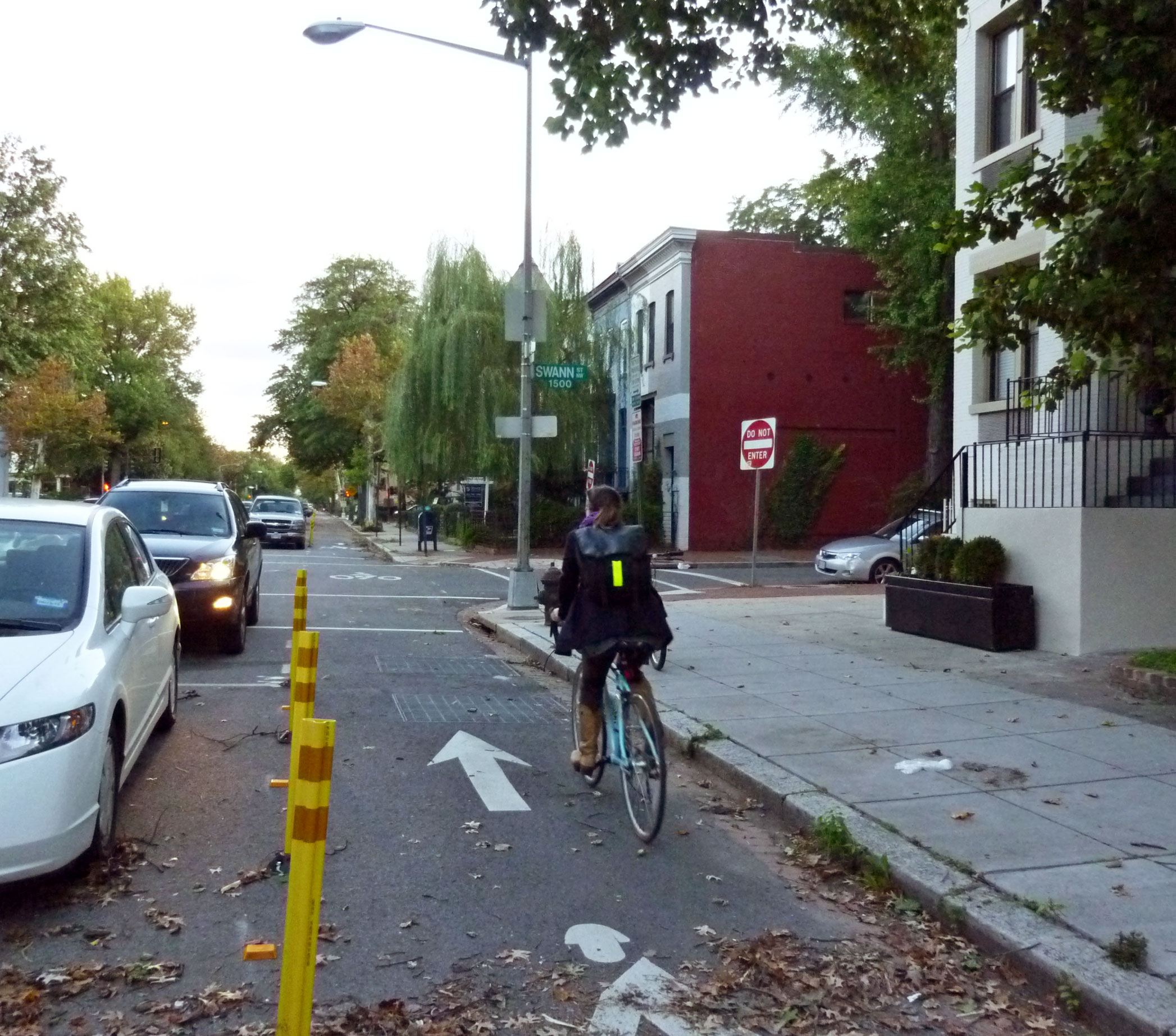
They are particularly useful on high-volume cycling corridors and offer cyclists much more protection than lanes that are merely painted but have no physical barriers or lanes with flexible posts that can be driven over.
Few bike lanes in Philadelphia are protected, leading to situations where trucks and other vehicles park in and thus block the lane. Photo by “Phila. Bikes”, CC BY-SA 2.0, Attribution-ShareAlike 2.0 Generic
Flexible posts, for example, were unable to block the collision that killed Barbara Friedes, chief pediatric resident at Children’s Hospital of Philadelphia, in Center City in July 2024 when a drunk driver sped through the bike lane where Friedes was bicycling.
With time, more Philadelphia streets are getting protected bike lines, like this 15th Street protected contraflow bike lane. Photo by Payton Chung, CC BY 2.0, Attribution 2.0 Generic
In October 2024, the city announced it will install concrete barriers to protect the bike lanes on Spruce and Pine streets in Center City, including where Friedes was killed. That same month, the City Council unanimously passed a “Get Out the Bike Lane” bill that increases the fines for drivers who stop or park in a bike lane.
Slow drivers down
Traffic-calming measures are engineering and road design strategies that slow vehicles down, make pedestrians more visible to motorists and provide safer crossing areas.
Automated speed cameras on Roosevelt Blvd. (shown here) have done much to slow traffic on one of the worst streets for cyclists in Philadelphia. Photo by Famartin, CC-BY-SA-4.0, Attribution-ShareAlike 4.0 International
Philadelphia can adopt more policies that promote walking or biking over driving. These include open streets or ciclovías, where streets are closed down to motor vehicle traffic and opened to cyclists and pedestrians. Philadelphia occasionally does this on stretches of 18th Street and Walnut Street in Center City.
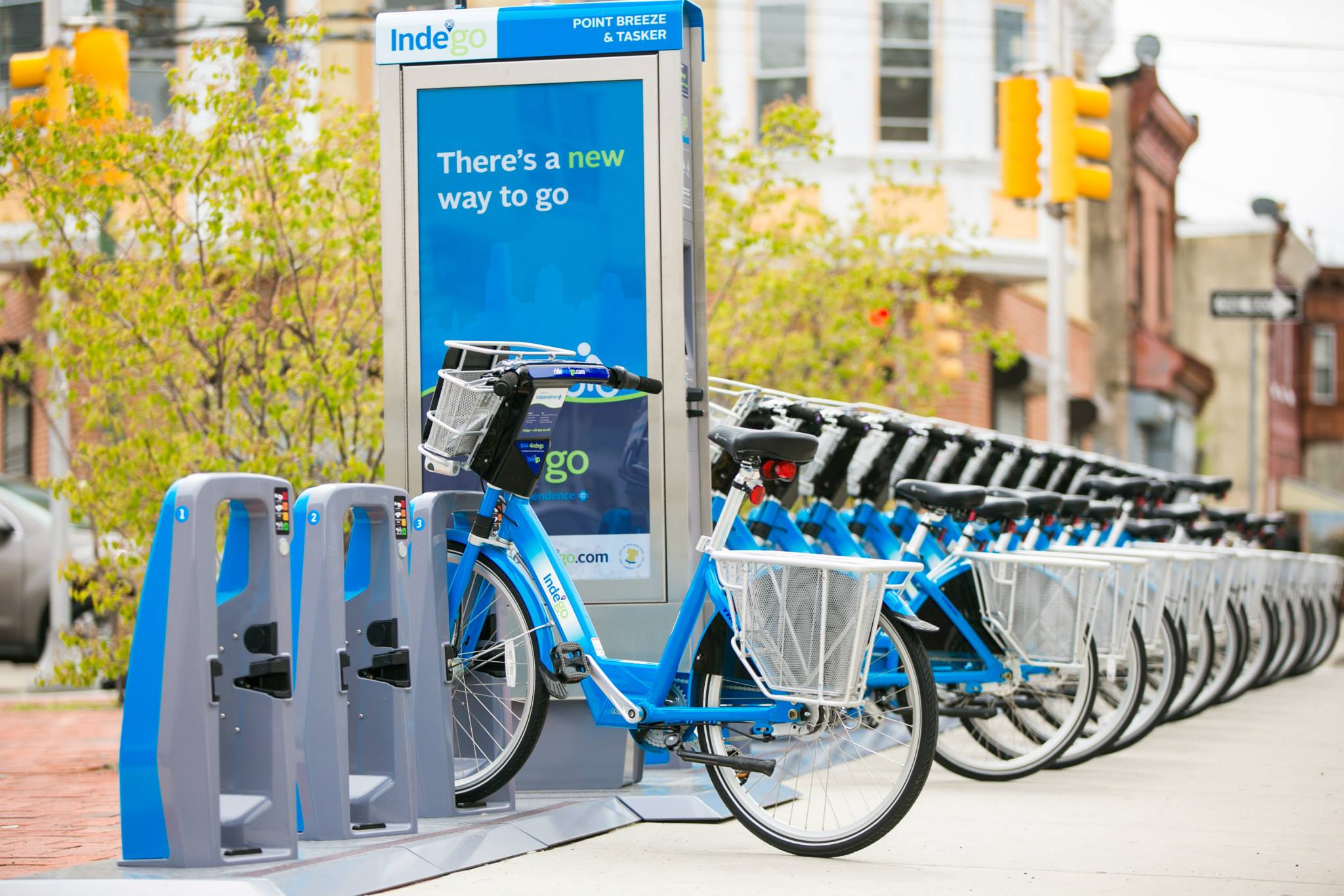
Indego, Philadelphia’s bikeshare program, launched on April 23, 2015 with B-cycle’s version 2.0 station. Photo by Tyree303, CC BY-SA 4.0 Attribution-ShareAlike 4.0 International
This may be a challenge, considering the recent experience of New York City, which spent decades preparing for congestion pricing only to have it blocked by the governor, though it seems it now has a chance of being implemented. How much success New York has with congestion pricing will likely determine the feasibility in Philadelphia and other U.S. cities.
Considering the increase in road traffic deaths in Philly since the start of the COVID-19 pandemic, substantial efforts are needed to reach the city’s Vision Zero goal of reducing road traffic deaths to zero by 2030.
In my view, this includes better data on transportation use and which interventions and policies are working and which are not.
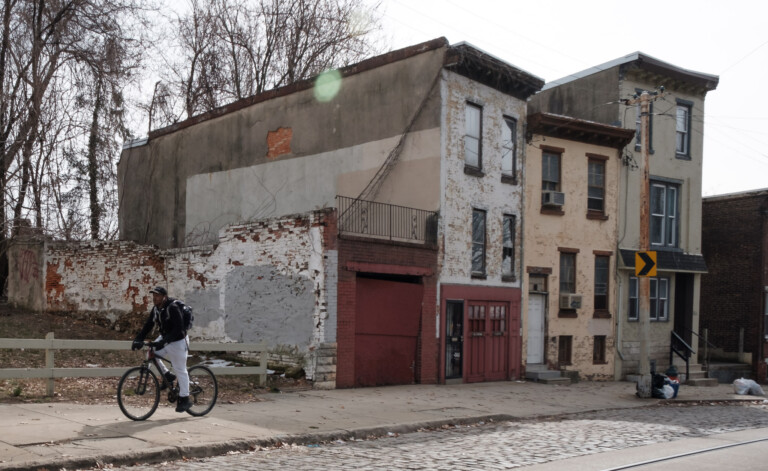
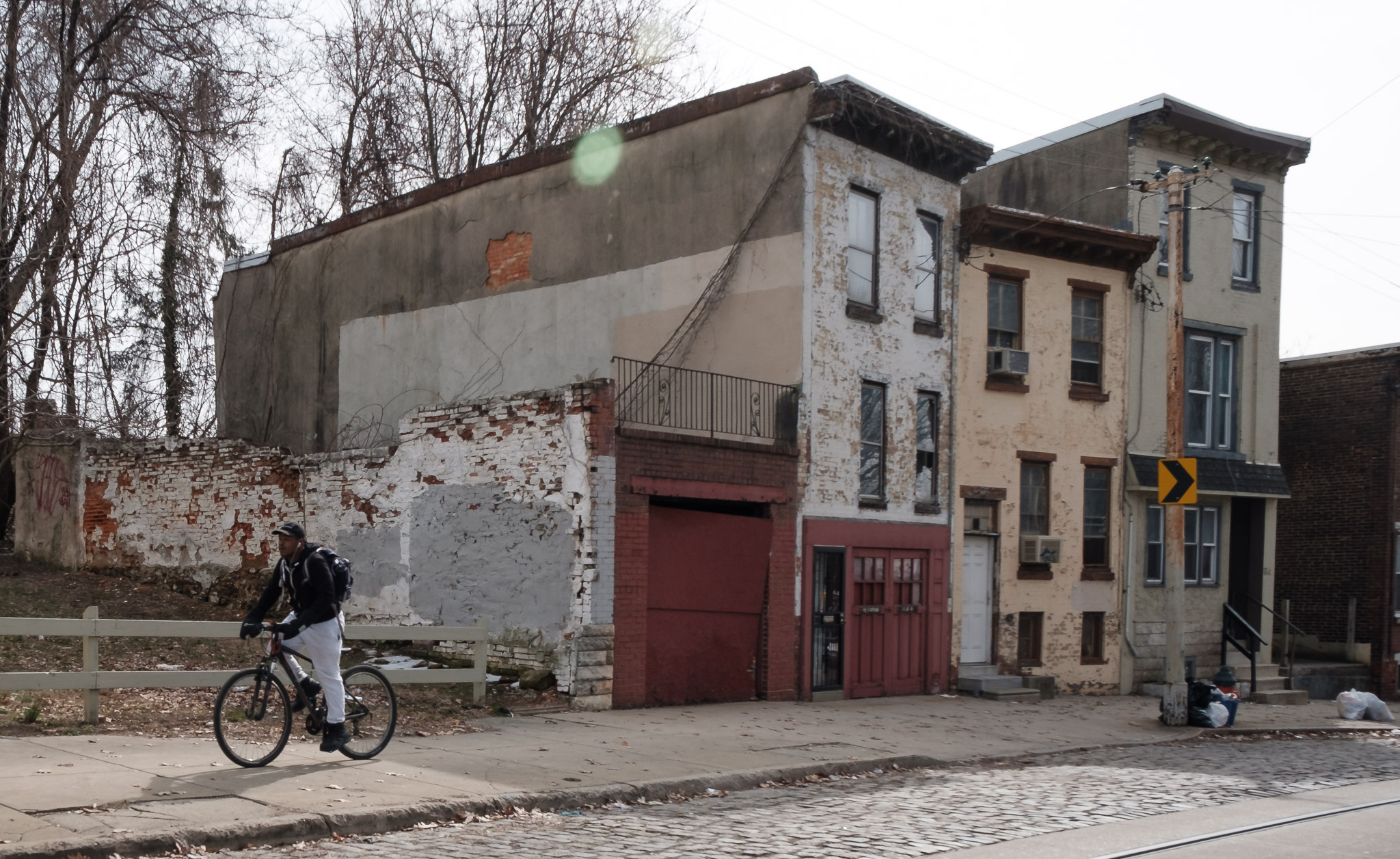
“Biker” (Germantown, Philadelphia) by Tony Juliano. Part of Juliano’s “Streets of Philadelphia” Series. CC BY-NC-ND 2.0, Attribution-NonCommercial-NoDerivs 2.0 Generic
Road safety surveillance could be improved in Philadelphia and across Pennsylvania by linking crash records to other data, such as hospital and clinical data of crash victims, as well as insurance costs to better understand the burden of road traffic injuries on the city and the state.
Data is also key to ensuring public policies are implemented equitably. The Vision Zero plan includes a focus on lower-income neighborhoods and those with higher proportions of racial and ethnic minorities. Those areas have three times as many serious injuries and deaths as other neighborhoods, and road traffic injury and deaths rates are 30% higher among people of color compared with white residents.
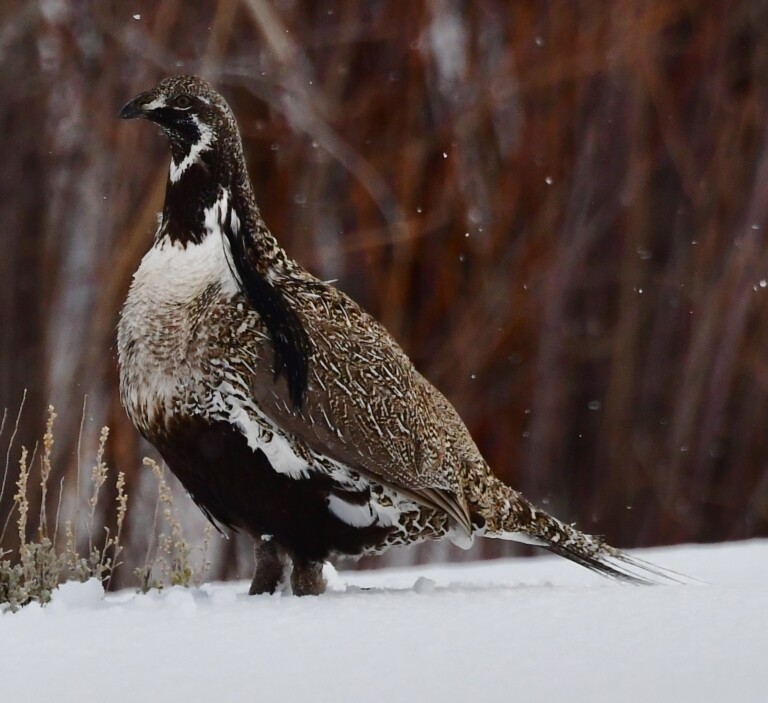
By Charles Pekow — Mountain biking will be restricted on certain Bureau of Land Management (BLM) lands in Colorado and Utah during specific times of the year to protect the habitat of the threatened Gunnison Sage-Grouse. The BLM lands are in Delta, Dolores, Gunnison, Hinsdale, Mesa, Montezuma, Montrose, Ouray, Saguache, and San Miguel Counties in Colorado and Grand and San Juan Counties in Utah.
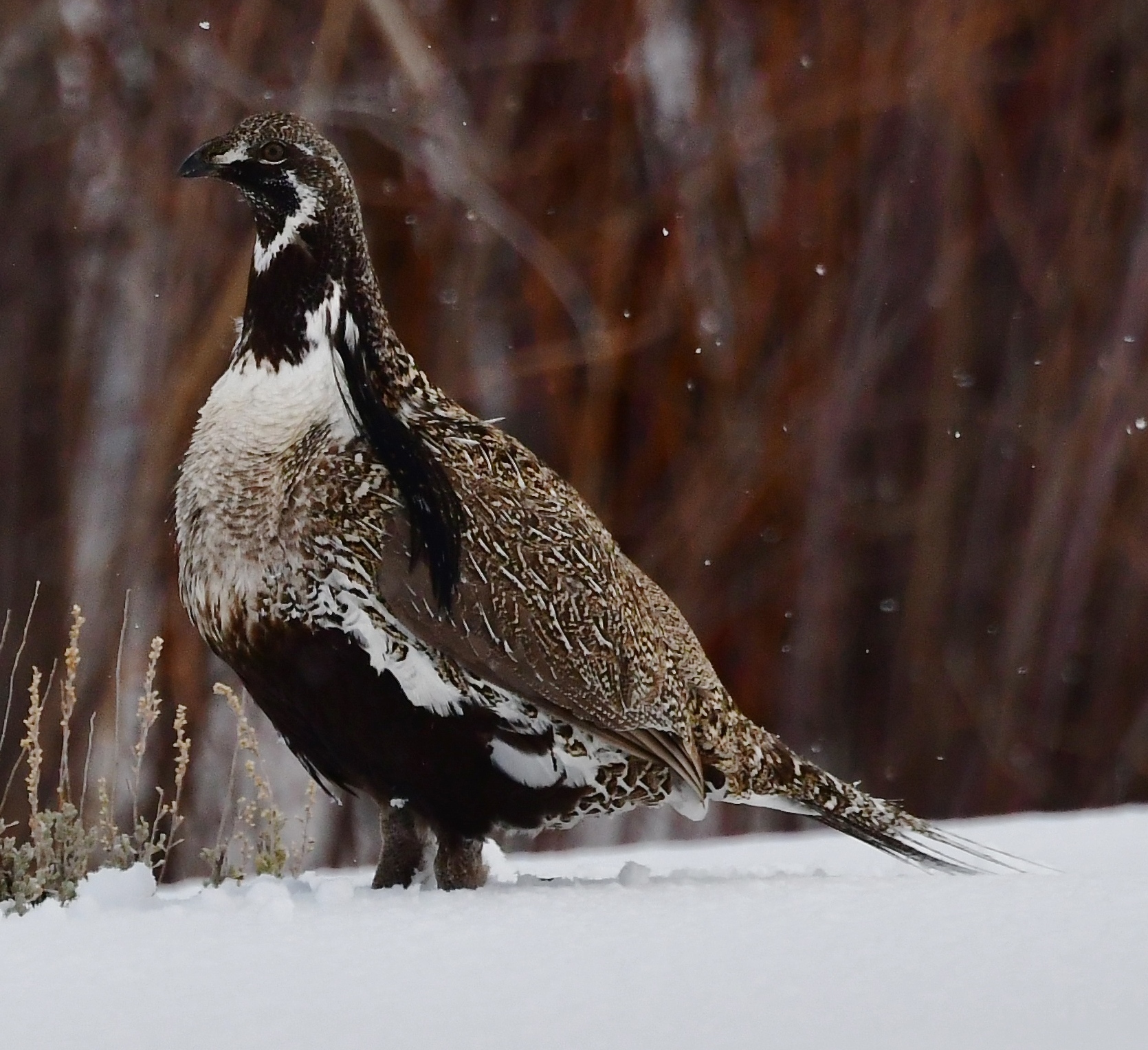
Gunnison Sage Grouse, Photo by Larry Lamsa, CC BY 2.0 <https://creativecommons.org/licenses/by/2.0>, via Wikimedia Commons
E-bikes will also be prohibited in the Sugar Creek and Chance Gulch areas during the species’ critical breeding and nesting season, which runs from March 15 to July 15.
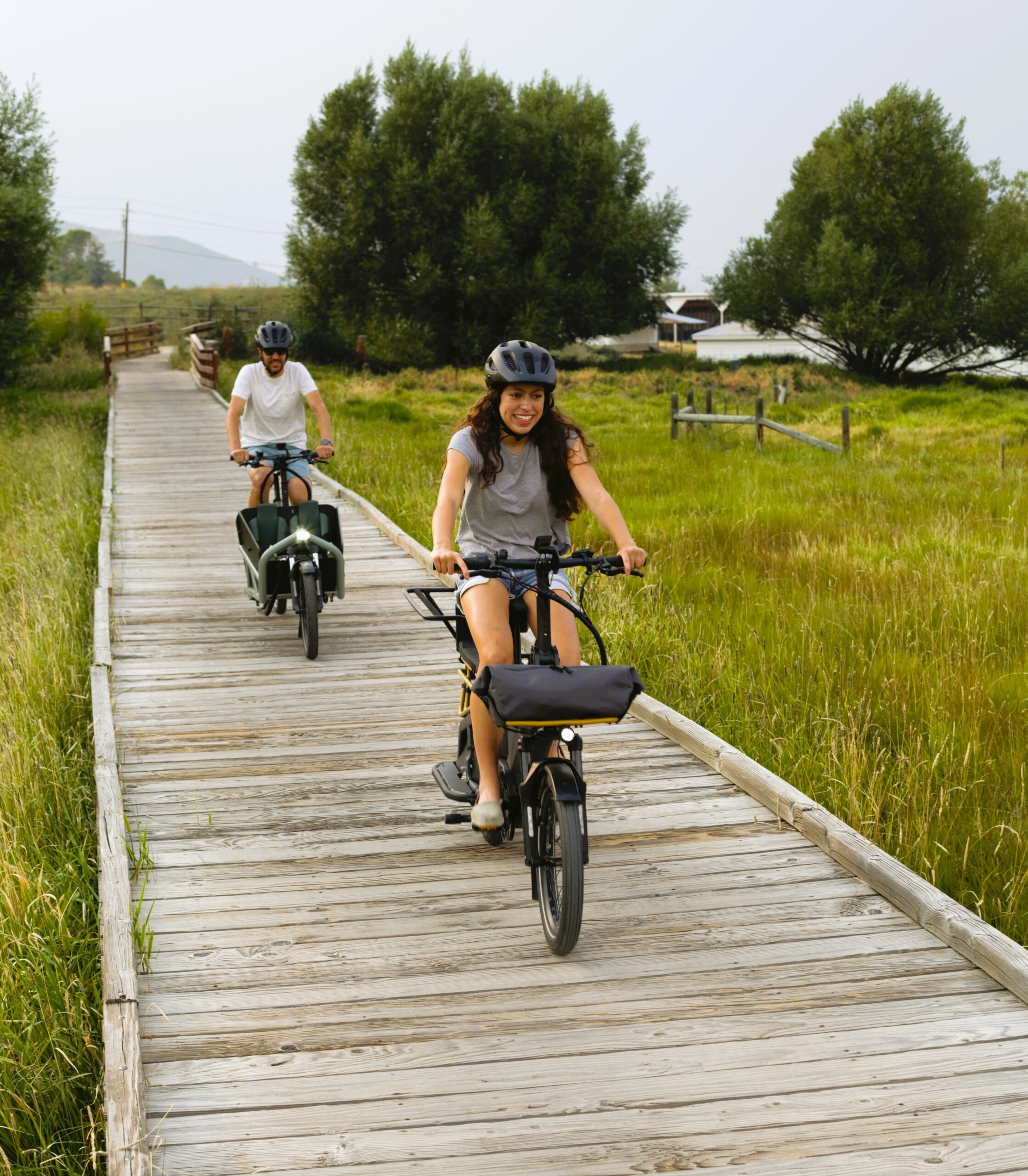
Local Youth and Teen e-Bike Ridership is Surging. Join Bingham Cyclery Park City for a Free Youth e-Bike Safety Night on Tuesday, March 4 from 6:00-7:00 pm.
PARK CITY, Utah (February 24, 2025) – Bingham Cyclery is committed to the safety of all cyclists, and at our Quarry Village store, we see firsthand how many teens and youth are riding e-bikes of all types to school, sports programs, and to socialize and recreate with friends and family.
Bingham Cyclery Park City, located at 3156 Quarry Rd, #3-N, invites students and parents to participate in a free e-bike safety clinic on Tuesday, March 4 from 6:00-7:00 pm.
“We’re in a unique position to witness the actual ridership of our community” says Bingham Cyclery owner Angela Wright. “We love that so many kids and their parents are choosing to ride to work, school, and other activities. We also see a lot of unsafe riding practices, with very few opportunities for education. We plan to make education more accessible by hosting more safety events with our community partners.”
Photo courtesy of Bingham Cyclery
E-bikes are excellent transportation, mobility, and recreation options for a diverse population of Utahns. E-bikes are an amazing tool for helping to reduce vehicle traffic, congestion, and pollution, while improving the health and well-being of those who ride them–as long as it’s done safely.
There are 3 aspects of safe riding that Bingham Cyclery intends to convey to riders and their parents.
An e-bike’s integrity is crucial to safe riding. This includes proper assembly, a certified battery, appropriate tires and air pressure, and working brakes.
The rider must understand how speed and the weight of the bike affect bike handling and braking distances.
It is important to understand the importance of wearing a current, well-fitting helmet and proper footwear.
Attendees are encouraged to bring their bikes and helmets. There will be an opportunity to undergo a free e-bike safety check and a helmet condition and fit check.
This event is free, but RSVPs are requested by texting or calling 435-731-9633.
For additional inquiries, please contact Jackie Baker, Community and Marketing Manager at [email protected] or Angela Wright, Owner, at [email protected].
By Lisa Hazel — On the island of Spetses, a member of the Saronic Islands, just south of the Peloponnese in Greece, and at the mouth of the Argolic Gulf, we began our human powered honeymoon bike ride. The island has a variety of terrain which forces you into nature’s distraction. Each angle yields a new vista. How nature manages to stun us after all the beatings we give her shows the power of mother earth seeping out to say, “I have more for you to see, just take a moment and I will astonish you.” Our ride and its sights will be discussed along with our rentor, his take on a transaction, and our conversation with him afterward.
Lisa Hazel (left) and David Iltis (right) with their backs to the easternmost Peloponnese peninsula. Photo by Lisa Hazel
The island of Spetses does not allow cars or trucks on their roads apart from the occasional dump truck, which made for a peaceful ride. According to one of the women working at the Hotel Roumani, where we stayed, ‘Spetses has only recently begun to allow motor scooters on Spetses’ which gives Spetses a unique set of noisy motor vehicles one gets to share the road with.
Our bike rentor, Nikkos, stands outside his shop on the coast of the southeastern side of the island of Spetses. Photo by David Iltis.
Our bike rentor, Nikkos, had a full house of potential customers eager to get going. The competition for service was between us and a few people from Germany. Dave kept saying, “How much will the bike rental for the two of us cost?” Nikkos said, “I’ll decide how much when you get back.” After asking Nikkos about the price a couple more times, he insisted we get going so we will have time to enjoy the entirety of the island. For us, this was a leap of faith from us to Nikkos being from the United States where almost everything has a price tag on it prior to payment. We ultimately decided to trust him. I tried telling myself, “We are not in the United States, let’s put some trust in the locals of Greece and see what happens.” While on this small island, I was able to separate the beauty of the scenery from whatever price we will be paying afterward. Nikkos didn’t have a waiver for us to sign either. I felt as if Nikkos wanted a small display of trust from us while we received trust from him. This equality of trust ripped away our obsession with the price and made the act of riding the bicycles one where Nikkos had a measure of goodwill that is difficult to find within the United States.
Dave Iltis pedaling on Spetses. Photo by Lisa Hazel
As we began, we wound through sharp corners, tall hills, and dense trees until we came to a clearing that gave us a long coastline view of the easternmost peninsula of the Peloponnese. As we got in a pedal stroke rhythm, the terrain of Spetses became dry and this viewpoint begged the comparison to our native Utah. Although red soil was nowhere in sight, sandy soil was abundant and lizards were a common sight. At one point, we saw a black snake that was about a foot long but disappeared within moments.
Lisa Hazel riding through town in Spetses. Photo by Dave Iltis
Once we made it to the western side of Spetses, there was a total of one road with construction of another which appeared to cut the island in half. Fellow humans became a rarity at the northwestern corner. Orchards often crept toward the road and cows would strut right up to the fences to greet us while we stopped to take in the contrast of west Spetses from the bustling of east Spetses. Manicured coniferous trees adorned the sides of the narrow streets as we encountered few vehicles. The sole encounter with a gasoline powered truck was a garbage truck that we heard before we saw around a tight corner. Luckily, we were able to get to the side of the road before it turned the bend. The second half of the island offered some of the most vivid contrasts of lush blues, greens, red, and yellows. The yellows came from a cove clamoring with an intimate party on or near the water’s shore invisible from the road. Red came from the sky’s rainbow starting from what appears to be the meeting point of the Argolic Gulf with the Mediterranean Sea. Shades of blue changed as we road counterclockwise around the island with blue deepening in color just prior to sunset. Greens from well kempt walkways and trees surrounding the road made for stark terrain contrast. Each of these colors and their differing positions within added to our reasons to push on. Our cadence was often interrupted with a new positioning of sun, sea, island, and vegetation that was completely new to us. Near the cove, we discussed turning back for fear of not making it back to our rentor’s shop before nightfall. By this time, we were nearly halfway around the island with the best photo lighting yet to come. After discussing the fear of an unknown price hike and an undisclosed curfew, we decided to risk our budget and take the remaining counterclockwise island road.
Lisa Hazel taking in the view from the southwestern side of Spetses. Photo by David Iltis
Neither of us are in immaculate shape and there were times each of us yelled out, “You got this!” or “We’re doing great! Only a little way left to go!” This back-and-forth encouragement from each of us added to the enthusiasm for the exercise, hills, scenery, and Greek culture we were putting our faith in.
Dave Iltis riding by the Aegean in the town of Spetses on the Greek island of Spetses. Photo by Lisa Hazel
Upon our return, we told Nikkos of our decision to complete the full ride around the island. He told us he is in the business of giving people a tool to further enjoy their holiday. When it came time to pay, Nikkos made a reasonable offer which we accepted. He asked us where we are from to which Dave replied “Utah in the United States.” Nikkos did not know where that was so to further explain I said, “it’s two states east of California.” He asked us how long we will be on Spetses to which we replied we would be leaving tomorrow morning to make it out before the two-day ferry strike. After we told him we would be headed for Thessaloniki, Nikkos had a whole set of suggestions for food and spas in that area. Nikkos told us he has a girlfriend up there and will be headed up there shortly after us.
Lisa Hazel (right) and David Iltis (left) capturing some car-free time in the middle of the road on Spetses near the middle western coast of the island. Photo by Lisa Hazel
This connection we made with Nikkos, recommendations for a fulfilling trip to Thessaloniki in northern Greece, along with a transaction based on trust topped off a perfect bicycling trip around the island of Spetses. Nature meshed herself together exactly the way she needed to create flawless pictures in our minds. We will be sharing memories of this ride for a lifetime to come.
A map of our ride around Spetses. Strava/OpenStreetMap
For more on Spetses: Head on over to visitgreece.gr and type “Spetses” in the search bar to obtain a short history of the island chronologically including its Early Bronze Age inhabitants, Venetians, Ottomans, and some of the Greek naval revolts led by the first known female admiral in naval history, Laskarina Bouboulina (whom one can view artifacts of in the intimate museum on Spetses).
For Nikkos’ Bikes: Located on the Northeastern shore of Spetses, Nikkos offers human powered bicycles, electric bikes, and small motor bikes for rent. Look for the white sign with black lettering which reads “NIKKOS BIKES; TREK; ΕΝΟΙΚΙΑΣΕΙΣ; ΠΩΛΗΣΕΙΣ; ΠΟΔΗΛΑΤΩΝ; Spetses; 6946087748” with the Greek translating to Rentals, Sales, Bicycles according to Google Translate.
Our ride details: October 21, 2024; 15.95 miles, 1:56 ride time, 1253 ft elevation gain. Trucks/cars encountered: 1.