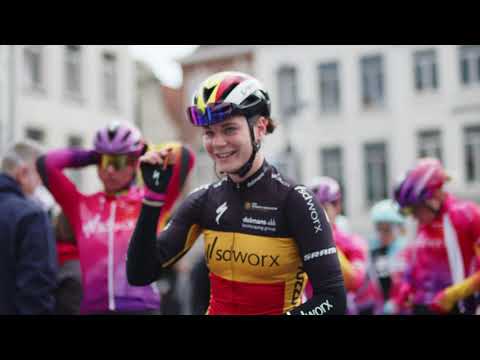
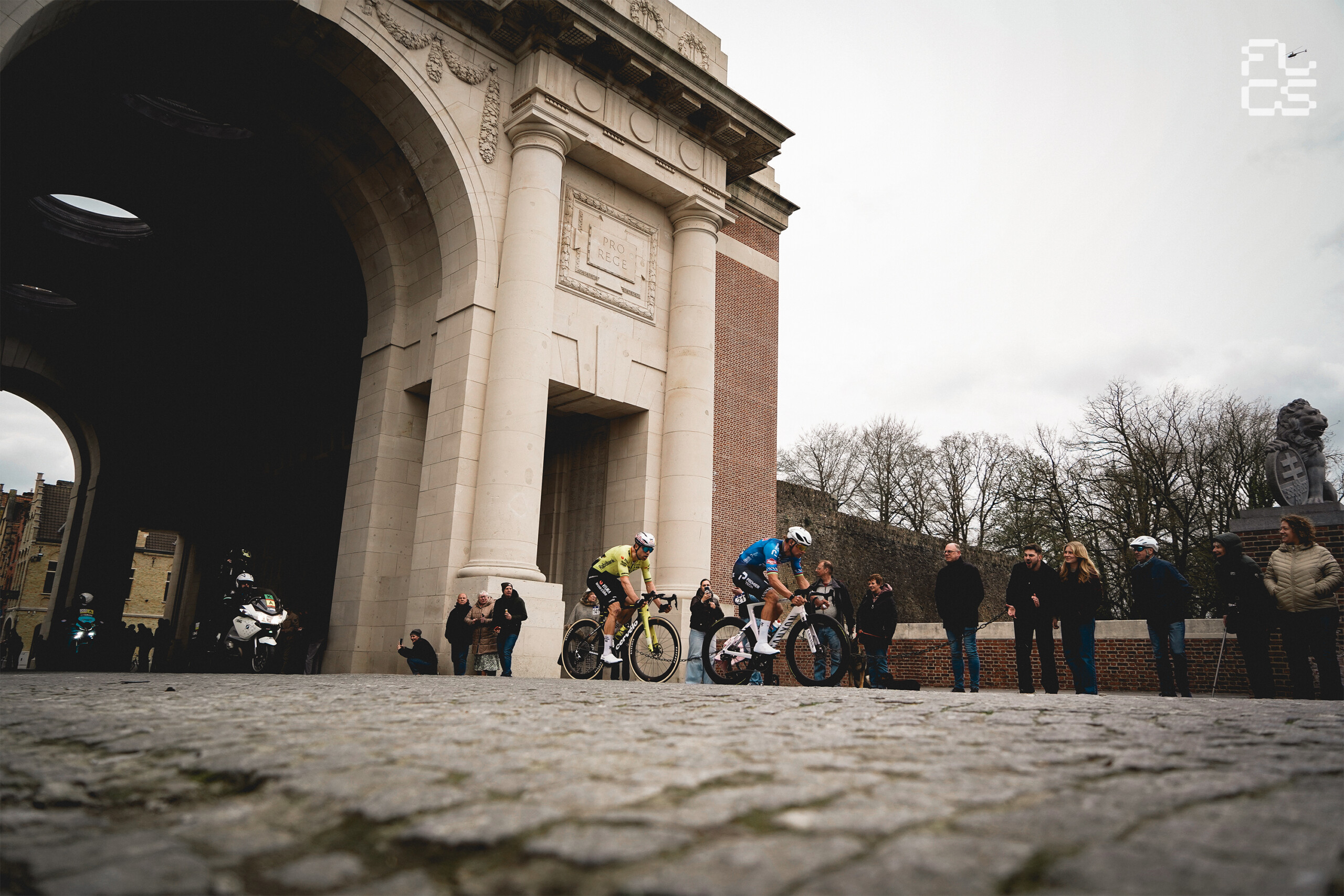
By Steven Sheffield — Three years ago, I discovered the trailer for a documentary about cycling in the Flemish region of Belgium; home to the Flahutes (or more commonly “Flandriens”). The title is, fittingly enough, simply Flandrien.
From the film’s website (https://flandrienfilm.com/): “Producer Shane Cooper and director Paul Willerton have teamed up to create a new feature-length documentary film, Flandrien. The film is set in the Flanders region of Belgium and explores the past, present, and future of cycling and local culture. The Tour of Flanders itself plays a starring role, as well as some of the riders who have been awarded the esteemed title of being a true ‘Flandrien.'”
The film premiered on Friday, June 16, 2023 in Belgium and is now available to watch on YouTube. The documentary features interviews with cycling legends including Johan Museeuw, three-time winner of the Tour of Flanders and the embodiment of the Flandrien spirit. As Museeuw reflects in the film on what defines a true Flandrien: the ability to suffer, the connection to the cobbles and bergs of Flanders, and an unwavering commitment to attacking racing.
The film offers an intimate look at Flemish cycling culture, from the passionate fans who line the Oude Kwaremont and Paterberg each spring, to the young riders dreaming of one day wearing the lion of Flanders. With stunning cinematography of the cobbled classics routes that define the region, Flandrien captures why this corner of Belgium remains the spiritual home of professional cycling’s hardmen.
Australian World Cup racer completed the iconic Canyonlands loop having never ridden 90 percent of the route
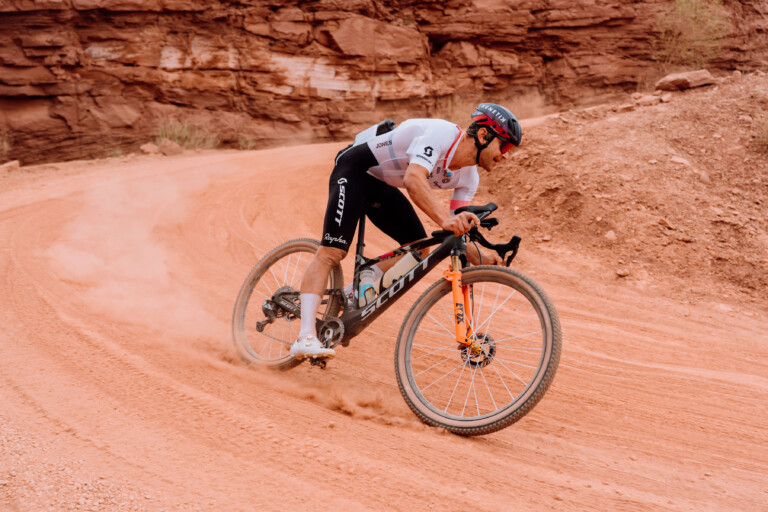
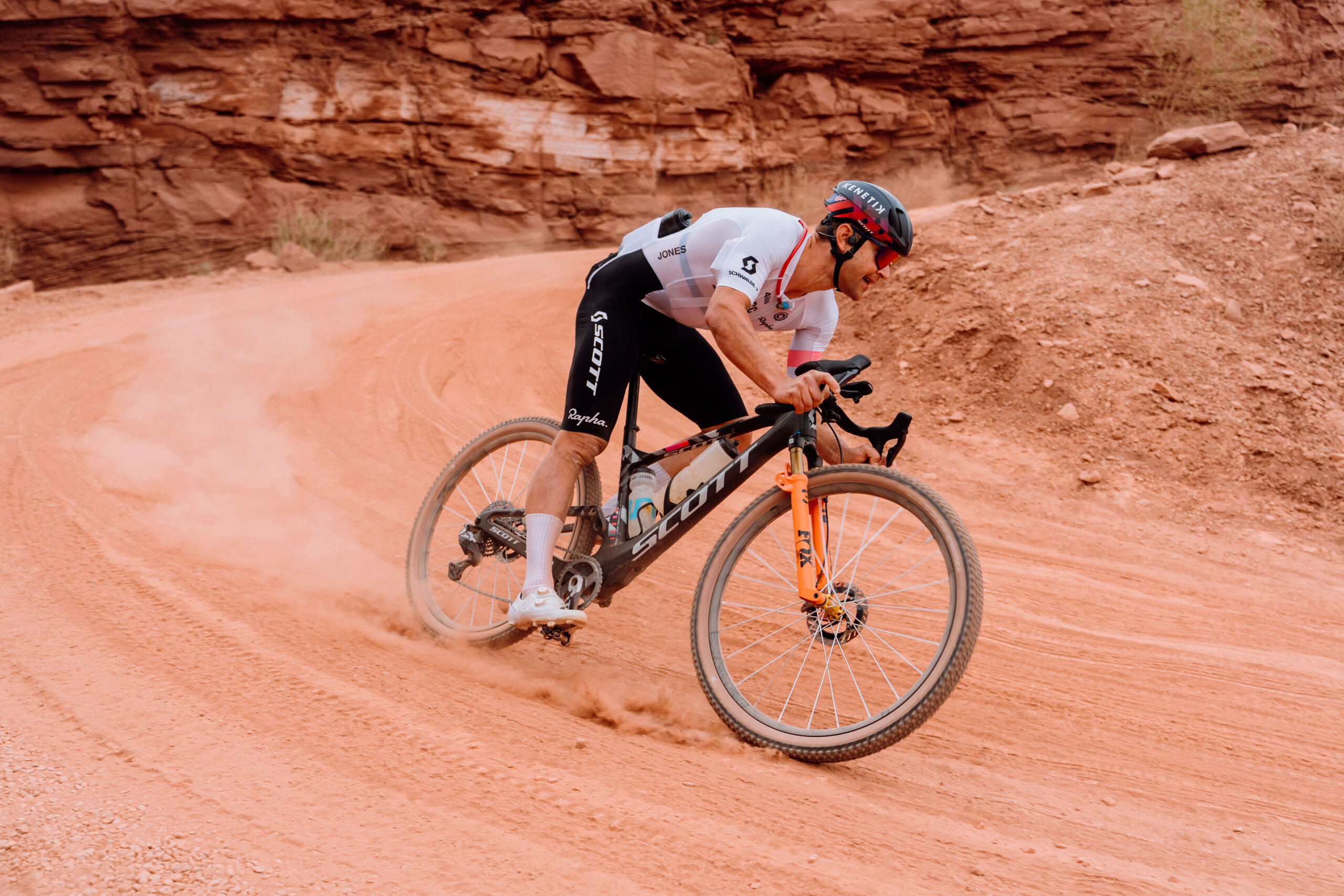
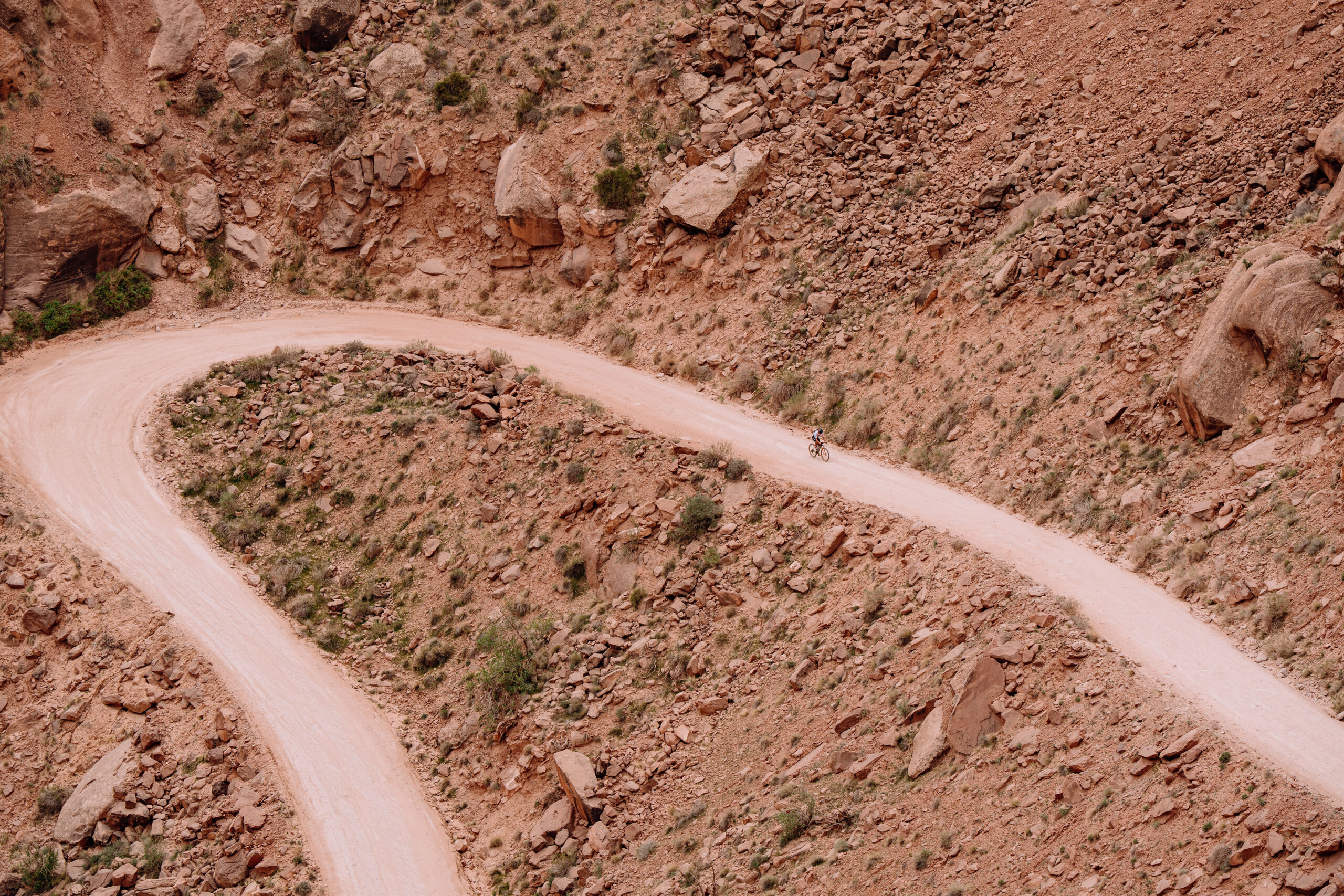
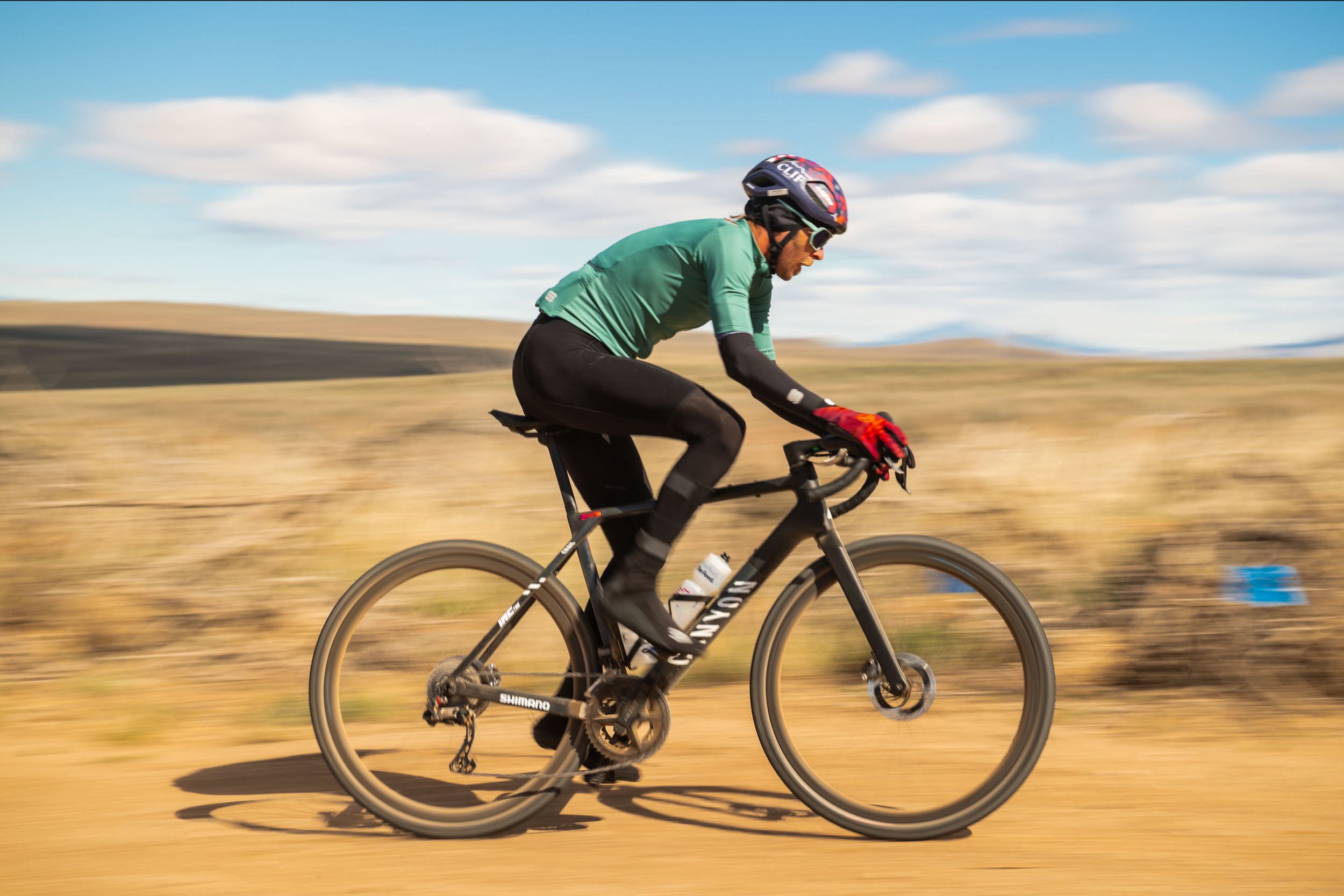
Cam Jones has set a new Fastest Known Time on Utah’s White Rim Trail, completing the roughly 100-mile Canyonlands National Park loop in 5 hours, 23 minutes and 27 seconds on Tuesday, March 31.
The Australian SCOTT Sports athlete tackled the iconic route — which runs below the Island in the Sky mesa — aboard a SCOTT Spark RC World Cup, and also claimed KOMs on several key segments: White Rim White Crack Road to Musselman Arch (1:21:12), Top of Shafter to Horsethief Parking (17:47), and the Hardscrabble Climb (2:09).
Photo Credit: Danny Awang @danny.awang, courtesy of SCOTT Sports
What sets the effort apart is the near-total lack of course familiarity. The attempt was a last-minute detour en route to the Sea Otter Classic, and Jones had never ridden approximately 90 percent of the route before rolling out. The evening before, he rang fellow SCOTT athlete Hannah Otto — herself the women’s FKT holder on the route — to gather recon notes and talk through strategy before heading in essentially blind.
Photo Credit: Danny Awang @danny.awang, courtesy of SCOTT Sports
“Even before I ever came to the U.S., I’d heard the legends of the White Rim Trail,” Jones said. “It’s not only an iconic mountain bike adventure, but also a route with a deep history of FKT attempts that I’ve followed throughout my career. It’s incredibly special to see my name alongside, and ahead of, some amazing athletes. Next time, though, I’d like to slow things down a bit and take in the views.”
Otto set the women’s mark on May 2, 2025 in 6:36:51, making SCOTT the holder of both the men’s and women’s records on the course.
BOULDER, Colo. (March 31, 2026) — The International Mountain Bicycling Association (IMBA) today announced the inaugural group of 28 communities receiving the IMBA Trail Town designation, a new national recognition honoring places that have made exceptional commitments to developing, stewarding, and celebrating trail systems that strengthen community life.
The IMBA Trail Town designation recognizes communities that are leading with trails by demonstrating strong trail infrastructure, a commitment to trail funding, an active local trail organization, a culture of community engagement, and a sustainable trail stewardship plan. Together these criteria support healthy lifestyles, local economies, and outdoor recreation access.
Photo courtesy IMBA.
“IMBA Trail Towns represent communities that understand the powerful role trails play in shaping vibrant places to live, work, and play,” said Jillian Olson, IMBA Community Progress Manager. “These communities have invested in trails not only as recreation opportunities, but as essential infrastructure that supports local economies, attracts visitors, improves quality of life, and builds stronger connections between people and the outdoors.”
Trails are increasingly recognized as drivers of outdoor recreation economies. Communities that invest in trail systems often see benefits ranging from increased tourism and small business growth, to improved health outcomes and stronger community identity. The American outdoor recreation economy continues to grow: in 2024 it generated $1.3 trillion in economic output while supporting 5.2 million American jobs. The sector accounts for 2.4% of the nation’s GDP.
The IMBA Trail Town designation highlights communities that have demonstrated leadership in these areas and are helping set the standard for how trails can positively shape the future of outdoor communities. This year’s honorees highlight 28 communities in 20 U.S. states.
The inaugural 2026 IMBA Trail Town designees include:
These 28 communities are leading a growing national network of trail-forward places committed to trail stewardship, collaboration, and expanding access to outdoor recreation
“The IMBA Trail Town designation is more than a badge of honor. It’s national recognition that a community values trails and the people who ride them,” said David Weins, IMBA Executive Director. “These towns are leading with trails by modeling what robust investments in the outdoors can do for local health, local economies and community connectivity — both to the outdoors and to one another. Trails bring communities together.”
The 2027 IMBA Trail Town designation will open this fall. Communities that have made an investment in trails and foster a culture around trails may be ready to pursue the designation. Communities interested in learning more can also take a free Community Assessment at any time. For more information about the IMBA Trail Town designation, visit www.imba.com/designation/trail-town.
On Executive Order 260401, the return of the Tour de Trump, and what a sixty-metre hill in New Jersey tells us about the relationship between power, memory, and the indifference of mountains.
By Claude Aurillac-Issoire Clermont-Ferrand, France (01 April 2026) Translated from the original French.
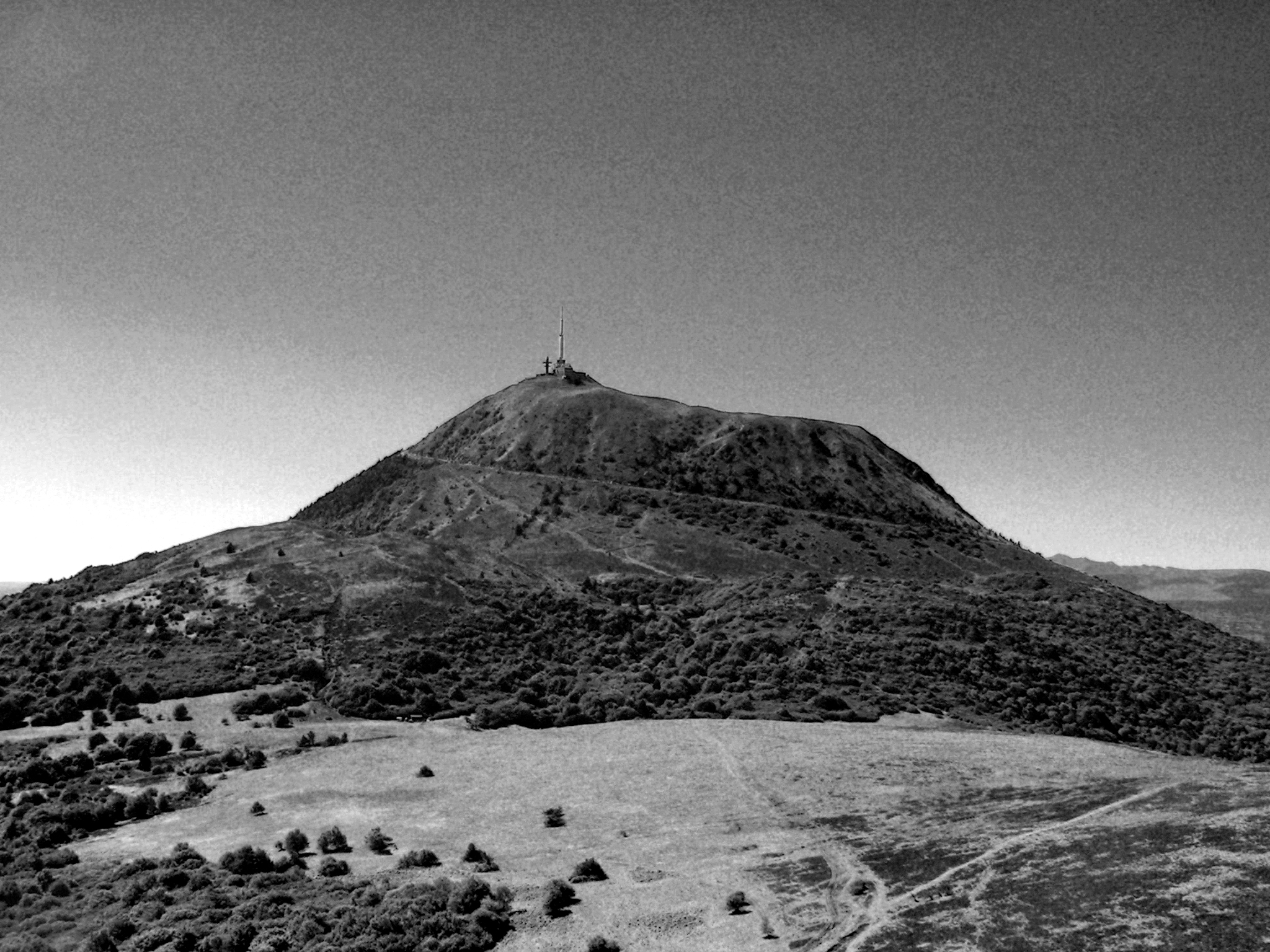
My mother grew up in the shadow of the Puy de Dôme. My father raced as an amateur in the Allier valley in the nineteen-seventies — nothing serious, club races, a few regional events, once a small criterium in Vichy where he finished fifth and told the story for the rest of his life. I learned to read in a house where the yellow jersey was not a metaphor. When I tell you that the Puy de Dôme rises 1,415 metres and that the final kilometre averages 12.8 percent and that Jacques Anquetil and Raymond Poulidor duelled on its upper slopes in 1964 while an entire nation held its breath, I am not reciting statistics. I am describing the landscape of my childhood.
The Bedminster hill is sixty metres tall.
I read the Executive Order this afternoon, the document having been forwarded to me by four colleagues within twenty minutes of its release, each with a different subject line. The most accurate was simply: “Claude.” The order is eight pages long and divided into thirteen sections. Section Seven reads, in its entirety: “The Bedminster climb is very challenging. Do not let anyone tell you otherwise.”
I read it twice. Then I poured more coffee.
I had expected, I think, a few paragraphs of the American President’s characteristic grammar dressed in governmental formatting — a Truth Social post amplified into official language. What I found was a document of genuine structural ambition, written by someone tasked with making a series of unpublishable ideas sound publishable, who had done their considerable best. Section Four requires all riders to use American-made bicycle frames — or those from countries the Secretary of Commerce has designated as Fair Trade Cycling Partners, a list that does not currently include Italy, France, Belgium, Spain, or Taiwan — and bans Campagnolo components outright. Section Five prohibits drafting for more than thirty consecutive seconds on the grounds that sheltering behind another rider is inconsistent with American values of self-reliance. Section Eight threatens Switzerland — its watches, its chocolate, its banking — if the UCI does not grant the Tour de Trump Grand Tour status within thirty days.
Section Nine, subsection (c), notes that Campagnolo “has been warned. Multiple times. Internally.”
I called Stefan Schoofveldt in Ghent. He had read it at a café near the Vrijdagmarkt, between a double espresso and a tartine he had not finished. Stefan has covered professional cycling for nineteen years, including every major one-day race in Belgium, three editions of the Tour de France, and a criterium in Aalst that was interrupted by a cow. He was, he told me, not angry.
“I am too old for outrage,” he said. “And too Belgian for surprise.”
He paused. I have known Stefan long enough to know that a pause from Stefan is not empty. “The second sentence of Section Seven,” he said, “is not the language of governance. It is the language of a man who knows, somewhere he cannot reach by executive order, that someone will tell you otherwise. That everyone will tell you otherwise.”
He then paid for his coffee and went home.
✦
I then called Chatham George Paulson-Thomas in London, who had been awake since five in the morning and who was, when I reached him, in the careful and slightly dangerous mood he enters when something has annoyed him sufficiently that he has decided to be precise about it.
“Let me be clear about the mechanism,” he said, “because I find that precision is the only reliable defence against the interpretive drift this situation invites. The mechanism is real. The tariff threat is real. The UCI cannot receive a unilateral instruction from a single government and comply without effectively dissolving its credibility as an independent international body.”
He granted — Chatham always grants — that the underlying frustrations were not without basis. That American cycling has been underserved by international governing structures. That the UCI’s record on doping enforcement and rider welfare is not a record anyone would defend in full. That these are real issues.
“They are not addressed by this order,” he said. “The order is not about the governance of cycling. It is about the reinstatement of a brand.”
Another pause. “What I find most dispiriting is the response it requires. Someone has to take this seriously enough to respond to it. Someone has to appear before cameras and be asked, with a straight face, whether Bedminster compares favourably to Mont Ventoux. And in the time that takes, other things do not get done.”
“The mountain does not care what you believe about it. It will exact from
you precisely what the mathematics say it will exact, whatever you thought
before you began climbing.”
I find I cannot quite share Chatham’s dispirited mood. What I feel instead — and I have been trying to identify it precisely since the order arrived this afternoon — is something closer to a helpless, liberating hilarity. Not at the expense of America, which has produced magnificent cyclists. Not even at the expense of the President, who has the distinction of being the only head of state in history to issue a formal federal document certifying the difficulty of his own golf course approach road. What I find funny — what I find, on reflection, genuinely, structurally, almost classically funny — is the nature of expertise.
The Tour de Trump ran for two years. It went through New Jersey, Delaware, Virginia, New York, Pennsylvania. It was a real event. It produced real winners. Dag Otto Lauritzen, who took the inaugural edition, was a professional of genuine quality. The race mattered to American cycling in its time, in the modest and sincere way that all races matter. And the man whose name was on it appeared at the start lines, smiled for the cameras, said it was tremendous. He ran the race in the limited sense that a man who once owned a restaurant has run a kitchen. The pot never touched his hand. The spoon never left the drawer. But the story was his.
And now, thirty-five years later, from that story — from two seasons of mid-Atlantic stage racing, from a handful of start-line photographs, from the fact of having once been in the same zip code as a professional peloton — he has constructed a total, comprehensive, unassailable expertise. He knows cycling better than the riders. Better than the directeurs sportifs, the race organizers, the governing bodies, or the sport’s entire one-hundred-and-fifty-year institutional memory. He knows it the way he knows many things: completely, effortlessly, and without the burden of having learned it.
I find this funny because it is, in a very precise way, the opposite of what cycling teaches you.
Cycling teaches you that the mountain does not care what you believe about it. You can be convinced, absolutely convinced, that you are capable of a certain wattage on a certain gradient in a certain wind, and the mountain will simply present its kilometres and its percentage signs and wait. The mountain is not impressed by your certainty. It is a fixed quantity of altitude, spread across a fixed quantity of distance, and it will exact from you precisely what the mathematics say it will exact, no more and no less, whatever you thought before you began climbing.
This is why cyclists tend to be, in my experience, somewhat humble people. Not always — there are exceptions, and some of them won the Tour de France multiple times and were stripped of the results. But in general, the sport produces humility because the sport’s primary feature is a series of non-negotiable physical realities that do not respond to confidence.
✦
I have met Christian Prudhomme three times. Once at a start village in the Dordogne, once at a race organisation dinner in Paris where the wine was excellent and the speeches were not, and once in a corridor at the Palais des Congrès in 2019 when he was moving quickly and did not have time to stop. On each occasion he was courteous, precise, and utterly unreadable. He is a man who has spent thirty years in the diplomatic layer between professional cycling and the rest of the world, and he has become very good at occupying that layer without ever quite revealing what lies beneath it. I understand he held a press conference this afternoon. I understand it went well, in the sense that he gave them nothing to use against him. This is, with Christian Prudhomme, always the goal.
I know this face. I am from Clermont-Ferrand. We learn it young.
I read Campagnolo’s statement from Vicenza. It was a model of corporate serenity — ninety-three years of precision manufacturing distilled into three sentences of impeccable restraint. They have survived wars, recessions, the rise of Shimano, and the cycling industry’s periodic infatuation with electronic groupsets. They will survive a tariff. What I found more telling was the product photograph they chose to accompany the statement: a Super Record groupset. Not a press release photo. Not a logo. A groupset. At four thousand eight hundred euros retail. The Italians have their own way of making a point.
Stefan, whom I texted this afternoon, replied in three words: “The groupset speaks.”
My father raced his criterium in Vichy in 1973. He finished fifth. He told the story for forty years — the race, the road, the riders who beat him, the café afterwards where someone bought him a beer. I am not unsympathetic to the impulse. A man wants his race to matter. A man wants the thing he touched, however briefly, however glancingly, to have been great. This is human. This is, in its way, rather moving.
But there are limits, and the limits are geological. The Bedminster hill is sixty metres tall. The Executive Order says it is very challenging. The Executive Order is incorrect in the way that a man can be incorrect about a mountain he has only ever driven, and the mountain will wait, patient and absolute, for the moment of reckoning it has been waiting for since before the race existed, before he signed the order, before someone took the photograph at the start line thirty-five years ago in New Jersey.
There is a climb I know in the hills above Clermont-Ferrand. It is nothing compared to the Puy de Dôme, nothing compared to the Galibier or the Stelvio or any of the climbs that have decided races and ended careers. It is a local road, not quite four kilometres, maybe seven percent average. I have ridden it perhaps two hundred times. On every occasion it has been exactly as long and exactly as steep as it was the time before. My belief about it, on any given morning, has had no effect whatsoever on its gradient. This is what cycling teaches, and it is a lesson the mountain delivers without sentiment, without variation, and without any particular interest in who is on the bicycle.
I spoke to Chatham again an hour ago. He had written fourteen hundred words of analysis and deleted them. “Someone has to take this seriously,” he said. “I know,” I said. “I’m sorry.” Stefan, for his part, has not replied to my last message. He is probably home by now, or out on the bike. He has a very good bike. Campagnolo, as it happens.
I am going outside. The light over the Auvergne is still good. It is a good evening to ride.
By Stefan Schoofveldt, with additional reporting by Chatham George Paulson-Thomas and Claude Aurillac-Issoire
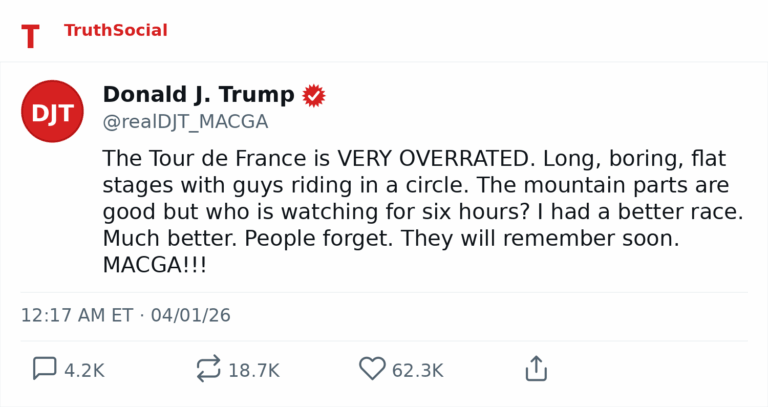
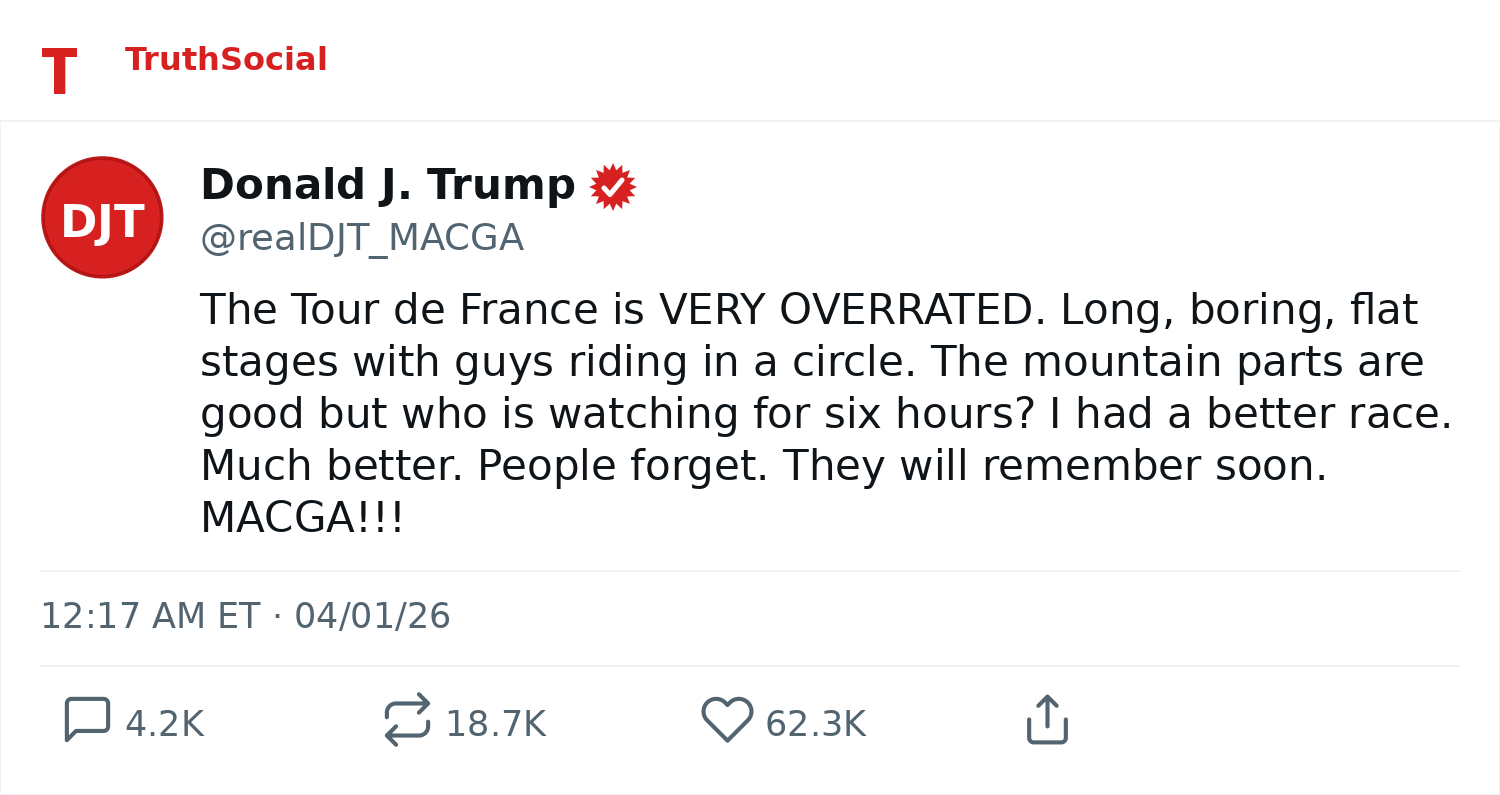
At seventeen minutes past midnight Eastern Time, Donald J. Trump posted to Truth Social that the Tour de France was very overrated. Thirty-four minutes later, he announced he was bringing back the greatest bike race the world had ever seen. This is a record of what has happened. All times shown as EDT (UTC−4) / CEST (UTC+2). European times in 24-hour format. Updates added as events develop.
12:17 AM EDT / 06:17 CEST — The first signal
The post arrives without warning or context, as they often do. Cycling people, who keep strange hours by habit — the 6 AM ride requiring a 5 AM alarm requiring a half-conscious check of the phone at some intermediate hour — are among the first to notice it.
There are, at this hour, perhaps forty people awake and online who know what MACGA means. The rest of the world is asleep. The forty people begin texting each other.
12:33 AM EDT / 06:33 CEST
Dag Otto Lauritzen, reached by a Norwegian journalist whose name we are withholding because it is 6:38 in the morning in Bergen and he had not consented to being the subject of a news story, will later say he has “no comment at this time” and then add, after a pause, “What is happening?”
BREAKING NEWS — 12:51 AM EDT / 06:51 CEST — Tour de Trump
The forty people become four hundred. Screenshots circulate. The phrase “signed papers” generates immediate and intense speculation about what, precisely, has been signed, and what authority it might carry over a private French sporting organization whose legal domicile is in Paris and which has been staging professional bicycle races without American governmental input since 1903.
[EDITOR’S NOTE: We have begun attempting to reach the White House press office, but it is 12:44 AM in Washington.]
1:14 AM EDT / 07:14 CEST
The mention of Campagnolo causes a particular kind of distress among road cyclists that is difficult to explain to non-cyclists and only somewhat easier to explain to cyclists who do not understand what Campagnolo means to people who do. Several European component industry figures will later say this was the moment they understood the situation was serious.
1:38 AM EDT / 07:38 CEST
A White House official, who asked not to be identified because they value their continued employment, confirms by text message that an executive order has been signed. They will not describe its contents. They will not say when it was signed. They add, unprompted: “I am going back to sleep.”
2:03 AM EDT / 8:03 CEST
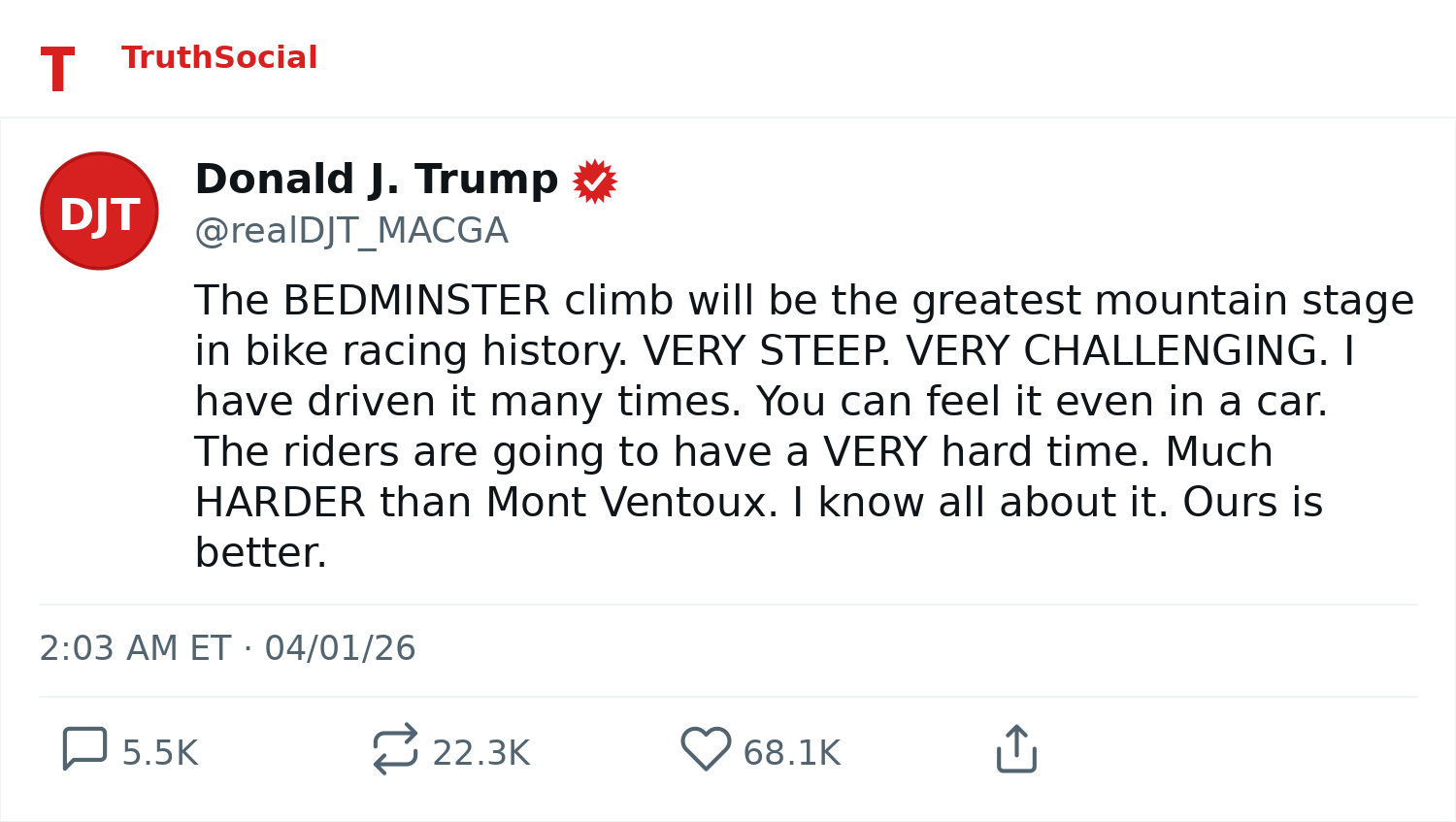
Mont Ventoux rises 1,617 meters over 21.5 kilometers of exposed Provençal limestone. It has ended careers. It has ended a life. Tom Simpson died on its upper slopes in 1967. The Bedminster hill rises approximately sixty meters over roughly eight hundred meters of New Jersey road. We are not making a comparison. We are simply reporting what was posted.
2:27 AM EDT / 08:27 CEST
Armstrong’s publicist in Austin does not respond to a request for comment sent at 4:11 AM EDT (3:11 AM MDT). This is, to be fair, a completely reasonable position to take at 3:11 in the morning local time.
6:09 AM EDT / 12:09 CEST — Europe wakes up
It is ten minutes past noon in Aigle, Switzerland, and the UCI’s communications office has arrived, had coffee, noticed forty-seven press inquiries, a Truth Social post describing their organization as “very sneaky,” and a threat — now confirmed by a second White House source — of retaliatory tariffs on Swiss chocolate. They issue a brief statement that says they are “aware of the announcement” and are “consulting with member federations.” In UCI terms, this is the institutional equivalent of closing the curtains and sitting very still until the noise stops.
6:51 AM EDT / 12:51 CEST
In Paris, it is approaching noon. Christian Prudhomme, the director of the Tour de France, holds a brief, unscheduled press conference at the ASO offices. He is wearing a very good suit. He looks like a man who has spent the last two hours being extremely diplomatic in a language other than the one he would prefer to use.
“We note with interest the American President’s announcement,” he says. “The Tour de France has operated continuously since 1903 and is one of the great sporting institutions of the world. We would be happy to share our experience in race organization with any interested parties.”
He is asked whether ASO considers the Tour de Trump a competitive threat.
He smiles the particular way the French smile when they are choosing, with considerable effort, not to say what they actually think.
“We consider all sporting events worthy of respect,” he says.
He is asked about the tariff threat on French wine, cheese, and berets.
The press conference ends.
7:31 AM EDT / 13:31 CEST — The Executive Order
The White House releases the text of the executive order. It is eight pages long. It is formally titled “Restoring American Excellence in the Sport of Cycling and Reviving the Tour de Trump as the World’s Premier Stage Race.” It cites Article Two twice. It contains a section — Section Seven — that is two sentences long and addresses, exclusively, the difficulty of the Bedminster climb.
Section Seven reads: “The Bedminster climb is very challenging. Do not let anyone tell you otherwise.”
Section Nine imposes a two-hundred-percent tariff on Campagnolo components. Section Nine, subsection (c) notes that the Secretary of Commerce has requested procedural clarification on the Campagnolo tariff. The request has been received. The Secretary has been asked to proceed.
A directeur sportif for a Belgian WorldTour squad, who asked not to be named because he genuinely could not afford the attention this morning, calls us from what sounds like a car. He has been reading the executive order.
“No drafting,” he says. “Thirty seconds. For three weeks. Has he ever — I mean, has he ever actually watched a bike race?”
He is told the President has watched multiple stages on YouTube.
There is a silence.
“The Campagnolo tariff is the most offensive part,” he says finally. “Two hundred percent. Do you understand what Campagnolo means to cycling? It is not a component. It is a philosophy. Granted, none of us use it at the WorldTour level anymore, but still!”
8:47 AM EDT / 14:47 CEST
We have asked several cyclists. They have, unanimously, not commented.
9:22 AM EDT / 15:22 CEST — Armstrong’s phone call
A source familiar with the situation confirms that Lance Armstrong received a phone call from the President at approximately 1:04 AM CDT / 8:04 AM CEST, which is to say, in the middle of what any reasonable person would describe as the night.
The call lasted twenty-two minutes. The source describes it as “not a conversation in the traditional sense.” The President spoke at length about the Tour de Trump, the mountain stages of the Tour de France (“tremendous, very exciting, like a rally but with bicycles”), the anti-drafting provision (“you go to the front, you race, you don’t hide behind people, very simple”), and the prize money, which he described as “tremendous” but declined to quantify.
Armstrong asked about the prize money three times. Each time, the President confirmed it would be tremendous and moved on.
Armstrong’s role as Special Advisor on Cycling Affairs appears in Section Ten of the executive order. Section Ten notes, in subsection (b), that Mr. Armstrong “has agreed to this appointment” and then, in the same sentence, acknowledges that “he has not explicitly confirmed this, but the President is confident he will.”
Armstrong has still not commented publicly. His publicist says he is “reviewing the opportunity.”
His phone, we are told, has not stopped ringing.
9:55 AM EDT / 15:55 CEST
The Office of American Cycling Excellence, established by Section Eleven of the executive order, does not yet have a director, staff, offices, a website, or a phone number. Section Eleven describes its budget as “to be determined” and adds, in the following sentence, “It will not be a lot. We are cutting spending.”
The OACE is, at this point, a name and a mandate. The mandate is, in full, to organize the Tour de Trump, enforce the executive order, negotiate with the UCI and ASO, manage the golden jersey supply chain, and “generally promote American cycling excellence at home and abroad.” The budget for this mandate is to be determined but will not be a lot.
10:28 AM EDT / 16:28 CEST
The Campagnolo company issues a statement from Vicenza. It notes, with dignity, that the company has been producing precision cycling components since 1933. It expresses confidence in its products. It says it looks forward to “continuing dialogue with all interested parties.” It is accompanied by a product photograph of a Super Record groupset. At current retail, the groupset runs to roughly €4.800 ($5,560 US). Under the proposed tariff: approximately €14.400 ($16,700 US).
Several American retailers who stock high-end Italian components have begun calling their buying offices. None of them wish to be quoted. One of them says, off the record, “I have $200,000 in Campagnolo inventory.” He does not say this in an unhappy way. He says it in the way a man says something when he is trying very hard not to smile in front of a journalist. Then he adds: “My summer reorder is already placed.” He says that part very differently.
11:02 AM EDT / 17:02 CEST — The press briefing
The daily White House press briefing. Maren Forsythe of CyclingPost — credentialed, though until this week her credential had never been especially competitive to obtain — is, for the first time in her publication’s history, in the first row.
Forsythe asks about the anti-drafting provision — specifically whether any professional cycling body has been consulted on its enforceability.
“I think what’s interesting,” press secretary Karoline Leavitt says, “is that the mainstream media and their allies in the so-called professional cycling establishment are already trying to undermine a pro-competition measure that the American people overwhelmingly support. The anti-drafting provision levels the playing field. It rewards individual effort. That’s a very American idea, and I’m not surprised that certain outlets find it threatening.”
Forsythe notes that the question was about enforceability, not ideology.
“The OACE will release technical enforcement details in due course,” Leavitt says. “Next question.”
Forsythe asks about the Bedminster climb.
“The President has visited that property hundreds of times,” Leavitt says. “He has personal and direct knowledge of that climb. He considers it a world-class competitive ascent and I think the American people trust the President’s judgment on that.”
Forsythe asks how it compares, in terms of elevation and gradient, to the climbs of the existing Grand Tours — the Stelvio, the Galibier, the Angliru.
“I’m not going to get into a comparison of mountains with a reporter who I think we all know has a predetermined narrative here,” Leavitt says. “The President certified the climb personally. That certification stands. The stage information will be released by the OACE.”
Forsythe asks when the OACE will have staff.
“That’s a process question and I’d refer you to the Office of Management and Budget,” Leavitt says.
Forsythe asks what the gradient of the Bedminster climb actually is.
Leavitt looks at Forsythe for a moment.
“The OACE,” she says, “will be releasing detailed stage information in due course.”
Forsythe sits down. Several colleagues in the briefing room are studying their shoes.
11:22 AM EDT / 17:22 CEST
The UCI has not confirmed this call took place. A spokesperson says they are “in ongoing consultations with member federations.” This is exactly what they said at eleven this morning. It is likely what they will say tomorrow.
11:37 AM EDT / 17:37 CEST
The Palm Beach County Commissioner’s office confirms it has not been consulted about Stage One’s road closures, which would require shutting approximately forty miles of public road for a full day. A spokesperson says the county is “reviewing the matter.” This is everyone’s favorite phrase today.
The Trump National Doral golf club has not responded to questions about Stage Two’s proposed finish on its grounds.
Bedminster is, by all accounts, still sixty meters tall.
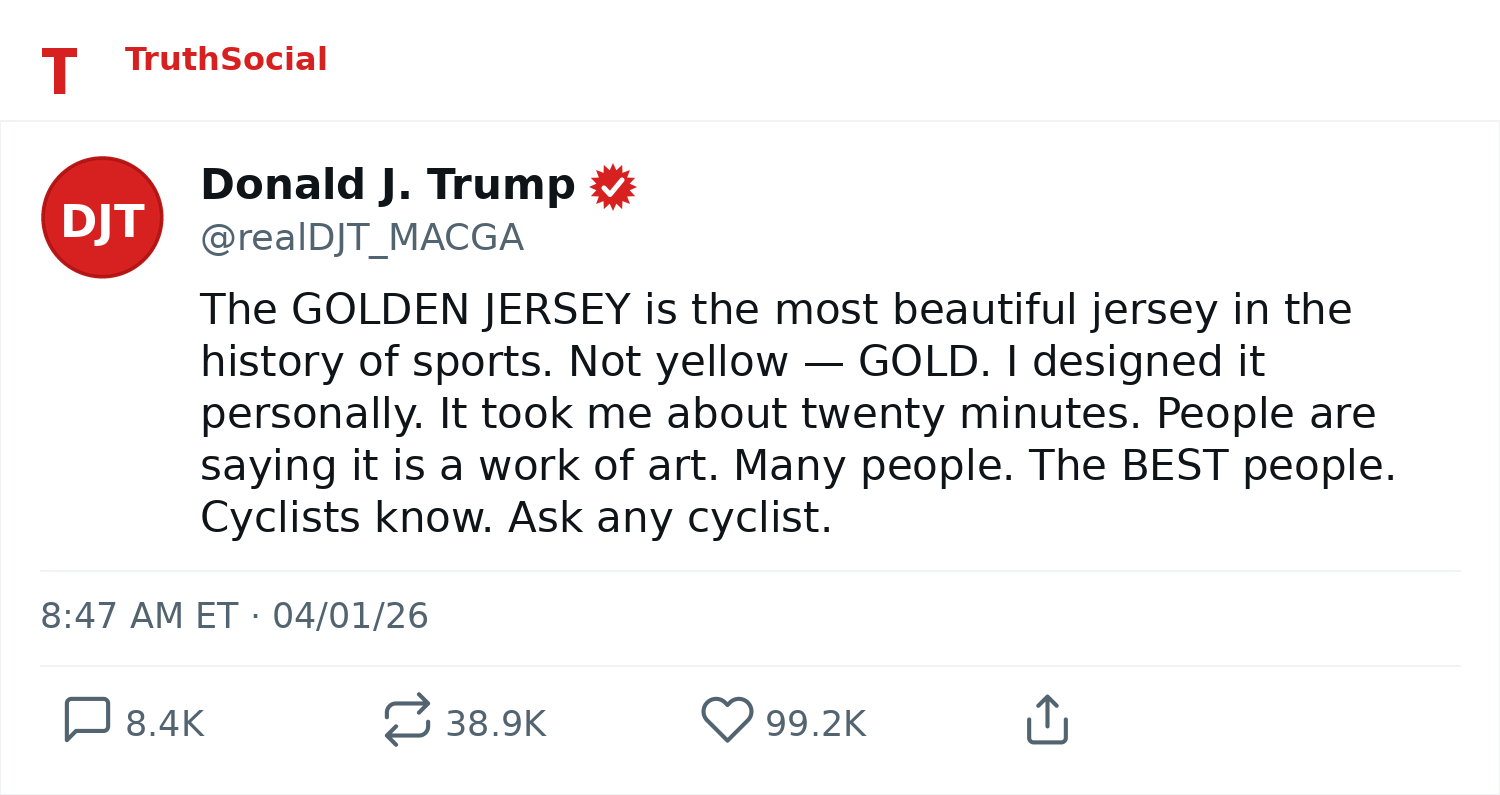
Images of the jersey design have been posted in the press room.
Tour de Trump Golden Jersey (front)
Tour de Trump Golden Jersey (back)
11:46 AM EDT / 17:46 CEST — Rider reaction, outside Girona
A rider for one of the major WorldTour teams — who declined to be named because he has a contract with a sponsor whose management is based in the United States — speaks briefly from a training ride outside Girona. He is still on his bike. He is riding Campagnolo.
“I read the order,” he says. “All of it. Section Seven is — I mean, have you been to Bedminster? I’ve been to New Jersey. It’s not the Dolomites.”
He is asked about the anti-drafting provision.
“If you take away the peloton, you don’t have bike racing,” he says. “You have a time trial that goes on for three weeks. Nobody can sustain Grand Tour watts without shelter for twenty-one days. The fastest riders in the world would be in medical tents by Stage Three.”
He pauses. Something passes across his face — not quite a smile.
“The golden jersey is hideous,” he adds. “I’m sorry. But it’s hideous.”
He rides away.
11:51 AM EDT / 17:51 CEST
No prize total has been announced. The OACE has not been contacted because the OACE does not exist in any staffed sense.
Armstrong’s publicist says he is still reviewing the opportunity. He has been reviewing it for over nine hours.
11:54 AM EDT / 17:54 CEST — Latest update
The morning ends more or less as it began: in motion, unresolved, and generating more questions than it answers. The UCI has consulted. ASO has noted. Campagnolo has expressed confidence in continued dialogue. The Secretary of Commerce has requested a clarification that has been overruled. The Bedminster climb remains, by all independent measurement, sixty meters tall.
Professional cycling is a sport accustomed to improbable weather, unexpected suffering, and events that make very little sense while they are happening. Its people are not, generally, easily surprised. They have seen riders fall asleep on descents and cross finish lines bleeding. They have watched men climb mountains in conditions that would ground aircraft. They have followed races through floods, strikes, and at least one kidnapping attempt.
They have not, until now, been subject to a presidential executive order regulating aerodynamic behavior in the peloton.
This afternoon, the UCI will consult further. ASO will note further. Armstrong will continue reviewing. The golden jersey will be, by all accounts, very gold.
And somewhere in Vicenza, a factory that has been making the finest bicycle components in the world since 1933 will begin a very difficult conversation with its American distributors.
The Tour de Trump has not yet announced its start date. The executive order says the OACE will provide this information “in due course.” The OACE has not yet hired anyone.
But the papers have been signed. The President was there when they were signed. He ran the whole thing personally.
He remembers it differently now. He always has.
[EDITOR’S NOTE: This is a developing story. We will update as events warrant. It is not yet noon.]
By Nancy Clark, MS RD CSSD — In my early years as a sports nutritionist, fat was a four-letter word. The mantra Eat fat. get fat scared athletes away from consuming any kind of dietary fat. I had to practically beg athletes to include some fat in each meal. After all, fat is an essential nutrient needed to absorb certain vitamins (A, D, E, K) and for normal brain functioning. Fat adds flavor (hence enjoyment) to food. Fat lingers in the stomach, helping you feel fed for longer than a fat-free meal.
Times have changed. We now know that fat-free foods which come with added sugar to improve flavor and acceptability—such as SnackWell cookies and fat-free frozen yogurt—can be detrimental to our health. Today we encourage healthy fats, including olive oil, walnuts, almond flour, ground flax seed, pumpkin seeds, avocado oil, salmon, and sardines. These unsaturated fats are soft at room temperature, in contrast to saturated fats (beef fat, butter, stick margarine) that are solid at room temperature. Saturated fat is associated with an increased risk for heart disease.
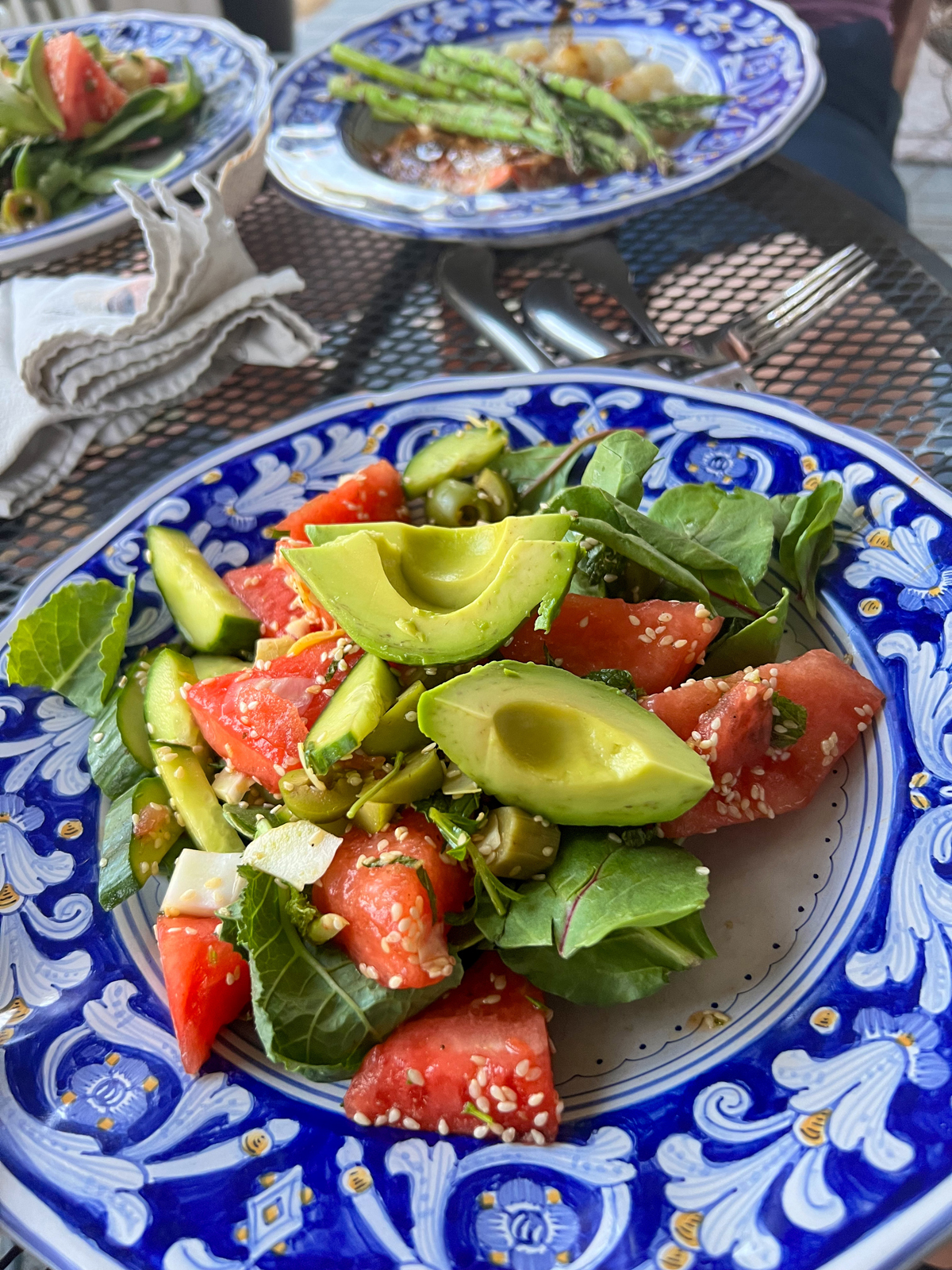
Avocados are a healthy source of fat that provide essential nutrients without spiking blood sugar. Photo by Heather Casey
How much fat is okay to eat?
While there is no limit on total fat intake (aside from calories), the American Heart Association recommends consuming less than 6% of total calories from saturated fats to lower the risk of heart attack and stroke. That’s about 15 to 20 grams of saturated fat, the amount in 2 table-spoons of butter. By choosing more beans, nuts, and fish (instead of fatty meats) and more olive oil (instead of butter), you can achieve that target.
What are the worst fatty foods to eat?
While there’s not a worst fatty food, I’d bet against a steady intake of greasy burgers, pepperoni, prime rib, French fries, chips, and fried foods. There’s no need to demonize fat. Rather, you want to look at the whole day’s intake and balance a McDonald’s Sausage Egg & Cheese Biscuit (17 g sat fat) with a low-fat turkey sandwich for lunch and fish for dinner.
Decades of science has shown that saturated fats raise your bad LDL cholesterol and put you at higher risk for heart disease. That said, more recently, the harm of saturated fat has become a topic of debate because saturated fats are not all the same. Some saturated fats (such as beef tallow) have long chains with 13 or more carbon atoms, others (coconut oil) have medium-length chains with 7 to 12 carbon atoms, and some (dairy) have short chains with 6 or less carbon atoms. Different lengths of carbon chains impact health differently. For example, recent evidence suggests the short carbon chains in dairy fat is not linked with heart disease.
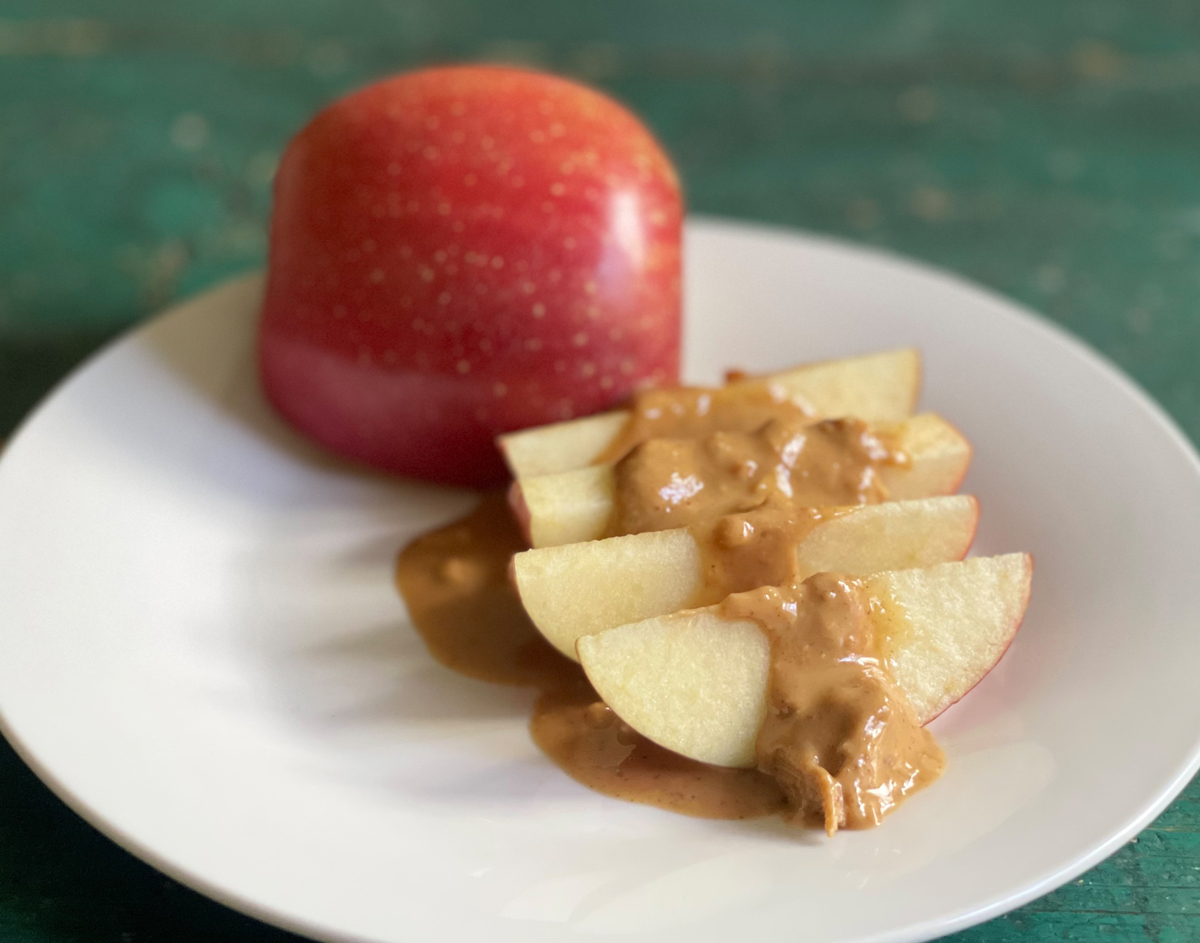
Peanut butter is a healthy source of fat. Photo by Dave Iltis
What are the best fatty foods to eat?
Foods high in unsaturated fats such as olive oil, salmon, and nuts, are at the top of the Good Fats List; they are known to fight inflammation that comes with heart disease and diabetes. Research suggests people who eat anti-inflammatory peanut butter and nuts 5 or more times a week can reduce their risk of diabetes by 25% and heart disease by 50%. When you cook at home, you want to use olive oil (instead of butter) when sautŽing and canola oil with frying and high heat cooking.
Isn’t canola oil bad for you?
Canola oil, made from rapeseed plants, and other seed oils (like corn, cotton, safflower, soy, and sunflower) are highly refined (i.e., lacking in vitamins and minerals) but rich in unsaturated fat. Seed oils are used in packaged /processed foods. Health concerns about seed oils stem from eating too much (ultra) processed foods. Home cooking with canola is fine!
What about “trans fat” listed on food labels?
Trans fats have been largely removed from foods in North America and Europe because they are strongly linked to heart disease. They elevate bad (LDL) cholesterol and reduce good (HDL) cholesterol. Some meats and dairy have small amounts of naturally occurring trans fats, and some commercially fried foods and packaged snacks may still have small amounts of trans fat, although they have been banned. Nutrition Facts on a label might (legally) list 0 grams trans fat when a product has less than 0.5 grams of naturally occurring trans fat per serving—but it still may have small amounts of trans fats.
The main culprit related to trans fat used to be partially hydrogenated oils that are now banned. Adding hydrogen to vegetable oils makes the fat more solid. This gives the food a desirable texture, taste, and extended shelf-life. Hence, trans fats were popular with commercial food producers.
What about taking fish oil supplements instead of eating salmon and other fatty fish?
While it is true that people who regularly eat fish are less likely to die from heart disease, researchers have been unsuccessful in proving omega-3 fish oil supplements have the same benefit as eating fatty fish. A whole foods approach is always preferable to the pop a pill approach. That’s because natural foods have a matrix of biological compounds that combine to offer health benefits.
Note: A small -for-a-hungry-athlete 3.5-ounce serving of salmon offers about 2.3 grams omega-3 fats. A fish oil pill might have only 1.2 grams. Spend your money on fish, not pills?
Given fats digest slower than carbs, should I avoid peanut butter before I exercise?
Anecdotally, many marathoners enjoy peanut butter on a bagel before a long run, and cyclists devour PB&J sandwiches during extended bike rides. Given ~75% of calories in peanut butter come from fat, seems like it could hinder performance? Maybe not. Research with athletes who repeatedly consumed equal calories of a high fat chocolate flavored nut butter (Roam Energy Nut Butter) or a fat-free high-carb chocolate flavored gel showed they performed similarly in exercise tests and reported no differences in gastro-intestinal symptoms. These results support what athletes have done for years—reached for peanut butter as a favorite staple in their sports diet! If a pre-exercise snack with PB works well for your body, enjoy it—along with its anti-inflammatory benefits and yummy taste!
By Steven Sheffield — The Monuments and classics represent the oldest and most prestigious one-day races in professional cycling—contests that predate the Tour de France and have crowned champions for well over a century. From the cobbled brutality of Paris-Roubaix to the Ardennes hills of Liège-Bastogne-Liège, from the sprinter’s lottery of Milano-Sanremo to the autumn leaves of Il Lombardia, these races demand mastery across radically different terrain. Five races hold Monument status: Milano-Sanremo (first run in 1907), Ronde van Vlaanderen (1913), Paris-Roubaix (1896), Liège-Bastogne-Liège (1892), and Il Lombardia (1905). Three additional races—Gent-Wevelgem, La Flèche Wallonne, and Paris-Tours—have historically been grouped with them as cycling’s eight “original classics.” Together, they form a palmarès that defines the complete classics rider, and the questions that follow explore the history, records, and legendary achievements across these storied races.
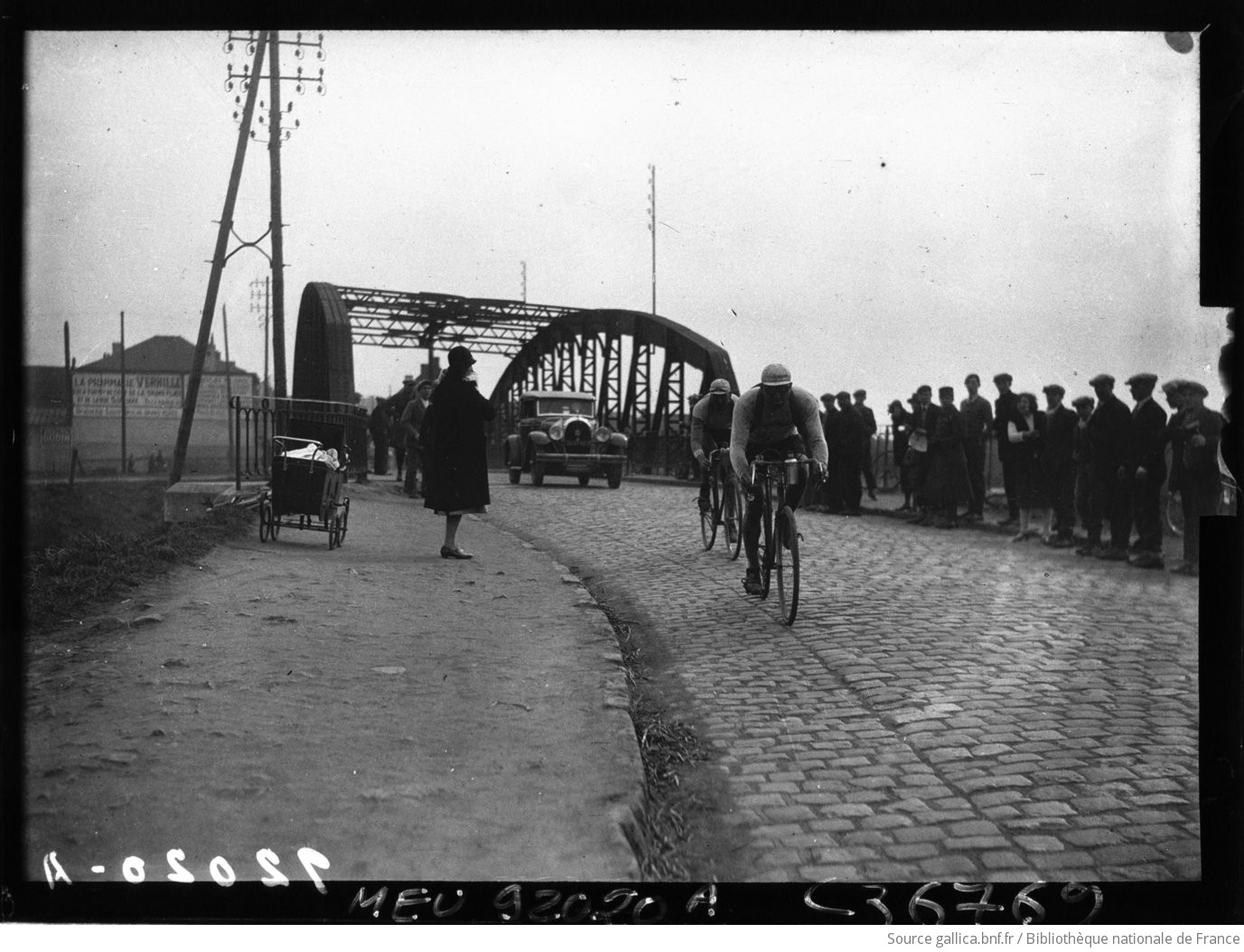
Paris-Roubaix 1910 : Bidot et Sieronski au pont de Courrières : [photographie de presse] / Agence Meurisse. Image in the public domain, courtesy Bibliothèque Nationale de France.Q1. The eight original classics—the five Monuments plus Gent-Wevelgem, La Flèche Wallonne, and Paris-Tours—represent the full spectrum of one-day racing: sprinters’ classics, cobbled brutes, and Ardennes climbers’ terrain. Winning even one is a career-defining achievement; winning all eight requires a versatility that borders on the impossible. While three riders have won all five Monuments, only one rider in history has won all eight of these prestigious races. Who is he, and which of the other two Monument winners came closest to matching him?
Q2. La Flèche Wallonne and Liège-Bastogne-Liège have long been linked as the Ardennes Classics, their hilly terrain in eastern Belgium favoring pure climbers and punchy attackers over the powerhouses who dominate the cobbles. Originally run on successive weekend days as “Le Weekend Ardennais,” La Flèche Wallonne moved to the Wednesday before Liège-Bastogne-Liège in 1985—the same year it introduced its now-iconic Mur de Huy finish. Winning both races in the same year remains one of cycling’s rarest achievements, demanding peak form sustained across either two days or five depending on the era. How many riders have completed this “Ardennes Double,” and has any rider achieved it both before and after the 1985 calendar change?
Q3. Before Gent-Wevelgem moved to the Sunday preceding the Ronde van Vlaanderen in 2010, it occupied the Wednesday slot between the Ronde and Paris-Roubaix—creating cycling’s most grueling week. The theoretical “Holy Week Triple” of winning the Ronde on Sunday, Gent-Wevelgem on Wednesday, and Paris-Roubaix on the following Sunday was considered the ultimate test of a Flandrien, requiring a rider to peak not once but three brutal times on cobbled roads over a span of eight days. Only one rider ever accomplished this feat. Who was he, and in what year did he achieve something the modern calendar has made permanently impossible?
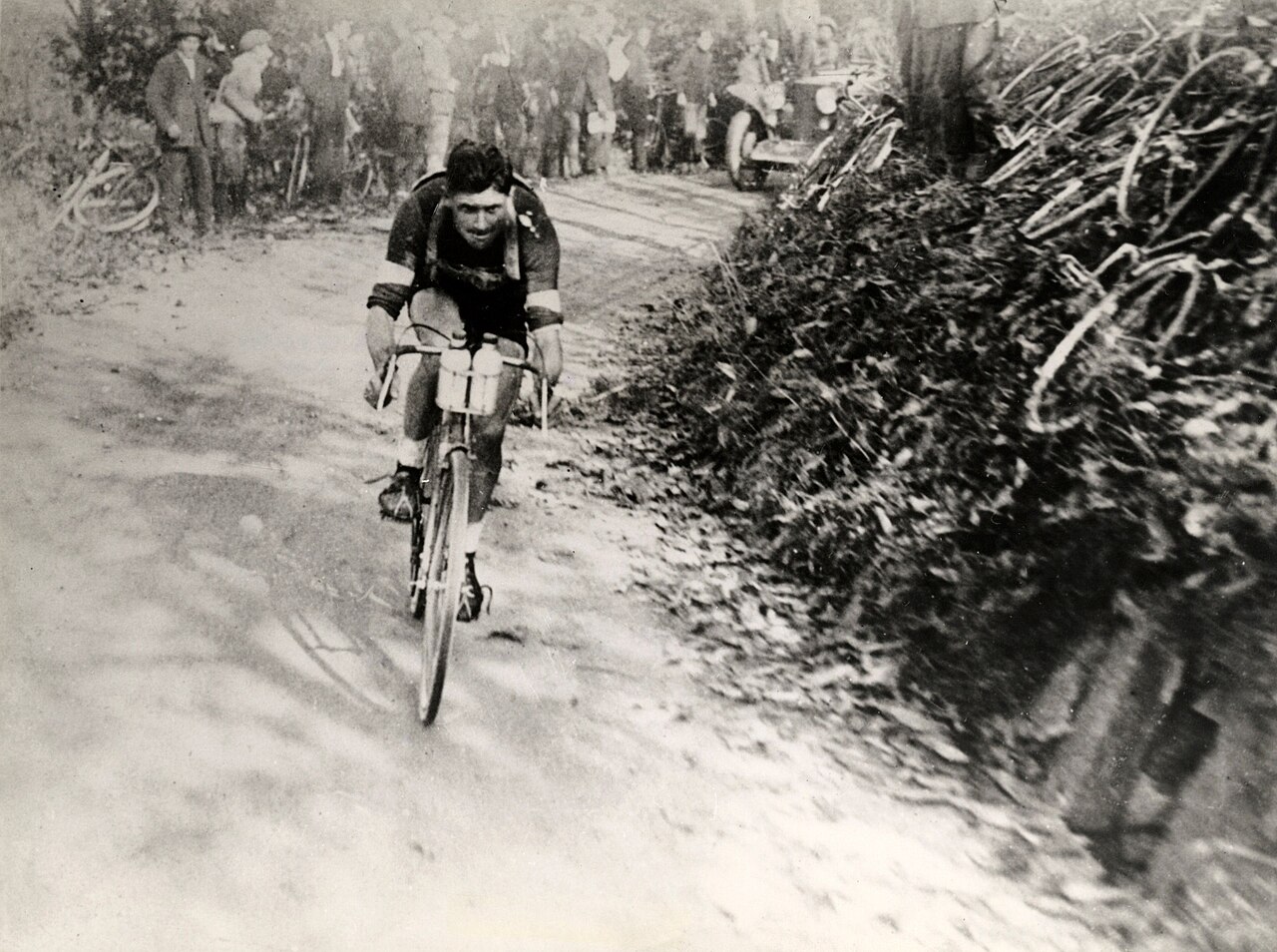
The Italian cyclist Alfredo Binda rides over the summit of the Brinzio with a commanding lead during the 1926 Tour of Lombardy. He would go on to win the race. Note also the deplorable condition of the road surface. Italy, 1926. Image in the public domain.
Q4. Winning three Monuments in a single season is one of cycling’s rarest achievements, requiring a rider to peak across different terrain and race profiles over a seven-month span from the March heat of the Ligurian coast to the October chill of Lombardy’s lake country. The specialization of modern cycling—where cobbled classics specialists rarely contest the Ardennes races, and vice versa—has made this feat increasingly difficult. Only two riders have ever done it. Who are they, and how many times did each accomplish this remarkable feat?
Q5. The Ronde van Vlaanderen and Paris-Roubaix are held just one week apart, and winning both in the same spring is considered one of cycling’s greatest achievements. Though both are cobbled classics, they demand different skills: Flanders features steep, technical climbs on narrow farm roads where bike-handling and explosive power decide the race, while Roubaix is a flat war of attrition across 55 kilometers of punishing pavé where endurance and positioning matter most. How many riders have completed this “Cobbled Double,” and which two riders have done it twice?
Q6. Roger De Vlaeminck earned the nickname “Monsieur Paris-Roubaix” not just for his four victories but for his extraordinary consistency across 14 years of racing the Hell of the North. His cyclo-cross background gave him unparalleled bike-handling skills on the treacherous cobbles, and his finishing speed made him lethal in reduced group sprints. His brother Éric, seven-time cyclo-cross world champion, often trained with him by riding in freshly plowed farm furrows and balancing on train rails. In De Vlaeminck’s 14 Paris-Roubaix starts between 1970 and 1983, how many times did he finish outside the top seven, and how many times did he abandon?
Q7. Sean Kelly won nine Monument races across four different Monuments during his remarkable career in the 1980s and early 1990s—a total surpassed only by Eddy Merckx and Roger De Vlaeminck. Yet despite his success in Milano-Sanremo, Paris-Roubaix, Liège-Bastogne-Liège, and Il Lombardia, one Monument eluded him entirely despite three runner-up finishes. Which Monument did Kelly never win?
Q8. Winning Paris-Roubaix three consecutive times is one of the rarest achievements in cycling, requiring a rider to dominate the Hell of the North across three seasons while avoiding the crashes, punctures, and mechanical disasters that decide the race as often as pure strength. In the race’s history stretching back to 1896, only three riders have ever accomplished this feat. Who are they?
Q9. In 2025, Tadej Pogačar contested all five Monuments for the first time in a single season, adding the cobbled classics of Flanders and Roubaix to his established dominance in the Ardennes and Lombardia. His spring and autumn campaign made history in a way no rider—not Merckx, not Hinault, not any of the great all-rounders—had ever achieved across all five Monument races. What was this unique accomplishment? Bonus: Pogačar also set another record with his finish at Lombardia. What was it?
Jasper Philipsen survives the chaos Van der Poel and Van Aert create, waits out the peloton’s clinical pursuit, and outsprints them all in Wevelgem. In Flanders Fields 2026 had everything — except the ending everyone expected.
WEVELGEM, Belgium (29 MARCH 2026) — There is a particular cruelty built into the design of In Flanders Fields. Unlike the Tour of Flanders, which gathers its violence into a sequence of famous climbs before releasing it all at the Oude Kwaremont, or Paris–Roubaix, which lays its suffering across cobblestones that punish the unprepared over a hundred kilometers, this race tightens slowly, methodically, across three successive ascents of the same hill. Each passage of the Kemmelberg arrives a little steeper, a little heavier with accumulated fatigue, until the third and final climb via the Ossuaire — the steilste flank, as the locals say, though the gradient tells only part of the story — separates the race for good. The cruelty lies in the fact that you can see it coming the entire time. On a cool, bright Sunday in West Flanders, it announced itself with unusual clarity and then delivered on every promise.
The Morning
Mathieu van der Poel arrived in Middelkerke carrying the residue of a performance in the E3 Saxo Classic that had left his rivals casting around for adequate language. His wattage numbers had leaked into the peloton’s consciousness in the days following; one rider called it madness, another suggested it would give a horse the hiccups. Van der Poel’s response, characteristically, was to lower expectations. He would race defensively, he said. He and Jasper Philipsen would share leadership. He would content himself with seeing how things unfolded. This is what Van der Poel says before he wins.
Wout van Aert, who had watched the E3 from home after choosing not to start, had woken up wanting a fight. He said this was a race that could go either way, that the finale provided enough opportunity for sprinters to come back, that he wanted to race aggressively and see where the day took him. He did not mention his oldest son, who would appear briefly in the post-race debrief as a reminder that this sport carries its disappointments home.
Among the wider field, the pre-race conversations mixed caution with candor. Biniam Girmay, measured and precise, said a podium was possible but a win would be difficult — it was, he explained, a race where you could lose at a hundred different points if your positioning was wrong. Filippo Ganna, who had emerged from Tirreno-Adriatico in poor condition, admitted he was not yet himself and hoped the day would be a fresh start. Matthew Brennan of Visma–Lease a Bike had finished a course of antibiotics only days before and arrived with the cautious optimism of a man who feels better but cannot yet be certain. Jonathan Milan, who had also been ill after Tirreno, said only that he would blow harder later and that he felt confidence.
Only Florian Vermeersch sounded entirely unambiguous. “I’m not going to spare myself at all,” he said. “I have full freedom from the team.” He had woken up feeling good. He had stood on the podium at the Omloop and the E3. He was ready.
Feed Zone, De Moeren, And The Early Break
The race’s first casualties arrived before the first serious test. In the feed zone, with the peloton still compact and the crosswind sectors still ahead, Timo Kielich went down hard and stayed down; the signs pointed to a broken collarbone before anyone had confirmed it. In the same incident Laurenz Rex ended up in the roadside ditch and did not rise quickly. Two Belgian riders, two seasons abruptly reshaped, and the race had not yet reached its defining terrain.
The early break had formed in the usual way — not cleanly or immediately but through two rounds of attempts and recaptures, until finally eight riders found themselves clear with the peloton’s permission: Dries De Bondt and Victor Vercouillie of Flanders-Baloise, Jules Hesters of the same team, Julius Johansen, Frits Biesterbos, Hartthijs de Vries, Wessel Mouris, and the 19-year-old Cofidis neoprof Camille Charret, whose race experience to that point consisted largely of not finishing things. Vercouillie, 23, was an established presence in early moves who had not yet converted his aggression into results at this level. Hesters had won a sub-professional French one-day race a few weeks earlier but had nothing yet on the road that mattered. They would work hard and finish nowhere, as the early break in In Flanders Fields almost always does, but their anonymity in the result does not diminish the labor.
The peloton let the eight go with something approaching indifference. The gap swelled past five minutes as the race moved toward De Moeren, which is either the most important section of In Flanders Fields or a spectacular anticlimax depending on the direction of the wind. Alec Segaert, interviewed before the start, had said the wind was favorable for the break and that De Moeren could split the race even without a proper crosswind. José De Cauwer, from the commentary position, offered the counterpoint that there was just a little too little of it. This small debate — favorable versus just not quite enough — turned out to be the day’s most consequential meteorological disagreement.
The peloton hit De Moeren with Visma–Lease a Bike on the front and Red Bull–BORA–Hansgrohe jostling for influence. There was a furious sprint for position into the narrow entry, teams fanning across the road in anticipation of the crosswind. Hugo Hofstetter ended up briefly in the grass verge at the side of the road, kept his bike upright, and returned to the bunch without drama. For a moment the long flat slab of reclaimed polder opened small gaps at the back, Jan Tratnik among those briefly shed. But the wind never fully committed. The peloton came through De Moeren bruised and nervous but functionally intact, and the race moved on toward what everyone understood to be its real business.
Before the hills, the Beauvoordestraat cobbled section provided a preview of what Alpecin–Premier Tech intended. The team lifted the tempo and the peloton splintered into a first and second group, with a gap of 40 seconds or so between them before the roads allowed a reassembly. It settled nothing definitively but established clearly that Van der Poel’s team was not here to ride conservatively regardless of what their leader had said in the morning. Silvan Dillier, who appears at the front of the peloton in spring classics with a reliability that suggests some contractual arrangement with fate, had been doing the steady work of keeping the break controllable. Now the race was beginning to load itself.
The startlist had its own small subplot worth noting. Burgos Burpellet, a Spanish professional team that had received a wildcard, arrived with a roster drawn from six different countries — alongside the Spaniards, there was a Frenchman, a Uruguayan, a Greek, a Mexican, and a Mongolian. It was the most geographically diverse nine-man team in the peloton, and they would spend the day largely invisible, which is the fate of most wildcard teams in races like this, but their presence was a reminder that the sport’s geography is wider than its Belgian obsessions suggest.
Into The Hills: Plugstreets And The First Kemmelberg
The hills arrived, and with them the race’s first genuine separations. On the first Kemmelberg, approached via the gentler Belvédère flank, Jules Hesters dropped from the front group — eight early leaders became seven before the peloton had even reached the climb. Ben Turner of INEOS Grenadiers briefly accelerated in the peloton, the only rider to do so with any conviction, before being absorbed. At the back of the peloton there was a bottleneck, riders briefly at a standstill on the narrow approach. Wout van Aert, visible in the replay afterward, put a foot down briefly after a minor equipment issue. Had the race chosen that moment to detonate — had Turner’s acceleration found traction, had someone attacked on the left — the afternoon would have been different. It did not, and Van Aert filed the moment away.
The plugstreets came next: three unpaved strips named for the WWI history of this ground, Hill 63 and Christmas Truce among them, narrow enough that position meant everything and any hesitation meant losing ten places at once. Jasper Stuyven had been building through the race and now he showed it, attacking on the smeared gravel with the cheerful aggression that has characterized his spring for years. “I’m not fully satisfied with my spring yet,” he had said in the morning, “but there are still a few nice opportunities.” On the plugstreets he looked like a man creating his own. Matthew Brennan and Filippo Ganna were among those trying to organize a return to the front group; the race was strung over kilometers of West Flemish back roads, everyone simultaneously chasing and being chased.
Paul Magnier’s afternoon ended, for practical purposes, at the exit of the final plugstreet. A mechanical forced the young Soudal–Quick-Step sprinter to take the spare bike of teammate Bert Van Lerberghe — which was too large. He gesticulated furiously for his own machine, losing ground he could not recover. When his bike finally came, he had already needed a second swap. He would rejoin the race but the momentum was gone, and Jasper Stuyven — who was supposed to be the team’s helper and was instead riding like a protected rider — was the better story now.
Ben Turner’s afternoon ended rather more abruptly. The INEOS Grenadiers Brit, who had been the one peloton rider willing to probe the first Kemmelberg, suddenly flew over his handlebars on a flat section — an involuntary dismount that drew at least one startled expletive from the barriers and several anxious seconds before it became clear the damage was limited. Filippo Ganna had been pacing for Turner; with Turner gone, Ganna drifted into a purely personal race, eventually ending up in service of Sam Watson in the finale. It was not the fresh start he had advertised in the morning.
The Second Kemmelberg And The Three-Man Move
At the second passage of the Kemmelberg, the race finally broke open as it had been threatening to do for two hours. Wout van Aert was the one who opened it — a clean, sudden acceleration that carried the clarity of a rider who had been waiting for exactly this gradient at exactly this moment. Two riders went with him: Mathieu van der Poel, who never needs a second invitation, and Florian Vermeersch, whose commitment to the move was underwritten by the work of Julius Johansen immediately before it. Johansen had been riding Vermeersch’s interests from the feed zone onward, and on the Baneberg he went to the front and poured himself out so that his teammate could arrive at the Kemmelberg with something still in reserve. It was the kind of domestique labor that appears in no statistics and takes a particular kind of character to sustain.
The three of them swept up what remained of the break. Mouris, de Vries, and Biesterbos refused to contribute; De Bondt and Johansen, spent, rotated briefly before the first-named dropped. Aimé De Gendt of Pinarello Q36.5, who had been floating in no man’s land between the peloton and the break for several kilometers — a position that demands exceptional commitment for uncertain reward — launched a counter on the Baneberg and caught Johansen, but could not bridge to the three leaders alone. He would finish eighth, which is one measure of what his day cost him.
Wout van Aert (Team Visma–Lease a Bike) on the Kemmelberg. Photo courtesy of Flanders Classics
Behind, the peloton was not reacting with panic. Decathlon CMA CGM had been deliberate throughout, conserving riders in the reduced group rather than committing early, fielding six men in the final peloton and sacrificing only two for the hills. It was the tactical reading of a team that understood the terrain would do the work if they were patient. Now, alongside Red Bull–BORA–Hansgrohe — riding for Jordi Meeus — and Lotto–Dstny Intermarché — riding for Arnaud De Lie — they began to organize a pursuit that would become one of the most efficiently executed chases in recent spring classic memory.
The gap grew anyway. At 22 kilometers to go the three leaders had 42 seconds. Van Aert and Van der Poel were working, and working well, but they were also riding on roads that offered nowhere to hide — long, straight, exposed approaches where the peloton’s cameras could track them perfectly and their diminishing advantage was plain to anyone with a stopwatch. Vermeersch, meanwhile, had been demonstrating the form that had put him on the podium at the Omloop and the E3, matching everything the two leaders asked of him. From behind, it almost looked equal.
The Third Kemmelberg: Ossuaire
The third and final Kemmelberg, via the Ossuaire — the side that measures your legs against what the first two climbs have taken from them — ended Vermeersch’s part in the lead group. Van der Poel went to the front and applied pressure that was not theatrical but simply relentless, the kind of riding that does not announce itself as an attack but raises the cost of following until the cost becomes prohibitive. Vermeersch held for perhaps half the climb. Then the gap appeared: eleven seconds at the crest, growing to nineteen on the false-flat descent toward Ieper.
Wout van Aert (Team Visma–Lease a Bike) and Mathieu van der Poel (Alpecin-Premier Tech) leading the race on the Kemmelberg. Photo courtesy of Flanders Classics.
He did not stop trying. On the long roads between the Kemmelberg and Ieper he rode alone with the determination of a man who refuses to accept arithmetic, and coming into Ieper he found himself suddenly and unexpectedly close — close enough that one final effort seemed possible. The road tilted slightly upward. “It’s false flat there,” he would say afterward, “and I just hit my ceiling.” He cracked briefly, then reset and continued, because the peloton was still behind him and the race was still his to lose. “Maybe we would have stayed three up,” he said, “but they decided otherwise.” He was satisfied with his day, he said, even as he was already framing the next one.
Up the road, Van Aert and Van der Poel were working together. After the Kemmelberg descent, Van Aert tapped his rival on the back and immediately took a pull — the gesture of two riders who have raced each other often enough that half a word suffices. They are not friends in the sentimental sense but they are profoundly familiar with each other’s rhythms, and this cooperation had the appearance of something that might last all the way to Wevelgem. The peloton, watching them on the road ahead, appeared to disagree.
The Chase
Vermeersch was caught at 14 kilometers. Six riders working in concert absorbed him and then continued past, the gap to Van Aert and Van der Poel already down to 35 seconds with 10 to go. The peloton was not a large one — perhaps 40 riders — but it was efficiently organized around three teams that wanted three different sprinters at the finish, and their common interest in the catch made the arithmetic simple.
Mathieu van der Poel (Alpecin-Premier Tech) and Wout van Aert (Team Visma-Lease A Bike). Photo courtesy of Flanders Classics
Jonathan Milan had been the race’s most dangerous sprinter and he was gone. He had needed a spare bike earlier in the race and managed, somehow, to stay in contention. But in the final kilometers he needed a second bike, and a camera operator who attempted to hand him a musette bidon drew a furious response from the Lidl-Trek staff car — the kind of roadside altercation that appears as a footnote in the results but represents, for the rider, the specific rage of a race slipping away. Milan effectively dropped out of the picture. Luke Lamperti, the young American sprinter with the legs to trouble the best on a flat finish, punctured with no team car close enough to help. He watched the peloton ride away from him in a scene cycling offers with punishing regularity to riders who deserve better.
At five kilometers, with the gap at 12 seconds and the two leaders almost certainly to be caught, Alec Segaert of Bahrain–Victorious did something that briefly redrew the race’s possibilities. He accelerated out of the peloton with no lead-out and no guarantee of anything except the knowledge that he was one of the strongest rouleurs in the bunch, and he closed 12 seconds in what felt like moments. He reached Van der Poel and Van Aert, and for approximately 90 seconds there were three riders out front again and the sprint was no longer a certainty.
It was not enough. The peloton behind was not going to stop for sentiment, and the roads between Ieper and Wevelgem are long and straight and merciless to small groups on exposed days. The gap yo-yoed but never stabilized. With just under two kilometers remaining, Segaert attacked alone — one more calculation, one more gamble — and rode clear briefly before the peloton took him back. Van Aert and Van der Poel had already been reabsorbed. The race would end in a sprint, a smaller sprint than anyone had imagined at the start of the day, on a finish line that had been waiting patiently all afternoon.
The Sprint, And Its Aftermath
Jasper Philipsen had been, for the preceding hour and a half, the most invisible important rider in the race. He had Alpecin–Premier Tech working for him, but beyond that he had Van der Poel working for him — the simple fact of his teammate’s presence up the road meant that every team chasing Van Aert and Van der Poel was simultaneously doing Philipsen’s lead-out work. He stayed near the front, moved up when required, and allowed the race to come to him. “It was the ideal situation for our team,” he would say afterward, with the understatement of a man who has learned that the ideal situation does not require commentary.
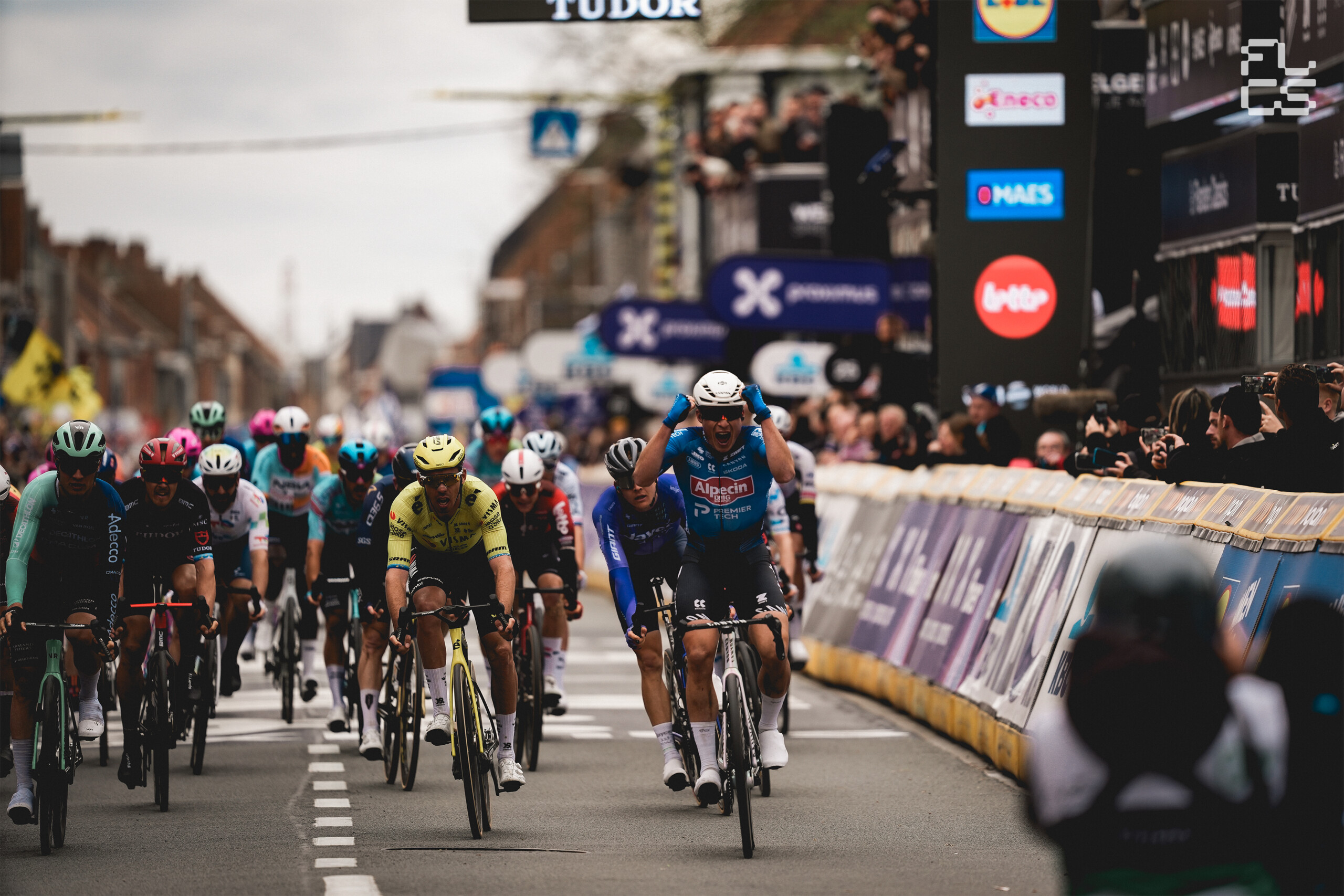
Jasper Philipsen (Alpecin-Premier Tech) wins the 2026 In Flanders Fields (Middlekerke-Wevelgem). Photo courtesy of Flanders Classics.
Jonas Geens and Florian Sénéchal delivered him precisely. Cees Bol opened the sprint for Tobias Lund Andresen but positioned himself fractionally off the barriers — not an error, Andresen would insist, simply a line that left a gap. Philipsen found it, drove through it with calm authority, and had Andresen beaten well before the line. Christophe Laporte arrived third. Arnaud De Lie was fourth.
The sprint had one more scene to play. Jordi Meeus, who had been Red Bull–BORA–Hansgrohe’s designated sprinter and who had reason to expect a result after what his team had done in the chase, found himself shoulder to shoulder with Laporte in the final 200 meters, two riders seeking the same space with equal conviction. The space was not there. Meeus was the one who had to brake, who felt the barriers approaching and unclipped rather than crash, who watched his sprint chance close in real time. After the line he went directly to Laporte and delivered his verdict without much editorial polish.
“What the f*ck, man!” he said. “You could have braked a little. You just pushed me into the fencing.” Laporte’s response suggested he held a different view of the sequence of events and of which rider bore the primary responsibility for braking. It was an argument conducted in the heat of a sprint finish and resolved, as these arguments generally are, not at all. Andresen, asked about Bol’s lead-out, refused to apportion blame. “The last thing we should say now is that he did something wrong,” he said. “He didn’t move off his line. You’d think it wasn’t possible to bring those two back — but the team showed how strong we are. Working with the other teams was great.”
Laporte, third, was brief. Van Aert had been very strong, the peloton had come back, he had done everything in the sprint that he could manage and it had not been enough. Van Aert himself, when he found his way to the finish, noted that his oldest son had been disappointed too. It was the kind of detail that lands differently than a tactical analysis — a reminder of who watches this, and what they want from it, and how it feels when the race ends the wrong way.
Van der Poel, who had ridden a calculated race and lost the calculation only in the final kilometers, reflected that he had always ridden with the thought that Philipsen was still coming back. It was the acknowledgment of a man who had done what he said he would do and been beaten by the plan he had said would be the plan.
Vermeersch was, of all the riders who did not win, the most forward-looking. He had ridden better than most men could manage against those opponents on those roads. Decathlon had been clever, he said — they got the race back and there was nothing more he and his two companions could have done against a collective pursuit of that quality. He had finished in the top ten at the Omloop and stood on the E3 podium. He said he was satisfied, and then he looked toward the following Sunday. “Next week Tadej is there for the Ronde,” he said. “I’m looking forward to it.” The smile carried equal parts consolation and threat.
For Philipsen, the victory was the 60th in the race’s history, and one of the purest expressions of the sprinter’s art in a race that does not usually favor that art. He had survived terrain designed to eliminate him, sheltered behind the aggression of a teammate willing to do the suffering on his behalf, and then converted the chaos of a collapsing two-man breakaway into a sprint that suited him exactly. He timed it without apparent difficulty and won it without apparent doubt. It is not the most dramatic way to win In Flanders Fields. On a Sunday like this one, it was the only way available, and he took it.
IN FLANDERS FIELDS • MIDDELKERKE–WEVELGEM • 240.8 KM • 29 MARCH 2026
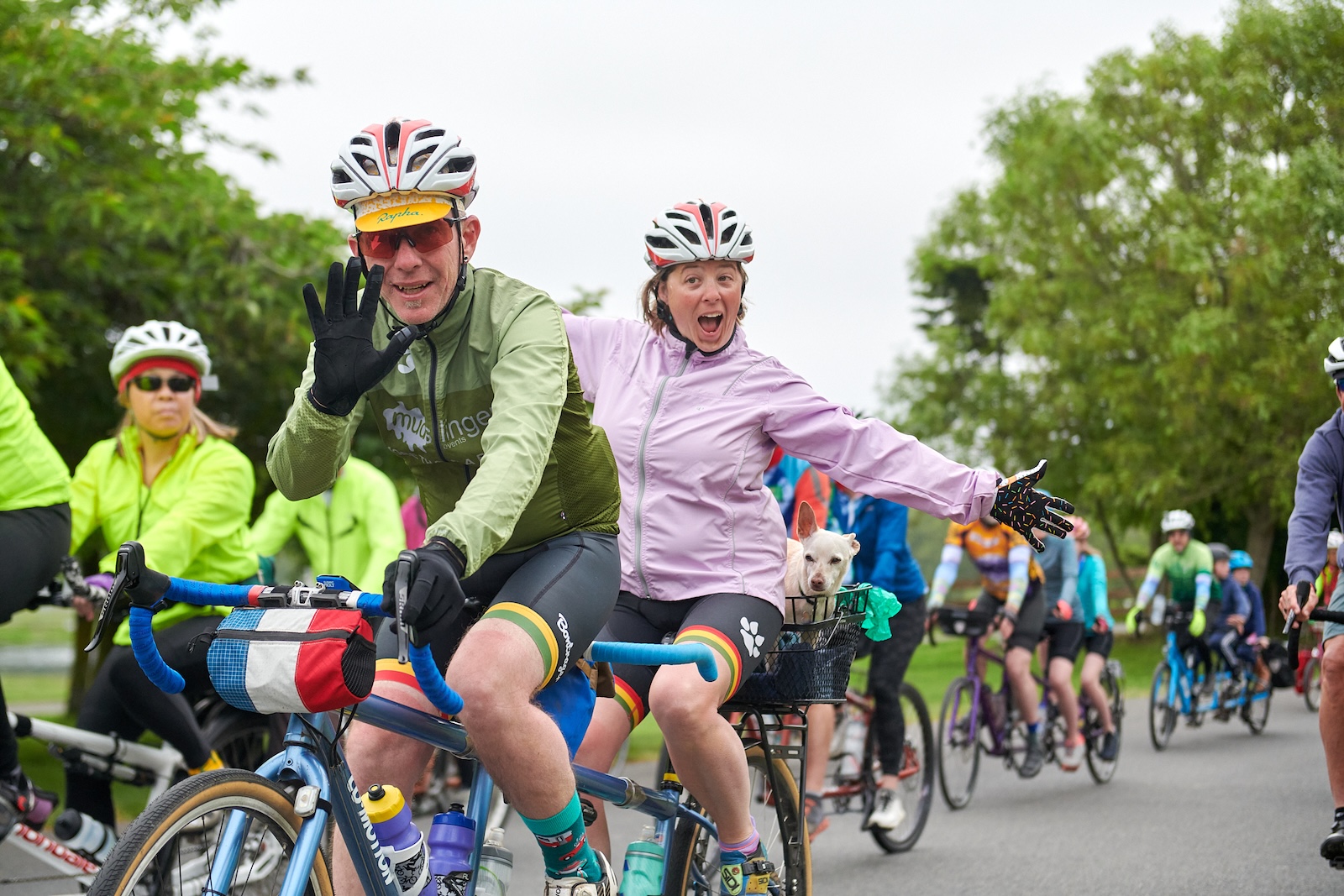
COTTAGE GROVE, Oregon — Tandem teams from across the country will gather in Cottage Grove from June 5–7 for the 2026 Northwest Tandem Rally, one of the premier and longest-running tandem cycling events in the United States.
Set in Oregon’s Willamette Valley, the rally offers a fully supported, multi-day riding experience designed specifically for tandem cyclists. Participants can choose from a range of thoughtfully curated routes with varying distances and elevation profiles, all showcasing quiet country roads, rolling farmland, and the region’s signature Pacific Northwest scenery. Each route is supported by well-stocked rest stops and on-route assistance.
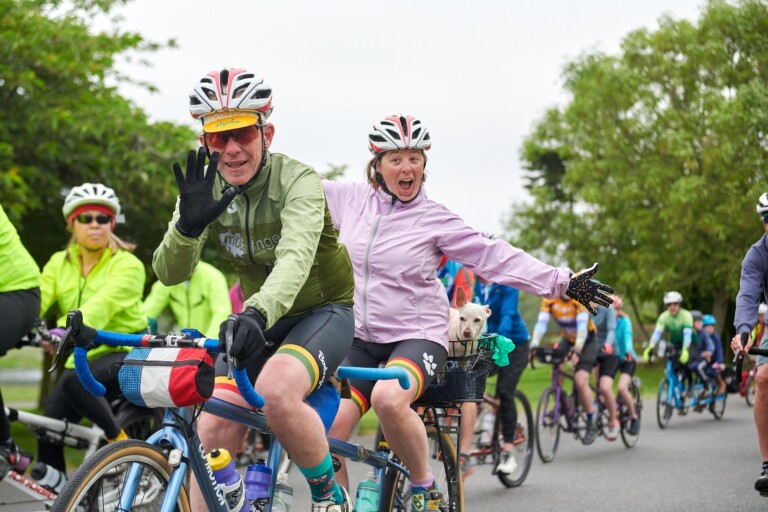
Scenes from the Northwest Tandem Rally. Photo courtesy of Mudslinger Events
Beyond the riding, the Northwest Tandem Rally centers on the social side of tandem cycling. Group meals, evening gatherings, and a vendor fair create opportunities for riders to connect with one another, as well as with industry partners and local businesses. Whether longtime tandem teams or first-time participants, riders can expect a welcoming, enthusiastic environment built around the shared experience of riding together.
Participants will also receive commemorative event swag, a staple of the rally experience.
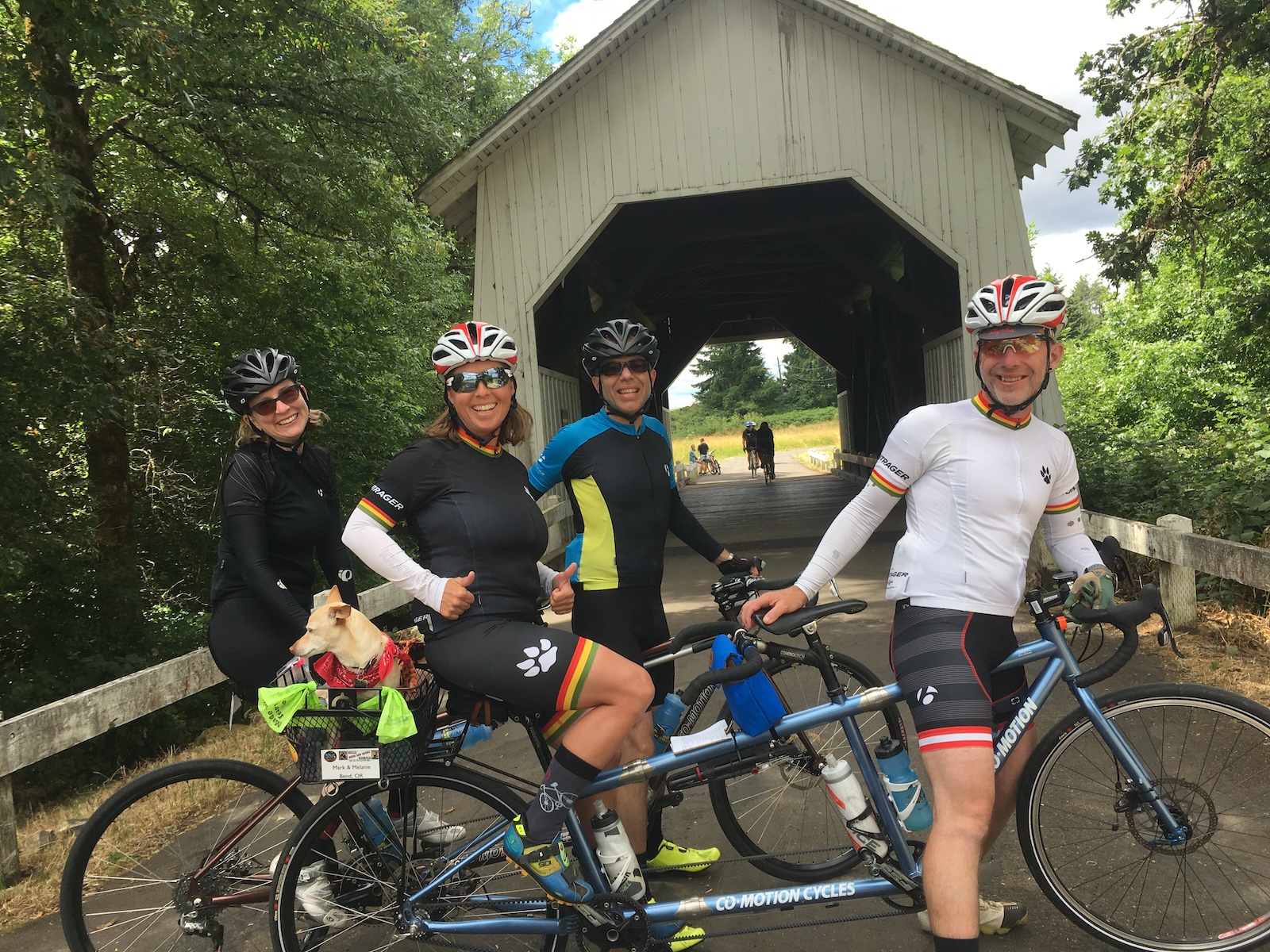
Scenes from the Northwest Tandem Rally. Photo courtesy of Mudslinger Events
Founded in 1986, the Northwest Tandem Rally has traveled throughout the region while maintaining its grassroots, volunteer-driven approach. The event is designed to be family-friendly, affordable, and accessible, with a variety of route options to accommodate different abilities. Traditionally held around Memorial Day or the Fourth of July, the rally continues that legacy in 2026 with its early June dates.
The event is produced by Mudslinger Events, which emphasizes a high-quality, community-focused experience. Registration is currently open, with capacity limited to maintain that atmosphere.
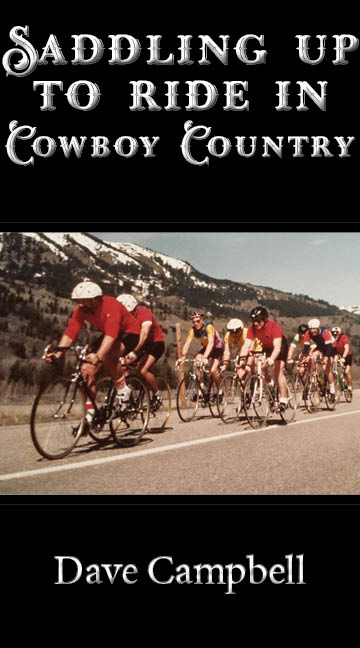
LANDER, Wyoming (March 27, 2026) — Author and Cycling West contributor Dave Campbell announces the release of his debut memoir, Saddling Up to Ride in Cowboy Country, a compelling story that captures both a personal coming-of-age journey and the explosive growth of cycling in the United States during the 1980s.
In the 1980s, America discovered cycling — and so did Dave Campbell. Growing up in Lander, Wyoming, at the foot of the Wind River Mountains, cycling gave him freedom, identity, and adventure. It became his escape from isolated small-town life and his bridge to a wider world of camaraderie, challenge, and discovery. The sport’s growth mirrored his own journey, fueled by the pioneering spirit of American riders who broke into the European racing scene and inspired a generation. From local races that they organized themselves to American firsts in the Tour de France, this was cycling’s golden age — when passion outpaced resources and community meant everything.
Saddling Up to Ride in Cowboy Country celebrates that transformative era, the riders who made history, and the enduring spirit of a sport that connects professionals and enthusiasts alike through a shared love of the ride.
Dave Campbell was born and raised in Lander, Wyoming and now resides in Bend, Oregon. A retired High School Science and Health teacher, Dave won four Wyoming state cycling championships before moving to Oregon to attend the University of Oregon in Eugene. While there, Dave was a collegiate All American and went on to win six Oregon State Cycling Championships as well as a Masters National Road Title on the Tandem. He started writing Trivia in 1992 for Oregon Cycling News and continued the column with the Northwest Bicycle Paper and now Cycling West. Dave also writes cycling history at “Clips_and_Straps” on Instagram and announces at cycling events throughout Oregon. This is his first book.
A public reading and book signing will take place on May 19 from 4-6 pm in Thermopolis, Wyoming at Storyteller bookstore.
And a reading will be held on May 21 at 6:30 PM at Gannett Peak Sports in Lander. The event is presented in partnership with the Lander Cycling Club and Indie Darling bookstore. Community members, cycling enthusiasts, and readers are warmly invited to attend. Additional book signings will be held in Bend, Oregon later this year.
Copies of Saddling Up to Ride in Cowboy Country will be available soon through Amazon and directly from the publisher, Powder River Publishing, based in Thermopolis, Wyoming. Attendees at the Lander event will have the opportunity to purchase signed copies in person.
Additional ordering details will be shared via Campbell’s Facebook page (https://www.facebook.com/dave.campbell.9231) and his cycling history-focused Instagram account, @Clips_and_Straps or reach out to Dave Campbell via email at: [email protected]
KAYSVILLE, Utah (March 26, 2026) — The Utah Cycling Association announces that Ronnie Boutte will conclude his leadership role on the Board of Directors effective April 8, 2026. The Utah Cycling Association is the local association governing road racing in the state of Utah, plus southeast Idaho and Western Wyoming.
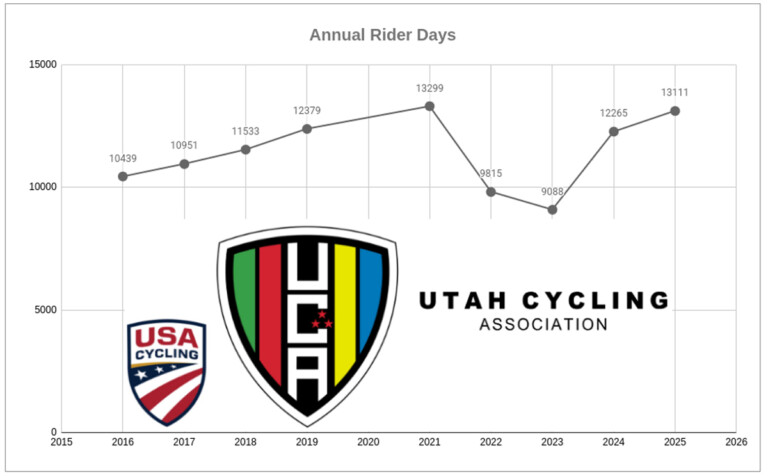
Since Ronnie assumed leadership in December 2023, the UCA has experienced significant growth in participation, expanded race and ride opportunities across multiple disciplines, strengthened governance structure, and improved financial stability. In 2025, the IRS granted the UCA 501C3 status. The board has grown in both depth and capability, positioning the organization for continued statewide expansion.
UCA annual rider days over the last few years.
During this period, UCA increased sanctioned event participation, supported promoters across road, mountain, gravel, cyclocross, BMX, and community ride programs, and established stronger operational frameworks to sustain long-term growth. Additionally, Ronnie worked to revamp the UCA website.
The Board of Directors will implement its transition plan and continue advancing the Association’s mission to grow cycling participation throughout Utah and the surrounding region. They have not yet announced who the next board leader will be.
CEDAR CITY, Utah (March 26, 2026) — The Hell of the South (West) comes back for its seventh edition on June 13, 2026, and this year’s Belgian Waffle Ride Utah arrives with a reimagined course and a renewed appetite for high-desert chaos.
Gone is the gnarly singletrack that defined previous editions. In its place, the organizers have built something faster, more rhythmic, and — by their own enthusiastic account — the most exciting course they’ve ever conjured. Riders will rip across red rock valleys, sandy stretches, and open alpine roads at altitude, trading technical punishment for flow, speed, and pure unroad bliss. The suffering remains baked in. Only the texture has changed.
Pete Stetina on his way to winning the 2024 BWR Utah. Photo courtesy BWR
Cedar City anchors the weekend once again, and few venues in the American West earn that role more honestly. Tucked into the red-rock majesty of Southwest Utah, the town sits at the crossroads of big mountains, open horizons, and roads that refuse to make anything easy. From Main Street Park — festival hub and race central — the terrain opens in every direction, and the elevation demands honesty from both legs and lungs.
The full festival weekend runs June 12–13. Friday brings rider check-in, an expo with more than 50 exhibitors, live music, food trucks, and the traditional cold Belgian ale to toast the dust ahead. Saturday is race day — grit, grace, and madness under the Utah sun.
Scenes from the 2021 Belgian Waffle Ride in Cedar City, Utah. Photo courtesy BWR.
Three routes serve every appetite. The Waffle covers roughly 110 miles and 5,940 feet of climbing, with 60 percent on unroad surfaces and five feed zones. The Wafer offers a 66.5-mile option with 2,734 feet of gain. For those dipping a toe in, the Wanna covers 27 miles with 913 feet of climbing. Every rider goes home with a Neversecond musette packed with sponsor swag, BWR bucks, waffles, coffee, post-race beer, and — perhaps most valuably — a finisher’s trophy beer and bragging rights that don’t expire. Amateur categories contest the coveted Q/KOM, Q/KOD, and Q/KOS jerseys.
BWR Utah is also the third round of the 2026 Quad-Tripel Crown of Gravel, the four-state series that also visits Arizona (February 27–28), California (May 2–3), and Montana (June 19–20). Complete at least three of the four and you earn the Quad-Tripel Crown Champion title — a genuine measure of endurance and commitment across some of the most beautiful and brutal terrain the American West can produce.
For riders who want to arrive prepared, BWR is offering a four-day training camp in Cedar City from May 7–10. The camp breaks the course into focused preview segments across Friday and Saturday, with coaching, lodging, meals, and SAG support included throughout. It’s a solid option for first-timers or anyone serious about racing the course rather than just surviving it.
Registration is open now at belgianwaffleride.com. Cedar City is waiting — come curious, leave humbled, come back hungry for more.
Event info:
June 12-13 — Belgian Waffle Ride – Cedar City, Quad-Tripel Crown of Gravel, Cedar City, UT, Third stop of Quad-Tripel Crown of Gravel, BWR UTAH takes place around the beautiful National Parks in southwest Utah and spends considerable mileage inside Dixie National Forest. The new‘unroad ‘course will feature less single-track and more of the incredible gravel rollers and truck trails the area is ripe with. Pain and suffering will commence at 7am featuring one wave start for all – there are three event distances. Waffles are served at 5am. The BWR Unroad Expo will open on Friday and run throughout the duration of the event until the beers, jeers and awards are distributed for all the day’s heroic efforts, Michael Marckx, 760-815-0927, [email protected], Brandon Burk, [email protected], belgianwaffleride.bike
WILMINGTON, Del. (March 25, 2026) — The LYCRA Company, whose stretch fibers are foundational to modern cycling apparel, has entered a prepackaged Chapter 11 restructuring process designed to eliminate more than $1.2 billion in long-term debt while maintaining uninterrupted operations for brands and riders.
The company reached a restructuring support agreement with the overwhelming majority of its creditors, including holders of its senior secured term loan and multiple tranches of secured notes. Those stakeholders have agreed to back a prepackaged plan of reorganization, which LYCRA expects to complete within approximately 45 days.
For the cycling industry, the key takeaway is continuity. From WorldTour race kits to weekend bibs, LYCRA-based materials underpin the fit, compression, and durability that define performance apparel. The company says customers, suppliers, and employees will not be impacted during the restructuring, and production and delivery will continue as normal.
In the late 1970s, the TI-Raleigh cycling team, sponsored by Assos, became the first professional team to race in Lycra shorts & bibs, instead of wool. Tour de France 1978, prologue in Leiden; Jan Raas in action. Image in the public domain, Creative Commons CC0 1.0 Universal Public Domain Dedication
“The LYCRA Company’s products have long been synonymous with comfort, fit, and performance,” said CEO Gary Smith. “This is a decisive step to reduce our debt and strengthen our financial foundation so we can continue supporting our customers and partners.”
To support ongoing operations, LYCRA has secured commitments for at least $75 million in debtor-in-possession financing, along with more than $75 million in exit financing that will take effect once the company emerges from Chapter 11.
The restructuring follows months of negotiations with creditors and is intended to create a more sustainable capital structure. The company has also filed customary “first day” motions to ensure it can continue paying vendors and suppliers in the normal course of business—an important signal for apparel brands heading into peak production cycles.
Not all LYCRA entities are included in the Chapter 11 filing, and the company emphasized that its global operations remain active.
For cycling brands, the reassurance comes at a critical time. With seasonal product lines already in development and supply chains finely tuned, any disruption in fiber availability could ripple quickly through the industry. LYCRA’s prepackaged restructuring—designed for speed and backed by broad creditor support—appears structured to avoid that scenario.
Headquartered in Wilmington, Delaware, The LYCRA Company owns a portfolio of widely used performance brands including LYCRA, COOLMAX, THERMOLITE, and TACTEL. Its materials are embedded across the cycling apparel ecosystem, from aerodynamic race suits to breathable base layers.
If completed on schedule, the company expects to exit Chapter 11 later this spring with significantly reduced debt and renewed capacity to invest in innovation—an outcome that could benefit cycling apparel brands and riders alike as performance fabrics continue to evolve.
By Charles Pekow — The United Nations has recognized the importance of cycling networks. The UN Economic Commission for Europe (UNECE) released the 38-page UNECE Cycling Network: Guide for Designating Cycle Route Networks, available in English, French, and Russian. The guide outlines clear steps for local, regional, and national governments to design effective cycling networks.
“Cycle route networks should be an important component of a mobility strategy of a country, region or a municipality. They need therefore to be, if not done so yet, an integral part of the infrastructure and mobility plans,” the guide states.
One recommendation is converting abandoned rail lines into bike paths (like American Rail Trails), like this example in Germany. Kanonenbahn Cycle Path at the Eastern Portal of the Küllstedt Tunnel (1,530 m). Creative Commons Attribution-Share Alike 4.0 International
The document lays out foundational principles, starting with identifying different types of cyclists and their needs—from children and families to commuters and tourists—and recognizing that each group requires different types of infrastructure. A single network may include multiple forms of infrastructure to serve these various users.
The guide also details the full process of building a cycling network, from defining ambition and assembling a project team to monitoring the network after construction. UNECE breaks the effort into nine steps, including assessing needs, reviewing existing infrastructure, and conducting both informal and formal public consultations to gather feedback on completed facilities.
Among its specific recommendations, UNECE advises raising cycle crossings and installing signage that alerts motorists to cyclists approaching from both directions on two-way cycle tracks.
By Lou Melini — An Ontario, Canada bike trip has never been high on my bucket list. It has never come up in conversation except with Julie. I do not know anyone that has toured in Ontario nor read any accounts of anyone touring in Ontario. On the other hand, I have owned “The Lake Erie Connector” maps from the Adventure Cycling Association for several years. The Erie Connector route starts in Michigan, near the Manitowoc (Wi.)-Ludington (Mi.) ferry. The route takes you into Ontario along the north shore of Lake Erie eastward ending in Fort Erie, Ontario. Julie has for many, many years wanted to see Niagara Falls. Her hometown is Manitowoc and Niagara Falls is about a 2-hour ride north of Fort Erie. Despite many conversations over many years, a bike trip to Niagara Falls never rose to the top of the bucket list.
Suddenly, in 2025 Niagara Falls was at the top. Julie’s niece in Wisconsin married towards the end of June. Following the wedding, a bike tour to Niagara Falls seemed plausible except I couldn’t come up with the motivation to plan the trip. The route via the Lake Erie Connector to Niagara Falls and back to Wisconsin would be over 1200 miles necessitating more than 3 weeks for the ride. The other option was transporting Julie and I along with our bikes from Buffalo back to Wisconsin. I was failing with the prospect of planning. Julie stepped up and said she would plan the trip.
Julie did great planning the trip. She thought outside-the-box to come up with an 890-mile loop, cobbling 4 Adventure Cycling routes, (The Lake Erie Connector, The Underground Railroad (Detroit alternative), the Underground Railroad, and the Northern Tier). Julie’s plan started the trip in Avon, Ohio (west of Cleveland) where we left our car with friends of our son Ben who used to live in Utah. We left Avon on June 25th, with our return to our car on July 12th.
Lou at Inglis Falls, near Owen Sound, Ontario. Ontario Bike Tour. Photo by Julie Melini
We rode a clockwise route with the first day riding to Sandusky, Ohio to catch a ferry across Lake Erie. We worked our way north to Lake Huron, before going to Owen Sound, the most northern city in our travels. From Owen Sound we traveled east and then south near some large cities west of Toronto. The final leg of our Canadian travels had us skirt the south shore of Lake Ontario to Niagara-on-the-Lake. From here we went south to Niagara Falls and our return to the U.S. in Buffalo. The final section of the trip had us in New York, a wee bit of Pennsylvania and back to Ohio and to our car. Eleven days were spent in Ontario, Canada and 5 along the south shore of Lake Erie.
Ontario is one of 10 provinces in Canada, none of which have representation in the U.S Congress or Senate, thus, you need a passport. In addition, check your health insurance coverage. Julie needed to buy “travel health insurance”. Her Medicaid/TriCare health insurance is great in the U.S., but nearly useless outside of the U.S. If you need additional coverage, try Allianztravelinsurance.com or visitorsinsurance.com. For approximately $89, Julie had enough insurance coverage for 2 weeks through Allianz for emergency care and transport to the U.S. My Medicare/UHC health insurance was good in the U.S. and Canada. As a side note, my son traveled to Canada as a mechanic for a race team. One of the team vans went through a different checkpoint. They were told they needed to buy travel insurance or show proof of insurance to enter Canada. The occupants of Ben’s truck were not asked about insurance. Ontario is a very large province; 415,598 square miles large. The combined states of Utah, Idaho, Montana and Wyoming by comparison, are 413,319 square miles. We rode in what I will call the southern, more populated part of Ontario. Approximately 80% of Canada’s population live within 200 miles of the U.S. border and many of that percentage are 2 hours by car from the U.S. Ontario’s major agricultural products include corn and soybeans, wheat, alfalfa, plus other lesser crops.
Julie at Niagara Falls. Ontario Bike Tour. Photo by Julie Melini
We rode mostly in the agricultural part of Ontario along roads that bordered large farms. As we approached Niagara Falls, vineyards of grapes became a predominant crop. Much of the bike routes we traveled in the western part of our ride were also signed as the Great Lakes Waterfront Trail, a 3600 Km (2237 mile) community development “trail” in Ontario.
Due to the wedding in Wisconsin, the mid-summer timing for the trip was not ideal. May thru early June or late August to September would have been a better choice. The Midwest and East was hit with a “heat dome” of high temperatures and humidity while we were in Wisconsin. The heat dome continued for the first 2 days of our trip, with the rest of the ride being just hot and humid. We cooled off during one morning of rain that lasted 2 hours when we returned to the U.S. We dealt with the heat with lots of breaks for water and afternoon ice cream whenever available.
Except for a few miles, the ride was pleasant. We encountered low traffic numbers on the back roads of our route. What traffic we encountered was very friendly including large trucks. In Ontario, cars would pass us after moving to the oncoming lane. We were told that there is a Canadian law that if a car is passing another vehicle, including bikes, oncoming traffic must slow or stop. We found that to be true in all but one case. Most cars and trucks slowed significantly before passing us. Posted speed limits were 50-70 Km/hour (30-45 mph) with a few at 80 and one that I noted 90 Km/h. In the cities 30-40 Km/hr. was common.
On the other hand, our back road route had us carrying food longer than our normal routine. Julie and I carry emergency food in the case of an inability to find adequate supplies. Twice we had to resort our emergency supplies. South of Niagara Falls we went out to eat at an Indian restaurant near the campground we stayed at as we were down to some oatmeal and peanut butter though there were navigational issues involved with that meal. The very nice restaurant meal was a welcome change to camp fare.
The Tour:
Lou Melini at the Ferry across Lake Erie. Ontario Bike Tour. Photo by Julie Melini
We left Avon, Ohio early enabling us to ride the 48 miles to Sandusky, Ohio to catch the 3:30 ferry across Lake Erie (the alternative being to ride through Detroit). The route to Sandusky was on a flat designated “bike route” on the south shore of Lake Erie. Despite the slow leak from my rear tire, we arrived at the ferry terminal at the designated 2:30 check-in time. Just as we boarded the ferry a thunderstorm hit. We secured our bikes, grabbed necessary panniers and headed into the very well air-conditioned sitting room. Having just ridden in high heat and humidity, I needed to put on my entire rain suit to keep warm, the only clothing that was in my pannier. The 90-minute ferry ride took us to Pelee Island where we would go through Canadian Customs. We camped on the island as the next ferry to the Canadian mainland was at 9 AM the next morning.
The morning 90-minute ferry ride, took us to Leamington, Ontario. From Leamington we encountered our only busy high-traffic road. Like a lot of Ontario roads, there was no paved shoulder, only gravel and stone. We had to ride 10 miles to get off the road and onto the first of many low-traffic roads. Much of that 10-mile stretch was on a gravel/small stone shoulder due to heavy traffic. For the next 2 days we traveled north on flat and relatively low-traffic roads to the shore of Lake Huron. Interesting we camped near Lake St. Clair on our first night on the Ontario mainland. Lake St. Clair allows ship traffic to connect Lake Erie to Lake Huron. It is considered the 6th Great Lake by some, but it is too small in diameter and too shallow to be a “Great Lake” per definition of the Great Lake Commission.
Ontario Farmland. Ontario Bike Tour. Photo by Julie Melini
Over the next 3 days we rode along Lake Huron, turning east to Owen Sound. We had a chance to wade in Lake Huron as a couple of our campgrounds were close to the lake. Lake Huron was relatively warm, compared to Lake Erie, with nice sandy beaches. Lake Erie is considered a dirty lake but has better fishing. Riding along this section of the tour was pleasurable. Flat terrain and favorable tailwinds on the low volume roads made our rides comfortable including the first of our two 70-plus mile days. There were some bike trails during this time, mostly a 2-lane pathway on one side of the road.
Owen Sound is part of the Georgian Bay which is a branch of Lake Huron. The town of Owen Sound is where we entered a new geologic feature called the Niagara Escarpment. Gentle tilting terrain on one side with steep descents on the other side. There are historical geological reasons for the escarpment that I won’t go into as I am not qualified. However, as a cyclist I am able to authoritatively state that going up the steep descents is damn hard. On my large Ontario map is a 20-30 mile swath of land from Owen Sound to Toronto with pictures of skiers indicating ski resorts. Julie and I were in our lowest gears. I once foolishly missed hearing Julie say “make the next right”. Yep, down I went. I was so pissed at myself I walked more than a quarter mile to return to the missed turn.
Up to this point, Julie and I camped for the past 9 days. Our luck with campgrounds ran out so we contacted a Warmshowers host in Orangeville, Ontario that lies northwest of Toronto. I think it was this day that we did our second 70-plus mile day, equaling my age of 74. We faced some headwinds and a series of steep climbs in the morning on that day. Fortunately, we had a gravel bike trail that was flat for afternoon portion of the ride. The bike trail was not on our maps. We took it figuring it was a rail-trail, thus no hills.
Julie on the Bike trail to Orangeville. Ontario Bike Tour. Photo by Lou Melini
Orangeville was the beginning of a more populated section of our tour route. The Adventure Cycling bike map routed us through this section so that we rode through suburbs and farmland. From Niagara-on-the-Lake, a town on Lake Ontario, through Niagara Falls and until we entered the U.S. in Buffalo, we rode on a paved bike path. Once past Niagara Falls the Shoreline bike path followed the Niagara River. The bike trail was a welcome relief as, expected, traffic picked up near Niagara Falls. After entering the U.S. in Buffalo, N.Y., the terrain again flattened along the south shore of Lake Erie. We did face headwinds during this phase of the trip. Using the digital and print version of the ACA’s Northern Tier route we rode the final 4 days along Lake Erie, including Cleveland back to our car in Avon. Who knew that the route took us to the Rock and Roll Hall of Fame building in Cleveland?
Food and Lodging: Food stores were plentiful in the “larger” cities. There were two small towns that our maps said food stores were available. Both were closed for a couple of years. We once passed a grocery at mile 10 on a near 60-mile day. We did not want to carry dinner for that many miles so we passed it up. Bad decision, as that was it for the day.
We were introduced to peameal at one of our “Second breakfast stops” (about 20 miles after first breakfast in camp). Peameal sounded like a plant-based food. It is a “wet-cured, unsmoked back bacon made from trimmed lean boneless pork loin rolled in cornmeal found mainly in Ontario.” It was very good and added to my eggs and potato breakfast.
We camped for 13 nights and used Warmshowers hosts twice. The Canadian dollar is worth about .73 U.S. dollars. We paid $50-70 Canadian for most campsites, one was $80, and one was $100, though there is a side story to that campground. We rented a cabin at one campground as they “did not do tents”. The owner/wife alluded to Julie that “young people stay in tents and party too late at night”. Julie called on one campground to make reservations stating that we were on bikes and needed a tent site. Before Julie could finish her request, the person bluntly told her that we could not be accommodated. After that we stopped calling, figuring it was easier to show up and obtain a site. When we entered Canada, we did not know that it was “Canada Day” weekend. Canada Day is July 1st. The campgrounds were crowded, but always had room for us.
Using a Garmin unit: This was our first time using a Garmin unit for travel. Adventure Cycling Association has partnered with Ride with GPS (RWGPS) that we downloaded onto the pricey Garmin unit. Less popular routes are now only available in digital format from Adventure Cycling Association. Julie had the Garmin on her bike and I had good paper maps for the U.S. portion and the first day in Canada. I also had an Ontario map with very little detail. The learning curve for the Garmin was steep and frustrating for Julie. I assumed that all of Adventure Cycling data transferred to RWGPS would be up to date. As mentioned, a couple of critical groceries were closed, one very nice rail trail was not on the map, and 3 road closures were not known to us. Only one road closure cost us much time. The Shoreline Trail in Buffalo had construction on the trail or close to it. We spent 90 minutes re-routing through Buffalo yet only traveling a little over 8 miles. How bike routes become updated is a laborious effort and in part is dependent on bike travelers to report discrepancies which I have done in the past and when I returned from this trip.
The Garmin also did odd things to us, perhaps due to our inexperience with it. In Canada, not the U.S, the Garmin would simply turn off when we went off route. In the U.S. it would direct us back to the route (not very well in Buffalo). On too many occasions Julie would signal or call to me “right turn” only to say “no, straight ahead at an intersection”. Sometimes when we stopped at an intersection the little directional arrow would spin in 360-degree circles. On many mornings Julie would have to re-enter the route despite having it set the night before. The unit put adventure in Adventure Cycling maps. I might buy remaining Adventure Cycling paper maps for any route I might think about riding just in case that route becomes digital only.
Nuts and Bolts:
Trip description: This trip is the 8th bike tour that Julie and I have done between 13 and 24 days in length. We rode 890 miles over 16 days.
Start/finish: Julie and I like loop tours to ease travel logistics to our start point and car. We started and finished in Avon, Ohio, a small town west of Cleveland about 8 miles from Lake Erie. The purpose of the trip was to have a bike trip to Niagara Falls. However, seeing the great lakes was an added bonus.
Major points on the loop: The purpose of the trip was to have a bike trip to Niagara Falls. Following that we rode along the Niagara River, a very large river. Seeing the great lakes was a bonus. Finishing the first day of the trip and starting the second day of the trip (total of 3 hours) gave us a sense of the enormity of the lakes. Though difficult to ride, the geographic escarpment gave us a geologic dating back to the last ice age. Geography is one thing, riding the escarpment is a whole different matter. My personal highlight of the loop we rode is simply the ability to travel 890 miles, in Canada and partly in the U.S., comfortably despite having zero knowledge and background of the area we rode. My thanks to the Adventure Cycling Association for making the trip possible.
Number of days: 16
Date of the trip: Late June to mid-July
Total miles: 890
Logistics: In addition to the Garmin, we used Google maps. However, for whatever reason that sometimes became both frustrating and hilarity. “Grocery near me” was 40 miles away, and Ice Cream shop resulted in a store in Kentucky. Google did help us navigate in several situations when we were off route and finding valuable alternatives such as the bike path that was not listed as an option on RWGPS. We had too many items needing to be charged; hearing aids, Garmin, I-pad, Apple watch, and 2 phones. Julie bought and brought with us a unit that had 6 charging ports for plugs, USB, etc. It proved to be very convenient and at one large campground that was extremely devoid of electrical outlets for the number of campsites, a necessity. One of my hearing aid wires broke so I used my backup battery aides for the final week lessening one item needing charging.
Warmshowers: A network of cyclists that host other cyclists in their homes. See: https://www.warmshowers.org
Equipment: We did not use anything special. We did bring front and rear lights that attached to our helmets assuming that we would experience morning fog near the lakes. This fortunately only occurred once with the fog lifting after an hour. We also used the helmet lights during the time we rode in the rain. We used the same tires that we used on our 2024 Alaska tour because we were under the assumption that there were a few gravel roads on our route. Julie rode with 45 mm Pirelli Cinturato H tires and I had 35 mm Cinturato M tires. None of the roads were gravel but the tires were great when we were on gravel shoulders and on the gravel bike trail. The asphalt on the rural roads had many cracks and small potholes so our tires were good in those instances.
Weather: As mentioned, the June-July weather was hot and humid. I think on one day we drank all 3 of our 20-ounce bottles on our bikes 3 times, plus morning and evening liquids. We would lay our sweaty, wet clothing out as much as possible in hopes of drying before putting the clothes in our panniers.
Canada: Everyone was friendly, helpful, and accommodating. We were as polite as possible. Not once did I mention that I was obtaining a piece of Canada when we purchased a campsite. Restrooms are called washrooms. Sometimes convenience stores didn’t have either. The ice cream was great. During Canada Day (a long weekend affair), Canadian flags were displayed everywhere. Some stores stated that “due to tariffs, American products were no longer being stocked”. Learn your metric system as speed limits and mileage signs are in kilometers. One day I got confused when Julie said “20 miles to our destination”. Eight miles down the road I saw a sign that said “20” to the town we were going to. I almost asked Julie to explain herself when I remembered the 20 was in kilometers.
Bike shops and camping supplies: There were bike shops in some of the larger towns we were near. We fortunately did not need any bike shops. I carried too much fuel in part because we cooked less fuel intensive meals. I did not see any stores that sold fuel for my stove except for Walmart. Walmart sells Coleman fuel, but many are out of stock when I have looked. My decision to carry 2 weeks of fuel was good.
Final thoughts: For every bike trip that I do, ideas for new trips pop up in my mind. Of the 5 Great Lakes, Lake Superior is now the only great lake that Julie and I have not ridden along. Perhaps for another day.