“I wish I didn’t have snack attacks. I eat way too much chocolate…”
“I eat only healthy foods during the day. My snacking problem starts the minute I get home from work. Chips are my downfall…”
“I try hard to not snack after dinner, but I have a bad habit of getting into the ice cream…”
By Nancy Clark MS RD CSSD — Day after day, I hear athletes complain about their (seemingly) uncontrollable snacking habits. Some believe they are hopelessly, and helplessly, addicted to chocolate. Others believe eating between meals is sinful & fattening; snacking is just plain wrong. Some equate snacking to doing drugs. They bemoan they are addicted to sugar and can’t eat just one cookie. Snacking is all or nothing.
Despite the popular belief that snacking is bad, the truth is that snacking can be helpful for active people. Athletes get hungry and need to eat at least every three to four hours. That means, if you have breakfast at 7:00, you’ll be ready for food by 10:00 or 11:00, particularly if you exercise in the morning. By 3:00 p.m., you will again want more food. For students and others who exercise mid to late afternoon, a pre-exercise snack is very important to provide the fuel needed to have an effective workout.
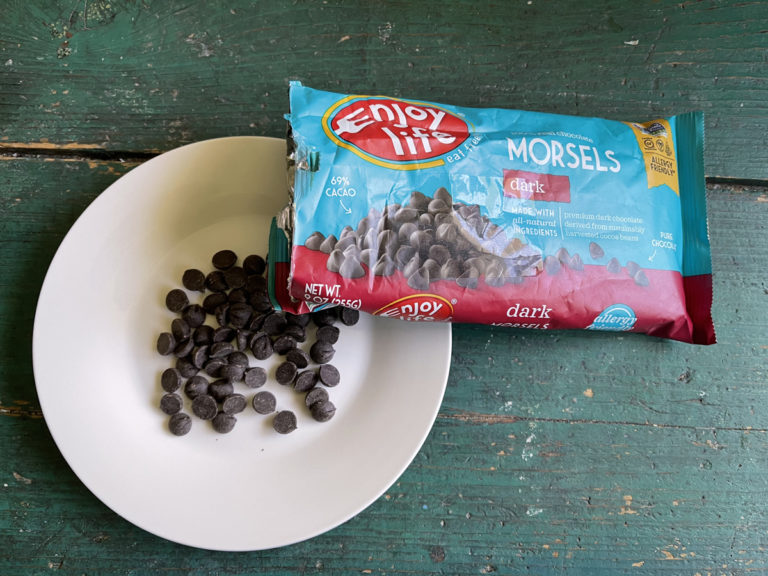
“Is chocolate a health food, dieter’s weight loss aid, and effective recovery food for tired, hungry athletes?” Photo by Dave Iltis
The trick is to make snacks a part of your sports diet—preferably with an early lunch at 11:00 that replaces the morning snack. (Why wait to eat at noon when you are hungry now?) and a second lunch instead of afternoon sweets, to energize the end of your work or school day. A planned wholesome meal is far better than succumbing to sugary snacks or stimulant drinks.
Snacking problems commonly occur when athletes under-eat meals, only to over-indulge in snacks. Inadequate breakfasts and lunches can easily explain why snacks can contribute 20 to 50 percent of total calories for the day. Fingers crossed those snacks are nutrient-rich!
To easily and painlessly resolve nutrient-poor snack attacks, eat before you get too hungry. Hungry athletes (and all people, for that matter) tend to crave sweets (and fats) and can easily eat too many donuts, chocolate chip cookies, candy bars—foods with sugar (for quick energy) and fat (for concentrated calories).That honking big muffin can easily win out over a piece of fruit, hands down!
Athletes who report they “eat well during the day but get into trouble with snacks at night” need to understand the problem is not the evening snacks but having eaten too little during the active part of their day. Snacking is the symptom; getting too hungry is commonly the problem. One way to eliminate a mid-morning snack attack is to have a protein-rich, satiating breakfast (such as 3 eggs + avocado toast + a latte for 500-600 calories) as opposed to just a packet of oatmeal (only 100-150 calories). Enjoy soup + sandwich for lunch (500-700 calories), not just a salad with grilled chicken (only 300 calories).
Identifying hunger
Do you spend too much time thinking about food all day? If so, your brain is telling you it wants some fuel. Thinking about food nudges you to eat. If you were to never think about food, you’d waste away to nothing.
Other hunger signals include feeling droopy, moody, cold, bored (I’m eating this popcorn just because I’m bored), unable to focus, and easily irritated. If you fail to honor these hunger signals, they will escalate into a growling stomach (too hungry) and an all-out snack attack. Prevent hunger; eat enough during the active part of your day.
Please remember that hunger does not mean “Oh no, I’m going to eat and get fat.” Hunger is simply a request for fuel. Just as a light on the dashboard of your car signals when your car needs gas, your brain sends you hunger signals when your body is low on fuel. To not eat when you are hungry is abusive to your body (and mind) and puts your body into muscle-breakdown mode, which is counter-productive for athletes.
Losing weight without daytime hunger
Even if you want to lose undesired body fat, you should eat enough to feel satiated during the active part of your day. You can lose weight (“diet”) at night when you are sleeping. This is opposite to how most athletes eat: They diet by day, then attack the snacks at night. They eat the whole pint of ice cream, too many chocolates, and/or non-stop chips. Winning the war against hunger requires white knuckles. Not sustainable and not fun. The better bet is to fuel by day and diet at night by eliminating high-calorie evening snacks.
Dieting athletes commonly report the most concerns about snack attacks. As one rower complained, “I’m hungry all the time.” If that sounds like you, and you feel hungry within the hour after you eat a meal, experiment with eating heartier meals. For help figuring out a food plan that works for you, I encourage you to meet with a registered dietitian (RD) who specializes in sports nutrition. The referral network at www.SCANdpg.org can help you find a local sports nutrition professional.
Winning the war against snack attacks
I encourage my clients to convert snacktime into mealtime. Instead of reaching for cookies, candy, caffeine, and other typical snack foods, they opt for a peanut butter & banana sandwich for an early lunch at 10:00 or 11:00ish. (As long as they have a flexible eating schedule, no need to eat a donut just to bridge the gap to the more traditional eating time of noon.) They then can enjoy a later second lunch at 2:00 to 3:00ish, which gives them energy to be productive throughout the last hours of the workday.
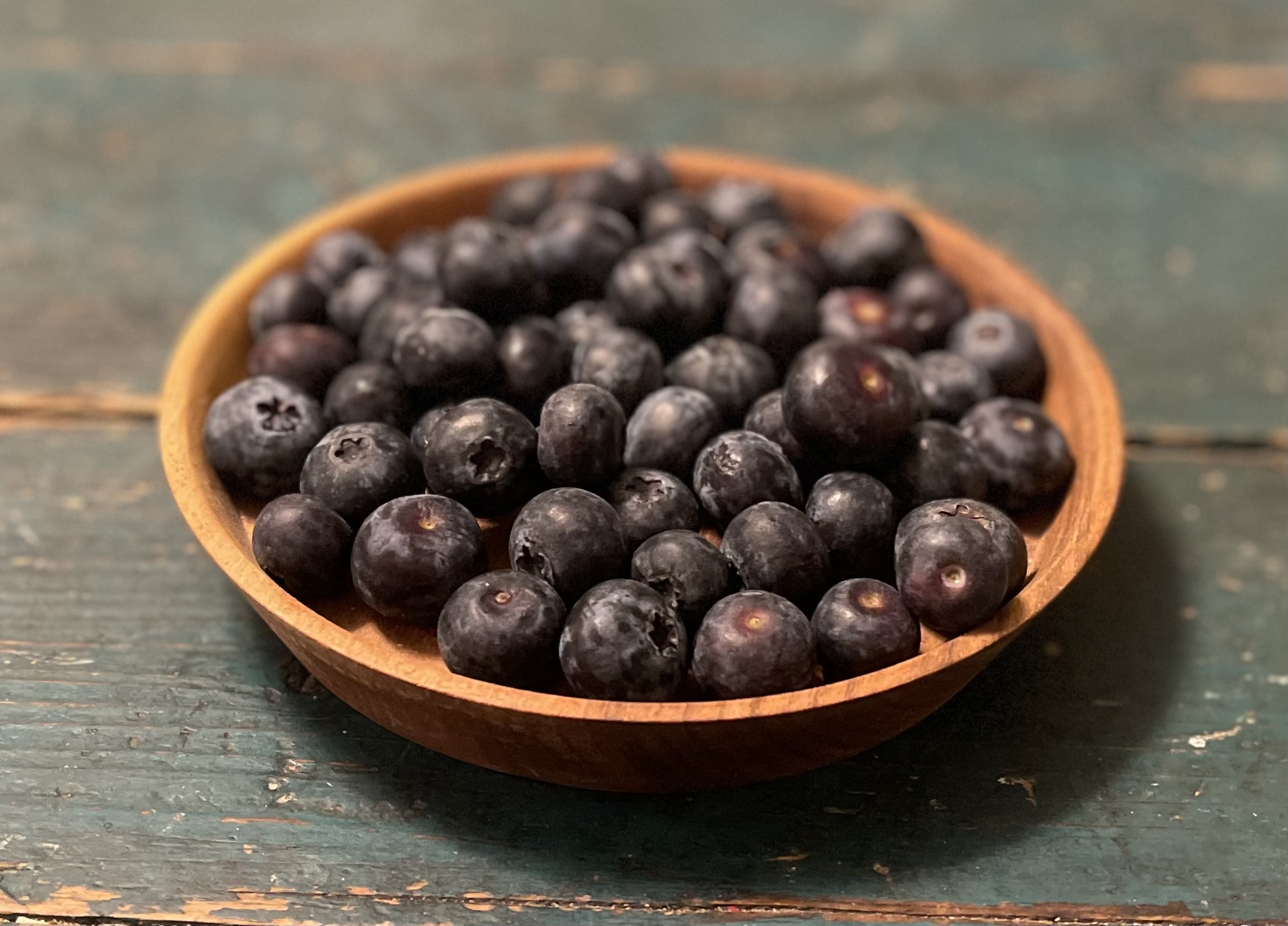
Blueberries are high in polyphenols which may help to curb the body’s inflammatory response. Photo by Dave Iltis
By enjoying two lunches instead of snack foods + one lunch, they generally end up eating more quality calories and fewer sweets. If their meal schedule is inflexible, I nudge them to at least snack on mini-meals instead of sweets:
Whole-grain English muffin + nut butter
Oatmeal cooked in milk + dates
Hummus s+ baby carrots.
The benefits of being well fed are fewer snack attacks, more energy, and easier weight management. Give it a try?
By Joe Kurmaskie — Let’s face it, no matter how much you love your commute by bike, there’s always that morning, the one that comes to early, too wet, too hot or just too something to get you to carry the bike off the porch and into the bike lane. When you feel uninspired, take heart, take inspiration or take a moment to feel ashamed by your inertia that you suck it up and get in the saddle. The hardest part of any ride is starting…
[Editor’s note: this article first appeared in the July 2013 edition of Cycling Utah. Anecdotes and statistics may be out-of-date.]
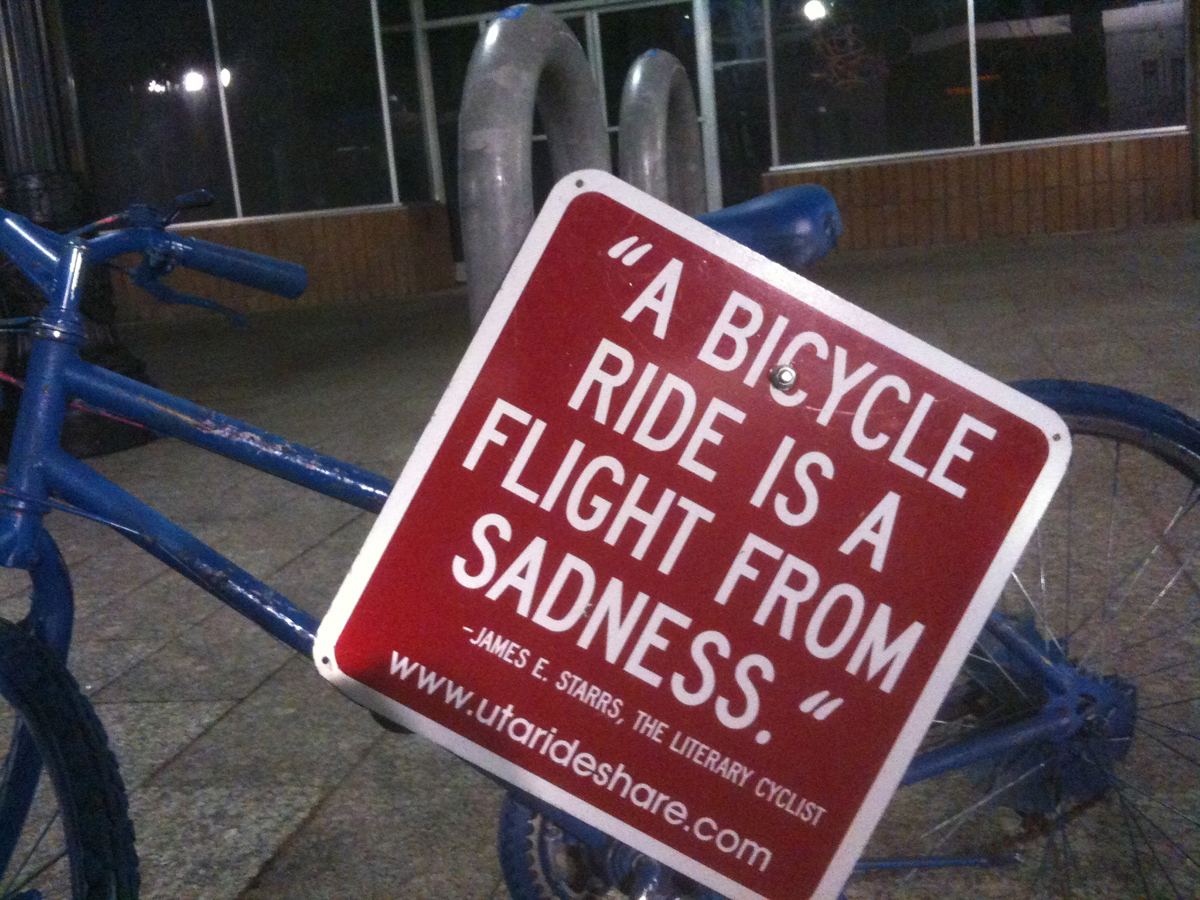
“A Bicycle Ride is a Flight From Sadness”. This sign is on a ‘blue bike’ in downtown Salt Lake City during Bike Month. Photo: Dave Iltis
(Of course, the greatest motivation for making the trek everyday is freeing yourself of car ownership, but even then, there are ways of passing on the commute by bike – carpool anyone? So for when you just aren’t feeling it, remember these road warriors.)
1. From The Never Too Young To Get Into The Groove File:
During the 2012-2013 school year, one Portland, Maine student marked the end of the school year as he started it, on a bicycle.
Kindergartener Alex Kimble told his father he enjoyed riding his bicycle so much that he wanted to ride it to school every day. Father and son made the several-block trip daily despite the weather.
On Thursday morning, Alex’s classmates gathered outside of school to cheer him on as he finished his goal. The 6-year-old’s effort made his father Nate proud.
“It was a real treat to see him have a goal and really want to stick to that. I think it was a good, sort of, life lesson for him and I’m proud of him,” Nate Kimble said.
Alex rode about 170 miles by the end of the school year, and he is thinking about bicycling to school next year too.
Let’s take a moment to internalize this information. Little Alex doesn’t live in Portland, Oregon where every third parent is cargo biking their kids and bike training along to the school yard. And Alex faced some mad weather conditions bicycling every day in MAINE! Alex, I’m not worthy, my friend. Way to go!
2. Ride Morning, Noon and Night:
When an office puts together a Lunchtime bike ride, commuter employee buy in grows by an average of 40 percent. don’t believe me, check out this tidbit about the National Geographic Headquarters, where it comes from the top down.
One way National Geographic staffers in Washington, D.C., can get to know their company’s CEO is to take him up on his long-standing offer: to go for a lunchtime bike ride.
“Anyone still downstairs? OK, so we ready to go, guys?” National Geographic Society CEO John Fahey asks a group of about 20 employees
Fahey, an avid biker, says he’s just trying to encourage a little exercise — and he wants the opportunity to get to know folks informally. As the group makes the 15-mile trek to Hains Point along the Potomac River and back, Fahey makes a point of chatting with everyone, staffers say.
At National Geographic — which is a hub of outdoorsy, adventure-seeking types who think nothing of biking busy city streets — lots of the staffers who join Fahey for the lunchtime rides also use their bikes to get to and from work every day.
“I’ve been riding in for 19 years,” says senior photo editor Dan Westergren, adding that he has definitely noticed the boom — especially as bike paths and bike lanes along city streets have improved.
Westergren’s commute is a combined 12 miles to and from home. And he says, given all the biking he does, he doesn’t need a gym membership to stay fit.
“Really, to build it into your daily routine by commuting for me has just been the best thing,” he says.
3. A Few Commuter Statistics:
And if you needed any more motivation there’s this from the American Journal of Public Health: the U.S. cities with the highest rates of walking and cycling to work have obesity rates that are 20 percent lower and diabetes rates that are 23 percent lower — compared with U.S. cities with the lowest rates of walking and cycling.
Adults who bike to work have better weight, blood pressure, and insulin levels. (Gordon-Larsen, P., et al., 2009)
Women who bike 30 minutes a day have a lower risk of breast cancer. (Luoto, R., et al., 2000)
Adolescents who bicycle are 48% less likely to be overweight as adults. (Menschik, D, et al., 2008)
The average American household spends $7,179 per year on owning and driving their cars. (Bureau of Transportation Statistics, 2010)
On a round-trip commute of 10 miles, bicyclists save around $10 daily. (Commute Solutions, 2011)
And if all that doesn’t get you pumped for your morning ride, just remember this riding a bike to work or school or to the store is like getting to play at something you love while moving yourself through space, instead of sitting in place as something moves you along.
The bike not only gets you somewhere, it lets you flee sadness in the process.
By Mike Pribesh — Three years. That’s how long I had been planning this trip and how long I was denied the opportunity due to Covid restrictions. I had every nuance planned, every castle, every mile of my route, every imaginable campsite, every possible eventuality. Guess how that worked out.
Some of my fondest childhood memories are from the couple of years I lived in Scotland, way back in the dark ages of the late seventies. I remember becoming completely enthralled with all things medieval, as evidenced by my current way too expensive sword collection. Biking all over the Dunoon area and up through Sandbank to Glen Massan are indelibly printed in my memories, and I looked forward to revisiting the old haunts.
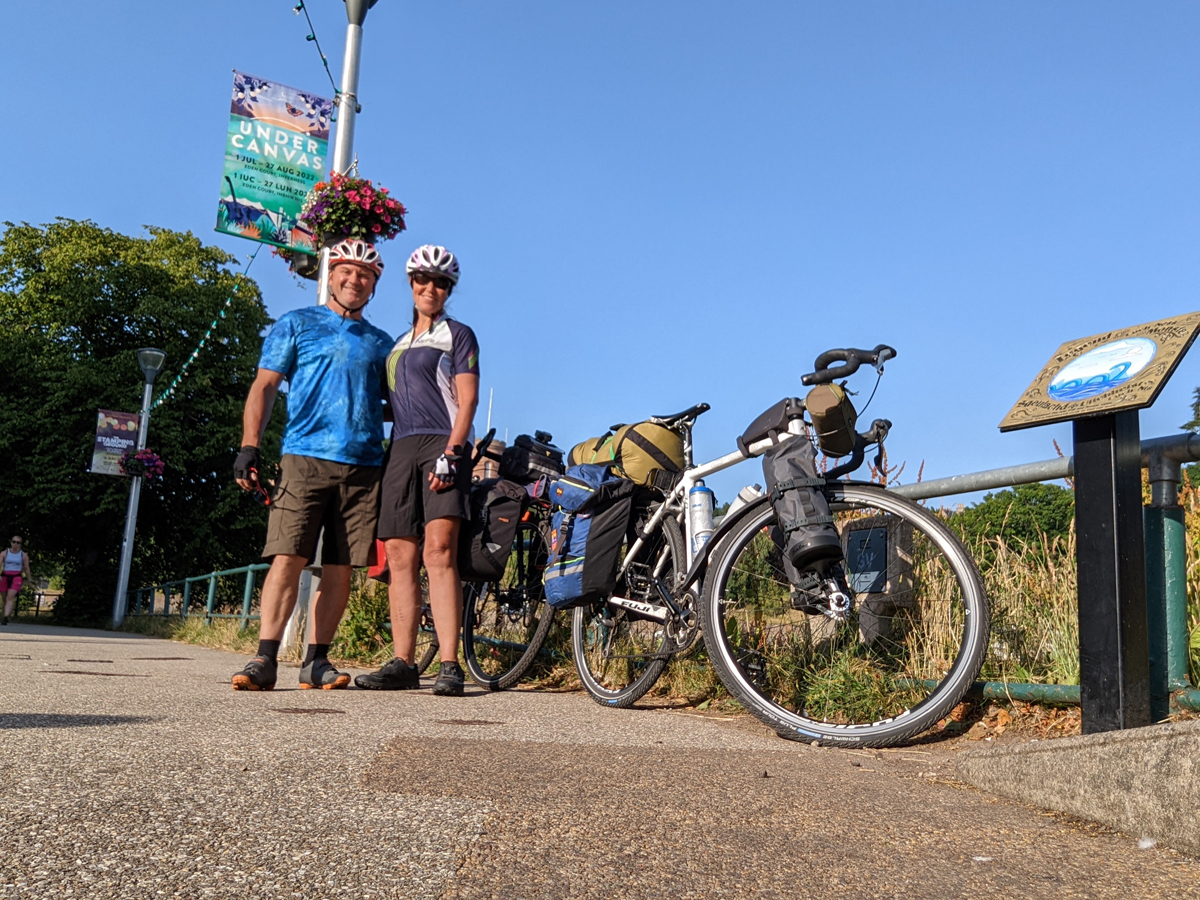
My planned solo trip became a couple’s trip when my girlfriend, Belinda, discovered that she likes bicycle touring. And she’s willing to put up with me for extended periods on the road. Win for me! Together we made our way across the Atlantic, after some delayed and missed flights and a wondrous night in Dallas, and arrived in Inverness ready to hit the road. Dallas was not quite the overnight stay that we had planned in London, but we made the best of it knowing the real trip had yet to begin. Unfortunately, our bikes did not arrive with us in Inverness, and instead showed up a day and a half later. I hope they at least had a scenic journey.
Mike and Belinda ready to get going, Inverness, Scotland. Photo by Mike Pribesh
When at last the bikes arrived, thankfully undamaged, we quickly assembled them and set off on our trip. The plan was to do a big, counterclockwise loop from Inverness, along the Great Glen Way to Fort William, then onward through Oban, south through Dunoon, through Glasgow, with a day off to explore Edinburgh before returning northward through the Cairngorms.
We rapidly discovered the Great Glen Way, at least the version of it we did, was no joke. Steep (very steep, stupidly steep) climbs through rough dirt roads and singletrack trails tested our resolve and our legs. Add in some rain on day two, and we were humbled. But the scenery was amazing with views of Loch Ness and some outstanding riding along the canal. We didn’t see Nessie but did tour Urquhart Castle. One of the must-do’s on our list was to see the Jacobite train, aka the Hogwarts Express, cross the viaduct in Glenfinnan, and we got there just in time to hike up to an overlook and watch it come across, puffing steam the whole way. It was easy to imagine Harry, Ron, and Hermione on their way to become wizards and witches. It was well worth the 30-ish mile detour on a scenic road along the edge of Loch Eil. We had a lot of must-dos on our list, so on we went.
The terrain got steeper, if that was even possible, and some questionable navigating by yours truly made for a very long day, in fact well past dark, again. Add in some cold rain and wind, and by the time we reached Fort William, we were pretty well soaked, frozen, and more than ready for a hotel with a hot shower. Camping was not high on the list at that point. Fortunately, the first place we stopped had a room, very reasonably priced for a swanky place, and we settled in for some recovery time so we could continue on the next day.
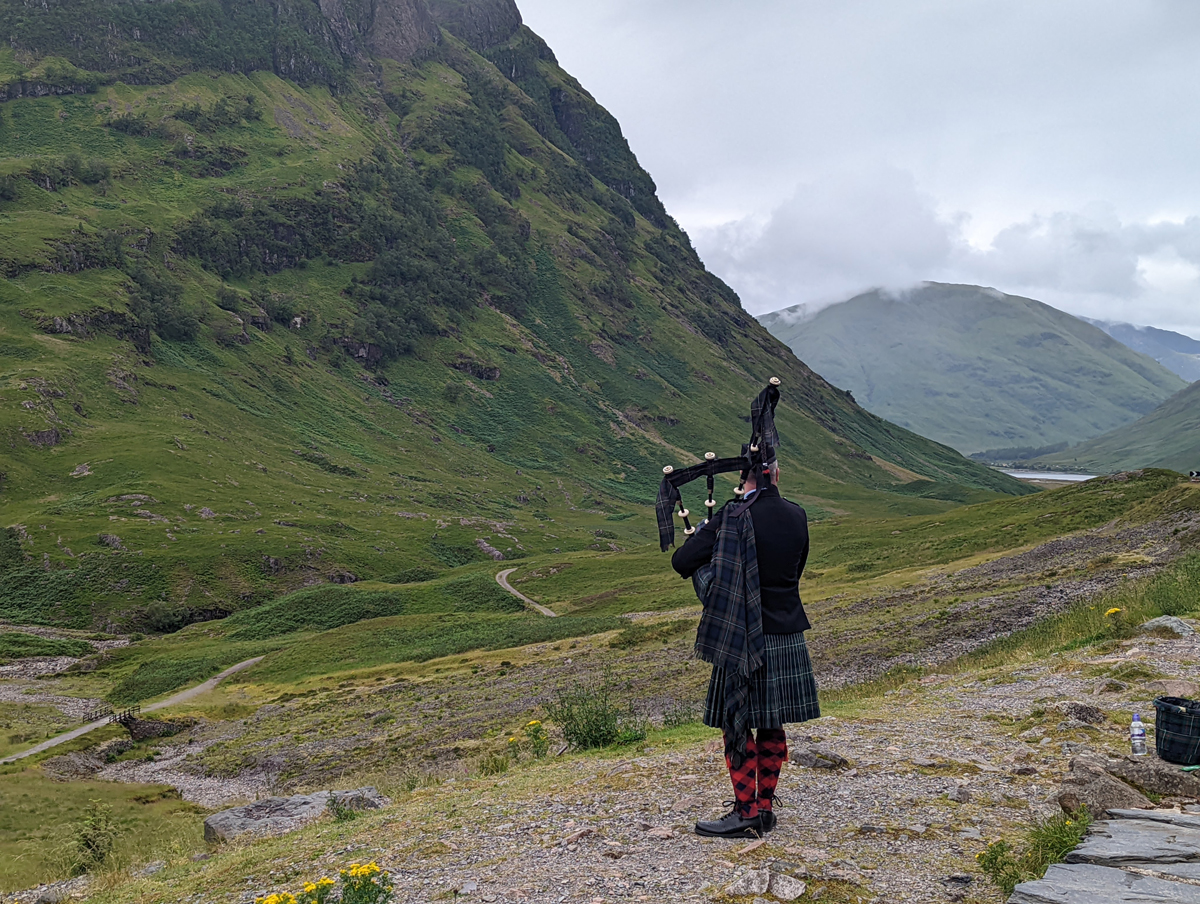
A Glencoe bagpiper. Photo by Mike Pribesh
Belinda and I are somewhat notorious for being slow movers in the morning, but we got going after a lot of breakfast (maybe too much breakfast?) and hit the road in good spirits and much better riding conditions. Our initial plan had been to do an eighty plus mile day to make up some lost time, with a brief stop in Glencoe before making our way to Oban for some much-needed whisky. The previous couple of days had taken their toll on our bodies, however, so we decided to stay in Glencoe, and I’m so glad we did. We stayed at the Red Squirrel Campground (amazing) and had a stellar evening at the Clachaig Inn just a short walk up the road. If you find yourself in Glencoe, I highly recommend a visit to this Inn/Pub. The exposed wood beams, stone floor, and feeling of cozy age are everything I could ever imagine in a Scottish pub. I introduced Belinda to the wonder that is haggis, played some pool, and sampled some delicious local whiskey while enjoying the ambiance. Belinda also discovered that she absolutely loves steak pie.
The ride out of Glencoe heading south is the stuff this trip was made for. A long, deep valley surrounded on both sides with looming mountains, lush green contrasted with low hanging clouds and fog, with waterfalls cascading down everywhere. It’s no wonder they chose to film Braveheart and The Highlander there. To top it off, as I rode up the long climb out of the valley, I began to hear bagpipes. Faint at first, but louder as I went on. Much to my surprise and profound joy, there, on the side of the road at a parking area, was a gentleman in full kilt and regalia, playing his bagpipes with the sound cascading down the valley. As a huge fan of bagpipe music, it made my day/week/life to come across this scene. Naturally I had to stop and hang out for a bit and chat.
Belinda was already far up the road ahead of me, and this delay dropped me even farther behind, so I was getting a little worried when I wasn’t catching up to her. Fortunately, she waited for me at the Glencoe Resort, a mountain biking and skiing mecca. We took a short detour to ride a lift to the top and watch the riders training for the Great Britain Downhill Mountain Bike Championship that was to take place in two days’ time. I was sorely tempted to rent a mountain bike and take a few runs down the course myself, but I know my luck (and skill level) and probably would have broken something vital.
As we made our way toward Dunoon, we passed (and stopped at) numerous castles, stone bridges, and quaint villages and the Rest and Be Thankful Viewpoint. It’s a tough slog getting up there, but worth it. I can never get tired of any of those. In Dunoon we stopped briefly at the house I lived in as a child, went by my old school, and I generally bored Belinda to tears with stories from my preteen childhood. As we rode through my old neighborhood, I had flashbacks to my first “racing” days on a bike. My friends and I had a loop where we would race NASCAR style, complete with pit stops and rider changes. I was fast(ish) once upon a time.
My father passed away a few years ago, and I took this opportunity to scatter some of his ashes in Holy Loch where he had been stationed for the Navy many years ago. It was a surprisingly challenging moment for me emotionally, but good. I didn’t expect it to be that hard. I clambered out on the rocks during low tide, beneath the ruins of the old pier that was the access point to the Navy ships out in the loch and took a few moments to recall my dad and record a video for my daughter.
By the time we arrived in downtown Dunoon, the rain had begun again in earnest and the temperature was dropping rapidly, so we elected to stay there in a warm hotel rather than continue on. Glasgow has been there for a long time, one more day probably wouldn’t make a difference.
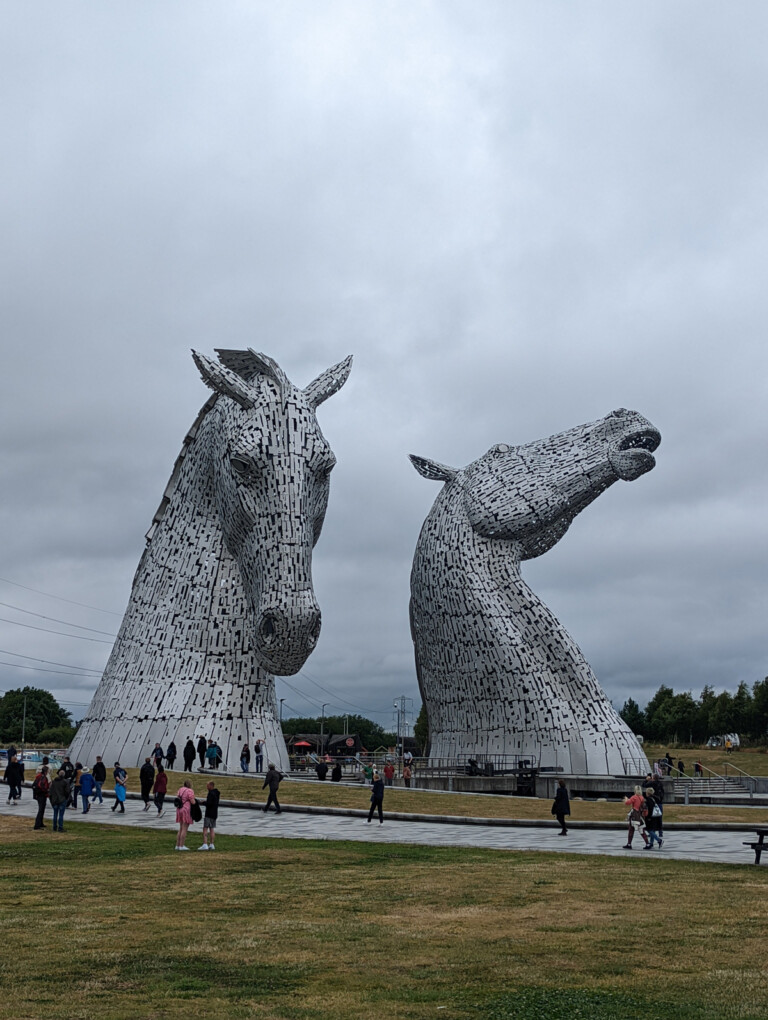
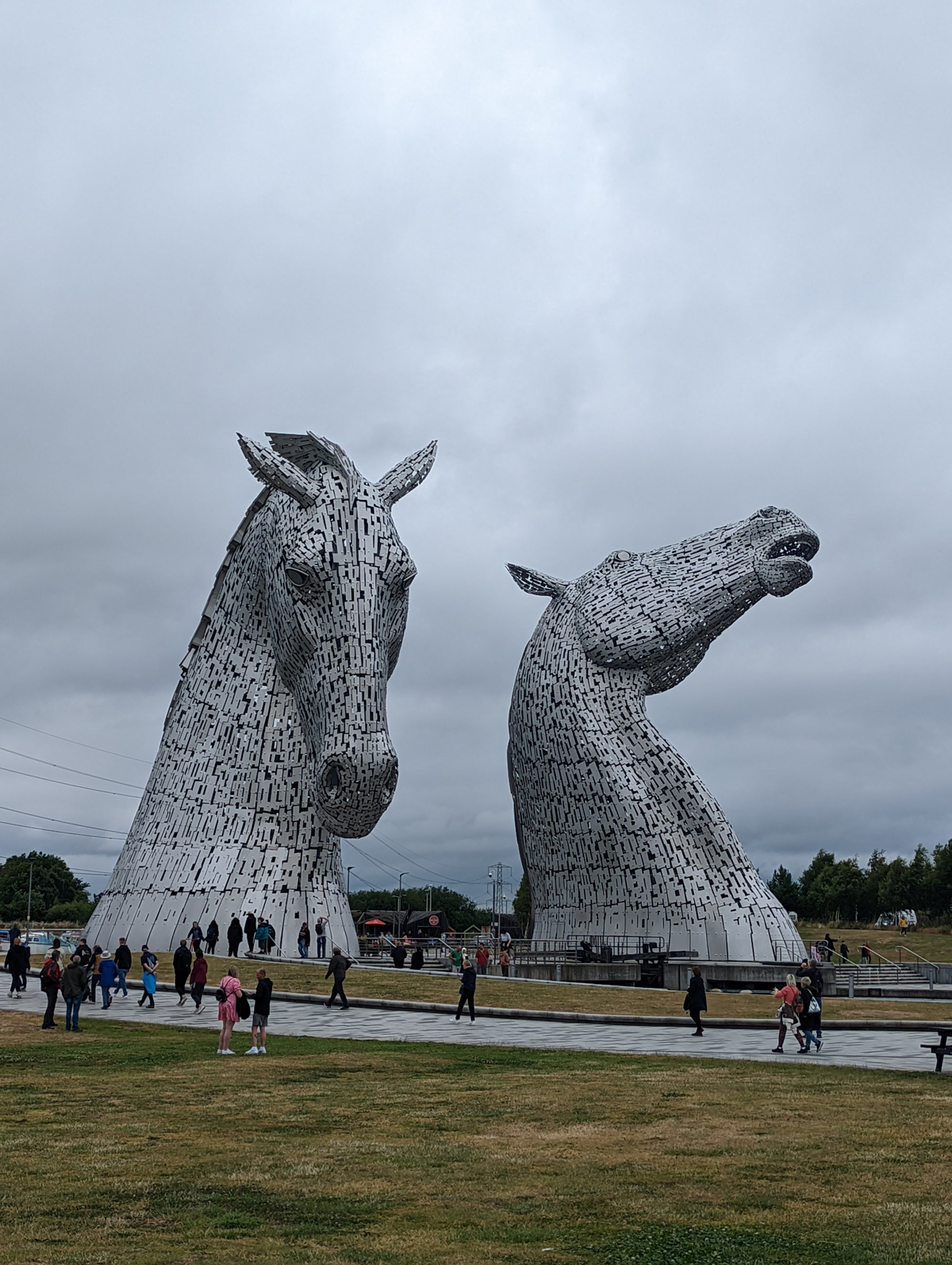
The Kelpies. Falkirk, Scotland. Photo by Mike Pribesh
The ride through Glasgow was rife with navigational challenges, technical malfunctions, and torrential rain. Those all may have been related. Glasgow roads and traffic were difficult to navigate, and there was a fair bit of profanity (only from me) as we struggled through wrong turns and going around in circles, but we made it through and enjoyed the Caledonian Canal all the way to see the Falkirk Wheel and the Kelpies, both modern marvels and major bucket list items. It’s odd that I’m an enormous geek about all things medieval, but I was super excited to see these two sites from far more recent history. The Falkirk Wheel is an engineering marvel connecting two canals, and the Kelpies are two enormous horse head sculptures. From there it was a short jaunt into Edinburgh for our planned rest day, and that’s where things started to go downhill.
Our rest day itself wasn’t the issue. We spent the day walking the Royal Mile, touring Edinburgh Castle, buying yet another sword, and generally being the tourists we were supposed to be. We had lunch at the World’s End Pub and marveled at how a city could still look pretty much the same today as it did four hundred years ago.
The next day, we decided to take a train to Stirling rather than backtrack the forty miles we had just ridden, and while waiting in the station, we grabbed a couple of sandwiches from a coffee shop. I will never eat a Chicken Caesar sandwich with bacon again. The food poisoning that hit me later in the day was epic. Long story short, we toured Stirling Castle (amazing), and I spent the next three days holed up in bed and breakfasts wishing I was dead. I lost twelve pounds in those three days, and while I’m okay with the weight loss, it was definitely not my preferred method. Belinda was a trooper, nursing me back to some semblance of health, and somehow didn’t smother me to death with a pillow in my copious sleep. I guess a small silver lining was seeing the oldest stone bridge in the Highlands in Carrbridge (also home of the World Porridge Championship) that we otherwise would not have seen.
Leaving Culloden Battlefield on singletrack. Photo by Mike Pribesh
Once I was capable, we continued on back to Inverness with stops at the Tomatin Distillery, Clava Cairns, and Culloden Battlefield. It was an easy day of riding through rolling farmland to finish the trip, and we took our time with lots of stops for rest and photos. Neither of us was ready to be done. Scotland is so rich in fascinating history that it would be impossible to see all the sights in a lifetime. I guess we’ll just have to go back sometime.
Part of the reason for this trip was to see just how much things were either the same or different from my childhood memories. In a country known for its history going back over a thousand years, I didn’t expect a lot of significant change, and was surprised that my memory was accurate after forty plus years. I recognized buildings and landmarks, street names and locations without any problem at all. It made me happy to think about things staying the same in such a rapidly changing world.
Belinda on the last day of the tour of Scotland. Photo by Mike Pribesh
While this trip deviated from all the planning I had done, I wouldn’t change anything. Well, maybe the food poisoning. Definitely would not recommend. In many years of bicycle touring, I have finally learned that you can’t, and shouldn’t, plan for everything. It’s the nature of the beast that things will wander off course, and sometimes it will be awful, but usually it will be epically better. I got to cycle around a gorgeous country with an amazing and beautiful woman (and she didn’t kill me, again), and see some of the most stunning landscapes on the planet. Would I do it again? Absolutely and in a heartbeat. But my return to Scotland will have to wait. This is a great big world with lots to see by bicycle, and while I know I won’t get to it all, I certainly want to try.
If you go:
Some thoughts on routes. I planned with RidewithGPS. It’s a great tool for finding bike friendly roads, but don’t trust it blindly. It will lead you through some truly questionable areas and pathways, including down staircases and literally through buildings. Cross referencing with Google Maps Streetview is highly recommended.
The Great Glen Way is a popular route between Fort William and Inverness and is well worth it for the scenery, but it is tough, and a lot of it is more suited to mountain bikes rather than fully loaded touring bikes. There are several versions of the trail and finding the right path for your needs and equipment can be challenging.
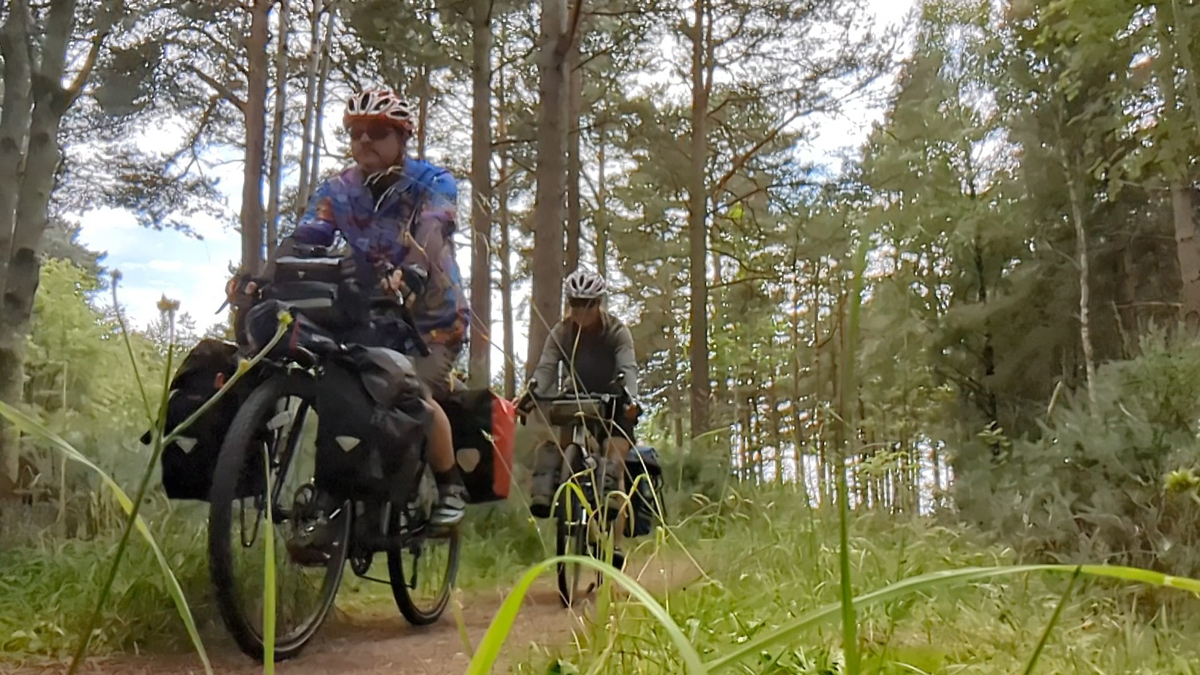
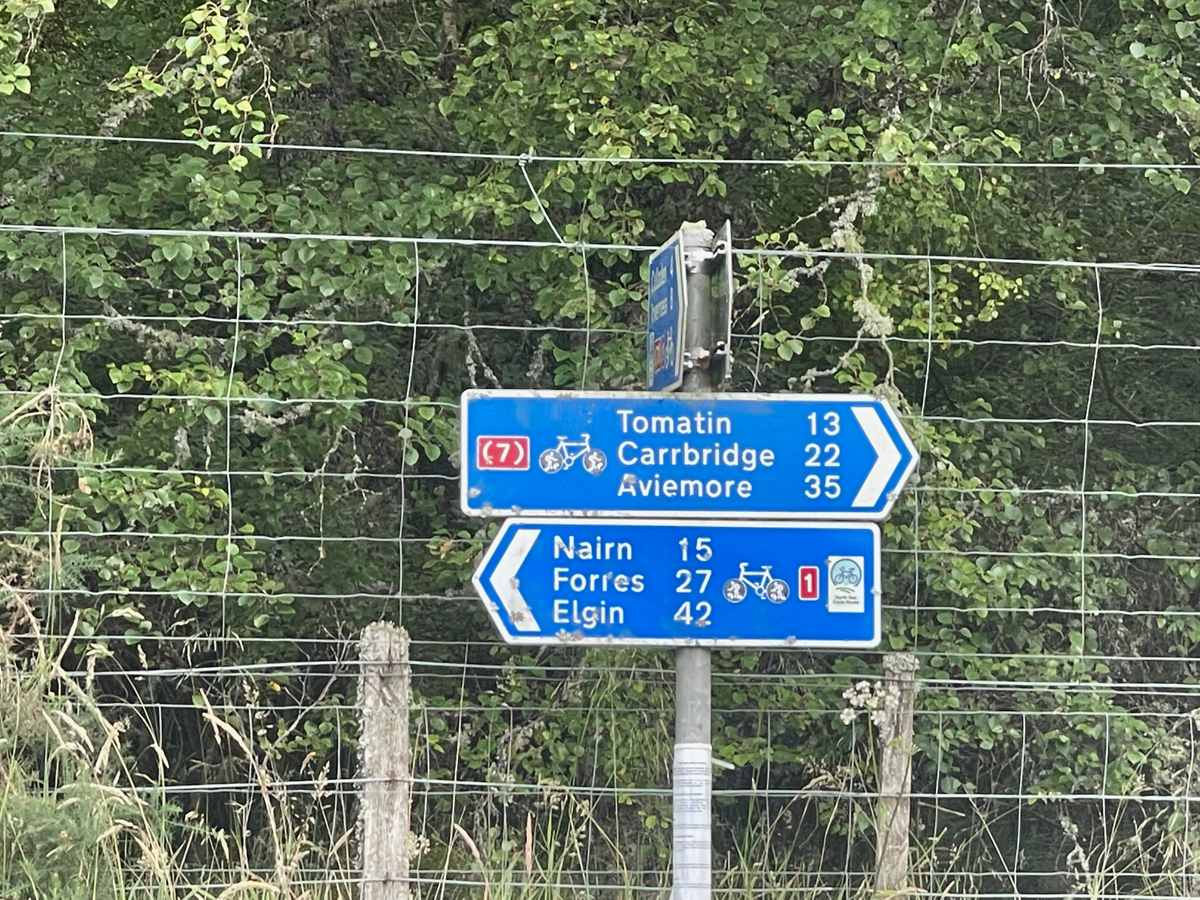
Scotland’s National Bike Network is extensive and well signed. Photo by Dave Iltis
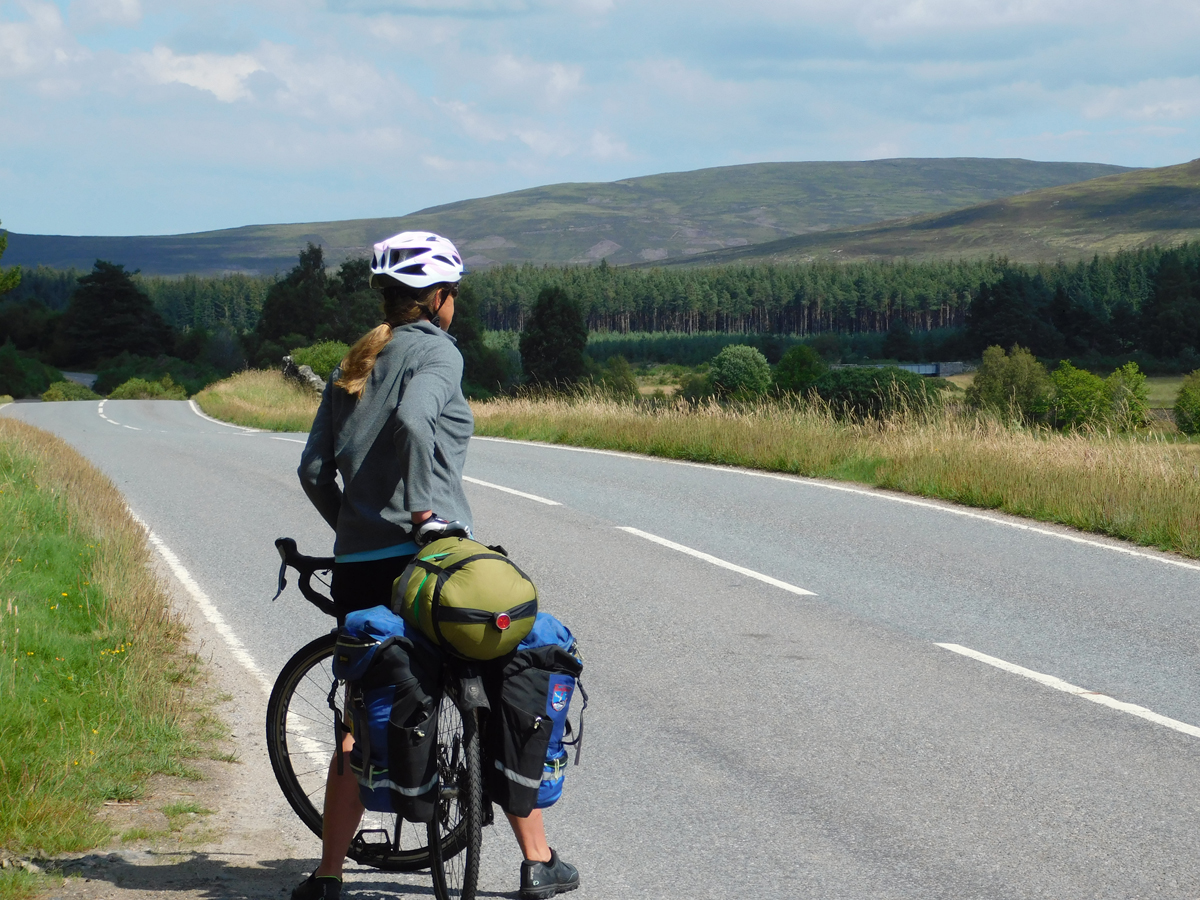
Scotland has multiple routes on their National Bike Network that are for the most part very well signed and easy to find. They keep you off of main roads and onto lesser used, smaller roads and bike paths. Look for the little blue numbered signs or in the case of the Great Glen Way, thistle signposts.
Although many of the roads are tiny, one lane paths, we found Scottish drivers to be amazingly patient and considerate. Many times, they would wait for miles for a safe place to pass, even when we were crawling up steep climbs. Yes, they drive on the wrong side of the road, but they can be forgiven.
Speaking of riding on the wrong side of the road. There’s a sharp learning curve there when looking for oncoming traffic. Be careful. Cars are not always where your brain tells you they should be.
Camping in Scotland is easy and beautiful. Their land use code allows camping virtually anywhere that is not obviously fenced and posted. Just leave no trace or leave it cleaner than you found it. Paid campgrounds are numerous and not hard to find, most for about twenty dollars per night. Hotels/bed and breakfasts are reasonably priced and easy to book online. We took advantage of that fact more than we had planned due to illness, and glad we did. Food poisoning and a tent would have been a very bad combination.
We averaged around 50-55 miles per day. In past tours, and this one, I have found this to be a pretty good distance to allow plenty of time to stop and smell the roses, so to speak. Remember it’s not about getting from point A to point B. It’s about seeing all the sights along the way, and if that means stopping for a couple of hours to crawl around some castle ruins, all the better. At that distance per day, there’s plenty of time for sightseeing.
Be flexible. I tend to over plan because I like to know what’s coming. The best laid plans invariably change, whether it’s due to weather or a wrong turn or there’s somewhere you just want to see more of. Roll with it and enjoy.
Embrace the local food. It’s fantastic. It may have funny names like haggis or spotted dick, but give it a whirl. You won’t regret it. Unless it’s a cold sandwich from a train station.
By Erica Tingey — For many mountain bikers, winter has arrived. While some four-season-climate dwellers extend their riding season with frequent trips to warmer biomes, others take a break for a few months (absence makes the heart grow fonder, after all). If you fall in the latter category, we highly suggest taking a half hour to prep your bike for storage — you and your bike will thank us in the spring! Here is a checklist to ensure that your bike hibernates peacefully:
Clean your bike.
Remove dirt from the frame and components with soft-bristle bike brushes. Wipe off finer dust with a rag or an old T-shirt. If your bike is muddy, spray it down with a hose using low pressure. Don’t spray directly into any screws or joints. You can use a mild cleanser (like dish soap) to get grease off your frame. Use a degreasing solvent with a brush and/or a chain cleaner to remove grease from your drive train. Rinse.
Dry your bike.
In order to prevent rust, be sure your bicycle and all components are thoroughly dry before storing it!
Lube your chain.
A lubed chain will also help protect against rust.
Shift into your smallest gear.
This will ensure that the chain and derailleur are relaxed. (Notice when your bike is in the biggest chain ring in the back that the chain and derailleur are “working”. If you store it like that, you run the risk of stretching your chain which will require you to replace it sooner than necessary.
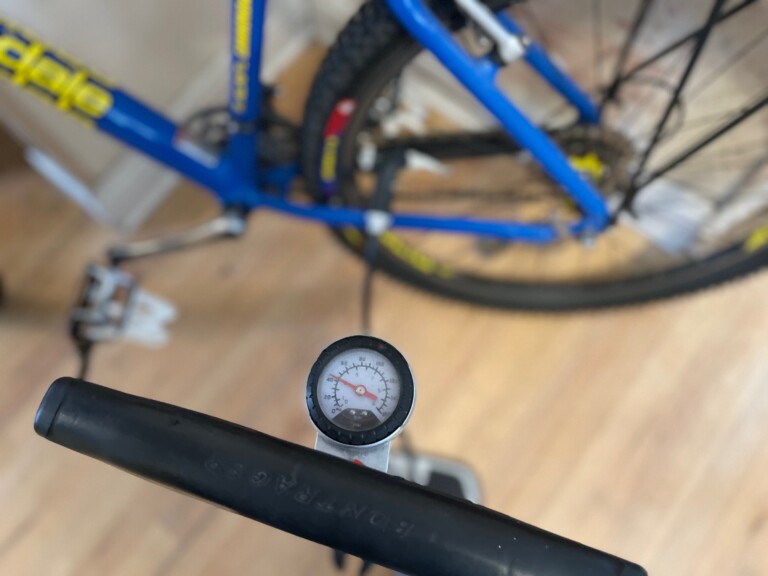
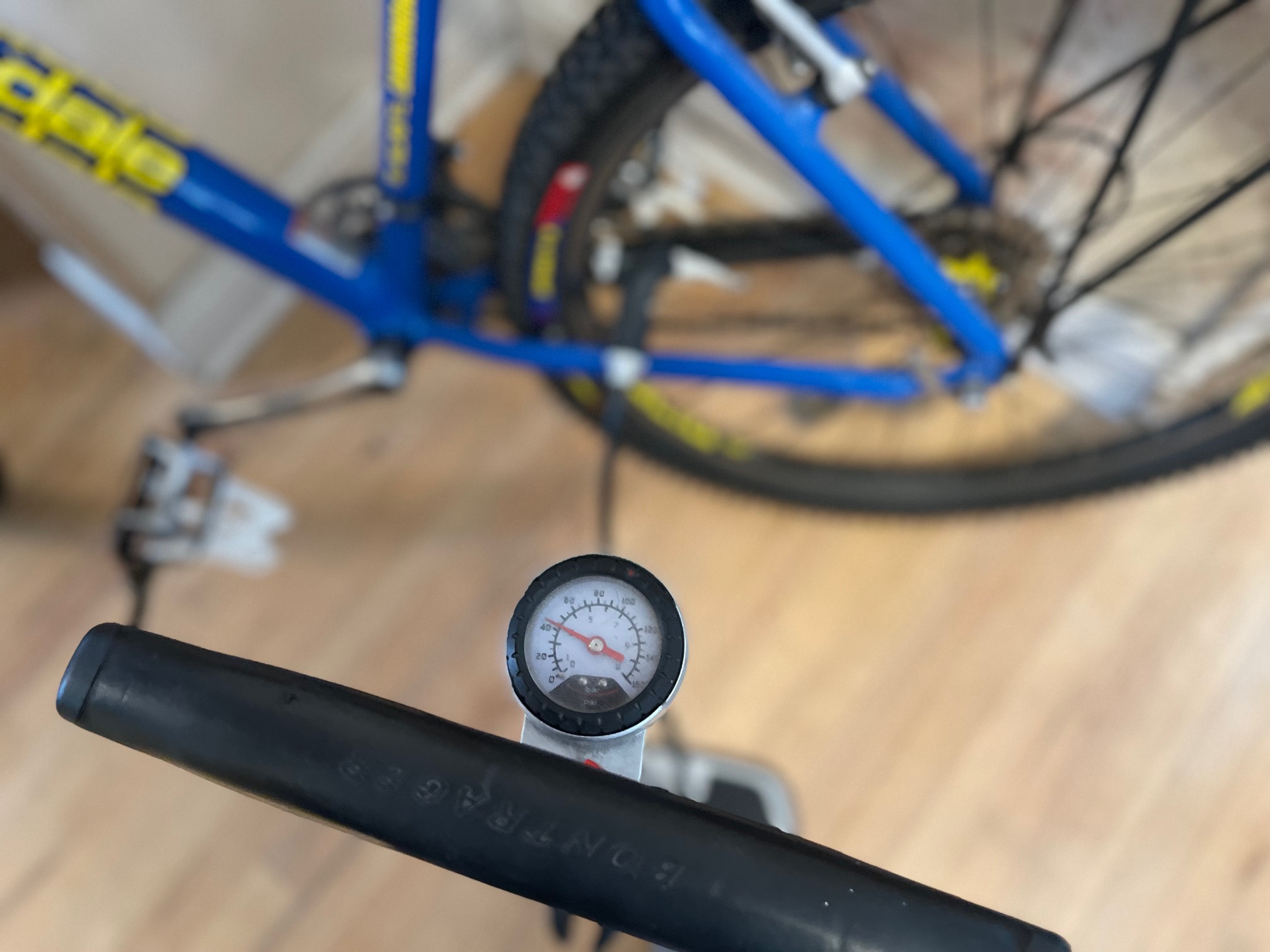
Before storing your bike for winter, check your tire pressure then check it periodically to prevent rim damage. Note that this is a commuter bike, so the pressure is much higher than on an MTB. Photo by Dave Iltis
Inflate to recommended pressure to keep the tire on the bead. Especially if you will be storing your bike on its wheels (i.e. not hanging), check periodically to make sure the tires are still inflated to avoid rim damage.
Give your bike a checkup.
Look for damage to the frame and components — now is a great time to take your bike to the shop for repairs since they usually aren’t as busy and can hopefully give your bike a little extra TLC.
ALWAYS store your bike with the dropper post in the UP position.
This will place less tension on the spring or hydraulic system, and extend the life of your dropper. (Psst … while we’re on the subject … never lift or hang your bike by the saddle unless the dropper is in the maximally raised position.
[Editor’s note: some mechanics don’t recommend hanging your bike by the saddle at all if you have a dropper post, preferring systems that allow you to hang your bike by the top tube if possible.]
Hang correctly.
If you are hanging by only one wheel, hang your bike by the rear wheel. Hanging the bike from the front wheel can put too much torque on the front fork.
Set a calendar notification for a month before spring riding begins.
Take your bike in for a tune-up before the spring rush! (We’ll try to remind you as well). Give your bike a loving pat and thank it for all the joy it sparked this year!
By Kelly McPherson — Cycling is a tough sport. It isn’t super beginner friendly. You either win or you don’t. You either get dropped and ride alone or you don’t. There isn’t much reward for not losing as badly as you did last time. Attrition is high as people leave for a variety of reasons ranging from injuries, life situations or just plain couldn’t handle getting dropped … again.
Unfortunately, the only way to really get good at something is to make sticking to it a consistent habit. Whether it is getting in your miles, that next interval, hanging onto someone’s wheel or even getting to the finish line, to be successful you have got to be consistently sticking to it. If you are ever, and we all do sometimes, considering quitting, below are some things to take into consideration. Kelly McPherson at the summit of a climb. Photo courtesy Kelly McPherson
What is the worst thing that could happen? When thinking about quitting, think about the worst thing that could happen if you stick with it and the worst thing that could happen if you don’t. Can you handle those consequences? If you keep riding while you aren’t feeling good, what will happen? You might get sicker? Is that ok? Maybe it is if you are riding in one of your target races. Maybe it isn’t if the training plan calls for a few easy miles.
In the first case, you need to decide what is worse, not finishing the race or getting sicker. In the second case, you need to decide what is worse not getting the planned miles in to post on Strava or getting too sick to ride a more key workout later in the week. I was riding Tour de Park City several years ago and I got to a climb that was completely demoralizing. I have never been a good climber. It was hot and I was out of water and I didn’t know where the top of the climb was. I ended up flipping about a mile from the top and heading back. By the time I got to my car, I was questioning my right to be on a bike at all. I felt like such a loser! I was completely frustrated with myself for quitting. This was a turning point for me. Now, when I am tempted to quit a climb, I remember this frustration and it becomes the worst thing that could happen if I quit. Most of the time, now, I choose to continue on.
Find your why. Why are you doing this sport, this race, this workout, this interval? Finding and tuning into a good reason why you are doing what you are doing is important. Is this workout key to being ready for a target race? Is finishing this race something important to you? Will hanging onto that wheel, right now, be important? It is also important to find a reason that doesn’t have anything to do with anything you can’t control if you want to stick to it for the long haul.
Be warned that if you are working to win the next race or to beat that crazy fast person, that will keep you motivated until you win or you beat that person or you get too old or too tired for it to remain a possibility. Then you will likely quit unless you find a more sustaining why. My whys are deeply personal, almost spiritual. I don’t ride to win, which is a good thing as I can count on one hand how many times in the last four years of racing that I haven’t been dead last. I do see progress, though. My consistent training is starting to pay off. I was only last by 9 minutes at my last race instead of 20-30. Progress! That’s another “why” to stick to it!
Remember that quitting can become a habit. Whatever you do over and over will become habit. If you quit once, it will be easier to quit again the next time and the next time until quitting becomes your normal. The sticking-to-it habit is a little harder to form because it often hurts. Giving up a quitting habit takes time and effort, but it is well worth it.
For me quitting hanging onto the group and allowing myself to drop has become a quitting habit. I get nervous in the group, and even though I really want to be there, I end up dropping and riding alone because it is more comfortable. I have recently identified this as a bad habit and am working on fixing it. It will take some time and a lot of hard work, but I will stick to it. For now, if anyone sees me actually riding in the group, know that I have been making countless successful decisions to stay there.
Make your choice and own it. Don’t let quitting just happen. Don’t just stop training, because you can’t seem to get out anymore. Don’t just quit an interval because it hurts. Make it a choice and then own your choice. If you are choosing to continue training, choose that and make a plan to make it happen. If you are choosing to quit an interval, know why this is the best choice for you and don’t regret it.
Many years ago, I had to make a choice about whether or not to continue in triathlon. I had an injury and the doctor had told me to never run again. He told me that if I continued to run, I would need additional surgery and then I wouldn’t likely be able to swim or cycle either. So, for me, choosing to quit triathlon was the better choice. Choosing to stick with it would mean that I would be done with all sport and my health would likely deteriorate rapidly due to the inactivity. In this case, I didn’t feel that the worst thing that could happen was worth the consequences and so I chose to quit. At the same time, I chose to start cycling.
If you ask any successful person in any field, not just athletics, what the secret to their success is, they will likely tell you that it is some variation on not quitting and consistently sticking to the behaviors and habits that lead to success. Yes, you might be gifted and have immediate success, but without consistently making choices to keep working, you aren’t likely to be performing long term. The best thing to quit is quitting!
Kelly is a 40+ cyclist who lives in South Jordan UT with her husband of 27 years and 5 kids. She has a BS in Health Education from the University of Utah and loves to stay healthy and fit and take as many people with her as she can.
By Charles Pekow — One more reason to promote bikeshare: it can improve physical fitness. A study done in Philadelphia and published in the International Journal of Behavioral Nutrition and Physical Activity found that those who joined a bikeshare did more “moderate and vigorous physical activity” after they did. To maintain the benefits, people will have to ride a lot over a long period of time, according to “Changes in Physical Activity after Joining a Bikeshare Program: A Cohort of New Bikeshare Users”: https://ijbnpa.biomedcentral.com/articles/10.1186/s12966-022-01353-6
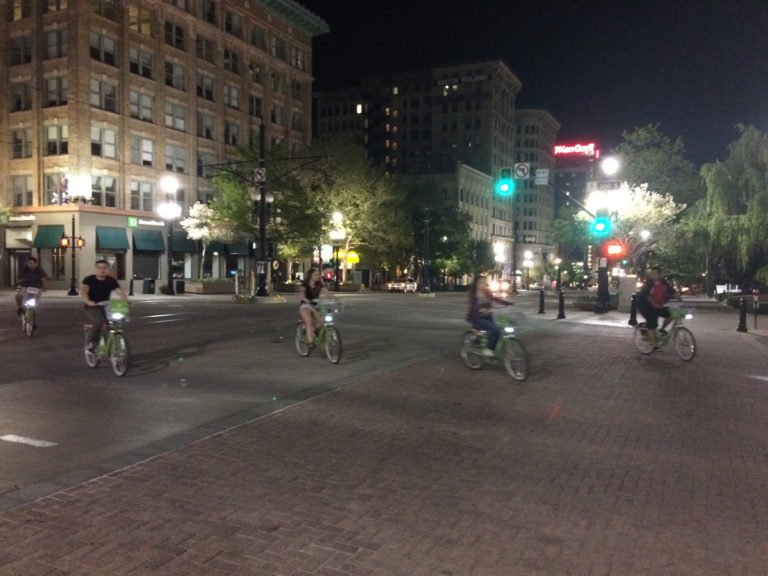
GreenBike Bikeshare in Salt Lake City has changed downtown by making it easier to get around without a car. Photo by Dave Iltis
The study followed 1,031 new members over a year from various demographic and income backgrounds with a median age of 30. Some members already owned a bike and a few others bought one over the year. Benefits accrued to people in all groups if they rode regularly.
The study suggests that cities get more people to use bikeshare and to encourage those who have signed up to use it more. It’s good for their own health!
By Charles Pekow — Voters in Boulder County, CO voted in November to continue a .1 percent sales tax (that’s one cent per $10) to fund multimodal transportation projects, including bike facilities. The tax will help fund a 25-year Transportation Master Plan that includes adding bike lanes in downtown Lyons, updating the county bikeway map, improving bike safety, etc.
WASHINGTON, D.C. (January 19, 2023) — Rails-to-Trails Conservancy (RTC), the nation’s largest trails and active-transportation advocacy organization, today launched the TrailNation™ Collaborative, a new community where public leaders, advocates and professionals will come together to advance the development of trail and active-transportation networks across the country. According to RTC, this collaborative is filling an unmet need for peer learning and collective action—leveraging the unprecedented demand for safe places to walk, bike and be active outside alongside a once-in-a-generation opportunity for public funding to create connected systems of trails, sidewalks and protected bike lanes in every community in America.
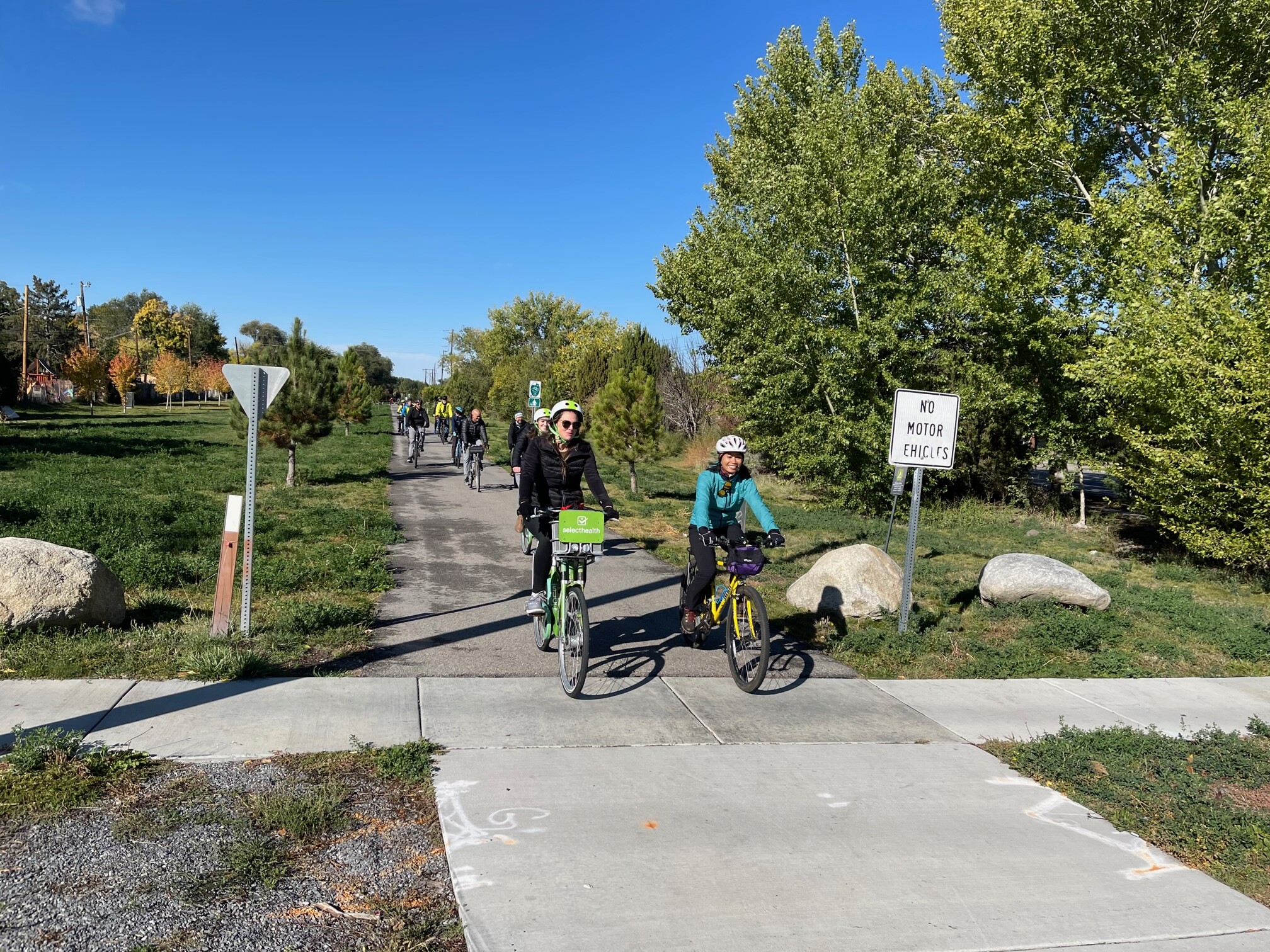
Riders on Salt Lake City’s 9-Line Trail. The trail is a key part of Salt Lake City’s cycling infrastructure. Photo by Dave Iltis
“This momentum is a result of decades of advocacy, the determination of the trail-building community, and the ingenuity it takes to envision a future where trail networks are embraced as fundamental to the quality of the places where we live, work and play,” said Liz Thorstensen, RTC’s vice president of trail development and the thought leader behind the TrailNation program.
“RTC began our TrailNation work to prove what is possible when trail networks are central to community design. Over the past decade, our aspirations have grown. Now, we want to ensure that trail networks—and all they deliver—are at the forefront of how communities prioritize resources. How places are designed, and whether they are safe and convenient for everyone to walk, bike and be active outside, can make all the difference,” said Thorstensen.
The recent influx of federal dollars and growing demand for trails are the catalysts for the TrailNation Collaborative’s vision to ensure that trail and active transportation networks are prioritized in the nation’s infrastructure plans.
Trail use increased 9.5% nationwide in 2022, nearly on par with 2020 levels, which was the most significant year on record, according to recent RTC analyses. The federal Bipartisan Infrastructure Law that passed in 2021, more than doubling funding for trails, walking and biking, emphasized the important role of trails and active transportation as climate and equity tools. In addition, the bill established a new program that provides dedicated funding for the planning and construction of safe and connected trail and active-transportation networks and long-distance spine trails, the Active Transportation Infrastructure Investment Program (ATIIP). Since then, trail and active transportation networks have proven competitive in the majority of federal transportation programs for which they’re eligible—including in the multimodal RAISE program, where the majority of projects have accounted for the needs of bicyclists and pedestrians, and most recently, the Fiscal Year 2023 Omnibus Appropriations Bill, where 29 states secured earmarks for trails, walking and biking.
“This is an unprecedented opportunity moment for trail networks,” said Ryan Chao, president of RTC. “We’ve known for years that the demand for connected trails has been growing at rates that outpace the supply across the country. There’s now more funding than ever before to meet this growing need and accelerate trail network development across counties, states and the country. Together, the TrailNation Collaborative and its hundreds of change agents will lead a paradigm shift to incorporate trail networks as equitable and essential infrastructure in America.”
The TrailNation projects and RTC’s extensive network of partners will serve as the foundation for the TrailNation Collaborative. The collaborative provides proven tools, methods and resources, combined with RTC’s expertise and network of partners across the country, to accelerate the development of connected trail systems.
“TrailNation Collaborative will help the doers, planners and advocates working to connect trails in their neighborhoods and across regions to more quickly unlock the benefits that trail networks uniquely deliver,” said Mary Ellen Koontz, RTC’s TrailNation Collaborative lead. “Together, we’re going to tackle what it takes to create trail networks at the pace we need to meet growing demand and take advantage of the funding opportunities available. Anyone interested in creating trail networks in their community can benefit from the ideas, expertise and resources we will crowdsource together.”
RTC’s TrailNation initiative, along with the work of hundreds of on-the-ground partners nationwide, is redefining what it means to build trail networks and the impact these equitable systems can have on people and places. To learn more about TrailNation and sign up for the no-cost collaborative, visit: railstotrails.org/trailnation.
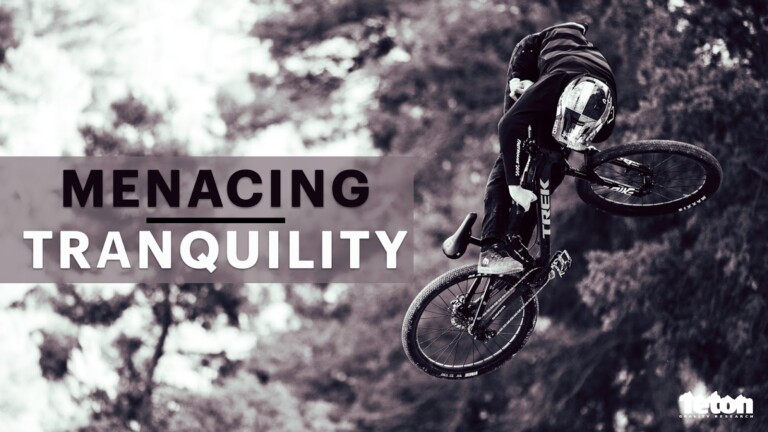
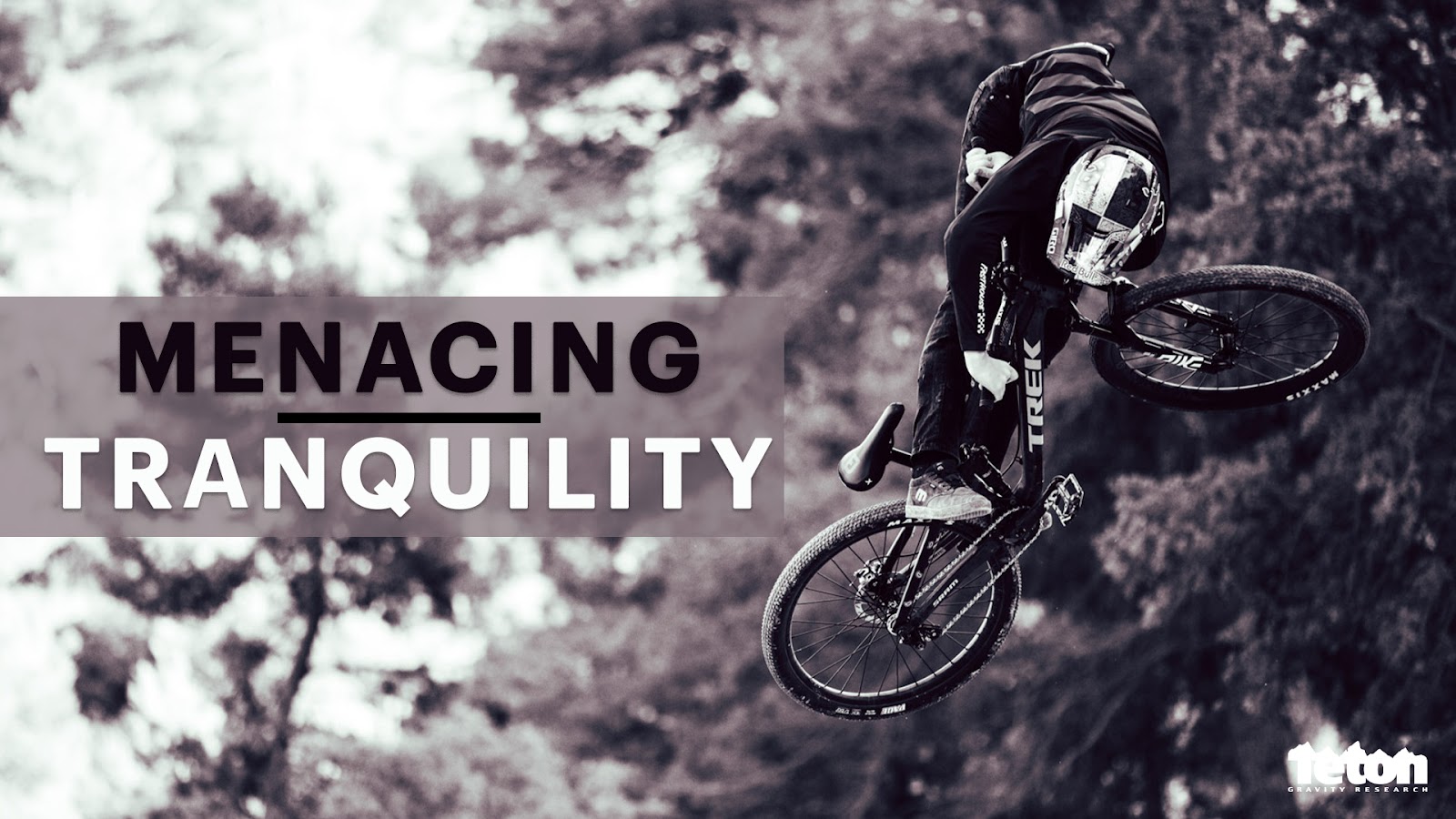
JACKSON, Wyoming (January 17, 2023) — Emil Johannson has put the slopestyle mountain bike world on notice since his 2016 debut at the iconic Red Bull Joyride event with his impressive fourth-place finish. Since then he has competed in a variety of other events and eventually found himself as one of the biggest stars in Teton Gravity Research’s 2022 mountain bike film Esperanto. With the help of director Jeremy Grant, Emil has been able to showcase some of his most epic riding that was shot at La Fenasosa Bike Park in Spain with features built by Nico Vink.
“It’s often highlighted what a strong competitor Emil is with so many slopestyle wins but what struck me on the shoot was his artistry,” director Jeremy Grant said. “With Menacing Tranquility we wanted to build an edit that stripped everything away and just illuminated the art in Emil’s riding.”
Menacing Tranquility came to fruition after Grant and Johannson began to sift through the extensive amount of leftover footage that was shot during the two-year process of making Esperanto. With so many good clips left it was hard for the duo not to make something of it. The film can be viewed at:
By Darrell Owens — Traffic Violence won’t be fixed by planners and engineers who view cities as a means to run an economy over the lives of people in them — only we can fix it ourselves.
Last month, a pedestrian and a cyclist were killed by a driver at the very same intersection in Sunnyvale, California. When Vice Mayor Alysa Cisneros brought the issue to the city council to investigate fixing the intersection, the council majority voted overwhelmingly to reject it and not improve traffic safety. They chose to prioritize the speed of motorists over the lifes of everyone else — at a cost of 40,000 Americans killed and 120,000 cyclists injured by cars a year. This is the norm throughout the United States from major cities to minor suburbs. So I’m forced to ponder: what can we do about this as urbanists?
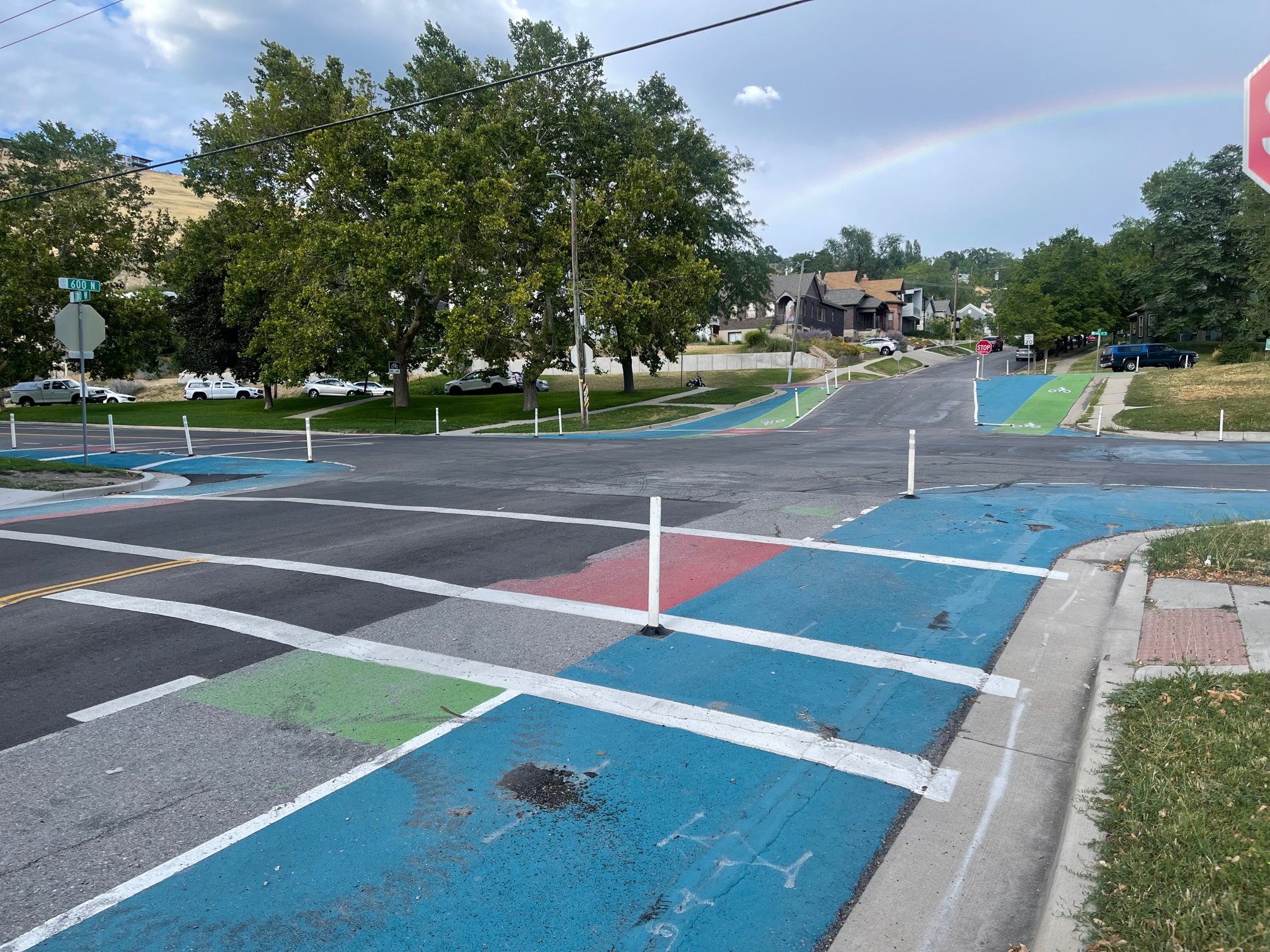
A tactical urbanism intersection in Salt Lake City, Utah. Photo by Dave Iltis
Nothing, under the current planning regime. Take protected intersections for example. Common outside the U.S. but very uncommon here. When we installed some in my town of Berkeley all hell broke loose. Motorists lost their shit when forced to make safer, slower turns. Neighbors placed bright traffic cones so idiotic drivers who are never expected to be attentive would stop rolling over the barriers and stunning themselves. One irate motorist even spray painted the platforms proclaiming they were illegal by court order (they weren’t).
On the same road, Berkeley spent four years planning to construct a protected bike lane which lead to an uproar by area drivers who insist they’re being persecuted by losing a tiny few on-street parking spaces adjacent to huge parking lots. At the prospect of making a road safer for cyclists AND motorists to use, fanatical NIMBYs now accuse safety advocates of being part of a so-called “bicycle lobby”, evidently out to harm the oh-so-precious driver.
Unfortunately traffic engineers and city planners are some of the weakest and most spineless civil servants in city government — the former especially. If you’ve ever talked to a traffic engineer, you’ll realize quickly that these people are not interested in reducing the tens of thousands of Americans who die annually from traffic-related crashes. Rather, on behalf of city electeds and local businesses, they are first and foremost interested in how quickly they can get employees to work and how quickly their local businesses can fill up their parking.
They have little to no regard for the safety of anyone who doesn’t drive. To traffic engineers, a city is for cars and the people in it are merely in the way. The same applies to fire departments whose fire marshals act as if any reduction in lanes somehow endangers emergency responders — without evidence. A strange American conundrum: car-free and car-lite cities around the world burn to the ground because they lack a giant stroads running through every other place — according to Americans. Total nonsense.
As a result, I’m sad to say there is no official way we can plan our way into traffic safety. The indoctrination of the automobile and fossil fuel industry is too deeply entrenched in many American’s minds. Even though car-lite policies like safer bike lanes and shrunken roads improve driver safety by forcing them to slow down and keep average people from not having to carry the burden of becoming killers. But the inevitable result of this radical, car-based, speed-first, safety-last planning is that people who go out of their ways to travel sustainably get pummeled or killed often enough that cars become a necessity for all.
Well I’m done. As history has frequently demonstrated, if we’re going to get traffic safety, we must fight for it. I’m not going to negotiate my safety or the safety of loved ones with the chamber of commerce, the city council or motorists who think they have a right to drive over every inch of pavement that exists. I’m tired of telling my younger sibling that I don’t want her to ride a bike in Oakland out of fear for her life.
It’s time for people to start forming organizations to protect cyclists, transit riders, pedestrians, and yes — drivers — from car-centrism. I’m not going to spend years writing to city council that I need a crosswalk where I live — I’m just going to paint it now. I’m not going to wait years on hundreds of thousands of dollars for impact studies blocking traffic out of neighborhood streets. We need to just erect the barriers and bike lanes ourselves. Erect the bus benches ourselves. Shrink the streets ourselves. There’s a long history of neighbors taking matters into their own hands. We need to bring tactical urbanism back.
I applaud the work of groups who have shined a light on traffic violence like Rapid Revolt in Oakland and in San Francisco such as Safe Street Rebel. We need to take control of our urban planning now. Form organizations and do the work yourselves. Stop asking for it, because the radical, pro-car, anti-human basis of American traffic planning is never going to give it to you.
Darrell Owens is a housing advocate and analyst for California YIMBY and is based in Berkeley, California. Follow him on Twitter @IDoTheThinking and subscribe to his newsletter: darrellowens.substack.com
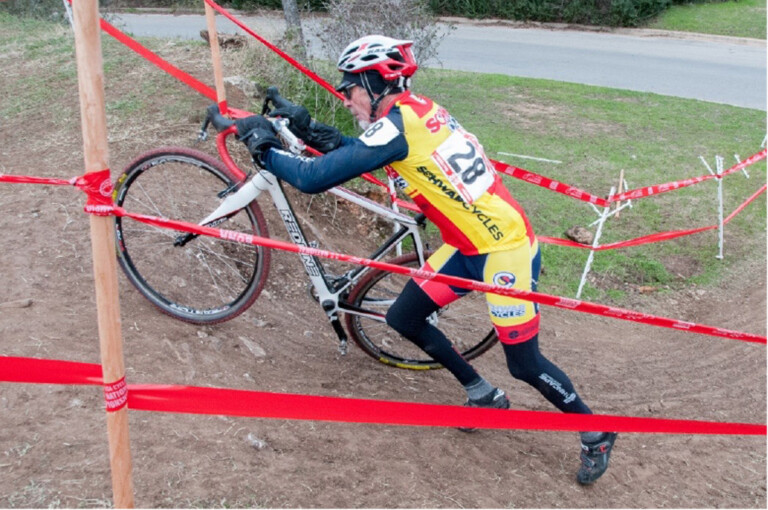
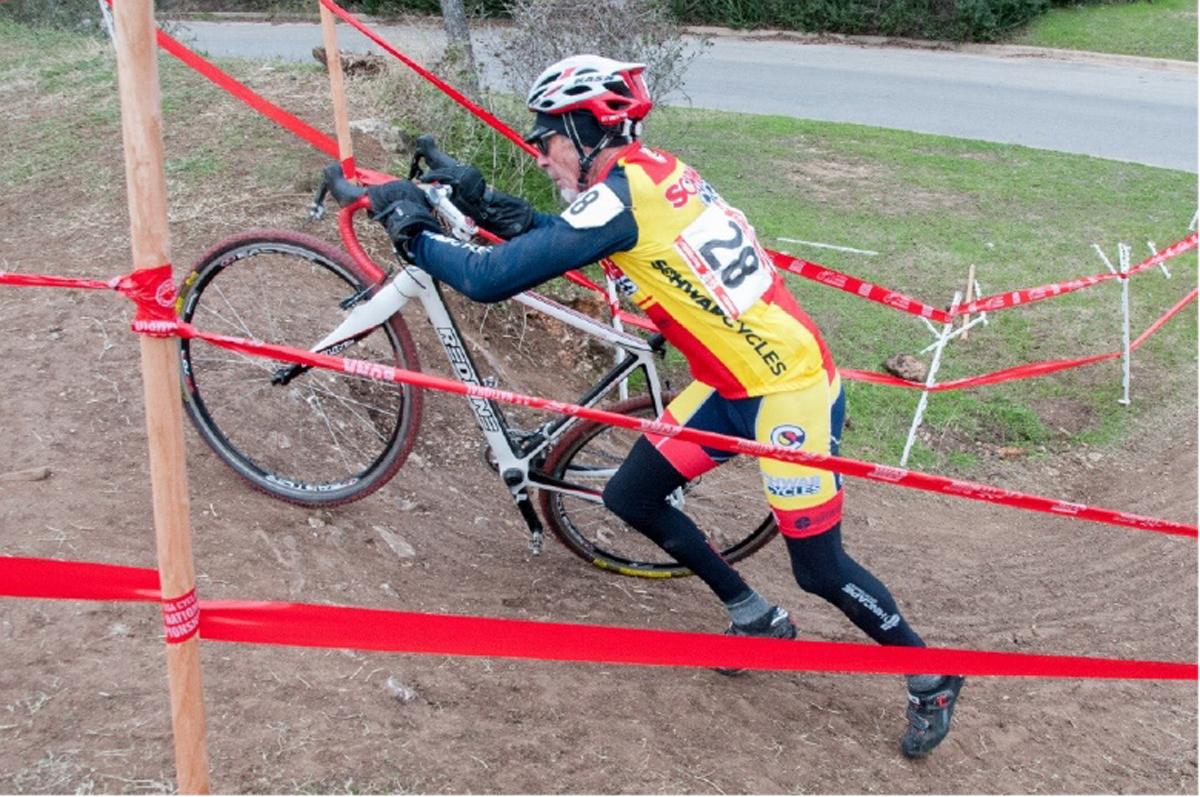
By Loren Hettinger — It’s that time of year again: the cooler mornings and a few golden leaves on the cottonwoods and willows remind us that cyclocross or CX racing is in full bloom. I can’t remember why I thought it would be a good idea to race CX. It couldn’t have been from spectating at a race in Colorado’s Chatfield State Park, south of Denver where I first witnessed people dismounting and running while carrying their bikes over barriers or up a steep bank. It all seemed counter-intuitive, or downright weird. Yet, there was an attraction–perhaps the challenge of doing something different after a road-racing season. This “something different” included riding on sketchy terrain with off-camber turns, slippery grass, and even ice-infused mud, while trying to stay upright.
For any of us who transitioned to CX from road racing later in life, the process was generally not seamless, as CX was a new and different “animal.” As different as a person proficient at loping around an arena on a horse, maybe doing some pole bending, but then decided to become a trick rider, suddenly attempting forward fenders, one-footed stands, and galloping vaults. Watching the top guys racing CX was vexing: the seamless dismounts, hurdling barriers while carrying the bike, and then remounting as if the barriers hadn’t been there in the first place. A few of us practiced this craft, starting slowly by dismounting to one pedal and then throwing the off leg back over, then gradually dismounting, running with the bike, and trying to remount without inflicting excruciating pain on ourselves. Landing too hard on the saddle, the top tube, or onto the rear tire was not for those with a low tolerance for pain! We practiced our new craft endlessly, even had some coaching, and watched videos of the Euro pros, as if their awesomeness could somehow transfer to our brains and increase our coordination.
Loren Hettinger – “seemed rideable in practice”, Austin, TX Nationals. Photo by Tom Lebsack
Dismounts and remounts weren’t the only difficulty because CX racecourses were an education in off-road surfaces. I had ridden mountain bikes on Front Range trails, but not raced them yet, and until now had thought the riskiness of a criterium was the epitome of prerace jitters. Moreover, CX course planners looked for the sketchiness, as if a slightly wider, knobby tire could be successfully ridden on any surface. And the treacherous surfaces naturally increased with the onset of winter. Another interesting aspect about this sport was the persona of CX in general—that real CXers thought the sketchier the course and conditions the better. I tried to see this point of view, but secretly thought these people were lying or at least pretended to buy into this macho psychosis while secretly hoping for a dry course on gentle trails like I did. It took a while until I too could revel and smile in the mud.
Then there was the application of infantile skills to courses during a local race. I had never been gassed in a road race to where I actually stopped or plodded up a steep hill in a death-march, bike over a shoulder, breathing like the bellows of hell’s fires, (or as one teammate described, “Like a steam locomotive!”); but CX racing had this effect. Another compounding factor was my first, too large, converted touring bike, which seemed to get taller during a race. Initially, I kept my objectives simple: not crash or fall over and hurt myself, not be rooted somewhere on the course, and not finish last.
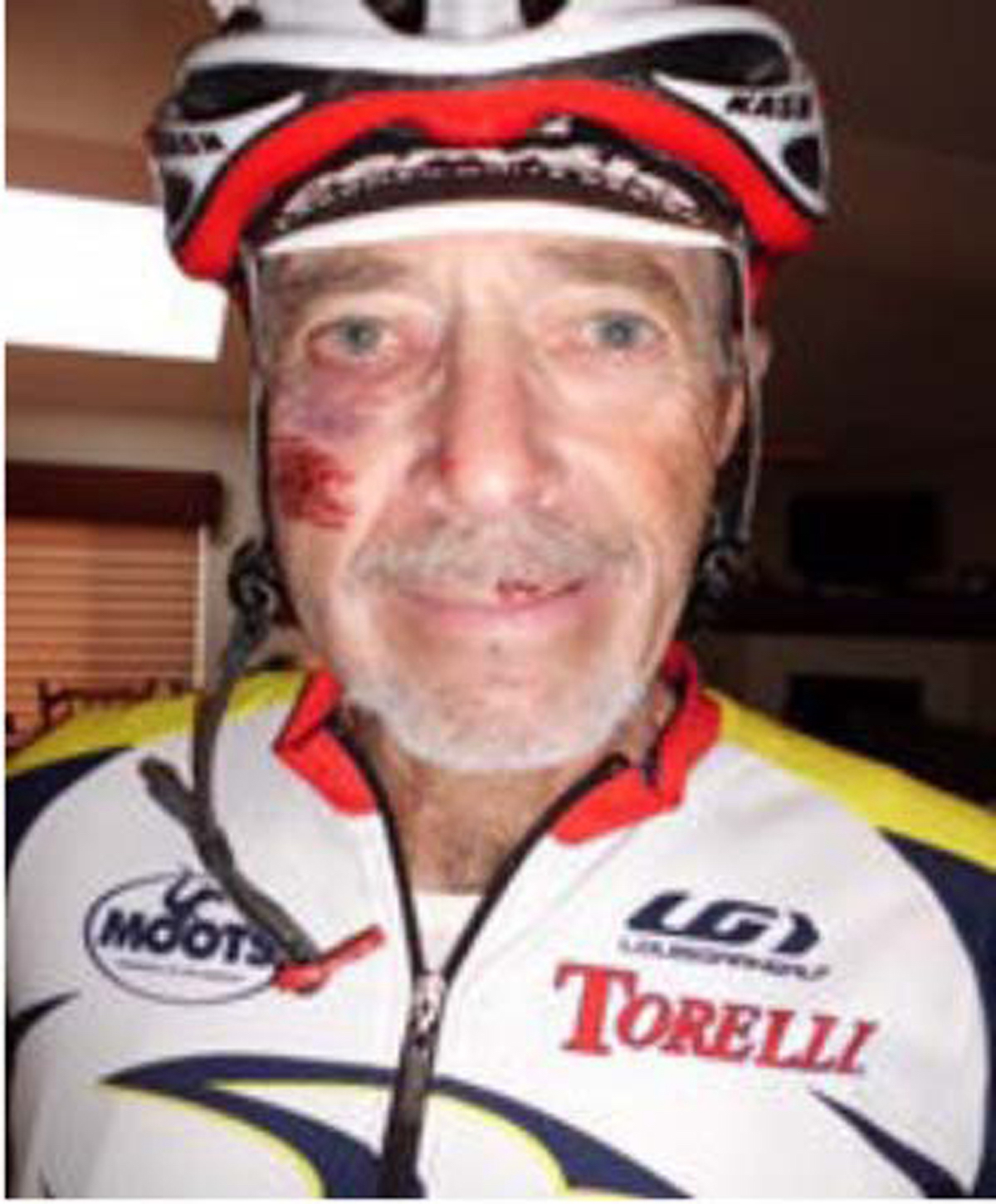
Of course, there were more than a few times when at least one of these objectives was not met. Some have remained somewhat vivid; like a race at the Boulder Reservoir when I cut a shin into the sub-cuticle by falling onto my bike in a tangle with other riders. Another episode occurred on a course through the marshes interior to the Mead sportscar racetrack. The driver error consisted of sticking a front wheel into a hole of muddy water–that I knew should have been avoided–resulting in a face plant and flattened nose. Seeing the bottom of shoes and cleats from ground level as other racers jump over you is disconcerting. Worse than that is searching that puddle, raccoon-like, for a lost lens from my glasses only to find that it was plastered to my beard in adobe-like goo. Riding with cotton gauze hanging from one nostril and one lens to sight the course was somewhat detrimental to not being last. Okay, so many of my objectives could be obliterated at a single race. How about all of them in a single helping?
This larger serving occurred at the Xilinx State Championships one wintry day. I rode several warmup laps and noticed with some interest a large flagstone bridge crossing of a ditch. My concern was the six-inch flagstone edge; however, I “lifted” the front wheel onto it during the first approach and confidently rode on.
The Masters’ group lined up in about three rows of seven across. Starts are generally hectic. All of us want to get toward the front before the courses narrow and enter off-road sections, single-track, or grass chicanes. I sprinted with the rest around a coned parking lot and then into the sand of a volleyball court. I remounted after the sand run, breathing hard. A familiar competitor was in front of me, and in moving to pass him, the flagstone bridge suddenly appeared. I belatedly thought about remedial action, but instead “endowed,” landing mostly on my left elbow—all this occurring in . . . what, under a second? Lying on the side of the stone was at first embarrassing, then disturbing, and finally all that psychological turmoil was replaced with acute physical pain. Other racers went by giving me the look of, “What happened?” or “Better you than me!”
Loren – CX scuffed. Photo by Tom Lebsack
Continuing crossed my mind, but I knew my race was over while attempting to straighten the handlebars and a brake lever. The injured arm responded by circumscribing some airy signals, as if trying to communicate with someone farther down the course that it knew, and I didn’t.
As I retrieved my spare wheels and packed things into the car, the thought that the injured appendage might not be an easy fix was reinforced by the throbbing and continued uselessness of the arm. By the time I headed back toward Longmont and the retreat toward home–pausing to search for ice at a convenience store–the elbow was the size of a softball.
X-rays later revealed that I had fractured the olecranon process (yeah, the elbow-pointy thing). This culminated in a kind of injury from hell: surgery to install hardware, a second, larger surgery 10 days later to check a nasty staph infection and replace the hardware. Then a Groshong catheter was plunged into my chest for six weeks of antibiotic infusions (when I really seriously considered experimenting with vodka), and finally physical therapy to unfreeze the joint.
I sometimes wondered in growing up and reading adventure stories of the American West if I would have been able to hack the Sundance Ceremony of the Plains Indians. This ceremony consisted of a bone being inserted through the chest muscles of the aspiring warrior who gradually pulled free of it and the leather thongs that were attached to a pole. Or, if I would have had to carry wood and water for the women of the tribe all my life. By the time the catheter was tugged out of my chest, I was more confident of my warrior aspirations and stopped for a double espresso on the way home.
There was another undercurrent to this experience: that the glitches and driver error-injuries were just reminders of something that we already knew: that bike racing can be dangerous. However, the rewards must outweigh the risks. Or, maybe it’s as Mark Cavendish said, “You know that thing in your head that says, ‘You shouldn’t be doing this?’ Well, we don’t have that!” But about the rewards . . . a sense of achievement, the challenge of a course and whether you could ride it or mostly ride it and with progressively more skill each lap. One could always hope. There is no doubt that for me it was addictive, and it must have been fun too. Because if it wasn’t, why do it? As one of us in the peloton said, “About as much fun as that first kiss by a fourth-grade crush!”
Some of my family and non-cycling friends thought that this medical sojourn would be the final nail as a deterrent from the rigors and risks of CX (and perhaps to bicycle racing in general). But the mishaps instead spurred me into increasing the reward side of this risk equation, and somehow becoming better at the craft. In fairness to CX and in defense of my seemingly ineptness, there were a lot of seasons when I had no mishaps needing medical attention. I may have ridden a few near-perfect laps, and the sketchy sections of a course were traversed in an upright, exhilarating manner. Perhaps, it’s not just the pros like Mark Cavendish, but a lot of us CX cyclists don’t have that “thing in our heads.”
By Dave Fotsch — I should’ve known better. It was day three of the Fitzgerald’s Joyride bike-packing race in southeast Idaho. I had just completed the second massive climb of the day and was starting down the other side when I encountered another rider. Brian Rinck stopped, and we chatted for a while, as you do when you finally see another rider. Then I said, “so you must be going clockwise.” He looked at me quizzically and said, “No, I’m going counterclockwise.” Though most go counterclockwise, the course allows riders to go in either direction.
“What? I’m going counterclockwise!”
“No, dude, if you continue down this trail, you’ll wind up back at the market.”
The market he was referring to was Bailey’s Market, a vital resupply point at the bottom of the biggest climb of the entire route, some 3,000 feet. I’d already done that climb and suddenly realized I’d done it twice.
“I’m so confused,” I said with genuine concern.
I had been having trouble with my navigation the entire trip. While I had loaded the route into my Garmin Etrex 30, I couldn’t get the display to work right. I tried to follow the line, but it wasn’t giving me mileage or other vital information. Plus, the route crisscrosses itself in the middle, and I had already spent extra time and mileage going the wrong way many times.
It was getting late. I followed Brian up the track back to the summit and down the other side. He dropped me because I descended like an old lady. I’m cautious descending after the sun goes down. Five broken collar bones and numerous other injuries over the years will do that to you.
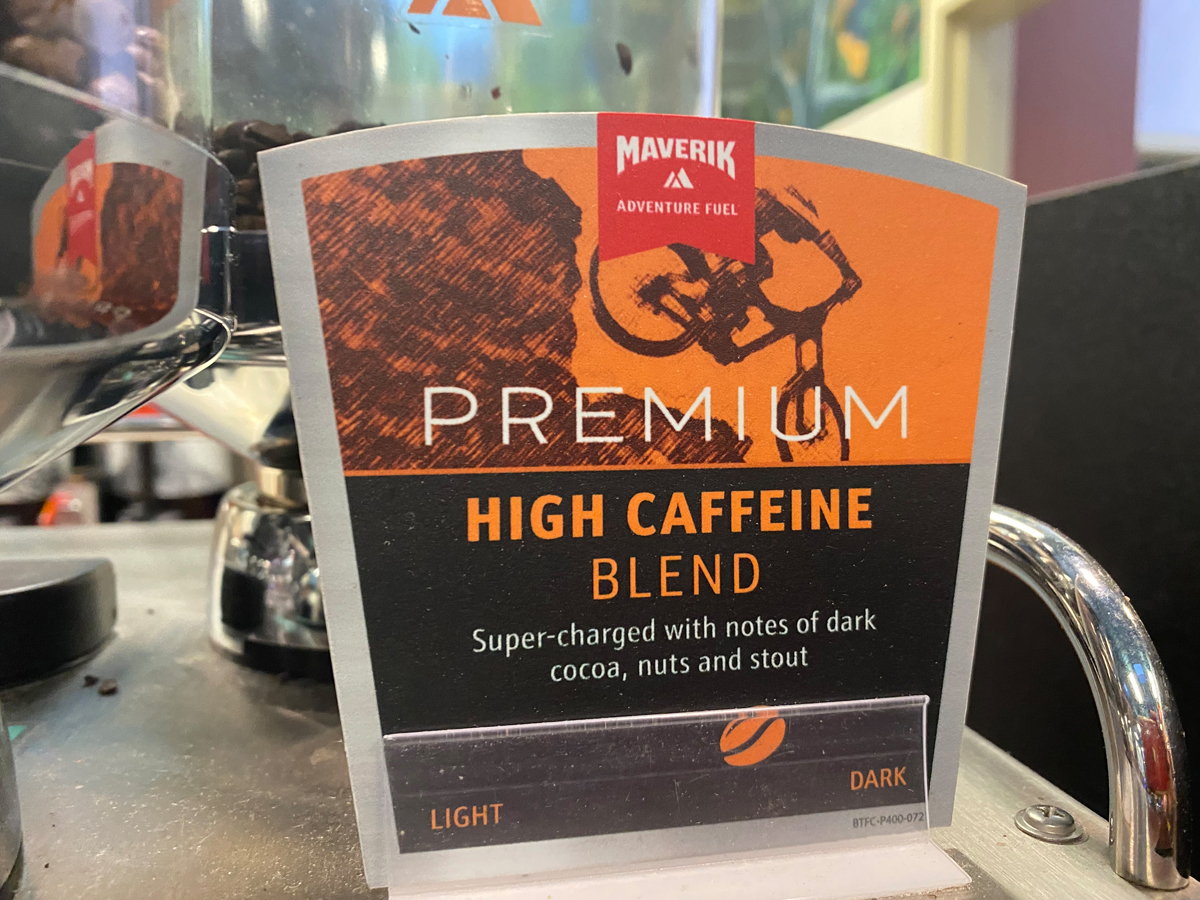
Fortunately, I came upon a couple of other riders, Peter Yerger, and Al Meder, who had been behind me. With all my navigational errors, they could’ve passed me anywhere. One of them was having trouble with the electronic derailleur on his bike. Having resolved the problem, they led me into Soda Springs. I was exhausted. There was no way I was going to try and find a camp spot and sleep in the cold. Only one of the two motels in town had a room. It didn’t matter that it was $87. I was staying there. At the Maverik station, I bought two 32-ounce Budweisers and went to my room. After a shower, I sat on the bed and drank the beers contemplating whether I could go on. I was so tired I couldn’t figure out the TV remote. Then I passed out.
I had screwed up badly. After completing the big climb out of Bailey’s Market and going down the other side, I stopped for food at a trail intersection. The Garmin indicated I needed to go up a hill when I got back on my bike. Intuitively, I thought I should be dropping into Soda Springs. I had no cell service to check my intuition, but Garmin knows best, right? I didn’t realize that I was climbing the hill I had just come down.
I had come into the race about as unprepared as I had ever been. The original plan had been to do the Smoke ‘n Fire 400 that starts and ends in Boise. True to its name, the race was altered by the all-too-common summer wildfires. The fires and smoke closed the route north of Ketchum, forcing organizers to change the course, making it an out-and-back along the northern part of the route from Boise to Redfish Lake. The air quality was grim even on the altered path. The last time I’d done Smoke ‘n Fire was five years ago when wildfire had forced organizers to make it an out and back along the southern part of the route. I didn’t want to do that again. The attraction this year was the opportunity to make the entire loop.
Fitzgerald’s Joyride, which started three days after Smoke ‘n Fire, was in a part of the state essentially free from wildfire smoke. I had friends doing the race, so I changed my plans at the last minute and caught a ride to Idaho Falls with Louie Konkol. Louie shared some of his route beta. That’s all the research I did, outside of downloading the course into my Garmin.
With my Garmin failing to give me mileage without switching between screens, I wasn’t entirely sure where I was at any given time, even as I tracked my progress on my Apple Watch. I didn’t know where the big climbs were or how long they would be. I only knew where I could resupply and get water. If I could cover at least a hundred miles a day I’d still have a ride home.
At an informal racer gathering the night before the race started, I told Boisean Clint Boltz that he was my backup ride home. Louie, who had done the race the year before, was determined to finish in three days. I couldn’t do that. Louie would be on his way home while I was still churning out the miles.
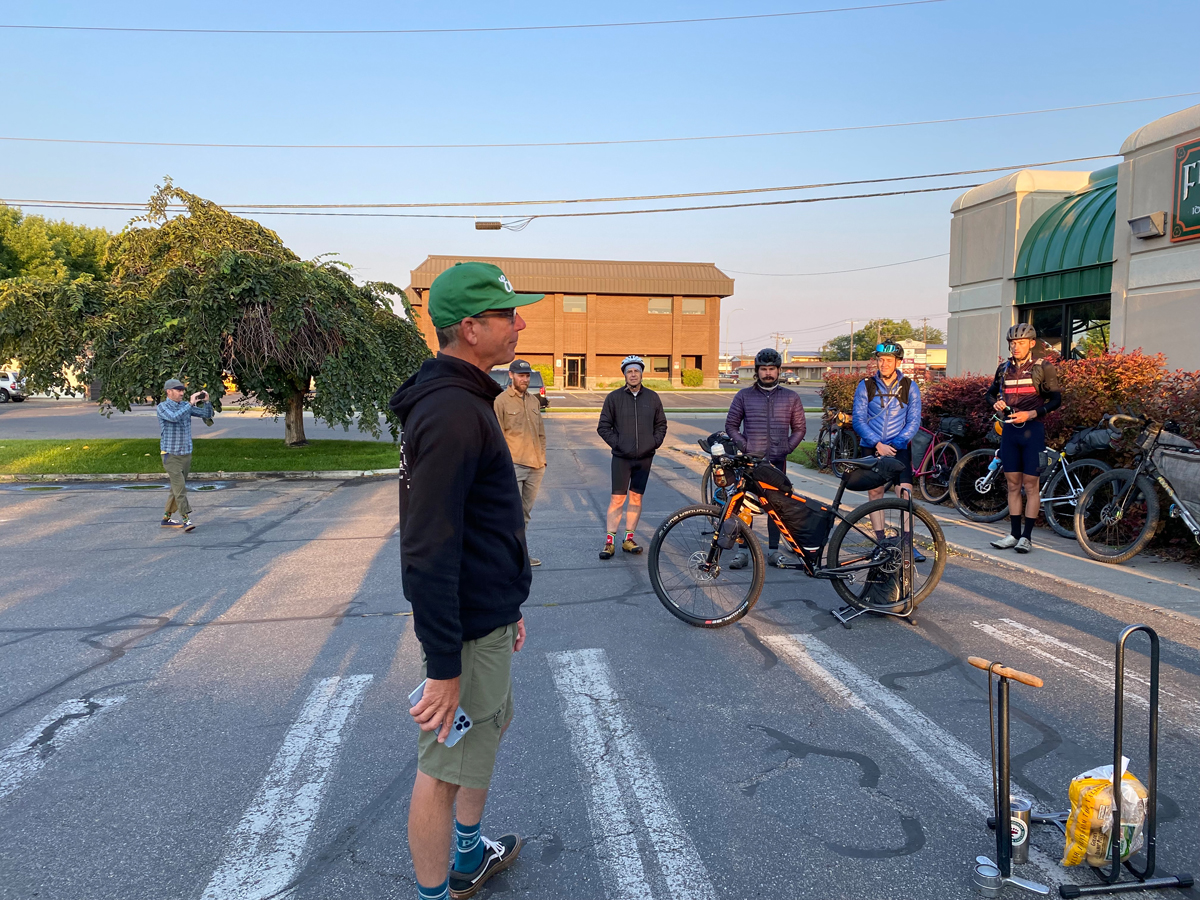
Kevin Emery addressing the racers. Note the bag of potatoes leaning against the bike stand. Photo by Dave Fotsch
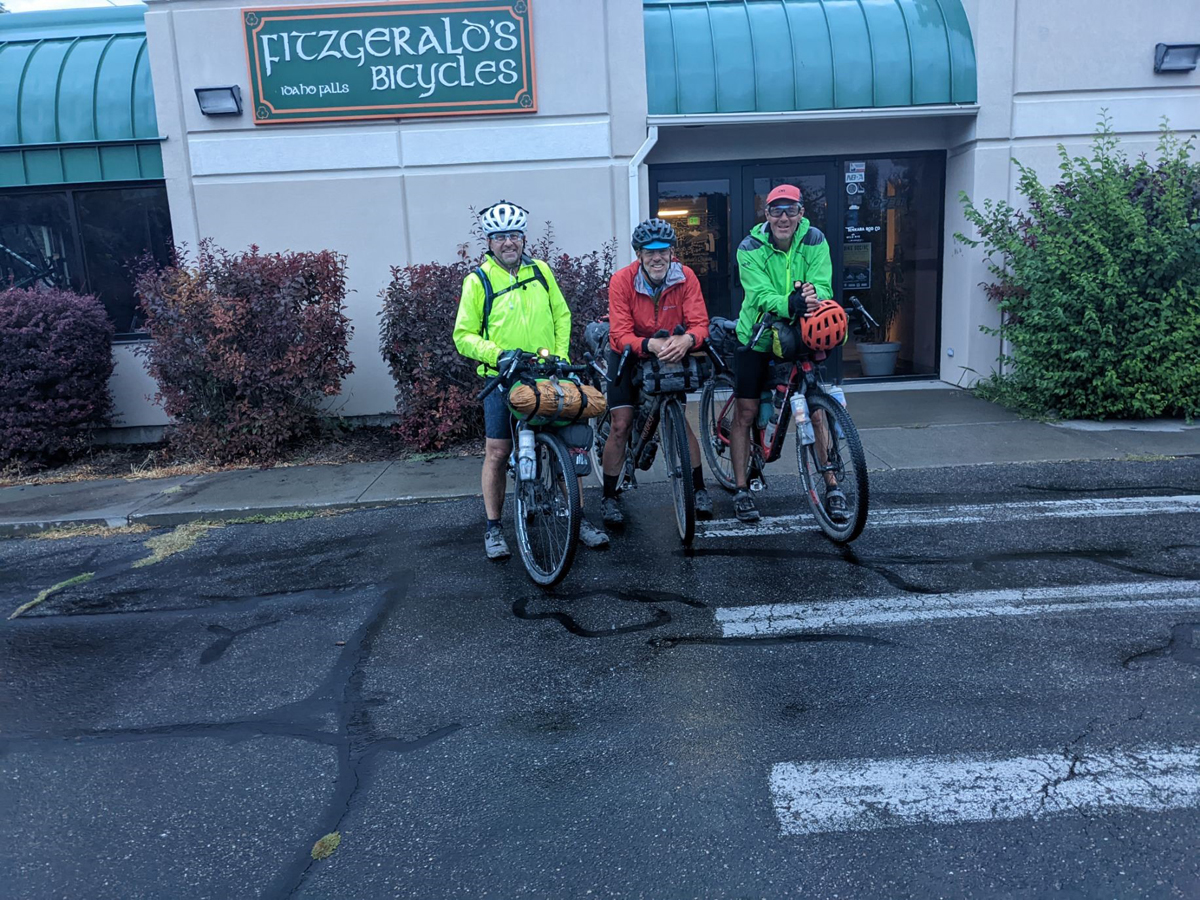
The racers gathered in the chilly morning air in the parking lot of Fitzgerald’s bike shop in Idaho Falls. The Fitzgerald crew was kind enough to have some snacks and, most importantly, coffee waiting for us. Race organizer, Kevin Emery, called everyone around for a brief talk before the start at eight o’clock. As with most of these races, there are no entry fees or prizes, though Kevin offered the winner a bag of Idaho potatoes. Self-support means finding your own food and water, though Kevin said he might pop up from time to time with a little ‘trail magic.’ Otherwise, you’re on your own in bike-packing races.
Without much fanfare, we rolled out on pavement heading south into farmlands and the nearby mountains. We shed layers as the day warmed up.
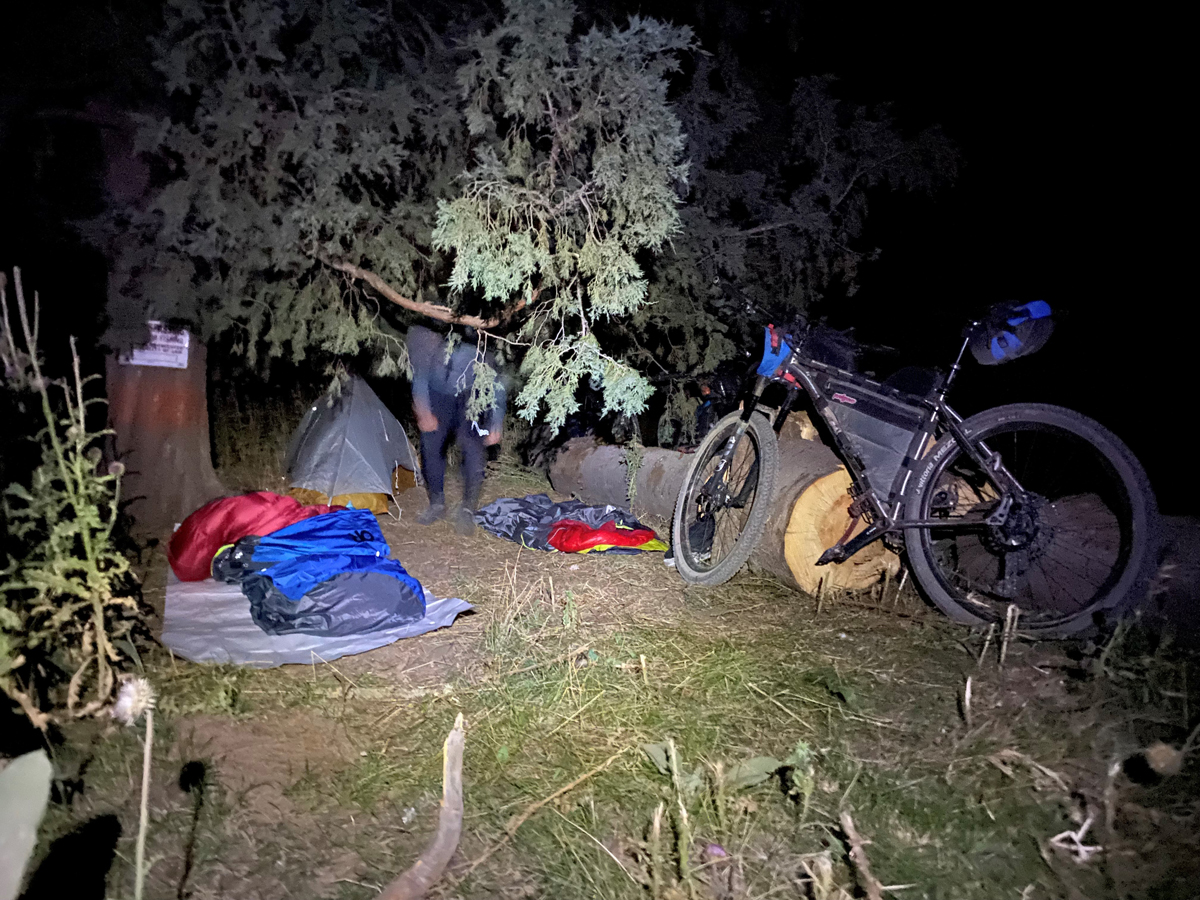
Camp one. The tired can’t be too choosy. Photo by Dave Fotsch
In races like this, you tend to find ‘your people,’ the ones who ride at your speed. After passing some and being passed by others, I was mostly on pace with Clint Boltz and Cody Heiner, both from Boise. I appreciate Clint correcting me as I got off course multiple times, a theme that resonated throughout the race. We decided to ride a few more miles together in the dark at a late-night dinner stop in Lava Hot Springs before collapsing exhausted into our sleeping bags. Our impromptu camp was a cow patty-splattered wide spot on the side of the road where someone had mowed down the tall thistle plants. We had covered 111 miles.
Cody was the first up the following day. The noise of him packing was my cue to get up and go, no matter how tired I was. It was about 6:00 a.m. Slowly we climbed the four miles to a summit that would’ve been a much better camp spot if only we had the energy to get there the night before. From there, it was a fun descent into the Gentile Valley, the nearly full moon and Jupiter still visible on the horizon.
I diverted off Cleveland Road unintentionally into the tiny town of Thatcher. I got a sighting of another rider going the other way. I think it was Jackson Long who ultimately won the race. I waved, but he didn’t. I sat on the Thatcher schoolhouse steps and had a snack. This town is one of the cross-over points on the route, where clockwise and counterclockwise paths converge. I had to backtrack less than a mile to get back on course.
One of the promises of this ride was the possibility of hot springs soaks at Lava Hot Springs and Maple Grove Hot Springs. Lava was out of the question because I got there so late. Maple Grove was hosting a special event and wasn’t open to the public. At this point, I had been leap-frogging with Brian Charette, who though faster than me, was on a more leisurely pace, stopping frequently to, uh, enjoy mother nature, shall we say? Regretfully, Brian and I filled our water bottles, gnawed on energy bars, and moved on. We had the big city of Preston to visit!
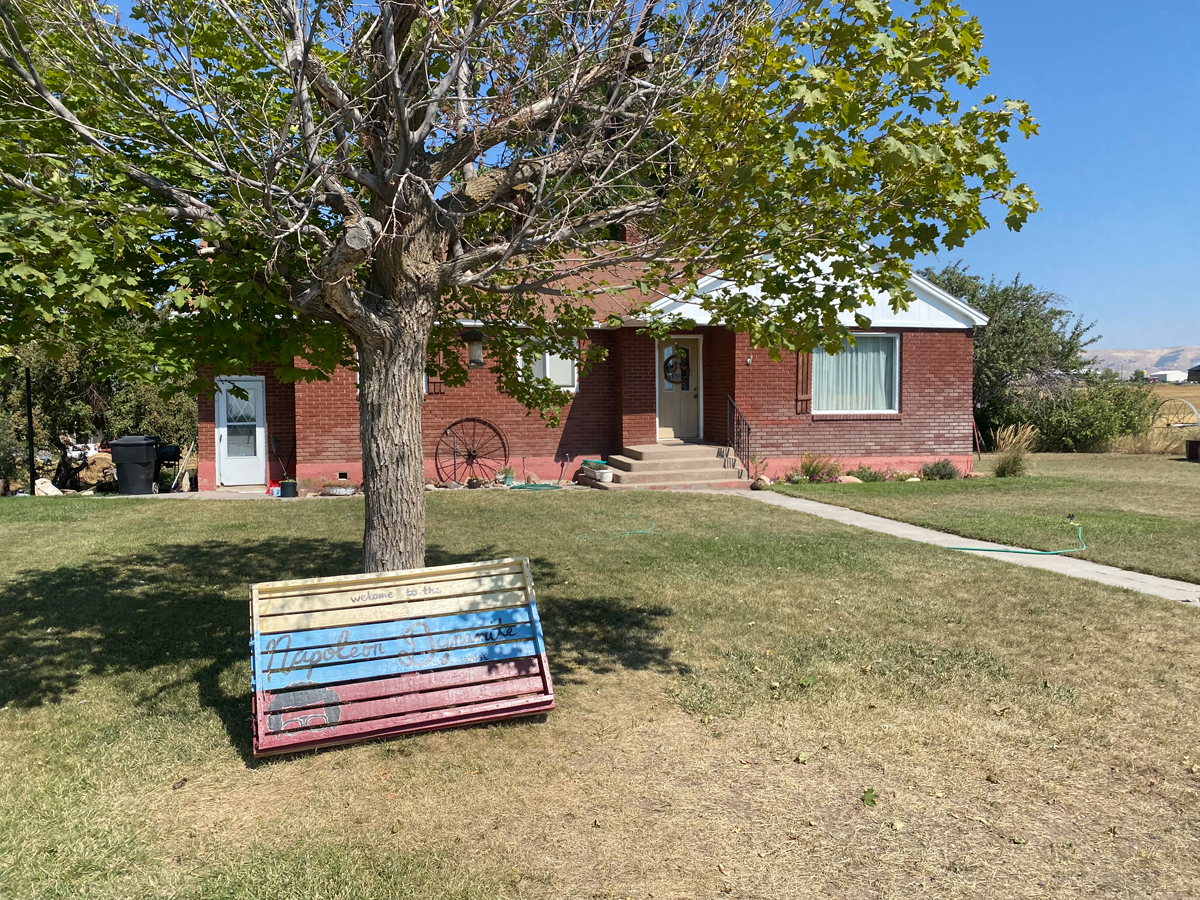
The Napoleon Dynamite house Preston, Idaho. Photo by Bryan Charette
Preston, Idaho, is famous for being the setting of the cult favorite movie Napoleon Dynamite, and that is all. The route intentionally passed the iconic house featured in the movie, though I missed it because I was too concerned about missing turns on the way into town. I was focusing on my Garmin and not the scenery. I caught up with Clint and Cody again, though we were at different fast-food restaurants.
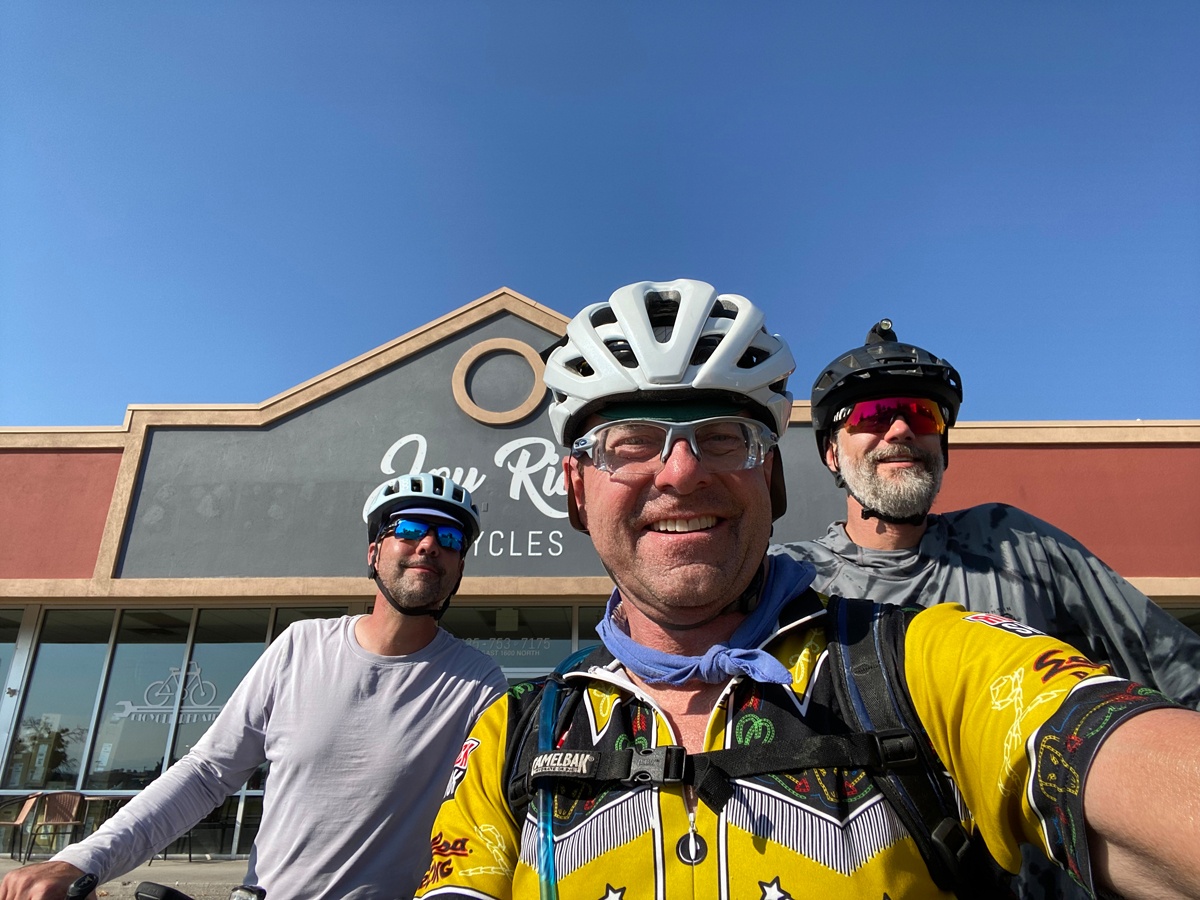
The author, Clint Brotz (l), and Cody Heiner (r) at the turnaround at Joyride Cycles in Logan, Utah. Photo by Dave Fotsch
The southern part of the route is flat and largely paved. It makes for fast travel, even if it isn’t as interesting. All around us was farmland. It’s a wide-open valley ringed by distant mountains. By 4:30 Sunday afternoon, we were at the turnaround point in Logan, Utah, taking selfies in front of Joyride Cycles. Nearby was a Mexican restaurant. I have a philosophy about eating on these kinds of adventures. When you have the opportunity for a sit-down meal, take it. You can only eat so many Clif Bars before you’re sick of them.
La Tormenta translates to The Storm, but to us, the restaurant’s name was The Torment. It offers genuine Mexican cuisine prepared by Mexicans, who hardly spoke English. While well-meaning, the cute teenage girls taking orders behind the counter couldn’t understand what we wanted. We were each asking for a meal to eat in, and bean and cheese burritos to-go. When the first bean and cheese burrito came out on a plate, Cody, who had done his mission in Ecuador, stepped in with his limited Spanish to try and explain. Eventually, we all got what we had ordered, and after a bit of a wait, our burritos to-go.
We made good time on the paved roads as the sun dropped in the sky. I got lost in Smithfield. I didn’t hear Clint yelling at me, and then I couldn’t figure out where he and Cody had gone. I wasted precious time going back and forth over the same roads until I found my way back onto the route. Damn you, Garmin! This getting lost thing was getting old. If only that had been the end of it.
It was nearly 8:00 p.m. when we rolled into Richmond. Needing a boost, we drank cups of strong gas station coffee. There had been foolish talk of trying to push onto Soda Springs, still some 90 miles away. I don’t mind riding in the dark, especially now that I have good lights, but my lights would long outlast my legs. We had already covered about a hundred miles at that point, so we lowered our expectations and targeted the Albert Moser campground only about 20 miles off in the Caribou-Targhee National Forest. We pulled into the campground late. It was nice to have a decent place to pitch a tent and a pit toilet! I had covered about 130 miles, more than my riding companions because of my wayward ways.
We awoke early again on Monday. Cody and Clint were packed and ready to go before me. I wanted to use the pit toilet before I left the campground. “I’ll see you down the road,” I said as I grabbed my toilet paper and A&D ointment and headed to the loo. That was a fateful mistake.
Don’t mess around with ordinary coffee, not after 10 hours in the saddle. Photo by Dave Fotsch
It’s not unusual to be tired and not thinking clearly after pounding out hundreds of miles in a couple of days. Well, I sure could’ve used a cup of gas station coffee that morning. From the campground, I turned left when I should’ve turned right. I thought things were going well as I cruised downhill. The road changed from gravel to pavement. Then I saw two things that made me slam on the brakes. A dead raccoon and a flashing sign for a nearby cabin. “%$&*!” I screamed to myself. “I went the wrong way!”
Last night, I’d seen that sign and the dead raccoon as we climbed to the campground. The same road looks so different in the daylight.
The road back up to the campsite. Photo by Dave Fotsch
There was only one thing to do – turn around. I’d only gone down the road about a mile and a half, but I had to reclaim the distance and elevation I’d lost before I could even start to catch up with my companions. I was hoping to join them on our second pass by Maple Grove Hot Springs, but sadly never saw them again.
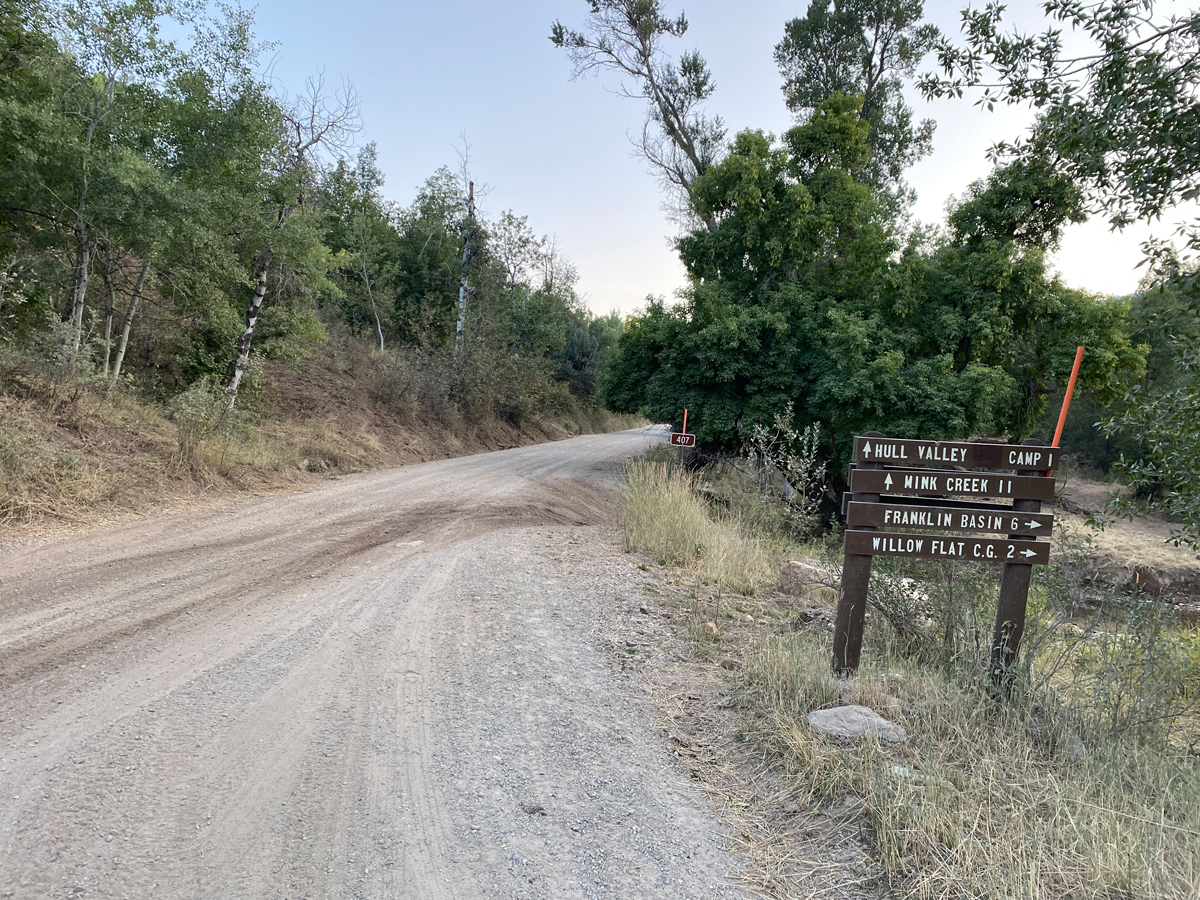
I followed the Birch Creek drainage into Mink Creek and picked up Highway 36 for a few miles before the turn-off to Maple Grove Hot Springs. As I was dropping into the Bear Creek drainage, I encountered a father and son from Utah. They were only doing part of the route, having started in Logan. The father, who was closer to my age, told me they had stayed in one of the cabins at Maple Grove.
“I don’t know when they clean the rooms,” he said. “But the door is open, and there are wristbands for the hot springs.”
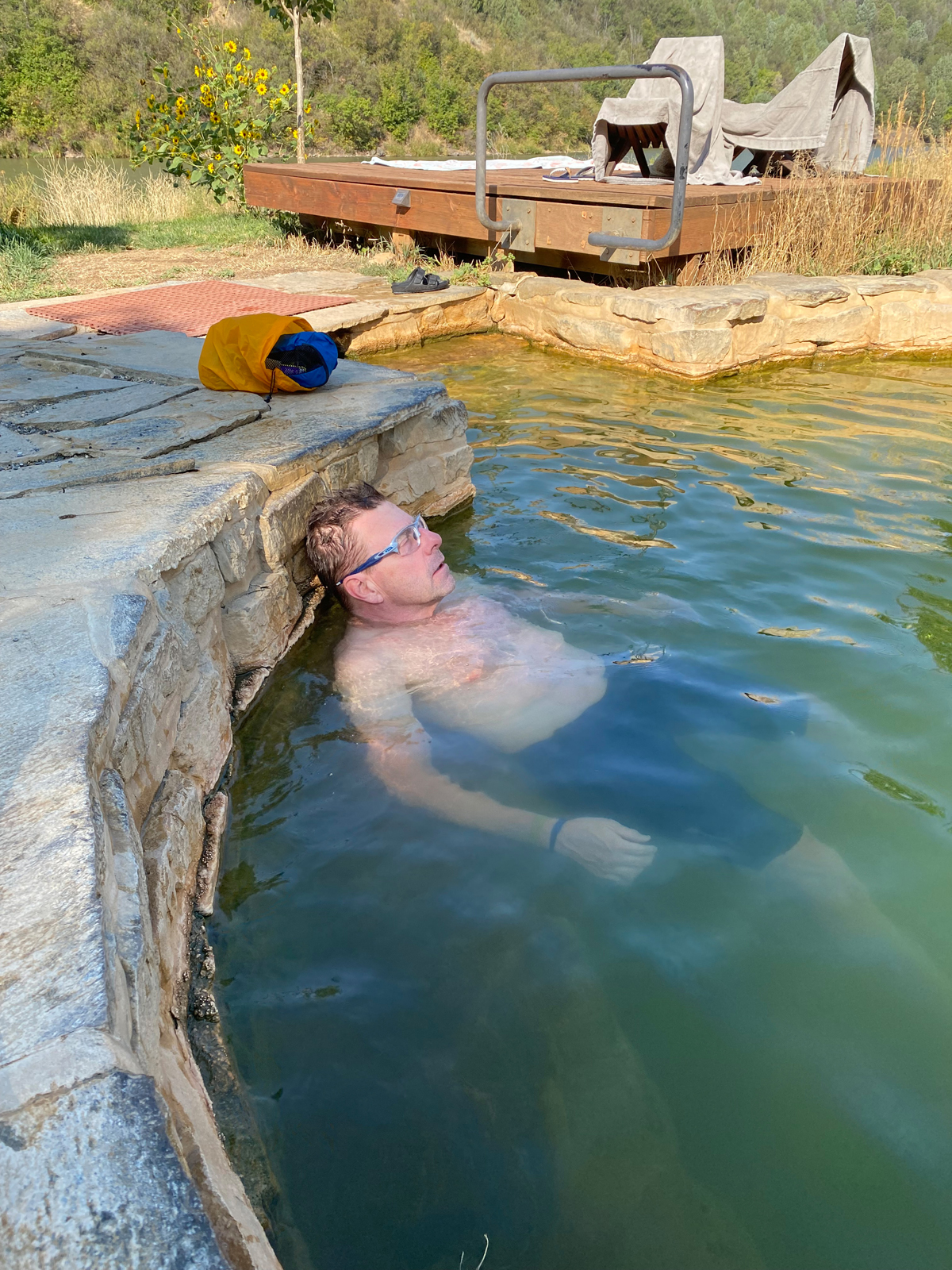
The author soaks away the pain at Maple Grove Hot Springs. Photo courtesy Dave Fotsch
That’s all I needed to hear. I was planning on soaking anyway. I was filthy from two days of dust and sunscreen. I eagerly covered the few miles to the hot springs. Just as he said, the cabin was open. I leaned my bike against the picnic table outside and got ready to soak. Clint and Cody were nowhere around. They later told me the place was closed when they got there. First, I went into the changing room and showered the grime off my body before getting into the big pool behind the main building.
A young woman was soaking nearby. I asked her if this was as hot as the pools get. She said there’s an even hotter pool close to the river. I gathered up my dirty clothes and headed that way. There I found two lovely middle-aged women, Linda, and Sondra. We engaged in some pleasant conversation, playing a guessing game, trying to figure out where we were from. I let the hot water purge my aching body of all the abuse it had suffered over the past few days while Sondra performed provocative stretches on the side of the pool.
Sufficiently soaked, I bid farewell to my newfound friends and returned to the cabin where I changed into a clean kit for the first time since Saturday, ate, and packed up to leave. The proprietor came around the corner just as I was zipping closed the last bag.
“I thought you guys already left.” I guess all cyclists look alike. “Oh yeah, it’s a long story,” I lied. “But I’m out of here now. Thanks for your hospitality.” I smiled knowingly to myself and hit the road.
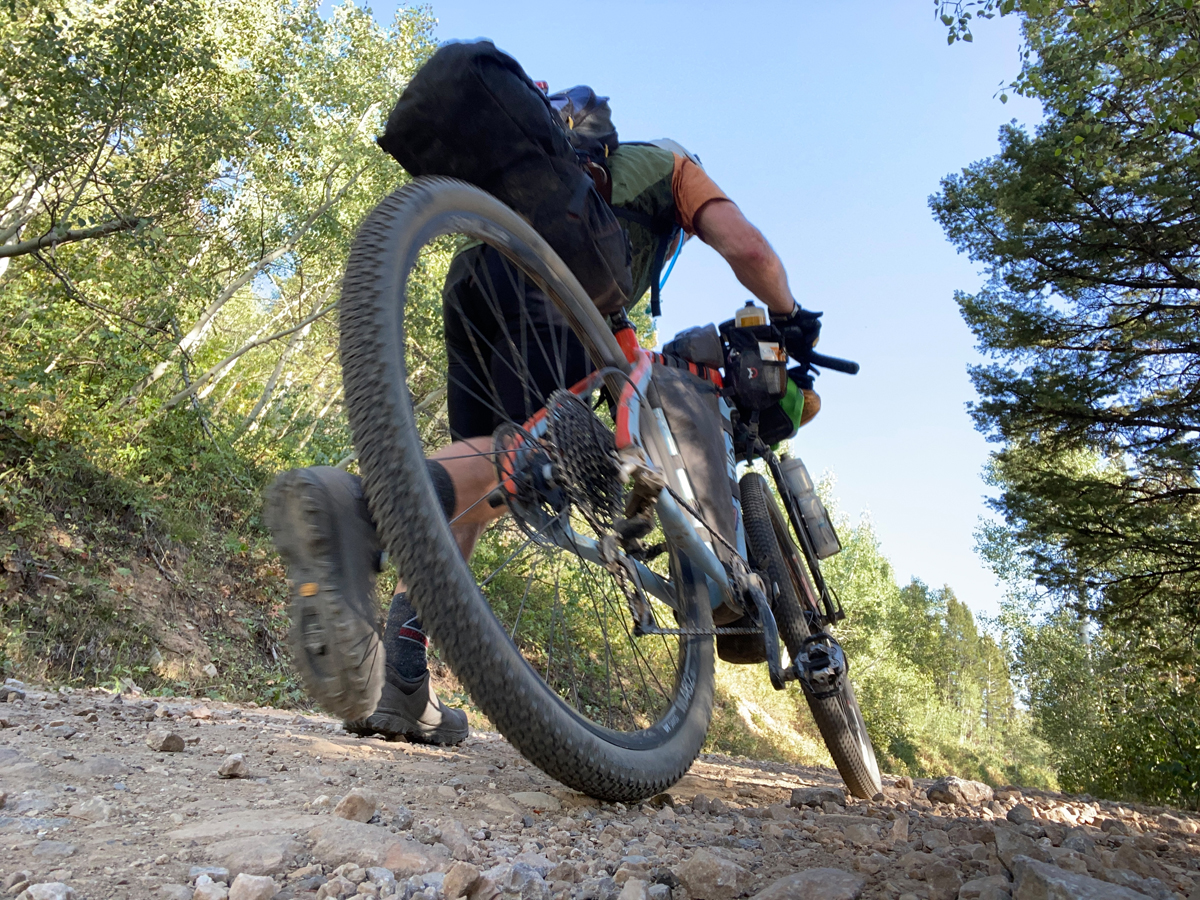
Dave pushing his bike… Photo courtesy Dave Fotsch
I passed through Thatcher again, this time going the right way, and pedaled to Bailey’s Market, where I feasted on Chili Cheese Fritos and Pepsi from the soda fountain. I topped off my water bottles and started what everyone said was the biggest climb of the route. It was as hot as it had been the entire weekend. It should be no surprise that there were a few wrong turns before the summit and lots of hike-a-bike sections. From the top, I dropped down to the other side. And then the stupidity happened.
I awoke at six Tuesday morning with a hangover. I was still out of sorts from being such an idiot the day before. There were roughly a hundred miles between me and the finish in Idaho Falls. The forecast called for overcast skies with a chance of rain. I texted my wife and told her I wasn’t sure I could go on. She offered to come and pick me up if I couldn’t go on. My friend Louie, who had finished the day before and spent the night in Idaho Falls, texted and offered to pick me up on his way home. I had options.
My ass hurt from the worsening saddle sores. Eventually, I resolved to give it a go. I made some really bad motel room coffee and started packing up. There was a lovely little café in town that opened at seven. I knew I’d feel better with a good meal in my belly.
Peter and Al were already there when I walked in. I ordered one of my favorite biking breakfasts, biscuits, and gravy with eggs over easy and lots of coffee. The three of us chatted about our adventures, past and present. I told the story of my stupidity the day before. They nodded, wondering what kind of joker was sitting across from them. They had ordered grilled cheese sandwiches to eat later. Brilliant, I thought, but I didn’t order one myself.
Peter, Al, and I rode out of town on a recreational trail that led to gravel roads on the relatively flat area south of the massive Blackfoot reservoir. We passed between a pair of cinder cones called China Cap and China Hat. From there, the route turned into the Caribou Mountains and more climbs.
For the first time in four days on the trail, my Garmin was giving me the information I needed all on one screen. I don’t know what I did to get it to display that way, but I sure wasn’t going to change anything. Peter and Al steadily pulled away from me until they stopped to eat their grilled cheese sandwiches. I was on a mission and told them I would keep going. I put earbuds in and cranked up the tunes. Head down; I pressed onward.
It was windy and cool, but the rain mostly held off until late in the day. With sporadic cell service, I got a message from Clint, who told me he wouldn’t be able to wait for me because he needed to get home. He had to work the following day at six in the morning. This news gave me something to think about as the miles added up. I had the rest of the week off, so I could probably take the Salt Lake Express shuttle back to Boise.
There are no resupply points on this final stretch. I still had plenty of nutrition onboard, so I wasn’t worried about that, but water became an issue late in the day. According to Louie’s beta, there were a couple of places where I could get water. I never saw the spring water pipe on Brockman Road (mile 366), but I stopped at Willow Creek, about 15 miles from the finish, and filtered enough water to fill two bottles. And then the rain started, light at first and heavier as I approached the finish.
The hills were unrelenting, and I cursed Kevin Emery. Wind turbines on surrounding hills spun in the increasing winds. I got to the top of the final climb and was relieved to see pavement leading into Idaho Falls. With less than ten miles to go, I tucked into my drops and flew toward Idaho Falls in light rain.
The finish of Fitzgerald’s Joyride 2022. Photo by Peter Yerger
Once the road flattened out, I pedaled furiously to get to the finish. At a stop light, I turned around only to see Peter and Al. I had probably given them time to catch up with me at the water stop. Jokingly, I asked them, “Hey, are you guys following me?” We rode together to Fitzgerald’s, where I was surprised to find Clint. He had been texting Louie and decided to wait for me, which was a huge relief.
As with most of these events, the end was anticlimactic. We took some congratulatory photos and then bid each other farewell. Clint helped me load my bike onto the car, and we hit the road.
I’d done it. With minimal training and no clue about what the route would throw at me, I had completed Fitzgerald’s Joyride. I didn’t die. I was tired and sore but felt a sense of accomplishment.
Every ride provides me with lessons, and this was no different. There’s a saying Louie is fond of sharing with me. You pack your fears. I had many fears because my bike was heavy, tipping the scales at 50+ pounds. On top of that, I wore a Camelback with two liters of water. I carried too much nutrition because I came home with some of it. My gear isn’t the lightest available. I took an extra kit when the faster riders get by with what they’re wearing. There is room for improvement.
And honestly, now that I’ve done the Fitz-Joy, I realize it would be possible to do this ride without any camping gear if you don’t mind riding only about a hundred miles a day. You could easily stay in a motel room in Lava Hot Springs, Logan, UT, and Soda Springs. It is possible to do the race on a ‘credit card tour.’ Just add food and water along the way.
I was the oldest registered participant in the event at age 64, which took a toll on my body. For days after the ride, I suffered numbness in my hands and feet. I had open wounds on my butt from the saddle rubbing me raw, despite regular applications of A&D ointment. Weeks later, the skin on my hands peeled despite having worn gloves.
These races are hard, but that is why we do them. If you don’t do hard things, you’ll never know what you can do. I love seeing new landscapes, even through tired eyes. I love the idea of being self-supported and the challenge of finding food and water. Though I might complain about it at the time, I love climbing hills and the sense of accomplishment at reaching the top. And who doesn’t love the free ride down the other side?
Completing an endurance event puts you in an exclusive group even if you don’t win. It’s tangible, real, and hurts, but it gets better, especially once you’ve completed a race. Most folks have more sense than to push themselves to extremes. And when people ask me why I do these races, the only answer I can come up with is not unlike the answer mountain climbers give when presented with the same question. We do it because it’s there. I can think of very few experiences in life that provide you with the challenges of an endurance race.
Will I do another race? Probably, I don’t know. I’ll have to see what comes along. I’m not getting any younger, so there is a finite window for challenging myself this way. I might also refocus on the bike touring that first got me into this crazy sport, taking a slower pace and spending more time smelling the roses. The one thing I know is that I will continue exploring by bicycle. It is the most rewarding thing I do.
By Tim Bochnowski — Second only to knee pain, lower back pain (LBP) is frequently cited as an issue cyclists encounter. There are many causes ranging from weak core muscles and disk issues to restricted sacro-iliac joints and poor bike fit. Cycling recreationalists and racers alike are susceptible and the exact cause of the back pain is often tricky to diagnose. The lower back contains an intricate system of muscles, joints and nerves. Understanding the complexities of this vital cycling body region could help prevent the injuries that are common to cyclist.
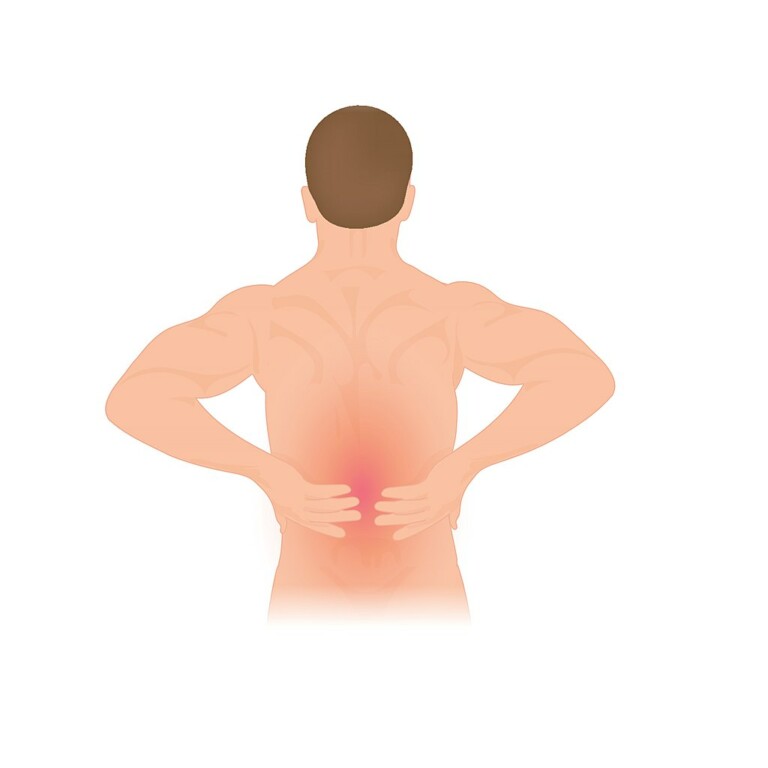
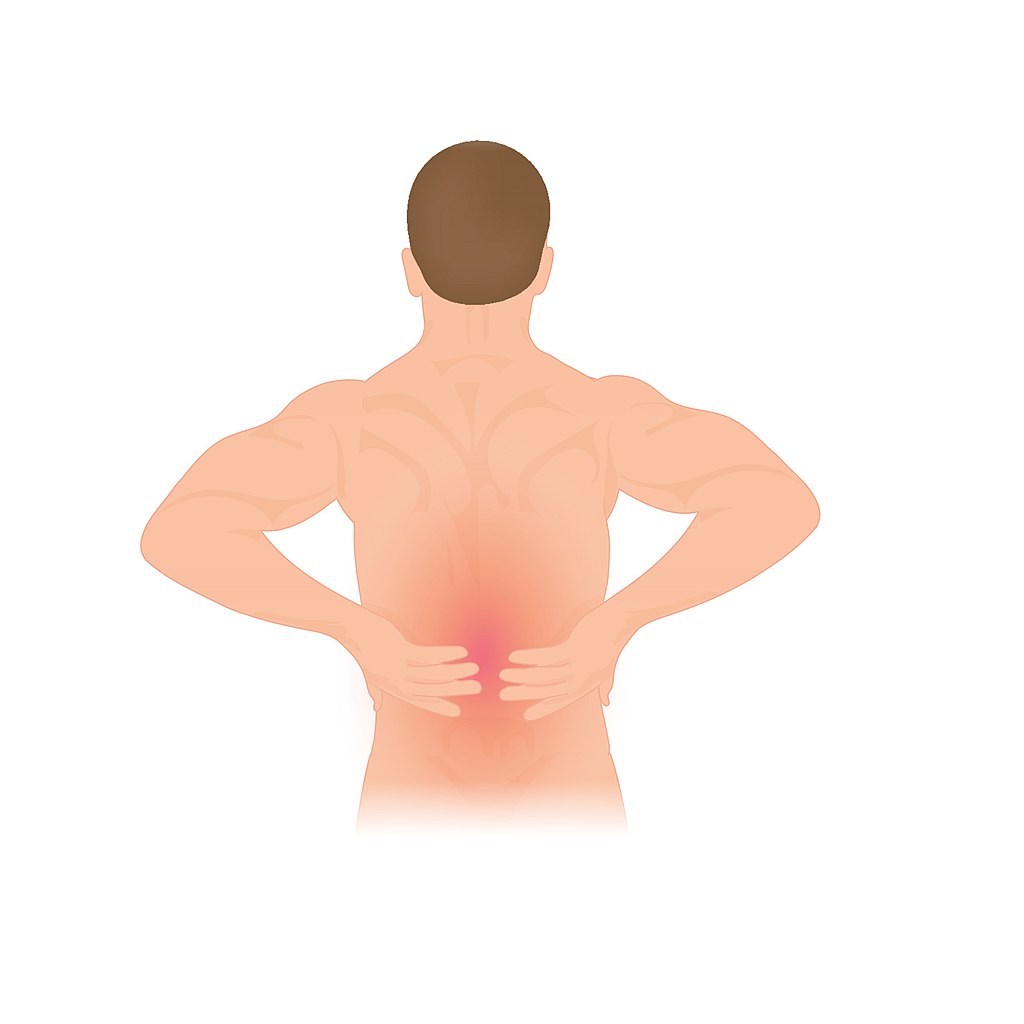
An illustration showing typical lower back pain. A common musculoskeletal ailment. Credit: InjuryMap – Free Human Anatomy Images and Pictures. This file is licensed under the Creative Commons Attribution 4.0 International
Aside from bike fit, there is a whole host of physiological issues that can cause lower back pain. Core strength and lack of flexibility is often identified as a culprit. Hamstring tightness, commonly seen in cycling, could pull the pelvis into a posterior tilt increasing the strains in the lower back muscles and ligaments. Also, the core provides a stable platform to absorb the forces created when pedaling. Simply put, the abdomen and back muscles provide important support of the spinal column while on the bike. A weak core may lead to unnecessary rotation and movement of the hips and spine. Stretching and maintaining or improving range of motion is a very important part of pain free cycling.
Other potential muscles that can be related to lower back pain include the piriformis, psoas and gluteal muscles. As part of the sacroiliac complex, these muscles, in addition to the hip flexors, are often overlooked. All four need to be kept long and loose. For example, the psoas is a hip flexor that attaches at the spine and if tight can cause stresses on the lower spine. There are many excellent websites that show how to correctly stretch these muscle groups. As always, if issues arise, seeking medical advice from your personal physician or medical professional is recommended.
Finally, age-related wear and tear, degenerative disks, scoliosis, muscle fatigue, spasms and overtraining can contribute to pain. As previously stated lower back pain encompasses a multitude of body systems. Fortunately there are trained professionals in medicine and bike fitting to help.
Holding a bent-forward (flexion) position for long periods of time while on the bicycle can cause the lower back muscles to become less effective at maintaining spinal stability and posture. Leg length discrepancies (LLD) are common with cyclist and can also cause issues with spinal alignment on the bike. Poor bike fit can make existing issues worse. Correcting mechanical adjustments of the bicycle can usually be administered by competent bicycle fitters, coaches and medical professionals.
Saddle and handlebar height, fore/aft saddle position and a variety of other adjustments are all in play when trying to remedy LBP. How you sit on your bike is very important. Having your spine in a neutral position (flat) by slightly rotating your hips forward could help you stop the prolonged flexion of your spine. A comfortable saddle horizontally positioned can also aid in comfort. In addition to a comfortable bike fit, stretching, deep tissue massage, physical therapy and a variety of other options should be considered for lower back pain.
Finally, riding style can have an effect on lower back pain. Pushing too big of a gear for long periods stresses your body and can activate LBP. Be conscience of your effort, gearing and posture while on your bike. Don’t over-train. LBP can sometimes be brought on by overall fatigue.
In the end, the importance of having a good bicycle position is recognized by cyclists. Comfort breeds performance. Keep working at improving your position on your bike and enjoy the ride.
Tim Bochnowski is a bicycle fitter and owner of Mountain Velo LLC, a cycling performance center located in Park City, UT. Tim started fitting bicycles in 1985 and has been trained by BIKEFIT, Slowtwitch, Retul and several other fitting techniques and tools. www.mountainvelo.com
Description: This recall involves Salsa Cowchipper, Salsa Cowbell, Whisky No.9 12F, and Whisky No.9 24F carbon handlebars. The model name is printed on the handlebar. The recalled handlebars were also sold with the Salsa Cutthroat, Warbird, and Warroad bikes. The bicycle model name is printed on the bicycle frame. The bicycles are sold in a variety of colors and sizes.
Remedy: Consumers should immediately stop using the recalled handlebars and bicycles, and bring the recalled handlebars and bicycles to a local bicycle retailer for free installation of a replacement carbon handlebar or an alternative aluminum handlebar.
Incidents/Injuries: QBP has received 37 reports of the handlebars cracking or fracturing while in use. No injuries have been reported.
Sold At: Specialty bicycle stores nationwide from January 2018 through August 2022 for the handlebars and from August 2018 through June 2022 for complete bicycles with the handlebars. The handlebars sold for about $240, and the complete bicycles sold for between $4,700 and $7,000.
Importer(s): Quality Bicycle Products GBC., of Bloomington, Minnesota
Note: Individual Commissioners may have statements related to this topic. Please visit www.cpsc.gov/commissioners to search for statements related to this or other topics.
By Charles Pekow — Helmet laws can reduce death and injury in youth, says a report published by the American Academy of Pediatrics (AAP). Bicycling causes more head injuries in children than any other sport, but most riders don’t wear helmets consistently despite their proven ability to reduce trauma, AAP’s research found.
The Smith Optics Forefront Helmet is a great choice for mountain biking. Photo by Lisa Hazel.
Helmet Use in Preventing Head Injuries in Bicycling, Snow Sports, and Other Recreational Activities and Sports says “a multipronged approach is needed to advance helmet use,” including legislation, enforcement of laws, and guidance from the medical community and schools. Safe Routes to School programs can include helmet promotion.
The study notes that 21 states and the District of Columbia employ mandatory helmet laws of for youth, though requirements vary by age. When the laws are properly enforced, they increase helmet use, but no Mountain West states require such use.
AAP based its conclusions on a review of existing research and found that programs offered by medical offices and schools also increase helmet use and safety.