Home Blog Page 97

A Woman’s Guide to Commuting to Work

0

By Tara McKee — In Europe, women lead the city biking movement and in many cities such as Copenhagen and Amsterdam, they clearly outnumber male riders. Fashion blogs such as Copenhagen Cycle Chic show how women in Denmark’s largest city dress for their commute, wearing dresses, suits, skirts, high heels and boots. Here in the states, big cities such as New York City have gone bicycle crazy, blending an eco-conscious style with the eco-conscious living. It’s chic to be seen riding a bike, so one might spot even models and movie stars riding their bikes around NYC or Beverly Hills.

The better the cycling infrastructure is in a community, the more likely women are to ride. Rocky Mountain states have made huge strides in the past few years, adding more miles of bicycle lanes and paths and widening road shoulders. More women are feeling more confident and ready to take the challenge of riding to work in Idaho’s Ada County or Wood River Valley as well as in Utah’s bike-friendly communities such as Salt Lake City and Provo. When communities strive to make the streets safer to ride on, they’ll find more cyclists taking to the streets dressed to impress, and not to duel with cars.

Want to take advantage of the greener and cheaper alternative to driving? During these fair weather days, it’s a great time to challenge yourself to give your gas-guzzling car a rest and make that commute to work by bicycle. Commuting needn’t be an ordeal, but you’ll want to assess the type of commute you have to make and choose the bicycle, clothing and accessories to make the ride an enjoyable one. If you’re headed to college, use your bicycle instead of a car to keep of the notorious “Freshmen 15” and save money at the same time. Whether your destination is work or school, you’ll want to learn the best places to keep your bicycle safe and secure. If you are comfortable locking it in the nearest bike rack, use a good quality u-lock. Many cities offer bicycle lockers for rent, as do some employers. Taking the bicycle right into your office may also be an alternative.

For tips on how to make a quick Wonder-Woman transformation from a biker into a credible executive, Cycling Utah will have a follow-up article on how to achieve a post-ride polish in next month’s issue.
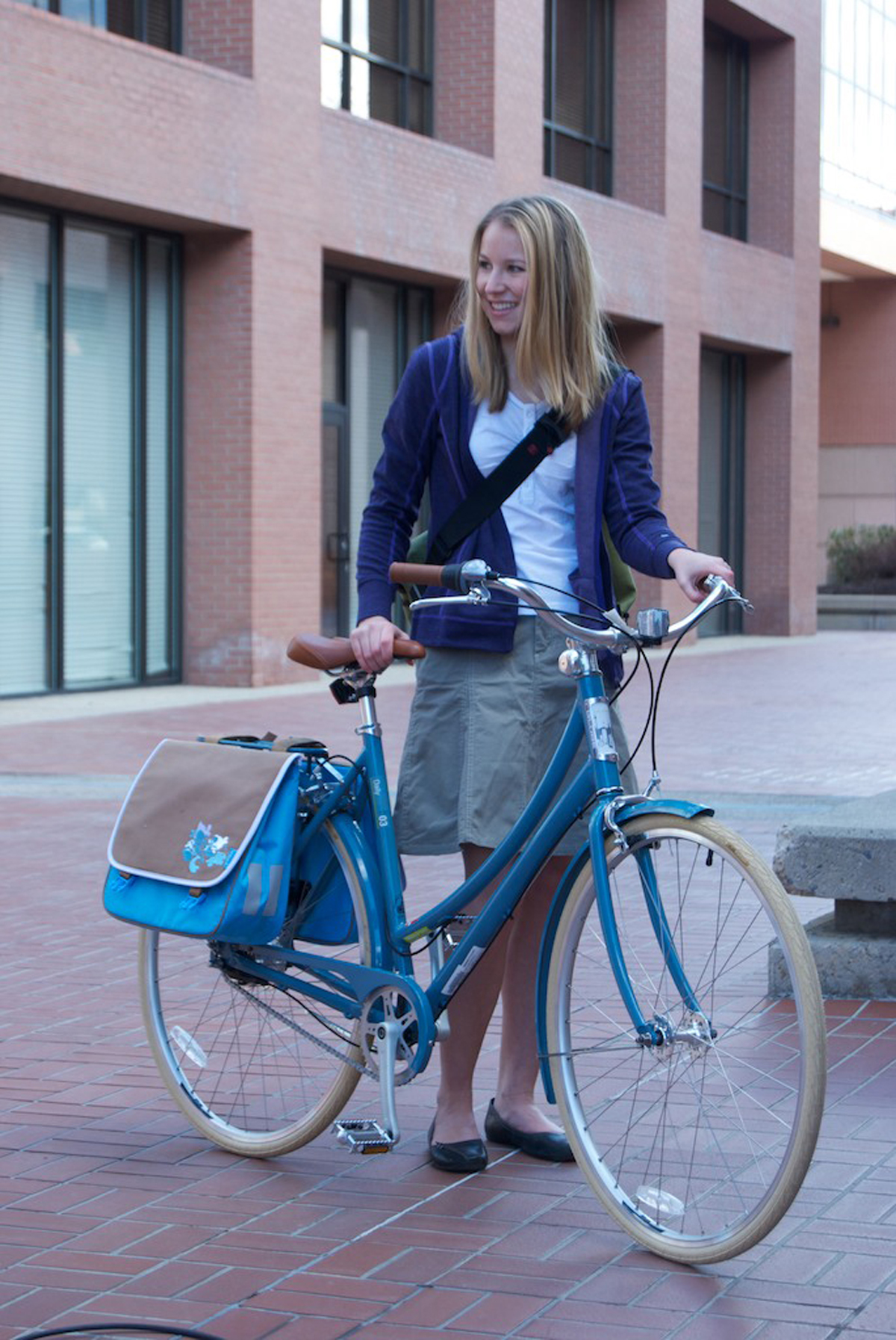
Panniers can be used to carry work supplies and extra clothing. Photo: Beth Runkle.

City Style Commute

The Route: Relatively short (4 miles or less) trip that is mostly flat and has good bike lanes or low-speed traffic route the majority of the trip. Often, this is a completely urban route for women who can ride from their downtown loft or apartment to work or shopping within the downtown area.

The Bicycle: An upright, comfortable “city” bike with a step-through (women’s style) frame, fenders, chain guard, maybe even skirt guard. Dutch-style bicycles, which may be a bit heavy for a longer commute, are perfect for such a trip! Vintage bicycles with a step-through frame are also fun to ride. (Steel frames make for a softer ride.)

Extra accessories: Have your bicycle equipped with a bell, a be-seen light to make you visible on a gray, foggy day or in low-light conditions. A basket fitting on either the front or rear of the bicycle is an absolute necessity for many women. Buy a nice basket that appeals to your sense of style and is large enough to carry a purse, perhaps a small shopping bag and a few other items. If your bicycle has a rear rack, you may want to add some panniers to carry even more items. Thankfully, panniers have come a long way from just basic black and many sport beautiful prints and colors.

Clothing: The beauty of the step-through bicycles with chain guards and fenders is that a girl can wear a pretty dress and heels or fashionable boots and wide-leg pants without worrying about damaging them. Wedge heels are a little problematic for pedaling but some women find that a spike heel nicely fits around the pedal.

Special Tip: Give yourself time to enjoy a leisurely ride. Ride at a slow pace so you don’t break a sweat. The best route by bicycle won’t be the typical car route. You may be able to ride through parks, along a bicycle pedestrian path and straight onto that pathway at the end of the cul-de-sac. Get a local bikeways map or use the Google map bike app to plan out your route.
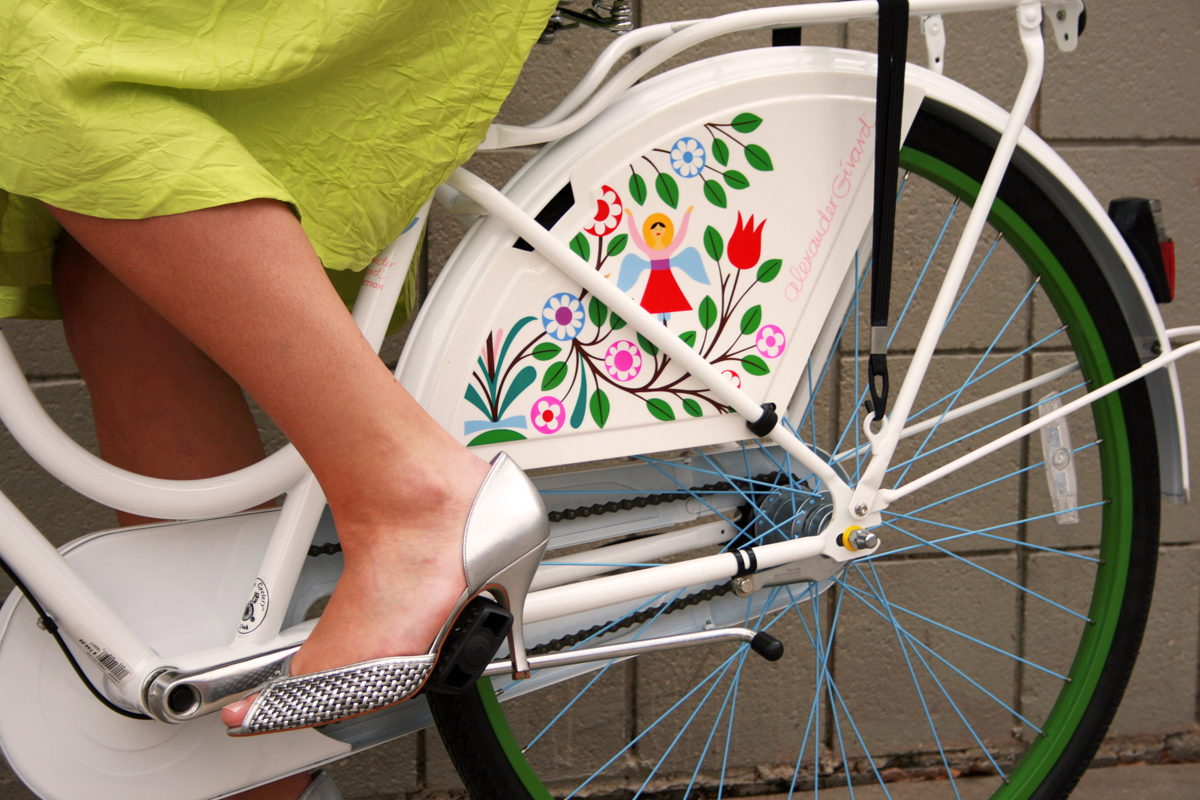
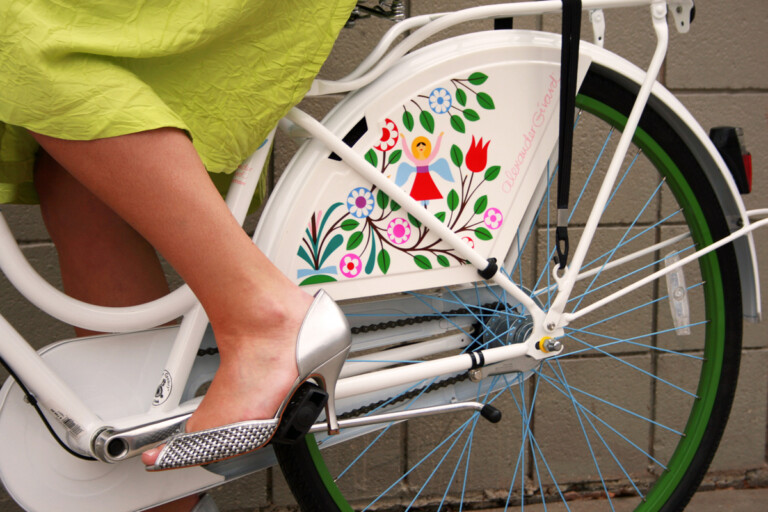
This bike has a chain and wheel guards to keep grease and water away from clothing. Riding in heels is possible for shorter commutes. Photo: Jessie Keller

Suburban Commute

The Route: A mid-length trip (about 4-10 miles) that may involve a little hilly terrain. Remember, the best route by bike isn’t always the same for a car, you may wish to go a little farther out of your way to avoid high-speed traffic areas or significant hills.

The Bicycle: The categories of bicycles that are called “commuter” bicycles are perfect for this. But any upright, comfortable, somewhat lightweight bicycle will work. Women can find bikes in this category with a step-through frame so wearing a skirt, dress or longer coat is not a problem. To protect your clothing from the occasional spatter from the road add fenders. Many “commuter-style” bikes have a chain guard so you don’t have to worry about the chain catching on your pant leg or staining them with grease.

Extra Accessories for the bike: To carry what you need, add a rack with panniers (those baskets or bags that fit on the rear rack of your bike) and/or a front basket will nicely hold your purse, lunch, and other items you’ll want to pack. If your load is easily carried in a messenger bag, you could alternatively take that instead.

Clothing: On some days or some commutes, one can dress as she would for work. Alternatively, a loose-fitting comfortable top can be worn then changed for a nicer one once at your destination. Wear comfortable street shoes and casual skirt or pants.

To Pack: You may just want to change from tee shirt into a blouse once there, bring or have at work small make-up bag and hair accessories for touch-up. Bring heels to change into if desired. If you are carrying a laptop on your commute, you should probably carry it in a messenger bag rather than panniers to protect it from occasional jarring as you hit a few bumps in the road.

Long Distance Commute

The Route: –A longer route of well over 8 miles that may have some hills.

The Bicycle: –A lighter weight bicycle to get up the hills and cover the miles is preferable, such as a hybrid, a commuter-style bicycle or even a road bike.

Extra Accessories for the Bike: –Have a rack installed so you can carry some panniers, a basket if you like, and front and back lights for the low-light of early morning and evening commuting. If you have to keep your bike on a rack, get a good U-lock to keep it safe.

Clothing for the Commute: Wear what you are comfortable in for the distance. A mix of casual clothing and technical clothing might be a nice and practical choice. Technical tops work well to wick away moisture. Merino wool jerseys will do the same on cool autumn days. Remember, once you remove the clothing that you biked in, you are removing 90% of the sweat. Bike shoes aren’t necessary unless you prefer them.

To Pack or keep in your desk at work: A complete change of clothing including shoes, facial and/or baby wipes to wipe off sweat, a small make-up bag, a brush, comb and curling iron or flat iron as desired. A little spritz from a spray bottle of a combination of leave-in conditioner mixed with water can be used to alleviate the compliant of “helmet hair.” Dry shampoo also does wonders. If you are packing your clothes in the panniers, roll them instead of fold them to reduce the chance of them getting wrinkled.
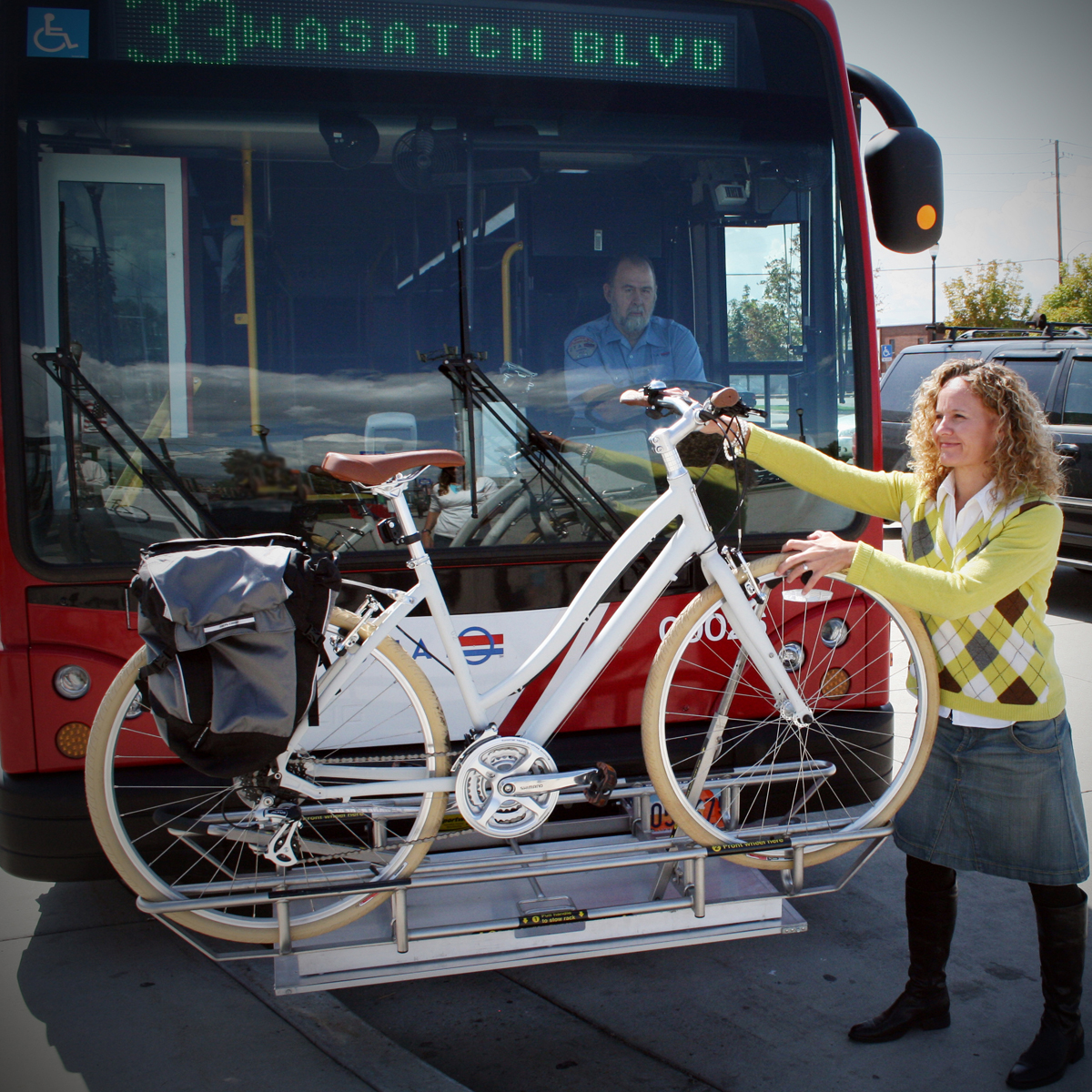
Combining bikes and public transportation is a great way to get to work. All new UTA buses will hold 3 bikes. Photo: Jessie Keller

Hybrid Commute

The Route: A long-distance commute made a lot easier by combining public transportation such as a bus or train or with your bike commute. This can include riding your bike to the terminal and locking it up on a rack or in a bike locker before getting on the public transportation or alternatively taking the bicycle with you; or even using a GreenBike in Salt Lake City to travel from the transit station to work and back. If the weather has suddenly turned bad or you have a hilly route home, use public transportation to make the homeward commute an easier one.

The Bicycle: It depends on the length of your bike commute, but a light bike that can be lifted onto the front rack of a bus with relative ease is practical. A folding bicycle may be more practical when there is no room on the train/bus for a bike.

Extra Accessories for the Bike or Commute: If you have a folding bike, you’ll want a messenger bag or backpack to carry what you need. Otherwise, have your bicycle equipped for the type of commute you have.

Clothing: Dress appropriate for the commute. If you have a folding bike, it will not likely have a chain guard, so wear an ankle band around your pant leg if necessary to keep it from catching in the chain.

Special Tip: It really isn’t difficult to get the bike onto a front-loading bike rack on a bus. To make it easier, the directions are literally spelled out on the stickers and first-timers would be surprised to find out how easy it is to put your bike on the bus and go! If you are taking your bike on the train, look for the specially marked train car which will be equipped for bike storage.
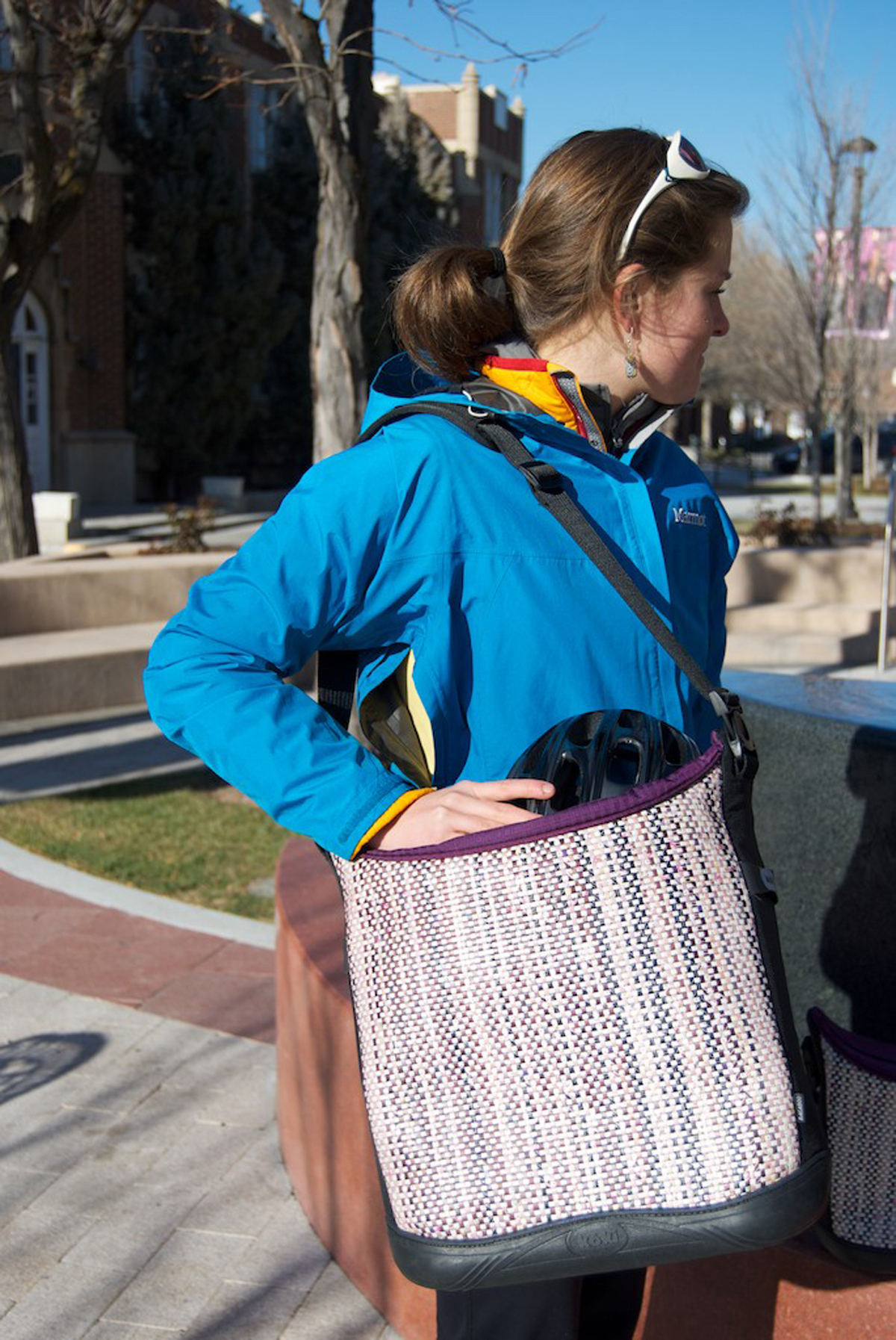
Shoulder bags are a good option for carrying stuff on a shorter commute. Photo by Beth Runkle.

Campus Commuter

The Route: Usually the route is a relatively short ride from apartment, sorority, dormitory or house to college or university campus. It may involve a hill, perhaps two, but usually nothing significant.

The Bicycle: Choose a bike that is a nice fit for student budget; nothing flashy to attract thieves, but just comfortable and nice enough that you will enjoy riding it. A step-through frame is easier for getting on and off the bicycle when wearing a skirt. If you have an older mountain bike that you are making over as your get-around bike, change the knobby tires for “Slicks”—smooth tires that will make riding on the pavement easier, smoother and faster.

Accessories for the Bike or commute: Buy a bike with a chain guard if you want to be able to wear wide-leg pants or not worry about the occasional chain grease on your leg. A good-quality, strong lock is necessary to deter theft. A fixed flat basket, in which books can be strapped in, can help balance the load so it isn’t all on your back. A front basket needs to be difficult for thieves to easily take off.

Clothing: Dress in comfortable clothing appropriate for class and the weather. A light, easily packable windproof jacket is perfect for stashing when no longer needed.

To Pack: Books, school supplies, and a laptop. You may already have a backpack that carries these nicely, but if you get a sweaty back from the backpack, a messenger bag may be preferable. Keep a small make-up bag and brush or comb for touch-up as needed.
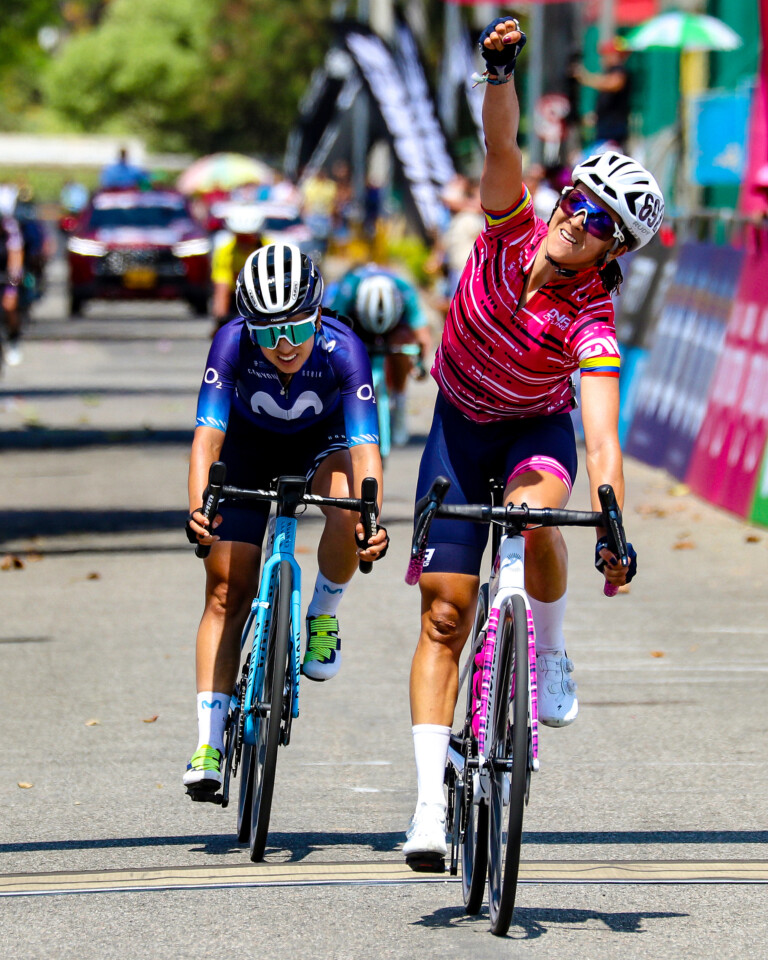
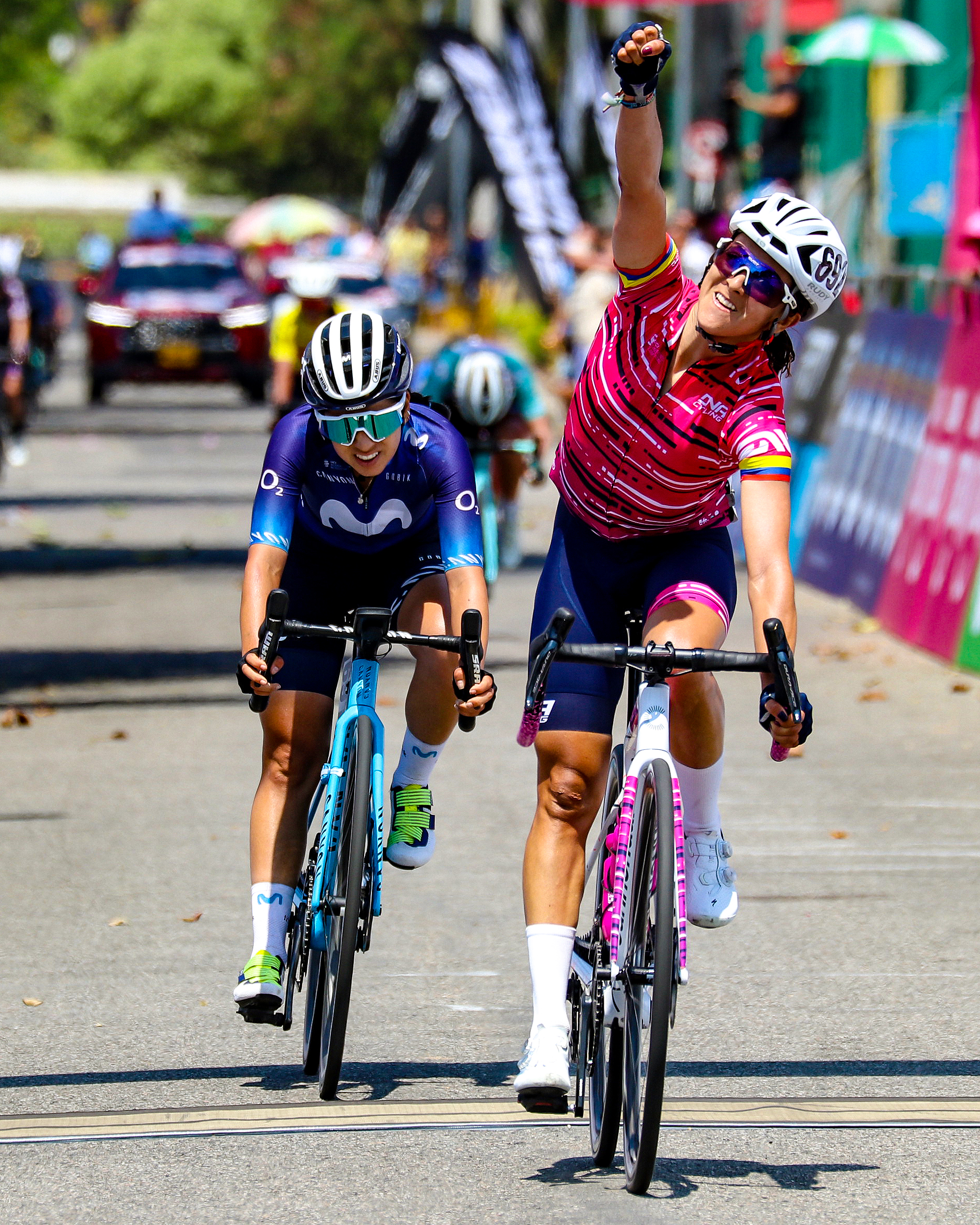
 

DNA Pro Cycling’s Diana Peñuela Defends Colombian National Title

BUCARAMANGA, Colombia (February 3, 2023) — Diana Peñuela rounded the final corner, outkicking Paula Patiño (Movistar Team) in a thrilling sprint to successfully defend her Colombian national road title on Friday. Peñuela’s win in Bucaramanga came a day after earning a silver medal in the individual time trial championship as the 36-year-old embarks on her second season with DNA Pro Cycling.  

Diana Carolina Peñuela (DNA Pro Cycling) successfully defends Colombian National Road Race Championship title, beating Paula Andrea Patiño (Movistar) in the final sprint. Photo Credit: Anderson Bonilla (@andersonbonilla01)

“There is nothing better than having the opportunity to represent the tri-color national champion jersey around the world,” Peñuela said following her second consecutive victory. “Last year, I put forth almost a desperate mental and physical effort, after coming so close for many years. The plan this year was to have patience, to know which break and attacks to control, and of course, to mark riders like Paula (Patiño) and Natalia (Franco), who are very strong.  I stuck to it, kept a cool head on my shoulders and everything turned out great.”

Peñuela spent much of the offseason training at home in Colombia, preparing for her first objective of the season. Much of the championship circuit was held on the same roads as the final stage of last season’s Vuelta a Colombia, where Peñuela won 4 stages and the general classification.

“December and January were good months for training with little rain, so I was able to put in a solid block of training … I knew it was going to be tough. I knew I had to have the speed to stay with multiple attacks, be able to climb with the best, and have reserves for the final sprint,” she said.

The victory came in the final 50 meters of the 118.5km circuit race that included 5 times up the Alto Parqueadero climb with an average 8% gradient. Towards the end of lap 3, three riders escaped– Lina Rojas, Carol Henao, and Karina Flores – this breakaway later grew to 10, with both Peñuela and Patiño joining. Natalia Franco, who races with the UCI WCC Team, was also part of this break. Franco broke away solo on the penultimate lap but was caught on the final climb before a remaining group of 8 raced to contest the finish.

“When you’re on your own in a race, versus with teammates, you must consider strategies and tactics very carefully. I’ve gained more experience each year, and with the pre-race direction from Cathy and Jack (DNA Pro Cycling directors), I was able to approach the race more calmly and with a plan,” Peñuela said.

The 2X Colombian National Road Champion will have the opportunity to race in her national jersey as she begins her 8th season racing professionally.

“This was my first objective of the season. Not only for my trade team, but also to be part of the Colombian National Team to race in the Pan American games,” she said. “I’m looking forward to an exciting season with DNA Pro Cycling, with upcoming races in the United States and Europe. I’m especially looking forward to supporting our new young riders and hopefully help them to secure results.”

Bikeshare Declined During the Pandemic, But Has Recovered

By Charles Pekow — Shared micromobility ridership took a big hit in North America during the first year of the pandemic but rebounded in 2021, according to a report from the National Association of City Transportation Officials. In 2021, “people took 47 million trips on station- based bike share systems, 62.5 million trips on dockless e-scooters, and 2.5 million trips on dockless bikes in the U.S.—a sharp contrast with 2020, when people took only 65 million trips across all shared micromobility modes,” says Half a Billion Trips: On Shared Micromobility Since 2010.

Bike share. Cartoon by Andy Singer

The pandemic caused a blip in growth of shared bike, ebike and scooter rides starting with a documented 321,000 rides in 2010, right after the concept was introduced. The 112 million rides in 2021 still fell below the peak of 136 million in 2019.

See https://nacto.org/wp-content/uploads/2022/12/2020-2021_shared_micro_snapshot_Dec7_2022.pdf.


Cargo Bikes Can Do More Than Most People Think

By Charles Pekow — The potential of cargo bikes lies largely untapped. Electric Cargo Bikes in Urban Areas: A New Mobility Option for Private Transportation says “adoption of e-cargo bikes as a valid transportation mode is still very limited worldwide. Although cycling has been pushed as a sustainable mode of travel in cities by multiple organizations and governments, cargo cycling has not been part of the conversation.”

Cargo bikes are cleaner than trucks when moving goods from one place to another, especially short distances. Photo by Dave Iltis

Electric cargo bikes can help riders carry a lot of weight, but a variety of factors are keeping use down, from cost to safety concerns to how far you can go on a charge and lack of appropriate infrastructure for riding and parking, says the study, published in Transportation Research Interdisciplinary Perspectives.

The study looked at previous research which stated that the typical cargo ebike user is young, well-to-do and male. Other demographics didn’t seem interested. Studies differed, however, in reporting the percentage of users were likely to own a car. But users generally expressed concerns about the environment as a motive for riding.

Previous studies also differed in how far riders typically went and how much time they spent on the bikes. Frequency of trips depended on the use. Few of those who used cargo bikes on a sharing system use them more than once a month. Frequency ranged for those who owned their own, just like it would for those with conventional bikes, from monthly or less to nearly daily.

See: https://www.sciencedirect.com/science/article/pii/S2590198222001658


Kickstands: A Primer

By Lou Melini — Mention a kickstand to a bike snob and you will most likely receive a very succinct unflattering response. However talk to someone with a loaded touring bike, or a commuter bike that is about to have its’ panniers packed with groceries and you will be told about the utilitarian necessity of a kickstand. I know you are going to say that I could simply lean my bike against something. By saying that, it shows that you have never used a kickstand. Once you use a kickstand for a period of time you will find that it becomes a needed accessory.

The insults thrown at kickstands have resulted in an absolute dearth of kickstands in stock in an American bike shop save the rare bike shop. In Germany I measured 12 square feet of display space allotted to kickstands in a very large bike shop. Probably 70% of the 2000 bike inventory in that shop was made up of heavy bikes that came standard with lights, racks, fenders and kickstands, so having after-market kickstands in that environment was not only appropriate but a necessity. Ask an American bike shop employee for advice or a recommendation for a kickstand and you will probably receive a shrug and be shown a page in a Quality Bike Parts catalog. My son laughs when I get excited over purchasing a new kickstand. I have used 3 styles of kickstands over the years, which I believe constitute all categories of kickstands. There are some minor variations within each category.

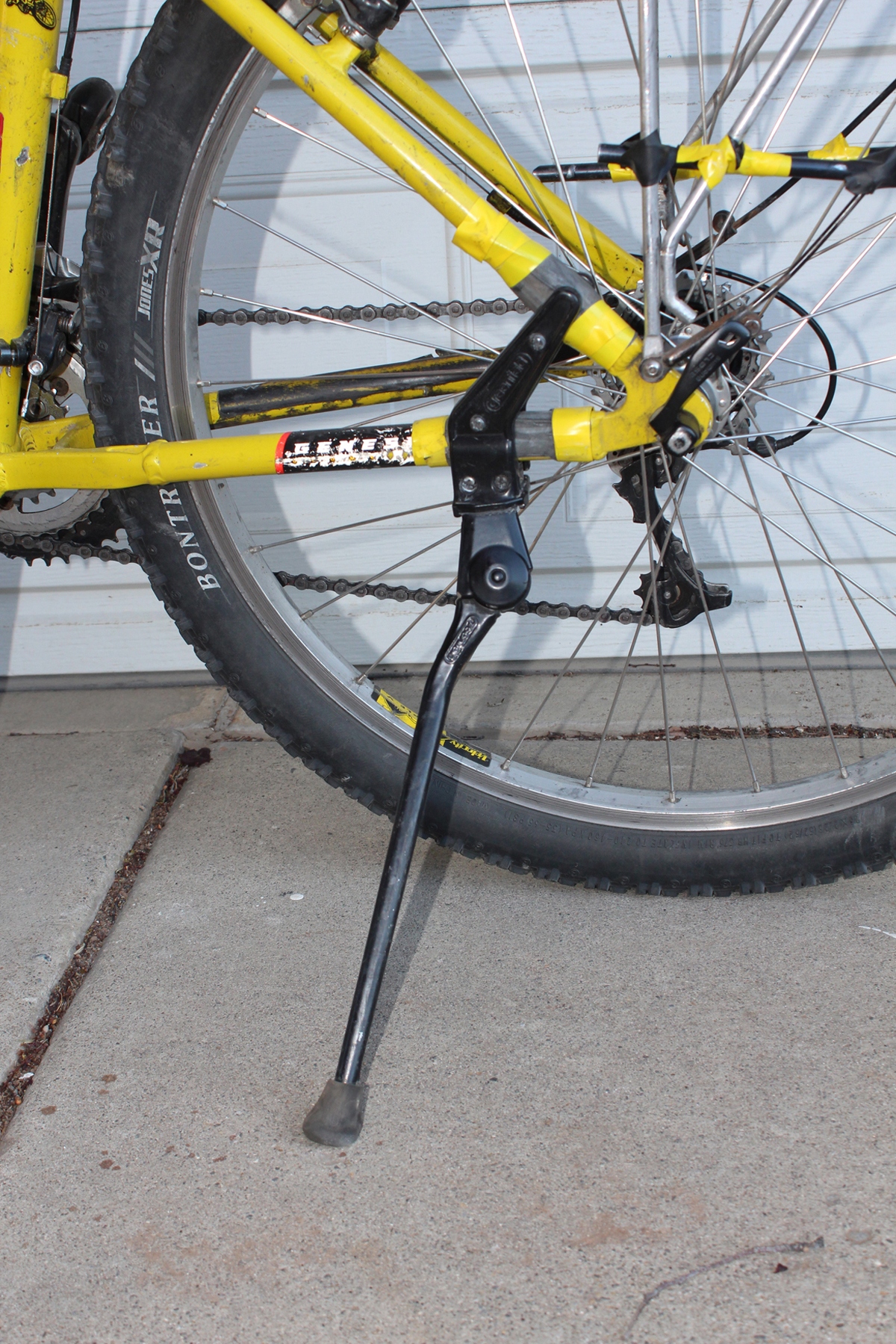
Greenfield Rear Kickstand. Photo by Lou Melini

The first style kickstand I ever used is rear mounted. Basically this clamps to the seatstay and chainstay of your bike via 2 arms and several screws. This is the easiest to use. Simply flick the kickstand arm down with your foot and lean the bike. You can buy adjustable and non-adjustable legs but I personally do not have a preference, as both seem to work well. I have packed over 50 pounds of groceries in my rear panniers and on the rack without a problem. You will need to pack the kickstand side pannier first. There are a few downsides of this kickstand. If you want to mount a Burley style trailer to your bike the kickstand will get in the way. In addition, disc brakes may make the distance between the stays of your bike too wide for this style kickstand. There is really no maintenance except an occasional need to tighten the screws. Locktite will help. I have used a Greenfield brand (non-adjustable) and a TranzX kickstand; each of which cost me around $17.

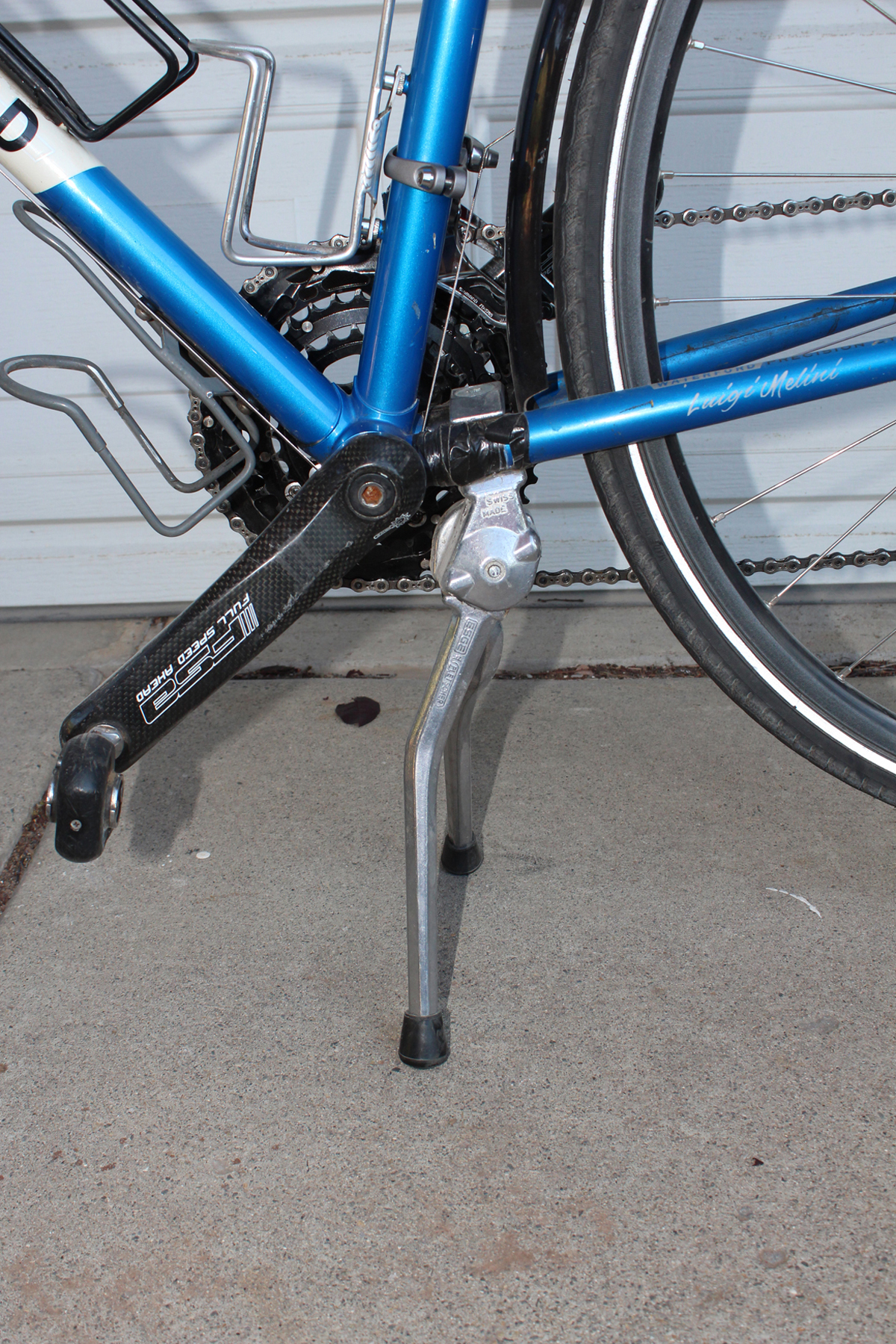
Pletchser under bottom bracket. Photo by Lou Melini

The next style I purchased for my touring bike fits under the chainstay. It has 2 legs that swing down stabilizing the bike in a vertical position. This kickstand clamps to the top and bottom of your chainstays in front of the rear tire. For this style of kickstand you push down the legs of the kickstand and then lift the bike onto the extended legs. The primary advantage of this style is that I can work on my bike for routine maintenance during an extended tour. It is quite stable with the 45 lbs of camping gear carried in my front and rear panniers and on the rear rack. My kickstand is Swiss made Pletscher model so it is a little pricey at $45 but I figured that being able to work on my bike was worth a little extra and Swiss quality isn’t cheap. I did assume wrong that Swiss quality would make it indestructible as the return spring broke after about 7,000+ miles. There is also a Greenfield kickstand that uses similar technology that I have not used.

The legs of the Pletscher kickstand have markings up to 300mm. You then cut the legs to fit your bike, though I am unsure if this is absolutely necessary. Simply measure from the middle of your chainring bolt to the floor (270 mm for my touring bike) and cut the legs at the 270 mm mark (my bike) on the kickstand legs. Rivendell bikes (www.rivbike.com/product-p/k21.htm) have a detailed instruction on how to cut the Pletscher kickstand. Rivendell also have rubberized mounts (to protect the chainstays) and “feet” for the kickstand legs. You can also use handlebar tape or an old tube to protect the chainstays and for the legs you can buy 0.5 inch rubber furniture “feet” (from Ace Hardware). You can also buy a single leg under the chainstay Pletscher kickstand.

Using this kickstand as a work stand or using it to keep the bike upright while changing a flat tire is remarkably more convenient when touring. It beats turning the bike upside -down or finding a low branch to hook the saddle to. I do have to carry a separate 6mm wrench for the kickstand, as my multi-tool is too bulky to fit in the tight space. My wife’s kickstand seemed to come loose too frequently, but has not come loose since I reinforced the kickstand body to the chainstay bridge with zip-ties.

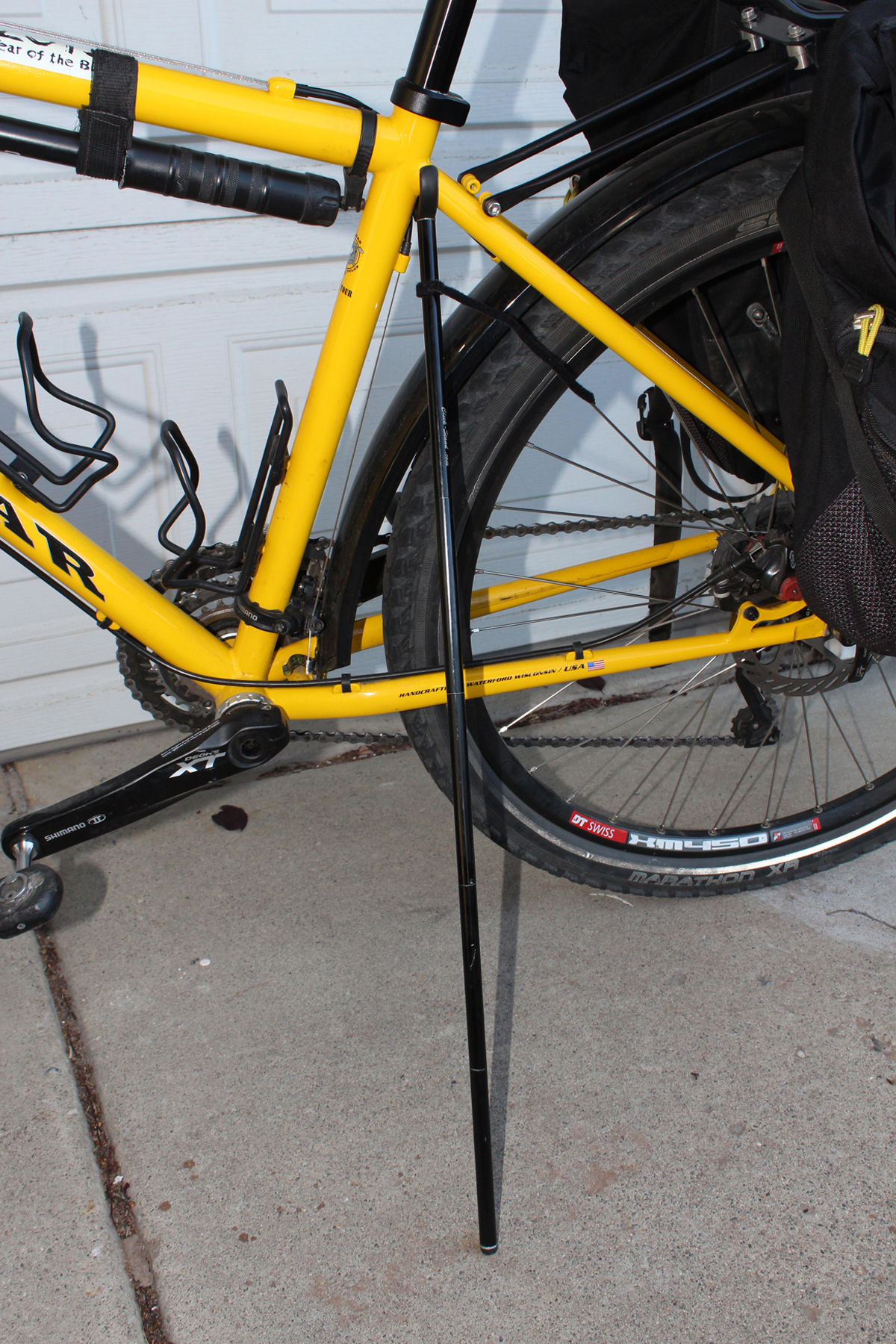
Click-stand. Photo by Lou Melin

The third style of kickstand I needed to purchase because my new commuter bike doesn’t accommodate kickstands, a story as to why I can discuss over a cup of coffee sometime. So if you have a bike that will not fit either of the above styles of kickstand then you will need a non-attached bike stabilizer. (Or if you want the function of a kickstand but wouldn’t be caught dead with one on your bike) The Click-Stand (Click-Stand.com) is basically a tent pole with a U-shaped attachment. The “U” is placed under the top tube or some other part of the bike and the bike leans into the tent pole. I’ve had a number of European bike travelers that have made their own bike stabilizer. The Click-Stand that I have folds down to 6 inches. It works well. After receiving it I had a large grocery list that I confirmed the weight to be 50 pounds. The entire shopping load was put into my panniers and strapped to the rear rack. With a bit of skepticism, one small adjustment, the bike held up. Good product!

I purchased my Click-Stand.com for $38. Prices vary a little for the lighter or heavier duty model (I have the heavy duty) and if you want a 4, 5, or 6 piece Click-Stand. Other than length, I’m not sure if there are any advantages for the 4, 5, or 6 piece lengths. I bought the middle-of-the-road 5-piece length which cost and extra $3 over the 4 piece. You can also buy an accessory to mount the Click-Stand to your water bottle bolts.

The website provides a detailed instructions on how to measure your bike when purchasing the Click-Stand as each are custom made for your bike. Tom at Click-Stand is very customer service oriented and will help you. The key to the stability of the Click-Stand is keeping the front brake engaged when using the Click-Stand. You will be sent 3 small bungee-cord loops to secure your brake with your order. Obviously this is the least convenient of the 3 types of kickstands that I own. I remove it from my pannier, assemble the shock-corded pole pieces similar to a tent pole, place it appropriately under my bike, and then lock the front brake. The Click-Stand is well worth the small amount of time to engage it, perhaps 10 seconds, for a simple quality product.

Be bold, trend setting and practical. Get a quality kickstand for your commuter or touring bike.

Representative Brad Daw Commutes Through Utah County

By Turner Bitton — After the close of the 2018 legislative session I caught up with Representative Brad Daw to talk about his experience as a commuter cyclist and legislator. Representative Daw has represented District 60 in the Utah House of Representatives since 2005 with a two year period between 2013 and 2015. District 60 is largely compromised of Orem and has historically been an area with significant growth.

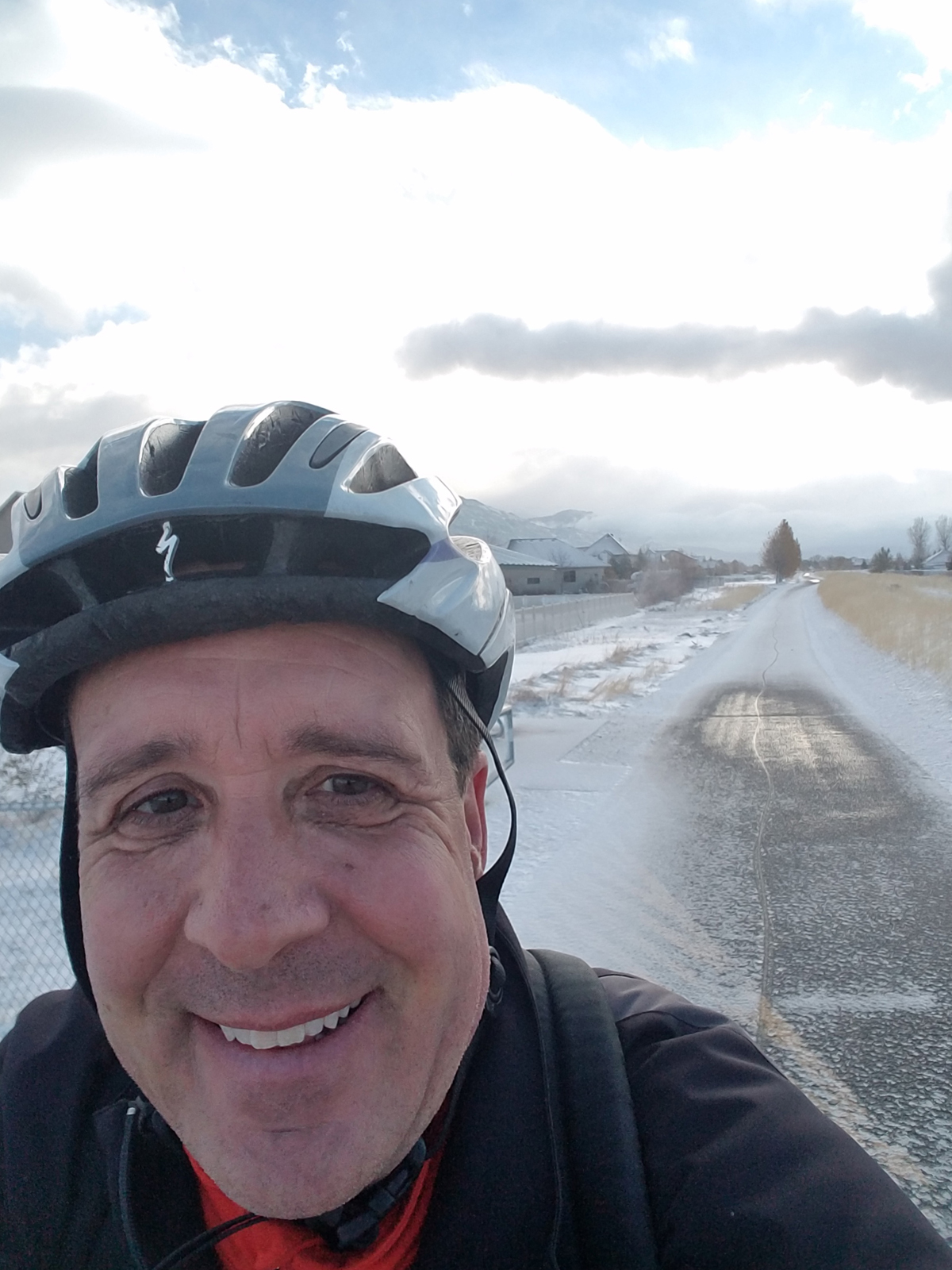
Brad Daw commutes to work in Utah County. Photo by Brad Daw

Representative Daw has developed an interesting profile as a legislator and is known for working on policies ranging from the regulation of payday lenders to medical cannabis. He serves on the Higher Education Appropriations Subcommittee, House Government Operations Committee, House Health and Human Services Committee, Health and Human Services Interim Committee, and the Law Enforcement and Criminal Justice Interim Committee.

Here is our discussion.

Cycling West: You have a reputation for being a cyclist and supporting cycling issues on Utah’s Capitol Hill. Is it accurate to say so? Can you share your personal experiences with cycling?

Brad Daw: I do support cycling issues. Like any other legislation there’s always a balancing act, but in general I want Utah to be a place that welcomes and supports cyclists.

I have a bum knee from a severe childhood accident so running is off the table for me. But fitness is important to me and I wanted to embrace an activity that would challenge me without causing undue wear and tear on my knee. Bicycling turned out to be the ideal solution.

CW: I understand that you commute to work by bicycle. If this is true, what route do you take, and what is your motivation for commuting by bicycle?

BD: I do ride in to work more or less twice a week. My ride is the Murdock Trail from on end to the other. It is pretty ideal that I live in Orem and Adobe is at the other end of the trail. I like the commute for numerous reasons but the for me commuting is a great twofer. I get to do something productive beyond just having a workout. I get to actually get somewhere that I need to be for the day.

As a side note, I do not ride home. 20 miles in a day is a good workout for me. I take the FrontRunner home.

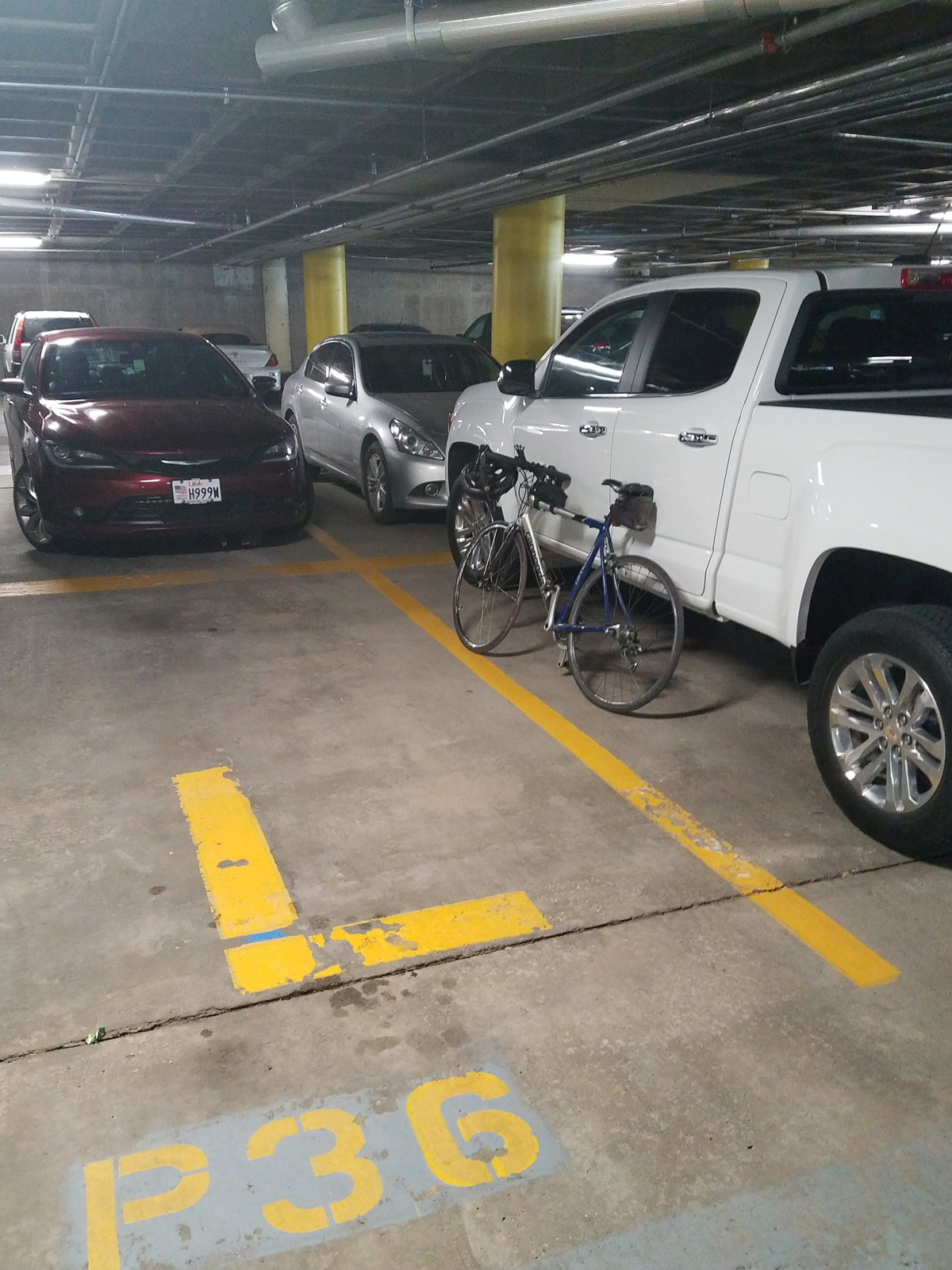
Brad Daw’s bike parking spot in the Utah State Capitol Building. Photo by Brad Daw

CW: I know that you live in Utah County but have you ever commuted to Capitol Hill by bicycle before?

BD: I did once this last session. I think I sent you the route I took in Strava. It was a 47 mile ride and I had a great time doing it. Here’s my bike in my parking spot at the capitol.

[Editor’s Note: Utah’s Idaho Stop Bill passed and was signed into law in 2021 and is now in effect, but without the red light portion which is covered in part by another section of the code. Cyclists can go through red lights after waiting for 90 seconds in certain circumstances.]

CW: During the legislative session the Utah House of Representatives passed House Bill 58 – the so-called “Idaho Stop” – which allows cyclists to treat stop signs as yield signs, and stop lights as stop signs. You voted for the legislation and I’m wondering if you have any thoughts on the bill.

BD: Well I just did it this morning. The fact is that if the road is clear I have no problem crossing and I do it all the time.

CW: You have served in the legislature since 2005. Do you feel the environment related to cycling issues has changed? If so, how and what has the impact been on cycling issues?

BD: There’s much more of a push on two fronts. One is simply clearing the way for more long distance bike paths like the Murdock and Jordan River Trail. And there is also more of an awareness of competitive cycling. The Tour of Utah is becoming a very big event and I hope it leads to more events both amateur and professional.

CW: Lastly, are there any issues or legislation you expect to see in the 2019 session related to bicycles? Do you plan on sponsoring any specific legislation related to cycling? Is there anything you would like to share with your constituents or our readers?

BD: I’m not aware of anything specific. Most of this seems like it would come under the heading of community and economic development. But if there needed to be some legislation I would most likely want to help it along.

I’ve always loved biking and hope to be able to do it for a long time and would encourage your readers and my constituents to get out and give it a try.

If you have an idea or individual subject for a commuter column in the West, please email [email protected]

Old Man Winter Gravel Race and Run Set for 2-5-23 in Lyons, CO

Now in its 9th year, this ‘Epic Winter Adventure’ has become the annual kickoff event for adventurous runners and riders from all over the country.

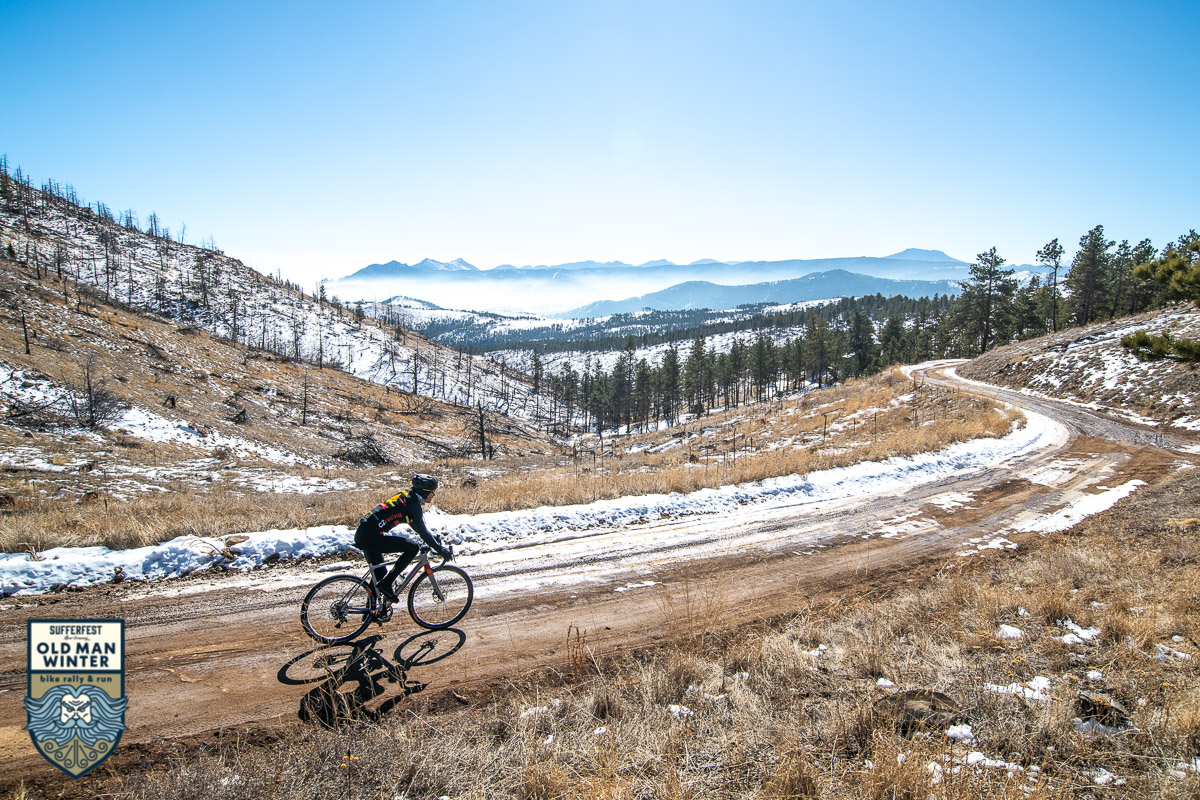
Photo courtesy Old Man Winter Rally

Need to know:

  • 1,500 riders and runners from 27 states will take the start line in Lyons, Colorado on Sunday 2/5/23.
  • Elite riders and runners will compete for the $8,000 prize purse, including Jens Voight, Ruth Winder, and Alex House.
  • The Old Man Winter Rally has seen all kinds of weather from a blizzard to a record-high sunny day. The forecast for 2023 is mild with 40-degree temps with sun
  • This year, the event will move to a new venue, Bohn Park, a multi-million-dollar project completed in the wake of the historic 2013 floods.
  • 5 categories: 50K Bike, 100K Bike, 10K Run, 5K Run, 10K Run / 50K Bike combo

Originally created as a way for friends to ‘rally’ together and support each other getting outside to ride on a wintry day, the Old Man Winter Rally has become one of the most popular running and riding events in Colorado. The event was built for folks that don’t hang up their bikes or running shoes during the winter and instead embrace the cold by bundling up and hitting the gravel roads and trails. “Old Man Winter is all about gearing up for winter adventure, having fun with your buddies, and enjoying a great party at the finish line” says, Josh Kravetz, the event’s founder and President of Adventure Fit, a Boulder-based Active Entertainment event company. “We like to make sure everybody has a fun day at Old Man Winter Rally – no matter what your athletic ability. This is Boulder, so you’ll see plenty of world-class athletes at the event, but we also love for this to be the first race ever for riders and runners.”

This Sunday, February 5th the event offers two bike course options: 50km and 100km, two run course options: a 5K and a 10K running race, and a Run/Bike combo that’s popular for winter multisport athletes. There will also be a huge celebration in Bohn Park for all at the after-party. And they do mean “party”. Athletes will cross the finish line and find fire pits, live music, delicious food (including s’mores) and Bootstrap Brewing Beer and June Shine cocktails.

2023 will have the biggest participation yet. The event will be capped at 1500 participants and less than 100 spots currently remain.

Old Man Winter History:

2015 – In the debut year, gravel bikes weren’t in fashion quite yet and future Tour de France stage winner Sepp Kuss nearly won on a road bike. Temps hit the high-60’s and high winds made for a breezy finish.

2016 – The running event is added, drawing in 188 participants in year one.

2018 – The course was revised due to construction, offering the first and only Northbound version which did not include the Rowena trail. Mat Stephens (winner of Unbound Gravel) and Lauren de Crescenzo (the winningest girl in gravel) taking the win.

2019 – The coldest year, never reaching above freezing throughout the whole event

2020 – A massive winter storm rolled through and ultimately, forced the cancellation of the 100K bike event 10 miles in. Riders were slipping and sliding in the epic conditions and despite the cancellation, the wild nature of it made it a monumental story in the race’s history.

2021 – One of the first COVID-friendly “DIY” style events to pick up steam, riders had the chance to ride the course with their pod, and get scored on a virtual scoreboard, or select a virtual option altogether. World Tour talents Alex Howes & Lachlan Morton teamed up and won the event.

2022 – The Rally returned from the pandemic full steam ahead, drawing in pro riders, everyday athletes and riders and runners from every background. Participants enjoyed a sunny 45-degree day

2023 – The Rally moves to a new venue, Bohn Park, a multi-million-dollar project completed in the wake the historic 2013 floods.

For those not competing, the top of the Rowena trail (off CO Rd 83) and Old Stage will be great spectating locations – showing off the variety of terrain the riders will challenge. Early February in Colorado can bring spring conditions, or mid-winter snow. A cool January and “sticky snow” will likely see a wintery route on tap. The after party in Lyons is open to all, with bonfires, s’mores, cold beer, and warm food. Join in on the winter adventure! Registration and additional event information is online at: www.OldManWinterRally.com

Put It Away Clean

By Tom Jow — By the time you read this, we will be well into the winter season. Snow came early this year and if you are like me, your summer bike gear is all but put away. But before we hang up the bike, we should clean it and perform some essential annual service.

Why now? One reason to do this maintenance now is it only needs to be done once or twice a year; so why not before we store it? Another reason, as my old friend Flo Irizarry says, “it is not good to store the bike with those dirty fluids inside”.

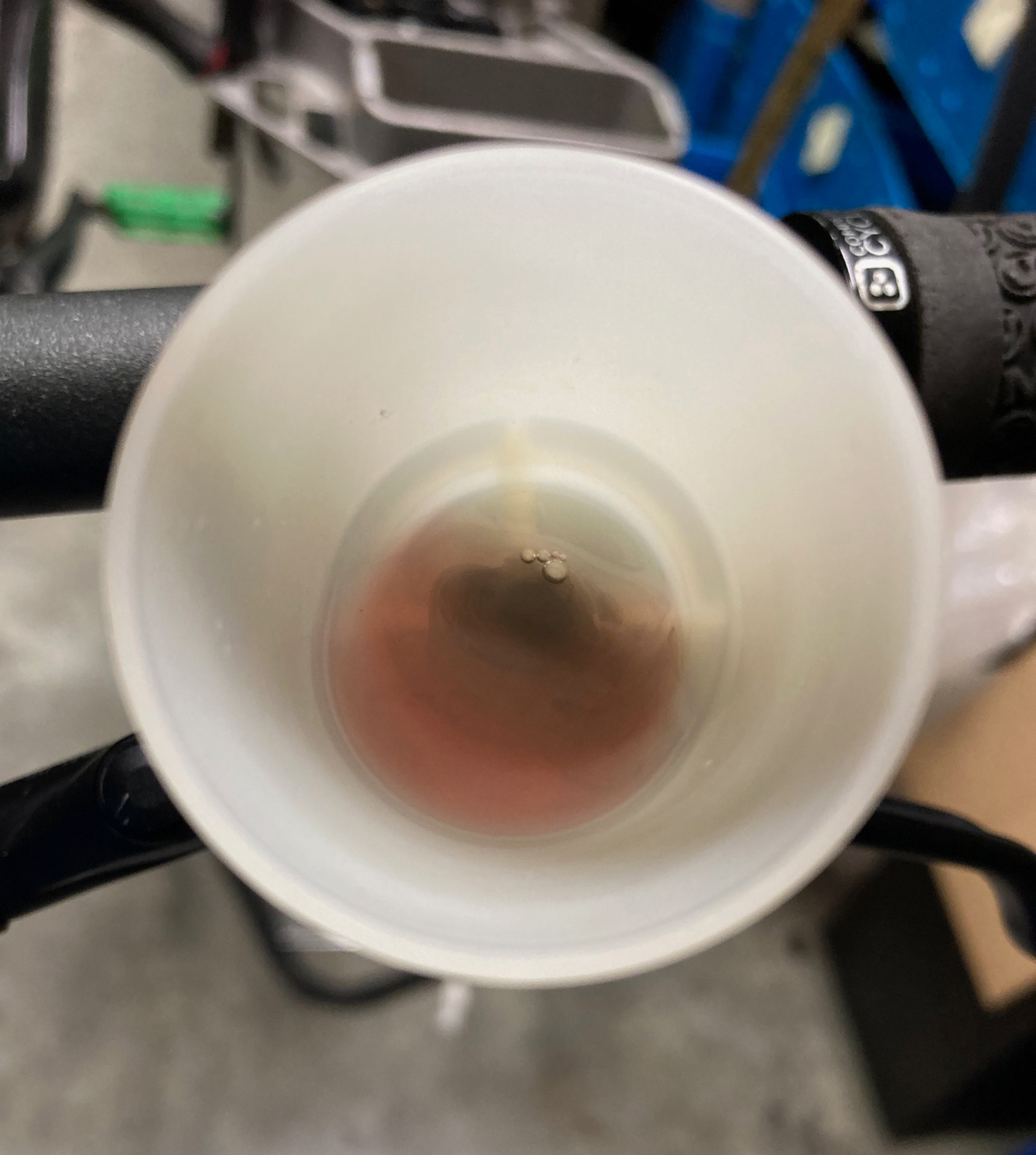
A black cloud of dirt and brake pad material afloat in pink brake fluid. Photo by Tom Jow

One system that should receive annual service is the hydraulic brakes. Because the brake pads are self-adjusting, hydraulic brakes rarely exhibit signs of needing service. It is very important however, to bleed and replace the brake fluid annually. The reason is that the fluid becomes contaminated with dirt and moisture. How does the brake system get contaminated? There are small rubber seals behind the brake pads where dirt and moisture can enter the system. Dirt, and brake pad material, in the brake fluid can cause premature wear of the seals and therefore allow fluid to leak through. Moisture can enter the system because DOT (automotive) brake fluid attracts and absorbs moisture. This moisture decreases performance by lowering the boiling point of the brake fluid. The minimum recommended fluid replacement interval for brakes using DOT fluid, SRAM for example, is annually. While mineral oil brake systems, such as Shimano and Magura, are affected less by moisture absorption, they are equally subject to dirt contamination.

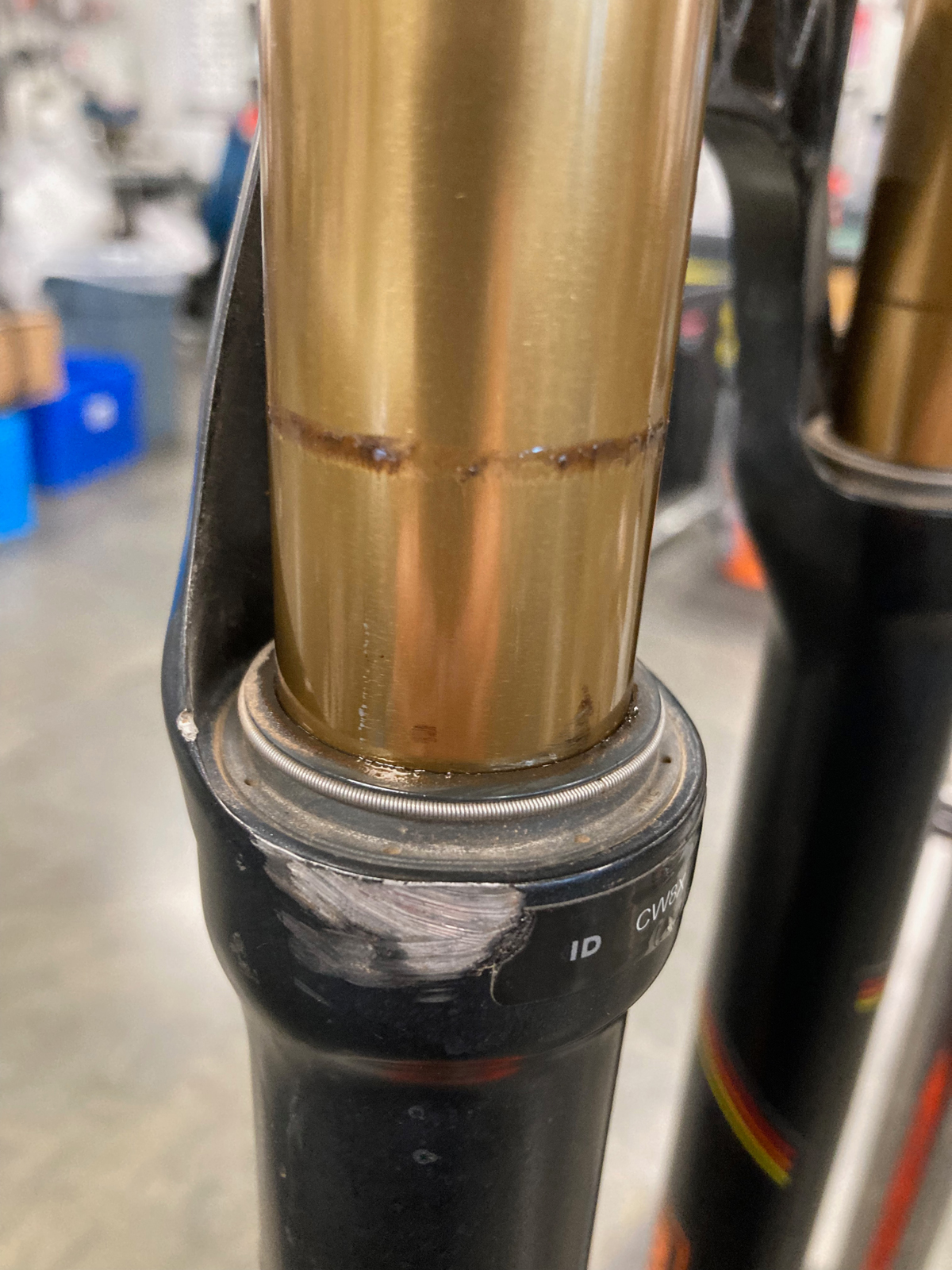
The telltale signs of a worn fork bushing. A ring of oil on the stanchion tube and around the lip of the seal. Photo by Tom Jow

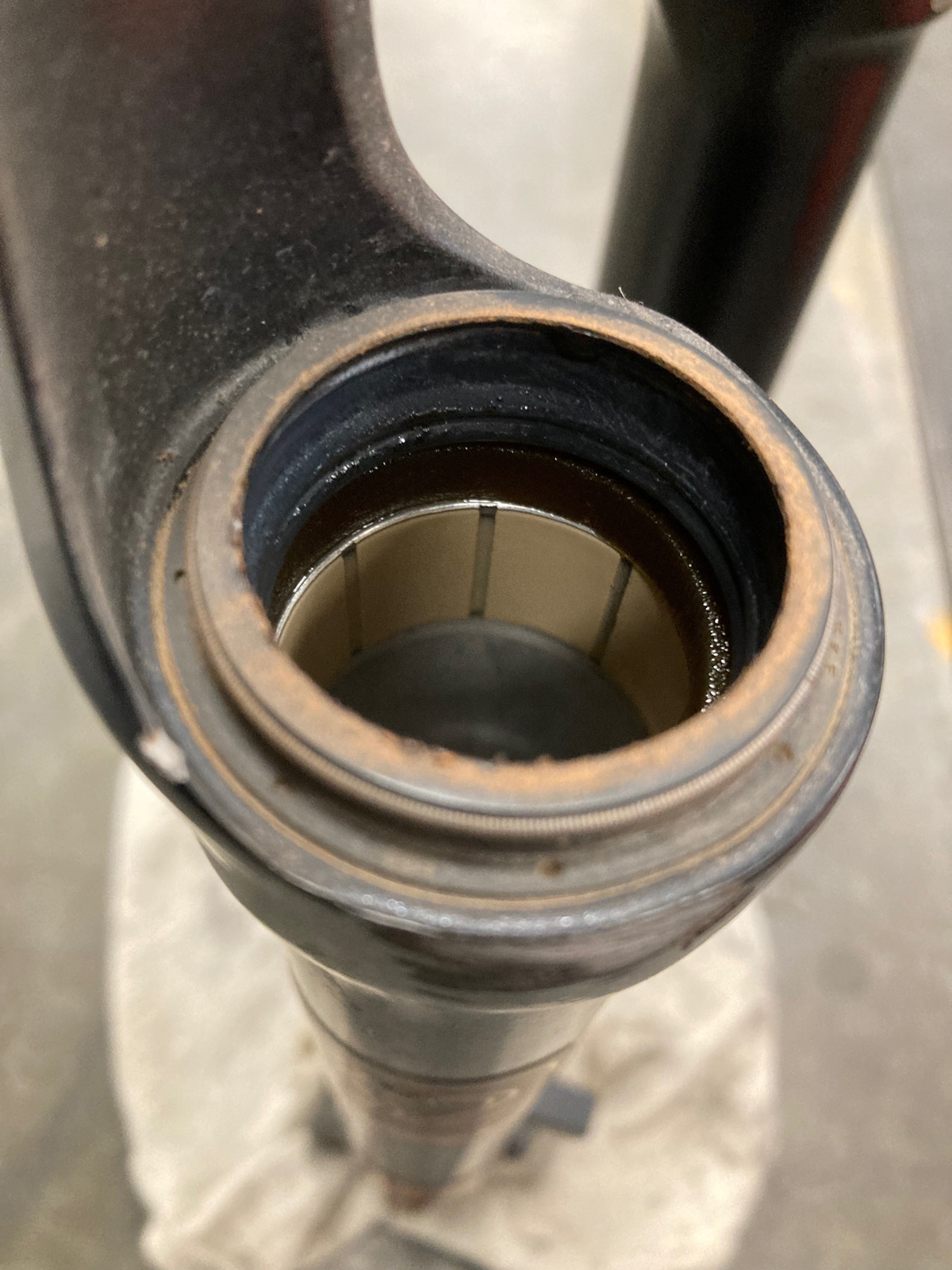
Mountain bike suspension systems are also affected by dirt contamination through rubber seals. Ever notice how dirty the upper fork legs are after a dusty ride? There are seals that keep the dirt out of the internals. If the seals were so tight as to keep all this dirt out the suspension would be very harsh. Also, think about how many times that seal goes up and down that dirty fork leg in any single ride. It’s impossible to keep all the dirt out. So, to help keep dirt out of the lower leg and bushings is an oil-soaked foam ring under the seal. This foam ring catches much of the dirt that gets past the rubber seal. Eventually, the foam ring becomes saturated with dirt, slowing down the fork action and potentially contaminating the oil in the lower fork legs. This is why both RockShox and Fox Shox recommend replacing seals every fifty hours. In addition to new seals and foam rings, the lower legs should be cleaned, and fresh suspension fluid added.

A dirty fork seal, a dirty black foam ring below and a fork bushing. When new, the foam ring is the same color as the bushing. Photo by Tom Jow

Keeping our bikes clean is an important investment of time. Dirt in moving parts wears them out faster. Cleaning the exterior of the bike is easy; the task and reason are obvious to all. Dirty brake and suspension systems are less obvious. The internal systems of hydraulic brakes and suspension are hidden but the potential for premature wear is the same. There is no excuse to not take care of it now. Winter is here and there is plenty of time before the new season. Storing the bike clean means it’s ready to ride as soon as the new season arrives. Fully maintaining the bike before storage means it’s ready to roll for the whole first part of the season before needing service. Put it away clean, inside and out.

Got a bike question? Email Tom at [email protected]

Borstelmann and Pannecoucke Win 40th Annual LoToJa Classic

By David Bern — After four consecutive decades, the LoToJa Classic’s fame as a hard, 203-mile road race remains indubitable: of the many cyclists who ride it, only the strongest win.

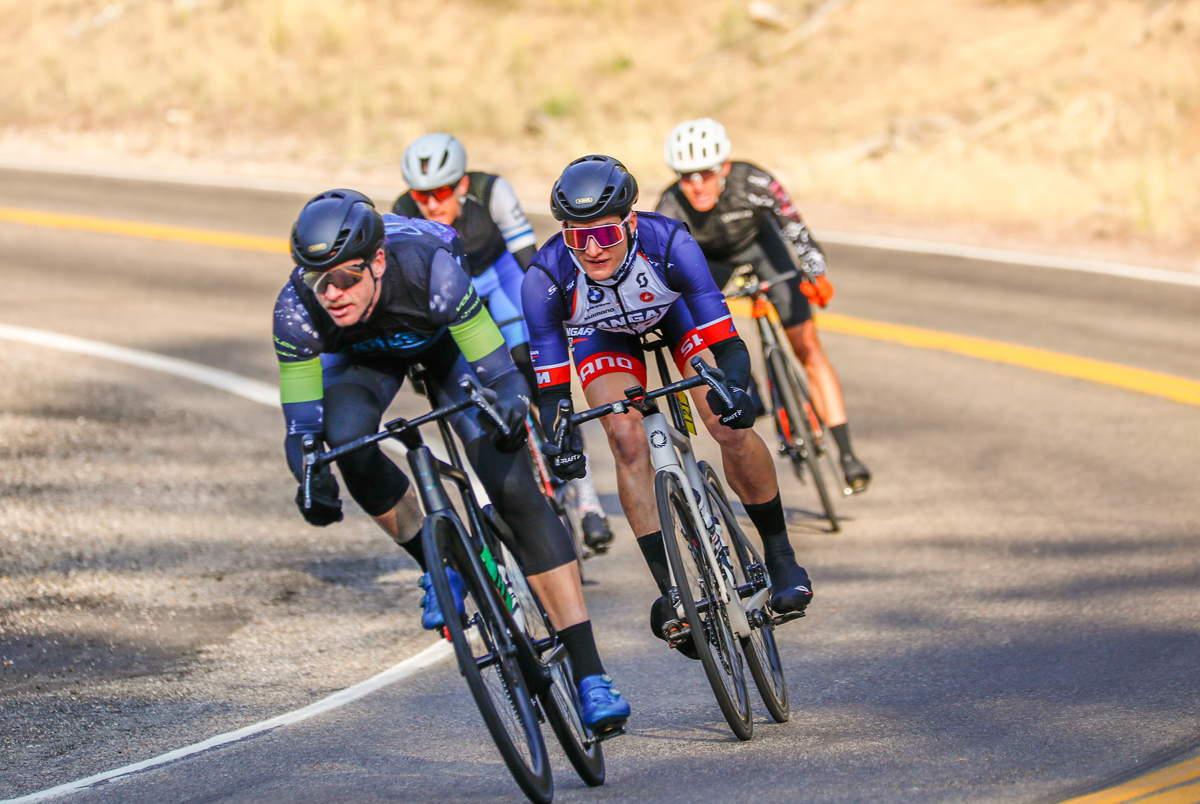
Strawberry descent: John Borstelmann (Team Voler Factory) is closely marked by Marc Spratt (Team Hangar 15) and two other cyclists while descending into Bear Lake Valley from the summit of Strawberry Canyon in the 40th annual LoToJa Classic on Sept. 10. Borstelmann won the Pro Men 123’s and Spratt took fifth. Photo courtesy of Snake River Photo

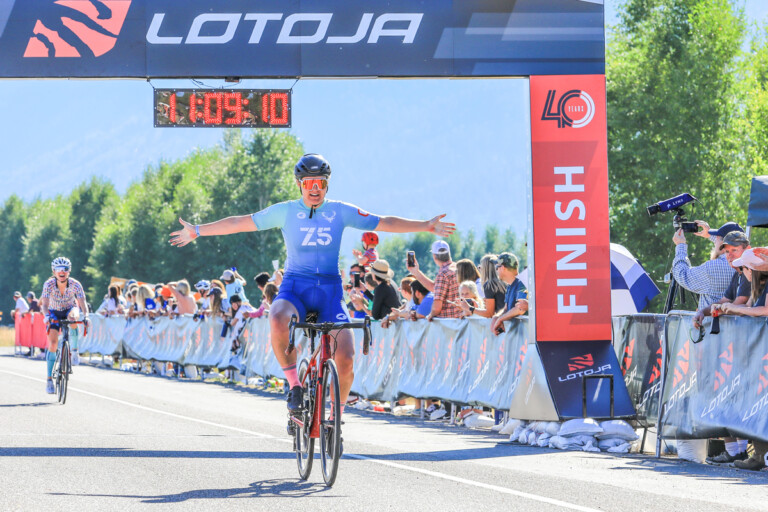
Cat. 1 pro road and gravel racer John Borstelmann (Team Voler Factory) and Cat. 2 Aileen Pannecoucke (Team Zone 5) convincingly won their Pro 123 categories in the 40th annual LoToJa on Sept. 10.

With 200 meters to go, Borstelmann, 31, of San Luis Obispo, California, sprinted away from last year’s winner Cat. 1 Nathan Spratt (Team Hangar 15) to the line at Jackson Hole Mountain Resort with a time of 8:41:43.

“It was a long, hard day on the bike,” Borstelmann said, who has won Gravel Worlds twice and excels at endurance cycling events. He was happy with the win, and pleased with his effort.

“It felt good to climb with Nathan,” he said while noting respect for Spratt’s climbing talent. “It was a confidence booster for sure.”

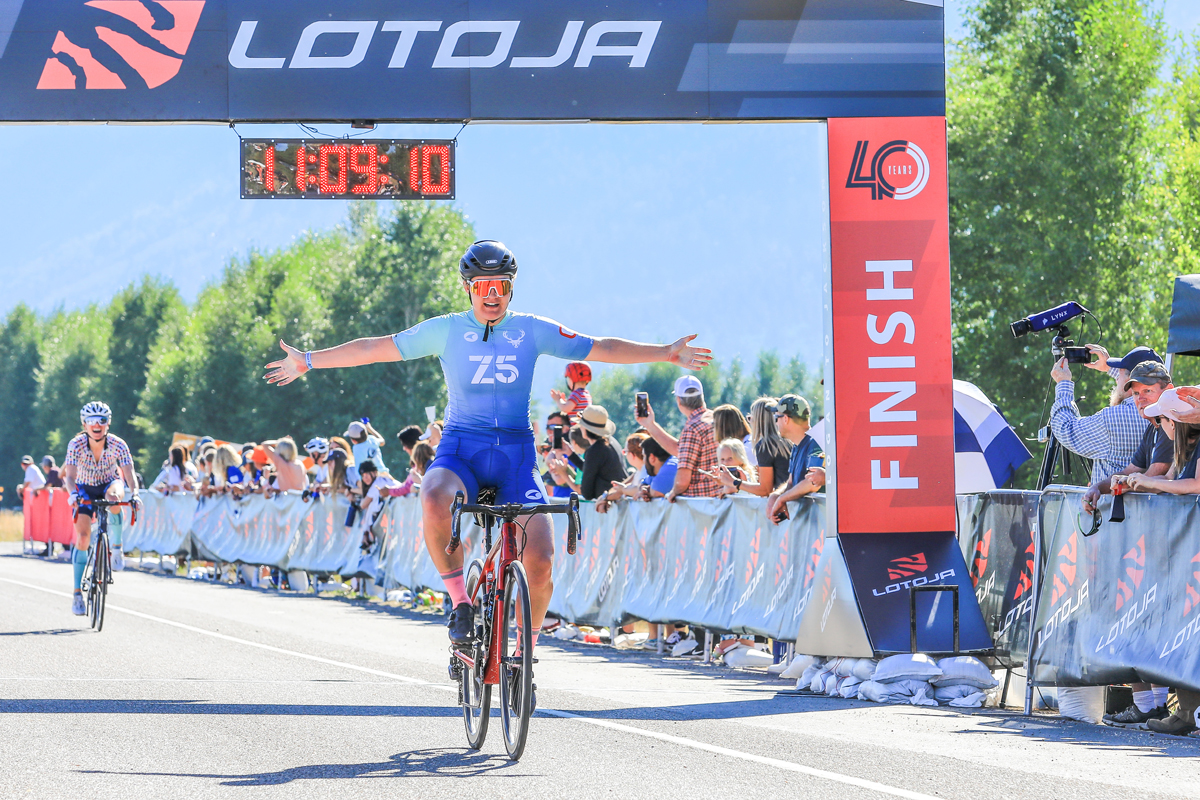
Pannecoucke, 25, of Pocatello, Idaho, defended her title from 2021 by outsprinting four other women at the finish. Her time was 9:58:00.

“I needed a re-do from last year’s finish,” she said. “I am very happy to come out first, to actually win it.”

It was 45 degrees and clear skies when Borstelmann and the 20-rider field of Men Pro 123s and 22-rider field of Men Master 35-plus rolled away from the 5:30 a.m. start at Sunrise Cyclery in Logan. He said three riders launched off into the dark soon after the peloton passed the neutral roll-out on 1000 West.

Although renowned for making long, solo efforts, Borstelmann chose to sit in and wait for the day’s first climb to Strawberry Canyon’s 7,424-foot-high summit (57mi/92km).

“I’m not the best climber,” he said. “But I knew if I could hang in there over the top, or be in a good chase group back to the leaders, I’d have a good chance in the sprint.”

His plan paid off. Borstelmann not only managed to “hang in there” over Strawberry, and 6,923-foot-high Geneva Summit (84mi/135km), he made it to the base of the day’s last major climb within an elite group.

That group consisted of 2018 LoToJa winner and current men’s course record holder (8:18:29) Cat. 1 Spencer Johnson (Team Johnson Elite Orthodontics), 44, of Riverton, Utah; Cat. 1 Matt Bailey (Team Intermountain Healthcare), 41, of South Jordan, Utah; Cat. 3 Danny Van Wagoner (Team Johnson Elite Orthodontics), 30, of Farmington, Utah; Cat. 1 Nathan Spratt (Team Hangar 15), 27, of Salt Lake City, Utah; his brother Cat. 2 Marc Spratt (Team Hangar 15), 27, of Millcreek, Utah; and Borstelmann.

And that last major climb was 7,630-foot-high Salt River Pass (106mi/171km), which features a nine-percent gradient during the last mile and King of the Mountain/Queen of the Mountain status at the top for the fastest male and female racers.

“Nathan attacked at the bottom and I followed him,” Borstelmann said. “I stayed on his wheel the entire climb. … We had a 15-second gap over the top.” The two climbed the four-mile-long pass in 12:28:21 with Borstelmann winning the KOM at the line.

The two flew down the other side of Salt River into Star Valley. They stayed away from the chase group to the finish, despite Spratt suffering a flat before Alpine Junction (156mi/251km), and shifting issues after the wheel change. Borstelmann said the gap was over eight minutes by Alpine Junction. It held through Hoback Junction (178mi/286km), and grew to over 12 minutes by Teton Village.

Borstelmann said he felt good and had recovered from the day’s climbs as he and Spratt traded pulls during the race’s last seven miles on Village Road.

“I’m a strong sprinter and Nathan was hurting,” Borstelmann said. With 200 meters to go, he sprinted away from Spratt to finish alone. Spratt crossed the line four seconds later with a time of 8:41:47.

The chase group arrived several minutes later with Johnson in third at 8:54:30, Van Wagoner in fourth at 8:54:31, Marc Spratt in fifth at 8:54:31:30, and Bailey in sixth at 9:11:51.

“I’d like to come back next year,” Borstelmann said. “… The whole experience and the beautiful country were amazing.”

Winner: Aileen Pannecoucke (Team Zone 5) celebrates after winning the Women Pro 123’s in the 40th annual LoToJa Classic at Jackson Hole Mountain Resort on Sept. 10. She set a time of 9:58:00 in the 203-mile road race. Behind her is Hallie Megan French (Team Type II Fun), who won the Women Masters 35-plus category. Photo courtesy of Snake River Photo

Although Pannecoucke won the Women Pro 123s in 2021, she was not the first woman to finish. That honor went to her Cat. 5 teammate Melissa Aitken, who was with her and Cat. 2 Jenny Leiser (Team Coda Coaching) in a three-woman break.

After the trio crossed the biker’s bridge at Wilson with seven miles to go, there was a near mishap with a pedestrian cyclist, which created a gap between Aitken, Leiser and Pannecoucke. With teammate Aitken up the road, Pannecoucke knew it was Leiser’s job to close the gap.

Also, because Pannecoucke wasn’t sure of Leiser’s sprint, she didn’t want to close the gap and possibly let Leiser beat her and Aitken at the line. Aitken soloed to the finish for the Women’s Cat. 5 victory.

Regardless of category and age, all licensed women cyclists in LoToJa start together because of lower field numbers. They are also allowed to ride together, but respective category wins are maintained despite mixed-category finishes.

Which is why Pannecoucke, who hails from Belgium and began racing at 16, was eager for a “re-do” from last year and to beat every Pro 123, Cat. 4/5, Cat 5 and Master woman to the line. So eager, she even ignored some pre-race advice from her parents, who flew in from Belgium to watch her race.

“My dad told me, ‘The one thing you don’t want to do is go off the front,’” Pannecoucke said.

But that’s exactly what she did. Shortly after the neutral roll-out in Logan, Pannecoucke attacked alone, yet was quickly caught by the 44-women field. As soon as she was caught, she attacked again and got away.

“I attacked to get a good time and to make the race hard,” she said. “I’m an OK climber and knew they would catch me on the climb [Strawberry]. I rode alone for the next two hours and they caught me about two miles from the summit.”

Pannecoucke was joined by her Zone 5 teammate Cat. 3 Ashley Kline, 33, of South Jordan, Utah, and eight other women cyclists from different categories. The break rode over the summit, down into Bear Lake Valley and Montpelier, and over Geneva Summit.

Pannecoucke said the break was down to a handful of riders as it approached the bottom of Salt River Pass, with Cat. 5 Autumn Vegh (Unattached), 28, of Denver, Colorado, off the front.

After the pass, the break consisted of Cat. 5 Master 35-plus Hallie Megan French (Team Type II Fun), 37, Salt Lake City, Utah; Cat. 5 Master 45-plus Nicole Lunsford (unattached), 47, Troutdale, Oregon; Cat. 4/5 Brittany Paige Mercier (Team Creepe), 33, Lethbridge, AB, Canada; and Pannecoucke. French won the QOM with a time of 17:35.

The break caught Vegh in Star Valley and the five women worked together through Alpine, Hoback Junction and toward the finish.

“Autumn [Vegh] went to the front with 1K to go,” Pannecoucke said. “I thought, ‘Oh, this is perfect! I’ve never had a lead-out like this before.’ I think she was trying to drop us. She cursed when I came around her. She was surprised.”

Pannecoucke crossed the line alone, followed by French in second at 9:58:02, Lunsford in third at 9:58:05, Vegh in fourth at 9:58:06, and Mercier in fifth at 9:59:42.

Although French took second, she won the Women’s Masters 35-plus, Lunsford won the Women’s Master 45-plus, Vegh won the Women’s Cat 5, and Mercier won the Women’s Cat 4/5.

Kline took second place in the Women Pro 123s with a time of 10:35:15. There was no third-place finisher in the Women Pro 123s.

Pannecoucke was delighted and relieved with her win. So were her parents.

“My dad said, ‘Lucky you were first!’ because of my early attacks,” Pannecoucke said. “If I had lost, I had no one to blame but myself.”

She said she plans to defend her title next year, and she hopes that more women will be on the start line.

The Men’s and Women’s Pro 123s aren’t the only categories with strong cyclists who ride and win LoToJa. There were approximately 1,500 USA Cycling licensed and unlicensed riders at this year’s start line. There were 31 start groups, which included licensed race categories, race relay teams, cyclosportive ride categories, and ride relay teams. LoToJa start groups left Sunrise Cyclery in 4-minute intervals as part of LoToJa’s Covid-19 Adaptations.

LoToJa is billed as the longest one-day USA Cycling-sanctioned bicycle race in the U.S., with three mountain passes, and nearly 10,000 vertical feet of climbing. The 203-mile/327-kilometer parcours passes through northern Utah, southeastern Idaho and western Wyoming.

The race was first held in 1983 with only seven cyclists. Now, up to 2,000 participate annually by riding the full-distance or a portion of the route as a relay teammate.

“Our 40th annual LoToJa Classic was a milestone achieved and a tremendous event with great riders and fantastic weather,” said race director Brent Chambers. “I look forward to many more LoToJa’s to come and how the race challenges everyone and brings out their best.”

The 41st annual LoToJa will be held on Sept. 9. The race’s 2023 website will be launched next March with online registration opening in early April.

Chambers expressed gratitude to everyone who helps make LoToJa successful year after year. He especially thanked the event’s team of 650-plus volunteers, sponsors, vendors, and the communities the race passes through.

“Without that support, LoToJa wouldn’t be possible,” he said. “LoToJa also wouldn’t be possible without the support of every cyclist who rides it. I am forever grateful and inspired by everyone who makes the race a reality.”

For complete finish line results of 2022’s race, go to lotoja.com and click on the “results/records” tab in the navigation bar.


A Cancelled Bikepacking Trip: When Health Issues Keep You from Riding Your Bike

By Chris Blinzinger — I awoke at 3 a.m. and realized I couldn’t swallow and had severe Vertigo. My head was spinning and causing nausea. During the next few hours, as the vertigo worsened, I pulled my phone out on camera mode to check my smile for uniformity. As a three-decade veteran of Emergency Medical Services (EMS) I checked myself for signs of stroke. All my checks were negative. I finally called 911 as symptoms were not improving and I was concerned.
So, what do you do when health issues impact your bike riding/touring/commuting? Here is my story.

My friend Lou Melini and I had planned a version of the Idaho Hot Springs loop for a couple of weeks at the end of July 2022 and into August. The preplanning had been done, maps purchased, GPX files downloaded and arrangements for parking a car during our ride. This has been on my “want to do list” for several years.

In mid-June I was deployed to Flagstaff, Arizona for the Pipeline Fire. I work with a regional Incident Management Team for large wildfires. I also work for a local fire department in Utah, so I can represent and contribute to the response for large wildfires outside our response area. After 8 days on the fire, I tested positive for COVID as it had found its way onto our Command Post.

I was directed to isolate myself in a hotel room when 2 days later at 3 a.m. I had the stroke.

I was transported to Northern Arizona Medical Center where they diagnosed me with a Cerebellum Stroke. I could not swallow for several days, and my eyes were so blurry I couldn’t make out anything. As the news sunk in, I was numb.

Interestingly, my biggest concern was the inability to swallow. How would I give my body nutrition to support my lifestyle that includes bike touring/ bikepacking and commuting and being active?

I thought I was speaking clearly but asked the dispatcher on 911 if they could understand me. They advised that they understood everything I was describing from symptoms to location.

EMS did a few more assessments and discovered an “Arm Drift” which is a sign of stroke. I neglected to test this on myself. EMS transported me to the hospital. Many tests were completed to confirm it was a stroke.

One of my fellow Incident Team members arrived at the hospital and began making notifications to my family, boss in Provo and the Incident Commander on the Pipeline Fire whose direction I was working under while in Flagstaff.

I couldn’t use my phone at all while in the hospital because of vision problems, so I handed it off to my team member then my wife who kept family and co-workers informed of my status.

I couldn’t swallow for days and had a mild headache. I was suctioning saliva to keep from choking on my own spit. I was given tongue exercises and ice to suck on. The tongue exercises were hard.
After several days, the speech therapist came in with a small container of applesauce and crackers. I verbalized that there was no way I would swallow that. I took a spoonful of applesauce, and I was able to swallow it. It tasted delightful. It was delicious and I don’t normally eat it. I was put on a minced and mashed diet so everything from beans to pork loin was ground up.
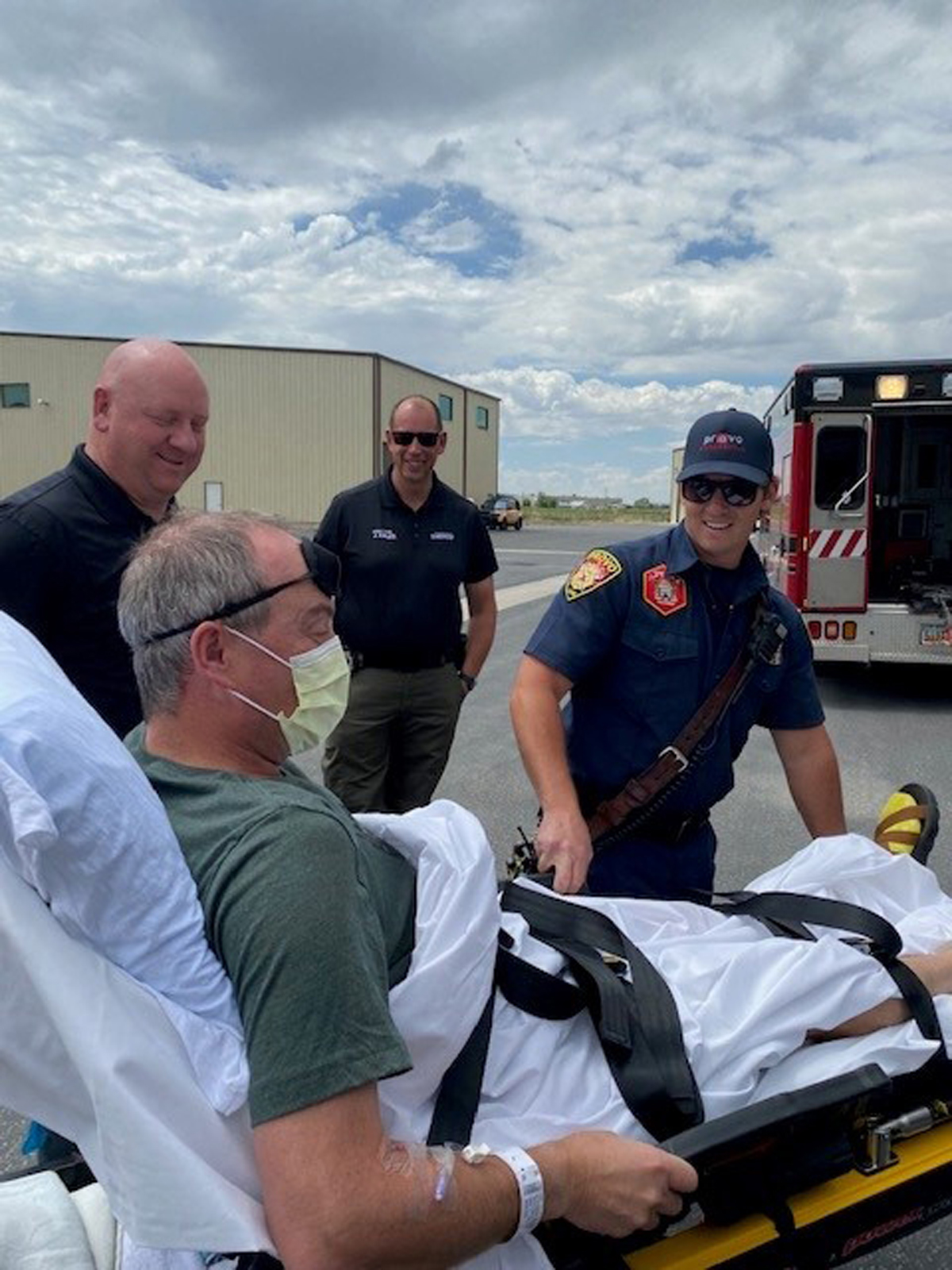
After 6 days in the hospital in Flagstaff with speech and limited physical therapy, I was transferred to a Neuro Hospital Unit in Provo, Utah. Still on a minced and mashed diet. I spent 8 days there re-learning to walk, swallow and participate in cognitive testing.

Chris arriving back to Utah. Photo by Kendra Blinzinger

While there I managed a message to Lou who is a retired PA and advised that I couldn’t do the trip in Idaho. I was so bummed and wondered how bike riding would be for me moving forward. Without missing a beat, he responded that we would plan it for 2023.

During physical therapy I was asked to do things that were scary. Walk across a short piece of grass on uneven ground. I made it across, walking like Frankenstein. The Frankenwalking continued to creep into my gait. Also, I had to walk up a therapy sized stair prop and on a treadmill with assistance. Those were all hard, but I could feel incremental improvement and my visitors could see much more improvement than I could.

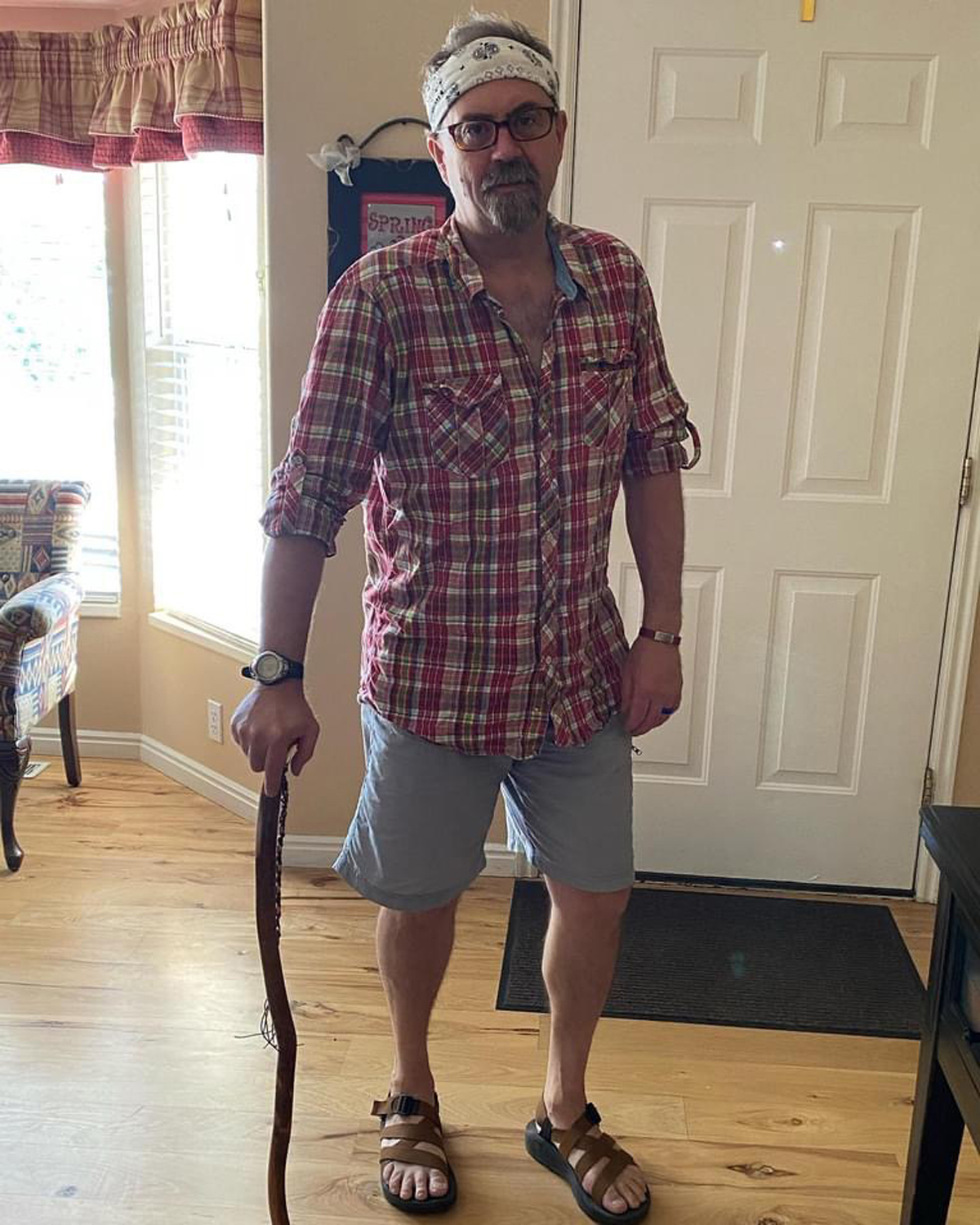
Trying out a new cane. Photo Kendra Blinzinger

During outpatient physical therapy my therapist and I talked bikes. He rides a lefty and we found ourselves continually talking about bikes. I had considered my ability to get back on a bike but was afraid to jump right back on. So many things I’d done in the past were now required to do again for the first time. Driving, cooking, showering, climbing stairs and riding a bike.

I am 53 and fairly active. I have a blood clotting disorder which I knew about before I had the stroke. I set up my Disc Trucker on a trainer downstairs and got on. It felt so good to be pedaling, I felt balanced, and it was a good first back on a bike. I wanted more. I asked my doctors and therapists about riding again. They were supportive due to my progress in therapy but cautioned me to be careful as I was no on blood thinners.

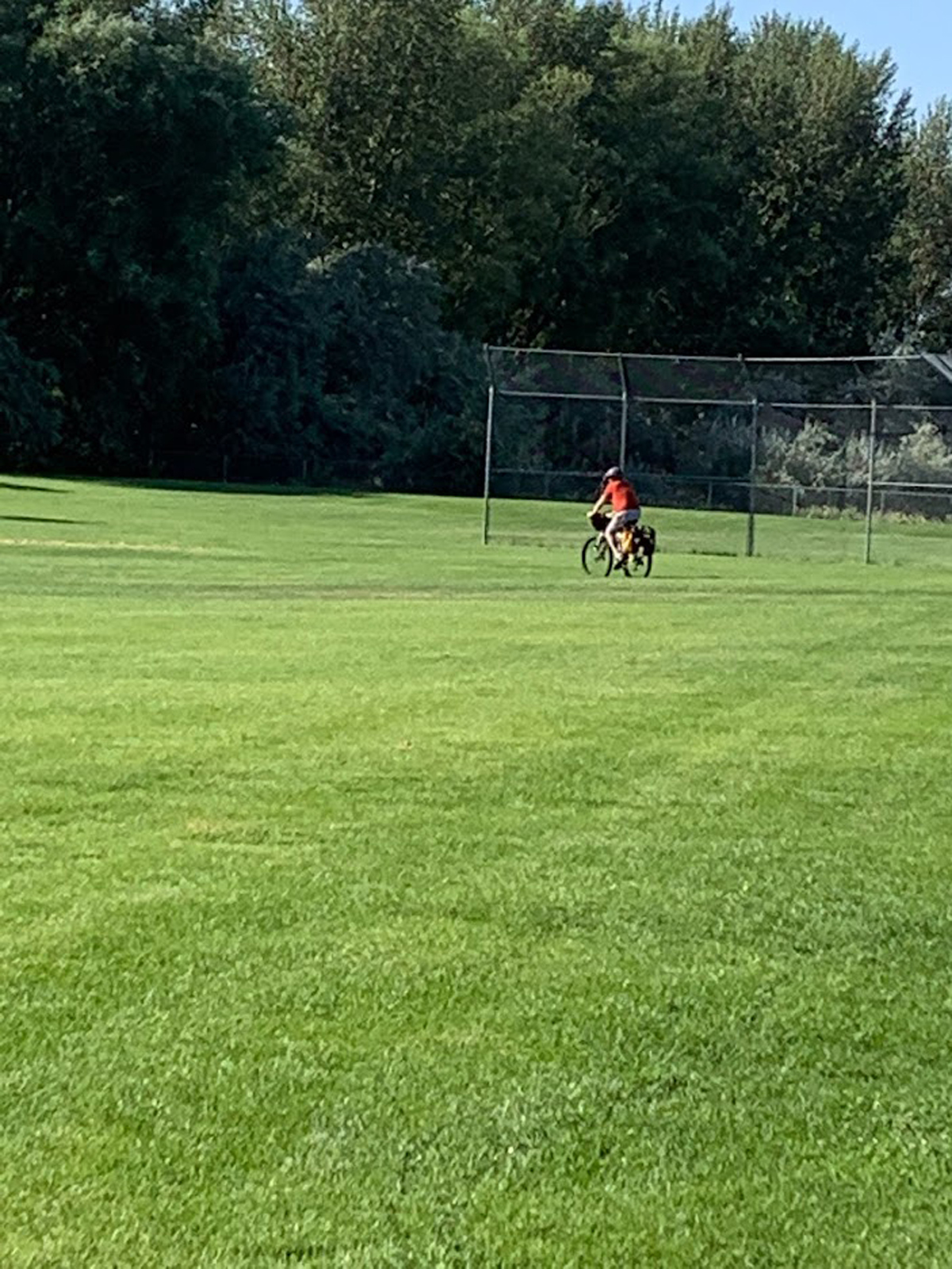
Chris’ first day back on a bike following a stroke. Photo Kendra Blinzinger

My wife has been my rock through this whole recovery process, so she supported me trying to ride on the grass field at the school nearby. I unloaded my bike and rolled it over to the grass field. I was scared to get on. I threw a leg over, looked at my wife and pushed off to pedal forward. I immediately fell over onto the grass. I was devastated.

If a horse bucks you off … My wife watched and encouraged me to be patient. I threw my leg over again with the same result. My worst fears were realized. I tried a third time and continued forward. I was ecstatic. It felt more of an accomplishment than my master’s degree. I continued to pedal in the long grass and was so happy that I could do it and had a smile like a kid at Christmas. It was a feeling of victory and success. I did have some vision problems with perception, but I felt balanced and made many tracks in the grass while getting my bearings. The long grass was a safe place to land but also exhausting.

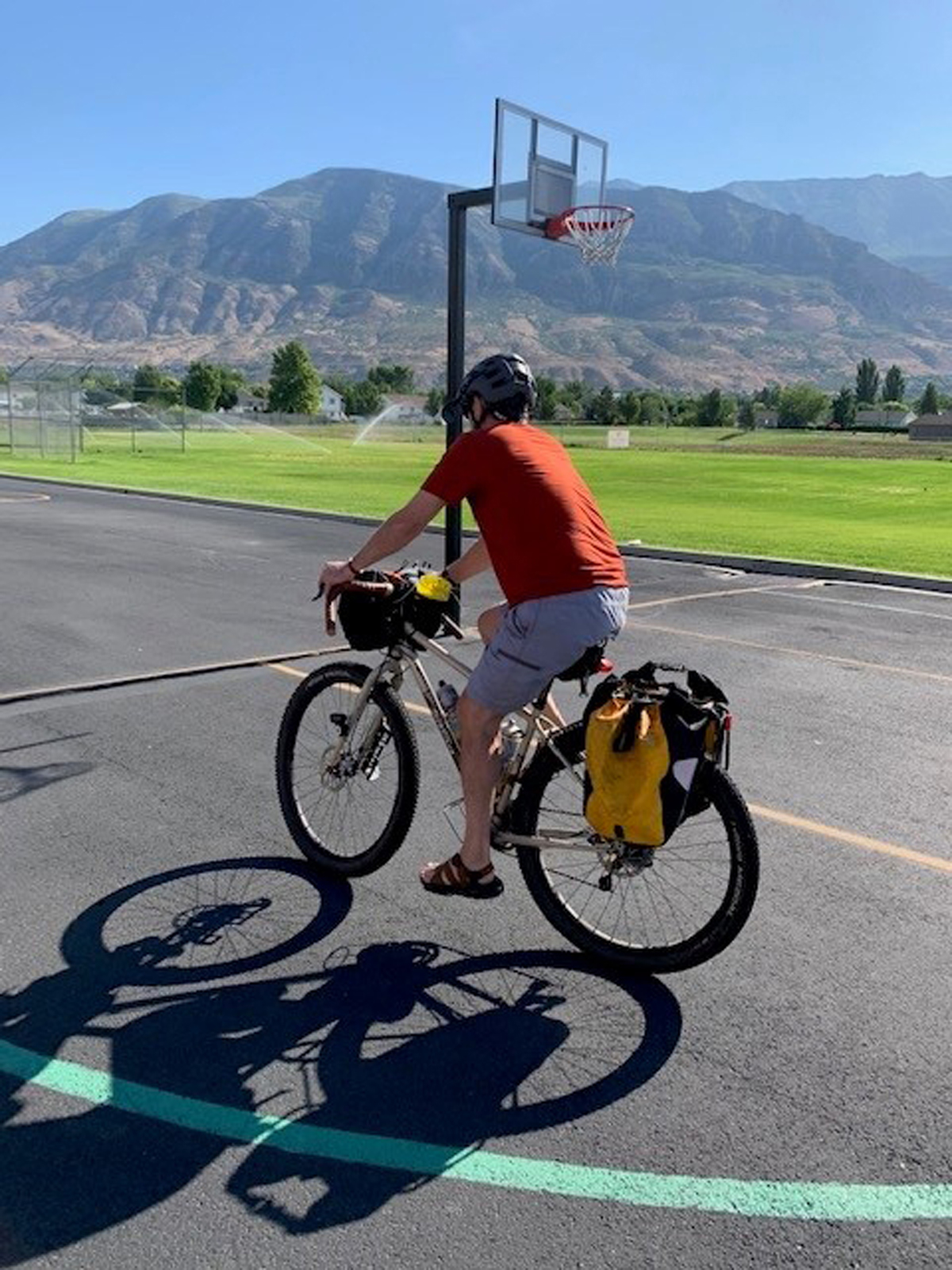
Chris testing pavement by Kendra Blinzinger

I had been in a hospital for nearly 2 weeks and not much activity besides therapy for the past 2 months. I moved over to the basketball courts and rode back and forth trying to get my bearings. When I approached an immovable object, my brain wanted to move away from it rather than ride alongside it. After doing many short practice rides over a period of weeks in safe non-traffic areas, I decided to venture out around the neighborhood. I’d ride for 1-2 hours just focusing on balance and managing the obstacles (parked cars, raised curbs) as I encountered them. I found that turning tight corners to be the most challenging for my balance.

I eventually decided to get back to commuting. My route includes riding to the train station and then from the station to work. This was another first, getting on the train and the obstacles involved. It was scary but I continued to do it. I found that I was much more balanced on my bike than walking. I returned to work 3 months after the stroke. I looked forward each day to riding to or from work. It was so enjoyable and helped me feel a bit more normal.

I work with a guy who is into bikepacking, and we started talking about putting together a manageable ride to test my ability. His wife had a traumatic brain injury 24 years earlier, so he understood some of the challenges I was facing. After a couple of months of discussion, we found a short bikepacking ride in nearby Moab, Utah.

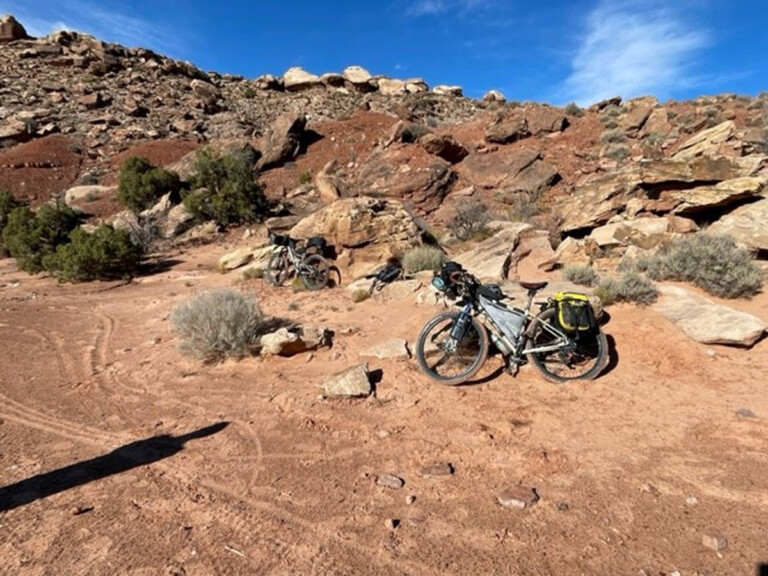
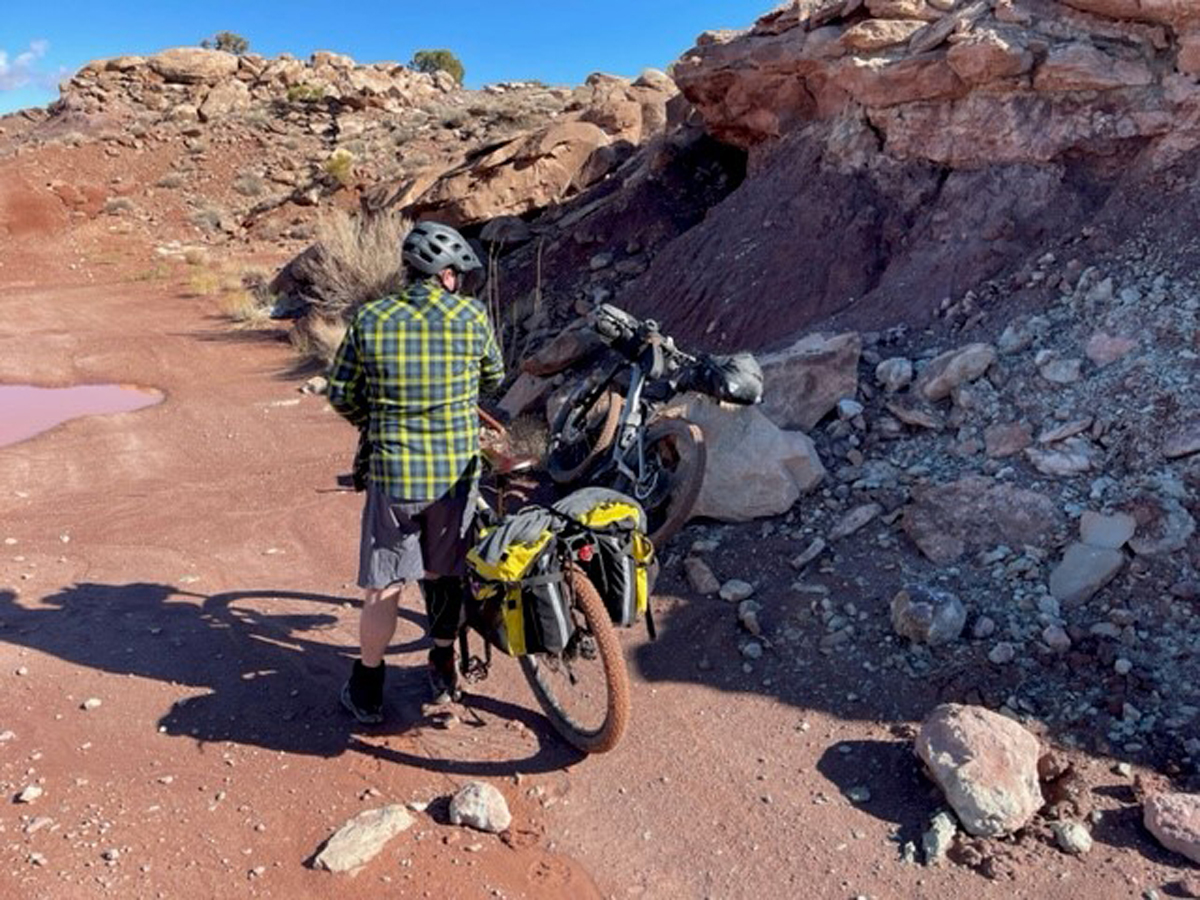
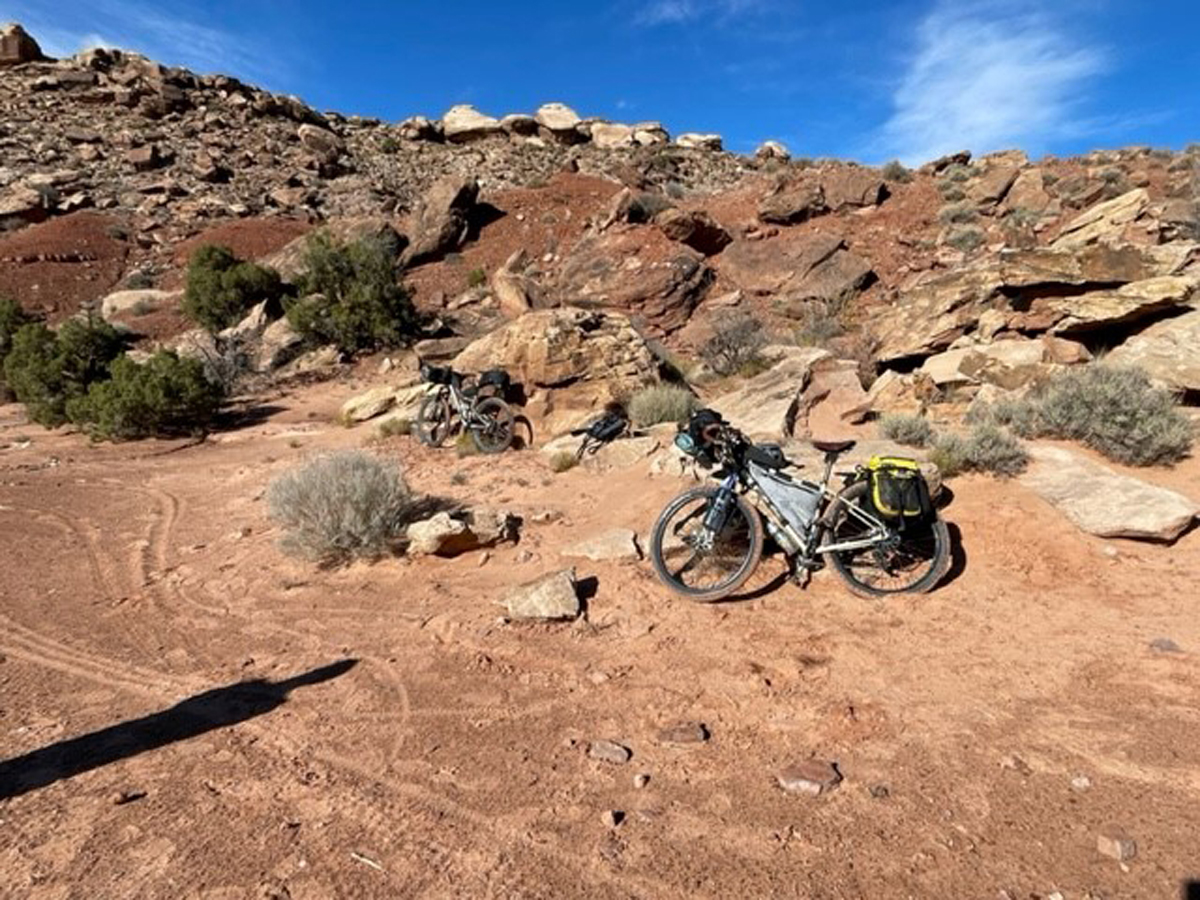
Hey Joe Safari Route. Photo by Koby Hubbs

I am new to bikepacking but have bike toured all over the western US so am comfortable with carrying my gear on the bike. The weather had been unseasonably wet and cold, but we were committed and had sufficient gear, so we headed out. I had 2 rear panniers, a frame bag and handlebar bag. Bikepacking is much lighter than touring and I need to think lighter. This was planned for a three-day ride. The first day had much more Hike-a-bike than we anticipated. When we approached early afternoon on the first day, I found myself tired from so much exertion we decided to set up camp and rest.

My riding partner was very understanding, and we set up and discussed the plan for the next 2 days. I’m not even sure of the first day’s mileage but I felt good about my efforts. He noticed how unstable I get when I am tired. He did remark that he observed that I could ride a bike better than I could walk.

The next morning, we headed back to the vehicle to look for a ride with less elevation gain. We found a gravel road that led to a rock that resembled Nefertiti along the Green River, so we parked and rode the round trip 20 miles and headed home. I felt great and although we didn’t complete the ride as planned, I met the objective of putting in some loaded miles on a bikepacking route and testing my ability. I had no regrets about modifying it. I felt accomplished in my performance. It was not easy, but it was much more enjoyable “hard” than going to therapy and tongue exercises.

Hey Joe Safari Route. Photo by Koby Hubbs

My cerebellum stroke happened on June 17, 2022, and now it’s December. I face peaks and valleys daily. I continue to improve and have a positive outlook for the Idaho Hot Springs route with Lou next September.

It occurred to me that this story is for everyone as we all can face challenges that disrupt life including hobbies and passions. I was devastated the first 2 attempts to ride the bike in the grass. If I hadn’t tried that third time, where would I be today? My doctors diagnosed my stroke as “mild”, but a mild stroke is still significant to me.

I am thankful for my recovery and the support of my family, friends, coworkers and especially my wife Kendra. I have a hopeful outlook for my bike touring/bikepacking future. It will still take hard work and doing the scary things, including new first’s, to get back to where I was, if that is even possible. I joined my physical therapist Quinn on a ride on our day off. It was great to ride the paved bike path in the canyon.

I know that COVID gets blamed for many things in positive patients. I asked the doctors taking care of me about its contribution to my stroke, but none would state that this was a COVID problem. I did have a clotting disorder already and during testing they found an Atrial Septal Defect in my heart that allowed the clot to pass through the blood/brain barrier.

When I talked to the cardiologist, he advised that there would be no attempt to repair my heart defect. First because the risk was too high for such a small defect and second because I have toured so much and challenged my heart climbing over Bald Mountain Pass and Boulder Mountain on my tours, he encouraged me to continue to ride my bike which was music to my ears. All doctors and therapists advised that my activity before the stroke would contribute to the speed of recovery and the overall recovery itself.

I eat just about what I want now. I can eat popcorn and bread which were a big no when this first happened. I need to have water close in case I choke. That is a rare occurrence now.

I get tired at the end of the day which results in balance problems. I can walk into a grocery store and feel mostly normal but once in there all the stimulation I get from the colors of the products and the obstacles of shelving, people with carts and displays, I lean on the cart because it does something to my brain which gives me balance problems. I am on thinners (Eliquis) for the rest of my life. It won’t keep me from pedaling as I believe there are equal dangers as a motorist during rush hour. I was riding to work until it got cold. Now I ride a stationary at work for an hour or so to build my strength back until it warms up. I still pull out the bike on weekends for short rides.

I thought about what it might be for someone facing other health challenges. Don’t lose hope. There are some things that I may never do again and some I will continue to do, even with limited ability.

A good friend in rehab told me that he “would do everything they ask me to do because they’ve given me this opportunity.” I told myself that I would do the same. Happy and safe pedaling.


Salt Lake County’s MidValley Connector Gains Federal Approval

By Charles Pekow — The Federal Transit Administration gave final approval to the seven-mile Midvalley Connector Bus Rapid Transit Project in Murray, Taylorsville and West Valley, Salt Lake County, Utah.

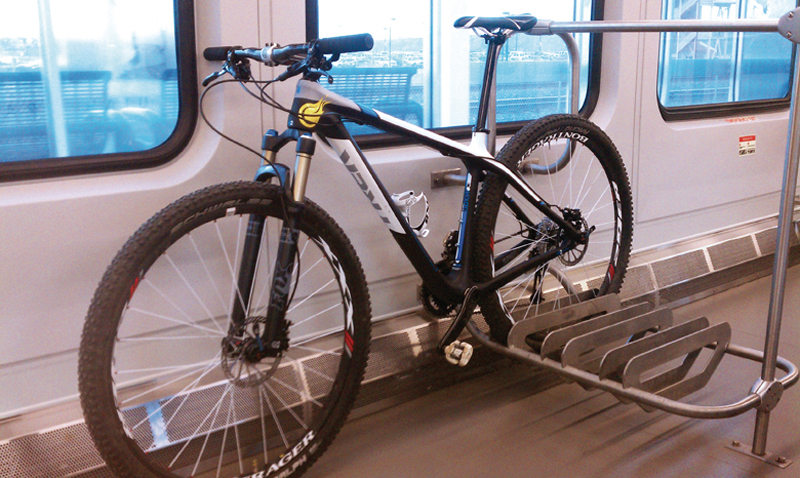
bike rack on train
UTA bike holder on TRAX. Photo: Cycling Utah

The project “would connect the Murray Central TRAX and FrontRunner Station to the Salt Lake Community College Redwood campus in Taylorsville and to the West Valley Central TRAX Station,” according to the project’s website.

The project includes improving bicycle conditions along the project, including building a multi-use path along 4700 South to replace the existing bike/ped facility. It also promises improved bike connections to stations and between existing paths as well as other improvements such as median islands and push-button activation of traffic lights.

Details: http://midvalleyconnector.com/.


Is It Possible to Make High-Speed Roads Safe for Bikes?

By Charles Pekow — How can we make biking safer on high-speed-limit roads? The Transportation Research Board (TRB) is going to give a contractor $550,000 and two- and a half years to find out. TRB noted that the higher the speed limit, the more dangerous conditions are for bicyclists and pedestrians. So it issued a request-for-proposals to issue a report on Speed Management Strategies to Improve Pedestrian and Bicyclist Safety on Arterials and Higher-Speed Roadways.

300 W between N. Temple and 600 N. needs bike lanes and lower speed limits. North of 600 North, the bike lanes need to be brought up to standard. Photo by Dave Iltis

Most safety programs for cyclists have focused on low-speed roads. Methods that work on them (speed humps, bumps, turn lanes and reduced speed limits) may not be practical on high-speed roads, TRB notes.

The project will be tasked with reviewing existing efforts and studies and developing a guide for practitioners.

Details: https://apps.trb.org/cmsfeed/TRBNetProjectDisplay.asp?ProjectID=5340


The Athlete’s Kitchen: Winning the War Against Snack Attacks

  • “I wish I didn’t have snack attacks. I eat way too much chocolate…”
  • “I eat only healthy foods during the day. My snacking problem starts the minute I get home from work. Chips are my downfall…”
  • “I try hard to not snack after dinner, but I have a bad habit of getting into the ice cream…”

By Nancy Clark MS RD CSSD — Day after day, I hear athletes complain about their (seemingly) uncontrollable snacking habits. Some believe they are hopelessly, and helplessly, addicted to chocolate. Others believe eating between meals is sinful & fattening; snacking is just plain wrong. Some equate snacking to doing drugs. They bemoan they are addicted to sugar and can’t eat just one cookie. Snacking is all or nothing.

Despite the popular belief that snacking is bad, the truth is that snacking can be helpful for active people. Athletes get hungry and need to eat at least every three to four hours. That means, if you have breakfast at 7:00, you’ll be ready for food by 10:00 or 11:00, particularly if you exercise in the morning. By 3:00 p.m., you will again want more food. For students and others who exercise mid to late afternoon, a pre-exercise snack is very important to provide the fuel needed to have an effective workout.

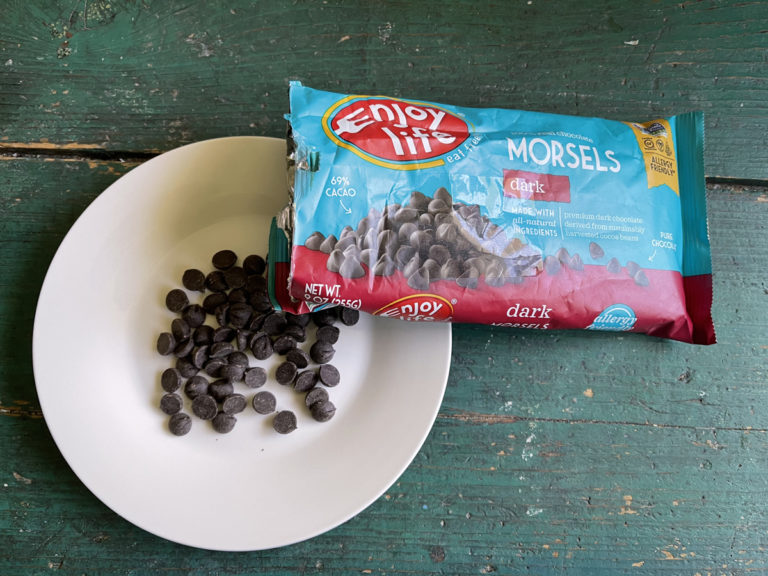
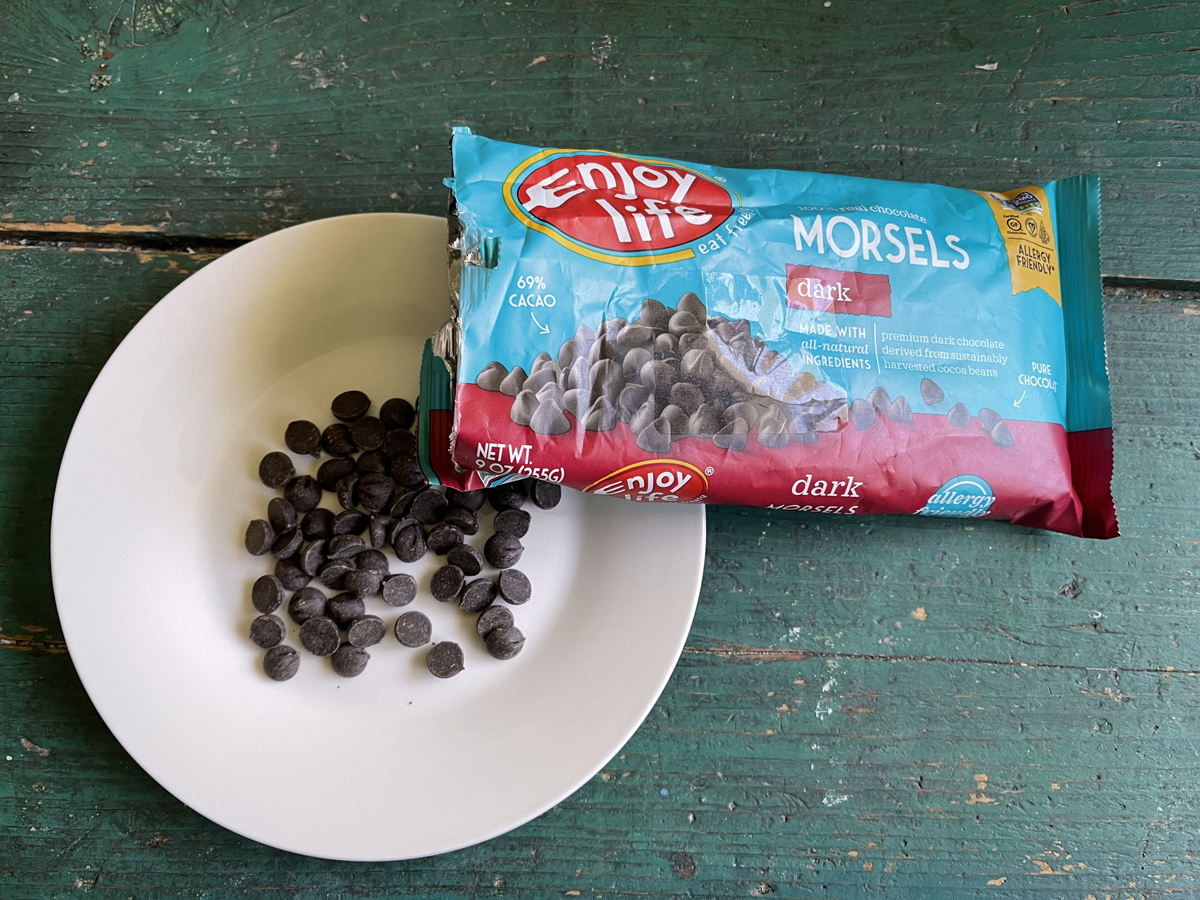
"Is chocolate a health food, dieter's weight loss aid, and effective recovery food for tired, hungry athletes?" Photo by Dave Iltis"Is chocolate a health food, dieter's weight loss aid, and effective recovery food for tired, hungry athletes?" Photo by Dave Iltis
“Is chocolate a health food, dieter’s weight loss aid, and effective recovery food for tired, hungry athletes?” Photo by Dave Iltis

The trick is to make snacks a part of your sports diet—preferably with an early lunch at 11:00 that replaces the morning snack. (Why wait to eat at noon when you are hungry now?) and a second lunch instead of afternoon sweets, to energize the end of your work or school day. A planned wholesome meal is far better than succumbing to sugary snacks or stimulant drinks.

Snacking problems commonly occur when athletes under-eat meals, only to over-indulge in snacks. Inadequate breakfasts and lunches can easily explain why snacks can contribute 20 to 50 percent of total calories for the day. Fingers crossed those snacks are nutrient-rich!

To easily and painlessly resolve nutrient-poor snack attacks, eat before you get too hungry. Hungry athletes (and all people, for that matter) tend to crave sweets (and fats) and can easily eat too many donuts, chocolate chip cookies, candy bars—foods with sugar (for quick energy) and fat (for concentrated calories).That honking big muffin can easily win out over a piece of fruit, hands down!

Athletes who report they “eat well during the day but get into trouble with snacks at night” need to understand the problem is not the evening snacks but having eaten too little during the active part of their day. Snacking is the symptom; getting too hungry is commonly the problem. One way to eliminate a mid-morning snack attack is to have a protein-rich, satiating breakfast (such as 3 eggs + avocado toast + a latte for 500-600 calories) as opposed to just a packet of oatmeal (only 100-150 calories). Enjoy soup + sandwich for lunch (500-700 calories), not just a salad with grilled chicken (only 300 calories).  

Identifying hunger

Do you spend too much time thinking about food all day? If so, your brain is telling you it wants some fuel. Thinking about food nudges you to eat. If you were to never think about food, you’d waste away to nothing.

Other hunger signals include feeling droopy, moody, cold, bored (I’m eating this popcorn just because I’m bored), unable to focus, and easily irritated. If you fail to honor these hunger signals, they will escalate into a growling stomach (too hungry) and an all-out snack attack. Prevent hunger; eat enough during the active part of your day.  

Please remember that hunger does not mean “Oh no, I’m going to eat and get fat.” Hunger is simply a request for fuel. Just as a light on the dashboard of your car signals when your car needs gas, your brain sends you hunger signals when your body is low on fuel. To not eat when you are hungry is abusive to your body (and mind) and puts your body into muscle-breakdown mode, which is counter-productive for athletes. 

Losing weight without daytime hunger

Even if you want to lose undesired body fat, you should eat enough to feel satiated during the active part of your day. You can lose weight (“diet”) at night when you are sleeping. This is opposite to how most athletes eat: They diet by day, then attack the snacks at night. They eat the whole pint of ice cream, too many chocolates, and/or non-stop chips. Winning the war against hunger requires white knuckles. Not sustainable and not fun. The better bet is to fuel by day and diet at night by eliminating high-calorie evening snacks.

Dieting athletes commonly report the most concerns about snack attacks. As one rower complained, “I’m hungry all the time.” If that sounds like you, and you feel hungry within the hour after you eat a meal, experiment with eating heartier meals. For help figuring out a food plan that works for you, I encourage you to meet with a registered dietitian (RD) who specializes in sports nutrition. The referral network at www.SCANdpg.org can help you find a local sports nutrition professional.

Winning the war against snack attacks

I encourage my clients to convert snacktime into mealtime. Instead of reaching for cookies, candy, caffeine, and other typical snack foods, they opt for a peanut butter & banana sandwich for an early lunch at 10:00 or 11:00ish. (As long as they have a flexible eating schedule, no need to eat a donut just to bridge the gap to the more traditional eating time of noon.) They then can enjoy a later second lunch at 2:00 to 3:00ish, which gives them energy to be productive throughout the last hours of the workday. 

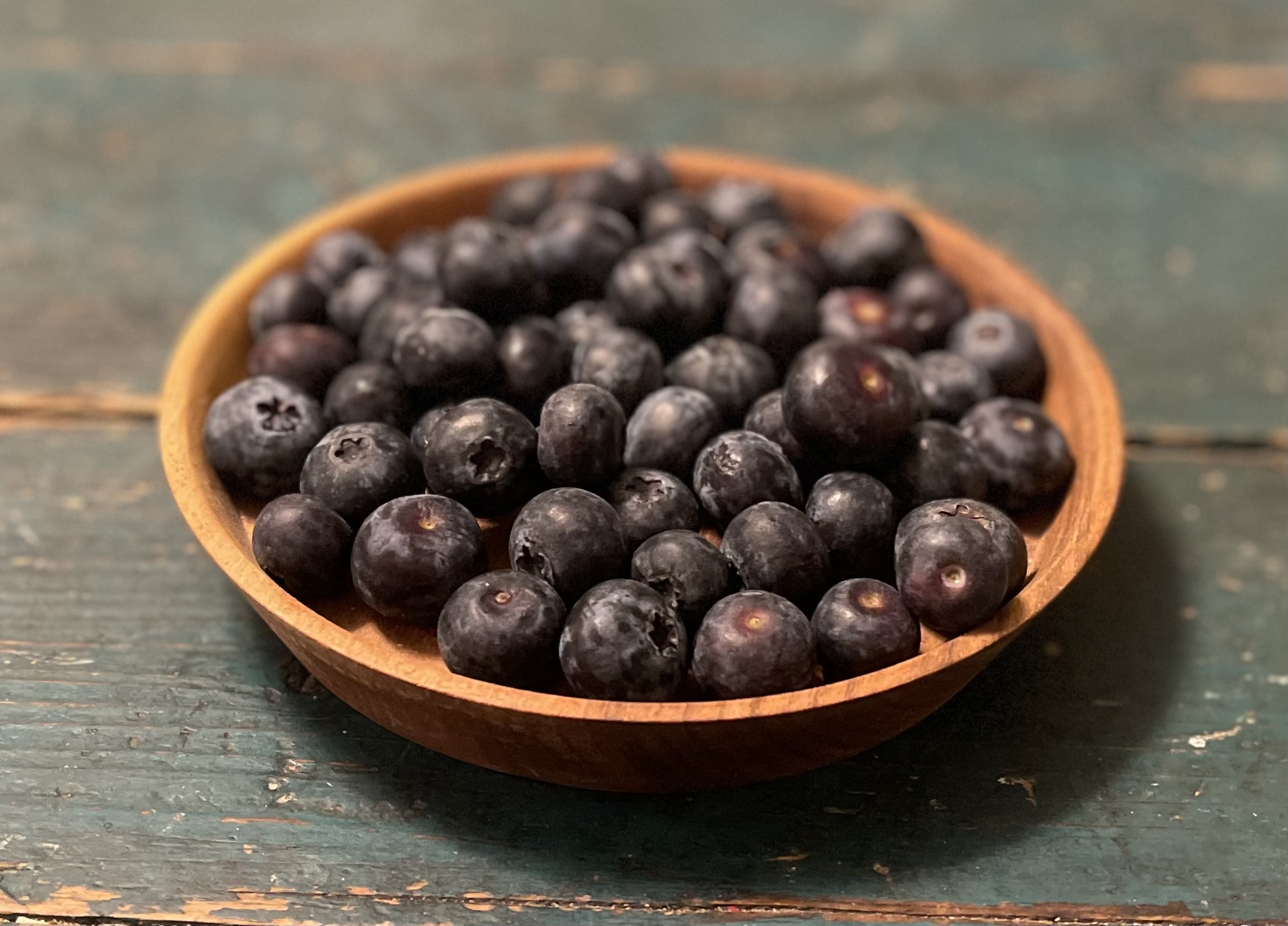
Blueberries are high in polyphenols which may help to curb the body’s inflammatory response. Photo by Dave Iltis

By enjoying two lunches instead of snack foods + one lunch, they generally end up eating more quality calories and fewer sweets. If their meal schedule is inflexible, I nudge them to at least snack on mini-meals instead of sweets:

  • Whole-grain English muffin + nut butter
  • Oatmeal cooked in milk + dates
  • Hummus s+ baby carrots.

The benefits of being well fed are fewer snack attacks, more energy, and easier weight management. Give it a try?


Inspiring Commuter Stories To Get You Out The Door In The Morning

By Joe Kurmaskie — Let’s face it, no matter how much you love your commute by bike, there’s always that morning, the one that comes to early, too wet, too hot or just too something to get you to carry the bike off the porch and into the bike lane. When you feel uninspired, take heart, take inspiration or take a moment to feel ashamed by your inertia that you suck it up and get in the saddle. The hardest part of any ride is starting…

[Editor’s note: this article first appeared in the July 2013 edition of Cycling Utah. Anecdotes and statistics may be out-of-date.]

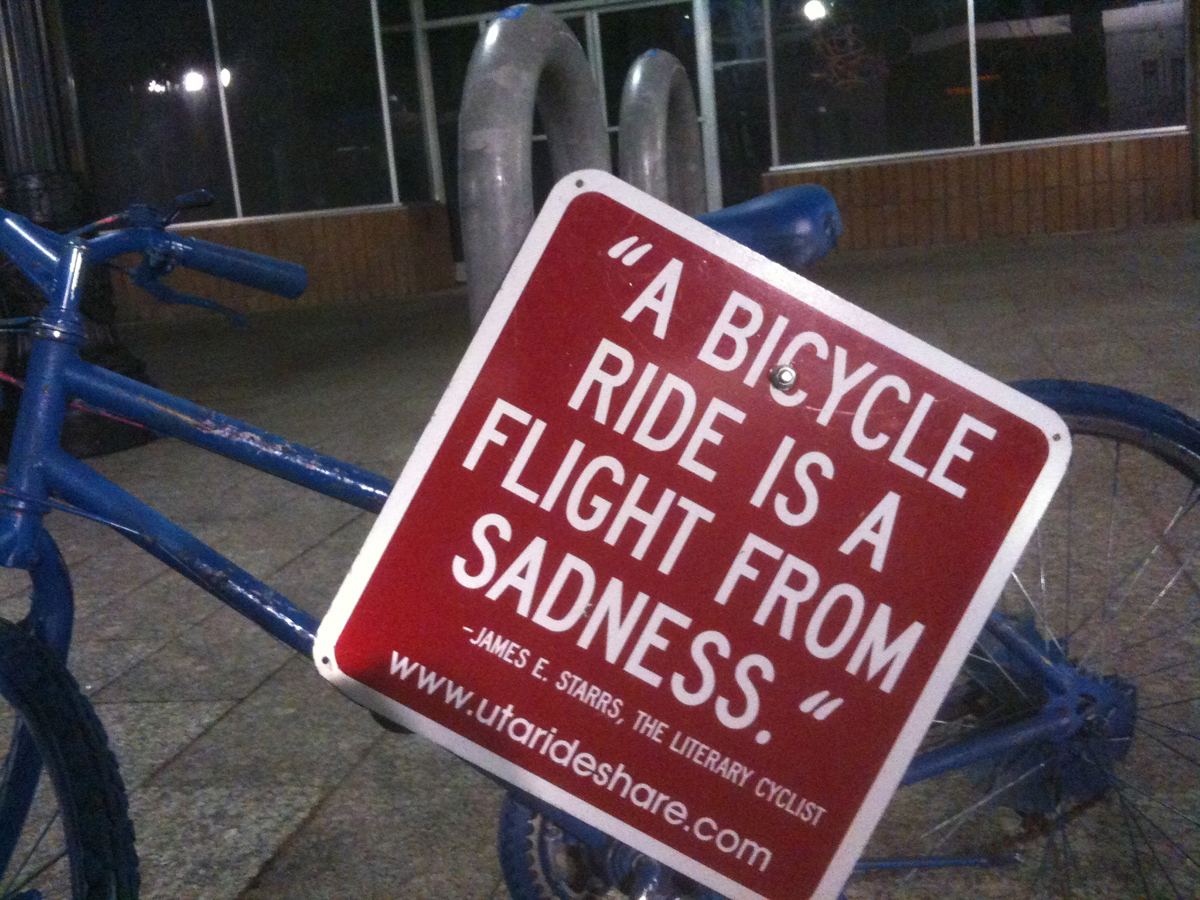
“A Bicycle Ride is a Flight From Sadness”. This sign is on a ‘blue bike’ in downtown Salt Lake City during Bike Month. Photo: Dave Iltis

(Of course, the greatest motivation for making the trek everyday is freeing yourself of car ownership, but even then, there are ways of passing on the commute by bike – carpool anyone? So for when you just aren’t feeling it, remember these road warriors.)

1. From The Never Too Young To Get Into The Groove File:

During the 2012-2013 school year, one Portland, Maine student marked the end of the school year as he started it, on a bicycle.

Kindergartener Alex Kimble told his father he enjoyed riding his bicycle so much that he wanted to ride it to school every day. Father and son made the several-block trip daily despite the weather.

On Thursday morning, Alex’s classmates gathered outside of school to cheer him on as he finished his goal. The 6-year-old’s effort made his father Nate proud.

“It was a real treat to see him have a goal and really want to stick to that. I think it was a good, sort of, life lesson for him and I’m proud of him,” Nate Kimble said.

Alex rode about 170 miles by the end of the school year, and he is thinking about bicycling to school next year too.

Read more: https://www.wmtw.com/article/portland-kindergartener-finishes-year-round-bike-commute/1996370

Let’s take a moment to internalize this information. Little Alex doesn’t live in Portland, Oregon where every third parent is cargo biking their kids and bike training along to the school yard. And Alex faced some mad weather conditions bicycling every day in MAINE! Alex, I’m not worthy, my friend. Way to go!

2. Ride Morning, Noon and Night:

When an office puts together a Lunchtime bike ride, commuter employee buy in grows by an average of 40 percent. don’t believe me, check out this tidbit about the National Geographic Headquarters, where it comes from the top down.

One way National Geographic staffers in Washington, D.C., can get to know their company’s CEO is to take him up on his long-standing offer: to go for a lunchtime bike ride.

“Anyone still downstairs? OK, so we ready to go, guys?” National Geographic Society CEO John Fahey asks a group of about 20 employees

Fahey, an avid biker, says he’s just trying to encourage a little exercise — and he wants the opportunity to get to know folks informally. As the group makes the 15-mile trek to Hains Point along the Potomac River and back, Fahey makes a point of chatting with everyone, staffers say.

At National Geographic — which is a hub of outdoorsy, adventure-seeking types who think nothing of biking busy city streets — lots of the staffers who join Fahey for the lunchtime rides also use their bikes to get to and from work every day.

“I’ve been riding in for 19 years,” says senior photo editor Dan Westergren, adding that he has definitely noticed the boom — especially as bike paths and bike lanes along city streets have improved.

Westergren’s commute is a combined 12 miles to and from home. And he says, given all the biking he does, he doesn’t need a gym membership to stay fit.

“Really, to build it into your daily routine by commuting for me has just been the best thing,” he says.

3. A Few Commuter Statistics:

  • And if you needed any more motivation there’s this from the American Journal of Public Health: the U.S. cities with the highest rates of walking and cycling to work have obesity rates that are 20 percent lower and diabetes rates that are 23 percent lower — compared with U.S. cities with the lowest rates of walking and cycling.
  • Adults who bike to work have better weight, blood pressure, and insulin levels. (Gordon-Larsen, P., et al., 2009)
  • Women who bike 30 minutes a day have a lower risk of breast cancer. (Luoto, R., et al., 2000)
  • Adolescents who bicycle are 48% less likely to be overweight as adults. (Menschik, D, et al., 2008)
  • The average American household spends $7,179 per year on owning and driving their cars. (Bureau of Transportation Statistics, 2010)
  • On a round-trip commute of 10 miles, bicyclists save around $10 daily. (Commute Solutions, 2011)

And if all that doesn’t get you pumped for your morning ride, just remember this riding a bike to work or school or to the store is like getting to play at something you love while moving yourself through space, instead of sitting in place as something moves you along.

The bike not only gets you somewhere, it lets you flee sadness in the process.


Going Home: A Bicycle Tour Through Scotland

By Mike Pribesh — Three years. That’s how long I had been planning this trip and how long I was denied the opportunity due to Covid restrictions. I had every nuance planned, every castle, every mile of my route, every imaginable campsite, every possible eventuality. Guess how that worked out.

Some of my fondest childhood memories are from the couple of years I lived in Scotland, way back in the dark ages of the late seventies. I remember becoming completely enthralled with all things medieval, as evidenced by my current way too expensive sword collection. Biking all over the Dunoon area and up through Sandbank to Glen Massan are indelibly printed in my memories, and I looked forward to revisiting the old haunts.

My planned solo trip became a couple’s trip when my girlfriend, Belinda, discovered that she likes bicycle touring. And she’s willing to put up with me for extended periods on the road. Win for me! Together we made our way across the Atlantic, after some delayed and missed flights and a wondrous night in Dallas, and arrived in Inverness ready to hit the road. Dallas was not quite the overnight stay that we had planned in London, but we made the best of it knowing the real trip had yet to begin. Unfortunately, our bikes did not arrive with us in Inverness, and instead showed up a day and a half later. I hope they at least had a scenic journey.

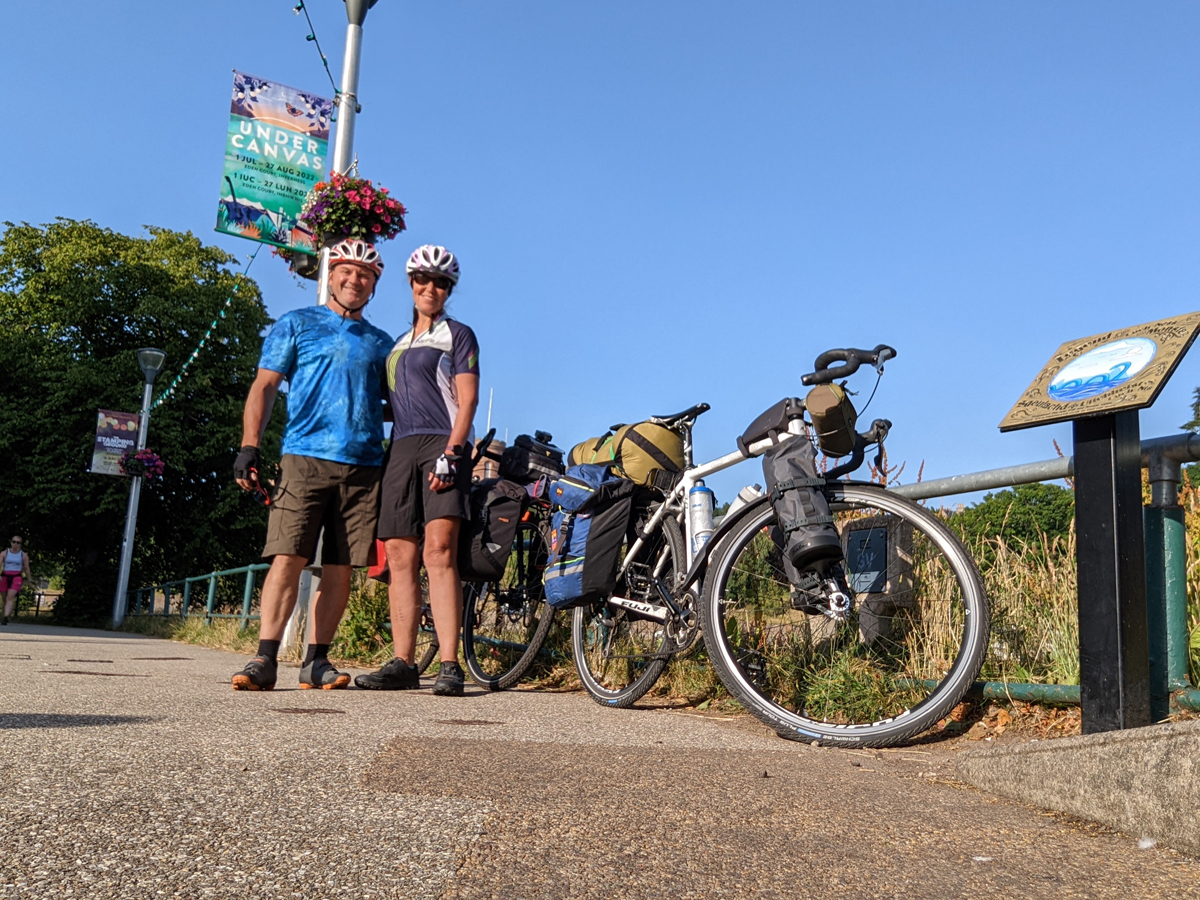
Mike and Belinda ready to get going, Inverness, Scotland. Photo by Mike Pribesh

When at last the bikes arrived, thankfully undamaged, we quickly assembled them and set off on our trip. The plan was to do a big, counterclockwise loop from Inverness, along the Great Glen Way to Fort William, then onward through Oban, south through Dunoon, through Glasgow, with a day off to explore Edinburgh before returning northward through the Cairngorms.

We rapidly discovered the Great Glen Way, at least the version of it we did, was no joke. Steep (very steep, stupidly steep) climbs through rough dirt roads and singletrack trails tested our resolve and our legs. Add in some rain on day two, and we were humbled. But the scenery was amazing with views of Loch Ness and some outstanding riding along the canal. We didn’t see Nessie but did tour Urquhart Castle. One of the must-do’s on our list was to see the Jacobite train, aka the Hogwarts Express, cross the viaduct in Glenfinnan, and we got there just in time to hike up to an overlook and watch it come across, puffing steam the whole way. It was easy to imagine Harry, Ron, and Hermione on their way to become wizards and witches. It was well worth the 30-ish mile detour on a scenic road along the edge of Loch Eil. We had a lot of must-dos on our list, so on we went.

The terrain got steeper, if that was even possible, and some questionable navigating by yours truly made for a very long day, in fact well past dark, again. Add in some cold rain and wind, and by the time we reached Fort William, we were pretty well soaked, frozen, and more than ready for a hotel with a hot shower. Camping was not high on the list at that point. Fortunately, the first place we stopped had a room, very reasonably priced for a swanky place, and we settled in for some recovery time so we could continue on the next day.

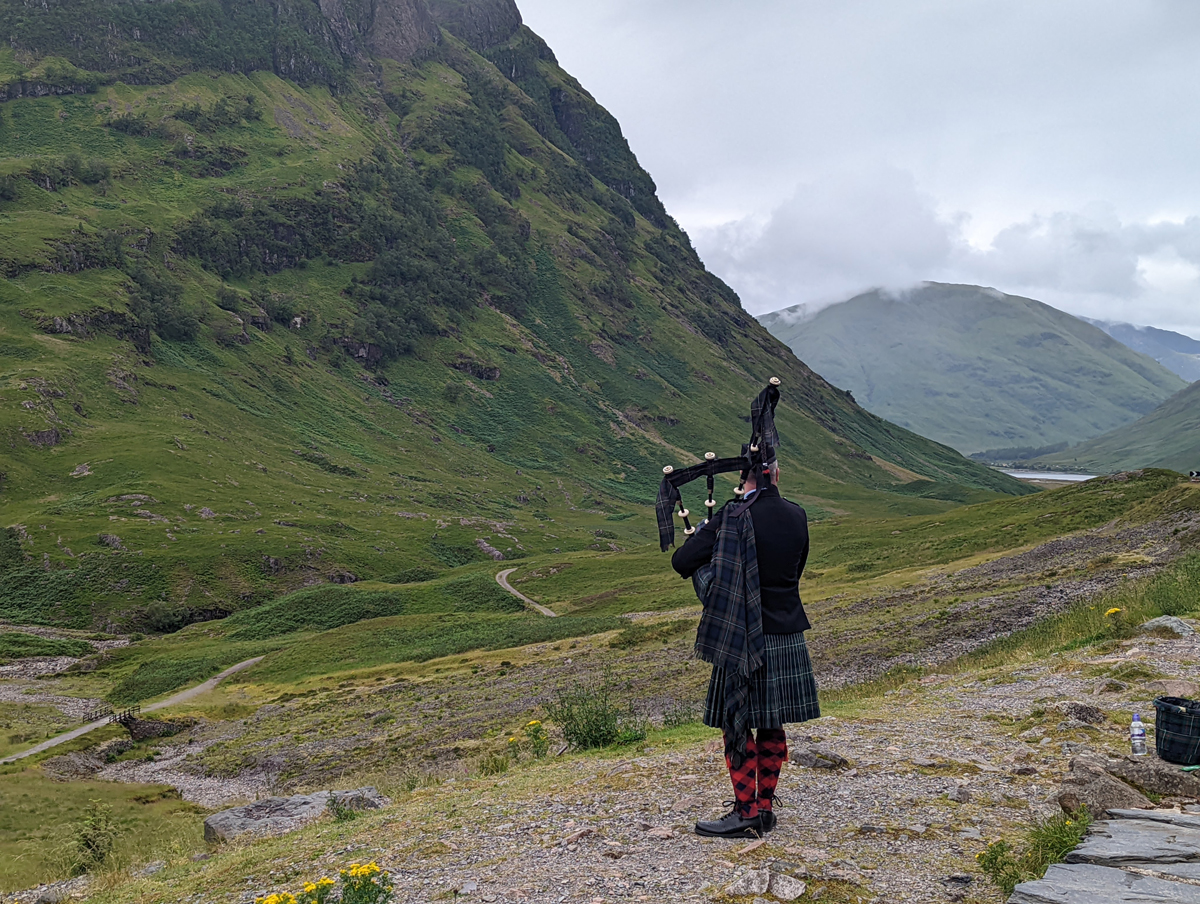
A Glencoe bagpiper. Photo by Mike Pribesh

Belinda and I are somewhat notorious for being slow movers in the morning, but we got going after a lot of breakfast (maybe too much breakfast?) and hit the road in good spirits and much better riding conditions. Our initial plan had been to do an eighty plus mile day to make up some lost time, with a brief stop in Glencoe before making our way to Oban for some much-needed whisky. The previous couple of days had taken their toll on our bodies, however, so we decided to stay in Glencoe, and I’m so glad we did. We stayed at the Red Squirrel Campground (amazing) and had a stellar evening at the Clachaig Inn just a short walk up the road. If you find yourself in Glencoe, I highly recommend a visit to this Inn/Pub. The exposed wood beams, stone floor, and feeling of cozy age are everything I could ever imagine in a Scottish pub. I introduced Belinda to the wonder that is haggis, played some pool, and sampled some delicious local whiskey while enjoying the ambiance. Belinda also discovered that she absolutely loves steak pie.

The ride out of Glencoe heading south is the stuff this trip was made for. A long, deep valley surrounded on both sides with looming mountains, lush green contrasted with low hanging clouds and fog, with waterfalls cascading down everywhere. It’s no wonder they chose to film Braveheart and The Highlander there. To top it off, as I rode up the long climb out of the valley, I began to hear bagpipes. Faint at first, but louder as I went on. Much to my surprise and profound joy, there, on the side of the road at a parking area, was a gentleman in full kilt and regalia, playing his bagpipes with the sound cascading down the valley. As a huge fan of bagpipe music, it made my day/week/life to come across this scene. Naturally I had to stop and hang out for a bit and chat.

Belinda was already far up the road ahead of me, and this delay dropped me even farther behind, so I was getting a little worried when I wasn’t catching up to her. Fortunately, she waited for me at the Glencoe Resort, a mountain biking and skiing mecca. We took a short detour to ride a lift to the top and watch the riders training for the Great Britain Downhill Mountain Bike Championship that was to take place in two days’ time. I was sorely tempted to rent a mountain bike and take a few runs down the course myself, but I know my luck (and skill level) and probably would have broken something vital.

As we made our way toward Dunoon, we passed (and stopped at) numerous castles, stone bridges, and quaint villages and the Rest and Be Thankful Viewpoint. It’s a tough slog getting up there, but worth it. I can never get tired of any of those. In Dunoon we stopped briefly at the house I lived in as a child, went by my old school, and I generally bored Belinda to tears with stories from my preteen childhood. As we rode through my old neighborhood, I had flashbacks to my first “racing” days on a bike. My friends and I had a loop where we would race NASCAR style, complete with pit stops and rider changes. I was fast(ish) once upon a time.

My father passed away a few years ago, and I took this opportunity to scatter some of his ashes in Holy Loch where he had been stationed for the Navy many years ago. It was a surprisingly challenging moment for me emotionally, but good. I didn’t expect it to be that hard. I clambered out on the rocks during low tide, beneath the ruins of the old pier that was the access point to the Navy ships out in the loch and took a few moments to recall my dad and record a video for my daughter.

By the time we arrived in downtown Dunoon, the rain had begun again in earnest and the temperature was dropping rapidly, so we elected to stay there in a warm hotel rather than continue on. Glasgow has been there for a long time, one more day probably wouldn’t make a difference.

The Kelpies. Falkirk, Scotland. Photo by Mike Pribesh

The ride through Glasgow was rife with navigational challenges, technical malfunctions, and torrential rain. Those all may have been related. Glasgow roads and traffic were difficult to navigate, and there was a fair bit of profanity (only from me) as we struggled through wrong turns and going around in circles, but we made it through and enjoyed the Caledonian Canal all the way to see the Falkirk Wheel and the Kelpies, both modern marvels and major bucket list items. It’s odd that I’m an enormous geek about all things medieval, but I was super excited to see these two sites from far more recent history. The Falkirk Wheel is an engineering marvel connecting two canals, and the Kelpies are two enormous horse head sculptures. From there it was a short jaunt into Edinburgh for our planned rest day, and that’s where things started to go downhill.

Our rest day itself wasn’t the issue. We spent the day walking the Royal Mile, touring Edinburgh Castle, buying yet another sword, and generally being the tourists we were supposed to be. We had lunch at the World’s End Pub and marveled at how a city could still look pretty much the same today as it did four hundred years ago.

The next day, we decided to take a train to Stirling rather than backtrack the forty miles we had just ridden, and while waiting in the station, we grabbed a couple of sandwiches from a coffee shop. I will never eat a Chicken Caesar sandwich with bacon again. The food poisoning that hit me later in the day was epic. Long story short, we toured Stirling Castle (amazing), and I spent the next three days holed up in bed and breakfasts wishing I was dead. I lost twelve pounds in those three days, and while I’m okay with the weight loss, it was definitely not my preferred method. Belinda was a trooper, nursing me back to some semblance of health, and somehow didn’t smother me to death with a pillow in my copious sleep. I guess a small silver lining was seeing the oldest stone bridge in the Highlands in Carrbridge (also home of the World Porridge Championship) that we otherwise would not have seen.

Leaving Culloden Battlefield on singletrack. Photo by Mike Pribesh

Once I was capable, we continued on back to Inverness with stops at the Tomatin Distillery, Clava Cairns, and Culloden Battlefield. It was an easy day of riding through rolling farmland to finish the trip, and we took our time with lots of stops for rest and photos. Neither of us was ready to be done. Scotland is so rich in fascinating history that it would be impossible to see all the sights in a lifetime. I guess we’ll just have to go back sometime.

Part of the reason for this trip was to see just how much things were either the same or different from my childhood memories. In a country known for its history going back over a thousand years, I didn’t expect a lot of significant change, and was surprised that my memory was accurate after forty plus years. I recognized buildings and landmarks, street names and locations without any problem at all. It made me happy to think about things staying the same in such a rapidly changing world.

Belinda on the last day of the tour of Scotland. Photo by Mike Pribesh

While this trip deviated from all the planning I had done, I wouldn’t change anything. Well, maybe the food poisoning. Definitely would not recommend. In many years of bicycle touring, I have finally learned that you can’t, and shouldn’t, plan for everything. It’s the nature of the beast that things will wander off course, and sometimes it will be awful, but usually it will be epically better. I got to cycle around a gorgeous country with an amazing and beautiful woman (and she didn’t kill me, again), and see some of the most stunning landscapes on the planet. Would I do it again? Absolutely and in a heartbeat. But my return to Scotland will have to wait. This is a great big world with lots to see by bicycle, and while I know I won’t get to it all, I certainly want to try.

If you go:

  • Some thoughts on routes. I planned with RidewithGPS. It’s a great tool for finding bike friendly roads, but don’t trust it blindly. It will lead you through some truly questionable areas and pathways, including down staircases and literally through buildings. Cross referencing with Google Maps Streetview is highly recommended.
  • The Great Glen Way is a popular route between Fort William and Inverness and is well worth it for the scenery, but it is tough, and a lot of it is more suited to mountain bikes rather than fully loaded touring bikes. There are several versions of the trail and finding the right path for your needs and equipment can be challenging.

    Scotland’s National Bike Network is extensive and well signed. Photo by Dave Iltis
  • Scotland has multiple routes on their National Bike Network that are for the most part very well signed and easy to find. They keep you off of main roads and onto lesser used, smaller roads and bike paths. Look for the little blue numbered signs or in the case of the Great Glen Way, thistle signposts.
  • Although many of the roads are tiny, one lane paths, we found Scottish drivers to be amazingly patient and considerate. Many times, they would wait for miles for a safe place to pass, even when we were crawling up steep climbs. Yes, they drive on the wrong side of the road, but they can be forgiven.
  • Speaking of riding on the wrong side of the road. There’s a sharp learning curve there when looking for oncoming traffic. Be careful. Cars are not always where your brain tells you they should be.
  • Camping in Scotland is easy and beautiful. Their land use code allows camping virtually anywhere that is not obviously fenced and posted. Just leave no trace or leave it cleaner than you found it. Paid campgrounds are numerous and not hard to find, most for about twenty dollars per night. Hotels/bed and breakfasts are reasonably priced and easy to book online. We took advantage of that fact more than we had planned due to illness, and glad we did. Food poisoning and a tent would have been a very bad combination.
  • We averaged around 50-55 miles per day. In past tours, and this one, I have found this to be a pretty good distance to allow plenty of time to stop and smell the roses, so to speak. Remember it’s not about getting from point A to point B. It’s about seeing all the sights along the way, and if that means stopping for a couple of hours to crawl around some castle ruins, all the better. At that distance per day, there’s plenty of time for sightseeing.
  • Be flexible. I tend to over plan because I like to know what’s coming. The best laid plans invariably change, whether it’s due to weather or a wrong turn or there’s somewhere you just want to see more of. Roll with it and enjoy.
  • Embrace the local food. It’s fantastic. It may have funny names like haggis or spotted dick, but give it a whirl. You won’t regret it. Unless it’s a cold sandwich from a train station.