
Marianne Martin wasn’t the first woman to wear the maillot jaune, but she became the first to win it, taking the race lead in the Alps and carrying it to Paris, in the process becoming the first American to stand atop a Tour de France podium — two years before Greg LeMond’s victory in the 1986 Tour.
By Steven L. Sheffield — A twenty-six-year-old from Fenton, Michigan, was climbing out of the saddle to Grenoble in July 1984, two minutes clear of the field, wondering whether anyone was coming to pass her. No one was. Marianne Martin wasn’t the first woman to wear the maillot jaune (the yellow jersey) that summer. Mieke Havik took it after the opening stage, Connie Meijer held it briefly a week later, and Heleen Hage carried it longest, deep into the Alps. But on the Champs-Élysées, nine days after Grenoble and five days after taking it on the stage to La Plagne, Martin became the first woman ever to win it.
The race finished on a Sunday, and Martin was back home in Colorado by Tuesday. The Los Angeles Olympics opened the following Saturday, July 28, and it took American sport just one more day to add a second landmark first in women’s endurance events, when Connie Carpenter-Phinney won the first women’s Olympic cycling road race; Joan Benoit Samuelson’s win in the first women’s Olympic marathon followed a week after that, on August 5. However, Martin’s result stood, that summer, as the answer to a French sporting press that had spent the spring insisting she and her rivals would not even finish.
A Race Borrowed from the Men
Women had chased the idea of a Tour de France since 1955, when the journalist Jean Leulliot staged a one-off five-stage race through Normandy and the Isle of Man’s Millie Robinson won it. That race stood apart from the Société du Tour de France’s own lineage, though, and no sequel followed. That distinction matters because Martin would join the later, official line in 1984. For twenty-nine years the idea sat dormant while the men’s Tour built its own mythology around Anquetil, Merckx, and Hinault. Bernard Hinault himself stood on the 1984 podium as the men’s runner-up to Laurent Fignon, a coincidence of timing that would put Martin and Fignon on the same riser in Paris.
Félix Lévitan, director of the Société du Tour de France, made the call to stage it, and he explained himself on the front page of L’Équipe when he announced the race, in language that has aged in complicated ways: “La femme est l’égale de l’homme, quand elle ne lui est pas supérieure,” or woman is man’s equal, when she is not his superior; and so he’d thought to organize something more significant than anything yet done for women in the sport. It was an argument for the race’s existence built on the same premises the race itself was about to spend eighteen days testing.
The stated rationale sat alongside a more commercial one. The Tour had spent years probing for new markets. Its amateur cousin, the Tour de l’Avenir, had opened itself to Eastern Bloc teams, and a Colombian squad had just been invited into the men’s race. North America looked like the biggest prize left. When Los Angeles announced it would host the first-ever Olympic women’s road race in 1984, the Société du Tour took sudden notice of women’s cycling. Whether the interest was in the sport itself or in the American television audience the Olympics promised is a question nobody has fully settled; either way, the race that resulted was, at eighteen stages, longer than any women’s Tour de France before or since.
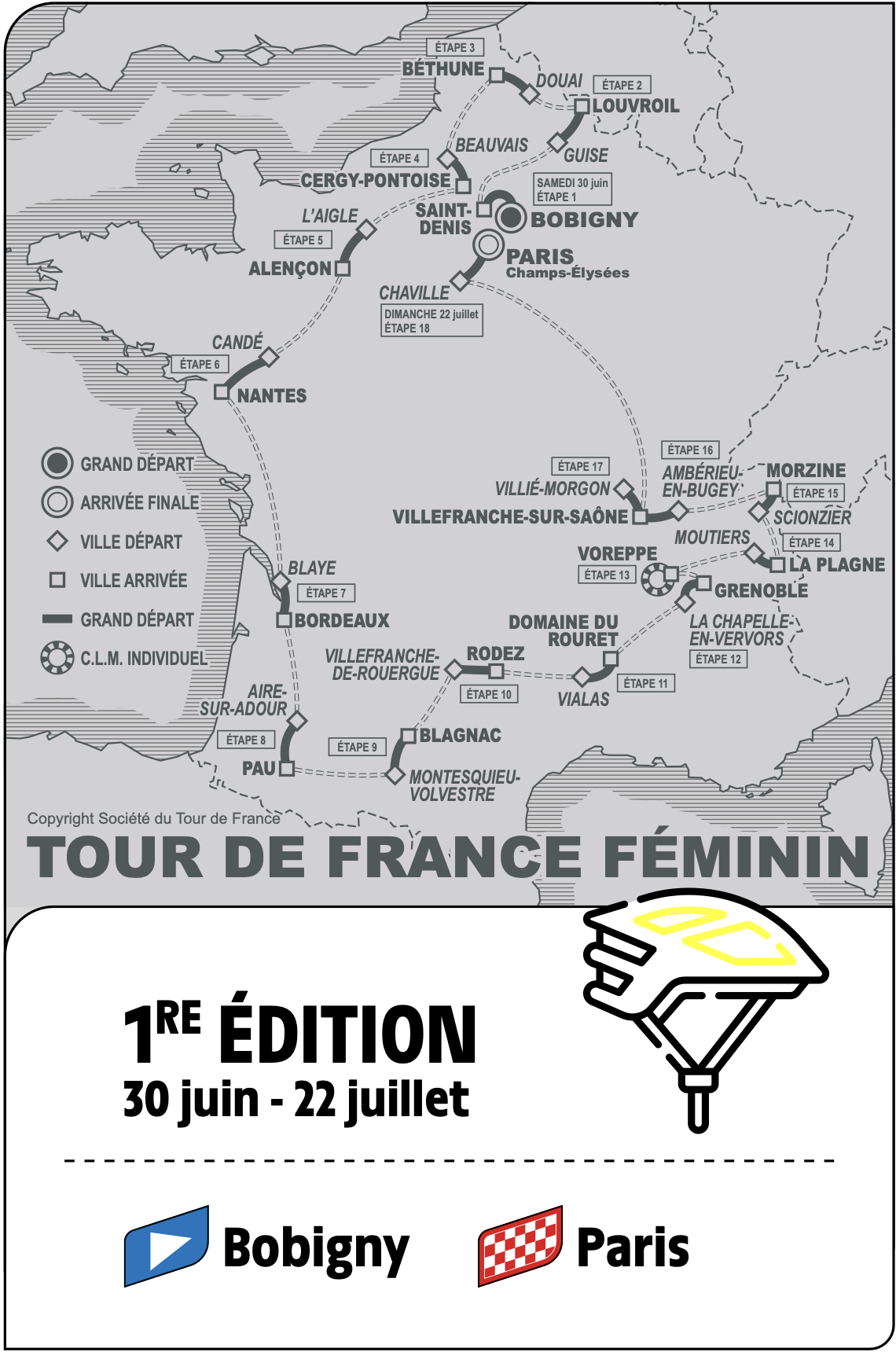
Rather than build an independent race, organizers grafted the women’s event onto the men’s existing skeleton. For eighteen days the women raced shortened courses built around the men’s route, frequently sharing the same finishing roads, climbs, and finish lines two to three hours before the men who would draw the day’s real headlines.
Their stages ranged from a 23-kilometer time trial to a 79-kilometer road stage, nothing like a fixed slice of each men’s stage. It was a shorter Tour by distance, 1,066 kilometers against the men’s 4,021-kilometer route, but not necessarily an easier one. And UCI limits on how far women were permitted to race meant even that trimmed distance required a special exemption, this one granting the women’s field five rest days across twenty-three days of racing against the men’s single rest day. The organizers kept every major climb intact even as they trimmed the transfers around them, so the women’s race carried the Vercors, the Alps above Grenoble, La Plagne, and the Col de Joux Plane above Morzine, the same passes that have always supplied the men’s race with its drama.
Reception among the riders themselves ranged from skeptical to openly hostile. Laurent Fignon, defending his 1983 title and about to become the standard against whom Martin’s own result would be measured, said plainly that he’d rather see women occupied with something other than bike racing. It was, in miniature, the argument the eighteen stages were about to settle.
A Camera, Not a Bike
Martin came to the sport sideways. When she graduated from the University of Colorado, her father offered her a graduation gift and she asked for money toward a racing bike; he gave her a camera instead, unconvinced that competitive cycling was a sensible pursuit for his daughter. Her mother took the opposite view from the start, encouraging her plainly and without qualification. She took out a loan for her first bike, a used one, for $600. She had discovered the sport almost by accident in Boulder, cycling to stay fit around a hotel job before a friend talked her into entering a race. To her own surprise, she found that the climbing suited her.
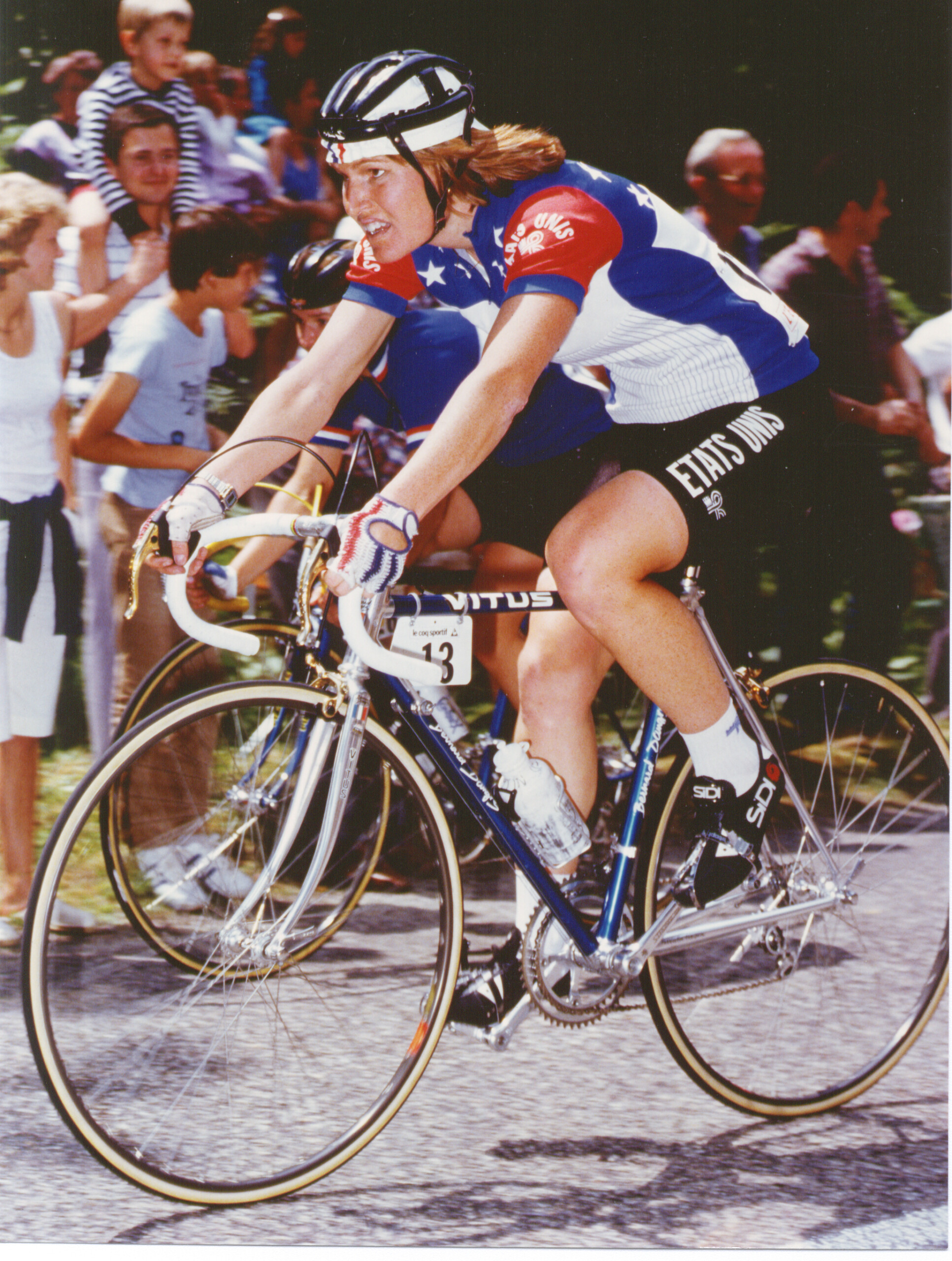
The scale of her ambition outran her circumstances almost immediately. She once called in sick to work so she could race the Tour of Texas, won its opening time trial, and was promptly exposed when the result made the local Boulder paper. By 1984 she had a national racing license but not a settled income. A bout of anemia early that year had wrecked her form, and she was still mid-way through the Olympic road trials, three races into four, when a late roster spot opened on the small U.S. squad that team manager Mike Fraysse was taking to the Tour de France Féminin. She left before the trials were finished, made her case to Fraysse in person, and had to beg and plead for the spot, by her own account. She closed her pitch simply: “Believe me, Mike, you won’t be disappointed. I’m a great hill climber, and I’m not going to be intimidated by the mountains.”
It worked. Martin took the last spot on the six-woman American roster only weeks before the race began, with no Tour-specific preparation behind her and, by her own account, no real expectation of contending. She herself wasn’t even the pick to lead her own team. Betsy King was supposed to be the winner, Martin has said. King, more experienced and based in Europe, was the presumptive leader for a reason, but she arrived carrying an injury from just before the race began, and the leadership Martin never expected fell to her instead.
Six Nations, One Orange Wall
Thirty-six riders across six national squads lined up at Bobigny for the opening stage into Saint-Denis: the Netherlands, the United States, Great Britain, two French teams designated A and B, and Canada. From the gun, the race belonged to the Dutch. Mieke Havik, Petra de Bruin, Heleen Hage, Connie Meijer, and Hanneke Lieverse traded stage wins among themselves with the efficiency of a team that had simply arrived fitter than everyone else, taking fifteen of the race’s eighteen stages between them. Havik won stage one outright, with de Bruin second and Martin third. Havik wore the first maillot jaune of the women’s Tour de France, sharing the winners’ podium at Saint-Denis with the men’s stage winner, and held it through stage five. Meijer inherited it after her own stage-six win into Nantes and held it through stage seven; Hage took it over after stage eight, on the strength of her placing behind stage winner Kelly-Ann Way rather than a win of her own, and held it deep into the Alps. She was the rider Martin would eventually have to dethrone. Way’s stage-eight victory into Pau was the only break in the Dutch run of stage wins before the mountains reshuffled the overall picture entirely. Havik alone would finish with five stage wins and the points jersey, the race’s most prolific winner by raw stage victories even as the overall classification slipped away from her.
The Americans arrived without the Dutch team’s depth of results but not without conviction. Patty Peoples, riding as team domestique, remembered the mood on arrival in France bluntly: the local papers had already written the ending, forecasting that no rider in the women’s field would survive to Paris. Martin herself found the notion faintly absurd rather than intimidating. “The French did not think we would finish 18 days of racing,” she said years later, still faintly incredulous at the presumption. Even the skeptical French press, Peoples has said, warmed up as the Americans kept proving them wrong.
Grenoble, and the Jersey No One Expected
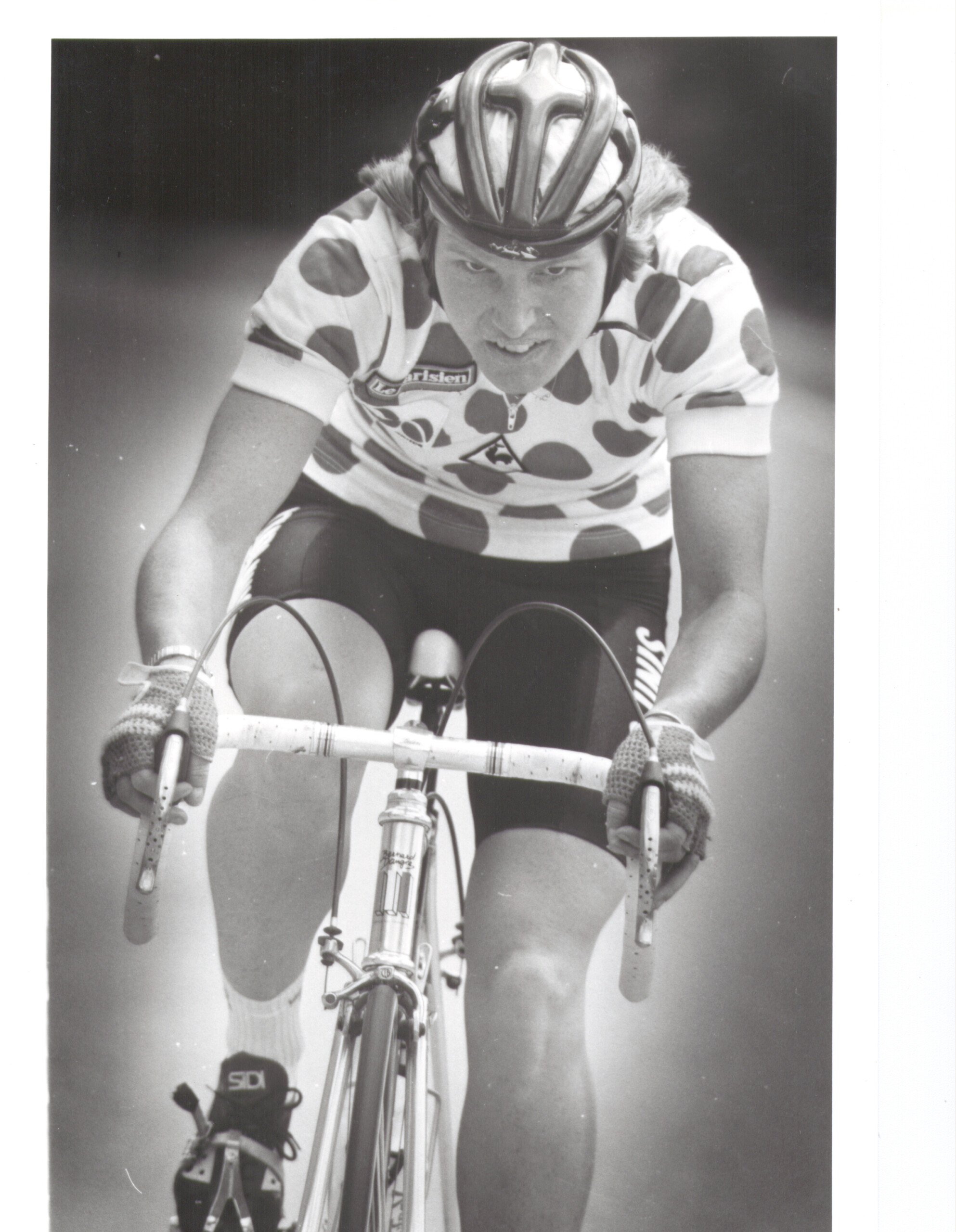
The race turned in the Alps. Stage twelve ran seventy-three hilly kilometers from La Chapelle-en-Vercors into Grenoble, over two passes topping out above 4,400 feet. Martin didn’t strike alone at first. She and her teammate Betty Wise-Steffan broke clear together on the Col de Chalimont, chasing the polka-dot mountains jersey, worn until then by the Frenchwoman Corinne Lutz. It was only in the final fifty kilometers that Martin rode away from Wise-Steffan too, alone now and clear of the flatter, faster Dutch specialists behind her, opening a gap she later estimated at ten minutes. She rode carefully rather than heroically the rest of the way into Grenoble, unwilling to bury herself defending a lead she wasn’t certain would hold. Nobody came back to her. She won the stage by 1:33 over Hage and claimed the mountains jersey outright, though Hage, still the overall leader, held on to the maillot jaune by 1:04.
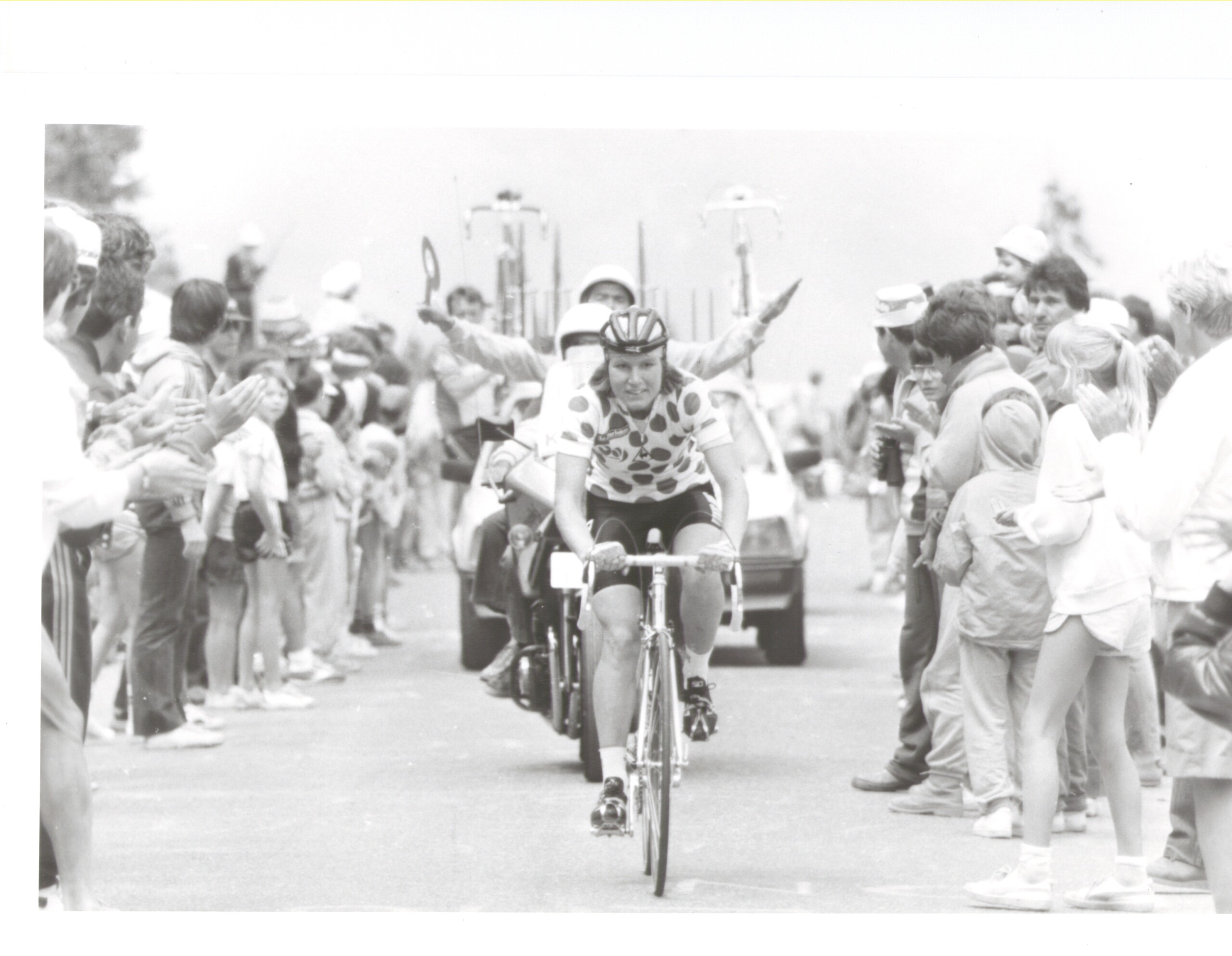
Hage responded the only way that mattered: stage thirteen, an individual time trial around Voreppe, went to the Dutchwoman by an even wider margin, stretching her overall lead further still. Then came stage fourteen: thirty-two brutal kilometers from Moûtiers up to the ski station at La Plagne, a stage built entirely of altitude. Martin won it outright, opening nearly four minutes on Hage, who cracked on the climb and finished the day fourteenth. With the stage came, finally, the maillot jaune itself. Peoples shifted her own role on the spot, riding the rest of the race as a dedicated domestique guarding her teammate’s lead.
The jersey wasn’t the only thing that changed in the Alps. At a photo call arranged for the men’s race leader, a photographer pointed Martin toward Fignon and told her, matter-of-factly, that he was the one who was going to win. Something in the moment inverted itself for her. She has said that was the instant she first believed, without qualification, that the title was hers to take.
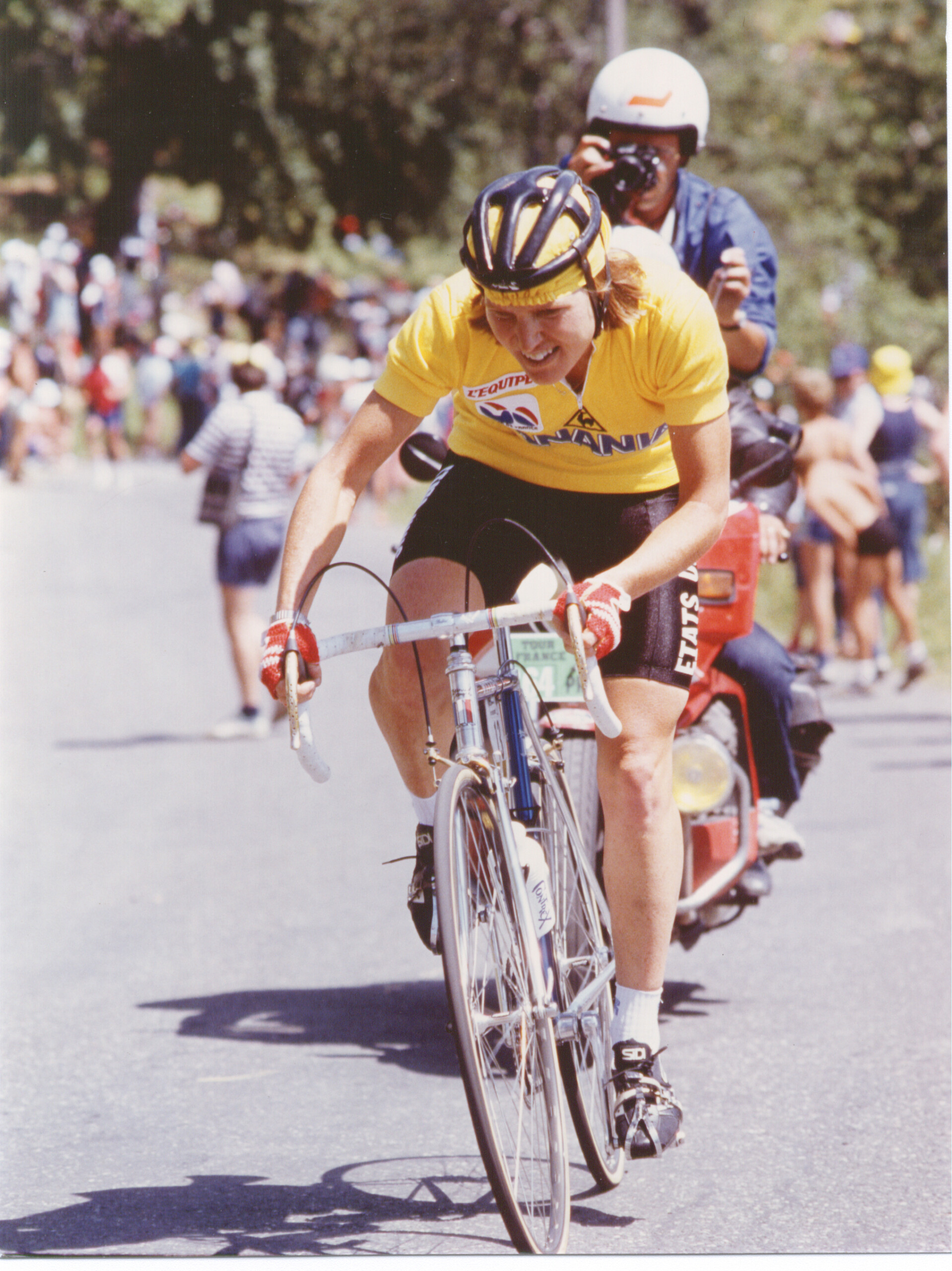
Of all the climbs that summer, Martin has said the one she remembers most vividly is the Col de Joux Plane, above Morzine on stage fifteen. The same climb the men’s race would immortalize a decade later as the site of Richard Virenque’s and Marco Pantani’s Tour battles. Her sister, who had ridden the descent into Morzine herself, had warned her before the Tour that it was a treacherous one, and that Hage, a strong descender, would be dangerous on it if given the chance. It played out almost exactly that way: Martin crested the climb alone in the lead, but Hage clawed back more than a minute on the descent and beat her to the line in Morzine by 22 seconds, the one defeat in an otherwise perfect run through the mountains. She has described looking up at the climb’s wall of switchbacks with something close to dread, the kind of memory, she has said, that only survives because the moment itself was hard enough to leave a mark.
A Fight, Not a Parade, into Paris
The finish-line drama didn’t start on the final stage; it had been building for three days. With the overall lead narrow enough to threaten, the Dutch team worked a coordinated box-and-chase in the days before Paris: one rider attacking with Hage sitting on her wheel while two or three others closed in around Martin to deny her any response, forcing her to fight clear and run the move down alone before the pattern started over. Her own team was thin cover against it, six riders with no shared season of racing behind them, but what she had, she used: Jolanda Goral helped her survive the worst of one hard day, and Patty Peoples, greener but willing, covered what she could the next. On one descent, boxed in against the roadside with no way through, Martin forced her way past Connie Meijer to chase down a group that had gone clear with five or six riders in it. Meijer caught back up to her ten kilometers later only to admit, in effect, that she hadn’t expected that kind of strength from her.
The final stage, sixty-seven kilometers from Chaville onto the Champs-Élysées, is remembered in most retellings of the men’s Tour as ceremonial, a procession broken only by a bunch sprint. For Martin and Hage it was nothing of the kind. Hage attacked repeatedly on the finishing circuits, still hunting the three minutes and seventeen seconds that separated them on general classification. “I stayed right on her wheel so that she couldn’t get off the front,” Martin has said of marking her rival through those closing laps, denying her the room to build a gap that mattered. Connie Meijer won the stage sprint, her third of the race, but the overall battle was decided by attrition rather than a finish-line photograph.
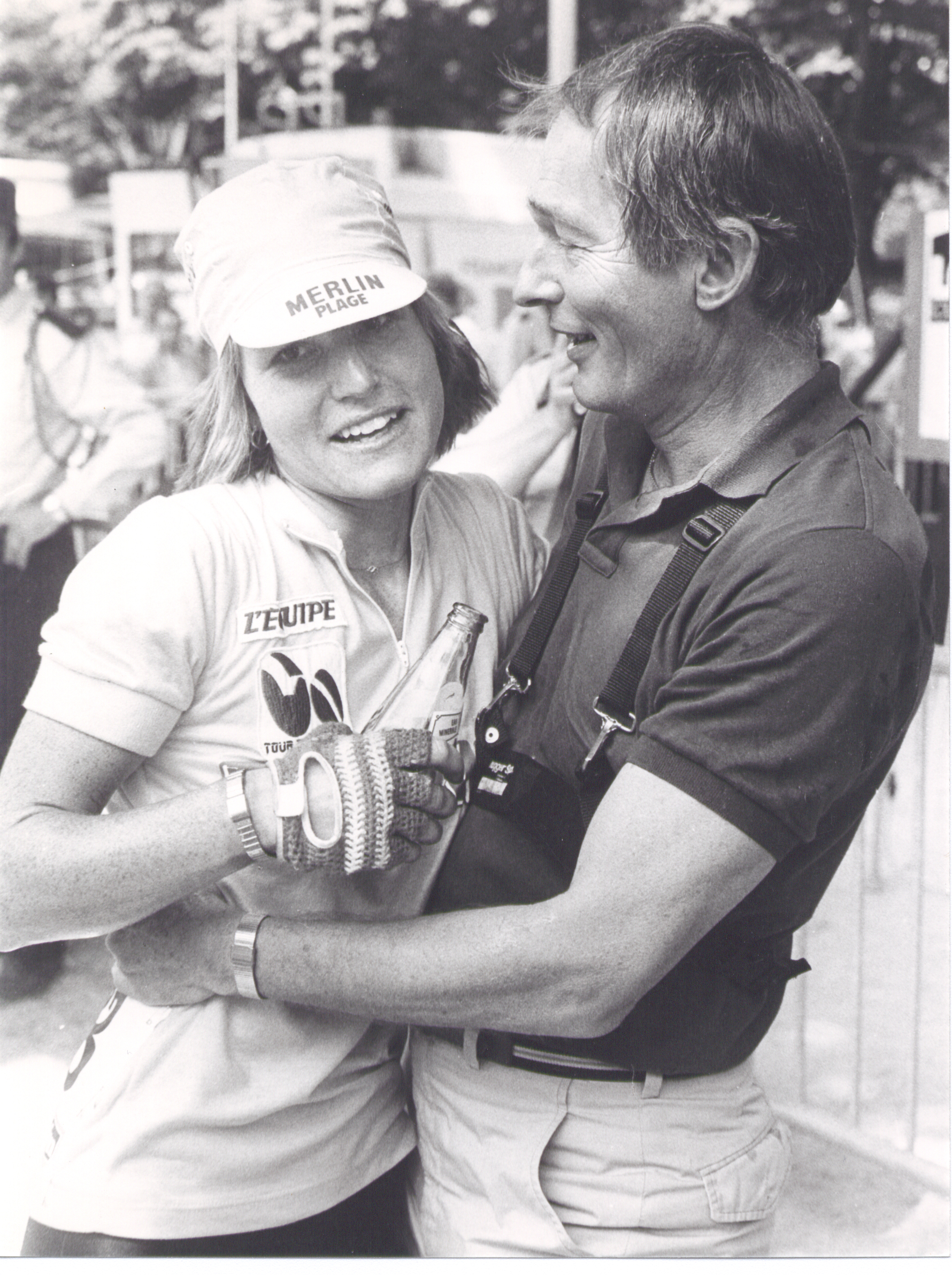
Martin’s father, James, had flown in from Michigan without telling her, and she heard his voice above the roadside noise on the Champs-Élysées before she found his face in the crowd. He vaulted the roadside barricade to reach her, ignoring the officials waving him back, insisting in halting French that he was, in fact, her father.
“He crawled over the fence, and my dad’s one of those people who obeys all the rules. The officials were saying, ‘No, no,’ and he’d say, ‘Moi, papa! Moi, papa!’ So he was out in the middle with me when I won. It was a fairytale. It was unreal,” Martin recalled in a 2016 interview with The Guardian.
One journalist working the finish line told Martin afterward that he hadn’t even known women were racing the Tour; she took it, she has said, less as an insult than an invitation to explain: “Oh! Well I’m going to tell you about it!”
Martin finished the general classification 3:17 ahead of Hage and 11:51 clear of her own teammate, Deborah Shumway, third overall. The United States claimed the best-team classification as well, nearly thirteen minutes clear of the Netherlands and well ahead of France. Of the thirty-six women who’d lined up at Bobigny, thirty-five reached Paris; the only rider who didn’t finish abandoned after breaking her collarbone, which had nothing to do with distance, altitude, or anything the French press had spent the spring predicting would break them.
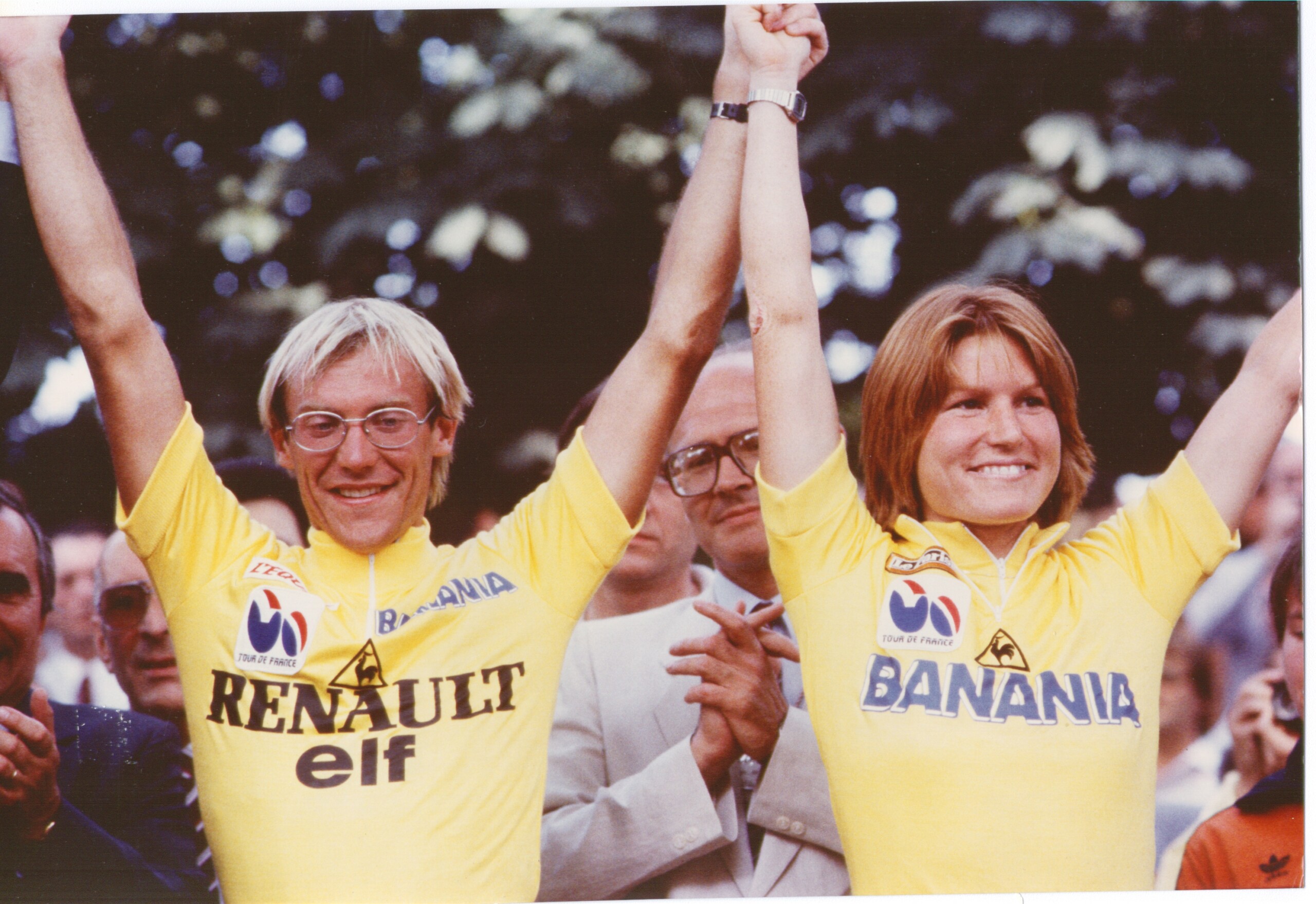
On the winners’ podium in Paris, race organizers ran the women’s ceremony first, then the men’s. In a final gesture nobody had scripted, organizers brought Martin back up alongside men’s champion Laurent Fignon for a joint appearance that Martin herself has called surreal. She has said she felt genuinely honored to share that podium with the men, given how much history the occasion carried for them. The story followed her home: within days, the Washington Post, the International Herald Tribune, and the New York Times had all called for interviews, a level of attention the win had never quite found in Boulder itself.
Stage-by-Stage Winners
| Stage | Route | Distance | Winner |
| 1 | Bobigny–Saint-Denis | 67 km | Mieke Havik (NED) |
| 2 | Guise–Louvroil | 61 km | Mieke Havik (NED) |
| 3 | Douai–Béthune | 49 km | Petra de Bruin (NED) |
| 4 | Beauvais–Cergy-Pontoise | 57 km | Heleen Hage (NED) |
| 5 | L’Aigle–Alençon | 76 km | Mieke Havik (NED) |
| 6 | Candé–Nantes | 79 km | Connie Meijer (NED) |
| 7 | Blaye–Bordeaux | 54 km | Petra de Bruin (NED) |
| 8 | Aire-sur-l’Adour–Pau | 70 km | Kelly-Ann Way (CAN) |
| 9 | Montesquieu-Volvestre–Blagnac | 78 km | Petra de Bruin (NED) |
| 10 | Villefranche-de-Rouergue–Rodez | 60 km | Hanneke Lieverse (NED) |
| 11 | Vialas–Domaine du Rouret | 60 km | Mieke Havik (NED) |
| 12 | La Chapelle-en-Vercors–Grenoble | 73 km | Marianne Martin (USA) |
| 13 | Voreppe ITT | 23 km | Heleen Hage (NED) |
| 14 | Moûtiers–La Plagne | 32 km | Marianne Martin (USA) |
| 15 | Scionzier–Morzine | 51 km | Heleen Hage (NED) |
| 16 | Ambérieu-en-Bugey–Villefranche-sur-Saône | 57 km | Connie Meijer (NED) |
| 17 | Villié-Morgon–Villefranche-en-Beaujolais | 51 km | Mieke Havik (NED) |
| 18 | Chaville–Champs-Élysées | 67 km | Connie Meijer (NED) |
| Full 18-stage result. The Netherlands won fifteen of eighteen stages; Marianne Martin’s mountain-stage victories, on stages 12 and 14, proved decisive to the general classification. | |||
Final General Classification
| Position | Rider | Team | Time |
| 1 | Marianne Martin | USA | 29:39:02 |
| 2 | Heleen Hage | NED | + 03:17 |
| 3 | Deborah Shumway | USA | + 11:51 |
| 4 | Valérie Simonnet | FRA A | + 12:13 |
| 5 | Corinne Lutz | FRA A | + 13:22 |
| 6 | Betty Wise-Steffan | USA | + 13:47 |
| 7 | Clare Greenwood | GBR | + 14:44 |
| 8 | Marylin Wells | CAN | + 15:20 |
| 9 | Chantal Broca | FRA A | + 18:05 |
| 10 | Annie Rebière | FRA B | + 18:24 |
| 11 | Mieke Havik | NED | + 19:31 |
| 12 | Suzanne Lemieux | CAN | + 20:11 |
| 13 | Corinne Le Gal | FRA A | + 21:09 |
| 14 | Hilary Matte | CAN | + 21:12 |
| 15 | Christine Waller | FRA B | + 22:52 |
| 16 | Connie Meijer | NED | + 22:59 |
| 17 | Rita Timpers | NED | + 23:02 |
| 18 | Patty Peoples | USA | + 23:05 |
| 19 | Judith Painter | GBR | + 24:45 |
| 20 | Kelly-Ann Way | CAN | + 25:19 |
| 21 | Marie-Françoise Potereau | FRA A | + 29:11 |
| 22 | Senta Bauermeister | CAN | + 30:32 |
| 23 | Béatrice Labarthe | FRA B | + 30:38 |
| 24 | Petra de Bruin | NED | + 30:50 |
| 25 | Hanneke Lieverse | NED | + 31:31 |
| 26 | Betsy King | USA | + 32:39 |
| 27 | Pauline Strong | GBR | + 33:53 |
| 28 | Laure Lisnard | FRA B | + 33:59 |
| 29 | Jacqueline Shaw | CAN | + 37:51 |
| 30 | Nathalie Diart | FRA A | + 41:15 |
| 31 | Helen Edwards | GBR | + 41:20 |
| 32 | Louise Garbutt | GBR | + 44:57 |
| 33 | Christine Gourmelon | FRA B | + 45:50 |
| 34 | Chantal Diaz | FRA B | — |
| 35 | Jolanda Goral | USA | + 49:05 |
| Full general classification, all thirty-five finishers, Paris, 22 July 1984. Marianne Martin took the overall lead on stage 14 and held it to the finish, averaging 35.966 km/h across the full race. | |||
The Gap Between the Jerseys
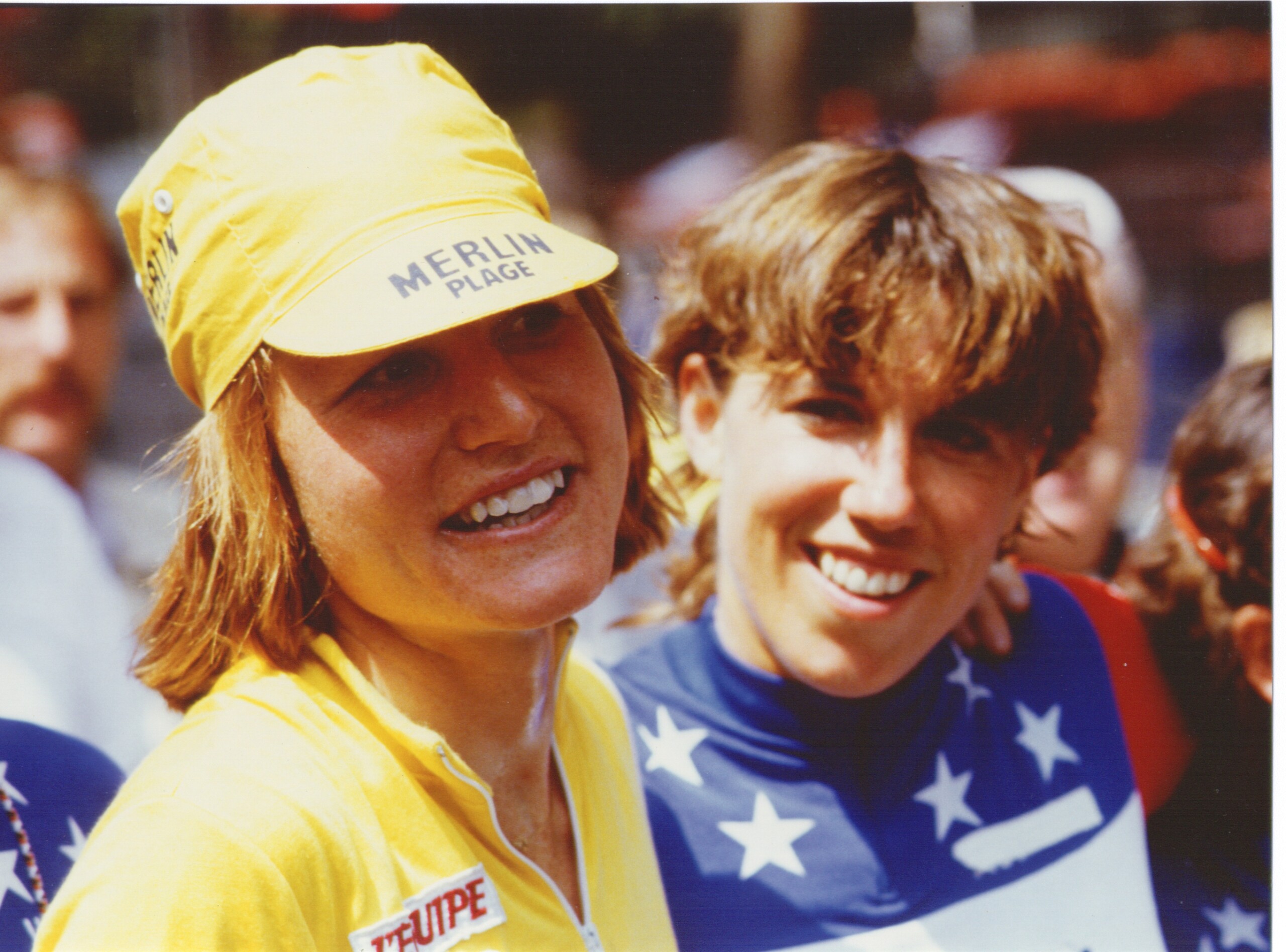
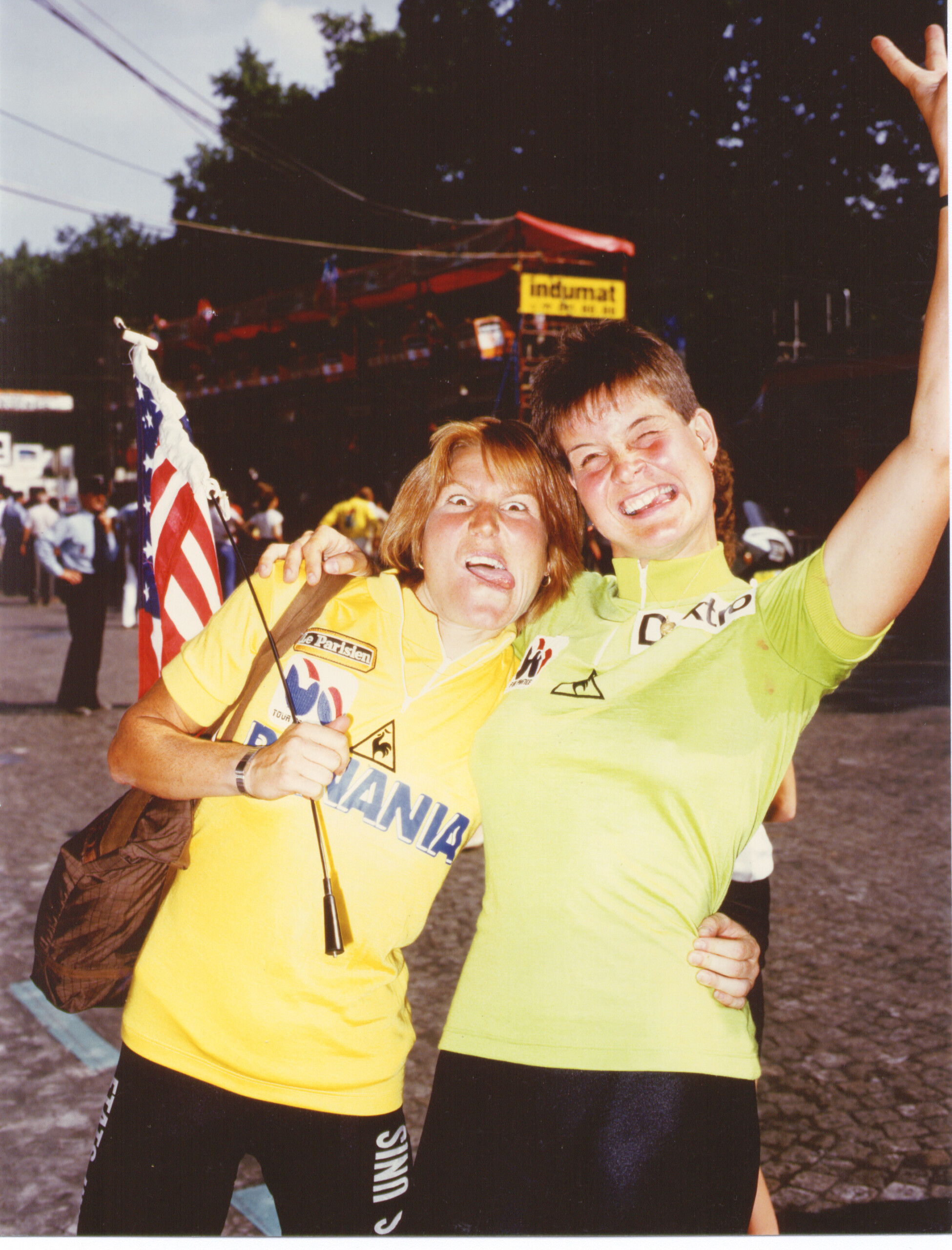
The disparity between the two Tours was not subtle, and nobody involved pretended otherwise. Fignon’s overall prize package that July has been valued at well over one hundred thousand dollars in the currency of the day; Martin’s own winnings amounted to a trophy and a $1,000 purse, split among her teammates. Rooming, meals, and logistical support for the men’s peloton outpaced anything on offer to the women, and Martin has said plainly that the difference showed up in nearly every category of treatment along the route. She has also said, just as plainly, that it never much bothered her at the time. She’d gone to France to race her bike, not to compare hotel rooms, and that part of the deal was never really the point.
Qualification itself had a price tag. National team selection required riders to compete in events scattered across the country, with no local sponsor covering travel to a race it wouldn’t benefit from, so Martin financed her own path to the Tour on a credit card. By the time she’d paid her way through the national circuit, competed in Europe the following spring, and finally been forced by declining health to quit racing in 1986, she had run up roughly $10,000 in debt, something closer to $30,000 today.
It took her two full years of working an advertising job to clear it. Martin has waved off any suggestion that the imbalance diminished the experience for her; she has said, in effect, that she’d have made the same trade even without the win, for the chance to race in France every day and be fed and cared for as an athlete, however modestly. None of it changed the result in the mountains; it’s harder to say it didn’t shape what came after, for her and for the race itself.
What Outlasted the Race
The Société du Tour de France ran its women’s race for six editions in total: Martin in 1984, Maria Canins in 1985 and 1986, and Jeannie Longo across three consecutive years, 1987 through 1989. It never again matched the scale of that first edition. The sport’s governing body at the time, the FICP, made noises almost immediately about capping how many days women were allowed to race, and the Société responded the following year by splitting the event into two separately judged halves rather than defend the full eighteen-stage format outright. Tour director Jean-Marie Leblanc then discontinued the race after 1989, citing the economics of running an event that limited sponsorship and media coverage had never let outgrow its early promise; the Société itself was folded into what became ASO a few years later, in 1992.
Other stage races tried to fill the void afterward, though the succession wasn’t a straight line: the Tour de la C.E.E. Féminin picked up directly where the Société’s race left off but folded after four editions, in 1993, while a separately organized Tour Cycliste Féminin, running since 1992 and later renamed the Grande Boucle Féminine Internationale, carried on under different organizers until 2009, when the last edition managed just four days with sixty-six riders. Neither carried the Tour de France name or belonged to the Société du Tour de France/ASO lineage; their own winners, including Leontien van Moorsel, Fabiana Luperini, Joane Somarriba, and Nicole Cooke, belong to a separate line of succession.
It took until 2022 for the Tour de France to field a women’s stage race under ASO’s own banner, the Tour de France Femmes avec Zwift, launched after nearly a decade of campaigning by riders including Kathryn Bertine, Marianne Vos, Emma Pooley, and Chrissie Wellington. ASO’s own history has since settled where that race fits: its current official guide to the Tour de France Femmes runs Martin’s 1984 win, Canins’s and Longo’s titles, and the modern champions together in one continuous palmarès, distance and average speed and all, with no dividing line between 1989 and 2022. The 2022 relaunch may have been billed in the moment as a fresh start; the record book disagrees. Martin, watching that relaunch from Colorado, found the broadcasts pulling her back toward the sport in a way the modern men’s race never had. She has said that watching the women’s peloton race now makes her “miss that so much,” something the men’s race no longer does for her.
The intervening decades hadn’t always been generous to that memory. When La Course launched in 2014 as a one-day curtain-raiser, some coverage described it as women’s first foray into the Tour de France. Peoples, still protective of what her generation had built, pushed back directly on that framing. Her own team had already proven the longer race was possible, she has said; what was missing wasn’t proof, but the will to bring the full race back.
The scarcity of names on the sport’s official list of Tour de France champions is itself part of the story. Thirty-three years passed between Longo’s third title in 1989 and the next name added to that list. When Annemiek van Vleuten won the revived Tour de France Femmes in 2022, her victory counted as the seventh official Tour de France title overall. But she herself was only the fourth woman ever to win one, since Canins and Longo each account for more than a single title apiece. Three more names have joined the list since, one per year: Demi Vollering in 2023, Kasia Niewiadoma in 2024, Pauline Ferrand-Prévot in 2025. None of them are repeat champions yet. Niewiadoma’s 2024 win came down to four seconds over Vollering, the tightest margin in the race’s history in either era; Martin’s own winning margin, 3:17, sits closer to how most of these editions have actually been decided. That’s seven women’s names across ten official titles, spanning two eras separated by thirty-three years. Martin’s name sits first on that list, not because she was the first woman to wear the maillot jaune, but because she was the first to win it, in Paris.
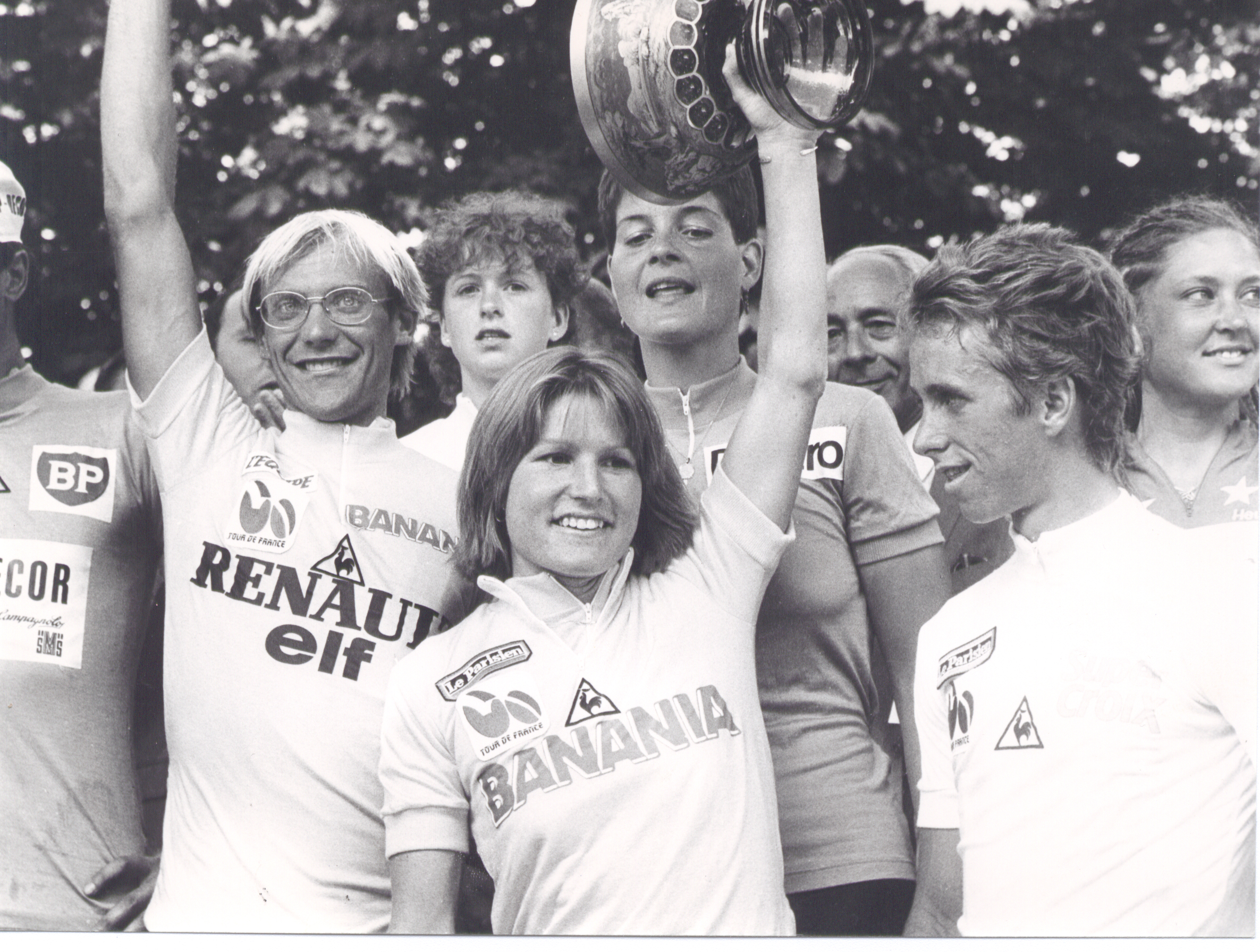
Martin was inducted into the Boulder Sports Hall of Fame in 2012 and the United States Bicycling Hall of Fame in 2020, honors that arrived decades after a result most of her own friends had never heard about. The gap in recognition shows up in a smaller, more specific way, too: American cycling folklore still routinely credits Greg LeMond as the first U.S. rider to win the Tour de France, for his victory in 1986. Martin got there two years earlier. She still sits first on that short list of seven names, not because she outlasted the field (nearly all of it reached Paris), but because a rider added to a national team roster almost as an afterthought turned out to be the strongest in the mountains, on the days that decided it.
Preview of the 2026 Tour de France Femmes
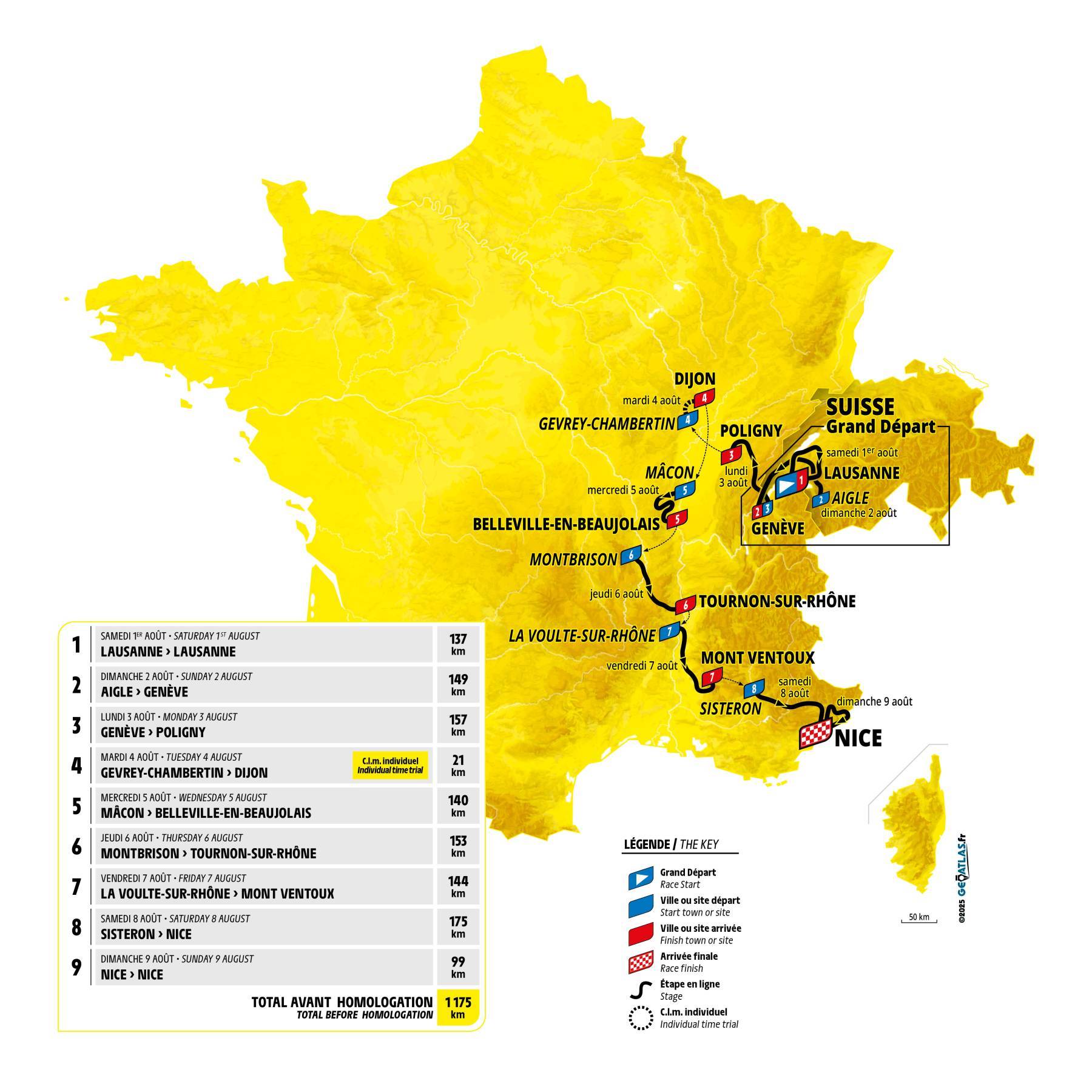
The fifth edition of the Tour de France Femmes avec Zwift runs August 1–9 over what may be the toughest route of the race’s modern era: 1,175 kilometers and nearly 19,000 meters of climbing across Switzerland and France.
After two opening stages in Switzerland, the riders face a 21-kilometer time trial finishing in Dijon before the race turns south toward the Mediterranean. The queen stage comes on day seven, when Mont Ventoux makes its first appearance in the women’s Tour. The 15.6-kilometer summit finish averages a punishing 8.7%. Both remaining stages finish in Nice, where a climbing circuit around the Col d’Èze will decide the race on the final day.
Calling it the toughest women’s Tour ever invites debate, however, because organizers set an extraordinarily high standard from the beginning. The inaugural Tour de France Féminin covered 1,059 kilometers over 18 stages in 1984. On mountain days, the women raced shortened versions of the men’s stages, generally the final 60 to 80 kilometers, but still climbed the same iconic Alpine and Pyrenean passes on the same unforgiving gradients. As rider Patty Peoples put it, when organizers shortened the women’s stages, “it wasn’t the mountains that were cut.”
That route remains fearsome by any era’s standards. The argument for placing the 2026 edition alongside it rests largely on compression: comparable distance and climbing packed into nine consecutive days, rather than 18 stages spread over 23 days with rest days included. Whether nine days of accumulated fatigue without a break outweigh legendary mountain passes tackled after opportunities for recovery remains open to debate. Either way, the 2026 route belongs in the same conversation as 1984 for sheer difficulty.
The field matches the severity of the course. After winning four Spring Classics and claiming both the overall and QOM titles at this year’s Giro d’Italia Women, 2023 Tour champion Demi Vollering arrives with perhaps the strongest combination of climbing ability, time-trialling prowess and consistency. Defending champion Pauline Ferrand-Prévot returns after a relatively quiet spring focused on preparing for her title defense. Paula Blasi’s breakthrough 2026 season, winning both the overall and QOM at three major stage races including the Vuelta España Femenina, has established her among the world’s best. Kim Le Court-Pienaar also merits attention, as does Marlen Reusser, who has returned from the illness that disrupted her 2025 season and enters the Dijon time trial as the reigning world champion against the clock.
Lorena Wiebes remains the clear benchmark in the bunch sprints, but Elisa Balsamo, Marianne Vos and Lotte Kopecky will all pose a threat whenever the terrain begins to thin the field.
Sources
- Amaury Sport Organisation, Tour de France Femmes avec Zwift: Guide Historique (official historical guide). https://storage-aso.lequipe.fr/ASO/cycling_trf/tdffaz25-guidehistorique-4.pdf
- “Grande Boucle Féminine Internationale,” Wikipedia. https://en.wikipedia.org/wiki/Grande_Boucle_Féminine_Internationale
- Edward Pickering, “Breakaway Femmes: The Untold and Extraordinary Story of the Tour de France Féminin,” Rouleur, August 15, 2025. https://www.rouleur.cc/blogs/the-rouleur-journal/breakaway-femmes-the-untold-and-extraordinary-story-of-the-tour-de-france-feminin
- Maggie Mertens, “The Forgotten Story of … Marianne Martin and the Tour de France Féminin,” The Guardian, July 6, 2016. https://www.theguardian.com/sport/2016/jul/06/marianne-martin-tour-de-france-feminin-cycling
- Bill Chappell, “What It Was Like to Watch the Women’s Tour de France, for the Only American to Win It,” NPR, Aug. 1, 2022. https://www.npr.org/2022/08/01/1114521372/tour-de-france-women-marianne-martin
- Tim Blumenthal, “VN Archives: Marianne Martin on Winning the First Women’s Tour de France,” VeloNews, Sept. 14, 1984; republished July 21, 2022. An interview with Martin one month after her win. https://velo.outsideonline.com/news/vn-archives-marianne-martin-on-winning-the-first-womens-tour-de-france/
- Kirsten Frattini, “Marianne Martin: Remembering the Magic of the 1984 Women’s Tour de France,” Cyclingnews, March 8, 2022. https://www.cyclingnews.com/features/marianne-martin-remembering-the-magic-of-the-1984-womens-tour-de-france/
- Anne-Marije Rook, “991km, 1 Yellow Jersey and $10,000 in Debt: Marianne Martin’s 1984 Tour de France,” Cycling Weekly, July 25, 2023. https://www.cyclingweekly.com/racing/991km-1-yellow-jersey-and-dollar10000-in-debt-marianne-martins-1984-tour-de-france
- “Cycling Results: Tour de France at Paris, July 22,” United Press International wire report, July 22, 1984. https://www.upi.com/Archives/1984/07/22/Cycling-Results-Tour-de-France-At-Paris-July-22/3978459316800/
- “Marianne Martin,” Wikipedia. https://en.wikipedia.org/wiki/Marianne_Martin
- 1984 Tour de France Féminin, general classification, ProCyclingStats. Times for Betty Wise-Steffan (6th) reconciled against the contemporary UPI wire report, source 9, to resolve an internal ordering inconsistency in the site’s uncorrected data. https://www.procyclingstats.com/race/tour-de-la-cee-feminin/1984/gc