
By Steven Sheffield — Every June, the race calendar offers a pair of Alpine examinations so closely linked in purpose and prestige that they function almost as a matched set. Separated only by a week or two on the calendar, the Critérium du Dauphiné — now rebranded as the Tour Auvergne-Rhône-Alpes beginning with its 2026 edition — and the Tour de Suisse have long served as the sport’s premier dress rehearsals for the Tour de France. Riders test their climbing legs on summit finishes that echo July’s decisive days, teams rehearse tactics under genuine race pressure, and contenders reveal — sometimes unintentionally — whether their form is sharpening or stalling.
The parallels run deeper than geography. Both races are rooted in the traditions of European stage racing’s golden age, born of newspapers, regional pride, and the desire to map identity onto landscape. Both have evolved into UCI WorldTour fixtures that attract nearly every serious Tour contender. And both occupy that curious psychological space in cycling: important enough to matter, but dangerous enough that winning them can feel like showing your hand too early. A rider who destroys the field in June can arrive in July with a target painted on his jersey and nothing left to prove — a problem that has derailed more than a few July campaigns.

Look closer, and the differences emerge. The Dauphiné tends toward compact brutality — shorter, sharper stages in the high Alps, often decided by explosive efforts and aggressive racing. The Tour de Suisse, by contrast, has frequently rewarded patience: longer arcs of competition, decisive time trials, and a slow accumulation of fatigue that tests a rider’s ability to manage himself over days. One feels like a spotlight rehearsal; the other, a slow tightening of the screws. Both, in their own way, are merciless.
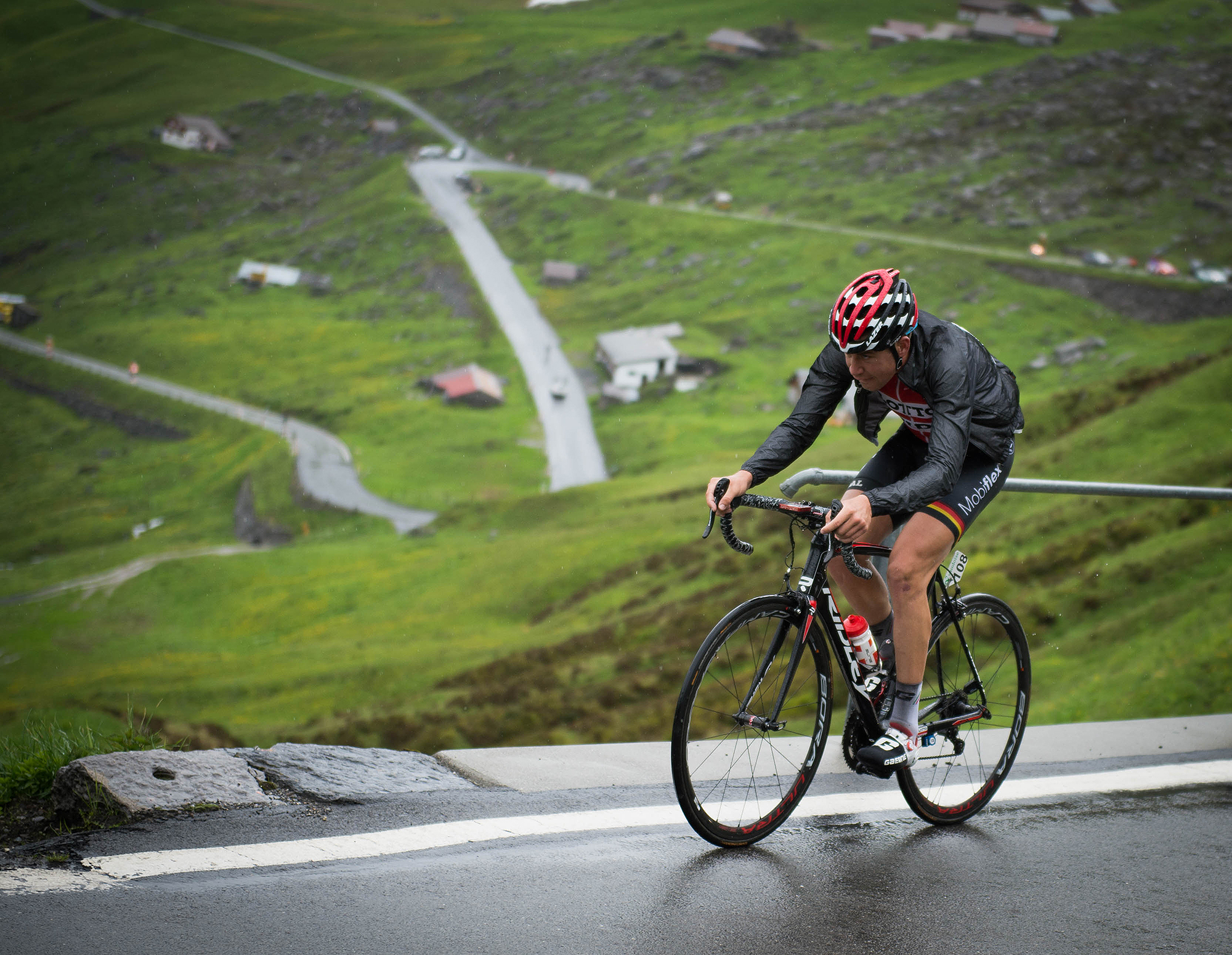
Taken together, they represent nearly two centuries of combined racing history — a span that includes world wars, doping scandals, canceled editions, dominators and nearly-men, and at least one finish line decided in a way that has no parallel in the modern sport. Some of those details are well known to the committed reader. Others sit just beneath the surface, waiting to be recalled by the fan who pays attention to more than July.
If that sounds like you, read on.
Q1. The Tour de Suisse was inaugurated in 1933 — fourteen years before the Dauphiné — making it one of the older stage races on the European calendar. Its first edition set a precedent that would define the race for decades: an international field competing on Swiss roads, with the outcome decided by a rider who had no particular national connection to the host country. He arrived for the start with almost no preparation time, having traveled to Zurich overnight by train from races in Belgium and France, and still dominated the competition from start to finish. Who was he, and why is his nationality worth noting in the context of a race called the Tour de Suisse?
Q2. The Critérium du Dauphiné didn’t emerge from the established machinery of professional cycling — it was created in 1947 by a regional newspaper, founded after World War II ended in Europe, that saw in a cycling race both a way to promote its circulation and a way to celebrate the landscape it was named for. That newspaper lent its name to the race for over sixty years, until the race’s current organizer took full control in 2010 and simplified the branding. The word at the heart of both names — the paper’s and the race’s — refers to a specific geographical region of France with a distinct historical identity, one that shaped the race’s terrain and character from its earliest editions. What was the founding newspaper called, and what does Dauphiné refer to geographically?
Q3. The Tour de Suisse continued racing through the early years of World War II, kept alive by Switzerland’s political neutrality even as the rest of the European racing calendar collapsed. The wartime editions were truncated, thin on international participation, and logistically improvised in ways that sometimes produced genuinely extraordinary outcomes. One particular edition, after several stages had already been completed, reached a point where the race simply could not continue on the road as planned — and organizers were forced to resolve the competition in a manner that has no precedent in the modern sport. What happened, and how was the winner ultimately determined?
Q4. The Dauphiné holds a distinction no other race on the WorldTour calendar can claim: it is the only race that every rider to have won the Tour de France five times has also won. This isn’t simply a function of those riders’ dominance across all races — it reflects something specific about the Dauphiné’s place in the season, its terrain, and its consistent ability to attract the sport’s most ambitious competitors at a moment when they are tuning for their greatest effort. Four men have won the Tour de France five times. All four also won this race. Name them.
Q5. The leader’s jersey of the Dauphiné has long been one of the most recognizable garments in professional cycling, instantly distinguishable from the jerseys of other major races — including one it superficially resembles but deliberately sets itself apart from. Its design has served as a visual shorthand for the race’s identity and its relationship to the broader French cycling calendar. Describe the jersey: what color is it, and what specific design element makes it visually distinctive?
Q6. The Tour de Suisse has historically structured itself around a significant individual time trial, often placed late enough in the race to function as both a settling of accounts and a final audition before the Tour de France. For GC contenders, a well-placed Suisse time trial offers something that most mountain stages cannot: clean, legible data about where a rider stands relative to his rivals, generated under the specific pressure of accumulated fatigue and genuine race stakes. Why does this structural feature make the Tour de Suisse particularly valuable as a Tour preparation tool, and what specific information does it yield that training data alone cannot provide?
Q7. The Tour de Suisse’s all-time record for overall victories belongs to a rider who achieved something no one has matched before or since: four wins in a single decade, across a field that included some of the most celebrated climbers and stage racers of the postwar era. His success was built partly on exceptional time-trialing ability and partly on a racing intelligence that allowed him to identify and exploit the precise moment when rivals — some of them considerably more famous than he was — had left themselves vulnerable. He is described by historians of the race with particular affection, and his record has stood for over sixty years. Who is he, and in which years did he win?
Q8. The Dauphiné’s official records contain a peculiar silence: several editions from the early 2000s list no official winner at all. The race was held, riders competed, and someone crossed the finish line first on each of those occasions — but the official record declines to name a champion. The decisions that produced those blank entries came years after the editions in question, as a result of investigations that reshaped cycling’s understanding of an entire era. What accounts for those erased results, and which riders were affected?
Q9. The 2020 Tour de Suisse became one of dozens of major races that simply did not happen that year, falling victim to circumstances entirely outside the sport’s control. But rather than go silent, the race’s organizers made a rapid decision to replace the event with something altogether different — a reflection of how creatively the sport had learned to respond to disruption. What caused the cancellation, and what did they stage in its place?
Q10. One of the Dauphiné’s most consequential regular entrants was a five-time Tour de France winner whose approach to the race exemplified a broader shift in how Grand Tour contenders understand preparation. Rather than arriving at the Tour with heavy racing legs built across a spring of constant competition, he used the Dauphiné as a precisely timed intervention — a controlled final stimulus before a deliberate taper — and his results there reflected a level of form that his rivals often couldn’t match when July arrived. His method helped normalize an approach to peaking that has since become standard across the peloton. Who was he, and what did his use of the Dauphiné represent within the sport’s broader evolution?
Q11. Five riders share the record for most victories at the Dauphiné, with three wins apiece — a list that spans five different decades and reads almost as a compressed history of climbing excellence in European stage racing. They include a postwar-era champion, a Spanish climber whose career is often overshadowed by the man he briefly dethroned, a French champion who dominated both the Dauphiné and the Tour de France in the early 1980s, a French rider who bridged eras without quite winning the Tour, and a rider whose Dauphiné victories came as part of a systematic team approach to Grand Tour preparation that redefined how the sport’s biggest races were won. Name as many as you can. (Bonus: one of them also won the very first edition of the race in 1947.)
Q12. The all-time record for stage victories at the Tour de Suisse belongs to a rider who never won the race overall — a gap between his day-to-day brilliance and his inability to accumulate the kind of general classification result his stage totals might seem to promise. His 18 stage wins were built on explosive speed, tactical intelligence, and a rare versatility that allowed him to contest finishes in conditions that would eliminate pure sprinters, yet the race’s mountain stages and time trials consistently prevented him from threatening the top of the GC. He is one of the most recognizable personalities the peloton has produced in the modern era, a rider whose career spanned multiple World Championship victories and an almost comical breadth of terrain. Who is he?
Q13. The Dauphiné’s current status as the definitive French preparation race for the Tour de France was not always guaranteed. Other races competed for that role at various points in the calendar, and the Dauphiné’s prestige has waxed and waned across its history. Its consolidation into the sport’s premier June warm-up was the result of several overlapping forces — organizational, tactical, and geographical — that converged gradually rather than by any single declaration. What were those forces, and why did the Dauphiné ultimately prevail as the race teams and riders trust most before July?
Q14. One of the Tour de Suisse’s most successful modern-era champions is a rider whose overall record at the race far outstrips his results at the Tour de France — a disparity that says as much about the era he competed in as it does about his own considerable abilities. He won the Suisse multiple times, placed on the Tour de France podium more than once, and was by any reasonable measure one of the best stage racers of his generation. Yet he never won the Grande Boucle, his best opportunities consistently frustrated by a rival whose dominance over a particular part of the race rendered the overall competition very nearly unkillable. Who is he, and who was the rival who so often stood between him and the yellow jersey in Paris?
Q15. One of the Tour de Suisse’s most celebrated champions was a rider whose career embodied a kind of effortless, almost theatrical elegance that made him one of the most beloved figures in postwar European cycling. He won the Suisse multiple times before going on to claim the Tour de France — becoming, in doing so, the first of a particular category of rider to win the Grande Boucle in nearly fifteen years. His story has a melancholy conclusion: his career declined sharply in the late 1950s, and he died young under circumstances that were never fully explained, leaving behind a legend colored as much by what went wrong as by the grace of what he achieved. Who was he?
Click to next page for answers.