Vingegaard Rises Again in Barcelona
A reinvented team time trial hands the Dane his first Maillot Jaune since 2023, as Visma-Lease a Bike master the mountainous run into Montjuïc’s Olympic Stadium.
PREVIEW
BARCELONA, Spain (4 July 2026) — When you think of Barcelona, football probably springs to mind first, but the Catalan capital also has a distinguished history in cycling. The city has already hosted the Tour de France three times, with four finishes and three starts. In 1957, the Grande Boucle crossed the border for a stage victory by one of the stars of that edition, René Privat, known as René la Châtaigne (René the Chestnut), winner of three stages — and the team time trial — and Yellow Jersey for three days. That same evening, at the Montjuïc circuit, Jacques Anquetil won the time trial and stretched his lead to almost four minutes over his compatriot Jean Forestier in the overall standings.
Eight years later, Spain’s José Pérez Francés, third in the 1963 Tour, raised his arms in victory at the end of the third-longest breakaway in the history of the race, a 223-kilometre escape. The last finish in the city, in 2009, saw David Millar caught under the red flag after breaking away, while Thor Hushovd won the bunch sprint. Barcelona has also hosted the Road World Championships twice, on the Montjuïc circuit in 1973 (Felice Gimondi) and in 1984 (Claudy Criquiélion). Finally, at the 1992 Olympic Games, victory went to the late Fabio Casartelli.
The team time trial returns to the Tour de France to kick off the 113th edition, in a brand-new format where tactics will prove crucial. At stake: the first Maillot Jaune, to be won on the slopes of Montjuïc, and what race officials call “psychologically significant seconds” in the general classification.
Excitement runs high in a city hosting its first Tour de France Grand Départ, having previously welcomed the start of La Vuelta (most recently in 2023) and La Vuelta Femenina (2025) — and one that will, by the time the flag drops on Saturday, have become the 27th foreign departure point in Tour history, 72 years after the race first ventured abroad, to Amsterdam, in 1954, and the third time it has started in Spain, following San Sebastián (1992) and Bilbao (2023). The action gets underway at 5:05pm, with Caja Rural-Seguros RGA — a team living “a dream come true” as it returns to the race after 37 years away, having last appeared in 1987 and 1988 as Caja Rural-Orbea and in 1989 as Paternina — rolling down the start ramp first.
Pedigree runs deep through the bunch. Three Yellow Jersey winners — between them, the champions of the last seven editions — line up in Barcelona: Tadej Pogačar (2020, 2021, 2024, 2025), Jonas Vingegaard (2022, 2023) and Egan Bernal (2019). Three Green Jersey winners start alongside them, in Michael Matthews (2017), Jasper Philipsen (2023) and Biniam Girmay (2024), while five past polka-dot winners — Warren Barguil (2017), Julian Alaphilippe (2018), Pogačar (2020, 2021, 2025), Vingegaard (2022) and Richard Carapaz (2024) — and five former white jersey holders — Adam Yates (2016), Bernal (2019), Pogačar (2020–2023), Remco Evenepoel (2024) and Florian Lipowitz (2025), the last two no longer eligible — round out an exceptionally decorated field. Mark Cavendish’s all-time record of 35 stage wins remains untouched, but Pogačar’s 21 victories, sixth-best in Tour history, lead this year’s active winners, ahead of Philipsen (10) and Alaphilippe (6). Twenty different riders arrive as national road race or time trial champions, eleven of each, and two of them — Isaac del Toro (Mexico) and Mathias Vacek (Czech Republic) — hold both titles at once.
A New Format to Revive the TTT
The team time trial’s long history at the Tour de France traces back to the 1920s, when race founder Henri Desgrange introduced “départs séparés” — staggered starts — grouping riders by team while still recording each rider’s individual time at the finish. That formula handed Francis Pélissier the first Maillot Jaune in 1927, after 180 kilometres from Paris to Dieppe, before Nicolas Frantz repeated the feat in 1928 over the 207 kilometres from Paris to Caen. The concept evolved into the modern team time trial and became a fixture of the race through the 1960s.
Saturday’s Grand Départ marks the 99th Tour de France stage raced with staggered starts or as a team time trial, and only the second time the first Maillot Jaune has been decided by one — the other instance came in 1971, when Eddy Merckx powered his Molteni team to victory in Mulhouse over 11 kilometres. The last team time trial held at the Tour came in 2019, when Jumbo-Visma dominated stage two in Brussels over 27.6 kilometres.
Now, Tour organisers introduce a new formula for the discipline — one already tried and tested on the roads of Paris-Nice since 2023, and at the Tour Auvergne-Rhône-Alpes in 2026. The aim is to revamp a traditional exercise by blending collective performance with individual brilliance for a more tactical battle. The stage classification is established using the time of each team’s best-placed rider crossing the line; for the general classification, every rider is credited with their own individual time. “The course has two distinctive parts, starting with 16 flat kilometres riding along Barcelona’s beaches, before entering the city, passing by the Sagrada Família and heading to Montjuïc for a much hillier second part with two successive climbs in the final kilometres,” explains race director Thierry Gouvenou. “Teams will likely push hard on the flat, then launch their leader on the final climb to gain a few psychologically important seconds.”
Powerhouses Gear Up to “Hit Hard Early”
Teams had two chances in 2026 to rehearse for Barcelona’s Grand Départ — first at Paris-Nice, then at the Tour Auvergne-Rhône-Alpes. In March, Netcompany Ineos proved strongest, taking victory in Coeur de Loire over 23.5 kilometres on stage three of the Race to the Sun. “To win the opening TTT is a very important goal for us,” insists Egan Bernal, winner of the 2019 Tour, whose team finished second in Brussels that year. The Grenadiers’ ambitions rest on specialists such as Filippo Ganna and Josh Tarling, both of whom worked against the clock to make it to Barcelona just three weeks after Tarling fractured his collarbone at the Tour Auvergne-Rhône-Alpes. “We’ve put in a lot of days and effort for this TT,” the British powerhouse explains. “We’ve spent a lot of time doing that sort of effort, and improved on the equipment. We’re a lot more aggressive compared to a couple of years ago, racing quite conservatively and looking at each other. Now, we just hit hard early and are not afraid to lose people.”
Last month’s team time trial at the Tour Auvergne-Rhône-Alpes — stage four, Perreux to Perreux, 28.4 kilometres — proved his point, with Visma-Lease a Bike coming out on top. “We lost Wout [van Aert] after eight or nine minutes, and Ben Tulett punctured immediately after, but we still managed to win despite having only five riders,” recounts French time trial expert Bruno Armirail. “It shows we have a strong team, but the terrain and tactics are different here. Wout is not here, and he would have been a big asset for us on the flat, but we’ll give it our best, with a strategy that may differ from other teams’.”
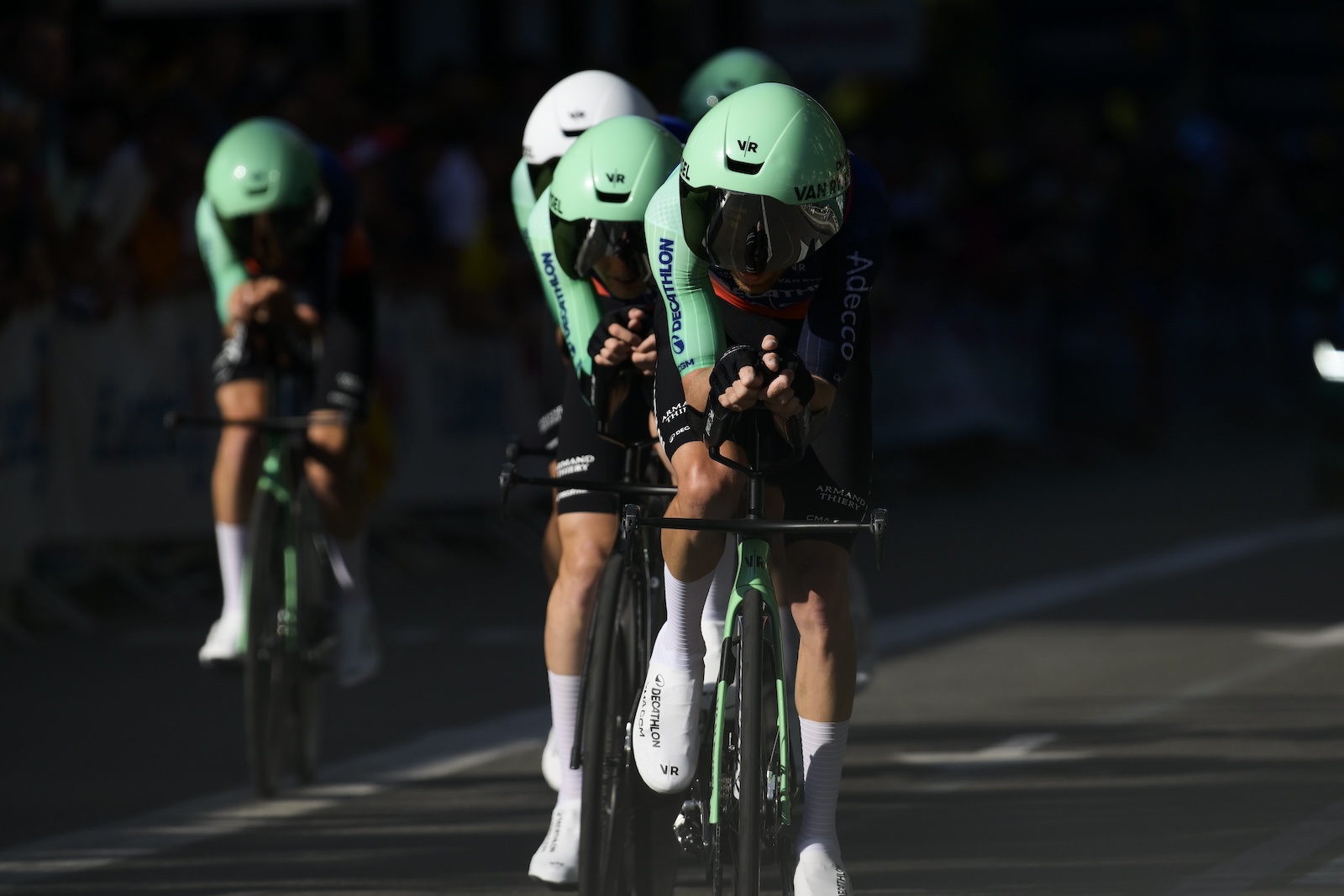
At Decathlon CMA CGM, the plan laid out by Daan Hoole to support Paul Seixas is straightforward. “Everyone will start really fast and use the heavier guys on the flat and then do suicide pulls all the way until the first climb, to then try to go over it with the two or three best climbers in the team who can ride a really hard pace uphill,” he says. “Then, on the last climb, the remaining riders will launch the team’s leader so he can go solo to the finish line.” GC teams are not alone in preparing for the rendezvous. “We have been training a bit more than usual on the time trial, and hopefully this will translate into a good result on Saturday,” says Mathieu van der Poel (Alpecin-Premier Tech), who also sees a chance to seize the Maillot Jaune.
Ayuso, Pidcock, Johannessen… Dark Horses Dream of the Podium
A handful of obvious favourites will again eye the sunset from the podium on the Champs-Élysées — Tadej Pogačar, Jonas Vingegaard, Remco Evenepoel and Florian Lipowitz among them. A small group of dazzling young riders, Paul Seixas and Isaac del Toro chief among them, hope to reach the podium for the first time. Then comes a list of contenders aiming to surpass themselves and shape the race in the process. Juan Ayuso, for one, is enjoying a Grand Départ in the city of his birth, though he lived there only during the first few months of his life. “I’m here excited to enjoy my first Tour de France with the freedom to go for a result,” says the Lidl-Trek leader. “Obviously I’m dreaming of the podium, but I’m going to take it day by day and try to enjoy the Tour experience.” After impressing at the Tour Auvergne-Rhône-Alpes with third place, a bout of flu derailed his final preparations. “However, I’ve managed to get back to feeling good and overcome adversity once again.”
Another dark horse whose Tour build-up has not been “ideal” is Tom Pidcock, hampered by illness that forced him out of the Tour de Suisse. “I don’t have any specific expectations,” says the Briton, third at last year’s Vuelta a España. “It’s no secret that the last years I came to the Tour weren’t the most fun. It’s a completely different feeling this time. It’s the first time with this team here. Whatever we achieve is a success.” Also worth watching is Norway’s Tobias Halland Johannessen, whose Uno-X team has surrounded him with climbers following a strong start to the season — fourth at Tirreno-Adriatico, third at the Tour of the Basque Country, fifth at the Tour Auvergne-Rhône-Alpes — and a top-six finish at the 2025 Tour. Will he go further still this July? “I always dream of doing better and that’s also what I envision for this summer.”
All Smiles for Caja Rural-Seguros RGA
Hanging from Abel Balderstone’s left earlobe is an earring shaped like a smiley face, which perfectly captures the mood of Caja Rural-Seguros RGA ahead of this Tour de France. “It’s a dream to be here,” explains last year’s Spanish time trial champion. “I’m really nervous, but I’m very happy to be making my Tour debut surrounded by my family and friends.” A native of Barcelona province, Balderstone is one of three Catalans enjoying this Grand Départ in the colours of the Navarran team. The others are Joel Nicolau, from Llofriu on Girona’s Costa Brava, and Alex Molenaar, a Dutch national whose mother is from Barcelona but who has lived in Olot, in Girona, since the age of ten. “It’s incredible to start my first Tour here; it feels as though the stars have aligned,” Molenaar smiles.
Fernando Gaviria — winner of two stages and holder of the yellow jersey in 2018, back when the team last lined up at the Tour — hopes to emulate the sprint stage win Mathieu Hermans delivered for the Navarrans during their three consecutive appearances between 1987 and 1989. “Winning at the Tour is a privilege few have, and we dream of securing a victory,” asserts the Colombian sprinter. “The Tour is quite a big challenge for any team. The demands of this race are a new challenge for the current Caja Rural team, but the squad has taken a big step forward and I feel we are ready for anything.” Molenaar sets out a different target of his own: “We intend to fight for the King of the Mountains jersey this Sunday.” Any of the team’s three Catalan riders would make a strong candidate to do so, while climbers José Félix Parra and Sebastian Berwick could battle their way into the top 20 of the final general classification — no small ambition for a team whose eight riders share only two Tour appearances between them, and whose 31-strong collective Tour experience across the peloton at large is dwarfed by Tudor’s, the second-newest team in the race, and by Jayco AlUla’s 27 and Soudal Quick-Step’s 26.
STAGE REPORT – SATURDAY, 4 JULY 2026 — STAGE 1: BARCELONA > BARCELONA (19.6KM, TEAM TIME TRIAL)
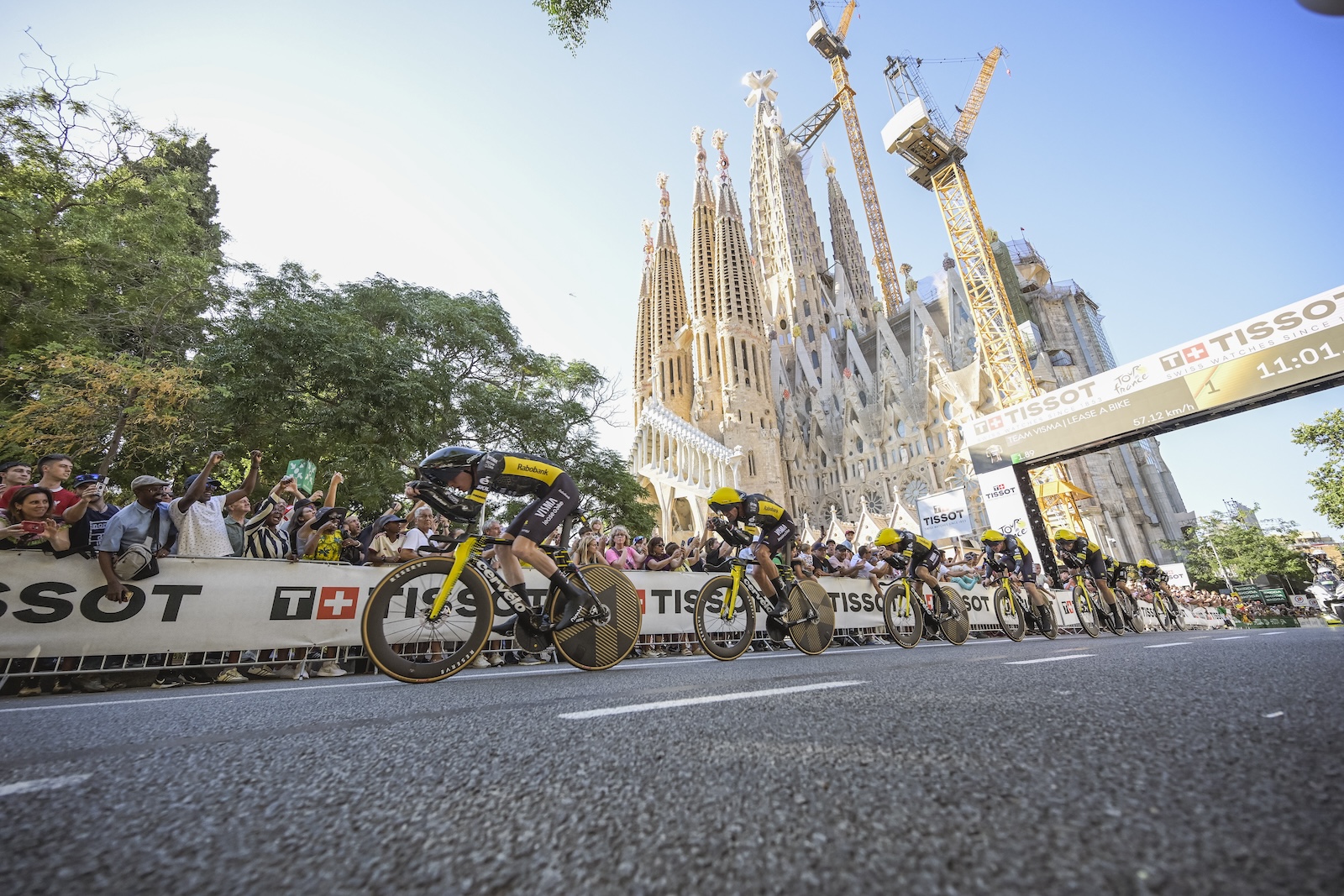
The opening team time trial of the 2026 Tour de France delivered every thrill its revamped format promised. Visma-Lease a Bike propelled Jonas Vingegaard to his first Maillot Jaune since 2023, the year he stood on the final podium in Paris to claim his second overall title. Three years on, the Danish climber and reigning Giro d’Italia champion powered to victory on the day’s final uphill, sealing glory at Barcelona’s Olympic Stadium after his teammates emptied their tanks across the flat opening kilometres. Vingegaard held off Netcompany Ineos’ Filippo Ganna by eight seconds, after the British team’s plans were upended by Kévin Vauquelin’s puncture. Tadej Pogačar’s UAE Emirates-XRG completed the podium, twelve seconds back, after a strong finale from the Slovenian, who rode fastest over the hilly closing 3.7 kilometres and claimed the polka-dot jersey as a result.
After Barcelona basked in the arrival of the Tour de France with spectacular Grand Départ celebrations, the 113th edition of the race for the Maillot Jaune opened with a 19.6-kilometre team time trial. The stage introduced a format unprecedented in the Grande Boucle, though tried and tested at Paris-Nice since 2023 and, this season, at the Tour Auvergne-Rhône-Alpes. The stage classification was decided by the time of each team’s best-placed rider; for the general classification, every rider was credited with their own individual time.
Local Heroes Kick Off, French Punchers Show Off
Making its return to the race 37 years after the team’s last participation, Caja Rural-Seguros RGA rolled off first from the seafront, heading into the city before tackling the final climbs up to the Olympic Stadium in Montjuïc. Propelled by José Félix Parra, Alex Molenaar launched on the last uphill to set the day’s first benchmark: 22’59”.
French teams quickly displaced the Spaniards from the provisional lead. First, Jordan Jegat powered TotalEnergies to 22’49”. Then French road race champion Romain Grégoire punched over the closing climbs 21 seconds faster, setting the best time of the day so far for Groupama-FDJ United.
Netcompany Ineos Fly, Vauquelin Punctures
Movistar offered the first real threat to the French pair, only to fade in the finale as Belgian leader Cian Uijtdebroeks struggled. Alpecin-Premier Tech, by contrast, improved as the course wore on, and Mathieu van der Poel eventually set a new benchmark of 22’26”.
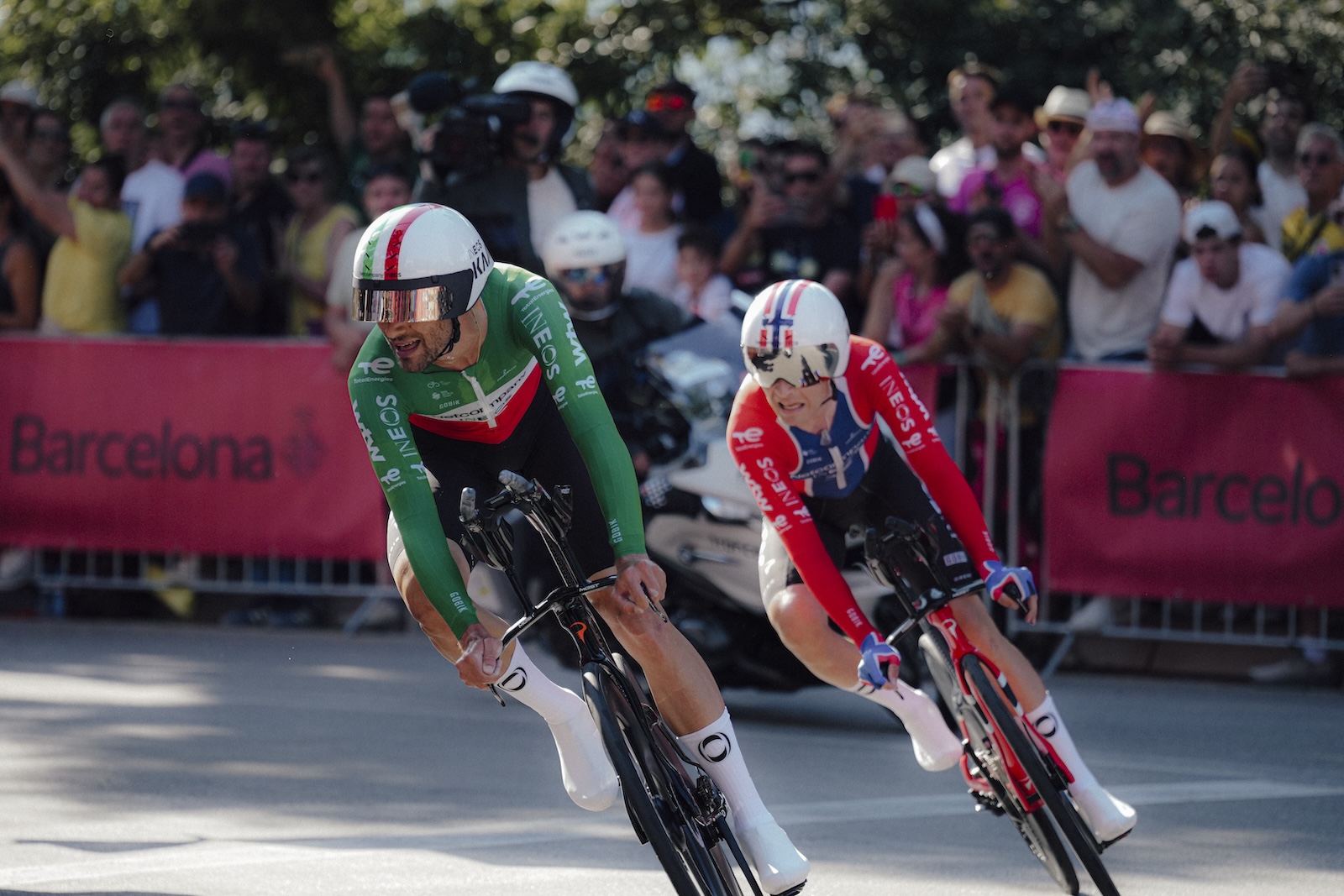
Netcompany Ineos, meanwhile, flew across the course — until their plans were derailed when Kévin Vauquelin was forced to swap bikes after puncturing just ahead of the third checkpoint. It fell to Filippo Ganna to power the team home in 21’55” (53.65km/h), a lead of 31 seconds over Alpecin-Premier Tech.
Vingegaard Caps Off Visma-Lease a Bike’s Work
Lidl-Trek impressed in turn, entering the final 3.7 kilometres just 0.04 seconds shy of Netcompany Ineos’ mark, before Juan Ayuso crossed the line in 22’03”. Not long after, Remco Evenepoel set the third-best time of the day for Red Bull-BORA-hansgrohe, eleven seconds off the pace.
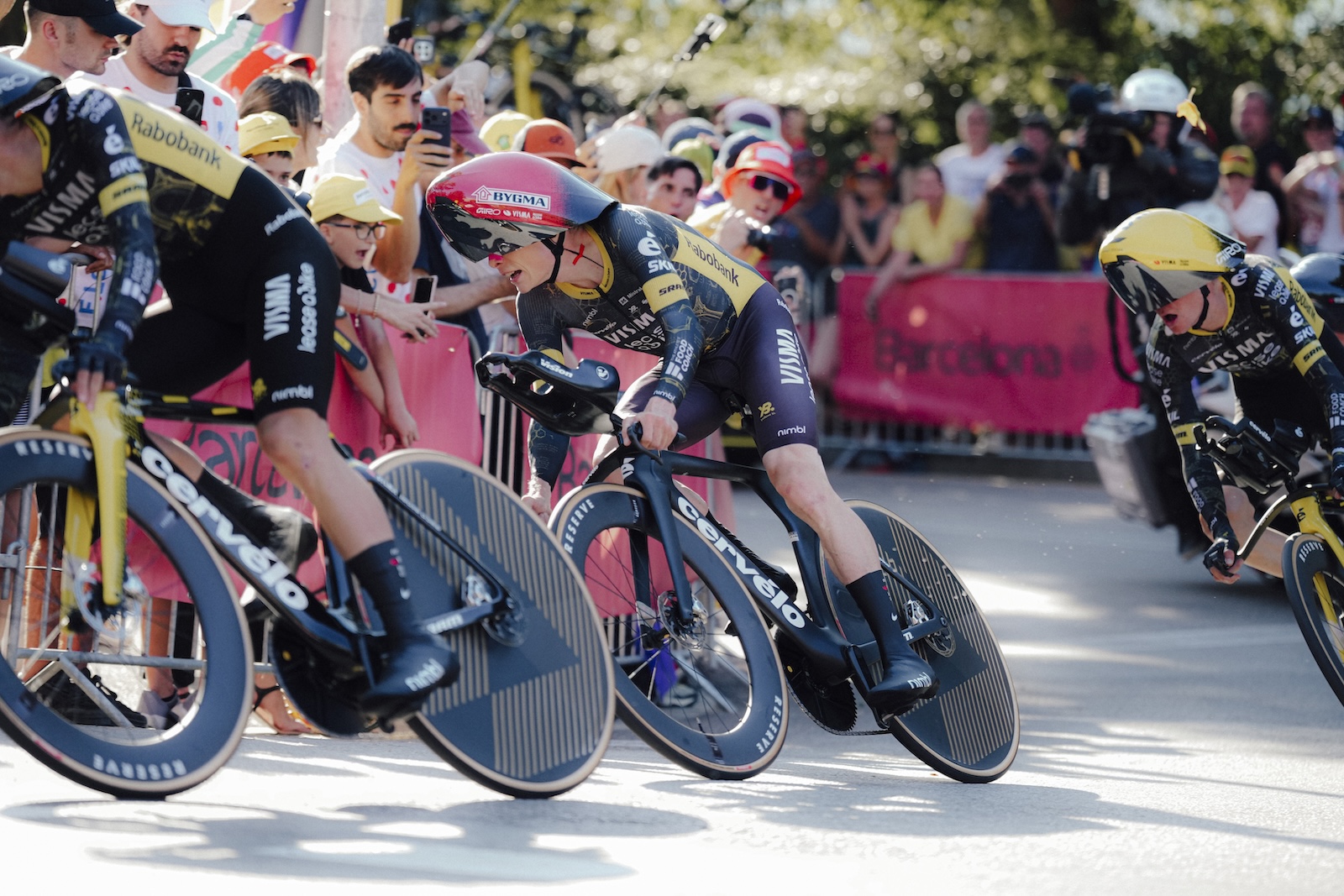
Strong as those rides were, none could resist Jonas Vingegaard. Visma-Lease a Bike showed its collective strength, and the Danish climber flew clear on the final climb to stop the clock at 21’47”. “I would say it’s the perfect start,” Vingegaard said afterwards, still catching his breath in the shadow of the Olympic Stadium. “It’s still a long way to go in the Tour, obviously, but I couldn’t dream of a better start. My teammates did a perfect job today. They were so strong! I didn’t have to do much to be honest, they just brought me all the way to the finish, to take the stage win for us, and the Yellow Jersey for me after a few hard years without it.” He was quick to redirect the credit toward the seven riders who had towed him across Barcelona’s beaches and up through the city.
“It’s the biggest race of the world,” he continued. “It’s an amazing victory for us, especially in a team time trial. I have seven teammates who sacrificed for me. I’m the one wearing the Yellow Jersey but they won the stage too, and I have to thank my teammates and my team. Everything went as planned. We had this tactic and it paid off in the end.”
Asked what the jersey meant after two lean seasons, he added: “Of course, I’m here to do the best GC possible and try to win. I’ve had a few tough years, for obvious reasons, but the Tour is the biggest race and just to wear the Yellow Jersey is special and I will enjoy it.” There is a short step, after all, from pink to yellow — Vingegaard’s win puts him in the Maillot Jaune for the 28th time in his career, a jersey he had not worn since his second Tour title in 2023, and makes him only the second rider, after Miguel Indurain in 1993, to pair a Giro victory with the Tour’s opening yellow in the same season. It is also just the second time a team time trial alone has decided the Tour’s first leader, the earlier instance belonging to Eddy Merckx and Molteni in Mulhouse in 1971, and it lifts Visma-Lease a Bike’s overall stage-win tally to 75 — a total no other team can match — while reclaiming a team time trial crown the Dutch squad last held in 2019, albeit under the old format.
UAE Emirates-XRG, last on the course, called on Isaac del Toro’s support to launch Tadej Pogačar, who proved fastest over the closing 3.7 kilometres and finished third on the day, twelve seconds behind his Danish rival. “No, I’m not disappointed. I’m actually super happy,” Pogačar said, breaking into a broad grin despite missing out on the win. “You always want victory, but we had super good performance. I’m super happy this really hard day is over. You prepare for just 20 minutes and it’s stressful. Still, I enjoyed today, it was a long time since I last raced a TTT. I can be happy about today and motivated for next days.” His fastest time over the final climbs — a contest measured across the two closing ramps combined — earned him the polka-dot jersey, a debt he was eager to acknowledge. “I was quite sure the climb was going to go well,” he said. “Isaac [del Toro] did an amazing job, he’s such a good kid. Everybody went over their limits. Thanks to them, I have the polka-dot jersey.”
It is a familiar position for the Slovenian: third place put him back in the provisional top three of the general classification for the 109th time in just 127 career Tour stages, a run in which he has led outright 54 times, finished second 45 times, and third on 10 occasions, and one he has not fallen out of since the opening day of the 2025 race, when he finished 18th. Looking ahead, Pogačar was already sounding a note of caution. “Tomorrow? First I need to chill and decompress, although we don’t have much time,” he said. “It will be a tricky stage, for puncheurs. The finale will be hectic, and things can also get complicated before that. We’ll have to pay attention tomorrow and do our best in the finale.”
Green for a Climber, White for a Local Son
Clocking the fastest time at the day’s first intermediate checkpoint, 5.1 kilometres in, Egan Bernal became the first rider to wear the green jersey this July — an unlikely garment for a pure climber who has previously worn both yellow and white, and one that makes him only the second Colombian, after Fernando Gaviria’s opening-stage lead in 2018, to top the points classification. “It’s a jersey I never thought I’d wear!” Bernal said, laughing at the novelty of it. “It’s a special race with this new team time trial format, but the team was incredibly strong and finished in an amazing way. Team time trials are super hard, and these guys are crazy — they have so much power! It was a good performance.” Netcompany Ineos had arrived in Barcelona targeting the stage win itself, and Bernal did not pretend otherwise. “Of course, we came here to win and we missed out on the victory, but at the same time we’re in good shape and the team is in a great vibe,” he said. “We’re definitely going to fight for everything. Every stage is an opportunity. We’re here to enjoy the race and we have nothing to lose, so we’ll try on every stage.”
Further down the results sheet, Juan Ayuso claimed the first white jersey of his career, becoming only the second Spaniard, after Jesús Blanco Villar in 1986, to lead the young rider classification on the opening day — a fitting twist for a rider born in Barcelona itself. “We prepared really well for this TTT,” Ayuso reflected. “We were dreaming of yellow, with a leader like Mads [Pedersen] and also with the legs we had today with Vacek. It was really feasible. We had a setback with Skjelmose’s mechanical. He is one of the best on hills like the ones we had in the final, and I don’t want to say we would have for sure won with him, but we would have come closer. Mads and Vacek carried the team on their shoulders and really made a difference. I was in a very good position at the bottom of the final climb — still in contention for the win. Overall, we put on a very good performance and did our best.” He was already turning his attention to Sunday. “It is nice to get things going,” he said. “This discipline is quite stressful, because everything has to go perfectly for the team to succeed. I really enjoyed the race today. I expect a really hard stage tomorrow. First we have to see what kind of breakaway goes clear in the first kilometres, and then the last circuit will be super tough. I’m sure guys like Tadej [Pogačar] will attack, so we’ll have to stay on top of the race all along.”
There was late drama for the purists, too: riding out of the saddle the entire way, Tom Pidcock powered up the closing 800-metre, 7% ramp to the Olympic Stadium at an average of 40.6km/h, the fastest ascent of the day by any measure — only for the polka-dot jersey to slip through his fingers on a technicality, since the mountains classification was instead calculated over the combined duration of the stage’s final two climbs, a contest Pogačar won outright.
Tour de France 2026 — Stage 1 Results, Top 10 |
||
| Position | Team | Time |
| 1 | Team Visma | Lease a Bike | 21:47.9 |
| 2 | Netcompany Ineos | 21:55.2 |
| 3 | UAE Emirates-XRG | 21:59.2 |
| 4 | Lidl-Trek | 22:03.1 |
| 5 | Red Bull-BORA-hansgrohe | 22:06.0 |
| 6 | Decathlon CMA CGM Team | 22:26.2 |
| 7 | Alpecin-Premier Tech | 22:26.2 |
| 8 | Groupama-FDJ United | 22:28.8 |
| 9 | Bahrain Victorious | 22:34.8 |
| 10 | Team Jayco AlUla | 22:38.0 |
Tour de France 2026 — General Classification, Top 10 After Stage 1 |
|||
| Position | Rider | Team | Time |
| 1 | Jonas Vingegaard | Team Visma | Lease a Bike | 21:48 |
| 2 | Filippo Ganna | Netcompany Ineos | +0:08 |
| 3 | Tadej Pogačar | UAE Emirates-XRG | +0:12 |
| 4 | Juan Ayuso | Lidl-Trek | +0:16 |
| 5 | Remco Evenepoel | Red Bull-BORA-hansgrohe | +0:19 |
| 6 | Isaac del Toro | UAE Emirates-XRG | +0:26 |
| 7 | Davide Piganzoli | Team Visma | Lease a Bike | +0:28 |
| 8 | Florian Lipowitz | Red Bull-BORA-hansgrohe | +0:35 |
| 9 | Paul Seixas | Netcompany Ineos | +0:38 |
| 10 | Tobias Foss | Decathlon CMA CGM Team | +0:39 |