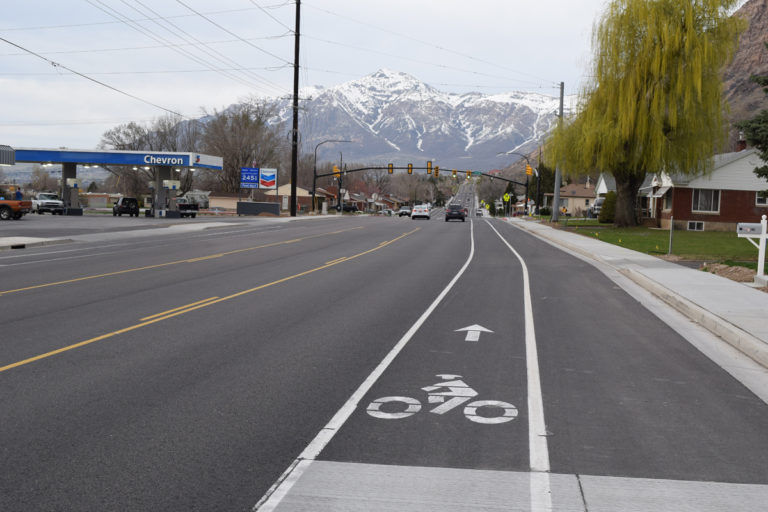
Summit County is looking for a feedback on the Rail Trail and is asking cyclists to provide input.
“What do you envision for the future of the Historic Union Pacific Rail Trail and surrounding land? Summit County is seeking community input to shape plans and guide decision-making. “The Corridor” is the working name for a thirty-mile arts, culture, recreation, and tourism corridor running along the Historic Union Pacific Rail Trail. The Corridor will be designed to cultivate a strong sense of community and offer opportunities for both resource protection and economic revitalization.”
Major roadway work is being planned for Mill Creek Canyon in Salt Lake City, Utah. Will this include a bike lane and motor vehicle speed calming measures or will it increase vehicle speeds and eliminate any possibility in our lifetime for shoulders for non-motorized use? The answer to that is uncertain and you have less than a month to help influence that decision.
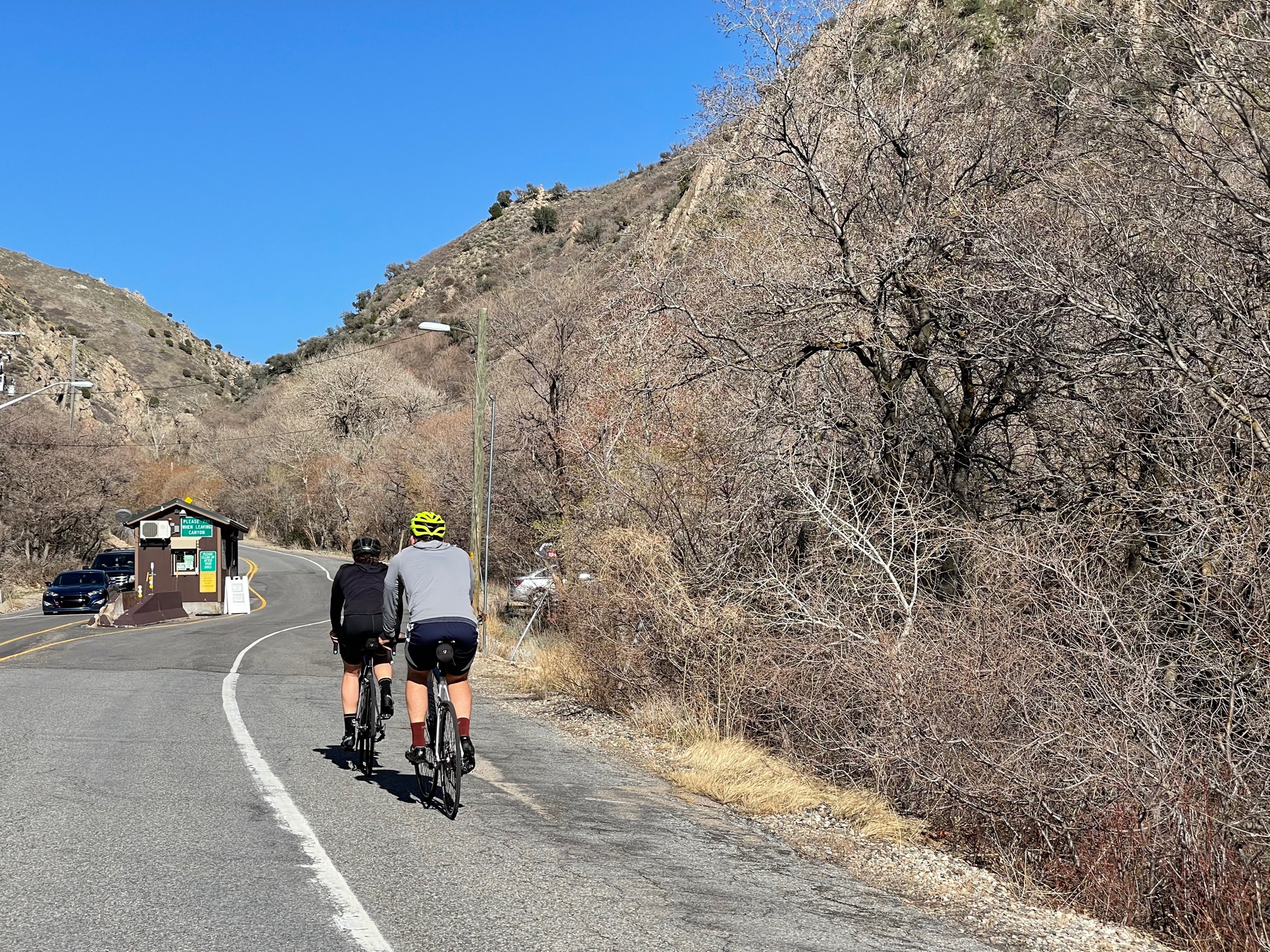
Cyclists climbing Millcreek Canyon. Photo by Lisa Hazel
Mill Creek Canyon, between Parley’s and Neffs Canyons on the Salt Lake East Bench, is a unique resource for Salt Lake Valley residents. Beginning only a few hundred yards from I-215, the canyon contains a 9 mile paved road, miles of trails including high quality single track and quiet Wilderness, wildlife, cool summer temperatures, a non-motorized connection to the Wasatch Back, private cabins, and 4 ½ miles of paved road that is closed to motor vehicles 8 months out of the year and groomed in the winter for nordic skiing, hiking, dog-walking, and riding. The canyon is free of commercial recreation served by a state highway and resort villages. The canyon is also getting more popular, with users forced to turn back due to parking filled beyond capacity, long lines to get out, and heavy traffic all common on weekends. The result of our collective attraction to the canyon is snarled traffic, deterioration of the roadway, and a threat to the health of the creek.
Changes are coming to Mill Creek that will affect us all. Last summer, a Federal Lands Acquisition Program (FLAP) Grant was awarded to improve the transportation facilities providing access to Federal land in the canyon in response to an application from the Forest Service, Salt Lake County, and Millcreek City. $38 million dollars worth of work based around the roadway was identified and the decision was made to begin with a $19.6 million project for improvements to the upper half of the roadway, above the winter gate. The project partners, the 3 requesting groups and the Federal Highways Administration, anticipate using a 2ndFLAP grant in the next round of funding to complete the portion of the canyon roadway below the gate.
The following is a list of the work anticipated:
Widen and resurface the road, with a goal of making a 29’ wide paved surface from the winter gate to Elbow Fork (1.4 miles) and a 24’ wide paved surface from Elbow Fork to the Big Water Trailhead.
Improve the parking and large vehicle turn-around ability at designated trailheads and picnic areas. This will include more off-road parking and the elimination of roadside parking, with no net change in total parking.
Roadway and stream channel realignment at Thousand Springs
Extend recently installed box culverts and other creek-oriented structures to improve roadway safety, fish habitat, and address concerns with the historic and aging bridges.
Install a conduit within the shoulder of the road to support future road and parking conditions monitoring and emergency communications.
The process has begun, starting with an open house Nov. 9, with the following timeline:
November 9 to December 9, 2021: Public comment period
January 2022 to December 2023: Public comments will be reviewed, a draft project design will be developed based on technical analysis, and environmental surveys and documentation will be completed.
2024: The design will be completed and approved, work contracts will be issued, and work will begin on the project.
Summer 2026: Work will be completed
The steep, narrow nature of the canyon combined with the space occupied by the creek present some big challenges. It’s not clear that there will be room to create 29 and 24 foot roadways without impacting the creek or requiring excavation that would radically change the nature of the canyon bottom.
Of particular interest to cyclists: the initial design proposes widening the vehicle lanes to at least 11 feet for the entire length of the road, adding a 5 foot wide bike path to the 1.4 mile stretch from the winter gate about half way up the canyon to Elbow Fork, and eliminating any bike lane or shoulder from Elbow Fork to the end of the road. To put that in perspective, the current lane width varies from about 8 ½ to 11 ft below the Big Water overflow lot, with the average estimated to be about 9 ½ ft. Nine and a half and even 9 ft wide lanes are acceptable in low speed areas like Mill Creek according to traffic engineering sources, but so far the design team has been focused on increasing the lanes to 11 feet wide. While the speed limit in the upper portion of the canyon post-project hasn’t been set yet, the wider vehicle lanes, improved sightlines from vegetation clearing, and some road straightening will all increase the natural speed of cars in the canyon. While public safety and bicycle issues are listed in the project goals, the engineers have concluded that there will not be room for an official 5 foot wide bike lane in the top 3.6 miles of the canyon and that the 11 ft lanes are likely to eliminate the possibility of any shoulder. Increasing vehicle speeds in the canyon and removing any shoulder for non-motorized use would likely be a huge step backwards for cyclist safety and enjoyment. The project designers have made no commitment to talking steps to protect non-motorized roadway space has been made and, in fact have made the claim that wider lanes and higher speeds will increase the safety of non-motorized users without providing any rationale or evidence.
Is a bike lane or shoulder to accommodate non-motorized users more important to you than faster cars or restoring a historic bridge? Now is the time to make your feelings known
If you use Mill Creek Canyon and are concerned about increasing vehicle speeds and decreasing space for those who ride, walk, and run in the canyon, you have to until December 9 to get familiar with the project and submit comments describing the changes you would like to see in the Canyon. The project design team needs to hear from you. Some points to bring up in your comments:
Studies1 show that increasing lane width increases speed at which motorists feel comfortable driving. Conversely, decreasing lane width has been clearly shown to reduce vehicle speeds.
Increasing vehicle speed without providing at least a 4 foot uphill bike lane or shoulder will greatly increase the likelihood and severity of collisions between cars and bikes and pedestrians.
Even adding a 3 foot striped shoulder and adjusting lane width accordingly would likely make Mill Creek Canyon safer for non-motorized users.
Wide lane advocates claim they are needed for emergency vehicle access. Not so, says Unified Fire Authority figures and Salt Lake County Search and Rescue leaders. And since the maximum width of emergency vehicles is 8 ½ feet, are 11 or even 12 foot lanes really needed?
The speed limit in the upper canyon should be no more than 25 mph
Now is the time to voice your opinions about this plan. Plans for the road are being developed and the planners are listening to canyon users. The public comment period ends on December 9, 2021.
Comments can also be emailed to [email protected]. Comments should also be sent directly to the US Forest Service Salt Lake Ranger District and the mayors and council members of Salt Lake County and Millcreek city (Google them).
If you use and value Mill Creek Canyon and have an opinion on the future of non-motorized use of the canyon road, it’s important that you speak up before December 9, 2021.
By Breanne Nalder Harward, MS, RDN — This is a question I ask athletes quite often as I want to get them thinking about their diet and whether or not they know how well or poor they may be eating. The most accurate way to recall your food choices is by filling out a food log, which provides an overview of when and what you’re eating and usually changes the way you think about your diet. Most athletes don’t keep a food journal so they’re not aware of what their diet may look like over a 24-hour period. Granted, keeping track of everything that goes into your gullet is time consuming and can be a nuisance, although it’s totally worth it when you want to truly hone in on your nutrition and fine tune your diet to improve your physical performance. After reading the article, you can figure out where you are nutritionally and be in great shape with regards to your performance and body composition goals.
Are you getting 6-10 servings of fruits and veggies each day? Photo and salad by Dave Iltis
Let’s Start with Some Basic Questions
Do you eat breakfast, lunch, and dinner?
Do you have snacks between meals?
Do you eat 6-10 servings of Fruits and Veggies?
How much water do you consume daily?
Do you consume sport products before, during, and after rides?
Do you know your caloric burn vs. intake?
What are your percentage of macronutrients on average (carbohydrates/fats/proteins)?
10 Guidelines to Eating Healthy
To reach your nutrition goals and get your diet to where it can maximize your health and riding performance, follow these basic guidelines. They may be simple, but the effects go a long way if you adopt them into lifestyle patterns.
Eat every 3-4 hours – this has been proven scientifically to lower body fat, improve energy levels, and improve strength and performance. Furthermore, eating more frequently throughout the day keeps your blood more sugar stable if choosing the correct carbohydrates. Consistent eating also helps support a healthy metabolism.
Eat Breakfast everyday – if you’re not eating breakfast, you’re not reaching your potential for top athletic performance. Skipping breakfast can trigger the body to slow its metabolism in order to preserve energy, which increases your risk for losing strength and eventually gaining weight. Eating breakfast revs your metabolism, supplies fuel to the brain, and supplies energy to working muscles. It only takes a few minutes to make a PB and J sandwich or to concoct a smoothie before you leave the house.
Consume 6-10 servings of Fruits and Vegetables – keep your immune system healthy and lower your risk for getting sick, improve healing of injuries, and reduce the soreness of your muscles with high nutrient dense foods. I always say, find a way to add color to every meal and snack!
Healthy Snacking between meals – high quality snacks between meals keeps your gas tank close to fuel where you won’t run out of gas. For example, if your last meal is at noon and you ride after work around 5 pm, a 3:30 pm snack is essential to get you through your workout and minimize fatigue. Skipping snacks could increase hunger, cause you to have a disappointing ride (the notorious “bonk”), and likely lead to over-eating at dinner and late into the night, which may increase your body fat. Always remember, you want to consume energy when your body will burn it, otherwise it will be stored as fat!
For general hydration, drink at least half your body weight in ounces of fluid (i.e., if you weigh 130 pounds, then drink 65 ounces) per day – hydration is critical in keeping energy levels normal, as the first sign of fatigue is usually related to dehydration, with another 2 bottles during exercise, at least one of which should be an electrolyte mix. For athletes, half your body weight is a good start but when training, you want to increase your fluid intake to match your losses. For every pound you lose during a ride, you want to drink 2-3 cups of fluid to replace the fluid lost. Be sure to include electrolytes into this equation, they are crucial to proper hydration balance. See my earlier article in the archives on hydration or contact me directly to discuss electrolyte needs for YOUR body.
Consume a Post Workout Shake (3-4:1 Carbohydrate:Protein) within 30 minutes of completing your workout – research has proven over and over again that consuming a combination of carbohydrates and protein immediately after your workout will improve muscle recovery and increase your ability to ride strong the following day. A mix of 20 grams of protein along with 60-80 grams of carbohydrate is the ideal ratio of carbs to protein to maximize protein synthesis. Liquid is preferred over solid food as it is absorbed faster, but a solid meal will suffice.
Consume Lean Protein at All Meals – Protein has several benefits for endurance athletes such as: boost metabolism, keep you full longer, helps maintain a healthy weight, boost the immune system, and again improve muscle recovery after workouts. The type of protein should vary so you are sure to get a variety of amino acids throughout the day. A good rule of thumb is to incorporate a plant-based protein each meal (such as beans, nuts, seeds) and limit yourself to 1 animal protein per day (if you eat meat/eggs).
Consume Whole Grain Carbohydrates to Fuel Up – I say this in every article some way or another: Carbs are the gasoline for your tank! On the bike we shoot for easy to digest carbs (rice products, sport chews and electrolyte drinks), while off the bike we aim for whole grains, which contain a rich source of fiber to keep blood sugar stable, which in turn keeps energy level high. Examples are 100% whole wheat bread, oatmeal, whole grain cereal, sweet potatoes, fresh fruit, vegetables, quinoa, legumes, lentils, and beans.
Take a Multivitamin Daily – If your diet is not where it needs to be, especially if you’re not consuming nutrient dense foods like fruits, veggies, and whole grains, a multivitamin can function as an insurance policy to supplement your diet with what you’re not getting from food.
Take an Omega 3 Fish Oil Supplement – Omega 3 Fish Oil acts as a natural anti-inflammatory agent to help reduce swelling, improve healing, minimize muscle soreness, and improve overall recovery after intense exercise.
Take Things One Pedal Stroke at a Time
The overall goal in adapting your lifestyle to improve your cycling performance and your overall health is to be realistic. It’s important that you attack things one at a time so that you aren’t attempting to make a bunch of changes all at once. Research shows that athletes are much more successful at adjusting their diet or controlling weight when goals are measurable, attainable, and positive. This is where tracking food and accountability come into play. There are numerous apps out there that can be used to food journal, though it can be hard to navigate if you aren’t confident on what your calorie and macro needs are for your body. This is where working with a Registered Dietitian Nutritionist can help you get past the guessing game or the “he said/she said” strategy of trying all the different diets out there. Let’s get you in to measure your metabolism and get you on a plan that is appropriate for your body and goals. Because riding better, faster, stronger, enjoying your food and feeling good while doing it is what it’s all about!
Hazard: The recalled helmets do not comply with the U.S. CPSC federal safety standard for bicycle helmets, posing a risk of head injury.
Remedy: Refund
Recall Date: November 10, 2021
Units: About 790
Consumer Contact
Sedgwick toll-free at 877-643-8415 from 8 a.m. to 5 p.m. ET, Monday through Friday, or email at [email protected] or online at https://mobil.abus.com/usa scroll down and click “Read More” on the main page or at: https://mobil.abus.com/usa/on-road/Bike-helmets/Voluntary-Recall.
Recall Details
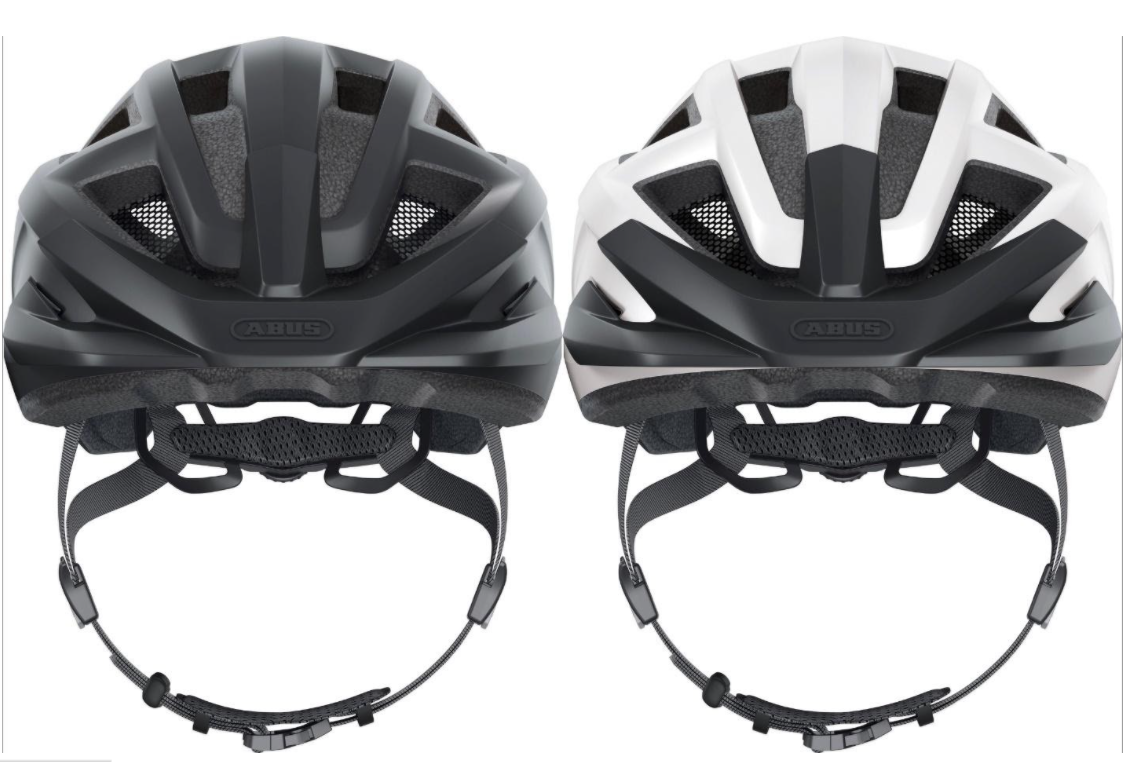
Description: This recall involves the ABUS ACM (MountZ) youth medium sized helmets with about a 21 inch circumference and attached chin strap. The recalled helmets were sold in velvet black and polar white colors. “ABUS” is printed on the left side, front and back of the helmets. The model ACM (MountZ) with the manufactured date of March 2020 or October 2020, is printed on a label on the inside of the helmet.
Remedy: Consumers should immediately stop using the recalled helmets and return them to ABUS’s Recall Administrator, Sedgwick, free of charge, for a full refund.
Incidents/Injuries: None reported
Sold At: Independent bike shops nationwide from April 2020 through October 2021 for about $80.
Manufactured In: China
Importer(s): ABUS Mobile Security Inc., of Chicago, Illinois
BOULDER, CO (November 11, 2021) — Adventure Fit Productions, announces open-registration for the 8th annual Old Man Winter Bike and Run Rally on February 6th, 2022. Known throughout the cycling and running community as an “epic winter adventure,” Old Man Winter 2022 is placing a strong focus on welcoming more beginner athletes and those new to racing to the event.
Photo courtesy Old Man Winter Rally
BEGINNER FOCUS / PRO-FRIENDLY
The event has been attracting Olympians and other world-class professional athletes since its inception in 2015, but it was originally created to be a fun winter adventure for all abilities.
“One of the main goals of OMW has always been to create the most fun, adventurous, yet welcoming environment possible to all our athletes from the pro’s to weekend warriors,” states Josh Kravetz, founder of Adventure Fit Productions.
This year, Kravetz is placing a special focus on new athletes and those new to racing. COVID may have put events on hold for much of the last two seasons, but it also caused more folks to take up solo hobbies/athletics, like biking and running. By offering training plans, and a variety of training rides and clinics leading up to the event, he hopes to attract new or cross-discipline athletes and introduce them to Old Man Winter’s welcoming community.
Photo courtesy Old Man Winter Rally
There’s a reason Adventure Fit Productions chose to use the word ‘Rally’ in the event title vs. ‘Race’. If you look at the start-line, you’ll see pro cyclists like Erin Huck and Sepp Kuss and world-class runners like Anton Krupicka. But when the gun goes off, it’s clearly evident that they’re there to have a good time in the gravel and snow just like everyone else.
“The Old Man Winter Rally motivates us all to keep moving during the winter months and cross the finish line with a smile on our faces, before hanging out around fire-pits with good food and a post-race beer or hot-cocoa,” said Kravetz.
COURSES
This epic winter community celebration starts and finishes in the Town of Lyons and takes athletes through mixed terrain in Boulder County, Colorado. The event offers two bike course options: 50km and 100km. The 50km route tours some of the scenic, rolling terrain that has made Boulder County, CO one of the country’s most popular gravel riding destinations in the world. The 100km course starts with the same gravel roads as the 50km course before sending cyclists on a roller coaster route of climbs and descents through the canyons west of Boulder. The event also offers a 10K running race and a Run/Bike combo that is popular for winter multisport athletes.In true family-friendly fashion, there will be free 1K run and bike races in the park for kids at the after-party.
Photo courtesy Old Man Winter Rally
PRIZE PURSE, SWAG & SNOWFLAKES
Old Man Winter offers prizes for all levels of athletes. Though the challenging course and the very nature of Colorado winter weather naturally draws elite athletes to compete for bragging rights, the OMW Rally varied prize purse doesn’t hurt.
This year a $3000 prize purse will be split among the winners of the 100K bike race / five deep. For all other categories, the top 3 finishers will receive over $1000 in product / gift-card prizes.
For those athletes and participants who aren’t “in it to win it”, Old Man Winter 2022 offers the Snowflakes Scavenger Hunt. Back by popular demand and exclusive to the Old Man Winter Rally, along the course will be Snowflakes which participants can pick up for a guaranteed prize at the after-party.
NEW FOR 2022
In addition to a refreshed focus on beginners, the historically fantastic after-party in Lyons will feature live music from local bands, free races for kids, and more contests. On the 100K bike course, the 1st aid station placement will be slightly varied. Previously the aid station was at the top of Rowena (and coincided with a timed section). This year it will be moved to the end of the timed section, before the Sunshine Canyon descent, to encourage folks to truly take a break, interact with their fellow athletes and our sponsors more.
Registration is currently open for this adventure-inducing, family and pet-friendly event at www.oldmanwinterrally.com and is expected to sell out fast.
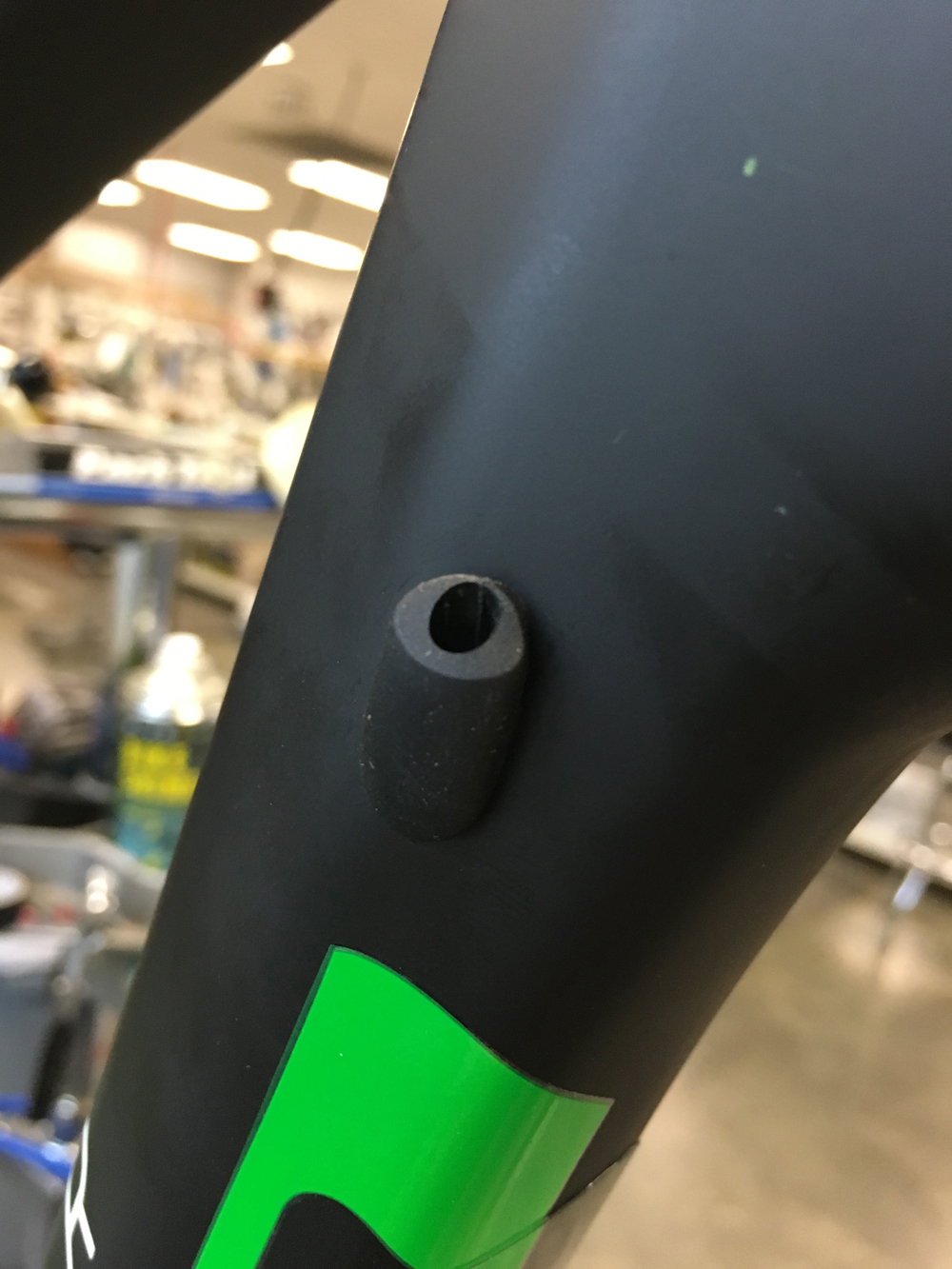
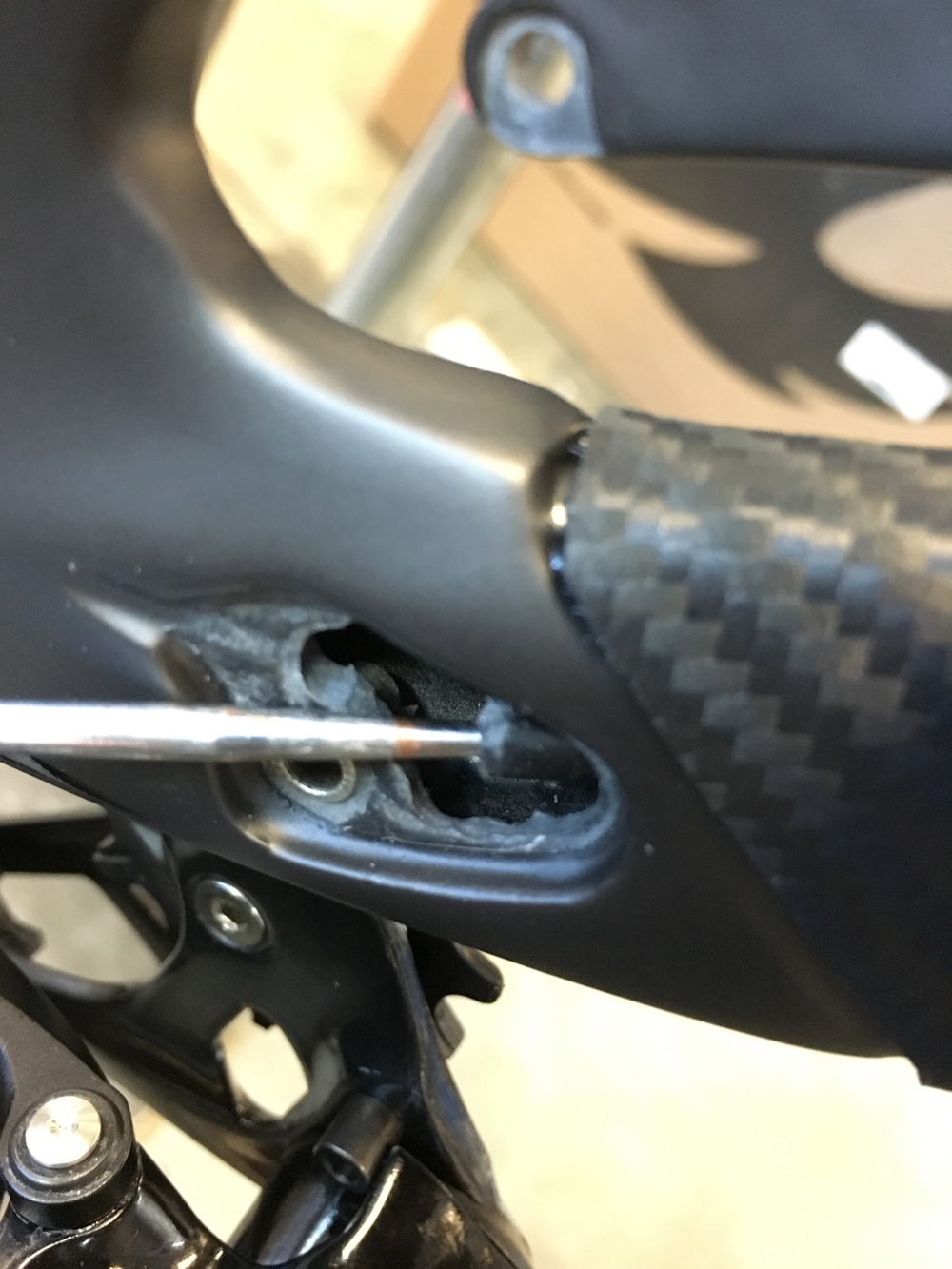
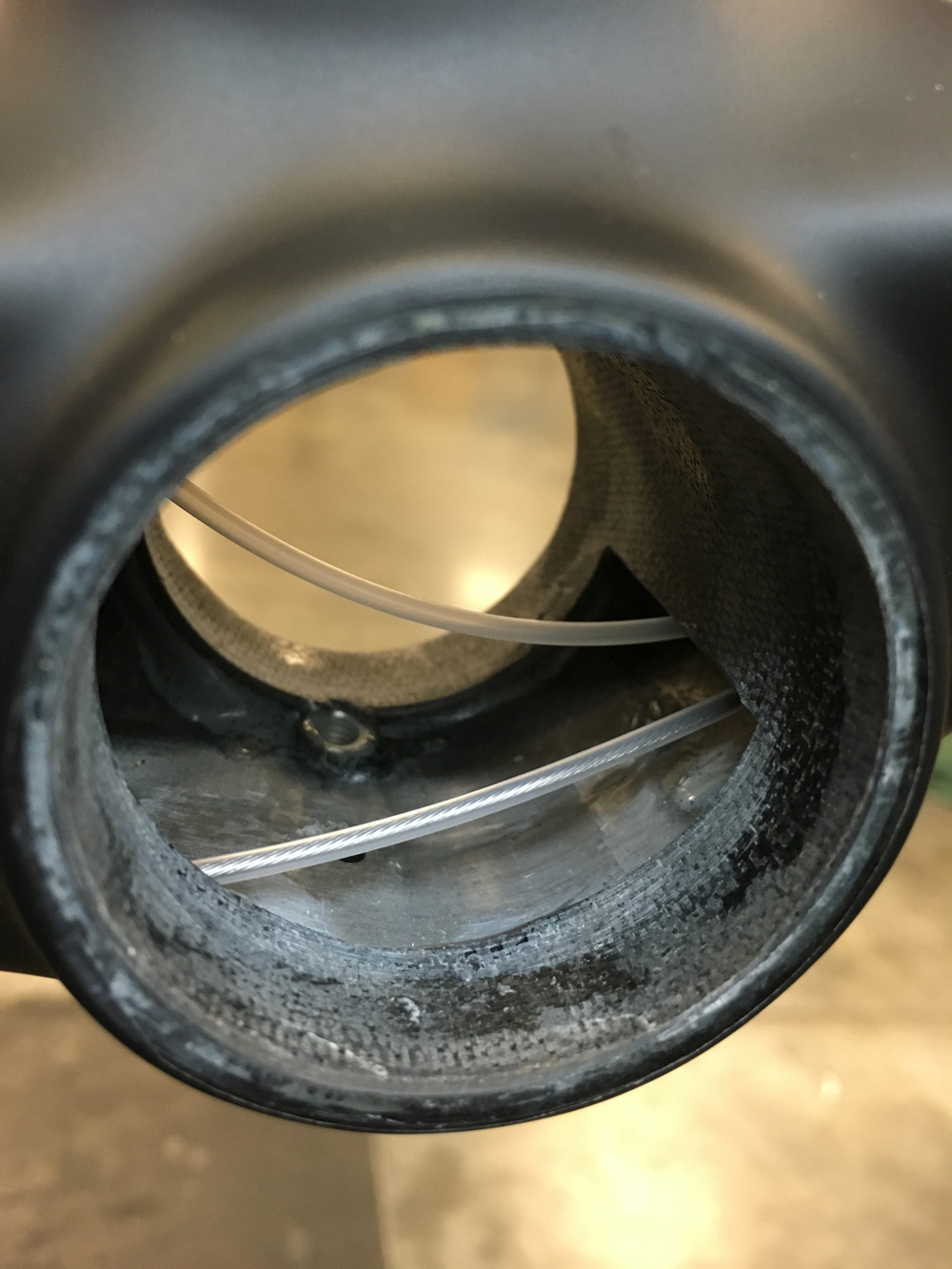
By Tom Jow — The modern carbon fiber frame is a work of art. With swoopy curves and smooth joints, what really makes them beautiful is the lack of cables outside the frame. What the internal cables lends to beauty may also add to complications for service. Replacing the cables, however, does not have to be an exercise in futility. What is required are the correct tools, an understanding of the specific type of cable routing and some patience.
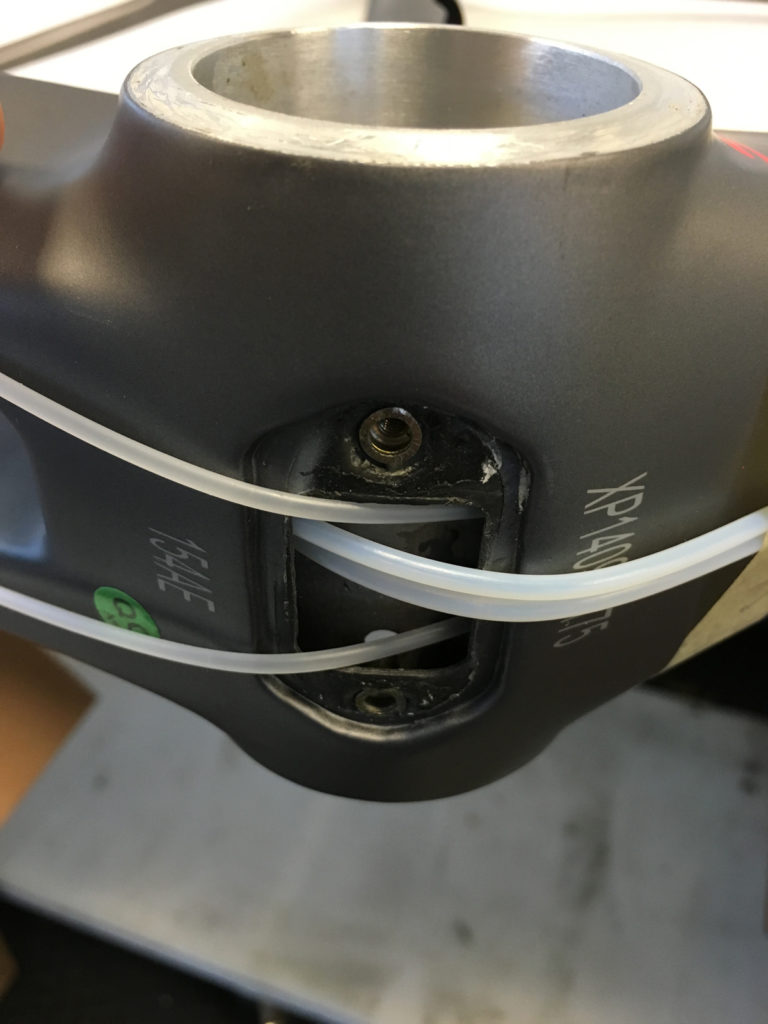
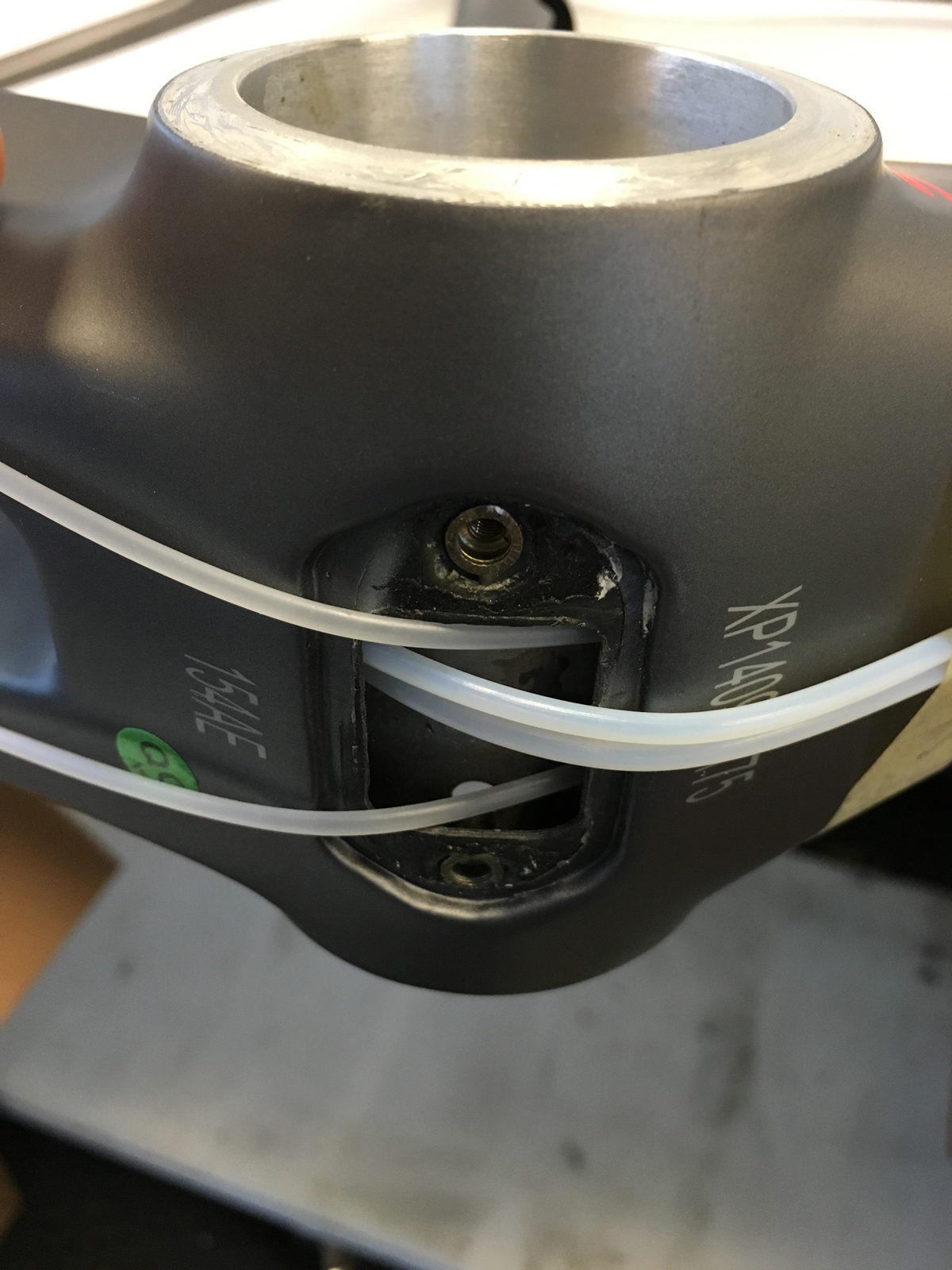
Liners in wait to guide cables from the downtube into the chainstay. Photo by Tom Jow
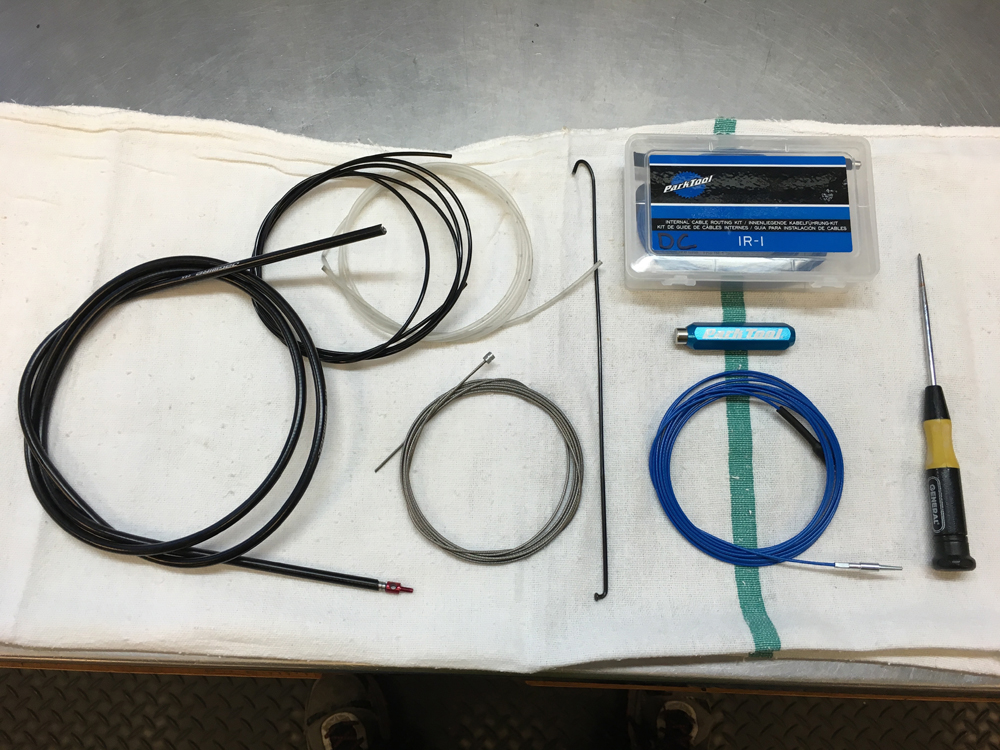
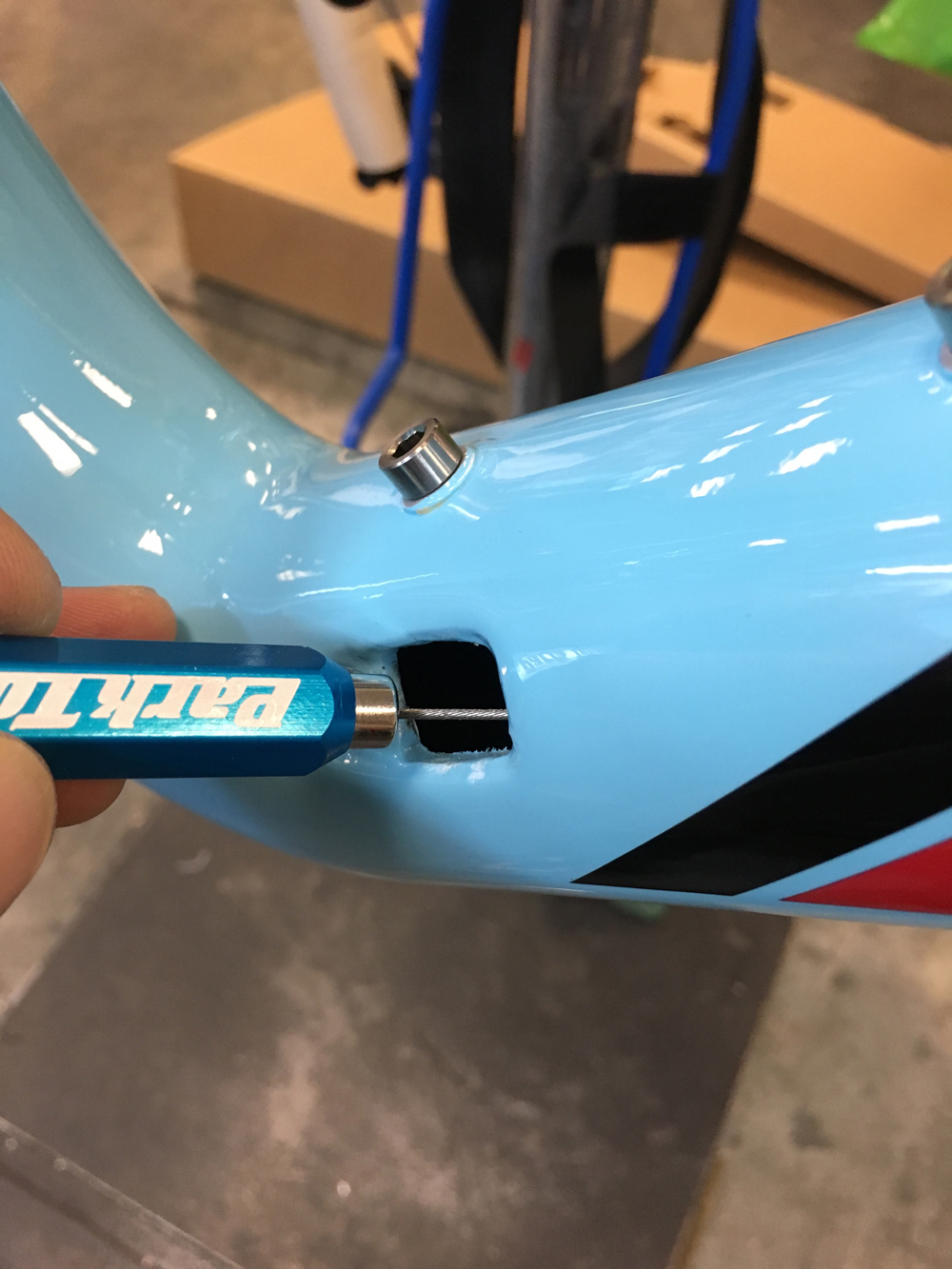
Until the development of carbon frames, there were not that many bikes that used internal cable routing. As such, there were no tools that could be purchased for the job. Every mechanic had his/her own special collection of instruments for each task. These collections would include spokes bent into hooks and curves, teflon liners of various lengths, cables with just the right bend and so forth. Much to the benefit of all mechanics, Park Tool Company has developed the IR-1 cable routing kit. This kit consists of a powerful magnet and three cables with various tips. Another essential tool to have is a bright headlamp.
Before we tear into things, it’s a good idea to consider what we are dealing with. There are several different types of routing used by frame manufacturers. There can be open tube, where the cable or housing runs free inside the frame tubes, or sleeved. The sleeve type has a tube that runs full length from opening to opening. The cable housing runs full length through this tube. It is the rare manufacturer that does this for all cables.
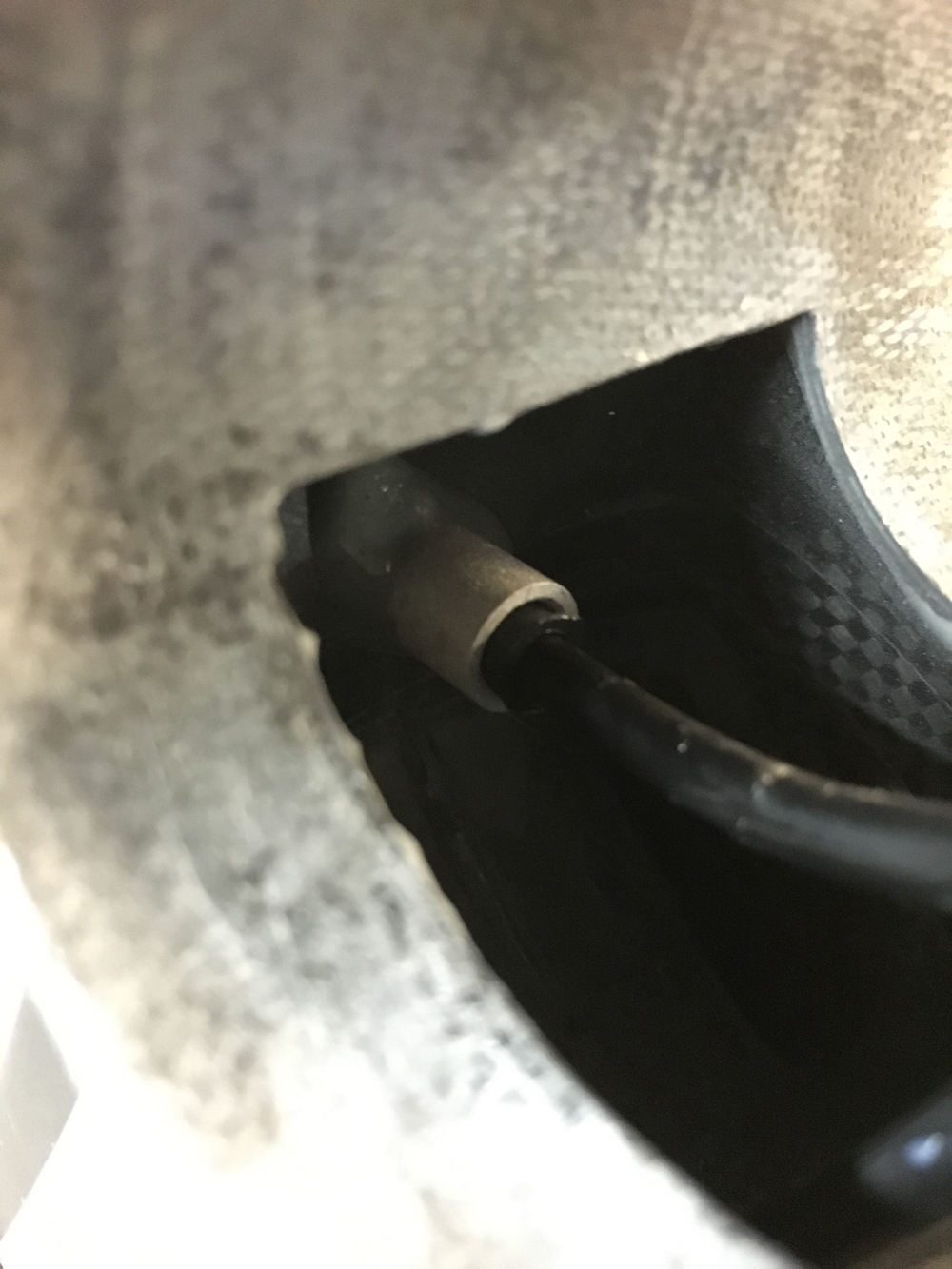
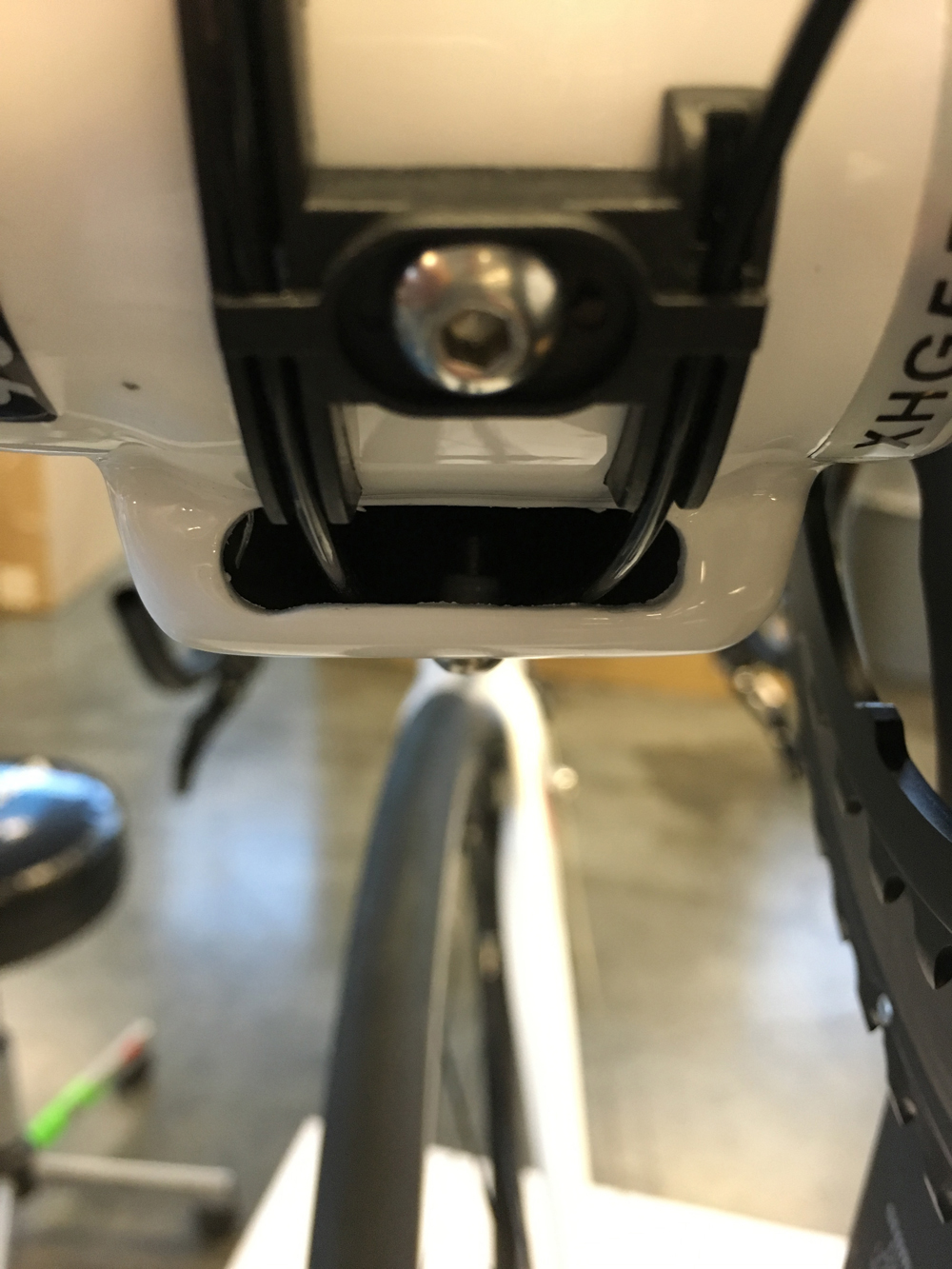
The open tube style can be of two sub types: full housing or interrupted housing. A frame with open tube that runs full housing has an opening into the head tube or down tube. The rear derailleur cable then passes through the bottom bracket and into the drive side chainstay to exit near the rear derailleur. The front derailleur housing usually stops inside or under the bottom bracket. The interrupted type has a housing stop near the head tube and the rear derailleur, with a cable guide under the bottom bracket. This guide may be under a cover plate.
Now, before we begin, it’s time to make a game plan. What cables are we going thread first? Do we need access inside the bottom bracket shell? How long will our cable housing be? Does the right shifter cable go on the right side or the left? These questions are important to answer because, for example, some frames require access inside the bottom bracket in order to run cables. This little detail throws off my standard procedure because I like to install the bottom bracket and cranks first, before the fork, stem, handlebars and, importantly, shifters and brakes. Because of this, I have had to come up with some different ways to do things.
New constructions are usually the easiest. If it is open tube with full housing, I like to run the housings first, and leave them long. It may be necessary to run a blank cable first to act as a guide for the cable housing. Then install the steering, the controls and derailleurs in order to hold that all in place. I’ve had more than one front derailleur slip out of its stop inside the bottom bracket after the bottom bracket has been installed. If the frame uses interrupted housings, I like to measure and cut the housing first. Next a cable with a liner is installed all the way through. Then pull the cable out. Now the liner can be used as a guide for the final cable installation.
For replacing cables on a fully constructed bike, in most cases a liner can be placed on the end of a cable, and thread it in as the old cable is pulled out. To replace a rear derailleur cable with interrupted housing, first remove the short piece of housing between the derailleur and the frame. Install a liner on the end, and slowly pull the cable out while at the same time inserting the liner. Be careful around the bottom bracket guide, the liner can get hung up here and without knowing it, the cable may get pulled out of the liner leaving you high and dry without a guide. The procedure for replacing full housing is dependant on the frame. Mountain bikes generally do not run the cable housing through the bottom bracket. In these cases it’s easy enough to pull out the old inner wire, install a fresh wire as a guide, and then remove the old housing, leaving the fresh wire in the frame to use as a goude. If, however, you have a frame, mountain or road, that runs the cable housing through the bottom bracket, save yourself some frustration and remove the bottom bracket first.
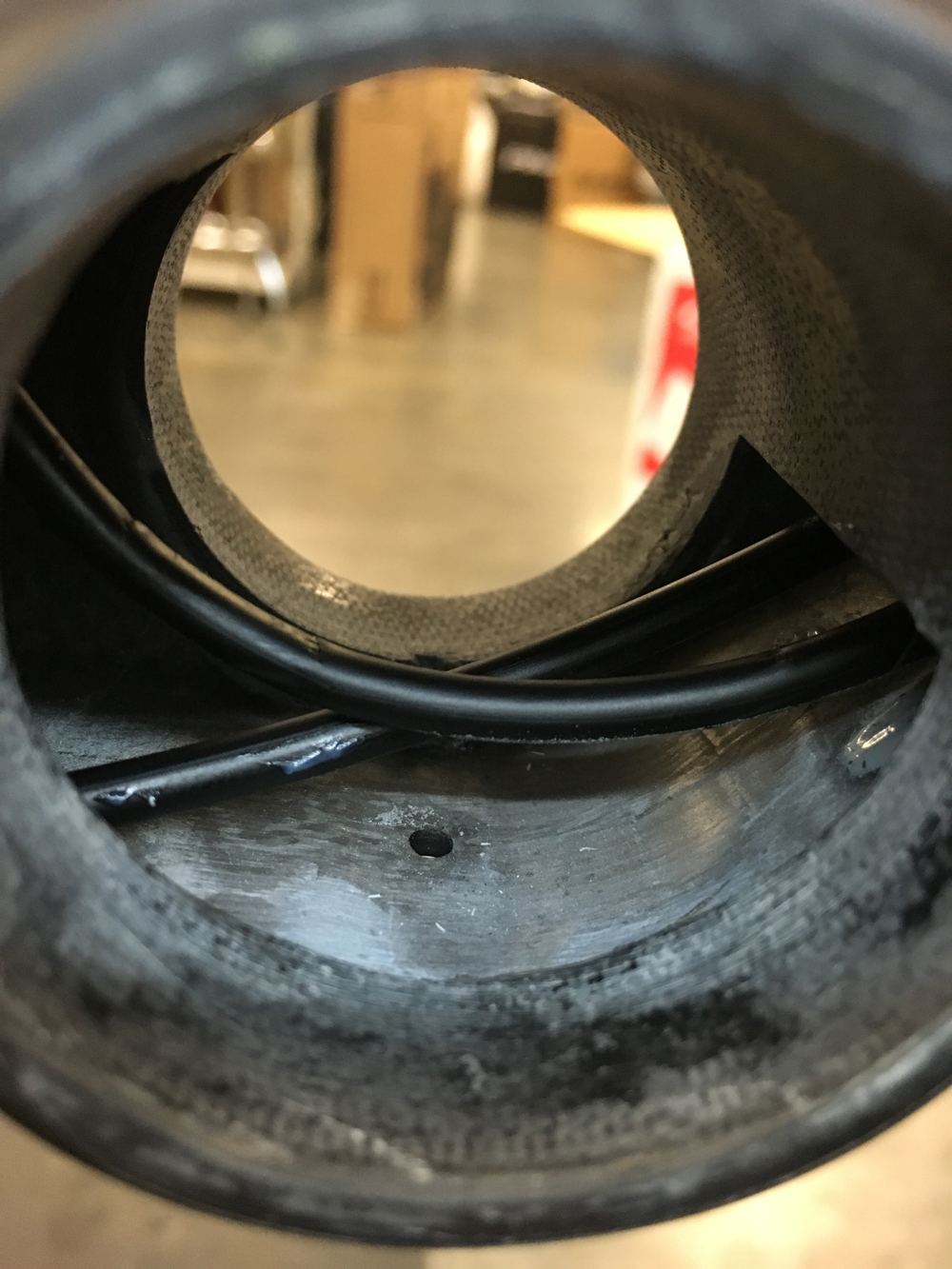
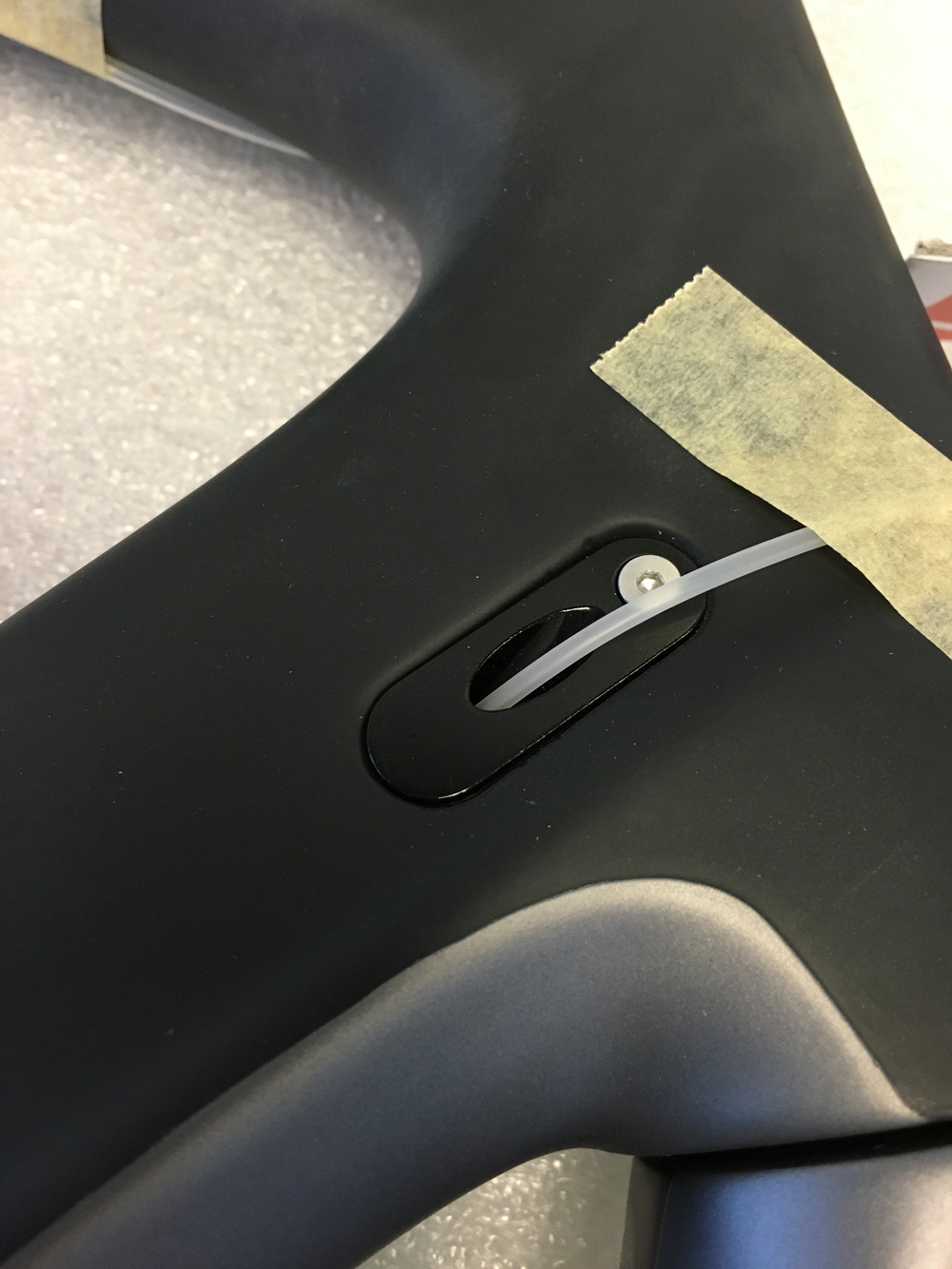
If you are still reading at this point, this where patience becomes important. Even though up to this point it may sound easy, getting cables threaded through a frame can be anything but. If a frame has removable ports or stops, removing them can make it much easier to shine the light in, and fish around with whatever hook or magnet tool you may have. Frame ports can be much easier than say, rear derailleur openings because the ports and the tube are larger making it easier to work around inside. The hook of a spoke works great for pulling a cable or housing out if you can get it close to the hole. A magnet is really handy here because it can grab the cable through the tube and can then be maneuvered to the opening. If the port is large enough just stick the magnet inside the frame.
The other reason for patience is performing this task the first time. And then the second. How many times does a home mechanic replace his/her cables? Once a year? Twice? It takes me three or four times to get a system down, and I might build five of the same bike in one week. All that being said, replacing internal cables is not impossible nor hateful necessarily. With the right tools, a plan and a strong do it yourself attitude this maintenance task can be nearly as enjoyable as any other.
If you build it, they will come. New bicycle lanes will encourage people to bike to work, but more in suburbs than in the city. That’s what researchers from two Canadian universities found after surveys in 17 neighborhoods in the Toronto area.
North-facing view of Harrison Boulevard with new bike lane markings and new traffic light at 2nd Street and Harrison Boulevard shown. Photo by Turner Bitton
People who biked to work at least once a week reported riding more often when new lanes became available. A greater percentage of city dwellers already biked to work before tracks were added, so there was less potential to increase bike commuting.
Citation: Mitra, Raktim & Khachatryan, Avet & Hess, Paul. (2021). Do new urban and suburban cycling facilities encourage more bicycling?. Transportation Research Part D: Transport and Environment. 97. 102915. 10.1016/j.trd.2021.102915.
Abstract: Cycling facilities have become a widely used sustainable transportation policy tool, but their impacts on reduced car dependence are difficult to isolate. This paper presents the findings from a household survey conducted in 17 neighbourhoods in the Toronto region, Canada, some with a recently built cycling facility and some without. Results indicate higher odds of increased commute-related bicycling on streets with a new cycling facility. People who were already commuting by bicycle at least once a week are likely to bicycle more frequently after new facilities are built. Bicycling uptake is more obvious in neighbourhhods with a new cycle track, while changes relating to bicycle lanes were not statistically different from neighbourhoods without a facility. All else being equal, urban cycling facilities were associated with higher odds of increased commute-related bicycling, compared to suburban locations. Findings offer insights into expected outcomes of bicycle network expansion policy/projects.
Recognizing that that designation is bit of a moving target and one that has become older and older with my personal age, I would say he was in his early 50s. He was fit. He looked like he had spent most of his life quite active. His grey hair was cut short and neat and gave him the air of a manager, or at least the leader of something, probably someone who took orders from superiors regularly, but who also passed those orders along to underlings. The setting was a bike shop, so I feel pretty confident in assuming he had spent most of his life riding, probably gran fondos and the occasional race with little to show for it other than the lack of a beer gut.
Whose bed have your boots been under? Early morning Zen. Photo by Lukas Brinkerhoff
“Do you sell a lot of these?” He asked.
“Yea, it’s about 50-50 these days.” I responded.
“I’m sure I’ll have one at some point, but I’m not that old yet. Besides doesn’t it feel like cheating?”
It was a conversation that gets repeated regularly in any bike shop selling eBikes. It was probably one of a dozen I personally experienced in this given week. And as such, I gave the canned response, “You get out of it what you want.”
He continued his browsing or what is also known as “gathering” and left the shop.
I watched as he got in his car and made his way out of the parking lot under the power of fossil fuels. Who’s cheating whom?
In an era of unprecedented ease, which of all the varying levels of mechanical advantage is cheating and which ones are not? When the bicycle was first invented, the problem it was solving was human transport. The bicycle is easier and faster than walking or running giving cyclists an advantage over the biologically available forms. Is the bicycle cheating? What about gears? Bicycles were first fixed, single speed versions due to the technology available at the time. Where do you draw the line?
There’s a hill about halfway up the Zen trail. We affectionately (and by we, I mean me) refer to as SOB Hill. By most standards, it’s not ridable. In fact, if you were to head up Zen for the first time and get to this hill, you would most likely not even realize it was there. Instead, you would just take one of the many cheater lines that go around.
It starts with a lead in that by its own merits is a challenge. It’s uphill and right before the crux, there are a dozen or so boulders that will suck any momentum right out of your wheels once you hit them. The crux is a ridiculously steep pitch of sandstone. If you can get to the sandstone still on your bike with enough forward motion to continue, getting up the sandstone is the challenge that stops almost every person willing to give it a go.
If you make it to the sandstone and are able to continue upward, the slickrock requires a Homeric effort to overcome. The grade is steep enough that balancing on one’s bike alone is a challenge. Combine that with the need to maintain forward motion through the narrow strip of rock that is the line, and you have yourself a real obstacle. It is best overcome by maintaining as much momentum as possible through the boulder field and then a lunge forward. With a little luck that lunge gets both wheels on the rock and on the line and then it is a question of strength and balance. Too much power and you will lose traction spinning out. Not enough power and you will stop dead in your tracks. Both have the possibility of a forced dismount off the side of a giant rock.
We had passed them on the climb up to SOB Hill. My guess that it was one of their first times on Zen as they were struggling not only with the grade of the trail but also with the technical aspects of the rock. Stopping at the Jacker Stacker for a couple of laps before moving on to the aforementioned hill had given them just enough time to catch back up to us.
I jam down on the right pedal to get my momentum started and then repeat with the left leg. I get as much speed as possible going into the boulder field. Out the other side, an unintentional scream escapes from my lungs as I put everything I have into the cranks. The bike lunges forward. My front wheel is in my face and I come to a near standstill. My left leg goes down and the momentum continues forward. One last pedal stroke through the skinny section puts my front wheel at the top of the crux and I throw the rest of the bike upward to finish it out.
The other riders we had passed stand a little confused by what they have just seen and ask my riding buddy, “Is he on an eBike?”
“Nah, kind of the opposite,” he responds, “He doesn’t even have gears.”
Walking versus biking versus driving. The latter is universally accepted. No one says they feel like they are cheating when they jump in the car for a quick spin to the mailbox. And yet, it is the most passive of the three forms of transportation. Despite the herculean effort required to mass produce cars and extract the fossil fuels necessary for that quick spin, pushing down on the accelerator is incredibly easy.
This brings us full circle back to eBikes. Yes, they are easier than pedaling an analog bike, but they are still more work than driving. If you view that incredible, electric motor strapped into the bottom bracket as simply a technological advancement, then it isn’t much different than adding gears to the bicycle or when the freewheel became a thing. Let’s not even get started on suspension, dropper posts and disc brakes. It all depends on where you draw the line.
Who’s cheating on whom?
I ride singlespeed despite my advanced age as well as an eBike and a couple of cars. From where I stand, every time we allow ourselves to use a motor instead of our own power, we have given up a piece of our humanity. There is a tipping point when we begin to lose our ability to do things by opting out of doing them ourselves. Which is to say that driving a car or riding an eBike or using the elevator is only cheating you. And yet, it’s so easy and yes, sometimes even downright fun.
By John Higgins — Of the 3 sports that comprise a triathlon, the cycling leg requires the most technical equipment, and is arguably the more intimidating sport because of this, particularly for competitors who come to triathlon from a running or swimming background. But cyclists are also faced with equipment questions and conundrums when considering participating in a triathlon. Do you need a special triathlon bike, or will any bike serve the purpose? And what’s with the low and stretched out position anyway?
The bike leg is in essence an individual time trial, followed by a run! Because competitors are not allowed to draft behind other riders and save energy, the way to go faster and have energy for the run is to reduce your wind resistance by riding in an “aero position”. This requires a different riding position, which means either a triathlon- specific bike, or modifications to an existing road bike. The longer the event, and/or the more competitive you want to be against yourself or others, the more significant this aerodynamic advantage becomes.
A tri bike (shown here) will be faster in a triathlon, but the rider will need to decide whether the expense is worth the time savings. A road bike with aero bars can be a good alternative. Photo by Dave Iltis
If you don’t have a tri bike, but are wanting to participate in a triathlon, here are some things to consider before investing in a tri bike.
Event Distance. Triathlons are generally classified by the total distance as either Sprint (12.4 mile bike), Olympic (24.8 mile bike), Half / 70.3 (56 mile bike) or Ironman (112 mile bike). Short distance events like the recently held Daybreak Tri and Dino Tri are popular for experiencing a triathlon and testing fitness, equipment and strategies. Unless you have your sights set on the podium, any bike you can put your hands on will be fine for these shorter events, even a mountain bike!
Your Motivation and Goals. If your aim is to do one triathlon and check it off your list, then there is no need to invest in special equipment. But if this is a sport you plan to repeatedly go in, and you want to be competitive, then having the right tool for the job is going to help.
Current Bike. If you have a road bike, you can use that for any triathlon (add aero bars, and see below), but you wont be as fast as someone with the same cycling fitness who is on a tri bike, especially in longer events. But many people do their first long event on a road bike just to make sure they are “hooked” before getting a tri bike.
Other Cycling Pursuits. A tri bike is usually a poor choice for group rides, club rides, non tri cycling events, and riding up and down canyons, due to the gearing, riding position and steering. If most of your cycling will not be training for or participating in a triathlon, then you probably don’t need a tri bike.
Time and Money. Triathlon is not a cheap sport. Entry fees, travel, training, and equipment all consume time and money. If you’ve got the time and money to go for it, then you probably want to maximize your enjoyment by having the right gear, and that would include a tri bike.
Converting a Road Bike to a Tri Bike. It’s not just a matter of slapping on aero bars. The frame geometry and riding position for a tri bike is quite different to a road bike. It’s difficult to have one bike optimized for both styles of riding. There are horses for courses, so don’t expect any old mustang to carry you to a triple crown. Which is not to say you can’t enter the race. Give tri a try.
John Higgins wants to elevate your cycling experience. He operates BikeFitr – an independent bike fitting studio, and Fit Kit Systems – supplying equipment and education to bike retailers and fitters. Contact: [email protected]
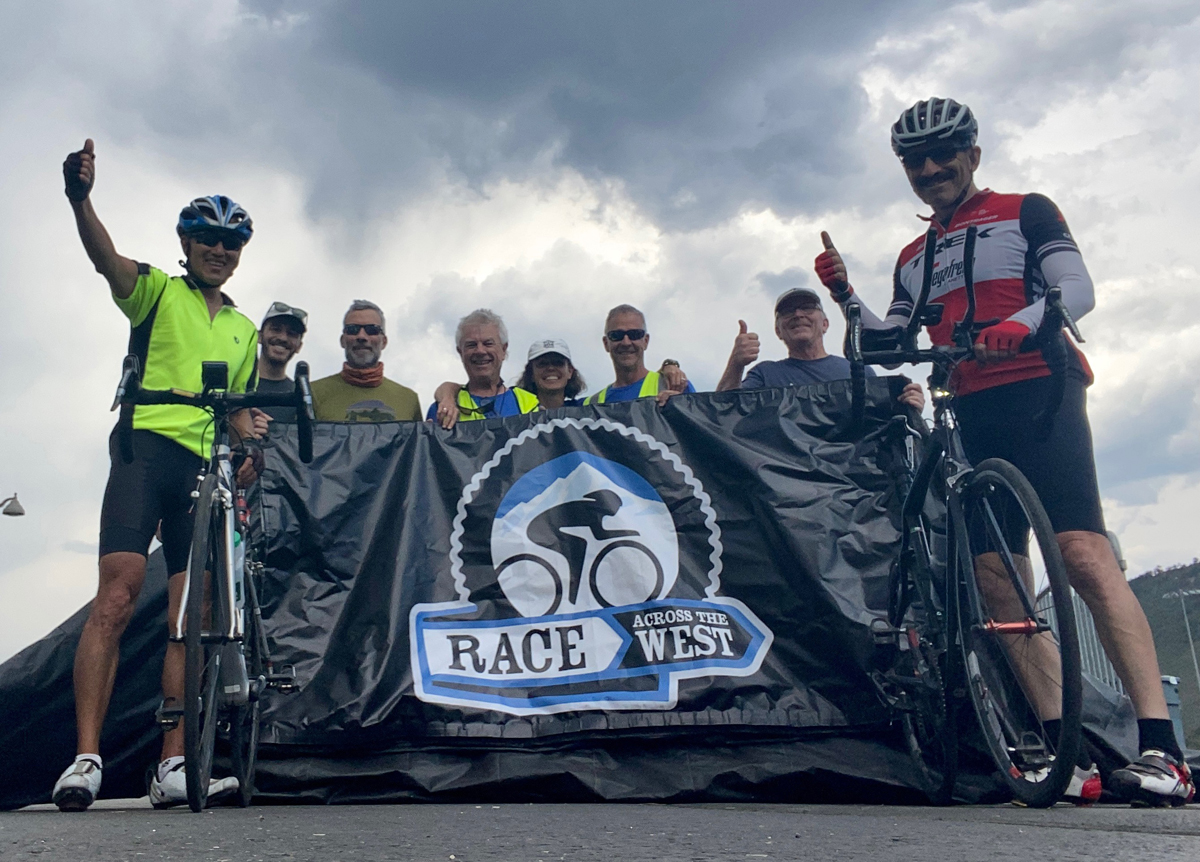
By Bob Corman — People ask me “why do you do things like this?” Most likely by the time I finish writing this neither you nor I will be any closer to that answer. Except maybe the answer is in the little stories within the story, the things we will take with us long after we forget what our finishing time was or what place we came in. Is this all worth the massive toll on my body that now, a week after finishing, is just starting to subside? The feelings of no energy, the pain everywhere, the night sweats, the feeling upon waking at home that I need to go ride a segment now but I’m too tired – which I think is a mild form of PTSD. You decide. For me, I don’t know if I will do this race again, but I am so glad my friend and teammate Doug Fujii gave me the opportunity to do it once.
The Race Across the West (RAW) is the baby sibling to The Race Across America (RAAM), which is the marquee race for ultra-endurance road cyclists. The two races run concurrently. RAW has solo, two-person, and four-person categories. From the RAW website: “Race Across the West was started in 2008 to offer a race longer than 500 miles and to help bridge the mileage gap to RAAM. It has since evolved into an epic race in its own right…It follows the first 930 miles of the RAAM course, from Oceanside, CA to Durango, CO…RAW leaves the beach in Oceanside, climbs the Coastal Range and the drops into the scorching desert. After crossing the deserts of California and Arizona, racers begin a gradual climb into the mountains surrounding Flagstaff, AZ and eventually into the Rocky Mountains. The race finishes at Fort Lewis College in the cycling mecca of Durango, CO.”
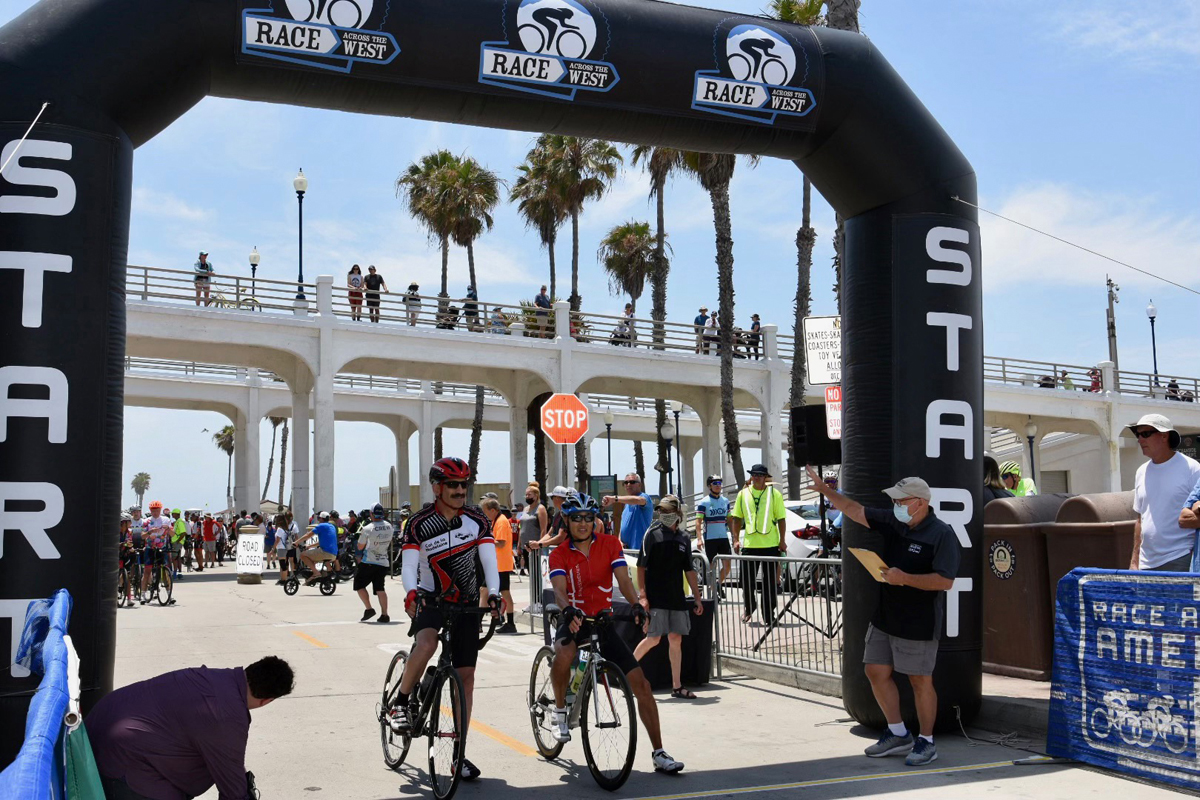
Bob and Doug seconds away from the start in Oceanside. Photo by Steven Bernsen
The 2021 Race Across the West timing coincided with a record-setting heat wave in the southwestern United States. The kind of heat most cyclists would never consider riding in. To prepare for this, I had a singular day of heat training – I rode out to Stevens Canyon in the SF Bay Area one day and my little Wahoo Bolt said it was over 100. Then the day before the race we practiced a racer transition where I would meet Doug after his unsupported first 23+ miles of the race. Just climbing the hill at that location, the temperatures were already well over 100. So, the next day during the actual race start when I had the exact same hill start it was no surprise to see the same temperatures. That was just the beginning. We weren’t even close to the desert yet.
Our strategy for this race was different than when Doug did it with a different teammate two years earlier. This time, we were still using two support vehicles, but instead of one vehicle following the riders and the other running errands and being available for crew rests, we would have a vehicle assigned to each of the riders so there would be no loss of time during transitions in direct follow periods, where a vehicle has to be behind the rider in order for that rider to move. Direct follow is during the night and in certain areas during the day. We were just not fast enough as a team to lose two to three hours in transitions if we had only one direct follow vehicle. To make this strategy work, we brought in a third crew a day into the race to spell the first two crews. All of this complicated coordination worked in large part due to our amazing crew chief Laura and the super flexible and tireless crew! The fact that we ended up not finishing in the official time was because together Doug and I were not fast enough. The crew was always exceptional. The heat was beyond anything I had ever experienced. Whether we would have made the 68 hours for the 930 miles and 50k+ feet without the heat, who knows. But you don’t control the circumstances of a race.
The second major climb I was on was steep with temperatures over 110. To add to the misery, my bike was having shifting issues, one of which I fixed myself while riding and the other when I got off. Bob 2, Bike 0. Amazing. There would be two more issues. Final tally: Bob (and Vin) 4, Bike 0.
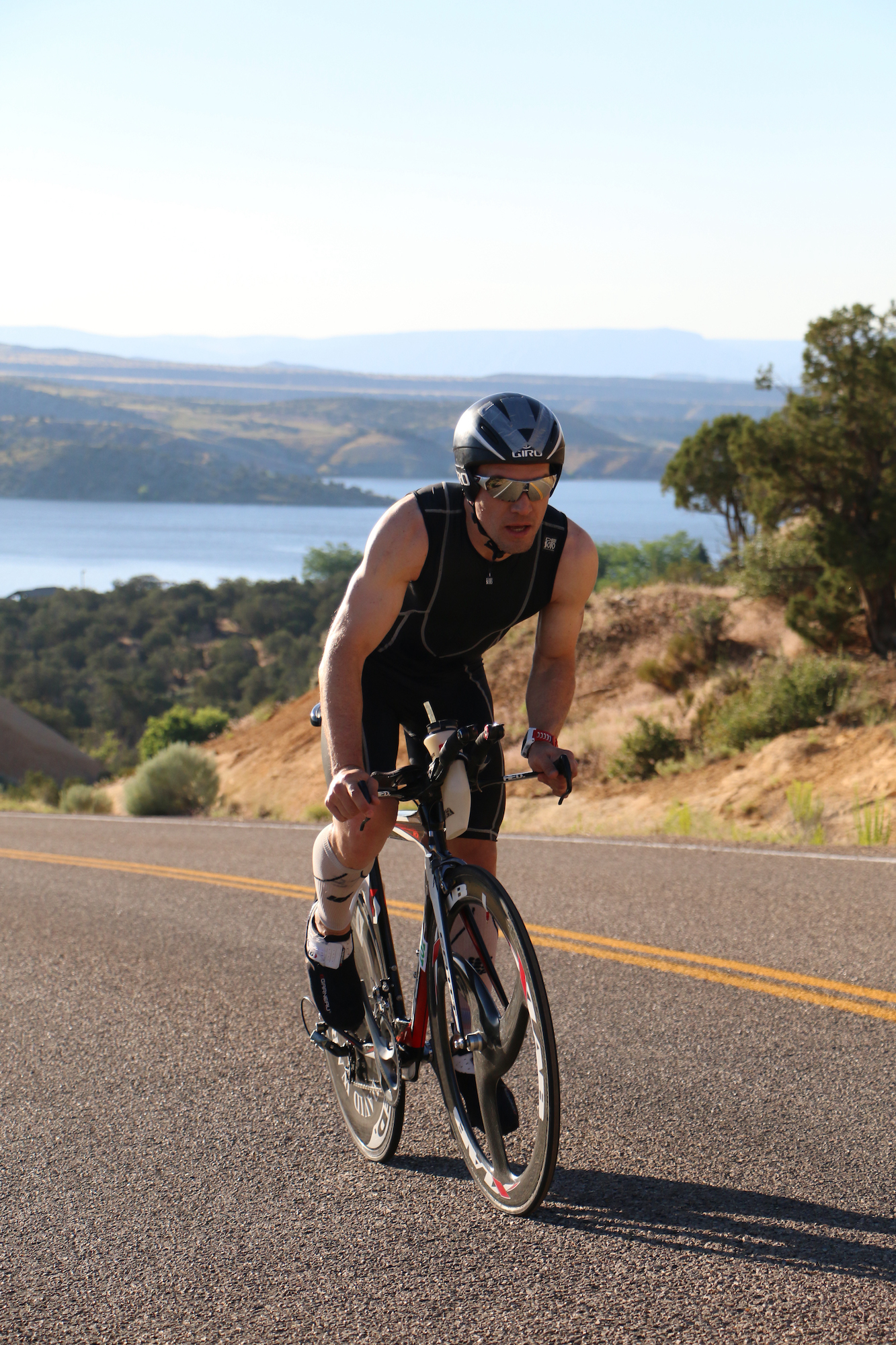
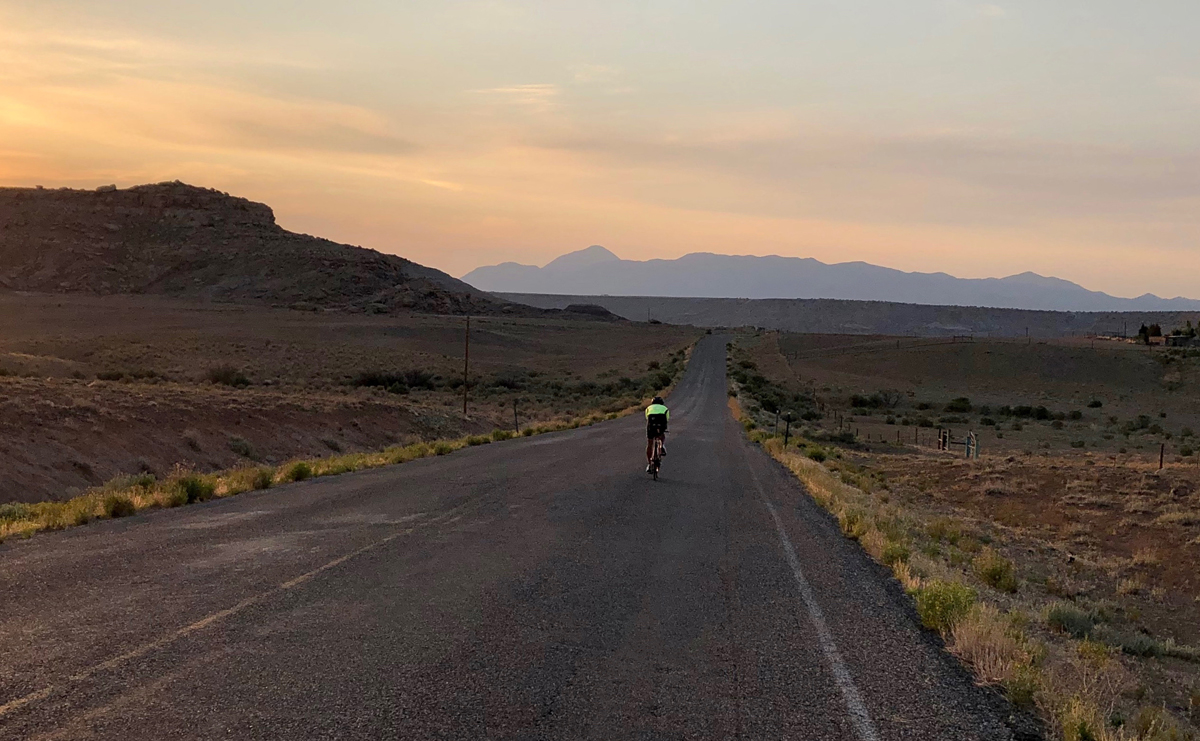
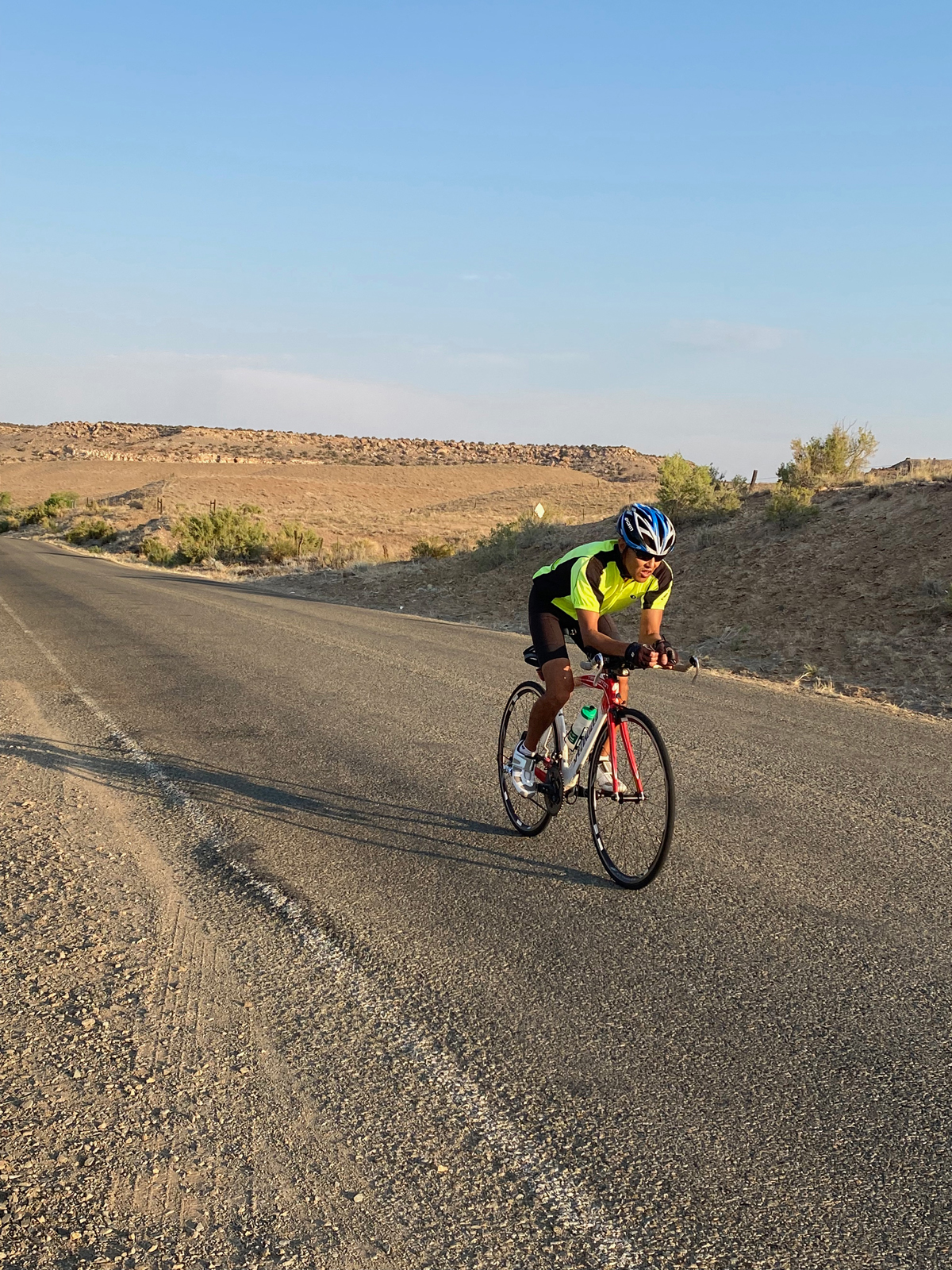
Doug Fujii riding at sunrise in southeastern Utah on one of many long stretches of road with spectacular views in the 2021 Race Across the West. Photo by Vin Wolff
During the first day is the famous descent into Borrego Springs called the Glass Elevator. I knew Doug wanted to do this and I wasn’t going to argue to do it. He had a vendetta with this race and the whole reason we were doing it was because he wanted so badly to have another crack at it after having stopped short of the finish line in 2019 with another teammate. If he wanted to descend the Glass Elevator, go for it. Which made it all the more shocking when a couple of miles from the start of the descent Doug told my crew to get me ready for “the hill.” Say what? Now I am not afraid of any descent but so many people had told me not to do this for fear of my safety that I was starting to think I shouldn’t do it myself. But let’s gooooo! And go I did! Wow. It’s called the Glass Elevator because you can see the desert spread out before you for tens (hundreds??) of miles while descending. I didn’t try to hammer the descent as safety first always. But it was fun, except, as I descended, it got hotter and hotter to the point I was wondering if I would soon be able to hold on to the brakes or anything else. It felt like my legs were getting sunburned, but the sun really wasn’t out. At the base of the descent, it was close to 120 degrees. Oh well. What’s a few extra degrees between friends? I filed away in the back of my mind that I owed Doug a descent or two. I did give him the super long descent into Durango at the end but that turned out to be, as Doug put it in one of his lengthier pronouncements, “long.” Not exactly the same as the elevator.
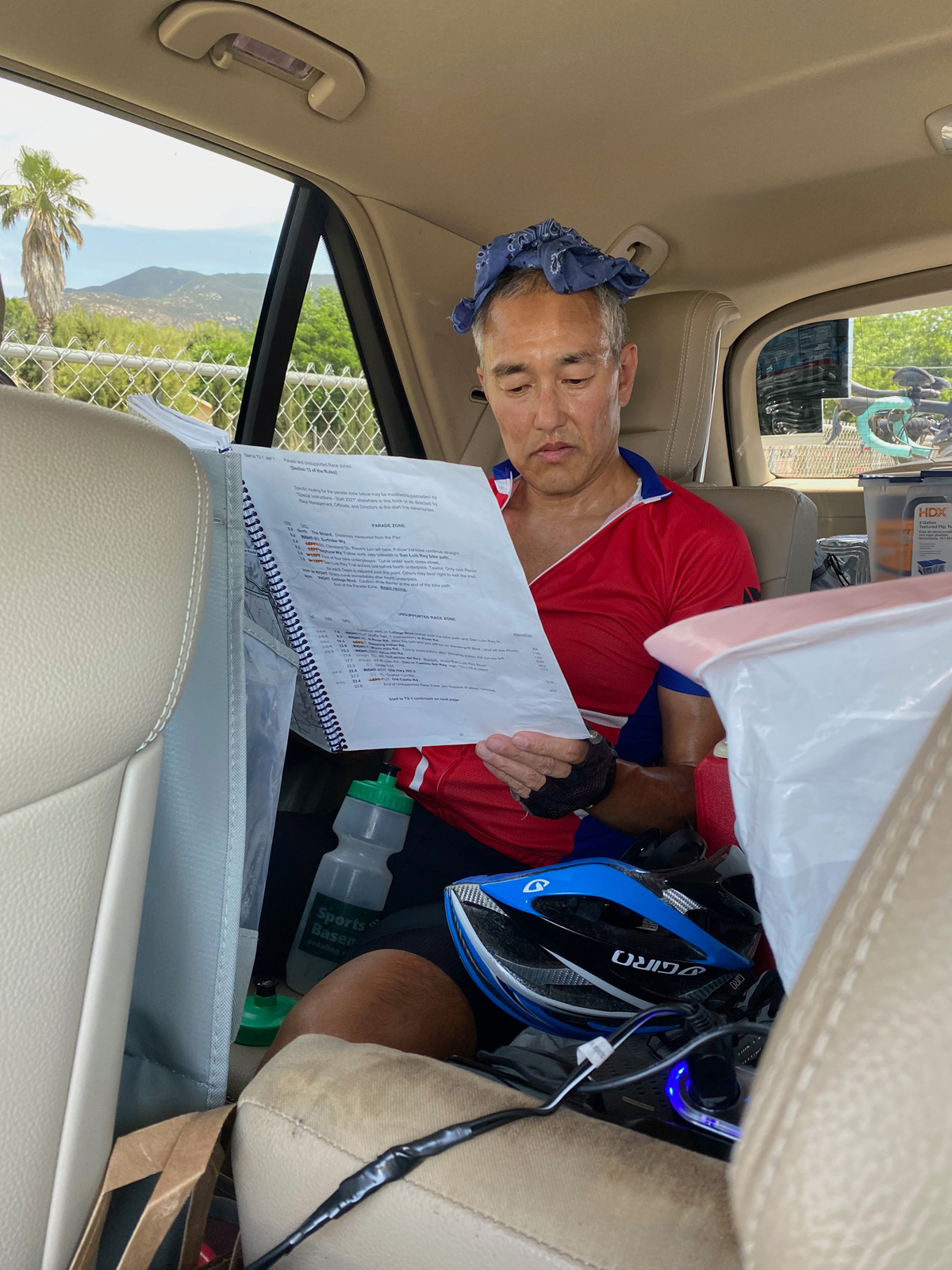
Doug Fujii, with ice on his head and ever present water bottle nearby, studying the route between pulls near Peeples Valley, AZ in the 2021 Race Across the West. Photo by Laura Hill Temmerman
A lot of the race is a blur, which explains how we finished. We just kept doing what we had to do. Every 20 minutes, or 15 if it was super-hot, or 30 if there was no place to transition or someone needed extra time, we kept switching riders and moving forward. It was all about moving forward. This is a 24 hour/3-day race – there is no stopping if you want to finish. I spent a few hours in three different hotels but over three nights I think I slept less than a total of three hours. During these times that we took longer breaks, whether in a bed or in the vehicle, it meant that the other rider was riding a longer period of time while very tired. It was pointed out to me that these longer ride segments in and of themselves would have made a good weekend ride at home, but we were doing them exhausted, and in the heat or on a climb and with hours and days of riding in our legs (and minds).
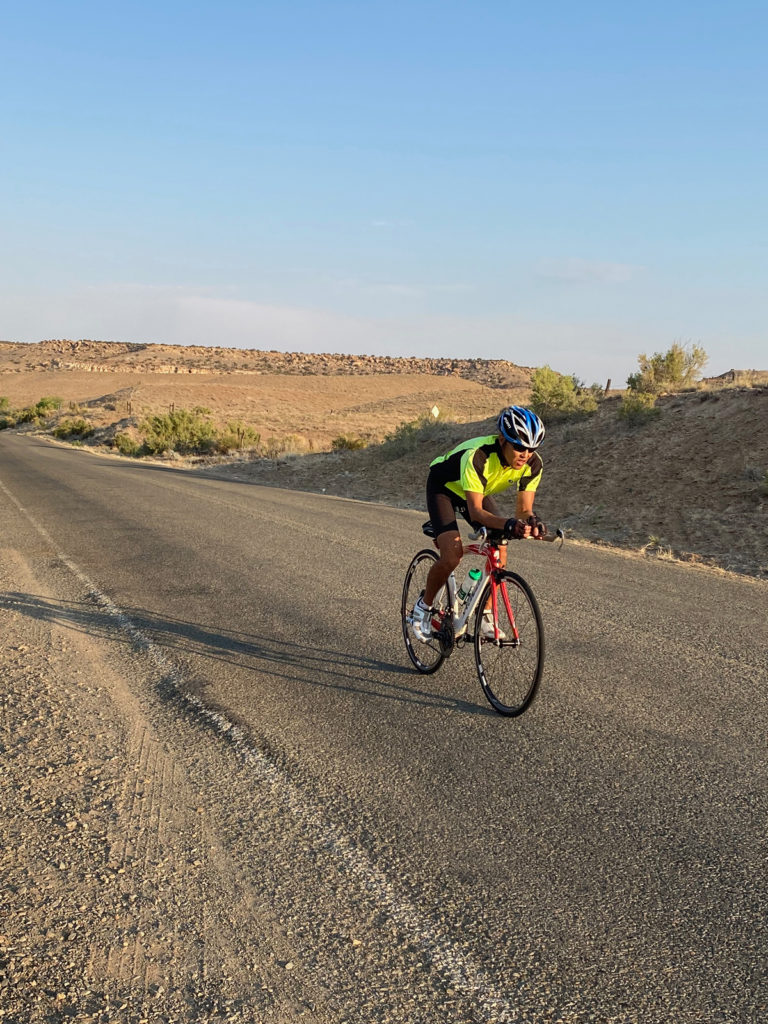
Doug Fujii pushes on with little sleep in southeastern Utah near the Colorado border on the morning of the last day of the 2021 Race Across the West. Photo by Laura Hill Temmerman
One of the times that I remember fondly (haha!) was having taken a rest in a hotel in Camp Verde, Arizona with the intention of sleeping about two hours. After an hour or so Laura shook me awake and said you need to get back out there, that Doug was about to start the climb out of Camp Verde and he is done. Can you do it? I remember saying something first like “What, where am I? Do I have a choice? I have to do it, so I am going to do it.” So, we caught up to him at the base of the climb, which I believe goes from something like 3000 feet to over 7000 feet and driving (too far) ahead of him to find a race legal transition spot. This is where I first met our third crew, which was my son Casey and friend Chris. Casey promptly informed me that this climb was similar in elevation gain and length to the biggest climb in the Bay Area, Mount Hamilton, so good morning at 1AM, Bob, why don’t you just climb Hamilton at elevation and at 85 degrees still and oh, by the way, have a good time. Which I did. At 9AM that morning, I remember telling my friend Vin that I had already climbed over 5000 feet that day and he said “today?” And Laura said while laughing “how do you think we got to this elevation?” An amusing moment that is really not significant other than that I will always remember it.
Our team was named Moxy and Grit, borrowed with permission from Sonya Looney’s company* because we liked what the name represents. Yes, Moxy is spelled “wrong” on purpose for creative and availability purposes, but you get the idea. I think one has to have both attributes to compete in this race, whether you are a solo (are they crazy???), 2X like us, or 4X. The events of the last day of the race exemplify what having those attributes mean. Doug was tearing his body apart trying to keep us under the time limit and once again doing a night pull while I tried to get some sleep.
Eventually I took over and when we reached the transition area where he would ride again, he was literally out of it. Had no idea where he was. Was standing five yards in front of his vehicle (he needed to be AT his vehicle) and clueless as to what was happening. This is no joke, and we knew he needed to rest big time. Luckily my 20 minutes of sleep in an Alfred Hitchcock hotel in Mexican Hat, Utah had given me some amazing energy, and when I took over and started riding, I said to myself “I have magical legs.” I mean holy crap, I could do anything. How did this happen? My follow car noticed this as I sped up rollers and showed speed I hadn’t shown maybe at all in the race. I told myself to reign it in or I would end up completely wasted like my teammate. I did try to keep it in check but later we would learn that I might have reigned in my speed and power, but I forgot to drink and eat enough – which had devastating consequences. I had been asked to do an hour pull and when we tried to transition it was clear that Doug needed to sleep more so I said I am good to go. I mean I thought I could ride the rest of the race if I needed to. That’s how good I felt. Magical legs. So, I rode another hour and a half and gave Doug the time he needed to sleep and be revived.
We resumed our 20-minute pulls and were soon on a rather desolate road in Utah near the Colorado border. I will remember several things about this section: holy cow the rollers were steep, the whole section climbs about 1300 feet very sneakily, I kept looking for a porta potty somewhere/anywhere!, and I was not feeling as good anymore. This is where everything started to catch up with me: the days of lack of sleep, the constant crazy heat, going hard that morning and not paying as much attention as I should have to constantly drinking and eating. I just felt like I was going really slow and was pretty much done with my pulls after 8 minutes and wondered how 20 minutes had not gone by. Uh oh.
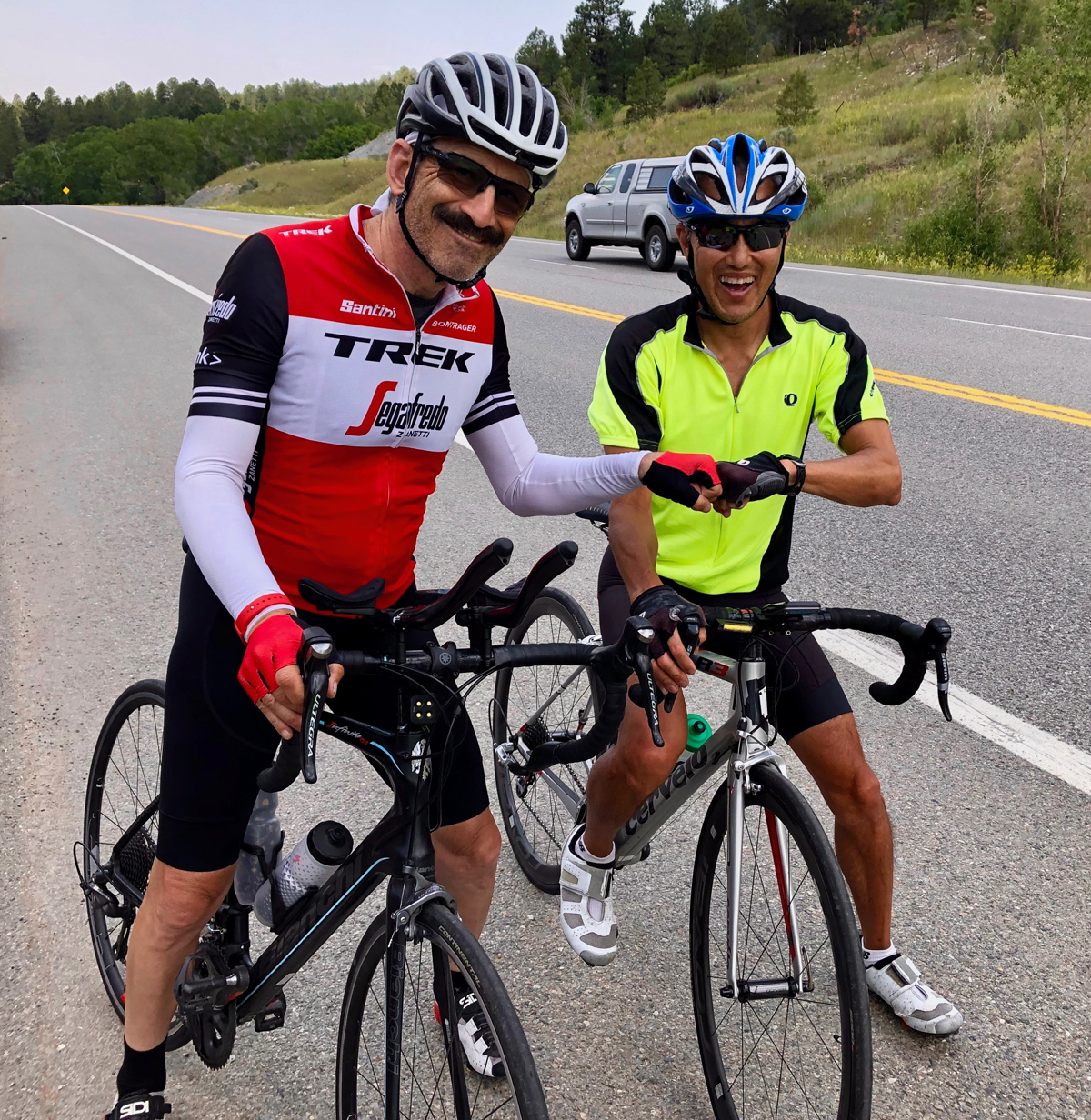
Bob Corman and Doug Fujii still smiling west of Hesperus, CO during the 2021 Race Across the West. Photo by Vin Wolff
Fast forward to Cortez, Colorado and the heat was getting more intense and I had nothing. Laura brought me an iced latte and food. I didn’t want the food. Craig, a former paramedic, was putting ice on my head and neck, and making me drink. Also checking my skin temp as I was afraid I was having heat stroke (I wasn’t). I started out on one relatively flat section and would go maybe 50 yards at maybe 5 mph, and then I would stop. Then I would try again…and stop. Finally, I reached for my phone to say I couldn’t ride…but I didn’t have my phone. In my not-all-there state I had left it in the vehicle. Now what? The crew quickly figured out something was wrong and came back (with Doug) to get me. Back in the car for me. I think I am done. I am devastated. Doug came back to the car to check on me and told me to go back to a motel and rest so I could help finish, and Laura was asking Casey to come to this location and “assess your dad.” He told her without seeing me that I am not going back to the hotel. Then he showed up – with another latté – yay! – and says “Dad, you will regret forever going back to the hotel and not finishing. Put your head on the cooler next to you and rest.” I hear all this through my fog/self-pity and comply. At some point, I burst into tears fearing that I have let everyone down, especially Doug who asked me to be on the team so he could finish. Not feeling good about crying but I think it helped.
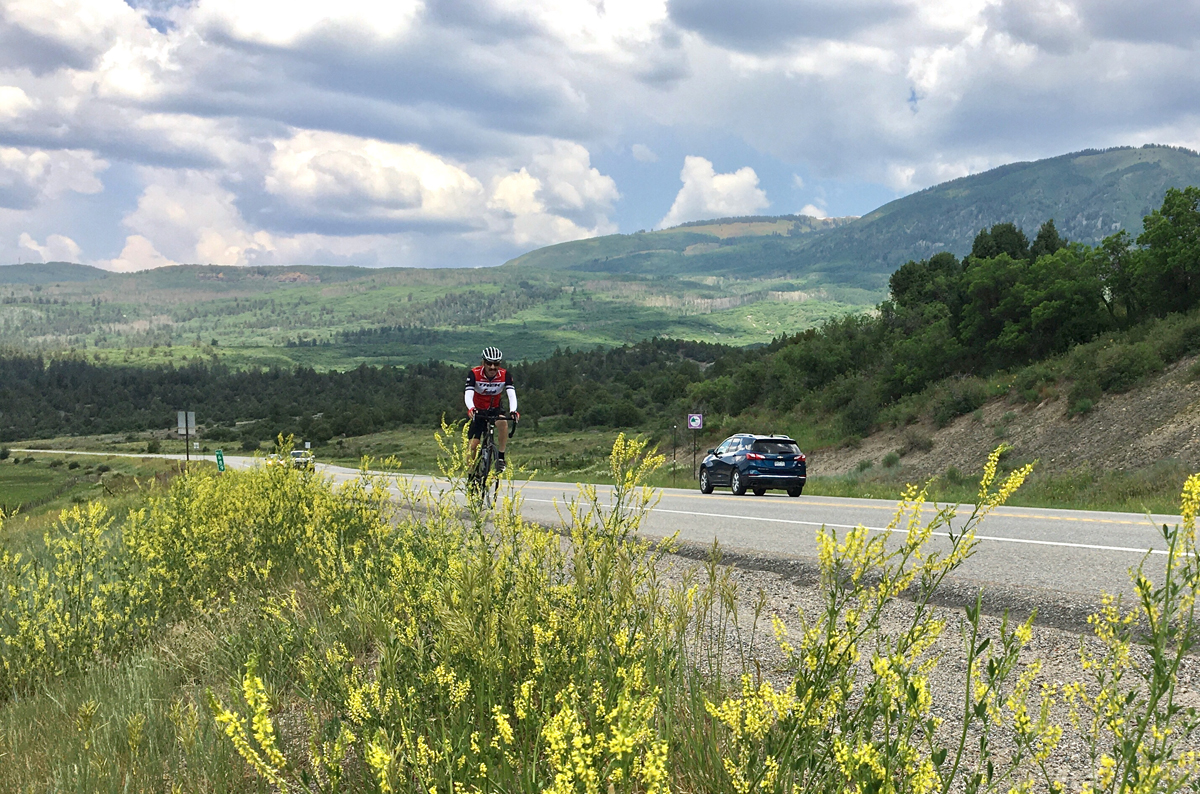
Bob Corman riding west of Hesperus, CO after recovering from his major bonk during the 2021 Race Across the West. Photo by Chris Dunn
Next, Jordan, Craig’s crew partner in crime, and the person with the most experience crewing for Doug, points to a quarter mile steep pitch in front of us, and says, “Bob, try it.” “I can’t do that.” “Try it. I will pick you up at the sign a couple of hundred yards ahead if you really can’t do it.” I get on the bike very tentatively. I push down on the pedals and they actually move. I slowly make my way up the hill and vaguely remember the team – all three cars worth – standing by the side of the road and cheering for me. I make it. I am back. 100% credit goes to my crew who would not let me fail…and especially Craig who just nursed me back with ice, massages, drinks, and food.
During this time, Doug had done almost all of the 17 miles of the first of the two climbs to the summit before the Durango descent, and I now finished it off and had an amazing descent to the base of the last five-mile climb. We took a couple of turns, then I took a minute to show Doug the rest of the route and explained that I would take the rest of the five mile climb and then I wanted him to finish it off and get the entire descent, which he more than deserved.
This was his “long” descent and my crew took me into Durango to wait at the base of the rather steep mile-ish climb into the finish line. I met up with Doug there and together we climbed this mean little hill to the finish line.
Now let me tell you something about our crew. I wouldn’t have replaced a single person. They did everything right and nothing wrong. They were always supportive and took leadership roles where they needed to. The logistics were incredibly complex, and they managed the planned and unplanned with seeming ease, although there was nothing easy about it. They smiled a lot. They encouraged. And at the finish line, where the inflatable banner was lying on the ground with no race folks to meet us, while Doug and I climbed they improvised a finish line complete with the chute and banner and cheered for us and I hope for themselves too as we crossed the finish line together (without crashing into each other). This will always be a highlight for me.
The amazing Moxy and Grit team at the at the 2021 Race Across the West finish line in Durango, CO. Photo by Casey Corman
I have been involved with some amazing events over the years – 24-hour events, Furnace and Silver State 508’s, Hoodoo 500. I rode through 50 mph headwinds in Death Valley in the 2009 508. That was pretty epic. I am not sure anything will ever top that.
But this is also as epic as it gets. A week later I am finally recovering.
The RAW website says we are DNF. We are not a DNF. We never stopped trying or racing. We were battling another team in our age group, and we beat them. We are RAW finishers, although not official. This group of eight people got two of us through 930 miles and 50k feet of the most intense heat one could imagine, through some roads with 6-inch rideable shoulders and lots of traffic, through rider implosions and crazy logistics.
I did a short ride yesterday with my daughter-in-law Martine and my friend Neal. It actually felt good. I can sort of sit on the saddle again. I can feel a little power coming back into my skinny little legs.
*Moxy & Grit was started by Professional Mountain Biker Sonya Looney, and its ethos is about inspiring athletes to push a little harder in life, go for the things they are passionate about, and have fun while doing it! The socks and apparel are bold, funny, and sometimes even include expletives to have that special something to take on big adventures and make others smile!
By David Wiens and Andre Shoumatoff — Mountain bikers have joined forces with equestrians, hikers, trail runners, and motorized users to create an exciting new campaign and program for increasing quality of experience for all. The program and campaign is called Trails are Common Ground. It’s now slated to likely become the largest single widespread trail etiquette campaign, included with a new, standardized national trails manage management system, brought to us by a new unified partnership of these various groups.
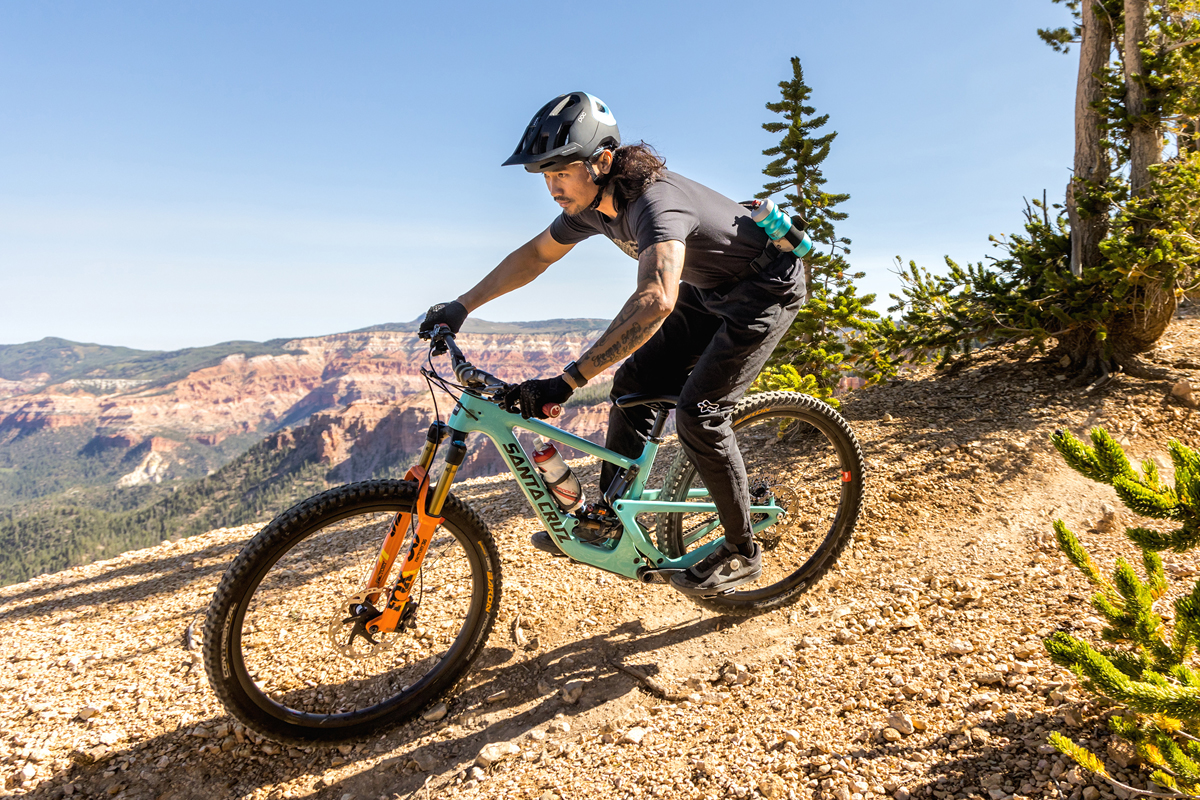
St. George, Utah resident, Keith Bitgue, descending the top section of Blow Hard Trail with Cedar Breaks National Monument in the background. Photo by John Shafer, photo-john.net
As we all know, trail use was dramatically increasing prior to Covid, then the pandemic hit, and all of a sudden we had massive numbers of new and formerly-active people getting back onto the trails. This sudden and unprecedented interest accentuated the challenges of trail management and lack of support for trail managers from a national level, as well as the considerable need for a new, standardized, well-marketed trail etiquette program oriented to all users. Likewise, the landscape of user types has also changed. Handicapped users are now recreating on dirt trails with electric motors, plus the need for addressing the correct implementation new technologies like the rise of popularity of pedal-assist mountain bikes and types of motorized technologies has only further-exacerbated the issue.
Recognizing this, IMBA, the International Mountain Bike Association, stepped up to create (and is now administering) this program with, and on behalf of the leaders from a variety of different user types and several organizations championing diversity and inclusion. The groups have been meeting since spring and the campaign launched in August, and is currently slated to run in perpetuity. IMBA donated several hundred thousand dollars to get the program off the ground, and dozens of other organizations and businesses have verbally committed to additional support and funding to help make the program truly effective.
Leading the messaging for Trail are Common Ground is an effort to make trails and trail systems welcoming and safe for all people. Everyone should be able to benefit from fitness and trail-based recreation and removing some of the barriers to participation is long overdue. But most notably, people of color have been underrepresented on trails and the Trails are Common Ground effort, with the help of several groups focused on DE&I, aim to help develop racial inclusivity in a landscape that has traditionally been overwhelmingly white.
Hitting closer to home for existing users, encouraging a new general of positive interactions among trail users will also only improve everyone’s experience on the trails. TACG has created a new, well-funded campaign run by several professional marketing agencies, to push a new, widespread ethos of kindness when using trails. If use of trails can be lead with kindness and respect for others, regardless of who they are and how they choose to enjoy trails, user conflict will be avoided and quality experiences for everyone should increase. Likewise, committing to simply being aware of the surroundings and others while using trails will make a big difference, not unlike when we get behind the wheel of our cars.
An awareness mindset, even though we may be out to unwind, can helps us all get along better. Trails are Common Ground will ask trail users to obtain knowledge specific to their chosen method of enjoying trails and will create this material to allow a solid understanding about what to expect from, and how to interact with users of trail.
Likewise, mountain bikers new and experienced, can also benefit from having a strong base of knowledge, particularly because we’re not only consistently the fastest users but we’re often relatively quiet. One of the primary concerns often brought up about mountain bikers is our sudden appearance at speed, both from behind and head on. TACG will develop and implement a new system of etiquette for mountain bikers so we can have less impact as most-dangerous users of non-motorized trails.
The same process of acquiring knowledge — both specific to them and what to expect from other types of trails users — applies to hikers, trail runners, equestrians and motorized singletrack users. Trail users of all kinds operating from a solid base of knowledge and increasing experience, combined with a wider-spread approach kindness, awareness, and inclusivity will enhance everyone’s experience on trails and TACG will create this.
Finally, phase II of Trail are Common Ground, launching early next year, will be a new, standardized system for developing and managing trails for trail managers. This is both to increase efficiency and to develop new, universal standard for both managers and users so we’re all on the same page and less on our own. These new systems, designed to help addressing areas conflict and to help with solutions such as wider use of directional trails, will enhance user experience, reduce the opportunities for conflict and increase the effective carrying capacity of trails and trail systems. There are growing numbers of these innovative systems currently on the landscape and the Trails are Common Ground movement, along with land managers, trail professionals, advocacy organizations and other stakeholders continue to innovate the planning, design and construction of trail systems that will be distributed through TACG.
For more information go to www.trailsarecommonground.org, and feel free to follow the Instagram and Facebook accounts for updates as the program grows to full fruition. You’re also welcome to contact us through a manner of channels if TACG is something you or your organization would like to become a supporter or participant in. TACG is already working with the Utah Office of Outdoor Recreation and plans to be an active participant in its Utah Trails Forum program.
Inclusivity on the Trails
We can all do our part in making the trails places of Respect, Inclusivity, Safety, and Enjoyment for everyone. Whatever our chosen recreation activity on any given day, let’s keep these things in mind:
For the best trail experience possible, we need to explore and embrace guidelines for local trails. What to ride and where and do-so legally and with respect.
All trail users should yield to equestrians. For other right-of-way protocol, when in doubt, yield (with a smile). Mountain bike specifics are below.
Let’s be sure to be accepting, inclusive, and welcoming of all types of people however they choose to recreate, including their backgrounds, identity, ability, and speed.
Let’s also be sure to be respectful of the history and customs of the original stewards of our land and consider supporting efforts to help protect our landscape.
Mountain Bike Trail Etiquette 101 / Recap
Yield to foot travelers, equestrians, and others when appropriate. When riding downhill, we yield to uphill cyclists and other traffic. We should also be cognizant of what users with disabilities may need.
Consider that multi-direction, multi-user trails should be treated with extra consideration of risk of impact, so we should rider slower and with additional caution
Let’s be sure to ride in control at all times so not to put the safety of others in jeopardy. This means we need to slow down for blind corners, particularly on multi directional trails.
We need to be aware of the risks and consequences associated with riding closed trails, or trails that aren’t open for our type of riding. For example, mountain bikers should not ride trails for hikers and those on eBikes should only ride on trails approved for eBikes. Ignoring these rules can jeopardize our access now and in the future.
When attempting to pass, it’s important to announce our presence with a bell or our voice, particularly when encountering users from behind. It is important to be patient and pass with kindness and respect.
David Weins is the Executive Director of IMBA. Andre Shoumatoff is a consultant in Utah helping with the program.
With all due respect to Smalls, you’re killing me, with your mountains and forests, national parks and public lands, famous resorts and secret hideaways, histories and prehistories, trails and dirt roads and miles of paved roads begging for attention and inviting every road cyclist to roll right down main streets and into the backroads and byways of the beehive state. They say you sport the greatest snow on earth, but before the snows take over the show each year, autumn colors dapple your Wasatch. Thanks for all your cycling venues and especially for this memorable self-supported road cycling century ride bursting with colors of the season every fall.
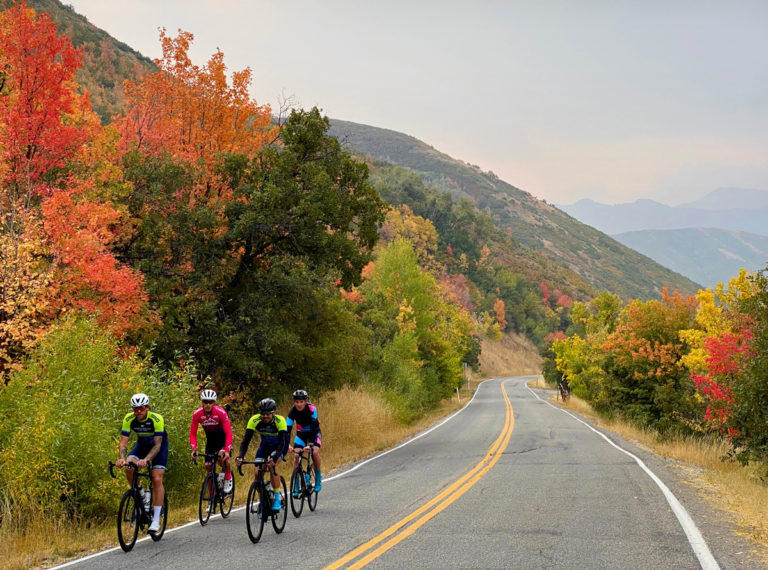
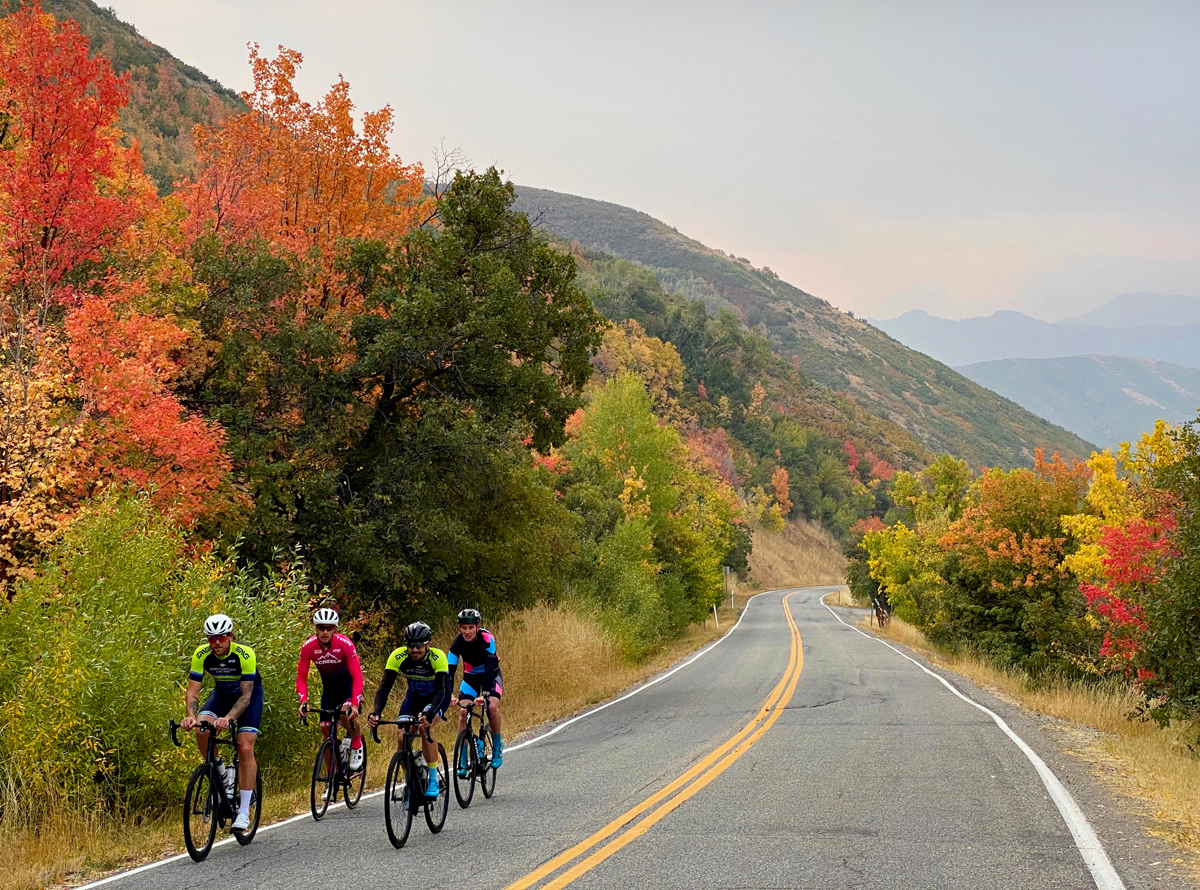
4 Riders on UT HWY 65 just west of the summit (between East Canyon Reservoir and Little Dell Reservoir). This is part of the Autumn Century route. Photo by David Collins
Snowbasin to Salt Lake City
Riding the Wasatch Back: Excursions and explorations are part of the fun of unsupported bicycle touring at your own pace. Mileage estimates are approximate and may vary depending on your tracking system and whims of the ride. Be sure to tell someone your plans and allow them to track your location using a smartphone or other device.
Solo or unsupported distance cycling often presents potentially dangerous situations related to terrain, weather, equipment, traffic, navigation and mental awareness. Even experienced cyclists must plan carefully and use wise judgment to successfully mitigate inherent risks of the sport or terminate a ride before it turns injurious or deadly. If you are new to the sport or have never ridden a bicycle more than 100 miles in a single day, learn the ropes with a seasoned buddy or local cycling club before strapping on this ride.
Make sure to check maps, plan your route and check local road conditions before you go. As with any ride, be aware of your surroundings and of roadway traffic.
Time to fill water bottles, stuff gear bags, click in and start pedaling a colorful Autumn Century.
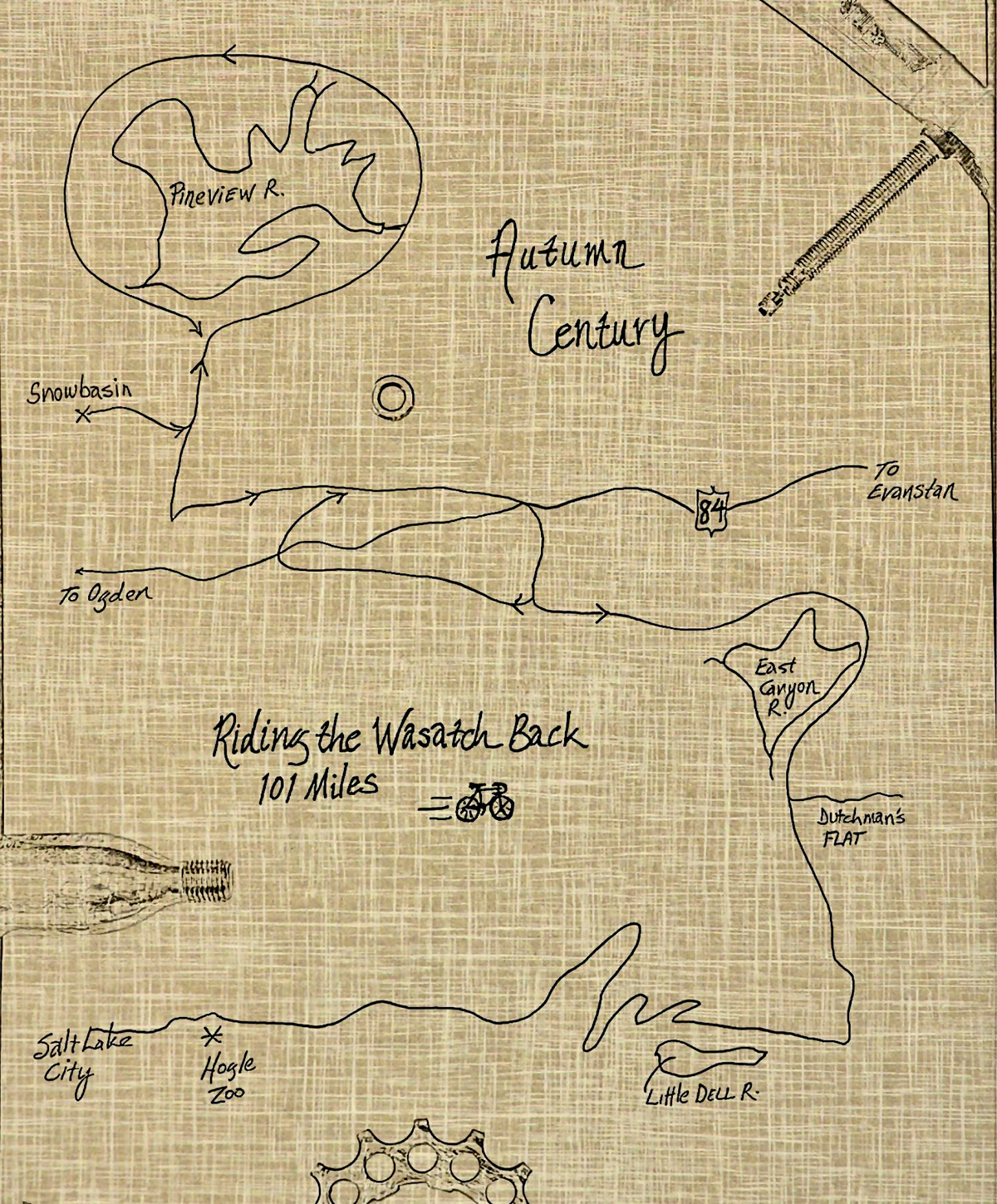
Snowbasin Century Map by David Collins
Route
Snowbasin to Huntsville via Trapper’s Loop Rd. (Utah Highway 167), circling Pineview reservoir and returning to Trapper’s Loop southbound to Mountain Green, left on West Old Highway Road to Morgan, south on State Street (which turns into South 100 East), right on South Morgan Valley Drive to Stoddard, right on West Stoddard Lane, right again on West Old Highway Road (you just made a loop around part of Morgan Valley), back to Morgan, south on State Street again, but this time, take the road all the way to East Canyon Dam, turn left at the dam and circle the reservoir via Utah Highway 65 all the way over the mountain pass and to just past Little Dell Reservoir, right on North Emigration Canyon Road to Hogle Zoo and This is The Place Heritage Park in Salt Lake City. Sound complicated? Check out the nearby map sketch and you’ll see it’s not too bad once you get the gist of the route.
Terrain:
All paved. Three mountain passes; canyons; valleys; agricultural zones and winding/bending undulated miles throughout. Although there are cycling (Share the Road) signs posted along the way, many segments have narrow (or no) paved shoulders and sharp curves.
What to See:
Snowbasin Resort, site of the 2002 Winter Olympics downhill event; historic Ogden Valley with three mountain villages: Huntsville, Eden and Liberty; three mountain reservoirs: Pineview, East Canyon and Little Dell; rolling hills over Trapper’s Loop; East Canyon Resort; Bauchmann Station, also known as East Canyon Station, Carson House and Dutchman’s Flat Old West Pony Express site (look for the historical marker a few hundred yards down the first left-turn dirt road past East Canyon Resort); TJ Cattle Company Cooperative Wildlife Management Unit slightly beyond East Canyon Reservoir; encounters with two historical Old West trails: Pony Express and Mormon Pioneer; numerous canyons and diversions throughout; This is the Place Heritage Park at the end of the ride (across the street from the Zoo) including several historical displays highlighting exploration and settlement including pioneers, trappers, explorers, and the Pony Express.
Selfies and Photo Ops:
Moose statue in Snowbasin Resort’s welcome plaza; views of Ogden Valley from Trapper’s Loop; Ogden Valley barn murals; Compass Rose Lodge in Huntsville, a few blocks detour (complete with astro-observation dome) and nearby Shooting Star Saloon, which claims to be Utah’s oldest bar; historic Eden General Store, home of Carlos and Harley’s Cantina; lakeside pullouts around Pineview Reservoir; Trapper’s Loop summit; historic pioneer cabin museum in Morgan; ruins of historic Porterville church meetinghouse; lakeside views of East Canyon Reservoir; Mormon Trail and Pony Express signage; Dutchman’s Flat landmark sign, see above; distant view of Salt Lake Valley as the road crests over the last alpine summit; lakeside views of Little Dell Reservoir, chicanes up and down climbs throughout; This is the Place Heritage Park statues; Hogle Zoo sign.
Wildlife:
Elk, deer, mountain lions, bobcats, black bears, turkeys, golden eagles, osprey and other raptures, lizards, snakes, foxes, coyotes, porcupines, mink and possums.
Best Post-Ride Eats:
Ruth’s Diner in the mouth of Emigration canyon just before ride’s end. Ninety-one years ago, Ruth, a cabaret singer, opened her diner. Good food has been served in her name ever since. If you ride this route in reverse, eat your post-ride dinner at Snowbasin instead (be sure to check their schedule since it varies) but eat your first meal at Ruth’s – they make a mean breakfast, highlighted by their Mile High Biscuits – mercy. Anyway, Ruth’s evening beverage menu pairs well with her dinners, so choose a few drinks and tuck into the Grilled Idaho Red Trout – it’s Cajun delightful and topped with a skewer of shrimp and a memorable lemon cream sauce. Or get their 12 oz ribeye, a classic plate of recovery protein done just the way you order it. Polish things off with some Chocolate Malt Pudding, made from scratch and topped proper with fresh whipped cream.
Still Have Legs, lungs and Sunlight?
Take a brisk dip in Causey Reservoir’s chilly waters, about a 20 mile round trip detour. Motorized boats are not permitted, so it’s pretty laid back. Except for a few paddleboarders, kayakers, or folks dropping a fishing line, there’s usually not much going on. You can find the short access road by turning east on East 1900 North just as you round the north end of Pineview Reservoir and pedaling east about 10 miles. Keep your eye out for wild turkeys, there are a rafter or two of them as you approach the canyon.
Notes:
Some of the route between East Canyon and Little Dell Reservoir is closed during the winter.
Be weather aware, riding conditions can swiftly change.
Bring your best legs, total assent is 5459 feet (if you ride the route in reverse, the total ascent is 6758 feet).
In 2013, the League of American Bicyclists (League) and the Sierra Club published “The New Majority: Pedaling Towards Equity,” a report highlighting the changing demographics within the bicycling movement. Today, the League is releasing a new report, “Reconnecting to the New Majority,” to update our understanding of demographic trends in bicycling, identify areas of focus to ensure that all people — particularly Black people, Indigenous people, and people of color (BIPOC) — have access to safe bicycling, and further progress actions that promote equity in bicycling.
People of all races, incomes, and ages want safer bicycling — that comes across clearly in the League’s research and data analysis conducted for the report. New and continued investments are critical to making bicycling safe, comfortable, and accessible to all, particularly in BIPOC communities where underinvestment has inhibited the development of a transportation system that serves all people. As identified in the report, investments that would address inequities start with a Safe System approach to the built environment, improved bike parking, increasing opportunities for people to bike with others and to receive hands-on bicycling education, and reducing interactions between bicyclists and the police.
By Shannon Boffeli — After taking the 2020 season off due to Covid, Utah’s most-anticipated mountain bike race each year returned for its 13th edition on September 4, 2021. Taking in over 75 miles of Park City, Utah’s, world renowned singletrack and 10,000 vertical feet of climbing, the Point 2 Point is known as one of hardest single-day mountain bike races in the country.
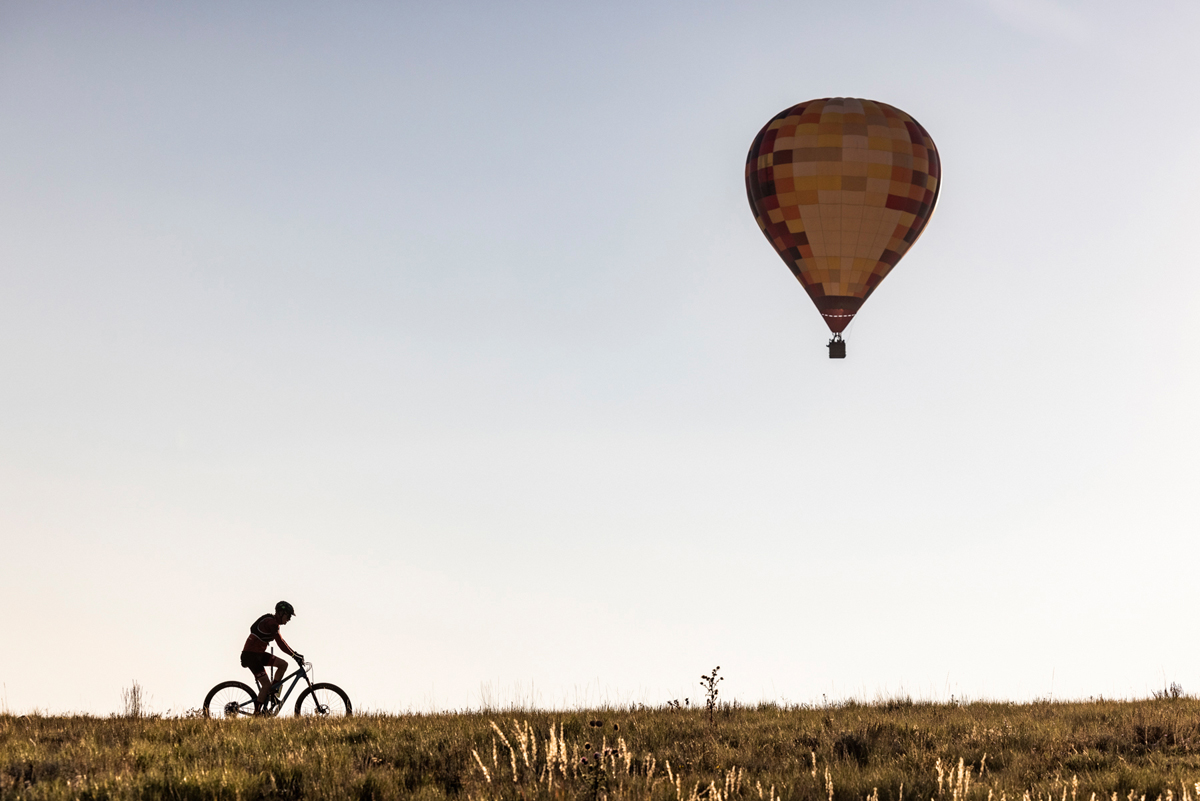
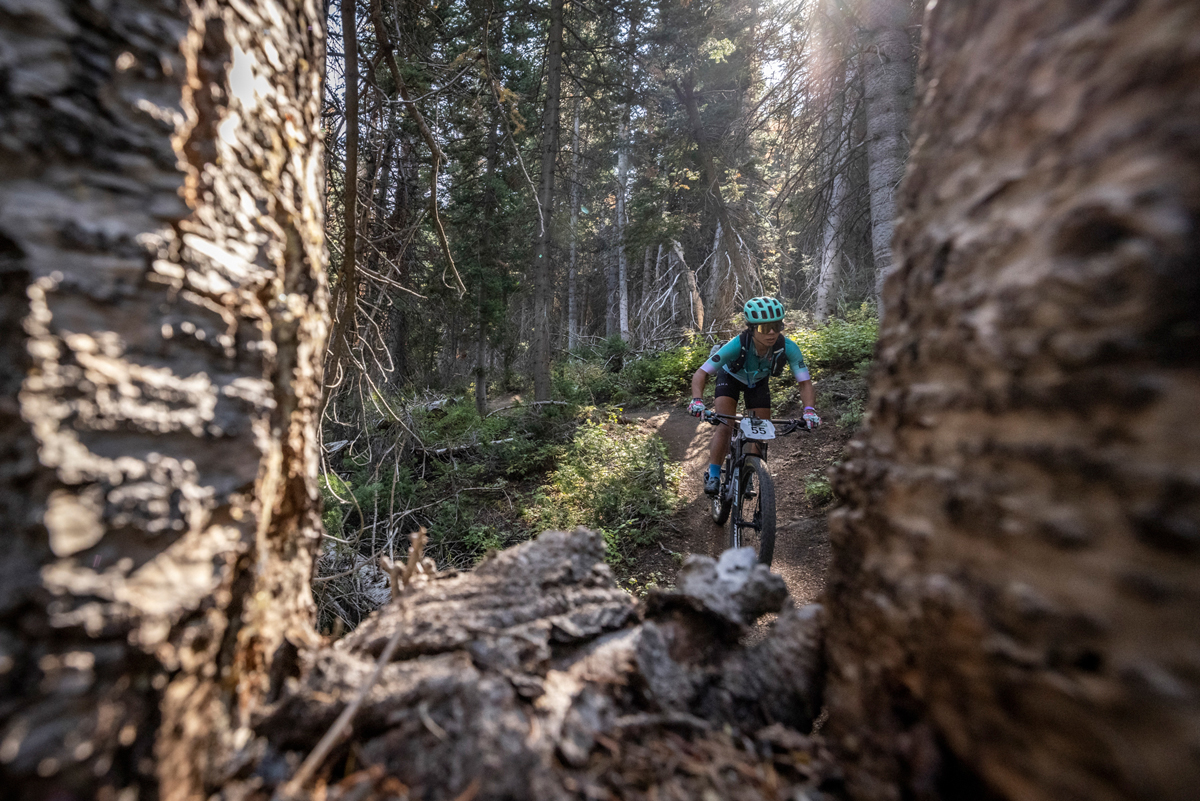
A rider with a hot air balloon overhead in the 2021 Park City Point 2 Point. Photo by Jay Dash, jaydashphotography.com
This year riders from across the country came to the destination town of Park City to be challenged by technical trails, grueling climbs, breakneck descents, and moose.
Rains on Friday helped clear out some of the smoke that has plagued the west throughout the summer and provided endless hero dirt for the riders to enjoy their P2P experience.
As the race kicked off just after sunrise it was clear both elite fields were ready to push the pace early.
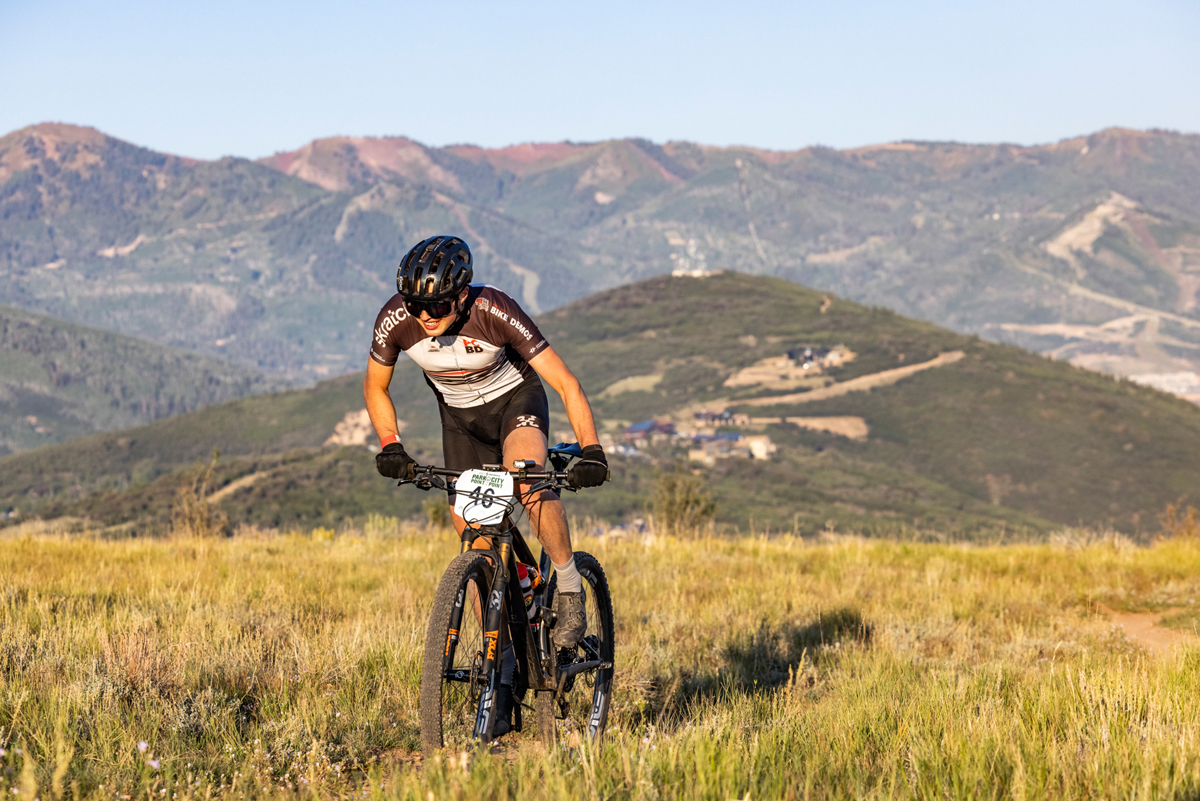
Evelyn Dong topped the women’s pro field in the 2021 Park City Point 2 Point. Photo by Jay Dash, jaydashphotography.com
Two-time winner Evelyn Dong (Juliana/SRAM/No Tubes) took the early lead pushing what challenger, Melissa Rollins (Team Twenty24) described as, ‘cross-county Olympic speeds.’ Dong was joined early on by Caedran Harvey with Rollins not far behind.
The punishing early pace broke up the women’s field and saw Evelyn Dong establish a solid gap that continued to grow throughout the day. The Juliana rider rode clear throughout the day and not even getting stung by a bee on the lip would slow the lone leader.
At mile 55, Dong passed through the crowds at the Park City Mountain feed zone taking in the cheers from hundreds of local fans lifting her spirits to finish the final 20 miles showing strong form.
Behind the leader Melisa Rollins had moved into second place after Harvey got off course in the mid-mountain section of the course.
Rollins was followed by the hard-charging Virginian Andrea Dvorak (Cutaway), who is battle-tested in all forms of endurance cycling.
No one would be catching Evelyn Dong on the day as she finished the race with a smashing time of 7:30:18, well inside the top-20 of the 350 men and women in the race.
Rollins’ final push to the finish was temporarily delayed as a mother and baby moose took up residence on the trail. The 25-year-old Rollins was forced to bushwhack her way around the pair before getting back on course and finishing her day at just over 8 hours.
Despite encountering the late moose challenge, Rollins managed to stay over 20 minutes clear on third-place rider Dvorak who finished at 8:24:55.
Chelsea Bolton finished fourth in the open women’s field but took top honors for best quote of the day for her comment after finishing the punishing Steps trail climb exclaiming, “Before today, I’ve only ever gone up that trail by mistake!”
Courtney Boyd (Wattie Ink) rounded out the women’s podium in fifth place with a time of 8:47:14
Tanner Visnick on his way to winning the 2021 Park City Point 2 Point. Photo by Jay Dash, jaydashphotography.com
The open men’s race got off to a similarly rapid pace with relative youngsters Truman Glasgow (Rouleur Devo) and Tanner Visnick (POC) pushing hard early accompanied briefly by Australian Lachlan Morton (EF Foundation) who was fresh off a podium finish at the 6-day Breck Epic and his Alt Tour De France effort where he rode the entire Tour De France course solo.
Morton suffered an early flat before exciting the Round Valley section of the course. This left Glasgow and Visnick out front, a strategy that Visnick had envisioned. “Going out hard early is typically my move,” the 24-tear-old Visnick said. “Unless I’m marking another rider and don’t know the course well, I prefer to be in front setting my own pace on the climbs and descents.”
Despite throwing down early speed, Visnick was unable to shed Glasgow who worked his way into the lead by the top of Deer Valley resort. The 21-year-old Glasgow stayed clear on the following descents and through the tortuous John’s trail where a mother and baby moose forced some brief detours.
At 50+ miles in both riders descended into the Park City Mountain feed zone just seconds apart.
Morton was slowly working his way through the field jumping into 5th place by the Steps trail climb and taking over 4th before making his way into the feed zone.
In front the racing was all out with less than a minute between the two leaders and Tanner Visnick now being out front, barely.
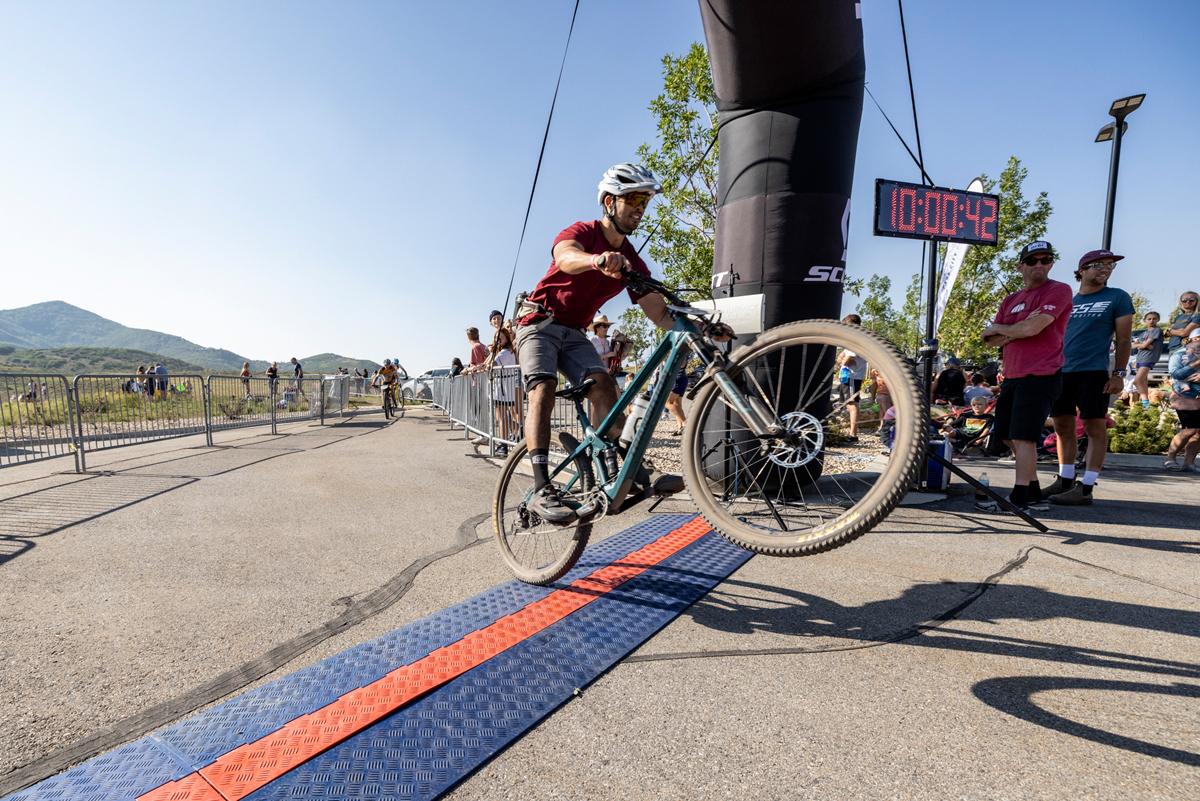
A rider pops a wheelie across the finish line in the 2021 Park City Point 2 Point. Photo by Jay Dash, jaydashphotography.com
Despite being young, Visnick is no stranger to distance events having already won the Gunnison Growler, Emerald Epic, and Big Sky Biggie in 2021. After a quick stop at the final feed zone, Visnick used his endurance experience to hold onto a 20 second gap over his challenger needing to essentially sprint the final 5 miles of downhill to cross the line with just 39 seconds in hand.
After almost six and a half hours of racing Truman Glasgow finished less than a minute behind the leader.
Lachlan Morton worked his way up to third place by the finish, passing another youngster, Cameron Larson (Summit Devo Team), in the final miles of the race.
Larson took fourth in what was his longest-ever mountain bike race effort.
Fifth went to Danny Van Wagoner with a time of 6:45:29.
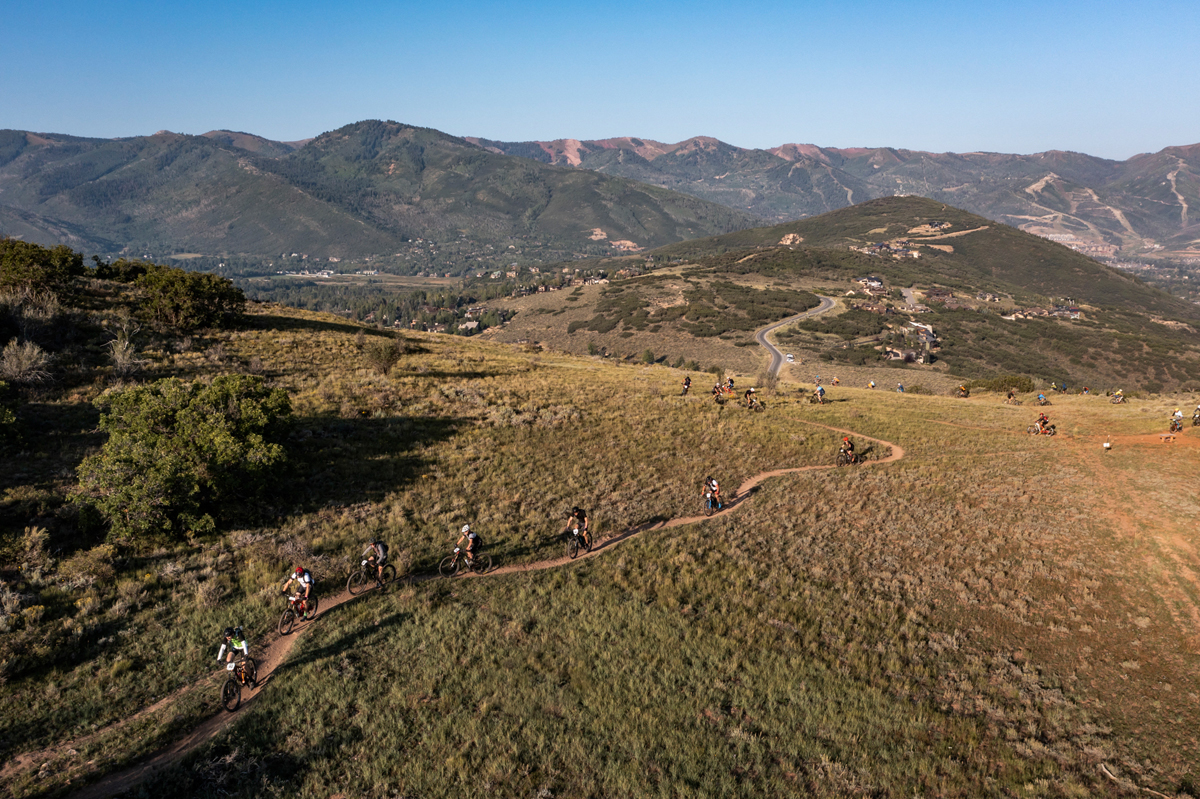
A stream of riders in the 2021 Park City Point 2 Point. Photo by Jay Dash, jaydashphotography.com
Race Notes
In a tradition unique to the Park City Point 2 Point, a special award is given to the final racer to finish each year’s event; in special recognition of their perseverance making it to the finish line.
This year’s red lantern award went to Kristine Thompson, who finished, in the dark, with a time of 13:58:44. The longest-ever finishing time for the P2P.
For the first time three riders on the men’s podium were former NICA (National Interscholastic Cycling Association) racers. Truman Glasgow and Cameron Larson both raced in the Utah league, while race winner Tanner Visnick raced in Steamboat Springs, Colorado.
Instead of tapering the weekend before the Park City Point 2 Point, race winner Tanner Visnick, was getting married in Bozeman, Montana. Congratulations Tanner!