By Charles Pekow — The COVID pandemic can’t be blamed for all the decline in public transit use. Other factors caused a 14-15 percent drop in bus and rail riding between 2012 and 2018 before anyone ever got sick from the virus. Availability of bikeshare and increased bike facilities played a very minor role, causing one percent of the decline at most.
So concludes Recent Decline in Public Transportation Ridership: Analysis, Causes, and Responses (https://www.nap.edu/download/26320), a new study from the Transportation Research Board. The board attributes most of the decline to increased fares, decreased gas prices and ride-hailing programs such as Uber and Lyft, as well as telecommuting, online shopping, etc.
Possible solutions to the public transit drop would include increased partnerships with bike/scooter sharing providers to make it easier to get to and from public transit. Bikeshare can actually increase rail ridership at outlying stations though it decreased it in central cities mainly on some bus lines.
By John Higgins — In the past decade, “advanced bike fitting” has been driven by a focus on the cyclist’s position, which has been enabled by digital tools like the Retul system that can dynamically measure joint angles and range of motion. Posture has often been overlooked, as it is not easily measured and quantified.
Typing “cycling posture” into a search engine yields many thousands of results. However, a perusal of the results shows significant conflation between “posture” and “position”. A clear distinction is rarely made between the two. A similar result comes from searching the biomechanical scientific literature. There are thousands of results for “cycling” + “posture” but only 8 articles for “cycling posture”. Adding “bike fit” to the search criteria yielded a scant 4 results from the past 10 years, and again posture was conflated with position.
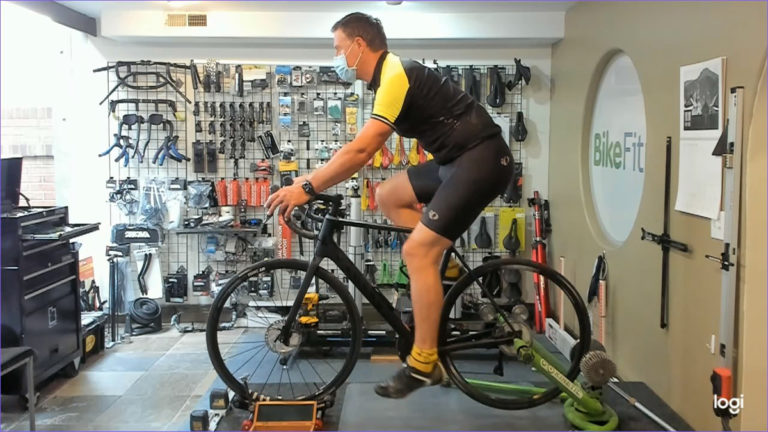
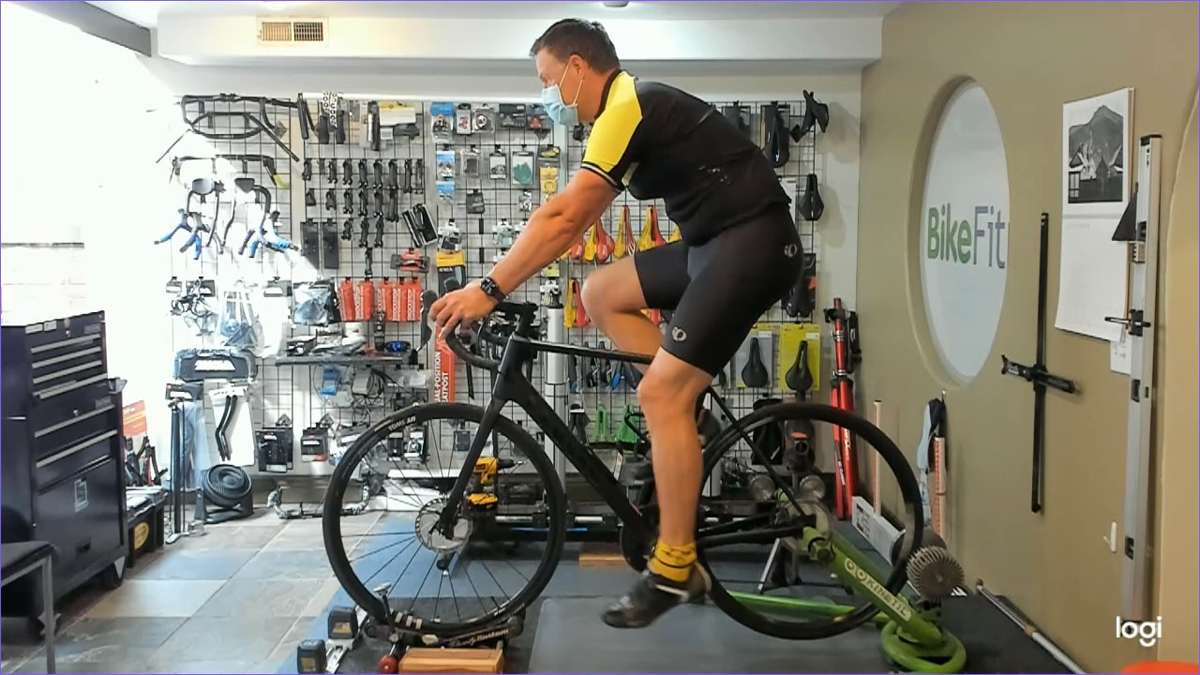
Alan’s bike posture before a bike fit. Photo by John Higgins
What is “posture”
Posture is how we align and hold our body to counter the relentless force of gravity. Regardless of whether we are standing, walking, running, sleeping, or cycling, the influence of gravity is ever present. The central focus of posture is the alignment of the pelvis and spine, which together provide the foundation for the movement of the upper and lower extremities.
What is “position”
Position considers the arrangement and movement of the upper and lower limbs in relation to the spine, and each other. Body position is commonly defined by joint angle measures, and indirectly documented by bike set up measures. A cyclist may exhibit the same position as defined by joint angles, but significantly different posture with implications for metabolic efficiency, sustainable comfort, and performance.
Both posture and position interact to affect how you look on a bike, and how you function. Although position is very important, posture has a higher priority and therefore needs to be observed, assessed and corrected – as appropriate for that cyclist – before fine tuning the position.
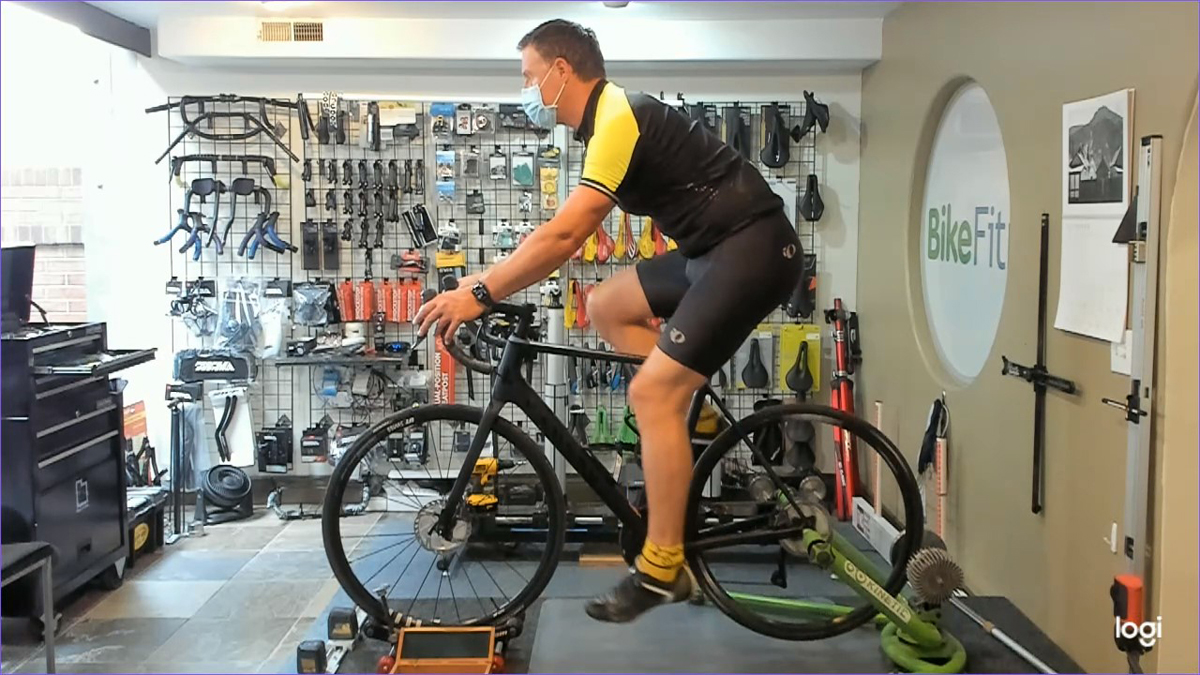
Optimal posture in cycling involves mild lumbar and thoracic flexion with mild cervical extension. No section should be at end of range, and there should be no excessive directional changes at any segment that could result in disc compression or nerve entrapment. Indicators of suboptimal posture could include: a vertical or near vertical pelvis and lumbar angle (posterior pelvic tilt), excessive flexion in segments of the lumbar or thoracic spine (thoracic kyphosis, or hunched back), excessive extension in the cervical spine (cervical lordosis or kinked neck), rounded or hunched shoulders (protracted or elevated scapula), or a forward head position. A number of these conditions may be present concurrently.
Alan’s bike posture after a bike fit. Photo by John Higgins
Posture and Technique in Sports
In any athletic and sporting endeavor, the serious participant will seek and benefit from skills coaching that includes the best movement patterns and the postural training necessary to excel at their sport. From ball sports to ballet and golf to gymnastics, participants are educated, trained, and coached in how to use their bodies. How many cyclists, cycling coaches, or bike fitters place emphasis on first principles of aligning the body on the bicycle to contend with the relentless tug of gravity? In cycling the emphasis has been first and foremost on fitness: cardiovascular, muscular endurance, and strength in order to sustain force delivery to the pedals. A cycling coach may additionally offer guidance on hydration and nutrition; handling skills including cornering, climbing and descending; and race strategy. A bike fitter may be focused on improving contact point comfort to relieve aches and pains, and to prevent repetitive use injuries. Aerodynamic efficiency gets considerable attention in triathlon and for time trials. Posture gets scant attention, but awareness of postural alignment establishes the context and parameters for which all other aspects are anchored.
Contributors to Suboptimal Posture
• Body and postural awareness on behalf of the cyclist. The vast majority of cyclists are unaware of how they look and function on a bicycle, other than the metrics provided from their cycle computer. With the exception of some high-performance programs, the culture of cycling has not embraced skills-based feedback and coaching, other than the skill of getting faster by getting fitter. Many cyclists do not know how they should be situated on a bicycle, and how to align and use their body to best effect for comfort and performance.
• Equipment Choice. Many cyclists present with poor posture due to subconscious compensations for unsuitable equipment choices. The saddle is a frequent culprit and is a critical piece of equipment as many postural compensations result from a poorly supported pelvis. However, the list is extensive and also includes seat post setback, crank length, stem length and angle, handlebar width, and most fundamentally the underlying frame geometry and size.
• Bike Fit Position. This refers primarily to saddle position (height, setback, angle) and handlebar position (reach and drop) that is deemed suitable for the cyclist. A person can present with a good position as defined by normative joint angles, and yet exhibit signs of suboptimal posture and suffer the consequences of that. If a fit position is determined and set up without considering posture, the rider is being locked into a position of ongoing postural compensation.
Foot-Pedal Interface. An important subset of both equipment choice and the bike fit position is the choice of cycling shoe and related internal foot support, and external cleat position and modifications. Dysfunction in the stability of the feet on the pedals can have kinetic chain ripple effects up to the pelvis and spine.
Pre-Existing Conditions. These include leg length differences, spinal conditions (scoliosis, spondylitis, stenosis, disc compression, fractures, and fusions), overuse injuries, and carryover effects from prior accidents or surgeries. Any of these may produce postural compensations as the body seeks the line of least resistance to operate the bicycle.
Benefits of Optimal Posture
A cyclist’s posture on a bicycle may be viewed as qualitatively optimal or suboptimal. Their posture will be either helping or hindering overall comfort and performance through the following attributes:
Balance. A key role of optimal posture is to align the body to function and perform well in the presence of gravity. Hence, having the rider’s center of mass balanced over the primary fulcrum point of the bicycle will help optimize muscle recruitment and handling responsiveness. If the rider’s center of mass is balanced over the bike, then small postural changes can be more easily deployed for the demands of different riding situations, like climbing, sprinting, cornering and descending
Airway and breathing. Optimal posture contributes to the maintenance of an open (vs restricted) airway to enable full use of the lungs. A sub-optimal posture will restrict the airway, limit the mobility of the ribcage, and inhibit the action of the diaphragm. Effective gas exchange is necessary to fuel the muscles to drive the pedals.
Muscle recruitment. Postural alignment informs body position which affects muscle recruitment. We are looking for a balance of anterior and posterior muscle activity from the hips and lower limbs to drive the pedals, while minimizing unnecessary or compensatory upper body muscle recruitment.
Neural transmission. Optimal spinal alignment minimizes the risk of nerve impingement to both the upper and lower limbs, supporting full neural activity which is needed for maximal muscle fiber recruitment and sensory feedback.
Efficient Energy Use. The summation of the above factors will reduce the amount of energy used in maintaining postural compensations, extending the time taken to reach a state of fatigue. Poor posture likely hastens the onset of fatigue for any given fitness level.
Ongoing Participation. For injured or older cyclists with disc compression or herniation, spondylosis, spinal stenosis, and cervical or lumbar fractures or fusions, the ability to maintain optimal posture while riding is critical to being able to continue riding pain-free and without further aggravation to their condition. What is optimal for cycling will depend on the condition and the individual.
For Cyclists
Let’s assume that posture could be considered “form”. We could debate if form follows function or if function follows form. I’ll suggest that the two are interrelated and that poor form (suboptimal posture) indicates compromised function on the bicycle. Improving your form could improve your function, and improving your function will improve your form. Do you know how good your form is? Could it be better? Ask for some input from riding friends, coach, or fitter. It is easier to identify suboptimal posture than it is to identify optimal posture. Video is a great tool for showing you both your posture and your position. Once a cyclist can see themselves riding, they are often quick to get the concept and intuitively recognize poor form from good form.
Once you can link how you look to how you feel on the bike, practice keeping your spine long and neutral by raising just off the saddle, sticking your butt back to tilt your pelvis forward, and extend gently forward with the top of your sternum, then lowering back onto the saddle. You want to set up an active athletic engagement, not a “hard to maintain” strain. If you find you then roll your hips back away from the nose of the saddle for more comfort, it maybe time for a different saddle. Pelvic support and comfort are critical to aligning your spine, engaging your core, and supporting your lower back.
Aches, pains, numbness and fidgeting around can indicator that your form and function could be improved. This begins with awareness of your current posture, techniques to bring mindful intent to your posture, possibly equipment changes to support good posture, and maybe changes to the saddle and handlebar position to fine tune the riding position. There is more skill to riding a bike than you think. Better skills = better riding!
[Note: This article is an edited extract from a paper presented to the International Bike Fitting Institute in 2020, to complete a mentorship program and as a requirement for additional professional recognition.]
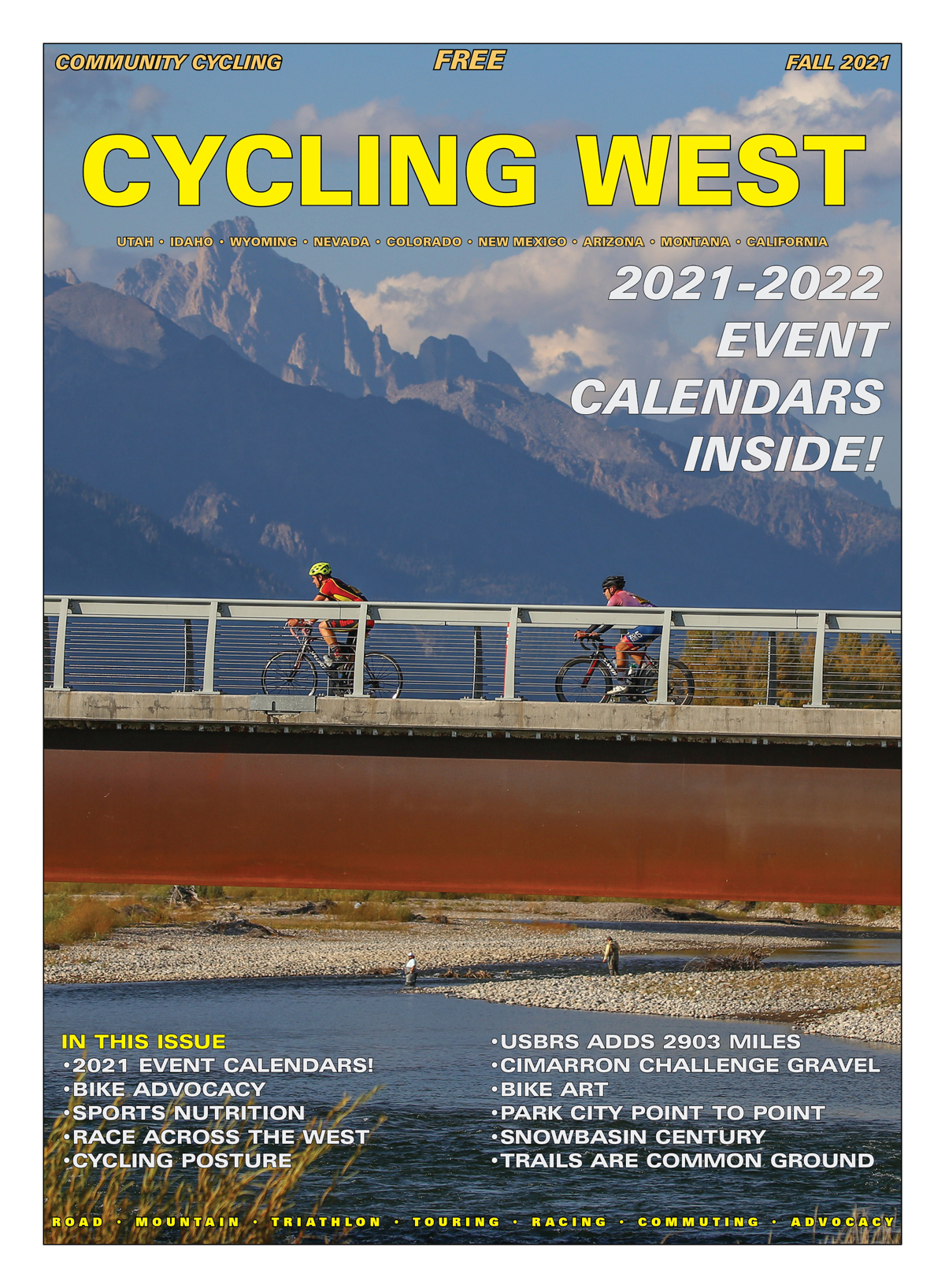
Cycling West and Cycling Utah Magazine’s Fall 2021 Issue is now available as a free download (10 MB download). Pick up a copy at your favorite Utah, Idaho, Wyoming, Nevada, Montana, Colorado, Arizona, New Mexico and Northern California bike shop or other location.
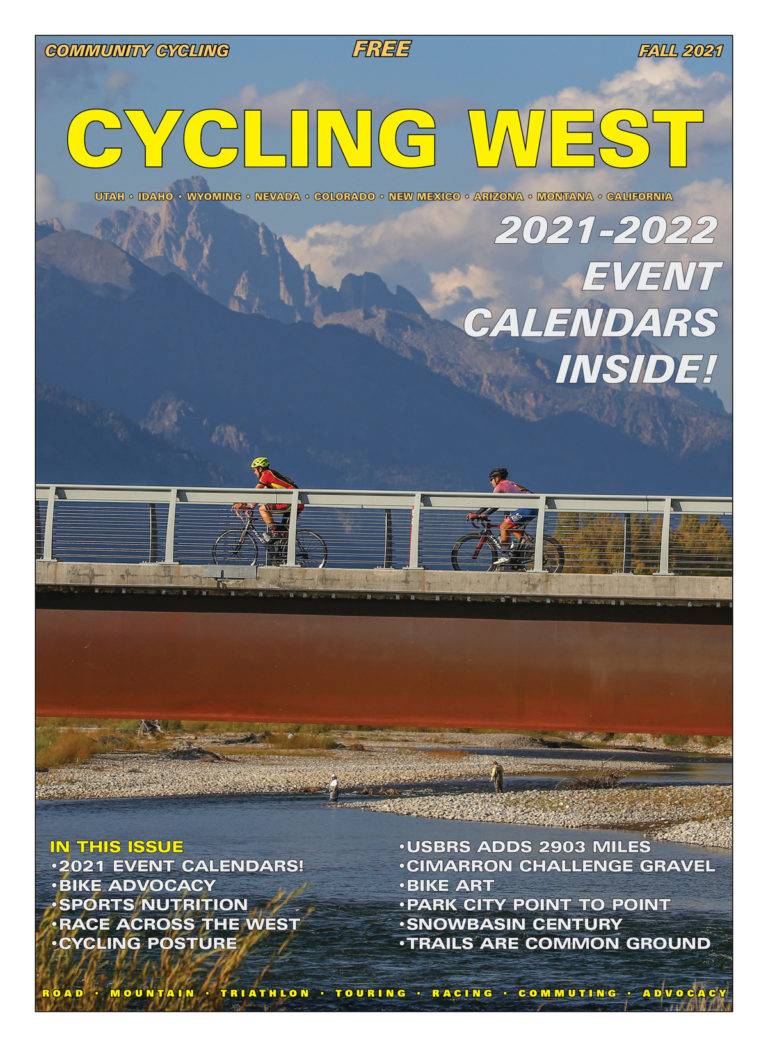
Cycling West Fall 2021 Cover Photo: Riders cross over Snake River on the bike/ped bridge in Wilson, Wyoming in the 2021 Lotoja Classic, just a few miles from the finish. Find your photo online at snakeriverphoto.com Photo by Nigel May, Snake River Photo
Contents
The Race Across the West – Moxy and Grit Tackles the 930 Mile Race — page 3
Nutrition: It’s All About Choices — page 6
U.S. Bicycle Route System Adds 2,903 Miles of New Routes in 5 States — page 7
Drivers Pay Attention to Painted Bike Lanes — page 7
Bike Lanes Encourage Riding to Work — page 7
Sustainability is Important to Bike Share Users — page 7
App Would Allow Cyclists to Time Red Lights — page 7
Bikeshare and Transit Use — page 7
Cycling Posture – Improving Form and Function — page 8
Dong and Visnick Take Top Spots at 2021 Park City Point 2 Point — page 9
Whose Bed Have Your Boots Been Under? — page 10
Book Review: From Rails to Trails — page 11
Antelope Island: A Californian’s Utah Bicycle Adventure in the Time of COVID — page 12
Autumn Century: A Utah Jewel – 101 Miles of Scenic Byway Adventure — page 14
Trails are Common Ground Launches to Improve Trail Etiquette and Inclusivity — page 15
BLM Taking Comments on Moab’s Klondike Bluffs MTB Area — page 15
Calendar Notes — page 18ds
Sunrise at Snowbasin – The Bicycle Art of Mindy Larson — page 21
The Cimarron Challenge – A Personal Story of the New Mexico Gravel Race — page 22
Manti-La Sal National Forest Taking Comments on Plan — page 23
Black Rock Desert Places Limits on Use, Including MTB’s — page 23
The BLM is temporarily restricting activities in Black Rock Desert — High Rock Canyon Emigrant Trails National Conservation Area (Black Rock Desert Playa) in Humboldt, Pershing and Washoe counties, NV. The restrictions last through October. The BLM anticipated high use of the area and determined it needed to restrict access to protect the environment and human health. Since the Burning Man festival has been canceled for the second consecutive year, would-be attendees use the playa for other events.
You can ride a bike but only in designated roads and trails in vegetated areas, but you’re not allowed to engage in other activities such as lighting fires, using pyrotechnics, dumping water or human waste, etc. Details at https://www.govinfo.gov/content/pkg/FR-2021-08-18/html/2021-17736.htm
Narrative for Painting: Jar of Fireflies, arrows coming’ from the skies, accompanied by 13 monarch butterflies, a well orchestrated disguise, events king wears polk-a-dotted ties, they rely on the mighty polar thighs… Until the fuse dies
To view or purchase prints or originals of Darrell Driver’s art at: www.darrelldriver.com
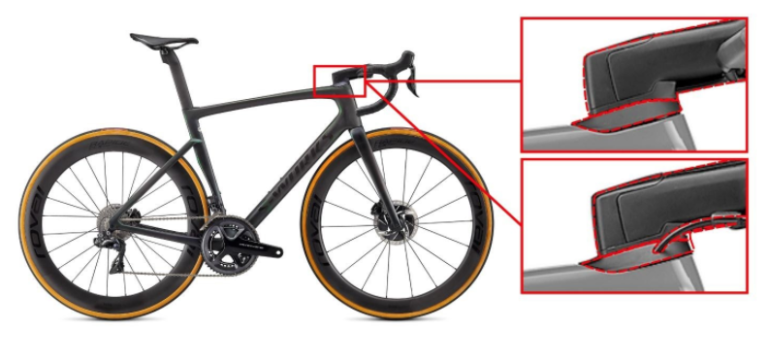
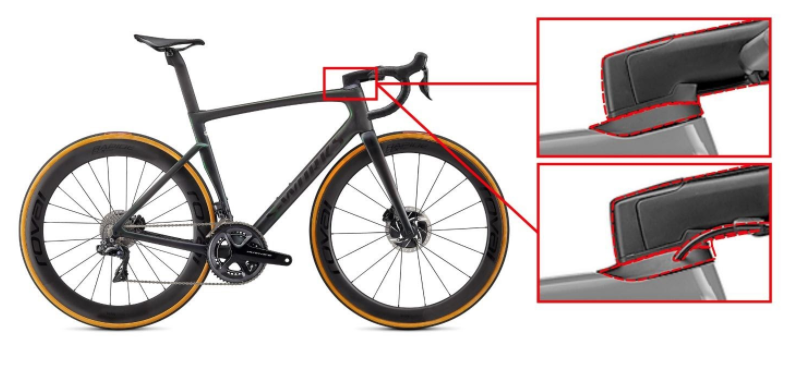
Name of Product: Specialized Tarmac SL7 Bicycles and Framesets
Hazard: The bicycle’s fork steerer tube can crack or break after harsh impact such as hitting a deep pothole or other stress event, posing fall and injury hazards to riders.
Incidents/Injuries: The company has received two reports of the bicycle’s steerer tube breaking after harsh frontal impact. No injuries have been reported.
Sold At: Authorized Specialized Bicycle Components retailers nationwide from July 2020 through August 2021 for between $3,300 and $15,000.
Remedy: Repair
Consumers should immediately stop using the recalled bicycles and contact Specialized Bicycle Components for a free inspection and repair.
Consumer Contact: Authorized Specialized retailers or Specialized Bicycle Components toll-free at 877-808-8154 from 8 a.m. to 6 p.m. MT Monday through Friday, email at [email protected], or online at www.specialized.com and click on “Safety Notifications” at the bottom of the page for more information.
By Nancy Clark MS RD CSSD — Thanks to the Internet, we can easily become overloaded with conflicting nutrition information. A few Google searches can leave you confused about carbs, calories, keto, inflammation, weight management, and sports supplements. How do you know what and whom to believe?
The following article identifies a few credible (sports) nutrition podcasts, blogs, books, and websites. You’ll find trustworthy answers to your questions about how to fuel your body and resolve confusion about what’s best to eat for optimal sports performance, good health, and high energy.
Podcasts offer a handy way to learn about (sports) nutrition while exercycling, running, or walking the dog. The hosts commonly interview researchers who are conducting the latest studies with athletes. Some of my favorite podcasts include:
You’ll hear about all things daily nutrition, with a focus on current food topics and controversies.
We Do Science, (theiopn.com/podcasts,. hosted by UK sports nutritionist Dr. Laurent Bannock.
Episode #118: “Swifter, Higher, Stronger” with Professors Louise Burke and John Hawley is well worth a listen.
ScienceOfUltra.com/podcasts, hosted by exercise physiologist and Idaho State University professor Shawn Bearden PhD.
Episode #69: Training on Low Glycogen offers food for thought.
PHITforaQueen.podbean.com, hosted by sports nutritionist Rebecca McConville RD and therapist Kara Shelman LCSW.
This podcast is devoted to female athletes wanting it all: Performance, Health, Intellect, and Time. You might like the episode with marathoner Allie Kieffer I don’t run fast because I am light. I run fast because I am stronger.
Websites
Exercise physiologist, researcher and Ironman triathlete Asker Jeukendrup PhD of the Netherlands offers abundant information for athletes and sports nutrition educators at MySportScience.com. The site provides a wide range of sport science topics with info-graphics that are highly educational for visual learners.
TeamUSA.org, the website for the US Olympic Committee, offers fun cooking videos with Olympians: TeamUSA.org/Cooking-With-Team-USA. You’ll find recipes for many yummy, healthy sports foods, including entrees, snacks, smoothies, and desserts. The website also offers sports nutrition fact sheets, including sample Athlete Plates with suggested meals for easy, moderate or hard exercise days. (From www.TeamUSA.org home page, click on Safe Sport, then High Performance Programs, and then Nutrition.)
Ausport.gov.au/ais/nutrition, the website for the Australian Institute of Sport, offers abundant sports nutrition information. If you have questions about creatine, sodium bicarbonate, or other ergogenic aids, the sport supplement section identifies which ones work, which ones need more research, and which ones are bunk.
EDCatalogue.com offers helpful information about eating disorders, including tips for families and friends. The website includes a bookstore with more than 200 self-help titles that can help an athlete find peace with food. The site also has excellent podcasts with top-notch experts in the field of eating disorders. Both athletes and health professionals alike will glean information that helps them better understand and manage eating disorders.
Books
The Academy of Nutrition and Dietetics Complete Food and Nutrition Guide by Roberta Duyff RD is a hefty general nutrition resource. It covers all nutrition topics and will answer your questions about food for health.
Nancy Clark’s Sports Nutrition Guidebook new 6th edition (2019) offers the latest information about fueling for sports, weight management, and life. Includes recipes!
Plant-based Sports Nutrition by Enette Larson-Meyer PhD RD offers in-depth information to help vegetarians and vegans enjoy a meatless diet and excel as an athlete.
Food and Fitness After 50: Eat Well, Move Well, Be Well by Christine Rosenbloom RD PhD and exercise physiologist Bob Murray PhD is perfect for mid-life fitness exercisers.
Overcoming Amenorrhea: Get Your Period Back. Get Your Life Back by runner (and podcaster) Tina Muir is a must-read for female athletes who have stopped getting menstrual periods.
For a wide array of trustworthy books related to exercise, training, and sports nutrition, check out the numerous titles at Human Kinetics publishing house: www.us.humankinetics.com.
While the above resources offer self-help information, the better way to improve your diet (and performance) is by enrolling the help of a registered dietitian nutritionist (RD or RDN) who specializes in sports nutrition. No blog, podcast or book can replace personalized food help. To find you local RD, use the referral network at FindAnRD.eatright.org Why just be a good athlete when you can be a better one?
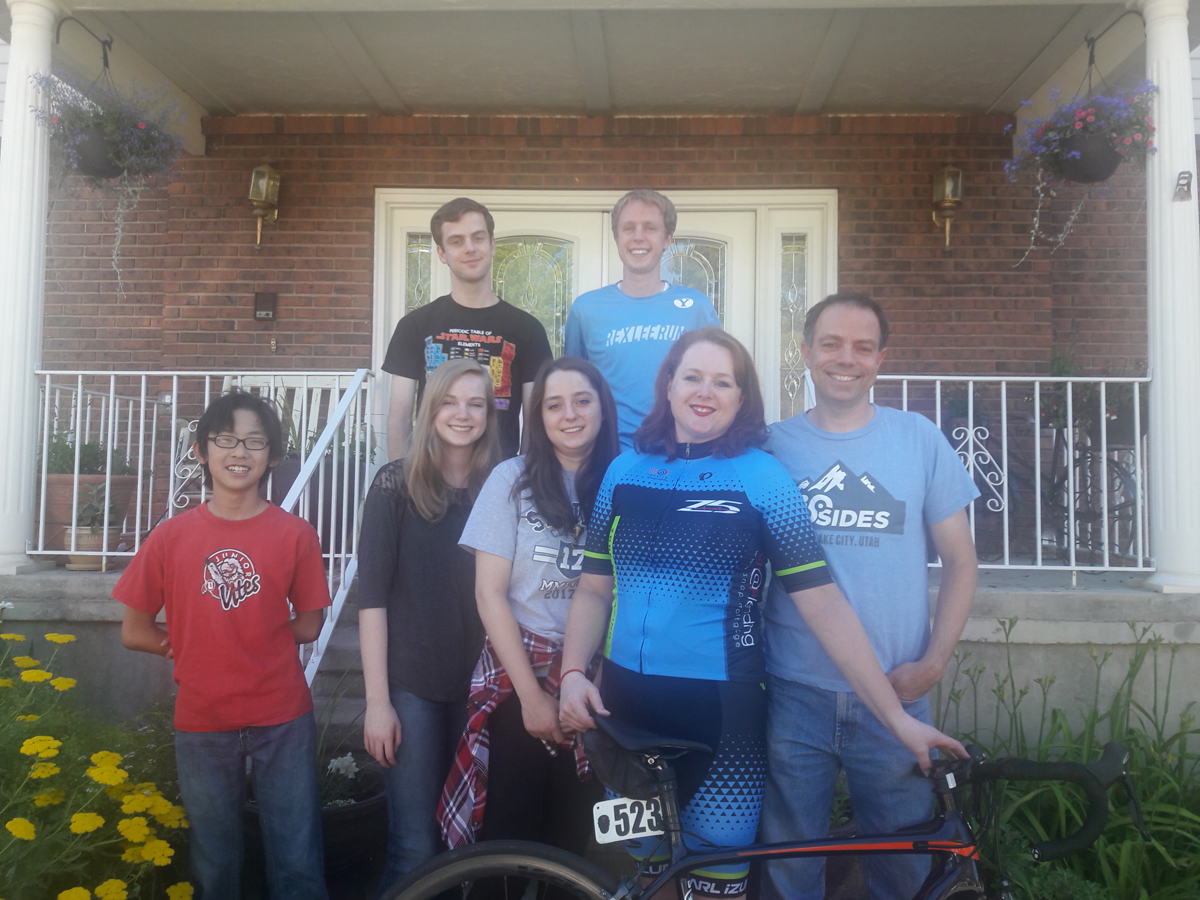
By Kelly McPherson — First and foremost, I am a mom and a wife with all of the responsibilities, joys and struggles those titles encompass. I have five kids with ages ranging from 12 to 24, three cats, a dog, a lizard and 3 fish. My husband and I are currently rehabilitating a large and very distressed home. I am also working full-time with a 45 minute commute each way. On top of all of that, I have decided that this year is the year that I will complete 3 of my bucket list events, Crusher in the Tushar, Seattle to Portland and Lotoja. Those who are familiar with these events will know that my training load is currently between 10-15 hours per week.
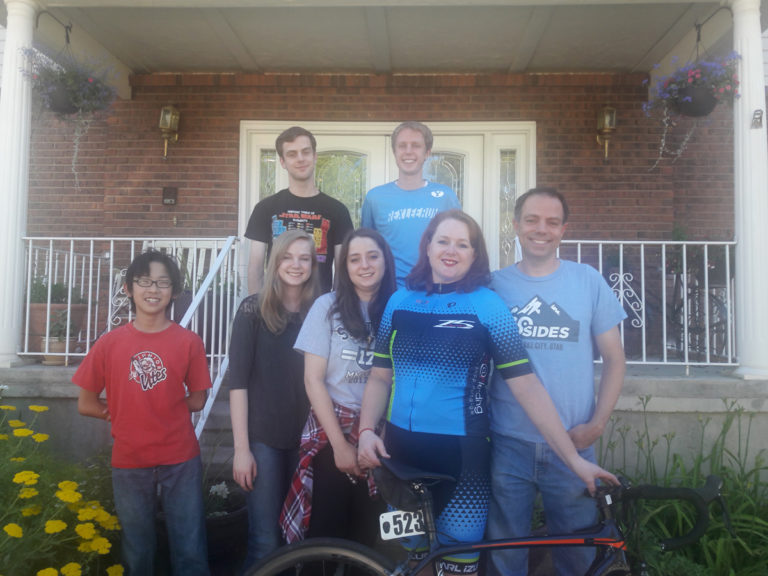
Kelly McPherson (center) balances training and family life. She is shown here with Duncan (21) and Michael (24) in the back, and next to her from the left is Nathan (12), Sarah (16), Alicia (18), and husband James. Photo by Amariah Grajales
I may be insane! True! Still, below are some of the things I have learned that might help those of us trying to keep sanity around this crazy sport.
Identify the why. This may seem obvious, but if you don’t know why you are training then you aren’t very likely to make and stick with a plan to complete it. Training is hard! For me, the why is to keep Type II diabetes under control and to model healthy behaviors for my children so they will not be as likely to battle the obesity related problems that I have had.
Develop your support crew. Enlist the help of those around you. This could be in the form of a husband, BFF, neighbor, extended family member or, in my case, a crew of kids and a husband who are taking on more responsibilities around the house so that I have more time to make training a priority. Make sure to ask them for what you need and express gratitude when they give it to you. Make sure to communicate with them what your plans are and when those plans change. Make sure to return the favor occasionally by sacrificing training time to help them reach a goal of their own. Your support crew is your single most valuable asset. Make sure that they know it and can truly feel your appreciation. Get completely off your bike physically and emotionally, and be totally present with them when you are not training.
Have a plan. If you don’t have a written plan, you will spend too much valuable time trying to decide what to do and then second-guessing yourself as to whether or not you are doing the right kind of work to reach your goal. This can be a plan you write yourself, have a coach help you with or something you find pre-canned on the internet. Do what is best for you. The point here is that you don’t have time to be messing around with workouts that are not in line with your goals. Get a good plan together and then stick with it.
Time your training. This will take a little experimentation to get right and even then, you will sometimes need to be flexible and have a plan B or C. For me, I am really blessed to work for an employer who lets me train at lunchtime. If I need a little longer session than what would fit in my lunch hour, I just stay a little later to make up the time. This is my favorite time to train. I eat at my desk when I get back and then, when I get home, I don’t need to leave my family again. Plan B, for me, is the evening, after work sessions, but I try to avoid them as much as I can so I can be there for my family to make dinner, help with homework, etc. My plan C is the early morning session on my trainer. This is just a personal preference, but I am just as likely to lie on the floor next to my trainer and sleep as I am to actually get onto it. I usually try to get my Saturday workouts in early in the morning as I have teenagers and some of them don’t get up before noon anyway. If I had little ones who went to bed early, I might try training in the evenings so they would be asleep for part of the time. The bottom line is to try to get your training completed when it has the least amount of impact on those around you. Help those you love understand the priority you need to place on training, but be flexible enough to get it done, when possible, at times when they aren’t needing you as much.
Be prepared for anything. Sometimes the opportunity to train comes at unexpected times. Be sure you are ready to take advantage of those moments. For me, this means that the trunk of my car is where I store a large portion of my bike gear, including my bike. That way if we get unexpectedly good weather, I can ride.
Find the shortcuts. There are lots of these, but here are a few to get your creative juices flowing.
Make a menu and post it, with the recipes, somewhere everyone in the household can see it so that dinner can be made even when you aren’t home.
Order your groceries online and then just pick them up, or better yet, have a member of your support crew do it for you. I love coming home from work to find that my kids went and picked up the groceries I had ordered and have put them away. Nice!
Set up automatic watering of your flowerpots and garden boxes. I realize that not everyone loves to grow things, but I do and it takes me more than an hour each day to water everything so that I don’t have to buy zucchini at the grocery store in August. I do not have that hour each day.
Hire out what you need to. Is mowing the lawn something you really have time to do? Or can you pay your son or the neighbor kid to do it for you?
Change your perspective. Many people, especially women, feel guilty training because it is taking time away from their families. This is hard. While I would never recommend abandoning your family excessively so that you can ride forever, I would suggest that you take a good look at how much your family does actually need you. Parenthood is an exercise in planned obsolescence. We want our kids to learn how to do things on their own and to be able to live without you. If you are never gone, that won’t happen. You do not need to do everything for them. Because of this perspective, my kids know how to cook, clean, do laundry, get themselves to their own lessons, medical appointments and to manage their own homework schedules. I will have three leaving home to go to college this fall and I am totally confident that they each will be completely capable of successfully managing their lives. I am highly involved in their lives in the important areas such as quality time spent together playing games, going on trips and chatting about anything and everything in lawn chairs on the deck. Why would I waste time doing for them the things that they need to learn to do for themselves?
Another perspective which I have found helpful is that I want to be an example of the kind of person that I want my kids to grow up to be and I want to teach them they need to work hard to get there. I have seen so many people put their lives on hold for their families. Their children never get to see them with the passion and drive that they had in their youth. They never get to see them have a goal or a dream, make a plan, have struggles, overcome adversity and work hard to reach their goal. They never get to see their parents fail, pick themselves up and try again. This is an extremely valuable process for kids to observe and strive to imitate. If I want my children to continue, through adulthood, to set goals and then work hard to achieve them, then that is what I need to show them.
Between work, family and community responsibilities, finding time to consistently train and to reach for goals that scare you is tough. Through attitude checks and careful planning, it can be done if you are fully committed to your goals. Plans are messy and constantly changing, but well worth it, in my opinion. Go for it! You got this!
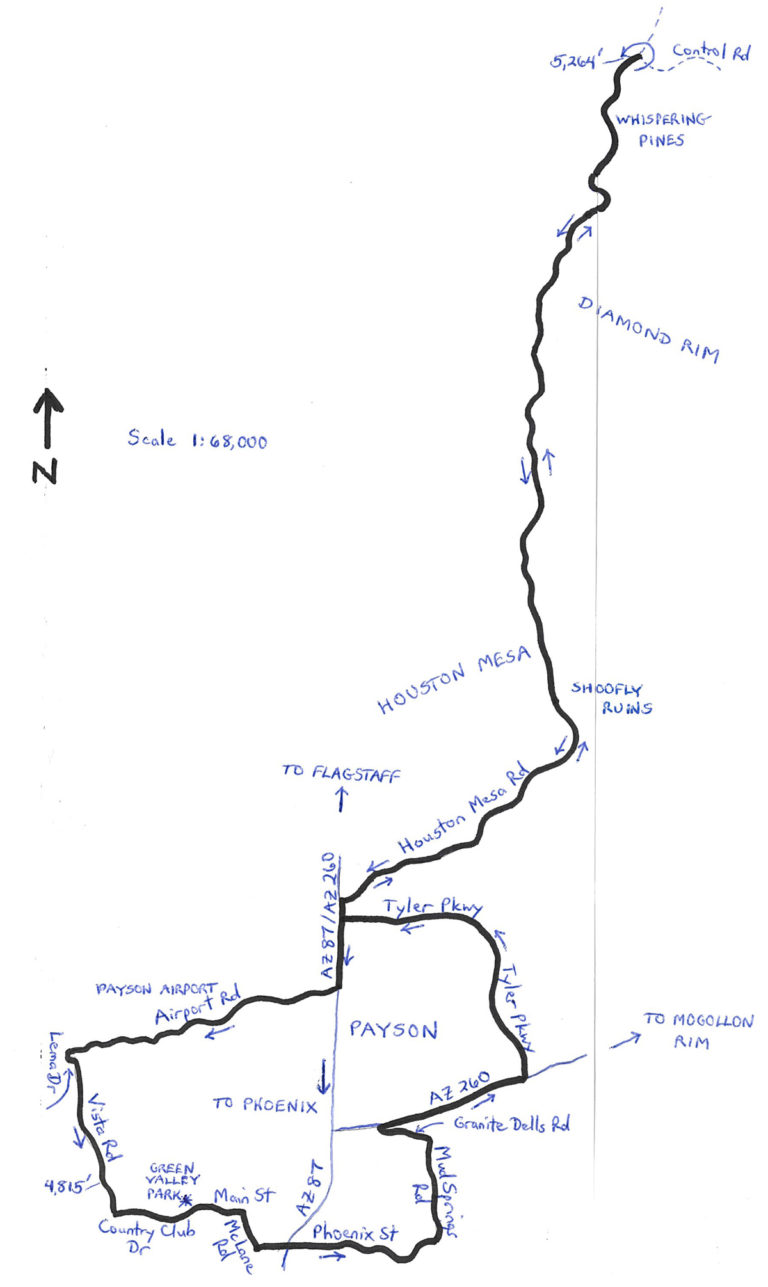
By Wayne Cottrell — Payson Perimeter to Pines is a 35.0-mile road bike ride in and around Payson, Arizona (not Payson, Utah). Payson is considered to be the “Heart of Arizona,” located right in the geographic center of the State. Yet, getting to Payson required even more effort than a hard bicycle ride, until 1958, when the Beeline Highway (Arizona State Highway 87, or AZ 87) was finally completed. The Beeline was upgraded to a high-speed, four-lane expressway in the 2010s – now, the 90-mile trip from Phoenix (which is to the south-southwest) can be completed in 90 minutes or less. Before the highway, it was an eight- to twelve-hour trek. Payson’s elevation is 5,000 feet, and it is located about 20 miles to the south of Mogollon Rim, which is the southern edge of the Colorado Plateau. The Rim has a striking appearance, particularly when traveling to the east of town on AZ 260, jutting upwards to an elevation of 8,000 feet.
A map of the Payson, Arizona Perimeter to Pines ride. Map by Wayne Cottrell
Payson had an estimated residential population of 15,800 in 2019, but its location at the “heart” gives the town significant through and visitor populations. Payson is effectively surrounded by Tonto National Forest, which features the largest grouping of Ponderosa pines in the world. In designing a road bike route, I considered a ride to the Mogollon Rim via AZ 260, but decided to mostly steer clear of the main highways. Payson Perimeter to Pines, therefore, is a counterclockwise perimeter ride of Payson, mostly on residential roads, plus an out-and-back on Houston Mesa Road north of town. The counterclockwise loop is broken, after 7.7 miles, by the out-and-back, which is 21 miles. The final phase of the ride closes the loop. The elevation differential is just 449 feet, but the cumulative climbing totals over 1,800 feet. Start the ride at Green Valley Park (34.230844oN 111.343789oW) – one of Payson’s two main parks – and head east on Country Club Drive, beginning a gradual climb. The starting elevation is 4,850 feet. The Green Valley Lakes are on either side of the road (Payson’s original name was Green Valley, dating from 1882, but was renamed in honor of Illinois representative Levi Joseph Payson, in 1884, after he advocated for a local post office). Country Club becomes Main Street east of Green Valley Parkway (mile 0.05). Main is the historical center of town, and is worth a closer look, after the ride. Turn right on McLane Road (mile 0.45) and head south, followed by a left on Phoenix Street (mile 0.8) to head east. Phoenix and McLane had the roughest pavement of the route, when I did this in May 2021. Cross the four-lane AZ 87 at mile 1.05 – there is no signal here, so the best strategy is to be patient and wait for a gap. Phoenix crosses AZ 87 at a skewed angle, making sight distance awkward, so use caution. East of Sycamore Street (mile 1.45), Phoenix climbs the steepest hill of the route (9.0% grade) – the hill lasts for just 0.3 miles. After cresting at 5,111 feet, Phoenix descends (7.5% grade) to Mud Springs Road (mile 2.4). Turn left on Mud Springs and head north, continuing the passage through residential areas, climbing gradually. Turn left on Granite Dells Road (traffic circle; use caution) at mile 3.25, to head northwest. At AZ 260 (traffic signal), turn sharply to the right, to head east. AZ 260 has four lanes and a wide shoulder along this stretch – the speed limit is 45 mi/h, increasing to 55 as you move through town, climbing and descending gradually. Now on the eastern edge of town, turn left onto Tyler Parkway (traffic signal; use caution) at mile 5.1 (elevation: 4,970 feet), and head north into the residential area. Tyler climbs gradually, to 5,000 feet. At mile 6.45, Tyler curves left to head west, climbing (4.5% grade) to 5,116 feet. From there, Tyler descends, gradually, ending at AZ 87.
Turn right onto AZ 87 (traffic circle), which is concurrent with AZ 260, at mile 7.7, followed by an immediate right onto Houston Mesa Road (mile 7.9). The next segment of the ride is on Houston Mesa, to the end of pavement at Control Road, and back. The total out-and-back distance is 20.6 miles. The road climbs gradually to Houston Mesa (peak elevation 5,256 feet). The speed limit on the two-lane road is 30 mi/h, dropping to 25 mi/h upon leaving the Mesa. The Shoofly Ruins, on the National Register of Historic Places, are on the right at mile 10.6, and are worth a visit. After traversing Houston Mesa, the road descends and climbs to pass Diamond Rim and the Brody Hills, with elevations ranging between 4,860 and 5,215 feet. There are intermittent cattle guards, and periodic views of Mogollon Rim in the distance. The Mesa de Caballo community is located just south of Shoofly, and there are several Tonto National Forest trailheads along the road (with parking areas and lavatories). Houston Mesa Road’s pavement comes to end after passing through the Whispering Pines community. The road narrows noticeably through Whispering Pines. Turn around at Control Road (mile 18.5), at the edge of the community. The elevation here, the highest of the ride, is 5,264 feet, which is nearly the same as that on Houston Mesa. Mogollon Rim is just five miles to the north, as the crow flies, although the view is obscured by trees. Return to AZ 87/ AZ 260 via Houston Mesa; use caution on blind curves. Turn left to head south on the highway (use caution; mile 29.1). Use caution through the traffic circle at Tyler Parkway (mile 29.3). At the next traffic circle, at Airport Road (mile 29.9), turn right.
After crossing McLane Road, Airport climbs (7.4% grade) to a mesa, with Payson Municipal Airport on the right (no commercial flights). The road then descends gradually. At Lema Drive (mile 32.9), turn left, followed immediately by a left onto Bulla Drive. Bulla then curves right to become Vista Road. Vista descends (5.66% grade), with the downhill ending at the route’s lowest point (4,815 feet), as the road curves through Payson Golf Course. At the end of Vista, turn left onto Country Club Drive (mile 34.35) and head east. The ride ends at the Green Valley Lakes.
Be sure to check out some of Payson’s history, nearby, including the Haught Cabin, which has no windows, historical ranger properties, and Zane Grey Cabin, all just to the north of the park, on Green Valley Parkway. The latter is a replica of a cabin near Mogollon Rim that the famous author and filmmaker owned during the 1920s. Also, immediately east of the park, on Main Street, are the Ox Bow Inn, Pieper Mansion, and Sidles Mud House, the latter being made primarily of poured mud(!).
Wayne Cottrell is a former Bay Area and Utah resident, and current southern California resident, who continues to conduct extensive research in these places, and elsewhere, to develop the content for bike books. His books include: Best Bike Rides San Francisco, Best Bike Rides books on Los Angeles and Orange County, Best Easy Bike Rides books on Los Angeles, Orange County, and San Francisco, and Road Biking Utah.
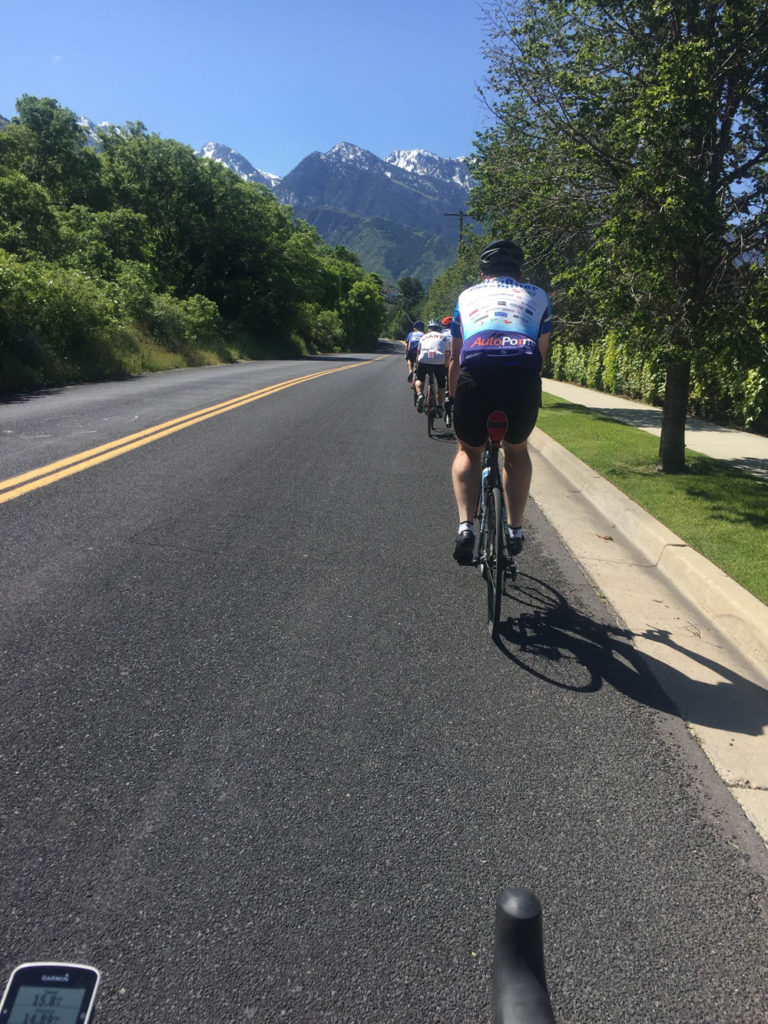
By David Ward — The Salt Lake Valley is rich in riding options. Yesterday, I was out riding 75 miles with four others as part of our LOTOJA training. One of our team members, Ace from Pocatello, commented on the nice route I had planned around the Salt Lake Valley, and how Pocatello simply did not offer such options right in the middle of the metropolitan area.
It made me reflect on how Salt Lake really is a cyclist’s mecca. Don’t get me wrong. I realize these is nothing quite like rolling along a winding road through a beautiful alpine forest. But you have plan that out and, usually, drive a distance to get to it. What I am talking about is the plethora of options to any rider in Salt Lake as he climbs on his bike and rolls out of his garage for a daily ride.
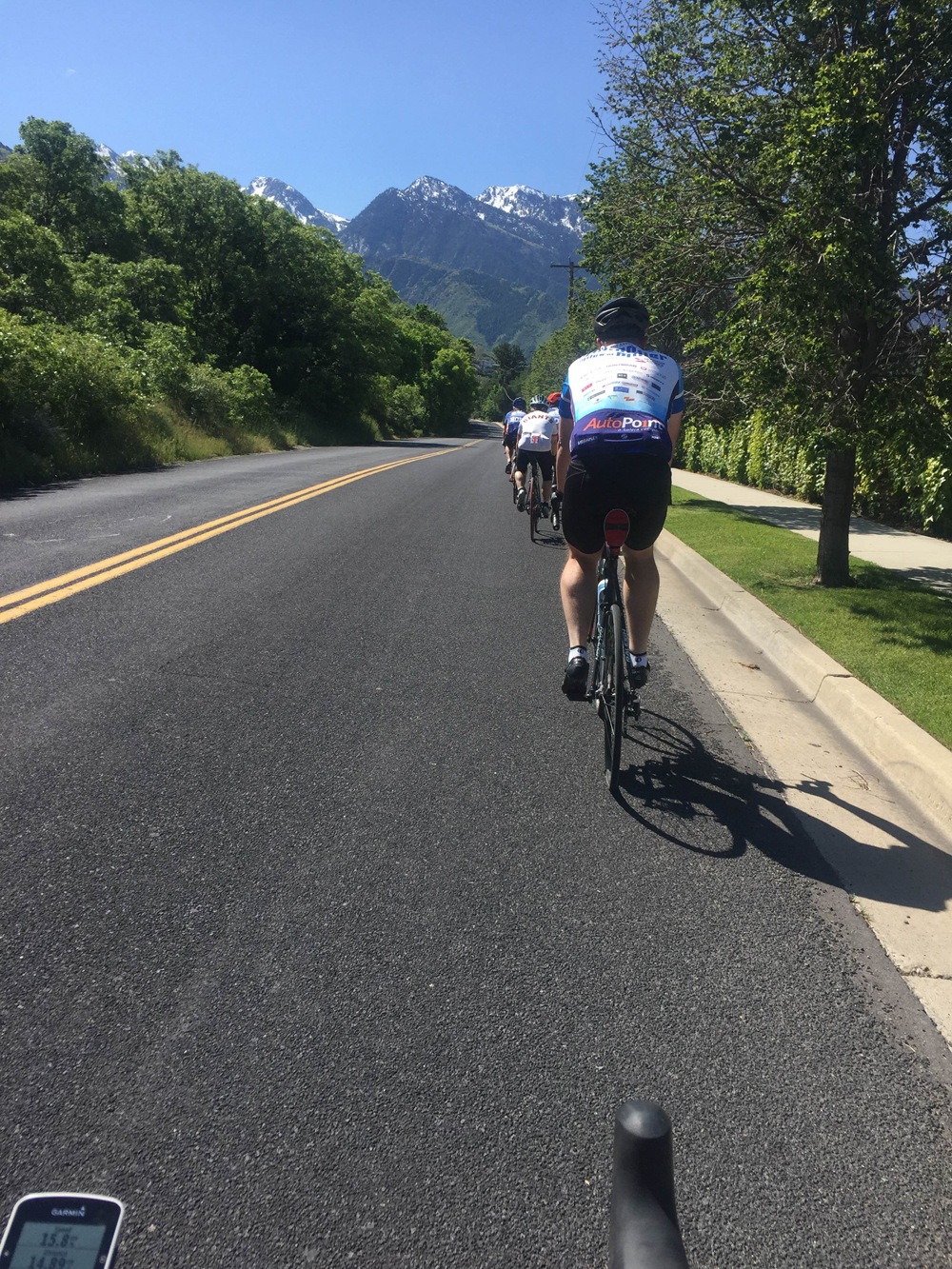
David Ward in the front, followed by his brother Nick, Elliot in the Giants jersey, and Ryan.
For yesterday’s ride, I had us meet at Hogle Zoo, and from there we headed south along Wasatch Boulevard. Thanks to the bike/ped bridge over I-80, we rolled along the east side to our first refueling stop, the Chevron on the corner of 1300 East and Draper Parkway, a watering hole for many cyclists. To avoid the traffic on Wasatch and the steep hill just past the mouth to Big Cottonwood Canyon, I took us through a quiet neighborhood cutoff to Danish Road and thence too its southern end near La Caille restaurant. This is, frankly, one of many nice neighborhood stretches to be found in the Salt Lake valley.
Had we been interested in doing some climbing, we could have headed up one of several canyons along this stretch: Millcreek, Big Cottonwood and Little Cottonwood Canyons will test the legs of the most seasoned climber. I have been lucky to ride a lot of the big climbs that feature in the Tour de France, and I can vouch that Little Cottonwood Canyon can match up with any of them for challenge and difficulty. Add to that City Creek, Emigration and Butterfield Canyons, and you have more canyon riding for all different levels of riders than anywhere I know of. And all within an epicenter of 15 miles. Just mount your bike, choose your canyon and roll out from the garage.
From the Delta Chevron, we headed to South Mountain, picked up Highland Drive as it headed to Point of the Mountain, crossed under I-15, and then rode west past the prison and over to Redwood Road. At that point, we continued west along 14400 South.
I lived 30 years in Murray, nearly smack dab in the middle of the Salt Lake valley. During that time, I had time to explore the best routes to bicycle almost anywhere in valley. However, since having moved to Emigration Canyon five years ago, there has been explosive growth in the southwest area of Salt Lake Valley: the Bluffdale, Riverton and Herriman areas. So once we were on 14400 South, I recognized nearly nothing.
We headed west till 14400 South ended, at which point we kind of felt our way north and west till we finally came to point I recognized, the road (11800 South) which would lead us to Bacchus Highway which we would then take to the Old Bingham Highway. I knew this area well, having raced many district road races on the Herriman course.
What I was pleasantly surprised by, though, were the wide shoulders and designated bike paths on many of the roads built in the last several years. I used to like riding out here, but the narrow shoulders were always a drawback. Now, there are good options for cyclists to ride out here, with good shoulders and bike paths to accommodate them.
Once at the Old Bingham Highway, the plan was to ride east and wind our way back home. What I would have liked to do, but chose not to, was to ride on up to Copperton, one of my favorite destinations years back. I would ride to where the road heading into the Kennecott Copper Mine was closed to traffic, then come back through this lovely old town tucked into the west side, around its park, and then head back east. Yesterday, however, our legs were beginning to feel the toll of the nearly 50 miles we had already ridden so far, so I declined that option, though now I wish we had opted for it.
I love riding the Old Bingham Highway. Going back in the years again, I remember when I would ride it early in the morning, and listen to the meadowlarks sing to me as I passed them by. There were no meadowlarks (too late in the day) as we made our descent down the Old Bingham Highway. After our second fueling stop, I led our group through the roads I had scoped out over the years to get us east of I-15, and on the route back home.
Doing this ride, and going through areas I used to pedal frequently, it brought to mind the many routes available to cyclists for navigating and enjoying cycling in Salt Lake. I have two daughters living in the Phoenix area, and I have a bike parked there for when I visit. I have gotten to know the area somewhat well. People think Salt Lake has nothing but east/west and north/south streets criss-crossing the valley. But while that is the general layout, it does not hold a candle to Phoenix. If a boring ride is what you seek, go ride the straight, flat streets of Phoenix. You will yearn to return to the cyclists’ mecca of Salt Lake.
I suspect that many large urban areas (excepting Phoenix, I am sure) have their little known but enjoyable routes. My experience living in Salt Lake for 40 years convinces me that it takes years of exploring to find them. But they are likely there. In my travels, that is one of the things I really enjoy. Jumping on a bike, exploring the area, and learning to navigate the urban landscape in an enjoyable way.
In riding our half loop around the Salt Lake valley, we racked up 73 miles. Without seeking to climb, we still ended up with 3700 feet of climbing just rolling up and down the topography that comprises this valley.
As an avid cyclist who simply loves to ride, I consider myself blessed to live in such a beautiful and varied valley. I have cycled in this area for 40 years. I know most of the good places to ride, but am still surprised to occasionally find a new stretch to add to my routes. For cycling in a metropolitan area, there is no better than Salt Lake.
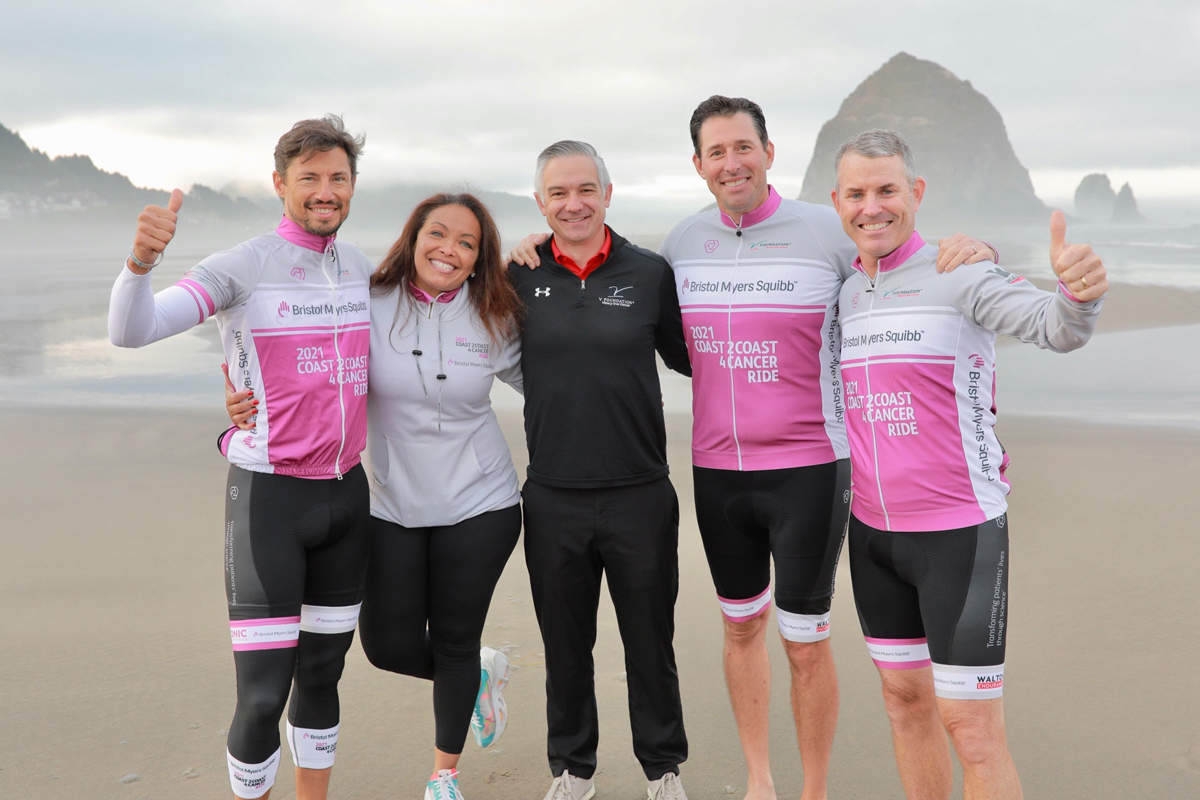
CARY, North Carolina (October 13, 2021) — The 2021 Coast 2 Coast 4 Cancer Ride raised over $1.67 million for cancer research for the V Foundation for Cancer Research. Additionally, Bristol Myers Squibb doubled its planned match, adding $1 million for a total of over $2.67 million raised for cancer research funded through the V Foundation.
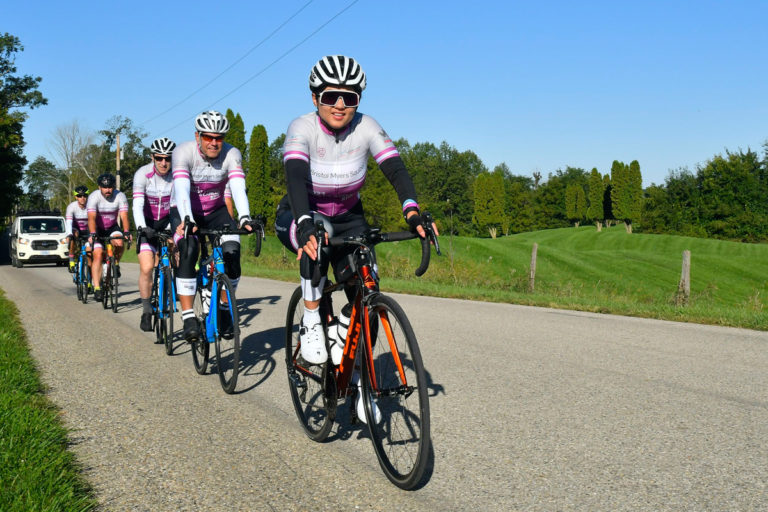
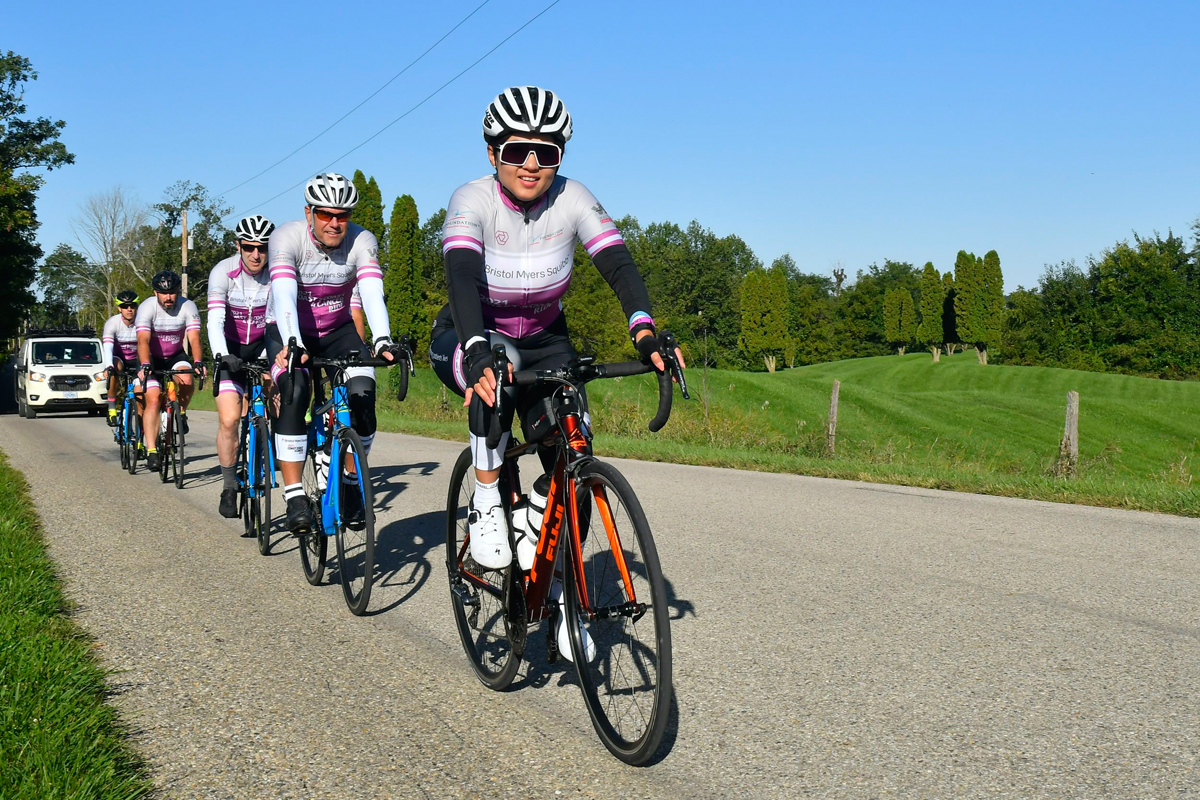
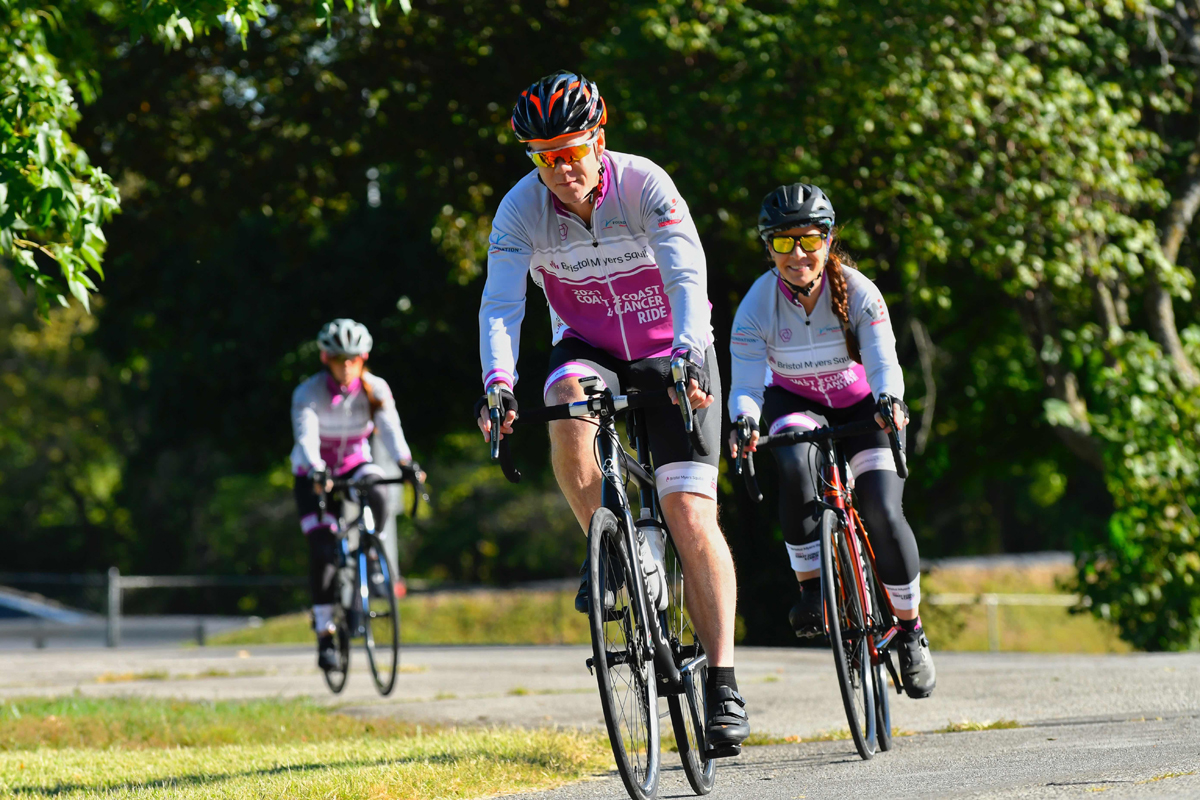
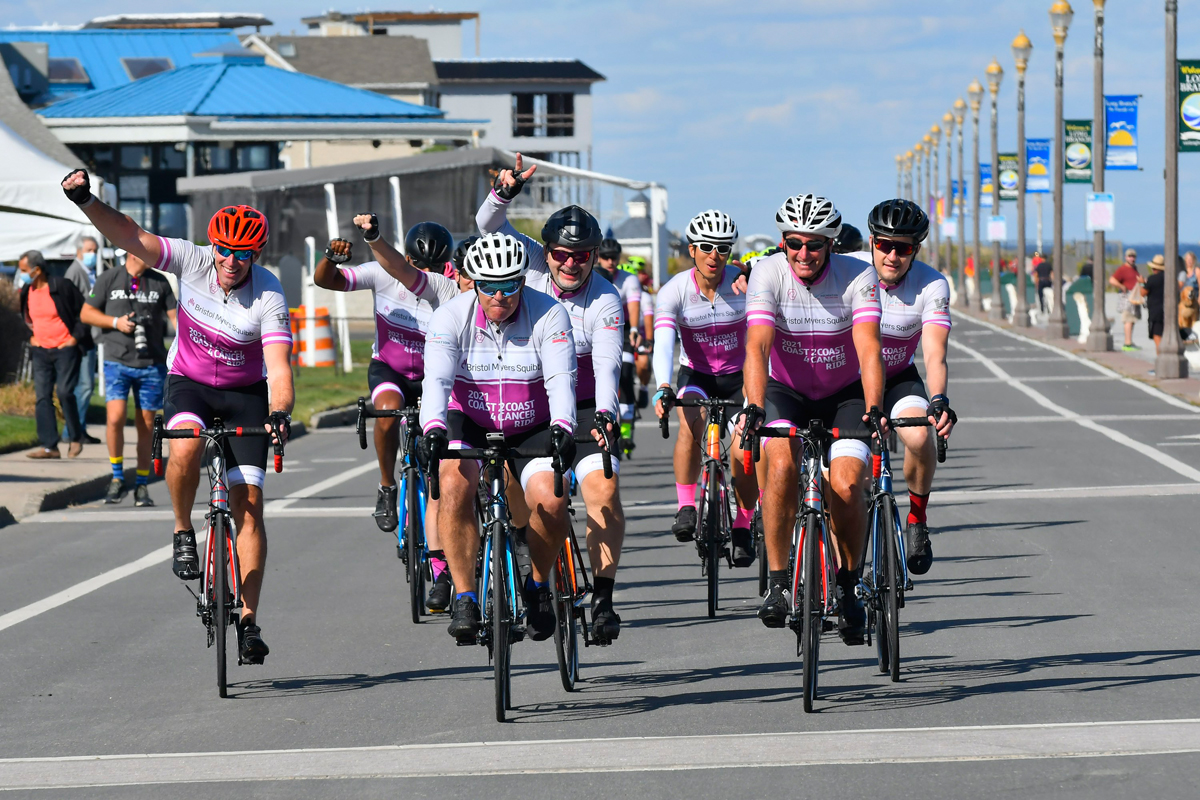
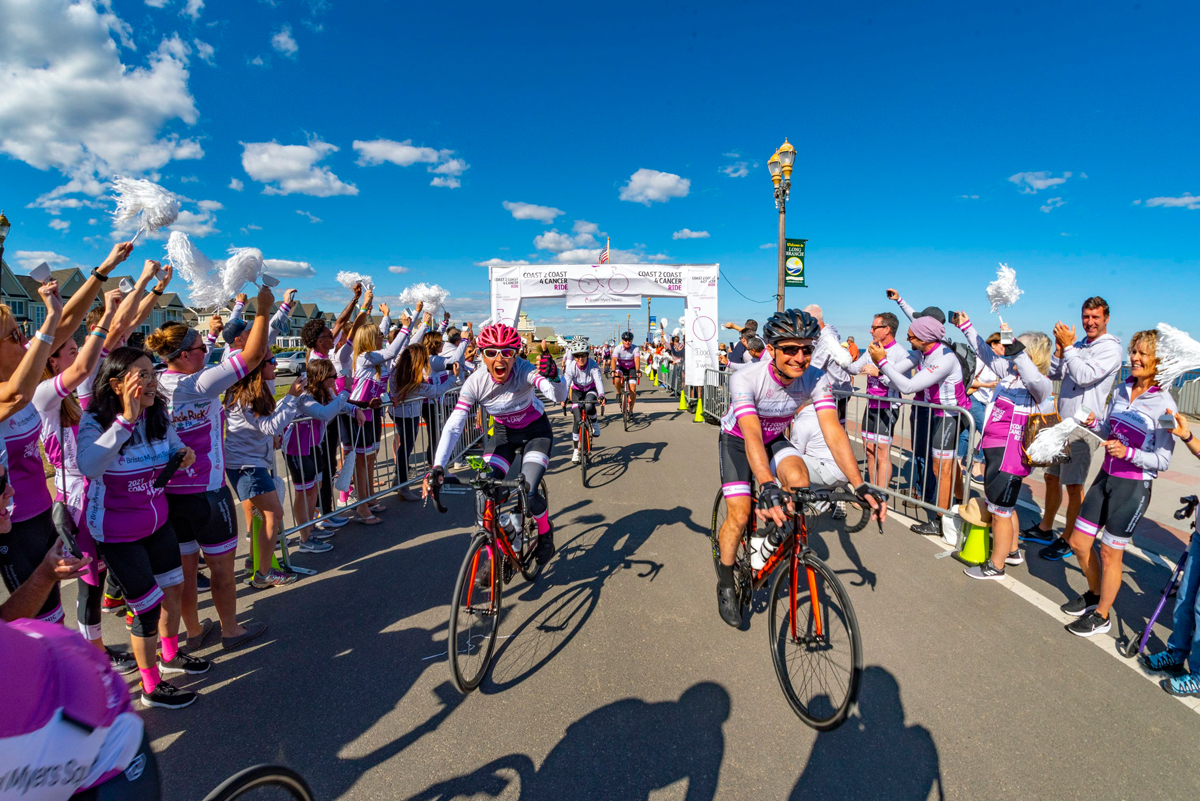
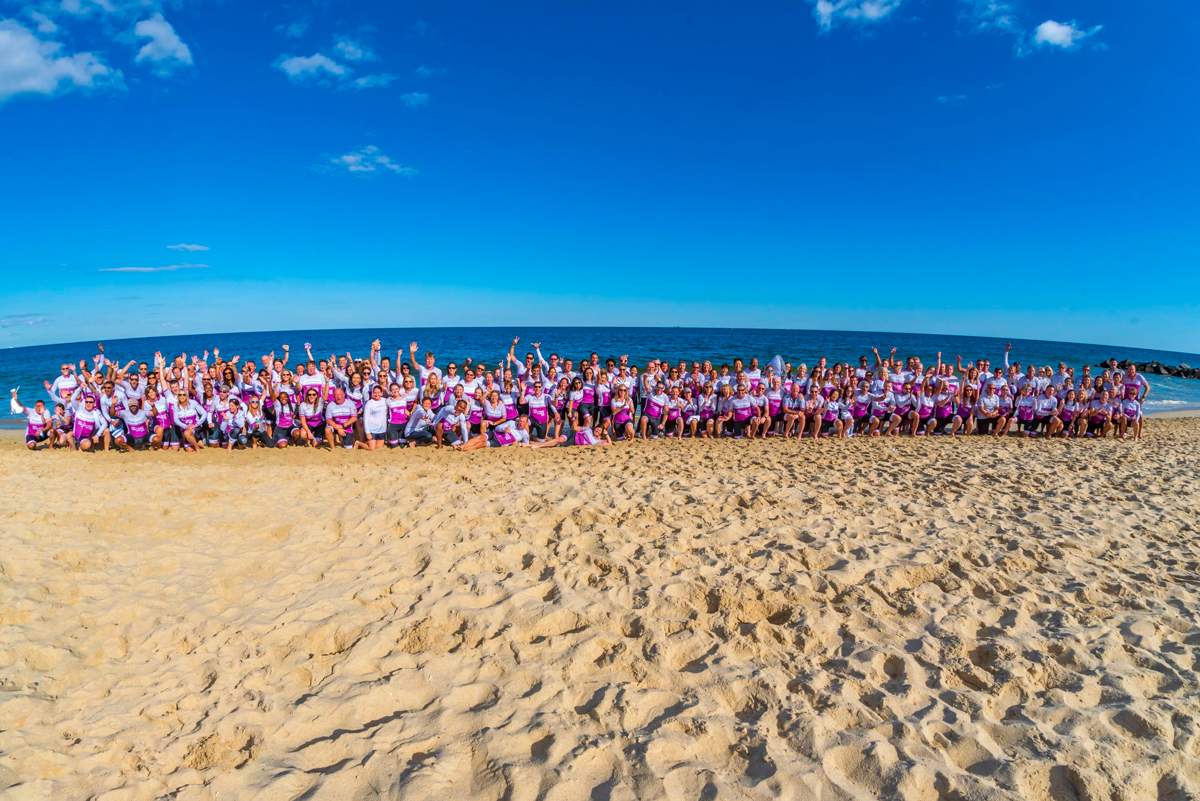
Scenes from the Coast 2 Coast 4 Cancer Ride 2021. Photo courtesy Coast 2 Coast 4 Cancer Ride
Participating in the ride were a record 18 teams featuring over 230 Bristol Myers Squibb employees. The teams followed two separate routes, both beginning in Cannon Beach, Oregon, and coming together again in Long Branch, N.J. Each team, mostly comprised of novice cyclists, covered approximately 240 miles in three days for a total of over 3,000 miles per route. Stops included Bend, OR; Walla Walla, WA; Boise, ID; Missoua, MT; Salt Lake City, UT; Billings, MT; Denver, CO; Rapid City, SD; Sioux City, IA; Kansas City, MO; Bloomington, IL; Indianapolis, IN; and Pittsburgh, PA.
On a path to achieve Victory Over Cancer, riders were inspired by their close connections to cancer. Nancy Eavy, a breast cancer survivor and mother of two, rode in this year’s ride from Denver to Kansas City. “I was honored to be a part of Coast 2 Coast 4 Cancer this year with so many strong survivors and thrivers from the cancer community,” Eavy said. “We know much more than we did about cancer than we did when I was a patient, but there’s still so much we don’t know. Research plays a pivotal role, and we must continue funding.”
“Bristol Myers Squibb’s support of the V Foundation is incredibly valued by our employees, their friends, and family, because they know that every dollar raised goes directly to cancer research,” said Adam Lenkowsky, senior vice president and general manager of U.S. Cardiovascular, Immunology and Oncology. “After five months of training and fundraising, our riders set a new record in funds raised for the cause. We hope this effort continues to raise awareness about the importance of research for the future of cutting-edge treatments for those with cancer.”
Proceeds from Coast 2 Coast 4 Cancer enable the V Foundation to invest in even more potential breakthrough cancer research nationwide. Including the funds raised from the riders, since 2015, Bristol Myers Squibb has provided nearly $15 million in charitable donations to the V Foundation to support multiple research initiatives.
“I am in awe of the dedication displayed by every single one of these riders. Whether riding up a mountain or persevering through strong crosswinds, they showed the kind of determination that can stop cancer,” said Shane Jacobson, chief executive officer of the V Foundation.
For more information about the 2021 Coast 2 Coast 4 Cancer ride, visit cancerbikeride.org. For more information about the V Foundation, visit v.org.
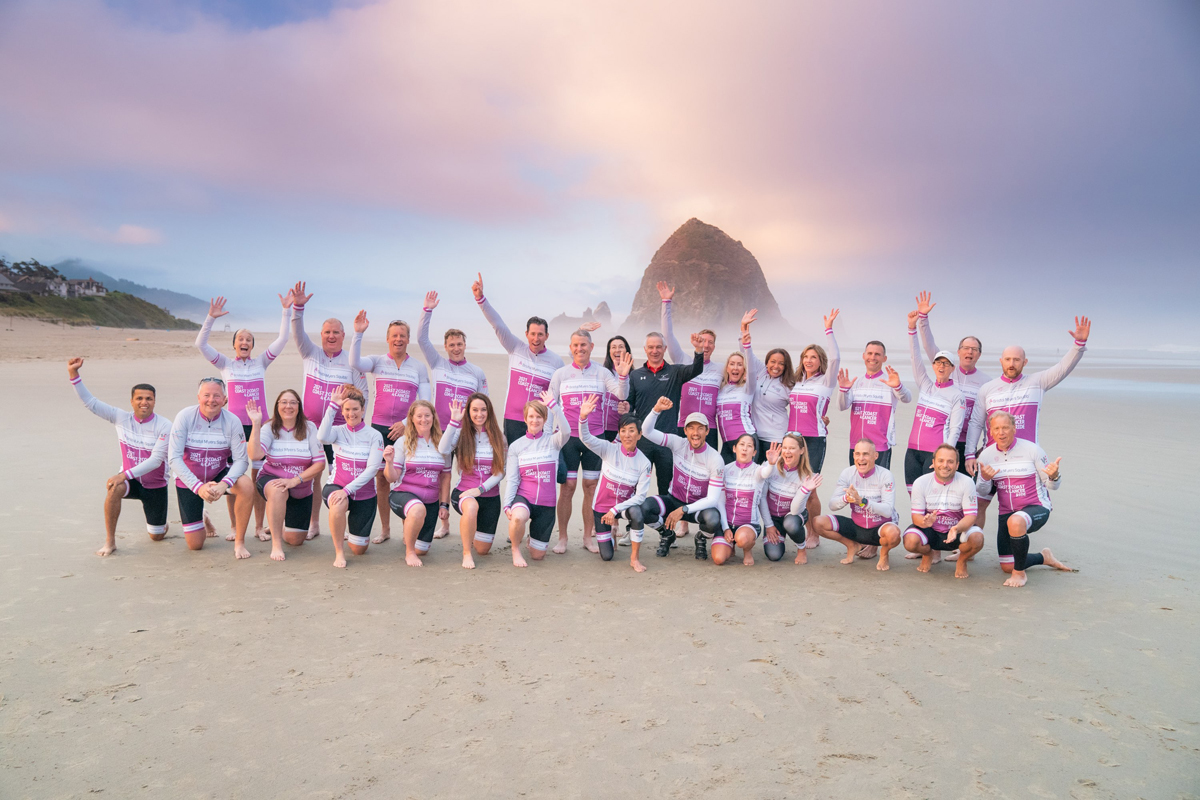
At the start of the Coast 2 Coast 4 Cancer Ride 2021 in Cannon Beach, OR. Photo courtesy Coast 2 Coast 4 Cancer RideAt the start of the Coast 2 Coast 4 Cancer Ride 2021 in Cannon Beach, OR. Photo courtesy Coast 2 Coast 4 Cancer RideScenes from the Coast 2 Coast 4 Cancer Ride 2021. Photo courtesy Coast 2 Coast 4 Cancer RideAt the finish of the Coast 2 Coast 4 Cancer Ride 2021 in Long Branch, NJ. Photo courtesy Coast 2 Coast 4 Cancer RideAt the finish of the Coast 2 Coast 4 Cancer Ride 2021 in Long Branch, NJ. Photo courtesy Coast 2 Coast 4 Cancer RideAt the finish of the Coast 2 Coast 4 Cancer Ride 2021 in Long Branch, NJ. Photo courtesy Coast 2 Coast 4 Cancer Ride
BOULDER, Colorado (Sept. 22, 2021) — PeopleForBikes, a national bicycling advocacy nonprofit, is proud to announce an ambitious, industrywide campaign highlighting the important role of bicycling in combating climate change. The One Ride at a Time Campaign and the accompanying Great Climate Bike Challenge empower individual riders, businesses and policymakers to choose and incentivize bicycling for short trips to help lend a hand in reducing transportation-related carbon emissions and protecting the planet.
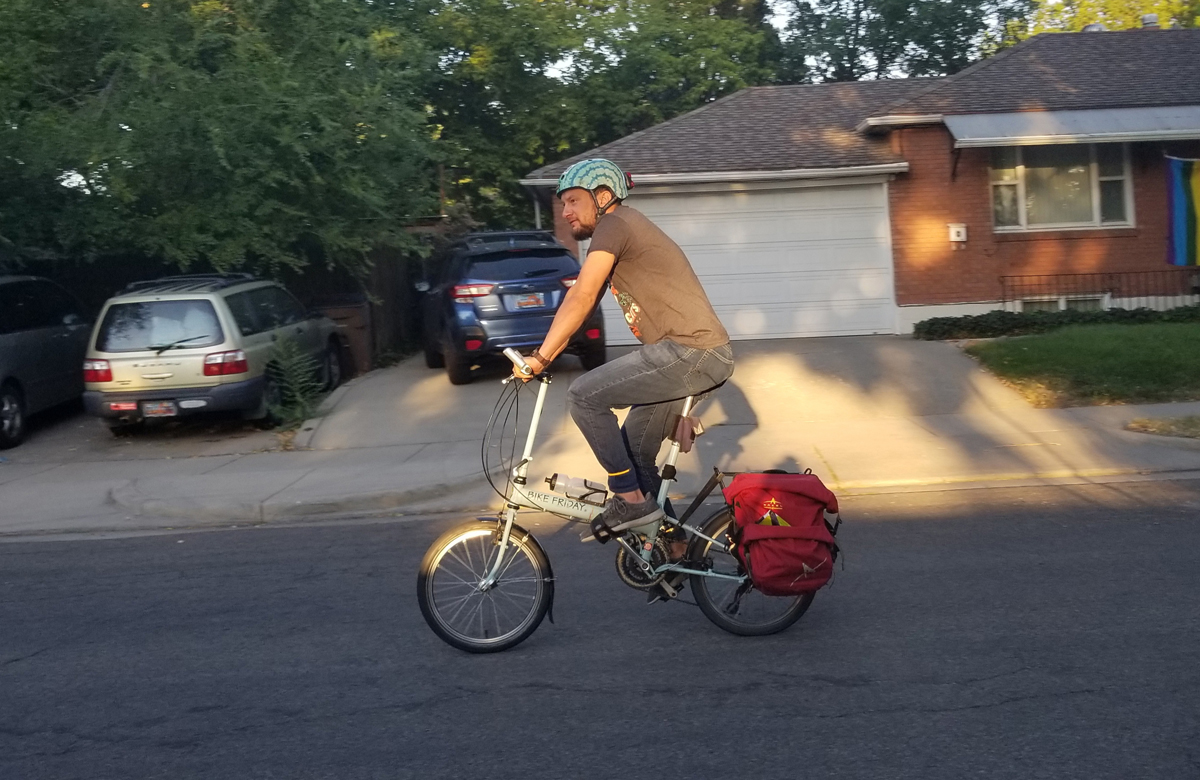
Seth Parsons’ folding Bike Friday is set up for commuting with a rack and panniers. Photo courtesy Seth Parsons
Climate change is on the forefront of elected official’s minds across the U.S. and PeopleForBikes knows that reducing carbon emissions is a large and complex task. In tandem with other solutions, replacing car trips with bike rides can play a significant role in reducing these harmful emissions. To help the bike industry on climate action, PeopleForBikes recently launched their industry Sustainability Working Group, working closely with the Outdoor Industry Association, crowdsourcing best-in-class practices and resources to improve the manufacturing and distribution of bicycles from a climate perspective.
As bike businesses work to make improvements in their supply chain, PeopleForBikes is working with policymakers at the local, state and federal levels to prioritize funding for more and better bike infrastructure and create incentives for people to bike more often through legislation like the E-BIKE Act and the Bicycle Commuter Act.
Climate change is affecting communities across the U.S., and the world, in a myriad of ways — worsening air conditions due to greenhouse gas emissions make outdoor recreation more difficult and decrease quality of life. Loss of recreational trails due to wildfires, erosion and floods means fewer opportunities for Americans to get into the — a proven benefit for boosting mental and physical health.
When people have safe places to ride, and reasons to ride, replacing car trips with bike rides is more attainable for everyday riders. Americans take 1.1 billion trips every day — an average of four trips per citizen. Further, 87% (957 million) of daily trips are taken in personal vehicles, and nearly half of those trips are less
than 3 miles. If 10% of the population were to replace one car trip a day with a bike ride, overall carbon emissions from transportation would drop 10%.
PeopleForBikes is challenging individuals across the U.S. to use their bicycle as a tool to help fight climate change and create a better future on two wheels. Offering three challenges on Ride Spot, PeopleForBikes’ app built to break down the barriers to bicycling, riders can ride to carbon neutral for either their traditional or electric bicycle, and pledge to replace a few car trips a month with bike rides. Every month, PeopleForBikes will tally the total number of miles ridden and the corresponding amount of carbon emissions avoided by participants biking instead of driving.
The Great Climate Bike Challenge pushes individuals to replace short local car trips with bike rides — starting with just a couple trips a week. Someone choosing to replace driving a car with riding a bike just once a day can reduce their personal transportation-related carbon emissions by 67%.
Ride to Carbon Neutral — Traditional Bikes is a Challenge to highlight the mileage needed to offset the carbon emissions tied to the manufacturing of a traditional bicycle. When running local errands by bike, it only takes a total of 319 miles to reach carbon neutral.
Ride to Carbon Neutral — Electric Bicycles demonstrates the ways electric bikes can serve as an alternative to cars by making errands easier, more fun and more convenient. By replacing 508 miles of local trips with an e-bike, people can pedal through their carbon footprint, benefiting their communities and themselves.
Diamondback and Rach McBride work together to continue to grow gravel cycling
KENT, Wash., (October, 15, 2021) — Diamondback, a leader in the gravel cycling space, and professional triathlete and gravel racer Rach McBride have teamed up for the second annual Gravel Scholarship. This year with a new name, the Eat My Dust Gravel Scholarship, which will aim to encourage more female, trans and non-binary participation in the sport of gravel cycling.
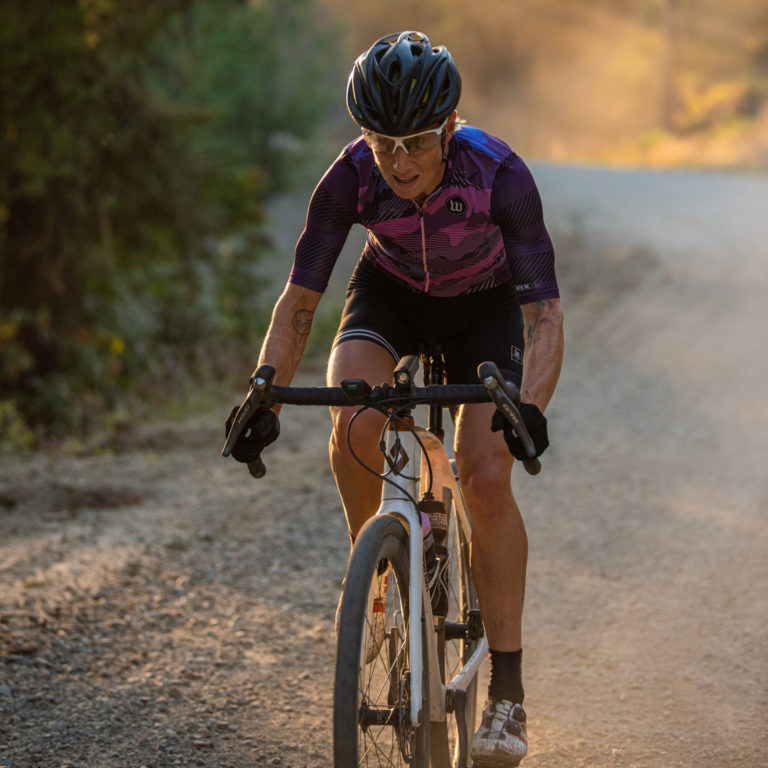
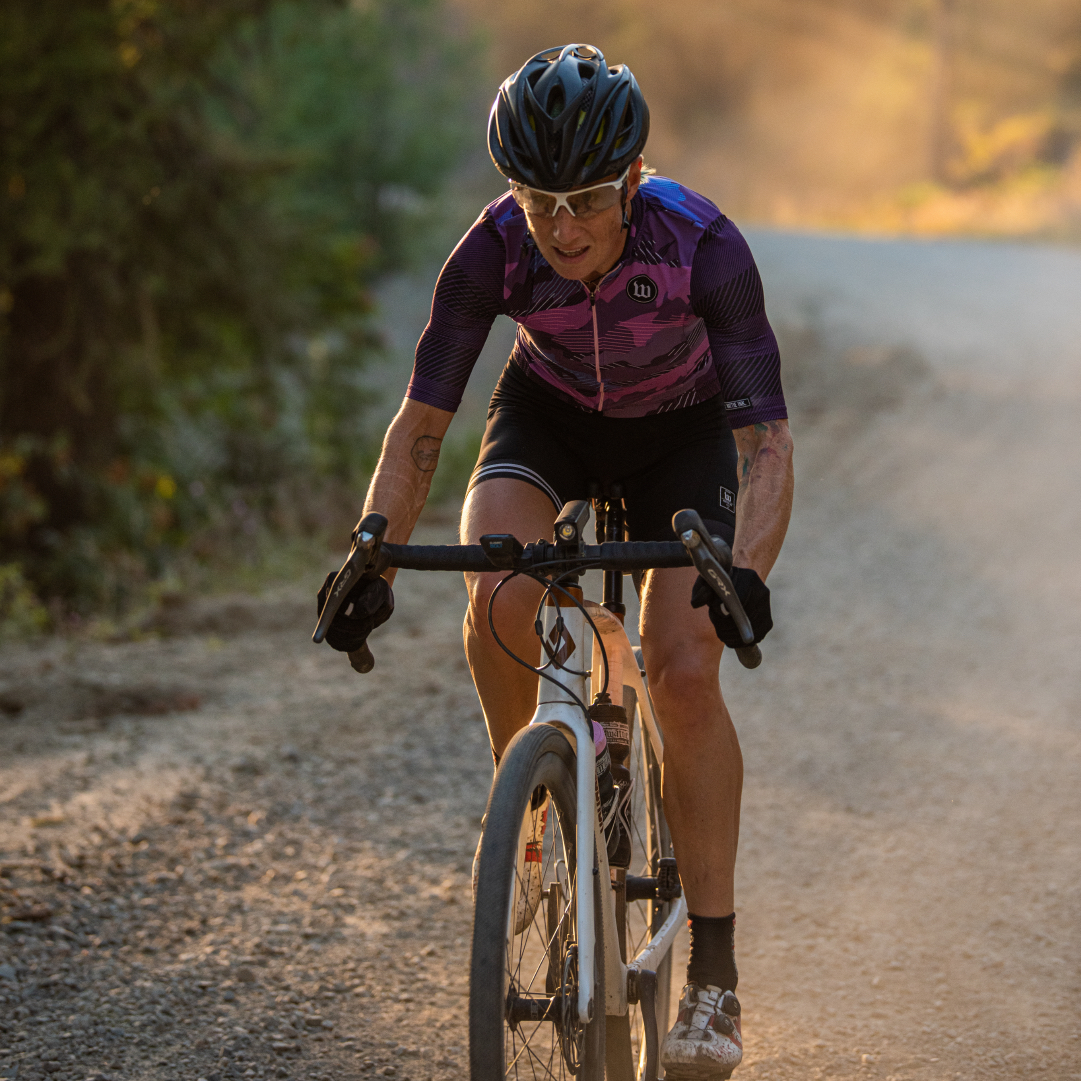
Photo courtesy Diamondback
McBride has spent their career uplifting underrepresented voices in the cycling community and working to ensure that everyone can participate, no matter their gender. McBride’s time as a professional athlete has been filled with plenty of highs, including eight Ironman 70.3 fastest bike splits, and two Ironman bike course records. Their path to endurance cycling success has also faced some lows, namely the lack of inclusion of female-bodied riders when they first joined the sport.
“As the sport of gravel only continues to grow, it’s important to build a foundation of equity and acceptance,” said McBride. “It’s important to me that we welcome more women and non-binary folks into our world, and scholarships are an important piece of that bigger puzzle. The Eat My Dust Scholarship makes me proud to work with Diamondback and my family of sponsors, as it offers support at every level of riding and would truly give someone the confidence and opportunity to grow as a rider.”
The scholarship will be open to female, trans, and non-binary applicants and the winner will receive a prize package from some of McBride’s sponsors and other brands, including: a Diamondback Haanjo 8C, a Life Time gravel race entry, a Nuun Hydration package, a Wahoo Kickr Core, a one year Zwift membership, a Zealios package, Smith sunglasses and helmet and a Wyn Republic bike kit.
The application will be open to US residents only from October 15 through October 31. Fill out the application here.
The application rules and regulations can be found at diamondback.com. For additional information on Diamondback and Rach please visit diamondback.com.
By Tom Jow — Build it, or take it apart, which comes first? As a kid I’m sure I had build it toys such as Lego or Lincoln Logs but what I remember is taking apart an old alarm clock. You know the type; large face and two bells on top with a hammer in between. One day it stopped working, so I took it apart. There were no instructions, no schematics, no YouTube. I just tore into it. I had never taken a clock, much less anything else apart. A few years later I was taking bicycles apart. They didn’t have to be broken, sometimes I just wanted to know how it worked. Nowadays, I take apart broken stuff all the time. Back then I didn’t know what I was doing, I just grabbed some wrenches and started taking stuff apart. Now I often do research before I take something apart. Over the years I have developed a strategy for taking things apart.
Where to Start, Research
If I have never taken something apart, the first place I look is the manufacturer website. Under the “support” tab, there will usually be a link to instructions and service documents.
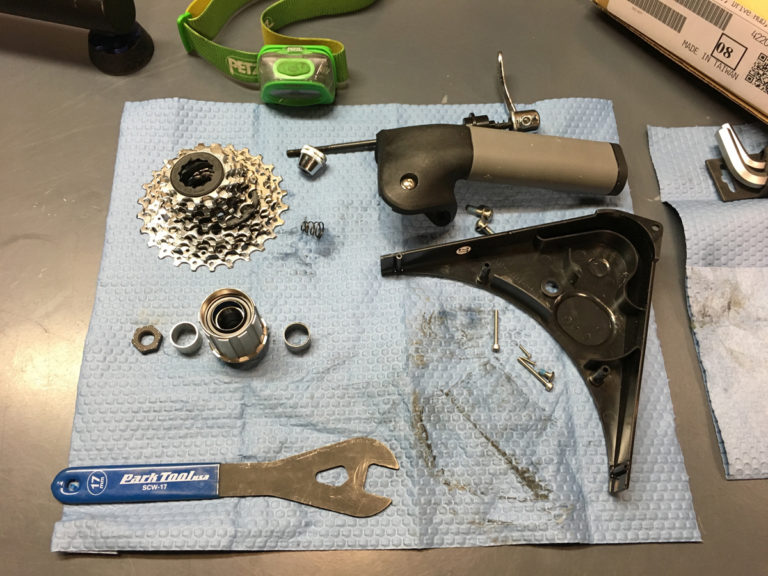
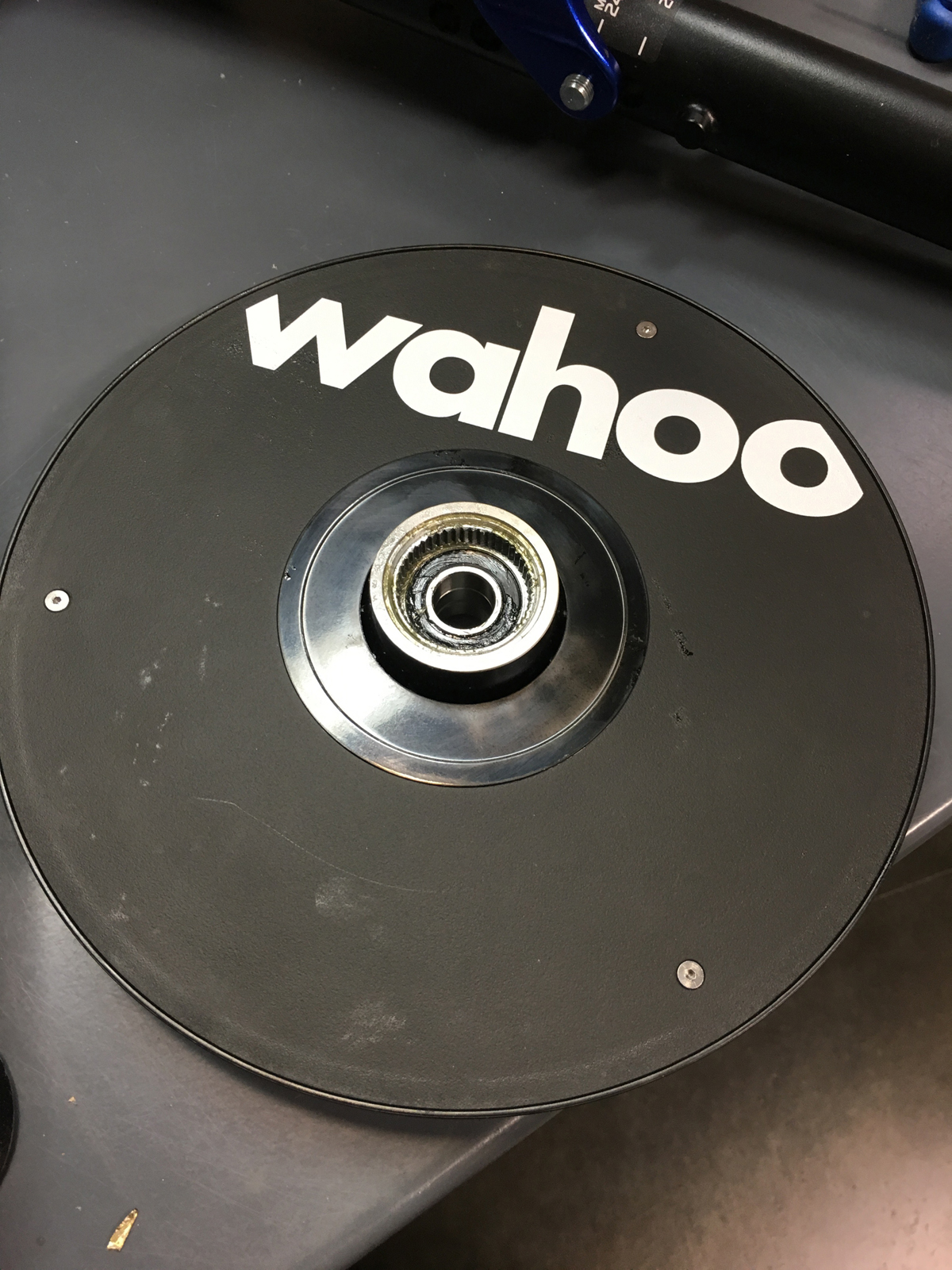
I’ve never replaced a flywheel on a trainer before. Photo by Tom Jow
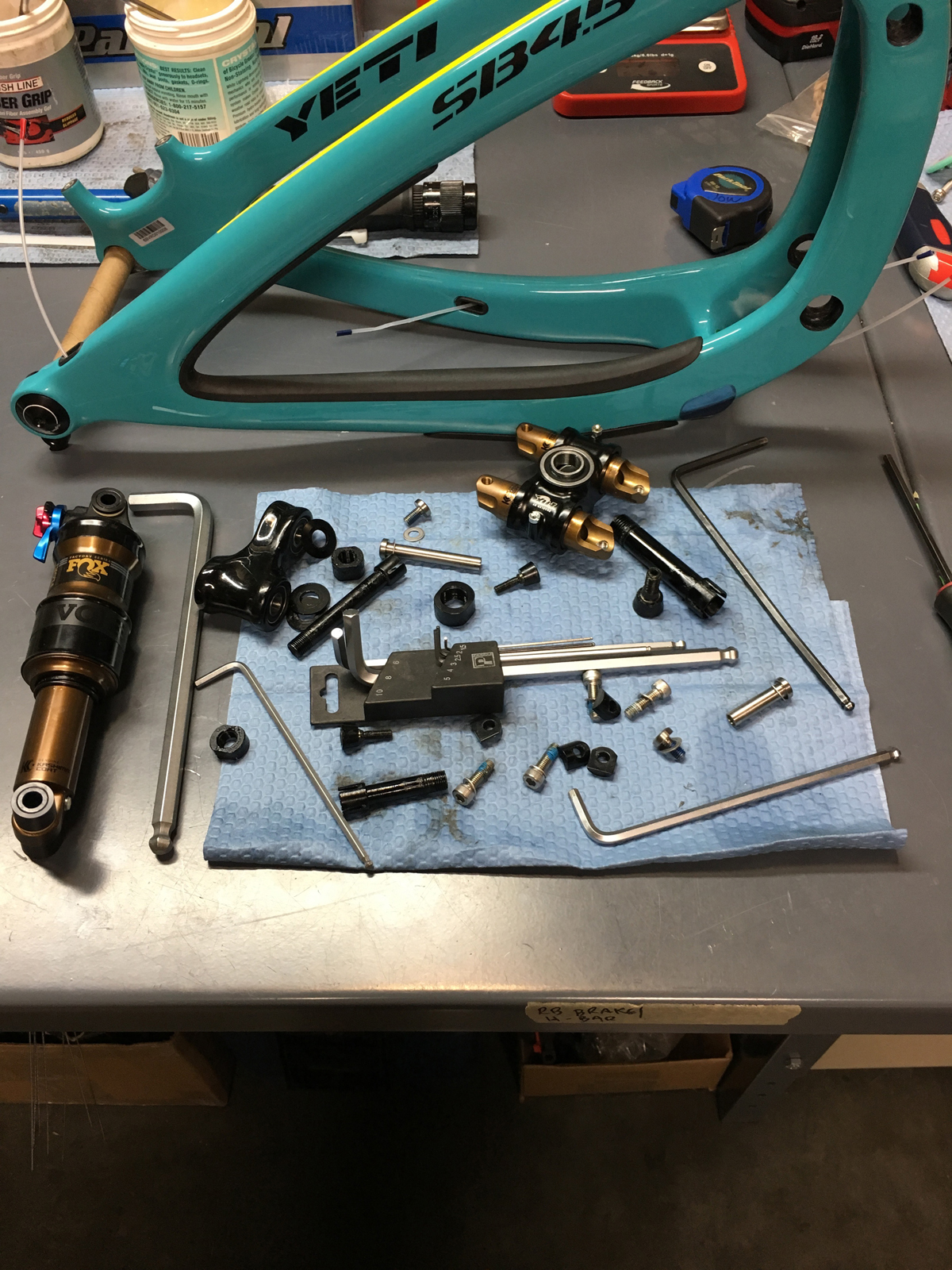
Instructions are helpful, but often they only show how to put something together, not apart. The next thing I look for is a maintenance document or parts schematic. The maintenance document would have the necessary instructions of how to service the component in question. A detailed parts schematic is useful because it gives an overall picture of where everything is and how it all fits together. It will show if and where there are hidden fasteners, or small parts that may fall out. A great example of service instructions and schematic is the Yeti Cycles Owners Manuals. Their instructions are very detailed and easy to follow with a very detailed parts schematic. Another great resource is YouTube. Many manufacturers publish detailed videos demonstrating the proper service procedure. Whenever possible, always use the manufacturers video. However, if the manufacturer hasn’t published one, someone else probably has.
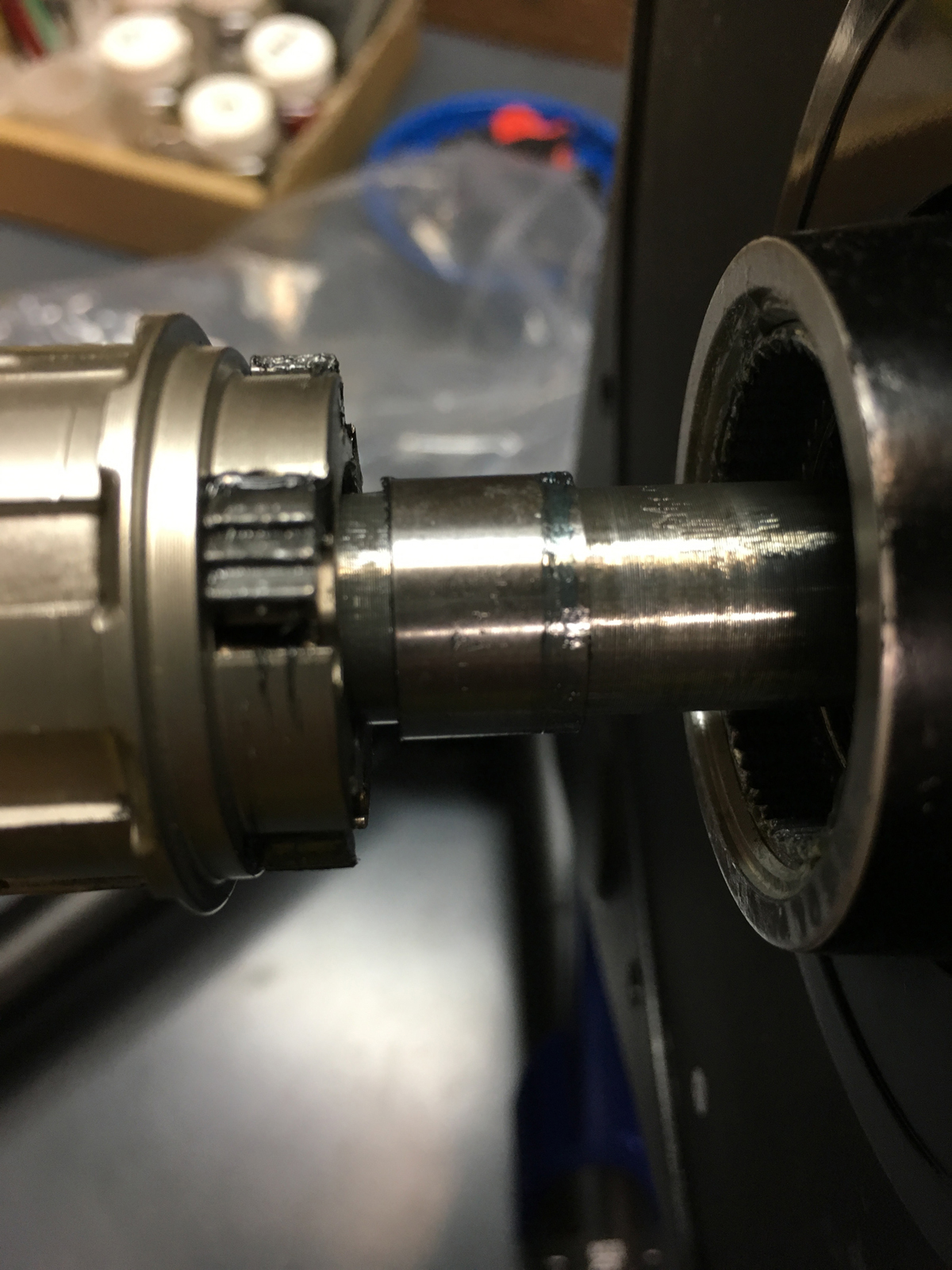
No schematic so I took a picture to remember where this spacer goes. Photo by Tom Jow
Be organized
Before you really get into it, prepare your work space. Even though it doesn’t always happen, I like to start with a clean workbench. Lay out a couple of clean rags. Place the tools needed on one. Reserve the other for parts removed. Also have a couple of rags ready for holding or wiping dirty things.
It is a good idea to read through the instructions or watch the video before starting the disassembly. This reduces the number of surprises you will encounter during the job. Previewing the procedure also helps prevent being confused while holding a dirty, greasy, half-disassembled bike component. Replay and review any part of the procedure that doesn’t make sense before you start.
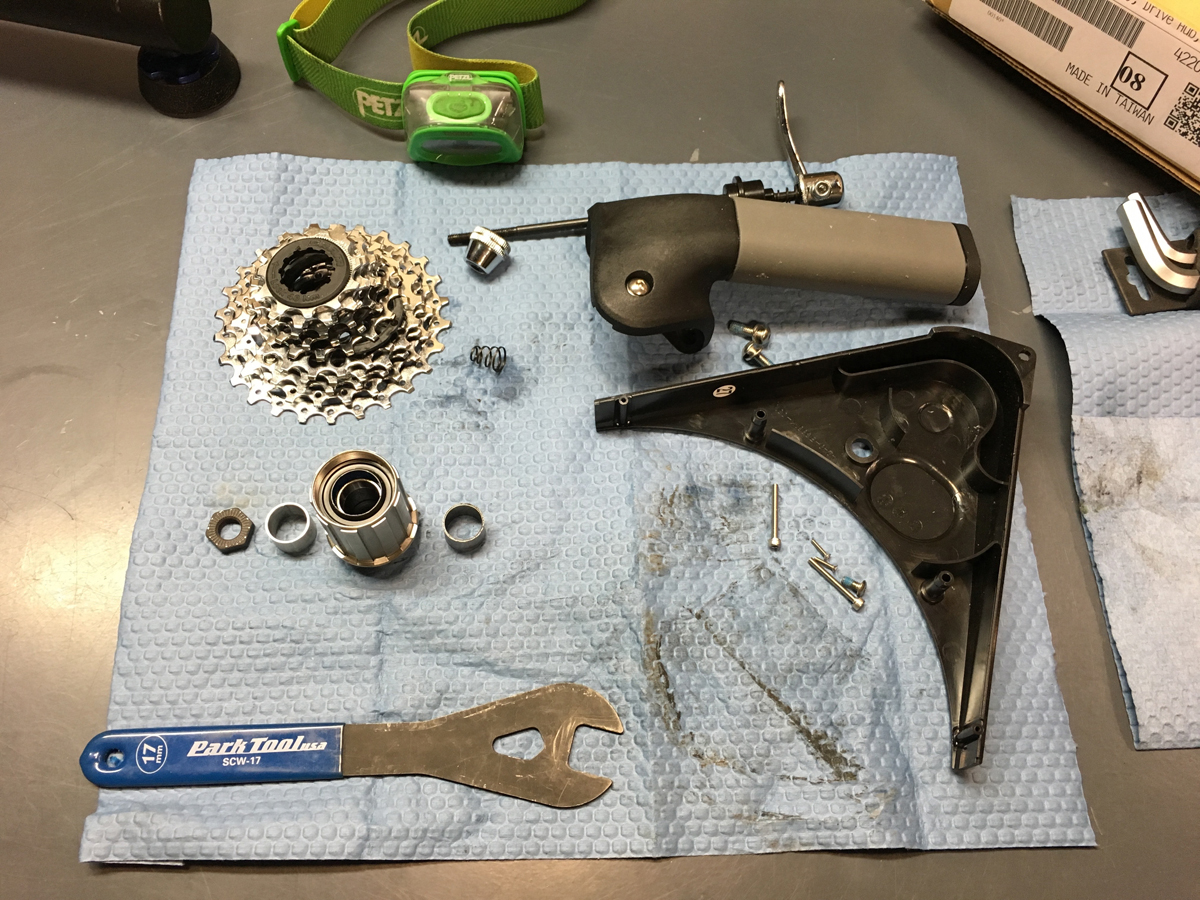
All the parts, pretty much in a row. Photo by Tom Jow
Getting into it
A couple things before getting started. One, threaded fasteners are removed by turning them counter-clockwise. A bicycle has two standard exceptions: the left pedal and the drive side cup of an english bottom bracket. These two components use a left hand thread, meaning they are removed by turning clockwise. Two, if the fasteners have been removed and the component will not come apart, resist using a hammer unless specifically instructed to do so. Review the instructions and schematic. When disassembling something for the first time it is easy to overlook things.
Now go to step one and get started. Follow the instructions step by step. This is my “do as I say, not as I do” moment. A lot of people don’t like to use instructions (read: men) but I’ll tell you, it makes things a whole lot easier. As things come apart, a good way to remember where parts go is to lay them out in order as they are removed. This strategy also makes it easy to see and remember which parts have been inspected and cleaned.
Can’t be organized all the time. Photo by Tom Jow
Putting it back together
Once the component parts have been cleaned, inspected and replaced as necessary, carefully work backwards and/or follow the instructions for reassembly. This includes using Loctite or grease on fastener threads as instructed by the manufacturer. Also use a torque wrench where specified (for more info on torque wrenches see Mechanics Corner, April 2017).
That wasn’t so bad, was it? Sure, easy for me to say, I’ve been working on bicycles for decades. Keep in mind however, that bicycle manufacturers are introducing new frames and components every year. In addition, I am a do-it-yoursefler. I do handyman jobs around the house such as plumbing, appliance repair, light electrical work. In order to get all these things done, I employ the same strategy as I have for bicycle repair. Research, documentation, instructions, organization, completion. Oh, did I say patience? Lots of patience.
By Bill Roland — A strange mishap occurred in early June to Gregg Rosann, an avid rider who lives near the University of Utah campus. His wife found a package on the street right in front of their house. She brought it in, Gregg opened it without examining the address on the package. Suddenly he realized that he had not ordered anything resembling the contents. He took a closer look and saw the package was addressed to Jeff Hepworth, the owner of the Loyal Cycle Store in Farmington.
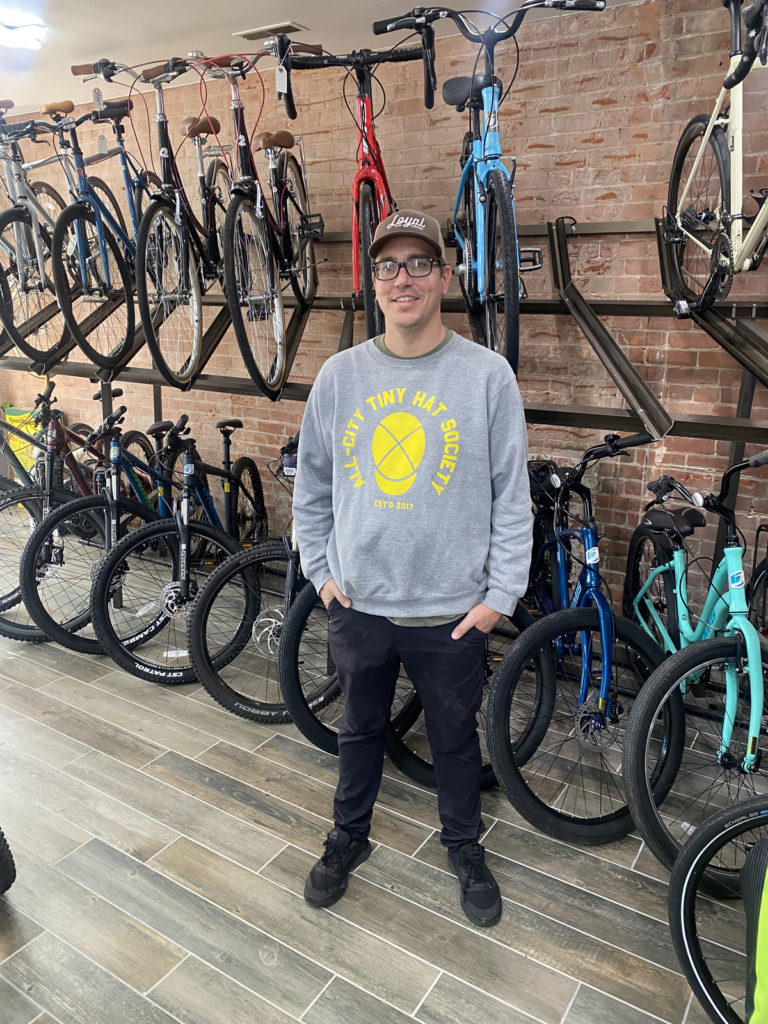
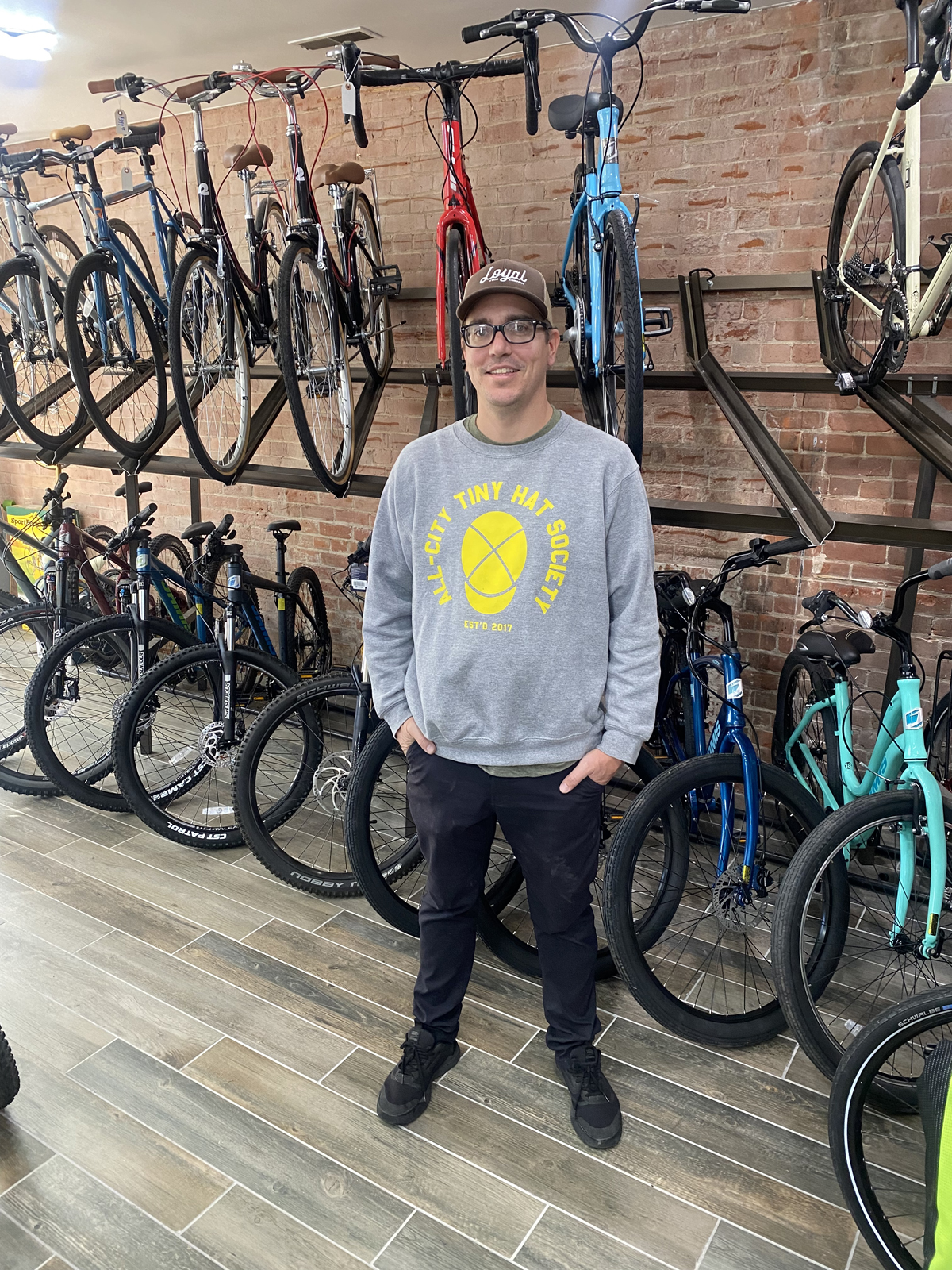
Jeff Hepworth of Loyal Cycle in Farmington, Utah. Photo by Austin Hepworth
Gregg’s first reaction was to contact UPS because his wife has just seen a UPS truck in the neighborhood. The UPS driver dropped by and said it was not a UPS package so there was nothing he could do. Next move Gregg made was an email to Jeff at his bike shop explaining the situation.
Jeff replied in a message to Gregg that he had wondered why there was a delay in receiving the package, but he had been so busy he had forgotten about it. He appreciated Gregg’s offer to deliver it right to the shop and promised to hook him up with something for his efforts.
A few days later, Gregg brought in the missing box and bought some cycling equipment from Jeff. In addition, he ordered some additional items online. No doubt Jeff made it up to Gregg for his honesty and extra effort to get the package to its intended address. There are many ways riders and bicycle shop owners can get along, but this was an example of a both individuals going the extra mile.
Shop information:
Loyal Cycle
15 E State St, Farmington,
UT 84025, United States
801-451-7560 https://loyalcycleco.com