PARK CITY, Utah — The Big Gear Show (BGS), the highly curated, invite-only trade show for Bike, Paddle and Outdoor Gear, will host its second annual event at Deer Valley Resort in Park City, Utah August 2-3, 2022. The show will be two full days, starting Tuesday morning and ending Wednesday evening.
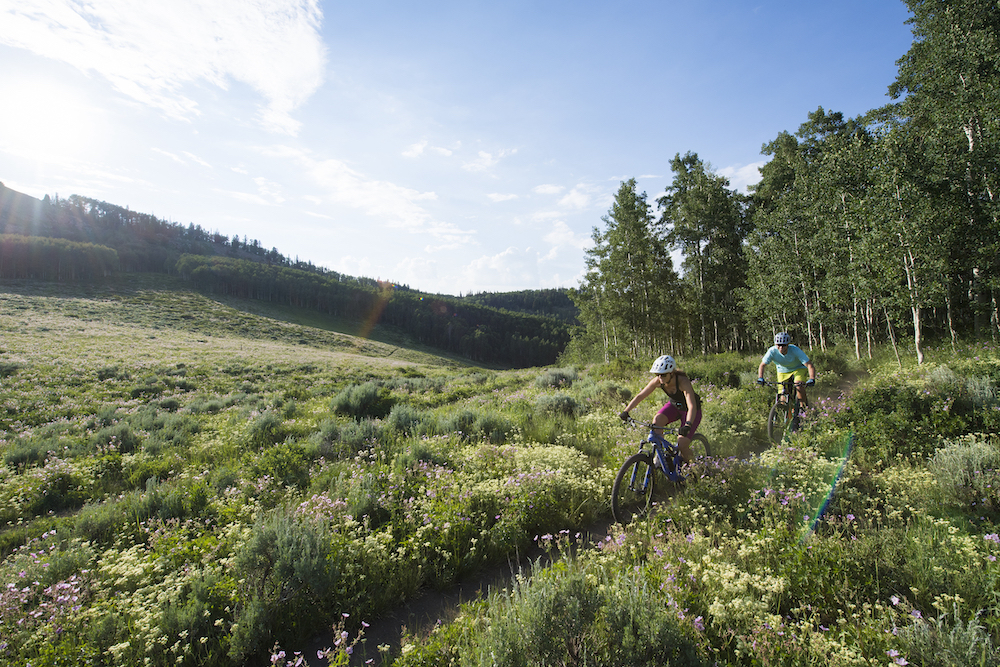
Photo courtesy The Big Gear Show
“After reviewing hundreds of post-show survey results, we’ve found that our multi-segment community wanted us to do another show and they want it to be over the course of two complete days, rather than three shorter days,” said bike show director, Lance Camisasca.
“Many retailers, our primary audience, can’t afford to spend an entire week away from their shops. This tighter and more productive schedule allows them to get more done in less time,” said outdoor show director, Kenji Haroutunian.
The BGS team has seen an increase in inbound inquiries and applications compared to this time last year and as a result, anticipates that retailer attendance and the number of brands participating could likely max out at 500 retailers and 250 brands. The Big Gear Show is a cross-category trade event that was started by specialty paddle retailers, Darren Bush and Sutton Bacon. They started the show to serve the needs of specialty shops in the bike, paddle and outdoor segments. The event is unique in that attendees are highly curated and invite-only. In 2022, BGS will again subsidize travel for top retailers, while carefully vetting exhibitors to ensure that the show includes only the best gear brands. To apply to attend, visit https://www.thebiggearshow.com/apply-to-attend/
Eating more plant-based protein appeals to many health-conscious athletes who want to reduce their intake of saturated fat as well stand up for the environment and animal welfare concerns. As a result, more and more athletes are trending towards a vegetarian diet. Two types of non-meat eaters seem to be emerging:
The traditional vegetarian, who gets protein from nuts, beans, and legumes (and perhaps milk, yogurt, cheese, eggs, and fish, depending on how the athlete defines his or her meatless diet). Veggie burgers are their faux burger.
The vegetarian who chooses ultra-processed almond milk, Beyond Burgers, and Impossible Burgers. Plant based foods, yes, but does ultra-processed really fit the essence of a vegetarian diet?
Just why would athletes want to consume ultra-processed proteins that are right up there with Beefaroni and hot dogs? Likely because they taste good. The Beyond Burger and the Impossible Burger offer a way to enjoy a tasty plant-based burger without feeling denied or deprived of the real thing —often a cherished childhood favorite.
Yes, a veggie burger is another meat alternative, but it just doesn’t have the same mouth-feel or “chew” that food scientists have figured out how to create using a combination of plant proteins. They add coconut oil (with questionable health attributes) to create marbling—and a juicy burger. With the help of beet juice (Beyond Burger) or synthetic heme made with yeast (Impossible Burger), these faux burgers “bleed,” just like the real thing. As for taste and texture, people who don’t like meat have been known to comment it tastes so real it “grosses them out.” For reluctant vegetarians, needless to say, the faux burgers can be far more desirable than garden burgers and bean burgers.
To help make their new creation attractive, Beyond Burger uses a label with appealing buzz words—20 grams of protein, plant-based, soy free, gluten free, no GMOs. Their marketing campaign mentions climate change, conservation, health, and animal welfare. Voila! They have a winning product that is exceeding sales expectations —despite the higher price tag. At the supermarket, you’ll need to pay twice as much for a 4-ounce ultra-processed burger.
Is this burger a step in a nutritionally positive direction in terms of the environment and our health? Regarding environmental concerns, both the Impossible Burger and Beyond Burger report an estimated 89% to 90% smaller carbon foot-print than a burger made from beef. Faux meat production requires less land and water, and creates less methane and manure (sources of pollution). Nutritionally speaking, faux meat is a reasonable match for real beef, but without the bioactive compounds that naturally occur in standard food. Natural foods contain known—and unknown—synergistic compounds, not be replicated in imitation products.
Protein is important to optimize athletic performance. You need it to build, repair, and maintain your body’s muscles. For a 150-lb athlete who trains hard, the recommended dose is about 20 grams of protein every four hours during the day (breakfast, early lunch, late lunch, dinner). A faux burger + roll can do the job, as can a lean beef burger.
As for me, I’ll stick with an occasional all-natural lean beef burger when desired, and choose plant-based foods more often than not. While the Impossible Whopper pleases my palate, I can’t help but wonder if Nature knows best?
Per 4-ounce patty
Hamburger, 85% lean
Beyond Burger
Impossible Burger
Cost
$1.00-1.50
$3.00
$5.59 at Burger King
Calories
260
250
240
Protein (grams)
28 g
20 g (Pea, rice, mung bean)
19 g (soy)
Total fat (grams)
16 g
18 g (Coconut oil, cocoa butter)
14 g (coconut oil)
Saturated (“bad”) fat
6 g
6 g
8 g
Sodium (mg)
75 to 450 mg (if added as a preservative)
390 mg
370 mg
Number ingredients
1 or 2
18
13 + 8 vitamins and minerals
Iron
15% DV
25% DV
25% DV
What makes it bleed?
hemoglobin
Beet juice extract, pomegranate fruit powder; apple extract (turns from red to brown as it cooks)
Soy leghemoglobin (made by inserting soy DNA into yeast, then fermenting it)
Added vitamins and minerals?
All natural (including B-12 and well-absorbed iron)
None added
Yes (with B-12 for vegans)
Where to buy it, if desired
Any grocery store that sells meat
Whole Foods, restaurants, grocery stores
Burger King, White Castle, Coming soon to grocery stores
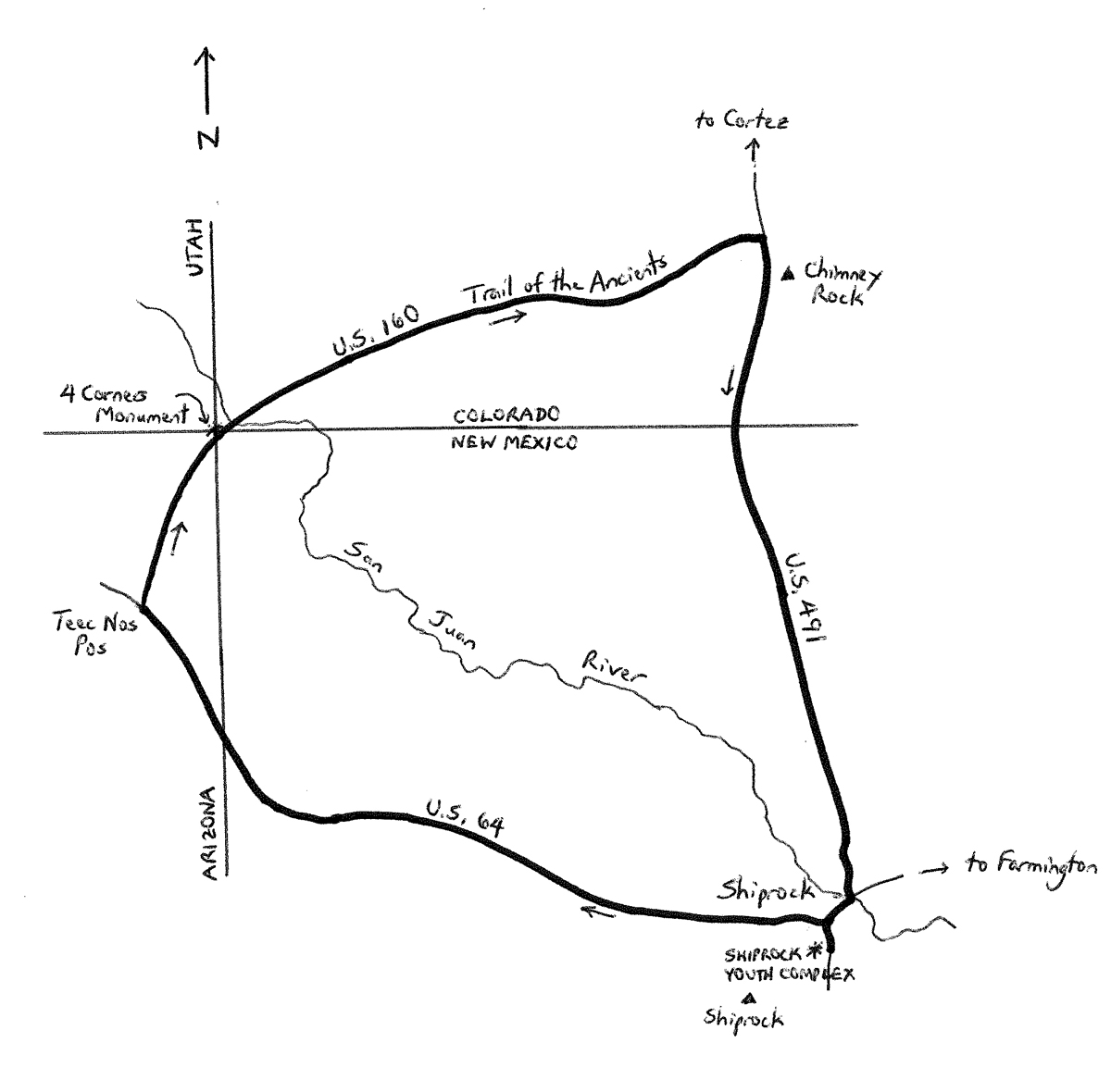
By Wayne Cottrell — In a recent article, we rode “Four Corners Circle,” passing through four States (Utah, Colorado, New Mexico and Arizona), and visiting the Four Corners Monument. In “Shiprock & Four Corners Roll,” we return to this area, starting in Shiprock, New Mexico, visiting three States instead of four (New Mexico, Arizona and Colorado), and once again visiting the Monument. This route, like the other, is almost entirely within the boundaries of the Navajo Nation (except for the portion in Colorado). Shiprock, the staging city for the ride, is 97% Navajo. The route, at 74.6 miles, is slightly shorter than Four Corners Circle’s 77.2 miles. Be prepared for warm temperatures, possibly in the triple digits, during the summer months.
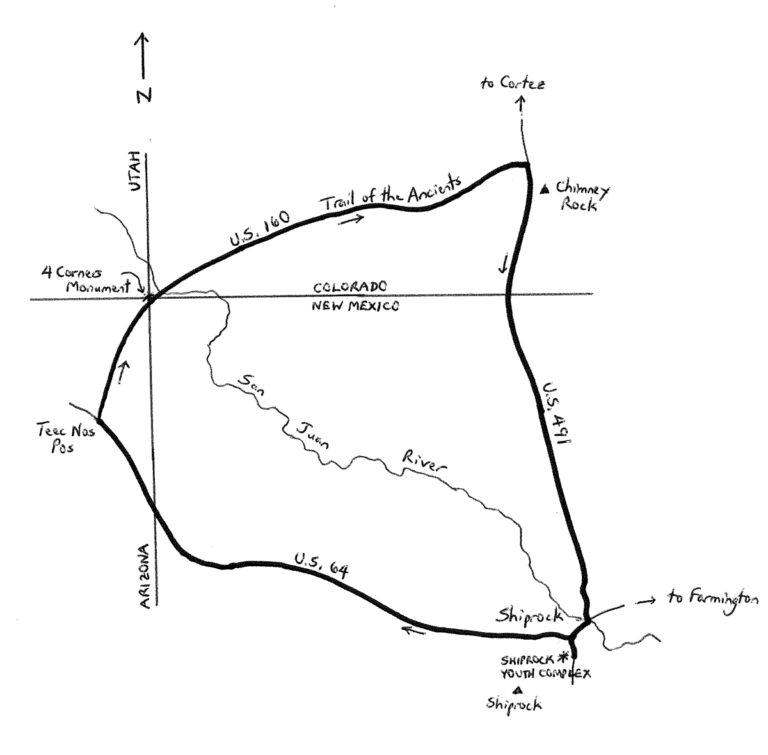
The Shiprock & Four Corners Roll is a 74.6 mile ride in the 4 corners area that starts in Shiprock, New Mexico. Map by Wayne Cottrell
The ride begins in Shiprock, which had a population of 8,295 in 2010, making it the largest settlement within the Navajo Nation. The staging point for the ride is the Shiprock Youth Complex at 4198 U.S. Highway 491, located on the south side of the community. The complex serves as the starting point of the annual Shiprock Marathon, for those of you who also do some running! Exit the complex and turn left, onto U.S. 491. After just under one-half mile, turn left onto U.S. 64 and head west. Leave the comforts of the community behind as you roll past Shiprock High School, on the left, and head out into the open desert. You will notice the faint, reddish tint of the landscape. It is an almost imperceptible climb from Shiprock’s 4,892 feet to Teec Nos Pas’ 5,210 feet, in Arizona, some 26 miles away. Off to the far left, you should be able to see the Shiprock formation, which is a conglomeration of volcanic rock that rises to an altitude of 7,178 feet. The Navajo have named the rock Tsé Bitai, which means “rock with wings,” and consider it be sacred. (Note that, other than isolated formations such as this one, the Four Corners region is comparatively flat). Just before U.S. 64 crosses the Arizona state line, enter the community of Beclabito, which had a population of 314 in 2016. The community had been in the news, most recently, for the local school chef who quit, leaving teachers and bus drivers to prepare the school lunches for the children! Parents were, understandably, outraged. The highway turns northwesterly past Beclabito. Enter Arizona at mile 22.5; enter Teec Nos Pos four miles later.
With a 2010 population of 730, Teec Nos Pos is the last major settlement of the entire ride. Thus, this may be a good place to refresh and stock up for the rest of the ride. Turn right onto U.S. 160 and head northeast. Re-enter New Mexico at mile 31.9. Out here, a visit to Four Corners Monument, which is a Navajo Tribal Park, is worthwhile. As noted previously, this is the only spot in the entire U.S. where four States converge. After one-half mile, turn left onto New Mexico Route 597, which heads directly to the monument. Take some time to visit – described in the “Four Corners Circle” article – and then return to U.S. 160. Turn left and continue heading northeast. Enter Colorado at mile 33.7. Cross the San Juan River, a major tributary of the Colorado River, shortly after entering Colorado. U.S. 160 within Colorado is part of the 480-mile long Trail of the Ancients Scenic Byway. Although there are no specific prehistorical sites along this segment, the reddish hue of the landscape gets deeper as you head east. The canyons and mesas, especially on your right, are a dramatic sight that follow the route for miles.
At mile 51.7, turn right onto U.S. 491 and head south. To your left is Ute Mountain Tribal Park; the park’s most prominent feature, very visible from here, is Chimney Rock. The formation, also referred to as Jackson Butte, has a chimney-like shape – it is also a national monument. Cross the Mancos River, a tributary of the San Juan, a few miles south of Chimney Rock. The majestic Tanner Mesa will be on your left after the river crossing. Enter New Mexico at mile 58.1. After a stretch of open, faint-red desert, a couple of dramatic formations appear on your left and right. The mesa on the left is an outstanding expression of nature’s geometry, as it is almost a perfect trapezoid on top. U.S. 491 reaches the outskirts of Shiprock around mile 72. At mile 73.4, turn right onto U.S. 64, in the heart of town. Highways 64 & 491 actually share this segment. At the next intersection, keep straight to continue heading southward on U.S. 491. From here, it is one-half mile to the Shiprock Youth Complex, which will be on the right. Note that the Shiprock formation is about 13 miles southwest of town.
GPS coordinates of Shiprock Youth Complex: 36.7714oN 108.6991oW
For more rides, see Road Biking Utah (Falcon Guides), written by avid cyclist Wayne Cottrell. Road Biking Utah features descriptions of 40 road bike rides in Utah. The ride lengths range from 14 to 106 miles, and the book’s coverage is statewide: from Wendover to Vernal, and from Bear Lake to St. George to Bluff. Each ride description features information about the suggested start-finish location, length, mileposts, terrain, traffic conditions and, most importantly, sights. The text is rich in detail about each route, including history, folklore, flora, fauna and, of course, scenery.
Salt Lake City invites the public to review final draft of the Street & Intersection Typologies Design Guide
Salt Lake City is seeking more voices from all neighborhoods as part of the final public review period for the Street & Intersection Typologies Design Guide. This opportunity is open now through November 30, 2021.
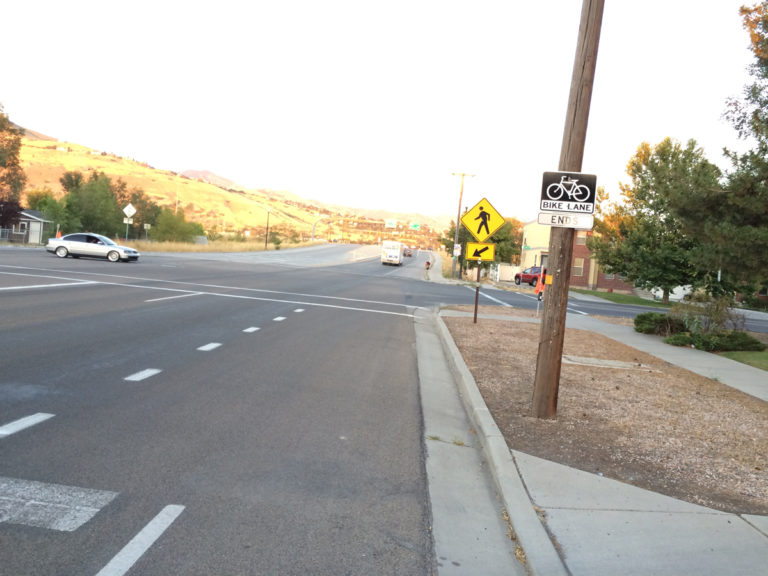
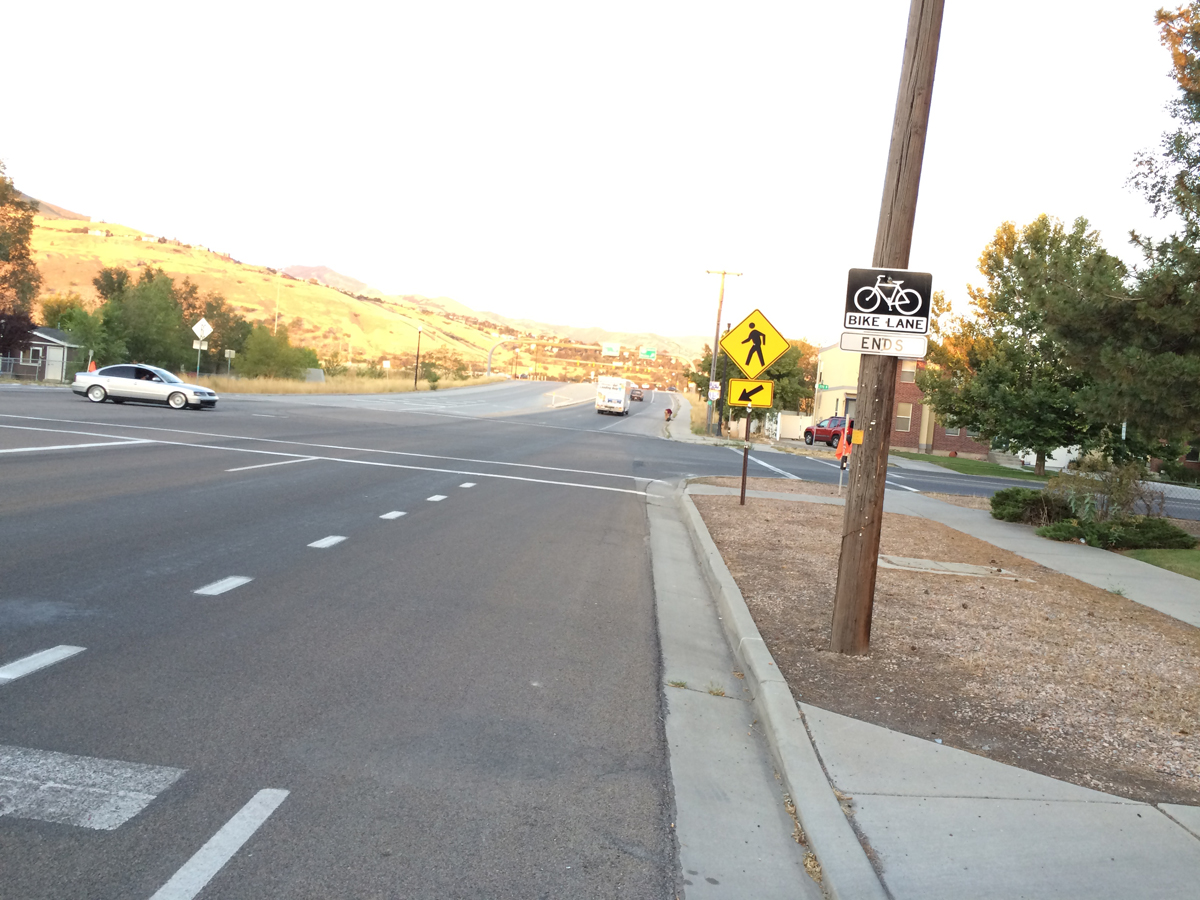
The bike lanes on 600 N have a huge gap between about 600 West and 400 W. Photo by Dave Iltis
The Design Guide refocuses the design of streets on people. Smaller, safer, and slower streets are better for everyone. The new and revised materials for review include: 17 street typology designs, nine intersection typologies, a typology assignment street map, and the Design Guide itself. All materials are available in English and Spanish, at www.slc.gov/transportation/typologies or www.slc.gov/transportation/tipologias.
“Streets are the lifeblood of our neighborhoods, and we need everyone’s voice included in how we design them,” said Tom Millar, the Typologies Design Guide’s project manager with the City’s Transportation Division. “Street design affects all of our behaviors and decisions — how safe we feel; where we choose to or can live; how we get around; how easy it is to get to the doctor; whether our kids walk or bike to school; and our physical, environmental, and economic health. Great streets are designed for everyone, and shaping great streets is fundamental to shaping great livable cities.”
Based on more than 5,000 previous public comments, people in Salt Lake City, regardless of their background, ethnicity, or current transportation habits, have indicated that they want streets that prioritize people by design: safer, more comfortable, more human-scale streets. Now, the project team is seeking final feedback on how best to achieve those goals. In particular, the City is seeking feedback from more residents of the City’s west side.
The new design guidance is not intended to trigger imminent, citywide construction changes. This project simply creates a new set of visual design ideas for planners, engineers, decisionmakers, and the public to consider when and if a street or intersection is set to be redesigned or reconstructed. Additional public input and data collection will continue to form the core of individual project processes.
Following this final public review period, comments will be reviewed and, as appropriate, incorporated into the final first edition of the Street & Intersection Typologies Design Guide. Future editions will be necessary, based on changes in zoning, development patterns, and transportation trends and goals. The Design Guide will be used to assist planners, designers, the public, and their representatives to better imagine, design, adjust, and maintain streets for all people of all ages and all abilities.
Cycling Utah’s Analysis and Comments:
There’s a lot to unpack in this in depth guide. Overall, it is really good. I think that the plan has the potential to transform SLC to a more people friendly city and not a car city, which it is now.
But, we have some reservations on particular items and recommendations for changes.
Lane width and median width: This is perhaps the most disappointing part of the guide. There are very few 10’ lane street typologies – most are 11’ and some are 12’. And medians/center tun lanes that are too wide too. How can you proceed with this guide and the goal of traffic calming and safer streets and maintain 11-12’ lanes as the standard? This is a contradiction in goals. Even the 10’ lane streets could be reduced to 8’ lanes. SLC needs a standard lane width of 10’ not 11 or 12. This adherence to wide lanes will only perpetuate the unsafe walking and cycling conditions in the city, and will cause the plan itself to fail. When separated bike lanes are not possible, this will result in fewer bike lanes because of unneeded width for car lanes. And higher speeds which means that the streets will be less safe for pedestrians, cyclists, and motorists – and less safe for SLC.
Bicycles on Streets: Regarding the types of bikeways in the guide, for transportation cycling, type 1 and type 2 are great. But, for recreational cycling, type one can be very limiting, and sometimes dangerous for cyclists at intersections, driveways etc (no, this is not a vehicular cycling argument in case you were worried about that). Recreational trips are approximately 50% of all trips on bikes, and as such, the needs of higher speed cyclists and average recreational cyclists (15-25 mph), must be considered too. This is problematic on type 1 routes if they are designed or implemented poorly. Additionally, explicitly adding recreational bike streets or routes would be great. Separated bikeways are great – please build more of them. But, on street cycling must be considered too, especially on busier streets.
Parking protected bike lanes seem to be missing from the guide and mostly just Type 1 lanes are mentioned. Parking protected bike lanes are an inexpensive way to jump start better protection for cyclists and should be included. Additionally, type 1 and 2 lanes are not defined in the guide – this would help the average person to make sense of this.
Regarding bus only lanes, please consider some of these as bus/bike lanes where appropriate (such as on N. Temple).
Electric bikes and micromobility: Ebikes will result in higher average speeds for cyclists and this must be taken in to account with the type of bike lanes on each street, and safety for cyclists on street and not just on type 1 protected bike lanes. Also, taking into account the needs of other micromobility such as scooters, mopeds, skateboards, etc. is important.
Traffic Calming: One thing mostly missing from the guide is traffic calming – there should be mention of this, especially with the liveable streets program going on now too. What about traffic diverters? And speed bumps? How for example are you going to get a design speed of 15 mph on 4th Ave without speed bumps and traffic diverters? There’s only one mention of raised crosswalks, and only on local streets. This is not enough.
Intersections: Please include an item that states ‘minimize the use of pedestrian actuation buttons’ and only use them when necessary. They are overused (even on SLC’s trend setting protected intersection) and don’t work well. They encourage people to walk against the light since no one wants to wait for an illogical button actuation. Pedestrian countdown timers are only useful if they match the signal lights. Otherwise, they are useless. Additionally, with the intersection recommendations, please consider whether these will encourage pedestrians to walk against the light, and how will that effect insurance issues if a pedestrian or cyclist is hit by a motorist. Insurance issues are rarely considered in planning, but if one is injured, they are by far the most important thing after personal health.
Also, on bulbouts/curb extensions – please only use these where they will not be a danger to cyclists.
Please consider raised crosswalks on more than just local streets. They need to be on collectors and other streets too to slow traffic.
Please add in Green Waves for cyclists in traffic signal timing.
Climate Change and sustainability: In Utah, transportation is responsible for 31% of our CO2 emissions. The guide needs a section on reduction in impacts to the climate in the Performance Measures section – including a reduction in vehicle miles traveled. This should be a major goal of the Typologies Guide and not just a cursory mention in the LOS section. How does this guide fit in with the goals of SLC Green? Sustainability? Carbon Neutrality?
SLC seems to have a large blindspot when it comes to the impacts of transportation and global warming. We do great with sustainable electricity generation, but transportation is an afterthought.
Complete Streets Ordinance and Following the Guide: Also, I fear that SLC Transportation and Engineering will ignore the Typologies guide, just like they did in ignoring the Complete Streets Ordinance on 100 S. A document like this has the potential to be transformational, but so was the 2010 Complete Streets Ordinance. Yet the Complete Streets Committee threw logic and healthy streets out the window in their illegal vote on this. It’s ironic that the guide has language about improving the ordinance when it was recently disregarded on 100 S. The memorandum on improving the CSO could have succinctly been restated as ‘follow the ordinance’ and would have more effect than any in depth analysis of improvements.
So, if this is going to be used for a rewrite of the Complete Streets Ordinance, what’s to keep the administration now and in the future (as the past 3 have done), from ignoring this too?
UDOT: UDOT is the elephant in the room. To fully implement these ideas on UDOT streets in SLC will require in depth conversation between Mayor Mendenhall and UDOT Director Carlos Braceras. For too long, UDOT streets in SLC have been unsafe, and UDOT exerts undo influence on keeping them that way. Examples include the ridiculously wide center turn lane on 1300 E and the lack of bike lanes on State Street. Mayor Mendenhall needs to initiate these conversations or SLC streets will remain unsafe for years to come.
Parklets and Streetside Dining: These have become much more important since the start of the pandemic but get scant mention in the guide. The guide needs a paragraph on them.
20 MPH Default Speed Limit: Implicit in the guide is the shift towards lower speed limits. Please make this explicit with the recommendation to go to a 20 mph default limit on city streets where not otherwise marked. This is relevant to most street typologies in the guide, and does have a place here.
Guide Organization: The organization of the 17 types needs to be better in the guide. It makes it really hard to digest what is going on with no hierarchy in how the guide is laid out.
How about?
Grand Boulevards
Destination Streets
Urban Streets
Industrial Streets
Neighborhood Streets
While I’m aware that the categories blend together, for someone who isn’t super familiar with the guide, it needs to be broken down into to 5 major street types with subtypes for each one so that it’s more readable.
By Lou Melini — Robert Brigance Jr. was first introduced to the readers of Cycling Utah in 2014 as a bike commuter shortly before his retirement. In 2015 he traveled along the Adventure Cycling Association’s (ACA) Western Express bike trail. We will now see how his high school sweetheart and wife of 44 years figured in his bike travel plans in 2016.
Cycling Utah: Robert, bring me up to date. Tell me about the tour across the U.S.!
Robert Brigance: Initially I gave some thought to riding across the U.S. solo, but despite my wife’s support of my goal, I gave it up due to safety issues. It was going to be my first long distance tour. My wife, Linda, was not thrilled about my going solo. So we agreed, I would hook up with other riders.
I was turning 66 in February 2015. I looked on the Adventure Cycling Association website for another rider or two close to my age to join me. I was not interested in going on a group tour. My goal was a TransAmerica tour starting in May with the completion of the ride in August. I found two guys who were starting in San Francisco, CA and ending in Yorktown, VA.
My desire to ride cross-country was to celebrate life—great health, a wonderful wife and two sons, married with families. As I continued to work toward this goal, I began to entertain thoughts of riding for a reason or a cause, something besides celebrating my retirement. My wife reminded me that we had a need within our own extended family. So I decided to raise funds for Alpha-1 Antitrypsin Deficiency. I shared my plans and goal with friends and family, raising an interim $900.00. I intend to keep my goal of $1,500.00 alive going forward by completing my cross-country tour.
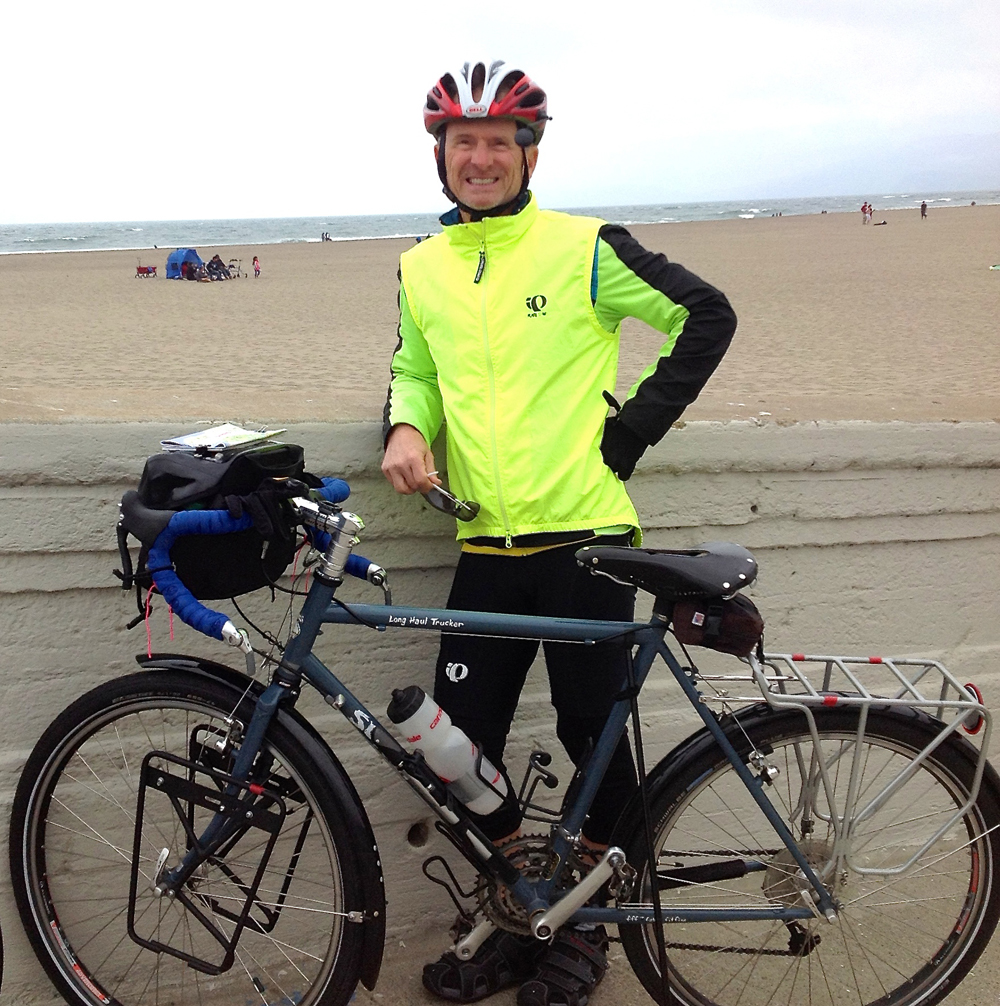
Robert Brigance at Ocean Beach, San Francisco, California at the start of the Western Express route.
C.U.: You rode with 2 other people that you did not know! How did that affect your ride?
R.B: We left San Francisco, May 25 but I separated from them in Cimarron, CO. Unfortunately I had not been getting along with one of my fellow riders. It was disappointing to say the least. For anyone considering riding with strangers make your goals and expectations very clear at the outset. My biggest unmet need was not camping more and having to stay on a mileage schedule. We had one rider (who I will call Joe) who would just do whatever the majority decided, so he was easy. Joe and I agreed that we needed to camp more as we all had camping gear. However my problem rider (who I will call Sam) wanted a shower, a bed and three square meals a day. Sam’s idea of camping was only when we could not get a room somewhere. He was a credit card tour cyclist who packed a bit more gear for camping. I just failed to ask, how many days a week do you need a diner and motel?
I wanted to ride with an experienced long-distance cyclist and Sam met this need. We spent weeks planning our tour with online video chats and emails. Most of our disagreements had to do with communication early on while riding. One of my top concerns that I did not share online was, “If you can’t see the rider behind you, pull over and wait to be sure he was OK.” During our planning time prior to our tour, Sam would constantly comment, “You guys will have to hold me back.” More often than not, Sam would disappear, leaving Joe and me miles behind. It did nothing for camaraderie. He and I had two major shouting incidents, which is NOT my nature, dealing with road safety and riding pace. Obviously, Sam and I had not gotten off to a good start. When I decided to go solo, a palpable, huge weight came off my shoulders, like a bird being released from a cage. I did not see our mismatch coming to a head. Safety in numbers is important, but it was not working for me.
I rode solo from Cimarron for 5 days and 4 nights, arriving in Pueblo, Colorado on July 3rd. I found that as at the miles increased, I became more confident about completing my TransAmerica tour solo. The freedom to be responsible for myself was wonderful! However, I decided to end my TransAm ride in Pueblo after a budget review, among other concerns. Tracking my daily expenses, I was staying at way too many motels with my fellow riders that would cause me to exceed my $3500 budget for the trip. My budget was set on campgrounds, WarmShowers, some camping in the wild, and maybe a motel once a week. Additional factors were boredom of riding everyday, thinking about Linda at home by herself, and the money I could save and use later. I wondered if I could talk her into joining me in Pueblo later in the summer to continue with my cross-country quest. Given my riding experience to Pueblo, I felt that if she and I took it easy and did not push it, she could ride 30 to 50 miles a day. We of course decided not to embrace this idea until I got back home to discuss it further.
I had communicated with Linda during the ride by phone, depending on cell connection about every two days from the start. Linda was positive about my cycling with the other two fellows. However, in retrospect she had some concerns about how the three of us would get along, but chose not to interfere with my plans, hoping the three of us would work out any issues on the ride.
C.U.: I read much of your Crazyguyonabike.com journal. Great pictures and overall it sounded like a good trip other than what you wrote above.
R.B.: It was a very good tour all things considered. I had neither saddle or bike issues, no sickness, no accidents, nor thefts. However, I lost my winter riding gloves on the ferry from San Fran to Vallejo when I carelessly placed them on my saddle to secure my bike to the ferry railing, just as we picked up speed. The wind blew them into the water, so I pulled out my back-up pair!
My abbreviated tour did accomplish one important milestone, that being the completion of the most challenging part of my planned cross-country tour. The Western Express (WE) route is extremely difficult and crosses some of the most barren parts of the U.S. If I remember correctly, our elevation gain from San Francisco to Pueblo was 66,000 ft. plus or minus.
We had really good weather for the initial California portion of the tour. We also lucked out crossing Nevada. There were only two cool, rainy days with thunderstorms and strong headwinds. One day, I had to throw all of my foul weather gear on and lie in the sagebrush to stay warm, while waiting out a mid-day thunderstorm! In southern Utah, the weather was hot (90+), so keeping tabs on hydration and electrolytes was critical.
C.U.: After finishing the ride in Pueblo, you did a short tour with your wife in late September. It sounds like you started putting the touring bug in Linda!
R.B.: After my return home, Linda and I chose a late September multi-day tour. She would have July and August to prepare and train. My wife shared with me that as much as it was nice to have me home, she was learning to be a more independent cyclist by finding new, local roads to ride from our home in Springville. That experience really helped strengthen her self-esteem, determination, experience and strength!
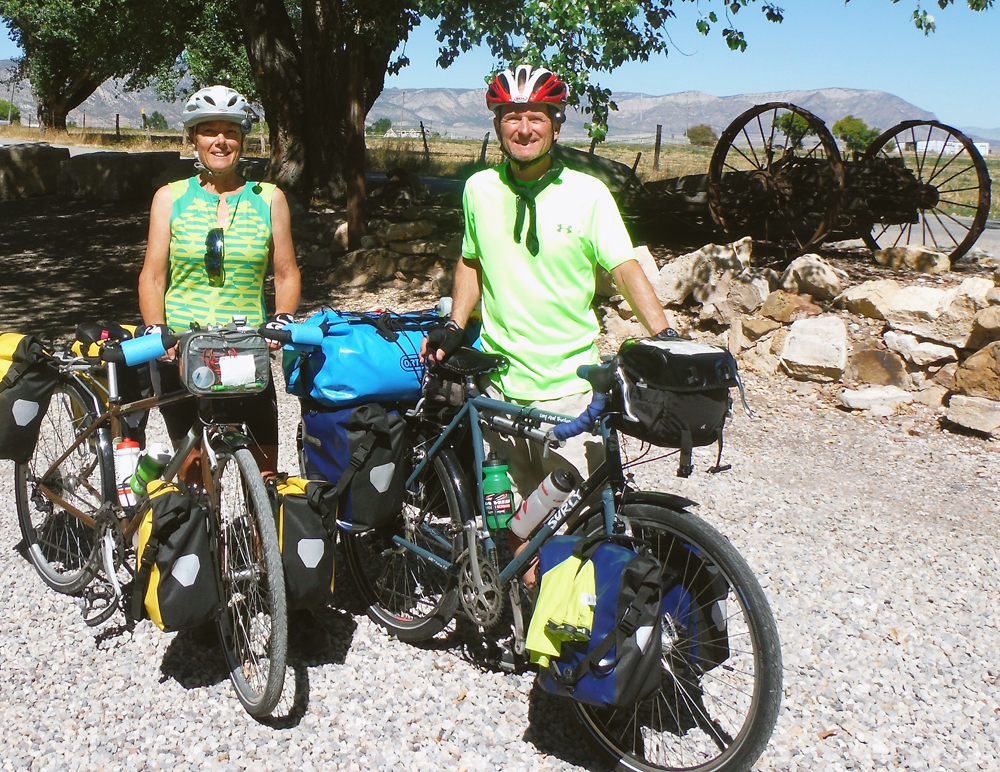
Robert and Linda in Manti, Utah on their 190 mile tour of central Utah.
She had tried to find other women her age to ride with but finding 60+ year old women to ride with was a challenge, and riding with a local riding ‘club’ proved difficult. So she ventured out alone and like me, rather enjoys the solitude of riding. Our neighbors knew where she was riding in case of an emergency.
We spent most of July and August just day riding, averaging 30 – 50 miles about three days a week. After a month of our riding together, I told her it was time to launch our multi-day tour. Linda was pretty well convinced, yet a bit hesitant. She was stressing about long grades and steep kickers that could be part of our planned route. Fortunately, we had the chance to ride up Hobble Creek Canyon from home and camp for a night with friends from the Utah County Presbyterian churches. We rode fully loaded minus food, 14 miles round-trip from our home. My wife enjoyed the challenge and the experience since she knew the roads and what to expect from traffic, road shoulders and grades.
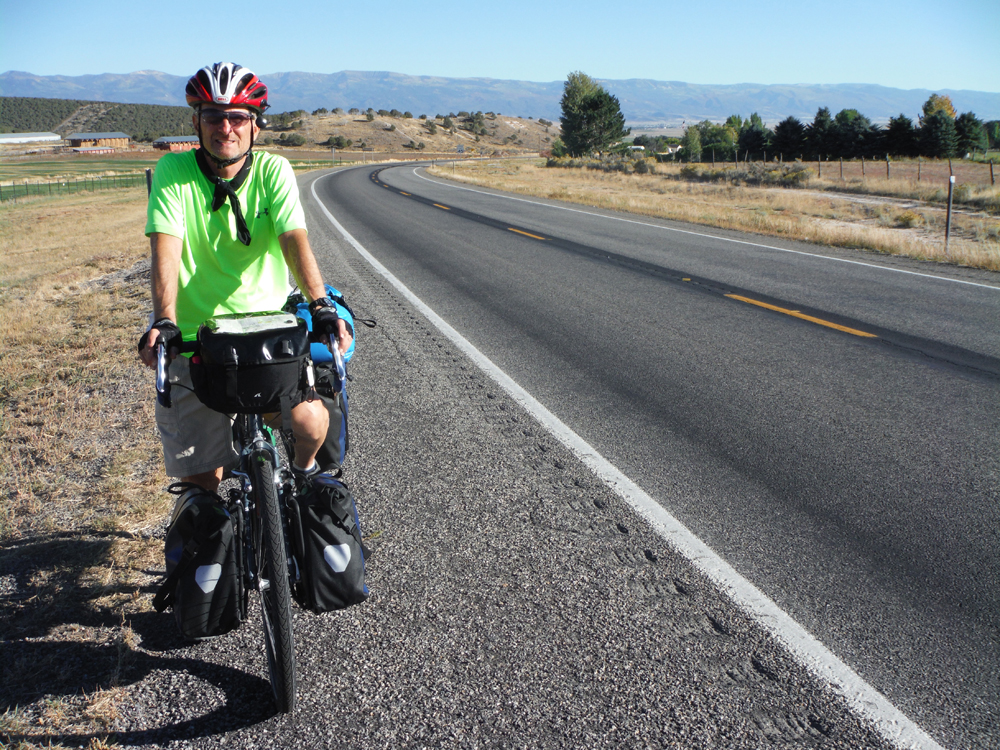
Robert Brigance on Highway 132, Fountain Green to Nephi Utah.
With that very positive initial experience, our 4-day, 3-night tour was epic for Linda. One decision that we made was to ride the route ahead of time on my motorcycle. She needed to see what she was in for and it sealed the deal! She was very proud of touring 190 miles round-trip, with wonderful weather, minimal headwinds and comfortable nights. A major achievement was mastering the grinding ascent on Route 132 from Fountain Green to Nephi at 6,387 feet. Afterwards, I told her she was a bona fide bicycle-touring chick. She laughed and said, “Okay!”
The key for Linda was frequent breaks after two to three hours riding. We both realized the15 minute breaks to walk around, look at scenery, historic sites, and enjoy a snack were a must. If we were passing through a town, we always looked for an ice cream opportunity! Back on the road, we averaged 30 to 50 miles a day with an average of 6 hours on the road with breaks, etc.
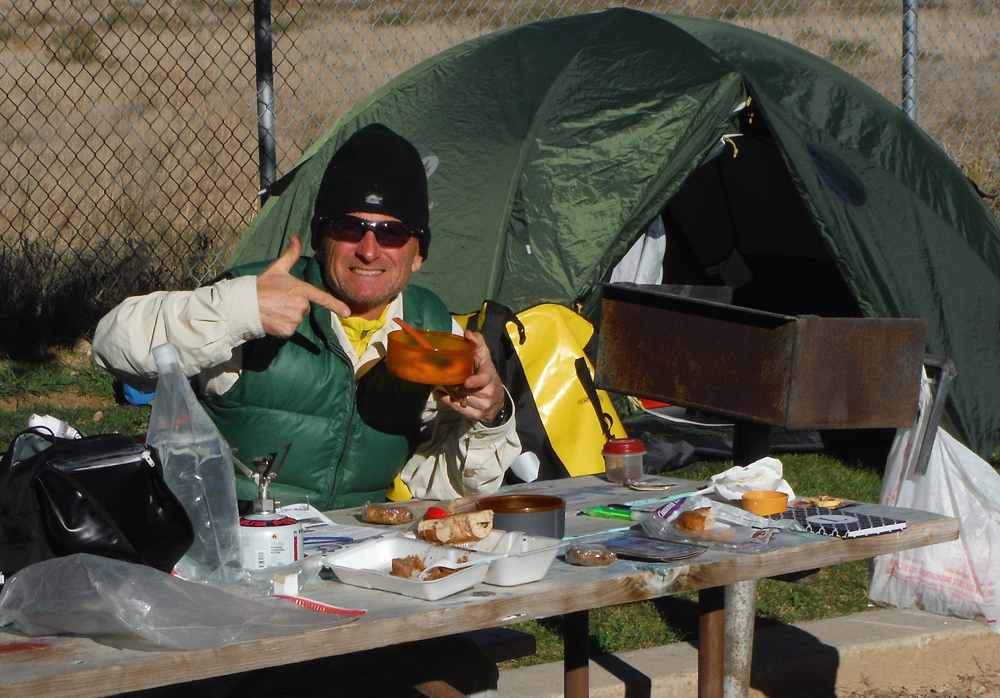
Robert Brigance enjoying breakfast in Manti, Utah on Highway 89
We camped in Levan City Park for free. It has very nice bathrooms and the park was empty with kids back in school. We stayed at the Temple Hills Resort in Manti on Day 2 and in Nephi at Hi-Country RV Park located at the south end of town for Day 3. With only 5 tent sites, it was not the best campground with poorly kept bathrooms and no fire pits for tent camping. It was noisy being very close to the highway and no one was in the office day or evening. There was no phone number to contact anyone for information; the only person to ask anything of was the young college student cleaning the bathrooms.
C.U.: You are contemplating completing your cross-country trip with your wife in 2016. Is she excited about that? What are your thoughts about this?
R.B.: We are giving a cross-country ride some very serious thought and we are cautiously optimistic it will be a GO. We are looking at a mid-April to May 30 timeframe. Linda is looking forward to the challenge, but still concerned about long grades and steep kickers. Life can be much more simple on the road, but there are tradeoffs. I have shared my experiences with her regarding WarmShowers, stealth camping and RV campgrounds from my summer tour experience. She knows what to expect. We both want to get this behind us and hopefully marvel in the achievement, while we still have what it takes. Even if we only make it to Memphis, we will have the last third of the U.S. to look forward to in 2017!
Linda rides with confidence on a Novara Safari 29er that she finds very comfortable. I did a test ride a 36v battery pack for $800.00 at JigaWatt Cycles in Provo. Linda is looking forward to giving it a try! It has a range of 20-30 miles with a recharge time of 6-8 hours. It’s a front wheel drive hub, the battery pack attaches to the down tube. It comes with a handlebar throttle attachment. She anticipates using this when she is just beat and would have to dismount to keep going. We still need to make our final choice of power packs.
We will start in Pueblo where I left off and ride towards Kansas and Missouri on the ACA TransAmerica route. At Centerville, MO, we plan to go off-route to Fulton, MS and pick up the Underground Railroad route to Mobile, AL. From Mobile we’ll follow the ACA Southern Tier to St. Augustine, FL, but go off-route to Jacksonville, FL our final destination. We will visit with my sister for a week or so, ship our bikes and gear, and fly home.
C.U.: What are your thoughts or perhaps advice regarding bike touring as an older couple?
R.B.: As a married couple cooperation is something we know well, and will need to practice daily. We enjoy the outdoors and are low-maintenance people. Self-supported touring requires grit, sacrifice and a proven endurance. From my recent Western Express tour experiences, we know that the road will dictate how our days will go. But make no mistake it will take a lot of effort, patience and perseverance from both of us. We are both early birds and like to get an early start.
We plan to take one day at time, enjoy the moment and practice tolerance with our differences and celebrate our individual strengths. Completing a long tour is like going to work each day, except you don’t care what day it is. You’re hopefully enjoying yourself, but it is work. You ride a good 6 hours, stop for meals, to rest, sight-see, make camp, talk with locals and maintain your bikes. You hit the hay, wake up/eat, plan the daily route, break camp, pack/load panniers, complete bike safety checks and head out. And you get to do this every day for 6 weeks or more. We have also taken a Basic First Aid class. And we have our affairs in order for the unexpected that is always out there with an adventure of this magnitude.
Special accommodations due to our age are minimal. We honor each other’s requests and needs. We make sure we stretch prior to riding, during and after our daily rides. Depending on the day, we take frequent rest stops every 20-25 miles. I know that late afternoons is when Linda will tire and her patience becomes short, so we plan accordingly. We might reduce daily mileage if the route is strenuous—headwinds, rolling hills, hot weather and/or high humidity. We try to keep our rest breaks short (15 min. max) and always have ample fluids, drinking every 20-30 minutes. Extra creature comforts are: ultra-light folding camp chairs, Therma-rest (full body) mattress, 3 season down bags and foam pads (two 4” lengths of swimming pool noodles cut lengthwise to fit over our handle bars) for really rough roads. We use a Marmot Limelight 3 person tent with vestibules on both sides for extra space and comfort. We have not made any modifications to our bikes other than the battery pack for Linda’s Novara.
Spring 2016 Update
Robert and Linda have resumed the TransAmerica tour, starting in Pueblo, Colorado on their way to Jacksonville, Florida.
A short update from Robert on this section of the tour is below:
We have started our tour from Pueblo, CO to Jacksonville, FL
We have started Part 2 our my cross-country tour and the “we” includes my wife, Linda.
April 28 was our start date from Pueblo, CO after good friends drove us down to stay with Dave and Susan, our hosts. We have been on our tour now for almost five weeks. Our final destination is Jacksonville. FL, sometime mid-to-late June where we will visit my sister.
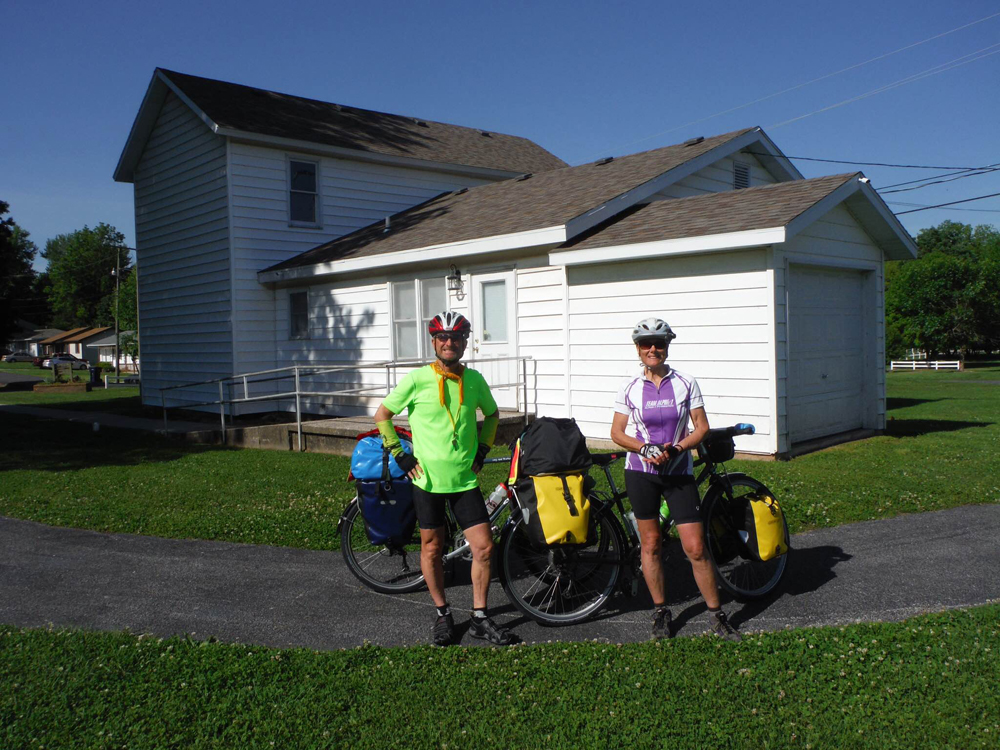
Robert and Linda Brigance at a cyclist-only hostel in Ash Grove, Missouri on their 2016 tour.
As of June 1, we are half way. The estimate was a total of 2,056 miles. We have logged 1,084 miles through CO, KS, MO, AR, TN and MS. We are now in Olive Branch, MS and will travel through AL and FL in the next two to three weeks via the ACA Underground Railroad and Southern Tier map system. We have been off the Transamerica maps since Bendavis,MO and will be until Fulton, MS. We expect to ride longer daily distances now that we have passed through the more difficult terrain of the Ozarks.
Our tour has been quite an experience both physically and mentally. My wife has her tunes to keep the boredom to a minimum. Eat, sleep and ride can be monotonous for some of us.
It has been hard at times and being the stronger rider, I allow Linda to ride at her pace and comfort level. We stress having fun, being honest about our feelings and thankful we are in shape to take this tour on. We take frequent, short breakers and are both trying to maintain weight.
We have camped a lot at city parks and asking farmers for a spot on the back 40. Motels when needed and rest days every 4-5 days have worked out well. Warmshowers hosts have been the best when available and when they work with our schedule. We have enjoyed not adhering to a set mileage each day and have stopped many a day just because we could. We are self-supported with food, tent and water, especially across the more rural states where convenience stores are sparse.
We have made time to visit family members grave sites in MO and MS, which were special for us both. Everywhere we go, strangers reachout to us and are quite friendly and willing to help as they can. Alpha-1 Antitrypsin Deficiency is part of our “reason to ride,” and we are creating awareness we those we along the way.
Inaugural year to include six iconic, renowned events including Garmin UNBOUND Gravel and Leadville Trail 100 as the Company aims to grow fandom and camaraderie around cycling in the United States
CHANHASSEN, Minn., Nov. 22, 2021 — Life Time, today announced the launch of the Life Time Grand Prix for elite cyclists. The new series is comprised of six highly regarded races, including both new and established events like Big Sugar Gravel and the Leadville Trail 100 MTB, and brings a healthy competition amongst elite cyclists. Men and women from a range of disciplines will compete for a $250,000 prize purse at the end of the series.
Photo courtesy: Life Time
The 2022 Life Time Grand Prix Series Lineup includes:
April 7-10: marathon mountain bike race at the Sea Otter Classic in Monterey, Calif.
June 4: 200-mile UNBOUND Gravel in Emporia, Kan.
July 9: 70-mile Crusher in the Tushar in Beaver, Utah
August 13: Leadville Trail 100 MTB in Leadville, Colo.
September 17: 40-mile Chequamegon MTB in Cable, Wis.
October 22: 100-mile Big Sugar Gravel in Bentonville, Ark.
The Grand Prix will prioritize gender parity in the series, with 20 men and 20 women selected to compete. The series will culminate with a $250,000 prize purse to be split evenly between men and women. Prizes will be awarded up to tenth place, based on a point system. At the conclusion of the Life Time Grand Prix, riders’ five best finishes from the six possible events will be tallied, giving the competitors a choice to skip an event or ride all six and take the points from their best performances. The riders with the most points at the end of the series will be the winners.
By Charles Pekow — It helps to paint bike lanes. When motorists see the paint, they’ll give cyclists more room, says what purports to be the largest study of the issue. Australian researchers put cameras and distance sensors on 162 cyclists in two cities, recording 46,769 incidents where motorists passed them. Even when controlling for the width of the road, the drivers gave more room when they saw the paint.
Tiffany Arcaris is a force of nature. I met her through friends who had emphasized that she loved running. She had a down-to-earth nature, and I could tell that she took pride in being and having fun, and seeking to do things that were out of the ordinary with likeminded friends.
Tiffany and friend Stefanie Shumaker adventuring the Great Western Trail — lots of schwacking and laughs.
A week or so after that evening out with friends, she asked me if I wanted to go trail running. I had officially ended my elite amateur bike racing “career” about 18 months earlier, and was enjoying catching up on other interests and hobbies, including things that allowed me to be lazily sedentary for a change. “I think you’d kick my butt,” I said, hoping she’d let it go until I could secretly get in some much overdo training. But she kindly would have none of it, “I’ll go easy on you.”
She stopped a few times along the first (to me) hilly mile, but then we both figured it would be in everyone’s best interest if she charged on, flying up to The Living Room lookout point above Red Butte Gardens and the University of Utah. And seriously, I’ve run with her a few times now on hilly and mountainous trails, and she just powers up ridiculously steep trail, making me feel like I’m standing still.
After racing at a high amateur level for 15 years, I had enjoyed not exercising for several months. Tiffany changed all that; now I was the out-of-shape friend desperately needing someone to push me.
She inspired me to whip myself back into shape, because after all, for much of my life I have talked the talk, but it was time to walk the walk again. About a month later, I ran my longest trail run to that point: 11 super-windy and grueling miles in spectacular Moab. It was more than I was ready for, but I did it and it felt great. I was back on track, feeling good and having fun.
Often it takes a special person and friend in our lives to set us on, or back on, a course that can greatly benefit us. In my case, I was quickly impressed by Tiffany’s resoluteness in doing everything she can as well as she can. She loves her job and enjoys doing it well. She values earning a living that affords her, her son and her mom an enjoyable lifestyle, enabling her to integrate into her life an intense passion for trail running and strength training in the gym. That’s good stuff; that’s something we can all work to emulate in our lives, regardless our chosen sport(s).
With the above as an intro and a little background, I’ll let “tiffsmooth” (that’s her Instagram handle) share some thoughts on her running experience:
* *
For most of my life, I never classified myself as a runner. I’ve always been athletic and involved in sports, but didn’t really get into running until my late twenties. A good friend asked me to do a charity race for a great cause, so how could I say no; I’m a sucker for being there for friends. That was my first 5k, in ice and snow…springtime in Utah. It was tough. I was shocked how hard three miles seemed. I’m more fit than that, I thought, and was bothered when others passed me. Yeah, I’m slightly competitive…
So, the next week I was asked to do a 10k, of course I said yes, and amazingly improved my time by 40 seconds per mile. (That race was also in the rain.) I immediately realized that running isn’t so much a physical test, but more a test of mental strength.
There are many instances in which I dislike portions of my run, or struggle to mentally get into it. But I’m always satisfied when I achieve my goal, and am proud that I’ve pushed through the moments of mental weakness. Truly, self-doubt is the biggest obstacle in anything you do; you’d be amazed by the power of your thoughts.
My running has transformed over the years from just doing certain races for the satisfaction of knowing I’ve completed the distance, to having fun doing relays and enjoying the amazing team experience. During one relay I discovered my love for trails, and it was all downhill or uphill from there!
Last year was my year of trail races. Not having many running friends up to doing trails, I did the majority of those races alone. Each race was incredibly intimidating and involved summiting a peak, which was very new to me. I enjoy the challenge and have gained great respect for trail runners; they are some of the most athletic people I’ve met.
Sure, there are a lot of social aspects to it, which I love and adore. The people I’ve met and have grown to love through the joint adoration of running truly amazes me. My ULAS (Utah Lady Adventure Seekers) are the most genuine and supportive group of friends, always up to do a Sunday run, or take road trips to odd and beautiful places just to play on a new trail.
The running community in Salt Lake is so awesome. Recently, I was fortunate to connect with a group I’ve deemed as my ICP (Insane Clown Posse). These badasses have gotten me back into waking up before dawn for not only a run, but for wild adventures in our beautiful backyard — the Wasatch Mountains.
Climbing ridiculous vertical before most are out of bed is oddly gratifying. Seeing the sun rise and laughing with people that just “get life,” well that’s why I now run. We challenge each other, we support one another, we tease, and we take awesome photos. It’s fulfilling more than words can say.
The experiences are always phenomenal and challenging, the views always breathtaking, and above all it makes me appreciate all that I am capable of when I put my mind and energy into something.
November 23, 2021 – Park City is seeking input on biking and walking in Park City. The survey is open for just a few more days to residents and non-residents who bike or walk in the mountain town.
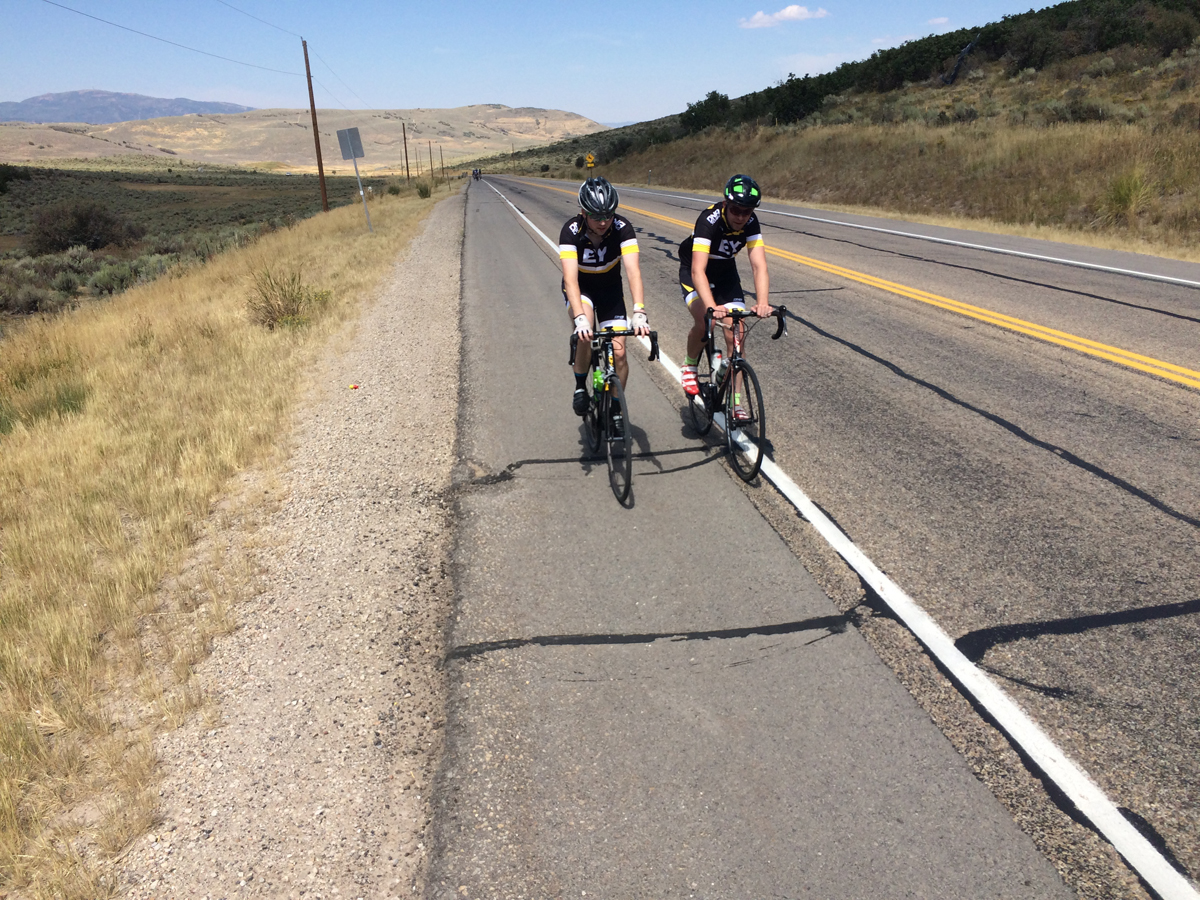
2 riders on the roads of Park City. Photo by Dave Iltis
From their webpage:
“Park City Bicycle and Pedestrian Plan
What
Fifteen years after Park City’s Walkable and Bikeable Neighborhoods study and after nearly complete implementation of that plan, Park City Municipal is creating a new plan that will outline walking and biking infrastructure investments for the next fifteen years.
Why
Park City Municipal is investing in this plan because of our goal to be a car-optional community. We want to provide safe and convenient walking and biking infrastructure so that people of all ages and all abilities can get around Park City on foot or bike.
When
The planning process launched in September 2021 and will take about ten months. The plan will be complete and ready for adoption by the Council in late summer 2022.
The League of American Bicyclists Releases “Reconnecting with the New Majority” Report on Diversity and Equity in Bicycling
In 2009, the League of American Bicyclists and the Alliance for Biking and Walking published “Bicycling Means Business”, a culmination of research studying the economic benefits of bicycle infrastructure. Today, the League is releasing an updated report, “Bicycling Benefits Business”, which reviews new research in the nearly 10 years that have passed since the original, and it remains true: communities that support bicycling as a means of transportation and recreation have outsized economic benefits by attracting residents and tourists alike.
“Bicycling Benefits Business” highlights the positive impact bicycling has on small businesses, neighborhoods, and regional and local economies. When governments and businesses invest in bicycling infrastructure and the bicycle industry, the economic benefits are felt at every level.
“Time and time again we see a significant link between people who bike and strong, resilient economies,” said Bill Nesper, executive director of the League of American Bicyclists. “When local communities invest in making bicycling safer and more accessible to more people, the return on investment is clear for individuals and society at large from cost-savings on public health, to job creation, to small businesses’ growth, and more. We hope that by continuing to highlight the real economic benefits experienced in places across the U.S., we will inspire more communities and businesses to plan, design, and build destinations that empower more Americans to choose bicycling as a means of transportation and recreation.”
Top findings in the report:
When people have access to safe bicycle facilities, they often choose to ride a bicycle.
People who ride bicycles purchase bicycles, supplies, and bike share memberships. This puts people in bicycle shops and bicycle industry-related businesses to work.
People who ride bicycles shop at other types of stores, too. Bike-accessible businesses, like Bicycle Friendly Businesses, experience economic benefits by catering to these customers.
People who ride bicycles on vacation buy food, spend on travel, and pay for lodging. This brings millions of tourist dollars to cities and towns across the country.
“Bicycling Benefits Business” also further highlights the mutually beneficial relationship between bicyclists and the economic impact of bicycling to society. In addition to their direct investments in communities through consumption, bicyclists are also engaged in a healthy lifestyle and thereby saving money on health care costs. By saving on transportation and car ownership costs as well, people who ride bikes can in turn spend more money at local businesses — but to maximize economic spending, bicycle infrastructure must be present.
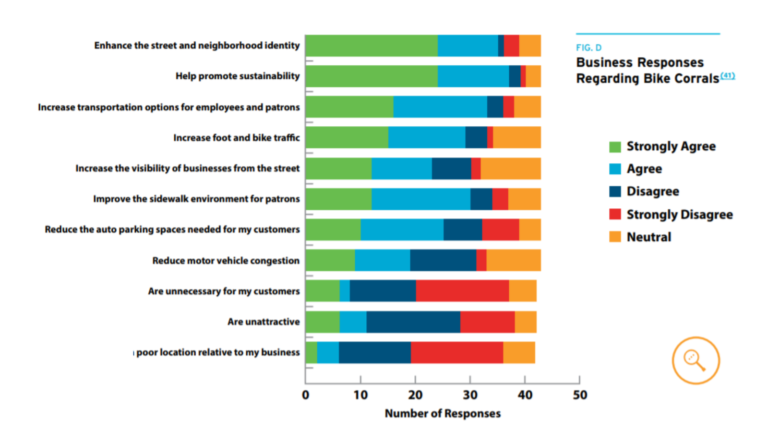
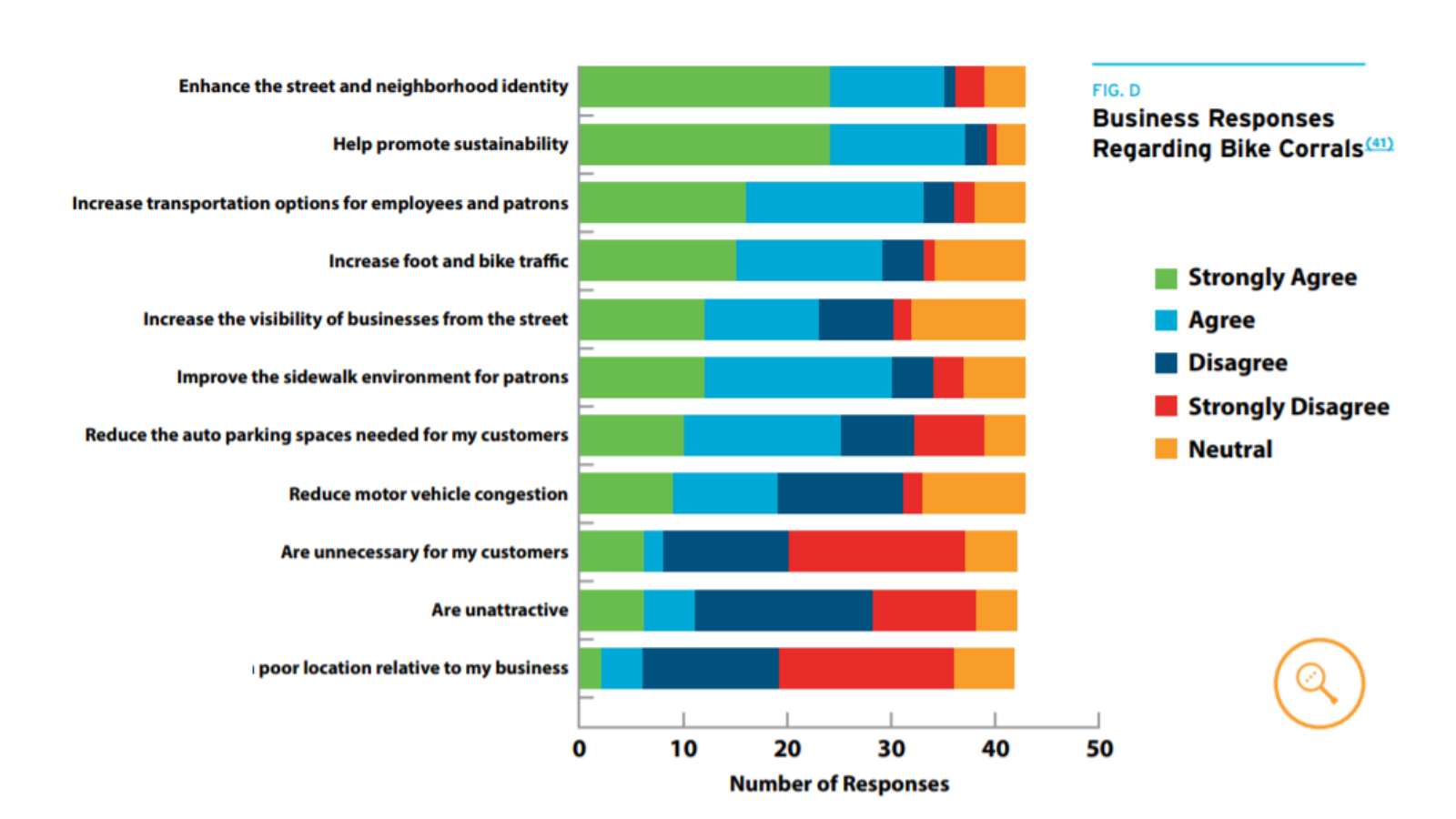
On infrastructure, the report demonstrates acceptable and unacceptable uses of bike parking and acknowledges widespread support for on-street corrals among the business community. Spending less on expensive car parking and instead investing in space-efficient, low-cost bicycle parking, like bike corrals, leads to cost-savings for bicyclists, employers, developers and cities.
“Not only is secure and ample bike parking a core element of bicycle infrastructure and something the League considers in deciding its Bicycle Friendly Business awards, but it’s essential to businesses that want to attract more people on bikes,” said Bicycle Friendly America director Amelia Neptune. “Bicyclists like to go places where they feel welcome and confident that their bicycle will be safe while they work, shop, dine, or run an errand.”
As more research develops on economic, social and environmental benefits of bicycling, we will continue to update this report, our benchmarking report at data.bikeleague.org, and the League’s main website at . To learn more about the League’s Bicycle Friendly Business program, please visit bikeleague.org/business.
By Tom Jow — So … it’s early in the mountain bike season and feeling a little rusty? Went to bike camp and need a place to practice? Trails not in rideable shape due to the snowline hitting lower elevations? Visit the bike park. Here in the Salt Lake area, we are lucky to have several bike parks, dirt jumps and pump tracks. What are these bike parks about? Mostly they are about having fun, but we can practice skills there too. Things we can practice are jumps, berms and technical riding. Each park has its own style. Follow along for a tour of my favorite features of our local parks.
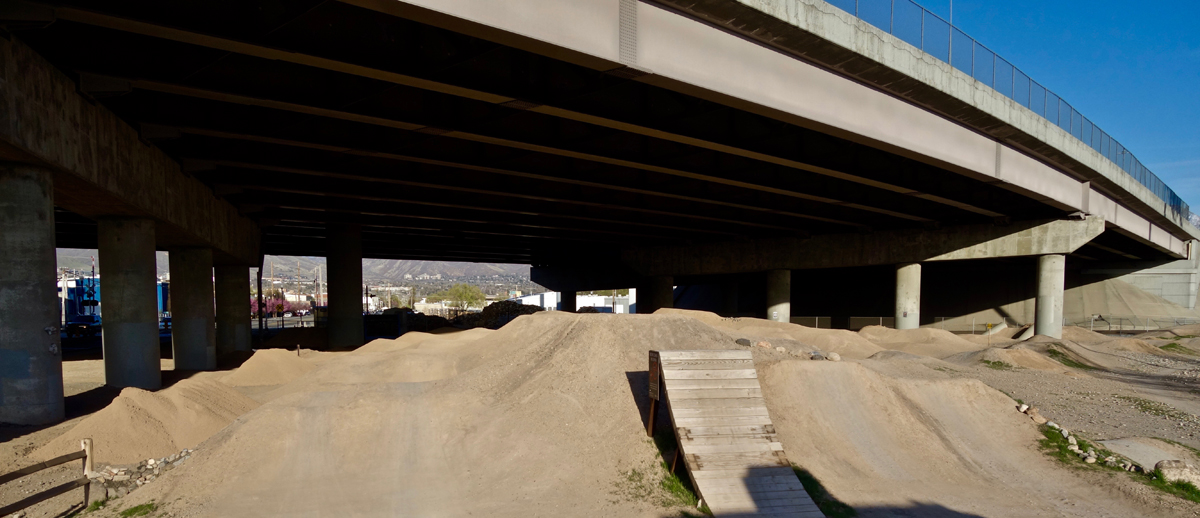
One of the earliest dirt jump areas in Salt Lake is the I-Street bike park. Of the parks I visit, I-Street is the most advanced. Many of the young kids there, even some ten-year-olds, ride bigger lines than me. There are some intermediate lines I can ride, but one feature I find really useful is a three-step progression of drops. Riding drops is a key skill for the rocky trails of Utah. At I-street, they built the drop lines with wood ramps leading to sloped landings. The smallest drop, at about 18 inches, will feel pretty intimidating to a beginner. The layout of the drops makes it easy to practice one height until it’s down pat. Then step up to the next level, and then the next. One drawback to I-Street (for beginning jumpers) is that most of the jumps have gaps.
Dirt jumps at 9-Line Bike Park. Beginners to the left, experts in the middle and intermediates on the right. Photo by Tom Jow
For a lower key jump experience, I head to the 9-Line dirt jumps. At the 9-Line you will find riders of all ages; toddlers on striders, kids on BMX, teenagers, as well as moms and dads. With five jump lines, there is something for everyone. The jumps are much less intimidating at 9-Line. The reason they are less scary is “tabletop” jumps. A tabletop jump has a take off ramp, a landing ramp, and a flat “table” in the middle. The connectedness of the two ramps removes a large amount of the anxiety of jumping. Jumping is a skill that requires much practice to be confident. Especially for jumps with gaps. Even on short jumps, take out the tabletop and it is very intimidating.
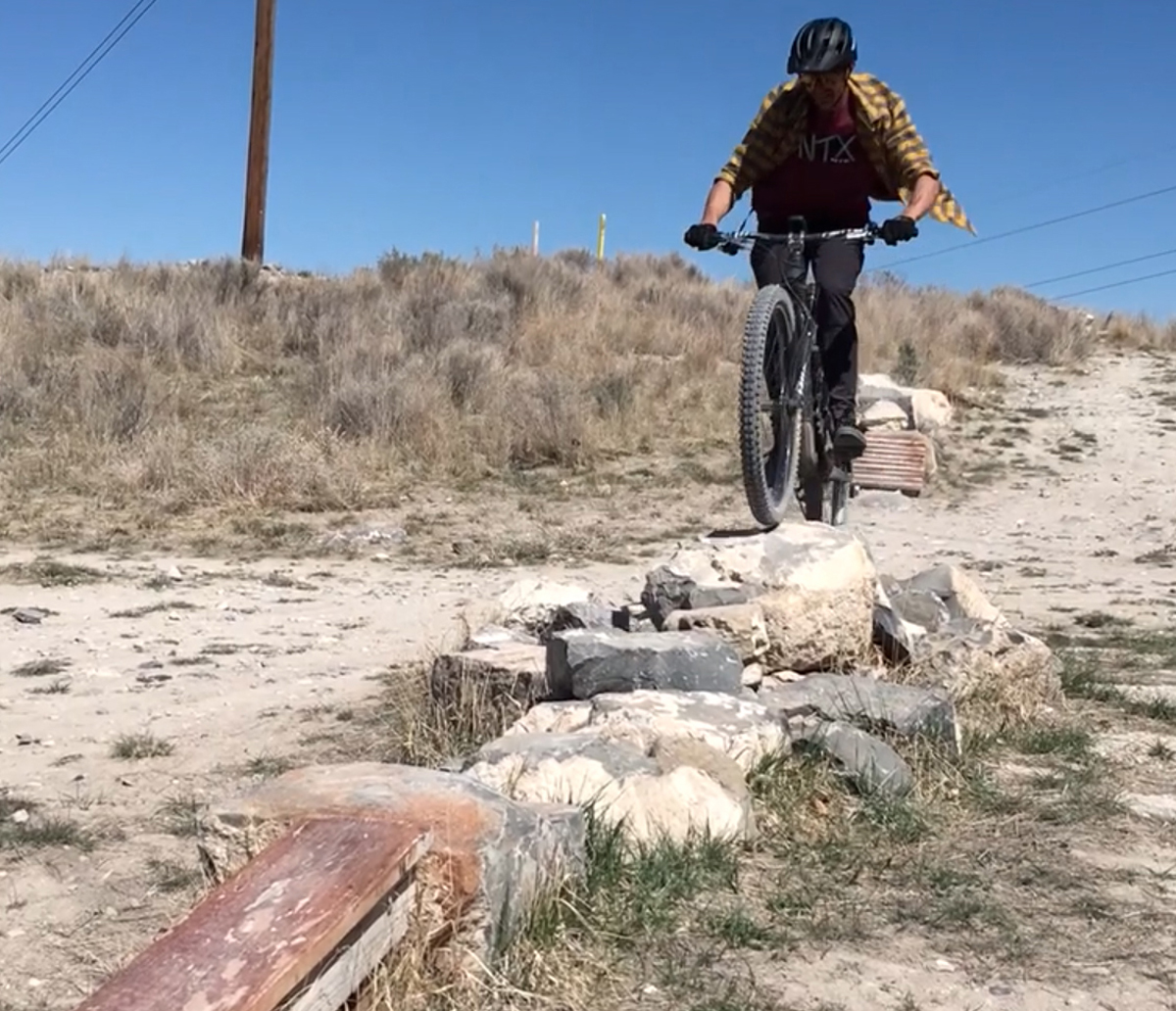
Derrick rides the skinny rocks at Eagle Mountain. Photo by Tom Jow
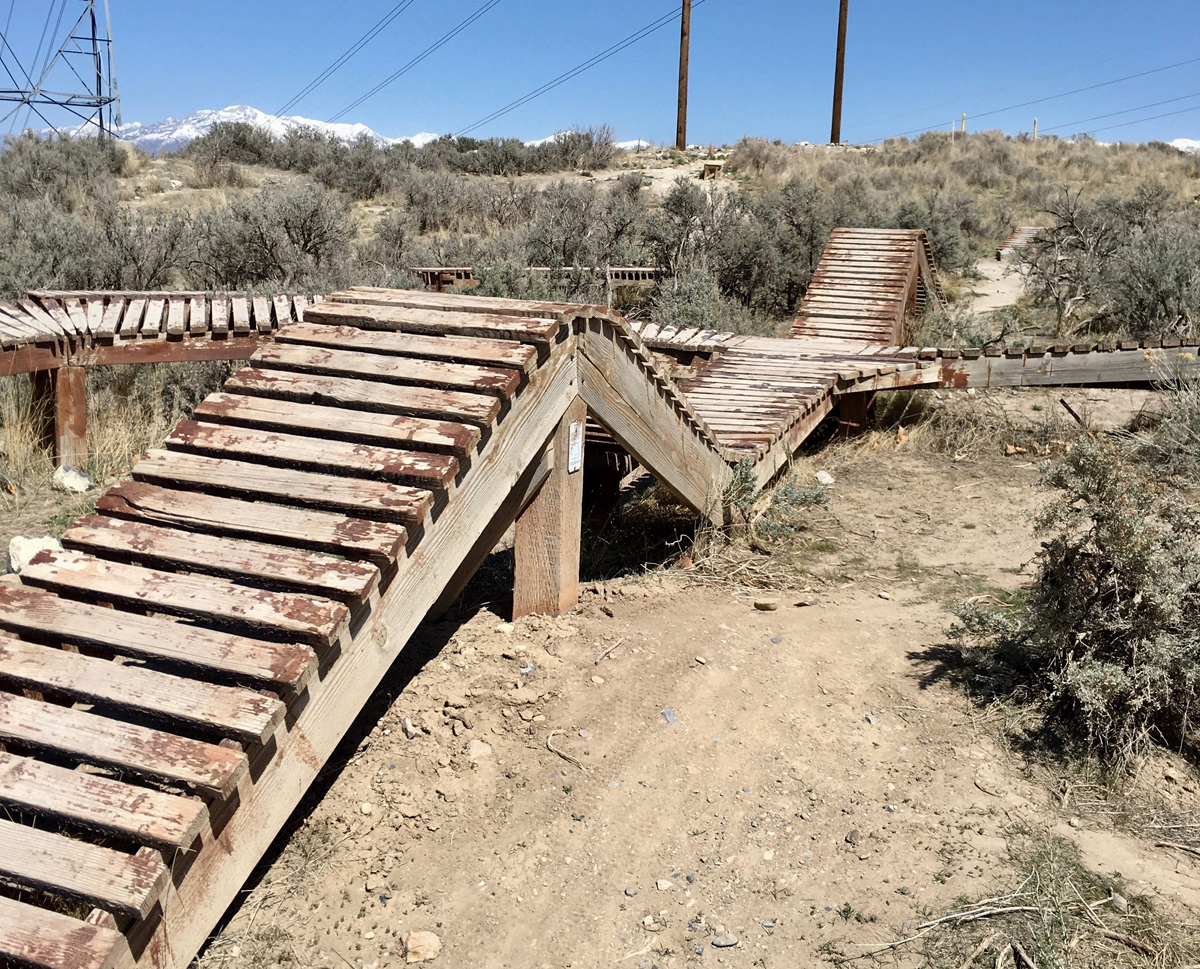
A more natural intimidating feature of Utah trails are rocks. Sometimes a couple of big rocks, sometimes a small field of boulders. Occasionally there is a narrow line of rocks or a wooden bridge built up between surfaces. Mastering rough rocks and bridges requires being able to focus on the chosen line and little else. I recently found that Eagle Mountain Bike Park has an extensive skills area which includes two narrow, technical rock lines and wooden bridges in a variety of widths and elevation. The wood may seem wide, but add a little elevation and some angle and it will get your nerves jumpy.
Trailside Park in Park City has a variety of terrain including a nice area with low bridges of various widths. To practice these skills at speed, the builders at Trailside developed a short flow trail with technical rocks and bridges. What is really nice about Trailside is the very short climb required to do laps on the flow trails.
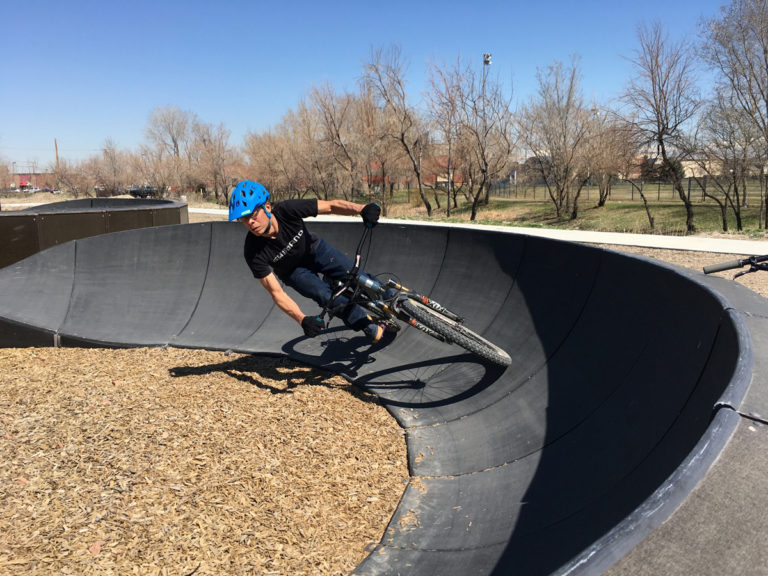
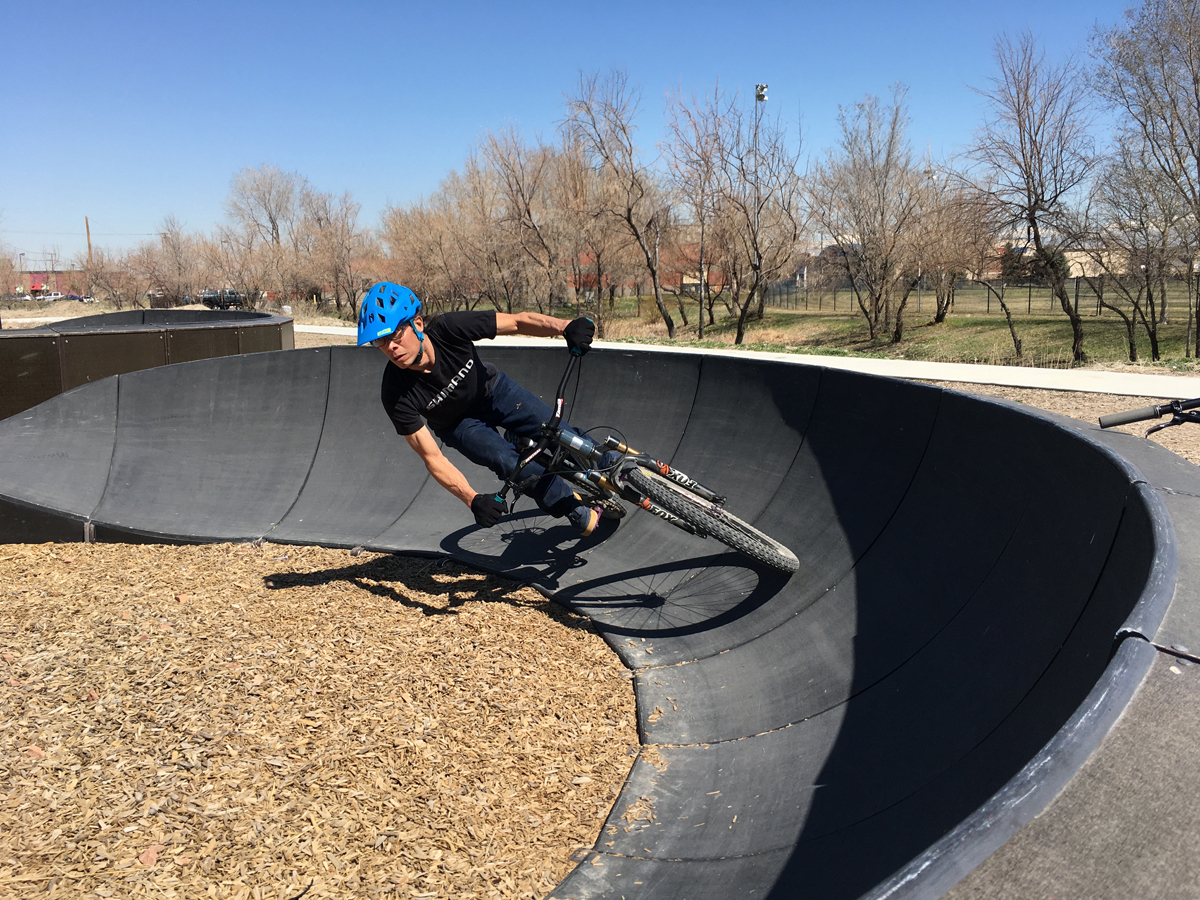
The author railing the berms at the West Valley pump track. Photo by Erik Reid
Flow trails, like at Trailside Park are a fantastic way to practice riding jumps and berms. Berms are banked turns designed to help the rider keep momentum. In addition to the tech trail mentioned earlier, Trailside also has beginner, intermediate and advanced flow lines. What is really nice here is a short climb back up to facilitate multiple laps. Berms are also a key feature of “pump” tracks. A pump track is like a flow trail, with rollers and berms, except flat. The idea behind pump tracks is to learn to “pump” the bike up and down the rollers to keep, or even increase your momentum around the track. My favorite pump track right now is located at Centennial Park in West Valley. Constructed of wood, the track has a rubberized surface for traction. The rubberized surface provides one hundred percent, confidence inspiring traction. Zipping around the berms on this track is incredibly fun.
This bridge at Eagle Mountain may be wide, but adding elevation makes it more challenging. Photo by Tom Jow
These are by no means the only bike parks in Utah, or across the country for that matter. They can be found in the city centers like the 9-Line, or adjacent to trails like Trailside and Eagle Mountain. The parks accommodate all riders from beginner to expert, and from toddlers to Moms and Dads. A wide variety of features can be found including jumps and berms. By by far the best feature though is fun. And perhaps some practice disguised as fun.
“The Last Best Ride Will Evolve Into a 501(c)(3) Non-Profit in its Second Year With 2022 Event Registration Opening on Veterans Day, Thursday, November 11th”
The Last Best Ride, Montana’s premier gravel event, is back for its second edition in 2022, with weekend activities starting on Friday, August 19th and culminating with race day on Sunday August 21st.
Race organizer Jess Cerra, a Whitefish local and resident professional cyclist, looks to build on what she considers a wildly successful debut in 2021, which garnered over 550 registrants from all over the United States and Canada who flocked to Flathead County to take part in the event.
Riders taking in the beautiful Montana scenery at the 2021 Last Best Ride. Photo by Sean Malone, courtesy kjesdcx
“I wanted this event to be something novel and unique that would benefit our community,” remarks Cerra, when asked what her goals were when she created the event. “Not only did I want to use The Last Best Ride to showcase the spectacular riding and natural beauty in and around Whitefish to the burgeoning gravel cycling scene in the U.S. and beyond, but I also wanted to make sure that the event’s existence within the community worked in some way to better the lives of local residents.”
The latter part of Cerra’s aforementioned goal of the event derives largely from her own positive experience with community-based scholarships that afforded her the opportunity to pursue post-secondary education. According to Cerra, “I have always wanted to give back to the community that gave so much to me,” and consequently designed the event largely as a vehicle to fundraise for The Barbara Mansfield Champion Scholar Award, a program created in collaboration with local educators that would direct a portion of proceeds from race registration fees, as well as any supplemental donations, to local, financially-qualified high school women seeking post-secondary education.
Named after Cerra’s high school college counselor, who Cerra cites as one of the driving forces that helped her get into college, the Scholar Award Program raised over $20,000 in 2021 awarded to four local women. For 2022 and beyond, Cerra is working to retroactively qualify The Last Best Ride as a 501(c)(3) non-profit organization to further grow the scope of the Scholar Award Program.
“By designing the event around the Scholar Award Program, I’ve created an event such that just signing up means registrants play a part in bettering the lives of the locals of the community they visit, regardless of whether they want to donate more or not” says Cerra.
In addition, the Cerra hopes conversion to a 501(c)(3) will bolster the mentorship programs of The Last Best Ride. In 2021, Cerra, through the contributions of sponsors, was able to supply equipment, such as bikes, helmets, tools, and shoes, to 4 local women taking part in the event and coach them as they prepared. For Cerra, the ability to engage with young female athletes is invaluable: “I hope that I can expand on the mentorship capabilities that the event was able to offer in 2021,” says Cerra. “The benefits of sports and bikes brought so much positivity into my life, and I want to share that same positivity with the next generation of young women in the valley.
Registration for the 2022 event formally opens on Veterans Day, Thursday, November 11th at 8am PST. If you are a Veteran or active-duty military, you may email your credential to [email protected] for a registration discount code.
By Charles Pekow — Focus on ecological benefits if you want to promote bikeshare. At least it worked in Taiwan. Researchers at three Taiwanese universities reported that people prone to ride concern themselves with sustainability in transportation, at least in Taipei City, Taiwan’s capital. “Our findings suggest authorities may promote bike sharing by enhancing user perceptions of the system’s green value, increase trust in this form of green transportation, and thus foster higher levels of loyalty resulting in continued use of shared bicycles,” the authors report.
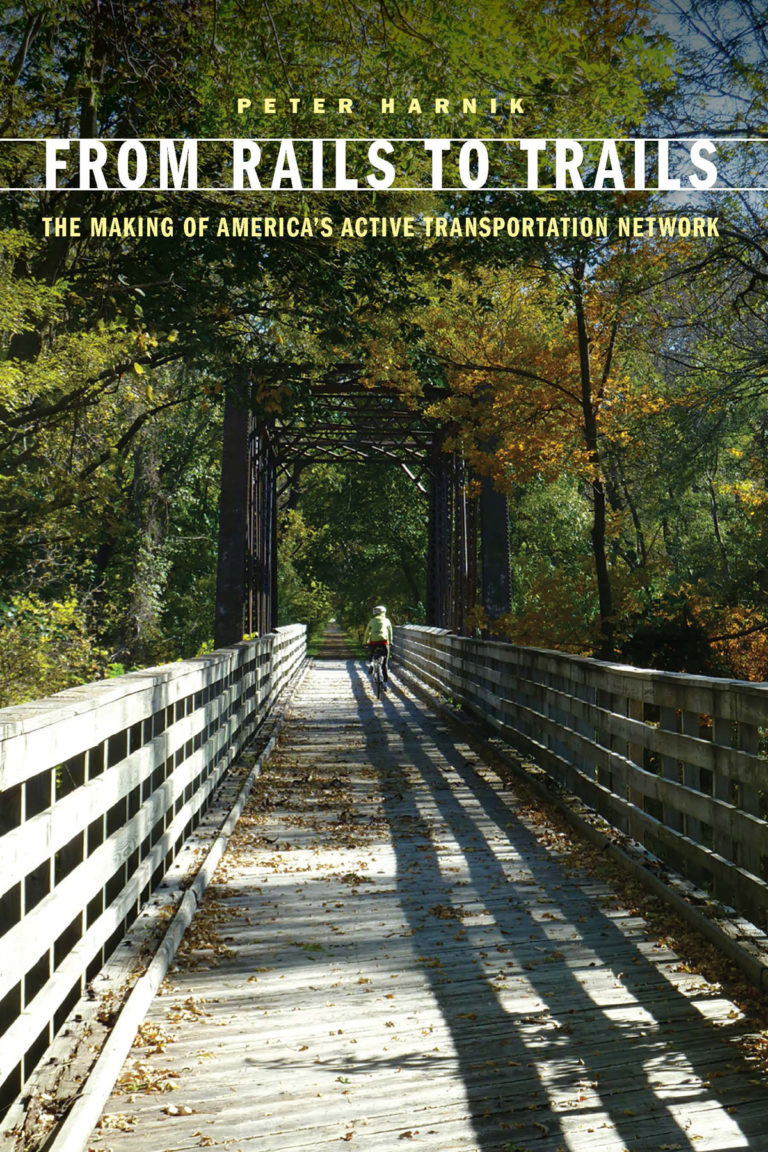
By Charles Pekow — Everything you’ll need to know – and then some– about the rail-to-trail movement can be found in a new tome. And the author, Peter Harnik, should know more about the history than anyone. He, as much as anybody, has sparked and led the cause since its beginning as a national movement and we can thank him for the many converted railroad lines we now enjoy riding – and the many more sure to come.
Harnik cofounded the Rails-to-Trails Conservancy back in 1986, the organization that initially focused exclusively on converting abandoned railroads into recreational paths. (Note: I’ve known Harnik for decades and collaborated with him on some projects years ago.)
In From Rails to Trails: The Making of America’s Active Transportation Network, Harnik tells the story of the movement, describing the legislative battles in Washington to get federal funding, and many state and local fights and the coping with non-believers and reluctant railroads. The book is not difficult to read.
It is, however, East Coast oriented as Harnik lives on the East Coast and describes many firsthand experiences. The unfortunate part for Mountain West folks is that it’s the one region in the country that gets very little play and Harnik discusses projects closer to the nation’s capital, with examples from Pennsylvania, Ohio, New York and so on, but not much out west.
But he gives a good overview, starting with the history of railroads and how these lines that connect towns by train unwittingly became ideal corridors for new means of transit between the communities. They tended to avoid steep hills and heavy traffic crossings whenever possible and include overpasses and bridges that work just as well for bicyclists and hikers since they became available with the 20th Century decline of rail transit, caused by everything from the rise of the auto to the Great Depression.
Harnik then takes us on a history of the bicycle and how it became practical and popular, and its ups (during World War II when auto production declined) and downs (post-war when the automobile caught on). We get a detailed history of the decline of the railroad, an essential part of the story but the reader gets tired of example after example.
Once we get the needed background, Harnik gives us a history of the rail-trail, starting with the prototypes before the concept caught on; such as the Illinois Prairie Path, Stony Valley Trail in Pennsylvania and the short Cathedral Aisle in South Carolina dating as far back as 1939. Then Harnik takes on a chronology of all the legislative battles it took to get crucial federal support. We read about some unsung heroes, including congressional staff member Tom Allison who worked behind the scenes to get legislation passed. (Then again, we never hear about congressional staffers who toil anonymously in favor of their bosses who need the publicity, but that’s another matter.)
The first major federal funding for the movement came in the form of $25 million included in bigger railroad legislation, a common legislative tactic. As the book says, “there had been the 1968 National Trails System Act, but in comparison to canals, railroads, and roadways, trails had seemed laughingly unqualified for funding.”
As you’d expect, many Republicans opposed funding trails. The book sometimes gets bogged down in minutia about legislation, though.
But we learn the valuable lesson from the book on how much goes into the making of a rail-trail, even when the abandoned corridor lies there for the taking. But we learn of the victorious struggles, such as against the utility in Virginia initially reluctant to acquiesce to the Washington & Old Dominion Trail in Northern Virginia, now a well-used trail impossible to object to. (The electric company eventually saw the value.) A Baltimore County executive tried (but failed) to stop the Torrey Brown Rail Trail which runs from Cockeysville north of Baltimore to the Pennsylvania state line. Of course, the movement lost many battles, including the proposed Trail of Two Cities between Omaha and Lincoln Nebraska when other real estate interests outbid trail advocates.
And of course, many battles had to be fought in court and a chapter tells us of the significant legal decisions. Landowners wanted to expand their farms or backyards or didn’t want people running and riding past their backyard. Some cases were won; some lost. But the movement won a major victory with a ruling that a corridor used for “public travel” didn’t just mean trains. But other courts ruled that railroads could choose how to dispose of their real estate.
The book can’t be considered a “how-to”, but it does explain how Harnik’s conservancy (of which I am a charter member) built a political base. He didn’t claim to start the movement but the conservancy nationalized it, starting by looking to see what was already going on around the nation. It found trail conversion needed a triangle: “a formal plan of action, a public agency agreeing to own the facility, and an advocacy organization pushing for approval.” A chapter explains how to build a base – bicyclists alone probably won’t do it though they often spearhead the drive; add other trail users, conservationists, etc. Doing so may require compromise – cyclists and equestrians have to learn to share.
There are all sorts of ways to turn skeptics around and deal with unique situations. The book will get you thinking about these matters. When a Wisconsin farmer complained about having to move cattle across the trail, the commission in charge agreed to include a special gate – and now watching the cows cross has become an attraction for trail users. Sometimes a philanthropist will buy the real estate if no government has the cash on hand. Different government agencies use different rules. Some concern themselves mainly with transportation; others with recreation. Tunnels and bridges are needed to get from here to there but present their own set of problems with structure, safety, vandalism, etc.
From Rails to Trails takes you in historical order through the necessary preconditions and prehistory of the rail-to-trail movement, the railroad, the bicycle, etc. The book shows how the movement formed and all entities you have to fight: legislatures, courts, communities, governments, and all the places trails can be built: urban, suburbs, rural, tunnel, etc.
Most trails replaced railroad tracks with pavement, suitable for all bikes, but some trails remain gravel. By and large, trails are flat and connect communities; they’re not built for mountain biking.
If you want to start or expand a trail in your community (or between yours and another), you need to read this book. If you’re already advocating for trails, you can pick up plenty of hints on what will work. Perhaps a subsequent book on bike advocacy can include examples from the Mountain West. And anyone who reads the book will have to come away with some appreciation for how the trails they ride got there.
SALT LAKE CITY, Utah (November 18, 2021) — Park City, Utah native and two-time U23 national champion Tanner Putt has been named team director for CS Velo Racing Team, a Philadelphia-based domestic elite and club cycling team.
Peak State Fit cycling coach Tanner Putt named team director for Philadelphia’s CS Velo Racing TEam. Photo courtesy Peak State Fit.
The former United Healthcare standout and Hincapie veteran has been in some of the most respected programs in USA cycling. Putt has an intimate knowledge of what it takes to build a successful race team as he steps into his new role as DS for the Team.
“I’m extremely excited to join CS Velo Racing as the director for the 2022 season. Over the past few years, CS Velo has proven to be one of the top domestic elite teams in the country and I’m eager to help them build on that success and grow the program in the future,” says Putt. “We will have a full schedule in the U.S. including Pro Nationals, Tour of the Gila, Redlands, Joe Martin, and many major criteriums. Since ending my own professional racing career, I have aspired to direct a team and get back in the action. I’m thrilled to see that dream finally become a reality.”
CS (which stands for Combined Strength) Velo is built on the premise that people are stronger as a group than as individuals, both on the bike and in life. Many of the team members have experienced the untimely loss of friends and loved ones after battling illnesses like cancer. The team aims to underscore that a group is stronger, and with that combined strength, people can succeed in life and on the bike. Teammates are invited to add the name of a loved one in whose honor they ride to the team jersey each year, and together carry these names as they ride to remind people of their core value: Combined Strength. CS Velo riders intend to be “good guys” who ride and compete with a purpose.