By Charles Pekow — A new bike/ped trail should be ready by next year leading to the Shoup Bridge Recreation Site operated by the Bureau of Land Management. The asphalt trail will run about 4.5 miles from just south of Salmon, ID, south along U.S. Highway 93. The trail will end at the Shoup Campground parking lot, which will also get repaved as part of this project. The campground lies along the Salmon River.
Repaving was delayed from last year. The trail will be eight feet wide part of the way and 10 ft the rest of it. Bike symbols will be painted on the trail.
Filmed By Bike Festival Silent Auction to Support Bike Collective Currently Open
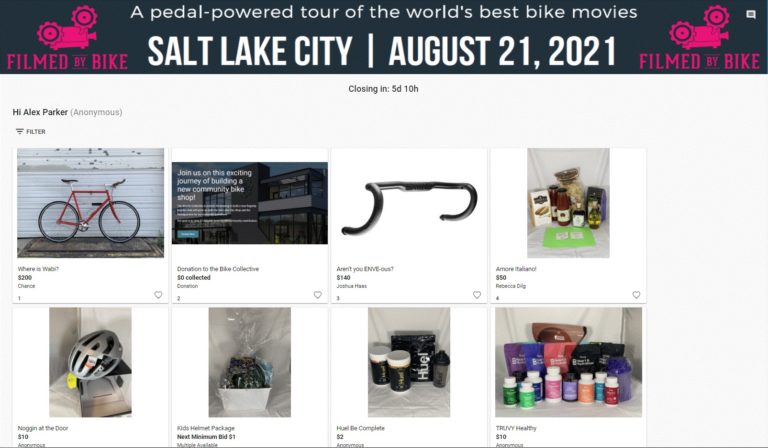
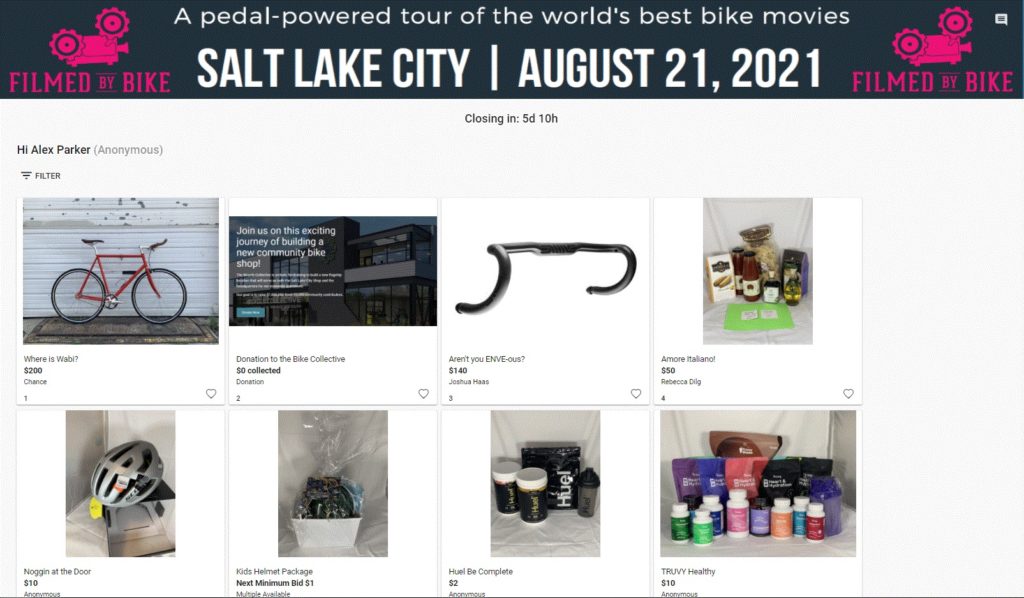
On August 21, 2021 The Salt Lake Country Bicycle Advisory Committee will host the First Annual Filmed by Bike Salt Lake City in Sugarhouse Park. In combination to the screening of feature films, Filmed by Bike SLC is hosting a silent auction with all proceeds to benefit The SLC Bicycle Collective, a non-profit organization that promotes cycling as an effective and sustainable form of transportation.
Here is a small number of items from the auction:
Enve Handlebars and Stem
Scott USA Helmets and Carbon Wheels
Gooseberry Mesa Yurt Stay
The auction will close at the end of the festival so, be generous and bid often.
2021 Intermountain Healthcare IRONMAN 70.3 World Championship presented by Utah Sports Commission in St. George, Utah shifts to a single-day event on Saturday, September 18 based on continuing COVID-19-related global travel restrictions
St. George, Utah, United States to host IRONMAN 70.3 World Championship in place of New Zealand in 2022 giving international athletes another opportunity to compete among the world’s best in the “Land of Endurance” with a two-day event
Taupō, New Zealand potential landing spot for future IRONMAN 70.3 World Championship as ability to host global events returns
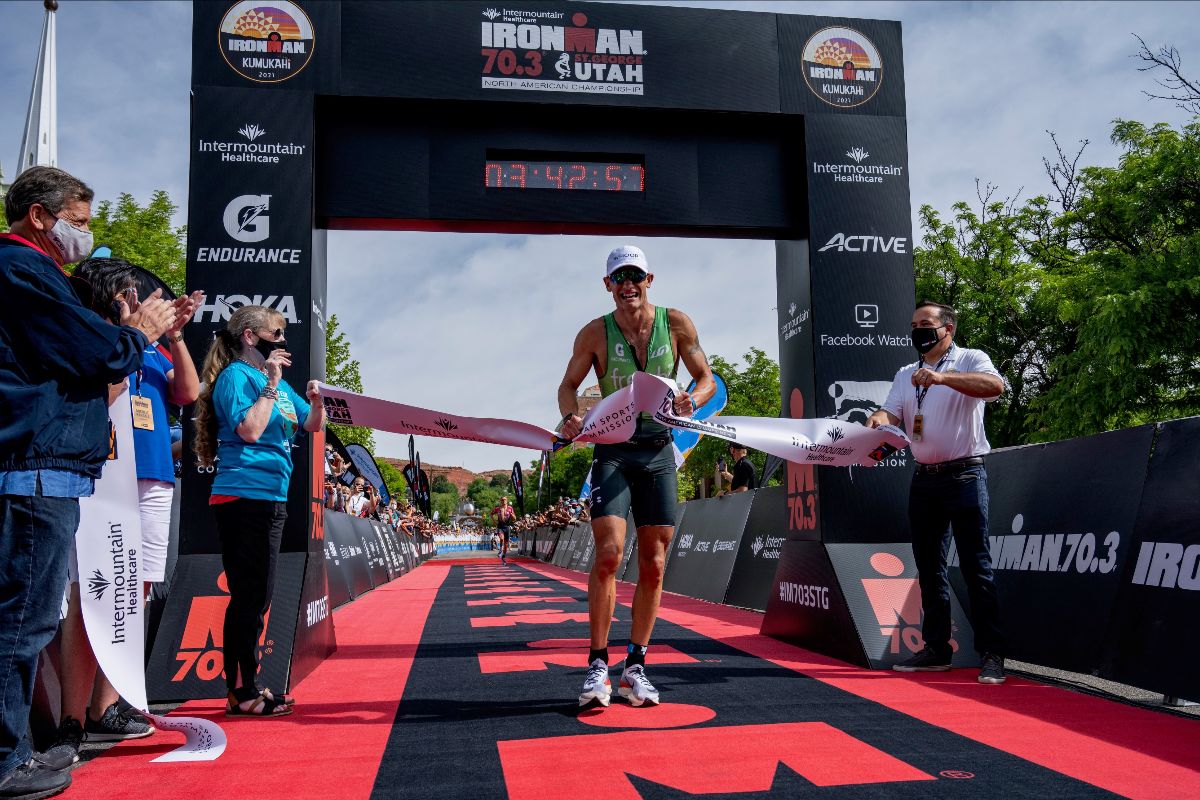
TAMPA, Florida (August 17, 2021) – IRONMAN today announced changes to the 2021 and 2022 editions of the IRONMAN 70.3 World Championship based on the continued global impact of the COVID-19 pandemic. Travel and border restrictions are expected to prevent as many as half of the athlete field from being able to attend the 2021 Intermountain Healthcare IRONMAN 70.3 World Championship presented by Utah Sports Commission in St. George, Utah. As a result, the race will shift to a single-day event with both men and women racing on Saturday, September 18. Additionally, the 2022 IRONMAN 70.3 World Championship that was set to be held in Taupō, New Zealand will also now be held in St. George, Utah, giving the travel-restricted athlete community an opportunity to race in the “Land of Endurance” with a two-day format from October 28-29, 2022.
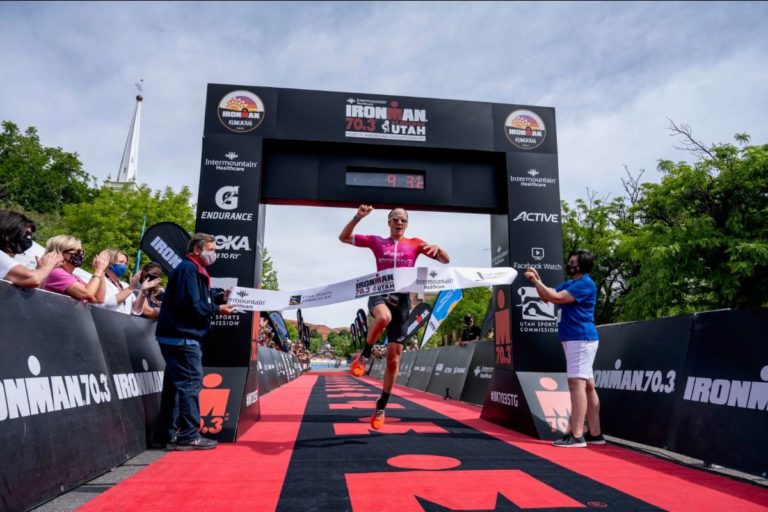
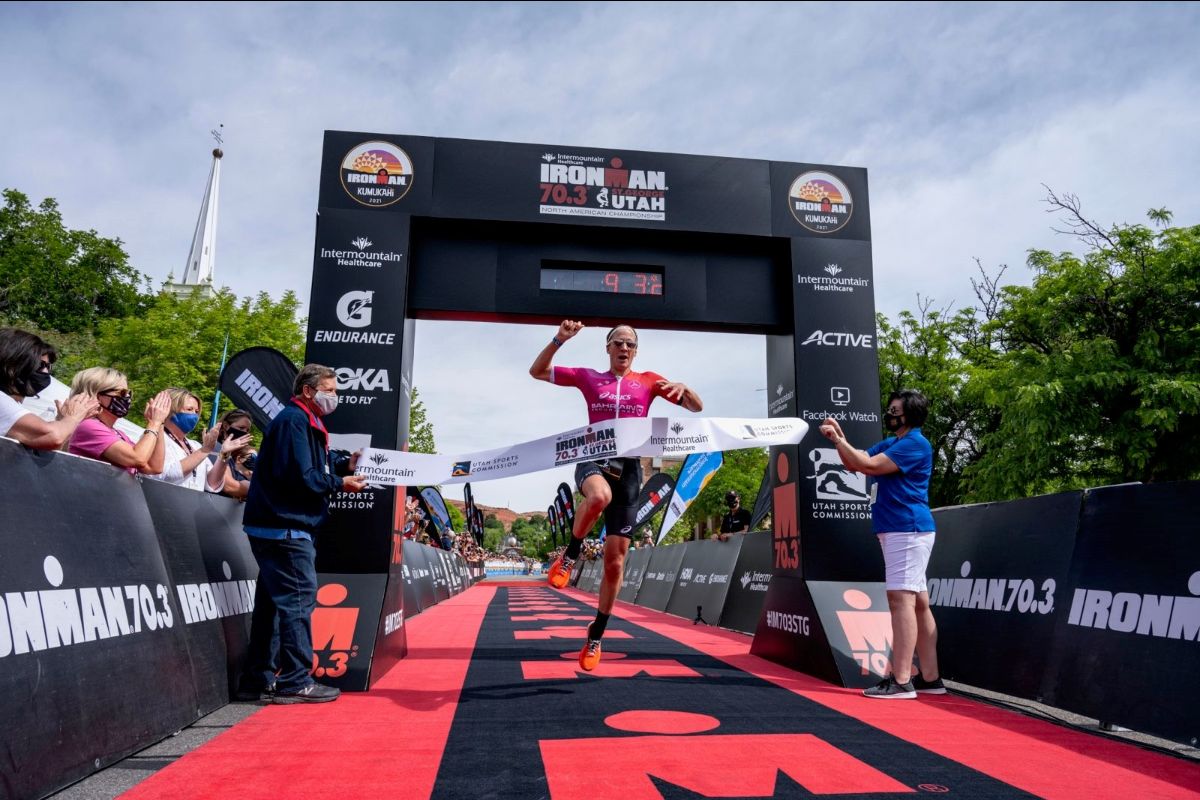
Daniela Ryf (CHE) claims victory at the 2021 Intermountain Healthcare IRONMAN 70.3 North American Championship in St. George, Utah. Photo courtesy IRONMAN
“We have continued to monitor border and travel restrictions closely, and it is increasingly clear that these restrictions are not likely to be relaxed in time for most international athletes to be able to race in St. George,” said Andrew Messick, President & Chief Executive Officer for The IRONMAN Group. “We have a special host partner in St. George and its surrounding communities, and we are looking forward to being able to host a full international two-day race in 2022.”
Lionel Sanders (CAN) claims victory at the 2021 Intermountain Healthcare IRONMAN 70.3 North American Championship in St. George, Utah. Photo courtesy IRONMAN
“Navigating the twists and turns of a global pandemic has been daunting, but at every turn our community has been able to look around the corner and find a positive path to a brighter horizon,” said Kevin Lewis, Director of the Greater Zion Convention & Tourism Office. “The dedication and commitment that the IRONMAN team has made to ensure success is inspiring. Working together, we’ve put together what will be an amazing world championship event this September, and we are thrilled at the opportunity to host the world here again in 2022.”
New Zealand remains a storied and special destination for The IRONMAN Group events, and despite the current uncertainties related to border and travel restrictions, both New Zealand and IRONMAN officials are committed to discussing how to bring the IRONMAN 70.3 World Championship event to Taupō in a future year, giving the world’s top athletes the ability to enjoy a World Championship experience in this unique destination that has embraced The IRONMAN Group events for more than 35 years.
“I think it’s important to look at it from how big an impact COVID-19 is having across the globe – particularly with the new Delta strain – and understand that having a longer lead-in time will actually allow us to host more athletes. As the world opens up in the next few years, athletes will have more events across the world to qualify for the world championship,” said Mayor of Taupō David Trewavas. “We are working closely with our stakeholders and IRONMAN to come up with a new date as quickly as possible. This is a huge event for us – and we are really looking forward to finally being able to showcase our district to the world and reap the rewards that this international event will have for us here.”
The previously announced 2023 IRONMAN 70.3 World Championship taking place in Lahti, Finland will continue as planned.
Cycling West and Cycling Utah Magazine’s Late Summer 2021 Issue is now available as a free download (12 MB download). Pick up a copy at your favorite Utah, Idaho, Wyoming, Nevada, Montana, Colorado, Arizona, New Mexico and Northern California bike shop or other location.
Cycling West Late Summer 2021 Cover Photo: Ty Hopkins in the 2018 Tour Divide on Blackshale Creek Suspension Bridge, on the High Rockies Trail in Kananaskis Country, Alberta, Canada. Approximately 70km from the start of the Tour Divide in Banff, Alberta. Photo by Megan Dunn, @evilmoosemegan on Instagram
Contents
Cycling Idaho’s Hiawatha Trail — page 3
UDOT seeks public input for Bike and Pedestrian Facilities on Utah state roads — page 4
Salmon, Idaho Gets New Bike Path — page 4
Stetina, Gomez-Villafañe Win 2021 Crusher in the Tushar — page 6
A Solo Ride in the El Doce 12 Hour Mountain Bike Race — page 8
National Parks, Bicycle travelers, and Entrance Fee Confusion — page 10
Rail Trail Best Practices — page 10
Tips for Getting Into Gravel Grinding — page 11
Bikepacking the Great Divide Classic — page 12
Calendar Notes — page 18
Tour de France 2021: Redemption, Dominance and a New Generation — page 22
August 11, 2021 – Registration is open for the 15th Annual Day of the Tread presented by True Health New Mexico and benefitting various non-profit organizations that serve New Mexico’s children. The event is scheduled for October 24, 2021. This year, there will also be an inaugural 4K Walk around Old Town Albuquerque.
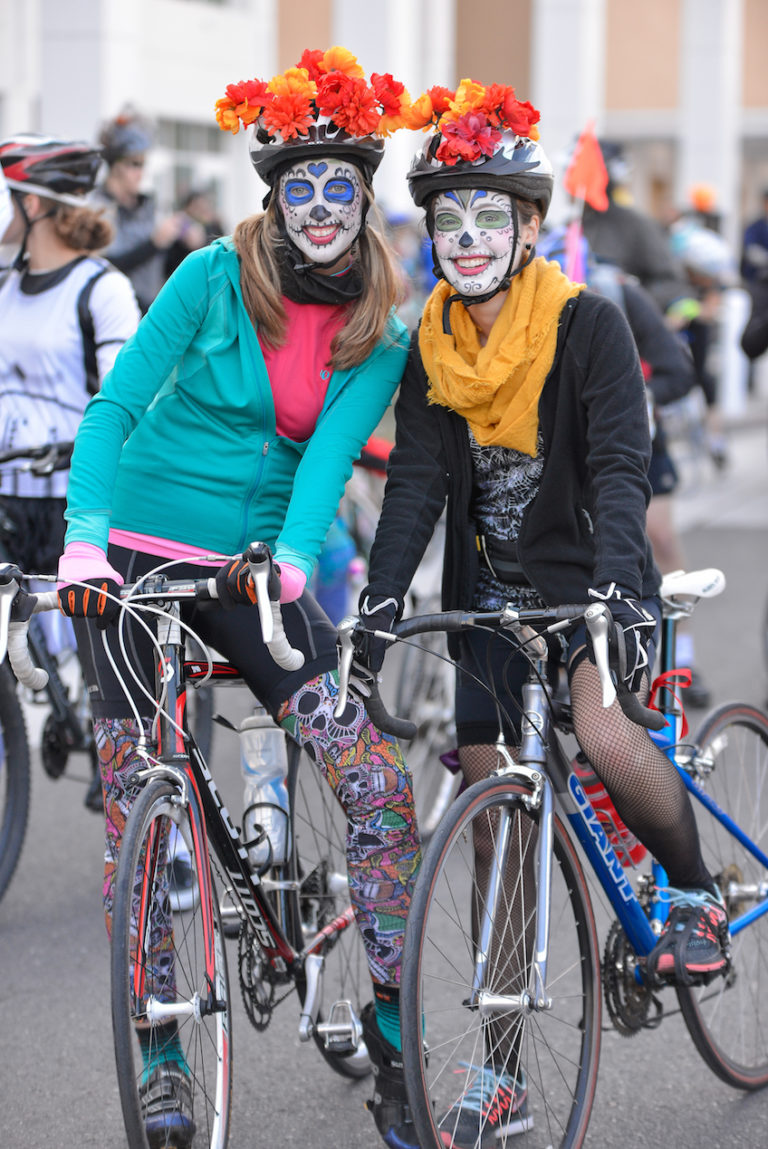
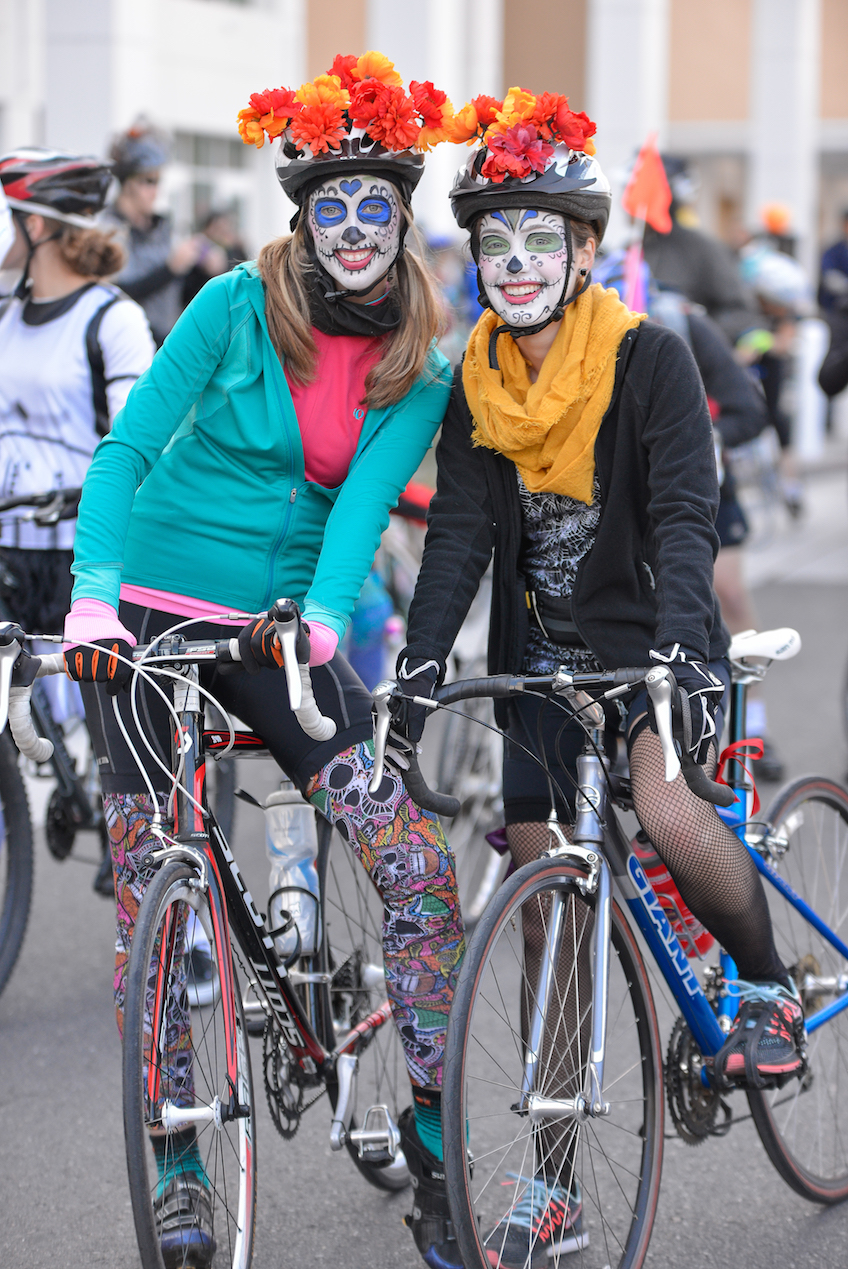
Riders celebrating Albuquerque’s annual Day of the Tread. Photo courtesy Day of the Tread.
In the last 14 years, more than 20,000 cyclists have participated in the annual fundraising event. Day of the Tread is known for its fun Day of the Dead inspired costumes that are seen on the roads surrounding Albuquerque one day every year. This year’s event brings back the favorites and some new twists, including:
New start and finish area in the Sawmill District of Albuquerque, anchored by the Sawmill Market Artisanal Food & Beverage Hall. Various routes are available including 7-mile, 18-mile, 25-mile, 47-mile, 60-mile and 100-rile routes.
The Rail Runner nine-mile Family Ride, a 12-mile ride that includes a ride on the Rail Runner, 26-, 50-, 64-, and 100-mile routes. Tandem categories are available for the 25-, 47-, 60- and 100-mile routes.
One of the highlights and favorite recharge zones is the famous El Pinto, located in Albuquerque’s scenic north Valley. El Pinto has supported the event every year since its inception.
By David Ward — Mexico City. When my daughter Jessica, who works for the Foreign Service, was first assigned to work in the embassy there, I wasn’t really excited to visit. My wife and I have followed Jessica around the world, visiting her in her various assignments in American embassies. Each place has been exciting and at each I have made it a point to scrounge up a bike and do some riding.
But Mexico City? That’s just the polluted capitol of the poor, run-down country to our south, right? I have known Mexicans, having grown up in a rural farming community where many seasonal workers from Mexico were employed. Good, nice people and diligent workers. But I wasn’t excited to visit.
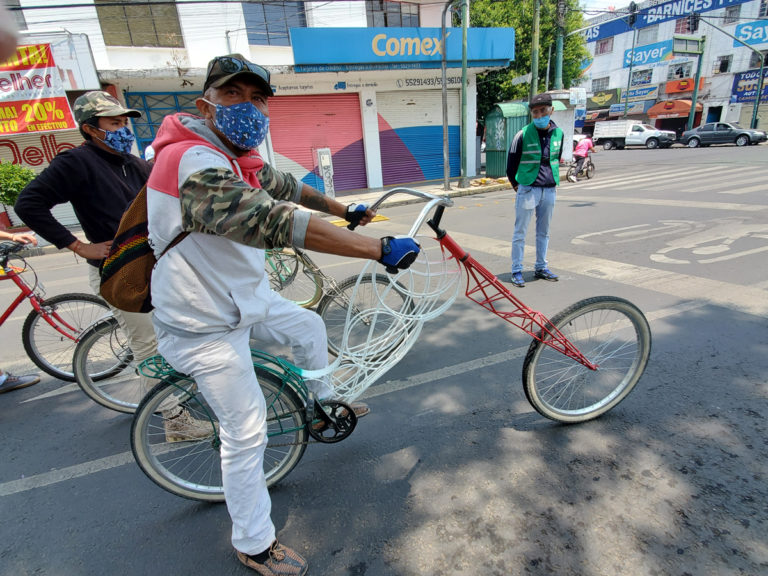
One of the many colorful bikes seen on the Sunday Muévete de Bici ride in Mexico City. Photo by David Ward
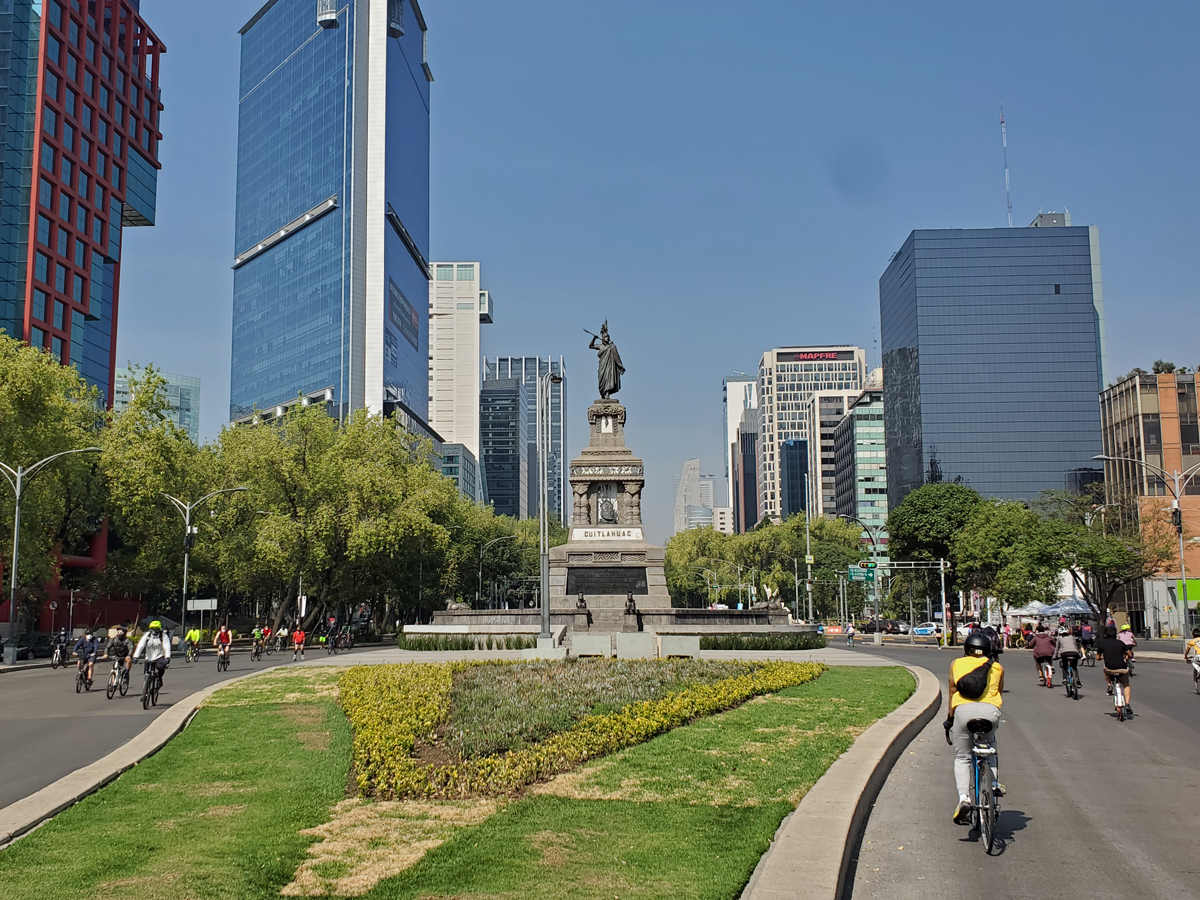
So, I was surprised when people told me, upon mentioning we were going to visit Jessica, that they loved Mexico City, with some even stating it was their favorite city. That got my attention. I also heard from my daughter that every Sunday, a miles long route of one of the city’s main thoroughfares, the Paseo de la Reforma, is shut down for people to come out and enjoy bicycling on a street free of traffic. That also got my attention.
Well, that was three years ago. I have now been to Mexico City, and other destinations in Mexico, three times and I now echo what others told me: I love Mexico City. There is a vibrancy to life and culture here, and a fascinating history to be explored here and elsewhere in this great country.
Each time I have visited, I have rented a cheap bike to cruise and explore on. The first couple of times the bikes were journeyman, single speed bikes. Mexico City is flat except for a few overpasses and bridges until you get to the outskirts of the city. As such, the single speed worked fine. This last time, May of this year, I rented an older road bike, a cool-looking silver Colnago with orange decals, or so I thought. When I mentioned to the shop owner (who, thankfully, spoke enough English for us to communicate) that I owned a Colnago, he laughingly told me this was not a Colnago. Those were just stickers a prior owner had put on there. A closer look clearly established that to be the case.
Cyclists on the Sunday Muévete de Bici ride in Mexico City. Photo by David Ward
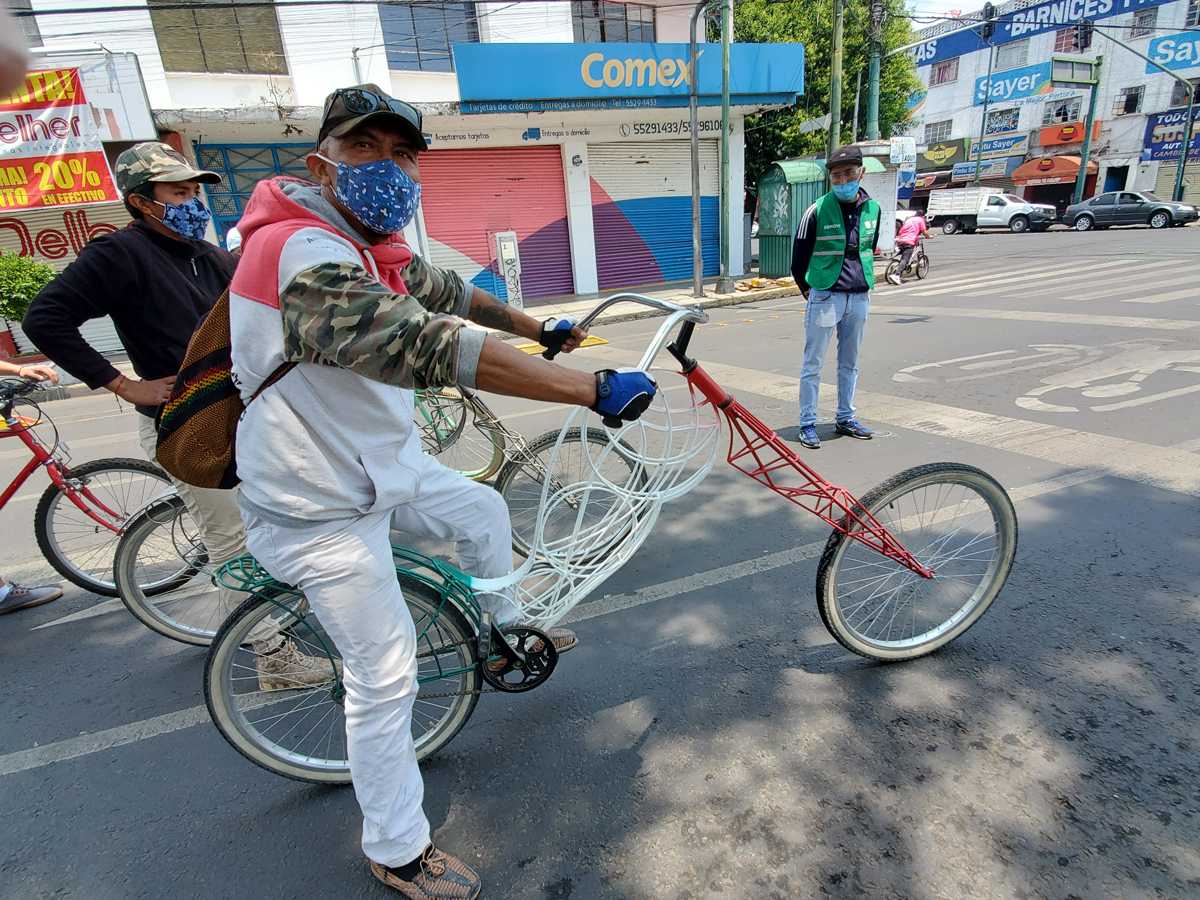
Each time I have come, I have done the Sunday ride, the Muévete de Bici. The ride is as colorful as the country itself. There are recreational riders on high end road bikes, but the majority are people on a wide variety of bikes ranging from the everyday get around the neighborhood bikes in various stages of repair or lack thereof, to artistic homemade or modified frame bikes, to the ubiquitous rent-them-off-the-streets bikes. There are kids, and even some adults, on trikes. There are some roller bladers, and even a few runners and skateboarders. It is a hodgepodge of pedal-powered machines, styles, colors, and people that excites the senses. It was so exhilarating to be a part of it.
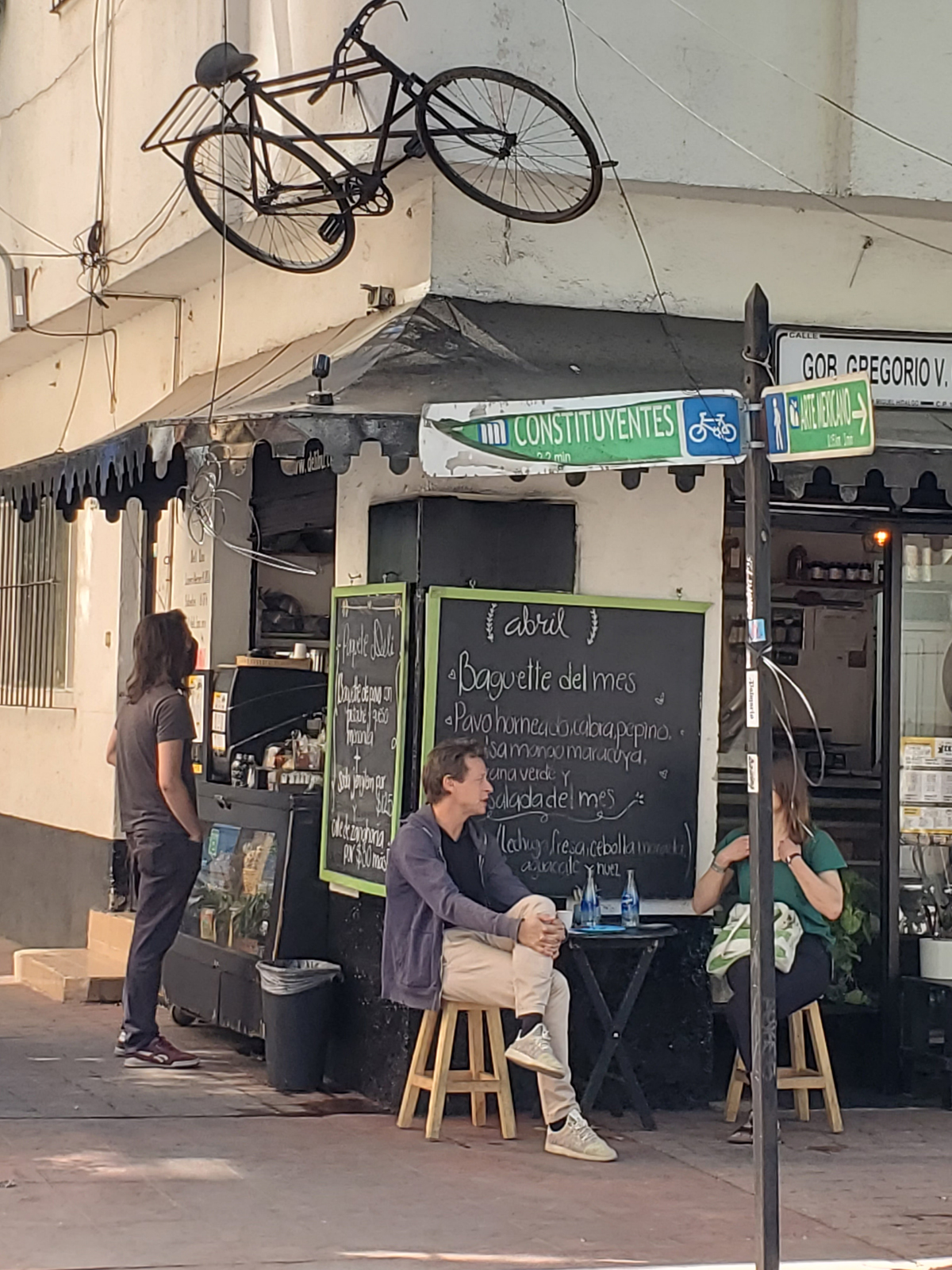
A bicycle deli on a bicycle street. Photo by David Ward
Beyond that, I have used my rental bikes to explore this city, ranging from the Zocolo (the center of town where you find the Palacio Nacional with the famous Diego Rivera murals, the Cathedral and the Templo Mayor), to the Palacio des Belles Artes, and to the Universidad Nacional Autónoma de México and its famed central library as well as the Olympic Stadium from the 1968 Olympics (probably most remembered, at least here in the United States, for the “Black Power Salute” of Americans John Carlos and Tommie Smith). Riding in traffic, even on the occasional bike paths, is not for the faint of heart. There are sufficient numbers of cyclists that motorists seem to accept and not resent them, but spaces can be tight. Mexican traffic, like most foreign countries, is what I call organized chaos. It works well enough, but you have to be brave in claiming your space and going with the flow. I am a fairly intrepid cyclist in traffic, so I actually found this rather exhilarating.
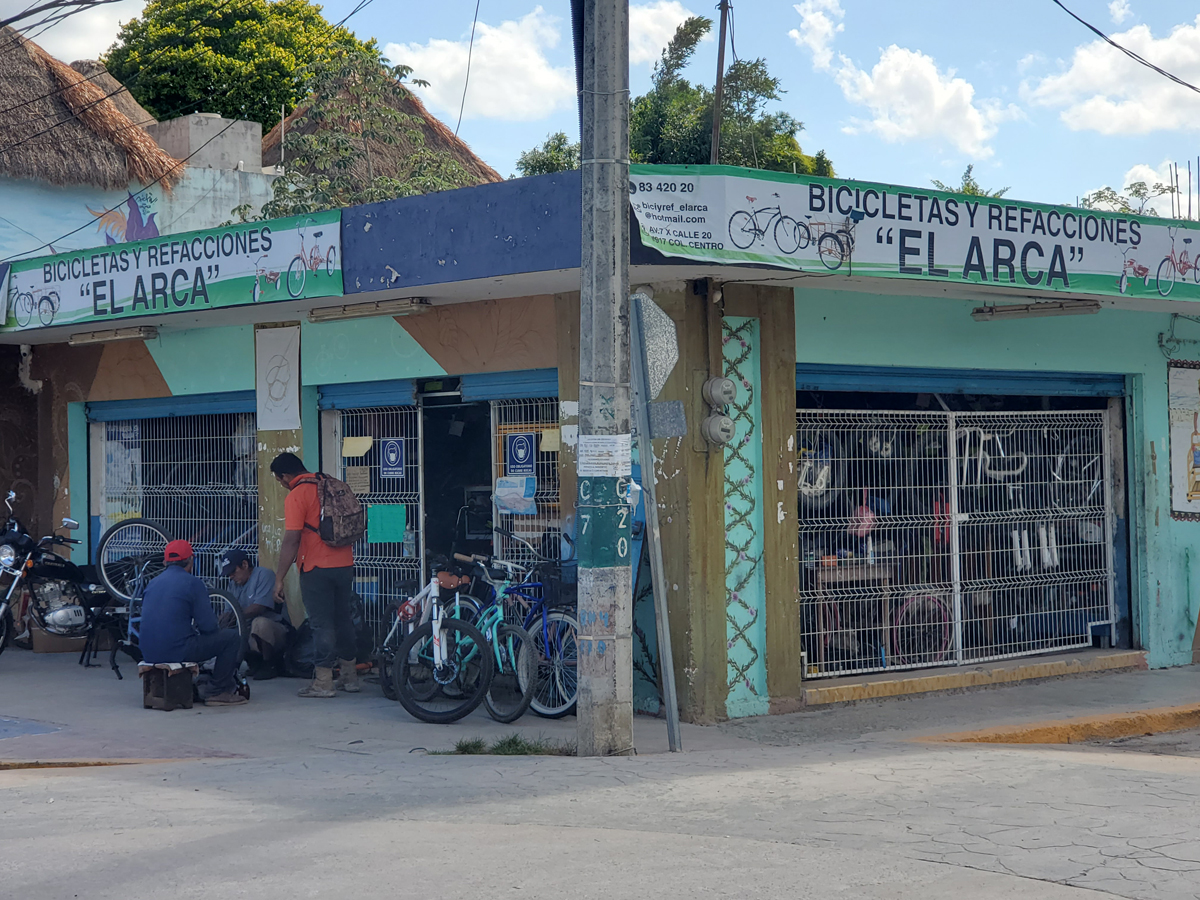
A bike shop in Mexico City. Photo by David Ward
Mexico City is rich in culture and history, not just since the Spanish invasion, but dating back to the Olmecs, Aztecs and Mayans. Turns out Mexico City has more museums than any other city in the world, including its beautiful and fascinating Museo de Antropologia. And those museums are just a part of the many features and attractions Mexico City has to offer. Everything is quite inexpensive, though vacationing here would be well worth it even if one were paying prices comparable to other large cities such as London or Paris.
I have loved my visits to this great city, and my time spent tooling around here on a set of wheels. My daughter is soon transferring to another assignment so I do not know if or when I will make it back. And that makes me rather sad, because I find Mexico City alive, culturally wealthy, unique, and exciting, and a city just fun to be in and to explore on a bike. Gracias Cuidad de Mexico.
By Nancy Clark MS RD CSSD — Many athletes train in the early morning. Rowers commonly meet at 5:30 a.m. Hockey players might get rink-time at 5:00 a.m.. Athletes who need to be at work at 7:00 often train at 4:30 a.m. Many of these athletes report eating nothing before their training session. My stomach isn’t awake. … It’s too early to even think about food. … I get reflux if I eat. Others report they have better workouts when they eat something simple. The question arises: What’s the best way to fuel for early morning workouts?
Before answering that question, let’s first address the physiological goals for fueling before morning workouts.
To change the stress-hormone profile. Cortisol (a stress hormone) is high in the early morning. This puts your body in muscle-breakdown mode. Eating carbs + protein can switch to muscle-building mode.
To provide energy and prevent low blood glucose with the consequences of feeling light-headed, dizzy, and needlessly fatigued.
To be adequately hydrated. Dehydration slows you down.
If you are making the effort to get up early to train, you might as well get the most out of your workout! In a fueling study, athletes had dinner the night before and then a 60-minute exercise test the next morning. They performed 6% better in the 10-minute sprint to the finish when they had some fuel (carb) compared to having had nothing; 6% better when they had adequate water (compared to minimal water), and 12% betterwhen they had both fuel + water (a sport drink). (1) Twelve percent better means running an 8-minute mile in about 7 minutes. Powerful, eh?
Your body can digest pre-exercise food and use it to energize your exercise as long as you are exercising at a pace that you can maintain for more than 30 minutes. (If you do stop-and-start exercise, you can still digest the food, but at a slower rate.) In another fueling study, athletes ate dinner and than nothing for the next 12 hours. Those who ate 180 calories (sugar) just five minutes before an hour-long exercise test performed 10% better in the last 15 minute sprint compared to when they ate nothing (2). Grab that granola bar or swig of juice!
If you are tempted to skip pre-exercise food so you can lose weight by burning more fat, think again. Yes, pre-exercise food will contribute to burning less fat at the moment, but that is irrelevant. The issue is not whether you have burned fat during exercise but if you have created a calorie deficit by the end of the day. Eating excess calories after a fat-burning workout gets you nowhere.
All of this means consuming some food and fluid on your way to the gym, spin class, or boot camp will enhance your workout—assuming you have trained your gut to tolerate the food and fluids. If you are worried about intestinal distress, start small (a few crackers) and work up to a handful of crackers, and then add, let’s say, a latte. For workouts longer than 60 minutes, the recommended intake is about 200 to 400 calories within the hour before you train. That recommendation obviously varies according to body size, exercise intensity and duration, and personal tolerance to food.
If you have been exercising on empty, you will likely discover you can exercise harder, feel better, and get more enjoyment from your workouts. Research subjects who ate 400 pre-exercise calories were able to exercise for 136 minutes until they were exhausted, as compared to only 109 minutes with no breakfast (3). Big difference! After learning this, one of my clients reported he was done with skipping pre-exercise fuel in the name of intermittent fasting. “Not eating is slowing me down and taking the fun out of my workout.”
Early morning options
Here are some options for fueling your early morning workouts so you are adequately hydrated and fueled.
Eat a quick and easy snack with about 200 to 400 calories (depending on your body size and workout intensity). Some popular options include: English muffin, toast, bagel or banana (with peanut butter); oatmeal, a smoothie, Fig Newtons, or granola bar. Coffee is OK; it’s a functional fluid that boosts performance and yes, helps with hydration.
Wake up 4 hours before important training sessions/events, eat a simple breakfast (bread + peanut butter), then go back to bed. This is a common practice among elite athletes. As one marathoner explained, “I don’t want to have food in my stomach when I’m racing. If a race starts at 8:00 a.m., I’ll get up at 4:00, eat a bagel with peanut butter and a banana, and then go back to bed. At 6:00, I’ll get up, have some coffee (to help me take a dump and wake me up), and then get to the race start. Because I never really sleep well the night before an event, getting up at 4:00 isn’t terribly disruptive.” In comparison, a rower reported she used to wake up two hours before practice to eat. She became too sleep-deprived and decided she needed sleep more than food. She started eating a bigger bedtime snack.
Eat your breakfast the night before via a bedtime snack, such as a bowl of cereal, or yogurt with granola. If you have dinner at 6:00, you’ll be ready for a bedtime snack by 9:00. Choose quality calories; this is your breakfast that you are eating the night before. Limit the cookies and ice cream!
Fuel during your workout. If your stomach isn’t awake when you first get up, it may be receptive to fuel when you are 30 minutes into your bike ride, run, or row. Be sure you have some fuel with you: sport drink, dried pineapple, gels, chomps, gummy bears—whatever is easy to carry and simple to digest. You want to target about 30 to 60 grams carb (120 to 240 calories) if the workout lasts 1 to 2.5 hours, and 60 to 90 g carb (240 to 360 cal) if the workout is longer than that..
What about “training low”?
If you are highly competitive and has mastered the sports nutrition basics (eat a diet with 90% quality foods; fuel evenly during the day; have no disordered eating behaviors), you might try training low (with depleted muscle glycogen and/or low blood glucose) once a week or so. To do this, eat primarily protein for dinner after a late-afternoon workout. The next morning, train without having eaten carbs. Exercising depleted like this is not fun, but it stimulates cellular changes that can be performance enhancing if you need to get to the next level (4). Novice and recreational athletes, however, first need to work on the basic ways to improve performance—by surrounding their workouts with food, and fueling wisely the rest of the day.
References
Below, P. et al. Fluid and carbohydrate ingestion independently improve performance during 1 hour of intense exercise. Med Sci Sports Exerc 27:200-210, 1995.
Neufer P. et al. Improvements in exercise performance: effects of carbohydrate feedings and diet. J Appl Physiol 62(3):983, 1987
Schabort, E. et al. The effect of a preexercise meal on time to fatigue during prolonged cycling exercise. Med Sci Sports Exerc 31(3):464-471, 1999.
Hawley J and Burke L. Carbohydrate availability and training adaptation: effects on cell metabolism. Exerc Sport Sci Rev. 38(4):152-60, 2010.
Here is a short note from Marty Jemison as he starts the Vuelta:
Marty Jemison. Photo by Beth Schneider/courtesy Marty Jemison
“I raced 17 days last month, and even with that I think I am just finding my legs again. I would like to have a good Vuelta but my primary concern is helping in the sprints and staying close to Tyler Hamilton during the stages. Tyler is looking really good.
The GP Eddy Merckx was a great experience, I teamed up with Tyler for the 2-man TT. It is 68 kms long, two laps of 34 kms in the center of Brussels. We were 3rd after the 1st lap and would have finished 3rd but Tyler flatted with 2kms to go and we fell to 7th. But what a ride! We were working well together. Tyler had just flown over the day before so he was a bit off, but my legs were good. I think we could have contended for the win if Tyler had been a little fresher, maybe next year!
Not too much to say about the Vuelta so far, I had a solid Prologue, finishing 22nd , same time as Ulrich. Jan looks solid. I predict he will finish in the top ten.”
9/8/99 – Team Sport:
Tyler is our protected rider….. yesterday Tyler had a bike mechanical in a bad moment…… Rabobank was at the front and on a mission. The bad moment was compounded by the fact that we were approaching a cat 3 climb, Tyler was getting a bike change…. Initially I was thinking no big deal… three teammates working with Tyler in the wheel (Marty, Benoit, Frankie) With my teammates , I began to close the gap rather quickly…….The exponential effort increased the closer we came to then back of the group….Oh we did our job, we made it…… but aahhh I burnt more matches than I really expected…… big gap and Rabo was turning the screws……It took the next 10kms before I could think of moving up again………. Graham Watson must have seen “something” because during the effort he began to shoot pictures!!! this kinda told me it was a difficult moment……not to mention what I was feeling……. So, I could see Graham’s lens and also……..Bobby Julich loaded with water bottles…..inching his way to the front.
Can we expect a Photo???? But this was not a photo session…. believe me
Today…. 20kms to go…. the bunch is chasing a group of 11. Going fast as you may expect….. pursue the group,….. bring your sprinter to the front etc, etc.. But not this time….. over the radio we heard that Tyler had crashed…… so myself (Marty), Frankie, Benoit and Frank hit the brakes…. from 60kph to nearly 0….. Tyler was a dot on the horizon in the rear….in front a dust cloud vanishing ahead …. and in the calm of the storm 4 ghostly figures…… waiting…..We hooked Tyler and opened up the engines…… Frank put it this way at dinner…..”we had to hit the brakes before we crashed into the back of the peloton” They were doing 60+kph we were doing???? faster…….
Dylan added to the dinner conversation……. Koos attacked at kilometer 0….. solo. Dylan was next to him in the front before he attacked and asked if he wanted to go with him “NO” was Dylan’s reply…..no like “ell no”
9/12/99 – The stage to Angrilu
The stage was epic. There was a lot of talk about how hard the climb was going to be, I was not really concerned with that, it is always a matter of how strong you are relative to the others in the bunch.
I had a triple chain ring on 30×25, so it was like mountain biking, spinning nicely for nearly half of the 13kms climb. The stage had 4 climbs in 175kms, cat 2 , cat 1, cat 1 and esp climb {special climb, Angril). The bunch was down to less that 50 riders at the top of the first cat 1. I was about 10sec down over the top, just next to the course director’s car, thinking it would be easy to bridge on the descent, but it was dangerous. I came upon several riders in the ditch. The roads here in Alicante are covered with carbon (from mining??) and diesel from the cars. It is very, very slippery and treacherous when wet, which it was.
I did not bridge back, I was one of the lucky few who avoided a crash. I rode the rest of the stage solo or with only 3-4 riders. It seemed that everyone was on their own. The next cat 1 climb was so slippery that when I stood the back wheel would spin! All I could think about was how I would climb 20+% pitches on Angrilu. But it turned out to be adventurous climb really, I was not suffering , I had the appropriate gear, and the fans were amazing. They estimated 400,000 (a possible exaggeration), no wheels slipping and fewer cars using the road. I passed riders who were pedaling squares, happy that I had a triple ring. I finished 46th, 13 minutes down on Tonkov (the victor) and Jimenez ( you would have to see the finish to understand).
9/13/99 – 185kms
A rollercoaster route along the coast in monsoon like conditions, wind , rain and flooding. This stage was harder than yesterday due to the conditions and the fact that 15 riders attacked from the gun. ONCE drove so hard for 60-80 kms that at times almost everyone was dropped except Olano. Groups came back and some yellow was present again. Bottom line; it was impressive and there was a lot of suffering. It was riding on the rivet all day in unbelievable conditions, crazy, single file, split, dropped, regain, split, etc. Riders arrived in small groups and alone at the finish line, the results looked more like a mountain top finish.
It was freezing cold in the showers, but the feelings were unanimous, sounds of agony were vocalized–with a bit of humor because we had suffered and now it was over. Next we shared a bus ride and flight to Zaragoza….. exchanging glances from time to time, asking the 5 W’s, and How!!!!
One bad day/night
I have a slight fever as I write this; two nights ago I did not feel like having dinner, but did so anyway. During the night I was hot/cold, and later I vomited and had diarrhea. In the morning I forced down some breakfast, thinking I could be strong enough to at least make the groupetto, but that was not the case. I was in the team cars 3+ times in the first 60 kms. When the peloton came to the first categorized climb I was shelled, game over. My legs ached, my breathing and HR were erratic and I was feeling dizzy as the cars came past.
I believe it was food poisoning. We were in a truck stop hotel alongside a highway that was very dirty. Apparently a few riders from Mapei and TVM complained of diarrhea. This morning, when I left the hotel, Benoit and Julian said they were up in the night also.
This is the first European stage race I have not completed in 10 years. I was completely empty and the race left me. There is nothing else to say.
STEAMBOAT SPRINGS, Colorado (Aug.15, 2021) — 3,000 riders, including a number of current and former U.S. professional national champions, Olympians, World Tour riders and many of the world’s most accomplished gravel riders descended on Routt County’s pristine gravel roads to contest the 2021 edition of SBT GRVL presented by Canyon Bicycles. In only its second year SBT has quickly become one the largest and most prestigious cycling events in the United States, fixing the cycling universe’s collective attention on the state of Colorado for the first time since 2019.
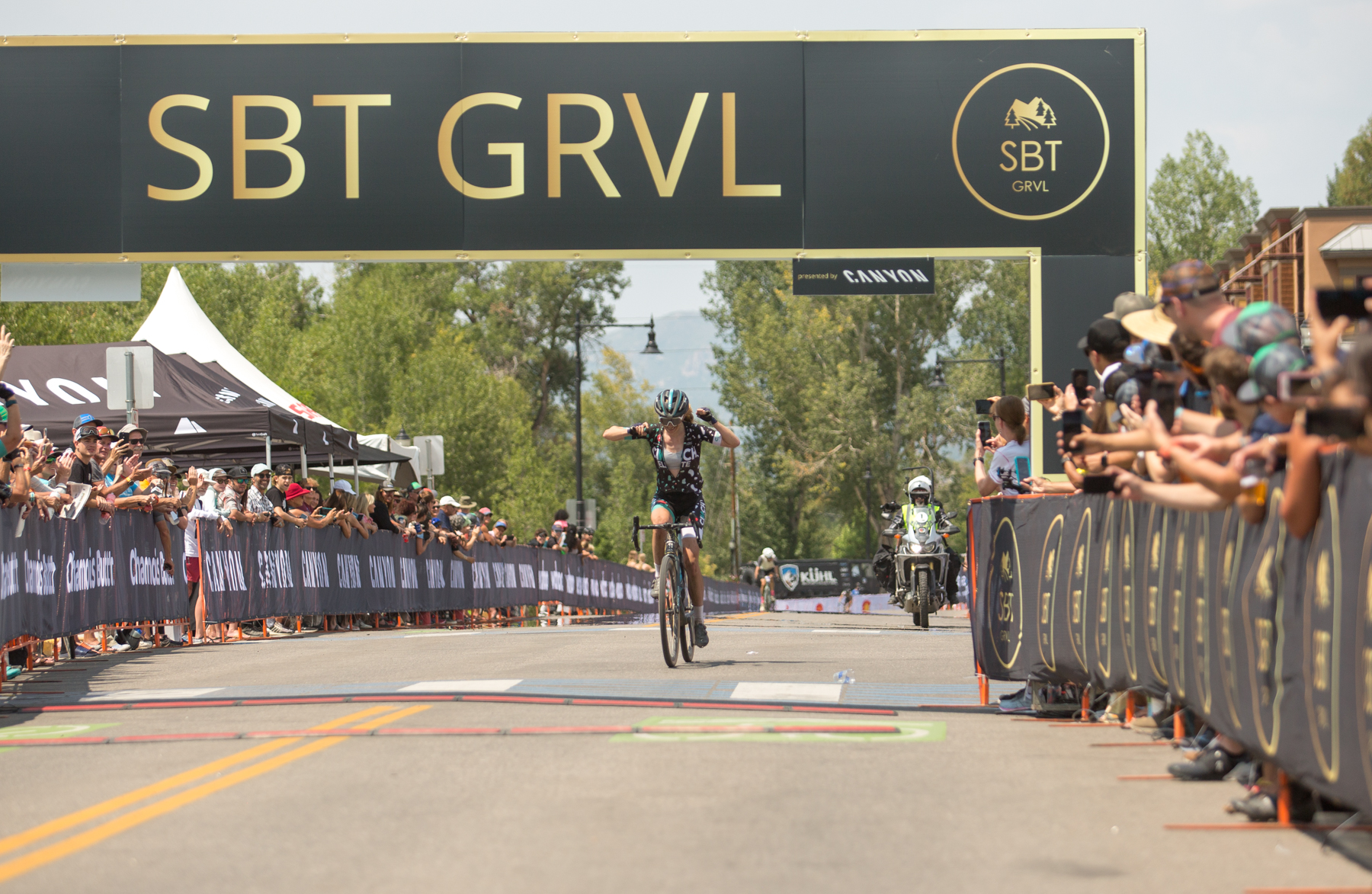
Lauren De Crescenzo (Cinch Elite) takes the Women’s Open/Pro win at the 2021 SBT GRVL. Photo by Linda Guerrette
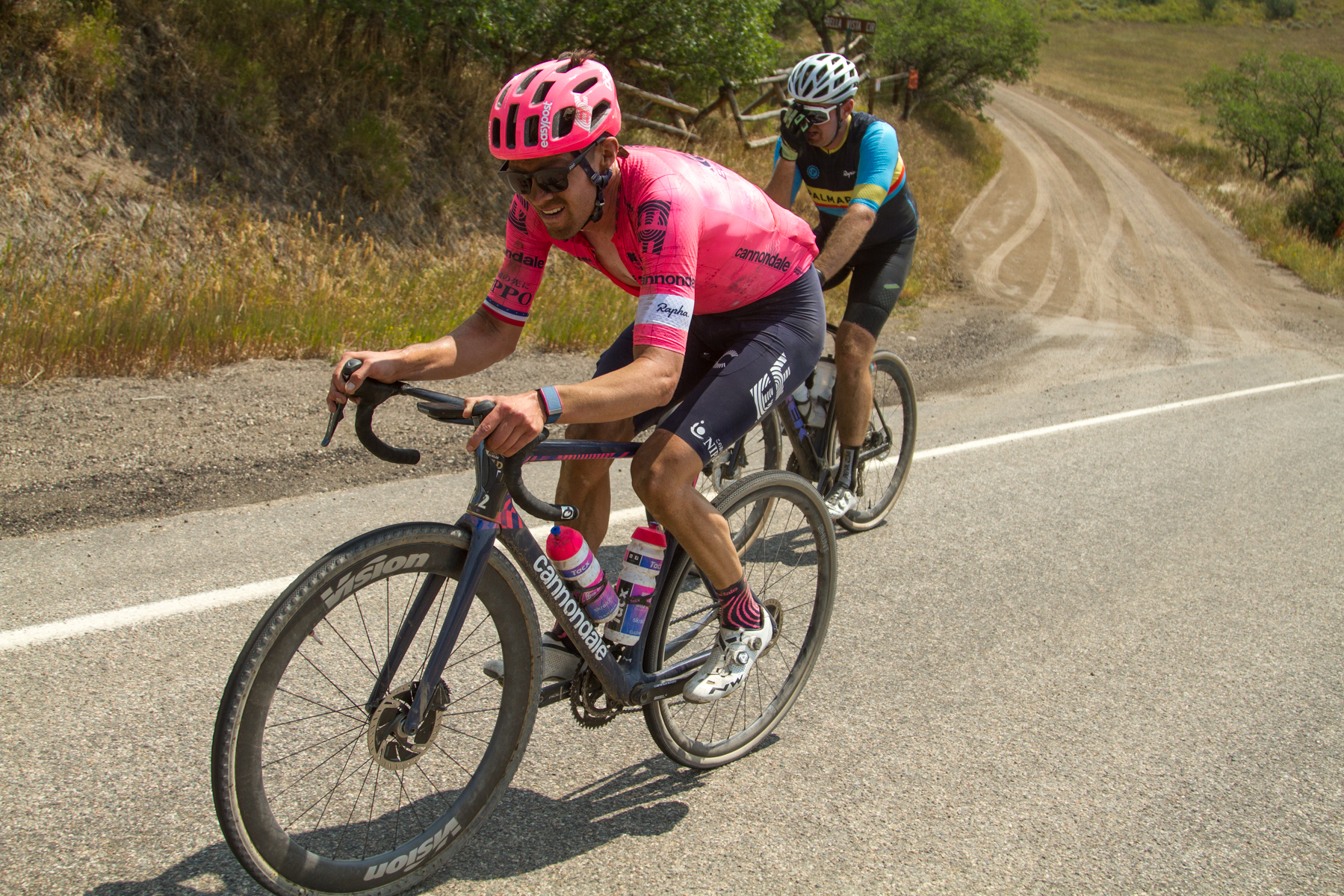
After 142 miles it was Lauren De Crescenzo (CINCH ELITE) and Alex Howes (EF Education First – Nippo Pro Cycling) who crossed the finish line first ahead of their respective Pro/Open fields.
Those fields included Olympian Tiffany Cromwell, current and former US pro national road champions Lauren Stephen and Alex Howes, 2021 Unbound champions Lauren de Crescenzo and Ian Boswell, defending SBT GRVL champion Ted King, 2021 BWR champion Pete Stetina and Alt-TDF champion Lachlan Morton.
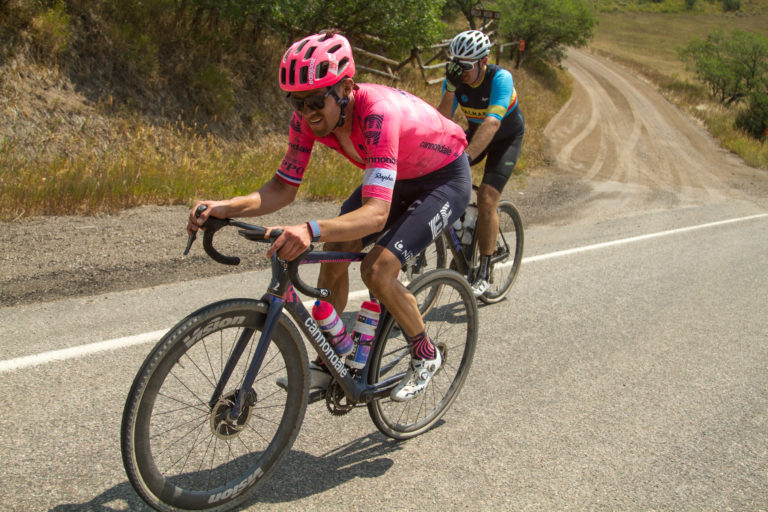
Alex Howes (EF Education First-Nippo) holds on to win the 2021 SBT GRVL. Photo by Linda Guerrette
The 2021 edition of SBT GRVL also broke ground as the first-ever gravel cycling race to be televised live, with Wahoo as the presenting sponsor. Broadcast partner OutsideTV carried the televised show.
“Seeing the incredible outpouring of enthusiasm for SBT GRVL, you feel a tremendous sense of pride in our local Steamboat community and the experience they make possible for our riders,” said Amy Charity, co-founder and owner. “We’ve got some of the best gravel in the world, but without our volunteers and the tremendous support from our sponsors and locals, this event wouldn’t be what it’s become. We’re very thankful and look forward to building on this foundation for years to come.”
Utah boasts about 960 miles of US Bike Routes System composed of streets, highway and trails for bicycle use
SALT LAKE CITY, Utah (August 9, 2021) — National transportation officials recently approved more than 550 miles of bike routes in Utah to the United States Bicycle Routes System (USBRS). These newly designated routes enhance safety and ease for biking in Utah.
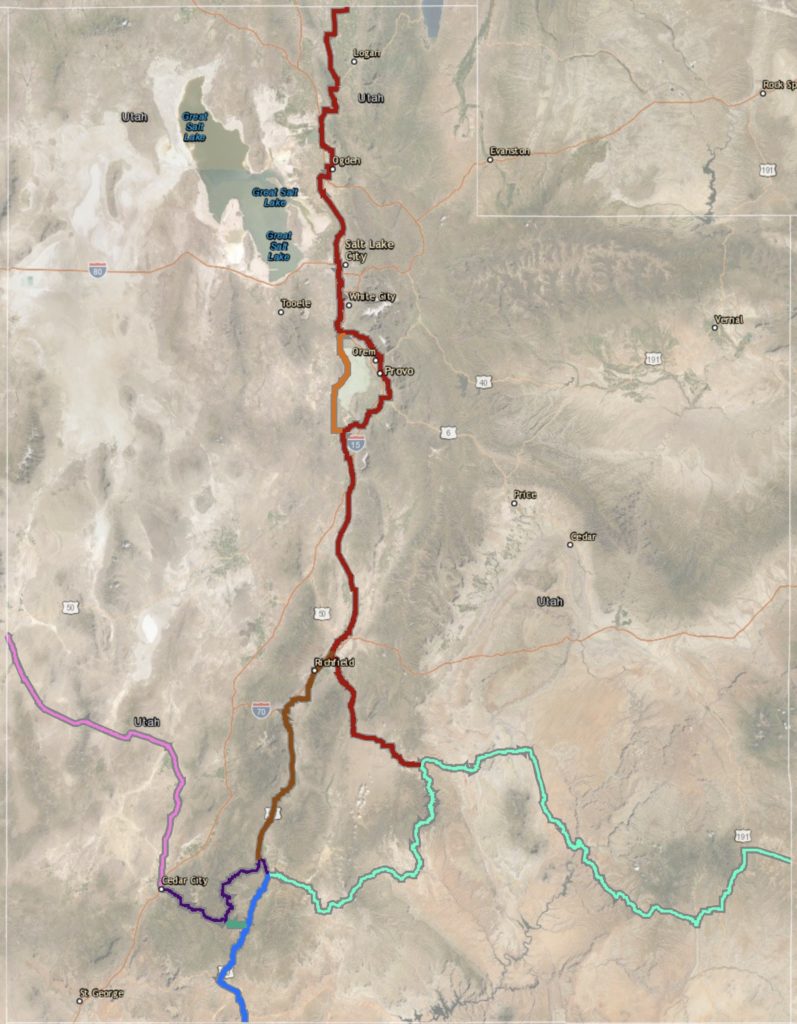
A map of the Utah section of the US Bike Route System.
The routes, approved by the American Association of State Highway and Transportation Officials (AASHTO), now boost Utah’s total USBRS to around 960 miles of streets, highways and trails for rider use throughout the state. Newly designated bicycle routes 77, 677, 877, 79 and 679 now connect riders from Idaho to Arizona in this developing national network of bicycle routes.
“These routes allow commuters, bicycle tourists and leisure cyclists a unique way to travel safely across Utah’s beautiful and diverse landscape,” UDOT Active Transportation Manager Heidi Goedhart said. “As more and more Utahns take advantage of active transportation, we expect to see less traffic congestion, greater economic development, and healthier citizens–three wins for communities everywhere.”
Video of portions of the new Utah route:
Adventure Cycling, a national cyclist advocacy group, partnered with UDOT and Move Utah to develop this north/south, state-to-state route over the last four years. During that time, the group looked for routes that provided riders the most safety and protection, local points of interest, accommodations and bike friendly shops, among others.
Developing the route also required coordination with multiple groups. For example, UDOT coordinated with, and got permissions from, the Departments of Transportation in both Idaho and Arizona regarding state line tie-in locations. Similarly, whenever a route was not on a state road, the group acquired approval and letters of support from local jurisdictions.
There are several benefits that come from the USBRS designation. For example, with this designation, new signs will be installed to direct bicyclists to a preferred route through a city, county, or state. Additionally, the designated routes ensure that a rider’s experience and safety is considered.
“Experiencing Utah by bicycle is a rewarding way to slow down, get off the highway and explore the state’s scenic beauty,” said Vicki Varela, managing director of the Utah Office of Tourism. “These routes demonstrate the commitment of our state and local communities to build something better for both Utah residents and Utah visitors. ”
As part of Utah’s new route system, there are 105 miles of continuous safe and separated cycling trails located along the urbanized Wasatch Front. The route also takes riders along beautiful rivers, parkways and vistas. Not only do these designations help bring bicycle tourism to Utah, but the benefits are also seen locally by assisting in building out and planning other active transportation facilities.
The USBRS application was submitted by UDOT in April of 2021, reviewed in May and approved the same month. To view all national routes, visit adventurecycling.com.
Route Information:
USBR 77, USBR 677, and USBR 877 (349.8, 40.6, and 88.8 miles): USBR 77 begins at the Idaho border and travels through Logan, along the Wasatch Front from Ogden to Salt Lake City and Provo, then climbs between the mountains of the Fishlake National Forest, and continues on to its end at USBR 70 in Torrey, near Capitol Reef National Park. USBR 677 is a less urban and more scenic alternate route on the west side of Utah Lake, while USBR 877 connects USBR 77 in Sigurd to USBR 79 in Panguitch.
USBR 79 and USBR 679 (269.3 and 9.4 miles): From the Nevada border, USBR 79 crosses high desert, reaches Cedar City, climbs toward the painted cliffs and pinnacles of Cedar Breaks National Monument, passes Panguitch, then descends to its end at the Arizona border, in the Navajo sandstone near Kanab. USBR 679 connects USBR 79 at U.S. Highway 89 and USBR 70 at Duck Creek Village.
GPS Route Links:
USBR 77: Brigham City, Ogden, Salt Lake City, Provo, Torrey
LEADVILLE, Colorado, (Saturday, August 14, 2021) — The 2021 Stages Cycling Leadville Trail 100 MTB race today welcomed a field of more than 1,500 riders ranging in age from 18 to 74 years old, representing 49 states and 12 countries. Cyclists tackled the famed 100-mile ‘Race Across the Sky’ through the Colorado Rockies as the course brought them through 13,000 feet of net elevation gain, topping out at 12,424 feet. Notably, 43 Leadville citizens proudly represented their hometown, for which the race series is well known and beloved, in the participant field.
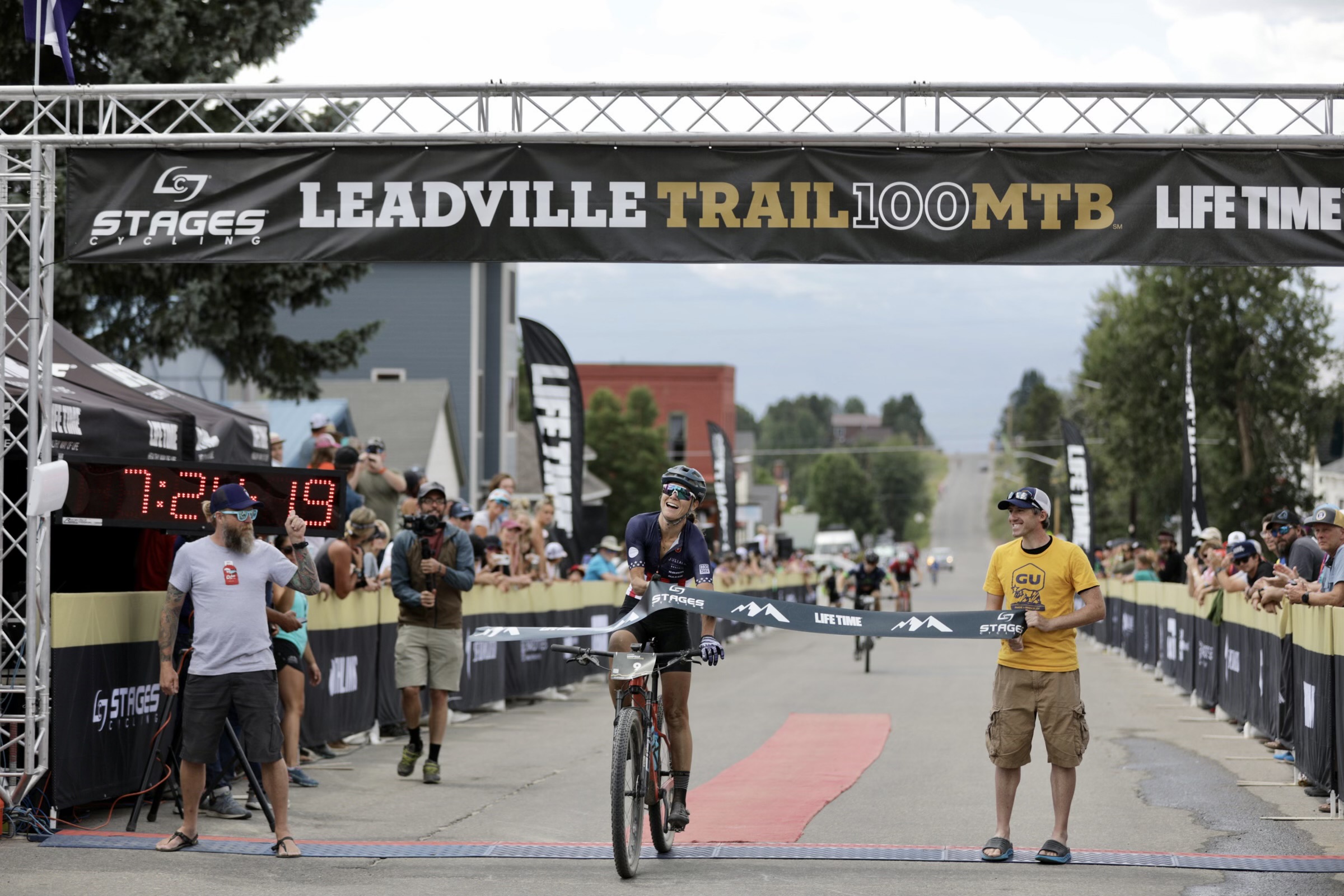
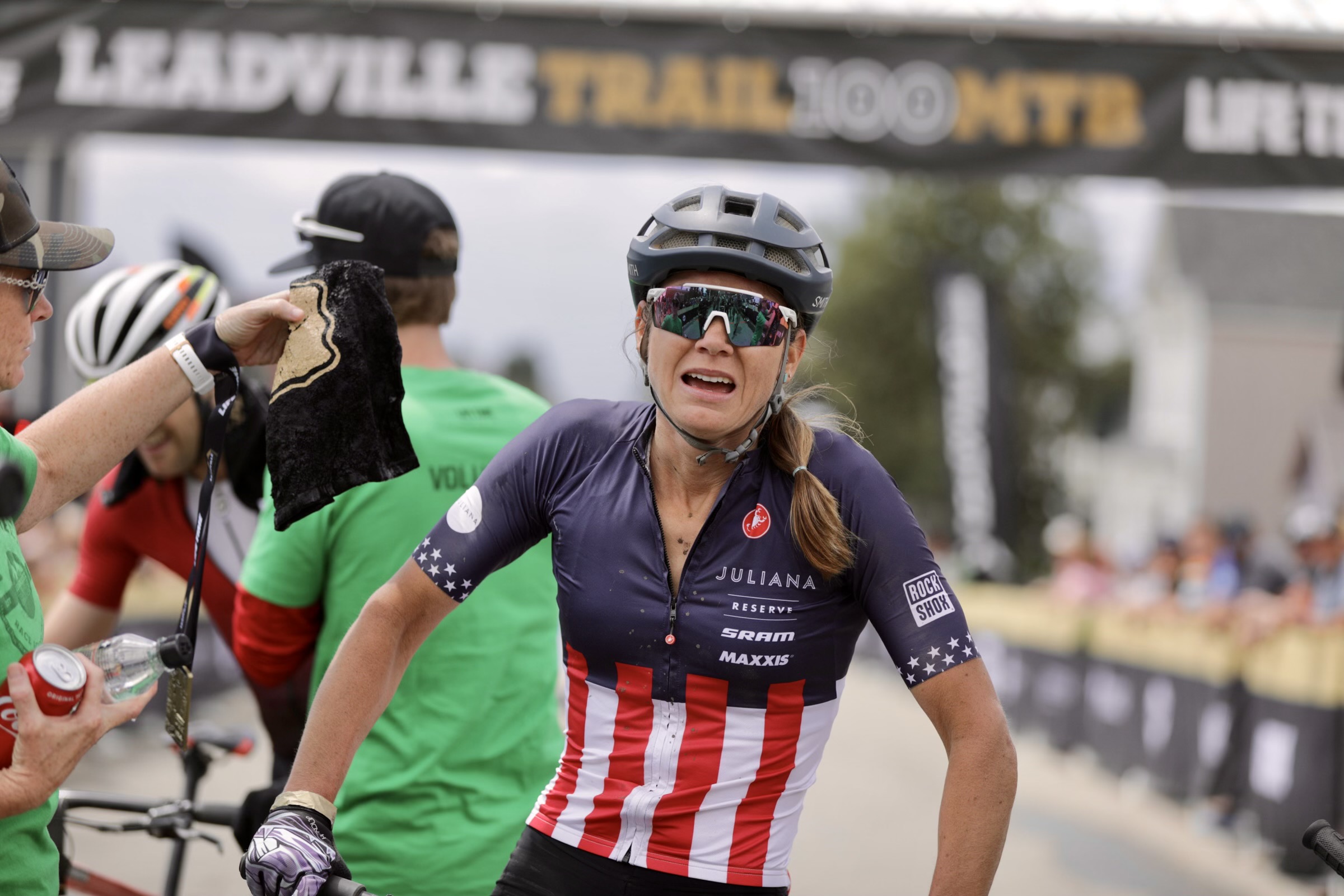
Rose Grant crosses the line to win the 2021 Leadville Trail 100. Photo courtesy Life Time
In the women’s division, Rose Grant, 39, of Columbia Falls, Mont. placed first with a finish time of 7:23:57, defending her title as reigning first-place female from 2019. Moriah Wilson, 25, of Mill Valley, Calif. secured second place with a finish time of 7:27:32. Sarah Sturm, 32, of Durango, Colo. placed third in the division with a completion time of 7:30:56.
Rose Grant, shortly after winning the 2021 Leadville Trail 100. Photo courtesy Life Time
After commenting that she worried she had gone out too hard at the beginning of the event when approaching the infamous Columbine climb, Grant said, “My favorite part of the day, in a love-hate type of way, was the depth of field this year. The racing was completely different than two years ago; the women were mixing it up the entire time and kept the pressure on. It was super suspenseful as to who was going to be the strongest.”
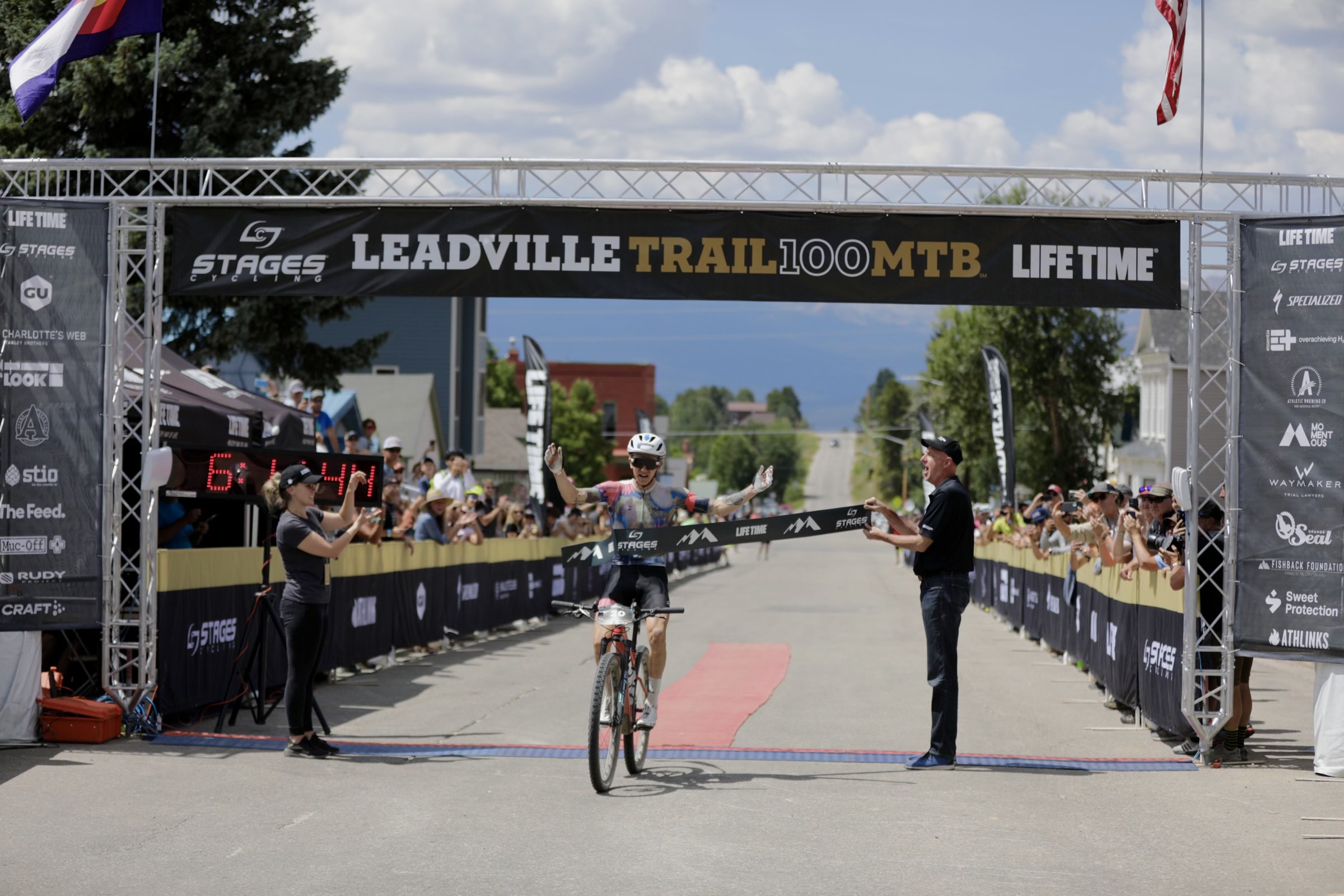
Keegan Swenson crosses the line to win the 2021 Leadville Trail 100. Photo courtesy Life Time
For the men, Keegan Swenson, 27, of Heber City, Utah placed first with a finish time of 6:11:26. Lachlan Morton, 29, of Boulder, Colo. secured second place with a finish time of 6:19:22 while 2019’s first place male champion Howard Grotts, 28, of Missoula, Mont. placed third in the division with a completion time of 6:21:47.
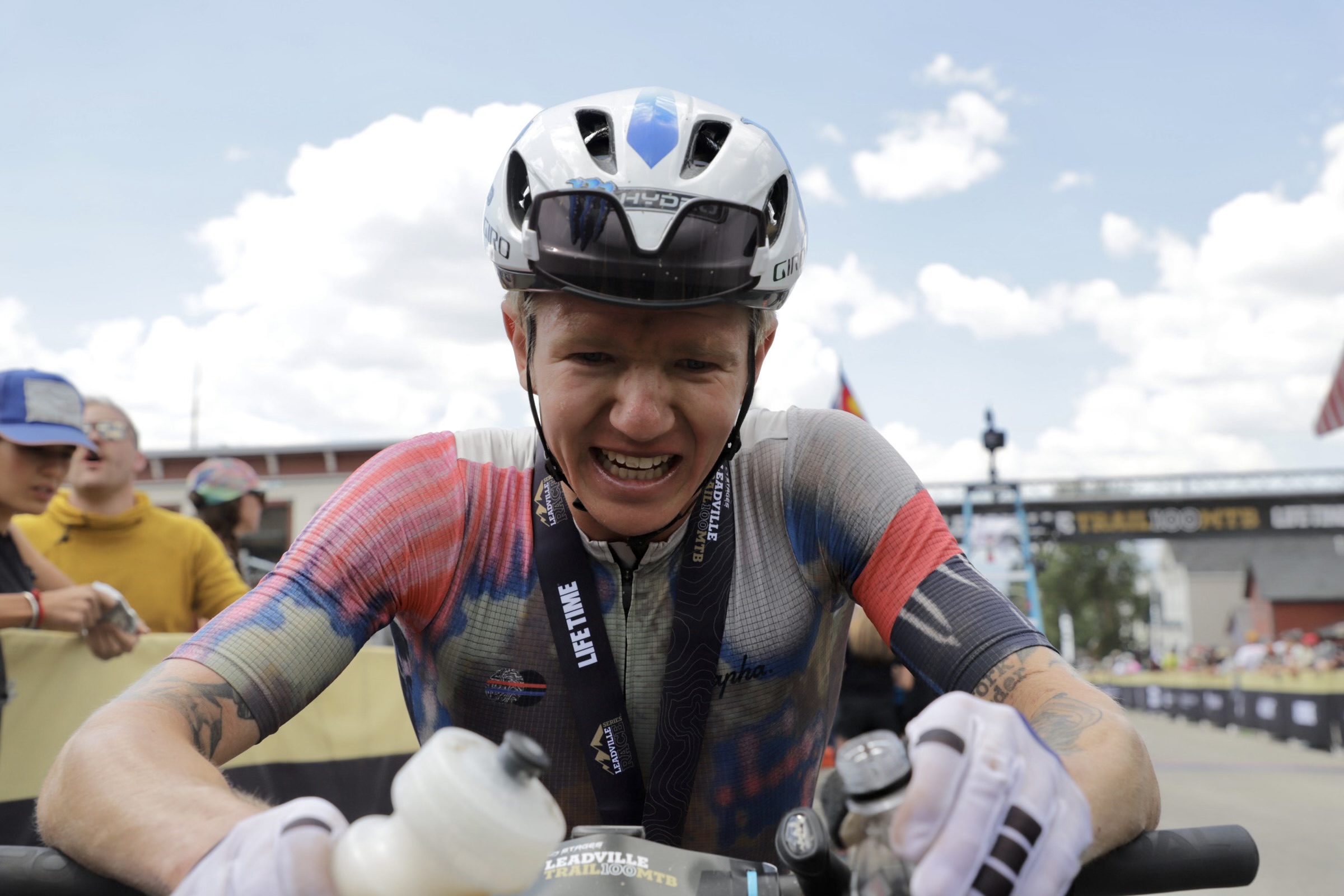
Keegan Swenson, shortly after winning the 2021 Leadville Trail 100. Photo courtesy Life Time
When asked about his day on-course, Swenson noted, “I just tried to ride smooth, Lachlan is a heck of a rider and so is Howard. Columbine was my favorite part of the course – I loved the views and seeing everyone climbing up as I was descending because everyone was cheering for each other. I’m definitely coming back next year.”
Nearly 100 riders from today’s event will quickly depart Leadville for Colorado Springs to complete the second half of the LeadBoat Challenge, which is comprised of the Leadville Trail 100 MTB followed by the SBT GRVL Black event, making for a grand total of 250 miles of riding in two days.
By Charles Pekow — It’s not just gender, ethnicity, income or certain neighborhoods that get overlooked in efforts to expand the universe of people who ride bikes. Manufacturers, advocates and planners may also be overlooking another large group of potential bicyclists: senior citizens. Many more people would be likely to ride if bikes and infrastructure were designed better for them. Or so suggests a new study from the Mineta Transportation Institute. And the older demographic has become more important because members have increased their desire to ride during the COVID-19 pandemic.
The institute questioned 2,300 people over 50 in the United States and Canada who ride about their habits and how cycling could become more friendly and safer for them. (The institute didn’t include seniors who don’t ride about why not and what might get them interested.) About 61 percent of respondents were men and respondents mainly came from relatively high-income households. “This is a recognized weakness of the survey,” the report acknowledges.
Most respondents indicated they learned to ride as a child or teen, indicating a need for more adult education in communities. Health or aging agencies, bike shops or recreation departments could run programs. Cambridge, MA, for instance, started a program to teach adults to ride (including skills for those who had learned many years ago but stopped riding). Cambridge had to do the program by webinar during the pandemic and put the program on YouTube.
“Older adults’ desire to continue riding means that planners and designers need to include this demographic in network planning, design, and maintenance. Planning for older adult communities should also be design to support cycling both within and with connections to the adjacent bicycle network,” the report says. Ebikes and trikes will help many.
18 New Routes in California, Indiana, Ohio, Utah, and Washington State Represent Largest Addition to USBRS to Date
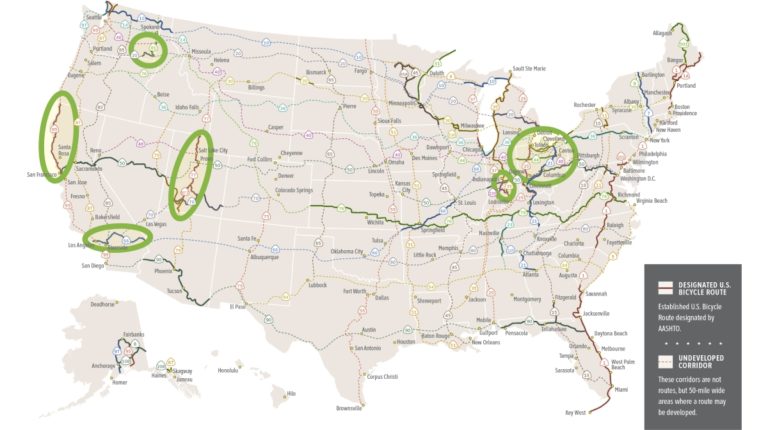
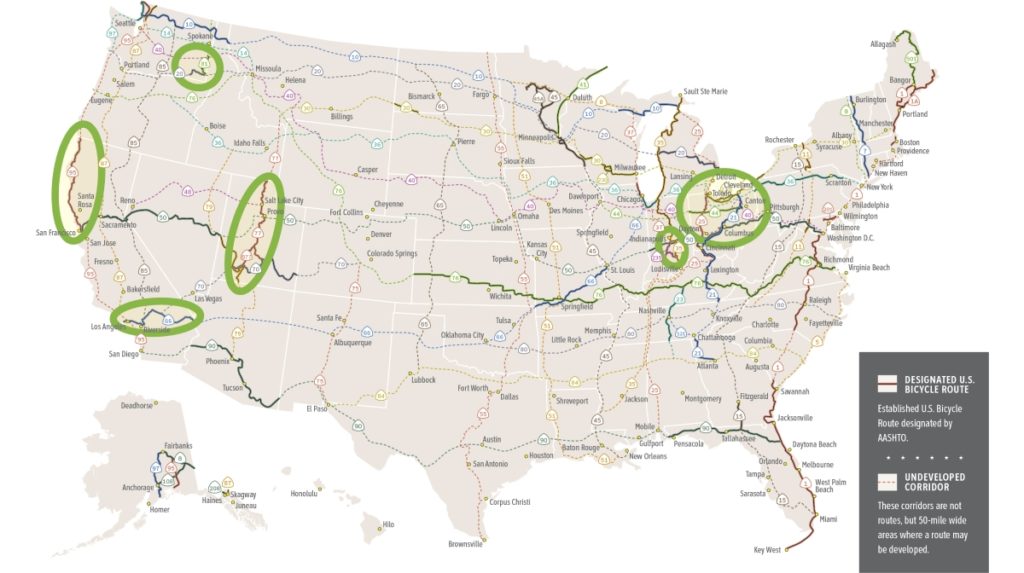
MISSOULA, Montana (Aug. 9, 2021) — Adventure Cycling Association announced the designation of 18 new U.S. Bicycle Routes in five states, adding 2,903 miles to the U.S. Bicycle Route System (USBRS). The new routes in California, Indiana, Ohio, Utah, and Washington State represent the largest addition to the USBRS to date in terms of both the number of designations and their total mileage. Two other routes in California and Florida also have been realigned to improve the cycling experience.
The US Bike Route System has new routes in 5 states in 2021.
The new routes offer a variety of scenic cycling opportunities from the Midwest to the Northwest and the Southwest. In California, follow the Pacific Coast from Oregon to San Francisco or cross the state from the high desert to Los Angeles. In Indiana, ride from Indianapolis to Bloomington and beyond. In Ohio, connect Cleveland, Toledo, Cincinnati, and more. In Utah, go from the foot of the Wasatch Front to Salt Lake City and the painted cliffs and pinnacles near the Arizona border. And in Washington State, ride the rolling Palouse and into the Snake River Canyon.
“Twice each year, state departments of transportation play a significant role in the expansion of the U.S. Bicycle Route System by designating new routes,” said Jim Tymon, Executive Director of the American Association of State Highway and Transportation Officials (AASHTO). “This summer, we are not only witnessing the highest number of designations in any single period to date, but we are also seeing why making improvements to existing routes when possible is important. In Northern California, for example, officials realigned U.S. Bicycle Route 50 to take advantage of a new paved path that is making cycling in the region safer and better than ever before.”
The USBRS is a developing national network of officially recognized, numbered, and signed bicycle routes, with the goal of 50,000 miles of routes linking every state in the country. USBRS-designated routes help promote tourism, enhance rider experience and safety, and assist in building out and planning other transportation facilities. All U.S. Bicycle Routes are designated by state departments of transportation and approved by AASHTO.
With the new designations, the USBRS now has 17,734 miles of routes in 31 states and Washington, DC. At least 40 states are currently developing U.S. Bicycle Routes.
Adventure Cycling Association, a nonprofit organization that provides national coordination for the USBRS, partners with AASHTO to ensure states have the resources and expertise needed for successful route designation.
“With this addition of nearly 3,000 miles, the U.S. Bicycle Route System continues to pick up momentum — and the growth of the system benefits every person who has, is, or will be traveling by bike,” said Scott Pankratz, Executive Director of Adventure Cycling. “Adventure Cycling Association applauds our state department of transportation partners, who understand the role bike travel plays in our national infrastructure, supporting health and wellness, transforming communities, and increasing economic activity across the country.”
Highlights of the newly designated USBRS routes include:
California
USBR 66 (329.8 miles): Where possible, USBR 66 generally follows the historic U.S. Route 66. Beginning at the Arizona border, the route crosses the Colorado River then travels along the high-desert National Trails Highway, passes through Barstow, Victorville, and San Bernardino, follows the Pacific Electric Bikeway across the eastern end of the San Gabriel Valley, and reaches Los Angeles, where highlights include Olivera Street, Chinatown, Hollywood, and Beverly Hills, before it ends on the pier at Santa Monica.
USBR 95 (440.4 miles): USBR 95 begins at the Oregon border and mostly follows U.S. Highway 101 and the Pacific Coast to San Francisco. After passing through Crescent City, the route travels under the shade of redwoods through Eureka, reaches Mendocino, climbs and descends coastal headlands, rides over the Russian River, continues on to Sausalito, crosses the Golden Gate Bridge, and finishes on the southern edge of San Francisco.
USBR 50: In El Dorado County, USBR 50 has been realigned to take advantage of a newly completed segment of the El Dorado Trail.
GPS links:
USBR 66: Needles, San Bernardino, Ludlow, Barstow, Victorville, Pasadena, Los Angeles, Santa Monica
USBR 77, USBR 677, and USBR 877 (349.8, 40.6, and 88.8 miles): USBR 77 begins at the Idaho border and travels through Logan, along the Wasatch Front from Ogden to Salt Lake City and Provo, then climbs between the mountains of the Fishlake National Forest, and continues on to its end at USBR 70 in Torrey, near Capitol Reef National Park. USBR 677 is a less urban and more scenic alternate route on the west side of Utah Lake, while USBR 877 connects USBR 77 in Sigurd to USBR 79 in Panguitch.
USBR 79 and USBR 679 (269.3 and 9.4 miles): From the Nevada border, USBR 79 crosses high desert, reaches Cedar City, climbs toward the painted cliffs and pinnacles of Cedar Breaks National Monument, passes Panguitch, then descends to its end at the Arizona border, in the Navajo sandstone near Kanab. USBR 679 connects USBR 79 at U.S. Highway 89 and USBR 70 at Duck Creek Village.
GPS Links:
USBR 77: Brigham City, Ogden, Salt Lake City, Provo, Torrey
USBR 81 and USBR 281 (103.4 and 23.1 miles): USBR 81 rolls through the wheat fields of the Palouse, staying close to the border with Idaho. Starting near the town of Tekoa, the route passes Pullman, home of Washington State University, then descends into the Snake River Canyon to Clarkston, and continues on to Asotin. USBR 281 is an alternate route from Pullman across the southern extent of the Palouse atop the Columbia Plateau, connecting with Idaho north of Clarkston.
USBR 40 (1.9 miles): USBR 40 is a small start to a route that will eventually stretch 400 miles across Washington. It currently starts at the Idaho border and ends in Tekoa.
USBR 20 (77.8 miles): USBR 20 begins at the Idaho border in Clarkston and crosses the Columbia Plateau. The route follows the Snake River past the island that makes up Chief Timothy Park, climbs through rolling hills to Alpowa Summit, descends Pataha Creek to Pomeroy, then climbs and descends again to Dayton, and reaches Lewis & Clark State Park on the Touchet River before its end.
USBR 1: In Key West, USBR 1 was realigned to allow safer passage to the southernmost point in Florida.
Indiana
USBR 235 (122.1 miles): USBR 235 is a scenic alternative to USBR 35 between Indianapolis and Seymour. From Monument Circle in downtown Indianapolis, the route passes the Indiana State Capitol and joins the White River Trail at White River State Park, opens up into farmland, turns to hills near Martinsville, takes a spur out to bike-friendly Bloomington, returns to Lake Lemon, and ends in Seymour.
USBR 21 (366.9 miles): Starting at Edgewater Park in Cleveland, USBR 21 follows the Ohio to Erie Trail through Akron, Massillon, and Columbus to Cincinnati, then continues along the Ohio River to Aberdeen, with nearly three-quarters of the route on off-street trails.
USBR 25 and USBR 225 (308.2 and 2.3 miles): USBR 25 starts at the Michigan border and passes through Toledo, Lima, and Dayton along segments of the Great Miami River Trail, reaches Cincinnati and continues along the Ohio River to Aberdeen. USBR 225 is an alternate route through Piqua along the opposite bank of the Great Miami River.
USBR 30 and USBR 230 (225.6 and 78.1 miles): USBR 30 travels from Ohio’s border with Pennsylvania to its border with Michigan. The route starts near Ashtabula, and passes through Cleveland and Toledo, following the shore of Lake Erie and the North Coast Inland Trail. USBR 230 is a scenic alternative that continues along the shore of Lake Erie from west of Cleveland through Lorain and Sandusky before rejoining USBR 30.
USBR 44 (196.1 miles): USBR 44 follows the Ohio to Erie Trail out of Massillon, crosses Charles Mill Lake on the way into Mansfield, passes through Bucyrus and outside Lima, and reaches its end at the Indiana border.
By Lou Melini — For many years the Bicycle Collective has envisioned a new building. If you have ever volunteered, visited or went there to make a purchase you will know why a new building is needed. The building is simply too small to meet the needs of the community in addition to needing repairs.
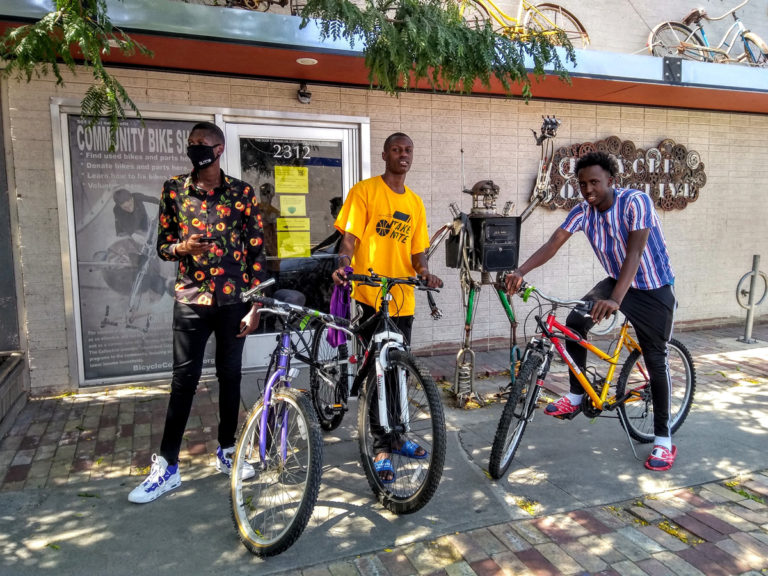
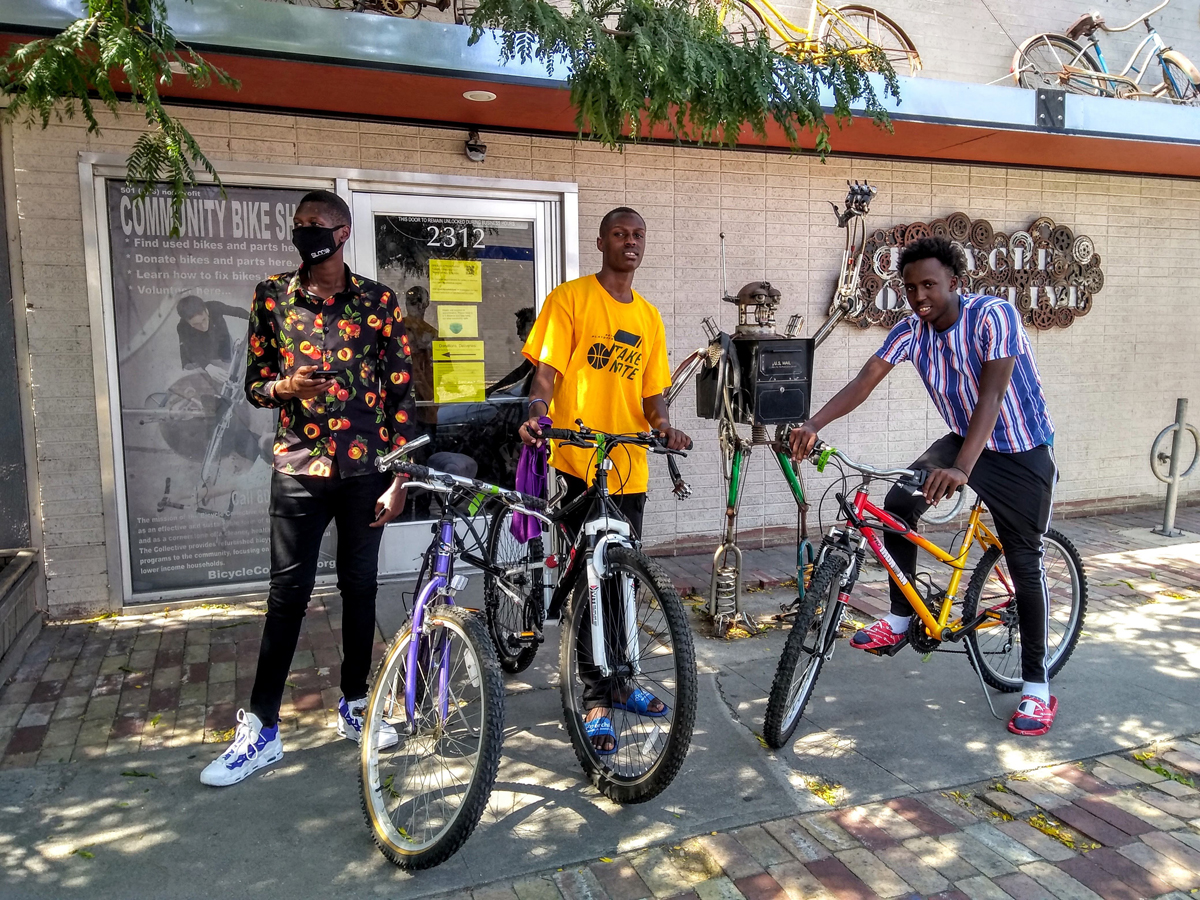
International Rescue Committee clients with bikes at the Salt Lake Bicycle Collective. Photo by Essen Skabelund
For more than 15 years the Collective has successfully operated the Salt Lake City shop in a rented space located at 2312 S. West Temple. The Bicycle Collective wants to ensure that it is a community resource for generations to come. A $3.5 million capital campaign to finance design and construction of a new flagship location in Salt Lake City has been in the works to achieve the goal of a new building.
Salt Lake City Redevelopment Agency (RDA) worked with the Collective and identified a piece of undeveloped property located at 901 S. Gale Street (325 West). Atlas Architects created the new building design concepts. The Salt Lake City RDA voted to donate that parcel of land to the Collective – a donation valued at $285,000.
Part of the funding has been raised, but more is needed, as construction is to begin soon. The goal of the campaign is to raise $1,000,000 from 10,000 community contributors. If you are unable to give $100, then donate what you can as all donations will be gratefully appreciated. Join me and help make this campaign a success. Go to Bicyclecollective.org and click on the capital campaign tab for more details.
Lou Melini is a lifelong bicycle commuter, and the former Commuter Column editor for Cycling West.
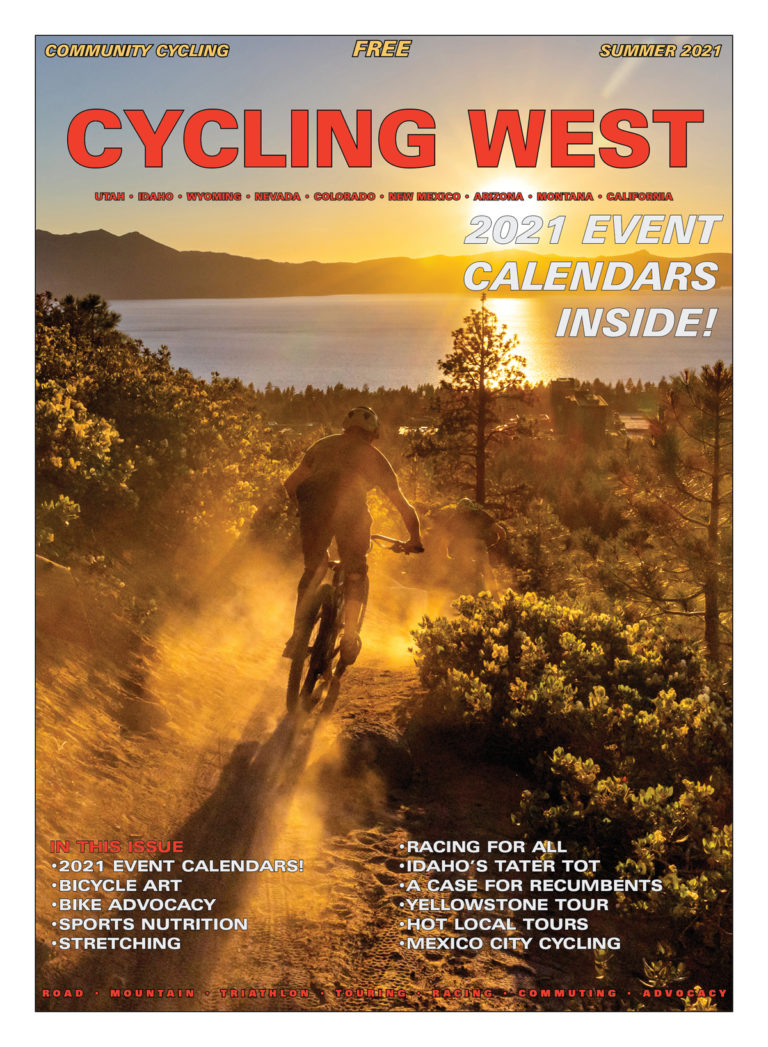
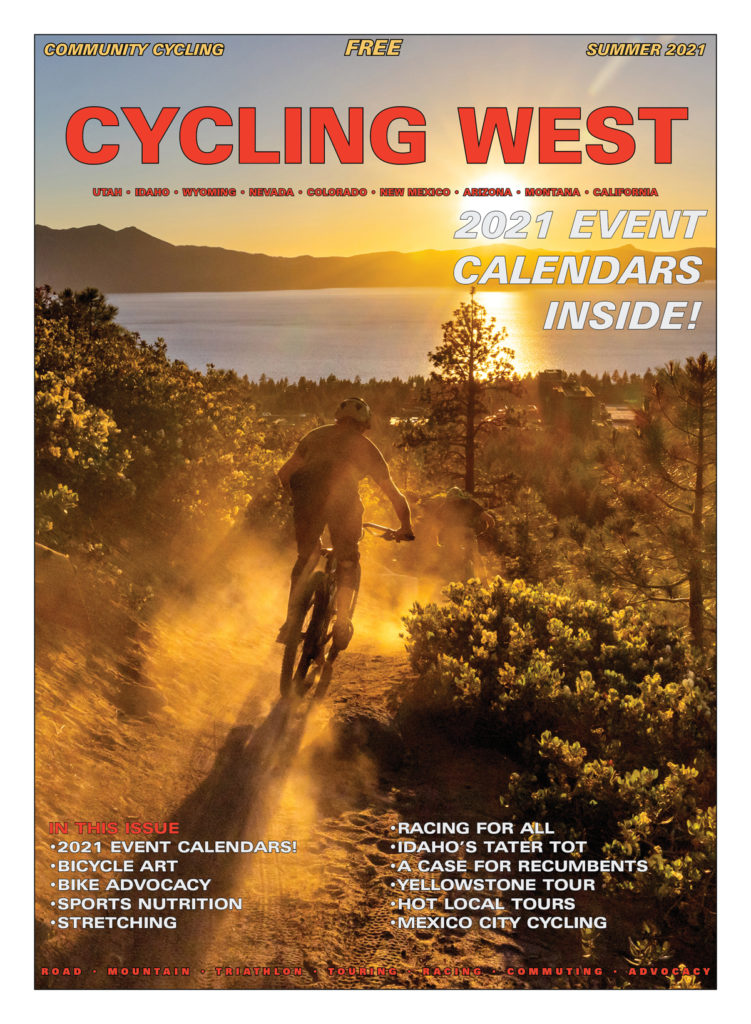
Cycling West and Cycling Utah Magazine’s Summer 2021 Issue is now available as a free download (12 MB download). Pick up a copy at your favorite Utah, Idaho, Wyoming, Nevada, Montana, Colorado, Arizona, New Mexico and Northern California bike shop or other location.
Cycling West Summer 2021 Cover Photo: Tahoe Area Mountain Bike Association (TAMBA) Vice President Nils Miller, and Over the Edge Tahoe employee Jonah Teetsel, descending towards Lake Tahoe on the Van Sickle Trail. Photo by John Shafer, photo-john.net
Contents
Is Your State Safe for Cycling? — page 2
Tax Deductions for Bike Commuting? — page 2
More Winners than Just Those on the Podium — page 3
Back in the Saddle Again: An Argument for Recumbents — page 4
The Most Important Stretch for Bicycling Health — page 6
Exploring Mexico City By Bicycle — page 7
Hot Local Tours (in Cool Utah Places) — page 8
Life at a 45-Degree Angle: Idaho’s Tater TOT — page 10
Going the Extra Mile — page 10
The Big Climb of Utah’s Castle Valley/Gateway — page 11
A Teton and Yellowstone National Park Bike Tour — page 12
No Place To Go But Everywhere — page 22
Cities Need to Consider Rider Age When Planning — page 22
Breath and Sky – The Bicycle Art of Trenton Higley — page 23