By Charles Pekow — A Complete Streets project in Pittsburgh doubled or nearly tripled bike traffic while reducing auto trips. That’s what an evaluation of a corridor found. Morning bike traffic went up 160 percent and evening use a whopping 280 percent. Part of the increase, though may have come from changes in transit culture as well as adding bike lanes on the road, says Travel Impacts of a Complete Streets Project in a Mixed Urban Corridor, the final research report of Carnegie Mellon University’s Mobility21, a National University Transportation Center for Mobility sponsored by the US Department of Transportation.
Not only did cycling increase, but reduced traffic meant bike riders breathed cleaner air. And the number of accidents didn’t climb. But more long term monitoring is needed to evaluate safety, the researchers found.
By Charles Pekow — One trouble with the reams of data we collect about bicycle habits is that they tend to be collected for a single purpose. Therefore, we don’t get the whole picture. So the National Cooperative Highway Research Program did a study on state data collection, Availability and Use of Pedestrian Infrastructure Data to Support Active Transportation Planning: A Synthesis of Highway Practice.
It found states varied in practices. Kentucky found that most requests for state or federal road funding included a bicycle/pedestrian component but that many of the local plans weren’t included in the state’s transportation plan. The state realized it needed better data collection and now requires all applications for transit funding explain how bicycle riders and pedestrians will be included.
The Utah Department of Transportation found it could get valuable data cheaply from bike/scooter share programs and Strava, an app for cyclists and runners.
By Jeff Levenson — As this is a new column, a bit of history is called for. I began 70 years ago, at age 5, on a kiddie bike with training wheels. After losing the trainers, moved on to a coaster brake JC Whitney cruiser, which probably outweighed me. At age 12, my Grandmother presented me with a state-of-the-art machine, a glossy black Raleigh (from Nottingham, England – home of Robin Hood and the dastardly Sheriff). In 1985, the gas shortage led me and my wife to purchase 10 speed French Racing bikes to commute with. Later we moved on to touring bikes, mountain bikes, and tandems.
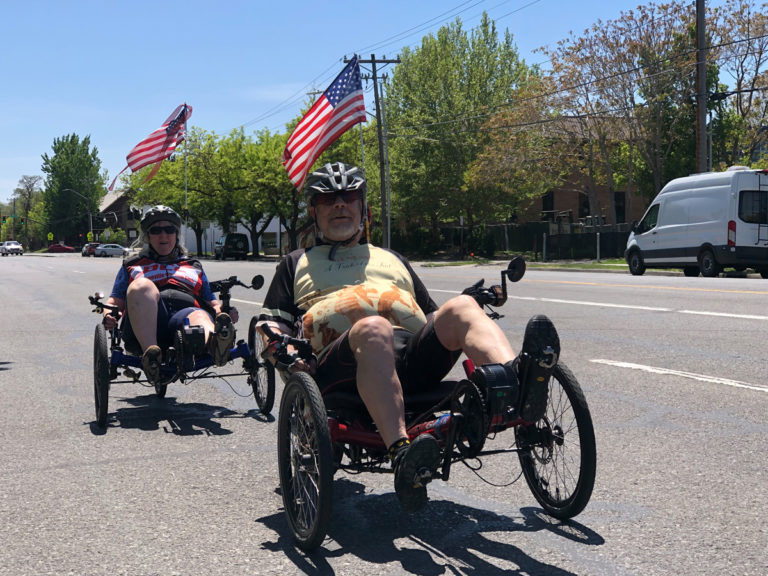
Jeff and Sandy Levenson on their recumbent bicycles. Photo by Dave Iltis
Then…disaster struck! In the words of one of my doctors (you get a lot of them in retirement), “Your backbone is turning into talcum powder”. If you watch TV, you will know from the overabundant legal commercials that talcum powder is deadly stuff. A few years earlier, we had, on a whim, bought two recumbent trikes. The solution to the back problem! And the seats were super comfortable – no “breaking-in” of a saddle that must convince your butt feels good; even better the longer you use it. Aside – I found on my first bike tour that the saddle had the ability to turn itself into a WW1 German army helmet – the one with the 10” spike rising from the middle.
What does any of this have to do with a 45-degree angle? Well, something you don’t notice on a cruiser, a racing bike, a touring bike, a tandem, or for that matter, a penny farthing. The lovely streets of the Salt Lake metropolitan area are high centered in the middle, then more or less flatten out – until the 5 feet or so adjoining the sidewalk. Then it’s a 45-degree slope. On a two wheeled contraption, you just naturally lean a bit to the left – problem solved. On a bike with two wheels up front, you just tilt – and sometimes start sliding off your seat and into the gutter (Note: those of you who think it’s impossible to flip a three-wheeler – it’s actually not that difficult!).
In later columns, I’ll address the observations I see as I trike around town. It’s definitely a different point of view.
Cycling West and Cycling Utah Magazine’s Spring 2021 Issue is now available as a free download (14 MB download). Pick up a copy at your favorite Utah, Idaho, Wyoming, Nevada, Montana, Colorado, Arizona, New Mexico and Northern California bike shop or other location.
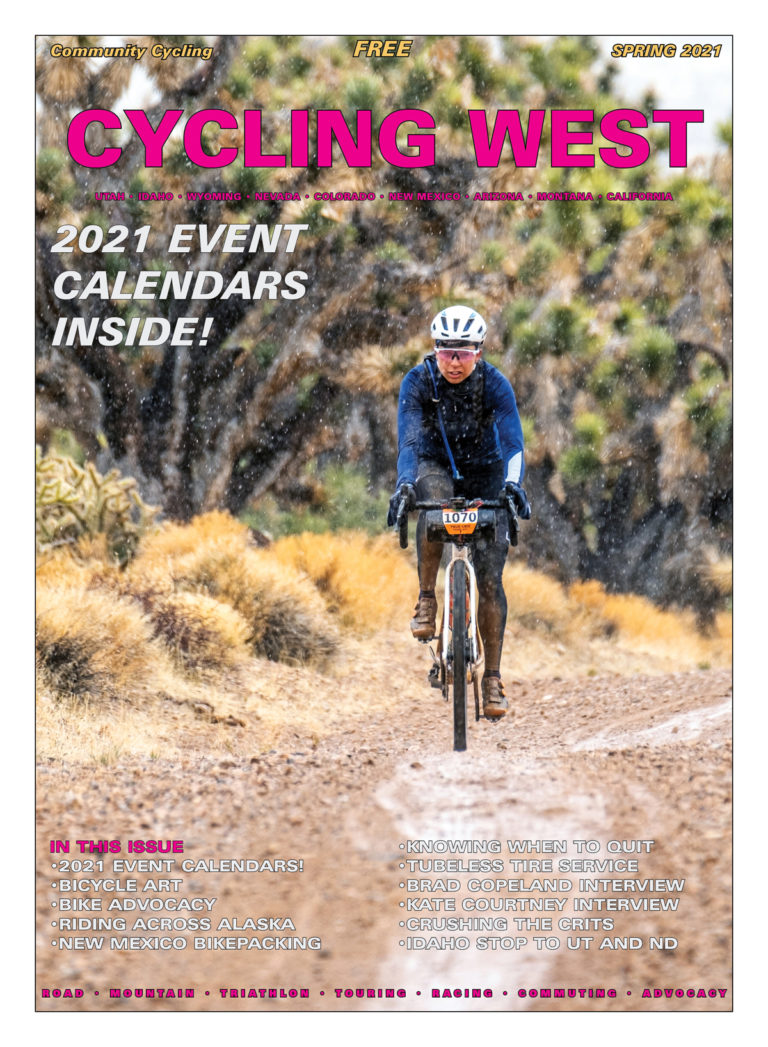
Cycling West Spring 2021 Cover Photo: Shayna Powless of Team TWENTY24 on her way to the women’s win in the 2021 True Grit Gravel race held on March 12. Find her on Instagram: @shaynapowless Photo by Dan Amodt, True Grit Epic
Contents
True Grit and Knowing When to Quit — page 3
Democrats in Congress Moving to Improve Bicycle Infrastructure Nationwide — page 5
Interview with Brad Copeland, Team Mechanic for Scott-SRAM MTB Racing — page 6
An Interview with Mountain Bike World Champion Kate Courtney — page 7
Tubeless Tire Service Can Be Easy — page 8
Salt Lake City Bicycle Collective Raising Money for New Home — page 8
Shifting Gears on Climate — page 9
Riding A Bicycle Across Frozen Alaska — A Hundred Years Ago — page 10
The Salt Lake Criterium and USA CRITS are Moving Forward at Full Speed — page 11
Voter Initiatives Approve $1B in Bicycle Infrastructure Funding in 2020 — page 11
Bikeshare Benefit a Mixed-Bag for Low-Income Communities — page 11
Studies Show Bikeshare Programs Need More Money — page 11
Bikepacking Through New Mexico’s Valle Grande — page 12
Calendar — page 16
Crushing the Crits — page 22
Idaho Stop Law Passes in Utah and North Dakota — page 22
Final Sprint – The Bicycle Art of TJ Eisenhart — page 23
The frequent question…how hard should I go while performing an endurance event? What’s a good pace for a time trial (TT)? Do I go out hard, or should I easy into race or ride pace? I am sure you have discovered what happens when you go out too hard…you blow up! On the other hand if you go out to slowly, you will sometimes feel like you did not go hard enough.
What is pace or what is meant by setting a pace for bicycling? Pacing is how you “dose” exercise intensity for a particular event. Pacing is performed in hopes of maximizing an event performance. Pacing is critical for success in timed individual athletic events such as TT’s, triathlon, rowing, long track speed skating.
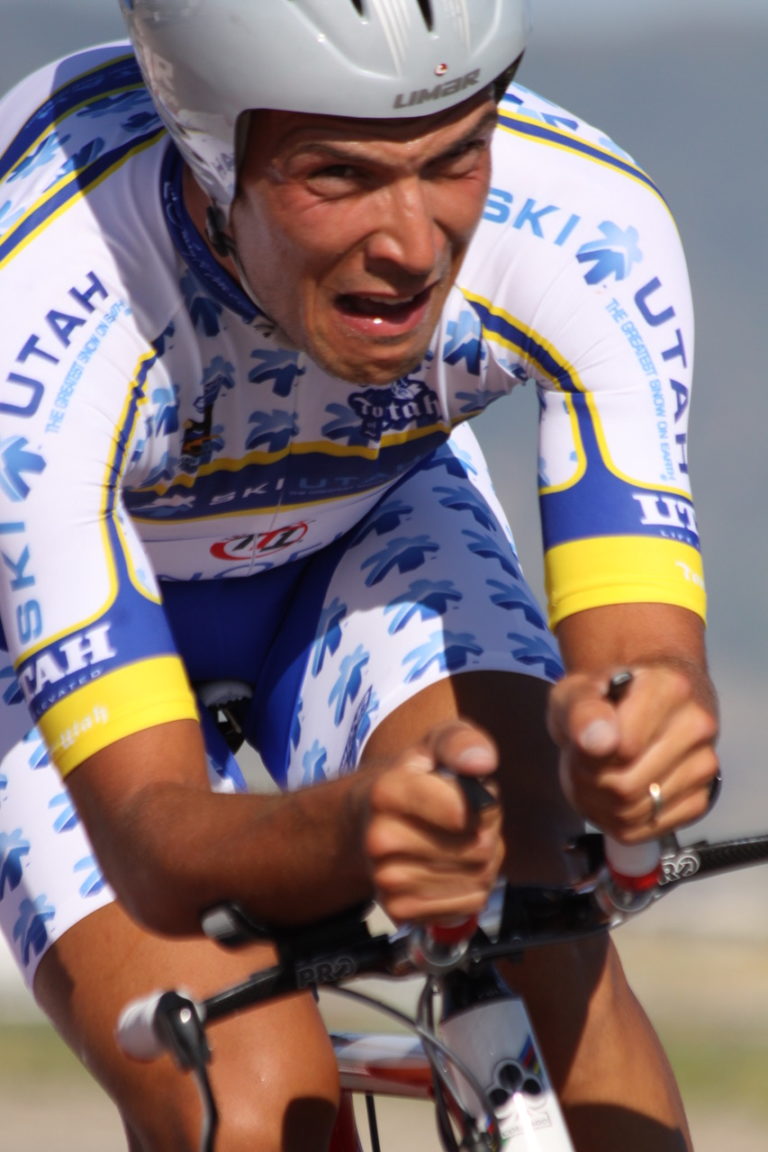
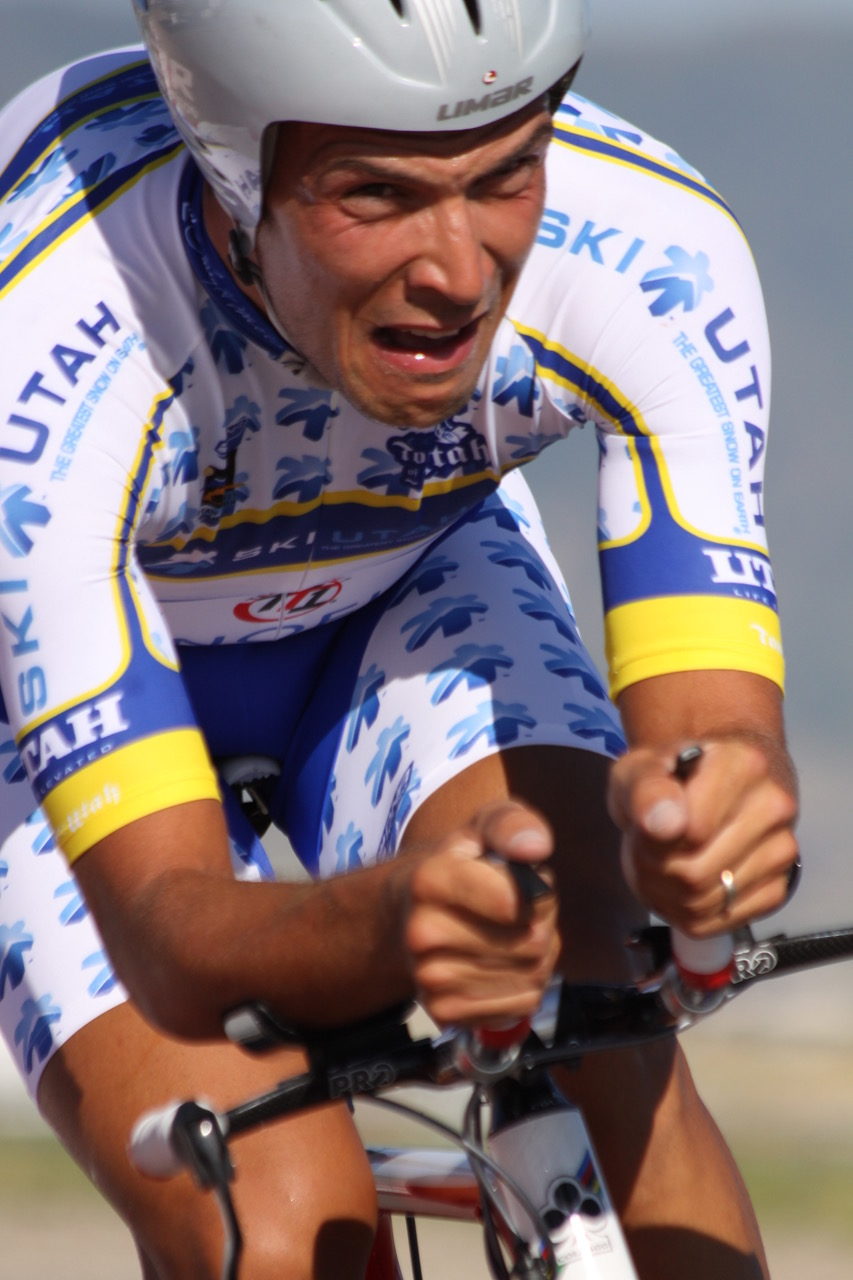
It’s important to pace yourself in a time trial. Stage 3 of the 2011 Tour of Utah at the Utah Motorsports Park in Tooele, Utah. Photo by Dave Iltis
A research paper by Ham and Knez discussed pacing strategies for a 30km time trial (TT) 1. A time trial is an individual race where you race “against the clock”. A TT requires an athlete to go as fast as they can over a certain distance. This paper looked at a longer event (30km) to best demonstrate the use of pacing. We know that in shorter events, such as 4km or less, pacing should be approached by a short and powerful start (above average pace for the event)2. Ham and Knez compared pacing strategies with time to exhaustion values as a means to calculate best pacing strategy for a longer TT. They discovered that athletes who had faster starts would then have slower completion times. It was suggested that early lactate acid build up is the reason for impaired performance. Their research suggested that starts for longer TT’s should be held closer to projected pacing levels so as to avoid early onset of exhaustion. This would suggest that athletes create an even dosing of energy to an event. They also found athletes who varied their TT efforts much greater than 5% over their optimal TT pace had slower results.
This paper is useful to more applications than just a 30km TT. Think about endurance events such as your local century ride. You will pay the price when you go out too fast. There is plenty of anecdotal evidence demonstrating the ill effects of going out too hard on endurance rides. You will find that even pacing strategies will allow for “best results” on most recreational endurance events.
What can I do?
Know your optimal pace. Experiment with pacing levels. This experimentation should include discovery of what is too hard of pacing and what is too easy.
Quantify your pacing in terms of cadence, heart rate and power. Heart rate and cadence are easy to monitor and should be best understood prior to application of power. Power monitoring is great if you can frequently test and then know your threshold power.
Resist the temptation to start an event too hard. This involves knowing a quantity or value that is associated with too hard of a pace. Use metrics of cadence, heart rate and/or power. Starts that exceed 5% of projected pace will result in poor performance.
This research encourages the bicyclist to “know thy self”. Pacing strategies will help you perform better. The establishment of this strategy requires work on your part. This includes testing, monitoring, event practice and self control. Don’t leave an important event to chance. Good preparation and strategy proves to be the best performance enhancement.
Reference:
Ham DJ and Knez WL. An evaluation of 30km cycling time trial pacing strategy through time-to-exhaustion at average time trial pace. J of Strength and Conditioning Research. 23(3): 1016-1021, 2009; DOI: 10.1519/JSC.0b013e3181a30f8f
Van IngenSchenau GJ, de Koning JJ and de Groot G. The distribution of anaerobic energy in 1000 and 4000 meter cycling bouts. Int J Sports Med 13: 447-451, 1992; DOI: 10.1055/s-2007-1021296
By Steve Chambers — Clydesdale is the most common name given to larger athletes. Anyone familiar with a certain beer company’s holiday commercials knows what a Clydesdale looks like. They truly are the behemoths of horses. Where a typical thoroughbred race horse will weigh 1200-1500 lbs., Clydesdales tip the scales at 1900 lbs. or more and stand much taller.
Sometimes female Clydesdales are called Fillies, an obvious “me-too” to the equine world. “Filly” is misleading, because a filly is simply a female horse over one year and under five years of age, regardless of size. One of the most famous fillies was Ruffian, winner of the Filly Triple Crown and unbeaten in 10 races. In 1975 a two horse battle of the sexes was set up between Ruffian and that year’s Kentucky Derby winner, Foolish Pleasure. Ruffian broke her leg during the race and had to be put down. She was the only non-human athlete named to Sports Illustrated’s list of the Top 100 Female Athletes of the 20th Century.
Athena is another name given to female Clydesdales. Athena was a Greek warrior goddess, often attended by the goddess of victory, Nike. She was the patron goddess of Athens.
Amazon is a term frequently used for female Clydesdales. Amazons were a mythic race of warrior-women in ancient Greece, of large stature and ferocious in battle. Legend has it the name is derived from the Greek “a-mazos”, meaning “without breast”. The Amazons were said to have cut off their right breasts so it would not interfere with their ability to draw a bow or throw a spear. According to many accounts, the Amazon River in South America was named by Spanish explorer Francisco de Orellana in 1541, in honor of the native female warriors he found along its banks.
In some parts of the country, other descriptive terms are used in place of “Clydesdale”. In the southwest, you might race in the Longhorn division, while in southern California there is the Shamu division.
By Steve Chambers — A popular t-shirt slogan a few years ago read “If you can’t run with the big dogs, stay on the porch”. The sad truth is big dogs can’t run with the pack. I should know; I’m a big dog, a/k/a a Clydesdale.
“Clydesdale” generally means over 200 lbs. for men and over 150 lbs. for women. Female Clydesdales are often called Fillies, Athenas or Amazons. For this article, I’ll refer to both men and women as Clydesdales.
Steve Chambers at the Cache Valley Century Ride. Photo courtesy Steve Chambers
I wasn’t always a Clydesdale. In high school I was too small to play football. But I made up for it by being slow. I was always at the back of the team running laps. Once, a coach, probably trying to speed things up, kindly told me that it was shorter to run around the inside of the track. I got bigger but I didn’t get faster.
In the 1980s, I discovered triathlons. At that time, I could run a steady nine-minute mile. Years and pounds have raised that to about 12 minutes. With some technique improvement and additional weight loss, I can improve, but probably not to what most people would consider normal mile splits. After a race, I tell people I flew through the course, passing rocks and trees like they were standing still. Forget about running with the pack; we’re lucky to see the pack after the first mile or so.
Why We’re Slow
So are Clydesdales just fat and lazy? A little more discipline, a little more effort, we’d be right up there with the so-called normal people, right? Wrong. Like a moving van differs from a sports car, Clydesdales aren’t built like their smaller brethren.
From high school physics, you might recall the formula for kinetic energy (the energy of movement): E = l/2mv2, where m = mass (weight) and v = velocity, (speed). What this says is that for a person to double his or her speed requires four times more energy. So for 250 lb. runner to drop from a twelve to a six-minute mile to keep up with a 125 lb. runner, he needs EIGHT TIMES more energy than the 125 lb. runner requires to run a 12-minute mile, twice as much for the size difference and four times as much for the speed differential.
But the real problem is VO2 max. This is the rate at which the body utilizes oxygen, which is necessary to convert its stored fuel into energy. As body mass increases, relative VO2 max actually decreases.
Here’s how Stephen Seiler, PhD in exercise physiology, explains it: If you take a highly trained 5’7″, 140 lb. cyclist and add 12% to his height, he will be just over 6’3′ tall. If you then configure this new, taller athlete proportionately to the original athlete, he will weigh 195 lbs. His absolute VO2 max will increase from 5.0 liters/minute to 6.25 liters/minute due to the increased heart volume. This should make a more efficient and therefore faster athlete. But because of the increased body mass, the relative VO2 max will actually decrease 9%. So while the athlete is now bigger, has more mass and therefore requires more energy to be competitive, his ability to utilize energy has decreased. It’s as if someone took the pistons out of a couple of cylinders in the engine at the same time they loaded up the trunk.
This is why there are very few large, competitive endurance athletes. Chris Froome and Romaine Bardet are almost identical. Both stand 6’1” tall but only weigh 149 and 148 lbs. respectively. Nairo Quintana stands 5’5” and weighs 128 lbs.
Clydesdales redline at very low speeds. When we try to crank up the velocity, our muscles send a signal to the brain that they need more energy. The brain orders the heart and lungs to deliver more oxygen so glycogen can be burned. Because the body has a low relative VO2max, the heart tries to compensate by beating faster to deliver more oxygen. This quickly pushes the athlete into the anaerobic area. Most trained endurance athletes have an anaerobic threshold of 75%-90% MHR. As soon as you exceed your anaerobic threshold, the effects of lactic acid begin to set in and you can’t sustain the pace.
Filling the Tank and Cooling the Engine
Clydesdales face a host of problems the Greyhounds don’t. Because our energy needs are greater, we have to carry more food and water in long races. Many times we come to an aid station long after the rest of the pack has left to find empty water cups, black banana peels, and little else. Our slower speed makes long rides really, really long.
Those of us who choose to ride centuries, run marathons or do Ironman-distance triathlons become creative in our training. Routes are planned to pass by convenience stores. We stash food along the way like through-hikers on the Appalachian Trail. Because of overheating, we train early in the morning or late at night, wearing headlamps and carrying flashlights. Sometimes we even break up long sessions over two days. For Clydesdales, every run is a marathon, every marathon is an ultra, and an ultra may be impossible.
Heat poses special problems for Clydesdales. Not only is staying cool more difficult, but due to the extra time we spend on the roads in the sun, we’re more prone to hyponatremia, low blood sodium due to excessive sweating. It’s crucial for Clydesdales to drink electrolyte replacement drinks during long training sessions, not just water.
The key to being successful (and by that I mean completing) in long distance events, besides the proper training that all athletes have to undertake, is fueling. Think of the glycogen in your muscles (the energy your body will draw on during a race) as a box of matches. There are only so many matches in the box; when they’re gone, you stop. You can’t will yourself to finish when the glycogen is gone any more than you can will a jet liner to stay airborne when the fuel tank is empty.
You can delay using up all the matches by fueling during the event, but you can never replace calories as quickly as you use them. The best you can do is time it so you run out of calories as you cross the finish line. A Clydesdale might burn 1,300 or more Calories per hour during a long race. Considering that glycogen stores in the muscles and liver probably can’t exceed 2,000 Calories, there is at most energy for less than two hours. Remember that it takes 30 minutes or so for whatever you eat to get to the bloodstream, so you need to start eating 60-90 minutes after you begin exercising.
The body can’t convert more than 250-280 Calories of intake per hour into usable energy. Anything above that amount will slop around in your stomach, eventually causing gastric distress. Most people who become ill during a race do so because of overeating, not over-exerting.
Know Your Limitations
I’ve learned that for rides up to an hour in length, I’m usually safe without taking any food, as long as I took in 350-400 Calories before I started. Over an hour, I need to eat something. During your training, keep track of what you eat, when, and how you feel, then plan race day accordingly.
Try out different fueling strategies before race day. Don’t ever use a new energy product from your goodie bag that you get at check-in during the race. Save it for a training ride. Find out what works for you and stick with it.
Expect Something to Happen
Preparing for my first Spudman, I had my fueling strategy all worked out — when I would start to eat and drink, how much, how often. On the swim, I swallowed about half of the Snake River and didn’t feel like eating or drinking until the turnaround on the bike. By the time I ate and drank, it was too late and I bonked on the run. My plan was fine if I had been able to stay with it. But things happen in a race. When it happens, deal with it; don’t let it ruin your race.
Take Charge of Your Life
No race day strategy can overcome a poor nutritional foundation. Here again Clydesdales face problems unknown to others. Most of us are trying to lose weight, and we might be tempted to try various diets, especially the low-carbohydrate ones That’s a big mistake. Those diets are designed for the average American who leads a sedentary lifestyle. Athletes need fuel and fuel comes mainly from carbohydrates.
Many Clydesdales have health issues associated with our size. I ride not to win but because cycling gives me the motivation I need to keep exercising, and I exercise because I have three of the four markers for heart disease. If I weren’t active, a low-carb diet would be ideal for me. But I am active, I need extra carbohydrates those diets don’t provide. The problem is, how to get the fuel I need and still maintain the blood chemistry my doctor advises.
Find out what’s going on inside your own body. Educate yourself. There are dozens of books about nutrition for endurance athletes. The American Diabetes Association has some excellent recipes and meal plans if you’re facing diabetes, like millions of middle-age Americans are.
Don’t Give Up
Carry your Clydesdale frame with pride. If it takes you two and a half hours to finish a sprint triathlon, that’s no less an accomplishment than a 2:30 marathon for a skinny runner. If you don’t want to commit to training for century rides, marathons or even Olympic-distance triathlons, focus on shorter events. Whatever you do, Big Dog, get off the porch.
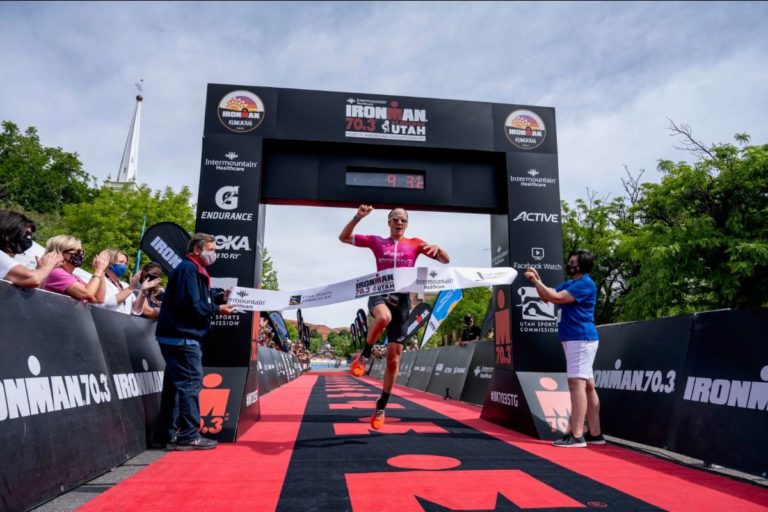
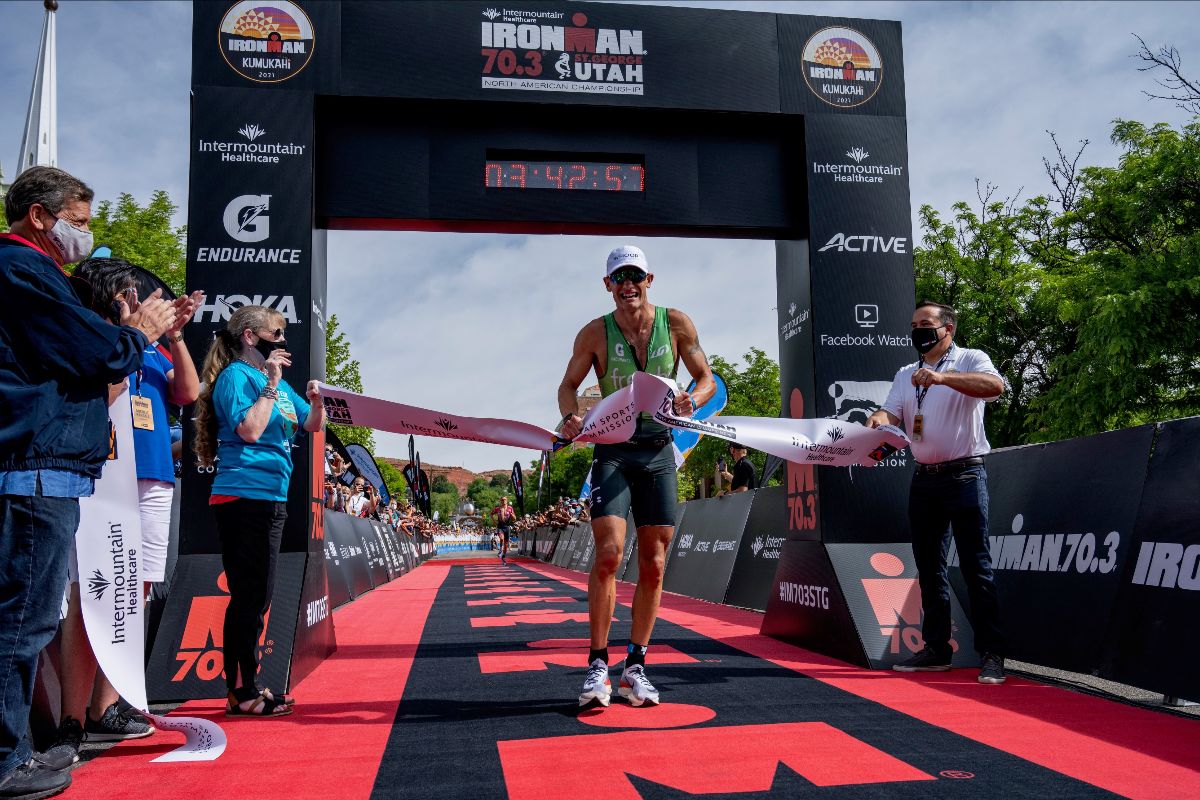
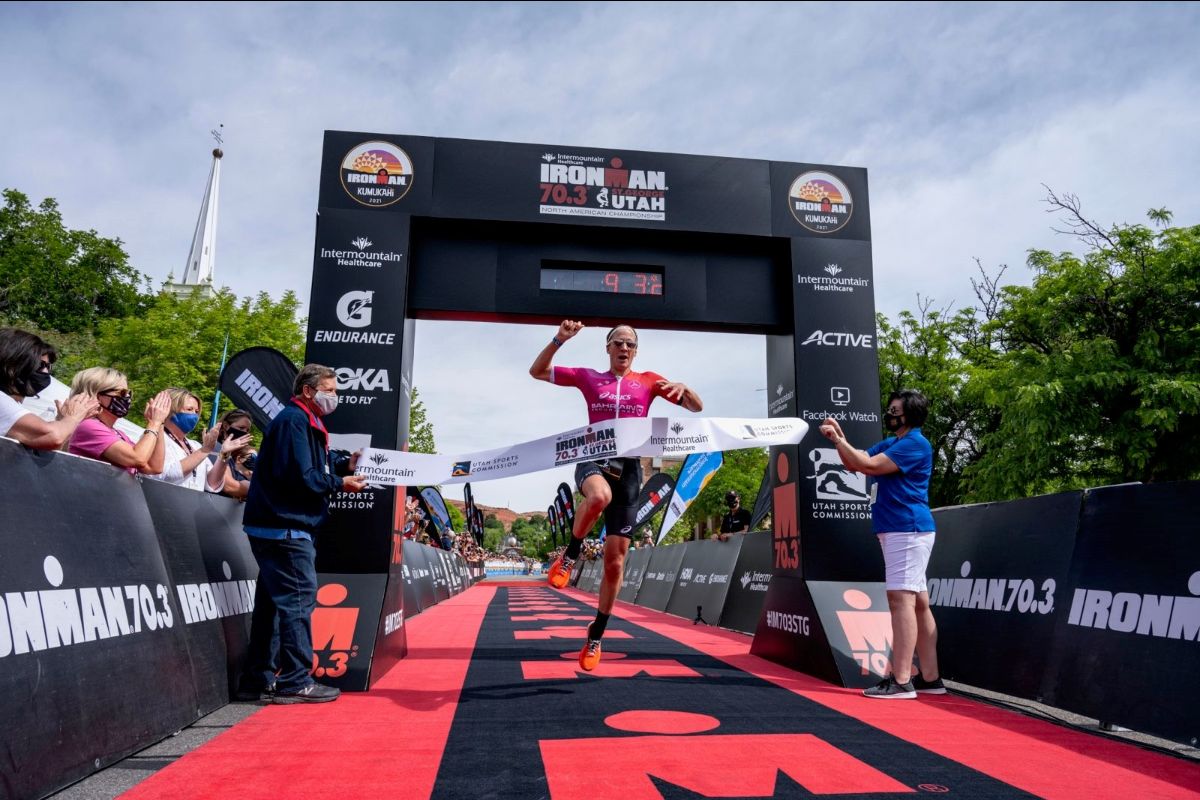
ST. GEORGE, Utah (May 1, 2021) — St. George, Utah provided breathtaking scenery for athletes on Saturday, May 1 as they swam 1.2-miles, biked 56-miles and ran 13.1 miles through southern Utah for the 2021 Intermountain Healthcare IRONMAN 70.3 North American Championship St. George triathlon. With a large and talented female and male professional field, many have viewed this event as a preview for the Intermountain Healthcare IRONMAN 70.3 World Championship presented by Utah Sports Commission which will also be taking place in St. George in 2021. Lionel Sanders (CAN) and Daniela Ryf (CHE) took the top honors with finishing times of 3:42:56 and 4:04:47 respectively.
Lionel Sanders (CAN) claims victory at the 2021 Intermountain Healthcare IRONMAN 70.3 North American Championship in St. George, Utah. Photo courtesy IRONMANDaniela Ryf (CHE) claims victory at the 2021 Intermountain Healthcare IRONMAN 70.3 North American Championship in St. George, Utah. Photo courtesy IRONMAN
Rounding out the men’s professional podium was Sam Long (USA), who came in second with a finish time of 3:43:02 and Magnus Ditlev (DNK) who posted a 3:45:12 finishing time that was good for third place. On the female side, Jeanni Metzler (ZAF) took second in 4:09:16, while Emma Pallant-Brown (GBR) finished in third with a 4:10:03 performance.
Top five professional men’s results:
SWIM
BIKE
RUN
FINISH
1. Lionel Sanders (CAN)
0:25:02
02:02:56
01:09:43
03:42:56
2. Sam Long (USA)
0:25:25
02:02:39
01:09:43
03:43:02
3. Magnus Ditlev (DNK)
0:23:26
02:01:26
01:14:44
03:45:12
4. Rodolphe Von Berg (USA)
0:23:15
02:02:39
01:11:58
03:45:29
5. Jackson Laundry (CAN)
0:23;52
02:04:46
01:13:45
03:45:44
Top five professional women’s results:
SWIM
BIKE
RUN
FINISH
1. Daniela Ryf (CHE)
0:23:45
02:14:12
01:20:54
04:04:47
2. Jeanni Metzler (ZAF)
0:23:45
02:21:33
01:18:11
04:09:16
3. Emma Pallant-Brown (GBR)
0:25:09
02:19:16
01:20:03
04:10:03
4. Paula Findlay (CAN)
0:23:51
02:21:40
01:21:51
04:13:07
5. Skye Moench (USA)
0:25:15
02:19:47
01:22:23
04:13:24
Earlier this week, IRONMAN announced that the city of St. George, Utah, will once again play host to a full-distance IRONMAN triathlon for the first time since 2012, with the event scheduled for May 7, 2022 and again in 2024. In addition, the new IRONMAN St. George will be designated as the 2022 and 2024 IRONMAN North America Championships.
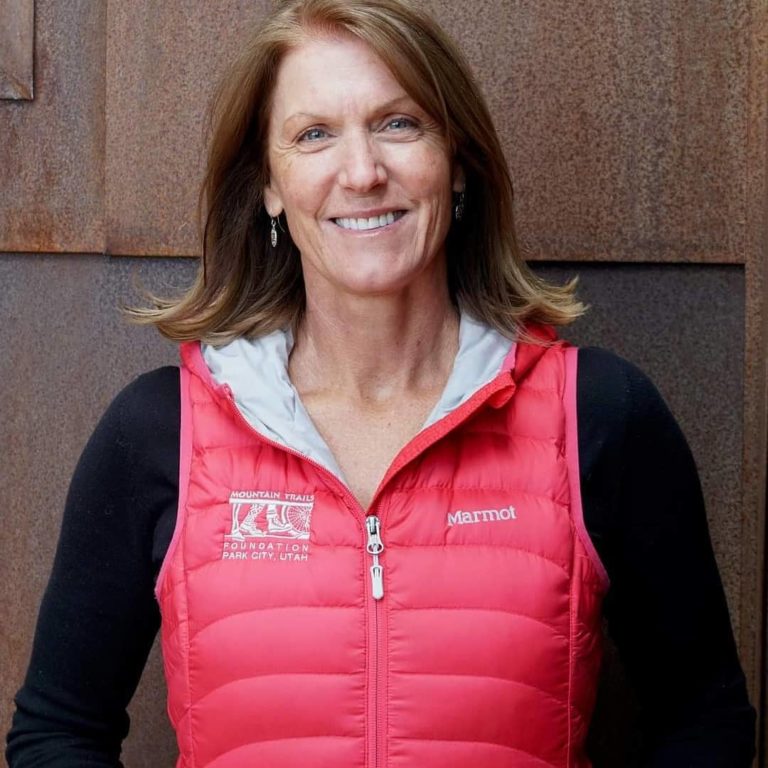
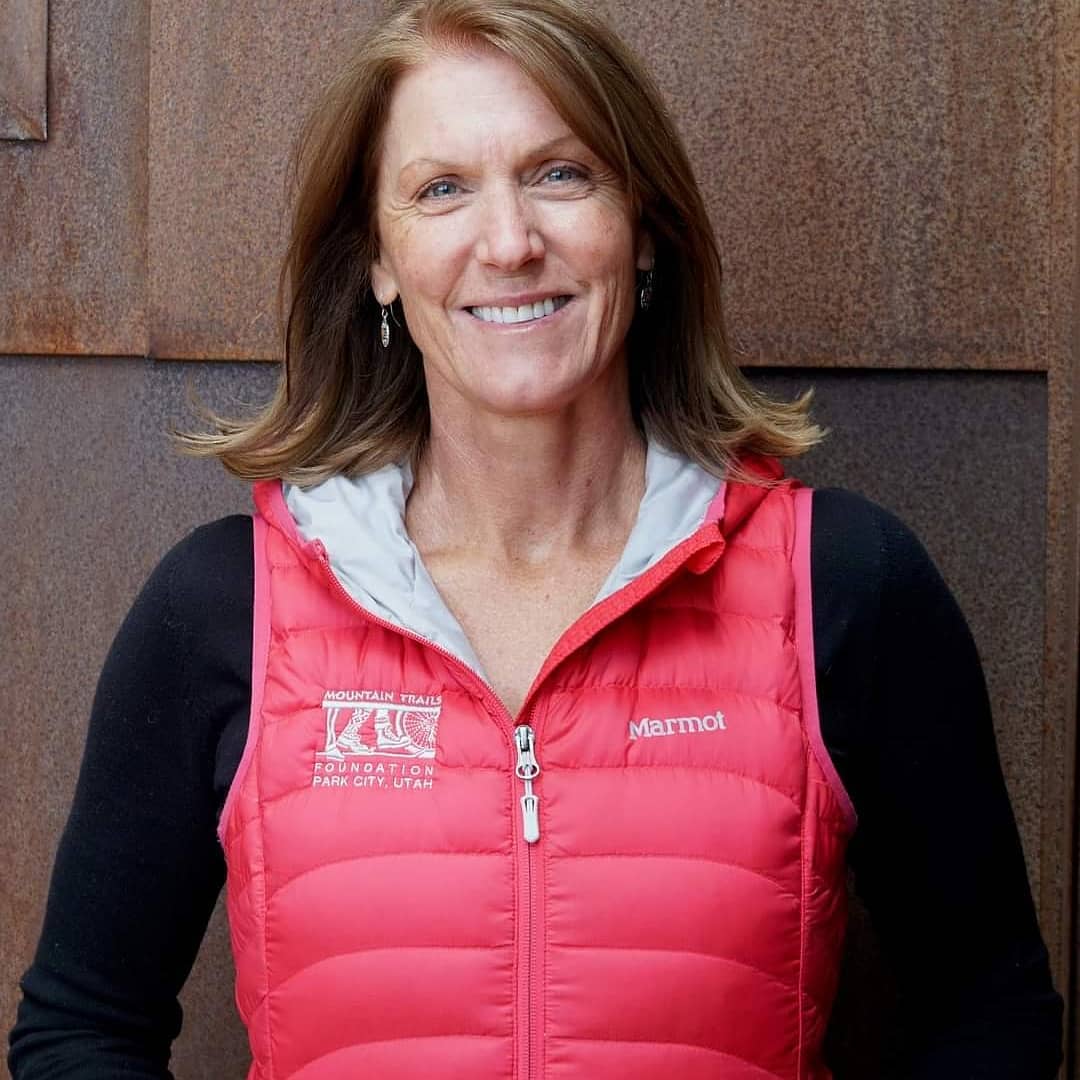
PARK CITY, UT (April 27, 2021) — Mountain Trails Foundation (MTF), a Park City/Summit County nonprofit, has named a new executive director to replace outgoing Charlie Sturgis. MTF announces Lora Smith will take the reins from Sturgis in June of this year.
Ms. Smith, who has worked for the organization as the Development and Resource Director, has been instrumental in the success and growth of the organization since 2012. Along with deep institutional knowledge, she brings the leadership, fundraising and professional experience necessary to seamlessly move the organization into the future.
Photo courtesy Mountain Trails Foundation
The board of directors performed an exhaustive search for a new executive director receiving over 30 highly qualified, extremely talented applications. From the outset, Smith set the bar for excellence.
“We were blown away at the interest and talent among the applicants for the ED position at MTF,” said Steve Perkins, board chair. “But Lora’s experience, energy and knowledge were uncontested and unequaled.”
“I am committed to building on MTF’s legacy of success and look forward to expanding the organization’s influence in the trails industry, both locally and regionally,” said Ms. Smith. “Worldwide, Park City is looked to as a model trail system and that is due, in large part, to the hard work and experience of MTF’s crew. My goal as ED is to enable the MTF crew and expand trail access throughout the region.”
Smith is an 18-year resident of Summit County, has raised four sons and is an avid trail runner, mountain biker and cross-country skier. “When I was raising my kids, immediate access to trails and open space made outdoor recreation a way of life,” Ms. Smith reflects, “they kept us healthy and bonded us as a family. I am honored to have a hand in creating an amenity that brings happiness to so many people.”
By Lou Melini — It was March 13, 2020 when I received an email stating that due to concerns with the coronavirus the Bicycle Collective where I had been volunteering nearly 40 hours/month for over 3 years was shutting down.
In addition to the Collectives in St. George, Ogden, Provo and Salt Lake City, non-profit bike shops across the country closed their doors. In the region that Cycling West serves, Free Cycles in Missoula, and the Boise Bicycle Project also shut down.
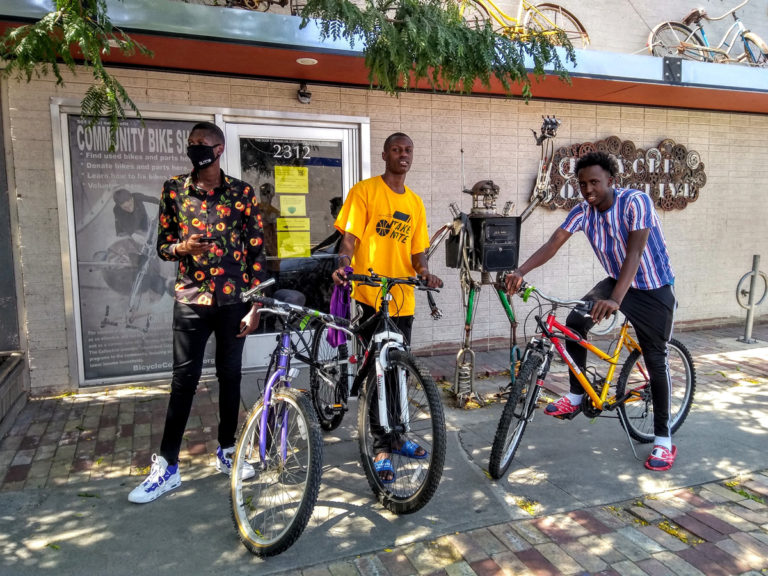
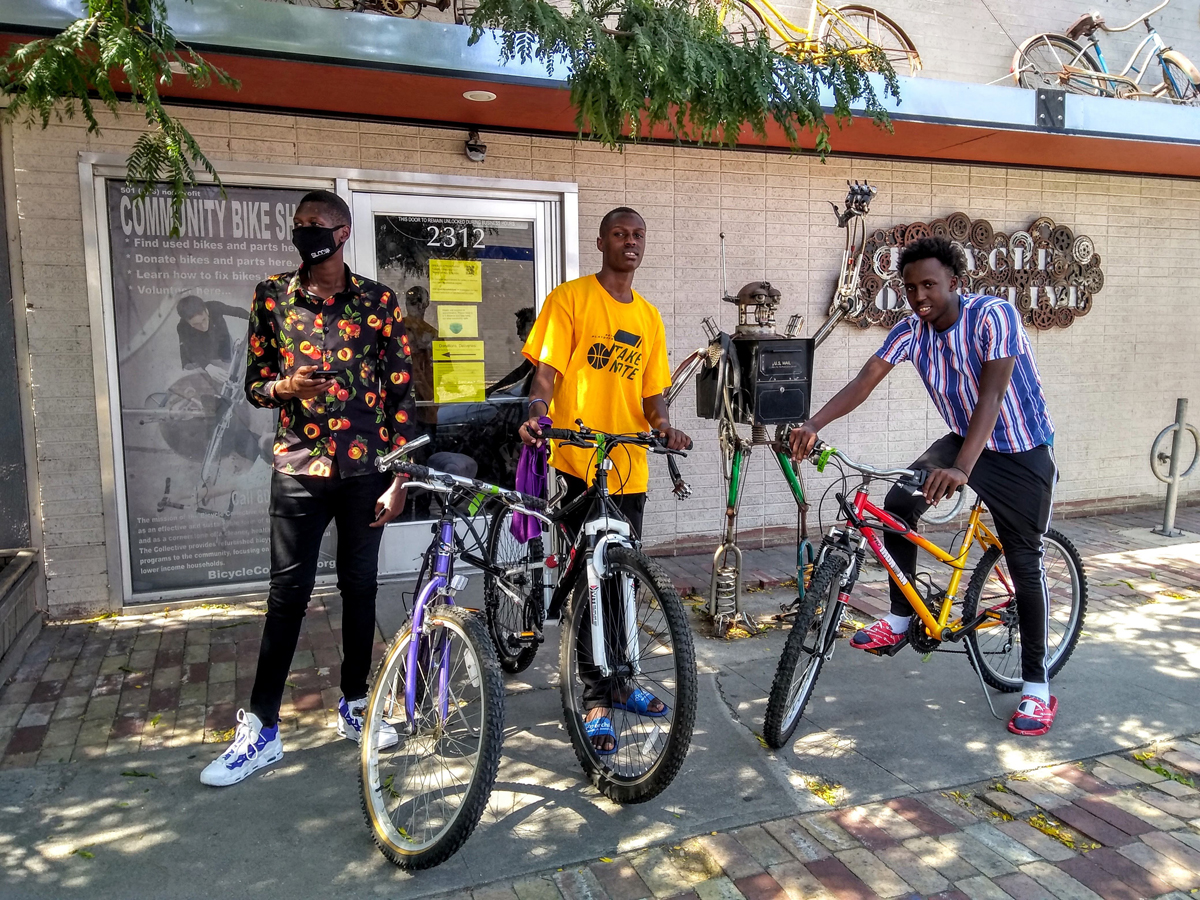
International Rescue Committee clients with bikes at the Salt Lake Bicycle Collective. Photo by Essen Skabelund
Unfortunately those most in need are usually most adversely affected by a crisis no matter the cause. With the coronavirus non-profit bicycle shops that assist the community with bicycle transportation have scrambled to meet the needs of their clients while maintaining an environment that is recommended by the CDC.
Within two weeks of shutting down, the Bicycle Collective reorganized, regrouped, and reinvented itself offering appointments for repairs and opening an on-line store while keeping employees on the payroll. Free Cycles reopened with an on-line bike store according to the website. The Boise Bicycle Project has also changed in order to provide services for the community it serves.
WTF (Women, Trans, Femme) night volunteer at the Bicycle Collective. Photo by Essen Skabelund
Essen Skabelund is the volunteer coordinator at the Salt Lake City location of the Bicycle Collective. She has been an integral part of creating and maintaining the volunteers’ schedules while juggling the requirements of social distancing.
Cycling West: Tell the readers about the effect of the pandemic.
Essen S.: We had an interesting spring and summer during the pandemic as our volunteer capacity was cut from around 20-30 volunteers per week in the shop to 0-7 volunteers outside of the shop per week! This was due to limited volunteer capacity to volunteer from home, with our safety measures in reserving out-of-shop volunteer opportunities for our core expert volunteer group. We created a waitlist for clients who needed bikes, as the demand for bicycles increased and the supply decreased. At one point we had over 40 clients on the list! We met the needs of recipients despite this shortage of volunteers by throwing all-staff-on-deck days (pizza was involved) entirely devoted to fixing up bicycles for each client on our list.
Some of the volunteers at the Bicycle Collective. Photo by Essen Skabelund
C.W.: The Collective has had to create some innovative ways to have volunteers refurbish bicycles. Can you discuss the challenges?
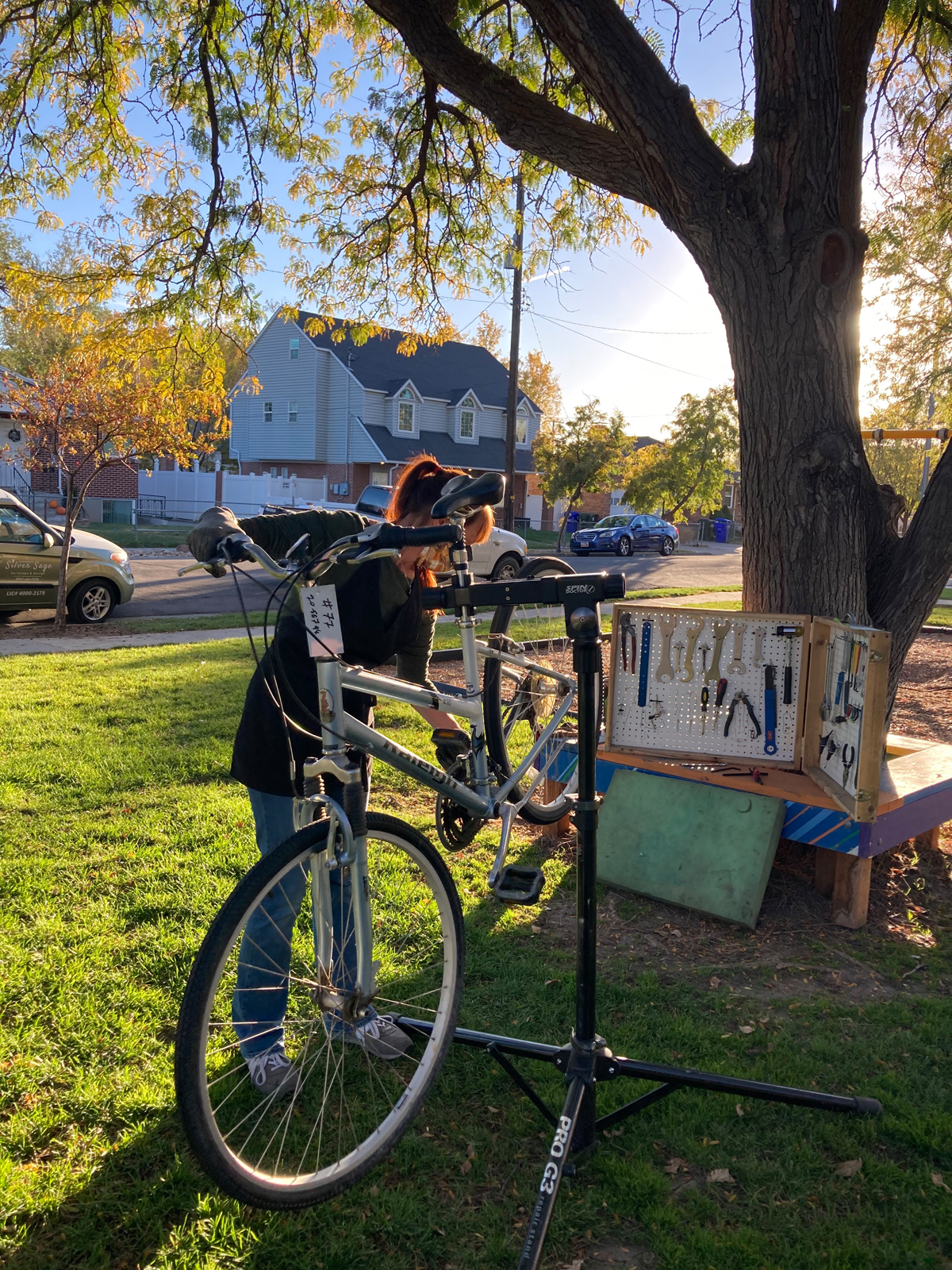
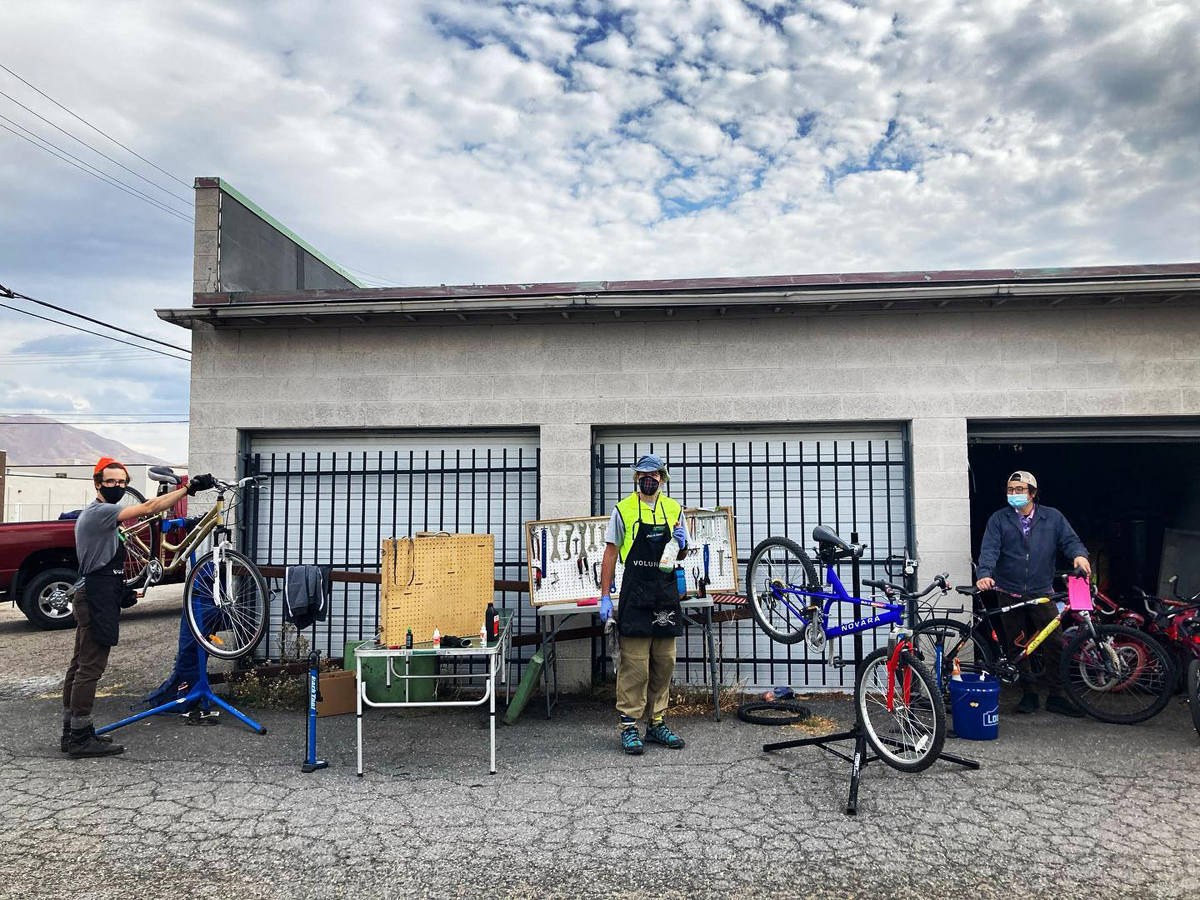
Essen S.: We started by having volunteers check out bicycles to work on from home or help with limited online work. This was tricky with volunteers who were accustomed to and wanted to do activities in person, or who lacked space or tools to work on bikes at home. We made tools and bike stands available to check out alongside repair bicycles. During the summer heat, it was too hot to work outdoors during the day, so once the brunt of the summer heat was through, we started working on bicycles outdoors during the mornings or the evening hours before sunset. Volunteers refurbished bicycles either at a park, in our shed, or behind the Collective! We created outdoor kits including toolboxes, stands, and parts that might be needed for the bicycles. This all took much longer to assemble and move, but kept us going in a safer way. When working under these circumstances, volunteers need to sign up for shifts, which previously was not required.
C.W.: Have the staff mechanics helped the volunteers?
Essen S.: Our shop mechanics still work on bikes we sell to help finance the shop. We set aside a day to work on bicycles during large-demand times. We recently developed a Zoom session where our head mechanic presented a class on bike repair. We hope to do more.
C.W.: What are the current needs of the Collective?
Essen S.: Bikes with 24″ wheels are always in high demand when we give bikes to pre-teens and teenagers – we always seem to go through that size quickly. Bikes that make good commuters are also very nice: ideally higher than 10 speed shifting, sturdy tires, durable. Bikes with mounts for racks/baskets are always nice for clients who’d like to add those on down the road.
We are constantly growing our partnerships with diverse organizations that serve people with high needs. We provide service vouchers for those who need a bicycle as their main transportation and cannot afford to get their bicycles fixed during the pandemic. If you have an idea for how we could collaborate for the community’s good, reach out to us!
Patrick Watson and I spent many Friday mornings together enjoying the camaraderie of repairing bicycles that would be donated to those in need.
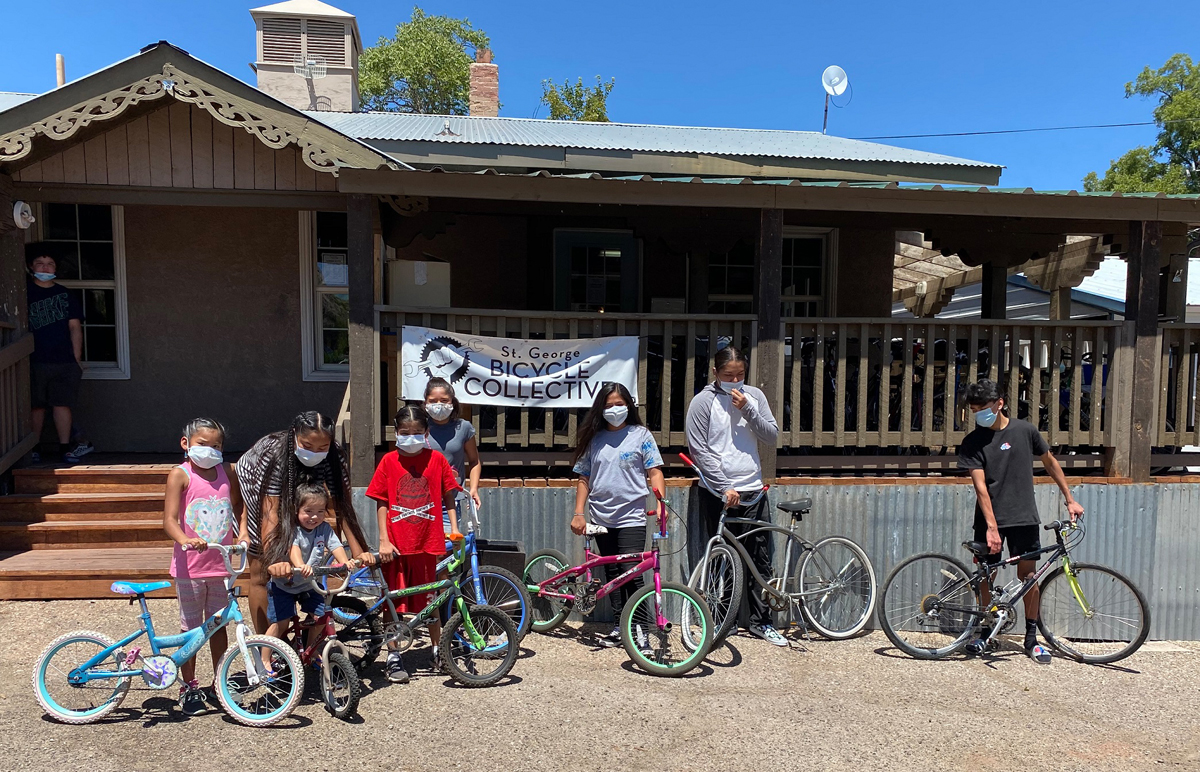
Giving Tuesday at the St. George Bicycle Collective. Photo by Essen Skabelund
Cycling West: Patrick, How are you are helping out at the Collective?
Patrick W.: Given the current Covid environment, the Collective is allowing 3 days a week, a mixture of evenings and early morning options one can sign up to volunteer. Only one volunteer at a time is allowed at the Collective to work on bikes and only when the staff is not there. We have to answer a questionnaire about our health prior to coming into the shop in person. It is nice to have the shop’s access, but it is a bit lonely.
C.W.: What other venues have you used to help out?
Patrick W.: Other venues I have used to work on bikes have included a Collective socially distanced local park setting with other volunteers. The Collective brought bike stands, bikes to work on and tools to use. We did this during the good weather of autumn. As the weather progressed, we worked out behind the shop in front of a storage unit distancing ourselves but having access to the shop for added tools and facilities. I have also wrenched in your garage as it is well equipped and has a small heater.
C.W.: What are the problems with wrenching at home?
Patrick W.: I have tried to utilize the Collective’s generous offer to drop off bikes at my house but given my available space it was not conducive. Other challenges were having the needed tools on hand and most importantly having a sounding board to assist when questions arise about a repair question.
C.W.: What do you miss most about the impact of the coronavirus and volunteering?
Patrick W: Mostly I miss the shared tribal knowledge and interaction amongst all during our volunteer time blocks. Also seeing the aggregated work being achieved was a nice boost to solidify the benefit to the community.
_
Former Salt Lake City Bicycle Collective Volunteer and Program Coordinator, Amy Nguyen is now volunteering at the Boise Bicycle Project (BBP). Life-changing events caused her to leave Salt Lake, first spending time in Australia, followed by her relocation to Boise just as the first coronavirus cases were being diagnosed on the west coast. It took 6 months, but she is employed in addition to being a volunteer tutor at the International Rescue Committee and wrenching on kids bikes for BBP.
Cycling West: Amy, tell me about your volunteer experience at Boise Bicycle Project.
Amy N: I started volunteering for the Boise Bicycle Project in November 2020, I’m a newbie! I was following the BBP on social media to see how to get involved and I came across a call for help to prep kids bikes for their annual Holiday Kids Bike Giveaway. There was an online volunteer orientation a few days after I saw the post and I signed up for it. I wanted to volunteer for the BBP because I knew it would be a good way for me to connect with the community, meet new people, and learn more wrenching skills. There is certainly something special and unique about the environment of bike co-ops. I met the best friends and people in my life when I worked at the Salt Lake City Bicycle Collective. While I’m still in the early stages of getting to know folks at the BBP, I’m positive I’ll make awesome friends like the ones I made at the SLCBC.
C.W.: What impact did the Holiday Kids Bike have?
Amy N: I refurbished a total of 6 six bikes for the Holiday Kids Bike giveaway. It was barely a drop in a sea of the 700 bikes that were refurbished and given away at the holiday event. Though a small number on my part, I’m still happy I was able to assist! I sadly was not well enough to attend the event to witness the kids receiving bikes. From the photos I saw and given the COVID circumstances, it was a big challenge that turned into a monumental success.
C.W.: How does wrenching from home compare to your time at the Bicycle Collective?
Amy N.: I am privileged to have the space and tools needed to do bike repairs from my home. The BBP has a coordinator who sets aside bikes and parts for volunteers to pick up once a week. We can usually take the time we need to repair the bikes. I try not to spend more than a week on the bikes I take home. One of the major benefits of working on the bikes at home (other than the health safety aspect, of course) is I can work on the bikes little by little throughout the week instead of feeling the pressure to repair a bike during one specific volunteer time. My wrenching skills are ok but still require many YouTube and Google searches – bless you, Internet. I have yet to experience an in-person volunteer shift at the BBP, but if it were anything like a volunteer shift at the SLCBC, I would say volunteering in the shop with other volunteers is the best and most ideal way to engage, connect with others, and learn more about bike repair.
C.W.: How has the coronavirus impacted the programs and how has BBP adapted?
Amy N.: BBP’s mission is to promote the personal, social, and environmental benefits of bicycling. They are able to meet this mission by offering many adult and youth programs that provide bikes while empowering each individual with the knowledge to repair their own bike. They also host a slew of cycling events that enhances the community like “Goathead Fest” where volunteers come together to pull thousands of pounds of goatheads along Boise bike trails.
BBP definitely took huge measures to adapt to the challenging times of COVID. They had extra storage space in an abandoned Pizza Hut building down the street from their headquarters where they ended up gutting it out and remodeling it to have more open space to allow volunteers to work from a safe distance to one another. Volunteers still have the option to wrench from home. After attending their Annual Impact meeting this week, some goals to highlight for the BBP as they head into 2021 is to recycle 2,000 bikes back into the community, empower 2,000 individuals with bicycle repair services, and collectively ride 20,000 miles as an organization. Many great things to come and I look forward to taking part in the adventure!
[Editor’s note: Amy was recently asked to apply to the Board of Directors of BPP. ]
Lou Melini: I have been able to help by refurbishing bikes in my garage. I do miss interacting with the recipients of the bike giveaways and the smiles on their faces. However volunteering isn’t about me. The mission of the Collective is most important and despite the disruptions from the pandemic, the Bicycle Collective met its mission and gave away 1382 bikes in 2020: 358 adult and 1024 children bikes. Additionally 37 tons of metal and 3.8 tons of rubber were recycled.
If you wish to volunteer at the Bicycle Collective or partner with the Collective contact Essen: [email protected].
Long-time Partner Medalist to Manage Operations of Professional Cycling Stage Race and the Tour of Utah Ultimate Challenge Endurance Ride
2021 Events Postponed due to Covid Pandemic
SALT LAKE CITY (April 29, 2021) – The Larry H. Miller Tour of Utah announced today that it has entered into a licensing agreement with Medalist Sports, a full-service sports management company specializing in road cycling and cause-related events, to operate the professional cycling stage race and the Tour of Utah Ultimate Challenge, a non-competitive gran-fondo-style endurance event for amateur riders. Also, due to the Covid-19 pandemic, both the Tour of Utah and the Tour of Utah Ultimate Challenge are postponed in 2021, with plans to resume in 2022.
Ben Hermans (Israel Cycling Academy) attacks on the final climb of Eagle Ridge to take his second consecutive stage win. Stage 3, 2019 Tour of Utah. Hermans would go on to win the overall GC. Photo by Steven L. Sheffield
The Tour of Utah began in 2004 as a grassroots regional event and developed into a seven-day, internationally sanctioned race for the world’s best men’s professional cycling teams. Medalist Sports, headquartered outside of Atlanta, has been a long-time partner of the Tour of Utah since 2011.
“Our goals of bringing world-class cycling to our local communities and showcasing the beauty of our state through the eyes of sport continue,” said race chairman Steve Miller. “The Tour of Utah has grown in stature and respect through the years, and we are thankful for the support of countless volunteers, loyal corporate partners, committed host cities and fanatic cycling enthusiasts. It has been an honor to conduct this race around the state for the past 15 years.
“We are now excited to support Medalist Sports in their operations and planning of these events,” Miller said. “Medalist has familiarity with the Tour of Utah and tremendous experience and expertise in conducting cycling events. We are particularly grateful for our partnerships with the Utah Sports Commission, the Utah Office of Tourism, and USA Cycling through the years. For everyone involved, the Tour of Utah is a labor of love.”
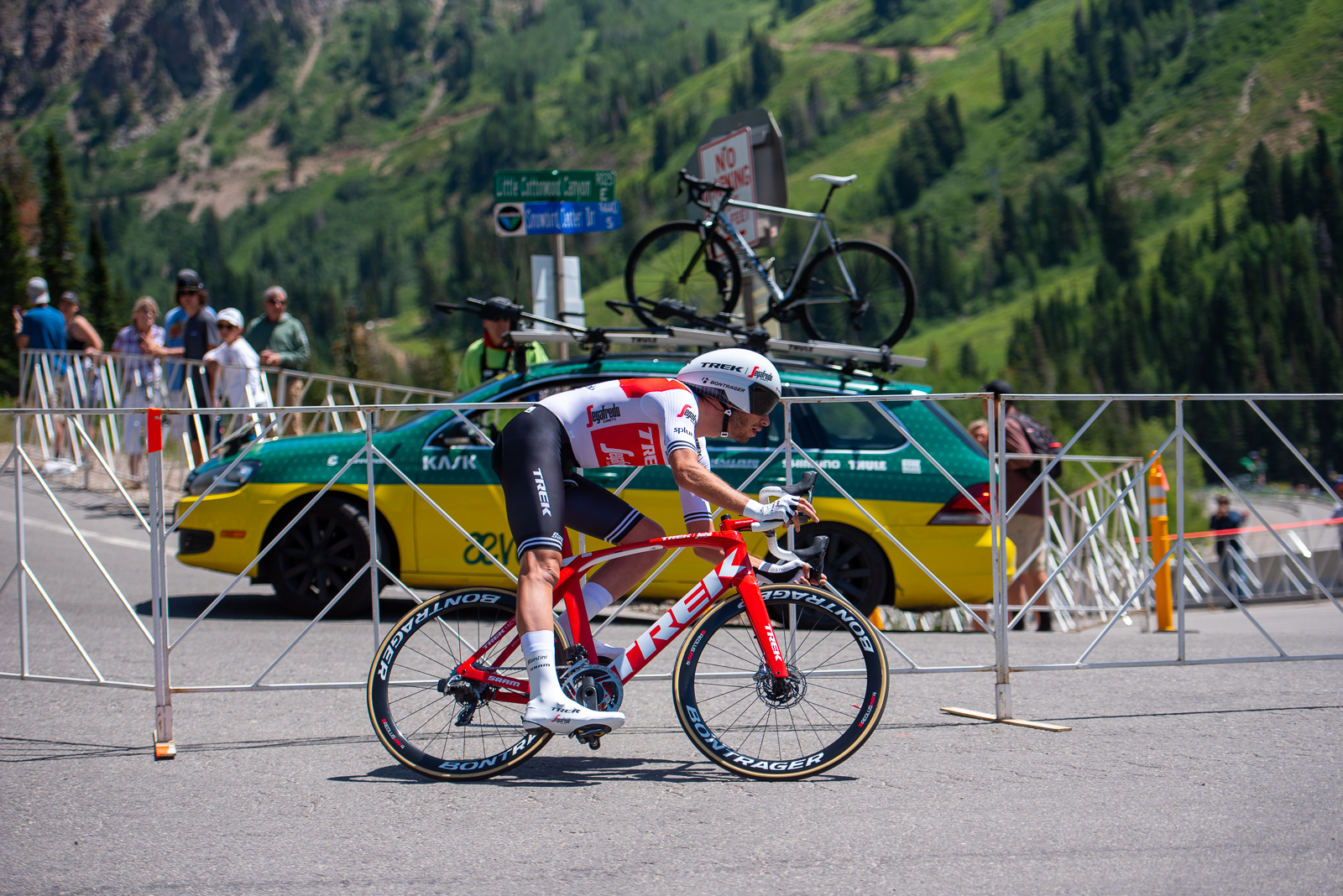
Nicholas DeBeaumarché (Trek-Segafredo) rounds the hairpin at the bottom of the Prologue course. 2019 Tour of Utah. Photo by Steven L
“Medalist Sports is committed to hosting a safe, successful and quality event while maintaining the integrity and legacy of the Tour of Utah,” said Chris Aronhalt, Owner and President of Medalist Sports. “We are grateful to the Miller family for their support of the sport and the Utah community and their ongoing partnership with Medalist. We look forward to sharing more information as we plan for the future.”
Aronholt added, “With a strong foundation of support, we remain focused on building new experiences and value for all involved. Although we are taking a hiatus in 2021, we are committed to the race’s return to the UCI calendar in 2022 with a reimagined event, which integrates world-class cycling along with multiple layers of engagement for spectators and partners. The sport of cycling is a beautiful thing, and for more than a decade, the Tour of Utah has been a model of excellence and a celebration of Utah and its communities.”
Known as “America’s Toughest Stage Race” for its challenging distances and vertical climb, the Tour of Utah has been rated as a 2.HC-rated stage race by the Union Cycliste Internationale for the past five years and has been selected as part of the new UCI ProSeries. The 2020 race in August had been cancelled due to the coronavirus pandemic.
In 2019, the field featured 115 riders from 17 teams, attracting 400,000 spectators during race week, 21 hours of national television coverage and reaching more than 400 million homes via broadcast around the world. The route covered 477 miles of racing and 37,882 feet of elevation gain.
Through the years, Tour of Utah General Classification champions have included Ben Hermans (2019), Sepp Kuss (2018), Rob Britton (2017), Lachlan Morton (2016) and Joe Dombrowski (2015) along with stage winners such as Tejay Van Garderen, Cadel Evans, Chris Horner, Travis McCabe, Brent Bookwalter, Marco Canola, Giulio Ciccone, Rob Carpenter and Levi Leipheimer.
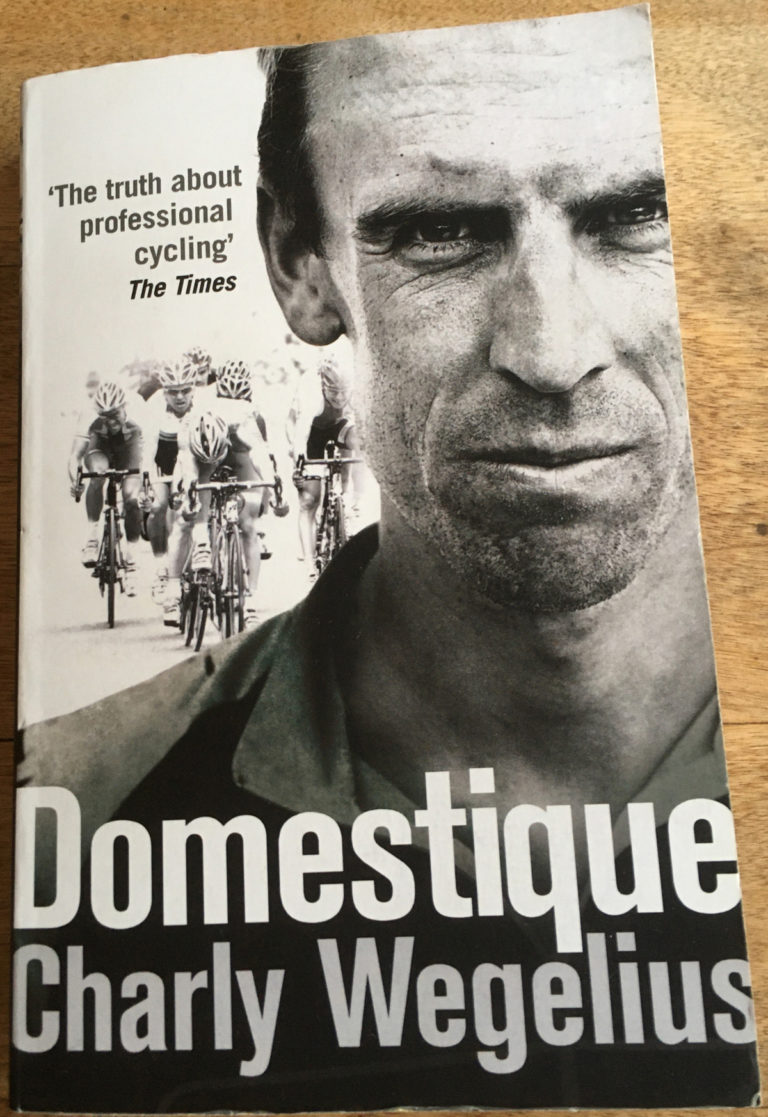
By Lou Melini — Perhaps you remember a stage in the Tour de France when a breakaway group of riders had an eight-minute advantage with 20 kilometers to the finish only to be caught with 500 meters left. That accomplishment to “close the gap” was the work of the domestiques leading their team captains to the finish line. Englishman Charly Wegelius (weg-he-lee-oos) describes his 11 years as a professional rider in his book, Domestique. Mr. Wegelius makes a clear point in the book that he was a professional domestique, not unlike the role of a sprinter or team leader. Once established in his role, he had his services sought after by many teams. If you are ever unclear of the term domestique in professional bike racing, read Charly Wegelius’ book.
Domestique: by Charly Wegelius with Tom Southam (2013), Random House www.randomhouse.co.uk
Mr. Wegelius raced in 14 Grand Tours (Tour de France, Giro de Italia, and Vuelta a España). In a manner characteristic of British humor, Charly describes his first grand tour at the “Vuelta” (he never calls the race by its full name). He uses profanity widely through in the book, something I usually find takes away from good storytelling, but in this case it is simply Charly being Charly emphasizing his point in the writing. Below are a few excerpts from his grand tours.
Dinner: On 18 of the 21 days we were fed chicken with asparagus and half a boiled egg for dinner. Night after night I felt like weeping into my watery salad when the same awful food was dropped on to my table-at the time of day I’d normally expect to be asleep.
Racing: As soon as the flag had been dropped (to the sound of the f******g Vuelta theme song) the race was flat out. The average speed of one of the stages in the first week was 51.6 km/h, and the only reason it wasn’t faster was because there was a bloody great 6 km climb near the finish that brought the speed down a bit! At times it felt like madness; on one occasion we were doing 77 km/h on a flat road and I looked down at my 53.11 and wished I had bigger gears because I simply couldn’t pedal it fast enough.
A stage in the Giro de Italia: I dragged the group as hard as I could until, with 600m to go, I just exploded. I was so over the limit that I literally stopped at the 400m sign to hold on to the barriers. Later after the race: There was a knock at the door. Alvaro Crespi, the general manager of the team along with Damiani entered. The paranoid, worried side of me immediately thought that they were upset that we had lost the jersey. Crespi took a seat and said, Charly, are you happy in this team? Of course, I said. At that he pulled out an envelope and handed it to me. In it was a cash bonus of 5 million lire for my work that day. He also ripped up my 2-year contract and made a new one with a raise.
And so it went. The stories abound. Mr. Wegelius rode for the French amateur team Vendee U who were surprised when he showed up not knowing that he was invited to join the team. After a brief spell riding for British teams including the 3rd division professional Linda McCartney team as a stagiaire (an amateur riding on a pro team), Charly started his professional career with Mapei. Mapei was at the time the largest and perhaps most successful team in Europe. I think Mr. Wegelius to this day is still amazed that he started his career with this team.
After sponsorship by Mapei expired, Mr. Wegelius found himself on the DeNardi-Colpack team where finances were less secure, so much that he had concerns his back-up wheels were to be sold. After many years racing in Italy, Charly was finally “feeling at home” on yet another Italian team, Liquigas recruited by his former Mapei directeur sportif, Roberto Damiani. The team included Mario Cipollini and Danilo Di Luca, both high profile riders who Mr. Wegelius got along well with.
After 9 years riding for Italian teams, Mr. Wegelius decided to move out of Italy to Silence-Lotto. His job was to ride for Cadel Evans as his mountain domestique. The beginning of his relationship with Cadel Evans over dinner seemed like “a bad job interview”. The situation didn’t get much better. In his final year as a professional, Charly rode for the U.S. based United Healthcare team. In his last race of his career, he was in the lead with 800 meters to go, hoping for the first win of his career, he abandoned his role as a domestique. At 200 meters he had it in his head that he had to win. With 100 meters to go he was passed by 2 Spanish riders and in disappointment, stop pedaling finishing in third.
Domestique takes you into the world of Charly Wegelius, the world of bicycle racing and most importantly the world of domestiques that ride day in and day out to the point of exhaustion. To quote Mr. Wegelius, it’s no f*******g fairytale.
Charly Wegelius last rode as a professional in 2011, publishing the book 2 years later. Many of the teams he rode for and the personalities he rode with may not be remembered or known to the current crop of cyclists. This should not discourage someone from reading his book, as it probably is true today as it was during Charly’s career. It is clearly an interesting book that would be read quickly by anyone interested in professional bike racing. The writing is good and except for a few terms, mostly British, the average cycling fan should not get confused by the dialogue.
Domestique: by Charly Wegelius with Tom Southam (2013), Random House www.randomhouse.co.uk
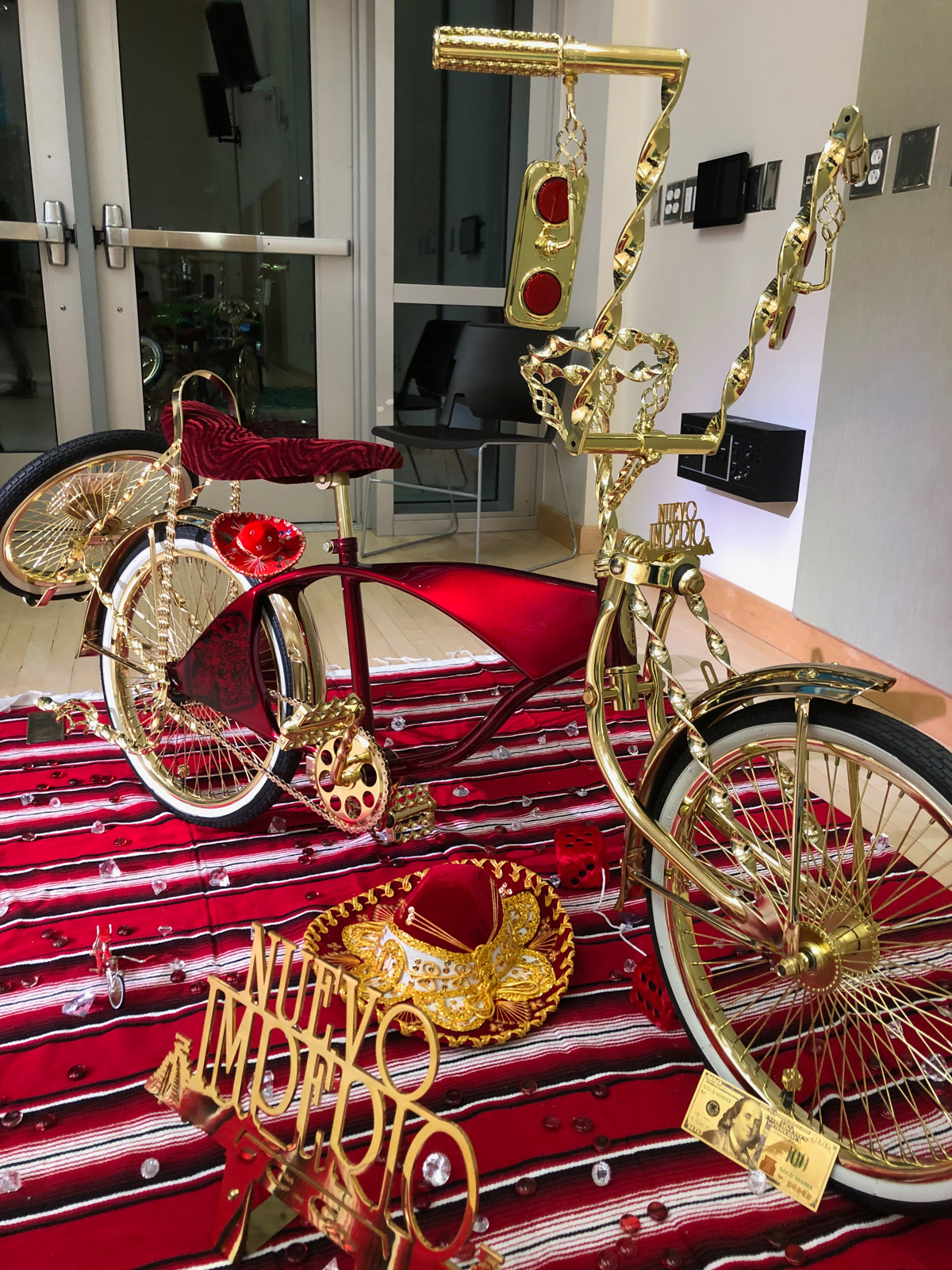
By Anthony J. Nocella II, Ph.D. — How does one start building a lowrider bicycle? First and foremost, do not rush out and buy a lowrider bicycle that has been manufactured in a mass-produced fashion. Get to know the lowrider culture and its historical and socio-political place in Chicanx/Latinx/Cholx society.
One of the bikes at the 2021 Salt Lake Winter Lowrider Show. Photo by Dave Iltis
The lowrider culture started in the 1960s during the Civil Rights, United Farm Workers, and Brown Power movements, inspired by earlier resistance movements by people of Mexican descent against structural racism and assimilationism. It is clear, direct, and easy to argue that the lowrider culture has always been and is grounded in activism and social justice.
Lowrider culture started with cars, clothing, stroll, swag, and religious and family values. Lowrider culture is about la familia, and the interweaving of religion and family. It is here that the culture promotes youth advocacy, art, dance, music, food, peace, unity, justice, and festivals.
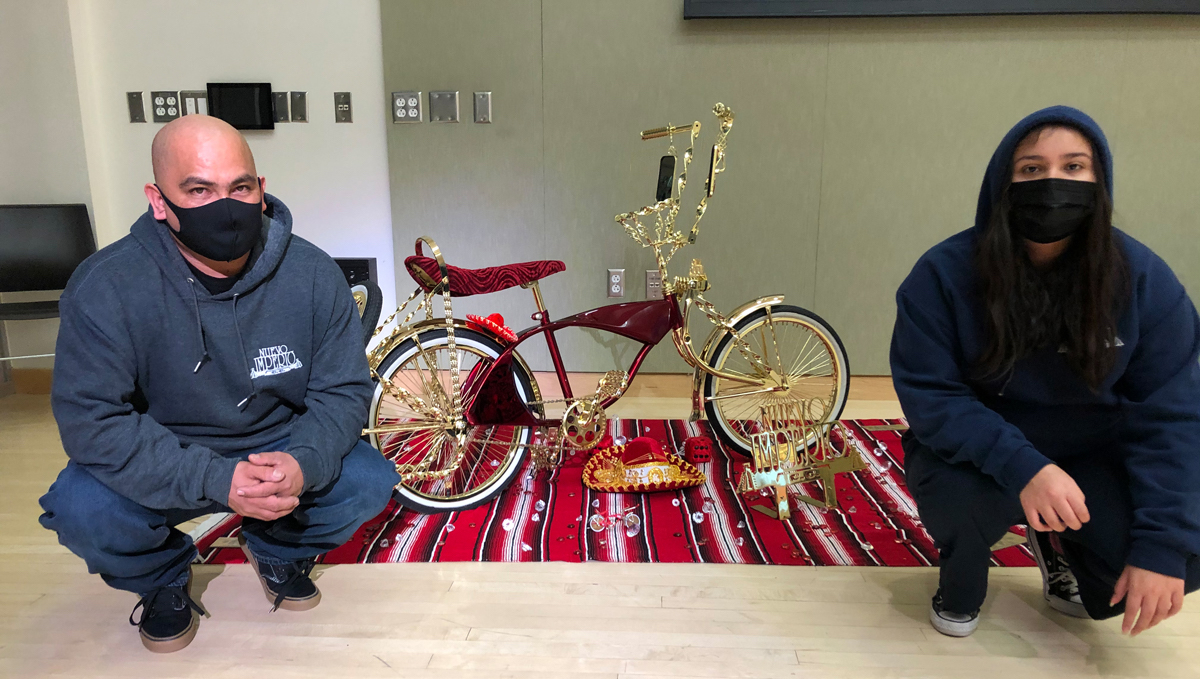
Rene and Dani Mendoza’s lowrider took 6 months to build. They are part of the Nuevo Imperio Cycling Club. 2021 Salt Lake Winter Lowrider Show. Photo by Dave Iltis
Lowrider culture is also therapy, and can be a healthy alternative breaking the cycle of violence, gangs, drugs, and prison.
Lowrider bicycle design emerged in California from the “King of the Kustomizers” George Barris, the legendary car designer, who created The Munster’s Munster Koach and built the Batmobile for the original 1960s TV series.
Rene and Dani Mendoza with the lowrider they built at the 2021 Salt Lake Winter Lowrider Show. Photo by Dave Iltis
In the 1960s, Barris brought his car art to the bicycle world by customizing Schwinn Sting-Rays, but never strived to be part of the lowrider culture. Later, the Stelber Cycle Corp in New York partnered with Barris to create bicycles under the brand name Iverson, which were not lowrider bicycles, but did have a bit more style than the classic Schwinn Sting-Ray.
Ultimately, Manny Silva, owner of Manny’s Bike Shop in Compton, California, would become the key person that introduced Barris’s style by to the barrio and lowrider .
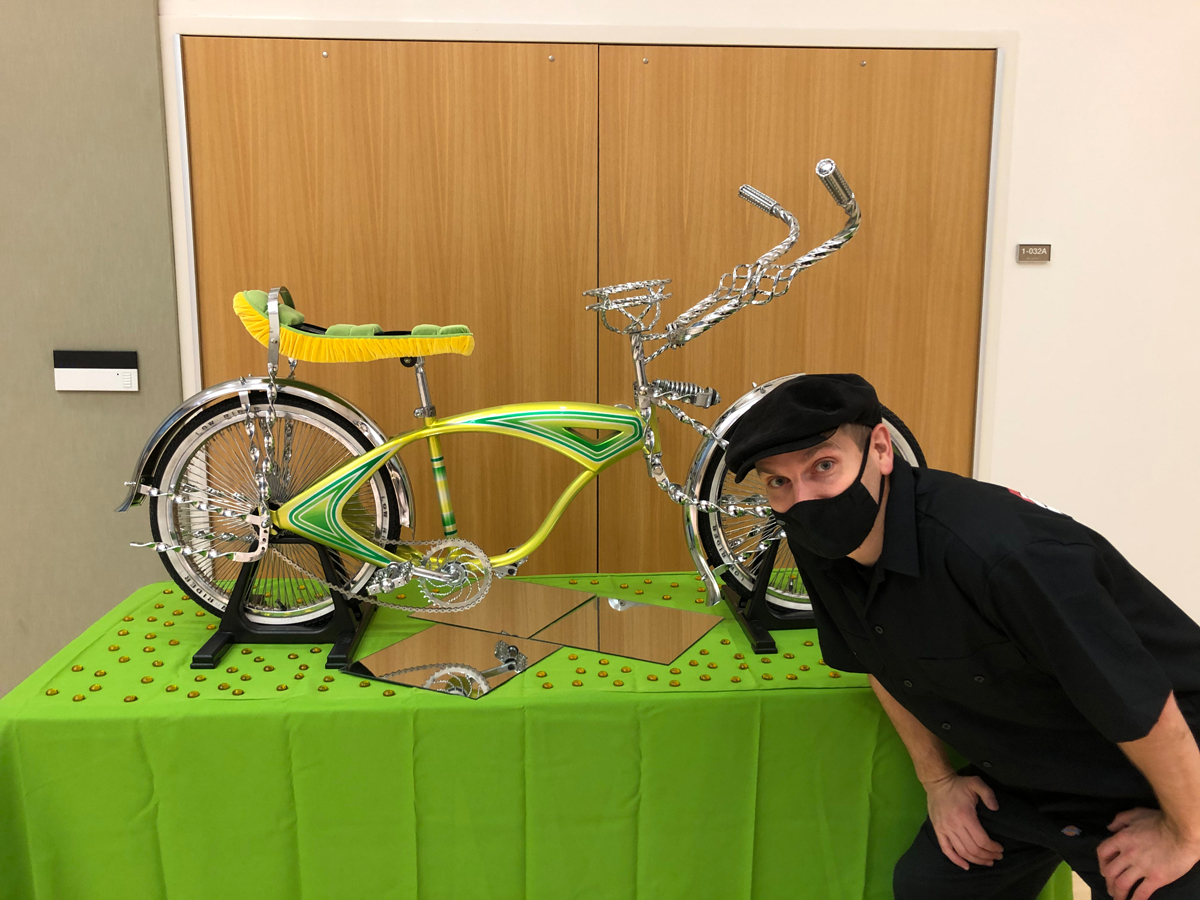
Anthony Nocella with the lowrider he built at the 2021 Salt Lake Winter Lowrider Show. Photo by Dave Iltis
My first lowrider bicycle was handed down to me by my Uncle Ron in Philadelphia, via my big sister Kim. It was an original Iverson 1968 Charger, that I later turned into a lowrider bicycle.
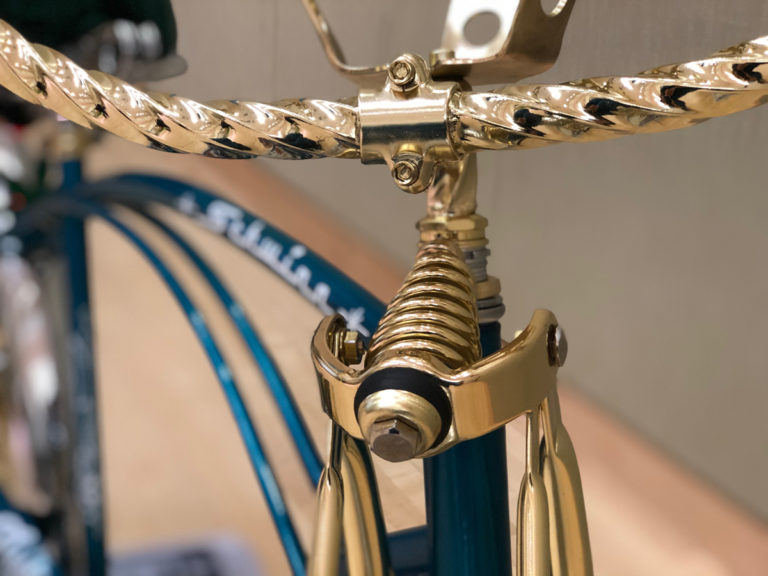
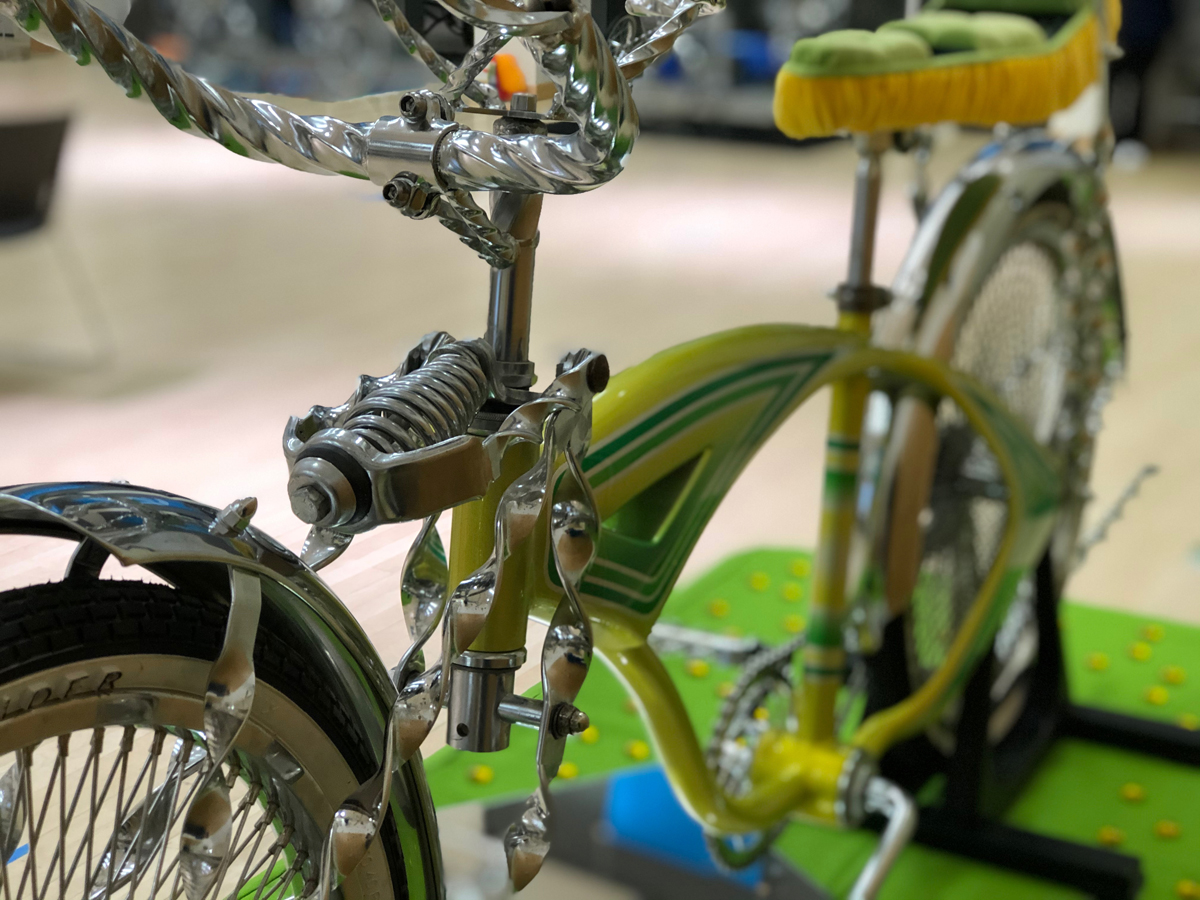
The key in designing a lowrider bicycle to take an original bicycle from the 1960s or early 1970s that has a “wheelie bike” or chopper design similar to the Schwinn String-Ray, and slow it down with smooth flowing bright glittering clean paint with white-wall tires, chrome and/or gold parts, mirrors, velvet banana saddle, and as much flare as possible.
Anthony Nocella’s lowrider. 2021 Salt Lake Winter Lowrider Show. Photo by Dave Iltis
Most lowriders are shiny and have candy paint on them. Many also have pinstripes and names of those that have died as a remembrance art piece, similar to tattooing the name on one’s arm. They are typically also named and have a theme, be it Star Wars, Raiders, Hellraiser, Candy Canes, Tupac, fire, music notes, Nike, Jordan, or Dominos.
Steps to Building a Lowrider
First, go check out lowrider shows in person and check out pictures of lowriders on the internet for ideas and inspiration. Originality is important, but it’s okay to get ideas for design elements from other bikes.
Second, find an old Schwinn Sting-Ray, take as many pictures of it as you can, and then strip it down.
Third, contact a local lowrider club to ask where to get your bike painted and if you want the tank and/or chain stay area filled in with Bondo. Be aware that depending on the extent of the paint and body work, this might cost upwards of $1000.00. Make sure when you get it painted you have your theme in mind for the bicycle.
Fourth, buy or build other design elements, such as new wheels (100-spoke 20-inch wheels?), a twisted long spring fork, reflectors, chrome chain, velvet saddle, twisted sissy bar, twisted pedals, chrome metal grips, crank, twisted chainring, bottom bracket, headset, white wall tires, and tubes.
Then, once you have all the parts, build the bike! If you are having trouble assembling your bicycle take it to a local bicycle shop, preferably one which appreciates all types of bicycles including lowriders.
The best place to get lowrider parts online is Street Lowrider (streetlowriders.com), but be aware that the price for lowrider parts can add up fairly quickly as well.
Finally, build a chromed mirrored velvet display stand for the bike, as it is an art piece. Now put on your Dickies, Converse sneakers, and black t-shirt and go to a lowrider show to show off your bicycle. For those who want to join a club, it is like getting married, the love and right fit have to be there, but once you have you are now part of la familia.
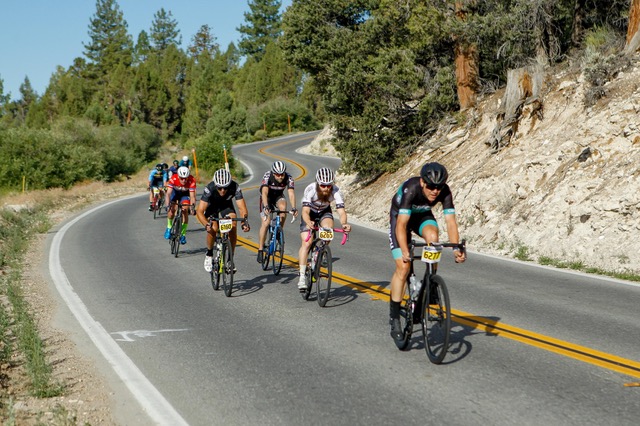
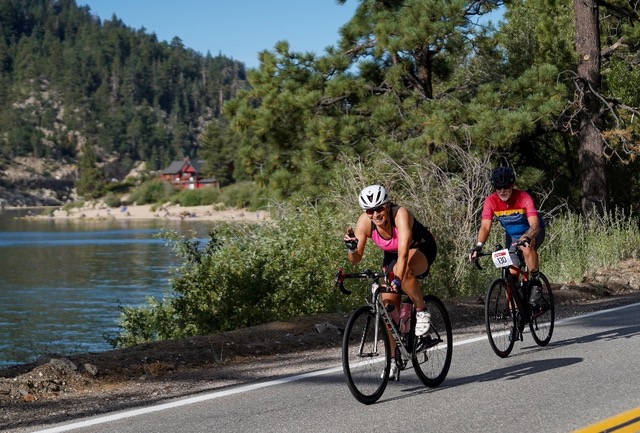
BIG BEAR LAKE, California (March 25, 2021) — The Big Bear Cycling Association (BBCA) announces the return of the Tour de Big Bear in 2021. The event has been repeatedly hailed “Southern California’s Favorite Ride”.
Photo courtesy Tour de Big Bear
Big Bear Lake is Southern California’s four-season mountain lake escape. Situated in the San Bernardino National Forest at 6,752’ elevation, it has cooler summer temperatures along with stunning mountain scenery.
The Tour de Big Bear features alpine roadways and trails over high mountain passes like Onyx Summit (elevation of 8,443 feet), and around Big Bear and Baldwin Lakes – plus fully staffed Aid Stations that feature ribs, bacon and other tasty treats.
Photo courtesy Tour de Big Bear
The 2021 Tour de Big Bear will start and finish at Bear Mountain Resort. Routes include:
5k family fun ride
25, 50, 70 or 100 mile routes
NEW! 50 mile gravel ride
Tour de Big Bear Weekend Events
The Big Bear Cycling Association hosts a two-day cycling expo that includes 40+ cycling vendors, a complimentary bike valet, a Beer Garden, raffle, and entertainment during Saturday’s festivities.
Come up early and get acclimated to the altitude with our Glow Rides and Poker Rides. Wind down on Sunday with the Recovery Ride.
SALT LAKE CITY (April 20, 2021) — GREENbike, Salt Lake City’s nonprofit bike-share program, is now offering a discounted $1 annual pass (reduced from $75) to all essential workers in 2021. For its 2021 discount, the bike-share program has expanded the categories of workers eligible for the pass to include those who lost their job due to COVID-19.
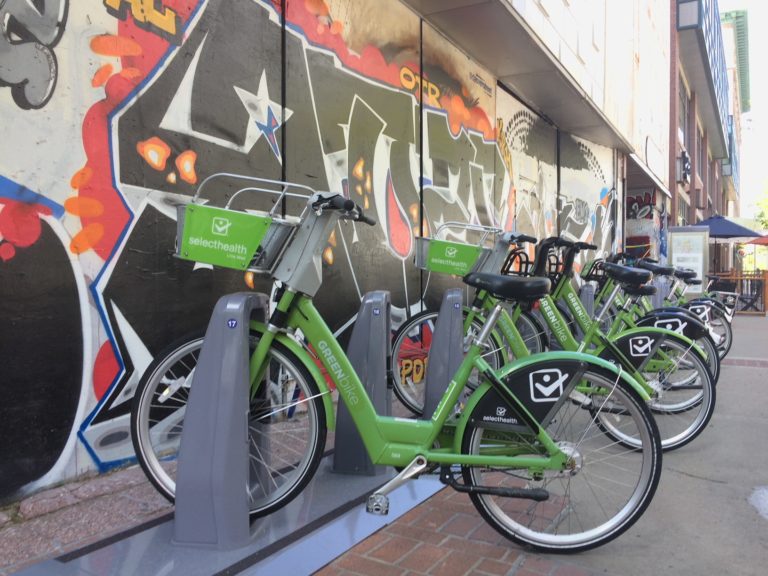
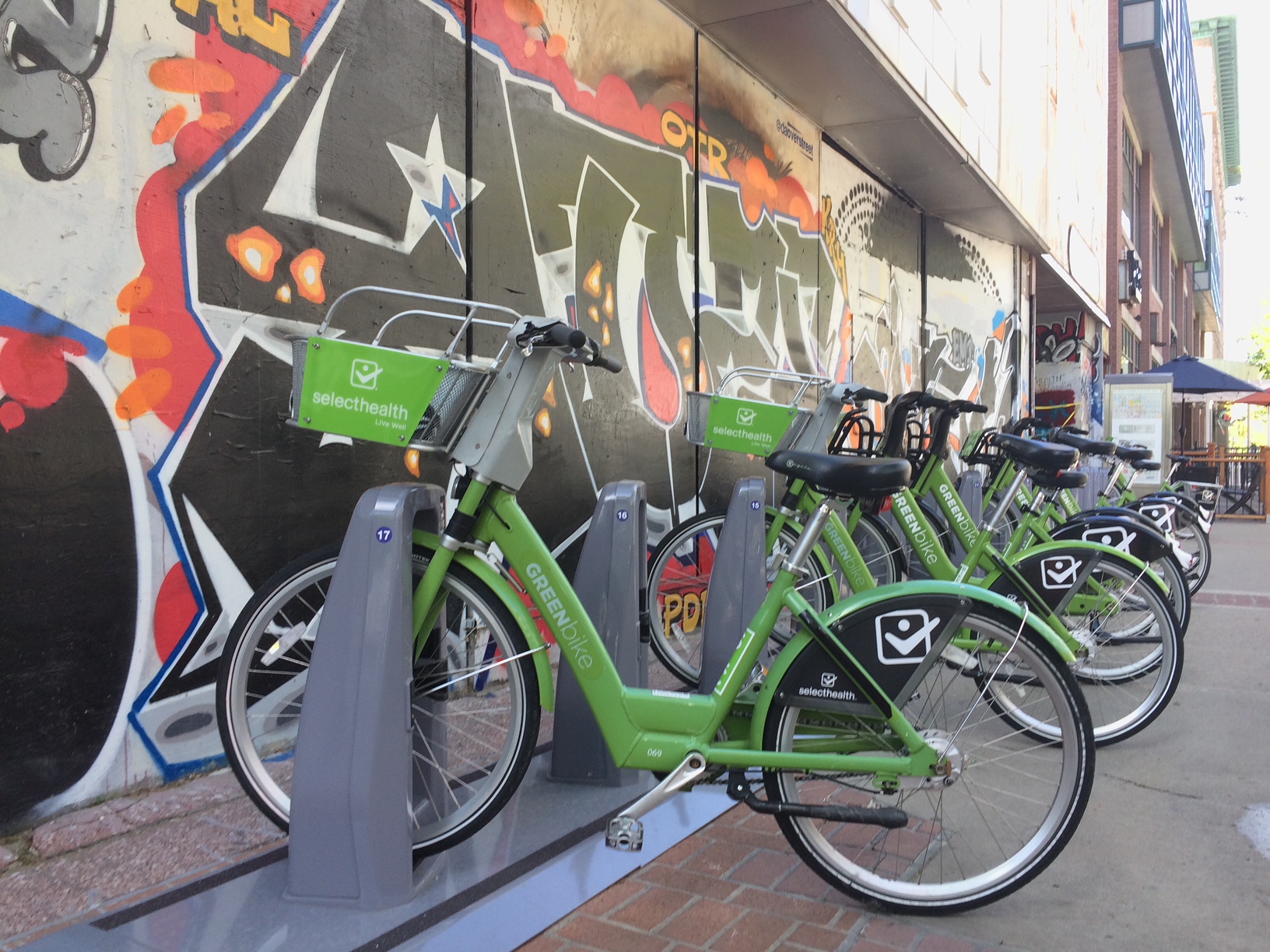
GreenBike has changed downtown Salt Lake City with 33 stations and hundreds of bikes. Photo by Dave Iltis
Eligible workers include:
Health care professionals.
First responders and law enforcement officers.
Faith leaders and workers, including an official, worker, or leader in a house of worship or other places of religious expression or fellowship.
Employees of charitable and social services organizations.
Grocery clerks and all grocery store employees.
Restaurant employees and drivers offering take-out and delivery options.
Bank employees.
Gas station employees.
All Utah residents unable to telework.
Workers who lost their job as a result of COVID-19.
Eligible workers can go to greenbikeslc.org/join to purchase an annual pass and apply the promo code Essential2021 to get the discount. The promo code will be able to be used throughout 2021. An annual GREENbike membership includes unlimited 1-hour bike rides for 365 days following account activation.
“Essential workers, Healthcare Heroes, and so many others continue to need our collective community support,” said SelectHealth Community and Public Relations Manager Greg Reid. “Thanks to all the essential workers.”
In 2020, nearly 600 local essential workers signed up for an annual GREENbike pass using the code Essential2020, which discounted annual passes to $0.01.
“We want to continue to provide a discount for our essential workers, and folks hit the hardest by this pandemic,” said Ben Bolte, Founder and Executive Director at GREENbike. “While vaccination numbers are promising, we realize the economic impact of COVID-19 still burdens some of our neighbors. GREENbike will continue to be a reliable, healthy, and affordable transportation option for our community members during this uncertain time.”