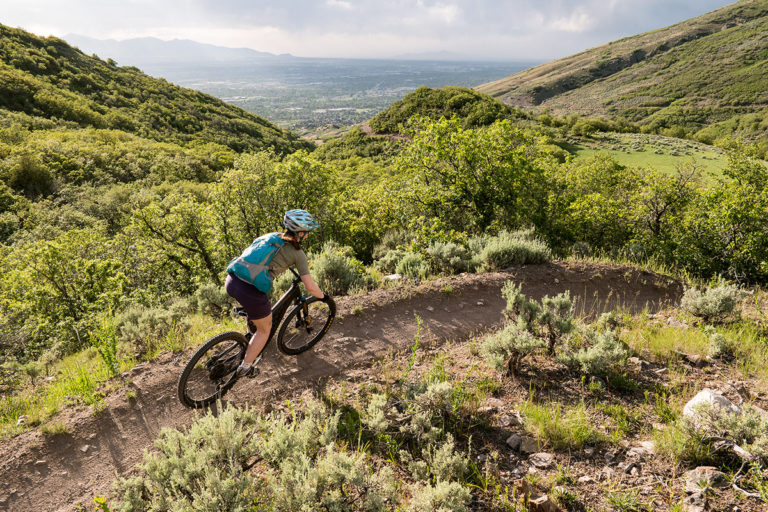
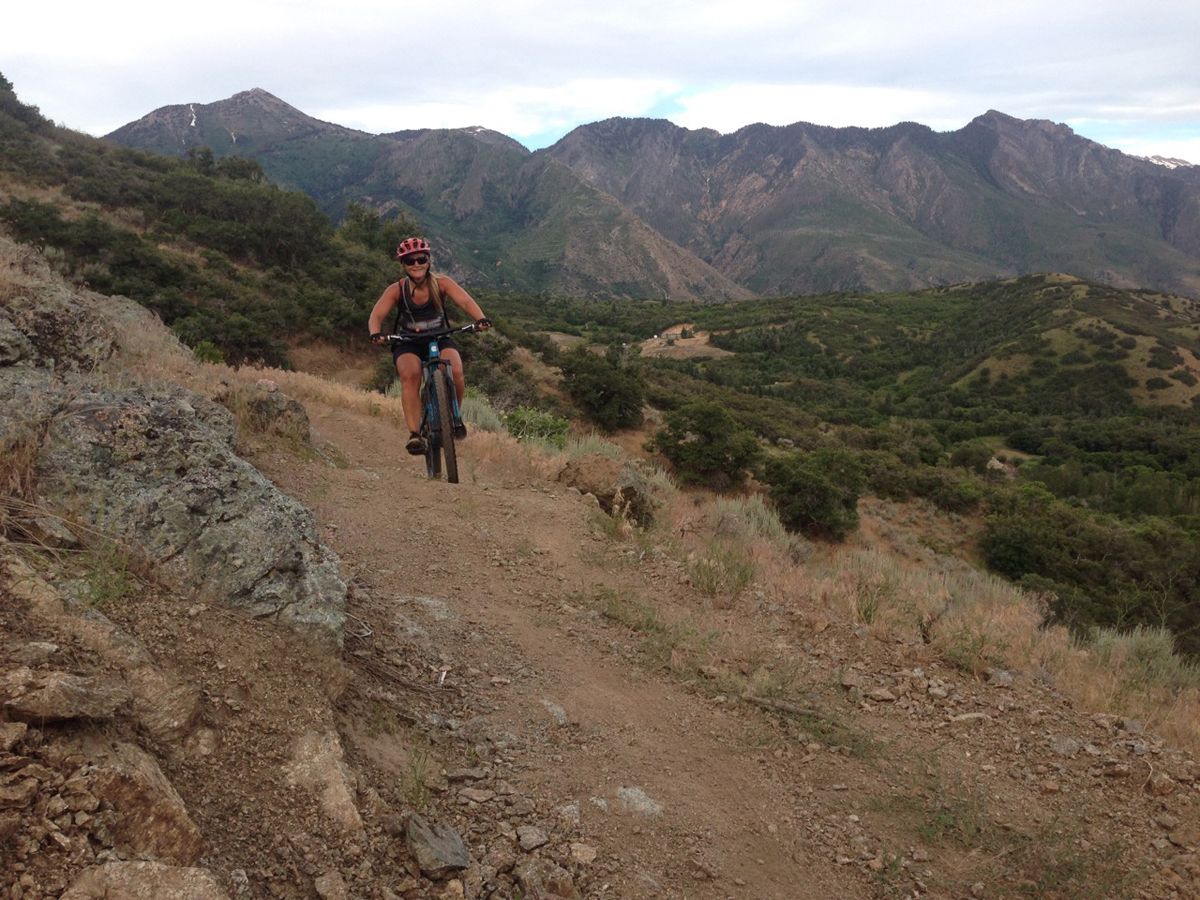
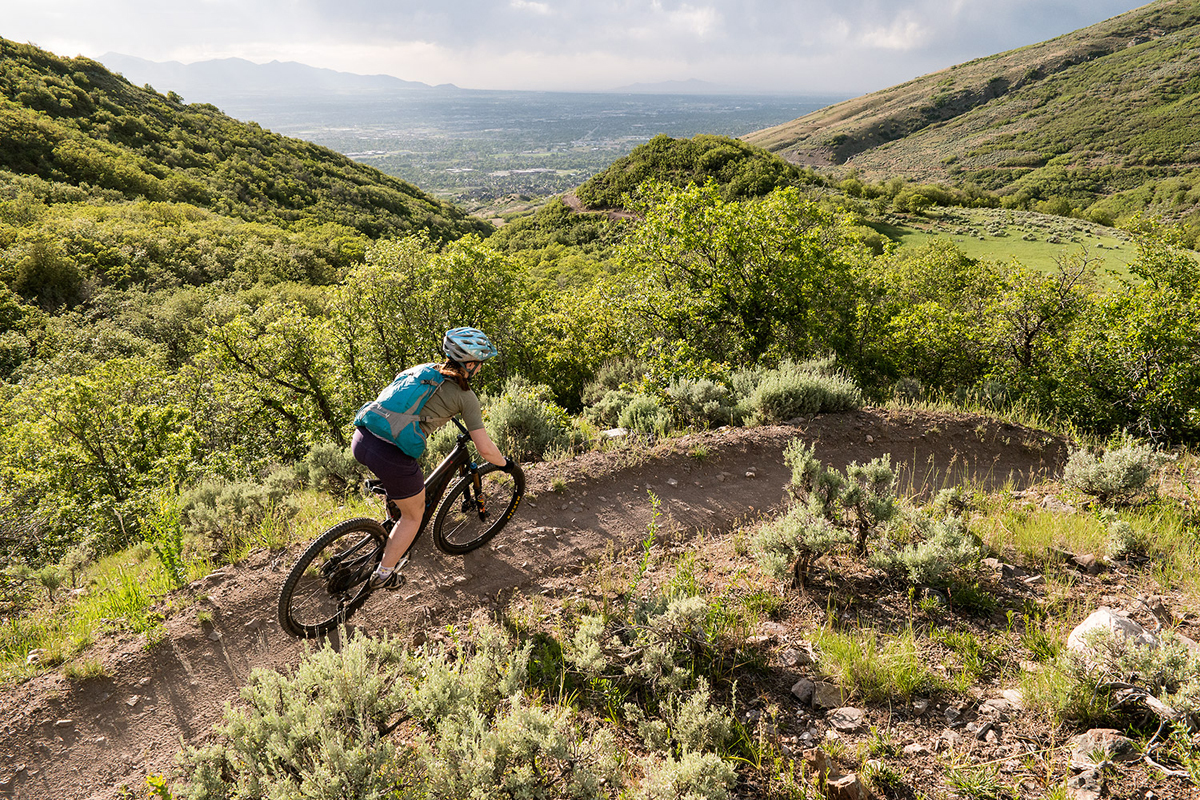
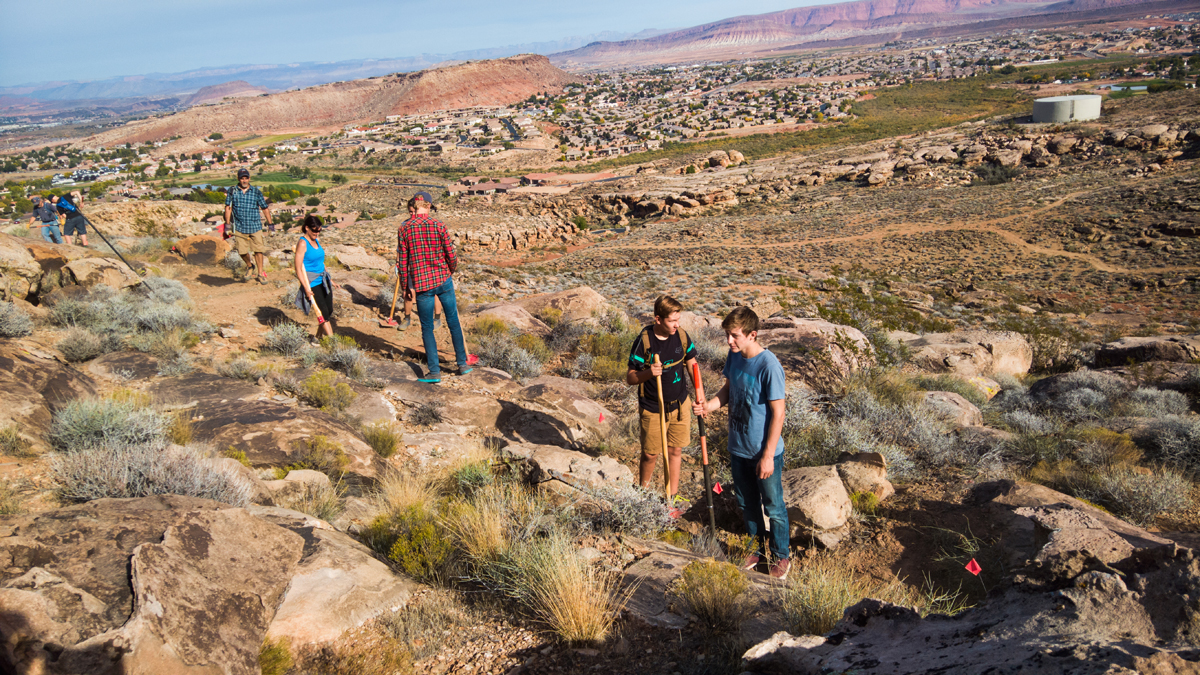
By Crys Lee — As a community we have responded to these difficult times by heading to our streets, trails, and pathways to find solace, comfort and to keep our sanities. Strava data provided by Utah DOT and Strava Metro found that ridership has increased significantly in total cycling trips taken in Utah. In April 2019, the number of total trips was around 107,000 compared to over 192,000 in April 2020. This is a mere snapshot of the increase that has occurred these past few months and we expect the trend will continue. What we are seeing throughout Utah is that people are embracing cycling as a way to keep their families safe, healthy, and active.
Bike Utah is continuing work with local governments and partners throughout the state to create family-friendly bike lanes and trails, to educate youth about road safety, and to advocate for active transportation programs that facilitate safe travel while promoting physical distancing.
Here is some of the progress we have made since 2019 and where we are heading in 2020:
Wasatch Bike Plan
Through the Wasatch Bike Plan initiative, we are working to make sure every municipality in the four Wasatch Front counties has an adopted active transportation plan.
When the initiative started in 2016, approximately 13% of Wasatch Front communities had adopted active transportation plans. Now, the percentage of communities with adopted or funded plans is at 70%. Approximately 96% of the population in Salt Lake County now lives in a community that either has an active transportation plan or is working on one. We are grateful to our partners the Wasatch Front Regional Council and Mountainland Association of Governments and the many others who have helped to make all of this possible.
Due to the incredible success and momentum the Wasatch Bike Plan has created we are looking to expand this plan to the entire state as we push for all communities to have safe, connected bicycle routes.
1,000 Miles Campaign
In May 2017, Governor Herbert initiated the 1,000 Miles Campaign to build 1,000 new miles of family-friendly bike paths, lanes, and trails by 2027. Bike Utah was designated as the nonprofit partner to carry out this campaign and to facilitate building the 1,000 miles.
Since the program’s inception in 2017, there have been 304.53 new miles built. We are on track for our goal to hit around 400 new miles by the end of 2020. Our 1,000 Miles Program Director, Chris Wiltsie, continually works to ensure that your communities will have more facilities your families can safely enjoy.
Youth BEST Program
The Youth Bicycle Education and Safety Training (BEST) Program teaches more than 3,000 Utah kids every year how to safely and confidently get around by bicycle. The Program is a 4-hour, in-class and on-bike program taught at schools around Utah, targeting students in the 4th to 7th grades. Bike Utah provides trained instructors, bicycles, helmets, and all other equipment for the duration of the program at no cost. We have taught almost 12,000 students across the state since 2016.
Due to current circumstances, the Youth BEST team has shifted their focus to virtual content. Schools are out and students are riding their bicycles more than ever. The staff are working on creating content for students and their parents so they can access information on how to ride safely. You can watch and interact with these videos on Bike Utah’s new TikTok channel, tiktok.com/@bikeutah
Utah Bike Summit
The Utah Bike Summit is the state bicycle conference, not only open to bicycle enthusiasts and advocates, but also, elected officials, bike shops, transportation planners and professionals, health officials and the general public. This one-day event features speakers, training sessions, networking opportunities, and discussions focusing on how to make Utah a better place to ride.
We made the difficult decision to cancel this year’s Utah Bike Summit, but look forward to a spectacular event on April 6, 2021 at the Davis Conference Center in Layton. Mark your Calendars!
Mid-Week MTB and PTown Cross Race Series
The Mid Week MTB Series provides a consistently fun, challenging mountain bike racing experience for riders of all ages and ability levels at venues throughout the Salt Lake Valley, Wasatch Front, and Wasatch Back. Proceeds from the Mid-Week MTB Series benefit the Youth BEST program.
Mid-Week MTB series will look a little different this year as we adjust to keep all our riders and volunteers safe. Our Mid-Week MTB team has put together a dynamic plan that will adjust to the circumstances on the given week of a race. We are thrilled that we are still able to put on a series this year and look forward to seeing you participate. Learn more at: midweekmtb.com
In 2019, Bike Utah took over the P-Town Cross race series. We are pleased to be bringing this cyclocross series back again in the fall! Follow along for details at: ptowncross.com
If you are interested in being involved in our programs and initiatives, there are a few things you can do:
Join our email list to stay updated
Send us an email about where you would like to be involved
Support our work by making a contribution to Bike Utah
Visit our website to learn more and get involved: bikeutah.org
Crys Lee is the Excecutive Director of Bike Utah. Bike Utah collaborates with all levels of government, organizations, agencies, businesses, and the general public to develop active transportation plans, educate thousands of children and adults, increase safety through legislation, and improve quality of life for residents and visitors with more bike lanes, paths, and trails.
Tinker Juarez to race the 2020 edition this October.
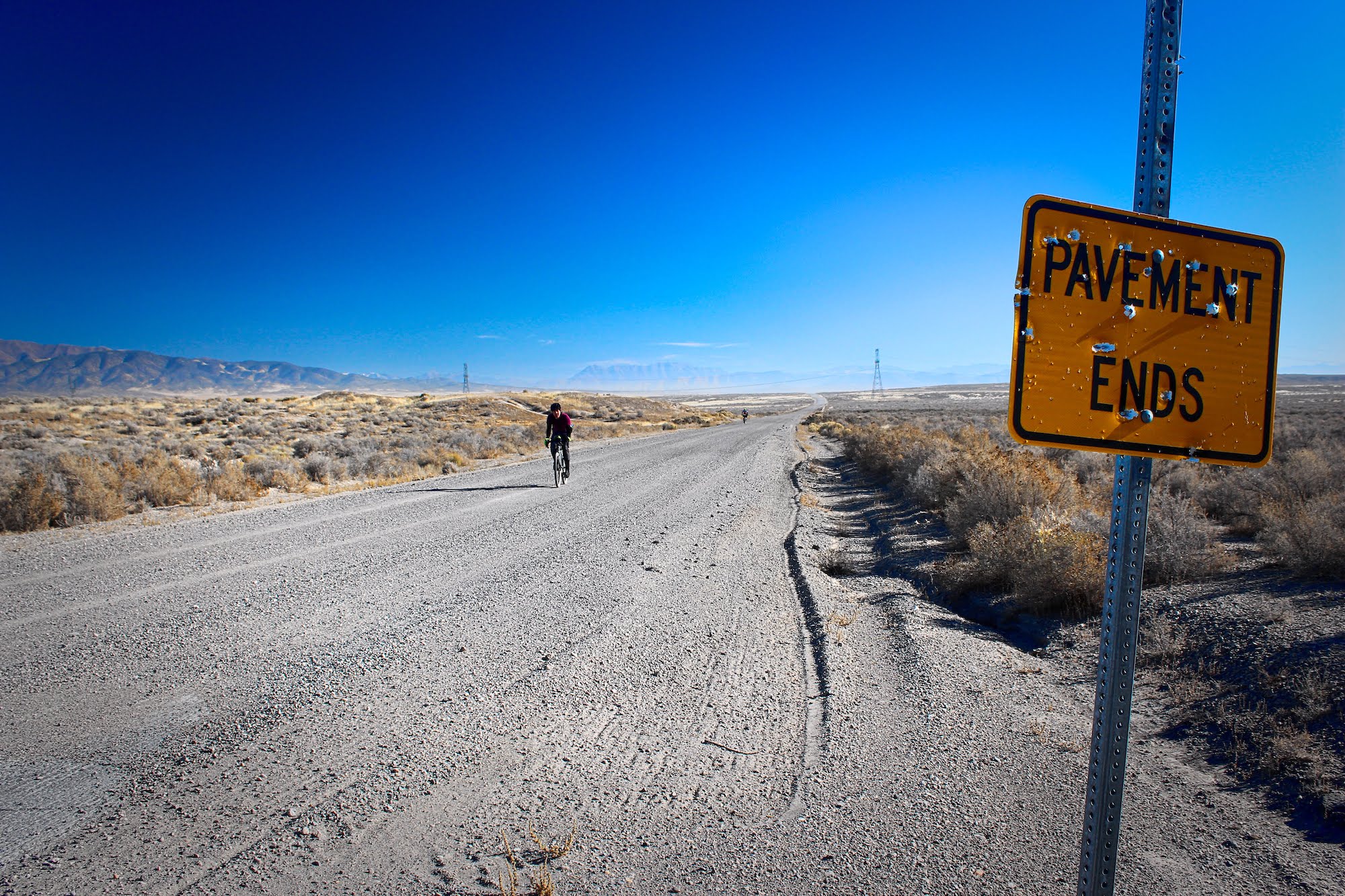
According to a press release sent out on July 29, 2020, Boyd Cycling is partnering with Salty & Stupid Cycling to put on the ambitious and unfathomably cool Salty Lizard 100, the Stupid Pony (#stupidpony), and the Stupid Lizard 100 (#saltylizard100) gravel races this October 2-3, and they’re bringing mountain biking great Tinker Juarez to join the party in Utah’s West Desert.
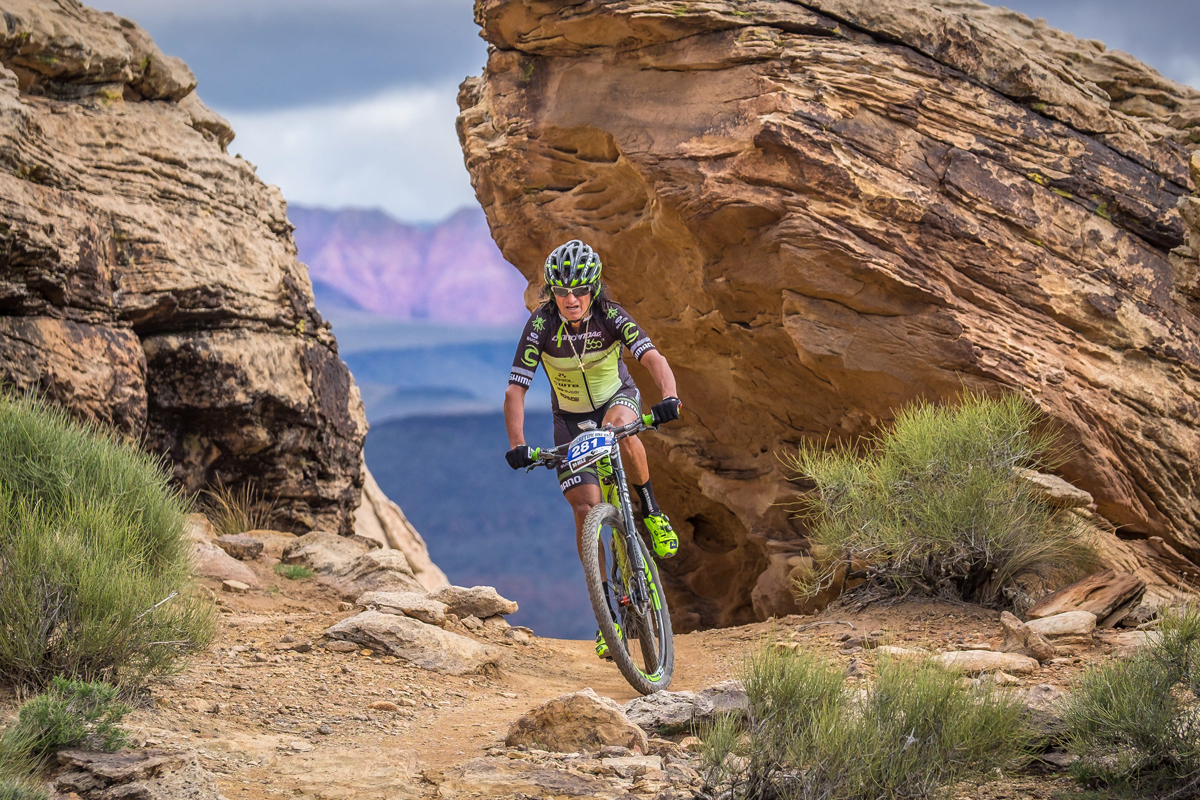
Mountain bike legend Tinker Juarez will be joining this year’s Stupid Pony and Salt Lizard 100 .
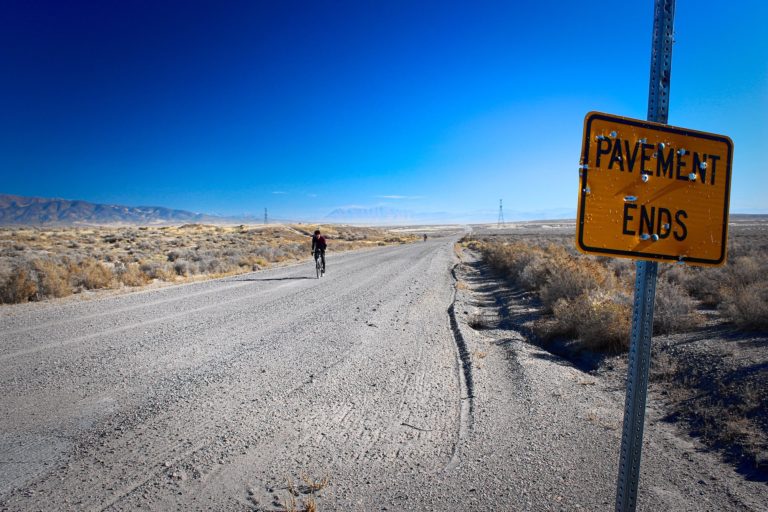
According to Bobby Kennedy, organizer of the event, “the Stupid Pony and the Salty Lizard 100 are the rides that you’ve always wanted to do – featuring between them over 330 miles of nearly 100% dirt traversing the width of Utah on the Pony Express and Silver Island Mountain Scenic Byway. You’ll see the most alien and beautiful and remote landscapes in the continental U.S., riding buff gravel roads and technical OHV trails. You’ll watch dawn over the Wasatch Mountains and dusk over the Deep Creek Mountains and see scads of pronghorn antelope and wild horses in the valleys in between.”
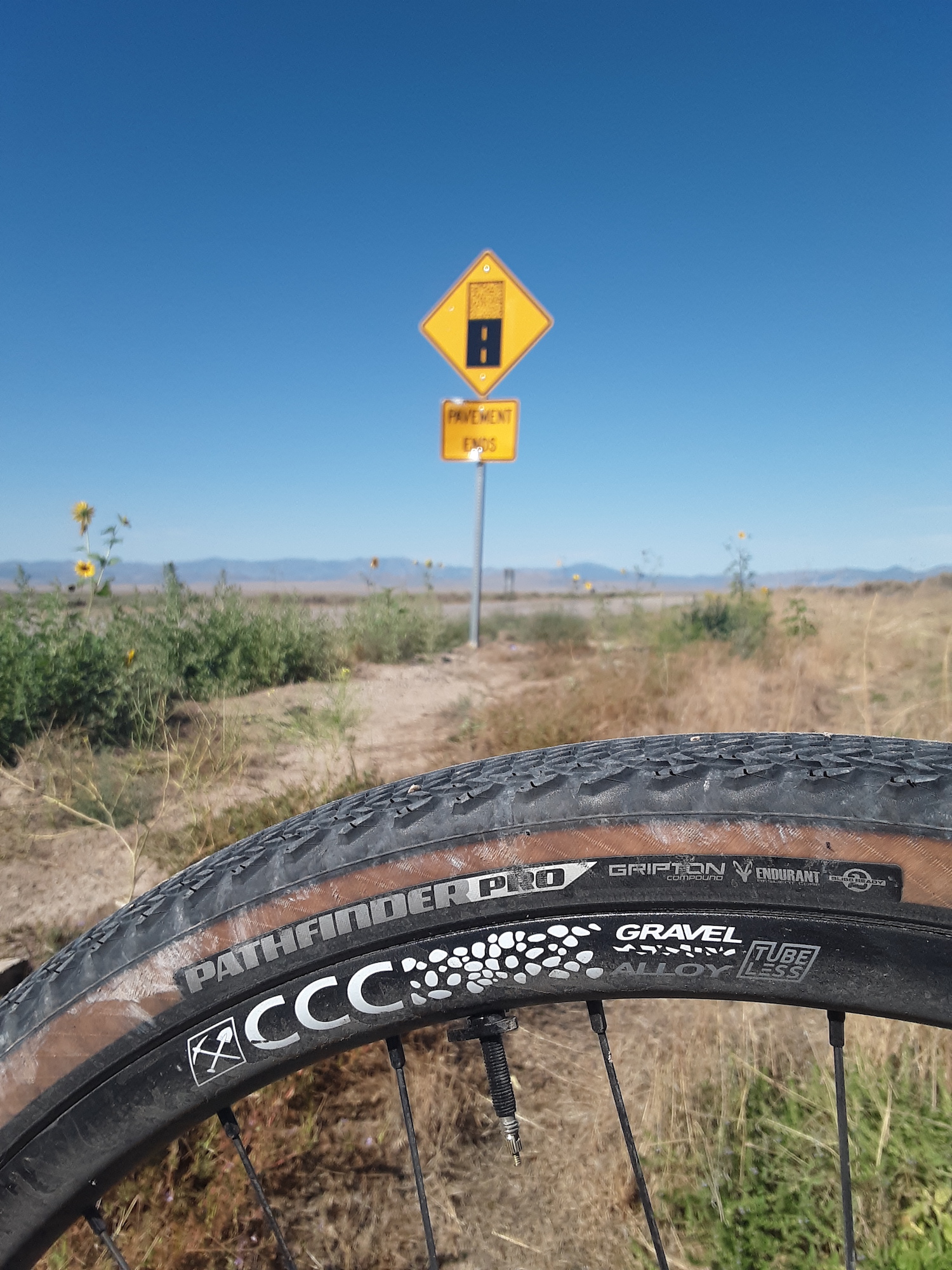
Boyd’s lineup of premium off-road gravel and mountain wheels, especially the Altamont and CCC, combine the light weight that brevet riders need to keep moving with the durability and ability to run wide tires that will actually get you across the desert.
Kennedy continues, “Even though our rides are fabulously chill, the presence of Tinker Juarez will give the fast guys who can’t resist 200 miles of drag racing a run for their money. Utah has an amazing endurance scene and we’re excited to up the competitive ante for last year’s podium finishers, Nathan Manwaring (1st place 2019 Stupid Pony Men’s), Jackie Baker (1st place 2019 Stupid Pony Women’s).”
Photo courtesy Salt & Stupid Cycling
Boyd is also putting up two (2) wheelsets for the winners of the men’s and women’s categories, which is a step up from the used t-shirts that the winners normally receive and are still contractually required to wear.
Boyd supports our community-driven and inclusive approach to putting on rides – they’re cheap, dirt cheap – and our efforts to reach out to communities who have been underserved by the biking industry.
Concluding his remarks, Kennedy says, “We’re also putting on a bike drive for kids in Wendover, UT, and West Wendover, NV, and reaching out to Latino communities in Utah and Nevada to spread the joy of gravel by bike. We’ve had incredible support from both West Wendover and Wendover, and the good luck to have wonderful volunteers like Karen and Randy Shepherd, Conner VanSkiver, Misti and Nate Cobb and Cason Carrol. We’re here to help people enjoy the incredible beauty of the West Desert, and so incredibly chuffed that Boyd is joining us in our cracked quest to get people to bike across it!”
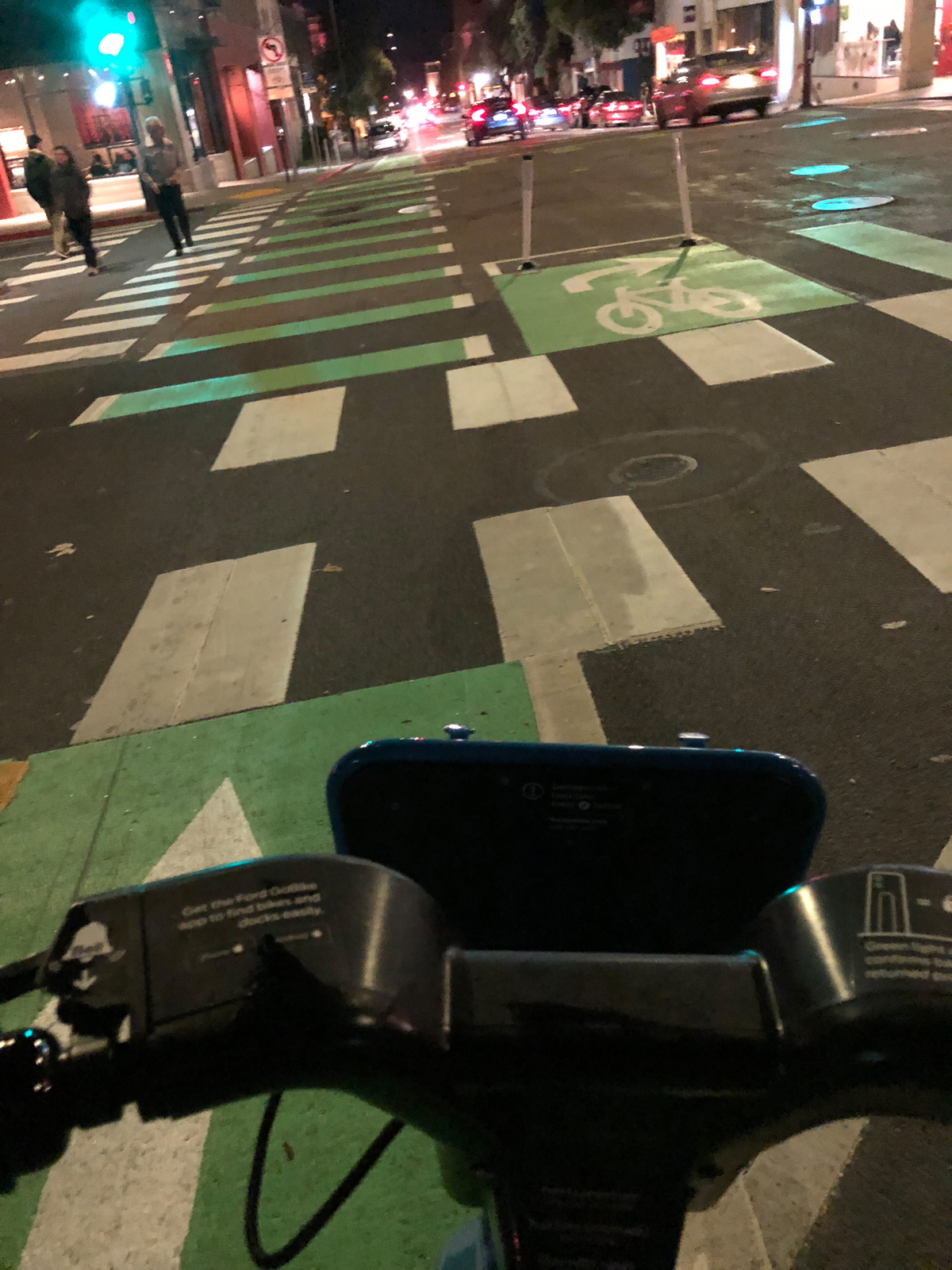
By Katy Swordfisk — Despite longstanding popular belief, bicycle lanes can actually improve business. At worst, the negative impact on sales and employment is minimal, according to a new study from Portland State’s Transportation Research and Education Center (TREC).
The report is part of a larger National Street Improvements Study, conducted by Portland State University, with support from consulting firm Bennett Midland and the cycling-advocacy nonprofit PeopleForBikes. The study was funded by The Summit Foundation and the National Institute for Transportation and Communities.
Berkeley bike lanes are good for business. Photo by Dave Iltis
Researchers studied 14 corridors in 6 cities — Portland, Seattle, San Francisco, Memphis, Minneapolis and Indianapolis — and found such improvements had either positive or non-significant impacts on sales and employment. Essentially, adding improvements like bike lanes largely boosted business and employment in the retail and food service sectors.
“I think that it is very significant that we found that positive business outcomes to the food service and retail industries on these corridors are persistent, even when we looked at different data metrics on employment or sales or when different analytical methods are utilized,” said Jenny Liu, associate professor in the Toulan School of Urban Studies & Planning.
Past studies examined the effects of street improvement corridors within specific cities, but this study is among the first to apply consistent and robust analytical approaches across multiple corridors and multiple cities.
The findings also provide policymakers and planners with an analytical framework and further evidence to support investment in non-motorized transportation infrastructure.
“The Street Improvement Study supports with data what we have seen in many communities: adding bicycle infrastructure boosts a neighborhood’s economic vitality,” said Zoe Kircos, director of grants and partnerships at PeopleForBikes. “Our collaboration with Portland State University and Bennett Midland on this research gives us more resources to share with cities across the U.S. that are eager to make bicycling safer and easier for everyone.”
Liu added that the partnership between PSU, PeopleForBikes and Bennett Midland contributed significantly to the end products that are directly targeted to planners and policymakers. The study produced in-depth reports for Portland, Seattle, San Francisco, Memphis, Minneapolis and Indianapolis.
Nationally, the study found the food service industry benefits most often from the addition of transportation infrastructure.
Even in cases where a motor vehicle travel lane or parking was removed to make room for a bike lane, food sales and employment tended to go up, according to the report.
“There is tremendous potential to expand on what we learned in this research project to additional cities and corridors, and to provide policymakers with the opportunity to evaluate street improvement projects before implementation or to collect additional economic/business metrics before and after implementation,” Liu said.
Reference: Liu, Jenny H., and Wei Shi. “Understanding Economic and Business Impacts of Street Improvements for Bicycle and Mobility–A Multicity Multiapproach Exploration.” No. NITC-RR-1031-1161. 2020. (https://nitc.trec.pdx.edu/research/project/1031/)
Ned Overend talks about his history in mountain biking, racing, and life
Anthony Nocella: I am excited to interview you, Ned, for Cycling West. I had posters of you all over my room growing up. You are a big reason on why I raced mountain bikes professionally. What was your motivation to get into cycling, and what kind of support was significant when you were starting out?
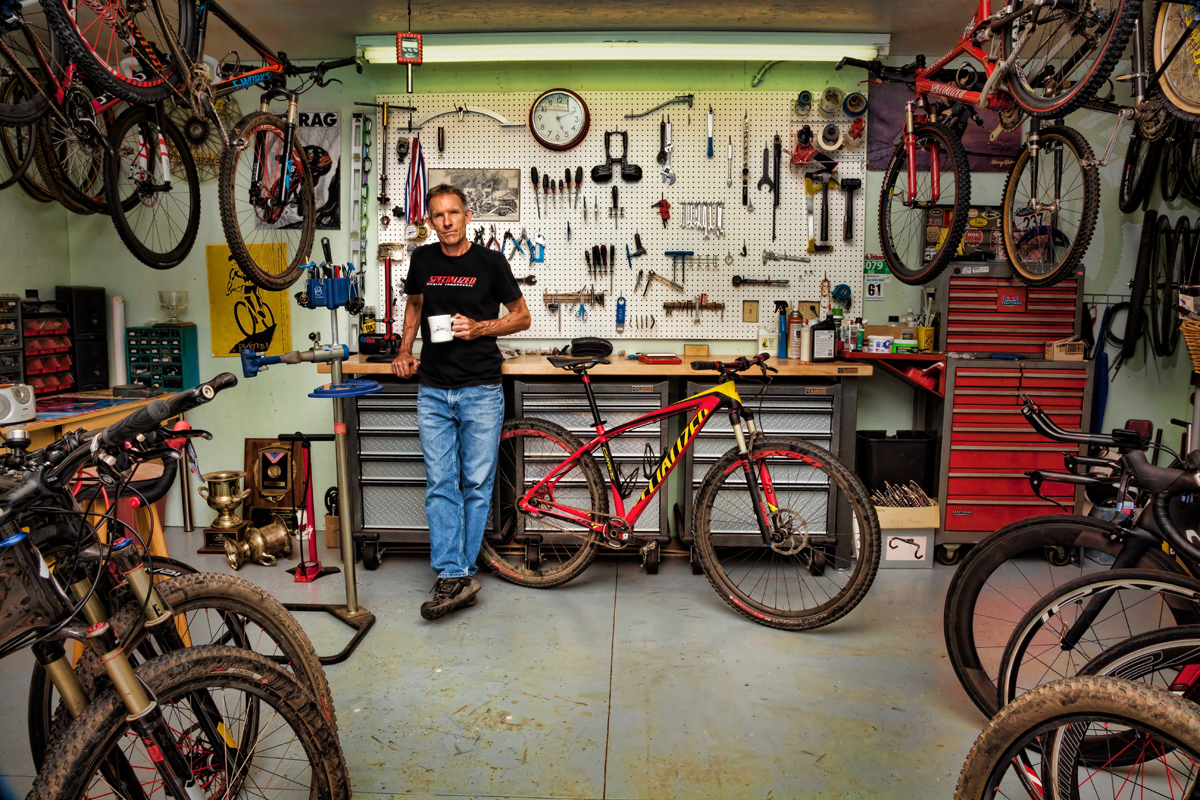
Ned Overend in his home workshop. Photo by Dan Escobar
Ned Overend: In 1980 I was living in Durango and having some success as a trail runner (Pikes Peak marathon etc.) and like all runners I got injured. I couldn’t run, but I could still ride, and cycling was an outlet for my fitness and desire for competition.
The Iron Horse Bicycle Classic was a big local event and it inspired me to try road racing. I started racing the Colorado road race circuit and in 1983 I got picked up by the Raleigh team to race the Coors Classic. My teammates included Andy Hampsten and Steve Tilford, two athletes that I would learn a lot from in the following years.
At the time, I was working at a bike shop and trying to decide whether to be a pro road racer or a pro triathlete when mountain bike racing was taking off on the West Coast. The biggest series in the US at the time was the Pacific Suntour Series. I drove out to the West Coast and won a couple of those events.
The bike shop was a Schwinn dealer so I called Fred Teeman at Schwinn; Fred was the manager of their BMX team and he said he was interested in mountain bike racing, so that was the start of a relationship that lasted until 1988. Then I met Mike Sinyard, the owner of Specialized, and I have been with them for the last 30-plus years.
Ed Zink, the owner of the bike shop and the promoter of the Iron Horse Bicycle Classic was an important mentor for me, not only in those early race days, but all the way up to last year when he passed from a heart condition. Before working at the Mountain Bike Specialists bike shop, I was a car mechanic. Ed let me work at the shop while I focused on training and racing.
AN: Could you imagine in the late 1980s that mountain biking would be as huge as it is now? What has been the most exciting advancement in mountain biking, in your opinion?
NO: Ha! There are so many technical advancements, the early bikes are primitive compared to what we are riding now. We’re talking about fully rigid bikes, 26 inch wheels, 45 PSI in the skinny (1.9) tube type tires to keep from flatting, pedals with toe clips and straps, friction shifting (no indexing clicks to find a gear), rim brakes, etc. In spite of that it was still fun.
I would say efficient full suspension made a huge difference in control and performance of mountain bikes, followed by the 29-inch wheel. Disc brakes are a big advancement as well.
Ned Overend hammering the climb during the 2016 Iron Horse Bicycle Classic. Photo by Scott D W Smith
AN: A lot of people wonder this, but you might have the answer on why doping has not been as significant an issue in mountain biking compared to road cycling.
NO: That’s a complicated question. In the mid 90’s doping was a problem in mountain biking.
It seemed like in a few short years the US riders like Tomac, Tinker, and I went from winning several World Cups a season to struggling to place in the top-five. This is not an unfounded accusation, but many riders from that era went on to test positive or admit to doping during that time, including Jerome Chiotti, who was the 1996 World XC champ. Chiotti had come over from road racing where they had a serious drug problem.
I believe mountain bike racing is pretty clean these days, especially in the US. There is a strong anti-drug culture that has been reinforced by education from USA Cycling and by programs like NICA that focus on fairness and strength of character over just winning.
The fact that mountain bike racing is not as hard as road racing is also a factor. The Pro Tour road race schedule is so arduous that it lends itself to drug abuse. Mountain bike races are not as long, and there is more time between races for recovery. Also, the fact that there is not a lot of money to be made as a professional mountain bike racer means there is less incentive for riders to cheat.
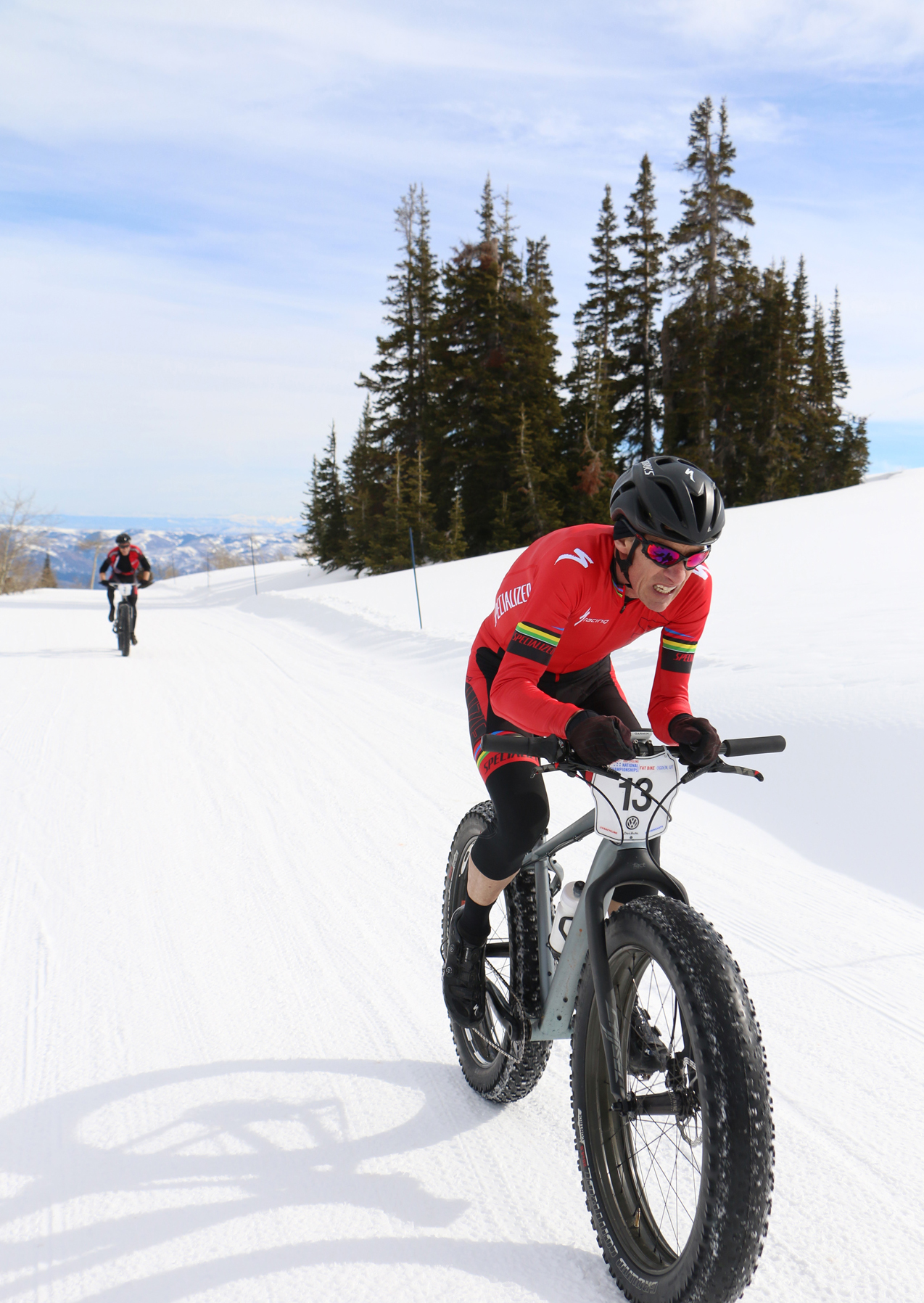
Ned Overend in the midst of a devastating last lap attack on his way to winning the pro Fat Bike National Championship at Powder Mountain on February 14, 2015. Photo by Dave Iltis
[Editor’s Note: Ned Overend won the 2015 Fat Bike National Championships. Check out Cycling West’s report on the race here.]
AN: What social issues would you like to see the bicycle industry focus more on?
NO: A couple of big ones are the obesity epidemic and Global Warming. Regular bikes and E-bikes especially are a massive opportunity to get people to drive less. With the right infrastructure that can protect riders from cars there is a lot of opportunity to grow commute cycling. I am an E-bike advocate because I have seen how many new people E-bikes are bringing to cycling.
A lot of the obesity issues in this country starts with the unhealthy eating habits of kids. Specialized’s Foundation “Outridebike.org” focus is to get kids on bikes. They have a variety of programs to support cycling in elementary and middle schools. NICA’s philosophy of having everyone participate and fostering team members support of each other is powerful movement that’s getting kids started in a healthy lifestyle .
Ned Overend leading the chase group at the 2018 Crusher in the Tushar. Photo by Steven L. Sheffield
AN: Out of all the races you have won, which race would you say was the most amazing for you and why?
NO: That’s hard to choose, I’m reminded of winning the first UCI World Mountain Bike Championships in 1990, whenever I see the rainbow stripes on my sleeves, so of course that title is a big milestone for me. I had won several un-official World Championships before that in 1987, ‘88, and ‘89 in Europe and in Mammoth California, but I really wanted to win the first official UCI rainbow jersey to back up my previous titles.
In 1994, the UCI World Cup was super competitive, and with the logistics it was harder to win in Europe. That year I won the World Cup races in Italy and Switzerland. It’s been a long time since an American has won an XC World Cup.
[Editor’s note: While no American male has won the World Cup overall since John Tomac (USA) in 1991 or an individual race since the mid-1990s, Kate Courtney (USA) won three rounds of the World Cup, as well as the overall Series in 2019.]
I retired from the World Cup circuit in 96 and started racing XTERRA triathlons. It took me a few years to develop my swim and run, but I won the World Champs in Maui in 1998 and ‘99. That was satisfying because learning to put the three disciplines together was a big challenge.
AN: What is your favorite three trails to ride in the southwest and why?
NO: My daughter moved to Scottsdale, Arizona and I have been doing some riding in McDowell Mountain Park. I am really enjoying chasing some Strava segments on the Pemberton trail. Its fast and flowy which is different than the rocky trails around Durango.
Not all the trails around Durango are rocky, the shale dirt trails in Overend Mountain Park west of town are some of the smoothest. One of my favorites there is the Spirit Trail, so named because it skirts around The City graveyard. It’s up-and-down with some tight switchbacks climbing and descending.
The Hermosa Creek trail is a classic 20 miles of single track that follows the Hermosa Creek drainage from above Purgatory ski resort towards Durango. It’s a beautiful alpine ride, I never get tired of it.
I’ve ridden some amazing trails across the southwest, in Park City, Moab, and Crested Butte. We are spoiled out here.
Anthony J. Nocella II, Ph.D. is a full-time professor at Salt Lake Community College, author of numerous books, trail runner, triathlete, competitive cyclist, and in his free time works at Hangar 15 Bicycles Millcreek.
By Charles Pekow — Montrose, Colorado just joined the family of bicycle friendly communities (BFCs). It was the only new BFC in the Mountain West issued in the League of American Bicyclists’ latest round of awards. Montrose earned the lowest award level, bronze. Silverthorne, Colorado moved up one notch from bronze to silver, and Springville, Utah earned honorable mention.
Designations last four years. Montrose applied in 2015 and received honorable mention. The Montrose Area Bicycle Alliance spearheaded the effort and promises to keep making improvements to try to earn a higher rank in 2024. The Parks Division includes 30 miles of paved trails. The city added a Connect Trail running through town with only two traffic intersections, bike lanes on streets and 30 miles of mountain bike trails. The city added new bike classes, installed downtown bike racks and sponsors a Bike-to-Work Day.
Silverthorne improved by adding a 3.8-mile Blue River Trail, sponsoring bike events and improving mountain biking trails.
Springville, meanwhile, had hoped to get a higher nod. The Hobble Creek Bicycle Association spearheaded the application. “We are shooting for bronze status with this first application, with the hopes of being able to move up to silver status in four years,” the association stated on its website when it applied with the city in February. “The application was long and detailed and took a significant amount of input from city officials to get it done, but it was very eye-opening to the kinds of things that the city and our associations could be doing to make Springville more bicycle friendly.”
The city is continuing to improve, adding new bike lanes in May, for instance, with more on the way, so higher rankings are sure to come.
“That’s your job in this hard world, to keep your love alive and see that you get on, no matter what.” ― Stephen King, The Shining
Pacific North Westerners did not invent clever names for athletic events, but it was wordsmith worship that attracted me to my first Summit To Surf diabetes charity bike ride. With its catchy name I fully expected to drive to the top of a mountain, plant a front fork at the driveway of Mt. Hood’s historic Timberline Lodge, then clip in for a bone shaking ride, a near vertical run, some sort of a tuck and go like hell, all the way to the Oregon Coast.
Joe Kurmaskie coming down from Barlow Pass to Hood River as part of the Summit To Surf Diabetes Association Charity Ride. Photo by Gail Davidson
Instead, a couple thousand of my friends and neighbors assembled outside of a one room schoolhouse in Welches, Oregon for 15 miles of slow going, up and over Barlow Pass, before coasting 30 gentle clicks to the water’s edge – Hood River and the “surf” of the Columbia River.
Don’t get me wrong, Barlow Pass is a lovely spot on the planet, but it’s a far cry from the rarefied air of Timberline – the prize waiting for me at the tip top of a crooked and steep fortress of stone, something Dr. Seuss might have drawn on a frisky day. Or so I was told. I’d never been to the lodge. If I’m going to rise at the crack of dawn, work those pedals in a way that resembles a gerbil of crack, play my gears like a concert pianist performing Rachmaninoff, than at the very least, pay my efforts with a million dollar view and architecture listed on important registers. Not to mention that while Barlow Pass pedaling may sound like a formidable accomplishment, when I found myself drafting behind a school group of sixth graders hardly out of breath, drastic measures were called for. Someone throw me a testosterone life preserver, stat, then point out the turn for Timberline.
Two bike lanes diverged in the Oregon woods and I took the one less pedaled. I took the one that held the promise of hypothermia, blowing rain and icicles forming on one’s chin at the tail end of July. My rescue came in the form of a small addendum to the official Summit to Surf brochure; something I’d missed until it was nearly too late, a last-minute Timberline Lodge option for those hearty souls who find pain and suffering their stock in trade. With a gleeful wave, I bid farewell to the elementary school set, peeling off their raggedy back wheels was the sort of liberation on par with graduating from the kiddy table at holiday dinners.
Once away from the crowds of casual riders – folks in their funny hats, theme music, bells, event T’s and dusted off garage rafter bikes, I searched for a rhythm I could live with as the earth began to tilt up. I knew to pace myself on what would be my lonely flight of folly to the top of the world.
Only in Oregon though, can a man commit such a brazen act of independence on two wheels and find himself followed into the breach by a rowdy armada of blue blooded cyclists, fellow inmates from the Lycra monkey house looking for a challenge that might very well put some of them on the evening news or in the hospital.
“Heard they’re offering medals to those who make it to the lodge,” This from a man twice my age who had apparently given up all signs of body fat the way others kick hardcore vices such as heroin or hookers. And he was about to kick my ass off the mountain if I didn’t pick up my pace.
I nodded to conserve energy in case he made a run for it mid-sentence.
“Only for those who make it back down again,” added a serious young man in front, probably a triathlete using this as a training ride. He shook his head as if the concept of medals was laughable.
“Medals? Baah… There’s hot chocolate and homemade pie at the Timberline turn around rest stop,” the old man’s sidekick said, his son perhaps judging from body type and crooked grin.
Now I do like my pie, but the way I was sweating, hot chocolate just seemed silly. But a medal now, that didn’t sound out of proportion. I fell in behind them and had a look around.
I counted eight of us in all. A pair of pretty boys – the sort ready at a moment’s notice to step in as Bicycling Magazine cover models. These posers would be the first to drop when the going got tough. Never dress like a Tour de France team member unless you’re actually in that race, and never ever ride more bike than you can use to successfully pass others. It’s a dead giveaway.
The big guy midway back in the pace line, now he was the one to keep an eye on. Resembling a whiskey barrel which had managed to defy gravity and mount a bike, his tan lines told the real story. This barrel of Booker Noe rode four or five times a week. Anyone strong enough to pull that much heft uphill, while carrying on a conversation, was a bear.
Don’t poke the bear.
The woman using him as a wind block? Poster child for the Pacific Northwest outdoor lifestyle. A peek in her closest would reveal more Gore-Tex shells than cocktail dresses, her bathroom stocked more Carmex than lip gloss and her garage was jammed with wind surfers and snowshoes, leaving just enough room to park the Subaru.
I could love this woman, if only I could find enough oxygen to introduce myself.
Rounding out our band of Timberline hopefuls was a husband/wife team on a tandem. Tandem riders fall into two camps; those who wave and smile at anything that moves, as if in training for the Rose Bowl Parade, as if a soundtrack accompanies their every pedal stoke, one featuring classic hits for 1976, Skyrockets in Flight, Redbone’s Come And Get Your Love, and Frank Valli’s Oh, What A Night, and then there are those who work for Boeing as structural engineers.
The engineers were bringing up our rear. scowling, determined, all systems go.
Every few miles of elevation gained the group access to a new ecosystem. Arboreal forest glistening in the sunshine gave way to sub-alpine with its puffy clouds and crisp breezes, before handing us off to growing shadows across alpine meadows.
Somewhere between admiring natural girl’s calves and thinking about fine hickory smoked whiskey, the temperature dropped forty degrees and the rain began to fall… sideways.
As under prepared as I felt for this assault of elements, my rear pannier held a trove of clothing options compared to most of my compadres. Only the triathlete and the engineers kept going when the pace line stopped for a wardrobe change. The flimsy windbreakers and thin fleece being donned were laughable, but it was all my fellow cyclists had. I lent a layer to the old guy’s sidekick, who mouthed “thank you”, but what I chose to hear instead was “hot chocolate”. It didn’t sound so silly now.
When we caught the stoic couple on their two-seater, they’d managed an in-motion head-to-toe clothing transformation. Mussolini would have been proud.
For another three miles we concentrated on making little circles with our pedals, battling back that coppery taste of blood in the back of throats as conditions deteriorated at cartoon velocity.
“It ever snow in July?” I asked, realizing, even as the words left my mouth, that images of Mt. Hood always, always proudly display snow on them.
Whiskey barrel seemed not to notice the icy rain or biting wind, but one of the two pretty boys was grunting and barking, making a spectacle of himself, the other suffered in silence. That’s when the lodge came into view.
I had to wipe my glasses twice before it registered. This being my first time setting eyes on the famed landmark, it jolted me upright in my saddle. Even through blinding rain and wind gusts strong enough to blow a bike right over the edge if one wasn’t mindful, the front facade of Timberline released a fight or flight burst of adrenaline, mixed with so much emotional vertigo that I had to grip my handlebars and bite down hard not to lose my place in the pace line. Crashing everyone to the ground is considered poor form on any ride.
Something hot and damp danced down my spine.
“Wait a minute, this looks…”
Sidekick nodded. He knew where my head was at that moment.
“Here’s Johnny!” He howled, waiting me out. “You really didn’t know they filmed the exterior shots for “The Shining” here?”
I shook my head. Rain flying off as the stark realization leaked in.
Struggling the final yards into the parking lot brought it all back. Forced to view the film way too young, every reel of that movie had left an impression. One sweltering Florida afternoon of terror. Mom claims she didn’t even look at the title, she just saw the movie poster with all that snow, knew the theater was air conditioned and took in whichever family member happened to be in tow. Me.
Later, when questioned by my older sister as to what she was thinking taking me to a Stephen King horror film, Mom pointed out that she was a Florida housewife with four children during humidity and cockroach season. An unkempt axe-wielding Jack Nicholson seemed laughable in comparison.
Now here it was in the flesh… or stone and masonry. Scaring the crap out of me all over again.
As soon as we came to a stop something else sent fear through the group.
“Where’s the hot chocolate?” someone whined.
Several tables with party skirting stood abandoned beside a locked, darkened lodge.
“Where’s the rest of the rest stop?”
Triathlete pointed at a white blob hanging in the low branches of a Spruce tree. Upended and covered in mud, the party tent invited anything but celebration.
When Dan Stathos introduced the bicycle bill back in 1971, I wonder if he ever envisioned that funding projects would lead to cyclists behaving in such a manner so early on a Saturday morning. Probably, after all, Oregon rarely tells its people what they can’t do in the name of physical fitness.
A murder of crows flew a tight formation over the tables, landing only long enough to pick at the mushy remains of breakfast muffins.
I do believe that’s when the pretty boys lost all hope.
Whiskey Barrel yelled something, but gale force winds swallowed it whole.
“At least it’s stopped raining.” I heard when he tried again.
And there it was, the core Oregonian spirit embodied in a rolling barrel of Booker Noe and Columbia Sportswear windbreaker. The eternal optimist facing down ridiculous meteorological conditions. It reminded me of British explorers stumbling about, frostbitten from days on the polar ice, asking only for a spot of tea before it’s back into the breach with them. I would do well to emulate the big man, seeing as we had recently chosen Oregon as our final stand.
That’s when it started to snow.
Not storybook flakes, sleigh bells and caroler conditions, but a swirling, dervish of chaos. A cold, white whirlpool of loathing. I took one last look at the haunted house of my childhood – a regal structure made so wrong by the magic of Hollywood – and headed for the low country as fast as my legs would send me. Echoes of “Redrum, Redrum,” nipping at my heels, ice and snow stinging my face.
I assumed everyone followed, but did I take an actual inventory? There was still a bit of east coast in me that needed to be purged. In time, I learned the customs of our region, a land where people made eye contact, conversed in coffeeshops with complete strangers, and held doors open for no other reason than… it’s the right thing to do.
Not until I was safely back into the warmth and light, rolling across the finish and into the feed line, did I notice we were a couple of people short. Tandem couple offered a nod, nature girl held her face to the sun, whiskey barrel already had his plate, the father and son team were showing off their medals, but the pretty boys and triathlete; absent. I scanned the bike corral for their expensive rigs, nada.
A woman with a clipboard, radio and red ribboned medals came to our table.
“You guys slipped up the mountain before we could close the road. Congratulations.” She handed us our medals.
“We had to send an ambulance for two other riders. Hypothermia.”
“Who called it in?” I asked.
“That guy.”
When we followed her finger, it led right to our Triathlete, sucking down a power drink, still in the saddle. As if on cue, he pedaled away, in the direction of the mountain. More than likely riding the course in reverse, back to his car.
You know he didn’t take a medal. The only true Oregonian among us that day.
Of course, being a vain little creature in spandex, I kept mine. I did put in a good word so that the pretty boys in the hospital would get theirs as well.
It’s another summer. Two roads diverge in the Oregon woods and like a good hunting dog, one that can’t keep put on the porch, I gear down and head up the hill for another crack at it. Another chance to leave none of my neighbors behind. The chance at another shining moment on Mt. Hood.
Joe Kurmaskie is a journalist, syndicated columnist, and contributor to numerous magazines including Outside, Bicycling Magazine, Men’s Journal and Parenting. He’s a bike advocate, activist, found of Cadence Press, and a Random House author of seven books including Metal Cowboy, Mud, Sweat and Gears and A Guide To Falling Down In Public.
For young U.S. triathletes with goals to compete in future Olympic Games, the COVID-19 pandemic has forced them to adapt their training.
With the racing season suspended, members of USA Triathlon’s men’s elite development squad, Project Podium, lose the benefits of competing in an international field and gaining valuable racing experience — but the disruption also has given them extra time to focus more on consistent individual training.
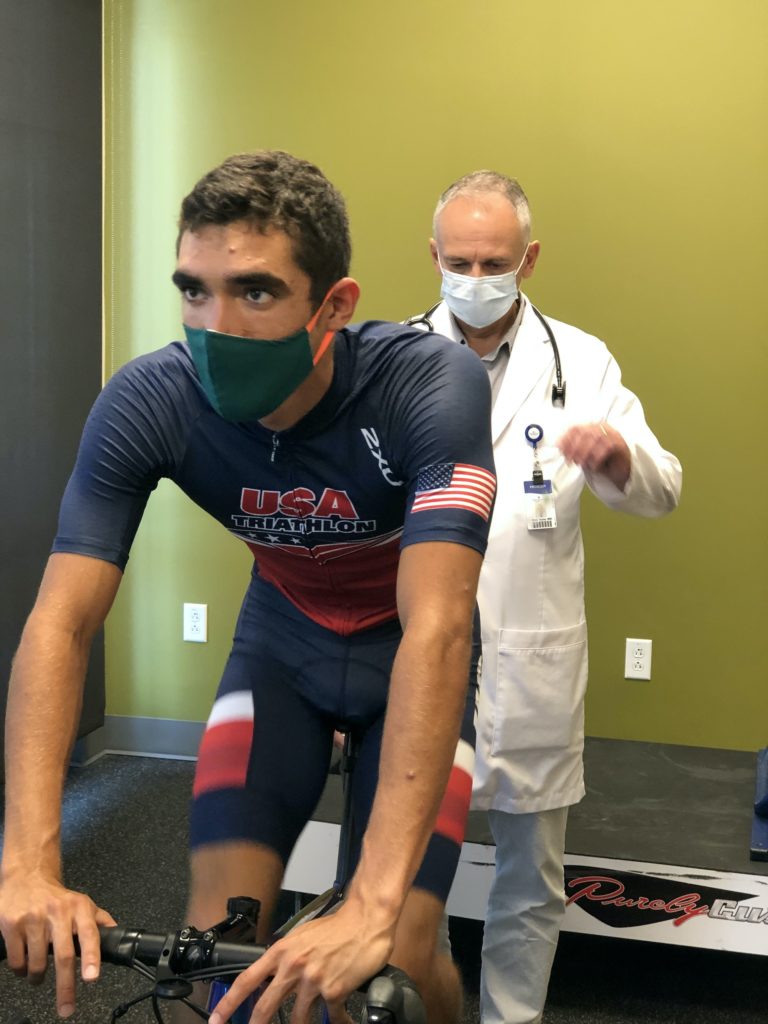
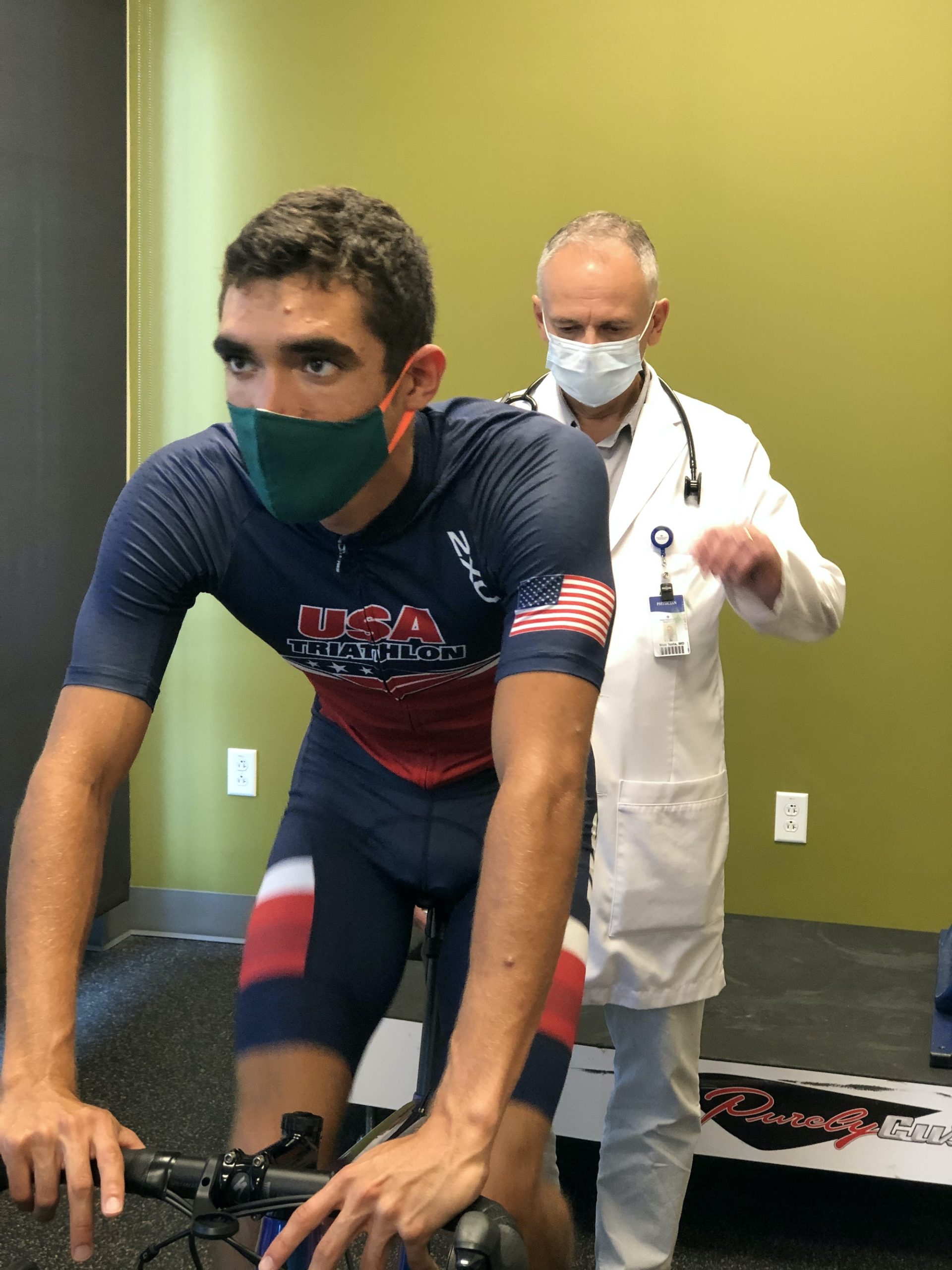
Dr. Max Testa working with USA Triathlon athlete Luis Ortiz. Photo courtesy Intermountain Healthcare
Project Podium, a program designed by USA Triathlon to train top young male triathletes in the U.S. to achieve medal performances in international competition and ultimately the Olympic Games, has partnered with Intermountain Healthcare for sport performance and sports medicine support. The team typically trains out of Arizona State University in Tempe, Arizona, but is spending time in Park City, Utah, this summer as a temporary training base.
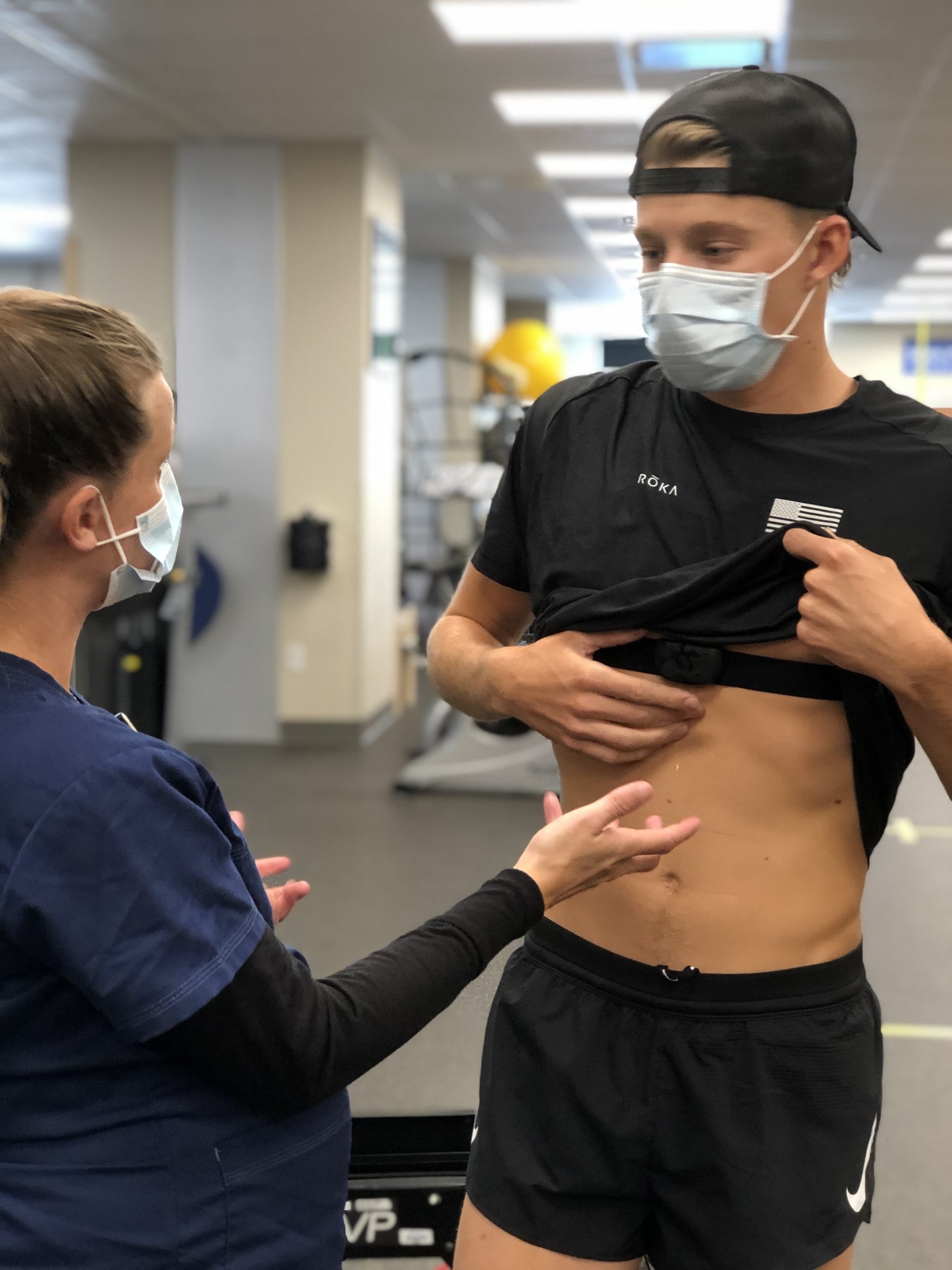
The squad’s training is enhanced by one-on-one consultations with members of the sports performance team at Intermountain Park City Hospital — including sports medicine physicians and physical therapists, certified athletic trainers, accredited sports dietitians, exercise physiologists and performance coaches.
“Normally, during the summer, we’re racing all over the world, but given the circumstances with COVID-19, races are canceled,” said Parker Spencer, a USA Triathlon Level II Certified Coach who leads the team. “We were looking for a temporary home base to train, and the Utah Olympic Park and Park City Hospital came highly recommended.”
“The altitude training is key, and Park City is an ideal location that provides world-class triathlon training. At Park City Hospital, we have access to everything from recovery components to sports performance to sports medicine,” said Spencer.
“The team comradery is at a level I’ve never seen before,” mentioned Spencer. “Because of COVID, we’re just all in this together. Since we’re not competing, we’re able to use our teammates to gauge our successes and motivate each other more than ever.”
The Intermountain team uses a methodology that emphasizes the importance of a fine-tuned human engine to help athletes reach peak performance.
“At times, athletes get distracted trying to lighten the weight of their bike or become more aerodynamic, yet they forget to check their ‘engine’ and implement quality training that affects the running of that engine,” said Max Testa, MD, a physician with the Intermountain sports performance program. Trained in Europe in exercise physiology, Dr. Testa has worked for 29 years with professional cycling teams as a team physician.
“I love seeing the data, and the science behind the training is incredible,” says Chase McQueen, 22, a two-time ITU Junior World Championships competitor and upcoming Olympic hopeful training with Project Podium.
“Working with the Intermountain team of experts has helped me dial into my cycling to better understand how I train at altitude, how I adapt, and what is different when I return to training and competing at sea level,” added McQueen.
The physicians and physical therapists help ensure athletes stay healthy through training — evaluating injuries that arise and helping athletes increase their strength and fitness to avoid injuries in the first place.
“By utilizing the team approach, we can assess and manage injuries, but also devote a great deal of time to preventing those injuries through proper warm-ups, customized workouts, proper nutrition, and time spent focusing on recovery,” said Marlene Hatch, sports medicine manager at Park City Hospital. She and her team provide therapy to many local winter Olympians and professional athletes as well as everyday athletes of all abilities.
By Nancy Clark MS, RD, CSSD — The average American, spends 24 hours a week online. That includes many athletes who spend a lot of time surfing the Web, looking for answers to their nutrition questions. They generally find way too much conflicting information and end up more confused than ever. Hence, the goal of this article is to offer science-based answers to a few popular sports nutrition questions and share some food for thought.
CARBOHYDRATES:
We have all heard trendy comments about carbs: They’re a waste of calories, sugar is evil. Fact? No…
Are carbs a waste of calories, with little nutritional value?
The answer depends on your definition of “carbs.” Many athletes define carbs as sugar-filled baked goods and foods made with refined white flour, such as pasta, bagels, bread. In reality, carbohydrates include all types of sugars and starches. Carbs are in fruit, vegetables, beans (pinto, lima, garbanzo, etc.), grains (wheat, rice, barley, corn), and milk. These “quality carbs” add important nutrients to a sports diet.
Should athletes cut out sugar?
Sure, if that means cutting out excesssugar. But if you plan is to cut out all sugar, technically speaking, you would need to stop eating any form of carbohydrate (fruit, veggies, grains), given those foods end up as sugar (glucose) in your body. That sugar fuels your muscles and brain. You’ll also need to cut out performance-enhancing sport drinks and gels.
Please judge a food based on all the nutrients that accompany the sugar, more so than just the sugar content. Some sugary foods are nutrient-rich. The natural and added sugar in chocolate milk, in combination with the milk’s protein, make chocolate milk an excellent recovery food. (The sugar refuels the muscles; the protein builds and repairs the muscles.)
If your goal is to cut out added sugar, you might want to think moderation, rather than all or nothing. US Dietary Guidelines say 10% of calories can come from added sugar. Eating a small sweet a day will not ruin your health forever.
Athletes who report a desire to cut out sugar commonly have a love-hate relationship with (too much) sugar. While they may believe sugar is addictive, a standard reason for overdosing on sugar relates to hunger. The body of a hungry athlete screams for quick energy: sugar. One way to curb sugar-cravings is to eat a satisfying protein-rich breakfast and lunch. By curbing hunger, you’ll enhance your chances of being able to choose quality carbs later in the day. Yes, eating enough breakfast can (and does) impact and improve your evening food choices. Give it a try?
PROTEIN:
Many of today’s athletes believe protein should dominate a sports diet. True? Not quite.
What percent of my calories should come from protein?
Dietary guidelines recommend 10% to 15% of daily calories should come from protein. In truth, athletes should base their protein needs on body weight, not percent of calories. The target for most athletes is about 0.5 to 0.75 grams of protein per pound of body weight (1.0-1.5 g pro/kg) per day. Athletes who restrict calories or are new to lifting weights might need a bit more protein. But most hungry athletes consume that much plus more within the context of daily food choices.
Can I get enough protein without protein shakes, bars and powders?Yes!
I rarely meet athletes who consume too little protein. Those who might benefit from a supplement include athletes with anorexia (who consume too little of most nutrients), dieting vegetarian athletes who fail to consume adequate plant protein within their restricted calorie budget. That is, for 125 calories, you can consume 25 grams of protein from a can of tuna but less than 4 g protein from the dollop (0.25 cup) of hummus on a salad.
Can vegan athletes perform as well as meat-eaters?
For certain, as long as they consume adequate protein, iron, calcium and B-12, among other nutrients. Not hard to do if the vegan is eating responsibly (i.e., not living on “vegan” Coke & potato chips). They might even perform better when they shift from a meat-based to plant-based diet. Plant proteins (such as beans, lentils, and hummus) offer both protein (to build and repair muscles) and carbohydrate (to fuel muscles).
To optimally fuel muscles, athletes who train about an hour a day need about 2.25 to 3.5 g carb per pound of body weight, depending on the intensity of the workout. For a 150-pound athlete, this comes to about 340 to 525 grams of carb a day (1,360 to 2,100 calories from carb). To hit that goal, starchy beans and grains should be the foundation of each meal and snack. Vegan athletes can easily hit that target, while many meat-focused or carb-avoidant athletes end up needlessly fatigued when meat, fish, chicken, and salads displace starches and grains. No wonder many athletes report performing better when they switch to a vegan diet!
FAT:
While fat has been shunned for years, it is now popular. Here’s what athletes want to know about dietary fat…
To lose undesired body fat, should I train my body to burn more fat?
Don’t bother! Burning fat differs from losing body fat. You might burn 800 calories doing two hours of fat-burning exercise, and then can easily replace it all by devouring a big meal. No fat loss there!
A wiser plan is to lose fat when you are sleeping (not when exercising), by eating less at dinner to create a calorie deficit for the day. That way, you can surround your workouts with fuel, and optimize your ability to train well. Weight is more of a calorie-game than a fat-burning game.
What about the high-fat keto diet for losing weight?
Keto advocates often rave they can lose weight without feeling hunger. True, a high fat diet is very satiating. But what happens after the diet? I’ve heard stories of keto dieters succumbing to carb-binges and rapid weight regain. My recommendation: Embark only on a food plan you want to maintain for the rest of your life. Meeting with a sports registered dietitian can help you learn effective weight management skills.
What about a keto diet for endurance athletes?
Some ultra-runners and ultra-athletes embrace a keto diet.By burning fat for fuel, they can eat less during long events and experience less intestinal distress. More research is needed on keto-athletes who have fat-adapted for several months (many studies are for less than one month): Can they perform better than carb-eaters? Current research suggests keto athletes might perform as well as carb eaters—but not better than. That’s a lot of dietary restriction for questionable performance benefits. That said, each athlete is an experiment of one and no one diet suits everyone.
Sports Nutritionist Nancy Clark, MS, RD counsels both casual and competitive athletes at her private practice in the Boston-area (Newton; 617-795-1875). Her best-selling Sports Nutrition Guidebook answers most nutrition questions and can help you eat to win. Visit www.NancyClarkRD.com for more information.
BOULDER, Colo. (July 22, 2020) — On Wednesday, July 22 the House of Representatives passed the Great American Outdoors Act with a vote of 310–107, following its passage in the Senate on June 17 with a vote of 73–25. The bill now heads to the White House where it is expected to be signed into law by President Trump. The legislation includes permanent full funding for the Land and Water Conservation Fund (LWCF) and addresses the deferred maintenance backlog across federal public lands with billions of dollars in new funding.
Jenny West riding the finished trail on the east end of the Three Falls Trail above Fort Canyon in Alpine, Utah. Photo by Don West
“The Great American Outdoors Act is a once-in-a-generation bill. It’s the result of decades of advocacy work for recreation and our outdoor places. Mountain bikers can look forward to more and better trails, both close to home and from coast to coast,” said David Wiens, IMBA Executive Director.
For decades the recreation community has worked to protect programs with funding levels in the millions. This bill will now fund trails, parks and public lands with $2.8 billion a year: $900 million annually in permanent full funding for LWCF, and $1.9 billion annually in new funding for the federal maintenance backlog. Mountain bikers pushed to see the Great American Outdoors Act introduced in the Senate in March, after their voices helped the outdoor community permanently reauthorize LWCF in 2019.
The Bonneville Shoreline Trail is a key part of the underdeveloped Salt Lake City Trails System. Photo by John Shafer, photo-john.net
“Nearly 14,000 mountain bikers have contacted their representatives in support of LWCF and the Great American Outdoors Act, in partnership with thousands upon thousands more outdoor recreation advocates across the country,” said Wiens. “As we celebrate, we must remember this historic level of funding means the hard work for trail advocates is just beginning. Mountain bikers, let’s stay engaged and active. Let’s get to work for more trails.”
In the 55-year history of LWCF, the bipartisan program has only been funded at the maximum $900 million on two occasions. Funding has often been a small fraction of the maximum, and advocacy work is dedicated to preserving the program and funding. Now, instead of working to fund the program, advocates will be able to spend much more time putting the funds to use. LWCF has helped create trailheads, parks, mountain bike trails and other great outdoor recreation opportunities all across the country. Eight IMBA EPICS, from Arkansas to Montana to Wisconsin, have been made possible through LWCF funding.
If you want trails, you have to build them. Photo by Lukas Brinkerhoff
The deferred maintenance backlog on public lands sits at tens of billions of dollars across the National Park Service, the Forest Service and the Bureau of Land Management, with the Forest Service having unfunded maintenance of more than $5 billion. IMBA and its partners worked hard to include the Forest Service and Bureau of Land Management in the bill, as those agencies are vital for mountain biking. IMBA Local Partners are intimately familiar with this funding gap, and have long helped federal land managers evaluate existing mountain bike trails and address maintenance issues to ensure an enjoyable mountain biking experience. IMBA Local Partners contributed more than 54,000 hours of volunteer stewardship on public lands in 2019.
“The Great American Outdoors Act will help meet the demand for accessible outdoor spaces, put people to work building and maintaining trails and parks across the country, and help create trail systems that provide lasting economic benefits. The pandemic has revitalized the importance of the outdoors. At the same time, it has highlighted how we don’t have enough trails close to home, and how the trails that exist aren’t always equally distributed,” said Wiens.
Ironman 70.3 Worlds Reset to St. George, Utah in 2021
First IRONMAN World Championship cancellation dating back to 1978
TAMPA, Fla. (July 21, 2020) – IRONMAN today announced that, due to the continued impact of the COVID-19 global pandemic, the 2020 editions of the IRONMAN World Championship and IRONMAN 70.3 World Championship have been cancelled. The IRONMAN World Championship will return to Kailua-Kona, Hawai`i on October 9, 2021 and the IRONMAN 70.3 World Championship will return on September 17 and 18, 2021 and take place in St. George, Utah, United States. IRONMAN is working to secure Taupō, New Zealand as the host destination for the 2022 IRONMAN 70.3 World Championship.
As the global COVID-19 pandemic continues to impact events around the world, both world championship events have seen a majority of their respective qualifying events postponed or unable to take place in 2020, impeding the ability to qualify athletes for the respective 2020 world championship events. Based on the schedule, the continuation of existing travel restrictions worldwide, and other circumstances beyond our control, IRONMAN’s world championship events cannot proceed as rescheduled.
“It is with a heavy heart that we have made the decision to cancel the 2020 editions of the IRONMAN World Championship and IRONMAN 70.3 World Championship. While we were hopeful that we could welcome our athletes, their families, and supporters to these events in early 2021, the continued impact of the pandemic makes this impossible. It is tough to make this decision in July, but it will provide the necessary clarity for our athletes, host cities and partners,” said Andrew Messick, President & Chief Executive Officer for The IRONMAN Group. “It is disappointing not to be able to provide our racing community with the opportunity to compete in the IRONMAN World Championship for the first time in our 43 year history and our IRONMAN 70.3 World Championship for the first time since inception in 2006. We will endure, however, and look forward to the day when we will again assemble the greatest professional and age-group triathletes in the world and crown world champions.”
Athletes who qualified for the 2020 editions of the IRONMAN World Championship and IRONMAN 70.3 World Championship event will be contacted directly. They will have the opportunity to race in the 2021 or 2022 editions of the respective World Championships.
In June, IRONMAN announced a new IRONMAN 70.3 World Championship qualifying method for athletes. The HOKA ONE ONE IRONMAN® Virtual Racing™ Championship Series is a four-weekend long regulated age-group competition designed to reward top-performing athletes with IRONMAN 70.3 World Championship qualifying slots. Athletes who earned qualifying slots, via that Championship Series, will now receive slots to the 2021 IRONMAN 70.3 World Championship taking place in St. George, Utah, United States on Sept. 17 and 18, 2021.
Looking Forward
St. George enters an elite group of destinations around the world bestowed with the honor of hosting the IRONMAN 70.3 World Championship. The event originated in Clearwater, Florida in 2006 and moved to Henderson, Nevada (2011-13) prior to embarking on a global annual rotation that began with Mont-Tremblant, Quebec, Canada (2014). Each year since, it has reached new locations all over the world, including Zell am See-Kaprun, SalzburgerLand, Austria (2015); Mooloolaba, Queensland, Australia (2016); Chattanooga, Tennessee, United States (2017); and Nelson Mandela Bay, South Africa (2018). In 2019, the IRONMAN 70.3 World Championship took place in beautiful Nice, France. In 2021 the IRONMAN 70.3 World Championship rotates back to North America for the first time since 2017.
The striking Southwestern community of St. George has been a host venue for IRONMAN and IRONMAN 70.3 triathlons since 2010. St. George’s breathtaking scenery and views of the surrounding red rock canyons have made the community an ideal destination for athletes for years. The city’s walkable downtown area features great local fare and boutique shopping. It is also only a two-hour drive from the nightlife of Las Vegas, with its never-ending entertainment options. The course has historically begun in the beautiful Sand Hollow Reservoir before embarking on a bike course through picturesque Snow Canyon State Park prior to a run through the Red Cliffs Desert Reserve. The IRONMAN 70.3 North American Pro Championship St. George also earned accolades in the 2018 IRONMAN Athlete Choice awards, ranking in the Top 10 for two categories – fifth in Best Overall Bike and ninth in Overall Host City Experience. In 2019 IRONMAN 70.3 St. George ranked in top-10 globally in two categories of the IRONMAN Athlete Choice award – ninth for Overall Bike and eighth for Overall Venue Experience.
“Since the inception of rotating the IRONMAN 70.3 World Championship to premier destinations around the globe each year, IRONMAN has created an inspirational event unlike any other. We are excited to be part of the prestigious and elite community of world championship host cities, and to represent the world as we welcome the world championship athletes back,” said Kevin Lewis, Director of the Greater Zion Convention & Tourism Office. “Our course showcases some of the most dramatic landscapes of any IRONMAN 70.3 circuit globally. The powerful combination of scenery and terrain is backed up by an energetic community that is exhilarated to host such an iconic event. Athletes who have raced here rave about the experience. Those who haven’t will soon find out why.”
BOULDER, Colo. (July 1, 2020) — The International Mountain Bicycling Association (IMBA) is pleased to announce ten Dig In projects are now live and open for fundraising. Dig In is a new online donation platform for mountain bike trail projects launched in partnership with Shimano. The platform will support IMBA Local Partners’ efforts to create, protect and enhance more trails close to home in communities across the country.
“We’re thrilled to officially launch Dig In and help our IMBA Local Partners boost funding for more trails close to home,” said Dave Wiens, Executive Director of IMBA. “Adequate trail funding is a consistent uphill grind that mountain bike advocates know all too well. Dig In is one more way IMBA can leverage its national network to better support and better fund more great mountain bike trails, by leveraging both public and private funding.”
The ten Dig In projects support work by IMBA Local Partners for a bike skills park construction project in Cincinnati, Youth Conservation Corps assistance in Vermont, Recreational Trails Program grant matching in Virginia, and more; all supporting more trails close to home. In total, the projects require $514,000 to be fully funded. Each project is eligible for matching funds from Shimano. The more individual donations each project raises, the more total funding each project receives. This quarter’s ten featured projects are summarized below.
Donations for the current projects will be accepted July 1 through September 30, and a new round of projects will be live for fundraising October 1. IMBA Local Partners can apply for the fall round of Dig In beginning August 1. New projects will continue to be posted quarterly and project applications will be accepted quarterly. IMBA’s previous Dig In fundraiser in fall 2017 was a one-time effort to raise funds for 68 projects in 31 states. It raised $122,000 for 500 miles of new trail, maintenance for 140 miles, ten new bike parks, and three projects supporting high school mountain biking. Now, Dig In has evolved to support ongoing funding for more trails.
“We are able to match up to $50,000 in donations in 2020 and expect more matching dollars in 2021. By providing a national platform to promote local projects, this program has the potential to provide hundreds of thousands of dollars directly to IMBA Local Partners for trail projects each year,” said Anthony Duncan, IMBA Director of Local Programs.
Summer 2020 Dig In Projects:
Mount Airy Skills Park and Trails Project – Cincinnati, OH (Cincinnati Off-Road Alliance)
Cincinnati Off-Road Alliance is working with Cincinnati Parks on developing the Mount Airy Forest Skills Park and Trails. This project will provide a low-risk and easily accessible learning environment for kids on bikes. The park will play a key role in helping develop the programming necessary to encourage kids to ride and develop their skills.
The project in focus is the construction of a 60-foot bridge across Trail Creek within the Southern Valley Recreation Project site in Victor, and will connect new trails to existing trails. The project has been partially funded through an Recreational Trails Program grant and a number of small private donations. Dig In funds will help pay for the cost of bridge materials.
Patuxent River State Park Trail Project – Damascus, MD (Mid-Atlantic Off Road Enthusiasts)
Mid-Atlantic Off Road Enthusiasts is helping fund the first seven miles of trails for hiking, running, biking, and equestrian use at Patuxent River State Park in Maryland. This project will provide additional trail infrastructure along the borders of Montgomery and Howard counties with emphasis on diversity and inclusion of underserved communities who do not have access to local trails or are forced to travel to enjoy sustainable, natural surface, multi-use, public trails.
Bridges and Berms Project – Ridgeland, MS (Tri-County Mountain Bike Association)
The Ridgeland Trails were constructed in 2007 with bridges and berms built with treated pine that have begun to deteriorate. Funding is needed to rebuild these features.
Western Heritage Park Trail Project – Mineral Wells, TX (Weatherford Mountain Bike Association)
Funding will support the purchase of tools for maintenance crews and signs for the Western Heritage Park Trail in Mineral Wells. At approximately 4.35 miles, the soft-surface nature trail benefits the mountain biking, hiking and trail running communities of Mineral Wells and the Palo Pinto County region.
Narrowback Trail Connector Project – Rockingham/Augusta Counties, VA (Shenandoah Mountain Bike Coalition)
Narrrowback Mountain is one of the most popular places to ride in the George Washington National Forest. The Coalition has received a Recreational Trails Program grant through the Virginia Department of Conservation and Recreation to construct three miles of new trail to connect the Narrowback Tower Trail with the newly constructed Wolf Ridge Parking lot. Funding will support the monetary match required for the grant.
Rattling Creek Trail System Expansion Project – Lykens, PA (Susquehanna Area Mountain Bike Association)
Susquehanna Area Mountain Bike Association’s vision for the expansion would provide additional access to the Rattling Creek IMBA EPIC from surrounding towns, connectivity to the Lykens Valley Rail Trail and double current trail mileage by establishing trail connections that support future trail development within Weiser State Forest.
Located less than ten minutes from downtown Chattanooga, the 200-acre Walden Ridge Park will offer our community between eight and 12 miles of gravity-oriented mountain bike trails with 800 feet of elevation loss, for beginner to expert riders. It will also boast a rock climbing zone and hiking trails.
Pine Hill Park Trail Buildout Project – Rutland, VT (Pine Hill Partnership)
Due to COVID-19, the Pine Hill Partnership needs to replace approximately 2,500 lost volunteer hours to complete the Pine Hill Park Trail project. The plan is to address the backlog of trail maintenance and new trail development by hiring the Vermont Youth Conservation Corps.
This project will fund the 3-mile second phase trail of an 8-mile project that will connect the existing U.S. Forest Service Bear Basin Trail system. It is a stacked loop non-motorized trail system just west of McCall, and will connect into a variety of lift-accessible and cross country trails at Brundage Mountain Resort.
Announces New Website Page Connecting Riders with Exhibiting Bike Brands
New website feature aims to support and make folks feel welcome amidst the growing influx of new riders into the bike community
MOAB, Utah (July 20, 2020) — Outerbike, the premier three-day experiential consumer event dedicated to helping mountain bikers find their perfect bike, announces an exciting new feature to the Outerbike website launching later this year, that will still help riders find their perfect bike, even when they can’t do it in person. Outerbike’s new website feature will utilize an interactive quiz to guide consumers towards the bike that’s right for them. This coincides with the cancellation of the remaining three Outerbike events that were on the 2020 event calendar: South Lake Tahoe, Moab and Bentonville.
A rider demoing one of the many bikes available at Outerbike, Crested Butte, CO. Photo courtesy Outerbike.
“The sad news is of course we’re canceling the rest of this year’s events, but the great news is the bike industry is booming! Pretty much every brand I speak with, sales are through the roof. This means more people are joining the cycling community and that’s more people who can join us at future Outerbikes. And not just Outerbike’s, but all types of cycling events, and that’s a winning combination we can be excited about for 2021 and beyond”, said Mark Sevenoff, co-founder of Outerbike. “Of course, COVID certainly played a part in our choice to cancel the rest of our 2020 events, however, we’re excited about the opportunity to use this time to make some important changes to the Outerbike website—stand by for more news on this, and in the meantime if you need a break, small group Western Spirit bike trips are departing every week.”
Cycling sales have seen a major boost during the pandemic as people look for safe ways to get outdoors and exercise, and the Outerbike team is dedicated to supporting this increase in new cyclists by welcoming them into the sport in a neutral, helpful and purely educational way. With the working title ‘Your Friend in the Bike Business,’ this new section of the Outerbike website will start with questions for the rider about their needs, hopes, and riding plans and will lead them to a group of bikes from Outerbike exhibitors created to meet those needs. Each bike model produced by a brand was designed with a certain rider in mind and this online tool will bridge the gap. The goal is to make sure all of these new cyclists feel welcome and provide them with a great tool for finding their next bike.
‘Your Friend in the Bike Business’ will connect consumers of all ability and experience levels to bikes brands like Yeti, Ibis, Canyon, Specialized, Pivot, Rocky Mountain, Alchemy, Fezzari, Esker and more.
Outerbike looks forward to sharing more details regarding ‘Your Friend in the Bike Business’ soon. For any 2020 attendees who want to defer their registration to a 2021 event, Outerbike is doubling their investment and offering a “bring a friend for free” option. The Outerbike 2021 dates will be announced in the coming months. For more information, please visit https://www.outerbike.com/covid-19.
Spring 2020 round recognizes companies and groups across the country, including several in the West, for their commitment to encouraging biking
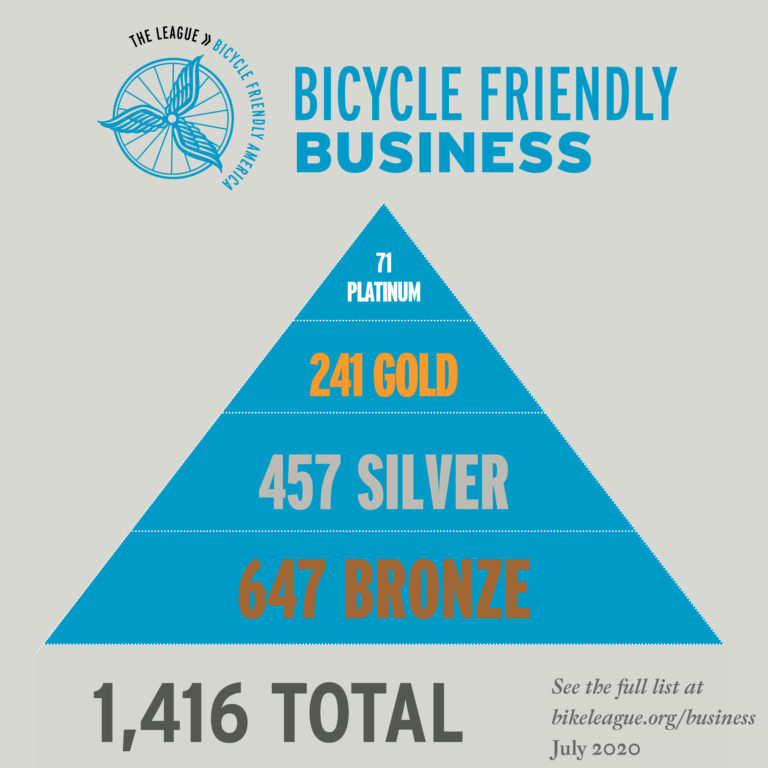
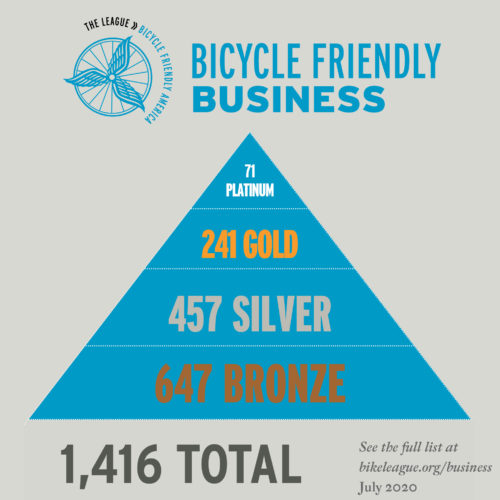
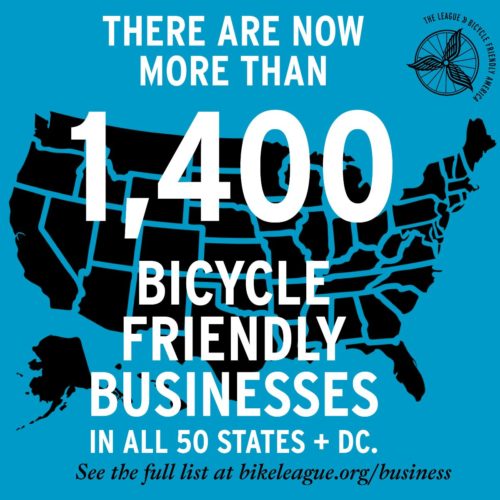
WASHINGTON, D.C. (July 9, 2020) — Biking is America’s new favorite pastime. A look around your neighborhood is all it takes to confirm what data from Eco-Counter shows: more people are biking in more places than before the pandemic began. While states and communities play an important role in building the infrastructure for new riders to safely and easily go places by bike, it’s businesses and organizations that give those rides bike joy by welcoming people biking to essential jobs or on weekend trips to pick up pastries. Today, the League of American Bicyclists is honoring 75 companies and organizations with Bicycle Friendly Business awards for their work creating environments that inspire bike joy for customers and employees.
“In the middle of a pandemic that has put unimaginable stress on business owners and employees, we are proud to recognize these 75 businesses for their sustained efforts to foster the health and well-being of their employees and customers,” said Bill Nesper, executive director of the League of American Bicyclists. “Groups that earn a Bicycle Friendly Business award have shown their commitment to taking positive steps in our movement to build a more Bicycle Friendly America for everyon-
This round of 75 Bicycle Friendly Business awards, plus four Honorable Mentions, includes seven organizations earning Platinum-level recognition, including a new applicant, Quality Bike Products-Pennsylvania, which joins the Quality Bike Products-Minnesota facility as a Platinum-level Bicycle Friendly Business. Twelve Gold-level awards include new applicant WomanTours based in Rochester, New York, and nine companies that earned upgrades in their recognition, demonstrating progress in their work to build better places to bike.
This round of Bicycle Friendly Businesses also includes 12 companies located in the Tampa Bay, Florida, area thanks to local advocacy led by Pedal Power Promoters, a consultancy firm that aids companies in becoming more welcoming to bikes and is celebrating its 100th certified BFB in the region this round. Local advocates in Northwest Arkansas, and Palo Alto, California, also continue to push regionally for companies to join the ranks of those working to build better places where people can bike to work or for fun. Matching Tampa’s feat, Fayetteville, Arkansas added 12 new Bicycle Friendly Businesses this round. Other highlights in BFB round include:
Five bike shops earning awards, three for the first time
Two breweries and one winery earning awards: Aeronaut Brewing, Big Grove Brewery, and Clif Family Winery
Six hotels and B&Bs earning awards, plus two others garnering Honorable Mentions
Largest employer: the downtown Houston-based Chevron Corporation with 7,500 employees (followed closely by Johns Hopkins University Applied Physics Laboratory with 7,000 employees)
A number of companies in the western United States also joined the list for the first time or renewed their existing status, ranging from the 5000+ employee VMWare, based in Palo Alto, California which renewed its Silver status, to the 160-employee Recursion Pharmaceuticals, based in Salt Lake City, Utah, to the 2-person Simply BulkMarket in Longmont, Colorado. Both Recursion Pharmaceuticals and Simply BulkMarket join the list at the Bronze level.
For many of the companies and organizations on this list, business today looks much different than it did when they applied in February 2020.
“The League is grateful for the myriad ways Bicycle Friendly Businesses have contributed to building a more Bicycle Friendly America, both in the past and moving forward. When your bike is your main mode of transportation, you learn to be flexible. Sometimes you have to search blocks away from your destination for a safe place to lock up your bike, or you have to take shelter in a downpour,” said Amelia Neptune, Bicycle Friendly America program director at the League of American Bicyclists. “Bicycle Friendly Businesses give people who bike the peace of mind that there will be a good rack out front or better yet, inside, and there will be a place to change into dry clothes. For someone thinking about making their first commute by bike, a Bicycle Friendly Business is the kind of employer that offers encouragement, education, and resources to help their commuters do so safely and confidently from day one. This pandemic can feel like a downpour and it’s causing many people to rethink the old ‘normal’ like how you get to work. We hope that the bicycling community can support the small businesses who have given so much to us.”
The next deadline to apply for Bicycle Friendly Business recognition is approaching on July 23, 2020. To learn more about the program or to apply for the next round of awards please visit bikeleague.org/business.
BERKELEY, Calif. (June 18, 2020) — The National Interscholastic Cycling Association (NICA), Blackburn Designs, and Bikepacking Roots are excited to announce a new partnership that establishes a bikepacking curriculum and traveling gear library for NICA student-athletes and coaches. Bikepacking Roots is providing the on-trail expertise and Blackburn is providing the funding and bikepacking kit for 20 riders as part of their Bronze Level sponsorship with NICA for 2020.
Blackburn Designs is an industry leader in innovative bicycling tools and accessories. Founded in 1975, Blackburn focuses their product design on the user’s perspective, showing respect for materials and their functionality while bringing unprecedented innovation to the cycling industry.
“We’ve been looking to get more involved with the future of bikepacking for the past few years,” said Blackburn Marketing Manager Dan Powell. “This partnership with NICA came up after the release of a video project ‘Wild Virtue’ we sponsored, and we felt like this was the opportunity we’d been waiting for. We’re very proud to be working with these two organizations.”
Bikepacking Roots is the first and only non-profit to support and advocate for the bikepacking community. The organization develops and sustains impactful multi-day off-pavement cycling routes, advocates for the conservation of and access to the public lands and wild places through which we ride, and cultivates stewards who create a positive impact while exploring by bike.
“At Bikepacking Roots, we’re passionate about facilitating human-powered adventures in wild places and reducing barriers to those sorts of empowering experiences. I’ve watched the remarkable transformation new bikepackers go through in just a handful of short bikepacking trips, and I couldn’t be more excited to partner with NICA and Blackburn to create such an opportunity for kids across the United States,” shares Bikepacking Roots Executive Director, Kurt Refsnider, Ph.D.
“At NICA, our mission is to build strong minds, bodies, character, and communities through cycling. With Bikepacking Roots’ expertise and Blackburn’s generous support, we are excited to develop this innovative opportunity for self-sufficiency, exploration, friendship and joy,” said Steve Matous, NICA President. “With student-athlete participation in NICA programs growing at over 20% annually, we are continuing to diversify our programming to include activities that promote adventure, build community, teach respect for the outdoors and are fun at the same time. Through initiatives like this, our student-athletes have the opportunity to develop a lifelong passion for mountain biking and outdoor recreation.”
A community ride experience free for all to participate with donations benefiting advocacy partners
STEAMBOAT SPRINGS, Colo., (June 17, 2020) – SBT GRVL, a world-class gravel bike experience presented by Canyon Bicycles, is launching a new virtual ride in place of the canceled August event. SBT VRTL is a free community ride experience that will be held on Sunday, August 16, with participants choosing where, when and how long to ride.
Riders take to the gravel roads surrounding Steamboat Springs, Colorado for the inaugural SBT GRVL Race. Photo by Wil Matthews, courtesy SBT GRVL.
“After announcing the cancellation of our event, we knew we wanted to still create a memorial gravel experience for everyone and couldn’t just leave this amazing gravel community without a goal on their calendars.” said Ken Benesh, co-founder and race director of SBT GRVL. “SBT VRTL will give new to experienced gravel riders from around the world a chance to participate in an epic day, stay connected with fellow riders and give back to our bike and local communities.”
Leading with the core value of inclusivity, SBT VRTL will be open to all, regardless if riders were registered for the original event. Participants will be able to choose any of the four distances from SBT GRVL (GREEN 37 miles, RED 64 miles, BLUE 103 miles or BLACK 144 miles) and can ride inside or outside, solo or with family. Riders can select a local route they know or the SBT GRVL team has created suggested routes for 34 cities across the USA, and will unveil these routes beginning in July.
Furthering its pillar of advocacy, SBT VRTL will give riders the ability to give back to Steamboat Springs and cycling community nonprofits. Participants who want to support SBT GRVL’s advocacy partners will have the opportunity to make donations upon registration and leading up to the August event. Any donation of $1 or more will enter riders to win a number of prizes from sponsors throughout the summer and on the day of the virtual ride event. Those riders not currently deferred to SBT GRVL 2021 will have the opportunity to guarantee their registration and entry into the 2021 event by donating $50 or more to any of SBT GRVL’s designated advocacy partners which include People for Bikes, NICA GRIT, Alpine Bank, Community Agriculture Alliance, Steamboat Springs Winter Sports Club and Boys and Girls Club of Northwest Colorado.
Registration for SBT VRTL is now open and can be completed by following this link. The SBT GRVL team urges all participants to continue to adhere to safety precautions in their areas.
Stay tuned for suggested route announcements by following SBT GRVL on Instagram, Twitter and Facebook. For additional information, please visit sbtgrvl.com.