Home Blog Page 160

Les Beehive Boys Compete at the Bicycle Polo World Championships in New Zealand

By Gabe Mejia, Jimmy Araneda, David Barthod —

[Editor’s Note: In this blast from the past, Cycling West looks back at the 2016 Bicycle Polo World Championships, at which a team from Salt Lake City, Utah competed.]

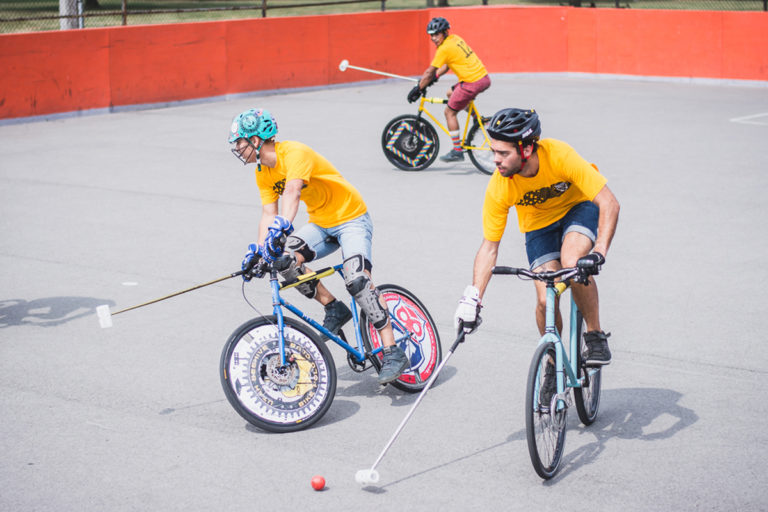
Les Beehive Boys: Gabriel, Jimmy and Dove are back from Timaru, New Zealand after 11 days spent riding their polo bikes on the roads and on the courts. This is the story of Salt Lake City’s major bike polo team.

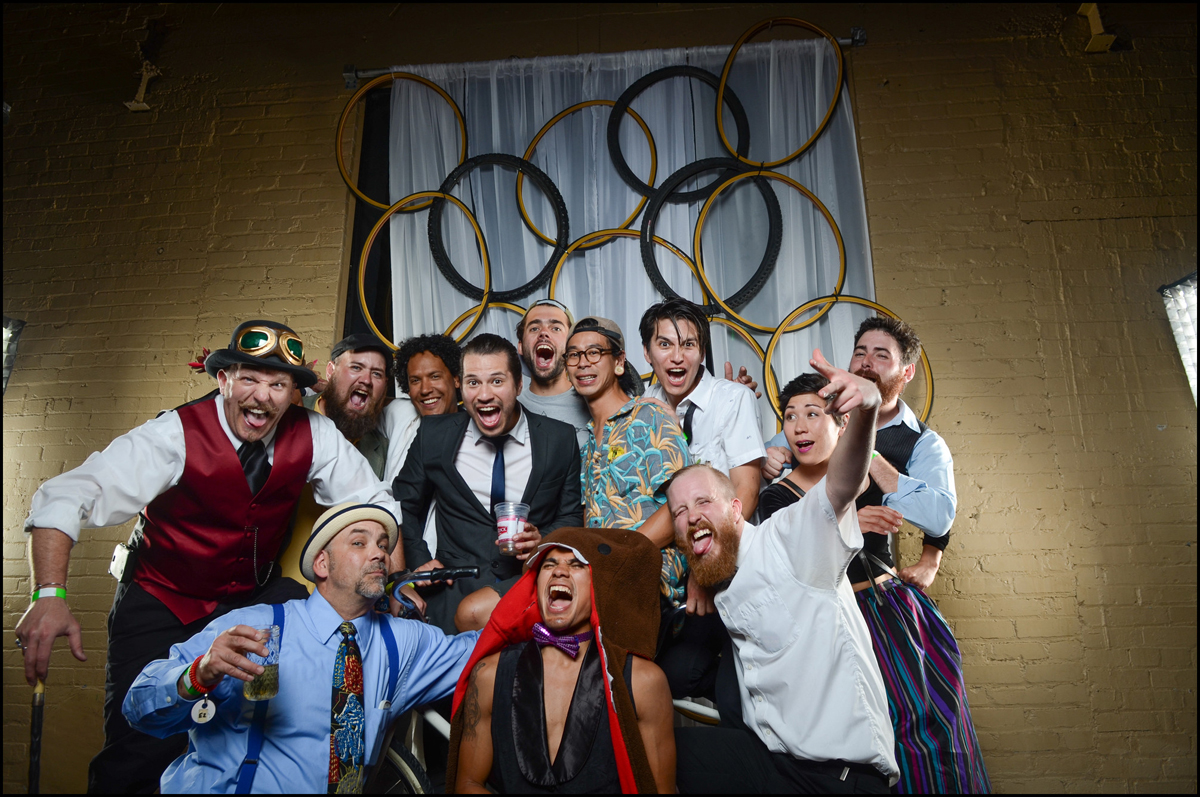
The Beehive Bicycle Polo Club at Bike Prom in 2015.

Beehive Bike Polo Club (BBPC) 801

Everything started about 15 years ago when a group of mountain bikers decided to build mallets with ski poles and gas pipes to hit a ball around on some grass. Chuck, Danny and Mark were the pioneers of the Salt Lake grass bike polo scene (Editor’s note: See page 28 of our July 2007 issue online:  ).

After some Seattle bike messengers reinvented the sport by playing on asphalt in the late 90’s, our local group started to play Hardcourt Bike Polo by the tennis wall of Liberty Park. Jimmy, Tate, Gabriel and more bikers started to show up weekly and then found a new spot for the winters playing in a parking garage downtown.

Today BBPC is a group of about 30 diverse people training every Tuesday, Thursday (Women’s night) and Sunday in a kindly and friendly atmosphere. Chuck, Danny, Gabriel, Tate and Jimmy are still at it with a bunch of local bikers and people from all over the U.S. who joined the club to make those nights fun and intense!

Les Beehive Boys

In 2014 – we created The Beehive Boys with Gabriel, Tate and Jimmy to represent Utah and Salt Lake City at tournaments. We drove to our first tourney in Vegas for Desert Bike Polo and played a year later in Fresno, CA for Smack In Da Middle IV. A great way to improve our skills by competing against new players.

In spring 2015, David – who just moved from France to Utah for his job – subbed in for Tate at the South West qualifiers. We had as a main goal to get a spot to play the North American Championship in Lexington, KY.

Les Beehive Boys at the National Championships.

We drove a total of 20 hours to Folsom, CA and took 4th place. The top 5 got to represent the region at the North American Championship!

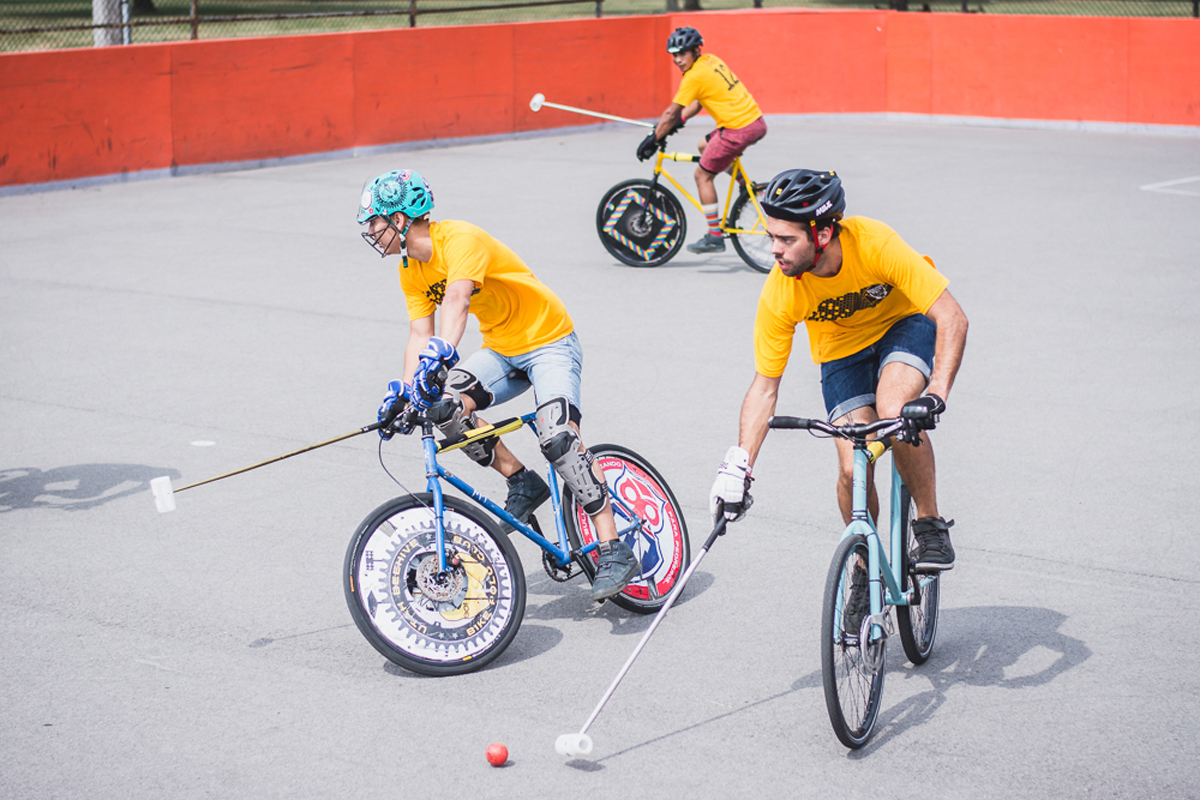
Les Beehive Boys at the National Championships.

3 months later and after raising funds selling shirts, we flew to Kentucky for the NAHBPC and made it to the final day taking 13th over 50 teams from all over North America. The Cherry-on-top was to get a spot to play the World Hardcourt Bike Polo Championships in New Zealand!

In Timaru – We want to GO!

After we came back from Lexington, we had to decide to go to the Worlds or not. The only fear was the price of the tickets ($1,500 each). After a first team meeting, we finally agreed to do whatever we could to make it to New Zealand. Financial sponsoring in bike polo is today reserved to only few teams as the sport still a niche – growing though! We were lucky enough to gather support from local companies Saturday cycles, Velo City bags, and from DZR shoes in SF

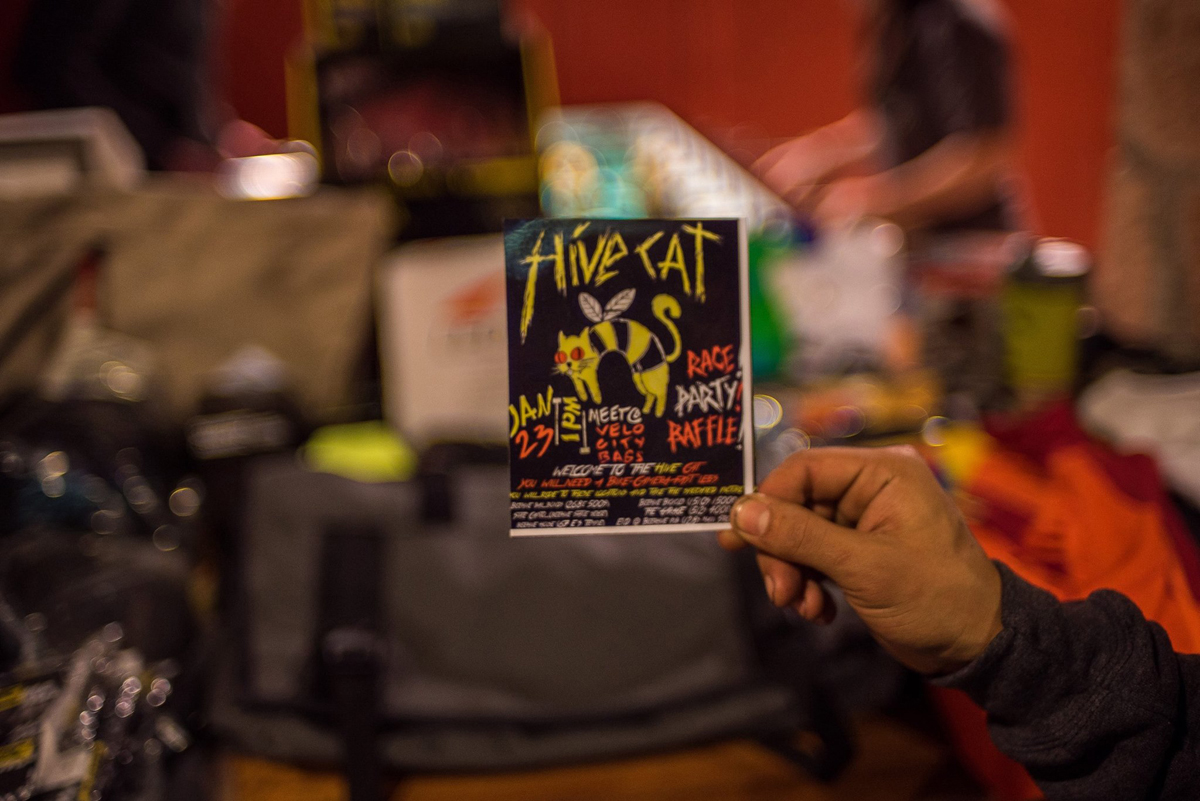
The Hive Cat helped raise funds for the trip to New Zealand.

We started to raise funds thanks to an online crowdfunding campaign – preselling shirts, hoodies, stickers and offering a French dinner at David’s house for 5 people! Few weeks later the strategy was paying for itself and we bought our tickets for Timaru.

In order to finalize the budget, we organized an Alley Cat race downtown “The Hive” including a raffle at The BeerHive with prizes from sponsors – Velo City Bags, Saturday Cycles, Mavic, Mission Workshop, Ogden Made, LedByLite, etc. 30 riders raced and celebrated in January to support our team before the trip. January 28th we traveled ‘down under’.

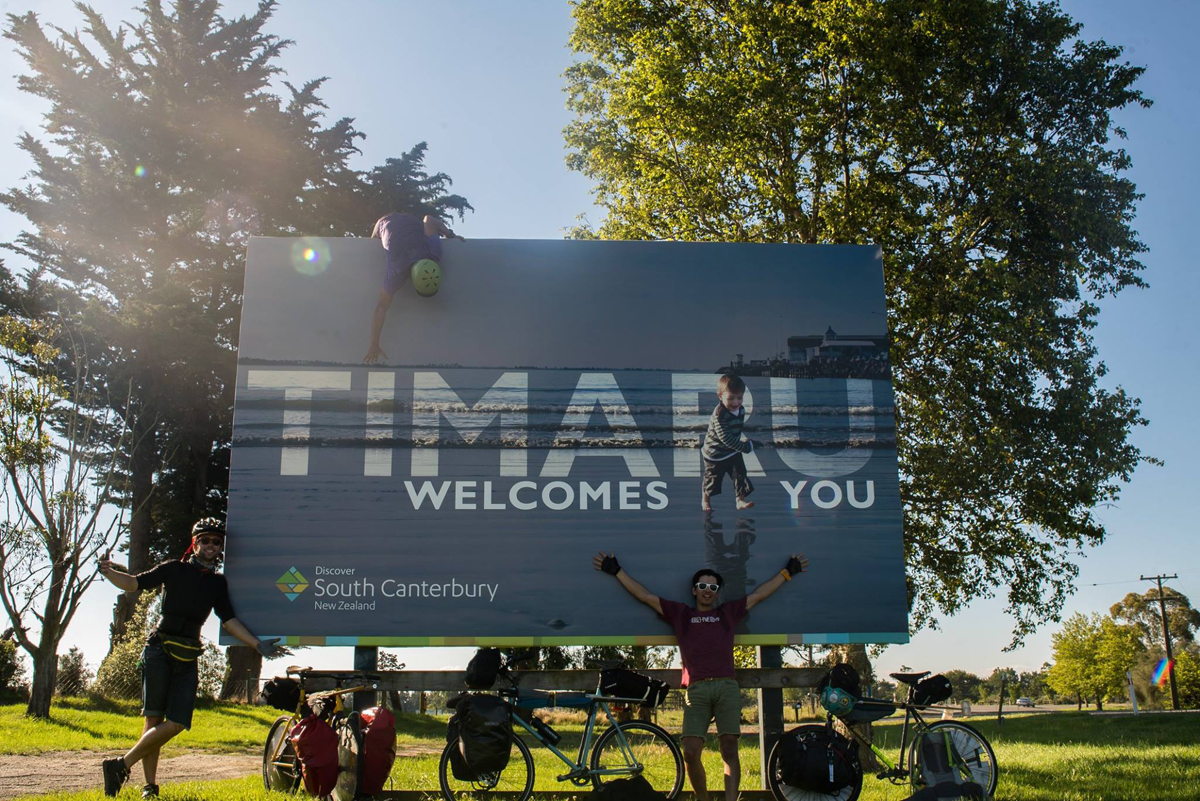
Les Beehive Boys arrive in Timaru.

Bike Polo Touring Trip:

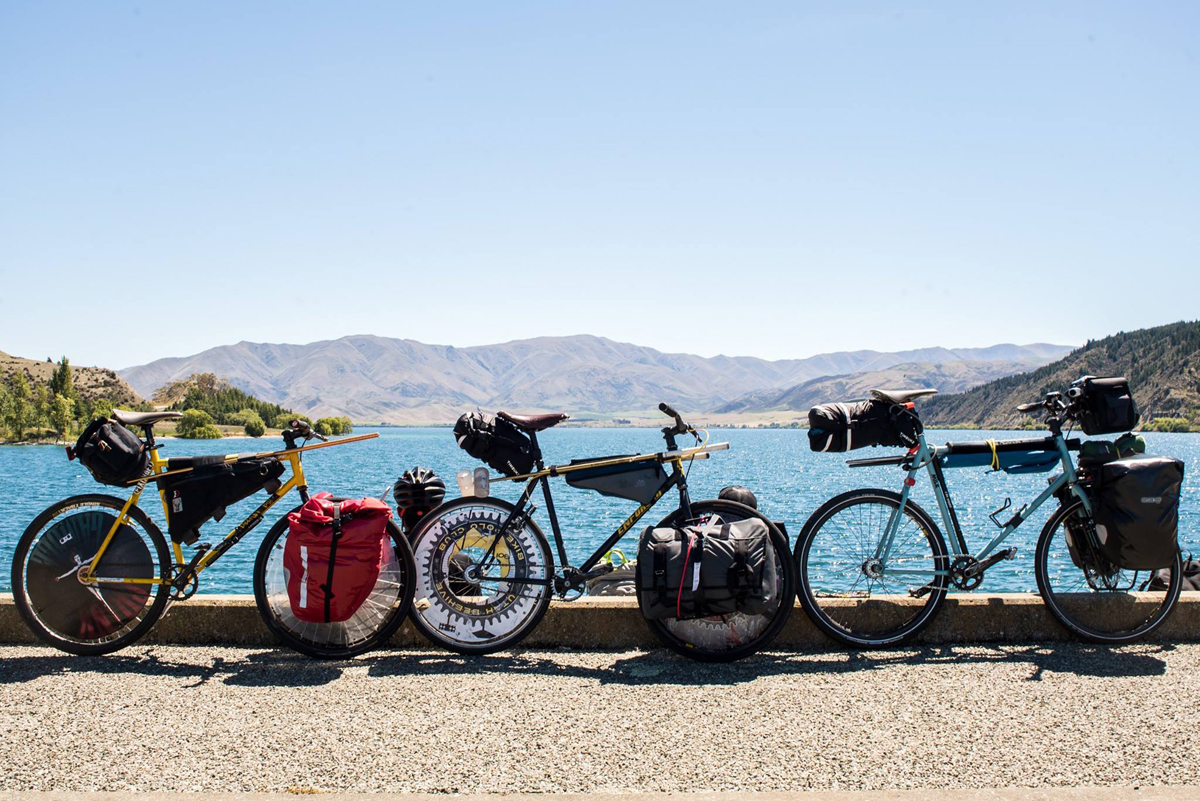
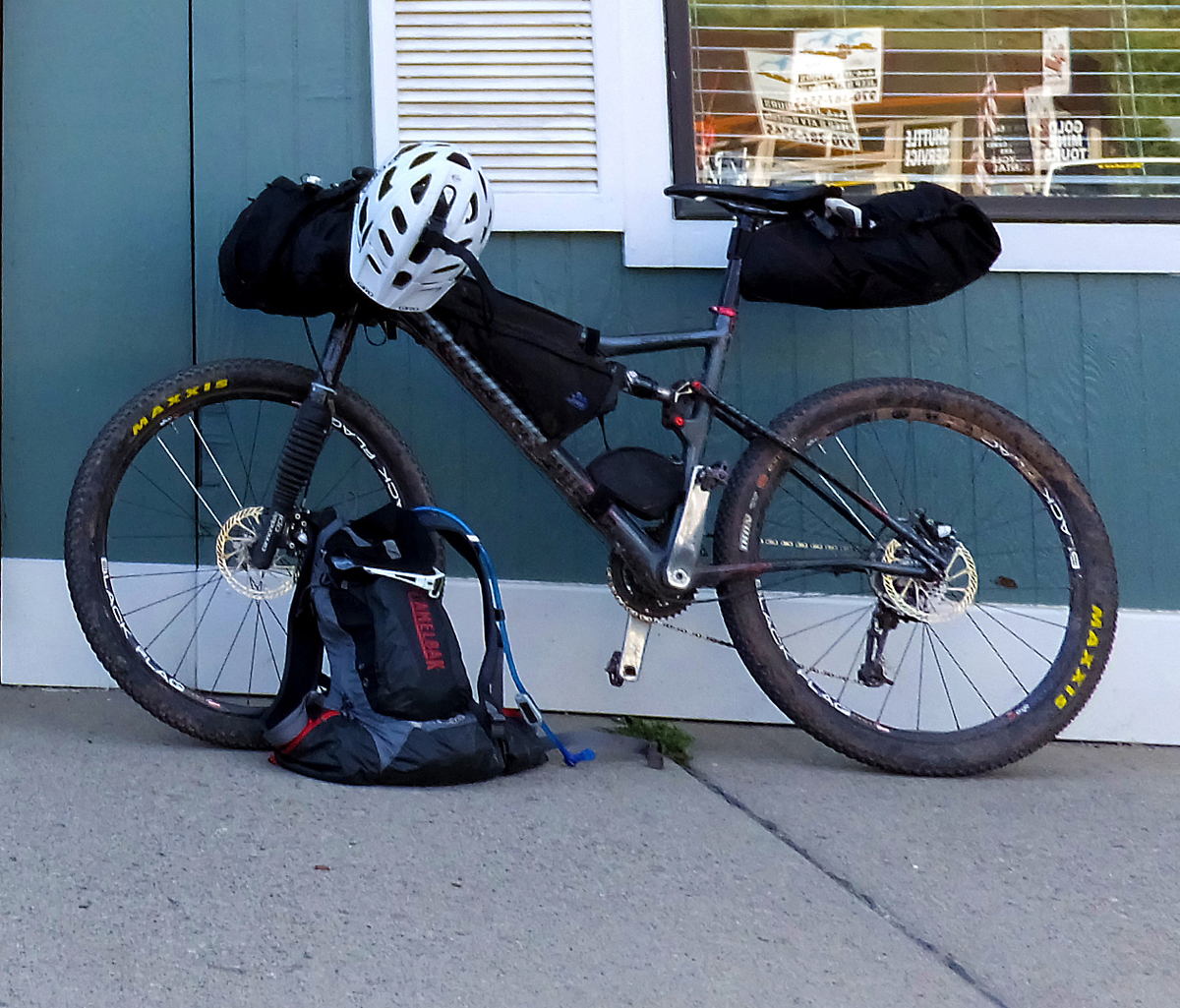
It will have been too bad for us to travel so far without catching a bit of this amazing country. That’s why we decided to go for a ‘bike-polo-touring-trip’ in the south island. After figuring out the best way to do long a tour on a polo bike, we were ready to see New Zealand the best way possible. By bike.

The bicycle polo bikes doubled as touring bikes.

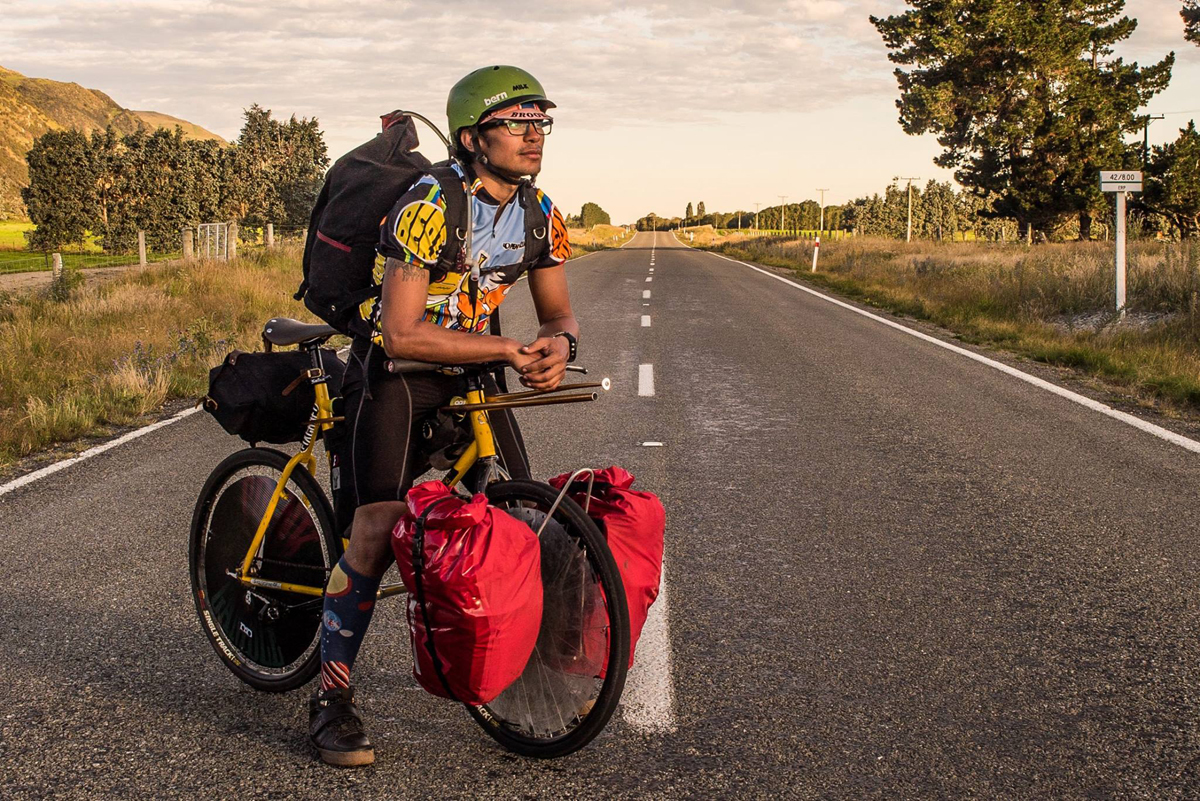
Day 1: After we took the shuttle from Christchurch we started our bike trip at Lake Pukaki – a magical place where Mt Cook and the lake seem unreal! 32 miles – riding on the “wrong” side of the road – for the first day. We spent the first night by lake Benmore where we were suddenly awoken in the tent by the owner of the private land where we were sleeping – we must have missed the sign. The only unpleasant kiwi we met.

Gabe Mejia during the Les Beehive Boys tour before the World Championships.

Day 2: 49 miles which started with a portion of the ‘Alps 2 Ocean’ trail before a long ascent we will never forget. But thankfully followed a descent along Lake Aviemore. After riding as much as possible we found a secret spot to set up camp and rest while drinking a warm bottle of red wine and eating some leftovers.

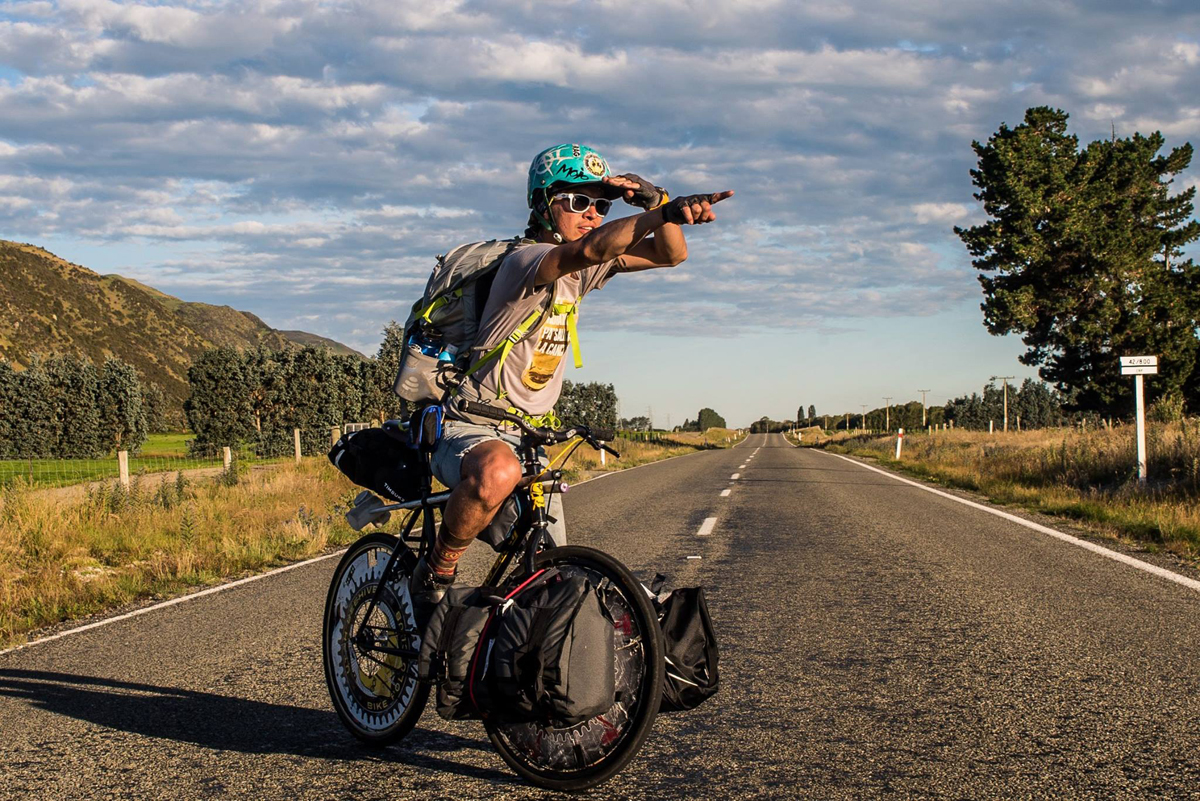
Jimmy Araneda on tour.

Day 3: Another 50 miles to the final destination Timaru which started with a bunch a hills where sheep and cows were looking at us the whole way. We finally joined the main road by the ocean and met the ‘couple of the year’ – a 65 year old man and his wife who invited us over to their estate for some coffee, pastries and a chat! Definitely the nicest kiwis ever! The last miles were not the easiest especially with the trucks and cars passing us pretty fast. Timaru here we are!

World Hardcourt Bike Polo Championships:

After 3 days of riding together as a team we had time to discuss the upcoming Worlds. For the first time in bike polo history, a city from the south hemisphere hosted the major event, bringing a lot teams from NZ and Australia.

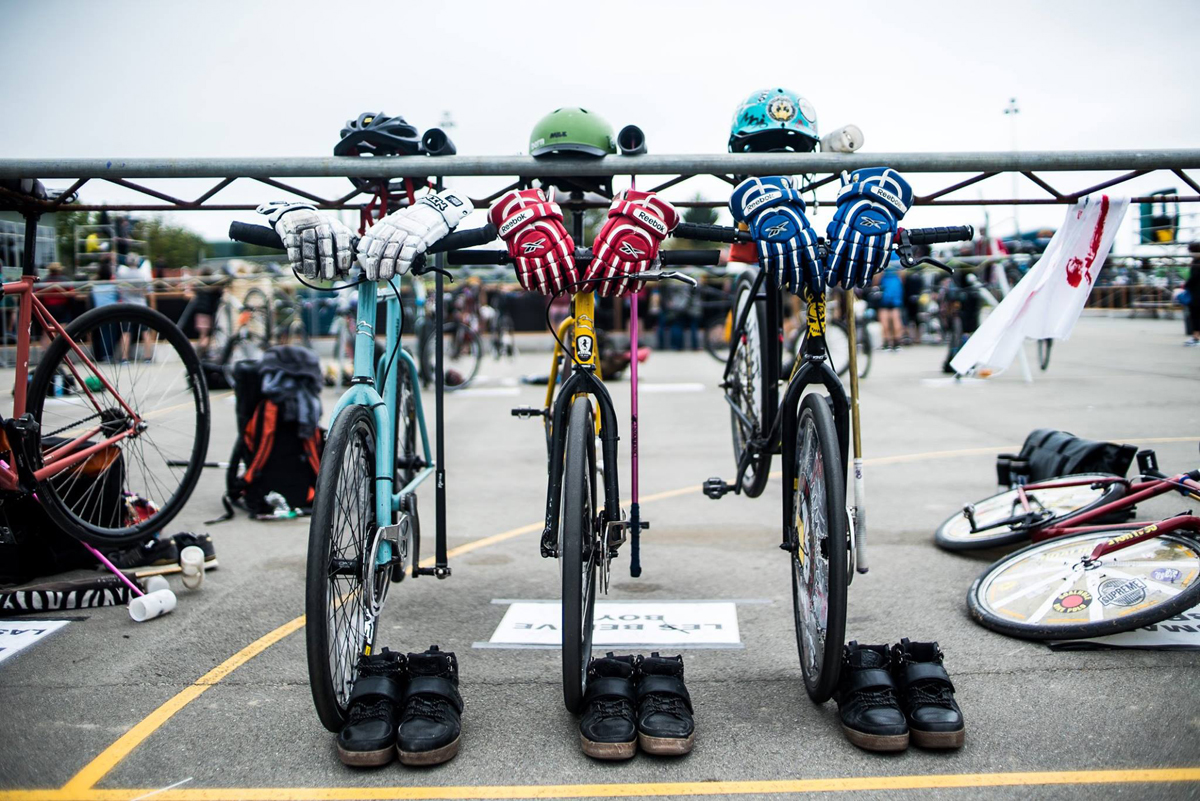
Bikes and gear – ready to play!

Our strategy was pretty clear. We were the outsiders and by consequence we had to surprise our opponents by playing our strengths: speed and defense.

Day 1: Came into the tournament a little nervous and didn’t do too well. We progressively got more comfortable on the court as the hot day went on, and by game 5–after having played against teams from 3 different continents including the wildcard winning team Golem and the Australian champions Huntsmen–at the end of the day we played a very intense and fast paced game against Los Bigotes, who would later rank 5th in the tournament.

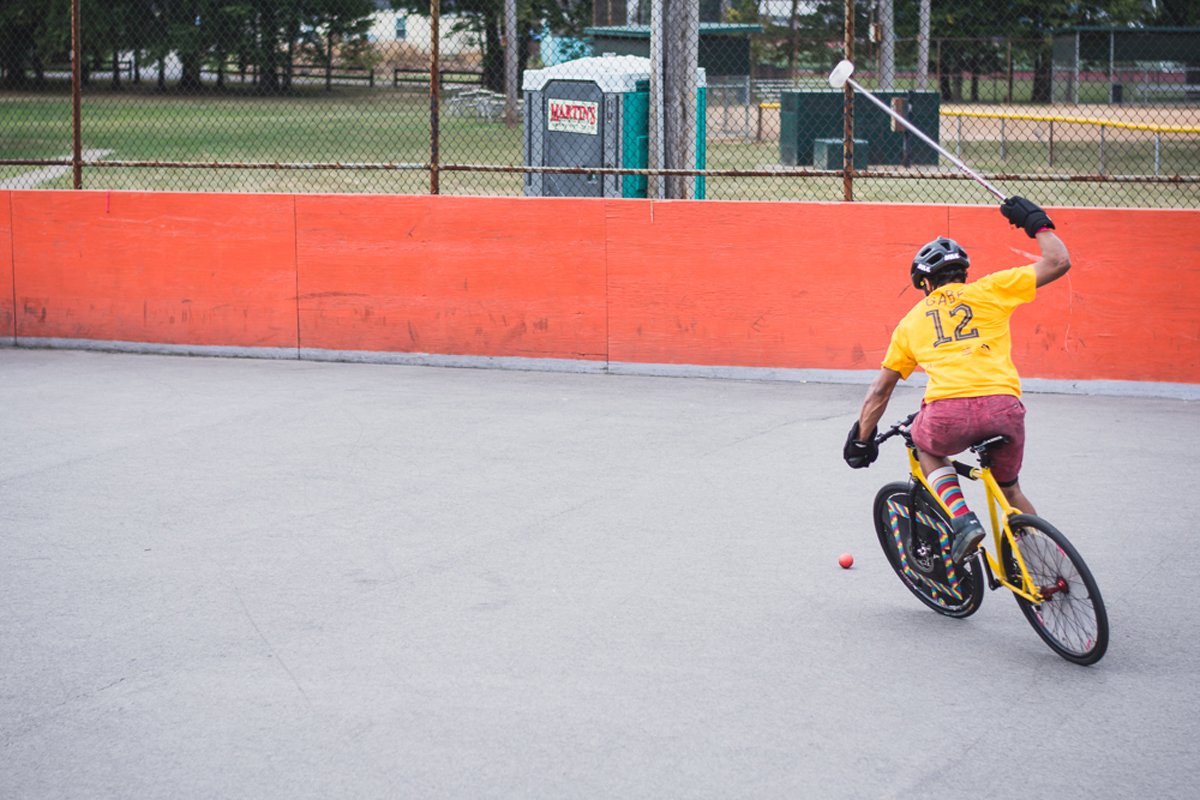
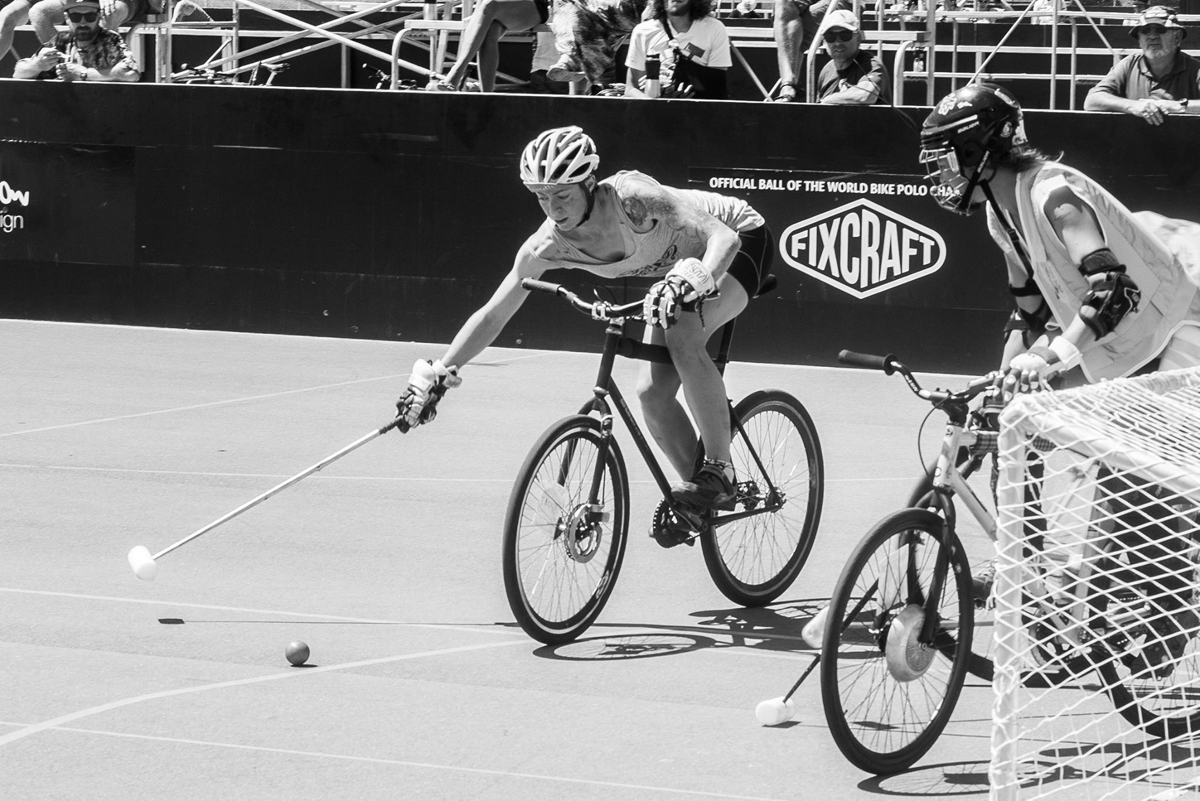
One of the games at the World Championships.

Day 2: In order to qualify for the final day, we needed to do well. And we started the day well, with two wins. The next challenge would be to play the current world champions Call Me Daddy from France. We knew our level of play was not at the level of Call Me’s, so our strategy was simple: stay on your bike and defend. Even though we lost 3-0 we feel it was one of our best games. After all that’s the reason we go to tournaments, to play the best out there. We finished the day with a loss against Fully Torqued from Sydney, Australia. Our chances of making it to the Final 16 were very slim at best.

Or so we thought.

After the announcement of our name over the speakers we were ecstatic, and also happy for all our friends who made it to the final day with us. What’s notable is that among the 16 teams that played the final day, 3 of them are from our Southwest Region. The Control, who finished 3rd, Thunderfart and us.

Day 3: We had surpassed our goals for the tournament so we decided to not put too much pressure on ourselves. We would play at our best and see how that stacks up against the best in the world. We played The Control (3rd place), Sentinels from Australia, and our friends Los Bigotes (5th). We did not make it to the next round of games, but we came out of those games very happy with our performances. And after examination of our individual and collective plays, we will apply all we learned in Timaru.

After 3 intense days we took 15th over the 54 teams who played the 7th Worlds in Timaru. This experience was all we were hoping for and more. We consider this, our first season, a success!

This trip has been a beautiful collective experience after riding through the south island and playing the best bike polo teams! Huge congrats to Timaru for hosting this championship. No doubt that it was the best one ever and it gives good recognition to bike polo.

What’s next?

The future looks bright. We have a great group of motivated people playing bike polo in Salt Lake. We want to send three teams to the next SW qualifiers and make Utah known in bike polo.

To make this happen we need a reliable, evenly paved, lit place to play and train, and for that we need Salt Lake City and our friends behind us. We already started discussions but they are going slowly. The winter is especially hard because of the rain, snow and cold. But week after week we are always there ready to play.

We also want to get kids on their bikes and trying bike polo by organizing a kids program with the Salt Lake Bicycle Collective. This is how we will build the future of bike polo in Utah.

We are working towards hosting an interstate tournament this spring.

If you want to join us, to watch us or to help us – feel free to join the club on Facebook or to email us [email protected].


The Stout Miss Hopkins’ Bicycle, by Octave Thanet

[Editor’s Note: Every so often you come across stories that really want to be shared. Often they’re still under copyright, which means sharing can cost money … but sometimes you luck into stories that are old enough to have passed into the public domain. This is one of those stories.]
From STORIES THAT END WELL, By Octave Thanet, NEW YORK, GROSSET & DUNLAP PUBLISHERS, Originally copyright © 1911, The Bobbs-Merrill Company (now Public Domain)

The Stout Miss Hopkins’ Bicycle

There was a skeleton in Mrs. Margaret Ellis’ closet; the same skeleton abode also in the closet of Miss Lorania Hopkins.

The skeleton—which really does not seem a proper word—was the dread of growing stout. They were more afraid of flesh than of sin. Yet they were both good women. Mrs. Ellis regularly attended church, and could always be depended on to show hospitality to convention delegates, whether clerical or lay; she was a liberal subscriber to every good work; she was almost the only woman in the church aid society that never lost her temper at the soul-vexing time of the church fair; and she had a larger clientele of regular pensioners than any one in town, unless it were her friend, Miss Hopkins, who was “so good to the poor” that never a tramp slighted her kitchen. Miss Hopkins was as amiable as Mrs. Ellis, and always put her name under that of Mrs. Ellis, with exactly the same amount, on the subscription papers. She could have given more, for she had the larger income; but she had no desire to outshine her friend, whom she admired as the most charming of women.

Mrs. Ellis, indeed, was agreeable as well as good, and a pretty woman to the bargain, if she did not choose to be weighed before people. Miss Hopkins often told her that she was not really stout; she merely was a plump, trim little figure. Miss Hopkins, alas! was really stout. The two waged a warfare against the flesh equal to the apostle’s in vigor, although so much less deserving of praise.

Mrs. Ellis drove her cook to distraction with divers dieting systems, from Banting’s and Doctor Salisbury’s to the latest exhortations of some unknown newspaper prophet. She bought elaborate gymnastic appliances, and swung dumbbells and rode imaginary horses and propelled imaginary boats. She ran races with a professional trainer, and she studied the principles of Delsarte, and solemnly whirled on one foot and swayed her body and rolled her head and hopped and kicked and genuflected in company with eleven other stout and earnest matrons and one slim and giggling girl who almost choked at every lesson. In all these exercises Miss Hopkins faithfully kept her company, which was the easier, as Miss Hopkins lived in the next house, a conscientious Colonial mansion with all the modern conveniences hidden beneath the old-fashioned pomp.

And yet, despite these struggles and self-denials, it must be told that Margaret Ellis and Lorania Hopkins were little thinner for their warfare. Still, as Shuey Cardigan, the trainer, told Mrs. Ellis, there was no knowing what they might have weighed had they not struggled.

“It ain’t only the fat that’s on ye, moind ye,” says Shuey, with a confidential sympathy of mien; ‘”it’s what ye’d naturally be getting in addition. And first ye’ve got to peel off that, and then ye come down to the other.”

Shuey was so much the most successful of Mrs. Ellis’ reducers that his words were weighty. And when at last Shuey said, “I got what you need,” Mrs. Ellis listened. “You need a bike, no less,” says Shuey.

“But I never could ride one!” said Margaret, opening her pretty brown eyes and wrinkling her Grecian forehead.

“You’d ride in six lessons,” pronounced Shuey.

“But how would I look, Cardigan?”

“You’d look noble, ma’am!”

“What do you consider the best wheel, Cardigan?”

Fear of being accused of advertising prevents my giving Cardigan’s answer; it is enough that the wheel glittered at Mrs. Ellis’ door the very next day, and that a large pasteboard box was delivered by the expressman the very next week. He went on to Miss Hopkins’, and delivered the twin of the box, with a similar yellow printed card bearing the impress of the same great firm on the inside of the box cover. For Margaret had hied her to Lorania Hopkins the instant Shuey was gone. She presented herself breathless, a little to the embarrassment of Lorania, who was sitting with her niece before a large box of cracker-jack.

“It’s a new kind of candy; I was just tasting it, Maggie,” faltered she, while the niece, a girl of nineteen, with the inhuman spirits of her age, laughed aloud.

“You needn’t mind me,” said Mrs. Ellis cheerfully; “I’m eating potatoes now!”

“Oh, Maggie!” Miss Hopkins breathed the words between envy and disapproval.

Mrs. Ellis tossed her brown head airily, not a whit abashed. “And I had beer for luncheon, and I’m going to have champagne for dinner.”

“Maggie, how do you dare? Did they—did they taste good?”

“They tasted heavenly, Lorania. Pass me the candy. I am going to try something new—the thinningest thing there is. I read in the paper of one woman who lost forty pounds in three months, and is losing still!”

“If it is obesity pills, I—”

“It isn’t; it’s a bicycle. Lorania, you and I must ride! Sibyl Hopkins, you heartless child, what are you laughing at?”

Lorania rose; in the glass over the mantel her figure returned her gaze. There was no mistake (except that, as is often the case with stout people, that glass always increased her size), she was a stout lady. She was taller than the average of women, and well proportioned, and still light on her feet; but she could not blink away the records; she was heavy on the scales. Did she stand looking at herself squarely, her form was shapely enough, although larger than she could wish; but the full force of the revelation fell when she allowed herself a profile view, she having what is called “a round waist,” and being almost as large one way as another. Yet Lorania was only thirty-three years old, and was of no mind to retire from society, and have a special phaeton built for her use, and hear from her mother’s friends how much her mother weighed before her death.

“How should I look on a wheel?” she asked, even as Mrs. Ellis had asked before; and Mrs. Ellis stoutly answered, “You’d look noble!”

“Shuey will teach us,” she went on, “and we can have a track made in your pasture, where nobody can see us learning. Lorania, there’s nothing like it. Let me bring you the bicycle edition of Harper’s Bazar.”

Miss Hopkins capitulated at once, and sat down to order her costume, while Sibyl, the niece, revelled silently in visions of a new bicycle which should presently revert to her. “For it’s ridiculous, auntie’s thinking of riding!” Miss Sibyl considered. “She would be a figure of fun on a wheel; besides, she can never learn in this world!”

Yet Sibyl was attached to her aunt, and enjoyed visiting Hopkins Manor, as Lorania had named her new house, into which she moved on the same day that she joined the Colonial Dames, by right of her ancestor the great and good divine commemorated by Mrs. Stowe. Lorania’s friends were all fond of her, she was so good-natured and tolerant, with a touch of dry humor in her vision of things, and not the least a Puritan in her frank enjoyment of ease and luxury. Nevertheless, Lorania had a good, able-bodied New England conscience, capable of staying awake nights without flinching; and perhaps from her stanch old Puritan forefathers she inherited her simple integrity, so that she neither lied nor cheated—even in the small whitewashed manner of her sex—and valued loyalty above most of the virtues. She had an innocent pride in her godly and martial ancestry, which was quite on the surface, and led people who did not know her to consider her haughty.

For fifteen years she had been an orphan, the mistress of a very large estate. No doubt she had been sought often in marriage, but never until lately had Lorania seriously thought of marrying. Sibyl said that she was too unsentimental to marry. Really she was too romantic. She had a longing to be loved, not in the quiet, matter-of-fact manner of her suitors, but with the passion of the poets. Therefore the presence of another skeleton in Mrs. Ellis’ closet, because she knew about a certain handsome Italian marquis who at this period was conducting an impassioned wooing by mail. Margaret did not fancy the marquis. He was not an American. He would take Lorania away. She thought his very virtue florid, and suspected that he had learned his love-making in a bad school. She dropped dark hints that frightened Lorania, who would sometimes piteously demand, “Don’t you think he could care for me—for—for myself?”

Margaret knew that she had an overweening distrust of her own appearance. How many tears she had shed first and last over her unhappy plumpness it would be hard to reckon. She made no account of her satin skin, or her glossy black hair, or her lustrous violet eyes with their long black lashes, or her flashing white teeth; she glanced dismally at her shape and scornfully at her features, good, honest, irregular American features, that might not satisfy a Greek critic, but suited each other and pleased her countrymen. And then she would sigh heavily over her figure. Her friend had not the heart to impute the marquis’ beautiful, artless compliments to mercenary motives. After all, the Italian was a good fellow, according to the point of view of his own race, if he did intend to live on his wife’s money, and had a very varied assortment of memories of women.

But Margaret dreaded and disliked him all the more for his good qualities. To-day this secret apprehension flung a cloud over the bicycle enthusiasm. She could not help wondering whether at this moment Lorania was not thinking of the marquis, who rode a wheel and a horse admirably.

“Aunt Lorania,” said Sibyl, “there comes Mr. Winslow. Shall I run out and ask him about those cloth-of-gold roses? The aphides are eating them all up.”

“Yes, to be sure, dear; but don’t let Ferguson suspect what you are talking of; he might feel hurt.”

Ferguson was the gardener. Miss Hopkins left her note to go to the window. Below she saw a mettled horse, with tossing head and silken skin, restlessly fretting on his bit and pawing the dust in front of the fence, while his rider, hat in hand, talked with the young girl. He was a little man, a very little man, in a gray business suit of the best cut and material. An air of careful and dainty neatness was diffused about both horse and rider. He bent toward Miss Sibyl’s charming person a thin, alert, fair face. His head was finely shaped, the brown hair worn away a little on the temples. He smiled gravely at intervals; the smile told that he had a dimple in his cheek.

“I wonder,” said Mrs. Ellis, “whether Mr. Winslow can have a penchant for Sibyl?”

Lorania opened her eyes. At this moment Mr. Winslow had caught sight of her at the window, and he bowed almost to his saddle-bow; Sibyl was saying something at which she laughed, and he visibly reddened. It was a peculiarity of his that his color turned easily. In a second his hat was on his head and his horse bounded half across the road.

“Hardly, I think,” said Lorania. “How well he rides! I never knew any one ride better—in this country.”

“I suppose Sibyl would ridicule such a thing,” said Mrs. Ellis, continuing her own train of thought, and yet vaguely disturbed by the last sentence.

“Why should she?”

“Well, he is so little, for one thing, and she is so tall. And then Sibyl thinks a great deal of social position.”

“He is a Winslow,” said Lorania, arching her neck unconsciously—”a lineal descendant from Kenelm Winslow, who came over in the May—”

“But his mother—”

“I don’t know anything about his mother before she came here. Oh, of course I know the gossip that she was a niece of the overseer at a village poorhouse, and that her husband quarrelled with all his family and married her in the poorhouse, and I know that when he died here she would not take a cent from the Winslows, nor let them have the boy. She is the meekest-looking little woman, but she must have an iron streak in her somewhere, for she was left without enough money to pay the funeral expenses, and she educated the boy and accumulated enough money to pay for this place they have.

“She used to run a laundry, and made money; but when Cyril got a place in the bank she sold out the laundry and went into chickens and vegetables; she told somebody that it wasn’t so profitable as the laundry, but it was more genteel, and Cyril being now in a position of trust at the bank, she must consider him. Cyril swept out the bank. People laughed about it, but, do you know, I rather liked Mrs. Winslow for it. She isn’t in the least an assertive woman. How long have we been up here, Maggie? Isn’t it four years? And they have been our next-door neighbors, and she has never been inside the house. Nor he either, for that matter, except once when it took fire, you know, and he came in with that funny little chemical engine tucked under his arm, and took off his hat in the same prim, polite way that he takes it off when he talks to Sibyl, and said, ‘If you’ll excuse me offering advice, Miss Hopkins, it is not necessary to move anything; it mars furniture very much to move it at a fire. I think, if you will allow me, I can extinguish this.’ And he did, too, didn’t he, as neatly and as coolly as if it were only adding up a column of figures. And offered me the engine as a souvenir of the occasion afterward.”

“Lorania, you never told me that!”

“It seemed like making fun of him, when he had been so kind. I declined as civilly as I could. I hope I didn’t hurt his feelings. I meant to pay a visit to his mother and ask them to dinner, but you know I went to England that week, and somehow when I came back it was difficult. It seems a little odd we never have seen more of the Winslows, but I fancy they don’t want either to intrude or to be intruded on. But he is certainly very obliging about the garden. Think of all the slips and flowers he has given us, and the advice—”

“All passed over the fence. It is funny our neighborly good offices which we render at arm’s-length. How long have you known him?”

“Oh, a long time. He is cashier of my bank, you know. First he was teller, then assistant cashier, and now for five years he has been cashier. The president wants to resign and let him be president, but he hardly has enough stock for that. But Oliver says” (Oliver was Miss Hopkins’ brother) “that there isn’t a shrewder or straighter banker in the state. Oliver likes him. He says he is a sandy little fellow.”

“Well, he is,” assented Mrs. Ellis. “It isn’t many cashiers would let robbers stab them and shoot them and leave them for dead rather than give up the combination of the safe!”

“He wouldn’t take a cent for it, either, and he saved ever so many thousand dollars. Yes, he is brave. I went to the same school with him once, and saw him fight a big boy twice his size—such a nasty boy, who called me ‘Fatty,’ and made a kissing noise with his lips just to scare me—and poor little Cyril Winslow got awfully beaten, and when I saw him on the ground, with his nose bleeding and that big brute pounding him, I ran to the water-bucket, and poured the whole bucket on that big bullying boy and stopped the fight, just as the teacher got on the scene. I cried over little Cyril Winslow. He was crying himself. ‘I ain’t crying because he hurt me,’ he sobbed; ‘I’m crying because I’m so mad I didn’t lick him!’ I wonder if he remembers that episode?”

“Perhaps,” said Mrs. Ellis.

“Maggie, what makes you think he is falling in love with Sibyl?”

Mrs. Ellis laughed. “I dare say he isn’t in love with Sibyl,” said she. “I think the main reason was his always riding by here instead of taking the shorter road down the other street.”

“Does he always ride by here? I hadn’t noticed.”

“Always!” said Mrs. Ellis. “I had noticed.”

“I am sorry for him,” said Lorania, musingly. “I think Sibyl is very much taken with that young Captain Carr at the Arsenal. Young girls always affect the army. He is a nice fellow, but I don’t think he is the man Winslow is. Now, Maggie, advise me about the suit. I don’t want to look like the escaped fat lady of a museum.”

Lorania thought no more of Sibyl’s love affairs. If she thought of the Winslows, it was to wish that Mrs. Winslow would sell or rent her pasture, which, in addition to her own and Mrs. Ellis’ pastures thrown into one, would make such a delightful bicycle track.

The Winslow house was very different from the two villas that were the pride of Fairport. A little story and a half cottage peeped out on the road behind the tall maples that were planted when Winslow was a boy. But there was a wonderful green velvet lawn, and the tulips and sweet peas and pansies that blazed softly nearer the house were as beautiful as those over which Miss Lorania’s gardener toiled and worried.

Mrs. Winslow was a little woman who showed the fierce struggle of her early life only in the deeper lines between her delicate eyebrows and the expression of melancholy patience in her brown eyes.

She always wore a widow’s cap and a black gown. In the mornings she donned a blue figured apron of stout and serviceable stuff; in the afternoon, an apron of that sheer white lawn used by bishops and smart young waitresses. Of an afternoon, in warm weather, she was accustomed to sit on the eastern piazza, next to the Hopkins place, and rock as she sewed. She was thus sitting and sewing when she beheld an extraordinary procession cross the Hopkins lawn. First marched the tall trainer, Shuey Cardigan, who worked by day in the Lossing furniture factory, and gave bicycle lessons at the armory evenings. He was clad in a white sweater and buff leggings, and was wheeling a lady’s bicycle. Behind him walked Miss Hopkins in a gray suit, the skirt of which only came to her ankles—she, always so dignified in her toilets.

“Land’s sakes!” gasped Mrs. Winslow, “if she ain’t going to ride a bike! Well, what next?”

What really happened next was the sneaking (for no other word does justice to the cautious and circuitous movements of her) of Mrs. Winslow to the stable, which had one window facing the Hopkins pasture. No cows were grazing in the pasture. All around the grassy plateau twinkled a broad brownish-yellow track. At one side of this track a bench had been placed, and a table, pleasing to the eye, with jugs and glasses. Mrs. Ellis, in a suit of the same undignified brevity and ease as Miss Hopkins’, sat on the bench supporting her own wheel. Shuey Cardigan was drawn up to his full six feet of strength, and, one arm in the air, was explaining the theory of the balance of power. It was an uncanny moment to Lorania. She eyed the glistening, restless thing that slipped beneath her hand, and her fingers trembled. If she could have fled in secret she would. But since flight was not possible, she assumed a firm expression. Mrs. Ellis wore a smile of studied and sickly cheerfulness.

“Don’t you think it is very high?” said Lorania. “I can never get up on it!”

“It will be by the block at first,” said Shuey, in the soothing tones of a jockey to a nervous horse; “it’s easy by the block. And I’ll be steadying it, of course.”

“Don’t they have any with larger saddles? It is a very small saddle.”

“They’re all of a size. It wouldn’t look sporty larger; it would look like a special make. Yous wouldn’t want a special make.”

Lorania thought that she would be thankful for a special make, but she suppressed the unsportsmanlike thought. “The pedals are very small, too, Cardigan. Are you sure they can hold me?”

“They could hold two of ye, Miss Hopkins. Now sit aisy and graceful as ye would on your chair at home, hold the shoulders back, and toe in a bit on the pedals—ye won’t be skinning your ankles so much then—and hold your foot up ready to get the other pedal. Hold light on the steering-bar. Push off hard. Now!”

“Will you hold me? I’m going—Oh, it’s like riding an earthquake!”

Here Shuey made a run, letting the wheel have its own wild way—to teach the balance. “Keep the front wheel under you!” he cried cheerfully. “Niver mind where you go. Keep a-pedalling; whatever you do, keep a-pedalling!”

“But I haven’t got but one pedal!” gasped the rider.

“Ye lost it?”

“No; I never had but one! Oh, don’t let me fall!”

“Oh, ye lost it in the beginning; now, then, I’ll hold it steady, and you get both feet right. Here we go!”

Swaying frightfully from side to side, and wrenched from capsizing the wheel by the full exercise of Shuey’s great muscles, Miss Hopkins reeled over the track. At short intervals she lost her pedals, and her feet, for some strange reason, instead of seeking the lost, simply curled up as if afraid of being hit. She gripped the steering-handles with an iron grasp, and her turns were such as an engine makes. Nevertheless Shuey got her up the track for some hundred feet, and then by a herculean sweep turned her round and rolled her back to the block. It was at this painful moment, when her whole being was concentrated on the effort to keep from toppling against Shuey, and even more to keep from toppling away from him, that Lorania’s strained gaze suddenly fell on the frightened and sympathetic face of Mrs. Winslow. The good woman saw no fun in the spectacle, but rather an awful risk to life and limb. Their eyes met. Not a change passed over Miss Hopkins’ features; but she looked up as soon as she was safe on the ground, and smiled. In a moment, before Mrs. Winslow could decide whether to run or to stand her ground, she saw the cyclist approaching—on foot.

“Won’t you come in and sit down?” she said, smiling. “We are trying our new wheels.”

And because she did not know how to refuse, Mrs. Winslow suffered herself to be handed over the fence. She sat on the bench beside Miss Hopkins in the prim attitude which had pertained to gentility in her youth, her hands loosely clasping each other, her feet crossed at the ankles.

“It’s an awful sight, ain’t it?” she breathed, “those little shiny things; I don’t see how you ever git on them.”

“I don’t,” said Miss Hopkins. “The only way I shall ever learn to start off is to start without the pedals. Does your son ride, Mrs. Winslow?”

“No, ma’am,” said Mrs. Winslow; “but he knows how. When he was a boy nothing would do but he must have a bicycle, one of those things most as big as a mill wheel, and if you fell off you broke yourself somewhere, sure. I always expected he’d be brought home in pieces. So I don’t think he’d have any manner of difficulty. Why, look at your friend; she’s most riding alone!”

“She could always do everything better than I,” cried Lorania, with ungrudging admiration. “See how she jumps off! Now I can’t jump off any more than I can jump on. It seems so ridiculous to be told to press hard on the pedal on the side where you want to jump, and swing your further leg over first, and cut a kind of figure eight with your legs, and turn your wheel the way you don’t want to go—all at once. While I’m trying to think of all those directions I always fall off. I got that wheel only yesterday, and fell before I even got away from the block. One of my arms looks like a Persian ribbon.”

Mrs. Winslow cried out in unfeigned sympathy. She wished Miss Hopkins would use her linament that she used for Cyril when he was hurt by the burglars at the bank; he was bruised “terrible.”

“That must have been an awful time to you,” said Lorania, looking with more interest than she had ever felt on the meek little woman; and she noticed the tremble in the decorously clasped hands.

“Yes, ma’am,” was all she said.

“I’ve often looked over at you on the piazza, and thought how cozy you looked. Mr. Winslow always seems to be home evenings.”

“Yes, ma’am. We sit a great deal on the piazza. Cyril’s a good boy; he wa’n’t nine when his father died; and he’s been like a man helping me. There never was a boy had such willing little feet. And he’d set right there on the steps and pat my slipper and say what he’d git me when he got to earning money; and he’s got me every last thing, foolish and all, that he said. There’s that black satin gown, a sin and a shame for a plain body like me, but he would git it. Cyril’s got a beautiful disposition, too, jest like his pa’s, and he’s a handy man about the house, and prompt at his meals. I wonder sometimes if Cyril was to git married if his wife would mind his running over now and then and setting with me awhile.”

She was speaking more rapidly, and her eyes strayed wistfully over to the Hopkins piazza, where Sibyl was sitting with the young soldier. Lorania looked at her pityingly.

“Why, surely,” said she.

“Mothers have kinder selfish feelings,” said Mrs. Winslow, moistening her lips and drawing a quick breath, still watching the girl on the piazza. “It’s so sweet and peaceful for them, they forget their sons may want something more. But it’s kinder hard giving all your little comforts up at once when you’ve had him right with you so long, and could cook just what he liked, and go right into his room nights if he coughed. It’s all right, all right, but it’s kinder hard. And beautiful young ladies that have had everything all their lives might—might not understand that a homespun old mother isn’t wanting to force herself on them at all when they have company, and they have no call to fear it.”

There was no doubt, however obscure the words seemed, that Mrs. Winslow had a clear purpose in her mind, nor that she was tremendously in earnest. Little blotches of red dabbled her cheeks, her breath came more quickly, and she swallowed between her words. Lorania could see the quiver in the muscles of her throat. She clasped her hands tight lest they should shake. “He is in love with Sibyl,” thought Lorania. “The poor woman!” She felt sorry for her, and she spoke gently and reassuringly:

“No girl with a good heart can help feeling tenderly toward her husband’s mother.”

Mrs. Winslow nodded. “You’re real comforting,” said she. She was silent a moment, and then said, in a different tone: “You ain’t got a large enough track. Wouldn’t you like to have our pasture too?”

Lorania expressed her gratitude, and invited the Winslows to see the practice.

“My niece will come out to-morrow,” she said, graciously.

“Yes? She is a real fine-appearing young lady,” said Mrs. Winslow.

Both the cyclists exulted. Neither of them, however, was prepared to behold the track made and the fence down the very next morning when they came out, about ten o’clock, to the west side of Miss Hopkins’ boundaries.

“As sure as you live, Maggie,” exclaimed Lorania, eagerly, “he’s got it all done! Now, that is something like a lover. I only hope his heart won’t be bruised as black and blue as I am with the wheel!”

“Shuey says the only harm your falls do you is to take away your confidence,” said Mrs. Ellis.

“He wouldn’t say so if he could see my knees!” retorted Miss Hopkins.

Mrs. Ellis, it will be observed, sheered away from the love affairs of Mr. Cyril Winslow. She had not yet made up her mind. And Mrs. Ellis, who had been married, did not jump at conclusions regarding the heart of man so readily as her spinster friend. She preferred to talk of the bicycle. Nor did Miss Hopkins refuse the subject. To her at this moment the most important object on the globe was the shining machine which she would allow no hand but hers to oil and dust. Both Mrs. Ellis and she were simply prostrated (as to their mental powers) by this new sport. They could not think nor talk nor read of anything but the wheel.

Between their accidents, they obtained glimpses of an exquisite exhilaration. And there was also to be counted the approval of their consciences, for they felt that no Turkish bath could wring out moisture from their systems like half an hour’s pumping at the bicycle treadles. Lorania during the month had ridden through one bottle of liniment and two of witch hazel, and by the end of the second bottle could ride a short distance alone. But Lorania could not yet dismount unassisted, and several times she had felled poor Winslow to the earth when he rashly adventured to stop her. Captain Carr had a peculiar, graceful fling of the arm, catching the saddle bar with one hand while he steadied the handles with the other. He did not hesitate in the least to grab Lorania’s belt if necessary. But poor modest Winslow, who fell upon the wheel and dared not touch the hem of a lady’s bicycle skirt, was as one in the path of a cyclone, and appeared daily in a fresh pair of white trousers.

“Yous have now,” Shuey remarked impressively, one day—”yous have now arrived at the most difficult and dangerous period in learning the wheel. It’s similar to a baby when it’s first learned to walk but ain’t yet got sense in walking. When it was little it would stay put wherever ye put it, and it didn’t know enough to go by itself, which is similar to you. When I was holding ye you couldn’t fall, but now you’re off alone depindent on yourself, object-struck by every tree, taking most of the pasture to turn in, and not able to git off save by falling—”

“Oh, couldn’t you go with her somehow?” exclaimed Mrs. Winslow, appalled at the picture. “Wouldn’t a rope round her be some help? I used to put it round Cyril when he was learning to walk.”

“Well, no, ma’am,” said Shuey, patiently. “Don’t you be scared; the riding will come; she’s getting on grandly. And ye should see Mr. Winslow. ‘Tis a pleasure to teach him. He rode in one lesson. I ain’t learning him nothing but tricks now.”

“But, Mr. Winslow, why don’t you ride here—with us?” said Sibyl, with her coquettish and flattering smile. “We’re always hearing of your beautiful riding. Are we never to see it?”

“I think Mr. Winslow is waiting for that swell English cycle suit that I hear about,” said the captain, grinning; and Winslow grew red to his eyelids.

Lorania gave an indignant side glance at Sibyl. Why need the girl make game of an honest man who loved her? Sibyl was biting her lips and darting side glances at the captain. She called the pasture practice slow, but she seemed, nevertheless, to enjoy herself sitting on the bench, the captain on one side and Winslow on the other, rattling off her girlish jokes, while her aunt and Mrs. Ellis, with the anxious, set faces of the beginner, were pedalling frantically after Cardigan. Lorania began to pity Winslow, for it was growing plain to her that Sibyl and the captain understood each other. She thought that even if Sibyl did care for the soldier, she need not be so careless of Winslow’s feelings. She talked with the cashier herself, trying to make amends for Sibyl’s absorption in the other man, and she admired the fortitude that concealed the pain that he must feel. It became quite the expected thing for the Winslows to be present at the practice; but Winslow had not yet appeared on his wheel. He used to bring a box of candy with him, or rather three boxes—one for each lady, he said—and a box of peppermints for his mother. He was always very attentive to his mother.

“And fancy, Aunt Margaret,” laughed Sibyl, “he has asked both auntie and me to the theater. He is not going to compromise himself by singling one of us out. He’s a careful soul. By the way, Aunt Margaret, Mrs. Winslow was telling me yesterday that I am the image of auntie at my age. Am I? Do I look like her? Was she as slender as I?”

“Almost,” said Mrs. Ellis, who was not so inflexibly truthful as her friend.

“No, Sibyl,” said Lorania, with a deep, deep sigh, “I was always plump; I was a chubby child! And oh, what do you think I heard in the crowd at Manly’s once? One woman said to another, ‘Miss Hopkins has got a wheel.’ ‘Miss Sibyl?’ said the other. ‘No; the stout Miss Hopkins,’ said the first creature; and the second—” Lorania groaned.

“What did she say to make you feel that way?”

“She said—she said, ‘Oh, my!'” answered Lorania, with a dying look.

“Well, she was horrid,” said Mrs. Ellis; “but you know you have grown thin. Come on; let’s ride!”

“I never shall be able to ride,” said Lorania, gloomily. “I can get on, but I can’t get off. And they’ve taken off the brake, so I can’t stop. And I’m object-struck by everything I look at. Some day I shall look down hill. Well, my will’s in the lower drawer of the mahogany desk.”

Perhaps Lorania had an occult inkling of the future. For this is what happened: That evening Winslow rode on to the track in his new English bicycle suit, which had just come. He hoped that he didn’t look like a fool in those queer clothes. But the instant he entered the pasture he saw something that drove everything else out of his head, and made him bend over the steering-bar and race madly across the green; Miss Hopkins’ bicycle was running away down hill! Cardigan, on foot, was pelting obliquely, in the hopeless thought to intercept her, while Mrs. Ellis, who was reeling over the ground with her own bicycle, wheeled as rapidly as she could to the brow of the hill, where she tumbled off, and, abandoning the wheel, rushed on foot to her friend’s rescue.

She was only in time to see a flash of silver and ebony and a streak of brown dart before her vision and swim down the hill like a bird. Lorania was still in the saddle, pedalling from sheer force of habit, and clinging to the handle-bars. Below the hill was a stone wall, and farther was the creek. There was a narrow opening in the wall where the cattle went down to drink; if she could steer through that she would have nothing worse than soft water and mud; but there was not one chance in a thousand that she could pass that narrow space. Mrs. Winslow, horror-stricken, watched the rescuer, who evidently was cutting across to catch the bicycle.

“He’s riding out of sight!” thought Shuey, in the rear. He himself did not slacken his speed, although he could not be in time for the catastrophe. Suddenly he stiffened; Winslow was close to the runaway wheel.

“Grab her!” yelled Shuey. “Grab her by the belt! Oh, Lord!”

The exclamation exploded like the groan of a shell. For while Winslow’s bicycling was all that could be wished, and he flung himself in the path of the on-coming wheel with marvelous celerity and precision, he had not the power to withstand the never yet revealed number of pounds carried by Miss Lorania, impelled by the rapid descent and gathering momentum at every whirl. They met; he caught her; but instantly he was rolling down the steep incline and she was doubled up on the grass. He crashed sickeningly against the stone wall; she lay stunned and still on the sod; and their friends, with beating hearts, slid down to them. Mrs. Winslow was on the brow of the hill. She blesses Shuey to this day for the shout he sent up, “Nobody killed, and I guess no bones broken.”


When Margaret went home that evening, having seen her friend safely in bed, not much the worse for her fall, she was told that Cardigan wished to see her. Shuey produced something from his pocket, saying: “I picked this up on the hill, ma’am, after the accident. It maybe belongs to him, or it maybe belongs to her; I’m thinking the safest way is to just give it to you.” He handed Mrs. Ellis a tiny gold-framed miniature of Lorania in a red leather case.


The morning was a sparkling June morning, dewy and fragrant, and the sunlight burnished the handles and pedals of the friends’ bicycles standing on the piazza unheeded. It was the hour for morning practice, but Miss Hopkins slept in her chamber, and Mrs. Ellis sat in the little parlor adjoining, and thought.

She did not look surprised at the maid’s announcement that Mrs. Winslow begged to see her for a few moments. Mrs. Winslow was pale. She was a good sketch of discomfort on the very edge of her chair, clad in the black silk which she wore Sundays, her head crowned with her bonnet of state, and her hands stiff in a pair of new gloves.

“I hope you’ll excuse me not sending up a card,” she began. “Cyril got me some going on a year ago, and I thought I could lay my hand right on ’em, but I’m so nervous this morning I hunted all over, and they wasn’t anywhere. I won’t keep you. I jest wanted to ask if you picked up anything—a little red Russia-leather case—”

“Was it a miniature—a miniature of my friend Miss Hopkins?”

“I thought it all over, and I came to explain. You no doubt think it strange; and I can assure you that my son never let any human being look at that picture. I never knew about it myself till it was lost and he got up out of his bed—he ain’t hardly able to walk—and staggered over here to look for it, and I followed him; and so he had to tell me. He had it painted from a picture that came out in the papers. He felt it was an awful liberty. But—you don’t know how my boy feels, Mrs. Ellis; he has worshipped that woman for years. He ain’t never had a thought of anybody but her since they was children in school; and yet’s he’s been so modest and so shy of pushing himself forward that he didn’t do a thing until I put him on to help you with this bicycle.”

Margaret Ellis did not know what to say. She thought of the marquis; and Mrs. Winslow poured out her story: “He ain’t never said a word to me till this morning. But don’t I know? Don’t I know who looked out so careful for her investments? Don’t I know who was always looking out for her interest—silent, and always keeping himself in the background? Why, she couldn’t even buy a cow that he wa’n’t looking round to see that she got a good one! ‘Twas him saw the gardener, and kept him from buying that cow with tuberculosis, ’cause he knew about the herd. He knew by finding out. He worshipped the very cows she owned, you may say, and I’ve seen him patting and feeding up her dogs; it’s to our house that big mastiff always goes every night. Mrs. Ellis, it ain’t often that a woman gits love such as my son is offering, only he da’sn’t offer it, and it ain’t often a woman is loved by such a good man as my son. He ain’t got any bad habits; he’ll die before he wrongs anybody; and he has got the sweetest temper you ever see; and he’s the tidiest man about a house you could ask, and the promptest about meals.”

Mrs. Ellis looked at her flushed face, and sent another flood of color into it, for she said, “Mrs. Winslow, I don’t know how much good I may be able to do, but I am on your side.”

Her eyes followed the little black figure when it crossed the lawn. She wondered whether her advice was good, for she had counseled that Winslow come over in the evening.

“Maggie,” said a voice. Lorania was in the doorway. “Maggie,” she said, “I ought to tell you that I heard every word.”

“Then I can tell you,” cried Mrs. Ellis, “that he is fifty times more of a man than the marquis, and loves you fifty thousand times better!”

Lorania made no answer, not even by a look. What she felt Mrs. Ellis could not guess. Nor was she any wiser when Winslow appeared at her gate, just as the sun was setting.

“I didn’t think I would better intrude on Miss Hopkins,” said he, “but perhaps you could tell me how she is this evening. My mother told me how kind you were, and perhaps you—you would advise me if I might venture to send Miss Hopkins some flowers.”

Out of the kindness of her heart Mrs. Ellis averted her eyes from his face; thus she was able to perceive Lorania saunter out of the Hopkins gate. So changed was she by the bicycle practice that, wrapped in her niece’s shawl, she made Margaret think of the girl. An inspiration flashed to her; she knew the cashier’s dependence on his eye-glasses, and he was not wearing them.

“If you want to know how Miss Hopkins is, why not speak to her niece now?” she said.

He started. He saw Miss Sibyl, as he supposed, and he went swiftly down the street. “Miss Sibyl,” he began, “may I ask how is your aunt?”—and then she turned.

She blushed, then she laughed aloud. “Has the bicycle done so much for me?” said she.

“The bicycle didn’t need to do anything for you!” he cried, warmly.

Mrs. Ellis, a little distance in the rear, heard, turned, and walked thoughtfully away. “They’re off,” said she—she had acquired a sporting tinge of thought from Shuey Cardigan. “If with that start he can’t make the running, it’s a wonder.”

“I have invited Mr. Winslow and his mother to dinner,” said Miss Hopkins, in the morning. “Will you come too, Maggie?”

“I’ll back him against the marquis,” thought Margaret, gleefully.

A week later Lorania said: “I really think I must be getting thinner. Fancy Mr. Winslow, who is so clear-sighted, mistaking me for Sibyl! He says—I told him how I had suffered from my figure—he says it can’t be what he has suffered from his. Do you think him so very short, Maggie? Of course he isn’t tall, but he has an elegant figure, I think, and I never saw anywhere such a rider!”

Mrs. Ellis answered, heartily: “He isn’t very small, and he is a beautiful figure on the wheel!” And added to herself, “I know what was in that letter she sent yesterday to the marquis! But to think of its all being due to the bicycle!”

From STORIES THAT END WELL, By Octave Thanet, NEW YORK, GROSSET & DUNLAP PUBLISHERS, Originally copyright © 1911, The Bobbs-Merrill Company (now Public Domain)

Update: Emigration Canyon to Close to Bikes Starting July 6, 2020

According to updates from the Emigration Canyon Project Team, Emigration Canyon will now remain open to cyclists through July 5, 2020, with heavy construction to start on July 6.

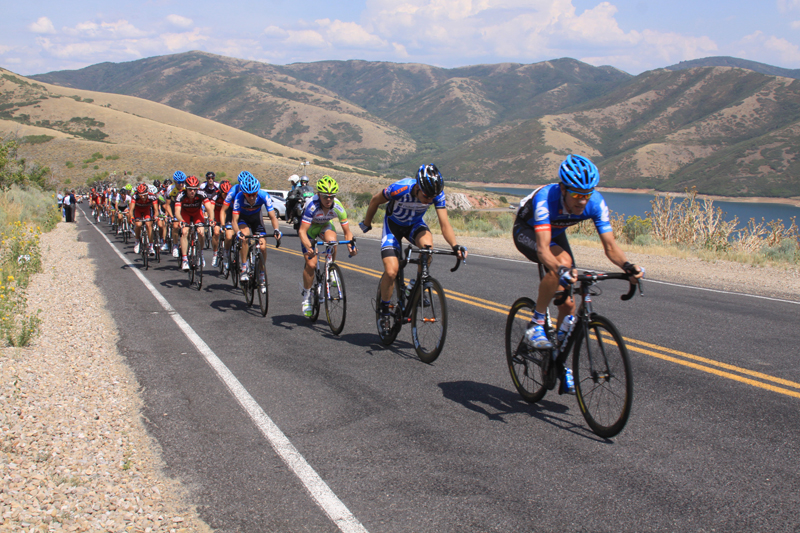
Dave Zabriskie leads the field over Little Mountain on Stage 3 in chase of Johann Tschopp. They caught him just around Ruth's Diner on the descent of Emigration Canyon.
Dave Zabriskie leads the field over Little Mountain on Stage 3 in chase of Johann Tschopp. They caught him just around Ruth’s Diner on the descent of Emigration Canyon. Photo: Dave Iltis

By reworking the repair schedule to focus first on soft-spot repairs (repairs of the underlying road bed), the paving company was able to postpone the closure. Additionally, the canyon will be repaved by mid-September.

In a blow to safety for cyclists and pedestrians, Emigration Township and Mayor Smolka seem unwilling to change the default vehicle travel lane width in the canyon from 12′ to 11′ or even 10′ lanes. Narrower vehicle travel lanes slow traffic down, and are safer for pedestrians, wildlife, cyclists, and vehicles for multiple reasons. Primarily, slower speeds result in lower average speeds, and thus the severity of automobile crashes are minimized. Additionally, and especially in Emigration Canyon, a narrower vehicle lane would result in wider bike lanes and/or shoulders for cyclists to ride on, and for pedestrians and residents of the canyon to walk on. According to Jeff Speck, author of Walkable City Rules, 12′ lanes accomodate traffic speeds up to 70 mph, while 10′ lanes accomodate traffic up to 45 mph. 

The Emigration Township statement regarding the new construction schedule is below:

The contractor, Black Forest Paving, has suggested a change to the project schedule and sequencing of work to save both time and money on the contract. Rather than performing soft spot repairs (places where the pavement and sub-material must be completely removed and re-installed, essentially reconstructing sections of the roadway) prior to asphalt removal (milling), they will proceed with asphalt removal to more quickly and accurately identify soft spots and conduct repairs as they go.

As a result, they will begin major asphalt work July 6, and will keep the canyon open to recreational cyclists until that date. This will allow recreational users of Emigration Canyon full access over the 4th of July holiday.

The contractor has assured us that with this new accelerated schedule, they will still be able to complete all of the paving by mid-to-late September.

Update for Cyclists:

Asphalt removal will begin on July 6. Crews will remove asphalt in one-mile sections, as they work their way up the canyon (see “Upcoming Work Activities” heading below for more details). Until paving begins, there will be progressively more segments of the road that will be in a milled state.

However, once new pavement is down, crews may be able to begin striping in segments before the canyon has been entirely repaved – therefore, we may be able to open up the lower sections of the canyon to recreational cyclists earlier than expected. We will continue to provide updated information about this option as the project progresses to that point.

Upcoming Work Activities:
This week, crews are performing minor work activities along the corridor, such as prepping to pour concrete for the new curb and gutter near the intersection of Maryfield Drive and Emigration Canyon Road, and lowering utilities in the roadway to prepare for the removal of asphalt. In observance of the 4th of July holiday, no work will take place from July 3-5.
Beginning July 6, major asphalt work will begin. Crews plan to begin at the Emigration Township line on the west end of the project, by removing asphalt in the eastbound lane. They will move eastbound for about a mile at a time, then flip and remove asphalt in the westbound lane – in a racetrack configuration. Asphalt removal is planned to take about two weeks to complete.
Beginning July 6, there will be some gas line work taking place, near the turn-off to Pinecrest, requiring trenches in the roadway. This activity is unrelated to our project but will take place concurrently.

*Schedule is subject to change due to weather or unforeseen circumstances.

Visit the Project Website

Questions or Concerns? Contact us!
Email: [email protected]
Hotline: 877-495-4240

Project Background
In an effort to preserve the pavement in Emigration Canyon, Salt Lake County and Emigration Canyon Metro Township will rehabilitate the asphalt on Emigration Canyon Road, from the Emigration Township line on the west to SR-65 on the east. This project is expected to continue through mid-September 2020.

This rehabilitation project will also include some drainage improvements and new striping for bike lanes, where existing roadway width allows, to improve safety in the canyon. Moderate delays are expected so motorists are advised to plan their travel times accordingly. If an alternate route is available for your destination, please plan to take it and help reduce congestion through the work zone.

A Non-Racer’s Summer of Racing – The Continued Road Racing Adventures of a 43 Year Old Mom

By Kelly McPherson — In the spring of 2015, I wrote an article detailing my experience as a non-racer, racing my very first RMR Crit. It was a valuable experience and I vowed to race it again many more times this summer. I did, a bit. I managed to get to a couple more RMR Crits, the Sugarhouse Crit, Wildflower Trailfest and Pedalfest, and the West Mountain Road Race.

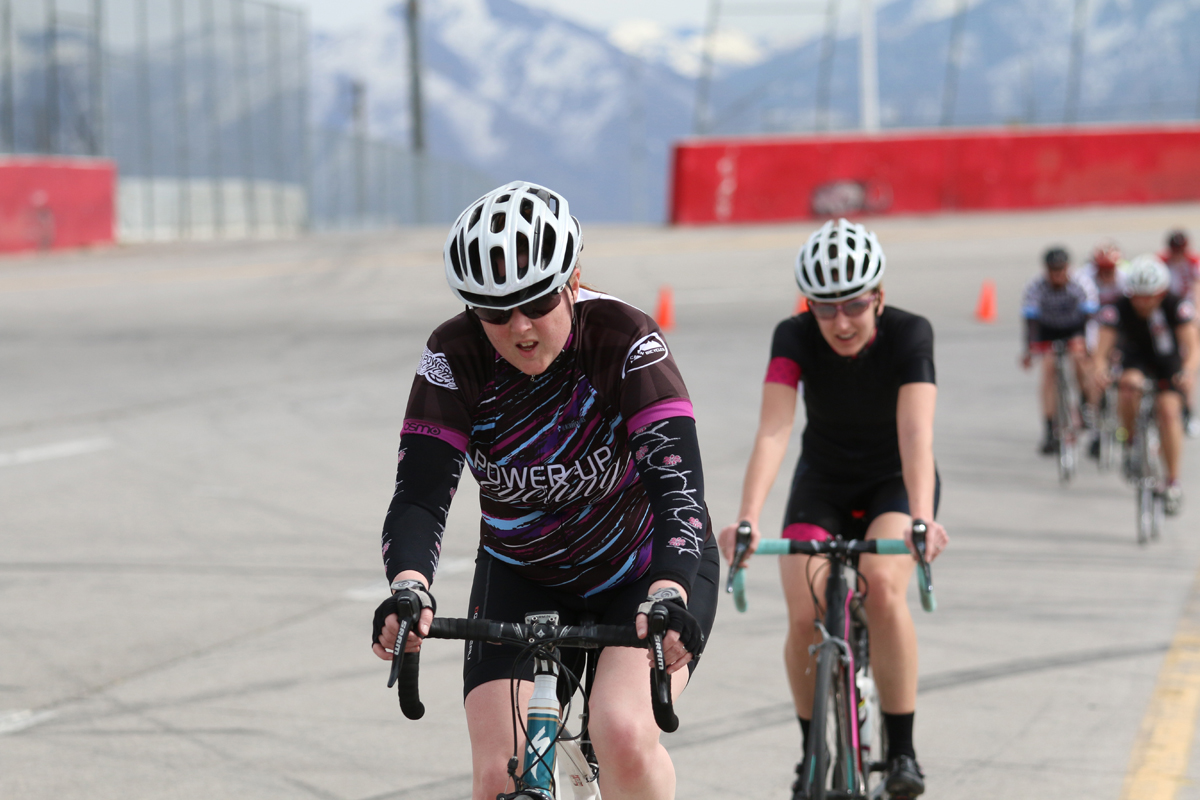
Kelly McPherson racing at the Rocky Mountain Raceways Criterium on March 5, 2016.

Work, kids, vacation and a flooded basement got in the way and I didn’t race as much as I had planned. I know, I know, excuses, excuses. If I were a real cyclist, I would have gotten my rear out to a lot more races anyway, right? Possibly, but I have been married for 25 years and I would like to stay that way. Sometimes, even with an extremely supportive spouse and family, turning pedals has to drop in my list of priorities.

Even though I didn’t race nearly as much as I had wanted to, I did learn a lot and am making concrete plans to be able to race more this year. Below are a few things that I learned.

  1. Crits are not that scary. They have the reputation for being lean, mean, crazy, Nascar on bikes kind of scary race. What they really are, is a bunch of crazy, mostly guys on bikes talking smack and riding in circles as fast as they can go. Occasionally there is a crash and, yes, there is an ambulance on standby, but no, they are not that dangerous. Newbies are welcome, provided you take some time to learn some bike handling skills and don’t take every one out while you ride.
  2. The Sugarhouse Crit is the perfect mom friendly event. I don’t know why more women don’t ride crits. They are great! Women complain all the time that we don’t have enough time to ride, take care of home and family, work and race too. Crits are the perfect solution to that. They are short and fast. Then are done and you are on your way and back to your normal life. If you can find time to take a class at a gym, you have time to race a crit. When I ride a century, it takes all day and I come home crazy too tired to get anything done other than a shower and a nap. 

    I got to sleep in and then make my way casually to the Sugarhouse Crit. I rode for 45 minutes, watched the race after mine, and then went home and had a wonderfully productive day. The venue was in a lush, green park where, if my kids had chosen to come, could have happily played while I raced. Perfect!

  3. There is more team strategy in cycling than I had anticipated. If you have the time to watch a few races, you will see teams working together to make sure someone on their team comes out ahead. It was interesting at the Sugarhouse crit to watch the Porcupine guys block, and I mean literally block as they looked more like linebackers than cyclists, the rest of the field from pushing and attacking their teammate who was in the breakaway. While we often ride alone, this is far from a solo sport. Teams can make all of the difference. It would be well worth a racer’s effort to seek out and to join a team.
  4. Other cyclists are super nice! Cyclists have a reputation of being snobby and only caring about one thing, winning. I found that this is just not true. As long as you don’t get in the way, most cyclists are very welcoming and helpful to those around them and are happy to see new people come out for the sport.

    At the West Mountain Road Race, I had fallen off the back on a climb. I am still significantly heavier than the other racers and so I struggle to keep up on climbs. One of the other racers noticed this and tried to bridge me so that I could catch back up to the group. She wasn’t on my team. She had no vested interested in me staying with the pack. In fact, she was risking her own race to save mine. I have seen countless instances like that this year as experienced racers have attempted to make sure that I am encouraged to come back and race again.

  5. Nothing takes the place of good, consistent training. June and July were tough months for me, personally and I didn’t get to train as much as I would have liked. The Wildflower Trailfest was a very humbling experience. No amount of attitude or fortitude would have allowed me to keep up with those mountain goat mtb girls. Yikes! They were off and I never saw them again. This was a great race, however, and I am more committed than ever to spend a lot more quality time on my bike so next year is a little better.
  6. While the all women’s rides are popular, some of us girls have a wide competitive streak. Wildflower Pedalfest satisfied the call for both a fun, casual ride as well as some competition. The ladies who are not into competition, rode the fun distances. Those of us who wanted to wet our competitive whistles raced the Big Mountain hill climb. I was excited that the hill work I have been doing lately, resulted in a much faster climb this year. Next year I am going to be even faster!
  7. We need more girls to come out and race. At the RMR Crits, I was often the only girl on the track. There were only a handful of us at the Sugarhouse and West Mountain races. While it was cool to have placed 3rd in my category at West Mountain, I would much rather have earned that place by beating someone else to the finish line rather than just being the 3rd in out of 3 participants.

These races need to be marketed where the girls are at. While there are a large number of girls at the all-women’s events who would never consider racing, there are quite a few who would if they knew how or where or when. A simple flyer in a couple of event swag bags might go a long way to encouraging new participants. Continuing to market races on websites and Facebook pages that target competitive cyclists is like preaching to the choir. The people frequenting those places are already competitive cyclists. Very few new people are being captured.

Girls, we need to put on our big girl panties and come out and race! I have heard that racing is intimidating. Maybe, it is, but it only is until you give it a good try and see that it isn’t. I have seen some race directors going out of their way to include us, but we aren’t making it easy for them. How long will it be before they give up trying? I would like many opportunities for myself, my daughters and my granddaughters to race, if they choose. We need to support these directors if we want them to continue to support us.

Racing is fun! I have really enjoyed it and it motivated me to work extra hard this past winter so that I can be better prepared to race stronger this year. While I will never likely win any races, racing has made me a much stronger rider. I am loving it!


The Colorado Trail Race: A Bikepacking Adventure from Durango to Denver

By Adam Lisonbee – The streets of Durango, Colorado were empty. The black sky was speckled with stars. A few street lamps glistened in the pre-dawn night. Shop windows glowed dully. Above the rooftops the dense foothills of the La Plata mountains surrounded the sleeping town with a deeper shade of dark. Nervous mountain bike riders were gathered downtown. Some of the riders looked more relaxed than others. Many were making last-minute adjustments to backpacks, bikes, and other gear. The 2013 Colorado Trail Race was just moments away.

[Editor’s Note: The 2020 edition of the Colorado Trail Race is anticipated to start on July 26. For more information, visit https://bikepacking.com/event/2020-colorado-trail-race/]

Bong.

The clocktower overhead broke the silence. The sound of shoes clipping into pedals clicked through the crowd. A few riders whooped or hollered.

Bong.

“Who’s ready to ride?” shouted Stefan Griebel, a rocket scientist from Boulder, Colorado, who organizes the Colorado Trail Race each year. A few more riders shouted in affirmation. Many were silent.

Bong.

Slowly, wheels started to roll forward. Headlamps bobbed in the morning dark. Riders rang the bells on their handlebars, a few spectators clapped and shouted. “See you in Denver!”

Bong.

Four o’clock. July 21, 2013. Rookies and vets alike now faced the same indifferent mountains and the same brutally difficult trail. Past experience would benefit the vets, while ignorant enthusiasm would press the rookies onward. Each rider now rolling across the pavement was embarking on days worth of pain and suffering, euphoria and joy.

Rugged trail near Blackhawk Pass. Photo courtesy Adam Lisonbee

The forest was lush and green. Morning dew glistened on the tree branches and tall grass. On the high horizon, the first light revealed the treeless summits of the mountains–mountains that the trail would climb up and over in short order. I had to force myself to stop and eat. I needed my wired nerves to calm down, and time to remind myself that this was no ordinary race. Passing or being passed 15 miles into a race that traveled 550 miles was superfluous. I sat on a fallen tree and ate my homemade rice cakes, enjoying the inaugural sunrise of this grand adventure. The trail above me climbed steeply onto the slopes of Lewis Mountain and Snowstorm Peak. Up, always up.

Ty Hopkins, my riding partner, and I refilled our water bottles at Taylor Lake, and then began pushing again. High above the lake and the pass, Indian Trail Ridge awaited. Another iconic name, and another place I had daydreamed about riding across. Indian Trail Ridge. Even the name sounded exotic. At 12,000 feet, the ridge is high. And it’s covered in loose boulders and rocks. The trail at the top was faint, only followable via sporadic cairns.

The loamy trail ducked in and out of the trees, flirting with the steep drop-off of the mountain. Clumps of riders strung out across the trail. Interactions with other riders were more seldom and brief. The race was unfolding along the map. The fastest riders were gone, rushing over the mountains, chasing record books. The rest of us plodded along, settling into our 550-mile pace.

The euphoria and the adrenaline faded. The cold reality of what lay ahead, accompanied by a swiftly moving rainstorm, dampened the optimism and joy. “What have I done?” I wondered. The miles rolled slowly by. Silverton, Colorado, the first resupply point on course, was hours and many rugged miles away. My bike was over-packed with food I didn’t want to eat. I was tired. Homesickness rippled through my spine.

The sun was low when I hiked over Rolling Pass. Wildflowers sparked across the meadows in the waning light. For the first time in hours, I smiled. The pass, the flowers, the setting sun—it was all overwhelmingly beautiful. The rising moon split the skyline. Cornhusk lilies crowded the trail. The sun dipped behind the high peaks. Pale, blue light filled the mountains. Ty was waiting at the pass. “I don’t want to play this game anymore,” I announced. He looked as tired as I felt, but he preached patience. “Let’s get down into some trees,” he suggested, “and we’ll find a nice place to camp. I’m exhausted, too.” We descended off the pass and into the trees where we set up camp for the night.

I heard the voices before I opened my eyes. The others were stirring. They sounded energetic and happy. It was still dark out. I stayed still. Maybe if I pretended to be asleep, no one would rouse me from my bed. A stove hissed. Jeff and Cameron, riders we had shared the campsite with, were getting ready for the day.

A few minutes after daybreak, Ty and I were pedaling through the morning light and across the open meadows above Molas Pass. We were both grumpy. We both felt uncertain about the immediate future. But we were moving. “What do you think?” I asked Ty. I was conflicted about how I wanted him to respond. Did he want to drop out in Silverton, or continue? Our race hung in the balance. He responded without hesitation. “Don’t say quit.”

“We could buy tickets for the train,” I said, “and ride back to Durango.”

He laughed. I wasn’t really joking.

Instead, we bought giant breakfast burritos, pedaled out of Silverton, and made our way toward Stony Pass Road, a steep cut through a massive glacial path and into the high reaches of the San Juan Mountains. We were 215 miles from the next resupply, and 465 miles from Denver. But we were both happy. We left the small mountain town hoping that after the first overwhelming day of the race, we were adapting to life on the trail.

 Ty Hopkins riding through Coney Summit, 13,270'. Photo courtesy Adam Lisonbee
Ty Hopkins riding through Coney Summit, 13,270′. Photo courtesy Adam Lisonbee

The highpoint of the Colorado Trail is the Coney Summit, 13,270 feet above sea level. The trail at the top was velvet. It rolled gently up and down the wrinkled hillsides, and across razor’s edge ridges. The world unfolded into layers of cirques, massive calderas, canyons, and purple peaks with names like Redcloud and Sunshine. Green walls sloped downward, split by blue ribbons of flowing water. Lake San Cristobal mirrored the watercolored sky. Far below, spruce and pine grew in thick formation, adding deeper greens and browns to the emerald sea. The day finally ended at Slumgullion Pass, ten miles beyond where we had hoped. It had been a good long day on the Colorado Trail. “That was an amazing day!” I said. “The best I’ve had in a long time.”

Ty Hopkins, Cameron Millard, and Jeff Hemperley riding the La Garita Wilderness detour near the Continental Divide. Photo courtesy Adam Lisonbee

Tall pine trees filled the sky. I was in my bag, staring up at them. The pale moonlight made sharp silhouettes of the trees. Stars blinked. Someone stirred. Light from a headlamp bounced off the tree trunks. “Time for breakfast.” A few minutes later I was packing my bike, gulping down food, and getting ready for another long day on the Colorado Trail. I had high hopes for the day. Ahead of me was the La Garita Wilderness detour, and a chance to cover many miles over easy-riding dirt roads.

The miles came and went. Ty and I climbed up and over Los Pinos Pass and descended into Colorado’s high mountain valleys. Ranchland and empty plains untangled themselves from the mountains. We plunged into an ocean of sagebrush. The road was smooth, flat, and straight. The morning sun turned warm. Dust parched the air. The San Juan Mountains were far behind.

CT racers claim that Sargents Mesa is haunted. Maybe it is. On the day I crossed its rocky top, there was a procession of palid, hopeless things that vaguely resembled men. Their eyes, once vibrant with vitality and color, were gray and lifeless. The light had gone out of them, replaced with the blank, empty stare of the walking dead. Nobody spoke. Our eyes said everything there was to say. Mouths were too dry, parched, and burnt for words. The endless rolling plateau was waterless. The sun beat down on us with merciless endurance. Angry, aggressive mosquitos found us easy prey. And still, we pushed our bikes. I dove deeper into the abyss than ever before. My mood, like the air, was sour. I hiked in angry silence, marveling at the absurdity of this mesa, this race, and my own audacity. “A bike has no place on this trail!” I moaned.

We hiked through a grove of aspen trees. I hadn’t seen an aspen tree since Los Pinos Pass. Immediately, I felt better. The softly swaying branches and twinkling leaves filled me with light. I paused, and soaked up the pocket of life and energy. I smiled through the pain and blackness. I watched the sunset illuminate the crowded peaks, turning them blue and purple on the horizon. The world melted into technicolored brilliance. I knew then, in that small stand of quaking aspens, there was nothing but me preventing me from pedaling to Denver.

During the night, a few more riders hiked by our camp. They went silently through the trees and up the hill. They, like me, like all of us, were hurting. But forward, upward, they walked and pedaled. I felt a new kinship with my fellow racers that night as we put the haunted, joyless expanse of Sargents Mesa and the Cochetopa Hills behind us. We had each suffered deeply, but we did not let the mountain, or the wily demons lurking in the trees, beat us.

“You awake?”

“Yeah. What time is it?”

“Four. Let’s get moving, and finish this hike in the dark.”

“May as well.”

When the sun had finally climbed over the Sawatch Mountains, Ty and I had left behind the bouldered, vertical trail, and were riding silky singletrack through spruce forests and mountain meadows. The first light of the day spread like wildfire, revealing the brilliant range and valleys in warm optimism. I paused for a photo. “You’ll thank me later,” I told Ty, when he urged me onward. We pedaled across Silver Creek and Marshall Pass. I stopped for water at a bubbling spring spouting out of the sidehill. “You go on,” I told Ty. “I need to spend some time here and get myself rehydrated.” He pedaled away up the trail.

I filled a bottle, and drank it. And then filled it again, and drank that. I slowly ate breakfast, and then drank another bottle. After 20 minutes I packed up, and started to pedal again. I reached the Monarch Crest Trail, and spent the next several miles riding some of the best singletrack in Colorado. Any thoughts of quitting vanished in the brilliant morning light.

That day was spent riding trail that contoured through dense, rubbly forests full of dark pine trees and rounded boulders. The Colorado Trail sneaked in and out of countless drainages, climbed over ridges, and curled through aspen trees that stood lean and tall. We made tracks, riding away from a chasing storm, and toward Buena Vista and its bounty of fresh food and clean sheets.

Buena Vista, Colorado is a small town surrounded by big mountains with elevated names: Harvard, Princeton, Yale. Coasting into the heart of the city however, it didn’t feel small. The stoplight, the traffic, the neon signs at the bars, motels, and restaurants, reflected an attitude of hurried, civilized luxury. I had left Silverton three days earlier and other than the small store at the hot springs, hadn’t encountered any permanent human presence at all. Pedaling through town, marveling at all the options for food and comfort, was wonderful.

The day aged. Ty and I had a choice. We could quickly resupply, and move on. Or, we could linger, rent a motel room, and sleep in a bed. It was an easy choice. We checked into a motel, and sat down for dinner at Pancho’s. We slept in a cramped, drafty room at the Topaz Lodge. It was palatial. The needed stop allowed us to clean and reorganize our bikes and gear, restock our food supplies, and enjoy unhurried frosty and fried indulgences.

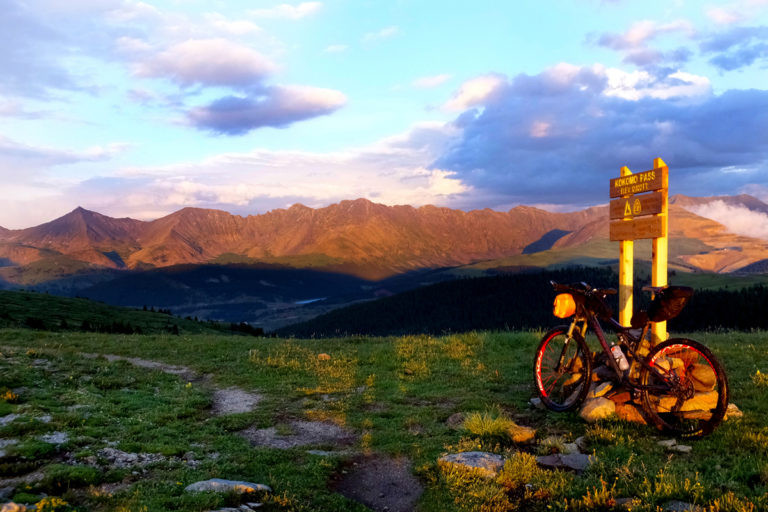
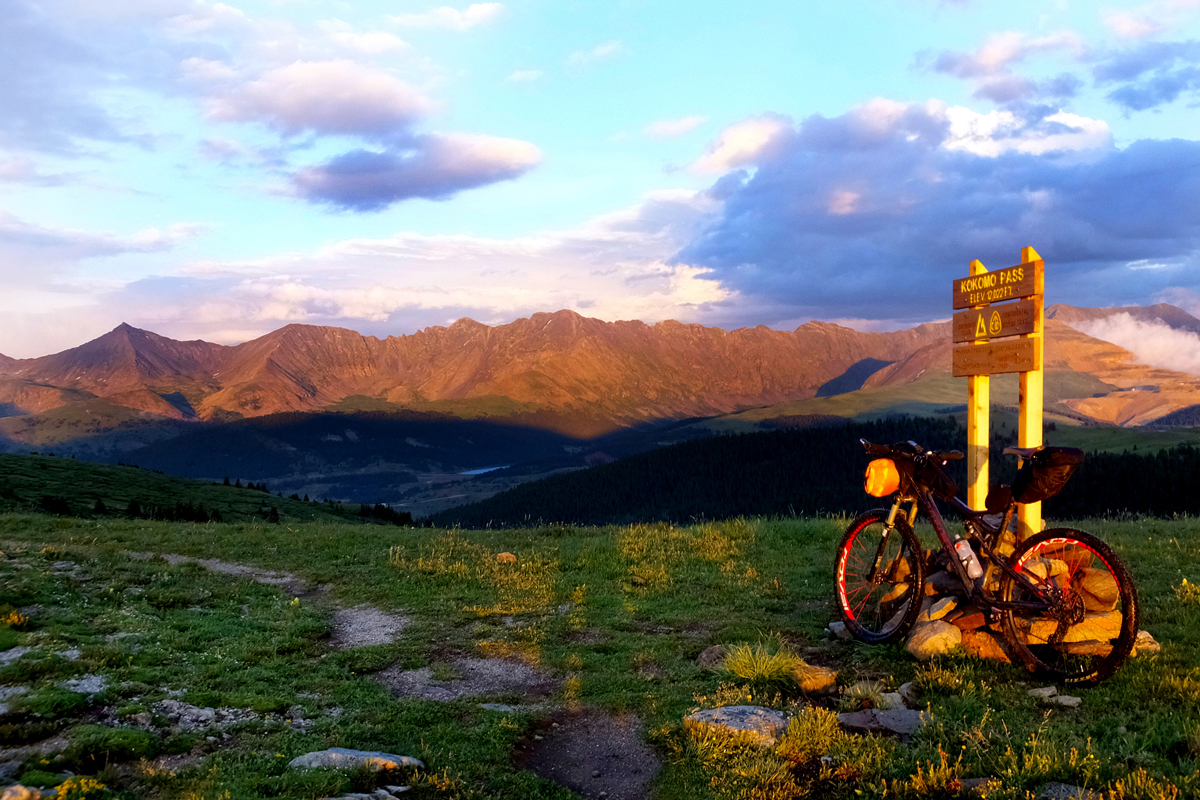
Sunset at Kokomo Pass 12,070 feet. Photo courtesy Adam Lisonbee

In the morning, after more food from Pancho’s, we were pedaling again. We rode alongside the Arkansas River and toward more mountains and more trail. The new day brought a sense of adventure and energy—energy that would be put to good use as we made our way toward Leadville, Kokomo Pass, and Copper Mountain ski area.

Gray clouds floated around the treeless peaks. The glassy water of Twin Lakes reflected them with perfect symmetry. Singletrack wove through the aspens, ponderosa, and sage. We climbed above the lakes, and into the fringes of the Mt. Massive Wilderness. Another detour loomed, but not before we spent hours riding smile-inducing trail on the shoulders of Mt. Elbert. At midday we rolled into Leadville, Colorado. Rain arrived in town at the same time we did. With packs and bellies full, we hid from torrential rain.

Leadville was bustling with tourists. An old man with a long white beard, wearing a coat and top hat, wandered the streets. He worked for the Chamber of Commerce, a small taste of history and flavor. He fit in with the old building facades and the boardwalk, where hurried families and window shoppers dodged the rain.

“How far away is Kokomo Pass?” Ty was talking to the old man in the coat and hat.

“Not far,” he told us.

“In which direction?” Ty wasn’t lost. He wanted to know if we were about to ride into more stormy weather.

“It’s that way,” he said, gesturing toward the wall of purple clouds.

A few hours after leaving Leadville, it started to rain again. The storm loitered overhead, following our route. A crack of thunder sent us diving into the trees. I crammed myself into a small pocket of spruce, and hoped any lightning missed them, and us. We left the trees in full rain gear, and continued walking up the hill. Thunder boomed. More rain fell. Kokomo Pass was only a few-minutes-hike above us, but we hid in the last of the trees, waiting out the storm. I huddled in between the trunks of closely growing pines and ate the cold, salty, fried chicken I had carried with me from Leadville. “Once we reach Kokomo,” Ty said, “there are three miles of trail to Searle Pass. From there, it’s all downhill to Copper.” The rain faded, the sun pushed its beams of caramel-colored light through the clouds, now pulling apart like cotton candy. Distant peaks were dark in the stormy, evening sky. The world melted into golden brilliance.

By now, the violent mood swings I experienced on the Colorado Trail were routine. But that didn’t make them enjoyable. After the sun went down, and the perfect light faded into night, it got cold, and we were wet. At Searle Pass, 12 slippery, rocky, and muddy miles, all downhill, separated us from Copper Mountain. The descent would have been fantastic in broad daylight, and without 17 hours of pedaling behind us. In the cold, wet, and dark night, with loaded bikes, fatigue gnawing at our brains, it was miserable. I flicked on my light. It didn’t turn on.

Ty disappeared into the gloom. I blindly dug fresh batteries out of the bottom of my pack. When those were installed, I flicked the light on again. Nothing. “Damn it!” I tried another set of batteries. Dark still. I started hiking in the dim glow of a back-up light. Ty, by now, must have been sipping hot cocoa at Copper Mountain, wondering where I had gone. I called his name. No reply. I growled in anger. “Hopkins!” After an hour of hiking and fiddling with my lights, I finally got them to turn on. Ty was angry when we reached Copper Mountain. I had delayed us an hour. We were hungry, soaked, and miserably tired. And there was no place to sleep.

It was my turn to talk Ty off the ledge. “Let’s just find some trees, and get in our bags.”

“Where at?” he growled.

“Anywhere. It’s late. We’ll get an early start. No one will know we were here.”

“I guess.”

The next morning we rode to the nearby convenience store, hoping to get enough food to last us until the finish line, 150 miles away. We were 45 minutes early to the store. Our moods darkened even more. I reorganized my pack while Ty cleaned his bike. We still weren’t talking much. Neither of us had slept well; we were still wet and cold. An employee from the store came outside to flip switches behind a closet door.

“Does this mean you’re open?” Ty asked hopefully.

“Nope. Not until 7 am.” The employee was too cheerful to be delivering such vexing news. He seemed to be enjoying our plight. He went back inside and locked the door behind him. We waited silently on the curb.

At exactly 7:00 the lights came on, and the clerk pushed open the door. “Come on in!” At that same moment, Cameron, Jeff, and Ian, three other CT racers, walked through door. We hadn’t seen them in days.

“Ha! You guys are here!” Jeff yelled.

Ty Hopkins, Cameron Millard, and Jeff Hemperley looking into Breckenridge from the top of Ten Mile. Ty Cameron, Jeff. Photo courtesy Adam Lisonbee

The happy rendezvous lifted everyone’s spirits. We left Copper behind, and began the long, steep, and brutal push over Ten Mile, part of an abrupt ridge of peaks that separated Copper Mountain from Breckenridge. At the top of Ten Mile we gazed down, down, down into Breckenridge, where’d we be passing through, (but not close enough for easy resupply) after a long descent, and a little more climbing. Beyond the small town more mountains layered the horizon—mountains we would have to climb.

Insects buzzed in the heat. The sun was boring holes into the ground. Ponderosa pines grew in thin stalks, like rows of soldiers. We were well above Breckenridge by now, slowly inching up the trail to Georgia Pass. I pedaled away from the group while they ate lunch. I wanted to keep moving. I had to keep moving, or they’d leave me too far behind. “You’ve got to eat, Adam,” Ty said.

“I’ll eat while I pedal,” I replied.

Golden light dripped from the trees when we finally reached Georgia Pass. Clouds clung to the skyscraper peaks, and stretched across the green, fertile mountain valleys of South Park. At Georgia Pass is one of the CT’s most popular trail markers. The tall wooden pole, CT triangle nailed near the top, divides the continent. Looking back to the west, and the way we had come, the mountains unfolded endlessly. The valley far below was blurred by distance. The long approach was covered in dense forests. Ahead of us, a similar sight stretched eastward and happily downward. I set off down the opposite side of the pass, knowing that the riding was almost all downhill to Kenosha Pass, Highway 285, and the homestretch of this incredible journey.

Around 10:30 pm, we were all beyond tired. I struggled to walk in a straight line while hiking a steep segment of a smooth dirt road. My head snapped from side to side while I fought the fatigue. I used my bike like a crutch, propping my body upright. “I need to sleep,” I told anyone who would listen. “Anywhere will do.”

“We can’t stop here,” Ian said. “There is a bar nearby. We can get some food there.”

“A bar? We are in the middle of nowhere,” I said. Surely the darkness, and the accumulated fatigue, had Ian confused.

“No, it’s here. I read about it,” he insisted.

Ty Hopkins and Jeff Hemperley riding the Hayman burn area on the Lost Creek Wilderness detour. Photo courtesy Adam Lisonbee

The route we had to take around the Lost Creek Wilderness was new to the CTR in 2013. We were as likely to find nothing, as we were a bar. A few more climbs came and went, and there was no bar in sight. Fatigue was eating at my head. My feet were numb. My legs were dull and slow. I tried to count how many calories I had stashed away in my bags. 800, maybe 900. At most, 1,000. Not enough for 130 miles, even if some of those miles were fast dirt roads. The temperature dropped, the high plateau turned chilly. The trees were walls of blackness. The moon rose above the mountains.

“If we stop now,” I pointed out, “we can get a fire going, and have a nice warm camp tonight.” Nobody stopped.

“We can’t be far now,” Ian said. “Start dreaming about hot food!”

I had been dreaming about hot food for a week. I grew more and more skeptical about Ian’s bar. But nobody wanted to risk missing it, if it did exist. Mile after mile revealed no bar. We were finally on the verge of pulling over and lying down when we rounded one more corner, and climbed one more rise. There were lights. Bright, neon lights. Music blared from the glowing oasis.

“No way!”

“It’s real!”

“And it’s still open!”

“Sit down, and let me get you guys some drinks. Pizzas will be out in a few minutes.” His name was Pat, and he was the owner of the Stagestop Saloon.

“I don’t want to go back outside,” I said to him. “If I do, I’m afraid this will all disappear, and I’ll be back in the cold, pushing my bike.”

He laughed. “I’m real. I can promise you that!”

Pat insisted that we camp in the beer garden. We laid out our bags under the tarped canopy, larders and bellies full. I burrowed into my sleeping bag, still unconvinced that the saloon was real. I wondered if I’d ever be able to find it again. Ian broke the sleepy silence. “I told you there was a bar.”

We set out from the saloon as the first light of dawn crept over the surrounding mountains. Finishing the CTR had never felt so far away. Jeff and Ty rode away from me. Cameron and Ian disappeared behind. I rode alone, thinking only of the finish line. “Don’t stop. Keep moving.” I rode farther and longer between breaks than I had all week. I skipped places to refill my water bottles. Finishing was the only thing that mattered. Stopping delayed that. “Don’t stop!”

Adam Lisonbee, after 6 days, 15 hours and 550 miles, is all smiles. Photo courtesy Adam Lisonbee

I crossed the Gudy Gaskill bridge and the South Platte River in the late afternoon. I was 17 miles from Denver. “Seventeen miles. Seventeen miles. Seventeen miles!” I fell into my own world, focused on moving, and only moving. After a long descent, and more chanting, just one more climb remained. But it wasn’t a long climb. And it wasn’t very steep, either. I started looking for Lenny’s Rest, a trailside bench that I knew was at the top of the hill. When I reached the bench, I wanted to sit down and enjoy the moment. “No time, go!” I pedaled by unceremoniously, and burst from the trees onto Waterton Canyon road. Six miles, all downhill, of smooth graded dirt were all that was left.

Six days, 15 hours, and 15 minutes, after leaving Durango, I arrived in Denver. Ty and Jeff were waiting in the trailhead parking lot, grinning stupidly. I sat down in the gravel and looked up at Ty. “Well,” I asked him, “now what?”


Some of what you need to know:

Plan for 4-9 days on trail

Hike-a-bike is abundant. Plan to walk 60-100 miles of the route.

Reliable resupply (from Durango):

  • Silverton: Mile 88
  • Buena Vista: Mile 300
  • Leadville: Mile 350
  • Copper Mountain: Mile 400

Limited resupply:

  • Mount Princeton Hot Springs Resort: Mile 280
  • Stagestop Saloon: Mile 450
  • Apple’s Camp: Mile TBD

Water is abundant on trail, but carry some form of filter/purification.

The trail is well marked, but a GPS and paper map are very helpful.


Adam's bike. Photo courtesy Adam Lisonbee
Adam’s bike. Photo courtesy Adam Lisonbee

Adam Lisonbee’s Gear List

Bike:

  • Cannondale Scalpel 2

Bags:

  • Revelate Sweet Roll handlebar bag w/ Pocket add-on
  • Revelate Feedbags on handlebar
  • Jannd Frame bag
  • Revelate Pika seat bag
  • Camelback Volt LR 13L

Sleep:

  • Lafuma Warm N Light 600 sleeping bag
  • Outdoor Research Auroa bivy bag
  • Big Agnes Clearview pad

Electronics:

  • Garmin eTrex 30 GPS
  • Fenix PD32 flashlight x 2
  • SteriPEN Adventurer Opti UV water purifier
  • Fujifilm F900exr camera

Repair:

  • Tubes x2
  • Tire boots x2
  • Tire lever
  • Patch kit
  • Chain links x2
  • Sealant 4 oz.
  • Valve stem x 2
  • Multi-tool
  • Zip ties x 10
  • Brake pads x2
  • Hand pump
  • Chain lube

Clothing:

  • Ride shorts
  • Ride shirt
  • Rain jacket/pants
  • Silk long underwear
  • Down vest
  • Socks x3 pair
  • Shoes
  • Ride gloves
  • Cold-weather gloves
  • Wool stocking cap
  • Arm warmers
  • Knee warmers

Safety:

  • First-aid kit
  • SPOT beacon
  • Paracord
  • Colorado Trail Databook

Personal:

  • Toothbrush/toothpaste
  • Floss
  • Chamois cream
  • Lip balm
  • Dehydrated towels
  • Sunscreen
  • Bugspray
  • Toilet paper
  • Credit card/cash/ID

Food:

  • Potato chips
  • Soda
  • Candy bars
  • Beef jerky
  • Rice cakes
  • Burritos


Robert Simonton: Helping to Make the University of Utah a Bike Friendlier Ride

To anyone that commutes to the University of Utah or to the medical centers, there are some issues, not insurmountable, but riding to and within the campus could be better. After reading the recent minutes from the Salt Lake City Bicycle Advisory Committee and meeting Bob Simonton, it appears that bicycle travel will be improving on campus.

[Editor’s Note: This article originally appeared in the March 2017 issue of Cycling West]

Cycling Utah: Bob, tell the readers a little about yourself.

Robert Simonton: My wife Anji and I live near the University of Utah, where I am the Director of Design and Construction. I belong to a family of Ducks, as Anji and both daughters, Sarah and Lydia, are all graduates from the University of Oregon. Anji has also spent most of her career working in Higher Education as a Director of Institutional Research. Sarah lives near Philadelphia with her husband Komeil. They are eagerly awaiting the birth of their first child this summer (2017). Lydia lives in Portland and works for a non-profit that aides blind athletes.

Bob and wife Anji bike touring Grand Teton National Park in September 2017. Photo by Bob Simonton

I am originally from Gettysburg PA. I have lots of great memories from my childhood cycling on the national park roads and exploring the famous sites. After college, I worked in construction management and traveled to projects in Delaware, New Jersey, Maryland, Virginia and Pennsylvania. In 1991, I took a job a Penn State’s Hershey Medical Center in Facilities Management that allowed for a much better life-work balance. In 2000, we moved to Eugene, Oregon, where I became the Assistant Vice Chancellor for Capital Programs, with the Oregon State Board of Higher Education. Since 2014, I have been with the University of Utah, and I currently manage a team specializing in infrastructure projects for the Planning, Design, and Construction Department.

C.U.: Why do you commute by bicycle? Tell me a little about your commute to the University and some of your bike commuting history and your commuter bikes.

R.S.: I believe having the freedom to venture out on a bike as a child has inspired me to keep riding throughout my life.

Since 1991, I have tried to commute to work by bike as weather permitted. It’s not only a great way to get exercise, but I always feel more focused and energized during the day. I have not always had the most expensive bikes, but I always install lights and a rear rack to hold my work clothing and lunch. Good puncture resistant tires and a heavy-duty lock are also important. When I started at Penn State’s Hershey Medical Center, my classic Miyata road bike was typically the only bike parked in the rack. I had a nice 28-mile round trip ride along back roads with rolling hills. On certain days, I would smell the aroma of chocolate and roasted nuts from the Hershey chocolate plant along my route. 

While in Eugene, I had an 8-mile round-trip ride on bike paths through parks and quiet neighborhood streets. I also learned how to make myself waterproof with a wonderful material called Gore-Tex. I rode an inexpensive Giant Suede hybrid bike with fenders and a huge seat that was super comfortable. Eugene is a great place to ride and is typically ranked as one of the most bike friendly towns in the US. I was able to commute year round and use my bike to run errands, go shopping, and meet friends for coffee or lunch. 

Now in Salt Lake City, my commute is only 2 miles round trip. My commuting bike has been a Specialized Crosstrail Pro Disc that I have also used on several bike tours. Thanks to the steep hills, I still get the workout of a much longer flat ride. I have never been a great hill climber, and have been known to joke about the hills getting steeper each year, blaming some sort of tectonic uplift of the mountains. To counter this hill phenomenon, I just purchased an electric assist fat bike. What a game changer! I can ride like I did 20 years ago. So, I find myself riding more places and going on longer rides.

The bike is Haibike, fat six model, made in Schweinfurt, Germany. With a mid-engine design and the battery integrated into the frame, the bike is well balanced and easy to ride. We also bought an e-bike for Anji, a Bulls Lacuba EVO-8, with a belt drive and Nexus 8-speed internal hub. Her bike is also a mid drive, but looks more like a Dutch bike, with a step-thru design. We are looking forward to more bike adventures together. Our goal is to ride the C&O Canal towpath trail this summer while in Pennsylvania visiting family.

C.U.: How would you compare your commuting experience in the various locales that you lived and rode?

R.S.: While in Pennsylvania, I did see investment in rails-to-trails type infrastructure, but not much improvement on public roads, other than signs that said; “Share the Road”. However, in Oregon, they definitely embrace cycling as a part of their culture. The numerous bike lanes and paths definitely played into my decision to move there. At the University of Oregon Campus, as parking lots were lost to the construction of new buildings, alternative transportation, like bus rapid transit and bike infrastructure, provided a cost effective solution to lost parking stalls.

In Salt Lake City, I see a community that is heading in the right direction with a bike master plan passed in 2015 and the addition of a bike share program. As we confront more traffic congestion and pollution, we can improve the quality of life by encouraging more people to try active transportation alternatives like biking.

Bob riding home in the snow. Photo by Randi Porter

C.U.: Your commute is roughly 2-miles round trip. Did you move to your home purposely for bike commuting? How does distance to work influence your commuting?

R.S.: Yes, living close to campus was a conscious choice for easy commuting and quality of life. It is so convenient to attend the many events offered by the University, including sporting events, concerts, plays, lectures, and dance performances.

However, there are so many other factors that need to be considered when thinking about a reasonable distance to commute by bike. For instance, when my 2 daughters were little, proximity to good schools was the priority.

Looking back on all of my various bicycle-commutes, the miles ranged from a maximum of 14 miles one way to my current 1-mile trip. But I think less of the miles and more of the overall commuting experience. My favorite commute was during a brief consulting job in Portland where I rode 8 miles each way along a bike path next to the Willamette River. The scenery was stunning, and I was joined by hundreds of other bike commuters. I had access to a bike valet service and shower facilities at my destination. All of the parts and pieces were in place for a safe and easy commute, and I felt like I belonged. Bike commuting seemed less like an alternative and more like an accepted norm where anyone could join in and experience it.

C.U.: Bob, tell me about what you are doing on campus that will help cyclists get around.

R.S.: In addition to my bike commuting, my position at the University allows me the opportunity to work on transportation planning projects, especially how we implement the University’s Bike Master Plan. Overall, the campus is a great place to ride but has certain areas that could use some improvement. Some of the projects that I am working on include:

  • Adding bike ramps around stairs.
  • Adding bike lanes and pathways along major access roads to campus.
  • Including bike facilities in new buildings; showers and secure bike parking.
  • Exploring an e-bike sharing program for students, faculty, and staff.

C.U.: What can my readers expect within the next year and within the next 5 years?

R.S.: The University has recently hired an Active Transportation Manager, Ginger Cannon, to help promote and prioritize projects that will create viable transportation options, like bike commuting. We are currently working on an annual capital funding plan to improve and expand the bike routes through campus, as outlined in the University’s Bike Master Plan. Ginger is also working on an e-bike purchase program for University employees and campus departments, where e-bike shops can offer bikes for sale at a discounted rate. Given the amount of road construction planned around campus this summer, an e-bike would be a fun way to avoid delays.

The University participates in planning initiatives by the city, county, UDOT, and UTA that address connectivity issues with the University. Recently we celebrated the completion of the Sunnyside Trail and the University to Downtown Bikeway, with marked routes showing easy, intermediate, and short/steep choices to connect the University and Downtown Salt Lake City. Also, UDOT plans to re-pave Mario Capecchi Drive this summer, and thanks to our input, will include bike lanes that will tie into a future bike/pedestrian path. We are also planning a Wasatch Drive project this summer to add bike lanes to that street. I would say that continued community support and having more bike commuters to campus is the key to getting more projects like these funded and implemented.

Bob fixing a donated bike at the SLC Bicycle Collective. Photo by Amy Wiscombe

C.U.: I met you as a fellow volunteer at the Bike Collective. What motivated you to volunteer? What goals do you have as a volunteer?

R.S.: I try to do my part by improving the bike infrastructure and culture at the U of U and the greater community as a volunteer with the SLC Bike Collective. I feel a sense of accomplishment by fixing donated bikes to be put back into service and used by those less fortunate. I really enjoy the challenge of fixing bikes and sharing my mechanical knowledge with less experienced volunteers. As a kid in Gettysburg, having a bike was my ticket to explore the world around me. I think everyone should be given the opportunity to explore by bike within a community that embraces those aspirations. 

C.U.: Bob, it has been a true pleasure to meet you and work with you at the Collective. I sincerely appreciate the work and effort that you are doing on behalf of the cyclists of Salt Lake City and beyond. Thank you!


Marty Jemison’s 2000 First Union Series Diary

Lancaster

A break of 7 was up the road … there were no Postal boys … after 1-2 laps they had around a 1:00 lead. On a long incline I noticed Oscar Freire (World Champion) moving up … a perfect time to launch I thought, and he looked like good company … in an effort to make the bridge. Oscar attacked and I went with him … two others in our wheel … I often surprise myself of how strong I can be when I am in a place that I like to be. We made it to the break within one lap (10-15kms?) one rider from 7-up helped … I felt bad, bad for him (7-up) when Oscar looked over to me on the same incline where it started. I nodded and he attacked again to drop our two companions. we each took one monster pull and were then on the back of the break …
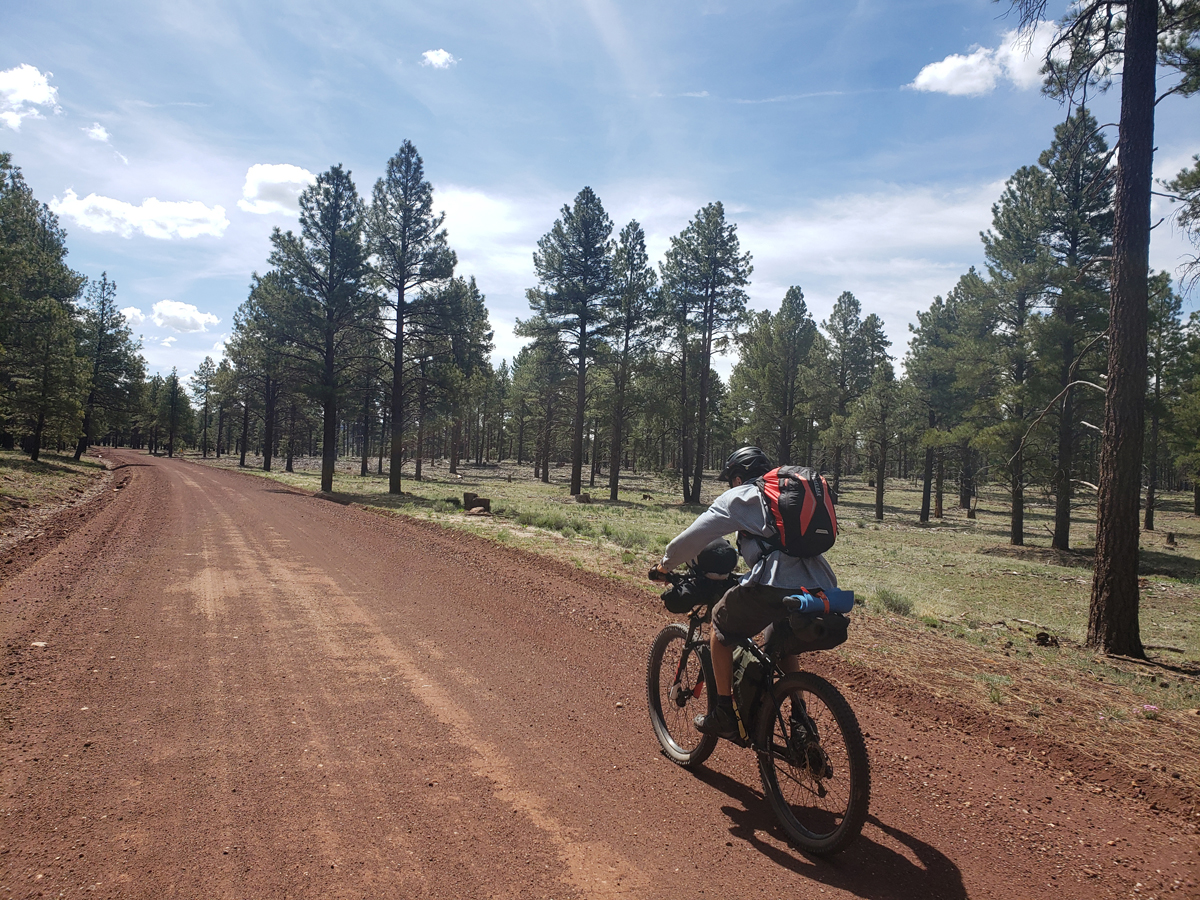
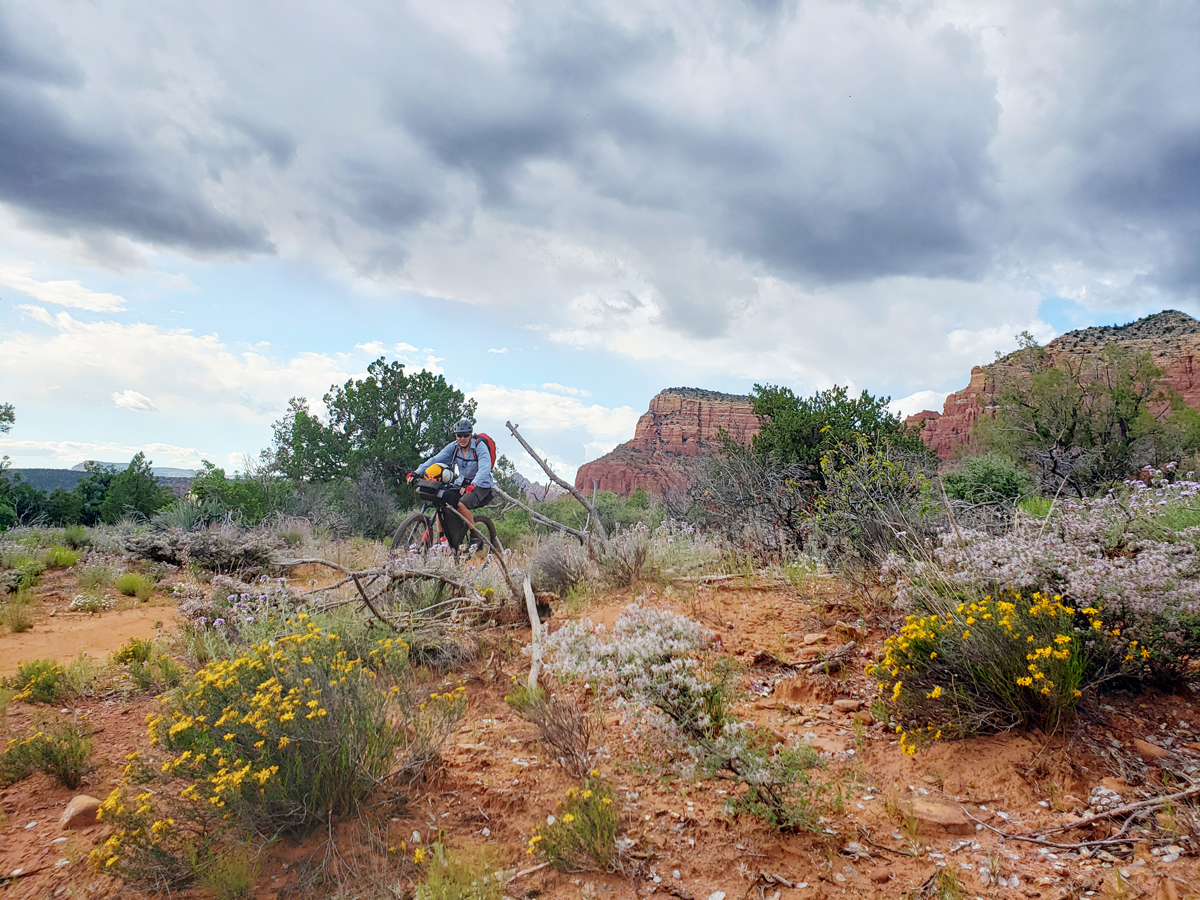
So now Postal was represented with still 1/2 of the race remaining … a good situation … maybe, maybe not … 9 riders with Fred R. and Oscar F. I noticed the time gap coming down fast … someone was bringing us back … It was Postal … apparently the team thought this break was a threat … I only wish I had known before my earlier efforts …

The team continued to ride (too?) hard throughout the race … in the end George would only get 7th in the sprint. Julian Dean was the only man left in the last lap … the rest of us left behind due to all the efforts to control and bring back breaks …

Wilmington Delaware 145kms

This is hard circuit … I started in the first 20 or so … single file throughout most of the circuit … I faded back for a couple laps and then started to move back up … not really feeling any better, just knowing from experience that it is often easier at the front … your head is more in the race then. 1/2 of the circuit meanders up, then there are several turns on a fast gentle decent. Near the top, past the start finish line, near the feed … (lap 8/20) I noticed Henk Vogels moving up …. I saw the move just as I saw Oscar the day before. Hank attacked hard, taking it over the top and burying himself down the backside … I was glued to his wheel. In my wheel was a Mroz rider (Wadecki) At the time I did not know his history … in the last few weeks he had won the Peace race, the Tour of Japan and took 2nd in the Tour of Solidarity just a few days before.

Henk and I rode 2-laps flat out then the Mroz rider (Pitor Wadecki) started to ride. The three of rode well in concert … we were flying … and held strongly to a 1:00 lead. I did not expect us to make it to the end … only to test the teams left in the peloton, and to take pressure off of Postal. Jack and Jones team tried hard for two laps to catch us … but actually lost a bit of time to us … eventually it was obvious that we would make it to the end … I had buried myself in this effort … we would have ridden 12/20 laps off the front with an 45kph average … very fast!!!! I soon had orders from the car to sit on … with 3 then 2 laps to go … I knew that Henk was fast … I knew that I would have to give it a surprise attack … but to sit on was not my style … anyway when is a free ride such a bad thing?? apparently on this day … I had buried myself and by sitting on. I think my body started to shut down … Wadecki made one strong attack on the uphill and when I tried to respond, my legs cramped severely … I had to sit back down and try to regain a rhythm … I did but I had to watch the two escape me … I was able to keep them in site … and see the final cat and mouse. But that it, a bit disappointing. I would take third … 3rd!

Trenton NJ 145kms

I was only able to ride hard in the end. The effects of yesterday’s effort took a while to go away. When it really counted, I was able to do my job … I made a few heroic efforts to bring back breaks. On the final lap Benoit and I rode 3/4 of if flat out … Mercury took over with 2kms to go … the rest is found in the results.

Philadelphia 256kms

What can I say about the Pro Championships????

We had a great situation from the start … Levi and Kirk were in the break of 20+- when it whittled down to 6, they were still both there …

Tactically it was perfect for us … although looking back, it may have made the race a bit too easy. because going into the last lap the field was just too large. A break escaped here on the last lap, and we had Stephane … Levi and I were given orders to bring it back. We came very close, leading into the Manayunk climb … Going up the climb I was still able to maintain a sensible position (top 15ish) I watched George make the bridge to the front group. (a couple of riders would get dropped and a couple would make the bridge.) This situation was what the team wanted … a small group with George in it., even better because Stephane was also there. Stephane drove this break very hard so that it would successfully stay away. George could then sit on.

Behind I was covering many attacks … there were still several riders and teams thinking that it would come back together or that they too could make it up to the front group.

The results of the sprint show it all … Henk Vogels, my companion form the race in Delaware attacked and soloed for the Philly Pro Championships win … a foreigner … so the

US Pro Jersey was still up for grabs … Fred Rodriguez won the sprint easily … George would end up 5th …

Fred becomes 2000 US Pro Champion for one year … I am happy for him … during the week he had finished 1,2,3,4, … and as of this late writing has a stage win in Swiss and is currently running 6th in GC. …as of stage 4.

So that’s if for a while … I am now riding the Tour of Catalonia … after the race in Delaware, I found out that I would not be doing Luxembourg … so I went home for a week of rest and altitude training. I look forward to a short break in July and then I will start to prepare for the second 1/2 of the season.

Marty

Desert Riders – The Bicycle Art of Trenton Higley

Artist bio: Trenton Edwin Higley (b. 1970) is a American Artist specializing in beautifully handcrafted representational figures, landscapes and narrative works in oil and watercolor.

Artist: Trenton Higley, Title: Desert Riders, Medium: Oil on canvas, Size: 36" x 36"
Artist: Trenton Higley, Title: Desert Riders, Medium: Oil on canvas, Size: 36″ x 36″

Often set within and around the Wasatch Mountains near by, his timeless paintings of strong alluring figures placed in intriguing situations or simply posed in a Landscape, strike a pleasing balance between the classical and the contemporary. His paintings are part of his desire to be in the outdoors riding his bicycle or skiing with his family.

Along with solo, joint and group shows in Jackson Hole, Wyoming, Park City and Salt Lake City, Utah and countless commissions, his artwork has been in many collections including Robert Duvall and Stetson inc.

Upcoming show: Trenton’s work is featured in an exhibition at 15th Street Gallery in Salt Lake City in Spring 2020. The gallery is located at 1519 S 1500 E, Salt Lake City, UT 84105; 15thstreetgallery.com

Find Trenton’s art here: trentonhigley.com.


Bikepacking the Coconino Loop (while thinking about the beach)

By Patrick Walsh — Remembering back to my first bike tour around 15 years ago, I had relationship issues and wanted to start the trip a month early… a week early… a day early… and then finally we were off. That ride took us toward the Grand Canyon along the Mogollon Rim on probably the heaviest and most overloaded bike I have ever ridden. It was before I really learned the beauty of “less is more”. I did not make it to the Canyon due to an Achilles tendon strain, my first and only non-crash related bike injury; that is before this ride – the Coconino Loop, Arizona. I decided to cut it 16 miles short due to sharp knee pain that fortunately healed quickly afterward. I anticipated many bike tours in much the same way, yearning to escape work stress, escape relationship stress, escape…

Patrick and Geoff - ready to ride, starting at the Broken Arrow Trailhead in Sedona. The trailhead is shared by hikers, bikers, motorcycles, and ATVs. On the Coconino Loop. Photo by Patrick Walsh
Patrick and Geoff – ready to ride, starting at the Broken Arrow Trailhead in Sedona. The trailhead is shared by hikers, bikers, motorcycles, and ATVs. On the Coconino Loop. Photo by Patrick Walsh

The fact is, we (almost) always choose great routes with goals of reconnecting with an old friend, seeing new places, and riding some fun roads and trails. But, I have almost always planned each tour at least partly to get away. Planning this tour a few months in advance I was again longing for escape. With a week of mixed single track, dirt road, slick rock, and pavement, we would circle the mountain bike meccas of Flagstaff and Sedona.

Templeton Trail is one of my favorite sections from the trip, capturing the feel of slick rock riding through healthy Ocotillo stands. On the Coconino Loop. Photo by Patrick Walsh

At planning time, I did not know of the oncoming life changes that resulted in divorce and then a new relationship – one that I did not want to escape. I did not know how this turbulence would impact my mentality and on the ride. All of a sudden, close proximity to civilization – something I would usually avoid – was a surprising bonus. I could text or talk in the evenings from camp; yes I really just wrote that about a bike tour. My recurring desire for life hiatus turned inside out, and if I am to be completely honest I was looking forward to the tour ending, really every day.

The first section interweaved with ATV routes. We were a little apprehensive about parking in the popular lot, but we happily returned to an intact vehicle. On the Coconino Loop. Photo by Patrick Walsh

Conversations with Geoff during the days touched on our careers, what went wrong with my marriage, memories of prior escape tours, and as always some route finding. The trip was fun, the riding was great, but my mixed feeling brought a little tension. Geoff once impatiently pushed me to get off a brief call when we had stopped to pick up beer at dusk, and I told him to go on to the next campsite. I don’t think he even knew where the campsite was. Geoff put up with a more-distracted version of my usual distracted self. I considered writing this article as a semi-apology to Geoff. At least twice I overshot turns, Geoff patiently waiting for me to realize it and return, once waiting nearly an hour. Nonetheless, he has already talked about another tour, a longer tour. So I know our long friendship survived, and I took some lessons away that might help future tours. Perhaps like any relationship, reflecting on and communicating expectations can go a long way to making a good trip great.

Walnut Canyon section was perhaps the most desolate of riding – not another person for a few hours. On the Coconino Loop. Photo by Patrick Walsh

Conversations in the evenings were not the normal banter and recollections from the day’s ride. Some time after dinner I was on the phone with my new partner Jacquie, talking about how we missed each other, all of the little things we enjoy, and our evolving life plans together. As a side note – at the last minute before the ride started, I bookended the bike tour with a short beach getaway with her. On one memorable night, she and I talked about walking on the beach, and it very much made we want to escape our dry, cow pasture camp. I really did not know these things when I planned nor even when I departed for the tour, but the tensions grew pretty quickly over the first 2 days.

Bikepacking always has some degree of uncertainty – where will you find water and food? Will the trails be rideable? Weather, equipment, etc. Taking someone else’s route adds a little more uncertainty, especially about their thinking or goals. Were they trying to have fun, cover certain distances and/or elevation gain, see specific features, embrace suffering and achieve enlightenment…? I added life turbulence and a new relationship, and I was surprised to find a strong desire to the escape the tour.

Wide, nicely graded roads between Williams and Parks, AZ. We enjoyed the pine forest and occasional views of Williams Peak above Flagstaff. On the Coconino Loop. Photo by Patrick Walsh

My companion Geoff was great as always, excellent ride quality, mostly perfect weather, and scenery that covered red slick rocks, alpine vistas, and extinct volcanoes. Really the tour had it all, save any real planning on my part. Without careful route review, we had embarked on the Coconino Loop, written up for bikepacking.com by Cass Gilbert. Bikepacking.com is a great resource with gear reviews, photos, route plans, everything you need to dream about riding and plan some adventure.

Spring is perfect for flower blooms. Sedona summer will wilt you. On the Coconino Loop. Photo by Patrick Walsh

The terrain held a little of everything from moderately technical trails, gravel roads, pavement, burgers and beer…always a must for me on these rides. There were a few places that the route felt like it was intended for a race with requisite per diem distance or elevation in mind. We skipped one of those sections and rode another, resulting in riding a loose, wandering motorcycle track. But really, the route is great, easy to find food and water, and close to civilization in case you want to call or text.

Twin Buttes and Two Nuns rock formations. Slick rock riding near Sedona is similar to Moab but the vegetation is more dense and lush. On the Coconino Loop. Photo by Patrick Walsh

We elected to start from Sedona after ominous rainstorms muddied the high country around Flagstaff. This turned out to be perfect, putting the actual mountain bike highlights at the start and then near the finish of the ride. Not that the middle is not good, but the trails in and between Sedona and Flagstaff are what we came for. Sedona’s sometimes technical slickrock contrasts with Flagstaff’s hardpack, rocks, and roots.

Riding in and out of slick rock canyons, with towering red rock views. On the Coconino Loop. Photo by Patrick Walsh

Within the first mile, any stress and aggravation from life, work, travel, bike repair, etc. melted away. Sedona trails on this route were moderate but still provided some challenges on loaded bikes. We chose campsites in the Coconino National Forest, usually with expansive views in mind but not always a flat spot for a tent. Water is scarce but manageable between some of the towns. One day we woke up to hot air balloons above. Another there were elk passing through camp. We chatted with a construction worker who was backpacking for his bucket list while eating at an historic former gas station.

Portions of the ride were sublime, but my mind was back at home or on the beach. We talked in the evenings about vulnerability and commitment. I hoped that we would avoid implosion. We have, we are now engaged, and I am still working on convincing Jacquie that she might like to bikepack – or maybe set up a central camp and ride mountain loops to avoid carrying all that gear and water. Setting those expectations will be critical for success as with any tour. I had a lot going on, and I should have better warned Geoff. Maybe he already knew. He was certainly forgiving, and I appreciate it.

A map of the Coconino Bikepacking Loop. Map credit Google Maps

If You Go:

The Ride – We rode a modified version of Cass Gilbert’s Coconino Loop.

The ride circumnavigates a large portion of the Coconino National Forest. Distributed camping is easy, and there are not many people around. We saw riders close to Flagstaff and Sedona, but more than 20 miles from those city centers felt relatively desolate.

Route Description – ~90% off pavement with grand vistas and moderately technical single track riding. Minimal pushing in a few spots. Lots of meditative graded gravel roads. Friendly locals. Easy navigation.

Start and finish – We chose Sedona’s Broken Arrow Trailhead, which was perfect. Flagstaff or Williams would work fine. Cottonwood would work too, but you would start with a steep, uphill climb.

Number of days – 5. It could be done in more or less. There are some great more-technical rides in Flagstaff and Sedona if you spend an extra night in each place.

Approximate mileage – Our version worked out to 234 miles. Cass’s is 250.

Know before you go – Weather can be really variable. Sedona can be very hot. Flagstaff can be snowing. They actually had heavy rain near the start of our ride and a few inches of snow the week after. Watch the weather, and you might plan the logistics just right.

Food and Water – The marked towns on the map all have food and water – Sedona, Cottonwood, Williams, and Flagstaff. There are both groceries and restaurants in each. There are a few water crossings and lakes for additional water filtering; and we rode along a few lakes. High county between towns might have snow to melt in spring.

Terrain – We rode a little bit of everything. Almost every day had at least 1 big climb. The climb out of Cottonwood was particulary long, and we did it on a hot day. Sedona was wonderful with grippy slickrock and a few small drops. The western side of the loop was mostly nicely graded wide gravel roads with a memorable descent into the Verde River Valley before a long climb toward Williams. Flagstaff area has narrow single track through pine forest as well as some graded gravel roads. There are really no bad parts. Great ride with views

Bikes – We both rode hardtail mountain bikes with bikepacking gear but with pretty different setups. Geoff rode a Surly Krampus, and Patrick rode a Lynskey MT 29. Goeff had wider tires and an extra bag – more comfort and more weight. Both reasonable choices, but the lighter weight Lynskey was definitely easier to lift over 2 or 3 locked gates we (legally) had to cross.


Big Cottonwood Canyon Closed Monday-Thursday to Cyclists Through August 2020

Partial Big Cottonwood Canyon Closure to Cyclists for Repaving

Salt Lake City, Utah – Big Cottonwood Canyon is closed to cyclists from milepost 8 to the top, starting June 24 through August 2020. Paving will start approximately 1 mile up the canyon from the Moss Ledge Picnic Area to the Winter/Summer Gate on the Guardsman Pass Road. Additionally, the Brighton town loop road will be paved.

Big Cottonwood Canyon is the home each year to the Porcupine Hill Climb. It will be closed to cyclists on many days during the summer of 2020. Photo by Dave Iltis

UDOT’s Big Cottonwood Canyon Project website states that cyclists will be restricted during the project.

The $4.5 million project is a pavement rehabilitation project that will grind off 3 inches of road surface and replace it with new asphalt. The UDOT project page does not indicate if lane widths will be adjusted to 11′ to accommodate wider shoulders and/or bike lanes.

One way, flagged traffic control will be implemented for motor vehicles. Also, except for local traffic, the Guardsman Pass road is expected to be completely closed from July 7-8.

UDOT’s website outlines pedestrian and cyclist restrictions:

Pedestrians and Cyclists

      • Pedestrians and cyclists will be restricted during daylight hours Monday through Thursday at various points between milepost 8 and the Brighton Ski Resort. These restricted access points will vary daily throughout the project as crews progress with paving operations.
      • There will be no restrictions for pedestrians and cyclists Friday through Sunday.

Another simultaneous project will install a pedestrian crossing signal at Cardiff Fork, milepost 10, at the Donut Falls turnoff.


Thoughts on Building the Home Bicycle Workbench

Home Bike Repair

If you’re like I am, you might literally be going crazy if you are subject to the self-isolation provisions to reduce the spread of the COVID-19 novel coronavirus. Some people are riding their bikes; either inside or solo outside. Others are not. Regardless, for me, part of the whole experience is spending time with the machine that brings us so much joy. I enjoy working with my hands; thus, working on bikes is nearly as therapeutic as riding them.

It Is Not Only About the Tools

Sometimes, I’ll go out to the garage and just pull something off the bike. Handle it. Clean it. Get really familiar with it. The more time you spend with your bike, the more you realize it will eventually need replacement parts. Spare parts are just as important as tools; sometimes even more so.

Keeping a clean workbench isn't just about presentation, it really helps you to make sure everything made it back on your bike! Photo by Eric Ramirez
Keeping a clean workbench isn’t just about presentation, it really helps you to make sure everything made it back on your bike! Photo by Eric Ramirez

Tools are essentially just paperweights if the repair actually calls for replacement. For example, worn cassettes generally cannot be repaired.

Building a home bicycle repair workshop assumes two things:

  1. You actually know how to use the tools on your workbench; and
  2. You have the spare parts you need to make those tools useful.

Don’t worry about trying to replicate your local shop’s repair area. Not everyone is going to have a liter of Shimano Mineral Oil on the shelf or an assortment of every possible disc brake pad and chain on the market. It’s your home workshop, so keep it simple. Make sure you have the most important spare parts on hand to keep your bike on the road (or trail).

Organization – What Do You Need?

Don’t rush off to your local bike shop and buy all the tires that fit your bike. Most of the time you’ll replace one or two tires a season. It will be helpful for you to have a spare chain and master-links, a couple of tubes, tire sealant, and maybe some cables and housing for your derailleur or dropper post.

Another thing to keep in mind: some of this stuff does not necessarily need to be new.

To save a ride, you often just need a part that isn’t completely worn out. Grips or pedals, for example. Or tires. In an effort to reduce waste, see if you can use something that you already have.

Keep your spare parts organized. The first step is to round up all your spare tubes, deflate and roll them, and bind them with a rubber band. I still have 26” tubes kicking around; I know this because they’re all organized. Do the same with tires. Get a bin or box for them. Clunky, big and awkward, tires have no place on a workbench. Better stash them underneath. Chains, brake pads, cables, and such, go well on the wall or in a drawer.

As you organize, look at your bike and make note of replacement parts you may need. This will vary widely between a home bike mechanic’s skillset and their bike. Getting ahead of required parts before the season really kicks off will save countless rides. So, go buy a spare tire and a chain; maybe add some grips or bar-tape. If you’re a little more confident in your skills, add brake pads, cables, and housing.

The Pay-off

Have you ever attempted back-to-back rides, only to be thwarted by a torn sidewall and a 3 hour wait for a tire change at the shop? Or an evening ride Friday night with smoked brake pads and an early Saturday ride? If you had a spare tire and extra brake pads on hand, a stop at the house and you’re riding anew.

Having the spare parts you need at home is perfectly prudent, and for me as a mechanic, it’s requisite. However, it’s even more critical when getting ready to hit the road for a bike trip. Being stocked at home makes packing for a trip way easier and immeasurably quicker.

With social-distancing protocols and limited access to businesses—bike shops are considered essential services here in Utah, but that’s not true nationwide—our whole approach to riding and getting our bikes working really does call for us to have more of a grasp on how our bikes actually work, and how to address the most common problems. Knowing that you can replace your tire, your chain, or that rancid smelling bar-tape without needing to leave your garage could really be helpful.

Don’t forget to support your local bike shop. They’ll be there for you when you really screw something up – or really want to avoid screwing something up. They should also have the spare parts you need, so that you can stock your home workshop as well.

Sidebar:

Essential Bike Parts to Have on Hand

  1. Tire(s)
  2. Chain
  3. 2 spare master-links
  4. Tire sealant
  5. Brake pads (disc or otherwise)
  6. Bar-tape or Grips
  7. Back-up pedals (plastic platforms $10)

Eric Ramirez has about 20 years experience working on bikes, starting in Park City. Today he’s a head technician at a shop.

No Cars, Better Cycling

I thank the stars for COVID-19. With people staying home and with little commuting for work, errands or otherwise, the roadways have been nearly abandoned. Conditions could hardly be better for a confirmed roadie like me.

I am jesting, of course. I recognize the seriousness of the COVID-19 virus, the many thousands of deaths it has caused and the toll it has taken in so many other ways. And while thankfully it appears its spread is being slowly curbed and contained, it has not finished its run and its ultimate cost in lives, health and economic difficulty and ruin is yet to be completely felt and determined.

A cyclist descends Emigration Canyon with no cars around. Photo by Dave Iltis

For myself, I was in the middle of an excellent ski season, spending many days on the slopes with friends and family, and a weekly ski day trying to keep up with my 4 year old granddaughter. Thankfully, we had just finished a ski vacation for which I had gathered my children and grandchildren from several states, when COVID-19 changed all that, causing the sudden closure of all ski resorts.

When the ski season ends, my heart and legs turn to cycling. It was no different this year, except the turning happened around the middle of March rather than the middle of May. But as I ventured out with my bike on the roadways, there was a noticeable difference: No cars. Or at least nearly no cars.

Leaving my home in Emigration Canyon, cars were no longer speeding around me to get somewhere important. On Wasatch Boulevard, I rarely had a vehicle zipping past me. The streets of Salt Lake County had never been so cyclist friendly. It was like riding on a quiet Sunday morning every time I went out to spin the pedals.

I was riding with my brother, Nick, in the middle of a usually busy weekday last week. We had ridden through a quiet University of Utah campus, down a nearly car-less 11th Avenue, around Memory Grove and the State Capital, and then back up 2nd Avenue. While pedaling up 2nd Avenue, Nick, who hadn’t ridden this road much, commented on what a nice street it was to bike on. While agreeing, I reminded him that on a normal day there would be quite a lot of traffic on this road.

I guess one of the silver linings of the pandemic shut-down is that exercise is not only not proscribed, but it is recognized as a good way to maintain our physical well-being as well as our emotional and mental well-being. And cycling is one of the best exercises as cyclists normally group in numbers less than 10, and naturally social distance, or more accurately physical distance, the recommended 6 feet or more. How’s that for doing what is best during this pandemic?

Consistent with the guidelines, I either rode alone or just with Nick. And we kept our distance from others. Of course, at our age, others are usually passing us, with distances between us and them closing and opening quickly, especially when we are headed uphill. Also, I have always been careful to do my nose-blowing and expectorating from the back of the group, but have been extra careful these days. I have not worn a mask while riding, which I have seen a few others do, but then that has never been recommended.

As government began to take steps to shut-down society to fight the virus, I began to worry about the longer term economic impact the shut-down would have. And I never realized the shut-down would go as far as it did. I fear the damage to the economy is going to be extensive and more long-lasting than the virus itself. But I am encouraged at how steps are being taken to re-open the economy and reboot businesses. Already, we are starting to slowly move back to a more normal lifestyle.

And that is good. It is what we hope and pray for. But I will miss the quiet streets and the sparse traffic. I will miss having every ride be like a quiet Sunday morning ride.


Richard Eborn – Living a Bike-Centric, Car-Free Lifestyle in Boise, Idaho

By Richard Eborn —

Q. Tell us a little about yourself.

A. My name is Richard Eborn. I am 60 years old. I am single, a father of five children and grandfather of nine. I work as a custodian at Boise State University.

Richard Eborn lives a car-free lifestyle in Boise, Idaho.

Q. What motivates you to commute by bike?

A. The short answer, I give family and friends, is that it’s good for my body, good for my pocketbook, and good for the planet. There are a multitude of other reasons. Take, for example, my ride to get to the University this morning. There had been rain last night. This morning, the rising sun was burning off the fog and clouds were clearing. The fall colors were splendid; the air was crisp and clear. As I was riding along the Boise Greenbelt, I was approached by a doe and buck (with a beautiful rack) who dove toward the trees and into the river when they were about fifteen feet away. Such moments are priceless, and wouldn’t be nearly so appreciated from behind a windshield at 50 miles per hour.

Q. Tell us a bit about your route/ride.

A. I live a little over two miles away from my work at the University. A little better than half the distance is on the bike/pedestrian path along the Boise Greenbelt (paralleling the Boise River.) I also use my bike around Boise to visit family and friends, run errands, shopping, to church and the temple, or anywhere else I need to go.

Q. Tell us about your bike.

A. I have a Raleigh Mojave 4.0 mountain bike, a little over ten years old. In summer I use 26 X 1.5 slick tires, but I switch to 26 X 2.1 knobby tires in winter. I have a milk crate on the back for carrying items. I also have a BOB trailer for larger loads, and a Burley Bee trailer for hauling grandkids.

Q. Describe your greatest challenge to bike commuting.

A. Dealing with cold, icy, wet conditions. Sometimes, I will have to revert to walking or public transit for the week or so it may get really bad. Mostly, though, I put on lot of extra layers and ride slow.

Q. What keeps you consistently riding?

A. Not owning a car. If I had a car, it would be easy on days that it’s cold or snow to simply say, “Nah, I will leave the bike in the shed today.” It’s just not an option, and I am too cheap to call a cab and too proud to impose on family or friends to drive me.

Q: What are the greatest challenges you face with a car-free lifestyle?

A. Dates. As an older bachelor, I am sometimes embarrassed to let the lovely lady know that we will have to walk, ride bikes, or take her car.

Q. What advice do you have for other bike commuters or people considering bike commuting.

A. Get out and do it. I remember when I first started, over fifteen years ago, not many people in Boise commuted by bike. especially in Southwest Boise where I was living at the time. I was intimidated and concerned about traffic and how I would look. Once, however, I began to realize the benefits, the joy of bike commuting far outweighed any concerns. Go with what you have. Just about any clothes, bike, or equipment that you currently have will work. Don’t spend an undue amount of time sweating and planning your route. Explore and come up with different alternatives. It’s a great way to get to know the byways and people of your city.

Q. Any final comments?

A. It’s gratifying to live in a city like Boise where bike commuting is really catching on. There are moments, on some roads, where the bicyclists outnumber the motorized vehicles. Our city and county government are working to improve an already pretty good situation. For example, I wrote our highway district about conditions on Walnut (a road along my daily commute.) Two weeks later, they had painted sharrows. Motorists are becoming more aware of and respectful of cyclists. It’s been at least a year since I was yelled at to “get on the sidewalk.” Then, there is the “Idaho Stop” that just keeps me rolling.

If you have a suggestion for a commuter profile, have a commuter question, or other comments, please send it to [email protected].

Parks, Peaks, and Prairies Bicycle Route Connects Yellowstone with Minneapolis

New Route Expands Adventure Cycling Route Network to 50,000 Miles

MISSOULA, Mont. (June 22, 2020) – Adventure Cycling Association’s newest route was always going to be memorable – the 1,374-mile Parks, Peaks, and Prairies Bicycle Route (PPP) brings the organization’s total cycling route network to 50,000 miles — but 2020 has tacked on another, unexpected layer.

Photo courtesy Adventure Cycling Association/Mike Vogl

Guiding cyclists from Yellowstone National Park, through Wyoming’s plains and Devils Tower National Monument, past the Black Hills, Mount Rushmore and the Badlands of South Dakota, on to the continent’s biggest rivers and some of the 10,000 lakes of Minnesota before finishing in bike-friendly Minneapolis, the PPP traverses iconic terrain, even in uncertain times.

“Our newest route takes in some of our country’s most beautiful natural wonders and national landmarks between the Rocky Mountains and the Midwest, and it brings our route network to a total of 50,000 miles,” said Director of Routes & Mapping Carla Majernik, who rode across the country in 1976 with Bikecentennial and has helmed Adventure Cycling’s Routes & Mapping department for decades. “However, we never imagined the challenges of traveling this summer as we designed it. So while 2020 might not be the ideal time to ride the full Parks, Peaks, and Prairies route, it’s a great time to tackle smaller sections if you live nearby or to plan for riding in 2021 and beyond.”

The PPP also offers a connecting option between the TransAmerica Trail and the Northern Tier bicycle routes, as well as crossing over the Lewis & Clark Trail near the new route’s midpoint.

Like all Adventure Cycling routes, the new Parks, Peaks, and Prairies Route was extensively researched by volunteers and the organization’s cartography staff before being distilled into cyclist-specific maps in print and digital form. PPP is available in print and GPX data format at adventurecycling.org/store, and via the Bicycle Route Navigator app on Apple and Android stores.

50,000 Miles

Beginning with the TransAmerica Trail in 1976, Adventure Cycling Association has steadily grown its route network to crisscross the country in every direction, plus a number of loop routes in some of the continent’s most compelling landscapes.

The Adventure Cycling Route Network includes the world’s premier bikepacking route, the Great Divide Mountain Bike Route, four east-west corridors (Southern Tier, Northern Tier, TransAm, and Bicycle Route 66/Chicago to New York City), four more north-south routes (Atlantic and Pacific Coast routes, Sierra Cascades, and Underground Railroad) and loops in Arkansas, Idaho, Texas, New York, and others.

Visit Adventure Cycling’s Interactive Route Map for an overview of the network, and see adventurecycling.org/routes-and-maps for more about the organization’s history guiding cyclists on two-wheeled adventure.

Adventure Cycling's new PPP route will connect Yellowstone to Minneapolis. Photo by Tom Robertson, Adventure Cycling
Adventure Cycling’s new PPP route will connect Yellowstone to Minneapolis. Photo by Tom Robertson, Adventure Cycling

The Cyclist’s Grocery List

Let’s face it, the current status of our world is forcing us to cook at home every day. This is not a bad thing! Most of us normally have the goal of eating out less and eating more healthily at home, so no better time than now. As cyclists/athletes, we actually have more time to train and therefore more opportunity to fuel our bodies properly.

But do you know what to get at the store to keep your fridge and pantry stocked with the right goodies?

At the supermarket, shop for healthful ingredients based on foods from the 5 food groups: fruits, vegetables, whole grains, lean proteins, and low-fat or fat-free dairy foods. Photo by Breanne Nalder-Harward

No matter how you shop — in the store or online — the basics of healthful eating remain the same. Use the tips below to maximize your purchases so that your cooking can trim fat, sodium, and added sugars while increasing flavor and nutrient content. Here we go!

At the supermarket, shop for healthful ingredients based on foods from the 5 food groups: fruits, vegetables, whole grains, lean proteins, and low-fat or fat-free dairy foods. Use the tips below to maximize nutrition and trim saturated fat, sodium, and added sugars in the aisles. The main tip to start is shop in color, and shop the perimeter of the grocery store first so you fill your cart with fresh foods before hitting the aisles and being tempted by processed foods.

Fruits and Vegetables

  • Choose multiple colors of fresh produce to get a variety of nutrients.
  • Tip: Produce is perishable, so don’t buy more than you need for the week.
  • Tip: When buying fresh produce, fruits and vegetables that are in season tend to sell at lower prices.
  • Pick up time savers such as prewashed lettuce and greens and precut fruits and vegetables.
  • Stock up on frozen, canned, jarred, and dried options. Choose plain frozen vegetables and reduced-sodium or no-added-salt versions of canned vegetables. Look for unsweetened canned and jarred fruits, or types packed in their own juice or water. Choose dried fruits without added sugars.

Grain-Based Foods

  • Choose mostly whole-grain versions of foods like bread, cereal, rice, and pasta. Examples are 100% whole-wheat bread, oatmeal, shredded wheat, brown rice, and whole-wheat spaghetti.
  • Enjoy “ancient grains” like quinoa, amaranth, and millet. These examples are whole grains, too.
  • Tip: Save time with quick-cook grains like quinoa or rice

Dairy (or not!)

  • Select low-fat and fat-free versions of milk, yogurt, and cheese. Or better yet, the plant-based milk alternatives will eliminate cholesterol entirely.
  • Compare added sugar on labels and choose those with lower amounts or the label “unsweetened.”
  • Almond, oat, cashew, soy, coconut, etc. milk alternatives are all great choices Change it up and try different milks with your smoothies, cereals, even baked goods!

Protein Foods

  • Choose lean meats — look for cuts with “loin” or “round” in the name to minimize saturated fat.
  • Buy skinless poultry or remove the skin before or after cooking.
  • Choose fatty fish such salmon, Atlantic or Pacific mackerel, tuna, and sardines for their heart-healthy omega-3 fatty acids. Find them fresh, frozen, canned, or in pouches. Opt for “wild caught” brands.
  • Try plant proteins like nuts and seeds, peanut butter, almond butter, beans (kidney, black, pinto, garbanzo, and more), peas and lentils.
  • Buy economical bags of dry beans to make from scratch. For convenience, stock up on reduced-sodium canned beans, or rinse regular beans under cold water to reduce sodium.
  • Experiment with soy proteins like edamame (green soybeans), tofu (soybean cake), and tempeh (fermented soybean cake that may also contain grains).

Oils and Spreads

  • For cooking and baking, choose a liquid vegetable oil like olive, canola, corn, cottonseed safflower, soybean, or sunflower oil. Oils contain less saturated fat than solid fats like butter and lard.
  • For spreads, buy soft tub, liquid, or spray margarines for less saturated fat than butter or stick margarine. Look for products with no trans fat by checking the Nutrition Facts label and in the ingredients for words like “partially hydrogenated.”

Strategic Shopping Tips

  • Staying organized is a key to saving time and money when you grocery shop. Try these tips:
  • Create a “master” list of frequently purchased items. That way, you can quickly check off what you need on your next shopping trip.
  • Don’t overbuy. Check your fridge, freezer, and pantry for items already on hand.
  • Make a shopping list. Put it on paper or use a meal-planning app on your smartphone that generates a shopping list based on your chosen recipes and other items you add. Many supermarkets offer apps that let you make lists and clip electronic coupons.
  • Be efficient at the store. Organize your list according to your store’s layout to avoid backtracking. Stick with the items on your list to avoid costly “impulse” purchases. Shop at less busy times, usually early in the morning or later in the evening.
  • Shop smart online. Review your past orders (usually available under your account information) to jog your memory for items you need. Stick to your list and resist the impulse to add unneeded items to your online cart.

When your pantry is well stocked, a nutritious and tasty meal or snack is just minutes away. Get suggestions for what to stock and learn about 10 popular pantry staples below.

The Scoop on 10 Popular Pantry Staples

  1. Oats. Oats provide iron and B vitamins, and contain soluble fiber, which may help lower blood cholesterol. Oatmeal makes a satisfying breakfast, but also enjoy oats in smoothies, cookies, pancakes, and homemade granola and snack bars.
  2. Whole-grain ready-to-eat cereals. Choose a cereal that lists a whole grain as the first ingredient. Compare the Nutrition Facts label on different brands to find options with at least 3 grams of dietary fiber and the fewest grams of added sugars per serving. Enjoy whole-grain cereal for a quick breakfast or snack or add to homemade trail mix.
  3. Whole grains. Nutty-tasting brown rice is a whole-grain food that offers dietary fiber, protein, and B vitamins. Use it as a side dish and in salads, soups, and stuffing. Use other whole grains, such as quinoa, millet, and amaranth, in most recipes that call for rice.
  4. Whole-grain pasta. Look for options made from whole wheat, brown rice, quinoa, or other whole grains. Whole-grain pasta is usually higher in dietary fiber and protein than enriched pasta. Stock a variety of shapes to use as an entrée with your favorite sauce, or as an ingredient in soups, casseroles, and cold salads.
  5. Beans and lentils. Dried and canned beans and lentils provide dietary fiber, protein, and B vitamins. Stock a variety such as black, pinto, kidney, and white beans, and brown, green, and red lentils. Add them to salads, soups, chili, salsa, casseroles, and pasta.
  6. Tuna, salmon, and sardines (cans or pouches). Packed with protein and heart-healthy omega-3 fats, use tuna, salmon, and sardines in salads, sandwich fillings, and casseroles, or for a snack on crackers.
  7. Canned tomatoes. Tasty canned tomatoes add vitamin C and the antioxidant lycopene to a variety of dishes. Use whole or crushed tomatoes for sauces and soups. Choose diced tomatoes for bruschetta, salsa, or guacamole.
  8. Stocks and broths (unsalted or low sodium). Stocks and broths add flavor to soups, stir-fries, sauces, stuffings, rice, pasta, and more.
  9. Mustard. Mustard, such as Dijon or spicy brown mustard, adds creaminess and zesty flavor to salad dressings, sauces, marinades, and dips. It’s also great in chicken, beef, pork, and seafood dishes.
  10. Cooking oils. Keep a variety of oils for different purposes. For instance, use a fruity olive oil in salad dressings and neutral-flavored canola oil in baked goods. Drizzle toasted sesame oil onto stir-fried vegetables.

Stocking a Healthy Pantry

Check out the list of suggested pantry stables below and add your own favorites. Read labels to see if items should be refrigerated after opening.

  • Beans, peas, and lentils (dry or reduced-sodium canned)
  • Peanut butter, nut butters
  • Pasta sauce (reduced sodium)
  • Cans or pouches of seafood (such as tuna, salmon, and sardines)
  • Canned fruit (water or packed in 100% juice)
  • Canned vegetables (reduced sodium or no added salt)
  • Canned soup (reduced sodium)
  • Canned tomato products (such as whole, diced, and crushed; reduced sodium or no added salt)
  • Jars of roasted red peppers, artichoke hearts, and olives
  • Dried fruit (without added sugar)
  • Whole-grain, hot, and ready-to-eat cereals (such as oatmeal, shredded wheat, and whole-wheat flakes)
  • Whole grains (such as brown rice, barley, bulgur, farro, quinoa, buckwheat, amaranth, millet, and sorghum)
  • Whole-grain pasta (such as spaghetti, rigatoni, and shells)
  • Whole-grain crackers
  • Popcorn (kernels or “light” microwave)

Take the next step and make your grocery list based on a meal plan specific to your needs and goals. For help determining your macro- and micro- nutrient needs, contact me to schedule an appointment.

Breanne Nalder Harward, MS, RDN, earned a BS in Biology and Sociology from Westminster College and went on to receive a Master of Science degree in Nutrition and Sports Dietetics from the University of Utah. She is licensed as a Registered Dietitian Nutritionist (RDN) and is the nutrition coach at PLAN7 Endurance Coaching and Utah Sports and Wellness. You can find more info on her at plan7coaching.com and utahsportsandwellness.com or follow her on social media @breezysaycheezy.