Home Blog Page 161

Bike Touring to Great Basin National Park

By Chris Blinzinger — My friend John Monroe and I have been touring around the Intermountain West for the past several years, always looking for an adventure. John and I met on Facebook several years ago after I reached out on a Bicycle Touring page for a touring partner in Utah. He sent me a message informing me that he and some friends had an upcoming trip planned (his second tour). We arranged to meet in Salt Lake City early on the morning of departure, introduced ourselves, and then headed out for a four day tour (my first). We have been on one or two trips a year since then and experienced a wide variety of conditions. For more than a year I had my eye on the Pony Express Trail in Utah’s West Desert as well as a visit to Lehman Cave in Nevada. Another bonus to that area is the opportunity to see the so-called “Darkest Skies in America” due to its lack of light pollution. It was going to be around/about a 350 mile trip. This is close to our normal length of tour that requires minimal days off work while maximizing the time to enjoy the journey. One of the great things about riding with a partner is that we pull each other along when either one of us needs it. John and I have become great friends during our adventures and I value that friendship more each time we head out.

The Pony Express Route

It’s interesting that the Pony Express is such a significant piece of history and Americana that only operated for 19 months. It has much more historical value and gets more recognition for its short duration than some American Presidents. The Pony Express could deliver mail from St. Joseph, Missouri to Sacramento, California in a mere 10 days. 1800 miles in 10 days is far better than we would do on our skinny tire touring bikes. We headed out on a Friday morning from my home in northern Utah County heading west into the Oquirrh Mountains. There is not any direction to ride along the Intermountain West for several days without the need to climb over a few mountains. Immediately after turning onto the dirt road that would lead us across the desert, we stopped at the first of many information signs and monuments that dot the Pony Express route.
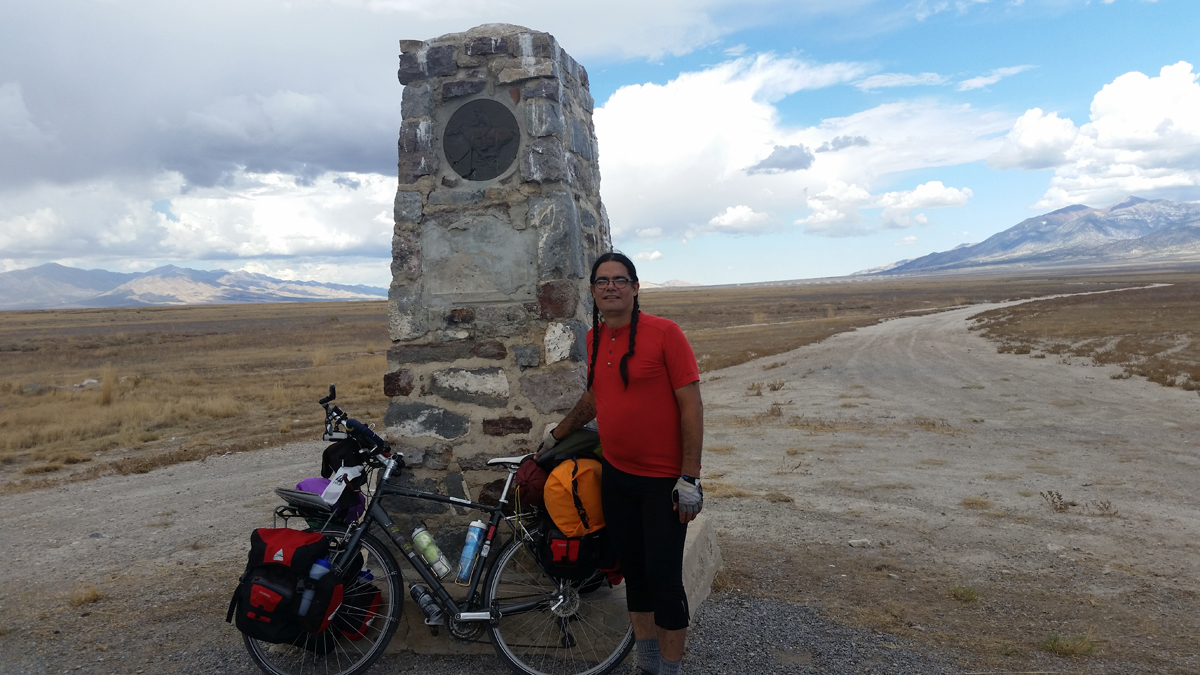
John in front of Pony Express Station Marker. Photo by Chris Blinzinger

Well on our way out into the Desert, the road was in good condition (hard packed dirt) and provided a historical monument every ten miles or so to signify a Pony Express Stop. Many of the monuments were missing the metal plate with the Horse and Rider, and in disrepair.
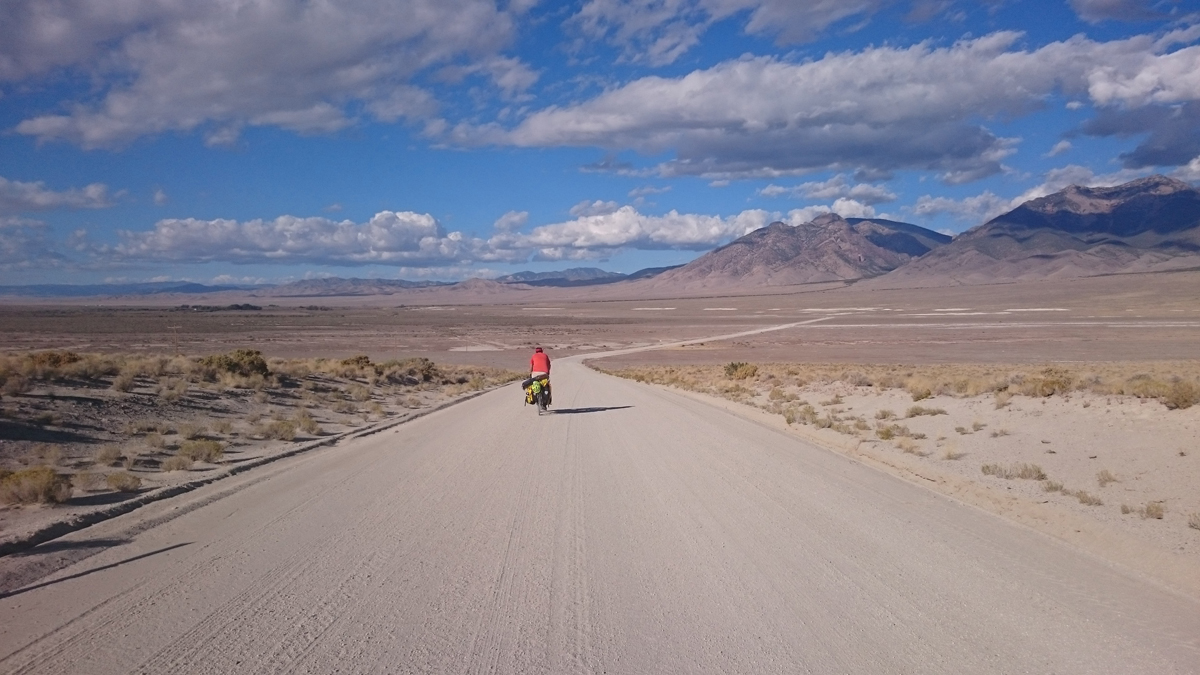
Chris headed toward Dugway Pass. Photo by John Monroe.

I was amazed at the beauty to behold out there. I expected to see sagebrush and rocks. What I experienced was a large expanse of desert grass, huge blue skies and peacefulness as we rode the long straight roads. It’s hard not to be awestruck with beauty of the desert. We watched a coyote run across the road in front of us and modified our line of travel from time to time to miss snakes in the road soaking up the sun. I imagined those Pony Express riders moving fast across that open space with a trail of dust behind them. We replenished our water at Simpson Springs Campground on the first night. We topped off our water at Fish Springs and turned off the Pony Express route before Callao, UT at the end of day two headed toward Hwy 50.

South to Great Basin National Park

In addition to the large stone monuments dotted along our route, there were 12 inch sections of a piece of railroad rail on a post with a descriptive plate detailing an old trade route or sheep camp. I got the impression from those markers that there was much more activity out there many years ago than the days we were out there. We did encounter a group of motorcycles doing a poker run and other motorists that wondered if we were lost. I always get a kick out of that question when we are out touring. Truthfully, I like it when they look at us like we are crazy. It’s part of the fun.

The road has so many variations of quality in every mile. Some sections are hard packed and easy to ride and pedal while others were sandy and loose and some just had ginormous rocks that are tube killers. It took some skill to avoid them when going downhill. But…there is a 200 foot section of paved road out in Trout Creek. We briefly enjoyed the short lived easy rolling as much as one could. The lone church out there has paved frontage. We stopped for a rest. We took advantage of the shade trees behind the church and sat at a picnic table under the pavilion. We replenished our water supply from a spigot on the pump house and washed up a little. We relaxed there for about an hour enjoying the breeze and plotting the rest of the days ride. It was truly an oasis in the desert.
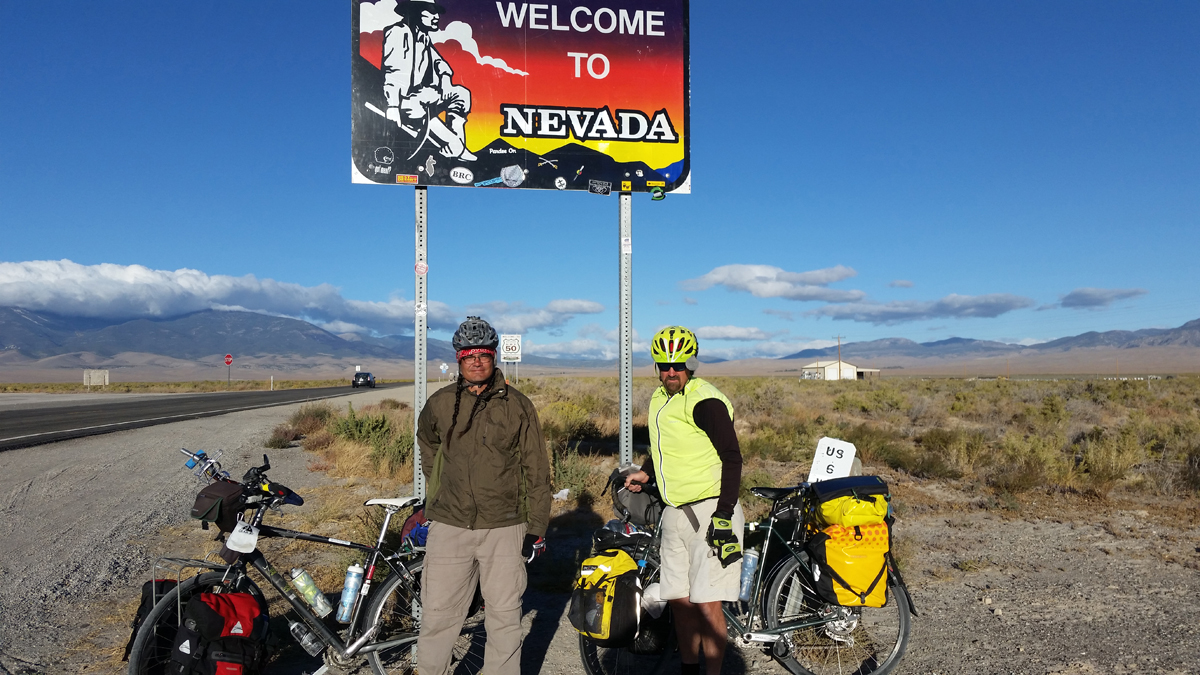
John and Chris at the Nevada state line. Photo by Chris Blinzinger’s tripod.

Soon we were headed out south toward Gandy where we hoped to stop at Warm springs before finishing the days ride by riding into the Border Inn at the Utah/Nevada state line. One hour later we were fighting 35 mph head winds. It was a drastic change from our oasis. Forward movement was slow going so we pulled over under shade and broke into our meat and cheese.

We were there for 15 minutes discussing what to do when a farmer stopped out on the road in his flatbed pickup so we walked over to talk to him. His dog jumped of the truck and ran passed us as we approached. We chatted briefly and swapped a few bike stories (he wants to do what we were doing and asked our opinion on a few things), then he offered us to come to his house 7 miles away to wait out the wind. We decided not to backtrack. While we like flexibility in our schedule, we had pre-purchased tickets for Lehman Cave. There was an annual astronomy event at Great Basin National Park and we followed their recommendation to buy tickets early.
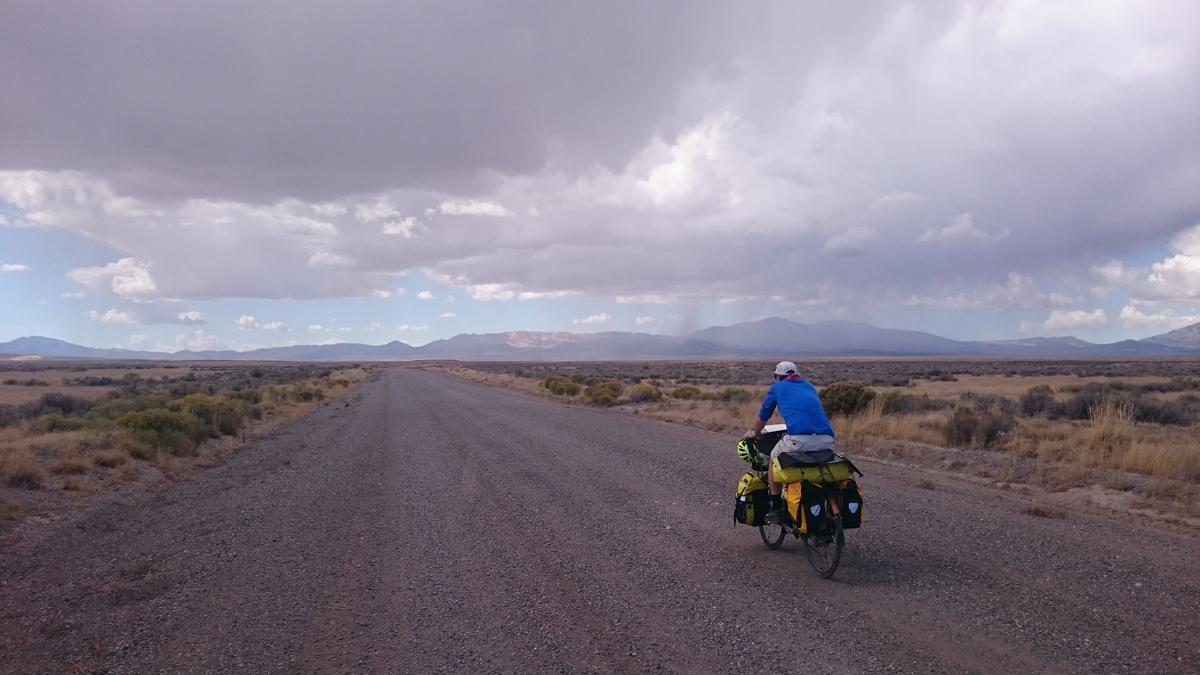
Rider in the Storm. Photo by John Monroe

We were concerned that the headwind would slow us down so much that we wouldn’t make it to our scheduled cave tour. Not sounding very flexible. I happened to look over toward our bikes and noticed his dog eating our lunch. He hollered and called his dog over. We shook hands and parted ways and went back to eating what was left of our lunch. We mounted up and continued on. It was tough going and we only managed seven miles in two hours. Wind can be demoralizing. Neither of us was able to encourage the other as we pushed on.

We hesitated to hitch a ride because we were there to ride the whole thing. Well, I heard a vehicle coming up behind us and at the last second, I stuck a thumb out struggling to keep my front wheel straight with one hand. The vehicle hesitated briefly and then I saw brake lights. I pedaled with new energy to see about a ride. The driver asked “Did you flip me off or are you looking for a ride?” I assured him I was looking for a ride. A rancher and his son had been out to check their herd and were headed to the Border Inn. We were in luck and loaded our bikes into their farm truck and hunkered down with our bikes. We passed the turnoff to Warm Springs in Gandy but that was no longer an option with our new found means of transportation. It was 35 miles to the Border Inn. We would have never made it to Lehman without that ride. The winds were supposed to last through the night. We hunkered down there for the night and ate at their restaurant.

To Great Basin National Park

We headed out for Great Basin the next morning. The wind was still blowing and it was much colder. We had a significant climb and planned on camping in the park that night. The climb was brutal, 1700 feet elevation gain with a cold cross wind. We were bundled up like winter commuters. We eventually found relief once we got far enough up the mountain for the hills to block the wind and let the sun warm us up.
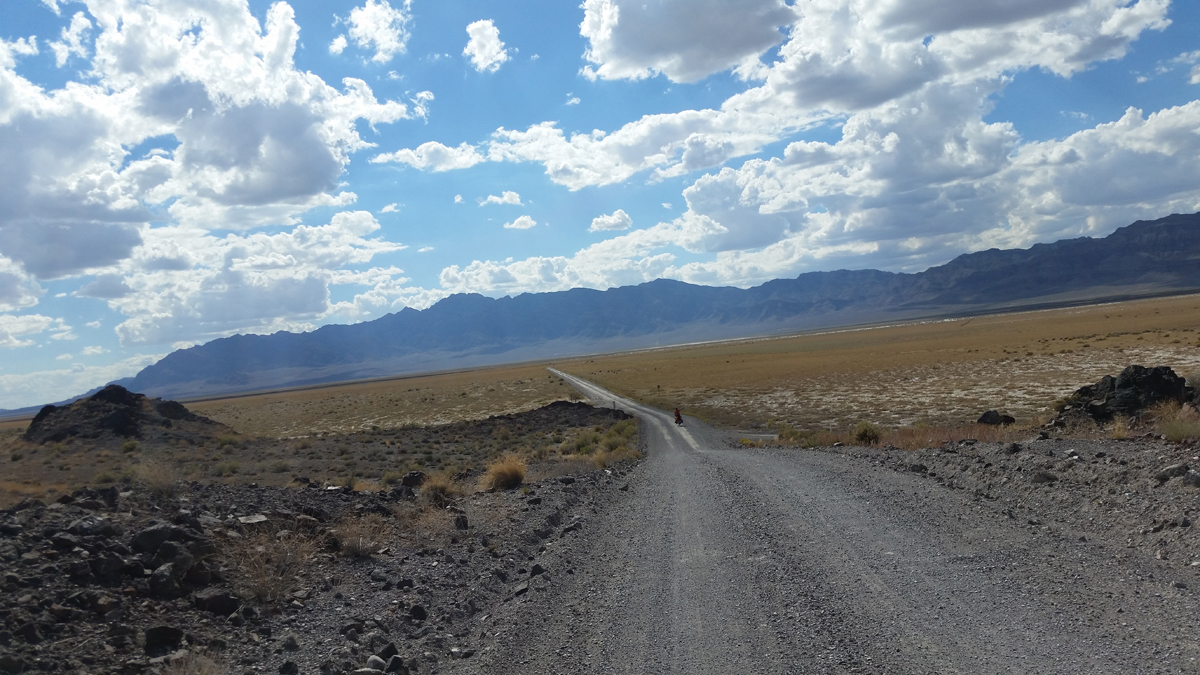
John Monroe on the road to Great Basin. Photo by Chris Blinzinger

The cave was cool. It’s worth the visit. The small visitor’s center has a restaurant for summer visitors. It was already Fall. The climb had really taken our energy so we sought out to find the campground and set up camp. It was easier said than done. When receiving directions it is essential to remember the description is subjective to the informant’s perspective. We know better but I guess we forget. Finally found our camp and enjoyed all you can eat pine nuts everywhere around us.
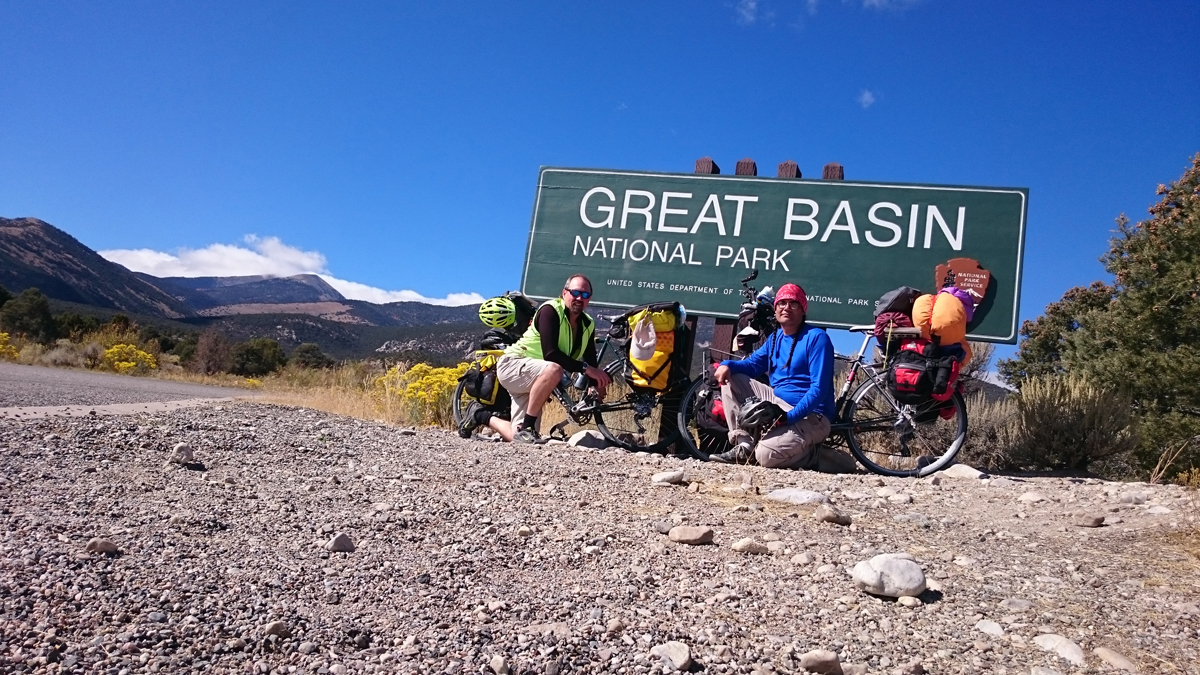
Chris Blinzinger (left) and John Monroe arrive at Great Basin National Park. Photo by Chris Blinzinger

Our first six miles of the morning were downhill leading us back to the Border Inn. Half way down the hill, we could see something ahead of us at the bottom of the hill on our route ahead that was causing a commotion in the road. It looked strange to us and we couldn’t make out what was going on. Looked like a traffic jam in the middle of nowhere as we could see a line of cars backed up. Once we were two miles away, it was clear what the commotion was but that only resulted in more questions. A two-seater airplane parked in the middle of the road. The pilot landed to chat with driver of a pickup, or just have coffee. They were as surprised to see us as we were them. We all had questions about what the other was doing there. We talked for a few minutes and the pilot loaded up and headed out. How often do you see a plane in the middle of the road in the middle of the desert? Well now I have.

Back to Delta

It’s funny how all roads look flat on a map. Our ride toward Delta was hillier than I expected. The pavement was a welcome relief from the 150 miles of dirt road we had been on. We camped close to Sevier Lake ½ mile off of Highway 50/6. I got up in the middle of the night to see a man about a horse, and admired the stars with amazement. From horizon to horizon, there was 180 degrees of bright stars. It was impressive and best view of the stars on this trip so far. We enjoyed a tailwind as we headed east to Delta, then northeast toward Leamington and up over the mountain into Nephi. We rode through some cool little towns on the way to Nephi. We encountered a cross-country female cyclist halfway to Nephi. She started off in Florida for a ride to see her brother in the Midwest but decided to keep riding until she reached the Pacific. I gave her my maps for the west desert crossing. We arrived in Nephi that evening. This is where our trip ended. My wife picked us up in Nephi and drove us home. We lost John’s bike off the bike rack on the way home. We went back and found it but…That’s another story.

Nuts and Bolts

  • We left the last week of September. The trip was 351 miles with 10,331 feet of elevation gain.
  • We spent five nights and six days on this trip. Every trip is hard and fun and easy and adventurous and thought provoking and rewarding.
  • This was a great time of year because days are warm but not too hot and nights were cool.
  • John and I have become used to carrying plenty of water. That is probably the most significant consideration for the trip. There are places to get water but you should carry plenty in case you have a problem. I am glad we did it. We carried 10 liters each and a filter. We never had to use the filter.
  • It is remote, beautiful and something I can check off my list.
  • Baker, Nevada is a ghost town this time of year, businesses are closed up so stock up at the Border Inn if traveling up to Great Basin National Park this time of year. We carry calories, protein and enjoy a hot drink in the morning and after dinner. John made some great dehydrated meals for the trip.
  • Meat sticks, trail mix and Hudson Bay Bars (homemade oat bars) are easy to access while riding and we never pass up a convenience store.
  • The route along Highway 50 is wide open, but camping can be difficult because of the fence that parallels with infrequent gates and side roads.

Now we are talking about doing the Loneliest Road in America through the rest of Nevada. But first we will ride to Grand Junction in June.

Chris Blinzinger is an Emergency Manager and avid cyclist living in Pleasant Grove, Utah. He traded in his horses for two wheels over a decade ago and is now a regular bicycle commuter/tourist.
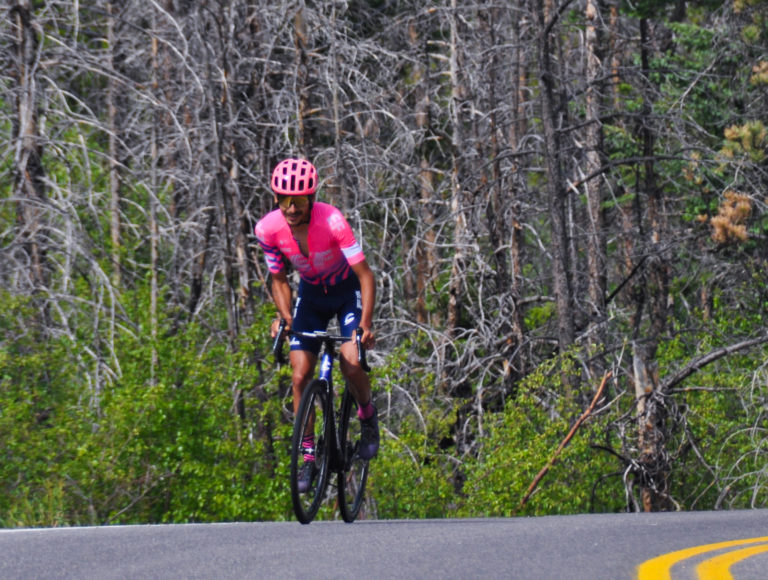
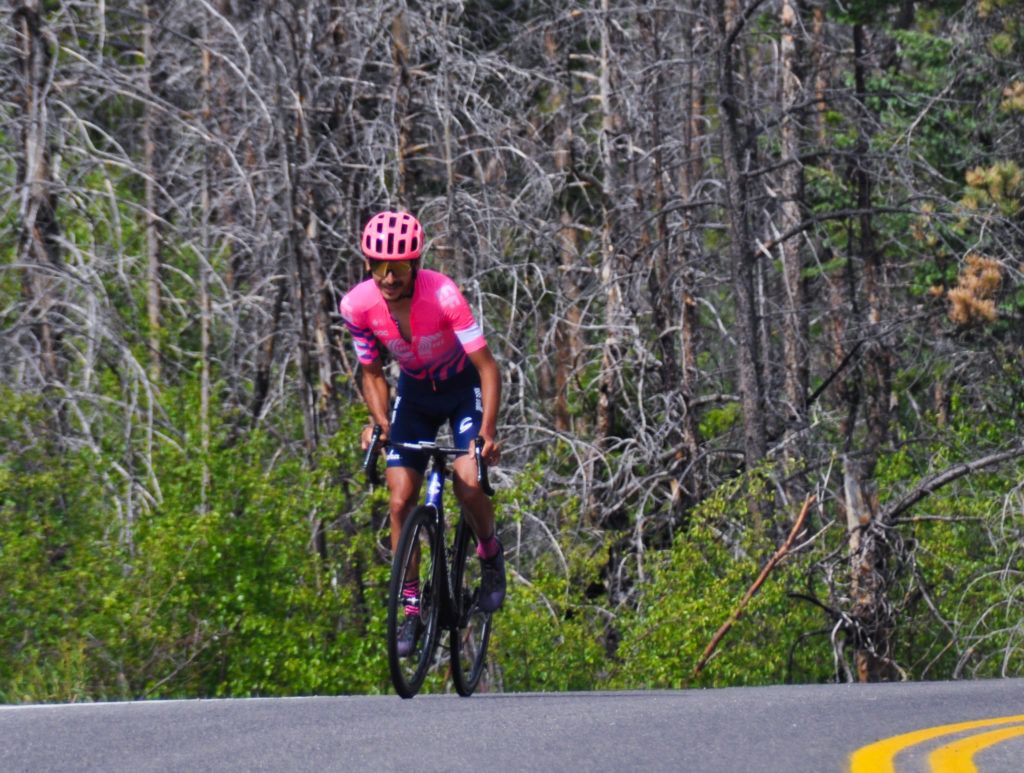
Lachlan Morton Takes Men’s Everesting Record (again) in Second Try

Following his recent Everest record and subsequent denial of that record, Lachlan Morton has once again taken the Everest crown with a time of 7 hours, 29 minutes and 57 seconds on Colorado’s Rist Canyon climb, taking the fastest known time away from Utah’s Keegan Swenson, who had recorded a 7:40 on the iconic Empire Pass climb. An interview, courtesy of EF Pro Cycling follows.


View this post on Instagram


Had a really great day out with family. I was happy to be able to enjoy this one. @thatisgus with the shots.

A post shared by lachlanmorton (@lachlanmorton) on


Last weekend, Morton thought he broke the Everesting record. The organizers of the challenge did, too. But alas… a glitch in the elevation data on the climb he rode more than 40 times proved the record’s undoing. He posted on social media shortly thereafter: “Well looks like I gotta do it again.” Mind you, it’s no simple day out — that meant he needed to ride seven plus hours again and climb more than 29,000 feet.

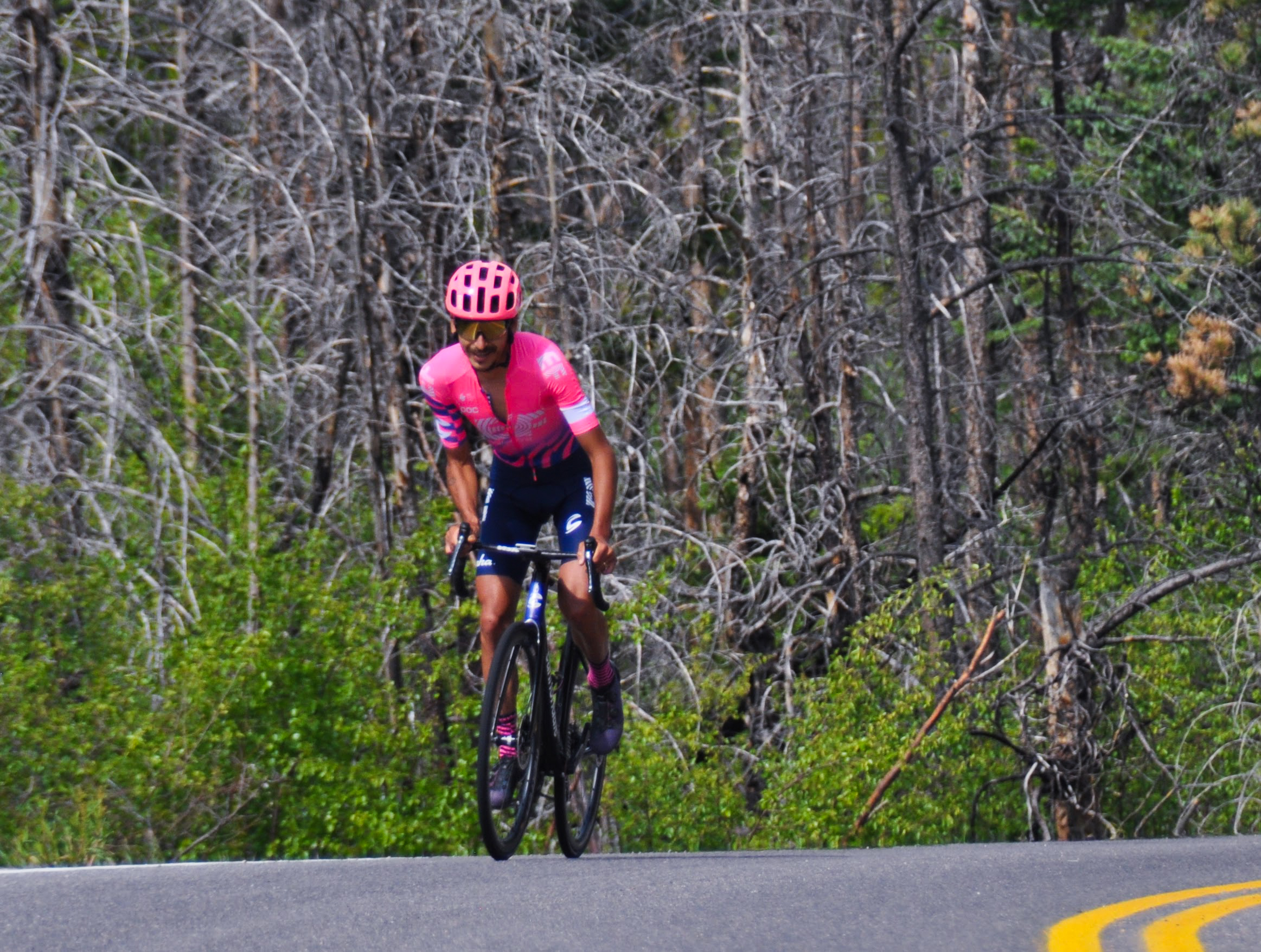
Lachlan Morton during his Everesting attempt on Saturday June 13, 2020. Photo credit: EF Pro Cycling
Lachlan Morton during his first (and recinded) Everesting attempt on Saturday June 13, 2020. Photo credit: EF Pro Cycling

He made good on his promise Saturday, June 20, 2020, besting the standing record by more than 10 minutes. With his family for support on the road and a beautiful Colorado day, the Australian rode the required 8,848m of ascent in 7 hours, 29 minutes and 57 seconds, marking a new record that has been verified by Hells 500, the event administrators. 

“We never intended for there to be Everesting records. In fact this whole challenge was always the opposite of racing. That said, like many of the community we feel we are now just an excited bystander, watching this whole crazy story unfold around us,” read a statement from Hells 500.⁠

“Lachlan Morton’s time of 07:29:57 is incredible, however the thing that will always remain — irrespective of what happens to this particular record — is that when faced with a result that didn’t sit right, he just got back out on the bike and did it again.⁠”

In true Morton style, he added an extra lap. Just to be safe. Hear from the man himself below, and check out his ride on Strava

What ran through your head and heart after you found out the initial record didn’t stand?
I guess I was confused, but I also understand that the creators didn’t really intend for Everesting to be about records, so I got how it could happen. I didn’t want anyone to think that I was being dishonest so I decided I’d just do it again. 

How’d you approach it differently this time?
I worked with the guys at Everesting to triple check a shorter segment on the same hill so we could be sure it was legitimate. They were really helpful and had everything independently checked on their end — I appreciated that alot.  I also had a bit of fire this time ‘round, which helped. Mentally knowing what I was in for helped a lot. I understood the effort that was needed. Doing it again so soon was a challenge, but I wanted to set the record straight, mainly for myself. For something like this internal motivation helps so much. 

You said something surprising: that it was easier the second time. Really?
Yeah, purely from a mental perspective it felt easier. My legs still felt the effort of last week, but I was at peace with the effort that was to come. I took a fair bit of time the days before preparing my head for that, but I knew how to handle it.

Any tips for those looking to go out and Everest themselves?
I’d say pick a place that you enjoy riding, understand it’s going to be a big day and your head will get negative and you will need to deal with that. Finally, bring people you really care about to support you. It’s a great challenge that’s really accessible.

Is two times enough?
Yeah, I think so. I’m glad I could somewhat enjoy it. That’s important to me. I can put it to bed for now. I hope someone goes faster and pushes the limit further, I’ve done my part.

Preparing for a Century Ride

Spring is upon us and the calling to put in big miles as winter ends is loud! We’ve got the list of events whether they be races, gran fondos or searching for personal best efforts. The idea of doing a big century ride either in training or one of the many mega endurance rides/races is super appealing yet quite daunting.

Bike riders on century ride in Utah
Century rides are held on some of the nicest roads in the state and provide
an opportunity to ride with a great group of people. This is from the 2014
Tour de Cure, a ride that needs to be on your list. Photo by Dave Iltis

Have you ridden 100 miles before? Wondering if you can? Wonder no more and start making your plans to make it happen. For many the idea of riding 100 miles sounds daunting. Is it doable? Yes! Here are a few tips on making it happen for you.

  • Choose your timing – when do I start training? What are your expectations?
  • Select some events or dates for your desired performance – look at the calendar and track down events that appeal to you and/or decide on dates for your peak performance
  • Consider your time constraints – how much time do you have available for training? • Does that align with your current lifestyle when you consider work, family/relationship, social
  • Make sure to allow time for recovery and rebuilding between tough training blocks and post event
  • Build your training plan, hire a coach, buy a prebuilt plan for the particular event
  • Consider the terrain, time of year (weather/environmental conditions), event elevation as you put together your training
  • Consider nutrition and hydration planning
  • If this is a pack riding event make sure you are ready to be surrounded by other riders

Ok, let’s get down to the details of the preparation.

Choosing Your Timing

Hopefully you’ve been doing some training through the winter months so you’re not starting from scratch as spring approaches. Even a few days a week through the winter can make a huge difference once you start training in earnest. If your favorite century ride is in April and you haven’t started training it might be one you suffer through to finish.

Part of this comes down to expectations. If you are doing a century in April and you haven’t been riding a lot keep your expectations reasonable and realistic. It may turn out your average speed is much lower than a similar effort in July after your training is making a difference in fitness levels.

In addition, as you start out with training make sure to put things together progressively. It’s tempting to jump right in to 15 hours of training per week if you have the time available. However, you might put yourself over the edge!

Select Your Events and Dates for Peak Performance

Planning out your season is essential for peak performance. Build a calendar of events/dates to help build out your training plan. Having dates in mind adds accountability to your plan and helps with motivation as the training advances.

Choose events that are fun, appealing and challenging! Some of the most entertaining events for me are when a bunch of teammates decide to hit an event together. The anticipation and excitement builds within the group. That’s amazing for motivation!

Consider Your Time Constraints

Nothing stops you in your tracks of motivation than overestimating your time available for training. Be reasonable as you consider the amount of time you have for training. Training for a century ride is doable with limited time. Just make sure you get some long rides in before the big day. Make sure your work/social/relationship schedule can tolerate the time you are planning for training.

Riding big miles will definitely help you with efficiency and fitness. Riding with a purpose is even better. It’s called junk miles versus intentional miles. Pedaling is a good thing. Even steady riding at endurance levels is super beneficial. It drives me crazy when people say they are putting in junk miles. Have your mindset be about purpose when you jump on the bike.

Recovery is When You Get Stronger

Training for big events puts a huge load on your physiology. Training breaks the body down, hopefully with a purpose if you’re following a sound training plan. The days you take off or ride at Active Recovery allow your body to use resources to rebuild rather than work.

The physiology has a chance to rebuild muscle, build more red blood cells, and increase plasma volume in addition to other changes. Remember it’s important to go hard on the hard days and take it easy on the mellow days. Riding at mid-throttle all the time doesn’t provide the big gains over the long haul.

Plan Your Training

Training with a plan provides intention and purpose. You’ll stay more focused on your goals and the particular preparation for your big events. Building out the plan takes some effort knowing where to place the big work as well as making it progressive so you avoid stagnating or overtraining. Programming in rest and recovery is as important as hitting your Tempo and Threshold efforts.

Building a training plan takes some effort. There are plenty of resources out there. Many people have used Joe Friel’s Training Bible books. Hunter Allen and Andy Coggan “wrote the book” on training with power – Training and Racing with a Power Meter. You can take their information and create a solid training plan for yourself. Another option is to hire a coach to help you match up your time constraints with your goals and intentions with a customized training plan. There are also plenty of pre-built training plans available based on how much time you have available and which type of event(s) you are trying to crush.

Further Considerations

There are plenty of other considerations as you lay out a plan for success. Terrain of the event, environmental conditions like temperature and elevation as well as pack riding should play into your training plan.

Terrain for the goal event should go into your planning. Along the Wasatch Front plenty of people look forward to the Ultimate Challenge, the amateur event that follows the Tour of Utah Queen Stage. In years past the event has been as long as 110 miles with 10K feet of climbing. You need to plan for the specifics of your goal event in your training. Whether it be lots of climbing or having some dirt/gravel sections make sure you are familiar with the event demands.

Another important consideration commonly overlooked is adaptation to temperatures you will encounter during your goal events. If you’re planning on having peak performance in July you need to make sure your body is ready to handle hot summer temperatures over multiple hours. It’s definitely more comfortable to train in the cooler temperatures of the morning. However, if you haven’t experienced hard efforts in 90+F until your event you might find yourself in trouble.

Time to Get After It!

It’s time to find your events if you haven’t already. Figure out the calendar, look at the course profiles, think about your time available for training and start to lay out your training plan. Remember there are coaches out there who are ready to build a plan based on your goals and time constraints.

As you start rolling through your training plan you can start practicing your hydration and nutrition plan. These are key aspects to successfully reaching your goals. You don’t want to be surprised with stomach upset or not understanding the caloric demands of your event. You can learn all of this by practicing during your training.

Pack Riding

Finally, if your big day is a pack event you definitely want to know how to ride in the group. Drafting saves energy and allows you to ride faster for longer. Make sure you get out with an experienced group and train your ability to ride in close quarters with large groups. We are all responsible for each other in a pack. If I ride safe, I keep you safe and vice versa. There are many options for group riding.

It’s exciting to be rolling into the new season. Make sure to enjoy yourself along the journey of putting in the big miles. Nothing makes me smile more on the bike than putting out my best effort. Those days happen because of intentional purpose and lots of hard work.

Dave Harward runs PLAN7 Endurance Coaching. PLAN7 offers individualized training plans customized to your goals and time constraints, nutrition programming and metabolic rate testing as well as bike fitting. Dave brings nearly 3 decades of race experience in multiple disciplines and 12 years of coaching and bike fitting experience to the table. Learn more at www.plan7coaching.com

San Luis Obispo Tops 2020 PeopleForBikes City Ratings

0

Other western state cities ranked in the top-10 include Missoula, Montana (5th), as well as Fort Collins (7th) and Denver (8th), Colorado.

BOULDER, Colorado. (June 9, 2020) — PeopleForBikes has released its third annual ratings of the best cities for bicycling in the U.S. The PeopleForBikes City Ratings program is a data-driven analysis that evaluates more than 550 cities and communities and shows city leaders how they can invest to make bicycling better for all residents and visitors.

City Ratings are scored across five key indicators: Ridership (how many people are riding bikes), Safety (how safe is it to ride bikes), Network (how easy is it for people to bike where they want to go), Reach (how well the network serves all parts of the community), and Acceleration (how fast the community is working to improve biking).

Image courtesy People for Bikes.

Topping this year’s overall ratings are San Luis Obispo, CA (1); Madison, WI (2); Santa Barbara, CA (3). Rounding out the top ten are: Washington, DC (4); Missoula, MT (5); Rogers, AR (6); Fort Collins, CO (7); Denver, CO (8); Grand Forks, ND (9); Fayetteville, AR (10).

Other cities in the western region, such as Salt Lake City, Utah and Boise, Idaho have either dropped down the rankings or stagnated, indicating they haven’t capitalized on their previous rankings by continuing to complete bicycle-related projects.

Salt Lake City’s network is relatively high quality, and ridership is increasing in the downtown area where the network is concentrated, although there are still concerns about safety. The city’s commitment to expanding the network appears to be waning, however, and without buy-in and expansion throughout the valley, the area’s ranking will likely remain mired in mediocrity. Boise’s bicycle network needs improvement, but the city’s apparently lack of commitment are keeping ridership and perception of safety down.

On the other hand, Missoula, Montana which ranked as the 5th highest city in this year’s survey is considered to be a highly safe city in which to ride, and the city government is perceived to be making significant progress towards continuing the growth of cycling as an alternate form of transportation.

As a small resort town (population 1700), the reputation of Crested Butte, Colorado as a recreational Mecca has contributed to its score reflecting one of the best bicycle networks in the nation; but while the feeling is that the city has made significant progress in the past, it doesn’t appear that there is much commitment to growing the cycling infrastructure even further.

Las Vegas, Nevada ranks well below average for ridership, safety, and network quality, but is currently experiencing one of the highest growth rates in bicycle facilities and infrastructure, as well as events. If this trend continues, ridership and perception of safety should rise contributing to an increase in their overall score.

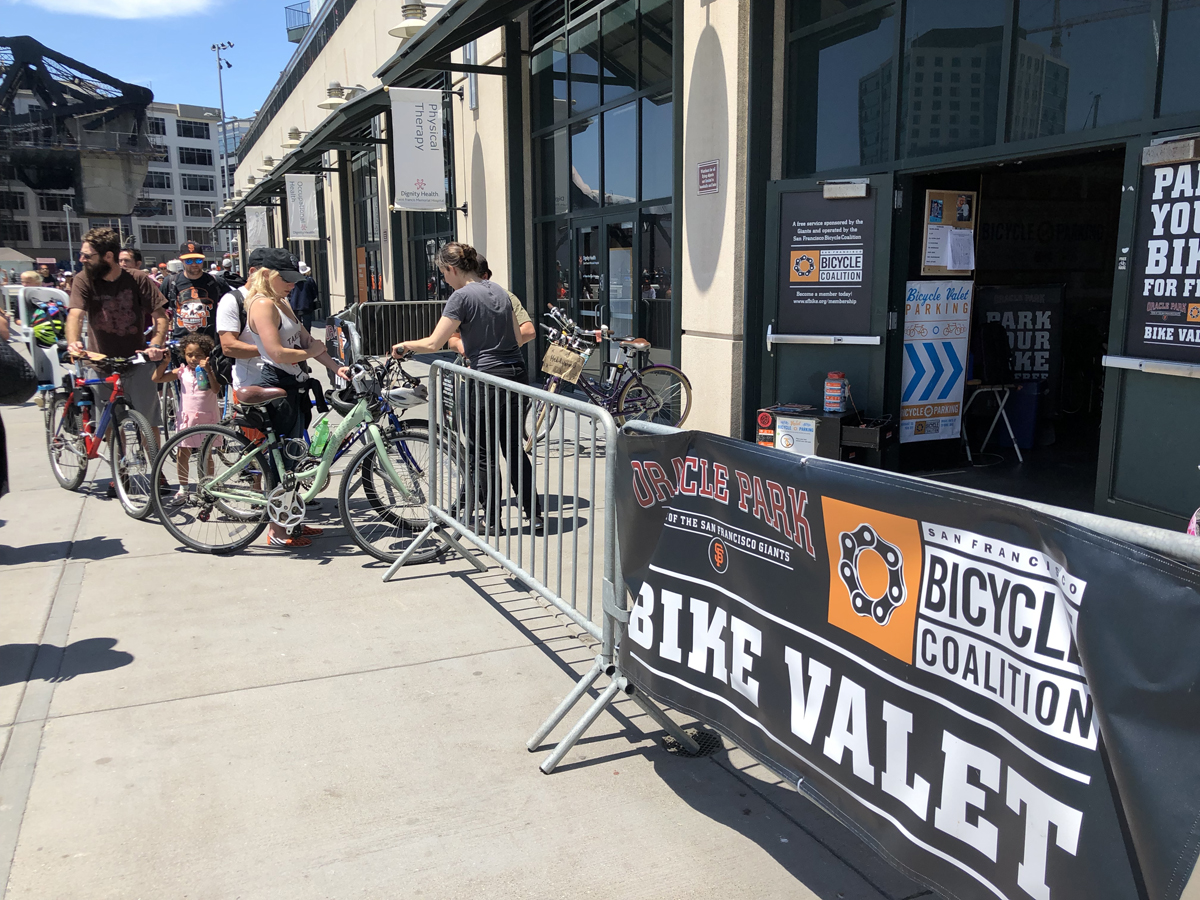
This bike valet at the San Francisco Giant's baseball stadium is run by the San Francisco Bicycle Coalition. Programs like this, and San Francisco's extensive bike network are reasons that San Francisco has a high participation rate in cycling. Photo by Dave Iltis
This bike valet at the San Francisco Giant’s baseball stadium is run by the San Francisco Bicycle Coalition. Programs like this, and San Francisco’s extensive bike network are reasons that San Francisco has a high participation rate in cycling. Photo by Dave Iltis

San Francisco, California has one of the highest rates of overall ridership in the nation, especially recreational use amongst it wealthy residents, but also as a form of alternate transportation amongst commuters due to the city’s longstanding commitment to improving bicycle facilities. As its bicycle network enjoys nearly complete penetration throughout the entire city, there is not much room for continued growth, except in the crowded and busy Financial District, which has created a slight drag on the city’s overall score.

“Now in its third year, the City Ratings creates a complete picture of bicycling in cities based on measurable factors,” says Rebecca Davies, PeopleForBikes’ bicycle networks data manager. “Top scorers are cities of all types and geographies who have succeeded in different ways, including cities that have made strong historical investments in active transportation as well as cities pursuing ambitious plans to rapidly implement high-quality bicycle networks on their city streets.”

Data for the ratings comes from existing sources (including the U.S. Census American Community Survey and the National Highway Traffic Safety Administration’s Fatality Analysis Reporting System), as well as sources developed by the PeopleForBikes team to capture city-specific data based on mapping, city planning information and survey responses from community members. This year, community members submitted a record-breaking 68,000 surveys. From these sources, 184 calculations are performed per city to determine individual category scores, as well as a city or town’s overall score. Read more about the methodology here: https://cityratings.peopleforbikes.org/methodology/.

Three years in, the PeopleForBikes team is able to identify key takeaways from the program. Top performing cities see their scores buoyed by Network and Acceleration scores. Communities should prepare to invest for the long run when planning new infrastructure; building ridership takes time. Communities looking to take a first step should prioritize building a safe, convenient network of bike lanes, trails, and paths; it is the most critical factor in understanding success in the other categories.

“City Ratings shows us what works: Places that have built better places to ride are seeing the benefits,” said Kyle Wagenschutz, director of local innovation for PeopleForBikes. “Our top scoring cities showcase the diverse ways that bicycling is thriving as a source of transportation, recreation, and inspiration. From San Luis Obispo, CA to Washington, DC — and all the places in between — city leaders are recognizing bike networks help relieve traffic congestion, increase mobility and opportunity and make our cities healthier.”

City Ratings is a key component of the PlacesForBikes program, which provides measurement tools, guidance, peer networking and storytelling to help U.S. cities quickly plan, build and promote great places to ride of all kinds. PlacesForBikes is supported by a generous grant from Trek Bicycle Corporation, as well as contributions from other bike businesses, foundations and individuals.

RESOURCES

For complete results and additional program details, please visit cityratings.peopleforbikes.org.

Lachlan Morton’s Everesting Attempt Disallowed; Swenson Retains Record

After scrutiny by the Hells 500 group, which maintains and ratifies Everesting record attempts, Lachlan Morton’s attempt on Saturday, June 13 has been disallowed, which means that Utah’s Keegan Swenson’s record of 7:40 still stands.

The segment that Morton used was determined to actually have 10 meters less elevation gain than originally indicated on Strava. This means that Morton’s 42-lap attempt ended up more than 400 meters short. Morton’s Garmin 1030 head unit only recorded a total elevation gain of 8509 meters, 349 short of the total climb, prompting the deeper dive into the data.

Strava segments originally created by older GPS devices without barometric pressure could often report inaccurate elevation gain data, due to system limitations in early consumer GPS devices.

Going forward, Hells 500 has indicated that they will need pre-approve all segments before Everesting record attempts. In a Facebook post, Hells 500 group founder Andy van Bergen states, “Rather than retroactively applying additional rigor to our approval methodology after a new record is claimed, we feel that a fairer method is to pre-approve segments for record attempts. As mapping data varies in accuracy from country to country (and indeed the exact height of Everest itself is still a matter of some debate!) we will – to the best of our ability with the resources to hand – agree on a set elevation gain prior to an attempt.”

In a response on Instagram, Morton says, “Well looks like I gotta do it again.”

Stan Swallow: Fast at 79

By Brian Thompson — If idle hands are the devil’s workshop, then Stan Swallow’s salvation is assured. This septuagenarian does more in one day than most retirees do in a week. He is a quiet unassuming man that lets his accomplishments do the talking for him.

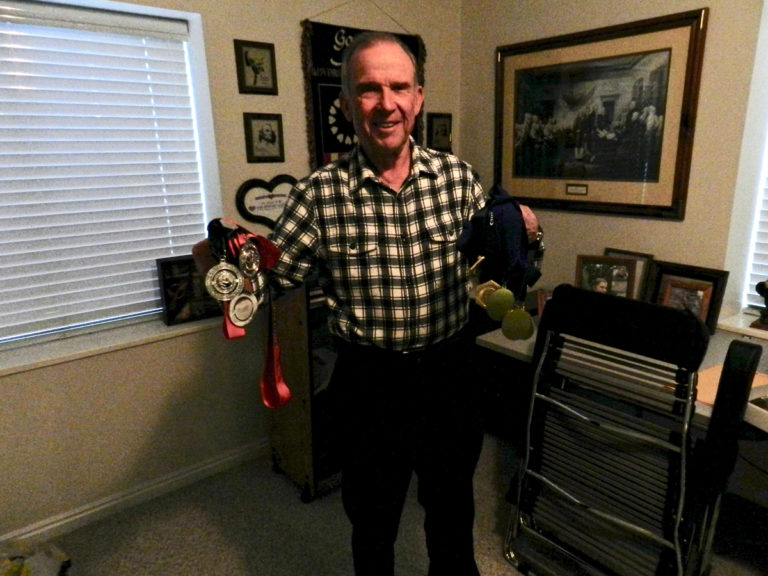
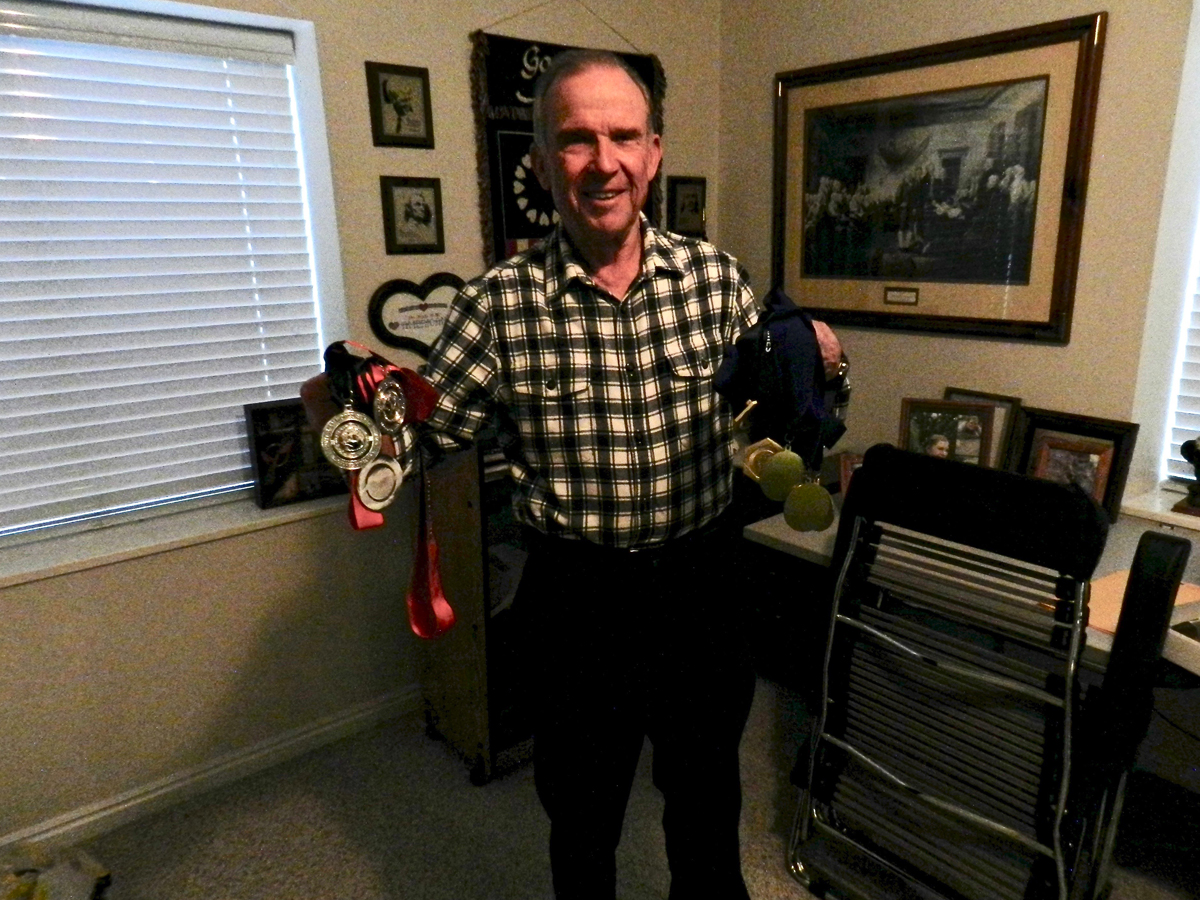
Stan Swallow with a variety of medals from National Championships and more. Photo by Brian Thompson

Stan Swallow was born seventy-nine years ago in Fillmore, Utah. He grew up on a farm and learned the value of hard work from an early age. He ran track and wrestled as a kid, excelling in the 440 (now the 400 meter) sprint. At eighteen he left Fillmore to attend Central Utah Technical College (now known as Utah Valley University) in Provo.

Like so many young men of that age, Stan had only a vague notion of what he wanted to do in life, revolving primarily around working at the local Ford dealer for his uncle as a mechanic. Fortunately, his mother saw greater potential in him and pushed him into another vocation. She apparently went to his professors who helped her push him into the electronics technician program. Stan later ended up at UCLA, where he completed a BS in Engineering and Applied Science.

Upon completing his degree at Central Utah, he went to work for the Federal Aviation Administration, where he spent 36 wonderful years working all across the country and once met President John Kennedy. During those working years, he continued to run, focusing on running marathons. He had a bike and did ride it, but it wasn’t until he retired in 1995 that he started focusing on bike racing more so than running.

At that time, he returned to Utah and started mountain biking with a neighbor who was 18 years his junior. Interestingly, Stan beat the younger man, which started him thinking that he might have a future in racing bicycles and what a future it turned out to be. He’s won the Huntsman World Senior Games, Utah Summer games, and Idaho Senior Games to name a few. 2016 was his best year when he won the USA Cycling National Criterium Championship, “a crash laden event” per Stan held at Wake Forest University.

“I was chasing the age group (70-74) younger than mine (75-79) and was about 25 meters behind them around the last corner when 3 guys crashed and I had time to avoid them. I was a solo break away from the others in my age group. I was 4th in my group until the last 5 laps when the 3 in front of me started to drop back. I had a 10 second advantage for the last lap and enjoyed winning in solo and save fashion.” He added the road race national championship that year as well, and as a result, he won the Best All-around Rider award.

What’s next? He’s moving more into the road race and looks forward to competing until at least 90 mainly because he feels he can continue to win and he enjoys the men across the county he competes against. His advice for older riders is, “to stick with it and don’t give up. Keep in mind that response time is lagging so, keep your distance and pay attention to the other riders.”

He’d also love to hang glide but probably won’t due to the possibility of missing a race season if something went wrong. I asked him what impact bicycling has had on his life; his answer showed me how much more we need to be doing if we want to be competitive. He trains 4 hours per day during the off-season and 2 hours during the season. This includes the spin classes he teaches, Zwift, and snowshoeing and, of course, riding. Stan’s final bit of advice for anyone looking to race is that there is “no substitute for experience in racing” and “don’t overestimate your abilities.”

As if this wasn’t enough to keep him busy, in 2003 he founded the Utah Velo Club (utahveloclub.com) at the request of Aaron Luck. The club started with two other neighbors and has steadily climbed to its current level of 700 riders. The club promotes safety, fitness, and friendship while promoting cycling in the community.


Tips for Spring & Summer Bicycle Commuting

Winter is officially over. The temperatures are warmer, the amount of daylight is longer each day and the chance of cold, snowy precipitation will dramatically lessen. Now is the perfect time to venture out on your bike to commute to work or wherever you need to be while leaving your car’s transmission in “park”.

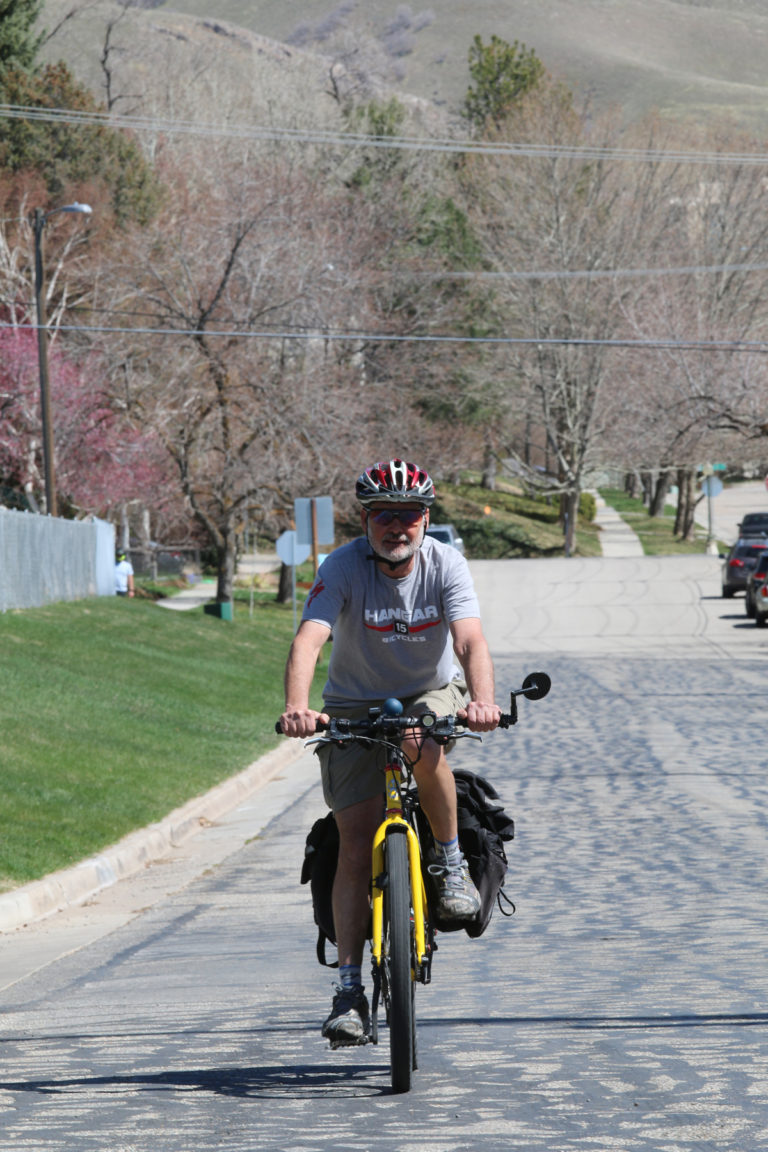
Lou Melini commutes year-round. He provides tips to make your commute better. Photo by Dave Iltis

If you have never commuted to work before there is anxiety and lots of questions. What bike do I ride, what clothes do I wear, and what route do I take are the most frequent of the questions. There are many answers to these questions with the caveat of “it depends”. Distance to work and weather considerations are a large part of “it depends”. Below is a general synopsis of what you need to know.

The Bike: For the April through October season, one could commute on any bike that is in good mechanical condition. One commuter I knew rode her high-end racing bike with carbon wheels for her 30-mile (round-trip) commute to her office. Once a week she drove to exchange her wardrobe for work and used a small backpack for needed daily items. I use a relatively heavy commuter bike built for me with a rear rack and fenders for my year-round commute to my volunteer job. My bike has lights, a mirror and a bell mimicking what my wife’s car has minus the air conditioning and all-wheel drive. I have a small repair kit including spare tubes and a pump/CO2 canister, a secure U-Lock and sometimes a second lock. My bike can fit different tire widths for summer and winter. With 15,000 miles of use the bike is still in great riding condition.

Any bike can work as a commuter bike. Here, a 26" wheel mountain bike is repurposed to make a great commuter bike. Photo by Dave Iltis
Any bike can work as a commuter bike. Here, a 26″ wheel mountain bike is repurposed to make a great commuter bike. Photo by Dave Iltis

You can spend a wee bit or a large amount of cash for your commuter bike. If you ride year-round and put in a lot of additional miles, that expensive commuter becomes cheap as the parts work well and last long. An inexpensive bike that is carefully cared for will feel like hitting a lottery over time. In either case, the elimination of a car will save you over $8,000 according to American Automobile Association (AAA) nationwide averages.

There are some special circumstances you may want to consider for your commuter bike choice. If puncturevine (goat-heads) is prevalent on your intended route you may want to ask your Local Bike Shop (LBS) for tubeless tires with sealant. A pedal-assist E-bike will answer the frequent reasons for not commuting such as tight schedules, needing to travel to multiple sites during your work-day or simply the physical exertion of riding hills or long distances. Your Local Bike Shop may have a bike that will suit your needs as well as servicing your bike so that you are back on the road quickly.

There are many ways to carry what you need for your daily commute. There are a variety of bags that you wear on your back though can be hot in the summer. In part because I do all of my grocery shopping on my bike, a rear rack with large panniers is my choice. Front racks, baskets or platforms to place a small duffle bag have recently become a popular way of carrying stuff.

The Route: With Google Maps and other electronic aides, you should be able to find a good route suitable for biking to your job. Keep in mind that your commute should not be stressful, so find low speed & low traffic roads even if it means a slight increase in your commuting miles. Over time traffic will get used to seeing you, creating a more pleasant environment. You will also become acutely aware of every aspect of your route thus anticipating uneven surfaces, parked cars, hidden driveways and other potential annoyances.

Clothing: If you want to look good on the bike with clothing that is also suitable for the office, a recent Wall Street Journal article described clothing that is “made for the road-and ready to put in overtime at work”. The combo of jacket, shirt, pants and shoes featured in the article will set you back just over $800, but you will look good.

My advice, wear what is comfortable, practical and useful for your needs. I could not donate most of what I wear given the age and wear & tear of the clothing I ride in. For shoes I use old leather hiking boots in the winter for warmth and resistance to precipitation with lighter hiking shoes for other times of the year. In snowstorms or heavy rain I wear 2 old rain jackets as neither one alone does a good job of keeping me dry. However each jacket alone works well as a wind jacket to keep me warm.

Eventually you will find clothing that works for you. My one piece of (serious) advice is to pack a light jacket that has the specifications of being water resistant (or waterproof) in case your sunny spring day becomes wet.

Attitude: I have experienced over 100,000 miles of commuting miles strictly for the purpose of not using a car. Doing this requires a different attitude and mindset compared to the recreational miles I ride. I can’t say, “Oh I will wait until it cools off a bit to ride to work”. With the right attitude your commute to work will be successful.

Road Bike Disc Brakes: An Overview

There is a new standard in brakes on the road bike. It has even entered the professional peloton. It is disc brakes for road bikes. You may be asking yourself, is this really necessary? We’ve been riding road bikes with regular rim brake calipers for years. Well be prepared to make the change if you want better brake performance in all riding conditions. The same reason why mountain bikers have made the transition to disc brakes is the same reason you should make the transition on the road.

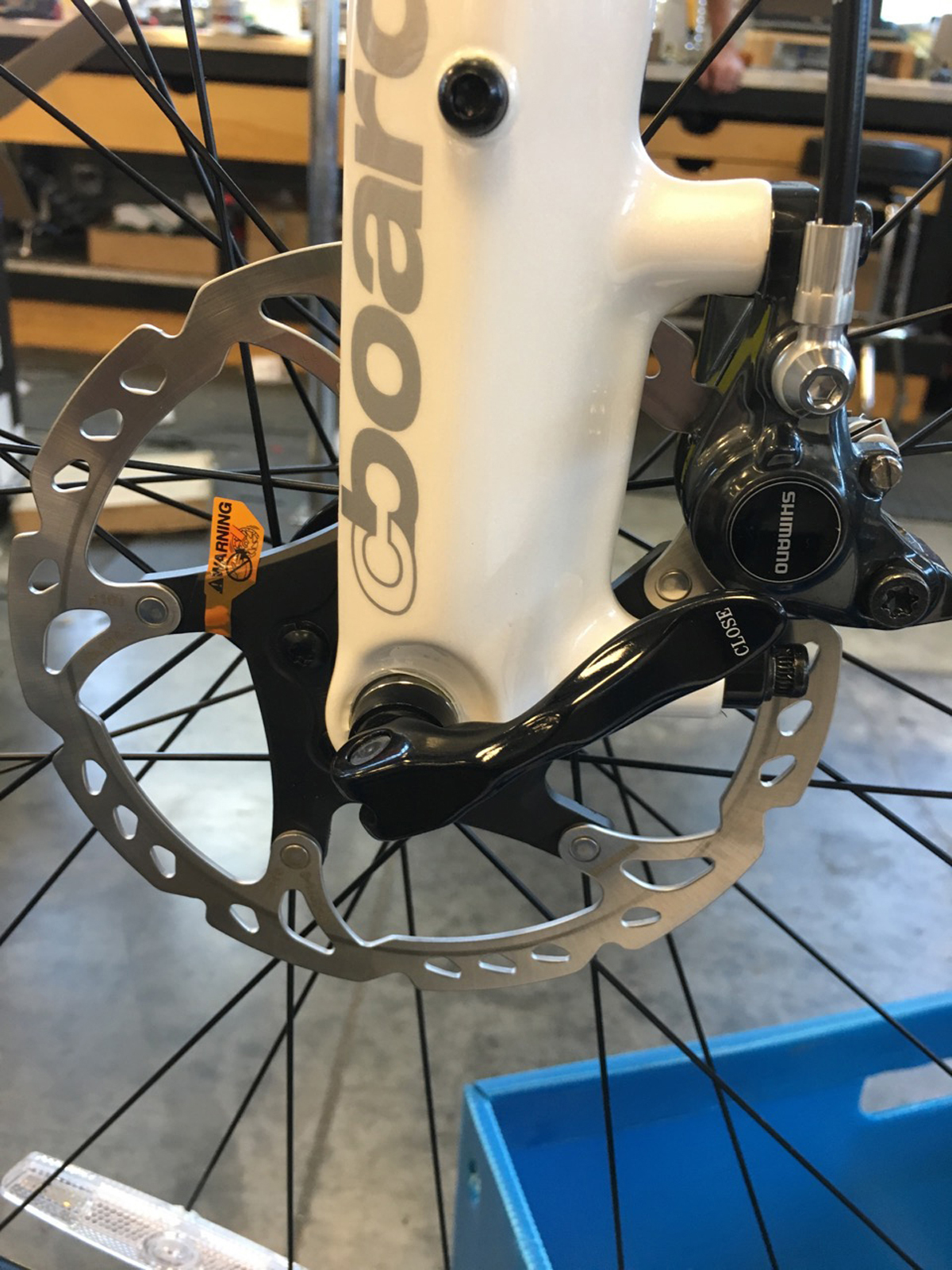
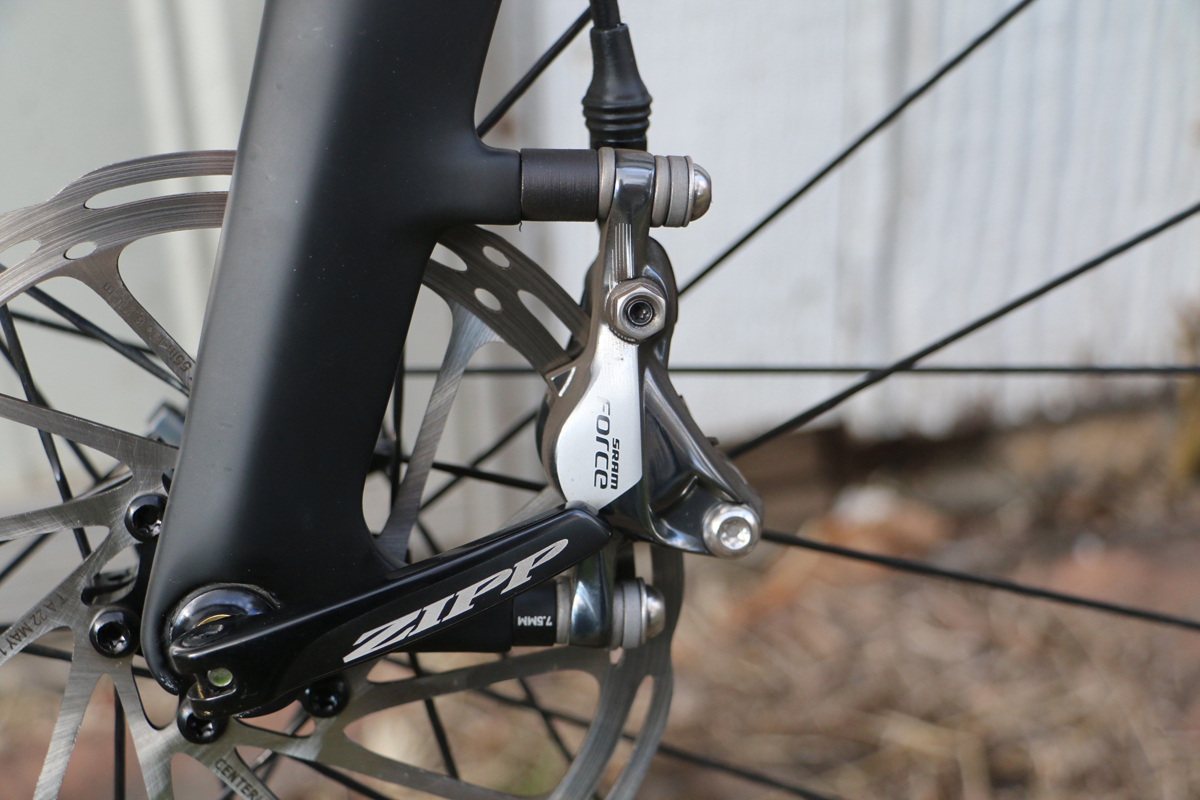
Road disc brakes require a different design for the front fork.
Shimano’s hydraulic disc brakes are shown here. Photo by Donald West

Disc brake rotors provide a consistent braking surfaced better brake modulation. Disc brakes are more powerful and remove issues of beefing up the rim surface to handle braking forces. Disc brakes remove any issues you may have with carbon wheels, including confusing brake pad choices. The removal of the brake surface on wheels will allow rim manufacturers to make lighter rims. There is less force that needs to be applied to the brake lever in order to stop the bike, which decreases rider fatigue.

Disc brakes also allow bike designers to increase clearances of tires without dramatically changing frame design. No more having to open brake calipers to allow for wider tires on road bikes or open brake calipers for cyclocross bikes. This opens up the door for wider rims and bigger high volume tires that can improve traction and braking performance.

Front forks require a new design to accomodate road disc brakes.

The only downside to disc brakes is they require you to have a disc specific frame and wheels. There is a slight increase in the weight of the disc bike. You also need to consider that these brakes require more mechanical know how. Hydraulic disc brakes use either dot 5 brake fluid or mineral oil to actuate brake calipers, just like the brakes on your vehicle. Finally, there will be issues with compatibility.

There are a myriad of new standards for disc brakes that are available, so swapping components between bikes will lead to some headaches. One of the new standards we will likely see are thru axles front and rear on road bikes. It is likely that we will see very few 9mm quick release axles in the near future. Thru axles will improve handling performance by increasing the strength of the connection between the wheel and the frame. Also, riders will be less likely to misalign the wheel in the frame during the wheel installation process. Finally, disc brakes are going to be more expensive than their mechanical counterparts.

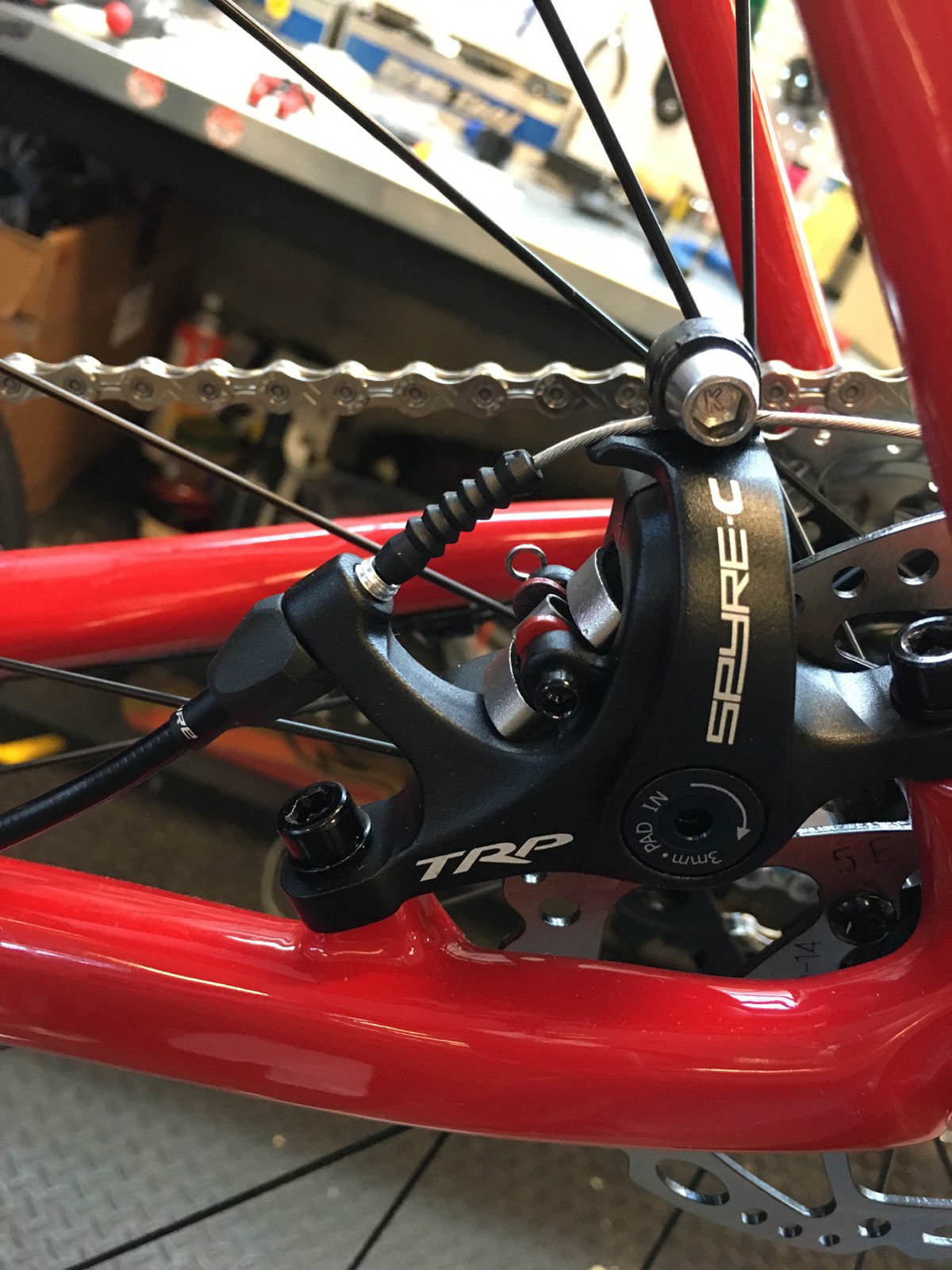
TRP's cable actuated hydraulic brake.
TRP’s cable actuated hydraulic brake.

There are several choices for riders considering changing over to road disc brakes. You can use hydraulic disc or cable actuated disc brakes. Each of the major component companies, Shimano, Sram, and Campagnolo, now offer disc brakes for road bikes. Shimano offers a hydraulic disc brake and electronic shifting option. Sram offers hydraulic disc brakes and mechanical shifting options. TRP offers a cable actuated hydraulic disc brake. SRAM/Avid allows riders to avoid hydraulics all together with their able accepted mechanical disc brake.

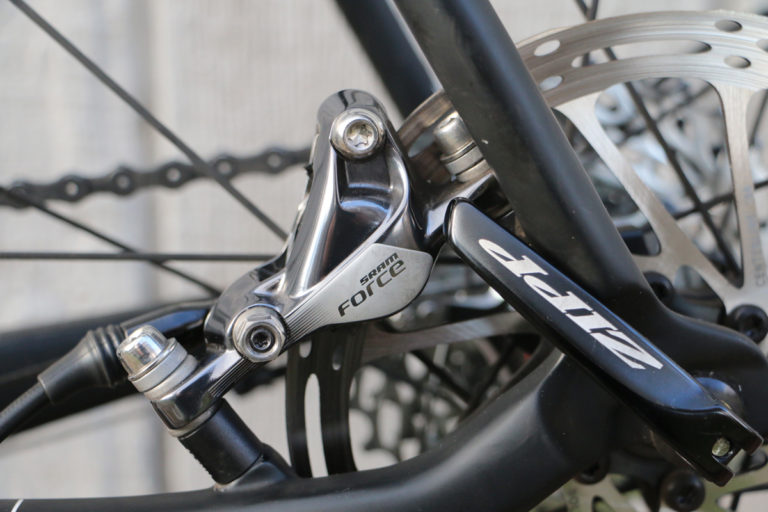
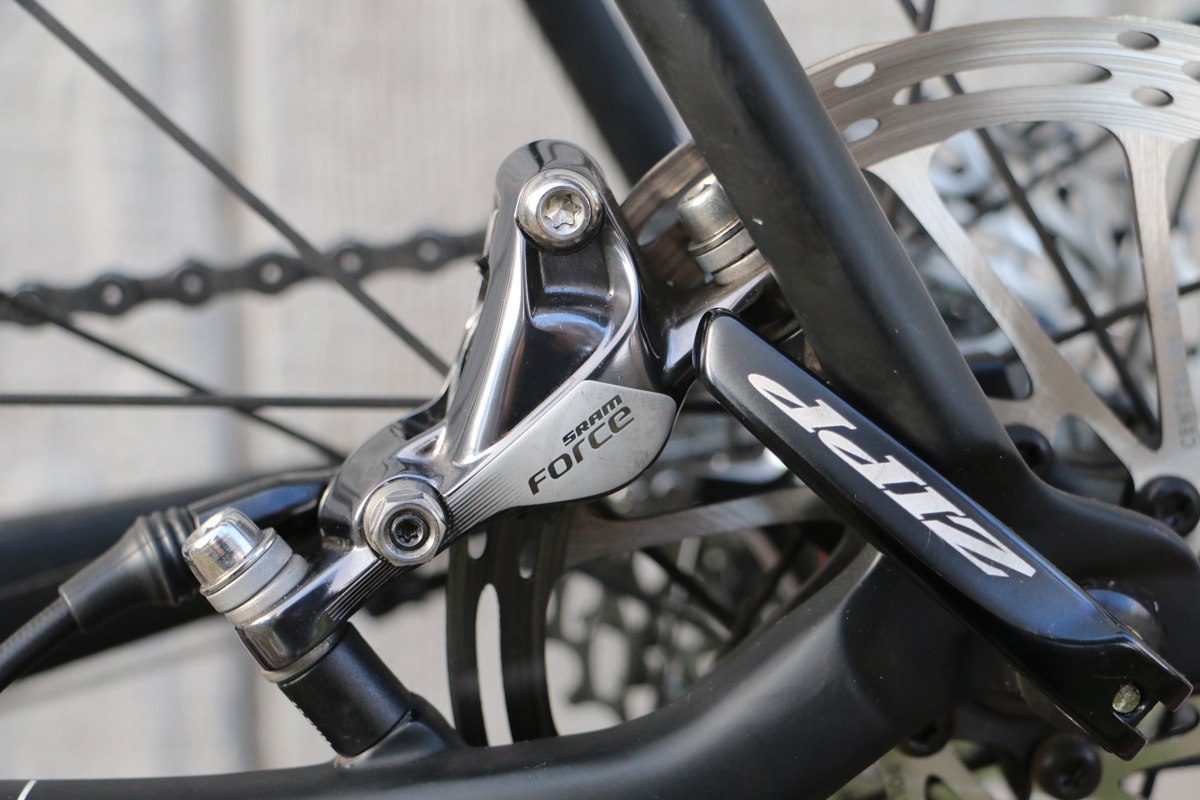
SRAM's Force Hydraulic Disc Brakes provide incredible stopping power.
SRAM’s Force Hydraulic Disc Brakes provide incredible stopping power.

Most riders will be able to run 140mm rotors for their bikes or a combination of 140mm and 160mm. There will be 160mm rotors available for more braking power. Rotors are mounted to the non-drive side of the wheel for obvious reasons either by 6 bolt standard or center lock attachment. The calipers mount to the frame in two standards, a mount similar to a post mount you’d find on mountain bikes, or ‘flat mount” calipers. Flat mount calipers are likely to be the new standard for road bikes due to their lighter weight and more compact design.

So there is the breakdown of the new trend in road biking. If you are willing to make the investment in a new frame and wheels, I believe you will have another excellent option for your exploration of your local roads. If you don’t feel that it is necessary to change over, there are still plenty of options for riders who want to stay in the mechanical brake caliper world.

Donald West is the owner of Bicycle Motion, a mobile bicycle repair business in Utah County. Find them at bicyclemotion.com.

Another Lachlan Morton Adventure; Another Record Falls

0

Initially, Lachlan Morton thought he’d have a go at the Everesting record Monday, June 15.  

But last Friday night at a BBQ, he and his dad, David, got to talking. His dad had to work Monday, so why not give it a try the following morning? Nothing like a last-minute Everesting attempt.  

Lachlan Morton during his Everesting attempt on Saturday June 13, 2020. Photo credit: EF Pro Cycling

Lachlan was feeling rested enough from  breaking the record for the fastest known time on the Kokopelli Trail a few weeks prior, and had recovered from a bout of food poisoning that foiled his initial attempt last week. And once he got to the climb and started rolling… he didn’t stop until he was the new record holder. All told, he climbed 29,029 feet in 7 hours, 32 minutes, and 54 seconds over 42 laps up the backside of Rist Canyon. 

Hear more from Lachlan below.

What is Everesting, for people who don’t know?

Climbing the height of Mt. Everest on one hill by bike. It’s a tough day out.

How does one prepare for something like that?

I prepared by riding my mountain bike up high in the Rockies, having fun and spending a lot of hours out. Finding a climb that’s steep and straight is also important. I wanted something local, so having a look around was a big part of preparing. I didn’t do any specific training for it. I’d ridden five and six hours the days before, then made a split-second decision to do it over a Friday BBQ with dad.

Tell us a bit about your setup for this. Anything special? 

Just my Cannondale SuperSix EVO training bike with a set of tubeless wheels I borrowed from JV. I had ‘cross wheels in it for a big gravel loop the day before. Love that thing. 

How’d you come to pick the climb you did?

I remembered it from when I was young. I actually won my first pro 1/2 race there. It’s steep and straight. The altitude makes it hard but I’m trying to stay close to home. There was an option to make it a bit shorter and steeper that was probably more economical, but the turnaround was blind and I needed to sight cars myself, so I opted for the longer one when we got there.

So you were initially thinking about doing it earlier this week, then got a stomach bug. Then Saturday, you were just going to scout it, but you ended up giving it a full go?

Yeah, I had food poisoning but bounced back and had a few big days on the bike and felt ok. I was thinking Monday, but dad was working so we decided on Friday night that we’d go have a look the next morning. I like things low key so just having dad there with some bottles felt right, so I just kept going.

What were you thinking about as it was going on? And on. 

That’s the biggest challenge actually. It’s pretty monotonous. You also know each lap is going to get harder. The last half I really thought about how difficult the world is right now for some people and how lucky I am that three hours of riding uphill is my biggest worry. It’s so insignificant in the scheme of things. 

Some rides feel longer than they are, I think. How long did this one feel?

The first three hours went really quick. The middle two felt about normal. The last two and a half really dragged. 

Will you do it again if someone breaks it?

I think there’s some other things I’d like to do first. It’s fun, I know someone will go faster, that’s the point. Put a mark out there, have someone think… “Yeah maybe I can do that.” It’s a progression; anyone can have a crack at it.

Kokopelli, now this. This is like the season of Lachlan Morton. What’s next?

Going to ride Rollins pass with my dad in the morning. One day at a time at the moment. I’m really hoping to be back racing with the whole team soon, though. 

Meeting Up with Orange Seal Cyclist Hannah Finchamp

It was with great excitement and pleasure that I got to interview an outstanding professional mountain biker residing in Salt Lake City, Utah. I started following Hannah Finchamp’s Instagram about four years ago when she was with Clif. The first week I moved to Salt Lake City, about two years ago, I was riding up Millcreek Canyon and saw whom I thought was Hannah Finchamp pass me doing sprints.

As soon as I got home I sent Hannah a message saying, “Did I see you on Millcreek today?” She replied, “Yes that was me.”

I have to admit I was starstruck. Hannah rocks as a cyclist and is a great person too, crushing it on her mountain bike with laughter, smiles, and intensity. Her Instagram shows her having a lot of fun and her always smiling, but do not be fooled! She is out to win and with her new Orange Seal team, nothing is holding her back.

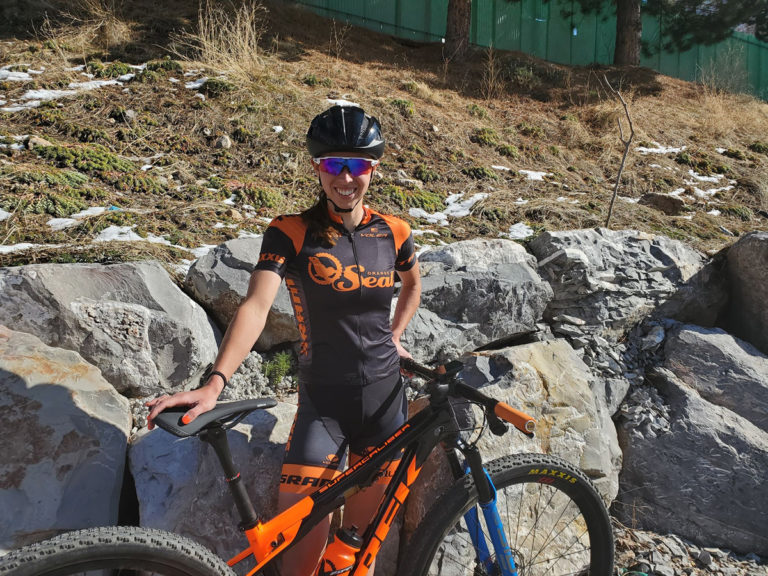
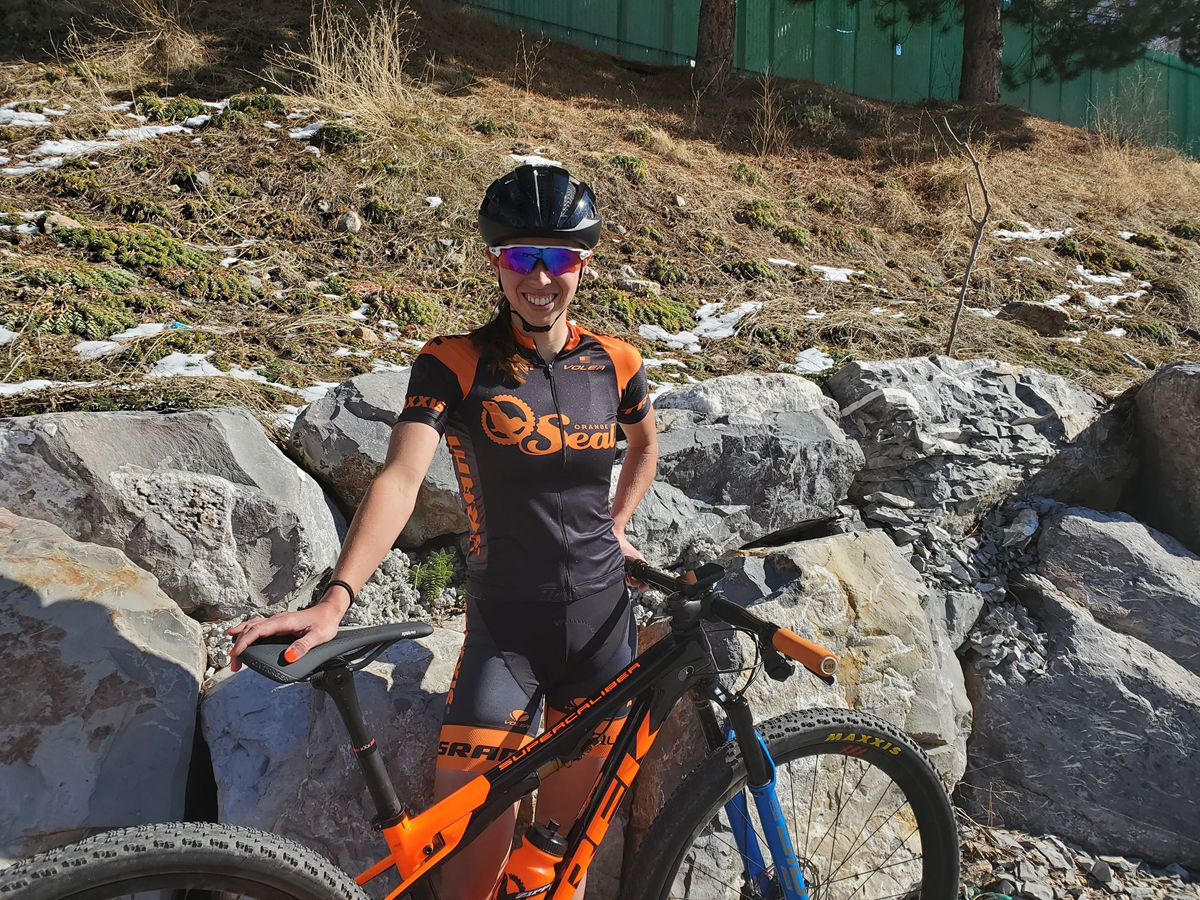
Hannah Finchamp is a professional mountain bike racer with the Orange Seal Off-Road Team. Photo by Anthony Nocella II.

I met up with Hannah at Hangar 15 Bicycles to ask her a few questions.

Anthony Nocella: Hannah to start, I got to ask how did you get involved in mountain biking? Was it through a high school team or local bike shop?

Hannah Finchamp: I started my career in sport at 9 years old in the sport of a triathlon. At a small running race, I saw a booth advertising for triathlon and was enamored by the idea of the challenge. I competed in the sport of triathlon from 9-19 years old and raced in draft legal ITU style races, non-drafting, and even XTERRA Off-Road events.

At the age of 16 I won the XTERRA amateur World Champion title for all ages and shortly after was recruited onto the CLIF Pro Team. A couple of years later, CLIF asked me to make the transition to the sport of mountain biking.

As a part of ‘training’ for triathlon while in high school, I had competed in NICA events. I was competing for my collegiate cycling team as well, so I went ahead and took the leap.

I am now starting my 5th year as a professional mountain biker and am entering my first season representing the Orange Seal Off-Road team. Along with Orange Seal, I am also sponsored by Trek, Sram, Maxxis, Osprey, Gu, and Voler.

AN: We are blessed to live right next to the amazingly beautiful natural Wasatch Mountains, with so many canyons and trails. What are a few of your favorite places to ride and why?

HF: I absolutely love living in Utah and I really believe that it is the best place I could be to accomplish my goals and dreams in the sport of mountain biking. My favorite long ride during the summer is to start up Millcreek Canyon, drop down into Canyons, ride back up Armstrong and Pinecone over the top of the Crest and finish down Pipeline back into town.

Of course, I also love going to Deer Valley and working on my technical skills by riding the lifts!

AN: You are a certified athletic trainer with degrees from Lindenwood University. What are the top training exercises you do beyond cycling?

HF: I have two bachelor degrees from Lindenwood University. One is in Exercise Science and the other is in Athletic Training (which is a health care profession). I am a certified athletic trainer and I have a great passion for balanced and pain-free exercise.

Additionally, I have my own coaching business (www.hannahfinchamp.com/coaching). My coaching philosophy is centered around evidence-based practice and exercise physiology. I seek to use scientific knowledge to cater to the uniqueness of human performance.

I complete a lot of very specific strength and plyometric training in the gym in addition to spending many hours on the bike.

Whether or not you are a competitive athlete, I highly recommend taking time to do a little extra core work (to prevent back pain), completing some weight bearing exercises (to strengthen bones), and working on hip and glute strength to protect your knees and back.

AN: There are more and more conversations being had about our diet and cycling. A lot of athletes are moving to healthier and more plant-based foods. How have you seen your diet change over the years?

HF: Diet can be a tricky question because it is very different for each and every individual. There is no one size fits all formula. For me, I have found that the best way to optimize my performance through diet is by thinking as food as the fuel that gets me through so many hard workouts. It is amazing the amount of food that your body needs in order to complete these physical tasks, so I am often thinking ahead to what demands I will be placing on my body and giving it the energy it needs to accomplish those missions.

AN: In the last ten years, I have really seen bicycle companies marketing more to women, and bike shops having a larger selection of products for women. As an athlete with a strong social media precense, in your opinion what are some recent victories for women cyclists and what would you like to see changed to bring about gender equity?

HF: I am lucky enough to live in a time in sport where many other women have pioneered a way in the industry ahead of me. Women have taken leaps and bounds in the sport, earning equal pay and prize money.

That said, there is always more work to be done. The women’s field is more competitive than it has ever been before and I believe that that alone will continue to garner the respect that we continue to strive for.

I want to be viewed as a successful athlete and not only a ‘female’ athlete.

AN: My final question: What is the best part of being a professional cyclist on the Orange Seal Team and was there any particular races you’re looking forward to?

HF: The Orange Seal Off-Road Team has provided me with an incredible amount of opportunity and I am really excited that the team not only share my same goals and aspirations in sport, but also carries my same values in life. I am very proud to represent a company that puts so much focus on loving others.

This year, I will have the opportunity to represent the team at a wide variety of events including Pro XCT UCI events, World Cups, Epic Rides, Leadville, and even some gravel races.

Hannah Finchamp’s bike specs:

  • Trek Supercaliber 29 (Size Small)
  • RockShox Sid Ultimate Fork
  • Sram Level Ultimate Brakes
  • Sram XX1 Axs ETap Drivetrain
  • Sram XX1 Quarq Powermeter
  • Bontrager XXX Carbon Bar and Seatpost
  • Bontrager XXX Carbon Wheels
  • Maxxis Aspen Tires 29 x 2.25 
  • Orange Seal Sealant
  • ESI Grips
  • Instagram: @hannah_finchamp

Anthony J. Nocella II, Ph.D. is a full-time professor at Salt Lake Community College, author of numerous books, trail runner, triathlete, competitive cyclist, and in his free time works at Hangar 15 Bicycles Millcreek.

Fremont Area Road Tour (F.A.R.T) Goes Virtual for 2020

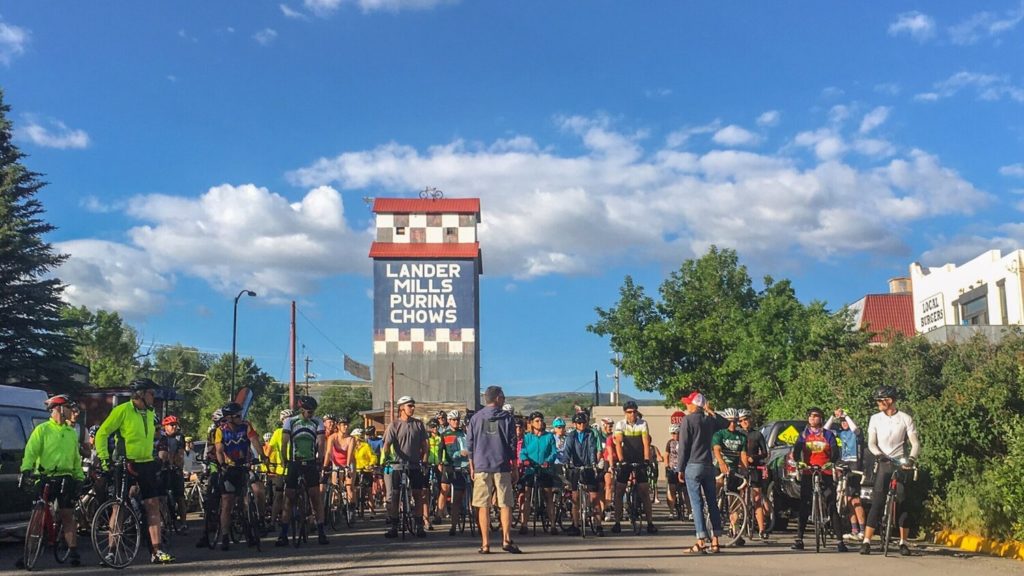
The Lander Cycling Club is hosting the 11th Annual Fremont Area Road Tour (F.A.R.T) from Aug 1-31, 2020. Due to the current COVID-19 novel coronavirus pandemic, this year the event will be hosted online, rather than in Lander, Wyoming, and will give participants a chance to compete in a month-long virtual challenge.

The Fremont Area Road Tour will be virtual in 2020. Photo courtesy Lander Cycling Club

Registered riders will be able to participate from any location just by riding their bikes along their favorite routes. Participants will need to track their activities using Strava or another activity tracker for verification. They will then log their miles on the event’s Rider Portal. Prizes will be awarded to the top 3 male and female overall distance, overall elevation gain, longest recorded ride, and best event photos. Event T-shirt color will be based on the total miles achieved by the end of the event and riders will no doubt be vying for the coveted 400+ mile “yellow jersey”. Riders will have the entire month of August to accumulate miles and can record road, gravel, mountain, or activities from a smart trainer. Competition and raffle winners will be announced on Sept 5th. Registered riders will receive their event SWAG (via mail or local pick up) at the completion of the event. Registration opens June 15.

More information can be found at www.fremontarearoadtour.com

Wyoming’s Fremont Area Road Tour will be virtual in 2020. Photo courtesy Lander Cycling Club
The Fremont Area Road Tour will be virtual in 2020. Photo courtesy Lander Cycling Club

Smarter, Faster! Improving Mountain Biking Speed through Improving Skills

Many cyclists are motivated to ride faster, and will pursue any number of strategies with that goal in mind. The obvious one is to get fitter, and this may involve training plans, coaches, power meters, heart rate monitors, and attention to nutrition. Another strategy is equipment focused: lighter, stiffer, more aero, and attention to tire width and pressure. The advanced cyclist may focus on mental strategies: visualization, goal setting, mantras, and managing self talk. But what if you just became a better rider through improving your bike handling skills? Would that make you faster?

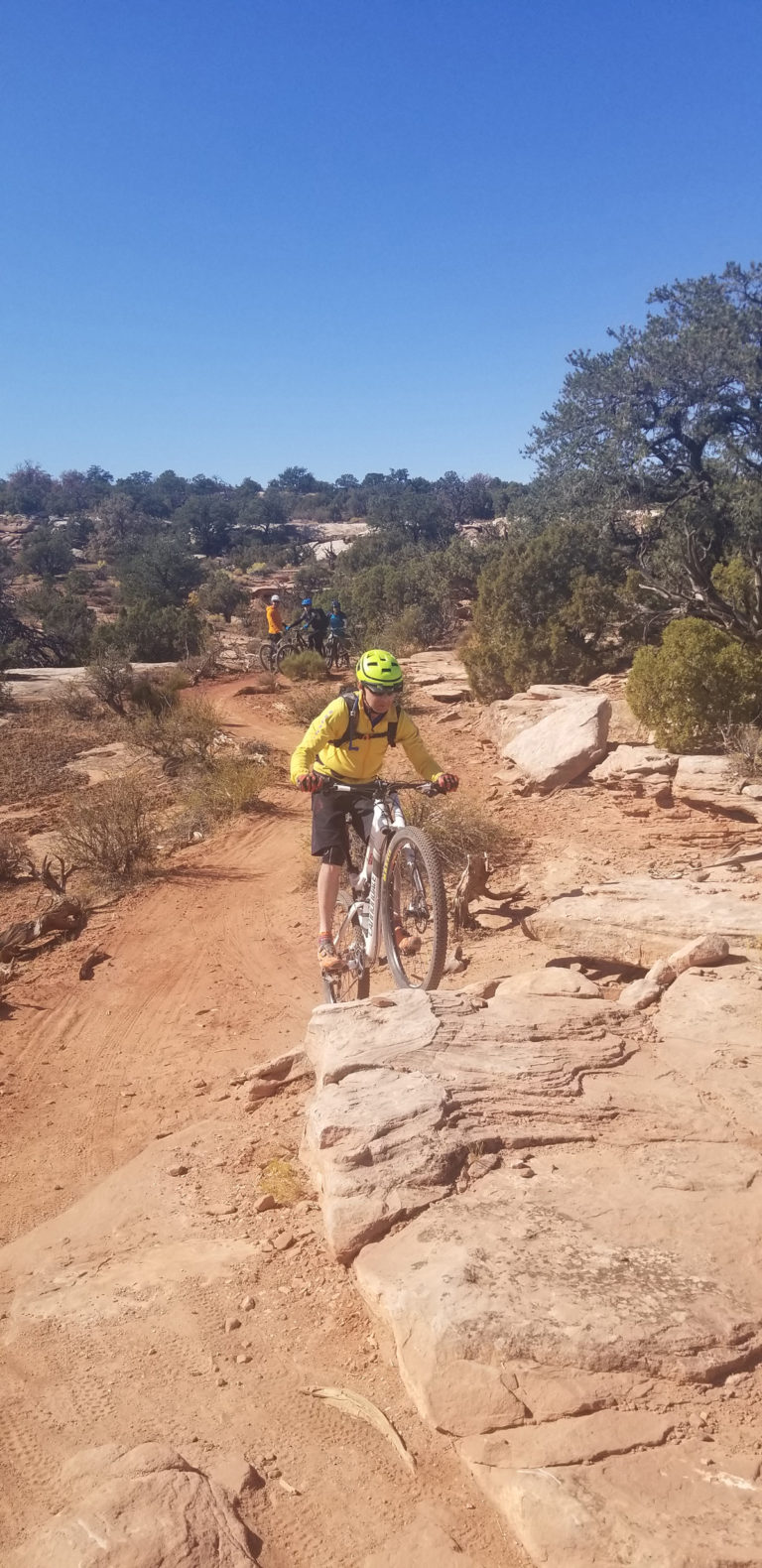
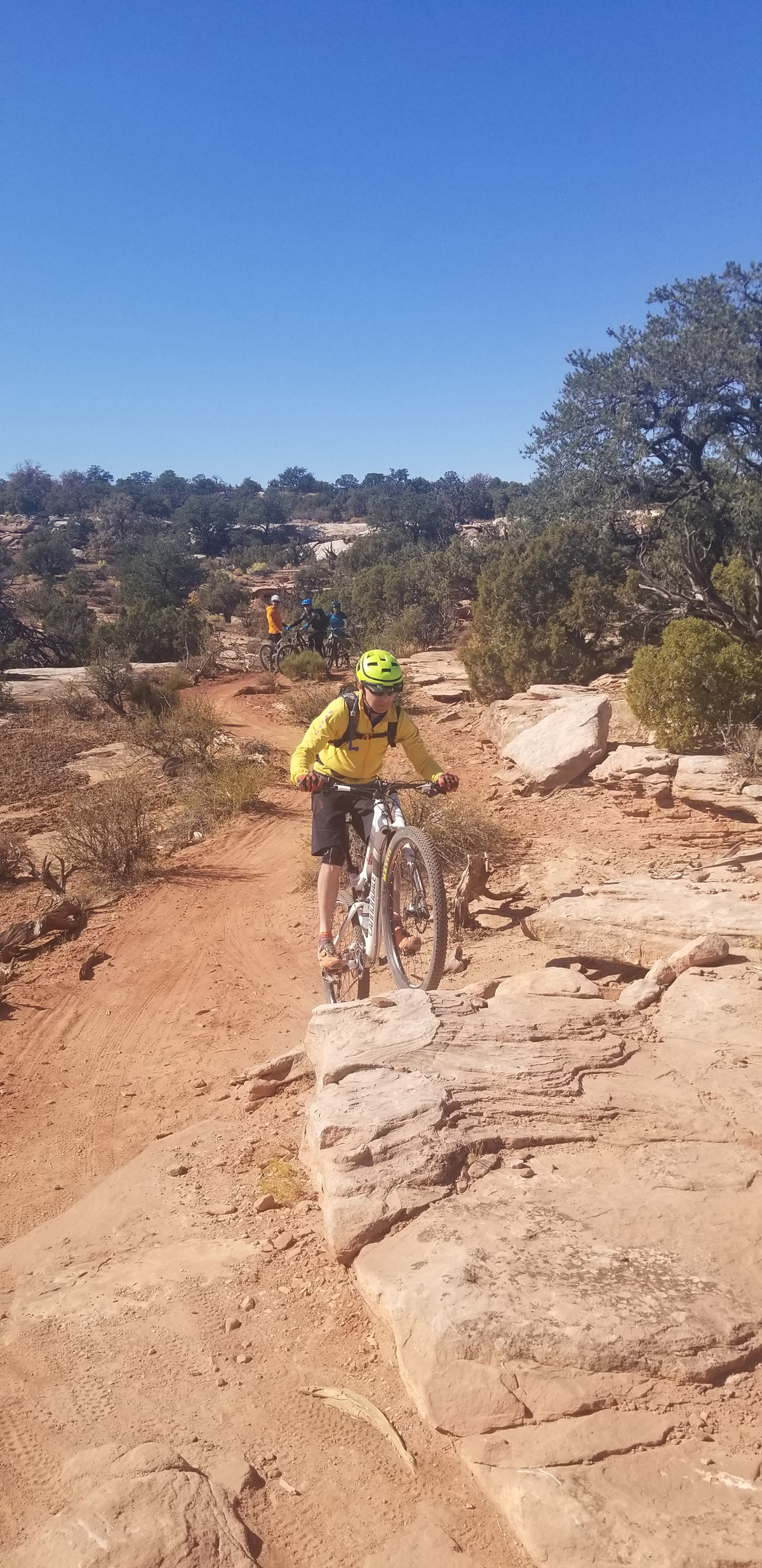
John Higgins during trails skills practice during a Better Ride camp. Photo by Gene Hamilton

At the end of summer I went in a local mountain bike race for the first time in a few years. I used to mountain bike a lot, raced a lot, and considered myself an expert level rider, but the past few years I’ve trended to more road, gravel and bike packing. The mountain bike race was a blast, and although I did well, I didn’t ride well. With aspirations of doing some more mtb races next year and regaining some of my former glory, I contemplated the reality of being older, slower and less reflexively skilled, and wondered how I might get an edge on my competitors (who I hope aren’t reading this!). My capacity to train and my level of fitness is not going to change noticeably, nor does my budget extend to the latest and greatest in an XC race machine (sorry Trek Supercaliber). Okay, I thought, what about getting faster by being smarter. Where is the opportunity for the most gain? Probably my bike handling skills, especially descending and cornering. Now while this may not be the biggest opportunity for gain on a road or tri bike, bike handling skills are critical for mountain biking and cyclo-cross, and definitely have an important place in gravel and road racing – especially descending and cornering.

Fast forward to October…. Moab Utah. Five experienced mountain bikers huddled against a cold wind in a gravel parking lot. We’d all signed up for a 3 day Mountain Bike Skills camp with BetterRide, run by Gene Hamilton. Gene is arguably the originator of mountain bike skills training in the USA. When he was a pro-downhiller in the 90’s no one was teaching mountain bike skills. It was all trial and error. Being big on enthusiasm but relatively low on skills compared to his competitors, Gene constantly sort ways to improve. As a snowboard team coach he knew there must be teachable, repeatable skills that the best riders were unknowingly using. Gene sort advice from other pro mountain bikers and motorcycle and motorcross riders and coaches, initially to improve his own riding, and then to convey that to others. BetterRide alumni now include many top level downhill, enduro and XC racers. Gene is no slouch on a bike and can “walk the talk”, earning a stars and stripes jersey in the USA Cycling Downhill National Championships in Colorado this year. However his own ego and skills are kept well in check during his camps, and he does far more storytelling to illustrate a point than riding to showcase his own skills.

You’ll never do less riding in 3 days than on a skills camp with Gene, but you’ll never learn more either. Much of the time was spent in gravel and asphalt parking lots working through an understanding of a range of skills, seeing it demonstrated, and putting it into practice. These covered the sort of things you would expect: vision, balance, body position, braking, cornering, weight shifting. You might think you could find all of this on YouTube for no cost, and you can. But there is a huge difference between watching a skills video and having it explained in person, getting to practice it and receiving immediate feedback. There is really no comparison. Having attended this skills camp, I can now watch a skills video on YouTube with an ability to observe, dissect and critique what is being said and demonstrated – and agree or disagree in the context of Gene’s instruction.

On the topic of skills, BetterRide does not offer a “basic” or “advanced” camp, and Gene will have novice as well as highly skilled athletes in the same camp. Many experienced riders may dismiss a skills camp on core skills, thinking “I’ve got this- show me the advanced skills”. That would be a grave error of judgement. In Gene’s view there are very few advanced skills, there is instead the advanced application of core skills. Those on the podium at world cup events are all using the core skills Gene teaches. They just happen to have them extremely well practiced and ingrained.

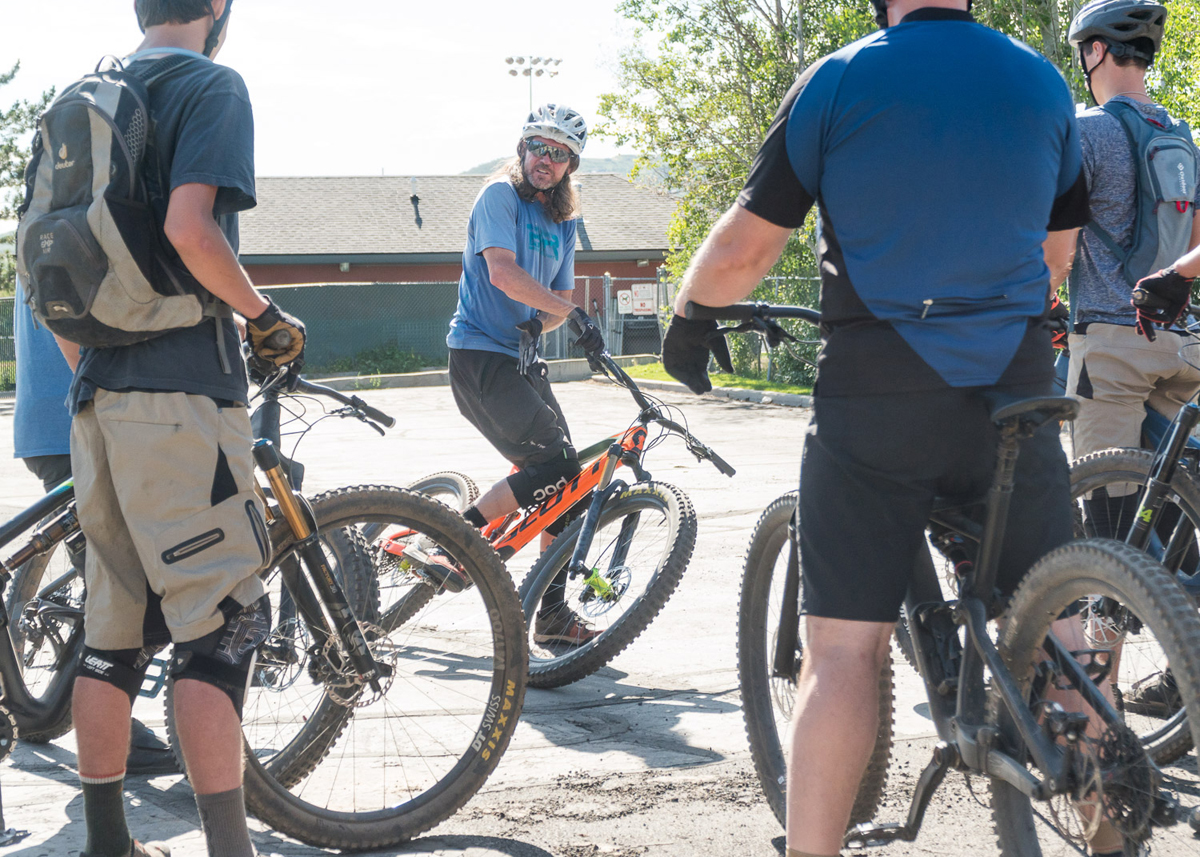
Gene Hamilton providing mountain bike skills instruction. Photo by John Shafer, photo-john.net

I went into the camp thinking I was good at some things, and poor at others, which was true – but perception and reality didn’t always line up. There were things I was doing well that I didn’t know I was doing well; things I thought I was doing well that I wasn’t, and areas that needed improvement – which was certainly confirmed. Like cornering. This is probably the most advanced skill in mountain biking because it is made up of so many smaller skills that have to blend together in perfect unison.

Also, changes in mountain bike frame geometry, suspension and the advent of dropper posts have changed the body position and techniques of riding compared to the survival skills needed to ride technical terrain on a 26” hardtail with 80mm of upfront travel, a steep headtube angle and a seat inconveniently in the way of where your center of mass should be. As someone whose early MTB skill development was on just such a bike, a “software” upgrade was needed to go along with my hardware upgrades since the 90’s.

I finished the camp a far worse rider than when I started it. Yes, that’s right, worse! Old ways of doing things had been challenged and disrupted, and new and improved ways have yet to be neurologically cemented in place. As Gene correctly points out, the improvement comes later as a result of doing the homework – weeks and months of skills drills, preferably nowhere near a trail. To get to the ultimate flow state of unconscious competence, one has to work through the awkward phase of conscious incompetence and progress to conscious competence in a controlled environment, without the distractions of all the variable a trail throws at us.

On my first post camp skills drills session in a paved parking lot I felt completed uncoordinated and inept. “how’s this ever going to come together?” I thought. But in subsequent skills drills sessions in a flat grassy park, I started to experience glimmers of hope. I’m not faster yet, but like committing to a training plan, it is unrealistic to expect immediate gains. The work has to be done first. The results will show up much later. By being both a smarter and more skilled rider I intend to be a safer and faster rider. I also should be able to transfer these skills across to my road and gravel riding, which is even more bang for the buck. Speaking of cost – the skills camp was far less than a new power meter, and I expect the rewards to be greater.

As an added bonus Gene and I had some good discussion about bike fit, and I came away with new perspectives and strategies to incorporate into my occupation as a bike fitter. We both aim to improve everyone’s riding experience, and offer different services for doing that.

If you are interested in improving your MTB skills, visit betterride.net for more information on upcoming camps, and a wealth of blog posts on how to ride better.

John Higgins is a professional bike fitter and purveyor of unique and boutique bicycles and fit-related components and accessories in Salt Lake City. More info on bikefitr.com

Colorado Classic Explores New Event Coverage Model

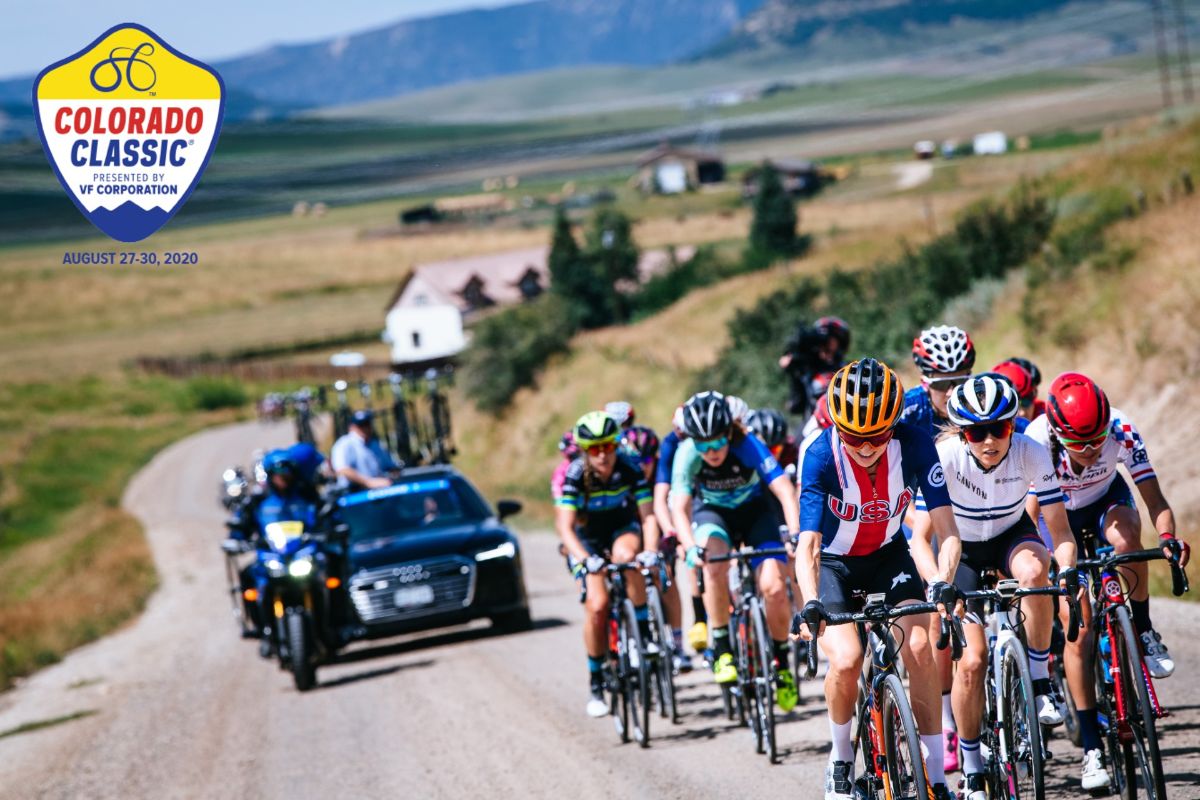
DENVER, Colo. (June 9, 2020) — In response to the ongoing COVID-19 pandemic, the Colorado Classic presented by VF Corporation today released an initial statement sharing their intention to continue their August race with a revised format, a ‘Made for TV Streaming’ model.

Image courtesy Colorado Classic.

With a new race model that limits the gathering of crowds and prioritizes the safety of riders, host communities and staff, the race organizers feel optimistic that America’s premier all-women’s professional road cycling race could successfully continue August 27-30, 2020 — pending the appropriate approvals from the State, county and city health departments.

“An event cancellation or postponement was explored, but as a last resort. And while it would be the easiest thing to do, we feel a strong commitment and promise to the athletes, the communities and our partners. Our decision to move forward with the modified model aligns with our mission of ongoing support and advancement for women’s cycling. We feel that the athletes need something positive to work towards and we want to be that glimmer of hope for both the peloton and the citizens of the communities in which we race,” said Lucy Diaz, CEO of the RPM Events Group, LLC.

“The infrastructure around this year’s race will be scaled back but our top priority is to create an opportunity for world-class competition in an environment that best supports and focuses on the health and well being of riders and staff. We are working closely with State and City organizations, health authorities, and the sports governing bodies to create protocols and processes that ensure the health and safety for everyone.”

Diaz continued, “this is nothing that any of us have ever experienced in our lifetime, so creating a well thought out plan takes time and collaboration. We have been working tirelessly to develop a model that we hope will inform and inspire other event promoters to apply to their events.”

The innovative live streaming model that was developed last year was a huge asset for the athletes and worldwide spectators, and now during this time of crisis, the Colorado Classic has taken the opportunity to further enhance and innovate this broadcast. The event will provide free, start-to-finish coverage distributed by dozens of outlets world-wide with some new features such as immersive point-of-view cameras, Zoom watch parties, super-fan simulcasts, guest commentator drop-ins and behind-the-scenes coverage of pre and post-race activities.

The biggest visible change to the 2020 event will be the elimination of all on-site ancillary activities, Start/Finish Expo Festivals, and the race hospitality tents and services. This decision was made in accordance with social distancing mandates to dissuade crowd gathering and was heavily circulated and discussed amongst partners and host communities.

“The Colorado Classic is working diligently within the public health orders to have this race,” said Rose Abello, Tourism Director at Snowmass Tourism. “We are looking forward to welcoming the best female riders from all over the world to Snowmass and look forward to cheering for them via live stream just as enthusiastically as we would have in person at the finish line.”

Additionally, race organizers are revising some of the race routes and start/finish locations to minimize the impact on its local host communities and the need for public safety officials. In exploring more alternate venues and courses in and around Denver, Red Rocks Park has emerged as an exciting potential venue. This iconic location offers not only stunning scenery and a controllable event site but also a challenging course profile that could help decide the overall race on the final day.

As of today, State approval to host the event has not yet been granted but conditions are changing daily. The race organizers are targeting an early July date for the next update release of information and will provide more details to the media at that time.

To learn more about the Colorado Classic, visit www.coloradoclassic.com or follow @coloradoclassicpro on Instagram and Facebook.

Advocacy Alert: Contact Congress for MTB Trails and the Great American Outdoors Act

Congress to Vote on Great American Outdoors Act This Week. 

Bill includes billions for parks and trails across the country. 

BOULDER, Colo. (June 10, 2020) — A vote on the Great American Outdoors Act is expected this week, and IMBA is asking mountain bikers to contact their elected officials and voice their support. This set of bills is a monumental opportunity to net more funding for trails, recreation projects and trail maintenance. It includes fully funding the Land and Water Conservation Fund (LWCF) as well as putting billions toward the staggering deferred maintenance backlog on federal public lands.

IMBA is asking people to call congress to support the Great American Outdoors Act. Photo courtesy IMBA

“This is a once-in-a-generation opportunity for trail funding. IMBA and our partners have been working on these issues for decades, and this is our moment,” said David Wiens, IMBA Executive Director.

Mountain bikers helped get the Great American Outdoors Act introduced in the Senate in March, after securing permanent reauthorization for LWCF earlier this year. Fully funding LWCF at $900 million is the next step. Since 1964, LWCF has helped create trailheads, parks, mountain bike trails and other great outdoor recreation opportunities all across the country. It is a popular, bipartisan program that reinvests royalties from offshore oil and gas drilling into recreation and conservation projects. Eight IMBA EPIC trails in five states have been made possible through LWCF funding, including Upper Buffalo Headwaters in Arkansas, Bangtail Divide in Montana, and Rock Lake in Wisconsin.

The deferred maintenance backlog on public lands is upwards of tens of billions of dollars across agencies. IMBA worked hard to have the Forest Service and Bureau of Land Management maintenance backlogs included in addition to the National Park Service, as these two agencies are vital to mountain biking. IMBA Local Partners are intimately familiar with these backlogs, and have long helped federal land managers evaluate mountain bike trails and address maintenance issues to ensure enjoyable riding. Local Partners contributed more than 54,000 hours of volunteer stewardship on public lands in 2019.

“The pandemic has revitalized the importance of the outdoors. At the same time, it has highlighted how we don’t have enough trails close to home, and how trail access isn’t always equitable. The Great American Outdoors Act will help meet demand for accessible outdoor spaces, put people to work building trails and parks, and help create trail systems that provide lasting economic benefits,” said Wiens.

IMBA is asking all mountain bikers to contact their elected officials in support of the Great American Outdoors Act. This could be the last best chance for more trail funding in this Congress.

Update: Emigration Canyon Repaving Team Addresses Cyclists’ Concerns

SALT LAKE CITY, Utah (June 9, 2020) — Cycling Utah reached out to the Emigration Canyon project team with a number of questions following the recent announcement that the canyon would be closing to cyclists for 3 months starting June 15, 2020. 

Cyclists congregate on the Little Mountain Summit at the top of Emigration Canyon. Emigration Canyon is the most popular recreational bike ride in Utah. Photo by Dave Iltis

We asked about access during construction, and roadway design after construction, and we relayed some ideas from the community. The general message is that:

  • It will be potentially dangerous for cyclists because of the milling machine and the extent of reconstruction.
  • There’s a chance of doing the road in segments that would allow some cycling during construction. Updates to follow. A key question is whether to start construction at SR65 and go towards Salt Lake City, or vice-versa.
  • There’s a chance that the project will take less than 3 months.
  • Residents may have different access conditions.
  • There’s a chance of speed limit reductions in some areas.
  • Lane widths may be adjusted to give more room to cyclists.
  • The short notice was due to circumstance around the availability of the contractor and funding.
  • Soft spots (areas with poor subsurface) total at least 6000 square yards, and require extensive reconstruction.
  • More updates to follow.

Design opportunities:

The biggest opportunity that we see is to request narrower travel lanes throughout the canyon (12’ to 11’). This design change would:

    1. Give more room for bikes.
    2. Slow vehicle travel speeds.
    3. Be safer for bikes, peds, wildlife, and motorists.

We will provide updates as we find out more information.

Reference (note, we have not yet evaluated the study to see how it connects to the project): Emigration Canyon Roadway Improvement Study

In discussion with the project manager, because of many required repairs to drainage and to the roadway, there was not enough budget to implement everything in the study referenced above.

New: Emigration Paving Project Website with scheduling info

Project Manager Steve Quinn’s response to Cycling Utah is below: 

First of all, thank you for your thoughts on the planned closure of Emigration Canyon. Also, please understand that this decision was not taken lightly. Many options were discussed but the final decision came down to one of safety. As you know the canyon is very narrow. When the contractor closes one lane for work, and establishes a safe work zone, the remaining lane which will require flagging, in most locations may be less than 11 feet wide including any shoulder. That is too narrow to safely support a bicycle and a vehicle. On evenings and weekends there will very likely be open milled surfaces with a 2+ inch drop from the roadway surface. Vehicles have very little problem navigating those conditions. For cyclists it would be very dangerous.

There are probably a few other things you need to know about the project that will help with understanding our decision.

      • The pavement in the canyon is in terrible condition. We have estimated significant areas that require what we call soft spot repair (places where the pavement and sub-material must be completely removed and re-installed, essentially reconstructing sections of the shoulder or roadway, which takes significantly more time).
      • There are several areas where the contractor will be adjusting the profile (slope) of the road in order to improve drainage,
      • and finally, they will be replacing a 24 in storm pipe that will cut across the entire roadway at one location.

The contractor is allowed to have two work zones (up to two miles each) active at any given time so they can replace the pipe or get out ahead of the soft spot repair while they are doing the mill and overlay work in another area. We gave the contractor this latitude in an attempt to get the project completed as quickly as possible.

I am sure you have seen a milling machine on the road before. They are extremely large. The contractor will select the machine they will use (there are different width machines to minimize the number of passes required to mill the road). They are very likely to select an 11’ or 12’ wide machine. The milling machine literally grinds off the existing pavement, in this case, the top 2” and throws that material into a dump truck that is following behind. The remaining surface is very rough with ridges and lots of loose materials. Dump trucks will be constantly present in the canyon either removing the mill tailings or bringing in new asphalt for the paving machine which is equally as large as the milling machine, again to reduce the number of passes required to do the work. By the time we get those large machines on the road and all the barrels to establish the work zone, you can see how narrow the available travel space will become. That is why we are so concerned with the safety of cyclists in or around the work zones.

The project will be constructed in segments so there may be the possibility of keeping some of the canyon open to cyclists as you suggest, but it needs to be segmented in a way that makes sense for all parties. We need to take all factors into consideration when looking at the segments. There is not parking available in the canyon to allow segments that start and end within the canyon. We also need to give the contractor flexibility in doing the work so that everything can be completed this year. However, we may be able to consider the following:

Keep the East end open (from SR-65 to Pinecrest for example) while they work on the West end (mouth of the canyon to Pinecrest). When the West section is complete, we could open it for cycling while they complete the work on the East end. Or possibly reverse it and start on the East end.

It seems that phasing the work like that would still give the contractor a chance to get out ahead of the milling to fix soft spots and still accommodate some cycling. We plan to discuss this with the contractor, but I cannot make any promises at this time. The mayor is in favor of this type of phasing.

Concerning the new striping and lane widths, here is the planned layout.

      • From the County line to the Fire Station in the eastbound (uphill) direction there will be a five (5) foot bike lane. Twelve (12) foot travel lane to Skycrest. Eleven (11) foot travel lane from Skycrest to the Fire Station.
      • From the County line to the Fire Station in the westbound (downhill) direction it will remain “Share the Road”. Twelve (12) foot travel lane.
      • Between the Fire Station and Pinecrest it will continue to be “Share the Road” because there is insufficient room through that section to strip for bike lanes. Eleven (11) foot travel lanes in both directions.
      • Between Pinecrest and the Summit there will be five (5) foot bike lanes on both sides of the road. Twelve (12) foot travel lanes in both directions.
      • From the Summit to SR-65 once again it will be “Share the Road” because of how narrow the road is. Eleven (11) foot travel lanes in both directions.

We very much wanted to expand the bike lanes, but the project simply was not funded to be able to add the width necessary to support additional bike lanes. Travel lanes were only adjusted where necessary to provide five (5) foot bike lanes.

The County is evaluating the speed in the canyon right now for the Mayor and Council. There is discussion of adjusting the speed to 35 MPH between the Fire Station and Pinecrest. The Mayor was not, last thing I heard, considering adjusting the speed in other areas but the speed study will help make those decisions.

Signage in the canyon is being handled by the County and not by the roadway contractor. We designed upgrades and additional signage to go along with the changes in the bike lanes. Additional signage will be up to the Mayor and County based on available funding.

To address the additional comments from the community, see my comments and questions below?

      1. A shuttle for cyclists – this item confuses me. Where would people want to be shuttled to and from?
      2. Downhill access should be ok – Do a lot of people travel the canyon one-way downhill? That could be considered, but remember it is uphill from SR-65 where the road is the very narrowest and uphill from Salt Lake. There is no way to always go downhill. Going downhill doesn’t remove the dangers of the narrow work zone.
      3. Access on weekends – this is being considered, but it is much more difficult than people can imagine. The contractor will have to make sure at the end of the day every Friday that every place the pavement was cut or milled has been re-paved, cleaned up, and made safe. Cars can safely navigate open pavement cuts or milled surfaces. Bikes cannot. It could also significantly increase costs because all the barrels will need to be removed and stored off-site to free up the shoulders and bike lanes versus just being pushed to the shoulder out of the travel lanes.
      4. Access in early morning and evenings – Like the response above it is even more difficult and more costly to make sure the road is open and safe at the end of every day.
      5. Stagger the section of construction starting at SR-65. – See my response above about dividing the canyon into two segments.
      6. A way to disseminate information on construction and closures – we have an email list people can subscribe to for weekly updates and we are looking into Twitter as a tool.
      7. Passes for residents – We are discussing how to handle residents as the rules will likely be different from those for the recreational rider.

We held a meeting yesterday with UDOT, the Mayor, and Salt Lake County to discuss options for cyclists. We have a plan of action we will be discussing with the contractor to see if accomodations can be made to not fully close the canyon to cyclists. I will let you know what comes of those discussions.

I happen to be one of the many people who loves to ride this canyon and I do it on a regular basis. I hate to lose the opportunity for this summer as well, but I also know that once it is complete it will be a safer and more comfortable ride on the new pavement for many years to come. If you have additional questions, please do not hesitate to reach out to us again.

Thanks,

Steve

Steven J. Quinn
Project Manager

Questions or Concerns? 

Salt Lake County and Emigration Township have established a dedicated public information team for this project. For more information, or to leave feedback, call 877-495-4240, or send an email to [email protected]