Home Blog Page 162

Can An E-bike Really Be Used For Touring?

By Roger Crandall — Bike touring is the love of my life! When I read the first touring article written by Americans Greg Siple and Dan Burden in National Geographic (May 1973), my life changed 180 degrees. 43 years later, and I am still thanking them. They went on to found Adventure Cycling Association out of Missoula, Montana, and I went on to a 2 1/2-year cycling odyssey throughout Latin America that later brought me to Utah, teaching Spanish for 30 years, and having a beautiful Costa Rican wife. All in all, not a bad deal for reading one article like this and doing one bike trip!
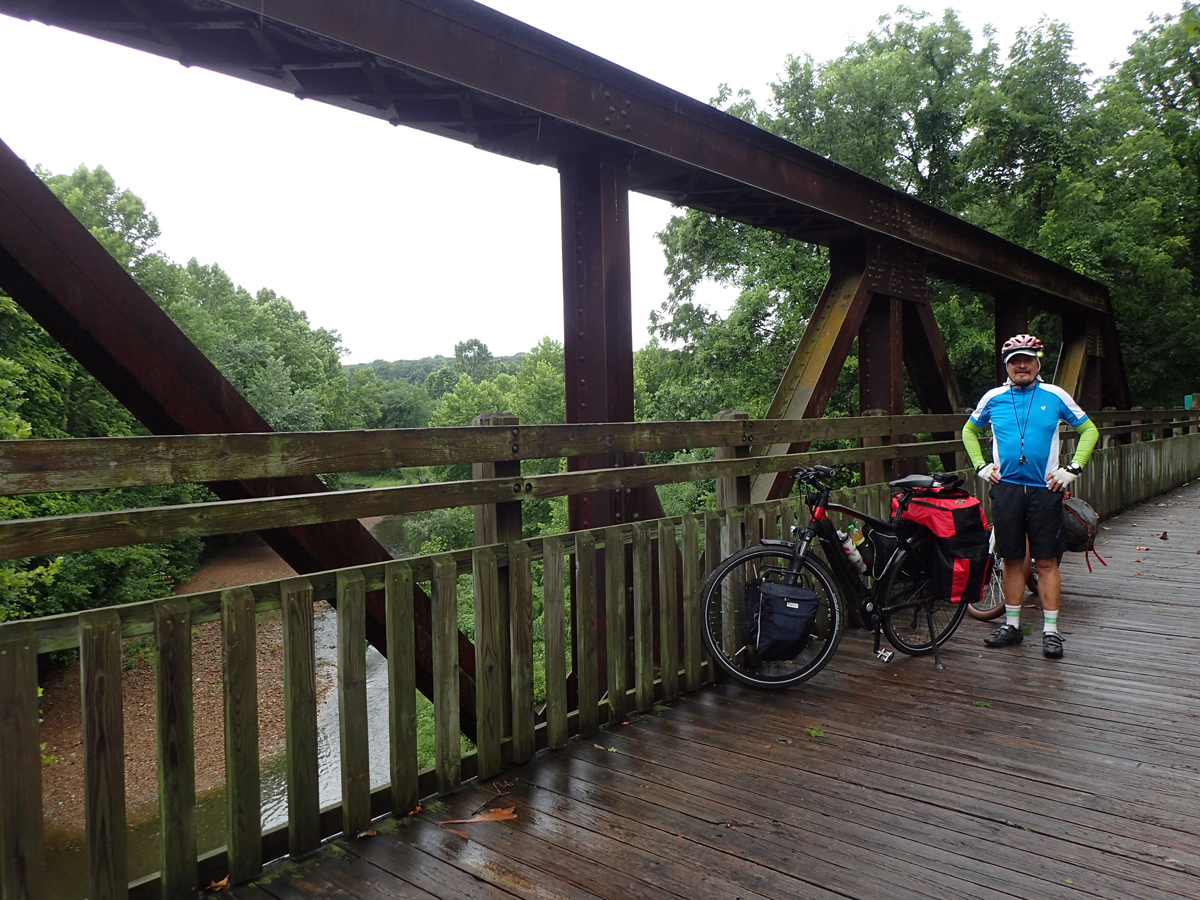
Roger with his ebike set up for touring. Photo by Jael Crandall

In recent years, I’ve toured on a Tour Easy recumbent, a Santana Cilantro tandem, and my trusty “reliquia” as my wife calls it, my “relic” classic, a Japanese 1973 Ranger T.U. (now for sale to a good home). I was due for a new touring bike; but could an E-bike make the grade and get me back into touring as my 70s now approached?

As serendipity would have it Matt Passey, owner of Salt Lake Ebikes, fell in love with my solar powered velomobile—the Organic Transit’s ELF—and we traded for two of his great e-bikes. My wife got a Magnum Ui5 and I got a Bulls Lacuba EVO. My “trained eye” thought that these bikes could make the grade for out of state touring, so now was the time to put them to the test!

In the spring, I did my first shake-down trip of 66 miles down the Jordan River Parkway to the Lehi campground in the rain, and on purpose! I needed to test out my new bike, new panniers, and new tent, and I sure picked out a doozy of a rainstorm that lasted all weekend! I charged up my bike in the campground restroom, a trick we would use many times throughout the year, but I left it out in the rain uncovered all night to see how it would react to the downpour.

By morning I was ready to “fly with the eagles” but this time it was the geese I stirred up. As my lights and honking horn cut through the dark raging lightning storm, I rode into the wind and sideways rain at the same speed as these geese took off with their long wingspans that almost touched the wingspan of my handlebars. Flying with the bird I felt like I was on the right bike at the right time and “this was the place”, for a most electrifying ride. When I got back to reality after making it to Gardner Village for lunch, I was still dry and in high spirits.

What makes my Bulls Lacuba such a great touring bike?

First, it has an advertised range of 132 miles on Eco-mode. Ok, fully loaded with 6 bags for touring I was able to do 60 miles with still one or two bars or 40 miles left, and I never had to charge at lunchtime to keep going.

Second, the super strong frame with fenders, racks, an always on bright front light and actual brake light, disc brakes, suspension forks, Schwalbe 50 Energizer Plus Performance Line Green Guard 28X 1.75 tires all made in Koln, Germany, made this the safest and most supportive touring bike I have ever come across.

I added a special front rack for the suspension fork, an Animaris suspension seat-post, and a Juiced motorcycle horn with key fob alarm that when armed will go off at the slightest touch; making it what I would call, the perfect American style “cafe lock”. This being a Class 3 E-bike it was capable of going 28 mph and it could get close to that easily fully loaded in Turbo-mode.

Thinking about getting into touring on an e-bike?

I have three friends who didn’t want to be left behind by the “old man” and they were about to do their first ever shake-down bike tour on their new e-bikes.

Joining me was Tairel Love on his Haibike hardtail mountain bike 7.0, who loaded everything on his rear rack including a full-size cot. Then we had Tevi Lawson on his fat tire Ecotrek, pulling a Burley trailer with his full-size cot, super thick pad, and winter weight sleeping bag. Tevi came prepared to do office work on his laptop, which he did in his tent after a long day of riding. Also along for the shake-down trip was Tom Jackson, who had never toured before, on a brand new Specialized Vado. Like Tevi, Tom had never done any lightweight camping before.

All four of us had a marvelous time going out to the Lehi bike trail campground ,and I don’t think it would have been as enjoyable had we been on “old fashioned” non-electric bicycles where we might have arrived DOA (Dead On Arrival).

Oregon to California West Coast Tour

For the true test of long-distance touring, Tai, Tevi, and I mounted up on our trusty E-steeds and set off from south of Portland, Oregon on Highway 101 bound for the Redwood Forests of California. Going south as all smart cyclists do, we whizzed along with tailwinds up mountain passes above the clouds and fog and down to shoreline beaches with their roaring surf. Each night we came into a State Park campground, many showing ‘Full’ signs and with car campers being turned away. For cyclists like us, Hiker/Biker sites were always open by decree.
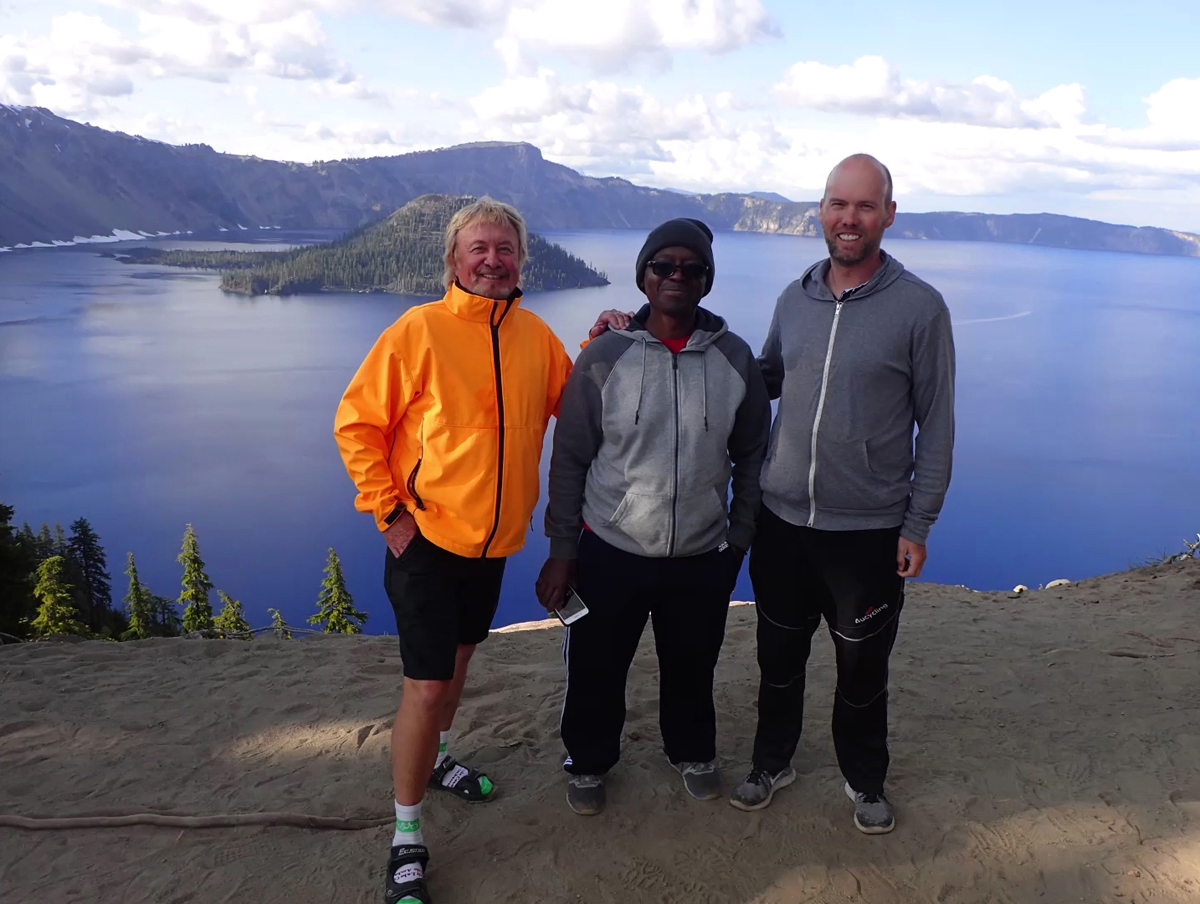
The Three Amigos end their trip at the top of Crater Lake. Photo by Roger and Jael Crandall

There was always space in the backwoods, but you did have to hike or bike to bathrooms, which were by exaggeration, “miles away”. Tevi carried an extra battery, and which he only used since he was on a fat tire bike pulling a 90-pound trailer. Each night, we plugged in and recharged and never had to do a lunch stop recharging.

None of our bikes had a throttle, so we worked hard for our faster speeds, rides into headwinds, and mountainous climbs. We often had to eat a second breakfast, but we didn’t get the snot kicked out of us or arrive with mashed potato legs at the end of the day.

As a 69-year-old, I really felt that I was cycling better than I had at 24 on my trip to South America. That was confirmed by some of the cute “20-something-year-olds” that we chatted up at the Hiker/Biker Campgrounds. One girl and her companions thought we old guys were “Awesome!” as we passed them on climbs and got to camp sites before them.
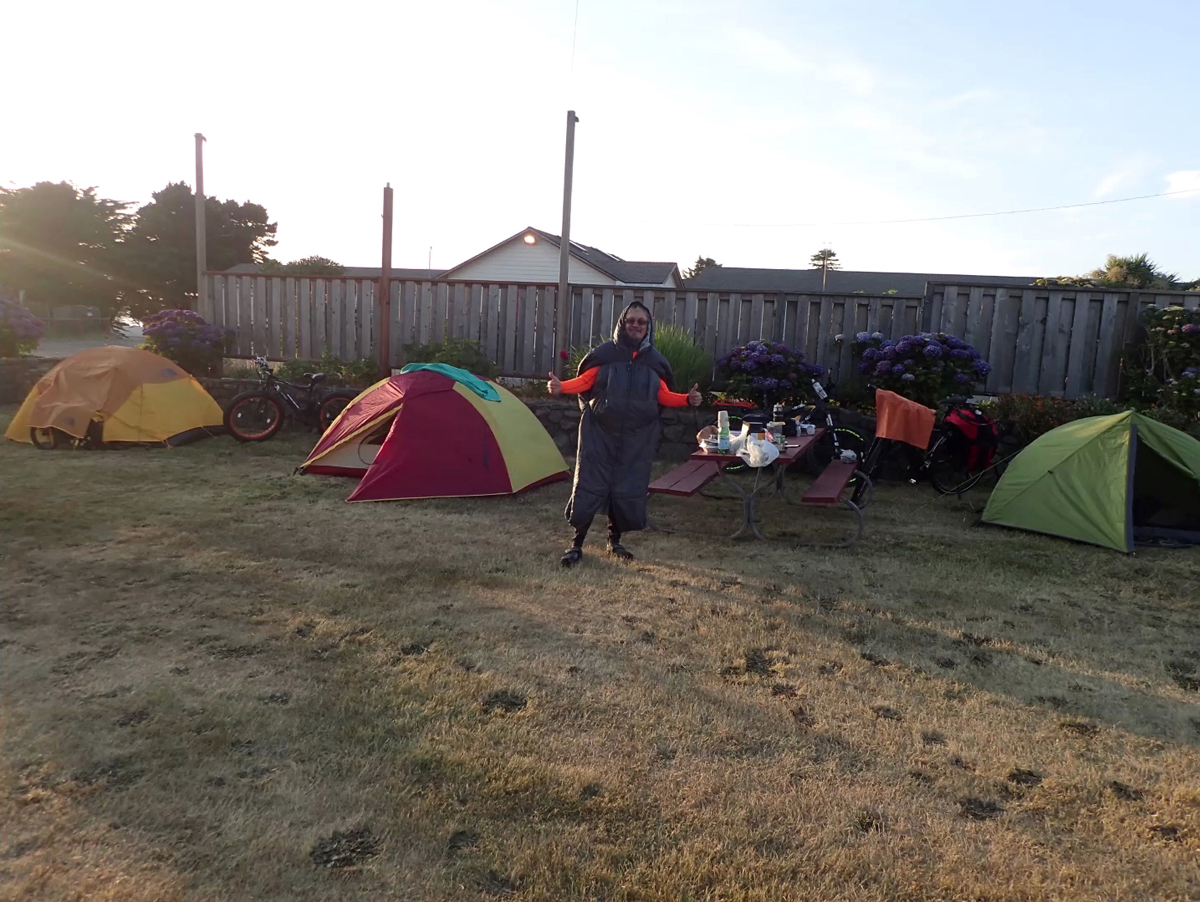
Roger wearing his Crash Sack sleeping bag. Photo by Roger and Jael Crandall

We must have seemed like the ‘Tortoise and the Hare”, always taking our time to rest and eat at great vegan restaurants, but still getting ahead. I had to confide to her that “old age and treachery will always beat out youth and beauty”. She asked me, “what do you mean?” to which I replied, “Honey, we are on e-bikes, that’s how we roll.” She was so impressed that she’s getting an e-bike next time!

We loved the hard climbs off of Hwy. 101 like the Seven Devils switchbacks. We even got off-road on a hiker/biker trail in the Redwoods that quickly went from double track, to a single track, to a no track that had our legs burning from stinging nettles. We also encountered two straight up scree climbs that necessitated a two person per bike push to get us up, and we could have used a power walk mode then.
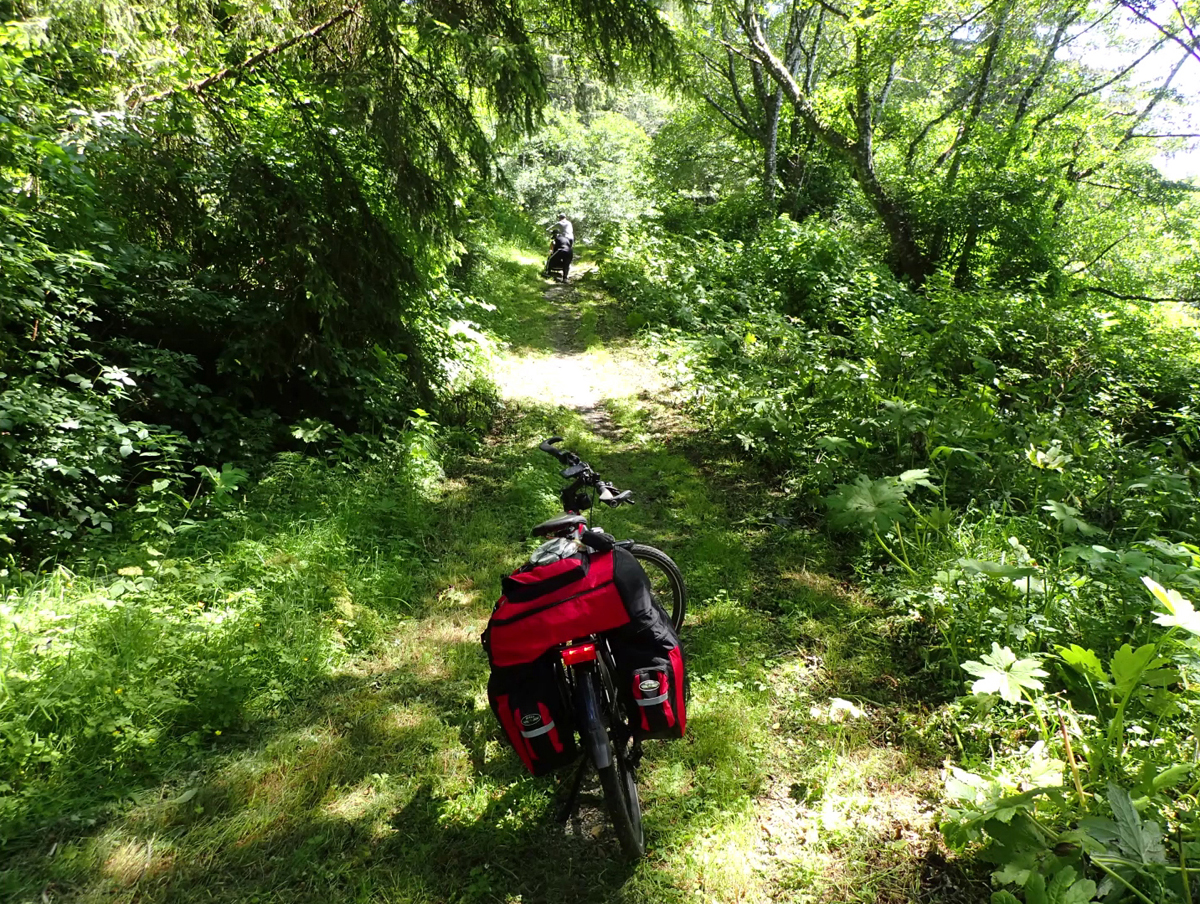
E-bikes going off road on the wide trail before it disappeared. Photo by Roger and Jael Crandall

Even when there was no discernible trail, we decided that “we must press on with all possible dispatch” as Terry-Thomas and Milton Berle said in “It’s a Mad, Mad, Mad, World”.

The Katy Trail

Ok, so men can ride these “high-powered machines”, but how about a non-cyclist woman like my wife who doesn’t like to be on her own bike and has only toured once with me on a tandem?

[Editor’s Note, see also the article, “A Tour of Idaho’s Bitterroot 300K Trail”, in the Fall 2017 issue of Cycling West on cyclingwest.com]

This past summer, my wife Jael rode her e-bike, with full panniers geared for camping, with me on the Katy Trail across Missouri. She kept up with her “biker pro” husband with “no hay problema” and even made the steep climbs when we got off the trail.
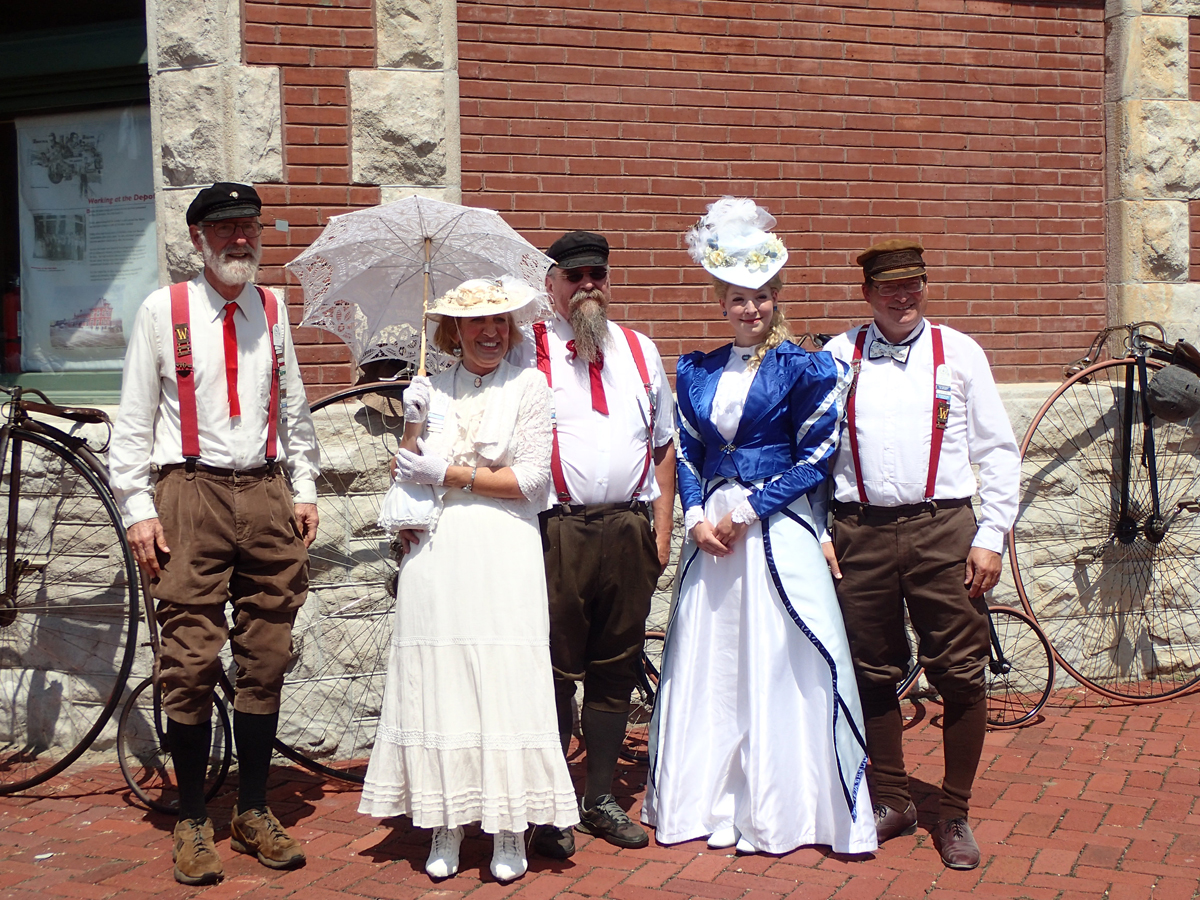
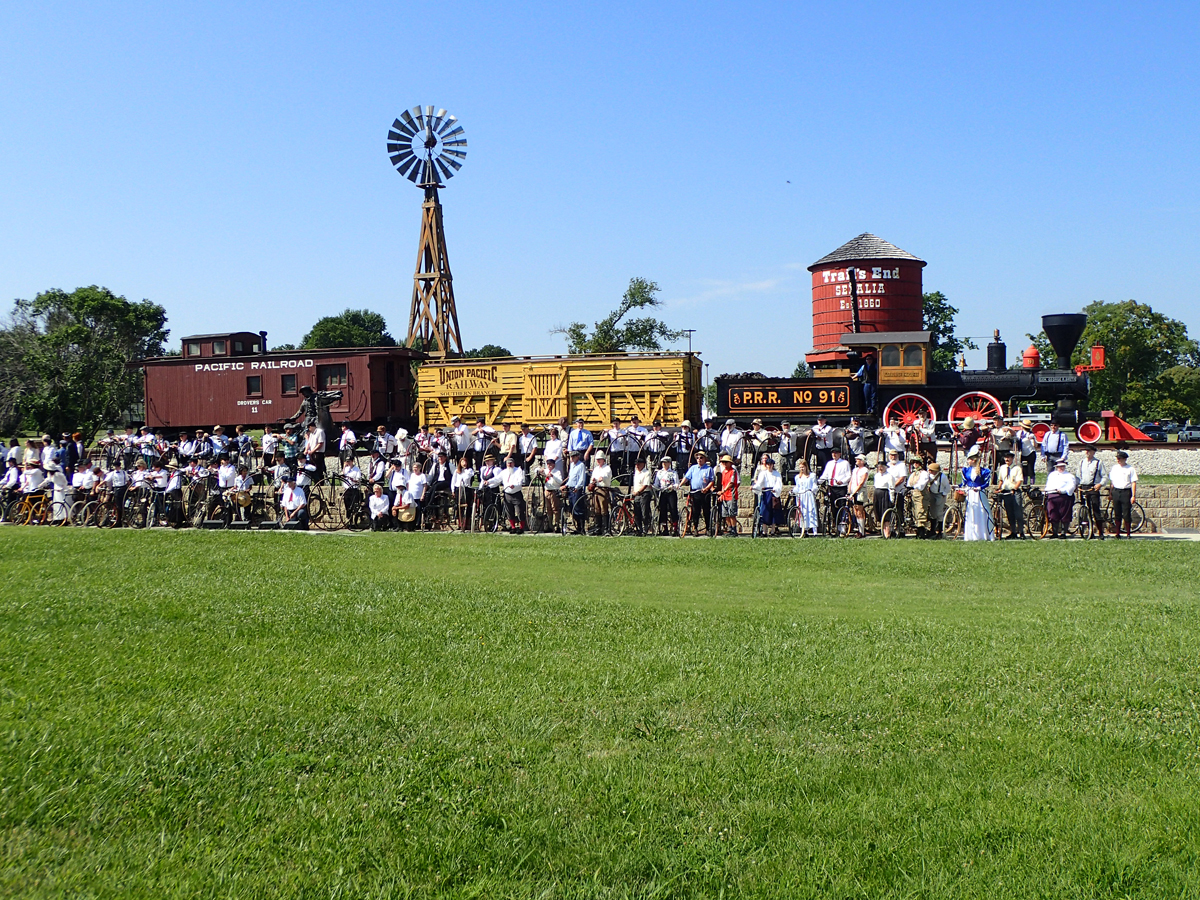
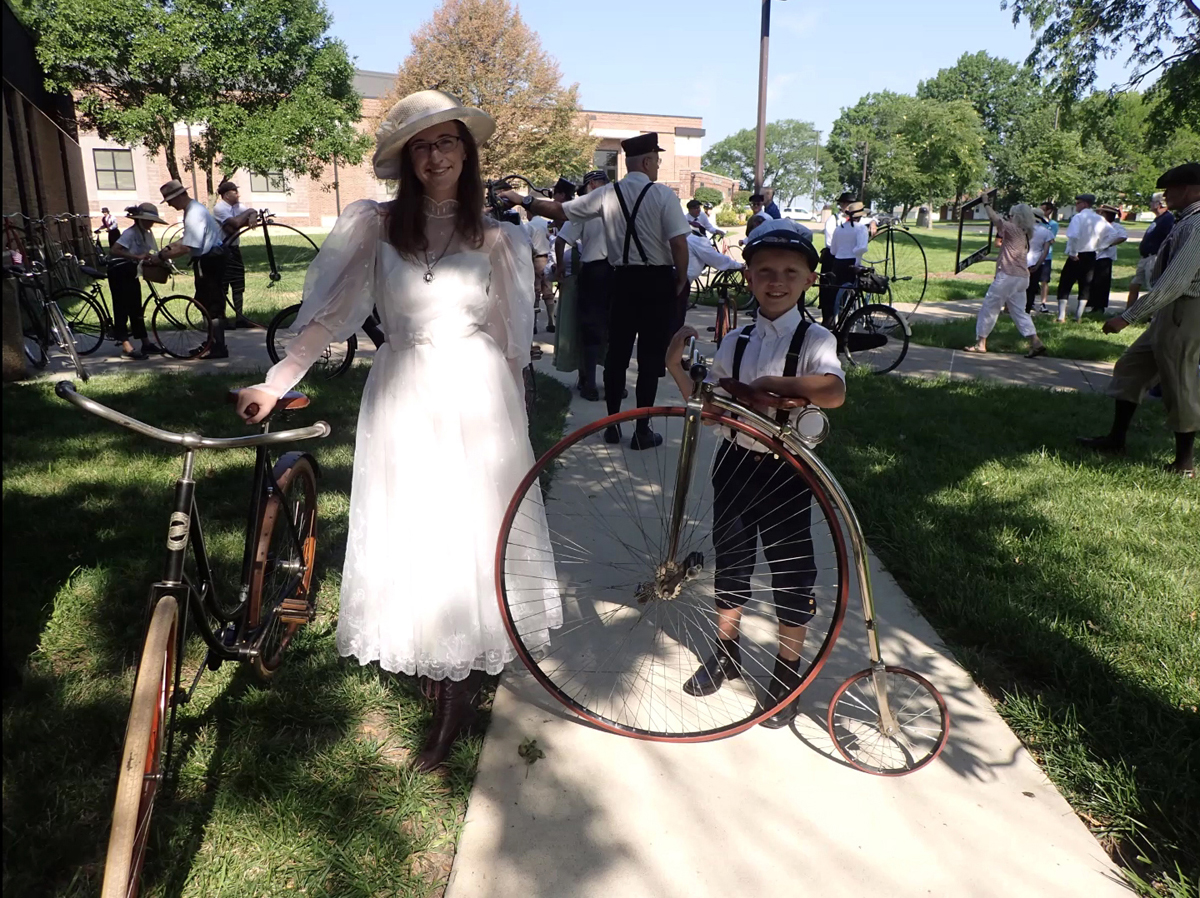
This is how some cyclists dressed on this hot day riding the KATY Trail with a club of a couple hundred close friends. Photo by Roger and Jael Crandall
The 52nd annual gathering of The Wheelman, a group dedicated to bicycle heritage on the Katy Trail. Photo by Roger and Jael Crandall
All types of cyclists bike the KATY, both old and young. Photo by Roger and Jael Crandall
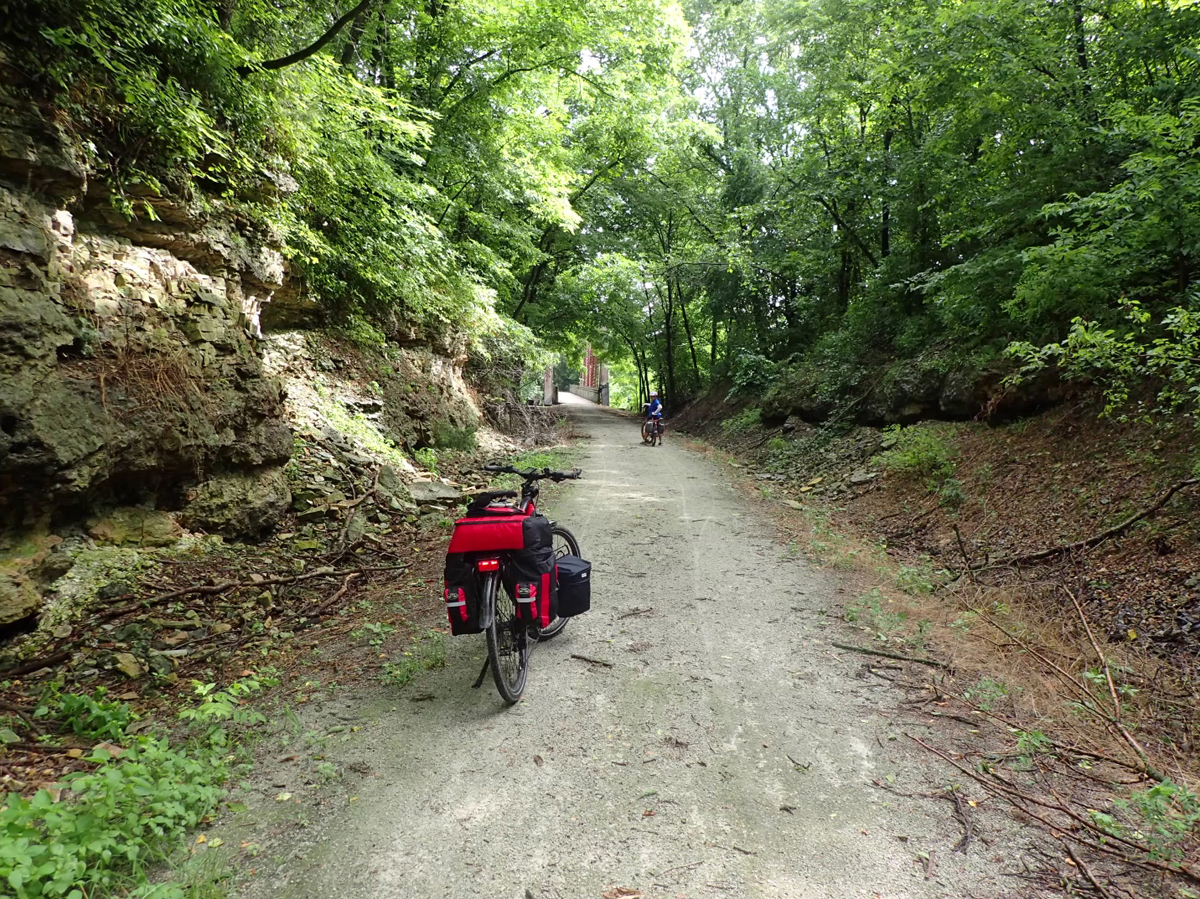
Here is how the KATY Trail looks, lots of shade to be sure. Photo by Roger Crandall

[Editor’s Note, see also the article, “Missouri Gem: The Katy Trail”, in the July 2013 issue of Cycling Utah on cyclingwest.com]

In summary, is an e-bike for touring in your future?

I think if the Germans in Germany are doing it and the French in France are doing it then we Americans can also ditch the car and go eco-mode when we want to go for all types of trips, both long and short. Well, did I sell out? Not yet, but I do have a great deal on a well-used classic round-the-world touring bike if you still aren’t sold on e-bikes.
 

The Boss

A Remembrance of Terry McGinnis

By Jeff Clawson — I was reminded about something last night, in a phone conversation I had with Bruce Bilodeau. He was telling me a story about a race he was announcing a few years back, the State Championship criterium at RMR and the last time I can remember my old friend Terry McGinnis racing bikes.
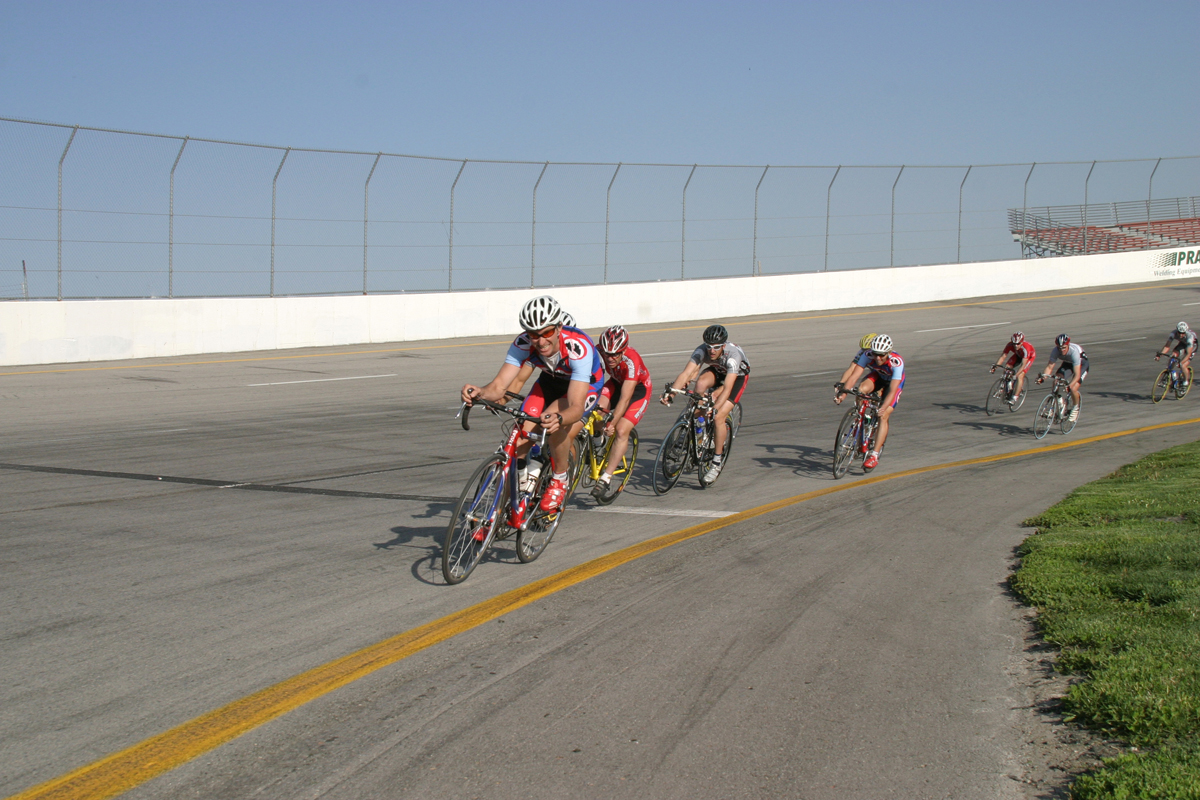
Terry McGinnis at the front on the Rocky Mountain Raceway Oval in 2004. Photo by Dave Iltis

He was pretty sick and must have been weak given the fact his cancer had progressed and he was getting chemo.

Bruce asked Terry after the Pro-1-2 race how he had managed to finish top-10 in his weakened condition. Terry’s face was white and had that 100-yard stare we’ve all seen many times, having gone deep into the pain cave. Terry just laughed and said “I just know how to race a bike …”

He knew that old RMR crit like the back of his hand. Where to be, how to bluff, and what moves to follow. Most importantly, he knew how to suffer.

We got talking about the last year he was directing the Tour of Utah, when he was just weeks away from death. He worked hard on every aspect of the Tour, was everywhere he needed to be, and somehow manufactured the energy to do the job. Never complained. Never let his body tell him what he could or couldn’t do.

I saw his inner strength many times. The times I visited him just before he died are good memories, however hard, when he was still giving me lessons about life — and later, how to die with dignity.

I was racing a wet and cold cyclocross race the day he passed. I was thinking about Terry at the start line, freezing rain coming down with the thought of wanting to quit before the race started. I always thought of Terry when I was suffering, he would be so pissed if I quit.

After that miserable race, I was in a calm mindset to receive the bad news. And so the end of an era, but how would I make it without his advice and guidance? What a loss.

All these years later, the old coach continues to whisper lessons in my ear. I know I will never forget the Boss.

Terry McGinnis was an accomplished bicycle racer, coach, father, and husband. He is missed by his circle of family and friends who still think of him often. He passed away on October 24, 2009 from cancer, and he would be 57 today—probably racing masters races.

[Editor’s note: Terry McGinnis was born on 6/8/1963. This remembrance originally appeared in the Winter 2019/2020 issue of Cycling West magazine, but we wanted to recognize and celebrate T-Mac’s 57th birthday by reposting the article today.]


Ebikes and Bikeshare: Quality Matters

If bikeshare programs want people to ride ebikes, they’ve got to provide good service – not just sell time. So found a study of 503 ebike users in China done in 2018 but published this April by a series of Chinese researchers. Whatever positive or negative experiences the riders had of previous ebike use didn’t matter. And improving service quality helped attain one of the chief reasons for promoting ebike use in China: cleaner air. See The Role of Service Quality and Perceived Behavioral Control in Shared Electric Bicycle in China: Does Residual Effects of Past Behavior Matters?

https://www.ncbi.nlm.nih.gov/pubmed/32306269. (The title may not be grammatical, but that’s how the translator put it.)


Trail Planning and the Birth of the Three Falls Trail

Amazing things can happen when the right people get together. In 2016, the Corner Canyon Foundation, Draper, Alpine, Three Falls Development and Trail Ace Construction collaborated to plan, design, and build a new trail connecting Draper, Utah to Alpine, Utah. The process began with members of the Three Falls Development contacting the Corner Canyon Foundation and the City of Draper Trails & Open Space Department. Brad Jenson, Project Manager, and Greg Hilbig, Trails & Open Space Manager, have worked for over a decade developing the Corner Canyon trail system for the City of Draper and were involved in the original concept design for the trail. Bill Becker, Executive Director for the Corner Canyon Trail Foundation, was instrumental in attaining funding for the section of the Three Falls Trail on Draper property. Will Jones, owner of the Three Falls Estates, allowed the trail to be routed through open space incorporated into the Three Falls subdivision master plan and paid for the trail that passed through his property.

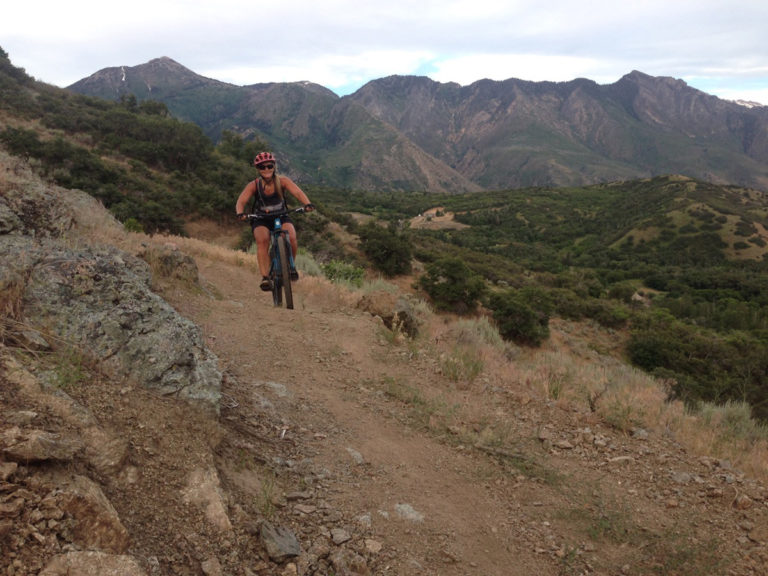
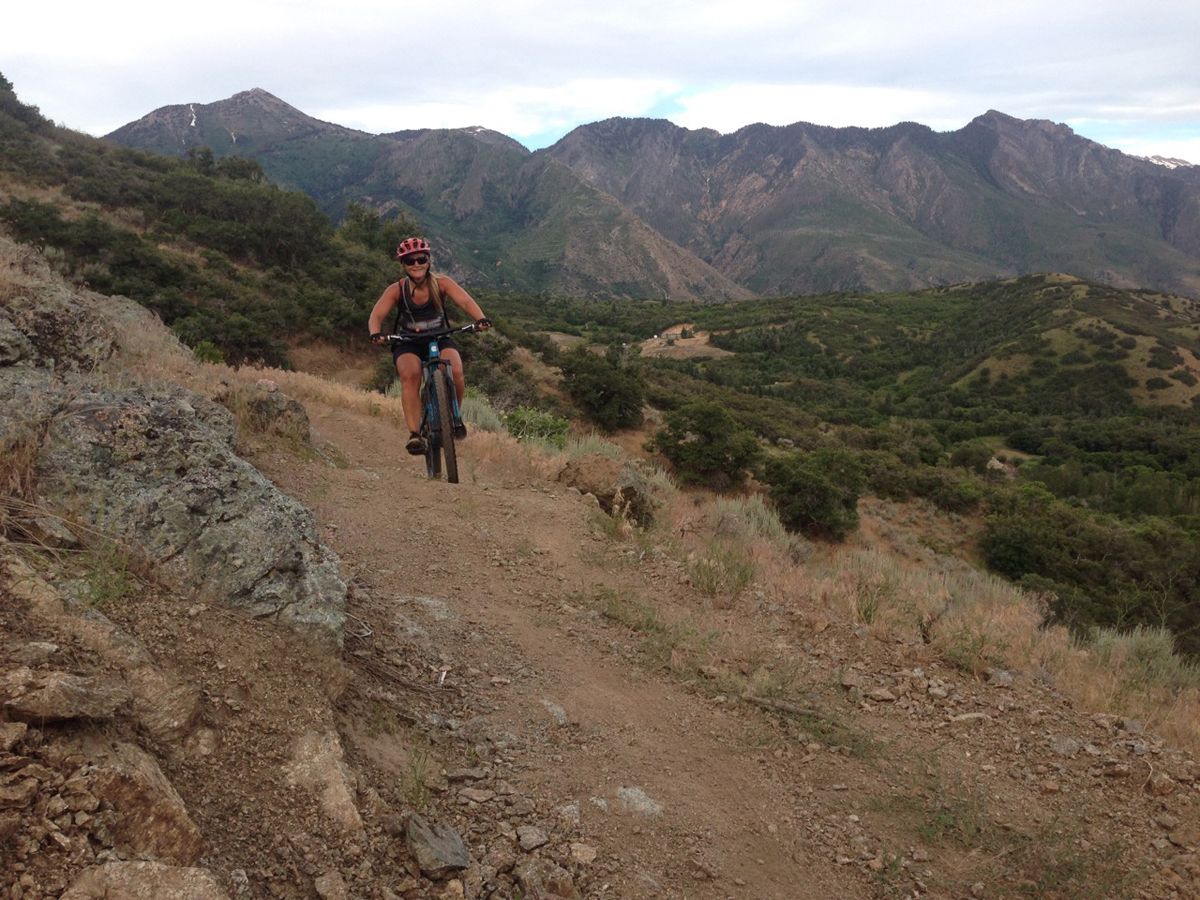
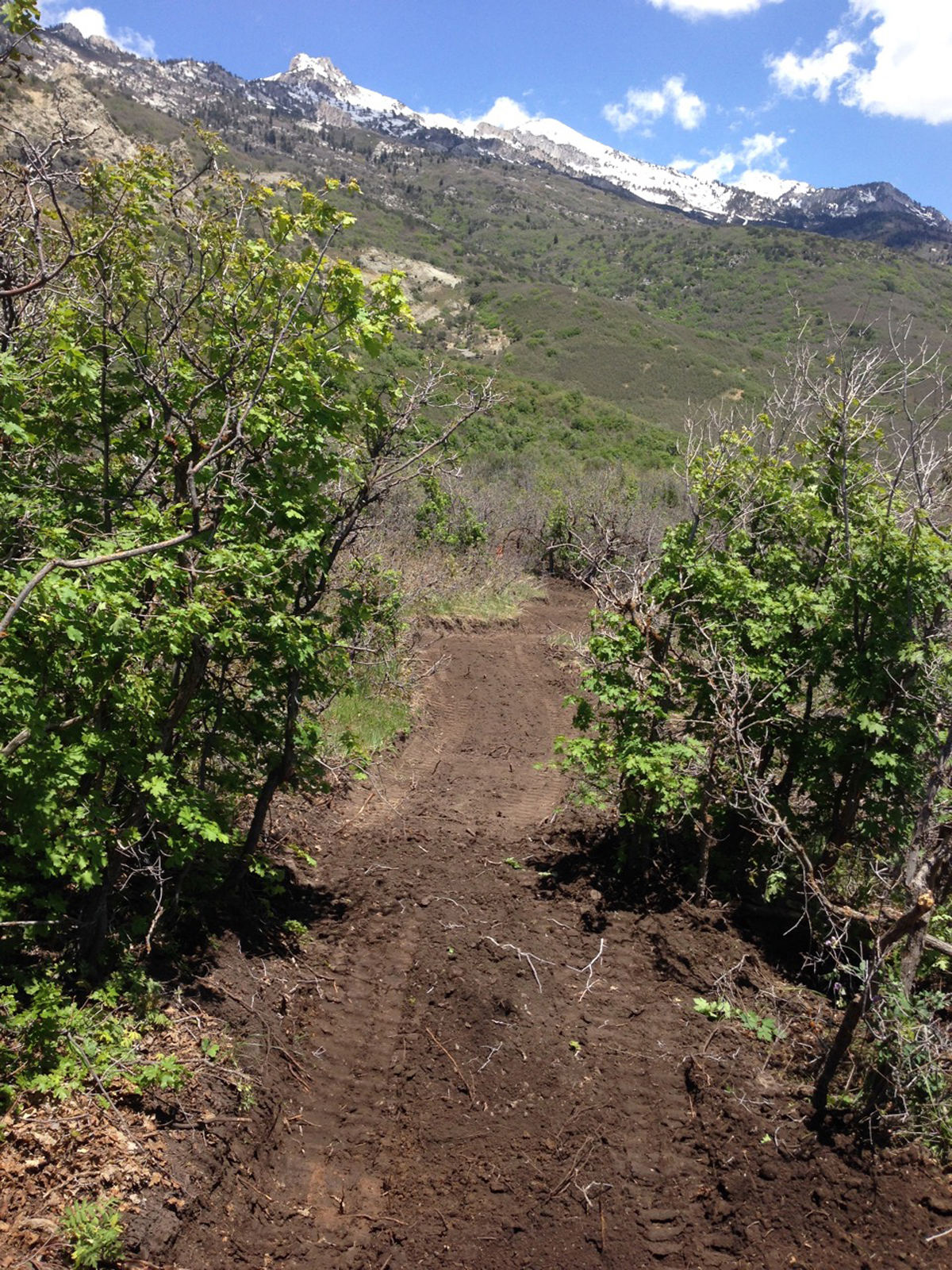
Jenny West riding the finished trail on the east end of the Three Falls Trail above Fort Canyon in Alpine, Utah. Photo by Don West

The Three Falls trail is unique because its birth is the result of a collaboration of private business, private land owners and two city governments. It has resulted in a stunningly beautiful trail connecting communities and providing a recreational outlet for members of the local and surrounding communities. The trail is currently (as of February 2018) partially open to the public to discover and enjoy. The trail is complete except for three bridges that will be built on the Three Falls Estates property on the east side of the trail in 2018. The largest bridge will span over 50 feet and is 20 feet high over the Sliding Rock gorge, The trail was designed and constructed by Trail Ace Construction, which is owned by Bonner Brumley. The field flagging and onsite construction was completed by Donald West, Project Manager for Trail Ace Construction (2015-2017) & current owner of Wasatch Trails Company, Bonner Brumley, and Nate Smith.

Trail Details

Construction began on the Three Falls Trail in the fall of 2016 and was completed in the summer of 2017. The trail is 3.1 miles long and has an elevation gain of 1,250 ft and an elevation loss of 700 ft. It starts at the intersection of Peakview Trail and Jacob’s Ladder in a stunted scrub oak forest. It drops steadily downhill past a series of four geocuts. Geocuts are large vertical features cut into the mountainside to determine if the soil is stable enough for property development. They are easily seen by looking at aerial photography of the area. The trail continues downhill through maple groves and open meadows with views of several stunning 11,000 ft peaks, including Lone Peak, Box Elder Peak, and White Baldy Peak. The trail pops out into the open as it approaches Fort Canyon in Alpine, Utah. The trail then traverses the mountain above the Three Falls Subdivision crossing three major drainages. Here the trail starts climbing and descends again finding the best spots to cross the imposing terrain. The last drainage is a huge gorge that feeds the Sliding Rock Falls and is host to massive granite boulders and towering spruce trees. After crossing a 50 ft bridge (to be built in the spring of 2018), the trail finishes in the Three Falls Estates main road. Here, people can continue on to the 2.3 mi Nephi Lake Trail that will eventually connect to Lambert Park. The Three Falls Trail was designed specifically for hikers and mountain bikers. The trail is considered purpose built for mountain biking, because it has reasonable grades that can be ridden by most experienced riders, features like insloped, bermed switchbacks, and an open and flowing trail design with no awkward or abrupt direction changes. The average grade on the trail hovers around 8% grade +/- 5% for short sections. The trail was designed to allow riders to enjoy the ride in both directions, but most people currently will access the trail from the Draper trail system on the Peakview trail.

Heading east on the Three Falls Trail during construction. The trail enters a meadow with views of Lone Peak. Photo by Don West

The Three Falls Trail has connections to the Jacob’s Ladder trail on the west side and the Nephi Lake Trail on the east. This section of trail will eventually connect to Lambert Park in Alpine and provide a continuous connection of trail from Alpine, Utah to Sandy, Utah. The east portion of the trail may be used as a connection for the Bonneville Shoreline Trail, which is part of a larger trail plan connecting the Idaho/Utah border to Nephi, Utah.

For more information about the Three Falls Trail you can go to Draper Trails & Open Spaces website: http://www.draper.ut.us/116/Trails-Open-Space. You can donate to or learn more about the Corner Canyon Trails Foundation by logging on to http://www.cornercanyontrails.com/. If you are interested in property or a home in the Three Falls Estates, go to http://threefallsalpine.com/. For more information about planning, design, or trail construction contact Donald West at Wasatch Trails Company at https://www.wasatchtrailscompany.com or call 385-444-6666

Salt Lake’s Emigration Canyon to Close to Cyclists for 3 Months – Summer 2020

SALT LAKE CITY, Utah (June 5, 2020) — Salt Lake County and Emigration Township announced today that Emigration Canyon will be closed to cyclists from June 15, 2020 to mid-September 2020 for roadway reconstruction. The closure is from the Salt Lake City / Salt Lake County border, near the mouth of the canyon, to the intersection with SR-65 (the East Canyon Road). 

The reconstruction of the road will result in better bike lanes where pavement width allows.

The public outreach team has several suggested alternate rides listed below, although none will allow a cyclist to ride from Salt Lake City to Morgan County or from Salt Lake City to Park City, Utah. Emigration Canyon is perhaps the most widely used recreational route in Utah.

Notice File: Emigration Canyon 2020 Notice of Closure to Cyclists

Update: Emigration Canyon Repaving Team Addresses Cyclists’ Concerns

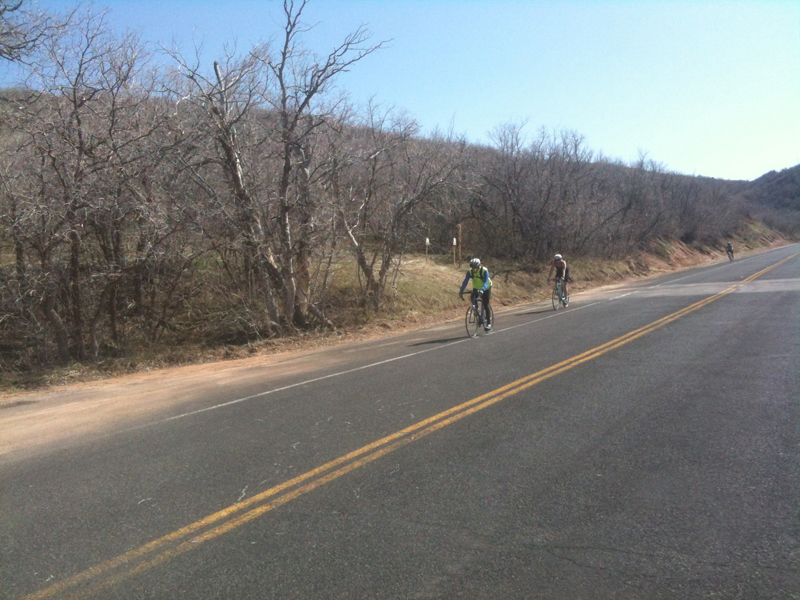
Cyclists and motorists both need to do their part to reduce conflict in Emigration Canyon. Here, 3 cyclists decend Emigration. Photo: Dave Iltis
Emigration Canyon will be closed to cyclists for 3 months in 2020. Here, 3 cyclists descend Emigration. Photo: Dave Iltis

The full text of the notice is below:

Notice for Cyclists:

Due to the one-way traffic necessitated by this project, Emigration Canyon will be CLOSED to cyclists during construction. With one lane unaccessible, the road is not wide enough to safely accommodate both motor vehicles and bicycles. Safety is the number one priority of our team, and the decision was made to close the canyon to cyclists in order to prevent accidents. We apologize for the inconvenience. Suggested alternate cycling routes include:

      • City Creek Canyon (5.7 miles to the top)
      • Wasatch Boulevard Out-and-Back (16 miles round trip)
      • Millcreek Canyon from Wasatch Boulevard (18 miles round trip) 
      • Wasatch Boulevard to Big Cottonwood Canyon (35 miles round trip) 
      • Wasatch Boulevard to Little Cottonwood Canyon (39 miles round trip) 

For more information about cycling routes, visit: www.visitutah.com/things-to-do/road-cycling

Safety: 

For your safety and the safety of those working in the area, please exercise caution while in the construction zone. Reduce speeds, and watch for flagging personnel and traffic control devices.

Questions or Concerns? 

Salt Lake County and Emigration Township have established a dedicated public information team for this project. For more information, or to leave feedback, call 877-495-4240, or send an email to [email protected]. 

Schedules are subject to change due to weather and/or equipment issues. 

Park City Point 2 Point Cancelled for 2020, Moves to 2021

PARK CITY, Utah (June 5, 2020) — The Park City Point 2 Point, one of Utah’s premier endurance mountain bike races, announced today that they have cancelled the 2020 event, and rescheduled it for September 4, 2021.

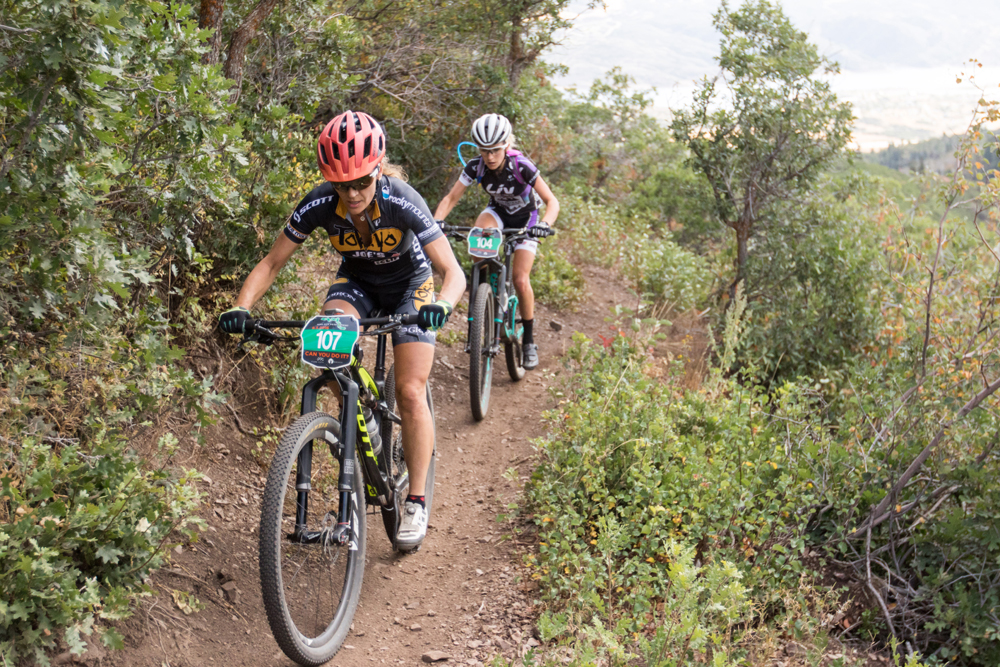
2016 Open Women Champion, Gretchen Reeves, being chased by Mikaela Kofman. Photo by selective-vision.com

Organizer Jay Burke said, “I put a lot of time and consideration into canceling the 2020 Point 2 Point, it was not an easy decision and I hope everyone can respect it. Point 2 Point will be back 100% in 2021, mark your calendars, Sept. 4th.”

The full statement from the P2P is here:

2020 Point 2 Point riders and racers, we are disappointed to join the ranks of so many other local and national events and will be canceling this year’s festivities. We will be back in 2021, mark your calendar now; the date will be Saturday, September 4, 2021. 

Through the years, we’ve worked hard to build a strong reputation as a must-do event. With that in mind, I don’t feel we can execute at our standards, and that’s not fair to participants coming from all over the nation. We want everyone who participates to have the experience they deserve.

We hope everyone can respect our decision, as it was not an easy one. 

If anyone needs qualifiable reasons for the decision, here’s what we took into consideration:

      • The health and safety of participants, volunteers, spectators, and the community is paramount.
      • Some participants and volunteers would be disappointed if we chose to move forward with the event – having one person questioning our decision would have been too many. 
      • We are a small organization and can’t risk taking a chance on the status of our nation in September.

The plan is to refund registered riders the base entry fee ($200) minus $10 for administrative costs related to registration and refunding. Expect a credit to the card you originally purchased with, hopefully within the next seven days. Those registered for 2020 will have an opportunity to re-register earlier than the general public next year for the 2021 event.

We will certainly keep our social outlets flowing with content over the coming months, so keep an eye out for when we open 2021 registration. 

Thank you for all the support, stay safe, and see you in 2021. 

For more on the race, see: https://thepcpp.com/

More Bikes Equals Safer Riding

The more bikes on the road, the safer it gets to ride them. At least that’s what a study in Philadelphia hints at. An academic treatise published in the American Journal of Public Health looked at crash records in Philadelphia County, PA between 2010 and 2018.

“In the long term, programs that increase the number of bicycles on the road, such as bikeshare, may reduce rates of motor vehicle crashes involving a bicycle,” the authors suggest.Though the presence of bikeshare presumably meant more people were riding, the rate of reported crashes with motor vehicles declined an average of 13 percent per annum after bikeshare was introduced, whereas it had been declining only one percent a year before then, says Motor Vehicle Crashes Involving a Bicycle Before and After Introduction of a Bike Share Program in Philadelphia, Pennsylvania, 2010–2018 (https://ajph.aphapublications.org/doi/abs/10.2105/AJPH.2020.305613).


UORG Grants Benefit Utah Mountain Bike Projects

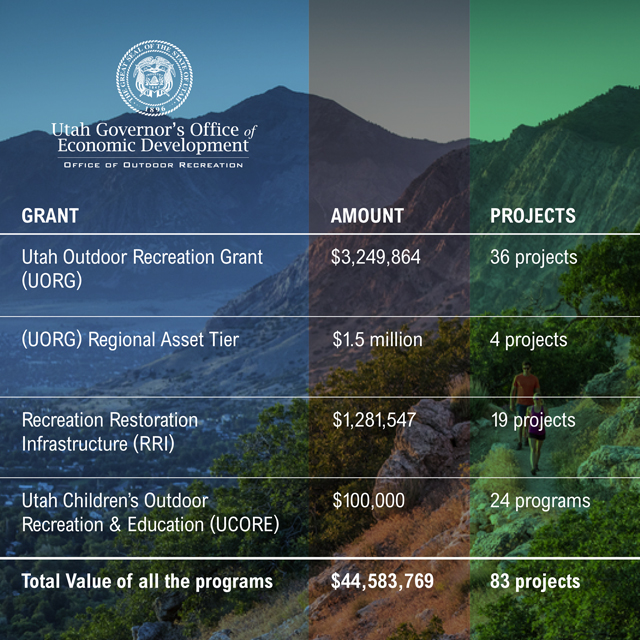
The Utah Office of Outdoor Recreation’s (OOR) sixth grant cycle of the Utah Outdoor Recreation Grant (UORG), has awarded almost $6 million in grant funding to 58 different outdoor recreation infrastructure projects throughout the state. This year marks the highest amount of grant funding given.

These funds will create an estimated impact of over $42.83 million statewide, including grants, matching funds and private investments. The 2020 UORG cycle generated a 7-to-1 return-on-investment for state funds and awarded 64% of its funds to rural counties.

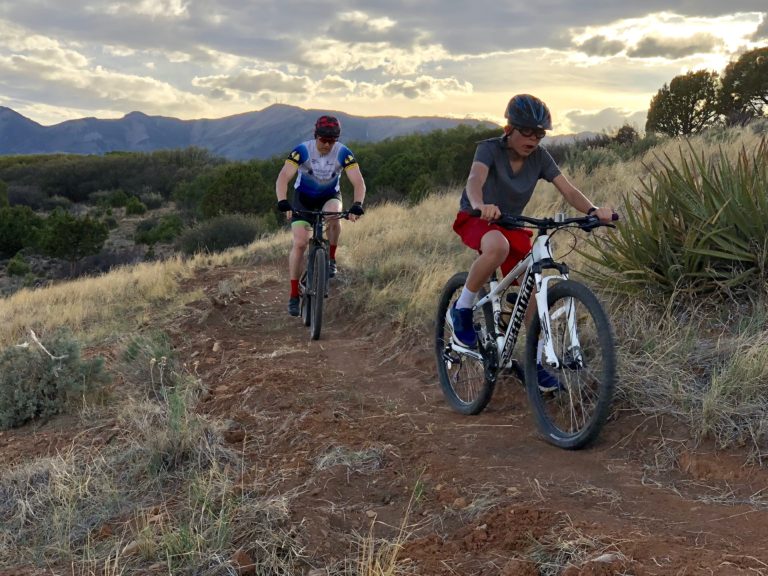
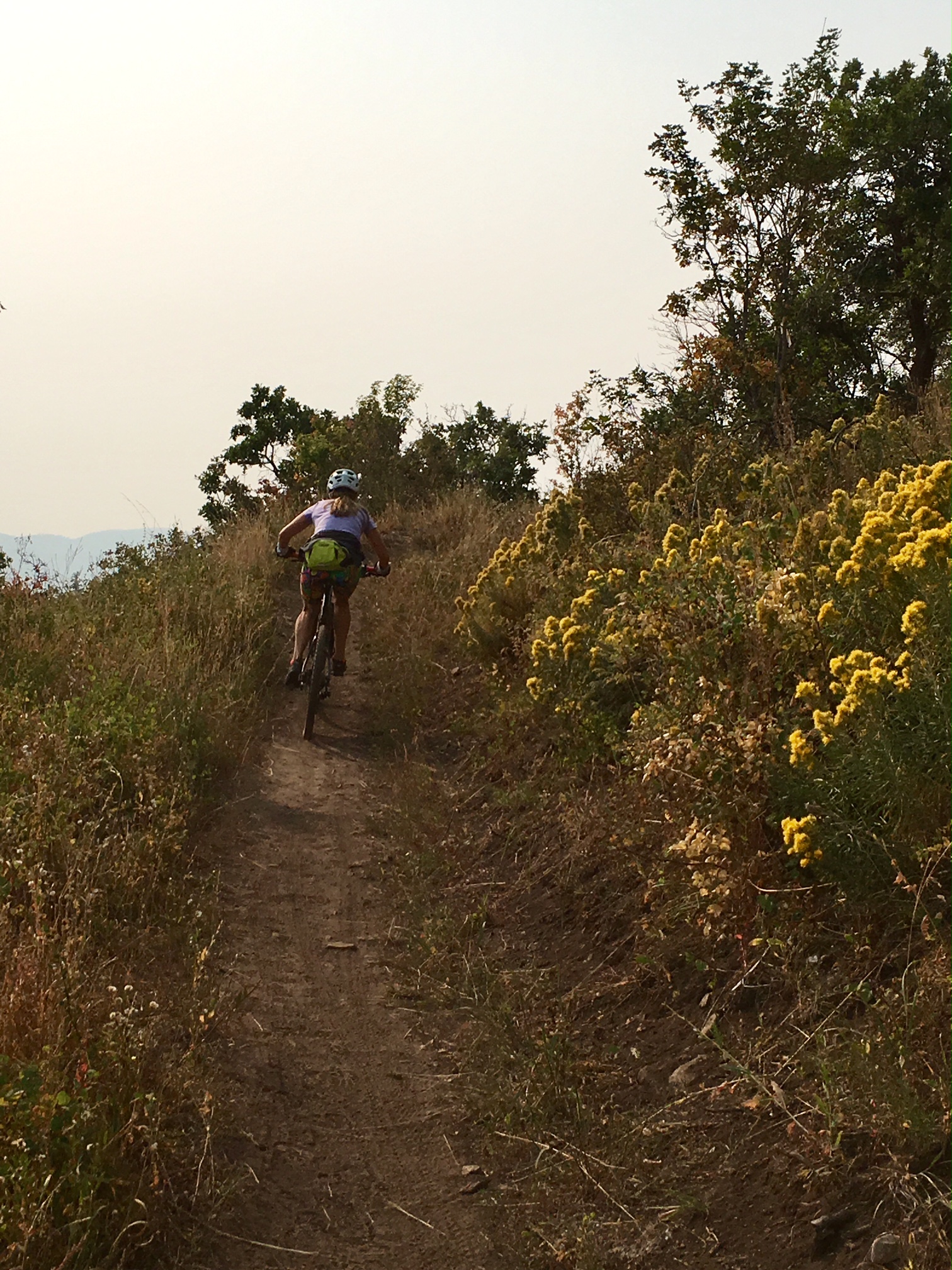
UOLP MTB Trail. Image courtesy UORG
UOLP MTB Trail. Image courtesy Utah Office of Outdoor Recreation

“We continue to be amazed at the number of projects created due to the UORG grant,” said Val Hale, executive director of the Utah Governor’s Office of Economic Development. “Outdoor recreation plays a big part in Utahns’ lifestyles, and we hope our communities will continue to take advantage of this grant to benefit even more of Utah’s outdoor recreation infrastructure.”

Since the grant’s inception in 2015, a total of $16 million in Utah Outdoor Recreation Grant funding has been awarded to 213 projects in 25 Utah counties. Rural counties benefited from 60% of grant projects. Those 200-plus projects have a total project value of over $121 million, representing a rare jewel for Utah compared to other states. The six-year grant initiative proves Utah is committed to enhancing the quality of life for residents and access to the state’s remarkable outdoors for residents and visitors alike.

Graphic courtesy UORG
Graphic courtesy Utah Office of Outdoor Recreation

Along with the traditional UORG grant, two new funding programs were introduced this year: 1) the Regional Asset Tier, funding up to $500,000 for projects costing $2 million or more, and 2) the Recreation Restoration Infrastructure (RRI) grant, for rehabilitating existing infrastructure.

UORG helps Utahns live active and healthy lifestyles by investing in trails, campgrounds, waterways and more. With this year’s trail work combined from all projects, the state will see 62 miles of new recreational trails, and 200 miles of trail restored. Also, 87 campsites and structures will be rehabilitated. Recreators will get to experience 39 new infrastructure sites for camping, archery, fishing, kayaking and canoeing, hiking, mountain biking, climbing, and more.

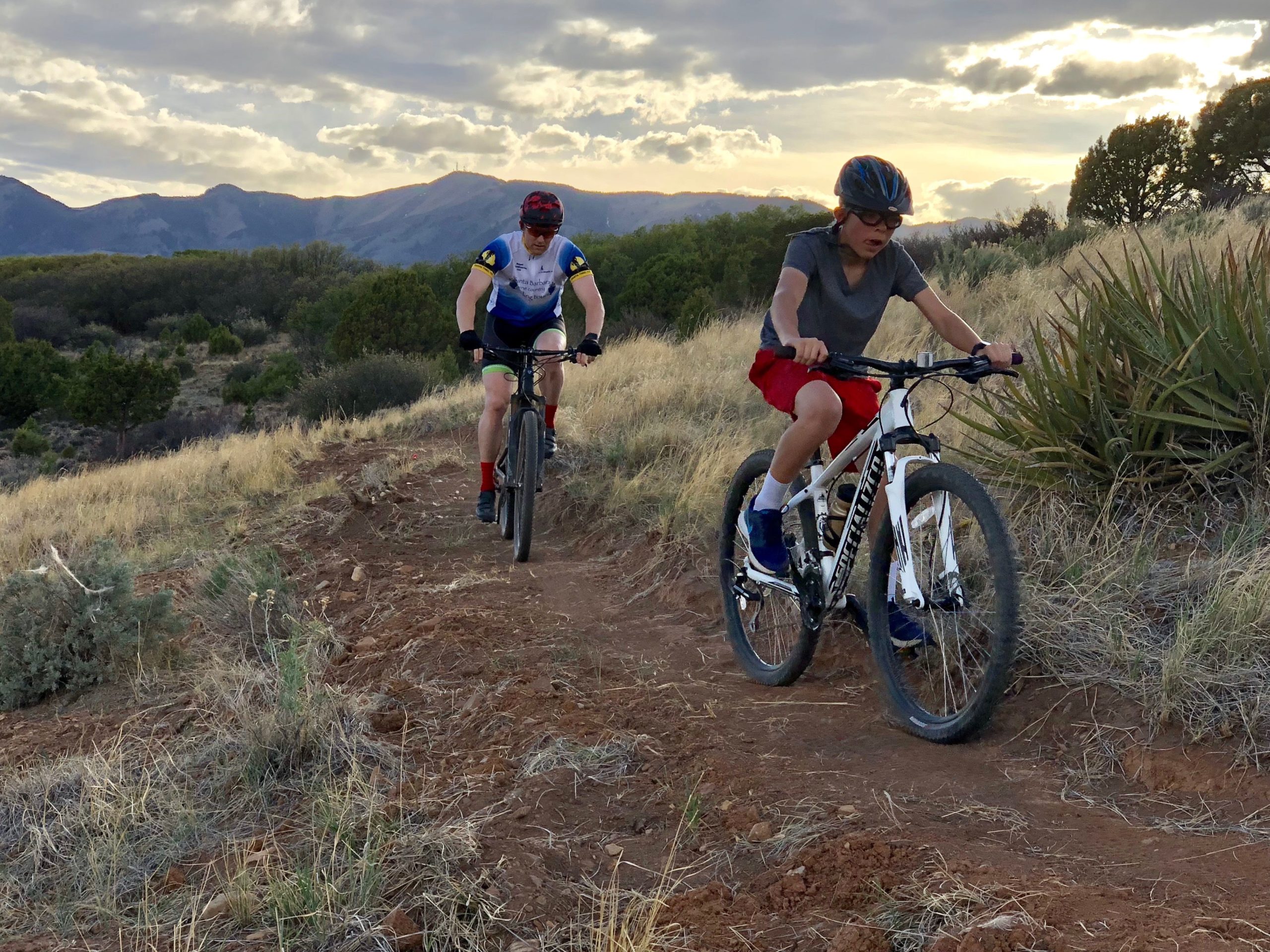
Abajo Foothills Trails. Image courtesy UORG
Abajo Foothills Trails. Image courtesy Utah Office of Outdoor Recreation

“Utah prioritizes providing access to recreation opportunities on all of its public lands,” said Pitt Grewe, director of the Utah Office of Outdoor Recreation. “The Office of Outdoor Recreation is devoted to making sure everyone across the state can find opportunities to recreate near their home. Whether you are a hiker, paddler, climber, biker, OHV or winter sports enthusiast, the state’s grant programs help ensure Utahns get a chance to get outside.”

The Utah Office of Outdoor Recreation received 87 complete applications between the three different grants available during this funding cycle. The 14-member Utah Outdoor Recreation Grant advisory committee reviewed the submissions and granted awards to 58 projects. The amounts awarded ranged from $4,000 to $500,000 per project. Awardees have two years to complete the projects before receiving the full reimbursement of awarded grant funds.

RRI recipient Christijan Draper of Dagget County Trails Committee said, “Speaking for the Flaming Gorge Community Foundation and the Daggett County Trails Committee, we’re excited to have the financial support provided by the Utah Recreation Restoration Infrastructure grant. The funding will help an important project move forward in the Flaming Gorge National Recreation Area and Daggett County. We’re thrilled that this project will allow visitors to more easily and safely enjoy this scenic canyon and its world-class fishery in Utah’s recreation frontier.”


Huntsman Ride Goes Virtual For 2020

Due to the current COVID-19 novel coronavirus pandemic, the Huntsman Cancer Foundation has cancelled a number of events, including the Huntsman 140 ride from Delta to Salt Lake City. Instead, in a letter sent to interested parties, the Foundation has elected to run “virtual” events for 2020. The text of their letter is below:

In 2015, the Huntsman 140 raised $415,000 for cancer research. Photo by Charles Uibel In 2015, the Huntsman 140 raised $415,000 for cancer research. Photo by Charles Uibel

VIRTUAL Huntsman SportsFest: Virtual means wherever you are, whatever you want to do, and raising funds for cancer research.

We hope that you and your families are staying safe and healthy amid the current COVID-19 pandemic. We are excited to let you know that the Huntsman SportsFest Run and Ride is moving to a virtual event for 2020, and we are asking you to join us. We have reimagined the event so that it is accessible to everyone, from anywhere. Although we can’t come together physically on June 20, we can make a difference through an exciting virtual fundraising experience dedicated to raising funds for cancer research.

Registration for the Virtual Huntsman SportsFest has been decreased to $25, and kids in the Virtual Huntsman Run are only $12. Registration is open now. Participants will receive a personal fundraising page, incentives for fundraising, an event t-shirt, and the knowledge that you are raising funds that accelerate cancer research at Huntsman Cancer Institute (HCI). Your support is needed now more than ever. Even amid the COVID-19 pandemic, the work at HCI goes forward. Our patients and caregivers continue the fight against cancer on the front lines. Each day we help hundreds of patients whose course of treatment cannot be delayed. HCI’s researchers are finding new and innovative ways to continue research efforts that save lives.

We invite you to think big! “Virtual” can mean anything: any distance, any location, and any activity that is safe and fun for you/your family. Maybe a 10K trail run becomes a pickleball contest with your family. Maybe the 140-miles you were planning to ride with friends, turns into a solo ride that you video document at stops along the way for friends and family to see on social media.

To register, go to www.huntsmansportsfestival.com

We are sure you have questions about this change. Please check out our FAQ page for answers to the many questions you may have. As always, you can contact us at [email protected] for additional information

Whether you choose to ride, run, walk, hold a family bingo tournament, or another activity, by committing to join us on June 20, you are making a difference. We hope to “see” you on June 20. One hundred percent of all donated dollars will fund cancer research at HCI. Our mission to eradicate cancer from the face of the earth continues and we are grateful for your support.

Thank you,

Jen Murano
Director of Events
Huntsman Cancer Foundation

Susan Sheehan
President and COO
Huntsman Cancer Foundation


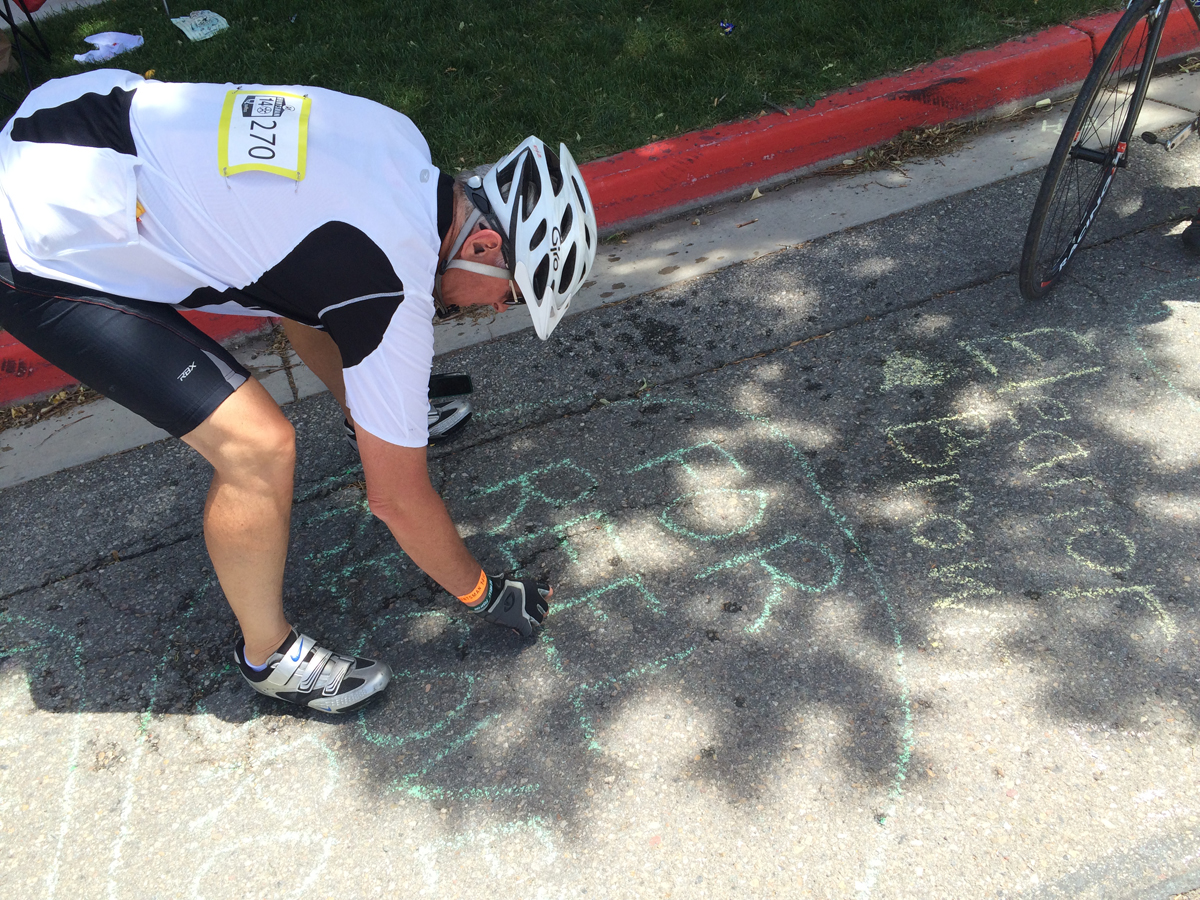
A rider supporting his friend. The Huntsman Ride raises money to support the Huntsman Cancer Institute. Photo by Dave Iltis
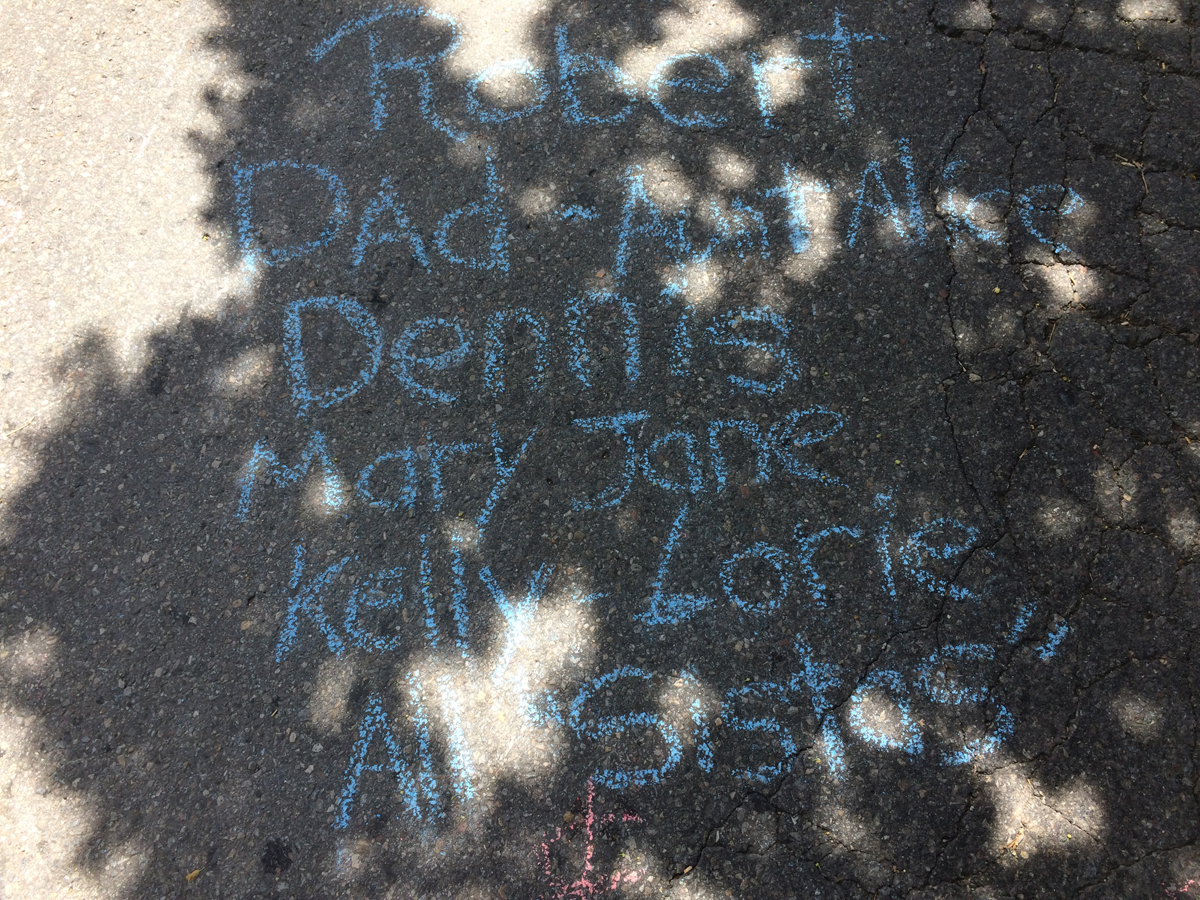
Many people write the names of who they are riding for in chalk. The Huntsman Ride raises money to support the Huntsman Cancer Institute. Photo by Dave Iltis
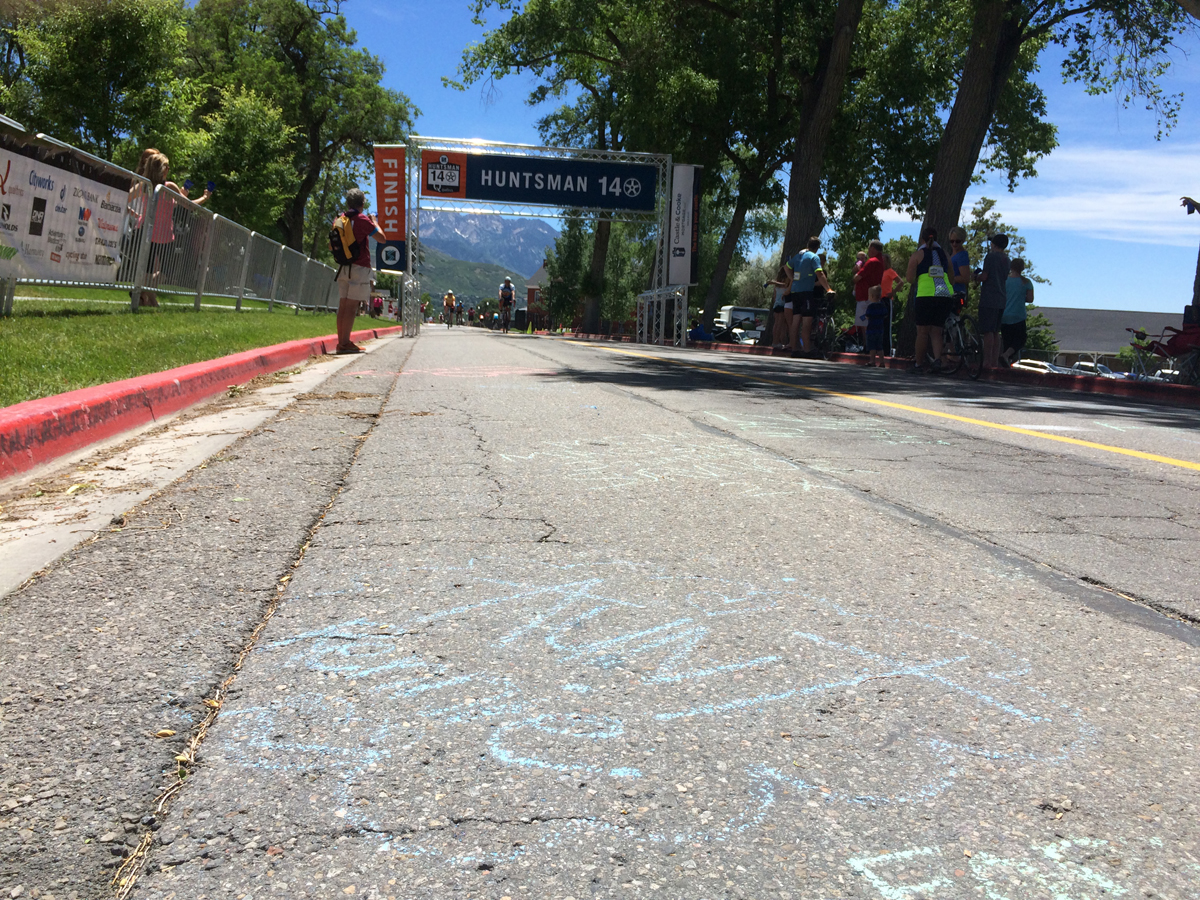
The Huntsman Ride raises money to support the Huntsman Cancer Institute. Photo by Dave Iltis
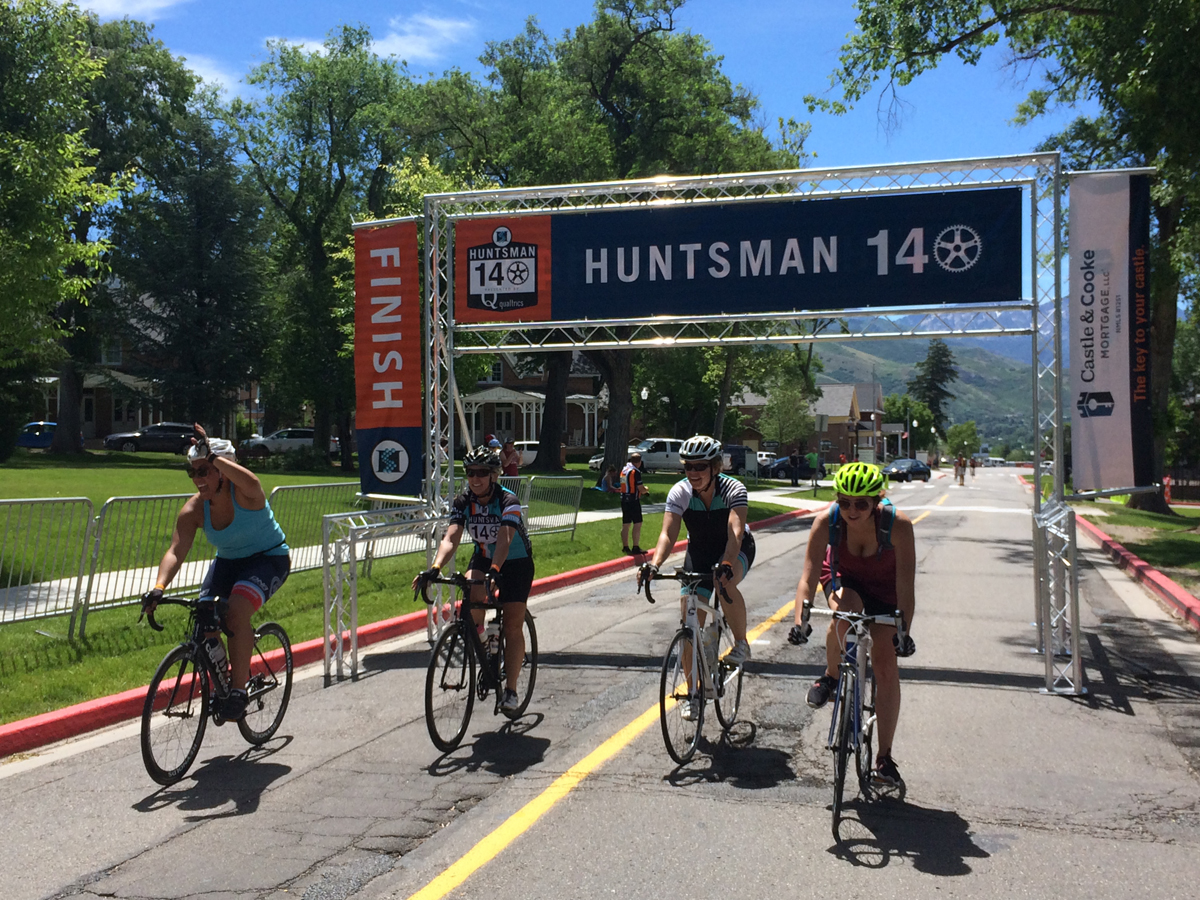
RIders crossing the finish line after the Huntsman 140.
The Huntsman Ride raises money to support the Huntsman Cancer Institute. Photo by Dave Iltis
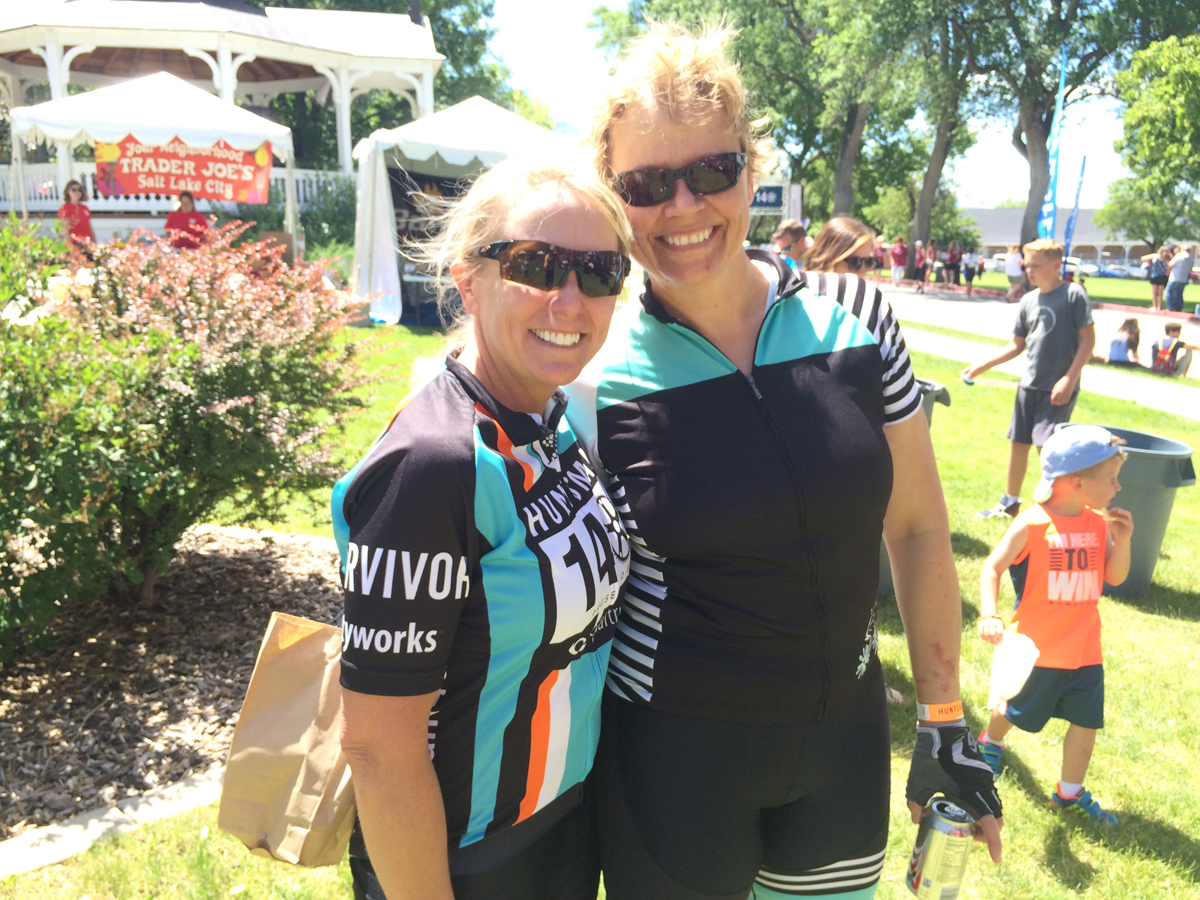
2 riders after the event. The Huntsman Ride raises money to support the Huntsman Cancer Institute. Photo by Dave Iltis

Big Sky Montana, The Ultimate Enduroists Family Vacation?

By Ali Goulet — Big Sky, Montana. For some it conjures up images of open vistas, the Yellowstone club, Warren Miller or other famous “residents”. What the locals know, is that Big Sky is a hidden gem, chock-full of rowdy lift accessible mountain bike trails and a fun mountain town full of activities.

For years my friend Chaz Boutsikaris, co-owner of Brothel Bikes, Big Sky’s most notorious bike shop, would often regale me with tales of amazing mountain biking and fun times at Big Sky, always pressing “you’ve got to come up, bring the family.”

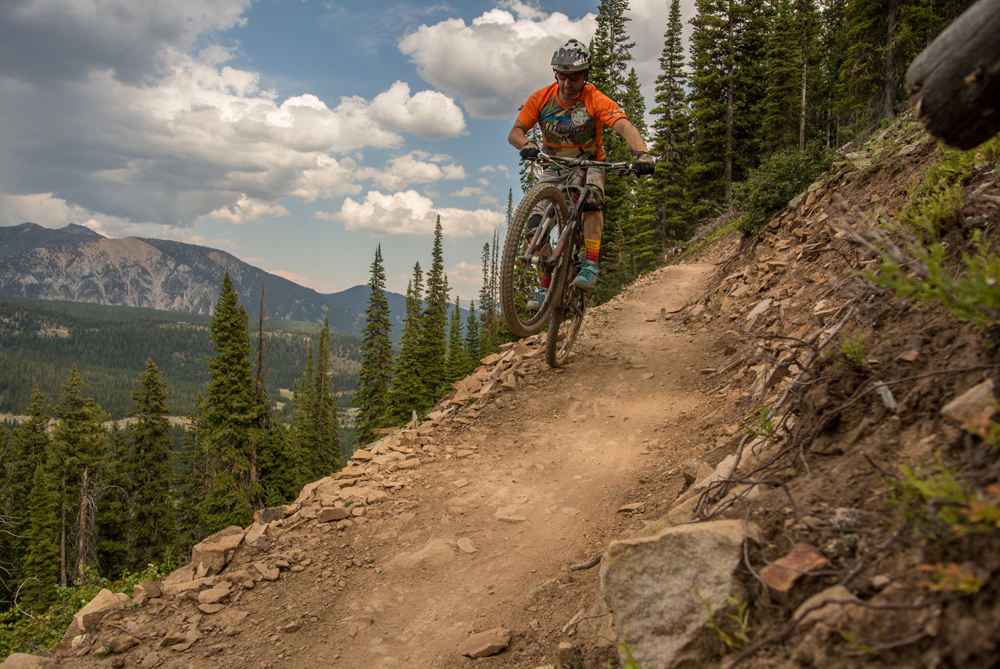
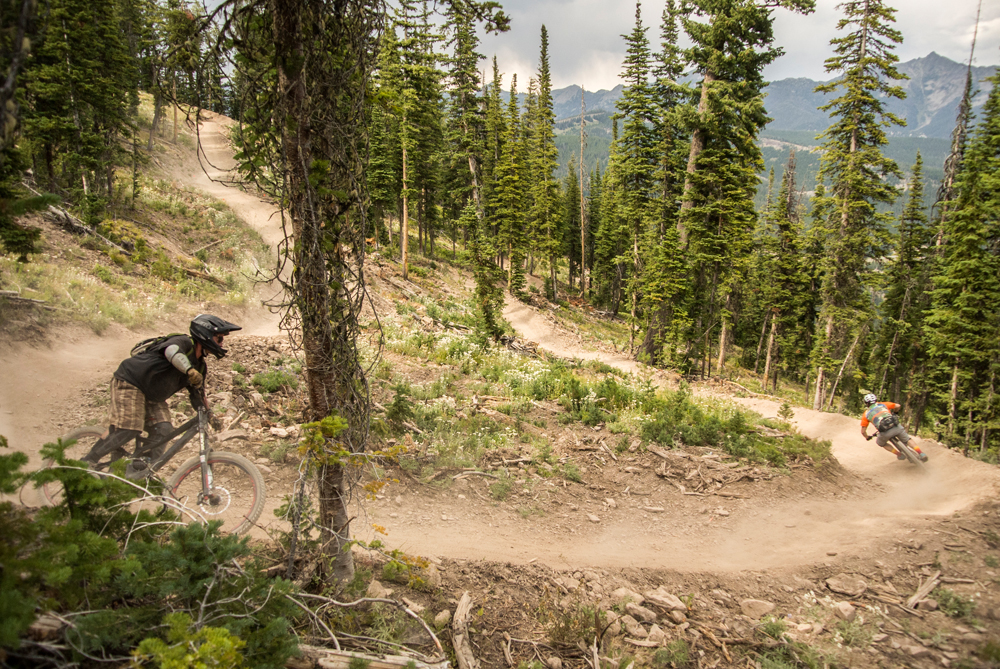
Ethan on the Snake Charmer run at Big Sky Resort, Montana. Photo by Ali Goulet

Finally in the year 2016, August to be exact the stars aligned in a trifecta of sorts. There was to be a Montana Enduro Series event held on Big Sky Resort itself, Chaz has been wanting us to visit for a while, and there was potential for a fun long weekend, with activities to entertain the kids. This was something I could sell the wife on. “We’ll visit Chaz, see Montana, I’ll do this Enduro, there’s a pool, it will be a fun family trip…” I guess it was a convincing pitch, the wife agreed “Montana?” and so not unlike the Griswolds, we loaded up the family truckster with bikes and kids and pushed off on the short 5 1/2 hour drive to what would become my Wally World.

Being just a half day drive from Salt Lake City, we arrived with plenty of time to get settled at our digs in the Huntley lodge, located in the village at Big Sky Resort proper. This was the perfect place for us, the “Mountain Village” was right out our door, offering rock climbing, zip line, scenic chairlift tours, the enduro would be right here and we had a pool!

In Big Sky, The dominant feature on the horizon is the massive Lone Peak. Jutting toward the sky, topping out at 11,166 feet, and without so much as a tree on it, it’s not hard to imagine why anchorman Chet Huntley saw so much potential here. During the winter Big Sky boast the most skiable acreage in North America at over 5,700 and I can just imagine the shreddable opportunities accessed via the Lone Peak Tram.

Bryson Deppe of the Highliners-Bingham Cyclery Team rides beneath Lone Peak in Big Sky Resort, Montana. Photo by Ali Goulet

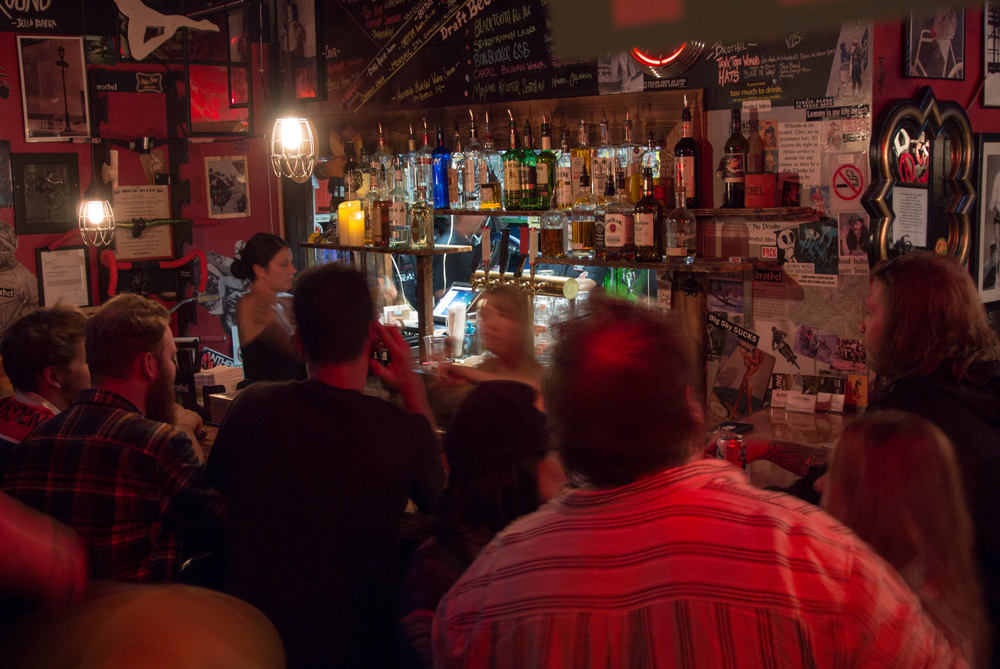
Thursday night’s concert series in the park offered us a family friendly hang before spilling over into a late night (for me anyway) at Brothel Bikes, which is just as much of a bar as it is a bike shop. In fact “The Brothel” as it is also known, became a central hub for me. It’s the place to get your bike serviced, you can grab a beer while you wait, and it happens to be at the bottom of 8 miles of flow trail and just around the corner from public transit, that shuttles you back to the resort.

Brothel Bikes is a brothel turned into a bar and bike shop. Photo by Ali Goulet

Big Sky originally opened to mountain biking with advanced terrain more suited to a Downhill or Enduro bike. More recently they’ve brought in Terraflow Trail Systems, adding more intermediate level flow trails and opening up the mountain to a broader skill base.

For the XC crowd there is plenty of riding as well. Scenic routes like Madison and Ulery’s Lake Loop, feature ribbons of single-track lined with lodgepole pine, and a lake of course. Or, there are more strenuous trails such as Coolridge and Ambush Loop that offer wide open “Big Sky” backdrops for your suffering.

Despite there being 40 miles of lift accessible trails on resort, it was all I could do the get my seven-year-old out of the pool, he was obsessed…of course. I was, however, able to dry him off long enough to get in a few laps. Our favorite of the new flow trails quickly became Snake Charmer. Hands-down one of the best flow trails I’ve had the pleasure of riding. The berms and tabletop jumps were all manageable by my seven-year-old on his 20-inch wheeled trail-bike and yet I was able to take advantage of the trail design, finding plenty of lofty air and opportunity for doubles and triples. No sketchy gap jumps, just miles of flow that can either be linked back to the resort or taken all the way down to the “Mountain Meadow” and The Brothel. Isn’t that convenient?

Ali pops a wheelie at Big Sky. Photo by Chaz Boutsikaris

Being based at the resort made balancing family time and enduro time fairly easy. I could quickly transition from being at the pool with the kids to cutting laps with the seven-year-old, to training for the enduro race. Not to mention the village had multiple dining options, a mini-mart and a coffee shop that pumped out Starbucks (I’m into that sort of thing).

Race day looked to be a disaster, it began with cold alpine rain and a 30 minute weather hold due to potential lightning. Thankfully the weather did a complete 180 and thirty minutes later competitors set out to enduro under partly cloudy skies, with moderate temps and freshly moistened tracks. And a proper enduro it was. The physical and technically challenging timed stages, combined with brutal transfer stages and mandatory hike-a-bike action, made for a rewarding day on the bike, clocking 6700 ft of descending and 3300 ft of climbing in 19 miles!

Ali (right) and Paul Gougen tackle Snake Charmer at Big Sky Resort in Montana. Photo by Chaz Boutsikaris

On one transfer stage, we were routed straight up a double black diamond ski run to the Andesite Mountain summit. In the midst of that transfer I vowed I would never return, the sun had finally started to beat down, my nutrition was failing me as was my general fitness and apparently my mental stamina. It was in those moments that I recalled Everett’s 8800 Mountain Top Restaurant, the home of my new goal, an ice cold Coca-Cola. The thought of that tasty beverage kept me going all the to the peak and Everett’s…but I was shattered. After imbibing 20 ounces of cola, I gathered myself up for the final stages of the day and came to grips with the fact that I did enjoy the challenge and was already entertaining thoughts of taking revenge on this course next year.

For my part, I did ok, landing just inside the top 10 Pro/Expert on unfamiliar trails.. But I had more pressing matters to be concerned with: Like loading up the family truckster and bolting for the city of salt. So we loaded up and bid farewell to Big Sky, but not forever, you see, we’re already planning our return and this time we’re bringing friends!

Travel to Big Sky

  • Travel distance from Salt Lake/Boise/Jackson/Bozeman = 368mi/436mi/175mi/41mi
  • Accommodations: Huntley lodge $275 per night – pool/hot tub/free wifi/55 feet from chairlifts (bigskyresort.com). There are many other lodging options in the area as well. See visitbigskymt.com/lodging/ for more information.
  • Family/kid activities: bike tours $58 youth day bike camps for ages 8 to 17. Adventure mountain pass $52 all-inclusive day access to adult and kid rope courses zip line, climbing wall, scenic lip rides and more
  • Info about travel to Big Sky Montana can be found at www.bigskyresort.com or contact Big Sky Chamber of Commerce at 406.995.3000 or visit: visitbigskymt.com
  • Summer mountain biking at Big Sky runs from June 3 – September 25 daily 9-4 PM, adult lift passes $38, Junior passes $30, more information regarding the bike park can be found on Big Sky’s website (bigskyresort.com) or by calling Different Spokes bike shopa at 406-995-5849The Montana Enduro Series is a five race series with events in Montana, Idaho, and Wyoming. More information can be found at montanaenduro.com


Utah’s Deer Valley Resort to Resume Lift-Served Mountain Biking in June

DEER VALLEY RESORT, Utah (May 28, 2020) — Deer Valley Resort is pleased to announce that summer operations will begin in June 2020. This summer, the resort will offer lift-served mountain biking, hiking and scenic chairlift rides. All our operations will be taking extensive measures to comply with COVID-19 cleaning, operating procedures and guidelines and subject to local ordinances. Extensive details on Deer Valley’s updated operating protocols can be viewed on our website.

Utah’s Mitch Ropelato races Stage Three of the SCOTT Enduro Cup at Deer Valley Resort in Park City, UT on Aug. 28, 2016. Ropelato won the race. Photo by Sean Ryan

Mountain Operations

Lift-served mountain biking, hiking and scenic rides, will open on June 26, 2020, (conditions permitting) and will be offered from 10 a.m. to 5 p.m. daily through Labor Day, September 7, 2020, then Saturdays and Sundays only through September 20, 2020. In addition, mountain bike rentals and lessons will be available daily from the Snow Park Rental Shop location only.

Deer Valley summer lift tickets can be purchased online or at the Snow Park Ticket Office. We encourage guests to pre-purchase lift tickets online to guarantee access to Deer Valley as we are operating with a limited capacity of mountain guests, per day. Day of tickets will be sold on a first come, first served basis.

Parking will only be available in the main lots of our Snow Park base area this summer, please follow all signage and direction by staff members. (No parking will be available in the Snow Park Loading Zone or Silver Lake Village area.) There will be no services available this summer from the Silver Lake area including parking, lift ticket sales, bike rentals and lessons.

Lachlan Morton Breaks Kokopelli Trail Record

‘Getting the record is nice for sure, but I’m just happy I had a good day out on that trail.’

Lachlan Morton shoved off in the dark at 2:31 am Saturday morning to ride the Kokopelli Trail, his aim to travel quick and beat the heat. By the end of the ride, he’d ridden the fastest known time on the classic 140-mile route from Moab, Utah to Loma, Colorado, at 11 hours and 14 minutes. The previous record was 11:52, held by Kurt Refsnider.


View this post on Instagram


Beautiful day out on the Kokopelli. 👍🏼

A post shared by lachlanmorton (@lachlanmorton) on

Along the way he overcame the dark (his headlight went out after 30 minutes) and a mechanical issue. He filtered his own water from the Colorado River and carried all his own provisions.

And when it was done, he took a swim in the Colorado River. Hear from Lachlan on his big day out below.

What was the experience like?

It was sweet! I got through the first two climbs in the dark but I think I made a mistake charging my front light, because it didn’t work very well. I say it didn’t work very well, but it worked well for half an hour and then it had no more battery.

So it was pretty dark for the first three hours and I was taking it pretty easy on the downhills, but then going as hard as I could on the uphills. And then I got a little rain actually up on top of the La Sal mountains, which made it a little muddy. It was nice when the sun came out. It sort of felt like I was just getting started, but I was already maybe three or four hours in. I got to the first place to get water which was at Dewey Bridge and filled up there. I got there earlier than I thought I would. But maybe 5km later I broke my back wheel. I was coming down one of the many rocky little descents and hit a rock on the side of the rim and the sealant came shooting out of the rim. I performed a botched change, which took me like 10 minutes. I just put a tube in it, pumped it right up, and hoped for the best.

For the next hour it started to get hot and I was trying to find my groove again. Then I found another little spot to fill up on water by the river and from then I knew I had enough food and enough water, so I just pushed on from there for the last four hours. It was one of those days where everything feels like it’s going smoothly. My body was feeling good, head’s good, and you could actually just enjoy it and not battle with yourself too hard.

In a normal race, mechanical issues like that would constitute a tough day. Yet you still felt like everything went pretty smooth despite all of that.

Yeah. I mean, I think if this had happened to me a year ago it would’ve put me off. I feel like it helped that I wasn’t obsessed with getting the record. I managed to stay calm about it. I also know now, that in these long events, 10 minutes feels like a really long time when you’re standing on the side of the road but you can bring that back pretty quickly. You can also lose it pretty quickly if you overcook it. But that’s just kind of part of it. I also knew that the whole situation was my error.

You didn’t set out to break the record, but it’s still a cool by-product. How does that feel?

I mean, it’s cool! I’ve got a huge amount of respect for Kurt for all that he’s done in ultra racing, and also for everything he’s done outside of racing with the big bikepacking routes, everything he’s done for cycling communities. To be able to go out there and have a smooth day was huge. Getting the record is nice for sure, but I’m just happy I had a good day out on that trail.

What about that route will you remember?

It’s a pretty crazy route in that you start in all the red rocks in Moab, but then you climb to nearly 9,000-feet and even at that height, somehow, the trails are still sandy. There’s snow up there but you’re still on a sandy trail. The coolest thing about this trail is that there’s something different every few kilometers. You go from it being really rocky, steep stuff but all still fun and manageable, and then you go around the corner and get two kilometers of sand, and then you’ll be back on a dirt road for a while or even on a paved road, and then you jump onto some single track. It’s just a super exciting trail. Time passes pretty quick. And it’s also really hot and there’s not much water.

You said you always get something different out of these rides from pushing your limit. Did you feel like you got there this time?

Definitely. It’s just great having that feeling again of being out, doing things. After the last few months, everyone’s sort of been questioning what they do and why they’re doing it. For me, it’s nice to be going out and doing something again.

Nearly 900 People Join Rebecca Rusch’s “Everest” Challenge for COVID-19 Relief

Over $130,000 Raised By Global Community Who Biked and Ran Over 10 Million Vertical Feet Over Memorial Day Weekend

KETCHUM, Idaho (May 27th, 2020) — As Memorial Day comes to a close in the United States, 890 athletes from all over the World rest their weary legs after heeding Rebecca Rusch’s call to complete an “Everest” challenge on their own in support of her Be Good Foundation’s efforts to aid COVID-19 relief, raising over $130,000 for the CDC Foundation, People For Bikes and World Bicycle Relief.

Rebecca Rusch during her "Everest" challenge to raise money for COVID-19 research. Photo courtesy Be Good Foundation.
Rebecca Rusch during her “Everest” challenge to raise money for COVID-19 research. Photo courtesy Be Good Foundation.

Rusch herself led the charge, as she usually does, by example, “The physical challenge of riding the equivalent elevation of Mount Everest (29,029 ft) was a first for me and a massive undertaking. I’m an endurance athlete and have a ton of experience in multi-hour and multi-day events, but I had never attempted that much elevation gain in a single day.”

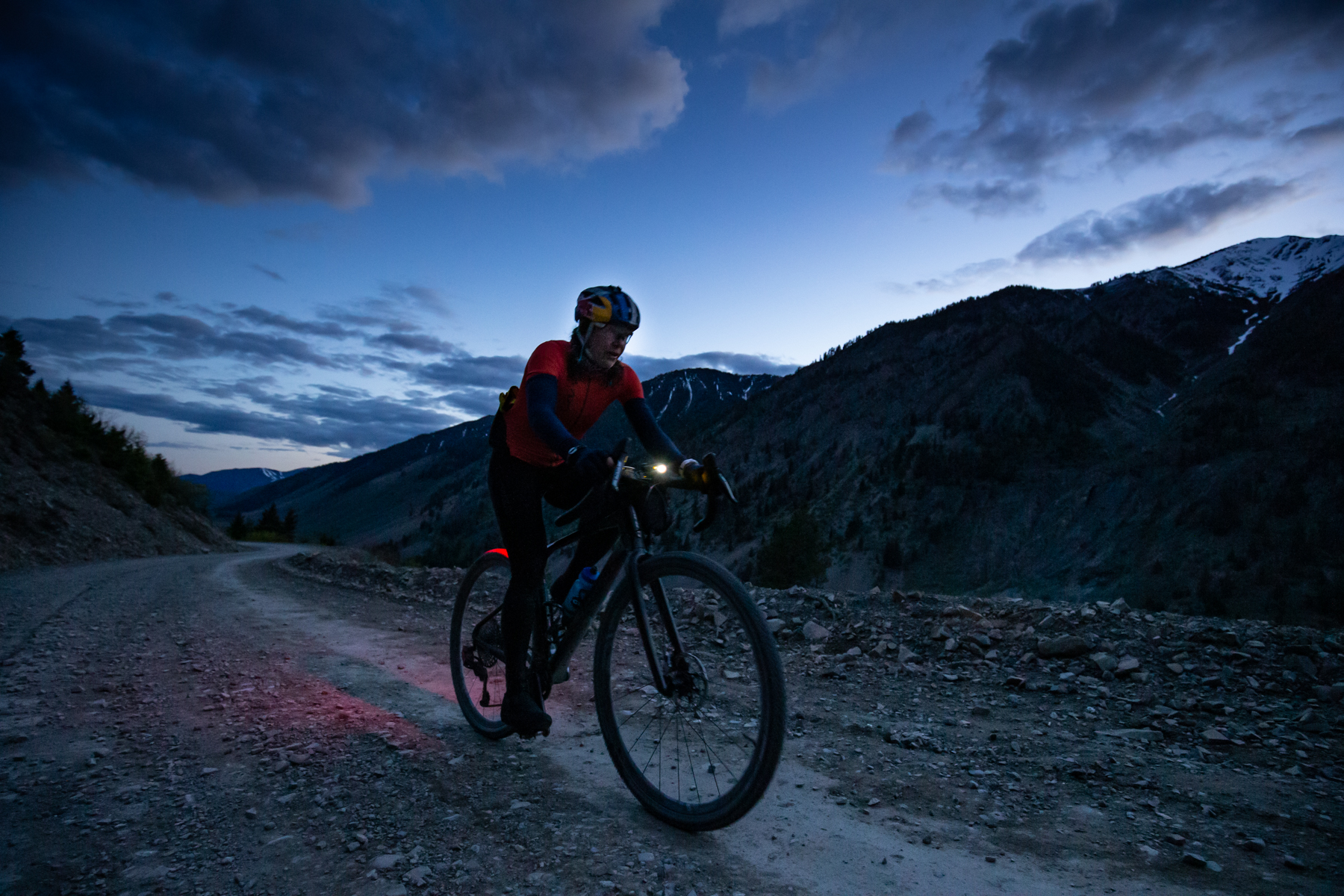
Rebecca Rusch rides through the night during her 23-hour “Everest” challenge. Photo courtesy Be Good Foundation.

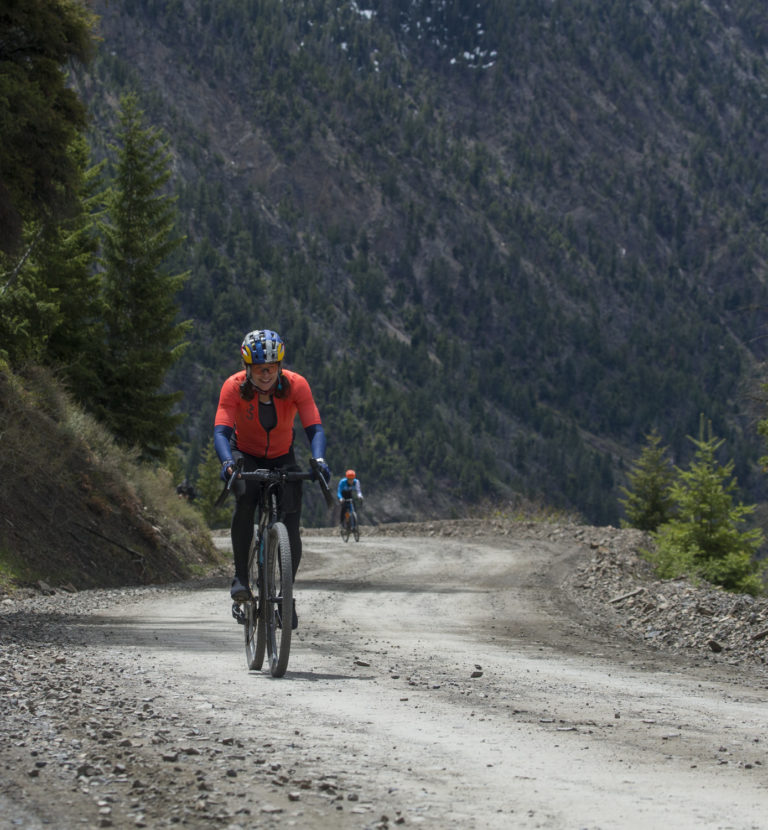
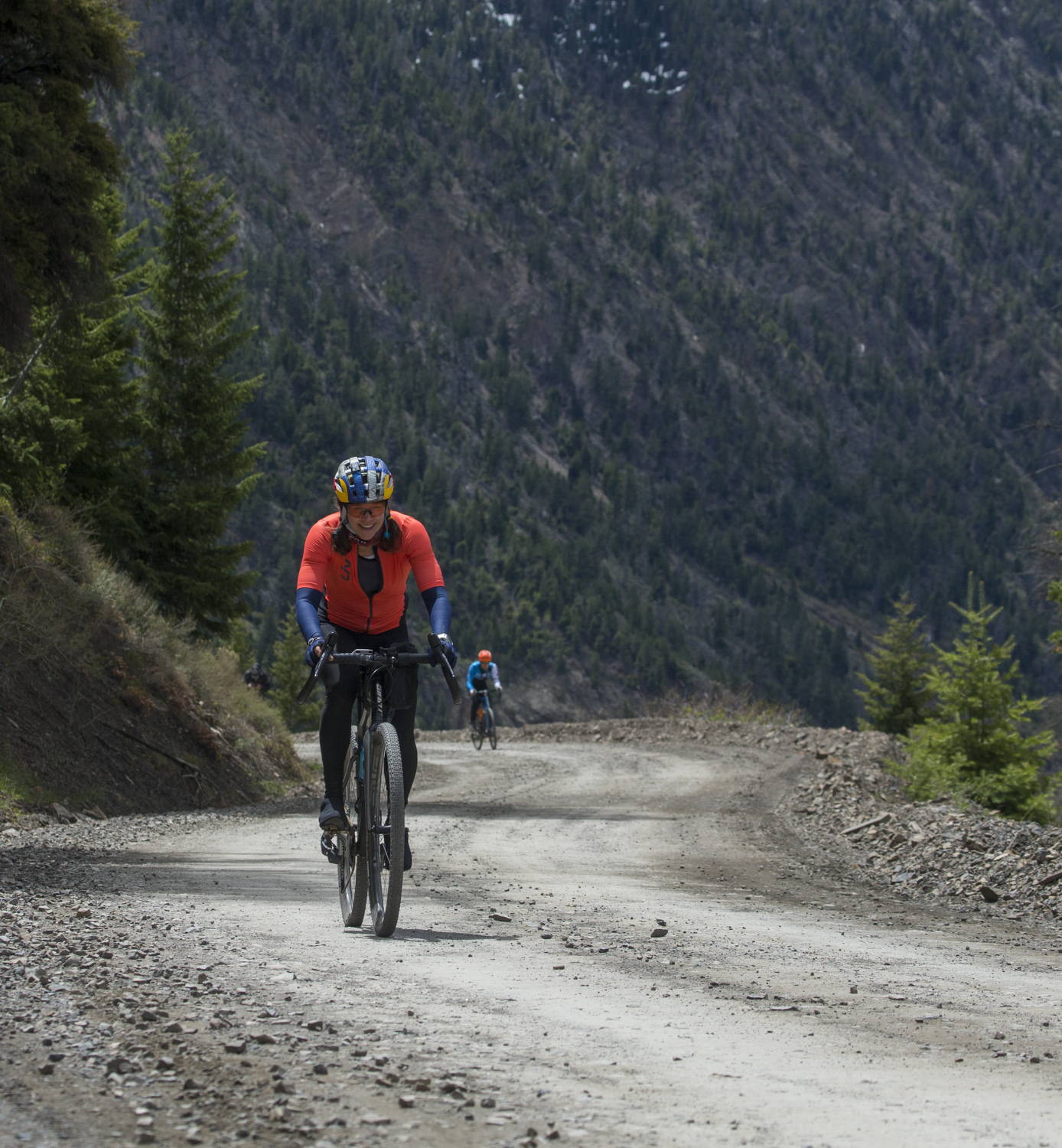
Rusch completed 21 laps up and down the rugged mountain road leading to the infamous Trail Creek Summit just outside of her hometown of Ketchum, ID. Despite freezing temperatures and over 23 hours of non-stop riding, Rusch said she felt surprisingly strong from start to finish. “I was motivated to complete my own personal challenge, but the true strength and motivation that kept my pedals turning hour after hour came from the knowledge that hundreds of people around the world were also pushing themselves to proactively be part of this global healing.”

Giddy Up Challenge Queen’s Everest Winners

  • Top Male Bike (Outdoor) – Jules Goguely, 9:39
  • Top Female Bike (Outdoor) – Katie Hall, 10:01
  • Top Male Bike (Indoor) – Tim Cusick, 11:58
  • Top Female Bike (Indoor) – Claudia Behring, 9:55
  • Top Male Run (Outdoor) – Gary Gellin, 13:45
  • Top Female Run (Outdoor) – Magda Boulet, 16:55
  • Top Male Run (Indoor) – N/A
  • Top Female Run (Indoor) -N/A

Katie Hall, of Oakland, CA., threw her hat in the ring with just a week to prepare and walked away with an Everesting™ World Record, completing 29,029 vertical feet of climbing in just 10 hours and one minute, “I decided on Monday to do this and I put all my nervous energy into preparing food for it. I haven’t ever spent that long on my bike or climbed that much.”

The 33-year-old road cyclist may not have climbed that much in a single day, but she was motivated to do good for the world in the best way she knows how “I’ve been trying to figure out what I can do as a cyclist to support those on the frontlines, and I am really grateful that Rebecca organised this event, creating an opportunity to bring cyclists together, support our essential workers, and for us to set big goals for ourselves that we can go after safely and responsibly.”

Giddy Up Challenge By The Numbers

  • 890 Participants
  • Over 10 Million Feet Climbed Collectively 53% Male / 47% Female Participation
  • $130,000 Raised for COVID-19 relief 43 of 50 US States
  • 11 Countries
  • Four Distances: 29,092ft (Everest), 15,885ft, 10,559ft & 5,295ft 1 World Record by Katie Hall
  • Age Range: 13 – 66
  • World’s Largest Combined Discipline Everest Attempt

Rusch officially launched the Be Good Foundation in 2019 with a mission to use the bicycle as a catalyst for healing, empowerment and evolution. The words “Be Good” are how her father, USAF Capt. Stephen Rusch signed his letters home from the Vietnam War. Rusch now uses those words to guide her and her efforts. She scheduled this inaugural event on Memorial Day weekend in honor of her father and all service members who are no longer with us.

“Rebecca’s Giddy Up Challenge fundraising will support COVID-19 relief programs providing public health, medical resources deployment, bikes for frontline healthcare workers, and cycling infrastructure for transportation in partnership with our Be Good Foundation beneficiaries. Together we are using the bicycle (and in this case, our running shoes) to deliver on that healing mission. We are thrilled to be able to award grant funds to three of our foundation partners: the CDC Foundation, World Bicycle Relief and People for Bikes,” said Erica Worden, Executive Director of the Be Good Foundation.

What’s next for Rebecca Rusch and her small, but mighty crew? Her annual Rebecca’s Private Idaho, a world-class gravel bike race, is only three months away, and you can be sure that she will find a way to motivate a huge group of people to jump on their bikes and make the world a better place.

PeopleForBikes Launches Business Intelligence Hub for Bike Industry Data Insights

0

BOULDER, Colo. (May 26, 2020) — PeopleForBikes is launching the first-of-its-kind PeopleForBikes Business Intelligence Hub, a dashboard for daily and weekly data insights for the bicycle industry covering ridership, retail sales and consumer attitudes. These metrics will give an overall sense of the state of bike riding and the bike business in the United States.“The timeliness and availability of data in the bike industry has been a challenge for a long time,” said Dr. Jennifer Boldry, chief research advisor for PeopleForBikes and applied innovation leader at NAXION. “With COVID-19 and the speed of change happening right now, we know that history is not a predictor of the future. This dashboard is designed to quickly deliver crucial insights to our industry.”

The Business Intelligence Hub — available online at http://peopleforbikes.org/business-intelligence-hub/ — is built on three core metrics:

  • Ridership: Thanks to partners at Eco-Counter, the Rails-to-Trails Conservancy and the Outdoor Foundation, and combined with insights from PeoplesForBikes’ Ride Spot program, the dashboard shares weekly updates on the number of bike trips taken in key locations nationwide.
  • Sales: The dashboard blends a daily index of IBD eCommerce sales from independent bicycle detailers, provided by SmartEtailing, with a weekly index of brick-and-mortar retail sales (including daily foot traffic and number of transactions) from Retail Toolkit. These partners are contributing to a huge advance in providing timely data on bike and bike equipment sales, which have traditionally been reported nearly two months after the fact.
  • Consumer Insights: Weekly surveys capture attitudes regarding riding patterns, consumer confidence, purchasing habits and more. PeopleForBikes will gather survey responses from its 1.4 million-strong grassroots supporter network, as well as bi-weekly general population surveys to showcase the attitudes, intentions and behaviors of the wider public.

These metrics mark a significant advance for the industry and lay the groundwork for more work to come. The dashboard will grow to include improved and additional metrics over time. The swift rollout this month comes as bicycle industry suppliers and retailers continue to adapt and pivot to consequences of the COVID-19 pandemic.

“Our goal all along has been to take all the data at our disposal and condense it into a concise and easily accessible format for all members of the PeopleForBikes Coalition to use in a way that’s impactful and useful,” said Bernie Doering, the chair of the PeopleForBikes Research and Statistics Subcommittee and the SVP of global sales/marketing for Stages Cycling. “This dashboard is one more step to achieving that goal.”

Ryan Atkinson, president of SmartEtailing, said, “When PeopleForBikes approached us asking if we could offer timely insights about what is happening at bike shops, we wanted to help.”

The SmartEtailing data team worked with the Research and Statistics Subcommittee to develop the daily index methodology that shares relative change in sales metrics year-over-year for each date, without revealing confidential retailer data.

“We want to help suppliers forecast to ensure that our retail clients have access to inventory and healthy margins, and with this index we will get timely insights that can help with decision making,” Atkinson said.

The dashboard is already pointing to new trends – at least in the short term – for independent bike dealers: While online sales have historically generated less than 5 percent of total retail revenue, e-commerce sales in April and May represent anywhere from 50 to 100 percent of bike shop sales in many markets, said Atkinson.

The new data hub will complement the in-depth reports on wholesale trends and retail sales that PeopleForBikes currently sends members on a monthly basis, adding real-time, day-over-day and week-over-week insights. The dashboard will be free to the entire bike industry until July 1, 2020, at which point access to retail sales data and consumer insights will be limited to dues-paying PeopleForBikes members.

“Providing this type of business intelligence as a member benefit was part of our vision for merging with the Bicycle Products Suppliers Association (BSPA) last year,” said PeopleForBikes Chief Operating Officer Jenn Dice. “We believe in the power of data and know these kinds of actionable insights provide real value to our members and their businesses. We also know that speed is everything and so the ability to provide a daily and weekly snapshot is a game changer.”

California Bicycle Coalition Lifts Up Bike Match in California

As more people turn to bikes for safe and healthy transportation and exercise during the pandemic, Bike Match services have sprung up around California. Bike Match connects people who need a bicycle but can’t afford one with those who may have an extra one sitting around. CalBike is proud to promote and lift up Bike Match in California by offering a clearinghouse website and working with volunteer technology providers to connect them with local partners around the state who are interested in setting up Bike Match programs.

Photo courtesy California Bicycle Coalition

New York City’s Transportation Alternatives pioneered #BikeMatch, but the concept has caught on in California. Bicycle advocacy organizations, community bike shops, and individuals have all started bike matching services through online platforms. These intermediaries help connect donors and recipients so everyone gets a bike that works for them.

“Bike Match is a great way to help essential workers and others who may need a bicycle get where they need to go safely,” said Dave Snyder, Executive Director of the California Bicycle Coalition. “When someone who works in a hospital or grocery store or warehouse can get around by bike, that frees up space on public transit for those who need to ride to stay physically distanced.”

Community bike shops have an important role to play in Bike Match, and some local bicycle advocacy organizations have partnered with these nonprofit bike shops on their Bike Match programs. When a donated bike needs work before it is ready to ride, volunteers or staff from community bike shops can supply parts and do necessary repairs so the bike rides like new.

CalBike has partnered with Seven Shurygin, whose Sprocket app now provides an easy way for individuals to donate a bike or search for a free bicycle in their area. We are also partnering with Stephen Braitsch and Sam Sadle of SafeLanes, who provide an out-of-the-box platform for local organizations to set up city-specific Bike Match services. The platform connects first responders in cities across California and around the U.S. with local bike organizations that are interested in setting up Bike Match programs. Several other local bicycle advocacy partners have set up their own independent bike match websites. And Spinlister has partnered with Brompton Bikes to provide healthcare workers with free bike rentals.

Right now, there are approximately 20 people who need bikes for every bike donated. Here’s how you can help out:

  • Pull that old bike out of the garage and donate it to Bike Match or a community bike shop. CalBike has compiled a list of Bike Match organizations in California. Both adult and kids’ bikes are in high demand.
  • Donate money. If you don’t have a bike you’re not using, donate to your local bicycle coalition, any of our listed Bike Match organizations, or your local community bike shop. The money you donate can be used to pay for replacement parts and repairs to donated bikes.
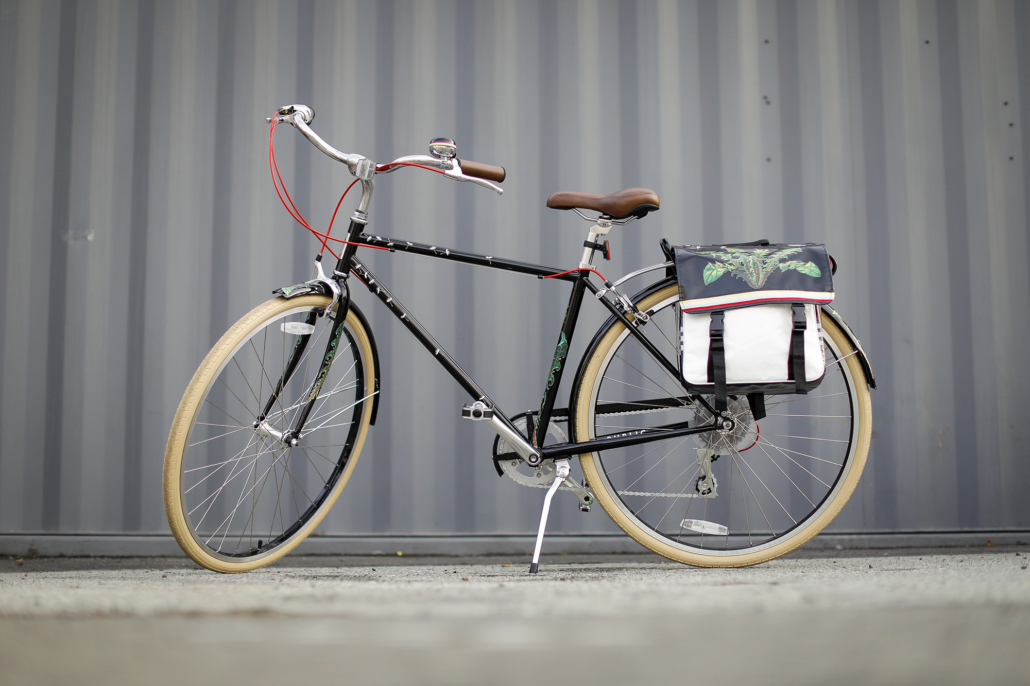
  • Volunteer your time locally. Bike Match organizations may need volunteers to work on bike repairs, answer emails, or pick up or drop off bikes.

  • If there’s no Bike Match group in your area, you can start one. This helpful video from Bike Match Gilroy/Morgan Hill tells how their bike match works. It isn’t hard!

At a time when bike shops across California are selling out and even used bikes can be hard to come by, there’s no excuse to leave an old bike gathering dust in a corner. Donate to Bike Match and give someone wheels.