Two projects that will enhance cycling opportunities in Utah gained final approval – unless someone sues to block them in the next six months. The Federal Highway Administration and Utah Department of Transportation approved the Mountain View Corridor in Salt Lake and Utah counties that will eventually include a bikepath to accompany the entire north-south roadway. And they also approved the West Davis Corridor that will include bicycle passage to the local bike trail.
The Mountain View Corridor project currently includes nine miles of striped bike lanes from Redwood Road to Old Bingham Highway in Salt Lake County and a bike/ped underpass at Redwood Road and 2100 North in Utah County. About four more miles of trail is scheduled to be completed next year extending north from there. A future plan calls for two more miles of bike lane into Salt Lake City and four more miles south into Utah County to connect a gap with an existing trail.
During construction, bikes will have to take a detour. In Salt Lake County, if construction goes according to plan, cyclists along the Northeast Frontage Road on S.R. 201 between 5600 and 5200 West will be redirected, with signs pointing the way. See https://mountainview.udot.utah.gov/.
The West Davis Corridor in Davis County, meanwhile, includes a new trail between I-15 in Farmington at the Legacy Parkway Trail extending north to the southern terminus of Old Emigration Trail in Jensen Park in Syracuse, with a crossing of I-15 at Park Lane in Farmington. An overpass will connect the Kayes Creek Trail near Weaver Lane in Layton. The project also includes connecting Old Emigration Trail from 1300 North in West Point to 4500 West in Davis County, then following 4500 West from 1300 North to the Weber County border with Davis County to connect with the southern end of the 5500 West Trail.
The timeline calls for the construction to start next spring and be completed in Winter 2024. See https://westdavis.udot.utah.gov/.
SALT LAKE CITY, Utah (May 15, 2020) — The Salt Lake Criterium organizing committee announced today the cancellation of the 2020 event which was to take place on July 18. The decision to cancel was made based on the challenges of meeting guidelines set out by CDC, State, County and City governments, difficulty in travel and housing logistics for invited teams, financial issues surrounding sponsors during this unprecedented pandemic, as well as concerns on unintentionally contributing to the spread of COVID-19 in the community. The USA Cycling-sanctioned event, which as to include amateur and professional fields, is part of the USA CRITS Series.
“We are obviously disappointed to have to cancel the event this year with such great momentum coming out of our highly successful first run in 2019,” said the race director, Eric Gardiner, “but the health and safety of our riders, fans, and community are of the highest importance. The hallmark of USA CRITS racing is a fun short circuit in vibrant downtown areas that draws large numbers of competitors and spectators – it’s unfortunate that this conflicts with the necessary social-distancing guidelines designed to slow the spread of the pandemic.”
The organizing committee is in discussions with sponsors and the USA CRITS national series in order to secure a date and plan for the 2021 season. The inaugural event last year was highly successful with 319 amateur riders, 21 D1 professional teams, and over 5,000 fans which attend the venue throughout the day.
About USA CRITS Series
Now in its 14th year, the USA CRITS Series is the premiere cycling series in the United States. USA CRITS was developed to feature criterium riders and to offer venues, teams and riders the ability to excel in a unique discipline of cycling. Starting in 2018, an effort to build the sport toward greater sustainability was taken on with the USACRITS.tv project. The events that form the USA CRITS Series showcase the ideals that make criterium racing an American legacy: challenging courses that showcase arts and entertainment districts, a large and growing base of spectators, broad community support, and strong marketing opportunities for partners. www.usacrits.com
The Islands in the Sky Cruise is a 51.0-mile out-and-back ride over undulating terrain between and through Dead Horse Point State Park and Canyonlands National Park, in southeastern Utah. The route passes through and above some of Utah’s most spectacular scenery, within a State and a National Park. Elevations range from 5,639 feet at Upheaval Dome, at the turnaround point in Canyonlands, to 6,184 feet on Big Flat, on Utah Highway (UT) 313 between Dead Horse Point and Canyonlands. The nearest town in Moab, which is 33 miles away from the entrance to Dead Horse Point State Park. (Use routes UT 313 and US 191 to reach Moab). The park-to-park-to-park routing is rare among Utah’s road rides. The relatively small difference between the high and low elevations – just 545 feet – suggests that there are no extended climbs along the way. The terrain undulates, though, making the ride far from flat. It is best to be prepared for this ride by bringing cash or card for park entrance fees. As of this writing, the fees were $15 for motor vehicles to enter Dead Horse Point State Park (to park and start the ride), $5 (proposed to increase to $10) to bicycle into Canyonlands National Park, and then $2 to bicycle into Dead Horse Point (on the return, although this may be waived with a receipt from your earlier entrance). Bring plenty of water, too, as you may not be able to find any for long stretches.
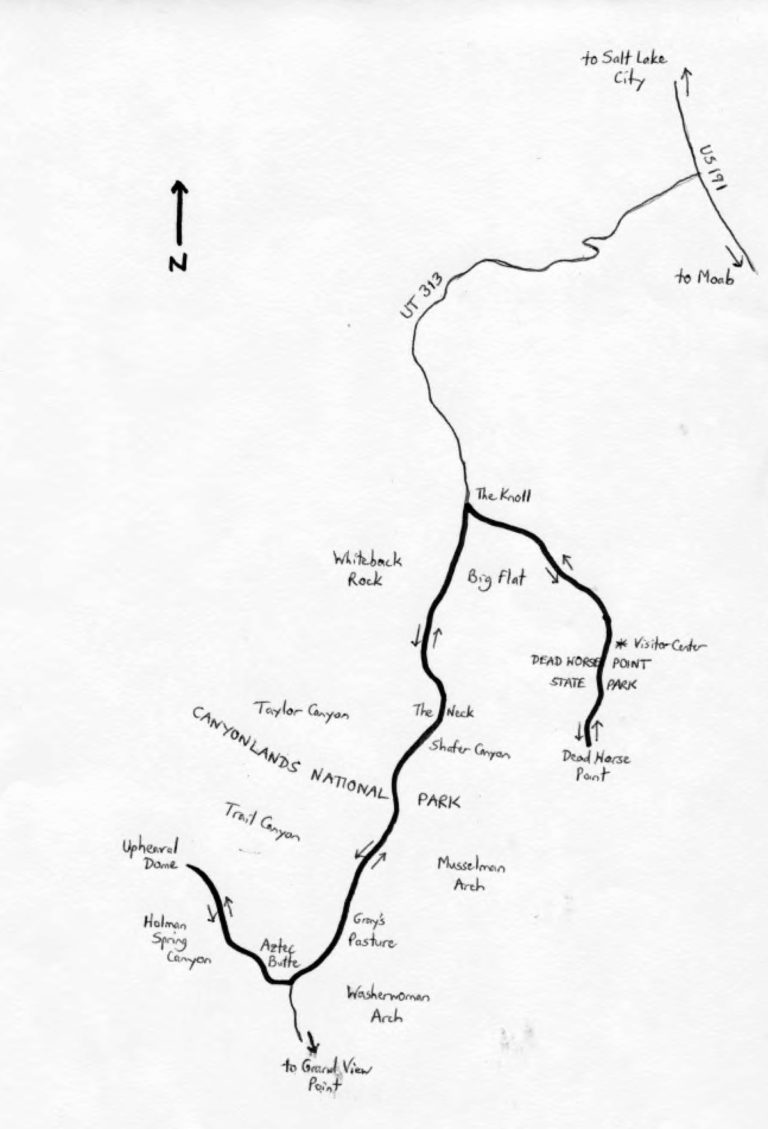
The Islands in the Sky Cruise is a 51-mile out-and-back ride over undulating terrain between and through Dead Horse Point State Park and Canyonlands National Park. Map by Wayne Cottrell
A description of this ride appears in the author’s Road Biking Utah, which was published in 2010. What has changed since then? Well, the roads and scenery are the same. The greatest change has been in the popularity of Canyonlands, which has experienced up to 20% annual increases in attendance. In fact, by 2016, annual park attendance was nearly double that of previous years. The park is divided into three districts, with the Island in the Sky District being the most accessible. While you will most likely not see any motor vehicle queues on the park’s roads, as you might at nearby Arches National Park, you certainly will not be alone, particularly during the peak summer months. Start the ride at the Dead Horse Point State Park’s Visitor Center, located just inside the main entrance. Turn left and head toward Dead Horse Point overlook, which is 1.3 miles away. The park is so-named because cowboys would use the mesa, at the overlook, as a natural corral for their horses. If you peer over the edge of the overlook, you will see the Colorado River winding through the deep canyon, about 2,000 feet below. Although the name suggests that horses leapt to their death from the mesa, it is likely that horses died from exposure to the sun and the associated dryness. While the canyon is not as deep as that of the Grand Canyon, Dead Horse Point’s version actually doubled as the Grand Canyon in the 1991 film Thelma and Louise. Only true experts would know the difference, right?
After spending some time on the overlook, turnaround and head back through the park. After leaving the park, passing its two entrance stations, you are now on UT 313. The Knoll appears on your right as you approach the junction with the main road into Canyonlands (Grandview Point Road; mile 9.2). Turn left here, and head south over Big Flat (highest elevation of the ride). Enter Canyonlands at mile 13.6; the official entrance station is at mile 14.8, where you can pay the fee for bicycles (please see above). The visitor center, with lavatories and vending (water!), is at mile 15.9. Beyond the visitor center, the road crosses The Neck (mile 16.6). As the name implies there are canyons to your left (Shafer) and right (Trail and Taylor). Shafer plunges steeply to the Colorado River, and there is an overlook. Beyond The Knoll is Gray’s Pasture, which extends for several miles along the road. On your left, as you approach the next junction, is Mesa Arch. At mile 22.1, turn right to head toward Upheaval Dome (Upheaval Dome Road). Aztec Butte, a natural masterpiece of slick rock, is to your right. Lining this road, in addition to Aztec, are mighty cliffs, uplifts, and monuments, with Holman Spring Canyon on the left. You can see how Islands in the Sky gets its name, in reference to the elevation differences between the mesas, and other elements of the high ground, and the Colorado and Green Rivers far below. (The actual name is Island in the Sky – no plural). Whale Rock is on the right at mile 26.0.
Enter the parking area for Upheaval Dome at mile 26.8, as the road reaches its terminus. Upheaval Dome actually looms over you. The elevation of the Dome, on a map, is 4,560 feet – so why is it towering overhead? Well, you are looking at the sides of a crater that geologists have surmised was formed by the impact of a meteor. The elevation inside the dome, or crater, is about 1,200 feet below your current elevation. You can dismount and hike out Crater View Trail to peer inside. After taking a peek, remount for the return ride. As a reminder, you will be making a left turn at the end of Upheaval Dome Road (mile 31.7), and then a right turn onto UT 313 (mile 44.6), on the way back. Note that a road ride through these parks is just one way to experience them. There are a multitude of opportunities for mountain biking and hiking, on trails that extend far away from the paved roads. Author Edward Abbey, in his Postcards from Ed: Dispatches and Salvos from an American Iconoclast, described the Canyonlands as “the most weird, wonderful, magical place on earth—there is nothing else like it anywhere.” Efforts continue to expand the park to include the sandstone rims that form the border of the entire Canyonlands region.
Starting point coordinates: 38.508333N, 109.742222W
For more rides, see Road Biking Utah (Falcon Guides), written by avid cyclist Wayne Cottrell. Road Biking Utah features descriptions of 40 road bike rides in Utah. The ride lengths range from 14 to 106 miles, and the book’s coverage is statewide: from Wendover to Vernal, and from Bear Lake to St. George to Bluff. Each ride description features information about the suggested start-finish location, length, mileposts, terrain, traffic conditions and, most importantly, sights. The text is rich in detail about each route, including history, folklore, flora, fauna and, of course, scenery.
Wayne Cottrell is a former Utah resident who conducted extensive research while living here – and even after moving – to develop the content for the book.
In most years, Cycling West celebrates National Bike Month by publishing an extensive calendar of events like bike to work day, scavanger hunts, alley cats, and the Ride of Silence. Because of the COVID-19 pandemic, most events are cancelled, so we are publishing a very limited calendar this year. See below.
Bike to Work Day will be September 22, 2020. In Bike Month, you can still take part by joining the National Bike Challenge, nationalbikechallenge.org. Here, riders participate in Bike to Work Day 2019. Photo by Dave Iltis
That doesn’t mean we aren’t celebrating Utah Bike Month, Idaho Bike Month, Montana Bike Month, Nevada Bike Month, California Bike Month, Colorado Bike Month, and Wyoming Bike Month – you get the idea.
Ride your bike to work if you aren’t working from home, on errands, or just for fun!
The following from the League of American Bicyclists lets you know how to celebrate wherever you are:
Bicycling makes life better. It makes us healthier and it makes us happier, two things that are always good for us and that are even more important in 2020. That’s why the League of American Bicyclists is so very excited to celebrate National Bike Month in May.
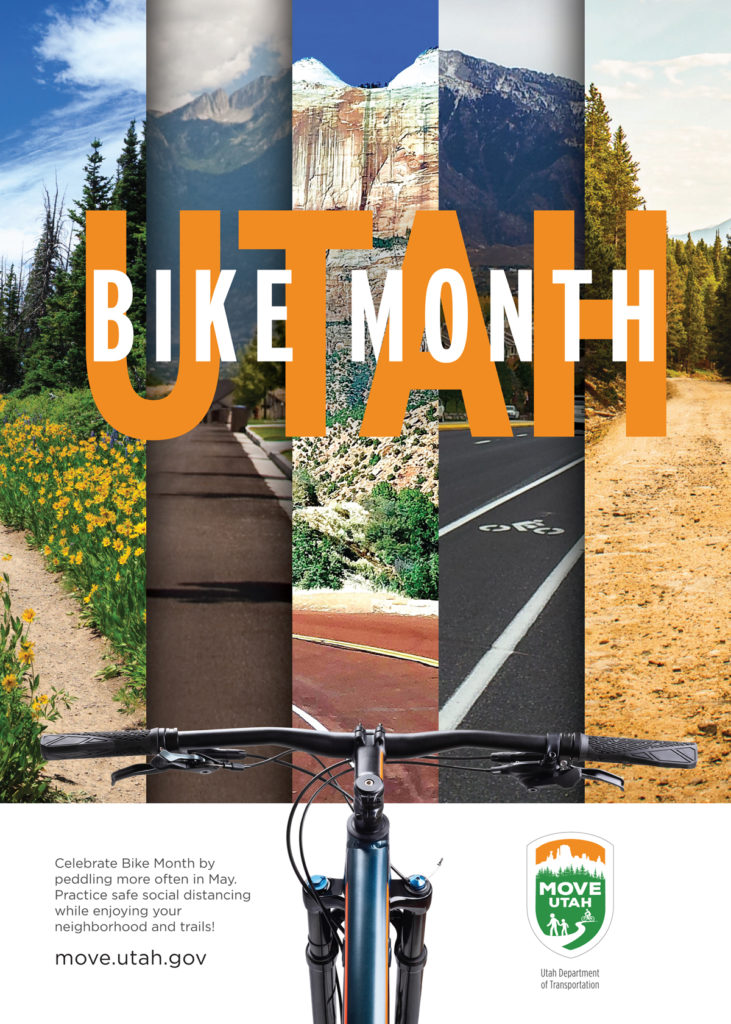
Celebrate Bike Month in May in Utah and the West!
First celebrated in 1956, National Bike Month centers on biking to work and riding with a friend to a local coffee shop to get them back on a bike. In 2020, we’re doing National Bike Month a little differently. This May, the League encourages everyone to get on a bike, go for a ride, and share the joy online together.
For the 31 days in May, #BikesUnite us. Whether you’re riding for fun, fitness or with family, or taking essential trips to work or shop, you are part of a movement for safer streets, connected communities, a healthier planet, and happier people.
Share photos of your solo or family rides on social media using #BikesUnite and share the joy biking brings you. By sharing your “reason to ride” on social media and encouraging friends and family across the country to go by bike, we can experience the joy of biking together even as we shelter at home apart.
Here’s how to take part in National Bike Month this year:
Go for a ride – solo! Take a photo and share it on social media and show the world that #BikesUnite
Take a picture of yourself and your bike
Challenge your friends to a photo contest – who can take the best photo of their bike leaning next to a tree?
Make a scavenger hunt in your community and help people discover local sights
Take a selfie in front of your favorite small businesses to show support.
Join the National Bike Challenge to log your miles and see how united people are across the country by biking: http://nationalbikechallenge.org/
If you have the ability, consider supporting your local bicycle advocacy organization and Bicycle Friendly Businesses in your community – find them on the League’s map.
National Bike Month is a celebration of the benefits of biking. Biking is good for the planet, it’s good for businesses in your community, and it’s good for you. Bonus: the bike is a “happiness machine” that brings joy to even the shortest trips. Biking together is our favorite way to celebrate this amazing machine and the communities it has helped us build, and with #BikesUnite we will show that bikes unite us even while we’re apart, so that we may get through the most difficult situations.
In addition to being National Bike Month and the start of the National Bike Challenge, May is Mental Health Month. The benefits of exercising for physical health have been promoted for decades, and it’s increasingly recognized that physical activity benefits mental health, as well. Our well-being, physically and mentally, is in focus right now. We don’t talk often enough about the mental health benefits of biking, including reducing stress and anxiety, and improving happiness, mental focus, and sleep.
You don’t have to put on Lycra or bike up a mountain to get these effects. Short and regular physical activity will go a long way to a cumulative effect on your health. This May, we’re not only encouraging people to bike because it is fun, but also because it feels good and is good for you. Tune up the bike in your garage or keep pedaling in the drops, but whatever you do: bike!
May 20, 2020 — Ride of Silence, Utah Bike Month, Salt Lake City, UT, Due to the COVID-19 pandemic, and in solidarity with The Ride of Silence founder, riders are encouraged to participate in solo or household silent rides in memory of cyclists killed on public roadways., Chris Slauger, [email protected], rideofsilence.org, facebook.com/events/1101400300066668/
May 20, 2020 — Ride of Silence, Utah Bike Month, Provo, UT, Join the Provo chapter of the Worldwide Ride of Silence to ride to honor people who were killed or injured while biking this last year and last several years. We will begin at Dixon Middle School and go for a short, slow, silent ride with brief stops at the ghost bike memorials for Doug Crow and Mark Robinson, and return to Dixon Middle School where we will have light refreshments. Meet at 6:30. Dixon Middle School, 750 W 200 N. Ride begins at 7 pm sharp., Lucy Ordaz, 801-477-7048, [email protected], rideofsilence.org
September 19, 2020 — Golden Spoke, Utah Bike Month, Wasatch Front, UT, This third annual cycling event features 100 miles of interconnected trail systems across the Wasatch Region with multiple starting locations from Provo to Ogden, Utah. This year’s theme also highlights the theme of the Spike 150 celebration of the completion of transcontinental railroad. Rides of various lengths — with 100 mile, 75 mile, 50 mile, 25 mile, 10 mile and 1.5 mile segments — will feature connections with local communities around various historic and contemporary railroad themes. Some stretches of trail in Utah, Davis and Weber County, will also include rails to trails cycling paths. The rides are geared for fun and community engagement rather than competition, and are planned to accommodate riders of all ages and abilities., Heidi Goedhart, 801-783-8426, [email protected], goldenspokeutah.org
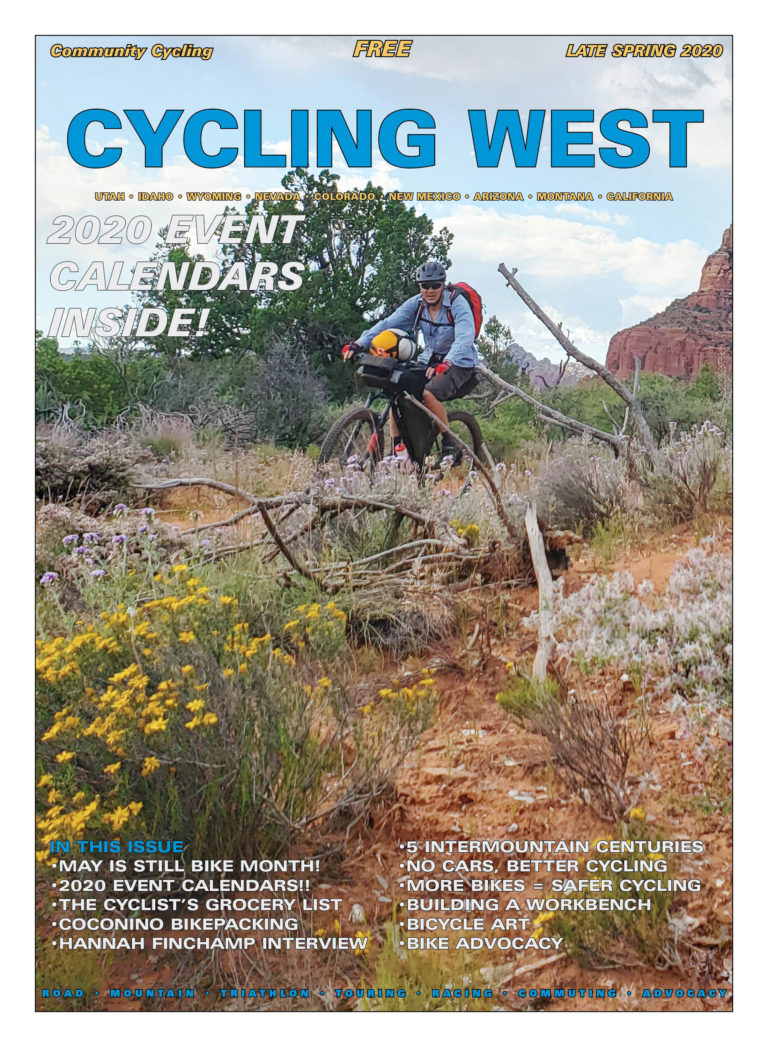
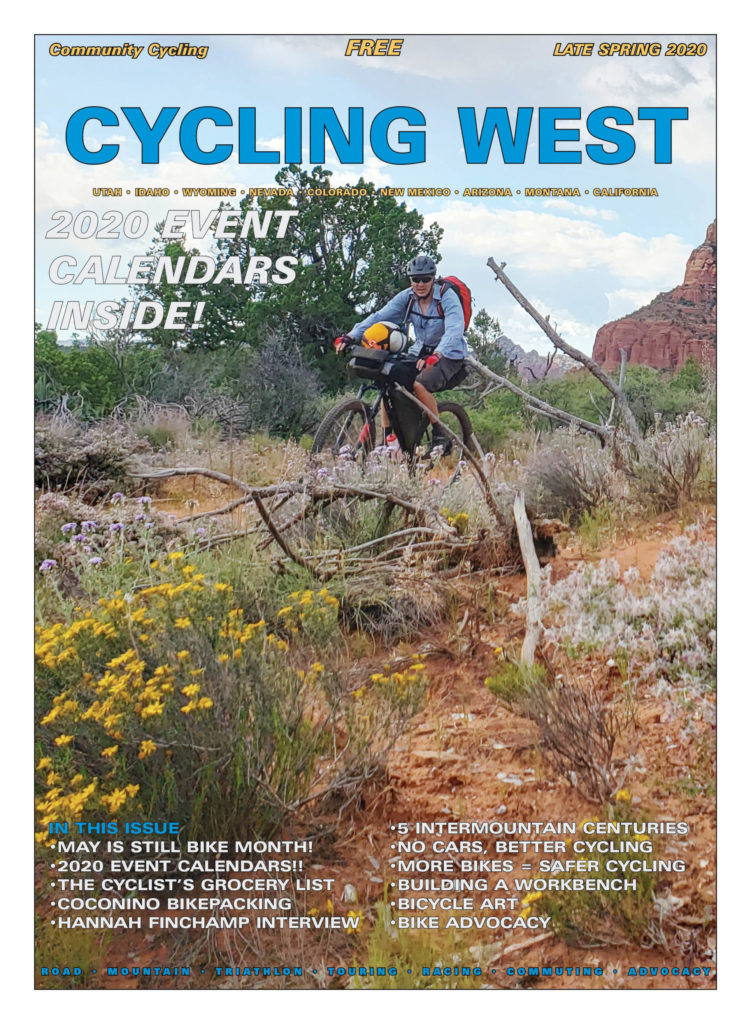
Cycling West and Cycling Utah Magazine’s Late Spring 2020 Issue is now available as a free download (8 MB download). Pick up a copy at your favorite Utah, Idaho, Wyoming, Nevada, Montana, Colorado, Arizona, New Mexico and Northern California bike shop or other location. PDF Link
By Bobby Kennedy — If you’re reading this, it’s because you live in the West and can’t figure out what the fuss is about gravel, or you’re living in the West and you’re super-excited about gravel but want some pointers on how to do it right. Cool. Hi! How are the kids/pets/plants/cobwebs where your family portraits once were?
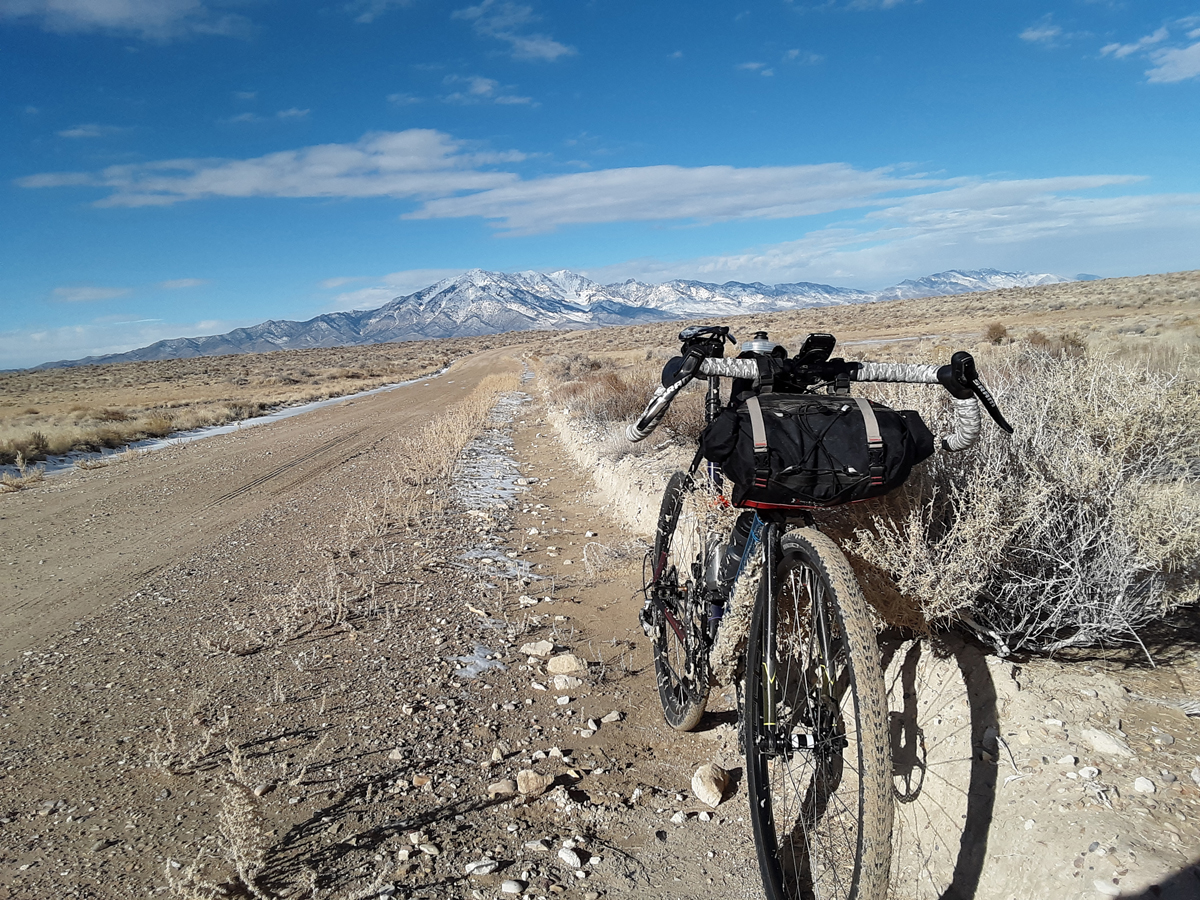
Check out the flared bars on that looker! The author’s Crux on the Salty Lizard 100 course at the top of Silver Island Pass. Flared bars help lower your center of gravity and widen your stance, giving you more control in chunder or when carrying loads. Photo by Bobby Kennedy
What is Gravel?
Gravel means one thing east of the Rockies and a whole ‘nother thing out here. Why? Because of land use, population density, the rectilinear survey of the United States, and geology.
It all boils down to this: we don’t really have gravel roads out here. Sure, sometimes a fire road gets a new coat of brand-new rocks, but what we have in the West is dirt. Not the groomed dirt of a bike park or the famously smooth dirt strada of Colorado but dirt as in whatever the road was carved out of.
Down by Veyo, Utah, that’s fine volcanic sand. In the West Desert of Utah, it means a gnarly mix of loose conglomerate and sand. It’s all sand, basically, in good time.
What that means is that riding gravel here is different than everywhere else, and what a lot of people say about gravel bikes makes little to no sense in the Intermountain West. I have worked as a retailer for years now and have started a couple of my own gravel races, the Salty Lizard 100 (May 15-16) and the Stupid Pony (Oct. 2-3) [See the calendar for details]. I have dedicated my life to trying to make up for my utter lack of descending skills by being fast on dirt roads and I am here to help.
What’s a Gravel Bike?
Gravel bikes are basically mountain bikes from the 1980s made to fit larger-diameter wheels and drop bars. If you encountered me in a local shop and asked me why I would recommend getting a gravel-specific bike, I would tell you that gravel bikes are
faster than mountain bikes, so they’re good for the distances that you’ll encounter during many organized rides, and
able to fit mountain-bikeish-sized tires, making them slower but more comfortable on semi- to full-on-crazy terrain than road bikes.
Gravel bikes also tend to put the front wheel farther out in front than cyclocross bikes and have longer wheelbases (the length of a horizontal line going through each wheel’s axle) so they’re more stable at speed and more comfortable over rough stuff. Gravel bikes won’t corner as quickly as a CX bike, but that’s ok because there generally aren’t any off-camber hairpins on dirt roads.
Wheel Size and Carrying Water
The biggest things to keep in mind when considering a bike for Western gravel are:
how much water can the bike carry and,
how big of a tire can you fit in it?
Since we Westerners tend to ride more fire roads, singletrack, 4×4 double-track, and moto trails, tire clearance is a big thing. If you’re going to just ride on the road and hit up some of the smoother events like Rebecca’s Private Idaho, the Crusher in the Tushar, or the Volcano Fire Road 120, then clearance that tops out allowing a 700c x 40mm wide tire will do you just fine. If you plan on riding rougher roads or longer events like the Wild Horse or the Salty Lizard 100, then go as big as you can. Big tires float better over pointy things and sand. At RPI or the Crusher, they’ll just weigh you down.
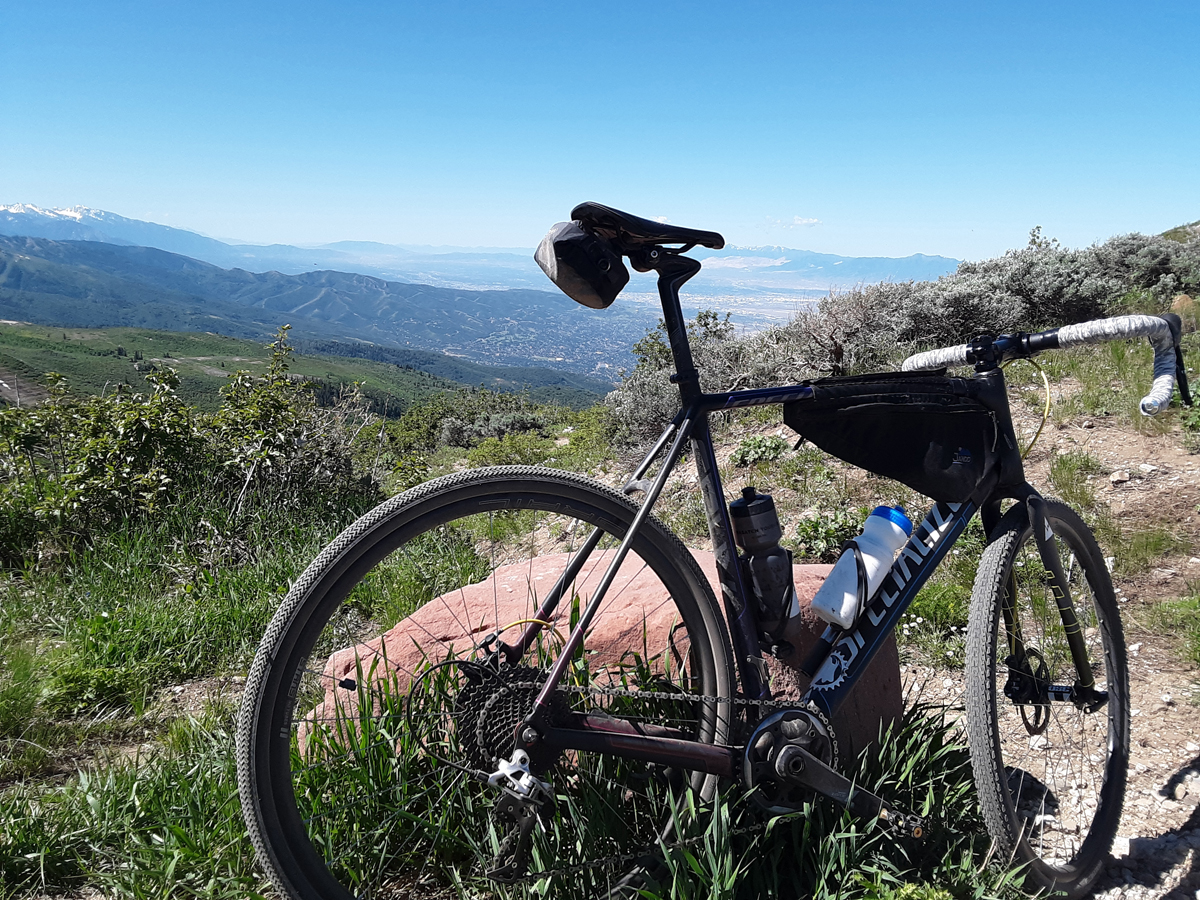
Bobby Kennedy’s gravelized Specialized Crux about Bountiful, UT on the Skyline Dr. 4x route. Single ring set-ups and at least 40mm of tire clearance are necessary for gnarly fire roads and a lot of OHV routes. Photo by Bobby Kennedy
With regards to carrying water, it’s a similar issue. Where are you riding? If you’re just tooling around on the roads with an event ride or two thrown in, then you don’t need a bunch of extra mounts. They add weight and you don’t need to carry a third bottle of water when you’re going to be see convenience stores and/or volunteer-staffed aid stations on every ride. Two bottles will get you pretty much everywhere (except when it’s hot, I guess).
If you’re planning on doing more remote rides or bikepacking, then get a bike that looks like a stunted porcupine from all the extra mounts. When you play around in the desert, you need to bring a lot of water. The mountains along the Wasatch Line will have springs, usually, whereas if you’re going to be in the surrounding desert, you might be utterly on your own. So, if your event is the Stupid Pony Ride or you’re one of the insane people circumnavigating the Great Salt Lake by bicycle, then get one that can haul liquids in quantity.
Luckily, these two requirements overlap both in terms of where you ride and what the bikes come equipped with. Bikes that can clear big tires like the Salsa Cutthroat or Fargo, Rodeo Labs Flaanimal, or the Bearclaw Beaux Jaxon, all have lots of places to carry water.
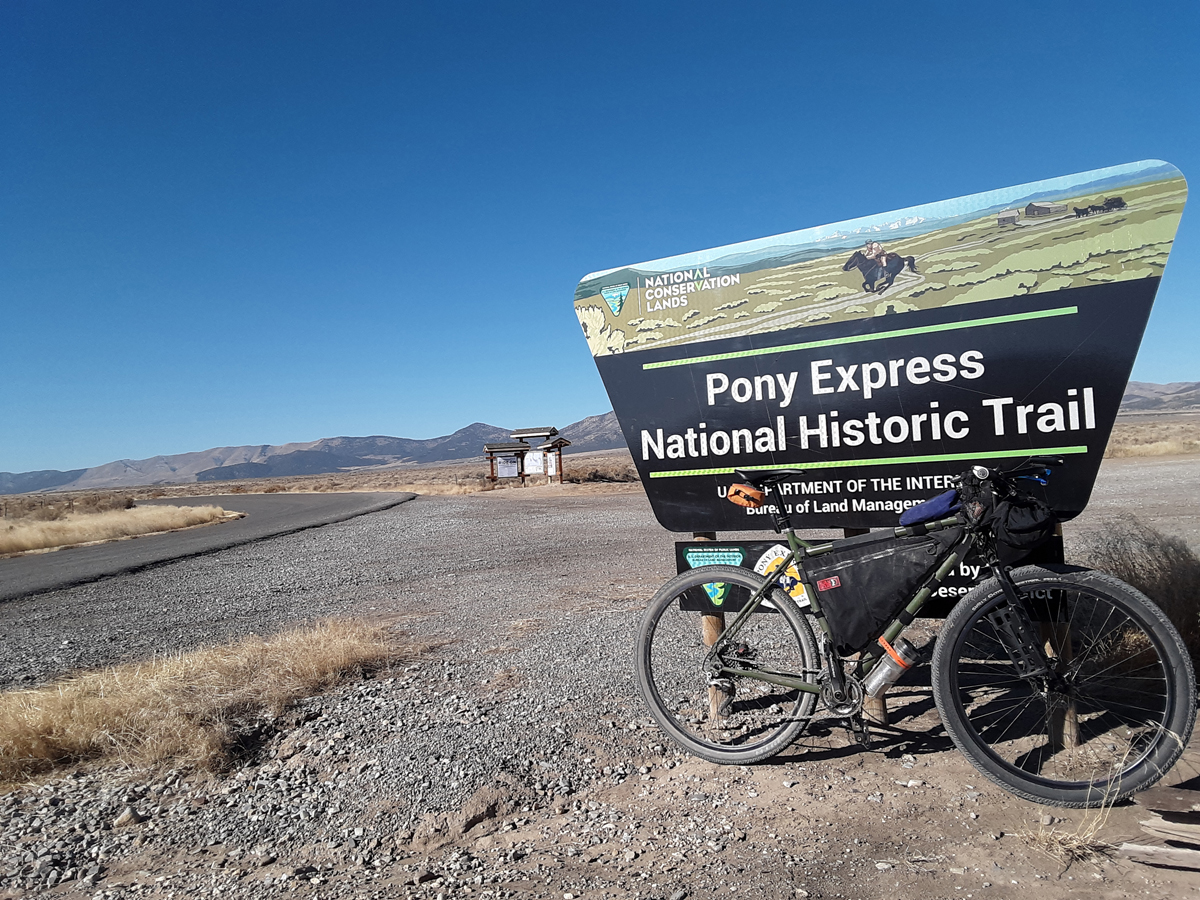
Bobby Kennedy’s flat bar Surly Ogre at the start of the West Desert section of the Pony Express National Historic Trail. It’s a 29er, but it doesn’t have suspension, making it a little more efficient. Lots of mounts for absolutely everything, which is great if your dream routes lead away from all C-stores. Photo by Bobby Kennedy
Conversely, while you can strap bikepacking bags to a 3T Exploro or Specialized Diverge, they each only come with three dedicated mounts. They are much faster than any of the big tire bikes, but they also don’t clear the same-sized rubber on a 29er (700c) wheelset.
“But Bobby, what about 650b?”
“What about it?”
“…”
“…”
“…”
Fine. Smaller-sized wheels have been used forever and, as folks in the industry have a lot of practice pointing out by now, the outside diameter of a large 650b tire is the same as a smaller-width 700c tire. Generally, it’s about the same between a 650b x 47mm and a 700c x 30mm. Lots of manufacturers will list how big of a tire in each size their bike can handle.
Why look for 650b specifically? Well, because the outer diameter is the same, then (theoretically) the ability to roll over obstacles and hold speed should be about the same between the two tires but with a bonus for the 650b rider, since the tire would be bigger and more comfortable. That can matter a lot if your bike is limited to a 700c x 37mm tire but can accept a far plumper and comfier 650b x 47mm tire. That can mean the difference between starting the Wild Horse and finishing it. So, what’s the downside? Well, that similarity between tire diameters is unweighted, so you actually don’t have the same outer diameter once you start riding the bike, which most of us do at some point.
Many gravel bikes now can accept 700c tires that have a similar width to typical 650b sizes – 42mm or wider – so the plusher tire argument becomes somewhat moot, since the 42mm tire on a 700c rim will have a better rollover clearance (obstacles hit lower on the tire) than a 42mm tire on a 650b rim.
Also, the smaller diameter of 650b tires means less ground clearance for your cranks and pedals, so you’ll need to be sure that you watch your feet when things get pointy. This was an issue with mountain bikes a few years ago. It should be telling how few bikes come with 27.5 x 2.8” tires now. Feel free to rattle off a few in the comments, but in your heart of hearts, you know I’m right.
MTB, CX, or Gravel Bike?
Speaking of mountain bikes, do you actually, really, truly need a gravel bike? No.
Gravel bikes split the differences between mountain bikes, cyclocross bikes, and road bikes, and, depending on where you’re riding, the first two will usually do just fine and the third might be survivable (unless you’re riding Jeremy Ranch Road in Park City, Utah, in which case send it). In fact, XC and CX bikes were the original gravel bikes. The benefit of a bike specifically designed for gravel is a bit more speed than a mountain bike and a bit more comfort and control than a CX bike. If you don’t mind sacrificing a little comfort on your CX bike, or if you feel super-fast on your XC bike, then you can get away without a dedicated gravel bike.
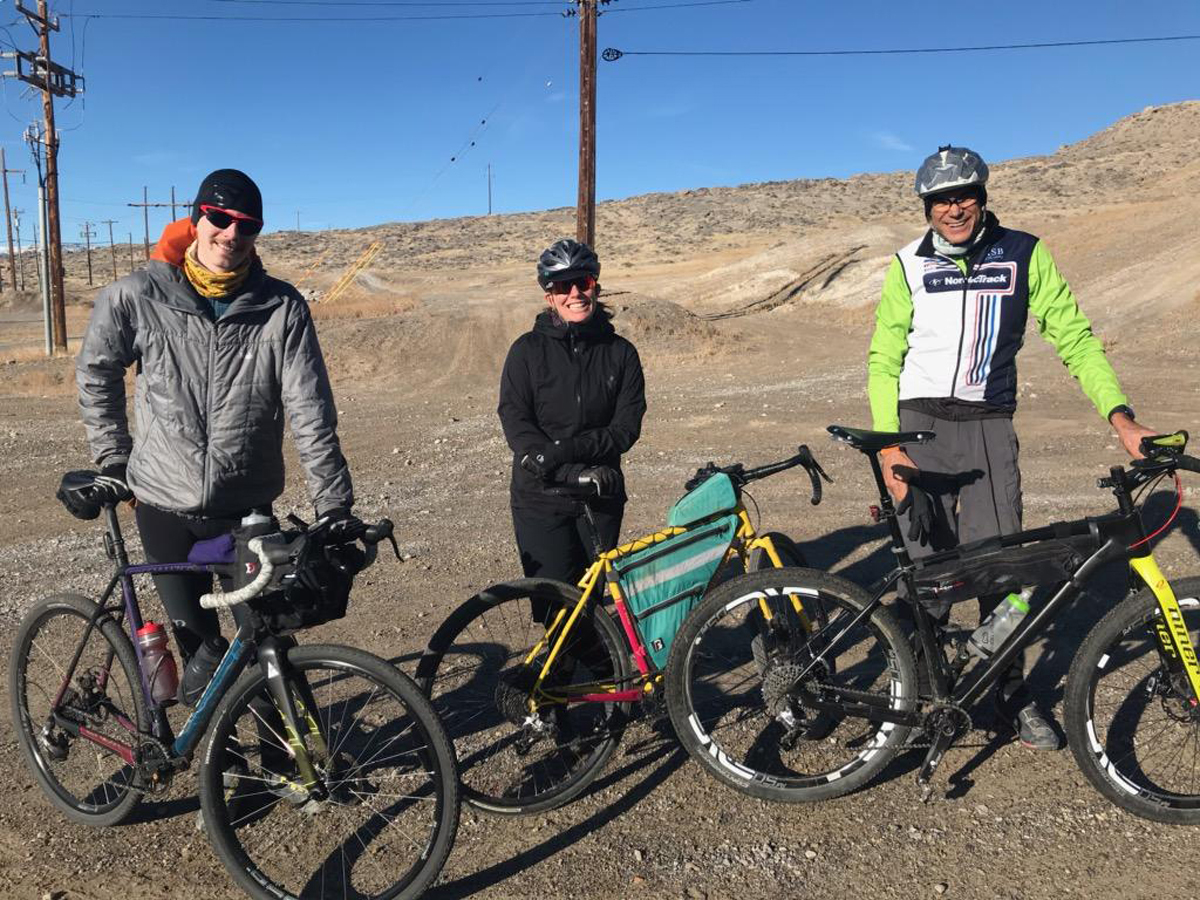
Right to left: Bobby Kennedy, Jackie Baker, and John Hernandez of Salty & Stupid Cycling. John is using a drop bar 29er, giving him all the hand positions of a normal gravel bike but with clearance to spare for mud and tumbleweeds. Photo courtesy of Salty and Stupid Cycling.
One of the great things about gravel events is that you can run what you brung and no one will bat an eye. If you’re out in the middle of nowhere, sometimes it’s just more comfortable to be sitting on a full-squish dual-suspension mountain bike despite the slower pace. I’ve ridden the Salty Lizard 100 course on both my full suspension XC bike and a CX bike and they were both a ton of fun. I have also had people swear to me that they’d never set foot on the course without an MTB below them. I still have yet to ride my own gravel course on a real gravel bike. Go figure.
Do You Need a Gravel Bike?
I hope that, if nothing else, you’re closer to your public transit stop, or a bit closer to the front of whatever line you’re standing in. I really hope is you’re reading this in a bike shop with a gal/guy standing next to you waiting to offer you advice that you’re currently ignoring (both the salesperson and the advice) in favor of reading this article.
Gravel bikes are fun, they can get you way out in the beautiful open ranges of mountain and desert and valleys here in Utah and all over the West, but buying one or, heck, even just deciding that you “need” one doesn’t have to be stressful. Just put your butt on a few and, after deciding what size tires you want to be able to run, choose the one that fits your build and your budget best, and looks cool to boot.
By Tara McKee – Cycling is great for our mental and physical health, our earth, and our wallets, but we don’t always want to come into the office or show up for lunch with the girlfriends looking slightly disheveled from our ride. Does a commute by bicycle mean you can’t conform to professional norms with clothing, make-up and hairstyles? Is the thought of helmet hair and perspiration preventing many women from cycling? Actually, the answer is “yes”, and it is a big enough concern to be a barrier, but there are ways to prevent a helmet from ruining your ‘do and ways to pull off a quick Wonder Woman transformation into professional ready for a full day at the office.
The girl in red shows a “Side Bun.” This hairstyle can be worn with a helmet and the hair will not have issues after the helmet is removed (i.e. no helmet hair.).
Photo: Jon Diaz
Over the last decade a number of studies that have been conducted in Australia, the UK and Canada which mirror the few studies on the gender imbalances in bicycling done in the U.S. In all of these countries, men are about three times more likely to be regular cyclists than women. The studies continually showed that safety concerns were a big concern for women, even though men were much more likely to be involved in collisions when studied over equivalent time periods riding. (See BikesBelong.org which has links to many of these studies.) But the other issues of concern for women, especially for riding to work, involved the problem of carrying items while cycling and fears of being anything less than well-groomed in front of colleagues, clients or customers.
The August 2013 issue of Cycling Utah had a feature titled “A Women’s Guide to Commuting to Work” which covered the basics of commuting, including choosing the right bike for the commute and tips on how to carry items on your bike. One point that article brought up was that if your commute is a short one, you can easily ride in regular office attire, because you won’t be riding enough to work up a sweat. (It was really the “part one” of this article.) This article is focuses on those with a longer commute and tackles the issue of how to fight “helmet hair” and offers tips for that transformation from a biker into a credible executive.
The Quick Change
For a long commute, it is best to wear technical, athletic clothing for the ride and pack your work clothes in panniers. Most of the sweat will be in the clothes worn for the ride and you can remove most of that simply by changing your clothes. As an alternative to showering at work, many women use disposable body wipes or towelettes to remove sweat and excess oils from the skin. Some varieties can be used all over your body and some are gentle enough for the face. Stylist Suzanne Gallegos recommends Cetaphil Facial Cleanser which is a great product for wash and moisturizing the skin. It doesn’t require water. Just put some on your hands wipe across the face and towel off. At this point, you can just apply your make-up and some deodorant as usual.
If you really feel the need for a shower and your place of work does not have one, look around for a nearby alternative. Health and fitness clubs such as Planet Fitness or county recreation centers often offer low monthly memberships, a locker, and a place to shower. If you are fortunate enough to have such a place close to your place of work, you can use your commute as a pre-work training session and shower and change into your work clothes there.
Tips for clothes and shoes:
When packing your panniers: Roll, don’t fold, your clothes to avoid creases. Dresses are often a better choice for packing than a skirt and tailored shirt as the wrinkles fall out better. Silk dresses would not be the best choice to pack.
In your desk at work, keep handy a wrinkle-release spray such as Downy Wrinkle Releaser (available at most grocery stores). It works great for cotton blend clothes that may have a few wrinkles. Spray it, smooth the damp areas and the wrinkles will disappear. Rayon fabrics are a little more problematic though.
Find a dry cleaner near your office. Drop off some clothing articles (such as a silk dress) to be cleaned and pressed. Pick up your order a morning or two later to change into for work.
If possible, keep few pairs of heels, a good coat or suit jacket at the office to wear when needed.
Handling Helmet Hair
In the interest of protecting our fragile skulls while cycling, we wear helmets while riding. The padding on the inside of the typical helmet is composed of a poly knit over foam. The friction caused by the combination of poly-knit and foam across the cuticles of your hair often results in a less than desirable look: flattened, sweaty, and sometimes frizzy hair. But there are ways to prevent the dreaded “helmet hair” and they don’t require a complete wash and re-styling. Styling your hair before putting on the helmet and having a few essential hair products can make helmet hair a thing of the past.
A simple French braid. Most women can manage to make this braid and again, it keeps the hair neatly in place for the duration of the ride. Photo: Jon Diaz
Think about it, the inside of your helmet gets dirtier over time, so wash it every so often. Keep your hair cleaner and your hairstyle protected by covering your hair under the helmet. Many women choose to wear a cycling cap or a Buff headband over hair and that will usually do the trick. But take a tip from French women and cover your hair under your helmet with a silk or satin headscarf. Not only will these fabrics reduce friction and protect hair from breakage and eliminate tangling, they are the best choice to absorb sweat, prevent helmet hair and preserve your style.
The first trick is to style your hair before putting on the helmet and there are a number of ways to do it. There are different hair types and styles and for each there are different tips and products. Find an experienced hairstylist and seek advice for how you can best style your hair for wearing under a helmet so it needs minimal care and styling upon your arrival at work. Whether you have curly or straight hair, short or long, there are ways to make sure you have a good hair day.
Tips for Great Looking Post-Ride Hair:
Pack a natural bristle brush. Right after removing your helmet, brush your hair out immediately with the brush. This will help lift your hair up and away from the scalp and help cool it down. Be sure to carefully work through the sweaty sections as this will allow your hair to dry at a maximum rate. Fluff it and style a little more if needed.
Dry Shampoo: This is a fabulous product for cleaning hair without getting it wet. Use the dry shampoo by working it into the roots of your hair and then brushing it out. There are some dry shampoos that work for mostly straight hair and some that work best for curly hair. Get a recommendation from your stylist or do some online research to find the type that will work best for your hair texture. It is a great post-ride remedy to remove sweat and city grime from your hair, but it also can be applied to the hair roots (do not brush out) before your ride to absorb excess oil and sweat during your ride. Applying before a ride will also keep volume and fight flatness.
Straight, longer hair tips: As you style your hair before your ride, part your hair on another side than your normal side. As you touch it up at work, you’ll part it in the normal side and you’ll find it won’t be as flattened. Pin up bangs to keep them off the forehead during the ride so they won’t absorb as much sweat. A pony tail is a great default hairstyle during the ride. Some women keep a cordless straightener (the kind most often used for travel) handy for a little touch-up.
Wavy, tousled look hair tips: Before your ride, apply dry shampoo at the roots and leave in. Next, spritz your hair with a wave-enhancing texturizer, separating and scrunching as you go. Then gather your hair at the top of your head and twist the hair into a messy bun. Secure the bun with bobby pins and cover with a scarf and the helmet. After you arrive at your destination, remove the helmet and bobby pins and simply shake out your hair. Voila! Beautifully tousled hair!
Curly hair: Many women with curly hair prefer riding with still-damp hair which has been piled on the top of the head under the helmet and then carefully fingering the curls into place upon arrival. The silk scarf can be helpful for reducing frizz. For very thick curly hair it may be easiest to pull the hair into a secured twist or pouf worn just below the helmet line.
Short hair: If you wear your hair short, you can work with your stylist to find an easy hairstyle that requires minimal post-ride styling. Get a good recommendation for hair products. For short hairstyles, some stylists recommend using wax and paste hair products instead of gels. Paste products give the hair texture, make it pliable and allow it to be re-shaped as needed. Several wax products are water-resistant and your hair won’t sweat them out. (Note to guys: this tip can for you too!)
Learn some new great hairstyles: Twists, braids and buns are popular hairstyles and many of them work well for wearing under a helmet. Learn how to do your hair up in a side ‘do, a sock-bun, chignon, or barrel roll and place it at the nape of your neck so it fits snugly below the helmet. There are great how-to videos on YouTube and you may find even more ideas through Pinterest.
Happy riding!
Special thanks to Suzanne Gallegos of Studios Salon at Brickyard.
Tara McKee was an editor for for the now-defunct cycleandstyle.com, an online women’s cycling magazine. This article originally appeared in the September 2013 issue of Cycling Utah.
When private transit comes to town, it brings one more potential conflict for bicyclists. Everything from Uber and Lyft to airport shuttles, shared-ride operators, private commuter buses, etc. provide another way around town and competition for riders and pavement, notes Private Transit: Existing Services & Emerging Directions, published by the Transit Cooperative Research Program (https://www.nap.edu/download/25020).
“Disputes over street space are unavoidable in environments where land is at a premium. At the same time, many cities are making changes to their streets to prioritize pedestrians, bicycles, and transit vehicles…” the report says.
The report advises that planners need to find ways for ride-sharing services to pick up and drop off passengers, park and idle without interfering with bike riding. Shuttles in San Francisco, for instance, were found to often block bike lanes. But the report falls short on offering specific remedies.
EVERGREEN, Colo. (May 1, 2020) — Team Evergreen Cycling and Desert Gravel are teaming up to present the inaugural Co2uT gravel race, scheduled for October 10th, 2020. This unique “Desert Gravel” event starts and ends in Fruita, CO, and travels around and across the Colorado-Utah borderlands.
Photo courtesy Team Evergreen
Taking advantage of all the vast and stunning Grand Valley, the Co2uT gravel race offers five different course options, named after the dinosaurs that once roamed the area. Courses range from the 30-mile “Fruitaden” up to the 185-mile ‘Allosaurus’ / a.k.a. “The BIG Monster”.
“The dinosaurs ranged in size and ferocity — just like our courses,” said Morgan Murri, Race Director and founder of Desert Gravel. “We wanted to offer a distance and route for everyone with affordable race fees to match. No matter which route you choose, you pay $1 per mile.”
A Perfect Fit
As the oldest and largest cycling club in Colorado, Team Evergreen Cycling has been organizing events for 32 years. Their Triple Bypass Ride, Mt. Evans Hillclimb and Beti Bike Bash race are Colorado favorites every year. While the Co2uT event will be their first foray in the very popular gravel racing realm, there is a hefty amount of gravel experience between Murri and the folks at Team Evergreen already, making this a logical partnership.
“The Co2uT is the perfect addition to Team Evergreen’s already diverse event offerings. Plus, Morgan’s out-of-the-box thinking, his goals as a race director and his commitment to his community are right in line with everything Team Evergreen stands for,” said Jen Barbour, Executive Director of Team Evergreen.
Co2uT promises to be a very welcoming event, with a totally unique landscape and a strong focus on bringing more women to the sport. This “strong focus” isn’t just a trendy tagline. Inspired by his daughter, Murri founded a girl-focused charity to reconnect kids with the wild and considers this event to be a natural extension. Through offering creative incentives to attract more women racers, Murri and Barbour are aiming for a 50/50 gender field split of its 1,000 participants, which would give the Co2uT the highest percentage of female participfants in a US gravel event yet.
Photo courtesy Team Evergreen
Register With Peace of Mind
Rolling out a brand new event in the time of COVID-19 comes with its own set of challenges and solutions. As an example, the organizers are introducing a new, industry-leading, way of running registration and refunds.
“We want folks to register for Co2uT with confidence. None of us know if COVID-19 will flare-up in the future. But with great partners and solid planning, we’re able to offer several reassurances,” said Murri.
“First, we have a reasonable and comprehensive insurance policy when registering. Second, if our event must cancel due to COVID-19, we have a sliding scale percentage refund (from 100% to 25%) based on days in advance of the event. Finally, everyone has the option of full deferment to any Desert Gravel event in 2021. In short, we’ve got your back.”
In addition to the race itself, the folks at Desert Gravel are doing all they can to make this event a success for all participants. They’ll be offering camps (including a women-specific one), complementary training plans, coaching opportunities and recon rides. Because as Murri puts it, “Gravel riders know and love suffering. But we all know there are two kinds: one that you’re prepared and ready for. We like fun and want you to be prepared!”
Registration for the Co2ut will officially open Monday, June 1st. In true Team Evergreen fashion, the proceeds from the event will go to local non-profits within the host community. For more information visit www.desertgravel.com.
Update 5/8/2020: Co2uT Gravel Opens Pre-Reg. to Women on May 10
Desert Gravel and Team Evergreen will be opening pre-registration to women on May 10th, for their inaugural Co2uT gravel race, (scheduled in October). This unique event showcases all the Grand Valley has to offer (on and off-road) from Fruita, across the border of UT and back. And it’s aiming for a 50/50 gender field split of its 1,000 participants with some creative incentives to attract more women racers. This would give the Co2uT the highest percentage of female participants in a US gravel event to date.
Bringing More Women to the Sport
The first example of these “creative incentives” mentioned above, will come into play on Mother’s Day (Sunday, May 10th). A women’s-only pre-registration will open at 8 am / MST. The first 100 women to register, will receive a Co2uT “Gravel-Girl Promo.” This will include a 50% credit towards registration (for the same distance or shorter) to give to a sister, girlfriend, bestie, partner, daughter, niece, mother, grandmother etc.
“We’re reserving a spot for 200 female riders (which is 20% of our 1,000 rider limit). That’s a pretty good start towards our 50/50 goal, with more incentives to come, once general registration opens in June,“ said Event Director, Morgan Murri. As a father of two daughters, a seasoned USA cycling coach and a long-time endurance racer, Murri is deeply invested in the cause to bring more women to gravel racing, cycling and outdoor sports in general. Inspired by his older daughter, Murri founded a girl-focused charity, GECKO (Giving Every Child Knowledge of the Outdoors) to reconnect kids with the wild and considers this event to be a natural extension.
Pre-registration will open on Sunday, May 10th at 8:00am Mountain Time, with general registration for officially opening Monday, June 1st. In true Team Evergreen fashion, the proceeds from the event will go to local non-profits within the host community. For more information visit www.desertgravel.com.
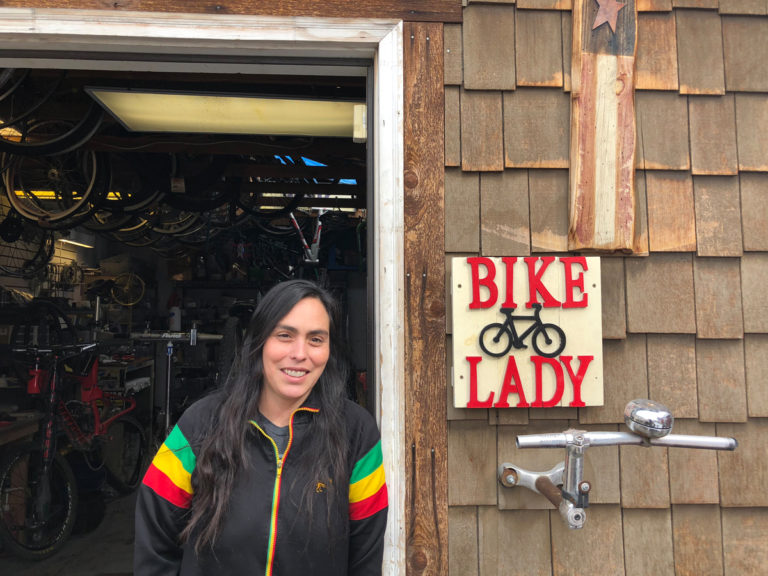
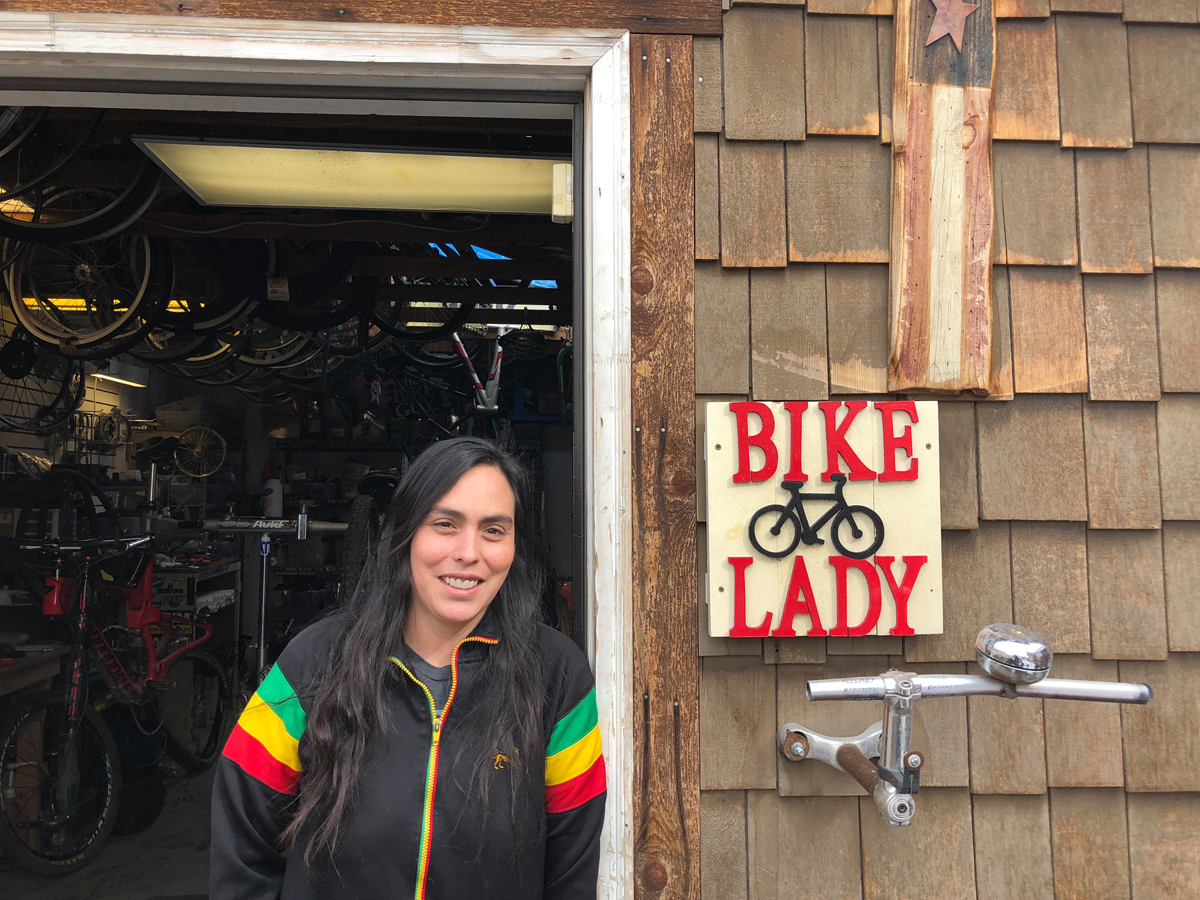
By Lisa Hazel — Elva Nava, The Bike Lady, spent some time with us to fill us in on the updates to her shop.
Elva started working alongside Johnny Barlow, The Bike Guy in 2005. After spending time becoming familiar with how to troubleshoot bike repairs and becoming accustomed to bike repair lingo, Elva began considering the idea of becoming her “own woman” by establishing herself as “The Bike Lady” and the name stuck!
Elva Nava is the owner and operator of The Bike Lady, a bike repair shop in Salt Lake City, Utah. Photo by Dave Iltis
Elva has made her shop unique by stepping into multiple roles within her business. As a mechanic, Elva has made it a priority to match her mechanics vocabulary with her customers’. “It is a great way to make customers with all types of biking experience comfortable,” she says. Once the repair is complete, she provides tips to enhance her customer’s riding preferences. To maintain power she advises to “avoid crossing the chain,” meaning to avoid simultaneous use of the big chain ring in front and big cog in the back to limit derailleur tension; or, for smoother shifting, try an inexpensive shifter overhaul fix.
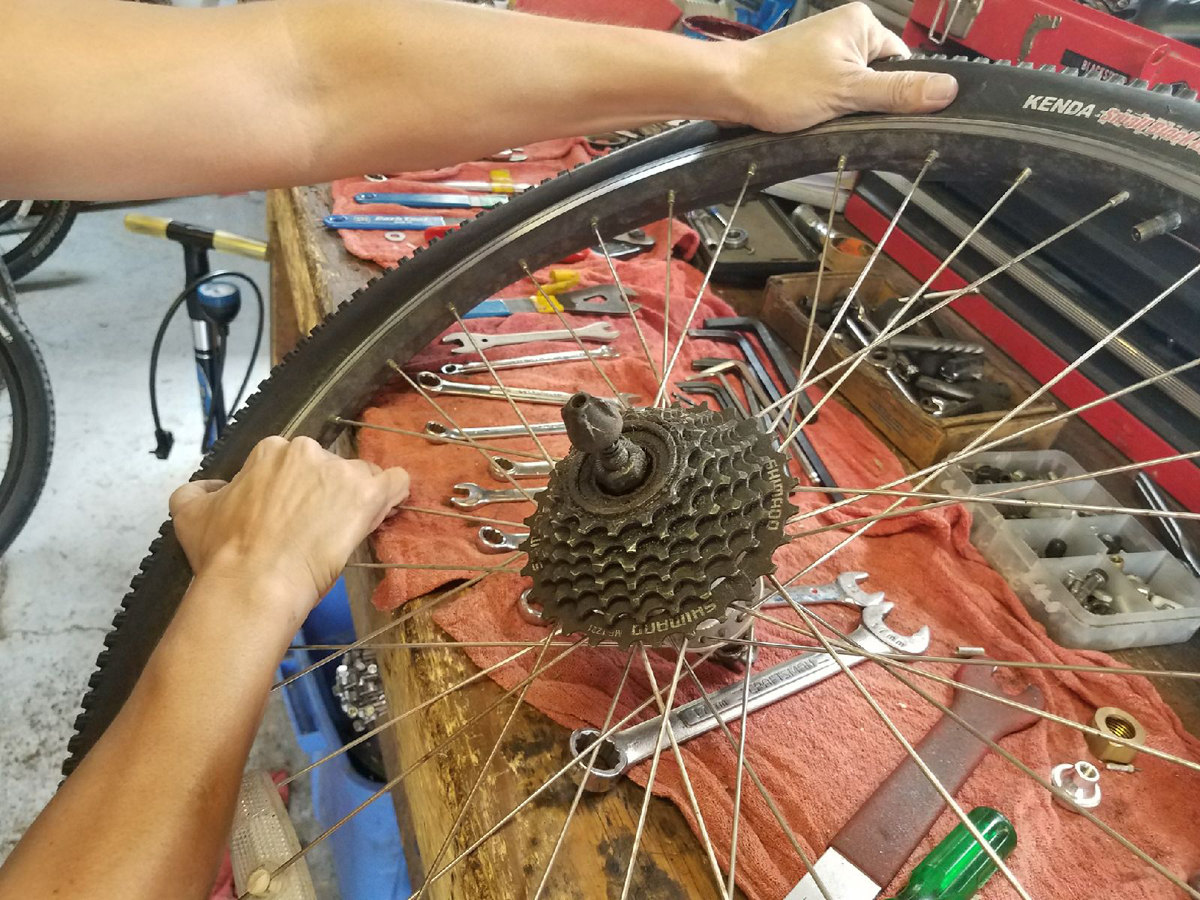
Elva Nava removes a tire in the process of changing a tube. Photo by Lisa Hazel
Elva is an advocate for empowering women by enabling a “fix it yourself” approach to bike repair. She often hears women saying “being able to fix [one’s] own bike allows [them] to ride more consistently.” To give to the women in need of this knowledge, Elva has taught the Women’s Bike Maintenance Clinic at the Bicycle Collective. Empowering women by teaching them to fix a bike is rewarding and helpful; it does not matter where [one] is in life, she says.
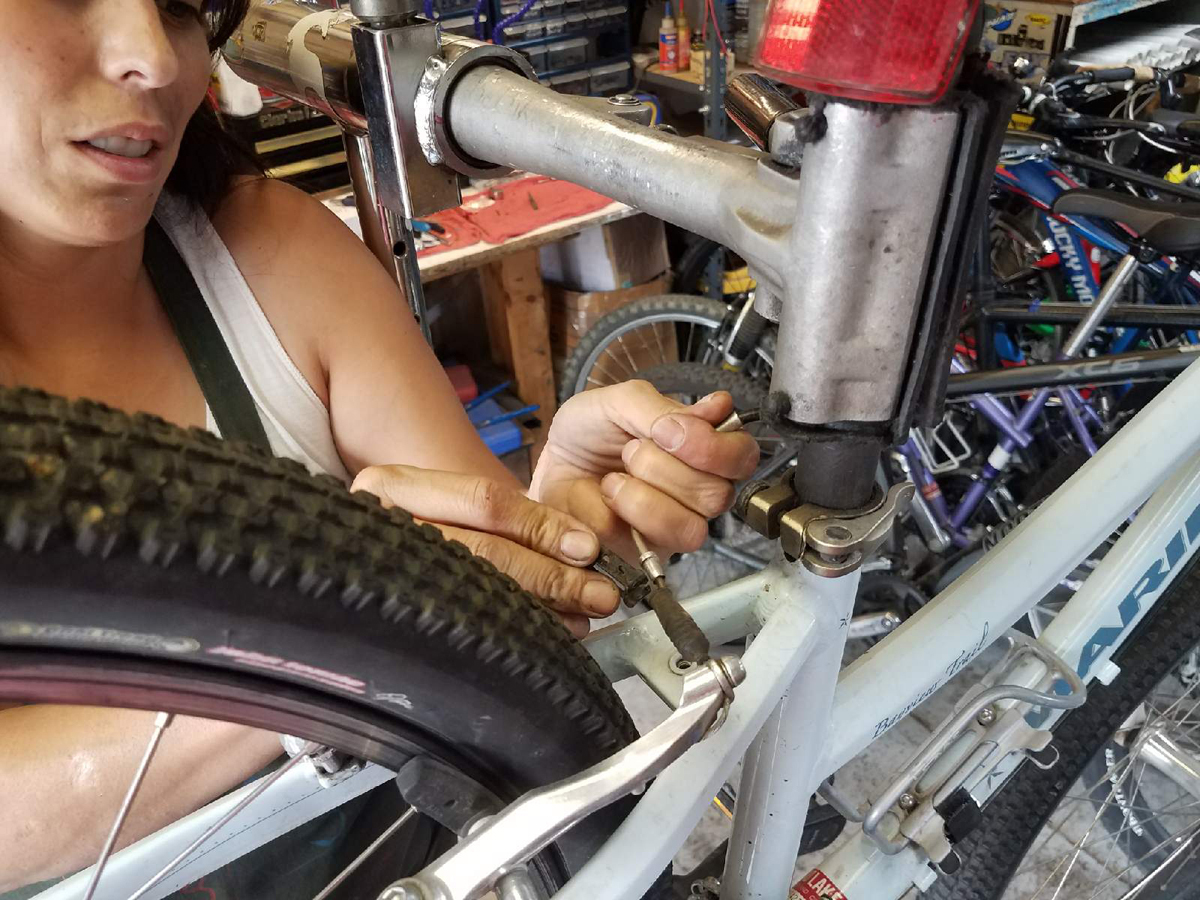
Elva demonstrates her attention to detail and love of bike mechanics. Photo by Lisa Hazel
As a novice bike mechanic, I found conversing with Elva to be informative and enlightening. While spending some time with The Bike Lady, I asked if she could demonstrate how to replace a tube. While she explained this, the precision in her work is clear. It’s obvious Elva enjoys the expertise of bike mechanics. As I watched her go through each step, Elva would explain the reason to perform certain steps with care while emphasizing others as routine. When we got to removing the tube, she emphasized, “loosen one side [of the tire] from the rim and take the tube out completely.” The importance of checking for thorns can not be exaggerated. If the repair is complete and thorns are still lurking, a flat is sure to present itself. After putting in the new tube, Elva conscientiously mentions to make sure the stem is straight. This is to ensure ease of pumping up your tires at home. Elva recommends, “put the wheel between the chain and rear derailleur back on the smallest cog,” she continues, “the derailleur will guide the wheel back into the frame. Once the wheel is in place, tighten it down and fit the brake noodle back into the brake caliber.” Not only was the experience beneficial to my learning, Elva knew how to take each discussion to the next mechanical level. If I asked a general question Elva matched my interest. If I requested more information or a general overview of the role of a part, she went through the part’s role and figured out if that part is fulfilling it.
Elva is interested in getting your bike in working order no matter what your budget. She noted that service is often more cost effective than all new parts. Be prepared for an honest evaluation of your bike’s condition; and if you are interested in thorough or general tips, Elva is the bike mechanic for you. Whether you are an experienced, moderate, or new biker and want dedication to your machine, try The Bike Lady. She will do everything she can to further inspire your interest in biking.
Shop information:
The Bike Lady
1555 So. 900 E.
Salt Lake City, UT 84105
(801) 638-0956 bikeladyslc.com
WASHINGTON, DC (May 6, 2020) — A coalition of transportation groups sent a letter to congressional leadership today outlining four recommendations for how the federal government can fast-track transit and active transportation projects amid the COVID-19 crisis devastating cities and people across America.
“Cycling is about much more than transportation, it is an opportunity to bridge divides and build community,” says Turner Bitton, a cyclist that lives on the west side in Salt Lake City. Photo courtesy Turner Bitton
With a focus on how Congress can empower cities to provide safe, equitable, and healthy transportation options during the pandemic and beyond, the recommendations call for:
Renewed investment in public transit to keep transit agencies afloat;
Continued investment in bicycle and pedestrian facilities through the Surface Transportation Block Grant and Transportation Alternatives programs;
The leveling of several procedural hurdles that have historically slowed these sorts of projects;
A focus on innovative solutions in transportation to help cities incentivize sustainable transportation options as the public begins to return to work. These include investments in bikesharing as a redundancy to public transit and subsidization of transit passes for low-income individuals during the recovery.
“The League of American Bicyclists and our partners are asking Congress to prioritize people and our need for safe, healthy, sustainable transportation options as part of the pandemic recovery efforts,” said Bill Nesper, executive director of the League of American Bicyclists. “The steps we’ve outlined would ensure reliable and equitable access to transit and that better biking and walking networks are core to building back better, post-pandemic.”
“People all around the country are realizing how much public space is dedicated to cars and how little space we have made for actual people,” said Beth Osborne, executive director of Transportation for America. “Especially as we steer through the COVID-19 pandemic, it is absolutely essential that people have space to move around outside while still social distancing. We no longer have any excuses to fail to address these needs.”
“Lyft is proud to stand with the League of American Bicyclists, Transportation for America and other leaders in advocating for investments in transit, bicycle, bikeshare, and pedestrian infrastructure,” said Caroline Samponaro, Head of Micromobility Policy at Lyft. “We are eager to partner with policymakers at all levels to find sustainable, equitable solutions for the future of our cities.”
League of American Bicyclists
America Walks
Association of Pedestrian and Bicycle Professionals (APBP)
BCycle LLC
Lyft
North American Bikeshare Association
National Association of City Transportation Officials (NACTO)
NUMO
PeopleForBikes
Safe Routes Partnership
Shared-Use Mobility Center
Transport Workers Union of America
Transportation for America
We don’t need to be told that cycling provides good exercise and exercise is healthful. But a new study says that it can help preserve your immune system as you age. It found that adults aged 55-79 who had been cycling most of their lives maintained better immune systems than their peers who hadn’t been exercising regularly and were just as good as younger ones in some ways.
The study noted that previous research has concluded that immune systems weaken as we age, leaving people more vulnerable to infection and inflammatory disease. But scientists hadn’t adequately looked at the effects of exercise on retarding the decline. Overall, older cyclists did lose some immunity, but not as much as sedentary peers.
The study, entitled Major Features of Immunesenescence, including Reduced Thymic Output, Are Ameliorated by High Levels of Physical Activity in Adulthood, appeared in the March issue of Aging Cell, a periodical of the Anatomical Society.
If you want to take a look at the scientific gobbledygook (sample line: “Compared with their less active counterparts, the cyclists had significantly higher serum levels of the thymoprotective cytokine IL‐7 and lower IL‐6, which promotes thymic atrophy), see https://onlinelibrary.wiley.com/doi/full/10.1111/acel.12750. Also, remember that one study doesn’t definitively prove anything.
Another new study, meanwhile, indicates that cycling to work may prolong your life, though it doesn’t factor in the chances of being killed by an auto. Instead, it says if you bike totally or part of the way to work, you’re less likely to die from cancer, heart conditions or other causes.
The research, done in the United Kingdom; Association between Active Commuting & Incident Cardiovascular Disease, Cancer & Mortality: Prospective Cohort Study appeared in the BMJ (originally British Medical Journal): https://www.bmj.com/content/357/bmj.j1456.
The researchers say they controlled for other factors, including sex, ethnicity, age, other exercise, smoking, etc. Cycling to work proved more beneficial than walking to the job, though walking provided some benefits. The study didn’t determine cause and effect, other than to note that people who exercise tend to stay healthier than those who don’t.
The study recommends that “(p)olicies designed to affect a population level modal shift to more active modes of commuting, particularly by cycle (e.g., cycle lanes, city bike hire, subsidized cycle purchase schemes, and increasing provision for cycles on public transport) may present major opportunities for the improvement of public health.”
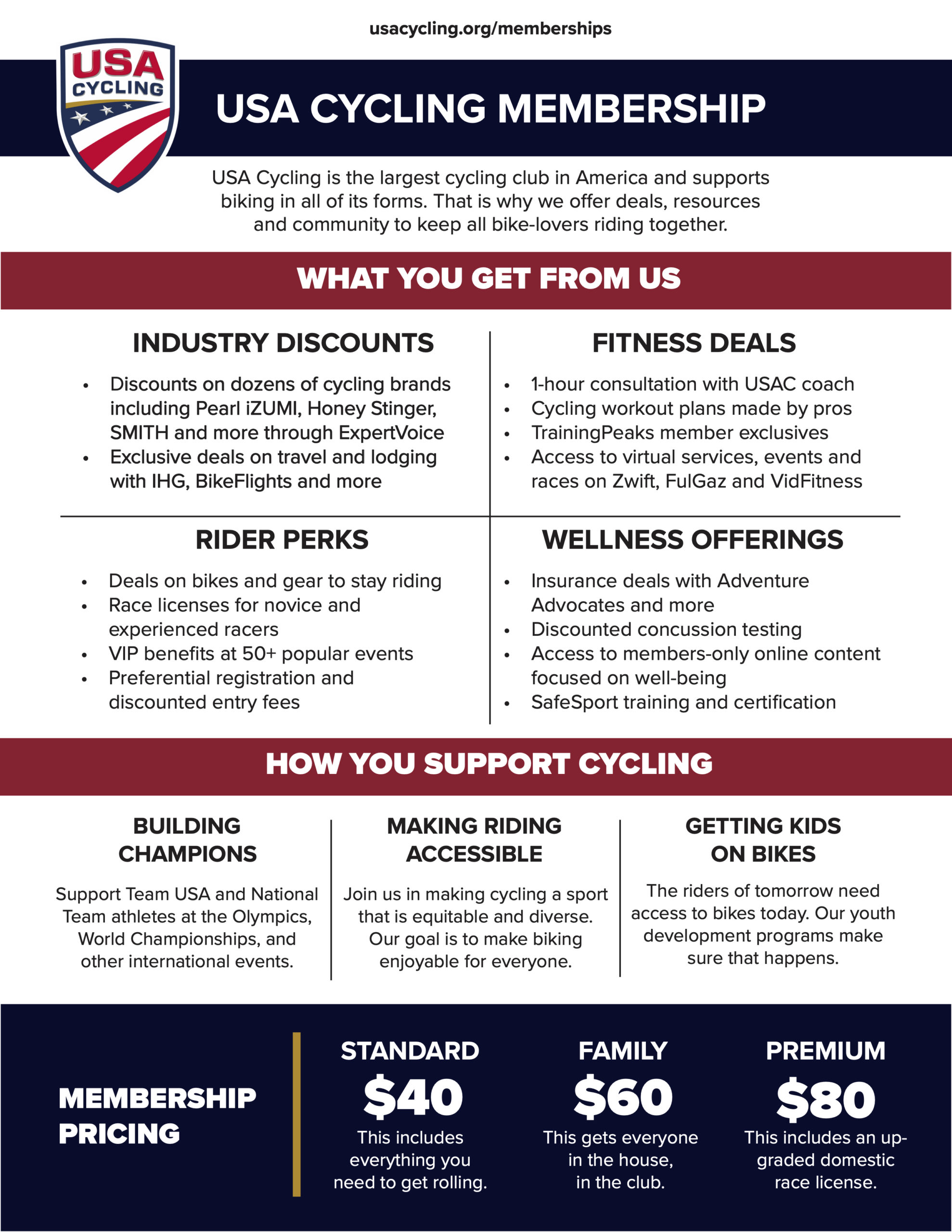
According to recent posts on the Utah Cycling Association’s and Southwest Idaho Cycling Association’s Facebook pages, USA Cycling has announced an offer to support grassroot cycling clubs and provide extra value for their club riders.
A membership with USA Cycling grants you access to the USAC community which includes discounts on dozens of cycling brands, access to virtual training tools, and a race license with VIP benefits for thousands of races every year.
Along with these benefits, your membership allows USA Cycling to support cycling in all its forms. As the national governing body associated with both the UCI and the IOC, USA Cycling helps train Olympians, oversees the sport at both the amateur and domestic levels in the United States, encourages youth riding and champions inclusion in all aspects of the sport.
A $40 standard membership gets you all these perks with a novice (formerly Cat 5) race license, a $60 family membership gets everyone in the household these benefits, and an $80 premium membership includes everything plus a license that qualifies you to race above the novice category.
Premium licenses associated with a $60 family membership will be an additional $40 per individual; so a family membership with two Cat 3 riders would be a total of $140 vs. $160 for two individual memberships/licenses.
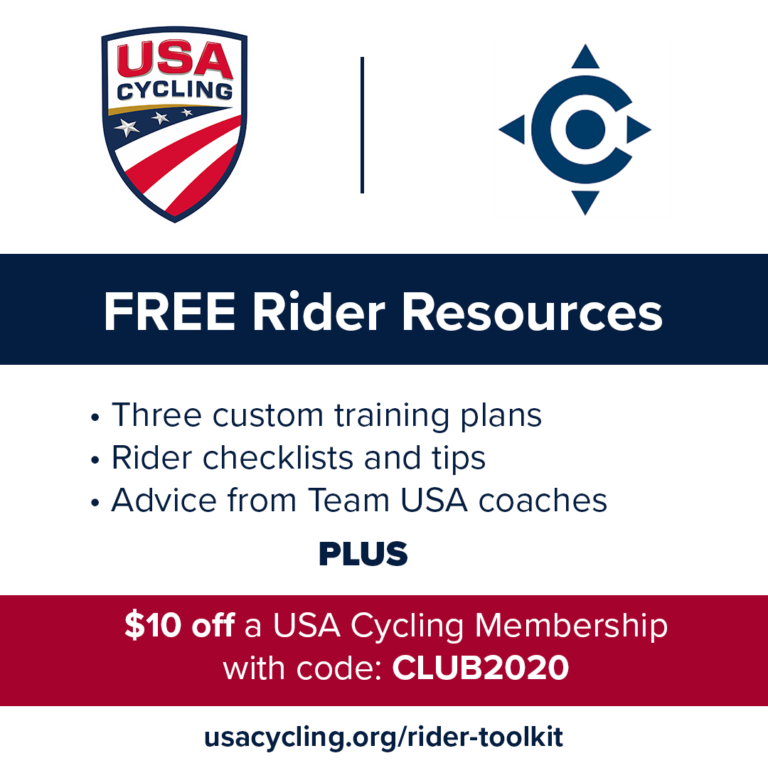
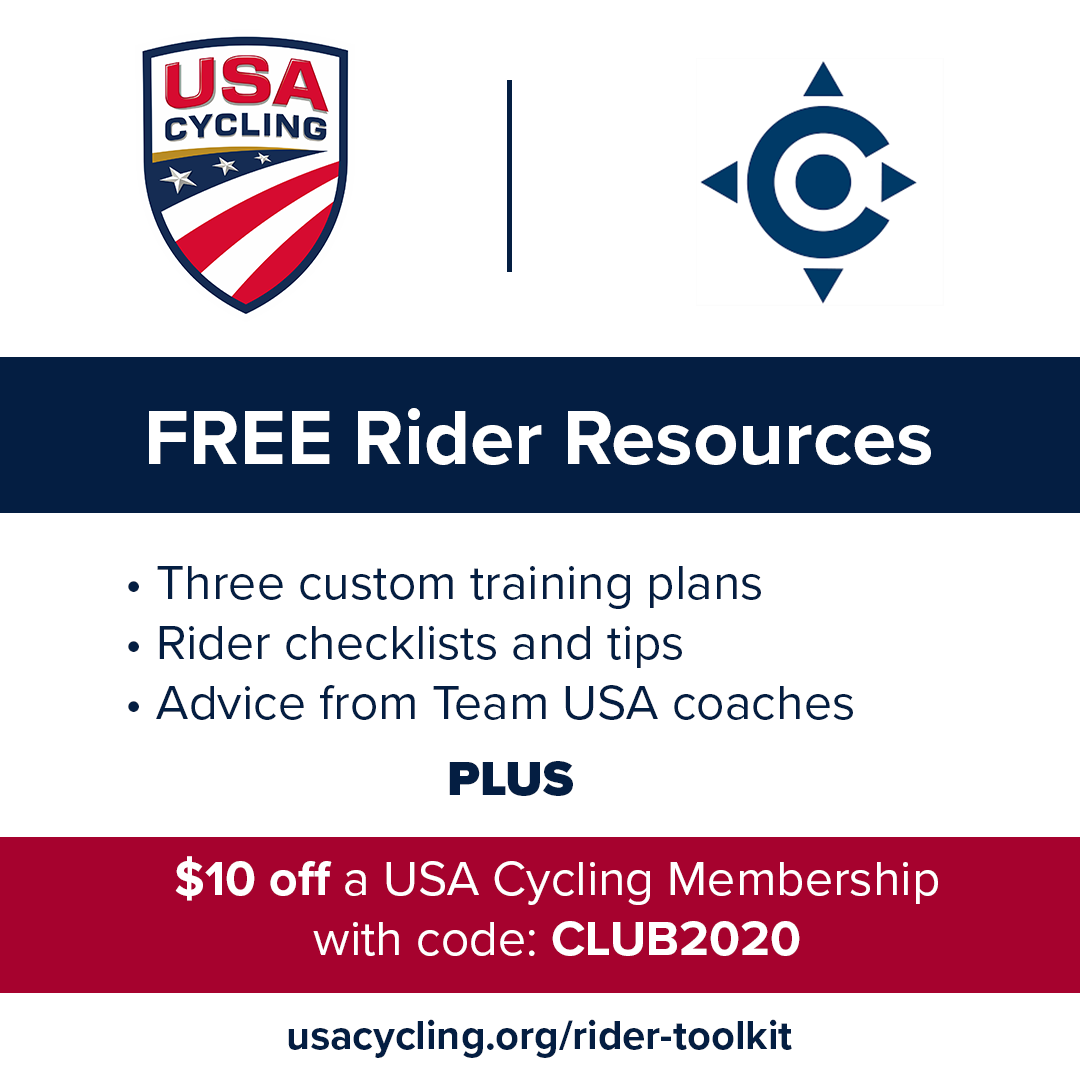
Until June 30, 2020 individuals can use code CLUB2020 to save an additional $10 off a USA Cycling 12-month rolling membership and, if riders identify which local club they are affiliated with, that club will save money on their 2021 club dues.
NEVADA CITY, California (May 4, 2020) — 2020 marks the 60th anniversary of the Nevada City Cycling Classic, the second oldest continuously running bicycle race in the country.
Photo courtesy Nevada City Classic
The Nevada City Classic will be held on the weekend of September 5-6, 2020. We look forward to the first ever September Classic, rescheduled due to COVID-19. In spite of recent sequestrations and events, the Nevada City Classic team is starting the process of planning this year’s event to take place on Saturday and Sunday, September 5-6.
We recognize that events that lay ahead remain unknown. We are committed to complying with all mandates for health and safety. Because it takes months to plan the event, the team is planning the annual schedule, just in case.
Photo courtesy Nevada City Classic
The course is back to the original design by event founder Charlie Allert in 1961, this was done for the race in 2018 and continues to be a popular route.
Register for this historic Pro/Am bicycle race, and watch for other cycling events this weekend.
Classic Brewfest & Nevada City Classic 5K Run/ Fun Walk
The third annual Nevada City Classic Brewfest is on Saturday, September 5, 2020 from 6 to 9 pm. The Brewfest will take place in the Three Forks Bakery & Brewery Parking lot in Nevada City.
A 5K Run/Walk will be held on Sunday, September 6, 2020, starting at 132 Main St, Nevada City. This family-friendly event will include a 5K run/walk, kids’ activities, entertainment, and post-race celebration ceremony.
Watch for details on other Nevada County Cycling Festival events at NevadaCityClassic.com and remember to check in as the COVID-19 situation develops. This event, as all others that conflict with public policy and safety, is subject to modification or cancellation.
By Joe Kurmaskie — There’s nothing like a bike ride, and the longer the better. But what happens when illness or injury gets between you and your true love? I went decades not having to find out. Sure I took spills that kept me off the bike for a few days but nothing more than a few days. Then, last fall I was taken to the mat with an illness that kept me off the bike for weeks. But the bike and the next ride was never far from my thoughts. Or physically, since the bike was only yards away from my bed.
Joe Kurmaskie on a recovery ride. Photo by Matteo Kurmaskie
Many would say why torture yourself? Instead, I saw it as motivation, a talisman of the next ride. A ride I planned to take. The weeks went by, my strength began to return…. slowly. Enough that I could do short circuits in the neighborhood. I cherished these even as they frustrated me. It was a broken hallelujah to be back in the saddle for any length of time. I thought about attaching clothespins and playing cards to my spokes, that’s how much it felt like a new beginning, the first time all over again relationship with the bike. Hills were out of the question, then they weren’t. I added one short climb and did it daily. Rain or shine, I plugged along. I’d add a little more distance every few days. And while I plugged and chugged and made my little circles, I thought about the next actual tour. I thought about a cross country tour over the summer. I thought about a weekend tour to the coast. I thought about the EuroVelo 6 – which is a bike path/low road combo that crosses through ten European countries. There are seventeen of these Eurovelo routes. I was fortunate to ride parts of two of them in France/Italy several years ago – the Eurovelo 5 and Eurovelo 7. I found them delightful and want to go back and ride them all, but since the Eurovelo 6 covers ten countries, most of which I haven’t visited, this seemed like a good goal. www.eurovelo.com/en/eurovelos
As I made my training rides each day I’d use one day to dream and scheme about Europe treks and the next to think domestic. I’ve covered a lot of miles in America but it’s a big place nonetheless. There’s still rubber that hasn’t met the pavement right here in the USA for me. The routes that come to mind for a decent size self supported or hotel tour include a 321 mile treacle filled jaunt in Nebraska dubbed the cowboy trail. www.bikecowboytrail.com/
This northern Nebraska ride follows the old Chicago & Northwestern rail route. The railroad called it the “Cowboy Line” so it makes sense that the bike world stayed with that theme, going with the cowboy trail. Yes, it’s through some rural, hard pan country, but with more trees than one thinks they would encounter in Nebraska – due in part because the rails hugged the waterways across the state.
Then there’s one closer to home, the Trail of the Couer d’ Alenes from Mullan to Plummer, Idaho. It’s only 73 miles but the country is gorgeous and the riding is one of a kind. I was on the verge of doing this two summers back but ran out of time on a family vacation.
This mixed asphalt and gravel packed trail cuts across the shortest length of the state from near Washington to Montana border through the historic Silver Valley. The trail provide views of the valley and Coeur d’Alene Lake. It’s a partnership between the Coeur d’Alene tribe and the Idaho Department of Parks and Recreation. There’s some excellent hotels that specifically cater to folks doing the ride with discounts and shuttles to and from trailheads and bike rentals.
And finally, my recovery riding dreams turn to one of my favorite places to ride on earth, Utah. And this is where my mind fires on too many cylinders for all the good riding, some of which I’ve done, some I haven’t and some I just must do again. Boulder to Escalante, Mammoth Lake Loop, Liberty Loop… but I remind myself that no matter what riding I do in Utah I must hit the 8 miles through Capitol Reef National Park. You can make many stops like in Fruita — a historic community founded in the 1800s by Mormon settlers — and to take in the views — such as the 240-million-year-old Moenkopi rock formation — and possibly for hikes along the Great Wash and Capitol Gorge trails (off-road biking is prohibited in the park). Capitol Reef National Park marks the end of Stage 2 of the Tour of Utah, just outside of Torrey.
My recovery is not to a point where I can take on the idea of climbing the 40 miles up to Bryce Canyon, but maybe after a few more rides and a bit more distance added each day I’ll let my mind wander there.
No matter what your dream tour is, scheming about the next tour while in the saddle is a good way to get your mind firing and your body out the door each day for recovery training. In no time, you’ll be headed towards health and the open road.
Joe Kurmaskie is a journalist, syndicated columnist, and contributor to numerous magazines including Outside, Bicycling Magazine, Men’s Journal and Parenting. He’s a bike advocate, activist, found of Cadence Press, and a Random House author of seven books including Metal Cowboy, Mud, Sweat and Gears and A Guide To Falling Down In Public.